Date: 08/03/1950, mid-morningLocation: Near Dayton, Ohio, USA (Vandalia area and Wright-Patterson Air Force Base)
Dayton, 1950: TWA pilots, tower and Wright-Patterson radar track bright UFO hovering high up
According to NICAP's private report, kept by the CIA, three TWA pilots, more than 20 people from the Vandalia area, the tower and personnel from the Air Force technical intelligence center saw a bright UFO hovering at great altitude. Radar picked it up in the same position, and two F-51 pilots said they saw it as round and metallic before turning back because of the clouds.
- Event date
- 08/03/1950, mid-morning
- Location
- Near Dayton, Ohio, USA (Vandalia area and Wright-Patterson Air Force Base)
- Topic
- CIA file
- Source agencies
- CIA
- Documents
- 1 document · 186 pages
- Reading time
- 10 min
 Page of the NICAP reportPhysical page 89
DOCUMENTARY SOURCES · CIA
What the records tell
The source of this dossier is the report "The UFO Evidence", a private compilation published in 1964 by NICAP (National Investigations Committee on Aerial Phenomena), an American civilian UFO research organization. A copy was kept by the CIA and released in 2001 in the CREST archive, which proves that the agency kept it, not that it produced or validated it. The Dayton case takes up one paragraph of the section on radar, on physical page 89. This passage has no source note; NICAP usually based cases from this period on books by Donald Keyhoe and Edward Ruppelt and on Air Force reports cited by them.
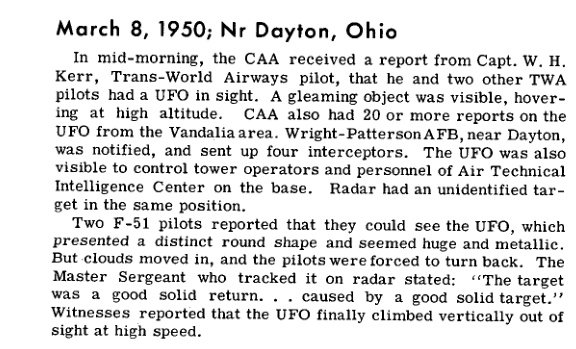
According to the summary, in mid-morning on March 8, 1950, the CAA, the civil aviation agency, received a report from Captain W. H. Kerr, a Trans-World Airways pilot: he and two other TWA pilots had an unidentified flying object in sight. It was a gleaming object, hovering at great altitude. The CAA also received more than 20 reports about the object from the Vandalia area, near Dayton.
Wright-Patterson Air Force Base, next to Dayton, was notified and sent four interceptors. The object was also visible to the tower controllers and to personnel of the Air Technical Intelligence Center, ATIC, which operated at the base and handled the Air Force's UFO investigation. The radar had an unidentified target in the same position. Two F-51 pilots said they could see the object, distinctly round in shape, huge and metallic, but clouds closed in and they had to turn back.
The master sergeant who tracked the target on radar is quoted with one sentence: the echo was a good, solid return, caused by a solid target. According to witnesses, the object eventually climbed vertically, at high speed, until it disappeared. The report does not give the official explanation of the case, if there was one, nor the names of the military pilots and the radar operator, nor the exact time, altitude or duration.
What is account and what is measurement should be kept apart. The descriptions of shape and size come from visual observation, with the naked eye or from the aircraft. The only instrument data is the existence of an echo at the object's position, with no altitude or distance. As an editorial hypothesis, bright objects hovering at great altitude in broad morning daylight are often compared to high-altitude balloons or to planets visible by day; NICAP's text does not discuss any of these possibilities and the original sources are not in this archive.
DIRECT READING OF THE FILE
The document, in the original
Private publication (NICAP report): the English text is not reproduced or translated in full. Each translations block provides a faithful summary, in English, of the portion of the case on the indicated physical page, with at most one short quotation. The images are crops of the report's pages. Summarized here is the case of 08/03/1950 on page 89; the other cases on the page were left out. This case's line in the radar table is on a page outside this batch (p. 81).
EXCERPT 1 · PHYSICAL PAGE 89
Physical page 89, left column: case of 08/03/1950, near Dayton
tis “ApRroved For Release 2001/04/02 : CIA-RDP81R00560R000100010001-0
believable target they had just seen. The in-
specting officers were appalled that such a coincidence
should happen. I was part of the meager intelligence report-
ing machinery at the base and I was called in to make an
immediate urgent intelligence report on the incident. The
prevailing theory at the time was that it was a meteor. I
personally discounted this since upon interviewing the radar
observers on both sides of the base they stated that it main-
tained an altitude of 60,000 feet and a speed of approximately
9000 mph.
“To make this story more incredible the very next day
both radars again reported an object hovering over the base
at about 10 mph, at 45,000 feet. The ‘‘official”’ story on this
was that they were probably some type of “high-flying sea-
gulls.” You must remember all these incidents happened
before the days of fast high flying jets and missiles and the
now common altitude record-breaking helicopters.”’
(Maj. Jerome then added: ‘‘On my recent tour in Alaska
[circa 1960], I became very familiar with the early warning
and air defense systems on the DEW Line and Alaska Air
Defense Sectors. Many times high speed unknown objects
were discerned which could not be explained as normal air
breathing vehicles penetrating our sectors. Many of the citi-
zens of Alaska along the Bering Sea Coast have reported
seeing missile-like aircraft flying at very low altitudes at
very high speeds, The AF denied the presence of Russian
aircraft vehemently. When it was suggested that they might
be extra-terrestrial everyone clammed up.’’)
October 15, 1948; Japan
Capt. Edward J. Ruppelt reported the following case received
by Project Sign (the original Air Force UFO investigation pro-
ject) in October 1948.
An F-61 “Black Widow” night fighter on patrol over Japan,
October 15, picked up an unidentified radar target. The UFO
was traveling about 200 mph. between 5000 and 6000 feet. Each
time the F-61 tried to close in, the object would accelerate to an
estimated 1200 mph., outdistancing the interceptor before slowing
down again. On one of six passes at the UFO, the crew of the
F-61 got close enough to see its silhouette. The UFO appeared
to be 20-30 feet long and shaped ‘‘like a rifle bullet.”
November 23, 1948; Fursten-Feldbruck, Germany
An unidentified object resembling a reddish light was sighted
east of the base at 2200 hours, local time. Capt. [names
deleted from Air Force reports] said the UFO was moving south
across Munich, turned southwest, then southeast. Not knowing
the height, the speed could not be estimated; but it appeared to
be traveling between 200 and 600 mph.
Capt. reported the sighting to base operations, andthe
radar station chécked its scope. An unidentified target, traveling
900 mph., was detected at 27,000 feet about 30 miles south of
Munich. Capt.. verified that the UFO was now visible in
that area, Radar then reported that the target had climbed quick-
ly to 50,000 feet and was circling 40 miles south of Munich.
March 8, 1950; Nr Dayton, Ohio
In mid-morning, the CAA received a report from Capt. W. H.
Kerr, Trans-World Airways pilot, that he and two other TWA
pilots had a UFO in sight. A gleaming object was visible, hover-
ing at high altitude. CAA also had 20 or more reports on the
UFO from the Vandalia area. Wright-Patterson AFB, near Dayton,
was notified, and sent up four interceptors. The UFO was also
visible to control tower operators and personnel of Air Technical
Intelligence Center on the base. Radar had an unidentified tar-
get in the same position.
Two F-51 pilots reported that they could see the UFO, which
presented a distinct round shape and seemed huge and metallic.
But clouds moved in, and the pilots were forced to turn back. The
Master Sergeant who tracked it on radar stated: ‘‘The target
was a good solid return. . . caused by a good solid target.’
Witnesses reported that the UFO finally climbed vertically out of
sight at high speed.
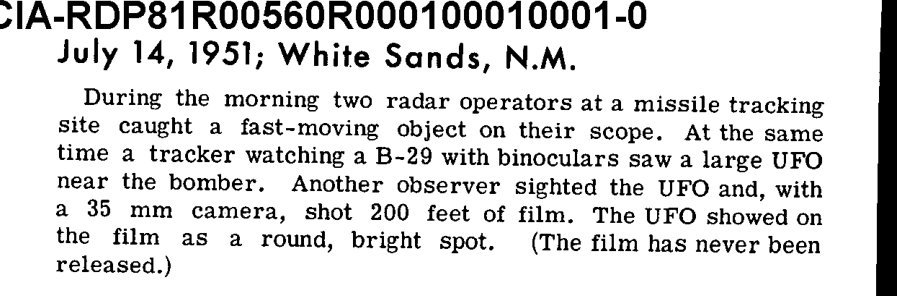
July 14, 1951; White Sands, N.M.
During the morning two radar operators at a missile tracking
site caught a fast-moving object on their scope. At the same
time a tracker watching a B-29 with binoculars saw a large UFO
near the bomber. Another observer sighted the UFO and, with
a 35 mm camera, shot 200 feet of film. The UFO showed on
the film as a round, bright spot. (The film has never been
released.)
Fall 1951; Korean Area
‘Following are extracts from a letter to NICAP dated May 16,
1957, signed by Lt. Cmdr. M. C. Davies, U.S.N., then stationed
at the U. S, Naval Air Station, Jacksonville, Florida.
My background is a Naval Aviator with approximately 4000
hours. At the time of the incident I was deployed with an
Anti-Submarine Squadron aboard a CVE class carrier. I was
assigned Air Crew Training Officer and prior to deployment
had attended CIC Air Controller School at Point Loma, also
Airborne Air Controller School and Airborne Early Warning
School both located at NAS, San Diego. . .
It was at night, I was riding with a radar operator which I
often did to check on their proficiency. We were flying at
5000 feet, solid instruments, with our wingman flying a radar
position about 3 miles astern and slightly to our right or left.
The target, which was slightly larger than our wingman, I
picked up on our scope, had been circling the fleet; it left
the fleet and joined up on us a position behind our wingman,
approximately the same position he held on us.
I reported the target to the ship and was informed that the
target was also held on the ship’s radars, 14 in number; and
for us to get a visual sighting if possible. This was impossible
because of the clouds. The target retained his relative
position for approximately 5 minutes and then departed in
excess of one thousand miles per hour. He departed ona
straight course and was observed to the maximum distance
of my radar which was two hundred miles.
Upon completion of my flight an unidentified flying object
report was completed, at which time I was informed that the
object was held on ship’s radars for approximately seven
hours.
July 1, 1952; Ft. Monmouth, N.J.
A radar tracking of two UFOs at Fort Monmouth, N. J. was
one of a series of sightings which fit a definite pattern. It
occurred at a time when the Air Force was swamped with UFO
reports - good ones. (See Section XII, 1952 Chronology.] Also,
it was the first of ten known incidents of UFOs tracked by radar
during July 1952. (See chart).
The sequence of events, reported by the Air Force UFO pro-
ject chief, was as follows.
7:30 a.m., Boston, Mass. A couple in nearby Lynn and an
Air Force Captain in Bedford saw two F-94’s which had been
scrambled on an intercept mission. The Captain saw one and
the couple saw two silvery cigar-shaped UFOs, which moved
southwest across Boston, outspeeding the jets.
9:30 a.m., Ft. Monmouth, N. J. Radar tracked two UFO tar-
gets, also observed visually as two shiny objects. The UFOs
approached slowly from the northeast, and hovered nearby at
50,000 feet for about 5 minutes.. Suddenly the blips on the
scope accelerated and shot away to the southwest, confirmed
by visual observation.
A_few hours later, Washington, D.C. A physics professor
at George Washington University, and dozens of others, saw
a grayish UFO bobbing back and forth in the sky about 30-40
degrees above the north-northwest horizon.
None of the sightings could be explained.
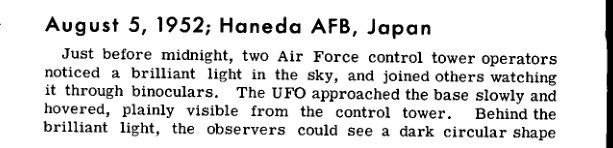
August 5, 1952; Haneda AFB, Japan
Just before midnight, two Air Force control tower operators
noticed a brilliant light in the sky, and joined others watching
it through binoculars. The UFO approached the base slowly and
hovered, plainly visible from the control tower. Behind the
brilliant light, the observers could see a dark circular shape
Approved For Release 2001/04/02 : CIA-RDP81R00560R000100010001-0Check the original PDF
[p. 89: texto da publicação privada não reproduzido; ver o resumo]View the document record ↗ · Physical page 89, counting the cover.
Dates and documentary context
- Event
- 08/03/1950 — Mid-morning of 08/03/1950, according to the NICAP summary.
- Document
- 02/04/2001 — Date of the CREST release stamp printed on all pages (Approved For Release 2001/04/02).
- Publication
- 1964 — Year of publication of the report "The UFO Evidence" by NICAP.
Origin and release
National Investigations Committee on Aerial Phenomena (NICAP), American civilian organization; private report "The UFO Evidence" (1964). Copy kept in the CIA's CREST archive (CIA-RDP81R00560R000100010001-0, released on 02/04/2001); the CIA kept the text, it did not produce or validate it · CIA-RDP81R00560R000100010001-0_NICAP-The-UFO-Evidence_1964.pdf
CIA CREST, CIA-RDP81R00560R000100010001-0, release of 02/04/2001 ↗ — undefined
Questions to continue the investigation
- Is there a Project Grudge or Blue Book file for 08/03/1950 in Dayton, with the official evaluation and the radar data?
- Did the four interceptors sent include the two F-51s mentioned, and what did the other two report?
GEOGRAPHY OF THE CASE
Dayton and Vandalia, Ohio
Approximate reference to the area cited in the report, placed by the editorial team. It does not indicate the position of the object.
DOCUMENTARY TRAIL
Go back to the sources
References use physical pages of the PDF, counting the cover. Summaries are presented in English; the documents keep their original language.
- CIA-RDP81R00560R000100010001-0_NICAP-The-UFO-Evidence_1964.pdf
Physical page 89: case of 08/03/1950, near Dayton, Ohio
CIA · 186 pages
Editorial summary based on the collection's research notes. How we read the documents.