Date: August 25, 1952Location: Location not identified in the excerpt
The musician and the UFO with small propellers
A musician on his way to work describes bluish windows, a human figure and small propellers on the edge of a UFO close to the ground.
- Event date
- August 25, 1952
- Location
- Location not identified in the excerpt
- Topic
- Traces and accounts
- Source agencies
- CIA
- Documents
- 1 document · 312 pages
- Reading time
- 12 min
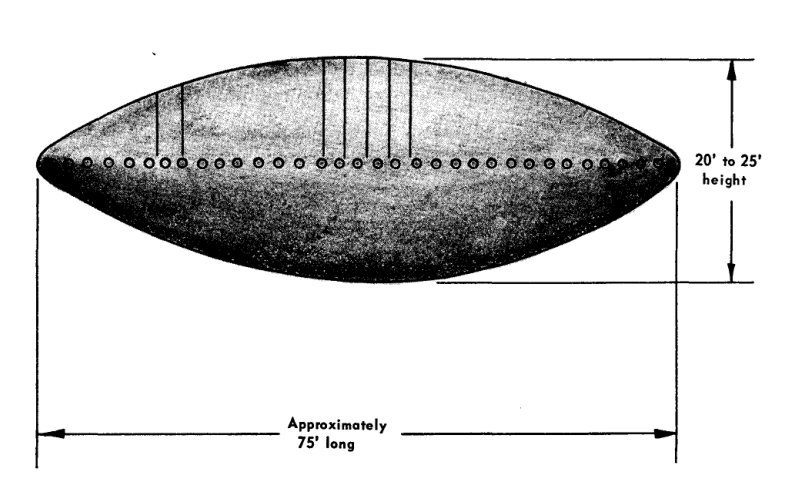 Official report drawingPhysical page 100
DOCUMENTARY SOURCES · CIA
What the records tell
At 5h35 on August 25, 1952, a musician from a radio station was driving to work when he noticed a UFO hovering over a field near the road. He stopped the car and got out to observe. The account was included as Case XII, number 3601.00, in Project Blue Book Special Report 14, part of the official documentation of the U.S. investigation.
The witness described an oval UFO, with a smooth surface the color of dull aluminum, whose shape resembled two platters placed against each other. It was reportedly approximately three meters above the ground and wobbled slightly. When he turned off the car engine, the musician said he heard a deep, pulsating sound coming from that direction.
A window in the front part reportedly emitted blue light. In it, the observer stated that he could make out the head and shoulders of a seated man, motionless and facing forward. In the middle section, other windows reportedly showed blue lighting of varying shade and internal activity that he could not identify as human or mechanical.
The most unusual element of the description is a series of small propellers close to one another along the outer edge. According to the account, they spun rapidly in a horizontal plane. The UFO reportedly began a vertical climb, producing a different sound, and continued until it disappeared. These characteristics belong to the testimony reproduced in the document, not to a reconstruction produced by this portal.
The subsequent investigation also appears in the summary. Signs of disturbed vegetation at the site were described, but the examination of the grass and soil samples revealed nothing unusual. The report considered the observer's reliability to be good. Reading the testimony and the result of the inspection together preserves both the extraordinary character of the encounter and what was actually recorded in the field.
The figure was described as a man; the text provides no basis for turning it into a non-human being. Likewise, the internal movement remained unidentified. The interest of the episode lies in the richness and strangeness of the details that an official investigation decided to record, including its still-open questions.
The page consulted does not identify the city or the field. The case enters the timeline in August 1952 and the map list as a location to be confirmed. The next documentary step is to recover the full testimony, the original drawings and the records of the sample analysis using the number 3601.00.
The full text of Case XII in Report 14 contains details that the current text does not record. The musician was about 100 yards from the UFO and did not leave the road because the surrounding terrain was rough. He described the UFO as about 75 feet long, 45 wide and 15 thick, and the propellers as 6 to 12 inches in diameter, mounted on a bracket. As it climbed, the UFO made a noise compared to that of "a large covey of quail taking off all at once" and passed through scattered clouds, which did not hide it from view. The report's drawing indicates a height of 20 to 25 feet, a figure different from the thickness given in the text.
In the evaluation of Special Report 14, the musician's case was in the strongest group of the 12 "good unknowns." Cases VIII to XII were the only ones that met three of the four conditions required for a model: shape and maneuvers similar to those of many other accounts, a reliable observer and account, and details that ruled out a common object or a known natural phenomenon. They failed only on the fourth, because none of them matched another. In Case XII, what made it unique were the windows on the top, in the front and in the upper part of the central section, and the set of propellers around the waist.
Right after the list, the report draws its general conclusion. Of about 4.000 people who said they had seen a flying saucer, only 12 gave detailed descriptions, and even this "cream" did not make it possible to form a picture of what a saucer would be. The team looked for groups of unknowns with the same characteristics and found none, and concluded that the probability that the unknowns represented a class of flying saucers was low. It added that some cases later identified had seemed, before identification, as strange as any of the 12. None of these sentences deals with the musician in particular.
The case has three layers that should be kept separate. The account is the musician's: the UFO some 3 meters off the ground, the measurements, the seated man, the activity in the center, the propellers, the two sounds and the disturbed vegetation. The verification was by investigators who were at the site shortly afterward and found some signs of disturbed vegetation. The analysis of the grass and soil samples showed nothing unusual. The final evaluation, from 1955, considered the witness's reliability to be good, without saying who evaluated it or by what criterion.
DIRECT READING OF THE FILE
The document, in the original
Full translation of the pages added to this dossier. Addresses and personal data of private individuals were omitted and marked.
EXCERPT 1 · PHYSICAL PAGE 100
Captions of the Case XII drawing, physical page 100
20' to 25'
height
I
I
I
I
I
I
I
I
I
I
I
I
I
Approximately
.....,._____ ----~
75' long I
I
I
I
I
I
I
I
90 IEditorial note: The drawing is already published in the dossier and is not repeated. The height in the drawing (20 to 25 feet) differs from the thickness given in the text (15 feet).
Check the original PDF
20' to 25' height. Approximately 75' long.View the document record ↗ · Physical page 100, counting the cover.
EXCERPT 2 · PHYSICAL PAGE 101
Selection criterion and the four conditions of the model, physical page 101 (passage referring to all cases)
I
I
I
These 12 sightings can be classed into four categories on the basis of
their shapes, as follows:
( l} Propeller shape - Case I
I (2) Aircraft shape - Cases II and III
I (3) Cigar shape - Cases IV and V
I (4) Elliptical or disc shape - Cases VI to XII
The criterion for choosing the above sightings was that their descrip I tions were given in enough detail to permit diagrams of the objects to be
I
drawn. It might be noted here that in all but one of these cases (Case XI)
the observer had already drawn a diagram of what he had seen.
The objective of this section of the study was the conceiving of a
I model, or models. The requirement that the description be detailed is an
I
important one, and was the easiest to determine in the re-evaluation program. However, a good model ought to satisfy the following conditions as
well:
I ( 1) The general shape of the object and the maneuvers it
performed should fit the reports of many of the UNKNOWNS
and thus explain them.
I (2) The observer and the report should be reliable.
I (3} The report should contain elements which should have
been observed with accuracy, and which eliminate the
I possibility that the sighting could be ascribed to a
familiar object or to a known natural phenomenon.
I ( 4} The model should be derived from two or more good
UNKNOWNS between which there is no essential conflict.
I It can be shown that it is not possible to deduce a model from the 12
cases that will satisfy all of these conditions. The following case-by-case
I discussion of the 12 good UNKNOWNS will illustrate this point:
I ( 1) Case I does not satisfy Conditions 1 and 4. The reported
shape of this object is not duplicated in any of the other
UNKNOWNS.
I
I •(2) Case II does not satisfy Conditions 1 and 3. There are
very few UNKNOWNS in the aircraft shape classification.
In addition, the unusual characteristic of this sighting
I
(i.e., the red glow) could have been reflection of the
lights of Flint from the objects if they were either birds
or aircraft.
91
IEditorial note: Passage common to the 12 cases; the sign [...] marks a sentence from the middle omitted because it deals only with the general objective of the study, already translated in the Report 14 dossier.
Check the original PDF
The criterion for choosing the above sightings was that their descriptions were given in enough detail to permit diagrams of the objects to be drawn. It might be noted here that in all but one of these cases (Case XI) the observer had already drawn a diagram of what he had seen. [...] a good model ought to satisfy the following conditions as well: (1) The general shape of the object and the maneuvers it performed should fit the reports of many of the UNKNOWNS and thus explain them. (2) The observer and the report should be reliable. (3) The report should contain elements which should have been observed with accuracy, and which eliminate the possibility that the sighting could be ascribed to a familiar object or to a known natural phenomenon. (4) The model should be derived from two or more good UNKNOWNS between which there is no essential conflict.View the document record ↗ · Physical page 101, counting the cover.
EXCERPT 3 · PHYSICAL PAGE 102
Evaluation of Cases VIII to XII, physical pages 102 and 103
(3) Case III does not satisfy Condition 1. It also does not
satisfy Condition 4 when Case II is eliminated as a
good UNKNOWN.
(4) Case IV does not satisfy Conditions 1 or 2. There are
few cigar-shaped or rocket-shaped objects reported in
the literature. In addition, this observer is not considered to be well-qualified technically.
(5) Case V does not satisfy Condition 1. It also does not
satisfy Condition 4 when Case IV is eliminated as a
good UNKNOWN.
It might be argued here that many of the UNKNOWNS might actually
have shapes similar to these good UNKNOWNS. It will be noted, however,
that each of these five cases does not satisfy one of the other three conditions.
(6) Case VI does not satisfy Condition 2. In the description
of the object, it was stated that at certain times there
was no light seen from the object. Apparently, the
"band of no light", as diagrammed by the observer, was
an attempt to explain this. However, if the object were
constructed as shown in the diagram, light should have
been seen at all times. Because of this conflict the
drawing is not considered reliable, and without the drawing, there is not enough detail in the description to make
it useful for this study.
(7) Case VII violates Conditions 1 and 4. Although the shape
is disc-like, the maneuvers performed by the object are
unique both among the UNKNOWNS and among the good
UNKNOWNS.
Cases VIII to XII satisfy Conditions 1 through 3, but they do not
satisfy Condition 4. The features which make them different from each
other are as follows:
(8) Case VIII. The object is smooth, with no protrusions
or other details.
( 9) Case IX. The object had rocket or jet pods on each
side that were shooting out flames.
(10) Case X. The,object had a fin or rudder.
( 11) Case XI. The object had a series of portholes, or
windows, on its under side.
92
I
I
I
I
I
I
I
I
I
I
I
I
I
I
I
I
I
I
I
I
I
IEditorial note: The passage cites the five cases together because the report's conclusion depends on the comparison between them.
Check the original PDF
Cases VIII to XII satisfy Conditions 1 through 3, but they do not satisfy Condition 4. The features which make them different from each other are as follows: (8) Case VIII. The object is smooth, with no protrusions or other details. (9) Case IX. The object had rocket or jet pods on each side that were shooting out flames. (10) Case X. The object had a fin or rudder. (11) Case XI. The object had a series of portholes, or windows, on its under side. (12) Case XII. The object had windows in its top and front and its top midsection. It also had a set of propellers around its waist. It is not possible, therefore, to derive a verified model of a "flying saucer" from the data that have been gathered to date.View the document record ↗ · Physical page 102, counting the cover.
EXCERPT 4 · PHYSICAL PAGE 99
Physical page 99 (p. 89): Case XII, serial number 3601.00 (full text, with one personal health detail omitted)
I
I
Case XII (Serial 3601. 00)
I At 0535 on the morning of August 25, 1952, a musician for a radio
station was driving to work from his home when he noticed an object
I hovering about 10 feet above a field near the road along which he was
I
driving. As he came abreast of the object, he stopped his car and got out
to watch. Having an artificial leg, he could not leave the road, since the
surrounding terrain was rough. However, he was within about 100 yards
I
of it at the point he was standing on the road. The object was not absolutely
still, but seemed to rock slightly as it hovered. When he turned off the
motor of his car, he could hear a deep throbbing sound coming from the
object. As he got out of the car, the object began a vertical ascent with a
I sound similar to "a large covey of quail starting to fly at one time". The
object ascended vertically through broken clouds until out of sight. His
I view was not obscured by clouds. The observer states that the vegetation
was blown about by the object when it was near the ground.
I Description of the object is as follows:
It was about 75 feet long, 45 feet wide, and 15 feet thick, shaped like I two oval meat platters placed together. It was a dull aluminum color, and
I
had a smooth surface. A medium-blue continuous light shone through the
one window in the front section. The head and shoulders of one man, sitting
motionless, facing the forward edge of the object, were visible. In the
midsection of the object were several windows extending from the top to the
I rear edge of the object; the midsection of the ship had a blue light which
I
gradually changed to different shades. There was a large amount of activity
and movement in the midsection that could not be identified as either human
or mechanical, although it did not have a regular pattern of movement.
I
There were no windows, doors or portholes, vents, seams, etc., visible
to the observer in the rear section of the object or under the object (viewed
at time of ascent). Another identifiable feature was a series of propellers
6 to 12 inches in diameter spaced closely together along the outer edge of I the object. These propellers were mounted on a bracket so that they
I
revolved in a horizontal plane along the edge of the object. The propellers
were revolving at a high rate of speed.
I
Investigation of the area soon afterward showed some evidence of
vegetation being blown around. An examination of grass and soil samples
taken indicated nothing unusual. Reliability of the observer was considered
good. I
I
I
I
89
IEditorial note: A personal health detail about the observer was omitted. 10 feet is about 3 m; 100 yards, about 90 m; 75, 45 and 15 feet, about 23, 14 and 4,6 m; 6 to 12 inches, about 15 to 30 cm.
Check the original PDF
Case XII (Serial 3601.00). At 0535 on the morning of August 25, 1952, a musician for a radio station was driving to work from his home when he noticed an object hovering about 10 feet above a field near the road along which he was driving. As he came abreast of the object, he stopped his car and got out to watch. [Omitted: personal health information.] He could not leave the road, since the surrounding terrain was rough. However, he was within about 100 yards of it at the point he was standing on the road. The object was not absolutely still, but seemed to rock slightly as it hovered. When he turned off the motor of his car, he could hear a deep throbbing sound coming from the object. As he got out of the car, the object began a vertical ascent with a sound similar to "a large covey of quail starting to fly at one time". The object ascended vertically through broken clouds until out of sight. His view was not obscured by clouds. The observer states that the vegetation was blown about by the object when it was near the ground. Description of the object is as follows: It was about 75 feet long, 45 feet wide, and 15 feet thick, shaped like two oval meat platters placed together. It was a dull aluminum color, and had a smooth surface. A medium-blue continuous light shone through the one window in the front section. The head and shoulders of one man, sitting motionless, facing the forward edge of the object, were visible. In the midsection of the object were several windows extending from the top to the rear edge of the object; the midsection of the ship had a blue light which gradually changed to different shades. There was a large amount of activity and movement in the midsection that could not be identified as either human or mechanical, although it did not have a regular pattern of movement. There were no windows, doors or portholes, vents, seams, etc., visible to the observer in the rear section of the object or under the object (viewed at time of ascent). Another identifiable feature was a series of propellers 6 to 12 inches in diameter spaced closely together along the outer edge of the object. These propellers were mounted on a bracket so that they revolved in a horizontal plane along the edge of the object. The propellers were revolving at a high rate of speed. Investigation of the area soon afterward showed some evidence of vegetation being blown around. An examination of grass and soil samples taken indicated nothing unusual. Reliability of the observer was considered good.View the document record ↗ · Physical page 99, counting the cover.
Dates and documentary context
GEOGRAPHY OF THE CASE
Location to be confirmed
The excerpt consulted does not identify a location sufficient to place the encounter. No coordinates were assigned.
DOCUMENTARY TRAIL
Go back to the sources
References use physical pages of the PDF, counting the cover. Summaries are presented in English; the documents keep their original language.
- CIA-UAP-015-Project_Blue_Book_Special_Report_No_14.pdf
Special Report 14, p. 99 (physical page of the PDF)
CIA · 312 pages
Editorial summary based on the collection's research notes. How we read the documents.