Date: August 1965 (Gemini V mission); debriefing from 30/08 to 02/09/1965Location: Earth orbit and nighttime reentry of Gemini V
Gemini V, 1965: a green "aurora-like" UFO, a possible satellite, and another UFO reentering behind the spacecraft
In the sightings section of the Gemini V debriefing, Gordon Cooper and Charles Conrad talk about an intense green UFO that changed the appearance of the airglow, a possible satellite in free flight, and a large UFO reentering behind them. The astronauts themselves suggest aurora and spacecraft parts as explanations.
- Event date
- August 1965 (Gemini V mission); debriefing from 30/08 to 02/09/1965
- Location
- Earth orbit and nighttime reentry of Gemini V
- Topic
- Astronaut accounts
- Source agencies
- NASA
- Documents
- 2 documents · 548 pages
- Reading time
- 651 min
 Debriefing transcriptPhysical page 157
DOCUMENTARY SOURCES · NASA
What the records tell
The Gemini V debriefing was recorded from August 30 to September 2, 1965, in the crew quarters at Cape Kennedy. The preliminary transcript of the second part, dated September 2, notes that it has not undergone full editorial review. Section 10.0, on visual sightings, gathers what Gordon Cooper and Charles "Pete" Conrad saw outside the spacecraft during the flight, and mixes known objects with three observations they could not fully explain.
The known objects come first. At second-stage shutdown, there was debris everywhere, "snow" and shiny pieces. Three or four orbits later, Cooper saw a washer floating in front of the window, showed it to Conrad, and watched it drift away; about an hour later, a bolt came loose. The two saw the REP many times, a small module ejected from the spacecraft for radar tests, and even the blanket that had covered it. Scheduled satellites, none: without the navigation platform, they did not know where to look.
The first observation without a definite name is described by Cooper: only once, in drifting flight, he and Conrad thought they had seen "something," but there was no time to identify it, and he did not even know whether it was a satellite. He explained that, when drifting, so much goes past the window that it is hard to say what you saw. Conrad added that, on one occasion when they used the platform and pointed the spacecraft exactly at the target given by the ground, they still could not make it out.
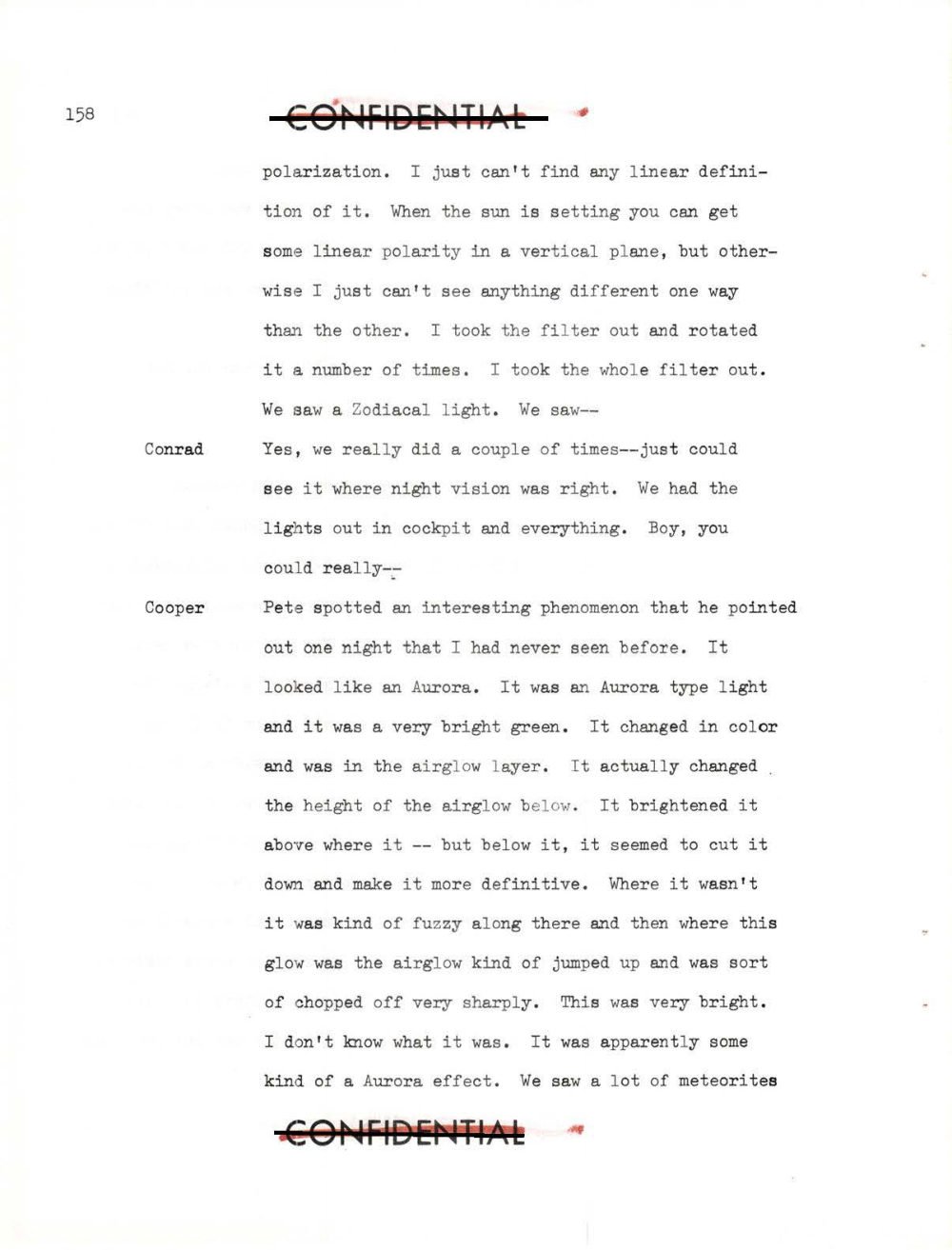
The second was pointed out by Conrad one night. Cooper described it as an aurora-type light, of a very intense green, that changed color and sat in the airglow layer. Where it appeared, the airglow band seemed to rise and become sharply defined; outside it, the band was diffuse. Cooper said he had never seen that, that he did not know what it was, and that apparently it would be some auroral effect.
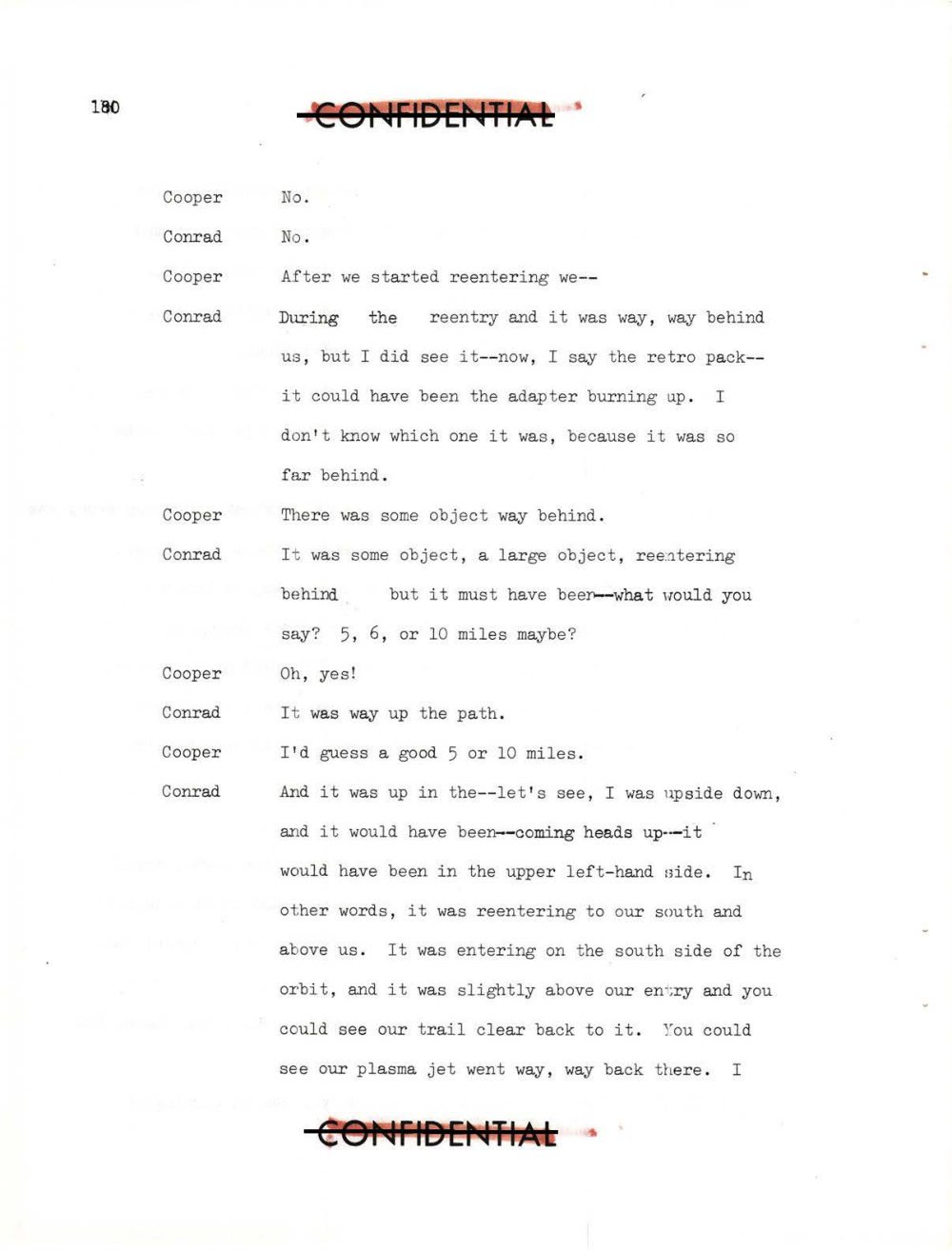
The third came during reentry, which took place at night. The two saw, far behind and a little above, a large object also reentering, about 5 to 10 miles away by their estimate, on the south side of the orbit, with a light-colored trail beside the spacecraft's own trail. Conrad thought it could be the retrorocket module or the adapter burning up, without knowing which of the two. The three observations are the crew's impressions and the suggested identifications are theirs; the document contains no later analysis.
Further on in the same debriefing, in the part on celestial observations, the green light reappears under another name. Cooper and Conrad say they saw, near the south celestial pole, an aurora australis that at first was "very hard to define." It looked like part of the airglow, but it changed the thickness of that layer and "broke" the smooth black outline of the Earth's curvature. Conrad describes it as a very green, sheet-shaped band. The text does not expressly say it is the same light as in the sightings section, but the description matches. Cooper says he photographed "that aurora" with a 200 mm lens and fast film, without knowing whether the photo would come out.
The same passage contains an observation that Cooper says he could not explain. Near the Magellanic Clouds and the region where they had been told to look for the gegenschein, a faint glow of the night sky at the point opposite the Sun, he saw two or three areas that looked like much smaller Magellanic Clouds. They were not star clusters, he said. Conrad doubted it was the gegenschein. Cooper concluded that he did not know what they were and that he had not noticed them on his previous flight, Faith 7, in 1963. The document contains no later analysis of these patches.
The rest of the sightings section, now translated in full, shows what the two saw with no mystery: cities, airports, an aircraft carrier, an airliner, contrails and streets of El Paso, as well as seventh-magnitude stars despite the dirty windows. On reentry, the crew support division representative remarks that, when they turned around, they saw something burning; the two answer "no," before Conrad describes the distant object. He and Cooper compare the light-colored trail beside the spacecraft's to a contrail, light in color, and not a flame.
The first part of the debriefing, with the operational description of the mission and a preliminary transcript dated September 1, 1965, also covers the reentry. In the item on the retrorocket module jettison, the crew support division representative asks whether they did not see the module burning. Conrad answers that he saw it reenter behind the spacecraft, "miles" away, "up and to the left" of where he was looking; Cooper says he thought he saw something burning back there and concludes: "I think that was it." Conrad explains that the module had been trailing the spacecraft in the dark and that is why they never saw it up close.
The two parts of the debriefing tell the same scene with different degrees of certainty. In the first, the identification as the retrorocket module comes up right away, suggested by the interviewer's own question, and the two accept it. In the second, a day later, Conrad says it "could be" the module or the adapter burning up, without knowing which, and estimates the distance at 5 to 10 miles. In neither is there any measurement or comparison with the predicted trajectory of the discarded modules. The identification remains the crew's.
The rest of the page on satellites shows why Cooper's doubt about "something" seen in drifting flight was not resolved. Conrad explains that they never saw any of the scheduled satellites: without the navigation platform, the angles given by the ground, such as pitch of 82° and yaw of 45°, only pointed at a black sky. On one occasion when they used the platform and pointed precisely, they still could not make out the target. The complaint is technical and reinforces that, for this crew, an unidentified object in orbit was, first and foremost, a satellite that could not be located.
More images from the document
DIRECT READING OF THE FILE
The document, in the original
NASA transcript, a U.S. government work: excerpts from the sightings section and the reentry translated after checking against the facsimile.
EXCERPT 1 · PHYSICAL PAGE 157
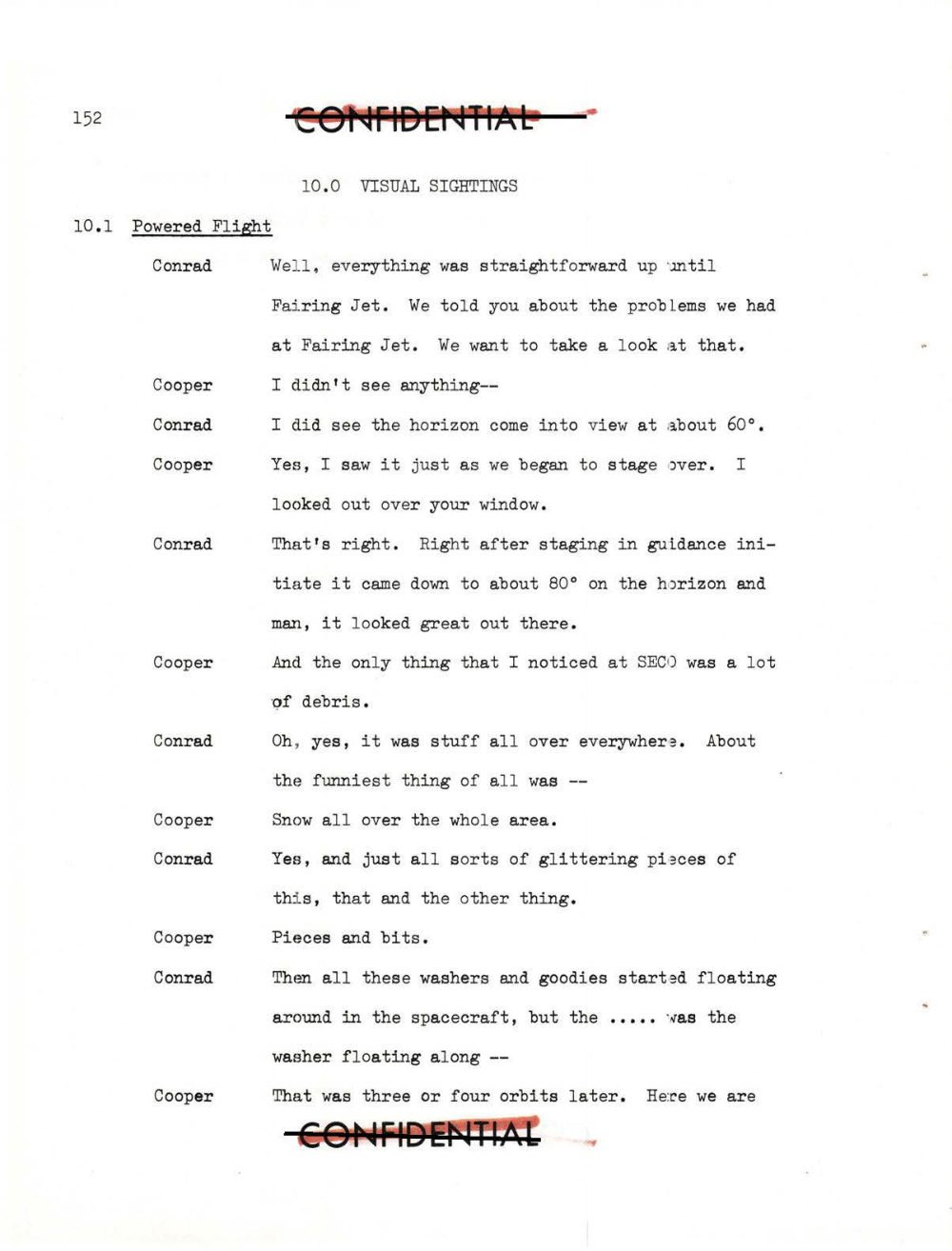
Physical page 157 (transcript page 152), full text: beginning of section 10.0
152
10.0 VISUAL SIGHTINGS
10.1 Powered Flight
Conrad Wel l, everything wa.s straightforward up ·.mtil
Fairing Jet. We told you about the problems we had
at Fairing Jet. We want to take a look 1:1.t that .
Cooper I didn ' t see anything--
Conrad I did see the horizon come into view at 1:1.bout 60° .
Cooper Yes, I saw it just as we began to stage 1'.>ver. I
l ooked out over your window.
Conrad That 's right. Right after staging in guidance initiate it ca.me down to about 80° on t he horizon and
man , it looked great out there .
Cooper And the only thing that I noticed at SEGO was a lot
·of debris.
Conrad Oh, yes, it was stuff all over everywhere. About
the funniest thing of all was
Cooper Snow all over the whole area..
Conrad Yes, and just all sorts of glittering pieces of
thi s , that and the other thing.
Cooper Pieces and bits.
Conrad Then a.11 these washers and goodies started floating
a.round in the spacecraft, but the .. .. . 'llas the
washer floating along --
Cooper That wa s three or four orbits later. He:t:'e we are
....Editorial note: The periods are from the typescript. SECO is second-stage engine cutoff.
Check the original PDF
10.0 VISUAL SIGHTINGS
10.1 Powered Flight
Conrad: Well, everything was straightforward up until Fairing Jet. We told you about the problems we had at Fairing Jet. We want to take a look at that.
Cooper: I didn't see anything--
Conrad: I did see the horizon come into view at about 60°.
Cooper: Yes, I saw it just as we began to stage over. I looked out over your window.
Conrad: That's right. Right after staging in guidance initiate it came down to about 80° on the horizon and man, it looked great out there.
Cooper: And the only thing that I noticed at SECO was a lot of debris.
Conrad: Oh, yes, it was stuff all over everywhere. About the funniest thing of all was --
Cooper: Snow all over the whole area.
Conrad: Yes, and just all sorts of glittering pieces of this, that and the other thing.
Cooper: Pieces and bits.
Conrad: Then all these washers and goodies started floating around in the spacecraft, but the ..... was the washer floating along --
Cooper: That was three or four orbits later. Here we areView the document record ↗ · Physical page 157, counting the cover.
EXCERPT 2 · PHYSICAL PAGE 158
Physical page 158 (transcript page 153), full text
153 ~Qt~OOit IIIAI? =
whipping a long at 17,000 miles an hour or so and I
looked out and here's that washer floating right in
front of my window. It sat out there and floated
around a while. I pointed it out to Pete and he
got over and looked at it and it floated on around
and finally it ·just was drifting on off. Finally
it disappeared. And about an hour l ater a bolt
came off.
10 2 Orbital Flight
Conrad We didn't see our own booster. We were too busy.
We started the flight plan right away and we never
turned around to look at it.
Cooper We never turned around to look at it.
Conrad We sure as heck saw the REP.
Cooper We saw the REP and saw the REP and saw the REP.
Conrad We saw the REP bl anket too.
Cooper The REP blanket, I think we mentioned before, but
the REP bl anket someway or other got between us and
the REP. This means that the REP either went through
it or tumbled over it, because the blanket was between us and the REP. Man-made objects in orbit.
Let's see booster, REP--
Conrad Okay, now that satellite--
Cooper Satellites. We never saw any of the scheduled ones.Editorial note: REP is the radar evaluation pod, a small module ejected from the spacecraft for rendezvous tests.
Check the original PDF
[Cooper] whipping along at 17,000 miles an hour or so and I looked out and here's that washer floating right in front of my window. It sat out there and floated around a while. I pointed it out to Pete and he got over and looked at it and it floated on around and finally it just was drifting on off. Finally it disappeared. And about an hour later a bolt came off.
10.2 Orbital Flight
Conrad: We didn't see our own booster. We were too busy. We started the flight plan right away and we never turned around to look at it.
Cooper: We never turned around to look at it.
Conrad: We sure as heck saw the REP.
Cooper: We saw the REP and saw the REP and saw the REP.
Conrad: We saw the REP blanket too.
Cooper: The REP blanket, I think we mentioned before, but the REP blanket someway or other got between us and the REP. This means that the REP either went through it or tumbled over it, because the blanket was between us and the REP. Man-made objects in orbit. Let's see booster, REP--
Conrad: Okay, now that satellite--
Cooper: Satellites. We never saw any of the scheduled ones.View the document record ↗ · Physical page 158, counting the cover.
EXCERPT 3 · PHYSICAL PAGE 160
Physical page 160 (transcript page 155), full text
ES 155 fJtlDEt TIA f
rivers, lakes, oceans--
Conrad I think all of that will come out in the experiments
too . We saw all kinds -
Cooper Towns, airports, railroads, roads, and all that
stuff.
Conrad .Airplanes.
Cooper Airp-lanes .
Conrad .Anything you say, we saw at least one each.
Cooper I finally saw one and I nearly busted my rear end
doing it.
Conrad I saw the carrier. I saw an airliner. I saw contrails. I saw individual houses up in Tibet. One
thing I didn't see for Gordo was a car.
Cooper I couldn't find him a car. He was sitting over there
asleep. I turned on the whole control system and
turned around to show him one. This was the only
one I could find during the whole stinking l ousy
trip.
Conrad We saw just about anything you would expect us to
see.
Cooper But there again I think you've got to have the control system to point where you have your windows
right to make sightings. You just can't catch them
in drifting flight .
ee~~flOEt'ITIALEditorial note: Conrad's and Cooper's lines about the car seem to be swapped with each other in the typescript (“a car for Gordo” and “he was sleeping”); the translation follows the margin labels, without correction.
Check the original PDF
[Cooper] rivers, lakes, oceans--
Conrad: I think all of that will come out in the experiments too. We saw all kinds -
Cooper: Towns, airports, railroads, roads, and all that stuff.
Conrad: Airplanes.
Cooper: Airplanes.
Conrad: Anything you say, we saw at least one each.
Cooper: I finally saw one and I nearly busted my rear end doing it.
Conrad: I saw the carrier. I saw an airliner. I saw contrails. I saw individual houses up in Tibet. One thing I didn't see for Gordo was a car.
Cooper: I couldn't find him a car. He was sitting over there asleep. I turned on the whole control system and turned around to show him one. This was the only one I could find during the whole stinking lousy trip.
Conrad: We saw just about anything you would expect us to see.
Cooper: But there again I think you've got to have the control system to point where you have your windows right to make sightings. You just can't catch them in drifting flight.View the document record ↗ · Physical page 160, counting the cover.
EXCERPT 4 · PHYSICAL PAGE 161
Physical page 161 (transcript page 156), full text
156
Conrad One day we went past El Paso and the lighting conditions were just right. You really coul d s ee the
individual streets in El Paso . You could distinguish
the streets but this wasn 't always true. The l ighting conditions had to be right. One day we made a
pass over the United States and I could 3ee the
str eets, the airports, the lakes and eve:ry principle town across the United States all on one orbit .
We started at Los Angel es, went to Phoenix to Tucson,
Abilene , White Sands, El Paso--
Cooper You coul d see the details down there in Jlear Lake -
Taylor Lake area--like you were flying over coming
in to land.
Conrad Dallas, Nashville , Memphis-
Cooper It was clear as a bell ,
Conrad And when we went right out at Savannah and we were ·
looking right down the pipe at Jacksonville, Florida.
You coul d see the bridges and the St. Johns R~ver
and everything.
Cooper When we came o~er. t~e Ca~e here you could see every
one of the launch pads.
Conrad I should have two 70-mm photographs. I guarantee
you that I got a 70-mm photograph of the Cape one
day l ike nobody ever took before. If i t came out,
eet>tfl0ENTIM •Check the original PDF
Conrad: One day we went past El Paso and the lighting conditions were just right. You really could see the individual streets in El Paso. You could distinguish the streets but this wasn't always true. The lighting conditions had to be right. One day we made a pass over the United States and I could see the streets, the airports, the lakes and every principle town across the United States all on one orbit. We started at Los Angeles, went to Phoenix to Tucson, Abilene, White Sands, El Paso--
Cooper: You could see the details down there in Clear Lake - Taylor Lake area--like you were flying over coming in to land.
Conrad: Dallas, Nashville, Memphis--
Cooper: It was clear as a bell.
Conrad: And when we went right out at Savannah and we were looking right down the pipe at Jacksonville, Florida. You could see the bridges and the St. Johns River and everything.
Cooper: When we came over the Cape here you could see every one of the launch pads.
Conrad: I should have two 70-mm photographs. I guarantee you that I got a 70-mm photograph of the Cape one day like nobody ever took before. If it came out,View the document record ↗ · Physical page 161, counting the cover.
EXCERPT 5 · PHYSICAL PAGE 162
Physical page 162 (transcript page 157), full text
157
Cooper
Conrad
Cooper
Conrad
Cooper
it was the clearest picture of the Cape.
Boy, that was beautiful. You coul d see every detail. You could see every causeway and every street,
everything that rode around the Cape, and buildings
all over the Cape.
All that was on the same day but it was another
orbit.
Celestial --
Gosh, we coul d see seventh magnitude stars--
Mercury never had a window. Our windows were filthy.
When we l ifted off it just absolutel y unforgiveable
how dirty they were. Yet there were many times the
magnitude of visibil ity the Mercury windows were .
We could see easil y seventh magnitude stars. Well,
in Orion we coul d see all seven stars in the belt
and we could see cl usters down the side of the leg ..
I've never seen those clusters before . I have seen
big bl owups of them, but you could definitely see
two good size cl usters. Celestial - -We saw a lot of
planets and we saw the moon under all kinds of conditions. We saw the sun. We took Polaroid testings
on the sun. We ran the Polaroid fil ters at different angles. It looks to me like the sun has circul ar
•Editorial note: “Seven stars in the belt” appears this way in the original. The addition in brackets is the translation's.
Check the original PDF
[Conrad] it was the clearest picture of the Cape.
Cooper: Boy, that was beautiful. You could see every detail. You could see every causeway and every street, everything that rode around the Cape, and buildings all over the Cape.
Conrad: All that was on the same day but it was another orbit.
Cooper: Celestial--
Conrad: Gosh, we could see seventh magnitude stars--
Cooper: Mercury never had a window. Our windows were filthy. When we lifted off it just absolutely unforgiveable how dirty they were. Yet there were many times the magnitude of visibility the Mercury windows were. We could see easily seventh magnitude stars. Well, in Orion we could see all seven stars in the belt and we could see clusters down the side of the leg. I've never seen those clusters before. I have seen big blowups of them, but you could definitely see two good size clusters. Celestial--We saw a lot of planets and we saw the moon under all kinds of conditions. We saw the sun. We took Polaroid testings on the sun. We ran the Polaroid filters at different angles. It looks to me like the sun has circularView the document record ↗ · Physical page 162, counting the cover.
EXCERPT 6 · PHYSICAL PAGE 163
Remainder of physical page 163 (transcript page 158), before and after the already translated remark about the green light
158
polarization. I just can' t find any linear definition of it. When the sun is setting you can get
s ome linear polarity in a vertical plane , but otherwise I just can't see anything different one way
than the other. I took the filter out and rotated
it a number of times. I took the whole filter out.
We saw a Zodiacal light. We saw--
Conrad Yes, we really did a couple of times--just could
see it where night vision was right . We had t he
lights out in cockpit and everything. Boy, you
coul d really-,:-
Cooper Pete spotted an interesting phenomenon that he pointed
out one night that I had never seen before. It
looked like an Aurora. It was an Aurora type l ight
and it was a very bright green . It changed in color
and was in the airglow layer. It actuall y changed
the height of the airglow below. It brightened it
above where it -- but below it, it seemed t o cut it
down and make it more definitive. Where it wasn't
it was kind of fuzzy along there and then where t his
glow was the airglow kind of jumped up and was sort
of chopped off very sharply. This was very bright.
I don 't know what it was . It was apparently some
kind of a Aurora effect. We saw a lot of meteoritesEditorial note: The final sentence (“We saw a lot of meteorites”) does not continue on the next page, which begins with “in Australia was a good example,” about clouds that obscured ground targets. There appears to be a gap in the preliminary transcript; nothing was filled in. “Meteorites” is the term used by the astronauts for meteors.
Check the original PDF
[Cooper] polarization. I just can't find any linear definition of it. When the sun is setting you can get some linear polarity in a vertical plane, but otherwise I just can't see anything different one way than the other. I took the filter out and rotated it a number of times. I took the whole filter out. We saw a Zodiacal light. We saw--
Conrad: Yes, we really did a couple of times--just could see it where night vision was right. We had the lights out in cockpit and everything. Boy, you could really--
Cooper: [fala sobre a luz verde, já traduzida no dossiê] ... We saw a lot of meteoritesView the document record ↗ · Physical page 163, counting the cover.
EXCERPT 7 · PHYSICAL PAGE 190
End of physical page 190 (transcript page 179): retrorockets and a question before the object during reentry
minute to TR+45 seconds throught retro- jet. You
know seeing that sequential system go amd
everything work- just like it was supposed to,
and the checkoff list go and everything: B())y,
we were really spring l oaded on that.
Cooper I know Pete had made some comment , "Well , things
have continued to fail and I just hope that is one
that doesn ' t . "
Conrad I had lost faith in sequential systems somewhere along the
way. We had all the emergency systems out though,
and we were ready to fire it any way we had to .
Cooper Yes , we had gone through our little emergency
retrofire and our emergency SEP ADAPT and all this.
We were all set to go on those , and I think we'd
have been in rea l good shape even if they hadn' t
occured . Retro- pack jettison --
Conrad Straightforward.
Cooper We held retro- attitude , waited on the light, armed
thereto- jet and when the light came on Pete toggled
them and off they went 11KapJunk11 • They sounded just
like in the simulator.
Conrad Again we didn't see anything. It was pitch black. Had
cockpit lights up full white .
FCSD REP Now, you turned around, and you saw it burning up.
~ CiQ~4fiOD~TlAiEditorial note: FCSD is the flight crew support division; the representative's line has no question mark in the original.
Check the original PDF
Cooper: We held retro-attitude, waited on the light, armed the retro-jet and when the light came on Pete toggled them and off they went "Kaplunk". They sounded just like in the simulator.
Conrad: Again we didn't see anything. It was pitch black. Had cockpit lights up full white.
FCSD REP: Now, you turned around, and you saw it burning up.View the document record ↗ · Physical page 190, counting the cover.
EXCERPT 8 · PHYSICAL PAGE 191
Physical page 191 (transcript page 180), remarks not yet translated
180
Cooper
Conrad
Cooper
Conrad
Cooper
Conrad
Cooper
Conrad
Cooper
Conrad
No .
No .
After we
During
us, but I
started reenter ing we--
the reentr y and it was way, way behind
did see it--now , I say the retro pack-
it could have been the adapt er burning up . I
don ' t know which one it was, because it was so
far behind .
There was some object way behind .
It was some object , a large object, ree:~tering
behind but it must have beer--what would you
say? 5, 6, or 10 miles maybe?
Oh , yes!
I t was way up the path.
I'd guess a good 5 or 10 miles.
And it was up in the--let 1 s see, I was upside down ,
and it would have been--coming heads up--it
would have been in the upper left- hand :lide. I n
other words , it was reentering to our south and
above us. It was entering on the south side of the
orbit , and it was sli ghtly above our en•;ry and you
could see our trail clear back to it. You could
see our plasma jet went way , way back there . ICheck the original PDF
Cooper: No.
Conrad: No.
Cooper: After we started reentering we--
Conrad: [fala já traduzida no dossiê]
Cooper: There was some object way behind.
Conrad: [fala já traduzida no dossiê]
Cooper: Oh, yes!
Conrad: It was way up the path.
Cooper: I'd guess a good 5 or 10 miles.
Conrad: And it was up in the--let's see, I was upside down, and it would have been--coming heads up--it would have been in the upper left-hand side. In other words, it was reentering to our south and above us. It was entering on the south side of the orbit, and it was slightly above our entry and you could see our trail clear back to it. You could see our plasma jet went way, way back there. IView the document record ↗ · Physical page 191, counting the cover.
EXCERPT 9 · PHYSICAL PAGE 192
Physical page 192 (transcript page 181), full text
EOMFtDEl-~Tt~l
don't know what it wasp'whether it wa s smoke or what
it wasn't fla.rne--you could definitely see it
trailing right along side our trail just like we
were leaving a con .
Cooper Yes , you could see our con--it was kind of a light
color. I wouldn't say it was a flame color--it
was kind of a light color. compared to everything else.
Conrad We were looking at this in relation to what nobody
else hadseen it to . We were still looking at this
down sun relatively nebulous horizon that you have.
We were looking at it ourselves, a trail back
there in the terminator.
Cooper Into the dark.
Conrad Yes. And that ' s another thing. A very important
point here--no kidding, saying this spacecraft's i n sunl i ght
doesn't • mean anything? That' s ani ght retrofire.
And we didn't have a definable horizon to fly on
until we crossed the Mississippi River• . That 's
way in the heck down the pipe on retrofire, because
that terminator is nothing.
Cooper One thing I ' d like to add here- -I really think a l l
.of us always sweat~d night ret rofire and it wa s a pi ece
of cake.Editorial note: Some of Conrad's sentences are truncated in the typescript (“in relation to what nobody else had seen it to”) and were translated literally. The terminator is the line separating the sunlit side from the dark side of the Earth.
Check the original PDF
[Conrad] don't know what it was, whether it was smoke or what it wasn't flame--you could definitely see it trailing right along side our trail just like we were leaving a con.
Cooper: Yes, you could see our con--it was kind of a light color. I wouldn't say it was a flame color--it was kind of a light color compared to everything else.
Conrad: We were looking at this in relation to what nobody else had seen it to. We were still looking at this down sun relatively nebulous horizon that you have. We were looking at it ourselves, a trail back there in the terminator.
Cooper: Into the dark.
Conrad: Yes. And that's another thing. A very important point here--no kidding, saying this spacecraft's in sunlight doesn't mean anything? That's a night retrofire. And we didn't have a definable horizon to fly on until we crossed the Mississippi River. That's way in the heck down the pipe on retrofire, because that terminator is nothing.
Cooper: One thing I'd like to add here--I really think all of us always sweated night retrofire and it was a piece of cake.View the document record ↗ · Physical page 192, counting the cover.
EXCERPT 10 · PHYSICAL PAGE 260
End of physical page 259 and physical page 260 (transcript pages 248 and 249), full text of the excerpt
249
Cooper
Conrad
Cooper
Conrad
Cooper
Conrad
Cooper
Conrad
Cooper
Conrad
Cooper
Clearly. We saw the air glow as usual, always
around everywhere - - around the night.
We did see streaks in the air glow that they talked
to us about -- the dark streaks in it which' Jim and
Ed mentioned. They are really definitely there .
Right -- banded are~s. And we saw this one in the
southern Aurora down on the southern celestial pole
which was quite - - pretty unus~al. Reall y hard to
def ine at f irst too -- just what it was.
Yeah , it looked like a part of the air gl ow, but it
was actually an Aurora -- i t changed the
It changed the air gl ow thickness too
Changed the air glow thickness and it changed the
smooth curvature of the earth -- it put a halt in
the black outline of the earth --
Right.
And i t was a very green band of what you'd -- what
kind of Aurora do you call that where it is sort of
like a sheet
Yeah the stria or striden -- somethi ng like
that.
Yeah.
Then one other -- the only other observation other
than we did see a lot of micrometeorites and I sawEditorial note: “Jim and Ed” are McDivitt and White, of Gemini IV. “Halt” appears this way in the typescript (probably “halt” in the sense of interruption, or an error for “fault”); translated as breakdown. The technical name spoken by Cooper is uncertain in the original itself and was kept in quotation marks. “Micrometeorites” is the astronauts' term for small meteors.
Check the original PDF
11.11 Miscellaneous
Cooper: Celestial and External Observations. We saw the Zodiacal light.
Conrad: Quite clearly--twice.
[p. 260]
Cooper: Clearly. We saw the air glow as usual, always around everywhere -- around the night.
Conrad: We did see streaks in the air glow that they talked to us about -- the dark streaks in it which Jim and Ed mentioned. They are really definitely there.
Cooper: Right -- banded areas. And we saw this one in the southern Aurora down on the southern celestial pole which was quite -- pretty unusual. Really hard to define at first too -- just what it was.
Conrad: Yeah, it looked like a part of the air glow, but it was actually an Aurora -- it changed the --
Cooper: It changed the air glow thickness too --
Conrad: Changed the air glow thickness and it changed the smooth curvature of the earth -- it put a halt in the black outline of the earth --
Cooper: Right.
Conrad: And it was a very green band of what you'd -- what kind of Aurora do you call that where it is sort of like a sheet --
Cooper: Yeah -- the stria or striden -- something like that.
Conrad: Yeah.
Cooper: Then one other -- the only other observation other than we did see a lot of micrometeorites and I sawView the document record ↗ · Physical page 260, counting the cover.
EXCERPT 11 · PHYSICAL PAGE 261
Physical page 261 (transcript page 250), full text
-
250
one large meteorite enter underneath U3
Conrad Observed quite a few underneat h us--
Cooper There was ver-✓ seldom a night went by that you
couldn't watch just for a few minutes to see a
micrometeorite or two of them enter. One meteorite
came from a l ong way out burning and went in underneath, There were two other si gnificant things.
One was the observation of the moon. The moon was
rising out of the airglow. We had about a quarter
moon and you couli seo the entire moon lit partially
and then t he one part o:f i t lit brighter. It
r eally appeared in t hree dimensional wlth the sun
back over back off the horizon light:L-1 5 it. This
was quite spectacular, I thought. I bought .i.t
l ooked very unusual. The other observa.ti0ns in t :'le
vicinity of the Magellanic Clouds, and actually in
t he vicinity where this Gegenschein Li1
sht is- -
i t appeared to me to be two to three a:~eas that
looked like Magellanic Clouds, only mu~h smaller.
.·, !
There were two or three other little Magellanic
Cloud-appearing thi!lgs, 'l'hey weren't elusters or
anything. I think you noticed them several times
too over there when we we~e fiddling around the
Magellanic..Clouds, I never could decid•~ what theyCheck the original PDF
[Cooper] one large meteorite enter underneath us --
Conrad: Observed quite a few underneath us--
Cooper: There was very seldom a night went by that you couldn't watch just for a few minutes to see a micrometeorite or two of them enter. One meteorite came from a long way out burning and went in underneath. There were two other significant things. One was the observation of the moon. The moon was rising out of the airglow. We had about a quarter moon and you could see the entire moon lit partially and then the one part of it lit brighter. It really appeared in three dimensional with the sun back over back off the horizon lighting it. This was quite spectacular, I thought. I thought it looked very unusual. The other observations in the vicinity of the Magellanic Clouds, and actually in the vicinity where this Gegenschein Light is-- it appeared to me to be two to three areas that looked like Magellanic Clouds, only much smaller. There were two or three other little Magellanic Cloud-appearing things. They weren't clusters or anything. I think you noticed them several times too over there when we were fiddling around the Magellanic Clouds, I never could decide what theyView the document record ↗ · Physical page 261, counting the cover.
EXCERPT 12 · PHYSICAL PAGE 262
Physical page 262 (transcript page 251), full text
251
Conrad Yes, we kept looking over the area of Gegenschein
to see if we could see and I don't really think it
was the Gegenschein, but--
Cooper There was one area right almost in the immediate
area of the Gegenschein, but not quite . It was
very near that area by maybe five degrees or so
though. There was this one area which appeared
like the Magellanic Clouds.
Conrad Like a real small one .
Cooper Yes, it looked like a small Magellanic Cloud.
That's really what it looked like. I t was quite
near the area where we had been told the Gegenschein
should appear; but, then there were a couple of others
of these that similar types back over closer toward
the other of the regular Magellanic Clouds. So ,
I don't know what they were, and I didn't notice
these before on my previous flight. These were
something that were new to me. We saw a l ot of
planets. We did try taking the polaroid, the two
sheet polaroid filters, and rotating them to all
different positions to see if we had circular
or linear polarity coming out of the sun. I
tried the sun both while well up and while setting. . . 19E ~:JtA b,Editorial note: Cooper's previous flight was Faith 7, of the Mercury program, in May 1963.
Check the original PDF
[Cooper] were.
Conrad: Yes, we kept looking over the area of Gegenschein to see if we could see and I don't really think it was the Gegenschein, but--
Cooper: There was one area right almost in the immediate area of the Gegenschein, but not quite. It was very near that area by maybe five degrees or so though. There was this one area which appeared like the Magellanic Clouds.
Conrad: Like a real small one.
Cooper: Yes, it looked like a small Magellanic Cloud. That's really what it looked like. It was quite near the area where we had been told the Gegenschein should appear; but, then there were a couple of others of these that similar types back over closer toward the other of the regular Magellanic Clouds. So, I don't know what they were, and I didn't notice these before on my previous flight. These were something that were new to me. We saw a lot of planets. We did try taking the polaroid, the two sheet polaroid filters, and rotating them to all different positions to see if we had circular or linear polarity coming out of the sun. I tried the sun both while well up and while setting.View the document record ↗ · Physical page 262, counting the cover.
EXCERPT 13 · PHYSICAL PAGE 265
Physical page 265 (transcript page 254), full text
254
Cooper
FCSD Rep
Cooper
FCSD Rep
in the middle of the States , like Dal l a s , For t
Worth , and J acksonville .
I tried some nighttime photographs with the 200 mm
l ens on high speed film with sever al different
speed setti ngs just to see i f they would come out
and what they would come out like- -
Of what?
Oh, of Orion and several of the constella tions-
several celesti a l fixes--once of some airglow,
I t ook a picture of that aurora that we saw over
there and, of course, all kinds of su~set s, sunrises, and the moon coming up through the airglow,
and things of this type . A l ot of di:n light stuff
we took with hi gh speed fil m. It may or may not
come out, I don I t know. We were gues,3ing at some
of the exposures . A gr ea t many thi ng:3 on the ground,
of course, we took pictures of tha t w1~re unexpec t ed
things tha t we just thought were real t arget s of
oppor tunity.
Okay , that' s the end of the experimen·~s .Editorial note: The first line concludes a statement from the previous page. The photos mentioned are not in the collection.
Check the original PDF
[...] in the middle of the States, like Dallas, Fort Worth, and Jacksonville.
Cooper: I tried some nighttime photographs with the 200 mm lens on high speed film with several different speed settings just to see if they would come out and what they would come out like--
FCSD Rep: Of what?
Cooper: Oh, of Orion and several of the constellations--several celestial fixes--once of some airglow. I took a picture of that aurora that we saw over there and, of course, all kinds of sunsets, sunrises, and the moon coming up through the airglow, and things of this type. A lot of dim light stuff we took with high speed film. It may or may not come out, I don't know. We were guessing at some of the exposures. A great many things on the ground, of course, we took pictures of that were unexpected things that we just thought were real targets of opportunity.
FCSD Rep: Okay, that's the end of the experiments.View the document record ↗ · Physical page 265, counting the cover.
EXCERPT 14 · PHYSICAL PAGE 2
Physical page 2, full text: title page of the preliminary transcript, part II
COt~FIDEt~TIAL
PRELIMINARY
GT- 5 FLIGHT CREW DEBRIEFING TRANSCRIPT
PART II
Prepared By
Spacecraft Operations Branch
Flight Crew Support Division
September 2, 1965
This material contains information affecting the
national defense of the United States within the
meaning of the Espionage Laws, Title 18. U.S. C.
Section 793 and 794, the transmission or revelation of which in any manner to an unauthorized
person is prohibited by law.
Group 4: Downgrade at 3 year intervals
Declassified after 12 years
co~~FIDEt'4TIALEditorial note: The CONFIDENTIAL markings are crossed out, a sign of later declassification.
Check the original PDF
CONFIDENTIAL [riscado]
PRELIMINARY
GT-5 FLIGHT CREW DEBRIEFING TRANSCRIPT
PART II
Prepared By
Spacecraft Operations Branch
Flight Crew Support Division
September 2, 1965
This material contains information affecting the national defense of the United States within the meaning of the Espionage Laws, Title 18. U.S.C. Section 793 and 794, the transmission or revelation of which in any manner to an unauthorized person is prohibited by law.
Group 4: Downgrade at 3 year intervals. Declassified after 12 years
CONFIDENTIAL [riscado]View the document record ↗ · Physical page 2, counting the cover.
EXCERPT 15 · PHYSICAL PAGE 3
Physical page 3, full text: foreword to part II
('
PREFACE
This preliminary transcript was made from voice tape recordings
of the GT- 5 flight crew debriefing conducted August 30, 1965 thru
September 2, 1965 at the Crew Quarters, Cape Kennedy, Florida .
Although all the material contained in this transcript has been
edited , the urgent need for the preliminary transcript by mission
analysis personnel precluded a thorough editorial review prior to its
publication. Errors in this transcript will be corrected as soon as
possible and an official transcript will be published at a later date .
This document contai ns a transcript of the second part of the
total debriefing. A prel iminary transcript of the first part was
publi shed on September 1, 1965 , and it contains the crew's description
of the mission from an operati onal standpoint.Editorial note: The first part cited in the preface is also in the collection (NASA-UAP-D019) and contains, on physical page 187, another mention of the object seen reentering behind the spacecraft.
Check the original PDF
PREFACE
This preliminary transcript was made from voice tape recordings of the GT-5 flight crew debriefing conducted August 30, 1965 thru September 2, 1965 at the Crew Quarters, Cape Kennedy, Florida.
Although all the material contained in this transcript has been edited, the urgent need for the preliminary transcript by mission analysis personnel precluded a thorough editorial review prior to its publication. Errors in this transcript will be corrected as soon as possible and an official transcript will be published at a later date.
This document contains a transcript of the second part of the total debriefing. A preliminary transcript of the first part was published on September 1, 1965, and it contains the crew's description of the mission from an operational standpoint.View the document record ↗ · Physical page 3, counting the cover.
EXCERPT 16 · PHYSICAL PAGE 159
Remainder of physical page 159 (transcript page 154), before and after Cooper's remark already translated in the dossier
154
Conrad We never saw any of the scheduled ones but you' ve
got to have the platform to see them. They gave us
angles like pitch 82° and yaw 45. You're looking
at the black sky. You haven't any idea of where
you're looking. You have to have the platform.
One thing that we did find, if their platform pointing at satellites was actuall y the pointing information they gave us for the ground objects, why we
woul dn ' t have had any trouble finding them.
Cooper The pointing information that we got from the ground
was excellent.
Conrad We hacked that time on the second and we were
really pointed with the platform up and we were
looking right down the pipe at whatever it was that
they were wanting us to look at. The only reason
we didn't see it is we couldn't make it out. But
we were l ooking at it.
Cooper Satellites--There was only one time when Pete and
I thought we saw something and we didn't have time
to identify it. We were in drifting flight and we
never could identify it. I don ' t even know if it
was a satellite. So many things are going by when
you're drifting that it's difficult to say. Geographical--We saw millions of geographical details:Editorial note: The "platform" is the spacecraft's inertial navigation platform. With this block, page 159 is translated in full; the list of geographic details continues on page 160, already translated.
Check the original PDF
Conrad: We never saw any of the scheduled ones but you've got to have the platform to see them. They gave us angles like pitch 82° and yaw 45. You're looking at the black sky. You haven't any idea of where you're looking. You have to have the platform. One thing that we did find, if their platform pointing at satellites was actually the pointing information they gave us for the ground objects, why we wouldn't have had any trouble finding them.
Cooper: The pointing information that we got from the ground was excellent.
Conrad: We hacked that time on the second and we were really pointed with the platform up and we were looking right down the pipe at whatever it was that they were wanting us to look at. The only reason we didn't see it is we couldn't make it out. But we were looking at it.
Cooper: [fala sobre os satélites, já traduzida] Geographical--We saw millions of geographical details:View the document record ↗ · Physical page 159, counting the cover.
EXCERPT 17 · PHYSICAL PAGE 187
Physical page 187 of part I (transcript page 182), item 5.5, retrorocket module jettison
182
Conrad At 30 000 we shut off the propellant valves to the
RCS. It was still working away merrily there trying
to steady it down on the drogue. As :: ar as I know,
there was propellant in both Ring A and Ring B when
we shut them down.
5. 5 1 Retropack Jettison
Cooper We jettisoned the retropack right in retro attitude -
FCSD Rep You didn't see the retropack burning up or anything?
Conrad Yes, I saw it reenter behind us but nowhere near like
those guys did. It was miles behind us when I saw i t .
Cooper I thought I saw something way back thEire burning. I
guess that was it.
Conrad Yes. Up and on the left side of where? I was looking .
I saw it burn up behind us. But it was miles behind
us by then. You see, it had been chaf:ing us in the
dark so we never did see it close up. We never saw
anything like pump packages blowing O\;.t when we set
the retros.
•Editorial note: "Those guys" are not identified; probably another crew, but the text does not say which one. The first two lines of the page deal with the reentry system propellant cutoff and were not translated.
Check the original PDF
5.5 Retropack Jettison
Cooper: We jettisoned the retropack right in retro attitude --
FCSD Rep: You didn't see the retropack burning up or anything?
Conrad: Yes, I saw it reenter behind us but nowhere near like those guys did. It was miles behind us when I saw it.
Cooper: I thought I saw something way back there burning. I guess that was it.
Conrad: Yes. Up and on the left side of where I was looking. I saw it burn up behind us. But it was miles behind us by then. You see, it had been chasing us in the dark so we never did see it close up. We never saw anything like pump packages blowing out when we set the retros.View the document record ↗ · Physical page 187, counting the cover.
EXCERPT 18 · PHYSICAL PAGE 1
full page
.. - ,.
19
Y authtrity of E. c 1 1G
hanged by C4?1 •'o <<= /
GEMINI V
TECHNICAL DEBRIEFING (U)
Part 1
NOTICE: This document may be exempt from
public disclosure under the Freedom of lnfor•
mation Act (5 U.S.C. 552). Requests for its release to persons outside the U.S. Government
should be handled under the provisions of
NASA Policy Directive 1382.2.
THIS MATE RIAL CONTAINS INF'ORM.ATION AFl"IECTING
THE NATIONAL OEFENSE OF THE UN I TEO STATES
WITHIN THE MEANING OF' TH£ £8P'IONAGIE LAW 5 ,.
TITLE 11. U . S.C, SECTION 793 ANO 794 . T HE TRANSM I SSION OR REVELAT I O N Of' WH IC H IN AN Y MANNER
TO AN UNA UTHORIZED PERSON IS PR OHIB ITED av L AW.
GROUP 4
OOWNCiftAOEO AT ) V EAR INTFRVALS,
OECLASSI F'IEO AFTER 12 VEARS
t
" 6()t JF18Er4 T I;\bEditorial note: Cover of the technical debriefing of the Gemini V (Gemini 5) flight, Part 1, with classification and dissemination restriction notices.
Check the original PDF
.. - ,.
19
Y authtrity of E. c 1 1G
hanged by C4?1 •'o <<= /
GEMINI V
TECHNICAL DEBRIEFING (U)
Part 1
NOTICE: This document may be exempt from
public disclosure under the Freedom of lnfor•
mation Act (5 U.S.C. 552). Requests for its release to persons outside the U.S. Government
should be handled under the provisions of
NASA Policy Directive 1382.2.
THIS MATE RIAL CONTAINS INF'ORM.ATION AFl"IECTING
THE NATIONAL OEFENSE OF THE UN I TEO STATES
WITHIN THE MEANING OF' TH£ £8P'IONAGIE LAW 5 ,.
TITLE 11. U . S.C, SECTION 793 ANO 794 . T HE TRANSM I SSION OR REVELAT I O N Of' WH IC H IN AN Y MANNER
TO AN UNA UTHORIZED PERSON IS PR OHIB ITED av L AW.
GROUP 4
OOWNCiftAOEO AT ) V EAR INTFRVALS,
OECLASSI F'IEO AFTER 12 VEARS
t
" 6()t JF18Er4 T I;\bView the document record ↗ · Physical page 1, counting the cover.
EXCERPT 19 · PHYSICAL PAGE 10
full page
5
FCSD REP
Cooper
Conrad
Cooper
Conrad
Cooper
Conrad ,.
Okay , how about the time you spent in there on
prelaunch. Do you think that this is about right?
Yes , yes, I think that this is just about right.
I think that if you cut it down too much more
than that you are going to be ....you could cut it
down some more , there's no doubt. .. .
It' s that cabin purge cycles when you 're not doing
anything really, and that ' s excellent time .
...that you can cut it down, but that' s the thing
that takes the time for both the ground crews...
and that' s lost time. I don' t know . ...
I don ' t think you want to rush the crew and now
our count that second day went by the clock, boy.
We got in there at the right time . We counted down
and lifted off on, and I didn' t feel that I was
rushed , and I didn' t feel that I sat in there for
an excessive amount of time .
No , I didn ' t either. I thought that it went just
about right , time wise .
Long as there ' s no holds in the count everything' s
great.Editorial note: The crew members consider the length of the wait in the cabin before launch adequate, with neither rush nor excessive delay.
Check the original PDF
5
FCSD REP
Cooper
Conrad
Cooper
Conrad
Cooper
Conrad ,.
Okay , how about the time you spent in there on
prelaunch. Do you think that this is about right?
Yes , yes, I think that this is just about right.
I think that if you cut it down too much more
than that you are going to be ....you could cut it
down some more , there's no doubt. .. .
It' s that cabin purge cycles when you 're not doing
anything really, and that ' s excellent time .
...that you can cut it down, but that' s the thing
that takes the time for both the ground crews...
and that' s lost time. I don' t know . ...
I don ' t think you want to rush the crew and now
our count that second day went by the clock, boy.
We got in there at the right time . We counted down
and lifted off on, and I didn' t feel that I was
rushed , and I didn' t feel that I sat in there for
an excessive amount of time .
No , I didn ' t either. I thought that it went just
about right , time wise .
Long as there ' s no holds in the count everything' s
great.View the document record ↗ · Physical page 10, counting the cover.
EXCERPT 20 · PHYSICAL PAGE 11
full page
6
2.1 Lif t Off Cues
Cooper
Conrad
Cooper
Conrad
Cooper
FtE>ENTI L
2. 0 POWERED FLIGHT
Okay , lift- off cues , CAP COM . CAP CO~ didn ' t come
into the act until later . Stoney counted us down
thru ignition and lift-off and then CAP COM picked
us up at l ift- off. Motion is an excellent clue .
There ' s doubt in your mind when you ljft- off. You
know, the second you lift- off that yot.' ve lifted.
Vibration was very low.
It had dropped out almost completely a.t lift- off,
felt that shaking was very l i ght.
There was very little vibrati on at all . Okay,
vibration, very l ow. Noise I thought, was quite
low.
I was particularl y aware of the noises of goi ng
through the max Q regionar y thing. Oh , t his is
lift-off again . I thought the noises were very
well at l iftoff. You know the engines were
running from the outside before , you know, and man
they really make a racket, but from where you are
it's pretty quite . You know there running. You
can here them, there's no doubt about that , but .. .
Okay, on visual I don ' t . . . . We had a very cl ear
day. There weren't even any clouds in sight on
~ IDENTI~Editorial note: The crew members describe the liftoff as felt mainly through motion, with little vibration and little noise, on a cloudless day.
Check the original PDF
6
2.1 Lif t Off Cues
Cooper
Conrad
Cooper
Conrad
Cooper
FtE>ENTI L
2. 0 POWERED FLIGHT
Okay , lift- off cues , CAP COM . CAP CO~ didn ' t come
into the act until later . Stoney counted us down
thru ignition and lift-off and then CAP COM picked
us up at l ift- off. Motion is an excellent clue .
There ' s doubt in your mind when you ljft- off. You
know, the second you lift- off that yot.' ve lifted.
Vibration was very low.
It had dropped out almost completely a.t lift- off,
felt that shaking was very l i ght.
There was very little vibrati on at all . Okay,
vibration, very l ow. Noise I thought, was quite
low.
I was particularl y aware of the noises of goi ng
through the max Q regionar y thing. Oh , t his is
lift-off again . I thought the noises were very
well at l iftoff. You know the engines were
running from the outside before , you know, and man
they really make a racket, but from where you are
it's pretty quite . You know there running. You
can here them, there's no doubt about that , but .. .
Okay, on visual I don ' t . . . . We had a very cl ear
day. There weren't even any clouds in sight on
~ IDENTI~View the document record ↗ · Physical page 11, counting the cover.
EXCERPT 21 · PHYSICAL PAGE 12
full page
Conrad
2 . 2 Roll Program
Conrad
Cooper
C.(&)Hft0ENTI:,\~~ 7 au, !to
our sight as we were lifting off, and I couldn't
tell any visual cues to lift- off, could you?
You had the feeling that you were moving visually.
After you get your roll program you see it visually
and you can see the pitch program starting visually,
but just at first l ift-off you don't really have
any visual cues . Cockpit displays are just l ike
advertised. The two stage - one lights go out, and
. .. just l ike the simulator.
Yes , I watched roll program on the gyro, I was
watching for it to come i n on time and in glancing
up when the roll program started I was still
looking at nothing but blue sky, but I was aware
visually as you say that the booster was rolling.
Yes , you can have a airplane when you are looking
at nothing but blue sky and start a motion and you
may not know exactly what the motion is, but you
know t hat you are moving.
Now on this cockpit display, something that I got two
different answers to from different people on how the
gyro and the actual case was going to be set and it
suddenly dawned on me that they actually set the gyro
so that you are launching down the 90 degrees. You'reEditorial note: The crew members say they visually perceive the rocket's roll against the blue sky, but have no visual cue at the instant of liftoff; Cooper discusses the gyro setting.
Check the original PDF
Conrad
2 . 2 Roll Program
Conrad
Cooper
C.(&)Hft0ENTI:,\~~ 7 au, !to
our sight as we were lifting off, and I couldn't
tell any visual cues to lift- off, could you?
You had the feeling that you were moving visually.
After you get your roll program you see it visually
and you can see the pitch program starting visually,
but just at first l ift-off you don't really have
any visual cues . Cockpit displays are just l ike
advertised. The two stage - one lights go out, and
. .. just l ike the simulator.
Yes , I watched roll program on the gyro, I was
watching for it to come i n on time and in glancing
up when the roll program started I was still
looking at nothing but blue sky, but I was aware
visually as you say that the booster was rolling.
Yes , you can have a airplane when you are looking
at nothing but blue sky and start a motion and you
may not know exactly what the motion is, but you
know t hat you are moving.
Now on this cockpit display, something that I got two
different answers to from different people on how the
gyro and the actual case was going to be set and it
suddenly dawned on me that they actually set the gyro
so that you are launching down the 90 degrees. You'reView the document record ↗ · Physical page 12, counting the cover.
EXCERPT 22 · PHYSICAL PAGE 13
full page
8
Conrad
Cooper
FCSD REP
Cooper
2. 3 Pitch Program
Cooper
2. 4 Aerodynamic
Cooper
progressi ng down to 90 degrees line, e. la the
simulator, although the booster sets on 85 degrees
and when you turn to 72 degrees launch azimuth
you are rolling clockwise so far as tr.e crew is
concerned .
You roll to zero .
But you are rolling to is real ly to O on the gyro
as precessed around so that you are net really
setting on the actual launch azimuth, you are
actually setting so that when you stai§'e on over i n
yaw then pitch over then in your yaw your on the inplane line.
You 're coming down the zero line . Y01.:. 1 re yawing
down the zero l i ne .
That 's right, and I kept getting diffe.rent answers
on this and this is in fact the case. Roll program
was exactly right on time and ended e>:actly on time.
Pitch program started exactly on time.
Aerodynamic was nothing new or differE:nt about it.
It was just standard. We build up to the noises at
max Q; the noise built up to gradual level and the
vibration and quantity built up to ma>:~ and then
dropped off very rapidly J.1'd:i!Jitely thereafter.
FlDENTIALEditorial note: Cooper confirms that the roll and pitch programs started and ended exactly on schedule and that the aerodynamic noise and vibration rose up to max Q and then dropped quickly.
Check the original PDF
8
Conrad
Cooper
FCSD REP
Cooper
2. 3 Pitch Program
Cooper
2. 4 Aerodynamic
Cooper
progressi ng down to 90 degrees line, e. la the
simulator, although the booster sets on 85 degrees
and when you turn to 72 degrees launch azimuth
you are rolling clockwise so far as tr.e crew is
concerned .
You roll to zero .
But you are rolling to is real ly to O on the gyro
as precessed around so that you are net really
setting on the actual launch azimuth, you are
actually setting so that when you stai§'e on over i n
yaw then pitch over then in your yaw your on the inplane line.
You 're coming down the zero line . Y01.:. 1 re yawing
down the zero l i ne .
That 's right, and I kept getting diffe.rent answers
on this and this is in fact the case. Roll program
was exactly right on time and ended e>:actly on time.
Pitch program started exactly on time.
Aerodynamic was nothing new or differE:nt about it.
It was just standard. We build up to the noises at
max Q; the noise built up to gradual level and the
vibration and quantity built up to ma>:~ and then
dropped off very rapidly J.1'd:i!Jitely thereafter.
FlDENTIALView the document record ↗ · Physical page 13, counting the cover.
EXCERPT 23 · PHYSICAL PAGE 14
full page
2. 5 ECS
Conrad
Cooper
Conr ad
Cooper
Conrad
Cooper
2 . 7 Wind Shear
Cooper
2 .8 DCS Updates
Cooper
FCSD REP
Conrad
CONFICtleNTIA~ 9 •
Right on the button.
ECS was right on the money, no problem at all .
Max Q we ' ve already stated.
The cabin s ealed a little bit high like they said
it would . I forget the number. It was about 5.8.
About 5.8 or 9 and just gradually dwindled back down .
And just after we got in there by the time I looked
at it again after insertion everything it bled down
on our gage to 4.9, our gage read a little low. I
think the actual reading, you will pr obably find
the cabin actually was 5.11 but the whole rest of
t he flight the gage never budged off the 4.9.
The gage stayed right there like it was glued .
The wind shear, we had none and , certainly nothing
that we could tell, but as I understand we ' ve been
told that for that day anyway we had almost negible
wind shear.
DCS updates were right on time .
You had two updates?
1 plus 45 , 2 plus 25 .
2 ,9 Engine 1 Operat i on
Cooper The engine 1 operation couldn ' t have been better,
----~~K)ENTIALEditorial note: The crew members rate the environmental control as correct; Conrad comments that the cabin pressure gauge stayed fixed at 4,9, although the actual pressure may have been 5,1, and they say they did not notice wind shear.
Check the original PDF
2. 5 ECS
Conrad
Cooper
Conr ad
Cooper
Conrad
Cooper
2 . 7 Wind Shear
Cooper
2 .8 DCS Updates
Cooper
FCSD REP
Conrad
CONFICtleNTIA~ 9 •
Right on the button.
ECS was right on the money, no problem at all .
Max Q we ' ve already stated.
The cabin s ealed a little bit high like they said
it would . I forget the number. It was about 5.8.
About 5.8 or 9 and just gradually dwindled back down .
And just after we got in there by the time I looked
at it again after insertion everything it bled down
on our gage to 4.9, our gage read a little low. I
think the actual reading, you will pr obably find
the cabin actually was 5.11 but the whole rest of
t he flight the gage never budged off the 4.9.
The gage stayed right there like it was glued .
The wind shear, we had none and , certainly nothing
that we could tell, but as I understand we ' ve been
told that for that day anyway we had almost negible
wind shear.
DCS updates were right on time .
You had two updates?
1 plus 45 , 2 plus 25 .
2 ,9 Engine 1 Operat i on
Cooper The engine 1 operation couldn ' t have been better,
----~~K)ENTIALView the document record ↗ · Physical page 14, counting the cover.
EXCERPT 24 · PHYSICAL PAGE 15
full page
-------
10 ..
2,10 POGO
Cooper
Conrad
(
Cooper
It was beautiful. Just now in between engine 1
operation and engine 2 here we have two items we
will insert in here .
One was POGO.. At 2 mi nutes and 5 seconds we started
picking up POGO and I got a fairly gcod amount of
POGO on through , stopping just at abcut 5 to 7
seconds before staging. POGO dropped. cl ean out
exactly the same time there that we programmed POGO
on the early days.
Yes, that one surprised me . We ' d he1:.rd and read
tbat both John 8{!.d Gus' s and Jim and Ed 's f l i ght
that they were hardly even aware of IDGO and boy
when it came in on us it was loud anc. clear and ,
well Gordon , neither one of us could talk hardly;
we were really vibrating with it and I was hard
pressed to read the displays. By golly , if I had
to re__ad :--;-: t h;--- - e num--:b;-- _ __ , er on _ e a:· -i sp ~- ~r-a___ ys I.,,. - think I woul d
have been hard pressed to do it, because we really
had it pretty good.
Yes , the rate ... the amplitude of them were such
. . . 11 cps frequency and the ampl itude of them was
such that you were on -- you were on the marginalEditorial note: Cooper and Conrad report a noticeable longitudinal oscillation (POGO) for about two minutes, strong enough to nearly prevent conversation and the reading of displays; according to Conrad, previous Gemini flights barely felt it.
Check the original PDF
-------
10 ..
2,10 POGO
Cooper
Conrad
(
Cooper
It was beautiful. Just now in between engine 1
operation and engine 2 here we have two items we
will insert in here .
One was POGO.. At 2 mi nutes and 5 seconds we started
picking up POGO and I got a fairly gcod amount of
POGO on through , stopping just at abcut 5 to 7
seconds before staging. POGO dropped. cl ean out
exactly the same time there that we programmed POGO
on the early days.
Yes, that one surprised me . We ' d he1:.rd and read
tbat both John 8{!.d Gus' s and Jim and Ed 's f l i ght
that they were hardly even aware of IDGO and boy
when it came in on us it was loud anc. clear and ,
well Gordon , neither one of us could talk hardly;
we were really vibrating with it and I was hard
pressed to read the displays. By golly , if I had
to re__ad :--;-: t h;--- - e num--:b;-- _ __ , er on _ e a:· -i sp ~- ~r-a___ ys I.,,. - think I woul d
have been hard pressed to do it, because we really
had it pretty good.
Yes , the rate ... the amplitude of them were such
. . . 11 cps frequency and the ampl itude of them was
such that you were on -- you were on the marginalView the document record ↗ · Physical page 15, counting the cover.
EXCERPT 25 · PHYSICAL PAGE 16
full page
11
i t
Conrad
RCSD REP
Cooper
FCSD REP
Cooper
FCSD REP
Cooper
edge of reading of any large gage and any fine
reading that you had to read, you would never be
able to read any numbers. It was exactly like
the POGO we did all along on the program up at
Ames and as the exact amplitude , I don ' t lmow, but
was, . . . . . I think we don ' t want that ~ POGO.
It was no par icu ar y upsetting to me , because I
really was fai rly familiar with POGO having been
through a ll that POGO program, but this thing kind
of t i ckled me that we got it to see that we had
still hadn ' t solved it, but I don ' t think . . .
its something you don ' t want because if you had ot~er
things going wrong during that period of t ime it
would make it vecy difficult to say what you had
wrong or what
It didn ' t upset me , but it surprised me , you lmow,
because I just wasn't expecting POGO.
Wbat g-level would you estimate it to be?
Well , we were sneaking right up there .
I mean the POGO .
Oh, it was right at about 5 g 's. ·
\1
•
Well , I mean plus or minus amplitude .
Well I , my estimate on it was that it was somethingEditorial note: Cooper says that the POGO made any display unreadable, that it seemed like the POGO tested at the Ames center and that it was not yet resolved; the representatives ask for an estimate in g.
Check the original PDF
11
i t
Conrad
RCSD REP
Cooper
FCSD REP
Cooper
FCSD REP
Cooper
edge of reading of any large gage and any fine
reading that you had to read, you would never be
able to read any numbers. It was exactly like
the POGO we did all along on the program up at
Ames and as the exact amplitude , I don ' t lmow, but
was, . . . . . I think we don ' t want that ~ POGO.
It was no par icu ar y upsetting to me , because I
really was fai rly familiar with POGO having been
through a ll that POGO program, but this thing kind
of t i ckled me that we got it to see that we had
still hadn ' t solved it, but I don ' t think . . .
its something you don ' t want because if you had ot~er
things going wrong during that period of t ime it
would make it vecy difficult to say what you had
wrong or what
It didn ' t upset me , but it surprised me , you lmow,
because I just wasn't expecting POGO.
Wbat g-level would you estimate it to be?
Well , we were sneaking right up there .
I mean the POGO .
Oh, it was right at about 5 g 's. ·
\1
•
Well , I mean plus or minus amplitude .
Well I , my estimate on it was that it was somethingView the document record ↗ · Physical page 16, counting the cover.
EXCERPT 26 · PHYSICAL PAGE 17
full page
--
12
on the order of maybe three quarters of a g. Well, I
don I t !mow whether it was that high c,r not.
Conrad I thought it was at least a half, if not better.
Apparently it wasn't that high . I ws.s really
surprised. Like I say, we were really getting the
ramrod out of it.
Cooper s beyond what we selected as we th~ht
should be the cutoff. It was more tr.an wh~ we
l
had selected at Ames as being max acc7.
in this.I passed up ver b • there one of
the first things that happened immediately about
the time that we got the pitch program was the
IGS Stage 2 fuel needle failed in thE full -max
deflection position. And it came back on and was
reading after staging briefly and thEn failed again
during staging. It was intermittent .
2. 11 Engine 2 Status
Cooper Engine 2 status stayed ... was perfect. There was
not anything wrong at all.
2.12 Acceleration G' s
Cooper Acceleration g ' s were right on the piofile, were
certainly very pleasant. Nothing wrong at all with them.
2. 13 BECOEditorial note: Cooper and Conrad estimate the POGO amplitude between half a g and three quarters of a g; Cooper adds that the second-stage fuel needle on the IGS indicator failed intermittently. Engine 2 and the accelerations were normal.
Check the original PDF
--
12
on the order of maybe three quarters of a g. Well, I
don I t !mow whether it was that high c,r not.
Conrad I thought it was at least a half, if not better.
Apparently it wasn't that high . I ws.s really
surprised. Like I say, we were really getting the
ramrod out of it.
Cooper s beyond what we selected as we th~ht
should be the cutoff. It was more tr.an wh~ we
l
had selected at Ames as being max acc7.
in this.I passed up ver b • there one of
the first things that happened immediately about
the time that we got the pitch program was the
IGS Stage 2 fuel needle failed in thE full -max
deflection position. And it came back on and was
reading after staging briefly and thEn failed again
during staging. It was intermittent .
2. 11 Engine 2 Status
Cooper Engine 2 status stayed ... was perfect. There was
not anything wrong at all.
2.12 Acceleration G' s
Cooper Acceleration g ' s were right on the piofile, were
certainly very pleasant. Nothing wrong at all with them.
2. 13 BECOView the document record ↗ · Physical page 17, counting the cover.
EXCERPT 27 · PHYSICAL PAGE 18
full page
13
Cooper BECO was right on the money . ..
2 . 14 Staging
Conrad Boy, that staging was smooth too .
Cooper They told us that BECO was going to occur early, but
it was
Conrad We did loft a little bit apparently like they said
we woul d because, right a fter staging ....
2. 15 Engine 2 I gnition
Conrad Well , Engine 2 ignition, I wasn't even hardly aware of
that other than we just started to get a little, yc,11
know, we just sort of went off the peg at 6 g's and
Gordo said st aging OK and Engine 2 is good and I
wasn ' t even aware that Engine 2 had lit. You
can ' t hear it, to speak of, but you can feel the
acceleration slowly building up .
FCSD REP Did you see anything visually?
Conrad No , I didn't see anything. I heard the other guys
talking about s ee the flash at the brig. Never
saw a thing and I wasn't aware of any flash out
there either. I\
Cooper J didn ' t see anything at all at BEDO. The best clue
that I have on my side , is that I see the Fuel
and Oxidizer needles start coming down as the engineEditorial note: Conrad and Cooper describe BECO and stage separation as smooth; Conrad says he neither saw nor heard the second engine's ignition and did not see any flash outside.
Check the original PDF
13
Cooper BECO was right on the money . ..
2 . 14 Staging
Conrad Boy, that staging was smooth too .
Cooper They told us that BECO was going to occur early, but
it was
Conrad We did loft a little bit apparently like they said
we woul d because, right a fter staging ....
2. 15 Engine 2 I gnition
Conrad Well , Engine 2 ignition, I wasn't even hardly aware of
that other than we just started to get a little, yc,11
know, we just sort of went off the peg at 6 g's and
Gordo said st aging OK and Engine 2 is good and I
wasn ' t even aware that Engine 2 had lit. You
can ' t hear it, to speak of, but you can feel the
acceleration slowly building up .
FCSD REP Did you see anything visually?
Conrad No , I didn't see anything. I heard the other guys
talking about s ee the flash at the brig. Never
saw a thing and I wasn't aware of any flash out
there either. I\
Cooper J didn ' t see anything at all at BEDO. The best clue
that I have on my side , is that I see the Fuel
and Oxidizer needles start coming down as the engineView the document record ↗ · Physical page 18, counting the cover.
EXCERPT 28 · PHYSICAL PAGE 19
full page
14
2.16 RGS Initiate
Cooper
Conrad
Cooper
Conrad
FCSD REP
Conrad
Cooper
Conrad
•
starts burning. And then they coming c.own fairly
rapidly at first, I mean you get a very definite
motion on them right at first there and. they kind of settled
out. Engine 2 ignition we've already covered.
RGS initiate right on the money.
I was going to mention that we had l of t ed and
that we were expected to pitch down a.nd we did when
it picked up RGS.
It smoothed in very smooth, and the fading was
just right.
The IGS needle really deflected and I ~as , you know,
I don't think it pitched, it didn't peg- out , but it
did make a large dip and then when the booster
came down just pitched down very smoottly down to
about 75 or 80 degrees, I guess it pitched down
almost 10 degrees.
What rate did it pitch over?
Very slow, but steady, at just
It took about 20 seconds I guess to fade it in there .
The needle came in and made a big deflection and
right after that the booster started pitching and
the needle started back and boy the needl e was
•Editorial note: Conrad and Cooper describe as smooth the start of the RGS system and the rocket's pitch-over to about 75 to 80 degrees, despite a large momentary deflection of the IGS needle.
Check the original PDF
14
2.16 RGS Initiate
Cooper
Conrad
Cooper
Conrad
FCSD REP
Conrad
Cooper
Conrad
•
starts burning. And then they coming c.own fairly
rapidly at first, I mean you get a very definite
motion on them right at first there and. they kind of settled
out. Engine 2 ignition we've already covered.
RGS initiate right on the money.
I was going to mention that we had l of t ed and
that we were expected to pitch down a.nd we did when
it picked up RGS.
It smoothed in very smooth, and the fading was
just right.
The IGS needle really deflected and I ~as , you know,
I don't think it pitched, it didn't peg- out , but it
did make a large dip and then when the booster
came down just pitched down very smoottly down to
about 75 or 80 degrees, I guess it pitched down
almost 10 degrees.
What rate did it pitch over?
Very slow, but steady, at just
It took about 20 seconds I guess to fade it in there .
The needle came in and made a big deflection and
right after that the booster started pitching and
the needle started back and boy the needl e was
•View the document record ↗ · Physical page 19, counting the cover.
EXCERPT 29 · PHYSICAL PAGE 2
full page
PRELIMINARY
GT- 5 FLIGHT CREW DEBRIEFING TRANSCRIPT
PART I
Prepared By
Spacecraft Operations Branch
Flight Crew Support Division
September 1 , 1965
This material contains informati on affecting the
national defense of the United States within the
meaning of the Espionage Laws, Title 18. U. S. C.
Section 793 and 794, the transmission or revela tion of which in any manner to an unauthorized
person is prohibited by law.
Gr oup 4 : Downgrade at 3 year intervals
Declassified after 12 yearsEditorial note: Title page of the preliminary transcript of the Gemini 5 crew debriefing, prepared by the crew support division on 1.º September 1965.
Check the original PDF
PRELIMINARY
GT- 5 FLIGHT CREW DEBRIEFING TRANSCRIPT
PART I
Prepared By
Spacecraft Operations Branch
Flight Crew Support Division
September 1 , 1965
This material contains informati on affecting the
national defense of the United States within the
meaning of the Espionage Laws, Title 18. U. S. C.
Section 793 and 794, the transmission or revela tion of which in any manner to an unauthorized
person is prohibited by law.
Gr oup 4 : Downgrade at 3 year intervals
Declassified after 12 yearsView the document record ↗ · Physical page 2, counting the cover.
EXCERPT 30 · PHYSICAL PAGE 20
full page
CQ~ElDEhJIJA 15
back and thing was right on the money at about 80
degrees. It was a very smooth transition and then
do you remember they were telling, us to look
for this one cps oscillation? Well, I didn't have
rate needl e s like Gordo did, but I wasn't aware of
any oscil lations at any time. That booster was in
pitch and yaw as far as that went
Cooper Those rate needles were like they were glued .
There was never through boost or second stage was
there ever any rate except that one tiny little
rate, one teensy little rate just at when we were
in POGO we got one tiny little longitudinal rate,
'
just one tiny little fleck on a rate, and was the
only one . Otherwise it was just smooth as silk,
the whole time, rate wi se .
2.17 Fairing Jettison
Cooper Fairing jettison. We jettisoned fairings at 3:25
and man do they ever go .
Conrad I counted Gordo down to them. Okay, yes, that 's
a good point .
Cooper Beside the scanner fairing and the nose fairing go
and when the nose fairing went it went with all
kinds of debris. There were pieces flying allEditorial note: Cooper and Conrad say the rate needles stayed practically motionless during ascent and begin describing the fairing jettison, at 3 minutes and 25 seconds, with a lot of debris.
Check the original PDF
CQ~ElDEhJIJA 15
back and thing was right on the money at about 80
degrees. It was a very smooth transition and then
do you remember they were telling, us to look
for this one cps oscillation? Well, I didn't have
rate needl e s like Gordo did, but I wasn't aware of
any oscil lations at any time. That booster was in
pitch and yaw as far as that went
Cooper Those rate needles were like they were glued .
There was never through boost or second stage was
there ever any rate except that one tiny little
rate, one teensy little rate just at when we were
in POGO we got one tiny little longitudinal rate,
'
just one tiny little fleck on a rate, and was the
only one . Otherwise it was just smooth as silk,
the whole time, rate wi se .
2.17 Fairing Jettison
Cooper Fairing jettison. We jettisoned fairings at 3:25
and man do they ever go .
Conrad I counted Gordo down to them. Okay, yes, that 's
a good point .
Cooper Beside the scanner fairing and the nose fairing go
and when the nose fairing went it went with all
kinds of debris. There were pieces flying allView the document record ↗ · Physical page 20, counting the cover.
EXCERPT 31 · PHYSICAL PAGE 21
full page
16
over.
Conrad Yes , and I don't think it went right . I don't
believe it went right , because the Rand R can
was ripped up in the front , and I can show you on
my side the nose went like that and there was some
tape or fiber glass that goes around t he . . ..
It was fiberglass cloth and it was a ll broken loose
in jagged flaps sticking up t hat, you lmow, had
broken loose from a long in here when i.hat cover
went I had decided impression that the cover went
off askew, that it didn 't jettison t he: way i t should
have. And this could be a good point of putting
it back to a fter insertion.
Cooper Well, it' s supposed to go off askew.
Conrad Yes , well, it just di dn ' t go off clean . That 's why
this was ripped up, see .
Cooper Well, it something somebody might look into, but
you don ' t want to recommend that they put back to
after insertion , because your taking a weight
penalty to carry that all the way up.
Conrad Yes, I realize that , but . . . .
Cooper It was designed to go off ... .
Conrad That was the reason in the first place that they
WIDEEditorial note: Conrad describes the forward cover of the recovery compartment torn, with loose fiberglass flaps, and the impression that the fairing came off crooked; Cooper replies that this is expected and weighs the weight cost of delaying the jettison.
Check the original PDF
16
over.
Conrad Yes , and I don't think it went right . I don't
believe it went right , because the Rand R can
was ripped up in the front , and I can show you on
my side the nose went like that and there was some
tape or fiber glass that goes around t he . . ..
It was fiberglass cloth and it was a ll broken loose
in jagged flaps sticking up t hat, you lmow, had
broken loose from a long in here when i.hat cover
went I had decided impression that the cover went
off askew, that it didn 't jettison t he: way i t should
have. And this could be a good point of putting
it back to a fter insertion.
Cooper Well, it' s supposed to go off askew.
Conrad Yes , well, it just di dn ' t go off clean . That 's why
this was ripped up, see .
Cooper Well, it something somebody might look into, but
you don ' t want to recommend that they put back to
after insertion , because your taking a weight
penalty to carry that all the way up.
Conrad Yes, I realize that , but . . . .
Cooper It was designed to go off ... .
Conrad That was the reason in the first place that they
WIDEView the document record ↗ · Physical page 21, counting the cover.
EXCERPT 32 · PHYSICAL PAGE 22
full page
17
moved it up there anyhow, because they weren't ....
Cooper No , the reason they moved it up there was because
they didn ' t have strong enough propulsion on those
squibs and spring combinations or whatever they use .
We never did get a reading on that, but whatever
the total propulsive expulsion system wasn't kicking, the scanner fairing wide enough but what they
would come back into the booster. But didn't you
have the distinct impression that the nose fairing
broke into j illions of pieces when it blast.
Conrad I certainly, I certainly, yes . That ' s why wh~n
I say askew, I mean something didn't look right.
I can't put my finger on it, but --
Cooper It came off in many pieces anyway. There were many,
many pieces and the whole area was just filled with
debris.
Conrad Yes, and then , I 'm not sure that that's when we got
all that gl op on our windshiel d, the spots ...
Cooper Well, I noted exactly at that time immediately
after the fairing went, I noted about 5 or 6, I
saw them hit , 5 or 6 gray splots, just small ones ,
very small little gray-type splots and I was
distinctly looking for that and watching for it andEditorial note: Cooper and Conrad say the nose fairing broke into many pieces and filled their field of view with debris; Cooper then saw five or six small gray spots hit the windshield.
Check the original PDF
17
moved it up there anyhow, because they weren't ....
Cooper No , the reason they moved it up there was because
they didn ' t have strong enough propulsion on those
squibs and spring combinations or whatever they use .
We never did get a reading on that, but whatever
the total propulsive expulsion system wasn't kicking, the scanner fairing wide enough but what they
would come back into the booster. But didn't you
have the distinct impression that the nose fairing
broke into j illions of pieces when it blast.
Conrad I certainly, I certainly, yes . That ' s why wh~n
I say askew, I mean something didn't look right.
I can't put my finger on it, but --
Cooper It came off in many pieces anyway. There were many,
many pieces and the whole area was just filled with
debris.
Conrad Yes, and then , I 'm not sure that that's when we got
all that gl op on our windshiel d, the spots ...
Cooper Well, I noted exactly at that time immediately
after the fairing went, I noted about 5 or 6, I
saw them hit , 5 or 6 gray splots, just small ones ,
very small little gray-type splots and I was
distinctly looking for that and watching for it andView the document record ↗ · Physical page 22, counting the cover.
EXCERPT 33 · PHYSICAL PAGE 23
full page
18
Conr ad
Cooper
Conrad
FCSD REP
they were not there before they were t'nere and I
;
saw them when they hit. They h it duri:'.l.g all this
debris flying around period.
I think that you can sti11 fi nd them o:'.l. the
windshields . They didn ' t burn off during reentry.
But they ' re not bad and there are just a few little
scattered ones and I think it might be interesting
t o compare how many you get there versus and how
many you get when you jettison them in orbit. It
may wel l be that jettisoni ng in orbit would be preferabl e , but I didn ' t f i nd anything objectionable
t o jettisoning where they went , they wenm fine.
It did add a lot of debris and I agree with Pete
there was a big torn something or other out there
which may just be a fiberglass thing that is kind
of . .. ,.
Yes , I want to get down and look at the R and R and
and I can tell you what it was , describe it a lot
better. We ' ll probably have some pictures of it
too in the camera somewhere. I know it' ll show
up in some film.
How l ong was this visible? You say there was a big
bunch of stuff out there .
ONFIDENTIALEditorial note: Cooper says the small gray spots appeared together with the fairing debris and remained on the windshield after reentry; he suggests comparing with the jettison in orbit. The composition of the spots is not identified.
Check the original PDF
18
Conr ad
Cooper
Conrad
FCSD REP
they were not there before they were t'nere and I
;
saw them when they hit. They h it duri:'.l.g all this
debris flying around period.
I think that you can sti11 fi nd them o:'.l. the
windshields . They didn ' t burn off during reentry.
But they ' re not bad and there are just a few little
scattered ones and I think it might be interesting
t o compare how many you get there versus and how
many you get when you jettison them in orbit. It
may wel l be that jettisoni ng in orbit would be preferabl e , but I didn ' t f i nd anything objectionable
t o jettisoning where they went , they wenm fine.
It did add a lot of debris and I agree with Pete
there was a big torn something or other out there
which may just be a fiberglass thing that is kind
of . .. ,.
Yes , I want to get down and look at the R and R and
and I can tell you what it was , describe it a lot
better. We ' ll probably have some pictures of it
too in the camera somewhere. I know it' ll show
up in some film.
How l ong was this visible? You say there was a big
bunch of stuff out there .
ONFIDENTIALView the document record ↗ · Physical page 23, counting the cover.
EXCERPT 34 · PHYSICAL PAGE 24
full page
19
Cooper There ' s a whole fly. Oh, you mean the debris. It
was gone .
Conrad It was gone like that, but it just looked like the
whole darn thing exploded.
Cooper It looked like it just flew into a jillion pieces.
It was all around you for maybe a period of a
second or two .
Conrad I didn't think it was that much, i t was just gone .
Cooper But it was a defininite period of time when you
were aware of all this debris all over and then
clear. Okay, enough for fairing jettison.Editorial note: Cooper and Conrad disagree about the intensity but agree that the fairing debris was visible for only one or two seconds.
Check the original PDF
19
Cooper There ' s a whole fly. Oh, you mean the debris. It
was gone .
Conrad It was gone like that, but it just looked like the
whole darn thing exploded.
Cooper It looked like it just flew into a jillion pieces.
It was all around you for maybe a period of a
second or two .
Conrad I didn't think it was that much, i t was just gone .
Cooper But it was a defininite period of time when you
were aware of all this debris all over and then
clear. Okay, enough for fairing jettison.View the document record ↗ · Physical page 24, counting the cover.
EXCERPT 35 · PHYSICAL PAGE 25
full page
20
2. l8 GO/NO GO
Cooper
FCSD REP
Cooper
Conrad
Cooper
Conrad
Cooper
GO/NO GO: We never got a GO/NO GO beeause we lost
our number 1 radio in about 4 minutes sometime just
prior . . . let see we got a . 8 . . . . Wti got a V
over VR of . 8 . We got a GO/NO GO of , ..
You did get a , 8?
We got a .8.
Yes, that comes much later - that com(!S after the
GO/NO GO.
Yes, that ' s right , okay, well I don ' t remember
ever getting a ... yea, we did, we go·~ MCC GO.
Right we got a GO/NO GO , okay, but then
immediately after . 8 we never got any·':hing at all
from there on until aft er we were insi~rted and gone
to UHF No . 2.
I think it must be in the antenna problem, I really
do .
Well , there 's some problem there because the same
thing happened on one of the previous flights and
we definitely and completely lost radio and I
switched over just before we inserted, I switched
over to number 2 and then when I call1~d but the
IVI's we were back with them then .Editorial note: Cooper says he lost radio number 1 for about four minutes during ascent and regained communication by switching to UHF number 2, and Conrad suspects an antenna problem.
Check the original PDF
20
2. l8 GO/NO GO
Cooper
FCSD REP
Cooper
Conrad
Cooper
Conrad
Cooper
GO/NO GO: We never got a GO/NO GO beeause we lost
our number 1 radio in about 4 minutes sometime just
prior . . . let see we got a . 8 . . . . Wti got a V
over VR of . 8 . We got a GO/NO GO of , ..
You did get a , 8?
We got a .8.
Yes, that comes much later - that com(!S after the
GO/NO GO.
Yes, that ' s right , okay, well I don ' t remember
ever getting a ... yea, we did, we go·~ MCC GO.
Right we got a GO/NO GO , okay, but then
immediately after . 8 we never got any·':hing at all
from there on until aft er we were insi~rted and gone
to UHF No . 2.
I think it must be in the antenna problem, I really
do .
Well , there 's some problem there because the same
thing happened on one of the previous flights and
we definitely and completely lost radio and I
switched over just before we inserted, I switched
over to number 2 and then when I call1~d but the
IVI's we were back with them then .View the document record ↗ · Physical page 25, counting the cover.
EXCERPT 36 · PHYSICAL PAGE 26
full page
21
2. 19 Systems Status
Cooper System Status everything .. . .
Conrad We did have ... Let me describe the delta P
\
lights. Shortly after liftoff I got the number 1
fuel cell delta Plight and I reported i t and just
about t he time I reported it, then the number 2
fuel cell delta Plight came on . They stayed on
all the way through boost and they were on aft er
insertion for ten , fifteen seconds and after that
they went right back out again and that) i s it.
It didn't effect anything on the fuey e11 operation,
the voltages , /thing stayed fine
• bein n----tliere was no other way of
telling the~ was out of tolerance so I don 't think
it is a problem. We expected it.
Cooper I 'm glad that we had them changed to orange rather
than red .
Conrad Yeah, yeah .
Cooper Systems status in addition to that I don ' t think we
had any systems that were exactly right, except
the radio and the acceleration as we had expected
it. We were right on the profile. SECO was ...
2. 20 SECO
tn currents,
other than
!Oa!IIALEditorial note: Conrad describes two fuel cell differential pressure warning lights, lit during ascent and for seconds after insertion, with no effect on operation; Cooper reports the rest of the systems as normal.
Check the original PDF
21
2. 19 Systems Status
Cooper System Status everything .. . .
Conrad We did have ... Let me describe the delta P
\
lights. Shortly after liftoff I got the number 1
fuel cell delta Plight and I reported i t and just
about t he time I reported it, then the number 2
fuel cell delta Plight came on . They stayed on
all the way through boost and they were on aft er
insertion for ten , fifteen seconds and after that
they went right back out again and that) i s it.
It didn't effect anything on the fuey e11 operation,
the voltages , /thing stayed fine
• bein n----tliere was no other way of
telling the~ was out of tolerance so I don 't think
it is a problem. We expected it.
Cooper I 'm glad that we had them changed to orange rather
than red .
Conrad Yeah, yeah .
Cooper Systems status in addition to that I don ' t think we
had any systems that were exactly right, except
the radio and the acceleration as we had expected
it. We were right on the profile. SECO was ...
2. 20 SECO
tn currents,
other than
!Oa!IIALView the document record ↗ · Physical page 26, counting the cover.
EXCERPT 37 · PHYSICAL PAGE 27
full page
22
Conrad
Cooper
2. 21 Steering
Cooper
Conrad
Cooper
Conrad
Cooper
FCSD REP
Conrad
Cooper
I think we burned out at, Gordo, 7 anc. 1/4 g's.
Right. SECO was exactly on time, just exactly on
time and IVI's read 002 AFT. Almost ierfect.
Steering was ... there was no steerine· accelerations
or velocities that we could tell. Steering was
just smooth as silk, apparently they :t.ad us going
right down the slot. And when we came off, apparently
we were lined up well because there weren ' t any
rates because when we came off and wajted our 20
seconds there were no rates whatsoever and it was
just setting there just . . . . as smootr.. as
As stable as a rock .
As smooth as silk so that and when we started
thrusting and separating we came off :ust right
straight forward . No deviation , no skidding around
or anything. Just right straight off,
I thought the IVI's were plus 2 . That ' s what I haVle
written down here. Plus 28 right, 3 t.p.
I guess that's what it was.
This velocity you read?
I was going to cover that in your ... ,
Your right, plus 2, it was -- that's :r·ight. PlusEditorial note: The crew members say SECO occurred exactly on schedule, with velocity indications close to those expected and smooth steering, with no rates on exit.
Check the original PDF
22
Conrad
Cooper
2. 21 Steering
Cooper
Conrad
Cooper
Conrad
Cooper
FCSD REP
Conrad
Cooper
I think we burned out at, Gordo, 7 anc. 1/4 g's.
Right. SECO was exactly on time, just exactly on
time and IVI's read 002 AFT. Almost ierfect.
Steering was ... there was no steerine· accelerations
or velocities that we could tell. Steering was
just smooth as silk, apparently they :t.ad us going
right down the slot. And when we came off, apparently
we were lined up well because there weren ' t any
rates because when we came off and wajted our 20
seconds there were no rates whatsoever and it was
just setting there just . . . . as smootr.. as
As stable as a rock .
As smooth as silk so that and when we started
thrusting and separating we came off :ust right
straight forward . No deviation , no skidding around
or anything. Just right straight off,
I thought the IVI's were plus 2 . That ' s what I haVle
written down here. Plus 28 right, 3 t.p.
I guess that's what it was.
This velocity you read?
I was going to cover that in your ... ,
Your right, plus 2, it was -- that's :r·ight. PlusView the document record ↗ · Physical page 27, counting the cover.
EXCERPT 38 · PHYSICAL PAGE 28
full page
Conrad
Cooper
Conrad
3,1 Post SECO
Cooper
Conrad
Cooper
Conrad
Cooper
~IE>l!NTtAE 23
002 .
I have all the computer readouts .
008 right and how many up?
3 up .
MANEUVER CONTROLLER worked fine . We went right
through ....
Wel l, l et's go through t hat. The way we had practice
SECO, Gordo, got SECO and Gordo unstowed the
CONTROLLER and I armed the BUS ARM Swit ch so that
we get the MSC- 1 doors OFF.
Brought the propulsion power ON.
Brought the ATTITUDE CONTROL Electric Power ON.
Went from RATE COMMAND to DIRECT. Armed the
switch and hit the computer. Armed t he sep
spacecraft thing and Gordo and I counted the
seconds down . In the meantime , I punched off
address 72 so that it was reading and then in 20
seconds we had SEP s/c . ...
In 20 seconds I start ed and I called it out and
started thrusting and Pete would hit the sep
spacecraft ... .
Conrad The reason we did that was so that we would haveEditorial note: Conrad and Cooper describe the procedures right after SECO and the preparation for separating the spacecraft from the rocket, following the checklist.
Check the original PDF
Conrad
Cooper
Conrad
3,1 Post SECO
Cooper
Conrad
Cooper
Conrad
Cooper
~IE>l!NTtAE 23
002 .
I have all the computer readouts .
008 right and how many up?
3 up .
MANEUVER CONTROLLER worked fine . We went right
through ....
Wel l, l et's go through t hat. The way we had practice
SECO, Gordo, got SECO and Gordo unstowed the
CONTROLLER and I armed the BUS ARM Swit ch so that
we get the MSC- 1 doors OFF.
Brought the propulsion power ON.
Brought the ATTITUDE CONTROL Electric Power ON.
Went from RATE COMMAND to DIRECT. Armed the
switch and hit the computer. Armed t he sep
spacecraft thing and Gordo and I counted the
seconds down . In the meantime , I punched off
address 72 so that it was reading and then in 20
seconds we had SEP s/c . ...
In 20 seconds I start ed and I called it out and
started thrusting and Pete would hit the sep
spacecraft ... .
Conrad The reason we did that was so that we would haveView the document record ↗ · Physical page 28, counting the cover.
EXCERPT 39 · PHYSICAL PAGE 29
full page
the inertial velocity readout on the ga.ge and that
was ·beautiful 25,808 and nominal was S-.lpposed to be
25,807. You can't ask for a better calculation
from a computer than that, and a lot of people
don ' t have much faith in that thing but, I think
that I'll bet that the computed MCC figure isn't
more than a foot or two off. I t couldn ' t be
because everything was nominal for hours and hours
in the past, Day's it went that way where we
stayed on the flight plan to the minute, to the
second so I know that it was a good computation,
and I have the five address readouts that we read ,
We read out address 72 as 25,808; address 94 which
was R dot for gamma was plus 20 feet which is
pretty darn small so we must have almost a zero
gamma address 97 which is the forward IVI was plus
2 feet; address 52 was perfect, it was zero. So
there was no adjustment needed and if there had
been an adjustment needed that would ha:ve come
at 3 ,042 seconds on the computer if tbere had been
an address . 52 correction and nominal 3,008
seconds so the computer computed the nomi nal thing
off only by less than a minute, about a half aEditorial note: Conrad reports that the inertial velocity read on the onboard computer was 25.808, against 25.807 nominal, and that no trajectory correction was necessary.
Check the original PDF
the inertial velocity readout on the ga.ge and that
was ·beautiful 25,808 and nominal was S-.lpposed to be
25,807. You can't ask for a better calculation
from a computer than that, and a lot of people
don ' t have much faith in that thing but, I think
that I'll bet that the computed MCC figure isn't
more than a foot or two off. I t couldn ' t be
because everything was nominal for hours and hours
in the past, Day's it went that way where we
stayed on the flight plan to the minute, to the
second so I know that it was a good computation,
and I have the five address readouts that we read ,
We read out address 72 as 25,808; address 94 which
was R dot for gamma was plus 20 feet which is
pretty darn small so we must have almost a zero
gamma address 97 which is the forward IVI was plus
2 feet; address 52 was perfect, it was zero. So
there was no adjustment needed and if there had
been an adjustment needed that would ha:ve come
at 3 ,042 seconds on the computer if tbere had been
an address . 52 correction and nominal 3,008
seconds so the computer computed the nomi nal thing
off only by less than a minute, about a half aView the document record ↗ · Physical page 29, counting the cover.
EXCERPT 40 · PHYSICAL PAGE 3
full page
PREFACE
This preliminary transcript was made from voice tape recordings
of the GT-5 flight crew debriefing conducted August 30, 1965 thru
September 1, 1965 at the Crew Quarters, Cape Kennedy , Florida.
Although all the material contained in this transcript has been
edited, the urgent need for the preliminary transcript by mission
analysis personnel precluded a thorough editorial review prior to its
publication. Errors in this transcript will be corrected as soon as
possible and an official transcript will be published at a later date .
This document contains a transcript of the first part of the
debriefing, during which the crew described the mission generally
from an operational viewpoint. A preliminary transcript of the remainder of the debriefing will be published by September 3, 1965. It
will cover systems operations, operational checks, visual sightings,
experiments, pre-mission planning, mission control , and training.
a i eJ~FIDff:!TIALEditorial note: Preface explaining how the transcript was made (from tapes recorded from 30 August to 1.º September 1965) and what will be covered in the second part, including the visual sightings.
Check the original PDF
PREFACE
This preliminary transcript was made from voice tape recordings
of the GT-5 flight crew debriefing conducted August 30, 1965 thru
September 1, 1965 at the Crew Quarters, Cape Kennedy , Florida.
Although all the material contained in this transcript has been
edited, the urgent need for the preliminary transcript by mission
analysis personnel precluded a thorough editorial review prior to its
publication. Errors in this transcript will be corrected as soon as
possible and an official transcript will be published at a later date .
This document contains a transcript of the first part of the
debriefing, during which the crew described the mission generally
from an operational viewpoint. A preliminary transcript of the remainder of the debriefing will be published by September 3, 1965. It
will cover systems operations, operational checks, visual sightings,
experiments, pre-mission planning, mission control , and training.
a i eJ~FIDff:!TIALView the document record ↗ · Physical page 3, counting the cover.
EXCERPT 41 · PHYSICAL PAGE 30
full page
25
minute of what the actual nominal value
/
een , so I think thats pretty darn good
ascent routine in that comput er, and I think hat
(
now that we have Math flow 6 in there t his i why I
think the guy shouldn't get so darn worried in MCC
underspeeds and giving them burn co/rections
t his Mickey Movse. I've been
Cooper
Conrad
Cooper
Cooper
Conrad
t rying to make tbis pein-t-ewe· since we got
associat ed with . . . .
I think we had better immediate data avail abl e on
board than people have been giving it credit for.
Tha t ' s right, and it really pleased me to see it
come out on the computer this way.
And had we never gotten our communications back
we would have known tha t we were i n good shape
because of the data we had on board, we didn ' t
have to worry about the ground readouts and
what to do ; we would have known what to do whether
we had been under or over or anything else.
Attitudes and rates , t here weren ' t any rat es.
The thing was steered right down the slot. We
came off smooth.
Spacecraft separation
NflD~NTlAkEditorial note: Conrad and Cooper praise the quality of the onboard data during ascent and say they would have known the spacecraft was fine even without regaining communications with the ground.
Check the original PDF
25
minute of what the actual nominal value
/
een , so I think thats pretty darn good
ascent routine in that comput er, and I think hat
(
now that we have Math flow 6 in there t his i why I
think the guy shouldn't get so darn worried in MCC
underspeeds and giving them burn co/rections
t his Mickey Movse. I've been
Cooper
Conrad
Cooper
Cooper
Conrad
t rying to make tbis pein-t-ewe· since we got
associat ed with . . . .
I think we had better immediate data avail abl e on
board than people have been giving it credit for.
Tha t ' s right, and it really pleased me to see it
come out on the computer this way.
And had we never gotten our communications back
we would have known tha t we were i n good shape
because of the data we had on board, we didn ' t
have to worry about the ground readouts and
what to do ; we would have known what to do whether
we had been under or over or anything else.
Attitudes and rates , t here weren ' t any rat es.
The thing was steered right down the slot. We
came off smooth.
Spacecraft separation
NflD~NTlAkView the document record ↗ · Physical page 30, counting the cover.
EXCERPT 42 · PHYSICAL PAGE 4
full page
9'0Ni;10ENTll(t
~
TABLE OF CONTENTS
Paragraph Page Number
1.0 COUNTDOWN
1.1 Crew Insertion. . . . . . . . . . ,1
1.2 Communications . . . . . . . . . . . .1
1. 3 Crew Participation and Countdown . .1
1.4 Comfort. . . . . . . . . . .1
1.5 Environmental Control System .2
1.6 Sounds . . . . . . 2
1.7 Vibrations . . . . . . . . . . . 2
1.8 Visual . . . . . . . . . . . . . . . 3
1. 9 Crew Station Controls and Displays 4
2. 0 POWER.ED FLIGHT
2.1 Lift- Off Cues . . . . . 6
2. 2 Roll Pr ogram 7
2.3 Pitch Program . 8
2. 4 Aerodyna.mci.c s. . . . . 8
2. 5 Environmental Control System. . 9
2. 6 Maximum q . . . . . . . . . . 9
2. 7 Windshear . . . . 9
2. 8 DCS Update . . . . . . . . . 9
2. 9 Engine 1 Operati on. . 9
2. 10 POGO. . . . . 10
2. 11 Engine 2 Status . . . 12
2. 12 Acceleration g ' s . . . . 12
2,13 BEXJO . . . . . . 12
2. 14 Staging . . . . . . . 13
2. 15 Engine 2 Ignition 13
2. 16 RGS Initia t~ . . ~4
2. 17 Fairing Jettison . 15
2,18 GO/ NO GO . . 20
2, 19 Systems Sta tus 21
2. 20 SECO . 21
2. 21 Steeri11g , . 22
I'
...... 3.0 INSERTION
3. 1 Post- SEXJO . . . . . . . . . . . . . . 23
3. 2 SEXJO + 20 Seconds . . . 26
3.3 Inser tion Activities . . . . 30
4 . 0 ORBITAL FLIGHT 38
Wf.lE>ENTl~EEditorial note: Table of contents for the first part of the debriefing: countdown, powered flight, orbital insertion and start of orbital flight.
Check the original PDF
9'0Ni;10ENTll(t
~
TABLE OF CONTENTS
Paragraph Page Number
1.0 COUNTDOWN
1.1 Crew Insertion. . . . . . . . . . ,1
1.2 Communications . . . . . . . . . . . .1
1. 3 Crew Participation and Countdown . .1
1.4 Comfort. . . . . . . . . . .1
1.5 Environmental Control System .2
1.6 Sounds . . . . . . 2
1.7 Vibrations . . . . . . . . . . . 2
1.8 Visual . . . . . . . . . . . . . . . 3
1. 9 Crew Station Controls and Displays 4
2. 0 POWER.ED FLIGHT
2.1 Lift- Off Cues . . . . . 6
2. 2 Roll Pr ogram 7
2.3 Pitch Program . 8
2. 4 Aerodyna.mci.c s. . . . . 8
2. 5 Environmental Control System. . 9
2. 6 Maximum q . . . . . . . . . . 9
2. 7 Windshear . . . . 9
2. 8 DCS Update . . . . . . . . . 9
2. 9 Engine 1 Operati on. . 9
2. 10 POGO. . . . . 10
2. 11 Engine 2 Status . . . 12
2. 12 Acceleration g ' s . . . . 12
2,13 BEXJO . . . . . . 12
2. 14 Staging . . . . . . . 13
2. 15 Engine 2 Ignition 13
2. 16 RGS Initia t~ . . ~4
2. 17 Fairing Jettison . 15
2,18 GO/ NO GO . . 20
2, 19 Systems Sta tus 21
2. 20 SECO . 21
2. 21 Steeri11g , . 22
I'
...... 3.0 INSERTION
3. 1 Post- SEXJO . . . . . . . . . . . . . . 23
3. 2 SEXJO + 20 Seconds . . . 26
3.3 Inser tion Activities . . . . 30
4 . 0 ORBITAL FLIGHT 38
Wf.lE>ENTl~EView the document record ↗ · Physical page 4, counting the cover.
EXCERPT 43 · PHYSICAL PAGE 5
full page
5
. 0 RETROFIRE 5. 1 5. 2 5.3 5,4
5.5 5. 6
!R
- 36 Events.. ~R- 256 Events . ~ - 1 Events . .. .
1R- O Events . .. .
Retropack Jettison.
Communic
ations.
6
.0 REENTRY 6 . 1 6 . 2
6.3 6 . 4
6.5 6 .6 6 . 7 6. 8 6, 9 6. 10 6 . 11 6. 12
400 K . . . . . . .
Acceleration profile.
Spacecr aft control . 100 000 Feet . .
50 000 Feet ....
35
0
00 checklist items . Commtmi cati ons. . .
10. 6K barostat. . . .
Main chute deployment
Single point release .
Blood pressure measurements
Postmain
c
hecklist items.
7. 0 LANDING AND RECOVERY 7. 1 Impact. . . . 7, 2 Checklists. .
7.3 Communications. 7.4 Systems Configuration . 7, 5 Spacecraft Status . . 7. 6 Post- Landing Activities 7, 7 Comfort . . . . . .. 7.8 Recovery Force Personnel . 7 .9 Egress . . 7 . 10 Survival Gear 7. 11 Crew Pickup
Page Number
.168
. 172 . 173 . . 174 . 182 . 183 . 194 . 196 .197 . 197 . 198
. 202 . 202 . 202
.
2
03
.
2
04
..204
. 205
.206
. . 210
. 211
. 211
. 212
. 213
. 214
. 214 . 214 . 215 . 215Editorial note: Continuation of the table of contents, with the retrofire, reentry and landing/recovery sections, whose pages appear further on in the transcript.
Check the original PDF
5
. 0 RETROFIRE 5. 1 5. 2 5.3 5,4
5.5 5. 6
!R
- 36 Events.. ~R- 256 Events . ~ - 1 Events . .. .
1R- O Events . .. .
Retropack Jettison.
Communic
ations.
6
.0 REENTRY 6 . 1 6 . 2
6.3 6 . 4
6.5 6 .6 6 . 7 6. 8 6, 9 6. 10 6 . 11 6. 12
400 K . . . . . . .
Acceleration profile.
Spacecr aft control . 100 000 Feet . .
50 000 Feet ....
35
0
00 checklist items . Commtmi cati ons. . .
10. 6K barostat. . . .
Main chute deployment
Single point release .
Blood pressure measurements
Postmain
c
hecklist items.
7. 0 LANDING AND RECOVERY 7. 1 Impact. . . . 7, 2 Checklists. .
7.3 Communications. 7.4 Systems Configuration . 7, 5 Spacecraft Status . . 7. 6 Post- Landing Activities 7, 7 Comfort . . . . . .. 7.8 Recovery Force Personnel . 7 .9 Egress . . 7 . 10 Survival Gear 7. 11 Crew Pickup
Page Number
.168
. 172 . 173 . . 174 . 182 . 183 . 194 . 196 .197 . 197 . 198
. 202 . 202 . 202
.
2
03
.
2
04
..204
. 205
.206
. . 210
. 211
. 211
. 212
. 213
. 214
. 214 . 214 . 215 . 215View the document record ↗ · Physical page 5, counting the cover.
EXCERPT 44 · PHYSICAL PAGE 6
full page
1
1 .0 COUNTDOWN
1.1 Crew Insertion
Cooper The crew insertion, I thought, went very well .
Conrad Yes , we had the suiting thing down on my cuffs and
everything so that we got right out t here and, boy,
th& Gunter was ready for us and i n we went .
Cooper They were all set. There were no delays and everything went exceedingly well on t he gantry.
1. 2 Communications
Cooper Communications, I thought were good and no probl em at
all on communications, and everything went real well.
Conrad Yes , Stoney handled that whole thing real well.
Cooper All right, volume was still down on the little comm
sets in the transfer van there . That 's Stoney' s
little improvement .
1 .3 Crew Participation
in Countdown
Cooper Crew participation in the countdown was good . I
didn' t see anything at all wrong.
Conrad Yes, we weren ' t rushed . We felt t hat we had enough
time to get the switches in the right position and
just ever ything went real good.
1.4 Comfort
Cooper Comfort was real fine . We went on to two suit fansEditorial note: Start of the transcript: Cooper and Conrad rate cabin ingress, communications and crew participation in the countdown as good.
Check the original PDF
1
1 .0 COUNTDOWN
1.1 Crew Insertion
Cooper The crew insertion, I thought, went very well .
Conrad Yes , we had the suiting thing down on my cuffs and
everything so that we got right out t here and, boy,
th& Gunter was ready for us and i n we went .
Cooper They were all set. There were no delays and everything went exceedingly well on t he gantry.
1. 2 Communications
Cooper Communications, I thought were good and no probl em at
all on communications, and everything went real well.
Conrad Yes , Stoney handled that whole thing real well.
Cooper All right, volume was still down on the little comm
sets in the transfer van there . That 's Stoney' s
little improvement .
1 .3 Crew Participation
in Countdown
Cooper Crew participation in the countdown was good . I
didn' t see anything at all wrong.
Conrad Yes, we weren ' t rushed . We felt t hat we had enough
time to get the switches in the right position and
just ever ything went real good.
1.4 Comfort
Cooper Comfort was real fine . We went on to two suit fansView the document record ↗ · Physical page 6, counting the cover.
EXCERPT 45 · PHYSICAL PAGE 7
full page
2
Cooper
1.6 Sounds
Cooper
Conrad
Cooper
Conrad
1.7 Vibration
Cooper
right away. I thought we felt plenty cool the
whole time.
ECS was good. Never any problem with it.
Sounds , I thought the only sounds tha·; we had that
were abnormal we'd been warned about. When the
prevalves opened, they were fairly loud and when
the engines gimballed they were quite loud , and
both of those we were aware of the fact that they
would cause a lot of noise and vibrat:.on.
There is something that really dings t he booster
too when they start.. . . I don ' t--whet her they
drop a platform away.
It' s before they start moving the gant ry.
Just before they start lowering that erector. Boy,
something really, like it really bangs tha t booster,
I thought. I still don't know what it is, but , of
course, we ' d been up there with the erector down
twice before that so we were sort of e~tting used
to those kind of sounds.
Okay , vibrations we already covered tr.at . Sounds ,
vibrations.Editorial note: Cooper and Conrad deal with the noises and vibrations expected during the countdown; Conrad mentions a bang on the rocket before the erector was lowered, of an origin he does not identify.
Check the original PDF
2
Cooper
1.6 Sounds
Cooper
Conrad
Cooper
Conrad
1.7 Vibration
Cooper
right away. I thought we felt plenty cool the
whole time.
ECS was good. Never any problem with it.
Sounds , I thought the only sounds tha·; we had that
were abnormal we'd been warned about. When the
prevalves opened, they were fairly loud and when
the engines gimballed they were quite loud , and
both of those we were aware of the fact that they
would cause a lot of noise and vibrat:.on.
There is something that really dings t he booster
too when they start.. . . I don ' t--whet her they
drop a platform away.
It' s before they start moving the gant ry.
Just before they start lowering that erector. Boy,
something really, like it really bangs tha t booster,
I thought. I still don't know what it is, but , of
course, we ' d been up there with the erector down
twice before that so we were sort of e~tting used
to those kind of sounds.
Okay , vibrations we already covered tr.at . Sounds ,
vibrations.View the document record ↗ · Physical page 7, counting the cover.
EXCERPT 46 · PHYSICAL PAGE 8
full page
3
1.8 Visual ,.
Cooper
Conrad
Cooper
Conrad
Cooper
Conrad
Cooper
Conrad
FCSD REP
Conrad
Cooper /
Visual . Nothing....
Oh , yes , wait a minute, I started getting this window fogging .
Well, let' s cover that under the right area .
Well, it was actually in the countdown when the
erector went down before liftoff.
Well , okay , allright .
I mean we still had it later.
Well, you want to cover that now then in systems.
Well, is that what this means , is visual, or does
that just mean something else?
Yes, that' s before liftoff. Powered flight is next .
Yes , well t lri,s-tra-,:5pened 6e:f'1
Allright, even before liftoff, hat this
really is completely unforgiveable. Each window
was filthy. Just fogged completely over, and it was
on the inside of the outer pane of glass. It was
within the sealed unit of glass, and it was so
foggy when they lowered the erector that it
it was frozen over solid,
d neither could
Conrad Well, it had fogged over before they lowered the
(j()tqflDENTIA[ ,.
I
IEditorial note: Cooper and Conrad say the windows were already completely fogged, inside the sealed glass assembly, before liftoff; this is the first visual observation item of the debriefing, with no report of an object.
Check the original PDF
3
1.8 Visual ,.
Cooper
Conrad
Cooper
Conrad
Cooper
Conrad
Cooper
Conrad
FCSD REP
Conrad
Cooper /
Visual . Nothing....
Oh , yes , wait a minute, I started getting this window fogging .
Well, let' s cover that under the right area .
Well, it was actually in the countdown when the
erector went down before liftoff.
Well , okay , allright .
I mean we still had it later.
Well, you want to cover that now then in systems.
Well, is that what this means , is visual, or does
that just mean something else?
Yes, that' s before liftoff. Powered flight is next .
Yes , well t lri,s-tra-,:5pened 6e:f'1
Allright, even before liftoff, hat this
really is completely unforgiveable. Each window
was filthy. Just fogged completely over, and it was
on the inside of the outer pane of glass. It was
within the sealed unit of glass, and it was so
foggy when they lowered the erector that it
it was frozen over solid,
d neither could
Conrad Well, it had fogged over before they lowered the
(j()tqflDENTIA[ ,.
I
IView the document record ↗ · Physical page 8, counting the cover.
EXCERPT 47 · PHYSICAL PAGE 9
full page
4
erector and then the guys heated it w:.th hot air to
make it go away and that just made th:.ngs wor se when
they lowered the erector.
Cooper It didn't make it go away all the way.
Conrad That I s right it made'"it-~ actually.
Cooper / L my side in my window ~etweer. the inside
pane and the two outside panes of\\8-~s, I had a
sma ll bee , and I had a fly, and I had\several
flecks of things that I had written u~ before and
never got corrected, and they were the whole flight,
and I 'm sure they will show up on all the films
and everything. Now between the outer sealed panes
of glass there were numerous little specks and
of stuff and throughout the flight as . ..well , we ' ll
cover that later, but that was even 7rore the flight
started . The windows were not pla/n a nd were not in
good shape to go forthe--f~.
1. 9 Crew Station Contr ols
and Displa_ys
Conrad I think the Gemini cockpit is a pretty good cockpit.
Cooper I think in general that crew stations eontrols and
displays were pretty adequate .
Conrad I 've got a couple comments on switches and things,
but these are . . . .
~FIDENTIAL -Editorial note: Cooper describes contaminants trapped between the window panes since before the flight (a tiny bee, a fly and small specks), which will appear in the films; Conrad and Cooper rate the cabin as adequate.
Check the original PDF
4
erector and then the guys heated it w:.th hot air to
make it go away and that just made th:.ngs wor se when
they lowered the erector.
Cooper It didn't make it go away all the way.
Conrad That I s right it made'"it-~ actually.
Cooper / L my side in my window ~etweer. the inside
pane and the two outside panes of\\8-~s, I had a
sma ll bee , and I had a fly, and I had\several
flecks of things that I had written u~ before and
never got corrected, and they were the whole flight,
and I 'm sure they will show up on all the films
and everything. Now between the outer sealed panes
of glass there were numerous little specks and
of stuff and throughout the flight as . ..well , we ' ll
cover that later, but that was even 7rore the flight
started . The windows were not pla/n a nd were not in
good shape to go forthe--f~.
1. 9 Crew Station Contr ols
and Displa_ys
Conrad I think the Gemini cockpit is a pretty good cockpit.
Cooper I think in general that crew stations eontrols and
displays were pretty adequate .
Conrad I 've got a couple comments on switches and things,
but these are . . . .
~FIDENTIAL -View the document record ↗ · Physical page 9, counting the cover.
EXCERPT 48 · PHYSICAL PAGE 31
full page
26 CONF:10ENT-IA
Cooper We separated as smooth as silk just r i ,
5ht straight
.;;
ahead
Conrad Well, we counted down and Gordo said h? was
ready and I SEP spacecraft and he thru3ted and I
went back to RATE COMMAND for them and we came
straight off. I didn't even feel it. The first
t hing we felt was thrust .
Cooper And rolled upright and went to 000 00 - 15 which
happened to be right on the horizon. As it
t urned out that 15 figure was good . It read out
the IVI•s .
FCSD REP That's, you know on 4 . . . they thought they came
off the booster.
Conrad Yes, that's why I mentioned that because
Cooper That's what we were looking for, too,
3.2 SEGO Plus 20 Seconds
Cooper We've already mentioned the IVI displays. Spacecraft separation occurred very smoothly. Thrusting
was smooth , nothing wrong at all. Attitude rates
were good.
Conrad Yes, I don't understand this! I don't understand
this guy saying that they can't hear them or they
can ' t sense them. Boy, I was easily aware . . . .Editorial note: Gemini 5 crew debriefing (Cooper and Conrad): description of the spacecraft's separation from the rocket, felt as smooth. There is no sighting of a light or object on the page.
Check the original PDF
26 CONF:10ENT-IA
Cooper We separated as smooth as silk just r i ,
5ht straight
.;;
ahead
Conrad Well, we counted down and Gordo said h? was
ready and I SEP spacecraft and he thru3ted and I
went back to RATE COMMAND for them and we came
straight off. I didn't even feel it. The first
t hing we felt was thrust .
Cooper And rolled upright and went to 000 00 - 15 which
happened to be right on the horizon. As it
t urned out that 15 figure was good . It read out
the IVI•s .
FCSD REP That's, you know on 4 . . . they thought they came
off the booster.
Conrad Yes, that's why I mentioned that because
Cooper That's what we were looking for, too,
3.2 SEGO Plus 20 Seconds
Cooper We've already mentioned the IVI displays. Spacecraft separation occurred very smoothly. Thrusting
was smooth , nothing wrong at all. Attitude rates
were good.
Conrad Yes, I don't understand this! I don't understand
this guy saying that they can't hear them or they
can ' t sense them. Boy, I was easily aware . . . .View the document record ↗ · Physical page 31, counting the cover.
EXCERPT 49 · PHYSICAL PAGE 32
full page
..
Cooper
Conrad
Cooper
FCSD REP
Cooper
Conrad
Cooper
Conrad
Cooper
FCSD REP
FHID~Nf lAL 27
1/ You can feel t hem almost mo,-e than you can hear
them. You can feel them vibrate r eally, more than
you can hear them. I mean , you can hear them
too , but the vibrat ion you can hear them too, but
t he vi bration you can f eel the thrust.
Have you ever heard a high speed hose or high speed
water j et. Shhh ... That 's the impression that I
had.
Yes, that ' s right.
Even from the aft firing thruster?
Ever y thruster we had on t here.
We heard every thruster on the whol e f l ight
It never occurred in my mind when the thrust ers
were fired. You can feel them and I can hear them.
I couldn 't hear them in the sense of an expl osive
sound or a roar. It sounded like wat er swishing.
Yes, very definitely, more a Shhh .
And I was aware of it again when we made the burns
l ater on, you know, we made the reverse coelliptic
stuff and all that.
How did these noises, the thruster noises, sound
compared with the way the last crew set the
mission simulator?
'Editorial note: Cooper and Conrad describe the sound and vibration of the attitude control thrusters, similar to hissing water. There is no sighting of a light or object on the page.
Check the original PDF
..
Cooper
Conrad
Cooper
FCSD REP
Cooper
Conrad
Cooper
Conrad
Cooper
FCSD REP
FHID~Nf lAL 27
1/ You can feel t hem almost mo,-e than you can hear
them. You can feel them vibrate r eally, more than
you can hear them. I mean , you can hear them
too , but the vibrat ion you can hear them too, but
t he vi bration you can f eel the thrust.
Have you ever heard a high speed hose or high speed
water j et. Shhh ... That 's the impression that I
had.
Yes, that ' s right.
Even from the aft firing thruster?
Ever y thruster we had on t here.
We heard every thruster on the whol e f l ight
It never occurred in my mind when the thrust ers
were fired. You can feel them and I can hear them.
I couldn 't hear them in the sense of an expl osive
sound or a roar. It sounded like wat er swishing.
Yes, very definitely, more a Shhh .
And I was aware of it again when we made the burns
l ater on, you know, we made the reverse coelliptic
stuff and all that.
How did these noises, the thruster noises, sound
compared with the way the last crew set the
mission simulator?
'View the document record ↗ · Physical page 32, counting the cover.
EXCERPT 50 · PHYSICAL PAGE 33
full page
28
Conrad
Cooper
Conrad
Cooper
Conrad
Cooper
Conrad
Cooper
Conrad
Cooper
Conrad
Cooper
Hey, that's another i nteresting point.
They're not very close on pulse.
Pulse is a ... •
Pulse is more of a thump .
That 's the one sound that does sound like you ' d
expect a rocket engine to sound .
Here ' s a sound just about like this : (knock)
Yes , it very definitely sounds like a knock .
There is no "shhh" or roar, just a little thud.
You can hear it just like somebody knccking at the
back of the spacecraft. You can hear it go "tap
tap, tap , tap, tap, tap,"
Really, the simulator doesn I t sound tl:.e right way.
It's a general enough nature and it tl::.e same type
manner
Yes, it is close enough to give you a good cue.
The platform mode for instance , you krow, when i t
goes shh, shh, shh, shh ... did the same thing i n
the spacecraft except it was all in one thump
and swooshes when it was constantly firing the
thrusters it sounded like the swish.
The air-to- ground communications I thought was
excellent the whol e time. I didn't find anythi ng
,Editorial note: Continuation of the Gemini 5 debriefing: Cooper and Conrad compare the sound of the thrusters in the spacecraft with that of the simulator. There is no sighting of a light or object on the page.
Check the original PDF
28
Conrad
Cooper
Conrad
Cooper
Conrad
Cooper
Conrad
Cooper
Conrad
Cooper
Conrad
Cooper
Hey, that's another i nteresting point.
They're not very close on pulse.
Pulse is a ... •
Pulse is more of a thump .
That 's the one sound that does sound like you ' d
expect a rocket engine to sound .
Here ' s a sound just about like this : (knock)
Yes , it very definitely sounds like a knock .
There is no "shhh" or roar, just a little thud.
You can hear it just like somebody knccking at the
back of the spacecraft. You can hear it go "tap
tap, tap , tap, tap, tap,"
Really, the simulator doesn I t sound tl:.e right way.
It's a general enough nature and it tl::.e same type
manner
Yes, it is close enough to give you a good cue.
The platform mode for instance , you krow, when i t
goes shh, shh, shh, shh ... did the same thing i n
the spacecraft except it was all in one thump
and swooshes when it was constantly firing the
thrusters it sounded like the swish.
The air-to- ground communications I thought was
excellent the whol e time. I didn't find anythi ng
,View the document record ↗ · Physical page 33, counting the cover.
EXCERPT 51 · PHYSICAL PAGE 34
full page
29
Conrad
.. Cooper
Conrad
Cooper
FCSD REP
Cooper
Conrad
Cooper
ONEl0EtslJl~E
wrong.
We really had good comm the whole flight.
There was never a time -- the only time the
only fault we find was one or two times through the
remote site when the MCC was trying to remote to
these sites they would get some fading. I must
say the HF worked excellent. When they were
~r~usic, broadcasting music to us, my\
gosh they had us practically the world round on
'-----~The music quality was quite _g0od
in most cases.
I got times on that we can bring out later so that
they can correlate how far
GO/NO GO , there wasn't any problem on that. They
gave us the GO right away.
How long did it take them to give this?
Oh , heck, immediately. Almost immediately.
.> vveaf There was no swivel
~
because there was no velocity
correction.
There was no velocity correction needed. Orbit
quantitites were good, they had those for us.
It took them quite a while to read us our experiments
but they just said you have a nominal orbit and then
mayb_e . . . . .
eQNFIE>ENTl~tEditorial note: Cooper and Conrad assess the radio communications (HF and air-ground) and the go-ahead for orbit (GO/NO GO) on Gemini 5. The sheet bears a handwritten note, in blue pencil, about a word, and a circled passage about the transmission of music. There is no sighting of a light or object on the page.
Check the original PDF
29
Conrad
.. Cooper
Conrad
Cooper
FCSD REP
Cooper
Conrad
Cooper
ONEl0EtslJl~E
wrong.
We really had good comm the whole flight.
There was never a time -- the only time the
only fault we find was one or two times through the
remote site when the MCC was trying to remote to
these sites they would get some fading. I must
say the HF worked excellent. When they were
~r~usic, broadcasting music to us, my\
gosh they had us practically the world round on
'-----~The music quality was quite _g0od
in most cases.
I got times on that we can bring out later so that
they can correlate how far
GO/NO GO , there wasn't any problem on that. They
gave us the GO right away.
How long did it take them to give this?
Oh , heck, immediately. Almost immediately.
.> vveaf There was no swivel
~
because there was no velocity
correction.
There was no velocity correction needed. Orbit
quantitites were good, they had those for us.
It took them quite a while to read us our experiments
but they just said you have a nominal orbit and then
mayb_e . . . . .
eQNFIE>ENTl~tView the document record ↗ · Physical page 34, counting the cover.
EXCERPT 52 · PHYSICAL PAGE 35
full page
I
Conrad I've got down here the GMT of liftoff. I wrote down ...
13 plus 59 plus 59 which they l ater change to 14
plus 00 plus 00 . I have the one A time they got "
it up to us okay, which was 10 pl us 11 . Then I
have the 2 dash 1 they gave us was 01 pl us 27 plus
16 which they later revised to 01 plus 26 plus 27,
I wrote those down.
3.3 Insertion Activities
Cooper Okay, l et 's start on inser tion activities. SAFE
t he swi tches we did that just right for our checklist. In fact , we are even more convinced than ever
that a good, thorough, accurate, checklist is the only
thing to have and
Conr ad Physically marked them off when they "·er e done.
Cooper We followed it conscientiously. The sequential
light t ests, we did it j ust by the teE.ts. Stowage:;
. we already had modified our checklistE, ·and we already
had written on some of it that we would do these i f
we decided to. For instance, the D- rlng safety pin,
we did install them at right t i me, and there was no
problem on those; they wer e nruch easi•~r under zero- g
to get in and out than we had thought and I had noEditorial note: Gemini 5 debriefing: Conrad reads revised event times (liftoff and other milestones); Cooper argues for strict use of the checklist during the orbital insertion phase. There is no sighting of a light or object on the page.
Check the original PDF
I
Conrad I've got down here the GMT of liftoff. I wrote down ...
13 plus 59 plus 59 which they l ater change to 14
plus 00 plus 00 . I have the one A time they got "
it up to us okay, which was 10 pl us 11 . Then I
have the 2 dash 1 they gave us was 01 pl us 27 plus
16 which they later revised to 01 plus 26 plus 27,
I wrote those down.
3.3 Insertion Activities
Cooper Okay, l et 's start on inser tion activities. SAFE
t he swi tches we did that just right for our checklist. In fact , we are even more convinced than ever
that a good, thorough, accurate, checklist is the only
thing to have and
Conr ad Physically marked them off when they "·er e done.
Cooper We followed it conscientiously. The sequential
light t ests, we did it j ust by the teE.ts. Stowage:;
. we already had modified our checklistE, ·and we already
had written on some of it that we would do these i f
we decided to. For instance, the D- rlng safety pin,
we did install them at right t i me, and there was no
problem on those; they wer e nruch easi•~r under zero- g
to get in and out than we had thought and I had noView the document record ↗ · Physical page 35, counting the cover.
EXCERPT 53 · PHYSICAL PAGE 36
full page
31
Conrad
.. Cooper
Conrad
Cooper
Conrad
Cooper
Conrad
.kQt4FIDfNJ1A.L,
trouble getting my D-ring in, did you?
I waited on mine , remember.
Yes , you waited . .. .
I stowed my D- ring thing
So we closed the cover immediately and I decided I
woul d go ahead and see if I could get mine, and I
got to i t right away and it went right in, so I
put it in.
We, of course, got in trouble in the second orbit ,
but we did not unstrap or put t he drogue pins in
the seat or unstow any items of gear other than the
flight plan books and the 16mm camera and the
Hasselblad. I take it back. We went through the
Flight Plan as advertised and then stowed the items.
We had D-2 canera out, the Blob out, but we did this
in the proper places in the Flight Pl an. But we
never did unstrap .
We never unstrapped and never put the drogue pins
in until after we go to 6 - 4 GO. We got a
6 - 4 GO.
But we restowed too , after we got in t rouble. We
throught maybe having to go into 6-4 why,
we'd put ourselves back into the configurationEditorial note: Gemini 5 debriefing: Cooper and Conrad recount what they did with safety pins and equipment after the problem on the second orbit, and that they only got out of their straps after the 6-4 GO. There is no sighting of a light or object on the page.
Check the original PDF
31
Conrad
.. Cooper
Conrad
Cooper
Conrad
Cooper
Conrad
.kQt4FIDfNJ1A.L,
trouble getting my D-ring in, did you?
I waited on mine , remember.
Yes , you waited . .. .
I stowed my D- ring thing
So we closed the cover immediately and I decided I
woul d go ahead and see if I could get mine, and I
got to i t right away and it went right in, so I
put it in.
We, of course, got in trouble in the second orbit ,
but we did not unstrap or put t he drogue pins in
the seat or unstow any items of gear other than the
flight plan books and the 16mm camera and the
Hasselblad. I take it back. We went through the
Flight Plan as advertised and then stowed the items.
We had D-2 canera out, the Blob out, but we did this
in the proper places in the Flight Pl an. But we
never did unstrap .
We never unstrapped and never put the drogue pins
in until after we go to 6 - 4 GO. We got a
6 - 4 GO.
But we restowed too , after we got in t rouble. We
throught maybe having to go into 6-4 why,
we'd put ourselves back into the configurationView the document record ↗ · Physical page 36, counting the cover.
EXCERPT 54 · PHYSICAL PAGE 37
full page
32
Cooper
Conrad
were never up .
to reenter
lready decided
t hat I was not going to launch with th£~ They "
are just useless as far as I am concerr..ed, and I
as delighted I did not have them; and I didn ' t
miss I don't think, I think
could remove th€m and
- The arm restraints are there for the pressurized
case and high altitude ejection. I did go with
mine up . I would prefer to go with thEim down, but
there wasn't any reason , I didn ' t need to get my
hands on the hand control or anything ~.o I left
them as they were, but I don' t think tr.ey were
necessary.
•Editorial note: Gemini 5 debriefing: Cooper and Conrad discuss the seat arm restraints and whether they were necessary. The sheet bears a passage circled in blue pencil. There is no sighting of a light or object on the page.
Check the original PDF
32
Cooper
Conrad
were never up .
to reenter
lready decided
t hat I was not going to launch with th£~ They "
are just useless as far as I am concerr..ed, and I
as delighted I did not have them; and I didn ' t
miss I don't think, I think
could remove th€m and
- The arm restraints are there for the pressurized
case and high altitude ejection. I did go with
mine up . I would prefer to go with thEim down, but
there wasn't any reason , I didn ' t need to get my
hands on the hand control or anything ~.o I left
them as they were, but I don' t think tr.ey were
necessary.
•View the document record ↗ · Physical page 37, counting the cover.
EXCERPT 55 · PHYSICAL PAGE 38
full page
FtDENTtAL 33
Cooper Okay, belts. I couldn ' t ~~he
belts. The harness - While we 're on the harness, I
don ' t like that harness worth anything.
t hink what we need is a simple type adjustable type
harness wi th clips on the legs that you can undo
legs to get to some of the functions you have to:
uri pation and defecation and so on in the spacecy ft.
I do ' t see why we have to have a big, expensi/e, custom,
made ha~ss that you can ' t readily get on off
and this on~ you can not readily get and if
you had one with on it and snaps
like you do on harness, it would
be, I think, a hundred times useful as this one .
Conrad Let me ask you a ~uestion. Do you really - now, do
you r eally - I agree. Let me say this. I agree you
should first be able to get your harness on and off,
but in zero-g I ' m not convinced that three , especially
two leg snaps type arrangement. In other words, a
harness that would come completely loose and have
many straps that hitch to the other straps would be
really good in zero- g . What I think we need to do is
to be able to get in and out of that harness that we
have, easier. Like, maybe you could loosen the leg
straps on it but not have them come apart. Now, I
~ NftDENTrALEditorial note: Gemini 5 debriefing: Cooper criticizes the seat harness for being hard to put on and take off and proposes a simpler design; Conrad discusses how it would behave in zero gravity. The sheet bears a passage circled in blue pencil. There is no sighting of a light or object on the page.
Check the original PDF
FtDENTtAL 33
Cooper Okay, belts. I couldn ' t ~~he
belts. The harness - While we 're on the harness, I
don ' t like that harness worth anything.
t hink what we need is a simple type adjustable type
harness wi th clips on the legs that you can undo
legs to get to some of the functions you have to:
uri pation and defecation and so on in the spacecy ft.
I do ' t see why we have to have a big, expensi/e, custom,
made ha~ss that you can ' t readily get on off
and this on~ you can not readily get and if
you had one with on it and snaps
like you do on harness, it would
be, I think, a hundred times useful as this one .
Conrad Let me ask you a ~uestion. Do you really - now, do
you r eally - I agree. Let me say this. I agree you
should first be able to get your harness on and off,
but in zero-g I ' m not convinced that three , especially
two leg snaps type arrangement. In other words, a
harness that would come completely loose and have
many straps that hitch to the other straps would be
really good in zero- g . What I think we need to do is
to be able to get in and out of that harness that we
have, easier. Like, maybe you could loosen the leg
straps on it but not have them come apart. Now, I
~ NftDENTrALView the document record ↗ · Physical page 38, counting the cover.
EXCERPT 56 · PHYSICAL PAGE 39
full page
Cooper
Conrad
Cooper
Conrad
Cooper
Conrad
Cooper
took my harness off in flight twice . I took 1 em
"
off once--
Yeah, but you wouldn ' t even have to step through these ::
leg loops if you had - just like on an airplane harness.
You could undo that and you wouldn' t eve·'.l. have to worry
about the leg loops. Then all you1 d have to do is just
slide out of the torso area.
Yeah. Well» lets sees that' s what I'm saying. If you
unhook both of those leg loops and you throw the whole
thing down in the footwell and then you pull it back up
again you got a leg strap floating off ever here and
you got a --
Well that' s no problem. It' s no worse i.han it is finding your lap belt. Did you ever have i;rouble getting
your lap belt back on after you took it off?
I always hitched it on the Velcro over on the side .
But you never had any trouble ~ ting t o it. I didn ' t . /
I let mine float free and I never had any trouble getting
t o them at all.
Well , I just don 1 t lmow now. I really d:i.dn' t think it
was that bad getting in and out of this harness . My
only concern was that if-- I stayed- -
How many times did you get i n and out o f it?
~Editorial note: Gemini 5 debriefing: Cooper and Conrad debate how to remove and stow the harness and the lap belt in zero gravity. There is no sighting of a light or object on the page.
Check the original PDF
Cooper
Conrad
Cooper
Conrad
Cooper
Conrad
Cooper
took my harness off in flight twice . I took 1 em
"
off once--
Yeah, but you wouldn ' t even have to step through these ::
leg loops if you had - just like on an airplane harness.
You could undo that and you wouldn' t eve·'.l. have to worry
about the leg loops. Then all you1 d have to do is just
slide out of the torso area.
Yeah. Well» lets sees that' s what I'm saying. If you
unhook both of those leg loops and you throw the whole
thing down in the footwell and then you pull it back up
again you got a leg strap floating off ever here and
you got a --
Well that' s no problem. It' s no worse i.han it is finding your lap belt. Did you ever have i;rouble getting
your lap belt back on after you took it off?
I always hitched it on the Velcro over on the side .
But you never had any trouble ~ ting t o it. I didn ' t . /
I let mine float free and I never had any trouble getting
t o them at all.
Well , I just don 1 t lmow now. I really d:i.dn' t think it
was that bad getting in and out of this harness . My
only concern was that if-- I stayed- -
How many times did you get i n and out o f it?
~View the document record ↗ · Physical page 39, counting the cover.
EXCERPT 57 · PHYSICAL PAGE 40
full page
( OhJFt0! 35
Conrad Twice . The big problem was having you unhitch the
straps on my suit.
Cooper That' s right. With the cables to go over the harness.
Conrad The harness--the easiest thing was getting in the legs .
That was no problem at all.
Cooper Yeah.
Conrad Where I needed help was getting over my shoulder and
getting the straps on the suit hitched back up again,
which is a two man operation.
Cooper Well, my point is that for normal wearing around the
pad area or wearing around when your suited and everything, you' d be much more comfortable if you could have
those straps loose where they' re not gouging you in
the legs,
Conrad Yes, well-- Oh, I agree.
Cooper Or where you had adjustments on them . ...
Conrad . .. adjustments see--
Cooper Okay, well.
Conrad Where you coul d make the legstraps loose but you' d
never disconnec t them so you don' t have free floating
straps around t here . It was no big problem ....
Cooper My suggestion would be to have them exactly like you
did in a parachute harness . You have the leg adjust-Editorial note: Gemini 5 debriefing: the discussion of the harness continues, with Conrad saying he needed help to get the harness over his shoulders and to reattach the suit straps. There is no sighting of a light or object on the page.
Check the original PDF
( OhJFt0! 35
Conrad Twice . The big problem was having you unhitch the
straps on my suit.
Cooper That' s right. With the cables to go over the harness.
Conrad The harness--the easiest thing was getting in the legs .
That was no problem at all.
Cooper Yeah.
Conrad Where I needed help was getting over my shoulder and
getting the straps on the suit hitched back up again,
which is a two man operation.
Cooper Well, my point is that for normal wearing around the
pad area or wearing around when your suited and everything, you' d be much more comfortable if you could have
those straps loose where they' re not gouging you in
the legs,
Conrad Yes, well-- Oh, I agree.
Cooper Or where you had adjustments on them . ...
Conrad . .. adjustments see--
Cooper Okay, well.
Conrad Where you coul d make the legstraps loose but you' d
never disconnec t them so you don' t have free floating
straps around t here . It was no big problem ....
Cooper My suggestion would be to have them exactly like you
did in a parachute harness . You have the leg adjust-View the document record ↗ · Physical page 40, counting the cover.
EXCERPT 58 · PHYSICAL PAGE 41
full page
Conrad
Cooper
Conrad
Cooper
Conrad
Cooper
ment and on that same fitting you have the little snap
"
wher e you can unsnap in the places you want to.
Oh yes, you dan do it either way. Sure .
You cou,Yd either loosen them or--I just thi we've
gone to such complex tailoring devices in orde
f ovide some company with a great elaborate pro of
providing expensive harnesses that they .. . personally don ' t think they ' re worth a darn for what they're
·ntended for. I don' t think you gain that much . I
think'y~u loose a lot of it.
~ stow
that harness .
The life7 est. Now I disagree wit everybody that 's ever
said that those aren ' t in the way. e were them all
the time mainly because we didn ' t hav a darn place to I
si ore them and they're a pain in the Ii,leck t o get on and
off but they are really in the way. The;r' re in the way
@f everything you do . They bump int0 your arms .
Tbey ' re there to cut down visibilit on ;rour chest and
they ' re just a nuisance,
Yeah, e didn' t have a place t store them.
We didn ' t store them or we'd have taken
them off and left them off. I am here t o say t hat IEditorial note: Gemini 5 debriefing: Cooper and Conrad criticize the harness and the life vest, which hampered movement and had no stowage location. One passage is circled in blue pencil. There is no sighting of a light or object on the page.
Check the original PDF
Conrad
Cooper
Conrad
Cooper
Conrad
Cooper
ment and on that same fitting you have the little snap
"
wher e you can unsnap in the places you want to.
Oh yes, you dan do it either way. Sure .
You cou,Yd either loosen them or--I just thi we've
gone to such complex tailoring devices in orde
f ovide some company with a great elaborate pro of
providing expensive harnesses that they .. . personally don ' t think they ' re worth a darn for what they're
·ntended for. I don' t think you gain that much . I
think'y~u loose a lot of it.
~ stow
that harness .
The life7 est. Now I disagree wit everybody that 's ever
said that those aren ' t in the way. e were them all
the time mainly because we didn ' t hav a darn place to I
si ore them and they're a pain in the Ii,leck t o get on and
off but they are really in the way. The;r' re in the way
@f everything you do . They bump int0 your arms .
Tbey ' re there to cut down visibilit on ;rour chest and
they ' re just a nuisance,
Yeah, e didn' t have a place t store them.
We didn ' t store them or we'd have taken
them off and left them off. I am here t o say t hat IView the document record ↗ · Physical page 41, counting the cover.
EXCERPT 59 · PHYSICAL PAGE 42
full page
ONFTDENTl~t 37
think they ' re r eally bad where they are .
Conrad After the big sweat was over and we got a GO and we
were relatively sure we were going to stay there for
awhile unless we, you lmow, had some other emergency
come up , I would have preferred to take off the harness
and the life jacket and stow it somewhere if we ' d
have had a place to stow it.
Cooper Right.
Conrad But the other thing is that maybe that' s just my personal feeling. I ' m extremely meticulous and we kept
that spacecraft as empty as possible . Everything had
it' s place and it stayed in it' s place .
Cooper And that harness and the vest--are pret t y big, bulky
items -
Conrad And I wasn' t going to have it rattling around down there
on the floor, loose .
Cooper Okay, on the drogue pins. By golly, I thought those
new l i ttle things on the drogue pins made them very easy
to get in and out. There wasn ' t a bit of problem wit h
those .
Conrad I popped the drogue pins in and out on mine .
Coope~ I put mine i n or out once just to ... .
Conrad I think Gordo put his own in and out once to see if heEditorial note: Gemini 5 debriefing: Conrad says he would prefer to stow the harness and the vest after the critical phase, if there were room; Cooper considers the pilot parachute pins easy to handle. There is no sighting of a light or object on the page.
Check the original PDF
ONFTDENTl~t 37
think they ' re r eally bad where they are .
Conrad After the big sweat was over and we got a GO and we
were relatively sure we were going to stay there for
awhile unless we, you lmow, had some other emergency
come up , I would have preferred to take off the harness
and the life jacket and stow it somewhere if we ' d
have had a place to stow it.
Cooper Right.
Conrad But the other thing is that maybe that' s just my personal feeling. I ' m extremely meticulous and we kept
that spacecraft as empty as possible . Everything had
it' s place and it stayed in it' s place .
Cooper And that harness and the vest--are pret t y big, bulky
items -
Conrad And I wasn' t going to have it rattling around down there
on the floor, loose .
Cooper Okay, on the drogue pins. By golly, I thought those
new l i ttle things on the drogue pins made them very easy
to get in and out. There wasn ' t a bit of problem wit h
those .
Conrad I popped the drogue pins in and out on mine .
Coope~ I put mine i n or out once just to ... .
Conrad I think Gordo put his own in and out once to see if heView the document record ↗ · Physical page 42, counting the cover.
EXCERPT 60 · PHYSICAL PAGE 43
full page
could do it and he coul d . That worked real well .
Cooper Okay. Fuel Cell o and Fuel Cell Hydrogen Quantity Read . 2
Yes, we read them at least a million times . Fuel Cell
•
Power Readings . Yes , everything checked out fine on
t hose. Bermuda 2- 1 update : fine . Orbital Flight.
FCSD Rep You' d better get out your flight plan on this because
t his is the original stuff I was telling you about.
Conrad Well , that ' s all right . This probably will go fairly....
FCSD Rep All three, if you go the way you did it.
4.0 Orbital Flight
Cooper Okay, on 4 . 0 Orbital Fli ht. Platform Alinement.
Conrad There ' s our first problem.
Cooper There ' s our first problem. Our plat orm mode did not
work and I don ' t lmow what ' s wrong wit but the
darn thing does not zero out on the space I
craft. It allows a good e to sit in
there and won ' t zero it out and it is ex remely sl oppy
·n pitch. The whole thing, I think tb7:r was something
~rong with the whole thing because it d esn ' t work at
I
a \ 1 like the ones in the simulator, an the whole thing
... plu's or minus a half a degree a very, ver y
system lucky to be plus or
thing really wrong with it. I personall y think thatEditorial note: Gemini 5 debriefing: Cooper describes the first problem of the orbital flight: platform mode would not null the alignment and was loose in pitch. One passage is circled in blue pencil. There is no sighting of a light or object on the page.
Check the original PDF
could do it and he coul d . That worked real well .
Cooper Okay. Fuel Cell o and Fuel Cell Hydrogen Quantity Read . 2
Yes, we read them at least a million times . Fuel Cell
•
Power Readings . Yes , everything checked out fine on
t hose. Bermuda 2- 1 update : fine . Orbital Flight.
FCSD Rep You' d better get out your flight plan on this because
t his is the original stuff I was telling you about.
Conrad Well , that ' s all right . This probably will go fairly....
FCSD Rep All three, if you go the way you did it.
4.0 Orbital Flight
Cooper Okay, on 4 . 0 Orbital Fli ht. Platform Alinement.
Conrad There ' s our first problem.
Cooper There ' s our first problem. Our plat orm mode did not
work and I don ' t lmow what ' s wrong wit but the
darn thing does not zero out on the space I
craft. It allows a good e to sit in
there and won ' t zero it out and it is ex remely sl oppy
·n pitch. The whole thing, I think tb7:r was something
~rong with the whole thing because it d esn ' t work at
I
a \ 1 like the ones in the simulator, an the whole thing
... plu's or minus a half a degree a very, ver y
system lucky to be plus or
thing really wrong with it. I personall y think thatView the document record ↗ · Physical page 43, counting the cover.
EXCERPT 61 · PHYSICAL PAGE 44
full page
~pl&f~T A~ 39
\
something was wired up wrong or something in i t because
it was not working right.
Conrad We didn ' t really get a chance to evaluate it too well
because we had trouble with it so we stopped using it
and by the time we ' d been able to do anything with it
we had other problems, fuel problems and so forth . So
we never did get back to using it again .
Cooper Well, we had other control system problems which were
overpowering, platform problem wise, but we did try one
burn on the platform and it was a terrible mistake . The
darn thi ng did not have the accuracy to really hold it
and we got one foot per second in and out of plane there .
Conrad Yeah. That was in those coeliptic .
Cooper In one of those , that coeliptic burns and we ~ade our
other burns then on Rate Command and man, that Rate
Command system is just beautiful. It holds that spacecraft so tight that it can ' t vary.
Conrad Yeah . We had a beautiful control system, I thought. When
Gordo made any of the burns on the Rate Command or
anything l i ke that it really responded -- well.
Coope1: Rate Command has tremendous torqueing. Boy, it' s strong
and it' s instantaneous and you can just stop it right on
the money. Really good.Editorial note: Gemini 5 debriefing: Cooper and Conrad say that a burn made with the platform was imprecise and that Rate Command mode held the spacecraft much more firmly. There is no sighting of a light or object on the page.
Check the original PDF
~pl&f~T A~ 39
\
something was wired up wrong or something in i t because
it was not working right.
Conrad We didn ' t really get a chance to evaluate it too well
because we had trouble with it so we stopped using it
and by the time we ' d been able to do anything with it
we had other problems, fuel problems and so forth . So
we never did get back to using it again .
Cooper Well, we had other control system problems which were
overpowering, platform problem wise, but we did try one
burn on the platform and it was a terrible mistake . The
darn thi ng did not have the accuracy to really hold it
and we got one foot per second in and out of plane there .
Conrad Yeah. That was in those coeliptic .
Cooper In one of those , that coeliptic burns and we ~ade our
other burns then on Rate Command and man, that Rate
Command system is just beautiful. It holds that spacecraft so tight that it can ' t vary.
Conrad Yeah . We had a beautiful control system, I thought. When
Gordo made any of the burns on the Rate Command or
anything l i ke that it really responded -- well.
Coope1: Rate Command has tremendous torqueing. Boy, it' s strong
and it' s instantaneous and you can just stop it right on
the money. Really good.View the document record ↗ · Physical page 44, counting the cover.
EXCERPT 62 · PHYSICAL PAGE 45
full page
40
FCSD Rep Okay, on this platform alinement thing. You went to
SEF and caged and SEF and Platform Control Mode,
Cooper We pitched down to visual when we went to CAGE and then
went to SEF and we went to Platform mode and after fiddling around with it awhile we decided the Platform mode
wouldn' t work so I went to Pulse and then I , just using
my needles , Platform needles then, I just pulsed the errors out until we torqued around and got the ... got
it ... on a fine line.
Conrad Okay, Now, there ' s no doubt in my mind that the Primary
Scanners, there ' s no doubt in my mind now, but we lost
on Primary Scanners. We started to aline the primary
Scanners and I don' t think we ever got to platform a line
correctly because the primary scanners were not working
correctly,
Cooper Now the primary scanners, The funny part of it is the
Primary Scanner was working in such a rr.anner - working
just enough, that it checked right because when we checked
out t he alinement of it and the tolerances on it it was
working fine , but there was something in it on one of
the tests that we did later showed thai it was actually
driving, tending to drive the spacecraft down.
Conrad Continuing to torque you down to about fifteen degrees
nose- down ,Editorial note: Gemini 5 debriefing: Cooper and Conrad suspect the primary horizon scanner, which seemed to be within tolerance but tended to drive the spacecraft downward in the platform alignment. There is no sighting of a light or object on the page.
Check the original PDF
40
FCSD Rep Okay, on this platform alinement thing. You went to
SEF and caged and SEF and Platform Control Mode,
Cooper We pitched down to visual when we went to CAGE and then
went to SEF and we went to Platform mode and after fiddling around with it awhile we decided the Platform mode
wouldn' t work so I went to Pulse and then I , just using
my needles , Platform needles then, I just pulsed the errors out until we torqued around and got the ... got
it ... on a fine line.
Conrad Okay, Now, there ' s no doubt in my mind that the Primary
Scanners, there ' s no doubt in my mind now, but we lost
on Primary Scanners. We started to aline the primary
Scanners and I don' t think we ever got to platform a line
correctly because the primary scanners were not working
correctly,
Cooper Now the primary scanners, The funny part of it is the
Primary Scanner was working in such a rr.anner - working
just enough, that it checked right because when we checked
out t he alinement of it and the tolerances on it it was
working fine , but there was something in it on one of
the tests that we did later showed thai it was actually
driving, tending to drive the spacecraft down.
Conrad Continuing to torque you down to about fifteen degrees
nose- down ,View the document record ↗ · Physical page 45, counting the cover.
EXCERPT 63 · PHYSICAL PAGE 46
full page
Cooper .. Conrad
FCSD Rep
Cooper
Conrad
Cooper
Conrad
Cooper
41 •
Or more .
In other words, it continued to try to aline t he platform
at about fifteen degrees . It tried to put the nose on t he
horizon is what it did.
It tried to aline the platform up at fifteen degrees
nose down?
Or more . I figured it was about somewhere around-
Well , one time it alined us at about 40 degrees nose
down and it still was indicating in scanner limits.
The scanner got worse as the flight went on, but I don ' t
think it ever worked correctly.
No . I don't think it did, now I look back .
That' s the thi ng right there and I think that this- -
I 'd l i ke to know what they decided from tracking the
REP on how we put the REP out because we put the REP
out in the proper position, but I don 't think the
platform was alined correctly . We had trouble with that
scanner in the sunlight on the horizon and this was right
when we were using it to aline - j ust before we put the
REP out.
Just as we were using it to aline and put t he REP out,
the Scanner began to skew all the platform needles off
and it skewed off and, --went to ORBIT RATE.Editorial note: Gemini 5 debriefing: the crew reports that the horizon scanner kept indicating within limits despite downward tilts, getting worse under sunlight on the horizon near the release of the REP (rendezvous evaluation pod). There is no sighting of a light or object on the page.
Check the original PDF
Cooper .. Conrad
FCSD Rep
Cooper
Conrad
Cooper
Conrad
Cooper
41 •
Or more .
In other words, it continued to try to aline t he platform
at about fifteen degrees . It tried to put the nose on t he
horizon is what it did.
It tried to aline the platform up at fifteen degrees
nose down?
Or more . I figured it was about somewhere around-
Well , one time it alined us at about 40 degrees nose
down and it still was indicating in scanner limits.
The scanner got worse as the flight went on, but I don ' t
think it ever worked correctly.
No . I don't think it did, now I look back .
That' s the thi ng right there and I think that this- -
I 'd l i ke to know what they decided from tracking the
REP on how we put the REP out because we put the REP
out in the proper position, but I don 't think the
platform was alined correctly . We had trouble with that
scanner in the sunlight on the horizon and this was right
when we were using it to aline - j ust before we put the
REP out.
Just as we were using it to aline and put t he REP out,
the Scanner began to skew all the platform needles off
and it skewed off and, --went to ORBIT RATE.View the document record ↗ · Physical page 46, counting the cover.
EXCERPT 64 · PHYSICAL PAGE 47
full page
42 L
Conrad Now wait til we get the onboard tapes because the tape
recorder was working and this all is on the onboard tape ;
the conversation that Gordo and I had about that. So
we weren ' t really sure it was working right but it
f
wasn 't that far off that we were going in the dark--
Cooper . Approximately 30 seconds before we had to pitch around
or had to yaw around to eject the REP, I had to go back
to CAGE and try getting a real rapid P] a tform aline in
there, SEF and PULSE and I had the neec.les zeroed and we
may not have been so far off but you don ' t know . That
isn' t enough time to really get it alined. In other
words. I had about the time we did it and got there we
probably had maybe , 30 seconds to Plat::orm aline . That' s
about all we had .
Conrad Well , we were just hoping that if it had been pulled off
only in pitch why, you know, we ' d get it right--we'd pull
the pitch right back in again.
Cooper But the scanner was acting up very badly by that time .
FCSD Rep How long did you aline the Platform initially?
Cooper Initially, we alined the platform for about 15 to 20
minutes and it seemed to aline allright although at that
time Pete and I had a discussion right then that we seemed
to be alining nose down .
..Editorial note: Gemini 5 debriefing: Cooper says about 30 seconds remained for a new platform alignment before the REP ejection and that the interval was insufficient. There is no sighting of a light or object on the page.
Check the original PDF
42 L
Conrad Now wait til we get the onboard tapes because the tape
recorder was working and this all is on the onboard tape ;
the conversation that Gordo and I had about that. So
we weren ' t really sure it was working right but it
f
wasn 't that far off that we were going in the dark--
Cooper . Approximately 30 seconds before we had to pitch around
or had to yaw around to eject the REP, I had to go back
to CAGE and try getting a real rapid P] a tform aline in
there, SEF and PULSE and I had the neec.les zeroed and we
may not have been so far off but you don ' t know . That
isn' t enough time to really get it alined. In other
words. I had about the time we did it and got there we
probably had maybe , 30 seconds to Plat::orm aline . That' s
about all we had .
Conrad Well , we were just hoping that if it had been pulled off
only in pitch why, you know, we ' d get it right--we'd pull
the pitch right back in again.
Cooper But the scanner was acting up very badly by that time .
FCSD Rep How long did you aline the Platform initially?
Cooper Initially, we alined the platform for about 15 to 20
minutes and it seemed to aline allright although at that
time Pete and I had a discussion right then that we seemed
to be alining nose down .
..View the document record ↗ · Physical page 47, counting the cover.
EXCERPT 65 · PHYSICAL PAGE 48
full page
Conrad Now, you see . Here ' s something that I've never heard
from the other guys .
Cooper Now there ' s another thing. See, we never had a simulator
to show us . Never once did we have any darn thing to
show us what out the window should look like.
Conrad And when the Platform is alined and you' re zero- zero- zero ,
boy, oh boy! That' s a , just -- It's a very peculiar looking
situation and it' s not what I expected to see at all.
Cooper No , it isn' t me either.
Conrad And I ' ve never heard either Gus of John or Jim and Ed say
"Put a little gouge out" Now I ' ve got a gouge tha t I
can draw for you where I 'm sure tha t I can put the Platform in roll and pitch within a degree in roll and pitch
of where it should be out the window on the horizon and
it' s by using the corner of the window and the RCS
thrusters on the front : the front RCS yaw thruster in
the lower corner of the window and you can put the
Platform-- you can put the spacecraft zero- zero and roll
and pitch just, well, like that. We didn' t know that
before we went.
Cooper This is one of my strongest recommendations if we aren ' t
going to have any kind of a visual out the window display
at least we ought to get some of the great planners to
•Editorial note: Gemini 5 debriefing: Cooper and Conrad say they never had a visual reference for how the horizon should appear in the window with the platform aligned, and Conrad describes a trick using the corner of the window and the yaw thruster. There is no sighting of a light or object on the page.
Check the original PDF
Conrad Now, you see . Here ' s something that I've never heard
from the other guys .
Cooper Now there ' s another thing. See, we never had a simulator
to show us . Never once did we have any darn thing to
show us what out the window should look like.
Conrad And when the Platform is alined and you' re zero- zero- zero ,
boy, oh boy! That' s a , just -- It's a very peculiar looking
situation and it' s not what I expected to see at all.
Cooper No , it isn' t me either.
Conrad And I ' ve never heard either Gus of John or Jim and Ed say
"Put a little gouge out" Now I ' ve got a gouge tha t I
can draw for you where I 'm sure tha t I can put the Platform in roll and pitch within a degree in roll and pitch
of where it should be out the window on the horizon and
it' s by using the corner of the window and the RCS
thrusters on the front : the front RCS yaw thruster in
the lower corner of the window and you can put the
Platform-- you can put the spacecraft zero- zero and roll
and pitch just, well, like that. We didn' t know that
before we went.
Cooper This is one of my strongest recommendations if we aren ' t
going to have any kind of a visual out the window display
at least we ought to get some of the great planners to
•View the document record ↗ · Physical page 48, counting the cover.
EXCERPT 66 · PHYSICAL PAGE 49
full page
-----
44
•
Conrad
Cooper
Conrad
draw up on a piece of paper what the window, what the ;:
horizon should look like through the window whic~ d
requested several times and never got -- to show ~~~) guy
what these various things should look like out the
......__
window;'---...We spent the whole darn eight days trying to
~rt=--'l;fl:e-s-0--~~~43 ~ould look like
and I'm not sure we were very clear on it to the day
we re- entered,
Yeah.
Now that's ridiculous! And it' s becau:3e of this odd
angle that you sit off in there . It completely fouls
up everytning, as to getting these various angles:
inverted and right side up and 90 degrees angles and
all this.
/1think we ought t;=-I ' ll tell you i;~d recommendation for the guys who are going to
do this on GT- 7 with that Hasselblad can take a pound
or two of fuel and sit up there and pl:.otograph
the camera back inside the spacecraft get
the window perspective in this thing.
zero- zero- zero , bank right 90 , bank lnft 90 , at ifferent
nose pitches above the horizon ,
<iOt◄r ,eeNirrXtEditorial note: Gemini 5 debriefing: Cooper and Conrad complain that they did not receive drawings of the view of the horizon through the window at known attitudes and suggest that the Gemini 7 crew photograph these perspectives. Two passages are marked in blue pencil. There is no sighting of a light or object on the page.
Check the original PDF
-----
44
•
Conrad
Cooper
Conrad
draw up on a piece of paper what the window, what the ;:
horizon should look like through the window whic~ d
requested several times and never got -- to show ~~~) guy
what these various things should look like out the
......__
window;'---...We spent the whole darn eight days trying to
~rt=--'l;fl:e-s-0--~~~43 ~ould look like
and I'm not sure we were very clear on it to the day
we re- entered,
Yeah.
Now that's ridiculous! And it' s becau:3e of this odd
angle that you sit off in there . It completely fouls
up everytning, as to getting these various angles:
inverted and right side up and 90 degrees angles and
all this.
/1think we ought t;=-I ' ll tell you i;~d recommendation for the guys who are going to
do this on GT- 7 with that Hasselblad can take a pound
or two of fuel and sit up there and pl:.otograph
the camera back inside the spacecraft get
the window perspective in this thing.
zero- zero- zero , bank right 90 , bank lnft 90 , at ifferent
nose pitches above the horizon ,
<iOt◄r ,eeNirrXtView the document record ↗ · Physical page 49, counting the cover.
EXCERPT 67 · PHYSICAL PAGE 50
full page
Really, we sat ther e and had hours worth of discussions
in drifting flight when we'd be drifting through, you
know, and we ' d say, "Hey, doesn' t that l ook like they'r:e
about 30 degrees nose up and roll right 60 degrees?" and
then we ' d try to find those lines and match them and
see . . . there ' s an awful lot of learning there . By
golly, if we ' d have a Platform Aline Gouge , a visual
gouge idea , we'd have picked up this trouble right off
the bat. We real ly didn't think the platform. was
alined right, but we really didn't have anything to
tell us t hat it wasn ' t .
Cooper Now looking a t it where we know now after we went to the
other scanner finally and we got proper operation knowing
what we learned during the flight it appears now like
we were--the number one scanner was trying to aline us
several degrees down over what it should.
Conrad Yeah.
FCSD Rep Did you ever go back to Primary after that?
Cooper Oh . We checked it a lot of times after that and tried
it numerous times and it got worse and worse and worse
and it finally was actually driving the spacecraft down
to minus 90 degrees and still the scanner, that' s the
funny part of it, the scanner wouldn't go off until you
were about 60 degrees below the horizon.Editorial note: Gemini 5 debriefing: Cooper and Conrad conclude that the primary horizon scanner aligned the spacecraft a few degrees downward and got worse until it commanded the spacecraft to minus 90 degrees. There is no sighting of a light or object on the page.
Check the original PDF
Really, we sat ther e and had hours worth of discussions
in drifting flight when we'd be drifting through, you
know, and we ' d say, "Hey, doesn' t that l ook like they'r:e
about 30 degrees nose up and roll right 60 degrees?" and
then we ' d try to find those lines and match them and
see . . . there ' s an awful lot of learning there . By
golly, if we ' d have a Platform Aline Gouge , a visual
gouge idea , we'd have picked up this trouble right off
the bat. We real ly didn't think the platform. was
alined right, but we really didn't have anything to
tell us t hat it wasn ' t .
Cooper Now looking a t it where we know now after we went to the
other scanner finally and we got proper operation knowing
what we learned during the flight it appears now like
we were--the number one scanner was trying to aline us
several degrees down over what it should.
Conrad Yeah.
FCSD Rep Did you ever go back to Primary after that?
Cooper Oh . We checked it a lot of times after that and tried
it numerous times and it got worse and worse and worse
and it finally was actually driving the spacecraft down
to minus 90 degrees and still the scanner, that' s the
funny part of it, the scanner wouldn't go off until you
were about 60 degrees below the horizon.View the document record ↗ · Physical page 50, counting the cover.
EXCERPT 68 · PHYSICAL PAGE 51
full page
46
Conrad It seems to me we ' ve got some data for them on Primary
scanner over the states so they could h~ve it on telemetry,
They should be able to find out what happened on that,
Cooper Yes, something was really fouled up, I think, Insertion
Check List--
Conrad We went through it by the numbers ,
Cooper By the numbers , Thruster and Control Mode Check - we went
t hrough by the numbers. Everything was fine .
Conrad Well, we were a little bit late, We get a little bit
behind and it was about the time when we were late performing the thruster control mode check because that was
supposed to be done before you got to the Canaries and
we did it after the Canaries.
Cooper That' s right,
Conrad We were behind, but we started catchine: up .
,Editorial note: Gemini 5 debriefing: the crew confirms that the insertion checklist was completed, but the thruster control mode check was done after the Canary Islands rather than before. There is no sighting of a light or object on the page.
Check the original PDF
46
Conrad It seems to me we ' ve got some data for them on Primary
scanner over the states so they could h~ve it on telemetry,
They should be able to find out what happened on that,
Cooper Yes, something was really fouled up, I think, Insertion
Check List--
Conrad We went through it by the numbers ,
Cooper By the numbers , Thruster and Control Mode Check - we went
t hrough by the numbers. Everything was fine .
Conrad Well, we were a little bit late, We get a little bit
behind and it was about the time when we were late performing the thruster control mode check because that was
supposed to be done before you got to the Canaries and
we did it after the Canaries.
Cooper That' s right,
Conrad We were behind, but we started catchine: up .
,View the document record ↗ · Physical page 51, counting the cover.
EXCERPT 69 · PHYSICAL PAGE 52
full page
Cooper
FCSD Rep
Cooper
FCSD Rep
Conrad
Cooper
Conrad
Cooper
Conrad
Cooper
Conrad
ee,~FID El'<ITIAI!-
Com Systems Check. We were right on the money, on time,
on that.
Everything checked out okay on that?
Yeah.
Com System?
D-4, D-7, I did by checkoff list and checked out
okay over Carnarvon.
6-4 GO/NO GO, well, that was quite late.
No. We got a GO for 6-4 over Carnarvon . That's
just to get past 2- 1.
Okay, Yeak Okay, got the 6-4 GO/NO GO, that ' s right,
D-4, D-7 GO/NO GO . Those were right on the money
and everything was fine there. Third adjustment
maneuver.
Was nominal
Was nominal end everything was fine there. Power
down D-4, D- 7 was nominal. 16mm, 35mm, D-6 equipmert
unstowed and mounted and there we begin to deviate
a little because just prior to this time we began
to get this rapid decrease in the -well- where
was it there?
It was-let me go into the log-book here for one
second because I got some.Editorial note: Gemini 5 debriefing: Cooper and Conrad go through the steps of the flight plan checklist (communication systems, GO/NO GO over Carnarvon, third trim maneuver) and begin to talk about a rapid drop in a supply indicator. There is no sighting of a light or object on the page.
Check the original PDF
Cooper
FCSD Rep
Cooper
FCSD Rep
Conrad
Cooper
Conrad
Cooper
Conrad
Cooper
Conrad
ee,~FID El'<ITIAI!-
Com Systems Check. We were right on the money, on time,
on that.
Everything checked out okay on that?
Yeah.
Com System?
D-4, D-7, I did by checkoff list and checked out
okay over Carnarvon.
6-4 GO/NO GO, well, that was quite late.
No. We got a GO for 6-4 over Carnarvon . That's
just to get past 2- 1.
Okay, Yeak Okay, got the 6-4 GO/NO GO, that ' s right,
D-4, D-7 GO/NO GO . Those were right on the money
and everything was fine there. Third adjustment
maneuver.
Was nominal
Was nominal end everything was fine there. Power
down D-4, D- 7 was nominal. 16mm, 35mm, D-6 equipmert
unstowed and mounted and there we begin to deviate
a little because just prior to this time we began
to get this rapid decrease in the -well- where
was it there?
It was-let me go into the log-book here for one
second because I got some.View the document record ↗ · Physical page 52, counting the cover.
EXCERPT 70 · PHYSICAL PAGE 53
full page
48
FCSD Rep
Cooper
Conrad
- This Perigee adjust. Did you do that i::1 Rate- is
that the one you did in Rate Command? Or is that
the one you tried in PLATFORM? ~
Did that in PLATFORM and it worked fine on that one.
Did that one in PLATFORM and it worked ,~eat, but
then on some of these other burns we did I tried
it in PLATFORM and it really didn 1 t work well at
a ll. That 's why I rather suspect the P::.ATFORM
thing. There's something wrong with it. I think
i t was better at some times than others . It was
allowing a lot of drift.
Okay, in the log book I have it at 50 m:.nutes which
is just prior to Carnarvon that I found the Fuel
Cell o2 and H Heater Circui t Breaker OFF. Now 2
that--I found it off because they told us to heat
the Hydrogen not the Oxygen, but the Hydrogen finally drilled down to the 220 and they want ed us to
use the heater and I turned the heater on and I
noticed that I didn 1 t get any ammeter rise and so
I looked at the circuit breaker panel and the
Circuit Breaker was OFF. So, now in ret rospect
seei?hg·the o ON which is on the same circuit 2
breaker burned out, I'm sure that it blE,w when this
thing burned out,
fEditorial note: Gemini 5 debriefing: Conrad and Cooper talk about a perigee adjustment in platform mode and the discovery of a fuel cell heater circuit breaker that was off, linked to the mission's fuel supply problem. There is no sighting of a light or object on the page.
Check the original PDF
48
FCSD Rep
Cooper
Conrad
- This Perigee adjust. Did you do that i::1 Rate- is
that the one you did in Rate Command? Or is that
the one you tried in PLATFORM? ~
Did that in PLATFORM and it worked fine on that one.
Did that one in PLATFORM and it worked ,~eat, but
then on some of these other burns we did I tried
it in PLATFORM and it really didn 1 t work well at
a ll. That 's why I rather suspect the P::.ATFORM
thing. There's something wrong with it. I think
i t was better at some times than others . It was
allowing a lot of drift.
Okay, in the log book I have it at 50 m:.nutes which
is just prior to Carnarvon that I found the Fuel
Cell o2 and H Heater Circui t Breaker OFF. Now 2
that--I found it off because they told us to heat
the Hydrogen not the Oxygen, but the Hydrogen finally drilled down to the 220 and they want ed us to
use the heater and I turned the heater on and I
noticed that I didn 1 t get any ammeter rise and so
I looked at the circuit breaker panel and the
Circuit Breaker was OFF. So, now in ret rospect
seei?hg·the o ON which is on the same circuit 2
breaker burned out, I'm sure that it blE,w when this
thing burned out,
fView the document record ↗ · Physical page 53, counting the cover.
EXCERPT 71 · PHYSICAL PAGE 54
full page
..
FCSD Rep
Conrad
Cooper
Conrad
FCSD Rep
Conrad
Cooper
Cooper
Conrad
We were at the power do':m. on the D- 4 and D- 7.
Oh Yeah. Well, about that time I think we were
getting back on the Flight Plan. We got the 16mm
out. We got the 35mm out.
D- 6 equipment was
Well, it' s really D-2, it' s what it was and I had
that work so I decided, "I' ll put together in
pieces at the blob and the camera put together
separately and they had it all loaded with the
right film and everything and had it on the floor,
and we were ready to go . "
Were you pushed for time to do this?
We were right on the money. We finally caught up
after Canaries and we were on the schedule at
Carnarvon.
Yeah. We were in good shape at Carvarvon .
Radar test #6, at 01 : 30, that worked fine . We did
bring it on. It worked . Observed the transients
on R dot, range and range rate. 6- 4 Preretro command
load came out fine . Blood pressure on the Command
Pilot there past Carnarvon, let's see . Now that
was back over the Cape here, yeah.
No , you broke the O-ring didn ' t you? Right off the
IALEditorial note: Gemini 5 debriefing: Conrad and Cooper review the camera preparation, getting back on schedule at Carnarvon and radar test no. 6, switched on to observe the warm-up transients. There is no sighting of a light or object on the page.
Check the original PDF
..
FCSD Rep
Conrad
Cooper
Conrad
FCSD Rep
Conrad
Cooper
Cooper
Conrad
We were at the power do':m. on the D- 4 and D- 7.
Oh Yeah. Well, about that time I think we were
getting back on the Flight Plan. We got the 16mm
out. We got the 35mm out.
D- 6 equipment was
Well, it' s really D-2, it' s what it was and I had
that work so I decided, "I' ll put together in
pieces at the blob and the camera put together
separately and they had it all loaded with the
right film and everything and had it on the floor,
and we were ready to go . "
Were you pushed for time to do this?
We were right on the money. We finally caught up
after Canaries and we were on the schedule at
Carnarvon.
Yeah. We were in good shape at Carvarvon .
Radar test #6, at 01 : 30, that worked fine . We did
bring it on. It worked . Observed the transients
on R dot, range and range rate. 6- 4 Preretro command
load came out fine . Blood pressure on the Command
Pilot there past Carnarvon, let's see . Now that
was back over the Cape here, yeah.
No , you broke the O-ring didn ' t you? Right off the
IALView the document record ↗ · Physical page 54, counting the cover.
EXCERPT 72 · PHYSICAL PAGE 55
full page
50
Cooper
Conrad
Cooper
FCSD Rep
Conrad
Cooper
Conrad
Cooper
Conrad
Cooper
Conrad
:JI
bat we broke the 0-ring. .. That 's right. That ' s right . That 's the first
one . We broke the 0-ring and couldn ' t give them
that blood pressure .
I think that was the one.
That 's right. We fina l ly gave that one up , The
0-ring was broken on that one.
Let's see . This first blood pressure that you got
an hour...
They got that one and then when Gordo--
When I, When we transferred over to me and I
plugged it in the ... 0-ring broke and ,:e didn't
have time for tha t pass again .
We had a bunch more 0-rings. I forget when we fixed
it but we fixed it.. .
Fixed somewhere around there.
...shortly thereafter.
M-1 experiment.
We turned it on on time .Editorial note: Gemini 5 debriefing: the crew recalls that a sealing ring broke during the first blood pressure measurement and prevented repeating it on that pass over the station. There is no sighting of a light or object on the page.
Check the original PDF
50
Cooper
Conrad
Cooper
FCSD Rep
Conrad
Cooper
Conrad
Cooper
Conrad
Cooper
Conrad
:JI
bat we broke the 0-ring. .. That 's right. That ' s right . That 's the first
one . We broke the 0-ring and couldn ' t give them
that blood pressure .
I think that was the one.
That 's right. We fina l ly gave that one up , The
0-ring was broken on that one.
Let's see . This first blood pressure that you got
an hour...
They got that one and then when Gordo--
When I, When we transferred over to me and I
plugged it in the ... 0-ring broke and ,:e didn't
have time for tha t pass again .
We had a bunch more 0-rings. I forget when we fixed
it but we fixed it.. .
Fixed somewhere around there.
...shortly thereafter.
M-1 experiment.
We turned it on on time .View the document record ↗ · Physical page 55, counting the cover.
EXCERPT 73 · PHYSICAL PAGE 56
full page
51
..
.,.
Cooper
Conrad
FCSD Rep
Conrad
Cooper
Conrad
Cooper
FCSD Rep
Cooper
Conrad
FCSD REP
Cooper
Conrad
FCSD REP
Conrad
Yeah . I got a lot of comments later on that on. That
thing is so noisy.
Oh, you know, I found out what happened, you know. They
went back and recomputed and they found out they had four
days worth of air in the bottle--Ha Ha!
Four days?
Yeah. It ran out.
But the thing. You can turn it off and it keeps running back there . And it goes SMACK- CHOO , SMACK- CHOO ,
SMACK- CHOO .
Yeah, it 1 s pretty noisy.
And in a real ~uiet cockpit it really sounds loud .
This radar test #6 here at O1:3OUsed to turn the radar on.
Used to turn it on.
Used to turn it to standby.
Turn it to standby and warm it up .
Used to observe the warmup transients .
And all this happened, right?
Yes, and it 1 s on the voice tape. Like Gordo said,
you lmow, what the radar needle did, What it does is it
has sort of a cyclic thing when you put it in standby
and it 1 s ready to run why it sits there and the lock onEditorial note: Gemini 5 debriefing: conversation about the noise of a piece of experimental equipment and about how the radar fluctuates during warm-up before stabilizing. There is no sighting of a light or object on the page.
Check the original PDF
51
..
.,.
Cooper
Conrad
FCSD Rep
Conrad
Cooper
Conrad
Cooper
FCSD Rep
Cooper
Conrad
FCSD REP
Cooper
Conrad
FCSD REP
Conrad
Yeah . I got a lot of comments later on that on. That
thing is so noisy.
Oh, you know, I found out what happened, you know. They
went back and recomputed and they found out they had four
days worth of air in the bottle--Ha Ha!
Four days?
Yeah. It ran out.
But the thing. You can turn it off and it keeps running back there . And it goes SMACK- CHOO , SMACK- CHOO ,
SMACK- CHOO .
Yeah, it 1 s pretty noisy.
And in a real ~uiet cockpit it really sounds loud .
This radar test #6 here at O1:3OUsed to turn the radar on.
Used to turn it on.
Used to turn it to standby.
Turn it to standby and warm it up .
Used to observe the warmup transients .
And all this happened, right?
Yes, and it 1 s on the voice tape. Like Gordo said,
you lmow, what the radar needle did, What it does is it
has sort of a cyclic thing when you put it in standby
and it 1 s ready to run why it sits there and the lock onView the document record ↗ · Physical page 56, counting the cover.
EXCERPT 74 · PHYSICAL PAGE 57
full page
52 L
Cooper
Conrad
FCSD REP
Cooper
Conrad
Cooper
Conrad
l ight blinks Green/OFF, Green/OFF.
Lock on light will blink on and it will come out R and
R dot will go from peg to peg. And they 'll settle out
when it really is warmed up good and you' ve gotten past
the transient periods and they ' ll all come back to zero .
I think what they ' re looking for are clues to tell you
that the set is warming up correct ly. Ba.ck in the
early days of TACAN we had warmup problems.
In other words, this would be your firnt indication if
something was wrong?
Purge Section. One and Two .
Well, we got our first load, this 6-4 load. The first
load that came up over the DCS system and it came up right
over the Cape.
Purge Section. One and Two . Got that?
Yes, no . Yes. That' s when we were getting rushed . Let' s
go back to that. Let 's stop right there. The REP was
supposed to go out at 02 :07 and I purg·ed early and I
always had been purging early because I purged it about
1+50 and then I went through the check off list and they
were all checked off here. I powered up at 1+50, I
purged the fuel cells and here I checked them off here.
. . . prop gauge experiments and the RAD 1 on and the coldEditorial note: Gemini 5 debriefing: the crew members explain the radar warm-up signals and return to the schedule: the REP (rendezvous evaluation pod) was to be released at 02:07, after the early purge of the fuel cells. There is no sighting of a light or object on the page.
Check the original PDF
52 L
Cooper
Conrad
FCSD REP
Cooper
Conrad
Cooper
Conrad
l ight blinks Green/OFF, Green/OFF.
Lock on light will blink on and it will come out R and
R dot will go from peg to peg. And they 'll settle out
when it really is warmed up good and you' ve gotten past
the transient periods and they ' ll all come back to zero .
I think what they ' re looking for are clues to tell you
that the set is warming up correct ly. Ba.ck in the
early days of TACAN we had warmup problems.
In other words, this would be your firnt indication if
something was wrong?
Purge Section. One and Two .
Well, we got our first load, this 6-4 load. The first
load that came up over the DCS system and it came up right
over the Cape.
Purge Section. One and Two . Got that?
Yes, no . Yes. That' s when we were getting rushed . Let' s
go back to that. Let 's stop right there. The REP was
supposed to go out at 02 :07 and I purg·ed early and I
always had been purging early because I purged it about
1+50 and then I went through the check off list and they
were all checked off here. I powered up at 1+50, I
purged the fuel cells and here I checked them off here.
. . . prop gauge experiments and the RAD 1 on and the coldView the document record ↗ · Physical page 57, counting the cover.
EXCERPT 75 · PHYSICAL PAGE 58
full page
53
IR on and the power on the exmitter on and the recorder
off and I went through these by the numbers. Computer, we went to Catch-Up . We had the hundred feet
in the window. We were really getting ready to
put the REP out and right then and there was when we came
over the hill and we were beginning to get to the dark
side you know, and the sun was getting low and that' s
when the scanner started going out,
Cooper That's when the scanner started dropping out.
Conrad And we started getting the scanner light and then now,
you got to visualize there ' s part of the problem. We're
coming into this "Fuzzy Zone"-horizon and that is the
best way to describe it.
Cooper Yeah, you can't see anything.
Conrad And the spacecraft looks like you're pitched up tremendously when you're zero- zero- zero to begin with and we
both had the impression that the scanner was pitching
us up. Well , that may not have been true. It just
may have been that that's the way the sky got to looking
as we approached the dark side zero- zero- zero .
Cooper Actually, you have a transition point there where you
cannot see the horizon and it doesn' t look like either
sky or earth or anything. It's a complete blank ,Editorial note: Gemini 5 debriefing: on entering the dark side of the orbit, with the sun low, the scanner began to fail and the crew had difficulty distinguishing horizon, sky and Earth (the "Fuzzy Zone"). The astronauts acknowledge that the impression of an upward tilt may have been merely visual. This is not a record of an unidentified object.
Check the original PDF
53
IR on and the power on the exmitter on and the recorder
off and I went through these by the numbers. Computer, we went to Catch-Up . We had the hundred feet
in the window. We were really getting ready to
put the REP out and right then and there was when we came
over the hill and we were beginning to get to the dark
side you know, and the sun was getting low and that' s
when the scanner started going out,
Cooper That's when the scanner started dropping out.
Conrad And we started getting the scanner light and then now,
you got to visualize there ' s part of the problem. We're
coming into this "Fuzzy Zone"-horizon and that is the
best way to describe it.
Cooper Yeah, you can't see anything.
Conrad And the spacecraft looks like you're pitched up tremendously when you're zero- zero- zero to begin with and we
both had the impression that the scanner was pitching
us up. Well , that may not have been true. It just
may have been that that's the way the sky got to looking
as we approached the dark side zero- zero- zero .
Cooper Actually, you have a transition point there where you
cannot see the horizon and it doesn' t look like either
sky or earth or anything. It's a complete blank ,View the document record ↗ · Physical page 58, counting the cover.
EXCERPT 76 · PHYSICAL PAGE 59
full page
Conrad
FCSD REP
Conrad
Cooper
Conrad
Cooper
Conrad
Cooper
It' s really a grey area.
Right at dusk.
Yeah.
Right at dusk or right at sunrise.
Yeah. Now the first time we went through there we didn ' t
even see it. We were working. That wan right after
insertion. So, mind you, this is the s1~cond time we
got to see it and I can' t emphasize thii, point enough,
even though we were on the flight plan and everything
else, you got to let the guys learn what ' s going on up
there. You haven't been up there befor~ in that darn
vehicle you've got to learn it. That' s :right where we
started getting in trouble .
That' s right. That's the exact point t·:1.at we made .
I made it for six months now.
For many, many months we've made this over this flight
plan, sticking this REP, thi s whole REP thing in that
early in the Flight Plan before you really have a chance
to get the systems ironed out and checked over and
everything and if everything goes exactly right and
nothing fails you can run through it time and time and
time and time again and you'll make it and you ' ll make
it on time.Editorial note: Gemini 5 debriefing: the crew members describe the "gray area" at twilight and criticize scheduling the REP release so early in the flight, before they had sorted out the systems. There is no sighting of a light or object on the page.
Check the original PDF
Conrad
FCSD REP
Conrad
Cooper
Conrad
Cooper
Conrad
Cooper
It' s really a grey area.
Right at dusk.
Yeah.
Right at dusk or right at sunrise.
Yeah. Now the first time we went through there we didn ' t
even see it. We were working. That wan right after
insertion. So, mind you, this is the s1~cond time we
got to see it and I can' t emphasize thii, point enough,
even though we were on the flight plan and everything
else, you got to let the guys learn what ' s going on up
there. You haven't been up there befor~ in that darn
vehicle you've got to learn it. That' s :right where we
started getting in trouble .
That' s right. That's the exact point t·:1.at we made .
I made it for six months now.
For many, many months we've made this over this flight
plan, sticking this REP, thi s whole REP thing in that
early in the Flight Plan before you really have a chance
to get the systems ironed out and checked over and
everything and if everything goes exactly right and
nothing fails you can run through it time and time and
time and time again and you'll make it and you ' ll make
it on time.View the document record ↗ · Physical page 59, counting the cover.
EXCERPT 77 · PHYSICAL PAGE 60
full page
55
Conrad
Cooper
Conrad ,
/
\
..
Yeah.
But you add one little failure in there and you ' ve had
it.
Yeah . That' s where I made my first mistake. We got
purged in an hour and 50 minutes and I was going by the
check off list and right there we got in this discussion
about what was happening to the platform and I missed
the most important thing on the check off l ist. I forgot to • st as simThat' s the whole G-- d-----
been running for the D- 4 cold IR, it' s been our biggest
constraint and a thing that I knew as well as my right
arm but there was a glitch and the glitch got us off
the scheduled activities and I missed it bigger than
eek. I di ors on the cold IR and -it's
a ll my fault and I accept the blame for it. We went
through this quickie aline business and we got turned
around and Gordo had it right on the money, we wer e
right out of plane and we got the REP out 15 seconds
late. It went out at 02+07+15 and we turned around,
waited for one minute, got the radar on, locked on it
and we were whistling away from it and I was back on
the Flight Plan and happy as a clam when I suddenlyEditorial note: Gemini 5 debriefing: Conrad takes the blame for having forgotten to open the cold IR doors on the checklist; the REP came out 15 seconds late, at 02+07+15. One passage is circled in blue pencil. There is no sighting of a light or object on the page.
Check the original PDF
55
Conrad
Cooper
Conrad ,
/
\
..
Yeah.
But you add one little failure in there and you ' ve had
it.
Yeah . That' s where I made my first mistake. We got
purged in an hour and 50 minutes and I was going by the
check off list and right there we got in this discussion
about what was happening to the platform and I missed
the most important thing on the check off l ist. I forgot to • st as simThat' s the whole G-- d-----
been running for the D- 4 cold IR, it' s been our biggest
constraint and a thing that I knew as well as my right
arm but there was a glitch and the glitch got us off
the scheduled activities and I missed it bigger than
eek. I di ors on the cold IR and -it's
a ll my fault and I accept the blame for it. We went
through this quickie aline business and we got turned
around and Gordo had it right on the money, we wer e
right out of plane and we got the REP out 15 seconds
late. It went out at 02+07+15 and we turned around,
waited for one minute, got the radar on, locked on it
and we were whistling away from it and I was back on
the Flight Plan and happy as a clam when I suddenlyView the document record ↗ · Physical page 60, counting the cover.
EXCERPT 78 · PHYSICAL PAGE 61
full page
C
Cooper
Conrad
Cooper
Conrad
Cooper
Conrad
Cooper
Conrad
@OMFIBEt4t4A.L
decided that something wasn't reading right and I realized
that I hadn' t blown the doors on the cold IR and I blew
them and at that time the REP was at 25JO feet from us ,
which is the end of the experiment, but I think it was
still reading--
But it was still reading on the, according to the gage .
Yeah . I think that cold IR read to a great, great thing.
Now, the Radar gage, this is where--here comes the next
mystery- the radar gage said the REP waE leaving us at
this point in time and that--
Five feet per second?
Yeah. I have 3 1/2 feet per second written down.
Oh, at that particular point. Oh, wel:. i t -- when we
first got our first measurement on it ·;he range rate on
my analog dial over there read exactly 5 feet per second
that it was going away from us.
Yeah. Okay.
Right on the money.
To go back to the D-4 in time it was 0.2, it was 02+ 16+ 15
when I blew the doors, which was corre3ponding to
2500 feet and I ran that REP D- 4 recorder until 02+37+12
and--okay, now. That darn REP! Gordo had the needles
right on the REP and that REP was going straight out
from us at 270 on the ball. It just went , I just
'COr'1FIDEtfJal>AttEditorial note: Following the passage about the REP (page 56 of the transcript), Conrad and Cooper discuss the opening of the cold infrared sensor doors and the REP separation readings on the radar display.
Check the original PDF
C
Cooper
Conrad
Cooper
Conrad
Cooper
Conrad
Cooper
Conrad
@OMFIBEt4t4A.L
decided that something wasn't reading right and I realized
that I hadn' t blown the doors on the cold IR and I blew
them and at that time the REP was at 25JO feet from us ,
which is the end of the experiment, but I think it was
still reading--
But it was still reading on the, according to the gage .
Yeah . I think that cold IR read to a great, great thing.
Now, the Radar gage, this is where--here comes the next
mystery- the radar gage said the REP waE leaving us at
this point in time and that--
Five feet per second?
Yeah. I have 3 1/2 feet per second written down.
Oh, at that particular point. Oh, wel:. i t -- when we
first got our first measurement on it ·;he range rate on
my analog dial over there read exactly 5 feet per second
that it was going away from us.
Yeah. Okay.
Right on the money.
To go back to the D-4 in time it was 0.2, it was 02+ 16+ 15
when I blew the doors, which was corre3ponding to
2500 feet and I ran that REP D- 4 recorder until 02+37+12
and--okay, now. That darn REP! Gordo had the needles
right on the REP and that REP was going straight out
from us at 270 on the ball. It just went , I just
'COr'1FIDEtfJal>AttView the document record ↗ · Physical page 61, counting the cover.
EXCERPT 79 · PHYSICAL PAGE 62
full page
CO DENJ:1A t 57
thought everything was going perfect. The REP was
moving just exactly out of plane away from us and
it was moving at about the right velocity and then the
mystery came. It just kept on going.
Cooper Yeah.
Conrad It kept right on going straight out, and-
Cooper It wasn't slowing down very much.
Conrad And I got over here on the graph and I kept reading
the mileage and we were up to about 7 feet a second.
It was leaving us, and I realized, I began to think,
well gee, this is- That' s when I was really convinced
that the platform wasn't alined and we must have kicked
it out some screwy way. Then it started to drift:~
us quite fast . It finally did peak out an
----------- a~ he corner at some phenomenal dis ance,
mile away from us, but
drift aft quite rapid
ent )
...--n:-~---------;---:--:--:-----;------:-:--:;-,i"'T"--,-----,-----r-;-;:--:-:--
Cooper
Conrad
and .when we got to the nodal crossing time, it was behin~ (
us by a mile , according to the radar. Now this is all /
on radar. And now, mind you, it' s nighttime and it was
right there. We could see it plain as day.
Okay, let' s see, we were at the--
Okay, that's when we got to this next screwy thing.
was almost nine tenths of aEditorial note: Conrad and Cooper say that the REP, ejected from the spacecraft for radar tests, kept moving away farther than expected and that, at night, they could see it with the naked eye; the identification as the REP is the crew's own.
Check the original PDF
CO DENJ:1A t 57
thought everything was going perfect. The REP was
moving just exactly out of plane away from us and
it was moving at about the right velocity and then the
mystery came. It just kept on going.
Cooper Yeah.
Conrad It kept right on going straight out, and-
Cooper It wasn't slowing down very much.
Conrad And I got over here on the graph and I kept reading
the mileage and we were up to about 7 feet a second.
It was leaving us, and I realized, I began to think,
well gee, this is- That' s when I was really convinced
that the platform wasn't alined and we must have kicked
it out some screwy way. Then it started to drift:~
us quite fast . It finally did peak out an
----------- a~ he corner at some phenomenal dis ance,
mile away from us, but
drift aft quite rapid
ent )
...--n:-~---------;---:--:--:-----;------:-:--:;-,i"'T"--,-----,-----r-;-;:--:-:--
Cooper
Conrad
and .when we got to the nodal crossing time, it was behin~ (
us by a mile , according to the radar. Now this is all /
on radar. And now, mind you, it' s nighttime and it was
right there. We could see it plain as day.
Okay, let' s see, we were at the--
Okay, that's when we got to this next screwy thing.
was almost nine tenths of aView the document record ↗ · Physical page 62, counting the cover.
EXCERPT 80 · PHYSICAL PAGE 63
full page
C
Cooper
Conrad
Cooper
Conrad
Cooper
Conrad
Cooper
Conrad.
See, the REP went straight out and kept on going.
The REP goes straight out and then it just kept on
going. It was slowing down very l ittle and just kept on
going and going and going and going.
And it never really stopped. What it d:Ld was it
sorta, it sorta starting going off this way, you !mow,
and it never got out to a node point wh~re you had
a definite stopping range and a start back in again.
Well , the range rate never got below a foot per second .
The range rate never decreased. You never got a decrease
in range rate, but it just kept-it started drifting slowly
off the 270 line on back out, but it we·nt straight
out the 270 line to a- -
What was the range? Do you remember what the range was
when it sti ll was out there?
It went straight like relative motion to us would
have looked like it went out looking down a plan form,
if we were here. It looked like it went out like this
and it slowly started doing this.
Yeah.
And it never did have a stop to it. It finally crossed
behind us back in here someplace.Editorial note: The two astronauts reconstruct the trajectory of the REP, which went in a straight line away from the spacecraft without ever stopping or returning; what they say are recollections debated between them, with no resolution of the discrepancy.
Check the original PDF
C
Cooper
Conrad
Cooper
Conrad
Cooper
Conrad
Cooper
Conrad.
See, the REP went straight out and kept on going.
The REP goes straight out and then it just kept on
going. It was slowing down very l ittle and just kept on
going and going and going and going.
And it never really stopped. What it d:Ld was it
sorta, it sorta starting going off this way, you !mow,
and it never got out to a node point wh~re you had
a definite stopping range and a start back in again.
Well , the range rate never got below a foot per second .
The range rate never decreased. You never got a decrease
in range rate, but it just kept-it started drifting slowly
off the 270 line on back out, but it we·nt straight
out the 270 line to a- -
What was the range? Do you remember what the range was
when it sti ll was out there?
It went straight like relative motion to us would
have looked like it went out looking down a plan form,
if we were here. It looked like it went out like this
and it slowly started doing this.
Yeah.
And it never did have a stop to it. It finally crossed
behind us back in here someplace.View the document record ↗ · Physical page 63, counting the cover.
EXCERPT 81 · PHYSICAL PAGE 64
full page
Cooper "
Conrad
Cooper
Conrad
Cooper
Conrad
Cooper
Conrad
eNftOf 59
We never got the point where it crossed behind us because somewhere when it was about the 210 point was when
we were out of fuel, of fuel cell o2.
Yeah, well, you see, we went by Carnarvon--
And this was coming down just BALOOM BALCOM BALOOM
BALCOM BALCOM.
See, here we go . We went by Carnarvon. Here I was trying
to figure out in here what was going on and what we
were going to take out and everything and we went by
Carnarvon and right here at Carnarvon and that's when
Charlie ... called up and says check your o2 heater
switch to AUTO . Now I had seen it fall, had noticed
that it had been falling and I had gone to the AUTO
position when without even being told --
You had already gone to nanua.l.
And then I was doing many other things and I decided
it wasn ' t coming up and so I'd gone to manual and held
it over there a couple times and sort of looked at it
and --
That didn' t work either.
I must have kidded myself into thinking that I was
getting something out of it, and then I forgot it
again and then~-Editorial note: The crew explains why they did not get to observe the expected crossing of the REP: the oxygen drop in the fuel cell began to demand attention, and they reconstruct their attempts to activate the heater.
Check the original PDF
Cooper "
Conrad
Cooper
Conrad
Cooper
Conrad
Cooper
Conrad
eNftOf 59
We never got the point where it crossed behind us because somewhere when it was about the 210 point was when
we were out of fuel, of fuel cell o2.
Yeah, well, you see, we went by Carnarvon--
And this was coming down just BALOOM BALCOM BALOOM
BALCOM BALCOM.
See, here we go . We went by Carnarvon. Here I was trying
to figure out in here what was going on and what we
were going to take out and everything and we went by
Carnarvon and right here at Carnarvon and that's when
Charlie ... called up and says check your o2 heater
switch to AUTO . Now I had seen it fall, had noticed
that it had been falling and I had gone to the AUTO
position when without even being told --
You had already gone to nanua.l.
And then I was doing many other things and I decided
it wasn ' t coming up and so I'd gone to manual and held
it over there a couple times and sort of looked at it
and --
That didn' t work either.
I must have kidded myself into thinking that I was
getting something out of it, and then I forgot it
again and then~-View the document record ↗ · Physical page 64, counting the cover.
EXCERPT 82 · PHYSICAL PAGE 65
full page
60
Cooper
Conrad
:But you did go back to the AUTO.
Yeah . I put ii; back in AUTO , you know, and then I called
t hem, I think it was on the tape and I think I told
them, I said, the S'f!litch is on AUTO . We're okay.
Don ' t worry about it and then right aft er that we got up
to this 240 or so in there and we realjzed that something
was wrong and the heater was out and I guess we told
them--We told them at Carnarvon that t he heater was out.
Cooper Well, we checked at that time then on ·~he annneter on
and off and on and off t hat on both manual and AUTO and
it was obvious.
Conrad And that' s when we--
Cooper And it was coming down so rapidly that it looked like
very shortly thereafter we were going to have fuel
Conrad
cell stoppage..
We were getting below 200 and falling pretty fast and
we had a big discussion between ourselves and we just
made up our mind to forget the REP. We felt we were
Cooper
really in trouble.
So we elected at that point to start rowering down because
we knew that we were using fuel cells a t a very high
rate .
Conrad And we secured the Platform and Radar and everything else.Editorial note: Conrad and Cooper report that the heater remained inoperative despite checks in AUTO and in manual and that, fearing a shutdown of the fuel cell, they decided to reduce power consumption and abandon the experiment with the REP.
Check the original PDF
60
Cooper
Conrad
:But you did go back to the AUTO.
Yeah . I put ii; back in AUTO , you know, and then I called
t hem, I think it was on the tape and I think I told
them, I said, the S'f!litch is on AUTO . We're okay.
Don ' t worry about it and then right aft er that we got up
to this 240 or so in there and we realjzed that something
was wrong and the heater was out and I guess we told
them--We told them at Carnarvon that t he heater was out.
Cooper Well, we checked at that time then on ·~he annneter on
and off and on and off t hat on both manual and AUTO and
it was obvious.
Conrad And that' s when we--
Cooper And it was coming down so rapidly that it looked like
very shortly thereafter we were going to have fuel
Conrad
cell stoppage..
We were getting below 200 and falling pretty fast and
we had a big discussion between ourselves and we just
made up our mind to forget the REP. We felt we were
Cooper
really in trouble.
So we elected at that point to start rowering down because
we knew that we were using fuel cells a t a very high
rate .
Conrad And we secured the Platform and Radar and everything else.View the document record ↗ · Physical page 65, counting the cover.
EXCERPT 83 · PHYSICAL PAGE 66
full page
r
~ ENTI~ - 61
Cooper So we said okay and we 're stopping it right here and of
course about this time we were in the boondocks area
away from everybody as always occurs.
Conrad We were between Carnarvon and Hawaii.
Cooper And--so we just started powering down everything and
holding on.
Conrad So from there on we were off the Flight Plan.
Cooper From here on to the next twenty orbits the REP was
right with us. Ha,Ha,Ha !
Conrad That' s what I cam't figure out. How did it get 375
miles from us when it hung around f or 5 orbits? That
darned thing. Everytime we went on the night sideCooper It was so--
Conrad As a matter of fact, I didn't see it for a time or two
and then all of a sudden, the nose of the spacecraft was
lighting up !
Cooper We even saw it in the day side . It was so near we could
even see it in the day side and at the transit areas when
the light woul d be shining on it we ' d be just going into
the darkness we could look back and you could even see i;
the dipole on it as it tumbled. The tumble rate was very,
.. very slow.
Conrad And then you guys called up and told us it was 375 milesEditorial note: After interrupting the experiment, the astronauts say that the REP seemed to stay nearby for many orbits, illuminating the nose of the spacecraft, and that they saw the dipole slowly rotating; they consider the 375-mile distance reported by the ground impossible. The object is the REP, identified by them.
Check the original PDF
r
~ ENTI~ - 61
Cooper So we said okay and we 're stopping it right here and of
course about this time we were in the boondocks area
away from everybody as always occurs.
Conrad We were between Carnarvon and Hawaii.
Cooper And--so we just started powering down everything and
holding on.
Conrad So from there on we were off the Flight Plan.
Cooper From here on to the next twenty orbits the REP was
right with us. Ha,Ha,Ha !
Conrad That' s what I cam't figure out. How did it get 375
miles from us when it hung around f or 5 orbits? That
darned thing. Everytime we went on the night sideCooper It was so--
Conrad As a matter of fact, I didn't see it for a time or two
and then all of a sudden, the nose of the spacecraft was
lighting up !
Cooper We even saw it in the day side . It was so near we could
even see it in the day side and at the transit areas when
the light woul d be shining on it we ' d be just going into
the darkness we could look back and you could even see i;
the dipole on it as it tumbled. The tumble rate was very,
.. very slow.
Conrad And then you guys called up and told us it was 375 milesView the document record ↗ · Physical page 66, counting the cover.
EXCERPT 84 · PHYSICAL PAGE 67
full page
62
C
Cooper
Cooper
Cooper
Conrad
Cooper
Conrad
That 1 s impossible. That thing wasn't that far
away. It hung right in there.
I think that's the whole things.
But 1 1 11 tell you there were two differnnt night
sides we went into. Several- -
Two different night sides--well, I reaU y-- i t
wouldn 1 t have surprised me if it had hit us.
Me either. It seemed to me like it was a lot closer.
That's what made me think that well, th? platform
was aligned and I don't know what exactly happened.
I did notice that it sort of climbed on us. So
then I had the feeling that maybe it was doing sort
of a figure eight type thing. That maybe we had
fired it off up or down a little bit yoQ know.
.And it was in three dimensions; a little bi t out
of plane working it's way around us , backing up
and going a.head and coming back around because the
darn thing was always there . It was there until
the darn lights burned out on it. Anyti me we
wanted to find it if you wanted to move t he
spacecraft around you could find it out there .
EOl"'lf!ltJEt =F hA. LEditorial note: Cooper and Conrad dispute the distance reported by the ground, and Conrad proposes, as a personal impression, that the REP was describing a three-dimensional figure-eight trajectory around the spacecraft; they admit they do not know exactly what happened.
Check the original PDF
62
C
Cooper
Cooper
Cooper
Conrad
Cooper
Conrad
That 1 s impossible. That thing wasn't that far
away. It hung right in there.
I think that's the whole things.
But 1 1 11 tell you there were two differnnt night
sides we went into. Several- -
Two different night sides--well, I reaU y-- i t
wouldn 1 t have surprised me if it had hit us.
Me either. It seemed to me like it was a lot closer.
That's what made me think that well, th? platform
was aligned and I don't know what exactly happened.
I did notice that it sort of climbed on us. So
then I had the feeling that maybe it was doing sort
of a figure eight type thing. That maybe we had
fired it off up or down a little bit yoQ know.
.And it was in three dimensions; a little bi t out
of plane working it's way around us , backing up
and going a.head and coming back around because the
darn thing was always there . It was there until
the darn lights burned out on it. Anyti me we
wanted to find it if you wanted to move t he
spacecraft around you could find it out there .
EOl"'lf!ltJEt =F hA. LView the document record ↗ · Physical page 67, counting the cover.
EXCERPT 85 · PHYSICAL PAGE 68
full page
Cooper It was close enough so that almost any attitude
you were in you could see i t shining on the
spacecraft. Even if it was clear back out here
you could see the nose just lighting up from it.
Conrad So I know it couldn ' t have been too darn far away.
I mean maybe up to five miles or something l ike
that, but it didn ' t get that far away from us . I
don' t understand the 375. I was really surprised
that those guys called up and said it was 375 miles
away. 1
Cooper Yes. Well , I don't believe that figure.
Conrad It will be real interesting to see what they dig
out f r om it. Well, all the radar and everything
we had is on the tape , isn't it?
Cooper Well, that was our first big heart breaker.
Conrad We ought to be able to put that all together .
Cooper After all the work we did on t he REP , then not
to pull the rendezvous out, we sure--
Conrad Well , from there until we got the GO to 6- 4 we
just were along for the ride . We just stayed--
Cooper I knew that--I was just so sure of all the time we
.. put in simulating that darn thing I just had a
queasy, uneasy feeli ng that maybe we better putEditorial note: Conrad estimates that the REP was at most about five miles away and not 375, and both hope that analysis of the radar tapes will clarify the matter; they regret the loss of the rendezvous, for which they had trained extensively.
Check the original PDF
Cooper It was close enough so that almost any attitude
you were in you could see i t shining on the
spacecraft. Even if it was clear back out here
you could see the nose just lighting up from it.
Conrad So I know it couldn ' t have been too darn far away.
I mean maybe up to five miles or something l ike
that, but it didn ' t get that far away from us . I
don' t understand the 375. I was really surprised
that those guys called up and said it was 375 miles
away. 1
Cooper Yes. Well , I don't believe that figure.
Conrad It will be real interesting to see what they dig
out f r om it. Well, all the radar and everything
we had is on the tape , isn't it?
Cooper Well, that was our first big heart breaker.
Conrad We ought to be able to put that all together .
Cooper After all the work we did on t he REP , then not
to pull the rendezvous out, we sure--
Conrad Well , from there until we got the GO to 6- 4 we
just were along for the ride . We just stayed--
Cooper I knew that--I was just so sure of all the time we
.. put in simulating that darn thing I just had a
queasy, uneasy feeli ng that maybe we better putView the document record ↗ · Physical page 68, counting the cover.
EXCERPT 86 · PHYSICAL PAGE 69
full page
64
in more time on other things.
That something was going to go wrong-~
Conrad I felt every problem that we had I felt real
good about the fact that we had either t he smarts
t o lmow that it was straight forward-- It didn't
take too long to figure out that that h1~ater was
on one line, both heaters, and that we'd had a
single point failure. And as a mat ter- of - fact we
t ook the schematics out.
Cooper And there's another argument for our ha-ring it;' for
when it occured there wasn ' t anybody around to ask
advice .
Conrad I t was very straight forward to throw t he switches
and look at the amp meter to see whethe:c you were
getting anything out. There was no dou·:it in my
mi nd that it had burned out and the sam,= daml
thing with the thrusters. When we finally decided
we had a problem with them we went through the
ci rcuit breakers just like we did in th= trainer
and it was obvious that number 7 was out and 8
went out and then the rest of them started getting sour.
So, I think that all the training we had we were pretty
well prepared.Editorial note: Conrad and Cooper say they diagnosed the heater and thruster failures by inspecting the schematics and that their training prepared them to solve problems without immediate guidance from the ground.
Check the original PDF
64
in more time on other things.
That something was going to go wrong-~
Conrad I felt every problem that we had I felt real
good about the fact that we had either t he smarts
t o lmow that it was straight forward-- It didn't
take too long to figure out that that h1~ater was
on one line, both heaters, and that we'd had a
single point failure. And as a mat ter- of - fact we
t ook the schematics out.
Cooper And there's another argument for our ha-ring it;' for
when it occured there wasn ' t anybody around to ask
advice .
Conrad I t was very straight forward to throw t he switches
and look at the amp meter to see whethe:c you were
getting anything out. There was no dou·:it in my
mi nd that it had burned out and the sam,= daml
thing with the thrusters. When we finally decided
we had a problem with them we went through the
ci rcuit breakers just like we did in th= trainer
and it was obvious that number 7 was out and 8
went out and then the rest of them started getting sour.
So, I think that all the training we had we were pretty
well prepared.View the document record ↗ · Physical page 69, counting the cover.
EXCERPT 87 · PHYSICAL PAGE 70
full page
Cooper I do , too . I ' l l tell you-- the launch- -we were
perfectly normal and right on the money--
Conrad Yes , we were sitting there waiting to find out what
they wanted us to do . I mean we !mew we could
go on the batteries long enough to get to a
fairly decent re- entry place and we wer e taking
bets wi th one another and we were kidding about
McDivitt. There must have been real pandamoni um
at MCC . They were burning up the lines to everywhere . Because ther e r eally wasn' t anythi ng we
could do after that but just sort of wait. We
re-stowed everything and we were ready to go i nto
6- 4 if they wanted us to . We wer e all prepared to
go i nt o 6-4. We didn 1 t want t o.
Cooper We really didn 1 t thi nk we ' d make 18-1.
Conrad Gor do was the eternal optimist though. I ' d say ,
"125 pounds" and he'd say, "Well , it ha sn't really
fallen anymore . 11 Then it would fall about another
20 pounds and I'd say, "Well , that' s 100 pounds
now," and he'd say, "Well , that's really not much
bel ow what it was before ."
I think we had a little more confidence than the
guys on the ground , I really do . I r emember oldEditorial note: The crew recalls waiting for decisions on the ground, the evaluation of an early return and Cooper's and Conrad's skepticism about completing the planned duration of the flight.
Check the original PDF
Cooper I do , too . I ' l l tell you-- the launch- -we were
perfectly normal and right on the money--
Conrad Yes , we were sitting there waiting to find out what
they wanted us to do . I mean we !mew we could
go on the batteries long enough to get to a
fairly decent re- entry place and we wer e taking
bets wi th one another and we were kidding about
McDivitt. There must have been real pandamoni um
at MCC . They were burning up the lines to everywhere . Because ther e r eally wasn' t anythi ng we
could do after that but just sort of wait. We
re-stowed everything and we were ready to go i nto
6- 4 if they wanted us to . We wer e all prepared to
go i nt o 6-4. We didn 1 t want t o.
Cooper We really didn 1 t thi nk we ' d make 18-1.
Conrad Gor do was the eternal optimist though. I ' d say ,
"125 pounds" and he'd say, "Well , it ha sn't really
fallen anymore . 11 Then it would fall about another
20 pounds and I'd say, "Well , that' s 100 pounds
now," and he'd say, "Well , that's really not much
bel ow what it was before ."
I think we had a little more confidence than the
guys on the ground , I really do . I r emember oldView the document record ↗ · Physical page 70, counting the cover.
EXCERPT 88 · PHYSICAL PAGE 71
full page
66 1':0 NEID Ebll IAJ. ..
Cooper
Conrad
Cooper
Steiner saying don't worry about that liq_uid
:
going through that heat exchanger. He said it
will go through just fine . The one thing that I
thought was that we might have dinged the tank
with the REP but as long as the q_uantity stayed
up there we were in pretty good shape , but I wasn't
sure that we didn't just might have sorre sort of
a hole back there and were just slowly leaking
pressure even though the q_uantity--
That was one thing--we always worried E~bout that
REP with that big diapole hanging out. If it
skewed up a little going out what woulcl it wipe
out going out. It just happened to be with a lot
of that OAMS--fuel cell lines and all 'Ghat type
stuff back there and that was one thing that
always kind of concerned us about ejecting the REP
now and then.
So that was one thing we kept running )ver and
wondering what i t had wiped out.
Yes. That was the only thing that kept bothering
me , but it held to 60 though and that was pretty
good.
Okay. Let's see boresight on REJ?,nodal crossing.
We didn't get the nodal cropsing. I · sure wish we
toNFll)Et~t1'1LEditorial note: Cooper and Conrad feared that the REP's rod had struck a tank or lines on the spacecraft during ejection and say they monitored quantity and pressure, without stating that there was damage; they then return to the radar lock.
Check the original PDF
66 1':0 NEID Ebll IAJ. ..
Cooper
Conrad
Cooper
Steiner saying don't worry about that liq_uid
:
going through that heat exchanger. He said it
will go through just fine . The one thing that I
thought was that we might have dinged the tank
with the REP but as long as the q_uantity stayed
up there we were in pretty good shape , but I wasn't
sure that we didn't just might have sorre sort of
a hole back there and were just slowly leaking
pressure even though the q_uantity--
That was one thing--we always worried E~bout that
REP with that big diapole hanging out. If it
skewed up a little going out what woulcl it wipe
out going out. It just happened to be with a lot
of that OAMS--fuel cell lines and all 'Ghat type
stuff back there and that was one thing that
always kind of concerned us about ejecting the REP
now and then.
So that was one thing we kept running )ver and
wondering what i t had wiped out.
Yes. That was the only thing that kept bothering
me , but it held to 60 though and that was pretty
good.
Okay. Let's see boresight on REJ?,nodal crossing.
We didn't get the nodal cropsing. I · sure wish we
toNFll)Et~t1'1LView the document record ↗ · Physical page 71, counting the cover.
EXCERPT 89 · PHYSICAL PAGE 72
full page
FpSD Rep
Cooper
Conrad
Cooper
Conrad
Cooper
Conrad
Cooper
COMflDEN I IA[»
could have hung on long enough to find out where
i t crossed us behind there .
Let's back up just a minute on your lock on .
Okay . Boy, it just clung right on to it and zap.
We got the lock on and the darn range and range
rate came right on there . It was moving right
out at about 5 1/ 4 feet per second just throttling
right down the old line.
Address 69 was reading just fine.
Everything was right on the money.
Address 58, 59--
The range was moving right on out just like it
should and we were sitting right there on our 270
point on the ball tracking right straight out for
a long ways out. Then is when the variance came
in, when it kept going out. It should have
started slowing down on range rate . But, it
seemed like it was slowing down awfully slow. It
seems like the range rate kept on for quite a ways .
You know I had a 58,of -63. 8, and a 59 of a 13~8
at .89 miles and we should have never gotten that
far away from i t ever--in the beginning.
See with it moving out at the R that we had, all
the figures we had ever run on it--we had our ownEditorial note: The crew, with an FCSD representative, returns to the radar lock-on to the REP: the separation began consistent with predictions, but the deceleration was less than expected and the distance exceeded what was planned.
Check the original PDF
FpSD Rep
Cooper
Conrad
Cooper
Conrad
Cooper
Conrad
Cooper
COMflDEN I IA[»
could have hung on long enough to find out where
i t crossed us behind there .
Let's back up just a minute on your lock on .
Okay . Boy, it just clung right on to it and zap.
We got the lock on and the darn range and range
rate came right on there . It was moving right
out at about 5 1/ 4 feet per second just throttling
right down the old line.
Address 69 was reading just fine.
Everything was right on the money.
Address 58, 59--
The range was moving right on out just like it
should and we were sitting right there on our 270
point on the ball tracking right straight out for
a long ways out. Then is when the variance came
in, when it kept going out. It should have
started slowing down on range rate . But, it
seemed like it was slowing down awfully slow. It
seems like the range rate kept on for quite a ways .
You know I had a 58,of -63. 8, and a 59 of a 13~8
at .89 miles and we should have never gotten that
far away from i t ever--in the beginning.
See with it moving out at the R that we had, all
the figures we had ever run on it--we had our ownView the document record ↗ · Physical page 72, counting the cover.
EXCERPT 90 · PHYSICAL PAGE 73
full page
68
little calculations right here--finally we were
off our graph up there, weren't we?
Conrad Yes. Well, you' ve got to realize that the graph ' s
based on out of plane and this was the hypotenuse
to the thing, but even so--
Cooper But st i ll you 've got to--
Conrad It still went away more than it should have .
Cooper Because you cosine angles were fairly 13mall in
t here .
Conrad It still went away more than it should have.
Cooper I don't quite understand it.
Conrad We 'll know what the platform--I presume they can
t ell how well we had the platform al igned.
Cooper But there again, there 's the f irst little horse
shoe nail that throws the glitch in things. When
that darn scanner screwed up right at the most
crucial time . It probably had been screwing up
all along , we just hadn 't really caught it. I t
really threw the glitch in right therEi at a point
when it really shouldn't have. We ma~, have lucked
out still, and gotten.it out right on the money
and it may not have been the problem. I don't
know, but anyway with the best we had to work with
we got it out the best we could and it looked like
=Editorial note: The astronauts compare the readings with the predicted geometry and raise as possibilities a platform misalignment or a scanner failure, without resolving the radar discrepancy.
Check the original PDF
68
little calculations right here--finally we were
off our graph up there, weren't we?
Conrad Yes. Well, you' ve got to realize that the graph ' s
based on out of plane and this was the hypotenuse
to the thing, but even so--
Cooper But st i ll you 've got to--
Conrad It still went away more than it should have .
Cooper Because you cosine angles were fairly 13mall in
t here .
Conrad It still went away more than it should have.
Cooper I don't quite understand it.
Conrad We 'll know what the platform--I presume they can
t ell how well we had the platform al igned.
Cooper But there again, there 's the f irst little horse
shoe nail that throws the glitch in things. When
that darn scanner screwed up right at the most
crucial time . It probably had been screwing up
all along , we just hadn 't really caught it. I t
really threw the glitch in right therEi at a point
when it really shouldn't have. We ma~, have lucked
out still, and gotten.it out right on the money
and it may not have been the problem. I don't
know, but anyway with the best we had to work with
we got it out the best we could and it looked like
=View the document record ↗ · Physical page 73, counting the cover.
EXCERPT 91 · PHYSICAL PAGE 74
full page
Conrad
FCSD Rep
Conrad
FCSD Rep
Conrad
•
it went out in good fashion. I think we still
would have been all right if we had gone ahead
and done the rendezvous with no problem even if
we had gotten a little out of plane with it we could
have handled this later on. But, there again it made
it difficult for Pete because it got him completely
off his schedule, too . It got him late blowing
the doors. Well , we st ill were reasonably well on
top of it. Let' s see .
We can skip all this REP stuff. You got anything
else you want to lmow about the radar?
It would be best I think to go on through it and
say what you did and didn ' t do so we can stay on
this.
Yes, well--
Use your flight plan.
Well, we got as far--let 's see, it says when on bore-
sight read and record address 58 , 59 , and 69 and
this was just before 2: 51 when we were supposed
to have a reading to give back on the ground.
This is the reading I got: 58 read -63. 8, 59 read
139 . 8. The distance was-- address 69 was .89 miles
and I got that at the t ime that it was supposed toEditorial note: Cooper assesses that the deviation might have been correctable, but it delayed Conrad's schedule; the FCSD representative asks them to review step by step what was done, and Conrad reads the recorded radar values.
Check the original PDF
Conrad
FCSD Rep
Conrad
FCSD Rep
Conrad
•
it went out in good fashion. I think we still
would have been all right if we had gone ahead
and done the rendezvous with no problem even if
we had gotten a little out of plane with it we could
have handled this later on. But, there again it made
it difficult for Pete because it got him completely
off his schedule, too . It got him late blowing
the doors. Well , we st ill were reasonably well on
top of it. Let' s see .
We can skip all this REP stuff. You got anything
else you want to lmow about the radar?
It would be best I think to go on through it and
say what you did and didn ' t do so we can stay on
this.
Yes, well--
Use your flight plan.
Well, we got as far--let 's see, it says when on bore-
sight read and record address 58 , 59 , and 69 and
this was just before 2: 51 when we were supposed
to have a reading to give back on the ground.
This is the reading I got: 58 read -63. 8, 59 read
139 . 8. The distance was-- address 69 was .89 miles
and I got that at the t ime that it was supposed toView the document record ↗ · Physical page 74, counting the cover.
EXCERPT 92 · PHYSICAL PAGE 75
full page
70
Cooper
Conrad
Cooper
Conrad
Cooper
Conrad
Cooper
Conrad
Cooper
Conrad
FCSD Rep
Conrad
Cooper
Conrad
be gotten,
Why don' t you bring the flight plan over here "
and let's start down it. We might as well
skip what he has in the flight plan here
because it varies so from there on.
From here on you can for get this flight plan.
That' s right.
Right here .
Where 's our little book of the fli ght plan?
I've got i t right here .
Oh , okay .
Okay. All this time we sweated out getting home
and that' s when we wound up-- here is where we
st arted on this flight plan, at 1 day a nd 02 hours,
so that's 12 hours after lift- off.
We finally got back on A f light plan ani --
Yes, and that' s the first thing we started to do
was to power back up .
One day. That's 24 hours.
No . That one day remember we-
We star ted that one day--
We went CEl' to 2400 Zulu and then tha t became day
1, 00 hours and lift-off was 1400 Zulu.
CON·rrD Et ◄ ifI,A. L~Editorial note: Cooper and Conrad return to the flight chronology after the drift and clarify how they counted elapsed time: day 1 began counting from 2400 Zulu, and the launch was at 1400 Zulu.
Check the original PDF
70
Cooper
Conrad
Cooper
Conrad
Cooper
Conrad
Cooper
Conrad
Cooper
Conrad
FCSD Rep
Conrad
Cooper
Conrad
be gotten,
Why don' t you bring the flight plan over here "
and let's start down it. We might as well
skip what he has in the flight plan here
because it varies so from there on.
From here on you can for get this flight plan.
That' s right.
Right here .
Where 's our little book of the fli ght plan?
I've got i t right here .
Oh , okay .
Okay. All this time we sweated out getting home
and that' s when we wound up-- here is where we
st arted on this flight plan, at 1 day a nd 02 hours,
so that's 12 hours after lift- off.
We finally got back on A f light plan ani --
Yes, and that' s the first thing we started to do
was to power back up .
One day. That's 24 hours.
No . That one day remember we-
We star ted that one day--
We went CEl' to 2400 Zulu and then tha t became day
1, 00 hours and lift-off was 1400 Zulu.
CON·rrD Et ◄ ifI,A. L~View the document record ↗ · Physical page 75, counting the cover.
EXCERPT 93 · PHYSICAL PAGE 76
full page
Cooper From lift- off until 2400 hours the day of launch
was elapsed t ime and st arting a t tha t t ime we started
calling it day one and then GM!'.
Conrad Okay. So , we went through a l i ttle deal here
where we started to power up and they let us tum-
we'd been drifting hadn ' t we?
Cooper Yes. I ' ll say.
Conrad We turned up the AC , ACME inverter on and the ACME
bias power on OAMS attitude on and we went t9 pulse
and we were supposed to power back down again at
02 + 27 + 25. We were supposed to have this H2
purge a t 02 + 45 + 00 . Tha t was the first thing,
they were just going to let us purge H we 2
didn 't purge the o:xygen. Everybody was worried
about that. Then we were on the flight plan and
they gave us an update time for our first
medical pass and we stayed-- ! think we took these
vision tests, didn ' t we?
Cooper Yes, we did.
Conrad We just stayed right on the fli ght plan, had the
vision tests, and I have a comment in here that at
01 days 04 hours and 32 minutes we saw our first
meteor r e- enter.
Cooper ~an , we saw a lot of those meteorites re- enterEditorial note: The astronauts explain the flight time count, the reactivation of systems after the drift and the first meteor seen reentering below the spacecraft (1 day, 4 hours and 32 minutes into the flight); the meteors are identified as such by the crew.
Check the original PDF
Cooper From lift- off until 2400 hours the day of launch
was elapsed t ime and st arting a t tha t t ime we started
calling it day one and then GM!'.
Conrad Okay. So , we went through a l i ttle deal here
where we started to power up and they let us tum-
we'd been drifting hadn ' t we?
Cooper Yes. I ' ll say.
Conrad We turned up the AC , ACME inverter on and the ACME
bias power on OAMS attitude on and we went t9 pulse
and we were supposed to power back down again at
02 + 27 + 25. We were supposed to have this H2
purge a t 02 + 45 + 00 . Tha t was the first thing,
they were just going to let us purge H we 2
didn 't purge the o:xygen. Everybody was worried
about that. Then we were on the flight plan and
they gave us an update time for our first
medical pass and we stayed-- ! think we took these
vision tests, didn ' t we?
Cooper Yes, we did.
Conrad We just stayed right on the fli ght plan, had the
vision tests, and I have a comment in here that at
01 days 04 hours and 32 minutes we saw our first
meteor r e- enter.
Cooper ~an , we saw a lot of those meteorites re- enterView the document record ↗ · Physical page 76, counting the cover.
EXCERPT 94 · PHYSICAL PAGE 77
full page
72
Conrad
Cooper
Conrad
Cooper
Conrad
Cooper
€Or<tFlt,fN Ii.2u •
below us. That kind of startles you when you ::
realize they are 9ntering below you. It means
ve you.
This is when the exp imenters went out of their
minds . They handed us this flight pl8l1 you wouldn ' t
believe where they had 1, 2, 3,4,5 , 6,7,8,9,10 , 11 ,
12, 13,14, 15, 16,17,18 , 19 , 20,21 22,23, no 22 experiments
they gave us to do in a row an they ir.volved
everything in the spacecraft anti we had gear all
over. You wouldn ' t believe it. I never had so
much junk--we went wild. That'/s when we called
up and said, "Hey, gang let' s be a l i t·~le more
reasonable."
The other problem didn't list them
seque
Yes, that' s right.
They put them in there and we had to keep skipping
around on them to get the sequential time on them
and that was a mess .
Now, what we did is we copied down in this book
and then we'd write it down at the proper time so
that we had it sequentially in the flight plan.
It worked out very well.
NFIDEEditorial note: Cooper says that dozens of experiments in sequence, with no chronological order in the flight plan, involved many systems and pieces of equipment; the crew asked the controllers for a more reasonable pace and began copying them into a notebook. Cooper also comments on meteors reentering below the spacecraft.
Check the original PDF
72
Conrad
Cooper
Conrad
Cooper
Conrad
Cooper
€Or<tFlt,fN Ii.2u •
below us. That kind of startles you when you ::
realize they are 9ntering below you. It means
ve you.
This is when the exp imenters went out of their
minds . They handed us this flight pl8l1 you wouldn ' t
believe where they had 1, 2, 3,4,5 , 6,7,8,9,10 , 11 ,
12, 13,14, 15, 16,17,18 , 19 , 20,21 22,23, no 22 experiments
they gave us to do in a row an they ir.volved
everything in the spacecraft anti we had gear all
over. You wouldn ' t believe it. I never had so
much junk--we went wild. That'/s when we called
up and said, "Hey, gang let' s be a l i t·~le more
reasonable."
The other problem didn't list them
seque
Yes, that' s right.
They put them in there and we had to keep skipping
around on them to get the sequential time on them
and that was a mess .
Now, what we did is we copied down in this book
and then we'd write it down at the proper time so
that we had it sequentially in the flight plan.
It worked out very well.
NFIDEView the document record ↗ · Physical page 77, counting the cover.
EXCERPT 95 · PHYSICAL PAGE 78
full page
• 73
Conrad
FCSD Rep
Cooper
Conrad
Cooper
You,don 't want to get into which experiments we
got done and which ones we didn't or do you?
Do you want to go through it that detailed?
Well, there's an experiment section in there .
Well, let's cover all the experiments in the
experiment section. We might just comment right
now how that I think our book arrangement worked
out extremely satisfactory and I don't know how
we'd have ever kept up with where we were if
we hadn't had these books to follow . We just
passed these books back and forth and we managed
to keep them stowed pretty neatly. I knew r ight
where they were . Pete· kept them stowed beside
his left leg in the seat. They slid right do~m
the seat.
Right here and Gordo kept them on his right and if
he had them and I wanted one --
If he was asleep I would just reach over and slide
them out and vice-versa. And then our Volkswagon
pouches held the l i ttle ones real fine . These
books were used a jilli on man- hours--just back
and for th. They really worked out well. They're
easy to write in and we tried to keep meticulous
logs on everything and I think we did reasonably
ftBENTIAtEditorial note: The astronauts praise the logbook system and describe where they kept the logbooks and how they passed them to each other during the flight; the FCSD representative asks which experiments were carried out.
Check the original PDF
• 73
Conrad
FCSD Rep
Cooper
Conrad
Cooper
You,don 't want to get into which experiments we
got done and which ones we didn't or do you?
Do you want to go through it that detailed?
Well, there's an experiment section in there .
Well, let's cover all the experiments in the
experiment section. We might just comment right
now how that I think our book arrangement worked
out extremely satisfactory and I don't know how
we'd have ever kept up with where we were if
we hadn't had these books to follow . We just
passed these books back and forth and we managed
to keep them stowed pretty neatly. I knew r ight
where they were . Pete· kept them stowed beside
his left leg in the seat. They slid right do~m
the seat.
Right here and Gordo kept them on his right and if
he had them and I wanted one --
If he was asleep I would just reach over and slide
them out and vice-versa. And then our Volkswagon
pouches held the l i ttle ones real fine . These
books were used a jilli on man- hours--just back
and for th. They really worked out well. They're
easy to write in and we tried to keep meticulous
logs on everything and I think we did reasonably
ftBENTIAtView the document record ↗ · Physical page 78, counting the cover.
EXCERPT 96 · PHYSICAL PAGE 79
full page
, L
well .
Conrad Okay, now we also wrote in these little screwy
ditties. This is where we kept the things if
they wanted us to power-up something or pull
one of their nutty tests that they dreareed up
in the middle of the night. We ' d write them down
just in order in which they came.
Cooper Do we just want to go right on down thrcugh here?
FCSD Rep Okay. Why don' t we go right on down anc. list what
we did and then when we get in the experiment section
we can go into detail .
Cooper Okay. Where did we leave off here now. At--okay,
one day 4 hours and 40 minutes. Let' s flee we
didn't do this--
Conrad No , we didn't do the cryogenic test . Tnt's right.
Cooper Then at 1 day 5 hours we did the S- 8, I)..13, Connnand Pilot.
Conrad That's another thing. They had you doing these
things while one g.:;.y was asleep' and one guy was
awake . You wake up and have a briefing period it's
just a bunch of baloney. We were both awake
and when we took a test why we took it together
and got it out of the way.
Cooper l,'e ate together and slept together and took the
•.•. together. We'd been completely st~rtledEditorial note: The crew reviews, in order, the flight plan tasks and criticizes the scheduling of individual tests while one slept and the other was awake, since in practice they ate, slept and did the tests together.
Check the original PDF
, L
well .
Conrad Okay, now we also wrote in these little screwy
ditties. This is where we kept the things if
they wanted us to power-up something or pull
one of their nutty tests that they dreareed up
in the middle of the night. We ' d write them down
just in order in which they came.
Cooper Do we just want to go right on down thrcugh here?
FCSD Rep Okay. Why don' t we go right on down anc. list what
we did and then when we get in the experiment section
we can go into detail .
Cooper Okay. Where did we leave off here now. At--okay,
one day 4 hours and 40 minutes. Let' s flee we
didn't do this--
Conrad No , we didn't do the cryogenic test . Tnt's right.
Cooper Then at 1 day 5 hours we did the S- 8, I)..13, Connnand Pilot.
Conrad That's another thing. They had you doing these
things while one g.:;.y was asleep' and one guy was
awake . You wake up and have a briefing period it's
just a bunch of baloney. We were both awake
and when we took a test why we took it together
and got it out of the way.
Cooper l,'e ate together and slept together and took the
•.•. together. We'd been completely st~rtledView the document record ↗ · Physical page 79, counting the cover.
EXCERPT 97 · PHYSICAL PAGE 80
full page
75
with terrible pulse rates when we ' d hear somebody
calling from down in that deep barrel , Gemini 5,
Gemini 5, Gemini 5. Ha ,ha.
Lights on all over the place trying to find the
radio switch. Ha-ha. Out of a deep sleep.
Cooper Okay. I think maybe if we'd just go down through
here and hit these things that particularly--
Conrad Tell me where we are in time and then I'll look
in here to see what notes there are in here .
Cooper Well , and then we left these pretty well as we went
through the flight plan here and then we left
those pretty well--
Conrad Well , these are all the next day so--
Cooper These things are all ready listed in there--I think
were just mainly the things we wrote in here .
Conrad These S-6 passes
Cooper S-6 weather pass at 1 day 6 hours and 10 minutes.
1 day 7 hours 48 minutes 26 seconds. Sequence
G8, we did that. That was the hurricane too wasn' t
i t? And then we had another sequence on that --
the next trip around at 9 hours 22 minutes 49 seconds .
We looked at it again. Then at 9 hours 27 minutes
33 seconds we had a sequence 208 and that was--
Conrad Man, we've got logs for the logs.Editorial note: Cooper recounts how they woke up startled by the radio calls, and then the crew goes through the S-6 weather observation passes, including sequences aimed at a hurricane.
Check the original PDF
75
with terrible pulse rates when we ' d hear somebody
calling from down in that deep barrel , Gemini 5,
Gemini 5, Gemini 5. Ha ,ha.
Lights on all over the place trying to find the
radio switch. Ha-ha. Out of a deep sleep.
Cooper Okay. I think maybe if we'd just go down through
here and hit these things that particularly--
Conrad Tell me where we are in time and then I'll look
in here to see what notes there are in here .
Cooper Well , and then we left these pretty well as we went
through the flight plan here and then we left
those pretty well--
Conrad Well , these are all the next day so--
Cooper These things are all ready listed in there--I think
were just mainly the things we wrote in here .
Conrad These S-6 passes
Cooper S-6 weather pass at 1 day 6 hours and 10 minutes.
1 day 7 hours 48 minutes 26 seconds. Sequence
G8, we did that. That was the hurricane too wasn' t
i t? And then we had another sequence on that --
the next trip around at 9 hours 22 minutes 49 seconds .
We looked at it again. Then at 9 hours 27 minutes
33 seconds we had a sequence 208 and that was--
Conrad Man, we've got logs for the logs.View the document record ↗ · Physical page 80, counting the cover.
EXCERPT 98 · PHYSICAL PAGE 81
full page
76 "C ► li 1DENJl4,L
Cooper
Conrad
I don ' t know but what we might be better ::
on this just to go through our individual
specialty logs and log where occured at what
time, because that's the more accurate
one of all--because this was kind of our running
logs of what was going on--to warn us when things
were coming up ahead. As far as going back into
this and doing the whole thing that isn1 t as accurate
as going into-- there are so many specia:.ty
areas in here . We have those logged real
accurately according to time. I think :.t
might be better to go through and get a:.1
those and build a flight plan out of that
r ather than go through the flight
plan because the flight plan had to
be just completely- -we didn't sleep
when we were supposed to and we didn't
eat when we were supposed to and--.
Well, let's go on through this thing, and now as far
as the experiments go those guys have a complete
log of what they sent up to us and that should
jive with the complete log that we have of what
we received and from that and what we logged and whatEditorial note: Cooper proposes reconstructing the actual schedule from each crew member's specialized logs, more accurate than the flight plan, which was not followed as to sleep and meals; Conrad points out that the ground also keeps a record of what it sent up.
Check the original PDF
76 "C ► li 1DENJl4,L
Cooper
Conrad
I don ' t know but what we might be better ::
on this just to go through our individual
specialty logs and log where occured at what
time, because that's the more accurate
one of all--because this was kind of our running
logs of what was going on--to warn us when things
were coming up ahead. As far as going back into
this and doing the whole thing that isn1 t as accurate
as going into-- there are so many specia:.ty
areas in here . We have those logged real
accurately according to time. I think :.t
might be better to go through and get a:.1
those and build a flight plan out of that
r ather than go through the flight
plan because the flight plan had to
be just completely- -we didn't sleep
when we were supposed to and we didn't
eat when we were supposed to and--.
Well, let's go on through this thing, and now as far
as the experiments go those guys have a complete
log of what they sent up to us and that should
jive with the complete log that we have of what
we received and from that and what we logged and whatView the document record ↗ · Physical page 81, counting the cover.
EXCERPT 99 · PHYSICAL PAGE 82
full page
77
Cooper
Conrad
Cooper
FCSD Rep
Cooper
Conrad
Cooper
Conrad
Cooper
Cooper
Conrad
Cooper
we did we can tell you at any point in time whether
we got a certain experiment done or not. If they
want to know if we got something done or not and
if there's a reason why we didn ' t do it why we
usually had that recorded somewhere. Either
in here or in the flight plan.
Why don1 t we go through this one?
Okay.
When we get to a point of the experiment or something we can check in here .
We did the UHF test.
Why don't you read off those days.
Okay. One day and 8 hours--let 1 s see 1 day 10 hours
49 minutes. Sequence 03 UHF test 3.
Right.
We did that.
We had--were supposed to do an Apollo a t 01 12 36
17 , Now I don't think we got that one.
I think that was sequence 208 . Why don't you check
that one real quick--yes.
I think that was the one we couldn ' t get because-
We had weather over that one .
Covered by clouds.
Okay, we had UHF test number 3 at 10 hours 49 minutes.Editorial note: The participants say that the cross-referenced logs make it possible to verify which experiments were completed; they mention the UHF test that was carried out and an Apollo observation lost because of clouds.
Check the original PDF
77
Cooper
Conrad
Cooper
FCSD Rep
Cooper
Conrad
Cooper
Conrad
Cooper
Cooper
Conrad
Cooper
we did we can tell you at any point in time whether
we got a certain experiment done or not. If they
want to know if we got something done or not and
if there's a reason why we didn ' t do it why we
usually had that recorded somewhere. Either
in here or in the flight plan.
Why don1 t we go through this one?
Okay.
When we get to a point of the experiment or something we can check in here .
We did the UHF test.
Why don't you read off those days.
Okay. One day and 8 hours--let 1 s see 1 day 10 hours
49 minutes. Sequence 03 UHF test 3.
Right.
We did that.
We had--were supposed to do an Apollo a t 01 12 36
17 , Now I don't think we got that one.
I think that was sequence 208 . Why don't you check
that one real quick--yes.
I think that was the one we couldn ' t get because-
We had weather over that one .
Covered by clouds.
Okay, we had UHF test number 3 at 10 hours 49 minutes.View the document record ↗ · Physical page 82, counting the cover.
EXCERPT 100 · PHYSICAL PAGE 83
full page
78
FCSD Rep
Cooper
Conrad
Cooper
Conrad
Cooper
Conrad
Cooper
Conrad
Cooper
Conrad
One day?
::
We've al l ready mentioned that one . We did get
that one. We have that one written up here actually
i t occurred around down here. Flight
plan up- date . Yes, we had lots of those.
Now, here was the D-4, D-7,421 .
D- 4, D- 7 421 occuring at 1 day 12 hours and 7
minutes.
I ' ll tell you whether we got it done or not. No.
We didn ' t do that one .
I don't know why we didn't do it. We were in
drifting fl±ght by then, I guess .
Then we have a note right here. The D- 6 number
19 scrubbed for the State side pass. They
scrubbed that one . There was a weather problem
on that one .
Yes.
Yes .
Okay now this is an interesti ng thing at 01 days
14 hours , completely different than GT 4, we
started getting these RCS hea ter lights. Those
guys--the only time they got an RCS heater :
light was something like day 3. Ed said. it was
in ring A and he turned on the heater a.r.d he gotEditorial note: The team lists experiments canceled or not carried out because of drift and weather conditions; then Conrad begins to report the illumination of the RCS heater indicator lights, unlike what had happened on Gemini IV (panel lights, not sightings).
Check the original PDF
78
FCSD Rep
Cooper
Conrad
Cooper
Conrad
Cooper
Conrad
Cooper
Conrad
Cooper
Conrad
One day?
::
We've al l ready mentioned that one . We did get
that one. We have that one written up here actually
i t occurred around down here. Flight
plan up- date . Yes, we had lots of those.
Now, here was the D-4, D-7,421 .
D- 4, D- 7 421 occuring at 1 day 12 hours and 7
minutes.
I ' ll tell you whether we got it done or not. No.
We didn ' t do that one .
I don't know why we didn't do it. We were in
drifting fl±ght by then, I guess .
Then we have a note right here. The D- 6 number
19 scrubbed for the State side pass. They
scrubbed that one . There was a weather problem
on that one .
Yes.
Yes .
Okay now this is an interesti ng thing at 01 days
14 hours , completely different than GT 4, we
started getting these RCS hea ter lights. Those
guys--the only time they got an RCS heater :
light was something like day 3. Ed said. it was
in ring A and he turned on the heater a.r.d he gotView the document record ↗ · Physical page 83, counting the cover.
EXCERPT 101 · PHYSICAL PAGE 84
full page
79
the light 2 or 3 times and he turned the heater
off then it ca.me on again. You lmow , for an
hour's per iod of time and he nBver had the lights
again. Now, this is another reason why I suspect
this OAMS system-- one of the biggest mistakes
ever made--whoever recommended it on the ground
to power down that OAMS heater to save electrical
ener gy fouled our whole system because we started
at this point time having RCS heater lights. I
checked for 8 days throughout the flight and I
could always get an RCS heater light. If I
turned off that heater switch I 1 d·have an RCS light
come on every once in a while and so we left those
RCS heaters on all the time.
Cooper From one day and 14 hours the RCS heater were on
the whole flight.
Conrad You lmow they're auto . And the only heat when
necessary, but every time we turned the heater
off we wouldn't run for an hour or two that the
light didn ' t come back on again and it would
either be on ring A or ring B.
Cooper And the temperature that we'd get on the gage
when those lights would come back on was something
in the order of about 60 degrees wasn ' t it?
IEditorial note: Conrad reports that the RCS heater lights came back on whenever the heater was switched off and criticizes the ground's decision to switch off the OAMS heater; for that reason the heaters were left on throughout the flight.
Check the original PDF
79
the light 2 or 3 times and he turned the heater
off then it ca.me on again. You lmow , for an
hour's per iod of time and he nBver had the lights
again. Now, this is another reason why I suspect
this OAMS system-- one of the biggest mistakes
ever made--whoever recommended it on the ground
to power down that OAMS heater to save electrical
ener gy fouled our whole system because we started
at this point time having RCS heater lights. I
checked for 8 days throughout the flight and I
could always get an RCS heater light. If I
turned off that heater switch I 1 d·have an RCS light
come on every once in a while and so we left those
RCS heaters on all the time.
Cooper From one day and 14 hours the RCS heater were on
the whole flight.
Conrad You lmow they're auto . And the only heat when
necessary, but every time we turned the heater
off we wouldn't run for an hour or two that the
light didn ' t come back on again and it would
either be on ring A or ring B.
Cooper And the temperature that we'd get on the gage
when those lights would come back on was something
in the order of about 60 degrees wasn ' t it?
IView the document record ↗ · Physical page 84, counting the cover.
EXCERPT 102 · PHYSICAL PAGE 85
full page
80
Conrad
Cooper
Conrad
Cooper
Conrad
Cooper
Conrad
Cooper
L ,
55 degrees.
Yes.
They ran when the heater was on--it kept them
::
between 60 and 80 . One time ring B got up to
80 degrees. But it ran between 60 and 80
degrees, that those heaters kept the RCS., A and B.
But, any time if you turned tha t heater off it
wasn ' t any time at all until the light cl3.me back
on again so we just turned them on and l ,~ft them
on the whole flight .
And that RCS couldn't have worked better. It
was the most beautiful system you ever s~w.
Boy , i t sure did. Now, here of course--
As you say, in contrast to what we had before .
Here 's another thing when we got into these high
tumbling rates that really kept the spacecraft
cold.
Shew! The windows even froze over.
Yes, i t was darn cold.
We were down to minimum flow. We had beth suit
flows off--completely off. We had the fuit
coolant completely down to the next to Jast notch
and we left i t cracked as we were afraic. we would
completely freeze up the whole coolant if we shutEditorial note: The astronauts describe the operating temperatures of the RCS heaters and the cold in the cabin during the high rotation, with frozen windows and suit cooling flow reduced to the minimum.
Check the original PDF
80
Conrad
Cooper
Conrad
Cooper
Conrad
Cooper
Conrad
Cooper
L ,
55 degrees.
Yes.
They ran when the heater was on--it kept them
::
between 60 and 80 . One time ring B got up to
80 degrees. But it ran between 60 and 80
degrees, that those heaters kept the RCS., A and B.
But, any time if you turned tha t heater off it
wasn ' t any time at all until the light cl3.me back
on again so we just turned them on and l ,~ft them
on the whole flight .
And that RCS couldn't have worked better. It
was the most beautiful system you ever s~w.
Boy , i t sure did. Now, here of course--
As you say, in contrast to what we had before .
Here 's another thing when we got into these high
tumbling rates that really kept the spacecraft
cold.
Shew! The windows even froze over.
Yes, i t was darn cold.
We were down to minimum flow. We had beth suit
flows off--completely off. We had the fuit
coolant completely down to the next to Jast notch
and we left i t cracked as we were afraic. we would
completely freeze up the whole coolant if we shutView the document record ↗ · Physical page 85, counting the cover.
EXCERPT 103 · PHYSICAL PAGE 86
full page
frost all over
have enough time e
-- I
81-----
it completely off and later they told us that we
could go a.head and shut it completely off. And
we were sitting in there just shivering and shaking
and I was a lot colder than Pete. He was cold and
I was really cold. I was really thinking seriously
about--if we couldn ' t get that thing warmed up I
was going to take my suit off and I did for a
while in fact ~ake my inlet and exhaust hoses off.
Conrad Yes, that was his answer to the problem. When he
got too cold, just disconnect.
Conrad Just let it blow i nto the cabin.
Cooper But, it was so cold in there that ·ndows froze
over and we were sitting there spinnin@.
Conrad It had a rapid freeze on them. I didn't see that
except when we were doing the high tumqling and i t
got really cold in there . I
Cooper You could see the frost bui ld up on the outside all
over the spacecraft. Outside up o the nose
section around the thrusters
down there . When you tumb
sunlight-- when the sunthink to warm up that particular
section. When we damped it immediately thereafterEditorial note: Cooper says he felt so cold that he disconnected the suit hoses; the two report frozen windows and frost on the outside of the spacecraft, in the nose section, during the high spin.
Check the original PDF
frost all over
have enough time e
-- I
81-----
it completely off and later they told us that we
could go a.head and shut it completely off. And
we were sitting in there just shivering and shaking
and I was a lot colder than Pete. He was cold and
I was really cold. I was really thinking seriously
about--if we couldn ' t get that thing warmed up I
was going to take my suit off and I did for a
while in fact ~ake my inlet and exhaust hoses off.
Conrad Yes, that was his answer to the problem. When he
got too cold, just disconnect.
Conrad Just let it blow i nto the cabin.
Cooper But, it was so cold in there that ·ndows froze
over and we were sitting there spinnin@.
Conrad It had a rapid freeze on them. I didn't see that
except when we were doing the high tumqling and i t
got really cold in there . I
Cooper You could see the frost bui ld up on the outside all
over the spacecraft. Outside up o the nose
section around the thrusters
down there . When you tumb
sunlight-- when the sunthink to warm up that particular
section. When we damped it immediately thereafterView the document record ↗ · Physical page 86, counting the cover.
EXCERPT 104 · PHYSICAL PAGE 87
full page
82 Flf)ENTIA ..
the whole thing star ted to warm up . You could see
the frost melt outside . Everything seei:ned t o go up.
The fuel temperatures would go up , and t'.le whole
ECS system would warm up, the cabin wouli warm up
and everything. We were sitting there--
Conrad A slow drift or stabilized fli ght--
Cooper When we wer e sitt ing t her e r eally spinning up, th:ings
just got colder and colder and colder. :IJ"ow by
spinning up I ' m talking about we got up )nee to
12 degrees per second. It wasn' t any bother to us
except visuall y . You just couldn ' t stani to look
at i t out the window. It just gave you 3uch an
awful looki ng pi cture . Like you were in an inverted-
upside down--wrong side up--. So we fin~lly put
the polar oid filter s up . . . the holes.
Conrad We got completely i n the dark ther e .
Cooper I didn ' t even want to look at what was ~)ing on .
It was odd because before you could take a penci l and
put it out here and it's the best attitu,ie indicator
you had. If there ' s any little r ate goi:1g on at all
the penci l would give it to you. You ca1 sit and
hold it r i ght out in front of you and it's just like
an arti f i cial horizon. It' s the most be,mtiful--
or camera or whatever you ve out there it will do
NFIDENTIAL ~Editorial note: Cooper reports that the external frost melted when the spacecraft came back into sunlight and describes the high rotation, of up to about 12 degrees per second, which disturbed vision through the windows and led to the use of polarized filters.
Check the original PDF
82 Flf)ENTIA ..
the whole thing star ted to warm up . You could see
the frost melt outside . Everything seei:ned t o go up.
The fuel temperatures would go up , and t'.le whole
ECS system would warm up, the cabin wouli warm up
and everything. We were sitting there--
Conrad A slow drift or stabilized fli ght--
Cooper When we wer e sitt ing t her e r eally spinning up, th:ings
just got colder and colder and colder. :IJ"ow by
spinning up I ' m talking about we got up )nee to
12 degrees per second. It wasn' t any bother to us
except visuall y . You just couldn ' t stani to look
at i t out the window. It just gave you 3uch an
awful looki ng pi cture . Like you were in an inverted-
upside down--wrong side up--. So we fin~lly put
the polar oid filter s up . . . the holes.
Conrad We got completely i n the dark ther e .
Cooper I didn ' t even want to look at what was ~)ing on .
It was odd because before you could take a penci l and
put it out here and it's the best attitu,ie indicator
you had. If there ' s any little r ate goi:1g on at all
the penci l would give it to you. You ca1 sit and
hold it r i ght out in front of you and it's just like
an arti f i cial horizon. It' s the most be,mtiful--
or camera or whatever you ve out there it will do
NFIDENTIAL ~View the document record ↗ · Physical page 87, counting the cover.
EXCERPT 105 · PHYSICAL PAGE 88
full page
Conrad
Cooper
Conrad
Cooper
Conrad
Cooper
Conrad
Cooper
Conrad
~rqflDENTIA~
the same thing. You put something out in front of
you and it would just disappear. Whew!
It wouldn' t sit in front of you. It would move from
one side to the other of the spacecraft due to the
rates you would build up.
Yes, here's where we got into this business of the
OAMS Heater- Off and ACME-Off and the C adapter to
Command and the Scanners-Off and they wanted to update the computer. We brought the IGS and the
computer on and then we powered down again and this
is--
One day 14 hours where this started.
Yes, right in here . That was passing over Carnarvon .
And then is where we brought up the second fuel
cell. We brought back on--
Got the pump back on the line and then we got ready
for our first big day over the States.
Yes, that's a great da;y .
Boy, we were busy though. We learned a lot.
I tell you though, those passes over the states
were really good.
The third day was our best day as far as being
organized. They gave us about the proper amount
of experiments and we were well organized.--Editorial note: Cooper explains that an object held in front of his face seemed to move from one side of the cabin to the other during the rotation (a pencil or camera, not an external sighting); the crew then resumes the chronology, the reactivation of the second fuel cell, and the preparation for the passes over the United States.
Check the original PDF
Conrad
Cooper
Conrad
Cooper
Conrad
Cooper
Conrad
Cooper
Conrad
~rqflDENTIA~
the same thing. You put something out in front of
you and it would just disappear. Whew!
It wouldn' t sit in front of you. It would move from
one side to the other of the spacecraft due to the
rates you would build up.
Yes, here's where we got into this business of the
OAMS Heater- Off and ACME-Off and the C adapter to
Command and the Scanners-Off and they wanted to update the computer. We brought the IGS and the
computer on and then we powered down again and this
is--
One day 14 hours where this started.
Yes, right in here . That was passing over Carnarvon .
And then is where we brought up the second fuel
cell. We brought back on--
Got the pump back on the line and then we got ready
for our first big day over the States.
Yes, that's a great da;y .
Boy, we were busy though. We learned a lot.
I tell you though, those passes over the states
were really good.
The third day was our best day as far as being
organized. They gave us about the proper amount
of experiments and we were well organized.--View the document record ↗ · Physical page 88, counting the cover.
EXCERPT 106 · PHYSICAL PAGE 89
full page
84
Cooper
Conrad
Cooper
Conrad
Cooper
Yes, we had a great day. That third da~r was a goody .
Man we had everythi ng right on the button. We
got good shots of it and everything just worked
out right on the money. Okay, let' s se,3. This is
15 hours 40 minutes, that's still with everything
powered up .
Then we had this D-1 and D-4 and we got those . Those
were photographs . We got the photographs of the moon
and the IR measurements of the moon and with the IR
film and I think they're probably pretty good. Of
course the Air Force has tha t film .
We found that the IR and the retical and the radar
and everything were pretty well right on the money.
Everything seemed to be boresighted pretty well, and
Pete could look thr ough his questar lense at a s t ar
and be boresighted right in the mi ddle of the darn
camera. I'd have it right in the middle of the reticle.
Yes, I ' ve got to eat crow on that. I Fas the @J.Y
that was complaining about did they reE,lly have this
stuff boresighted. Everything was extremely well
boresighted. :
Yes, it sure was. Can ' t complain about i t at all.
•Editorial note: The crew describes a well-organized day, with photographs of the Moon and infrared measurements; they say the camera, radar and reticle were well aligned (boresight), which Conrad acknowledges, having doubted it before.
Check the original PDF
84
Cooper
Conrad
Cooper
Conrad
Cooper
Yes, we had a great day. That third da~r was a goody .
Man we had everythi ng right on the button. We
got good shots of it and everything just worked
out right on the money. Okay, let' s se,3. This is
15 hours 40 minutes, that's still with everything
powered up .
Then we had this D-1 and D-4 and we got those . Those
were photographs . We got the photographs of the moon
and the IR measurements of the moon and with the IR
film and I think they're probably pretty good. Of
course the Air Force has tha t film .
We found that the IR and the retical and the radar
and everything were pretty well right on the money.
Everything seemed to be boresighted pretty well, and
Pete could look thr ough his questar lense at a s t ar
and be boresighted right in the mi ddle of the darn
camera. I'd have it right in the middle of the reticle.
Yes, I ' ve got to eat crow on that. I Fas the @J.Y
that was complaining about did they reE,lly have this
stuff boresighted. Everything was extremely well
boresighted. :
Yes, it sure was. Can ' t complain about i t at all.
•View the document record ↗ · Physical page 89, counting the cover.
EXCERPT 107 · PHYSICAL PAGE 90
full page
85
Conrad No, it worked very well.
Cooper Let' s see we had an observation of the storm and some
... pictures there at 17 hours and 12 minutes still on
day 1. Oh, we brought the radar to stand-by to
warm things up there at 17 hours-- 16 hours
Conrad Radar temperature went down to 19 degrees.
Cooper 16 hours and 50 minutes-~it wa s the secondary
coolant loop that got so cold. They wanted us to
bring on some added heat source so we brought the
radar on to stand-by for quite a period of time
to warm things up, and let's see--
Conrad They wanted to warm the radar up, too . It got too col d .
Cooper Yes , that' s right. What did we do in here .
Conrad That was S-8, D- 13,
Cooper That was S-8, D- 13, and that didn't work out very well.
'That was too early. That was the one that was so
early in the morning.
Conrad It seems to me that's the first time we looked at
it and we saw the smoke.
Cooper Oh yes .
Cooper Now, let's see was it the first one or the second
that I saw and you didn 1 t see.
Conrad I don't know. I never saw it.Editorial note: Cooper and Conrad recount that the radar was kept on standby to warm up the cooling loop, which had gotten too cold, and comment on experiment S-8 D-13, during which Cooper says he saw smoke and Conrad never saw it; the origin of the smoke is not discussed.
Check the original PDF
85
Conrad No, it worked very well.
Cooper Let' s see we had an observation of the storm and some
... pictures there at 17 hours and 12 minutes still on
day 1. Oh, we brought the radar to stand-by to
warm things up there at 17 hours-- 16 hours
Conrad Radar temperature went down to 19 degrees.
Cooper 16 hours and 50 minutes-~it wa s the secondary
coolant loop that got so cold. They wanted us to
bring on some added heat source so we brought the
radar on to stand-by for quite a period of time
to warm things up, and let's see--
Conrad They wanted to warm the radar up, too . It got too col d .
Cooper Yes , that' s right. What did we do in here .
Conrad That was S-8, D- 13,
Cooper That was S-8, D- 13, and that didn't work out very well.
'That was too early. That was the one that was so
early in the morning.
Conrad It seems to me that's the first time we looked at
it and we saw the smoke.
Cooper Oh yes .
Cooper Now, let's see was it the first one or the second
that I saw and you didn 1 t see.
Conrad I don't know. I never saw it.View the document record ↗ · Physical page 90, counting the cover.
EXCERPT 108 · PHYSICAL PAGE 1
full page
22
Authority:
NW 91526 GEMINI V
j Technical Debriefing
Part ~I_I__________________
CLASSIFICAT:ON CHANGE
o_ ----.......,,_~ c L~A s:..;;...: s 1:...::...,::. F E 1 -=-=o_~ By authority of • o I G !>- .2. -/ - ? "'t..
Chanied by C'~ ~ , Date NOV 2 0
NOTICE: This document may be exempt from
public disclosure under the Freedom of Information Act (5 U.S.C. 552). Requests for its release to persons outside the U. S. Government
should be handled under the provisions of
NASA Policy Directive 1382.2.
THIS MATE ,-IAL CONTA INS INF09'MATION AFl"£CT ING
THE NATION"L DE FENSE OF TH t: U NITED STATES
W ITHI N THE MEANING OF TH£ ESPIONAGE LAWS . .
TITLE 18. U .S.C. SECTION 793 AND n• . THE T9'ANSMISS ION OR REVELATION OF WH ICH IN "NY M"NNIEl'I
TO AN U N ....UTHORIZ£D P'E ASON IS PIIOHIB ITE D BY LAW.
GROUP 4
DOWNGRADED A T J YEAR I N TF RVALS
CECLASS IFIEO AFT£9' 12 YE...,,-5
973
lEditorial note: Cover of the Gemini V mission technical debriefing, Part II, with the classification and release notices.
Check the original PDF
22
Authority:
NW 91526 GEMINI V
j Technical Debriefing
Part ~I_I__________________
CLASSIFICAT:ON CHANGE
o_ ----.......,,_~ c L~A s:..;;...: s 1:...::...,::. F E 1 -=-=o_~ By authority of • o I G !>- .2. -/ - ? "'t..
Chanied by C'~ ~ , Date NOV 2 0
NOTICE: This document may be exempt from
public disclosure under the Freedom of Information Act (5 U.S.C. 552). Requests for its release to persons outside the U. S. Government
should be handled under the provisions of
NASA Policy Directive 1382.2.
THIS MATE ,-IAL CONTA INS INF09'MATION AFl"£CT ING
THE NATION"L DE FENSE OF TH t: U NITED STATES
W ITHI N THE MEANING OF TH£ ESPIONAGE LAWS . .
TITLE 18. U .S.C. SECTION 793 AND n• . THE T9'ANSMISS ION OR REVELATION OF WH ICH IN "NY M"NNIEl'I
TO AN U N ....UTHORIZ£D P'E ASON IS PIIOHIB ITE D BY LAW.
GROUP 4
DOWNGRADED A T J YEAR I N TF RVALS
CECLASS IFIEO AFT£9' 12 YE...,,-5
973
lView the document record ↗ · Physical page 1, counting the cover.
EXCERPT 109 · PHYSICAL PAGE 10
full page
5
Conrad You don't want to be deceived by the fact that
the needles are holding in the center pretty well.
Cooper That's right, one thing that we found when we
were going through this real, real long platform
alinement prior to getting all l i ned up for retrofire was that we had the needles all alined, t hey
were sitting all glued out . But you have to si t
there with them for a little bi t glued out. They
sit there all zeroed out, it looks like everything
was all alined and al l of a sudden yaw begin to
ease off quite a bit showing that we weren ' t
alined.
Conrad At one time we went to Orbit Rate when we had not
pulled the yaw all the way in and, boy, it showed
up in r oll as we started moving around.
Cooper Orbit Rate and Horizon Scan.
Conrad I mean it shwed up in the roll axis .
Cooper Oh, yes. Right.
Conrad You have to take t he time and be careful with the
platform alinement, no doubt about i t.
CSf*fDEt TIAlEditorial note: Conrad warns that centered indicators could hide a misalignment; the team describes late corrections after the platform went into orbital mode.
Check the original PDF
5
Conrad You don't want to be deceived by the fact that
the needles are holding in the center pretty well.
Cooper That's right, one thing that we found when we
were going through this real, real long platform
alinement prior to getting all l i ned up for retrofire was that we had the needles all alined, t hey
were sitting all glued out . But you have to si t
there with them for a little bi t glued out. They
sit there all zeroed out, it looks like everything
was all alined and al l of a sudden yaw begin to
ease off quite a bit showing that we weren ' t
alined.
Conrad At one time we went to Orbit Rate when we had not
pulled the yaw all the way in and, boy, it showed
up in r oll as we started moving around.
Cooper Orbit Rate and Horizon Scan.
Conrad I mean it shwed up in the roll axis .
Cooper Oh, yes. Right.
Conrad You have to take t he time and be careful with the
platform alinement, no doubt about i t.
CSf*fDEt TIAlView the document record ↗ · Physical page 10, counting the cover.
EXCERPT 110 · PHYSICAL PAGE 11
full page
6
,
Cooper And i t takes t ime to do it and do a
job on it.
r ~ally good
Modes. The only thing I can say about
that it takes an excessively long tim1;
Cage is
to Cage .
Conrad I 'll comment on this even though we d:i. dn't get a
chance to do the rendezvous, but even in simulation, it was apparent and the l i ttl e bit t hat
we did in flight caging the ~latform, getting
ready for alinements and t hings l ike -;hat, it
was very time consuming . I think tha ·; you could
find use for a f ast slave cycle .
Cooper Very much so.
Conrad Fast Cage cycle is what I should say. I 'll say
it's a luxury item but it sure could be helpful.
Cooper SEF and BEF worked just like advertisEid . SEF
for fine aline and small- end- forward, BEF for
reYersing your phase angles so that you ' re still
steering to and fine alining blunt encl forward.
Conrad J i m and Ed made the comment that t hey never alined
BEF, that t hey a lways alined SEF. We alined SEF
normally through the flight and when ,:e were ready
60►◄~~Editorial note: The crew members consider the Cage cycle slow and suggest a quick cycle; they report that the SEF and BEF modes worked as expected.
Check the original PDF
6
,
Cooper And i t takes t ime to do it and do a
job on it.
r ~ally good
Modes. The only thing I can say about
that it takes an excessively long tim1;
Cage is
to Cage .
Conrad I 'll comment on this even though we d:i. dn't get a
chance to do the rendezvous, but even in simulation, it was apparent and the l i ttl e bit t hat
we did in flight caging the ~latform, getting
ready for alinements and t hings l ike -;hat, it
was very time consuming . I think tha ·; you could
find use for a f ast slave cycle .
Cooper Very much so.
Conrad Fast Cage cycle is what I should say. I 'll say
it's a luxury item but it sure could be helpful.
Cooper SEF and BEF worked just like advertisEid . SEF
for fine aline and small- end- forward, BEF for
reYersing your phase angles so that you ' re still
steering to and fine alining blunt encl forward.
Conrad J i m and Ed made the comment that t hey never alined
BEF, that t hey a lways alined SEF. We alined SEF
normally through the flight and when ,:e were ready
60►◄~~View the document record ↗ · Physical page 11, counting the cover.
EXCERPT 111 · PHYSICAL PAGE 12
full page
7
Cooper
Conrad
Cooper
Conrad
Cooper
Conrad
Cooper
Conrad
to retro, we wanted to save as much fuel as
possible, so we alined BEF and I think alining
BEF is easier than in SEF.
Yes ,
I think you can tell yaw better going backwards
than you can going forward.
Yes.
I don't know why, maybe it was just psychological.
I agree with you, I really think you're right.
I think you can tell it better. It streams away
from you a little more .
Yes. It was easier to pull in in yaw. I thought
it was a little more comfortable feeling . I
enjoyed the riding around alining the platform
BEF much more than when we alined it SEF, and I
felt we were closer to being on most of the time
when we pulled it in in yaw.
Of course, we had a little better control system
there, it does help.
Yes .
FIDE ~TIAL •Editorial note: Cooper and Conrad prefer to align in BEF before retrofire, saying the yaw reference seemed easier in that orientation.
Check the original PDF
7
Cooper
Conrad
Cooper
Conrad
Cooper
Conrad
Cooper
Conrad
to retro, we wanted to save as much fuel as
possible, so we alined BEF and I think alining
BEF is easier than in SEF.
Yes ,
I think you can tell yaw better going backwards
than you can going forward.
Yes.
I don't know why, maybe it was just psychological.
I agree with you, I really think you're right.
I think you can tell it better. It streams away
from you a little more .
Yes. It was easier to pull in in yaw. I thought
it was a little more comfortable feeling . I
enjoyed the riding around alining the platform
BEF much more than when we alined it SEF, and I
felt we were closer to being on most of the time
when we pulled it in in yaw.
Of course, we had a little better control system
there, it does help.
Yes .
FIDE ~TIAL •View the document record ↗ · Physical page 12, counting the cover.
EXCERPT 112 · PHYSICAL PAGE 13
full page
8 ~NftDE~~TIAt·,_
Cooper I think either way (SEF, BEF) is good, both worked
very a dequately and it just depends on which way
you want to aline for what you ' re going to do .
BEF is certainl y a t least as acceptable as SEF.
ORBIT RATE was not bad off at all. We didn't
have any l arge errors in it due to t he f a ct that
we had more nearly circulari zed our oroit from
t he burns that we did.
Conrad We were about at 171-60 at that time p<=:riod. I
don't know what t hey ha d picked as an orbit rate
number at the end fina lly for the REP.
Cooper We were about 107, 166 .
Conrad Yes . I was really surprised with how ,..,ell the
platform stayed on after just t aking a quick look
at zero- zero- zero, not even trying to ali ne these.
We just passed freely through this in dr ifting
flight and uncaged the platform right into Or bit
Rate, and it didn't get off five or ten degrees
in any of the three axis.
Cooper For about 20 hours .
'i0 ~FIDE ~TIALEditorial note: The crew members consider the SEF and BEF modes acceptable and report that the platform remained reasonably stable in drifting flight.
Check the original PDF
8 ~NftDE~~TIAt·,_
Cooper I think either way (SEF, BEF) is good, both worked
very a dequately and it just depends on which way
you want to aline for what you ' re going to do .
BEF is certainl y a t least as acceptable as SEF.
ORBIT RATE was not bad off at all. We didn't
have any l arge errors in it due to t he f a ct that
we had more nearly circulari zed our oroit from
t he burns that we did.
Conrad We were about at 171-60 at that time p<=:riod. I
don't know what t hey ha d picked as an orbit rate
number at the end fina lly for the REP.
Cooper We were about 107, 166 .
Conrad Yes . I was really surprised with how ,..,ell the
platform stayed on after just t aking a quick look
at zero- zero- zero, not even trying to ali ne these.
We just passed freely through this in dr ifting
flight and uncaged the platform right into Or bit
Rate, and it didn't get off five or ten degrees
in any of the three axis.
Cooper For about 20 hours .
'i0 ~FIDE ~TIALView the document record ↗ · Physical page 13, counting the cover.
EXCERPT 113 · PHYSICAL PAGE 14
full page
G©t FIDl!~~TIAL 9
Conrad
Cooper
Conrad
Cooper
Conrad
Cooper
Conrad
,,
Cooper
Yes, for about 20 hours that we drifted around.
It was finally off the most in roll. It got about
15 degrees off in roll.
Orbit Rate worked very well.
Other than inertial work, I just didn't see any
big advantage in free. You'd still think in
terms of the local horizon up there most of the
time.
Yes .
We just never had much occasion during the f light
to use FREE.
Platform displays.
Bal l oper ation through the poles was just
fantastic! It was so smooth. The only way you
could tell that you were going through a pole
is you could see the roll index, vehicle is on the
roll gimbal, flip .
Yes. This is something we had trouble finding
out, whether this was the case or not and we
deliberately ran several specific checks of this.
<!rJ~~FIDEt~TIALEditorial note: The team says the Orbit Rate mode worked very well and that the passage over the poles was smooth, noticeable only from the flip of the roll index.
Check the original PDF
G©t FIDl!~~TIAL 9
Conrad
Cooper
Conrad
Cooper
Conrad
Cooper
Conrad
,,
Cooper
Yes, for about 20 hours that we drifted around.
It was finally off the most in roll. It got about
15 degrees off in roll.
Orbit Rate worked very well.
Other than inertial work, I just didn't see any
big advantage in free. You'd still think in
terms of the local horizon up there most of the
time.
Yes .
We just never had much occasion during the f light
to use FREE.
Platform displays.
Bal l oper ation through the poles was just
fantastic! It was so smooth. The only way you
could tell that you were going through a pole
is you could see the roll index, vehicle is on the
roll gimbal, flip .
Yes. This is something we had trouble finding
out, whether this was the case or not and we
deliberately ran several specific checks of this.
<!rJ~~FIDEt~TIALView the document record ↗ · Physical page 14, counting the cover.
EXCERPT 114 · PHYSICAL PAGE 15
full page
10
Regardless of which way you approachec. it from,
whether you approached i t fast or slm.- or whether
you 're going through the 90 or 270 pojnt on the
ball, you can go right smack through the middle
of it, you can sit right in the middle of it,
you can move up or down, r ight or left and the
ball doesn 't jump, doesn't j itter, doesn't do
anything . It's just beautiful .
Conrad Yes .
Cooper We did a burn right through each one of the poles.
I think the controls are pretty simila-r to what
they are in the simulator . There are t wo
exceptions, one of which I think i s valid and
which I think may be influenced by the fact that
we had a lot of s low degredation in ou:~ OAMS
system. I thought that the PlJISE system in the
spacecraft had a lot less torque, a reasonable
amount less torque and it got a lot leBs, as we
went along it got less and less and leHs .
Conrad Yes .
Cooper But even i nitially, it felt like thP- PlLSE systemEditorial note: Cooper reports the controlled passage through the poles in the ball indication and the differences in Pulse mode in flight and in the simulator, with gradual loss of torque.
Check the original PDF
10
Regardless of which way you approachec. it from,
whether you approached i t fast or slm.- or whether
you 're going through the 90 or 270 pojnt on the
ball, you can go right smack through the middle
of it, you can sit right in the middle of it,
you can move up or down, r ight or left and the
ball doesn 't jump, doesn't j itter, doesn't do
anything . It's just beautiful .
Conrad Yes .
Cooper We did a burn right through each one of the poles.
I think the controls are pretty simila-r to what
they are in the simulator . There are t wo
exceptions, one of which I think i s valid and
which I think may be influenced by the fact that
we had a lot of s low degredation in ou:~ OAMS
system. I thought that the PlJISE system in the
spacecraft had a lot less torque, a reasonable
amount less torque and it got a lot leBs, as we
went along it got less and less and leHs .
Conrad Yes .
Cooper But even i nitially, it felt like thP- PlLSE systemView the document record ↗ · Physical page 15, counting the cover.
EXCERPT 115 · PHYSICAL PAGE 16
full page
11
had less authority in the spacecraft than it does
in t he simulator. On the other hand, I felt the
RATE COMMAND system had a heck of a lot more
authority in the spacecraft than it does in the
simulator.
Cooper That RATE COMMAND just flat snaps you in. In the
simulator, when you come around in RATE COMMAND
and you let off it will go through 5 to 10 degrees.
You have to let off on it 5 to 10 degrees early.
By golly, in the spacecraft you didn't have to
let off even a degree early. When you let go,
it stopped right there just like you put on the
brakes.
Conrad Yeah. It was good and it was tight.
Cooper It was so tight that you almost had to - -
Conrad That was OAMS Rate Command.
Cooper You almost had the feeling that the OAMS Rate
Command was almost bending the Adapter Section.
I t had such high torquing rate .
Conrad On day 2 and 3, our OAMS system was working
completely correct. I was extremely impressedEditorial note: The crew members consider Rate Command stronger and more precise in flight than in the simulator; Cooper describes the immediate stop when releasing the controller.
Check the original PDF
11
had less authority in the spacecraft than it does
in t he simulator. On the other hand, I felt the
RATE COMMAND system had a heck of a lot more
authority in the spacecraft than it does in the
simulator.
Cooper That RATE COMMAND just flat snaps you in. In the
simulator, when you come around in RATE COMMAND
and you let off it will go through 5 to 10 degrees.
You have to let off on it 5 to 10 degrees early.
By golly, in the spacecraft you didn't have to
let off even a degree early. When you let go,
it stopped right there just like you put on the
brakes.
Conrad Yeah. It was good and it was tight.
Cooper It was so tight that you almost had to - -
Conrad That was OAMS Rate Command.
Cooper You almost had the feeling that the OAMS Rate
Command was almost bending the Adapter Section.
I t had such high torquing rate .
Conrad On day 2 and 3, our OAMS system was working
completely correct. I was extremely impressedView the document record ↗ · Physical page 16, counting the cover.
EXCERPT 116 · PHYSICAL PAGE 17
full page
12 •
FCSD REP
Cooper
Conrad
Cooper
Conrad
FCSD REP
Cooper
Conrad
with how nice a control system i t was. We made
several maneuvers using this control Eystem and
didn 't have any gripes on that system at all. As
Gordo said we were really impressed wjth the
Rate Command system.
When you turned around 90 degr ees in crder to get
rid of the REP, did you use the 8-ball ?
Yes.
FDI 's are on this Gimbal flip busi ness too, you
see . They do that in the trainer, but they were
steady as a rock in the spacecraft.
Yes, we used the FDI's for t he fine al ine . Although to get there we used the 8-ball.
We had trained to use the IVI's .
That 's right.
We used the IVI 's, not t he FDI' s . We used t he
IVI 's as the real fine measure of being l i ned up .
We used the FDI 's too.
You can use anything in the spacecraft.Editorial note: The crew praises Rate Command in the first days and explains the combined use of the attitude instruments for fine alignment.
Check the original PDF
12 •
FCSD REP
Cooper
Conrad
Cooper
Conrad
FCSD REP
Cooper
Conrad
with how nice a control system i t was. We made
several maneuvers using this control Eystem and
didn 't have any gripes on that system at all. As
Gordo said we were really impressed wjth the
Rate Command system.
When you turned around 90 degr ees in crder to get
rid of the REP, did you use the 8-ball ?
Yes.
FDI 's are on this Gimbal flip busi ness too, you
see . They do that in the trainer, but they were
steady as a rock in the spacecraft.
Yes, we used the FDI's for t he fine al ine . Although to get there we used the 8-ball.
We had trained to use the IVI's .
That 's right.
We used the IVI 's, not t he FDI' s . We used t he
IVI 's as the real fine measure of being l i ned up .
We used the FDI 's too.
You can use anything in the spacecraft.View the document record ↗ · Physical page 17, counting the cover.
EXCERPT 117 · PHYSICAL PAGE 18
full page
13
Cooper
..
Conrad
Cooper
Conrad
Cooper
Conrad
•
You can't use the FDI 's or the 8-ball as a
reference in the mission simulation because you
have this gimbal flip which just gives you fits .
We didn't use Ra te Command very much, mainly just
for the burns. In fact, t he burns are the onl y
times we used Rate Command. I used the Dir ect
system several times and I thought the Direct was
really good. It was good and crisp and you had
good authority with it.
I had the impression that the spacecraft was a
lot more stable vehicle in Di rect than it was in
the simulator.
Tmt's right.
In t he simulator you tend to sit there and go
too much and go too much . When Gordo'd stick a
shot of Direct in to go someplace, it never
showed up in another axis. An equal shot i n the
other direction would stop it r i ght now.
Yes.
The effects momentum of the spacecraft didn ' t seem
to be as great in flight as they were i n the
~f:HDEt TIA ~Editorial note: Cooper and Conrad compare the Direct and Rate Command modes with the simulator and say the vehicle seemed more stable in Direct during maneuvers.
Check the original PDF
13
Cooper
..
Conrad
Cooper
Conrad
Cooper
Conrad
•
You can't use the FDI 's or the 8-ball as a
reference in the mission simulation because you
have this gimbal flip which just gives you fits .
We didn't use Ra te Command very much, mainly just
for the burns. In fact, t he burns are the onl y
times we used Rate Command. I used the Dir ect
system several times and I thought the Direct was
really good. It was good and crisp and you had
good authority with it.
I had the impression that the spacecraft was a
lot more stable vehicle in Di rect than it was in
the simulator.
Tmt's right.
In t he simulator you tend to sit there and go
too much and go too much . When Gordo'd stick a
shot of Direct in to go someplace, it never
showed up in another axis. An equal shot i n the
other direction would stop it r i ght now.
Yes.
The effects momentum of the spacecraft didn ' t seem
to be as great in flight as they were i n the
~f:HDEt TIA ~View the document record ↗ · Physical page 18, counting the cover.
EXCERPT 118 · PHYSICAL PAGE 19
full page
14 "t OMFtDE~ TIAL
simulator. You didn ' t have to lead a :, much.
Cooper That's right.
The Direct system was a much more precise system
in the spacecraft than it i s in the s' mulator.
Conrad I thought it was quite easy to fly, but there's
no doubt about it, boy, that Rate Corrunand eats
up the fuel .Editorial note: The crew members consider Direct more precise in flight and note that Rate Command used up fuel; the conversation concerns control, not sightings.
Check the original PDF
14 "t OMFtDE~ TIAL
simulator. You didn ' t have to lead a :, much.
Cooper That's right.
The Direct system was a much more precise system
in the spacecraft than it i s in the s' mulator.
Conrad I thought it was quite easy to fly, but there's
no doubt about it, boy, that Rate Corrunand eats
up the fuel .View the document record ↗ · Physical page 19, counting the cover.
EXCERPT 119 · PHYSICAL PAGE 20
full page
15 •
Cooper
Conrad
Cooper
Conrad
Cooper
Direct uses quite a bit of fuel also.
We did use a little fuel t hat one day. We were
doing so many experiments in a row that we had to
very rapidly get the spacecraft back to a zerozero- zero or a pitch down 30 posi tion. When you
track one of these targets and come through the
nadir and keep on going, boy, you're really smoking
towards a rearward direction.
You're sitti ng i nverted BEF.
That's r i ght, you ' ve got rates built up going away
from you and you 'd have to use Direct to stop those
rates, get yourself moved all the way back up here
and stop them again. Maybe it'd be so tight that
you'd use Di rect to get down and start on it, and
then switch to Pulse and track in Pul se and then
r i ght back up and start doing something else. Well,
we di d eat up a lot of fuel that day, but we got
everything done that day. We hit darned near all
targets.
Di rect i s a real responsive , real fine way to
maneuver.
60t~Fl0Et.t:tAtEditorial note: Cooper describes rapid target-pointing sequences, the alternating use of Direct and Pulse, and fuel consumption on a day with many tasks.
Check the original PDF
15 •
Cooper
Conrad
Cooper
Conrad
Cooper
Direct uses quite a bit of fuel also.
We did use a little fuel t hat one day. We were
doing so many experiments in a row that we had to
very rapidly get the spacecraft back to a zerozero- zero or a pitch down 30 posi tion. When you
track one of these targets and come through the
nadir and keep on going, boy, you're really smoking
towards a rearward direction.
You're sitti ng i nverted BEF.
That's r i ght, you ' ve got rates built up going away
from you and you 'd have to use Direct to stop those
rates, get yourself moved all the way back up here
and stop them again. Maybe it'd be so tight that
you'd use Di rect to get down and start on it, and
then switch to Pulse and track in Pul se and then
r i ght back up and start doing something else. Well,
we di d eat up a lot of fuel that day, but we got
everything done that day. We hit darned near all
targets.
Di rect i s a real responsive , real fine way to
maneuver.
60t~Fl0Et.t:tAtView the document record ↗ · Physical page 20, counting the cover.
EXCERPT 120 · PHYSICAL PAGE 21
full page
16
Cooper
Conrad
Cooper
Conrad
Cooper
8. 2 OAMS
Cooper
Cooper
•i Q:Mf~Cf1stIIAla ..
Platform controls were very straight fc,rward. I
thought they all functioned as expected.
The Platform took the full 25 minutes to go through
the fast heat, and the first time on it was really
cold and took another 3 minutes worth before start
of the Cage Cycle. After that, it seemed to stick
right around 25 minutes to get the platform up and
on the line and start into Cage .
Right now, I've got extreme confidence in that
Platform. I really think it does well.
'.Ihe platform did an outstanding job during the
entire flight.
I t sure did.
We fired the OAMS on the pad and it was mushy. You
couldn't hear them fire just gas mainly, About
the third round of firings however, you could really
feel them fire off, they were all good.
During flight the OAMS started out very good and in
about the third day began to degrade. ~:he f i fth dayEditorial note: The crew members praise the platform controls but report slow warm-up; they say the OAMS thrusters started out well and degraded from the third day on.
Check the original PDF
16
Cooper
Conrad
Cooper
Conrad
Cooper
8. 2 OAMS
Cooper
Cooper
•i Q:Mf~Cf1stIIAla ..
Platform controls were very straight fc,rward. I
thought they all functioned as expected.
The Platform took the full 25 minutes to go through
the fast heat, and the first time on it was really
cold and took another 3 minutes worth before start
of the Cage Cycle. After that, it seemed to stick
right around 25 minutes to get the platform up and
on the line and start into Cage .
Right now, I've got extreme confidence in that
Platform. I really think it does well.
'.Ihe platform did an outstanding job during the
entire flight.
I t sure did.
We fired the OAMS on the pad and it was mushy. You
couldn't hear them fire just gas mainly, About
the third round of firings however, you could really
feel them fire off, they were all good.
During flight the OAMS started out very good and in
about the third day began to degrade. ~:he f i fth dayView the document record ↗ · Physical page 21, counting the cover.
EXCERPT 121 · PHYSICAL PAGE 22
full page
~liUiiAL 17
i s when we found the two thrusters that were not
operating correctly.
Conr ad 'Ille number 8 thruster was working real good when we
found that the number 7 thruster was out. So we
shut the system down again and had a big talk with
Houston about this. We went one more revolution
and they gave us some tests to perform on 7 and
that 's when we di scovered 8 wasn ' t working.
Conrad 'lwo of them quit, within an orbit of one another.
Cooper We had already run complete tests on it and
number 8 had been working on the previous tests and
quit on the next one. 'Ille story of the old OAMS
inflight system was that gradually as the days went
by there was more , and more that went wrong with
it unti l f i nally at the end we had less than half
the thrusters left and they were pretty bad.
Conrad I realized a couple of heater blankets were probably
out on the OAMS system, but I'm still convinced
unt i l somebody convi nces me otherwise, that the
thing that shot the OAMS system down, was the
decision to turn off the OAMS heater. I had quesioned the decision in the air to only point thatEditorial note: The crew reports the failure of thrusters 7 and 8 on successive orbits and the progressive loss of the system; Conrad suspects that turning off the heaters contributed.
Check the original PDF
~liUiiAL 17
i s when we found the two thrusters that were not
operating correctly.
Conr ad 'Ille number 8 thruster was working real good when we
found that the number 7 thruster was out. So we
shut the system down again and had a big talk with
Houston about this. We went one more revolution
and they gave us some tests to perform on 7 and
that 's when we di scovered 8 wasn ' t working.
Conrad 'lwo of them quit, within an orbit of one another.
Cooper We had already run complete tests on it and
number 8 had been working on the previous tests and
quit on the next one. 'Ille story of the old OAMS
inflight system was that gradually as the days went
by there was more , and more that went wrong with
it unti l f i nally at the end we had less than half
the thrusters left and they were pretty bad.
Conrad I realized a couple of heater blankets were probably
out on the OAMS system, but I'm still convinced
unt i l somebody convi nces me otherwise, that the
thing that shot the OAMS system down, was the
decision to turn off the OAMS heater. I had quesioned the decision in the air to only point thatView the document record ↗ · Physical page 22, counting the cover.
EXCERPT 122 · PHYSICAL PAGE 23
full page
18
I could. I didn 't think we were in that much
trouble for electrical power. I still think it
was a mi stake because I think even with a couple
of blankets out, if we'd have kept the ,3ystem warm
wi th the rest of the heaters, we'd have never froze
them up.
Cooper 'llie thrusters themselves were actually ·vorki ng
because you could actually get a glow off of them.
There was a little bi t of fuel or oxidiier coming
out of it and burning , but it wasn't getting the
proper amount of mi xture ratio.
Conrad Now, they could have been dirty. That :ould be it,
but it was purely in the valves i n the thrusters
themselves because they were putting out thrust
even at the end. I f you wanted to hold it i n full
D:Lrect wi th 7 and 8 circuit breaker engs.ged, you
were getting wet f uel thrust.
Cooper Yes. You were getti ng a little wet thr~st.
Conrad let's go into how the whole thing occurred. We
had shut the heat er down a long time ago and we
really hadn't agreed wi th that, but there wasn't
much we could do about it. We were i n the mi ddleEditorial note: Cooper and Conrad say the thrusters still produced some thrust, but with an improper mixture, and discuss valves and dirt as possible causes.
Check the original PDF
18
I could. I didn 't think we were in that much
trouble for electrical power. I still think it
was a mi stake because I think even with a couple
of blankets out, if we'd have kept the ,3ystem warm
wi th the rest of the heaters, we'd have never froze
them up.
Cooper 'llie thrusters themselves were actually ·vorki ng
because you could actually get a glow off of them.
There was a little bi t of fuel or oxidiier coming
out of it and burning , but it wasn't getting the
proper amount of mi xture ratio.
Conrad Now, they could have been dirty. That :ould be it,
but it was purely in the valves i n the thrusters
themselves because they were putting out thrust
even at the end. I f you wanted to hold it i n full
D:Lrect wi th 7 and 8 circuit breaker engs.ged, you
were getting wet f uel thrust.
Cooper Yes. You were getti ng a little wet thr~st.
Conrad let's go into how the whole thing occurred. We
had shut the heat er down a long time ago and we
really hadn't agreed wi th that, but there wasn't
much we could do about it. We were i n the mi ddleView the document record ↗ · Physical page 23, counting the cover.
EXCERPT 123 · PHYSICAL PAGE 24
full page
, 19
of doing experiments on the fifth day, and we had
had a little trouble alining the platform. What
was happening, apparently was the number 7 thruster
was getting cranky, but we also knew we were venting hydrogen and we knew this because we were
getting some torqueing out of that. At the t ime
Gordo was having trouble ali ning the Platform, we
thought it was because the hydrogen was venting.
Finally Gardo said, "There's something wrong with t
the control systems. " Once we deci ded there was
something wrong wi th the control system, that 's
when it went just like back i n the simulator. We
shut everything down, went to Direct, thought about
it for a second and turned off all the circuit
breakers, turned them all back on one at a time ,
tested all of the thrusters and, sure enough , when
we got to number 7, it was out, completely out.
Conrad So then I tri ed secondary ACME bias power. We
tried the seconday yaw and the secondary attitude
drivers with no effect so we were relatively assured that something had happened in either the
hand controller or the fuel was not feeding. We
decided to power down r i ght there , which we did,
and we advised flight of what the problem was.
£ 8.M&HW~Jl~i
IEditorial note: Conrad reports that a thruster failed during the fifth-day tasks; the team turned the circuit breakers off and back on to test each thruster and notified control in Houston.
Check the original PDF
, 19
of doing experiments on the fifth day, and we had
had a little trouble alining the platform. What
was happening, apparently was the number 7 thruster
was getting cranky, but we also knew we were venting hydrogen and we knew this because we were
getting some torqueing out of that. At the t ime
Gordo was having trouble ali ning the Platform, we
thought it was because the hydrogen was venting.
Finally Gardo said, "There's something wrong with t
the control systems. " Once we deci ded there was
something wrong wi th the control system, that 's
when it went just like back i n the simulator. We
shut everything down, went to Direct, thought about
it for a second and turned off all the circuit
breakers, turned them all back on one at a time ,
tested all of the thrusters and, sure enough , when
we got to number 7, it was out, completely out.
Conrad So then I tri ed secondary ACME bias power. We
tried the seconday yaw and the secondary attitude
drivers with no effect so we were relatively assured that something had happened in either the
hand controller or the fuel was not feeding. We
decided to power down r i ght there , which we did,
and we advised flight of what the problem was.
£ 8.M&HW~Jl~i
IView the document record ↗ · Physical page 24, counting the cover.
EXCERPT 124 · PHYSICAL PAGE 25
full page
20
think that's about the time we really decided the
s canner wasn't any good , or had we already tol d
them about that?
Cooper Yes. We 'd already t old them about that.
Conrad Yes, you ' re right. I know what it was. That's
when we discovered that the voice tape was out.
We were right i n the middle of s everal experiments
and it occurred approximatel y like 16:30:54 on
the f i f th day. We r eported to Houston that the
voice tape was out, the number 7 yaw L~ft thruster
was out and that I had turned the OAMS heater back
on. I was suspicious of that all the ·;ime. That's
when they called up and gave us this m:i.nimum power
down. Why did we go i nto that? They had us power
down everything.
Cooper At about the same time that we came up with this,
they came up with this idea that the hrdrogen was
boiling off so fast that we were going t o be out of
hydrogen by about the end of the f i fth day at the
rat e we were goi ng i f we d i dn't power down and stop
the usage of i t .
.iO~~FIDEMTfffl:
•Editorial note: The crew reports that the voice tape also failed and that control ordered minimum power because of concern over accelerated hydrogen consumption.
Check the original PDF
20
think that's about the time we really decided the
s canner wasn't any good , or had we already tol d
them about that?
Cooper Yes. We 'd already t old them about that.
Conrad Yes, you ' re right. I know what it was. That's
when we discovered that the voice tape was out.
We were right i n the middle of s everal experiments
and it occurred approximatel y like 16:30:54 on
the f i f th day. We r eported to Houston that the
voice tape was out, the number 7 yaw L~ft thruster
was out and that I had turned the OAMS heater back
on. I was suspicious of that all the ·;ime. That's
when they called up and gave us this m:i.nimum power
down. Why did we go i nto that? They had us power
down everything.
Cooper At about the same time that we came up with this,
they came up with this idea that the hrdrogen was
boiling off so fast that we were going t o be out of
hydrogen by about the end of the f i fth day at the
rat e we were goi ng i f we d i dn't power down and stop
the usage of i t .
.iO~~FIDEMTfffl:
•View the document record ↗ · Physical page 25, counting the cover.
EXCERPT 125 · PHYSICAL PAGE 26
full page
21
Conrad
Cooper
Conrad
FCSD REP
Conrad
Yes. That's when we came around on the next
revolution. 'Illey had us fire up everything again
to take a look at i t and that's when we found out
number 8 had just gone down the tubes too. But
number 8 was still givi ng us something; number 8
was stil l burning, but it was burning off mi xture.
You could see a flame .
You could see a glow out of it.
You couldn' t hear it like you could hear the other
thrusters, but you could see lights on the ni ght
side so you knew something was coming out. 'Ille
drivers just weren't openi ng all the way or something.
The fifth day at 16:30 is the first problem you
had with the OAMS, is that right?
No, earlier. When we first powered the system
up, we were having trouble with that very f irst
platform alining and we felt we were having some
hydrogen venting problems. 'Ihat's when we drifted
way off, and Gordo said, "'Ille Pulse system isn't
going to hack this hydrogen venting. " He went
t o Di rect and blipped the yaw l eft thrusters.
•Editorial note: Conrad and Cooper describe thruster 8 as having visible combustion but deficient operation; they report lights seen on the night side during the failure, attributed to the thruster itself.
Check the original PDF
21
Conrad
Cooper
Conrad
FCSD REP
Conrad
Yes. That's when we came around on the next
revolution. 'Illey had us fire up everything again
to take a look at i t and that's when we found out
number 8 had just gone down the tubes too. But
number 8 was still givi ng us something; number 8
was stil l burning, but it was burning off mi xture.
You could see a flame .
You could see a glow out of it.
You couldn' t hear it like you could hear the other
thrusters, but you could see lights on the ni ght
side so you knew something was coming out. 'Ille
drivers just weren't openi ng all the way or something.
The fifth day at 16:30 is the first problem you
had with the OAMS, is that right?
No, earlier. When we first powered the system
up, we were having trouble with that very f irst
platform alining and we felt we were having some
hydrogen venting problems. 'Ihat's when we drifted
way off, and Gordo said, "'Ille Pulse system isn't
going to hack this hydrogen venting. " He went
t o Di rect and blipped the yaw l eft thrusters.
•View the document record ↗ · Physical page 26, counting the cover.
EXCERPT 126 · PHYSICAL PAGE 27
full page
22
All kinds of garbage came by the spacecraft. It
looked like we blew a whole bunch of junk out of it.
I remember distinctly seeing gold balls.
Cooper Great bi g balls of l iquid.
Conrad So it must have been raw fue l . Something at this
time wasn 't working right, but I guess number 8
was putting out full thrust and number 7 was still
worki ng but not all the way. Now mayb<? right then
and there if we'd have really worked that system
over; fired all the thrusters in Direc1; and a
couple of good healthy loads throug it,., and put
the heater s back on the line, we might have salvaged thew
vaged the whole system. It must have been right
at the point of freezing up.
Cooper This was early i n the fifth day.
.£:Obi:EIOEttllALEditorial note: When firing the thrusters, Conrad reports having seen golden spheres or balls of liquid passing by the spacecraft and supposes it was raw fuel expelled due to the failure; the crew does not treat them as an unknown object.
Check the original PDF
22
All kinds of garbage came by the spacecraft. It
looked like we blew a whole bunch of junk out of it.
I remember distinctly seeing gold balls.
Cooper Great bi g balls of l iquid.
Conrad So it must have been raw fue l . Something at this
time wasn 't working right, but I guess number 8
was putting out full thrust and number 7 was still
worki ng but not all the way. Now mayb<? right then
and there if we'd have really worked that system
over; fired all the thrusters in Direc1; and a
couple of good healthy loads throug it,., and put
the heater s back on the line, we might have salvaged thew
vaged the whole system. It must have been right
at the point of freezing up.
Cooper This was early i n the fifth day.
.£:Obi:EIOEttllALView the document record ↗ · Physical page 27, counting the cover.
EXCERPT 127 · PHYSICAL PAGE 28
full page
23
Conrad We didn't hit the direct thrusters long enough to
heat them I don't think. I do distinctly remember
saying to Gordo "We blew all this junk out of there . "
Conrad We ' d never seen anything like that before and we'd
been up there 5 days and seen all sorts of things .
We could see liquid oxygen when we vented it, if we
vented i t under the right light conditions . We
could see when we vented hydrogen under the right
lighting conditions. It would all float by the
spacecraft and at low sun angles, either at sunup
or sundown any one of these quantities, ECS o
2
,
CRYO o2, or RSF hydrogen, you could see it come
whistling by the spacecraft. We were continually
floating around in these old silver balls of either
hydrogen or oxygen.
Cooper Okay, well that was pretty well the background of
what happened. Some thrusters that had checked
out good would subsequently check out bad or be
completely inoperative as the days went by. So
finally we wound up with maybe half of the total
OAMS thrusters still operating properly.Editorial note: Conrad explains that oxygen or hydrogen leaks could become visible under adequate lighting, floating like silver balls; Cooper summarizes the progressive failures of the OAMS thrusters.
Check the original PDF
23
Conrad We didn't hit the direct thrusters long enough to
heat them I don't think. I do distinctly remember
saying to Gordo "We blew all this junk out of there . "
Conrad We ' d never seen anything like that before and we'd
been up there 5 days and seen all sorts of things .
We could see liquid oxygen when we vented it, if we
vented i t under the right light conditions . We
could see when we vented hydrogen under the right
lighting conditions. It would all float by the
spacecraft and at low sun angles, either at sunup
or sundown any one of these quantities, ECS o
2
,
CRYO o2, or RSF hydrogen, you could see it come
whistling by the spacecraft. We were continually
floating around in these old silver balls of either
hydrogen or oxygen.
Cooper Okay, well that was pretty well the background of
what happened. Some thrusters that had checked
out good would subsequently check out bad or be
completely inoperative as the days went by. So
finally we wound up with maybe half of the total
OAMS thrusters still operating properly.View the document record ↗ · Physical page 28, counting the cover.
EXCERPT 128 · PHYSICAL PAGE 29
full page
24
Conrad
•
We had some thrust remaining in every axis but yaw
l eft. We had some in yaw left if you just wanted
to dump raw fuel overboard . I don ' t know whether
it was fuel or oxidizer.
Cooper Generally, what we'd do is roll and pitch to get
our yaw left.
Conrad I f we were tumbling and wanted to damp we just
waited until we translated into the right axis in
which we had some authority.
Cooper The one axis that always seemed to work pretty good
so far as control authority was pitch.
Conrad Yes
Cooper Pitch up and pitch down seemed to work reasonably
well all the time.
Conrad Yes . I wonder i f that had something to do with the
pitch thruster lines on the manifold being close
to the source. Pitch was always good . Our trouble
was mainly coupling in the yaw thrusters both right
and left.
Cooper Source pressure was easy to monitor. SJurce temperature we could monitor and it was too CJld .Editorial note: The crew members describe the loss of control in some axes, with yaw the most affected and pitch preserved, and speculate about the proximity of the manifold lines to the source.
Check the original PDF
24
Conrad
•
We had some thrust remaining in every axis but yaw
l eft. We had some in yaw left if you just wanted
to dump raw fuel overboard . I don ' t know whether
it was fuel or oxidizer.
Cooper Generally, what we'd do is roll and pitch to get
our yaw left.
Conrad I f we were tumbling and wanted to damp we just
waited until we translated into the right axis in
which we had some authority.
Cooper The one axis that always seemed to work pretty good
so far as control authority was pitch.
Conrad Yes
Cooper Pitch up and pitch down seemed to work reasonably
well all the time.
Conrad Yes . I wonder i f that had something to do with the
pitch thruster lines on the manifold being close
to the source. Pitch was always good . Our trouble
was mainly coupling in the yaw thrusters both right
and left.
Cooper Source pressure was easy to monitor. SJurce temperature we could monitor and it was too CJld .View the document record ↗ · Physical page 29, counting the cover.
EXCERPT 129 · PHYSICAL PAGE 30
full page
Conrad
Cooper
Cooper
Conrad
Cooper
Cooper
Conrad
Cooper
Conrad
25
It ran down in the 48 degree area .
It showed that it was running too cold. That's why
we questioned turning the OAMS heater off,
Regul ated pressure was fine .
Right on the money .
Propellant quantity seemed to read r easonably good
until it got down towards the end. At that point
(from about 10 percent on down) the propellant
quantity just went on down to the bottom of the
scale. It was reading below zero and yet ground
readouts indicated OAMS propellant quantity remaining .
Monitoring of OAMS propellant r emaining onboard
information was fairly good .
Yes. I thought we were fairly close.
Gr ound i nformation agreed fairly good with onboard
information in general.
The whole OAMS systems got to be reviewed . I
think that they think we wasted a lot of fuel and
I think that on day 3 we probabl y were a little
overgenerous with our fuel usage. But I ' m still
ret FtE>Et.~TIA ~ IEditorial note: The team reports the low temperature of the system and the discrepancy between the onboard propellant indicator and the ground readings when the level was nearing depletion.
Check the original PDF
Conrad
Cooper
Cooper
Conrad
Cooper
Cooper
Conrad
Cooper
Conrad
25
It ran down in the 48 degree area .
It showed that it was running too cold. That's why
we questioned turning the OAMS heater off,
Regul ated pressure was fine .
Right on the money .
Propellant quantity seemed to read r easonably good
until it got down towards the end. At that point
(from about 10 percent on down) the propellant
quantity just went on down to the bottom of the
scale. It was reading below zero and yet ground
readouts indicated OAMS propellant quantity remaining .
Monitoring of OAMS propellant r emaining onboard
information was fairly good .
Yes. I thought we were fairly close.
Gr ound i nformation agreed fairly good with onboard
information in general.
The whole OAMS systems got to be reviewed . I
think that they think we wasted a lot of fuel and
I think that on day 3 we probabl y were a little
overgenerous with our fuel usage. But I ' m still
ret FtE>Et.~TIA ~ IView the document record ↗ · Physical page 30, counting the cover.
EXCERPT 130 · PHYSICAL PAGE 31
full page
26
Cooper
Conrad
Cooper
Conr ad
COt--1 FIDEt◄ :rIA~ ,;
convinced that because we went so long with the
OAMS heater off that we were not burning a nominal
fuel to oxidizer ratio.
Yes . Even though we were in a rush to get a lot of
...
these things done, I was still extremelr conscious
of fuel usage . Although I'd used Direct to get
i t started, I wouldn't just fire all the way around
in Direct input, let it coast around, a~d then stop
it right there.
Yes. I never saw fuel usage in the sim1lator like
we saw in flight .
I t just seemed to go down very rapidly on the gauge
during that one period of time.
And yet we went night after night all night long in
Horizon Scan or in Pulse and would hardly use any
fuel at all. As a matter of fact, the ground gave
me the figures. This was when we were ::unning all
ni ght long in Horizon Scan so that we had a nice
reference . They said "You' re using about 2 pounds
a night. 11 Now, that seems like a r easonable amount
for what we were doing.
•Editorial note: Conrad questions whether operating without a heater altered the propellant ratio; the crew compares the high consumption in Direct with the low consumption in the scan modes.
Check the original PDF
26
Cooper
Conrad
Cooper
Conr ad
COt--1 FIDEt◄ :rIA~ ,;
convinced that because we went so long with the
OAMS heater off that we were not burning a nominal
fuel to oxidizer ratio.
Yes . Even though we were in a rush to get a lot of
...
these things done, I was still extremelr conscious
of fuel usage . Although I'd used Direct to get
i t started, I wouldn't just fire all the way around
in Direct input, let it coast around, a~d then stop
it right there.
Yes. I never saw fuel usage in the sim1lator like
we saw in flight .
I t just seemed to go down very rapidly on the gauge
during that one period of time.
And yet we went night after night all night long in
Horizon Scan or in Pulse and would hardly use any
fuel at all. As a matter of fact, the ground gave
me the figures. This was when we were ::unning all
ni ght long in Horizon Scan so that we had a nice
reference . They said "You' re using about 2 pounds
a night. 11 Now, that seems like a r easonable amount
for what we were doing.
•View the document record ↗ · Physical page 31, counting the cover.
EXCERPT 131 · PHYSICAL PAGE 32
full page
27
Cooper We were using it for Attitude Hold and for getting
pictures and to get through the day side.
Conrad Oh Yes. We never used Rate Command except for the
maneuver burns.
Cooper We were tracking the missile using Diredt.
get on it in a rush so I went to Direct.
Had to
Conrad
Cooper
I questioned propellant quantity prior to lift- off.
It was 87 percent at lift- off, I thought we were
supposed to be 100 percent on the gage at lift- off.
I thought we had propellant quantity loaded to the
maximum?
Well, they said we were about 50 pounds under.
Conrad Yes, they said we had about 50 pounds less fuel
than we were supposed to have.
Cooper We asked them about this before we l ifted off,
Cooper At about 4 or 5 minutes before lift- off,
them about this.
we asked
Conrad We got a "We ' re checking" and that's the last we
heard from it. And off we went .Editorial note: Cooper reports having used Direct to track a missile and questions the initial propellant load, indicated as lower than expected; the team says it consulted the ground before launch.
Check the original PDF
27
Cooper We were using it for Attitude Hold and for getting
pictures and to get through the day side.
Conrad Oh Yes. We never used Rate Command except for the
maneuver burns.
Cooper We were tracking the missile using Diredt.
get on it in a rush so I went to Direct.
Had to
Conrad
Cooper
I questioned propellant quantity prior to lift- off.
It was 87 percent at lift- off, I thought we were
supposed to be 100 percent on the gage at lift- off.
I thought we had propellant quantity loaded to the
maximum?
Well, they said we were about 50 pounds under.
Conrad Yes, they said we had about 50 pounds less fuel
than we were supposed to have.
Cooper We asked them about this before we l ifted off,
Cooper At about 4 or 5 minutes before lift- off,
them about this.
we asked
Conrad We got a "We ' re checking" and that's the last we
heard from it. And off we went .View the document record ↗ · Physical page 32, counting the cover.
EXCERPT 132 · PHYSICAL PAGE 4
full page
;CAts4flOEt!!IIAb
TABLE OF CONTENTS
Paragraph Page number
8. 0 SYSTEMS OPERATION
8. 1 Pla t f o:rm. . . . . . . . . . . . . . . . . . . . . . . . . . . . . . . . . . . . . . • . . . . • • 1
8. 2 O.AMS •• ..... . ....... . . . .......... . . .....•.. •. •• ••••• 16
8. 3 RCS •....... . .. • ....•..... . . •. .••. .. .... . • .•••••• • • • 47
8. 4 Environment a l Control System ·•·•·•··•·••····••••••• 54
8, 5 Comm.1.lllications .... . . .. ................ .. . ...••••••• 66
8. 6 Electrical System ... . ... . ......................... . 80
8. 7 Computer ..... . .. . ... ... ......... . ........ . .. . . . ... . 82
8. 8 Cr ew Sta tion ....................................... 90
9,0 OPERATIONAL CHECKS
9.1 Apollo Landmark Identifica tion • ••• •·••·••·••••••• · 132
9. 2 Cabin Lighting Survey . . . . . . . . . . . . . . . . . . • . . . . • . • . • • 146
9. 3 SPADATS Tra cking Check . .. . .. . .. . . .. . . . . .. •..• • . . .. 147
9. 4 UHF Antenna Pa ttern Test ..... .. . .. .. . .....••.•.••. 147
9. 5 Thruster Illuminat ion Checks ........... . . •....•••• 148
9. 6 Dual Command Transmitter Test ....... . .. .... ...•••• 148
9. 7 Radar Test s . . . . . . . . . . . . . . . . . . . . . . . . . . . . . . . . . . • . • • . 148
9. 8 ID1 Evallla. tion . . . . . . . . . . . . . . . . . . . . . . . . . . . . . . . . • • . • . 150
10. 0 VISUAL SIGHTINGS
10 . 1 Powered Fl ight . . . . . . . . . . . . . . . . . . . . . . . . . . . . . . . . . . . . 152
10. 2 Orbital Flight ...... . ... . ....... . .... .. ....••. .• . . 153
10 . 3 Reentcy . . . . . . . . . . . . . . . . . . . . . . . . . . . . . . . . . . . . . . . . . . . 172
11.0 EXPERIMENTS
11. 1 Visual Definition of Celesti al Objects (D- 1) , Nearby Object Photography (D- 2) , and Terrest rial
Features (D- 6) ••····• ·•·••···•·• •• · • · ··••••• •• •• •· 210
11. 2 Cel estia l , Space and Terrestria l Radiometry ..•.••• 222
11. 3 Synoptic Ter r a in (S- 5) and Wea ther (S- 6) . J?rl.otography . . . . . . . . . . . . . . . . . . . . . . . . . . . • . . . • • • • • • • • 228
11. 4 Visual Acuity and Astronaut Visibi lity (S-8/D- 13)
and Vision Test (M- 9) .......... .. ..... . ......... . . 233
11. 5 Electrostati c Charge (MSC-1 ) ..........•• . . •.•• • •• • 242
11.6 Zodiacal Li ght Photography (S- 1) .... .. .......••• .• 243
11. 7 In- flight Exer ciser (M- 3) ........... . ..... ........ 243
11. 8 In- f l i ght Phonocardiogram (M- 4) ••••··•••••••·•··•• 244
11. 9 Cardiovascular Reflex Conditioning (M- 1) . ••••••••• 244
11. 10 Cloud Top Spectrometer (S- 7) •·•••••··•••·••• ••· ••• 246
11. 11 Miscel laneous .............. . . ... . .•...... . ...••••• 248Editorial note: Table of contents of Part II: systems operation, operational checks, visual observations, and experiments.
Check the original PDF
;CAts4flOEt!!IIAb
TABLE OF CONTENTS
Paragraph Page number
8. 0 SYSTEMS OPERATION
8. 1 Pla t f o:rm. . . . . . . . . . . . . . . . . . . . . . . . . . . . . . . . . . . . . . • . . . . • • 1
8. 2 O.AMS •• ..... . ....... . . . .......... . . .....•.. •. •• ••••• 16
8. 3 RCS •....... . .. • ....•..... . . •. .••. .. .... . • .•••••• • • • 47
8. 4 Environment a l Control System ·•·•·•··•·••····••••••• 54
8, 5 Comm.1.lllications .... . . .. ................ .. . ...••••••• 66
8. 6 Electrical System ... . ... . ......................... . 80
8. 7 Computer ..... . .. . ... ... ......... . ........ . .. . . . ... . 82
8. 8 Cr ew Sta tion ....................................... 90
9,0 OPERATIONAL CHECKS
9.1 Apollo Landmark Identifica tion • ••• •·••·••·••••••• · 132
9. 2 Cabin Lighting Survey . . . . . . . . . . . . . . . . . . • . . . . • . • . • • 146
9. 3 SPADATS Tra cking Check . .. . .. . .. . . .. . . . . .. •..• • . . .. 147
9. 4 UHF Antenna Pa ttern Test ..... .. . .. .. . .....••.•.••. 147
9. 5 Thruster Illuminat ion Checks ........... . . •....•••• 148
9. 6 Dual Command Transmitter Test ....... . .. .... ...•••• 148
9. 7 Radar Test s . . . . . . . . . . . . . . . . . . . . . . . . . . . . . . . . . . • . • • . 148
9. 8 ID1 Evallla. tion . . . . . . . . . . . . . . . . . . . . . . . . . . . . . . . . • • . • . 150
10. 0 VISUAL SIGHTINGS
10 . 1 Powered Fl ight . . . . . . . . . . . . . . . . . . . . . . . . . . . . . . . . . . . . 152
10. 2 Orbital Flight ...... . ... . ....... . .... .. ....••. .• . . 153
10 . 3 Reentcy . . . . . . . . . . . . . . . . . . . . . . . . . . . . . . . . . . . . . . . . . . . 172
11.0 EXPERIMENTS
11. 1 Visual Definition of Celesti al Objects (D- 1) , Nearby Object Photography (D- 2) , and Terrest rial
Features (D- 6) ••····• ·•·••···•·• •• · • · ··••••• •• •• •· 210
11. 2 Cel estia l , Space and Terrestria l Radiometry ..•.••• 222
11. 3 Synoptic Ter r a in (S- 5) and Wea ther (S- 6) . J?rl.otography . . . . . . . . . . . . . . . . . . . . . . . . . . . • . . . • • • • • • • • 228
11. 4 Visual Acuity and Astronaut Visibi lity (S-8/D- 13)
and Vision Test (M- 9) .......... .. ..... . ......... . . 233
11. 5 Electrostati c Charge (MSC-1 ) ..........•• . . •.•• • •• • 242
11.6 Zodiacal Li ght Photography (S- 1) .... .. .......••• .• 243
11. 7 In- flight Exer ciser (M- 3) ........... . ..... ........ 243
11. 8 In- f l i ght Phonocardiogram (M- 4) ••••··•••••••·•··•• 244
11. 9 Cardiovascular Reflex Conditioning (M- 1) . ••••••••• 244
11. 10 Cloud Top Spectrometer (S- 7) •·•••••··•••·••• ••· ••• 246
11. 11 Miscel laneous .............. . . ... . .•...... . ...••••• 248View the document record ↗ · Physical page 4, counting the cover.
EXCERPT 133 · PHYSICAL PAGE 5
full page
CQ t-4 F-1 DEt-4TIAL
12. 0 PR.EMISSION PLANNING
12.1 Mission Plan (Trajectory) .. . .. .. .. ..... .. . .........255
12. 2 Flig}lt Plan .. ... .. ... ... . ..... . . ..... .. . . . ..... ....255
12.3 Spac ecraft Changes . . .. .. ..... . ..... .... ... . . .. ..... 255
12.4 Mission Rules . . .... . . . ..... ........... .. ...........256
12. 5 Experiments .. .... . .. . . ...... . .. ..........•......... 256
12.6 Training Activities . . .. . .. .. .. .... .. . ....... ...•.. . 257
MISSION CONTROL
13. l GO/NO GO ••. . ...•. ............. . . . . ......•• •. •• • ... . 261
13. 2 FLA and CLA Updates .. .. ....... ........... ..... ... .. 261
13. 3 Consumables .•.. . .. . . . .. ... ....... ..... .. . . .........261
13.4 Flight Plan Changes •. .. ... . . . . ... . .. ....•.. ... .. . •. 264
13. 5 Systems .• •. .. ... . .............. . ......•.•..••. . . . ..267
13.6 Experiments Real - Time Updates .. .. ........... . . . . .. . 268
TRAINING
14. 1 Gemini Mission Simulator . . ........................ . 270
14.2 LT\T , DCPS • , . ... .... . . . . .•.. . .........••. .••. . • •. .•• 284
14. 3 MAC Engineering Simulator •• •••·•·••·•· •·•••••••·• •• 285
14.4 Centrifuge ... ...... . .... .. . ........................ 286
14.5 Translation and Docking Trainer ••• · •····•·• · ··•••··286
14. 6 PlSlletaritllD. .. . . . .. . . . .. . .... . .. ........ . ... . ....... 288
14. 7 Systems Briefings . .. ........ . . .. .. . .. . . ........ . . . . 292
14. 8 Flight Experiments .. . .. . . .... . .... . . .........•... .. 293
14.9 Spacecraft Systems Tests . .. .... . ... .. . ............. 294
14. 10 Egress Training ..... . ..... . . . . . . . ...... ..... ....... 296
14.11 Parachute Training ......... ... ... . . .... .. .......... 297
14. 12 Ia.unch simulation ............. . . . . . .. .. . . .... ...... 298
14. 13 Network Simulation .. ....... . ... .. ... . . . ....... ..... 298
14. 14 Reentry Simulation . ... . ... .. ...... .. ... .......... . . 298
14.15 Simulated Network Simulations . . ... . . ....... . ....... 298
14.16 Zero "G" Fligh.ts ............ . .. . . ..... . .......... . . 299
14. 17 Flight Plan Tra ining ... ...... . . . . . . .. .............. 300
15.0 CONCLUDING COMMENTS
15.1 Crew Qu.arters .... ; ....... . .. . .. . .. . . ..•.... . ...... . 30 2
15. 2 Physical Training and Aircraft Flying . ... ..... ..... 303
15.3 Sea I.a.b . . .. ........ ... ....... . . ... .. . . .. . .... .. . ... 304
15. 4 Wa tches and Clocks . .. . .. ....... . ....... ...... ... ... 304
15.5 Miscellaneous Discrepencies •• · ··•·• · ·· •• ••••••••••• 306
15.6 Medica l Aspects .. . .. .... . . . . . ......... .... ..... .... 310Editorial note: Continuation of the table of contents: premission planning, mission control, training, and final crew comments.
Check the original PDF
CQ t-4 F-1 DEt-4TIAL
12. 0 PR.EMISSION PLANNING
12.1 Mission Plan (Trajectory) .. . .. .. .. ..... .. . .........255
12. 2 Flig}lt Plan .. ... .. ... ... . ..... . . ..... .. . . . ..... ....255
12.3 Spac ecraft Changes . . .. .. ..... . ..... .... ... . . .. ..... 255
12.4 Mission Rules . . .... . . . ..... ........... .. ...........256
12. 5 Experiments .. .... . .. . . ...... . .. ..........•......... 256
12.6 Training Activities . . .. . .. .. .. .... .. . ....... ...•.. . 257
MISSION CONTROL
13. l GO/NO GO ••. . ...•. ............. . . . . ......•• •. •• • ... . 261
13. 2 FLA and CLA Updates .. .. ....... ........... ..... ... .. 261
13. 3 Consumables .•.. . .. . . . .. ... ....... ..... .. . . .........261
13.4 Flight Plan Changes •. .. ... . . . . ... . .. ....•.. ... .. . •. 264
13. 5 Systems .• •. .. ... . .............. . ......•.•..••. . . . ..267
13.6 Experiments Real - Time Updates .. .. ........... . . . . .. . 268
TRAINING
14. 1 Gemini Mission Simulator . . ........................ . 270
14.2 LT\T , DCPS • , . ... .... . . . . .•.. . .........••. .••. . • •. .•• 284
14. 3 MAC Engineering Simulator •• •••·•·••·•· •·•••••••·• •• 285
14.4 Centrifuge ... ...... . .... .. . ........................ 286
14.5 Translation and Docking Trainer ••• · •····•·• · ··•••··286
14. 6 PlSlletaritllD. .. . . . .. . . . .. . .... . .. ........ . ... . ....... 288
14. 7 Systems Briefings . .. ........ . . .. .. . .. . . ........ . . . . 292
14. 8 Flight Experiments .. . .. . . .... . .... . . .........•... .. 293
14.9 Spacecraft Systems Tests . .. .... . ... .. . ............. 294
14. 10 Egress Training ..... . ..... . . . . . . . ...... ..... ....... 296
14.11 Parachute Training ......... ... ... . . .... .. .......... 297
14. 12 Ia.unch simulation ............. . . . . . .. .. . . .... ...... 298
14. 13 Network Simulation .. ....... . ... .. ... . . . ....... ..... 298
14. 14 Reentry Simulation . ... . ... .. ...... .. ... .......... . . 298
14.15 Simulated Network Simulations . . ... . . ....... . ....... 298
14.16 Zero "G" Fligh.ts ............ . .. . . ..... . .......... . . 299
14. 17 Flight Plan Tra ining ... ...... . . . . . . .. .............. 300
15.0 CONCLUDING COMMENTS
15.1 Crew Qu.arters .... ; ....... . .. . .. . .. . . ..•.... . ...... . 30 2
15. 2 Physical Training and Aircraft Flying . ... ..... ..... 303
15.3 Sea I.a.b . . .. ........ ... ....... . . ... .. . . .. . .... .. . ... 304
15. 4 Wa tches and Clocks . .. . .. ....... . ....... ...... ... ... 304
15.5 Miscellaneous Discrepencies •• · ··•·• · ·· •• ••••••••••• 306
15.6 Medica l Aspects .. . .. .... . . . . . ......... .... ..... .... 310View the document record ↗ · Physical page 5, counting the cover.
EXCERPT 134 · PHYSICAL PAGE 6
full page
1
8.1 Platform
Cooper
8.O SYSTEMS OPERATIONS
By day we used standard procedure of finding a
zero yaw, which is a little easier to do down at
about retro position. The nose is a little bit
in the way for determining zero yaw unless you
pitch down just a little past nose low in zerozero- zero position. When pitched down just a tiny
bit, zero yaw was very readily apparent to within
a fairly reasonable degree of accuracy, and then
ease it right on up. We had lines for the zerozero position to give us our pitch and roll on the
horizon. This was the regular day alinement.
Night was pretty much the same except we 1
d get
zero yaw by a star, get roll and pitch by the zero
lines on the window (or knowing where they were
approximately) line this with the top of the airglow or the horizon. At that point you'd go into
Cage, hold it there at that position until it
caged) then uncage the platform to BEF or SEF
whichever the case might be, and then to to Platform and Attitude on the FDM and FDI's. Then
aline the platform fine aline SEF or BEF by keeping
,Editorial note: Cooper explains how the inertial platform was aligned by day and by night, using the horizon, airglow, and the stars as references.
Check the original PDF
1
8.1 Platform
Cooper
8.O SYSTEMS OPERATIONS
By day we used standard procedure of finding a
zero yaw, which is a little easier to do down at
about retro position. The nose is a little bit
in the way for determining zero yaw unless you
pitch down just a little past nose low in zerozero- zero position. When pitched down just a tiny
bit, zero yaw was very readily apparent to within
a fairly reasonable degree of accuracy, and then
ease it right on up. We had lines for the zerozero position to give us our pitch and roll on the
horizon. This was the regular day alinement.
Night was pretty much the same except we 1
d get
zero yaw by a star, get roll and pitch by the zero
lines on the window (or knowing where they were
approximately) line this with the top of the airglow or the horizon. At that point you'd go into
Cage, hold it there at that position until it
caged) then uncage the platform to BEF or SEF
whichever the case might be, and then to to Platform and Attitude on the FDM and FDI's. Then
aline the platform fine aline SEF or BEF by keeping
,View the document record ↗ · Physical page 6, counting the cover.
EXCERPT 135 · PHYSICAL PAGE 7
full page
2
the needles zeroed. It would slowly gyro torque
itself and correct out the small errors for fine
alinement. Anything to add, Pete?
Conrad Well, I didn ' t hear all of that, but I think the
alinement is straightforward. One thlng I had not
read in either the GT- 3 or GT- 4 debriefings on
this subject on out the window alinement was that
we have a window gage that you can us1i t hat will
put you right on in roll and pitch ancl, of course,
for yaw you still have to use the same out the
window reference.
Cooper One thing that I think that should very definitely
training wise be readily available anc. we looked
and looked and looked and couldn't fir..d any was an
actual scale picture of the left hand wi ndow and
the right hand window with what the hcri zon should
look like at zero-zero-zero and at retro attitude
and at minus 90 degrees left and 90 degrees r ight
and at 60 degrees left and 60 degrees right and
this type thing . I've never seen an a~tual drawing
showing the horizon line on a window a·'ld what i t
should look l ike .Editorial note: The crew members describe the visual references in the windows for alignment and recommend scale drawings showing how the horizon should appear in each attitude.
Check the original PDF
2
the needles zeroed. It would slowly gyro torque
itself and correct out the small errors for fine
alinement. Anything to add, Pete?
Conrad Well, I didn ' t hear all of that, but I think the
alinement is straightforward. One thlng I had not
read in either the GT- 3 or GT- 4 debriefings on
this subject on out the window alinement was that
we have a window gage that you can us1i t hat will
put you right on in roll and pitch ancl, of course,
for yaw you still have to use the same out the
window reference.
Cooper One thing that I think that should very definitely
training wise be readily available anc. we looked
and looked and looked and couldn't fir..d any was an
actual scale picture of the left hand wi ndow and
the right hand window with what the hcri zon should
look like at zero-zero-zero and at retro attitude
and at minus 90 degrees left and 90 degrees r ight
and at 60 degrees left and 60 degrees right and
this type thing . I've never seen an a~tual drawing
showing the horizon line on a window a·'ld what i t
should look l ike .View the document record ↗ · Physical page 7, counting the cover.
EXCERPT 136 · PHYSICAL PAGE 8
full page
3
Conrad Yes
Cooper I think this would be a tremendous benefit and
shouldn't be difficult to come up with.
Conrad If you place your eye so that it goes through the
lower left corner of the right window or the lower
right corner of the left window and run that eye
position right through the front RCS yaw thruster,
the lower yaw thruster in the front ring, I guess
that's ring A, anyway, you take a line between
your eye, the corner of the window and the front
RCS yaw thruster, right through the middle of it,
and put that line on the top of the airglow or the
horizon. Then the spacecraft, and this looks like
an excessively nose up attitude, but it's not,
you're zero degrees in pitch then the window frame
is just about vertical to the horizon and it forms
a perpendicular angle.
Cooper The inside edge of the frame .
Conrad The inside up and down edge of the window corner
makes a perpendicular angle to the horizon and you
can use that as a roll gage. If you set it upEditorial note: Conrad describes the method of aligning attitude using eye position, the corner of the window frame, and the forward thruster as geometric references.
Check the original PDF
3
Conrad Yes
Cooper I think this would be a tremendous benefit and
shouldn't be difficult to come up with.
Conrad If you place your eye so that it goes through the
lower left corner of the right window or the lower
right corner of the left window and run that eye
position right through the front RCS yaw thruster,
the lower yaw thruster in the front ring, I guess
that's ring A, anyway, you take a line between
your eye, the corner of the window and the front
RCS yaw thruster, right through the middle of it,
and put that line on the top of the airglow or the
horizon. Then the spacecraft, and this looks like
an excessively nose up attitude, but it's not,
you're zero degrees in pitch then the window frame
is just about vertical to the horizon and it forms
a perpendicular angle.
Cooper The inside edge of the frame .
Conrad The inside up and down edge of the window corner
makes a perpendicular angle to the horizon and you
can use that as a roll gage. If you set it upView the document record ↗ · Physical page 8, counting the cover.
EXCERPT 137 · PHYSICAL PAGE 9
full page
4
that way that platform isn 't
i n roll or pitch.
off 4 or 5 degrees
Cooper So, i t r eally looks like, when you fir3t start
lining it up, it appear s to you that f::-om the
left seat that you ' re actually rolled l eft,
Conrad Yes, that's right .
Cooper And f r om your seat it would look l i ke j t
actuall y r olled right.
was
Cooper It doesn ' t look horizontal at al l, but that ' s due
to the fact t ha t you 're sitting off by thi s offset .
Conrad One other thing that you might say about platform
alinement is that if you ' re not on in roll and
pi tch, mainl y roll, t his really will ea t you up
in alinement time .
Cooper Roll and yaw are
you can be off a
out.
t he bad errors creator:, .
l ot i n and it'11 corr ec:t
Pitch
r ight
Conrad Not if the other two (roll and yaw) are off .
Cooper But if you 're off in roll and/or yaw th€n it
really takes a long time and its real rcugh .Editorial note: The crew members say that the window frame may appear tilted because of the offset seat and that a misaligned roll lengthened the procedure.
Check the original PDF
4
that way that platform isn 't
i n roll or pitch.
off 4 or 5 degrees
Cooper So, i t r eally looks like, when you fir3t start
lining it up, it appear s to you that f::-om the
left seat that you ' re actually rolled l eft,
Conrad Yes, that's right .
Cooper And f r om your seat it would look l i ke j t
actuall y r olled right.
was
Cooper It doesn ' t look horizontal at al l, but that ' s due
to the fact t ha t you 're sitting off by thi s offset .
Conrad One other thing that you might say about platform
alinement is that if you ' re not on in roll and
pi tch, mainl y roll, t his really will ea t you up
in alinement time .
Cooper Roll and yaw are
you can be off a
out.
t he bad errors creator:, .
l ot i n and it'11 corr ec:t
Pitch
r ight
Conrad Not if the other two (roll and yaw) are off .
Cooper But if you 're off in roll and/or yaw th€n it
really takes a long time and its real rcugh .View the document record ↗ · Physical page 9, counting the cover.
EXCERPT 138 · PHYSICAL PAGE 100
full page
95
clip so hard that when I pulled it out, I pulled
it completely apart. I shattered it. I broke out
my lens . Glass floating around and everything.
Where did we stow that? I forgot . I gave it to
you and you stowed i t --
Cooper I put it in the garbage bag.
Conrad That ' s right; it's in the garbage bag, someplace.
Well , they have gone through a ll that.
Cooper Incidentially, that one single-point cord that we
have in there over on my side , if I had had
something to cut it with, I should have cut it
right in two so it wouldn 't be used again . It's
no good . It works fine as long as you don ' t put
any tension on it. When you st ring it up to put
it in the reticle, it shorts out .
Conrad Then we went through another maneuver preparation
at 17:50:00 on the second day. We alined the
platform SEF and we sat up an out-of-plane
maneuver and address 27 00150 , 15 feet per second
out of plane burn, and 90 degrees yaw left. At
02 days 18 hours 06 minutes 50 seconds we made
that out-of-plane burn .
Cooper We did that in Rate Command and right on the money.Editorial note: The crew recounts that the auxiliary light broke when removed from its bracket and that the reticle cable shorted under tension; the out-of-plane burn went as planned.
Check the original PDF
95
clip so hard that when I pulled it out, I pulled
it completely apart. I shattered it. I broke out
my lens . Glass floating around and everything.
Where did we stow that? I forgot . I gave it to
you and you stowed i t --
Cooper I put it in the garbage bag.
Conrad That ' s right; it's in the garbage bag, someplace.
Well , they have gone through a ll that.
Cooper Incidentially, that one single-point cord that we
have in there over on my side , if I had had
something to cut it with, I should have cut it
right in two so it wouldn 't be used again . It's
no good . It works fine as long as you don ' t put
any tension on it. When you st ring it up to put
it in the reticle, it shorts out .
Conrad Then we went through another maneuver preparation
at 17:50:00 on the second day. We alined the
platform SEF and we sat up an out-of-plane
maneuver and address 27 00150 , 15 feet per second
out of plane burn, and 90 degrees yaw left. At
02 days 18 hours 06 minutes 50 seconds we made
that out-of-plane burn .
Cooper We did that in Rate Command and right on the money.View the document record ↗ · Physical page 100, counting the cover.
EXCERPT 139 · PHYSICAL PAGE 101
full page
Conrad
Cooper
Cooper
Conrad
Yes, we did that in Rate Command right on the money.
Then we had an S- 8/D-13 and we documented those
t hings; Gordo saw part of it and I did.r. 1 t . We
never did really get a good score . ThE·n at 18 : 50
again we alined the platform SEF and seit the
computer up to 25 00164 and burned thiE1 reverse
coelliptic maneuver at 19:04:18 , and that was a
good burn too. MCC had put in their Agena computer
an Agena ephemeris, and they ran a rendezvous
solution on a fake Agena. They had us make the
actual burns, and then they computed hJw close we
would have wound up. I was told over the radio
that we got within 0 .2 mile of altitude and 0 . 3
mile horizontal distance from where we should have
actually been. That was well within the tolerances,
so they were apparently fairly pleased with the
burns . Then we had S-7 at 2 days 21 tours 33
minutes 02 seconds , and Gordo shot moet of those.
They always happened on your wat ch.
Yes.
Then we did 2 days 21 hours and 50 minutes . We had
,, Apollo Landmark south -·
Th.at' s when I woke up and you had tha·~ Lake . . . IEditorial note: Conrad summarizes the maneuvering burns of the second day, including a simulated rendezvous with a phantom Agena computed by mission control, and resumes the experiment schedule.
Check the original PDF
Conrad
Cooper
Cooper
Conrad
Yes, we did that in Rate Command right on the money.
Then we had an S- 8/D-13 and we documented those
t hings; Gordo saw part of it and I did.r. 1 t . We
never did really get a good score . ThE·n at 18 : 50
again we alined the platform SEF and seit the
computer up to 25 00164 and burned thiE1 reverse
coelliptic maneuver at 19:04:18 , and that was a
good burn too. MCC had put in their Agena computer
an Agena ephemeris, and they ran a rendezvous
solution on a fake Agena. They had us make the
actual burns, and then they computed hJw close we
would have wound up. I was told over the radio
that we got within 0 .2 mile of altitude and 0 . 3
mile horizontal distance from where we should have
actually been. That was well within the tolerances,
so they were apparently fairly pleased with the
burns . Then we had S-7 at 2 days 21 tours 33
minutes 02 seconds , and Gordo shot moet of those.
They always happened on your wat ch.
Yes.
Then we did 2 days 21 hours and 50 minutes . We had
,, Apollo Landmark south -·
Th.at' s when I woke up and you had tha·~ Lake . . . IView the document record ↗ · Physical page 101, counting the cover.
EXCERPT 140 · PHYSICAL PAGE 102
full page
IEditorial note: Page reproduced only as a narrow white strip, with no text.
Check the original PDF
[p. 102: faixa horizontal branca muito estreita, sem texto]View the document record ↗ · Physical page 102, counting the cover.
EXCERPT 141 · PHYSICAL PAGE 104
full page
99
got the S- 7 again, or you got it, at 3 days 06
hours and 32 minutes. We del eted an S- 7 at 3
days 05 hours for some reason . I just have
"delete" in here .
Cooper What was that? An S- 7?
Conrad Yes.
Cooper Yes . I don ' t know ; they just told us to delete
that one at 3 days 05 hours . Let ' s see ; we
deleted a Cabin Lighting Survey because Pete was
asleep. That was one time when you were asleep
and I didn ' t want to disturb you . You hadn ' t had
any sleep in awhile .
Conrad You have the note down here that at 3 days 6 hours
and 33 minutes you found the OAMS Control Propellant
circuit breaker open and OAMS Control Regulator No .
1 circuit breaker open ; and you don't know when
they were opened, and I don ' t know when they
opened, but we know what did it. We had been
parking the water gun up there like you are
supposed to be able to do and then pulling i t off.
You tend to pull down thi s way, which would cock
the gun barrel up into the circuit breaker panel ;
and I think I probably knocked them off, but whenEditorial note: Crew members discuss canceled tasks and two propulsion system circuit breakers found open; Conrad suspects that the water gun, when pulled from its bracket, tripped them.
Check the original PDF
99
got the S- 7 again, or you got it, at 3 days 06
hours and 32 minutes. We del eted an S- 7 at 3
days 05 hours for some reason . I just have
"delete" in here .
Cooper What was that? An S- 7?
Conrad Yes.
Cooper Yes . I don ' t know ; they just told us to delete
that one at 3 days 05 hours . Let ' s see ; we
deleted a Cabin Lighting Survey because Pete was
asleep. That was one time when you were asleep
and I didn ' t want to disturb you . You hadn ' t had
any sleep in awhile .
Conrad You have the note down here that at 3 days 6 hours
and 33 minutes you found the OAMS Control Propellant
circuit breaker open and OAMS Control Regulator No .
1 circuit breaker open ; and you don't know when
they were opened, and I don ' t know when they
opened, but we know what did it. We had been
parking the water gun up there like you are
supposed to be able to do and then pulling i t off.
You tend to pull down thi s way, which would cock
the gun barrel up into the circuit breaker panel ;
and I think I probably knocked them off, but whenView the document record ↗ · Physical page 104, counting the cover.
EXCERPT 142 · PHYSICAL PAGE 105
full page
100
Cooper
Conrad
Cooper
Conrad
Cooper
Conrad
Cooper
•
I 'm not sure . So , from that point in time on we
never used the hook-up that you can hock it up on
the -- -.
We al so found that little-hook up was i•eeling gray
paint off of those bars and i t was floe.ting all over
the cabin,
That ' s right. It kept knocking the gre.y paint off
the guards and i t kept floating around the cabin.
So from then on we always put the water· gun in the
gun holster down there where it belongs . As a
matter of fact I think it was easier tc get it in
and out of the plastic thing that holds it on the
circuit breaker guards - holds it on ttere so
tightly that it is a big swivet everytime you pull
it off.
Okay. At day 3, 6 hours 32 minutes 46 seconds we
did an S- 7 Experiment that aircraft surpor t on it.
This was over the Philippines.
We got four pictures.
Right.
We did an MSC-1 at 07 :40. We had a medical data
pass in there at 0~: 53,
Right,Editorial note: The crew members recount that the water gun fitting shed gray paint, which floated around the cabin, and resume the list of third-day experiments.
Check the original PDF
100
Cooper
Conrad
Cooper
Conrad
Cooper
Conrad
Cooper
•
I 'm not sure . So , from that point in time on we
never used the hook-up that you can hock it up on
the -- -.
We al so found that little-hook up was i•eeling gray
paint off of those bars and i t was floe.ting all over
the cabin,
That ' s right. It kept knocking the gre.y paint off
the guards and i t kept floating around the cabin.
So from then on we always put the water· gun in the
gun holster down there where it belongs . As a
matter of fact I think it was easier tc get it in
and out of the plastic thing that holds it on the
circuit breaker guards - holds it on ttere so
tightly that it is a big swivet everytime you pull
it off.
Okay. At day 3, 6 hours 32 minutes 46 seconds we
did an S- 7 Experiment that aircraft surpor t on it.
This was over the Philippines.
We got four pictures.
Right.
We did an MSC-1 at 07 :40. We had a medical data
pass in there at 0~: 53,
Right,View the document record ↗ · Physical page 105, counting the cover.
EXCERPT 143 · PHYSICAL PAGE 106
full page
CONFIDENT~ 101
Conrad Then I have Pla tform to ORB Rate , Prelaunch , and
horizon scan for some r eason . ~uestar 01 , 90
degrees left.
Cooper We alined SEF at 13:10.
Conrad Oh, that was these platform tests 1 and 2 that they
wanted us to do .
Cooper That's right. We were getting ready for another
stateside pass, too . We installed the photometer,
we did an S- 8/D-13 pass at day 3, 13 hours 32
minutes at Laredo .
Conrad Oh , let me make a comment right now on S- 8/D- 13.
We were supposed to make a measurement, a window
survey, of the window before day one and the last day.
Okay, the window scan was done on 1 day 18 hours
26 minutes 00 seconds. That was the first window
scan. A second window scan was never done because
the last 3 days of the flight we were in drifting
flight . This required a 30- degree sun angle on the
window, and we never did have a control system
back until we were on the RCS system. We weren ' t
about to do any experiments on RCS fuel . That was
right before retro . The second window scan, the
one at the end of the flight , wasn ' t done. ButEditorial note: Conrad explains why the second scan of the capsule window, planned for the end of the flight, was not done: drifting flight and the lack of attitude control.
Check the original PDF
CONFIDENT~ 101
Conrad Then I have Pla tform to ORB Rate , Prelaunch , and
horizon scan for some r eason . ~uestar 01 , 90
degrees left.
Cooper We alined SEF at 13:10.
Conrad Oh, that was these platform tests 1 and 2 that they
wanted us to do .
Cooper That's right. We were getting ready for another
stateside pass, too . We installed the photometer,
we did an S- 8/D-13 pass at day 3, 13 hours 32
minutes at Laredo .
Conrad Oh , let me make a comment right now on S- 8/D- 13.
We were supposed to make a measurement, a window
survey, of the window before day one and the last day.
Okay, the window scan was done on 1 day 18 hours
26 minutes 00 seconds. That was the first window
scan. A second window scan was never done because
the last 3 days of the flight we were in drifting
flight . This required a 30- degree sun angle on the
window, and we never did have a control system
back until we were on the RCS system. We weren ' t
about to do any experiments on RCS fuel . That was
right before retro . The second window scan, the
one at the end of the flight , wasn ' t done. ButView the document record ↗ · Physical page 106, counting the cover.
EXCERPT 144 · PHYSICAL PAGE 107
full page
102
I will make the comment that I don't think the
window changed, just from my looking at it.
Cooper No , I don ' t think it did, either, I think it was
just as bad at first, as it was at l ant.
Conrad That's right.
Cooper And it was pretty bad .
Conrad So, I don I t think they lost anything ·;here on that
data. We just couldn't ge t that one.
Cooper Okay. Let's see. We had a medical pgss at day 3,
13 hours 50 minutes - 13 hours 47 minutes, actually.
Alined the platform
Conrad We went through a really big day. This was day
3 and this was the day we were really organized .
The experimenters sent us up about the right
number of experiments. They gave us enough time
between experiments , and they planned them well
enough so that we didn't have any troubl e changing
the gear around or anything, and we had a big day
that day.
Cooper This was a great day.
Conrad We had enough time to do it all and we felt good
about it. We felt that it was the best day we
flew.Editorial note: Conrad and Cooper say the window does not seem to have changed and rate the third day as the best organized of the flight.
Check the original PDF
102
I will make the comment that I don't think the
window changed, just from my looking at it.
Cooper No , I don ' t think it did, either, I think it was
just as bad at first, as it was at l ant.
Conrad That's right.
Cooper And it was pretty bad .
Conrad So, I don I t think they lost anything ·;here on that
data. We just couldn't ge t that one.
Cooper Okay. Let's see. We had a medical pgss at day 3,
13 hours 50 minutes - 13 hours 47 minutes, actually.
Alined the platform
Conrad We went through a really big day. This was day
3 and this was the day we were really organized .
The experimenters sent us up about the right
number of experiments. They gave us enough time
between experiments , and they planned them well
enough so that we didn't have any troubl e changing
the gear around or anything, and we had a big day
that day.
Cooper This was a great day.
Conrad We had enough time to do it all and we felt good
about it. We felt that it was the best day we
flew.View the document record ↗ · Physical page 107, counting the cover.
EXCERPT 145 · PHYSICAL PAGE 108
full page
103
Cooper Let ' s see . Day 3, 14 hours and 18 minutes , we did
that Zodiacal Light .
Conrad That 's right. Gordo really had it on there . I
think he got some good dope out of that Zodiacal
Light. The pictures should be good . Gordo held
it right on the money.
Cooper Let ' s see; and then we did D- 6.
Conrad On the D-6 134, we looked for the ship again but
didn't see it that day, and that was one thing we
didn ' t get.
Cooper I have here now a D-6 . We did it. This is El
Centro. No , no.
Conrad 021 is Dallas, I think , or something like that.
Cooper That's right. And then day 3, 15 hours 8 minutes .Editorial note: The crew members record the observation of the Zodiacal Light and another unsuccessful attempt to locate a ship; there is no sighting of an anomalous object.
Check the original PDF
103
Cooper Let ' s see . Day 3, 14 hours and 18 minutes , we did
that Zodiacal Light .
Conrad That 's right. Gordo really had it on there . I
think he got some good dope out of that Zodiacal
Light. The pictures should be good . Gordo held
it right on the money.
Cooper Let ' s see; and then we did D- 6.
Conrad On the D-6 134, we looked for the ship again but
didn't see it that day, and that was one thing we
didn ' t get.
Cooper I have here now a D-6 . We did it. This is El
Centro. No , no.
Conrad 021 is Dallas, I think , or something like that.
Cooper That's right. And then day 3, 15 hours 8 minutes .View the document record ↗ · Physical page 108, counting the cover.
EXCERPT 146 · PHYSICAL PAGE 109
full page
104
Cooper
Conrad
Cooper
Conrad
Cooper
Conrad
Cooper
Conrad
Cooper
Conrad
Cooper
Conrad
FCSD rep
Conrad
We had a full day this day, Let ' s see-
at 3 hours-- day 3, 15 hours, ]3 minutes
we had D- 6 134, ,:,
When was this?
3:05:13:51
Yes, That was a 134--that was the ship
and we didn't see it.
Yes--that was the weather.
Yes--I have "no joy for sunlight here,"
OK then we had a D- 4 at 15: 59 ,
Right
409 and 410b and we got them both done .
We got both of those.
We had a platform aline at 16::.5:00.
And a medical pass - right - pl atform
aline .
What was that--the computer waE: off by
240 miles?
Yes. Their computations were calling
for 240 short based on what waE put into
it.
That 's right--that 1 s just what happened
and we were trying to fly short.
CQNEJD;l»TI~ •Editorial note: List of third-day passes, with a target ship the crew did not see because of the weather and a 240-mile error in the computer calculations.
Check the original PDF
104
Cooper
Conrad
Cooper
Conrad
Cooper
Conrad
Cooper
Conrad
Cooper
Conrad
Cooper
Conrad
FCSD rep
Conrad
We had a full day this day, Let ' s see-
at 3 hours-- day 3, 15 hours, ]3 minutes
we had D- 6 134, ,:,
When was this?
3:05:13:51
Yes, That was a 134--that was the ship
and we didn't see it.
Yes--that was the weather.
Yes--I have "no joy for sunlight here,"
OK then we had a D- 4 at 15: 59 ,
Right
409 and 410b and we got them both done .
We got both of those.
We had a platform aline at 16::.5:00.
And a medical pass - right - pl atform
aline .
What was that--the computer waE: off by
240 miles?
Yes. Their computations were calling
for 240 short based on what waE put into
it.
That 's right--that 1 s just what happened
and we were trying to fly short.
CQNEJD;l»TI~ •View the document record ↗ · Physical page 109, counting the cover.
EXCERPT 147 · PHYSICAL PAGE 110
full page
@NflDi~TIAL • 105
FCSD Rep
Conrad
Cooper
Cooper
Conrad
Cooper
Conrad
FCSD rep .
Conrad
FCSD rep.
Cooper
Conrad
Cooper
Yes.
Well, do you feel better?
No--
At 16 hours and 24 minutes we had a
medical pass. At 16 hours and 15 minutes
we alined SEF, powered up the radar,
rate gyros, etc. At 16 hours and 37
minutes we had a D-4 pass 423a,.
That was the first missile .
And we saw it.
Saw it come up thru the clouds--or right
at the edge of the clouds.
Which one was this--out of here-
No--we didn't get any missiles out of
here. It was out of Vandenburg. It
was the Minuteman out of Vandenburg.
You got it as soon as you came out of
the clouds?
Yes.
Yeah--just as plain as day.
Right on it. Should have gotten some
good readings on that . We powered up
the computer then at day 3, 16 hoursEditorial note: Conrad and Cooper say they saw a Minuteman missile launched from Vandenberg emerge near the edge of the clouds, an observation identified by the crew itself.
Check the original PDF
@NflDi~TIAL • 105
FCSD Rep
Conrad
Cooper
Cooper
Conrad
Cooper
Conrad
FCSD rep .
Conrad
FCSD rep.
Cooper
Conrad
Cooper
Yes.
Well, do you feel better?
No--
At 16 hours and 24 minutes we had a
medical pass. At 16 hours and 15 minutes
we alined SEF, powered up the radar,
rate gyros, etc. At 16 hours and 37
minutes we had a D-4 pass 423a,.
That was the first missile .
And we saw it.
Saw it come up thru the clouds--or right
at the edge of the clouds.
Which one was this--out of here-
No--we didn't get any missiles out of
here. It was out of Vandenburg. It
was the Minuteman out of Vandenburg.
You got it as soon as you came out of
the clouds?
Yes.
Yeah--just as plain as day.
Right on it. Should have gotten some
good readings on that . We powered up
the computer then at day 3, 16 hoursView the document record ↗ · Physical page 110, counting the cover.
EXCERPT 148 · PHYSICAL PAGE 111
full page
106
a.nd 45 minutes a.nd radar was on a.nd
radar off, on--we had that radar test
right in there that they wanted to do.
Conrad Did we get those pictures of Venus and
Fomalhaut. This platform 1 and 2
business?
Cooper I thought we did.
Conrad I didn' t have a done log on that and
I don't think I wrote that down anywhere
whether we--
Cooper I don't remember whether we ever got
Venus or not. OK, let' s see---the tape
recorder was apparently still working
there because you changed the tape there.
That day at 17 hours--yeah--he:r:e we go.
Conrad Wait a minute--here, I got it down here.
Platform test 1, magazine 9, picture 23,
l/30th of a second- no - somet::iing
Questar.
Cooper Didn't get Venus--
Conrad Platform test 02 , magazine 9, picture 22,
I/30th of a second-- oh, no fili;er--I 1m
sorry. Fomalhaut--we got Foma:Lhaut but
CO~FIDENTIAL.-Editorial note: The crew members check the records of the photographs of Venus and the star Fomalhaut taken during the platform tests, without certainty that Venus was photographed.
Check the original PDF
106
a.nd 45 minutes a.nd radar was on a.nd
radar off, on--we had that radar test
right in there that they wanted to do.
Conrad Did we get those pictures of Venus and
Fomalhaut. This platform 1 and 2
business?
Cooper I thought we did.
Conrad I didn' t have a done log on that and
I don't think I wrote that down anywhere
whether we--
Cooper I don't remember whether we ever got
Venus or not. OK, let' s see---the tape
recorder was apparently still working
there because you changed the tape there.
That day at 17 hours--yeah--he:r:e we go.
Conrad Wait a minute--here, I got it down here.
Platform test 1, magazine 9, picture 23,
l/30th of a second- no - somet::iing
Questar.
Cooper Didn't get Venus--
Conrad Platform test 02 , magazine 9, picture 22,
I/30th of a second-- oh, no fili;er--I 1m
sorry. Fomalhaut--we got Foma:Lhaut but
CO~FIDENTIAL.-View the document record ↗ · Physical page 111, counting the cover.
EXCERPT 149 · PHYSICAL PAGE 112
full page
107
::
Cooper
Conrad
Cooper
Conrad
Cooper
we didn' t get Venus. We never found
it. That' s right.
That ' s right. We never even found
Venus on that night side. Platform
test 2--
And I got a remark here to find out
that on day 6 at 01 hours, 02 minutes
and 15 seconds where in the heck were
we because there were great fires on the
ground?
Yeah.
OK--so I did write it down--all right-
SA- D-13, day 3, 18 :16:14--and I had
some comments about that here some place .
16:14 - We scored a 4 and a 1--and the
4 was in the upper--the 1 was in the
upper left hand box and the 4 was in
the second box in the second row.
Right. OK about this period of time-
let' s see we had an S- 7--0h, first before
this--then we had run some more tests
on our primary scanner and found out
that it was completely inoperative and--Editorial note: During the task review, Conrad recalls a note about large fires seen on the ground (day 6), and the crew discusses the test of the primary scanner, which failed.
Check the original PDF
107
::
Cooper
Conrad
Cooper
Conrad
Cooper
we didn' t get Venus. We never found
it. That' s right.
That ' s right. We never even found
Venus on that night side. Platform
test 2--
And I got a remark here to find out
that on day 6 at 01 hours, 02 minutes
and 15 seconds where in the heck were
we because there were great fires on the
ground?
Yeah.
OK--so I did write it down--all right-
SA- D-13, day 3, 18 :16:14--and I had
some comments about that here some place .
16:14 - We scored a 4 and a 1--and the
4 was in the upper--the 1 was in the
upper left hand box and the 4 was in
the second box in the second row.
Right. OK about this period of time-
let' s see we had an S- 7--0h, first before
this--then we had run some more tests
on our primary scanner and found out
that it was completely inoperative and--View the document record ↗ · Physical page 112, counting the cover.
EXCERPT 150 · PHYSICAL PAGE 113
full page
108
Conrad
Cooper
Conrad
Cooper
Conrad
Cooper
Conrad
Cooper
Yeah.
Just kept getting worse, worse , worse--
and so--Pete has a note here--tell Houston
about primary scanner--which we did
shortly thereafter at 3 hours, 18 minutes,
3 days, 18 hours and 16 minutes we did
an S- 7, and then at 3 days, 18 hours
and 25 minutes we purged, powe:('ed down,
computer off, platform off, re·;icle off,
rate gyros off, etc. , etc.
Yeah. Then you have a--you1ve got an
S- 7 done at 03:21:20:08.
Right ,
You had an Apollo landmark at 03:21:38:02
a 213 and I think that--we got Lake
De Poo Poo or whatever it was, when we
got t hat done.
We got that one.
There was a D- 4 D- 7 at 03:22:48 :17 a
425a--I don' t know what that was but-
Well , we also got in addition just before
that at day 3, 22 hours and 15 minutes
we got an S- 6 magazine 4; exposure 12,Editorial note: The crew says the primary scanner worsened until it failed and that control in Houston was notified; the list of third-day experiments and Apollo landmarks follows.
Check the original PDF
108
Conrad
Cooper
Conrad
Cooper
Conrad
Cooper
Conrad
Cooper
Yeah.
Just kept getting worse, worse , worse--
and so--Pete has a note here--tell Houston
about primary scanner--which we did
shortly thereafter at 3 hours, 18 minutes,
3 days, 18 hours and 16 minutes we did
an S- 7, and then at 3 days, 18 hours
and 25 minutes we purged, powe:('ed down,
computer off, platform off, re·;icle off,
rate gyros off, etc. , etc.
Yeah. Then you have a--you1ve got an
S- 7 done at 03:21:20:08.
Right ,
You had an Apollo landmark at 03:21:38:02
a 213 and I think that--we got Lake
De Poo Poo or whatever it was, when we
got t hat done.
We got that one.
There was a D- 4 D- 7 at 03:22:48 :17 a
425a--I don' t know what that was but-
Well , we also got in addition just before
that at day 3, 22 hours and 15 minutes
we got an S- 6 magazine 4; exposure 12,View the document record ↗ · Physical page 113, counting the cover.
EXCERPT 151 · PHYSICAL PAGE 114
full page
109
C
Conrad
Cooper
Conrad
Cooper
Conrad
Cooper
Conrad
Coop:er
Conrad
Cooper
cyclone off Japan which has been added
into there. And then you start on that
HF test number 1 starting at 22 hours,
55 minutes.
Oh, yeah, 425a was Hawaii, Maui.
Oh, yeah, you got that one.
Maunakea was the volcano--it' s not
active--but anyhow--
Wait a minute--oh--213 is what--
Huh? That's Apollo landmark--this was
the D- 4 D- 7--let 1 s see the Apollo landmarks--let me look there and see if we
got 213 on it.
All right , then that was at 22 :48 - the
D-4 D- 7 was at 3 days, 22 hours, 48 minutes, and 17 seconds was the 425a--and
416 .
You got the Apollo landmark at 03:21 : 38:
02: 213, magazine 4 , frame 10, 1 - 2
pictures you took.
Yes .
Camera 11.
Then--day 4 start at day 4 , 00 hours,Editorial note: The two check the list of third-day passes (Maui, Maunakea, Apollo landmarks) and correct times and numbers during the conversation.
Check the original PDF
109
C
Conrad
Cooper
Conrad
Cooper
Conrad
Cooper
Conrad
Coop:er
Conrad
Cooper
cyclone off Japan which has been added
into there. And then you start on that
HF test number 1 starting at 22 hours,
55 minutes.
Oh, yeah, 425a was Hawaii, Maui.
Oh, yeah, you got that one.
Maunakea was the volcano--it' s not
active--but anyhow--
Wait a minute--oh--213 is what--
Huh? That's Apollo landmark--this was
the D- 4 D- 7--let 1 s see the Apollo landmarks--let me look there and see if we
got 213 on it.
All right , then that was at 22 :48 - the
D-4 D- 7 was at 3 days, 22 hours, 48 minutes, and 17 seconds was the 425a--and
416 .
You got the Apollo landmark at 03:21 : 38:
02: 213, magazine 4 , frame 10, 1 - 2
pictures you took.
Yes .
Camera 11.
Then--day 4 start at day 4 , 00 hours,View the document record ↗ · Physical page 114, counting the cover.
EXCERPT 152 · PHYSICAL PAGE 115
full page
110
Cooper
Conrad
Cooper
Conrad
Cooper
Conrad
Cooper
Conrad
Cooper
Conrad
Cooper
Conrad
Cooper
25 minutes, cabin lighting. 19 minutes
was the medical data, at 40 let•s see--
40 minutes there was the D- 2 series 1, 4,
5--sequence 1, 4, 5.
Mode 414 I have here--What was that?
145 was a military, U.S.
Yeah. What I s this Mode 414--
That was if we saw it we were ·;o be in
Mode 414 on the IR.
Oh, OK. Then we had a D- 6, mode 01 at
44:10, day 4, 44 minutes and 10 seconds.
On day 4?
Yes.
I donI t have anything down hero for that.
04:00
Mode Ol--that 1 s--I think. that 1 s .-~ I
may have the numbers wrong.
OK--at day 4, two hours, 20 minutes -
vision tests, both of us.
Had that HF test in there someplace.
Yeah, I've already called that out.
Medical data pass on me over CSQ at
03:11:00. We had an S-7, day 4, 03 hours,
'AElEN:J:Editorial note: The crew members go through the fourth-day records, including infrared modes for U.S. military targets, and correct uncertain times and numbers.
Check the original PDF
110
Cooper
Conrad
Cooper
Conrad
Cooper
Conrad
Cooper
Conrad
Cooper
Conrad
Cooper
Conrad
Cooper
25 minutes, cabin lighting. 19 minutes
was the medical data, at 40 let•s see--
40 minutes there was the D- 2 series 1, 4,
5--sequence 1, 4, 5.
Mode 414 I have here--What was that?
145 was a military, U.S.
Yeah. What I s this Mode 414--
That was if we saw it we were ·;o be in
Mode 414 on the IR.
Oh, OK. Then we had a D- 6, mode 01 at
44:10, day 4, 44 minutes and 10 seconds.
On day 4?
Yes.
I donI t have anything down hero for that.
04:00
Mode Ol--that 1 s--I think. that 1 s .-~ I
may have the numbers wrong.
OK--at day 4, two hours, 20 minutes -
vision tests, both of us.
Had that HF test in there someplace.
Yeah, I've already called that out.
Medical data pass on me over CSQ at
03:11:00. We had an S-7, day 4, 03 hours,
'AElEN:J:View the document record ↗ · Physical page 115, counting the cover.
EXCERPT 153 · PHYSICAL PAGE 116
full page
111
C
Conrad
Cooper
Conrad
Cooper
Conrad
Cooper
Conrad
20 minutes and 25 seconds, we got an
S- 7, sequence 01 and let's see--and thru
this period was where we both completely
ran out of steam--here on--we were trying
to get you to sleep so I deleted all of
these tests right in thru here to let
Pete sleep. On day 4, starting at 3
hours and 45 minutes on--
Deleted the HF tests here--
Kept adding these tests in here that
were--just weren' t going to get him
any sleep at all.
This was this 145 mode this was at D- 6,
D-4, D- 7 and D- 2. It was the 145 mode
for the 01 and 414 .
That' s right . At day 4, 48 hours--
Yeah, here I have this thing--4th day,
U. S. passes--we started at 11 :00 o!clock.
What 1 s this 04, 4 hours, 48 minutes a.rid
58 seconds there was a D-2 that we had
no success on,
Now comment on that . To do any of those
things you have to have the platform on.Editorial note: Cooper says he canceled experiments and HF tests so that Conrad could sleep; Conrad recalls that one of the tests did not work because the platform was off.
Check the original PDF
111
C
Conrad
Cooper
Conrad
Cooper
Conrad
Cooper
Conrad
20 minutes and 25 seconds, we got an
S- 7, sequence 01 and let's see--and thru
this period was where we both completely
ran out of steam--here on--we were trying
to get you to sleep so I deleted all of
these tests right in thru here to let
Pete sleep. On day 4, starting at 3
hours and 45 minutes on--
Deleted the HF tests here--
Kept adding these tests in here that
were--just weren' t going to get him
any sleep at all.
This was this 145 mode this was at D- 6,
D-4, D- 7 and D- 2. It was the 145 mode
for the 01 and 414 .
That' s right . At day 4, 48 hours--
Yeah, here I have this thing--4th day,
U. S. passes--we started at 11 :00 o!clock.
What 1 s this 04, 4 hours, 48 minutes a.rid
58 seconds there was a D-2 that we had
no success on,
Now comment on that . To do any of those
things you have to have the platform on.View the document record ↗ · Physical page 116, counting the cover.
EXCERPT 154 · PHYSICAL PAGE 117
full page
112
FCSD r ep .
Conrad
Cooper
Conrad
Cooper
FCSD rep.
Conrad
Cooper
Conrad
Cooper
Then the platform wasn' t on?
Was not on .
That ' s right--see you got to he able
to have an accurate means of pointing
of having yaw and--
They said pitch up 83 degreeR, yaw 45
degrees left--out of that window. You
don I t have any idea in the wo:dd. I
mean, we didn't even have rat1:! gyros
powered up. You have no idea in the
world where you a.re pointing, just-
You are wasting your time try:Lng to do
this kind of job without a platform.
What is this a shot of--what "i.s this
target?
Well, for any pointing r equiraments,
especially ones in the sky--
Where they are going at different angles,
see.
You have to have a platform.
Then along at day 4, 5 hours and 40
minutes, Buzz ' s eX])eriment was placed
in there on a switch--
fEditorial note: Conrad and Cooper explain that pointing the camera at celestial targets without the platform or rate gyros on was unfeasible, and consider some angle instructions useless.
Check the original PDF
112
FCSD r ep .
Conrad
Cooper
Conrad
Cooper
FCSD rep.
Conrad
Cooper
Conrad
Cooper
Then the platform wasn' t on?
Was not on .
That ' s right--see you got to he able
to have an accurate means of pointing
of having yaw and--
They said pitch up 83 degreeR, yaw 45
degrees left--out of that window. You
don I t have any idea in the wo:dd. I
mean, we didn't even have rat1:! gyros
powered up. You have no idea in the
world where you a.re pointing, just-
You are wasting your time try:Lng to do
this kind of job without a platform.
What is this a shot of--what "i.s this
target?
Well, for any pointing r equiraments,
especially ones in the sky--
Where they are going at different angles,
see.
You have to have a platform.
Then along at day 4, 5 hours and 40
minutes, Buzz ' s eX])eriment was placed
in there on a switch--
fView the document record ↗ · Physical page 117, counting the cover.
EXCERPT 155 · PHYSICAL PAGE 118
full page
Conrad
Cooper
Cooper
Conrad
Cooper
Conrad
Cooper
Conrad
Cooper
Conrad
Cooper
Conrad
Cooper
113
Yeah.
That was the straw that broke the camel's
back--we didn't do .
Did MSC-1, day 4, 5 hours and something
to .6 hours and something. Let ' s see--
then on down to day 4 , 11 hours and 5 minutes
Powered up.
Then it' s powered up platform, had a
medical data pass , 11 hours and 25 minutes
aligned SEF--11 hours and 40, powered
up the rate gyro and computer on--11 :51
bio-med recorder number 1 off, number 2 on.
That was half way through the flight .
11 : 55:55 we had a D- 6, the recovery ship,
and that wa$ ~he one we saw.
No , we didn' t get it. I got no joy on
that one .
OK .
We got them the next time around I think.
11 : 55:55, 134 sequence zero A.
Yeah, we got them the next rev .
OK .
Conrad OK--I 1ve got the D- 6 at 12:24:02 was done-Editorial note: The crew reviews the fourth-day times and recounts that it could not photograph the recovery ship on the first attempt, but did so on the following revolution.
Check the original PDF
Conrad
Cooper
Cooper
Conrad
Cooper
Conrad
Cooper
Conrad
Cooper
Conrad
Cooper
Conrad
Cooper
113
Yeah.
That was the straw that broke the camel's
back--we didn't do .
Did MSC-1, day 4, 5 hours and something
to .6 hours and something. Let ' s see--
then on down to day 4 , 11 hours and 5 minutes
Powered up.
Then it' s powered up platform, had a
medical data pass , 11 hours and 25 minutes
aligned SEF--11 hours and 40, powered
up the rate gyro and computer on--11 :51
bio-med recorder number 1 off, number 2 on.
That was half way through the flight .
11 : 55:55 we had a D- 6, the recovery ship,
and that wa$ ~he one we saw.
No , we didn' t get it. I got no joy on
that one .
OK .
We got them the next time around I think.
11 : 55:55, 134 sequence zero A.
Yeah, we got them the next rev .
OK .
Conrad OK--I 1ve got the D- 6 at 12:24:02 was done-View the document record ↗ · Physical page 118, counting the cover.
EXCERPT 156 · PHYSICAL PAGE 119
full page
114
Cooper
Conrad
Cooper
Conrad
Cooper
Conrad
Cooper
Conrad
Cooper
Conrad
Cooper
Conrad
that was the sequence 091 or W:~atever
it was.
Right .
The platform aligned SEF, for t he command
pilot we got- -
Purged the fuel cells at day 4 , 12 hours
and 50 minutes.
Yeah, SA D- 13 on Laredo at 13::?3 : 39-
what happened?
Neither one of us saw the target--on
that one.
I'm not sure I 1ve got anything written
down. I don' t . Why don' t I ? Huh.
I don' t know what happened. Then we had
a D-6 089-what the heck was 085'?
Day 4, 13:58:50 , D- 6 in F.a.st .Af'rica- -
0h yeah, that was Blantyre Aercdrome and
Malawi. I don't think we got that one.
Yes we did.
Did we?
Malawi airport--remember?
Maybe we did- -I don't have a done written
on it for some reason.Editorial note: The crew members disagree about whether or not they photographed the Blantyre airfield, in Malawi, and discuss the uncertainty about the target and their notes.
Check the original PDF
114
Cooper
Conrad
Cooper
Conrad
Cooper
Conrad
Cooper
Conrad
Cooper
Conrad
Cooper
Conrad
that was the sequence 091 or W:~atever
it was.
Right .
The platform aligned SEF, for t he command
pilot we got- -
Purged the fuel cells at day 4 , 12 hours
and 50 minutes.
Yeah, SA D- 13 on Laredo at 13::?3 : 39-
what happened?
Neither one of us saw the target--on
that one.
I'm not sure I 1ve got anything written
down. I don' t . Why don' t I ? Huh.
I don' t know what happened. Then we had
a D-6 089-what the heck was 085'?
Day 4, 13:58:50 , D- 6 in F.a.st .Af'rica- -
0h yeah, that was Blantyre Aercdrome and
Malawi. I don't think we got that one.
Yes we did.
Did we?
Malawi airport--remember?
Maybe we did- -I don't have a done written
on it for some reason.View the document record ↗ · Physical page 119, counting the cover.
EXCERPT 157 · PHYSICAL PAGE 120
full page
115
Cooper "
Conrad
Cooper
Conrad
Cooper
Conrad
Cooper
Conrad
Cooper
Yeah, I remember we had the picture of
it you know and it was out there on
that little point--or wa s that the one
by Ka.no that we couldn' t find because
of the weather.
There's one in there where we did 089-
let's see what it looked like .
Look up 089--that 1 s the one wher e we
had all the weather on it by Ka.no ,
wasn' t it?
Yeah, well, we saw these lakes but-
We saw the lakes but that was in under
a big deck of clouds .
Did we or didn't we get the aerodrome.
guess we didn' t get the aerodrome.
No , we didn't get it. Because remember
we saw the lake and saw the river come
out and then there was this whole deck
of clouds over there so we couldn ' t get
that because of the cloud cover.
That's right.
We saw the general area--where it was
at--but we couldn' t get on it at all.
IEditorial note: The team concludes it did not photograph the airfield because of a cloud layer, although it saw lakes and a river in the area.
Check the original PDF
115
Cooper "
Conrad
Cooper
Conrad
Cooper
Conrad
Cooper
Conrad
Cooper
Yeah, I remember we had the picture of
it you know and it was out there on
that little point--or wa s that the one
by Ka.no that we couldn' t find because
of the weather.
There's one in there where we did 089-
let's see what it looked like .
Look up 089--that 1 s the one wher e we
had all the weather on it by Ka.no ,
wasn' t it?
Yeah, well, we saw these lakes but-
We saw the lakes but that was in under
a big deck of clouds .
Did we or didn't we get the aerodrome.
guess we didn' t get the aerodrome.
No , we didn't get it. Because remember
we saw the lake and saw the river come
out and then there was this whole deck
of clouds over there so we couldn ' t get
that because of the cloud cover.
That's right.
We saw the general area--where it was
at--but we couldn' t get on it at all.
IView the document record ↗ · Physical page 120, counting the cover.
EXCERPT 158 · PHYSICAL PAGE 121
full page
116
Conrad
Cooper
Conrad
Let ' s see at 14:15, day 4, D-4, D- 7,
410c.
D-4 , D- 7 , 410c was--that•s one of the
ones where we were supposed to track
a star or something--yeah, we were
supposed to track Nunki and we never
could find it because it was--
It was up in first, early--
It was up early--we had troubln with
that . That' s another thing I could have
recommended those gu:ys--we got enough
to do in the spacecraft not to worry
about setting up the star chart and
figuring out from the- -somethir..g you
can ' t do from the star chart is figure
out a pitch and yaw angle and the
grormd' s got that information up the
kazoo, so on any of these ones where
they want you to photograph some stars
or anything else-you' ve got to platform
up again - the easiest thing to do is
send up a pitch and yaw with it and
that just takes all the work out of itEditorial note: Conrad recounts that he could not locate the star Nunki and recommends that the ground send pitch and yaw angles to make pointing easier.
Check the original PDF
116
Conrad
Cooper
Conrad
Let ' s see at 14:15, day 4, D-4, D- 7,
410c.
D-4 , D- 7 , 410c was--that•s one of the
ones where we were supposed to track
a star or something--yeah, we were
supposed to track Nunki and we never
could find it because it was--
It was up in first, early--
It was up early--we had troubln with
that . That' s another thing I could have
recommended those gu:ys--we got enough
to do in the spacecraft not to worry
about setting up the star chart and
figuring out from the- -somethir..g you
can ' t do from the star chart is figure
out a pitch and yaw angle and the
grormd' s got that information up the
kazoo, so on any of these ones where
they want you to photograph some stars
or anything else-you' ve got to platform
up again - the easiest thing to do is
send up a pitch and yaw with it and
that just takes all the work out of itView the document record ↗ · Physical page 121, counting the cover.
EXCERPT 159 · PHYSICAL PAGE 122
full page
117
.::
Cooper
Conrad
Cooper
Conrad
Cooper
in the spacecr aft. Gosh, we ' re messing
around with the star charts--still don' t
tell you how much to pitch up or yaw
around to find the darn thing.
They tell you where it would be on yaw
path.
You just sort of got to figure it outit•s over to the left or the right and
go over and look for it. Well, that ' s
not the way to do it. Heck, we never
navigated that way in the Navy. You
go into star chart with local hour angle
and it gives you the elevation and azimuth
to the star, from North, and that ' s
essentially what you need here . You
need the elevation and azimuth angle off
the orbital plane.
OK , let's see--at day 4, 14:56:50 we had
a D- 4, D- 7 White Sands Sled Run which
was successful .
And then we got the ship.
An then we got the D- 6 424a r ight after
that. At 14: 57: 31 we got D-6 sequence 134.Editorial note: Cooper and Conrad criticize the use of star charts without pointing angles; the page also records that the observation of the White Sands sled run was successful.
Check the original PDF
117
.::
Cooper
Conrad
Cooper
Conrad
Cooper
in the spacecr aft. Gosh, we ' re messing
around with the star charts--still don' t
tell you how much to pitch up or yaw
around to find the darn thing.
They tell you where it would be on yaw
path.
You just sort of got to figure it outit•s over to the left or the right and
go over and look for it. Well, that ' s
not the way to do it. Heck, we never
navigated that way in the Navy. You
go into star chart with local hour angle
and it gives you the elevation and azimuth
to the star, from North, and that ' s
essentially what you need here . You
need the elevation and azimuth angle off
the orbital plane.
OK , let's see--at day 4, 14:56:50 we had
a D- 4, D- 7 White Sands Sled Run which
was successful .
And then we got the ship.
An then we got the D- 6 424a r ight after
that. At 14: 57: 31 we got D-6 sequence 134.View the document record ↗ · Physical page 122, counting the cover.
EXCERPT 160 · PHYSICAL PAGE 123
full page
118
Conrad
FCSD rep.
Cooper
FCSD rep.
Cooper
Conrad
Cooper
Conrad
Cooper
Conrad
Which we did photograph the Lake Champlain.
Did you see this thing-- how dii you
pick this thing up--did you us: a telescope orWe saw him visually - found h~n visually
and then
From the wake--
Put the pipper on him and Pete took
pictures with the big camera. Then we
got a D- 6 15:04:40 series 134. What
was that?
That ' s the ship.
Well, what was the 424a?
That was the White Sands MissiJe Run.
Oh, OK, We got a D-4, D-7 at 15:19:00
that was the 419--
The 419 was the ascension calibration.
We did that darn thing again for them-
remember that over Australia or something
I don't know what the heck we did it
for because I told them we got that
thing once. Anyhow, then we did a platform
aline.Editorial note: The crew confirms the photographs of the ship Lake Champlain and of the White Sands target and reviews a repeated calibration it considered unnecessary.
Check the original PDF
118
Conrad
FCSD rep.
Cooper
FCSD rep.
Cooper
Conrad
Cooper
Conrad
Cooper
Conrad
Which we did photograph the Lake Champlain.
Did you see this thing-- how dii you
pick this thing up--did you us: a telescope orWe saw him visually - found h~n visually
and then
From the wake--
Put the pipper on him and Pete took
pictures with the big camera. Then we
got a D- 6 15:04:40 series 134. What
was that?
That ' s the ship.
Well, what was the 424a?
That was the White Sands MissiJe Run.
Oh, OK, We got a D-4, D-7 at 15:19:00
that was the 419--
The 419 was the ascension calibration.
We did that darn thing again for them-
remember that over Australia or something
I don't know what the heck we did it
for because I told them we got that
thing once. Anyhow, then we did a platform
aline.View the document record ↗ · Physical page 123, counting the cover.
EXCERPT 161 · PHYSICAL PAGE 124
full page
119
Cooper
Conrad
Cooper
Conrad
Cooper
Conrad
Cooper
Conrad
Cooper
Conrad
Cooper
~FIDE~TIA
All right - 15 hours 40 minutesThen D- 4, D- 7 was the second Minuteman
which we saw but we didn't track.
16 hours 28 minutes, 423b - we did the
HF tests 4 at 17 hours.
Wait a minute- I got a - we had an S- 7
at 16:37 and it was the thunderstorms in
southern Florida. I think we got those.
We got that one. All right -
We had a D- 6 at 16: 51:25 which was an 065 -
Right
And if I 'm not mistaken that was that
Island off Brazil and we photographed
the wrong island - then we found out
our mistake in time and -
Just as we were going over we shifted
over to the other island -
And we photographed the right island -
it lookeQ. like there was only one island
out there and we found out there were
two i slands out there so we did get the
right pictures.
There again, the maps we had just weren' tEditorial note: Conrad and Cooper describe two islands off Brazil that they initially confused; after correcting the heading during the pass, they say they photographed the right island.
Check the original PDF
119
Cooper
Conrad
Cooper
Conrad
Cooper
Conrad
Cooper
Conrad
Cooper
Conrad
Cooper
~FIDE~TIA
All right - 15 hours 40 minutesThen D- 4, D- 7 was the second Minuteman
which we saw but we didn't track.
16 hours 28 minutes, 423b - we did the
HF tests 4 at 17 hours.
Wait a minute- I got a - we had an S- 7
at 16:37 and it was the thunderstorms in
southern Florida. I think we got those.
We got that one. All right -
We had a D- 6 at 16: 51:25 which was an 065 -
Right
And if I 'm not mistaken that was that
Island off Brazil and we photographed
the wrong island - then we found out
our mistake in time and -
Just as we were going over we shifted
over to the other island -
And we photographed the right island -
it lookeQ. like there was only one island
out there and we found out there were
two i slands out there so we did get the
right pictures.
There again, the maps we had just weren' tView the document record ↗ · Physical page 124, counting the cover.
EXCERPT 162 · PHYSICAL PAGE 125
full page
120
Conrad
Cooper
Conrad
big enough in their overall look at
things to give you a clue as to what -
I ' ll show you this - This is the kind of
thing that you just can•t have-that was
065- now what you need to help you find
an island is some clue as to Khere it
is located in the world- well, t hat ' s
what we had--
Yeah, there was the island--
Now it turns out that right up about here
there ' s another island--laught er--and
man we took all kinds of -- sE!e fortunately
it was far enough away - you •• look 15
seconds up there is 15 x 8 is 120 milesand 120 miles is a lot of dist ance but
you are covering that in 15 snconds - well
fortunately this was about 15 or 20
seconds - we·were pitched down and we
were at least at the 90 and Wt:! got the
second island a little bit pa::Jt the nadir,
because we already had been t :cack.ing t his
first island see and thlm here we came
drifting along feeling how great we wereEditorial note: Conrad criticizes the scale of the maps, which did not help distinguish nearby targets, and describes the visual trajectory correction that made it possible to record the second island.
Check the original PDF
120
Conrad
Cooper
Conrad
big enough in their overall look at
things to give you a clue as to what -
I ' ll show you this - This is the kind of
thing that you just can•t have-that was
065- now what you need to help you find
an island is some clue as to Khere it
is located in the world- well, t hat ' s
what we had--
Yeah, there was the island--
Now it turns out that right up about here
there ' s another island--laught er--and
man we took all kinds of -- sE!e fortunately
it was far enough away - you •• look 15
seconds up there is 15 x 8 is 120 milesand 120 miles is a lot of dist ance but
you are covering that in 15 snconds - well
fortunately this was about 15 or 20
seconds - we·were pitched down and we
were at least at the 90 and Wt:! got the
second island a little bit pa::Jt the nadir,
because we already had been t :cack.ing t his
first island see and thlm here we came
drifting along feeling how great we wereView the document record ↗ · Physical page 125, counting the cover.
EXCERPT 163 · PHYSICAL PAGE 126
full page
Q©~fNTtAE, 121
getting the picture but we really dirui 1 t
think it quite looked like the right
island but because we didn ' t see an air
field on it - well here came the island
with the air field - it was a good 200
miles down the pike but you need a little
more -
Cooper A little more help as to where it' s at.
Let ' s see 17 hours was HF test 4 -
we did that,
Conrad Yeah, we powered down .
Cooper 17 :40 - Medical data - we did that.
Conrad Yeah, now here is a good time for a comment
on this thing. Every time we went thru
these state-side passes now a - to operate
on a state- side passes - they start out
two orbits before you hit the state- side
passes-you started getting chatter--the
first time you hit Carnavon and then well-
no , I take that back - the first thing
that happened is we come by that low sweep
up thru Central America liliere we got
Canaveral and Antigua and we get HoustonEditorial note: Conrad recalls that the flight plan required a commentary on the passes over the United States, which began two orbits earlier and piled up tasks.
Check the original PDF
Q©~fNTtAE, 121
getting the picture but we really dirui 1 t
think it quite looked like the right
island but because we didn ' t see an air
field on it - well here came the island
with the air field - it was a good 200
miles down the pike but you need a little
more -
Cooper A little more help as to where it' s at.
Let ' s see 17 hours was HF test 4 -
we did that,
Conrad Yeah, we powered down .
Cooper 17 :40 - Medical data - we did that.
Conrad Yeah, now here is a good time for a comment
on this thing. Every time we went thru
these state-side passes now a - to operate
on a state- side passes - they start out
two orbits before you hit the state- side
passes-you started getting chatter--the
first time you hit Carnavon and then well-
no , I take that back - the first thing
that happened is we come by that low sweep
up thru Central America liliere we got
Canaveral and Antigua and we get HoustonView the document record ↗ · Physical page 126, counting the cover.
EXCERPT 164 · PHYSICAL PAGE 127
full page
122
remote from there and it would be Dave
Scott and Elliot ,a.nd they would start
giving us a little poop about what was
going to go on that day see--and heck
they'd tell us a little bit acout the
latest hydrogen calculations er something
(laughter) and that was - we 1 ci. sort of
get an idea of what was going on, then
the next t~ip around is the first time
you pick up Carnavon and then he'd sta.xrt
to give you an update and he'd get about
half way through what you wern going to
do in those state- side passes and we ' d
pick up Dave Scott again at Canton and
heI d finish it and then we'd come by that
fringe pass by the states and that ' s when
they changed the watch and we'd say hello
to everybody that was going off and coming
on and then we'd have all the stuff and
the next trip around - that would start
the three revs over the states see and
then it was just go--you had gear all
over the spacecraft - gee we had everythingEditorial note: Conrad describes how the remote stations transmitted task updates and how the passes over the United States required intensive equipment preparation.
Check the original PDF
122
remote from there and it would be Dave
Scott and Elliot ,a.nd they would start
giving us a little poop about what was
going to go on that day see--and heck
they'd tell us a little bit acout the
latest hydrogen calculations er something
(laughter) and that was - we 1 ci. sort of
get an idea of what was going on, then
the next t~ip around is the first time
you pick up Carnavon and then he'd sta.xrt
to give you an update and he'd get about
half way through what you wern going to
do in those state- side passes and we ' d
pick up Dave Scott again at Canton and
heI d finish it and then we'd come by that
fringe pass by the states and that ' s when
they changed the watch and we'd say hello
to everybody that was going off and coming
on and then we'd have all the stuff and
the next trip around - that would start
the three revs over the states see and
then it was just go--you had gear all
over the spacecraft - gee we had everythingView the document record ↗ · Physical page 127, counting the cover.
EXCERPT 165 · PHYSICAL PAGE 128
full page
123
Cooper
Conrad
Cooper
we owned out and we ' d be going through
books and writing and flight plan and
then we ' d leave the states and it says
pilot ' s nap period and Gordo was supposed
t o do something else and that was impossible - it would take two more revs to
clean up the spacecraft before we ever
got to do anything else so we never got
on that part of the flight plan. This
pilot nap period - that was a big joke -
Now pilot's eat period and nap period
and all -
Always cleaning the spacecraft and we
had to clean up the whole thing - it was
a good time to do it -- we ' d have meal
garbage out and we ' d have all the experiments out so we ' d -- up to the states on
that last one .
It was handier to eat together too -
because you had to get the stuff out
anyway--so it was handier for us just to
eat together so we just always ate at
the same time .
•Editorial note: The crew members say that the pilot's nap period was impractical, because cleaning and organizing the cabin took up the time; they began having their meals together.
Check the original PDF
123
Cooper
Conrad
Cooper
we owned out and we ' d be going through
books and writing and flight plan and
then we ' d leave the states and it says
pilot ' s nap period and Gordo was supposed
t o do something else and that was impossible - it would take two more revs to
clean up the spacecraft before we ever
got to do anything else so we never got
on that part of the flight plan. This
pilot nap period - that was a big joke -
Now pilot's eat period and nap period
and all -
Always cleaning the spacecraft and we
had to clean up the whole thing - it was
a good time to do it -- we ' d have meal
garbage out and we ' d have all the experiments out so we ' d -- up to the states on
that last one .
It was handier to eat together too -
because you had to get the stuff out
anyway--so it was handier for us just to
eat together so we just always ate at
the same time .
•View the document record ↗ · Physical page 128, counting the cover.
EXCERPT 166 · PHYSICAL PAGE 129
full page
124
Conrad
Cooper
Conrad
Cooper
Conrad
And we would be in the procesH of cleaning
up when we'd come by and we ' d have that
Guaymas pass where we'd come ·1:iy and have
California acq. and Guaymas acq. and
we ' d go right down the side of Mexico ,
the west side, and then cross the isthmus
and go down Brazil and then fI'Om there
on you - that was your last contact with
the states and you'd stay out there with
the CSQ RKV cycle through the rest of
the night and that time we got all the
way around there and picked up the CSQ
the first time and we ' d have Hawaii once
more -
Then we were already through my sl eep
period and that ' s supposed to be Pete ' s
sleep period - that was the not:'lllal sleep
period.
We worked our tail off that wh:>le time -
That was the normal sleep peri,:,d and we
just barely have things all sq·.lared away
so then we both powered down -·-
Go thru this terrible 50 minut,:s with both
of us like this - we ' d uh- uh, oh, yeah - hiEditorial note: The crew reports that it worked past the sleep period, between passes and contacts with the stations, and Conrad describes the exhaustion of the two crew members.
Check the original PDF
124
Conrad
Cooper
Conrad
Cooper
Conrad
And we would be in the procesH of cleaning
up when we'd come by and we ' d have that
Guaymas pass where we'd come ·1:iy and have
California acq. and Guaymas acq. and
we ' d go right down the side of Mexico ,
the west side, and then cross the isthmus
and go down Brazil and then fI'Om there
on you - that was your last contact with
the states and you'd stay out there with
the CSQ RKV cycle through the rest of
the night and that time we got all the
way around there and picked up the CSQ
the first time and we ' d have Hawaii once
more -
Then we were already through my sl eep
period and that ' s supposed to be Pete ' s
sleep period - that was the not:'lllal sleep
period.
We worked our tail off that wh:>le time -
That was the normal sleep peri,:,d and we
just barely have things all sq·.lared away
so then we both powered down -·-
Go thru this terrible 50 minut,:s with both
of us like this - we ' d uh- uh, oh, yeah - hiView the document record ↗ · Physical page 129, counting the cover.
EXCERPT 167 · PHYSICAL PAGE 130
full page
125
Cooper
Conrad
Cooper
Conrad
Cooper
there - laughter.
Yeah, ok, everything1 s fine (snoring)
(1a,1g~+.er) .
Talk about lonely--that•s when it really
got bad. You really knew you were out
in the no place.
We just discussed one thing while you
were out, was this window situation. You
couldn't even begin to see out of Pete' s
window when we launched. It was really
terrible and it was in between those
outside panes and glass. And my window
between the outside sealed units and the
inside unit of glass there was a bee -
Oh, yeah, yeah, that stuff is on the
inside of the outer pane. I ·don' t know
how that got there.
And inside these two outside units on my
side in between those and the inside pane
of glass there was a little bee and a
fly and a whole bunch of flecks of dirt
and odds and ends in there. And my
window wasn ' t as frosted over as his.Editorial note: Cooper and Conrad return to the condition of the windows: Pete's barely allowed a view at launch and, in Cooper's, there was a bee, a fly and particles between the panes.
Check the original PDF
125
Cooper
Conrad
Cooper
Conrad
Cooper
there - laughter.
Yeah, ok, everything1 s fine (snoring)
(1a,1g~+.er) .
Talk about lonely--that•s when it really
got bad. You really knew you were out
in the no place.
We just discussed one thing while you
were out, was this window situation. You
couldn't even begin to see out of Pete' s
window when we launched. It was really
terrible and it was in between those
outside panes and glass. And my window
between the outside sealed units and the
inside unit of glass there was a bee -
Oh, yeah, yeah, that stuff is on the
inside of the outer pane. I ·don' t know
how that got there.
And inside these two outside units on my
side in between those and the inside pane
of glass there was a little bee and a
fly and a whole bunch of flecks of dirt
and odds and ends in there. And my
window wasn ' t as frosted over as his.View the document record ↗ · Physical page 130, counting the cover.
EXCERPT 168 · PHYSICAL PAGE 131
full page
126
Conrad
FCSD rep .
Cooper
Cooper
Conrad
Over the period of time, they both got
a certain amount of little frosty scum
on the outside of them and when we fired
the scanner covers there were about foUT
or five little gray flecks of etuff and
debris just flew everywhere right in that
period of time and four or five· little
gray flecks came on the window.
Heck, that's before launch isn't it?
Oh, I didn' t know that.
Did it ever clear up?
No . I think it was just unforg:i.veable.
I think if they can I t do bette1· on windows
than that they ought to just qt.it trying.
I could see maybe having some El.lllount of
debris-and then when you use the thruster s
the debris would all show up again. We
were on--here we are up here--t his med
data. Day 4, 16 hours and that data -
did.
16 hours 28 minutes - D-4, D- 7, D-6 , 423b.
Yeah that was the second missi:.e - which
we didnI t get any track on -- ue saw -
i'Editorial note: Conrad reports gray particles released when the scanner covers were actuated; the crew criticizes the quality of the windows and returns to the target list, including the second missile seen without tracking.
Check the original PDF
126
Conrad
FCSD rep .
Cooper
Cooper
Conrad
Over the period of time, they both got
a certain amount of little frosty scum
on the outside of them and when we fired
the scanner covers there were about foUT
or five little gray flecks of etuff and
debris just flew everywhere right in that
period of time and four or five· little
gray flecks came on the window.
Heck, that's before launch isn't it?
Oh, I didn' t know that.
Did it ever clear up?
No . I think it was just unforg:i.veable.
I think if they can I t do bette1· on windows
than that they ought to just qt.it trying.
I could see maybe having some El.lllount of
debris-and then when you use the thruster s
the debris would all show up again. We
were on--here we are up here--t his med
data. Day 4, 16 hours and that data -
did.
16 hours 28 minutes - D-4, D- 7, D-6 , 423b.
Yeah that was the second missi:.e - which
we didnI t get any track on -- ue saw -
i'View the document record ↗ · Physical page 131, counting the cover.
EXCERPT 169 · PHYSICAL PAGE 132
full page
127
Cooper
Conrad
Cooper
Conrad
Cooper
Conrad
Cooper
Conrad
Cooper
ONFl0ENTIA[
HF test 4 then at 417 , 4:17:40 med
data was done. HF test 4 ended on -
down there - OK, day 4, 19 hours 44 minutes
was S- 7 which was completed.
Yeah, both the ·s- 71 s were completed.
Then there's an S-7b, 21 hours, 9 minutes
and 50 seconds storm Doreen - we completed,
Time of closest approach was at 21:09:30,
They had us tracking this storm - you
see
Oh, yeah.
We estimated the eye was
250 miles left of course
approximately
-
Have you got the orbits - yeah, here it
is. This thing is the greatest thing in
the whole world . It 1 s the simplest -
cheapest thing in the spacecraft and -
It is - it is great.
We would have been lost without this
thing. This orbital update map. Boy,
it really- well, the orbit was really
good as far as -
You really don't know where ~ou are at-Editorial note: The crew comments on the tracking of tropical storm Doreen, an estimate of the eye's position and the usefulness of the orbital update map for orientation.
Check the original PDF
127
Cooper
Conrad
Cooper
Conrad
Cooper
Conrad
Cooper
Conrad
Cooper
ONFl0ENTIA[
HF test 4 then at 417 , 4:17:40 med
data was done. HF test 4 ended on -
down there - OK, day 4, 19 hours 44 minutes
was S- 7 which was completed.
Yeah, both the ·s- 71 s were completed.
Then there's an S-7b, 21 hours, 9 minutes
and 50 seconds storm Doreen - we completed,
Time of closest approach was at 21:09:30,
They had us tracking this storm - you
see
Oh, yeah.
We estimated the eye was
250 miles left of course
approximately
-
Have you got the orbits - yeah, here it
is. This thing is the greatest thing in
the whole world . It 1 s the simplest -
cheapest thing in the spacecraft and -
It is - it is great.
We would have been lost without this
thing. This orbital update map. Boy,
it really- well, the orbit was really
good as far as -
You really don't know where ~ou are at-View the document record ↗ · Physical page 132, counting the cover.
EXCERPT 170 · PHYSICAL PAGE 133
full page
128
,,,
Conrad
Cooper
Conrad
Conrad
Cooper
Conrad
Cooper
But this is a good little map t oo . It
really has the right things on it.
There wasn't anytime we didn' t Look
down and know exactly where we ·Here.
This thing is really great. Probably the
cheapest thing in the spacecraft.
That 1 s one Jerry Jones made up. We tried
out a long time ago and I said I liked
it and I wanted to take one like that
rather than this big elaborate one -
Yeah, it really worked great.
Yeah, I just saw all these map star updates
we had here.
Yeah. One thing they could do . They
could put about 3 or 4 more orbi ts on it
and not have t o update it so often. Might
be a little handier. Just a tr.ought -
but it 1 s good the way i t is. CK, l et's
see , we ' re on day 4, 22 hours end 20
minutes - we did a cabin l ighting survey.
We did the radar test 10 . Cabi n lighting
S-7 , MSC-1.
And med data.
~tf>fNT=IALEditorial note: The pilots praise the simple orbital map as a position reference and suggest adding more orbits to it, so it would not need to be updated so frequently.
Check the original PDF
128
,,,
Conrad
Cooper
Conrad
Conrad
Cooper
Conrad
Cooper
But this is a good little map t oo . It
really has the right things on it.
There wasn't anytime we didn' t Look
down and know exactly where we ·Here.
This thing is really great. Probably the
cheapest thing in the spacecraft.
That 1 s one Jerry Jones made up. We tried
out a long time ago and I said I liked
it and I wanted to take one like that
rather than this big elaborate one -
Yeah, it really worked great.
Yeah, I just saw all these map star updates
we had here.
Yeah. One thing they could do . They
could put about 3 or 4 more orbi ts on it
and not have t o update it so often. Might
be a little handier. Just a tr.ought -
but it 1 s good the way i t is. CK, l et's
see , we ' re on day 4, 22 hours end 20
minutes - we did a cabin l ighting survey.
We did the radar test 10 . Cabi n lighting
S-7 , MSC-1.
And med data.
~tf>fNT=IALView the document record ↗ · Physical page 133, counting the cover.
EXCERPT 171 · PHYSICAL PAGE 134
full page
~ ffDffiTIA[ 129
Conrad
Cooper
Conrad
Cooper
Conrad
Cooper
Conrad
Cooper
Conrad
Cooper
Conrad
Cooper
Apollo landmark 207- that was at 07 :14:25
must be day 5,
No , not that far along - We did UHF 6
we did at 2 hours , day 5, 2 hours and
something.
You said you had an S-7 that was again
during my sleep cycle and you said missed
while discussing Cryos with CSQ.
Right.
And then you had an MSC 1 at 05:40 and you
got that done.
Now you're ahead of me--hold up just a
minute . We 're down here now - let~ see -
here's the S-7. 05 :40 MSC- 1 that was done .
You got your Apollo landmark -
Apollo landmark at sequence 207 at 7 hours
and 14 minutes.
What was 207?
Lake Titicaca
That was the Canaries -
Oh, yeah, all right. Then we had SAD- 13 -
vision tests on both of us which we did
together instead of separately. And thenEditorial note: The crew members continue the review of experiments and landmarks and correct which site corresponded to Apollo landmark number 207.
Check the original PDF
~ ffDffiTIA[ 129
Conrad
Cooper
Conrad
Cooper
Conrad
Cooper
Conrad
Cooper
Conrad
Cooper
Conrad
Cooper
Apollo landmark 207- that was at 07 :14:25
must be day 5,
No , not that far along - We did UHF 6
we did at 2 hours , day 5, 2 hours and
something.
You said you had an S-7 that was again
during my sleep cycle and you said missed
while discussing Cryos with CSQ.
Right.
And then you had an MSC 1 at 05:40 and you
got that done.
Now you're ahead of me--hold up just a
minute . We 're down here now - let~ see -
here's the S-7. 05 :40 MSC- 1 that was done .
You got your Apollo landmark -
Apollo landmark at sequence 207 at 7 hours
and 14 minutes.
What was 207?
Lake Titicaca
That was the Canaries -
Oh, yeah, all right. Then we had SAD- 13 -
vision tests on both of us which we did
together instead of separately. And thenView the document record ↗ · Physical page 134, counting the cover.
EXCERPT 172 · PHYSICAL PAGE 135
full page
130
Conrad
Cooper
Conrad
Cooper
Conrad
Cooper
Conrad
NFl0Etsl:TIAt '4
at 5 day, 10 hours and 20 mim:.tes we
had Apollo No. 208 , which we g'Ot . We
had S- 502 which we got . We had D- 4,
D- 7, sequence 414 which we got and we
had the platform tests which ·Ke did .
Yeah then we got the radar teet run -
And Pete has a note here "Get serious,"
it really starts getti ng thick and
heavy.--
Well , I don't know--they were really getting
wild -
We had a platform aline - plat form test,
radar test , this is day 5, 11 hours and
35 minutes - We had D- 6, D-4, D- 7 , platform
aline, radar test -
That ' s where they were off the·ir rocker.
But we got them. Those were s.ll in the
day 5, 11 to 12 hours -
Listen, there ' s a lot of sloppy things
in there - I mean we got thine:s done but
we missed little subtleties -· like we
were supposed to run the 16mm camera
along with some part of the IR gear and
I wouldnI t get that on - and E. bunch of
0NF-IDENT.IAL
.IiiEditorial note: The crew members say that the task sequence on the fifth day was overloaded and that, although many experiments were done, small operational details were forgotten.
Check the original PDF
130
Conrad
Cooper
Conrad
Cooper
Conrad
Cooper
Conrad
NFl0Etsl:TIAt '4
at 5 day, 10 hours and 20 mim:.tes we
had Apollo No. 208 , which we g'Ot . We
had S- 502 which we got . We had D- 4,
D- 7, sequence 414 which we got and we
had the platform tests which ·Ke did .
Yeah then we got the radar teet run -
And Pete has a note here "Get serious,"
it really starts getti ng thick and
heavy.--
Well , I don't know--they were really getting
wild -
We had a platform aline - plat form test,
radar test , this is day 5, 11 hours and
35 minutes - We had D- 6, D-4, D- 7 , platform
aline, radar test -
That ' s where they were off the·ir rocker.
But we got them. Those were s.ll in the
day 5, 11 to 12 hours -
Listen, there ' s a lot of sloppy things
in there - I mean we got thine:s done but
we missed little subtleties -· like we
were supposed to run the 16mm camera
along with some part of the IR gear and
I wouldnI t get that on - and E. bunch of
0NF-IDENT.IAL
.IiiView the document record ↗ · Physical page 135, counting the cover.
EXCERPT 173 · PHYSICAL PAGE 136
full page
G0MF-IDFiNTl~"t 131
little things. Again, we were always
man, they had stuff thrown at us as fast
as you could say Jack Robinson,
Cooper Let ' s see--S-B , D-13 at Laredo--do you have
one of those right in that period- day 5,
13 hours -
Conrad Day 5, 13 hours - no .
Cooper I don ' t have it either.
Conrad I have this all scratched out for some
reason ,
Cooper D- 6 - This is where we really began to
have trouble with something -- what was
it we were really having trouble with?
Conrad The O.AMS systems cut out.
Cooper That ' s right. The O.AMS systems pooped
out. Day 5, at about 11 hours when we
were cranking up for this is when we found
that our OAMS systems was really getting
bad, and we already had discovered that
we had one thruster out and a partial
otrer one out but this is the time when
we found out we had about 3 others that
were just about out.
Conrad Yeah, I have a little note here - report
- ~ NFIDENilAlEditorial note: Cooper reports the deterioration of several OAMS thrusters on the fifth day: one inoperative, another partial and about three others barely working.
Check the original PDF
G0MF-IDFiNTl~"t 131
little things. Again, we were always
man, they had stuff thrown at us as fast
as you could say Jack Robinson,
Cooper Let ' s see--S-B , D-13 at Laredo--do you have
one of those right in that period- day 5,
13 hours -
Conrad Day 5, 13 hours - no .
Cooper I don ' t have it either.
Conrad I have this all scratched out for some
reason ,
Cooper D- 6 - This is where we really began to
have trouble with something -- what was
it we were really having trouble with?
Conrad The O.AMS systems cut out.
Cooper That ' s right. The O.AMS systems pooped
out. Day 5, at about 11 hours when we
were cranking up for this is when we found
that our OAMS systems was really getting
bad, and we already had discovered that
we had one thruster out and a partial
otrer one out but this is the time when
we found out we had about 3 others that
were just about out.
Conrad Yeah, I have a little note here - report
- ~ NFIDENilAlView the document record ↗ · Physical page 136, counting the cover.
EXCERPT 174 · PHYSICAL PAGE 137
full page
132 •
Conrad
Cooper
Conrad
Cooper
Conrad
Cooper
Conrad
to flight ~oi ce tape out - num·oer 7 yaw
left thruster out and OAMS heat er light
turned ba ck on again.
And so we were supposed to ask 7 Keywest
and D- 8 S-13, SAD- 13 about 6 : 22:50 -
OK - From ther e on for a while things
just got scrubbed i n the flight plan on
that day five , the l atter part of the
time on entries there .
Yeah, that ' s when they got us into this
minimum power down - voice cont~ol - 1
suit f an - 2 coolant pumps, 1 a,Jq_. aid,
UHF r eceiver, DOS receiver, PCM -
That ' s when they decided the hydrogen
wasnI t going to l ast at the preoent
electri cal rate .
That ' s what I wrote down - Houston hot
dope - drift for three days - r icky, tieky.
(Laughter) Sorry -
But at day 5, 19 hours and 25 minutes we
did get a fix on Doreen - wher e she was
ther e .
Yeah, everything happened that day. ThatEditorial note: The crew describes task cuts and the minimum-power shutdown decided because of the projected hydrogen consumption, and says it obtained a position for storm Doreen.
Check the original PDF
132 •
Conrad
Cooper
Conrad
Cooper
Conrad
Cooper
Conrad
to flight ~oi ce tape out - num·oer 7 yaw
left thruster out and OAMS heat er light
turned ba ck on again.
And so we were supposed to ask 7 Keywest
and D- 8 S-13, SAD- 13 about 6 : 22:50 -
OK - From ther e on for a while things
just got scrubbed i n the flight plan on
that day five , the l atter part of the
time on entries there .
Yeah, that ' s when they got us into this
minimum power down - voice cont~ol - 1
suit f an - 2 coolant pumps, 1 a,Jq_. aid,
UHF r eceiver, DOS receiver, PCM -
That ' s when they decided the hydrogen
wasnI t going to l ast at the preoent
electri cal rate .
That ' s what I wrote down - Houston hot
dope - drift for three days - r icky, tieky.
(Laughter) Sorry -
But at day 5, 19 hours and 25 minutes we
did get a fix on Doreen - wher e she was
ther e .
Yeah, everything happened that day. ThatView the document record ↗ · Physical page 137, counting the cover.
EXCERPT 175 · PHYSICAL PAGE 138
full page
133
Cooper
Conrad
IDE1'1TIA -
was when the PC02 started to read for
some reason.
PC02 came off the scale and was reading
way up there for a while. We broke out
one of the co2 tapes, and it showed that
we were still all right . We figured the
gage was its usual reliability.
Okay, now, I think this is good for the
recorder right here. At that time, as
of 5 days 21 hours 00 minutes they
wanted to know what our experiment status
was. So on the UHF , we had completed
tests 1, 2, 3 and I said 6 just so that
if they were still trying to keep that
number under their lid. That's what it
sounded like because they kept mentioning
it. We ' d done D- 1 , 1, ~, and 3 which
had completed D-1. D- 2 we had done
nothing, because we didn' t get the REP.
D-6 we'd taken 72 pictures. D- 4 , D- 7 we ' d
had completed 405, 408, 409, 410, 410a,
410b , 411, 414 , 420 , 422 , 423a, 423b , 424a ,
425a. We had 16 minutes and 8 seconds of
Jeo~~f6i~tWon. ~Editorial note: Conrad notes an abnormal reading on the CO2 indicator, which an independent measuring tape showed to be acceptable, and summarizes for control the status of the experiments at 5 days and 21 hours.
Check the original PDF
133
Cooper
Conrad
IDE1'1TIA -
was when the PC02 started to read for
some reason.
PC02 came off the scale and was reading
way up there for a while. We broke out
one of the co2 tapes, and it showed that
we were still all right . We figured the
gage was its usual reliability.
Okay, now, I think this is good for the
recorder right here. At that time, as
of 5 days 21 hours 00 minutes they
wanted to know what our experiment status
was. So on the UHF , we had completed
tests 1, 2, 3 and I said 6 just so that
if they were still trying to keep that
number under their lid. That's what it
sounded like because they kept mentioning
it. We ' d done D- 1 , 1, ~, and 3 which
had completed D-1. D- 2 we had done
nothing, because we didn' t get the REP.
D-6 we'd taken 72 pictures. D- 4 , D- 7 we ' d
had completed 405, 408, 409, 410, 410a,
410b , 411, 414 , 420 , 422 , 423a, 423b , 424a ,
425a. We had 16 minutes and 8 seconds of
Jeo~~f6i~tWon. ~View the document record ↗ · Physical page 138, counting the cover.
EXCERPT 176 · PHYSICAL PAGE 139
full page
134
Conrad On S-8, D-13 we completed all tests although we
didn' t see the targets several times. On S- 1 we
completed it. S-5 and S-6 we'd taken three magazines for a total of 210+ pictures. S-7 we had
23 pictures or 8 groups that they had ~anted plus
we had taken cal card picture. The M-1 broke at
4 days and some odd hours, and I don' t know the
exact time . M-3 didn't make any difference. MSC-1
we did on day one , three, and four. Apollo-we got
Landmarks 207, 8, 121 and 13. We'd done 4 cabin
lighting surveys. The humidity sensor we read at
least once a day, and the 16mm film we had one and
a quarter magazines shot up which is general stuff.
That was what we had completed in 5 days. Then
from there on, we went through this big drill of
sending up of all kinds of experiments but don't
expend any fuel on them. An so we were pretty well
restricted to S-5, S-6, and S-7 type phJtographs
which was about all we got.
Cooper Catch as catch can.
Conrad We marked down all this other stuff. W1~ did catch
a D-4/D-7 occasionally if it was the ri1sht sort of
thing-if we were sort of pointed in the rightEditorial note: Conrad lists the experiments and photographs completed through the fifth day; afterward, the fuel restriction limited the flight to opportunities to photograph S-5, S-6 and S-7 type targets.
Check the original PDF
134
Conrad On S-8, D-13 we completed all tests although we
didn' t see the targets several times. On S- 1 we
completed it. S-5 and S-6 we'd taken three magazines for a total of 210+ pictures. S-7 we had
23 pictures or 8 groups that they had ~anted plus
we had taken cal card picture. The M-1 broke at
4 days and some odd hours, and I don' t know the
exact time . M-3 didn't make any difference. MSC-1
we did on day one , three, and four. Apollo-we got
Landmarks 207, 8, 121 and 13. We'd done 4 cabin
lighting surveys. The humidity sensor we read at
least once a day, and the 16mm film we had one and
a quarter magazines shot up which is general stuff.
That was what we had completed in 5 days. Then
from there on, we went through this big drill of
sending up of all kinds of experiments but don't
expend any fuel on them. An so we were pretty well
restricted to S-5, S-6, and S-7 type phJtographs
which was about all we got.
Cooper Catch as catch can.
Conrad We marked down all this other stuff. W1~ did catch
a D-4/D-7 occasionally if it was the ri1sht sort of
thing-if we were sort of pointed in the rightView the document record ↗ · Physical page 139, counting the cover.
EXCERPT 177 · PHYSICAL PAGE 140
full page
FJD~TIAL ~ 135
direction. Like I got a--in drifting flight I
got 417 and 418 at 6 days 8 hours 41 minutes.
I don ' t remember what that is.
Cooper From here on , we just-- we drifted through this
period of time and the only time we ever powered
anything up was when the drift rates got up pretty
high. We would power up, damp the rates, and power
right back down , and hope we-- and did manage to
keep somewhat attitude so we could get occasionally
some pictures. For instance on--we did continue
doing MSC-1 experiments which incidentally-- even in
times of minimum power when they wanted us powered
right down to our eyeballs they still left MSC- 1
on. I don ' t know how much fuel i t takes, but it
always erks me if we had to have everything off
why could they manage to leave that one on. Day
6 , 8 hours, 41 minutes we got D-4/D-7 417 , 418 , and
414 .
Conrad Yes , on that one day, Day 6 , when they had the HF
tests in Houston--0roadcast HF- - we had Houston on
HF till 15 hours 59 minutes 00 seconds and this
included the remoting through Ascension,and the
remoting through Ascension was beautiful . ThatEditorial note: Cooper explains that, in drifting flight, they turned on the systems only to damp the rotation; Conrad praises the HF relay via Ascension during the day 6 test.
Check the original PDF
FJD~TIAL ~ 135
direction. Like I got a--in drifting flight I
got 417 and 418 at 6 days 8 hours 41 minutes.
I don ' t remember what that is.
Cooper From here on , we just-- we drifted through this
period of time and the only time we ever powered
anything up was when the drift rates got up pretty
high. We would power up, damp the rates, and power
right back down , and hope we-- and did manage to
keep somewhat attitude so we could get occasionally
some pictures. For instance on--we did continue
doing MSC-1 experiments which incidentally-- even in
times of minimum power when they wanted us powered
right down to our eyeballs they still left MSC- 1
on. I don ' t know how much fuel i t takes, but it
always erks me if we had to have everything off
why could they manage to leave that one on. Day
6 , 8 hours, 41 minutes we got D-4/D-7 417 , 418 , and
414 .
Conrad Yes , on that one day, Day 6 , when they had the HF
tests in Houston--0roadcast HF- - we had Houston on
HF till 15 hours 59 minutes 00 seconds and this
included the remoting through Ascension,and the
remoting through Ascension was beautiful . ThatView the document record ↗ · Physical page 140, counting the cover.
EXCERPT 178 · PHYSICAL PAGE 141
full page
was really good recepti on. And then tl:.ey were
playing 'Never on Sunday' and that faded out at
15 hours 08 minutes.
Cooper That was the best HF test we had .
Conrad Yes, and we started receiving the music again
coming around the other side of the wo1·ld at
15 hours 49 minutes. This must be 16::9. 14: 59?
14: 59, I got the wrong number in here J think. I'll
just make a note to check it. No, thi~ is 15:08,
15:49 which is about right half way arcund the world
and this number may be wrong.
Cooper Is that day 6?
Conrad Yes, check it and see if we got a note in the Flight
Plan. Day 6 at 1400, almost 1500. Then we did
some of these radar tests and for the 1ikes of
me to underst and do you know what was ~ome of the
discussion on why the radar didn't work after that .
Gee, it locked up so beautifully the first day on
the REP down there.
Cooper The one REP pass we had, man, things Jt;.st worked
like a charm.
Conrad And it just never did work after that. We always
got a lock on.Editorial note: The crew members report the reception and loss of an HF music broadcast, with times noted uncertainly, and then discuss the radar's performance.
Check the original PDF
was really good recepti on. And then tl:.ey were
playing 'Never on Sunday' and that faded out at
15 hours 08 minutes.
Cooper That was the best HF test we had .
Conrad Yes, and we started receiving the music again
coming around the other side of the wo1·ld at
15 hours 49 minutes. This must be 16::9. 14: 59?
14: 59, I got the wrong number in here J think. I'll
just make a note to check it. No, thi~ is 15:08,
15:49 which is about right half way arcund the world
and this number may be wrong.
Cooper Is that day 6?
Conrad Yes, check it and see if we got a note in the Flight
Plan. Day 6 at 1400, almost 1500. Then we did
some of these radar tests and for the 1ikes of
me to underst and do you know what was ~ome of the
discussion on why the radar didn't work after that .
Gee, it locked up so beautifully the first day on
the REP down there.
Cooper The one REP pass we had, man, things Jt;.st worked
like a charm.
Conrad And it just never did work after that. We always
got a lock on.View the document record ↗ · Physical page 141, counting the cover.
EXCERPT 179 · PHYSICAL PAGE 142
full page
137
•
Cooper And I read analog. My analog read beautiful , but
he couldn ' t read out digital and that' s impossible
because the analog data comes from the di gital da ta.
I could even tell where it was. It was si tting
out on Meritt Island, wasn't it? I ' ll bet--it wa s
accurate enough--I ' ll bet you that you could almost
t ell what building it was in. It looked like it
was r ight out here in the south part of the complex
here .
Conrad Where wer e we receiving music fr om?
Cooper We got a little Chinese HF br oadcast every now and
then. Peoples program.
Conrad We went through these radar tests just drif ting
around out there .
Cooper Oh, yes , they were trying to jam our r adios.
Everytime we went over the China area .
Conrad I had the decided impression that they were t r ying
to jam our UHF. So it was either that or--oh, yes ,
where was it where we heard the radar on the r adio .
Cooper China.
Conrad No , we were along the fringes of Russia , but we
went over China. We were over something like Indi a .
Cooper We wer e coming right over the Tibet-- the hi gh Tibet
QWflOEditorial note: The crew members discuss the reception of a Chinese HF broadcast and their suspicion that someone was trying to jam their radios over China; the origin of the jamming is not demonstrated.
Check the original PDF
137
•
Cooper And I read analog. My analog read beautiful , but
he couldn ' t read out digital and that' s impossible
because the analog data comes from the di gital da ta.
I could even tell where it was. It was si tting
out on Meritt Island, wasn't it? I ' ll bet--it wa s
accurate enough--I ' ll bet you that you could almost
t ell what building it was in. It looked like it
was r ight out here in the south part of the complex
here .
Conrad Where wer e we receiving music fr om?
Cooper We got a little Chinese HF br oadcast every now and
then. Peoples program.
Conrad We went through these radar tests just drif ting
around out there .
Cooper Oh, yes , they were trying to jam our r adios.
Everytime we went over the China area .
Conrad I had the decided impression that they were t r ying
to jam our UHF. So it was either that or--oh, yes ,
where was it where we heard the radar on the r adio .
Cooper China.
Conrad No , we were along the fringes of Russia , but we
went over China. We were over something like Indi a .
Cooper We wer e coming right over the Tibet-- the hi gh Tibet
QWflOView the document record ↗ · Physical page 142, counting the cover.
EXCERPT 180 · PHYSICAL PAGE 143
full page
138
area there , and we were just on the south edge of
China.
Conxad Have you ever t axied close by radar? You can hear
i t on radio , i t goes "beep , beep, beep, beep,"
and you can even clock the antenna sweep , and
you can get about three pulses. . . . "Beep,beep ,beep,"
and then, "beep, beep , beep" , and you can see that
old antenna down there on the ground going around
and we could hear the UHF as big as heck and we
were way up in the middle of no place, and I know
darn well it must have been--Russian radar.
Cooper We were up on the high of southern China. High
plains area.
Conxad Okay, then we ran another eXPeriment summary, and
this eXPeriment summary was for the sixth day.
And on the D- 6 we did not see 135 which was the
Laser. Laser out of White Sands. Never did see
that darn Laser. And the D-4/D-7 we caught a
417, 418, and on S-6 we ' d taken five more pictures.
On S-5 we'd t aken 43 more pictures and on S-7 we ' d
taken one more storm or two pictures. On S-8 , D- 13
I have no- - we didn't get to mark the targets , but
we may have gotten the 70mm pictures of them thatEditorial note: Conrad describes radar pulses heard on the UHF radio over southern China, which he attributes to a possible Russian radar (his opinion), and moves on to the summary of the sixth day's experiments.
Check the original PDF
138
area there , and we were just on the south edge of
China.
Conxad Have you ever t axied close by radar? You can hear
i t on radio , i t goes "beep , beep, beep, beep,"
and you can even clock the antenna sweep , and
you can get about three pulses. . . . "Beep,beep ,beep,"
and then, "beep, beep , beep" , and you can see that
old antenna down there on the ground going around
and we could hear the UHF as big as heck and we
were way up in the middle of no place, and I know
darn well it must have been--Russian radar.
Cooper We were up on the high of southern China. High
plains area.
Conxad Okay, then we ran another eXPeriment summary, and
this eXPeriment summary was for the sixth day.
And on the D- 6 we did not see 135 which was the
Laser. Laser out of White Sands. Never did see
that darn Laser. And the D-4/D-7 we caught a
417, 418, and on S-6 we ' d taken five more pictures.
On S-5 we'd t aken 43 more pictures and on S-7 we ' d
taken one more storm or two pictures. On S-8 , D- 13
I have no- - we didn't get to mark the targets , but
we may have gotten the 70mm pictures of them thatView the document record ↗ · Physical page 143, counting the cover.
EXCERPT 181 · PHYSICAL PAGE 144
full page
EM=FfAL 139
they wanted . I had to point--I may have all
spacecraft in the picture . I don' t know-we were
just drifting by this one . And then at 11 hours
30 minutes on the sixth day, we went through this
crank up this number 2 fuel cell again after it
had been shut down for 20 hours. They wanted to
bring it up by warming up the coolant loop so
we went through this drill of shutting off the
Primary Cooling Valve Circuit Breaker and opening
the Rad Flow to BYPASS so that we could bypass
the SECONDARY LOOP and let it warm up a bit. Then
we went through the purge procedures and brought
the fuel cell on the l i ne . And i t came on pretty
good .
Conrad We never got any of the rest of the experiments
on that day. They wanted general photos of the
U. S. and so forth , D- 6 1 s and we just were never
in position. We were always pointed straight up
or something like that . Then we had another UHF
test leaving the States and on the seventh day
and we lost HF on the seventh day at 16 hours
and 27 minutes and 00 seconds. I had the Squelch
set on 4 , and I brought the Squelch up higher and
..Editorial note: Conrad notes that they did not locate the White Sands laser and that several target photographs were hampered by the drift and attitude of the spacecraft; he reports the restart of fuel cell no. 2.
Check the original PDF
EM=FfAL 139
they wanted . I had to point--I may have all
spacecraft in the picture . I don' t know-we were
just drifting by this one . And then at 11 hours
30 minutes on the sixth day, we went through this
crank up this number 2 fuel cell again after it
had been shut down for 20 hours. They wanted to
bring it up by warming up the coolant loop so
we went through this drill of shutting off the
Primary Cooling Valve Circuit Breaker and opening
the Rad Flow to BYPASS so that we could bypass
the SECONDARY LOOP and let it warm up a bit. Then
we went through the purge procedures and brought
the fuel cell on the l i ne . And i t came on pretty
good .
Conrad We never got any of the rest of the experiments
on that day. They wanted general photos of the
U. S. and so forth , D- 6 1 s and we just were never
in position. We were always pointed straight up
or something like that . Then we had another UHF
test leaving the States and on the seventh day
and we lost HF on the seventh day at 16 hours
and 27 minutes and 00 seconds. I had the Squelch
set on 4 , and I brought the Squelch up higher and
..View the document record ↗ · Physical page 144, counting the cover.
EXCERPT 182 · PHYSICAL PAGE 145
full page
140
Cooper
Conrad
Cooper
Conrad
~ NFl0ENTIAL
and we got them back again and lost it 3 minutes
later at 07 days 16 hours and 30 minufos . Then
we did a MSC- 1.
I have a note here 7 days and 20 minut(~S was that
large storm where we located the depre:3sion on it.
Take a look at it, and see just where :Lt was ,
and weather breaking off from it.
And then when they came up with their :1ext ground
t est whi ch--
Had two S-7 eXPeriments.
. ..which I think we could have done without and
that ' s when they had us warm up the solenoids for
ten minutes. The thing that got to us was that
we had turned-- They had us shut off the Propellant
Valve and what we should have done wa s dumped the
Propellant by rotating through all control posi tions
on the handle , but what they had us do was go to
the full yaw left position and dumped the whole load
of manifold pr opellants out through the the malfunctioning left yaw thrusters and man did .that
couple up into a couple of beautiful rates, and we
were doing it at night, and we didn ' t realize until
it wa s too l ate and all of a sudden there were theEditorial note: Conrad recounts that a solenoid heating procedure, ordered from the ground, dumped propellant through faulty thrusters and generated unexpected rotations, at night.
Check the original PDF
140
Cooper
Conrad
Cooper
Conrad
~ NFl0ENTIAL
and we got them back again and lost it 3 minutes
later at 07 days 16 hours and 30 minufos . Then
we did a MSC- 1.
I have a note here 7 days and 20 minut(~S was that
large storm where we located the depre:3sion on it.
Take a look at it, and see just where :Lt was ,
and weather breaking off from it.
And then when they came up with their :1ext ground
t est whi ch--
Had two S-7 eXPeriments.
. ..which I think we could have done without and
that ' s when they had us warm up the solenoids for
ten minutes. The thing that got to us was that
we had turned-- They had us shut off the Propellant
Valve and what we should have done wa s dumped the
Propellant by rotating through all control posi tions
on the handle , but what they had us do was go to
the full yaw left position and dumped the whole load
of manifold pr opellants out through the the malfunctioning left yaw thrusters and man did .that
couple up into a couple of beautiful rates, and we
were doing it at night, and we didn ' t realize until
it wa s too l ate and all of a sudden there were theView the document record ↗ · Physical page 145, counting the cover.
EXCERPT 183 · PHYSICAL PAGE 146
full page
141
stars going by , and we were just going through the
world every which way , and we were supposed to
hold it that way f or ten minutes and we were--okay ,
we were well aware .. . .
Cooper Where were you? This day 7?
Conrad Yes , and I just got to this big set of procedures
on that test and it didn' t work .
Cooper I have a note here at Day 7 , 3 hours and 19 minutes
only 22 more r evolutions to go . Same length as
MA- 9 .
Conrad Okay, now , here are the comments of the degregation
of the other thruster s . Now left roll only with
the roll logic switch in pitch. We had no right
yaw. Right yaw only with the roll logic switch in
yaw position. No left roll. Then if you had the
roll logic in yaw, pitch up and down were okay in
yaw right gave right roll also. Pitch up , right
roll , pitch down you a lso got a right roll .
You ' ve got to figure out which thruster s were
weaker than the other ones .
Cooper Roll right gave yaw right.
Conrad Right, and then r oll logic and pitch rolled right
okay. Roll left okay . No left yaw. So and theEditorial note: Conrad lists the response failures of several thrusters under different command combinations; when describing an uncontrolled rotation, he says they saw stars going by, with no report of an unidentified object.
Check the original PDF
141
stars going by , and we were just going through the
world every which way , and we were supposed to
hold it that way f or ten minutes and we were--okay ,
we were well aware .. . .
Cooper Where were you? This day 7?
Conrad Yes , and I just got to this big set of procedures
on that test and it didn' t work .
Cooper I have a note here at Day 7 , 3 hours and 19 minutes
only 22 more r evolutions to go . Same length as
MA- 9 .
Conrad Okay, now , here are the comments of the degregation
of the other thruster s . Now left roll only with
the roll logic switch in pitch. We had no right
yaw. Right yaw only with the roll logic switch in
yaw position. No left roll. Then if you had the
roll logic in yaw, pitch up and down were okay in
yaw right gave right roll also. Pitch up , right
roll , pitch down you a lso got a right roll .
You ' ve got to figure out which thruster s were
weaker than the other ones .
Cooper Roll right gave yaw right.
Conrad Right, and then r oll logic and pitch rolled right
okay. Roll left okay . No left yaw. So and theView the document record ↗ · Physical page 146, counting the cover.
EXCERPT 184 · PHYSICAL PAGE 147
full page
142
Cooper
Conrad
Cooper
Conrad
CONFIDEJ\ITr
other thing is is when you hit the thrusters you
can very definitely tell from the sound that some
were putting out· more than others.
I think that ' s what was giving us the yaw
roll off was that in pairs of thruster of one would
be strong maybe and one weak and would give you
couplings.
That was exactly what was happening. ~'.hey were
cross coupling.
It was really messy.
And then I 1ve got down here the roll.. I have
nothing else in the book until we start talking
about retro here and the changes that we decided
to go into 121- 1 instead of 122 . And t here would
be 27 minutes over Carnarvon instead of 36 and all
the power up sequence . Now , I ' ve got one comment .
We came up over Carnarvon and when I hi:.d-- when
we left the Cape on the Rev going into retrofire
a transmitted a val id load up t o the sJacecraft
and I called McDivitt and I said , "I' m putting the
Computer into Reentry," and we came up over
Carnarvon and the guy says, "Stand by. I ' m going
to update you computer with a new load . Boom!"
GE>NFH:)ENffAL 'Editorial note: Conrad and Cooper associate the asymmetric thruster responses with yaw-roll coupling; the conversation moves on to the computer update before retrofire.
Check the original PDF
142
Cooper
Conrad
Cooper
Conrad
CONFIDEJ\ITr
other thing is is when you hit the thrusters you
can very definitely tell from the sound that some
were putting out· more than others.
I think that ' s what was giving us the yaw
roll off was that in pairs of thruster of one would
be strong maybe and one weak and would give you
couplings.
That was exactly what was happening. ~'.hey were
cross coupling.
It was really messy.
And then I 1ve got down here the roll.. I have
nothing else in the book until we start talking
about retro here and the changes that we decided
to go into 121- 1 instead of 122 . And t here would
be 27 minutes over Carnarvon instead of 36 and all
the power up sequence . Now , I ' ve got one comment .
We came up over Carnarvon and when I hi:.d-- when
we left the Cape on the Rev going into retrofire
a transmitted a val id load up t o the sJacecraft
and I called McDivitt and I said , "I' m putting the
Computer into Reentry," and we came up over
Carnarvon and the guy says, "Stand by. I ' m going
to update you computer with a new load . Boom!"
GE>NFH:)ENffAL 'View the document record ↗ · Physical page 147, counting the cover.
EXCERPT 185 · PHYSICAL PAGE 148
full page
143
,,.
Cooper
Conrad
Cooper
Conrad
Cooper
Conrad
Cooper
::.
And the computer was in reentry and I said, "Golly,"
and I swi tched that thing to pr elaunch and he said
the loads in and va lidated , and I didn't get a DCS
light. And I ' d gotten a DCS light everytime .
We never f ailed to get a DCS light.
And I was never reall y convinced even when we
checked the two cores that the l oad wa s r ight that
he put up there , but I guess it was. Tha t ' s been
checked out . We did have the right load in the
computer.
That procedure is r eal ly poor, very , very poor.
I don ' t understand . ...
We had agreed and agreed and agreed that nobody
would send a DCS load or anything without permission
f r om you first--t i ll they cleared with you first.
And he just right out of the clear blue sky with
12 minutes-- something like that to go to retro.
27 .
27 was it? Well , anyway , it' s getting down darn
close . Here we were all l i ned--all set up to go
and everything all squared away and what we thought
was a real proper load out of the Cape . Had gone
into reentry and here we wer e a ll set. Then here
-CQNElQ f=.W+t ALEditorial note: Conrad and Cooper criticize the sending of a new DCS load to the computer, without explicit authorization, when the spacecraft was already configured for reentry.
Check the original PDF
143
,,.
Cooper
Conrad
Cooper
Conrad
Cooper
Conrad
Cooper
::.
And the computer was in reentry and I said, "Golly,"
and I swi tched that thing to pr elaunch and he said
the loads in and va lidated , and I didn't get a DCS
light. And I ' d gotten a DCS light everytime .
We never f ailed to get a DCS light.
And I was never reall y convinced even when we
checked the two cores that the l oad wa s r ight that
he put up there , but I guess it was. Tha t ' s been
checked out . We did have the right load in the
computer.
That procedure is r eal ly poor, very , very poor.
I don ' t understand . ...
We had agreed and agreed and agreed that nobody
would send a DCS load or anything without permission
f r om you first--t i ll they cleared with you first.
And he just right out of the clear blue sky with
12 minutes-- something like that to go to retro.
27 .
27 was it? Well , anyway , it' s getting down darn
close . Here we were all l i ned--all set up to go
and everything all squared away and what we thought
was a real proper load out of the Cape . Had gone
into reentry and here we wer e a ll set. Then here
-CQNElQ f=.W+t ALView the document record ↗ · Physical page 148, counting the cover.
EXCERPT 186 · PHYSICAL PAGE 149
full page
144
this gu.y just says, "I ' m sending a DCS update , "
and WHAM! her e it comes. No warning. No nothi ng.
Before you could even tell him to wait, t he
darn things i n reentry.
Conrad He didn' t check his ground information, because
if he ' d looked at his boar d , he would t.ave seen
that the computer was in r eentry. He could have
told us to put it in prelaunch. It all happened
so fast . Boy, my heart r eally sank , because we
had that thing-- we were all set up . We were rea~y
to go and everything and that was a bi g· blitz.·
Now, after 121 orbits and we'd left the Cape after
stateside track. Why, after 121 orbits did they
have to update that thing between the Cape and
Carnarvon? I mean they should have known where
the heck we where . I just don' t understand it.
Cooper I don' t either and if they are going to play
around with that , boy, my feelings r ight now on
i t is that that DCS circuit breaker oug~t to be
off all the time. I felt that way befo:ce , and
I deci ded well , those guys worked out so well that
maybe it would work , but after that one time ,
that just convinced me that you ought to justEditorial note: The crew reports surprise and concern over a DCS load received without warning; Conrad and Cooper question the need for the update after so many orbits.
Check the original PDF
144
this gu.y just says, "I ' m sending a DCS update , "
and WHAM! her e it comes. No warning. No nothi ng.
Before you could even tell him to wait, t he
darn things i n reentry.
Conrad He didn' t check his ground information, because
if he ' d looked at his boar d , he would t.ave seen
that the computer was in r eentry. He could have
told us to put it in prelaunch. It all happened
so fast . Boy, my heart r eally sank , because we
had that thing-- we were all set up . We were rea~y
to go and everything and that was a bi g· blitz.·
Now, after 121 orbits and we'd left the Cape after
stateside track. Why, after 121 orbits did they
have to update that thing between the Cape and
Carnarvon? I mean they should have known where
the heck we where . I just don' t understand it.
Cooper I don' t either and if they are going to play
around with that , boy, my feelings r ight now on
i t is that that DCS circuit breaker oug~t to be
off all the time. I felt that way befo:ce , and
I deci ded well , those guys worked out so well that
maybe it would work , but after that one time ,
that just convinced me that you ought to justView the document record ↗ · Physical page 149, counting the cover.
EXCERPT 187 · PHYSICAL PAGE 91
full page
86 G@t lfill.Et ff1,1'1_ 1
FCSD Rep
Cooper
Conrad
Cooper
Conrad
Cooper
S- 8 , D- 13, One day and 18 hours.
I saw it. That' s right. We couldn ' t se e it at
all unti l we were almost over i t and then I found
the target.
We could see the smoke and we were looking at the
smoke and looking at the smoke--
The sun angle wa s very low and it was very bad
but just after we got right on top of i t and going
on over I located the targets and was trying to
point them out to Pete . At least I sor-; of got
a pattern on the ground and I think tha·;' s why
I could find them. I recognized the pa·;tern on the
general area of the ground that I could find. They
were in between two r ivers and a bi g r e i mud hill.
Okay, what did we get on that? That wa:3 next and
I got on that one . Let's see that was three and
four and 18 hour s and one day 20 hours 4 minutes
43 seconds. We got that. And then S- 8, D- 13,
The same one .
The same one we were discussing there. Yes . ;
CO ll'Et tf lsA,b ◄Editorial note: Page from the Gemini 5 technical debriefing: Cooper and Conrad recall how, under a low Sun, they located ground targets for experiments S-8 and D-13.
Check the original PDF
86 G@t lfill.Et ff1,1'1_ 1
FCSD Rep
Cooper
Conrad
Cooper
Conrad
Cooper
S- 8 , D- 13, One day and 18 hours.
I saw it. That' s right. We couldn ' t se e it at
all unti l we were almost over i t and then I found
the target.
We could see the smoke and we were looking at the
smoke and looking at the smoke--
The sun angle wa s very low and it was very bad
but just after we got right on top of i t and going
on over I located the targets and was trying to
point them out to Pete . At least I sor-; of got
a pattern on the ground and I think tha·;' s why
I could find them. I recognized the pa·;tern on the
general area of the ground that I could find. They
were in between two r ivers and a bi g r e i mud hill.
Okay, what did we get on that? That wa:3 next and
I got on that one . Let's see that was three and
four and 18 hour s and one day 20 hours 4 minutes
43 seconds. We got that. And then S- 8, D- 13,
The same one .
The same one we were discussing there. Yes . ;
CO ll'Et tf lsA,b ◄View the document record ↗ · Physical page 91, counting the cover.
EXCERPT 188 · PHYSICAL PAGE 92
full page
87
Cooper Okay , we moved to Med Data to Hawaii at 19 hours
and 55 minutes which we did. I got there at 7 i n
the Caribbean at 20 hours and did the MSC- 1 at 21
hours 52 minutes to 22 hours and 44 minutes.
Conrad Then we stayed on the flight plan there and at
Hawaii had a critical tape dump at 1 day 23 hours .
I congratulated Gordo for exceeding his original
flight time at 2 days hours .
Cooper Just barely started.
Conrad Gee . Ob! Here's that "dinged by a micrometeorite . "
I haven ' t told anyone about this because I ' m not
really sure that was what happened, because it
happened twice and it happened right in the same
place . It might have been metal cooling, but right
over my head something dinged the hatch. Just
bigger than heck - dinged. You know , just like
someone shot a B-B off of it.
Cooper Yes, I could hear. That's just exactly what it
sounded like .
Conrad I was convinced that we had gotten dinged by a
micrometeorite . So I put it on the voice tape and
wrote it down here . Then a couple of hours later
we got dinged just as loud just about in the same
•Editorial note: Conrad reports two loud pops on the hatch, at the same spot, which he first attributed to a micrometeorite.
Check the original PDF
87
Cooper Okay , we moved to Med Data to Hawaii at 19 hours
and 55 minutes which we did. I got there at 7 i n
the Caribbean at 20 hours and did the MSC- 1 at 21
hours 52 minutes to 22 hours and 44 minutes.
Conrad Then we stayed on the flight plan there and at
Hawaii had a critical tape dump at 1 day 23 hours .
I congratulated Gordo for exceeding his original
flight time at 2 days hours .
Cooper Just barely started.
Conrad Gee . Ob! Here's that "dinged by a micrometeorite . "
I haven ' t told anyone about this because I ' m not
really sure that was what happened, because it
happened twice and it happened right in the same
place . It might have been metal cooling, but right
over my head something dinged the hatch. Just
bigger than heck - dinged. You know , just like
someone shot a B-B off of it.
Cooper Yes, I could hear. That's just exactly what it
sounded like .
Conrad I was convinced that we had gotten dinged by a
micrometeorite . So I put it on the voice tape and
wrote it down here . Then a couple of hours later
we got dinged just as loud just about in the same
•View the document record ↗ · Physical page 92, counting the cover.
EXCERPT 189 · PHYSICAL PAGE 93
full page
88
Cooper
Conrad
Cooper
Conrad
Cooper
ac: 0 1 J,A L ~
place again, so that made me think , well, you know
:
they aren't going to strike the same place twice
so maybe it wasn't a micrometeorite after all. I ::
really don ' t know what it was, but I think it's
worth a look at the hatch. It could have just been
that metal was cooling down or expandin~· or something, you know
They were right directly overhead on thE! right
hatch.
Yes. It really sounded like someone fired a pellet
or a B-B, or a . 22 off of a piece of me·;al .
We decided we wouldn't put this out ove:c the radio
or we would get everybody all shattered . Okay,
well essentially that day 2 - that whole page from
2 hours to 4 hours - went right on flight plan
schedule . We did the Vision Test there and we
called down the scores from both that one and the
day before .
Now we were on this split purge cycle .
Yes , now here is where they started making a
mistake. Somebody didn 't realize that I could not
purge the fuel cells from my side. I can ' t get
to those switches, and I had to wake Pete up
€O FI Er k-'Editorial note: The two crew members discuss the cause of the pops on the hatch (micrometeorite or expanding metal) and move on to the fuel cell purge cycle.
Check the original PDF
88
Cooper
Conrad
Cooper
Conrad
Cooper
ac: 0 1 J,A L ~
place again, so that made me think , well, you know
:
they aren't going to strike the same place twice
so maybe it wasn't a micrometeorite after all. I ::
really don ' t know what it was, but I think it's
worth a look at the hatch. It could have just been
that metal was cooling down or expandin~· or something, you know
They were right directly overhead on thE! right
hatch.
Yes. It really sounded like someone fired a pellet
or a B-B, or a . 22 off of a piece of me·;al .
We decided we wouldn't put this out ove:c the radio
or we would get everybody all shattered . Okay,
well essentially that day 2 - that whole page from
2 hours to 4 hours - went right on flight plan
schedule . We did the Vision Test there and we
called down the scores from both that one and the
day before .
Now we were on this split purge cycle .
Yes , now here is where they started making a
mistake. Somebody didn 't realize that I could not
purge the fuel cells from my side. I can ' t get
to those switches, and I had to wake Pete up
€O FI Er k-'View the document record ↗ · Physical page 93, counting the cover.
EXCERPT 190 · PHYSICAL PAGE 94
full page
every time he was supposed to be asleep when the
fuel cells were purged . Well, I could get to them,
but I had to crawl right over in his lap to do it,
so he was awake then . After that I learned to wake
him up early and let him get awake before he
purged them.
Conrad Scared the heck out of that guy at Carnarvon , too ,
I ' ll bet you -- We were going to purge the fuel
cells for the first time and I was sound asleep.
Gordo said, ''Wake up, wake up, we ' ve got to purge
the fuel cells!" I reached over there and turned
on everything and all the Delta-Plights came on .
Cooper He hadn ' t put the crossover --
Conrad The crossover valve on. I said, "The Delta- P
lights are on!" The guy at Carnarvon said, "Stop
purging! Stop purging!" He must have thought the
cells were going to go right then and there so
Cooper And then Pete woke up .
Conrad Then finally I woke up and got to thinking about
what was going on there and found out that I'd
fouled up, slightly.
Cooper All right, let's see. We deleted on day 2, 6 hours,
and 35 minutes, we deleted that Philippines S-7 and theyEditorial note: Account of an error in the fuel cell purge, when the control station at Carnarvon asked the crew to stop the operation.
Check the original PDF
every time he was supposed to be asleep when the
fuel cells were purged . Well, I could get to them,
but I had to crawl right over in his lap to do it,
so he was awake then . After that I learned to wake
him up early and let him get awake before he
purged them.
Conrad Scared the heck out of that guy at Carnarvon , too ,
I ' ll bet you -- We were going to purge the fuel
cells for the first time and I was sound asleep.
Gordo said, ''Wake up, wake up, we ' ve got to purge
the fuel cells!" I reached over there and turned
on everything and all the Delta-Plights came on .
Cooper He hadn ' t put the crossover --
Conrad The crossover valve on. I said, "The Delta- P
lights are on!" The guy at Carnarvon said, "Stop
purging! Stop purging!" He must have thought the
cells were going to go right then and there so
Cooper And then Pete woke up .
Conrad Then finally I woke up and got to thinking about
what was going on there and found out that I'd
fouled up, slightly.
Cooper All right, let's see. We deleted on day 2, 6 hours,
and 35 minutes, we deleted that Philippines S-7 and theyView the document record ↗ · Physical page 94, counting the cover.
EXCERPT 191 · PHYSICAL PAGE 95
full page
90
Cooper
Cooper
Conrad
were --
I wonder what the reason was for that. There was
some interference with something. I conldn ' t get
to that one. Oh, what the heck was it? There was
something else going on they had us doing right
then . Oh , somebody was asking me somet:1ing. They
were having a big discussion over cryo . That' s
right . We had a great big 2 days 6 hours-we had
a big discussion over the net on something on these
cryos and it occured right at the time when we
were supposed to get this one on this Jass .
Okay, at 2 days 7 hours and 45 minutes we did MSC1 again, and in fact I think we did all the MSC- l 's
pretty much on schedul e. At 2 days 9 hours and
15 minutes we were supposed to do an Apollo
Landmark in Africa, and the one they called out for
us to do in the Flight Plan , there just wasn ' t any
description of it. It was very poorly described
and we couldn't find where and what it was they
wanted us to get. They never did call out a
number on this nor did they have it listed here .
What was the time on that? ..
. Cooper It was almost 02:09:20:00 .Editorial note: The crew members comment on a task omitted during a discussion about the cryogenics and on the insufficient description of an Apollo landmark in Africa, scheduled in the flight plan.
Check the original PDF
90
Cooper
Cooper
Conrad
were --
I wonder what the reason was for that. There was
some interference with something. I conldn ' t get
to that one. Oh, what the heck was it? There was
something else going on they had us doing right
then . Oh , somebody was asking me somet:1ing. They
were having a big discussion over cryo . That' s
right . We had a great big 2 days 6 hours-we had
a big discussion over the net on something on these
cryos and it occured right at the time when we
were supposed to get this one on this Jass .
Okay, at 2 days 7 hours and 45 minutes we did MSC1 again, and in fact I think we did all the MSC- l 's
pretty much on schedul e. At 2 days 9 hours and
15 minutes we were supposed to do an Apollo
Landmark in Africa, and the one they called out for
us to do in the Flight Plan , there just wasn ' t any
description of it. It was very poorly described
and we couldn't find where and what it was they
wanted us to get. They never did call out a
number on this nor did they have it listed here .
What was the time on that? ..
. Cooper It was almost 02:09:20:00 .View the document record ↗ · Physical page 95, counting the cover.
EXCERPT 192 · PHYSICAL PAGE 96
full page
91
Conrad
Cooper
Conr ad
Cooper
Conrad
Cooper
Conrad
Cooper
Conr ad
Cooper
Conrad
Cooper
02:09 , huh?
Yes .
Gosh, that doesn't even show here . So , I guess
they never did even call it up from the ground .
You just saw it in t he Flight Plan.
It was in the Flight Plan --
But they riever called it out.
They never called it out .
I haven ' t got it written down , either.
Okay, on through the second day we did another UHF
Test, another Medical Data, on 2 days 12 hours and
50 minutes.
That ' s when we first powered the platform back up.
We were still building up.
Two days and 13 hours, we powered the platform back
up and we did a UHF No . 1 , we did a D- 1 sequence 2,
we did a D- 1 sequence 3, we did a D-6 sequence 12;
and these are all st ateside passes. That was a
busy time ! We did a D- 6 at day 2, 14 hours. We
did a D- 4/D-7 at 14: 35.
What ' s this, now? I have the platform power up , a
D- 4 , a UHF 2
Right .Editorial note: The two go over the task list for the second day of flight, including a landmark that control never called and the platform restart.
Check the original PDF
91
Conrad
Cooper
Conr ad
Cooper
Conrad
Cooper
Conrad
Cooper
Conr ad
Cooper
Conrad
Cooper
02:09 , huh?
Yes .
Gosh, that doesn't even show here . So , I guess
they never did even call it up from the ground .
You just saw it in t he Flight Plan.
It was in the Flight Plan --
But they riever called it out.
They never called it out .
I haven ' t got it written down , either.
Okay, on through the second day we did another UHF
Test, another Medical Data, on 2 days 12 hours and
50 minutes.
That ' s when we first powered the platform back up.
We were still building up.
Two days and 13 hours, we powered the platform back
up and we did a UHF No . 1 , we did a D- 1 sequence 2,
we did a D- 1 sequence 3, we did a D-6 sequence 12;
and these are all st ateside passes. That was a
busy time ! We did a D- 6 at day 2, 14 hours. We
did a D- 4/D-7 at 14: 35.
What ' s this, now? I have the platform power up , a
D- 4 , a UHF 2
Right .View the document record ↗ · Physical page 96, counting the cover.
EXCERPT 193 · PHYSICAL PAGE 97
full page
92
Conrad - - an S- 6 at 15:45 --
Cooper You ' re ahead of where I was .
Conrad Oh, I 'm sorry. Okay, we'll back up. D- 6 at 13 :41--46 .
We got Tampico instead of Monterey beca-i;.se it was
clouded in. Then we did the UHF No. 1, and we got
this S- 5/S- 6 during our African pass- dicn ' t we?
And we got the D- 4/D-7 over Kano . Wait a minute,
I ' m not sure we got that one. Let me look in the
log here. 4 :20, no clouds over Kano , so we didn't
get it. It was supposed to be cl oudy O'rer Kano .
Cooper That ' s right . There were supposed to b1? clouds over
Kano. It was supposed to be clouds we '~ere getting
pi ctures of, and there weren't any clouis .
Conrad Yes , it was clear. Then we had an S- 1 , which we
did not do . We did the S- 1 later. That's when we
went to platform power up and the computer on, and
then we started a D- 6 at 15 :16. After D- 6 at
15:16 was a number 20 , which, if I'm net mistaken ,
was supposed to be Waco ; and we got DaJlas instead
because Waco was cloudy then . Yes, it was supposed
to be James Connally and we took Dallaf1 instead,
because Waco was clobbered.
Cooper What ' s this I have here? That' s your note there.
rEditorial note: Chronological review of the second day's experiments: targets switched because of clouds (Tampico, Dallas) and a cloud-free target over Kano to photograph.
Check the original PDF
92
Conrad - - an S- 6 at 15:45 --
Cooper You ' re ahead of where I was .
Conrad Oh, I 'm sorry. Okay, we'll back up. D- 6 at 13 :41--46 .
We got Tampico instead of Monterey beca-i;.se it was
clouded in. Then we did the UHF No. 1, and we got
this S- 5/S- 6 during our African pass- dicn ' t we?
And we got the D- 4/D-7 over Kano . Wait a minute,
I ' m not sure we got that one. Let me look in the
log here. 4 :20, no clouds over Kano , so we didn't
get it. It was supposed to be cl oudy O'rer Kano .
Cooper That ' s right . There were supposed to b1? clouds over
Kano. It was supposed to be clouds we '~ere getting
pi ctures of, and there weren't any clouis .
Conrad Yes , it was clear. Then we had an S- 1 , which we
did not do . We did the S- 1 later. That's when we
went to platform power up and the computer on, and
then we started a D- 6 at 15 :16. After D- 6 at
15:16 was a number 20 , which, if I'm net mistaken ,
was supposed to be Waco ; and we got DaJlas instead
because Waco was cloudy then . Yes, it was supposed
to be James Connally and we took Dallaf1 instead,
because Waco was clobbered.
Cooper What ' s this I have here? That' s your note there.
rView the document record ↗ · Physical page 97, counting the cover.
EXCERPT 194 · PHYSICAL PAGE 98
full page
93
Conrad
Cooper
.,,
...
Conrad
Cooper
Conrad
Cooper
·GONftf1
21 . 1 feet per second Delta P.
Oh, that was our pre-burn stuff. At 2 days
17 hours 34 minutes and 31 seconds we had a
maneuver load.
Well , I have the whole thing here . We powered
up the platform on day 2 at 15:50 with the platform caged BEF, and at 16:15 we alined BEF with the
rate gyros on. At 16:45:00 the computer went on
and we addressed 25 90201 , and apogee adjust maneuver
was a t 16:50:17 . We translated forward to zero the
IVI, so it was actually a retro burn . I mean we
were BEF.
We were using the aft-firing thrusters.
Yes. We had a D-6 on the ship , and we didn't see
it, at 2 days 16 hours 56 minutes and 49 seconds .
We didn't see the ship. Then at 17:20 the second
day we alined the platform SEF and we sat the
computer up to address 25 00158 . We made an SEF
burn, which was a phase adjust maneuver, at 17 :
34:58 . Now, that one we did in the Platform Mode
and it didn't burn for schmaltz.
The platform didn ' t hold it. It allowed us to get
a little bit of left-right and up- down .Editorial note: Conrad and Cooper go over the orbital maneuvers of the second day, among them a burn made in Platform Mode that did not perform as expected.
Check the original PDF
93
Conrad
Cooper
.,,
...
Conrad
Cooper
Conrad
Cooper
·GONftf1
21 . 1 feet per second Delta P.
Oh, that was our pre-burn stuff. At 2 days
17 hours 34 minutes and 31 seconds we had a
maneuver load.
Well , I have the whole thing here . We powered
up the platform on day 2 at 15:50 with the platform caged BEF, and at 16:15 we alined BEF with the
rate gyros on. At 16:45:00 the computer went on
and we addressed 25 90201 , and apogee adjust maneuver
was a t 16:50:17 . We translated forward to zero the
IVI, so it was actually a retro burn . I mean we
were BEF.
We were using the aft-firing thrusters.
Yes. We had a D-6 on the ship , and we didn't see
it, at 2 days 16 hours 56 minutes and 49 seconds .
We didn't see the ship. Then at 17:20 the second
day we alined the platform SEF and we sat the
computer up to address 25 00158 . We made an SEF
burn, which was a phase adjust maneuver, at 17 :
34:58 . Now, that one we did in the Platform Mode
and it didn't burn for schmaltz.
The platform didn ' t hold it. It allowed us to get
a little bit of left-right and up- down .View the document record ↗ · Physical page 98, counting the cover.
EXCERPT 195 · PHYSICAL PAGE 99
full page
Conrad I don't bel ieve that Platform Mode was holding the
t olerances it was supposed to. It was drifting a
full degree, and it was supposed to hold better
than t ha t .
Cooper I t is supposed to hol d plus or minus half a degree .
Conrad By drifting off in yaw a degree , it burned the whole
time 1 degree off in yaw in the same direction.
You see, that accounted for the sort of l arge outof-pl ane number; it was like 0.8 foot ier second
that we got in to the out of pl ane. Okay, then we
had a D-4/D- 7 at 17:42:00, a 410 Band a 407 over
Carnarvon; and it was not done .
Cooper Tha t 's right; we didn ' t have a reticl e .
Conrad Because the reticle pooped out . We thought the
reticl e had burned out. It wasn ' t unti l l a ter on
after we were going to fix the reticle by putting
t he auxiliary light in there that Gordo found that
t here was a short in the cord when the cord was
stretched, and that t he short wasn ' t i n the cord
when the cord wasn ' t stretched, and that the sight
was okay. That reminds me of another thing.
Right af ter we got airborne I went to use the
little auxil iary l ight down here . It was in theEditorial note: Conrad attributes part of the out-of-plane deviation to the platform, which was drifting beyond tolerance, and says that a short in the stretched cable made the reticle unusable.
Check the original PDF
Conrad I don't bel ieve that Platform Mode was holding the
t olerances it was supposed to. It was drifting a
full degree, and it was supposed to hold better
than t ha t .
Cooper I t is supposed to hol d plus or minus half a degree .
Conrad By drifting off in yaw a degree , it burned the whole
time 1 degree off in yaw in the same direction.
You see, that accounted for the sort of l arge outof-pl ane number; it was like 0.8 foot ier second
that we got in to the out of pl ane. Okay, then we
had a D-4/D- 7 at 17:42:00, a 410 Band a 407 over
Carnarvon; and it was not done .
Cooper Tha t 's right; we didn ' t have a reticl e .
Conrad Because the reticle pooped out . We thought the
reticl e had burned out. It wasn ' t unti l l a ter on
after we were going to fix the reticle by putting
t he auxiliary light in there that Gordo found that
t here was a short in the cord when the cord was
stretched, and that t he short wasn ' t i n the cord
when the cord wasn ' t stretched, and that the sight
was okay. That reminds me of another thing.
Right af ter we got airborne I went to use the
little auxil iary l ight down here . It was in theView the document record ↗ · Physical page 99, counting the cover.
EXCERPT 196 · PHYSICAL PAGE 33
full page
28
Cooper So then we asked again when we wer e in orbit,
"About this under load on GA.MS fuel" . I suspect
t hat something was fouled up because we didn ' t get
a full 0AMS load . That was pretty bad .
Cooper I think monitor ing onboard of propell~mt r emaining
t o compl et e the mission was pretty good. The forecast fuel for missi on completion of GE,mini V ought
to be reviewed because somebody didn ' t quite come up
with the right fuel figures . Twenty-six percent
remaining after the REP would not havE been nearly
enough to have ~one the r emainder of the mission .
Conrad Yes . I t hi nk t hat in computing the a.mount of fuel
used t o perform a maneuver, they figure out how much
to get the r ates going but they must stop there .
They must not f i gur e how much fuel it takes you to .
get back to, say, zer o- zero- zero . Appirentl y t hey
assume that whenever you get done with a tracking
maneuver, you j ust drift to get back to zero- zerozero. Over the U.S. we had maybe 6 or 7 minutes bet ween a 30 degree pitch- down target to the next
30 degr ee pitch- down target . You ' ve got to t r ack
it all t he way through, bing the spacecraft all the
way back up and then go to and track the next target.Editorial note: Gemini 5 technical debriefing (part 2): Cooper and Conrad criticize the fuel forecast for completing the mission and the calculation of consumption in the tracking maneuvers. There is no sighting of an unidentified object.
Check the original PDF
28
Cooper So then we asked again when we wer e in orbit,
"About this under load on GA.MS fuel" . I suspect
t hat something was fouled up because we didn ' t get
a full 0AMS load . That was pretty bad .
Cooper I think monitor ing onboard of propell~mt r emaining
t o compl et e the mission was pretty good. The forecast fuel for missi on completion of GE,mini V ought
to be reviewed because somebody didn ' t quite come up
with the right fuel figures . Twenty-six percent
remaining after the REP would not havE been nearly
enough to have ~one the r emainder of the mission .
Conrad Yes . I t hi nk t hat in computing the a.mount of fuel
used t o perform a maneuver, they figure out how much
to get the r ates going but they must stop there .
They must not f i gur e how much fuel it takes you to .
get back to, say, zer o- zero- zero . Appirentl y t hey
assume that whenever you get done with a tracking
maneuver, you j ust drift to get back to zero- zerozero. Over the U.S. we had maybe 6 or 7 minutes bet ween a 30 degree pitch- down target to the next
30 degr ee pitch- down target . You ' ve got to t r ack
it all t he way through, bing the spacecraft all the
way back up and then go to and track the next target.View the document record ↗ · Physical page 33, counting the cover.
EXCERPT 197 · PHYSICAL PAGE 34
full page
29
Cooper And stop your rate at the back.
Conrad As a matter of fact, that's about twice the fuel
usage . They may take this into account, I doubt
it. They're very conservative on their estimates.
Cooper Selector controls and switches were all right.
Attitude controller was fine . Maneuver controllers . (
We had every intention of checking the right one and
we never did check it because of other problems .
Inflight malfunction irregularities we've already
covered pretty well.
Cooper Attitude Control Modes, Rate Command was excellent.
Reentry Rate Command we never checked .
Conrad I don't even think you need it.
Cooper And I think it could be removed from the spacecraft
as far as I 'm concerned . I never used or need it on
the simulator. I never liked it.
Conrad Pilots aren't going to tolerate these higher r ates .
They will damp before these rates are reached.
Cooper Direct is a good mode. There ' s nothing at all
wrong with Direct . I thought it was much crisper,
much crisper in the spacecraft than in the simulatorEditorial note: Gemini 5 technical debriefing (part 2): Cooper and Conrad assess the attitude controls and modes and suggest removing the reentry mode, which they never used; they praise the Direct mode. There is no sighting of an unidentified object.
Check the original PDF
29
Cooper And stop your rate at the back.
Conrad As a matter of fact, that's about twice the fuel
usage . They may take this into account, I doubt
it. They're very conservative on their estimates.
Cooper Selector controls and switches were all right.
Attitude controller was fine . Maneuver controllers . (
We had every intention of checking the right one and
we never did check it because of other problems .
Inflight malfunction irregularities we've already
covered pretty well.
Cooper Attitude Control Modes, Rate Command was excellent.
Reentry Rate Command we never checked .
Conrad I don't even think you need it.
Cooper And I think it could be removed from the spacecraft
as far as I 'm concerned . I never used or need it on
the simulator. I never liked it.
Conrad Pilots aren't going to tolerate these higher r ates .
They will damp before these rates are reached.
Cooper Direct is a good mode. There ' s nothing at all
wrong with Direct . I thought it was much crisper,
much crisper in the spacecraft than in the simulatorView the document record ↗ · Physical page 34, counting the cover.
EXCERPT 198 · PHYSICAL PAGE 35
full page
30
Conrad
Cooper
Conrad
Cooper
shows that it is . The Pulse mode was very economical
on fuel and I felt that in the sinru.latc,r you had a
little more authority than you actually did in the
spacecraft . The spacecraft had slightly less
authority in Pulse than the sinru.lator does . Incidentally, you can use Pulse just for a month of
Sundays and never see the fuel go down on the 0AMS
gage at all. You can use Pulse all day long with
using little fuel usage . Horizon s can, the primary
Scanner was inoperative as was stated e3.Tlier. The
Secondary Scanner worked fine. The sca::mers, I
think, operated quite satisfactorily. We had a lot
of scanner dropout in the primary and eiren in the
secondary. We had some dropout in the :iecondary
when we first were going in and out of i;unlight
areas.
But then it seemed to work allright.
Horizon Scan Control Mode worked fine . Real good.
It's a loose mode but it still works fir..e .
It's got wide limits on it of course, -which i s
okay . The mode itself works fine. There was something really fouled up in the platform rnode . It didn't
work at all like it's supposed to. The platform mode
is supposed to be plus or minus 5/loth of a degree . If
it was plus or minus 10 degrees I 'll eat my hat . .. •Editorial note: Gemini 5 technical debriefing (part 2): the Pulse mode was economical, the primary horizon scanner did not work and the secondary had some dropouts; the Horizon Scan mode was good and the platform mode did not work as it should have. There is no sighting of an unidentified object.
Check the original PDF
30
Conrad
Cooper
Conrad
Cooper
shows that it is . The Pulse mode was very economical
on fuel and I felt that in the sinru.latc,r you had a
little more authority than you actually did in the
spacecraft . The spacecraft had slightly less
authority in Pulse than the sinru.lator does . Incidentally, you can use Pulse just for a month of
Sundays and never see the fuel go down on the 0AMS
gage at all. You can use Pulse all day long with
using little fuel usage . Horizon s can, the primary
Scanner was inoperative as was stated e3.Tlier. The
Secondary Scanner worked fine. The sca::mers, I
think, operated quite satisfactorily. We had a lot
of scanner dropout in the primary and eiren in the
secondary. We had some dropout in the :iecondary
when we first were going in and out of i;unlight
areas.
But then it seemed to work allright.
Horizon Scan Control Mode worked fine . Real good.
It's a loose mode but it still works fir..e .
It's got wide limits on it of course, -which i s
okay . The mode itself works fine. There was something really fouled up in the platform rnode . It didn't
work at all like it's supposed to. The platform mode
is supposed to be plus or minus 5/loth of a degree . If
it was plus or minus 10 degrees I 'll eat my hat . .. •View the document record ↗ · Physical page 35, counting the cover.
EXCERPT 199 · PHYSICAL PAGE 36
full page
Conrad
Cooper
Conrad
FCSD Rep
Cooper
Conrad
Conrad
Cooper
31
I thought it held to about a degree and a half .
Not in yaw, you remember. It allowed yaw to wander
off by probably a good 10 degrees there. Remember
it allowed right yaw to wander off by about 10 degrees
and just sit off there in right yaw several times.
It wouldn't even bring it back.
Yes. That was the trouble .
Do you think this had anything to do with your control problem?
W-ell, it may have been . It may have been that control was somewhat intermittent right there . I don ' t
know, but it might have been . But Rate Command sure
worked good using those same controls.
Yes. I suspect that being the first time that it
was cranked up since spacecraft number 2, it may not
have been tweeked as well as it could have been.
It certainly didn't work like it did on the simulator,
I ' ll put it that way.
It didnlt work properly, and it was no good the way
it was. We never used it after we originally tried
it out and after we 1
d tried doing this one burn on it
to see if it would hold. The one that it did hold
on, our first perigee adjust, it held beautifully.
During the next one, it got so bad it wasn I t anyEditorial note: Gemini 5 technical debriefing (part 2): the crew members say the platform mode let yaw drift about 10 degrees without correcting, while Rate Command responded well. There is no sighting of an unidentified object.
Check the original PDF
Conrad
Cooper
Conrad
FCSD Rep
Cooper
Conrad
Conrad
Cooper
31
I thought it held to about a degree and a half .
Not in yaw, you remember. It allowed yaw to wander
off by probably a good 10 degrees there. Remember
it allowed right yaw to wander off by about 10 degrees
and just sit off there in right yaw several times.
It wouldn't even bring it back.
Yes. That was the trouble .
Do you think this had anything to do with your control problem?
W-ell, it may have been . It may have been that control was somewhat intermittent right there . I don ' t
know, but it might have been . But Rate Command sure
worked good using those same controls.
Yes. I suspect that being the first time that it
was cranked up since spacecraft number 2, it may not
have been tweeked as well as it could have been.
It certainly didn't work like it did on the simulator,
I ' ll put it that way.
It didnlt work properly, and it was no good the way
it was. We never used it after we originally tried
it out and after we 1
d tried doing this one burn on it
to see if it would hold. The one that it did hold
on, our first perigee adjust, it held beautifully.
During the next one, it got so bad it wasn I t anyView the document record ↗ · Physical page 36, counting the cover.
EXCERPT 200 · PHYSICAL PAGE 37
full page
32
Cooper
Conrad
Conrad
good . Ther e again, it might have been a f unction of
the thrusters going out.
In any event, I think that 1 s an error ,;hat somebody
needs to look i nto. I ' m not sure that pl atfor m mode
is doing what i t should. I know that , t heoretically, •
and by t he diagrams on it and the limit s that it
ought to be a ver y pr ecise control modE! .
Spacecraft separation at SECO + 20 couldn ' t have been
better , just fine . Translat i on per igeE! adjust went
like cl ockwork.
That was our fir st r eal burn and I thi r.k we got
something like 9 . 6 f t/sec on t he IVI ir.stead of
10 . 0, but t he burn wasn ' t that crit icaJ .
I checked accelerometer bias and it seE•med like the
accel er ometer bias incr eased l at er in the f light .
I specif icall y checked it f or the REP end it was
okay . I 1
d just set up zer os in the wirdow and
went to Catch-Up and they stayed zero for 3 or
4 minutes or longer . So that satisfied me . I
checked it l ater on in the f light and I don ' t think
we r an more than a minute and we clickEd up a
f oot per second on the fore- aft window. That can
be checked on the tape . In the beginning it was
entirely acceptable for the REP.Editorial note: Gemini 5 technical debriefing (part 2): questions about the platform mode, praise for spacecraft separation and the first burn, and a check of a possible accelerometer bias. There is no sighting of an unidentified object.
Check the original PDF
32
Cooper
Conrad
Conrad
good . Ther e again, it might have been a f unction of
the thrusters going out.
In any event, I think that 1 s an error ,;hat somebody
needs to look i nto. I ' m not sure that pl atfor m mode
is doing what i t should. I know that , t heoretically, •
and by t he diagrams on it and the limit s that it
ought to be a ver y pr ecise control modE! .
Spacecraft separation at SECO + 20 couldn ' t have been
better , just fine . Translat i on per igeE! adjust went
like cl ockwork.
That was our fir st r eal burn and I thi r.k we got
something like 9 . 6 f t/sec on t he IVI ir.stead of
10 . 0, but t he burn wasn ' t that crit icaJ .
I checked accelerometer bias and it seE•med like the
accel er ometer bias incr eased l at er in the f light .
I specif icall y checked it f or the REP end it was
okay . I 1
d just set up zer os in the wirdow and
went to Catch-Up and they stayed zero for 3 or
4 minutes or longer . So that satisfied me . I
checked it l ater on in the f light and I don ' t think
we r an more than a minute and we clickEd up a
f oot per second on the fore- aft window. That can
be checked on the tape . In the beginning it was
entirely acceptable for the REP.View the document record ↗ · Physical page 37, counting the cover.
EXCERPT 201 · PHYSICAL PAGE 38
full page
33
Cooper I think we had some bias, just how much I don ' t lmow.
The timing of the translation was fine , updating was
fine. Operations and checklist were okay. Computer
usage, okay.
Conrad It was easier to make a burn on the simulator that
had no up- down or left and right in it than it was
in the spacecraft. Gordo did a real good job of
tracking on every burn and I didn't see it wander
hardly at all.
Cooper And all the IVI ' s would be zero .
Conrad And all the IVI 1 s would be zero, but we'd have .4. of 10
a foot in one axis and ~O in another.
Conrad 8 Yes. The worst cross- coupling, we had 10 in one
axis, and when we burned in the platform mode, but
we were checking that. It could have been accelerometer bias again, or, the spacecraft is more sensi- •
tive to picking up up- down and l eft- right velocities
than I thought it was .
Conrad Gordo did a real good job of tracking. He tracked
as well as he did in the simulator and we never had
this show up in another axis in the simulator.
Cooper It would be zero , zero , zero in the simulator.
Conrad It was hardly worth my time checking address 81 and
82 in the simulator because I could just tell heEditorial note: Gemini 5 technical debriefing (part 2): discussion of small residual velocities in the other axes after the burns, attributed to accelerometer bias or to the spacecraft's sensitivity. There is no sighting of an unidentified object.
Check the original PDF
33
Cooper I think we had some bias, just how much I don ' t lmow.
The timing of the translation was fine , updating was
fine. Operations and checklist were okay. Computer
usage, okay.
Conrad It was easier to make a burn on the simulator that
had no up- down or left and right in it than it was
in the spacecraft. Gordo did a real good job of
tracking on every burn and I didn't see it wander
hardly at all.
Cooper And all the IVI ' s would be zero .
Conrad And all the IVI 1 s would be zero, but we'd have .4. of 10
a foot in one axis and ~O in another.
Conrad 8 Yes. The worst cross- coupling, we had 10 in one
axis, and when we burned in the platform mode, but
we were checking that. It could have been accelerometer bias again, or, the spacecraft is more sensi- •
tive to picking up up- down and l eft- right velocities
than I thought it was .
Conrad Gordo did a real good job of tracking. He tracked
as well as he did in the simulator and we never had
this show up in another axis in the simulator.
Cooper It would be zero , zero , zero in the simulator.
Conrad It was hardly worth my time checking address 81 and
82 in the simulator because I could just tell heView the document record ↗ · Physical page 38, counting the cover.
EXCERPT 202 · PHYSICAL PAGE 39
full page
34
wasn't going to have any velocities in there , and
very seldom did . But we never failed t o have fairly
sizeable ones, like fa and fo fps, in another axis
and I'm not quite sure how it got therE·. I guess
the spacecraft is extremely sensitive . If you ' re
going to make pr ecise burns, you I ve gotta really burn
precisely and i f you want to take out the errors, take
out the address 81 and 82 errors so that you don ' t
introduce anything else. During the difficult rendezvous maneuvers, you have to plan on more
f uel usage because you're going to have to take it out
with the up- down thrusters .
Cooper I think what you ' re going to have to do is stop
short of burning off all your forward or aft velocity,
particularly the forward velocity, and then use the
canted thrusters to burn off the right- Left and up- do,m
and that will take out part of the remaLnder of the
forward velocity. If it hasn ' t taken it all out ,
then bleep out the rest of the f orward . I think
that 1
s the only way you can do it if you want to
burn them al l t o zeros. I don' t believe you can t r ack
any more precisely if you keep all your IVI ' s zeroed
right down the money. If you burn it off and stop
just at the right time so that everything should turnEditorial note: Gemini 5 technical debriefing (part 2): techniques for reducing residual velocities in the cross axes during rendezvous maneuvers and the extra fuel expenditure. There is no sighting of an unidentified object.
Check the original PDF
34
wasn't going to have any velocities in there , and
very seldom did . But we never failed t o have fairly
sizeable ones, like fa and fo fps, in another axis
and I'm not quite sure how it got therE·. I guess
the spacecraft is extremely sensitive . If you ' re
going to make pr ecise burns, you I ve gotta really burn
precisely and i f you want to take out the errors, take
out the address 81 and 82 errors so that you don ' t
introduce anything else. During the difficult rendezvous maneuvers, you have to plan on more
f uel usage because you're going to have to take it out
with the up- down thrusters .
Cooper I think what you ' re going to have to do is stop
short of burning off all your forward or aft velocity,
particularly the forward velocity, and then use the
canted thrusters to burn off the right- Left and up- do,m
and that will take out part of the remaLnder of the
forward velocity. If it hasn ' t taken it all out ,
then bleep out the rest of the f orward . I think
that 1
s the only way you can do it if you want to
burn them al l t o zeros. I don' t believe you can t r ack
any more precisely if you keep all your IVI ' s zeroed
right down the money. If you burn it off and stop
just at the right time so that everything should turnView the document record ↗ · Physical page 39, counting the cover.
EXCERPT 203 · PHYSICAL PAGE 150
full page
145
:z
Conrad
Cooper
Conrad
Cooper
Conrad
Cooper
turn that darn thing off and leave the DCS circuit
breaker off.
Okay, the next thing before retrofire .
I had one note here, just a second, at 7--Day 7 ,
22 hours, and 30 minutes. We were on that real
black night side way down there somewhere on the
South American area . Remember we saw those tremendous series of thunderstorms. Just fantastic,
you could--
The brightest lightning I ' ve ever seen anywhere .
It lit up the inside of the spacecraft .
--see hundreds and hundreds and hundreds of miles
almost as far as you could see in any direction
out the windows you could see lightning just
lighting up-just blossoming everywhere . There
were hundreds of miles of thunderstorms of which
you could probably see at one time-you could
probably see 20 or 25 thunderstorms light up
at the same time .
And I've got somewhere on the 16mm film. I opened
the stops up, and I took pictures of the lightning.
I don't know whet her it came out.
They would just light the whole spacecraft up.Editorial note: Gemini 5 technical debriefing: Cooper and Conrad comment on the DCS circuit breaker and the lightning storms over South America. There is no sighting of an unidentified object on the page.
Check the original PDF
145
:z
Conrad
Cooper
Conrad
Cooper
Conrad
Cooper
turn that darn thing off and leave the DCS circuit
breaker off.
Okay, the next thing before retrofire .
I had one note here, just a second, at 7--Day 7 ,
22 hours, and 30 minutes. We were on that real
black night side way down there somewhere on the
South American area . Remember we saw those tremendous series of thunderstorms. Just fantastic,
you could--
The brightest lightning I ' ve ever seen anywhere .
It lit up the inside of the spacecraft .
--see hundreds and hundreds and hundreds of miles
almost as far as you could see in any direction
out the windows you could see lightning just
lighting up-just blossoming everywhere . There
were hundreds of miles of thunderstorms of which
you could probably see at one time-you could
probably see 20 or 25 thunderstorms light up
at the same time .
And I've got somewhere on the 16mm film. I opened
the stops up, and I took pictures of the lightning.
I don't know whet her it came out.
They would just light the whole spacecraft up.View the document record ↗ · Physical page 150, counting the cover.
EXCERPT 204 · PHYSICAL PAGE 151
full page
Boy, I ' ve never seen such fantastic big areas
covered by .thunderstorms . Just , tremenious! And
they were big, each individual CB lookei like it
was maybe 50 to 100 miles across and just whole
columns of them stacked around. They must have
really been. ...
Conrad Okay , about the only other thing that I can think
of that we did in the test nature there--was
wanted to and did fire the oams Squibb on the
regul ator, and you can ' t hear it. And every other
Squibb--every other thing that we ever fired we
could hear. But that one we couldn' t hear.
Cooper That simulator was really good on that SEP OAMS ,
SEP ELECT, and SEP ADAPT . Simulator could be
a lot louder on the SEP ADAPT. That thing really
takes off.
Conrad How do you want to cover the reentry phase?
Because that's about it. I ' ve got one other comment,
but this one is written after landing. It' s the
. HF whip antenna didn't deploy.
FJDENTIAtEditorial note: Gemini 5 technical debriefing: continuation about the storms seen from space, the firing of pyrotechnic separation charges and the HF antenna that did not deploy. There is no sighting of an unidentified object.
Check the original PDF
Boy, I ' ve never seen such fantastic big areas
covered by .thunderstorms . Just , tremenious! And
they were big, each individual CB lookei like it
was maybe 50 to 100 miles across and just whole
columns of them stacked around. They must have
really been. ...
Conrad Okay , about the only other thing that I can think
of that we did in the test nature there--was
wanted to and did fire the oams Squibb on the
regul ator, and you can ' t hear it. And every other
Squibb--every other thing that we ever fired we
could hear. But that one we couldn' t hear.
Cooper That simulator was really good on that SEP OAMS ,
SEP ELECT, and SEP ADAPT . Simulator could be
a lot louder on the SEP ADAPT. That thing really
takes off.
Conrad How do you want to cover the reentry phase?
Because that's about it. I ' ve got one other comment,
but this one is written after landing. It' s the
. HF whip antenna didn't deploy.
FJDENTIAtView the document record ↗ · Physical page 151, counting the cover.
EXCERPT 205 · PHYSICAL PAGE 152
full page
JI FIDENT ~L 147
Conrad Well , why don't we get ourselves down on the water?
Stowage wise when we left the United Stat es on the
last Cali fornia- Guaymas pass which occurred at--
it occurr ed around 7: 18: 40, something like that.
We started our reentry stowage right then and there .
Very early i n the game , because we wanted to make
sur e that we had-- that was almost 20 some hours to
reentry.
Cooper First of all, at least once a day, we went through
the entire cockpit and br ought everything up to
completely clean configuration . Everything stowed
and we had about a 2 day basis. We planned what
meals we were going to need for the next 2 days and
we would get these meals out , get them stowed in an
easy- to- get- to place--around the footwell areas-
generally i n the footwells back in our feet area
and would restack and restow garbage and try and
get it completely caught up on a day- to-day basi s ,
so that we didn ' t have a lot of garbage sitting
around .
Conrad We always did i t right after that CaliforniaGuaymas l ast pass over the States starting out
into the boondock area and this conflicted with the
Pilot' s naptime . That was my scheduled napti me .
Of\lFIDENTIEditorial note: Gemini 5 technical debriefing: the astronauts describe how they stowed the cabin for reentry and the daily management of trash and meals. There is no sighting of an unidentified object.
Check the original PDF
JI FIDENT ~L 147
Conrad Well , why don't we get ourselves down on the water?
Stowage wise when we left the United Stat es on the
last Cali fornia- Guaymas pass which occurred at--
it occurr ed around 7: 18: 40, something like that.
We started our reentry stowage right then and there .
Very early i n the game , because we wanted to make
sur e that we had-- that was almost 20 some hours to
reentry.
Cooper First of all, at least once a day, we went through
the entire cockpit and br ought everything up to
completely clean configuration . Everything stowed
and we had about a 2 day basis. We planned what
meals we were going to need for the next 2 days and
we would get these meals out , get them stowed in an
easy- to- get- to place--around the footwell areas-
generally i n the footwells back in our feet area
and would restack and restow garbage and try and
get it completely caught up on a day- to-day basi s ,
so that we didn ' t have a lot of garbage sitting
around .
Conrad We always did i t right after that CaliforniaGuaymas l ast pass over the States starting out
into the boondock area and this conflicted with the
Pilot' s naptime . That was my scheduled napti me .
Of\lFIDENTIView the document record ↗ · Physical page 152, counting the cover.
EXCERPT 206 · PHYSICAL PAGE 153
full page
148 .€>MFt0ENTt.
We never-- we always ran late on that. I ' d get the
nap, but I'd get it much later and that would cut
a l ittle bit into Gordo ' s sleep per iod and that
would wind up overlapping into my sleep period and
then we would both catch a nap . . .Gor do's napti me
which was just before Carnarvon .
Cooper I don' t think we ever came over Carnarvon but what
we were asleep.
Conr ad The next morning we would both be asleeip . . . . but
Gordo ' s right. The meals--if we wc,uld like to
stop and talk about that. We did not E?ven get into
the left food box until the fourth day. We ate the
meals that were in the footwell . There! were two
stowage footwells to start with and th1:.t gave us
the two garbage bags that we always hac. out. In
other wor ds we always had two silver be.gs, food
bags , open that we could put garbage ir.--any kind
of garbage-- and we always kept two of t hose out, -
one on Gordo I s side and one on mine. ~'hen we ' d
actually collect more- -we ' d eat more me•als, but
we always ran with two of those out at least and
we ' d wind up with maybe two in each foctwell and
that's when we would restow at the end of that day.
What we did was put as much of the garl:,age as
'Editorial note: Gemini 5 technical debriefing: delays in sleep periods because of stowage, use of the food boxes and trash bags. There is no sighting of an unidentified object.
Check the original PDF
148 .€>MFt0ENTt.
We never-- we always ran late on that. I ' d get the
nap, but I'd get it much later and that would cut
a l ittle bit into Gordo ' s sleep per iod and that
would wind up overlapping into my sleep period and
then we would both catch a nap . . .Gor do's napti me
which was just before Carnarvon .
Cooper I don' t think we ever came over Carnarvon but what
we were asleep.
Conr ad The next morning we would both be asleeip . . . . but
Gordo ' s right. The meals--if we wc,uld like to
stop and talk about that. We did not E?ven get into
the left food box until the fourth day. We ate the
meals that were in the footwell . There! were two
stowage footwells to start with and th1:.t gave us
the two garbage bags that we always hac. out. In
other wor ds we always had two silver be.gs, food
bags , open that we could put garbage ir.--any kind
of garbage-- and we always kept two of t hose out, -
one on Gordo I s side and one on mine. ~'hen we ' d
actually collect more- -we ' d eat more me•als, but
we always ran with two of those out at least and
we ' d wind up with maybe two in each foctwell and
that's when we would restow at the end of that day.
What we did was put as much of the garl:,age as
'View the document record ↗ · Physical page 153, counting the cover.
EXCERPT 207 · PHYSICAL PAGE 154
full page
149
possible back in the ri ght hand box. We completely
emptied the right hand box at the beginning of
the fli ght and stowed the articles around the
cockpit in those red bags that we had built for the
back of the seat and they really worked well. On
the top of the seat. I kept two meals always stowed
i n the area that led to the right hand stowage box
over my left shoulder. I kept my two meals there .
Gordo normally kept his two down on either side
of his helmet in the footwell area. We kept our
garbage bags--our silver garbage bags down in there
and the reason I say silver garbage bags is because
those green ones that McDonnell made just didn ' t
work at all. We never used them in the whole
flight.
Cooper They are no good at all.
Conrad They tore up .
Cooper They are hard to get into. They tear. The top-
the way it puckers up there you have a hard time
getting anything in and out of it. I finally used
one over there to fasten that camera- -that 200
millimeter camera, that 35 mm camera. We put the
lens down there so that it would hold--so that the
LEditorial note: Gemini 5 technical debriefing: comparison between the silver trash bags, which worked, and the green McDonnell ones, which did not serve. There is no sighting of an unidentified object.
Check the original PDF
149
possible back in the ri ght hand box. We completely
emptied the right hand box at the beginning of
the fli ght and stowed the articles around the
cockpit in those red bags that we had built for the
back of the seat and they really worked well. On
the top of the seat. I kept two meals always stowed
i n the area that led to the right hand stowage box
over my left shoulder. I kept my two meals there .
Gordo normally kept his two down on either side
of his helmet in the footwell area. We kept our
garbage bags--our silver garbage bags down in there
and the reason I say silver garbage bags is because
those green ones that McDonnell made just didn ' t
work at all. We never used them in the whole
flight.
Cooper They are no good at all.
Conrad They tore up .
Cooper They are hard to get into. They tear. The top-
the way it puckers up there you have a hard time
getting anything in and out of it. I finally used
one over there to fasten that camera- -that 200
millimeter camera, that 35 mm camera. We put the
lens down there so that it would hold--so that the
LView the document record ↗ · Physical page 154, counting the cover.
EXCERPT 208 · PHYSICAL PAGE 155
full page
150
Conrad
Cooper
Conrad
bag would hold it in. Keep it from floating and
then fasten the velcro upon the back of the
maneuver controller.
Now there was one thing that one green bag that I
had originally had the REP plan stow in it. The
REP plan was never taken out and I never took the
bag off the wall. Then, the other green bag had
the Poleroid light filter in. I took that light
filter in and out so many times that ihe elastic on
the top of the bag broke and the bag ~ot completely
frayed from my right leg rubbing agai:n.st it. My
pressure suit actually wore that clott all through.
You can see that on that bag t hat came out of there .
So they didn' t work at all. We kept s.11 our food
garbage and all that little sort of tl:.ings in the
silver food bags that we opened and wl'..en we filled
one we would wrap it with tape and stew it down
there until it was time for our daily housecleaning.
I might add for stowage two items that we found were
extremely important were rubber bands and tape.
"
We actually ran out of tape on the eighth day packing the last of the garbage. We used every bit of
tape that we could lay our hands on. We took the
tape off of the bags.
ftBEN,T"'L •Editorial note: Gemini 5 technical debriefing: defects of the green bags and the importance of rubber bands and tape for storing trash; the tape ran out on the eighth day. There is no sighting of an unidentified object.
Check the original PDF
150
Conrad
Cooper
Conrad
bag would hold it in. Keep it from floating and
then fasten the velcro upon the back of the
maneuver controller.
Now there was one thing that one green bag that I
had originally had the REP plan stow in it. The
REP plan was never taken out and I never took the
bag off the wall. Then, the other green bag had
the Poleroid light filter in. I took that light
filter in and out so many times that ihe elastic on
the top of the bag broke and the bag ~ot completely
frayed from my right leg rubbing agai:n.st it. My
pressure suit actually wore that clott all through.
You can see that on that bag t hat came out of there .
So they didn' t work at all. We kept s.11 our food
garbage and all that little sort of tl:.ings in the
silver food bags that we opened and wl'..en we filled
one we would wrap it with tape and stew it down
there until it was time for our daily housecleaning.
I might add for stowage two items that we found were
extremely important were rubber bands and tape.
"
We actually ran out of tape on the eighth day packing the last of the garbage. We used every bit of
tape that we could lay our hands on. We took the
tape off of the bags.
ftBEN,T"'L •View the document record ↗ · Physical page 155, counting the cover.
EXCERPT 209 · PHYSICAL PAGE 156
full page
151
Cooper
Conrad
Cooper
FCSD Rep
Conrad
Cooper
~GNaDENTIAL
And I had a whole pocketful of rubber bands.
And Gordo had a whole pocketful of rubber bands.
We found that was the only way to handle the food.
After we ate a rehydratable package or even a few
solid packages that we opened. We always resealed
them again wi th tape and rolled them up as small as
we could get them and used the tape to wrap them
with for stowage.
To keep them very small and compact.
Did you get all this stuff where you originally
planned to put it?
I have a copy of our reentry stowage here which
shows what varied from the way it was. Now the
big items, there was only one big item that didn't
go . There were only two i terns that didn't get
stowed i n the place that it was called for that I
remember right now. The S-1 camera went over in
the right food box rather than the left food box
and the urine device we kept out until the last
minute and we restowed it in its original stowage
place which was in Gordo's left box.
And then there were two partial bags of defecation
bags and an empty bag and one bag full of about a
half of a meal , paper and wrappings from one mealEditorial note: Gemini 5 technical debriefing: use of rubber bands and tape to compact waste and what ended up out of its planned place in the stowage for reentry. There is no sighting of an unidentified object.
Check the original PDF
151
Cooper
Conrad
Cooper
FCSD Rep
Conrad
Cooper
~GNaDENTIAL
And I had a whole pocketful of rubber bands.
And Gordo had a whole pocketful of rubber bands.
We found that was the only way to handle the food.
After we ate a rehydratable package or even a few
solid packages that we opened. We always resealed
them again wi th tape and rolled them up as small as
we could get them and used the tape to wrap them
with for stowage.
To keep them very small and compact.
Did you get all this stuff where you originally
planned to put it?
I have a copy of our reentry stowage here which
shows what varied from the way it was. Now the
big items, there was only one big item that didn't
go . There were only two i terns that didn't get
stowed i n the place that it was called for that I
remember right now. The S-1 camera went over in
the right food box rather than the left food box
and the urine device we kept out until the last
minute and we restowed it in its original stowage
place which was in Gordo's left box.
And then there were two partial bags of defecation
bags and an empty bag and one bag full of about a
half of a meal , paper and wrappings from one mealView the document record ↗ · Physical page 156, counting the cover.
EXCERPT 210 · PHYSICAL PAGE 157
full page
152
that went in behind my ejection seat. I managed
to work around the side and get clear down around
to the back and manage to shove it down in behind
the seat.
Conrad Then I had a little bit of miscellaneous trash like
that in the right lower wrap around reel pouch that
was over the seat for reentry. It connisted of
several things which we hadn't planned t o stow any
place . The cardiovascular cuffs that :: cut off were
one of them. Some loose paper trash Lke the top
round paper ring off the defecation bags. This
was j ust a convenient place to put light trash and
I saw no reason to remove it from there . And that
was about it. I forget--they'll have a list of
the other items that were in there but they were all
minor paper things.
Cooper Yes, I had a few pieces of paper and things in the
outboard back wing.
Conrad But we pretty well had everything stowed in its
proper place before reentry. Very l i t-;le
exception. Well, let me look right now. I marked
what we had stowed in the right place. Okay, in the
two left--they' re called left and right food box
extensions. The back ones that had thEi rubber coveTs
~0NFI LEditorial note: Gemini 5 technical debriefing: Conrad and Cooper list small items and trash stored in pouches at reentry. There is no sighting of an unidentified object.
Check the original PDF
152
that went in behind my ejection seat. I managed
to work around the side and get clear down around
to the back and manage to shove it down in behind
the seat.
Conrad Then I had a little bit of miscellaneous trash like
that in the right lower wrap around reel pouch that
was over the seat for reentry. It connisted of
several things which we hadn't planned t o stow any
place . The cardiovascular cuffs that :: cut off were
one of them. Some loose paper trash Lke the top
round paper ring off the defecation bags. This
was j ust a convenient place to put light trash and
I saw no reason to remove it from there . And that
was about it. I forget--they'll have a list of
the other items that were in there but they were all
minor paper things.
Cooper Yes, I had a few pieces of paper and things in the
outboard back wing.
Conrad But we pretty well had everything stowed in its
proper place before reentry. Very l i t-;le
exception. Well, let me look right now. I marked
what we had stowed in the right place. Okay, in the
two left--they' re called left and right food box
extensions. The back ones that had thEi rubber coveTs
~0NFI LView the document record ↗ · Physical page 157, counting the cover.
EXCERPT 211 · PHYSICAL PAGE 158
full page
153
on them. They had originally had the-- in my side
the blood pressure reprogrammer, the hose interconnect adapters and the pilot's personal preference
kit. Gordo's side it had just the personal preference kit and the hose interconnect, right? There
wasn't anything else in there , was there?
Cooper I don ' t think there was.
It calls out here for a blood pressure reprogrammer
but we only had one.
Cooper No, we only had the one on board.
Conrad Okay, I removed those three items and Gordo removed
his two items just prior to reentry.
Cooper The hose interconnect--! had
Conrad Yes, that's what I sai d, the hose interconnect and
the pilot's personal preference kit. The two kits
we stowed in our leg pockets and the two hose things
we stowed up in the green pouches during reentry
so that they would be handy on the water to connect
the hoses up . We filled those wing boxes with food
trash from the last days worth of meals because we
had completely filled the right hand food box with
trash and we had completely filled the left food box.
Let' s see in the left food box we did stow the 16 mm
J:lDENEditorial note: Gemini 5 technical debriefing: Conrad and Cooper list the items removed and relocated from the side boxes before reentry. There is no sighting of an unidentified object.
Check the original PDF
153
on them. They had originally had the-- in my side
the blood pressure reprogrammer, the hose interconnect adapters and the pilot's personal preference
kit. Gordo's side it had just the personal preference kit and the hose interconnect, right? There
wasn't anything else in there , was there?
Cooper I don ' t think there was.
It calls out here for a blood pressure reprogrammer
but we only had one.
Cooper No, we only had the one on board.
Conrad Okay, I removed those three items and Gordo removed
his two items just prior to reentry.
Cooper The hose interconnect--! had
Conrad Yes, that's what I sai d, the hose interconnect and
the pilot's personal preference kit. The two kits
we stowed in our leg pockets and the two hose things
we stowed up in the green pouches during reentry
so that they would be handy on the water to connect
the hoses up . We filled those wing boxes with food
trash from the last days worth of meals because we
had completely filled the right hand food box with
trash and we had completely filled the left food box.
Let' s see in the left food box we did stow the 16 mm
J:lDENView the document record ↗ · Physical page 158, counting the cover.
EXCERPT 212 · PHYSICAL PAGE 159
full page
154
camera and we di d stow the 17 mm lens and the 18 nnn
lens and the 75 mm Hasselblad. We did not stow
the urine receiver there . We stowed that up where
it had started out in the left side food box. We
did stow the mirror sight there and we did stow
the ri ng sight and we did stow the 18 voice tapes.
Now the 18 voice tapes cartridge holder was entirely
unsatisfactory. We had to take the 18 voice tapes
and take them in groups of three and wrap them with
tape so that we had something that was a little
handi er to work with than stuffing that box.
Cooper Yes , that thing is just too big.
Conrad We stowed them in groups of three in that box, but
we got it all in there and the reason we didn't get
anymore in was that that box was still half full of
food . Matter of fact, you didn ' t hardly get
below the level of the lid.
Cooper I got just to the bottom level of the lid.
Conrad Yes, there was a good three days worth of food
left in that box. Everything else went where it
was supposed to go . Except we only stowed two
16 mm film bags in the center compartment and I
left two in the original right hand box because they
were not exposed. We spent so much time in drifting
,eawflQEblJlAL
I ·•Editorial note: Gemini 5 technical debriefing: final location of the cameras, lenses, sights and voice tapes in the stowage for reentry. There is no sighting of an unidentified object.
Check the original PDF
154
camera and we di d stow the 17 mm lens and the 18 nnn
lens and the 75 mm Hasselblad. We did not stow
the urine receiver there . We stowed that up where
it had started out in the left side food box. We
did stow the mirror sight there and we did stow
the ri ng sight and we did stow the 18 voice tapes.
Now the 18 voice tapes cartridge holder was entirely
unsatisfactory. We had to take the 18 voice tapes
and take them in groups of three and wrap them with
tape so that we had something that was a little
handi er to work with than stuffing that box.
Cooper Yes , that thing is just too big.
Conrad We stowed them in groups of three in that box, but
we got it all in there and the reason we didn't get
anymore in was that that box was still half full of
food . Matter of fact, you didn ' t hardly get
below the level of the lid.
Cooper I got just to the bottom level of the lid.
Conrad Yes, there was a good three days worth of food
left in that box. Everything else went where it
was supposed to go . Except we only stowed two
16 mm film bags in the center compartment and I
left two in the original right hand box because they
were not exposed. We spent so much time in drifting
,eawflQEblJlAL
I ·•View the document record ↗ · Physical page 159, counting the cover.
EXCERPT 213 · PHYSICAL PAGE 160
full page
155
..
FCSD Rep
Conrad
f l ight and everything that we just di dn ' t ever
shoot up the 16 mm film. There just wasn ' t that
much to shoot it up on.
How long for reentry? Starting stowage for reentry?
Would you estimate?
We did it in three steps. 20 hours before reentry
we started really really thinking about the big
stuff. You know the thing that we thought mi ght
cause us a problem. The one place that we were
worried about was getting all the stuff in the
left hand box . So that' s when we got t o looking
at the tapes. We got all the gear out that we had
to stow in ·there i ncluding the Hasselblad and sort
of got an idea how much room it was going to take
in that box and that was when we decided we had to
tape the cartridges. Now when I say tape 18 cartridges, heck, that shot an hour r i ght there .
mean, you just don ' t do anything fast up there ,
and so we were ready for reentry 6 or 7 hours
before reentry. We could have come in anytime ,
because we took care of our major i tems very early.
Now, this doesn' t mean that we couldn ' t afford to
pull that camera gear and run experiments because
all that stuff was still in the same place and we
IEditorial note: Gemini 5 technical debriefing: the astronauts estimate when and in how many stages they did the stowage for reentry. There is no sighting of an unidentified object.
Check the original PDF
155
..
FCSD Rep
Conrad
f l ight and everything that we just di dn ' t ever
shoot up the 16 mm film. There just wasn ' t that
much to shoot it up on.
How long for reentry? Starting stowage for reentry?
Would you estimate?
We did it in three steps. 20 hours before reentry
we started really really thinking about the big
stuff. You know the thing that we thought mi ght
cause us a problem. The one place that we were
worried about was getting all the stuff in the
left hand box . So that' s when we got t o looking
at the tapes. We got all the gear out that we had
to stow in ·there i ncluding the Hasselblad and sort
of got an idea how much room it was going to take
in that box and that was when we decided we had to
tape the cartridges. Now when I say tape 18 cartridges, heck, that shot an hour r i ght there .
mean, you just don ' t do anything fast up there ,
and so we were ready for reentry 6 or 7 hours
before reentry. We could have come in anytime ,
because we took care of our major i tems very early.
Now, this doesn' t mean that we couldn ' t afford to
pull that camera gear and run experiments because
all that stuff was still in the same place and we
IView the document record ↗ · Physical page 160, counting the cover.
EXCERPT 214 · PHYSICAL PAGE 161
full page
•
could have laid our hands on it. We didn't
actually stow the Hasselblad till the very end.
Cooper We stowed it about 4 hours.
Conr ad And so we were prepared by working constantly
through the night but not steadily. We worked on
and off. We took little rests. Then we went
back and--
Cooper To give a time estimate though for purposes of
planning I would say you should figure on it taking
you at least a minimum of about 4 hours to really
thoroughly restow. And this depends 0:1 how messy
t he cockpit is. If its really messy it will take
longer than that. If the cockpit is r,~asonably
squared away and reasonably clean you ;,hould
figure on it taking about 4 hours to rHally completely thoroughly stow everything and get ready for
reentry.
Conrad Now we were really conscious all 8 dayn-- we would
say to one another, "Boy, it's time to stop and
stow things right now," because the si·;uation is
getting out of hand and you'd be surpr:.sed at
how fast you can build up trash in tha"; cockpit
and not realize that it is in there, ycru see .
•Editorial note: Gemini 5 technical debriefing: time estimate for complete stowage before reentry and the need to manage trash every day. There is no sighting of an unidentified object.
Check the original PDF
•
could have laid our hands on it. We didn't
actually stow the Hasselblad till the very end.
Cooper We stowed it about 4 hours.
Conr ad And so we were prepared by working constantly
through the night but not steadily. We worked on
and off. We took little rests. Then we went
back and--
Cooper To give a time estimate though for purposes of
planning I would say you should figure on it taking
you at least a minimum of about 4 hours to really
thoroughly restow. And this depends 0:1 how messy
t he cockpit is. If its really messy it will take
longer than that. If the cockpit is r,~asonably
squared away and reasonably clean you ;,hould
figure on it taking about 4 hours to rHally completely thoroughly stow everything and get ready for
reentry.
Conrad Now we were really conscious all 8 dayn-- we would
say to one another, "Boy, it's time to stop and
stow things right now," because the si·;uation is
getting out of hand and you'd be surpr:.sed at
how fast you can build up trash in tha"; cockpit
and not realize that it is in there, ycru see .
•View the document record ↗ · Physical page 161, counting the cover.
EXCERPT 215 · PHYSICAL PAGE 162
full page
157
Realize that if we had to reenter shortly or even
if we pack it t ightly, but I think the bottom of
the box I think I wasted a--1 111 say I could
have put another silver bag or two worth of trash
in there by stuffing the lower part i f I had
known about it in the beginning. But it didn't
t ake us much past day 2 to realize that we had a
trash problem and we had to keep on top of it
every single day if we were going to ever have it
cleaned up at t he end. And we were in good shape.
We were as clean as a whistle when we came in.
..
ONFIBENi lALEditorial note: Gemini 5 technical debriefing: Conrad says they could have compacted the trash more, but that the cabin reached reentry clean. There is no sighting of an unidentified object.
Check the original PDF
157
Realize that if we had to reenter shortly or even
if we pack it t ightly, but I think the bottom of
the box I think I wasted a--1 111 say I could
have put another silver bag or two worth of trash
in there by stuffing the lower part i f I had
known about it in the beginning. But it didn't
t ake us much past day 2 to realize that we had a
trash problem and we had to keep on top of it
every single day if we were going to ever have it
cleaned up at t he end. And we were in good shape.
We were as clean as a whistle when we came in.
..
ONFIBENi lALView the document record ↗ · Physical page 162, counting the cover.
EXCERPT 216 · PHYSICAL PAGE 163
full page
158 ..
FCSD REP How about the power up?
Cooper I think that the power up went just r :Lght straight
forward.
Conrad Yessir, I've the checklist right here. Just like the
insertion checklist we went by the numbers and I actually
marked it off as we did it and you can see it right
there. I went through power off check off list and we
went right down the thing we had. Our checkoff list is
wrong and we had changes in it right h,~re. We had
Attitude Indicator with FDI, Computer :?ower-ON, Computer
to PRELADNCH, Platform- CAGE, Scanners :?RIMARY, Rate GyrosON and it should read Attitude Indicator with FDI Rate
Gyros-ON, Computer in the PRELADNCH MO:)E, Computer
Power-ON Platform, Scanner etc.
Cooper The arrangement of it was wrong.
Conrad Yes, the arrangement was wrong. But w,~ did it just by
the numbers right here. And it was completely straightforward. Interesting note on the Plat.form, we went for
many days with the platform powered do,.;n to that it
got as cold soaked as it was ever goi~~ to get and the
platform took the maximum time. Heat dxop out took
exactly 25 minutes and then it was a l :L ttle slow coming
in. On the cold starts it took 28 minutes to get theEditorial note: Gemini 5 technical debriefing: restart of onboard systems before reentry and warm-up times of the inertial platform. There is no sighting of an unidentified object.
Check the original PDF
158 ..
FCSD REP How about the power up?
Cooper I think that the power up went just r :Lght straight
forward.
Conrad Yessir, I've the checklist right here. Just like the
insertion checklist we went by the numbers and I actually
marked it off as we did it and you can see it right
there. I went through power off check off list and we
went right down the thing we had. Our checkoff list is
wrong and we had changes in it right h,~re. We had
Attitude Indicator with FDI, Computer :?ower-ON, Computer
to PRELADNCH, Platform- CAGE, Scanners :?RIMARY, Rate GyrosON and it should read Attitude Indicator with FDI Rate
Gyros-ON, Computer in the PRELADNCH MO:)E, Computer
Power-ON Platform, Scanner etc.
Cooper The arrangement of it was wrong.
Conrad Yes, the arrangement was wrong. But w,~ did it just by
the numbers right here. And it was completely straightforward. Interesting note on the Plat.form, we went for
many days with the platform powered do,.;n to that it
got as cold soaked as it was ever goi~~ to get and the
platform took the maximum time. Heat dxop out took
exactly 25 minutes and then it was a l :L ttle slow coming
in. On the cold starts it took 28 minutes to get theView the document record ↗ · Physical page 163, counting the cover.
EXCERPT 217 · PHYSICAL PAGE 164
full page
Cooper
Conrad
Cooper
Conrad
Cooper
Conrad
€0NftDENTIAL 159
attitude light. It took 3 minutes after the fast heat
drop out. And then I noticed after that was the first
time after we did that- powered it up two or three times
why the platform came in at 25 minutes of a f a st heat
drop out. And then ;x ~gat after tha t it would start to
cage up and you' d get the Attitude Light on and you' d
be in business with the Platformt but that platform
performed beautifully.
Well~ I might make just one remark on the platform. Something that I thought was extremely interesting to me .
People have talked about the bad platform drift and
everything but we had one occasion we had our platform
powered for some 18 or 20 hours.
Let' s seet why did we do that?
Because they wanted us toOh, it was after we tumbled up there with that OAMS
check which they really didn't think out too well and
they thought we might lose our gas volume.
We were about to lose the gas volume by starting to
vent again so they wanted us to power up, bring the
power up to a pretty high level to keep below the
vent pressure on the hydrogen.
Yes, to keep the platform warmed up incase we had to-Editorial note: Gemini 5 technical debriefing: attitude light entry time and comment by Cooper and Conrad on the performance of the inertial platform and on keeping it powered. There is no sighting of an unidentified object.
Check the original PDF
Cooper
Conrad
Cooper
Conrad
Cooper
Conrad
€0NftDENTIAL 159
attitude light. It took 3 minutes after the fast heat
drop out. And then I noticed after that was the first
time after we did that- powered it up two or three times
why the platform came in at 25 minutes of a f a st heat
drop out. And then ;x ~gat after tha t it would start to
cage up and you' d get the Attitude Light on and you' d
be in business with the Platformt but that platform
performed beautifully.
Well~ I might make just one remark on the platform. Something that I thought was extremely interesting to me .
People have talked about the bad platform drift and
everything but we had one occasion we had our platform
powered for some 18 or 20 hours.
Let' s seet why did we do that?
Because they wanted us toOh, it was after we tumbled up there with that OAMS
check which they really didn't think out too well and
they thought we might lose our gas volume.
We were about to lose the gas volume by starting to
vent again so they wanted us to power up, bring the
power up to a pretty high level to keep below the
vent pressure on the hydrogen.
Yes, to keep the platform warmed up incase we had to-View the document record ↗ · Physical page 164, counting the cover.
EXCERPT 218 · PHYSICAL PAGE 165
full page
160
Cooper So they wanted to keep the platform warmed up also .
So we went for some approximately 20 hours with the
platform warm-running-up.
Conrad In drifting flight .
Cooper In drifting flight. So what we did- we caged the
platform, brought it up to cage and the~ we just went
to orbit rate. Left it in orbit rate and we caged it
at a time when were just guessing pretty close to o
7
o1o
and then went to orbit rate . Some 20 l'..ours later drifting
all around,- tumbling all over the sky,-·all over t he
placesConrad It was amazing how close the pl atform 1,,as.
Cooper The platform was almost right on what cur attitude was
after that many hours of orbital rate errors and drift
etc . etc. added in to there and it still was a good
relative attitude indicator I thought it was really good.
Conrad In all three a.xis it stayed on. I was pretty surprised.
Cooper I really thought that was quite good. That platform really
behaved well and it really took a l ot of abuse. Different times we powered it up- in drift- did all kinds
of things. You couldn't have mistreated it more if
you tried. Alining the platform very straightforward.
We alined it in BEF. First of all, we went right toEditorial note: Gemini 5 technical debriefing: the inertial platform stayed on for about 20 hours during drifting flight and was then aligned in BEF before retrofire. There is no sighting of an unidentified object.
Check the original PDF
160
Cooper So they wanted to keep the platform warmed up also .
So we went for some approximately 20 hours with the
platform warm-running-up.
Conrad In drifting flight .
Cooper In drifting flight. So what we did- we caged the
platform, brought it up to cage and the~ we just went
to orbit rate. Left it in orbit rate and we caged it
at a time when were just guessing pretty close to o
7
o1o
and then went to orbit rate . Some 20 l'..ours later drifting
all around,- tumbling all over the sky,-·all over t he
placesConrad It was amazing how close the pl atform 1,,as.
Cooper The platform was almost right on what cur attitude was
after that many hours of orbital rate errors and drift
etc . etc. added in to there and it still was a good
relative attitude indicator I thought it was really good.
Conrad In all three a.xis it stayed on. I was pretty surprised.
Cooper I really thought that was quite good. That platform really
behaved well and it really took a l ot of abuse. Different times we powered it up- in drift- did all kinds
of things. You couldn't have mistreated it more if
you tried. Alining the platform very straightforward.
We alined it in BEF. First of all, we went right toView the document record ↗ · Physical page 165, counting the cover.
EXCERPT 219 · PHYSICAL PAGE 166
full page
-,
Conrad
Cooper
Conrad
FCSD REP
our old platform position which was BEF and started
right from there in lining in a fine line by BEF position
going out just- lining from there and we found that
we had quite a yaw error in it. We noted thatThat showed up in roll real fast .
So we noted then that our yaw-what we figured was our
yaw star one of them that we remember as our yaw star
was a little bit over to the right about 10 degrees.
So we just went to cage. Eased it over about 10 degrees, uncaged it in BEF and sure enough then we went
to platform position in BEF showed the needles weren't
very far off. Right away they began to aline....
very closely and we had it alined very shortly.
Yes, I can't say too much for that star chart either,
boy, it was real comforting to have those yaw stars
and it turned out that Scorpio went right down the middle
of the tube for us. We just always knew that we had
the platform in good alinement be for retrofire. We knew
that we were right on in yaw all the way down that line
and we could just name the stars and we knew that they
were just going to come right down the middle by watching
them go and it worked real well.
How long did you aline the platform?Editorial note: Gemini 5 technical debriefing: alignment of the inertial platform using reference stars before retrofire, with a correction of about 10 degrees in yaw. There is no sighting of an unidentified object.
Check the original PDF
-,
Conrad
Cooper
Conrad
FCSD REP
our old platform position which was BEF and started
right from there in lining in a fine line by BEF position
going out just- lining from there and we found that
we had quite a yaw error in it. We noted thatThat showed up in roll real fast .
So we noted then that our yaw-what we figured was our
yaw star one of them that we remember as our yaw star
was a little bit over to the right about 10 degrees.
So we just went to cage. Eased it over about 10 degrees, uncaged it in BEF and sure enough then we went
to platform position in BEF showed the needles weren't
very far off. Right away they began to aline....
very closely and we had it alined very shortly.
Yes, I can't say too much for that star chart either,
boy, it was real comforting to have those yaw stars
and it turned out that Scorpio went right down the middle
of the tube for us. We just always knew that we had
the platform in good alinement be for retrofire. We knew
that we were right on in yaw all the way down that line
and we could just name the stars and we knew that they
were just going to come right down the middle by watching
them go and it worked real well.
How long did you aline the platform?View the document record ↗ · Physical page 166, counting the cover.
EXCERPT 220 · PHYSICAL PAGE 167
full page
162
Conrad
Cooper
FCSD REP
Cooper
FlDENTIA
One and a half orbits. We really aline•d in about one
and a half orbits.
We powered up two and one half and thei:. actually,
we were actual ly alining for about an cr bit and a
half before retrofire. And we were on all the alinement and everything was done on the RCc system.
How about the preretro checklist?
Let me say this on this alining. We fcund t hat we
coul dn't even see any decrease at a ll jn RCS after an
orbit and a half. The way we were doirg this we were
doing it i n Horizon Scan BEF then using· the Rllse MJde
in the H')rizon . Scan. To really keep tl:.ose needles
real ly closely centered. Now, you can do the same
thing in Tu.lse BEF, -but the Ibrizon Scan if you neglect it for just a minute, the lbrizon. Scan would
hold it in there real closely and wouldn't let you
wander off anywhere in pitch.
00 F-t0E-N:f:t~L ....Editorial note: Gemini 5 technical debriefing: duration of the platform alignment before retrofire and use of the horizon scan mode to keep the indicators centered. There is no sighting of an unidentified object.
Check the original PDF
162
Conrad
Cooper
FCSD REP
Cooper
FlDENTIA
One and a half orbits. We really aline•d in about one
and a half orbits.
We powered up two and one half and thei:. actually,
we were actual ly alining for about an cr bit and a
half before retrofire. And we were on all the alinement and everything was done on the RCc system.
How about the preretro checklist?
Let me say this on this alining. We fcund t hat we
coul dn't even see any decrease at a ll jn RCS after an
orbit and a half. The way we were doirg this we were
doing it i n Horizon Scan BEF then using· the Rllse MJde
in the H')rizon . Scan. To really keep tl:.ose needles
real ly closely centered. Now, you can do the same
thing in Tu.lse BEF, -but the Ibrizon Scan if you neglect it for just a minute, the lbrizon. Scan would
hold it in there real closely and wouldn't let you
wander off anywhere in pitch.
00 F-t0E-N:f:t~L ....View the document record ↗ · Physical page 167, counting the cover.
EXCERPT 221 · PHYSICAL PAGE 168
full page
Conr ad
FCSD Rep
Conrad
Cooper
I can't sey too much f or that star chart either.
Boy , it was real comforting to have those yaw stars,
and it turned out that Scorpio went right down the
middle of the tube f or us and we alweys knew that we
had the platform i n good alinement before retrofire .
We knew we were right on in yaw al l the wey down the
line, and we could just name the stars and knew that
t hey were just going to come right down the middle
of the pipe , and watch them go . It worked real well .
How long did you aline the platform for r etrofire?
Well, we really alined it about 1½ orbits.
1 We powered up for~ and we actually were alining
for an orbit and a half before retrofire . All the
alinement and everything was done on the RCS system.
Let me sey this on this alining. We found that we
couldn 1 t see any decrease at all in the RCS quantity
after an orbit and a half. We were doing it in
horizon scan , BEF, and then using the pulse mode in
the horizon scan to give you the fine control within
the horizon scan to really keep the needles closely
centered. Now you can do the same thing just in pulse ,
but if you neglect it for just a minute, the horizon
scan would hold it in there real close . It wouldn 1 t
L --Editorial note: Gemini 5 technical debriefing: the transcript repeats the passage about the star chart and the platform alignment for retrofire, with small variations in wording. There is no sighting of an unidentified object.
Check the original PDF
Conr ad
FCSD Rep
Conrad
Cooper
I can't sey too much f or that star chart either.
Boy , it was real comforting to have those yaw stars,
and it turned out that Scorpio went right down the
middle of the tube f or us and we alweys knew that we
had the platform i n good alinement before retrofire .
We knew we were right on in yaw al l the wey down the
line, and we could just name the stars and knew that
t hey were just going to come right down the middle
of the pipe , and watch them go . It worked real well .
How long did you aline the platform for r etrofire?
Well, we really alined it about 1½ orbits.
1 We powered up for~ and we actually were alining
for an orbit and a half before retrofire . All the
alinement and everything was done on the RCS system.
Let me sey this on this alining. We found that we
couldn 1 t see any decrease at all in the RCS quantity
after an orbit and a half. We were doing it in
horizon scan , BEF, and then using the pulse mode in
the horizon scan to give you the fine control within
the horizon scan to really keep the needles closely
centered. Now you can do the same thing just in pulse ,
but if you neglect it for just a minute, the horizon
scan would hold it in there real close . It wouldn 1 t
L --View the document record ↗ · Physical page 168, counting the cover.
EXCERPT 222 · PHYSICAL PAGE 169
full page
FCSD Rep
Conrad
Cooper
Conrad
FCSD Rep
Cooper
let you wander off anywhere in pi tch and roll . You
had to watch the yaw very carefully, of course , but
you could concentrate on doing other things for just
a few seconds time and you didn ' t get your errors
built up into it. You still have the iulse correction within the wider band of t he horizon scan. We
found that little teensy little blips to make your
correction and I don ' t think we were u:.:irig any
fuel at all.
Did you get any reading on how much yoi. did use?
I checked this morning and it' s not i n yet. I don ' t
know how much fuel . We used Ring A sir.ce we powered
it up at 2 orbits, over Carnarvon the first time .
What I r ecall from the preretro checkl::.st - - it
commenced at Carnarvon one pass before r eentry. In
other words, we went an orbit and a ha:.f on the RCS
system -- Ring A. Most of that time wEi were alining.
We used dual ring RCS rate command for r etrofire
only. Then we turned Ring B off and d:_d the whole
reentry on ring A.
Pulse .
You operated Ring A all the way?
The last I saw of Ring A in the r eentr;;r, down beforeEditorial note: Gemini 5 technical debriefing: discussion of fuel consumption in RCS ring A during alignment and reentry. There is no sighting of an unidentified object.
Check the original PDF
FCSD Rep
Conrad
Cooper
Conrad
FCSD Rep
Cooper
let you wander off anywhere in pi tch and roll . You
had to watch the yaw very carefully, of course , but
you could concentrate on doing other things for just
a few seconds time and you didn ' t get your errors
built up into it. You still have the iulse correction within the wider band of t he horizon scan. We
found that little teensy little blips to make your
correction and I don ' t think we were u:.:irig any
fuel at all.
Did you get any reading on how much yoi. did use?
I checked this morning and it' s not i n yet. I don ' t
know how much fuel . We used Ring A sir.ce we powered
it up at 2 orbits, over Carnarvon the first time .
What I r ecall from the preretro checkl::.st - - it
commenced at Carnarvon one pass before r eentry. In
other words, we went an orbit and a ha:.f on the RCS
system -- Ring A. Most of that time wEi were alining.
We used dual ring RCS rate command for r etrofire
only. Then we turned Ring B off and d:_d the whole
reentry on ring A.
Pulse .
You operated Ring A all the way?
The last I saw of Ring A in the r eentr;;r, down beforeView the document record ↗ · Physical page 169, counting the cover.
EXCERPT 223 · PHYSICAL PAGE 170
full page
we went to drogue chute out, I still couldn't see
any decrease in Ring A.
Conrad Well, I'm not sure that Ring A wasn ' t out of fuel ,
somewhere around between 100 000 on down. But the
other ring wasn ' t . I know darn well it wasn't .
Cooper What do you mean it was? It wasn ' t out before we
put the other ring in at all.
Conrad No . I know it wasn ' t out before we put the other
ring in.
Cooper Did you take a look at it around 100 000?
Conrad Yes. I know the thrusters were firing. It was
firing.
Cooper Well, the gauge indicated it still had all kinds of
fuel lef t ir1 it just before 100 000 .
Conrad !
Well, thats regulated pressure .
Cooper Yes , it ' s pressure .
Conrad It's not going to tell you anything in the way of
fuel usage . You have to see source pressure to find
out what -- we don't have that .
Cooper Well , you would - -
Conrad I'm not sure that Ring A didn't run out of fuel, but
if it did , it did it somewhere around the time we
put the other ring on , because we never got anyEditorial note: Gemini 5 technical debriefing: Cooper and Conrad disagree about whether RCS ring A ran out of fuel during descent; Conrad reports residual flames in the thrusters. There is no sighting of an unidentified object.
Check the original PDF
we went to drogue chute out, I still couldn't see
any decrease in Ring A.
Conrad Well, I'm not sure that Ring A wasn ' t out of fuel ,
somewhere around between 100 000 on down. But the
other ring wasn ' t . I know darn well it wasn't .
Cooper What do you mean it was? It wasn ' t out before we
put the other ring in at all.
Conrad No . I know it wasn ' t out before we put the other
ring in.
Cooper Did you take a look at it around 100 000?
Conrad Yes. I know the thrusters were firing. It was
firing.
Cooper Well, the gauge indicated it still had all kinds of
fuel lef t ir1 it just before 100 000 .
Conrad !
Well, thats regulated pressure .
Cooper Yes , it ' s pressure .
Conrad It's not going to tell you anything in the way of
fuel usage . You have to see source pressure to find
out what -- we don't have that .
Cooper Well , you would - -
Conrad I'm not sure that Ring A didn't run out of fuel, but
if it did , it did it somewhere around the time we
put the other ring on , because we never got anyView the document record ↗ · Physical page 170, counting the cover.
EXCERPT 224 · PHYSICAL PAGE 171
full page
oscil lations or anything. The rings were f iring -all
the time .
Cooper I ~ never was out of f uel before we put the other one
on , 1 1 11 guarant ee . I know because I was sitting
there controlling with it and I know that we had
control .
Conrad I know that both thrusters were physically burning
inside -- you know, the throats were burning when I
shut the propellant off. In other words, t he propellant was shut off and there was no fuel f low
going to them, but both Ring A and Ring· B thrusters
t hat I could see had throat f lames i n them.
Cooper That ' s just from residual fuel .
Conrad Yes, that ' s what I mean. So , I had the impression
that t hey r an al l the way down , and then i f Ring A
did run out of fuel at all, it did it a.t the very
end , you know. I think that you ' ll find that there
was f uel in both RCS rings and there sr.ould have been
plenty of RCS B fuel left, because we didn ' t even
turn on RCS B until l ess than 70 000 . We wer e at
50 because
Cooper Yes.
Conrad -- Gordo put the drogue out instead of turning the
ring on.
0Nft9ENTt'A~Editorial note: Gemini 5 technical debriefing: Conrad observes residual flames in the thruster throats after propellant cutoff; the two conclude that there was still fuel in the rings. There is no sighting of an unidentified object.
Check the original PDF
oscil lations or anything. The rings were f iring -all
the time .
Cooper I ~ never was out of f uel before we put the other one
on , 1 1 11 guarant ee . I know because I was sitting
there controlling with it and I know that we had
control .
Conrad I know that both thrusters were physically burning
inside -- you know, the throats were burning when I
shut the propellant off. In other words, t he propellant was shut off and there was no fuel f low
going to them, but both Ring A and Ring· B thrusters
t hat I could see had throat f lames i n them.
Cooper That ' s just from residual fuel .
Conrad Yes, that ' s what I mean. So , I had the impression
that t hey r an al l the way down , and then i f Ring A
did run out of fuel at all, it did it a.t the very
end , you know. I think that you ' ll find that there
was f uel in both RCS rings and there sr.ould have been
plenty of RCS B fuel left, because we didn ' t even
turn on RCS B until l ess than 70 000 . We wer e at
50 because
Cooper Yes.
Conrad -- Gordo put the drogue out instead of turning the
ring on.
0Nft9ENTt'A~View the document record ↗ · Physical page 171, counting the cover.
EXCERPT 225 · PHYSICAL PAGE 172
full page
FCSD Rep
Cooper
_CONFIDENTIAL
Why don't we pick up on page 26?
Okay.
GONFIDENTIAL -
167Editorial note: Gemini 5 technical debriefing: transition page, containing only the proposal to resume the discussion on page 26 of the preliminary version of the debriefing. There is no sighting of an unidentified object.
Check the original PDF
FCSD Rep
Cooper
_CONFIDENTIAL
Why don't we pick up on page 26?
Okay.
GONFIDENTIAL -
167View the document record ↗ · Physical page 172, counting the cover.
EXCERPT 226 · PHYSICAL PAGE 173
full page
168
5. 1 ~ -36 Events
Cooper
Conrad
FCSD Rep
Conrad
Cooper
Conrad
•
5. 0 RETROFIRE
TR- 36
TR-36 is not right. There ' s no aft-f i rjng thrusters
verification. That ' s for OAMS . And thEre was no
TR- 22 either because that was for OAMS , nor was there
a TR- 13 or 12. What we had was a TR- 27 clock set
over Carnarvon .
You started your event t imer at TR- 27?
ThatsI because we changed from 122- 1 to 121-1. We
went r ight down the pre- retro checklist before that by
the numbers, and we had what we call a ~R-36 which
was nothing more than pick up the event timer. So
we had the pre-retro checkli st complete before
Carnarvon . That ' s when t hey glitched us , and I 1
m
going to complain about this one . We had a valid
load in the comput er and a valid TR when we left the
States on Rev 120, and I see absolutely no reason
if those guys don ' t know what the heck our orbit is
aft er 120 of them up there , that they had to go
ahead and send a quick up- date over Carnarvon --
Yes.
-- I f elt that screwed us. I still want to know
what happened.Editorial note: Gemini 5 technical debriefing: Conrad complains about an orbit update sent from Carnarvon shortly before retrofire, when they had already completed the pre-retro checklist. There is no sighting of an unidentified object.
Check the original PDF
168
5. 1 ~ -36 Events
Cooper
Conrad
FCSD Rep
Conrad
Cooper
Conrad
•
5. 0 RETROFIRE
TR- 36
TR-36 is not right. There ' s no aft-f i rjng thrusters
verification. That ' s for OAMS . And thEre was no
TR- 22 either because that was for OAMS , nor was there
a TR- 13 or 12. What we had was a TR- 27 clock set
over Carnarvon .
You started your event t imer at TR- 27?
ThatsI because we changed from 122- 1 to 121-1. We
went r ight down the pre- retro checklist before that by
the numbers, and we had what we call a ~R-36 which
was nothing more than pick up the event timer. So
we had the pre-retro checkli st complete before
Carnarvon . That ' s when t hey glitched us , and I 1
m
going to complain about this one . We had a valid
load in the comput er and a valid TR when we left the
States on Rev 120, and I see absolutely no reason
if those guys don ' t know what the heck our orbit is
aft er 120 of them up there , that they had to go
ahead and send a quick up- date over Carnarvon --
Yes.
-- I f elt that screwed us. I still want to know
what happened.View the document record ↗ · Physical page 173, counting the cover.
EXCERPT 227 · PHYSICAL PAGE 174
full page
~t0EN,-IAL
Cooper And we told McDivitt --
Conrad We didn ' t get a DCS light.
Cooper We told McDivitt when we left Houston that everything
I was all square and that we re going to Reentry Mode
on the computer then. We did , and then at Carnarvon
the CAP COM, before he even gave us a warning or
asked us about anything or even checked to see what
mode our computer was in, sent an up- date . Very ,
very poor.
Conrad He said, "I'm sending you a new load and a new TR.
Stand by." Boy, we were all over the thing trying to
get it back to PRELAUNCH . I never got a DCS light
on either the TR or the load . I quizzed him and I
told him I didn't think the load went in. He said,
11No, the load was valid. " We r ead out a couple of
I cores and checked TR , but I don t understand why we
didn't get a DCS light. Now I won ' t understand it
because we should have gotten two DCS lights.
Cooper Yes. One for TR and one for --
Conrad I didn't get one the first time when he sent the
TR, and I didn ' t get one when he sent the load. We
were in the process of switching the computer to
PRELAUNCH, and I think the el ectrpns got lost in the
shuffle there . I gather that they took the computerEditorial note: Gemini 5 technical debriefing: the crew recounts that it did not receive the DCS confirmation lights for the update sent from Carnarvon and that it rushed to return the computer to prelaunch mode. There is no sighting of an unidentified object.
Check the original PDF
~t0EN,-IAL
Cooper And we told McDivitt --
Conrad We didn ' t get a DCS light.
Cooper We told McDivitt when we left Houston that everything
I was all square and that we re going to Reentry Mode
on the computer then. We did , and then at Carnarvon
the CAP COM, before he even gave us a warning or
asked us about anything or even checked to see what
mode our computer was in, sent an up- date . Very ,
very poor.
Conrad He said, "I'm sending you a new load and a new TR.
Stand by." Boy, we were all over the thing trying to
get it back to PRELAUNCH . I never got a DCS light
on either the TR or the load . I quizzed him and I
told him I didn't think the load went in. He said,
11No, the load was valid. " We r ead out a couple of
I cores and checked TR , but I don t understand why we
didn't get a DCS light. Now I won ' t understand it
because we should have gotten two DCS lights.
Cooper Yes. One for TR and one for --
Conrad I didn't get one the first time when he sent the
TR, and I didn ' t get one when he sent the load. We
were in the process of switching the computer to
PRELAUNCH, and I think the el ectrpns got lost in the
shuffle there . I gather that they took the computerView the document record ↗ · Physical page 174, counting the cover.
EXCERPT 228 · PHYSICAL PAGE 175
full page
170 ONFl[;)ENTIAL
out yesterday and that the load in it was valid. It 1
s
just that they computed the wrong place to land , in
Houston, and sent the wrong load , period. Boy , that
was a heck of a thing to do, and I really that darn
I 1 DCS! m going to do just what I said I was going to
do. If I ever fly again , I ' m not going to fly with
that DCS circuit breaker on. That ' s just exactly what
I was afraid was going to happen, and they couldn ' t
have done it at a worse time in the flient . They
just absolutely couldn't have done it wcrse . The
one thing that I had forgotten many times was putting
that computer from PRELAUNCH to REENTRY. I had it
underlined 50 times on the check- off liflt . I was
going to make sure that it was in REENTI'.Y . When they
told me leaving the Cape we had a valid load and a
valid TR, I called McDivitt and I said :: 1
m putting
the computer in REENTRY. The next thin/~ is, at
Carnarvon the guy should have seen on h:.s board that
the computer was in REENTRY and should have told me
instead of sending a load like he did . We moved as
f ast as we could when he said he was sending loads
to put the darn thing back to PRELAUNCH . That really
screwed us up and I 1
m really mad about that. That ' s
the only gripe I have against them, but it's a major one .Editorial note: Gemini 5 technical debriefing: Conrad attributes to the team in Houston the sending of a computer load calculated for the wrong landing site and says that, on a future flight, he would keep the DCS circuit breaker off. There is no sighting of an unidentified object.
Check the original PDF
170 ONFl[;)ENTIAL
out yesterday and that the load in it was valid. It 1
s
just that they computed the wrong place to land , in
Houston, and sent the wrong load , period. Boy , that
was a heck of a thing to do, and I really that darn
I 1 DCS! m going to do just what I said I was going to
do. If I ever fly again , I ' m not going to fly with
that DCS circuit breaker on. That ' s just exactly what
I was afraid was going to happen, and they couldn ' t
have done it at a worse time in the flient . They
just absolutely couldn't have done it wcrse . The
one thing that I had forgotten many times was putting
that computer from PRELAUNCH to REENTRY. I had it
underlined 50 times on the check- off liflt . I was
going to make sure that it was in REENTI'.Y . When they
told me leaving the Cape we had a valid load and a
valid TR, I called McDivitt and I said :: 1
m putting
the computer in REENTRY. The next thin/~ is, at
Carnarvon the guy should have seen on h:.s board that
the computer was in REENTRY and should have told me
instead of sending a load like he did . We moved as
f ast as we could when he said he was sending loads
to put the darn thing back to PRELAUNCH . That really
screwed us up and I 1
m really mad about that. That ' s
the only gripe I have against them, but it's a major one .View the document record ↗ · Physical page 175, counting the cover.
EXCERPT 229 · PHYSICAL PAGE 176
full page
=- 171
Cooper Yes. It's major enought that , by goll y , my recommendations exactly like Pete ' s . From now on my recomendation is
Conrad That did it.
Cooper -- that the DCS circuit breaker is left in the OFF
position.
Conrad Yes. The next time I ever go for the reentry and we
put a valid load i n the computer, I'm going to turn
the DCS off so they can ' t screw it up again without
me turning it back on .
Coop_er Absolutely. Turn that circuit breaker to the OFF
position.
Conrad That's right. I 'd rather miss a load and go with
the earlier one. I still can ' t believe that after
120 orbits they didn't know exactly what our parameters were for orbit. I don't even know why they
needed that track over the United States the last
pass. They 'd been tracking us all night long.
They ' d been tracking us for 8 days, and they ought
to know where the heck we were . If they want to do
it at the last minute, then let's plan on loading the
computer at Carnarvon and not load the computer at
the Cape . This loading it at the Cape and then changing it again at Carnarvon has got to go .
GON.flDENTIALEditorial note: Gemini 5 technical debriefing: Cooper and Conrad recommend keeping the DCS circuit breaker off after the load is verified and criticize the last-minute update. There is no sighting of an unidentified object.
Check the original PDF
=- 171
Cooper Yes. It's major enought that , by goll y , my recommendations exactly like Pete ' s . From now on my recomendation is
Conrad That did it.
Cooper -- that the DCS circuit breaker is left in the OFF
position.
Conrad Yes. The next time I ever go for the reentry and we
put a valid load i n the computer, I'm going to turn
the DCS off so they can ' t screw it up again without
me turning it back on .
Coop_er Absolutely. Turn that circuit breaker to the OFF
position.
Conrad That's right. I 'd rather miss a load and go with
the earlier one. I still can ' t believe that after
120 orbits they didn't know exactly what our parameters were for orbit. I don't even know why they
needed that track over the United States the last
pass. They 'd been tracking us all night long.
They ' d been tracking us for 8 days, and they ought
to know where the heck we were . If they want to do
it at the last minute, then let's plan on loading the
computer at Carnarvon and not load the computer at
the Cape . This loading it at the Cape and then changing it again at Carnarvon has got to go .
GON.flDENTIALView the document record ↗ · Physical page 176, counting the cover.
EXCERPT 230 · PHYSICAL PAGE 177
full page
172 Cet-ctftDEt~rrt~
Cooper And t hen saying this is your final load. Verify -
Conrad Bad news. I 'm r eally mad about that !
Cooper Then unscheduled and everything else --
Conrad I don ' t blame that guy at Carnarvon because he wasn ' t
expecting to send us a load either. I hlame Houston.
Houston sent it down to them at the las·; minute ,
obviously, and he was doi ng the best he could and
he got rushed. The whole thing we wanted to do on
r eentry and the reason we stowed early md sat there
with nothing to do was to make sure that we were
never rushed . We weren't until the guy sent that
l oad . And there we were , 27 minutes fr:>m retrofire ,
and I r eally wasn't convinced we had th~ right load
in the computer even when we left Carnarvon. Boy,
I Im really mad at that!
Cooper
Conrad I Okay. Ive got some recommendations. I think we
ought to rewrite our TR- 256 check- off list because
there are too many things that happen en it at TR- 5
and TR- 256 . We changed the procedure in f light
I knew I was going to do it that way ar.yhow, in t hat
I brought up the main batteries early. I brought
them on at 7 minutes. I verified the computer inEditorial note: Gemini 5 technical debriefing: Conrad says that the load sent 27 minutes before retrofire left him uneasy and proposes rewriting the TR-256 checklist. There is no sighting of an unidentified object.
Check the original PDF
172 Cet-ctftDEt~rrt~
Cooper And t hen saying this is your final load. Verify -
Conrad Bad news. I 'm r eally mad about that !
Cooper Then unscheduled and everything else --
Conrad I don ' t blame that guy at Carnarvon because he wasn ' t
expecting to send us a load either. I hlame Houston.
Houston sent it down to them at the las·; minute ,
obviously, and he was doi ng the best he could and
he got rushed. The whole thing we wanted to do on
r eentry and the reason we stowed early md sat there
with nothing to do was to make sure that we were
never rushed . We weren't until the guy sent that
l oad . And there we were , 27 minutes fr:>m retrofire ,
and I r eally wasn't convinced we had th~ right load
in the computer even when we left Carnarvon. Boy,
I Im really mad at that!
Cooper
Conrad I Okay. Ive got some recommendations. I think we
ought to rewrite our TR- 256 check- off list because
there are too many things that happen en it at TR- 5
and TR- 256 . We changed the procedure in f light
I knew I was going to do it that way ar.yhow, in t hat
I brought up the main batteries early. I brought
them on at 7 minutes. I verified the computer inView the document record ↗ · Physical page 177, counting the cover.
EXCERPT 231 · PHYSICAL PAGE 178
full page
Cooper
Conrad
5. 3 T - 1 -=-ItCooper
Conrad
Cooper
Conrad
Cooper
173
REENTRY again, of course, and squib batteries. We
were already on the RCS system, so we didn 1
t have to
bring-them on, but I did bring on the other ring at
that point. At the 256 , we wanted to go platform to
ORB RATE as late as possible, so we did that after
we got TR- 256 function light -- the attitude indicator
light -- and that showed we had all our clocks were
in sync ..just perfectly. There wasn I
t a clock in the
spacecraft that wasn ' t in sync . The TR was in sync
with the event timer and they were in sync with our
back- up watches. There was no doubt in our minds
that everything in the TRS system was working right
down the line and that we were working right down
the line.
We went to retro attitude punched the --
Went to retro attitude, set up the whole thing for •
the reentry, and at TR- 1 --
TR- 1, SEP OAMS, SEP ELEC, SEP ADAP, four squibs on -
At TR- 30 seconds --
Arm retro. We already had that.
I've al ways made it a procedure to arm auto-retro at
TR- 5 seconds
Let's see -- SEP OAMS , SEP ELEC, SEP ADAP -- we did a
t0NilQE i LEditorial note: Gemini 5 technical debriefing: battery sequence, clock synchronization and activation of systems before retrofire. There is no sighting of an unidentified object.
Check the original PDF
Cooper
Conrad
5. 3 T - 1 -=-ItCooper
Conrad
Cooper
Conrad
Cooper
173
REENTRY again, of course, and squib batteries. We
were already on the RCS system, so we didn 1
t have to
bring-them on, but I did bring on the other ring at
that point. At the 256 , we wanted to go platform to
ORB RATE as late as possible, so we did that after
we got TR- 256 function light -- the attitude indicator
light -- and that showed we had all our clocks were
in sync ..just perfectly. There wasn I
t a clock in the
spacecraft that wasn ' t in sync . The TR was in sync
with the event timer and they were in sync with our
back- up watches. There was no doubt in our minds
that everything in the TRS system was working right
down the line and that we were working right down
the line.
We went to retro attitude punched the --
Went to retro attitude, set up the whole thing for •
the reentry, and at TR- 1 --
TR- 1, SEP OAMS, SEP ELEC, SEP ADAP, four squibs on -
At TR- 30 seconds --
Arm retro. We already had that.
I've al ways made it a procedure to arm auto-retro at
TR- 5 seconds
Let's see -- SEP OAMS , SEP ELEC, SEP ADAP -- we did a
t0NilQE i LView the document record ↗ · Physical page 178, counting the cover.
EXCERPT 232 · PHYSICAL PAGE 179
full page
174 CO~EIDENTI L
Conrad
FCSD Rep
Conrad
5.4 T - 0 =-RCooper
Conrad
Cooper
Conrad
Cooper
Conrad
Cooper
Conr ad
LetsI see, retro rockets squib all four
armed at TR- 3O, arm auto- retros at about TR- 5 seconds
Ye s. TR- 5. And I absolutely positively go on record
that the manual retro-fire button was pushed, because
I pushed it four times at one second ani the COMP
l ight went green at --
One second after auto?
No . One second after the retros actuall y fired.
At TR- O' spacecraft attitude was right on the money.
Ther e were no rates. Control mode was dual RCS
I've got a couple of comment s about the retros.
There ' s no doubt in my mind that the number 3 retro
stopped firing at l east a half a second before the
number 4 retro started t o fire .
It sure did.
And there was another one in there --
There was no overlap.
iI I m pretty sure that between the second and the l
t hird, there was no overlap -
Between 2 and 3.
-- but they were much closer together than between
3 and 4 .Editorial note: Gemini 5 technical debriefing: Conrad states that he manually pressed the retrofire button and the two describe the intervals between the retro rockets, especially between the third and the fourth. There is no sighting of an unidentified object.
Check the original PDF
174 CO~EIDENTI L
Conrad
FCSD Rep
Conrad
5.4 T - 0 =-RCooper
Conrad
Cooper
Conrad
Cooper
Conrad
Cooper
Conr ad
LetsI see, retro rockets squib all four
armed at TR- 3O, arm auto- retros at about TR- 5 seconds
Ye s. TR- 5. And I absolutely positively go on record
that the manual retro-fire button was pushed, because
I pushed it four times at one second ani the COMP
l ight went green at --
One second after auto?
No . One second after the retros actuall y fired.
At TR- O' spacecraft attitude was right on the money.
Ther e were no rates. Control mode was dual RCS
I've got a couple of comment s about the retros.
There ' s no doubt in my mind that the number 3 retro
stopped firing at l east a half a second before the
number 4 retro started t o fire .
It sure did.
And there was another one in there --
There was no overlap.
iI I m pretty sure that between the second and the l
t hird, there was no overlap -
Between 2 and 3.
-- but they were much closer together than between
3 and 4 .View the document record ↗ · Physical page 179, counting the cover.
EXCERPT 233 · PHYSICAL PAGE 180
full page
Cooper
Conrad
Cooper
Conrad
FCSD Rep
Conrad
Cooper
Conrad
Cooper
., 175
Number 1 was firing and it was just tailing off when
number 2 took in. It had the proper sequence on i t .
Number 2 had completely stopped and there was an
interval ther e of, it seemed like, several seconds.
It wasn 1 t , but it seemed like there was a definite
distinct --
Between 3 and 4 was the one that. really seemed l ike an
eternity.
There was a definite distinct separate interval
there where there was no firing going on. Then 3
fired . Then there was an even longer interval in
there involved and then 4 fired.
Yes. That was long enough between 3 and 4 for me to
think maybe the fourth one wasn ' t going to f ire at
all.
I think we ought to get some comments on the night
Oh , we weren ' t even aware of it.
We had the lights up bright in the cockpit -
We went with the lights bright
We decided we ' d play it just like we did in the
simulator, just like we were going to be in the simulator, you know, with all the lights up br ight and not
even worry about what was going on out the wi ndow.
However, I did sneak a little peaky or t wo and you
fJBfNIIALEditorial note: Gemini 5 technical debriefing: the two compare the firing sequence of the four retrorockets and recall that they kept the cabin lights on during the night retrofire. There is no sighting of an unidentified object.
Check the original PDF
Cooper
Conrad
Cooper
Conrad
FCSD Rep
Conrad
Cooper
Conrad
Cooper
., 175
Number 1 was firing and it was just tailing off when
number 2 took in. It had the proper sequence on i t .
Number 2 had completely stopped and there was an
interval ther e of, it seemed like, several seconds.
It wasn 1 t , but it seemed like there was a definite
distinct --
Between 3 and 4 was the one that. really seemed l ike an
eternity.
There was a definite distinct separate interval
there where there was no firing going on. Then 3
fired . Then there was an even longer interval in
there involved and then 4 fired.
Yes. That was long enough between 3 and 4 for me to
think maybe the fourth one wasn ' t going to f ire at
all.
I think we ought to get some comments on the night
Oh , we weren ' t even aware of it.
We had the lights up bright in the cockpit -
We went with the lights bright
We decided we ' d play it just like we did in the
simulator, just like we were going to be in the simulator, you know, with all the lights up br ight and not
even worry about what was going on out the wi ndow.
However, I did sneak a little peaky or t wo and you
fJBfNIIALView the document record ↗ · Physical page 180, counting the cover.
EXCERPT 234 · PHYSICAL PAGE 181
full page
G~El0ENTIAL ,
look like you were sitting in the middl11 of a fire
barrel . Boy! When those retros go off , the whol e
spacecraft ' s enveloped in flames jus·; looks like
the whole place is burning all over bac:c there .
This flame comes all the way back over che spacecraft
and all the way up --
Conrad At SEP OAMS , electr ic and adapter, though , we didn 't
see much of anything.
Cooper No. I saw a flash at SEP ADAP.
Conrad I
I saw a l ittle flash , but I thought maybe we d see a
lot more f lashing- type f l ame . Actual l y , no big probl em in that night retro, but I 1
11 tell you one t hing,
I
you re not ever going to do it out t he window.
Cooper You ' re never going to see anything out the wi ndow i n
a night retro. You ' re just completely enveloped in
f lames.
Conrad Those RCS ' s are firi ng away like mad and there ' s al l
kind& of light outside and everything, so night r etr o
is an instrument- type thing.
Cooper It's purely instruments. If you don ' t have i nstru1 ments, you re just not going to shoot :i. t .
Conrad But otherwise , I don ' t think t here was any di fferenc e .
Cooper No .
Conrad We were completely in the dark f or a l)ng time . WeEditorial note: Gemini 5 technical debriefing: the astronauts say that, during the night retrofire, the rocket flames envelop the spacecraft and attitude can only be controlled by instruments. There is no sighting of an unidentified object.
Check the original PDF
G~El0ENTIAL ,
look like you were sitting in the middl11 of a fire
barrel . Boy! When those retros go off , the whol e
spacecraft ' s enveloped in flames jus·; looks like
the whole place is burning all over bac:c there .
This flame comes all the way back over che spacecraft
and all the way up --
Conrad At SEP OAMS , electr ic and adapter, though , we didn 't
see much of anything.
Cooper No. I saw a flash at SEP ADAP.
Conrad I
I saw a l ittle flash , but I thought maybe we d see a
lot more f lashing- type f l ame . Actual l y , no big probl em in that night retro, but I 1
11 tell you one t hing,
I
you re not ever going to do it out t he window.
Cooper You ' re never going to see anything out the wi ndow i n
a night retro. You ' re just completely enveloped in
f lames.
Conrad Those RCS ' s are firi ng away like mad and there ' s al l
kind& of light outside and everything, so night r etr o
is an instrument- type thing.
Cooper It's purely instruments. If you don ' t have i nstru1 ments, you re just not going to shoot :i. t .
Conrad But otherwise , I don ' t think t here was any di fferenc e .
Cooper No .
Conrad We were completely in the dark f or a l)ng time . WeView the document record ↗ · Physical page 181, counting the cover.
EXCERPT 235 · PHYSICAL PAGE 182
full page
177
didn't have a horizon for 5 minutes after retro-fire ,
We were in the middle of the United States bef ore we
saw the groU.Ll.d.
Cooper The first place we saw was White Sands.
Conrad White Sands --
Cooper Just past the terminator
Conrad -- was the first place I saw when we CaJlle out of the
terminator on the ground. Of course, by that time,
we had a sort of what you might call a discernable
horizon, but it was so fuzzy. There is no such thing
as a horizon at sunrise, looking the other way.
I Looking 180 from the sun you re looking into a gray ,
black, fuzzy -- boy, there's no discernable horizon .
You ' re looking at the terminator. It's not a usable
horizon. I don't call it usable. We were on gauges
all the way and not until we got past the Mississippi
River did we get what you would really call a horizon.
That's when the reentry started getting different than
the ones in the simulator. The reentry was much different in ball attitudes, in that we were much steeper
on the ball. We were looking at more and more white
that I ever saw before. I was hard pressed -- if we
didn't have the bank angle index on the ball you
couldn't tell what your bank angle was.
f-lDEWJ~LEditorial note: Gemini 5 technical debriefing: after retrofire, the crew went about 5 minutes without a visible horizon; the first place they saw on the ground was White Sands, right after the terminator. There is no sighting of an unidentified object.
Check the original PDF
177
didn't have a horizon for 5 minutes after retro-fire ,
We were in the middle of the United States bef ore we
saw the groU.Ll.d.
Cooper The first place we saw was White Sands.
Conrad White Sands --
Cooper Just past the terminator
Conrad -- was the first place I saw when we CaJlle out of the
terminator on the ground. Of course, by that time,
we had a sort of what you might call a discernable
horizon, but it was so fuzzy. There is no such thing
as a horizon at sunrise, looking the other way.
I Looking 180 from the sun you re looking into a gray ,
black, fuzzy -- boy, there's no discernable horizon .
You ' re looking at the terminator. It's not a usable
horizon. I don't call it usable. We were on gauges
all the way and not until we got past the Mississippi
River did we get what you would really call a horizon.
That's when the reentry started getting different than
the ones in the simulator. The reentry was much different in ball attitudes, in that we were much steeper
on the ball. We were looking at more and more white
that I ever saw before. I was hard pressed -- if we
didn't have the bank angle index on the ball you
couldn't tell what your bank angle was.
f-lDEWJ~LView the document record ↗ · Physical page 182, counting the cover.
EXCERPT 236 · PHYSICAL PAGE 183
full page
178 .. €>MFl0ENflA~
Cooper
Conrad
FCSD Rep
Conrad
Cooper ·
Conrad
FCSD Rep
Conrad
Cooper
Conrad
Cooper
FCSD Rep
Cooper
Yes.
There was no horizon. The black part of the ball was
gone. It was gone for the rest of reentry. We l ost
it awful earl y.
Do you remember a point, say 400 000 .feet, •:,at what
pitch angle you were on the ball?
400 000 feet - - the trim hadn ' t begun to affect you
too much and Gordo was at about 30 degrees.
About 30 degrees. Yes.
Yes. But he was still flying the spa~ecraft, just
holding attitude there .
Okay , how about when you hit the atmosphere?
280 K.
At 280 K we were --
It seemed to me that's when t hings started to steepen
up. We started to really trim up. We were beginning
to get g --
By the time we got to 280 K, we were at about 50 degrees
pitch, roughly -- 50 or 60 degrees on t he ball. We
were quite a way down. From there on, we were moving
:: right on around on the ball.
Were you able after retrofire to roll i t up and put
the horizon on the top of the window and hold that?
Yes, on the ball, but we couldn't see t he horizon.
FtOEMEditorial note: Gemini 5 technical debriefing: pitch angles during reentry (about 30 degrees at 400.000 feet and 50 to 60 degrees at 280.000 feet) read on the attitude ball, with no visible horizon. There is no sighting of an unidentified object.
Check the original PDF
178 .. €>MFl0ENflA~
Cooper
Conrad
FCSD Rep
Conrad
Cooper ·
Conrad
FCSD Rep
Conrad
Cooper
Conrad
Cooper
FCSD Rep
Cooper
Yes.
There was no horizon. The black part of the ball was
gone. It was gone for the rest of reentry. We l ost
it awful earl y.
Do you remember a point, say 400 000 .feet, •:,at what
pitch angle you were on the ball?
400 000 feet - - the trim hadn ' t begun to affect you
too much and Gordo was at about 30 degrees.
About 30 degrees. Yes.
Yes. But he was still flying the spa~ecraft, just
holding attitude there .
Okay , how about when you hit the atmosphere?
280 K.
At 280 K we were --
It seemed to me that's when t hings started to steepen
up. We started to really trim up. We were beginning
to get g --
By the time we got to 280 K, we were at about 50 degrees
pitch, roughly -- 50 or 60 degrees on t he ball. We
were quite a way down. From there on, we were moving
:: right on around on the ball.
Were you able after retrofire to roll i t up and put
the horizon on the top of the window and hold that?
Yes, on the ball, but we couldn't see t he horizon.
FtOEMView the document record ↗ · Physical page 183, counting the cover.
EXCERPT 237 · PHYSICAL PAGE 184
full page
Conrad
GCSD Fep
Cooper
Conrad
Cooper
Conrad
Cooper
Conrad
FCSD Rep
Cooper
L 179
Yes, those lines were useless as far as the horizon
on it, because there wasn't any horizon out there .
You had to use the 8-ball entirely?
Yes.
That was a pure instrument retro.
I I You're darn right, boy. 11 guarantee you anytime
you fire retros at night, you'd better have instruments because you 're not going to have a visual outthe-window, because those RCS thrusters out there
will just blind you.
Yes, and this t alking about doing this stuff on rate
needles and no ball and everything is a bunch of
hog-wash. You'd better have the whole panel.
You're darn right.
Or you fire them in the daytime, with a good horizon .
Let me see now. You rolled it upside down , and what
did you hold? You held 20 degrees --
20 ,degrees until it st art ed trimming out. Then, I'd
}
switch between rate and attitude . I ' d just hold that
attitude and when I'd see a little tiny rat e creep
in -- I was on single-ring pulse - - I'd just pulse that
rate out. Of course, _: that was establishing my trim
./
angle right there. You'd see it on the rate. You'dEditorial note: Gemini 5 technical debriefing: Conrad and Cooper say the night retrofire was done purely on instruments, because the RCS thrusters obscure the view through the window. There is no sighting of an unidentified object.
Check the original PDF
Conrad
GCSD Fep
Cooper
Conrad
Cooper
Conrad
Cooper
Conrad
FCSD Rep
Cooper
L 179
Yes, those lines were useless as far as the horizon
on it, because there wasn't any horizon out there .
You had to use the 8-ball entirely?
Yes.
That was a pure instrument retro.
I I You're darn right, boy. 11 guarantee you anytime
you fire retros at night, you'd better have instruments because you 're not going to have a visual outthe-window, because those RCS thrusters out there
will just blind you.
Yes, and this t alking about doing this stuff on rate
needles and no ball and everything is a bunch of
hog-wash. You'd better have the whole panel.
You're darn right.
Or you fire them in the daytime, with a good horizon .
Let me see now. You rolled it upside down , and what
did you hold? You held 20 degrees --
20 ,degrees until it st art ed trimming out. Then, I'd
}
switch between rate and attitude . I ' d just hold that
attitude and when I'd see a little tiny rat e creep
in -- I was on single-ring pulse - - I'd just pulse that
rate out. Of course, _: that was establishing my trim
./
angle right there. You'd see it on the rate. You'dView the document record ↗ · Physical page 184, counting the cover.
EXCERPT 238 · PHYSICAL PAGE 185
full page
180
FCSD Rep
Cooper
Conrad
Cooper
Conr ad
C0oper
FCSD Rep
Cooper
Conrad
see the pitch rate needle start to mo're just a
l ittle tiny bit. That was showing you that you
weren ' t quite on trim. Then I'd tweek it and it
would sit right there, and it would just start trimming itself out on the ball.
When it trimmed out you damped the rates. You were in
single- ring di rect?
Well , at 400 KI went to single-ring direct.
Yes, we were in pulse
Yes, single-ring pulse .
Single-r i ng pulse to 400 K --
Then I went to RATE COMMAND on the attitude control
selector and took the ACME RCS switch to direct --
one to direct,! the other one was to off. Then I used , )
single-ring direct throughout the ree'.ltry , until
very late when the oscillations got so rapid that 1·
had to concentrate too much on them rather than the
attitude . Then I went into ACME just put the
RCS switch to ACME and then flew the attitude with
the stick and allowed the RCS to damp the oscillations.
Still one ring?
Still one ring.
We di dn't go on dual- rings until below 70 000 feet .Editorial note: Gemini 5 technical debriefing: control modes used during reentry (pulse, direct and ACME) with a single RCS ring until below 70.000 feet. There is no sighting of an unidentified object.
Check the original PDF
180
FCSD Rep
Cooper
Conrad
Cooper
Conr ad
C0oper
FCSD Rep
Cooper
Conrad
see the pitch rate needle start to mo're just a
l ittle tiny bit. That was showing you that you
weren ' t quite on trim. Then I'd tweek it and it
would sit right there, and it would just start trimming itself out on the ball.
When it trimmed out you damped the rates. You were in
single- ring di rect?
Well , at 400 KI went to single-ring direct.
Yes, we were in pulse
Yes, single-ring pulse .
Single-r i ng pulse to 400 K --
Then I went to RATE COMMAND on the attitude control
selector and took the ACME RCS switch to direct --
one to direct,! the other one was to off. Then I used , )
single-ring direct throughout the ree'.ltry , until
very late when the oscillations got so rapid that 1·
had to concentrate too much on them rather than the
attitude . Then I went into ACME just put the
RCS switch to ACME and then flew the attitude with
the stick and allowed the RCS to damp the oscillations.
Still one ring?
Still one ring.
We di dn't go on dual- rings until below 70 000 feet .View the document record ↗ · Physical page 185, counting the cover.
EXCERPT 239 · PHYSICAL PAGE 186
full page
181
Cooper
FCSD Rep
Conrad
Cooper
Conrad
Cooper
Conrad
Cooper
Col').rad
Cooper
Conrad
Cooper
We had the drogue out before we went on dual- rings.
Was there any problem?
The thing was steady as a rock all the way.
Yes, it was beautiful.
I ' ve been hearing 40-degree oscillations on the
drogue and all that sort of stuff. The only
oscallations we had on the drogue were high
~requency low- amplitude oscillations, where the
drogue was stable, sitting above us steady as a rock,
pulsing longitudinally like this
It squidded super-sonically for we were about 112 -
And then the shrouds --
Did you hear about the Mercury tests where the drogue
was a few times?
The shrouds on the spacecraft had a high frequency 1·ow
amplitude oscillation, but the nose was like 5 degrees,
it seemed to me . It' s just surprising. We were as
steady as a rock as far as I was concerned.
Well, I think the whole
The oscillation was there, but I think the
I think the whole retrofire and reentry is so much
easier than Mercury that I can ' t believe it. It is
really a piece of cake .
L •Editorial note: Gemini 5 technical debriefing: Cooper and Conrad describe the drogue parachute as stable, with high-frequency, low-amplitude oscillations, and say that retrofire and reentry were much easier than on Mercury. There is no sighting of an unidentified object.
Check the original PDF
181
Cooper
FCSD Rep
Conrad
Cooper
Conrad
Cooper
Conrad
Cooper
Col').rad
Cooper
Conrad
Cooper
We had the drogue out before we went on dual- rings.
Was there any problem?
The thing was steady as a rock all the way.
Yes, it was beautiful.
I ' ve been hearing 40-degree oscillations on the
drogue and all that sort of stuff. The only
oscallations we had on the drogue were high
~requency low- amplitude oscillations, where the
drogue was stable, sitting above us steady as a rock,
pulsing longitudinally like this
It squidded super-sonically for we were about 112 -
And then the shrouds --
Did you hear about the Mercury tests where the drogue
was a few times?
The shrouds on the spacecraft had a high frequency 1·ow
amplitude oscillation, but the nose was like 5 degrees,
it seemed to me . It' s just surprising. We were as
steady as a rock as far as I was concerned.
Well, I think the whole
The oscillation was there, but I think the
I think the whole retrofire and reentry is so much
easier than Mercury that I can ' t believe it. It is
really a piece of cake .
L •View the document record ↗ · Physical page 186, counting the cover.
EXCERPT 240 · PHYSICAL PAGE 188
full page
183
5.6 Communications
Cooper
Conrad
Cooper
FCSD Rep
Conrad
Cooper
Cooper
Conrad
t1'EITTIA7: ~
Communications were good throughout the whole reentry. We went into blackout right on time .
Right on time.
Yes, just right on the second when they said we'd
go into blackout. We came out just exactly when
they said we would.. The only thing was, when they
asked us what our over-shoot or under-shoot was
I ' ll be dam if I could t ell them at that point.
I sure as heck didn't know with this computer t elling us one thing and yet it not doing the right
thing.
We'd better put the retrofire IVI readings in here .
269 aft , 010 l eft , 181 down . And that comes out
amazingly close to a nominal combination. As a
matter of fact, it shows that we should have had
about a 60 degree bank. angle, and if you compensate
the 6o degrees for the off- set it would have been
54 or 53--
Yes.
Almost completely nominal.
I think this chart's a handy gouge . It agrees with
what the ground gave us. We didn' t fly it, of
course, We flew the computer, but--Editorial note: Gemini 5 technical debriefing: communications during reentry, blackout times and gauge readings at retrofire, nearly nominal. There is no sighting of an unidentified object.
Check the original PDF
183
5.6 Communications
Cooper
Conrad
Cooper
FCSD Rep
Conrad
Cooper
Cooper
Conrad
t1'EITTIA7: ~
Communications were good throughout the whole reentry. We went into blackout right on time .
Right on time.
Yes, just right on the second when they said we'd
go into blackout. We came out just exactly when
they said we would.. The only thing was, when they
asked us what our over-shoot or under-shoot was
I ' ll be dam if I could t ell them at that point.
I sure as heck didn't know with this computer t elling us one thing and yet it not doing the right
thing.
We'd better put the retrofire IVI readings in here .
269 aft , 010 l eft , 181 down . And that comes out
amazingly close to a nominal combination. As a
matter of fact, it shows that we should have had
about a 60 degree bank. angle, and if you compensate
the 6o degrees for the off- set it would have been
54 or 53--
Yes.
Almost completely nominal.
I think this chart's a handy gouge . It agrees with
what the ground gave us. We didn' t fly it, of
course, We flew the computer, but--View the document record ↗ · Physical page 188, counting the cover.
EXCERPT 241 · PHYSICAL PAGE 189
full page
184
Cooper Well, this is the bank angle we flew until we got
cross, and down-range at 280K.
Conrad We went from full lift at 400K to 53 degrees, which
was the given bank angle by the ground which we
agreed to use. We went to 53 degrees until guidance
came in, and it came in at 280K. The needle showed
that we were high. It showed that we were very
high, that we were going to over-sho,)t by a large
distance, and--
Cooper This is the first normal indication. The computer
is supposed--
Conrad · ·• do anything which is what you're supposed to do.
We sat there to watch the trend. No,;hing happened.
The needle didn't come up off the peg. I looked
at the high scale and it didn ' t look to me like the
high scale was pegged out.
Cooper It wasn ' t pegged. I went to the higl:. scale and it
was about half way down.
Conrad Less than half way down, indicating that we were
up around a 75 mil e over-shoot, which just told me
we were humping a little bit to get down into the
target.
Cooper Right.
Conrad And, in fact, at that time we were
G>NFIIDENTIAEditorial note: Gemini 5 technical debriefing: Conrad and Cooper describe the 53-degree bank angle held until computer guidance at 280.000 feet, whose needle indicated a large overshoot in range without moving as expected. There is no sighting of an unidentified object.
Check the original PDF
184
Cooper Well, this is the bank angle we flew until we got
cross, and down-range at 280K.
Conrad We went from full lift at 400K to 53 degrees, which
was the given bank angle by the ground which we
agreed to use. We went to 53 degrees until guidance
came in, and it came in at 280K. The needle showed
that we were high. It showed that we were very
high, that we were going to over-sho,)t by a large
distance, and--
Cooper This is the first normal indication. The computer
is supposed--
Conrad · ·• do anything which is what you're supposed to do.
We sat there to watch the trend. No,;hing happened.
The needle didn't come up off the peg. I looked
at the high scale and it didn ' t look to me like the
high scale was pegged out.
Cooper It wasn ' t pegged. I went to the higl:. scale and it
was about half way down.
Conrad Less than half way down, indicating that we were
up around a 75 mil e over-shoot, which just told me
we were humping a little bit to get down into the
target.
Cooper Right.
Conrad And, in fact, at that time we were
G>NFIIDENTIAView the document record ↗ · Physical page 189, counting the cover.
EXCERPT 242 · PHYSICAL PAGE 190
full page
6NFIDENTIA[ 185 .
Cooper •.•to get on down to it because it told me--
Conrad We were just sitting there waiting for the needle
to come up like we had seen it do a million_.:t.ime -- - in the same
------
situation. It
-
never came off the peg.
Then , we got in a little discussion, you know. I
fel t that we ought to go to full lift because I
thought something was wrong with guidance . Gordo
agreed that something was wrong with guidance but
he reall y t hought maybe we really had over-shot.
I'm sure the retros were on time and they were
nominal , almost. So , we finall y wound up going back
to the nominal l ift vect or- -
Cooper I went back to the nominal bank angle, which we had
agreed we ' d go to i f anything happened . We had agreed
with FOD that if anything happened throughout reentry--something was wrong with guidance--
Conrad We flew--
Cooper --we would go back to the nominal bank angle , that
we wouldn't take any great abnormal- type situation.
We woul d go back to t he nominal bank angle, so that
in the event they lost communication with us or
something screwed completely up in the reentry,
they would know that we used as near as possible to
the nominal bank angle.Editorial note: Gemini 5 technical debriefing: the two report that the range needle never came off the stop, that they suspected a guidance failure and returned to the nominal bank angle agreed upon with the ground team. There is no sighting of an unidentified object.
Check the original PDF
6NFIDENTIA[ 185 .
Cooper •.•to get on down to it because it told me--
Conrad We were just sitting there waiting for the needle
to come up like we had seen it do a million_.:t.ime -- - in the same
------
situation. It
-
never came off the peg.
Then , we got in a little discussion, you know. I
fel t that we ought to go to full lift because I
thought something was wrong with guidance . Gordo
agreed that something was wrong with guidance but
he reall y t hought maybe we really had over-shot.
I'm sure the retros were on time and they were
nominal , almost. So , we finall y wound up going back
to the nominal l ift vect or- -
Cooper I went back to the nominal bank angle, which we had
agreed we ' d go to i f anything happened . We had agreed
with FOD that if anything happened throughout reentry--something was wrong with guidance--
Conrad We flew--
Cooper --we would go back to the nominal bank angle , that
we wouldn't take any great abnormal- type situation.
We woul d go back to t he nominal bank angle, so that
in the event they lost communication with us or
something screwed completely up in the reentry,
they would know that we used as near as possible to
the nominal bank angle.View the document record ↗ · Physical page 190, counting the cover.
EXCERPT 243 · PHYSICAL PAGE 191
full page
186
Conrad
Cooper
Conrad
Cooper
FCSD Rep
Conrad
Cooper
Now , what really hurt there though was that he
sat there at the nominal bank angle of 53 degrees ..
until we got to, say, 2 1/2 g's, which is a fair
.long time through the guidance ... . When he elected
to roll to the 90 degree bank angle, that's when
we were getting the most lift. Boy, we dug in--
I 111 tell you we shot up there to 7 1/2 g ' s in
nothing flat. It was at about that time that we
rolled back out again, you see . We ' d lost the main
lift that we were going to get out of it, but, as
it is, I don't think we did so badly ·Ninding up 83
miles short. I understand they were targeting
240 miles short .
That's apparently what the load they had in the computer
turned out to be--erroneously put in a.t 240 miles
short .
Yes , they were off by a factor of 240 miles.
So , if we had followed the computer e:icactly we'd
have been a lot further shorter than we were.
Fortunately, we recognized that somet:1ing was amiss.
Did that down-range needle ever do an;rthing?
No, I don ' t think it moved at all,
I don ' t think it ever really moved. I think one
time it moved a little, but I really don ' t think
ElQENllAt •Editorial note: Gemini 5 technical debriefing: the spacecraft landed about 83 miles short of the target; the erroneous load entered in Houston predicted 240 miles short, and the crew recognized that something was wrong. There is no sighting of an unidentified object.
Check the original PDF
186
Conrad
Cooper
Conrad
Cooper
FCSD Rep
Conrad
Cooper
Now , what really hurt there though was that he
sat there at the nominal bank angle of 53 degrees ..
until we got to, say, 2 1/2 g's, which is a fair
.long time through the guidance ... . When he elected
to roll to the 90 degree bank angle, that's when
we were getting the most lift. Boy, we dug in--
I 111 tell you we shot up there to 7 1/2 g ' s in
nothing flat. It was at about that time that we
rolled back out again, you see . We ' d lost the main
lift that we were going to get out of it, but, as
it is, I don't think we did so badly ·Ninding up 83
miles short. I understand they were targeting
240 miles short .
That's apparently what the load they had in the computer
turned out to be--erroneously put in a.t 240 miles
short .
Yes , they were off by a factor of 240 miles.
So , if we had followed the computer e:icactly we'd
have been a lot further shorter than we were.
Fortunately, we recognized that somet:1ing was amiss.
Did that down-range needle ever do an;rthing?
No, I don ' t think it moved at all,
I don ' t think it ever really moved. I think one
time it moved a little, but I really don ' t think
ElQENllAt •View the document record ↗ · Physical page 191, counting the cover.
EXCERPT 244 · PHYSICAL PAGE 192
full page
187
it moved much.
Conrad I think we were hoping to see it move, you know,
but it was just one of those- -that's a fast time
situation there, and it was jus~ one of those things
where we made the right decision in the end to go
back to the nominal bank angle. Everything in the
computer indicated--the time to 400K and roll needle
initiate were within a second of one another. What
the ground gave us--
Cooper And the time to 290K was exactly right.
Conrad And 280K time, roughly as far as we knew and everything--BANG! in comes the guidance initiate downrange predict on the needles. Everything up to
that point--the computer had come on green, the
IVI's read nominal, we saw the kind of thing we
expected to see . We were completely suckered on
that, because the computer worked just like it was
supposed to--
Cooper And the down-range needle indicated exactly what
it always will do and exactly what we'd briefed
with FOD. They had agreed that what we should see
on the computer is just about the maximum deflection
on the low scale when it first comes on.
Conrad And that's just what we got.
O NEIDE~ JIAL,.Editorial note: Gemini 5 technical debriefing: Conrad and Cooper explain that all time signals and the initial guidance indications looked normal, and that the downrange needle was where expected when switched on. There is no sighting of an unidentified object.
Check the original PDF
187
it moved much.
Conrad I think we were hoping to see it move, you know,
but it was just one of those- -that's a fast time
situation there, and it was jus~ one of those things
where we made the right decision in the end to go
back to the nominal bank angle. Everything in the
computer indicated--the time to 400K and roll needle
initiate were within a second of one another. What
the ground gave us--
Cooper And the time to 290K was exactly right.
Conrad And 280K time, roughly as far as we knew and everything--BANG! in comes the guidance initiate downrange predict on the needles. Everything up to
that point--the computer had come on green, the
IVI's read nominal, we saw the kind of thing we
expected to see . We were completely suckered on
that, because the computer worked just like it was
supposed to--
Cooper And the down-range needle indicated exactly what
it always will do and exactly what we'd briefed
with FOD. They had agreed that what we should see
on the computer is just about the maximum deflection
on the low scale when it first comes on.
Conrad And that's just what we got.
O NEIDE~ JIAL,.View the document record ↗ · Physical page 192, counting the cover.
EXCERPT 245 · PHYSICAL PAGE 193
full page
188
Cooper
Conrad
Cooper
Conrad
Cooper
Conrad
I
Because that ' s exactly the way things arE' all set
up in the math flow. You' 11 get that anc. then very
shortly thereafter if you hold the nomim.l bank
angle it will take a little bit of time End it will
start easing on up.
And you ' ll get an idea by the rate of ea~ing up .
If you roll to the 90, of course, in thai position
you ' ll get to it in a big rush, but you \\-ant to be
careful not to overshoot.
You'll never get back.
But, then when I held the nominal bank angl e and
it didn ' t come up and didn't come up , then I rolled
to the 90 to see if I was going to be able to bring
it up. Of course, by this time I realized that
when I didn't see it come up something wa.s really
wrong. I then went back to the nominal. Fortunately,
that period that we held at the nominal is what
carried us down as near as it did. The short period
that we were at 90, of course , is where ~e were
really digging in--
It cost us 83 miles, probably, because I think if ..
we had flown the nominal bank angle all the way that
we'd have really wound up real close to the darn
carrier.Editorial note: Gemini 5 technical debriefing: discussion of how the needle should have responded when holding the nominal bank angle or rolling to 90 degrees, and how much range that period cost. There is no sighting of an unidentified object.
Check the original PDF
188
Cooper
Conrad
Cooper
Conrad
Cooper
Conrad
I
Because that ' s exactly the way things arE' all set
up in the math flow. You' 11 get that anc. then very
shortly thereafter if you hold the nomim.l bank
angle it will take a little bit of time End it will
start easing on up.
And you ' ll get an idea by the rate of ea~ing up .
If you roll to the 90, of course, in thai position
you ' ll get to it in a big rush, but you \\-ant to be
careful not to overshoot.
You'll never get back.
But, then when I held the nominal bank angl e and
it didn ' t come up and didn't come up , then I rolled
to the 90 to see if I was going to be able to bring
it up. Of course, by this time I realized that
when I didn't see it come up something wa.s really
wrong. I then went back to the nominal. Fortunately,
that period that we held at the nominal is what
carried us down as near as it did. The short period
that we were at 90, of course , is where ~e were
really digging in--
It cost us 83 miles, probably, because I think if ..
we had flown the nominal bank angle all the way that
we'd have really wound up real close to the darn
carrier.View the document record ↗ · Physical page 193, counting the cover.
EXCERPT 246 · PHYSICAL PAGE 194
full page
---
Cooper
Conrad
Cooper
Conrad
We'd probably wound up 45 miles from the carrier-
That going to the 90 degrees for the time period
that we did cost us 80 something miles . Otherwise,
we flew the ~
The,.....wholy ning is if we hadn't tried following the
computer we would never have known
,,/
Yes, and I'll tell you one thing. I ' m still convinced right now sitting in this room that computer
will bring you right in to where you want to go if
you have the right load in it, because it just\worked
magnificently. It came in just like it was supposed
to and it did it on boost, too . I was really sold
on it. I think the computations in that computer
are accurate enough for the kind of work that a guy
can do onboard the spacecraft, and··it' s a darn fine
piece of equipment and it was working well. We're
the first ones to get a good look at 7 and it
worked just l ike it was supposed to. If it had the
parameters in it we'd have split the
Cooper
FCSD Rep
Cooper
ship right up the middle .
I think so. I think it's just a dirty shame.
What was the cross-range needle doing?
Cross-range was showing that·we needed left bank in
there--that we needed to move to the left. In otherEditorial note: Gemini 5 technical debriefing: Conrad says he remains convinced that the computer would have taken the spacecraft to the target with the correct load; Cooper describes the crossrange needle, which called for a left bank. There is no sighting of an unidentified object.
Check the original PDF
---
Cooper
Conrad
Cooper
Conrad
We'd probably wound up 45 miles from the carrier-
That going to the 90 degrees for the time period
that we did cost us 80 something miles . Otherwise,
we flew the ~
The,.....wholy ning is if we hadn't tried following the
computer we would never have known
,,/
Yes, and I'll tell you one thing. I ' m still convinced right now sitting in this room that computer
will bring you right in to where you want to go if
you have the right load in it, because it just\worked
magnificently. It came in just like it was supposed
to and it did it on boost, too . I was really sold
on it. I think the computations in that computer
are accurate enough for the kind of work that a guy
can do onboard the spacecraft, and··it' s a darn fine
piece of equipment and it was working well. We're
the first ones to get a good look at 7 and it
worked just l ike it was supposed to. If it had the
parameters in it we'd have split the
Cooper
FCSD Rep
Cooper
ship right up the middle .
I think so. I think it's just a dirty shame.
What was the cross-range needle doing?
Cross-range was showing that·we needed left bank in
there--that we needed to move to the left. In otherView the document record ↗ · Physical page 194, counting the cover.
EXCERPT 247 · PHYSICAL PAGE 195
full page
/
/ 190
Cooper
Cooper
<;ONFtDENTIA[ .
words, you're flying opposite. You're flying your
needle to. In other words, you're flyir.g back
course ILS on lateral and you 're flying a standard
ILS on the glide slope--front course IL~,. The
cross-range needle was showing off to the right,
which indicated that we needed to bank Jeft, which
is exactly right , That's just exactly right. We
hit 10 miles short. We never did get t he crossrange--cross-range was coming in--cross--range did
move in on us. Down-range, I don't believe, ever
really moved . Cross-range did move in ~1ome on us,
and that's when I went back to the nominal. I
thought, well, we're past the time to rEiverse bank
angle. Maybe I ought to roll right. So, I rolled
over to the right side and said, no , by golly, I'm
still going to follow the cross-range. At least
it's giving us the proper indications, l believe.
So, I rolled back in to the left bank, ,rhich was
smart because we still hit slightly to t he right.
Were we off to the north or the south, Pete? I had
it all figured out one time.
I don't really know Gordo. I didn ' t pa;i, any a ttention to the cross-range needle.
Anyway, the way I had it figured out here the otherEditorial note: Gemini 5 technical debriefing: the landing was about 10 miles short and slightly to the right of the target; Cooper explains how he followed the crossrange needle. There is no sighting of an unidentified object.
Check the original PDF
/
/ 190
Cooper
Cooper
<;ONFtDENTIA[ .
words, you're flying opposite. You're flying your
needle to. In other words, you're flyir.g back
course ILS on lateral and you 're flying a standard
ILS on the glide slope--front course IL~,. The
cross-range needle was showing off to the right,
which indicated that we needed to bank Jeft, which
is exactly right , That's just exactly right. We
hit 10 miles short. We never did get t he crossrange--cross-range was coming in--cross--range did
move in on us. Down-range, I don't believe, ever
really moved . Cross-range did move in ~1ome on us,
and that's when I went back to the nominal. I
thought, well, we're past the time to rEiverse bank
angle. Maybe I ought to roll right. So, I rolled
over to the right side and said, no , by golly, I'm
still going to follow the cross-range. At least
it's giving us the proper indications, l believe.
So, I rolled back in to the left bank, ,rhich was
smart because we still hit slightly to t he right.
Were we off to the north or the south, Pete? I had
it all figured out one time.
I don't really know Gordo. I didn ' t pa;i, any a ttention to the cross-range needle.
Anyway, the way I had it figured out here the otherView the document record ↗ · Physical page 195, counting the cover.
EXCERPT 248 · PHYSICAL PAGE 196
full page
191
FCSD Rep
Cooper
FCSD Rep
Cooper
FCSD Rep
Conrad
day the cross-range needle was indicating properly.
The down-range needle , when it came on, stayed in
the same place all the time--all the way through?
Yes.
Full-scale.
Full-scale. Right. Just about full-scale on the
low range .
Okay. How about any of the up- dating done during
reentry?
We got all the times. We got a ll the times just
fine and I wrote them all down . They gave us
enter blackout at 16:14, out of blackout at 21:20,
reverse bank at 19:25, bank left 54, and bank right
68 . The drogue time was 22+05, and the main time
was 23+48 , They were all good times. I had them
all written down. No problem. They got the updates in before blackout and in plenty of time before blackout, as a matter of fact . We whistled
right in there. No sweat on the times . I guess
maybe we went to the 90 degree bank or something
like that, but from about the time of lg to the time
of guidance locking out, which is roughly 100K and
t he altimeter coming· off the peg, man, I don't
knov whether it was just because we did it for realEditorial note: Gemini 5 technical debriefing: the downrange needle stayed pegged at full scale, and Conrad lists the times for blackout, bank reversal and parachute deployment relayed by Houston. There is no sighting of an unidentified object.
Check the original PDF
191
FCSD Rep
Cooper
FCSD Rep
Cooper
FCSD Rep
Conrad
day the cross-range needle was indicating properly.
The down-range needle , when it came on, stayed in
the same place all the time--all the way through?
Yes.
Full-scale.
Full-scale. Right. Just about full-scale on the
low range .
Okay. How about any of the up- dating done during
reentry?
We got all the times. We got a ll the times just
fine and I wrote them all down . They gave us
enter blackout at 16:14, out of blackout at 21:20,
reverse bank at 19:25, bank left 54, and bank right
68 . The drogue time was 22+05, and the main time
was 23+48 , They were all good times. I had them
all written down. No problem. They got the updates in before blackout and in plenty of time before blackout, as a matter of fact . We whistled
right in there. No sweat on the times . I guess
maybe we went to the 90 degree bank or something
like that, but from about the time of lg to the time
of guidance locking out, which is roughly 100K and
t he altimeter coming· off the peg, man, I don't
knov whether it was just because we did it for realView the document record ↗ · Physical page 196, counting the cover.
EXCERPT 249 · PHYSICAL PAGE 197
full page
192
Cooper
Conrad
Cooper
Conrad
FCSD Rep
Conrad
Cooper
Conrad
Cooper
Conrad
~hJEIDE~TlAL ..
but everything else worked like the Eimulator
timewise, but that time period seemed extremely
short to me in comparison to simul ator reentry.
Yes, it sure did to me.
Yes. Now we can go back and look at the times and
see what the actual times were to these--
Maybe just in real time- -
This might have been the real- time case to make-
How about the altimeter?
It worked very poorl y on lift-off. It had been
very jerky and jumped all around but it was smooth
as a bell. Boy, it came off the peg. It locked
up at 96 000. What was it? It did it in the altitude chamber.
96 800 feet or something like that.
It didn't ever run to 100 000 and it never had.
It didn't do that in the altitude cha.rlber, and it
quit where it always quit- -96 800. I t came off the
peg smooth and just wound right on down. No jumping or jittering.
It was right with the barostats comine: down .
Yes, it was right with the barostats coming down.
I called the altimeter off the peg to Gordo and he
put the landing arm on, which was roushl y atEditorial note: Gemini 5 technical debriefing: Cooper and Conrad compare the timing of the actual reentry with that of the simulator and say that the altimeter, which had malfunctioned at liftoff, came down smoothly. There is no sighting of an unidentified object.
Check the original PDF
192
Cooper
Conrad
Cooper
Conrad
FCSD Rep
Conrad
Cooper
Conrad
Cooper
Conrad
~hJEIDE~TlAL ..
but everything else worked like the Eimulator
timewise, but that time period seemed extremely
short to me in comparison to simul ator reentry.
Yes, it sure did to me.
Yes. Now we can go back and look at the times and
see what the actual times were to these--
Maybe just in real time- -
This might have been the real- time case to make-
How about the altimeter?
It worked very poorl y on lift-off. It had been
very jerky and jumped all around but it was smooth
as a bell. Boy, it came off the peg. It locked
up at 96 000. What was it? It did it in the altitude chamber.
96 800 feet or something like that.
It didn't ever run to 100 000 and it never had.
It didn't do that in the altitude cha.rlber, and it
quit where it always quit- -96 800. I t came off the
peg smooth and just wound right on down. No jumping or jittering.
It was right with the barostats comine: down .
Yes, it was right with the barostats coming down.
I called the altimeter off the peg to Gordo and he
put the landing arm on, which was roushl y atView the document record ↗ · Physical page 197, counting the cover.
EXCERPT 250 · PHYSICAL PAGE 198
full page
193
100 000. Then, I said, "Stand by for 70 000."
I was going to tell him to go attitude control RCS
A and B to ACME , and he punched out the drogue. So ,
we qualified the drogue at 70 000, and then I got
the rate command, both rings on, and we were somewhere below 70 000 when we put Ring Bon.
~NFIE>EMTIALEditorial note: Gemini 5 technical debriefing: Conrad reports the altimeter reading near 100.000 feet, Cooper's deployment of the drogue at 70.000 feet and the activation of both RCS rings. There is no sighting of an unidentified object.
Check the original PDF
193
100 000. Then, I said, "Stand by for 70 000."
I was going to tell him to go attitude control RCS
A and B to ACME , and he punched out the drogue. So ,
we qualified the drogue at 70 000, and then I got
the rate command, both rings on, and we were somewhere below 70 000 when we put Ring Bon.
~NFIE>EMTIALView the document record ↗ · Physical page 198, counting the cover.
EXCERPT 251 · PHYSICAL PAGE 199
full page
194
6.1 400K
Cooper
Conrad
Cooper
6 . 0 REENTRY
By the time we hit 400K I was at fuL lift positi on
from Retro Jett until there. Roll command gave a
roll right and a roll command the bug just as it
a lways does. Time correlation was r t ght on the
money. 400K occurred right to the s econd when it
was supposed to. Guidance initiate e>ccurred just
at 280K at exactly the right time anc. it indica ted
we had a right .... the azimuth needle indicated
right and the down range needle indicated full
scale it was well up into the thing. I would sey
maybe half deflection.
Yes. That was full scale. High sca]e was not -
The bank angle was 53 degrees left bank which was
our nominal bank angle which I went to a t guidance
initiate and held 53 degrees l eft. ~he rool needle
at this time the roll needle indicated off full
right and vecy shortly thereafter then . . .. before
I even got suspicious that we weren't getting down
on this, the roll needle then crossed over the
middle position and held there indicati ng we had
the r ight bank angle there for a minute and then
crossed full scale over to t he other side . . . .
OhJEIDENTIALEditorial note: Gemini 5 technical debriefing: Cooper describes reentry at 400.000 feet and the start of guidance at 280.000 feet, with a nominal bank angle of 53 degrees left, and the behavior of the roll needles. There is no sighting of an unidentified object.
Check the original PDF
194
6.1 400K
Cooper
Conrad
Cooper
6 . 0 REENTRY
By the time we hit 400K I was at fuL lift positi on
from Retro Jett until there. Roll command gave a
roll right and a roll command the bug just as it
a lways does. Time correlation was r t ght on the
money. 400K occurred right to the s econd when it
was supposed to. Guidance initiate e>ccurred just
at 280K at exactly the right time anc. it indica ted
we had a right .... the azimuth needle indicated
right and the down range needle indicated full
scale it was well up into the thing. I would sey
maybe half deflection.
Yes. That was full scale. High sca]e was not -
The bank angle was 53 degrees left bank which was
our nominal bank angle which I went to a t guidance
initiate and held 53 degrees l eft. ~he rool needle
at this time the roll needle indicated off full
right and vecy shortly thereafter then . . .. before
I even got suspicious that we weren't getting down
on this, the roll needle then crossed over the
middle position and held there indicati ng we had
the r ight bank angle there for a minute and then
crossed full scale over to t he other side . . . .
OhJEIDENTIALView the document record ↗ · Physical page 199, counting the cover.
EXCERPT 252 · PHYSICAL PAGE 200
full page
<;GNFtf>EMftA1. 195 ,,
which gave me one little old tweak of suspicion
there that something was wrong right there on the
roll bug. At that point then, I rolled 90 to see
if I could get on that too , the down range needle.
The cross range needle moved in some from the right.
It had been out . . . not completely full scale, but ' I
quite a ways out. It moved in slightly but not
much. Down range needle, let's see , I don't believe
it ever moved up · from there on and then at that
point when I saw that the 90 wasn ' t going to hold it
in there, I said I was going back to the nominal
bank angle. I went back t o the 53 but then put in
60. . . . 67 degrees bank right, to see if I can get the
roll bug to change . It didn ' t change at that time
so cross range was still indicating that I should
be banked left so I went back to my bank left to
see if I can kill off the cross range. I knew at
that point that something was really seriously
- 0llg and I was just trying to hold it as nominal
as possible . I shoul d have probably at that time
since I was already passed the time of reverse bank
angle, I probably shoul d have gone ahead and hel d
that, but that was a mistake, I probably should have
gone ahead and held that 67 degrees bank right, and
•Editorial note: Gemini 5 technical debriefing: Cooper reports that the range needles did not respond as expected and that he alternated bank angles trying to follow the crossrange needle, acknowledging that he made a mistake. There is no sighting of an unidentified object.
Check the original PDF
<;GNFtf>EMftA1. 195 ,,
which gave me one little old tweak of suspicion
there that something was wrong right there on the
roll bug. At that point then, I rolled 90 to see
if I could get on that too , the down range needle.
The cross range needle moved in some from the right.
It had been out . . . not completely full scale, but ' I
quite a ways out. It moved in slightly but not
much. Down range needle, let's see , I don't believe
it ever moved up · from there on and then at that
point when I saw that the 90 wasn ' t going to hold it
in there, I said I was going back to the nominal
bank angle. I went back t o the 53 but then put in
60. . . . 67 degrees bank right, to see if I can get the
roll bug to change . It didn ' t change at that time
so cross range was still indicating that I should
be banked left so I went back to my bank left to
see if I can kill off the cross range. I knew at
that point that something was really seriously
- 0llg and I was just trying to hold it as nominal
as possible . I shoul d have probably at that time
since I was already passed the time of reverse bank
angle, I probably shoul d have gone ahead and hel d
that, but that was a mistake, I probably should have
gone ahead and held that 67 degrees bank right, and
•View the document record ↗ · Physical page 200, counting the cover.
EXCERPT 253 · PHYSICAL PAGE 201
full page
196 GNr;l0ENTIA~
held that on in. It probably would have corrected
us out a little better cross- range-wise, but the
period of time that we were at 90 degrees trying
to get the glide slope, to get onto the glide slope
there, is what cost us that 86 miles. Had we held
the nominal bank angle all the way ani ignored the
computer, I think we would have hit v3ry, very near
the carrier. But, we ... .at least we 1save the computer a try. I think that if it had had the right
values loaded in it, I think it would have done
very well by us . The spacecraft behaved very well .
Ionization, we got into that ionic layer. After
the 280K point, we began -to really ionize quite a
bit and got into a typical fire ball E•ffect back
there although it didn ' t seem to me l1ke it was
as much of a fire ball effect in this as it was in
Mercury. It seemed a lot less.
6 .2 Acceleration Profile
Cooper Acceleration profile, I noted the g ' s very early bef ore we got the 2g's on . I noted the g' s felt
pretty strong in there. I could feel them fairly
severe now. I never felt at all from there on . I
never even felt like we had any amount of g's on
us until I noted we had seven and a ha:.f and I could
~0MFl0EI\JTIAL •Editorial note: Gemini 5 technical debriefing: Cooper attributes the fireball effect during reentry, smaller than on Mercury, to ionization, and describes the acceleration profile, in which he barely felt the g's until he noticed 7,5. There is no sighting of an unidentified object.
Check the original PDF
196 GNr;l0ENTIA~
held that on in. It probably would have corrected
us out a little better cross- range-wise, but the
period of time that we were at 90 degrees trying
to get the glide slope, to get onto the glide slope
there, is what cost us that 86 miles. Had we held
the nominal bank angle all the way ani ignored the
computer, I think we would have hit v3ry, very near
the carrier. But, we ... .at least we 1save the computer a try. I think that if it had had the right
values loaded in it, I think it would have done
very well by us . The spacecraft behaved very well .
Ionization, we got into that ionic layer. After
the 280K point, we began -to really ionize quite a
bit and got into a typical fire ball E•ffect back
there although it didn ' t seem to me l1ke it was
as much of a fire ball effect in this as it was in
Mercury. It seemed a lot less.
6 .2 Acceleration Profile
Cooper Acceleration profile, I noted the g ' s very early bef ore we got the 2g's on . I noted the g' s felt
pretty strong in there. I could feel them fairly
severe now. I never felt at all from there on . I
never even felt like we had any amount of g's on
us until I noted we had seven and a ha:.f and I could
~0MFl0EI\JTIAL •View the document record ↗ · Physical page 201, counting the cover.
EXCERPT 254 · PHYSICAL PAGE 202
full page
ONFIDEITTIAL 4 197
hardly believe it. So , I didn't have any trouble
controlling or... I just didn't think about having f j I I
it on there. Pete noticed the g's more t han I did
because he wasn ' t as busy, I guess, as I was.
6.3 Spacecraft Control
Cooper Spacecraft control was beautiful. There was no
problem at all. I was on single ring DIRECT and
then had gone fairly late down in the guidance
program there when the oscillations got to be often
enough in there that it was taking a little concentration to damp the oscillations as well as to watch
the guidance. I just went over the single ring
ACME or RATE COMMAND ACME and let the RATE COMMAND
damp the oscillations and I was doing the steering,
with the RATE COMMAND also. Still single ring.
6.4 100K Feet
Cooper Let ' s see, at a 100K the altimeter ca.me off the peg
very shortly thereafter. I was going to arm both
RCS rings, bringing on ring B to ACME .at 70K and
instead I deliberately, calmly, cooly, and del iberately deployed the drogue chutes. And it worked
beautifully. Most stable drogue chute I ever saw.
It squidde~ just like a supersonic drogue test that
were done in Mercury that I saw. In fact, 70 wasEditorial note: Gemini 5 technical debriefing: Cooper describes control of the spacecraft, the switch to RATE COMMAND ACME to damp the oscillations, and the deliberate deployment of the drogue parachute at about 70.000 feet. There is no sighting of an unidentified object.
Check the original PDF
ONFIDEITTIAL 4 197
hardly believe it. So , I didn't have any trouble
controlling or... I just didn't think about having f j I I
it on there. Pete noticed the g's more t han I did
because he wasn ' t as busy, I guess, as I was.
6.3 Spacecraft Control
Cooper Spacecraft control was beautiful. There was no
problem at all. I was on single ring DIRECT and
then had gone fairly late down in the guidance
program there when the oscillations got to be often
enough in there that it was taking a little concentration to damp the oscillations as well as to watch
the guidance. I just went over the single ring
ACME or RATE COMMAND ACME and let the RATE COMMAND
damp the oscillations and I was doing the steering,
with the RATE COMMAND also. Still single ring.
6.4 100K Feet
Cooper Let ' s see, at a 100K the altimeter ca.me off the peg
very shortly thereafter. I was going to arm both
RCS rings, bringing on ring B to ACME .at 70K and
instead I deliberately, calmly, cooly, and del iberately deployed the drogue chutes. And it worked
beautifully. Most stable drogue chute I ever saw.
It squidde~ just like a supersonic drogue test that
were done in Mercury that I saw. In fact, 70 wasView the document record ↗ · Physical page 202, counting the cover.
EXCERPT 255 · PHYSICAL PAGE 203
full page
198
6.5 50K Feet
Cooper
FCSD Rep
Cooper
Conrad
Cooper
the point where he put the Mercury d:t'ogue out. It
squidded a couple of times very nicely and stabilized
out and was just beautiful . . . .We nev,3r had any
oscillations on it or anything. It was just as
nice as it could be.
By 50K we had both RCS rings .ON, jus·: letting them
feed on out and then were blipping away out there
and the spacecraft just came right s1;raight down .
No oscillation or anything.
What kind of oscillation on drogue dnployment . . . .
what would you estimate the
I don 1
·t think we had any at all. I c.on ' t think we
had a single oscillation real ly, wher. we deployed
the drogue, do you?
Oh yeah. It oscillated but the . . . . . it was sort
of high frequency and low amplitude .
That's just what I say. I mean it was just kind
of like .. . ..It was just kind of like -- a little
quiver on the line. Like when you pluck a bow
string, you know , the string . . ..the spacecraft
would kind of go like this but not any- amount
of --
Conrad These guys were talking about 40 degr3e yaw anglesEditorial note: Gemini 5 technical debriefing: the drogue opened stably, with a slight high-frequency, low-amplitude shudder, according to Cooper and Conrad; at 50.000 feet both RCS rings were on. There is no sighting of an unidentified object.
Check the original PDF
198
6.5 50K Feet
Cooper
FCSD Rep
Cooper
Conrad
Cooper
the point where he put the Mercury d:t'ogue out. It
squidded a couple of times very nicely and stabilized
out and was just beautiful . . . .We nev,3r had any
oscillations on it or anything. It was just as
nice as it could be.
By 50K we had both RCS rings .ON, jus·: letting them
feed on out and then were blipping away out there
and the spacecraft just came right s1;raight down .
No oscillation or anything.
What kind of oscillation on drogue dnployment . . . .
what would you estimate the
I don 1
·t think we had any at all. I c.on ' t think we
had a single oscillation real ly, wher. we deployed
the drogue, do you?
Oh yeah. It oscillated but the . . . . . it was sort
of high frequency and low amplitude .
That's just what I say. I mean it was just kind
of like .. . ..It was just kind of like -- a little
quiver on the line. Like when you pluck a bow
string, you know , the string . . ..the spacecraft
would kind of go like this but not any- amount
of --
Conrad These guys were talking about 40 degr3e yaw anglesView the document record ↗ · Physical page 203, counting the cover.
EXCERPT 256 · PHYSICAL PAGE 204
full page
Cooper ,.
Conrad
Cooper
Conrad
Cooper
Conrad
Cooper
Conrad
199
and stuff like -- Nothing like that.
I bet you couldn't make it any more than 2 or 3
or 4 degrees.
Yes , I would say 5 at the most. Now I don't have
any horizon or anything to reference this to. All
I 'm doing is watching the drogue . But I didn ' t
have any physical sensations, or --
There were no physical sensations of any kind of
oscillations.
The frequency was too high to ever get any amplitudes
that big. We were just sitting there and the drogue
looked steady to me , see, and all I could see was
the nose and the shrouds zacking back and forth like
that. Ob, sort of around, and , you know . They were
both at pitch and yaw.. .but I felt comfortable all
the time . I didn't have any idea that we were
really going to --
It was well stabilized. Stable as a rock
Now, I'll tell you that RCS was really working.
Now, we were in RATE COMMAND not REENTRY RATE COMMAND, we were in RATE COMMAND. So , it would . I
mean, it was firing full time .
Yes, it was really working.
We were outside the rate command bands .Editorial note: Gemini 5 technical debriefing: Conrad and Cooper estimate the drogue's motion at a few degrees and say the spacecraft was stable, with the RCS thrusters working the whole time in RATE COMMAND. There is no sighting of an unidentified object.
Check the original PDF
Cooper ,.
Conrad
Cooper
Conrad
Cooper
Conrad
Cooper
Conrad
199
and stuff like -- Nothing like that.
I bet you couldn't make it any more than 2 or 3
or 4 degrees.
Yes , I would say 5 at the most. Now I don't have
any horizon or anything to reference this to. All
I 'm doing is watching the drogue . But I didn ' t
have any physical sensations, or --
There were no physical sensations of any kind of
oscillations.
The frequency was too high to ever get any amplitudes
that big. We were just sitting there and the drogue
looked steady to me , see, and all I could see was
the nose and the shrouds zacking back and forth like
that. Ob, sort of around, and , you know . They were
both at pitch and yaw.. .but I felt comfortable all
the time . I didn't have any idea that we were
really going to --
It was well stabilized. Stable as a rock
Now, I'll tell you that RCS was really working.
Now, we were in RATE COMMAND not REENTRY RATE COMMAND, we were in RATE COMMAND. So , it would . I
mean, it was firing full time .
Yes, it was really working.
We were outside the rate command bands .View the document record ↗ · Physical page 204, counting the cover.
EXCERPT 257 · PHYSICAL PAGE 205
full page
200 CQNFIDENTiAL
FCSD Rep
Conrad
Cooper
Conrad
Cooper
Conrad
Cooper
Conrad
Cooper
Conrad
You don ' t use the reentry command?
Heck no!
No, no that's useless .
We had fuel up the kazoo .
We had all kinds of fuel . We figured to just go
into RATE COMMAND. That's exactly what --
to see how smooth a reentry you could make .
The only thing we deviated from our very carefully
calculated preflight plan was that I , instead of
going to dual ring RCS, I put the drog~e out at
70K.
We just had that step backwards betwee:1 50 and 70K.
There must be a hold over from Mercury there somewhere , too , still getting to me .
Okay, now the next most important thing was that at
50 000 or shortly thereafter, we went ·;o repress.
Gordo turned on the REPRESS and I hit ·;he o2 HIGH
RATE , and as we planned you know , we wHr e not going
to vent the cabin or open the inlet snorkel , and
man , going through 27 000 feet that neEidle hit zero
faster than you can say "Jack Robinson." That
cabin came down from 5 paid to nothing and I said
"Holy Christmas" ; it came down so fast t hat I was
really humping to get the ... . . I wanted to get theEditorial note: Gemini 5 technical debriefing: use of RATE COMMAND during reentry and a very rapid drop in cabin pressure during repressurization at about 27.000 feet. There is no sighting of an unidentified object.
Check the original PDF
200 CQNFIDENTiAL
FCSD Rep
Conrad
Cooper
Conrad
Cooper
Conrad
Cooper
Conrad
Cooper
Conrad
You don ' t use the reentry command?
Heck no!
No, no that's useless .
We had fuel up the kazoo .
We had all kinds of fuel . We figured to just go
into RATE COMMAND. That's exactly what --
to see how smooth a reentry you could make .
The only thing we deviated from our very carefully
calculated preflight plan was that I , instead of
going to dual ring RCS, I put the drog~e out at
70K.
We just had that step backwards betwee:1 50 and 70K.
There must be a hold over from Mercury there somewhere , too , still getting to me .
Okay, now the next most important thing was that at
50 000 or shortly thereafter, we went ·;o repress.
Gordo turned on the REPRESS and I hit ·;he o2 HIGH
RATE , and as we planned you know , we wHr e not going
to vent the cabin or open the inlet snorkel , and
man , going through 27 000 feet that neEidle hit zero
faster than you can say "Jack Robinson." That
cabin came down from 5 paid to nothing and I said
"Holy Christmas" ; it came down so fast t hat I was
really humping to get the ... . . I wanted to get theView the document record ↗ · Physical page 205, counting the cover.
EXCERPT 258 · PHYSICAL PAGE 206
full page
201
,.
Cooper
Conrad
Cooper
Conrad
Cooper
Conrad
Cooper
CQnrad
Cooper
ll'
vent open and I opened the vent and opened the inlet snorkel and set the recirc at 45 degrees in
pretty fast order. But, all the fancy calculations
by the ECS people are dead wrong, because there
isn' t enough in that repress or the o2 HIGH RATE
to keep up with that differential drop off. We
got fumes too, but not many.
Boy, I dind't think they were hardly noticeable,
at all.
It was noticeable .
Just a musty smell,
But it was noticeable . I 'm suxe
the o2 HIGH RATE and the REPRESS
it helped to have
on all the way down .
But then the one thing that we did do then at 2000 .
We closed it back up . Closed it back up and left
t he REPRESS and o2 HIGH RATE on , so that I expect
that we had a little bit of delta pressuxe in the
cabin when we touched.
Oh, we did . We had about a pound. It was very
sl owly coming up .
It was up .....
We had about a pound.
Now I think this kept a l ot of the fumes out.Editorial note: Gemini 5 technical debriefing: Cooper says the ECS calculations for repressurization were wrong and reports a slight musty or smoky smell in the cabin; the crew describes the pressure at water impact. There is no sighting of an unidentified object.
Check the original PDF
201
,.
Cooper
Conrad
Cooper
Conrad
Cooper
Conrad
Cooper
CQnrad
Cooper
ll'
vent open and I opened the vent and opened the inlet snorkel and set the recirc at 45 degrees in
pretty fast order. But, all the fancy calculations
by the ECS people are dead wrong, because there
isn' t enough in that repress or the o2 HIGH RATE
to keep up with that differential drop off. We
got fumes too, but not many.
Boy, I dind't think they were hardly noticeable,
at all.
It was noticeable .
Just a musty smell,
But it was noticeable . I 'm suxe
the o2 HIGH RATE and the REPRESS
it helped to have
on all the way down .
But then the one thing that we did do then at 2000 .
We closed it back up . Closed it back up and left
t he REPRESS and o2 HIGH RATE on , so that I expect
that we had a little bit of delta pressuxe in the
cabin when we touched.
Oh, we did . We had about a pound. It was very
sl owly coming up .
It was up .....
We had about a pound.
Now I think this kept a l ot of the fumes out.View the document record ↗ · Physical page 206, counting the cover.
EXCERPT 259 · PHYSICAL PAGE 207
full page
202
'"
Conrad Then we sat there in the water, very leisurely. It
was still building up . I went and cy~led the o
2
HIGH RATE handle OFF. .. 6.6 35K Checklist Items
Conrad
6.7 Communications
Cooper
Conrad
Cooper
Conrad
Cooper
Conrad
6.8 10,6K Barostat
Cooper
Before you leave that let's just say that at
35 000 feet for the check off list we uncovered
our D-rings. At 30 000 feet we turneci off the RCS
propellant A and Band they ran out I shortly thereafter. We
We . . . communicated with the recovery forces . Tal ked
to them at that point twice on the wa;)' down and they
asked us for a short count.
We gave this here.
We gave this a short count,
reading you loud and clear. "
at 270 degrees at .....
289 , I think i t was.
They sai6. "Roger,
and they had us fixed
289, was it? Well, some .... ,I know you had a degree
and a bearing and a range on us at that point,
We managed to get all the way through our post main
check off list, too,
Then at . . ...the barost a t came on, deployed theEditorial note: Gemini 5 technical debriefing: checklist items at 35.000 feet, communications with the recovery forces during descent, and the start of the section on the barostat at 10.600 feet. There is no sighting of an unidentified object.
Check the original PDF
202
'"
Conrad Then we sat there in the water, very leisurely. It
was still building up . I went and cy~led the o
2
HIGH RATE handle OFF. .. 6.6 35K Checklist Items
Conrad
6.7 Communications
Cooper
Conrad
Cooper
Conrad
Cooper
Conrad
6.8 10,6K Barostat
Cooper
Before you leave that let's just say that at
35 000 feet for the check off list we uncovered
our D-rings. At 30 000 feet we turneci off the RCS
propellant A and Band they ran out I shortly thereafter. We
We . . . communicated with the recovery forces . Tal ked
to them at that point twice on the wa;)' down and they
asked us for a short count.
We gave this here.
We gave this a short count,
reading you loud and clear. "
at 270 degrees at .....
289 , I think i t was.
They sai6. "Roger,
and they had us fixed
289, was it? Well, some .... ,I know you had a degree
and a bearing and a range on us at that point,
We managed to get all the way through our post main
check off list, too,
Then at . . ...the barost a t came on, deployed theView the document record ↗ · Physical page 207, counting the cover.
EXCERPT 260 · PHYSICAL PAGE 208
full page
CQNf;Ur>ENTI~[ 203
•
drogue just as the barostat came on. It came on
right at 10.6, right on the money. I punched the
main , deployed the main just as the barostat came
on. As we have already said, the main deployed.....
Conrad There seemed like an awful long time to me though
from the time you punched the main for it to go
through the sequence . It seemed like an eternity
for the Rand R can to blow.
Cooper Well , you could see the sequence going on out there,
all this thing trundling out and all the long lines
going out, and all the sequence happening, and then
the main coming out .
Conrad It was really pretty though .
Cooper Well, I guess I was anticipating.
Conrad It was just like in that picture.
Cooper You see all this stuff coming out, you know , that
drawing where it shows all the cy~les of the stuff
coming out. Just like advertised.
6.9 Main Chute Deployment
Cooper We reported when we had a drogue, when we had a good
main. The main came out nominally. De-reefed exactly on time .... .
Conrad Beautiful thing. No gores out, no nothing, rips or
anything, nothing. It was just nominal all the way.
tG©Nft0ENltAL 4Editorial note: Gemini 5 technical debriefing: Cooper reports the barostat actuation at 10.600 feet and the nominal opening of the main parachute, which Conrad found slow but beautiful to watch. There is no sighting of an unidentified object.
Check the original PDF
CQNf;Ur>ENTI~[ 203
•
drogue just as the barostat came on. It came on
right at 10.6, right on the money. I punched the
main , deployed the main just as the barostat came
on. As we have already said, the main deployed.....
Conrad There seemed like an awful long time to me though
from the time you punched the main for it to go
through the sequence . It seemed like an eternity
for the Rand R can to blow.
Cooper Well , you could see the sequence going on out there,
all this thing trundling out and all the long lines
going out, and all the sequence happening, and then
the main coming out .
Conrad It was really pretty though .
Cooper Well, I guess I was anticipating.
Conrad It was just like in that picture.
Cooper You see all this stuff coming out, you know , that
drawing where it shows all the cy~les of the stuff
coming out. Just like advertised.
6.9 Main Chute Deployment
Cooper We reported when we had a drogue, when we had a good
main. The main came out nominally. De-reefed exactly on time .... .
Conrad Beautiful thing. No gores out, no nothing, rips or
anything, nothing. It was just nominal all the way.
tG©Nft0ENltAL 4View the document record ↗ · Physical page 208, counting the cover.
EXCERPT 261 · PHYSICAL PAGE 209
full page
204
Cooper It was a real pretty main, and we wer,~ very stable
on the main . We weren't oscillating a.t all, I mean
obviously. It looked like we were ju:3t coming
straight down.
Conrad Yes, the whole thing damped out. That is another
reason the water landing was so smooth .
Cooper And when we touched in the water, as :: said, we
went to the 2000, we went to --
6. 10 Single Point Release
FCSD Rep Okay, single point release . How about that?
Cooper Single point release. It' s there . I mean it's
really a jolt when you go to single point release,
but being aware of it we were both brc,ced like this
when I hit it, it oscillated us a couple of t imes
and then that is all there is to it.
Conrad You hit the end of the strap and then you see-saw
a couple of oscillations. That 's exactly what it
felt like .... .
Cooper As long as you lmow what to expect there is no problem. I can see why Gus and John woul d lmock the
heck out of themselves .
Conrad Not expecting it.
6.11 Blood Pressure Measurements
Cooper Okay, we gave a blood pressure at Guaymas after
r etrofire and I told them I wouldn' t put the programer
O~F-IDENT.IAEditorial note: Gemini 5 technical debriefing: stable descent on the main parachute, with the jolt of the single-point release, and the start of the topic of blood pressure measurements. There is no sighting of an unidentified object.
Check the original PDF
204
Cooper It was a real pretty main, and we wer,~ very stable
on the main . We weren't oscillating a.t all, I mean
obviously. It looked like we were ju:3t coming
straight down.
Conrad Yes, the whole thing damped out. That is another
reason the water landing was so smooth .
Cooper And when we touched in the water, as :: said, we
went to the 2000, we went to --
6. 10 Single Point Release
FCSD Rep Okay, single point release . How about that?
Cooper Single point release. It' s there . I mean it's
really a jolt when you go to single point release,
but being aware of it we were both brc,ced like this
when I hit it, it oscillated us a couple of t imes
and then that is all there is to it.
Conrad You hit the end of the strap and then you see-saw
a couple of oscillations. That 's exactly what it
felt like .... .
Cooper As long as you lmow what to expect there is no problem. I can see why Gus and John woul d lmock the
heck out of themselves .
Conrad Not expecting it.
6.11 Blood Pressure Measurements
Cooper Okay, we gave a blood pressure at Guaymas after
r etrofire and I told them I wouldn' t put the programer
O~F-IDENT.IAView the document record ↗ · Physical page 209, counting the cover.
EXCERPT 262 · PHYSICAL PAGE 210
full page
GGNFIDEf';ITIAL 205
ON until we were on the water and I gave them three
,. blood pressures and I don ' t think a:ny of them worked,
I don't think the bowl bled down.
6.12 Post-Main Checklist Items
FCSD REP Okay, we g-ot the rescue beacon without lights and
the suit fans and ACME BIAS power OFF. This is
post main check list and landing attitudes.
.,.
E@N~IDENTIALEditorial note: Gemini 5 technical debriefing: Cooper reports the blood pressure measurements taken in the water, which did not work, and the post-main checklist. There is no sighting of an unidentified object.
Check the original PDF
GGNFIDEf';ITIAL 205
ON until we were on the water and I gave them three
,. blood pressures and I don ' t think a:ny of them worked,
I don't think the bowl bled down.
6.12 Post-Main Checklist Items
FCSD REP Okay, we g-ot the rescue beacon without lights and
the suit fans and ACME BIAS power OFF. This is
post main check list and landing attitudes.
.,.
E@N~IDENTIALView the document record ↗ · Physical page 210, counting the cover.
EXCERPT 263 · PHYSICAL PAGE 211
full page
206
7,1 Impact
Cooper
Conrad
Cooper
Conrad
~GNFl&ENTIAf ,
7,0 LANDING AND RECOVERY
Impact, was very very soft. We just hit. We hit
very easy. We didn't go under water at all. We
didn ' t change attitude one bit from t he time we
hit the water. We went bloop.
We just pitched down a little bit
The nose pitched down 8 or 10 degrees but the water
didn't even come over the windows. lhe main hit
parachute relea se, the chute drifted off in front
just slightly out to the right of us md just sat
out there in the water on the right fJr a long
time.
We did skip this one thing here with this 6. 13
post main check off list. We got all the way
through that and I wanted to say that I had the
decided impression that we got to the post main and
got back over here on this 2000 foot check list
pretty fast. I mean that time happene,d faster than
the simula tor but it took us a little while to get
our heads unlocked, and after we went to 2-point
and get back on this check- off list, and boy, we
hadn ' t a:n:y more gotten through this when we were
..
•
0NFIBENTIALEditorial note: Gemini 5 technical debriefing: water impact was very smooth, with no submersion or significant change in attitude, and the parachute floated beside the spacecraft. There is no sighting of an unidentified object.
Check the original PDF
206
7,1 Impact
Cooper
Conrad
Cooper
Conrad
~GNFl&ENTIAf ,
7,0 LANDING AND RECOVERY
Impact, was very very soft. We just hit. We hit
very easy. We didn't go under water at all. We
didn ' t change attitude one bit from t he time we
hit the water. We went bloop.
We just pitched down a little bit
The nose pitched down 8 or 10 degrees but the water
didn't even come over the windows. lhe main hit
parachute relea se, the chute drifted off in front
just slightly out to the right of us md just sat
out there in the water on the right fJr a long
time.
We did skip this one thing here with this 6. 13
post main check off list. We got all the way
through that and I wanted to say that I had the
decided impression that we got to the post main and
got back over here on this 2000 foot check list
pretty fast. I mean that time happene,d faster than
the simula tor but it took us a little while to get
our heads unlocked, and after we went to 2-point
and get back on this check- off list, and boy, we
hadn ' t a:n:y more gotten through this when we were
..
•
0NFIBENTIALView the document record ↗ · Physical page 211, counting the cover.
EXCERPT 264 · PHYSICAL PAGE 212
full page
201
Cooper
Conrad
FCSD REP
Conrad
G0NFIDEI\ITIAL
over there to the 2000 Kand I was . . ..
One thing that took a little bit of our time
there though, Pete , was the fact that the AIR
BOSS called us twice there and we were actually
busy answering that.
We were talking on the radio and a little talking
to Houston on the radio too .
Why don't you talk a little bit more about the
2000 foot that pressurized in the cabin.
Yes, well then we went the D-ring safety cover.
We covered our D-rings but I can't put my D-ring
pin in so I didn ' t put the pin in until we were on
the water. I can't put that pin in, in flight,
strappen in the seat. I can't reach down there.
Gordo , can. 'Gordo can reach down and get it. I
can't do it. So, I didn't put mine in. Then I
went to cabin vent UP and inlet snorkel UP and then
left the recirc valve at 45 degrees, and of course
the repress had been on since 50,000. So had the
o HIGH RATE, or some altitude shortly thereafter. 2
The cabin seemed to be coming up very slowly. It
doesn't even with repress on. That's a, I guess,
a lot of volume in there or something, but it just
doesn ' t come up fast. So we were about a pound when
CONFtDENTIALEditorial note: Gemini 5 technical debriefing: Conrad describes the checklist at 2000 feet, the difficulty of reaching the D-ring pin attached to the seat, and the venting and repressurization of the cabin. There is no sighting of an unidentified object.
Check the original PDF
201
Cooper
Conrad
FCSD REP
Conrad
G0NFIDEI\ITIAL
over there to the 2000 Kand I was . . ..
One thing that took a little bit of our time
there though, Pete , was the fact that the AIR
BOSS called us twice there and we were actually
busy answering that.
We were talking on the radio and a little talking
to Houston on the radio too .
Why don't you talk a little bit more about the
2000 foot that pressurized in the cabin.
Yes, well then we went the D-ring safety cover.
We covered our D-rings but I can't put my D-ring
pin in so I didn ' t put the pin in until we were on
the water. I can't put that pin in, in flight,
strappen in the seat. I can't reach down there.
Gordo , can. 'Gordo can reach down and get it. I
can't do it. So, I didn't put mine in. Then I
went to cabin vent UP and inlet snorkel UP and then
left the recirc valve at 45 degrees, and of course
the repress had been on since 50,000. So had the
o HIGH RATE, or some altitude shortly thereafter. 2
The cabin seemed to be coming up very slowly. It
doesn't even with repress on. That's a, I guess,
a lot of volume in there or something, but it just
doesn ' t come up fast. So we were about a pound when
CONFtDENTIALView the document record ↗ · Physical page 212, counting the cover.
EXCERPT 265 · PHYSICAL PAGE 213
full page
208 CONEIDENJIAl
F'CSD REP
Conrad
Cooper
Conrad
Cooper
Conrad
Cooper
we landed.
Never got over a pound?
Never got over a pound I don ' t believe.
Then we ca.me OFF on the repress and we opened .. our face plates,
Then we opened our face plates and tcok a sniff in
there. It didn't smell to bad . I had a little
smell of RCS fumes. Now mind you we were s ealed
off at 2000 so I know it didn't come in on the
water. The RCS fumes that were in there came in
there at 27000 when we opened the vent and the
inlet snorkel so I 'm stil l -- if the structure
would take jt, I really think you should come in
and leave that inlet snorkel and that vent
closed. If you did that you would ha-re a clean,
cold cabin when you.hit the water. Okay, now .
I didn't really think it was as object ionable .
No, it wasn't objectionable.
It was cool. One thing we might add ,:ight here
right now, that we didn ' t cover back :.n the preretro area was trat we went the full cold on
everythi ng. We had that cabin so cold , and we went
to cabin fan and so that the cagin wae1 about, wha t ,
40 degrees, 50 degrees.Editorial note: Gemini 5 technical debriefing: Conrad and Cooper say they noticed a slight smell of RCS fumes coming through the vent opened at 27.000 feet and suggest keeping the cabin closed during descent. There is no sighting of an unidentified object.
Check the original PDF
208 CONEIDENJIAl
F'CSD REP
Conrad
Cooper
Conrad
Cooper
Conrad
Cooper
we landed.
Never got over a pound?
Never got over a pound I don ' t believe.
Then we ca.me OFF on the repress and we opened .. our face plates,
Then we opened our face plates and tcok a sniff in
there. It didn't smell to bad . I had a little
smell of RCS fumes. Now mind you we were s ealed
off at 2000 so I know it didn't come in on the
water. The RCS fumes that were in there came in
there at 27000 when we opened the vent and the
inlet snorkel so I 'm stil l -- if the structure
would take jt, I really think you should come in
and leave that inlet snorkel and that vent
closed. If you did that you would ha-re a clean,
cold cabin when you.hit the water. Okay, now .
I didn't really think it was as object ionable .
No, it wasn't objectionable.
It was cool. One thing we might add ,:ight here
right now, that we didn ' t cover back :.n the preretro area was trat we went the full cold on
everythi ng. We had that cabin so cold , and we went
to cabin fan and so that the cagin wae1 about, wha t ,
40 degrees, 50 degrees.View the document record ↗ · Physical page 213, counting the cover.
EXCERPT 266 · PHYSICAL PAGE 214
full page
G0MFIDENTIAL 209
Conrad No , the cabin was a bout 53 degrees. Somewhere in
there. It was a little over 50 , and the suit was
rll!llling
Cooper The sui t was rll!llling about 50 on reentry so the
whole thing was pretty cool.
Conrad It was never hot at any time.
Cooper When we opened our face plates the cabin was still
cool, the suits were still cool , and the snorkel
and vent when we did open them and both fans came
on after we went OFF of o HIGH RATE, Repress and 2
both fans came on. We were getting nice cool air
through . .. . Yes, we have been hearing everybody
say, you know, boy you've got to get those suits
off, you really get hot in there. You see and Gordo
said "Well come on we are going to be here for
awhile, we'll get the suits off" and it was
perfectly obvious that we were getting a good flow
and I said "Well, why don ' t we put our neck dams, on
and we ' ll leave the inlet snorkel open here and
get this fans running and see, just see , just sit
here for a second , because you get awful hot
getting out of the suit period. And by golly
we were in good shape. We could have stayed in tlutEditorial note: Gemini 5 technical debriefing: the cabin and suits stayed cool after reentry, with good airflow; the crew members decided to wait without removing their suits. There is no sighting of an unidentified object.
Check the original PDF
G0MFIDENTIAL 209
Conrad No , the cabin was a bout 53 degrees. Somewhere in
there. It was a little over 50 , and the suit was
rll!llling
Cooper The sui t was rll!llling about 50 on reentry so the
whole thing was pretty cool.
Conrad It was never hot at any time.
Cooper When we opened our face plates the cabin was still
cool, the suits were still cool , and the snorkel
and vent when we did open them and both fans came
on after we went OFF of o HIGH RATE, Repress and 2
both fans came on. We were getting nice cool air
through . .. . Yes, we have been hearing everybody
say, you know, boy you've got to get those suits
off, you really get hot in there. You see and Gordo
said "Well come on we are going to be here for
awhile, we'll get the suits off" and it was
perfectly obvious that we were getting a good flow
and I said "Well, why don ' t we put our neck dams, on
and we ' ll leave the inlet snorkel open here and
get this fans running and see, just see , just sit
here for a second , because you get awful hot
getting out of the suit period. And by golly
we were in good shape. We could have stayed in tlutView the document record ↗ · Physical page 214, counting the cover.
EXCERPT 267 · PHYSICAL PAGE 215
full page
210
Cooper
Conrad
Cooper
Conrad
7. 2 Checklist s
Cooper
spacecraft 2, 3 hours. As a matter o.f fact the
longer we stayed •.the cooler we wi~re getting
because we were just sitting back letting -- .. We really debated seriously about wait ing if the
carrier had been an hour or so nearer we would have
waited for a carrier pick up rather than go with
the choppers.
Because we wer ei in good shape in theriuand we
didn't feel bad and the smells weren't bad and what
little RCS fumes where in there from picking them
up a t 27000 went right out.
Of course we had -- let's f ace it thotgh, we had an
ideal day on the water. It was like a. mill pond
out on the water. It was nice and smcoth and sunny
and everything was i n good shape , witb t he spacecraft.
It was early in the morning and the air was about
80 degrees - air t hat it was pulling in the aircraft pumping in our· suits, see. But we were in
good shape.
Check list. I thought our check lists were very
good with a few minor things we have m,~ntioned
CONFIDENTIALEditorial note: Gemini 5 technical debriefing: the two say they could have waited for hours in the spacecraft and almost waited for the aircraft carrier, and describe the calm sea; the section on checklists begins. There is no sighting of an unidentified object.
Check the original PDF
210
Cooper
Conrad
Cooper
Conrad
7. 2 Checklist s
Cooper
spacecraft 2, 3 hours. As a matter o.f fact the
longer we stayed •.the cooler we wi~re getting
because we were just sitting back letting -- .. We really debated seriously about wait ing if the
carrier had been an hour or so nearer we would have
waited for a carrier pick up rather than go with
the choppers.
Because we wer ei in good shape in theriuand we
didn't feel bad and the smells weren't bad and what
little RCS fumes where in there from picking them
up a t 27000 went right out.
Of course we had -- let's f ace it thotgh, we had an
ideal day on the water. It was like a. mill pond
out on the water. It was nice and smcoth and sunny
and everything was i n good shape , witb t he spacecraft.
It was early in the morning and the air was about
80 degrees - air t hat it was pulling in the aircraft pumping in our· suits, see. But we were in
good shape.
Check list. I thought our check lists were very
good with a few minor things we have m,~ntioned
CONFIDENTIALView the document record ↗ · Physical page 215, counting the cover.
EXCERPT 268 · PHYSICAL PAGE 216
full page
211 tfYENifP!
7, 3 Communica tions
Cooper
Conrad
Cooper
Conrad
Cooper
here that we might .. . we would suggest ma;ybe
reshuffling a little there .
The communications were excellent all the way, all
the way down until impact and from there on we
were hearing everybody in the whole darn world but
nobody apparently was hearing us.
Now, Houston read us twice on the water, but ....
Houston read us twice .
We transmitted both on UHF and we transmitted on
HF.
Our HF antenna never did extend on the water. They
don't lmow whats wrong with it at this point, but
we went through the right procedures several times
of extending it. Point: · of impact, we found out
fairly shortly what our point of impace was by
hearing the discussion in the air on where it was.
Status of recovery. We were kept well informed of
that because our radio receivers were working fine .
7,4 Systems Configuration
Cooper Systems configuration,ECS was excellent. No
probl em at all. Electrical was good, control was
good , aeromedical - - what does a eromedical have toEditorial note: Gemini 5 technical debriefing: excellent communications until impact; in the water, the HF antenna did not extend and the crew could hear everyone without being heard, except for two readings from Houston. There is no sighting of an unidentified object.
Check the original PDF
211 tfYENifP!
7, 3 Communica tions
Cooper
Conrad
Cooper
Conrad
Cooper
here that we might .. . we would suggest ma;ybe
reshuffling a little there .
The communications were excellent all the way, all
the way down until impact and from there on we
were hearing everybody in the whole darn world but
nobody apparently was hearing us.
Now, Houston read us twice on the water, but ....
Houston read us twice .
We transmitted both on UHF and we transmitted on
HF.
Our HF antenna never did extend on the water. They
don't lmow whats wrong with it at this point, but
we went through the right procedures several times
of extending it. Point: · of impact, we found out
fairly shortly what our point of impace was by
hearing the discussion in the air on where it was.
Status of recovery. We were kept well informed of
that because our radio receivers were working fine .
7,4 Systems Configuration
Cooper Systems configuration,ECS was excellent. No
probl em at all. Electrical was good, control was
good , aeromedical - - what does a eromedical have toView the document record ↗ · Physical page 216, counting the cover.
EXCERPT 269 · PHYSICAL PAGE 217
full page
212
do with it here?
FCSD REP Biomed records and all that stuff.
Cooper The gear worked. The one thing was, the blood
pressure bulb wouldn ' t bleed down and Pete never
could get a proper blood pressure there when on
the water.
Conrad I took the bulb up to the helicopter .md gave it to
the doctor and told him to check it right away and
find out what happened because it wor:£ed fine a ll
flight.
7.5 Spacecra ft Status
Cooper Spacecraft status. There was a faint odor of fumes
in there but I didn't personally cons:Lder them
objectionable at all.
Conrad It cleared out once we got the fans running.
Cooper Ma.in chute was excellent. The windowii -- visibility
was doggone good out the windows . .. ue were fogged
over just a little bit.
Conrad They steamed up a little bit. I coulc. see out of
t hem all right and could see the airplanes flying
overhead.
Cooper They steamed up a little bit. After ~-e sat there ,.
they steamed up more than they were when we first
landed and they . . but we could see outside very
NFIDENTIALEditorial note: Gemini 5 technical debriefing: the equipment worked, except for the blood pressure gauge bulb; the windows fogged up a little but still allowed aircraft to be seen, and there was a slight smell of fumes that disappeared with the fans. There is no sighting of an unidentified object.
Check the original PDF
212
do with it here?
FCSD REP Biomed records and all that stuff.
Cooper The gear worked. The one thing was, the blood
pressure bulb wouldn ' t bleed down and Pete never
could get a proper blood pressure there when on
the water.
Conrad I took the bulb up to the helicopter .md gave it to
the doctor and told him to check it right away and
find out what happened because it wor:£ed fine a ll
flight.
7.5 Spacecra ft Status
Cooper Spacecraft status. There was a faint odor of fumes
in there but I didn't personally cons:Lder them
objectionable at all.
Conrad It cleared out once we got the fans running.
Cooper Ma.in chute was excellent. The windowii -- visibility
was doggone good out the windows . .. ue were fogged
over just a little bit.
Conrad They steamed up a little bit. I coulc. see out of
t hem all right and could see the airplanes flying
overhead.
Cooper They steamed up a little bit. After ~-e sat there ,.
they steamed up more than they were when we first
landed and they . . but we could see outside very
NFIDENTIALView the document record ↗ · Physical page 217, counting the cover.
EXCERPT 270 · PHYSICAL PAGE 218
full page
C0~61DENTIA~ 213
well and I guess the guy outside probably couldn't .,.
see in as well as we could see out. They were
fogged a little. There were no l ea.ks that we could
tell. Electrical Power, everything was nominal .
o2 was fine.
Conrad Electrical power, we,we, we, did not power .down the
squib betteries after we got on the water and we
went through the landing check list and powered
down all electrical equipment except the radios and
the beacons and a biomed recorders and the blood
pressure.
Cooper We took a complete power down check list. We
followed check list right on the money. Sea condition
was 2 to 3 foot easy swells.
7.6 Post Landing Activity
Cooper Post landing activities. Let's see, we proceeded
to continue to try and contact and answer somebody.
We heard all the activity around and over and
around us. The firs't thing we finatly heard in the way
of communications was when one of the swimmers
plugged in this outside phone jack and talked
to us. He wasn't r eal clear but he was coming
through pretty well. He wanted to know if we
,,Editorial note: Gemini 5 technical debriefing: condition of the spacecraft after splashdown, shutdown of the electrical systems, and first contact by external telephone with the recovery swimmer, with 2- to 3-foot seas. There is no sighting of an unidentified object.
Check the original PDF
C0~61DENTIA~ 213
well and I guess the guy outside probably couldn't .,.
see in as well as we could see out. They were
fogged a little. There were no l ea.ks that we could
tell. Electrical Power, everything was nominal .
o2 was fine.
Conrad Electrical power, we,we, we, did not power .down the
squib betteries after we got on the water and we
went through the landing check list and powered
down all electrical equipment except the radios and
the beacons and a biomed recorders and the blood
pressure.
Cooper We took a complete power down check list. We
followed check list right on the money. Sea condition
was 2 to 3 foot easy swells.
7.6 Post Landing Activity
Cooper Post landing activities. Let's see, we proceeded
to continue to try and contact and answer somebody.
We heard all the activity around and over and
around us. The firs't thing we finatly heard in the way
of communications was when one of the swimmers
plugged in this outside phone jack and talked
to us. He wasn't r eal clear but he was coming
through pretty well. He wanted to know if we
,,View the document record ↗ · Physical page 218, counting the cover.
EXCERPT 271 · PHYSICAL PAGE 219
full page
214 C..ONFIB~Nft~t
wanted to wait on the carrier or if we wanted a
chopper pick up. I asked him how fal' the carrier
was away and he went ahead and told t:.s about 75
miles at that time. We told him we relieved we
wanted to take the choppers.
7.7 Comfort
Cooper Comfort was fine in the spacecraft.
EDSD REP How long were you in the spacecraft in your suit?
Conrad 35, 40 minutes .
Cooper About 35 or 40 minutes I . . . Maybe a little bit
more .
7. 8 Recovery Force Personnel
Cooper Recovery f orce personnel and communications. As I
say they did communicate with us with the telephone.
First of all one of the swimmers came up and looked
in the window and held up his thumb and we held up
our thumbs okay, so that took the sweE.t off them.
Floa tation collar, they had slightly more trouble than
usually getting it around but not a great deal. It
probably took th~m maybe 10 or 15 minutEtS to get it
around there and inflated.
7.9 Egress
Cooper Right after they got it inflated we told them we
were coming out for the chopper. I opened the left
--~
ONF-IDENTIALEditorial note: Gemini 5 technical debriefing: Cooper explains that they chose helicopter pickup on learning that the aircraft carrier was about 75 miles away; they describe the attachment of the flotation collar. There is no sighting of an unidentified object.
Check the original PDF
214 C..ONFIB~Nft~t
wanted to wait on the carrier or if we wanted a
chopper pick up. I asked him how fal' the carrier
was away and he went ahead and told t:.s about 75
miles at that time. We told him we relieved we
wanted to take the choppers.
7.7 Comfort
Cooper Comfort was fine in the spacecraft.
EDSD REP How long were you in the spacecraft in your suit?
Conrad 35, 40 minutes .
Cooper About 35 or 40 minutes I . . . Maybe a little bit
more .
7. 8 Recovery Force Personnel
Cooper Recovery f orce personnel and communications. As I
say they did communicate with us with the telephone.
First of all one of the swimmers came up and looked
in the window and held up his thumb and we held up
our thumbs okay, so that took the sweE.t off them.
Floa tation collar, they had slightly more trouble than
usually getting it around but not a great deal. It
probably took th~m maybe 10 or 15 minutEtS to get it
around there and inflated.
7.9 Egress
Cooper Right after they got it inflated we told them we
were coming out for the chopper. I opened the left
--~
ONF-IDENTIALView the document record ↗ · Physical page 219, counting the cover.
EXCERPT 272 · PHYSICAL PAGE 220
full page
CONFIDEf\lTIAL 215
7.10 Survival Gear
Cooper
7,11 Crew Pick Up
Cooper
FCSD REP
side hatch. We did have our . • • we saw that they
had the floa tation collar around there and the sea
was calm and there was no problem getting any
water in the spacecraft and we decided we weren't
going to go in the water ourselves . We did have
our neck "'1ams on but we did not have our gloves
on. We left our helmet and gloves in the cockpit and decided well if we did go in the water for
unforecast reason we had our water wings and our
wrists are tight enough to hold your arms above
water and not get much in.
So, we didn ' t fiddle with any survival gear or
anything.
We just stood out on the nose of the spacecraft.
In fact .•• then I moved from the nose over into
one of the liftrafts. Pete came up out of the
hatch and stood on the nose and he took the first
. . . horse co~lar came around. He got the ho~se
collar and went up to the chopper first and they
lowered it again and I went in behind him.
Oh, one thing we didn ' t mention here . How a bout
cutting the chute, the main chute?
CONFIDENTIALEditorial note: Gemini 5 technical debriefing: egress from the spacecraft without entering the water, without using survival equipment, and hoisting by helicopter with the hoist collar. There is no sighting of an unidentified object.
Check the original PDF
CONFIDEf\lTIAL 215
7.10 Survival Gear
Cooper
7,11 Crew Pick Up
Cooper
FCSD REP
side hatch. We did have our . • • we saw that they
had the floa tation collar around there and the sea
was calm and there was no problem getting any
water in the spacecraft and we decided we weren't
going to go in the water ourselves . We did have
our neck "'1ams on but we did not have our gloves
on. We left our helmet and gloves in the cockpit and decided well if we did go in the water for
unforecast reason we had our water wings and our
wrists are tight enough to hold your arms above
water and not get much in.
So, we didn ' t fiddle with any survival gear or
anything.
We just stood out on the nose of the spacecraft.
In fact .•• then I moved from the nose over into
one of the liftrafts. Pete came up out of the
hatch and stood on the nose and he took the first
. . . horse co~lar came around. He got the ho~se
collar and went up to the chopper first and they
lowered it again and I went in behind him.
Oh, one thing we didn ' t mention here . How a bout
cutting the chute, the main chute?
CONFIDENTIALView the document record ↗ · Physical page 220, counting the cover.
EXCERPT 273 · PHYSICAL PAGE 221
full page
216
Conrad
Cooper
Conrad
Cooper
RCSD REP
Oh, you mean jettison? Gordo jettisoned about 1
second after we touched down.
About 1 second: after we landed I hit Hand away
it went.
It sat right there beside us and float ed around for
quite a while .
It sat there about 30 yards off to the• front and
slightly to one side of us.
Okay.Editorial note: Gemini 5 technical debriefing: Conrad and Cooper say the main parachute was jettisoned about one second after water contact and floated some 30 meters from the spacecraft. There is no sighting of an unidentified object.
Check the original PDF
216
Conrad
Cooper
Conrad
Cooper
RCSD REP
Oh, you mean jettison? Gordo jettisoned about 1
second after we touched down.
About 1 second: after we landed I hit Hand away
it went.
It sat right there beside us and float ed around for
quite a while .
It sat there about 30 yards off to the• front and
slightly to one side of us.
Okay.View the document record ↗ · Physical page 221, counting the cover.
EXCERPT 274 · PHYSICAL PAGE 222
full page
_,.,
✓
10
cJ
ZS'
33
.7~
38
44- ~
5:,- ~
S77 Z, ;eteP S~P
8 1Editorial note: Handwritten sheet at the end of the Gemini 5 technical debriefing, with pen notes on radio noise, reentry, parachutes, equipment, and a list of numbers. There is no sighting of an unidentified object.
Check the original PDF
_,.,
✓
10
cJ
ZS'
33
.7~
38
44- ~
5:,- ~
S77 Z, ;eteP S~P
8 1View the document record ↗ · Physical page 222, counting the cover.
EXCERPT 275 · PHYSICAL PAGE 223
full page
\Editorial note: Blank final sheet of the Gemini 5 technical debriefing, with crossed-out CONFIDENTIAL stamps along the edges.
Check the original PDF
[p. 223: folha parda sem texto; carimbos CONFIDENTIAL riscados nas bordas]View the document record ↗ · Physical page 223, counting the cover.
EXCERPT 276 · PHYSICAL PAGE 100
full page
Conrad
Cooper
Cooper
Conrad
Cooper
FCSD REP
Conrad
FCSD REP
Conrad
95 -COtrt~IQ itililil·\ l
Suit s.
The first tlling that happened -- Pete's suit had
to be repaired.
Swizzle stick -- I used the swizzle stick for qui te
awhile to punch off the DOS light when Pete was
asleep, but, finally, it got to where it was j:ust
easier to reach over there. I've got pretty long
arms. I think most people would probably need the
swizzle st ick t o get over there to punch it off.
I never had the occasion to use it.
That's the only time I used it. I used it once for
turning on the ACME power over there.
Before we go a:ny further, while I'm thinking about
it, on the pad out here, you said you could see that
umbilical tower when they started to raise it.
No, the erector.
The erector. Yes.
You could take t he mirror out of the holder and hold
it at the bottom of the window, and you could measure
the distance . Now I don't know exactly how high we
are above the road, but where the road winds up to
the pad and makes a left turn in and drive straight
into the pad, you could see the intersection of that
road. So, I S83 that you can see the ground some
tet-tPfOEtfF1'tlEditorial note: Cooper and Conrad talk about Conrad's suit, which needed repair, and about a rod for reaching switches; they describe how they used the mirror, while still on the launch pad, to see the ground and the road.
Check the original PDF
Conrad
Cooper
Cooper
Conrad
Cooper
FCSD REP
Conrad
FCSD REP
Conrad
95 -COtrt~IQ itililil·\ l
Suit s.
The first tlling that happened -- Pete's suit had
to be repaired.
Swizzle stick -- I used the swizzle stick for qui te
awhile to punch off the DOS light when Pete was
asleep, but, finally, it got to where it was j:ust
easier to reach over there. I've got pretty long
arms. I think most people would probably need the
swizzle st ick t o get over there to punch it off.
I never had the occasion to use it.
That's the only time I used it. I used it once for
turning on the ACME power over there.
Before we go a:ny further, while I'm thinking about
it, on the pad out here, you said you could see that
umbilical tower when they started to raise it.
No, the erector.
The erector. Yes.
You could take t he mirror out of the holder and hold
it at the bottom of the window, and you could measure
the distance . Now I don't know exactly how high we
are above the road, but where the road winds up to
the pad and makes a left turn in and drive straight
into the pad, you could see the intersection of that
road. So, I S83 that you can see the ground some
tet-tPfOEtfF1'tlView the document record ↗ · Physical page 100, counting the cover.
EXCERPT 277 · PHYSICAL PAGE 101
full page
CO~◄ F 18 E~ fFh't-l - ,..
350 feet away from the booster. You can see ground
level, and we were going to use that procedure if
we aborted. We didn't know if we were going to make
a land or a water landing, but we f elt t hat we
could use the mirror to see if we were over water
or over land, at least within 350 feet of the spacecraft in the direction of the windows . J didn't
use the mirror on the water landing out c~er Bermuda,
because I oould see the water out of the corner of
the window by just putting my head up and peering
at it - - in the two-point attitude. I could see
the water coming. I knew we were fairly low. As
a matter of fact, that altimeter was just about on
the money, wasn 1 t it?
Conrad We were at just about zero feet when we hit the
water. We had a good altimeter setting.
Cooper Almost exactly zero feet.
Conrad Th.is is what McDivitt said. Don't go on that 29 .92 .
They gave us a 30 .10 altimeter setting, and when it
read zero we were on the water.
Cooper Yes, that was a real good one.
Conrad So , I recommend they stick with this -- giving the
altimeter setting in the recovery area be,~ause it
can make the difference of a co~ le of hundred f eet .
'€01'1FtDEl"~TIAtEditorial note: Cooper says he used the mirror to tell land from water in case of an abort and that he saw the water coming up before landing; Conrad recommends reporting the altimeter setting in the recovery area.
Check the original PDF
CO~◄ F 18 E~ fFh't-l - ,..
350 feet away from the booster. You can see ground
level, and we were going to use that procedure if
we aborted. We didn't know if we were going to make
a land or a water landing, but we f elt t hat we
could use the mirror to see if we were over water
or over land, at least within 350 feet of the spacecraft in the direction of the windows . J didn't
use the mirror on the water landing out c~er Bermuda,
because I oould see the water out of the corner of
the window by just putting my head up and peering
at it - - in the two-point attitude. I could see
the water coming. I knew we were fairly low. As
a matter of fact, that altimeter was just about on
the money, wasn 1 t it?
Conrad We were at just about zero feet when we hit the
water. We had a good altimeter setting.
Cooper Almost exactly zero feet.
Conrad Th.is is what McDivitt said. Don't go on that 29 .92 .
They gave us a 30 .10 altimeter setting, and when it
read zero we were on the water.
Cooper Yes, that was a real good one.
Conrad So , I recommend they stick with this -- giving the
altimeter setting in the recovery area be,~ause it
can make the difference of a co~ le of hundred f eet .
'€01'1FtDEl"~TIAtView the document record ↗ · Physical page 101, counting the cover.
EXCERPT 278 · PHYSICAL PAGE 102
full page
97
Cooper Okay-, radar. Warm up time -- we don't have any
comment on that?
Conrad No. That was straightforward.
Cooper Acquisi tion range --
Conrad It acquired in excess of 250 miles and read at
250 miles.
Cooper That's that. Acquisition attitude -- well, at one
ti.me I thought we were out of attitude, and it still
was reading right on, locked up.
Conrad Yes.
Cooper Ease of lock on -- good. Capability of holding lock
-- it seemed to hold lock very well. Flight display
Conrad It was fine. All you needed.
Cooper Radar tests generally -- from our point of view it
went very well. We never had any false lock problems
at all. We didnI t really give these a fair shake,
however.
Conrad Yes.
Cooper But, from the testing that we did, we encountered
no false locks.
Conrad We didn't get a false lock when we turned around
and looked at the REP.
Cooper No, we didn't .Editorial note: The astronauts assess the radar: it acquired the target at more than 250 miles, held radar lock-on and gave no false lock-on, including when they turned to look at the REP.
Check the original PDF
97
Cooper Okay-, radar. Warm up time -- we don't have any
comment on that?
Conrad No. That was straightforward.
Cooper Acquisi tion range --
Conrad It acquired in excess of 250 miles and read at
250 miles.
Cooper That's that. Acquisition attitude -- well, at one
ti.me I thought we were out of attitude, and it still
was reading right on, locked up.
Conrad Yes.
Cooper Ease of lock on -- good. Capability of holding lock
-- it seemed to hold lock very well. Flight display
Conrad It was fine. All you needed.
Cooper Radar tests generally -- from our point of view it
went very well. We never had any false lock problems
at all. We didnI t really give these a fair shake,
however.
Conrad Yes.
Cooper But, from the testing that we did, we encountered
no false locks.
Conrad We didn't get a false lock when we turned around
and looked at the REP.
Cooper No, we didn't .View the document record ↗ · Physical page 102, counting the cover.
EXCERPT 279 · PHYSICAL PAGE 103
full page
98
Conrad
Cooper
Conrad
Cooper
Conrad
Cooper
Conrad
Cooper
0+4Fl !J! if 11'L ,...
We t urned around and we waited unti l 1 mjnute was
over, and banged on the radar and it didn ' t take t his
23 seconds or anything. It just bammed . It just
locked up on us right t here.
Locked up instantaneously.
There it was. No doubt in your mind.
Lighting, indicators, and instruments.
Okay, there's a def iciency here. You need to see
that center instrument panel, and
You need some kind of glow. You need some kind of
a little glow down t hat center instrument panel to
be able to see that t hing. That thing is really
black . Without bringing that big darn
I really don't underst and why those guys took that
r ed center light out.
Whil e we are talking about lights, let's see if we
cover that. No, we don't. But there is a real
safety- of-flight item in t hat cockpit lighting.
That is, if you leave a:ny one of these lig·hts on,
and, in particular, the big bright center light
which is the landing light -- I think it is on
ther e in the light solenoid area, the reostat,
you build up a heat thing that is actuall;y- to the
point of being explosive. It actually gets to
•eet*t8i ~q;rw.LEditorial note: Cooper and Conrad criticize the insufficient lighting of the cockpit's center panel, and Cooper warns that leaving a bright light on generates dangerous heating, a flight safety item.
Check the original PDF
98
Conrad
Cooper
Conrad
Cooper
Conrad
Cooper
Conrad
Cooper
0+4Fl !J! if 11'L ,...
We t urned around and we waited unti l 1 mjnute was
over, and banged on the radar and it didn ' t take t his
23 seconds or anything. It just bammed . It just
locked up on us right t here.
Locked up instantaneously.
There it was. No doubt in your mind.
Lighting, indicators, and instruments.
Okay, there's a def iciency here. You need to see
that center instrument panel, and
You need some kind of glow. You need some kind of
a little glow down t hat center instrument panel to
be able to see that t hing. That thing is really
black . Without bringing that big darn
I really don't underst and why those guys took that
r ed center light out.
Whil e we are talking about lights, let's see if we
cover that. No, we don't. But there is a real
safety- of-flight item in t hat cockpit lighting.
That is, if you leave a:ny one of these lig·hts on,
and, in particular, the big bright center light
which is the landing light -- I think it is on
ther e in the light solenoid area, the reostat,
you build up a heat thing that is actuall;y- to the
point of being explosive. It actually gets to
•eet*t8i ~q;rw.LView the document record ↗ · Physical page 103, counting the cover.
EXCERPT 280 · PHYSICAL PAGE 104
full page
Conrad
Cooper
Conrad
Cooper
Conrad
Cooper
Conrad
Cooper
where it will burn --
Yes , you could smell paint.
It burns the paint in the spacecraft .
You can smell paint cooking. That's the first
thing that we noticed, the first day. I 'll tell
you what heats up. It's the reostat . Well, the
thunderstorm light th.at Gordo 1 s referring to doesn't
have a reostat. That just flat puts out heat.
It just flat puts out heat. You can burn your
glove right off your hand on th.at one.
Your under-window right and left lights -- if we
ran those at great periods of time with the light
dimmed down, th.at reostat gets so bloody hot th.at
you can smell the paint cooking again. I felt that
that was a real bad sit uation and we have comments
on th.at --
So we kept rotating these lights on and off.
We never did burn our lights too steadily unless we
absolutely had to . The other problem there was that
anything that generates th.at much heat is going to
have a tendency to burn out, and I 'll tell you, you
lose one of those cockpit lights, buddy, and you
are screwed.
You really are.
,QNFl9Et TIAL.21a
99Editorial note: The crew reports that rheostats and certain cockpit lights got hot enough to burn the paint and the glove, and that for this reason they alternated the lighting so as not to lose essential bulbs.
Check the original PDF
Conrad
Cooper
Conrad
Cooper
Conrad
Cooper
Conrad
Cooper
where it will burn --
Yes , you could smell paint.
It burns the paint in the spacecraft .
You can smell paint cooking. That's the first
thing that we noticed, the first day. I 'll tell
you what heats up. It's the reostat . Well, the
thunderstorm light th.at Gordo 1 s referring to doesn't
have a reostat. That just flat puts out heat.
It just flat puts out heat. You can burn your
glove right off your hand on th.at one.
Your under-window right and left lights -- if we
ran those at great periods of time with the light
dimmed down, th.at reostat gets so bloody hot th.at
you can smell the paint cooking again. I felt that
that was a real bad sit uation and we have comments
on th.at --
So we kept rotating these lights on and off.
We never did burn our lights too steadily unless we
absolutely had to . The other problem there was that
anything that generates th.at much heat is going to
have a tendency to burn out, and I 'll tell you, you
lose one of those cockpit lights, buddy, and you
are screwed.
You really are.
,QNFl9Et TIAL.21a
99View the document record ↗ · Physical page 104, counting the cover.
EXCERPT 281 · PHYSICAL PAGE 105
full page
100
Conrad I had already busted my au.xiliary light a.nd if I would
have burned out the light on the right i :'.lstrument
panel, we would have had to rtm that center light a
lot, and I don' t think that center light would have
lasted either.
Cooper No . I think that whole center console area is a very
weakly lit area. It could certainly stand a very,very
faint soft light. When you are rtmning 1mder night
light conditions you'd be able to see thn radio switches and this type of thing. Let' s see, indicators and
instruments--well t of courset a pet peeVE! of mine is
that we couldn' t get EL in the 8-balls. I still think
the 8- balls could certainly be lit a lot better, al
though they are satisfactory for what we ' ve got. I
think the--
Conrad We really didn't use that except during lift- off and
reentry, but it does shine. Mine shines in your eyes,
doesn ' t it?
Cooper Yes, there is a real bad f eature in the cockpit in
that a:ny lighting at all, either one of the right or
the left lights- say Pete turns his right light on,
particularly--if I'm trying to look through the reticle, it just zaps. It's gone. Can't see a thing inEditorial note: Conrad recalls that he broke the auxiliary light, and Cooper says the center panel needed dim light and that the side lighting could cause glare when reading through the reticle.
Check the original PDF
100
Conrad I had already busted my au.xiliary light a.nd if I would
have burned out the light on the right i :'.lstrument
panel, we would have had to rtm that center light a
lot, and I don' t think that center light would have
lasted either.
Cooper No . I think that whole center console area is a very
weakly lit area. It could certainly stand a very,very
faint soft light. When you are rtmning 1mder night
light conditions you'd be able to see thn radio switches and this type of thing. Let' s see, indicators and
instruments--well t of courset a pet peeVE! of mine is
that we couldn' t get EL in the 8-balls. I still think
the 8- balls could certainly be lit a lot better, al
though they are satisfactory for what we ' ve got. I
think the--
Conrad We really didn't use that except during lift- off and
reentry, but it does shine. Mine shines in your eyes,
doesn ' t it?
Cooper Yes, there is a real bad f eature in the cockpit in
that a:ny lighting at all, either one of the right or
the left lights- say Pete turns his right light on,
particularly--if I'm trying to look through the reticle, it just zaps. It's gone. Can't see a thing inView the document record ↗ · Physical page 105, counting the cover.
EXCERPT 282 · PHYSICAL PAGE 106
full page
• 101
there with a.ny light on in the cockpit. In order to
use the reticl e , you have almost got to dim out all
the lights in the cockpit, and this is pretty ha.rd
to do because you need to use some around.
Conrad And, you know, they bad a light down on the center
pedestal shining aft that was supposed to light up
the water management panel, and everybody took it out.
You have to do most of your work on that water management panel blind. I mean, you sort of put your hand
in there backwards and everything, and, as long as
everything runs all right, you only need that one
switch to go from off to overboard. The other two
switches stay in the normal position unless you have
some sort of problem. But it would be nice to light
up that whole area down there. There is no way,
without a flashlight or pulling that auxiliary light
way over there , to tell how much water you have in
the water tank.
Cooper I don't think you can tell with it. I took that
auxiliary light and got back in there and practically
crawled down in there. With that darn M- 1 experiment
thing installed on t0p of the tank there, you can't
see the water level bubble anymore. They installedEditorial note: Crew members say the water management panel was kept dark and that the M-1 experiment equipment, installed over the tank, prevented them from seeing the water level.
Check the original PDF
• 101
there with a.ny light on in the cockpit. In order to
use the reticl e , you have almost got to dim out all
the lights in the cockpit, and this is pretty ha.rd
to do because you need to use some around.
Conrad And, you know, they bad a light down on the center
pedestal shining aft that was supposed to light up
the water management panel, and everybody took it out.
You have to do most of your work on that water management panel blind. I mean, you sort of put your hand
in there backwards and everything, and, as long as
everything runs all right, you only need that one
switch to go from off to overboard. The other two
switches stay in the normal position unless you have
some sort of problem. But it would be nice to light
up that whole area down there. There is no way,
without a flashlight or pulling that auxiliary light
way over there , to tell how much water you have in
the water tank.
Cooper I don't think you can tell with it. I took that
auxiliary light and got back in there and practically
crawled down in there. With that darn M- 1 experiment
thing installed on t0p of the tank there, you can't
see the water level bubble anymore. They installedView the document record ↗ · Physical page 106, counting the cover.
EXCERPT 283 · PHYSICAL PAGE 107
full page
102 - Pete's M- 1 experiment right on top of the water tank
where the water level bubble and the mea3uring gauge
is. It' s built right on over it, so you can ' t see it.
Conrad We used every combination of l ights in t :1ere that you
could think of, depending on what we we:re doing.
Sometimes we ran with Gordo--if one guy was sleeping,
the other guy would run with his red lights on dim.
And many nights, we ran with no lights at all. We
had that much confidence in things like 1!abin pressurization and so forth, that we just powered down the
lights and we would go through whole night sides without
ever turning the lights on and never even looking at
the instrument panel when we were in dri::ting f light.
We would both nod or look out the window.,
Cooper Or sleep.
Conrad Yes, and one of the reasons we did this Has because
of this heating problem. I had a decided fear that we
would be in real trouble if we burned ou·; any light.
We had no way of replacing them. So , an;:r time I
could conserve electrical lighting, by saving the
bulb , I would turn the thing off. I didn' t want to
build up big hea t loads in them. We ran red lights,
we ran white lights, we ran the center lights only,Editorial note: The crew says it operated at night with lights dimmed or off to limit heat and save irreplaceable bulbs, trusting the systems without checking the panel all the time.
Check the original PDF
102 - Pete's M- 1 experiment right on top of the water tank
where the water level bubble and the mea3uring gauge
is. It' s built right on over it, so you can ' t see it.
Conrad We used every combination of l ights in t :1ere that you
could think of, depending on what we we:re doing.
Sometimes we ran with Gordo--if one guy was sleeping,
the other guy would run with his red lights on dim.
And many nights, we ran with no lights at all. We
had that much confidence in things like 1!abin pressurization and so forth, that we just powered down the
lights and we would go through whole night sides without
ever turning the lights on and never even looking at
the instrument panel when we were in dri::ting f light.
We would both nod or look out the window.,
Cooper Or sleep.
Conrad Yes, and one of the reasons we did this Has because
of this heating problem. I had a decided fear that we
would be in real trouble if we burned ou·; any light.
We had no way of replacing them. So , an;:r time I
could conserve electrical lighting, by saving the
bulb , I would turn the thing off. I didn' t want to
build up big hea t loads in them. We ran red lights,
we ran white lights, we ran the center lights only,View the document record ↗ · Physical page 107, counting the cover.
EXCERPT 284 · PHYSICAL PAGE 108
full page
-e@NPl8ENTI 103
we ran the left side only, we ran the right side
only; we ran them in a:ny combination you could think
of, just dependent on what you wanted to do with them.
Sometimes you needed lights in the daytime, sometimes
you didn't need lights in the daytime . It depend s on
what your orientation ~a9 and what you were doing.
That was very interesting. It's an entirely lighting
situation than in an -ai-rplane .
Cooper Let ' s see. We checked out the one light that we hadn't
mentioned here. I think we mentioned all of them except the doggone docking light. We did check it out,
and it really throws out a nice light out there . We
didn ' t have anything to try it out on out beyond the
nose, but it sure lights up the nose. As a matter of
f act, on that onenlght side we kept wondering where in
the heck that light was com.;_ng from.
Conrad I kept saying, "Hey, the sun is really shining on the
nose for a long time . " It was the night I blew up the-
Cooper We were pointing straight up.
Conrad Yeah, I 'd blown up the shrimp and gotten it all over
the right console, and when I was cleaning it off, I
had inadvertently turned on the docking light switch.
It took me about 10 minutes looking out there trying
..Editorial note: Conrad says that, during one night, the two were puzzled by a light that looked like the sun on the spacecraft's nose; it was the docking light, turned on accidentally while he was cleaning up spilled food. They identified it in about 10 minutes.
Check the original PDF
-e@NPl8ENTI 103
we ran the left side only, we ran the right side
only; we ran them in a:ny combination you could think
of, just dependent on what you wanted to do with them.
Sometimes you needed lights in the daytime, sometimes
you didn't need lights in the daytime . It depend s on
what your orientation ~a9 and what you were doing.
That was very interesting. It's an entirely lighting
situation than in an -ai-rplane .
Cooper Let ' s see. We checked out the one light that we hadn't
mentioned here. I think we mentioned all of them except the doggone docking light. We did check it out,
and it really throws out a nice light out there . We
didn ' t have anything to try it out on out beyond the
nose, but it sure lights up the nose. As a matter of
f act, on that onenlght side we kept wondering where in
the heck that light was com.;_ng from.
Conrad I kept saying, "Hey, the sun is really shining on the
nose for a long time . " It was the night I blew up the-
Cooper We were pointing straight up.
Conrad Yeah, I 'd blown up the shrimp and gotten it all over
the right console, and when I was cleaning it off, I
had inadvertently turned on the docking light switch.
It took me about 10 minutes looking out there trying
..View the document record ↗ · Physical page 108, counting the cover.
EXCERPT 285 · PHYSICAL PAGE 109
full page
104 -€0i'IFID Ef~TIAt -
to figure out what the heck it was shinj ng out there
on the nose . It finally came to me in a. flash that
the docking light was on. Now that is another thing-
I don' t know how they covered that REP with the reflective t ape , but, man, that thing wa s bright!
Cooper All you could see was the light.
Conrad No, I mean in the daytime.
Cooper Oh yes.
Conrad In the daytime with the sun shining on that thing, it
almost burned a hole in your head. Boy it was bright!
Cooper "{es, actually--
Conrad It looked like a little sun out there.
Cooper Pete went into it deciding that he was n~ver going to
see it in the daytime , and I think he ha1i a big surpri se. I was determined that we were go:Lng to see it.
Conrad .And we did see it in the daytime, several times after
i t had gotten a fair distance away from us, I ' d say
2 or 3 miles away.
Cooper It was bright. It was almost brighter on the daysi de than it was at night. In fact, it was so bright
i t would blot out those blinking lights.
Conxad Yes, that' s right. The REP, itself, was bright enough
and reflective enough that it would blot out theEditorial note: The astronauts say the REP's reflective tape made it shine in sunlight like a small sun, even outshining its flashing light; it was seen in daylight, several times, at 2 or 3 miles.
Check the original PDF
104 -€0i'IFID Ef~TIAt -
to figure out what the heck it was shinj ng out there
on the nose . It finally came to me in a. flash that
the docking light was on. Now that is another thing-
I don' t know how they covered that REP with the reflective t ape , but, man, that thing wa s bright!
Cooper All you could see was the light.
Conrad No, I mean in the daytime.
Cooper Oh yes.
Conrad In the daytime with the sun shining on that thing, it
almost burned a hole in your head. Boy it was bright!
Cooper "{es, actually--
Conrad It looked like a little sun out there.
Cooper Pete went into it deciding that he was n~ver going to
see it in the daytime , and I think he ha1i a big surpri se. I was determined that we were go:Lng to see it.
Conrad .And we did see it in the daytime, several times after
i t had gotten a fair distance away from us, I ' d say
2 or 3 miles away.
Cooper It was bright. It was almost brighter on the daysi de than it was at night. In fact, it was so bright
i t would blot out those blinking lights.
Conxad Yes, that' s right. The REP, itself, was bright enough
and reflective enough that it would blot out theView the document record ↗ · Physical page 109, counting the cover.
EXCERPT 286 · PHYSICAL PAGE 110
full page
Cooper
Conrad
Cooper
Conrad
Cooper
Conrad
Cooper
FCSD REP
Cooper
FCSD REP
Cooper
-ee,Nfl!)f!l!fftlrt 2 105
flashing light, but there were times when we saw it
close enough in the dayside that we could see the
flashing light. it didn ' t get that far away from us,
and thats why I st ill challenge this 375 miles--
You aren ' t going to see that dipole as long as we did.
The last time I saw that thing, I was still seeing the
dipole antenna.
That' s right. That's the last thing I saw.
You aren't going to see that dipole at several hundred miles.
That 's right, and we saw it in the daytime.
Yes.
And it was on the 5th or 6th orbit.
Okay , utility light, interior lights, outside lightsTalking about outside lighting from external--
We didn ' t have any flashlights. All we had was the
gloves.
It says glove . It should be glare.
Gla.re--well, anytime the sun comes whopping in the
window there, you are going to really have a gld,re
And anytime you are sitting there watching the earth,
tracking a target down on the earth, and you suddenly
come back into the cockpit, you aren ' t going to see a
zCOt'4fK)itsl11.,tfLPEditorial note: The astronauts discuss the distance at which they saw the REP, stating that they saw its dipole antenna and its light in daylight, on the 5th or 6th orbit, which contradicts the estimate of 375 miles; they then move on to the external lights and glare.
Check the original PDF
Cooper
Conrad
Cooper
Conrad
Cooper
Conrad
Cooper
FCSD REP
Cooper
FCSD REP
Cooper
-ee,Nfl!)f!l!fftlrt 2 105
flashing light, but there were times when we saw it
close enough in the dayside that we could see the
flashing light. it didn ' t get that far away from us,
and thats why I st ill challenge this 375 miles--
You aren ' t going to see that dipole as long as we did.
The last time I saw that thing, I was still seeing the
dipole antenna.
That' s right. That's the last thing I saw.
You aren't going to see that dipole at several hundred miles.
That 's right, and we saw it in the daytime.
Yes.
And it was on the 5th or 6th orbit.
Okay , utility light, interior lights, outside lightsTalking about outside lighting from external--
We didn ' t have any flashlights. All we had was the
gloves.
It says glove . It should be glare.
Gla.re--well, anytime the sun comes whopping in the
window there, you are going to really have a gld,re
And anytime you are sitting there watching the earth,
tracking a target down on the earth, and you suddenly
come back into the cockpit, you aren ' t going to see a
zCOt'4fK)itsl11.,tfLPView the document record ↗ · Physical page 110, counting the cover.
EXCERPT 287 · PHYSICAL PAGE 111
full page
106 @9► IEll;l Ii~ 111..\L
Cooper
Conra d
FCSD REP
Conrad
Cooper
Conrad
Cooper
Conra d
thing. You are completely blinded because when you
have gotten used to the outside--sunlit earth--and
you come back in.. the cockpit, it takes a few seconds to
adapt to seeing things inside.
Intensity controls--! think they were f:.ne . I thought
they worked pretty well, and I must say1
, as Pete
mentioned, I did like thos e red lights very well.
Fingertip lights-they worked out all r :.ght. A
flashli ght would have been better, but t he fingertip
lights are f i ne. Onboard dataFlight plan strip we r eally didn' t use, We used our
own checkoff list, because all we had on the flight plan
strip was checkoff lists. You couldn't read it at night,
and we just put something on there beca1::se it was
going to be in the spacecraft.
You didn' t use it?
I set it up in the proper places, but ar.ytime I really
used a checkoff list, I used this one right here . And
I think that one is going to be replaced by a clock.
Yes . Checkl ist cards- -
I can't say too much for them.
They are really good.
We beat them over the head and we reworked them and
EO liiM-iJiO.LEditorial note: The crew members say their vision takes a few seconds to adapt when turning from the sunlit Earth back to the cockpit, and they assess the fingertip lights, the flight plan strip and the checklist cards.
Check the original PDF
106 @9► IEll;l Ii~ 111..\L
Cooper
Conra d
FCSD REP
Conrad
Cooper
Conrad
Cooper
Conra d
thing. You are completely blinded because when you
have gotten used to the outside--sunlit earth--and
you come back in.. the cockpit, it takes a few seconds to
adapt to seeing things inside.
Intensity controls--! think they were f:.ne . I thought
they worked pretty well, and I must say1
, as Pete
mentioned, I did like thos e red lights very well.
Fingertip lights-they worked out all r :.ght. A
flashli ght would have been better, but t he fingertip
lights are f i ne. Onboard dataFlight plan strip we r eally didn' t use, We used our
own checkoff list, because all we had on the flight plan
strip was checkoff lists. You couldn't read it at night,
and we just put something on there beca1::se it was
going to be in the spacecraft.
You didn' t use it?
I set it up in the proper places, but ar.ytime I really
used a checkoff list, I used this one right here . And
I think that one is going to be replaced by a clock.
Yes . Checkl ist cards- -
I can't say too much for them.
They are really good.
We beat them over the head and we reworked them and
EO liiM-iJiO.LView the document record ↗ · Physical page 111, counting the cover.
EXCERPT 288 · PHYSICAL PAGE 112
full page
107
reworked them. I lmow we drove thos e guys nuts down
there , but I 'll tell you, there are darn few things I ' d
change on these set of cards right now, after having
flown the flight . They really helped us. And the
experiments book helped us and the log book worked
well, and I think we kept things fairly straight.
Cooper In general, I thi nk the books worked out very, very
wel l .
Conrad Our big flight plan book worked out well, it didn't
get in the way . Our reentry book, I t hink, could be
made smaller. I would recommend next t i me that they
put the schematics together like Neil did in the GOH
Junior, which turned out that he had the schematics
in a b◊Ok that was 10 inches high and 2 1/ 2 inches
wide and about 1/ 2 inch thick. Just by folding them
a certain way, and this you would put away and never
pull out. Now, everytime we hauled out that reentry
book to do anythi ng, we had all the schematics and
everything. We really didn' t need to haul those
around all the time. We could have found a proper
plac e for them. So, I ' m not complaining against the
reentry book and I wouldn' t take anything out of it.
By golly, we used everything in the books. We looked
€O 4ft90tt1 A1,--Editorial note: The crew considers the checklist cards, the experiment book and the logbook useful, and suggests making the reentry book smaller by separating out the diagrams.
Check the original PDF
107
reworked them. I lmow we drove thos e guys nuts down
there , but I 'll tell you, there are darn few things I ' d
change on these set of cards right now, after having
flown the flight . They really helped us. And the
experiments book helped us and the log book worked
well, and I think we kept things fairly straight.
Cooper In general, I thi nk the books worked out very, very
wel l .
Conrad Our big flight plan book worked out well, it didn't
get in the way . Our reentry book, I t hink, could be
made smaller. I would recommend next t i me that they
put the schematics together like Neil did in the GOH
Junior, which turned out that he had the schematics
in a b◊Ok that was 10 inches high and 2 1/ 2 inches
wide and about 1/ 2 inch thick. Just by folding them
a certain way, and this you would put away and never
pull out. Now, everytime we hauled out that reentry
book to do anythi ng, we had all the schematics and
everything. We really didn' t need to haul those
around all the time. We could have found a proper
plac e for them. So, I ' m not complaining against the
reentry book and I wouldn' t take anything out of it.
By golly, we used everything in the books. We looked
€O 4ft90tt1 A1,--View the document record ↗ · Physical page 112, counting the cover.
EXCERPT 289 · PHYSICAL PAGE 113
full page
108
at schematics when we were up there. Don't think we
didn't with the troubles we had. We used everything
in that reentry book . There is only one book that we
didn't take out of its holder and that w~s the REP
and that is because we gave up the REP, or we would
have used that one. And this big flight plan like this,
I'd recommend that you make it even bigger. You've
seen how much writing we did in it. I recomment that
you use the same procedure of keeping a log book and
a flight plan, because two guys are working all the
time. You put it down in the log book and then you
write it down in the flight plan, and this helps you
organize it. By writing it down in the flight plan
is when we really recognized just what we had tc unstow
and how we had to put it together to make that series
pass work right. It took us three days to do that.
We still spent a lot of time thinking about this. The
maps--boy, that's another thing. If we didn't have
that map, we wouldn't have known where in the hell we
were.
Cooper Yes, that orbital mapConrad Those map updates were the greatest!
Cooper I'll tell you the map that was the useful one was theEditorial note: Conrad praises the logbook and the flight plan for organizing tasks and says the orbital maps were essential for knowing where they were.
Check the original PDF
108
at schematics when we were up there. Don't think we
didn't with the troubles we had. We used everything
in that reentry book . There is only one book that we
didn't take out of its holder and that w~s the REP
and that is because we gave up the REP, or we would
have used that one. And this big flight plan like this,
I'd recommend that you make it even bigger. You've
seen how much writing we did in it. I recomment that
you use the same procedure of keeping a log book and
a flight plan, because two guys are working all the
time. You put it down in the log book and then you
write it down in the flight plan, and this helps you
organize it. By writing it down in the flight plan
is when we really recognized just what we had tc unstow
and how we had to put it together to make that series
pass work right. It took us three days to do that.
We still spent a lot of time thinking about this. The
maps--boy, that's another thing. If we didn't have
that map, we wouldn't have known where in the hell we
were.
Cooper Yes, that orbital mapConrad Those map updates were the greatest!
Cooper I'll tell you the map that was the useful one was theView the document record ↗ · Physical page 113, counting the cover.
EXCERPT 290 · PHYSICAL PAGE 114
full page
109
Conxad
Cooper
-.
Conrad
Cooper
Conrad
Cooper
Conxad
Cooper
Conrad
D- 6 map that Harry Kozuma had in there.
Yes, we used this one, too.
Yes, this big map that he had in here.was really a
good one.
Yes, that helped you even better find out where you
were.
Man that's a good map . For instance, over here , we
were over here trying to find some details on some
isla.nois. Where was it?
Yes, you could go to this map and get an orbit and come
down to--
Oh, islands or something off here. Let's see, where were
they? Some of these little islands right here, off
IndiaWe could pick up these little tiny chains and these
things. The Solomons and these little messy things
down in here- boy,. and all this stuff out in here . Here
is all that junk we kept passing over in thereYes ! We were getting the New Hebrides, the Carolines,
and the Marshalls. We were going over everyone of
those darn islands, just like on our maps, boy. Just
beautiful.
And you could really pinpoint your location. ThatEditorial note: The crew members praise the D-6 map, which made it possible to locate small island chains in the Pacific and Indian Oceans and know where the spacecraft was during the orbit.
Check the original PDF
109
Conxad
Cooper
-.
Conrad
Cooper
Conrad
Cooper
Conxad
Cooper
Conrad
D- 6 map that Harry Kozuma had in there.
Yes, we used this one, too.
Yes, this big map that he had in here.was really a
good one.
Yes, that helped you even better find out where you
were.
Man that's a good map . For instance, over here , we
were over here trying to find some details on some
isla.nois. Where was it?
Yes, you could go to this map and get an orbit and come
down to--
Oh, islands or something off here. Let's see, where were
they? Some of these little islands right here, off
IndiaWe could pick up these little tiny chains and these
things. The Solomons and these little messy things
down in here- boy,. and all this stuff out in here . Here
is all that junk we kept passing over in thereYes ! We were getting the New Hebrides, the Carolines,
and the Marshalls. We were going over everyone of
those darn islands, just like on our maps, boy. Just
beautiful.
And you could really pinpoint your location. ThatView the document record ↗ · Physical page 114, counting the cover.
EXCERPT 291 · PHYSICAL PAGE 115
full page
110 ee1<Wl"Er 4TIAL
r eally impressed me.
Cooper Here is where we did all t he photographing.
Conrad Yes, that's right . Here is where we photographed
Australia one day.
(Much Laughter)
Cooper We were photographing the hell out of Australia coming
right down across here. Then we thought , well , that' s
odd. Never had noticed that. Where is that island
off here? Well , that does look kind of like Sumatra
coming across there . And there is another big island
and I thought, well, darn, I know there isn't another
big island coming off there, and it was Borneo , and
~ here comes Austra l ia. Fortunately , we had the
time on it, so somebody can go back thro·igh and
reconstruct wher e we really were .
Conrad I was trying to find where we struck out Australi a and
wrote down Palestine.
Cooper Pal estine. Dear me. We had two cameraB going j ust
as f ast a s they would click. You know, elicket y
click click. Nobody had gotten aerial photographs of
Australia before during the daylight.
. Conrad Listen, I t a iLked to Paul Backer and he t old me the
16mm film came out great. So, maybe we got t he REP
pi ctures, too .
,,.COMFfOtfEditorial note: Cooper says they photographed Australia and nearby islands, momentarily confusing Sumatra, Borneo and Australia; Conrad says the 16 mm film came out well and may have recorded the REP.
Check the original PDF
110 ee1<Wl"Er 4TIAL
r eally impressed me.
Cooper Here is where we did all t he photographing.
Conrad Yes, that's right . Here is where we photographed
Australia one day.
(Much Laughter)
Cooper We were photographing the hell out of Australia coming
right down across here. Then we thought , well , that' s
odd. Never had noticed that. Where is that island
off here? Well , that does look kind of like Sumatra
coming across there . And there is another big island
and I thought, well, darn, I know there isn't another
big island coming off there, and it was Borneo , and
~ here comes Austra l ia. Fortunately , we had the
time on it, so somebody can go back thro·igh and
reconstruct wher e we really were .
Conrad I was trying to find where we struck out Australi a and
wrote down Palestine.
Cooper Pal estine. Dear me. We had two cameraB going j ust
as f ast a s they would click. You know, elicket y
click click. Nobody had gotten aerial photographs of
Australia before during the daylight.
. Conrad Listen, I t a iLked to Paul Backer and he t old me the
16mm film came out great. So, maybe we got t he REP
pi ctures, too .
,,.COMFfOtfView the document record ↗ · Physical page 115, counting the cover.
EXCERPT 292 · PHYSICAL PAGE 116
full page
Conrad
Cooper
Conrad
Cooper
Conrad
Cooper
Conrad
Cooper
Cooper
11 1
Okay, maps and overl ays--they were really good.
D-6 books and the data books were good and we used
the star charts--
The onl y maps I thought weren't worth a darn were
the Apoll o landmark maps.
Yes, well you'll get to debrief on that through
Apollo in here. But our straight data books and
everything--
Yes , they were good .
We used .all of them.
No comment on them.
We took the experiments procedure book and the experiments log book just like this, and whoever had
the watch side put them in the Volkswagen bag. We ' d
take the reentry book, which we had the PLA updates
in, and the other book, and we woul d just throw the~
down between our legs. If you wanted to l ook at the
f l ight plan you would just f lick it up , grab it, and
read the thing, and throw it back down there again.
There was enough r oom so that Pete kept them on the
side of his left l eg, and I kept them on the sid.e
of my right l eg, and we woul d just pass them back
and forth.
Okay, start charts--by gol 1 y , I thought they wereEditorial note: The team praises the data books and the maps, but considers the Apollo landmark maps useless, and describes how they kept the books between their legs, passing them to each other.
Check the original PDF
Conrad
Cooper
Conrad
Cooper
Conrad
Cooper
Conrad
Cooper
Cooper
11 1
Okay, maps and overl ays--they were really good.
D-6 books and the data books were good and we used
the star charts--
The onl y maps I thought weren't worth a darn were
the Apoll o landmark maps.
Yes, well you'll get to debrief on that through
Apollo in here. But our straight data books and
everything--
Yes , they were good .
We used .all of them.
No comment on them.
We took the experiments procedure book and the experiments log book just like this, and whoever had
the watch side put them in the Volkswagen bag. We ' d
take the reentry book, which we had the PLA updates
in, and the other book, and we woul d just throw the~
down between our legs. If you wanted to l ook at the
f l ight plan you would just f lick it up , grab it, and
read the thing, and throw it back down there again.
There was enough r oom so that Pete kept them on the
side of his left l eg, and I kept them on the sid.e
of my right l eg, and we woul d just pass them back
and forth.
Okay, start charts--by gol 1 y , I thought they wereView the document record ↗ · Physical page 116, counting the cover.
EXCERPT 293 · PHYSICAL PAGE 117
full page
112
Conrad
Cooper
Cooper
- r eally good, and I think anybody that wants to get
lined up for a night retro, if they do :_t once and
aren't convinced that star charts were pretty useful they're --
Well, it gave us a great deal of confidence to go
into the star chart the last day and pic:k out the
right yaw stars, and then, as we were aJ.ining the
platform, to see those yaw stars go right through
the middle like they were supposed to.
I think the star chart was very usable snd very neat,
much smaller and neater in this fashion than it is
in this great big mechanism thing we hav-e . I think
they're very usable in that fashion.
Stowage. Hah! What are we supposed to say about
stowage? Boy, it's probably the most critical thing
in a long flight . It has to be kept up on an hourly
basis. Belts and harness-- I thought they were
perfectly satisfactory, except for one set of bel ts
I wanted to get out before the flight and if I were
doing it again, I'd take my own scissors down there
and cut them out. That is the knee belt which was
put in there for pressurized ejection. It is still
in there, and it is in the way, and I hated the darn
thing. Mine flopped and f l apped around in there .Editorial note: Cooper praises the star charts for the night retrofire alignment and criticizes the lap belt, which he considers uncomfortable and unnecessary, along with other stowage items.
Check the original PDF
112
Conrad
Cooper
Cooper
- r eally good, and I think anybody that wants to get
lined up for a night retro, if they do :_t once and
aren't convinced that star charts were pretty useful they're --
Well, it gave us a great deal of confidence to go
into the star chart the last day and pic:k out the
right yaw stars, and then, as we were aJ.ining the
platform, to see those yaw stars go right through
the middle like they were supposed to.
I think the star chart was very usable snd very neat,
much smaller and neater in this fashion than it is
in this great big mechanism thing we hav-e . I think
they're very usable in that fashion.
Stowage. Hah! What are we supposed to say about
stowage? Boy, it's probably the most critical thing
in a long flight . It has to be kept up on an hourly
basis. Belts and harness-- I thought they were
perfectly satisfactory, except for one set of bel ts
I wanted to get out before the flight and if I were
doing it again, I'd take my own scissors down there
and cut them out. That is the knee belt which was
put in there for pressurized ejection. It is still
in there, and it is in the way, and I hated the darn
thing. Mine flopped and f l apped around in there .View the document record ↗ · Physical page 117, counting the cover.
EXCERPT 294 · PHYSICAL PAGE 118
full page
113
I final ly took them and gouged them down in al ong
side the s eat. I took my scissors and cr ammed them
down in there , and that is where they stayed the
whol e flight.
Conrad Yes , I 'm not convinced they are necessary.
Cooper That knee restraint belt was put in there so that
if you were ejecting at high al titude and you came
out in a pressuri zed condition - -
Conrad I think the arm restraints ought to be l ooked at the
same way.
Cooper My arm restraints stayed in the down position, I
l aunched with them down , I r eentered with them down,
and they never came out of the down position. They
could have saved a good 2 or 3 pounds of weight on
my sea t by taking my arm restraints out. I t old
t hem that before and they said, "Well, they woul dn't
ever be abl e to get them off . " You know the seat
was out sitting over there and I coul d have removed
them my~el f in 5 minutes when we were in Weight and
Bal ance . They said the paperwork involved in removing them would probabl y take a year. So,' those
two items I f l ew with I thought were compl etel y
worthl ess . And the lifevest- -I don ' t know what
you are going to do better. I really don ' tEditorial note: Cooper says he kept the arm restraints down during launch and reentry and believes they could be removed, while acknowledging the lap belt's function in ejection.
Check the original PDF
113
I final ly took them and gouged them down in al ong
side the s eat. I took my scissors and cr ammed them
down in there , and that is where they stayed the
whol e flight.
Conrad Yes , I 'm not convinced they are necessary.
Cooper That knee restraint belt was put in there so that
if you were ejecting at high al titude and you came
out in a pressuri zed condition - -
Conrad I think the arm restraints ought to be l ooked at the
same way.
Cooper My arm restraints stayed in the down position, I
l aunched with them down , I r eentered with them down,
and they never came out of the down position. They
could have saved a good 2 or 3 pounds of weight on
my sea t by taking my arm restraints out. I t old
t hem that before and they said, "Well, they woul dn't
ever be abl e to get them off . " You know the seat
was out sitting over there and I coul d have removed
them my~el f in 5 minutes when we were in Weight and
Bal ance . They said the paperwork involved in removing them would probabl y take a year. So,' those
two items I f l ew with I thought were compl etel y
worthl ess . And the lifevest- -I don ' t know what
you are going to do better. I really don ' tView the document record ↗ · Physical page 118, counting the cover.
EXCERPT 295 · PHYSICAL PAGE 119
full page
• 114
Conrad
Cooper
Conrad
Cooper
Conrad
Cooper
Conrad
Cooper
•
honestly !mow what you are goi ng to do better because
of the ejection situation, but they are in the way.
They are in the way of everything you do, and they are
real little bearcats to get on and off---these little
lifevests.
We didn't have a place to stow them.
Yes, we left them on the whole darn time just because
we didnI t have anywhere to stow them. llut they are
really in the way. They are a real pail'.. in the rear.
Yes, it' s all part of the suit combina tjon.
Well, that's right.
If you didn' t have the suit, they wouldn.
1 t be so bad.
Waste disposal- pack harder.
Yes.
Pack tighter. That's a very grave problem, in the
f act that as you start getting defecaticn wastes of this
type you want an area where you are not going to mixing that with other items too much, and you want an
area that you start packing right the first time so
you don' t have to keep dragging it all out and repacking.
I don't !mow how you are going to do it any differently
than we did~in keeping one area completely open for
it, and just working and using that for your disposalEditorial note: Crew members say the life vests got in the way and had no stowage location, and they discuss how to organize space for solid waste disposal in the spacecraft.
Check the original PDF
• 114
Conrad
Cooper
Conrad
Cooper
Conrad
Cooper
Conrad
Cooper
•
honestly !mow what you are goi ng to do better because
of the ejection situation, but they are in the way.
They are in the way of everything you do, and they are
real little bearcats to get on and off---these little
lifevests.
We didn't have a place to stow them.
Yes, we left them on the whole darn time just because
we didnI t have anywhere to stow them. llut they are
really in the way. They are a real pail'.. in the rear.
Yes, it' s all part of the suit combina tjon.
Well, that's right.
If you didn' t have the suit, they wouldn.
1 t be so bad.
Waste disposal- pack harder.
Yes.
Pack tighter. That's a very grave problem, in the
f act that as you start getting defecaticn wastes of this
type you want an area where you are not going to mixing that with other items too much, and you want an
area that you start packing right the first time so
you don' t have to keep dragging it all out and repacking.
I don't !mow how you are going to do it any differently
than we did~in keeping one area completely open for
it, and just working and using that for your disposalView the document record ↗ · Physical page 119, counting the cover.
EXCERPT 296 · PHYSICAL PAGE 40
full page
35
Cooper
FCSD Rep
Cooper
FCSD Rep
Cooper
FCSD Rep
Cooper
FCSD Rep
Cooper
Conrad
Cooper
;COtsifH0E1t~I IAL
up zero , then youst i
·11 win• d up wi·th .1_ 2- or 10, 10,
6 I
in all your windows. I just don t t know how you re 10
ever going to do any better than that. (Unless you
use the above procedure).
Translation REP deployment was passable .
This one you didn ' t . You didn ' t fire back at the REP
after jettison?
No.
Let's replace this maneuver with the simulated operation (phantom rendezvous).
We did deploy the REP and the radar did operate
properly.
Originally when the debriefing guide was made out,
this section covered the translation back after REP
deployment and the subsequent translations.
Okay .
We ' ll just have to use the translations that they
made on the simulated run .
We kicked the REP out at 90 degrees right yaw.
We kicked it out at 02 07 + 15, or 15 seconds l ate .
The reason we were 15 seconds late , as we stated
earlier, was that going into the night side the night
before , after all our careful platform alinements,
all of a sudden the horizon scanner began to dropEditorial note: Gemini 5 crew debriefing: Cooper and Conrad explain the 15-second delay in the REP ejection (Radar Evaluation Pod, equipment belonging to the mission itself) and the replacement of the maneuver with a simulated rendezvous.
Check the original PDF
35
Cooper
FCSD Rep
Cooper
FCSD Rep
Cooper
FCSD Rep
Cooper
FCSD Rep
Cooper
Conrad
Cooper
;COtsifH0E1t~I IAL
up zero , then youst i
·11 win• d up wi·th .1_ 2- or 10, 10,
6 I
in all your windows. I just don t t know how you re 10
ever going to do any better than that. (Unless you
use the above procedure).
Translation REP deployment was passable .
This one you didn ' t . You didn ' t fire back at the REP
after jettison?
No.
Let's replace this maneuver with the simulated operation (phantom rendezvous).
We did deploy the REP and the radar did operate
properly.
Originally when the debriefing guide was made out,
this section covered the translation back after REP
deployment and the subsequent translations.
Okay .
We ' ll just have to use the translations that they
made on the simulated run .
We kicked the REP out at 90 degrees right yaw.
We kicked it out at 02 07 + 15, or 15 seconds l ate .
The reason we were 15 seconds late , as we stated
earlier, was that going into the night side the night
before , after all our careful platform alinements,
all of a sudden the horizon scanner began to dropView the document record ↗ · Physical page 40, counting the cover.
EXCERPT 297 · PHYSICAL PAGE 41
full page
out on us and we began to drift off in yaw.
Conrad Dropping out wouldn't have been bad, but when it
dropped out it also commanded some thrusting.
Cooper We got some real good blips out of it.
Conrad We were alining i n the Horizon Scan Mode and I got
the impression that it pitched us up .
Cooper We wer e already alined , and we had gone to Orbital
Rate and Horizon Scan, just to come alcng there in
time to go in. As soon as we had the Ilatform all
ali ned , and before we went in on the night side , I
decided I would realine the pl atform ji.:st very
briefly. So I had gone to SEF and to IULSE and I
was checking and pulsing it. • But becai.:.se t hen in
SEF position all your torquing is done f rom your
Horizon Scanner. When t he Horizon Scar,ner began to
drop out we began to get real erratic needle display
and it looked like our platform alinemEmt was deteriorating. I was trying to correct thiB, but
obviously, it was really kicking us off. That was
when we went t o CAGE , tried desperatelr to get it
caged and realined in time , and thought we had i t
realined. We may have had it reasonab:.y well alined
by the time we f inally yawed right. I·; looked like
it was. The needles wer e all zeroed out andEditorial note: Cooper and Conrad recount how the horizon scanner failure, on the eve of the REP ejection, produced erratic indications and uncommanded thrust while they were trying to realign the platform.
Check the original PDF
out on us and we began to drift off in yaw.
Conrad Dropping out wouldn't have been bad, but when it
dropped out it also commanded some thrusting.
Cooper We got some real good blips out of it.
Conrad We were alining i n the Horizon Scan Mode and I got
the impression that it pitched us up .
Cooper We wer e already alined , and we had gone to Orbital
Rate and Horizon Scan, just to come alcng there in
time to go in. As soon as we had the Ilatform all
ali ned , and before we went in on the night side , I
decided I would realine the pl atform ji.:st very
briefly. So I had gone to SEF and to IULSE and I
was checking and pulsing it. • But becai.:.se t hen in
SEF position all your torquing is done f rom your
Horizon Scanner. When t he Horizon Scar,ner began to
drop out we began to get real erratic needle display
and it looked like our platform alinemEmt was deteriorating. I was trying to correct thiB, but
obviously, it was really kicking us off. That was
when we went t o CAGE , tried desperatelr to get it
caged and realined in time , and thought we had i t
realined. We may have had it reasonab:.y well alined
by the time we f inally yawed right. I·; looked like
it was. The needles wer e all zeroed out andView the document record ↗ · Physical page 41, counting the cover.
EXCERPT 298 · PHYSICAL PAGE 42
full page
FCSD Rep
Cooper
Conrad
Conrad
Cooper
Conrad
everything was settled down . The Horizon Scanner
.was working at that point. It quit working properly
after we turned to yaw right . We had already gone
into Orbital Rate, so we could care less about the
scanner at this point . We got it alined, and we ' re
already in Orbital Rate . We yawed right , got squared
away and 15 seconds late ejected the REP on the
IVI's all zeroed . We then used a couple of DIRECT
pulses, zipped back around , picked it up going around
to the 270. It was going right straight out to 270
on our ball. We could see the REP light whenever we
were passing through the 90 degree point . On my side,
I could see it flashing on the nose . By the time we
got around it was in quite close, we could see it
going out with a very slow tumble rate, flashing.
What would you estimate the tumble rate to be?
It was tumbling very slowly, I would say maybe a
half to 1 degree per second .
I 1
d say a degree per second.
I couldn't tell what it was in roll . It didn't seem
to be tumbling in more than 2 axes.
That was ha.rd to tell .
When I saw it, you could see the dipole come around .
We couldn 1
t tell anything about roll, but it was notEditorial note: The astronauts describe the flashing light of the REP, equipment ejected by the spacecraft itself, which moved away with a slow rotation; it is an identified object, not an unexplained sighting.
Check the original PDF
FCSD Rep
Cooper
Conrad
Conrad
Cooper
Conrad
everything was settled down . The Horizon Scanner
.was working at that point. It quit working properly
after we turned to yaw right . We had already gone
into Orbital Rate, so we could care less about the
scanner at this point . We got it alined, and we ' re
already in Orbital Rate . We yawed right , got squared
away and 15 seconds late ejected the REP on the
IVI's all zeroed . We then used a couple of DIRECT
pulses, zipped back around , picked it up going around
to the 270. It was going right straight out to 270
on our ball. We could see the REP light whenever we
were passing through the 90 degree point . On my side,
I could see it flashing on the nose . By the time we
got around it was in quite close, we could see it
going out with a very slow tumble rate, flashing.
What would you estimate the tumble rate to be?
It was tumbling very slowly, I would say maybe a
half to 1 degree per second .
I 1
d say a degree per second.
I couldn't tell what it was in roll . It didn't seem
to be tumbling in more than 2 axes.
That was ha.rd to tell .
When I saw it, you could see the dipole come around .
We couldn 1
t tell anything about roll, but it was notView the document record ↗ · Physical page 42, counting the cover.
EXCERPT 299 · PHYSICAL PAGE 43
full page
38
tumbling in the other axes. The blanket was sitting
_r ight next to it.
Cooper The blanket went out and was sitting ri1sht by it. It
went right on out with it. That was thi~ funny part of
it. The blanket was between the REP and us.
Conrad Yes.
Cooper The blanket goes out first. The REP ha:3 a lot more
mementum, apparently the REP had gone b;r the blanket:
Apparently it had either hit it or moved it over or
something because the blanket was betwe,m us and the
REP.
Conrad Yes. I don ' t know exactly what happenecl there .
Cooper It was just a few feet outside of the REP. The REP
went straight on out to 270 , radar was working fine ,
r eading out everything just right , lock1~d on, and went
out to the point where it should have s·~arted sl owing
down.
Conrad This is where I had a mistake in the fl:.ght plan and
didn't catch it. The computer was in PHELAUNCH and I
was wondering why I couldn't get any digital readout.
I t took me a few seconds to catch on to that one and
I realized that I had to get the computEir into
CATCH-UP. We had never run into this problem where
we'd gone through a complete insertion checklistEditorial note: Cooper and Conrad recount that a thermal blanket came out together with the REP, that the radar tracked it as it moved away, and that the computer was in the wrong mode.
Check the original PDF
38
tumbling in the other axes. The blanket was sitting
_r ight next to it.
Cooper The blanket went out and was sitting ri1sht by it. It
went right on out with it. That was thi~ funny part of
it. The blanket was between the REP and us.
Conrad Yes.
Cooper The blanket goes out first. The REP ha:3 a lot more
mementum, apparently the REP had gone b;r the blanket:
Apparently it had either hit it or moved it over or
something because the blanket was betwe,m us and the
REP.
Conrad Yes. I don ' t know exactly what happenecl there .
Cooper It was just a few feet outside of the REP. The REP
went straight on out to 270 , radar was working fine ,
r eading out everything just right , lock1~d on, and went
out to the point where it should have s·~arted sl owing
down.
Conrad This is where I had a mistake in the fl:.ght plan and
didn't catch it. The computer was in PHELAUNCH and I
was wondering why I couldn't get any digital readout.
I t took me a few seconds to catch on to that one and
I realized that I had to get the computEir into
CATCH-UP. We had never run into this problem where
we'd gone through a complete insertion checklistView the document record ↗ · Physical page 43, counting the cover.
EXCERPT 300 · PHYSICAL PAGE 44
full page
39
which calls for putting the computer to CATCH-UP.
I had gone through and zeroed 25 , 26, and 27, talcing
the ascent routine numbers out of it. So that I knew
that we were getting the right readings. I had put
the computer back in PRELAUNCH, also had this discussion at that time and that ' s when I didn't blow the
cold IR doors until the REP was out .
Cooper I've said it before, and I also said it after my
Mercury flight ; that is, "If you continually shove
things in on people very early in the flight, the
quality of it is going to be degraded." You need the
first two or three orbits to check the systems over,
to get oriented , learn how to aline the platform, to
learn how to use the systems, to learn where things
are, to do these things before you start giving
-people complicated tasks. You just aren ' t going to
get the quality out of them unless they're flying
exactly the same vehicle for the second or third
time and they 1
re very experienced in it and they 're
familiar with everything that 's onboard and there ' s
no change in equipment , no change in control system,
no change in any of these things. Then , perhaps they
could leap right off and go right into the first
orbit and do these things. But to put somebody into
iottf ~~ •Editorial note: Conrad explains the computer mode error and Cooper argues that the crew should have the first orbits free to get to know the systems before receiving complex tasks.
Check the original PDF
39
which calls for putting the computer to CATCH-UP.
I had gone through and zeroed 25 , 26, and 27, talcing
the ascent routine numbers out of it. So that I knew
that we were getting the right readings. I had put
the computer back in PRELAUNCH, also had this discussion at that time and that ' s when I didn't blow the
cold IR doors until the REP was out .
Cooper I've said it before, and I also said it after my
Mercury flight ; that is, "If you continually shove
things in on people very early in the flight, the
quality of it is going to be degraded." You need the
first two or three orbits to check the systems over,
to get oriented , learn how to aline the platform, to
learn how to use the systems, to learn where things
are, to do these things before you start giving
-people complicated tasks. You just aren ' t going to
get the quality out of them unless they're flying
exactly the same vehicle for the second or third
time and they 1
re very experienced in it and they 're
familiar with everything that 's onboard and there ' s
no change in equipment , no change in control system,
no change in any of these things. Then , perhaps they
could leap right off and go right into the first
orbit and do these things. But to put somebody into
iottf ~~ •View the document record ↗ · Physical page 44, counting the cover.
EXCERPT 301 · PHYSICAL PAGE 45
full page
40
a strange vehicle, with strange control systems that
you've only simulated as about best you can , and no
visual simulation available for doing anything outthe-window; you just cannot expect people to stay
right on top of things when it occurs ir. the first
part of the flight . This is an ideal eYample ; we
had worked and worked and worked and worked and
worked to have our timing down just rigl:.t. If nothing had happened , we would have had our timing down
just right and everything would have gor..e just perfect . Pete would have been right on hi~ checklist
and blown the cold IR doors right on tirre.
Cooper I I d have been right exactly on time on g·etting the
REP out and everything would have gone reach- keen .
Just that one thi ng, the Horizon Scanner failure ,
really threw the skids to the thing and caused us
to be running sl ightl y late. There was added confusion in trying to f igure out how to get t hings
going and salvage the whole thing really threw the
skids to it.
Cooper The REP went out and it continued going out instead
of slowing down as it should. It conti nued to move
on out at quite a separation r ate . The thing that
still has us a little puzzled , instead of slowingEditorial note: Cooper says the scanner failure delayed the REP ejection and that the equipment kept moving away instead of slowing down, which left the crew puzzled.
Check the original PDF
40
a strange vehicle, with strange control systems that
you've only simulated as about best you can , and no
visual simulation available for doing anything outthe-window; you just cannot expect people to stay
right on top of things when it occurs ir. the first
part of the flight . This is an ideal eYample ; we
had worked and worked and worked and worked and
worked to have our timing down just rigl:.t. If nothing had happened , we would have had our timing down
just right and everything would have gor..e just perfect . Pete would have been right on hi~ checklist
and blown the cold IR doors right on tirre.
Cooper I I d have been right exactly on time on g·etting the
REP out and everything would have gone reach- keen .
Just that one thi ng, the Horizon Scanner failure ,
really threw the skids to the thing and caused us
to be running sl ightl y late. There was added confusion in trying to f igure out how to get t hings
going and salvage the whole thing really threw the
skids to it.
Cooper The REP went out and it continued going out instead
of slowing down as it should. It conti nued to move
on out at quite a separation r ate . The thing that
still has us a little puzzled , instead of slowingView the document record ↗ · Physical page 45, counting the cover.
EXCERPT 302 · PHYSICAL PAGE 46
full page
41
down and coming to a null out there , it appeared to
st art moving somewhat at the same separation rate to
the south of us slightly towards a trail position very
slowly. We tracked it f or a long t ime . We were tracking it straight out and then all nf a sudden , it began to loop around slightly to the lef t .
Conrad It di d something like I 1 d never seen before!
Cooper I 1
d never seen this happen in the simulator, and
it still doesn ' t seem quite f easi ble to us that this
could ever happen.
Conrad One possible answer, and it' s r elated to something
that we saw later in the flight , Gordo , where we
alined the platform and had -yaw error couple into
roll . Might not this have given us bad steering information as far as our radar needles were concerned
if the scanner wasn ' t working properly? We didn ' t
have the platform alined right . We went along
30 minutes, almost one- third of an orbit . If we
di dn ' t have an alined platform, that would start
coupling up in some other axis like roll and we
woul d be off in yaw. Then when we thought we were
pointing at the pole , we reall y weren't. Maybe it
didn 1
t reall y drift behind us, maybe it stayed out
on our wing. We must have put it out fairly wellEditorial note: The crew describes the REP appearing to curve its trajectory; Conrad proposes that a platform error, with coupling between yaw and roll, explains the apparent change of course.
Check the original PDF
41
down and coming to a null out there , it appeared to
st art moving somewhat at the same separation rate to
the south of us slightly towards a trail position very
slowly. We tracked it f or a long t ime . We were tracking it straight out and then all nf a sudden , it began to loop around slightly to the lef t .
Conrad It di d something like I 1 d never seen before!
Cooper I 1
d never seen this happen in the simulator, and
it still doesn ' t seem quite f easi ble to us that this
could ever happen.
Conrad One possible answer, and it' s r elated to something
that we saw later in the flight , Gordo , where we
alined the platform and had -yaw error couple into
roll . Might not this have given us bad steering information as far as our radar needles were concerned
if the scanner wasn ' t working properly? We didn ' t
have the platform alined right . We went along
30 minutes, almost one- third of an orbit . If we
di dn ' t have an alined platform, that would start
coupling up in some other axis like roll and we
woul d be off in yaw. Then when we thought we were
pointing at the pole , we reall y weren't. Maybe it
didn 1
t reall y drift behind us, maybe it stayed out
on our wing. We must have put it out fairly wellView the document record ↗ · Physical page 46, counting the cover.
EXCERPT 303 · PHYSICAL PAGE 47
full page
42
Cooper
Conr ad
Cooper
Conrad
FCSD Rep
Conrad
Cooper
Conrad
Cooper
out of plane , in that it hung around us so darned long.
It stayed with us for 20 orbits!
We saw it until the light burned out . I t was never
f ar away from us. During five night cycles it was
close enough that the flashing light illuminated the
spacecraft . At the proper times, when we would get
nodal crossing, when we turned around and actually
s aw the REP it was very close .
We t hought we were going t o hit i t .
It was bright enough t o illuminate the spacecraft and
the flashing light r eally impress ed me .
Did you take pictures?
Ye s, I think we have some 70- mm Hassel blad pictures
and I took 16- mm moving pictur es.
That was the last of the REP exercise .
I understand all t he movie film came out, too. So
you ' ll have pictures of it.
At this point, we wer e rapidly running out of cryogenic fuel cell oxygen. We decided t hio.t the only way
we were going t o salvage the f l i ght waE to stop
using it at this rapid a rate . We had to make the
choice whether we were going to power down and cont i nue the f light, or whether we were gcing to end
the flight very abruptly if i t continuEd going down
we@t.tf1!9 l!l'it~~.Editorial note: Conrad and Cooper say that the REP, with its flashing light, stayed near the spacecraft for about 20 orbits, illuminating it at night; photos and films were taken, and the fuel cell oxygen began to run low.
Check the original PDF
42
Cooper
Conr ad
Cooper
Conrad
FCSD Rep
Conrad
Cooper
Conrad
Cooper
out of plane , in that it hung around us so darned long.
It stayed with us for 20 orbits!
We saw it until the light burned out . I t was never
f ar away from us. During five night cycles it was
close enough that the flashing light illuminated the
spacecraft . At the proper times, when we would get
nodal crossing, when we turned around and actually
s aw the REP it was very close .
We t hought we were going t o hit i t .
It was bright enough t o illuminate the spacecraft and
the flashing light r eally impress ed me .
Did you take pictures?
Ye s, I think we have some 70- mm Hassel blad pictures
and I took 16- mm moving pictur es.
That was the last of the REP exercise .
I understand all t he movie film came out, too. So
you ' ll have pictures of it.
At this point, we wer e rapidly running out of cryogenic fuel cell oxygen. We decided t hio.t the only way
we were going t o salvage the f l i ght waE to stop
using it at this rapid a rate . We had to make the
choice whether we were going to power down and cont i nue the f light, or whether we were gcing to end
the flight very abruptly if i t continuEd going down
we@t.tf1!9 l!l'it~~.View the document record ↗ · Physical page 47, counting the cover.
EXCERPT 304 · PHYSICAL PAGE 48
full page
43
at this rate .
Cooper We had a short discussion on t his and decided that we ' d
better power down and forget the REP because we were
in trouble .
Cooper So we tearful ly decided to give up the REP and power
down . Houston agreed with us when we got in touch with
them that we had done the right thing. That ended the
REP. We did see it for quite a few orbits later.
Then Houston came up with the simulated Agena rendezvous exercise , which they put on one of their
computers. The three burns they gave us to do went
off very satisfactorily, the thrusters worked very
well. They would not allow us to use anything but the
aft firing thrusters because they wanted to keep the
cryogenic oxygen in the right position in the cryo
tanks. Apparently the burns went to their satisf ac-·
tion too . They seemed to feel that it put us right
where we should be .
Cooper We tried one of these burns with the Platform Mode .
It did not work satisfactorily so I used Rate Command
Conrad
which worked very well.
1 We t ried to take the errors out and thats where we got
into trouble . We had about a fo error left and right
and a fo error up and down , so Gordo fired off the fo
G~~FIDE ,• ♦ L.Editorial note: The crew decides to abandon the REP exercise to save oxygen and moves on to the simulated rendezvous with the Agena, dictated by Houston; they describe the results of the burns.
Check the original PDF
43
at this rate .
Cooper We had a short discussion on t his and decided that we ' d
better power down and forget the REP because we were
in trouble .
Cooper So we tearful ly decided to give up the REP and power
down . Houston agreed with us when we got in touch with
them that we had done the right thing. That ended the
REP. We did see it for quite a few orbits later.
Then Houston came up with the simulated Agena rendezvous exercise , which they put on one of their
computers. The three burns they gave us to do went
off very satisfactorily, the thrusters worked very
well. They would not allow us to use anything but the
aft firing thrusters because they wanted to keep the
cryogenic oxygen in the right position in the cryo
tanks. Apparently the burns went to their satisf ac-·
tion too . They seemed to feel that it put us right
where we should be .
Cooper We tried one of these burns with the Platform Mode .
It did not work satisfactorily so I used Rate Command
Conrad
which worked very well.
1 We t ried to take the errors out and thats where we got
into trouble . We had about a fo error left and right
and a fo error up and down , so Gordo fired off the fo
G~~FIDE ,• ♦ L.View the document record ↗ · Physical page 48, counting the cover.
EXCERPT 305 · PHYSICAL PAGE 49
full page
44
FCSD rep
Conrad
FCSD rep
Conrad
left and r ight. We wound up witr. too much going
forward and we started to back up and suddenly we
remembered we couldn't back up so then we
decided well , we 'd j ust leave thEi errors on
the burn and burn i t the best we could
because no matter what happened He're going
to translate i nto forward and what we should
have done and we didn't think of i t at the
time--but you learn--we shouldn ' t have
burned all the forward--we should have
burned down to about a foot of what we
were supposed to have forward ancl then taken
out the left, right , up and down and go
ahead and burn the forward again.
The updates that they sent you on--
That worked fine. There was no problem.
We copied the numbers down , entered the
computer. We had plenty of t i me to make
the maneuver. We btuned r ight on the cl ock
as advertised and we seemed to have gotten
approximately i n the positi on they wanted
us to get to.
What burns did you si mulate?
Well, we did a-- I 've got them right here.
@oM~lA AlEditorial note: Conrad describes translation errors in the simulated rendezvous burns, what they learned about how to correct them, and says that the updates sent by control were copied and entered without problems.
Check the original PDF
44
FCSD rep
Conrad
FCSD rep
Conrad
left and r ight. We wound up witr. too much going
forward and we started to back up and suddenly we
remembered we couldn't back up so then we
decided well , we 'd j ust leave thEi errors on
the burn and burn i t the best we could
because no matter what happened He're going
to translate i nto forward and what we should
have done and we didn't think of i t at the
time--but you learn--we shouldn ' t have
burned all the forward--we should have
burned down to about a foot of what we
were supposed to have forward ancl then taken
out the left, right , up and down and go
ahead and burn the forward again.
The updates that they sent you on--
That worked fine. There was no problem.
We copied the numbers down , entered the
computer. We had plenty of t i me to make
the maneuver. We btuned r ight on the cl ock
as advertised and we seemed to have gotten
approximately i n the positi on they wanted
us to get to.
What burns did you si mulate?
Well, we did a-- I 've got them right here.
@oM~lA AlView the document record ↗ · Physical page 49, counting the cover.
EXCERPT 306 · PHYSICAL PAGE 50
full page
45
Cooper
Conr ad
Cooper
Conr ad
Cooper
Conrad
Conrad
FCSD r ep
Conrad
co~~r,ocr~r,At ,
We did a separation burn and we did a cl osing
burn and a coelliptic burn . Those the ones
we did, Pete?
Well , i t was--
We did not a standard coelliptic--it was
a--
No , we did a maneuver burn , which as--wait
a minute--we did an apogee adjust maneuver
which was a retrograde of 20.1 feet , then
we did a phase adjust maneuver which was a
forwar d burn of 15 feet . No .
Yeah.
15.8 feet , then we did an out- of- plane
burn , yawed left 900 of 15 feet and then
we did a reverse coelliptic burn--
We burned- let's see--we burned 16. 4 feet
forward and we di d four burns altogether.
Aft thruster s for all?
Aft thrusters for all--on out- of- plane-
and that was the only t ime that we did
ever, ever f l y the translat ional l eft,
right , up, down thrusters. We used them
to take out some of the IVI readings thereEditorial note: The astronauts reconstruct the four burns of the simulated rendezvous exercise (separation, apogee adjustment, phase adjustment, and out-of-plane) and say which thrusters they used for each.
Check the original PDF
45
Cooper
Conr ad
Cooper
Conr ad
Cooper
Conrad
Conrad
FCSD r ep
Conrad
co~~r,ocr~r,At ,
We did a separation burn and we did a cl osing
burn and a coelliptic burn . Those the ones
we did, Pete?
Well , i t was--
We did not a standard coelliptic--it was
a--
No , we did a maneuver burn , which as--wait
a minute--we did an apogee adjust maneuver
which was a retrograde of 20.1 feet , then
we did a phase adjust maneuver which was a
forwar d burn of 15 feet . No .
Yeah.
15.8 feet , then we did an out- of- plane
burn , yawed left 900 of 15 feet and then
we did a reverse coelliptic burn--
We burned- let's see--we burned 16. 4 feet
forward and we di d four burns altogether.
Aft thruster s for all?
Aft thrusters for all--on out- of- plane-
and that was the only t ime that we did
ever, ever f l y the translat ional l eft,
right , up, down thrusters. We used them
to take out some of the IVI readings thereView the document record ↗ · Physical page 50, counting the cover.
EXCERPT 307 · PHYSICAL PAGE 51
full page
Cooper
Conrad
FCSD rep
Cooper
Conrad
Cooper
Conrad
Cooper
Conrad
Cooper
a couple of times. And they were very
straight forward--left, right , up, down .
We even fired the forward-one quick l ittle
blip.
We fired the forward one then we suddenly
remembered we weren't supposed to .
What kind of visual out- the-window did
you see on these translations? In other
words--
Left/right lights things up real w?ll-
I could see the glow from the aft--they
were- -
J. B. is referring to visual cues )n the
horizon and we were on the gages--
They were at night--middle of the night-
everything we did was in the middl 1~ of the
night--this spacecraft only ran in t he
middle of the night (laughter).
I really don't remember making a burn-
We never did anything in the day--
Yeah, I think one or two of them were on
the day side--but by and large--
I never did so much night work in rzy- life--
EONFIDEt~ AL,.Editorial note: The astronauts say the translations in the exercise were almost all done at night, guided by the instruments, and that they even fired the forward thruster unintentionally.
Check the original PDF
Cooper
Conrad
FCSD rep
Cooper
Conrad
Cooper
Conrad
Cooper
Conrad
Cooper
a couple of times. And they were very
straight forward--left, right , up, down .
We even fired the forward-one quick l ittle
blip.
We fired the forward one then we suddenly
remembered we weren't supposed to .
What kind of visual out- the-window did
you see on these translations? In other
words--
Left/right lights things up real w?ll-
I could see the glow from the aft--they
were- -
J. B. is referring to visual cues )n the
horizon and we were on the gages--
They were at night--middle of the night-
everything we did was in the middl 1~ of the
night--this spacecraft only ran in t he
middle of the night (laughter).
I really don't remember making a burn-
We never did anything in the day--
Yeah, I think one or two of them were on
the day side--but by and large--
I never did so much night work in rzy- life--
EONFIDEt~ AL,.View the document record ↗ · Physical page 51, counting the cover.
EXCERPT 308 · PHYSICAL PAGE 52
full page
47
FCSD rep
Conrad
Cooper
8 .3 RCS
FCSD rep
Cooper
Conrad
Cooper
FCSD rep
Cooper
FCSD rep
Conrad
Cooper
Cooper
COt~FIDE~~TIAt
OK- well, I don't think there is much we can
add then--did you get all of these readings
out of--
8O- 81- 82- 58- 59- 69- Yeah, that stuff works
just like the simulator. We got the readings.
OK - On to 8 .3 - RCS.
Let's go into the RCS - yeah , I don ' t think
there is anything more--
This is all--
Yeah, this is all we can do on the REP.
OK- RCS Operational Checks - We did just like
we had planned in our little book. We
a ctivated the RCS and Check Ring A and ACME
and direct--al l three axis- Ring B - Check
Ring Bin ACME and direct--all three axis
and they worked beautifully.
How about the pad checks--were they-
Negative
No pad checks?
Not with the sealed system--
A sealed system - I'm glad it was-
Control Modes - We used pulse and we used
horizon scan--
tQEt Ttl<LEditorial note: End of the section on the REP and start of section 8.3, on the reaction control system (RCS): the astronauts say the operational checks worked on both rings and in all three axes.
Check the original PDF
47
FCSD rep
Conrad
Cooper
8 .3 RCS
FCSD rep
Cooper
Conrad
Cooper
FCSD rep
Cooper
FCSD rep
Conrad
Cooper
Cooper
COt~FIDE~~TIAt
OK- well, I don't think there is much we can
add then--did you get all of these readings
out of--
8O- 81- 82- 58- 59- 69- Yeah, that stuff works
just like the simulator. We got the readings.
OK - On to 8 .3 - RCS.
Let's go into the RCS - yeah , I don ' t think
there is anything more--
This is all--
Yeah, this is all we can do on the REP.
OK- RCS Operational Checks - We did just like
we had planned in our little book. We
a ctivated the RCS and Check Ring A and ACME
and direct--al l three axis- Ring B - Check
Ring Bin ACME and direct--all three axis
and they worked beautifully.
How about the pad checks--were they-
Negative
No pad checks?
Not with the sealed system--
A sealed system - I'm glad it was-
Control Modes - We used pulse and we used
horizon scan--
tQEt Ttl<LView the document record ↗ · Physical page 52, counting the cover.
EXCERPT 309 · PHYSICAL PAGE 53
full page
48
Conrad We didn ' t even check reentry rate command-
Cooper We used direct, UBed pulse . We uned the
rate command . We used hori zon scan.
Conrad I know what it was--why don ' t you tell
them about this--and I ' m going to see if I
can get the fuel f i gures--
Cooper OK. And they all worked very adequately.
I thought the rate command system, I mean
the RCS system was an excellent system.
It was really crisp and just really, I
thought, it was a real good solid system.
Rate command was much more--
FCSD rep What about the retrof ire - how did i t
hold retrofire?
Cooper Beautifully, it was just no effort at all-
hold--
FCSD rep + 1 degree or less?
Cooper Oh, yeah, easily. We had a little offset
in number 3 and number 4. I could feel
them offsetting us. I just cranked in a
little bit of RCS : Boy, it just glued it
right in there, it just wasn ' t about --
I felt like we could have had four or five
times the offset we had--and never have
,.Editorial note: The astronauts assess the RCS control modes during reentry and say the system held the retrofire attitude easily, despite a small deviation between rockets 3 and 4.
Check the original PDF
48
Conrad We didn ' t even check reentry rate command-
Cooper We used direct, UBed pulse . We uned the
rate command . We used hori zon scan.
Conrad I know what it was--why don ' t you tell
them about this--and I ' m going to see if I
can get the fuel f i gures--
Cooper OK. And they all worked very adequately.
I thought the rate command system, I mean
the RCS system was an excellent system.
It was really crisp and just really, I
thought, it was a real good solid system.
Rate command was much more--
FCSD rep What about the retrof ire - how did i t
hold retrofire?
Cooper Beautifully, it was just no effort at all-
hold--
FCSD rep + 1 degree or less?
Cooper Oh, yeah, easily. We had a little offset
in number 3 and number 4. I could feel
them offsetting us. I just cranked in a
little bit of RCS : Boy, it just glued it
right in there, it just wasn ' t about --
I felt like we could have had four or five
times the offset we had--and never have
,.View the document record ↗ · Physical page 53, counting the cover.
EXCERPT 310 · PHYSICAL PAGE 54
full page
GQt"EIDE~~TIAt 49
FCSD rep
Cooper
budged it off there . RCS , I mean the rate
command--One thing on rate command before
retrofire and just after retrofire, waiting
for retrojet , and then starting the pitch
up to go up and roll over inverted and go
to zero lift, the dual ring rate command
is just mor e than you can handle. It 's
just a lot more than control authority than
you want--you tend to over-shoot on things
because there is just so much control
tor que in there . As I had stated, after
I f ired retro and jettisoned the retropack
and pitched up to roll over then from
ther eon I went to si ngle ring pulse, and
used that. Reentry rate command--we didn ' t
use . Direct - used direct t o do the reentry
on single ring direct and used the pulse
mode from r etrojet to 400K.
On the single ring direct reentry did you
have--did you feel like you had all the
authority you wanted?
Yeah--until very late--as I stated some
time down , oh, half way thru the reentry
,_C~ Ji Hl:EttTEditorial note: Cooper explains that dual-ring rate command gave excessive authority near retrofire and that, for this reason, he switched to single-ring pulse and then to direct for reentry.
Check the original PDF
GQt"EIDE~~TIAt 49
FCSD rep
Cooper
budged it off there . RCS , I mean the rate
command--One thing on rate command before
retrofire and just after retrofire, waiting
for retrojet , and then starting the pitch
up to go up and roll over inverted and go
to zero lift, the dual ring rate command
is just mor e than you can handle. It 's
just a lot more than control authority than
you want--you tend to over-shoot on things
because there is just so much control
tor que in there . As I had stated, after
I f ired retro and jettisoned the retropack
and pitched up to roll over then from
ther eon I went to si ngle ring pulse, and
used that. Reentry rate command--we didn ' t
use . Direct - used direct t o do the reentry
on single ring direct and used the pulse
mode from r etrojet to 400K.
On the single ring direct reentry did you
have--did you feel like you had all the
authority you wanted?
Yeah--until very late--as I stated some
time down , oh, half way thru the reentry
,_C~ Ji Hl:EttTView the document record ↗ · Physical page 54, counting the cover.
EXCERPT 311 · PHYSICAL PAGE 55
full page
50
where you really begin to get the high g ,
after your high g , in fact, along about
.. coincidental with a real high g, when you
begin to get some fairly good oe1cillations,
very r apid rate, I had no problE'ms damping
them at all but I didn' t have tt.e time to
keep switching back and forth f rom rate to
attitude and go back to rate anc. damp them
real quick and then go back to &.ttitude and
decide where I was on the guide and then
go back to rate and damp them and go back
to guidance , so I finally--they got to
getting fairly good where I had to devote
a l i ttle bit of time to damping them, and
I f i nally just went to guidance and stayed on
guidance andJust flicked over tc single r i ng
rate command to damp the oscillati ons and
then used the attitude control i n the rate
command to steer the computer steers. Which
worked out versJ well and there was--there
never was really any oscillating-you never
really--I could go to rate on there and you
could hardly ever see the rate needles
CQNftO Etsi:filA L -..Editorial note: Cooper reports rapid oscillations during the high G load on reentry and explains how he alternated between guidance and single-ring rate command to damp them.
Check the original PDF
50
where you really begin to get the high g ,
after your high g , in fact, along about
.. coincidental with a real high g, when you
begin to get some fairly good oe1cillations,
very r apid rate, I had no problE'ms damping
them at all but I didn' t have tt.e time to
keep switching back and forth f rom rate to
attitude and go back to rate anc. damp them
real quick and then go back to &.ttitude and
decide where I was on the guide and then
go back to rate and damp them and go back
to guidance , so I finally--they got to
getting fairly good where I had to devote
a l i ttle bit of time to damping them, and
I f i nally just went to guidance and stayed on
guidance andJust flicked over tc single r i ng
rate command to damp the oscillati ons and
then used the attitude control i n the rate
command to steer the computer steers. Which
worked out versJ well and there was--there
never was really any oscillating-you never
really--I could go to rate on there and you
could hardly ever see the rate needles
CQNftO Etsi:filA L -..View the document record ↗ · Physical page 55, counting the cover.
EXCERPT 312 · PHYSICAL PAGE 56
full page
COt-ct FID Et'<ITI AL 51
jiggle--single ring was holding i t just as
tight as could be . Retrofire attitude
.. control - I had already mentioned on theredual ring. Rate Command, reentry attitude
control-- I had already mentioned how we
shot the reentry. No primary heater lights.
Heater lights on the RCS - they were on
practically--we had the heater on 99 percent
of the whole flight. We turned it off, got
heater lights on Ring A first, brought the
RCS heaters on then rechecked-heater light
went off and turned the heater off and about
five or ten minutes later-fifteen minutes
later, the heater light came on and then it
was on Ring Band we turned the heater back
on and this went on five or six times and
finally we just turned the heater on and
left it on the whole flight. I monitored
the temper~tures f~equently throughout the
whole flight in the RCS Ring A - temperature
ran about 70 degrees or about 65 degrees
and the RCS Ring B temperature ran about
70 to 72 degrees the entire flight . At
<::.:.€0 ~FIDE~~T LEditorial note: The crew describes attitude control during retrofire and reentry and reports the RCS heater lights, which led them to leave the heaters on almost the entire flight, with ring temperatures between 65 and 72 degrees.
Check the original PDF
COt-ct FID Et'<ITI AL 51
jiggle--single ring was holding i t just as
tight as could be . Retrofire attitude
.. control - I had already mentioned on theredual ring. Rate Command, reentry attitude
control-- I had already mentioned how we
shot the reentry. No primary heater lights.
Heater lights on the RCS - they were on
practically--we had the heater on 99 percent
of the whole flight. We turned it off, got
heater lights on Ring A first, brought the
RCS heaters on then rechecked-heater light
went off and turned the heater off and about
five or ten minutes later-fifteen minutes
later, the heater light came on and then it
was on Ring Band we turned the heater back
on and this went on five or six times and
finally we just turned the heater on and
left it on the whole flight. I monitored
the temper~tures f~equently throughout the
whole flight in the RCS Ring A - temperature
ran about 70 degrees or about 65 degrees
and the RCS Ring B temperature ran about
70 to 72 degrees the entire flight . At
<::.:.€0 ~FIDE~~T LView the document record ↗ · Physical page 56, counting the cover.
EXCERPT 313 · PHYSICAL PAGE 57
full page
52
FCSD rep
Cooper
one time I noted the RCS Ring B was up to
80 degrees. I watched i t quite closely for
a while and then it never went beyond
that and came on back down to about 70.
And they stayed there essentia.lly the whole
flight . I think you need thoee heaters
on obviously the whole--all tt.e time--I'd
never have any of them off at all now.
Thruster firing colIDllents . When the RCS
thrusters fire at night they clank out whatever you are l ooking at in the night side.
The only way you are going to use any night
attitude reference i s to watct. what you are
doing, get l~ned up in a reference and then
f i re a thruster and pl an on ws.iting a few
seconds before you can tel l wt.ere you are
at again . They really light t ~ the place .
When you are firing them at night .
How far does the flame stick cut?
The plume goes out about-- appears to go out
about 4 feet and the plume is j ust the width
of the outside diameter of tha.t thruster
as i t comes out --it has a little bit of expansion ratio as it comes out and it goes
-'> 4 FlDEfi~Tfii:l' .;Editorial note: Cooper says that the flame of the RCS thrusters at night washes out the visual references and that it is necessary to wait a few seconds to regain orientation; he describes the size of the plume.
Check the original PDF
52
FCSD rep
Cooper
one time I noted the RCS Ring B was up to
80 degrees. I watched i t quite closely for
a while and then it never went beyond
that and came on back down to about 70.
And they stayed there essentia.lly the whole
flight . I think you need thoee heaters
on obviously the whole--all tt.e time--I'd
never have any of them off at all now.
Thruster firing colIDllents . When the RCS
thrusters fire at night they clank out whatever you are l ooking at in the night side.
The only way you are going to use any night
attitude reference i s to watct. what you are
doing, get l~ned up in a reference and then
f i re a thruster and pl an on ws.iting a few
seconds before you can tel l wt.ere you are
at again . They really light t ~ the place .
When you are firing them at night .
How far does the flame stick cut?
The plume goes out about-- appears to go out
about 4 feet and the plume is j ust the width
of the outside diameter of tha.t thruster
as i t comes out --it has a little bit of expansion ratio as it comes out and it goes
-'> 4 FlDEfi~Tfii:l' .;View the document record ↗ · Physical page 57, counting the cover.
EXCERPT 314 · PHYSICAL PAGE 58
full page
53
FCSD rep
Cooper
b4~1DEt TIAw
r ight up just about that size--it grows very
slightly but not a heck of a lot and so it's
just about something i n the order of 4
inches diameter. Something like that--it
has little expansion ratio--i t expands as
it comes out the nozzle slightly, and the~
it just goes sort of like a column and it
fans out very slightly but it goes up
something in the order of 4 to 5 feet
distance from the thruster.
Did you ever get any pictures of that?
No, we didn't . We had all our cameras
stowed at the time we got that cranked up .
We intended to. Systems Shutdown - It
worked just like advertised and we turned
the prop valves off, very shortly then
it rtms out of f uel and stops firing and
you notice that there is a little burning
around all the nozzles. There we got a little
residual fuel--not much--just a little bit--
it dribbles and fumes after i mpact- -probably
very neglible. I don;t really think we got
them after impact, I think we got them while
still airborne . But they were almostEditorial note: Cooper estimates the size of the RCS thruster plume (about 4 inches in diameter and 4 to 5 feet long), says there were no photos, and describes the shutdown of the systems.
Check the original PDF
53
FCSD rep
Cooper
b4~1DEt TIAw
r ight up just about that size--it grows very
slightly but not a heck of a lot and so it's
just about something i n the order of 4
inches diameter. Something like that--it
has little expansion ratio--i t expands as
it comes out the nozzle slightly, and the~
it just goes sort of like a column and it
fans out very slightly but it goes up
something in the order of 4 to 5 feet
distance from the thruster.
Did you ever get any pictures of that?
No, we didn't . We had all our cameras
stowed at the time we got that cranked up .
We intended to. Systems Shutdown - It
worked just like advertised and we turned
the prop valves off, very shortly then
it rtms out of f uel and stops firing and
you notice that there is a little burning
around all the nozzles. There we got a little
residual fuel--not much--just a little bit--
it dribbles and fumes after i mpact- -probably
very neglible. I don;t really think we got
them after impact, I think we got them while
still airborne . But they were almostView the document record ↗ · Physical page 58, counting the cover.
EXCERPT 315 · PHYSICAL PAGE 59
full page
54
8.4 ECS
o+ FtOEP◄ IIAl
neglible-- you had to really b3 looking for
them to tell they were t here . There was
just a very slight musty odor in there- - fume.
Not sure-- I'm not sure that p~rt of this
odor isn 't part of t he ablati:1g going on
because fiberglass ablates with pretty
high fume rates. Some pretty pungent fumes offab}ating fibe:rgJass·
The mobility of the suit is nJ better or
no worse than any other suit. It--suit
definitely cuts you down and iecreases
mobility. In anything you do , i t just
limits you i n what you can do, limits the
movements you can make and I 1
:n talki ng about
unpressurized mobility at thi3 point even .
We didn't do any pressurized ·Nork in the
cockpit but t o unpressurize t·:1e suit
definitel y cuts you down a gr=at deal in
your mobility and where you cm reach and
takes up a great deal of r oom. Pressure -
Are they talking about pressurized suit work
here?
Well , since you didn't do any pressurized,
how about the und and--
€'01QF1
FCSD r epEditorial note: Cooper comments on the faint odor in the cabin after splashdown, possibly from the ablation of the fiberglass, and on the mobility of the suit; section 8.4 begins, on the environmental control system (ECS).
Check the original PDF
54
8.4 ECS
o+ FtOEP◄ IIAl
neglible-- you had to really b3 looking for
them to tell they were t here . There was
just a very slight musty odor in there- - fume.
Not sure-- I'm not sure that p~rt of this
odor isn 't part of t he ablati:1g going on
because fiberglass ablates with pretty
high fume rates. Some pretty pungent fumes offab}ating fibe:rgJass·
The mobility of the suit is nJ better or
no worse than any other suit. It--suit
definitely cuts you down and iecreases
mobility. In anything you do , i t just
limits you i n what you can do, limits the
movements you can make and I 1
:n talki ng about
unpressurized mobility at thi3 point even .
We didn't do any pressurized ·Nork in the
cockpit but t o unpressurize t·:1e suit
definitel y cuts you down a gr=at deal in
your mobility and where you cm reach and
takes up a great deal of r oom. Pressure -
Are they talking about pressurized suit work
here?
Well , since you didn't do any pressurized,
how about the und and--
€'01QF1
FCSD r epView the document record ↗ · Physical page 59, counting the cover.
EXCERPT 316 · PHYSICAL PAGE 60
full page
a@8t ftef~tJtl 55
Cooper Yeah, when you are sealed up in it it gives
you about a half a psi in pressure in there
which doesn't decrease your mobility a
great deal over what the regular suit does .
Temperature in the suit, I certainly
can't complain there. I had to sort of
eat crow on that. That suit circuit ran
consistently. We had to really shut it
completely down to get above 55 degrees
t emperature on the suit heat exchanger
outlet and generally it ran around 50 degrees
which just froze my rear off and I had my
suit flow . . the general configuration we
had was both of us f".ad the suit flow
rates quite a bit back . I had mine clear
back to almost a minimum position and we
had the suit coolant loop shut down to
where it was just about a half to one notch
open from the fully OFF position. I really
got quite concerned that they were going to
freeze us to death. In fact one whole night
side I had my suit inlet exhaust hoses off
and laying down alongside the seat because
e ~ as iust too cold in the suit. Humidiv.
C fF 9Et-~,l'ALEditorial note: Cooper recounts that the suit cooling loop kept about 50 degrees, to the point that he disconnected the suit hoses for an entire night because of the cold.
Check the original PDF
a@8t ftef~tJtl 55
Cooper Yeah, when you are sealed up in it it gives
you about a half a psi in pressure in there
which doesn't decrease your mobility a
great deal over what the regular suit does .
Temperature in the suit, I certainly
can't complain there. I had to sort of
eat crow on that. That suit circuit ran
consistently. We had to really shut it
completely down to get above 55 degrees
t emperature on the suit heat exchanger
outlet and generally it ran around 50 degrees
which just froze my rear off and I had my
suit flow . . the general configuration we
had was both of us f".ad the suit flow
rates quite a bit back . I had mine clear
back to almost a minimum position and we
had the suit coolant loop shut down to
where it was just about a half to one notch
open from the fully OFF position. I really
got quite concerned that they were going to
freeze us to death. In fact one whole night
side I had my suit inlet exhaust hoses off
and laying down alongside the seat because
e ~ as iust too cold in the suit. Humidiv.
C fF 9Et-~,l'ALView the document record ↗ · Physical page 60, counting the cover.
EXCERPT 317 · PHYSICAL PAGE 61
full page
56
The suit seemed to run pretty ,iry. I wasn ' t
conscious of any great amount of perspiration
in i t at all. A couple of tim1~s when we
had fairly heavy work loads I 1;as aware of
the feeling of cool air and folt
like it was drying sweat . CO2 . We got 2
or 3 indications of CO2 on the PCO2 gage .
One thing, whenever a station nends you a
calibrate, well, you get a big jump on that
gage but there were other timeB when we
weren ' t even near a stati on when that
gage came up and began to give an indication
and one time it gave such a poBitive
indication for quite a period of time that
we got a little concerned about i t because
it was right when all this other stuff was
' going, on day 5 and we I d shut c.own control
systems had failed and we were destined for
3 deys of drifting and the PCOr started up . ~
So we pulled out one of the ta;es , one of
the CO2 tapes that we had onboard. lt showed
it was below 2 nun of mercury, below that anyway.
It was this usually erroneous €:age . The
suit comfort is no darn good. It is worse than any
mNffl>Et llA ~Editorial note: Cooper talks about the dryness of the suit and the CO2 readings: the gauge rose on day 5, during the control problems, but a check tape showed less than 2 mm of mercury, and he concluded the gauge was erroneous.
Check the original PDF
56
The suit seemed to run pretty ,iry. I wasn ' t
conscious of any great amount of perspiration
in i t at all. A couple of tim1~s when we
had fairly heavy work loads I 1;as aware of
the feeling of cool air and folt
like it was drying sweat . CO2 . We got 2
or 3 indications of CO2 on the PCO2 gage .
One thing, whenever a station nends you a
calibrate, well, you get a big jump on that
gage but there were other timeB when we
weren ' t even near a stati on when that
gage came up and began to give an indication
and one time it gave such a poBitive
indication for quite a period of time that
we got a little concerned about i t because
it was right when all this other stuff was
' going, on day 5 and we I d shut c.own control
systems had failed and we were destined for
3 deys of drifting and the PCOr started up . ~
So we pulled out one of the ta;es , one of
the CO2 tapes that we had onboard. lt showed
it was below 2 nun of mercury, below that anyway.
It was this usually erroneous €:age . The
suit comfort is no darn good. It is worse than any
mNffl>Et llA ~View the document record ↗ · Physical page 61, counting the cover.
EXCERPT 318 · PHYSICAL PAGE 62
full page
57
other suit but there just isn't any way of
having comfort in a pressure suit.
Darn thing gives you pressure points and
bulges and gouges and cuts down, scrapes
you here and there, prevents you from being
able to stretch and scratch and have any
comfort. There isn't a;ny comfort in a suit.
I don ' t give a darn who says so. There just
isn't a;ny real comfort in a pressure suit.
In the configuration that we flew in from
the time we got 6-4 GO, our helmets and
glove s came off--were stowed in the footwell ,
and they were never put on again until just
before retrofire . We ran the whole flight
in just the basic _pressure suit torso
with the neck dam on and the wrist dams on
and with the light-weight headset and I guess
the comfort was as good as you could possibly
have , but it still wasn't a;ny good and we
cuffed the pressure suits plenty of times.Editorial note: Cooper complains about the discomfort of the pressure suit and says helmets and gloves stayed stowed almost the entire flight, being put back on only before retrofire.
Check the original PDF
57
other suit but there just isn't any way of
having comfort in a pressure suit.
Darn thing gives you pressure points and
bulges and gouges and cuts down, scrapes
you here and there, prevents you from being
able to stretch and scratch and have any
comfort. There isn't a;ny comfort in a suit.
I don ' t give a darn who says so. There just
isn't a;ny real comfort in a pressure suit.
In the configuration that we flew in from
the time we got 6-4 GO, our helmets and
glove s came off--were stowed in the footwell ,
and they were never put on again until just
before retrofire . We ran the whole flight
in just the basic _pressure suit torso
with the neck dam on and the wrist dams on
and with the light-weight headset and I guess
the comfort was as good as you could possibly
have , but it still wasn't a;ny good and we
cuffed the pressure suits plenty of times.View the document record ↗ · Physical page 62, counting the cover.
EXCERPT 319 · PHYSICAL PAGE 63
full page
.
58
Cooper Humidity. The suit seemed to run :pre·;ty d:ry. I
wasn't conscious of any great amount of :perspiration
in it a t all. A couple of times we had fairly
heavy work loads , I was aware of any :.ittle cool a:ir:'
and felt like it was kind of drying sweat. CO2.
We got two or three indications of CO? on the PC02
gage. One thing, when ever a station gives you a
I
cali.brate well you get a big jump on that gage
but there are other times when we weren't even near
a statiun when that gage came up and began to give
an indication and one time it gave such a :positive
indication for quite a :period of ttme that we got
a little concerned about it because it was right
when all this other stuff was going on , day 5
and we had shut down, control systems had failed
and we were destined for three days of drifting and
the PC0 started up . So, we :pulled out one of the 2
tapes, one of the CO2 tapes we had on board and gave
a check of the suit circuit there and i t showed
that it was below 2 millimeters of a,., two millimeters of mercury was what it was .. . below that
anyway. We probably assumed it was tr.is usually
6j@t4FIDE►◄T IA-4
, •Editorial note: This page repeats, with small variations, the passage from the previous page about suit humidity and the CO2 gauge readings during day 5, checked against a test tape.
Check the original PDF
.
58
Cooper Humidity. The suit seemed to run :pre·;ty d:ry. I
wasn't conscious of any great amount of :perspiration
in it a t all. A couple of times we had fairly
heavy work loads , I was aware of any :.ittle cool a:ir:'
and felt like it was kind of drying sweat. CO2.
We got two or three indications of CO? on the PC02
gage. One thing, when ever a station gives you a
I
cali.brate well you get a big jump on that gage
but there are other times when we weren't even near
a statiun when that gage came up and began to give
an indication and one time it gave such a :positive
indication for quite a :period of ttme that we got
a little concerned about it because it was right
when all this other stuff was going on , day 5
and we had shut down, control systems had failed
and we were destined for three days of drifting and
the PC0 started up . So, we :pulled out one of the 2
tapes, one of the CO2 tapes we had on board and gave
a check of the suit circuit there and i t showed
that it was below 2 millimeters of a,., two millimeters of mercury was what it was .. . below that
anyway. We probably assumed it was tr.is usually
6j@t4FIDE►◄T IA-4
, •View the document record ↗ · Physical page 63, counting the cover.
EXCERPT 320 · PHYSICAL PAGE 64
full page
...,CQt~FH)Et~TIAf • 59
erroneous gage . The suit comfort is no darn good .
It' s no worse than any other suit but there just
isn't any way of having comfort in a pressure suit.
The darn thing gives you pressure points and
bulges and gouges and cuff dam scrapes you here and
there and prevents you from being able to stretch
and scratch and have any comfort . There isn't
any comfort in the suit, I don't give a darn who
says so, there just isn't any real comfort in a
pressure suit. In the configuration that we flew
in,from time we got our 6-4 Go, our helmets and •• •
gloves came off, were stowed in the foot well and
they were never put on again until just before
retrofire . We ran the whole flight in just a
basic pressure suit torso with the neck dam on and
with wrists dams on and with a light-weight head
set. I guess the comfort was as good as you could
possibly haV@, but it still wasn' t any good and we
cussed the pressure suit plenty of times. The
controls were good on it. No problem there. The
o Demand Regulator, as far as we could tell, worked
fine. We had no real occassion to reall y stress
it much or anything. The suit umbilical was
always in the way. Both my inlet and my exhaust
~~9i ,•f.A~
2Editorial note: The astronauts repeat the criticisms of pressure suit comfort, say that the controls and the oxygen demand regulator worked well, and that the suit umbilical got in the way.
Check the original PDF
...,CQt~FH)Et~TIAf • 59
erroneous gage . The suit comfort is no darn good .
It' s no worse than any other suit but there just
isn't any way of having comfort in a pressure suit.
The darn thing gives you pressure points and
bulges and gouges and cuff dam scrapes you here and
there and prevents you from being able to stretch
and scratch and have any comfort . There isn't
any comfort in the suit, I don't give a darn who
says so, there just isn't any real comfort in a
pressure suit. In the configuration that we flew
in,from time we got our 6-4 Go, our helmets and •• •
gloves came off, were stowed in the foot well and
they were never put on again until just before
retrofire . We ran the whole flight in just a
basic pressure suit torso with the neck dam on and
with wrists dams on and with a light-weight head
set. I guess the comfort was as good as you could
possibly haV@, but it still wasn' t any good and we
cussed the pressure suit plenty of times. The
controls were good on it. No problem there. The
o Demand Regulator, as far as we could tell, worked
fine. We had no real occassion to reall y stress
it much or anything. The suit umbilical was
always in the way. Both my inlet and my exhaust
~~9i ,•f.A~
2View the document record ↗ · Physical page 64, counting the cover.
EXCERPT 321 · PHYSICAL PAGE 65
full page
60 •
made my whole chest and rib area sor E• f rom the
mainfol d , the end i nside the suit being gouged over,
being cantilevered over and digging in side ways
on me . So , it's a real pressure point. It was the
worst pressure point I had were from the suit
hoses, and I had my suit hoses deliberatel y longer ,,
than people said they should be so I ~ould get away
f rom this effect. So, I di d have sla~k to
prevent ~hem from getting drug over ·but even so
they bothered me. Finger tip lights ·,1ere good and
I kept one glove out and kept it over on a piece
velcro o,.l t he side to use in the event we had any
kind of cabin light failures. When P(~te was asleep
I frequently used my finger tip lightB on that
glove to light up some of the gages to look around
with. Cabin pressure sealed off high on our gage .
This i s under s ection 2, Cabin. Our CE.bin pressure
a t launch sealed off high a t about 5,5, which it
always did i n the a t titude chamber in a ll t he runs
we made, in f act , in just exactly the same way.
Then i t bled down slowly t o about 4, 9 and never
budged from there the whole flight . It stayed
right there . We never saw one flick out of it a tEditorial note: Conrad and Cooper describe pressure points caused by the suit hoses, the use of fingertip lights on the glove to read instruments, and the behavior of cabin pressure (from 5,5 to 4,9, stable the whole flight).
Check the original PDF
60 •
made my whole chest and rib area sor E• f rom the
mainfol d , the end i nside the suit being gouged over,
being cantilevered over and digging in side ways
on me . So , it's a real pressure point. It was the
worst pressure point I had were from the suit
hoses, and I had my suit hoses deliberatel y longer ,,
than people said they should be so I ~ould get away
f rom this effect. So, I di d have sla~k to
prevent ~hem from getting drug over ·but even so
they bothered me. Finger tip lights ·,1ere good and
I kept one glove out and kept it over on a piece
velcro o,.l t he side to use in the event we had any
kind of cabin light failures. When P(~te was asleep
I frequently used my finger tip lightB on that
glove to light up some of the gages to look around
with. Cabin pressure sealed off high on our gage .
This i s under s ection 2, Cabin. Our CE.bin pressure
a t launch sealed off high a t about 5,5, which it
always did i n the a t titude chamber in a ll t he runs
we made, in f act , in just exactly the same way.
Then i t bled down slowly t o about 4, 9 and never
budged from there the whole flight . It stayed
right there . We never saw one flick out of it a tView the document record ↗ · Physical page 65, counting the cover.
EXCERPT 322 · PHYSICAL PAGE 66
full page
FCSD Rep
Cooper
all. Cabin temperature ran 70 to 75 degrees and
humidity ran about 62 to 67 per cent the whol e
flight . We have the figures somewhere here . We
can get in here and get those out , but we have
the figures where we mn daily checkr:i; H.:. 1,~i i ,1 t;
once a day and generally two or three times a day ,of
the wet and dry bulb readings.
Okay. We have that back in the original check .
Okay. CO2. The cabin, I thought was just really
good. It was very seldom that you really got any
smell in the cabin a t all. We thought the cabin would
have a dark green cloud evolve out of it when they
finally opened it, but I think the cabin, to the
time we landed, was still a pretty fresh cabin.
It seemed to scrub the odors, defication odor s
would linger on for two or three or four hours
perhaps, but it even scrubbed those out. You
couldn ' t smell them at all. CO2; we had no--any
kind of co2. Comfort day or night. The cabi n
ran too cold at night, particularly when we ·were
drifting and had some fairly high drift rates
the cabin got quite cold and in fact even froze
up the windows. The cabin fan we never used at
all until we turned it on just before retrofire ;Editorial note: The crew reports cabin temperature (70 to 75 degrees) and humidity (62 to 67 percent), says odors were removed, and reports cold at night during drifting flight, with frozen windows.
Check the original PDF
FCSD Rep
Cooper
all. Cabin temperature ran 70 to 75 degrees and
humidity ran about 62 to 67 per cent the whol e
flight . We have the figures somewhere here . We
can get in here and get those out , but we have
the figures where we mn daily checkr:i; H.:. 1,~i i ,1 t;
once a day and generally two or three times a day ,of
the wet and dry bulb readings.
Okay. We have that back in the original check .
Okay. CO2. The cabin, I thought was just really
good. It was very seldom that you really got any
smell in the cabin a t all. We thought the cabin would
have a dark green cloud evolve out of it when they
finally opened it, but I think the cabin, to the
time we landed, was still a pretty fresh cabin.
It seemed to scrub the odors, defication odor s
would linger on for two or three or four hours
perhaps, but it even scrubbed those out. You
couldn ' t smell them at all. CO2; we had no--any
kind of co2. Comfort day or night. The cabi n
ran too cold at night, particularly when we ·were
drifting and had some fairly high drift rates
the cabin got quite cold and in fact even froze
up the windows. The cabin fan we never used at
all until we turned it on just before retrofire ;View the document record ↗ · Physical page 66, counting the cover.
EXCERPT 323 · PHYSICAL PAGE 67
full page
62
about 45 minutes before retrofire we turned the
cabin fan on and let it run for about 30 minutes
and i t decreased the cabin t emperatu:ce about 20
degrees. Got it down about 50 degre,:)S and then
turned it off prior to starting retrofire . Cabin
pressure relief valve; never actuall;r did we . . .
the cabin pressure dual regulator, the release
side of the cabin pressure regulator was the only
one that ever . . . . We never heard the
cabin relief valve actuate after launch . During
launch we were going up we heard it moan a couple
of times. The cabin vent val ve . Th•? cabin vent
valve, we actuated it on the way down once since
we couldn't maintain positive pressu:~e we actuated
the vent and the snorkel. Cabin rep:~essurizati on .
We never checked it because we didn ' t need to.
Cabin air inlet valve . We actually never ran any
check on it. Cabin air recirc , we had open the
whole time . Fully open . Pri mary o2 . System
monitoring, system monitoring was ea:3y. Primary
o2 was very good. The only problem we had with
it, it kept yawing us around when it was venting.
Whenever it would get up to vent pre:3sure and
vent, why, it would give us a bit of a yaw, leftEditorial note: Cooper describes the late use of the cabin fan, the cabin valves, and a problem with the primary oxygen: when venting, it made the spacecraft yaw to the left.
Check the original PDF
62
about 45 minutes before retrofire we turned the
cabin fan on and let it run for about 30 minutes
and i t decreased the cabin t emperatu:ce about 20
degrees. Got it down about 50 degre,:)S and then
turned it off prior to starting retrofire . Cabin
pressure relief valve; never actuall;r did we . . .
the cabin pressure dual regulator, the release
side of the cabin pressure regulator was the only
one that ever . . . . We never heard the
cabin relief valve actuate after launch . During
launch we were going up we heard it moan a couple
of times. The cabin vent val ve . Th•? cabin vent
valve, we actuated it on the way down once since
we couldn't maintain positive pressu:~e we actuated
the vent and the snorkel. Cabin rep:~essurizati on .
We never checked it because we didn ' t need to.
Cabin air inlet valve . We actually never ran any
check on it. Cabin air recirc , we had open the
whole time . Fully open . Pri mary o2 . System
monitoring, system monitoring was ea:3y. Primary
o2 was very good. The only problem we had with
it, it kept yawing us around when it was venting.
Whenever it would get up to vent pre:3sure and
vent, why, it would give us a bit of a yaw, leftView the document record ↗ · Physical page 67, counting the cover.
EXCERPT 324 · PHYSICAL PAGE 68
full page
FCSD Rep
Cooper
yaw. Build up to any rate you wanted to . Over a
period of time , one time we got up to about 12
degrees per second. You just sit there, and drift
it will build you up more , and more and more .
You can really hear it pop off back there . You
can hear i t "shhh". You see this tremendous big
fiel d of stars go by. If i t ' s in the early or lat e
night you just, the whole sky is just complet ely
covered with this, just millions of stars.. . particles, liquid gases ... I guess. ~uantity measuring system; worked perfectly satisfactory. Flow
rates were good. Pressure was . . . pressure was
fine . It got up ; I don ' t think you ever need to
use, unless you are doing something like EVA ,
I don't think you ever should consider ever
using a heater on that oxygen system because i t
all by itself fairly rapidly gets on up there to
boil off pressures. Boil off temperatures I
should say.
How about BJC.Jp, UTE, Di d you ever use that?
Used O Hi gh Rate when they were purging the cabin. 2
It worked f ine , reset fine. We used i t then for
landing. Manual heater we never used. The controls;
we did very little as f ar as doing anything withEditorial note: Cooper recounts that venting of the primary oxygen made the spacecraft rotate at up to about 12 degrees per second and that, at those moments, he saw an enormous field of stars go by and what he assumed were particles or gases; this is his impression, with no identification of an object.
Check the original PDF
FCSD Rep
Cooper
yaw. Build up to any rate you wanted to . Over a
period of time , one time we got up to about 12
degrees per second. You just sit there, and drift
it will build you up more , and more and more .
You can really hear it pop off back there . You
can hear i t "shhh". You see this tremendous big
fiel d of stars go by. If i t ' s in the early or lat e
night you just, the whole sky is just complet ely
covered with this, just millions of stars.. . particles, liquid gases ... I guess. ~uantity measuring system; worked perfectly satisfactory. Flow
rates were good. Pressure was . . . pressure was
fine . It got up ; I don ' t think you ever need to
use, unless you are doing something like EVA ,
I don't think you ever should consider ever
using a heater on that oxygen system because i t
all by itself fairly rapidly gets on up there to
boil off pressures. Boil off temperatures I
should say.
How about BJC.Jp, UTE, Di d you ever use that?
Used O Hi gh Rate when they were purging the cabin. 2
It worked f ine , reset fine. We used i t then for
landing. Manual heater we never used. The controls;
we did very little as f ar as doing anything withView the document record ↗ · Physical page 68, counting the cover.
EXCERPT 325 · PHYSICAL PAGE 69
full page
FCSD Rep
Cooper
•
the Secondary O2. Mine was ope:1, Pete' s
was closed the whole flight . That's the way they
stayed, just like for the check list. Never saw
one quiver in either one of them the ',1hole mission.
Pressure stayed right?
Pressure stayed right where it was on launch. CO2
partial pressure . The gauge was some·,1hat erratic
and gave us two or three readings that we had
CO partial pressure~one of which we finally 2
checked and found we did not have and so then we
disbelieved the gauge . . . : After that, although it
generally read down at zero . Coolant: Coolant
loops worked real fine . w~ were -running two
coolant loops ON most of the time sin,Je we had fuel
cells running. For 2 twenty- hour periods we
had fuel cell, section 2 of the fuel ,)ells shut off,
and the coolant loops shut off. In one period of
time we had ci rcuit breaker pulled on coolant
loop number 1 coolant loop . Secondary coolant 1oop , then we were running on pum:? B and with
bYJ>ass ON. BYJ>assing it around so we were heating
before bringing the section 2 back nn the line
after long shut down peri od we bYJ)assed the cool ant
loop , the secondary coolant loop , in order to warm
-€ FID[pqf6tL_ ~Editorial note: The crew describes the secondary oxygen, the erratic CO2 gauge, and the operation of the cooling loops, shut off for periods of about twenty hours.
Check the original PDF
FCSD Rep
Cooper
•
the Secondary O2. Mine was ope:1, Pete' s
was closed the whole flight . That's the way they
stayed, just like for the check list. Never saw
one quiver in either one of them the ',1hole mission.
Pressure stayed right?
Pressure stayed right where it was on launch. CO2
partial pressure . The gauge was some·,1hat erratic
and gave us two or three readings that we had
CO partial pressure~one of which we finally 2
checked and found we did not have and so then we
disbelieved the gauge . . . : After that, although it
generally read down at zero . Coolant: Coolant
loops worked real fine . w~ were -running two
coolant loops ON most of the time sin,Je we had fuel
cells running. For 2 twenty- hour periods we
had fuel cell, section 2 of the fuel ,)ells shut off,
and the coolant loops shut off. In one period of
time we had ci rcuit breaker pulled on coolant
loop number 1 coolant loop . Secondary coolant 1oop , then we were running on pum:? B and with
bYJ>ass ON. BYJ>assing it around so we were heating
before bringing the section 2 back nn the line
after long shut down peri od we bYJ)assed the cool ant
loop , the secondary coolant loop , in order to warm
-€ FID[pqf6tL_ ~View the document record ↗ · Physical page 69, counting the cover.
EXCERPT 326 · PHYSICAL PAGE 70
full page
COt~ft0E~~TIA l
up the fuel cell section and then went to normal
configuration right on the line. Evaporator operation: for 45 minutes the Oh , this i s not
the suit. Yes, this ie the water evaporator . 45
minutes after launch we got yaw deviati ons from
the evaporator and after that they stopped.
$ornewhere just slightly beyond 45 minutes they were
gone . By the time we got around one or bi t anyway,
I didn't notice any at all. Water management .
Well, we ran the water management in t he normal
mode all the time. In our configurat i on t he normal
mode is the drink mode . We r an NORMAL, NORMAL ,
NORMAL and OFF the whole time . The only t i me we
went to OFF was when we went to over- board and
the FLUSH position on the uri ne heater system and
they all worked fine . No problem at all, and the
water was excell ent water. It was ful l of air.
It had a lot of air i n i t , a lot of air bubbles ,
but they didn' t seem to effect us adversely. We
decided to go ahead and just ignore i t and drink
it and i t seemed to work out f i ne . The wat er was
really nice and cold the whole t ime , so i t t ast ed
good . No objectionable t a ste to i t at all. I
thought the water was excellent . Humidity sensor .
.GON£Hil Et~TJ.il:sEditorial note: The astronauts report yaw deviations caused by the water evaporator in the first 45 minutes and say the drinking water was good, cold, and had air bubbles with no adverse effect.
Check the original PDF
COt~ft0E~~TIA l
up the fuel cell section and then went to normal
configuration right on the line. Evaporator operation: for 45 minutes the Oh , this i s not
the suit. Yes, this ie the water evaporator . 45
minutes after launch we got yaw deviati ons from
the evaporator and after that they stopped.
$ornewhere just slightly beyond 45 minutes they were
gone . By the time we got around one or bi t anyway,
I didn't notice any at all. Water management .
Well, we ran the water management in t he normal
mode all the time. In our configurat i on t he normal
mode is the drink mode . We r an NORMAL, NORMAL ,
NORMAL and OFF the whole time . The only t i me we
went to OFF was when we went to over- board and
the FLUSH position on the uri ne heater system and
they all worked fine . No problem at all, and the
water was excell ent water. It was ful l of air.
It had a lot of air i n i t , a lot of air bubbles ,
but they didn' t seem to effect us adversely. We
decided to go ahead and just ignore i t and drink
it and i t seemed to work out f i ne . The wat er was
really nice and cold the whole t ime , so i t t ast ed
good . No objectionable t a ste to i t at all. I
thought the water was excellent . Humidity sensor .
.GON£Hil Et~TJ.il:sView the document record ↗ · Physical page 70, counting the cover.
EXCERPT 327 · PHYSICAL PAGE 71
full page
66
8,5 Communications
Cooper
Yes, we took it. It worked fine . It dries out
very rapidly; you have to refill it with water
frequently, but that is no problem. The drink
gun fills it very readily. I t seems to be pretty
accurate . Stowage , of course , is always a problem
and we obtained readings at least once a day on it.
Communications . Interphone : operation and quality
were excellent. UHF performance : cJuntdown
was excellent , orbit was excellent, md recovery
was excellent, except that nobody was receiving
our transmitter in the recovery area. However, they
were receiving it back here in Houst)n. Twice
AIR BOSS finally shut up talking long enough, said
"some other station calling : me, say"' , and
then immediately he'd launch off int) another long
spiel and I don ' t know whether he was just drowning
us out or whether they just never got us. At any
rate , nobody was getting us, except Houston, a
couple of times. But the UHF perfonnance in general throughout the whole flight was excellent.
And even AIR BOSS received when we w,~re on our
way down in the parachute. He got two steers to
us on the way down. Voice tape reco::.-der worked
wQOhU,IDEN+t1'<~Editorial note: Cooper assesses communications: intercom and UHF excellent during the countdown and in orbit, but the recovery area was not receiving the spacecraft's transmitter, even though Houston was hearing it.
Check the original PDF
66
8,5 Communications
Cooper
Yes, we took it. It worked fine . It dries out
very rapidly; you have to refill it with water
frequently, but that is no problem. The drink
gun fills it very readily. I t seems to be pretty
accurate . Stowage , of course , is always a problem
and we obtained readings at least once a day on it.
Communications . Interphone : operation and quality
were excellent. UHF performance : cJuntdown
was excellent , orbit was excellent, md recovery
was excellent, except that nobody was receiving
our transmitter in the recovery area. However, they
were receiving it back here in Houst)n. Twice
AIR BOSS finally shut up talking long enough, said
"some other station calling : me, say"' , and
then immediately he'd launch off int) another long
spiel and I don ' t know whether he was just drowning
us out or whether they just never got us. At any
rate , nobody was getting us, except Houston, a
couple of times. But the UHF perfonnance in general throughout the whole flight was excellent.
And even AIR BOSS received when we w,~re on our
way down in the parachute. He got two steers to
us on the way down. Voice tape reco::.-der worked
wQOhU,IDEN+t1'<~View the document record ↗ · Physical page 71, counting the cover.
EXCERPT 328 · PHYSICAL PAGE 72
full page
FCSD Rep
Cooper
fine for two cartidges worth and then quit.
Was i t two or four?
I don't lmow, it was some l ow number. Maybe it was
four. Anyway, it quit fairly early in the flight .
The tape recorder was finished. DCS . Ok8iY , until
the last 30 minutes of the flight , the DCS couldn't
have been better. The updates were good, the
ground coordination was f ine on i t . The things
they gave us to put in the MDIU were given in a good
manner and were put in. No problem. Pete got
them all loaded in fine . No problem at all
until that last up-date we got from Carnarvon which
they updated us with our comput er a~d reentry configuration, after we wer e all ready supposed to have
our last update from Houston and without telling
everybody to look on his board and see what mode
our computer was in, he sends this update which is
just about ... blew our cork there . And which I
think at this point right now, having experienced
this one occasion of this happening at the worst
possible time it could happen in, my recommendation
right now to flight crews is that they fly the DCS
circuit breaker in the OFF position.
FCSD Rep I concur.
e~ F tDe~ Al~Editorial note: Cooper reports that the voice recorder stopped early and that a DCS update sent from Carnarvon at the last moment interfered with the computer; he recommends that crews fly with the DCS circuit breaker off.
Check the original PDF
FCSD Rep
Cooper
fine for two cartidges worth and then quit.
Was i t two or four?
I don't lmow, it was some l ow number. Maybe it was
four. Anyway, it quit fairly early in the flight .
The tape recorder was finished. DCS . Ok8iY , until
the last 30 minutes of the flight , the DCS couldn't
have been better. The updates were good, the
ground coordination was f ine on i t . The things
they gave us to put in the MDIU were given in a good
manner and were put in. No problem. Pete got
them all loaded in fine . No problem at all
until that last up-date we got from Carnarvon which
they updated us with our comput er a~d reentry configuration, after we wer e all ready supposed to have
our last update from Houston and without telling
everybody to look on his board and see what mode
our computer was in, he sends this update which is
just about ... blew our cork there . And which I
think at this point right now, having experienced
this one occasion of this happening at the worst
possible time it could happen in, my recommendation
right now to flight crews is that they fly the DCS
circuit breaker in the OFF position.
FCSD Rep I concur.
e~ F tDe~ Al~View the document record ↗ · Physical page 72, counting the cover.
EXCERPT 329 · PHYSICAL PAGE 73
full page
68
Cooper That's a drastic move to make , but just that one
experience was just enough to convince me that if
you can ' t 100 per cent trust everybody and the
system isn' t going to work, then you just don ' t
dare trust it at all. I wouldn' t even think of
not flying again wit h that DCS circui t breaker ON .
Conrad At least for reentry.
Cooper At lease in crew ... .
Conrad You couldn't have hurt us any better than by sending
t hat load up .
Cooper Real- time t ransmitter,delayed-time trmsmitter, fine .
Stand-by t ransmitter ... .
Conrad We were out of fuel on Ring A. And we had 4.9 and
4.6 left in Ring B. Which is good. It says that
Ring A ran out sometime after Ring B ~ame on, which
says we went around the world 1 1/2 ttmes and re-
entered on Ring A by itself. That's :9retty impressive.
33 pounds of fuel It al so shows you how much
fuel we used in Ring B. We tested Ring B and
turned it off and didn ' t turn i t on u1til sometime
less than 70,000 f eet and turned it back off again
at 30,000 feet so we used the majorit;r of the fuel
on RATE COMMAN]) in Ring B from 65 to 30 which says
it probably fired continuously all thi? way down ,
08-~~FIDE~~T.I•Editorial note: Cooper justifies the recommendation to turn off the DCS, and Conrad reports the fuel remaining in the RCS rings: ring A was depleted and ring B was used mainly between 65.000 and 30.000 feet.
Check the original PDF
68
Cooper That's a drastic move to make , but just that one
experience was just enough to convince me that if
you can ' t 100 per cent trust everybody and the
system isn' t going to work, then you just don ' t
dare trust it at all. I wouldn' t even think of
not flying again wit h that DCS circui t breaker ON .
Conrad At least for reentry.
Cooper At lease in crew ... .
Conrad You couldn't have hurt us any better than by sending
t hat load up .
Cooper Real- time t ransmitter,delayed-time trmsmitter, fine .
Stand-by t ransmitter ... .
Conrad We were out of fuel on Ring A. And we had 4.9 and
4.6 left in Ring B. Which is good. It says that
Ring A ran out sometime after Ring B ~ame on, which
says we went around the world 1 1/2 ttmes and re-
entered on Ring A by itself. That's :9retty impressive.
33 pounds of fuel It al so shows you how much
fuel we used in Ring B. We tested Ring B and
turned it off and didn ' t turn i t on u1til sometime
less than 70,000 f eet and turned it back off again
at 30,000 feet so we used the majorit;r of the fuel
on RATE COMMAN]) in Ring B from 65 to 30 which says
it probably fired continuously all thi? way down ,
08-~~FIDE~~T.I•View the document record ↗ · Physical page 73, counting the cover.
EXCERPT 330 · PHYSICAL PAGE 74
full page
69
Cooper
FCSD Rep
Conr ad
damping those rates. But it sure was steady. We
used almost 80 percent of the , yes, 80 percent of
the fuel in Ring B from 65 to 30.
65 down.
On this voice tape recorder. Didn't you say ·it
broke after you got 4 tapes.
Yes, what happened was that the thing worked j ust
·1ike advertised. Two minutes before the tape ran
out you get the little flicker on the tape recorder
l i ght which is now up on the caution and warning
panel, and at the end of the two minutes the TAPE
OUT light comes on steady and that operat es just
as advertised and then one day I put a new tape
in it and Gordo and I held a big debriefing on it,
About what all our storage was and present
configuration that we were in in the spacecraft,
and what we thought the six, I mean , 'that the seven
troops would want to know about how we were using
our storage and we thought the best place to do it
was in flight right there while we were using it
and we really put down some good dope and we also
had some thoughts on Apollo on the darn thing and
I figured we talked at least an hour on the thing,
and I couldn't understand why it hadn 't run out andEditorial note: Conrad explains how the voice tape recorder signaled the end of the tape and says that he and Cooper recorded an in-flight debriefing about the stowage of the spacecraft, without immediately realizing that the tape was not running.
Check the original PDF
69
Cooper
FCSD Rep
Conr ad
damping those rates. But it sure was steady. We
used almost 80 percent of the , yes, 80 percent of
the fuel in Ring B from 65 to 30.
65 down.
On this voice tape recorder. Didn't you say ·it
broke after you got 4 tapes.
Yes, what happened was that the thing worked j ust
·1ike advertised. Two minutes before the tape ran
out you get the little flicker on the tape recorder
l i ght which is now up on the caution and warning
panel, and at the end of the two minutes the TAPE
OUT light comes on steady and that operat es just
as advertised and then one day I put a new tape
in it and Gordo and I held a big debriefing on it,
About what all our storage was and present
configuration that we were in in the spacecraft,
and what we thought the six, I mean , 'that the seven
troops would want to know about how we were using
our storage and we thought the best place to do it
was in flight right there while we were using it
and we really put down some good dope and we also
had some thoughts on Apollo on the darn thing and
I figured we talked at least an hour on the thing,
and I couldn't understand why it hadn 't run out andView the document record ↗ · Physical page 74, counting the cover.
EXCERPT 331 · PHYSICAL PAGE 75
full page
70
FCSD Rep
Conrad
Cooper
Conrad
Conrad
I looked down in there and I marked ·;he t ape , you
know with my pencil , and put it back in the tape
recorder and turned it on and sure enough it
wasn ' t running. The motor burned ou·; in the tape
recorder. Now, when I turned the tape recorder
switch ON and OFF I could see a slight rise in
the ammeter but I think what was happening was that
we were getting the amplification part of it, but
that the motor to the tape recorder was not running, tt
wasn't driving the tape . That seemec. to be the
f ailure.
While we're here why don't you flip back a couple
of pages while you were out and see jf there is
anythi ng that you want to add.
Okay. Yes ,. Gordo covered the h~ater operation on
the ECS . Okay, they came on pretty early in the
flight and we kept checking to see that it was
truly working and it was. System check covered
the fumes and we got fumes at 27 ,000 and we were
very light because we did have the ... .
Under EX:;S I covered how you loved your pressure suit
for mobility and comfort.
Yes , okay. I won ' t say anymore on that.
Finger tip lights. Listen, now there ' s a very in-
.- ,fJOet>JfllttEditorial note: Conrad pinpoints the tape recorder failure (burned-out motor) and, at the request of the FCSD representative, the pair reviews points from earlier sections, such as the heaters and the fumes during ascent.
Check the original PDF
70
FCSD Rep
Conrad
Cooper
Conrad
Conrad
I looked down in there and I marked ·;he t ape , you
know with my pencil , and put it back in the tape
recorder and turned it on and sure enough it
wasn ' t running. The motor burned ou·; in the tape
recorder. Now, when I turned the tape recorder
switch ON and OFF I could see a slight rise in
the ammeter but I think what was happening was that
we were getting the amplification part of it, but
that the motor to the tape recorder was not running, tt
wasn't driving the tape . That seemec. to be the
f ailure.
While we're here why don't you flip back a couple
of pages while you were out and see jf there is
anythi ng that you want to add.
Okay. Yes ,. Gordo covered the h~ater operation on
the ECS . Okay, they came on pretty early in the
flight and we kept checking to see that it was
truly working and it was. System check covered
the fumes and we got fumes at 27 ,000 and we were
very light because we did have the ... .
Under EX:;S I covered how you loved your pressure suit
for mobility and comfort.
Yes , okay. I won ' t say anymore on that.
Finger tip lights. Listen, now there ' s a very in-
.- ,fJOet>JfllttView the document record ↗ · Physical page 75, counting the cover.
EXCERPT 332 · PHYSICAL PAGE 76
full page
co~~FID EtiTI-A L 71
teresting thing. The finger tip lights were the
only darn lights we had in the spacecraft that we
could move around, which is ridiculous. We kept
holding a glove up once in a while looking at lights
all night because we
Cooper They sure were ....
Conrad We had the gloves stowed a.nd I broke my auxiliary
light because it was too ha.rd to hold there. When
I pulled it out, the very first time I pulled it
out I shattered it a.nd Gordo never used the one on
his side because it's just not handy. What you
really need in there is, we've got to quality one
of those little pen lights.
Cooper One of those little pen flash. lights.
Conrad A g.zy- really needs one of those little pen flash
lights up there a.nd I really wish that we had
ta.ken the ones along but we couldn't get them
qualified. They had an open switch in them a.nd we
couldn't get them qualified for 100 per cent oxygen.
Cooper You really need a little light that doesn ' t have
a.n electric cord fastened to it that you ca.n just
s tick in your suit or on a pieoe of velcro where
you can just get to it and use it, you know.Editorial note: Conrad says that the glove fingertip lights were the only portable light sources in the cabin and recommends a small cordless flashlight, since the auxiliary light he brought broke.
Check the original PDF
co~~FID EtiTI-A L 71
teresting thing. The finger tip lights were the
only darn lights we had in the spacecraft that we
could move around, which is ridiculous. We kept
holding a glove up once in a while looking at lights
all night because we
Cooper They sure were ....
Conrad We had the gloves stowed a.nd I broke my auxiliary
light because it was too ha.rd to hold there. When
I pulled it out, the very first time I pulled it
out I shattered it a.nd Gordo never used the one on
his side because it's just not handy. What you
really need in there is, we've got to quality one
of those little pen lights.
Cooper One of those little pen flash. lights.
Conrad A g.zy- really needs one of those little pen flash
lights up there a.nd I really wish that we had
ta.ken the ones along but we couldn't get them
qualified. They had an open switch in them a.nd we
couldn't get them qualified for 100 per cent oxygen.
Cooper You really need a little light that doesn ' t have
a.n electric cord fastened to it that you ca.n just
s tick in your suit or on a pieoe of velcro where
you can just get to it and use it, you know.View the document record ↗ · Physical page 76, counting the cover.
EXCERPT 333 · PHYSICAL PAGE 77
full page
72
Conrad
Cooper
Conrad
Cooper
I
There is plenty of time at night when you are
flying. Now the worst thing a t all wa s a guy
sleeping. If you turn on your instrument panel
lights it only lights your instrument and the· thing is
you are interested in most is that ce,nter panel
with the cabin press and the secondary o and 2
all these things in it. So , the big thing is
that you need an auxiliary light in there, like a
pen light.
Yes, you did.
The umbilicals: I had about the right fit on the
umbilicals and all that sort of jazz. The cabin
press was great. .The thing locked up a little
high on lift off like it was supposed to but then
a 4.9 never moved. We covered the co bit. Did 2
you c·over the comfort day night and how the high
rotation rates that effect us? We m~ver used
the cabin fan except just prior to l:Lft off
where it is cal l ed for in sequence SJ1d when we put
the cabin cooler to the full cold po::11tion and
brought on the cabin f an and fl ew it through ' -reentry that was it. Primary o did vent quite a 2
bit. You covered that.
Yes.
.:i~ fid:DE~~Tl&LiEditorial note: Conrad reinforces the need for an auxiliary light to read the center panel at night and summarizes the cabin pressure (stable at 4,9) and the limited use of the cabin fan.
Check the original PDF
72
Conrad
Cooper
Conrad
Cooper
I
There is plenty of time at night when you are
flying. Now the worst thing a t all wa s a guy
sleeping. If you turn on your instrument panel
lights it only lights your instrument and the· thing is
you are interested in most is that ce,nter panel
with the cabin press and the secondary o and 2
all these things in it. So , the big thing is
that you need an auxiliary light in there, like a
pen light.
Yes, you did.
The umbilicals: I had about the right fit on the
umbilicals and all that sort of jazz. The cabin
press was great. .The thing locked up a little
high on lift off like it was supposed to but then
a 4.9 never moved. We covered the co bit. Did 2
you c·over the comfort day night and how the high
rotation rates that effect us? We m~ver used
the cabin fan except just prior to l:Lft off
where it is cal l ed for in sequence SJ1d when we put
the cabin cooler to the full cold po::11tion and
brought on the cabin f an and fl ew it through ' -reentry that was it. Primary o did vent quite a 2
bit. You covered that.
Yes.
.:i~ fid:DE~~Tl&LiView the document record ↗ · Physical page 77, counting the cover.
EXCERPT 334 · PHYSICAL PAGE 78
full page
73
Conrad I'm sure that's all for now. It never bothered
us, of ~ odor. The normal type venting system
worked fine.
Cooper I covered that on the CO partial press . . . . 2
Conrad Did you cover the coolant splashing all over the
nose of the spacecraft just after adapter sep .
That must have been coolant, it's the only thing
I can think of that wouldn't be frozen up there.
But it was liquid and it actually splashed on
the nose after adapter sep and retrofire. It
ca.me around behind the spacecraft and I saw it
splash and the marks are still on the nose of
the spacecraft where it hit. Water management
I thought was great except it had air in it. It
did have air in it but pressures were good, the
wa ter was cold, it tasted good, but we did have
air in the water and it wasn't the amount that we
had at the factory, but there was air in the water.
You could see it when you filled your darn rehydratable food bags.
Cooper Yes.
Conrad But, it was good water.
Cooper I covered the humidity sensor, we used it ... communications, I don't think you say anything butEditorial note: Conrad reports that a liquid, which he assumes was coolant, splashed onto the nose of the spacecraft after the separation of the adapter and the retrorocket, leaving marks; this is his hypothesis, since it would be the only liquid that would not be frozen there.
Check the original PDF
73
Conrad I'm sure that's all for now. It never bothered
us, of ~ odor. The normal type venting system
worked fine.
Cooper I covered that on the CO partial press . . . . 2
Conrad Did you cover the coolant splashing all over the
nose of the spacecraft just after adapter sep .
That must have been coolant, it's the only thing
I can think of that wouldn't be frozen up there.
But it was liquid and it actually splashed on
the nose after adapter sep and retrofire. It
ca.me around behind the spacecraft and I saw it
splash and the marks are still on the nose of
the spacecraft where it hit. Water management
I thought was great except it had air in it. It
did have air in it but pressures were good, the
wa ter was cold, it tasted good, but we did have
air in the water and it wasn't the amount that we
had at the factory, but there was air in the water.
You could see it when you filled your darn rehydratable food bags.
Cooper Yes.
Conrad But, it was good water.
Cooper I covered the humidity sensor, we used it ... communications, I don't think you say anything butView the document record ↗ · Physical page 78, counting the cover.
EXCERPT 335 · PHYSICAL PAGE 79
full page
74
excellent on that.
Conrad They were great. Even the UHF worked wnll. I
mean HF .
Cooper Voice tape recorder. Then we were on. I just
covered tha t . It didn't work.
Conrad Did you cover the . .. the exact detail s on this
DCS? How we didn ' t get the light. The only time
we didn't get the light.
Cooper No, I didn't cover the details on that Eixcept just
that we had gotten DCS unforecast over Carnarvon
after when we already had our load in from Houston,
and then it came on unexpectedly, not ev-en checking
to see what mode we were in here, We we•re in reentry mode and sent us this DCS updatin€' our TR
and updating our load, DCS load there, and just as
he said he was sending, why rapidly then we switched
out of reentry to prelaunch but never got any DCS
l i ght on either the TR or the load.
Conrad Yes, he s ent two separate commands, and theoretical ly
the light should come on each time but I never got
the lights, so I'm highly suspicious of what happened and I've got to have an explana tion why this
load....
Cooper Which he verified to the cores and they checked outEditorial note: The crew returns to the problem of the DCS update sent from Carnarvon when the spacecraft was in reentry mode, with no confirmation light coming on after the mode switch.
Check the original PDF
74
excellent on that.
Conrad They were great. Even the UHF worked wnll. I
mean HF .
Cooper Voice tape recorder. Then we were on. I just
covered tha t . It didn't work.
Conrad Did you cover the . .. the exact detail s on this
DCS? How we didn ' t get the light. The only time
we didn't get the light.
Cooper No, I didn't cover the details on that Eixcept just
that we had gotten DCS unforecast over Carnarvon
after when we already had our load in from Houston,
and then it came on unexpectedly, not ev-en checking
to see what mode we were in here, We we•re in reentry mode and sent us this DCS updatin€' our TR
and updating our load, DCS load there, and just as
he said he was sending, why rapidly then we switched
out of reentry to prelaunch but never got any DCS
l i ght on either the TR or the load.
Conrad Yes, he s ent two separate commands, and theoretical ly
the light should come on each time but I never got
the lights, so I'm highly suspicious of what happened and I've got to have an explana tion why this
load....
Cooper Which he verified to the cores and they checked outView the document record ↗ · Physical page 79, counting the cover.
EXCERPT 336 · PHYSICAL PAGE 80
full page
ak0tr4f.lDEt-4TIAL 75
all right.
Conrad Yes, it was address 03 and address 10 and they verified okay and that seemed to convince everybody
except me that the load was correct and my mistake,
in retrospect, I should have made them ,transmit the
load and either satisfied myself that the DCS light
had burned out, or that the operation did take place
truly in the ma.mter in which it was supposed to
and it did light the DCS light. He knew the TR
was right because he had his TR clock synched in
with the spacecraft TR.
Cooper And he assumed the load was right because he got
maps back on it, but .... I'm not too sure I .. . .
Conrad Yes, that's pretty dangerous. Pretty dangerous .
Cooper I think this is it as I just pointed out to J . B.
and we were discussing in the corridor here, my
feelings on it are right now are real strongly, that
my recommendation would be to piloia during really
critical time periods, "I'd just turn the DCS
circuit breaker off." I wouldn't even fiddle with
it because that one violation that of everything
we had agreed on has just completely destroyed my
confidence in the whole set up. That's all it takes
is that one time just to completely foul you up .
0'8HF+9E .IW.LEditorial note: Conrad and Cooper detail the DCS load addresses that were checked and reaffirm that, during critical periods, the pilots should open the DCS circuit breaker.
Check the original PDF
ak0tr4f.lDEt-4TIAL 75
all right.
Conrad Yes, it was address 03 and address 10 and they verified okay and that seemed to convince everybody
except me that the load was correct and my mistake,
in retrospect, I should have made them ,transmit the
load and either satisfied myself that the DCS light
had burned out, or that the operation did take place
truly in the ma.mter in which it was supposed to
and it did light the DCS light. He knew the TR
was right because he had his TR clock synched in
with the spacecraft TR.
Cooper And he assumed the load was right because he got
maps back on it, but .... I'm not too sure I .. . .
Conrad Yes, that's pretty dangerous. Pretty dangerous .
Cooper I think this is it as I just pointed out to J . B.
and we were discussing in the corridor here, my
feelings on it are right now are real strongly, that
my recommendation would be to piloia during really
critical time periods, "I'd just turn the DCS
circuit breaker off." I wouldn't even fiddle with
it because that one violation that of everything
we had agreed on has just completely destroyed my
confidence in the whole set up. That's all it takes
is that one time just to completely foul you up .
0'8HF+9E .IW.LView the document record ↗ · Physical page 80, counting the cover.
EXCERPT 337 · PHYSICAL PAGE 81
full page
76
Conrad
Cooper
Cooper
Conrad
Conrad
Cooper
Conrad
~ IDEtff
Big Brother.
Yes. sir. I do feel that way, I really do . Okay.
Let' s see, all this real time, delayed time,
st andby, that all worked fine, I thought.
Yes, we had real little trouble .
The coordination with the ground really in general
went excellent.
Yes, the only guy that had any problem ,.,as Guaymas
doesn't have a command system so , poor old Guaymas
was stuck when he was first to pick us up coming
into the states with having to call us a.nd tell us
t o turn on real-time and ack and then th,~ Rouston
people would have to remind us t o turn :Lt off again
but the rest of the flight the command 13ystem ran
t hat telemetry and dumped t elemetry and everything
else just fine as f ar as I was concerned. We
were glad not to be bothered with it.
Communications control and switches. The vjc. Man
I tell you, that really worked slick, e:ccept thos e
darn rubber guards on there. Those havH got to go.
Yes. The cabin is dry enough. The onl:r reason
I can see they need them on there is in case you had
a catastrophic water spillage which you do very
easily have. ...
£QMF--1De~JIA~·•Editorial note: The astronauts rate the coordination with the ground as excellent, with the only operational reservation being the Guaymas station, and criticize the rubber guards on the communication switches.
Check the original PDF
76
Conrad
Cooper
Cooper
Conrad
Conrad
Cooper
Conrad
~ IDEtff
Big Brother.
Yes. sir. I do feel that way, I really do . Okay.
Let' s see, all this real time, delayed time,
st andby, that all worked fine, I thought.
Yes, we had real little trouble .
The coordination with the ground really in general
went excellent.
Yes, the only guy that had any problem ,.,as Guaymas
doesn't have a command system so , poor old Guaymas
was stuck when he was first to pick us up coming
into the states with having to call us a.nd tell us
t o turn on real-time and ack and then th,~ Rouston
people would have to remind us t o turn :Lt off again
but the rest of the flight the command 13ystem ran
t hat telemetry and dumped t elemetry and everything
else just fine as f ar as I was concerned. We
were glad not to be bothered with it.
Communications control and switches. The vjc. Man
I tell you, that really worked slick, e:ccept thos e
darn rubber guards on there. Those havH got to go.
Yes. The cabin is dry enough. The onl:r reason
I can see they need them on there is in case you had
a catastrophic water spillage which you do very
easily have. ...
£QMF--1De~JIA~·•View the document record ↗ · Physical page 81, counting the cover.
EXCERPT 338 · PHYSICAL PAGE 82
full page
77
Cooper Yes , I pulled my ear plug and put the ear plug right
in the bottom of my ear where it was barely hanging
there and I could hear anybody calling then . Then
I put the plug back in. I thought the quality of
the communication.ewas really, as far as we were
concerned, in the air a:n:yway, was excellent.
Conrad Our beacons worked satisfactorily both adapter and
reentry, C band beacons most of the time they were
in the command position, the people used them
as they wanted them.
Cooper Let's see, the sl eep configuration, we covered
that, yes, that worked fine .
Conrad Antenna selection. I went to adapter and I really
couldn't tell much different and then we decided
we would go back to the check off list which called
for reentry. Oh, I know how I got in adapter position.
Cooper Somebody asked you .. . . Oh, it was that test.
Conrad Yes, it was the UHF test that we pulled and we
were switching from reentry to adapter, from
reentry to adapter, and I finally left it at
adapter one time and the thing was working just
great as far as I could tell.
Cooper Yes, it was there for a day or so.
Cooper Yes, it was there for a day or so. I reallyEditorial note: Cooper praises the quality of the communications and Conrad describes the operation of the beacons and the switching of the antenna between the adapter and reentry positions during a UHF test.
Check the original PDF
77
Cooper Yes , I pulled my ear plug and put the ear plug right
in the bottom of my ear where it was barely hanging
there and I could hear anybody calling then . Then
I put the plug back in. I thought the quality of
the communication.ewas really, as far as we were
concerned, in the air a:n:yway, was excellent.
Conrad Our beacons worked satisfactorily both adapter and
reentry, C band beacons most of the time they were
in the command position, the people used them
as they wanted them.
Cooper Let's see, the sl eep configuration, we covered
that, yes, that worked fine .
Conrad Antenna selection. I went to adapter and I really
couldn't tell much different and then we decided
we would go back to the check off list which called
for reentry. Oh, I know how I got in adapter position.
Cooper Somebody asked you .. . . Oh, it was that test.
Conrad Yes, it was the UHF test that we pulled and we
were switching from reentry to adapter, from
reentry to adapter, and I finally left it at
adapter one time and the thing was working just
great as far as I could tell.
Cooper Yes, it was there for a day or so.
Cooper Yes, it was there for a day or so. I reallyView the document record ↗ · Physical page 82, counting the cover.
EXCERPT 339 · PHYSICAL PAGE 83
full page
78
Cooper You could dUlllp OUZD or something.
Conrad Yes, I ....
Cooper But the neoprene things are hard to see· through,
you could actually push them up to the control
knob to read what you got on there.
Conrad Let' s face it Gordo, once we got those controls
set, we never moved them.
Cooper Yes, that ' s right, Once you set t hem you very
seldom ever set them from there on. Sc,, I guess it
really isn' t too bad. It's kind of a :Mickey Mouse
thing..,, -..net iit works-, I guess.
Conrad Those light weight head sets, Those PlEll'ltronic
head sets that we had, I don't think 8J'tybody can
argue about the voice quality and they are really
comfortable up there.
Cooper Yes, and they were really good reception , too .
Conrad Just pull a plug out of my ear and l et it hang
and turn the sleep switch on when I W8J'tted to sleep.
Never took the think off my head in 7 or 8 days I
don ' t believe. I'd sometimes take it off and hook
it under here for sleeping, but after E1 'While I
just got so used to having it on my head I just
unpull the ear plug and let it hang ancl turn the
sleep switch, and the sleep switch worted grea t ...•Editorial note: Cooper and Conrad comment that the audio controls were hardly touched and praise the lightweight Plantronics headsets and the sleep switch.
Check the original PDF
78
Cooper You could dUlllp OUZD or something.
Conrad Yes, I ....
Cooper But the neoprene things are hard to see· through,
you could actually push them up to the control
knob to read what you got on there.
Conrad Let' s face it Gordo, once we got those controls
set, we never moved them.
Cooper Yes, that ' s right, Once you set t hem you very
seldom ever set them from there on. Sc,, I guess it
really isn' t too bad. It's kind of a :Mickey Mouse
thing..,, -..net iit works-, I guess.
Conrad Those light weight head sets, Those PlEll'ltronic
head sets that we had, I don't think 8J'tybody can
argue about the voice quality and they are really
comfortable up there.
Cooper Yes, and they were really good reception , too .
Conrad Just pull a plug out of my ear and l et it hang
and turn the sleep switch on when I W8J'tted to sleep.
Never took the think off my head in 7 or 8 days I
don ' t believe. I'd sometimes take it off and hook
it under here for sleeping, but after E1 'While I
just got so used to having it on my head I just
unpull the ear plug and let it hang ancl turn the
sleep switch, and the sleep switch worted grea t ...•View the document record ↗ · Physical page 83, counting the cover.
EXCERPT 340 · PHYSICAL PAGE 84
full page
c:.COMElllB!PYM• 79
couldn't see, we didn't have too much problem with
that, but they wanted it back to reentry and I
presumed that they will get the right data out of
that UHF test to know what's wrong with the adapter
antennas, if anything' s wrong with it. But we
stayed in reentry configuration most of the time.
Conrad E™ controls?
Cooper We didn't have a:ny problems with i t .
Conrad We had no problems there at a ll.
-.;_COMFHDEffFIAA. •Editorial note: Cooper and Conrad say that they stayed most of the time in the reentry antenna configuration and that they had no problems with the controls for that part.
Check the original PDF
c:.COMElllB!PYM• 79
couldn't see, we didn't have too much problem with
that, but they wanted it back to reentry and I
presumed that they will get the right data out of
that UHF test to know what's wrong with the adapter
antennas, if anything' s wrong with it. But we
stayed in reentry configuration most of the time.
Conrad E™ controls?
Cooper We didn't have a:ny problems with i t .
Conrad We had no problems there at a ll.
-.;_COMFHDEffFIAA. •View the document record ↗ · Physical page 84, counting the cover.
EXCERPT 341 · PHYSICAL PAGE 85
full page
80
8.6 Electrical
Cooper
Conrad
Cooper
Conrad
Cooper
Conrad
Cooper
C@ t iE L
Electrical system monitoring.
Well , I can't say enough for the fuel c:ells, they
really performed they --
They sure did , boy those little rascalEt really work.
The purging, I recommend that we changEi those purge
switches, and I don 't think this is dar.gerous.
recommend that we change those purge swi tches to
three position. Maybe guarded ones. Yes, maybe
guarded ones.
What you might do was put a little thrEie position
guar d there.
But that spring loaded business, that Bpring
tension on those , so I tell you my fingers are still
sore from doing that. I used my toothbrush ...•
t hat's what I used a ll the time to purge them
with. You had to j a ck them up with your toothbrush because we've got them guarded u.nd they are
spring loaded , and you just don ' t think about it
but you just try and hold that spring :'..n that
position for two minutes, it's like a :rear.
Particularly under zero g. You don't have anything
t o push against.
E@t l~IDEWI1hL
IEditorial note: Cooper and Conrad praise the fuel cells, but recommend replacing the purge switches, which are spring-loaded and hard to hold in zero gravity, with three-position switches; Cooper used his toothbrush to actuate them.
Check the original PDF
80
8.6 Electrical
Cooper
Conrad
Cooper
Conrad
Cooper
Conrad
Cooper
C@ t iE L
Electrical system monitoring.
Well , I can't say enough for the fuel c:ells, they
really performed they --
They sure did , boy those little rascalEt really work.
The purging, I recommend that we changEi those purge
switches, and I don 't think this is dar.gerous.
recommend that we change those purge swi tches to
three position. Maybe guarded ones. Yes, maybe
guarded ones.
What you might do was put a little thrEie position
guar d there.
But that spring loaded business, that Bpring
tension on those , so I tell you my fingers are still
sore from doing that. I used my toothbrush ...•
t hat's what I used a ll the time to purge them
with. You had to j a ck them up with your toothbrush because we've got them guarded u.nd they are
spring loaded , and you just don ' t think about it
but you just try and hold that spring :'..n that
position for two minutes, it's like a :rear.
Particularly under zero g. You don't have anything
t o push against.
E@t l~IDEWI1hL
IView the document record ↗ · Physical page 85, counting the cover.
EXCERPT 342 · PHYSICAL PAGE 86
full page
~'it l'FIOEt•l'fl P 1 ... 81
Conrad So I recommend they make the purging switches.
Well, I recommend that they either cane up with a
gimmick that you can insert on the switches when it
is time to purge so that you can flip them on and
time it and then f l ip them off, or ~beyma.ke the
switches three position. Especially in that 14
day flight . You purge every 6 hours you know, and
that's minimum. If you are running higher loads
you are purging every 4 or every 2. So, that's
quite a chore and it's like house keeping.
Those fuel cells have to be purged and 5 minutes
of switching is what it takes, holding those spring
loaded switches.
Cooper 2, 2 and almost 1, Yes, 2, 2 and half a minute .
26 seconds. That's really hard on the fingers ,
hiding behind these guards we have, makes it even
more difficult but the guards should be there.
Let's see , monitoring electrical power remaining.
Conrad There was no big argument there.
Cooper No problem there a t a l l, just watching the hydrogen
fa.11.
Conrad They were either there or they weren't.
Cooper Ground information required to complete mission.Editorial note: Conrad details the fuel cell purge routine (at least every 6 hours, about 5 minutes of actuation) and suggests a timer device or three-position switches.
Check the original PDF
~'it l'FIOEt•l'fl P 1 ... 81
Conrad So I recommend they make the purging switches.
Well, I recommend that they either cane up with a
gimmick that you can insert on the switches when it
is time to purge so that you can flip them on and
time it and then f l ip them off, or ~beyma.ke the
switches three position. Especially in that 14
day flight . You purge every 6 hours you know, and
that's minimum. If you are running higher loads
you are purging every 4 or every 2. So, that's
quite a chore and it's like house keeping.
Those fuel cells have to be purged and 5 minutes
of switching is what it takes, holding those spring
loaded switches.
Cooper 2, 2 and almost 1, Yes, 2, 2 and half a minute .
26 seconds. That's really hard on the fingers ,
hiding behind these guards we have, makes it even
more difficult but the guards should be there.
Let's see , monitoring electrical power remaining.
Conrad There was no big argument there.
Cooper No problem there a t a l l, just watching the hydrogen
fa.11.
Conrad They were either there or they weren't.
Cooper Ground information required to complete mission.View the document record ↗ · Physical page 86, counting the cover.
EXCERPT 343 · PHYSICAL PAGE 87
full page
82 eOl<U'IDEl At
Well , that there again. Ti-ie cryos were rea lly
the only problem we had with electrical. The main
bat teries ... the times tha t Pete touched them they
were just exactly like advertised.
Conrad Yes, they were 22½ volts every time we tested them,
Cooper No problem at all. Squib ba tteries were fine , no
problem.
Conrad Squib ba tteries came down about, I would say
2½ volts during the whole flight. We
st arted out with a common ccmtrol bus t ha t had been
27½ vol t s and a t the end of the flight it was 24 . 7
or s omething like that, 24, 8 or something. It came
down about 3 volts. But one thing that nobody ever
tol d me, was man, when you fire thrusters and
things like that you can s ee a l ot of t ransients on
that common control bus. Tha t thing rea lly gets
to oscil l a ting up and down. I wasn' t sure something wasn't wrong at the beginning, SlJd I just pass
that on as a tip to people who go later.
8, 7 Onboard Computer
Cooper On.board computer,
Conrad I can' t say too much for t he computer 6ither.
It worked f ant astically,Editorial note: The crew reports that the main and squib batteries stayed within expectations, with fluctuations on the control bus when firing thrusters, and begins section 8.7, on the onboard computer.
Check the original PDF
82 eOl<U'IDEl At
Well , that there again. Ti-ie cryos were rea lly
the only problem we had with electrical. The main
bat teries ... the times tha t Pete touched them they
were just exactly like advertised.
Conrad Yes, they were 22½ volts every time we tested them,
Cooper No problem at all. Squib ba tteries were fine , no
problem.
Conrad Squib ba tteries came down about, I would say
2½ volts during the whole flight. We
st arted out with a common ccmtrol bus t ha t had been
27½ vol t s and a t the end of the flight it was 24 . 7
or s omething like that, 24, 8 or something. It came
down about 3 volts. But one thing that nobody ever
tol d me, was man, when you fire thrusters and
things like that you can s ee a l ot of t ransients on
that common control bus. Tha t thing rea lly gets
to oscil l a ting up and down. I wasn' t sure something wasn't wrong at the beginning, SlJd I just pass
that on as a tip to people who go later.
8, 7 Onboard Computer
Cooper On.board computer,
Conrad I can' t say too much for t he computer 6ither.
It worked f ant astically,View the document record ↗ · Physical page 87, counting the cover.
EXCERPT 344 · PHYSICAL PAGE 88
full page
=€8t 4Flli'0@1A1-- 83
Cooper It couldn't have worked better. It really
did.
Conrad The IGS Guidance was indicating everything that we
did. We knew that we were going to loft a little
bit and boy, it showed that we should pitch down
at second stage and RGS did pitch us down, and when
it pitched us down and put us on the IGS was
centered up. I never saw any big needle deviations.
I didn ' t see this big pitch transient at the end
of the flight. I think it did wander just a little
bit in pitch but none of this off the scale stuff.
It looked like it was on the money all the wey, am
I felt that if we ever switched we would be right
down the pipe with it.
Cooper Yes. I did too. Real good.
Conrad In the insertion, boy, that math flow 6 ca.me up
with all the right numbers. The numbers were just
right. You didn't read the numbers. Where the ta~e
began the numbers were on tbe money. Address 72
was 25,808. Address 94 R dot was plus 20 feet :pga
97 was plus 2 feet. 52 said we had a perfect
:insertion that we had no apogee adjust. At perigee
there was 00000 and then calculated , even thoughEditorial note: Cooper and Conrad praise the computer guidance and the orbital insertion calculations, which came out with the expected numbers and with no need for an apogee adjustment.
Check the original PDF
=€8t 4Flli'0@1A1-- 83
Cooper It couldn't have worked better. It really
did.
Conrad The IGS Guidance was indicating everything that we
did. We knew that we were going to loft a little
bit and boy, it showed that we should pitch down
at second stage and RGS did pitch us down, and when
it pitched us down and put us on the IGS was
centered up. I never saw any big needle deviations.
I didn ' t see this big pitch transient at the end
of the flight. I think it did wander just a little
bit in pitch but none of this off the scale stuff.
It looked like it was on the money all the wey, am
I felt that if we ever switched we would be right
down the pipe with it.
Cooper Yes. I did too. Real good.
Conrad In the insertion, boy, that math flow 6 ca.me up
with all the right numbers. The numbers were just
right. You didn't read the numbers. Where the ta~e
began the numbers were on tbe money. Address 72
was 25,808. Address 94 R dot was plus 20 feet :pga
97 was plus 2 feet. 52 said we had a perfect
:insertion that we had no apogee adjust. At perigee
there was 00000 and then calculated , even thoughView the document record ↗ · Physical page 88, counting the cover.
EXCERPT 345 · PHYSICAL PAGE 89
full page
84
Cooper
Conrad
Cooper
Conrad
-e8 tsl P Fls1TIAL
we didn't need one, the directions should be applied
at 3,042 seconds and the nominal value io ?, 008
seconds and I just don't think you can ask for
better computations than that.
Okay . I think that everything that we did on it
worked out quite well.
Catch- up mode worked well. The .... tl:.e one
thing it did though, there was one ancmaly that
I saw on there and I almost had a heart attack at
the beginning of the flight. Remember, we got
into orbit and I don't know whether I did it or
what, but I got in the mo::le where I got the darn
IVI 's running and it wouldn't stop running , and
the worked until I switched into pre- launch nav
again a couple of times and I finally got the IVI 1 s
to quit and then I was very careful about how I
did any switching after that and I don't know what
that was. I'll have to sit down and talk to the
computer people about that. It seemed to me that
what I did ....
It happened once more.
Yes, it happened one other time and we got out of
i t by going to pre-launch and letting it sit for
•@Ot FID ► ~.tA IEditorial note: Conrad reports a computer anomaly early in the flight: the velocity indicators (IVI) kept running until he switched the navigation mode; it happened twice and remained unexplained.
Check the original PDF
84
Cooper
Conrad
Cooper
Conrad
-e8 tsl P Fls1TIAL
we didn't need one, the directions should be applied
at 3,042 seconds and the nominal value io ?, 008
seconds and I just don't think you can ask for
better computations than that.
Okay . I think that everything that we did on it
worked out quite well.
Catch- up mode worked well. The .... tl:.e one
thing it did though, there was one ancmaly that
I saw on there and I almost had a heart attack at
the beginning of the flight. Remember, we got
into orbit and I don't know whether I did it or
what, but I got in the mo::le where I got the darn
IVI 's running and it wouldn't stop running , and
the worked until I switched into pre- launch nav
again a couple of times and I finally got the IVI 1 s
to quit and then I was very careful about how I
did any switching after that and I don't know what
that was. I'll have to sit down and talk to the
computer people about that. It seemed to me that
what I did ....
It happened once more.
Yes, it happened one other time and we got out of
i t by going to pre-launch and letting it sit for
•@Ot FID ► ~.tA IView the document record ↗ · Physical page 89, counting the cover.
EXCERPT 346 · PHYSICAL PAGE 90
full page
c€~F,6Ef~ fI 85
Cooper
FCSD REP
Conrad
Cooper
Conra d
Cooper
awhile and it finally ran itself out and stopped.
But it looked l ike the accelerometer bi as took off
or did s omething that just made IVI 's run. I
don 't rea lly understand what happened but I wanted
to note that an anomaly. I felt that the thing
was running right and that this might have been a
little glitch so I didn't report it to ground
because, well, later on we didn ' t really have any
need for catch up or anything like t hat and it
seemed to operat~ okay.
Okay , let's see. Orbit maneuvers. I don't think
there was
How about the powering down and powering up?
It shut down and started up d~t as advertised. ON
with the on switch and 18 seconds it went through
it's s elf check and the green start comp l i ght ca.me
on green and it did it every time .
Okey, Orbit maneuvers we have already covered that.
We powered it up for a ll our updates and it accepted
it every time, llO strain·.
Retro fire, you got those numbers through, We gave
the number to ... . IVI's after retro fire. Read
269 aft and 10 left and 181 down.Editorial note: The team speculates that an accelerometer bias may have caused the IVIs to run, but cannot explain it; it describes shutting down and restarting the computer and records the IVI readings after the retrofire.
Check the original PDF
c€~F,6Ef~ fI 85
Cooper
FCSD REP
Conrad
Cooper
Conra d
Cooper
awhile and it finally ran itself out and stopped.
But it looked l ike the accelerometer bi as took off
or did s omething that just made IVI 's run. I
don 't rea lly understand what happened but I wanted
to note that an anomaly. I felt that the thing
was running right and that this might have been a
little glitch so I didn't report it to ground
because, well, later on we didn ' t really have any
need for catch up or anything like t hat and it
seemed to operat~ okay.
Okay , let's see. Orbit maneuvers. I don't think
there was
How about the powering down and powering up?
It shut down and started up d~t as advertised. ON
with the on switch and 18 seconds it went through
it's s elf check and the green start comp l i ght ca.me
on green and it did it every time .
Okey, Orbit maneuvers we have already covered that.
We powered it up for a ll our updates and it accepted
it every time, llO strain·.
Retro fire, you got those numbers through, We gave
the number to ... . IVI's after retro fire. Read
269 aft and 10 left and 181 down.View the document record ↗ · Physical page 90, counting the cover.
EXCERPT 347 · PHYSICAL PAGE 91
full page
86
Conrad
Cooper
Conrad
Cooper
Conrad
Cooper
Conrad
Cooper
Conrad
Cooper
Conrad
Cooper
@@ I 4FIDEr4fliAll
10 left and 181 dOWl\, 269 010 181.
Yes.
And as soon as those retro 's fired the llght came
on green and it went right into reentry ,5',lidance
. . . reentry guidance
Reentry guidance was right on the money when it came
on, it came on exactly on time . Roll neeclle , roll
bug . . ..
Stopped a t 400,000 feet , right at the tine Houston
gave us our c omputed time to 400 K.
And the 290 K steering commands came in ~ ust right.
Came in just where they should , the dir ection they
should come in and everything~
At about the r ight magnitude • •••
And about the right magnitude. Then the problems
star t ed.
And tbat was the loose nut on the ground and not
in the a ir, f ortunately.
MDU , t hat worked fine .
That apparently worked fine .
Computer modes. Let's see, pr e l aunch worked good.
Ascent worked beautiful ly, catch up . . . . Ne didn ' t
real ly do any ca tch up except the one . .. .
:m O b4 F 19 itL4il.AirEditorial note: Cooper and Conrad say that the computer's reentry guidance came up at the scheduled time and that the steering commands arrived correctly; the problem that came later, according to Conrad, was on the ground and not on board.
Check the original PDF
86
Conrad
Cooper
Conrad
Cooper
Conrad
Cooper
Conrad
Cooper
Conrad
Cooper
Conrad
Cooper
@@ I 4FIDEr4fliAll
10 left and 181 dOWl\, 269 010 181.
Yes.
And as soon as those retro 's fired the llght came
on green and it went right into reentry ,5',lidance
. . . reentry guidance
Reentry guidance was right on the money when it came
on, it came on exactly on time . Roll neeclle , roll
bug . . ..
Stopped a t 400,000 feet , right at the tine Houston
gave us our c omputed time to 400 K.
And the 290 K steering commands came in ~ ust right.
Came in just where they should , the dir ection they
should come in and everything~
At about the r ight magnitude • •••
And about the right magnitude. Then the problems
star t ed.
And tbat was the loose nut on the ground and not
in the a ir, f ortunately.
MDU , t hat worked fine .
That apparently worked fine .
Computer modes. Let's see, pr e l aunch worked good.
Ascent worked beautiful ly, catch up . . . . Ne didn ' t
real ly do any ca tch up except the one . .. .
:m O b4 F 19 itL4il.AirView the document record ↗ · Physical page 91, counting the cover.
EXCERPT 348 · PHYSICAL PAGE 92
full page
87
Conrad Now, there was one thing there, I don't know if it
was the radar or the computer. But, the first
time we flew over the Cape and locked up on the
back up REP on the ground, it read out the
digital millage to a gnat's eyebrow. It locked
up at 248,66 miles and I don 't believe it will read
any higher than that supposed to be 250 , but I had
the same number at the other end so I suspect
that that is as high as it will read out. And it
tracked t hat thing right over the Cape where we got down
to, I think we got down to .... our slant range at
the closest approach was 161 miles or something
like that, and everyti.me I punched it up to the
range went do'Wl'l. and --
Cooper Man that was really beautiful, just beautiful,
The radar itself stayed locked on for ... . I felt
like you could a lmost point out the tower it was
right on the mila.ge mcxl e.
Conrad But in the catch up mode it read out to 248 . 66
miles both at the start of lock up and the end of
lock up , and I was really impressed with that. Then
after that we always locked the Cape . The r adar
locked on like it should on the REP , but weEditorial note: Conrad and Cooper praise the rendezvous radar, which locked onto the backup REP on the ground over Cape Canaveral and gave a digital reading of 248,66 miles, close to the equipment's 250-mile limit.
Check the original PDF
87
Conrad Now, there was one thing there, I don't know if it
was the radar or the computer. But, the first
time we flew over the Cape and locked up on the
back up REP on the ground, it read out the
digital millage to a gnat's eyebrow. It locked
up at 248,66 miles and I don 't believe it will read
any higher than that supposed to be 250 , but I had
the same number at the other end so I suspect
that that is as high as it will read out. And it
tracked t hat thing right over the Cape where we got down
to, I think we got down to .... our slant range at
the closest approach was 161 miles or something
like that, and everyti.me I punched it up to the
range went do'Wl'l. and --
Cooper Man that was really beautiful, just beautiful,
The radar itself stayed locked on for ... . I felt
like you could a lmost point out the tower it was
right on the mila.ge mcxl e.
Conrad But in the catch up mode it read out to 248 . 66
miles both at the start of lock up and the end of
lock up , and I was really impressed with that. Then
after that we always locked the Cape . The r adar
locked on like it should on the REP , but weView the document record ↗ · Physical page 92, counting the cover.
EXCERPT 349 · PHYSICAL PAGE 93
full page
88
Cooper
Conrad
Cooper
Conrad
Cooper
Conrad
Cooper
Conrad
a@Q t 4Ft9€NII • b
never got it to read through the compute1r now I
Yes, but my analog read- outs read.
Yes, but wait a minute, your analog readouts only
go to 300,000 feet and that's 50 miles El.l'l.d we were
never within 50 miles of it, so . . ..
Yes, but they rea d correctly and I got Hteering,
radar steering.
Yes, but the analog couldn't have read correctly.
If it read anything on your scale it wa.E1 wrong
because it should have read only digital . . . .
What I saw it was showing that it was getting a
r eading.
Oh, yes, well , there was no doubt that ue were
locked up.
The R dot was going right on out past there , you
know, and then it came on past.
But I don't know whether if the problem in theEditorial note: The two pilots disagree about the analog radar reading: Cooper says there was an indication and direction, and Conrad doubts that the scale could be valid at that distance.
Check the original PDF
88
Cooper
Conrad
Cooper
Conrad
Cooper
Conrad
Cooper
Conrad
a@Q t 4Ft9€NII • b
never got it to read through the compute1r now I
Yes, but my analog read- outs read.
Yes, but wait a minute, your analog readouts only
go to 300,000 feet and that's 50 miles El.l'l.d we were
never within 50 miles of it, so . . ..
Yes, but they rea d correctly and I got Hteering,
radar steering.
Yes, but the analog couldn't have read correctly.
If it read anything on your scale it wa.E1 wrong
because it should have read only digital . . . .
What I saw it was showing that it was getting a
r eading.
Oh, yes, well , there was no doubt that ue were
locked up.
The R dot was going right on out past there , you
know, and then it came on past.
But I don't know whether if the problem in theView the document record ↗ · Physical page 93, counting the cover.
EXCERPT 350 · PHYSICAL PAGE 94
full page
89
digital read- out was a computer problem in the
catch-up and rendezvous mode of accepting radar data
or whether it was radar problem, but I ' ll mention
under the computer becaus e I sort of suspect it was
a computer problem.
Cooper Eut I don't understand why it worked so well the one
time and the other time it didn 't work.
Conrad Something gave out. Either in the radar or in the
computer. Well, then we never did get ·to check'- a.nything in the rendezvous mode.
Cooper No, reentry ....
Conrad We dan 1t know what the problem was in reentry, but
I think the canputer did a 40 job it did just what
it was suppose to do. It just had bum dope .Editorial note: Conrad cannot say whether the failure of the digital range reading came from the radar or the computer; regarding reentry, he says the computer did what it was supposed to, but received bad data.
Check the original PDF
89
digital read- out was a computer problem in the
catch-up and rendezvous mode of accepting radar data
or whether it was radar problem, but I ' ll mention
under the computer becaus e I sort of suspect it was
a computer problem.
Cooper Eut I don't understand why it worked so well the one
time and the other time it didn 't work.
Conrad Something gave out. Either in the radar or in the
computer. Well, then we never did get ·to check'- a.nything in the rendezvous mode.
Cooper No, reentry ....
Conrad We dan 1t know what the problem was in reentry, but
I think the canputer did a 40 job it did just what
it was suppose to do. It just had bum dope .View the document record ↗ · Physical page 94, counting the cover.
EXCERPT 351 · PHYSICAL PAGE 95
full page
90
8.8 Crew Station
Cooper
Conrad
Cooper
Conrad
Cooper
Conrad
Cooper
Conrad
Okay, control s and displays, sequence telelights.
The only comment I have on sequence t el elights is
that the comp light on the comput~r is too bright.
That 's right.
We are going to have to have some way of iimming
that or put some tape over it or something, because
That 's a comment for GT-6 especially.
Because when you are running it at night with the
computer on for rendezvous, that comp light darn
near blinds you.
Yeah, it I s really bright . That needs a dim f eatur e
on i t.
The other sequential telelights that are in there
are all dimable, or turnoffable .
Say, there is one thing t hat we didn 't t r y through.
I wonder if that thing is on the bright-dim sequence
We never did put the switch to dim. I never
thought of it in 8 days eibher. I'll bet you it's
on t he bright-dim circuit, but we never used that
swit ch. We ' ve never had occassion to ever use t hat
swit ch. You lmow we always check sequence l ights
bright .
Cooper So, that is what that check is f or. (laughter)Editorial note: The astronauts say that the computer light was so bright at night that it was almost blinding during the rendezvous and remark that they never used the dimming switch for the sequence lights.
Check the original PDF
90
8.8 Crew Station
Cooper
Conrad
Cooper
Conrad
Cooper
Conrad
Cooper
Conrad
Okay, control s and displays, sequence telelights.
The only comment I have on sequence t el elights is
that the comp light on the comput~r is too bright.
That 's right.
We are going to have to have some way of iimming
that or put some tape over it or something, because
That 's a comment for GT-6 especially.
Because when you are running it at night with the
computer on for rendezvous, that comp light darn
near blinds you.
Yeah, it I s really bright . That needs a dim f eatur e
on i t.
The other sequential telelights that are in there
are all dimable, or turnoffable .
Say, there is one thing t hat we didn 't t r y through.
I wonder if that thing is on the bright-dim sequence
We never did put the switch to dim. I never
thought of it in 8 days eibher. I'll bet you it's
on t he bright-dim circuit, but we never used that
swit ch. We ' ve never had occassion to ever use t hat
swit ch. You lmow we always check sequence l ights
bright .
Cooper So, that is what that check is f or. (laughter)View the document record ↗ · Physical page 95, counting the cover.
EXCERPT 352 · PHYSICAL PAGE 96
full page
91
Conrad Learn something new everyday.
Cooper I didn't think about that.
Conrad 1 1 11 bet baby it is.
Cooper Well , that ' s something somebody ought to check out .
This is just a comment.
Conrad But we never did have any reason to dim it in the
simulator. You never tried to look out the window.
Cooper You don't have anything to look out the window at.
Conrad Yeah.
Cooper Okay, event timer -- We stopped at 48 minutes after
insertinn and never ran it again until we cranked
it up at 27 minutes prior to retrofire.
Conrad Yeah, that's right. That was one of those things
they had ~s power down. We never powered it up in
the flight.
Cooper Apparently, it is a fairly good power consumer.
Conrad But it worked all right.
Cooper The IVI 1 s worked fine, other than the one comment
Pete made while ago that they were continually running there for a while. The FDI 1 s excellent.
Range and range rate indicator worked good on the
REP, boy, really, really good . It worked very good
on the - -
•Editorial note: The pilots talk about the event timer, which was left off for a long time to save power, and rate the IVIs, the FDIs, and the range indicator used with the REP as good.
Check the original PDF
91
Conrad Learn something new everyday.
Cooper I didn't think about that.
Conrad 1 1 11 bet baby it is.
Cooper Well , that ' s something somebody ought to check out .
This is just a comment.
Conrad But we never did have any reason to dim it in the
simulator. You never tried to look out the window.
Cooper You don't have anything to look out the window at.
Conrad Yeah.
Cooper Okay, event timer -- We stopped at 48 minutes after
insertinn and never ran it again until we cranked
it up at 27 minutes prior to retrofire.
Conrad Yeah, that's right. That was one of those things
they had ~s power down. We never powered it up in
the flight.
Cooper Apparently, it is a fairly good power consumer.
Conrad But it worked all right.
Cooper The IVI 1 s worked fine, other than the one comment
Pete made while ago that they were continually running there for a while. The FDI 1 s excellent.
Range and range rate indicator worked good on the
REP, boy, really, really good . It worked very good
on the - -
•View the document record ↗ · Physical page 96, counting the cover.
EXCERPT 353 · PHYSICAL PAGE 97
full page
92 .. ef FIE)l!I 'Pl~L
Conrad
Cooper
Conrad
Cooper
Conrad
Cooper
Conrad
Cooper
Conrad
And the analog range was in close agreeme:'lt with
the digital range when the REP was going away from
us.
Yep. The GLV fuel and oxidizer pressure gauges
worked excellent except for the IPS. Stage two IPS
fuel gauge failed to the full max deflect:i.on position just shortly before POGO started, ancl stayed
in the OFF position until after staging. It came
back on and worked for about a minute and then went
back off again. The altimeter worked just like it
worked in the altitude chamber. Stopped at 96 800
feet .
It was very jerky on the wa:y up.
It was erratic going up .
And I don ' t guess you ca.n expect a pressm·e altimeter like that to follow as fast as that booster is
moving.
It's r eally winding up.
Coming back on reentry, why, we were apparently a
lot slower on the other aide of it, because it
unwound in a.n extremely steady manner and it seemed
to be right with the barostat .
It was right on the barostat , actually.
And this is really the important thing.Editorial note: The crew praises the agreement between the analog and digital range when the REP was moving away and reports the temporary failure of the second-stage fuel gauge and the erratic altimeter during ascent.
Check the original PDF
92 .. ef FIE)l!I 'Pl~L
Conrad
Cooper
Conrad
Cooper
Conrad
Cooper
Conrad
Cooper
Conrad
And the analog range was in close agreeme:'lt with
the digital range when the REP was going away from
us.
Yep. The GLV fuel and oxidizer pressure gauges
worked excellent except for the IPS. Stage two IPS
fuel gauge failed to the full max deflect:i.on position just shortly before POGO started, ancl stayed
in the OFF position until after staging. It came
back on and worked for about a minute and then went
back off again. The altimeter worked just like it
worked in the altitude chamber. Stopped at 96 800
feet .
It was very jerky on the wa:y up.
It was erratic going up .
And I don ' t guess you ca.n expect a pressm·e altimeter like that to follow as fast as that booster is
moving.
It's r eally winding up.
Coming back on reentry, why, we were apparently a
lot slower on the other aide of it, because it
unwound in a.n extremely steady manner and it seemed
to be right with the barostat .
It was right on the barostat , actually.
And this is really the important thing.View the document record ↗ · Physical page 97, counting the cover.
EXCERPT 354 · PHYSICAL PAGE 98
full page
93
Cooper Rate of descent - - you know, I even forgot to look
at the rate of descent.
Conrad Well, we didn ' t even worry about it. When the chute
Cooper When the main chute opened as good as i t did --
Conrad -- out there, t hat we both watched the main chut e
and I saw the water coming at the corner of t he
window --
Cooper I didn't even think t o look at the rat e of descent .
I knew it was good.
Conrad Yeah, we didn' t have a:ny reason to look at it.
Cooper I forgot about t hat .
Conrad No, we got busy doing a check there, too.
Cooper Well, we were also having a couple of radio calls
in there and it was int errupting --
Conrad Yeah, radio calls, and we knew the chute was good,
and there wasn't a:ny reason to look at it.
Cooper I 'm sure the rate of descent worked all right .
Cooper Accelerometer i t seemed t o wcr k, fine.
Conrad We 'll look at it the next time .
Cooper Yeah, okay. 1 111 make a not e.
Cooper The accelerometer worked fine . The switches and
circuit breaker panel s --
Conrad I t's still extremely easy to knock off a:ny circuit
breakers --Editorial note: Cooper and Conrad admit that they forgot to look at the rate of descent during landing, because the main parachute opened well, and say that the accelerometer worked.
Check the original PDF
93
Cooper Rate of descent - - you know, I even forgot to look
at the rate of descent.
Conrad Well, we didn ' t even worry about it. When the chute
Cooper When the main chute opened as good as i t did --
Conrad -- out there, t hat we both watched the main chut e
and I saw the water coming at the corner of t he
window --
Cooper I didn't even think t o look at the rat e of descent .
I knew it was good.
Conrad Yeah, we didn' t have a:ny reason to look at it.
Cooper I forgot about t hat .
Conrad No, we got busy doing a check there, too.
Cooper Well, we were also having a couple of radio calls
in there and it was int errupting --
Conrad Yeah, radio calls, and we knew the chute was good,
and there wasn't a:ny reason to look at it.
Cooper I 'm sure the rate of descent worked all right .
Cooper Accelerometer i t seemed t o wcr k, fine.
Conrad We 'll look at it the next time .
Cooper Yeah, okay. 1 111 make a not e.
Cooper The accelerometer worked fine . The switches and
circuit breaker panel s --
Conrad I t's still extremely easy to knock off a:ny circuit
breakers --View the document record ↗ · Physical page 98, counting the cover.
EXCERPT 355 · PHYSICAL PAGE 99
full page
94 €8 t JFIB Et 4Tl"'1L
Cooper Anyt:iJlle you move around in there.
Conrad You get in the habit of real fast checking that.
Cooper I would strongly recommend to anybody in any crew
that anytime they do any moving around o::- turning
around in the cockpit that they run a c:Lrcui t
breaker check.
Conrad we did.
Cooper Because, invaribly, we would always find one off.
Everytime we would run a check, somewhere or another
we would find one knocked off.
Conrad We usally found a reason for it though, t he overhead ones we knocked off with the water gun so we
stopped putting it up there. And the orni I thought
I knocked off on the right hand side, I came to the
conclusion that was one the o heater blnw out. It 2
just blew it off.
Cooper And the mirrors worked excellent. I must say,
Deke, you do need that in-flight repair occasionally
to tighten those mirror --
Conrad You mean the postlanding kit.
Cooper Whew! Gracious! I lost my head. The pontlanding
kit to tighten up the adjustments on thoeie mirrors
to keep them tight . Repair reticle, you know,
things like that.
~J~ilE ttlAtEditorial note: Cooper recommends checking the circuit breakers whenever someone moves around in the cabin, since they almost always found one tripped, and says that the mirrors worked well but need adjustment in flight.
Check the original PDF
94 €8 t JFIB Et 4Tl"'1L
Cooper Anyt:iJlle you move around in there.
Conrad You get in the habit of real fast checking that.
Cooper I would strongly recommend to anybody in any crew
that anytime they do any moving around o::- turning
around in the cockpit that they run a c:Lrcui t
breaker check.
Conrad we did.
Cooper Because, invaribly, we would always find one off.
Everytime we would run a check, somewhere or another
we would find one knocked off.
Conrad We usally found a reason for it though, t he overhead ones we knocked off with the water gun so we
stopped putting it up there. And the orni I thought
I knocked off on the right hand side, I came to the
conclusion that was one the o heater blnw out. It 2
just blew it off.
Cooper And the mirrors worked excellent. I must say,
Deke, you do need that in-flight repair occasionally
to tighten those mirror --
Conrad You mean the postlanding kit.
Cooper Whew! Gracious! I lost my head. The pontlanding
kit to tighten up the adjustments on thoeie mirrors
to keep them tight . Repair reticle, you know,
things like that.
~J~ilE ttlAtView the document record ↗ · Physical page 99, counting the cover.
EXCERPT 356 · PHYSICAL PAGE 120
full page
115
FCSD REP
Cooper
Conrad
area.
How about urine?
The urine system worked just great.
Except for one problem. It leaked on occasion, and
I really attr ibute that to the fact that this rubber
device gets covered with tars. I cover ed this pretty
thoroughly with the doctors . I recommend that you take
new urine rubber receivers along, one per each day of
the flight . We had four along and we changed t hem
every two days. They get gummy and tarry and they
don' t have their holding power and urine tends to
flow back.
• eeft#AD Ei<I Tt,o, LEditorial note: Conrad says the urine system worked well but leaked now and then because the rubber receivers became sticky, and recommends carrying a new one for each day of flight.
Check the original PDF
115
FCSD REP
Cooper
Conrad
area.
How about urine?
The urine system worked just great.
Except for one problem. It leaked on occasion, and
I really attr ibute that to the fact that this rubber
device gets covered with tars. I cover ed this pretty
thoroughly with the doctors . I recommend that you take
new urine rubber receivers along, one per each day of
the flight . We had four along and we changed t hem
every two days. They get gummy and tarry and they
don' t have their holding power and urine tends to
flow back.
• eeft#AD Ei<I Tt,o, LView the document record ↗ · Physical page 120, counting the cover.
EXCERPT 357 · PHYSICAL PAGE 121
full page
11 6 C:@l i IOLN IiAt - around the side . That is what i t amounts t o.
Cooper Yes.
Conrad We never had any t r ouble with them when w1~ put on a
new one . The new one would l ast about a day before
i t would start getting gummy . We t ried everything
to keep them clean.
Cooper It would get gummy.
Conrad ...wipe on them and we left them unrolled so that
t hey would dry out.
Cooper The rubber gets so gummy you can put the t wo together
and they just stick together. It gets all gummy and
sticky. It may be a better material is available .
Conrad I still think i ts the urine t hat does i t .
Cooper Tha t ' s what I'm saying. There may be a better material
available tha t the urine won ' t effect that way . The
urine is eating into that latex--its late~ rubber ,
I suspect . Either carry more good ones al ong or
get a better materi al to use . That should have been
evaluated by CSD. They should have determined that
urine does effect them and makes them go to pieces
in a hurry.
Conrad Yes , I ' m not sure they don ' t even wash then out
occasionally.
..Editorial note: The two astronauts describe how the latex receivers of the urine system became sticky after about a day and ask for better material or more parts.
Check the original PDF
11 6 C:@l i IOLN IiAt - around the side . That is what i t amounts t o.
Cooper Yes.
Conrad We never had any t r ouble with them when w1~ put on a
new one . The new one would l ast about a day before
i t would start getting gummy . We t ried everything
to keep them clean.
Cooper It would get gummy.
Conrad ...wipe on them and we left them unrolled so that
t hey would dry out.
Cooper The rubber gets so gummy you can put the t wo together
and they just stick together. It gets all gummy and
sticky. It may be a better material is available .
Conrad I still think i ts the urine t hat does i t .
Cooper Tha t ' s what I'm saying. There may be a better material
available tha t the urine won ' t effect that way . The
urine is eating into that latex--its late~ rubber ,
I suspect . Either carry more good ones al ong or
get a better materi al to use . That should have been
evaluated by CSD. They should have determined that
urine does effect them and makes them go to pieces
in a hurry.
Conrad Yes , I ' m not sure they don ' t even wash then out
occasionally.
..View the document record ↗ · Physical page 121, counting the cover.
EXCERPT 358 · PHYSICAL PAGE 122
full page
117
Cooper Two other things we have is that you leave preheat
on for 4 minutes prior to flushing. We got one
t remendous big glob of urine ice that broke off
sometime about the fifth day.
Conrad Oh, yes .
Cooper And, man, that indicated that it really buil t up .
It must have been as big as that box there .
Conrad It looked like one of those sand castles you build.
It was a conica l buildup of ice . The liquid
had flowed out . It kept building up and building
up . But it was still flowing out through the center
like a volcano. The darn thing broke off one day
out there , and, boy , I tell you that thing was about
this big around and it was about 3 and 1/2 inches
high. It just went floating right by the spacecraft
and it was pure yellow. Ha , ha! It was about 3 by
4 by 3 or 3 1/2 or 4. About 3 inches in diameter
and about 4 inches high . It was triangular, dribbled
up, rough shaped, but you could see where it was smooth
on the back side where it had actually s tarted to
freeze. Boy , that scared us . We didn ' t want the urine
system to freeze up so we went to 4 minutes. We used
the recommended McDonnell procedures and we revised
those slightly when we found out the tar was beginning
.CO ~4 FIB l!r 4ih',I&Editorial note: Cooper and Conrad say a large block of yellow urine ice, about 3 inches in diameter by 4 in height, broke loose on the fifth day and floated alongside the spacecraft; for this reason they changed the preheating to 4 minutes. It is a floating object identified by the crew itself.
Check the original PDF
117
Cooper Two other things we have is that you leave preheat
on for 4 minutes prior to flushing. We got one
t remendous big glob of urine ice that broke off
sometime about the fifth day.
Conrad Oh, yes .
Cooper And, man, that indicated that it really buil t up .
It must have been as big as that box there .
Conrad It looked like one of those sand castles you build.
It was a conica l buildup of ice . The liquid
had flowed out . It kept building up and building
up . But it was still flowing out through the center
like a volcano. The darn thing broke off one day
out there , and, boy , I tell you that thing was about
this big around and it was about 3 and 1/2 inches
high. It just went floating right by the spacecraft
and it was pure yellow. Ha , ha! It was about 3 by
4 by 3 or 3 1/2 or 4. About 3 inches in diameter
and about 4 inches high . It was triangular, dribbled
up, rough shaped, but you could see where it was smooth
on the back side where it had actually s tarted to
freeze. Boy , that scared us . We didn ' t want the urine
system to freeze up so we went to 4 minutes. We used
the recommended McDonnell procedures and we revised
those slightly when we found out the tar was beginning
.CO ~4 FIB l!r 4ih',I&View the document record ↗ · Physical page 122, counting the cover.
EXCERPT 359 · PHYSICAL PAGE 123
full page
118 eO +Ft0Etrff~
Cooper
Conrad
Cooper
Conrad
Cooper
8.9 Biomedical
Cooper
to gum up the little valve too .
The little relief check valve .
We ' d built up a pressure in there when you would
start to UJ1inate in that thing. We would open it
up and dump for 30 seconds after we went through
regular dump cycle and evacuated the bag. We
woul d open it up to the cockpit and let it dump
30 seconds which is what MAC recommended . Then we
woul d sit there and cycle it on and off a 1d have
that vacuum suck around down on that valv,~.
Open and close that valve dry .
We cycled it three or four times rapidly with the
vacuum opening and closing it and then we shut the
system down. I don ' t know whether that helped or
not. We had the impression that it did .
It made us feel better about the whole si·;uation.
At least the thing worked the whole time .
Medical Data Passes--They weren ' t really too big a
problem. They' re necessary. I guess they are as
minimum in interfer ence as you can get thEise medical
data passes. They weren ' t too bad . I tal ked to
Chuck Berry this morning about it. I thir.k that
getting the food down into a better type i:.ystem where
~ 10E L •Editorial note: The crew describes the extra cycles with the vacuum valve that it adopted to keep the urine system working and begins assessing the intervals for transmitting medical data.
Check the original PDF
118 eO +Ft0Etrff~
Cooper
Conrad
Cooper
Conrad
Cooper
8.9 Biomedical
Cooper
to gum up the little valve too .
The little relief check valve .
We ' d built up a pressure in there when you would
start to UJ1inate in that thing. We would open it
up and dump for 30 seconds after we went through
regular dump cycle and evacuated the bag. We
woul d open it up to the cockpit and let it dump
30 seconds which is what MAC recommended . Then we
woul d sit there and cycle it on and off a 1d have
that vacuum suck around down on that valv,~.
Open and close that valve dry .
We cycled it three or four times rapidly with the
vacuum opening and closing it and then we shut the
system down. I don ' t know whether that helped or
not. We had the impression that it did .
It made us feel better about the whole si·;uation.
At least the thing worked the whole time .
Medical Data Passes--They weren ' t really too big a
problem. They' re necessary. I guess they are as
minimum in interfer ence as you can get thEise medical
data passes. They weren ' t too bad . I tal ked to
Chuck Berry this morning about it. I thir.k that
getting the food down into a better type i:.ystem where
~ 10E L •View the document record ↗ · Physical page 123, counting the cover.
EXCERPT 360 · PHYSICAL PAGE 124
full page
€9~J f lil ► ll bt,L, 119
you give the pilot more option in what he eats
rather than t ry to give him meal A, B, C, D, E, F, G
is goi ng to alleviate their problem as well as the
pilots a great deal . It' ll make i t easier and t ake
a lot less t ransmitting. They were thoroughly
confused by this numbering system. It made it
more difficult f or them to keep track of what we
wer e eating. The excersior worked fine . No problem
at all. I n f act , I used tha t exercisor a lot of
times other than medical passes. My lcnee s got
hurting me . About the t hird day they really start ed
hurting. So I started using the exer ci sor
r egular and found that it helped . Pete did t he same
thing l a ter when his--
Conrad I didn' t use it as much as Gordo did , but I did
use it for t he same reason. Both my knees got
sore from being bent all the time . For some reason,
I don ' t know why, it settles in your knees . I
just found out that maybe once or twice a day with
that thing in additi on to the medical dat a pass eliminated the whole thing.
Cooper Yes, it real ly helped . Food and water evaluation.
We have already evaluated the water . The water was
excell ent . Having cold water is really a luxury .
4Fl&li ► 1lhtll •Editorial note: Cooper suggests giving the pilot more freedom of choice in food, praises the exerciser (also used by Conrad) and says cold water was a luxury.
Check the original PDF
€9~J f lil ► ll bt,L, 119
you give the pilot more option in what he eats
rather than t ry to give him meal A, B, C, D, E, F, G
is goi ng to alleviate their problem as well as the
pilots a great deal . It' ll make i t easier and t ake
a lot less t ransmitting. They were thoroughly
confused by this numbering system. It made it
more difficult f or them to keep track of what we
wer e eating. The excersior worked fine . No problem
at all. I n f act , I used tha t exercisor a lot of
times other than medical passes. My lcnee s got
hurting me . About the t hird day they really start ed
hurting. So I started using the exer ci sor
r egular and found that it helped . Pete did t he same
thing l a ter when his--
Conrad I didn' t use it as much as Gordo did , but I did
use it for t he same reason. Both my knees got
sore from being bent all the time . For some reason,
I don ' t know why, it settles in your knees . I
just found out that maybe once or twice a day with
that thing in additi on to the medical dat a pass eliminated the whole thing.
Cooper Yes, it real ly helped . Food and water evaluation.
We have already evaluated the water . The water was
excell ent . Having cold water is really a luxury .
4Fl&li ► 1lhtll •View the document record ↗ · Physical page 124, counting the cover.
EXCERPT 361 · PHYSICAL PAGE 125
full page
120 :ti 0t fl8Et T1)!(~
It i s sure different than Mercury. The food just
boil s down to the fact that we quit eating the
bite size food entirely. We had absolute ly no desire
for it after the third day. I doubt whet·:1.er we
touched a drop of that bite size food affor t he
third day. We ate st rictly the rehydrated food.
If I were sitting down r i ght now to redo this
flight, I would make up a recommendation ::or the
food . I would have a number of bags made up just
the size of these rehydratabl e bags . Bagi; that
don't have to be folded, crushed , rolled, or steam
rollers driven over them. I ' d make up these packets
of eight , ten , or f i f teen or whatever the neatest
package with a zipper or a velcro on it if:. I ' d
put those in there and let the pilot pick out what
he wanted for a meal. He could pick out one or two
or three or wha tever he felt like he wanted for a
meal. He could do the same with the juices. I'd
have other bags in with just juices. We ' d have a
grea t many juices all stacked i n there , and they
don ' t have to be all folded and crumpled up . I
thi nk they will probably package a lot neater this
way. You just have two types of bags. You'd haveEditorial note: Cooper says the crew stopped eating the bite-size foods after the third day and proposes rehydratable bags in which the pilot chooses what to eat.
Check the original PDF
120 :ti 0t fl8Et T1)!(~
It i s sure different than Mercury. The food just
boil s down to the fact that we quit eating the
bite size food entirely. We had absolute ly no desire
for it after the third day. I doubt whet·:1.er we
touched a drop of that bite size food affor t he
third day. We ate st rictly the rehydrated food.
If I were sitting down r i ght now to redo this
flight, I would make up a recommendation ::or the
food . I would have a number of bags made up just
the size of these rehydratabl e bags . Bagi; that
don't have to be folded, crushed , rolled, or steam
rollers driven over them. I ' d make up these packets
of eight , ten , or f i f teen or whatever the neatest
package with a zipper or a velcro on it if:. I ' d
put those in there and let the pilot pick out what
he wanted for a meal. He could pick out one or two
or three or wha tever he felt like he wanted for a
meal. He could do the same with the juices. I'd
have other bags in with just juices. We ' d have a
grea t many juices all stacked i n there , and they
don ' t have to be all folded and crumpled up . I
thi nk they will probably package a lot neater this
way. You just have two types of bags. You'd haveView the document record ↗ · Physical page 125, counting the cover.
EXCERPT 362 · PHYSICAL PAGE 126
full page
iO ► 12 1 IE1Qfti&i
food bags and juice bags . And then I'd have another
bag just full of these wet wipes . I f somebody
wanted a wet wipe they could go in and get a wet wipe .
They wouldn ' t have to be handed back and forth ,
back and forth . They wouldn ' t be hanging all over
the cockpit. And that way you' d have a very neat
set up . You wouldn' t have a lot of food that is
difficult to stow. The big difficulty in st owing
this food is the paper. This makes the bulk.
All this tinfoil and other· things wrapped in
individual plastic and then more foil and a great
big package holding the whole thing. And When you
get all this paper gathered up the best you can
possibly packet you have at least equal volume to what
you had initially with the food . I think that you
can cut down a great deal by clever packaging and allow
the pilot to choose his foods per meal . I think he'll
be happier. I think the packaging of it will be
neater and easier. I think you will get a lot more
effective use of space . I think the biggest
problem for GT-7 will be that they are going to
have a 2- 1 factor. Everytime they pull out a package
of food, by the time they get that food plus the waste
products back in and stowed it' s going to be exactly
@ot FtMl ◄ 11xrEditorial note: Cooper recommends packing food, juices and wet wipes in separate bags, because the bulk of the wrapping paper makes stowage in the cockpit difficult.
Check the original PDF
iO ► 12 1 IE1Qfti&i
food bags and juice bags . And then I'd have another
bag just full of these wet wipes . I f somebody
wanted a wet wipe they could go in and get a wet wipe .
They wouldn ' t have to be handed back and forth ,
back and forth . They wouldn ' t be hanging all over
the cockpit. And that way you' d have a very neat
set up . You wouldn' t have a lot of food that is
difficult to stow. The big difficulty in st owing
this food is the paper. This makes the bulk.
All this tinfoil and other· things wrapped in
individual plastic and then more foil and a great
big package holding the whole thing. And When you
get all this paper gathered up the best you can
possibly packet you have at least equal volume to what
you had initially with the food . I think that you
can cut down a great deal by clever packaging and allow
the pilot to choose his foods per meal . I think he'll
be happier. I think the packaging of it will be
neater and easier. I think you will get a lot more
effective use of space . I think the biggest
problem for GT-7 will be that they are going to
have a 2- 1 factor. Everytime they pull out a package
of food, by the time they get that food plus the waste
products back in and stowed it' s going to be exactly
@ot FtMl ◄ 11xrView the document record ↗ · Physical page 126, counting the cover.
EXCERPT 363 · PHYSICAL PAGE 127
full page
122 EO ~FH!Jl!m l
twice the size it was when it came out. I don ' t
believe there is anyway t o get around it the way
the food is packaged .
Conrad What are you going to do? Jim a.nd .l!:d at11 everything
in the spacecraft. You and I hardly ate anything.
If we had known that we were going to eat what we ate ,
we could have had twice the room in the Bpacecraf t .
Cooper Yes.
Conrad We lef t 10 packages of food there . We m•ver
ever touched it. Plus we filled up the Jocker
with another third of the food we didn't eat from
the packages that we opened . Toast, apri cot cubes ,
brownie squares, fruit cakes , a.nd I don' t know
what all were stuffed all over that spacecraft.
We didn 't eat any of that. I couldn' t eat it if
I had wanted to. I just didn' t have a:ny desire
for that stuff at all.
Cooper I don' t know what it was about, but it just seemed
to be so dry, and chew and concentrated.
Conrad The doctors figured we were running on ab)ut
1800 calories a day , and I don ' t feel that we were
cheating ourselves. There is a big diffe::-ence between
our flight and Jim and Ed ' s . They went a::ter this
big extravehicular t hing, and I think tha·; it probably--
(@t 4F18{MiWIL •Editorial note: Conrad says the crew left 10 food packages untouched and many items opened but not eaten, and Cooper attributes this to the dry, concentrated food.
Check the original PDF
122 EO ~FH!Jl!m l
twice the size it was when it came out. I don ' t
believe there is anyway t o get around it the way
the food is packaged .
Conrad What are you going to do? Jim a.nd .l!:d at11 everything
in the spacecraft. You and I hardly ate anything.
If we had known that we were going to eat what we ate ,
we could have had twice the room in the Bpacecraf t .
Cooper Yes.
Conrad We lef t 10 packages of food there . We m•ver
ever touched it. Plus we filled up the Jocker
with another third of the food we didn't eat from
the packages that we opened . Toast, apri cot cubes ,
brownie squares, fruit cakes , a.nd I don' t know
what all were stuffed all over that spacecraft.
We didn 't eat any of that. I couldn' t eat it if
I had wanted to. I just didn' t have a:ny desire
for that stuff at all.
Cooper I don' t know what it was about, but it just seemed
to be so dry, and chew and concentrated.
Conrad The doctors figured we were running on ab)ut
1800 calories a day , and I don ' t feel that we were
cheating ourselves. There is a big diffe::-ence between
our flight and Jim and Ed ' s . They went a::ter this
big extravehicular t hing, and I think tha·; it probably--
(@t 4F18{MiWIL •View the document record ↗ · Physical page 127, counting the cover.
EXCERPT 364 · PHYSICAL PAGE 128
full page
123
Cooper Well, I ' ll tell you , a couple of days we ate a
lot more . That third day we had a real full day.
We were really busy. Man , we really had the appetite .
We really gobbled down the food and we ate good .
Those days we were just drifting were--
Conrad That makes sense to me because if I ' m wor king I eat
a lot and if I ' m not working I don ' t eat much.
Cooper Maybe our morale was low all over. We didn' t
consume much food . I got hungry and Pete did , too .
I could tell when I was hungry , and we'd say okay
let' s break out the food and eat. We really boiled
down to just about 2 meals a day when we powered
down and 3 meals a day when we were working hard .
It was only about 2 meals a day powered down that
we even wanted . The bite si ze food tastes awful
good when you just sit around and snack on bite
size food . I t just didn ' t taste wor t h anything up
there . I may have finished off maybe one or possibly
two packages of it up t here just by having it
sitting around i n •that little nook or cranny .
Maybe once a day , I'd have one of t hem. Just an
i n-between meal snack but other t han that i t was
really a waste having t hem along. I think that if
we had all bite size food we would have quit eating
-eof'~kJelSt rrmEditorial note: Cooper and Conrad say their appetite varied with the level of activity: they ate well on busy days and about two meals a day when the systems were powered down.
Check the original PDF
123
Cooper Well, I ' ll tell you , a couple of days we ate a
lot more . That third day we had a real full day.
We were really busy. Man , we really had the appetite .
We really gobbled down the food and we ate good .
Those days we were just drifting were--
Conrad That makes sense to me because if I ' m wor king I eat
a lot and if I ' m not working I don ' t eat much.
Cooper Maybe our morale was low all over. We didn' t
consume much food . I got hungry and Pete did , too .
I could tell when I was hungry , and we'd say okay
let' s break out the food and eat. We really boiled
down to just about 2 meals a day when we powered
down and 3 meals a day when we were working hard .
It was only about 2 meals a day powered down that
we even wanted . The bite si ze food tastes awful
good when you just sit around and snack on bite
size food . I t just didn ' t taste wor t h anything up
there . I may have finished off maybe one or possibly
two packages of it up t here just by having it
sitting around i n •that little nook or cranny .
Maybe once a day , I'd have one of t hem. Just an
i n-between meal snack but other t han that i t was
really a waste having t hem along. I think that if
we had all bite size food we would have quit eating
-eof'~kJelSt rrmView the document record ↗ · Physical page 128, counting the cover.
EXCERPT 365 · PHYSICAL PAGE 129
full page
124
entirely. I imagine that would be an ea3y way to
package the food. But the rehydratabl e ,)nes were
really good. There is just no getting acound it.
They are good food. The are nourishing and ...
Conrad Boy, I don't know what to say about the :3leep periods.
Cooper The juices were good. They were really Hxcellent.
We had some leaks . We had four bag failures on
those plastic bags . I think it was the /unction of
crumpling this bag all up again and having t o wad
i t around to fit it -tightly into a diffe:'.'ent
shape from the fold that it was in. I think tha.t
those four bag failures could have been r eal serious.
Pete had one that was worse probably--
Conrad I was eating merrily on the eighth day, r:hrimp creole,
and it blew out the side , and it blew this itty bitty
dehydrated , rehydrated shrimp all over the circuit
breaker panel. It was red and i t looked like somebody
had flashed their hash all over--Ha,ha! You can ' t
clean it up in zero g. Everytime you wipe a shrimp
off one place it would float over somewhEre else.
I was snatching shrirap out of the ai r al l over
everywhere. I was bloody mad at the bag. I was
about to have a fit .
..ONPl9@11ff.,_L •Editorial note: Cooper praises the rehydrated foods and the juices but reports four failures in the plastic bags; Conrad says a bag of shrimp burst on the eighth day and scattered pieces over the circuit breaker panel.
Check the original PDF
124
entirely. I imagine that would be an ea3y way to
package the food. But the rehydratabl e ,)nes were
really good. There is just no getting acound it.
They are good food. The are nourishing and ...
Conrad Boy, I don't know what to say about the :3leep periods.
Cooper The juices were good. They were really Hxcellent.
We had some leaks . We had four bag failures on
those plastic bags . I think it was the /unction of
crumpling this bag all up again and having t o wad
i t around to fit it -tightly into a diffe:'.'ent
shape from the fold that it was in. I think tha.t
those four bag failures could have been r eal serious.
Pete had one that was worse probably--
Conrad I was eating merrily on the eighth day, r:hrimp creole,
and it blew out the side , and it blew this itty bitty
dehydrated , rehydrated shrimp all over the circuit
breaker panel. It was red and i t looked like somebody
had flashed their hash all over--Ha,ha! You can ' t
clean it up in zero g. Everytime you wipe a shrimp
off one place it would float over somewhEre else.
I was snatching shrirap out of the ai r al l over
everywhere. I was bloody mad at the bag. I was
about to have a fit .
..ONPl9@11ff.,_L •View the document record ↗ · Physical page 129, counting the cover.
EXCERPT 366 · PHYSICAL PAGE 130
full page
FCSD Rep
Conrad
Cooper
Conrad
Cooper
Conrad
Cooper
~eMUAL 125
Why don ' t we finish this sleep period? And we will
be through with systems and pick up those questions .
Start the experiments. Okay .
Okay , sleep period. I think the schedule needs to
be set somewhere around the normal sl eep cycle that
a person has a l ready, in other words , I don ' t think
that the sl eep ought to be set for mid-morning or
mid- afternoon . And I personally think that the
cockpit is small enough that you 're al most going
to have to sl eep both guys at the same time .
I concur. I don ' t think you can be doing the ex
? eriments with one of them--
And have the other one asleep.
Yeah.
Pete and I both found that the times when we really
slept the best and most comfortable and really got
some good sound sleep was when we powered that thing
completely down and turned all the l ights out and
were down around the backside area of South America
and there wasn ' t anybody to cut in and be flashing
in to tell us all kind of things and they woul d
leave us a l one and we just both power down and go
to sleep and get a good sl eep . And that is the only
way you are going to do it, becaus e if one guy is
•Editorial note: The astronauts argue that the sleep schedule should follow the normal cycle and that both should sleep at the same time, with the systems powered down and no calls from ground control.
Check the original PDF
FCSD Rep
Conrad
Cooper
Conrad
Cooper
Conrad
Cooper
~eMUAL 125
Why don ' t we finish this sleep period? And we will
be through with systems and pick up those questions .
Start the experiments. Okay .
Okay , sleep period. I think the schedule needs to
be set somewhere around the normal sl eep cycle that
a person has a l ready, in other words , I don ' t think
that the sl eep ought to be set for mid-morning or
mid- afternoon . And I personally think that the
cockpit is small enough that you 're al most going
to have to sl eep both guys at the same time .
I concur. I don ' t think you can be doing the ex
? eriments with one of them--
And have the other one asleep.
Yeah.
Pete and I both found that the times when we really
slept the best and most comfortable and really got
some good sound sleep was when we powered that thing
completely down and turned all the l ights out and
were down around the backside area of South America
and there wasn ' t anybody to cut in and be flashing
in to tell us all kind of things and they woul d
leave us a l one and we just both power down and go
to sleep and get a good sl eep . And that is the only
way you are going to do it, becaus e if one guy is
•View the document record ↗ · Physical page 130, counting the cover.
EXCERPT 367 · PHYSICAL PAGE 131
full page
126
FCSD Rep
Cooper
Conrad
Cooper
Conrad
doing experiments or working, or if one in the
spacecraft, or doing all this other stuff, the other
one is just not going to sleep. This i~: pure and
simple as that.
How about mentioning about how quiet it is.
The inside of the spacecraft is just as quiet as
the inside of a very quiet office room.
Yeah. Well now, the big thing here is ihat we had
taken our helmets off and put these neck dams on
so we had no, none of this suit air flow over the
mikes. And when you get in that configuration so
you are not picking up any noises, as a matter of
fact , we had our intercom volumes turned down . Most
of our talking we were doing was to one another.
We were just talking in our normal tone of voice.
And our radio volume levels were extremely low. We
were carrying about 4 on our radio volumes . And
that was more than adequate volume. I mean that
guy came in loud and clear in the headset. You
could hear a pin drop in that spacecraft . The only
sound that you were aware of was a very gentle
swishing sound of air which was flow due to the
recirc being open .
Cooper Right.
•Editorial note: The two describe the cockpit as being as silent as a quiet office, with helmets removed, the intercom turned down and only the faint whisper of the recirculation air.
Check the original PDF
126
FCSD Rep
Cooper
Conrad
Cooper
Conrad
doing experiments or working, or if one in the
spacecraft, or doing all this other stuff, the other
one is just not going to sleep. This i~: pure and
simple as that.
How about mentioning about how quiet it is.
The inside of the spacecraft is just as quiet as
the inside of a very quiet office room.
Yeah. Well now, the big thing here is ihat we had
taken our helmets off and put these neck dams on
so we had no, none of this suit air flow over the
mikes. And when you get in that configuration so
you are not picking up any noises, as a matter of
fact , we had our intercom volumes turned down . Most
of our talking we were doing was to one another.
We were just talking in our normal tone of voice.
And our radio volume levels were extremely low. We
were carrying about 4 on our radio volumes . And
that was more than adequate volume. I mean that
guy came in loud and clear in the headset. You
could hear a pin drop in that spacecraft . The only
sound that you were aware of was a very gentle
swishing sound of air which was flow due to the
recirc being open .
Cooper Right.
•View the document record ↗ · Physical page 131, counting the cover.
EXCERPT 368 · PHYSICAL PAGE 132
full page
127
Cooper And it was so quiet that you could hear a guy when
he picked the book up and started turning the page .
Conrad Yeah , I could hear in back in the adapter section
after real ly getting adapted to this thing, we
could hear the hydrogen vent, we could hear the
fuel cell hydrogen purge . We couldn ' t hear oxygen
purge . We could hear all thruster firing of the
attitude thruster s . When we did our burns, we
didn ' t even have our helmets on . Did we? We had
our helmets off when we did the maneuver burns ,
when we did those perigee--and we could hear all
thrusters firing. Aft firing thrusters. We
bli pped the forward fir ing thruster s and we fired
the up-down and left and right thrusters and we
heard them all fire -- all the maneuver thrusters
and all the attitude thrusters. And I could hear
many other noises working back in the--There was a
pump package or something squeaking back there that
squeaked for all through the test period and I was
curious to see if I was going to hear it in flight
and sure enough , it was loud and clear. It was
back there behind my head in the adapter section.
And you could hear just anything that was out of
the ordinary noise . And that was what the pr oblem
ee-NFlt:JfflTF-;1¥1_Editorial note: Conrad says that, with the cockpit so quiet, the crew could hear hydrogen purges, firings of all the thrusters and the grinding of a pump assembly in the adapter section.
Check the original PDF
127
Cooper And it was so quiet that you could hear a guy when
he picked the book up and started turning the page .
Conrad Yeah , I could hear in back in the adapter section
after real ly getting adapted to this thing, we
could hear the hydrogen vent, we could hear the
fuel cell hydrogen purge . We couldn ' t hear oxygen
purge . We could hear all thruster firing of the
attitude thruster s . When we did our burns, we
didn ' t even have our helmets on . Did we? We had
our helmets off when we did the maneuver burns ,
when we did those perigee--and we could hear all
thrusters firing. Aft firing thrusters. We
bli pped the forward fir ing thruster s and we fired
the up-down and left and right thrusters and we
heard them all fire -- all the maneuver thrusters
and all the attitude thrusters. And I could hear
many other noises working back in the--There was a
pump package or something squeaking back there that
squeaked for all through the test period and I was
curious to see if I was going to hear it in flight
and sure enough , it was loud and clear. It was
back there behind my head in the adapter section.
And you could hear just anything that was out of
the ordinary noise . And that was what the pr oblem
ee-NFlt:JfflTF-;1¥1_View the document record ↗ · Physical page 132, counting the cover.
EXCERPT 369 · PHYSICAL PAGE 133
full page
128 @@:t .. 4FID it tTls-tt~
was , it was so blas ted quiet in there that when
something did click or snap or that was not cyclic
in nature that you got used to it woke you up just
like that. And as Gordo says , turning the pages
i n a book , or he ' d reach over and pull something
off the Velcro, just a little food package and just
that little zip of the Velcro sounded like it was
magnified in ther e cause it was so blasted quiet
in the spacecraft . He couldn ' t talk in the microphone without me hearing it.
Cooper I tri ed actually cupping my hands and talking into
my mike here so I could make as little n)ise as
possible.
Conrad And I tried it too . We would wake each )ther up .
So our recommendation - I 'm sure the spa~ecraft is
safe. You may want to look at something - I really
don ' t think you need this, but I think it should be
looked at fr om an engineering point of view - what
would - what are the catastrophic things that could
bother you i f you were both asleep that ·,,rould need
somewhat of a warning to wake you up and I reall y
don ' t think you need any myself.
Cooper I don ' t either .
Conrad But I think that the spacecr aft - and we felt thatEditorial note: The crew members say that, in the silence of the cockpit, any click, page turn or Velcro woke the other; Conrad recommends studying which emergencies would require an alarm for whoever is sleeping.
Check the original PDF
128 @@:t .. 4FID it tTls-tt~
was , it was so blas ted quiet in there that when
something did click or snap or that was not cyclic
in nature that you got used to it woke you up just
like that. And as Gordo says , turning the pages
i n a book , or he ' d reach over and pull something
off the Velcro, just a little food package and just
that little zip of the Velcro sounded like it was
magnified in ther e cause it was so blasted quiet
in the spacecraft . He couldn ' t talk in the microphone without me hearing it.
Cooper I tri ed actually cupping my hands and talking into
my mike here so I could make as little n)ise as
possible.
Conrad And I tried it too . We would wake each )ther up .
So our recommendation - I 'm sure the spa~ecraft is
safe. You may want to look at something - I really
don ' t think you need this, but I think it should be
looked at fr om an engineering point of view - what
would - what are the catastrophic things that could
bother you i f you were both asleep that ·,,rould need
somewhat of a warning to wake you up and I reall y
don ' t think you need any myself.
Cooper I don ' t either .
Conrad But I think that the spacecr aft - and we felt thatView the document record ↗ · Physical page 133, counting the cover.
EXCERPT 370 · PHYSICAL PAGE 134
full page
129
way in flight , and we did ; we both went to sleep
at the same time . And I ' m sure if we would start
losing pressurization our ears would have told us
that we were as sensitive to that as we were to
noise .
Cooper Thi s schedule we have covered that , I think it
should be in . Because invariably, we could get busy
doing other things and have many interfer ences and
it would wind up that we would both wind up sleeping
during the normal East Coast nighttime cycle. Invariably, we just weren ' t sleepy at other times .
Conrad Yeah, I think the other thing is that now in the
schedule my naptime al ways took place when we were
cleaning the spacecraft. This was too short after
the stateside passes . That compressed the whole
rest of the sleeping cycle . Although we tried to
stick to it. Gordo woul d go to sleep for his long
period which was usually 5 hours instead of 6 because we ' d slid into that time . We always ate our
meals together and we were scheduled not to . We
always took the vision test together. We weren ' t ,
this way we compr essed things down . And uh , then
I usually wound up having about 5 hours off, but
I never slept the full 5 hours . There was just one
..Editorial note: Conrad says the schedule and the cleaning of the spacecraft squeezed their rest time, and that they never slept the entire scheduled period.
Check the original PDF
129
way in flight , and we did ; we both went to sleep
at the same time . And I ' m sure if we would start
losing pressurization our ears would have told us
that we were as sensitive to that as we were to
noise .
Cooper Thi s schedule we have covered that , I think it
should be in . Because invariably, we could get busy
doing other things and have many interfer ences and
it would wind up that we would both wind up sleeping
during the normal East Coast nighttime cycle. Invariably, we just weren ' t sleepy at other times .
Conrad Yeah, I think the other thing is that now in the
schedule my naptime al ways took place when we were
cleaning the spacecraft. This was too short after
the stateside passes . That compressed the whole
rest of the sleeping cycle . Although we tried to
stick to it. Gordo woul d go to sleep for his long
period which was usually 5 hours instead of 6 because we ' d slid into that time . We always ate our
meals together and we were scheduled not to . We
always took the vision test together. We weren ' t ,
this way we compr essed things down . And uh , then
I usually wound up having about 5 hours off, but
I never slept the full 5 hours . There was just one
..View the document record ↗ · Physical page 134, counting the cover.
EXCERPT 371 · PHYSICAL PAGE 135
full page
130 •
night that I did. There was one night that Gor do
slept maybe 6 or 7 hours and I let him Eleep that
whole time because we were just exhausted. And
that was the same reciprocal thing -- he let me
sleep for 6 or 7 hours . That was the only time in
the f l ight that we both real ly sl ept any long period
of time . The rest of the time I don't t hink we ever
slept longer than 2 hour s at the most -- And most
of the time it was 50 minutes between st ations.
Cooper Well, that ' s the whole thing, that the -- on this
schedule thing there are many, many, many interfer ences to sleeping and these stations just calling
in letting you know that they have TM sclid and are
standing by, interfere with you-- they wake you up.
Conrad They shouldn ' t even do that--on backside passes unless they got something to give you, they shouldn ' t
even call you.
Cooper And then too , when they start handing ycu a bunch
of flight plan updates and they want yoi:.. to do this
and that and one man is trying to be-- ttey ar e trying to keep one man real busy whil e the other sleeps,
just doesn't work out. Configuration, i,,ell , just
close your eyes . The best configuration t o sl eep
is to turn all lights off and sl eep . I will say oneEditorial note: Conrad and Cooper say they slept for long periods only once; at other times, sleep did not exceed about 2 hours, interrupted by calls from the stations and flight plan updates.
Check the original PDF
130 •
night that I did. There was one night that Gor do
slept maybe 6 or 7 hours and I let him Eleep that
whole time because we were just exhausted. And
that was the same reciprocal thing -- he let me
sleep for 6 or 7 hours . That was the only time in
the f l ight that we both real ly sl ept any long period
of time . The rest of the time I don't t hink we ever
slept longer than 2 hour s at the most -- And most
of the time it was 50 minutes between st ations.
Cooper Well, that ' s the whole thing, that the -- on this
schedule thing there are many, many, many interfer ences to sleeping and these stations just calling
in letting you know that they have TM sclid and are
standing by, interfere with you-- they wake you up.
Conrad They shouldn ' t even do that--on backside passes unless they got something to give you, they shouldn ' t
even call you.
Cooper And then too , when they start handing ycu a bunch
of flight plan updates and they want yoi:.. to do this
and that and one man is trying to be-- ttey ar e trying to keep one man real busy whil e the other sleeps,
just doesn't work out. Configuration, i,,ell , just
close your eyes . The best configuration t o sl eep
is to turn all lights off and sl eep . I will say oneView the document record ↗ · Physical page 135, counting the cover.
EXCERPT 372 · PHYSICAL PAGE 136
full page
131
thing right now that we haven ' t mentioned befor e ,
I believe the Polaroid window f i l t ers we
took were the greatest things we had along.
Conrad Especially when we got on that drift in fli ght.
Cooper I ' d reall y r ecommend thos e very strongly, We put
both of those up dim then down to where they completely block things out, turn the lights out , go
to sleep and rea lly have at it.
Conrad One guy could open his up and real ly s ee the gr~'.ll1d
well with them in the open conditi on , but i t was a
circular hole that was small and with the filter on
the other window it kept t he spacecraft r el ativel y
dar k i f the other guy was t rying to sleep.
Cooper Ri ght. What ' s this mission br iefing?
Conrad I think that was supposed to be the t hing that we
changed courses in midstream and we di d; we briefed
each ot her and br ought one another up on what was
going on and what we had written down .
CO~Ff • l!J !PffMEditorial note: The two strongly recommend the polarizing window filters, which darkened the cockpit for rest while one of them observed through a small opening.
Check the original PDF
131
thing right now that we haven ' t mentioned befor e ,
I believe the Polaroid window f i l t ers we
took were the greatest things we had along.
Conrad Especially when we got on that drift in fli ght.
Cooper I ' d reall y r ecommend thos e very strongly, We put
both of those up dim then down to where they completely block things out, turn the lights out , go
to sleep and rea lly have at it.
Conrad One guy could open his up and real ly s ee the gr~'.ll1d
well with them in the open conditi on , but i t was a
circular hole that was small and with the filter on
the other window it kept t he spacecraft r el ativel y
dar k i f the other guy was t rying to sleep.
Cooper Ri ght. What ' s this mission br iefing?
Conrad I think that was supposed to be the t hing that we
changed courses in midstream and we di d; we briefed
each ot her and br ought one another up on what was
going on and what we had written down .
CO~Ff • l!J !PffMView the document record ↗ · Physical page 136, counting the cover.
EXCERPT 373 · PHYSICAL PAGE 137
full page
132
9,0 OPERATIONAL CHECKS
9, 1 Apollo Landmark Identification
FCSD Rep
Conr ad
FCSD Rep
Conrad
FCSD Rep
Conrad
Cooper
Conrad
On these - let' s try to get everything in that log
on these --it' s going to take a little more time?
I think - -
Well , you want to take each Apollo landmark separately? Is that what you want to do?
Yes . As your list - - go down and call out the ones
you did and whatever you have on your log there and
we' 11 put this in one neat l i ttle packag(?.
Well, the first one they gave us--you want to do
this exactly fully like - time , rev?
I ' d like to , yes, because we ' ve had an awful l ot of
trouble .
Okay, the first Apol lo l andmark was 208 and it was
on day one at 09 : 27 and it was covered b;r cl ouds.
. . c And it was Cape Rhir and we didn ' t get 1 ,,.
In fact , the clouds were right over the (?dge and
we didn ' t see anything until just about off the
land.
And the next one was - - Gordo , why don ' -~ you talk
about -- You took all these except--you -~ook them
all , as a matter of fact, so why don't you give
them the business on that, I didn ' t even look atEditorial note: The operational checks section begins, with the identification of Apollo program landmarks; the first attempt, at Cape Rhir, was prevented by clouds.
Check the original PDF
132
9,0 OPERATIONAL CHECKS
9, 1 Apollo Landmark Identification
FCSD Rep
Conr ad
FCSD Rep
Conrad
FCSD Rep
Conrad
Cooper
Conrad
On these - let' s try to get everything in that log
on these --it' s going to take a little more time?
I think - -
Well , you want to take each Apollo landmark separately? Is that what you want to do?
Yes . As your list - - go down and call out the ones
you did and whatever you have on your log there and
we' 11 put this in one neat l i ttle packag(?.
Well, the first one they gave us--you want to do
this exactly fully like - time , rev?
I ' d like to , yes, because we ' ve had an awful l ot of
trouble .
Okay, the first Apol lo l andmark was 208 and it was
on day one at 09 : 27 and it was covered b;r cl ouds.
. . c And it was Cape Rhir and we didn ' t get 1 ,,.
In fact , the clouds were right over the (?dge and
we didn ' t see anything until just about off the
land.
And the next one was - - Gordo , why don ' -~ you talk
about -- You took all these except--you -~ook them
all , as a matter of fact, so why don't you give
them the business on that, I didn ' t even look atView the document record ↗ · Physical page 137, counting the cover.
EXCERPT 374 · PHYSICAL PAGE 138
full page
60t H@ 133 l8 Et tlh\L
half of them. Most of them occurred during my sleep
time .
Cooper Okay, the next one was Sequence 212 . And that is
on Lake Winemarka and it was a point out in the
l akes in Brazil--down in the Br azilian area, and
it's a l arge l ake . There are no other l akes in the
immediate area . The l ake was very , very distinctive .
You could see it from some 6 or 700 miles away very
clearly--big, heavy jungle all around the lake and
the point that they selected was the finger of a
little peninsula out in the lake in a particular
point right on the peninsula . I thought the lake
was easy to find , the peninsula was relati vely easy
to find from quite a distance out . There was no
problem getting on it. It was a fairly disti nctive
landmark . The light was fairly low - it was latein- the- day type pass, and the light was fairly low
over in the West , but no particular problem getting
on it, holding on t he target , and identi f yi ng it.
Apollo l andmark--l et 's see , I took 1 , 2, 3, sequences
of pi ctures over that. And Apollo landmark 213 was
the next one , and I wonder if they want the magazi ne
and sequence number s . Okay , on 212 it was magazine 1
and exposure 62 , 63 , and 64 . On Apollo landmark 213Editorial note: Cooper describes the identification of the Apollo 212 landmark, a prominent lake in Brazil, visible from 600 or 700 miles away, and the photographs taken of it.
Check the original PDF
60t H@ 133 l8 Et tlh\L
half of them. Most of them occurred during my sleep
time .
Cooper Okay, the next one was Sequence 212 . And that is
on Lake Winemarka and it was a point out in the
l akes in Brazil--down in the Br azilian area, and
it's a l arge l ake . There are no other l akes in the
immediate area . The l ake was very , very distinctive .
You could see it from some 6 or 700 miles away very
clearly--big, heavy jungle all around the lake and
the point that they selected was the finger of a
little peninsula out in the lake in a particular
point right on the peninsula . I thought the lake
was easy to find , the peninsula was relati vely easy
to find from quite a distance out . There was no
problem getting on it. It was a fairly disti nctive
landmark . The light was fairly low - it was latein- the- day type pass, and the light was fairly low
over in the West , but no particular problem getting
on it, holding on t he target , and identi f yi ng it.
Apollo l andmark--l et 's see , I took 1 , 2, 3, sequences
of pi ctures over that. And Apollo landmark 213 was
the next one , and I wonder if they want the magazi ne
and sequence number s . Okay , on 212 it was magazine 1
and exposure 62 , 63 , and 64 . On Apollo landmark 213View the document record ↗ · Physical page 138, counting the cover.
EXCERPT 375 · PHYSICAL PAGE 139
full page
134 •
it was magazine 4, exposure 10, expo:rnre 11 . 213
was Lake DePoopo in South America and here again
the l ake was fairl y distinctive although this was
.._
a shallow water lake - the other lake was i n the
mountains in a fairl y deep water - crater-type lake,
whereas this Lake DePoopo was a flat land lake fair ly
shallow, the lake was not the same shape as on the
map that we had of it. In fact, the map we have is
quite a poor map and the isl and that the point i s on ,
Isl a de Panza , is not the same shape as the island
that is shown . It is the onl y i slanc it can be,
i t is not exactly, quite different in reality than
it is here on the thing. The island is changed in
shape, but being a shallow water l ake you can see
that the lake could very r eadily change with the
water level - - change shape with the water level ;
and these islands could very readily be modified
fairly readily just by dredging or hacking away at
them. It was obviously the only lake in that immediate area that i t could be and it had the same
general shape as this lake . And it had the river
leading in. The lake was f airly distinctive, and
fairly easy to find, the point was easy enough to
get onto , and I got these two pictures of it. Light
•Editorial note: Cooper describes the Apollo 213 landmark, Lake DePoopo, in South America, a shallow lake whose shape and whose island did not match the map the crew had.
Check the original PDF
134 •
it was magazine 4, exposure 10, expo:rnre 11 . 213
was Lake DePoopo in South America and here again
the l ake was fairl y distinctive although this was
.._
a shallow water lake - the other lake was i n the
mountains in a fairl y deep water - crater-type lake,
whereas this Lake DePoopo was a flat land lake fair ly
shallow, the lake was not the same shape as on the
map that we had of it. In fact, the map we have is
quite a poor map and the isl and that the point i s on ,
Isl a de Panza , is not the same shape as the island
that is shown . It is the onl y i slanc it can be,
i t is not exactly, quite different in reality than
it is here on the thing. The island is changed in
shape, but being a shallow water l ake you can see
that the lake could very r eadily change with the
water level - - change shape with the water level ;
and these islands could very readily be modified
fairly readily just by dredging or hacking away at
them. It was obviously the only lake in that immediate area that i t could be and it had the same
general shape as this lake . And it had the river
leading in. The lake was f airly distinctive, and
fairly easy to find, the point was easy enough to
get onto , and I got these two pictures of it. Light
•View the document record ↗ · Physical page 139, counting the cover.
EXCERPT 376 · PHYSICAL PAGE 140
full page
I
135
conditions were again fairly late-in- the-afternoon
type light conditions, but they were good enough .
don't think this lake was nearly as distinctive
however, as the Lago de Winemarga . I don't think
you can trust these shallow water lakes as being
that definitive in that they may change a little on
you and won ' t show up as good , particularly f r om
higher altitudes I don't believe, as the deeper
water lake perhaps . And the next one , let' s see,
as to time--days and times--first of all , I was
skipping that, day 2, 21 hours 45 minutes 39 seconds was Sequence 212 which I covered, Sequence 213
which we just covered was day 3, 21 hours 38 minutes
and 2 seconds; these were all made at -- 212 was
made at 1/250 at f/8 because of the quite low light
value, and Sequence 213 was made at 1/250 at 9.5 and
then one at f/8 , because here again, it was a fairly
low l ight level. They were all made at fairly near
90° pitch down. Sequence 207 was made by day 5,
7 hours 14 minutes 27 seconds. I made two pictures
there. 57 and 58 are magazine 4, 1/250 at 9. 5 and
approximately 70° pitch down and 30 to 50° yaw.
These were yawed off at some slight angle . And
207 was Canary Islands and it was the southern point
•Editorial note: Cooper compares Lake DePoopo to the 212 lake and gives the days, times, camera settings and pitch and yaw angles used in sequences 212, 213 and 207.
Check the original PDF
I
135
conditions were again fairly late-in- the-afternoon
type light conditions, but they were good enough .
don't think this lake was nearly as distinctive
however, as the Lago de Winemarga . I don't think
you can trust these shallow water lakes as being
that definitive in that they may change a little on
you and won ' t show up as good , particularly f r om
higher altitudes I don't believe, as the deeper
water lake perhaps . And the next one , let' s see,
as to time--days and times--first of all , I was
skipping that, day 2, 21 hours 45 minutes 39 seconds was Sequence 212 which I covered, Sequence 213
which we just covered was day 3, 21 hours 38 minutes
and 2 seconds; these were all made at -- 212 was
made at 1/250 at f/8 because of the quite low light
value, and Sequence 213 was made at 1/250 at 9.5 and
then one at f/8 , because here again, it was a fairly
low l ight level. They were all made at fairly near
90° pitch down. Sequence 207 was made by day 5,
7 hours 14 minutes 27 seconds. I made two pictures
there. 57 and 58 are magazine 4, 1/250 at 9. 5 and
approximately 70° pitch down and 30 to 50° yaw.
These were yawed off at some slight angle . And
207 was Canary Islands and it was the southern point
•View the document record ↗ · Physical page 140, counting the cover.
EXCERPT 377 · PHYSICAL PAGE 141
full page
«€~ E;fP91Tl,
•
,L
on the La Palma Island , and very distinctive ; however, one can get confused if there LS any l ittle
bit of cloud cover at the isl ands yo·11 r e l ooking
.. at . There are approximately five or six islands
out in this group and with some of t:1e scattered
cloud conditions, vou can get on the wrong island
there fairly readil y, particularly i .: part of one
island , where partiall y covered by cl ouds , maybe
just a point--you can very readily g1~t the wrong
po.int . However, I think we got the :~ight point
all right without any problem. And :: think the
lighting condi tions were very excel l nnt , really,
except for the scattered c louds on the water down
there; the lighting conditions themsdves were good
for these pictures . And on day 5, 10 hours 25 minutes and 2 seconds , we got Sequence :)08 which was
the one we had tried the first day and had had
cloud cover. That was magazine 4 , e>:posure no . 62
taken at 1/250 at f/9 . 5 90° with about a 20° yaw
right, and there again that was the 1,oint near
Cape Rhir near Agadir and the commenis that I had
to make on this one are that there are three points
going down this same general land mass that are
neither one a great deal more distinctive than the
•Editorial note: Cooper says the Canaries can be confused under scattered clouds, but that the correct point was obtained at La Palma; Cape Rhir, attempted on the first day under clouds, was photographed on day 5.
Check the original PDF
«€~ E;fP91Tl,
•
,L
on the La Palma Island , and very distinctive ; however, one can get confused if there LS any l ittle
bit of cloud cover at the isl ands yo·11 r e l ooking
.. at . There are approximately five or six islands
out in this group and with some of t:1e scattered
cloud conditions, vou can get on the wrong island
there fairly readil y, particularly i .: part of one
island , where partiall y covered by cl ouds , maybe
just a point--you can very readily g1~t the wrong
po.int . However, I think we got the :~ight point
all right without any problem. And :: think the
lighting condi tions were very excel l nnt , really,
except for the scattered c louds on the water down
there; the lighting conditions themsdves were good
for these pictures . And on day 5, 10 hours 25 minutes and 2 seconds , we got Sequence :)08 which was
the one we had tried the first day and had had
cloud cover. That was magazine 4 , e>:posure no . 62
taken at 1/250 at f/9 . 5 90° with about a 20° yaw
right, and there again that was the 1,oint near
Cape Rhir near Agadir and the commenis that I had
to make on this one are that there are three points
going down this same general land mass that are
neither one a great deal more distinctive than the
•View the document record ↗ · Physical page 141, counting the cover.
EXCERPT 378 · PHYSICAL PAGE 142
full page
<Qt; fIDflsl1\AJ; 137
..
other. In fact, the one that is the most distinctive
from quite a distance out is Cape Sim near Osaweira.
It is a lot brighter, lighter colored sand and is
more distinctive than Cape Rhir. However, once you
learn the place , Cape Rhir becomes a little more
distinctive when you learn what to look for, because
Cape Rhir is at the edge of the mountains and just
to the southeast of Cape Rhir, there is a river and
a valley--a big, wide, green valley which travels
up to the east along the edge of the mountains .
When you once learn to look for it, this river and
valley are quite a give- away , because look just to
the left of it and that's Cape Rhir. I think , probably it is the most distinctive of these three. The
three points that show up immediately from perhaps
800--1000 miles out are Cape Hodad and Cape Sim and.
Cape Rhir. You can see all three little points
sticking out there . Neither one of which are
particularly more distinct except this Cape Sim has
brighter colored sand and begins to show up a little
more distinctive, but once you learn where the landmarks are , these mountains and valleys near Agadir
give away Cape Rhir. I believe it is the best
landmark-- in that immediate area. I ' m not sure thatEditorial note: Cooper compares three points on the coast of Morocco (Cape Sim, Cape Hodad and Cape Rhir) and says the river and the valley to the southeast of Cape Rhir help recognize it.
Check the original PDF
<Qt; fIDflsl1\AJ; 137
..
other. In fact, the one that is the most distinctive
from quite a distance out is Cape Sim near Osaweira.
It is a lot brighter, lighter colored sand and is
more distinctive than Cape Rhir. However, once you
learn the place , Cape Rhir becomes a little more
distinctive when you learn what to look for, because
Cape Rhir is at the edge of the mountains and just
to the southeast of Cape Rhir, there is a river and
a valley--a big, wide, green valley which travels
up to the east along the edge of the mountains .
When you once learn to look for it, this river and
valley are quite a give- away , because look just to
the left of it and that's Cape Rhir. I think , probably it is the most distinctive of these three. The
three points that show up immediately from perhaps
800--1000 miles out are Cape Hodad and Cape Sim and.
Cape Rhir. You can see all three little points
sticking out there . Neither one of which are
particularly more distinct except this Cape Sim has
brighter colored sand and begins to show up a little
more distinctive, but once you learn where the landmarks are , these mountains and valleys near Agadir
give away Cape Rhir. I believe it is the best
landmark-- in that immediate area. I ' m not sure thatView the document record ↗ · Physical page 142, counting the cover.
EXCERPT 379 · PHYSICAL PAGE 143
full page
138
FCSD Rep
I agree , incidentally on all the Apollo landmarks
landmarks we ' ve got here . I ' m not sure I agree , in
general, with any of the Apollo landmarks that they
havp . I think there are lots more distinctive l andmark features around the country. I think that
their idea of selecting a point of land down in the
water is good, but I think that there are numerous
places around the world where , say a large river
comes out and intersects with the ocean naybe at a
point , at a point in a river and things ,f this
type , would be even more distinctive or an inters ection of a river and the ocean , or an intersection
of something in the type of causeways i n Miami or
the causeways here at the Cape where the;r cross the
water with a very prominent water landma:~k . They ' ll
give you a very accurate telescopic poin-; to sight.
on , whereas the particular points of lancl that they
have selected are not really accurate type sighting
points for real accuracy, I don ' t feel . They're
r easonably distinctive, but I don ' t thin}: any--nearl y
a s distinctive as a lot of other areas around the
country that could be selected.
Okay, why don ' t you look through these things her e
and see if there is anything there that you haven ' t
covered.
€ewfl~if>.f"pl,OflEditorial note: Cooper disagrees with the choice of Apollo landmarks and suggests more precise points for telescope sighting, such as river mouths and causeways.
Check the original PDF
138
FCSD Rep
I agree , incidentally on all the Apollo landmarks
landmarks we ' ve got here . I ' m not sure I agree , in
general, with any of the Apollo landmarks that they
havp . I think there are lots more distinctive l andmark features around the country. I think that
their idea of selecting a point of land down in the
water is good, but I think that there are numerous
places around the world where , say a large river
comes out and intersects with the ocean naybe at a
point , at a point in a river and things ,f this
type , would be even more distinctive or an inters ection of a river and the ocean , or an intersection
of something in the type of causeways i n Miami or
the causeways here at the Cape where the;r cross the
water with a very prominent water landma:~k . They ' ll
give you a very accurate telescopic poin-; to sight.
on , whereas the particular points of lancl that they
have selected are not really accurate type sighting
points for real accuracy, I don ' t feel . They're
r easonably distinctive, but I don ' t thin}: any--nearl y
a s distinctive as a lot of other areas around the
country that could be selected.
Okay, why don ' t you look through these things her e
and see if there is anything there that you haven ' t
covered.
€ewfl~if>.f"pl,OflView the document record ↗ · Physical page 143, counting the cover.
EXCERPT 380 · PHYSICAL PAGE 144
full page
139
Cooper
FCSD Rep
Cooper
Cooper
"
Okay, let's see, going down on the 9 , 0 Operational
Checks - Acquisition. .
That's Apollo Landmarks.
All right, the--I think to find these landmarks,
things of this type, one thing that I feel pretty
strongly that you really need is a platform. You
need a platform to operate from. You need pointing,
something to give you pointing information. Now,
you can find it approximat ely with the plat -
form off, and by knowing about what BEF or SEF are ,
and by yawing approximately so many degrees , knowing
what time to look for it, approximately what degrees
to pitch down . Chances are, if it is fairly distinctive you are going to find it. But for certainly
very accurate acquisition, you certainly need a
platform up and some accurate pointing information,
then you real ly got it pinned.
We tried it both ways and there is no comparison.
If you really want to make sure you get on a target,
if you' ve got a time and a t the time you are at
this time, then the pitch angle and the yaw angle
to be at, boy, you just can ' t miss it. If you go
to those angles just a few seconds ahead of time
and set right there and as you come up on the time ,Editorial note: Cooper says locating landmarks precisely requires the navigation platform to be active and pointing data; without it, they can only be found approximately.
Check the original PDF
139
Cooper
FCSD Rep
Cooper
Cooper
"
Okay, let's see, going down on the 9 , 0 Operational
Checks - Acquisition. .
That's Apollo Landmarks.
All right, the--I think to find these landmarks,
things of this type, one thing that I feel pretty
strongly that you really need is a platform. You
need a platform to operate from. You need pointing,
something to give you pointing information. Now,
you can find it approximat ely with the plat -
form off, and by knowing about what BEF or SEF are ,
and by yawing approximately so many degrees , knowing
what time to look for it, approximately what degrees
to pitch down . Chances are, if it is fairly distinctive you are going to find it. But for certainly
very accurate acquisition, you certainly need a
platform up and some accurate pointing information,
then you real ly got it pinned.
We tried it both ways and there is no comparison.
If you really want to make sure you get on a target,
if you' ve got a time and a t the time you are at
this time, then the pitch angle and the yaw angle
to be at, boy, you just can ' t miss it. If you go
to those angles just a few seconds ahead of time
and set right there and as you come up on the time ,View the document record ↗ · Physical page 144, counting the cover.
EXCERPT 381 · PHYSICAL PAGE 145
full page
140 •
there t he point is, right there . You just don't
miss it. Updating, of course , you 've got to keep
these times updated as you--depending on your
ephemeris, and how you are sliding around on your
original time. Ours, fortunately , was just right
on the money practically the whol e mission , fairly
late in the program we began to decay enough that
we were changing times fairly significantly, but
the weather is the biggest factor of all. Of course,
if t he weather is bad in the area, you do:1 1 t get it.
You just don ' t get the t arget . I f it exists, humidity
l ike you find along the West Coast of t he United
States then you aren ' t going to get it although
some places out there like the point by Santa Barbara
and Point Arguella and some of those poin·~s, even in
spite of fog and haze , almost i nvariably Bhow up .
These are the kind of things that should be taken
into consideration . The weather is pr obably t he
biggest factor on whether you are going to get a
point or not . Sun angle is not so importcnt as
weather, although it definitely is a factc,r in that
very early or very late the sun angles ree.lly tend
to cut down the visibility, particularly if you have
the addition of humidity in the air. If you have
"COMFfD~ •Editorial note: Cooper says target times need to be updated and that weather (clouds, haze, humidity) matters more than the Sun angle for photographing a landmark.
Check the original PDF
140 •
there t he point is, right there . You just don't
miss it. Updating, of course , you 've got to keep
these times updated as you--depending on your
ephemeris, and how you are sliding around on your
original time. Ours, fortunately , was just right
on the money practically the whol e mission , fairly
late in the program we began to decay enough that
we were changing times fairly significantly, but
the weather is the biggest factor of all. Of course,
if t he weather is bad in the area, you do:1 1 t get it.
You just don ' t get the t arget . I f it exists, humidity
l ike you find along the West Coast of t he United
States then you aren ' t going to get it although
some places out there like the point by Santa Barbara
and Point Arguella and some of those poin·~s, even in
spite of fog and haze , almost i nvariably Bhow up .
These are the kind of things that should be taken
into consideration . The weather is pr obably t he
biggest factor on whether you are going to get a
point or not . Sun angle is not so importcnt as
weather, although it definitely is a factc,r in that
very early or very late the sun angles ree.lly tend
to cut down the visibility, particularly if you have
the addition of humidity in the air. If you have
"COMFfD~ •View the document record ↗ · Physical page 145, counting the cover.
EXCERPT 382 · PHYSICAL PAGE 146
full page
• 141
the addition of humidity in the air. If you have
high humidity and then low sun angles, you are out
of luck. If it is a very dry humidity, the low sun
angles don ' t hurt you nearly so much . The sightings
--there again the ease of which you are going to get
your sightings done, get on to them and get them
spotted and so on , i s going to be dependent on the
landmark itself. Those of them that we got, I think,
are certainly reasonably landmarks , although some
of the confusion things can be--
Conrad I just found out why the whip antenna didn't go up .
It was my fault .
Cooper Why is that?
Conrad Because I powered down the common control bus.
Remember, I turned off all squib batteries to save
batteries later.
Cooper You didn' t turn those off till later.
Conrad Well, I know I didn ' t, but I pr obably turned them
off before we ran the antenna up though, or tried
to. I ' m not really sure.
Cooper I don ' t think so .
Conrad Well, don't mind that. If it comes out, well , that
was the reason.
Cooper I remember when you powered those down. We had
tEditorial note: Cooper closes the assessment by saying that high humidity with a low Sun hinders landmark identification; Conrad concludes that the whip antenna did not extend because he had turned off the common control bus.
Check the original PDF
• 141
the addition of humidity in the air. If you have
high humidity and then low sun angles, you are out
of luck. If it is a very dry humidity, the low sun
angles don ' t hurt you nearly so much . The sightings
--there again the ease of which you are going to get
your sightings done, get on to them and get them
spotted and so on , i s going to be dependent on the
landmark itself. Those of them that we got, I think,
are certainly reasonably landmarks , although some
of the confusion things can be--
Conrad I just found out why the whip antenna didn't go up .
It was my fault .
Cooper Why is that?
Conrad Because I powered down the common control bus.
Remember, I turned off all squib batteries to save
batteries later.
Cooper You didn' t turn those off till later.
Conrad Well, I know I didn ' t, but I pr obably turned them
off before we ran the antenna up though, or tried
to. I ' m not really sure.
Cooper I don ' t think so .
Conrad Well, don't mind that. If it comes out, well , that
was the reason.
Cooper I remember when you powered those down. We had
tView the document record ↗ · Physical page 146, counting the cover.
EXCERPT 383 · PHYSICAL PAGE 147
full page
-
••
142
Cooper
FCSD Rep
Cooper
FCSD Rep
Cooper
already gone through all the sequences ~1d everything
by then.
Okay, let's see. Designated targets--
I think you have covered that pretty much.
Yes, a ll the targets.
The targets that they have designated versus what ••
Yes. Okay, well the designated targets-- There are
some al ternate targets right in the are1:.s here that
I ' ve already mentioned. I mentioned a c:ouple of
cases there that could possibly be bettnr targets
than the ones that they selected, although there
is nothing wrong, particularly, with thr, ones that
they selected . I personally liked a little bit
better than on target 212 , or Sequence 212 , this
point of land. I thought a little more distinctive
was the point of land that came out of a l ittl e
town called San Pedro, just north of there on the
same lake . That 's spmething to consider. It's a
point of land that is quite distinct because it is
fairly heavy. A big mountain sort of c:ame right
down into the lake and dropped off into it, and it ·
was quite a prominent point of land . ::t is very
shear and precise, whereas, it is a l i ·;tle bigger
point. Although, from a great distanc,~ farther out,Editorial note: Cooper suggests, in place of target 212, the land point next to the city of San Pedro, on the same lake, because it is sharper, although the chosen point is better at a great distance.
Check the original PDF
-
••
142
Cooper
FCSD Rep
Cooper
FCSD Rep
Cooper
already gone through all the sequences ~1d everything
by then.
Okay, let's see. Designated targets--
I think you have covered that pretty much.
Yes, a ll the targets.
The targets that they have designated versus what ••
Yes. Okay, well the designated targets-- There are
some al ternate targets right in the are1:.s here that
I ' ve already mentioned. I mentioned a c:ouple of
cases there that could possibly be bettnr targets
than the ones that they selected, although there
is nothing wrong, particularly, with thr, ones that
they selected . I personally liked a little bit
better than on target 212 , or Sequence 212 , this
point of land. I thought a little more distinctive
was the point of land that came out of a l ittl e
town called San Pedro, just north of there on the
same lake . That 's spmething to consider. It's a
point of land that is quite distinct because it is
fairly heavy. A big mountain sort of c:ame right
down into the lake and dropped off into it, and it ·
was quite a prominent point of land . ::t is very
shear and precise, whereas, it is a l i ·;tle bigger
point. Although, from a great distanc,~ farther out,View the document record ↗ · Physical page 147, counting the cover.
EXCERPT 384 · PHYSICAL PAGE 148
full page
the point they had might have proved to be better.
Maps--Boy, we ran the gamut on them, but in general,
the Apollo maps we got were just stinking. They
were lousy and they didn ' t give you any lead-ins to
where you were trying to find these things, and if
it hadn ' t been for Harry KazU1DA. ' s map over there
and our regular orbital map , we never would have begun to have found these places. We couldn't have
possibly told where they were . And the Apollo maps
that they have on here, these colored lithograph types
gizmoes things, are just worthless. They are not
worth the powder to blow them up with . There are
several real typical examples of why these maps are
so bad . For instance , right here, just on the better
map of the group , they have the Canary Islands, but
they don't even have all of the islands in the group.
The island that you pick is sitting way up here at
the corner of the map and you don ' t know what's
leading you into there, or whether there ' s maybe
another island just right by that one . You need a
bigger scale map like this one . That was a little
too big a scale perhaps , really, but that ' s the
kind of map you need to really point out what you
need coming into it, and somewhat of a more reasonableEditorial note: Cooper criticizes the Apollo maps, with no approach cues and without the islands of the group complete, and says that without Harry Kazuma's map and the normal orbital map they would never have found the sites.
Check the original PDF
the point they had might have proved to be better.
Maps--Boy, we ran the gamut on them, but in general,
the Apollo maps we got were just stinking. They
were lousy and they didn ' t give you any lead-ins to
where you were trying to find these things, and if
it hadn ' t been for Harry KazU1DA. ' s map over there
and our regular orbital map , we never would have begun to have found these places. We couldn't have
possibly told where they were . And the Apollo maps
that they have on here, these colored lithograph types
gizmoes things, are just worthless. They are not
worth the powder to blow them up with . There are
several real typical examples of why these maps are
so bad . For instance , right here, just on the better
map of the group , they have the Canary Islands, but
they don't even have all of the islands in the group.
The island that you pick is sitting way up here at
the corner of the map and you don ' t know what's
leading you into there, or whether there ' s maybe
another island just right by that one . You need a
bigger scale map like this one . That was a little
too big a scale perhaps , really, but that ' s the
kind of map you need to really point out what you
need coming into it, and somewhat of a more reasonableView the document record ↗ · Physical page 148, counting the cover.
EXCERPT 385 · PHYSICAL PAGE 149
full page
144 •
picture. I think the prime example we had of any
difficulty in map locat ion was not on the Apollo
maps themselves , but i t is exactl y the srune kind of
thing. What was that one that had the lit tle i sland?
Conrad Lake Depoopo .
Cooper No, no . It had one tiny l i ttle i sland right off
t he coast and it wasn't on the Apollo mapB . It was
the--
Conrad It was a D- 6. That was that thing off BrE,zil. That's
a ll it was . It was a chart of water with an i sland
in the middle of it. It turned out that right at
the edge of the chart was another island. We took
the wrong island first because , heck, it looked l ike
there wasn ' t another island--
Conrad I'm just making this comment because it will apply
to the Apollo map making, as well, and this was an
ideal example of how t o really screw somebody up .
Cooper We a l so got another isl and right up there . We got
it and we were sail ing along thinking that was a
good shot we made of that island, and we fooked
down and I said, "Hey, look down there. What ' s
that. That ' s another one." I swung over on it,
and he said, "Let's get it, too ." So , we discoveredEditorial note: The crew says they first photographed the wrong island because of the lack of context on the map, and only afterward realized, looking down, that there was another island, the correct one.
Check the original PDF
144 •
picture. I think the prime example we had of any
difficulty in map locat ion was not on the Apollo
maps themselves , but i t is exactl y the srune kind of
thing. What was that one that had the lit tle i sland?
Conrad Lake Depoopo .
Cooper No, no . It had one tiny l i ttle i sland right off
t he coast and it wasn't on the Apollo mapB . It was
the--
Conrad It was a D- 6. That was that thing off BrE,zil. That's
a ll it was . It was a chart of water with an i sland
in the middle of it. It turned out that right at
the edge of the chart was another island. We took
the wrong island first because , heck, it looked l ike
there wasn ' t another island--
Conrad I'm just making this comment because it will apply
to the Apollo map making, as well, and this was an
ideal example of how t o really screw somebody up .
Cooper We a l so got another isl and right up there . We got
it and we were sail ing along thinking that was a
good shot we made of that island, and we fooked
down and I said, "Hey, look down there. What ' s
that. That ' s another one." I swung over on it,
and he said, "Let's get it, too ." So , we discoveredView the document record ↗ · Physical page 149, counting the cover.
EXCERPT 386 · PHYSICAL PAGE 150
full page
FCSD Rep
Cooper
E~PID[NflAL 145
that it was the one. It was just by accident that
we got the right one.
Okay. Detail--which of these do you think would be
best? I think you covered some of this.
Well, I think that coastline is the best, distinctive
features on a coastline. Next best are rivers and
mountains . Probably, if you can have combinations
of the rivers, mountains, and coastlines, these are
quite good. A river running into a coastline and
into the sea, I think, is a real excellent one.
Very good. And roads- -boy, there is just no getting
around it that roads make an excellent landmark area.
They really show up. And a road in the right area
where it is contrasty will really show up for a long,
long way away, like a white concrete road and darker
background, a dark green background, really shows..
And then, I guess cities show up probably the least
of anything. They tend to have enough vegetation
and foliage and everything and they kind of blend
in. They don't reall y show. Lakes are excellent
landmarks. Airports are not as good as lakes and
things of this type. Airports tend to blend in a
little bit. L~t•s see, color contrast--I've already
covered that . Readability - -Editorial note: Cooper classifies what serves as a landmark: coastlines, rivers, mountains, roads and lakes are good; cities and airports blend into the terrain and show up less.
Check the original PDF
FCSD Rep
Cooper
E~PID[NflAL 145
that it was the one. It was just by accident that
we got the right one.
Okay. Detail--which of these do you think would be
best? I think you covered some of this.
Well, I think that coastline is the best, distinctive
features on a coastline. Next best are rivers and
mountains . Probably, if you can have combinations
of the rivers, mountains, and coastlines, these are
quite good. A river running into a coastline and
into the sea, I think, is a real excellent one.
Very good. And roads- -boy, there is just no getting
around it that roads make an excellent landmark area.
They really show up. And a road in the right area
where it is contrasty will really show up for a long,
long way away, like a white concrete road and darker
background, a dark green background, really shows..
And then, I guess cities show up probably the least
of anything. They tend to have enough vegetation
and foliage and everything and they kind of blend
in. They don't reall y show. Lakes are excellent
landmarks. Airports are not as good as lakes and
things of this type. Airports tend to blend in a
little bit. L~t•s see, color contrast--I've already
covered that . Readability - -View the document record ↗ · Physical page 150, counting the cover.
EXCERPT 387 · PHYSICAL PAGE 151
full page
FCSD Rep Anything at night?
Cooper Coastline . On a clear ni ght, boy, the best thing
that will show up is coastline. The grnatest light
contrast is between your water and l and ..
FCSD Rep Okay, I think that ' s enough on that .
9 , 2 Cabin Lighting Survey
Cooper I ' ll let Pete comment on that one .
Conrad Well , it was very straightforward, and we didn't
get very many of them, mainly because WE! wound up
in drifting flight . We took the measurements as
advertised , except there is one little ~:litch in the
thing. They wanted you to take a light measurement
out, the , window, and they wanted you to c.o it in
either the heads- up, or heads- down. In doi ng thi s ,
that said the horizon was in front of ycu. Now the
light meter reading looking at the black sky just
above the horizon in the daytime , which was the
total sky, was usually a number around 11 . 5. But
looking at the earth, or just below the horizon, the
meter reading was about 15. 6. So, I al ways recorded
two readings , the reading for the horizon and the
black sky, because I didn't really know which one
you wanted . With the spot meter the thing just turned
out that way . Okay, we made one at 01+23+10. GordoEditorial note: Conrad describes the cabin lighting survey: the light meter read about 11,5 pointed at the black sky and about 15,6 pointed toward the Earth.
Check the original PDF
FCSD Rep Anything at night?
Cooper Coastline . On a clear ni ght, boy, the best thing
that will show up is coastline. The grnatest light
contrast is between your water and l and ..
FCSD Rep Okay, I think that ' s enough on that .
9 , 2 Cabin Lighting Survey
Cooper I ' ll let Pete comment on that one .
Conrad Well , it was very straightforward, and we didn't
get very many of them, mainly because WE! wound up
in drifting flight . We took the measurements as
advertised , except there is one little ~:litch in the
thing. They wanted you to take a light measurement
out, the , window, and they wanted you to c.o it in
either the heads- up, or heads- down. In doi ng thi s ,
that said the horizon was in front of ycu. Now the
light meter reading looking at the black sky just
above the horizon in the daytime , which was the
total sky, was usually a number around 11 . 5. But
looking at the earth, or just below the horizon, the
meter reading was about 15. 6. So, I al ways recorded
two readings , the reading for the horizon and the
black sky, because I didn't really know which one
you wanted . With the spot meter the thing just turned
out that way . Okay, we made one at 01+23+10. GordoView the document record ↗ · Physical page 151, counting the cover.
EXCERPT 388 · PHYSICAL PAGE 152
full page
-GQMEilQEt{l:1 A I D 147 ,.
made one at 05+04+30+00. I made another one at
03+01+45+00 , and we had another one at 04+22+40+00.
Out of those, two of them were in drifting flight,
and the other two were heads-up . And I had this
recording that 11 . 6 was equal to black sky and 16.8
was normally representative of earth background.
That was it. It was straightforward.
9, 3 SPADATS Tracking Check
Conrad We did it. We did it by turning our beacon on so
they could just track us, but we , of course, didn't
get into it with the REP thing. The SPADATS thing,
actually, was supposed to take place during the REP
operation, and it didn ' t. But we did turn on our
beacon so SPADATS could track us one time over this
Willia.mtown site, or wherever it was. That's all
there was to it, so there was nothing to-- -
9, 4 UHF Antenna Pattern Test
Conrad Now, these UHF antenna pattern tests were done just
as written in the book and the data is recorded .
Do you want it?
FCSD Rep Why don ' t you read it out?
Conrad Okay. We did a UHF sequence 03 at 01+10+44+25,
and the angles were 0°, 0° , 0° . We did a sequence
01 at 02+13+47+05, and the angles were 90°, 0°, and
•Editorial note: Conrad lists the times and values of the lighting measurements, describes the SPADATS tracking check by beacon and begins to report the UHF antenna pattern tests.
Check the original PDF
-GQMEilQEt{l:1 A I D 147 ,.
made one at 05+04+30+00. I made another one at
03+01+45+00 , and we had another one at 04+22+40+00.
Out of those, two of them were in drifting flight,
and the other two were heads-up . And I had this
recording that 11 . 6 was equal to black sky and 16.8
was normally representative of earth background.
That was it. It was straightforward.
9, 3 SPADATS Tracking Check
Conrad We did it. We did it by turning our beacon on so
they could just track us, but we , of course, didn't
get into it with the REP thing. The SPADATS thing,
actually, was supposed to take place during the REP
operation, and it didn ' t. But we did turn on our
beacon so SPADATS could track us one time over this
Willia.mtown site, or wherever it was. That's all
there was to it, so there was nothing to-- -
9, 4 UHF Antenna Pattern Test
Conrad Now, these UHF antenna pattern tests were done just
as written in the book and the data is recorded .
Do you want it?
FCSD Rep Why don ' t you read it out?
Conrad Okay. We did a UHF sequence 03 at 01+10+44+25,
and the angles were 0°, 0° , 0° . We did a sequence
01 at 02+13+47+05, and the angles were 90°, 0°, and
•View the document record ↗ · Physical page 152, counting the cover.
EXCERPT 389 · PHYSICAL PAGE 153
full page
148 eOt Fll'f fqTIJ(t ..
14° left. We did an 02+15+21+19 , sequence 02 , and
the angles were 0°, roll left 132° , 0°, and they were
done as advertized .
FCSD Rep How about any updating on that?
Conrad No , they just sent i t up and said to do it, and these
were the angles they wanted . They set this up for
us to do.
9,5 Thruster Illuminati on Checks
Conrad Never did it. We were supposed to do it the beginning of the first night or something like that , and
it was in a sleep period time and we were tired and
we didn ' t do it. After that, we got into either a
power down or drifting situation where we were unable to do it, so it was never done during the flight .
9.6 Dual Command Transmi tter Test
Conrad That was never done. That had to do with the REP
too, if I remember right. I think it was DCS light
r esets. I think what they were trying to do was to
fi nd out if our radar was on. They sent DCS commartds
and we were transmitting or something--what could
happen--We never got into that test.
9,7 Radar Tests
Conrad Okay, Test 2, short range, boresight spacecraft on
REP, no problem. We never got time to get into the
00 4 FtDffi~TlA! •Editorial note: Conrad gives the angles of the UHF tests and says that the thruster lighting tests and the dual command transmitter (DCS) tests were never done, because of fatigue and the drift periods.
Check the original PDF
148 eOt Fll'f fqTIJ(t ..
14° left. We did an 02+15+21+19 , sequence 02 , and
the angles were 0°, roll left 132° , 0°, and they were
done as advertized .
FCSD Rep How about any updating on that?
Conrad No , they just sent i t up and said to do it, and these
were the angles they wanted . They set this up for
us to do.
9,5 Thruster Illuminati on Checks
Conrad Never did it. We were supposed to do it the beginning of the first night or something like that , and
it was in a sleep period time and we were tired and
we didn ' t do it. After that, we got into either a
power down or drifting situation where we were unable to do it, so it was never done during the flight .
9.6 Dual Command Transmi tter Test
Conrad That was never done. That had to do with the REP
too, if I remember right. I think it was DCS light
r esets. I think what they were trying to do was to
fi nd out if our radar was on. They sent DCS commartds
and we were transmitting or something--what could
happen--We never got into that test.
9,7 Radar Tests
Conrad Okay, Test 2, short range, boresight spacecraft on
REP, no problem. We never got time to get into the
00 4 FtDffi~TlA! •View the document record ↗ · Physical page 153, counting the cover.
EXCERPT 390 · PHYSICAL PAGE 154
full page
~cONEIDftsl!IAL 149
rest of it. We never got more than a mile from him,
so we got that 3000 foot transient but we never got
the 30,000, What was the transient at 3000 feet
like? Do you remember, Gordo? On radar when the
REP went farther than 3000 feet , I don't think there
was any transient to speak of.
Cooper I didn't notice any particular transient, or any
noticeable one at all. I was looking for it.
Conrad Yeah. We did the--
Cooper I had it damped pretty well .
Conrad We never did get the radar to run for 3 hours, so
we didn ' t get test 5, test 4, no correlation between
range and range rate display and visual observations
at short range, they all worked very well. Test 6,
we observed the normal transients that you'd expect,
just as advertised on here, and I also noticed that·
the lock- on light cycled on and off, on and off,
when I was in a standby mode after warmup. Radar
test 7, stand by to ON, you have to get Gordo on
that.
Conrad Test 8 . We dashed over there the first time and as
soon as we were within about 260 to 270 miles, the
radar locked up on 248,66 miles . I got the first
digital readout on address 69 and it read down toEditorial note: Conrad reports the radar test with the REP (the target satellite that accompanied the capsule): no problems at short range, a transient at 3.000 feet, and radar lock-on at about 260 to 270 miles.
Check the original PDF
~cONEIDftsl!IAL 149
rest of it. We never got more than a mile from him,
so we got that 3000 foot transient but we never got
the 30,000, What was the transient at 3000 feet
like? Do you remember, Gordo? On radar when the
REP went farther than 3000 feet , I don't think there
was any transient to speak of.
Cooper I didn't notice any particular transient, or any
noticeable one at all. I was looking for it.
Conrad Yeah. We did the--
Cooper I had it damped pretty well .
Conrad We never did get the radar to run for 3 hours, so
we didn ' t get test 5, test 4, no correlation between
range and range rate display and visual observations
at short range, they all worked very well. Test 6,
we observed the normal transients that you'd expect,
just as advertised on here, and I also noticed that·
the lock- on light cycled on and off, on and off,
when I was in a standby mode after warmup. Radar
test 7, stand by to ON, you have to get Gordo on
that.
Conrad Test 8 . We dashed over there the first time and as
soon as we were within about 260 to 270 miles, the
radar locked up on 248,66 miles . I got the first
digital readout on address 69 and it read down toView the document record ↗ · Physical page 154, counting the cover.
EXCERPT 391 · PHYSICAL PAGE 155
full page
150
Conrad
9 .8 HF Evaluati on
Conrad
Cooper
some 160 miles . I read the numbers out over the
air. I ' m not sure that they aren't on t ape , too .
The tape hadn't run out then . Then we tracked back
out again and it pointed right to t his f-''.ILA area
here at the Cape when we had the needles centered .
Gordo was tracking on the needles, and it seemed to
work real well. We are really impressed with it.
As you know, we got it to lock on the REP everytime
after that over the Cape , but we never g~t the range
to read right. I don't know whether that was a
radar problem or a computer problem.
At that time , the voice recorder was working on the
first test, and I thi nk there is some in::ormation
on the tape .
HF evaluation test number 1 . We transmit ted all
the way around the worl d. Then we gave i.:.p number 2,
because it was keeping the other :Astronaut awake .
Then we did the other HF transmission test which
was l isten . We did hear Hawaii for awhile going
away from them and coming back in -
That was a ridiculous test anyway.Editorial note: Conrad describes the digital readout of radar range while tracking the REP, which locked on over the Cape but never gave the correct distance, and reports the round-the-world HF test.
Check the original PDF
150
Conrad
9 .8 HF Evaluati on
Conrad
Cooper
some 160 miles . I read the numbers out over the
air. I ' m not sure that they aren't on t ape , too .
The tape hadn't run out then . Then we tracked back
out again and it pointed right to t his f-''.ILA area
here at the Cape when we had the needles centered .
Gordo was tracking on the needles, and it seemed to
work real well. We are really impressed with it.
As you know, we got it to lock on the REP everytime
after that over the Cape , but we never g~t the range
to read right. I don't know whether that was a
radar problem or a computer problem.
At that time , the voice recorder was working on the
first test, and I thi nk there is some in::ormation
on the tape .
HF evaluation test number 1 . We transmit ted all
the way around the worl d. Then we gave i.:.p number 2,
because it was keeping the other :Astronaut awake .
Then we did the other HF transmission test which
was l isten . We did hear Hawaii for awhile going
away from them and coming back in -
That was a ridiculous test anyway.View the document record ↗ · Physical page 155, counting the cover.
EXCERPT 392 · PHYSICAL PAGE 156
full page
151
Cooper .. . .HF when they were playing music. It dropped
out when we heard it, and we'd transmit once in a
while to them and they heard us. It worked real
well.
£0Mftf>EMflALEditorial note: Cooper says that, in the HF test, the music from Hawaii cut out at moments, but the crew transmitted and was heard.
Check the original PDF
151
Cooper .. . .HF when they were playing music. It dropped
out when we heard it, and we'd transmit once in a
while to them and they heard us. It worked real
well.
£0Mftf>EMflALView the document record ↗ · Physical page 156, counting the cover.
EXCERPT 393 · PHYSICAL PAGE 164
full page
in Australia was a good example . Two different
days it was completely clobbered in where you
couldn't see anything on the ground in that immediate area. This point Rhir was clobbered in
one day. We were going to get an Apollo landmark
on it and it was just back in under the clouds in
fact. And Kano we were going to get a shot of
the Kano air field, wasn ' t it?
Conrad Yes, that was clobbered.
Cooper Yes, it was clobbered, We got right up close to
i t and there were these low clouds hanging in
there just scattered to broken clouds and we
couldn't see .
Conrad Actually on the D-6 stuff most of the time the
experimenters were up on what was clobbered and
they didn't even bother to give it to us , or if
they gave it to us it became clobbered before we
got there. They usually were able to tell us that
it was going to be clobbered and then many times
they gave us that the weather was pretty good,
but there's three tenths cloud coverage so you
may or may not, It didn't bother us too much
around the coastal regions.Editorial note: The astronauts say that low clouds obscured Australia, the Rhir point and the Kano airfield on some days, and that the experimenters' weather forecasts were not always borne out.
Check the original PDF
in Australia was a good example . Two different
days it was completely clobbered in where you
couldn't see anything on the ground in that immediate area. This point Rhir was clobbered in
one day. We were going to get an Apollo landmark
on it and it was just back in under the clouds in
fact. And Kano we were going to get a shot of
the Kano air field, wasn ' t it?
Conrad Yes, that was clobbered.
Cooper Yes, it was clobbered, We got right up close to
i t and there were these low clouds hanging in
there just scattered to broken clouds and we
couldn't see .
Conrad Actually on the D-6 stuff most of the time the
experimenters were up on what was clobbered and
they didn't even bother to give it to us , or if
they gave it to us it became clobbered before we
got there. They usually were able to tell us that
it was going to be clobbered and then many times
they gave us that the weather was pretty good,
but there's three tenths cloud coverage so you
may or may not, It didn't bother us too much
around the coastal regions.View the document record ↗ · Physical page 164, counting the cover.
EXCERPT 394 · PHYSICAL PAGE 165
full page
7 a
gis Tal ts pt ani ah dae on Dirt
Ao TR me ee al gem Buses tay
ar ok So ee re ee
ie Se ae ee) ee
aaa 4d nn Speen Magda ces
hd) Fut, ek et Bt te ghm ye FT
- ‘ag hag - Lt |e Wt SyORRRESYy SoA
ne 4 Se a Se A iL a ;
ni ;
[pa aie eter Spon sepia
E27 oe ES me ee Ty
te a ee ed ae iad
Fear ainy Ts “we a
3 5 nv gl th,
MET re te Su el pe tee on pe
“2 ‘ ee
at | ae a” - Spm, (Rat Ps dager. eto “wiry Ab
a ee 2! aT
Se OS eet Ca ee oe sae
ad ay mas ey Leth Ue
to Oe eh oF Ve fay a Td jittersEditorial note: Sheet with a faded trace from the reverse side, with no legible text.
Check the original PDF
[p. 165: sem texto legível; apenas vestígio desbotado e ilegível do verso da folha]View the document record ↗ · Physical page 165, counting the cover.
EXCERPT 395 · PHYSICAL PAGE 166
full page
159 A
Cooper Cloud Coverage . We had varied cloud coverage
t hroughout the flight .
Conrad Boy, I think we saw every phenomenon you could
think of with t he clouds.
Cooper Just about everyt hing you could t hink of. We saw
typhoons , and hurricanes , and--
Conrad We saw well defined eyes in these tropical storms
and others without--with such ci rrus cover t hat you
couldn' t define an eye. We saw some of the most
fant asti c thunder st orms we have ever seen.
Cooper We saw hundreds and hundr eds and hundreds of miles
of t r ememdous big thunder storm lines with squall
lines going across it.
Conrad Near Sout h America.
Cooper Had at times as many as 15 to 20 thunderstorms
that were lighting up all at the same time .
Conrad I think I have some good 16 mm camera coverage of
t he thunderstorm lightning at night .
Cooper And these are--then we saw--then we had great
expanses over the same areas of excel lent weather,
clear weather. We saw a lot of dust stormsEditorial note: Conrad and Cooper describe the variety of clouds seen during the flight: typhoons, hurricanes, thunderstorm lines hundreds of miles long and as many as 15 to 20 storms flashing lightning at the same time.
Check the original PDF
159 A
Cooper Cloud Coverage . We had varied cloud coverage
t hroughout the flight .
Conrad Boy, I think we saw every phenomenon you could
think of with t he clouds.
Cooper Just about everyt hing you could t hink of. We saw
typhoons , and hurricanes , and--
Conrad We saw well defined eyes in these tropical storms
and others without--with such ci rrus cover t hat you
couldn' t define an eye. We saw some of the most
fant asti c thunder st orms we have ever seen.
Cooper We saw hundreds and hundr eds and hundreds of miles
of t r ememdous big thunder storm lines with squall
lines going across it.
Conrad Near Sout h America.
Cooper Had at times as many as 15 to 20 thunderstorms
that were lighting up all at the same time .
Conrad I think I have some good 16 mm camera coverage of
t he thunderstorm lightning at night .
Cooper And these are--then we saw--then we had great
expanses over the same areas of excel lent weather,
clear weather. We saw a lot of dust stormsView the document record ↗ · Physical page 166, counting the cover.
EXCERPT 396 · PHYSICAL PAGE 167
full page
159 B
Conrad
Cooper
Conrad
Cooper
Conrad
Cooper
Conrad
Cooper
Conrad
Cooper
< 0~4'1Dcl~TIM •
in Arabia and Africa.
Yes . You could see those desert storms real clearly.
The wind picking up and moving the sand al ong.
Other days we saw the same areas just as clear with
no wind . Beaut iful weather.
It was interesting in those deserts to notice that
you could really pick up the prevailing wind t rails.
Yes.
You know from the sand flow.
The way the sand dunes were--
And which as I sort of remember back e1omewhere
there was a lot of explanation about how the
whole desert moves , you know, and you could r eally
see these great --! mean for a hundred miles-
hundreds of miles you could pick out t hese great
obvi ous prevailing wind tracks in t he sand that
just stretched for hundreds of miles.
Yes .
And again t his was in Egypt and south of Egypt -
down in t hat area .
Well, you could actually s ee by the c1oud
format ion--was odd, too . The t hing I noticed was,Editorial note: The astronauts report sandstorms in Arabia and Africa and the large tracks of the prevailing wind marked in the desert sand, which stretched for hundreds of miles.
Check the original PDF
159 B
Conrad
Cooper
Conrad
Cooper
Conrad
Cooper
Conrad
Cooper
Conrad
Cooper
< 0~4'1Dcl~TIM •
in Arabia and Africa.
Yes . You could see those desert storms real clearly.
The wind picking up and moving the sand al ong.
Other days we saw the same areas just as clear with
no wind . Beaut iful weather.
It was interesting in those deserts to notice that
you could really pick up the prevailing wind t rails.
Yes.
You know from the sand flow.
The way the sand dunes were--
And which as I sort of remember back e1omewhere
there was a lot of explanation about how the
whole desert moves , you know, and you could r eally
see these great --! mean for a hundred miles-
hundreds of miles you could pick out t hese great
obvi ous prevailing wind tracks in t he sand that
just stretched for hundreds of miles.
Yes .
And again t his was in Egypt and south of Egypt -
down in t hat area .
Well, you could actually s ee by the c1oud
format ion--was odd, too . The t hing I noticed was,View the document record ↗ · Physical page 167, counting the cover.
EXCERPT 397 · PHYSICAL PAGE 168
full page
Cooper
FCSD Rep
Cooper
FCSD Rep
159 C
you really could see the lower altitude prevailing
winds in the cirrus clouds or the lower altitude
stratus type cloud you all around and you really
could see the wind pattern and one thing that
r eall y impressed me , was the-- on cloud formations
low altitude cloud formations--up in the Himalayan
areas ,how t hat stratus-type cloud would hang--
would just completely define the land shape . You' d
see it hang in the valleys and swirl right down
in the valleys and you'd see where the peaks
were , i t would puff and was quite definitive of
the land mass. And then coming in off the--
you could see the prevailing wind direction in
the l ower altitude clouds . You could see the way
the wind would come in and you'd get the wind
shear where it would hit the mountain peaks
coming in off the desert areas there and it would
kick it up over the peak areas.
Okay.
Let me ask one question.
Okay.
Was ther e--as far as good pictures are concerned-
how many pictures did cloud coverage prevent youEditorial note: Cooper describes how low clouds and cirrus revealed the terrain and the winds, especially in the valleys and peaks of the Himalayas, and the FCSD representative begins to ask how many photographs the clouds prevented.
Check the original PDF
Cooper
FCSD Rep
Cooper
FCSD Rep
159 C
you really could see the lower altitude prevailing
winds in the cirrus clouds or the lower altitude
stratus type cloud you all around and you really
could see the wind pattern and one thing that
r eall y impressed me , was the-- on cloud formations
low altitude cloud formations--up in the Himalayan
areas ,how t hat stratus-type cloud would hang--
would just completely define the land shape . You' d
see it hang in the valleys and swirl right down
in the valleys and you'd see where the peaks
were , i t would puff and was quite definitive of
the land mass. And then coming in off the--
you could see the prevailing wind direction in
the l ower altitude clouds . You could see the way
the wind would come in and you'd get the wind
shear where it would hit the mountain peaks
coming in off the desert areas there and it would
kick it up over the peak areas.
Okay.
Let me ask one question.
Okay.
Was ther e--as far as good pictures are concerned-
how many pictures did cloud coverage prevent youView the document record ↗ · Physical page 168, counting the cover.
EXCERPT 398 · PHYSICAL PAGE 169
full page
159 D co•lE.-laEhtllAL ~
from getting?
Cooper Oh, well, a great many. Some areas--well , just in
general let's just say that some areaB of the
country would be completely clobbered in and we'd be
traveling over an undercast for great long expanses
of hundreds and hundreds of miles , and anything ·,
that was in there would be--anything t o do with
any areas we desired to photograph in there whether
they were specified immediate areas 01· whether
they were just general pupose or S-5, S-6 , were
not available for photography, and yet the next
day it might be wide open. The Himals.yas was
an ideal example of that too. For twc, different
days we traveled over that, you couldr..' t see
any of the craters or any of the ice flows or
anything due to the clouds . You could. see just
occasional areas and some of the lakee would be
open, so it was just heavy cloud cover- through
there for about a 2 day period and then it just
broke up wide open one day. Eut there were a great
many areas that there were cloud covered to the
point that you could not f i nd it. For instance,
the Carnarvon or I should say the woodly sideEditorial note: Cooper says that many photographs were prevented by cloud layers, including over the Himalayas for about two days, while on other days the same location was completely clear.
Check the original PDF
159 D co•lE.-laEhtllAL ~
from getting?
Cooper Oh, well, a great many. Some areas--well , just in
general let's just say that some areaB of the
country would be completely clobbered in and we'd be
traveling over an undercast for great long expanses
of hundreds and hundreds of miles , and anything ·,
that was in there would be--anything t o do with
any areas we desired to photograph in there whether
they were specified immediate areas 01· whether
they were just general pupose or S-5, S-6 , were
not available for photography, and yet the next
day it might be wide open. The Himals.yas was
an ideal example of that too. For twc, different
days we traveled over that, you couldr..' t see
any of the craters or any of the ice flows or
anything due to the clouds . You could. see just
occasional areas and some of the lakee would be
open, so it was just heavy cloud cover- through
there for about a 2 day period and then it just
broke up wide open one day. Eut there were a great
many areas that there were cloud covered to the
point that you could not f i nd it. For instance,
the Carnarvon or I should say the woodly sideView the document record ↗ · Physical page 169, counting the cover.
EXCERPT 399 · PHYSICAL PAGE 170
full page
®@r r1~Tr~t 159 E
•
in Australia was a good example. Two different
days it was completely clobbered in where you
couldn't see anything on the ground in that immediate area. This point Rhir was clobbered in
one day. We were going to get an Apollo landmark
on it and it was just back in under the clouds in
fact. And Kano we were going to get a shot of
the Kano air field , wasn't it?
Conrad Yes, that was clobbered.
Cooper Yes, it was clobbered. We got right up close to
it and there were these low cl ouds hanging in
there just scattered to broken clouds and we
couldn't see.
Conrad Actually on the D-6 stuff most of the time the
experimenters were up on what was clobbered and
they didn ' t even bother to give it to us , or if
they gave it t o us it became clobbered before we
got there . They usually were able to tell us that
it was going t o be clobbered and then many times
they gave us that the weat her was pretty good ,
but there 's three tenths cloud coverage so you
may or may not. It didn't bother us too much
around the coastal regions .Editorial note: Repeats the final passage of page 159: low clouds obscured Australia, the Rhir point and the Kano airfield on some days, according to the astronauts.
Check the original PDF
®@r r1~Tr~t 159 E
•
in Australia was a good example. Two different
days it was completely clobbered in where you
couldn't see anything on the ground in that immediate area. This point Rhir was clobbered in
one day. We were going to get an Apollo landmark
on it and it was just back in under the clouds in
fact. And Kano we were going to get a shot of
the Kano air field , wasn't it?
Conrad Yes, that was clobbered.
Cooper Yes, it was clobbered. We got right up close to
it and there were these low cl ouds hanging in
there just scattered to broken clouds and we
couldn't see.
Conrad Actually on the D-6 stuff most of the time the
experimenters were up on what was clobbered and
they didn ' t even bother to give it to us , or if
they gave it t o us it became clobbered before we
got there . They usually were able to tell us that
it was going t o be clobbered and then many times
they gave us that the weat her was pretty good ,
but there 's three tenths cloud coverage so you
may or may not. It didn't bother us too much
around the coastal regions .View the document record ↗ · Physical page 170, counting the cover.
EXCERPT 400 · PHYSICAL PAGE 171
full page
160
Cooper
Conrad
Cooper
Conrad
Cooper
Conrad
Cooper
The carrier was the one thing that it really
bothered us on . Two different days on the carrier
shots doggone it you could see one day--for instance we saw the carrier wake and--
But the sunlighting was such-
The sunlighting and the--
You lose the wake and everything--
And then the scattered clouds, too were such that
you were kind of hunting for him in and around the
scattered clouds and sunlight angle was low on it
and we lost him.
The day we got him there were clouds b~ck there
but gee we could see him for 500 miles out and we
never lost t hem.
Just the lighting conditions were ideal t hat day
and he was also out in kind of an open area in
t he clouds .
Okay , horizons. The horizons were of ~curse , a s
usual, I t hink day and night were fairl;r well defined "
except as you come into the--as you go in out and
out of the terminator. Just at that p,~riod of time
where you 'r e going into t he l i ght or out of t he
light through the terminator it's a ve:-:y fuzzyEditorial note: The astronauts report that the aircraft carrier was sighted at up to 500 miles on a day of ideal lighting and lost on another, because of the low Sun and scattered clouds; Cooper begins to assess the horizons.
Check the original PDF
160
Cooper
Conrad
Cooper
Conrad
Cooper
Conrad
Cooper
The carrier was the one thing that it really
bothered us on . Two different days on the carrier
shots doggone it you could see one day--for instance we saw the carrier wake and--
But the sunlighting was such-
The sunlighting and the--
You lose the wake and everything--
And then the scattered clouds, too were such that
you were kind of hunting for him in and around the
scattered clouds and sunlight angle was low on it
and we lost him.
The day we got him there were clouds b~ck there
but gee we could see him for 500 miles out and we
never lost t hem.
Just the lighting conditions were ideal t hat day
and he was also out in kind of an open area in
t he clouds .
Okay , horizons. The horizons were of ~curse , a s
usual, I t hink day and night were fairl;r well defined "
except as you come into the--as you go in out and
out of the terminator. Just at that p,~riod of time
where you 'r e going into t he l i ght or out of t he
light through the terminator it's a ve:-:y fuzzyView the document record ↗ · Physical page 171, counting the cover.
EXCERPT 401 · PHYSICAL PAGE 172
full page
161
Conrad
Cooper
Conrad
Cooper
Conrad
FCSD Rep
ill- defined, odd area-
Yeah, looking down the sun.
Where you have no defined horizon at all. It's
very--a real messy situation. The only thing I
noted different about the horizons this time was
at one morning, at one sunrise, when we saw
those tremendous thunder heads out clear on the
horizon--you remember that?
Yes.
Where we saw the horizon well-defined and these
great big thunder heads with the handles on them
sitting up above the horizon. They were those
big thunder storms. I would guess that those
things must have gone well in excess of 50,000 feet
probably to be that well defined--clear out on
the horizon some 12 to 15 hundred miles away you
could see that profile of them. Do you have anything more on horizons?
No .
One thing we might mention here while we're
talking aoout these thunderstorms, you mentioned
before the l ighting in the spacecraft from this
lightning.Editorial note: The astronauts describe diffuse horizons at the terminator and a sunrise in which enormous thunderstorm heads, above 50.000 feet, appeared sharply at 1.200 to 1.500 miles.
Check the original PDF
161
Conrad
Cooper
Conrad
Cooper
Conrad
FCSD Rep
ill- defined, odd area-
Yeah, looking down the sun.
Where you have no defined horizon at all. It's
very--a real messy situation. The only thing I
noted different about the horizons this time was
at one morning, at one sunrise, when we saw
those tremendous thunder heads out clear on the
horizon--you remember that?
Yes.
Where we saw the horizon well-defined and these
great big thunder heads with the handles on them
sitting up above the horizon. They were those
big thunder storms. I would guess that those
things must have gone well in excess of 50,000 feet
probably to be that well defined--clear out on
the horizon some 12 to 15 hundred miles away you
could see that profile of them. Do you have anything more on horizons?
No .
One thing we might mention here while we're
talking aoout these thunderstorms, you mentioned
before the l ighting in the spacecraft from this
lightning.View the document record ↗ · Physical page 172, counting the cover.
EXCERPT 402 · PHYSICAL PAGE 173
full page
162
Conrad Yes, the lightning was bright enough io light the
shingles on the spacecraft.
Cooper You--the whole spacecraft could be li';. You would,
even through the polaroid windows- -with the polaroid
windows down full dark,some of these cig thunderstorms were lighting the whole thing.
Conrad Well , I tell you we saw some lightning· like I
just never dreamed existed. I mean the lightning
bolts must have covered a hundred miles.
Cooper In general in this lightning--
Conrad Cloud to cloud
Cooper In the clouds , in this lightning, in general,these
clouds light up like they were a big puff of
cotton with a light bulb inside, and the
whole thing just lights up . But Pete md I both
saw several cases where we would see a thunderst0rm
a l ittle ways out in the distance , and I actually
saw air to ground lightning bolts come right out
of the clouds and right down just 11 cho,:,m".
Conrad There was one storm we looked at for t :1em in the
daytime where we saw air to ground lig,1tning in
the daytime--
Cooper We saw lightning go all the way from t he edge of
e!Ol'If 10E~ITIAL~Editorial note: The astronauts say that lightning lit up the entire spacecraft even with the polarized windows dark, with bolts a hundred miles long and cloud-to-ground discharges, including in daytime.
Check the original PDF
162
Conrad Yes, the lightning was bright enough io light the
shingles on the spacecraft.
Cooper You--the whole spacecraft could be li';. You would,
even through the polaroid windows- -with the polaroid
windows down full dark,some of these cig thunderstorms were lighting the whole thing.
Conrad Well , I tell you we saw some lightning· like I
just never dreamed existed. I mean the lightning
bolts must have covered a hundred miles.
Cooper In general in this lightning--
Conrad Cloud to cloud
Cooper In the clouds , in this lightning, in general,these
clouds light up like they were a big puff of
cotton with a light bulb inside, and the
whole thing just lights up . But Pete md I both
saw several cases where we would see a thunderst0rm
a l ittle ways out in the distance , and I actually
saw air to ground lightning bolts come right out
of the clouds and right down just 11 cho,:,m".
Conrad There was one storm we looked at for t :1em in the
daytime where we saw air to ground lig,1tning in
the daytime--
Cooper We saw lightning go all the way from t he edge of
e!Ol'If 10E~ITIAL~View the document record ↗ · Physical page 173, counting the cover.
EXCERPT 403 · PHYSICAL PAGE 174
full page
EiO Ftl?>et TIAt 163
'
FCSD Rep
Conrad
Cooper
Conrad
this big black cloud right down to the ground.
Very clear.
Another thing that was different that I noted
that was a little different than the usual type
of the whole big mass of clouds lighting up--
one long series of thunderstorms, I noticed where
there was horizontal kind of a chain--horizontal
lightning going over and you'd see it sort of
travel along horizontally through the clouds like
it was moving from cloud to cloud rather than from
cloud to ground .
Okay, thruster firing. You could see every thruster
on the spacecraft fire in the middle of t he night-
you could see the glow from it.
These aft firing thrusters too?
I don't know. I was just trying to think about
the aft firing ones and we were so busy everytime
we fired them that I wasn't aware of them.
I don't know . We had the lights up in the cockpit
when we were firing the aft -firing because we were
busy--
It' s unfair to say without pulling the test, you
see, because when we were firing the aft firingEditorial note: Cooper describes horizontal lightning that seemed to run from cloud to cloud; then the crew comments that the thruster glow was visible at night, but they are not sure whether they noticed the glow of the aft firings.
Check the original PDF
EiO Ftl?>et TIAt 163
'
FCSD Rep
Conrad
Cooper
Conrad
this big black cloud right down to the ground.
Very clear.
Another thing that was different that I noted
that was a little different than the usual type
of the whole big mass of clouds lighting up--
one long series of thunderstorms, I noticed where
there was horizontal kind of a chain--horizontal
lightning going over and you'd see it sort of
travel along horizontally through the clouds like
it was moving from cloud to cloud rather than from
cloud to ground .
Okay, thruster firing. You could see every thruster
on the spacecraft fire in the middle of t he night-
you could see the glow from it.
These aft firing thrusters too?
I don't know. I was just trying to think about
the aft firing ones and we were so busy everytime
we fired them that I wasn't aware of them.
I don't know . We had the lights up in the cockpit
when we were firing the aft -firing because we were
busy--
It' s unfair to say without pulling the test, you
see, because when we were firing the aft firingView the document record ↗ · Physical page 174, counting the cover.
EXCERPT 404 · PHYSICAL PAGE 175
full page
164
Cooper
Cooper
Conrad
FCSD Rep
Cooper
FCSD Rep
Conrad
Cooper
FCSD Rep
Conrad
Cooper
Conrad
Cooper
thrusters, we were also firing attitude thrusters
and the attitude thrusters you could see all of
them.
I don't know whether you s ee the glo..;- off the af t
firing thruster or not .
You certainly can feel t hem firing. You can hear
them fire.
It's not annoying or anything.
Somewhere we ought to say here--you said you could
hear all the thrusters firing.
Every one of them.
Now, this is with the helmet on or off?
Off.
Off.
How about with it on at separation?
I bad the impression tbat at separati)n tbat I
could hear them firing. The aft thrunters with
the helmet on and tbat is--
Yes , I did , too .
Simply because everybody said they couldn ' t hear
them.
I thought I could hear the--Editorial note: The crew says the thruster firing could be heard and felt, even at separation and with the helmet on; they cannot say whether the glow of the aft thrusters was visible.
Check the original PDF
164
Cooper
Cooper
Conrad
FCSD Rep
Cooper
FCSD Rep
Conrad
Cooper
FCSD Rep
Conrad
Cooper
Conrad
Cooper
thrusters, we were also firing attitude thrusters
and the attitude thrusters you could see all of
them.
I don't know whether you s ee the glo..;- off the af t
firing thruster or not .
You certainly can feel t hem firing. You can hear
them fire.
It's not annoying or anything.
Somewhere we ought to say here--you said you could
hear all the thrusters firing.
Every one of them.
Now, this is with the helmet on or off?
Off.
Off.
How about with it on at separation?
I bad the impression tbat at separati)n tbat I
could hear them firing. The aft thrunters with
the helmet on and tbat is--
Yes , I did , too .
Simply because everybody said they couldn ' t hear
them.
I thought I could hear the--View the document record ↗ · Physical page 175, counting the cover.
EXCERPT 405 · PHYSICAL PAGE 176
full page
165
Conrad
Cooper
"
FCSD Rep
Cooper
Conrad
Cooper
Conr ad
Cooper
Conrad
Cooper
FCSD Rep
Cooper
Conrad
Cooper
There's no doubt in your mind that they are firing.
Yes. I think it's almost more a matter of--
Did you fire t hem before you separated?
We fired them just as we separated. We hit SEP-
the spacecraft just as we--
Gordo counted them down 1, 2 SEP and I hit the
SEP button and I don't know when he started firing.
I fired just as you hit SEP.
Yes. We came out clean as a whistle , I'll tell
you that boy.
We fired at the same second that we hit SEP.
There wasn't any pitch or yaw of anything- -we
just separated as smooth as a bell.
And what I did, I--we held that on in there
in direct and then switched over to rate command
then a couple to 3 seconds later.
Okay, how about the--why don't you describe the
plumes a little bit here on the different thrusters
and what you saw.
Okay. Well, the only really-
You don ' t see any plumes.
You don't see any plumes off the OAMS and all you
do is get the glow from them back there--you see
CO ~EIDE 4TIALEditorial note: Conrad and Cooper describe a clean, smooth separation, with the thrusters fired in the same second as the SEP command; they say the OAMS showed no plume, only a glow.
Check the original PDF
165
Conrad
Cooper
"
FCSD Rep
Cooper
Conrad
Cooper
Conr ad
Cooper
Conrad
Cooper
FCSD Rep
Cooper
Conrad
Cooper
There's no doubt in your mind that they are firing.
Yes. I think it's almost more a matter of--
Did you fire t hem before you separated?
We fired them just as we separated. We hit SEP-
the spacecraft just as we--
Gordo counted them down 1, 2 SEP and I hit the
SEP button and I don't know when he started firing.
I fired just as you hit SEP.
Yes. We came out clean as a whistle , I'll tell
you that boy.
We fired at the same second that we hit SEP.
There wasn't any pitch or yaw of anything- -we
just separated as smooth as a bell.
And what I did, I--we held that on in there
in direct and then switched over to rate command
then a couple to 3 seconds later.
Okay, how about the--why don't you describe the
plumes a little bit here on the different thrusters
and what you saw.
Okay. Well, the only really-
You don ' t see any plumes.
You don't see any plumes off the OAMS and all you
do is get the glow from them back there--you see
CO ~EIDE 4TIALView the document record ↗ · Physical page 176, counting the cover.
EXCERPT 406 · PHYSICAL PAGE 177
full page
166
the glow as they fire .
Conrad And it is pure white .
Cooper And--
Conrad My recollection of i t --like white li€·ht glowing.
Cooper Of the RCS Plumes?
Conrad No , of t he OAMS .
Cooper Oh yes. The OAMS . The RCS had a little bit of a
golden color to them.
Conrad Yes.
Cooper And--
Conrad Plus you see on t he RCS t hrusters you see little
bits of pieces of ablative material c)ming out
like carbon.
Cooper Yes. Right.
The RCS plumes tend to come out of th,3 nozzle
with a little bit of an expansion rat:lo and then
just to come out in almost a column that doesn't
change much. It just increases in si,;e.
Conrad Yes . I was surprised t hat it didn't expand out
this way.
Cooper Yes, I thought it would expand out.
Conrad But it just went straight up.
Cooper I very much thought it would fan completely out.Editorial note: The astronauts describe the pure white glow of the OAMS, the golden tone of the RCS plumes and small particles of ablative material, resembling carbon, coming out of the thrusters.
Check the original PDF
166
the glow as they fire .
Conrad And it is pure white .
Cooper And--
Conrad My recollection of i t --like white li€·ht glowing.
Cooper Of the RCS Plumes?
Conrad No , of t he OAMS .
Cooper Oh yes. The OAMS . The RCS had a little bit of a
golden color to them.
Conrad Yes.
Cooper And--
Conrad Plus you see on t he RCS t hrusters you see little
bits of pieces of ablative material c)ming out
like carbon.
Cooper Yes. Right.
The RCS plumes tend to come out of th,3 nozzle
with a little bit of an expansion rat:lo and then
just to come out in almost a column that doesn't
change much. It just increases in si,;e.
Conrad Yes . I was surprised t hat it didn't expand out
this way.
Cooper Yes, I thought it would expand out.
Conrad But it just went straight up.
Cooper I very much thought it would fan completely out.View the document record ↗ · Physical page 177, counting the cover.
EXCERPT 407 · PHYSICAL PAGE 178
full page
~O 167 ►◄t:IDfMflAL
Conrad Like a nice candle flame.
Cooper It just goes up in just a contained column almost -
in fact the column appeared t o me to be no bigger
around t han t hat saucer.
Conrad That 's right, if it was that round .
Cooper Some 4 to 5 inches maybe, in diameter at the most
and just went right st raight up for a period,
distance of about 4 to 5 feet I guess where it
faded, something like t hat.
Conrad Oh, I didn't really think it went that high. I
really didn't think the thing stuck up more t han
about a foot . That i t was visible light that would
bother you.
Cooper Well , it would bother you, but I could actually
detect when they would fire, I could actually see
from the pitch down--I could see t hat going almost
to the t op of the window on something on the order
of about a 4 foot dent where you could see any
line a t all. I'm tal king about where it fades
you lmow completely. And it's act ually only a
couple of feet out from where the light is r eally
bright.
Conrad The t hing that I thought of when first I ever
co~~FIDEt~TJM:Editorial note: Cooper estimates the luminous thruster plume at 4 to 5 inches in diameter and 4 to 5 feet in height, while Conrad thinks it was no more than a foot; both compare it to a candle flame.
Check the original PDF
~O 167 ►◄t:IDfMflAL
Conrad Like a nice candle flame.
Cooper It just goes up in just a contained column almost -
in fact the column appeared t o me to be no bigger
around t han t hat saucer.
Conrad That 's right, if it was that round .
Cooper Some 4 to 5 inches maybe, in diameter at the most
and just went right st raight up for a period,
distance of about 4 to 5 feet I guess where it
faded, something like t hat.
Conrad Oh, I didn't really think it went that high. I
really didn't think the thing stuck up more t han
about a foot . That i t was visible light that would
bother you.
Cooper Well , it would bother you, but I could actually
detect when they would fire, I could actually see
from the pitch down--I could see t hat going almost
to the t op of the window on something on the order
of about a 4 foot dent where you could see any
line a t all. I'm tal king about where it fades
you lmow completely. And it's act ually only a
couple of feet out from where the light is r eally
bright.
Conrad The t hing that I thought of when first I ever
co~~FIDEt~TJM:View the document record ↗ · Physical page 178, counting the cover.
EXCERPT 408 · PHYSICAL PAGE 179
full page
168
Cooper
Conrad
Cooper
Conrad
Cooper
Conrad
C QfqflDEt~TIAL"
saw one fire was one of these 4th of ~-uly firecracker stand-up type bombs that you light the fuse,
you know, and the thing sort of like ·;he Roman
candle--it sort of spits out flame and a few
sparks you know and then--
Yes, that's right .
That really did it. And the other thing is that
everybody's been talking about how bright they
were at night and maybe again I was geared to
see in the really, really brilliant light --I
didn ' t really think t hey were that bright--now
t hey do disrupt night vision and they did disrupt
t he horizon, but they.'re not that brignt .
Well , of course you1ve got to recogniz,~, too , that
we saw them under different conditions and the fact
t hat we were expecting t hem to be very bright and
we bad cabin light ing up full bright.
Yes .
And they were by comparison with the full bright
cabin lighting--they were not as bright as we
expected.
We also went around though with the lie;hts on red
there when we were alone and you were firing only
CO~'4FIDEt~ IEditorial note: Conrad compares the thruster plumes to fireworks and says that, under maximum cabin lighting, they were not as bright as expected, although they disturbed night vision and the horizon.
Check the original PDF
168
Cooper
Conrad
Cooper
Conrad
Cooper
Conrad
C QfqflDEt~TIAL"
saw one fire was one of these 4th of ~-uly firecracker stand-up type bombs that you light the fuse,
you know, and the thing sort of like ·;he Roman
candle--it sort of spits out flame and a few
sparks you know and then--
Yes, that's right .
That really did it. And the other thing is that
everybody's been talking about how bright they
were at night and maybe again I was geared to
see in the really, really brilliant light --I
didn ' t really think t hey were that bright--now
t hey do disrupt night vision and they did disrupt
t he horizon, but they.'re not that brignt .
Well , of course you1ve got to recogniz,~, too , that
we saw them under different conditions and the fact
t hat we were expecting t hem to be very bright and
we bad cabin light ing up full bright.
Yes .
And they were by comparison with the full bright
cabin lighting--they were not as bright as we
expected.
We also went around though with the lie;hts on red
there when we were alone and you were firing only
CO~'4FIDEt~ IView the document record ↗ · Physical page 179, counting the cover.
EXCERPT 409 · PHYSICAL PAGE 180
full page
,,,.
in PULSE.
Cooper That's right. We actually only bad it in PULSE.
Conrad And really what it is--as a matter of fact , firing
in PULSE and everything--you could always keep
the ~9rizon in sight.
Cooper You could keep the horizon in sight and we had the
red lights on, and only we didn't have them down
dim and firing just in pulse you could hold the
attitude visually very well, but when you go into
any amount of RCS thruster firing you've lost the
horizon.
Conrad Yes.
Cooper Okay. One thing we have here on thruster firing
both attitude and translation. I think we covered
attitude pretty well. I think our OAMS was a
very good attitude system to begin with. I
think it was gradually degrading as the flight
went on. Getting worse and worse and worse and
mushier and sloppier so it was not fair to evaluate
it later on in the flight because it was pretty
miserable. But the RCS attitude was beautiful.
It was really good. It was crisp and real precise
and just a real pleasure to fly. Translation, weEditorial note: The astronauts say that with the red lights and PULSE firings they kept the horizon in view, but larger RCS firings made it disappear; Cooper assesses the OAMS and the RCS.
Check the original PDF
,,,.
in PULSE.
Cooper That's right. We actually only bad it in PULSE.
Conrad And really what it is--as a matter of fact , firing
in PULSE and everything--you could always keep
the ~9rizon in sight.
Cooper You could keep the horizon in sight and we had the
red lights on, and only we didn't have them down
dim and firing just in pulse you could hold the
attitude visually very well, but when you go into
any amount of RCS thruster firing you've lost the
horizon.
Conrad Yes.
Cooper Okay. One thing we have here on thruster firing
both attitude and translation. I think we covered
attitude pretty well. I think our OAMS was a
very good attitude system to begin with. I
think it was gradually degrading as the flight
went on. Getting worse and worse and worse and
mushier and sloppier so it was not fair to evaluate
it later on in the flight because it was pretty
miserable. But the RCS attitude was beautiful.
It was really good. It was crisp and real precise
and just a real pleasure to fly. Translation, weView the document record ↗ · Physical page 180, counting the cover.
EXCERPT 410 · PHYSICAL PAGE 181
full page
170
Conrad
Cooper
Conrad
COt~fHIDEt~TIAb
used all the translation thrusters on:.y one little
splurt of it on the forward, i n other words
the forward firing thruster-the smal l forward
firing thruster, but they were all very,· very
positive and you got very defi nite die1t i nct
action out of them. And you really gc,t a feeling
of real accel eration out of those aft f i r i ng
ones, I thought. I felt l i ke you really werereally had a big afterburner lit off when you
lit those things.
Yeah, man, I would have liked to have some more
kinds to mess around-like turn off thruster 10
or something like that, and burn a couple of
feet on one thruster because i n the si mulator
you can't hold it in Rate Command.
I think you probably can in the actual spacecraft.
Well, I don ' t know whether you can or ~an ' t but
t hink that the difference between 2 thruster
operation and 1 thruster operation is going to be
apparent to you just like that and the3e guys
i n F0D are making this big deal about :1aving to
burn after separation from the booster and maybe
only have one thruster or anything and I think
anybody who has flown that thing once :Ls going
IEditorial note: Cooper and Conrad assess the translation thrusters: crisp firings and a strong sensation of acceleration with the aft ones, compared to that of an afterburner.
Check the original PDF
170
Conrad
Cooper
Conrad
COt~fHIDEt~TIAb
used all the translation thrusters on:.y one little
splurt of it on the forward, i n other words
the forward firing thruster-the smal l forward
firing thruster, but they were all very,· very
positive and you got very defi nite die1t i nct
action out of them. And you really gc,t a feeling
of real accel eration out of those aft f i r i ng
ones, I thought. I felt l i ke you really werereally had a big afterburner lit off when you
lit those things.
Yeah, man, I would have liked to have some more
kinds to mess around-like turn off thruster 10
or something like that, and burn a couple of
feet on one thruster because i n the si mulator
you can't hold it in Rate Command.
I think you probably can in the actual spacecraft.
Well, I don ' t know whether you can or ~an ' t but
t hink that the difference between 2 thruster
operation and 1 thruster operation is going to be
apparent to you just like that and the3e guys
i n F0D are making this big deal about :1aving to
burn after separation from the booster and maybe
only have one thruster or anything and I think
anybody who has flown that thing once :Ls going
IView the document record ↗ · Physical page 181, counting the cover.
EXCERPT 411 · PHYSICAL PAGE 182
full page
Cooper
Conrad
Cooper
Conrad
FCSD REP
Conrad
Cooper
FCSD REP
Cooper
Conrad
Cooper
FCSD REP
171
to have a good feel for whether he has two aft
f i re thrusters or one because boy, with those
aft f i r i ng thruster are firing you're just like
you're flying an airplane and you put the throttle
to it. You really feel i t.
You really feel it. Yes , it's really got
acceleration.
And you can hear i t --it was that high speed water
jet type sound , it wasn ' t an explosive sound or
a r oar or anything like that. I t was more of a
:i swishing sound.
More like a big hose.
Like a couple of big hoses firing back there .
Okay , you say you did fire the forward firing-
you checked out the forward firing?
Just a bleep .
Right.
What did you see here?
Oh, man. You really see t he flames off that.
. Yes, well, you don ' t , I don't really think you really
see the flames , but it throws a grea t deal more light .
It's a l i ght rather than flames--alight more than
flames.
Could you see a distinct plume?Editorial note: The pilots compare the sound of the aft-firing thrusters to a water jet or large hoses and say that the forward firing, just a tap, threw out a lot of light, but not flames.
Check the original PDF
Cooper
Conrad
Cooper
Conrad
FCSD REP
Conrad
Cooper
FCSD REP
Cooper
Conrad
Cooper
FCSD REP
171
to have a good feel for whether he has two aft
f i re thrusters or one because boy, with those
aft f i r i ng thruster are firing you're just like
you're flying an airplane and you put the throttle
to it. You really feel i t.
You really feel it. Yes , it's really got
acceleration.
And you can hear i t --it was that high speed water
jet type sound , it wasn ' t an explosive sound or
a r oar or anything like that. I t was more of a
:i swishing sound.
More like a big hose.
Like a couple of big hoses firing back there .
Okay , you say you did fire the forward firing-
you checked out the forward firing?
Just a bleep .
Right.
What did you see here?
Oh, man. You really see t he flames off that.
. Yes, well, you don ' t , I don't really think you really
see the flames , but it throws a grea t deal more light .
It's a l i ght rather than flames--alight more than
flames.
Could you see a distinct plume?View the document record ↗ · Physical page 182, counting the cover.
EXCERPT 412 · PHYSICAL PAGE 183
full page
172
Conrad
Cooper
Cooper
Conrad
Cooper
Conrad
Cooper
Conrad
Cooper
10. 3 Reentry
Conrad
COl-4FIDE~~TIAL
No .
No , not a plume as such, but just it reially lit up .
You got a lot of lighting from it. Much more so than
you did the--It was distinct ive enough that it really
made an impression on us .
Let' s see, the side f iring was really--the thing that ' s
surpri si ng about the side firing wa s j ust as I-- you
might anticipate, if you really stop ar.d thought about it
but you don ' t get this in the trainer or anyt hing
when you fire a side thrust--
A side thrust-- Yes , that was really weird.
You really could feel that.
It fired down , then up , then left and right then you
raise up in the seat or you slide down in the seat
or you go left in the cockpit or right in .the cockpit .
You know that you reall y going to do this and you-
And you can see all the debris and evecything coming
t hrough-- swish!
Yes, everything starts going sideways. And it' s
pretty funny .
Okay , we ' re at paragTaph 10 . 3 reentry. Number 1
adapter separation. No doubt .
Yes, there was no doubt but t here agai11 one of those
FIDEblTIALEditorial note: Conrad and Cooper describe the distinct sensation of the thrusters' lateral thrust, with debris and loose objects crossing the cabin, and the section on reentry begins.
Check the original PDF
172
Conrad
Cooper
Cooper
Conrad
Cooper
Conrad
Cooper
Conrad
Cooper
10. 3 Reentry
Conrad
COl-4FIDE~~TIAL
No .
No , not a plume as such, but just it reially lit up .
You got a lot of lighting from it. Much more so than
you did the--It was distinct ive enough that it really
made an impression on us .
Let' s see, the side f iring was really--the thing that ' s
surpri si ng about the side firing wa s j ust as I-- you
might anticipate, if you really stop ar.d thought about it
but you don ' t get this in the trainer or anyt hing
when you fire a side thrust--
A side thrust-- Yes , that was really weird.
You really could feel that.
It fired down , then up , then left and right then you
raise up in the seat or you slide down in the seat
or you go left in the cockpit or right in .the cockpit .
You know that you reall y going to do this and you-
And you can see all the debris and evecything coming
t hrough-- swish!
Yes, everything starts going sideways. And it' s
pretty funny .
Okay , we ' re at paragTaph 10 . 3 reentry. Number 1
adapter separation. No doubt .
Yes, there was no doubt but t here agai11 one of those
FIDEblTIALView the document record ↗ · Physical page 183, counting the cover.
EXCERPT 413 · PHYSICAL PAGE 184
full page
Cooper
Conrad
Cooper
Conrad
Cooper
Conrad
Cooper
173
things where both Gus and John and Jim and Ed said,
"Man, that thing really went out there with this
horrendous bang," and I was really spring loaded . I
was waiting for a 16 inch gun to go off in my ear,
and, therefore, there was no doubt that it fired ,
and there was no doubt that it left, but I didn ' t
think it was that loud-- but then again, I think,
it's what you're anticipating, and they had both
said that they got quite a --
I think there again, you and I were keyed up to i t
being a tremendous explosion--when it went off--
But there ' s no doubt about it that it is loud -
There is no doubt about it--it's loud and it really
gives you an acceleration--a delta accelera tion.
I actually heard SEP ELEC and SEP OAMS lines squibs
and I don' t know whether you want to say whether we felt
them or heard them fire, but we could hear a definite
"kerplunk, kerplunk" back there when you push both
of them--not loud--
Just like the trainer. I think the trainer is very
realistic of those sounds.
Yes, the trainer is very realistic.
And the trainer sound is really pretty realistic
r EO~~FIOEt.'4Ii.LEditorial note: The astronauts say they heard the adapter separation and the detonators of the SEP ELEC and SEP OAMS commands as a dull thud, comparable to the sounds of the training simulator, and felt an acceleration.
Check the original PDF
Cooper
Conrad
Cooper
Conrad
Cooper
Conrad
Cooper
173
things where both Gus and John and Jim and Ed said,
"Man, that thing really went out there with this
horrendous bang," and I was really spring loaded . I
was waiting for a 16 inch gun to go off in my ear,
and, therefore, there was no doubt that it fired ,
and there was no doubt that it left, but I didn ' t
think it was that loud-- but then again, I think,
it's what you're anticipating, and they had both
said that they got quite a --
I think there again, you and I were keyed up to i t
being a tremendous explosion--when it went off--
But there ' s no doubt about it that it is loud -
There is no doubt about it--it's loud and it really
gives you an acceleration--a delta accelera tion.
I actually heard SEP ELEC and SEP OAMS lines squibs
and I don' t know whether you want to say whether we felt
them or heard them fire, but we could hear a definite
"kerplunk, kerplunk" back there when you push both
of them--not loud--
Just like the trainer. I think the trainer is very
realistic of those sounds.
Yes, the trainer is very realistic.
And the trainer sound is really pretty realistic
r EO~~FIOEt.'4Ii.LView the document record ↗ · Physical page 184, counting the cover.
EXCERPT 414 · PHYSICAL PAGE 185
full page
174 e@NnDEf~TIAL
Conrad
Cooper
Conrad
Cooper
Conrad
Cooper
Conrad
Cooper
Conrad
of the adapter sep now . I think they're all three
fairly realistic of the t rainer.
And now in adapter sep you get a little acceler ation
force with it, and you feel that . You really feel
that--
Well, it shudders the whole thing as you come off-
as you separate . And ret r ofire to me w~s a big
surprise .
I t was a bi g surprise to me , too .
I remember in Mercury tha.t everybody had different
feelings on what retrofire felt like , a ~d I didn't
f eel that they were that distincti ve or th~t great
a t all in my previous flight, but in this one I
felt like we were on the front of Stapp ' s rocket
sledo
Yes .
Everyone that fire.
We were pretty G sensative by this point , 8 days of
weightlessness.
I t felt to me like we were just hanging on the--
Yes. Gordo said he thought we wound up going in the
other direction and I had the decided foeling that
we pitched up and did a loop everytime one of them
•Editorial note: Cooper and Conrad say retrofire was a big surprise, with the sensation of being on the front of Stapp's rocket sled, after 8 days of weightlessness.
Check the original PDF
174 e@NnDEf~TIAL
Conrad
Cooper
Conrad
Cooper
Conrad
Cooper
Conrad
Cooper
Conrad
of the adapter sep now . I think they're all three
fairly realistic of the t rainer.
And now in adapter sep you get a little acceler ation
force with it, and you feel that . You really feel
that--
Well, it shudders the whole thing as you come off-
as you separate . And ret r ofire to me w~s a big
surprise .
I t was a bi g surprise to me , too .
I remember in Mercury tha.t everybody had different
feelings on what retrofire felt like , a ~d I didn't
f eel that they were that distincti ve or th~t great
a t all in my previous flight, but in this one I
felt like we were on the front of Stapp ' s rocket
sledo
Yes .
Everyone that fire.
We were pretty G sensative by this point , 8 days of
weightlessness.
I t felt to me like we were just hanging on the--
Yes. Gordo said he thought we wound up going in the
other direction and I had the decided foeling that
we pitched up and did a loop everytime one of them
•View the document record ↗ · Physical page 185, counting the cover.
EXCERPT 415 · PHYSICAL PAGE 186
full page
175
fired, I had the feeling that we pitched up another
30 degrees and went streaming up that way you
know, and then another one would f ire , and I really
thought we were going around a big circle. That
was my physical sensations although the gages said
we were right on the money . But, all through
retrofire those darn retros did not overlap .
Cooper That 's right. They didn ' t . Number 1 .
Conrad Especially 3 and 4. As a ma tter a fact, there was
enough of a de lay--
"Editorial note: Conrad says that, during the retrorocket firings, he felt the spacecraft pitch and make a large circle, although the instruments showed an exact trajectory, and that the retrorockets did not overlap.
Check the original PDF
175
fired, I had the feeling that we pitched up another
30 degrees and went streaming up that way you
know, and then another one would f ire , and I really
thought we were going around a big circle. That
was my physical sensations although the gages said
we were right on the money . But, all through
retrofire those darn retros did not overlap .
Cooper That 's right. They didn ' t . Number 1 .
Conrad Especially 3 and 4. As a ma tter a fact, there was
enough of a de lay--
"View the document record ↗ · Physical page 186, counting the cover.
EXCERPT 416 · PHYSICAL PAGE 187
full page
176
Cooper
Conrad
Cooper
Conrad
Cooper
Conrad
Cooper
Let 's go through these now. Number 1 fired exactly
on time. Boy, right on the money with 'I'R. We
were right on the money. Every clock we: had in
the spacecraft was just reading right O when
it fired. No delay or anything anywhere. Just
beautiful. Number 1 was still firing when number
2 started to fire.
That 's correct.
And there was no off-set whatsoever from. number
1 and number 2 .
That's right.
Then number 2 had finished firing for a definite
delta time period before number 3 fired.
That 's right.
Then number 3 fired and had an offset to the
left--to the left--yes to our left which was not
bad and I think they had r times that am::runt of
off-set it had and still hold it with th~ RCS,
no with the rate command. No problem at all. No
doubt in your mind. You were way more t han overpowering. You must keep it glued right t here.
But then number 3 finished firing and then there
was an even greater delta time--Editorial note: The crew reconstructs the retrorocket sequence: number 1 fired on time, number 2 overlapped number 1, number 3 came after an interval and with a slight shift to the left, and then there was an even longer interval.
Check the original PDF
176
Cooper
Conrad
Cooper
Conrad
Cooper
Conrad
Cooper
Let 's go through these now. Number 1 fired exactly
on time. Boy, right on the money with 'I'R. We
were right on the money. Every clock we: had in
the spacecraft was just reading right O when
it fired. No delay or anything anywhere. Just
beautiful. Number 1 was still firing when number
2 started to fire.
That 's correct.
And there was no off-set whatsoever from. number
1 and number 2 .
That's right.
Then number 2 had finished firing for a definite
delta time period before number 3 fired.
That 's right.
Then number 3 fired and had an offset to the
left--to the left--yes to our left which was not
bad and I think they had r times that am::runt of
off-set it had and still hold it with th~ RCS,
no with the rate command. No problem at all. No
doubt in your mind. You were way more t han overpowering. You must keep it glued right t here.
But then number 3 finished firing and then there
was an even greater delta time--View the document record ↗ · Physical page 187, counting the cover.
EXCERPT 417 · PHYSICAL PAGE 188
full page
177
Conrad
Cooper
Conrad
FCSD Rep
Conrad
Cooper
Conrad
Cooper
Conrad
Cooper
FCSD Rep
Cooper
Conrad
That was a period of time that I -
Before number 4--
I thought we weren't going to get number 4.
What would you estimate the time?
Well, I'd say it would have been a full second .
Boy, I think it was at least a full second.
Time up there is going to seem like--
Time--yes.
It may have been shorter than that--but there
was a definite delay.
I 1m sure that our time sensing mechanism was overly
tweaked at that period of time and we probably were
overly sensitive to it, but there was no doubt
I don't believe there was any doubt , and we both
arrived at this conclusion independently too--
that number 2 came in at the right sequence on
number 1 and then there was a short delta time and
then number 3 fired and then a longer delta time
and number 4 fired.
Okay, how about the visual sightings duri ng thi s.
Ma.n--
We were I FR completely the cockpit lights up full
white, pitch black and--Editorial note: The astronauts estimate the interval before the fourth retrorocket at about one second, acknowledging that their perception of time may have been altered by the tension of the moment, and the FCSD representative asks about what they saw during retrofire.
Check the original PDF
177
Conrad
Cooper
Conrad
FCSD Rep
Conrad
Cooper
Conrad
Cooper
Conrad
Cooper
FCSD Rep
Cooper
Conrad
That was a period of time that I -
Before number 4--
I thought we weren't going to get number 4.
What would you estimate the time?
Well, I'd say it would have been a full second .
Boy, I think it was at least a full second.
Time up there is going to seem like--
Time--yes.
It may have been shorter than that--but there
was a definite delay.
I 1m sure that our time sensing mechanism was overly
tweaked at that period of time and we probably were
overly sensitive to it, but there was no doubt
I don't believe there was any doubt , and we both
arrived at this conclusion independently too--
that number 2 came in at the right sequence on
number 1 and then there was a short delta time and
then number 3 fired and then a longer delta time
and number 4 fired.
Okay, how about the visual sightings duri ng thi s.
Ma.n--
We were I FR completely the cockpit lights up full
white, pitch black and--View the document record ↗ · Physical page 188, counting the cover.
EXCERPT 418 · PHYSICAL PAGE 189
full page
178
Cooper And the whole window area was completel;r obliterated by flames. When the retros go off you're
just in a big barrel of flames--because the whol e
thing is just covered by flames.
Conrad I wasn't even aware of that. I didn't (~Ven--
I 'd have said that we didn 't see any flume at all.
Cooper Well , we had everything at full bright-••
Conrad I guess I had my eyes locked on the instruments-
Cooper Well, I did , too , but I also was going to look and
see what it looked like out the window there and
I noted that everytime one of them went off you
got tremendous flame coverage which surprised me
because I didnI t think you would. I thc,ught
maybe you'd see the glow from it but I lad a
distinct feeling that the whole-- that tl:.e whole
flame expanded to the point where you felt like
it--maybe you just felt like it was so bright
it just lit up the outside that much, but I had
a distinct feeling that you really had flames all
over when they went off.
Conrad Really that 's the high light of the flight in my
mind is going down through that--watching that
TR clock count down and going through TR - 1Editorial note: Cooper reports that the windows were completely covered by flames with each retrorocket firing; Conrad, focused on the instruments, says he did not even notice flames.
Check the original PDF
178
Cooper And the whole window area was completel;r obliterated by flames. When the retros go off you're
just in a big barrel of flames--because the whol e
thing is just covered by flames.
Conrad I wasn't even aware of that. I didn't (~Ven--
I 'd have said that we didn 't see any flume at all.
Cooper Well , we had everything at full bright-••
Conrad I guess I had my eyes locked on the instruments-
Cooper Well, I did , too , but I also was going to look and
see what it looked like out the window there and
I noted that everytime one of them went off you
got tremendous flame coverage which surprised me
because I didnI t think you would. I thc,ught
maybe you'd see the glow from it but I lad a
distinct feeling that the whole-- that tl:.e whole
flame expanded to the point where you felt like
it--maybe you just felt like it was so bright
it just lit up the outside that much, but I had
a distinct feeling that you really had flames all
over when they went off.
Conrad Really that 's the high light of the flight in my
mind is going down through that--watching that
TR clock count down and going through TR - 1View the document record ↗ · Physical page 189, counting the cover.
EXCERPT 419 · PHYSICAL PAGE 193
full page
182
Conrad
Cooper
FCSD REP
Cooper
Conrad
Cooper
Conrad
It really was.
However, if you don ' t have full instrunHmt panel,
I ' d recommend you forget it. Because i:~ you don ' t
have an 8 ball and rate gyros and a clarn
good rate da.mping--well, that ' s not true.if you've
got an 8-ball and r _a te gyros , then you could fire
them just as well in .Jirect system as well as Rate
Command; although , think , you could hcndle them
in direct with no problem.
Do you think you nee~ both the rate gyrcs and the
platform?
I do . Yes. I would strongly recommend that for a
night retro you not try them on purely rate gyros
because you just--even the little--
And the reason--
The RCS a ttitude system disrupts your night vision
so much out there that getting all squar =d away for
i t-- j ust about the t i me you I re getting right in
to retro attitude there if you have to f:ire a
thruster or two you ' d completely lose you attitude-
I think the other big thing is tha t that is
absolutely the world ' s biggest "vertigo gi.ver" ,
because you are really g sensitive and when those
retros go off if you don ' t hav11 the whole smear of
00MFIOE~~TIAl'Editorial note: Cooper recommends not attempting a night retrofire without the full panel (attitude ball, rate gyros and platform), because the RCS impairs night vision; Conrad says retrofire is a vertigo generator.
Check the original PDF
182
Conrad
Cooper
FCSD REP
Cooper
Conrad
Cooper
Conrad
It really was.
However, if you don ' t have full instrunHmt panel,
I ' d recommend you forget it. Because i:~ you don ' t
have an 8 ball and rate gyros and a clarn
good rate da.mping--well, that ' s not true.if you've
got an 8-ball and r _a te gyros , then you could fire
them just as well in .Jirect system as well as Rate
Command; although , think , you could hcndle them
in direct with no problem.
Do you think you nee~ both the rate gyrcs and the
platform?
I do . Yes. I would strongly recommend that for a
night retro you not try them on purely rate gyros
because you just--even the little--
And the reason--
The RCS a ttitude system disrupts your night vision
so much out there that getting all squar =d away for
i t-- j ust about the t i me you I re getting right in
to retro attitude there if you have to f:ire a
thruster or two you ' d completely lose you attitude-
I think the other big thing is tha t that is
absolutely the world ' s biggest "vertigo gi.ver" ,
because you are really g sensitive and when those
retros go off if you don ' t hav11 the whole smear of
00MFIOE~~TIAl'View the document record ↗ · Physical page 193, counting the cover.
EXCERPT 420 · PHYSICAL PAGE 194
full page
183
Cooper
Conrad
Cooper
Conrad
Cooper
Conrad
Conrad
instruments--like I said I was watching the
i nstruments and they were sitting right dead
center. ]ordo had that t hing pitched down
30 degrees and we didn ' t hardly over 2 degrees off
that darn retro attitude.,and I wa s convinced we
were doing a loop-- even watching the gages. That
is the worst set of vertigo that I ever had in my
life .
And I had the dist inct feeling that I had just lit
off the biggest after-burner I ' d ever haa a h0~d
of and was going back straight west juat as hard
as I could hold on .
That's exactly the feeling.
And everyone of them had fired .
Yes,-.
Yes.
All over again and I really-- if you were doing it
on just rate needles--well , doing it on rate needles
wouldn't be as bad as doing it just on the ball
without rate needles. Listen, boy doing it .-....
just on the ball--that' s just bad news.
I always felt even in the trainer that
bad news.
°€:ON filD 4TIALEditorial note: Conrad and Cooper describe intense vertigo during retrofire, with the instruments centered, and compare the sensation to a loop or to the ignition of a large afterburner.
Check the original PDF
183
Cooper
Conrad
Cooper
Conrad
Cooper
Conrad
Conrad
instruments--like I said I was watching the
i nstruments and they were sitting right dead
center. ]ordo had that t hing pitched down
30 degrees and we didn ' t hardly over 2 degrees off
that darn retro attitude.,and I wa s convinced we
were doing a loop-- even watching the gages. That
is the worst set of vertigo that I ever had in my
life .
And I had the dist inct feeling that I had just lit
off the biggest after-burner I ' d ever haa a h0~d
of and was going back straight west juat as hard
as I could hold on .
That's exactly the feeling.
And everyone of them had fired .
Yes,-.
Yes.
All over again and I really-- if you were doing it
on just rate needles--well , doing it on rate needles
wouldn't be as bad as doing it just on the ball
without rate needles. Listen, boy doing it .-....
just on the ball--that' s just bad news.
I always felt even in the trainer that
bad news.
°€:ON filD 4TIALView the document record ↗ · Physical page 194, counting the cover.
EXCERPT 421 · PHYSICAL PAGE 195
full page
184
Cooper Wel l, I don't know. You could do it on the ball.
I t hink if I had my choice between ball and rate
needles I ' d rather have the ball.
Conrad Would you really? I'd rather have the rat e needles,
I think, because I could understand them even with this
crazy sensation; where I might try to int erpret the
But , you see,
Cooper But , you see , our rat e needles never ven-;ured off
the middle . We never got a rate on the :rate needles.
Conrad Yes , well that' s fine. Then you know yo·11 re staying
right where you want to be.
Cooper And the ball--to me the ball i s the real good
i ndicator. If you keep your rates down ·;o zero you
still coul d actually get off slightly in attitude
and still have almost, you know , essentially
negligible rat es.
Conrad I t hink the point is it, it' s pretty comforting to have
a whole bag of instruments.
Cooper Ye s , i t sure is.
Conrad I ' m not saying i t can' t be done, but rea lly there was
no sweat on night ret rofire. Gordo ' s ri15ht about
that. I mean, we went through that, turned the lights
up bright--matter of fact, it's just likn you're
back in t he si mulator.
~lrl9i •Editorial note: Conrad and Cooper discuss whether it is better to rely on the rate needles or on the attitude ball during night retrofire and agree that having a full set of instruments provides confidence.
Check the original PDF
184
Cooper Wel l, I don't know. You could do it on the ball.
I t hink if I had my choice between ball and rate
needles I ' d rather have the ball.
Conrad Would you really? I'd rather have the rat e needles,
I think, because I could understand them even with this
crazy sensation; where I might try to int erpret the
But , you see,
Cooper But , you see , our rat e needles never ven-;ured off
the middle . We never got a rate on the :rate needles.
Conrad Yes , well that' s fine. Then you know yo·11 re staying
right where you want to be.
Cooper And the ball--to me the ball i s the real good
i ndicator. If you keep your rates down ·;o zero you
still coul d actually get off slightly in attitude
and still have almost, you know , essentially
negligible rat es.
Conrad I t hink the point is it, it' s pretty comforting to have
a whole bag of instruments.
Cooper Ye s , i t sure is.
Conrad I ' m not saying i t can' t be done, but rea lly there was
no sweat on night ret rofire. Gordo ' s ri15ht about
that. I mean, we went through that, turned the lights
up bright--matter of fact, it's just likn you're
back in t he si mulator.
~lrl9i •View the document record ↗ · Physical page 195, counting the cover.
EXCERPT 422 · PHYSICAL PAGE 196
full page
Cooper
Conrad
Cooper
Conrad
Cooper
Conrad
Cooper
185
Like doing it in the simulator.
Until retros fired .
When they fire , it's quite a sensation .
But , we went cl ear to 400K--we went almost t he 14
minutes before we had a horizon . We had the
ground in sight pr evious to this
Well , not much previous to this.
But we were looking at that scr ewy gray--
Well , I 1 11 tell you, we fired them at Hawaii, and White
Sands was the first thing I saw coming out of the terminator and that 's looking straight down . It was still black
r ight behind Whi t e Sands and no horizon looki ng at the
nose . But looking straight down , White Sands was the first
thing I saw. We still had a rather nebulous
horizon about 45 degrees out the window when we
crossed the Mississippi River, I had the
decided feeling that we were right on t he east
coast , but by this time the plasma was so bad tha t
I couldn ' t really tell . I had the decided feel ing
that we were crossing into the Atlantic Ocean by the
time that we had a full horizon out there .
Well , now I think our windows on this flight --! wasEditorial note: Cooper says White Sands was the first terrain he saw on coming out of the terminator, looking down, and that he only had a full horizon when crossing to the Atlantic, when the plasma was already passing.
Check the original PDF
Cooper
Conrad
Cooper
Conrad
Cooper
Conrad
Cooper
185
Like doing it in the simulator.
Until retros fired .
When they fire , it's quite a sensation .
But , we went cl ear to 400K--we went almost t he 14
minutes before we had a horizon . We had the
ground in sight pr evious to this
Well , not much previous to this.
But we were looking at that scr ewy gray--
Well , I 1 11 tell you, we fired them at Hawaii, and White
Sands was the first thing I saw coming out of the terminator and that 's looking straight down . It was still black
r ight behind Whi t e Sands and no horizon looki ng at the
nose . But looking straight down , White Sands was the first
thing I saw. We still had a rather nebulous
horizon about 45 degrees out the window when we
crossed the Mississippi River, I had the
decided feeling that we were right on t he east
coast , but by this time the plasma was so bad tha t
I couldn ' t really tell . I had the decided feel ing
that we were crossing into the Atlantic Ocean by the
time that we had a full horizon out there .
Well , now I think our windows on this flight --! wasView the document record ↗ · Physical page 196, counting the cover.
EXCERPT 423 · PHYSICAL PAGE 197
full page
really pleased. I think our windows w~re real l y
stayed rel ativel y cl ean . We built up a slight
coating on them, or something.
Conrad I think everything we built up on them was on there
at the beginning,
Cooper But most of it was there to begin with. Our
windows were s o much better than Mercu::-y. There
wasn't even any comparison. The thingn you coul d
see out of them were just fantastic. \/e 1re going
t o have to crank up the pl anetarium stars much
higher, in fact , because we saw so man~, more stars
t han we saw at the decreased Mercury values in the
planetarium, It was very confusing, which was
very pleasing. I think it's really groat . But ,
even with thi s better window definition , when you
crossed the terminator from day to dark or dark to
day there's a very decided confusing area in there
where you have absolutel y no attitude reference at
all out the window. In fact, I tri ed E, couple of
times when we were going through the teirminator, to
be compl etel y blackened down, to have r..o lights on
in the cockpit, and nothing to refl ect outside;
yet when you crossed the terminator
CQ~,FID~f}.~TIAL
•Editorial note: Cooper praises the windows and the number of visible stars, but says that at the terminator there is a confusing zone in which the window offers no attitude reference.
Check the original PDF
really pleased. I think our windows w~re real l y
stayed rel ativel y cl ean . We built up a slight
coating on them, or something.
Conrad I think everything we built up on them was on there
at the beginning,
Cooper But most of it was there to begin with. Our
windows were s o much better than Mercu::-y. There
wasn't even any comparison. The thingn you coul d
see out of them were just fantastic. \/e 1re going
t o have to crank up the pl anetarium stars much
higher, in fact , because we saw so man~, more stars
t han we saw at the decreased Mercury values in the
planetarium, It was very confusing, which was
very pleasing. I think it's really groat . But ,
even with thi s better window definition , when you
crossed the terminator from day to dark or dark to
day there's a very decided confusing area in there
where you have absolutel y no attitude reference at
all out the window. In fact, I tri ed E, couple of
times when we were going through the teirminator, to
be compl etel y blackened down, to have r..o lights on
in the cockpit, and nothing to refl ect outside;
yet when you crossed the terminator
CQ~,FID~f}.~TIAL
•View the document record ↗ · Physical page 197, counting the cover.
EXCERPT 424 · PHYSICAL PAGE 198
full page
187
you can see both stars passing under you and the
earth passing under you. I can't figure how you
get all these odd refl ections in there. There's
a period of time when everything just gets completel y
jumbled and it's a real dim gray area there you 're
going through just for a few seconds where you have
absol utely no visual reference at all. You' re
doing beautifully on a night horizon on the airglow
and al l of a sudden "zunk" you're into this cottony
i ll-defined mess, and you 're getting all kinds of
odd refl ections and all kinds of odd l ight patterns,
and then "zoom" here you suddenl y have day reference
on the ground . That period of time is a very poor
time to have to do any kind of out-the- window attitude control . And it obviously is a very confusing
l ight period because this is what confuses the horizon scanners, t oo. The times when you do get the-
when we had that one horizon scanner that was really
screwing up . It was overl y sensitive, of course,
and it woul d just drop out . Every terminator we
went through it would drop off the line. And even
our no. 2 dropped off, initial ly there, a few times
going through the terminator. You get a few ignoresEditorial note: The astronauts describe at the terminator a gray zone of strange reflections, with no visual reference, which also confused the spacecraft's horizon sensors.
Check the original PDF
187
you can see both stars passing under you and the
earth passing under you. I can't figure how you
get all these odd refl ections in there. There's
a period of time when everything just gets completel y
jumbled and it's a real dim gray area there you 're
going through just for a few seconds where you have
absol utely no visual reference at all. You' re
doing beautifully on a night horizon on the airglow
and al l of a sudden "zunk" you're into this cottony
i ll-defined mess, and you 're getting all kinds of
odd refl ections and all kinds of odd l ight patterns,
and then "zoom" here you suddenl y have day reference
on the ground . That period of time is a very poor
time to have to do any kind of out-the- window attitude control . And it obviously is a very confusing
l ight period because this is what confuses the horizon scanners, t oo. The times when you do get the-
when we had that one horizon scanner that was really
screwing up . It was overl y sensitive, of course,
and it woul d just drop out . Every terminator we
went through it would drop off the line. And even
our no. 2 dropped off, initial ly there, a few times
going through the terminator. You get a few ignoresView the document record ↗ · Physical page 198, counting the cover.
EXCERPT 425 · PHYSICAL PAGE 199
full page
188
Conrad
Cooper
Conrad
Cooper
Conrad
Cooper
Conrad
FCSD Rep
going through the terminator. Okay, r~tro-pack
jettison, we covered . Reentry--our re~ntry was
exactly like we had planned it. We f l :w singlering pul se down to 400K. At 400K--
400K came on the time that Houston gav: us, the
computer 400K guidance came in wit hin a second or
two--
The roll bug came in right on the second.
Right on the money.
At 400K, then , I switched the attitude control
sel ector to Rate Command . The RCS Ring B came
already off and Ring A I took to Direct- -so it
gave me singl e-ring Direct . I flew single-ring
Direct then on down through the--
I think we covered the horizon adequatdy.
Let's see--
Spacecraft was--boy, I never even saw-•
What do you recall on visual sight rings?
co~~FlllEt~IIM:Editorial note: The astronauts say reentry occurred exactly as planned, with the computer at 400K at the scheduled time and flight in single-ring Direct; the FCSD representative asks what they saw visually.
Check the original PDF
188
Conrad
Cooper
Conrad
Cooper
Conrad
Cooper
Conrad
FCSD Rep
going through the terminator. Okay, r~tro-pack
jettison, we covered . Reentry--our re~ntry was
exactly like we had planned it. We f l :w singlering pul se down to 400K. At 400K--
400K came on the time that Houston gav: us, the
computer 400K guidance came in wit hin a second or
two--
The roll bug came in right on the second.
Right on the money.
At 400K, then , I switched the attitude control
sel ector to Rate Command . The RCS Ring B came
already off and Ring A I took to Direct- -so it
gave me singl e-ring Direct . I flew single-ring
Direct then on down through the--
I think we covered the horizon adequatdy.
Let's see--
Spacecraft was--boy, I never even saw-•
What do you recall on visual sight rings?
co~~FlllEt~IIM:View the document record ↗ · Physical page 199, counting the cover.
EXCERPT 426 · PHYSICAL PAGE 200
full page
189
Conrad
Cooper
FCSD Rep
Conrad
Cooper
the updated blackout at 16 + 14 and end of blackout
at 21 +20 . He updated reverse bank as 19 + 25
for a bank lef t 54 , a bank r ight 68 , which was a
change of 1 degree from 53 and 67. He gave us
drogue at 22 + 05 and main at 23 +48, That was
the l at est updated quantity after retrofire .
Okay, spacecraft oscill ations--
Could you tell anything visually?
Man, that thing was like a rock coming in! I 'd
been hearing about 40 degree yaw oscillations
and the drogue and everything else. I f we had
anything over 5 degrees- -maybe it is just me ,
but I don't think we had anything over 5 degrees.
Let's start farther up in the reentry. After
we got to 280 K, I was switching back and forth
at this point from r ate to attitude. I would
switch back to rate, and when I ' d see we had a
little rate build up, I ' d tweak it, and then
back to attitude and hold my attitude on the
attitude needles. Then I 'd wait just a few
seconds and switch back to r ate and t weak out
the little rates set in, and go back to attitude-
back and forth in this f a shion. On single-ring
direct, I had more control authority, initially,Editorial note: The crew cites the updated times for blackout, bank and parachute deployment, and judges that the spacecraft descended stably, with no oscillations above 5 degrees; Cooper describes how he alternated between the rate and attitude modes.
Check the original PDF
189
Conrad
Cooper
FCSD Rep
Conrad
Cooper
the updated blackout at 16 + 14 and end of blackout
at 21 +20 . He updated reverse bank as 19 + 25
for a bank lef t 54 , a bank r ight 68 , which was a
change of 1 degree from 53 and 67. He gave us
drogue at 22 + 05 and main at 23 +48, That was
the l at est updated quantity after retrofire .
Okay, spacecraft oscill ations--
Could you tell anything visually?
Man, that thing was like a rock coming in! I 'd
been hearing about 40 degree yaw oscillations
and the drogue and everything else. I f we had
anything over 5 degrees- -maybe it is just me ,
but I don't think we had anything over 5 degrees.
Let's start farther up in the reentry. After
we got to 280 K, I was switching back and forth
at this point from r ate to attitude. I would
switch back to rate, and when I ' d see we had a
little rate build up, I ' d tweak it, and then
back to attitude and hold my attitude on the
attitude needles. Then I 'd wait just a few
seconds and switch back to r ate and t weak out
the little rates set in, and go back to attitude-
back and forth in this f a shion. On single-ring
direct, I had more control authority, initially,View the document record ↗ · Physical page 200, counting the cover.
EXCERPT 427 · PHYSICAL PAGE 201
full page
190
than I needed. I had to be very careful to just
put a little teensy tweak in to damp the rates.
Later on, as we got on down, maybe half way
through the g pulse area, the rates began to increase in amplitude and in frequency. J still
was able to handle them very adequately. No
problem at all on tweaking the rates out on
pitch and yaw. However, at about this I1eriod
of time, it began to take so much time t o switch
back and forth from rate to attitude and get the
rates damp that I was getting concerned about the
math flow guidance in here and making sure I
stayed on it. At this point then, probably half
way through or somewhere on down through the
l atter part of the reentry, I just switched over
to the ACME position and allowed the RCS rate
command t o damp the rates . Then, I wouli reach
over and check the rat es once in a while to see
how it was damping. But, then, I could concentrate
on purely attitude .and just fly this same singlering attitude control. It left me plent,v of
attitude control . Never once when I cheJked the
rates were the rate needles ever off zer). ItEditorial note: Cooper describes attitude oscillations that grew during reentry and says he switched to ACME mode so the RCS would damp the rates, while he concentrated only on attitude.
Check the original PDF
190
than I needed. I had to be very careful to just
put a little teensy tweak in to damp the rates.
Later on, as we got on down, maybe half way
through the g pulse area, the rates began to increase in amplitude and in frequency. J still
was able to handle them very adequately. No
problem at all on tweaking the rates out on
pitch and yaw. However, at about this I1eriod
of time, it began to take so much time t o switch
back and forth from rate to attitude and get the
rates damp that I was getting concerned about the
math flow guidance in here and making sure I
stayed on it. At this point then, probably half
way through or somewhere on down through the
l atter part of the reentry, I just switched over
to the ACME position and allowed the RCS rate
command t o damp the rates . Then, I wouli reach
over and check the rat es once in a while to see
how it was damping. But, then, I could concentrate
on purely attitude .and just fly this same singlering attitude control. It left me plent,v of
attitude control . Never once when I cheJked the
rates were the rate needles ever off zer). ItView the document record ↗ · Physical page 201, counting the cover.
EXCERPT 428 · PHYSICAL PAGE 202
full page
was just keeping it damped to zero. We -weren 't
firing thrusters too overly often. You could see
them fire now and then, but it wasn't a great
task for them to fire at all. I really thought
the whole reentry was quite stable and at no time
did we have a;ny real oscillations .
Conrad Somewhere in there Ring A ran out of fuel . But
I am almost convinced that--
Cooper Well , let me say r ight here now Pde. I
way flying the thing. Ring A didn't run out of
fuel as long as I was flying. We still had control . Now
you are talking about down after drogue deploy.
I 'm talking about during reentry. Until the time
that we went to dual-ring RCS , we still had fuel
left in Ring A.
Conrad Yes, I know we did.
Cooper Okey, I just wanted to make that clear on the
record .
Conrad It ran out somewhere below 65 ,000 f eet .
Cooper Yes, by those f igures you got yesterday, it looked
like we still had fuel in Ring A sometime aft er
we br ought Ring Bon, which was at 60 ,000 .
Right?Editorial note: The astronauts discuss at what point during reentry the fuel in Ring A of the reaction control system (RCS) ran out; Cooper insists there was still fuel until they switched on the dual-ring system.
Check the original PDF
was just keeping it damped to zero. We -weren 't
firing thrusters too overly often. You could see
them fire now and then, but it wasn't a great
task for them to fire at all. I really thought
the whole reentry was quite stable and at no time
did we have a;ny real oscillations .
Conrad Somewhere in there Ring A ran out of fuel . But
I am almost convinced that--
Cooper Well , let me say r ight here now Pde. I
way flying the thing. Ring A didn't run out of
fuel as long as I was flying. We still had control . Now
you are talking about down after drogue deploy.
I 'm talking about during reentry. Until the time
that we went to dual-ring RCS , we still had fuel
left in Ring A.
Conrad Yes, I know we did.
Cooper Okey, I just wanted to make that clear on the
record .
Conrad It ran out somewhere below 65 ,000 f eet .
Cooper Yes, by those f igures you got yesterday, it looked
like we still had fuel in Ring A sometime aft er
we br ought Ring Bon, which was at 60 ,000 .
Right?View the document record ↗ · Physical page 202, counting the cover.
EXCERPT 429 · PHYSICAL PAGE 203
full page
192
Conrad
Cooper
Conrad
Cooper
Conrad
C:et<tfilf)Et l l.._4
That's right . You get an idea of how much fuel you
use because Ring B was tested but never used
until below 65 ,000 feet; we shot 80 percent of the
fuel out of it on the drogue. So , it iB no
surprise to me that Ring A ran out of fuel .
There is no doubt about it that Ring A ua.s still
running, unless somebody shows me otherwise on a
traces , at least past drogue deploy. It was running until at l east we got Ring B running.
I really firmly believe, based on what we tried
on here and my feeling on the thing, you could shoot
two or three orbits of attitude control and alignment and the whole smear of r e ~rofire ar.d the
whole reentry and everything on one rin€' with no
problem at all.
Now, let's look at another thing. When you are
at drogue deploy, we were on rate command and there
was a high frequency, low amplitude oscillation,
but it was well outside the r ate band. So , those
thrusters went to steady-state firing.
Yes, they did .
They were firing full blower all the way, trying
to damp . And they did. They did an excellentEditorial note: Conrad and Cooper discuss fuel consumption for rings A and B and report that, at drogue deployment, the thrusters fired continuously to damp a high-frequency, low-amplitude oscillation.
Check the original PDF
192
Conrad
Cooper
Conrad
Cooper
Conrad
C:et<tfilf)Et l l.._4
That's right . You get an idea of how much fuel you
use because Ring B was tested but never used
until below 65 ,000 feet; we shot 80 percent of the
fuel out of it on the drogue. So , it iB no
surprise to me that Ring A ran out of fuel .
There is no doubt about it that Ring A ua.s still
running, unless somebody shows me otherwise on a
traces , at least past drogue deploy. It was running until at l east we got Ring B running.
I really firmly believe, based on what we tried
on here and my feeling on the thing, you could shoot
two or three orbits of attitude control and alignment and the whole smear of r e ~rofire ar.d the
whole reentry and everything on one rin€' with no
problem at all.
Now, let's look at another thing. When you are
at drogue deploy, we were on rate command and there
was a high frequency, low amplitude oscillation,
but it was well outside the r ate band. So , those
thrusters went to steady-state firing.
Yes, they did .
They were firing full blower all the way, trying
to damp . And they did. They did an excellentView the document record ↗ · Physical page 203, counting the cover.
EXCERPT 430 · PHYSICAL PAGE 204
full page
.193
job of keeping it damped . We were steady as rock
coming in there .
Cooper Of course, this is the way to do it.
Conrad They were firing all the way, and it doesn't
surprise me at all that we used all that fuel out
of Ring B. But Ring B, I know , wasn't put on
until the drogue was out. And I know t hat Ring B
had no fuel taken out of it except to test it
two orbits back. There are some 33 pounds in
Ring B, and there was 4.9 oxidizer and 4.6 fuel
left in Ring B. So, we shot almost 25 pounds of
fuel on the drogue.
Cooper Which is fine . You might as well use the fuel up
at that point . There's no sense in saving it.
Conrad Again, this tells me that up to drogue deployment
you might as well take that reentry rate command
and throw it away because the pilot i sn't going to
accept four degrees per second anyhow. He is
going to d.Q.mp before that. So , you might as
well use the wire for something else . Use rate
command, and if you fly the reentries just like
that , you've got more than adequate fuel in Ring
B to poop it away on the drogue and insureEditorial note: Conrad details the Ring B fuel, used almost only at the drogue (about 25 pounds spent, with little remaining), and concludes that reentry does not need rate command until drogue deployment.
Check the original PDF
.193
job of keeping it damped . We were steady as rock
coming in there .
Cooper Of course, this is the way to do it.
Conrad They were firing all the way, and it doesn't
surprise me at all that we used all that fuel out
of Ring B. But Ring B, I know , wasn't put on
until the drogue was out. And I know t hat Ring B
had no fuel taken out of it except to test it
two orbits back. There are some 33 pounds in
Ring B, and there was 4.9 oxidizer and 4.6 fuel
left in Ring B. So, we shot almost 25 pounds of
fuel on the drogue.
Cooper Which is fine . You might as well use the fuel up
at that point . There's no sense in saving it.
Conrad Again, this tells me that up to drogue deployment
you might as well take that reentry rate command
and throw it away because the pilot i sn't going to
accept four degrees per second anyhow. He is
going to d.Q.mp before that. So , you might as
well use the wire for something else . Use rate
command, and if you fly the reentries just like
that , you've got more than adequate fuel in Ring
B to poop it away on the drogue and insureView the document record ↗ · Physical page 204, counting the cover.
EXCERPT 431 · PHYSICAL PAGE 205
full page
194
Cooper
FCSD Rep
Conrad
Cooper
yourself a nice steady ride. We never :Jaw a:nything that approached over 5 degrees oscillation.
The nice thing about the control system is that
i t is a simple matter to switch back and forth
between direct and rate command in the uystem
that we had set up . If you are damping and the
damping gets to be t oo much of a t ask, or it
gets more than you can damp, all you do is switch
over to the ACME position on this one switch and
i t will damp in the rate command . In that rate
command, you have really good damping. You might
as well have a system that will damp it right
down to a gnat ' s eyebrow, and then you can switch
back into direct , concentrate to what you are
doing, and switch back and forth if you want to .
Let's see , drogue--
Di d you get enough of an oscillation dw·ing
reentry? If you looked out the window .._•as there
enough trailing you that you could pr obc,bly damp
by looking at this? Was there any possjbility to
do this?
I don' t think the spacecraft is that un~table .
We didn ' t have that much oscillation.Editorial note: Conrad says they never saw oscillation above 5 degrees and that it is simple to switch between direct and rate modes; asked about damping by looking out the window, they say the spacecraft is not that unstable.
Check the original PDF
194
Cooper
FCSD Rep
Conrad
Cooper
yourself a nice steady ride. We never :Jaw a:nything that approached over 5 degrees oscillation.
The nice thing about the control system is that
i t is a simple matter to switch back and forth
between direct and rate command in the uystem
that we had set up . If you are damping and the
damping gets to be t oo much of a t ask, or it
gets more than you can damp, all you do is switch
over to the ACME position on this one switch and
i t will damp in the rate command . In that rate
command, you have really good damping. You might
as well have a system that will damp it right
down to a gnat ' s eyebrow, and then you can switch
back into direct , concentrate to what you are
doing, and switch back and forth if you want to .
Let's see , drogue--
Di d you get enough of an oscillation dw·ing
reentry? If you looked out the window .._•as there
enough trailing you that you could pr obc,bly damp
by looking at this? Was there any possjbility to
do this?
I don' t think the spacecraft is that un~table .
We didn ' t have that much oscillation.View the document record ↗ · Physical page 205, counting the cover.
EXCERPT 432 · PHYSICAL PAGE 206
full page
Conrad
Cooper
Conrad
Cooper
Conrad
Cooper
• 195
I don't think you have to worry about Lt , to tell
you the truth. I really wasn't aware of any
oscillations at all. Gordo says he was damping.
For all I know we rode in there free.
He speaks highly of my damping.
The first time I really noticed anything was
when we got on the drogue , and I didn't have a whole
lot to do. but to look out t he window.
There would have been some oscillation, but it
would be kind of interesting to ride one down
and not damp it, to see how it would do. I
really doubt if you'd get very large amplitudes
or very much--
Not until you get down there below a 100,000.
I don't think this is true of a rolling reentry.
That's why we never were in favor of a rolling
reentry. On the simulator the thing goes wild
on a rolling reentry. But , I think, a s long as
you hold a steady bank angle , whether i~ is full
left or 90 or whatever you hold, I think the
thing is really stable. It sure felt that way
to me. It felt to me that it is a good stable
vehicle. ·Now at drogue deploy--I very deliberately deployed the drogue at 70 ,000 feet.
60 •Ft&tt<!T~ALEditorial note: The astronauts say they did not notice any significant oscillations and that the spacecraft is a stable vehicle when it holds a constant bank angle; Cooper says he deliberately deployed the drogue at 70.000 feet.
Check the original PDF
Conrad
Cooper
Conrad
Cooper
Conrad
Cooper
• 195
I don't think you have to worry about Lt , to tell
you the truth. I really wasn't aware of any
oscillations at all. Gordo says he was damping.
For all I know we rode in there free.
He speaks highly of my damping.
The first time I really noticed anything was
when we got on the drogue , and I didn't have a whole
lot to do. but to look out t he window.
There would have been some oscillation, but it
would be kind of interesting to ride one down
and not damp it, to see how it would do. I
really doubt if you'd get very large amplitudes
or very much--
Not until you get down there below a 100,000.
I don't think this is true of a rolling reentry.
That's why we never were in favor of a rolling
reentry. On the simulator the thing goes wild
on a rolling reentry. But , I think, a s long as
you hold a steady bank angle , whether i~ is full
left or 90 or whatever you hold, I think the
thing is really stable. It sure felt that way
to me. It felt to me that it is a good stable
vehicle. ·Now at drogue deploy--I very deliberately deployed the drogue at 70 ,000 feet.
60 •Ft&tt<!T~ALView the document record ↗ · Physical page 206, counting the cover.
EXCERPT 433 · PHYSICAL PAGE 207
full page
196
Conrad You might put down that I was reading t:1e checklist off, and I called stRndby for 70,000, which
is our point to put the second ring on HCS rate
command, and we were going to put Ring Bon. I
said stand by for 70,000, and away went the drogue.
Cooper I reached down, uncovered the cover on :.t, and
punched it out right at 70 K. I might Hay here
that the drogue went out beautifully, it squidded
a couple of times--a typical supersonic drogue
f ashion. No hard squidding.
Conr ad I ' m not sure that it stayed reefed. Did. it?
Cooper Yes, it did .
Conrad It did a couple of gyrations up there . I wasn't
really sure what it was. I don ' t think it stayed
reefed for 16 seconds.
Cooper Yes, it did. It stayed reefed for 16 seconds.
Conrad It looked to me like it flew out and opened.
Cooper It came out and opened in the reef condition.
That was that squidding you saw . I t opened in
the reef condition and then it squidded 3bout three
times in the reef condition and then dereefed
fully opened . It was as stable as a roc:ce. And
I fully anticipated some of the lines we:c-e
.,§Q±!f lDEt TtAL •Editorial note: The astronauts describe the drogue opening at 70.000 feet: it came out beautifully, opened reefed for 16 seconds with slight swinging, and then opened fully, stable.
Check the original PDF
196
Conrad You might put down that I was reading t:1e checklist off, and I called stRndby for 70,000, which
is our point to put the second ring on HCS rate
command, and we were going to put Ring Bon. I
said stand by for 70,000, and away went the drogue.
Cooper I reached down, uncovered the cover on :.t, and
punched it out right at 70 K. I might Hay here
that the drogue went out beautifully, it squidded
a couple of times--a typical supersonic drogue
f ashion. No hard squidding.
Conr ad I ' m not sure that it stayed reefed. Did. it?
Cooper Yes, it did .
Conrad It did a couple of gyrations up there . I wasn't
really sure what it was. I don ' t think it stayed
reefed for 16 seconds.
Cooper Yes, it did. It stayed reefed for 16 seconds.
Conrad It looked to me like it flew out and opened.
Cooper It came out and opened in the reef condition.
That was that squidding you saw . I t opened in
the reef condition and then it squidded 3bout three
times in the reef condition and then dereefed
fully opened . It was as stable as a roc:ce. And
I fully anticipated some of the lines we:c-e
.,§Q±!f lDEt TtAL •View the document record ↗ · Physical page 207, counting the cover.
EXCERPT 434 · PHYSICAL PAGE 208
full page
197
probably booken, and I began to look at them.
They looked good. I decided, well, it wasn't really
any problem, even if I had broken the lines. All
I had to do was reach up and deploy the emergency
main deploy if it departed, and we were still in
good shape, so--no problem on it. As a matter
of fact, the combination of when the drogue went
out and the RCS left us as stable as a rock.
We just came right straight down t he glide slope
and I don't think we had any oscillations of any
kind all the way down, other than these very very
minor little higher frequency ones t hat felt like
vibrations off the drogue lines.
Conrad There seemed to be more interaction between the
spacecraft and the drogue lines than anything
else.
Cooper Right. At the time that we came to the main
chute, when I pickled off the main chute, it
came out completely straight; we didn't oscillate
or swing on it at all.
Conrad Let 's backup one second . The best calculations
of m:ic.e and men were completely wrong though .
At 50 K we went on with full repress and o high 2Editorial note: Cooper says the drogue stabilized the spacecraft, with no oscillations other than slight vibrations of the lines, and that the main parachute came out straight, without swinging.
Check the original PDF
197
probably booken, and I began to look at them.
They looked good. I decided, well, it wasn't really
any problem, even if I had broken the lines. All
I had to do was reach up and deploy the emergency
main deploy if it departed, and we were still in
good shape, so--no problem on it. As a matter
of fact, the combination of when the drogue went
out and the RCS left us as stable as a rock.
We just came right straight down t he glide slope
and I don't think we had any oscillations of any
kind all the way down, other than these very very
minor little higher frequency ones t hat felt like
vibrations off the drogue lines.
Conrad There seemed to be more interaction between the
spacecraft and the drogue lines than anything
else.
Cooper Right. At the time that we came to the main
chute, when I pickled off the main chute, it
came out completely straight; we didn't oscillate
or swing on it at all.
Conrad Let 's backup one second . The best calculations
of m:ic.e and men were completely wrong though .
At 50 K we went on with full repress and o high 2View the document record ↗ · Physical page 208, counting the cover.
EXCERPT 435 · PHYSICAL PAGE 209
full page
198
rate . And past 27,000 feet that cabin :lndicator
hit zero fas~er than you could say Jack Robinson.
That thing came off the peg and I had to go back
to the old procedure of--
Cooper Snorkel open up .
Conrad Snorkel vent open , and recirc at 45 deg.eees.
We didn ' t seal it up again until 2,000 , so that
didn't work.
Cooper Then, at 10 . 6 the altimeter and the barostat
light were exactly right together. I punched the
main and it came out reefed. It held rnefed
for approximately 12 seconds . We were nxactly
straight, no oscillations or swings or gyrations
on the chute at all. In fact, we were flO stable
on the chute that in the reefed condition the
skirt was exactly symmetrical arou."1.d thn bottom.
There was no breathing to one side or anything.
Conrad I think that is another thing that speaks highly
of this rate command business, even through
we shut it off at 30,000 feet. By that time, we
were well slowed down, and there was no big oscillation, left on the drogue . So the 1•est of
the ride with no system was free . Now, when that
.,Editorial note: Conrad reports that cabin pressure went to zero faster than expected above 27.000 feet, which led them to open the snorkel; Cooper describes the main parachute opening reefed for about 12 seconds, without swinging.
Check the original PDF
198
rate . And past 27,000 feet that cabin :lndicator
hit zero fas~er than you could say Jack Robinson.
That thing came off the peg and I had to go back
to the old procedure of--
Cooper Snorkel open up .
Conrad Snorkel vent open , and recirc at 45 deg.eees.
We didn ' t seal it up again until 2,000 , so that
didn't work.
Cooper Then, at 10 . 6 the altimeter and the barostat
light were exactly right together. I punched the
main and it came out reefed. It held rnefed
for approximately 12 seconds . We were nxactly
straight, no oscillations or swings or gyrations
on the chute at all. In fact, we were flO stable
on the chute that in the reefed condition the
skirt was exactly symmetrical arou."1.d thn bottom.
There was no breathing to one side or anything.
Conrad I think that is another thing that speaks highly
of this rate command business, even through
we shut it off at 30,000 feet. By that time, we
were well slowed down, and there was no big oscillation, left on the drogue . So the 1•est of
the ride with no system was free . Now, when that
.,View the document record ↗ · Physical page 209, counting the cover.
EXCERPT 436 · PHYSICAL PAGE 210
full page
199
chute deployed we weren' t even swinging or anything.
Like Gordo said, boy, when tha t thing came out of
the reefed condition, it was perfectly circular
around the bottom. We looked at movies of these
things and we've seen them collapsed on one side,
billow out, and collapse, and everything. It
didn't do that . That chute came out, stayed
perfectly circular. Whenever the number of seconds
went by, and the thing dereefed, it dereefed perfectly circular. It never breathed, never
oscillated, never swung or anything.
Cooper And we never turned on it either.
Conrad We never turned or anything. The only oscillation we got the whole time was when we went to
two-point. We got the see-wawing action. That
was it. We went straight into the water. The
chute almost landed on top of us.
Cooper Okay, on Rand R separation--we might cover that
after drogue deploy--it is just exactly like it
looks in the sequences. You see all the whole
smear trunneling out there, the great long Rand
R section going out, and all the lines feeding
out , and then the main opens, and the Rand R
COMFIDEfa~TIAL •Editorial note: Debriefing of the Gemini 5 crew (Cooper and Conrad): the main parachute opened symmetrically, without swinging, and the conversation moves on to separation of the reentry assembly.
Check the original PDF
199
chute deployed we weren' t even swinging or anything.
Like Gordo said, boy, when tha t thing came out of
the reefed condition, it was perfectly circular
around the bottom. We looked at movies of these
things and we've seen them collapsed on one side,
billow out, and collapse, and everything. It
didn't do that . That chute came out, stayed
perfectly circular. Whenever the number of seconds
went by, and the thing dereefed, it dereefed perfectly circular. It never breathed, never
oscillated, never swung or anything.
Cooper And we never turned on it either.
Conrad We never turned or anything. The only oscillation we got the whole time was when we went to
two-point. We got the see-wawing action. That
was it. We went straight into the water. The
chute almost landed on top of us.
Cooper Okay, on Rand R separation--we might cover that
after drogue deploy--it is just exactly like it
looks in the sequences. You see all the whole
smear trunneling out there, the great long Rand
R section going out, and all the lines feeding
out , and then the main opens, and the Rand R
COMFIDEfa~TIAL •View the document record ↗ · Physical page 210, counting the cover.
EXCERPT 437 · PHYSICAL PAGE 211
full page
200
can goes on off. It looks just like it does in
those sequential drawings . Main chute deploy-
we ' ve already covered. We anticipated the landing
attitude as being kind of a jar. It is kind of a
whip action there, more than anything. As long
as you are braced for it, it is no problem. And
then on landing--to me that was a su.l'.'prise, because
on landing I could hardly believe we had hit .
It was so easy. We didn't go under water, didn't
splash water, or anything. The windows were
clear when we hit. I could see the water as we
hit. I could see the chute. When I pur..ched the
chute jettison, the chute just floated c-ut in
front of us and slightly off to one side•. The
windows were clear. They had some conde•nsation
on them but not bad. We could see out of them
very clearly. We condensed them over a little
more just breathing on the inside, I gue,ss.
But when the frogmen got there the windows were
still clear enough that they came up anc. got up
close to the window and we gave them the, thumbs
up . They visually got our thumbs up signal with
no problem. The only abnormality was that after
we got on the water AIR BOSS apparently was not
'" CO~ FIDE~4Tt"LEditorial note: Cooper and Conrad describe the parachute separation, a smooth splashdown and clear windows; after reaching the water, recovery control (AIR BOSS) apparently could not hear them.
Check the original PDF
200
can goes on off. It looks just like it does in
those sequential drawings . Main chute deploy-
we ' ve already covered. We anticipated the landing
attitude as being kind of a jar. It is kind of a
whip action there, more than anything. As long
as you are braced for it, it is no problem. And
then on landing--to me that was a su.l'.'prise, because
on landing I could hardly believe we had hit .
It was so easy. We didn't go under water, didn't
splash water, or anything. The windows were
clear when we hit. I could see the water as we
hit. I could see the chute. When I pur..ched the
chute jettison, the chute just floated c-ut in
front of us and slightly off to one side•. The
windows were clear. They had some conde•nsation
on them but not bad. We could see out of them
very clearly. We condensed them over a little
more just breathing on the inside, I gue,ss.
But when the frogmen got there the windows were
still clear enough that they came up anc. got up
close to the window and we gave them the, thumbs
up . They visually got our thumbs up signal with
no problem. The only abnormality was that after
we got on the water AIR BOSS apparently was not
'" CO~ FIDE~4Tt"LView the document record ↗ · Physical page 211, counting the cover.
EXCERPT 438 · PHYSICAL PAGE 212
full page
201
receiving us. We were transmitting coming down on
the chute, on the main chute. We made two steerage
transmissions and counts, and AIR BOSS received
these and acknowledged them and got the clears
on them. After we were on the water, he apparently
was not receiving us.
Conrad Okay, now, I found a mistake, and that is my fault
on the HF antenna. I went down through the checklist but I read this one item wrong. I had all
three squib batteries off. I should have left the
No . 3 squib battery on. The antenna goes up on
the common control bus, so that is my fault that
the antenna didn't go· up.
Cooper But, I thought I remembered when you put those off
was after we had already gone through all this.
Conrad Well, I'm not sure that you are not right there,
but I still made the mistake of turning all three
squib batteries off. I'm sure that if it doesn't
go up with the squib batteries on, then there is
something wrong with the antenna, but if it goes
with the squib battery on, why it was my fault .
Cooper But, in defense of Pete on this, I 'm almost sure
that we had already gone through all the sequenceEditorial note: Conrad takes responsibility for having turned off the squib batteries, which is why the HF antenna did not go up; Cooper questions the sequence of events and defends his colleague.
Check the original PDF
201
receiving us. We were transmitting coming down on
the chute, on the main chute. We made two steerage
transmissions and counts, and AIR BOSS received
these and acknowledged them and got the clears
on them. After we were on the water, he apparently
was not receiving us.
Conrad Okay, now, I found a mistake, and that is my fault
on the HF antenna. I went down through the checklist but I read this one item wrong. I had all
three squib batteries off. I should have left the
No . 3 squib battery on. The antenna goes up on
the common control bus, so that is my fault that
the antenna didn't go· up.
Cooper But, I thought I remembered when you put those off
was after we had already gone through all this.
Conrad Well, I'm not sure that you are not right there,
but I still made the mistake of turning all three
squib batteries off. I'm sure that if it doesn't
go up with the squib batteries on, then there is
something wrong with the antenna, but if it goes
with the squib battery on, why it was my fault .
Cooper But, in defense of Pete on this, I 'm almost sure
that we had already gone through all the sequenceView the document record ↗ · Physical page 212, counting the cover.
EXCERPT 439 · PHYSICAL PAGE 213
full page
202 •
and said, okay, let I s go through and re1:,lly see
what we can power down here now. We had. gone
through to really see wha.t we could powE•r down here
now. We had gone through a sort of s econd powerdown checklist when he turned the squib batteries
off --
Conrad Yes, you are right .
Cooper .And we had tried several transmissions prior to
this and had gone through and rechecked t his antenna switch location. So, I'm kind 0f inclined
to think that was not the fault of the Bquib battery being off.
Conrad I really don' t know. Then, we powered t he whole
spacecraft down when we left it, so the1~e was no
telling what was going on. I can•t speuk too
highly of this checkoff list. As many t imes as
we went over things in the simulator, boy, if
you don't check these items off item by item, in the
height of the excitement and the way it goes you
are going to miss something. That is the way we
went through these checkoff lists. We Ghecked
them off by the numbers . .Anytime back here where
I didn't do an item--where I left it op1m for some
CO~~FIDE~fR'AL •Editorial note: Cooper and Conrad discuss the cause of the HF antenna failure and advocate checking the checklists item by item.
Check the original PDF
202 •
and said, okay, let I s go through and re1:,lly see
what we can power down here now. We had. gone
through to really see wha.t we could powE•r down here
now. We had gone through a sort of s econd powerdown checklist when he turned the squib batteries
off --
Conrad Yes, you are right .
Cooper .And we had tried several transmissions prior to
this and had gone through and rechecked t his antenna switch location. So, I'm kind 0f inclined
to think that was not the fault of the Bquib battery being off.
Conrad I really don' t know. Then, we powered t he whole
spacecraft down when we left it, so the1~e was no
telling what was going on. I can•t speuk too
highly of this checkoff list. As many t imes as
we went over things in the simulator, boy, if
you don't check these items off item by item, in the
height of the excitement and the way it goes you
are going to miss something. That is the way we
went through these checkoff lists. We Ghecked
them off by the numbers . .Anytime back here where
I didn't do an item--where I left it op1m for some
CO~~FIDE~fR'AL •View the document record ↗ · Physical page 213, counting the cover.
EXCERPT 440 · PHYSICAL PAGE 214
full page
203
reason like right here, suit fans 1 and 2--I
made a mark out to the side, "faceplate closed",
so we would go back and pick them up later.
You've got to do it that way. That's all there
is to it. It sure did make it easy.
Cooper Very briefly we would like to cover post-landing.
First of all, we had ideal conditions. It was
early morning, the air was cool out on the water.
The wave condition was, at the worst, 2 to 3
feet easy swells. Almost calm conditions, low
wind.
Conrad Let me add one thing on that. We sat there for
4 or 5 minutes in these 2 or 3 foot waves, and
every once in a while a wave would wash over the
top of the spacecraft. I think you want to be
real careful, and I still say--
Cooper Not over the top, but they could wash into your
window.
Conrad Right over the window.
Cooper Your window was the down window.
Conrad But it looked like it would roll up on your
window.
Cooper That's right. That is a good point.
C9:HFIDE~~t1AbEditorial note: Cooper and Conrad move on to the Gemini 5 post-landing phase: an almost calm sea, and the warning that waves can reach the capsule window.
Check the original PDF
203
reason like right here, suit fans 1 and 2--I
made a mark out to the side, "faceplate closed",
so we would go back and pick them up later.
You've got to do it that way. That's all there
is to it. It sure did make it easy.
Cooper Very briefly we would like to cover post-landing.
First of all, we had ideal conditions. It was
early morning, the air was cool out on the water.
The wave condition was, at the worst, 2 to 3
feet easy swells. Almost calm conditions, low
wind.
Conrad Let me add one thing on that. We sat there for
4 or 5 minutes in these 2 or 3 foot waves, and
every once in a while a wave would wash over the
top of the spacecraft. I think you want to be
real careful, and I still say--
Cooper Not over the top, but they could wash into your
window.
Conrad Right over the window.
Cooper Your window was the down window.
Conrad But it looked like it would roll up on your
window.
Cooper That's right. That is a good point.
C9:HFIDE~~t1AbView the document record ↗ · Physical page 214, counting the cover.
EXCERPT 441 · PHYSICAL PAGE 215
full page
204
Conrad Even on as calm a day as that, boy, don't ever
open those hatches unless it is a dire emergency
until they've got that collar on there.
Cooper I agree.
Conrad I could see that thing going right straight to the
bottom.
Cooper I agree. Pete and I both were in complete agreement
on this.
Conrad It was as calm as you could get out there.
Cooper It was a beautiful, calm day. And even so, his
point is exactly valid. I think that if you open
up even the left hatch, which is the higher hatch,
there would be an occasional wave which would
throw water into it. I think opening those hatches
out there, even with the splash curtain, is a
real bad situation, unless you Just absolutely
have to. You are risking really filling it.
Of course, I think you can get them closed and
shut down if you start taking water on board,
but there is no sense in getting the whole inside
all smeared with salt water. However, we were
perfectly cool inside with both suit fans operating when we got the repress off, the o2 high
•Editorial note: The Gemini 5 crew recommends not opening the hatches in the water before the flotation collar is installed, except in a serious emergency.
Check the original PDF
204
Conrad Even on as calm a day as that, boy, don't ever
open those hatches unless it is a dire emergency
until they've got that collar on there.
Cooper I agree.
Conrad I could see that thing going right straight to the
bottom.
Cooper I agree. Pete and I both were in complete agreement
on this.
Conrad It was as calm as you could get out there.
Cooper It was a beautiful, calm day. And even so, his
point is exactly valid. I think that if you open
up even the left hatch, which is the higher hatch,
there would be an occasional wave which would
throw water into it. I think opening those hatches
out there, even with the splash curtain, is a
real bad situation, unless you Just absolutely
have to. You are risking really filling it.
Of course, I think you can get them closed and
shut down if you start taking water on board,
but there is no sense in getting the whole inside
all smeared with salt water. However, we were
perfectly cool inside with both suit fans operating when we got the repress off, the o2 high
•View the document record ↗ · Physical page 215, counting the cover.
EXCERPT 442 · PHYSICAL PAGE 216
full page
205
rate off, and both suit fans back on the line.
We sat there and we were perspiring vecy lightly,
but the spacecraft was cool; we had cooled it down
prior to reentry as cold as it can go. It was
50 degrees cabin prior to retrofire and 50 degrees
suit loop--
Conrad We had thought when we hit the water if we were
going to have any wait --and it was apparent when
we got down there we were going to have a wait-
the smartest thing to do is to get out of the
suit. It became real apparent that the smartest
thing to do was to stay in the suit and get the
snorkel open, get the both fans running, and the
cabin fan running.
Cooper And this was the answer, because we were really
cool in there. There was no problem. We got our
helmets off, our glo-ves off, and our neck dams
on so we could recirc through the suits good. It
was nice and cool in there. No problem at all.
We could have sat there for hours on end if we
really had to. No problem. Of course, there
again, we want to emphasize t hat we were there
under ideal sea conditions, and I am sure thatEditorial note: The astronauts report that the cabin was cool before landing and explain why they stayed in their suits, with the snorkel open and fans on, while waiting for recovery.
Check the original PDF
205
rate off, and both suit fans back on the line.
We sat there and we were perspiring vecy lightly,
but the spacecraft was cool; we had cooled it down
prior to reentry as cold as it can go. It was
50 degrees cabin prior to retrofire and 50 degrees
suit loop--
Conrad We had thought when we hit the water if we were
going to have any wait --and it was apparent when
we got down there we were going to have a wait-
the smartest thing to do is to get out of the
suit. It became real apparent that the smartest
thing to do was to stay in the suit and get the
snorkel open, get the both fans running, and the
cabin fan running.
Cooper And this was the answer, because we were really
cool in there. There was no problem. We got our
helmets off, our glo-ves off, and our neck dams
on so we could recirc through the suits good. It
was nice and cool in there. No problem at all.
We could have sat there for hours on end if we
really had to. No problem. Of course, there
again, we want to emphasize t hat we were there
under ideal sea conditions, and I am sure thatView the document record ↗ · Physical page 216, counting the cover.
EXCERPT 443 · PHYSICAL PAGE 217
full page
206
Conrad
Cooper
Conrad
Cooper
Conrad
Cooper
@OMFIDEl>~TI-Al
that little spacecraft could get mighty nauseous
if you really had rough seas.
We did have just a t winge of RCS fumes in there .
We had sealed it off at 2,000 feet and it had only
bui] up to a pound by the time we got en the
water, so that secondary o flow rate ar.. 2 d o2
high rate is just not putting out a hecli: of a lot
of flow.
But it helps. I think you really had t o really
sniff to--you had to be hunting for it to smell
the fumes.
Once we got the snorkel open again on the wat er
and had the cabin fan and the two suit :~ans running,
the smell disappeared shortly thereafte::.- .
Yes, it was nice and fresh.
It got to be nice and fresh in there. As Gordo
says, we wer e perspiring lightly but ou~ best
bet there was we were getting good flow in the
suits from the t wo fans with the snorkel open.
I might recommend at this point for later crews
that this~ a good point to take that doggone bl ood
pressure bulb and pump up the water system and
drink all the water you can drink right there .
.,Editorial note: Cooper and Conrad report a faint smell of propellants from the reentry control jets in the cabin, which disappeared once the snorkel was opened and the fans were turned on.
Check the original PDF
206
Conrad
Cooper
Conrad
Cooper
Conrad
Cooper
@OMFIDEl>~TI-Al
that little spacecraft could get mighty nauseous
if you really had rough seas.
We did have just a t winge of RCS fumes in there .
We had sealed it off at 2,000 feet and it had only
bui] up to a pound by the time we got en the
water, so that secondary o flow rate ar.. 2 d o2
high rate is just not putting out a hecli: of a lot
of flow.
But it helps. I think you really had t o really
sniff to--you had to be hunting for it to smell
the fumes.
Once we got the snorkel open again on the wat er
and had the cabin fan and the two suit :~ans running,
the smell disappeared shortly thereafte::.- .
Yes, it was nice and fresh.
It got to be nice and fresh in there. As Gordo
says, we wer e perspiring lightly but ou~ best
bet there was we were getting good flow in the
suits from the t wo fans with the snorkel open.
I might recommend at this point for later crews
that this~ a good point to take that doggone bl ood
pressure bulb and pump up the water system and
drink all the water you can drink right there .
.,View the document record ↗ · Physical page 217, counting the cover.
EXCERPT 444 · PHYSICAL PAGE 218
full page
207
Because once you hit the carrier, the medics
aren •t going to let you drink for about a 3-hour
period while they run all their little diddies on
you. They don't care how thirsty you are or how
bad a situation it is. So, I would recommend that
you just fill up with water right there.
Conrad The most uncomfortable and the hottest we got was
in the nelicopter ride back, which was 35 minutes.
It was hotter than blazes in that helicopter.
We still had the suits on. We could have gotten
out 0£ them, but we had gotten out fairly dry to
begin with, and we just decided to--
Cooper We decided, as a matter of principle, we were
going to arrive on the carrier with our suits on.
Conrad We arrived in uniform on the carrier rather than
in a bathrobe.
Cooper Besides that, we didn't have patches on our bathrobe.
Conrad Right.
Cooper Okey, thatls all I think of. One thing, after we
got out--just to cover briefly- -when the swimmers
got the flotation around the spacecraft we decided
we would open my hatch. We opened the hatch andEditorial note: The Gemini 5 astronauts recommend drinking water before reaching the aircraft carrier and describe the helicopter flight back, still in their suits.
Check the original PDF
207
Because once you hit the carrier, the medics
aren •t going to let you drink for about a 3-hour
period while they run all their little diddies on
you. They don't care how thirsty you are or how
bad a situation it is. So, I would recommend that
you just fill up with water right there.
Conrad The most uncomfortable and the hottest we got was
in the nelicopter ride back, which was 35 minutes.
It was hotter than blazes in that helicopter.
We still had the suits on. We could have gotten
out 0£ them, but we had gotten out fairly dry to
begin with, and we just decided to--
Cooper We decided, as a matter of principle, we were
going to arrive on the carrier with our suits on.
Conrad We arrived in uniform on the carrier rather than
in a bathrobe.
Cooper Besides that, we didn't have patches on our bathrobe.
Conrad Right.
Cooper Okey, thatls all I think of. One thing, after we
got out--just to cover briefly- -when the swimmers
got the flotation around the spacecraft we decided
we would open my hatch. We opened the hatch andView the document record ↗ · Physical page 218, counting the cover.
EXCERPT 445 · PHYSICAL PAGE 219
full page
208
FCSC Rep
Conrad
I climbed on out over onto the nose sec·;ion. I
felt no ill effects at all. I was kind of watching for it, being careful about it so I didn't
f all in the water right off. We wanted to keep
our suits dry. I climbed out on the no.3e section;
and they wheeled one of the bigger raft·:i over
around the flotation collar and I stepp~d on off
over into the raft. Pete stepped on out. The only
dampness we got on us was when the chop·per ca.me
down pretty low. He was sitting there "blowing
spray all over us . He had a heck of a time getting
the horsecollar over to us for some reason or other.
He finally got over. Pete took it and went up
in it and dropped it back to me. I took it and
went up in it. We had no ill effects in the
horsecollar and no ill effects from there on .
Did you crawl out of the left hatch too, Pete?
Yes, Gordo got out and I powered the siacecraft
down and turned off all the batteries end the rest
of the switches and got out on the left side, and
then with the flotation collar on, I climbed
back over the right hatch and stood on the right
side because it was plenty stable over there
t'f?~~FtDEMTIAL' "'Editorial note: Cooper describes exiting through the hatch into the raft and being lifted on the hoist under the helicopter's spray; Conrad replies that he powered down the spacecraft before leaving.
Check the original PDF
208
FCSC Rep
Conrad
I climbed on out over onto the nose sec·;ion. I
felt no ill effects at all. I was kind of watching for it, being careful about it so I didn't
f all in the water right off. We wanted to keep
our suits dry. I climbed out on the no.3e section;
and they wheeled one of the bigger raft·:i over
around the flotation collar and I stepp~d on off
over into the raft. Pete stepped on out. The only
dampness we got on us was when the chop·per ca.me
down pretty low. He was sitting there "blowing
spray all over us . He had a heck of a time getting
the horsecollar over to us for some reason or other.
He finally got over. Pete took it and went up
in it and dropped it back to me. I took it and
went up in it. We had no ill effects in the
horsecollar and no ill effects from there on .
Did you crawl out of the left hatch too, Pete?
Yes, Gordo got out and I powered the siacecraft
down and turned off all the batteries end the rest
of the switches and got out on the left side, and
then with the flotation collar on, I climbed
back over the right hatch and stood on the right
side because it was plenty stable over there
t'f?~~FtDEMTIAL' "'View the document record ↗ · Physical page 219, counting the cover.
EXCERPT 446 · PHYSICAL PAGE 220
full page
209
once they got the collar on. A frogman and
I closed tlm.e left hatch. I hooked up the little
gizzy on the wa:y out so that we could close the
hatch and get it started--~ne lock release.
Cooper Incidentally, was that hard to close? The little
lock release?
Conrad No, once the hatch was open and started open,
then it was free.
Cooper For some reason or another--that is the first
time I've seen it like that when you couldn't
get it open.
Conrad I checked mine and it worked okay.
Cooper But mine was hung up for some reason where it
wouldnI t open.
But mine was hung
Conrad Once we opened the hatch it went free.
Cooper Okiey-, so much for that.
CEditorial note: Conrad says he closed the left hatch with a diver; Cooper notes that the release latch of his hatch got stuck, unlike Conrad's.
Check the original PDF
209
once they got the collar on. A frogman and
I closed tlm.e left hatch. I hooked up the little
gizzy on the wa:y out so that we could close the
hatch and get it started--~ne lock release.
Cooper Incidentally, was that hard to close? The little
lock release?
Conrad No, once the hatch was open and started open,
then it was free.
Cooper For some reason or another--that is the first
time I've seen it like that when you couldn't
get it open.
Conrad I checked mine and it worked okay.
Cooper But mine was hung up for some reason where it
wouldnI t open.
But mine was hung
Conrad Once we opened the hatch it went free.
Cooper Okiey-, so much for that.
CView the document record ↗ · Physical page 220, counting the cover.
EXCERPT 447 · PHYSICAL PAGE 221
full page
210 I
11 .0 EXPERIMENTS
11 . 1 Visual definition of celestial objects (D-1) , nearby object
photography (D- 2), and terrestrial features(D-§l
Conrad Okay. D-1, mode 01. These are going ti) be real
straightforward. D-1 mode 01 was done :ln conjunction with D-4 and it was done photogTaphing
the moon. It was done as advertised at 01 days
16 hours 30 minutes, and we took the mo()n with
magazine 11. We took 4 pictures at 1/30 of a second. We took the moon on magazine 9 at 1/60 of
a second, 4 pictures. We took 4 picturHs of the
moon on magazine 10 at 1/125 of a seconci, and all
at that time period or shortly thereaft«?r 16:30.
In the meantime, we were making the recording
IR measurements of the moon, so we have 12 pictures
of the moon on the three camera backs , :> 400
film, 3401 film, and 8443 film. That WHS
sequence 3 with the Questar lens, visual acquisition mode. Now, we did not track with t he periscope. We found that the boresight was good
enough, and we didn' t want to screw anything up.
So Gordo did all the tracking with the r eticle.
Cooper I think we have mentioned it bef'ore, but we might
e6t~[JDEb4Tl.iJL ,Editorial note: Start of the experiments chapter: Conrad describes experiment D-1, photographs of the Moon with the Questar lens on three types of film and simultaneous infrared measurements.
Check the original PDF
210 I
11 .0 EXPERIMENTS
11 . 1 Visual definition of celestial objects (D-1) , nearby object
photography (D- 2), and terrestrial features(D-§l
Conrad Okay. D-1, mode 01. These are going ti) be real
straightforward. D-1 mode 01 was done :ln conjunction with D-4 and it was done photogTaphing
the moon. It was done as advertised at 01 days
16 hours 30 minutes, and we took the mo()n with
magazine 11. We took 4 pictures at 1/30 of a second. We took the moon on magazine 9 at 1/60 of
a second, 4 pictures. We took 4 picturHs of the
moon on magazine 10 at 1/125 of a seconci, and all
at that time period or shortly thereaft«?r 16:30.
In the meantime, we were making the recording
IR measurements of the moon, so we have 12 pictures
of the moon on the three camera backs , :> 400
film, 3401 film, and 8443 film. That WHS
sequence 3 with the Questar lens, visual acquisition mode. Now, we did not track with t he periscope. We found that the boresight was good
enough, and we didn' t want to screw anything up.
So Gordo did all the tracking with the r eticle.
Cooper I think we have mentioned it bef'ore, but we might
e6t~[JDEb4Tl.iJL ,View the document record ↗ · Physical page 221, counting the cover.
EXCERPT 448 · PHYSICAL PAGE 222
full page
211
mention right here again that when the reticle
was exactly boreaighted on some object, like the
moon or a star, so was the Questar lens. It was
right on the moon.Editorial note: Cooper adds that when the reticle was aligned exactly with the Moon or a star, the Questar lens was as well.
Check the original PDF
211
mention right here again that when the reticle
was exactly boreaighted on some object, like the
moon or a star, so was the Questar lens. It was
right on the moon.View the document record ↗ · Physical page 222, counting the cover.
EXCERPT 449 · PHYSICAL PAGE 223
full page
212
Cooper Reentry--Number 1--Adapter Separation. No doubt .
We set the Magazine at l/60th of a seccnd-- 4 pictures
We took 4 pi ctures of the moon on Magazine 10 at
l/120th.
Conrad At that time period shortly, thereafter 16 :30. In
the meantime we wer e making and r ecording IR
measurements of the moon so we have 12 pictures of
the moon on the three camera backs using 3400 film,
3401 f ilm, and 8443 film. And that was sequence 3
with the Questar lens, visual acquisition mode .
Now; we did not track with the per iscope . We found
that the boresight was good enough and we didn ' t
want to mess anything up so Gordo did all the
tracking with the r eticle .
Cooper We mentioned before, but we might menti,m again that
when the reticle wa s exactly bor esighted on some
object like the moon or a star so was the Questar
lens. It was right on the money.
Conrad Yes, r eally good boresight.
Cooper And t he radar was also right on .
Conrad D-4/D- 7 , 422 was done at the sa1J?~ t.i;ae . Do you want
·to cover that now seeing they wer e done together, or
do you want to wait until we get over into D- 4?Editorial note: Repeated passage about the photographs of the Moon and the alignment of the reticle, the Questar lens and the radar; the astronauts agree to address D-4/D-7 at another time.
Check the original PDF
212
Cooper Reentry--Number 1--Adapter Separation. No doubt .
We set the Magazine at l/60th of a seccnd-- 4 pictures
We took 4 pi ctures of the moon on Magazine 10 at
l/120th.
Conrad At that time period shortly, thereafter 16 :30. In
the meantime we wer e making and r ecording IR
measurements of the moon so we have 12 pictures of
the moon on the three camera backs using 3400 film,
3401 f ilm, and 8443 film. And that was sequence 3
with the Questar lens, visual acquisition mode .
Now; we did not track with the per iscope . We found
that the boresight was good enough and we didn ' t
want to mess anything up so Gordo did all the
tracking with the r eticle .
Cooper We mentioned before, but we might menti,m again that
when the reticle wa s exactly bor esighted on some
object like the moon or a star so was the Questar
lens. It was right on the money.
Conrad Yes, r eally good boresight.
Cooper And t he radar was also right on .
Conrad D-4/D- 7 , 422 was done at the sa1J?~ t.i;ae . Do you want
·to cover that now seeing they wer e done together, or
do you want to wait until we get over into D- 4?View the document record ↗ · Physical page 223, counting the cover.
EXCERPT 450 · PHYSICAL PAGE 224
full page
213
FCSD REP
Conrad
Why don ' t we wait?
We did that portion of D- 1 that was.. . . Then the
next D- 1 we did was Mode 2. This was done on Venus
at 02 days 13 hours 00 minutes. We took 4 pictures
of Venus at l / 30th of a second on magazine 11 which
was the 8443 IR Film. It was taken through the
Questar lens visually with reticle tracking. Let
me check the book to see if that is all. D- 1 ,
Mode 2 we did at 02 days 13 hours 20 minutes, on
Alpha Centauri using magazine 9 which wa s 3401 Film.
We used the Questar lens, took 4 pictures and that
completed the D-1 Experiments. Let ' s run through
the updating techniques and communications procedures
that ar e used with the other experiments and I ' ll
only cover them once and that' s this time . We send
up the title of the experiment , the GMT of the
experiment , the sequence number if required , a
Mode number if required and then any other requirements went in the remarks section. Things such
as pitch, yaw, up , down , filmspeeds, and delta
times or anything else went in remarks. I think
that this procedure worked extremely well . Ther e
was never any confusion on our part as to what
Gelat,JOENltAtEditorial note: Conrad lists the photographs of Venus and Alpha Centauri (D-1, mode 2) and explains the format of the messages sent from the ground to update each experiment.
Check the original PDF
213
FCSD REP
Conrad
Why don ' t we wait?
We did that portion of D- 1 that was.. . . Then the
next D- 1 we did was Mode 2. This was done on Venus
at 02 days 13 hours 00 minutes. We took 4 pictures
of Venus at l / 30th of a second on magazine 11 which
was the 8443 IR Film. It was taken through the
Questar lens visually with reticle tracking. Let
me check the book to see if that is all. D- 1 ,
Mode 2 we did at 02 days 13 hours 20 minutes, on
Alpha Centauri using magazine 9 which wa s 3401 Film.
We used the Questar lens, took 4 pictures and that
completed the D-1 Experiments. Let ' s run through
the updating techniques and communications procedures
that ar e used with the other experiments and I ' ll
only cover them once and that' s this time . We send
up the title of the experiment , the GMT of the
experiment , the sequence number if required , a
Mode number if required and then any other requirements went in the remarks section. Things such
as pitch, yaw, up , down , filmspeeds, and delta
times or anything else went in remarks. I think
that this procedure worked extremely well . Ther e
was never any confusion on our part as to what
Gelat,JOENltAtView the document record ↗ · Physical page 224, counting the cover.
EXCERPT 451 · PHYSICAL PAGE 225
full page
214
•
experinent or how it was to be done .
Cooper The only caution that we might throw in is right
here--
Conrad Stick to sequential times.
Cooper Ri ght, stick to sequential time exactly so that you
have running sequential time. You can :{eep track
of all the great number of things that they are
sending up . They might also consider wi1at--equipment
set up and stowage problems you have wh,m they' re
sending these things up. We had a great deal of
equipment shuffling to do there. In general, it
worked out fairly well. All the equipm,mt worked
extremely well except 35mm camera which jammed several
times on . . . .
Conrad Okay, now the reason it jammed was that photo event
indicator,,which st.raps on the film tran:,port adapter
cable,, was too long when t he trigger was squeezed .
That had a tendency to jam the camera mnchanism,
and I had to back it off out of the thrnad zone so
that it wasn ' t tightly in there. In zeJ~o g it would
continue to back itself out. I woul d gtit a couple
of pictures and then it wouldn ' t take a picture and
I woul d have to reach down and screw it in. IEditorial note: Cooper and Conrad recommend keeping sequential schedules and paying attention to equipment stowage; Conrad begins to explain why the 35 mm camera jammed several times.
Check the original PDF
214
•
experinent or how it was to be done .
Cooper The only caution that we might throw in is right
here--
Conrad Stick to sequential times.
Cooper Ri ght, stick to sequential time exactly so that you
have running sequential time. You can :{eep track
of all the great number of things that they are
sending up . They might also consider wi1at--equipment
set up and stowage problems you have wh,m they' re
sending these things up. We had a great deal of
equipment shuffling to do there. In general, it
worked out fairly well. All the equipm,mt worked
extremely well except 35mm camera which jammed several
times on . . . .
Conrad Okay, now the reason it jammed was that photo event
indicator,,which st.raps on the film tran:,port adapter
cable,, was too long when t he trigger was squeezed .
That had a tendency to jam the camera mnchanism,
and I had to back it off out of the thrnad zone so
that it wasn ' t tightly in there. In zeJ~o g it would
continue to back itself out. I woul d gtit a couple
of pictures and then it wouldn ' t take a picture and
I woul d have to reach down and screw it in. IView the document record ↗ · Physical page 225, counting the cover.
EXCERPT 452 · PHYSICAL PAGE 226
full page
cCQMAO£MIA L 215
would screw it in too tight so I would get one more
picture off and then it would jam, and I would back
it out a little bit. We finally got to where it
worked pretty good .
Cooper But this still is an equipment discrepancy that
should be--
Conrad Yes, and equipment discrepancy and it a lmost cost
us a couple of good pictures. Especially, when
we hadn't found the ship about four times and all
of a sudden the camera was jammed....wall light
fit in there . I might say here that this is D- 1,
D- 2 , and D- 6. D-1 we got, D-6 we got quite a
bit of, and D- 2 we did nothing. What we are t alking
about is the camera equipment associated with D-1
and D- 6 .
Cooper Acquisition Techniques--They varied. Acquisition
techniques varied depending on whether it was a
celestial or ground target. Again we can' t
emphasize ~nough to do experiments where you have to
point to certain places to find things the only way
to do it in a professional manner is to have a plat
form up and use the pointing angles. It makes the
task a thousand times easier and it eliminat es allEditorial note: Conrad attributes the camera jams to the photo event indicator; Cooper advocates a pointing platform for experiments that require locating targets.
Check the original PDF
cCQMAO£MIA L 215
would screw it in too tight so I would get one more
picture off and then it would jam, and I would back
it out a little bit. We finally got to where it
worked pretty good .
Cooper But this still is an equipment discrepancy that
should be--
Conrad Yes, and equipment discrepancy and it a lmost cost
us a couple of good pictures. Especially, when
we hadn't found the ship about four times and all
of a sudden the camera was jammed....wall light
fit in there . I might say here that this is D- 1,
D- 2 , and D- 6. D-1 we got, D-6 we got quite a
bit of, and D- 2 we did nothing. What we are t alking
about is the camera equipment associated with D-1
and D- 6 .
Cooper Acquisition Techniques--They varied. Acquisition
techniques varied depending on whether it was a
celestial or ground target. Again we can' t
emphasize ~nough to do experiments where you have to
point to certain places to find things the only way
to do it in a professional manner is to have a plat
form up and use the pointing angles. It makes the
task a thousand times easier and it eliminat es allView the document record ↗ · Physical page 226, counting the cover.
EXCERPT 453 · PHYSICAL PAGE 227
full page
216
this sloppiness. If these experiments are worth
taking platform time and power to do .
Conrad We've got to say here that there was so much difficulty in finding these things and getting organized
that we made onboard decisions to drop this tracking technique and we used only one method . We both
looked for the target and when we found it, if we
found it, I got Gordo pointed in the right direction
and he put the reticle on it. From then on , he did
the tracking and I took the pictures . I 'd coach
him if he was off at all by looking in the lens .
We never t ried the technique of me flyi::ig and taking
the pictures at the same time . We didn't because
the majority of pictures that they asked for in D- 6
were Questar pictures. I would never have been
able to find it if we were off the leas·~ little bit
because the pictures that they wanted f:l.lled the
whole Questar l ens . We found that the lioresi ght
was perfect so rather than mess things up and we
-- Things were getting worst. To make 11ure that we
got the pictures, we dropped these different tracking modes and we used the same t echniquEi everytime .
Gordo tracked it in the r eticle and I coached him
if he wasn't right on fo~ he picture. I told him
c_Qb4f10Et'4TI LEditorial note: Conrad explains that, because of the difficulty of locating the targets, the team switched to a single method: Cooper tracked through the reticle and Conrad took the photographs.
Check the original PDF
216
this sloppiness. If these experiments are worth
taking platform time and power to do .
Conrad We've got to say here that there was so much difficulty in finding these things and getting organized
that we made onboard decisions to drop this tracking technique and we used only one method . We both
looked for the target and when we found it, if we
found it, I got Gordo pointed in the right direction
and he put the reticle on it. From then on , he did
the tracking and I took the pictures . I 'd coach
him if he was off at all by looking in the lens .
We never t ried the technique of me flyi::ig and taking
the pictures at the same time . We didn't because
the majority of pictures that they asked for in D- 6
were Questar pictures. I would never have been
able to find it if we were off the leas·~ little bit
because the pictures that they wanted f:l.lled the
whole Questar l ens . We found that the lioresi ght
was perfect so rather than mess things up and we
-- Things were getting worst. To make 11ure that we
got the pictures, we dropped these different tracking modes and we used the same t echniquEi everytime .
Gordo tracked it in the r eticle and I coached him
if he wasn't right on fo~ he picture. I told him
c_Qb4f10Et'4TI LView the document record ↗ · Physical page 227, counting the cover.
EXCERPT 454 · PHYSICAL PAGE 228
full page
217
Cooper
Conrad
Cooper
Cooper
F<;SD REP
Conrad
t'CSD REP
Cooper
Conrad
Conrad
where to go and I took the pictures; and we used
that consistently. Now that's a switch from what
they wanted but I think it bought them some. It
still proves that you can do the job. The telescope
has too small a field of view . I recommend if you
want the man in the right seat to track and fly
them he should have a reticle on his side . Then he
can track with the reticle and not the telescope.
He tracks with the reticle and he looks in his viewfinder just to make sure that he's got the picture
where he wants it in the view-finder.
Comparison of operational modes .
We covered that.
Voice recorder usage.
We used it while we had it.
What about your D- 6 logs?
This D-6 log is pretty long. Do you want it all?
I can give you the time --
Why don't you just go through it?
think it might be better to reproduce.
It's not that long. It's S-5 and S-6.
At 01 days, 15 hours, 33 minutes, we had a Sequence
053 which we didn't get . Target obscured by clouds.
02 days, 13 hours, 41 minutes, we had 012 which was
CQMfi,OENl~Af
IEditorial note: Cooper recommends a reticle for the right-seat crew member as well; Conrad begins reading the D-6 log, with the ground targets photographed or obscured by clouds.
Check the original PDF
217
Cooper
Conrad
Cooper
Cooper
F<;SD REP
Conrad
t'CSD REP
Cooper
Conrad
Conrad
where to go and I took the pictures; and we used
that consistently. Now that's a switch from what
they wanted but I think it bought them some. It
still proves that you can do the job. The telescope
has too small a field of view . I recommend if you
want the man in the right seat to track and fly
them he should have a reticle on his side . Then he
can track with the reticle and not the telescope.
He tracks with the reticle and he looks in his viewfinder just to make sure that he's got the picture
where he wants it in the view-finder.
Comparison of operational modes .
We covered that.
Voice recorder usage.
We used it while we had it.
What about your D- 6 logs?
This D-6 log is pretty long. Do you want it all?
I can give you the time --
Why don't you just go through it?
think it might be better to reproduce.
It's not that long. It's S-5 and S-6.
At 01 days, 15 hours, 33 minutes, we had a Sequence
053 which we didn't get . Target obscured by clouds.
02 days, 13 hours, 41 minutes, we had 012 which was
CQMfi,OENl~Af
IView the document record ↗ · Physical page 228, counting the cover.
EXCERPT 455 · PHYSICAL PAGE 229
full page
218
Monterrey, Mexico. It was covered by elouds , so
we took Tampico instead. We took two pictures.
02 days, 15 hours, 16 minutes, 59 seconds, they
asked for 020 which was James Connally AFB at Waco,
Texas . It was obscured by clouds so I t hink we got
the Dallas Air Naval Station and it wan sort of
hurried but I think we got five picturHs. The next
thing they asked for was on 03 days, 11; hours,
37 minutes , 28 seconds , we got our fir11t missile.
I got five pictures. I won't guaranteo whether the
missile was in it or not. Shortly aftHr that time ,
we got seven of Holloman . I was so tickeled to see
the sled down there that I shot 6 pictures instead
of four. At 03 days, 16 hours, 44 minutes, we took
five pictures of Bergstrom. On that same pass, we
t ook four pictures of the Cape and tha·; 1 s when we
were tracking with radar.
Cooper Yes .
Conrad Then they gave us a target on 04 days , 12 hours,
08 minutes, 13 seconds of Los Palmos and we got
four pictures in the mode that they wanted. On
04 days, 12 hours, 24 minutes, 02 seconds, we got
Mozambique . I 1m not sure how well we got it, but I
took six pictures down here so I guess we got itEditorial note: Log of experiment D-6: ground targets covered by clouds and replaced with other locations; a sequence of five photos of a missile, with no certainty that it appears in the images.
Check the original PDF
218
Monterrey, Mexico. It was covered by elouds , so
we took Tampico instead. We took two pictures.
02 days, 15 hours, 16 minutes, 59 seconds, they
asked for 020 which was James Connally AFB at Waco,
Texas . It was obscured by clouds so I t hink we got
the Dallas Air Naval Station and it wan sort of
hurried but I think we got five picturHs. The next
thing they asked for was on 03 days, 11; hours,
37 minutes , 28 seconds , we got our fir11t missile.
I got five pictures. I won't guaranteo whether the
missile was in it or not. Shortly aftHr that time ,
we got seven of Holloman . I was so tickeled to see
the sled down there that I shot 6 pictures instead
of four. At 03 days, 16 hours, 44 minutes, we took
five pictures of Bergstrom. On that same pass, we
t ook four pictures of the Cape and tha·; 1 s when we
were tracking with radar.
Cooper Yes .
Conrad Then they gave us a target on 04 days , 12 hours,
08 minutes, 13 seconds of Los Palmos and we got
four pictures in the mode that they wanted. On
04 days, 12 hours, 24 minutes, 02 seconds, we got
Mozambique . I 1m not sure how well we got it, but I
took six pictures down here so I guess we got itView the document record ↗ · Physical page 229, counting the cover.
EXCERPT 456 · PHYSICAL PAGE 230
full page
219
pretty ~ell. At 04 days, 13 hours, 29 minutes I
got Savannah.Municipal even though they were asking
for something else and that was covered and then I
t r ied to get them a picture of this Blantyre Airdrome
at 04 days , 13 hours, 58 minutes, 50 seconds and
all I got was the terrain around it, because i t
was covered by clouds. I t ook a couple of pictures
down there anyhow, because this was IR film, and I
thought they might want to look at Africa. At
04 days, 15 hours, 56 minutes , 53 seconds we got
W!iite Sands again on a 424a. I got 5 pictures.
Then we got the best one of all 04 days, 15 hours,
04 minutes, 40 seconds. We got 6 pictures of the
USS Lake Champlain.
Cooper Let me interrupt one thing here . I think you said
15 hours on White Sands.
Conrad Did I? White Sands was 14 hours , 56 minutes, 53
seconds. Then we picked up the California missile
on. the .next one. I don't think I got any pictures
of that. We saw the missile real clearly but Gordo
didn' t get on track so I don' t think we got the
missile in the picture--Every one of these pictures
that I mentioned are Questar except the Savannah
Municipal which was on a 200 mm. Then we came up
►◄ rlDE~~TIALEditorial note: Conrad corrects the White Sands time and says he clearly saw a missile launch but thinks he did not get it in frame; almost all the photos mentioned were taken with the Questar lens.
Check the original PDF
219
pretty ~ell. At 04 days, 13 hours, 29 minutes I
got Savannah.Municipal even though they were asking
for something else and that was covered and then I
t r ied to get them a picture of this Blantyre Airdrome
at 04 days , 13 hours, 58 minutes, 50 seconds and
all I got was the terrain around it, because i t
was covered by clouds. I t ook a couple of pictures
down there anyhow, because this was IR film, and I
thought they might want to look at Africa. At
04 days, 15 hours, 56 minutes , 53 seconds we got
W!iite Sands again on a 424a. I got 5 pictures.
Then we got the best one of all 04 days, 15 hours,
04 minutes, 40 seconds. We got 6 pictures of the
USS Lake Champlain.
Cooper Let me interrupt one thing here . I think you said
15 hours on White Sands.
Conrad Did I? White Sands was 14 hours , 56 minutes, 53
seconds. Then we picked up the California missile
on. the .next one. I don't think I got any pictures
of that. We saw the missile real clearly but Gordo
didn' t get on track so I don' t think we got the
missile in the picture--Every one of these pictures
that I mentioned are Questar except the Savannah
Municipal which was on a 200 mm. Then we came up
►◄ rlDE~~TIALView the document record ↗ · Physical page 230, counting the cover.
EXCERPT 457 · PHYSICAL PAGE 231
full page
220
Cooper
Conrad
FCSD REP
Conrad
with object 65 which was this small island off
Brazil and that was 04 days , 16 hours, 51 minutes,
25 seconds and we have four lovely pictures of the
first island which is 120 miles above the corr ect
island. We have four more pictures of the correct
island. We finally found it.
Here is the map problem that we remarked about earlier.
Here then i s the only one that I really messed up.
05 days, 11 hours, 43 minutes , 41 seconds was the
Cape radar test, and I had the darn lens on l/250th
and I should have had on l/30th. I don ' t think those
4 pictures will come out. And that' s it for D- 6.
You mi ght mention here the tracking of these missil es?
No strain. You' ve got to get on them right away.
When Gordo finally saw it the second time it wa s
just to far away to get him in PULSE, When they
come r ight off the pad you can see them all right .
It gets harder the higher they get. Especi ally
the second stage. I got the first missile al l the
way to first stage burnout. Then I was behind hi m.
I kept seeing a piece of the contrail here and ther e
but I really didn' t catch up with him until he
passed our altitude . Just about that time heEditorial note: The astronauts describe how they found the right island after photographing another one, 120 miles away from it; Conrad admits an exposure error in the Cape radar test and comments on visual tracking of missiles.
Check the original PDF
220
Cooper
Conrad
FCSD REP
Conrad
with object 65 which was this small island off
Brazil and that was 04 days , 16 hours, 51 minutes,
25 seconds and we have four lovely pictures of the
first island which is 120 miles above the corr ect
island. We have four more pictures of the correct
island. We finally found it.
Here is the map problem that we remarked about earlier.
Here then i s the only one that I really messed up.
05 days, 11 hours, 43 minutes , 41 seconds was the
Cape radar test, and I had the darn lens on l/250th
and I should have had on l/30th. I don ' t think those
4 pictures will come out. And that' s it for D- 6.
You mi ght mention here the tracking of these missil es?
No strain. You' ve got to get on them right away.
When Gordo finally saw it the second time it wa s
just to far away to get him in PULSE, When they
come r ight off the pad you can see them all right .
It gets harder the higher they get. Especi ally
the second stage. I got the first missile al l the
way to first stage burnout. Then I was behind hi m.
I kept seeing a piece of the contrail here and ther e
but I really didn' t catch up with him until he
passed our altitude . Just about that time heView the document record ↗ · Physical page 231, counting the cover.
EXCERPT 458 · PHYSICAL PAGE 232
full page
burned out again and then he was gone . We could
have t r acked him through second stage. If you
are going to get hi m on IR you better get him
coming off the pad because after that you can ' t
follow them very well with the naked eye. We had
two entirely different lighting conditions.
The first day we had them against the clouds and the
second day we had them against the land and water.
Cooper We had him against that one string of clouds.
We lost him going against those clouds. If you
had a solid land water background I think you could
fol low him the whole way without any problem.
Conrad The f irst day he didn ' t come up out of the clouds
but he did to us. You know it was clear at Vandenburg
but the clouds were close enough to cut off our
angular view. First, we saw him when he--
Cooper But we had good lighting conditions in spite of
his being above the clouds. The lighting wa s such
that we could foll ow him real easy.
Conrad But the second day I was looking right at the pad ,
and I saw the engine light . There ' s no two ways
about it, I saw the engine light or whatever the
fire was coming out of the hole . I don' t know how
they fired them, but f r om the time that flame was
l'~EIQ6~,TIA1sEditorial note: Cooper and Conrad compare the tracking of two missile launches with clouds and with land and water in the background; Conrad says he saw the engine ignite on the pad on the second day.
Check the original PDF
burned out again and then he was gone . We could
have t r acked him through second stage. If you
are going to get hi m on IR you better get him
coming off the pad because after that you can ' t
follow them very well with the naked eye. We had
two entirely different lighting conditions.
The first day we had them against the clouds and the
second day we had them against the land and water.
Cooper We had him against that one string of clouds.
We lost him going against those clouds. If you
had a solid land water background I think you could
fol low him the whole way without any problem.
Conrad The f irst day he didn ' t come up out of the clouds
but he did to us. You know it was clear at Vandenburg
but the clouds were close enough to cut off our
angular view. First, we saw him when he--
Cooper But we had good lighting conditions in spite of
his being above the clouds. The lighting wa s such
that we could foll ow him real easy.
Conrad But the second day I was looking right at the pad ,
and I saw the engine light . There ' s no two ways
about it, I saw the engine light or whatever the
fire was coming out of the hole . I don' t know how
they fired them, but f r om the time that flame was
l'~EIQ6~,TIA1sView the document record ↗ · Physical page 232, counting the cover.
EXCERPT 459 · PHYSICAL PAGE 233
full page
222
above ground or wherever it was, I saw them come
off the grormd just as plain as day. You really
could see them. He really stood out tt.e second time
against the sand background.
Cooper You extended your eyes on that. You didn't save
them for the visibility targets.
Conrad We ' ll t alk about those visibility t argets . I
told you, before I went, I didn't think t hat was the
way to measure eyesight up there.
Cooper I don't ei ther. I think, that the problem--
11. 2 Celestial , Space , and terrestrial Radiometry (D-4/7)
Conrad Celestial space and terrestrial radiometry , D- 4/ D-7 .
I think , what I'd better do is just go right through
t he log.
C.Q;t-4fIDEMTIM.Editorial note: Conrad says he saw the engine flame and the missile leaving the ground, a known launch; the astronauts criticize the visual acuity test, and the radiometry section (D-4/D-7) begins.
Check the original PDF
222
above ground or wherever it was, I saw them come
off the grormd just as plain as day. You really
could see them. He really stood out tt.e second time
against the sand background.
Cooper You extended your eyes on that. You didn't save
them for the visibility targets.
Conrad We ' ll t alk about those visibility t argets . I
told you, before I went, I didn't think t hat was the
way to measure eyesight up there.
Cooper I don't ei ther. I think, that the problem--
11. 2 Celestial , Space , and terrestrial Radiometry (D-4/7)
Conrad Celestial space and terrestrial radiometry , D- 4/ D-7 .
I think , what I'd better do is just go right through
t he log.
C.Q;t-4fIDEMTIM.View the document record ↗ · Physical page 233, counting the cover.
EXCERPT 460 · PHYSICAL PAGE 234
full page
223
Conrad All right we started out on D- 4 on 01 day, 11 hours,
40 minutes, 15 seconds wi th Mode 410. Let me just
read them and look them up for you. 410 was a
star measurement . No camera was required.
I have down here 410 and i t was done so i t must
have been Deneb. Anyhow it's annotated on the
voice tape and it was a 410. Pitch angle was
70 degrees. The yaw was O degrees and t he location
was Carnarvon , Austral ia. We put 4 mi nutes of
D- 4/D- 7 data on the onboard tape . Okay at 01 deys ,
11 hours, 48 minutes, 00 seconds we did 411 whi ch
was a night. land measurement, 90 degree pitch
down. The experiment was made whi le over an
experiment station. No camera was required.
And it was done past . Sydney·. It was done for
3 minutes. Okey, at 01 deys, 14 hours, 14 minutes ,
00 seconds we did measurement No . 420 . We started
to do measurement No . 420 whi ch was an IR cloud
blanket swee~ and the place they gave us had no
cl ouds. We di dn't do i t . So at 01 deys, 14 hours,
42 minutes, 00 seconds we did 410A. That was
Vega and I have it marked as Vega. We got some
recorder time on i t . It should be correlated.
I know what i t was. It wasn't 410 . This wasEditorial note: Conrad reads the D-4/D-7 radiometric log: a star measurement, a nighttime terrain measurement and a cloud scan that could not be done for lack of clouds.
Check the original PDF
223
Conrad All right we started out on D- 4 on 01 day, 11 hours,
40 minutes, 15 seconds wi th Mode 410. Let me just
read them and look them up for you. 410 was a
star measurement . No camera was required.
I have down here 410 and i t was done so i t must
have been Deneb. Anyhow it's annotated on the
voice tape and it was a 410. Pitch angle was
70 degrees. The yaw was O degrees and t he location
was Carnarvon , Austral ia. We put 4 mi nutes of
D- 4/D- 7 data on the onboard tape . Okay at 01 deys ,
11 hours, 48 minutes, 00 seconds we did 411 whi ch
was a night. land measurement, 90 degree pitch
down. The experiment was made whi le over an
experiment station. No camera was required.
And it was done past . Sydney·. It was done for
3 minutes. Okey, at 01 deys, 14 hours, 14 minutes ,
00 seconds we did measurement No . 420 . We started
to do measurement No . 420 whi ch was an IR cloud
blanket swee~ and the place they gave us had no
cl ouds. We di dn't do i t . So at 01 deys, 14 hours,
42 minutes, 00 seconds we did 410A. That was
Vega and I have it marked as Vega. We got some
recorder time on i t . It should be correlated.
I know what i t was. It wasn't 410 . This wasView the document record ↗ · Physical page 234, counting the cover.
EXCERPT 461 · PHYSICAL PAGE 235
full page
.
224
done in conjunction with D-1. The firsi: measurement on there was a REP, don't forget that. The
first twenty minutes of tape is the REP.. Now
at 01 days, 14 hours, 53 minutes, 10 seeonds we
did a 405 and I have the notation "boreBight okay."
And that was where we calibrated our RAD gages.
They were all right. -At 16 hours, 03 m:.nutes, we
di d 422 which was the moon measurements . We
got 2 minutes and tape recorder on that.. Then
we go to the next day. On the second day ,
14 hours, 06 minutes, 00 seconds 420 wh:.ch was
a horizon to nadir measurement and back again,
and I believe IR cloud findings sweep. You'll
have to correlate what pa.rt of the worlcl that was
in. I'm not sure that it wasn't over Ancension.
03 days, 12 hours, 50 minutes, 00 seconds we
did a 408 which was a black sky measurement and
void black space. It was done over an Hxper iments
station. It was done over Carnarvon. ~:hen on
03 days, 16 hours, 02 minutes, 00 seconcls we
did a 409 for 4 minutes over Carna.rvon. This
was Zodiacal light measurement. At 03 clays,
16 hours, 07 minutes, 50 seconds we did a
41013' which was Alpha Signus or Deneb. \le gotEditorial note: Conrad continues the log: calibration of the radiation meters, measurements of the Moon, dark sky, zodiacal light and a horizon-to-nadir measurement at an uncertain location.
Check the original PDF
.
224
done in conjunction with D-1. The firsi: measurement on there was a REP, don't forget that. The
first twenty minutes of tape is the REP.. Now
at 01 days, 14 hours, 53 minutes, 10 seeonds we
did a 405 and I have the notation "boreBight okay."
And that was where we calibrated our RAD gages.
They were all right. -At 16 hours, 03 m:.nutes, we
di d 422 which was the moon measurements . We
got 2 minutes and tape recorder on that.. Then
we go to the next day. On the second day ,
14 hours, 06 minutes, 00 seconds 420 wh:.ch was
a horizon to nadir measurement and back again,
and I believe IR cloud findings sweep. You'll
have to correlate what pa.rt of the worlcl that was
in. I'm not sure that it wasn't over Ancension.
03 days, 12 hours, 50 minutes, 00 seconds we
did a 408 which was a black sky measurement and
void black space. It was done over an Hxper iments
station. It was done over Carnarvon. ~:hen on
03 days, 16 hours, 02 minutes, 00 seconcls we
did a 409 for 4 minutes over Carna.rvon. This
was Zodiacal light measurement. At 03 clays,
16 hours, 07 minutes, 50 seconds we did a
41013' which was Alpha Signus or Deneb. \le gotView the document record ↗ · Physical page 235, counting the cover.
EXCERPT 462 · PHYSICAL PAGE 236
full page
two minutes of record time . On 03 days, 16 hours,
37 minutes, 28 seconds we got our first missile ,
423 Alpha. We have about a minute and 30 seconds
of record time on that. 03 days, 22 hours , 48
minutes , 17 seconds we did 425A which was a
Hawaii volcano measurement. I did Monique. It
is the only one I could find sticking up out of
the cloud. That's not active , but it's a volcano.
Maybe they will find something. On the rourth
day, 14 hours, 57 minutes, 33 seconds we did a
424A which was a White Sands engine measurement.
I got one minute of record time. It should have
been a good run. 04 days, 16 hours , 28 minutes,
.07 seconds we got the second missile, 423E. I
don't think it's on the .track. I don't think
Gordo was looking at it. We may have been pointed
at it right at the beginning, but I doubt it.
On the fifth day , at 10 hours, 27 minutes, 00
seconds we did a 414 in East Africa, correlated
with some 16mm magazine film. 414 was a desert
land. It was done in the area of the Sahara
Desert. On the sixth day, 08 hours, 43 minutes,
00 seconds I did a 417 in the East African/
Mediterranean. 417 was a water land measurement.
f€0t'4f:lf> Et\lTIAbEditorial note: Radiometric log: measurements of a missile, a Hawaii volcano, an engine at White Sands, desert and water/land, with doubt about the tracking of the second missile.
Check the original PDF
two minutes of record time . On 03 days, 16 hours,
37 minutes, 28 seconds we got our first missile ,
423 Alpha. We have about a minute and 30 seconds
of record time on that. 03 days, 22 hours , 48
minutes , 17 seconds we did 425A which was a
Hawaii volcano measurement. I did Monique. It
is the only one I could find sticking up out of
the cloud. That's not active , but it's a volcano.
Maybe they will find something. On the rourth
day, 14 hours, 57 minutes, 33 seconds we did a
424A which was a White Sands engine measurement.
I got one minute of record time. It should have
been a good run. 04 days, 16 hours , 28 minutes,
.07 seconds we got the second missile, 423E. I
don't think it's on the .track. I don't think
Gordo was looking at it. We may have been pointed
at it right at the beginning, but I doubt it.
On the fifth day , at 10 hours, 27 minutes, 00
seconds we did a 414 in East Africa, correlated
with some 16mm magazine film. 414 was a desert
land. It was done in the area of the Sahara
Desert. On the sixth day, 08 hours, 43 minutes,
00 seconds I did a 417 in the East African/
Mediterranean. 417 was a water land measurement.
f€0t'4f:lf> Et\lTIAbView the document record ↗ · Physical page 236, counting the cover.
EXCERPT 463 · PHYSICAL PAGE 237
full page
226
It's on the recorder, At 06 days, 08 ·tours,
44 minutes, 40 seconds I did a 418 whic.h was
mountains . Those were desert mountaine in East
Africa. Again I got some record time. On the
seventh dey, 09 hundred hours, 00 minutes ,
00 seconds 419 I got the Ascension cali bration
except it was done in drifting flight over
Carnarvon if I'm not mistaken, And that is
the end of D- 4/ D- 7. Updating techniques and
communications procedures were exactly the same
as covered. Equipment set up and usage was very
straightforward. The checkoff list was good.
The cooled spectrometer checks worked out fine
over Carnarvon. We had a go the first time.
We never did make the alinements. The only thing
we looked at with the cooled spectrometer was
the REP. The REP measurements were mad3 1 hour
and 50 minutes after liftoff. We had a go at
Carnarvon. I went to PROP GAGE-EXPIDRIMENTS,
RAD- 1, Cold IR- ON, IR- ON, power-ON, transmitte::c...oN,
·recorder-OFF. Shortly thereafter we had trouole
wi th the scanner. At 2:05 we were still having
trouble with the scanner. We were having trouble
wi th the platform aline. We were in th,~ process
IEditorial note: Conrad closes the D-4/D-7 log and begins reporting the problems with the scanner and with platform alignment during operation of the cooled spectrometer.
Check the original PDF
226
It's on the recorder, At 06 days, 08 ·tours,
44 minutes, 40 seconds I did a 418 whic.h was
mountains . Those were desert mountaine in East
Africa. Again I got some record time. On the
seventh dey, 09 hundred hours, 00 minutes ,
00 seconds 419 I got the Ascension cali bration
except it was done in drifting flight over
Carnarvon if I'm not mistaken, And that is
the end of D- 4/ D- 7. Updating techniques and
communications procedures were exactly the same
as covered. Equipment set up and usage was very
straightforward. The checkoff list was good.
The cooled spectrometer checks worked out fine
over Carnarvon. We had a go the first time.
We never did make the alinements. The only thing
we looked at with the cooled spectrometer was
the REP. The REP measurements were mad3 1 hour
and 50 minutes after liftoff. We had a go at
Carnarvon. I went to PROP GAGE-EXPIDRIMENTS,
RAD- 1, Cold IR- ON, IR- ON, power-ON, transmitte::c...oN,
·recorder-OFF. Shortly thereafter we had trouole
wi th the scanner. At 2:05 we were still having
trouble with the scanner. We were having trouble
wi th the platform aline. We were in th,~ process
IView the document record ↗ · Physical page 237, counting the cover.
EXCERPT 464 · PHYSICAL PAGE 238
full page
227
of turning and I missed Agena BUS ARM EXPERIMENTS
and I missed jettisoning the door on the cold IR.
That's my fault and I jettisoned the door on the
cold IR at 02 hours , 16 minutes, 15 seconds after
liftoff. I started taking the first REP measurements and unfortunately it was at 2500 feet. I
felt that it was still readable so that is where
the data starts. We got some black sky along side
the REP with the cold IR. The radiometric and
IR spectrometer alinements were r ight on the
button. So was the cold IR. We had no trouble
with the power down procedures. It was very
straightf orward. We never did get to do the
cryogenic gas lifetime updates. We never got
the Milky Wey with that cooled sensor. We did
get the void black space with the cooled sensor.
We got the Zodiacal light . We got most of the
star.measurements. We got the moon. We got the
night land measurements. No, well,· we got the
numbers that I mentioned. I just don ' t remember
a ll of them. I did not get a:n:y cloud illumination
with lightning. I did get dey land measurements.
I got the Ascension calibration. I got an IR cloud
blanket sweep , but I did not get the cumulus clouds.
C~ 4EIDEt TIALEditorial note: Conrad reports the start of the REP measurements, the failure to eject the infrared sensor cover at the planned time, and a summary of what the spectrometer did and did not record.
Check the original PDF
227
of turning and I missed Agena BUS ARM EXPERIMENTS
and I missed jettisoning the door on the cold IR.
That's my fault and I jettisoned the door on the
cold IR at 02 hours , 16 minutes, 15 seconds after
liftoff. I started taking the first REP measurements and unfortunately it was at 2500 feet. I
felt that it was still readable so that is where
the data starts. We got some black sky along side
the REP with the cold IR. The radiometric and
IR spectrometer alinements were r ight on the
button. So was the cold IR. We had no trouble
with the power down procedures. It was very
straightf orward. We never did get to do the
cryogenic gas lifetime updates. We never got
the Milky Wey with that cooled sensor. We did
get the void black space with the cooled sensor.
We got the Zodiacal light . We got most of the
star.measurements. We got the moon. We got the
night land measurements. No, well,· we got the
numbers that I mentioned. I just don ' t remember
a ll of them. I did not get a:n:y cloud illumination
with lightning. I did get dey land measurements.
I got the Ascension calibration. I got an IR cloud
blanket sweep , but I did not get the cumulus clouds.
C~ 4EIDEt TIALView the document record ↗ · Physical page 238, counting the cover.
EXCERPT 465 · PHYSICAL PAGE 239
full page
228 0t FIDEf~TIAL '
I did get the moon measurements. I did get one
mi ssile measurement. I did get one volcano
measurement. I did not get the sun measurements.
We were in drifting flight then and we never
drifted into the sun. The equipment tape recorder
shoul d have had by my calculations, which were
generous and I think there was probably more left
on it than I had calculated, 12 minutes and
40 seconds worth of record time left on it.
This says we recorded some 41 minutes worth of
data. The voice recorder was used until it
broke down. The flight control proced~res were
straightforward and we did most of our tracking
with the reticle. I ran the equipment.
FCSD REP Did missile coordination turn out okay:
Conrad It couldn't have been better.
11.3 Synoptic Terrain
and Weather Photography
Conrad I could sum up this synoptic terrain photography.
We have over three hundred photographs. I'm just
saying that I think we got some tremendous
geological shots. I think we got some great
weather shots. I can't say anything al>out it
until I see the pictures. We've got them allEditorial note: Conrad summarizes the measurements obtained and not obtained, about 41 minutes of data and the voice recorder failure; the section on synoptic terrain and weather photography begins.
Check the original PDF
228 0t FIDEf~TIAL '
I did get the moon measurements. I did get one
mi ssile measurement. I did get one volcano
measurement. I did not get the sun measurements.
We were in drifting flight then and we never
drifted into the sun. The equipment tape recorder
shoul d have had by my calculations, which were
generous and I think there was probably more left
on it than I had calculated, 12 minutes and
40 seconds worth of record time left on it.
This says we recorded some 41 minutes worth of
data. The voice recorder was used until it
broke down. The flight control proced~res were
straightforward and we did most of our tracking
with the reticle. I ran the equipment.
FCSD REP Did missile coordination turn out okay:
Conrad It couldn't have been better.
11.3 Synoptic Terrain
and Weather Photography
Conrad I could sum up this synoptic terrain photography.
We have over three hundred photographs. I'm just
saying that I think we got some tremendous
geological shots. I think we got some great
weather shots. I can't say anything al>out it
until I see the pictures. We've got them allView the document record ↗ · Physical page 239, counting the cover.
EXCERPT 466 · PHYSICAL PAGE 240
full page
229
logged. We should be able to dig our way through
them. Some of them were done on 35 mm film
which was not requested by the man. It was done
on the extra 35mm film that we carried with the
200mm lens so we may have some great shots. The
relay of data was good. The voice recorder was
used until it br oke . All the equipment operated.
The Hasselblad camera operated fine. It never
jammed. It took every picture and I think they
were all good pictures. The tape recorder quit
somewhere in the third day. I've got a log over
her e that says voice recorder tapes. We had a
tape that ran from launch to 01 days, 09 hours ,
25 minutes, 00 seconds and we picked up the next
tape at that time . It ran till 02 day , 13 hours,
10 minutes and we had another tape that we picked
up at that time. It ran till the third day,
13 hours, 47 minutes. Tape 29 ran until the
third day 17 hours, 15 minutes . There was another
tape in there and that was the one that quit.
We don't know how much we got on that one. That
was the fifth tape. We ran 4 tapes and it quit
on the fifth one. That fourth tape takes us
through third day , 17 hours, 15 minutes. We tookEditorial note: The astronauts describe the hundreds of synoptic photographs, the good performance of the cameras, and the voice recorder, which broke on the fifth tape, after four usable tapes.
Check the original PDF
229
logged. We should be able to dig our way through
them. Some of them were done on 35 mm film
which was not requested by the man. It was done
on the extra 35mm film that we carried with the
200mm lens so we may have some great shots. The
relay of data was good. The voice recorder was
used until it br oke . All the equipment operated.
The Hasselblad camera operated fine. It never
jammed. It took every picture and I think they
were all good pictures. The tape recorder quit
somewhere in the third day. I've got a log over
her e that says voice recorder tapes. We had a
tape that ran from launch to 01 days, 09 hours ,
25 minutes, 00 seconds and we picked up the next
tape at that time . It ran till 02 day , 13 hours,
10 minutes and we had another tape that we picked
up at that time. It ran till the third day,
13 hours, 47 minutes. Tape 29 ran until the
third day 17 hours, 15 minutes . There was another
tape in there and that was the one that quit.
We don't know how much we got on that one. That
was the fifth tape. We ran 4 tapes and it quit
on the fifth one. That fourth tape takes us
through third day , 17 hours, 15 minutes. We tookView the document record ↗ · Physical page 240, counting the cover.
EXCERPT 467 · PHYSICAL PAGE 241
full page
pictures of Betsy and Ibre.en and we got a couple
of typhoons, also. We gvt them all marked down.Editorial note: Short close of the photograph list: Conrad mentions images of storms Betsy and Doreen and of some typhoons.
Check the original PDF
pictures of Betsy and Ibre.en and we got a couple
of typhoons, also. We gvt them all marked down.View the document record ↗ · Physical page 241, counting the cover.
EXCERPT 468 · PHYSICAL PAGE 242
full page
231
Conr ad Let me just maybe gi ve you a synopsis here of some
idea of what we probably have down here on the log,
and , just looking at the pages here -- started out
pretty generally, lot of Ba.ha California, few in
Mexico , Island chains, sunrise , couple of shots down
of Saigon, Tibet, Tibet , China, Japan , Arabian desert ,
Tibet, Tibet, China, Arabia, Hanoy, Phillipine
Islands, desert dunes, Oasis, African continent,
hurricane , coast line , Cairo , Gibraltar, Tripoli,
Apollo landmark, Mexico , U. S. California coast, Cape ,
large storm on an S- 6 at 01 day 17 hours 12 minutes,
Florida, large thunder storms over Antigua, Ba.ha,
California, Islands and coast, large circular swirls
and clouds, river mouth in Shanghai, Japan, typhoon
by Japan , Tibet, Tibet , Formosa, Cairo , an S- 6 mode
07 , Florida, Cuba (if I can mention the word),
Guaymas clouds, Houston coastal weather, tropical
storm - Central America, Lake Titticaca, Arabia,
China, earache , North Australian Islands, Africa,
Cairo, Tibet, Pete (laughter) , Apollo landmarks,
Cyclonic clouds, Hawaiian Islands, Hawaiian Islands,
Iran, Turkey, Tibet, Glazier, Tibet , Hong Kong, Nile ,
Florida, Cuba, West Coast, South America -- gee , hesI
got a lot of pictures of me in here -- Pete -- tropicalEditorial note: Conrad reads an informal synopsis of the photographs in the log: regions, cities, deserts, storms and cloud formations.
Check the original PDF
231
Conr ad Let me just maybe gi ve you a synopsis here of some
idea of what we probably have down here on the log,
and , just looking at the pages here -- started out
pretty generally, lot of Ba.ha California, few in
Mexico , Island chains, sunrise , couple of shots down
of Saigon, Tibet, Tibet , China, Japan , Arabian desert ,
Tibet, Tibet, China, Arabia, Hanoy, Phillipine
Islands, desert dunes, Oasis, African continent,
hurricane , coast line , Cairo , Gibraltar, Tripoli,
Apollo landmark, Mexico , U. S. California coast, Cape ,
large storm on an S- 6 at 01 day 17 hours 12 minutes,
Florida, large thunder storms over Antigua, Ba.ha,
California, Islands and coast, large circular swirls
and clouds, river mouth in Shanghai, Japan, typhoon
by Japan , Tibet, Tibet , Formosa, Cairo , an S- 6 mode
07 , Florida, Cuba (if I can mention the word),
Guaymas clouds, Houston coastal weather, tropical
storm - Central America, Lake Titticaca, Arabia,
China, earache , North Australian Islands, Africa,
Cairo, Tibet, Pete (laughter) , Apollo landmarks,
Cyclonic clouds, Hawaiian Islands, Hawaiian Islands,
Iran, Turkey, Tibet, Glazier, Tibet , Hong Kong, Nile ,
Florida, Cuba, West Coast, South America -- gee , hesI
got a lot of pictures of me in here -- Pete -- tropicalView the document record ↗ · Physical page 242, counting the cover.
EXCERPT 469 · PHYSICAL PAGE 243
full page
232
storm Doreen, West Coast , South America , Andes,
Formosa, big Islands of Japan , Tibet mountains and
clouds , Tibeten geology , Tibet village , China coast ,
North Coast of Australia, Australia, China, New
Guinea, North Coast of ·Australia, Cairo , (got a lot
of Cairo - - we really liked Cairo), Central Australia,
clouds at Cape Rhir ( oh, I got a reall~r spectacular
cloud shot at Cape Rhir of a cyclonic cloud f ormat ion -- a minature one) , East Africa, Canari es, Dallas,
Fort Worth , Jacksonvill e , Houston, U. S. , Carribean,
Getmo , Baha, California, Mexico , storm Doreen, uxine i ce,
Amazon , Hawaii storm, coral r eefs, Midpac , tropical
storm, coral reef , urine dump, Tibet, Ji'ormosa, Africa,
Arabia, weather, Crete'., a string acros:3 the Meds,
l arge something, Ind_ia, Isl ands, Arabia, Palestine ,
Rev 87 - Australia, East African geol0;5J' , African
l akes south of Nirobi, east African coa,st north of
Tananarive , Madagascar, clouds in the [nter- Tropical
' Convergence Zone , Jacksonville , Florid.3. , aircr aft
carrier West Coast by Windowhec , Afric3., night photos,
clouds, Baha, California, South Mexico , South America,
Zodiacal light, moon , cloud formations in the Pacific ,
cloud formation Hawaii, Sout h American geol ogy,
West- South American weather phenomena Jf sunrise inEditorial note: Continuation of the informal photograph list: storms, geology, coastlines, zodiacal light, cities, clouds and weather phenomena in various regions.
Check the original PDF
232
storm Doreen, West Coast , South America , Andes,
Formosa, big Islands of Japan , Tibet mountains and
clouds , Tibeten geology , Tibet village , China coast ,
North Coast of Australia, Australia, China, New
Guinea, North Coast of ·Australia, Cairo , (got a lot
of Cairo - - we really liked Cairo), Central Australia,
clouds at Cape Rhir ( oh, I got a reall~r spectacular
cloud shot at Cape Rhir of a cyclonic cloud f ormat ion -- a minature one) , East Africa, Canari es, Dallas,
Fort Worth , Jacksonvill e , Houston, U. S. , Carribean,
Getmo , Baha, California, Mexico , storm Doreen, uxine i ce,
Amazon , Hawaii storm, coral r eefs, Midpac , tropical
storm, coral reef , urine dump, Tibet, Ji'ormosa, Africa,
Arabia, weather, Crete'., a string acros:3 the Meds,
l arge something, Ind_ia, Isl ands, Arabia, Palestine ,
Rev 87 - Australia, East African geol0;5J' , African
l akes south of Nirobi, east African coa,st north of
Tananarive , Madagascar, clouds in the [nter- Tropical
' Convergence Zone , Jacksonville , Florid.3. , aircr aft
carrier West Coast by Windowhec , Afric3., night photos,
clouds, Baha, California, South Mexico , South America,
Zodiacal light, moon , cloud formations in the Pacific ,
cloud formation Hawaii, Sout h American geol ogy,
West- South American weather phenomena Jf sunrise inView the document record ↗ · Physical page 243, counting the cover.
EXCERPT 470 · PHYSICAL PAGE 244
full page
FCSD Rep
Cpnrad
11.4 Visual Acuity
Cooper
FCSD Rep
Conr ad
233
Japan, Japan weather, night pies, stars, Milky Way,
thunderstorm and lightning, something village , China,
something Shanghai, Marshall Islands, tropical storms,
oil well fires in Africa, geol ogy in India, Tibet,
Solomon Islands, sequences across Arabia, New Guinea,
China coast, Islands due west of someplace can ' t
• I
read it -- West Coast Africa, I cant read any of
Gordo's wr~ting, some other islands, 102 Rev
Austral ia, Canaries, S- 5 no . 48 -- wonder what that
was -- East Africa, very hazy, African geology, Cape
Kennedy, ice particles, and that's it. Pretty
varied (laughter) . That ' s a lot of film there , I ' ll
tell you.
Greed on Tibet?
No , that was Gordo -- he real ly goes for that Ti beten
country up ··there -- that I s where he sees all his
goodies. It's pretty clear and pretty·up there .
and Astronaut Visibility (S- 8/D-13) and Vision Test (M-9)
Okay .
Why don ' t we go --
Okay -- updating techni ques and communications procedures. Again remain the same as before . Equipment
set up -- the thing we had there , of course, was a
CE1NFPDE►◄lt>6.i:Editorial note: Conrad finishes the photograph list (stars, Milky Way, lightning, ice particles) and the conversation moves on to section 11.4, on visual acuity and vision tests.
Check the original PDF
FCSD Rep
Cpnrad
11.4 Visual Acuity
Cooper
FCSD Rep
Conr ad
233
Japan, Japan weather, night pies, stars, Milky Way,
thunderstorm and lightning, something village , China,
something Shanghai, Marshall Islands, tropical storms,
oil well fires in Africa, geol ogy in India, Tibet,
Solomon Islands, sequences across Arabia, New Guinea,
China coast, Islands due west of someplace can ' t
• I
read it -- West Coast Africa, I cant read any of
Gordo's wr~ting, some other islands, 102 Rev
Austral ia, Canaries, S- 5 no . 48 -- wonder what that
was -- East Africa, very hazy, African geology, Cape
Kennedy, ice particles, and that's it. Pretty
varied (laughter) . That ' s a lot of film there , I ' ll
tell you.
Greed on Tibet?
No , that was Gordo -- he real ly goes for that Ti beten
country up ··there -- that I s where he sees all his
goodies. It's pretty clear and pretty·up there .
and Astronaut Visibility (S- 8/D-13) and Vision Test (M-9)
Okay .
Why don ' t we go --
Okay -- updating techni ques and communications procedures. Again remain the same as before . Equipment
set up -- the thing we had there , of course, was a
CE1NFPDE►◄lt>6.i:View the document record ↗ · Physical page 244, counting the cover.
EXCERPT 471 · PHYSICAL PAGE 245
full page
234
vision tester and photometer and the f :Lrst thing there
on the photometer -- I got t he first day measurement
with the photometer which required a 30 degree sun
angle and this was really -- had been given a location to put the sun on ,the -- Gordo 1 s nide of the
instrument panel to assure that we had the right sun
angle - - okay, we made that measurement. We had the
photometer in the window whenever we went by the
S- 8/D- 13 target -- we got t hose measur Eiments, but we
didn.1 t get the last day photometer mea~iurement because we were in drifting flight and di dn't have the
fuel to set it up. But I don 1
t think the wi ndow
changed.
Cooper I don ' t either.
Conrad Yeah, okay.
Cooper Let 's see , ·the vision tester, I thought worked very •
well. No problem on it - - everything "·orked just as
advertised and we did run it just as we had agreed to
run it and was scheduled to run it. I n fact, increased our numbers of runs on it later on. Everything went fine on it. I sure noticed a variance
from day to day in our perf ormance back and f orth,
back and forth -- it would seem to me like we -- and
I think thi s is probably a function of how much we
•Editorial note: Conrad and Cooper talk about the photometer and the vision tester: measurements made in S-8/D-13, and the last one, during drifting flight, omitted for lack of fuel to set up the instrument.
Check the original PDF
234
vision tester and photometer and the f :Lrst thing there
on the photometer -- I got t he first day measurement
with the photometer which required a 30 degree sun
angle and this was really -- had been given a location to put the sun on ,the -- Gordo 1 s nide of the
instrument panel to assure that we had the right sun
angle - - okay, we made that measurement. We had the
photometer in the window whenever we went by the
S- 8/D- 13 target -- we got t hose measur Eiments, but we
didn.1 t get the last day photometer mea~iurement because we were in drifting flight and di dn't have the
fuel to set it up. But I don 1
t think the wi ndow
changed.
Cooper I don ' t either.
Conrad Yeah, okay.
Cooper Let 's see , ·the vision tester, I thought worked very •
well. No problem on it - - everything "·orked just as
advertised and we did run it just as we had agreed to
run it and was scheduled to run it. I n fact, increased our numbers of runs on it later on. Everything went fine on it. I sure noticed a variance
from day to day in our perf ormance back and f orth,
back and forth -- it would seem to me like we -- and
I think thi s is probably a function of how much we
•View the document record ↗ · Physical page 245, counting the cover.
EXCERPT 472 · PHYSICAL PAGE 246
full page
Ot~FIDE~ llAL 235
have been looking out the window --
Conrad Yeah, I think you hit the nail right on the head with
that one --
Cooper Because once you have been looking out the window for
a while , if you come back in and do anything for a
while until your eyes kind of got settled down was
very difficult. The M- 9 -- it' s not the M- 9 vision
test -- it was the M- 9 vestibular functions tests of
we ran that just as we had said we
would run it we held our heads alined with the
headrest , as straight as possible, and turned the
thing on - - I took mine in my right eye, Pete took
his in his left eye , so t hat I could read along the
side of his and he could read along the side of mine .
I alined with the top of my instrument panel which
is offse.t by some 30 degrees, or so , and I assume
that Pete alined with the top of his also. And we
would spin the dial and then while looking in there ,
aline with what we thought was the parallel alinement
with the top of the panel and then say read, and the
other man would read their reading or would record
the reading down then, and we di d this five times to
get the readings -- enough said for that . I just
will say that I -- my personal opinion on this thing
ct>J\,FK) ►~T I,._.Editorial note: Cooper praises the operation of the visual tester, comments on the day-to-day variation in performance and describes how the pair performed the M-9 vestibular test; at the end, he gives his opinion of it.
Check the original PDF
Ot~FIDE~ llAL 235
have been looking out the window --
Conrad Yeah, I think you hit the nail right on the head with
that one --
Cooper Because once you have been looking out the window for
a while , if you come back in and do anything for a
while until your eyes kind of got settled down was
very difficult. The M- 9 -- it' s not the M- 9 vision
test -- it was the M- 9 vestibular functions tests of
we ran that just as we had said we
would run it we held our heads alined with the
headrest , as straight as possible, and turned the
thing on - - I took mine in my right eye, Pete took
his in his left eye , so t hat I could read along the
side of his and he could read along the side of mine .
I alined with the top of my instrument panel which
is offse.t by some 30 degrees, or so , and I assume
that Pete alined with the top of his also. And we
would spin the dial and then while looking in there ,
aline with what we thought was the parallel alinement
with the top of the panel and then say read, and the
other man would read their reading or would record
the reading down then, and we di d this five times to
get the readings -- enough said for that . I just
will say that I -- my personal opinion on this thing
ct>J\,FK) ►~T I,._.View the document record ↗ · Physical page 246, counting the cover.
EXCERPT 473 · PHYSICAL PAGE 247
full page
236
Conrad
Cooper
Conrad
Cooper
Conrad
FIDE 4TI~
is that it was put in here politicall y , that it was
ill planned, ill defined , and is a worthless experiment. I hope someday somebody will have the courtesy
t o check some of these things out more thoroughly .
Ground observati ons - - we can't even say about the
Austr alian site - - the Woodleigh sit e because the
weather was such that we never got a look at it --
t wo times we could have gott en a look at it, t he
weather was very bad over the area and one --
We saw the smoke so clearly though ,~ and the weather
was so clear that I could sort of put that in a
category with Yuma, you know, I just wished we had
seen i t
Yeah, I do too.
That darned Laredo site -- even when we saw the
smoke -- the contrast ratio was down so much on the·
target outlines
Yeah
That we had a great deal of difficulty finding the
target. Now Gordo found them a couple of times when
I didn ' t even f ind them even looking right at the right
spot and I -- when I 'd find them, why I 'd be too
late -- I mean we'd be already at the Nadir and
going away from i t and by that time , we 'd usually beEditorial note: Conrad criticizes experiment M-9 as poorly planned; the two report that bad weather and low contrast prevented them from seeing the test sites in Australia and Laredo.
Check the original PDF
236
Conrad
Cooper
Conrad
Cooper
Conrad
FIDE 4TI~
is that it was put in here politicall y , that it was
ill planned, ill defined , and is a worthless experiment. I hope someday somebody will have the courtesy
t o check some of these things out more thoroughly .
Ground observati ons - - we can't even say about the
Austr alian site - - the Woodleigh sit e because the
weather was such that we never got a look at it --
t wo times we could have gott en a look at it, t he
weather was very bad over the area and one --
We saw the smoke so clearly though ,~ and the weather
was so clear that I could sort of put that in a
category with Yuma, you know, I just wished we had
seen i t
Yeah, I do too.
That darned Laredo site -- even when we saw the
smoke -- the contrast ratio was down so much on the·
target outlines
Yeah
That we had a great deal of difficulty finding the
target. Now Gordo found them a couple of times when
I didn ' t even f ind them even looking right at the right
spot and I -- when I 'd find them, why I 'd be too
late -- I mean we'd be already at the Nadir and
going away from i t and by that time , we 'd usually beView the document record ↗ · Physical page 247, counting the cover.
EXCERPT 474 · PHYSICAL PAGE 248
full page
co~~FIDE~~TIAL 237
in rolling flight because of the tracking involved
and the couple of times we saw the marks, you' d be
messed up trying to decide whether it was the 1 , 2,
3, or 4, just from orientation.
Cooper Well, here again, we were trying to salvage a little
bit out of drifting flight and I realize why we continued that experiment where we could and doing what
we could, but it' s almost worthless to try and do
anything of this type if you don ' t have attitude
control systems --
Conrad And a platform
Cooper And a platform because you have got t o be able
to get powered up , you have got to be able to have
pointing information, be able to get on the thing
at an early enough date to get your angles right
and to get all set up and to be able to control the·
spacecraft so that you can take the right look angle .
When you are trying to climb all over one side of the
spacecraft, peer out the back corner of the other
window and one in one another' s lap, one peering out
of one window and one out the other and there ' s just
a mess and it doesn't do the experiment justice and
it doesn't do us justice. If the experiments going
to be done at all, it ought to be done right and
@0 4FIDE~~TIALEditorial note: Cooper and Conrad state that Earth observation experiments without attitude control, a platform and pointing information have little value, and that the drifting flight imposed limitations.
Check the original PDF
co~~FIDE~~TIAL 237
in rolling flight because of the tracking involved
and the couple of times we saw the marks, you' d be
messed up trying to decide whether it was the 1 , 2,
3, or 4, just from orientation.
Cooper Well, here again, we were trying to salvage a little
bit out of drifting flight and I realize why we continued that experiment where we could and doing what
we could, but it' s almost worthless to try and do
anything of this type if you don ' t have attitude
control systems --
Conrad And a platform
Cooper And a platform because you have got t o be able
to get powered up , you have got to be able to have
pointing information, be able to get on the thing
at an early enough date to get your angles right
and to get all set up and to be able to control the·
spacecraft so that you can take the right look angle .
When you are trying to climb all over one side of the
spacecraft, peer out the back corner of the other
window and one in one another' s lap, one peering out
of one window and one out the other and there ' s just
a mess and it doesn't do the experiment justice and
it doesn't do us justice. If the experiments going
to be done at all, it ought to be done right and
@0 4FIDE~~TIALView the document record ↗ · Physical page 248, counting the cover.
EXCERPT 475 · PHYSICAL PAGE 249
full page
238
here again , I say I realize why we wer,= trying to
sal vage what we could out of a bad sit11ation but
it didn 1t really do justice to the expt=riment. We
never r eally once really gave the expe:C'iment as far
as the ground observation, a really fa:Lr chance. And
the one time when we really did give it the most
fair chance, when we did have attitude control , was
extremely bad weather -- the haze was ·)ad -- it was
j ust about like the day when we went over it in
the airplane trying to do those observations, it was
a low sun angle and haze and the vis:Lbility in the
area was not real overly good . Pete ' s already
covered the window measurements checkli st. I think
that t his whole _experiment was very well laid down
and very well prepared for and that the people concerned with this experiment did a real fine job of •
it --
Conrad I have to make one comment though, I think that the
target size was small enough such that the target
itself, although it had the high contrast ratio with
the surrounding background , that they were looking
for, you know so it would stand out, was lost in the
acquiring -- in other words, th3.t thing was designed
for our close overhead work to see it, and therefore,Editorial note: Cooper says the Earth observation experiment never had a fair chance; Conrad adds that the small size of the targets made them hard to find.
Check the original PDF
238
here again , I say I realize why we wer,= trying to
sal vage what we could out of a bad sit11ation but
it didn 1t really do justice to the expt=riment. We
never r eally once really gave the expe:C'iment as far
as the ground observation, a really fa:Lr chance. And
the one time when we really did give it the most
fair chance, when we did have attitude control , was
extremely bad weather -- the haze was ·)ad -- it was
j ust about like the day when we went over it in
the airplane trying to do those observations, it was
a low sun angle and haze and the vis:Lbility in the
area was not real overly good . Pete ' s already
covered the window measurements checkli st. I think
that t his whole _experiment was very well laid down
and very well prepared for and that the people concerned with this experiment did a real fine job of •
it --
Conrad I have to make one comment though, I think that the
target size was small enough such that the target
itself, although it had the high contrast ratio with
the surrounding background , that they were looking
for, you know so it would stand out, was lost in the
acquiring -- in other words, th3.t thing was designed
for our close overhead work to see it, and therefore,View the document record ↗ · Physical page 249, counting the cover.
EXCERPT 476 · PHYSICAL PAGE 250
full page
EO~ FIDE~ TrAt 239
besides the smoke there was nothing else to -- in
a contrast nature -- to attract us to the target area
Cooper That ' s right.
Conrad And that -- the problem was acquiring it -- we were
always in the process of acquiring but by the time we
acquired it, we were already overhead where we should
have been making readings.
Cooper Yeah, I think that they might do ~ell to put some
big colored panels out or some type of something
that would be more distinctive
Conrad Let ' s (Say this -- the times that we saw the ships,
the time we found the carrier, we had the carrier
wake in sight for 500 miles even though we didn ' t
have the ship in sight and we were bor esighted ,
tracking,,spacecraft pitching down keeping track of
that thing when we got close enough to actually
see the aarrier with our naked eyes, why it's because
we had been tracking and looking and focusing right
in the right spot all this time . You can ' t do that
with that type target, and this was the thing that
I was afraid that was going -- they've tried to
control everything in this S~S/D- 13 experiment
measure the atmosphere , they have measured our eyes,
they have made the targets the right size , but theyEditorial note: Conrad explains that the problem was locating the target in time to measure and suggests colored panels; he compares this with tracking a ship's wake, seen from 500 miles.
Check the original PDF
EO~ FIDE~ TrAt 239
besides the smoke there was nothing else to -- in
a contrast nature -- to attract us to the target area
Cooper That ' s right.
Conrad And that -- the problem was acquiring it -- we were
always in the process of acquiring but by the time we
acquired it, we were already overhead where we should
have been making readings.
Cooper Yeah, I think that they might do ~ell to put some
big colored panels out or some type of something
that would be more distinctive
Conrad Let ' s (Say this -- the times that we saw the ships,
the time we found the carrier, we had the carrier
wake in sight for 500 miles even though we didn ' t
have the ship in sight and we were bor esighted ,
tracking,,spacecraft pitching down keeping track of
that thing when we got close enough to actually
see the aarrier with our naked eyes, why it's because
we had been tracking and looking and focusing right
in the right spot all this time . You can ' t do that
with that type target, and this was the thing that
I was afraid that was going -- they've tried to
control everything in this S~S/D- 13 experiment
measure the atmosphere , they have measured our eyes,
they have made the targets the right size , but theyView the document record ↗ · Physical page 250, counting the cover.
EXCERPT 477 · PHYSICAL PAGE 251
full page
240
left out the one thing that reall y made -- just like
being in the desert -- you are flying along out there
over the desert and a very, very small ·;hink road
st ands out and the reason it does, is because it ' s
got the r i ght contr ast ratio. You can put a 6 foot
road in brown in a brown field and you ' re not going to
see it from 100 feet in the air. And t his was.the
whole trouble. The targets were to small that their
contrast ratio didn ' t help us acquire. I feel the
experiment was really a good one . I re~lly feel
badly about not getting the data, but ~1 opinion
hasn ' t changed from before flight -- I ·,ras worried
before flight that the contrast was gob.g to be
such that we would never locate it and that was
exactly what our problem was. Now the Woodleigh
si te , I feel might have been a little bit different:
We had such a good sighting cue in that Sharksmouth
Bay, and there was no doubt in our mind where the
target was the one time we saw it with t he smoke and
in relation to Sharksmouth Bay, and eve:cything that
if we had had some fuel up there, we ve:cy well may
have seen those targets far enough out t o acquir e the
si te and start t r acking and then we might have gotten
them some useful dat a . No doubt in our mind that we'd
lu€0MFIDE~fFJALEditorial note: Conrad judges that small, low-contrast targets prevented data acquisition and comments on the Woodleigh site in Australia, where there was a good reference (Shark Bay).
Check the original PDF
240
left out the one thing that reall y made -- just like
being in the desert -- you are flying along out there
over the desert and a very, very small ·;hink road
st ands out and the reason it does, is because it ' s
got the r i ght contr ast ratio. You can put a 6 foot
road in brown in a brown field and you ' re not going to
see it from 100 feet in the air. And t his was.the
whole trouble. The targets were to small that their
contrast ratio didn ' t help us acquire. I feel the
experiment was really a good one . I re~lly feel
badly about not getting the data, but ~1 opinion
hasn ' t changed from before flight -- I ·,ras worried
before flight that the contrast was gob.g to be
such that we would never locate it and that was
exactly what our problem was. Now the Woodleigh
si te , I feel might have been a little bit different:
We had such a good sighting cue in that Sharksmouth
Bay, and there was no doubt in our mind where the
target was the one time we saw it with t he smoke and
in relation to Sharksmouth Bay, and eve:cything that
if we had had some fuel up there, we ve:cy well may
have seen those targets far enough out t o acquir e the
si te and start t r acking and then we might have gotten
them some useful dat a . No doubt in our mind that we'd
lu€0MFIDE~fFJALView the document record ↗ · Physical page 251, counting the cover.
EXCERPT 478 · PHYSICAL PAGE 252
full page
~F.IDENT!ts#- 241
Cooper
FCSD Rep
Conrad
have had a heck of a lot easier problem if the visual
acuity targets had been located up in Yuma and not
Laredo . Everytime we came over the West Coast , if
I didn ' t see Yuma, why I was surprised because I
think!I acquired Yuma every time -- it' s real easy
to pick it out of the desert and there was many clues
to lead you right where those vis targets might have
situated if they had been in the Yu.ma areas, and I felt
that you would probably see them. And I still think
this is a real worthwhile experiment . I think it' s
good for 7, but it' s got to be revised considerably.
They have got to move that Laredo l ocation,
Okay.
Have you got anything in the book ther e that you
want to put in?
Wel l, yeah. Let ' s just run by it real quick. What ·
happened on each one of the I have several passes
l isted and I have on the first day 00 hours 00 minutes
that we took a vision test, well, those are all in the
flight plan and they are all marked on the cards so
that ' s not necessary to record . It was on the f i r st
day, 18 hours 26 minutes, when I did the window scan.
The Laredo siting we did at 1 day, 18 hours, 34 minutes, 38 seconds and we didn ' t even see it. ThenEditorial note: They suggest that the visual acuity targets be placed at Yuma rather than Laredo; the log of attempts begins, and on one pass Conrad saw the targets and Cooper did not.
Check the original PDF
~F.IDENT!ts#- 241
Cooper
FCSD Rep
Conrad
have had a heck of a lot easier problem if the visual
acuity targets had been located up in Yuma and not
Laredo . Everytime we came over the West Coast , if
I didn ' t see Yuma, why I was surprised because I
think!I acquired Yuma every time -- it' s real easy
to pick it out of the desert and there was many clues
to lead you right where those vis targets might have
situated if they had been in the Yu.ma areas, and I felt
that you would probably see them. And I still think
this is a real worthwhile experiment . I think it' s
good for 7, but it' s got to be revised considerably.
They have got to move that Laredo l ocation,
Okay.
Have you got anything in the book ther e that you
want to put in?
Wel l, yeah. Let ' s just run by it real quick. What ·
happened on each one of the I have several passes
l isted and I have on the first day 00 hours 00 minutes
that we took a vision test, well, those are all in the
flight plan and they are all marked on the cards so
that ' s not necessary to record . It was on the f i r st
day, 18 hours 26 minutes, when I did the window scan.
The Laredo siting we did at 1 day, 18 hours, 34 minutes, 38 seconds and we didn ' t even see it. ThenView the document record ↗ · Physical page 252, counting the cover.
EXCERPT 479 · PHYSICAL PAGE 253
full page
'
242 t:€ 0bt~IDEt TIAL •
at 18:25: 05 on the second day, Gordo s~w the targets
and I didn't. On the third day, 13:32:40 we saw the
smoke -- no targets bad sun angle -- then the
third day, 18 hours, 16 minutes, 14 sei::onds, we
saw a 1 in the first row, and a 4 in t :'le second
1 in on the second row -- then on the 3eventh day,
16 hours, 40 seconds, we saw the smoke , saw the
targets on Gordo 1
s side and he scored :1. 4 and a 1
in the first two boxes and the window measurement
was made at that time also. We had to, you know,
had the photometer and that's the only S- 8/D- 13 data
I have down.
11.5 Electrostatic Charge fuse :.1l..
Cooper We did
that just according to the flight plan,
I I I Conrad Yeah , well, lets see -- Ive got - - I 11 give the ·
readings here , if I can find them. MSC- 1 -- We had
.... an MSC- 1 at 01+21+52+00 which ended at 01+22+44+00
and another one at 03+07+40+00 that encied at
03+08+40+00 . And another one at 04+05--50+00 that
ended at 04+07+00+00 and another one a·; 06+05+24+00
that ended at 06+06+24+00 . Another orni at 07+05+24+00
t hat ended at 07+06+25+00 and another one at
07+20+50+00 and that got cut short by a thrusterEditorial note: Conrad finishes the list of visual observation attempts (Laredo targets) and moves on to the electrostatic charge experiment (MSC-1), with the session times.
Check the original PDF
'
242 t:€ 0bt~IDEt TIAL •
at 18:25: 05 on the second day, Gordo s~w the targets
and I didn't. On the third day, 13:32:40 we saw the
smoke -- no targets bad sun angle -- then the
third day, 18 hours, 16 minutes, 14 sei::onds, we
saw a 1 in the first row, and a 4 in t :'le second
1 in on the second row -- then on the 3eventh day,
16 hours, 40 seconds, we saw the smoke , saw the
targets on Gordo 1
s side and he scored :1. 4 and a 1
in the first two boxes and the window measurement
was made at that time also. We had to, you know,
had the photometer and that's the only S- 8/D- 13 data
I have down.
11.5 Electrostatic Charge fuse :.1l..
Cooper We did
that just according to the flight plan,
I I I Conrad Yeah , well, lets see -- Ive got - - I 11 give the ·
readings here , if I can find them. MSC- 1 -- We had
.... an MSC- 1 at 01+21+52+00 which ended at 01+22+44+00
and another one at 03+07+40+00 that encied at
03+08+40+00 . And another one at 04+05--50+00 that
ended at 04+07+00+00 and another one a·; 06+05+24+00
that ended at 06+06+24+00 . Another orni at 07+05+24+00
t hat ended at 07+06+25+00 and another one at
07+20+50+00 and that got cut short by a thrusterView the document record ↗ · Physical page 253, counting the cover.
EXCERPT 480 · PHYSICAL PAGE 254
full page
243 f
check and I didn't record the time that it was
turned off, but I turned on again -- but I 'm sure it' s
on the tape somewhere.- So much for the MSC- 1.
11.6 Zodia,5e.l Light Photc--gra.:phy (s 1)
Conrad Why don't you give them the word on that.
Cooper Equipment set up and usage -- we didn ' t have any
problems in sett ing up the camera -- all set to go
by the procedure that we developed for using the
Southern Cross and pointing up towards Alpha and
Beta Centaurus with the top part of the reticle
worked out all right. We don ' t know yet what kind
of data we got , but we followed the pre-agreed
method for where we put the reticle and for turning
the camera on and how long it was held on there and
then proceeded on around to Gruis, pointing up
towards Fomalhaut and held on there and we didn't
thrust any during the film. I think there was one
film sequence we had to - - we still were doing a
little thrusting to get into attitude on one of the
longer observations and we recorded this on the
recorder and should be on there as to the times and
everything.
11 . 7 Inflight Exerciser (M-3} '
We used it extensively for both medical passes andEditorial note: Conclusion of MSC-1 and start of the section on zodiacal light photography: Cooper describes the combined method of pointing the reticle at the reference stars and says he does not yet know the quality of the data.
Check the original PDF
243 f
check and I didn't record the time that it was
turned off, but I turned on again -- but I 'm sure it' s
on the tape somewhere.- So much for the MSC- 1.
11.6 Zodia,5e.l Light Photc--gra.:phy (s 1)
Conrad Why don't you give them the word on that.
Cooper Equipment set up and usage -- we didn ' t have any
problems in sett ing up the camera -- all set to go
by the procedure that we developed for using the
Southern Cross and pointing up towards Alpha and
Beta Centaurus with the top part of the reticle
worked out all right. We don ' t know yet what kind
of data we got , but we followed the pre-agreed
method for where we put the reticle and for turning
the camera on and how long it was held on there and
then proceeded on around to Gruis, pointing up
towards Fomalhaut and held on there and we didn't
thrust any during the film. I think there was one
film sequence we had to - - we still were doing a
little thrusting to get into attitude on one of the
longer observations and we recorded this on the
recorder and should be on there as to the times and
everything.
11 . 7 Inflight Exerciser (M-3} '
We used it extensively for both medical passes andView the document record ↗ · Physical page 254, counting the cover.
EXCERPT 481 · PHYSICAL PAGE 255
full page
244
for regular exercise through the day--both of us used
it. There was no noticeable changes in physiological
condition. I think if anything, it i~ easier to use
inflight than it is on the ground, und.er lg I mean.
One thing I might recommend is that ii have some little
better method of rolling up in maybe some kind of
velcro strap fastened onto it to be able to roll the
thing up into a stowage type configuration. This is
one thing when you start to stow it anywhere , it tends
to keep unrolling and getting all over the place. But
i t worked very well--no problem.
11 . 8 Inflight Phonocardiogram (M-4)
Cooper As far as I know, it functioned all right. It was
just like any other sensor, it itched and was troublesome as far as another sensor~ It was not comfortable, but i t was not overly painful, but it certainly
was very noticeable just like other sensors.
11 . 9 Cardiovascular Ref lex Conditioning (M-1)
Cooper This worked for some 4 days on Pete. :3:e was the
one that had this on. There were no procedures
or operational problems--it was turned on and left
on for all this period of time in whic:1. time it
ran out of air and quit and the cuffs ·~ere itching
him very much under his suit, and we p:,:-oceeded to get his suit •
EEot.◄ EIDEf',Tl;iillEditorial note: The astronauts evaluate the M-3 exerciser and the M-4 phonocardiogram, and Cooper begins describing the M-1 cardiovascular reflex conditioning; the passage about physical sensations was omitted because it deals with health data.
Check the original PDF
[transcrição omitida: dados de saúde]View the document record ↗ · Physical page 255, counting the cover.
EXCERPT 482 · PHYSICAL PAGE 256
full page
Conrad
FCSD Rep
Conrad
Cooper
Conrad
245
off -- enough off that we could cut the cuffs off
and throw them back in the trash box. The cardiovascular conditioning bottle valve was very objectionable . It was extremely noisy. It YOke both of us
up everytime it actuated -- with a loud thud and
hisses of air-- and I don ' t care what anybody says
in a very quite room, it was very defi nitely
objectionabl e and I won't change my opinion of it
one bit! It was too loud and my recommendation
woul d be if they can ' t decrease the noise of this
valve, that it be eliminated from any flights.
Your M-1.
My M- 1, huh? Yeah , that was a crazy one.
Let me ask one question on this. You didn't say here .
Did you feel anything?
Yeah, let's go into that . I very definitely felt
that after we finally spent many hours down her e
with Gene Tuggs and rebuilt the cuffs -- yeah, they
were doing the job that they were designed to do.
They were cutting off the venous flow and I could
feel that in flight. Very easily in my f eet . So I
thi nk it was working correctly. It was a shame it
ran out of poop -- gas, air.
I'm glad it did!
YesCOJ)iU•IDEf>fJJicLEditorial note: Conrad criticizes the noise of the M-1 valve, which woke them both every time it actuated, and recommends eliminating it if the noise cannot be reduced; the passage about physical sensation was omitted.
Check the original PDF
[transcrição omitida: dados de saúde]View the document record ↗ · Physical page 256, counting the cover.
EXCERPT 483 · PHYSICAL PAGE 257
full page
11.10 Cloud Top Spectrometer (S-7)
Cooper Here again, there weren't a:ny problems
in the hard~1are in the flight that
we didn ' t know about before flight. There were two
occasions where the spectrograph I
s shu·;ter was released inadvertently e i ther in stowage or unstowing
and the main shutter had not been -- just as we knew-
this is a very weak point of the mechru1ism because all
you have to do is bump it against some·;hing and the
spectrographic shutter was released -- which ruined
the whole -- that particular exposure •·- you had to
recock the whole thing. As far as the procedur es
of using it, it was easy enough to use , it was a
ld.ttle bit cumbersome in shape but we used it holding
i t -- the lenses upright up high so tha·; they got out
t he window. I think we got them some good data if .
Pete will get the log out here he can r ead over that .
We recorded on the voice recorder as long as we had
any tape . We recorded comments on t he clouds, their
appearance , and all that while making ·;he photographs.
Conrad Now, all the photographs taken were specific photographs requested at a specific time . '.:here were
some that were requested at a specific t ime that we
didn ' t get. I think the experiments pHople have thoseEditorial note: Start of the cloud-top spectrometer section (S-7): Cooper describes the spectrograph shutter, which would release inadvertently and ruin exposures, and Conrad begins listing the photographs taken.
Check the original PDF
11.10 Cloud Top Spectrometer (S-7)
Cooper Here again, there weren't a:ny problems
in the hard~1are in the flight that
we didn ' t know about before flight. There were two
occasions where the spectrograph I
s shu·;ter was released inadvertently e i ther in stowage or unstowing
and the main shutter had not been -- just as we knew-
this is a very weak point of the mechru1ism because all
you have to do is bump it against some·;hing and the
spectrographic shutter was released -- which ruined
the whole -- that particular exposure •·- you had to
recock the whole thing. As far as the procedur es
of using it, it was easy enough to use , it was a
ld.ttle bit cumbersome in shape but we used it holding
i t -- the lenses upright up high so tha·; they got out
t he window. I think we got them some good data if .
Pete will get the log out here he can r ead over that .
We recorded on the voice recorder as long as we had
any tape . We recorded comments on t he clouds, their
appearance , and all that while making ·;he photographs.
Conrad Now, all the photographs taken were specific photographs requested at a specific time . '.:here were
some that were requested at a specific t ime that we
didn ' t get. I think the experiments pHople have thoseView the document record ↗ · Physical page 257, counting the cover.
EXCERPT 484 · PHYSICAL PAGE 258
full page
247
..
Cooper
Conrad
G©t'<IFIBE ~TIAL
down or they can correlate it real easy if I give
you the ones that we got. So we had a -- and we
alwrors took two sets, one at an eighth and one a t
quaYter, so we had a set at 1 day 20 hours 2 minutes
and 30 seconds, and we actually would up with four
pictures. Apparently they requested four. Then
/
we had another one and that was cumulus clouds
wherelver the location was -- Gordo took the pictures
I
and another one on the second day 21 hours 33 minutes
and 02 seconds, four pictures of a tropical storm.
On the third day, 6 hours 32 minutes and 46 seconds
we had four pictures taken over the Philippines of
clouds in the Philippines. Then the next frame ,
number 13, was exposed accidentally. And then on
the third day at 21 hours 20 minutes and 8 seconds,
it doesn ' t say what the picture was made of -- but~
set were made -- of an 03 , mode 03 -- that was, let
me look and see here .
Right , I think that was
S- 7, 03 Eastern Pacific and then we had on the fourth
day at 3 hours 20 minutes and 25 seconds, we had a
Philippines/Guam area set again, then on the third
day, 20 minutes 35 seconds, you had one taken there
Gordo, whatst that white something -- oh , that white
EO~~FIDE~TIALEditorial note: Conrad lists the sets of cloud photographs from the S-7 spectrometer (cumulus, tropical storm, Philippines, Eastern Pacific), with one frame exposed by accident.
Check the original PDF
247
..
Cooper
Conrad
G©t'<IFIBE ~TIAL
down or they can correlate it real easy if I give
you the ones that we got. So we had a -- and we
alwrors took two sets, one at an eighth and one a t
quaYter, so we had a set at 1 day 20 hours 2 minutes
and 30 seconds, and we actually would up with four
pictures. Apparently they requested four. Then
/
we had another one and that was cumulus clouds
wherelver the location was -- Gordo took the pictures
I
and another one on the second day 21 hours 33 minutes
and 02 seconds, four pictures of a tropical storm.
On the third day, 6 hours 32 minutes and 46 seconds
we had four pictures taken over the Philippines of
clouds in the Philippines. Then the next frame ,
number 13, was exposed accidentally. And then on
the third day at 21 hours 20 minutes and 8 seconds,
it doesn ' t say what the picture was made of -- but~
set were made -- of an 03 , mode 03 -- that was, let
me look and see here .
Right , I think that was
S- 7, 03 Eastern Pacific and then we had on the fourth
day at 3 hours 20 minutes and 25 seconds, we had a
Philippines/Guam area set again, then on the third
day, 20 minutes 35 seconds, you had one taken there
Gordo, whatst that white something -- oh , that white
EO~~FIDE~TIALView the document record ↗ · Physical page 258, counting the cover.
EXCERPT 485 · PHYSICAL PAGE 259
full page
248
Conrad
Cooper
Conrad
Cooper
Conrad
Cooper
Conrad
Cooper
11,11 Miscellaneous
Cooper
Conrad
calibration card--that was frame number 18,
Then on the fourth day 16 hours 37 minutes 00 seconds,
you had thunderstorms over someplace---is that right-
thunderstonns?
Yes, the tip of_ Florida, up right off-•-
Yes, thunderstorms off the tip of Florida--that's
right, they ask for that. And then on the fourth
day, 19 hours 44 minutes 02 seconds, we had another
Eastern Pacific for_two pictures. Then on the fourth
day, 21 hours 09 minutes 25 seconds, tropical storm
'Doreen--two pictures. Twenty-seven wHs tripped in
the spectrometer again--the twenty-seventh--
That's right.
Then on the seventh we had seventh day, 4 hours, 18
minutes 21 seconds, we had another Philippine/Guam
area.
Right
Two pictures.
Yes, and that was it for the cloud to1> spectrometer.
Celestial and External Observations. We saw the
Zodiacal light.
Quite clearly--twice.Editorial note: Conclusion of the list of cloud spectrometer photographs and start of the section on celestial and external observations: the astronauts say they saw the zodiacal light clearly, twice.
Check the original PDF
248
Conrad
Cooper
Conrad
Cooper
Conrad
Cooper
Conrad
Cooper
11,11 Miscellaneous
Cooper
Conrad
calibration card--that was frame number 18,
Then on the fourth day 16 hours 37 minutes 00 seconds,
you had thunderstorms over someplace---is that right-
thunderstonns?
Yes, the tip of_ Florida, up right off-•-
Yes, thunderstorms off the tip of Florida--that's
right, they ask for that. And then on the fourth
day, 19 hours 44 minutes 02 seconds, we had another
Eastern Pacific for_two pictures. Then on the fourth
day, 21 hours 09 minutes 25 seconds, tropical storm
'Doreen--two pictures. Twenty-seven wHs tripped in
the spectrometer again--the twenty-seventh--
That's right.
Then on the seventh we had seventh day, 4 hours, 18
minutes 21 seconds, we had another Philippine/Guam
area.
Right
Two pictures.
Yes, and that was it for the cloud to1> spectrometer.
Celestial and External Observations. We saw the
Zodiacal light.
Quite clearly--twice.View the document record ↗ · Physical page 259, counting the cover.
EXCERPT 486 · PHYSICAL PAGE 263
full page
252
FCSD Rep
Cooper
Everytime while setting, it seemed to have linear
polarity, somewhat vertical , but I never could pin
this down to anything well- defined. While the
sun was up, well into the sky, I could rotate
the filters and rotate them within themselves to
any degree and couldn't discern anything but
equal polarity coming out of them in all directions.
It didn't seem to have any linearity to it at all
or any well-defined specific axis of linearity.
never could see anything from the sun other than
with the polaroid filter in. After the sun had set,
you could see quite a glow with the polaroid filter
in, but at the same time you could see it without the
polaroid, too . A couple of times when we got the
Zodiacal light quite strongly--
Can you see the stars down through this airglow?
Oh yes. You can see the stars right on down through
the airglow. The Gemini window is much cleaner
in general , apparently, or much better visibility
out of it and night visibility than the Mercury
window, because we were seeing down to about
seventh magnitude of stars. We saw the clusters
in Orion and we could see seven stars in the belt
of Orion. We saw a great many stars which we couldn ' t
"'-=eOMFlf>El'4TIM. ,>
IEditorial note: Cooper describes the attempts, without a definite result, to measure the polarization of sunlight and of the airglow, and says that the stars were visible through the atmospheric glow (airglow).
Check the original PDF
252
FCSD Rep
Cooper
Everytime while setting, it seemed to have linear
polarity, somewhat vertical , but I never could pin
this down to anything well- defined. While the
sun was up, well into the sky, I could rotate
the filters and rotate them within themselves to
any degree and couldn't discern anything but
equal polarity coming out of them in all directions.
It didn't seem to have any linearity to it at all
or any well-defined specific axis of linearity.
never could see anything from the sun other than
with the polaroid filter in. After the sun had set,
you could see quite a glow with the polaroid filter
in, but at the same time you could see it without the
polaroid, too . A couple of times when we got the
Zodiacal light quite strongly--
Can you see the stars down through this airglow?
Oh yes. You can see the stars right on down through
the airglow. The Gemini window is much cleaner
in general , apparently, or much better visibility
out of it and night visibility than the Mercury
window, because we were seeing down to about
seventh magnitude of stars. We saw the clusters
in Orion and we could see seven stars in the belt
of Orion. We saw a great many stars which we couldn ' t
"'-=eOMFlf>El'4TIM. ,>
IView the document record ↗ · Physical page 263, counting the cover.
EXCERPT 487 · PHYSICAL PAGE 264
full page
Conrad
FCSD Rep
Conrad
FCSD Rep
Conrad
FCSD Rep
Cooper
Conrad
begin to see in the Mercury flights. In f act, on
the basis of the number of stars we've seen, our
recommendations are that you crank up the planetarium at Moorehead and increase the brightness of
it over the l evel at which we were studying it because it was, to me, rather confusing when we got
up there due to the number of stars we actually
were seeing. Didn't you think we needed to up the
number of that you actually see?
Yes, very definitely. You see quite a bit of the
sky.
Did you get any pictures of opportunity of something
--something that you really remember-- that wasn't
scheduled?
Pictur es. You mean photographs?
Yes.
Oh, I think we have some outstanding photographs
in there if they came out.
I mean something that m~be you wanted to take a
picture of that wasn't on the--
Oh , yes. \.le took a number of pictures because--
We got some real good pictures coming across the
states, with the clear day we never expected to see,
where we got two or three of the big major citiesEditorial note: The astronauts say they saw many more stars than on the Mercury flights, recommend increasing the brightness of the training planetarium, and mention good photographs of large U.S. cities.
Check the original PDF
Conrad
FCSD Rep
Conrad
FCSD Rep
Conrad
FCSD Rep
Cooper
Conrad
begin to see in the Mercury flights. In f act, on
the basis of the number of stars we've seen, our
recommendations are that you crank up the planetarium at Moorehead and increase the brightness of
it over the l evel at which we were studying it because it was, to me, rather confusing when we got
up there due to the number of stars we actually
were seeing. Didn't you think we needed to up the
number of that you actually see?
Yes, very definitely. You see quite a bit of the
sky.
Did you get any pictures of opportunity of something
--something that you really remember-- that wasn't
scheduled?
Pictur es. You mean photographs?
Yes.
Oh, I think we have some outstanding photographs
in there if they came out.
I mean something that m~be you wanted to take a
picture of that wasn't on the--
Oh , yes. \.le took a number of pictures because--
We got some real good pictures coming across the
states, with the clear day we never expected to see,
where we got two or three of the big major citiesView the document record ↗ · Physical page 264, counting the cover.
EXCERPT 488 · PHYSICAL PAGE 266
full page
255
12.0 PREMISSION PLANNING
12. 1 Mi ssion Plan (trajectory)
Cooper On these l onger flights you have to be prepared for
more real - time mission pl anning, which we were .
And we had planned on this perhaps being the case
and we hel d al l the flexibility that we could in
our pl anning. You need to get a ll of the key things
that you 're going to do planned and trained for as
well as possible, but the way you fit them together
has to be flexible . This applies more to the flight
pl an than it does to the over- a ll mission plan.
12. 2 Flight Plan
Cooper Flight plan almost invariably winds up being
l argely real-time planning.
12.3 Spacecraft Changes
Cooper Spacecraft changes has al ways been a sore point with
me and stil l is. I can ' t emphasize enough to give
the crew and everybody el se a fair shake by hol ding
spacecraft changes to a real firm, hard freeze date.
No more changes should be made after a certain date
because it adds hardship to everybody invol ved, and
does not allow the crew time to train. Some changes
are going to be necessary because of what you find
out on the preceding flight, but I think they should
JlEditorial note: Start of the pre-mission planning part: Cooper advocates flexible planning on long flights and a firm freeze date for spacecraft changes, to allow time for training.
Check the original PDF
255
12.0 PREMISSION PLANNING
12. 1 Mi ssion Plan (trajectory)
Cooper On these l onger flights you have to be prepared for
more real - time mission pl anning, which we were .
And we had planned on this perhaps being the case
and we hel d al l the flexibility that we could in
our pl anning. You need to get a ll of the key things
that you 're going to do planned and trained for as
well as possible, but the way you fit them together
has to be flexible . This applies more to the flight
pl an than it does to the over- a ll mission plan.
12. 2 Flight Plan
Cooper Flight plan almost invariably winds up being
l argely real-time planning.
12.3 Spacecraft Changes
Cooper Spacecraft changes has al ways been a sore point with
me and stil l is. I can ' t emphasize enough to give
the crew and everybody el se a fair shake by hol ding
spacecraft changes to a real firm, hard freeze date.
No more changes should be made after a certain date
because it adds hardship to everybody invol ved, and
does not allow the crew time to train. Some changes
are going to be necessary because of what you find
out on the preceding flight, but I think they should
JlView the document record ↗ · Physical page 266, counting the cover.
EXCERPT 489 · PHYSICAL PAGE 267
full page
256 ~ WFIDel>~TIAL
12.4 Mission Rules
Cooper
Conrad
12.5 Experiments
Cooper
be held to an absolute minimum.
I think that the mission rules were i n general very
heal thy. I think the attitude of the FOD toward
mission rules was very good. It was obvious that
just as we have seen many times before, that FOD
uses the mission rul es as guidelines and certainly
wil l deviate from them to keep the f l ight going, but
keep everything as safe and as smooth as possible.
I real ly can ' t quibble with the mission rules we
wound up with at all. I think they were very good.
The mission rules on the fuel cells were the best
things we ever had, they were written real operationall y. I would l ike to compliment the people
who wrote those rules .
Experiments is a sore point with me b<?cause I again
feel like the flight crew get trompled on all the
way down the l ine. There is no polic;r that has ever
been held to or ever backed up on adhBring to an
experiments cut-off date. Very obviously, there
were a couple of experiments thrown in on a political basis and nothing else. I feel that this is not
fair to the experimenters and to the flight crew,
IEditorial note: Cooper praises the mission rules and Conrad the rules on the fuel cells; Cooper criticizes the late inclusion of experiments that he considers politically motivated.
Check the original PDF
256 ~ WFIDel>~TIAL
12.4 Mission Rules
Cooper
Conrad
12.5 Experiments
Cooper
be held to an absolute minimum.
I think that the mission rules were i n general very
heal thy. I think the attitude of the FOD toward
mission rules was very good. It was obvious that
just as we have seen many times before, that FOD
uses the mission rul es as guidelines and certainly
wil l deviate from them to keep the f l ight going, but
keep everything as safe and as smooth as possible.
I real ly can ' t quibble with the mission rules we
wound up with at all. I think they were very good.
The mission rules on the fuel cells were the best
things we ever had, they were written real operationall y. I would l ike to compliment the people
who wrote those rules .
Experiments is a sore point with me b<?cause I again
feel like the flight crew get trompled on all the
way down the l ine. There is no polic;r that has ever
been held to or ever backed up on adhBring to an
experiments cut-off date. Very obviously, there
were a couple of experiments thrown in on a political basis and nothing else. I feel that this is not
fair to the experimenters and to the flight crew,
IView the document record ↗ · Physical page 267, counting the cover.
EXCERPT 490 · PHYSICAL PAGE 268
full page
257
nor is i t fair to the operations people when experiments get cranked in past the experiments freeze
dates. I feel that these freeze dates shoul d be
establ ished early, agreed to by everybody concerned,
and shoul d be hel d very rigidl y to . Unl ess a safety
of flight or a significant development occurs
warranting a spacecraft change, the f r eeze date
shoul d be adhered to . If you don ' t , ,you affect
hardware, you affect al l the previous and subsequent
training a..~d planning involved , and you compromise
everything as well as the experiments which did
meet the agreed- to schedul e .
12. 6 Training Activities
Cooper We were extremely short on time to do adequate
flight plan training. Although we had it pretty
well in hand, but it was still very marginal . I
guess it was just as well since circumstances required considerable real- time pl anning. It woul dn't
do much good to get timing patterns down real pat
on these things anyway. Usually it boil s down to
doing them real time. There were s everal experiments
that I would have liked to have had a l ittle more
time to run practice on the simul ator, or, at l east
sit down and lay out exactl y how we were going toEditorial note: Cooper asks for firm freeze dates for experiments and changes and speaks of the little training time on the flight plan; some activities reportedly would have required more practice in the simulator.
Check the original PDF
257
nor is i t fair to the operations people when experiments get cranked in past the experiments freeze
dates. I feel that these freeze dates shoul d be
establ ished early, agreed to by everybody concerned,
and shoul d be hel d very rigidl y to . Unl ess a safety
of flight or a significant development occurs
warranting a spacecraft change, the f r eeze date
shoul d be adhered to . If you don ' t , ,you affect
hardware, you affect al l the previous and subsequent
training a..~d planning involved , and you compromise
everything as well as the experiments which did
meet the agreed- to schedul e .
12. 6 Training Activities
Cooper We were extremely short on time to do adequate
flight plan training. Although we had it pretty
well in hand, but it was still very marginal . I
guess it was just as well since circumstances required considerable real- time pl anning. It woul dn't
do much good to get timing patterns down real pat
on these things anyway. Usually it boil s down to
doing them real time. There were s everal experiments
that I would have liked to have had a l ittle more
time to run practice on the simul ator, or, at l east
sit down and lay out exactl y how we were going toView the document record ↗ · Physical page 268, counting the cover.
EXCERPT 491 · PHYSICAL PAGE 269
full page
258
Conrad
Conrad
Conrad
do it. Although experiments worked ,)ut r e l a tively
we11 , we could have used a 1 i ttle mo:c:-e time on them.
Concerning mission planning. I would avoid wiring ,:.
experiments such as MSC-1 . They clo·:iber up very
critical time phasing in the mission. For instance,
arming the Bus Arm Switch at SECO added an unnecessary step at an extremely time-cri ti,::al time, which
is just pure lousy engineering pl anning. That door
could have been blown by any number ,)f circuits.
It didn't have to put i t on that one.
The next thing is the laying out of t he flight plan.
It became obvious that we were crowd,3d , So , I think
they should take a more objective l ook at thesequential aspects of f light planning, particularly
in terms of how long it takes t o complete one experiment. This business of being pitched a ll the
way to the nadir, going backward, th,m having to
pitch forward again to pick up t he next target , is
time consuming. Neither the flight plan peopl e,
the crew, nor anybody el se for that rnatter picked
this up until we were flying.
Sleep cycl es, On the long flights you have to plan
for dual sl eep cycl es. Stations shoul d monitor and
not transmit. The crew shoul d sleep at the same
'Editorial note: Conrad criticizes experiments tied to critical moments of the flight and the tight sequence of the flight plan, and recommends simultaneous sleep cycles for the crew.
Check the original PDF
258
Conrad
Conrad
Conrad
do it. Although experiments worked ,)ut r e l a tively
we11 , we could have used a 1 i ttle mo:c:-e time on them.
Concerning mission planning. I would avoid wiring ,:.
experiments such as MSC-1 . They clo·:iber up very
critical time phasing in the mission. For instance,
arming the Bus Arm Switch at SECO added an unnecessary step at an extremely time-cri ti,::al time, which
is just pure lousy engineering pl anning. That door
could have been blown by any number ,)f circuits.
It didn't have to put i t on that one.
The next thing is the laying out of t he flight plan.
It became obvious that we were crowd,3d , So , I think
they should take a more objective l ook at thesequential aspects of f light planning, particularly
in terms of how long it takes t o complete one experiment. This business of being pitched a ll the
way to the nadir, going backward, th,m having to
pitch forward again to pick up t he next target , is
time consuming. Neither the flight plan peopl e,
the crew, nor anybody el se for that rnatter picked
this up until we were flying.
Sleep cycl es, On the long flights you have to plan
for dual sl eep cycl es. Stations shoul d monitor and
not transmit. The crew shoul d sleep at the same
'View the document record ↗ · Physical page 269, counting the cover.
EXCERPT 492 · PHYSICAL PAGE 270
full page
259
Conrad
"
Cooper
Conrad
time for a period of 6 hours , at least.
I am firml y convinced the first three orbits shoul d
be devoted onl y to wringing the spacecraft out.
There was a tremendous mistake made in the pl anning
on our f l ight. We assumed that everything was going
to run correctly in the very beginning. We didn't
even test anything but the thrusters and that was
a mistake. We had the time to make several systems
checks . You have to do a good platform check. You
need to check the scanners. You ought to have a detailed procedure laid out in advance. If we ' d have
done that, we'd have lmown that the primary scanner was
no good. You should have a computer check, which consists of going into Catch- Up mode, hitting Start COMP,
maybe inserting a few numbers and see what they read
out. We ran into one computer anomaly where the computer kept running and running and I still don't lmow
what that was.
Had that occured during the REP exercise we would have
really been up the creek.
That's right. In pre- mission planning we should lmow
what the most critical systems are to be checked. For
us there was the Platform, Computer and Scanners. One
of them bit us and that was the Primary Scanner. WeEditorial note: Conrad advocates dedicating the first three orbits to testing the systems (platform, scanners, computer) and says that the failure of the primary scanner caught the crew by surprise.
Check the original PDF
259
Conrad
"
Cooper
Conrad
time for a period of 6 hours , at least.
I am firml y convinced the first three orbits shoul d
be devoted onl y to wringing the spacecraft out.
There was a tremendous mistake made in the pl anning
on our f l ight. We assumed that everything was going
to run correctly in the very beginning. We didn't
even test anything but the thrusters and that was
a mistake. We had the time to make several systems
checks . You have to do a good platform check. You
need to check the scanners. You ought to have a detailed procedure laid out in advance. If we ' d have
done that, we'd have lmown that the primary scanner was
no good. You should have a computer check, which consists of going into Catch- Up mode, hitting Start COMP,
maybe inserting a few numbers and see what they read
out. We ran into one computer anomaly where the computer kept running and running and I still don't lmow
what that was.
Had that occured during the REP exercise we would have
really been up the creek.
That's right. In pre- mission planning we should lmow
what the most critical systems are to be checked. For
us there was the Platform, Computer and Scanners. One
of them bit us and that was the Primary Scanner. WeView the document record ↗ · Physical page 270, counting the cover.
EXCERPT 493 · PHYSICAL PAGE 271
full page
260
were forced into being p11t all the wa;'{ back into the
first orbit, and it was a mistake. 'Th-e--mis s i an
\
rules ,.were goud.and I agree with the comments Gordo
had on the experiments and the training activities.Editorial note: Closing of Conrad's recommendation on checking the systems before the mission tasks; he says he agrees with Cooper's comments on experiments and training.
Check the original PDF
260
were forced into being p11t all the wa;'{ back into the
first orbit, and it was a mistake. 'Th-e--mis s i an
\
rules ,.were goud.and I agree with the comments Gordo
had on the experiments and the training activities.View the document record ↗ · Physical page 271, counting the cover.
EXCERPT 494 · PHYSICAL PAGE 272
full page
261
13.0 MI3SION CONTRO:
13. 1 GO/ NO GO
Cooper GO/NO GO 's--I think we 're fine . I don' t see anything
wrong with the GO/NO GO's.
13. 2 Pl~ and CLA Updat~s
Cooper
Conrad
13 Consumables
Cooper
::.,onrad
Cooper
Conrad
Cooper
Conrad
..
I thought those went all right . Do you?
Yes, we had a hip pocket place to go on every or bit.
Consumables--In general we had a pretty good handle
on those. The oxygen, the OAMS- -
We had one anomally on the OAMS . I still don ' t think
we lifted off with the right OAMS propellant .
No , I don ' t think so either. We had 87 percent- -
87 percent on liftof f and they never answered that
question for us .
We did ask why we had this r eading rather than 100
percent and we never got that answer . We asked this
shortly before liftoff.
This may have had to do with the fact that we had
full fuel but not a full load of oxydizer based on
that 1 , 25 mixture ratio. My understanding was that
we were supposed to liftoff with 100 percent on the
gage. I ' m not saying that wa s correct but it took
I
us by surprise when they blew the Squibs a
couple of minutes before liftoff and had 87 percent
«e~FIDi~il.l;<LEditorial note: Start of the mission control chapter: the astronauts approve of the GO/NO GO clearances and the updates, but are still puzzled by the 87% OAMS propellant level indicated before launch.
Check the original PDF
261
13.0 MI3SION CONTRO:
13. 1 GO/ NO GO
Cooper GO/NO GO 's--I think we 're fine . I don' t see anything
wrong with the GO/NO GO's.
13. 2 Pl~ and CLA Updat~s
Cooper
Conrad
13 Consumables
Cooper
::.,onrad
Cooper
Conrad
Cooper
Conrad
..
I thought those went all right . Do you?
Yes, we had a hip pocket place to go on every or bit.
Consumables--In general we had a pretty good handle
on those. The oxygen, the OAMS- -
We had one anomally on the OAMS . I still don ' t think
we lifted off with the right OAMS propellant .
No , I don ' t think so either. We had 87 percent- -
87 percent on liftof f and they never answered that
question for us .
We did ask why we had this r eading rather than 100
percent and we never got that answer . We asked this
shortly before liftoff.
This may have had to do with the fact that we had
full fuel but not a full load of oxydizer based on
that 1 , 25 mixture ratio. My understanding was that
we were supposed to liftoff with 100 percent on the
gage. I ' m not saying that wa s correct but it took
I
us by surprise when they blew the Squibs a
couple of minutes before liftoff and had 87 percent
«e~FIDi~il.l;<LView the document record ↗ · Physical page 272, counting the cover.
EXCERPT 495 · PHYSICAL PAGE 273
full page
on the gage.
Cooper Electrical--1 don't think there was a:ny problem on
the electrical system. The problem Wc,s in the
cryogenics rather than the electrical. I should say
in the cryogenics and in the water product of the
fuel cells. These were the limiting things rather
than the electrical power we were using. As long
as you could run the fuel cells there was no limit to
the power you could pull off of them.
Conrad Let I s put that to bed right now. The GPO fluffed
powering up those fuel cells after thny' d been
powered down . If our electrical prob:.ems didn't do
anything else, we got to cycle electr:_cal loads all
the way through the flight on those fuel cells.
As far as I'm concerned , those fuel CBlls are flight
proven. Every fuel cell in every spa<!ecraft that
goes off should carry the maximum loacl of RSS
supply so that he has all the electrieal power that
he wants to use. He can run that pla·;form, computer,
or any combination of electrical gear that he wants
anytime during the flight. The same ·;hing with the
experiments. You' ve got to have that platform. We
kept pinching electrical power and pinching electrical
power. I think we proved that the fu<~l cells can take
@~,FIQ~t,.~TIAl "Editorial note: Cooper and Conrad assess the consumables: the limit was cryogenics and fuel cell water, not electrical power; Conrad considers the fuel cells flight-proven.
Check the original PDF
on the gage.
Cooper Electrical--1 don't think there was a:ny problem on
the electrical system. The problem Wc,s in the
cryogenics rather than the electrical. I should say
in the cryogenics and in the water product of the
fuel cells. These were the limiting things rather
than the electrical power we were using. As long
as you could run the fuel cells there was no limit to
the power you could pull off of them.
Conrad Let I s put that to bed right now. The GPO fluffed
powering up those fuel cells after thny' d been
powered down . If our electrical prob:.ems didn't do
anything else, we got to cycle electr:_cal loads all
the way through the flight on those fuel cells.
As far as I'm concerned , those fuel CBlls are flight
proven. Every fuel cell in every spa<!ecraft that
goes off should carry the maximum loacl of RSS
supply so that he has all the electrieal power that
he wants to use. He can run that pla·;form, computer,
or any combination of electrical gear that he wants
anytime during the flight. The same ·;hing with the
experiments. You' ve got to have that platform. We
kept pinching electrical power and pinching electrical
power. I think we proved that the fu<~l cells can take
@~,FIQ~t,.~TIAl "View the document record ↗ · Physical page 273, counting the cover.
EXCERPT 496 · PHYSICAL PAGE 274
full page
,.,,
Cooper
Conrad
Cooper
Conrad
•
Cooper
the load . It shouldn I t be any problem to
fix a couple of things like that . There ' s no
doubt about it, those fuel cells can go up and
down, and up and down under load and they will ha.ck
the course. We sure gave them a beating. Especially
that Number 2 fuel cell.
Can ' t say enough about the fuel cells. I just think
they did real well. I was extremely impressed at the
end when we kept loading them down. We loaded them
down even more and the doggone thing began to come
up rather than fail, go down or poop completely out .
That thing stayed on sixty o~ seventy hours of the
whole flight . That' s a lot. It must have been
sixty hours at least.
I think that the fuel cell really goes into a
hybernation period when you cool it down . I think
it almost hibernates like a storage battery.
The way to bring it back to life is to load it down
to get it warmed up, and then to purge it. And I
would have liked to super purge that Number 2 cell
a couple of times to see if I couldn't have brought
it up higher.
Yes, I think it probably would have wor ked. TheEditorial note: Cooper and Conrad praise fuel cell No. 2, which kept operating under load after a cooldown period, and discuss how to revive it with heating and purging.
Check the original PDF
,.,,
Cooper
Conrad
Cooper
Conrad
•
Cooper
the load . It shouldn I t be any problem to
fix a couple of things like that . There ' s no
doubt about it, those fuel cells can go up and
down, and up and down under load and they will ha.ck
the course. We sure gave them a beating. Especially
that Number 2 fuel cell.
Can ' t say enough about the fuel cells. I just think
they did real well. I was extremely impressed at the
end when we kept loading them down. We loaded them
down even more and the doggone thing began to come
up rather than fail, go down or poop completely out .
That thing stayed on sixty o~ seventy hours of the
whole flight . That' s a lot. It must have been
sixty hours at least.
I think that the fuel cell really goes into a
hybernation period when you cool it down . I think
it almost hibernates like a storage battery.
The way to bring it back to life is to load it down
to get it warmed up, and then to purge it. And I
would have liked to super purge that Number 2 cell
a couple of times to see if I couldn't have brought
it up higher.
Yes, I think it probably would have wor ked. TheView the document record ↗ · Physical page 274, counting the cover.
EXCERPT 497 · PHYSICAL PAGE 275
full page
I
Conrad We didn't always agree with Mission Control. One
example--! would have l oved to argue with them
about the heater circuit on the OAMS. I was against
turning it off.
Cooper On fuel cell--do you want to go back tc OAMS. We ' ve
already gone by it.
Conr ad Yes, I ' m a curious person by nature and so is everybody else that flies one of these spacecraft. When
you send up something you ought to tell them why
you 're doing it. Especially when we get into these
screwy conditions. We didn ' t have any choice when
t hey said shut down the fuel cell but to shut down
t he fuel cel l. It wouldn't have cost them another
t wo words to say what they were trying t o do. I think
i t was obvious to us what they were trying to do .
I tell you, they made some decisions down there on
t he ground t hat I 'll still sit back here and argue
wi th them about .
Cooper Yes, you are right on that OAMS heater.
Conr ad OAMS heater was one of them and another one is the
manner in which they conducted that solenoid warmup
idea on the OAMS system to unfreeze i t . That was a
poor way of doing it.Editorial note: Conrad disagrees with mission control decisions on the fuel cells and the OAMS heater and says that the crew should receive explanations about what they are asked to do.
Check the original PDF
I
Conrad We didn't always agree with Mission Control. One
example--! would have l oved to argue with them
about the heater circuit on the OAMS. I was against
turning it off.
Cooper On fuel cell--do you want to go back tc OAMS. We ' ve
already gone by it.
Conr ad Yes, I ' m a curious person by nature and so is everybody else that flies one of these spacecraft. When
you send up something you ought to tell them why
you 're doing it. Especially when we get into these
screwy conditions. We didn ' t have any choice when
t hey said shut down the fuel cell but to shut down
t he fuel cel l. It wouldn't have cost them another
t wo words to say what they were trying t o do. I think
i t was obvious to us what they were trying to do .
I tell you, they made some decisions down there on
t he ground t hat I 'll still sit back here and argue
wi th them about .
Cooper Yes, you are right on that OAMS heater.
Conr ad OAMS heater was one of them and another one is the
manner in which they conducted that solenoid warmup
idea on the OAMS system to unfreeze i t . That was a
poor way of doing it.View the document record ↗ · Physical page 275, counting the cover.
EXCERPT 498 · PHYSICAL PAGE 276
full page
EeJNFIOEr-qTIAt 265
Cooper That was a very poor plan.
Conrad That wasn 't thought out very well. I think, in that
particular case, we had all the time in the world
to discuss that with the ground . We could have
gone a couple of revs talking that one over and it
wouldn ' t have made a hill of beans.
Cooper I think the time that they chose to do it was ill
planned . Every test that they laid on us wound up
to being a test in the middle of the night . I don ' t
know why. I 'm sure this wasn't planned that way,
but that is the way it turned out. Anything else on
the fuel cells, batteries, or mission control?
Conrad No .
13 . 4 F'light Plan Changes
Cooper Flight plan changes--I think here is one thing that
we want to say about mission control. I ' m well
aware that the flight plan people were kept extremely
busy having to do this tremendous amount of real
time flight planning. I think in general Flight
Planning back there did a fine job . I'm sure there
were a lot of the people coming in and adding this
and that and changing this and changing that.
There wasn't enough thought given to the crew. The
crew was extreme~ co,.u.romised throughout the whole
€0NFl91!1'~ 1-1Ai.Editorial note: Cooper and Conrad consider the heating of the OAMS solenoids poorly planned and begin the section on flight plan changes, in which Cooper praises the planning but says the crew was given little consideration.
Check the original PDF
EeJNFIOEr-qTIAt 265
Cooper That was a very poor plan.
Conrad That wasn 't thought out very well. I think, in that
particular case, we had all the time in the world
to discuss that with the ground . We could have
gone a couple of revs talking that one over and it
wouldn ' t have made a hill of beans.
Cooper I think the time that they chose to do it was ill
planned . Every test that they laid on us wound up
to being a test in the middle of the night . I don ' t
know why. I 'm sure this wasn't planned that way,
but that is the way it turned out. Anything else on
the fuel cells, batteries, or mission control?
Conrad No .
13 . 4 F'light Plan Changes
Cooper Flight plan changes--I think here is one thing that
we want to say about mission control. I ' m well
aware that the flight plan people were kept extremely
busy having to do this tremendous amount of real
time flight planning. I think in general Flight
Planning back there did a fine job . I'm sure there
were a lot of the people coming in and adding this
and that and changing this and changing that.
There wasn't enough thought given to the crew. The
crew was extreme~ co,.u.romised throughout the whole
€0NFl91!1'~ 1-1Ai.View the document record ↗ · Physical page 276, counting the cover.
EXCERPT 499 · PHYSICAL PAGE 277
full page
266
flight in the way the flight plan changes were made .
This was unintentional, I'm sure .
Conrad We had to blow the whistle on it.
Cooper They did things like trying to keep one man busy
a l l the time , just to keep him busy. It was obvious
that was exactly what was being planned . Certain
experiments were put on one man when th,~ other man
was asleep then the other man whe he wa:, asleep
without any thought being given to who had what
or which side of the cockpit.
Conrad I think, that we documented this \vell enough, and
I don ' t think the 4 crew emphasized it enough; but,
the people on the ground don't realize how long it
t akes to perform these other mundane taf,ks that
aren't scheduled such as: hygiene , food., etc .
They did a llow long time periods for focd, but there
were other things that they didn't allo~ the time
for such as: garbage , cleaning, etc.
Cooper That's r ight . General housekeeping and cleaning
up the spacecraft.
Conrad I think we can straighten this out with them.
Cooper I do to , but we are talking here about flight plan
changes in mission controlling. I don't mean this
as critical as it sounds. I want to say I thinkEditorial note: Cooper and Conrad explain that the successive flight plan changes compressed the crew's sleep and routine tasks, without this being intentional.
Check the original PDF
266
flight in the way the flight plan changes were made .
This was unintentional, I'm sure .
Conrad We had to blow the whistle on it.
Cooper They did things like trying to keep one man busy
a l l the time , just to keep him busy. It was obvious
that was exactly what was being planned . Certain
experiments were put on one man when th,~ other man
was asleep then the other man whe he wa:, asleep
without any thought being given to who had what
or which side of the cockpit.
Conrad I think, that we documented this \vell enough, and
I don ' t think the 4 crew emphasized it enough; but,
the people on the ground don't realize how long it
t akes to perform these other mundane taf,ks that
aren't scheduled such as: hygiene , food., etc .
They did a llow long time periods for focd, but there
were other things that they didn't allo~ the time
for such as: garbage , cleaning, etc.
Cooper That's r ight . General housekeeping and cleaning
up the spacecraft.
Conrad I think we can straighten this out with them.
Cooper I do to , but we are talking here about flight plan
changes in mission controlling. I don't mean this
as critical as it sounds. I want to say I thinkView the document record ↗ · Physical page 277, counting the cover.
EXCERPT 500 · PHYSICAL PAGE 278
full page
"
13 .5 Systems
Cooper
'l@ Ot~FIDE ~TIAl
they did a fine job. I think they made a good effort
to salvage a ll we could ou of a poor situation. .
I think they really did a fine job. As a result
of what we found , and we didn't know before we got
into the real time situation; we discovered that the
people compromised are the flight crew. They
wound up cutting into sleep periods and certain
functions were performed at the wrong time for each
one of us. It could have been better planned as
for as who did what when.
Mission Control for syst ems . I think the biggest
handle you have on systems is right on board , and
I still think so. I think we had a good handle on
what was going on. The things that presented a
real question were the rate of decay, the rate of
dwindling, some of these cyros , etc. The ground
got a good handle on them and began to give us some
good informat ion on what we could expect. Although ,
I think some of them were new enough that the ground
wasn't aware of what was going to happen. For
example, they didn't know when they would vent and
when they wouldn't, what the rate would be when
they vented , etc.
£:Of4£10E~~TIALEditorial note: Cooper says that mission control did a good job with the systems, but that the crew suffered with the flight plan; he describes the initial uncertainty about the rate of venting and decrease of the cryogenics.
Check the original PDF
"
13 .5 Systems
Cooper
'l@ Ot~FIDE ~TIAl
they did a fine job. I think they made a good effort
to salvage a ll we could ou of a poor situation. .
I think they really did a fine job. As a result
of what we found , and we didn't know before we got
into the real time situation; we discovered that the
people compromised are the flight crew. They
wound up cutting into sleep periods and certain
functions were performed at the wrong time for each
one of us. It could have been better planned as
for as who did what when.
Mission Control for syst ems . I think the biggest
handle you have on systems is right on board , and
I still think so. I think we had a good handle on
what was going on. The things that presented a
real question were the rate of decay, the rate of
dwindling, some of these cyros , etc. The ground
got a good handle on them and began to give us some
good informat ion on what we could expect. Although ,
I think some of them were new enough that the ground
wasn't aware of what was going to happen. For
example, they didn't know when they would vent and
when they wouldn't, what the rate would be when
they vented , etc.
£:Of4£10E~~TIALView the document record ↗ · Physical page 278, counting the cover.
EXCERPT 501 · PHYSICAL PAGE 279
full page
26s ~EIDE~~TIAL
13 . 6 Experiment Real Time Updates
Cooper I think these worked out pretty well. We mentioned
about needing a platform before and abcut needing
attitude control . And our OAMS system got worse
and worse where we had no attitude cont rol t o speak
and weren't allowed to use any, I think, a great
many of these things that were put in ~ust hoping
we might drift through. They were sort of wasted .
It was a waste of time . They could ha.v-e saved
our time , theirs, the writing time , and. everything
involved, because trying to get some of these
experi ments while in drifting flight i~ completely
imp.ossible.
Conrad It was really funny. It couldn' t have been better
planned to work out opposite. They'd say get a
D-4/ D- 7, like the Milky Way--You ' d expect to
drift through the Milky Way long enougr. to get it.
Anytime we had the gear fired up we nev-er got
anywhere near the Milky Way.
Cooper No , we would always be pointing at the ground .
Conrad There was one time when I tried to do it. We were
pointed at the Milky Wa;y. By the time I found out
that we were going to drift through it and the t en
minute warm up time for the gear passed, we were
ct> ,FfDE~~Th*lll. IEditorial note: Cooper and Conrad say that experiments attempted in drifting flight, without attitude control, were unfeasible; Conrad recounts that a pass through the Milky Way ended before the equipment warmed up.
Check the original PDF
26s ~EIDE~~TIAL
13 . 6 Experiment Real Time Updates
Cooper I think these worked out pretty well. We mentioned
about needing a platform before and abcut needing
attitude control . And our OAMS system got worse
and worse where we had no attitude cont rol t o speak
and weren't allowed to use any, I think, a great
many of these things that were put in ~ust hoping
we might drift through. They were sort of wasted .
It was a waste of time . They could ha.v-e saved
our time , theirs, the writing time , and. everything
involved, because trying to get some of these
experi ments while in drifting flight i~ completely
imp.ossible.
Conrad It was really funny. It couldn' t have been better
planned to work out opposite. They'd say get a
D-4/ D- 7, like the Milky Way--You ' d expect to
drift through the Milky Way long enougr. to get it.
Anytime we had the gear fired up we nev-er got
anywhere near the Milky Way.
Cooper No , we would always be pointing at the ground .
Conrad There was one time when I tried to do it. We were
pointed at the Milky Wa;y. By the time I found out
that we were going to drift through it and the t en
minute warm up time for the gear passed, we were
ct> ,FfDE~~Th*lll. IView the document record ↗ · Physical page 279, counting the cover.
EXCERPT 502 · PHYSICAL PAGE 280
full page
269
...
Cooper
COt FtDEt-ctflM:
out of it again. I'd leave the darn IR gear running
for a while and we would never get near anyt hing
we could look at .
We never did get that end of the sun picture and
yet the sun wa s in our eyes every time you would
turn around. When t hey would give us some of these
locations to photograph and gave us pointing
informa tion, it was good. When we had a platform
to use , I think , their pointing information was
extremely accurate . I was well pleased with it.
I thought it wa s right on t he money, We never had
a plat form to work from so we couldn' t evaluate
the air-to-air, The air-to- ground was quite good.
And you need this.
COl>4FIDE ~TIAEEditorial note: Cooper says that the pointing information sent from the ground was accurate when the platform was available, but that he could not evaluate the air-to-air experiment without it; Conrad talks about the Sun and the infrared equipment.
Check the original PDF
269
...
Cooper
COt FtDEt-ctflM:
out of it again. I'd leave the darn IR gear running
for a while and we would never get near anyt hing
we could look at .
We never did get that end of the sun picture and
yet the sun wa s in our eyes every time you would
turn around. When t hey would give us some of these
locations to photograph and gave us pointing
informa tion, it was good. When we had a platform
to use , I think , their pointing information was
extremely accurate . I was well pleased with it.
I thought it wa s right on t he money, We never had
a plat form to work from so we couldn' t evaluate
the air-to-air, The air-to- ground was quite good.
And you need this.
COl>4FIDE ~TIAEView the document record ↗ · Physical page 280, counting the cover.
EXCERPT 503 · PHYSICAL PAGE 281
full page
270
14,0 TRAINING
14.1 Gemini Simula tor Procedures
Cooper The procedures that we went through in-·it- and our
t raining was pretty accurate. I think that we used
the right procedures in the development of our
checklist. In going through the procedures we
should have ""tad; our flight type checkli~;t at an
earlier date in order to get a little bii.
more famili ar with them and to iron them out a little
more in the GMS. We should have had them j or 4 weeks earlier.
System knowledge--I didn' t feel we were t oo bad off
system knowledge wise , did you?
Conrad No .
Cooper We were pretty well on top of everything, We had
a great deal of confidence in knowing the systems.
The systems training that we got in the GMS on the
fail ure analysis a long with the lectures we got
by t he systems people , both the GMS people and the
McDonnell people , put us in pretty good s·1ape
syst em wise. We were in excellent shape ,:::oncerning
launch t raining. I might say tha t i f the::-e is any
changing to be done we should emphasize the nominal
launch more. We ran through al l types of emergencies.
We had some good sessions on the DCPS . We had some
eot-~FIDE~~T1AtEditorial note: Start of the training section: Cooper considers the Gemini simulator (GMS) procedures and the systems knowledge adequate, but says that the flight checklists should have come 3 to 4 weeks earlier.
Check the original PDF
270
14,0 TRAINING
14.1 Gemini Simula tor Procedures
Cooper The procedures that we went through in-·it- and our
t raining was pretty accurate. I think that we used
the right procedures in the development of our
checklist. In going through the procedures we
should have ""tad; our flight type checkli~;t at an
earlier date in order to get a little bii.
more famili ar with them and to iron them out a little
more in the GMS. We should have had them j or 4 weeks earlier.
System knowledge--I didn' t feel we were t oo bad off
system knowledge wise , did you?
Conrad No .
Cooper We were pretty well on top of everything, We had
a great deal of confidence in knowing the systems.
The systems training that we got in the GMS on the
fail ure analysis a long with the lectures we got
by t he systems people , both the GMS people and the
McDonnell people , put us in pretty good s·1ape
syst em wise. We were in excellent shape ,:::oncerning
launch t raining. I might say tha t i f the::-e is any
changing to be done we should emphasize the nominal
launch more. We ran through al l types of emergencies.
We had some good sessions on the DCPS . We had some
eot-~FIDE~~T1AtView the document record ↗ · Physical page 281, counting the cover.
EXCERPT 504 · PHYSICAL PAGE 282
full page
creo~4ffDEMftA~ 271
wasted time down here trying to crank up some of
these launch failures that take quite a while to
reset on the GMS . We should have gone through them
on the DCPS and let them go at that. It was a
waste of valuable time during the last few days.
Many precious hours were wasted cranking the program
into the GMS to go through some of the failure modes
that we could have done in a tenth of the time on
the DCPS . Due to the shortage of time we cut way
back on nominal training. We could have had more
nominal launches, nominal insertions, nomina l
insertion checklist, nominal preretro , and nominal
retro, e tc .
Conrad The best day we had was the day before the act ual
flight. The day after we had scrubbed . We ran
about 8 nominal launches. About 4 reentries all
the way through to the end and that really put
the frosting on the cake.
Cooper Yes , we should have had another day of t hat before
the first attempted launch. As it turned out we
got into reasonable shape because of that one scrub
date . We really put it to good use.
Conrad We got a chance to go over the books some more andEditorial note: Cooper says that simulator time was wasted on launch failures in the GMS instead of nominal training; Conrad highlights the training day after the first postponement.
Check the original PDF
creo~4ffDEMftA~ 271
wasted time down here trying to crank up some of
these launch failures that take quite a while to
reset on the GMS . We should have gone through them
on the DCPS and let them go at that. It was a
waste of valuable time during the last few days.
Many precious hours were wasted cranking the program
into the GMS to go through some of the failure modes
that we could have done in a tenth of the time on
the DCPS . Due to the shortage of time we cut way
back on nominal training. We could have had more
nominal launches, nominal insertions, nomina l
insertion checklist, nominal preretro , and nominal
retro, e tc .
Conrad The best day we had was the day before the act ual
flight. The day after we had scrubbed . We ran
about 8 nominal launches. About 4 reentries all
the way through to the end and that really put
the frosting on the cake.
Cooper Yes , we should have had another day of t hat before
the first attempted launch. As it turned out we
got into reasonable shape because of that one scrub
date . We really put it to good use.
Conrad We got a chance to go over the books some more andView the document record ↗ · Physical page 282, counting the cover.
EXCERPT 505 · PHYSICAL PAGE 283
full page
272
learn things that really helped .
Cooper We were short on nominal time .
Conrad I can ' t say enough for the way Deke schEiduled the
things when he asked for t wo weeks. He was right
on the button. We could have used a couple more
days.
Cooper Yes.
Conrad A little more nomi nal training like that to polish
it off. If we had, I don't think Gordo woul d have
put the drogue out at 70 . And I don' t t hink I would
have left all the Squibb batter ies off. We shouldn' t
make those kind of mistakes.
Cooper We would have had more time to run through the nominal
procedures and get them down.
Con.rad We 're the first ones to admit that we maie them,
because we just di dn't have the f light checklist . I
finished all the time . We didn't run· ~hat thing that
many times.
Cooper We ran very little orbita l training othe:r than the
REP . I think we spent a great deal of t'ime on the
rendezvous and the REP, because it was the first
priority.
Conrad One thing that slipped by us , too, was that it took
COt-c!FIDEt TIM.Editorial note: Conrad and Cooper say that more nominal training would have avoided procedural errors, such as turning off all the squib batteries, and that orbital practice focused on the rendezvous and the REP.
Check the original PDF
272
learn things that really helped .
Cooper We were short on nominal time .
Conrad I can ' t say enough for the way Deke schEiduled the
things when he asked for t wo weeks. He was right
on the button. We could have used a couple more
days.
Cooper Yes.
Conrad A little more nomi nal training like that to polish
it off. If we had, I don't think Gordo woul d have
put the drogue out at 70 . And I don' t t hink I would
have left all the Squibb batter ies off. We shouldn' t
make those kind of mistakes.
Cooper We would have had more time to run through the nominal
procedures and get them down.
Con.rad We 're the first ones to admit that we maie them,
because we just di dn't have the f light checklist . I
finished all the time . We didn't run· ~hat thing that
many times.
Cooper We ran very little orbita l training othe:r than the
REP . I think we spent a great deal of t'ime on the
rendezvous and the REP, because it was the first
priority.
Conrad One thing that slipped by us , too, was that it took
COt-c!FIDEt TIM.View the document record ↗ · Physical page 283, counting the cover.
EXCERPT 506 · PHYSICAL PAGE 284
full page
273
us a whole day and a half in flight to realized
that these experiments were going to run so
successively close t o one another. The one thing
that we were not prepared for on the ground and had
to learn in the air was how to organize a series
of di fferent experiments to run them in a row.
I ' m not sure we coul d have figured this out on the
ground .
Cooper One thing we could have done if we had had the time ,
we could have taken one of these Stateside passes
that we knew would really be cluttered and run
through it in real time .
Conrad I think the recommendation here is what
should be done in the future for a flight that
had experiments like this one . I ' d run a
sim-net- sim with Houston. We had individually
er ected and taken down and put up every experiment
enough times that we had no problem in assembling
anything. We had no problem in knowing where
everything was, we knew where everything was in the
spacecraft and we got it in the shortest amount
of time as possible even in the f light. We didn ' t
have any trouble in that way. The one thing that
we did miss was, and they have a sim net sim of
'90NFtoENll,_, "Editorial note: Conrad recounts that the crew only realized in flight the tight pace of the experiments and proposes, for future flights, a real-time simulation of the busiest passes.
Check the original PDF
273
us a whole day and a half in flight to realized
that these experiments were going to run so
successively close t o one another. The one thing
that we were not prepared for on the ground and had
to learn in the air was how to organize a series
of di fferent experiments to run them in a row.
I ' m not sure we coul d have figured this out on the
ground .
Cooper One thing we could have done if we had had the time ,
we could have taken one of these Stateside passes
that we knew would really be cluttered and run
through it in real time .
Conrad I think the recommendation here is what
should be done in the future for a flight that
had experiments like this one . I ' d run a
sim-net- sim with Houston. We had individually
er ected and taken down and put up every experiment
enough times that we had no problem in assembling
anything. We had no problem in knowing where
everything was, we knew where everything was in the
spacecraft and we got it in the shortest amount
of time as possible even in the f light. We didn ' t
have any trouble in that way. The one thing that
we did miss was, and they have a sim net sim of
'90NFtoENll,_, "View the document record ↗ · Physical page 284, counting the cover.
EXCERPT 507 · PHYSICAL PAGE 285
full page
274 eoMEIDEt TIA •
revs 15 and 16. It might have been a good idea
if we ha.d listened to it in that we might have
picked up the fact that the sequential ,::-unning
required just a little bit different opnration.
Again, I'm not sure that you can practice this on
the ground, because at the times we ha.d the gear
out we wouldn't have been able to load any spacecraft
on the ground the way we wound up using it in zero g.
I had lenses floating on the floor and film magazines
hanging by just a couple of little velcJ:o t hreads
on the overhead which you couldn't have done in a
1 g horizontal environment. You couldn't stow your
gear around the cockpit like you can during zero g.
Maybe you might compromise here. You mj_ght consider
a sim net sim to get some idea of how things are
going to run into one another, and then if you're
up for 4 days or something like that, yc,u might
take an orbit to lay out a series so y01:.. can learn
how to stick stuff around the spacecraft. . It's
not apparent to you on the ground exactJy how you
wind up storing that stuff. We really ca.me up with
some new places to stash gear as the re~ult of being
in zero g .
..Editorial note: Conrad explains why stowing equipment in zero gravity could not be trained on the ground and suggests combining network simulation with practice in orbit.
Check the original PDF
274 eoMEIDEt TIA •
revs 15 and 16. It might have been a good idea
if we ha.d listened to it in that we might have
picked up the fact that the sequential ,::-unning
required just a little bit different opnration.
Again, I'm not sure that you can practice this on
the ground, because at the times we ha.d the gear
out we wouldn't have been able to load any spacecraft
on the ground the way we wound up using it in zero g.
I had lenses floating on the floor and film magazines
hanging by just a couple of little velcJ:o t hreads
on the overhead which you couldn't have done in a
1 g horizontal environment. You couldn't stow your
gear around the cockpit like you can during zero g.
Maybe you might compromise here. You mj_ght consider
a sim net sim to get some idea of how things are
going to run into one another, and then if you're
up for 4 days or something like that, yc,u might
take an orbit to lay out a series so y01:.. can learn
how to stick stuff around the spacecraft. . It's
not apparent to you on the ground exactJy how you
wind up storing that stuff. We really ca.me up with
some new places to stash gear as the re~ult of being
in zero g .
..View the document record ↗ · Physical page 285, counting the cover.
EXCERPT 508 · PHYSICAL PAGE 286
full page
275
Cooper
Conrad
Cooper
Conrad
FCSD REP
Cooper
Yes, that's right. Okay, rendezvous is not applicable.
If there was one area that we were pretty well trained
on, t hat was retrofi re.
Yes.
I think we were in good shape for retrofire . We had
our checklist for a long time for pre-ret rofire
and retrofire . We were in good shape , well-trained,
and we went right through it like clockwork. I
think this area we were sitting r i ght on top ot No
problem at all.
We were in good shape in SECO, too . We went through
those SECO procedures in dandy shape. Got the
numbers out of t he computer and had all of the
se~uences and so forth and got that well down in
the GMS .
On rendezvous, how do you feel about the GMS training?
The procedures that we learned in the simulator were
fine, but you just can't take away that out-thewindow simulation. When you add the out- the-window
element to it, it's di fferent. It' s easier when
you kick the REP out a.hd there it is out t here
visually you can do it fine. The training that
we had up at McDonnell on that simulat or was just
identical to flight. Didn't you feel like we were
\cOMilOEMlt~Editorial note: Cooper and Conrad say they were well trained for retrofire and SECO and that the McDonnell simulator, with an external visual display, provided rendezvous (REP) training identical to the flight.
Check the original PDF
275
Cooper
Conrad
Cooper
Conrad
FCSD REP
Cooper
Yes, that's right. Okay, rendezvous is not applicable.
If there was one area that we were pretty well trained
on, t hat was retrofi re.
Yes.
I think we were in good shape for retrofire . We had
our checklist for a long time for pre-ret rofire
and retrofire . We were in good shape , well-trained,
and we went right through it like clockwork. I
think this area we were sitting r i ght on top ot No
problem at all.
We were in good shape in SECO, too . We went through
those SECO procedures in dandy shape. Got the
numbers out of t he computer and had all of the
se~uences and so forth and got that well down in
the GMS .
On rendezvous, how do you feel about the GMS training?
The procedures that we learned in the simulator were
fine, but you just can't take away that out-thewindow simulation. When you add the out- the-window
element to it, it's di fferent. It' s easier when
you kick the REP out a.hd there it is out t here
visually you can do it fine. The training that
we had up at McDonnell on that simulat or was just
identical to flight. Didn't you feel like we were
\cOMilOEMlt~View the document record ↗ · Physical page 286, counting the cover.
EXCERPT 509 · PHYSICAL PAGE 287
full page
276
Conrad
•
almost in the McDonnell simulator when we got the
REP out? Just exactly. That training that we
did up there with the visual presentation was
invaluable .
A lot of people don't realize how time critical
that whole REP maneuver was. We didn't realize it
even when we ran it a t McDonnell. When we ran at
McDonnell , we had a visual di splay and no outside
encumberances and no other systems. We had a
computer. Gordo had a ball and an out-the-window
di splay, a reticle and a hand controlle:c-. I had
a computer and an MDIU over there and t·:iat was it.
And we would sit there, shoot the breez,= , talk to
the guys out the window and run that tb:i.ng. I
don' t think we became aware of how crit :i.cal it was
until we came down to the Cape and got :m that
first sim-net -sim. Then we had the ground honking
on the horn. They wanted information. We had a
spacecraft around us in the GMS , and theiy could
throw in little cliches every once in a while,
which t hey did . It turned out tha t we e~t little
cliches in flight starting out. The one• thing that
we spent an awful lot of hours on was the REP.Editorial note: Conrad says that the REP was a very time-critical maneuver, something the crew only realized when training in a network with the ground at the Cape; he highlights the value of the external visual display.
Check the original PDF
276
Conrad
•
almost in the McDonnell simulator when we got the
REP out? Just exactly. That training that we
did up there with the visual presentation was
invaluable .
A lot of people don't realize how time critical
that whole REP maneuver was. We didn't realize it
even when we ran it a t McDonnell. When we ran at
McDonnell , we had a visual di splay and no outside
encumberances and no other systems. We had a
computer. Gordo had a ball and an out-the-window
di splay, a reticle and a hand controlle:c-. I had
a computer and an MDIU over there and t·:iat was it.
And we would sit there, shoot the breez,= , talk to
the guys out the window and run that tb:i.ng. I
don' t think we became aware of how crit :i.cal it was
until we came down to the Cape and got :m that
first sim-net -sim. Then we had the ground honking
on the horn. They wanted information. We had a
spacecraft around us in the GMS , and theiy could
throw in little cliches every once in a while,
which t hey did . It turned out tha t we e~t little
cliches in flight starting out. The one• thing that
we spent an awful lot of hours on was the REP.View the document record ↗ · Physical page 287, counting the cover.
EXCERPT 510 · PHYSICAL PAGE 288
full page
277
I'll tell you I wouldn' t have given you a nickels
chance if we didn ' t have up systems. We would have
had to fallen back on one of those backup jobber
doos. That would have been pure luck. Eut I
wouldn't have made a mistake reading it. You are
just reading the checklist. They were extremely
complicated and long-winded. Now I guess they
simplified this a lot in Spacecraft 6; we were up
against the wall. We had to stop somewhere ; take it
and work with it or we weren't going to get it
done . They were still in the process or ironing
out the procedures. We did more of an eva luation,
although it was a learning process, but we were
involved in the evaluati on stage , which was not the
time for us to be doing this.Editorial note: Conrad assesses that the REP procedures were complex and were still being worked out; the crew executed them on the mission while they were still in the evaluation phase.
Check the original PDF
277
I'll tell you I wouldn' t have given you a nickels
chance if we didn ' t have up systems. We would have
had to fallen back on one of those backup jobber
doos. That would have been pure luck. Eut I
wouldn't have made a mistake reading it. You are
just reading the checklist. They were extremely
complicated and long-winded. Now I guess they
simplified this a lot in Spacecraft 6; we were up
against the wall. We had to stop somewhere ; take it
and work with it or we weren't going to get it
done . They were still in the process or ironing
out the procedures. We did more of an eva luation,
although it was a learning process, but we were
involved in the evaluati on stage , which was not the
time for us to be doing this.View the document record ↗ · Physical page 288, counting the cover.
EXCERPT 511 · PHYSICAL PAGE 289
full page
278
Conrad Let me just add one thing. My recommendation is
tha t you are going to have to be extremely careful
with the mission planning people becau:rn I saw what
happened to us. Every fl ight is going to have a
different rendezvous. Somebody is going to want
to start changing something, or mickey•-mousing
around. I think it is going to wind u:;, to be a crew
responsibility and that a couple of mo,~ths before the
f light they really put the axe to them to stop.
vlhether it is the best way to do it or not, the more
you do in rendezvous, the more complicated it is
and the more time critical it is doing the maneuvers.
The computer is a complex little gadget and can really
f oul you up if you make one mistake. '3o , trainingwise I can1 t emphasize running the mis3ion the way
it is really going to run in real time. We haven't
enough time to really get it down.
Cooper Cut i t off at an early date , so you ca1 adequately
t rain on i t . I can't conceive that you could ever
get the off-sets that we were using in some of our
r etrofire training. Plus, I don ' t th~1k we are using
the right torquing moments on our Rate Command
system. The trainer doesn 1 t have anyw.~ere near the
brute power that the actual RCS Rate CJmmand has.Editorial note: Conrad recommends freezing changes to the rendezvous early and training the mission as it will be executed in real time; Cooper says that the retrofire simulator did not reproduce the actual power of the thrusters.
Check the original PDF
278
Conrad Let me just add one thing. My recommendation is
tha t you are going to have to be extremely careful
with the mission planning people becau:rn I saw what
happened to us. Every fl ight is going to have a
different rendezvous. Somebody is going to want
to start changing something, or mickey•-mousing
around. I think it is going to wind u:;, to be a crew
responsibility and that a couple of mo,~ths before the
f light they really put the axe to them to stop.
vlhether it is the best way to do it or not, the more
you do in rendezvous, the more complicated it is
and the more time critical it is doing the maneuvers.
The computer is a complex little gadget and can really
f oul you up if you make one mistake. '3o , trainingwise I can1 t emphasize running the mis3ion the way
it is really going to run in real time. We haven't
enough time to really get it down.
Cooper Cut i t off at an early date , so you ca1 adequately
t rain on i t . I can't conceive that you could ever
get the off-sets that we were using in some of our
r etrofire training. Plus, I don ' t th~1k we are using
the right torquing moments on our Rate Command
system. The trainer doesn 1 t have anyw.~ere near the
brute power that the actual RCS Rate CJmmand has.View the document record ↗ · Physical page 289, counting the cover.
EXCERPT 512 · PHYSICAL PAGE 290
full page
279
It is a great deal of difference.
Conrad Yes, it was a pretty tight system. This is probably
a function of each individual syst em because I
remember Jim mentioning the fact that it was so much
sloppier in Rate Command RCS and there is a difference in the tolerance. But it sure wasn't apparent
to us. Both the OAMS and RCS Rate Command systems
were just as tight as they could be.
Cooper Well, the OAMS Rate Command system definitely was
tighter because you could come zapping around with it
and the second you let go of the handle it stopped
right there . Barn, it never even quivered, just
held right there .
Conrad Yes, we must have had an outstanding set of rate
gyros. The RCS Rate Command there had a wider
band. There was so much power and authority
in the RCS Rate Command that it actually gave me
a little bit of problem just hitting the point,
getting lined up on it for retrofire. There was just
so much authority you had trouble getting just
small amounts of control force until you got
used to it. There was so much power there ,
almost more power than you needed for fine
contr ol. It would be interesting to simulateEditorial note: Cooper and Conrad compare the Rate Command modes of the spacecraft and the simulator: the actual controls were very stiff and required adaptation, with almost excessive power for fine control.
Check the original PDF
279
It is a great deal of difference.
Conrad Yes, it was a pretty tight system. This is probably
a function of each individual syst em because I
remember Jim mentioning the fact that it was so much
sloppier in Rate Command RCS and there is a difference in the tolerance. But it sure wasn't apparent
to us. Both the OAMS and RCS Rate Command systems
were just as tight as they could be.
Cooper Well, the OAMS Rate Command system definitely was
tighter because you could come zapping around with it
and the second you let go of the handle it stopped
right there . Barn, it never even quivered, just
held right there .
Conrad Yes, we must have had an outstanding set of rate
gyros. The RCS Rate Command there had a wider
band. There was so much power and authority
in the RCS Rate Command that it actually gave me
a little bit of problem just hitting the point,
getting lined up on it for retrofire. There was just
so much authority you had trouble getting just
small amounts of control force until you got
used to it. There was so much power there ,
almost more power than you needed for fine
contr ol. It would be interesting to simulateView the document record ↗ · Physical page 290, counting the cover.
EXCERPT 513 · PHYSICAL PAGE 291
full page
280
similar contr ol torques on the GMS to Eee what
kind of off- sets it would take before contr ol
problems are encountered. I don ' t belj eve that
you would actually set one of the rockeits off
enough to bother you. Possibly, you could
since it is not a straightline functi on.
Cooper We had had adequate amount of reentry ·;raining.
If we ' d had a thousand hours more we would not have
done anything differently than we did.
Conrad The reent ry in the simul a tor and the roentry •
in flight up to a point went right down the
line , I would say to slightly after guidance
initiate. Then, the ball angles were ~xtremely
steep in flight in comparison to the h·ainer. I
would very much like to go back and ta«e a look at
this on the t rainer while it is fresh in my mind.
I always use the horizon for roll reference in addition to the r oll bug. The horizon di sappeared too
soon on our reentry. We were looking at all white
on the ball there for a long t ime.
Cooper We pitched on up pretty good.
Conrad Yes, we trimmed out at an awful high angle. The
stagnation point on the spacecraft inc.icated we wereEditorial note: Conrad notes that in the actual reentry the horizon disappeared early and the attitude was more inclined than in the simulator; Cooper says that the reentry training was adequate.
Check the original PDF
280
similar contr ol torques on the GMS to Eee what
kind of off- sets it would take before contr ol
problems are encountered. I don ' t belj eve that
you would actually set one of the rockeits off
enough to bother you. Possibly, you could
since it is not a straightline functi on.
Cooper We had had adequate amount of reentry ·;raining.
If we ' d had a thousand hours more we would not have
done anything differently than we did.
Conrad The reent ry in the simul a tor and the roentry •
in flight up to a point went right down the
line , I would say to slightly after guidance
initiate. Then, the ball angles were ~xtremely
steep in flight in comparison to the h·ainer. I
would very much like to go back and ta«e a look at
this on the t rainer while it is fresh in my mind.
I always use the horizon for roll reference in addition to the r oll bug. The horizon di sappeared too
soon on our reentry. We were looking at all white
on the ball there for a long t ime.
Cooper We pitched on up pretty good.
Conrad Yes, we trimmed out at an awful high angle. The
stagnation point on the spacecraft inc.icated we wereView the document record ↗ · Physical page 291, counting the cover.
EXCERPT 514 · PHYSICAL PAGE 292
full page
281
in the ball park with the previous spacecraft.
Cooper It had to be traveling right because as long as you
keep your rates zeroed it is going to trim to its
proper trim point. I agree with you completely. It
seemed to me as though we trimmed a lot nose higher
much earlier in the reentry than we did in the
simulator. You have less nose up above the horizon
for a longer period of time in the simulator than you
do in the actual case.
Conrad That was the only thing that seemed different about
the reentry.
Cooper It didn't concern me because I knew we were damped
and trimed out okay.
Conrad Yes, I knew we were in good shape , but it was a significant enough difference so as to be a glaring difference with the simulator.
Cooper I don't know whether it actually was the case or not,
but the reentry seemed to go much faster than it did
on the simulator.
Conrad From Guidance Initiate to 100 000 feet , it seemed to
pass at considerable less a.mount of time than it does
in the simulator.
Cooper Yes, it sure seemed to me like it did. That is something I think we ought to have people check into toEditorial note: The astronauts compare the actual reentry with the simulated one: the capsule trimmed with the nose higher and earlier, and the descent to 100.000 feet seemed faster; they consider the vehicle stable.
Check the original PDF
281
in the ball park with the previous spacecraft.
Cooper It had to be traveling right because as long as you
keep your rates zeroed it is going to trim to its
proper trim point. I agree with you completely. It
seemed to me as though we trimmed a lot nose higher
much earlier in the reentry than we did in the
simulator. You have less nose up above the horizon
for a longer period of time in the simulator than you
do in the actual case.
Conrad That was the only thing that seemed different about
the reentry.
Cooper It didn't concern me because I knew we were damped
and trimed out okay.
Conrad Yes, I knew we were in good shape , but it was a significant enough difference so as to be a glaring difference with the simulator.
Cooper I don't know whether it actually was the case or not,
but the reentry seemed to go much faster than it did
on the simulator.
Conrad From Guidance Initiate to 100 000 feet , it seemed to
pass at considerable less a.mount of time than it does
in the simulator.
Cooper Yes, it sure seemed to me like it did. That is something I think we ought to have people check into toView the document record ↗ · Physical page 292, counting the cover.
EXCERPT 515 · PHYSICAL PAGE 293
full page
282
see what the actual time difference ws.s. Maybe it
was just us.
Conrad They can ring that out real easy. We can improve
the reentry on the simulator a little bit, it's
different in this respect.
Cooper Okay, Crew Station. I have the same C)mment that I
made after Mercury on that. I think t::lat it is just
t oo bad that we can ' t have horizontal 3imulators because that is exactly the way you are :in orbit. You
are not laying on your back, you are ~1 a horizontal
configuration. If your simulator ran horizontal you
would be standing just like you would be in orbit.
Orientation is entirely different.
Conrad I compliment the Gemini crew station on the layout of
t he para.meters that are displayed to you. I feel that
there are some other para.meters that I would like to
have seen displayed in the spacecraft throughout the
flight. As an example, I ha te to rely on the ground
for radiator temperatures or have them call me to
heat up a cooling loop. That type of thing is an
onboard function. It is very nice that the ground
monitors and takes care of you. The spacecraft was
extremely well layed out, and as we thought in the
simulator it turned out to be true in flight .Editorial note: Cooper suggests comparing the actual and simulated reentry times and recommends horizontal simulators; Conrad praises the Gemini panel and asks for more onboard parameters, such as the radiator temperature.
Check the original PDF
282
see what the actual time difference ws.s. Maybe it
was just us.
Conrad They can ring that out real easy. We can improve
the reentry on the simulator a little bit, it's
different in this respect.
Cooper Okay, Crew Station. I have the same C)mment that I
made after Mercury on that. I think t::lat it is just
t oo bad that we can ' t have horizontal 3imulators because that is exactly the way you are :in orbit. You
are not laying on your back, you are ~1 a horizontal
configuration. If your simulator ran horizontal you
would be standing just like you would be in orbit.
Orientation is entirely different.
Conrad I compliment the Gemini crew station on the layout of
t he para.meters that are displayed to you. I feel that
there are some other para.meters that I would like to
have seen displayed in the spacecraft throughout the
flight. As an example, I ha te to rely on the ground
for radiator temperatures or have them call me to
heat up a cooling loop. That type of thing is an
onboard function. It is very nice that the ground
monitors and takes care of you. The spacecraft was
extremely well layed out, and as we thought in the
simulator it turned out to be true in flight .View the document record ↗ · Physical page 293, counting the cover.
EXCERPT 516 · PHYSICAL PAGE 294
full page
€0►◄ Ftf!JEMT 283
Cooper I think the simulator people down here did a great
job getting the simulator up to our spacecraft
configuration.
Conrad Yes.
Cooper When we came down here it was pretty close to oux
flight configuration.
Conrad Yes.
Cooper Stowage wise, they had i t in pretty good shape.
Conrad With particular reference with Apoll o , having worked
for 2 years in the Apollo cockpits, and having now
flown a Gemini, and knowing that these two cockpi t s
have been layed out as f ar as I'm concerned, with
two different philosophies, and I think this i& the
right one.Editorial note: Conrad and Cooper assess the training simulator and compare the cockpit layout of the Gemini with that of the Apollo.
Check the original PDF
€0►◄ Ftf!JEMT 283
Cooper I think the simulator people down here did a great
job getting the simulator up to our spacecraft
configuration.
Conrad Yes.
Cooper When we came down here it was pretty close to oux
flight configuration.
Conrad Yes.
Cooper Stowage wise, they had i t in pretty good shape.
Conrad With particular reference with Apoll o , having worked
for 2 years in the Apollo cockpits, and having now
flown a Gemini, and knowing that these two cockpi t s
have been layed out as f ar as I'm concerned, with
two different philosophies, and I think this i& the
right one.View the document record ↗ · Physical page 294, counting the cover.
EXCERPT 517 · PHYSICAL PAGE 295
full page
14. 2 LTV and DCPS
Cooper
Conrad
Cooper
Conrad
Cooper
Conrad
I can't really say how accurat e t hey uere because
we had a nominal mission. I think that they were
good training. I think a certain amount of that is
very good, very essential . I think there again we
have to be very careful not to over emphasize it.
I don ' t believe we did in our case . J think we had
just about the right amount , although I think there
was a number of people who were concerned that we
could have used maybe more DCPS .
I'll say one thing about the DCPS hor izon. I
thought that that worked out just almost the way
it actually happened.
('
Yes sir, I do to. I would l ike to--
Boy , that horizon came in the window just about
the same t i me you saw --
I think that DCPS should really be utilized to advantage as far as this out-the-'window reference . Just
crank it just a l ittle beyond and do a little bit of
work as far as out- the-window referencing and I think
it will be an extreme help .
I wonder i f we might not be able to do some help
on platforrn aligning and this sort of :3tuff. I
woul d like to go back again and look at the DCPS
.et◄ FteENTl,t(w •Editorial note: Cooper and Conrad talk about the training with the LTV and the DCPS and ask for more use of the horizon reference to align the platform.
Check the original PDF
14. 2 LTV and DCPS
Cooper
Conrad
Cooper
Conrad
Cooper
Conrad
I can't really say how accurat e t hey uere because
we had a nominal mission. I think that they were
good training. I think a certain amount of that is
very good, very essential . I think there again we
have to be very careful not to over emphasize it.
I don ' t believe we did in our case . J think we had
just about the right amount , although I think there
was a number of people who were concerned that we
could have used maybe more DCPS .
I'll say one thing about the DCPS hor izon. I
thought that that worked out just almost the way
it actually happened.
('
Yes sir, I do to. I would l ike to--
Boy , that horizon came in the window just about
the same t i me you saw --
I think that DCPS should really be utilized to advantage as far as this out-the-'window reference . Just
crank it just a l ittle beyond and do a little bit of
work as far as out- the-window referencing and I think
it will be an extreme help .
I wonder i f we might not be able to do some help
on platforrn aligning and this sort of :3tuff. I
woul d like to go back again and look at the DCPS
.et◄ FteENTl,t(w •View the document record ↗ · Physical page 295, counting the cover.
EXCERPT 518 · PHYSICAL PAGE 296
full page
Cooper
Conrad
Cooper
Conrad
285
from now - having seen an alined platform. I really
was quite surpr ised at what 0-0-0 looked like. It
wasn I t anything like what I imagined it was going i,
to l ook l ike . I think we were both surprised when
we got up there and got the platform alined and
really looked at 0-0-0, that it looked the way it
did.
And you are also banked .
Yes .
You are banked right and I'm banked left.
Yes.
14. 3 MAC Engineering Simulator
Cooper Okay. The MAC Engineering Simulator.
Conrad I can't say enough for that half a day we spent on
launches reading out Math Flow 6, on the computer.
Cooper That's right. And the reentries . ..•
Conrad That•s the most worthwhile half a day I spent as far
as my side of the spacecraft went.
Cooper The reentries I thought we did at MAC Engineering
Simulator were just exactly' like the reentry we did .
I think it was real good . I think, of course, the
rendezvous we did up there .we tave al ready mentioned,
I thought were probably one of the best things we did .Editorial note: Cooper and Conrad recount that the 0-0-0 orientation looked different than expected and move on to the MAC engineering simulator.
Check the original PDF
Cooper
Conrad
Cooper
Conrad
285
from now - having seen an alined platform. I really
was quite surpr ised at what 0-0-0 looked like. It
wasn I t anything like what I imagined it was going i,
to l ook l ike . I think we were both surprised when
we got up there and got the platform alined and
really looked at 0-0-0, that it looked the way it
did.
And you are also banked .
Yes .
You are banked right and I'm banked left.
Yes.
14. 3 MAC Engineering Simulator
Cooper Okay. The MAC Engineering Simulator.
Conrad I can't say enough for that half a day we spent on
launches reading out Math Flow 6, on the computer.
Cooper That's right. And the reentries . ..•
Conrad That•s the most worthwhile half a day I spent as far
as my side of the spacecraft went.
Cooper The reentries I thought we did at MAC Engineering
Simulator were just exactly' like the reentry we did .
I think it was real good . I think, of course, the
rendezvous we did up there .we tave al ready mentioned,
I thought were probably one of the best things we did .View the document record ↗ · Physical page 296, counting the cover.
EXCERPT 519 · PHYSICAL PAGE 297
full page
286 •
14.4 Centrifuge
Conrad We didn ' t miss the centrifuge at al l. The fact that
we didn't go , I didn ' t feel that I wae1 left out of
anything.
Cooper No, I don't think we missed a thing wi th the centrifuge.
Conrad I think you should ride it, you know, a time or two
or something like that.
Cooper I think if nobody has ever ridden cen·;rifuge--
Conrad • . ..boost profile or reentry profile :.s worth running
a coupl e of nominals in your shirt sl eeves. I don't
think you need instruments or anything, but--
Cooper I think if no one has ever ridden one before I think
it is worthwhile they ride the centri::uge just to get
the feel of what it is like. But, so far as-- you
never even feel those g's. You don't even know you'.ve
got g's. You are so busy doing thing13 and you 're
just "clickt y-cli ckty-cl ick." You don 't notice them
at all. And that l evel of g is not enough to even
worry about.
14.5 Translation and Docking Trainer
Conrad The tracking tests that we did on the Agena, you know,
for the camera, was real good. I diQ1 1 t do the one
up in Denver but the one in the Agena was real good,
up to, and of course we woul d onl y get up as far as
@@++FtDE~+.11":Editorial note: Conrad and Cooper give their opinions on the centrifuge and comment on the translation and docking trainer and the target tracking on the Agena.
Check the original PDF
286 •
14.4 Centrifuge
Conrad We didn ' t miss the centrifuge at al l. The fact that
we didn't go , I didn ' t feel that I wae1 left out of
anything.
Cooper No, I don't think we missed a thing wi th the centrifuge.
Conrad I think you should ride it, you know, a time or two
or something like that.
Cooper I think if nobody has ever ridden cen·;rifuge--
Conrad • . ..boost profile or reentry profile :.s worth running
a coupl e of nominals in your shirt sl eeves. I don't
think you need instruments or anything, but--
Cooper I think if no one has ever ridden one before I think
it is worthwhile they ride the centri::uge just to get
the feel of what it is like. But, so far as-- you
never even feel those g's. You don't even know you'.ve
got g's. You are so busy doing thing13 and you 're
just "clickt y-cli ckty-cl ick." You don 't notice them
at all. And that l evel of g is not enough to even
worry about.
14.5 Translation and Docking Trainer
Conrad The tracking tests that we did on the Agena, you know,
for the camera, was real good. I diQ1 1 t do the one
up in Denver but the one in the Agena was real good,
up to, and of course we woul d onl y get up as far as
@@++FtDE~+.11":View the document record ↗ · Physical page 297, counting the cover.
EXCERPT 520 · PHYSICAL PAGE 298
full page
Cooper
Conrad
Cooper
Conrad
287
the nadir, but I think it wa.s helpful and I think
f l ight proved the same thing that we concluded in
this, that it wa.s a. very simpl e task , once you ha.d
acquired something... . . .the track.
Once you ha.d acquired something, yes.
The one thing that I, to this day gave me the funniest
sensations though , is when you track through the nadir
and the things started to speed up and reverse I get
the weirdest sensation that we passed the nadir and
got a.bout 30° going behind us . I almost had myself
reversed in flight, like I wa.s coming up on it again .
Now, I can ' t explain the feeling but it was weird.
It's a real odd optical i llusion where you a.re like
you are in an inverted spin-type situation. You a.re
looking--going back over here and the angle out is
changing such that you al most do have the feeling
that it's - that you have suddenly s tarted changing
your whole angle ....
And if you're looking a.t the nadir, and you're tracking through in just one axis , pitch or something like
that, invariably you're off a. l ittl e bit in yaw, you
see, and you' ll get going, all of a sudden it will
start speeding up , and if there is any roll in there
a.t a.11; all of a sudden the roll will pick up ,Editorial note: Conrad describes an optical illusion when tracking a target through the nadir, in which it seemed to be inverted or rotating.
Check the original PDF
Cooper
Conrad
Cooper
Conrad
287
the nadir, but I think it wa.s helpful and I think
f l ight proved the same thing that we concluded in
this, that it wa.s a. very simpl e task , once you ha.d
acquired something... . . .the track.
Once you ha.d acquired something, yes.
The one thing that I, to this day gave me the funniest
sensations though , is when you track through the nadir
and the things started to speed up and reverse I get
the weirdest sensation that we passed the nadir and
got a.bout 30° going behind us . I almost had myself
reversed in flight, like I wa.s coming up on it again .
Now, I can ' t explain the feeling but it was weird.
It's a real odd optical i llusion where you a.re like
you are in an inverted spin-type situation. You a.re
looking--going back over here and the angle out is
changing such that you al most do have the feeling
that it's - that you have suddenly s tarted changing
your whole angle ....
And if you're looking a.t the nadir, and you're tracking through in just one axis , pitch or something like
that, invariably you're off a. l ittl e bit in yaw, you
see, and you' ll get going, all of a sudden it will
start speeding up , and if there is any roll in there
a.t a.11; all of a sudden the roll will pick up ,View the document record ↗ · Physical page 298, counting the cover.
EXCERPT 521 · PHYSICAL PAGE 299
full page
288
I
Cooper
14.6 Planetarium
Cooper
Conrad
Cooper
Conrad
Cooper
•
so all of a sudden this target
which has been going this _way and getiing a little
bit smaller al l of a sudden the whole world will
start t o roll on you too as you are gcing away.
had the feeling that I was falling over a cliff
every time we got back to the end of that thing.
It was pretty weird.
Well, here again, I just can't emphasize enough
I think that a lot of people under play the val ue of
the planetarium. I think Pete even agrees with me
now that boy, that doggone planetariUIIJ is pretty
e ssential training,
Yes, i t felt ... . pretty good.
The planetarium, unfortunately, is an item in your
t raining program that is very easy to cut out. You
say well I don't really know that, I can take along
a star chart and I can recognize these, and we all
t end t o do that. We all tend to try and fall into
that.
I tell you, we would never have gotten Nye 1 s
Zodiacal light done without having gone up there at
the .. . and taken his displ ay on it.
Oh, yes. If we hadn't gone up there a ~d actually
gone through it we would never had don= it.
'CONFt&li 44 /ttlEditorial note: Cooper and Conrad advocate the planetarium as essential training, without which they would not have done the zodiacal light experiment.
Check the original PDF
288
I
Cooper
14.6 Planetarium
Cooper
Conrad
Cooper
Conrad
Cooper
•
so all of a sudden this target
which has been going this _way and getiing a little
bit smaller al l of a sudden the whole world will
start t o roll on you too as you are gcing away.
had the feeling that I was falling over a cliff
every time we got back to the end of that thing.
It was pretty weird.
Well, here again, I just can't emphasize enough
I think that a lot of people under play the val ue of
the planetarium. I think Pete even agrees with me
now that boy, that doggone planetariUIIJ is pretty
e ssential training,
Yes, i t felt ... . pretty good.
The planetarium, unfortunately, is an item in your
t raining program that is very easy to cut out. You
say well I don't really know that, I can take along
a star chart and I can recognize these, and we all
t end t o do that. We all tend to try and fall into
that.
I tell you, we would never have gotten Nye 1 s
Zodiacal light done without having gone up there at
the .. . and taken his displ ay on it.
Oh, yes. If we hadn't gone up there a ~d actually
gone through it we would never had don= it.
'CONFt&li 44 /ttlView the document record ↗ · Physical page 299, counting the cover.
EXCERPT 522 · PHYSICAL PAGE 300
full page
289
Conrad And with the gun site superimposed, excuse me,
reticle superimposed on it. Put it right there to
orient it with the Southern Cross and Grus and
Fomalhaut we would have never gotten that
experiment done , without having gone through that
really that half a day did it for that experiment.
Cooper Yes. That salvaged the experiment. Of course he
will probably ruin the film anyway, The celestial
identification up there t I think one thing that I
recommend that we are going to have to crank up the
brightness of the stars because we have had them
cranked down to the Mercury level here all this
time and it's just too confusing when you get up
there you see so many more stars than you did in Mercury , I
so we are going to have to raise the level, brightness
level of it back up. Up for the training that we
do because there were multitudes more stars than we
had been trainL~g on.
Conrad The stars move around in orbit too fast to use them
for spacecraft orientation, as far as I was concerned.
In other words I might recognize a constellation
out there, The Southern Cross or Orion or something
like tha t , but unless you know your exact point of
time and have a star chart sitting m front of youEditorial note: Cooper and Conrad recount that the reticle and the reference stars saved the zodiacal light experiment and recommend brighter and more numerous stars in the planetarium.
Check the original PDF
289
Conrad And with the gun site superimposed, excuse me,
reticle superimposed on it. Put it right there to
orient it with the Southern Cross and Grus and
Fomalhaut we would have never gotten that
experiment done , without having gone through that
really that half a day did it for that experiment.
Cooper Yes. That salvaged the experiment. Of course he
will probably ruin the film anyway, The celestial
identification up there t I think one thing that I
recommend that we are going to have to crank up the
brightness of the stars because we have had them
cranked down to the Mercury level here all this
time and it's just too confusing when you get up
there you see so many more stars than you did in Mercury , I
so we are going to have to raise the level, brightness
level of it back up. Up for the training that we
do because there were multitudes more stars than we
had been trainL~g on.
Conrad The stars move around in orbit too fast to use them
for spacecraft orientation, as far as I was concerned.
In other words I might recognize a constellation
out there, The Southern Cross or Orion or something
like tha t , but unless you know your exact point of
time and have a star chart sitting m front of youView the document record ↗ · Physical page 300, counting the cover.
EXCERPT 523 · PHYSICAL PAGE 301
full page
290
and even with a star chart sitting in front of you
it wouldn't help you with spacecraft orientation.
I take it tha t what you are saying. Do I know
what I am in roll, pitch and yaw to the horizon, or
something like that. I don't think so, because
most of that stuff is moving too fast up there.
Cooper Well , so far as it's yaw orientation :.t gives you
relatively good angle. For instance you always
know if you swing around just one lit·;le You
remember when we would swing around and there was
Cassiopeia, you knew that you were hended generally
north.
Conrad Well , yes that's true. You knew that you were on
one side of the tra ck or the other. n
Cooper Pleides and the ... whenever you would see the
Pleides, it always points east, so thnt gives you a
clue and there are several pretty good clues and I
always lmow when I see Delphinus that the Summer
Triangle is near by.
Conrad You're right, it would tell me where H was pointed
but it wouldn't have told me anything in roll. In
othe.r words I wouldn I t say that I would use it
completely for a three axis spacecraft orientation .
It might give me an idea of which way the sky wasEditorial note: Conrad and Cooper discuss whether the stars and constellations are enough to orient the spacecraft: they give the heading, but not the three axes.
Check the original PDF
290
and even with a star chart sitting in front of you
it wouldn't help you with spacecraft orientation.
I take it tha t what you are saying. Do I know
what I am in roll, pitch and yaw to the horizon, or
something like that. I don't think so, because
most of that stuff is moving too fast up there.
Cooper Well , so far as it's yaw orientation :.t gives you
relatively good angle. For instance you always
know if you swing around just one lit·;le You
remember when we would swing around and there was
Cassiopeia, you knew that you were hended generally
north.
Conrad Well , yes that's true. You knew that you were on
one side of the tra ck or the other. n
Cooper Pleides and the ... whenever you would see the
Pleides, it always points east, so thnt gives you a
clue and there are several pretty good clues and I
always lmow when I see Delphinus that the Summer
Triangle is near by.
Conrad You're right, it would tell me where H was pointed
but it wouldn't have told me anything in roll. In
othe.r words I wouldn I t say that I would use it
completely for a three axis spacecraft orientation .
It might give me an idea of which way the sky wasView the document record ↗ · Physical page 301, counting the cover.
EXCERPT 524 · PHYSICAL PAGE 302
full page
-IM 291
Cooper
Conrad
Cooper
Conrad
Cooper
pointing but that wouldn't tell me whether I was
upside down or right side up or anything, but I
don't know the stars that well.
With the accurate star chart updated and then finding
the stars on there , then you could use them for
spacecraft orientation.
I'm taking this to mean you are talking about a
quick orientation, you know, I aborted in the
middle of the night on launch if I went on a
night launch, would I know which way I was going?
I don't think so . I don't know.
You would be very lucky, you would just have to see
one you could recognize .
You can take your time when you are planning in
advance. Okay. Now you want to use Orion to
line up in a certain way with my reticle. Now
that's a different story, but that would have to
be done at a specific time because Orion moves all
the way through the sky and it turns over on a 72
degree launch azimuth.
Well, tracking task. We didn ' t cover that but I
think it is pr etty obvious that you can use it for
tracking task we found .
•Editorial note: The crew finds the updated star charts useful for planned orientation, but doubts their quick use after a nighttime abort; Orion would depend on the time and azimuth.
Check the original PDF
-IM 291
Cooper
Conrad
Cooper
Conrad
Cooper
pointing but that wouldn't tell me whether I was
upside down or right side up or anything, but I
don't know the stars that well.
With the accurate star chart updated and then finding
the stars on there , then you could use them for
spacecraft orientation.
I'm taking this to mean you are talking about a
quick orientation, you know, I aborted in the
middle of the night on launch if I went on a
night launch, would I know which way I was going?
I don't think so . I don't know.
You would be very lucky, you would just have to see
one you could recognize .
You can take your time when you are planning in
advance. Okay. Now you want to use Orion to
line up in a certain way with my reticle. Now
that's a different story, but that would have to
be done at a specific time because Orion moves all
the way through the sky and it turns over on a 72
degree launch azimuth.
Well, tracking task. We didn ' t cover that but I
think it is pr etty obvious that you can use it for
tracking task we found .
•View the document record ↗ · Physical page 302, counting the cover.
EXCERPT 525 · PHYSICAL PAGE 303
full page
292 @OfictFtDEf~TIAP •
Conrad Oh yes.
Cooper Spacecraft orientation. I agree, you need a little
help on that . It would be a help ~o find a horizon,
but you could get pitch and yaw on it md then
maybe use the stars as a yaw orientat i on.
14,7 Syst ems Briefing
Conrad Well, boy I can 't say enough for the t;rpe we got
at McDonnell - were relatively different in nature and
the type we got down here but I can' t :,ay enough for
both of them because they are both essential. I'll
t ell you old Bob Snyder's one remark about that cryo
stuff being abl e to go through that heat exchanger
as a liq_uid and not bother anything would . . . I
I
just can ' t say enough for how that took the load off
of our minds when we were up there .
Cooper Yes, I think the --
Conrad A lot of little tidbits that we had out of these,
specifically the gu:ys here a t the Ca.Pe,
Cooper- I would sar that the content that we hE\d at the
syst ems briefing was excellent. I would say the
number we had scheduled, I would consic.er the absolute
minimum. I t hink that you should have at an early
date some very thorough,extensive syste·ms briefings
at a later date, closer to the flight some
Pllit8E~~lhhlt
and thenEditorial note: The two agree that stars and horizon could help with orientation in pitch and yaw and move on to evaluating the systems briefings.
Check the original PDF
292 @OfictFtDEf~TIAP •
Conrad Oh yes.
Cooper Spacecraft orientation. I agree, you need a little
help on that . It would be a help ~o find a horizon,
but you could get pitch and yaw on it md then
maybe use the stars as a yaw orientat i on.
14,7 Syst ems Briefing
Conrad Well, boy I can 't say enough for the t;rpe we got
at McDonnell - were relatively different in nature and
the type we got down here but I can' t :,ay enough for
both of them because they are both essential. I'll
t ell you old Bob Snyder's one remark about that cryo
stuff being abl e to go through that heat exchanger
as a liq_uid and not bother anything would . . . I
I
just can ' t say enough for how that took the load off
of our minds when we were up there .
Cooper Yes, I think the --
Conrad A lot of little tidbits that we had out of these,
specifically the gu:ys here a t the Ca.Pe,
Cooper- I would sar that the content that we hE\d at the
syst ems briefing was excellent. I would say the
number we had scheduled, I would consic.er the absolute
minimum. I t hink that you should have at an early
date some very thorough,extensive syste·ms briefings
at a later date, closer to the flight some
Pllit8E~~lhhlt
and thenView the document record ↗ · Physical page 303, counting the cover.
EXCERPT 526 · PHYSICAL PAGE 304
full page
293
14 . 8 Flight
Experiments
Conrad
Cooper
Conrad
Cooper
additional, maybe shorter, brush-ups on it. I
think the people who have done , the McDonnell
people and some of our own people and some of the
McDonnell people and up at McDonnell is the way to
do it. I think, I want the people to really !mow the
systems, to use the systems briefing. I don't
think they can be over emphasized, they're really
necessary. Simulations.
Well , we can rule out Denver because we didn't go
there, and MAC, I ' ll never consider ever flying a
flight without a horizontal seater on all the gear.
Wait a minute now, we are in flight experiments.
This is training. We got simulation, GMS , Translation
and Docking and at Denver. This is all backwards
because we didn't go to Denver. Oh, okay, simulation.
Well , okay GMS, on flight experiments .. . . we really
didn't do an awful lot of flight experiments in the
GMS.
No , the only thing we used the GMS f or down here was
a final stowage revue when we got all changed around.
We used it for the REP of course. A brush through on
the REP.
Conrad We never rigged. I take it back we did rig. WeEditorial note: The crew recommends extensive and early systems briefings, with shorter reviews close to the flight, and comments on the little use of the GMS simulator for experiments.
Check the original PDF
293
14 . 8 Flight
Experiments
Conrad
Cooper
Conrad
Cooper
additional, maybe shorter, brush-ups on it. I
think the people who have done , the McDonnell
people and some of our own people and some of the
McDonnell people and up at McDonnell is the way to
do it. I think, I want the people to really !mow the
systems, to use the systems briefing. I don't
think they can be over emphasized, they're really
necessary. Simulations.
Well , we can rule out Denver because we didn't go
there, and MAC, I ' ll never consider ever flying a
flight without a horizontal seater on all the gear.
Wait a minute now, we are in flight experiments.
This is training. We got simulation, GMS , Translation
and Docking and at Denver. This is all backwards
because we didn't go to Denver. Oh, okay, simulation.
Well , okay GMS, on flight experiments .. . . we really
didn't do an awful lot of flight experiments in the
GMS.
No , the only thing we used the GMS f or down here was
a final stowage revue when we got all changed around.
We used it for the REP of course. A brush through on
the REP.
Conrad We never rigged. I take it back we did rig. WeView the document record ↗ · Physical page 304, counting the cover.
EXCERPT 527 · PHYSICAL PAGE 305
full page
294
went so far as working out the REP that the D-2
camera wanted to pull it out at real t ime but we
never put it in the window. We riggecl a 16 mm.
Yes, we did use the GMS for all the things that
were concerned with the REP which had to do with
many stowed items, experiment items.
Cooper Okay. Translation and docking t raine,~s . Let me just
say this as far as the simulations on flight
experiments. I really think you can use a mock- up
to greater advantage and most experimnnts than you
can the GMS .
Conrad Yes. I think you are right.
Cooper I think you are tyi::g up the GMS in mnny cases over
things that you don ' t need to tie it up for .
Translation and docking trainer. I would like to have
had maybe a little more time in it although I think
we got 99 per cent of what we needed t o get.
Conrad Yes, the afternoon I spent in it was worthwhile,
running the D- 6 camera eq_uipment, takj_ng some
pictures and tracking them. All put ·;ogerther
the GMS and the tracking thing and thn horizontal
SEDR up at MAC ended up to good familiarity with
the experiments equipment . 14.9 Spacecraft System Tests
Cooper Okay, and at MAC we didn ' t really run1 as you say,
-.i @el>,,FID ►~T Jl\tEditorial note: Conrad and Cooper talk about using the GMS for the REP and the cameras and prefer mockups for experiments; they move on to the spacecraft systems tests.
Check the original PDF
294
went so far as working out the REP that the D-2
camera wanted to pull it out at real t ime but we
never put it in the window. We riggecl a 16 mm.
Yes, we did use the GMS for all the things that
were concerned with the REP which had to do with
many stowed items, experiment items.
Cooper Okay. Translation and docking t raine,~s . Let me just
say this as far as the simulations on flight
experiments. I really think you can use a mock- up
to greater advantage and most experimnnts than you
can the GMS .
Conrad Yes. I think you are right.
Cooper I think you are tyi::g up the GMS in mnny cases over
things that you don ' t need to tie it up for .
Translation and docking trainer. I would like to have
had maybe a little more time in it although I think
we got 99 per cent of what we needed t o get.
Conrad Yes, the afternoon I spent in it was worthwhile,
running the D- 6 camera eq_uipment, takj_ng some
pictures and tracking them. All put ·;ogerther
the GMS and the tracking thing and thn horizontal
SEDR up at MAC ended up to good familiarity with
the experiments equipment . 14.9 Spacecraft System Tests
Cooper Okay, and at MAC we didn ' t really run1 as you say,
-.i @el>,,FID ►~T Jl\tView the document record ↗ · Physical page 305, counting the cover.
EXCERPT 528 · PHYSICAL PAGE 306
full page
295
t he horizontal SEDR was - around the spacecraft -
was really the only
flight experiments thing that we did on it up there .
Let's see, flight experiments. Briefings. Well ,
I think some of the experiments, some were better
than others. Some were lousy and generally the ones
that got there in politically where the lousiest,
or they didn I t bother to show up . I think this is
something that should be very carefully controlled by
the experiments board. If the experiment is going
to be chosen the people who are the experiment ers
should be forced to come in and give you a good
briefing on these, everything ahllt them, or otherwise they ought to be thr own off. Equipment --
now this is along the same line -- I think that you
need desperately to observe freeze dates for the
operation and availability of the experiments.
Equipment for the experiments, if it isn't available
i t ought to be thrown off the flight. I think that
somebody somewhere along the line ought to back this.
Maybe it has to go t o the LBJ level or something, I
don ' t know. Spacecraft systems t est . .. . I
personaliy am not very impressed with the multipl eEditorial note: Cooper criticizes the briefings and the equipment of some experiments and asks for availability deadlines, under strict control by the experiments board.
Check the original PDF
295
t he horizontal SEDR was - around the spacecraft -
was really the only
flight experiments thing that we did on it up there .
Let's see, flight experiments. Briefings. Well ,
I think some of the experiments, some were better
than others. Some were lousy and generally the ones
that got there in politically where the lousiest,
or they didn I t bother to show up . I think this is
something that should be very carefully controlled by
the experiments board. If the experiment is going
to be chosen the people who are the experiment ers
should be forced to come in and give you a good
briefing on these, everything ahllt them, or otherwise they ought to be thr own off. Equipment --
now this is along the same line -- I think that you
need desperately to observe freeze dates for the
operation and availability of the experiments.
Equipment for the experiments, if it isn't available
i t ought to be thrown off the flight. I think that
somebody somewhere along the line ought to back this.
Maybe it has to go t o the LBJ level or something, I
don ' t know. Spacecraft systems t est . .. . I
personaliy am not very impressed with the multipl eView the document record ↗ · Physical page 306, counting the cover.
EXCERPT 529 · PHYSICAL PAGE 307
full page
296
Conrad
Cooper
14.10 Egress
Training
parallel testing. I don ' t feel that the crew really
gets an awful lot out of, out of the spacecraft
systems tests anymore because there are so many
tests going on at the same time that you can't
really keep a handle on what's going o:n and really
get much of a feel for what's going on. You evolve
t o an automated- type thing of calling three scripts
at the same time and throwing switches and listening
t o quite a complex thing going on. I think that a
few of the systems tests that still go on such as the
ECS test and the altitude chamber type thing are
still well worthwhile, but I think that the parallel
method of testing has decreased the val ue of the
spacecraft systems test to the crew by great
extent.
There's no doubt about it, though, in l>eing present
you keep them honest on many occasions.
Well, that 1 s right. On the--it is good in that respect, but as far as the training point of view it
does give you some certain familiarity with the systems too , but I was just pointing out i:hat it was
decreased over what it used to be.
I really thought our egress training wa.s well wort hwhile- -
•Editorial note: Cooper and Conrad say that parallel testing reduced the value of the systems tests for the crew, although their presence helps with oversight, and praise the egress training.
Check the original PDF
296
Conrad
Cooper
14.10 Egress
Training
parallel testing. I don ' t feel that the crew really
gets an awful lot out of, out of the spacecraft
systems tests anymore because there are so many
tests going on at the same time that you can't
really keep a handle on what's going o:n and really
get much of a feel for what's going on. You evolve
t o an automated- type thing of calling three scripts
at the same time and throwing switches and listening
t o quite a complex thing going on. I think that a
few of the systems tests that still go on such as the
ECS test and the altitude chamber type thing are
still well worthwhile, but I think that the parallel
method of testing has decreased the val ue of the
spacecraft systems test to the crew by great
extent.
There's no doubt about it, though, in l>eing present
you keep them honest on many occasions.
Well, that 1 s right. On the--it is good in that respect, but as far as the training point of view it
does give you some certain familiarity with the systems too , but I was just pointing out i:hat it was
decreased over what it used to be.
I really thought our egress training wa.s well wort hwhile- -
•View the document record ↗ · Physical page 307, counting the cover.
EXCERPT 530 · PHYSICAL PAGE 308
full page
297
Conrad Boy, I do too.
Cooper I think that was a good exercise-
Conrad It was wel l organized--
Cooper I thought it was well organized and well run and
just very well done and I felt like it gave us a
great confidence in the water situation.
Conrad I felt real good when we hit the water.
Cooper Yes, I don't think there was a qualm in our mind
at all when we hit the water that we were right on
top of the situation--just no problem. In fact , I
didn't even bother listening for l eaks .
Conrad Yes .
14, 11 Parachute Training
Cooper Parachute training. As far as I'm concerned I
think if you've had any--I don ' t feel that I missed
parachute training at all . I personally think that .
1 s
one you could just delete. I think sometime, somewhere al ong when people come in to the program,
they need parachute famil iarity and parachute training. Of course, I ' m of the banned school and I
believe very strongl y that we should have actual
parachute jump training.
Conrad I do, too .
Cooper If people think this is too dangerous for thisEditorial note: Cooper praises the water egress training and disagrees that parachute training is necessary, advocating real jumps or none at all.
Check the original PDF
297
Conrad Boy, I do too.
Cooper I think that was a good exercise-
Conrad It was wel l organized--
Cooper I thought it was well organized and well run and
just very well done and I felt like it gave us a
great confidence in the water situation.
Conrad I felt real good when we hit the water.
Cooper Yes, I don't think there was a qualm in our mind
at all when we hit the water that we were right on
top of the situation--just no problem. In fact , I
didn't even bother listening for l eaks .
Conrad Yes .
14, 11 Parachute Training
Cooper Parachute training. As far as I'm concerned I
think if you've had any--I don ' t feel that I missed
parachute training at all . I personally think that .
1 s
one you could just delete. I think sometime, somewhere al ong when people come in to the program,
they need parachute famil iarity and parachute training. Of course, I ' m of the banned school and I
believe very strongl y that we should have actual
parachute jump training.
Conrad I do, too .
Cooper If people think this is too dangerous for thisView the document record ↗ · Physical page 308, counting the cover.
EXCERPT 531 · PHYSICAL PAGE 309
full page
298 ..
unhazardous occupation. ..
14 . 12 Launch Simulati on
Cooper Launch simulation, I thought they were very worthwhile and I think launch sims that we :~ave with the
whol e, with MCC tied in, are extremely worthwhile.
14. 13 Network Simul at i on
Cooper I think net sims are worthwhil e .
14 .14 Reentry Simulat ions
Cooper I think the reentry sims we had were ~1valuable.
In fact, I would sort of l iked to have had a few
more reentry sims.
Conrad Yes.
14 , 15 Simul ated Network Simul ations
Cooper Sims, net sims. I thought were-
Conrad They were invaluable on the REP.
Cooper They were good for the REP,
Conrad I think we got something out of the l aunch sims ,
too, a l though that exercise is more fo:~ on the
ground ,
Cooper Yes, the launch sims had diminishing r1~turns--i t
took us a l ong time to cover the grouncl that we
shoul d have covered,
Conrad I think it stayed with the crew and wao worthwhile
just to get you pl ugged in to the neg ngain and get
to hear some of the thing'f! you' re going to actually
~•Ptf;)tNTfrA.Le .Editorial note: Cooper and Conrad consider the launch, network and reentry simulations valuable, especially for coordination with ground control.
Check the original PDF
298 ..
unhazardous occupation. ..
14 . 12 Launch Simulati on
Cooper Launch simulation, I thought they were very worthwhile and I think launch sims that we :~ave with the
whol e, with MCC tied in, are extremely worthwhile.
14. 13 Network Simul at i on
Cooper I think net sims are worthwhil e .
14 .14 Reentry Simulat ions
Cooper I think the reentry sims we had were ~1valuable.
In fact, I would sort of l iked to have had a few
more reentry sims.
Conrad Yes.
14 , 15 Simul ated Network Simul ations
Cooper Sims, net sims. I thought were-
Conrad They were invaluable on the REP.
Cooper They were good for the REP,
Conrad I think we got something out of the l aunch sims ,
too, a l though that exercise is more fo:~ on the
ground ,
Cooper Yes, the launch sims had diminishing r1~turns--i t
took us a l ong time to cover the grouncl that we
shoul d have covered,
Conrad I think it stayed with the crew and wao worthwhile
just to get you pl ugged in to the neg ngain and get
to hear some of the thing'f! you' re going to actually
~•Ptf;)tNTfrA.Le .View the document record ↗ · Physical page 309, counting the cover.
EXCERPT 532 · PHYSICAL PAGE 310
full page
299
hear over the net . . .the reentry sims are more important...because it~s a more coordinated effort
between you and the ground , and I'm convinced that
for any rendezvous situations that some net sims
have to be--be run...
14.16 Zero "G" Flights
Cooper Yes, well, okay, zero g flights, ...I 'm not real ly
sure just what value you get out of zero g f l ights.
Conrad Wel l , I l earned one thing, it was the only opportunity that I had before the flight to get--even
though it was a bunny suit at the time , a pressure
suit up there in zero g and get some idea-- opening
and cl osing it which we did many times in the flight
and so forth ...And I think we both learned a little
something there. I would say now I've done zero g
in the airplanes and I ' ve done it in the spacecraft~
and if I f l y again I certainly don't need to go
back and do any zero g work again.
Cooper I really--
Conrad As far as Gemini is concerned.
Cooper I reall y didn't--
FCSD Rep
Conrad Oh , Oh, well that ' s a different story, yes . Wel l,
we did do EVA's ...but if I was going to do something
€0PltFt018'fTl!ArEditorial note: The crew sees the network simulations as important for reentry and rendezvous; opinions on the zero-gravity flights vary, and their usefulness is greater as familiarization.
Check the original PDF
299
hear over the net . . .the reentry sims are more important...because it~s a more coordinated effort
between you and the ground , and I'm convinced that
for any rendezvous situations that some net sims
have to be--be run...
14.16 Zero "G" Flights
Cooper Yes, well, okay, zero g flights, ...I 'm not real ly
sure just what value you get out of zero g f l ights.
Conrad Wel l , I l earned one thing, it was the only opportunity that I had before the flight to get--even
though it was a bunny suit at the time , a pressure
suit up there in zero g and get some idea-- opening
and cl osing it which we did many times in the flight
and so forth ...And I think we both learned a little
something there. I would say now I've done zero g
in the airplanes and I ' ve done it in the spacecraft~
and if I f l y again I certainly don't need to go
back and do any zero g work again.
Cooper I really--
Conrad As far as Gemini is concerned.
Cooper I reall y didn't--
FCSD Rep
Conrad Oh , Oh, well that ' s a different story, yes . Wel l,
we did do EVA's ...but if I was going to do something
€0PltFt018'fTl!ArView the document record ↗ · Physical page 310, counting the cover.
EXCERPT 533 · PHYSICAL PAGE 311
full page
300
"EVA again, yes,--
Cooper Yes , I think this zero g airplane plane is well
worthwhile for a specific mission, especially mission training. But so far, as just in general .. .
I don ' t bel ieve it's particularly worthwhile.
Well , it is worthwhile like Pete said, that if a
man hasn't ever made a f l ight before a~d never experienced zero g, certainl y good to f~niliarize
him.
Conrad Yes, I agree with you on EVA .
14.17 Flight Plan Training
Cooper Okay, f l ight plan training. Well, we never did
really have much time to do any real f1ight plan
t raining, other than--
Conrad Yes, the onl y thing that we were invol'red in really
was the REP and how it was going to go , We l et
J erry Jones l ay out the rest of it without us really
putting much effort into it. There rnally wasn ' t
a heck of a l ot we coul d do along that line.. .
Cooper And I think for long missions this rea:.-time thing
is going to go, is going to have to go on, many
changes to be made so I 'm not sure that the over..-all
mission needs training.. . I think maybe you might just
run spot portions of it on the time-critical of course--Editorial note: Cooper sees limited usefulness in zero-gravity flights, except for specific missions; the two say they did little flight plan training beyond the REP.
Check the original PDF
300
"EVA again, yes,--
Cooper Yes , I think this zero g airplane plane is well
worthwhile for a specific mission, especially mission training. But so far, as just in general .. .
I don ' t bel ieve it's particularly worthwhile.
Well , it is worthwhile like Pete said, that if a
man hasn't ever made a f l ight before a~d never experienced zero g, certainl y good to f~niliarize
him.
Conrad Yes, I agree with you on EVA .
14.17 Flight Plan Training
Cooper Okay, f l ight plan training. Well, we never did
really have much time to do any real f1ight plan
t raining, other than--
Conrad Yes, the onl y thing that we were invol'red in really
was the REP and how it was going to go , We l et
J erry Jones l ay out the rest of it without us really
putting much effort into it. There rnally wasn ' t
a heck of a l ot we coul d do along that line.. .
Cooper And I think for long missions this rea:.-time thing
is going to go, is going to have to go on, many
changes to be made so I 'm not sure that the over..-all
mission needs training.. . I think maybe you might just
run spot portions of it on the time-critical of course--View the document record ↗ · Physical page 311, counting the cover.
EXCERPT 534 · PHYSICAL PAGE 312
full page
301
Conrad
FCSD Rep
Conrad
,
I
What do you mean by operational check, you were
talking about system checks; in flight?
Yes, flight plan training. . .
Operation checks.
Thruster ill umination . Well, I don't have much
feel for that one way or another other than what I
said earlier this morning-- yes, I think I don't
know why it's as plain as the nose on my face but
I think we l eaped off the wrong assumption--that
everything was going to run right without checki ng
and I think that we shoul d flight plan up the first
orbit now with more checks in it. That was a very
poor assumption on this part , the more I even think
about it, because it was a perfectly likel y situation
to have some part of those three systems to be not
working right , and it would have been a simpl e matter
to have gone to the secondary scanners and el iminating the problem at the very beginning that we had ,
but we weren't smart enough to know that. We are
now .Editorial note: Conrad recommends putting more checks into the first orbit and attributes the problems to the mistaken assumption that everything would work without checking.
Check the original PDF
301
Conrad
FCSD Rep
Conrad
,
I
What do you mean by operational check, you were
talking about system checks; in flight?
Yes, flight plan training. . .
Operation checks.
Thruster ill umination . Well, I don't have much
feel for that one way or another other than what I
said earlier this morning-- yes, I think I don't
know why it's as plain as the nose on my face but
I think we l eaped off the wrong assumption--that
everything was going to run right without checki ng
and I think that we shoul d flight plan up the first
orbit now with more checks in it. That was a very
poor assumption on this part , the more I even think
about it, because it was a perfectly likel y situation
to have some part of those three systems to be not
working right , and it would have been a simpl e matter
to have gone to the secondary scanners and el iminating the problem at the very beginning that we had ,
but we weren't smart enough to know that. We are
now .View the document record ↗ · Physical page 312, counting the cover.
EXCERPT 535 · PHYSICAL PAGE 313
full page
302
15. 1 Crew Quarters
Cooper
15 . 0 CONCLUDING REMARKS
One comment on the crew area here . I think that the
crew area here is a real good place to stay and that
the kitchen facility we have set up i ~: very worthwhile , when a real tight schedule is almost a necessi ty. However, the bedrooms are not ~:oundproof at
all. You can hear anything throughout the whole
thing. Any noise at all that goes on, or a television or radio playing anywhere thr01:.ghout the whole
thing is very easily heard throughout the enti re
build ing. I say this only because this was one of
t he suggestions that we had before t he place was ever
build, that the bedrooms be soundproofed. This was
based on our old Hangar S experiences. Due to the
fact that heavy construction is going on all the
time , this place is completely useless so far as
daytime sleepi ng. There is no possibility of sleep
around here during the day due to the jackhammers
and construction work goi ng on . So , if any shift
work is going on , I recommend that someone keep them
a motel room, and sleep during the day at the motel
room if you are worki ng night shifts around here andEditorial note: Start of the final remarks: Cooper assesses the crew quarters, with a useful kitchen, rooms without soundproofing, and construction work that prevents sleeping during the day.
Check the original PDF
302
15. 1 Crew Quarters
Cooper
15 . 0 CONCLUDING REMARKS
One comment on the crew area here . I think that the
crew area here is a real good place to stay and that
the kitchen facility we have set up i ~: very worthwhile , when a real tight schedule is almost a necessi ty. However, the bedrooms are not ~:oundproof at
all. You can hear anything throughout the whole
thing. Any noise at all that goes on, or a television or radio playing anywhere thr01:.ghout the whole
thing is very easily heard throughout the enti re
build ing. I say this only because this was one of
t he suggestions that we had before t he place was ever
build, that the bedrooms be soundproofed. This was
based on our old Hangar S experiences. Due to the
fact that heavy construction is going on all the
time , this place is completely useless so far as
daytime sleepi ng. There is no possibility of sleep
around here during the day due to the jackhammers
and construction work goi ng on . So , if any shift
work is going on , I recommend that someone keep them
a motel room, and sleep during the day at the motel
room if you are worki ng night shifts around here andView the document record ↗ · Physical page 313, counting the cover.
EXCERPT 536 · PHYSICAL PAGE 314
full page
303
trying t o sleep duri ng the day and run any kind of
night test s .
So far as the people that we had with us that run the
pl ace -- I think the place is very adequately run .
I think one person her e who certainly deserves
bouquets is the maid, Joyce , who just can ' t do
enough for keeping all the laundry done. She keeps
the pl~ce , I think, very, very satisfactorily clean
and squared away. Pete , do you have anyi;hing to add?
Conrad Well , I didn ' t hear all of what you said, but I really
/
t hought the crew quarters were a great save f or
us. I agree with all the thi ngs about the noises and
everything, with all the construction going on now.
I t 's kind of hard . I do thi nk that there is one thing
that I ' m goi ng to have to go on record as saying we
missed in our training, and there ' s no doubt about
about it. We were so pressed that we didn ' t have
enough time f or adequate physical training.
15. 2 Physical Training and Aircraft Flying
Cooper There were t wo things; we had inadequate physical
training, arid I think we were somewhat short. on airplane flight time . I would have liked to have had a
f ew more days to be able -- when we were do,m here on
our last period of time -- to got out and just fly
~MMU.LEditorial note: Conrad agrees about the noise and says there was not enough time for physical conditioning; Cooper also points to little physical training and few hours of airplane flying.
Check the original PDF
303
trying t o sleep duri ng the day and run any kind of
night test s .
So far as the people that we had with us that run the
pl ace -- I think the place is very adequately run .
I think one person her e who certainly deserves
bouquets is the maid, Joyce , who just can ' t do
enough for keeping all the laundry done. She keeps
the pl~ce , I think, very, very satisfactorily clean
and squared away. Pete , do you have anyi;hing to add?
Conrad Well , I didn ' t hear all of what you said, but I really
/
t hought the crew quarters were a great save f or
us. I agree with all the thi ngs about the noises and
everything, with all the construction going on now.
I t 's kind of hard . I do thi nk that there is one thing
that I ' m goi ng to have to go on record as saying we
missed in our training, and there ' s no doubt about
about it. We were so pressed that we didn ' t have
enough time f or adequate physical training.
15. 2 Physical Training and Aircraft Flying
Cooper There were t wo things; we had inadequate physical
training, arid I think we were somewhat short. on airplane flight time . I would have liked to have had a
f ew more days to be able -- when we were do,m here on
our last period of time -- to got out and just fly
~MMU.LView the document record ↗ · Physical page 314, counting the cover.
EXCERPT 537 · PHYSICAL PAGE 315
full page
304
Conrad
Cooper
Conrad
Cooper
15. 3 Sea Lab
FCSD Rep
Conrad
Cooper
Conrad
Cooper
local.
I flew l ocal once the whole time I was down here .
Yes, I don ' t think I f lew local at al l .
No , that ' s right.
And I thi nk, her e agai n , we were caught in the
middle of a bad scheduling situati on, which higher
level woul d not allow us to do anythin15 about . But ,
I think we di d the best we could with t he short
amount of time we had . I personall y f ,~el that we wer e
extremely short on recreational time ru1d on flying
time . We were pretty hard pushed there and on
physical conditioning time .
Did you a ll ever get to tal k to Scott Jarpenter?
Yes.
Yes.
The l ast day, the second orbit before ·,;e were at
r etro.
Yes, just before retro.
15.4 Watches and Cl ocks
FCSD Red Do you want to say anythi ng about watches and clocks?
Conrad I think Gordo mentioned his Acutron stayed within
4 seconds during the whole flight and we only set
it twice .Editorial note: The astronauts regret the little time for local flying and recreation, say they spoke with Scott Carpenter before retrofire, and begin commenting on the watches.
Check the original PDF
304
Conrad
Cooper
Conrad
Cooper
15. 3 Sea Lab
FCSD Rep
Conrad
Cooper
Conrad
Cooper
local.
I flew l ocal once the whole time I was down here .
Yes, I don ' t think I f lew local at al l .
No , that ' s right.
And I thi nk, her e agai n , we were caught in the
middle of a bad scheduling situati on, which higher
level woul d not allow us to do anythin15 about . But ,
I think we di d the best we could with t he short
amount of time we had . I personall y f ,~el that we wer e
extremely short on recreational time ru1d on flying
time . We were pretty hard pushed there and on
physical conditioning time .
Did you a ll ever get to tal k to Scott Jarpenter?
Yes.
Yes.
The l ast day, the second orbit before ·,;e were at
r etro.
Yes, just before retro.
15.4 Watches and Cl ocks
FCSD Red Do you want to say anythi ng about watches and clocks?
Conrad I think Gordo mentioned his Acutron stayed within
4 seconds during the whole flight and we only set
it twice .View the document record ↗ · Physical page 315, counting the cover.
EXCERPT 538 · PHYSICAL PAGE 316
full page
305
Cooper
FCSD Rep
Cooper
Conrad
My clock you talking about?
It was the one--
My own personal Acutron I never reset and it was
some 15 seconds off at the end of the flight for the
whole 8-day period. The Acutron on the panel, the
panel mounted Acutron, was--I changed it about 4
seconds . It ran 4 seconds f ast t he entire flight.
The Omega that I wore was some 2 minutes off the
first day and the second day was another l minute
and some odd off, at whi ch time I just quit winding
/
it. I quit winding it about the third day and
never even bothered using it again . The stop watch
that I was--that I took along--at the end of the
third day was still only about 2 to 3 seconds off.
It actually was quite good and I just didn ' t have
occasion to use one and let i t run on down. And
then I cranked it up for reentry and started two
minutes after retrofire. Your clock over there ran
reasonably accuratel y your little 8 day clock over
there , didn ' t i t?
Eight day clock ran real well. I kept it on GMT--
the two big wrist watches I carried, I carried mainly
for the REP maneuver and didn't use them too much. I
did use them to count down to retrofire and my Glycene
~E~TIAcbsEditorial note: Cooper compares the watches used on the mission: the personal Acutron stayed close to the correct time and an Omega ran slow and was abandoned; Conrad talks about the eight-day clock.
Check the original PDF
305
Cooper
FCSD Rep
Cooper
Conrad
My clock you talking about?
It was the one--
My own personal Acutron I never reset and it was
some 15 seconds off at the end of the flight for the
whole 8-day period. The Acutron on the panel, the
panel mounted Acutron, was--I changed it about 4
seconds . It ran 4 seconds f ast t he entire flight.
The Omega that I wore was some 2 minutes off the
first day and the second day was another l minute
and some odd off, at whi ch time I just quit winding
/
it. I quit winding it about the third day and
never even bothered using it again . The stop watch
that I was--that I took along--at the end of the
third day was still only about 2 to 3 seconds off.
It actually was quite good and I just didn ' t have
occasion to use one and let i t run on down. And
then I cranked it up for reentry and started two
minutes after retrofire. Your clock over there ran
reasonably accuratel y your little 8 day clock over
there , didn ' t i t?
Eight day clock ran real well. I kept it on GMT--
the two big wrist watches I carried, I carried mainly
for the REP maneuver and didn't use them too much. I
did use them to count down to retrofire and my Glycene
~E~TIAcbsView the document record ↗ · Physical page 316, counting the cover.
EXCERPT 539 · PHYSICAL PAGE 317
full page
306
watch here I kept on G.m. t .
15.5 Miscellaneous Discrepancies
Cooper
FCSD Rep
Cooper
OK , I have a little list of discrepanc:.es -ti~ that
I might just include here. These are discrepancies
that I noted during the flight and somn of them
have been noted bef ore , but I might juHt hit them
real briefly. Just to make sure we have all of
them. 1. We lost the stage 2 IPS fuel
gage shortly after launch. 2. We encountered this
POGO effect at 2 minutes and 6 seconds. 3. We
lost communications near SECO on UHF No . 1.
many of these have already been explained why, but
I just--1 111 get these down. 4. We lC>st fuel cell
o2 tank heaters. 5. The M..:1 experimer..t pooped out
and also I thought it was objectionably noisy.
6. The gray interior paint flecks off of the guard
bars and off several areas of the cockpit areas and •
floats and flecks around on the inside. 7. The
platform mode was no good for t he burm, and was not
holding the spacecraft as it should.
Let me ask one question. Did you ever try that
platform control mode on the RCS system?
No , I didn't. Sure didn't. I wish I l:.ad , I just-
I guess I had just given it up at that point and
just didnI t get around to it. I should. have. TheEditorial note: Cooper begins the list of flight discrepancies: loss of a fuel gauge, POGO effect, communication failure, heaters, and platform problems.
Check the original PDF
306
watch here I kept on G.m. t .
15.5 Miscellaneous Discrepancies
Cooper
FCSD Rep
Cooper
OK , I have a little list of discrepanc:.es -ti~ that
I might just include here. These are discrepancies
that I noted during the flight and somn of them
have been noted bef ore , but I might juHt hit them
real briefly. Just to make sure we have all of
them. 1. We lost the stage 2 IPS fuel
gage shortly after launch. 2. We encountered this
POGO effect at 2 minutes and 6 seconds. 3. We
lost communications near SECO on UHF No . 1.
many of these have already been explained why, but
I just--1 111 get these down. 4. We lC>st fuel cell
o2 tank heaters. 5. The M..:1 experimer..t pooped out
and also I thought it was objectionably noisy.
6. The gray interior paint flecks off of the guard
bars and off several areas of the cockpit areas and •
floats and flecks around on the inside. 7. The
platform mode was no good for t he burm, and was not
holding the spacecraft as it should.
Let me ask one question. Did you ever try that
platform control mode on the RCS system?
No , I didn't. Sure didn't. I wish I l:.ad , I just-
I guess I had just given it up at that point and
just didnI t get around to it. I should. have. TheView the document record ↗ · Physical page 317, counting the cover.
EXCERPT 540 · PHYSICAL PAGE 318
full page
Conrad
platform mode should work very well. There's no
reason why it shouldn't work very well and I just
can't help but believe it was probably in the OAMS
system. 8. I would strongly recommend unsnapable
legs on a harness like a regular aircraft parachute
harness with adjustable buckle-snap combination
things rather than the custom made harness that we
have. I think they would be much more usuable for
flight. 9, The cabin temperature gage failed--
came back in the fifth day for one day and then went
back out again. 10 . We did not use the polaroid
window covers for launch so we don't know how they
will evaluate holding on for launch. However, they
worked out extreme~y well for flight. 11. Rest
cycles are not observed. Too many little things
keep getting thrown in that require two people.
12. The PC02 gage was very irratic. It kept coming
up and indicating PC02 up around 1 mm and it did
that for a while and then ba ck down. And, 13. Tape
recorder quit some time during the fifth day. That's
about it.
We had a couple here--l et ' s see , di d we get the thing
about cabin lights getting hot? And melting paint?
Cooper The -l~iugh! hey will burn yourEditorial note: Cooper concludes the list of discrepancies (harness, temperature gauge, window covers, rest, CO2, recorder) and the two talk about the cabin lights.
Check the original PDF
Conrad
platform mode should work very well. There's no
reason why it shouldn't work very well and I just
can't help but believe it was probably in the OAMS
system. 8. I would strongly recommend unsnapable
legs on a harness like a regular aircraft parachute
harness with adjustable buckle-snap combination
things rather than the custom made harness that we
have. I think they would be much more usuable for
flight. 9, The cabin temperature gage failed--
came back in the fifth day for one day and then went
back out again. 10 . We did not use the polaroid
window covers for launch so we don't know how they
will evaluate holding on for launch. However, they
worked out extreme~y well for flight. 11. Rest
cycles are not observed. Too many little things
keep getting thrown in that require two people.
12. The PC02 gage was very irratic. It kept coming
up and indicating PC02 up around 1 mm and it did
that for a while and then ba ck down. And, 13. Tape
recorder quit some time during the fifth day. That's
about it.
We had a couple here--l et ' s see , di d we get the thing
about cabin lights getting hot? And melting paint?
Cooper The -l~iugh! hey will burn yourView the document record ↗ · Physical page 318, counting the cover.
EXCERPT 541 · PHYSICAL PAGE 319
full page
308
hands and in particular the bright overhead one is
very hot .
Conrad One other--let' s see, we talked about the purge
switches being 3-positioned rather than spring
l oaded . And one other thing we noticed , one systems
glitch which seemed to affect either scanner-- out
over the Pacific a couple of times we passed some
really, really, really big areas of cload cover-,
I mean we were almost--the whole visible sky or
ground was covered with clouds or a good portion of
it and this seemed to give the scanners fits.
Cooper These same cloud.a were that big cloud t hat had all
the lightning in it too--later on we--
Conrad Well, it may have been . I didn ' t make n.ny correlation that way, but I, in the daytime , I noticed that
the scanners had quite a hard time doiner their job
when they were looking at much horizon covered by
clouds. Got very irratic. I think that ' s a known
phenomena--with scanners, anyhow, but I just wanted
to mention that they did kind of kick up when there
were a lot of clouds a.round . We talked about the
right auxiliary light bulb bug thing breaking off.
And I have one question, There was one place in the
world where we 0
ased at:!Ct a great deal of rCOW:t EblTlitEditorial note: Conrad reports that large areas of clouds over the Pacific seemed to interfere with the scanners; Cooper associates the clouds with a region with a lot of lightning, which Conrad does not confirm.
Check the original PDF
308
hands and in particular the bright overhead one is
very hot .
Conrad One other--let' s see, we talked about the purge
switches being 3-positioned rather than spring
l oaded . And one other thing we noticed , one systems
glitch which seemed to affect either scanner-- out
over the Pacific a couple of times we passed some
really, really, really big areas of cload cover-,
I mean we were almost--the whole visible sky or
ground was covered with clouds or a good portion of
it and this seemed to give the scanners fits.
Cooper These same cloud.a were that big cloud t hat had all
the lightning in it too--later on we--
Conrad Well, it may have been . I didn ' t make n.ny correlation that way, but I, in the daytime , I noticed that
the scanners had quite a hard time doiner their job
when they were looking at much horizon covered by
clouds. Got very irratic. I think that ' s a known
phenomena--with scanners, anyhow, but I just wanted
to mention that they did kind of kick up when there
were a lot of clouds a.round . We talked about the
right auxiliary light bulb bug thing breaking off.
And I have one question, There was one place in the
world where we 0
ased at:!Ct a great deal of rCOW:t EblTlitView the document record ↗ · Physical page 319, counting the cover.
EXCERPT 542 · PHYSICAL PAGE 320
full page
Cooper
FCSD Rep
Conrad
FCSD Rep
Conrad
Cooper
Conrad
309
gigantic fires on the ground and just out of curiosity
I want to know where we were--and it happened on
the sixth day at 01 hours 02 minutes and 15 seconds
so maybe we'll be able to find out where we were.
That's all I got, Gordo, how about you, anything
more?
No.
Oh, I got-- Pete, you mentioned. you blew that oxygen-
Blew the OAMS squib--could not hear it blow. Had
no way of telling that it really worked. You can ' t
pulse a regulator up and I did and it works just
like it does in the trainer. It gives it a blip, you
know, and you got to keep blipping it up. And I
built it up to about 325 from about 300 just to see
if it would do it and it did. So the system
worked OK. But I still don1 t know that the squib
was blown--you know you pulse, anyhow.
Well, other than looking.
Yeah. Well, I thought the squib was in the adapter.
No way of telling, I don't think.
I f they are lucky they. might have--(laughter)
Well, they found a booster--they might find the
adapter.Editorial note: Conrad reports having passed at night over enormous fires on the ground, at a point on the sixth day whose location he wants to find out; the three talk about the OAMS squib.
Check the original PDF
Cooper
FCSD Rep
Conrad
FCSD Rep
Conrad
Cooper
Conrad
309
gigantic fires on the ground and just out of curiosity
I want to know where we were--and it happened on
the sixth day at 01 hours 02 minutes and 15 seconds
so maybe we'll be able to find out where we were.
That's all I got, Gordo, how about you, anything
more?
No.
Oh, I got-- Pete, you mentioned. you blew that oxygen-
Blew the OAMS squib--could not hear it blow. Had
no way of telling that it really worked. You can ' t
pulse a regulator up and I did and it works just
like it does in the trainer. It gives it a blip, you
know, and you got to keep blipping it up. And I
built it up to about 325 from about 300 just to see
if it would do it and it did. So the system
worked OK. But I still don1 t know that the squib
was blown--you know you pulse, anyhow.
Well, other than looking.
Yeah. Well, I thought the squib was in the adapter.
No way of telling, I don't think.
I f they are lucky they. might have--(laughter)
Well, they found a booster--they might find the
adapter.View the document record ↗ · Physical page 320, counting the cover.
EXCERPT 543 · PHYSICAL PAGE 321
full page
.
310 "8NftDE~ Tt~H?
15.6 Medical Aspects
Cooper I agree completely that the crew area.::iere should be
i solated from the medics. I don ' t feel that the
medical department should have anythini? whatsoever to
do with crew quarters; otherwise, I thi nk the crew
should j ust go right ahead and live up to flight day in
a motel or somewhere else, because I have a very
strong feeling t hat the medical deparu~ent is trying
to make a clinic out of this place up here.
I think the crew area should be held completely devoid
of medics. I don't think they should have anything to
do with the running of the crew quarters. I think the
crew should establish its own procedurns of whether
they're going to have low residue dietB, or . whether
they're not going to have low residue diets, based upon
recommendations from previous crews, fJ~om previous
flight experiences along the way, and what everyone
who has worked with it has passed on. We hope we can
get all this information gathered up ir, a form that
each crew coming along can be given a c.ondensation perhaps
of all the previous crew' s comments on things of this
type, such as diets, methods of defecation and urination,Editorial note: Cooper argues that the crew area should be kept separate from the medical personnel and that each crew should define its own procedures, based on previous flights.
Check the original PDF
.
310 "8NftDE~ Tt~H?
15.6 Medical Aspects
Cooper I agree completely that the crew area.::iere should be
i solated from the medics. I don ' t feel that the
medical department should have anythini? whatsoever to
do with crew quarters; otherwise, I thi nk the crew
should j ust go right ahead and live up to flight day in
a motel or somewhere else, because I have a very
strong feeling t hat the medical deparu~ent is trying
to make a clinic out of this place up here.
I think the crew area should be held completely devoid
of medics. I don't think they should have anything to
do with the running of the crew quarters. I think the
crew should establish its own procedurns of whether
they're going to have low residue dietB, or . whether
they're not going to have low residue diets, based upon
recommendations from previous crews, fJ~om previous
flight experiences along the way, and what everyone
who has worked with it has passed on. We hope we can
get all this information gathered up ir, a form that
each crew coming along can be given a c.ondensation perhaps
of all the previous crew' s comments on things of this
type, such as diets, methods of defecation and urination,View the document record ↗ · Physical page 321, counting the cover.
EXCERPT 544 · PHYSICAL PAGE 322
full page
O~ P' I0E~~TIAL • 311
urination systems. drinking water systems. and preflight set- up type things. As far as the medical-~
I'd like to hit that specifically.
5Editorial note: Cooper finishes the list of subjects he would like to see compiled for the next crews and announces that he will deal specifically with the medical aspects.
Check the original PDF
O~ P' I0E~~TIAL • 311
urination systems. drinking water systems. and preflight set- up type things. As far as the medical-~
I'd like to hit that specifically.
5View the document record ↗ · Physical page 322, counting the cover.
EXCERPT 545 · PHYSICAL PAGE 323
full page
312
We ·1a.ndeij on• t~e\ ree.Trier at ' ·"-
mid- morning, carrier time , and we acconplished not
one bit of debriefing or operational work throughout
that day at all. We went to bed that night without
ever having done one bit of our own de1iriefi ng of any
kind, whatsoever. The entire day was npent with
the medical community. I don't know that we lost
anything there , particularly, but I st:.ll thi nk there
are a lot of things you could sit down and start
t aping that would be a lot fresher i n ;irour mind.
Although, I think with two people on the flight , you
tend to jog one another enough that yon don ' t forget
( .
about things you might when one person has been on a
flight. Now, so far a.s +,ne preflight nedical aspects,
I still have some very strenous object:.ons to it and
comments to make . I think that T- 2 days physical -
giving t hit extensive a physical at that period of
time i s kind of ridiculous. I think you really drag
a guy throught the hoops there just 2 clays before his
flight and completely grind him down on a very, very
extensive physical that I don ' t agree with the medics
as being necessary. And I don ' t agree with all the
blood- letting that was involved in thin. I think that
al l t he number of i njections and sticko and reinsertions of isotopic bl ood and everything was completely
M).taiFtDE ,TtM •Editorial note: Cooper complains that landing day was entirely taken up by medical procedures and criticizes the extent of the physical exam and of the samples taken two days before the flight.
Check the original PDF
312
We ·1a.ndeij on• t~e\ ree.Trier at ' ·"-
mid- morning, carrier time , and we acconplished not
one bit of debriefing or operational work throughout
that day at all. We went to bed that night without
ever having done one bit of our own de1iriefi ng of any
kind, whatsoever. The entire day was npent with
the medical community. I don't know that we lost
anything there , particularly, but I st:.ll thi nk there
are a lot of things you could sit down and start
t aping that would be a lot fresher i n ;irour mind.
Although, I think with two people on the flight , you
tend to jog one another enough that yon don ' t forget
( .
about things you might when one person has been on a
flight. Now, so far a.s +,ne preflight nedical aspects,
I still have some very strenous object:.ons to it and
comments to make . I think that T- 2 days physical -
giving t hit extensive a physical at that period of
time i s kind of ridiculous. I think you really drag
a guy throught the hoops there just 2 clays before his
flight and completely grind him down on a very, very
extensive physical that I don ' t agree with the medics
as being necessary. And I don ' t agree with all the
blood- letting that was involved in thin. I think that
al l t he number of i njections and sticko and reinsertions of isotopic bl ood and everything was completely
M).taiFtDE ,TtM •View the document record ↗ · Physical page 323, counting the cover.
EXCERPT 546 · PHYSICAL PAGE 324
full page
313
unnecessary, and , again, was just a matter of r esearch rather than anything else.Editorial note: End of Cooper's criticism of the preflight medical preparation, which he considers more useful to research than to the mission.
Check the original PDF
313
unnecessary, and , again, was just a matter of r esearch rather than anything else.View the document record ↗ · Physical page 324, counting the cover.
EXCERPT 547 · PHYSICAL PAGE 325
full page
j
..
..·
.
.1Editorial note: Sheet with no text, only crossed-out CONFIDENTIAL stamps.
Check the original PDF
j
..
..·
.
.1View the document record ↗ · Physical page 325, counting the cover.
Dates and documentary context
- Event
- 08/1965 — Gemini V mission, August 1965. The transcript does not date the green light or the sighting during drifting flight; the reentry is the end of the mission.
- Document
- 02/09/1965 — Preliminary transcript of part II, 02/09/1965 (p. 2); debriefing from 30/08 to 02/09/1965 (p. 3).
- Publication
- Not established — Published by NASA in the UAP batch (release 3).
Origin and release
NASA, Flight Crew Support Division, Spacecraft Operations Section; preliminary transcript, classified, later declassified · NASA-UAP-D020_Gemini-5-Technical-Debriefing_Part2_1965.pdf
undefined ↗ — undefined
Related accounts and their differences
Questions to continue the investigation
- Was the green light seen by Conrad later linked to any aurora recorded on the ground?
- Was the object seen behind during reentry identified as the retrorocket module or the adapter in later reports?
GEOGRAPHY OF THE CASE
Earth orbit and reentry of Gemini V
The transcript does not locate the green light; regarding the reentry, it only says that the object was coming along the southern side of the orbit and that the horizon became defined when crossing the Mississippi River.
DOCUMENTARY TRAIL
Go back to the sources
References use physical pages of the PDF, counting the cover. Summaries are presented in English; the documents keep their original language.
- NASA-UAP-D020_Gemini-5-Technical-Debriefing_Part2_1965.pdf
Physical pages 2 and 3: title page and preface; 157 to 163: section 10.0, visual sightings; 191 and 192: object reentering behind the spacecraft
NASA · 325 pages - NASA-UAP-D019_Gemini-5-Technical-Debriefing_Part1_1965.pdf
Physical page 187: retrorocket module jettison, seen reentering behind the spacecraft (preliminary transcript of part I, 01/09/1965)
NASA · 223 pages
Editorial summary based on the collection's research notes. How we read the documents.