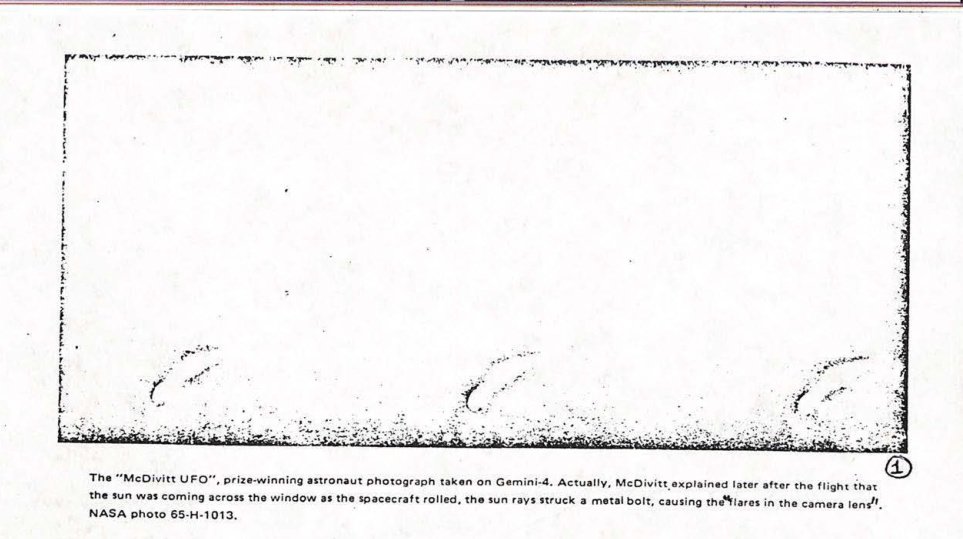
Date: June 1965Location: Earth orbit
Gemini IV: the curtain-of-light UFO described by McDivitt and White
Two astronauts describe a UFO as a curtain of light during Gemini IV. Read the dialogue preserved by NASA, with translated excerpts and pages for verification.
- Event date
- June 1965
- Location
- Earth orbit
- Topic
- Lights and encounters
- Source agencies
- NASA
- Documents
- 2 documents · 514 pages
- Reading time
- 615 min
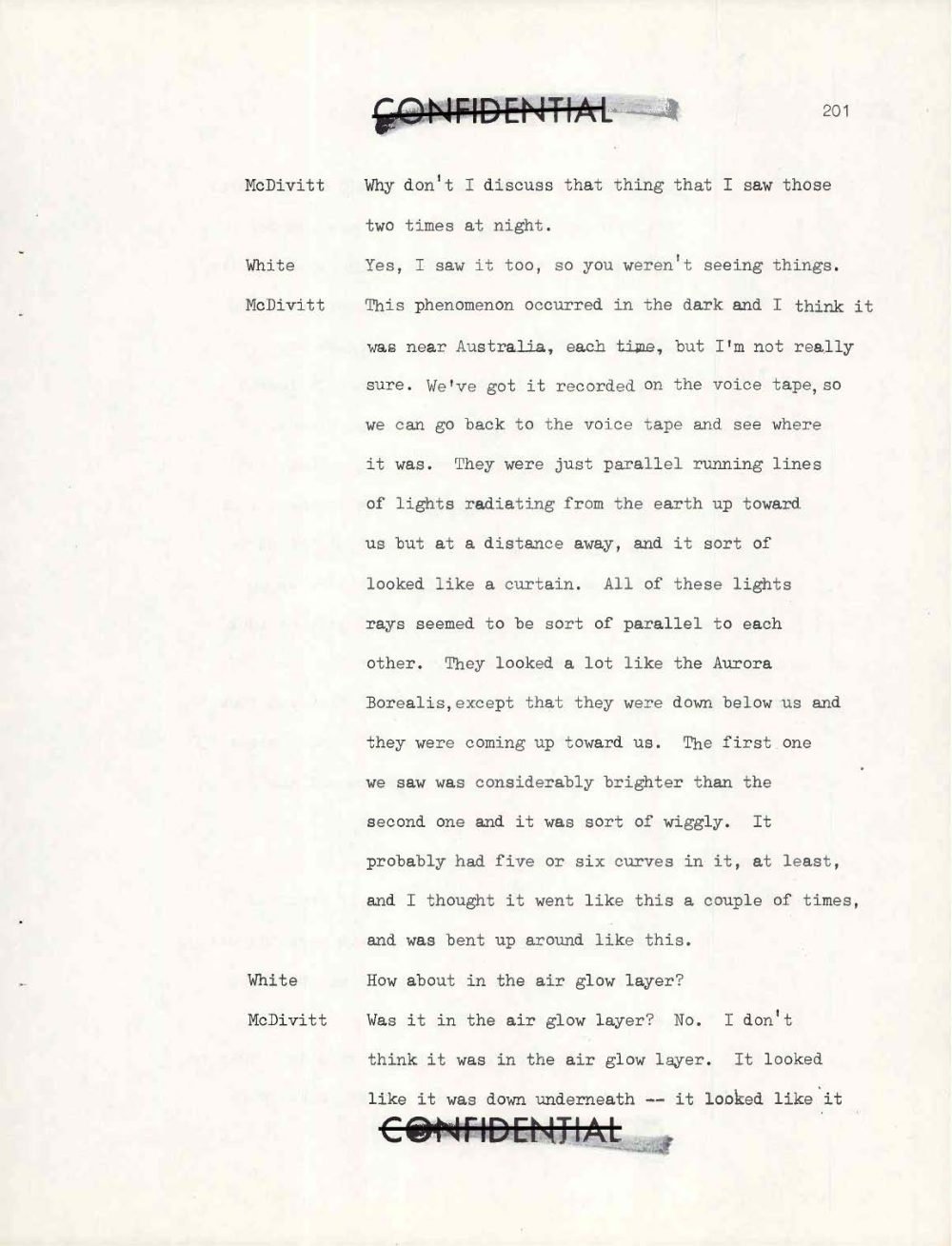 Crew debriefing: start of the accountPhysical page 209
DOCUMENTARY SOURCES · NASA
What the records tell
In the preliminary Gemini IV debriefing, James McDivitt introduces an observation he reportedly made twice during the night. Edward White replies that he saw it too. The description turns to a kind of curtain, formed by roughly parallel lines of light, apparently projected upward from the direction of the Earth. McDivitt compares its appearance to an aurora, but tries to explain why the position he perceived seemed different to him.
The excerpt is valuable because it preserves a conversation, with agreements and differences, instead of presenting a single ready-made interpretation. McDivitt thinks the episodes occurred near Australia, but says he is not sure and points to the voice recording as a means of recovering the location. This indication offers a possible documentary follow-up: the recording and the mission time could allow an orbital reconstruction far more precise than the recollection expressed in the dialogue.
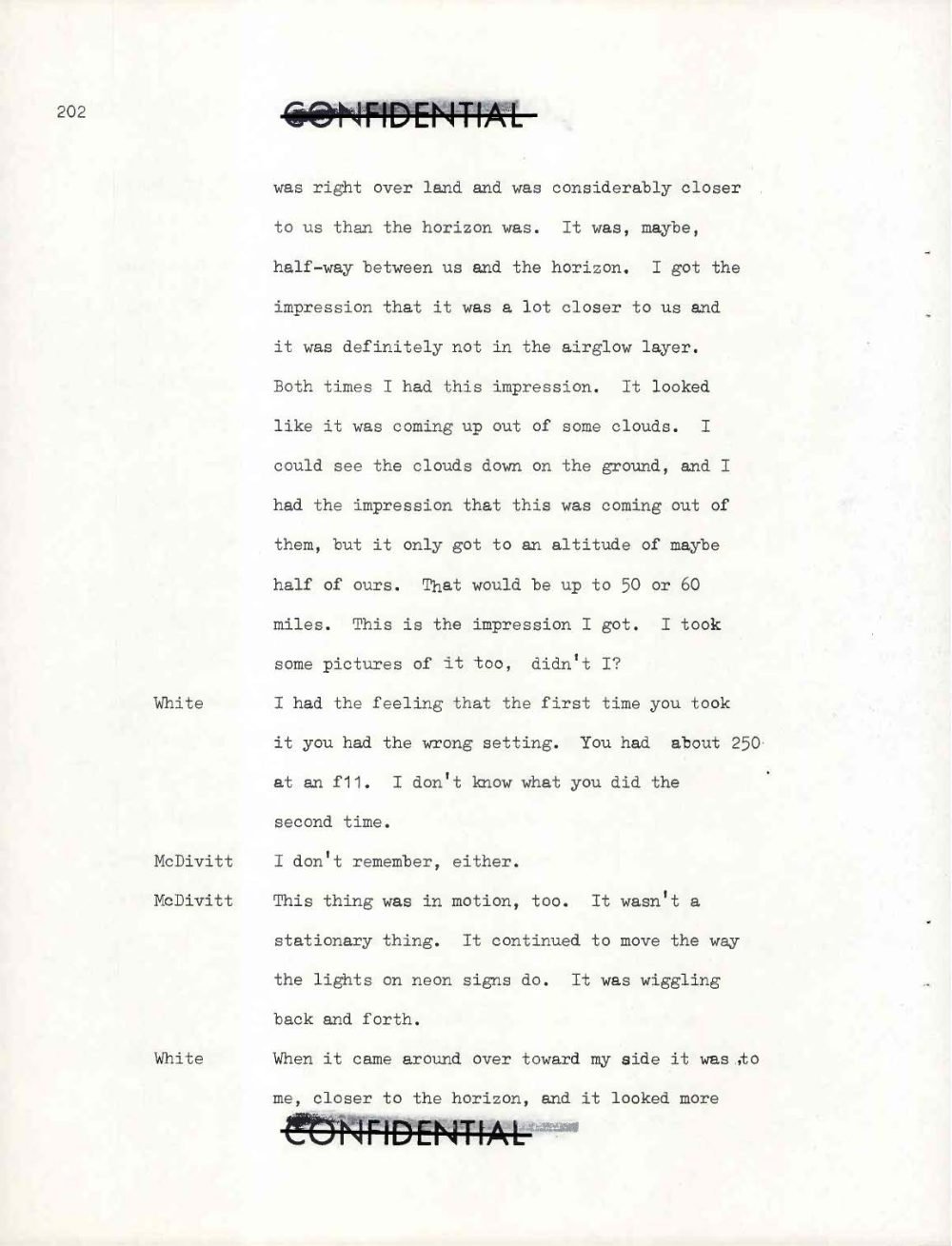
On the following page, McDivitt describes the impression of proximity, supposes lights emerging from the direction of the clouds and mentions an apparent height on the order of half the spacecraft's altitude. He himself uses the language of impression, not of a distance measurement. The movement is compared to that of neon sign lights, oscillating from side to side. This comparison should not be turned into the trajectory of a solid vehicle or a calculated acceleration.
White reports a geometry perceived differently: when the phenomenon moved to his side during the spacecraft's drift, it seemed closer to the horizon and to the airglow layer, the atmospheric luminosity. McDivitt insists that, from his position, the phenomenon seemed closer and outside that layer. The difference between the two perspectives is a clue for investigation, not a detail to be erased to make the account more uniform.
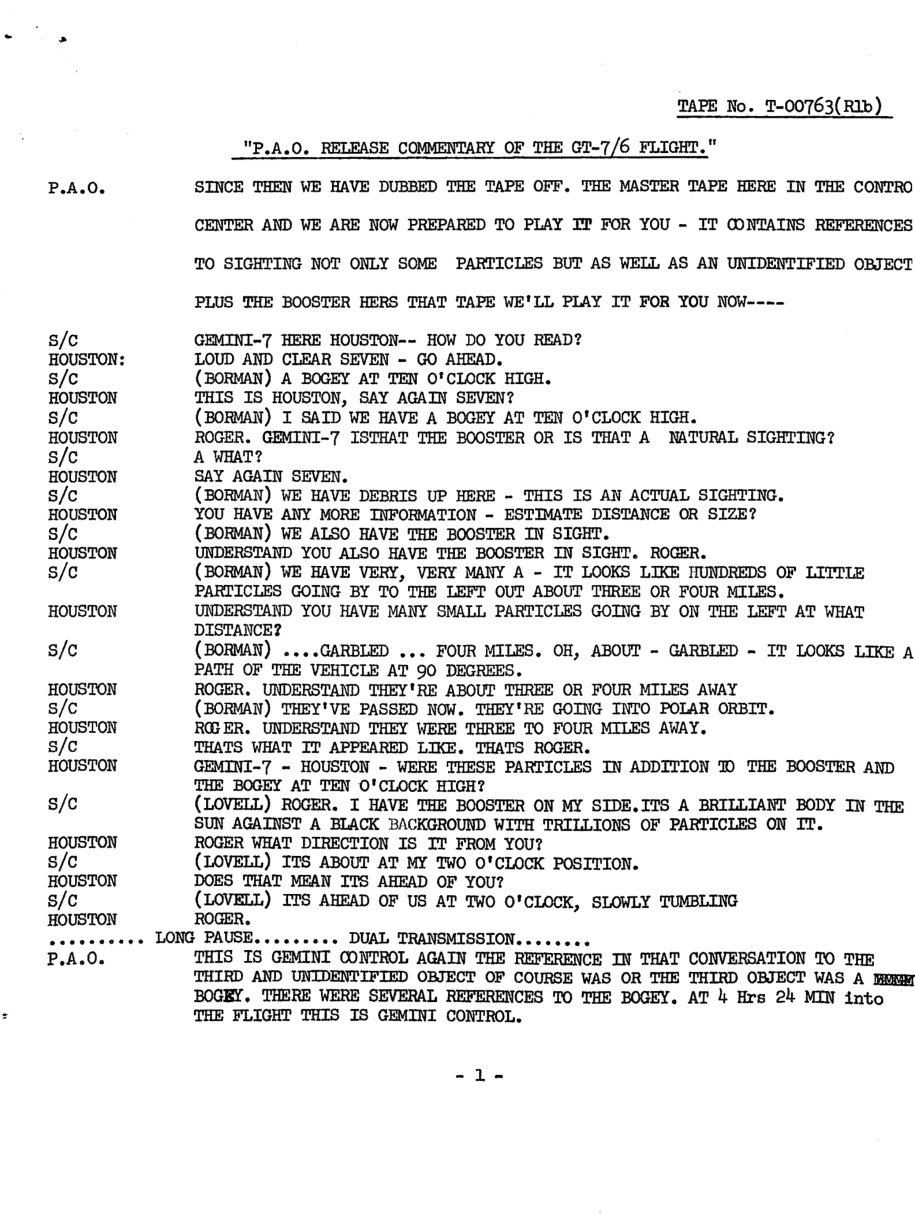
The dialogue also mentions photographs, but the astronauts themselves show uncertainty about the settings used. Thus, the mention of a photographic attempt does not allow one to assert that the effect was recorded with sufficient quality. At the end of the excerpt, the conversation moves on to the luminous particles near the spacecraft, called fireflies; this new subject needs to be separated from the distant curtain.
This case warrants further study because it brings together two observers, a concrete reference to a recording and possible photographic material. Useful investigation would synchronize these records with the spacecraft's attitude, orbital position, lighting and atmospheric conditions. The debriefing preserves an unusual observation and its uncertainty; it does not identify an artificial structure or a responsible intelligence.
In the continuation of the same dialogue, after the curtain, the two move on to their other observations of the sky. White recounts that, during the last sunrises, he searched without success for the jet of light that should rise just before the Sun. He saw something else: several minutes before sunrise, a small beam of white light rising from the horizon. He observed it on two occasions, during McDivitt's last sleep period, while he was doing the final filming. McDivitt replies that he did not see this beam. White also reports many shooting stars, which seemed to burn up at half or a third of the spacecraft's altitude, and none above it.
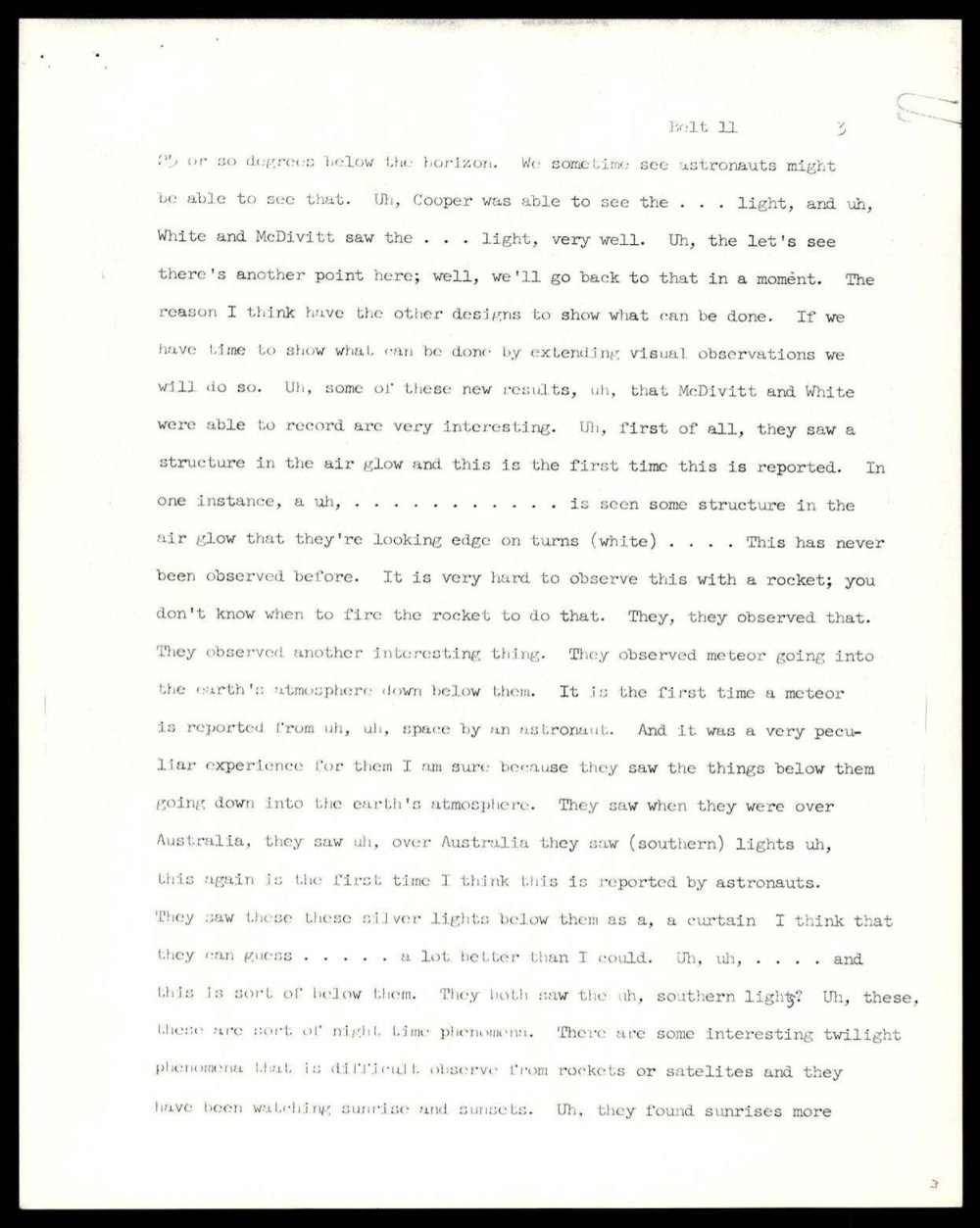
Papers from the Gemini IV experiments debriefing, kept in the same NASA collection, show how the scientists read these remarks. In a talk from the afternoon session, transcribed from a recording and attributed by hand to “Dunkelman”, the speaker says that, over Australia, the astronauts saw “(southern) lights”, “silver lights below them, like a curtain”, and treats them as southern lights, which he believed had been reported by astronauts for the first time. A draft synoptic report classifies the pre-dawn beam as zodiacal light, and notes taken from the transcript treat the shooting stars as meteors.
These readings are third-party interpretations, not measurements. The aurora is a hypothesis of the speaker, who admits that the astronauts would assess it “much better” than he could; the text of the talk is degraded and has gaps marked with dots by the transcriber himself. The draft synoptic report attributes the description of the beam to McDivitt and White together, but, in the transcript, it is White who gives it, and McDivitt says he did not see it. The notes also attribute to both the sentence about the meteors, spoken by White. None of these papers contains a photo of the curtain or a comparison with the voice recording cited by McDivitt.
The full text of the first two pages of the dialogue adds details to McDivitt's description. The first appearance was much brighter than the second and "sort of wiggly", with at least five or six curves; he shows with gestures, which the transcript does not record, how the band folded. In his view, the phenomenon was over land, much closer than the horizon, perhaps halfway, and seemed to come out of clouds he saw far below. It rose only to half the spacecraft's altitude, which would give, by his reckoning, 50 or 60 miles. This is an estimate made from a visual impression, not a measurement.
The conversation about the photos is also complete. McDivitt asks whether he had photographed the phenomenon, and White replies that, the first time, the setting seemed wrong to him: about 1/250 of a second at an f/11 aperture. The second time, neither of them remembered. None of the pages in the collection contains these photographs or says whether they were developed and examined. White, for his part, insists that, when the phenomenon moved to his side, it seemed closer to the horizon. The two impressions are recorded side by side, without the transcript deciding between them.
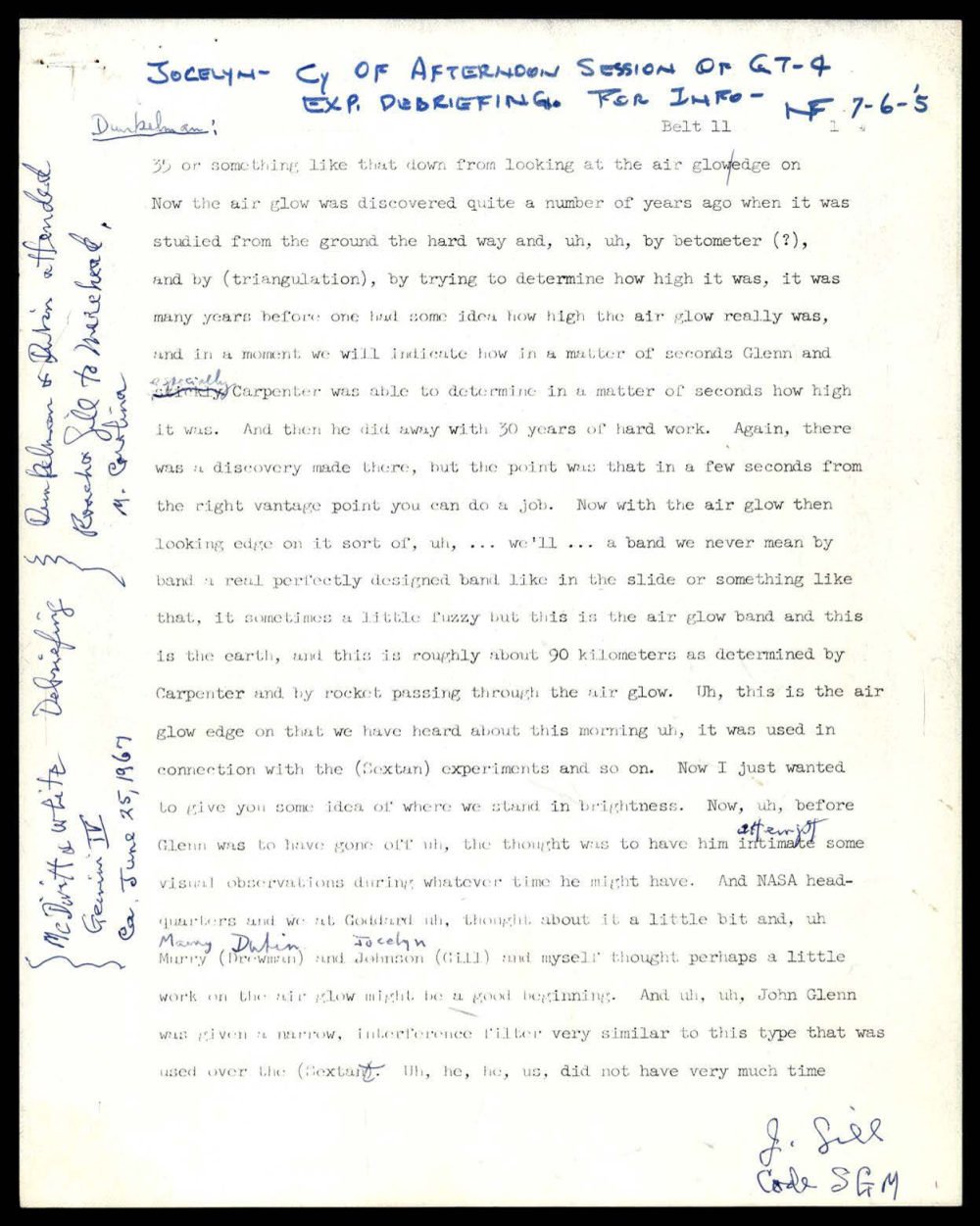
A handwritten annotation at the top of the transcript of the talk, in the experiments debriefing file, explains where this paper comes from. It is a copy of the afternoon session of the GT-4 experiments debriefing sent "for information" to Jocelyn, with a date that appears to be July 6, 1965. In the margin, another note records that Dunkelman and Dubin attended the debriefing, while Roach and Gill went to Morehead, North Carolina. The name "Dunkelman" written next to the first line is the only identification of the speaker. The paper does not say whether the astronauts attended this talk.
On another tape from the same series, the subject returns as an argument for future flights. The speaker, not identified on that page, talks about observations made by rockets that are difficult to repeat, such as a probable very strong ultraviolet aurora over Wallops Island, and suggests that astronauts, with image converters, might be able to see auroras of this type. "They saw this aurora in southern Australia, visually," he says, and calls it "the beginning." It is the same reading of the curtain as a southern aurora, now treated as fact. The transcript comes from a poor recording and has gaps marked by the transcriber himself.
More images from the document
DIRECT READING OF THE FILE
The document, in the original
Translation of selected excerpts, not a full translation of the PDF. The English original was transcribed with normalized line breaks; check the facsimile for graphic details. Summary and editorial analysis are kept separate from the translations. Redacted passages were not reconstructed.
EXCERPT 1 · PHYSICAL PAGE 211
Remainder of physical page 211 (page 203 of the transcript), full text, except White's remark about the change in perspective, already translated in the dossier
McDivitt
White
McDivitt
White
McDivitt
White
McDivitt
203 .CO~~FIDE~~TIAL
like it -was below and in the air glow.
It looked like it was in the air glow to you? When
I saw it, it definitely wasn't in the air glow. It
was a lot closer to me.
Of course, it started on your side and you talked
about it for 3" • or 4 minutes or so. Then as
we drifted around, it went over, I guess, to my
side. It was irregular shaped and it was out
toward the air glow layer.
Well, the second time it was a lot less bright.
Are we going to talk about the air glow layer now?
Okay. We' re going to talk about the air glow layer,
but it comes under "horizon". Let's talk about
that under "horizon".
Okay.
Do we have any other celestial observations? The
fire flies that we had around the spacecraft continua.lly--Sometimes you'd be able to look out and only
see one, and you couldn't see them too well at all
at times. You could see them in the daylight occasionally, but I don't think you could ever see them
at night. But the place where you could really see
them was at sunrise and sundown, because here you
had a black background of the sky a.nd you had the
GQ~~ElDE ~TIAL • -'.1Editorial note: The first line concludes White's remark begun on page 210. The number of minutes in White's remark is handwritten ("3"). "Air glow" rendered as atmospheric glow (airglow).
Check the original PDF
White: [...] like it was below and in the air glow.
McDivitt: It looked like it was in the air glow to you? When I saw it, it definitely wasn't in the air glow. It was a lot closer to me.
White: [fala já traduzida no dossiê]
McDivitt: Well, the second time it was a lot less bright.
White: Are we going to talk about the air glow layer now?
McDivitt: Okay. We're going to talk about the air glow layer, but it comes under "horizon". Let's talk about that under "horizon".
White: Okay.
McDivitt: Do we have any other celestial observations? The fire flies that we had around the spacecraft continually--Sometimes you'd be able to look out and only see one, and you couldn't see them too well at all at times. You could see them in the daylight occasionally, but I don't think you could ever see them at night. But the place where you could really see them was at sunrise and sundown, because here you had a black background of the sky and you had theView the document record ↗ · Physical page 211, counting the cover.
EXCERPT 2 · PHYSICAL PAGE 212
Physical page 212 (page 204 of the transcript), full text
204 GOl>~FIDE~~TIAL
White
McDivitt
White
McDivitt
sun shining on them.
They picked the sun up .
They picked the sun up and reflected the rays. They
r eflect ed t hem just as bright as stars, I thought .
Didn ' t they ! Well, you know the thing that was most
interesting to me was the time I called you and said
the sky was full of stars, and you said it wasn't ,
the sky. We were pointing down at the earth. That
was my first exposure to having your window in t he
daylight and mine in the dark. At this time we had
a l l the fuel particles from the fuel from the boosters
spewing out all over, and my whole view out t he window was j ust completely full of these reflecting
particles. They looked kind of like one of the st ar
fi elds we had past off on us as star fields. It
looked kind of like a star field, but it looked
kind of unreal , too . That's exactly what it was.
One of the prettiest things was when. we had a urine
dump at eunset,because we just had mil lions and
millions and millions of these fireflies or part icles
outside . When you put them all out like that with
the sun shining on them,as we 'd mentioned earlier ·
with the black background, it just l ooked marvelous.
As a matter of fact, we took some movies of them·,.
E..-01
RFIDE~~TIAEEditorial note: "Past off on us" appears this way in the typescript (probably "passed off"); the bracketed reference to the training is the translation's interpretation. The remark about the fireflies is McDivitt's, who began it on the previous page.
Check the original PDF
[McDivitt] sun shining on them.
White: They picked the sun up.
McDivitt: They picked the sun up and reflected the rays. They reflected them just as bright as stars, I thought.
White: Didn't they! Well, you know the thing that was most interesting to me was the time I called you and said the sky was full of stars, and you said it wasn't the sky. We were pointing down at the earth. That was my first exposure to having your window in the daylight and mine in the dark. At this time we had all the fuel particles from the fuel from the boosters spewing out all over, and my whole view out the window was just completely full of these reflecting particles. They looked kind of like one of the star fields we had past off on us as star fields. It looked kind of like a star field, but it looked kind of unreal, too. That's exactly what it was.
McDivitt: One of the prettiest things was when we had a urine dump at sunset, because we just had millions and millions and millions of these fireflies or particles outside. When you put them all out like that with the sun shining on them, as we'd mentioned earlier with the black background, it just looked marvelous. As a matter of fact, we took some movies of them,View the document record ↗ · Physical page 212, counting the cover.
EXCERPT 3 · PHYSICAL PAGE 213
Physical page 213 (page 205 of the transcript), full text
205
White
McDivitt
White
McDivitt
White
and I think we might have taken some stills,
but I'm not sure .
I hope it came out.
Yes , it was r eally spectacular! So we could
just about make our own stars when we wanted to .
Is that all on celestial?
That ' s all I can think of, Jim.
I couldn't see the zodiacal lights. I couldn't
see the r~genschein and I could not see the burst
of zodj acal lights that you get just as the sun
sets. Go ahead , Ed .
Okay. I saw one during the last few sunrises .
I watched the sun very carefully. trom the time
it first started to come up till it finally
popped up , I was looking all the time for that
shoot of light that 's supposed to come up just
before the sun pops up . Well , I could never
see that . All I could see was the glow as it
came up and a very rapid rise as the sun did come
up . There 's something that I did see that was
quite interesting t o me . Several minutes before
the sun came up there would be a shaft of light
that would shoot up, and I watched it on twoEditorial note: The remark about the beam of light is White's, not McDivitt's. Gegenschein is the faint glow of the night sky at the point opposite the Sun.
Check the original PDF
[McDivitt] and I think we might have taken some stills, but I'm not sure.
White: I hope it came out.
McDivitt: Yes, it was really spectacular! So we could just about make our own stars when we wanted to. Is that all on celestial?
White: That's all I can think of, Jim.
McDivitt: I couldn't see the zodiacal lights. I couldn't see the gegenschein and I could not see the burst of zodiacal lights that you get just as the sun sets. Go ahead, Ed.
White: Okay. I saw one during the last few sunrises. I watched the sun very carefully from the time it first started to come up till it finally popped up. I was looking all the time for that shoot of light that's supposed to come up just before the sun pops up. Well, I could never see that. All I could see was the glow as it came up and a very rapid rise as the sun did come up. There's something that I did see that was quite interesting to me. Several minutes before the sun came up there would be a shaft of light that would shoot up, and I watched it on twoView the document record ↗ · Physical page 213, counting the cover.
EXCERPT 4 · PHYSICAL PAGE 214
Physical page 214 (page 206 of the transcript), full text
206 cer~FI
McDivitt
White
McDivitt
White
McDivitt
White
McDivitt
different occasions. It was during your last
sleep. I was taking a few final movies and I was
watching for this very phenomenan. It was the
first time I saw it . It would be a little shaft
of white illumination and it was a long time before the sun came up. I don't know whether that's
what they were seeing before or not . But when the
sun itself actually came up, I didn't get much of
a big ball of light--just some big, bright lights
coming up from behind the earth.
That's all I was getting. I didn't see this other
thing.
I saw quite a few shooting stars.
Oh, yes.
They seemed to fall and burn up considerably below
our altitude. They looked a half or a third as
high as we were when they were actually being
consumed and being burned up. I never saw one
above us , did you?
No .
Okay cloud coverage--
There was a lot of it.
There was lots of it. There were a lot of times
when there wasn't any. I don't guess there's much
we can sal about this .
co~~IDE~~TJAL
_JEditorial note: "Phenomenan" appears this way in the typescript. The line "Okay cloud coverage" has no name in the margin.
Check the original PDF
[White] different occasions. It was during your last sleep. I was taking a few final movies and I was watching for this very phenomenan. It was the first time I saw it. It would be a little shaft of white illumination and it was a long time before the sun came up. I don't know whether that's what they were seeing before or not. But when the sun itself actually came up, I didn't get much of a big ball of light--just some big, bright lights coming up from behind the earth.
McDivitt: That's all I was getting. I didn't see this other thing.
White: I saw quite a few shooting stars.
McDivitt: Oh, yes.
White: They seemed to fall and burn up considerably below our altitude. They looked a half or a third as high as we were when they were actually being consumed and being burned up. I never saw one above us, did you?
McDivitt: No.
Okay cloud coverage--
White: There was a lot of it.
McDivitt: There was lots of it. There were a lot of times when there wasn't any. I don't guess there's much we can say about this.View the document record ↗ · Physical page 214, counting the cover.
EXCERPT 5 · PHYSICAL PAGE 38
Physical page 38 (sheet 3 of the “Belt 11” tape), full text: talk at the afternoon session of the Gemini IV experiments debriefing
C -- l:r:lt ll
v/1 • some: L:i.rnr: sec :.;.3tronauts might
l.1c aolc t o sec t hti.t . UJ i, Coope was able to see the . light , and uh ,
White and McDivitt s aw the .. . light, ve ry wel l. Uh, the let 's see
there ' s another point here ; well, w ' 11 go ba k t o t hat in a moment. The
cason I 1,htnk have tt otl1e.r dcsji.'.ns I~ show what r:Fm be done . If we
lw.vr: Urne Lu ehow whuL 1·1n1 be don<· lly r~xLem.l.int'. vi s 1..ia1 obscr vt"i.tions we
,,.,:111 do so. UJ1 , :,om 01 · Ll1 ·s • n. w r :_:u]ts , 11t1 t hat McDivitt and White
we re able tu r or ar v ry . nLc r 'S Ung. Ul1 f irst of all, t hey saw a
structure in the air gl ow a nd this is the first time this i s eport ed. In
one inst ance a uh, . i s seen some structure i n the
~ir elow that they 're looking edge on turns (whlte) .... This has never
been obscrv d b fore . It is ver y hurd to observe t his with a roc ket; you
clan 't know when to fire the rocket to do t hat. They, they observed that.
They obcer-vcd. unothcr intc.;rc ct:Lnp, tli·ine; . They observed mcteo oi ng into
Lh • 1:,.1r.th ' :: -'Li..mu:..;phcrr: dnwn ·1ic1ow Lb . 111 . I t .i :; the .first time a mcteo
1::: rcJ,ortccl f"r.um uh , uJ1 , npac l1y l.l!l ,rnL onui1L. And it. wa a very pecu1.iar .xperjcnc:c l"or· i..11 rn I itru sure: b r·.-1use they saw the things below them
go ng own .I.nto t.hc ca1 ·t;h ' n utmo::;pltcr(: . Th_y saw when they were over
/\u t alia) they cuw u.J1 ave /1.ustru.lin they sn.w (southern) lights uh,
Lli·i.,.. 1tg :I. n ir.; L11e l'it·:::I; time J tli inl< Ll1·i s i s reported by astronauts .
. u loL Ile l. l:c r Lllan I c 1L1ld. m1 uh . and
l.l11..':;,• :i 1· , : : wl, l,1 · r1i1-'.l 1L l.i1n,· pl1L't1,,1m·1111. 'rh 1·c ut·c some inte e ting twilight
pl 1c11<>n11'11u. I.I rd, i :~ d •i IT.i 1·1l.l L P ll i.H•rv,' 1· 1·um oc ·kc t s or satel ites and they
(Jh tllcy fow1d sunrises moreEditorial note: The dots and parentheses are the original transcriber's, who marked passages he did not understand in the recording; they were not filled in. The first digit of the opening number is barely legible. Sheet 1 of the same tape (physical page 36) bears the handwritten note “copy of the afternoon session of the GT-4 experiments debriefing” and the name “Dunkelman” as the speaker; the identification of the speaker depends on that note.
Check the original PDF
[2]5 or so degrees below the horizon. We sometime see astronauts might be able to see that. Uh, Cooper was able to see the . . . light, and uh, White and McDivitt saw the . . . light, very well. Uh, the let's see there's another point here; well, we'll go back to that in a moment. The reason I think have the other designs to show what can be done. If we have time to show what can be done by extending visual observations we will do so. Uh, some of these new results, uh, that McDivitt and White were able to record are very interesting. Uh, first of all, they saw a structure in the air glow and this is the first time this is reported. In one instance, a uh, . . . . . . . . . . . is seen some structure in the air glow that they're looking edge on turns (white) . . . . This has never been observed before. It is very hard to observe this with a rocket; you don't know when to fire the rocket to do that. They, they observed that. They observed another interesting thing. They observed meteor going into the earth's atmosphere down below them. It is the first time a meteor is reported from uh, uh, space by an astronaut. And it was a very peculiar experience for them I am sure because they saw the things below them going down into the earth's atmosphere. They saw when they were over Australia, they saw uh, over Australia they saw (southern) lights uh, this again is the first time I think this is reported by astronauts. They saw these these silver lights below them as a, a curtain I think that they can guess . . . . . a lot better than I could. Uh, uh, . . . . and this is sort of below them. They both saw the uh, southern lights? Uh, these, these are sort of night time phenomena. There are some interesting twilight phenomena that is difficult observe from rockets or satelites and they have been watching sunrise and sunsets. Uh, they found sunrises moreView the document record ↗ · Physical page 38, counting the cover.
EXCERPT 6 · PHYSICAL PAGE 120
Physical page 120, “Meteors” section: notes taken from the debriefing transcript
"' Notes from the De-Briefing transcript
eteors:
Both cDivitt and hite 1 tioned seeing a number of rn teors bel w
them: e sa quite a fe f all end burn up bolo our cltitude. 1hey wore bout
on half to on third as high as re were hen they ere conswn d. . e /n er
aaw one bove us. 11 { short d s if.,'()
As the acco p',nyin..~ plots of numb rs of meteor a ainst the onths of thef
r sho s the oun of meteor activity in e rly June is at a r ther lo
p206 *Fig. l(Ro chta plot of Olivier data from S ithsoni n Contrib. t o Astrophys.N
level, b1,.:gdnn to rioe very hortly alter that to rds ll peak in u ust . on th average from to altitude
Re rdless of their bri htness/meteors ap or 40 and 60 miles/in the earth's
sphere. Bri"ht rn toors ares en to reach about 40 miles, rhereas wct8kkx
lar e fireb· lls may still e seen as lo I as 20 miles or so .
Th ver· , hei'.;ht th ou11.hout the ath is r ter for f aint r eteo nd
for thos of h h v.locitie . Actually the hr' ht objects r lar er and hence
tr vol further tofore they re conn d1 often tr veling fo r sev ral hundr d
iles b for they r consum d.
Planets
The pilot re rked that"the pl ets or o clear nd br' ht, 11 nd later
th t 11 a11 the sun"ets h d the plan t in it•" Th y have in f ct r corded Venus
in the oriion bands on one of their sunset pictures . t thot date V nus Qllbc
as still clos to the sun being (angul r dist;nce·t)Sup. conj .A r.11) bout 15de •
cast of the sun (eve. star). On the color print S-65-34771 them ge of Venus
can be distictly seen amid the horizon bands .Editorial note: In the transcript, the two quotations correspond to statements by White and by McDivitt (physical page 201 of part 1). Photo S-65-34771 is not in the collection. “Distictly” appears this way in the original; a word struck out by typewriter was omitted. The “Meteors” section of the same page is translated in the luminous curtain dossier.
Check the original PDF
Notes from the De-Briefing transcript
Meteors:
Both McDivitt and White mentioned seeing a number of meteors below them: "We saw quite a few fall and burn up below our altitude. They were about one-half to one-third as high as we were when they were consumed. We never saw one above us." (short and swift?)
As the accompanying plots of numbers of meteors against the months of the year shows the amount of meteor activity in early June is at a rather low level, beginning to rise very shortly after that towards a peak in August. [margem: p206] *Fig. 1 (Roach's plot of Olivier data from Smithsonian Contrib. to Astrophys. No[...])
Regardless of their brightness meteors appear on the average from altitude 40 and 60 miles in the earth's atmosphere. Bright meteors are seen to reach about 40 miles, whereas large fireballs may still be seen as low as 20 miles or so.
The average height throughout the path is greater for fainter meteors and for those of high velocities. Actually the bright objects are larger and hence travel further before they are consumed, often traveling for several hundred miles before they are consumed.View the document record ↗ · Physical page 120, counting the cover.
EXCERPT 7 · PHYSICAL PAGE 121
Physical page 121, full text: draft synoptic report, “Zodiacal light” and “Window condition” sections
..
Zodiacal Light
~ Jae Divitt and ,hite ,ere taking 16 rnti. movies DK1u:d;i1Q5
be.fore one 11 capsule da m11 when they noic d ttie zodiacal light and described
it u thus, "it was a shaft of light and a long tine before the sun came up. 11
On the ,round observ rs can note tho cone tot light in the eastern sky or
• western sky after the sun has set and gone down about 18 de~~ ( about and hour
after sunset or an hour before sunri e.) Pilots t 40,000 feet o~n follo it for
a lon1er span since they are , rray from disturbing city lights •
\ Condition of tho ii.do
\
\
The G....nrlni optical window is quite superior to tho Jrcury indo,,. None- ~
the less the pilots note that11 both their windows ere fog YJ" nd at one
point durin~ EVA ,hite :rubbed his sleeve accid nt·-lly on JirllSs, ~dow
d~~na it - probably parti lly rcmvlinr the silicon ·D.m. smu -~-oEditorial note: Words struck out by typewriter at the beginning were omitted. The margin note “.205” refers to page 205 of the transcript (physical page 213 of part 2). The draft attributes the description to both astronauts, but in the transcript it is White's, and McDivitt says he did not see the beam. “Noiced” and “and hour” appear this way in the original.
Check the original PDF
[manuscrito:] Draft Synops. report
2.
Zodiacal Light
McDivitt and White were taking 16 mm. movies before one "capsule dawn" when they noiced the zodiacal light and described it thus, "it was a shaft of light and a long time before the sun came up." [margem: .205] On the ground observers can note the cone of light in the eastern sky or western sky after the sun has set and gone down about 18 deg. (about and hour after sunset or an hour before sunrise.) Pilots at 40,000 feet can follow it for a longer span since they are away from disturbing city lights.
Condition of the Window:
The Gemini optical window is quite superior to the Mercury window. None the less the pilots note that "both their windows were foggy;" and at one point during EVA White rubbed his sleeve accidentally on Jim's window smudging it --probably partially removing the silicon film.View the document record ↗ · Physical page 121, counting the cover.
EXCERPT 8 · PHYSICAL PAGE 209
Remainder of physical page 209 (page 201 of the transcript), after the opening of the dialogue already translated in the dossier
201
McDivitt
White
McDivitt
White
McDivitt
Why don' t I discuss t hat thing that I saw those
two times at night .
Yes, I saw it too , so you weren ' t seeing things.
This phenomenon occurred in the dark and I think it
\./a.S near Austra.l.ia., each t.iine, but I 1m not really
sure. We 've got it recorded on the voice tape,so
we can go back to the voice tape and see where
it was. They were just paral l el r unning lines
of lights radiating from the earth up toward
us but at a distance away, and i t sort of
looked like a curtain. All of these lights
rays seemed to be sor t of parallel t o each
other. They looked a lot like the Aurora
Borealis, except that they were down below us and
they were coming up toward us. The first one
we saw was considerably brighter than t he
second one and i t was sort of wiggly. It
probably had five or six curves in it, at least,
and I thought it went like this a couple of times,
and was bent up around like this.
How about in the air glow layer?
Was it in the air glow layer? No. I don't
think it was in the air glow layer. It looked
like it was down underneath -- it looked like it
Cilt-lFIDEt;JIAL .Editorial note: "Assim" translates "like this": McDivitt describes the shape with gestures, which the transcript does not record. With this block, page 209 is translated in full.
Check the original PDF
McDivitt: [...] All of these lights rays seemed to be sort of parallel to each other. They looked a lot like the Aurora Borealis, except that they were down below us and they were coming up toward us. The first one we saw was considerably brighter than the second one and it was sort of wiggly. It probably had five or six curves in it, at least, and I thought it went like this a couple of times, and was bent up around like this.
White: How about in the air glow layer?
McDivitt: Was it in the air glow layer? No. I don't think it was in the air glow layer. It looked like it was down underneath -- it looked like itView the document record ↗ · Physical page 209, counting the cover.
EXCERPT 9 · PHYSICAL PAGE 210
Remainder of physical page 210 (page 202 of the transcript), before and after the remark about the motion already translated in the dossier
202
White
McDivitt
McDivitt
White
was right over land and was considerably closer
to us than the horizon was. It was, maybe,
half-way between us and the horizon. I got the
impression that it was a lot closer to us and
it was definitely not in the airglow layer.
Both times I had this impression . It l ooked
like it was coming up out of some clouds. I
could see the clouds down on the ground, and I
had the impression that this was coming out of
them, but it only got to an altitude of maybe
half of ours. That would be up to 50 or 60
miles. This is the impression I got . I took
some pictures of it too, didn't I?
I had the feeling that the first time you took
it you had the wrong setting. You had about 250·
at an f11. I don't know what you did the
second time.
I don't remember, either.
This thing was in motion, too. It wasn ' t a
stationary thing. It continued to move the way
the lights on neon signs do. It was wiggling
back and forth .
When it came around over toward my side it was .,to
me, closer to the horizon, and it looked more
<!tlP-ifFIDE ~TtAt ~Editorial note: "250 at f/11" is the camera setting mentioned by White: a speed of about 1/250 of a second and an aperture of f/11. The altitude of 50 to 60 miles is McDivitt's calculation based on the impression that the phenomenon reached half the spacecraft's altitude; it is not a measurement. With this block, page 210 is translated in full.
Check the original PDF
McDivitt: [it] was right over land and was considerably closer to us than the horizon was. It was, maybe, half-way between us and the horizon. I got the impression that it was a lot closer to us and it was definitely not in the airglow layer. Both times I had this impression. It looked like it was coming up out of some clouds. I could see the clouds down on the ground, and I had the impression that this was coming out of them, but it only got to an altitude of maybe half of ours. That would be up to 50 or 60 miles. This is the impression I got. I took some pictures of it too, didn't I?
White: I had the feeling that the first time you took it you had the wrong setting. You had about 250 at an f11. I don't know what you did the second time.
McDivitt: I don't remember, either.
McDivitt: [fala sobre o movimento, já traduzida]
White: When it came around over toward my side it was, to me, closer to the horizon, and it looked moreView the document record ↗ · Physical page 210, counting the cover.
EXCERPT 10 · PHYSICAL PAGE 36
Physical page 36 of the experiments debriefing: handwritten notes at the top and in the margin of the talk transcript (notes only)
C..y 0~ AFT~NO<#,J Se-w,o~ <Dr
~ f. 9\& b c.,cn:I N-"• ~fl- l,'-\Jrc,
Belt 11
)'.,; or· ~;omc.;U1j r.r~ .Ulce t! ,r,.t ,Lovt', from looking at t e ai!'.' 0 10vfedge on
Now t he air ~l ow was discovered q1lit a number o· y ea s ago when it wa s
stud ·cd .om t e ground the hard way and, uh uh, by etometer (?)'
,1.nd l,y ( tri11.nguJ.;.i. t • on) , by tryi ng to determine h ow high i t wa s it was
many yea r n h r oJ"<• on· 1,a<l ::om,1 j< <'>L how ll lg}1 tr,c air 1.i:low really was,
ancl .ir1 a rnorm:11. wv "W j.ll .lrnl.i1:1d,· l1t)W in u. rrv-.1.l,L<·r- f ccr·ond.o Glenn and
-<! , ,. c..-....it..
~Cu.rp ·nL(·r- wac ·· lil • Lo <:Lr:r-m i 11C: in u mutter [" seconds how jgh
it w:.J,,s . /\ncl tl1<: r1 lie: d:i.<t v.wu.y w:i.tl, :,0 y :r.1.rs of' hard wor·k. Aga.in the e
W"l.ls :L dis,·ov _ ry 111a<'l.c Lh<..:.rc: hut LJ1c pc,in t WIL~: t;hat in a few ~ - conds from
th . :L ht vant 11~ poj_ri L ynu cnn d > tl jolJ. Nuw with tl'ic air glow t hen
.Looki ng 'U/~(' 011 LL so L of ul1 , wt· 'll . . . a band we never mean by
LK't.nd ·t red. l' 1.•f't't:tly tlc~ :i. 1'.ncrl arnl J.jkc.: i n th· s lide or som thing like
tlio.L. . it :;urn l,j IIK::; a Ji t;t;l • J'11z:1.y l,ut t:.l1i s j s U1c air glow band and this
C rp ·11t r nnd. li_y r·ock. ·t pn.::;~i11r.; L11r-()t.1/'.h the 'L.i.r elow. TJb th·I s is t he air
glow dg on tl11tL we 1t1~v, _h .ard ttl,rn1t Ut:Ls mot'ni.ng uli it was used i n
er
- com1 rtion vlit}, l:h _ u:,,xtu.n) X'P'l"imc.mL.; ancl ' O on. Now 1 just wanted
to 1: i vc y 0 11 ::om(: idcu. ol.' wl 1c-rc; we - :;l.1t11d. in 'l id/~l1tness . N w ub, before
~tr.Jwv--~
C.-lc1 111 w-:tn l.n l1;rvc· ,'.onr· ,i!'I' 1rl , 1 tl1v thD1l1'.ht W' L(.; Lo have him irltimaJtl some
And NASA headAnd. nil , ull , ,John Glenn
w,1 :~ ; '. i v,·11
1i:; <I ,,v,'r
.-L 111 1.1.,-1,w , i 11l.('r·l', ·1 ·,·11cc l'i .1 l.1·1 · ve1·y slrnilar to thls t ype that was
L1 1t· (;;,,xt,u;r. IJl 1 he , I re: , 11!.; , did not have ve y much timeEditorial note: "Cy" is an abbreviation of "copy". The date follows the American month-day-year format: 7-6-65 is July 6, 1965; the last digit is partially cut off. The reading of the margin note has words of uncertain reading ("attended", "Morehead"). The initials "NF" have not been identified. The typewritten text on the page is the beginning of the talk on airglow in general and on the observations by Glenn and Carpenter, unrelated to the curtain; it was not translated.
Check the original PDF
[No alto, à mão:] Jocelyn - Cy of Afternoon Session of GT-4 Exp. Debriefing for Info - NF 7-6-'65 [data parcialmente cortada na margem]
[À esquerda, à mão:] Dunkelman:
[Na margem esquerda, à mão, na vertical, com chave:] Dunkelman & Dubin attended Debriefing; Roach & Gill to Morehead, N. Carolina
[Datilografado:] Belt 11 1View the document record ↗ · Physical page 36, counting the cover.
EXCERPT 11 · PHYSICAL PAGE 47
Final passage of physical page 47 of the experiments debriefing (tape 12, sheet 2): talk on ultraviolet aurora
:Belt 1 2
relatively b.l.ack cornpa. ed to the 01 tsidc . And thi s is true and they
J ooked out thro1--<13.h the 'Window 1.1h , there seem d t o b e a change . In fact,
they have a pl'1 otograph of t h is ( spot) . . . . talk about that. Uh,
they are very uh, they say the astronauts have t aken advantages of every
possible opportunity t o note something unusual. And he keeps all
the (;opies . . Uh , .. I think we can look a little b it
to the :futu.rc . I think we uJ.l woul.d like t o extend the . r a nge of
vis i011 o.nd the wa y to do tJ-mt i s w•i t l1 inn ge converters. Thia may be
vc y ])rnc tic.:tl.l. Uh, i on · j s des.line: with uh, the iclea of perhaps using
'L v iol t lens t·at11er tl11m 11 ulue to r...-;ct down to a reg:Lon that is .
many ruo e c·ommunt::: on. You mn.y ue /7, t t.! ng into cl. reg:i on wbere the eye
snot ver y sensit i.vc or nots nsitiv • at a ll, yet i t is a very inter
esting region to do p ractical navigation well , there one can use the image
c;onverter and hav the eye become s ensitive through a n image converter
to uh, (the near v:i.olet) . There are many ob servations tha t have made
I' om roc k -ts that are 1 a d to repeat. Uh, for example , ultra viole t aurora .
We ' re not sm·e thi~ happened b ut uJ1 , two of th ,se .. in a rocket
nntl L11rou~~l1 ,y_j r· ai1d. -Lt r:ot satura t d Ftnd it tm·ns out t hat it probably
WHS a vc y st-.rong ll·:trnv:i o:JcL u 01 ·1-1 over Wa]ll)ps Island. And f'or t unately
t.w-o ol' tile ( 1;1:l<· t..,lmc Lm··n ) worked uml l>ec:iuse ti icy were .. to such
J,i1...-;!1 ::i;rw,iLivlty l111L tl1c otl1t:l' t wo W-< : r·<· .. .. Wel J_ , Lili, there .as
11u vj ::;1Lh.l • <:()tmt.cr·J)u.r.L 01 · thJ s aJ."c:t; tile e Wl:l.s 110 w y of knowing it·
::;11 t .LJ J Les I1avc • • • • • . 11<; tromJ.uLs might ' c able to l ook a round and
. LLltravio l c;t 1.:1.urora. •r1,cy saw l".hi" aura a j_n south
/\us tralia visually. Wi ~J 1 LI 1ft t 's l;I 1e bcginni.nt;. Perhaps With image
c:onw-rt rs Ll1cy rr\j t,'.llt p•ic ·k 11p s om • 0Ll1cr· aurora.
11 I L. n,vi oJ ct. C/'. 'i on ; we don ' t know whether
I I , . ,.• I I i r l.1 ~ I • :IEditorial note: Transcript of a recorded talk, with gaps marked by dots by the transcriber himself (here, [...]); the word in parentheses "sactometers" is the transcriber's doubt, kept as is. The speaker on this tape is not identified on the page. The sentence about the aurora seen in southern Australia refers back to the curtain described by the astronauts. The beginning of the page deals with a smudge on the window and was not translated.
Check the original PDF
There are many observations that have made from rockets that are hard to repeat. Uh, for example, ultraviolet aurora. We're not sure this happened but uh, two of these . . . . . in a rocket and through air and it got saturated and it turns out that it probably was a very strong ultraviolet aurora over Wallops Island. And fortunately two of the (sactometers) worked and because they were . . . . to such high sensitivity but the other two were . . . . Well, uh, there was no visable counterpart of this area; there was no way of knowing it; satellites have . . . . . . astronauts might be able to look around and see . . . . . ultraviolet aurora. They saw this aurora in south Australia visually. Well, that's the beginning. Perhaps with image converters they might pick up some other aurora. . . . . . . . . . . . ultraviolet . . . . uh, is a very . . . . region; we don't know whetherView the document record ↗ · Physical page 47, counting the cover.
EXCERPT 12 · PHYSICAL PAGE 1
full page
Action
MAIL CODE NAME
Approval
Call Me
Concurrence
file
Information
Investigate and Advise
NASA FORM 26
• I
AND SPACE
ROUTING SLIP
NATIONAL AERONAUTICS ADMINISTRATlo-1
____ .l ,Nmote and Forward
Note and R_e_hl_rn___
_
_
__jL,P;;,,-;R;:e::q::-u•=s�I::::.::_____
Per Teleph one Conversation
___ _J__:
R..e,.c,ommendation
See·Me
Signature
Circulate and De s roy I
(fL
1 J
'I,
h'.C.9--�
TEL. NO · (or ,ode) & EXT.
APR 69 PREVIOUS EDITIONS MAY BE USEDEditorial note: NASA internal routing slip that opens the set, noting that the following memoranda deal with the release of Gemini 4 photographic material between headquarters and the Manned Spacecraft Center.
Check the original PDF
Action
MAIL CODE NAME
Approval
Call Me
Concurrence
file
Information
Investigate and Advise
NASA FORM 26
• I
AND SPACE
ROUTING SLIP
NATIONAL AERONAUTICS ADMINISTRATlo-1
____ .l ,Nmote and Forward
Note and R_e_hl_rn___
_
_
__jL,P;;,,-;R;:e::q::-u•=s�I::::.::_____
Per Teleph one Conversation
___ _J__:
R..e,.c,ommendation
See·Me
Signature
Circulate and De s roy I
(fL
1 J
'I,
h'.C.9--�
TEL. NO · (or ,ode) & EXT.
APR 69 PREVIOUS EDITIONS MAY BE USEDView the document record ↗ · Physical page 1, counting the cover.
EXCERPT 13 · PHYSICAL PAGE 10
full page
FOREWORD
MISSION OPERATION REPORTS are published expressly for the
use of NASA General Management as required by the Administrator in NASA Instruction 6-2-10 dated August 15, 1963 . The purpose of these reports is to provide NASA General Management with
timely, complete and definitive information on flight mission plans
and results from launchings with Scout class or larger vehicles.
Initial reports are to be prepared and issued for each flight project
just prior to launch. Following launch, updating reports for each
mission will be issued to keep General Management currently informed as provided in NASA Instruction 6-2-10.
Distribution of these reports has been specifically directed by General Management and they are not available for additiona l or general
distribution . The Office of Pub I ic Affairs pub I ishes a comprehensive
series of pre-launch and post-launch reports on NASA flight missions
which are available for general distribution.
Pub I ishec and Distributed
by
OFFICE OF PROGRAM REPORTS
OFFICE OF PROGRAMMING
NATIONAL AERONAUTICS AND SPACE ADMINISTRATION
Washington, D. C. 20546Editorial note: Preface to the report: explains that the mission operation reports were produced for NASA's internal management and not for general distribution.
Check the original PDF
FOREWORD
MISSION OPERATION REPORTS are published expressly for the
use of NASA General Management as required by the Administrator in NASA Instruction 6-2-10 dated August 15, 1963 . The purpose of these reports is to provide NASA General Management with
timely, complete and definitive information on flight mission plans
and results from launchings with Scout class or larger vehicles.
Initial reports are to be prepared and issued for each flight project
just prior to launch. Following launch, updating reports for each
mission will be issued to keep General Management currently informed as provided in NASA Instruction 6-2-10.
Distribution of these reports has been specifically directed by General Management and they are not available for additiona l or general
distribution . The Office of Pub I ic Affairs pub I ishes a comprehensive
series of pre-launch and post-launch reports on NASA flight missions
which are available for general distribution.
Pub I ishec and Distributed
by
OFFICE OF PROGRAM REPORTS
OFFICE OF PROGRAMMING
NATIONAL AERONAUTICS AND SPACE ADMINISTRATION
Washington, D. C. 20546View the document record ↗ · Physical page 10, counting the cover.
EXCERPT 14 · PHYSICAL PAGE 11
full page
Rtndczvous guidance
& recovery system ____ _,
11 Ft
8 Ft
Separation point
Oxidizer tank
•Equipment bay
27 Ft
Stage 11 engine
thrust chamber
108 Ft
10 Ft
Oxidizer
tank
Stage I engine
g1mbal point
•Equipment bay contains:
• Batteries·
• Malfunction detection system IMOSI units
• Range safety command control system
• Programmer
• Three-axis reference system !TARSI
• Radio guidance system IRGSI
• Autopilot
• Instrumentation and telemetry system
FIG.
5/24/65
M-913-65-04
GENERAL
Gemini Flight Number Four (GT-4) is the second
manned orbital flight in the Gemini Program and
the fourth flight in a series of twelve planned to
develop long-duration and rendezvous capability,
docking techniques, extra-vehicular activities,
and controlled reentry. The first three Gemini
flights demonstrated: orbital insertion capability;
spacecraft structural integrity; and spacecraft
systems performance and crew accommodation
qualities, respectively. This GT-4 mission is
intended to further demonstrate manned space
flight for a period of four days, the longest
ever flown by two astronauts. The space vehicle
is depicted in Figure 1.
MISSION OBJECTIVES
PRIMARY
• Demonstrate and evaluate the performance of
the Gemini spacecraft systems for a period
exceeding four days.
• Evaluate the effects of prolonged exposure
to the space environment on the two-man
flight crew in preparation for missions of
longer duration.
SECONDARY
• Demonstrate OAMS capability to perform retro fire
backup.
• Demonstrate the capability of the spacecraft and
flight crew to make significant in-plane and
out-of-plane maneuvers.
• Conduct further evaluation of spacecraft
systems as outlined below:
1. Structure and thermo I protection
2. Environmental Control Systems (ECS)
3. Crew stations
4. Guidance and Control System
5. Orbital Attitude and Maneuver System
(OAMS)
• Execute the fol I owing experiments:
• D-1, Basic Object Photography
• D-6, Surface Photography
• D-8, Radiation in Spacecraft
• D-9, Simple Navigation
• M-3, In-Flight Exercises
• M-4, In-Flight Phonocardiogram
• M-6, Bone Demineralization
• MSC-1, Electrostatic Charge
Page 1Editorial note: Overview of the May 24, 1965 report: diagram of the launch vehicle, primary and secondary mission objectives and the beginning of the list of experiments.
Check the original PDF
Rtndczvous guidance
& recovery system ____ _,
11 Ft
8 Ft
Separation point
Oxidizer tank
•Equipment bay
27 Ft
Stage 11 engine
thrust chamber
108 Ft
10 Ft
Oxidizer
tank
Stage I engine
g1mbal point
•Equipment bay contains:
• Batteries·
• Malfunction detection system IMOSI units
• Range safety command control system
• Programmer
• Three-axis reference system !TARSI
• Radio guidance system IRGSI
• Autopilot
• Instrumentation and telemetry system
FIG.
5/24/65
M-913-65-04
GENERAL
Gemini Flight Number Four (GT-4) is the second
manned orbital flight in the Gemini Program and
the fourth flight in a series of twelve planned to
develop long-duration and rendezvous capability,
docking techniques, extra-vehicular activities,
and controlled reentry. The first three Gemini
flights demonstrated: orbital insertion capability;
spacecraft structural integrity; and spacecraft
systems performance and crew accommodation
qualities, respectively. This GT-4 mission is
intended to further demonstrate manned space
flight for a period of four days, the longest
ever flown by two astronauts. The space vehicle
is depicted in Figure 1.
MISSION OBJECTIVES
PRIMARY
• Demonstrate and evaluate the performance of
the Gemini spacecraft systems for a period
exceeding four days.
• Evaluate the effects of prolonged exposure
to the space environment on the two-man
flight crew in preparation for missions of
longer duration.
SECONDARY
• Demonstrate OAMS capability to perform retro fire
backup.
• Demonstrate the capability of the spacecraft and
flight crew to make significant in-plane and
out-of-plane maneuvers.
• Conduct further evaluation of spacecraft
systems as outlined below:
1. Structure and thermo I protection
2. Environmental Control Systems (ECS)
3. Crew stations
4. Guidance and Control System
5. Orbital Attitude and Maneuver System
(OAMS)
• Execute the fol I owing experiments:
• D-1, Basic Object Photography
• D-6, Surface Photography
• D-8, Radiation in Spacecraft
• D-9, Simple Navigation
• M-3, In-Flight Exercises
• M-4, In-Flight Phonocardiogram
• M-6, Bone Demineralization
• MSC-1, Electrostatic Charge
Page 1View the document record ↗ · Physical page 11, counting the cover.
EXCERPT 15 · PHYSICAL PAGE 12
full page
M-913-65-04
• MSC-2, Proton Electron Spectrometer
• MSC-3, Tri-Axis Magnetometer
• MSC-10, Two-Color Earth's Limb Photos
• S-5, Synoptic Terrain Photography
• S-6, Synoptic Weather Photography
UNUSUAL TASKS OF THIS MISSION
One of the interesting tasks of this mission is the duration of the flight. It
will be the longest ever to be conducted by a two-man crew. Another highly
interesting item is that control of the mission for the first time wil I be from the
Mission Control Center (MCC) Houston. Some elements of the Mission Control
Center at Cape Kennedy and the GSFC computing facility will be standing by as
a backup during the launch phase. The computing facilities at GSFC will also be
used as a backup to MCC-Houston during the orbital phase. Flight controllers will
man the MCC in three shifts to give complete round-the-clock coverage of the fourday mission. Crew control of reentry will be ac~omplished by tracking the roll
needle rather than nulling the down-range and cross-range needles as on GT-3.
The experiments will, of course, contribute much information for the scientific
and medical communities. The G4C suit which replaces the G3C suit used on
GT-3 has the fol lowing new featu res: a triple overvisor, a redundant pressure
closure seal (zipper), and thermal and meteoroid protection integrated in the
outer cover layer. Abort procedures to be utilized by the astronauts in the
unlikely event it becomes necessary for them to terminate. a mission before orbital
insertion are different from those used in the Mercury program. In that program,
the fireball that would have been created had a conflagration occurred on the pad,
would have been large enough to ABORT PROCEDURES
engulf an ejecting astronaut, so
it was necessary to add an escape
rocket to I ift the entire spacecraft
free of the area. The GLV, on
the other hand, uses self-igniting
fuels which, upon mixing, create a
fi reba II sma II enough so that the
astronauts can eject from the
spacecraft in much the same manner as is done in today's high
performance jet aircraft. This
is called the Mode I abort procedure. The three abort modes
are more fully defined by the
altitude and elapsed time-afterlaunch parameters depicted on
Figure 2.
FIG . 2
MOOE I - EJECT AfTEll SHUTDOWN
MOOE ll - SALVO RETROS AFTER SHUTDOWN
MODE ID - SHUTDOWN, SE PARATE, TURN AROUND,
RETROFIRE
~ OEIAYEO
MOOE
n
(WA IT 5
SECS )
15,000FT. _ _ ____.____~--'<-+--~-
' ~' MOOE
I
50
SECONDS
SEA LEVEL-----------''----L--'--
5/24/65 Page 2Editorial note: Finishes the list of experiments, highlights what is unusual about the mission (first control from Houston) and explains the three launch abort modes.
Check the original PDF
M-913-65-04
• MSC-2, Proton Electron Spectrometer
• MSC-3, Tri-Axis Magnetometer
• MSC-10, Two-Color Earth's Limb Photos
• S-5, Synoptic Terrain Photography
• S-6, Synoptic Weather Photography
UNUSUAL TASKS OF THIS MISSION
One of the interesting tasks of this mission is the duration of the flight. It
will be the longest ever to be conducted by a two-man crew. Another highly
interesting item is that control of the mission for the first time wil I be from the
Mission Control Center (MCC) Houston. Some elements of the Mission Control
Center at Cape Kennedy and the GSFC computing facility will be standing by as
a backup during the launch phase. The computing facilities at GSFC will also be
used as a backup to MCC-Houston during the orbital phase. Flight controllers will
man the MCC in three shifts to give complete round-the-clock coverage of the fourday mission. Crew control of reentry will be ac~omplished by tracking the roll
needle rather than nulling the down-range and cross-range needles as on GT-3.
The experiments will, of course, contribute much information for the scientific
and medical communities. The G4C suit which replaces the G3C suit used on
GT-3 has the fol lowing new featu res: a triple overvisor, a redundant pressure
closure seal (zipper), and thermal and meteoroid protection integrated in the
outer cover layer. Abort procedures to be utilized by the astronauts in the
unlikely event it becomes necessary for them to terminate. a mission before orbital
insertion are different from those used in the Mercury program. In that program,
the fireball that would have been created had a conflagration occurred on the pad,
would have been large enough to ABORT PROCEDURES
engulf an ejecting astronaut, so
it was necessary to add an escape
rocket to I ift the entire spacecraft
free of the area. The GLV, on
the other hand, uses self-igniting
fuels which, upon mixing, create a
fi reba II sma II enough so that the
astronauts can eject from the
spacecraft in much the same manner as is done in today's high
performance jet aircraft. This
is called the Mode I abort procedure. The three abort modes
are more fully defined by the
altitude and elapsed time-afterlaunch parameters depicted on
Figure 2.
FIG . 2
MOOE I - EJECT AfTEll SHUTDOWN
MOOE ll - SALVO RETROS AFTER SHUTDOWN
MODE ID - SHUTDOWN, SE PARATE, TURN AROUND,
RETROFIRE
~ OEIAYEO
MOOE
n
(WA IT 5
SECS )
15,000FT. _ _ ____.____~--'<-+--~-
' ~' MOOE
I
50
SECONDS
SEA LEVEL-----------''----L--'--
5/24/65 Page 2View the document record ↗ · Physical page 12, counting the cover.
EXCERPT 16 · PHYSICAL PAGE 13
full page
M-931-65-04
LAUNCH VEHICLE DESCRIPTION
The Gemini Launch Vehicle (GLV) has been modified by man-roting an Air Force
Titan II missile. The GLV has two stages, the first 71 feet long and the second 18
feet long; both stages have a diameter of 10 feet. The gross loaded weight of the
two stages is 337,521 pounds and they both burn storable hypergolic (self-igniting
upon mixture) propellants. First stage thrust is approximately 430,000 pounds at sea
level. Second stage thrust is approximately 100,000 pounds. The various systems of
the GLV have been detailed in previous Gemini MOR1s and what follows is additional
information concerning modifications made to GLV-4. The fuel dampener and oxidizer
standpipe used to suppress longitudinal oscillations have been redesigned. Butt welding
vice lapped joints have been utilized on the fuel tank conduits to eliminate minute
cracks. Malfunction Detection System circuitry has been redesigned to provide separate
indications of the subassembly thrust level and additional insulation has been applied to
provide increased fire protection. Sixteen T/M readout points have been removed
from the GLV because they are no longer required and one range safety circuit has
been added to the destruct system interlocking AGE and the GLV motor driven switch
control. This circuit will prevent switch cycling in the event that both set and reset
signals are inadvertently applied during checkout.
TABLE I
PROJECT COST
(In Millions)
FY 62 FY 63 FY 64 FY 65 FY 66 FY 67 Total
Spacecraft 30.3 205. 1 280.5 165.3 122.7 19. 1 823.0
Launch Vehicle 24.4 79. 1 122.7 115.4 88.6 8.5 438.7
Operational
Support 0 1 4.9 15. 7 27.7 30.8 13.0 92.2
Total RD & 0 54.8 289. 1 418.9 308.4 242. 1 40.6 1353.9
This level of funding will provide for twelve Gemini Launch Vehicles, twelve spacecraft, seven Agena Target Vehicles, six Atlas booster missiles and the operational costs
of flight testing and the associated Ground Support Equipment.
SPACECRAFT
The spacecraft is 18. 75 feet long and its two sections, a reentry module and an adapter
section will weigh 7799 lbs. fully loaded with the astronauts onboard. The configuration
will be the same as was flown on GT-3 except for the following: minor changes have
been made to switch positions and nomenclature, three additional (total of six) adapter
5/24/65 Page 3Editorial note: Describes the modifications to the launch vehicle (derived from the Titan II missile), includes the Project Gemini cost table by fiscal year and begins describing the spacecraft.
Check the original PDF
M-931-65-04
LAUNCH VEHICLE DESCRIPTION
The Gemini Launch Vehicle (GLV) has been modified by man-roting an Air Force
Titan II missile. The GLV has two stages, the first 71 feet long and the second 18
feet long; both stages have a diameter of 10 feet. The gross loaded weight of the
two stages is 337,521 pounds and they both burn storable hypergolic (self-igniting
upon mixture) propellants. First stage thrust is approximately 430,000 pounds at sea
level. Second stage thrust is approximately 100,000 pounds. The various systems of
the GLV have been detailed in previous Gemini MOR1s and what follows is additional
information concerning modifications made to GLV-4. The fuel dampener and oxidizer
standpipe used to suppress longitudinal oscillations have been redesigned. Butt welding
vice lapped joints have been utilized on the fuel tank conduits to eliminate minute
cracks. Malfunction Detection System circuitry has been redesigned to provide separate
indications of the subassembly thrust level and additional insulation has been applied to
provide increased fire protection. Sixteen T/M readout points have been removed
from the GLV because they are no longer required and one range safety circuit has
been added to the destruct system interlocking AGE and the GLV motor driven switch
control. This circuit will prevent switch cycling in the event that both set and reset
signals are inadvertently applied during checkout.
TABLE I
PROJECT COST
(In Millions)
FY 62 FY 63 FY 64 FY 65 FY 66 FY 67 Total
Spacecraft 30.3 205. 1 280.5 165.3 122.7 19. 1 823.0
Launch Vehicle 24.4 79. 1 122.7 115.4 88.6 8.5 438.7
Operational
Support 0 1 4.9 15. 7 27.7 30.8 13.0 92.2
Total RD & 0 54.8 289. 1 418.9 308.4 242. 1 40.6 1353.9
This level of funding will provide for twelve Gemini Launch Vehicles, twelve spacecraft, seven Agena Target Vehicles, six Atlas booster missiles and the operational costs
of flight testing and the associated Ground Support Equipment.
SPACECRAFT
The spacecraft is 18. 75 feet long and its two sections, a reentry module and an adapter
section will weigh 7799 lbs. fully loaded with the astronauts onboard. The configuration
will be the same as was flown on GT-3 except for the following: minor changes have
been made to switch positions and nomenclature, three additional (total of six) adapter
5/24/65 Page 3View the document record ↗ · Physical page 13, counting the cover.
EXCERPT 17 · PHYSICAL PAGE 14
full page
M-913-65-04
batteries will be required, radial thrusting TCA's and burst diaphragms in the 11 811
package that were removed for GT-3 are both installed on GT-4, and will act
through the Spacecraft Centers of Gravity. An HF antenna has been added to the
adapter section for orbital use and the HF transciever there has been removed.
The C-band phase shifter now has its own inverter, the recovery flashing light
can now be turned off during dayIight hours, the HF antenna on the cabin section
has been redesigned, and the adapter $-band transponder in the adapter section has
been replaced with a C-band transponder which will have a different pulse spacing
from the one in the spacecraft. In the GT-4 mission S/C, urine wi 11 be dumped
directly overboard from the urine bellows through a shut-off and selector valve, a
solenoid valve and a heated line. Redundancy is provided by the capability to
dump urine through the launch cooling heat exchanger (water boiler}. The main
chute disconnect cartridge has been changed from a 22-second time delay to a
zero second delay and new long-life attitude thrusters have been installed.
EXPERIMENTS
The 13 experiments are depicted and described on the following pages:
1. D-1, Basic Object Photography
In conducting this experiment, the astronauts will employ elaborate photooptical equipment to investigate the
technical problems associated with
observing, evaluating, and photographing objects in space. These
objects include the 2nd stage of
the launch vehicle and natural
celestial bodies such as the moon.
Data from this experiment will be
used to evaluate the astronauts'
ability to view and track objects,
and to maintain object-camera
orientation by maneuvering the
spacecraft. Equipment which wi 11
be used is illustrated in Figure 3.
D-1 BASIC OBJECT
PHOTOGRAPHY
FIG. 3
5/24/65 Page 4Editorial note: End of the list of Gemini 4 spacecraft changes and beginning of the description of the experiments, with D-1, which calls for photographing and tracking objects such as the rocket's second stage and the Moon.
Check the original PDF
M-913-65-04
batteries will be required, radial thrusting TCA's and burst diaphragms in the 11 811
package that were removed for GT-3 are both installed on GT-4, and will act
through the Spacecraft Centers of Gravity. An HF antenna has been added to the
adapter section for orbital use and the HF transciever there has been removed.
The C-band phase shifter now has its own inverter, the recovery flashing light
can now be turned off during dayIight hours, the HF antenna on the cabin section
has been redesigned, and the adapter $-band transponder in the adapter section has
been replaced with a C-band transponder which will have a different pulse spacing
from the one in the spacecraft. In the GT-4 mission S/C, urine wi 11 be dumped
directly overboard from the urine bellows through a shut-off and selector valve, a
solenoid valve and a heated line. Redundancy is provided by the capability to
dump urine through the launch cooling heat exchanger (water boiler}. The main
chute disconnect cartridge has been changed from a 22-second time delay to a
zero second delay and new long-life attitude thrusters have been installed.
EXPERIMENTS
The 13 experiments are depicted and described on the following pages:
1. D-1, Basic Object Photography
In conducting this experiment, the astronauts will employ elaborate photooptical equipment to investigate the
technical problems associated with
observing, evaluating, and photographing objects in space. These
objects include the 2nd stage of
the launch vehicle and natural
celestial bodies such as the moon.
Data from this experiment will be
used to evaluate the astronauts'
ability to view and track objects,
and to maintain object-camera
orientation by maneuvering the
spacecraft. Equipment which wi 11
be used is illustrated in Figure 3.
D-1 BASIC OBJECT
PHOTOGRAPHY
FIG. 3
5/24/65 Page 4View the document record ↗ · Physical page 14, counting the cover.
EXCERPT 18 · PHYSICAL PAGE 15
full page
2. D-6, Surface Photography
This experiment wi 11 investigate
the technical problems associated
with an astronaut's ability to
acquire, track, and photograph
terrestrial objects from a spacecraft with more elaborate photoopti ca I equipment than that used
previously. The astronaut will
photograph selected series of
objects during day-side and
night-side intervals of the flight
using specified Iens-fi Im combinations. The resulting data wi 11
be used to eva Iuate the astronaut's
ability to maintain object-camera
orientation by maneuvering the
spacecraft. Figure 4 shows the
camera mount installed on the
spacecraft window.
3. D-8, Radiation in Spacecraft
Data from this experiment will be
used to supplement external radiation measurements in studying
the dose levels within the spacecraft resulting from passes through
regions of varying radiation
intensity. Two tissue-equivalent,
current-mode ionization chambers
wi 11 be used to measure the
variation of absorbed dose-rate
inside the spacecraft. Five
small packets containing radiation detection and measurement
devices will be placed at
various locations in the cabin
to ascertain their suitability as
convenient dosimeters of space
radiation and measure total
accumulated dose. Figure 5 shows
some of the equipment to be used
for this experiment.
M-913-65-04
0-6 SURFACE PHOTOGRAPHY
FIG. 4
D-8 RADIATION IN SPACECRAFT
(PORTABLE UNIT)
FIG. 5
5/24/65 Page 5Editorial note: Describes experiments D-6 (photographing the Earth's surface by day and by night) and D-8 (measuring the radiation dose inside the cabin).
Check the original PDF
2. D-6, Surface Photography
This experiment wi 11 investigate
the technical problems associated
with an astronaut's ability to
acquire, track, and photograph
terrestrial objects from a spacecraft with more elaborate photoopti ca I equipment than that used
previously. The astronaut will
photograph selected series of
objects during day-side and
night-side intervals of the flight
using specified Iens-fi Im combinations. The resulting data wi 11
be used to eva Iuate the astronaut's
ability to maintain object-camera
orientation by maneuvering the
spacecraft. Figure 4 shows the
camera mount installed on the
spacecraft window.
3. D-8, Radiation in Spacecraft
Data from this experiment will be
used to supplement external radiation measurements in studying
the dose levels within the spacecraft resulting from passes through
regions of varying radiation
intensity. Two tissue-equivalent,
current-mode ionization chambers
wi 11 be used to measure the
variation of absorbed dose-rate
inside the spacecraft. Five
small packets containing radiation detection and measurement
devices will be placed at
various locations in the cabin
to ascertain their suitability as
convenient dosimeters of space
radiation and measure total
accumulated dose. Figure 5 shows
some of the equipment to be used
for this experiment.
M-913-65-04
0-6 SURFACE PHOTOGRAPHY
FIG. 4
D-8 RADIATION IN SPACECRAFT
(PORTABLE UNIT)
FIG. 5
5/24/65 Page 5View the document record ↗ · Physical page 15, counting the cover.
EXCERPT 19 · PHYSICAL PAGE 16
full page
the manner in which this exercise
wi 11 be performed.
5/24/65 Page 6
FIG. 7
4. D-9, Simple Navigation
This experiment is designed to
develop and test navigation procedures which employ a simple
stadimetric device and a sextant
to make sightings and measurements
in space using the horizon and
stars as references. Data from
sightings wi 11 be used in computations to determine orbital
parameters. These results wi 11
be compared with actual
parameters to determine the
accuracy of the procedures.
The hand held sextant to be used
is shown in Figure 6.
5. M-3, In-Flight Exerciser
The purpose of this experiment is
to assess the astronauts' capacity
to perform physi ca I work under
spacecraft conditions. Monitored
exercise wil I be performed by the
astronauts prior to the flight to
establish control data. l·sotonic
exercises employing a bungee
cord and involving the arms and
legs wi 11 be taken prior to and
a.fter exercising. Pulse rate wil I
be monitored continuously. The
inflight data obtained wil I be
compared with the control data
to determine the· capacity for
work in space. Figure 7 shows
M-913-65-04
0-9 SIMPLE NAVIGATION
HAND HELD SPACE SEXTANT
MG5-8097
FIG. 6
M-3 IN-FLIGHT
EXERCISEREditorial note: Describes the sextant navigation experiment (D-9) and the in-flight exercise experiment (M-3), which evaluates the astronauts' capacity for physical work in space.
Check the original PDF
the manner in which this exercise
wi 11 be performed.
5/24/65 Page 6
FIG. 7
4. D-9, Simple Navigation
This experiment is designed to
develop and test navigation procedures which employ a simple
stadimetric device and a sextant
to make sightings and measurements
in space using the horizon and
stars as references. Data from
sightings wi 11 be used in computations to determine orbital
parameters. These results wi 11
be compared with actual
parameters to determine the
accuracy of the procedures.
The hand held sextant to be used
is shown in Figure 6.
5. M-3, In-Flight Exerciser
The purpose of this experiment is
to assess the astronauts' capacity
to perform physi ca I work under
spacecraft conditions. Monitored
exercise wil I be performed by the
astronauts prior to the flight to
establish control data. l·sotonic
exercises employing a bungee
cord and involving the arms and
legs wi 11 be taken prior to and
a.fter exercising. Pulse rate wil I
be monitored continuously. The
inflight data obtained wil I be
compared with the control data
to determine the· capacity for
work in space. Figure 7 shows
M-913-65-04
0-9 SIMPLE NAVIGATION
HAND HELD SPACE SEXTANT
MG5-8097
FIG. 6
M-3 IN-FLIGHT
EXERCISERView the document record ↗ · Physical page 16, counting the cover.
EXCERPT 20 · PHYSICAL PAGE 17
full page
6. M-4, In-Flight Phonocardiogram
The purpose of this experiment is
to measure the fatigue-stage of an
astronaut's heart muscle during a
long-duration flight. A microphone
wi ll be applied to an astronaut's
chest wal I at the cardiac apex.
Heart sounds detected during the
flight will be recorded on an onboard biomedical recorder. The
sound trace wi 11 be compared to
the waveform obtained from a
simultaneous infl ight electrocardiogram to determine the time
interval between electrical
activation of the heart muscle
and the onset of ventricular
systrole. Figure 8 illustrates the
method of installation of the phonocardiogram transducer.
7. M-6, Bone Demineralization
The purpose of this experiment
is to establish the occurrence
and degree of bone demi nera Iizati on resulting from prolonged
weightlessness during spaceflight.
Spec ia I X-rays wi 11 be ta ken of
an astronaut's heel bone and the
terminal bone of the fifth digit
of the right hand. Three preflight and three postflight
exposures wi 11 be taken of these
two bones and compared to
determine if any bone demineralization has occurred due to the
space flight. Figure 9 i 11 ustrates
the laboratory procedure which will
be used for this experiment.
M-913-65-04
M-4 IN-FLIGHT
PHONOCARDIOGRAM
PROTOTYPE PHONOCARDIOGRAM
TRANSDUCER AND
SIGNAL CONDITIONER
FIG . 8
GEMINI EXPERIMENT NO. M·&
BONE DEMINERALIZATION
ESTABLISH DEGREE
PURPOSE OF BONE
DETERIORATION
EQUIPMENT STANDARD X-RAY
WEIGHT N/ A VOLUME N/ A
PRE AND POST PROCEDURE FLIGHT x-RAY
LOCATION N/ A i " ' MG4-1886
FIG. 9
5/24/65 Page 7Editorial note: Describes biomedical experiments M-4 (heart sounds in flight) and M-6 (comparison of bone X-rays before and after the flight).
Check the original PDF
6. M-4, In-Flight Phonocardiogram
The purpose of this experiment is
to measure the fatigue-stage of an
astronaut's heart muscle during a
long-duration flight. A microphone
wi ll be applied to an astronaut's
chest wal I at the cardiac apex.
Heart sounds detected during the
flight will be recorded on an onboard biomedical recorder. The
sound trace wi 11 be compared to
the waveform obtained from a
simultaneous infl ight electrocardiogram to determine the time
interval between electrical
activation of the heart muscle
and the onset of ventricular
systrole. Figure 8 illustrates the
method of installation of the phonocardiogram transducer.
7. M-6, Bone Demineralization
The purpose of this experiment
is to establish the occurrence
and degree of bone demi nera Iizati on resulting from prolonged
weightlessness during spaceflight.
Spec ia I X-rays wi 11 be ta ken of
an astronaut's heel bone and the
terminal bone of the fifth digit
of the right hand. Three preflight and three postflight
exposures wi 11 be taken of these
two bones and compared to
determine if any bone demineralization has occurred due to the
space flight. Figure 9 i 11 ustrates
the laboratory procedure which will
be used for this experiment.
M-913-65-04
M-4 IN-FLIGHT
PHONOCARDIOGRAM
PROTOTYPE PHONOCARDIOGRAM
TRANSDUCER AND
SIGNAL CONDITIONER
FIG . 8
GEMINI EXPERIMENT NO. M·&
BONE DEMINERALIZATION
ESTABLISH DEGREE
PURPOSE OF BONE
DETERIORATION
EQUIPMENT STANDARD X-RAY
WEIGHT N/ A VOLUME N/ A
PRE AND POST PROCEDURE FLIGHT x-RAY
LOCATION N/ A i " ' MG4-1886
FIG. 9
5/24/65 Page 7View the document record ↗ · Physical page 17, counting the cover.
EXCERPT 21 · PHYSICAL PAGE 18
full page
8. MSC-1, Electrostatic Charge
Before rendezvous missions are
attempted, an investigation
must be made of the possibility
of inadvertent ignition of
pyrotechnics and other detrimenta I effects due to discharge
of electrostatic charge potentials
during rendezvous. In this
experiment, an electrostaticpotential meter, which protrudes
through the wa 11 of the spacecraft adapter assembly, wi 11 be
used to detect and measure any
accumulated electrostatic charge
that may be created on the
surface of the spacecraft by
ionization from engine exhaust.
This do ta wi 11 be a no Iyzed to
determine if the charge is adequate
to create a rendezvous hazard. Figure 10 shows the detector instal lotion.
9. MSC-2, Proton Electron
Spectrometer
This experiment is designed to
measure the quantity and energy
of protons and electrons present
immediately exterior to the
orbiting spacecraft. This wil I be
accomplished by means of a
scintillating-crystal, chargedparticle analyzer mounted on
the adapter assembly of the
spacecraft. Data from this
experiment wil I be used to
correlate radiation measurements made inside the spacecraft and to predict radiation
levels on future space missions.
The proton electron spectrometer
instal lotion is shown in Figure 11 .
MSC-1
ELECTROSTATIC
CHARGE
FIG. 10
M-913-65-04
MSC-2
PROTON
ELECTRON
SPECTROMETER
FIG. 11
5/24/65 Page 8Editorial note: Describes experiments MSC-1 (electrostatic charge on the spacecraft during rendezvous) and MSC-2 (protons and electrons around the spacecraft).
Check the original PDF
8. MSC-1, Electrostatic Charge
Before rendezvous missions are
attempted, an investigation
must be made of the possibility
of inadvertent ignition of
pyrotechnics and other detrimenta I effects due to discharge
of electrostatic charge potentials
during rendezvous. In this
experiment, an electrostaticpotential meter, which protrudes
through the wa 11 of the spacecraft adapter assembly, wi 11 be
used to detect and measure any
accumulated electrostatic charge
that may be created on the
surface of the spacecraft by
ionization from engine exhaust.
This do ta wi 11 be a no Iyzed to
determine if the charge is adequate
to create a rendezvous hazard. Figure 10 shows the detector instal lotion.
9. MSC-2, Proton Electron
Spectrometer
This experiment is designed to
measure the quantity and energy
of protons and electrons present
immediately exterior to the
orbiting spacecraft. This wil I be
accomplished by means of a
scintillating-crystal, chargedparticle analyzer mounted on
the adapter assembly of the
spacecraft. Data from this
experiment wil I be used to
correlate radiation measurements made inside the spacecraft and to predict radiation
levels on future space missions.
The proton electron spectrometer
instal lotion is shown in Figure 11 .
MSC-1
ELECTROSTATIC
CHARGE
FIG. 10
M-913-65-04
MSC-2
PROTON
ELECTRON
SPECTROMETER
FIG. 11
5/24/65 Page 8View the document record ↗ · Physical page 18, counting the cover.
EXCERPT 22 · PHYSICAL PAGE 19
full page
M-913-65-04
10. MSC-3, Tri-Axis Magnetometer
In this experiment, the
direction and magnitude
of the earth's magnetic
field with respect to the
spacecraft will be measured.
A tri-axis fluxgate magnetometer, mounted in the adapter
assembly of the spacecraft wi 11
be used. The equipment instal lotion is shown in Figure 12.
- 11. MSC-10, Two-Color Earth's
Limb Photos
The astronaut wil I obtain photographs of the earth's limb using
a hand-held camera, black and
white film, and a special filter
mosaic which will allow each
picture to be taken partly
through a red filter and partly
through a blue filter. After
the flight, the negative will
be subjected to careful measurements, and the resulting data
will be used in statistical
analyses to evaluate the limb
radiance. These studies will
be used to determine if the
sun-lit earth's limit can be
reliably observed in the shortvisible or near-ultraviolet spectral
region. The camera to be used for
this experiment is shown in Figure 13.
MSC-3 TRI-AXIS
MAGNETOMETER
MSC-10 TWO-COLOR
EARTH'S LIMB PHOTOS
MG5·8105
FIG. 13
FIG. 12
5/24/65 Page 9Editorial note: Describes experiments MSC-3 (Earth's magnetic field) and MSC-10 (photographs of the Earth's limb through red and blue filters).
Check the original PDF
M-913-65-04
10. MSC-3, Tri-Axis Magnetometer
In this experiment, the
direction and magnitude
of the earth's magnetic
field with respect to the
spacecraft will be measured.
A tri-axis fluxgate magnetometer, mounted in the adapter
assembly of the spacecraft wi 11
be used. The equipment instal lotion is shown in Figure 12.
- 11. MSC-10, Two-Color Earth's
Limb Photos
The astronaut wil I obtain photographs of the earth's limb using
a hand-held camera, black and
white film, and a special filter
mosaic which will allow each
picture to be taken partly
through a red filter and partly
through a blue filter. After
the flight, the negative will
be subjected to careful measurements, and the resulting data
will be used in statistical
analyses to evaluate the limb
radiance. These studies will
be used to determine if the
sun-lit earth's limit can be
reliably observed in the shortvisible or near-ultraviolet spectral
region. The camera to be used for
this experiment is shown in Figure 13.
MSC-3 TRI-AXIS
MAGNETOMETER
MSC-10 TWO-COLOR
EARTH'S LIMB PHOTOS
MG5·8105
FIG. 13
FIG. 12
5/24/65 Page 9View the document record ↗ · Physical page 19, counting the cover.
EXCERPT 23 · PHYSICAL PAGE 2
full page
Mission Operation Report
No. M-913-65-04
MEMORANDUM June 1, 1965
To A/Administrator
From M/Associate Administrator for Manned Space Flight
Subject: Gemini Flight Number Four (GT-4) Additional Flight Activities
Subsequent to the preparation of the GT-4 Mission Operation Report several
new procedures and items of equipment have progressed to a stage of flight
readiness. Consequently, three significant additional flight activities are
now possible and have been included in the mission. These activities are:
extra vehicular activities (EVA); extra vehicular propulsion; and demonstration
of rendezvous with the booster second stage. Additional details of these
flight plan activities are provided in the attached supplement to the basic
report.
Enclosure:
MOR No. 913-65-04
Change 1
FOR INTERNAL USE ONLYEditorial note: Memorandum of 1º June 1965 adding to the Gemini 4 flight the extravehicular activity, individual propulsion in space and a station-keeping test with the rocket's second stage.
Check the original PDF
Mission Operation Report
No. M-913-65-04
MEMORANDUM June 1, 1965
To A/Administrator
From M/Associate Administrator for Manned Space Flight
Subject: Gemini Flight Number Four (GT-4) Additional Flight Activities
Subsequent to the preparation of the GT-4 Mission Operation Report several
new procedures and items of equipment have progressed to a stage of flight
readiness. Consequently, three significant additional flight activities are
now possible and have been included in the mission. These activities are:
extra vehicular activities (EVA); extra vehicular propulsion; and demonstration
of rendezvous with the booster second stage. Additional details of these
flight plan activities are provided in the attached supplement to the basic
report.
Enclosure:
MOR No. 913-65-04
Change 1
FOR INTERNAL USE ONLYView the document record ↗ · Physical page 2, counting the cover.
EXCERPT 24 · PHYSICAL PAGE 20
full page
12. S-5, Synoptic Terrain
Photography
The objective of this experiment is to obtain high quality
photographs of selected parts
of the earth's surface. The
spa1.,c:craft will be manually
oriented from an orbit mode
attitude to a moderately high
camera depression angle attitude.
After a series of photographs
has been taken, the spacecraft
will be reoriented to the orbit
mode attitude. Four spacecraft
orientation maneuvers will be
required during which approximately 40 pictures will be
taken over areas of the
United States. Figure 14 shows
one of the photos taken by Gordon
Cooper which is similar to the
terrain photographs planned .
13. S-6, Synoptic Weather
Photography
The objective of this experiment is to learn more about
the earth's weather systems by
obtaining high quality photographs of selected cloud formations. As in experiment
S-5, the spacecraft will be
oriented from an orbit mode
attitude to a moderately high
camera depression angle attitude.
After a series of photographs
has been taken, the spacecraft
wi 11 be reoriented to the orbit
mode attitude. Approximately
10 orientation maneuvers will
be required during which
approximately 40 pictures will
be taken. The photograph shown
in Figure 15 taken by Gordon
Cooper is similar to those planned
on this flight.
5/24/65
M-913-65-04
GEMINI DPEltllfNT NO. S.5
SYNOPTIC TERRAIN PHOTOGRAPHY
,.,.. .:t
PURPOSE OITAIN HIGH QUALITY PHOTOGIAPHS
Of THI EARTH'SSUlfACf
EQUIPMENT 70MM CAMERA AND fllM
WEIGHT I LI. VOlUMI 0.036 CU. n.
PROCEDURE POSITION sm1mn, TAIi
PICTURES
LOCATION PRISSURIZID CAIIN
PMOTOGUIH Of THI HIIAlAUS IN THI NIDIA, IIIPAl, 11111 IOROII AHA, THIN IT ASTRONAUT
l. GOIDON C00,11, JI., DUIING HIS 22-01111 IA-f IIISSION. MC4· 1768
FIG. 14
GOIN OPIIIIINT NO. S-6
SYNOPTIC WEATHER PHOTOGRAPHY
PURPOSE OITAIN HIGH QUALITY aoue
PHOTOGIAPHS
EQUIPMENT 10 11 CAMDA Me ,u
WEIGHT I LI. YOlUMl 0.036 cu. n.
PROCEDURE POSITION SPACKWT Me TAIi
PNOTOGIAPIIS
lOCATION PIISSUIIZED WIN
PIIOIOGUPH Of ClOUDS AND lffl IUIIIA 11S1 COAi!. WIST Of UNOOII. TWI 1Y
ASIIOIIAUI l. IOIDOII COOPII, ll, DU- HIS 22-11 IA•t IIISSIOII. MC4· I767
FIG. 15
Page 10Editorial note: Describes the terrain and cloud photographs in the flight plan, with two images of the Himalayas and Burma taken by Gordon Cooper on the Mercury-Atlas 9 flight as examples.
Check the original PDF
12. S-5, Synoptic Terrain
Photography
The objective of this experiment is to obtain high quality
photographs of selected parts
of the earth's surface. The
spa1.,c:craft will be manually
oriented from an orbit mode
attitude to a moderately high
camera depression angle attitude.
After a series of photographs
has been taken, the spacecraft
will be reoriented to the orbit
mode attitude. Four spacecraft
orientation maneuvers will be
required during which approximately 40 pictures will be
taken over areas of the
United States. Figure 14 shows
one of the photos taken by Gordon
Cooper which is similar to the
terrain photographs planned .
13. S-6, Synoptic Weather
Photography
The objective of this experiment is to learn more about
the earth's weather systems by
obtaining high quality photographs of selected cloud formations. As in experiment
S-5, the spacecraft will be
oriented from an orbit mode
attitude to a moderately high
camera depression angle attitude.
After a series of photographs
has been taken, the spacecraft
wi 11 be reoriented to the orbit
mode attitude. Approximately
10 orientation maneuvers will
be required during which
approximately 40 pictures will
be taken. The photograph shown
in Figure 15 taken by Gordon
Cooper is similar to those planned
on this flight.
5/24/65
M-913-65-04
GEMINI DPEltllfNT NO. S.5
SYNOPTIC TERRAIN PHOTOGRAPHY
,.,.. .:t
PURPOSE OITAIN HIGH QUALITY PHOTOGIAPHS
Of THI EARTH'SSUlfACf
EQUIPMENT 70MM CAMERA AND fllM
WEIGHT I LI. VOlUMI 0.036 CU. n.
PROCEDURE POSITION sm1mn, TAIi
PICTURES
LOCATION PRISSURIZID CAIIN
PMOTOGUIH Of THI HIIAlAUS IN THI NIDIA, IIIPAl, 11111 IOROII AHA, THIN IT ASTRONAUT
l. GOIDON C00,11, JI., DUIING HIS 22-01111 IA-f IIISSION. MC4· 1768
FIG. 14
GOIN OPIIIIINT NO. S-6
SYNOPTIC WEATHER PHOTOGRAPHY
PURPOSE OITAIN HIGH QUALITY aoue
PHOTOGIAPHS
EQUIPMENT 10 11 CAMDA Me ,u
WEIGHT I LI. YOlUMl 0.036 cu. n.
PROCEDURE POSITION SPACKWT Me TAIi
PNOTOGIAPIIS
lOCATION PIISSUIIZED WIN
PIIOIOGUPH Of ClOUDS AND lffl IUIIIA 11S1 COAi!. WIST Of UNOOII. TWI 1Y
ASIIOIIAUI l. IOIDOII COOPII, ll, DU- HIS 22-11 IA•t IIISSIOII. MC4· I767
FIG. 15
Page 10View the document record ↗ · Physical page 20, counting the cover.
EXCERPT 25 · PHYSICAL PAGE 21
full page
M-913-65-04
ASTRONAUTS
The Command Pilot for the GT-4 mission will be James A. McDivitt and the Pilot
will be Edward H. White, II. The backup flight crew will consist of Frank Borman
as Command Pilot and James A. Lovell, Jr., as Pilot. Their pictures and biographies
follow:
FIG. 16 FIG. 17
JAMES A. MCDIVITT
Born in Chicago, Illinois on June 10, 1929. He graduated first in his class from the
University of Michigan with a B. S. in aeronautical engineering. McDivitt is ma rried
to the former Patricia A. Hass of Cleveland, Ohio and has three children. McDivitt
joined the Air Force in 1951 and is an Air Force Major. He was awarded three
Distinguished Flying Crosses, five Air Medals and the Choo Moo Medal from South
Korea. He is a graduate of the United States Air Force Expe rimental Test Pilot
School and the United States Air Force Aerospace Research pilot course. He served
at Edwards Air Force Base, California, as an experimental test pilot. McDivitt has
logged more than 3,000 hours flying time, including 2,500 hours in jet aircraft.
McDivitt was selected as an astronaut by NASA in September 1962. In addition to
participating in the overal I astronaut training program he has had additional specialized
duties. These duties include monitoring the design and development of the guidance
and navigation systems for the Gemini and Apollo spacecraft, as wel I as monitoring
the overall Apollo Command and Service Modules.
EDWARD H. WHITE II
Born in San Antonio, Texas, on November 14, 1930. White received his B.S. from
the United States Military Academy and his M.S. in aeronautical engineering from
5/24/65 Page 11Editorial note: Introduces the prime crew (McDivitt and White) and the backup crew (Borman and Lovell) of Gemini 4 and gives McDivitt's professional biography and the beginning of White's; family details omitted.
Check the original PDF
M-913-65-04
ASTRONAUTS
The Command Pilot for the GT-4 mission will be James A. McDivitt and the Pilot
will be Edward H. White, II. The backup flight crew will consist of Frank Borman
as Command Pilot and James A. Lovell, Jr., as Pilot. Their pictures and biographies
follow:
FIG. 16 FIG. 17
JAMES A. MCDIVITT
Born in Chicago, Illinois on June 10, 1929. He graduated first in his class from the
University of Michigan with a B. S. in aeronautical engineering. McDivitt is ma rried
to the former Patricia A. Hass of Cleveland, Ohio and has three children. McDivitt
joined the Air Force in 1951 and is an Air Force Major. He was awarded three
Distinguished Flying Crosses, five Air Medals and the Choo Moo Medal from South
Korea. He is a graduate of the United States Air Force Expe rimental Test Pilot
School and the United States Air Force Aerospace Research pilot course. He served
at Edwards Air Force Base, California, as an experimental test pilot. McDivitt has
logged more than 3,000 hours flying time, including 2,500 hours in jet aircraft.
McDivitt was selected as an astronaut by NASA in September 1962. In addition to
participating in the overal I astronaut training program he has had additional specialized
duties. These duties include monitoring the design and development of the guidance
and navigation systems for the Gemini and Apollo spacecraft, as wel I as monitoring
the overall Apollo Command and Service Modules.
EDWARD H. WHITE II
Born in San Antonio, Texas, on November 14, 1930. White received his B.S. from
the United States Military Academy and his M.S. in aeronautical engineering from
5/24/65 Page 11View the document record ↗ · Physical page 21, counting the cover.
EXCERPT 26 · PHYSICAL PAGE 22
full page
M-913-65-04
I
' the University of Michigan. He is married to the former Patricia E. Finegan of
Washington, D.C. and has two children. White, an Air Force Major, received
flight training in Florida and Texas, following his graduation from West Point.
He attended the Air Force Test Pilot School at Edwards Air Force Base,
California, in 1959. White was later assigned to Wright-Patterson Air Force
Base, Ohio, as an experimental test pilot with the Aeronautical Systems
Division. In this assignment he made flight tests for research and weapons
systems development, wrote technical engineering reports, and made recommendations for improvement in aircraft design and construction. He has logged more
than 3,600 hours flying time, including more than 2,200 hours in jet aircraft.
White was named as a member of the astronaut team selected by NASA in
September 1962.
FRANK BORMAN
Born in Gary, Indiana on March 14, 1928. He received his B.S. from the United States Military Academy
and his M.S. in aeronautical engineering from the
California Institute of Technology. He is married to
the former Susan Bugbee of Tucson, Arizona and has
two sons.
Upon graduation from West Point, Borman, now an Air
Force Major, chose an Air Force career and received
his pilot training at Williams Air Force Base, California
From 1951 to 1956 he served with fighter squadrons in
the United States and in the Philippines and was an
instructor of thermodynamics and fluid mechanics at
the U.S. Military Academy, West Point. He was
graduated from the USAF Aerospace Research Pilots
School in 1960 and later served there as an instructor.
In this capacity he prepared and delivered academic
lectures and simulator briefings, and flight test briefings on the theory and practice of spacecraft testing.
Borman has logged more than 4,400 hours flying time,
including more than 3,600 hours in jet aircraft.
Borman was one of the nine astronauts named by NASA
in September l 962.
JAMES A. LOVELL, JR.
Born in Cleveland, Ohio, on March 25, 1928. He
received his B. S. from the United States Naval
Academy. Lovell is married to the former Merilyn
Gerlach of Milwaukee, Wisconsin and has three
children.
Love I I, a Navy Lieutenant Commander, received
flight training following his graduation from
Annapolis. He served in a number of Naval
5/24/65 Page 12
FIG. 18
FIG. 19Editorial note: Continues White's professional biography and gives those of Frank Borman and James Lovell, the Gemini 4 backup crew; family details omitted.
Check the original PDF
M-913-65-04
I
' the University of Michigan. He is married to the former Patricia E. Finegan of
Washington, D.C. and has two children. White, an Air Force Major, received
flight training in Florida and Texas, following his graduation from West Point.
He attended the Air Force Test Pilot School at Edwards Air Force Base,
California, in 1959. White was later assigned to Wright-Patterson Air Force
Base, Ohio, as an experimental test pilot with the Aeronautical Systems
Division. In this assignment he made flight tests for research and weapons
systems development, wrote technical engineering reports, and made recommendations for improvement in aircraft design and construction. He has logged more
than 3,600 hours flying time, including more than 2,200 hours in jet aircraft.
White was named as a member of the astronaut team selected by NASA in
September 1962.
FRANK BORMAN
Born in Gary, Indiana on March 14, 1928. He received his B.S. from the United States Military Academy
and his M.S. in aeronautical engineering from the
California Institute of Technology. He is married to
the former Susan Bugbee of Tucson, Arizona and has
two sons.
Upon graduation from West Point, Borman, now an Air
Force Major, chose an Air Force career and received
his pilot training at Williams Air Force Base, California
From 1951 to 1956 he served with fighter squadrons in
the United States and in the Philippines and was an
instructor of thermodynamics and fluid mechanics at
the U.S. Military Academy, West Point. He was
graduated from the USAF Aerospace Research Pilots
School in 1960 and later served there as an instructor.
In this capacity he prepared and delivered academic
lectures and simulator briefings, and flight test briefings on the theory and practice of spacecraft testing.
Borman has logged more than 4,400 hours flying time,
including more than 3,600 hours in jet aircraft.
Borman was one of the nine astronauts named by NASA
in September l 962.
JAMES A. LOVELL, JR.
Born in Cleveland, Ohio, on March 25, 1928. He
received his B. S. from the United States Naval
Academy. Lovell is married to the former Merilyn
Gerlach of Milwaukee, Wisconsin and has three
children.
Love I I, a Navy Lieutenant Commander, received
flight training following his graduation from
Annapolis. He served in a number of Naval
5/24/65 Page 12
FIG. 18
FIG. 19View the document record ↗ · Physical page 22, counting the cover.
EXCERPT 27 · PHYSICAL PAGE 23
full page
••
-
M-913-65-04
aviator assignments including a three year tour as a test pilot at the Naval Air
Test Center at Patuxent River, Maryland. His duties there included service as
program manager for the F4H Weapon System Evaluation. Lovell was graduated
from the Aviation Safety School of the University of Southern California. He
served as flight instructor and safety officer with Fighter Squadron 101 at the
Naval Air Station at Oceana, Virginia. Lovell has logged 3,000 hours flying
time, including more than 2,000 hours in jet aircraft.
Love II was selected as an astronaut by NASA in September 1962. In addition to
participating in the overal I astronaut training program, he has been assigned
special duties. These duties included monitoring design and development of
recovery and crew life support systems. These include space suits, environmental
control system and developing techniques for lunar and earth landings and recovery.
The launch trajectory
for the GT-4 mission
wi 11 be similar to that
flown by GT-3. lnserti on wi 11 be at the same
altitude, 87 miles, but
the first apogee of GT-4
will be 161 miles. The
Gemini launch sequence
is shown in Figure 20.
FLIGHT PLAN
In addition to the various
orbi ta I maneuvers to be
pe rformed during the mission, as ca Iled out in
Table II, other activities
will be taking place as
is shown below in Table
111, a summarization of
the Flight Plan. The
consumable items loaded
onboard the spacecraft
are shown in Table IV.
TRAJECTORY
811Ul
MODE 111: SHUTDOWN j •SEPARATE SIC
5:10 CHANGE -·-·- •RETRO &REBffllY
A200.m ABORT MOOl SEflllNCE
L 2:48 START 11:SHUTDOWN T RADIO GUIDANCE j.SALVO RETROS
.
1:40 CHANG ABORT MOOE
1:19 MAX Q
I 2:34 BECO ~.ET11SON RETRO
T 5.5G·s •=SEOllll:E
U 75,000' 1·- ~ 42.000' IIElAYEO AQIE U:SfUTOOWN
•WAIT 5SECONDS
25.000' •SALVO RETim
•JETTISON RmO
SECTIII 15.000' 0:50 CHANGE ABORT····-···-·
MODE •I.AIIN SBIIIIG
2500' Q:23 START PITCH
2000· Q:20 STOP ROLL 012• l:EJECT
~l Q:10 START ROLL oas·
:OO LIFT OFF-- ... - _______...
0 50 •
RANG -NAUTICAL MIES
-
FIG. 20
•
5/24/65 Page 13Editorial note: Finishes Lovell's biography and presents the planned launch trajectory, with the chart of events and abort modes minute by minute.
Check the original PDF
••
-
M-913-65-04
aviator assignments including a three year tour as a test pilot at the Naval Air
Test Center at Patuxent River, Maryland. His duties there included service as
program manager for the F4H Weapon System Evaluation. Lovell was graduated
from the Aviation Safety School of the University of Southern California. He
served as flight instructor and safety officer with Fighter Squadron 101 at the
Naval Air Station at Oceana, Virginia. Lovell has logged 3,000 hours flying
time, including more than 2,000 hours in jet aircraft.
Love II was selected as an astronaut by NASA in September 1962. In addition to
participating in the overal I astronaut training program, he has been assigned
special duties. These duties included monitoring design and development of
recovery and crew life support systems. These include space suits, environmental
control system and developing techniques for lunar and earth landings and recovery.
The launch trajectory
for the GT-4 mission
wi 11 be similar to that
flown by GT-3. lnserti on wi 11 be at the same
altitude, 87 miles, but
the first apogee of GT-4
will be 161 miles. The
Gemini launch sequence
is shown in Figure 20.
FLIGHT PLAN
In addition to the various
orbi ta I maneuvers to be
pe rformed during the mission, as ca Iled out in
Table II, other activities
will be taking place as
is shown below in Table
111, a summarization of
the Flight Plan. The
consumable items loaded
onboard the spacecraft
are shown in Table IV.
TRAJECTORY
811Ul
MODE 111: SHUTDOWN j •SEPARATE SIC
5:10 CHANGE -·-·- •RETRO &REBffllY
A200.m ABORT MOOl SEflllNCE
L 2:48 START 11:SHUTDOWN T RADIO GUIDANCE j.SALVO RETROS
.
1:40 CHANG ABORT MOOE
1:19 MAX Q
I 2:34 BECO ~.ET11SON RETRO
T 5.5G·s •=SEOllll:E
U 75,000' 1·- ~ 42.000' IIElAYEO AQIE U:SfUTOOWN
•WAIT 5SECONDS
25.000' •SALVO RETim
•JETTISON RmO
SECTIII 15.000' 0:50 CHANGE ABORT····-···-·
MODE •I.AIIN SBIIIIG
2500' Q:23 START PITCH
2000· Q:20 STOP ROLL 012• l:EJECT
~l Q:10 START ROLL oas·
:OO LIFT OFF-- ... - _______...
0 50 •
RANG -NAUTICAL MIES
-
FIG. 20
•
5/24/65 Page 13View the document record ↗ · Physical page 23, counting the cover.
EXCERPT 28 · PHYSICAL PAGE 24
full page
MANEUVER HP/HA TRANSLA-
~v AFTER POINT OF DIRECTION TIONAL
MANEUVERS APPLICATION OF THRUST THRUSTER PURPOSE
Separation l0FPS 87/161 N.M. SECO+2- FWD AFT S/ C-Booster Separation
1 ?FPS 91/161 N.M. 2d Apogee FWD FWD Adjust lifetime {for insertion dispersions.
Evaluate thruster operation.
2A 12FPS Apogee of FWD Left Ad just Iifetime. Evaluate thruster operation .
30th Rev.
+TSC #1 5FPS Approx. 15 min Left Right Evaluate thruster operation. Determine visual
afte r 2A characteristics of thruster plume .
TSC #2 5FPS 5 min. a fter Down Up Evaluate thruster operation. Determine visual
TSC #1 c haracteristics of thruster plume.
TSC #3 5FPS 5 min after Up Down Evaluate thruster operation. Determine visual
TSC #2 characteristics of thruster plume.
27FPS 94/ 134 N.M. Perigee AFT Adjust lifetime. Evaluate 3-axis
fol lowing 2A
28 AFT
application.
3A 4FPS Apogee of FWD FWD Adjust Iifetime. Evaluate thruster operation.
45th Rev .
6FPS 93/ 124 N.M. Perigee AFT FWD Adjust lifetime. Evaluate thruster operation.
following
3B
4 1 l0FPS 45/99 62d Rev. AFT AFT Achieve OAMS retrofire. Evaluate thruster
(45/97)* {or 66th Rev. )* operation.
s::
-b
(,J
I
0,
I
°'
*FOR PACIFIC LANDING ~ +TRANSLATIONAL SYSTEM CHECKEditorial note: Table of the orbital maneuvers planned for Gemini 4, with the velocity change, time of application and purpose of each.
Check the original PDF
MANEUVER HP/HA TRANSLA-
~v AFTER POINT OF DIRECTION TIONAL
MANEUVERS APPLICATION OF THRUST THRUSTER PURPOSE
Separation l0FPS 87/161 N.M. SECO+2- FWD AFT S/ C-Booster Separation
1 ?FPS 91/161 N.M. 2d Apogee FWD FWD Adjust lifetime {for insertion dispersions.
Evaluate thruster operation.
2A 12FPS Apogee of FWD Left Ad just Iifetime. Evaluate thruster operation .
30th Rev.
+TSC #1 5FPS Approx. 15 min Left Right Evaluate thruster operation. Determine visual
afte r 2A characteristics of thruster plume .
TSC #2 5FPS 5 min. a fter Down Up Evaluate thruster operation. Determine visual
TSC #1 c haracteristics of thruster plume.
TSC #3 5FPS 5 min after Up Down Evaluate thruster operation. Determine visual
TSC #2 characteristics of thruster plume.
27FPS 94/ 134 N.M. Perigee AFT Adjust lifetime. Evaluate 3-axis
fol lowing 2A
28 AFT
application.
3A 4FPS Apogee of FWD FWD Adjust Iifetime. Evaluate thruster operation.
45th Rev .
6FPS 93/ 124 N.M. Perigee AFT FWD Adjust lifetime. Evaluate thruster operation.
following
3B
4 1 l0FPS 45/99 62d Rev. AFT AFT Achieve OAMS retrofire. Evaluate thruster
(45/97)* {or 66th Rev. )* operation.
s::
-b
(,J
I
0,
I
°'
*FOR PACIFIC LANDING ~ +TRANSLATIONAL SYSTEM CHECKView the document record ↗ · Physical page 24, counting the cover.
EXCERPT 29 · PHYSICAL PAGE 25
full page
M-913-65-04
TABLE Ill
IN-FLIGHT ACTIVITIES
Time Revolution
HRS:MIN No.
0:12 1
1:45 2
4:35 3-4
7:45 5-6
11:15 7-8
13:05 9
17:05 11
19:52 13-14
24:00 16
25:58 17-18
29:25 19
31 :20 20
31 :40 21
33:20 22
43:00 28
44:25 29
46:48 30
47:33 31
52:30 33-34
54:35 35
56:35 36-37
41
70:26 46
76:30 49
77:20 50
90:45 58
95:45 61
96-35 62
97:32
97:46 63
5/24/65
EVENT
Insertion Check I ist
D-9 Experiment
Translation Maneuver
D-6 Experiment
MSC-1,2,3, and 10 Experiments
M-3 Experiment
MSC-2 and 3 Experiments
D-8 Experiment
D-9 Experiment
D-1 Experiment
M-3 Experiment
S-5 Experiment
HF Communication Tests
D-9 Experiment
S-6 Experiment
MSC-2 & # Experiments
D-8 Experiment
D-8 Experiment
S-6 Exoeriment
S-6 Experiment
S-5 Experiment
S-6 Experiment
M-3 Experiment
MSC-1 Experiment
Translation Maneuvers
Translation Maneuvers
Thruster Failure Check
Power Down S/C
S-5 Experiment
S-6 Experiment
M-3 Experiment
D-9 Experiment
MSC-2 & 3 Experiments
S-6 Experiment
D-9 Exoeriment
Translation Maneuvers
M-3 Experiment
Apollo Yaw Orientation
Power Down S/ C
M-3 Experiment
D-9 Exoeriment
Power Down S/ C
M-3 Experiment
Pre Retro Checklist, TR-5 Minutes
Checklist, TR-1 Minute Checklist
Retrofire, Retro Jettison, Post-Retro
Checklist
Reentry, Drogue Chute Deploy, Pilot
Chute Deploy, Main Chute Deploy,
Two-Point Suspension, Touchdown,
Post-Landing Checklist
Page 15
Function
CP p Dav Niaht
X X X
X X X
X X
X X
X X
X X
X X
X X
X
X X
X
X
X X X
X X
X X
X X
X X
X X
X X
X
X X
X X
X
X X
X X
X X
X X
X X X
X
X
X X
X X X
:.<. X
X X
X )(
X X
X
X X X X
X X X
X X
X X )(
X X X
X X
X X X
X X X
X X XEditorial note: Schedule of the activities planned for the four days of the flight, by hour and by revolution: experiments, maneuvers, radio tests, retrofire, reentry and landing.
Check the original PDF
M-913-65-04
TABLE Ill
IN-FLIGHT ACTIVITIES
Time Revolution
HRS:MIN No.
0:12 1
1:45 2
4:35 3-4
7:45 5-6
11:15 7-8
13:05 9
17:05 11
19:52 13-14
24:00 16
25:58 17-18
29:25 19
31 :20 20
31 :40 21
33:20 22
43:00 28
44:25 29
46:48 30
47:33 31
52:30 33-34
54:35 35
56:35 36-37
41
70:26 46
76:30 49
77:20 50
90:45 58
95:45 61
96-35 62
97:32
97:46 63
5/24/65
EVENT
Insertion Check I ist
D-9 Experiment
Translation Maneuver
D-6 Experiment
MSC-1,2,3, and 10 Experiments
M-3 Experiment
MSC-2 and 3 Experiments
D-8 Experiment
D-9 Experiment
D-1 Experiment
M-3 Experiment
S-5 Experiment
HF Communication Tests
D-9 Experiment
S-6 Experiment
MSC-2 & # Experiments
D-8 Experiment
D-8 Experiment
S-6 Exoeriment
S-6 Experiment
S-5 Experiment
S-6 Experiment
M-3 Experiment
MSC-1 Experiment
Translation Maneuvers
Translation Maneuvers
Thruster Failure Check
Power Down S/C
S-5 Experiment
S-6 Experiment
M-3 Experiment
D-9 Experiment
MSC-2 & 3 Experiments
S-6 Experiment
D-9 Exoeriment
Translation Maneuvers
M-3 Experiment
Apollo Yaw Orientation
Power Down S/ C
M-3 Experiment
D-9 Exoeriment
Power Down S/ C
M-3 Experiment
Pre Retro Checklist, TR-5 Minutes
Checklist, TR-1 Minute Checklist
Retrofire, Retro Jettison, Post-Retro
Checklist
Reentry, Drogue Chute Deploy, Pilot
Chute Deploy, Main Chute Deploy,
Two-Point Suspension, Touchdown,
Post-Landing Checklist
Page 15
Function
CP p Dav Niaht
X X X
X X X
X X
X X
X X
X X
X X
X X
X
X X
X
X
X X X
X X
X X
X X
X X
X X
X X
X
X X
X X
X
X X
X X
X X
X X
X X X
X
X
X X
X X X
:.<. X
X X
X )(
X X
X
X X X X
X X X
X X
X X )(
X X X
X X
X X X
X X X
X X XView the document record ↗ · Physical page 25, counting the cover.
EXCERPT 30 · PHYSICAL PAGE 26
full page
M-913-65-03
TABLE IV
GT-4 CONSUMABLE LOADINGS
ITEM QUANTITY REMARKS
Batteries
OAMS Propel I ants
Odixizer
Fuel
Oxygen
Primary
Secondary
Lithium Hydroxide
Food
Drinking Water
Spacecraft
Adapter
RCS Propellants
O xidize r
Fuel
703 I bs. based
on a 2400 A-h
246 lbs
164 lbs
52 lbs
13 lbs
97 lbs
lb lbs
14 lbs
61 lbs
40. 4 lbs
3l.61bs
Each battery has a
400 A-h capacity
Egress bottle are also
carried if ejection is
required.
LANDING SEQUENCE
At the end of the mission, the parachute
landing sequence shown in Figure 21 will
be employed. One item that should be
mentioned in this regard is that should the
84-foot main parachute fail to open, the
crew can abandon the spacecraft by ejecting and using their personal parachutes to
effect a safe water landing. The latter
sequence would also be employed should
the spacecraft come in overland instead of
the intended water landing.
FIG. 21
GEMINI PARACHUTE LANDING SEQUENCE
50,000 FEET - HIGH ALTITUDE
DROGUE CHUTE
DEPLOYED \ 21 , 000 FEET - Oft:N CABIN VfNT
t VALVE
10, 600 FEET - PILOT PARA.CHUTE
DEPLOYED
9,600 FEET - It A It SECTION
SEPARAT ION
9,000 FEET - MAINCHUTE
DEPLOYMENT
6,700 FEET !' - TWO-POINT
SUSPENSION
1,500 FEET - CABIN WA.Tflt 1_ SEAL CLOSED
SEA LEVEL - TOUCHDOWN
~~-JffilSONCHUTf
~ -
5/ 24/65 Page 16Editorial note: Table of Gemini 4 consumables loads (batteries, propellants, oxygen, food and water) and the parachute landing sequence, including ejection as an alternative.
Check the original PDF
M-913-65-03
TABLE IV
GT-4 CONSUMABLE LOADINGS
ITEM QUANTITY REMARKS
Batteries
OAMS Propel I ants
Odixizer
Fuel
Oxygen
Primary
Secondary
Lithium Hydroxide
Food
Drinking Water
Spacecraft
Adapter
RCS Propellants
O xidize r
Fuel
703 I bs. based
on a 2400 A-h
246 lbs
164 lbs
52 lbs
13 lbs
97 lbs
lb lbs
14 lbs
61 lbs
40. 4 lbs
3l.61bs
Each battery has a
400 A-h capacity
Egress bottle are also
carried if ejection is
required.
LANDING SEQUENCE
At the end of the mission, the parachute
landing sequence shown in Figure 21 will
be employed. One item that should be
mentioned in this regard is that should the
84-foot main parachute fail to open, the
crew can abandon the spacecraft by ejecting and using their personal parachutes to
effect a safe water landing. The latter
sequence would also be employed should
the spacecraft come in overland instead of
the intended water landing.
FIG. 21
GEMINI PARACHUTE LANDING SEQUENCE
50,000 FEET - HIGH ALTITUDE
DROGUE CHUTE
DEPLOYED \ 21 , 000 FEET - Oft:N CABIN VfNT
t VALVE
10, 600 FEET - PILOT PARA.CHUTE
DEPLOYED
9,600 FEET - It A It SECTION
SEPARAT ION
9,000 FEET - MAINCHUTE
DEPLOYMENT
6,700 FEET !' - TWO-POINT
SUSPENSION
1,500 FEET - CABIN WA.Tflt 1_ SEAL CLOSED
SEA LEVEL - TOUCHDOWN
~~-JffilSONCHUTf
~ -
5/ 24/65 Page 16View the document record ↗ · Physical page 26, counting the cover.
EXCERPT 31 · PHYSICAL PAGE 27
full page
M-913-65-03
MISSION MANAGEMENT RESPONSIBILITY
The Gemini Program is managed by the Gemini Program Director who exercises his
direction through the Project Manager at the Manned Spacecraft Center. The direction of a specific mission is accomplished by a Mission Director acting under the
cognizance of the Associate Administrator for Manned Space Flight from the time a
space vehicle is committed to flight test until the end of the Mission Period.
TITLE
Program Director (Acting)
Deputy Program Director
Program Manager
Mission Director
TRACKING & DATA
ACQUISITION
MSC
GSFC
ETR
Staff
Gemini Flight
Ops Rep
Requirements
Coordinator
Security
Officer
Meteorologica l.
Group
NAME
Dr. G . E. Mueller
Mr. W.C. Schneider
Mr. C. W. Mathews
Mr. C.C. Kraft
PROGRAM MANAGEMENT
NASA HEADQUARTERS
Office of Manned Space Fliqht
I
PROJECT MANAGEMENT
Manned Soacecraft Center
I
SPACECRAFT
MSC
McDonnell Aircraft Co.
OPERATIONS ORGAN IZATION FOR MISS ION PERIOD
ORGANIZATION
NASA Headquarters
NASA Headquarters
MSC
MSC
LAUNCH VEHICLE
MSC
SSD
Aerospace Corporation
Martin Company
Aerojet General
DOD Mgr for
MISSION DIRECTOR MS F Support ...___--.-_____,----- ----~Operations
Gemini
Program
Manager
Deputy for
Flight
Operati ons
DO D
Recovery
Director
Atlas/ Agena Medical Publ ic Fl ight
Crew
5/24/65
Launch Director Affa irs
Director Director Director
----------------------------------
Page 17
Flight
Crew
Medical
MonitorEditorial note: Mission management organization: who directed the Gemini Program and the mission, with organization charts for program, project, launch, recovery and operations.
Check the original PDF
M-913-65-03
MISSION MANAGEMENT RESPONSIBILITY
The Gemini Program is managed by the Gemini Program Director who exercises his
direction through the Project Manager at the Manned Spacecraft Center. The direction of a specific mission is accomplished by a Mission Director acting under the
cognizance of the Associate Administrator for Manned Space Flight from the time a
space vehicle is committed to flight test until the end of the Mission Period.
TITLE
Program Director (Acting)
Deputy Program Director
Program Manager
Mission Director
TRACKING & DATA
ACQUISITION
MSC
GSFC
ETR
Staff
Gemini Flight
Ops Rep
Requirements
Coordinator
Security
Officer
Meteorologica l.
Group
NAME
Dr. G . E. Mueller
Mr. W.C. Schneider
Mr. C. W. Mathews
Mr. C.C. Kraft
PROGRAM MANAGEMENT
NASA HEADQUARTERS
Office of Manned Space Fliqht
I
PROJECT MANAGEMENT
Manned Soacecraft Center
I
SPACECRAFT
MSC
McDonnell Aircraft Co.
OPERATIONS ORGAN IZATION FOR MISS ION PERIOD
ORGANIZATION
NASA Headquarters
NASA Headquarters
MSC
MSC
LAUNCH VEHICLE
MSC
SSD
Aerospace Corporation
Martin Company
Aerojet General
DOD Mgr for
MISSION DIRECTOR MS F Support ...___--.-_____,----- ----~Operations
Gemini
Program
Manager
Deputy for
Flight
Operati ons
DO D
Recovery
Director
Atlas/ Agena Medical Publ ic Fl ight
Crew
5/24/65
Launch Director Affa irs
Director Director Director
----------------------------------
Page 17
Flight
Crew
Medical
MonitorView the document record ↗ · Physical page 27, counting the cover.
EXCERPT 32 · PHYSICAL PAGE 28
full page
M-913-65-04
TRACKING AND DATA ACQUISITION
The ground support network for GT-4 wi 11 be the Gemini Manned Space Flight
Network (MSFN) illustrated in Figure 22 and tabulated in Table V. There will
be , however, some mi nor modifications to the MSFN for the GT-4 mission.
These changes for the GT-4 fl ight are prima rily in loca ting the range tracking
ships in positions most advantageous fo r the orbits to be flown .
TABLE V - NETWORK REQ UIREMENTS FOR GT-4
Network Ra dar
G round Sta tion Code C
Band
Merritt Island MILA X
Cope Ken nedy/ CNV/
M iss ion Contro l MCC
Patri ck AFB PAFB X
lr.:.""d Bahamas G BI X
Grand Turk GTI X
IAntiouo ANT X
Ascension Island ASC X
Valkario Fla. VA L
Eleuthera Island ELU
Bermuda BDA X
Conarv Is land CYI X
Kono N iae rio KNO
Tananarive TAN
Cornarvon CRO X
Canton Is land CTN
Hawaii HAW X
Guovmos Mex. GYM
Corous Christi TEX
Rose Knot Victor RKV
Coasta l Se ntrv CSQ
Ranae Tracker RTK X
Pt ArQuello, Cal CAL X
White Sa nd~ NM WHS X
Ea lin AFB EG L X
M SC, Houston MCC
ITe lemetry Airc raft (d)
NOTES:
Tracki ng Telemetry
A/ G
Mistrom Acq. aid G emini la unch Spacec ra ft Commend vehi cl e voi ce
or oth ers as I isted PCM FM/ FN Li nks R/T D/T RSDP * DCS Tone UHF HF received
GE-Mod 111 -G X X Xa 3 X X X X X
Xb Xo 3 Xb X Xe Xe
3 Xb X X Xe Xe
3 Xe X X Xe
X
X
X 3 Xb X X Xe
X 3 X X X X
X 2 Xo
2 Xo
X 3 X X X X
X 2 Xa
X 3 X X X X
X 3 X X X
X 3 X X X X
X 3 X X X X
X 3 X X X X
X 2 Xo
X
X
X
X
X X
Xe Xe
Xe Xe
Xe Xe
Xe Xe
Xe Xe
Xe Xe
Xe Xe
Xe Xe
Xe Xe .
Xe Xe
Xe Xe
Xe Xe
Xe Xe
X X
X X
Xe Xe
Xe Xe
Fli ght
Controller
Manned
Sites
X
X
X
X
X
X
X
X
X
a - Record Only c - Remoted to ond from the MCC
b - Remoted to MCC d - Three te lemetry aircraft in pri mary recovery area
* Remote Site Data Process (R SDP)
The ground network support facilities include the MCC-Houston, Cape Kennedy
(CNV), Air Force Eastern Test Range (AFETR) downrange stations, the MSFN,
and Goddard Space Flight Center (GSFC). Real time tracking and the acquisition of data for post flight evaluation will be provided by optical and photographic systems, MISTRAM, GE Mod Ill radar, C-band radar, and the Impact
Predictor OP) 7094. The network as listed in Table V will monitor spacecraft
and launch vehicle PCM telemetry. The flight controller-manned stations, as
shown in Table V will display selected spacecraft data for real-time evaluation
and transmit these data to the MCC via teletype. The MCC will use both the
Digital Command System (DCS) for transmitting commands. All the remote sites
that are flight controller-manned, except for GYM, will have the DCS command
capability. Tone commands for use by the Range Safety Officer will be used for
manual fuel cutoff (MFCO), auxiliary second stage cutoff (ASCO), and Destruct.
5/24/65 Page 18Editorial note: Describes the Gemini 4 tracking and communications network, with the ground stations, the requirements table and the use of the Mission Control Center in Houston.
Check the original PDF
M-913-65-04
TRACKING AND DATA ACQUISITION
The ground support network for GT-4 wi 11 be the Gemini Manned Space Flight
Network (MSFN) illustrated in Figure 22 and tabulated in Table V. There will
be , however, some mi nor modifications to the MSFN for the GT-4 mission.
These changes for the GT-4 fl ight are prima rily in loca ting the range tracking
ships in positions most advantageous fo r the orbits to be flown .
TABLE V - NETWORK REQ UIREMENTS FOR GT-4
Network Ra dar
G round Sta tion Code C
Band
Merritt Island MILA X
Cope Ken nedy/ CNV/
M iss ion Contro l MCC
Patri ck AFB PAFB X
lr.:.""d Bahamas G BI X
Grand Turk GTI X
IAntiouo ANT X
Ascension Island ASC X
Valkario Fla. VA L
Eleuthera Island ELU
Bermuda BDA X
Conarv Is land CYI X
Kono N iae rio KNO
Tananarive TAN
Cornarvon CRO X
Canton Is land CTN
Hawaii HAW X
Guovmos Mex. GYM
Corous Christi TEX
Rose Knot Victor RKV
Coasta l Se ntrv CSQ
Ranae Tracker RTK X
Pt ArQuello, Cal CAL X
White Sa nd~ NM WHS X
Ea lin AFB EG L X
M SC, Houston MCC
ITe lemetry Airc raft (d)
NOTES:
Tracki ng Telemetry
A/ G
Mistrom Acq. aid G emini la unch Spacec ra ft Commend vehi cl e voi ce
or oth ers as I isted PCM FM/ FN Li nks R/T D/T RSDP * DCS Tone UHF HF received
GE-Mod 111 -G X X Xa 3 X X X X X
Xb Xo 3 Xb X Xe Xe
3 Xb X X Xe Xe
3 Xe X X Xe
X
X
X 3 Xb X X Xe
X 3 X X X X
X 2 Xo
2 Xo
X 3 X X X X
X 2 Xa
X 3 X X X X
X 3 X X X
X 3 X X X X
X 3 X X X X
X 3 X X X X
X 2 Xo
X
X
X
X
X X
Xe Xe
Xe Xe
Xe Xe
Xe Xe
Xe Xe
Xe Xe
Xe Xe
Xe Xe
Xe Xe .
Xe Xe
Xe Xe
Xe Xe
Xe Xe
X X
X X
Xe Xe
Xe Xe
Fli ght
Controller
Manned
Sites
X
X
X
X
X
X
X
X
X
a - Record Only c - Remoted to ond from the MCC
b - Remoted to MCC d - Three te lemetry aircraft in pri mary recovery area
* Remote Site Data Process (R SDP)
The ground network support facilities include the MCC-Houston, Cape Kennedy
(CNV), Air Force Eastern Test Range (AFETR) downrange stations, the MSFN,
and Goddard Space Flight Center (GSFC). Real time tracking and the acquisition of data for post flight evaluation will be provided by optical and photographic systems, MISTRAM, GE Mod Ill radar, C-band radar, and the Impact
Predictor OP) 7094. The network as listed in Table V will monitor spacecraft
and launch vehicle PCM telemetry. The flight controller-manned stations, as
shown in Table V will display selected spacecraft data for real-time evaluation
and transmit these data to the MCC via teletype. The MCC will use both the
Digital Command System (DCS) for transmitting commands. All the remote sites
that are flight controller-manned, except for GYM, will have the DCS command
capability. Tone commands for use by the Range Safety Officer will be used for
manual fuel cutoff (MFCO), auxiliary second stage cutoff (ASCO), and Destruct.
5/24/65 Page 18View the document record ↗ · Physical page 28, counting the cover.
EXCERPT 33 · PHYSICAL PAGE 29
full page
-0
0
(0
(1)
I / /_ I \ / / l
TH
I \ /J I \
P ,I C / I
w
I 0
-
<.n
I
0
.i,..
FIG. 22Editorial note: World map with the planned orbital tracks and the coverage of the tracking network stations (Figure 22).
Check the original PDF
-0
0
(0
(1)
I / /_ I \ / / l
TH
I \ /J I \
P ,I C / I
w
I 0
-
<.n
I
0
.i,..
FIG. 22View the document record ↗ · Physical page 29, counting the cover.
EXCERPT 34 · PHYSICAL PAGE 3
full page
M-913-65-04
ADDITIONAL GT-4 FLIGHT PLAN ACTIVITIES
Three additional special engineering and operational objectives are now
planned for the first four orbits of the GT-4 Mission:
1. Demonstration of extravehicular activities (EVA) using a 25 foot
umbilical. Potential future application includes crew transfer, inflight repair, and inspection of orbiting objects.
2. Demonstration of extravehicular maneuvering using a simple, oneman propulsion unit. This device could be used with or without
a spacecraft tether on future missions.
3. Demonstration of rendezvous with the booster second stage. This
activity wil I provide valuable early information and maneuvering
procedures necessary to rendezvous with a target vehicle. Flashing
lights identical to those designed for the Gemini/Agena Vehicle
have been insta I led on the booster second stage for th is test.
The Flight Plan sequence involves post-launch separation from the launch
vehicle, then maneuvering to stop the spacecraft separation velocity. The
first two orbits wil I be flown with the spacecraft at distances less than one
quarter of a mile from the launch vehicle. Nighttime separation will be
sufficient to prevent the flashing lights from disturbing the pilot's visual dark
adaptation. The first orbit will be occupied with operational checks of the
spacecraft guidance, maneuvering, and environmental control systems. The
pilots will utilize the second orbit to prepare for the extravehicular activity.
This procedure involves unstowing and assembling a 25-foot umbilical, the
emergency oxygen pack, a maneuvering unit, and the cameras. Over Hawaii,
at daybreak, near the end of the second orbit, the cabin will be depressurized
and Jim McDivitt will maneuver to within close proximity of the booster. At
this point, the right hatch will be opened and Ed White will climb out and
hold on the right forward portion of the spacecraft unti I McDivitt gives him a
release command. Upon command, White wi II push off slowly and reorient
himself with the hand-held maneuvering unit to face the booster. A 35-mm still
camera (Zeiss-Contarex) mounted on the maneuvering unit will be used to photograph the booster and spacecraft with various earth/sky backgrounds. After
testing his ability to maneuver in a zero gravity environment, White will
maneuver back toward the spacecraft and ingress. The total time separated
from the spacecraft will be approximately 10 minutes. He will be inside
with the cabin repressurized by the time the spacecraft posses over Ascension
Island on the start of the third orbit.
Shortly ofter passing Ascension, McDivitt wil I maneuver ahead of the booster
with 5 feet per second separation velocity. Because this maneuver places the
spacecraft in a higher altitude and longer period orbit than the booster, it will
rise above and fall behind the booster. One orbit later, the spacecraft
6/1/65 Page 1Editorial note: First page of the June 1, 1965 supplement, which describes Ed White's spacewalk, the hand-held propulsion unit and the planned approach to the rocket's second stage, with flashing lights installed for the test.
Check the original PDF
M-913-65-04
ADDITIONAL GT-4 FLIGHT PLAN ACTIVITIES
Three additional special engineering and operational objectives are now
planned for the first four orbits of the GT-4 Mission:
1. Demonstration of extravehicular activities (EVA) using a 25 foot
umbilical. Potential future application includes crew transfer, inflight repair, and inspection of orbiting objects.
2. Demonstration of extravehicular maneuvering using a simple, oneman propulsion unit. This device could be used with or without
a spacecraft tether on future missions.
3. Demonstration of rendezvous with the booster second stage. This
activity wil I provide valuable early information and maneuvering
procedures necessary to rendezvous with a target vehicle. Flashing
lights identical to those designed for the Gemini/Agena Vehicle
have been insta I led on the booster second stage for th is test.
The Flight Plan sequence involves post-launch separation from the launch
vehicle, then maneuvering to stop the spacecraft separation velocity. The
first two orbits wil I be flown with the spacecraft at distances less than one
quarter of a mile from the launch vehicle. Nighttime separation will be
sufficient to prevent the flashing lights from disturbing the pilot's visual dark
adaptation. The first orbit will be occupied with operational checks of the
spacecraft guidance, maneuvering, and environmental control systems. The
pilots will utilize the second orbit to prepare for the extravehicular activity.
This procedure involves unstowing and assembling a 25-foot umbilical, the
emergency oxygen pack, a maneuvering unit, and the cameras. Over Hawaii,
at daybreak, near the end of the second orbit, the cabin will be depressurized
and Jim McDivitt will maneuver to within close proximity of the booster. At
this point, the right hatch will be opened and Ed White will climb out and
hold on the right forward portion of the spacecraft unti I McDivitt gives him a
release command. Upon command, White wi II push off slowly and reorient
himself with the hand-held maneuvering unit to face the booster. A 35-mm still
camera (Zeiss-Contarex) mounted on the maneuvering unit will be used to photograph the booster and spacecraft with various earth/sky backgrounds. After
testing his ability to maneuver in a zero gravity environment, White will
maneuver back toward the spacecraft and ingress. The total time separated
from the spacecraft will be approximately 10 minutes. He will be inside
with the cabin repressurized by the time the spacecraft posses over Ascension
Island on the start of the third orbit.
Shortly ofter passing Ascension, McDivitt wil I maneuver ahead of the booster
with 5 feet per second separation velocity. Because this maneuver places the
spacecraft in a higher altitude and longer period orbit than the booster, it will
rise above and fall behind the booster. One orbit later, the spacecraft
6/1/65 Page 1View the document record ↗ · Physical page 3, counting the cover.
EXCERPT 35 · PHYSICAL PAGE 30
full page
M-913-65-04
BACKGROUND
Project Gemini is the stepping stone between the comparatively simple one-man
orbital flights of Project Mercury and the complexities involved in the multi-man
lunar flights of Project Apollo. As such, Gemini's prime reason for being is to
increase knowledge of man's capabilities in space and in developing operational
techniques to support the Apollo Program. Thus, Gemini's objectives become:
a.
b.
c.
Long-duration flights - up to fourteen
Rendezvous and maneuver in space
Docking with a target vehicle
days
d. Extra-vehicular activities by the astronauts
e. Control led reentry
f. Operational training for al I flight personnel concerned
To accomplish these objectives, a series of flights have been planned of which
this GT-4 is the fourth. The first three demonstrated respectively: orbital
insertion capability, spacecraft structural integrity, and crew accommodation
qualities. The four-day manned flight will further demonstrate manned space
flight capabilities for the support of future missions of even longer duration.
The remaining eight Gemini flights, all of which will be manned by two
astronauts, are tabulated in Table VI ' with type of missson and approximate date
of flight:
Mission No.
GT-5
GTA-6
GT-7
GTA-8
GTA-9
GTA-10
GTA-11
GTA-12
TABLE VI
Mission Objectives
Seven-day flight with experiments*
Radar rendezvous and docking
14-day Extra-vehicular activities
Optical rendezvous and docking
Simultaneous countdown and
rendezvous
Direct rendezvous
Apollo-LEM rendezvous simulation
Apollo-LEM abort simulation
Date
Latter 1965
Early 1966
Early 1966
Early 1966
Mid 1966
Mid 1966
Late 1966
Early 1967
*Includes rendezvous evaluation pod
The planned end-of-the-mission touchdown point is in the Atlantic Ocean approximately 400 miles southwest of Bermuda as is shown in Figure 23. This is the primary
landing area. The GT-4 mission employs a zone concept for recovery which establishes four recovery zones: East Atlantic, West Atlantic, West Pacific and MidPacific. Each zone consists of a circular area with a radius of 240 nautical miles
in which various ships and planes will be stationed. An aircraft carrier will be stationed only in the primary landing area as ii lustrated in the recovery forces diagram
5/24/65 Page 20Editorial note: Places Gemini 4 within the program: objectives of Project Gemini, list of the next eight flights with planned dates, and the plan for recovering the capsule at sea by zones.
Check the original PDF
M-913-65-04
BACKGROUND
Project Gemini is the stepping stone between the comparatively simple one-man
orbital flights of Project Mercury and the complexities involved in the multi-man
lunar flights of Project Apollo. As such, Gemini's prime reason for being is to
increase knowledge of man's capabilities in space and in developing operational
techniques to support the Apollo Program. Thus, Gemini's objectives become:
a.
b.
c.
Long-duration flights - up to fourteen
Rendezvous and maneuver in space
Docking with a target vehicle
days
d. Extra-vehicular activities by the astronauts
e. Control led reentry
f. Operational training for al I flight personnel concerned
To accomplish these objectives, a series of flights have been planned of which
this GT-4 is the fourth. The first three demonstrated respectively: orbital
insertion capability, spacecraft structural integrity, and crew accommodation
qualities. The four-day manned flight will further demonstrate manned space
flight capabilities for the support of future missions of even longer duration.
The remaining eight Gemini flights, all of which will be manned by two
astronauts, are tabulated in Table VI ' with type of missson and approximate date
of flight:
Mission No.
GT-5
GTA-6
GT-7
GTA-8
GTA-9
GTA-10
GTA-11
GTA-12
TABLE VI
Mission Objectives
Seven-day flight with experiments*
Radar rendezvous and docking
14-day Extra-vehicular activities
Optical rendezvous and docking
Simultaneous countdown and
rendezvous
Direct rendezvous
Apollo-LEM rendezvous simulation
Apollo-LEM abort simulation
Date
Latter 1965
Early 1966
Early 1966
Early 1966
Mid 1966
Mid 1966
Late 1966
Early 1967
*Includes rendezvous evaluation pod
The planned end-of-the-mission touchdown point is in the Atlantic Ocean approximately 400 miles southwest of Bermuda as is shown in Figure 23. This is the primary
landing area. The GT-4 mission employs a zone concept for recovery which establishes four recovery zones: East Atlantic, West Atlantic, West Pacific and MidPacific. Each zone consists of a circular area with a radius of 240 nautical miles
in which various ships and planes will be stationed. An aircraft carrier will be stationed only in the primary landing area as ii lustrated in the recovery forces diagram
5/24/65 Page 20View the document record ↗ · Physical page 30, counting the cover.
EXCERPT 36 · PHYSICAL PAGE 4
full page
M-913-65-04
will trail 16 miles behind the booster. At this point, a spacecraft retardation
maneuver of 13 feet per second will initiate the visual rendezvous sequence.
The spacecraft will approach the booster from behind and below. Because of
unknown variation in the atmospheric density and drag of the slowly tumbling
booster, the exact approach trajectory cannot be predicted. The flight crew
will measure elevation angles of the booster and wil I initiate rendezvous
maneuvers when the booster is approximately 45 degrees elevation angle a bove
the spacecraft. By observing the movement of the booster with respect to the
star background and with respect to the spacecraft inertia l platform display, the
crew can determine the proper lateral maneuver to null the lateral component
of velocity thereby resulting in a spacecraft velocity vector which is directly
toward the booster. After removing the lateral velocity difference, the pilot
will apply a series of breaking maneuvers with the forward firing thrusters to
reduce the closing velocity. The flight crew will measure with onboard
instruments the total maneuvering velocity required for the rendezvous procedure.
The spacecraft should be back in close proximity of the launch vehicle over
the Northeast coast of South America at the beginning of the fifth orbit.
After the rendezvous operation is complete, the spacecraft will again separate
from the booster - this time using a maneuver which will place the Gemini
spacecraft on an orbit with a predicted lifetime of four days.
The EVA suit is the new G4C suit which replaces the G3C suit used so
successfully by the GT-3 flight crew. The G4C suit has the following new
features:
a. Helmet - incorporation of triple lens shield (visors) for visual, thermal,
impact, and micrometeorite protection.
b. Torso -
1. Change to Nomex (HT-1) 11 Linknet11 in restraint layer for increased
structure I strength.
2. Incorporation of strain relief zipper in sealing closure.
3. Incorporation of redesigned ventilation inlet and outlet fittings with
automatic locking and redundant sealing features.
4. Replace Nomex (HT-1) coverlayer with integrated thermal and
mi crometeori ty cover layer.
c. Gloves - Incorporate new design with increased mobility, abrasion
resistance and thermal protection.
d. Bio-connector - Self-alighment, pin protective design.
6/1/65 Page 2Editorial note: Continuation of the supplement: end of the rocket approach sequence and list of what is new in the G4C extravehicular suit compared with the G3C used on Gemini 3.
Check the original PDF
M-913-65-04
will trail 16 miles behind the booster. At this point, a spacecraft retardation
maneuver of 13 feet per second will initiate the visual rendezvous sequence.
The spacecraft will approach the booster from behind and below. Because of
unknown variation in the atmospheric density and drag of the slowly tumbling
booster, the exact approach trajectory cannot be predicted. The flight crew
will measure elevation angles of the booster and wil I initiate rendezvous
maneuvers when the booster is approximately 45 degrees elevation angle a bove
the spacecraft. By observing the movement of the booster with respect to the
star background and with respect to the spacecraft inertia l platform display, the
crew can determine the proper lateral maneuver to null the lateral component
of velocity thereby resulting in a spacecraft velocity vector which is directly
toward the booster. After removing the lateral velocity difference, the pilot
will apply a series of breaking maneuvers with the forward firing thrusters to
reduce the closing velocity. The flight crew will measure with onboard
instruments the total maneuvering velocity required for the rendezvous procedure.
The spacecraft should be back in close proximity of the launch vehicle over
the Northeast coast of South America at the beginning of the fifth orbit.
After the rendezvous operation is complete, the spacecraft will again separate
from the booster - this time using a maneuver which will place the Gemini
spacecraft on an orbit with a predicted lifetime of four days.
The EVA suit is the new G4C suit which replaces the G3C suit used so
successfully by the GT-3 flight crew. The G4C suit has the following new
features:
a. Helmet - incorporation of triple lens shield (visors) for visual, thermal,
impact, and micrometeorite protection.
b. Torso -
1. Change to Nomex (HT-1) 11 Linknet11 in restraint layer for increased
structure I strength.
2. Incorporation of strain relief zipper in sealing closure.
3. Incorporation of redesigned ventilation inlet and outlet fittings with
automatic locking and redundant sealing features.
4. Replace Nomex (HT-1) coverlayer with integrated thermal and
mi crometeori ty cover layer.
c. Gloves - Incorporate new design with increased mobility, abrasion
resistance and thermal protection.
d. Bio-connector - Self-alighment, pin protective design.
6/1/65 Page 2View the document record ↗ · Physical page 4, counting the cover.
EXCERPT 37 · PHYSICAL PAGE 5
full page
M-913-65-04
Figure 1 depicts the
principal physical
differences between
the old G3C suit
and the new EVA
G4C suit. Figure
2 shows that with
one visor down on
the new G4C helmet,
there is practi ca I ly
no attenutation of
Ii ght entering, whereas
Figure 3 shows that
with two of the visors
down there is a
noticeable difference
in the amount of
light that enters the
astronaut's eyes.
With the third visor
down, there would
be a similar decrease
in the amount of
I ight al lowed to enter
the helmet.
The multivarious layers
of materials used in
the EVA G4C suits
are delineated in
Figure 4. It should
be noted that the old
G3C suit consisted
only of the pressure
and restraint layers
of Figure 4 with the
HT -1 nylon outer
protective layer.
The EVA spacesuit
has received the
following qualification tests:
FIG.
G-4C
OVER VISOR
SPACE
HELMET
6/1/65 Page 3Editorial note: Supplement page with photographs comparing the G3C and G4C suits and showing how the helmet visors reduce the light reaching the astronaut's eyes.
Check the original PDF
M-913-65-04
Figure 1 depicts the
principal physical
differences between
the old G3C suit
and the new EVA
G4C suit. Figure
2 shows that with
one visor down on
the new G4C helmet,
there is practi ca I ly
no attenutation of
Ii ght entering, whereas
Figure 3 shows that
with two of the visors
down there is a
noticeable difference
in the amount of
light that enters the
astronaut's eyes.
With the third visor
down, there would
be a similar decrease
in the amount of
I ight al lowed to enter
the helmet.
The multivarious layers
of materials used in
the EVA G4C suits
are delineated in
Figure 4. It should
be noted that the old
G3C suit consisted
only of the pressure
and restraint layers
of Figure 4 with the
HT -1 nylon outer
protective layer.
The EVA spacesuit
has received the
following qualification tests:
FIG.
G-4C
OVER VISOR
SPACE
HELMET
6/1/65 Page 3View the document record ↗ · Physical page 5, counting the cover.
EXCERPT 38 · PHYSICAL PAGE 6
full page
____
• M-913-65-04
G-4C
OVERVISOR
SPACE
HELMET
FIG. 3
G-4C EXTRAVEHICULAR SUIT
HH NYLON OUITR
~6~ T~~ ~~} ~~~;:)
USE: WEAR AND
SOLAR REFLECTANCE
7 LAYERS ALUMIN IZEO
MYLAR SEPARATED BY
7 LAYCAS UNWOVEN
DACRON SPACERS
THERMAL AND
MICROMETEOROID
LAYERS
HH NYLON INNER MICROr,,'tn OROID
STOPPER LAYERS
!EACH 6. 8 OZ/YD2 WH IT[ I USE: WEAR
ANO MICR0~,1£TEO ROI D PRO TE CT ION
PRESSURE AND
RESTRAINT
LAYERS
r-----
COTTON CONSTANT "[AR
~Ng~~;:r~~m
OXFORD NYLOt-i
COf.JORT LAY.R
11 oz,vo 2 swu
PRCSSURE LAYER NEOPRE~E COATEO NYLON
11-1·2ozvo21
RESTRAINT lAVlR UM( NH DACRON
Al.;Q HflO~
u-J 4 oz vo 21
FIG. 4
6/1/65 Page 4Editorial note: Photograph of the G4C helmet with the dark visor and diagram of the layers of the extravehicular suit, with materials and weights.
Check the original PDF
____
• M-913-65-04
G-4C
OVERVISOR
SPACE
HELMET
FIG. 3
G-4C EXTRAVEHICULAR SUIT
HH NYLON OUITR
~6~ T~~ ~~} ~~~;:)
USE: WEAR AND
SOLAR REFLECTANCE
7 LAYERS ALUMIN IZEO
MYLAR SEPARATED BY
7 LAYCAS UNWOVEN
DACRON SPACERS
THERMAL AND
MICROMETEOROID
LAYERS
HH NYLON INNER MICROr,,'tn OROID
STOPPER LAYERS
!EACH 6. 8 OZ/YD2 WH IT[ I USE: WEAR
ANO MICR0~,1£TEO ROI D PRO TE CT ION
PRESSURE AND
RESTRAINT
LAYERS
r-----
COTTON CONSTANT "[AR
~Ng~~;:r~~m
OXFORD NYLOt-i
COf.JORT LAY.R
11 oz,vo 2 swu
PRCSSURE LAYER NEOPRE~E COATEO NYLON
11-1·2ozvo21
RESTRAINT lAVlR UM( NH DACRON
Al.;Q HflO~
u-J 4 oz vo 21
FIG. 4
6/1/65 Page 4View the document record ↗ · Physical page 6, counting the cover.
EXCERPT 39 · PHYSICAL PAGE 7
full page
M-913-65-04
a. Leakage
b. Proof pressure
c. 02 compatibility
d. Ejection envelope
e. Cold temperature
f. Rapid decompression
g. Life cycling
h. Visor testing
Should the 25-foot long tether fail in some manner, the pilot will be carrying
a chestpack that has been compatibility qualified with the G4C suit and consists principally of an emergency oxygen bottle with automatic valving.
It should be emphasized that both the primary and backup flight crews have
undergone 40 minutes cabin depressurization with the hatches open at a
simulated altitude of 150,000 feet in the chambers at McDonnell, St. Louis
during which time they practiced opening and closing the hatches, taking
pictures, and other actions that will take place during EVA.
The extravehicular maneuvering will be accomplished using a zero g Integral
Propulsion (ZIP) Unit as shown in Figure 5. This device is handheld and
accomplishes propulsion by jetting oxygen out through a single forward firing
nozzle and two aft firing nozzles as selected and aimed by the operator. It
includes a camera mounted for convenient extravehicular photography.
FIG. 5
6/1/65 Page 5Editorial note: Lists the qualification tests of the EVA suit, describes the emergency oxygen in case the tether fails and presents the ZIP hand-held propulsion unit.
Check the original PDF
M-913-65-04
a. Leakage
b. Proof pressure
c. 02 compatibility
d. Ejection envelope
e. Cold temperature
f. Rapid decompression
g. Life cycling
h. Visor testing
Should the 25-foot long tether fail in some manner, the pilot will be carrying
a chestpack that has been compatibility qualified with the G4C suit and consists principally of an emergency oxygen bottle with automatic valving.
It should be emphasized that both the primary and backup flight crews have
undergone 40 minutes cabin depressurization with the hatches open at a
simulated altitude of 150,000 feet in the chambers at McDonnell, St. Louis
during which time they practiced opening and closing the hatches, taking
pictures, and other actions that will take place during EVA.
The extravehicular maneuvering will be accomplished using a zero g Integral
Propulsion (ZIP) Unit as shown in Figure 5. This device is handheld and
accomplishes propulsion by jetting oxygen out through a single forward firing
nozzle and two aft firing nozzles as selected and aimed by the operator. It
includes a camera mounted for convenient extravehicular photography.
FIG. 5
6/1/65 Page 5View the document record ↗ · Physical page 7, counting the cover.
EXCERPT 40 · PHYSICAL PAGE 8
full page
Mission Operation Report
No. M-913-65-04
MEMORANDUM May 24, 1965
To A/Administrator
From M/Associate Administrator for Manned Space Flight
Subject: Gemini Flight Number Four (GT-4)
GT-4, the fourth in a series of twelve planned Gemini flights is scheduled to
be launched from Complex 19 at the John F. Kennedy Space Center on or after
3 June 1965. This wi 11 be the second manned Gemini mission and the longest
ever attempted by a two-man crew. The purpose of the mission is to further
demonstrate manned space flight for a period of four days.
The nominal launch time is 10 a.m. EDT (1400 GMT). The space vehicle is
to be launched on an azimuth of 72 degrees and the spacecraft wi 11 be inserted
into an initial orbit of 87-161 N.M. at an orbital inclination of 32.5 degrees.
The 62 revolution mission will have a duration of approximately 97 hours and 50
minutes. The primary and backup flight crews are of the "new generation, 11 being
members of the second group of astronauts. James A. McDivitt will be the
command pilot and Edward H. White, II will be the pilot. Because the duration
of the flight is one of the most significant aspects of their mission, the postflight activities will involve expanded medical evaluation as compared with
previous missions, including at least 24 hours aboard the recovery aircraft carrier,
the USS WASP.
After conducting various orbital maneuvers and the thirteen experiments during the
four-day mission, the spacecraft wi 11 reenter and touchdown approximately 400
miles southwest of Bermuda for a water landing and carrier retrieval.
Enclosure
MOR Noo M-913-65-04
FOR INTERNAL USE ONLYEditorial note: Memorandum of May 24, 1965 summarizing the Gemini 4 mission: four days in orbit, crew, planned orbit, thirteen experiments and recovery in the Atlantic.
Check the original PDF
Mission Operation Report
No. M-913-65-04
MEMORANDUM May 24, 1965
To A/Administrator
From M/Associate Administrator for Manned Space Flight
Subject: Gemini Flight Number Four (GT-4)
GT-4, the fourth in a series of twelve planned Gemini flights is scheduled to
be launched from Complex 19 at the John F. Kennedy Space Center on or after
3 June 1965. This wi 11 be the second manned Gemini mission and the longest
ever attempted by a two-man crew. The purpose of the mission is to further
demonstrate manned space flight for a period of four days.
The nominal launch time is 10 a.m. EDT (1400 GMT). The space vehicle is
to be launched on an azimuth of 72 degrees and the spacecraft wi 11 be inserted
into an initial orbit of 87-161 N.M. at an orbital inclination of 32.5 degrees.
The 62 revolution mission will have a duration of approximately 97 hours and 50
minutes. The primary and backup flight crews are of the "new generation, 11 being
members of the second group of astronauts. James A. McDivitt will be the
command pilot and Edward H. White, II will be the pilot. Because the duration
of the flight is one of the most significant aspects of their mission, the postflight activities will involve expanded medical evaluation as compared with
previous missions, including at least 24 hours aboard the recovery aircraft carrier,
the USS WASP.
After conducting various orbital maneuvers and the thirteen experiments during the
four-day mission, the spacecraft wi 11 reenter and touchdown approximately 400
miles southwest of Bermuda for a water landing and carrier retrieval.
Enclosure
MOR Noo M-913-65-04
FOR INTERNAL USE ONLYView the document record ↗ · Physical page 8, counting the cover.
EXCERPT 41 · PHYSICAL PAGE 9
full page
Report No. M-913-65-04
MISSION OPERATION REPORT
GEMINI FLIGHT NUMBER FOUR
(GT-4)
OFFICE OF MANNED SPACE FLIGHT
FOR INTERNAL USE ONLYEditorial note: Cover of the Gemini 4 Mission Operation Report, prepared by NASA's Office of Manned Space Flight.
Check the original PDF
Report No. M-913-65-04
MISSION OPERATION REPORT
GEMINI FLIGHT NUMBER FOUR
(GT-4)
OFFICE OF MANNED SPACE FLIGHT
FOR INTERNAL USE ONLYView the document record ↗ · Physical page 9, counting the cover.
EXCERPT 42 · PHYSICAL PAGE 1
full page
•
Authority: 65
NW 91526
l
I
To urtfFj~fr{ft~E -----------"-==-----~
By authority of-E---'-:---'--'-=--::....-~-=-__,___.c.....:::=---1
Cha nged bY--..£:::%:.:~~!l"~~==--
PRELIMINARY
GT-4 FLIGHT CREW DEBRIEFING TRANSCRIPT
PART II
Prepared By
Spacecraft Operations Branch
Flight Crew Support Division
June 18 , 1965
This material contains information affecting the
national defense of the United States within the
meaning of the Espionage Laws, Title 18. U. S. c. Section 793 and 794 , the transmission or revela tion of which in any manner to an unauthorized
person is prohibited by law.
Group 4: Downgrade at 3 year intervals
Declassified after 12 years
NOTICE: This document may be exempt from
public disclosure under the Freedom of Information Act (5 U.S.C. 552). Requests for its release to persons outside the U.S. Government
should be handled under the provisions of
NASA Policy Direct:ve 1382.2.Editorial note: Cover of Part II of the preliminary transcript of the Gemini 4 crew debriefing, prepared on 18 June 1965, with declassification stamps.
Check the original PDF
•
Authority: 65
NW 91526
l
I
To urtfFj~fr{ft~E -----------"-==-----~
By authority of-E---'-:---'--'-=--::....-~-=-__,___.c.....:::=---1
Cha nged bY--..£:::%:.:~~!l"~~==--
PRELIMINARY
GT-4 FLIGHT CREW DEBRIEFING TRANSCRIPT
PART II
Prepared By
Spacecraft Operations Branch
Flight Crew Support Division
June 18 , 1965
This material contains information affecting the
national defense of the United States within the
meaning of the Espionage Laws, Title 18. U. S. c. Section 793 and 794 , the transmission or revela tion of which in any manner to an unauthorized
person is prohibited by law.
Group 4: Downgrade at 3 year intervals
Declassified after 12 years
NOTICE: This document may be exempt from
public disclosure under the Freedom of Information Act (5 U.S.C. 552). Requests for its release to persons outside the U.S. Government
should be handled under the provisions of
NASA Policy Direct:ve 1382.2.View the document record ↗ · Physical page 1, counting the cover.
EXCERPT 43 · PHYSICAL PAGE 10
full page
4
White
McDivitt
going to Orbit Rate at T- 5 and firing the retros
at TR. We wanted to have exactly the right rate
in there so when we did our closed-loop reentry
we wouldn' t have an error. As I said , I had the
most accurate platform in the world with nothing
to do with it. I think the displays were adequate
and the controls were adequate . After t he first
couple of revs I really didn ' t have any confidence
at all in the platform. I had done nothing to
establish any confidence in it. I really didn't
get the chance to get the thing alined, and I
real ly didn ' t have the view out the window to check
it with. We were hurrying and scurring through
there . We finally shut the thing down before I
really got a chance to use it very much. When we
powered it up there on the third day and we saw
that thing coming around there• -and cage properly,
we compared the out- the-window attitudes and that
old a ttitude reference was right there. That's
when I got some confidence in the platform.
This is where we lost a couple of bets.
That ' s right. We lost a couple of beers on that
platform. At retrofire I had a lot of confidence
in the platform, but the first two and a half toEditorial note: McDivitt says he only gained confidence in the inertial platform on the third day, by comparing the attitudes with the view out the window.
Check the original PDF
4
White
McDivitt
going to Orbit Rate at T- 5 and firing the retros
at TR. We wanted to have exactly the right rate
in there so when we did our closed-loop reentry
we wouldn' t have an error. As I said , I had the
most accurate platform in the world with nothing
to do with it. I think the displays were adequate
and the controls were adequate . After t he first
couple of revs I really didn ' t have any confidence
at all in the platform. I had done nothing to
establish any confidence in it. I really didn't
get the chance to get the thing alined, and I
real ly didn ' t have the view out the window to check
it with. We were hurrying and scurring through
there . We finally shut the thing down before I
really got a chance to use it very much. When we
powered it up there on the third day and we saw
that thing coming around there• -and cage properly,
we compared the out- the-window attitudes and that
old a ttitude reference was right there. That's
when I got some confidence in the platform.
This is where we lost a couple of bets.
That ' s right. We lost a couple of beers on that
platform. At retrofire I had a lot of confidence
in the platform, but the first two and a half toView the document record ↗ · Physical page 10, counting the cover.
EXCERPT 44 · PHYSICAL PAGE 11
full page
5
White
8.2 OAMS
McDivitt
White
McDivitt
three days I really didn't have anything with
which to establish any confidence. It was just
an unknown.
Jim did the majority of the work in this area and
I think his comments reflect my opinion also.
On the pad we did the thruster check that we
wanted to. We went around one whole cycle and
got nothing. We went around another whole cycle
and got nothing until we got to the last one.
We were going yaw left pitch-down, yaw right
pitch-up, yaw left pitch- down, yaw right pitchup. When we got to that second pitch-up, I heard
the thrusters fire for the first time. ·
You can hear them. It was very distinct.
That's right. And then we went around and yawed
left and they fired again. We -waited 20 seconds
and fired a yaw left again, and they fired again .
These were the bottom manifold jets. We said,
"Okay, we're ready to go.", and that was the end
of it. So, it -was a pretty straightforward check.
The inflight checks--I got my operational checks
on the OAMS systems while chasing the booster
around. I had Direct, Pulse, and Rate Command in
Le !~FllffiPMxMii t a JEditorial note: Start of the section on the OAMS propulsion system: thruster checks on the launch pad and in-flight tests during the pursuit of the rocket stage.
Check the original PDF
5
White
8.2 OAMS
McDivitt
White
McDivitt
three days I really didn't have anything with
which to establish any confidence. It was just
an unknown.
Jim did the majority of the work in this area and
I think his comments reflect my opinion also.
On the pad we did the thruster check that we
wanted to. We went around one whole cycle and
got nothing. We went around another whole cycle
and got nothing until we got to the last one.
We were going yaw left pitch-down, yaw right
pitch-up, yaw left pitch- down, yaw right pitchup. When we got to that second pitch-up, I heard
the thrusters fire for the first time. ·
You can hear them. It was very distinct.
That's right. And then we went around and yawed
left and they fired again. We -waited 20 seconds
and fired a yaw left again, and they fired again .
These were the bottom manifold jets. We said,
"Okay, we're ready to go.", and that was the end
of it. So, it -was a pretty straightforward check.
The inflight checks--I got my operational checks
on the OAMS systems while chasing the booster
around. I had Direct, Pulse, and Rate Command in
Le !~FllffiPMxMii t a JView the document record ↗ · Physical page 11, counting the cover.
EXCERPT 45 · PHYSICAL PAGE 12
full page
6
White
McDivitt
there as I chased it around, and those were the
only modes I intended to use right then. Later
on, I checked out the Reentry Rate Command and I
checked the Rate Command before we thrusted. It
did seem to be operating fine . Why don ' t you go
through the next part , Eli?
All right . We 're going to get into the source
temperature and pressure , the regulated pressure ,
and the propellant quantity . Let ' s take the
temperature first. The temperature of our OAMS
was 75 degrees all the way down the line . The
i nit ial indications on the pressures were approximately 2800 psi for the source and 320 psi for the
regulated pressure .
The quantity gage operated all right except that,
as I mentioned earlier, the thing seemed to wander
up and down somewhere between 2 and 4 percent ,
depending upon where you were in the mission .
You ' d read it one time and it would be 60, and
you'd read it a little while later and it would
be 62, and you 'd r ead it a little while l ater and
it 'd be back about 60 . The greatest variation in
that thing that ever occurred was when I went to
sleep one time with it reading 60 and woke up andEditorial note: The astronauts describe temperatures, pressures, and the fluctuating reading of the OAMS propellant gauge.
Check the original PDF
6
White
McDivitt
there as I chased it around, and those were the
only modes I intended to use right then. Later
on, I checked out the Reentry Rate Command and I
checked the Rate Command before we thrusted. It
did seem to be operating fine . Why don ' t you go
through the next part , Eli?
All right . We 're going to get into the source
temperature and pressure , the regulated pressure ,
and the propellant quantity . Let ' s take the
temperature first. The temperature of our OAMS
was 75 degrees all the way down the line . The
i nit ial indications on the pressures were approximately 2800 psi for the source and 320 psi for the
regulated pressure .
The quantity gage operated all right except that,
as I mentioned earlier, the thing seemed to wander
up and down somewhere between 2 and 4 percent ,
depending upon where you were in the mission .
You ' d read it one time and it would be 60, and
you'd read it a little while later and it would
be 62, and you 'd r ead it a little while l ater and
it 'd be back about 60 . The greatest variation in
that thing that ever occurred was when I went to
sleep one time with it reading 60 and woke up andView the document record ↗ · Physical page 12, counting the cover.
EXCERPT 46 · PHYSICAL PAGE 13
full page
7
White
McDivitt
White
it was reading 56. Another hour or two after that
it had climbed slowly back up to 60 again. I
had a long time to look at it in the same position.
When we ended the cha.sing-around at the end of the
first hour, we were down to 70 percent indicated
and we never got below 50 percent in four days.
I'll tell you, the position it seemed to stay
for days and days was 59 to 60 percent. We fired
in Pulse Mode for a long time with the gage at
that position, and all of a sudden that one time
it dropped down to about 55 percent .
But then it came back up to 60.
I guess it did , didn ' t it? The temperatures all
stayed fairly constant. If I recall .right, they
dropped down to around 70 degrees. It seemed to
me they continually decreased throughout the
flight. I noticed this particularly in the RCS,
but I guess we'll get to that later. The propellart
quantity though, I think we mentioned earlier,
ended up on our gaging at about 3 percent at the
end . We got a little bit of ground information on
the 0AMS propellant. I felt a little suspicious
of the gage when it kept staying there at 59 to 60Editorial note: Continuation on OAMS propellant consumption: the gauge stayed nearly steady during the flight, with small fluctuations.
Check the original PDF
7
White
McDivitt
White
it was reading 56. Another hour or two after that
it had climbed slowly back up to 60 again. I
had a long time to look at it in the same position.
When we ended the cha.sing-around at the end of the
first hour, we were down to 70 percent indicated
and we never got below 50 percent in four days.
I'll tell you, the position it seemed to stay
for days and days was 59 to 60 percent. We fired
in Pulse Mode for a long time with the gage at
that position, and all of a sudden that one time
it dropped down to about 55 percent .
But then it came back up to 60.
I guess it did , didn ' t it? The temperatures all
stayed fairly constant. If I recall .right, they
dropped down to around 70 degrees. It seemed to
me they continually decreased throughout the
flight. I noticed this particularly in the RCS,
but I guess we'll get to that later. The propellart
quantity though, I think we mentioned earlier,
ended up on our gaging at about 3 percent at the
end . We got a little bit of ground information on
the 0AMS propellant. I felt a little suspicious
of the gage when it kept staying there at 59 to 60View the document record ↗ · Physical page 13, counting the cover.
EXCERPT 47 · PHYSICAL PAGE 14
full page
8
McDivitt
White
McDivitt
White
McDivitt
White
percent for so long.
We were pretty miserly with that OAMS fuel . We
set out to save the fuel and we sure did it.
I think that in future missions , if they permit
the crew to use the Puls e Mode in a saving-manner
they could do a lot more with the mission--if you
could use Pulse Mode instead of just free-drifting
around. In other words, line yourself up so you
can make some decent observations.
Shoot! We were in Horizon Scan Mode when we got
the last data, and I don ' t think we used any more
fuel than we were when we were in free drift.
That ' s right. We certainly got more out of the
orbit than we did when we were just drifting free.
I 'll tell you one record that we ought to hold.
We've looked at the earth from more different
angles than anybody else in the world. Well,
maybe not. I guess the Russians did , but we sure
got a lot of different views of that earth as we
rotated around.
I thi nk the ground information that they called up
on the status of our OAMS wasn't as much as they
could have called up to us, but I 'm really satisfied that our OAMS was staying pretty constant.Editorial note: The astronauts say they conserved OAMS fuel and that Horizon Scan mode and Pulse mode allowed them to observe the Earth from many angles.
Check the original PDF
8
McDivitt
White
McDivitt
White
McDivitt
White
percent for so long.
We were pretty miserly with that OAMS fuel . We
set out to save the fuel and we sure did it.
I think that in future missions , if they permit
the crew to use the Puls e Mode in a saving-manner
they could do a lot more with the mission--if you
could use Pulse Mode instead of just free-drifting
around. In other words, line yourself up so you
can make some decent observations.
Shoot! We were in Horizon Scan Mode when we got
the last data, and I don ' t think we used any more
fuel than we were when we were in free drift.
That ' s right. We certainly got more out of the
orbit than we did when we were just drifting free.
I 'll tell you one record that we ought to hold.
We've looked at the earth from more different
angles than anybody else in the world. Well,
maybe not. I guess the Russians did , but we sure
got a lot of different views of that earth as we
rotated around.
I thi nk the ground information that they called up
on the status of our OAMS wasn't as much as they
could have called up to us, but I 'm really satisfied that our OAMS was staying pretty constant.View the document record ↗ · Physical page 14, counting the cover.
EXCERPT 48 · PHYSICAL PAGE 15
full page
9
McDivitt
White
McDivitt
White
McDivitt
So did I. The way I felt was that I knew that we
had to be as miserly with the fuel as we possibly
could, so we got as much out of as little fuel as
possible . There wasn' t going to be anything to
change that velocity. We just went along and I
really didn't care how they were plotting that fuel
on the ground. I knew that we were starting to
get ahead of the schedule, because I was plotting
it roughly onboard the spacecraft . I could see we
were ~p above the line that we needed to remain
above to handle our OAMS retrofir~.
Actually , we followed the profile rather closely,
We leveled off there at first, and then when we
started using it, we we~c right down the profile,
We were a little below the line and we just held
the same fuel level until we walked out across it
and got up on top of i+ Then, we went on down
above it.
I think the controls and the switches were all
satisfactory.
I think so too. The attitude controller worked
fine and dandy. We didn't have any trouble with
it. The stick forces weren't too high. We didn't
get a chance to use it in any other mode besidesEditorial note: The astronauts compare fuel consumption with the planned profile and say the controls and switches worked satisfactorily.
Check the original PDF
9
McDivitt
White
McDivitt
White
McDivitt
So did I. The way I felt was that I knew that we
had to be as miserly with the fuel as we possibly
could, so we got as much out of as little fuel as
possible . There wasn' t going to be anything to
change that velocity. We just went along and I
really didn't care how they were plotting that fuel
on the ground. I knew that we were starting to
get ahead of the schedule, because I was plotting
it roughly onboard the spacecraft . I could see we
were ~p above the line that we needed to remain
above to handle our OAMS retrofir~.
Actually , we followed the profile rather closely,
We leveled off there at first, and then when we
started using it, we we~c right down the profile,
We were a little below the line and we just held
the same fuel level until we walked out across it
and got up on top of i+ Then, we went on down
above it.
I think the controls and the switches were all
satisfactory.
I think so too. The attitude controller worked
fine and dandy. We didn't have any trouble with
it. The stick forces weren't too high. We didn't
get a chance to use it in any other mode besidesView the document record ↗ · Physical page 15, counting the cover.
EXCERPT 49 · PHYSICAL PAGE 16
full page
10
I
White
McDivitt
White
McDivitt
White
McDivitt
Pulse . It seemed to wor k all right in Pulse.
don't really have any comments to make on the attitude controller.
As a matter of fact, I didn't ~se any Rate Command .
Didn't you really?
We didn't use the Rate Command . I got to use
Direct a couple of times . I used Pulse a lot .
Everytime you 'd go to sleep, I ' d rea lly have a bal]
I could tell that by the wiggling.
No . That was real ly great--flying that spacecraft .
That ' s right, and I think Pulse is the mode . You
ca.n do a lot with it. With a little bit of planning
you could get to the attitude--if you start out 5
or 6 minutes ahead of time. That's what we were
doing. At 10 minutes before I was supposed to be
at a certain attitude I ' d start, and one or two
little pulses and you'd--boop, boop, boop, boop--
th€ bad thing was if you were in an attitude where
you couldn ' t see the horizon and didn ' t know where
you were. You would give it a couple of pulses
and nothing would happen, and you ' d have to give
it a couple of more pulses. It' d t ake a long time
sometimes before you would get to where you could
see . As a matter of fact, if at 5 minutes before
@i~FfDENTI>4ctEditorial note: The astronauts praise the Pulse mode of attitude control and explain how they planned maneuvers in advance.
Check the original PDF
10
I
White
McDivitt
White
McDivitt
White
McDivitt
Pulse . It seemed to wor k all right in Pulse.
don't really have any comments to make on the attitude controller.
As a matter of fact, I didn't ~se any Rate Command .
Didn't you really?
We didn't use the Rate Command . I got to use
Direct a couple of times . I used Pulse a lot .
Everytime you 'd go to sleep, I ' d rea lly have a bal]
I could tell that by the wiggling.
No . That was real ly great--flying that spacecraft .
That ' s right, and I think Pulse is the mode . You
ca.n do a lot with it. With a little bit of planning
you could get to the attitude--if you start out 5
or 6 minutes ahead of time. That's what we were
doing. At 10 minutes before I was supposed to be
at a certain attitude I ' d start, and one or two
little pulses and you'd--boop, boop, boop, boop--
th€ bad thing was if you were in an attitude where
you couldn ' t see the horizon and didn ' t know where
you were. You would give it a couple of pulses
and nothing would happen, and you ' d have to give
it a couple of more pulses. It' d t ake a long time
sometimes before you would get to where you could
see . As a matter of fact, if at 5 minutes before
@i~FfDENTI>4ctView the document record ↗ · Physical page 16, counting the cover.
EXCERPT 50 · PHYSICAL PAGE 17
full page
11
White
NcDivitt
White
McDivitt
we were supposed to be at a certain attitude we
weren't approaching it, I 'd start pulsing a little
harder.
You'd hear a series of about five quick pulses.
It was a very economical control mode.
The ma.ne·,..;ver controller worked the way it was
supposed to.
What about the deadband? Did you think the deadbands and breakouts were all satisfactory?
Yes, just like the one we used in the simulator.
You've got a lot of slop in it when you're making
gross maneuvers because you're not fixing your
elbow and manipulating around tmt point. You're
fixing your shoulder and your whole arm, and
it's just like shoveling coal--you've got about
that much finesse to it. I don't think there's
much you can say about it. The controls weren't
too gross and they weren't too minor. The whole
thing was adequate. We did have an inflight malfunction, or irregularity. We were in Horizon
Scanner Mode one time and Fd wanted to yaw around.
He started to yaw and the thing rolled. The
Horizon Scanner Mode fired the roll thrusters to
level it back off--Editorial note: The astronauts evaluate Pulse control and the deadbands, and McDivitt begins describing an irregularity in Horizon Scanner mode.
Check the original PDF
11
White
NcDivitt
White
McDivitt
we were supposed to be at a certain attitude we
weren't approaching it, I 'd start pulsing a little
harder.
You'd hear a series of about five quick pulses.
It was a very economical control mode.
The ma.ne·,..;ver controller worked the way it was
supposed to.
What about the deadband? Did you think the deadbands and breakouts were all satisfactory?
Yes, just like the one we used in the simulator.
You've got a lot of slop in it when you're making
gross maneuvers because you're not fixing your
elbow and manipulating around tmt point. You're
fixing your shoulder and your whole arm, and
it's just like shoveling coal--you've got about
that much finesse to it. I don't think there's
much you can say about it. The controls weren't
too gross and they weren't too minor. The whole
thing was adequate. We did have an inflight malfunction, or irregularity. We were in Horizon
Scanner Mode one time and Fd wanted to yaw around.
He started to yaw and the thing rolled. The
Horizon Scanner Mode fired the roll thrusters to
level it back off--View the document record ↗ · Physical page 17, counting the cover.
EXCERPT 51 · PHYSICAL PAGE 18
full page
12
White
McDivitt
White
McDivitt
McDivitt
I couldn ' t get the yaw. We had a circui t breaker
off.
Finally, after you did that a couple of times I
looked up and saw we had knocked a circuit breaker
off. That was one thing that we didn't cover in
EVA that I should have mentioned . Ed was a real
hazar d to the switch positions in that he was all
over with his feet, arms , and hands - - .
I don't think I threw any though. Did I? Come
on now. You' re not guilty until you ' re convic ted .
I don ' t know. You kept putting your foot on the
HF Reentry Antenna Switch and stepping on it.
Ha . Ha . Ha .
As for the atti tude control modes--I mentioned
the Rate Command in OAMS seemed to be tighter than
the Rate Command i n RCS , a l though t hey use the
same electroni cs, the same gyros, and the i,,rhole
thing. It might ha.ve just been my imagination,
but I felt that the Rate Command system in RCS was
a lot looser than it was in OAMS . The Reentry
Rate Command operated just the way it should . It
had a 4 degree deadband , and handled the spacecra ft
very well during reentry. Direct had a lot more
author ity than I thought it would, but it wasEditorial note: The pilots explain that one yaw attempt failed because a circuit breaker had been inadvertently switched off, and compare the OAMS Rate Command with that of the RCS.
Check the original PDF
12
White
McDivitt
White
McDivitt
McDivitt
I couldn ' t get the yaw. We had a circui t breaker
off.
Finally, after you did that a couple of times I
looked up and saw we had knocked a circuit breaker
off. That was one thing that we didn't cover in
EVA that I should have mentioned . Ed was a real
hazar d to the switch positions in that he was all
over with his feet, arms , and hands - - .
I don't think I threw any though. Did I? Come
on now. You' re not guilty until you ' re convic ted .
I don ' t know. You kept putting your foot on the
HF Reentry Antenna Switch and stepping on it.
Ha . Ha . Ha .
As for the atti tude control modes--I mentioned
the Rate Command in OAMS seemed to be tighter than
the Rate Command i n RCS , a l though t hey use the
same electroni cs, the same gyros, and the i,,rhole
thing. It might ha.ve just been my imagination,
but I felt that the Rate Command system in RCS was
a lot looser than it was in OAMS . The Reentry
Rate Command operated just the way it should . It
had a 4 degree deadband , and handled the spacecra ft
very well during reentry. Direct had a lot more
author ity than I thought it would, but it wasView the document record ↗ · Physical page 18, counting the cover.
EXCERPT 52 · PHYSICAL PAGE 19
full page
White
McDiYitt
~IDE ~llM. 13
pretty straightforward. I think Pulse was the
best mode on the spacecraft for the orbit phase .
We were able to save all kinds of fuel, it worked
fine, and it was just about what the doctor ordered .
We didn't use the Horizon Scan Mode during about
the first three days of flight, except for the second
orbit when I think I \\18.S in Horizon Sca.n so that I
could have the freedom to help Ed prepare for his
EVA. The last day we used the Horizon Sca.n Mode,
and I found it to be an excellent mode. There was
only one case when it broke lock and didn ' t recover.
Wasn't that it, F.d.?
You've got it in the book .
We've got in the book and we'll check on that.
The Ho~izon Scan Mode worked essentially for 24
hours without any problem ~and I think it' s an
excellent control mode, It seemed to be very
economical on fuel . We were doing a lot of
yawing around and right at sunrise a.nd sunset it
seemed to get a l ittle nervous , especially if we
had the horizon scanner pointed within about plus
or minus 45 degrees of the sun. The moon didn ' t
seem to affect it at all. I noticed that, occasionally, we would ~et some thruster blips with the sun
n&Q·tslfiO EtslltAIA ·Editorial note: McDivitt assesses the control modes and says the Horizon Scan mode worked well for 24 hours, with slight instability near sunrise and sunset.
Check the original PDF
White
McDiYitt
~IDE ~llM. 13
pretty straightforward. I think Pulse was the
best mode on the spacecraft for the orbit phase .
We were able to save all kinds of fuel, it worked
fine, and it was just about what the doctor ordered .
We didn't use the Horizon Scan Mode during about
the first three days of flight, except for the second
orbit when I think I \\18.S in Horizon Sca.n so that I
could have the freedom to help Ed prepare for his
EVA. The last day we used the Horizon Sca.n Mode,
and I found it to be an excellent mode. There was
only one case when it broke lock and didn ' t recover.
Wasn't that it, F.d.?
You've got it in the book .
We've got in the book and we'll check on that.
The Ho~izon Scan Mode worked essentially for 24
hours without any problem ~and I think it' s an
excellent control mode, It seemed to be very
economical on fuel . We were doing a lot of
yawing around and right at sunrise a.nd sunset it
seemed to get a l ittle nervous , especially if we
had the horizon scanner pointed within about plus
or minus 45 degrees of the sun. The moon didn ' t
seem to affect it at all. I noticed that, occasionally, we would ~et some thruster blips with the sun
n&Q·tslfiO EtslltAIA ·View the document record ↗ · Physical page 19, counting the cover.
EXCERPT 53 · PHYSICAL PAGE 2
full page
• • IEditorial note: Blank sheet after the cover.
Check the original PDF
[p. 2: folha quase em branco, só bordas e pontos de digitalização]View the document record ↗ · Physical page 2, counting the cover.
EXCERPT 54 · PHYSICAL PAGE 20
full page
14
White
McDivitt
Whi te
McDivitt
White
McDivitt
:iObJFIDE1'4 Tf,t(ilfr
pointed toward the hori zon scanner although we
never got an unlock light. We wouldn ' t get an
unlock light, but we 'd ~et a bunch of maybe four
or five thruster blips right there.
Particularly at sunrise .
It would hold. I thought the Ho rizon Scan--
It was definitely getting some spurious signals
through but not enough to break it out all the way.
I thought the Horizon Scan Mode was an excell ent
attitude-hold mode.
Did you notice the water boiler venting, Jim?
Yes, I did. We kept yawing around to the left.
I believe it was left. I did notice the fact
that we were yawing, but not very much. We were
yawing a t rates that wer e extremely low and it just
took a pulse every once in a while to handle the
thing. As a matter of fact, when we were chasing
the booster around a lot at the beginning, I never
even noticed. It was when we were i n the Pulse Control Mode for a period of time,when we didn ' t do much
thrusting in yaw, that I noticed we did start drifting
off in yaw. So I did notice the water boiler venting.Editorial note: McDivitt describes small thruster firings near the horizon and the yaw drift he associated with the water boiler venting.
Check the original PDF
14
White
McDivitt
Whi te
McDivitt
White
McDivitt
:iObJFIDE1'4 Tf,t(ilfr
pointed toward the hori zon scanner although we
never got an unlock light. We wouldn ' t get an
unlock light, but we 'd ~et a bunch of maybe four
or five thruster blips right there.
Particularly at sunrise .
It would hold. I thought the Ho rizon Scan--
It was definitely getting some spurious signals
through but not enough to break it out all the way.
I thought the Horizon Scan Mode was an excell ent
attitude-hold mode.
Did you notice the water boiler venting, Jim?
Yes, I did. We kept yawing around to the left.
I believe it was left. I did notice the fact
that we were yawing, but not very much. We were
yawing a t rates that wer e extremely low and it just
took a pulse every once in a while to handle the
thing. As a matter of fact, when we were chasing
the booster around a lot at the beginning, I never
even noticed. It was when we were i n the Pulse Control Mode for a period of time,when we didn ' t do much
thrusting in yaw, that I noticed we did start drifting
off in yaw. So I did notice the water boiler venting.View the document record ↗ · Physical page 20, counting the cover.
EXCERPT 55 · PHYSICAL PAGE 21
full page
White
McDivitt
• 15
I didn't think you noticed it earlier when we
were working.
Well, I did notice it a little bit in that first
orbit, but it wasn't distracting at all. It would
just drift off a little bit and I'd whop it and
it would be back . At SEX:;0 + 30, I used the translation thrusters to damp the booster-spacecraft
rates . One of them was a little higher than the
other, although they were both down in the order
of a half of a degree/second. I did fire one
thruster one time or possibly two times to damp
the rate. I don't know if it was pitch or yaw.
You know, you are working in spacecraft pitch and
booster yaw and spacecraft yaw and booster pitch.
I was getting my coordinate system transformed
around in my mind, going from booster coordinate
system to the spacecraft. I don't remember
whether it was yaw or pitch, but I did thrust
once or twice. By the way , I could hear those
thrusters fire. At SEC0 + 30 I said, "Thrusting, "
and I started thrusting. "Separate" , and Fd
punched the SPACE.CRAFT SEPARATE. We were in Direct
and I thrusted straight ahead for about 5 seconds.
Then I went back into Rate Command. Separati on wasEditorial note: The astronauts describe the separation between the spacecraft and the rocket stage, using small translation thrusters to reduce the relative rates.
Check the original PDF
White
McDivitt
• 15
I didn't think you noticed it earlier when we
were working.
Well, I did notice it a little bit in that first
orbit, but it wasn't distracting at all. It would
just drift off a little bit and I'd whop it and
it would be back . At SEX:;0 + 30, I used the translation thrusters to damp the booster-spacecraft
rates . One of them was a little higher than the
other, although they were both down in the order
of a half of a degree/second. I did fire one
thruster one time or possibly two times to damp
the rate. I don't know if it was pitch or yaw.
You know, you are working in spacecraft pitch and
booster yaw and spacecraft yaw and booster pitch.
I was getting my coordinate system transformed
around in my mind, going from booster coordinate
system to the spacecraft. I don't remember
whether it was yaw or pitch, but I did thrust
once or twice. By the way , I could hear those
thrusters fire. At SEC0 + 30 I said, "Thrusting, "
and I started thrusting. "Separate" , and Fd
punched the SPACE.CRAFT SEPARATE. We were in Direct
and I thrusted straight ahead for about 5 seconds.
Then I went back into Rate Command. Separati on wasView the document record ↗ · Physical page 21, counting the cover.
EXCERPT 56 · PHYSICAL PAGE 22
full page
16
White
McDivitt
just smooth--we didn ' t come off with a rotational
rate .
I think one of the things you mi ght commant on , Jim,
is that you fired most of those thrusters during
that initial time .
I 'm sure I fired the upward-firing thrusters a
number of times . That isn ' t any more difficult
to control than t he other one . Actually you can
fire these thrusters whether you are in Rate
Command, Direct or even in Puls e . When you fire
them, you get a rate and you just damp t he rate
out with the a ttitude controller. When you are
firing the translation thrusters, th0 things t hat
you r ea lly hear are not the translation thrusters,
but the attitude thrusters. Those translation
thrusters are really tough to hear, but the attitude thrusters are very easy to hear. I doh ' t
understand why. They must be mounted differently
because their location isn't that much different.
I think I fired the aft-firing thrust ers a couple
of times and they didn ' t make any more noise than
the forward-firing thrusters, that I could tell.
The up and down and left and right ones were just
as easy to fire as t he other ones. Our OAMS retroEditorial note: McDivitt compares the noise of the translation and attitude thrusters and begins discussing the retrofire performed with the OAMS.
Check the original PDF
16
White
McDivitt
just smooth--we didn ' t come off with a rotational
rate .
I think one of the things you mi ght commant on , Jim,
is that you fired most of those thrusters during
that initial time .
I 'm sure I fired the upward-firing thrusters a
number of times . That isn ' t any more difficult
to control than t he other one . Actually you can
fire these thrusters whether you are in Rate
Command, Direct or even in Puls e . When you fire
them, you get a rate and you just damp t he rate
out with the a ttitude controller. When you are
firing the translation thrusters, th0 things t hat
you r ea lly hear are not the translation thrusters,
but the attitude thrusters. Those translation
thrusters are really tough to hear, but the attitude thrusters are very easy to hear. I doh ' t
understand why. They must be mounted differently
because their location isn't that much different.
I think I fired the aft-firing thrust ers a couple
of times and they didn ' t make any more noise than
the forward-firing thrusters, that I could tell.
The up and down and left and right ones were just
as easy to fire as t he other ones. Our OAMS retroView the document record ↗ · Physical page 22, counting the cover.
EXCERPT 57 · PHYSICAL PAGE 23
full page
I
• 17
White
McDivitt
8.3 RCS
McDivitt
was 127 feet/second which, incidently, happened
to come out exactly 2 minutes and 40 seconds.
suspect that we selected OAMS retrofire on the basis
of time, rather than on the basis of t::,.V.
Very convenient , wasn't it?
Very convenient. It -was obvious there is no more
difficulty in timing 2 minutes 40 seconds during
our OAMS retrofire than it is during any other
thing. We had no trouble with it. I was convinced
that when we got through with it, that was really
the proper conversion factor between t::,.V and t::,. T.
We had exactly 127 feet/second, and we sure had
the time nailed down.
The operational checks that we did on the RCS
occurred at about TR minus an hour. When I checked
the system out it seemed like I had a lot less
authority and a lot sloppier Rate Command than I
had in OAMS . The operational check consisted of
pitching up and down , yawing left and right,
rolling lef+ and right on each ring in Rate Command
and Direct. Direct worked as I expected it to.
In Rate Coremand, however, as I pitched up and down
I noticed that my top left yaw thrus ter was doingEditorial note: The astronauts comment on the time and velocity of the OAMS retrofire and begin the section on the RCS system, with the operational checks before retrofire.
Check the original PDF
I
• 17
White
McDivitt
8.3 RCS
McDivitt
was 127 feet/second which, incidently, happened
to come out exactly 2 minutes and 40 seconds.
suspect that we selected OAMS retrofire on the basis
of time, rather than on the basis of t::,.V.
Very convenient , wasn't it?
Very convenient. It -was obvious there is no more
difficulty in timing 2 minutes 40 seconds during
our OAMS retrofire than it is during any other
thing. We had no trouble with it. I was convinced
that when we got through with it, that was really
the proper conversion factor between t::,.V and t::,. T.
We had exactly 127 feet/second, and we sure had
the time nailed down.
The operational checks that we did on the RCS
occurred at about TR minus an hour. When I checked
the system out it seemed like I had a lot less
authority and a lot sloppier Rate Command than I
had in OAMS . The operational check consisted of
pitching up and down , yawing left and right,
rolling lef+ and right on each ring in Rate Command
and Direct. Direct worked as I expected it to.
In Rate Coremand, however, as I pitched up and down
I noticed that my top left yaw thrus ter was doingView the document record ↗ · Physical page 23, counting the cover.
EXCERPT 58 · PHYSICAL PAGE 24
full page
18
White
a lot of firing, too. I started out checking the
Rate Command , so I thought I might possibly have
one bad pitch thruster that was causing a rolling
moment that was bei ng counteracted by the yaw-roll
jets. When I did it in Direct, however, it wasn' t
doing that . It wasn't rolling either, so I felt
that it must just be a very tight deadband that
was trying to hold us in there. So , the operational
checks were all right. The only thing we had to
monitor on the system was the temperature and the
pressure of the propellant. It seemed to hold
pretty well.
I have some comments on that. I kept a running
log of them as we went along. The tempera ture
started out at 75 degrees and 3000 pounds. It held
that way pretty well until about the 65th hour, when
the temperature gradually went down. The temperature
decreased to a point where we started getting the
RCS heater lights that we noted earlier. We got
about eight series of RCS heater lights . It took
about 5 minutes to extinguish the light. It was
t he A-ring,then the B-ring, and then the A-ring.
I t s eemed to alternate each time back and forth and
it came on for about 15 to 20 minute periods ofEditorial note: McDivitt reports a check of the RCS Rate Command and White begins describing the RCS heater lights that came on during the flight.
Check the original PDF
18
White
a lot of firing, too. I started out checking the
Rate Command , so I thought I might possibly have
one bad pitch thruster that was causing a rolling
moment that was bei ng counteracted by the yaw-roll
jets. When I did it in Direct, however, it wasn' t
doing that . It wasn't rolling either, so I felt
that it must just be a very tight deadband that
was trying to hold us in there. So , the operational
checks were all right. The only thing we had to
monitor on the system was the temperature and the
pressure of the propellant. It seemed to hold
pretty well.
I have some comments on that. I kept a running
log of them as we went along. The tempera ture
started out at 75 degrees and 3000 pounds. It held
that way pretty well until about the 65th hour, when
the temperature gradually went down. The temperature
decreased to a point where we started getting the
RCS heater lights that we noted earlier. We got
about eight series of RCS heater lights . It took
about 5 minutes to extinguish the light. It was
t he A-ring,then the B-ring, and then the A-ring.
I t s eemed to alternate each time back and forth and
it came on for about 15 to 20 minute periods ofView the document record ↗ · Physical page 24, counting the cover.
EXCERPT 59 · PHYSICAL PAGE 25
full page
19
McDivitt
White
time . It started right after a night cycle . It
seemed rather natural to me that there wasn't
really something wrong, but that we actually had
a cold RCS thing out there and it did need some
heat . After heat was applied it did appear to go
away. I decided to go ahead and set up a slow roll
rate in the daytime, and I kept that roll rate in
for several orbits. Whether this actually helped
to get the light off or not, I don 't know. We
didn't get anymore lights after this time . I think
there ought to be one other comment on the RCS ,
and that is the temperatures and the pressures
stayed up pretty well except when we actuated the
system. The pressures then went down further than
we had expected them to go . They went down to
2400 to 2500 p~i. This was a little lower than I
expected to see.
I think the pressures in the RCS A and B dropped
by about 100 pounds throughout the four-day period.
They were slightly over 3000 pounds and they got
down to slightly under 3000.
The lowest temperatures I noted were in the neighborhood of about 63 to 64 degrees. They started
out at 75 degrees.Editorial note: White reports that the RCS heater lights came on after night periods and that pressures and temperatures varied little during the four-day flight.
Check the original PDF
19
McDivitt
White
time . It started right after a night cycle . It
seemed rather natural to me that there wasn't
really something wrong, but that we actually had
a cold RCS thing out there and it did need some
heat . After heat was applied it did appear to go
away. I decided to go ahead and set up a slow roll
rate in the daytime, and I kept that roll rate in
for several orbits. Whether this actually helped
to get the light off or not, I don 't know. We
didn't get anymore lights after this time . I think
there ought to be one other comment on the RCS ,
and that is the temperatures and the pressures
stayed up pretty well except when we actuated the
system. The pressures then went down further than
we had expected them to go . They went down to
2400 to 2500 p~i. This was a little lower than I
expected to see.
I think the pressures in the RCS A and B dropped
by about 100 pounds throughout the four-day period.
They were slightly over 3000 pounds and they got
down to slightly under 3000.
The lowest temperatures I noted were in the neighborhood of about 63 to 64 degrees. They started
out at 75 degrees.View the document record ↗ · Physical page 25, counting the cover.
EXCERPT 60 · PHYSICAL PAGE 26
full page
20
McDivitt
White
McDivitt
White
McDivitt
White
McDiv.itt
Let me ask you a question?
Yes.
When you turned on the RCS heaters , did you turn
on the heater s on both r ings, or did you turn on
the RCS Heater Switch and then turn off the cir cui t
breaker on the ot her ring?
I turned the heaters on and then I checked to see
which ring it was that was ac tually heating up by
using the circuit breakers. The first time I went
ahead and left them on and then the other ring
came on . I felt that one of them was about as
cold as the other, so I left the heaters on both
rings throughout the heating cycles.
Good.
They were in perfect sequence--A and B, A and B,
and about 15 minutes apart . The regularity was
surprising. The temperatures at the time when
these lights came on were indicating about 63 or
64 degrees and it seemed like it would come up a
little bit, and then come right back down and pop
back on again. I felt it was not an actual
temperature problem .
I used Rate Command, Reentry Rate Command and Pulse
control modes. I didn ' t use Direct. They a llEditorial note: The pilots discuss how they turned on the heaters for both RCS rings and the regularity of the warning lights, which White did not consider a real temperature problem.
Check the original PDF
20
McDivitt
White
McDivitt
White
McDivitt
White
McDiv.itt
Let me ask you a question?
Yes.
When you turned on the RCS heaters , did you turn
on the heater s on both r ings, or did you turn on
the RCS Heater Switch and then turn off the cir cui t
breaker on the ot her ring?
I turned the heaters on and then I checked to see
which ring it was that was ac tually heating up by
using the circuit breakers. The first time I went
ahead and left them on and then the other ring
came on . I felt that one of them was about as
cold as the other, so I left the heaters on both
rings throughout the heating cycles.
Good.
They were in perfect sequence--A and B, A and B,
and about 15 minutes apart . The regularity was
surprising. The temperatures at the time when
these lights came on were indicating about 63 or
64 degrees and it seemed like it would come up a
little bit, and then come right back down and pop
back on again. I felt it was not an actual
temperature problem .
I used Rate Command, Reentry Rate Command and Pulse
control modes. I didn ' t use Direct. They a llView the document record ↗ · Physical page 26, counting the cover.
EXCERPT 61 · PHYSICAL PAGE 27
full page
'-OtslF-tD-E~.l lA:L:;;. 21
operated as I thought they should. I've already
mentioned I thought Rate Command was a little
sloppier in RCS than it was in OAMS . It certainly
did a fine job of holding the retro attitude during
retrofire. Retrofire attitude control was excellent.
We didn ' t deviate more than about a degree from
the attitude we were supposed to hold, and I had
plenty of authority there . From my standpoint
it couldn ' t have been any better. I was really
happy about it. I used the Reentry Rate Command
with roll rate gyro off, so that I had essentially
Direct in roll and Reentry Rate Command in pitch
and yaw axes. It had the typical 4 degree deadband
that it was supposed to have. It did do rate damping
as it was supposed to. It performed just the way
it should. Fd, you want to cover that heater-lights
thing again? I think you've already got that thing
pretty much in detail.
White I have the precise times at which the lights came
on. It started at about the 64th or 65th elapsed
time hour. At 06:47, the first light, in the A-ring,
came on . At 08:23 the A-ring light came on again.
That was the last time . During that period of time
the A and the B-rings cycled on and off interMWfiO,ftSl;QAJ•Editorial note: McDivitt assesses attitude control during retrofire and White reports the times at which the RCS heater lights came on.
Check the original PDF
'-OtslF-tD-E~.l lA:L:;;. 21
operated as I thought they should. I've already
mentioned I thought Rate Command was a little
sloppier in RCS than it was in OAMS . It certainly
did a fine job of holding the retro attitude during
retrofire. Retrofire attitude control was excellent.
We didn ' t deviate more than about a degree from
the attitude we were supposed to hold, and I had
plenty of authority there . From my standpoint
it couldn ' t have been any better. I was really
happy about it. I used the Reentry Rate Command
with roll rate gyro off, so that I had essentially
Direct in roll and Reentry Rate Command in pitch
and yaw axes. It had the typical 4 degree deadband
that it was supposed to have. It did do rate damping
as it was supposed to. It performed just the way
it should. Fd, you want to cover that heater-lights
thing again? I think you've already got that thing
pretty much in detail.
White I have the precise times at which the lights came
on. It started at about the 64th or 65th elapsed
time hour. At 06:47, the first light, in the A-ring,
came on . At 08:23 the A-ring light came on again.
That was the last time . During that period of time
the A and the B-rings cycled on and off interMWfiO,ftSl;QAJ•View the document record ↗ · Physical page 27, counting the cover.
EXCERPT 62 · PHYSICAL PAGE 28
full page
22
mittently.
McDivi t t During descent , we turned the power off to see if
t he drogue chute was unstable . It wasn ' t . We
turned the power back on and the propellant valves
of f and burned up a l l of t he fuel i n the manif olds.
We had no fumes after impact .
8.4 Environment a l Control ~ystem
McDivitt
White
McDivitt
Whit e
McDivitt
I thought the suit mobility was as good in the
spacecraft as it is anywhere else . I think these
sui ts are pretty good suits. I didn' t fi nd any
trouble with them whatsoever i~ the spacecraft
that I wasn ' t a lready awar e of. The pressure held
up good . I did a pressure check on the suit. It
bled down about 0. 2 or 0. 3 psi in about 30 s econds,
which reall y wasn ' t too bad . The temperature was
a lways good. It ran between about 50 and 55
degr ees diring the entire flight except when we
really worked hard . I don ' t think it ever got up
over 60 . Do you , Ed?
No.
We had reasonably good temperature control .
The cabin temperature got up pretty high one time
and then it came back down .
Yes , on about the first orbit .
__ w,f_.., .....
I 'Editorial note: End of the discussion of the RCS lights, account of the drogue parachute test during descent, and start of the section on the environmental control system and the suits.
Check the original PDF
22
mittently.
McDivi t t During descent , we turned the power off to see if
t he drogue chute was unstable . It wasn ' t . We
turned the power back on and the propellant valves
of f and burned up a l l of t he fuel i n the manif olds.
We had no fumes after impact .
8.4 Environment a l Control ~ystem
McDivitt
White
McDivitt
Whit e
McDivitt
I thought the suit mobility was as good in the
spacecraft as it is anywhere else . I think these
sui ts are pretty good suits. I didn' t fi nd any
trouble with them whatsoever i~ the spacecraft
that I wasn ' t a lready awar e of. The pressure held
up good . I did a pressure check on the suit. It
bled down about 0. 2 or 0. 3 psi in about 30 s econds,
which reall y wasn ' t too bad . The temperature was
a lways good. It ran between about 50 and 55
degr ees diring the entire flight except when we
really worked hard . I don ' t think it ever got up
over 60 . Do you , Ed?
No.
We had reasonably good temperature control .
The cabin temperature got up pretty high one time
and then it came back down .
Yes , on about the first orbit .
__ w,f_.., .....
I 'View the document record ↗ · Physical page 28, counting the cover.
EXCERPT 63 · PHYSICAL PAGE 29
full page
23
White
McDivitt
White
McDivitt
That's r ght. It got up to about 90.
100, it was. We turned the cabin heat exchanger
on for just a short time and it went right back on
down to 80 degrees.
It stayed in the area of 82 to 83 degrees the whole
flight.
The humidity in the suit must have been pretty dry
because rrry foot dried out. I didn't take any wetbulb readings inside the suit. The CO2 stayed at
zero all the time. It never did go up except when
we'd go to o High Rate, when it would bound off 2
the top peg and fall back down again. The comfort
and suit controls were pretty reasonable. The o2
demand regulator seemed to work all right . My
umbilicals were short. My fingertip lights were
lousy. Before_launch I only had one that worked.
On rrry right-hand glove one of the bulbs obviously
didn't work. One of them did work. On rrry lefthand glove the switch on the batteries would only
turn the lights on if it was in one exact position,
vh.ich wasn't full throw in either direction. So I
found out I had only one fingertip light that
worked. However, during the flight I didn't use
my' fingertip lights except one time when I used ·Editorial note: The astronauts report the cabin and suit temperatures, the CO2 and problems with the glove fingertip lights.
Check the original PDF
23
White
McDivitt
White
McDivitt
That's r ght. It got up to about 90.
100, it was. We turned the cabin heat exchanger
on for just a short time and it went right back on
down to 80 degrees.
It stayed in the area of 82 to 83 degrees the whole
flight.
The humidity in the suit must have been pretty dry
because rrry foot dried out. I didn't take any wetbulb readings inside the suit. The CO2 stayed at
zero all the time. It never did go up except when
we'd go to o High Rate, when it would bound off 2
the top peg and fall back down again. The comfort
and suit controls were pretty reasonable. The o2
demand regulator seemed to work all right . My
umbilicals were short. My fingertip lights were
lousy. Before_launch I only had one that worked.
On rrry right-hand glove one of the bulbs obviously
didn't work. One of them did work. On rrry lefthand glove the switch on the batteries would only
turn the lights on if it was in one exact position,
vh.ich wasn't full throw in either direction. So I
found out I had only one fingertip light that
worked. However, during the flight I didn't use
my' fingertip lights except one time when I used ·View the document record ↗ · Physical page 29, counting the cover.
EXCERPT 64 · PHYSICAL PAGE 3
full page
PREFACE
This preliminary transcript was made from voice tape -recording3
of the GT-4 flight crew debriefing conducted aboard the recovery ship,
the USS Wasp, on June~' 1965, and concluded at the Manned Spacecraft
Center on June 12, 1965.
Although all the material contained in this transcript has been
edited , the urgent need for the preliminary transcript by mission
analysis personnel precluded a thorough editorial review prior to its
publication. Errors in this transcript will be corrected as soon as
possible and an official transcript will be published at a later date.
Thia document contains a transcript of the second part of the
total debriefing. A preliminary transcript of the first part was
published on June 16 , 1965, and it contains the crew' s description
of the mission from an operational standpoint.Editorial note: Preface explaining that the transcript was made from the recordings of the debriefing aboard the USS Wasp and at the Manned Spacecraft Center, and that it may contain errors.
Check the original PDF
PREFACE
This preliminary transcript was made from voice tape -recording3
of the GT-4 flight crew debriefing conducted aboard the recovery ship,
the USS Wasp, on June~' 1965, and concluded at the Manned Spacecraft
Center on June 12, 1965.
Although all the material contained in this transcript has been
edited , the urgent need for the preliminary transcript by mission
analysis personnel precluded a thorough editorial review prior to its
publication. Errors in this transcript will be corrected as soon as
possible and an official transcript will be published at a later date.
Thia document contains a transcript of the second part of the
total debriefing. A preliminary transcript of the first part was
published on June 16 , 1965, and it contains the crew' s description
of the mission from an operational standpoint.View the document record ↗ · Physical page 3, counting the cover.
EXCERPT 65 · PHYSICAL PAGE 30
full page
24
them for a flashlight. I had my gl oves off and I
reached over and got my gloves and turned the
fingertip lights on and shined the gloves on something. I didn't use them a lot. I do want to
comment on one thing , though , since we 're talking
about the suits here . I launched without the plug
that goes in the blood pressure port in the suit .
I don ' t feel we should launch these things with
no plug to plug up the blood pressure port in the
suit , especially when we ' re going EVA . I think
that was a mistake . The only pressure points I had
in the suit were in the helmet . Those were just
above my ears where I tended to move my head back
and forth within the helmet. I finally rubbed up
a ll the hair so that it was going in the wrong
direction. When you press against hair for a long
time in the wrong direction it becomes very uncomfortable. At about the end of 2 3/4 days I took
my helmet off for a couple of hours, and it felt a
lot better. The only problem is that when you have
your helmet off there is no place to stow it. We
had the foot wells full of gear, so when I had the
he lmet off I just let it float around on my lap ,
and over in Ed's l ap. There wasn ' t any place toEditorial note: McDivitt comments on the missing plug for the suit port and the discomfort of the helmet, which he took off for two hours because there was nowhere to stow it.
Check the original PDF
24
them for a flashlight. I had my gl oves off and I
reached over and got my gloves and turned the
fingertip lights on and shined the gloves on something. I didn't use them a lot. I do want to
comment on one thing , though , since we 're talking
about the suits here . I launched without the plug
that goes in the blood pressure port in the suit .
I don ' t feel we should launch these things with
no plug to plug up the blood pressure port in the
suit , especially when we ' re going EVA . I think
that was a mistake . The only pressure points I had
in the suit were in the helmet . Those were just
above my ears where I tended to move my head back
and forth within the helmet. I finally rubbed up
a ll the hair so that it was going in the wrong
direction. When you press against hair for a long
time in the wrong direction it becomes very uncomfortable. At about the end of 2 3/4 days I took
my helmet off for a couple of hours, and it felt a
lot better. The only problem is that when you have
your helmet off there is no place to stow it. We
had the foot wells full of gear, so when I had the
he lmet off I just let it float around on my lap ,
and over in Ed's l ap. There wasn ' t any place toView the document record ↗ · Physical page 30, counting the cover.
EXCERPT 66 · PHYSICAL PAGE 31
full page
25
put it. The micro-meteroid blanket that I had
strapped under my right leg wasn't a detriment.
As a matter of fact since we had no place to stow
it, I just left it strapped to my leg until reentry.
Then, I felt that if we had to get out in the water
I didn't want to have any straps hanging off me
that I didn't need. So, I took it off and threw
it on the floor a long with Ed's sleeves. I don't
have anymore comments on my suit.
White I wore the ENA suit. I think the mobility of the
suit was about what I had expected. Actually, I
think the mobility in some respects was a little
better, and in some respects it was a little less
than I had expected. I wasn't able to get into the
right-hand aft food box as well as I had thought
I was going to be able to in zero g. In fact, the
position that I had figured out to use, which was
leaning forward and reaching in backwards with my
left arm, didn' t work out well at all. I had to
actually turn around 90 degrees in the seat and
reach in with my right arm. This worked out all
right. I was able to get hold of things in the
box. The surprise that I got though, was that I
could get into the right- hand aft refuse box muchEditorial note: The astronauts comment on the mobility of the suits and on access to the cabin stowage boxes in zero gravity.
Check the original PDF
25
put it. The micro-meteroid blanket that I had
strapped under my right leg wasn't a detriment.
As a matter of fact since we had no place to stow
it, I just left it strapped to my leg until reentry.
Then, I felt that if we had to get out in the water
I didn't want to have any straps hanging off me
that I didn't need. So, I took it off and threw
it on the floor a long with Ed's sleeves. I don't
have anymore comments on my suit.
White I wore the ENA suit. I think the mobility of the
suit was about what I had expected. Actually, I
think the mobility in some respects was a little
better, and in some respects it was a little less
than I had expected. I wasn't able to get into the
right-hand aft food box as well as I had thought
I was going to be able to in zero g. In fact, the
position that I had figured out to use, which was
leaning forward and reaching in backwards with my
left arm, didn' t work out well at all. I had to
actually turn around 90 degrees in the seat and
reach in with my right arm. This worked out all
right. I was able to get hold of things in the
box. The surprise that I got though, was that I
could get into the right- hand aft refuse box muchView the document record ↗ · Physical page 31, counting the cover.
EXCERPT 67 · PHYSICAL PAGE 32
full page
26
McDivitt
White
White
McDivitt
White
McDivitt
White
easier than I had thought I ' d ever be able to . It
turned out t ra t I was able to get into that box
ea sier while in orbit, by far, t han--
It 's a rubber covered box.
It's a rubber covered box on the right hand side .
I think that box does have the capability of stowing refuse in it and stowi ng some things prior to
l aunch in it , too .
Did you try that box during flight , Jim?
Yes, I did. I didn ' t find it easy to get into.
I thought the things we had stowed in it wer e
real good things--items that we didn ' t need at all
in flight and possibly might not need--
I used all four defecation bags that I h~d on my
side . I used them up during flight . In fact , you
used one of them.
That ' s right , we did have a bag of those defecation bags out . It just happened to be over on my
side where you could get to it.
You were asleep. I had to get them or wake you up .
I pressure- checked rey suit . I checked it at 8 . 5
and it bled down several tenths of a psi. I was
satisfied with the pr essure-holding of rey suit .Editorial note: The astronauts talk about access to the rubber-lined box, the waste bags and the suit pressure check.
Check the original PDF
26
McDivitt
White
White
McDivitt
White
McDivitt
White
easier than I had thought I ' d ever be able to . It
turned out t ra t I was able to get into that box
ea sier while in orbit, by far, t han--
It 's a rubber covered box.
It's a rubber covered box on the right hand side .
I think that box does have the capability of stowing refuse in it and stowi ng some things prior to
l aunch in it , too .
Did you try that box during flight , Jim?
Yes, I did. I didn ' t find it easy to get into.
I thought the things we had stowed in it wer e
real good things--items that we didn ' t need at all
in flight and possibly might not need--
I used all four defecation bags that I h~d on my
side . I used them up during flight . In fact , you
used one of them.
That ' s right , we did have a bag of those defecation bags out . It just happened to be over on my
side where you could get to it.
You were asleep. I had to get them or wake you up .
I pressure- checked rey suit . I checked it at 8 . 5
and it bled down several tenths of a psi. I was
satisfied with the pr essure-holding of rey suit .View the document record ↗ · Physical page 32, counting the cover.
EXCERPT 68 · PHYSICAL PAGE 33
full page
27
There was one thing though with the suit that I
wasn't too happy with. I was hot all the time
in the suit. It got so that after a while I got
used to the normal temperature as being warm.
I could incr ease the temperature , which seemed
rather strange to both Jim and me, by putting out
zey gloves and closing zey faceplate . I could go
to sleep. At that time zey temperature would go
up considerably inside the suit . It seemed like
I coul d stay in there only an hour or an hour and
15 minutes and rest before I had to either open
up the faceplate or do something else. So, the
temperature got uncomfortably warm in about an
hour or an hour and fifteen minutes with the faceplate closed, the sleeves on and the gloves on .
The humidity in the suit, I thought , was quite
dry. I had quite a tendency for zey lips to crack
and nzy- nose to get very dry . In fact, I noticed
zey nose was itching considerably. This was an
indicator to me every time I would go to sleep.
I would wake up with zey nose itching and feeling
quite hot and uncomfortable. }zy- lips got to the
point where I thought they were going to crack,Editorial note: White describes the heat and dryness of the air inside the suit, especially when sleeping with the gloves on and the visor closed.
Check the original PDF
27
There was one thing though with the suit that I
wasn't too happy with. I was hot all the time
in the suit. It got so that after a while I got
used to the normal temperature as being warm.
I could incr ease the temperature , which seemed
rather strange to both Jim and me, by putting out
zey gloves and closing zey faceplate . I could go
to sleep. At that time zey temperature would go
up considerably inside the suit . It seemed like
I coul d stay in there only an hour or an hour and
15 minutes and rest before I had to either open
up the faceplate or do something else. So, the
temperature got uncomfortably warm in about an
hour or an hour and fifteen minutes with the faceplate closed, the sleeves on and the gloves on .
The humidity in the suit, I thought , was quite
dry. I had quite a tendency for zey lips to crack
and nzy- nose to get very dry . In fact, I noticed
zey nose was itching considerably. This was an
indicator to me every time I would go to sleep.
I would wake up with zey nose itching and feeling
quite hot and uncomfortable. }zy- lips got to the
point where I thought they were going to crack,View the document record ↗ · Physical page 33, counting the cover.
EXCERPT 69 · PHYSICAL PAGE 34
full page
28
and I was trying to be very careful and keep them
from cracking and getting anymore uncomfortabl e
than they were . Jim mentioned the CO sensors 2
stayed on zero, which I was happy to see . I
think one thing that I was fairly happy about was
that the suit , as bulky as it was , wasn ' t depressingly uncomfortable. I felt that I did have a
pretty heavy suit on most of the time , and I was
a little bit constrained in my mobility. The
i dea to have the detachable sleeves that I could
take off after the EVA work was , I felt, a very
good decision. I felt much more comfortable ,
and I had a much higher degree of mobility around
with my arms in the spacecraft. It was not as
tiring to move around as it had been when I was
inside the heavy sleeves. So , I was quite happy
to take them off. We took them off, I believe,
shortly after my first sleep. I slept with t hem
on the first time, and then we took them off.
think they were quite easy to take off. As a
matter of fact, I think if you went EVA at a
later time you could take those sleeves onboard ,
and if they were made just a little aasier to
slip on and off over the wrist, you could take
@e 14 rte Et<4,t,\ t
IEditorial note: White evaluates the suit's detachable sleeves and suggests making them easier to put on and take off.
Check the original PDF
28
and I was trying to be very careful and keep them
from cracking and getting anymore uncomfortabl e
than they were . Jim mentioned the CO sensors 2
stayed on zero, which I was happy to see . I
think one thing that I was fairly happy about was
that the suit , as bulky as it was , wasn ' t depressingly uncomfortable. I felt that I did have a
pretty heavy suit on most of the time , and I was
a little bit constrained in my mobility. The
i dea to have the detachable sleeves that I could
take off after the EVA work was , I felt, a very
good decision. I felt much more comfortable ,
and I had a much higher degree of mobility around
with my arms in the spacecraft. It was not as
tiring to move around as it had been when I was
inside the heavy sleeves. So , I was quite happy
to take them off. We took them off, I believe,
shortly after my first sleep. I slept with t hem
on the first time, and then we took them off.
think they were quite easy to take off. As a
matter of fact, I think if you went EVA at a
later time you could take those sleeves onboard ,
and if they were made just a little aasier to
slip on and off over the wrist, you could take
@e 14 rte Et<4,t,\ t
IView the document record ↗ · Physical page 34, counting the cover.
EXCERPT 70 · PHYSICAL PAGE 35
full page
29
McDivitt
White
them on and off in flight if you wanted to.
I don ' t know. I'd hesitate to recommend putting
them on in flight . It might get pretty tricky.
I think if you put them on in flight , you'd want
to put them over all the harness, rather than
i.mder the harness.
That ' s exactly what I was going to sey. I think
if you took the life preservers off, you could
actually make the sleeves big enough so that you
could slip them on and velcro them across the
back over the harness. This might be for the
type of operation of throwing equipment in and
out . I think in the future , though , a suit as
heavy as this might not be required. The controls
and the switches in the suit , I felt , were satisfactory. There wasn ' t anything that I couldn ' t
get at in the spacecraft . It was easier under
weightless conditions for me to operate certain
controls. In fact, I think I was able to get
down and unscrew the bellows in the gun hose as
well and maybe a little easier than you could,
Jim. At least initially, I was able to get down
there . Of course you weren ' t really particularly
trying to do it at that time.
@8 ~ •••i-EM-liaJ.;;Editorial note: Discussion about putting on the suit sleeves in flight, about the harness, and about access to the suit controls in weightlessness.
Check the original PDF
29
McDivitt
White
them on and off in flight if you wanted to.
I don ' t know. I'd hesitate to recommend putting
them on in flight . It might get pretty tricky.
I think if you put them on in flight , you'd want
to put them over all the harness, rather than
i.mder the harness.
That ' s exactly what I was going to sey. I think
if you took the life preservers off, you could
actually make the sleeves big enough so that you
could slip them on and velcro them across the
back over the harness. This might be for the
type of operation of throwing equipment in and
out . I think in the future , though , a suit as
heavy as this might not be required. The controls
and the switches in the suit , I felt , were satisfactory. There wasn ' t anything that I couldn ' t
get at in the spacecraft . It was easier under
weightless conditions for me to operate certain
controls. In fact, I think I was able to get
down and unscrew the bellows in the gun hose as
well and maybe a little easier than you could,
Jim. At least initially, I was able to get down
there . Of course you weren ' t really particularly
trying to do it at that time.
@8 ~ •••i-EM-liaJ.;;View the document record ↗ · Physical page 35, counting the cover.
EXCERPT 71 · PHYSICAL PAGE 36
full page
30
McDivitt
White
McDivitt
White
I suspect I probably could have gotten down there
as easy or easier than you if I had really gotten
around to trying.
I don ' t remember, but , anyhow, I was surprised
with the ease which I had in getting down .
We were trying to dump the pressure in the bellow
before we went EVA with it.
Right . The demand regulator was satisfactory. Ivzyumbilical,I thought,was very easy to use and
disconnect . I was quite happy to have the microdot in there. One comment on the micro-dot--the
first time we exercised the micro- dots on our
suit , they were pretty hard to operate . Mine got
progressively easier to use each time I used it.
The fingertip lights that I had were better than
Jim' s . I ha:l lights with Lexan tops on them.
All my lights worked, and r felt that their
operation was quite satisfactory. We had decided
to put my lights between the first and second
joints for several reasons. We thought the EVA
gloves would be easier to don and there'd be less
tendency to break them. I think, though, the
position of the lights was still a little too far
forward if it was intended to put them back betweenEditorial note: The astronauts evaluate the demand regulator, the umbilical and the fingertip lights of the extravehicular activity gloves.
Check the original PDF
30
McDivitt
White
McDivitt
White
I suspect I probably could have gotten down there
as easy or easier than you if I had really gotten
around to trying.
I don ' t remember, but , anyhow, I was surprised
with the ease which I had in getting down .
We were trying to dump the pressure in the bellow
before we went EVA with it.
Right . The demand regulator was satisfactory. Ivzyumbilical,I thought,was very easy to use and
disconnect . I was quite happy to have the microdot in there. One comment on the micro-dot--the
first time we exercised the micro- dots on our
suit , they were pretty hard to operate . Mine got
progressively easier to use each time I used it.
The fingertip lights that I had were better than
Jim' s . I ha:l lights with Lexan tops on them.
All my lights worked, and r felt that their
operation was quite satisfactory. We had decided
to put my lights between the first and second
joints for several reasons. We thought the EVA
gloves would be easier to don and there'd be less
tendency to break them. I think, though, the
position of the lights was still a little too far
forward if it was intended to put them back betweenView the document record ↗ · Physical page 36, counting the cover.
EXCERPT 72 · PHYSICAL PAGE 37
full page
McDivitt
White
McDivitt
White
McDivitt
White
McDivitt
31
the first and second joints, because the lights
were resting right on top of my first joint. I
think if I had worn my gloves anymore, I would
have gotten a very sore first knuckle . If you
are going to move them back, I think they should
definitely be moved back behind the first knuckle.
Where were they getting you, .fili?
Right on the top of the knuckle .
You think they ought to be back?
If they are going to be anywhere, they ought to be
back here, and I'm not too sure that is necessary.
In fact, I think the best place is behind the
fingertip and in front of the first joint.
But, with the pl astic covers over the gloves.
With the plastic cover on the glove , and I think
we've got the right position for the lights . I
don't think they should be back behind the first
knuckle . I think they should be in front of that
first knuckle and behind the fingertip, That's a
good place for them. That's where we've been using
them in the past. I think thf' Le::mn cover
on the light bulb is a darn good idea ,
Yes, I think so.,. too . Shoot! I checked my lights
before launch and found out that I already had oneEditorial note: Discussion about the ideal position of the fingertip lights on the gloves relative to the finger joints.
Check the original PDF
McDivitt
White
McDivitt
White
McDivitt
White
McDivitt
31
the first and second joints, because the lights
were resting right on top of my first joint. I
think if I had worn my gloves anymore, I would
have gotten a very sore first knuckle . If you
are going to move them back, I think they should
definitely be moved back behind the first knuckle.
Where were they getting you, .fili?
Right on the top of the knuckle .
You think they ought to be back?
If they are going to be anywhere, they ought to be
back here, and I'm not too sure that is necessary.
In fact, I think the best place is behind the
fingertip and in front of the first joint.
But, with the pl astic covers over the gloves.
With the plastic cover on the glove , and I think
we've got the right position for the lights . I
don't think they should be back behind the first
knuckle . I think they should be in front of that
first knuckle and behind the fingertip, That's a
good place for them. That's where we've been using
them in the past. I think thf' Le::mn cover
on the light bulb is a darn good idea ,
Yes, I think so.,. too . Shoot! I checked my lights
before launch and found out that I already had oneView the document record ↗ · Physical page 37, counting the cover.
EXCERPT 73 · PHYSICAL PAGE 38
full page
32
of them out on my right hand. I wasn ' t too happy
about it.
White I was a little disappointed. I think the only
discrepancy I found in my suit was that I had no
blood pressure plug either. A point that I was
pretty happy with was that I had no pressure points
from my suit at all on my body . I had one set of
pressure points from my helmet pressing down on the
front forward part of my head. I lmew why this
was. I 'd had Joe Schmitt adjust my cables so that
I could pull my helmet down to a maximum amount
for the EVA work. I felt that I just bought this
discomfort by having my cables adjusted in this
manner. It was pretty uncomfortable though. I
checked out the use of the emergency bottles on
the EVA equipment and they worked as they were
supposed to . I was able to regulate the flow.
Incidently, before I went out the reading on the
EVA bottles was full-scale, 3400 pounds . I was
happy to see that. All in all, I was quite happy
with the suit. I think it was a very well designed
suit and it met the requirements that were levied
upon it. It was a heavy suit and a big suit to
wear for four days, but I felt the auit wasn ' t as
€ ~~f-~LEditorial note: White comments on the missing plug for the suit pressure port, the helmet and the operation of the emergency cylinders of the extravehicular equipment.
Check the original PDF
32
of them out on my right hand. I wasn ' t too happy
about it.
White I was a little disappointed. I think the only
discrepancy I found in my suit was that I had no
blood pressure plug either. A point that I was
pretty happy with was that I had no pressure points
from my suit at all on my body . I had one set of
pressure points from my helmet pressing down on the
front forward part of my head. I lmew why this
was. I 'd had Joe Schmitt adjust my cables so that
I could pull my helmet down to a maximum amount
for the EVA work. I felt that I just bought this
discomfort by having my cables adjusted in this
manner. It was pretty uncomfortable though. I
checked out the use of the emergency bottles on
the EVA equipment and they worked as they were
supposed to . I was able to regulate the flow.
Incidently, before I went out the reading on the
EVA bottles was full-scale, 3400 pounds . I was
happy to see that. All in all, I was quite happy
with the suit. I think it was a very well designed
suit and it met the requirements that were levied
upon it. It was a heavy suit and a big suit to
wear for four days, but I felt the auit wasn ' t as
€ ~~f-~LView the document record ↗ · Physical page 38, counting the cover.
EXCERPT 74 · PHYSICAL PAGE 39
full page
33
bad as I had expected it was going to be.
I have one more comment. I'd like to comment on
the inner liner. We decided to go with the inner
liner. in and I felt this was a good decision .
The inside of the suit was comfortable , and I
didn ' t get any pressure points. I think one reason
why neither Jim nor I got any particular pressure
points from the suit was that we had worn these
suits a heck of a lot of time . I had over 50
hours on my flight suit. I don't know how many
hours Jim had on his.Editorial note: White praises the suit's inner liner and attributes the comfort to the long time the suits were worn before the flight.
Check the original PDF
33
bad as I had expected it was going to be.
I have one more comment. I'd like to comment on
the inner liner. We decided to go with the inner
liner. in and I felt this was a good decision .
The inside of the suit was comfortable , and I
didn ' t get any pressure points. I think one reason
why neither Jim nor I got any particular pressure
points from the suit was that we had worn these
suits a heck of a lot of time . I had over 50
hours on my flight suit. I don't know how many
hours Jim had on his.View the document record ↗ · Physical page 39, counting the cover.
EXCERPT 75 · PHYSICAL PAGE 40
full page
34
McDivitt
White
Actually Ed had just finished talking about his
inner liner. I 1d like to comment about the inner
liner too . I thought about it when he was talking
about his. I think that was one of the reall y
wi se decisions •- to go with that inner l iner.
I felt that it offered a lot more comfort than
wearing that rubber suit up against my body, or
up against my underwear. I sort of felt that I
was really quite comfortable in this suit . I
didn ' t find my mobility limited by my inner l iner
at all, and I had made sure that it fit . I think
that has a l ot to do with it.
I worked the suit once for about a four-'hour
period with just the rubber insi de . I did notice it sticking to me, and I didn ' t feel as comfortable . After I got inside the suit with pressure on my body , the suit felt pretty darn good.
I had the knees cut out of my suits. The knees
are still too short . Having been in it for four
days , I know the dimensions are wrong. The dimension from my knee down to my foot is not long
enough . I t 's not just the inner line~ but the
1f¥18~4AL ··~Editorial note: The astronauts compare the comfort of the inner liner with that of the rubber suit directly against the body and comment on the length of the suit.
Check the original PDF
34
McDivitt
White
Actually Ed had just finished talking about his
inner liner. I 1d like to comment about the inner
liner too . I thought about it when he was talking
about his. I think that was one of the reall y
wi se decisions •- to go with that inner l iner.
I felt that it offered a lot more comfort than
wearing that rubber suit up against my body, or
up against my underwear. I sort of felt that I
was really quite comfortable in this suit . I
didn ' t find my mobility limited by my inner l iner
at all, and I had made sure that it fit . I think
that has a l ot to do with it.
I worked the suit once for about a four-'hour
period with just the rubber insi de . I did notice it sticking to me, and I didn ' t feel as comfortable . After I got inside the suit with pressure on my body , the suit felt pretty darn good.
I had the knees cut out of my suits. The knees
are still too short . Having been in it for four
days , I know the dimensions are wrong. The dimension from my knee down to my foot is not long
enough . I t 's not just the inner line~ but the
1f¥18~4AL ··~View the document record ↗ · Physical page 40, counting the cover.
EXCERPT 76 · PHYSICAL PAGE 41
full page
35
McDivitt
White
McDivitt
White
McDivit-'-
White
McDivitt
White
link net in itself just isn't long enough.
You wouldn ' t say you had a pressure point though?
No, it was just a constant pull on there all the
time.
Did it bother you very much during the flight?
Yes, it bothered me a little bit.
So you really did have sort of a pressure point
then?
Yes, to some extent in that area . I had had that
one so much before. It had been so extreme in
some cases that it really didn't bother me too
much .
Both of us should mention something about the
visors .
I thought you ought to mention something about
your visor problem, your EVA visor or the other
one.
Well, I have briefed the visor on the EVA pretty
well. The one that I will mention now is the
visor that I had on my regular helmet . I thought
that the vision through it was quite good . I
noticed no distortion at all through it, but I
did immediately put a couple big scratches on itEditorial note: The astronauts compare suit comfort, mention a pressure point caused by the length of the link net, and begin talking about the helmet visors.
Check the original PDF
35
McDivitt
White
McDivitt
White
McDivit-'-
White
McDivitt
White
link net in itself just isn't long enough.
You wouldn ' t say you had a pressure point though?
No, it was just a constant pull on there all the
time.
Did it bother you very much during the flight?
Yes, it bothered me a little bit.
So you really did have sort of a pressure point
then?
Yes, to some extent in that area . I had had that
one so much before. It had been so extreme in
some cases that it really didn't bother me too
much .
Both of us should mention something about the
visors .
I thought you ought to mention something about
your visor problem, your EVA visor or the other
one.
Well, I have briefed the visor on the EVA pretty
well. The one that I will mention now is the
visor that I had on my regular helmet . I thought
that the vision through it was quite good . I
noticed no distortion at all through it, but I
did immediately put a couple big scratches on itView the document record ↗ · Physical page 41, counting the cover.
EXCERPT 77 · PHYSICAL PAGE 42
full page
McDivitt
in the beginning when I was unstowing equipment .
I continued to scratch it throughout the mission.
When I finished , the visor was considerably
scratched up as you would pr obably notice if
you looked at my suit . I don ' t know what there is
to do about this other than to accept a scratchy
visor.
If you 've got the visors down in front of your
face, you don ' t tend to scratch it up as much .
I think it was really worn out because you
started opening up your visor and leaving it up
over your head a lot earlier than I did. At about
the two and a half or three day mark, I looked at
your visor and it was really a mess . I took the
helmet off and cleaned the visor because it was
dirty on the inside and the outside . I looked at
my visor and had very few marks on it. I had a
few l ittle scratches, but very minor. Then I
started putting my vi sor up more and mor e because t hey wanted us to stay open . Because I ' m
a lot taller than you are, I really started beati ng mine up . In the last day, I think I caught
up with you and maybe even surpassed you in theEditorial note: White and McDivitt compare the scratches on the helmet visors during the mission.
Check the original PDF
McDivitt
in the beginning when I was unstowing equipment .
I continued to scratch it throughout the mission.
When I finished , the visor was considerably
scratched up as you would pr obably notice if
you looked at my suit . I don ' t know what there is
to do about this other than to accept a scratchy
visor.
If you 've got the visors down in front of your
face, you don ' t tend to scratch it up as much .
I think it was really worn out because you
started opening up your visor and leaving it up
over your head a lot earlier than I did. At about
the two and a half or three day mark, I looked at
your visor and it was really a mess . I took the
helmet off and cleaned the visor because it was
dirty on the inside and the outside . I looked at
my visor and had very few marks on it. I had a
few l ittle scratches, but very minor. Then I
started putting my vi sor up more and mor e because t hey wanted us to stay open . Because I ' m
a lot taller than you are, I really started beati ng mine up . In the last day, I think I caught
up with you and maybe even surpassed you in theView the document record ↗ · Physical page 42, counting the cover.
EXCERPT 78 · PHYSICAL PAGE 43
full page
White
McDivitt
White
McDivitt
37
amount of marks on it. I'll say another thing.
I'm sure glad we didn ' t go in for those Lexan
visors that they wanted us to fly with, cause the
distortion woul d have driven me batty in about
the first six hours .
I think you must insist on perfectl y optically
clear visors .
That 's right . You 've got to have good optics .
I took my helmet off about three times , and I
didn ' t leave it off very long.
I took mine off about two times . I took it off
one time for an hour because my hair right above
my ears was really bothering me . I didn ' t bother
getting a light- weight headset out , and when anybody called me , I had the thing sitting in my
l ap and I could hear it. I took one of the • ~ . ~
and pulled it back and I hollered into the mike,
Ha , ha.! 1 till I could hear it . I s~id , "I 've got
my helmet off. Unless you 've got something important to tell me , don't bother me ." .Ha , ~a!
And he said, "Okay . " It was one of those passes,
you know , where you only talk to one guy for about
an hour . Then I took it off one other time for
about a half hour to rub my ears . I was quite
s€0 ~ ~t8l!lttfif1Aif:r:
JEditorial note: The astronauts argue for optically clear visors and describe how they removed the helmet for short periods during the flight.
Check the original PDF
White
McDivitt
White
McDivitt
37
amount of marks on it. I'll say another thing.
I'm sure glad we didn ' t go in for those Lexan
visors that they wanted us to fly with, cause the
distortion woul d have driven me batty in about
the first six hours .
I think you must insist on perfectl y optically
clear visors .
That 's right . You 've got to have good optics .
I took my helmet off about three times , and I
didn ' t leave it off very long.
I took mine off about two times . I took it off
one time for an hour because my hair right above
my ears was really bothering me . I didn ' t bother
getting a light- weight headset out , and when anybody called me , I had the thing sitting in my
l ap and I could hear it. I took one of the • ~ . ~
and pulled it back and I hollered into the mike,
Ha , ha.! 1 till I could hear it . I s~id , "I 've got
my helmet off. Unless you 've got something important to tell me , don't bother me ." .Ha , ~a!
And he said, "Okay . " It was one of those passes,
you know , where you only talk to one guy for about
an hour . Then I took it off one other time for
about a half hour to rub my ears . I was quite
s€0 ~ ~t8l!lttfif1Aif:r:
JView the document record ↗ · Physical page 43, counting the cover.
EXCERPT 79 · PHYSICAL PAGE 44
full page
White
McDivitt
comfortable with my helmet on for two days.
Do you want to know something that ' s kind of
strange? I was more comfortable with my helmet
on than off. I n fact, I kind of got used to
those pressure points on the top of my head with
the helmet on . When I took the helmet off and
moved my head around, I felt a little dizzy from
not having these restraints. I didn ' t feel as
comfort able as I did with my helmet on. The times
I had my helmet off were when I was running D-9.
I ran the D-9 Experiment several times with my
helmet off so I'd have better use of my sextant .
I took it off one other time near the end when
they indicated they would like to have everything off . I didn ' t feel particularly comfortable with my helmet off any more. I got so us ed
to having that thing on that I put it on so I
could talk better with the stations. They were
calling me from time to time , and I thought it
would be a little better. Before I forget, I
think the portable headset is really a lousy
design.
I concur. I think it ought to be thrown out .
-Editorial note: White prefers keeping the helmet on, mentions the experiments done without it and criticizes the portable headset.
Check the original PDF
White
McDivitt
comfortable with my helmet on for two days.
Do you want to know something that ' s kind of
strange? I was more comfortable with my helmet
on than off. I n fact, I kind of got used to
those pressure points on the top of my head with
the helmet on . When I took the helmet off and
moved my head around, I felt a little dizzy from
not having these restraints. I didn ' t feel as
comfort able as I did with my helmet on. The times
I had my helmet off were when I was running D-9.
I ran the D-9 Experiment several times with my
helmet off so I'd have better use of my sextant .
I took it off one other time near the end when
they indicated they would like to have everything off . I didn ' t feel particularly comfortable with my helmet off any more. I got so us ed
to having that thing on that I put it on so I
could talk better with the stations. They were
calling me from time to time , and I thought it
would be a little better. Before I forget, I
think the portable headset is really a lousy
design.
I concur. I think it ought to be thrown out .
-View the document record ↗ · Physical page 44, counting the cover.
EXCERPT 80 · PHYSICAL PAGE 45
full page
39
White
McDivitt
I've seen the ones they've got in the MCC and
they're good plain old headsets. I don't see
any reason why we can't get one that stays on
your head and stays in your ear. You put this
thing on and it pops off about two minutes later.
It's not built to stay on my size head and I
noticed it didn't stay on Jim's very well eit~er.
I think the portable headset idea is a good
idea, but we ought to have a good headset for
it. Okay. As we mentioned earlier the cabi n
pressure relieved at about 5.5 and held that
way during launch . It went back down to 4.9
or 4.8 and this is where it stayed for the remainder of the mission. I think that they probably overshot their zeal to correct the cabin
pressure that John and Gus had had on GT-3 and
put ours down so that it was actually relieving
lower and sealing lower than it would have been
desirable. I was expecting it to seal up around
5.5 or 5.7 like it was advertised.
I checked my suit gage against the cabin pressure g-age and my suit €8,ge read higher than:
the cabin pressure gage by about .3 of a pound.Editorial note: White criticizes the portable headset and the two discuss the cabin pressure, which was below the expected value after launch.
Check the original PDF
39
White
McDivitt
I've seen the ones they've got in the MCC and
they're good plain old headsets. I don't see
any reason why we can't get one that stays on
your head and stays in your ear. You put this
thing on and it pops off about two minutes later.
It's not built to stay on my size head and I
noticed it didn't stay on Jim's very well eit~er.
I think the portable headset idea is a good
idea, but we ought to have a good headset for
it. Okay. As we mentioned earlier the cabi n
pressure relieved at about 5.5 and held that
way during launch . It went back down to 4.9
or 4.8 and this is where it stayed for the remainder of the mission. I think that they probably overshot their zeal to correct the cabin
pressure that John and Gus had had on GT-3 and
put ours down so that it was actually relieving
lower and sealing lower than it would have been
desirable. I was expecting it to seal up around
5.5 or 5.7 like it was advertised.
I checked my suit gage against the cabin pressure g-age and my suit €8,ge read higher than:
the cabin pressure gage by about .3 of a pound.View the document record ↗ · Physical page 45, counting the cover.
EXCERPT 81 · PHYSICAL PAGE 46
full page
40
White
McDivitt
White
McDivitt
White
McDivitt
White
Yes, mine was right on it though .
I know . You checked your suit gage against
the cabin pressure and yours read just about on
it, didn ' t it? Was it a tenth of a pound higher
or was it right on it?
Right on .
Okay . So mine was reading a little higher,
indicating to me that possibly the cabin pressure was higher. But since Ed's read with it,
I don 't know where we were .
Well, the pr essure at which it relieved at went
right into the problem of the temperature- pressure relief in the cryogenic oxygen system so
t hat those two problems kind of lashed together.
The venting in the o2 system was set at around
970.
967, I think the poop sheet said.
Well , it was about 967 or 970. We had the possibility of losing oxygen in a steady manner
out of the spacecraft if we let the pressure
rise up above- -well, the ground felt 960 , and
I concurred with that figure . So throughout
the flight we had to keep venting our o system 2Editorial note: The pilots compare the suit and cabin gauges and relate the cabin pressure to the pressure relief of the cryogenic oxygen system.
Check the original PDF
40
White
McDivitt
White
McDivitt
White
McDivitt
White
Yes, mine was right on it though .
I know . You checked your suit gage against
the cabin pressure and yours read just about on
it, didn ' t it? Was it a tenth of a pound higher
or was it right on it?
Right on .
Okay . So mine was reading a little higher,
indicating to me that possibly the cabin pressure was higher. But since Ed's read with it,
I don 't know where we were .
Well, the pr essure at which it relieved at went
right into the problem of the temperature- pressure relief in the cryogenic oxygen system so
t hat those two problems kind of lashed together.
The venting in the o2 system was set at around
970.
967, I think the poop sheet said.
Well , it was about 967 or 970. We had the possibility of losing oxygen in a steady manner
out of the spacecraft if we let the pressure
rise up above- -well, the ground felt 960 , and
I concurred with that figure . So throughout
the flight we had to keep venting our o system 2View the document record ↗ · Physical page 46, counting the cover.
EXCERPT 82 · PHYSICAL PAGE 47
full page
41
McDivitt
White
down so the pressure woul d remai n down below
960. They initially told us to vent it to keep
it at 930 to 960. Then they told us to vent it
on down to about 890. From then on, we vented
it down in the neighborhood of between 890 and
93, depending upon who was asleep and who wasn't
asleep. It sure seemed to be an unsatisfactory
solution to two problems--one of the cabin holding at a higher pressure than they wanted it to
on GT- 3 and also the problem of the o system 2
venting outside of the pressure gage . In the
oxygen system I think the solution to putting
the venting down at 967 was a poor solution to
the problem of having a poorly designed gage .
I think the gage was agai n poorly designed and
it should be designed to read about 1200 pounds.
Rel ief should be up in that area .
I f they really went ahead and jacked down the
relief pressure, to get it on the gage, I think
that is one heck of an approach to an engineering problem.
I think that 's a gross thing to do and if they
did that deliberatel y, I thi nk they deserve aEditorial note: White and McDivitt criticize the oxygen relief pressure setting and the design of the system's gauge.
Check the original PDF
41
McDivitt
White
down so the pressure woul d remai n down below
960. They initially told us to vent it to keep
it at 930 to 960. Then they told us to vent it
on down to about 890. From then on, we vented
it down in the neighborhood of between 890 and
93, depending upon who was asleep and who wasn't
asleep. It sure seemed to be an unsatisfactory
solution to two problems--one of the cabin holding at a higher pressure than they wanted it to
on GT- 3 and also the problem of the o system 2
venting outside of the pressure gage . In the
oxygen system I think the solution to putting
the venting down at 967 was a poor solution to
the problem of having a poorly designed gage .
I think the gage was agai n poorly designed and
it should be designed to read about 1200 pounds.
Rel ief should be up in that area .
I f they really went ahead and jacked down the
relief pressure, to get it on the gage, I think
that is one heck of an approach to an engineering problem.
I think that 's a gross thing to do and if they
did that deliberatel y, I thi nk they deserve aView the document record ↗ · Physical page 47, counting the cover.
EXCERPT 83 · PHYSICAL PAGE 48
full page
42
McDivitt
White
McDivitt
White
McDivitt
White
McDivitt
very black star for that one.
They need their heads examinedt
I guess we beat that one around pretty well,
didn 't we?
Yes~ The way that we were venting the cabin
was by going to o High Rate and venting the 2
oxygen out through the cabin vent or going to
cabin repress and using up the oxygen through
the cabin and through the cabin vent valve
that way.
I was quite satisfied with the cabin temperature .
It started out and got pretty hot at one time
early in the flight and went up to 100 as you
noted,and then it went back down into the 80 's.
I think it actually dropped into the 70's a time
or two.
That ' s right. It was in the 70's most of the
time .
Right.
Let's get the data book , The dry bulb temperature was 80; 80, the first time we tood it.
Then it was 79, 79, 79. Then it was 75, 75,
75, and then they stayed between 75 and 77,I
OQ\ilIi~LEditorial note: The pilots discuss how they vented oxygen through the cabin and begin reading from the data book the temperatures recorded in the cabin.
Check the original PDF
42
McDivitt
White
McDivitt
White
McDivitt
White
McDivitt
very black star for that one.
They need their heads examinedt
I guess we beat that one around pretty well,
didn 't we?
Yes~ The way that we were venting the cabin
was by going to o High Rate and venting the 2
oxygen out through the cabin vent or going to
cabin repress and using up the oxygen through
the cabin and through the cabin vent valve
that way.
I was quite satisfied with the cabin temperature .
It started out and got pretty hot at one time
early in the flight and went up to 100 as you
noted,and then it went back down into the 80 's.
I think it actually dropped into the 70's a time
or two.
That ' s right. It was in the 70's most of the
time .
Right.
Let's get the data book , The dry bulb temperature was 80; 80, the first time we tood it.
Then it was 79, 79, 79. Then it was 75, 75,
75, and then they stayed between 75 and 77,I
OQ\ilIi~LView the document record ↗ · Physical page 48, counting the cover.
EXCERPT 84 · PHYSICAL PAGE 49
full page
White
McDivitt
White
McDivitt
White
McDivitt
think,.the rest of the flight . No, here it is
down as low as 72. So it got down to around
72 late in the flight, and here we are with a
whole bunch of 70's to 73's and a couple of 76 1 s.
So I guess that 75 was the average temperature
throughout the whole flight.
I think our cabin temperature gage was reflecting a little higher temperature than these.
No, let's see . It was down around 75.
It went down to 74 at one time, I remember.
Yes, I think 75 was a good average cabin temperature for the whole flight.
I thought this was a pretty satisfactory cabin
temperature. The suit temperatures were also
down. They stayed down from about 52 to 54
most of the· flight. I thought that was a pretty
satisfactory temperature there. I believe that
there was a difference in suit temperatures between Jim and me because I was continually
hollering about being hot. I think that temperature-wise Jim was relatively comfortable .
I was vecy comfortable, and as a matter of fact,
when I went to sleep, I tended to get just aEditorial note: The astronauts read the temperatures recorded in the cabin and in the suit, averaging about 75 degrees in the cabin, and compare how comfortable each of them was.
Check the original PDF
White
McDivitt
White
McDivitt
White
McDivitt
think,.the rest of the flight . No, here it is
down as low as 72. So it got down to around
72 late in the flight, and here we are with a
whole bunch of 70's to 73's and a couple of 76 1 s.
So I guess that 75 was the average temperature
throughout the whole flight.
I think our cabin temperature gage was reflecting a little higher temperature than these.
No, let's see . It was down around 75.
It went down to 74 at one time, I remember.
Yes, I think 75 was a good average cabin temperature for the whole flight.
I thought this was a pretty satisfactory cabin
temperature. The suit temperatures were also
down. They stayed down from about 52 to 54
most of the· flight. I thought that was a pretty
satisfactory temperature there. I believe that
there was a difference in suit temperatures between Jim and me because I was continually
hollering about being hot. I think that temperature-wise Jim was relatively comfortable .
I was vecy comfortable, and as a matter of fact,
when I went to sleep, I tended to get just aView the document record ↗ · Physical page 49, counting the cover.
EXCERPT 85 · PHYSICAL PAGE 5
full page
itit 4Fl8E!I Jlt'&'
TABLE OF CONTENTS
Paragraph Page number
8. 0 SYSTEMS OPERATION
8. 1 Pla tfo:r,n ................................................ . 1
8 . 2 O..AMS ....... .....................•...... ...............•. 5
8 . 3 RCS ................................................, ... 17
8.4 Environmental Control System •••·················••••···2 2
8.5 CoDlDlunications ........................................ . 68
8. 6 Electrical System ...................................... 82
8 . 7 Computer ............................................... 87
8.8 Crew Station .......................................... . 93
8 . 9 Bio-Medicat ...........................................134
9. 0 OPERATIONAL CHEDKS
9. 1 Apollo Landmark Identification (D- 6) .................. 144
9. 2 Apollo Yaw Orientation •••·•··•·•••·•··••·•••···•·•·•••168
9. 3 One Attitude Thruster Fail ure Check ... ......... ....... 171
9.4 Horizon Scanner Track Check •·•••·••••·•·•• ·•••• ·•·••••172
9. 5 Horizon Scanner Check ....................... ...... ~ ... 173
9. 6 HF Transmission Reception Check ....................... 181
9·. 7 Orbit Navigation Check ................................ 182
9.8 Rela tive Humidity Test ................................ 185
9.9 Zodiacal Light Check .................................. 186
10.0 VISUAL SIGHTINGS
10.1 Cotllltdo\.lll .................•.•......................... 188
10. 2 Powered Flight . ........................ ..... ... ... . .. . 188
10 . 3 Orbital Flight . ............................... ........ 191
10 .4 Reentry .................... . ......................... . 213
11 .0 EXPERIMENTS
11 . 1 Two-Color Earth-Limb Photography (MSC-10) ............. 217
11 . 2 Synoptic Terrain and Weather Photography (S- 5 and S-6) . 219
11. 3 Simple Navigation with t he Sextant .... ................219
11.4 Electrostatic Charge (MSC- 1) .. .. ......... .....·........229
11.5 Proton- Electron Spectrometer and Tri-Axis Flus-Ga.te
Magnetometer (MSC- 2 and MSC-3) ........................ 229
11 . 6 Radiation ( D-8) ........... ... ......................... 230
11 . 7 Inflight Exerciser (M-3) . ........ .. . . .. ............... 230
11 .8 Inflight Phonocardiogram (M-4) . . ...................... 232
11 . 9 Extravehicular Activity . ............ .. .......... ...... 232
11 . 10 Miscellaneous .................. ....................... 232Editorial note: First page of the table of contents of Part II of the debriefing, with the sections on systems operation, operational checks, visual sightings and experiments.
Check the original PDF
itit 4Fl8E!I Jlt'&'
TABLE OF CONTENTS
Paragraph Page number
8. 0 SYSTEMS OPERATION
8. 1 Pla tfo:r,n ................................................ . 1
8 . 2 O..AMS ....... .....................•...... ...............•. 5
8 . 3 RCS ................................................, ... 17
8.4 Environmental Control System •••·················••••···2 2
8.5 CoDlDlunications ........................................ . 68
8. 6 Electrical System ...................................... 82
8 . 7 Computer ............................................... 87
8.8 Crew Station .......................................... . 93
8 . 9 Bio-Medicat ...........................................134
9. 0 OPERATIONAL CHEDKS
9. 1 Apollo Landmark Identification (D- 6) .................. 144
9. 2 Apollo Yaw Orientation •••·•··•·•••·•··••·•••···•·•·•••168
9. 3 One Attitude Thruster Fail ure Check ... ......... ....... 171
9.4 Horizon Scanner Track Check •·•••·••••·•·•• ·•••• ·•·••••172
9. 5 Horizon Scanner Check ....................... ...... ~ ... 173
9. 6 HF Transmission Reception Check ....................... 181
9·. 7 Orbit Navigation Check ................................ 182
9.8 Rela tive Humidity Test ................................ 185
9.9 Zodiacal Light Check .................................. 186
10.0 VISUAL SIGHTINGS
10.1 Cotllltdo\.lll .................•.•......................... 188
10. 2 Powered Flight . ........................ ..... ... ... . .. . 188
10 . 3 Orbital Flight . ............................... ........ 191
10 .4 Reentry .................... . ......................... . 213
11 .0 EXPERIMENTS
11 . 1 Two-Color Earth-Limb Photography (MSC-10) ............. 217
11 . 2 Synoptic Terrain and Weather Photography (S- 5 and S-6) . 219
11. 3 Simple Navigation with t he Sextant .... ................219
11.4 Electrostatic Charge (MSC- 1) .. .. ......... .....·........229
11.5 Proton- Electron Spectrometer and Tri-Axis Flus-Ga.te
Magnetometer (MSC- 2 and MSC-3) ........................ 229
11 . 6 Radiation ( D-8) ........... ... ......................... 230
11 . 7 Inflight Exerciser (M-3) . ........ .. . . .. ............... 230
11 .8 Inflight Phonocardiogram (M-4) . . ...................... 232
11 . 9 Extravehicular Activity . ............ .. .......... ...... 232
11 . 10 Miscellaneous .................. ....................... 232View the document record ↗ · Physical page 5, counting the cover.
EXCERPT 86 · PHYSICAL PAGE 50
full page
44
White
McDivitt
White
little bit cool , especially if I had urinated
all over myself.
I don' t remember one time during the flight
during which I was cool in the suit . I think
I was hot most of the time in the suit . I got
used to i t after a while. The only time that
it was not satisfactory, as far as I was concerned, was when I was trying to sleep. The
humidity data that we got doesn't go along with
what everybody was expecting.
No, not by a l ong shot .
No, not at all . Our l i ttle gage seemed like
it was working properly. We didn ' t have any
visible moisture at any time at any pl ace in
the spacecraft . It seemed to be indicating
down around 62 to 63 percent relative humidity
which was a big surprise to myself. With this
type of data , I began going open faceplate and
open gloves fairly early in the flight, about
a day or a day and a half, and continued in this
manner just about throughout the flight . We
used the wrist dams quite a bit of the time .
But I had my faceplate open with my wrist dams '
CiO t◄ F10E._ffd +bEditorial note: The pilots say the humidity data were a surprise and that they began leaving visors and gloves open for much of the flight.
Check the original PDF
44
White
McDivitt
White
little bit cool , especially if I had urinated
all over myself.
I don' t remember one time during the flight
during which I was cool in the suit . I think
I was hot most of the time in the suit . I got
used to i t after a while. The only time that
it was not satisfactory, as far as I was concerned, was when I was trying to sleep. The
humidity data that we got doesn't go along with
what everybody was expecting.
No, not by a l ong shot .
No, not at all . Our l i ttle gage seemed like
it was working properly. We didn ' t have any
visible moisture at any time at any pl ace in
the spacecraft . It seemed to be indicating
down around 62 to 63 percent relative humidity
which was a big surprise to myself. With this
type of data , I began going open faceplate and
open gloves fairly early in the flight, about
a day or a day and a half, and continued in this
manner just about throughout the flight . We
used the wrist dams quite a bit of the time .
But I had my faceplate open with my wrist dams '
CiO t◄ F10E._ffd +bView the document record ↗ · Physical page 50, counting the cover.
EXCERPT 87 · PHYSICAL PAGE 51
full page
'
McDivitt
White
McDivitt
on a great deal of time also. I think you had
your faceplate closed a little more than I
did . There at the end we were both going to an
open-faceplate and open- gloves all the way .
Yes, we were especially going open-faceplate
at the end just to see if we could jack up
the humidity. I actually preferred to have
my faceplate closed, as opposed to having it open.
I went ahead and left it open trying to get
the humidity up . We never really did get it
up over 60 percent. That seemed to be where
it was going to stay.
We were happy to see that the CO2 sensor
gage stayed down low the whole flight . It
would pop up any time we turned the o High · 2
Rate on and go up to a pretty high reading,
and then settle back down to zero. I didn't
notice any particular discomfort versus day
versus night .
No, as a matter of fact, I didn't either. We
took some temperature readings on the cabin
window frame and they varied by about 6 or
8 , 10 degrees at the very most .Editorial note: The astronauts discuss the air humidity in the cabin, which did not exceed about 60 percent, and the CO2 sensor, which stayed low, and compare the temperature of the window frame.
Check the original PDF
'
McDivitt
White
McDivitt
on a great deal of time also. I think you had
your faceplate closed a little more than I
did . There at the end we were both going to an
open-faceplate and open- gloves all the way .
Yes, we were especially going open-faceplate
at the end just to see if we could jack up
the humidity. I actually preferred to have
my faceplate closed, as opposed to having it open.
I went ahead and left it open trying to get
the humidity up . We never really did get it
up over 60 percent. That seemed to be where
it was going to stay.
We were happy to see that the CO2 sensor
gage stayed down low the whole flight . It
would pop up any time we turned the o High · 2
Rate on and go up to a pretty high reading,
and then settle back down to zero. I didn't
notice any particular discomfort versus day
versus night .
No, as a matter of fact, I didn't either. We
took some temperature readings on the cabin
window frame and they varied by about 6 or
8 , 10 degrees at the very most .View the document record ↗ · Physical page 51, counting the cover.
EXCERPT 88 · PHYSICAL PAGE 6
full page
12 . 0 PRE-MISSION PLANNING
12.1 Mission Plan (Trajectory) ....... .......... ...... .. .... 234
12 . 2 Flight Plan ..................... ... .. .. ............... 234
12 . 3 Spacecraft Changes ............. ... . . .................. 239
12 . 4 Mission Rules ........... ..... ... . ....... . . . .... . ...... 240
12. 5 Experiments ........................................... 241
12 . 6 Training Activities ................. .... . . ............ 24 5
13. 0 MISSION CONTROL
13.1 GO/NO GO 's ............. .. .............. .... ........... 249
13 . 2 PLA and CLA Updates ...................... . ............ 249
13. 3 Consumable s ............... ... ............... .. ........ 249
13.4 Flight Plan Changes ....................... .. .......... 250
13. 5 Systems ............................................... 254
14.0 TRAINING
14.1 Gemini Mission Simulator ..... . . .. ................ .. .. . 255
14. 2 LTV Simulation .................. . ...... . ........ .... .. 260
14.3 Centrifuge ...................... .. .......... . ... ...... 261
14.4 Translation and Docking Trainer ...... .. ............ ... 262
14.5 Planetarium ..................................... .. . ... 263
14.6 Systems Briefings ................................ .. ... 266
14. 7 Flight Expe rimen ts ............ ... .............. ... .... 267
14 . 8 Spacecraft Syst ems Test .. . ...... ... ... . . .. .... ... .. ... 273
14 . 9 Egress Training ........................ .. ..... : .... . .. 274
14. 10 Parachute Training ................... . . ... ............ 275
14 . 11 Launch Simulation . . . . . . . . . . . . . . . . . . . . . .............. . 276
14.1 2 Network Simulation . .... . ............ . . .. . . . . . . . . . ..... 277
14. 13 Zero "G" Flight ........ . .......... ... . .. . .. . ... . ...... 278
14. 14 Flight Plan Traini ng .................... . ............. 279Editorial note: Second page of the table of contents, with pre-mission planning, mission control and training.
Check the original PDF
12 . 0 PRE-MISSION PLANNING
12.1 Mission Plan (Trajectory) ....... .......... ...... .. .... 234
12 . 2 Flight Plan ..................... ... .. .. ............... 234
12 . 3 Spacecraft Changes ............. ... . . .................. 239
12 . 4 Mission Rules ........... ..... ... . ....... . . . .... . ...... 240
12. 5 Experiments ........................................... 241
12 . 6 Training Activities ................. .... . . ............ 24 5
13. 0 MISSION CONTROL
13.1 GO/NO GO 's ............. .. .............. .... ........... 249
13 . 2 PLA and CLA Updates ...................... . ............ 249
13. 3 Consumable s ............... ... ............... .. ........ 249
13.4 Flight Plan Changes ....................... .. .......... 250
13. 5 Systems ............................................... 254
14.0 TRAINING
14.1 Gemini Mission Simulator ..... . . .. ................ .. .. . 255
14. 2 LTV Simulation .................. . ...... . ........ .... .. 260
14.3 Centrifuge ...................... .. .......... . ... ...... 261
14.4 Translation and Docking Trainer ...... .. ............ ... 262
14.5 Planetarium ..................................... .. . ... 263
14.6 Systems Briefings ................................ .. ... 266
14. 7 Flight Expe rimen ts ............ ... .............. ... .... 267
14 . 8 Spacecraft Syst ems Test .. . ...... ... ... . . .. .... ... .. ... 273
14 . 9 Egress Training ........................ .. ..... : .... . .. 274
14. 10 Parachute Training ................... . . ... ............ 275
14 . 11 Launch Simulation . . . . . . . . . . . . . . . . . . . . . .............. . 276
14.1 2 Network Simulation . .... . ............ . . .. . . . . . . . . . ..... 277
14. 13 Zero "G" Flight ........ . .......... ... . .. . .. . ... . ...... 278
14. 14 Flight Plan Traini ng .................... . ............. 279View the document record ↗ · Physical page 6, counting the cover.
EXCERPT 89 · PHYSICAL PAGE 7
full page
8. 1 Platform
McDivitt
White
McDivitt
White
McDivitt
8.0 SYSTEMS OPERATION
Actually, the first portion of any alinement is
to cage the thing. The case of caging the thing
is much more important than the alinement itself.
In the daytime I felt that I could cage the platform to a reference with an error plus or minus
about 3 or 4 degrees in all axes. Did you think
we could do that wel l?
Only in the daytime.
The yaw was a little problem. It took longer
to get it, but if you kept after it for awhil e ,
I felt that you could get down to just a few
degrees.
Within a couple of degrees.
The big thing is that you have to stop your yaw
rates, and then sit there and look outside for
awhile and see which way you're going, straight
ahead or sideways. If you are going sideways
you rotate around for awhil e and stop the rate
and then look out again. Ri ght? I felt you could
get the thing caged quite well. We. didn ' t do it
BEF at all, did we? We never did cage in BEF.Editorial note: Beginning of the section on the inertial platform: McDivitt and White comment on how to cage and align the platform during the day, using yaw and the visual reference.
Check the original PDF
8. 1 Platform
McDivitt
White
McDivitt
White
McDivitt
8.0 SYSTEMS OPERATION
Actually, the first portion of any alinement is
to cage the thing. The case of caging the thing
is much more important than the alinement itself.
In the daytime I felt that I could cage the platform to a reference with an error plus or minus
about 3 or 4 degrees in all axes. Did you think
we could do that wel l?
Only in the daytime.
The yaw was a little problem. It took longer
to get it, but if you kept after it for awhil e ,
I felt that you could get down to just a few
degrees.
Within a couple of degrees.
The big thing is that you have to stop your yaw
rates, and then sit there and look outside for
awhile and see which way you're going, straight
ahead or sideways. If you are going sideways
you rotate around for awhil e and stop the rate
and then look out again. Ri ght? I felt you could
get the thing caged quite well. We. didn ' t do it
BEF at all, did we? We never did cage in BEF.View the document record ↗ · Physical page 7, counting the cover.
EXCERPT 90 · PHYSICAL PAGE 8
full page
2
White
McDivitt
White
McDivitt
--,
I ' m not sure.
The caging of the thing with small- end-forward in
the daytime was r elatively easy . At night I don't
think it would be quite tha t simple . I think what
you would have to do at night time is to point
the spacecraft down at the ground pretty much so
you can see the track ac ross the ground, I could
see which way the land was moving under me . I
felt--although I never did this--that if I could
do that and then roll around to where I had no
bank angl e , and fac e in my yaw direction, either
small-end or blunt-end-forward , stop t he rol l t her e
and pitch up to the horizon I could cage there
within plus or minus 10 degrees for sure . It was
much less accurate at night, I felt, than in the
daytime .
You aren' t kidding! We both felt that on those
dark nights when you really couldn ' t see anything
on the ground, pure star reference for yaw was
pretty rough.
Pure star reference for yaw was almost impossible
to use. That was the only place where that thing
we decided not to take with us--the view of the
stars through the window--might have been of someEditorial note: The astronauts compare platform alignment during the day and at night and say that referencing by the stars alone was difficult for yaw.
Check the original PDF
2
White
McDivitt
White
McDivitt
--,
I ' m not sure.
The caging of the thing with small- end-forward in
the daytime was r elatively easy . At night I don't
think it would be quite tha t simple . I think what
you would have to do at night time is to point
the spacecraft down at the ground pretty much so
you can see the track ac ross the ground, I could
see which way the land was moving under me . I
felt--although I never did this--that if I could
do that and then roll around to where I had no
bank angl e , and fac e in my yaw direction, either
small-end or blunt-end-forward , stop t he rol l t her e
and pitch up to the horizon I could cage there
within plus or minus 10 degrees for sure . It was
much less accurate at night, I felt, than in the
daytime .
You aren' t kidding! We both felt that on those
dark nights when you really couldn ' t see anything
on the ground, pure star reference for yaw was
pretty rough.
Pure star reference for yaw was almost impossible
to use. That was the only place where that thing
we decided not to take with us--the view of the
stars through the window--might have been of someView the document record ↗ · Physical page 8, counting the cover.
EXCERPT 91 · PHYSICAL PAGE 9
full page
3
White
McDivitt
use to us. We knew the stars along our track but
you couldn't see enough of them. The quickest
way to get the yaw reference was to look down at
the ground. Once we got the platform caged, alinement was quite simple . All you had to do was just
hold the needles at zero and the platform alined
itself. Of course you had to have the scanners
on , The modes--the SEF and the EEF wer e identically
the same except the spacecraft is pointing in
different directions . You tended to null the
needles by using pulses and just hold the needles
very close to null and the platform alined itself
through the horizon scanners. Orbit Rate was a
satisfactory mode, I thought. As a matter of fact,
it was very good.
I liked that Orbit Rate,
Yes, because we finally had a reference where we
didn't have to look out and s ee the ground . It's
like having the old altitude indicator back in an
airplane . The only thing was, we had the wrong
orbit rate in the spacecraft because it was s e t
for an orbit rate t hat was to take care of, I
think, a 60 nautical mile circular orbit. This
was to take care of the short period of time between
~~ SQ -lii4Q"itsll-lM.-.Editorial note: The astronauts discuss aligning the platform with the horizon sensors and the Orbit Rate mode.
Check the original PDF
3
White
McDivitt
use to us. We knew the stars along our track but
you couldn't see enough of them. The quickest
way to get the yaw reference was to look down at
the ground. Once we got the platform caged, alinement was quite simple . All you had to do was just
hold the needles at zero and the platform alined
itself. Of course you had to have the scanners
on , The modes--the SEF and the EEF wer e identically
the same except the spacecraft is pointing in
different directions . You tended to null the
needles by using pulses and just hold the needles
very close to null and the platform alined itself
through the horizon scanners. Orbit Rate was a
satisfactory mode, I thought. As a matter of fact,
it was very good.
I liked that Orbit Rate,
Yes, because we finally had a reference where we
didn't have to look out and s ee the ground . It's
like having the old altitude indicator back in an
airplane . The only thing was, we had the wrong
orbit rate in the spacecraft because it was s e t
for an orbit rate t hat was to take care of, I
think, a 60 nautical mile circular orbit. This
was to take care of the short period of time between
~~ SQ -lii4Q"itsll-lM.-.View the document record ↗ · Physical page 9, counting the cover.
EXCERPT 92 · PHYSICAL PAGE 100
full page
94
long, but it would have taken a few dollars. Instead we decided it would be simpler and cheaper
and a lot quicker to go ahead and paste some
paper decals over the top of the glass . The
parallax with these things is horrendous . The
decals were pasted on over t he top of the glass
in such a manner that they completely obscure
the inside-the- glass readings.They also obscure the
center needles which are not only the clue to
what the taz1k pressures are but a clue to whether
you have any APS power,which is also critical.
When you cut these things back so that you can
see the inside needles, you see the inside gage
too . I think this nickel-dime fix to ·our multi...·!.
million doll ar vehicle is ridiculous. I think
that we ought to get those inside gages painted
the way that they 're supposed to be painted. I
think we ought to end this Mickey Mouse gage
routine right now and get going on GT-5 ' s fuel
and oxidizer gages for both stages. It's ridiculous the way they are right now. The a .l timeter
worked as advertised. I mentioned that it went
down and back up again at around 100,000 feet .Editorial note: McDivitt criticizes the paper decals stuck over the pressure gauges, which hid the needles and the internal readings, and asks for a fix before Gemini 5.
Check the original PDF
94
long, but it would have taken a few dollars. Instead we decided it would be simpler and cheaper
and a lot quicker to go ahead and paste some
paper decals over the top of the glass . The
parallax with these things is horrendous . The
decals were pasted on over t he top of the glass
in such a manner that they completely obscure
the inside-the- glass readings.They also obscure the
center needles which are not only the clue to
what the taz1k pressures are but a clue to whether
you have any APS power,which is also critical.
When you cut these things back so that you can
see the inside needles, you see the inside gage
too . I think this nickel-dime fix to ·our multi...·!.
million doll ar vehicle is ridiculous. I think
that we ought to get those inside gages painted
the way that they 're supposed to be painted. I
think we ought to end this Mickey Mouse gage
routine right now and get going on GT-5 ' s fuel
and oxidizer gages for both stages. It's ridiculous the way they are right now. The a .l timeter
worked as advertised. I mentioned that it went
down and back up again at around 100,000 feet .View the document record ↗ · Physical page 100, counting the cover.
EXCERPT 93 · PHYSICAL PAGE 101
full page
95
White
McDivitt
White
McDivitt
The rate of aescent seemed to be all right. The
accelerometer was okay. The switches and circuit
breaker panels--! had no comment. We knocked a
couple of switches and circuit breakers off during the course of the flight. We always caught
them and got them back on quickly , or maybe we
didn't get them back on quickly. We got them
back on quickly enough because nobody ever said
much to us about it. They commented one time .
Two times,I think, they asked us if we turned something on or off.
I remember that . One was over on my side.
Was one the A pump on the s econdary
loop or the E pump on the secondary loop,or did
you turn that on?
No. I think one of them was up there, and I forget how we got it on.
Maybe we just bumped it. Yes, there was another
one over on your right-hand side and there were
a couple of them in the center circuit breaker ~
panel. One time I know I bumped one on the lefthand side circuit breaker panel. I thought it
was the-electronic timer. It was one right above
~FlDWTlAIJEditorial note: The astronauts say they accidentally knocked some switches and circuit breakers during the flight and that the ground asked twice whether they had turned something on or off.
Check the original PDF
95
White
McDivitt
White
McDivitt
The rate of aescent seemed to be all right. The
accelerometer was okay. The switches and circuit
breaker panels--! had no comment. We knocked a
couple of switches and circuit breakers off during the course of the flight. We always caught
them and got them back on quickly , or maybe we
didn't get them back on quickly. We got them
back on quickly enough because nobody ever said
much to us about it. They commented one time .
Two times,I think, they asked us if we turned something on or off.
I remember that . One was over on my side.
Was one the A pump on the s econdary
loop or the E pump on the secondary loop,or did
you turn that on?
No. I think one of them was up there, and I forget how we got it on.
Maybe we just bumped it. Yes, there was another
one over on your right-hand side and there were
a couple of them in the center circuit breaker ~
panel. One time I know I bumped one on the lefthand side circuit breaker panel. I thought it
was the-electronic timer. It was one right above
~FlDWTlAIJView the document record ↗ · Physical page 101, counting the cover.
EXCERPT 94 · PHYSICAL PAGE 102
full page
96
White
McDivitt
White
McDivitt
White
McDivitt
that. I almost had a heart attack when I saw
that thing go down because it would have messed
up the whole time reference system. I thought
the switches and circuit breaker panels were
very good . I have no complaint about it. I
think that's a well designed cockpit. The mirrors
were fine and the swizzle stick was a real life
saver. I can't reach the circuit breakers and
switches over on the right-hand side unless I
use the swizzle stick. I had to do a lot of
switching when Ed was sleeping. This swizzle
stick was the real answer.
I 've been always telling you to get some long
arms . H~, ha! I didn ' t use the swizzle stick
very much .
Yes, but you don't have to reach over and get
those switches all on the left-hand side .
I found the swizzle stick was quite useful for
unstowing items out, of the center stowage box.
That 's right .
It was really good there. I used that every time
when I unstowed.
It ' s a good piece of equipment . Okay , lighting- do
.you want to ~ ~ ting, Ed?
GiQ.f>.~tfit~Editorial note: McDivitt and White praise the cabin design and the reach stick used to actuate distant switches and retrieve items from the center compartment.
Check the original PDF
96
White
McDivitt
White
McDivitt
White
McDivitt
that. I almost had a heart attack when I saw
that thing go down because it would have messed
up the whole time reference system. I thought
the switches and circuit breaker panels were
very good . I have no complaint about it. I
think that's a well designed cockpit. The mirrors
were fine and the swizzle stick was a real life
saver. I can't reach the circuit breakers and
switches over on the right-hand side unless I
use the swizzle stick. I had to do a lot of
switching when Ed was sleeping. This swizzle
stick was the real answer.
I 've been always telling you to get some long
arms . H~, ha! I didn ' t use the swizzle stick
very much .
Yes, but you don't have to reach over and get
those switches all on the left-hand side .
I found the swizzle stick was quite useful for
unstowing items out, of the center stowage box.
That 's right .
It was really good there. I used that every time
when I unstowed.
It ' s a good piece of equipment . Okay , lighting- do
.you want to ~ ~ ting, Ed?
GiQ.f>.~tfit~View the document record ↗ · Physical page 102, counting the cover.
EXCERPT 95 · PHYSICAL PAGE 103
full page
97
White Okay, I think that the lighting to me was surprisingly good. I think that at one time there
was a press to put two white lights on either
side on the instrument panel. I think the lights
on the instrument panel should remain just as
they are. I think we used the red light much more
than we used the white light. There was quite a
bit of time when you had to do a lot of out-thewindow operation at night and you wanted to have
some reference inside. The red light doesn't
seem to destroy your night ~eference at all. So
I think the instrument lights, the two on either
side above the panel, are satisfactory. I also
thought the del etion of the red light in the cabin
light and the substitution of a bright white
light was certainly good. There were several times
when I wanted to get a reading on something right
away and I didn't want to fool around with dim
lighting. I would switch on the big bright light
and I was almost always able to get good readings.
Now when the sun was really bright in you face,
there was a period of time in which your eyes
had to adjust to the instrument panel before you
.e@t'4FIDEMTIALEditorial note: White considers the cabin lighting good: red instrument light for night and strong white light for quick readings.
Check the original PDF
97
White Okay, I think that the lighting to me was surprisingly good. I think that at one time there
was a press to put two white lights on either
side on the instrument panel. I think the lights
on the instrument panel should remain just as
they are. I think we used the red light much more
than we used the white light. There was quite a
bit of time when you had to do a lot of out-thewindow operation at night and you wanted to have
some reference inside. The red light doesn't
seem to destroy your night ~eference at all. So
I think the instrument lights, the two on either
side above the panel, are satisfactory. I also
thought the del etion of the red light in the cabin
light and the substitution of a bright white
light was certainly good. There were several times
when I wanted to get a reading on something right
away and I didn't want to fool around with dim
lighting. I would switch on the big bright light
and I was almost always able to get good readings.
Now when the sun was really bright in you face,
there was a period of time in which your eyes
had to adjust to the instrument panel before you
.e@t'4FIDEMTIALView the document record ↗ · Physical page 103, counting the cover.
EXCERPT 96 · PHYSICAL PAGE 104
full page
98
McDivitt
White
McDivitt
White
McDivitt
White
could make the readings . I think you could put
spot lights in there and not get by that problem.
That's exactly what I was going to say . Lights
aren't going to solve that problem.
No, it's just plain bright outside. When you look
back in, even though you have your lights on, it's
fairly dark inside . I personally wasn ' t troubled
by this very many times during the flight . Were
you , Jim?
No, I wasn 't.
I didn't feel that was too bad . S~ actually, I
felt that the lighting, although not abundant ,
was adequate. I think the actual light ing of the
instruments would certainly be nicer if we had
individual instruments lit up. Oh, ene thing -
several times I would like to have had a flashEght in there, something where I could direct a
real beam of light. The little side light& I
thought, were close to being useless . I didn' t
use my little side light, the auxiliary light ,
very much at all.
As a matter of fact , I didn ' t either.
Very seldom . I think that if we're going to have
•Gl>J~LOiMIWs.Editorial note: McDivitt and White say the lighting was adequate, but they would have liked individually lit instruments and a directable flashlight.
Check the original PDF
98
McDivitt
White
McDivitt
White
McDivitt
White
could make the readings . I think you could put
spot lights in there and not get by that problem.
That's exactly what I was going to say . Lights
aren't going to solve that problem.
No, it's just plain bright outside. When you look
back in, even though you have your lights on, it's
fairly dark inside . I personally wasn ' t troubled
by this very many times during the flight . Were
you , Jim?
No, I wasn 't.
I didn't feel that was too bad . S~ actually, I
felt that the lighting, although not abundant ,
was adequate. I think the actual light ing of the
instruments would certainly be nicer if we had
individual instruments lit up. Oh, ene thing -
several times I would like to have had a flashEght in there, something where I could direct a
real beam of light. The little side light& I
thought, were close to being useless . I didn' t
use my little side light, the auxiliary light ,
very much at all.
As a matter of fact , I didn ' t either.
Very seldom . I think that if we're going to have
•Gl>J~LOiMIWs.View the document record ↗ · Physical page 104, counting the cover.
EXCERPT 97 · PHYSICAL PAGE 105
full page
99
McDivitt
White
McDivitt
White
McDivitt
a little auxiliary light like thatl it
ought to be a light--
It ought to be a big auxiliary light! Ba, Pa!
a directed beam. This goes right back to
something that we forgot to point out in water
management. I think we ought to point it out
right now loud and clear. I think that we have
to have a system in which we can gage the water
outflow. I think the medical people feel fairly
strong about this also. I know that I restrained
from drinking because I didn't want to drink all
the water out of there prior to the end of the
four days. I got a feeling Jim was doing the same
thing.
That's right. I was doing exactly the same thing.
I didn't drink abundantly at any time during the
flight except perhaps right before the r3entry.
I felt I was taking quite a bit of moisture with
my reconstituted food. I felt that if I overdid
it t he first part of the fligh~, we wouldn't get
through the last part, because water is so critical.
That's right. We've got a number of expendp.~les
like OAMS, and we've got a couple of gages forEditorial note: The astronauts say they limited water consumption because there was no way to measure how much remained, and they ask for a system to measure water output.
Check the original PDF
99
McDivitt
White
McDivitt
White
McDivitt
a little auxiliary light like thatl it
ought to be a light--
It ought to be a big auxiliary light! Ba, Pa!
a directed beam. This goes right back to
something that we forgot to point out in water
management. I think we ought to point it out
right now loud and clear. I think that we have
to have a system in which we can gage the water
outflow. I think the medical people feel fairly
strong about this also. I know that I restrained
from drinking because I didn't want to drink all
the water out of there prior to the end of the
four days. I got a feeling Jim was doing the same
thing.
That's right. I was doing exactly the same thing.
I didn't drink abundantly at any time during the
flight except perhaps right before the r3entry.
I felt I was taking quite a bit of moisture with
my reconstituted food. I felt that if I overdid
it t he first part of the fligh~, we wouldn't get
through the last part, because water is so critical.
That's right. We've got a number of expendp.~les
like OAMS, and we've got a couple of gages forView the document record ↗ · Physical page 105, counting the cover.
EXCERPT 98 · PHYSICAL PAGE 106
full page
100
White
McDivitt
White
◄ p=rr,aql¥A l
the propellants. We ' ve got the EGS oxygen . We 've
got quantity gages for that . We 've got electrical
power and we ' ve got .ways of measuring that from
the ammeter. We've got food and we can al ways
count that . But when we get down to water, which
is just as critical as all these other things in
flyir.g_ long duration missions, t here ' s not a single
way in the world we can measure how much we've
gotten or how muchi. we ' ve drunk . I think it ' s
imperative that we get some method of measuring
this t hing before we try to fly another long duration flight.
The white light on the little utility light was
not satisfactory. We tried to look to see if we
could find out what we had in the cabin bottle-
Water tank .
And that wasn ' t satisfactory. I think we ought , ,
to have some t ype of a metering system which
would enable us to actually determine the water
that we 've utilized and in some way koow that
we ' re getting it out of t he adapter. I don ' t
know . We need to look into the whole water
metering system, which is non- existent, and see
ic!o~{Bt some kind of system.
FNilAtEditorial note: White and McDivitt say there was no reliable measurement of the water consumed or remaining and argue for a metering system before new long-duration flights.
Check the original PDF
100
White
McDivitt
White
◄ p=rr,aql¥A l
the propellants. We ' ve got the EGS oxygen . We 've
got quantity gages for that . We 've got electrical
power and we ' ve got .ways of measuring that from
the ammeter. We've got food and we can al ways
count that . But when we get down to water, which
is just as critical as all these other things in
flyir.g_ long duration missions, t here ' s not a single
way in the world we can measure how much we've
gotten or how muchi. we ' ve drunk . I think it ' s
imperative that we get some method of measuring
this t hing before we try to fly another long duration flight.
The white light on the little utility light was
not satisfactory. We tried to look to see if we
could find out what we had in the cabin bottle-
Water tank .
And that wasn ' t satisfactory. I think we ought , ,
to have some t ype of a metering system which
would enable us to actually determine the water
that we 've utilized and in some way koow that
we ' re getting it out of t he adapter. I don ' t
know . We need to look into the whole water
metering system, which is non- existent, and see
ic!o~{Bt some kind of system.
FNilAtView the document record ↗ · Physical page 106, counting the cover.
EXCERPT 99 · PHYSICAL PAGE 107
full page
101
McDivitt
White
McDivitt
White
McDivitt
White
You lmow even if we can ' t get something that they
can pipe into the spacecraft, at the very least
we ought to TM the pressura.nt pressure down to the
~ound and back up again , or something, and get ,
some sort of calibration curve--
So that we'd lmow what we have remaining in the
a .dapter.
We could at least call the people down at the
ground and say, "How much water do we have left?"
That ' s right. And I think we ought to be able to
tell what our bottle has inside of it in the
spacecraft .
Yes, I 1:h:ink they're really two separate things .
I think first of all you've got to know the
total water that you've got left and the rate
that it's going down. I think the second thing
that Ed's pointing out is that we don't even have
a:n:y way of telling what the water supply is in the
spacecraft. The first clue that you get that
you're out of water is you just run out of water.
The lighting on the water management panel I
think is just about non-existent. You can see it
in the daytime. If you know the position of theEditorial note: The crew proposes measuring the water supply by telemetry or by a calibration curve, noting that the first sign of running low on water would simply be running out of it.
Check the original PDF
101
McDivitt
White
McDivitt
White
McDivitt
White
You lmow even if we can ' t get something that they
can pipe into the spacecraft, at the very least
we ought to TM the pressura.nt pressure down to the
~ound and back up again , or something, and get ,
some sort of calibration curve--
So that we'd lmow what we have remaining in the
a .dapter.
We could at least call the people down at the
ground and say, "How much water do we have left?"
That ' s right. And I think we ought to be able to
tell what our bottle has inside of it in the
spacecraft .
Yes, I 1:h:ink they're really two separate things .
I think first of all you've got to know the
total water that you've got left and the rate
that it's going down. I think the second thing
that Ed's pointing out is that we don't even have
a:n:y way of telling what the water supply is in the
spacecraft. The first clue that you get that
you're out of water is you just run out of water.
The lighting on the water management panel I
think is just about non-existent. You can see it
in the daytime. If you know the position of theView the document record ↗ · Physical page 107, counting the cover.
EXCERPT 100 · PHYSICAL PAGE 108
full page
102
McDivitt
White
switches and lmow where they're supposed to be,
you can make sure they ' re located properly and on
the proper indication, but I can 't read anything
down in that area at night. The lighting is very
poor in that area.
One thing that I'd like to comment on here a
little bit is that ~ amber light that I insisted
that they put on the Preheat-Flush switch over
back of the water management panel. I felt it
came in real handy. Two times during the course
of the flight I left the Preheat switch on after
I flushed it for short periods of time to make
sure we didn't have any ice left in the lines .
I did it on every occasion, but two times the
thing that called my attention to the fact that
I still had the thing on , was the fact I could
see that orange light-amber light-shining up between the food box and the front of the spacecraft .
I could tell that I had another light on in the
back.
And so I think the left panel, center panel, right
panel, pedestal, and console are not lit abundantly,
but are lit what I ' d call adequately and perhapsEditorial note: McDivitt says an amber light installed on the Preheat-Flush switch helped him notice that the heater had been left on after short purges.
Check the original PDF
102
McDivitt
White
switches and lmow where they're supposed to be,
you can make sure they ' re located properly and on
the proper indication, but I can 't read anything
down in that area at night. The lighting is very
poor in that area.
One thing that I'd like to comment on here a
little bit is that ~ amber light that I insisted
that they put on the Preheat-Flush switch over
back of the water management panel. I felt it
came in real handy. Two times during the course
of the flight I left the Preheat switch on after
I flushed it for short periods of time to make
sure we didn't have any ice left in the lines .
I did it on every occasion, but two times the
thing that called my attention to the fact that
I still had the thing on , was the fact I could
see that orange light-amber light-shining up between the food box and the front of the spacecraft .
I could tell that I had another light on in the
back.
And so I think the left panel, center panel, right
panel, pedestal, and console are not lit abundantly,
but are lit what I ' d call adequately and perhapsView the document record ↗ · Physical page 108, counting the cover.
EXCERPT 101 · PHYSICAL PAGE 109
full page
McDivitt
White
a little marginal in some cases. I had no difficulty in reading the desi gnations on the switchbreaker panels. I think they were lighted adequately also. I'm not going to say they're
lighted well, because I don ' t think the lighting
is real good in the spacecraft. The water
management panel isn' t lighted properl y . I ' m
not sure we reall y have to have it l i ghted too
well . The utility lights, I t hink,as they are
now.,are very close to being useless. It's like
taking a match and trying to use it to find your
way around. It doesn ' t provide enough light .
From time to time I would have liked to have had
a light which had a little stronger output of
light available,~ so that I coul d--I several times
wanted to look behind my seat for things at night
and I ' d like to look down into the area in the
water management panel light.
Yes , I think probably the wattage on those bulbs
should go up an order of magnitude to make them
effective.
You use it so seldom that it wouldn ' t be a big
power use. You' d only use it when you needed it,Editorial note: The pilots consider the general lighting marginal and the utility lights nearly useless, and suggest much more powerful lamps for looking for items at night.
Check the original PDF
McDivitt
White
a little marginal in some cases. I had no difficulty in reading the desi gnations on the switchbreaker panels. I think they were lighted adequately also. I'm not going to say they're
lighted well, because I don ' t think the lighting
is real good in the spacecraft. The water
management panel isn' t lighted properl y . I ' m
not sure we reall y have to have it l i ghted too
well . The utility lights, I t hink,as they are
now.,are very close to being useless. It's like
taking a match and trying to use it to find your
way around. It doesn ' t provide enough light .
From time to time I would have liked to have had
a light which had a little stronger output of
light available,~ so that I coul d--I several times
wanted to look behind my seat for things at night
and I ' d like to look down into the area in the
water management panel light.
Yes , I think probably the wattage on those bulbs
should go up an order of magnitude to make them
effective.
You use it so seldom that it wouldn ' t be a big
power use. You' d only use it when you needed it,View the document record ↗ · Physical page 109, counting the cover.
EXCERPT 102 · PHYSICAL PAGE 110
full page
104
McDivitt
White
McDivitt
White
McDivitt
It wouldn't be something you ' d use very often.
I'll tell you what it all is,though. When you
want it, you want something that you can see .
You just can ' t see with those things at all.
I don ' t particularly understand what the interior
and exterior lights mean . Do you?
I think the exterior lighting is probably the
lighting that could probably be used for docking.
We didn't have any exterior lights.
I thought the intensity control of the lights was
an absolute necessity and I think it was satisfactory. I think the fingertip lights are quite
useful , and were commented on already. They should
have the Lexan covers, and we've also commented
that they should be located between the fingertip and the first joint. The onboard data--now
here we come to a very useful piece of equipment.
Ha , ha! I believe I made a considerate effort
three times to update that thing, and I never
got up with it any one of those times .
We had three positions on our flight plan strip.
We had launch,the first five minutes-- ·t'he next
time I tried to get it was 23 hours. The nextEditorial note: The crew assesses the light intensity control and the fingertip lights and begins to criticize the rotating flight plan strip, which was hard to update.
Check the original PDF
104
McDivitt
White
McDivitt
White
McDivitt
It wouldn't be something you ' d use very often.
I'll tell you what it all is,though. When you
want it, you want something that you can see .
You just can ' t see with those things at all.
I don ' t particularly understand what the interior
and exterior lights mean . Do you?
I think the exterior lighting is probably the
lighting that could probably be used for docking.
We didn't have any exterior lights.
I thought the intensity control of the lights was
an absolute necessity and I think it was satisfactory. I think the fingertip lights are quite
useful , and were commented on already. They should
have the Lexan covers, and we've also commented
that they should be located between the fingertip and the first joint. The onboard data--now
here we come to a very useful piece of equipment.
Ha , ha! I believe I made a considerate effort
three times to update that thing, and I never
got up with it any one of those times .
We had three positions on our flight plan strip.
We had launch,the first five minutes-- ·t'he next
time I tried to get it was 23 hours. The nextView the document record ↗ · Physical page 110, counting the cover.
EXCERPT 103 · PHYSICAL PAGE 111
full page
105
White
McDivitt
White
McDivitt
White
McDivitt
White
McDivitt
White
position was 88. :Ha, ha '
And neither time did I catch up really where we
were . I turned and turned and turned and then
got distracted into something else .
Quite frankly , the only things I, ever saw in that
flight plan roller were the 23- hour and the 88-
hour times and I never even read what it said.
I didn't quite agree with--
84 it was, I'm sorry. It wasn ' t 88, it was 84 .
And Ed wrote something on here. He wrote my
parachute-deploy time .
I wrote your times during l'.eentry on there .
It would have been much more useful if there
hadn ' t been anything on it at all.
Yes , we put a few times up there--
I couldn't read those things, which were the only
numbers that I really was interested in at all.
40CK 2+ 38 • Ghute 12+ 33 . The only two that I
thought you really needed were those two. I put
them on there. I diat t thoroughly believe Gus
when he said you ought to take the thing out,
throw it away, and leave a hole in the instrument
panel . But I 'm inclined to agree with him r ightEditorial note: The pilots say the scroll flight plan was of little use and hard to read, and they disagree about times noted on it, even suggesting removing it.
Check the original PDF
105
White
McDivitt
White
McDivitt
White
McDivitt
White
McDivitt
White
position was 88. :Ha, ha '
And neither time did I catch up really where we
were . I turned and turned and turned and then
got distracted into something else .
Quite frankly , the only things I, ever saw in that
flight plan roller were the 23- hour and the 88-
hour times and I never even read what it said.
I didn't quite agree with--
84 it was, I'm sorry. It wasn ' t 88, it was 84 .
And Ed wrote something on here. He wrote my
parachute-deploy time .
I wrote your times during l'.eentry on there .
It would have been much more useful if there
hadn ' t been anything on it at all.
Yes , we put a few times up there--
I couldn't read those things, which were the only
numbers that I really was interested in at all.
40CK 2+ 38 • Ghute 12+ 33 . The only two that I
thought you really needed were those two. I put
them on there. I diat t thoroughly believe Gus
when he said you ought to take the thing out,
throw it away, and leave a hole in the instrument
panel . But I 'm inclined to agree with him r ightView the document record ↗ · Physical page 111, counting the cover.
EXCERPT 104 · PHYSICAL PAGE 112
full page
106
McDivitt
White
McDivitt
White
McDivitt
White
McDivitt
White
McDivitt
White
Now. You ought to take it out, throw it away ,
and leave a hole in the instrument panel. But
honestly, what I do think ought to go up t here ,
is a good digital clock readout .
I don ' t think an analog clock in that position
would do you any good though.
They both have a high degree of parallax.
Yes, the parallax would make it usel ess. I think
if it goes in there it ought to be digital .
Yes, a one-second clock.
I 'm not really sure that we're going to get a
digital clock in because of the complexity and
the weight and all that jazz.
Let 's talk about the clocks right now, Jim.
Okay, let ' s talk about the clocks .
I 'll hit mine and then you hit yours and then
there should be a conclusion that we could come
to .
Very good .
I think the clock on my side is unsatisfactory.
I wouldn ' t recommend flying it on another flight .
It's difficult to read . There are two hands
going aroun~ keeping track of minute~ and somet ~ ou read the wro~ minute hand. The one
Q ~,FtDEf>ffl~~-Editorial note: McDivitt and White recommend a digital seconds clock on the panel and criticize the parallax of the analog dials; White begins to assess the clock on his side.
Check the original PDF
106
McDivitt
White
McDivitt
White
McDivitt
White
McDivitt
White
McDivitt
White
Now. You ought to take it out, throw it away ,
and leave a hole in the instrument panel. But
honestly, what I do think ought to go up t here ,
is a good digital clock readout .
I don ' t think an analog clock in that position
would do you any good though.
They both have a high degree of parallax.
Yes, the parallax would make it usel ess. I think
if it goes in there it ought to be digital .
Yes, a one-second clock.
I 'm not really sure that we're going to get a
digital clock in because of the complexity and
the weight and all that jazz.
Let 's talk about the clocks right now, Jim.
Okay, let ' s talk about the clocks .
I 'll hit mine and then you hit yours and then
there should be a conclusion that we could come
to .
Very good .
I think the clock on my side is unsatisfactory.
I wouldn ' t recommend flying it on another flight .
It's difficult to read . There are two hands
going aroun~ keeping track of minute~ and somet ~ ou read the wro~ minute hand. The one
Q ~,FtDEf>ffl~~-View the document record ↗ · Physical page 112, counting the cover.
EXCERPT 105 · PHYSICAL PAGE 113
full page
McDivitt
White
McDivitt
107
that ' s keeping your hack-¼t's easy to mistake for
your minute hand. The way the face is marked it' s
difficult to read the minutes out . The hours
interfere with each other. The whole readability
of the clock is unsatisfactory and the readability
of the hands is unsatisfactory. SQ I think the
clock is out in all counts as far as I ' m concerned.
I kept watching Jim's clock over there and I think
I could get a better Greenwich Mean Time off of
his clock than I could on mine on my side of the
instrument panel.
Hey, let me comment on mine . I thought the readability of t hat Accutron 24-hour clock was excellent.
The accuracy of it was lousy. It lost four or
or f ive seconds every day or more . I reset it
about every 24 hours. My Omega wrist watch that
I had set on GMT never lost a second, except I
forgot to wind it one day, and it ran down. It
stopped. Ha, ha!
I was guilty of the same thing.
But the Accutron clock on my side of the instrument panel, that they put on as sort of an
afterthought, was indeed a fine clock as far asEditorial note: White criticizes the readability of the analog clock on his side of the panel; McDivitt praises the readability of the 24-hour Accutron clock but says it lost a few seconds per day.
Check the original PDF
McDivitt
White
McDivitt
107
that ' s keeping your hack-¼t's easy to mistake for
your minute hand. The way the face is marked it' s
difficult to read the minutes out . The hours
interfere with each other. The whole readability
of the clock is unsatisfactory and the readability
of the hands is unsatisfactory. SQ I think the
clock is out in all counts as far as I ' m concerned.
I kept watching Jim's clock over there and I think
I could get a better Greenwich Mean Time off of
his clock than I could on mine on my side of the
instrument panel.
Hey, let me comment on mine . I thought the readability of t hat Accutron 24-hour clock was excellent.
The accuracy of it was lousy. It lost four or
or f ive seconds every day or more . I reset it
about every 24 hours. My Omega wrist watch that
I had set on GMT never lost a second, except I
forgot to wind it one day, and it ran down. It
stopped. Ha, ha!
I was guilty of the same thing.
But the Accutron clock on my side of the instrument panel, that they put on as sort of an
afterthought, was indeed a fine clock as far asView the document record ↗ · Physical page 113, counting the cover.
EXCERPT 106 · PHYSICAL PAGE 114
full page
108 ~ee, rrAL
White
McDivitt
White
readability. It didn ' t have any chronometer function to it at all . It had strictly a second,
minute , and hour hand on it. It told you GMI'
and it didn't tell you anything else. It told
you GMI' in a way you could read it . You could
read out the minutes, you could read out the hours,
and you could read out the seconds. I really
didn't have any trouble with it at all. It had
a nice thin second hand which I find to ~e much
more useful than those great big blunt t hings
with huge arrows on the end of them. I hate to
lose the chronometer feature on that right-hand
side, but I do think that the readability of
this thing ,as far as the GMI' is concerned, is so
much superior to that other clock that it isn' t
even comparable.
I'm not sure that the chronometer function on
that side is really too important .
• Don' t you?
No, I would be perfectly happy to go ahead and
take that ,out and put a good clock on there in
Greenwi ch Mean Time. Now I 've got some further
comments on--Editorial note: McDivitt prefers the Accutron clock for its clear GMT reading, and White finds the stopwatch function on that side of the panel unnecessary.
Check the original PDF
108 ~ee, rrAL
White
McDivitt
White
readability. It didn ' t have any chronometer function to it at all . It had strictly a second,
minute , and hour hand on it. It told you GMI'
and it didn't tell you anything else. It told
you GMI' in a way you could read it . You could
read out the minutes, you could read out the hours,
and you could read out the seconds. I really
didn't have any trouble with it at all. It had
a nice thin second hand which I find to ~e much
more useful than those great big blunt t hings
with huge arrows on the end of them. I hate to
lose the chronometer feature on that right-hand
side, but I do think that the readability of
this thing ,as far as the GMI' is concerned, is so
much superior to that other clock that it isn' t
even comparable.
I'm not sure that the chronometer function on
that side is really too important .
• Don' t you?
No, I would be perfectly happy to go ahead and
take that ,out and put a good clock on there in
Greenwi ch Mean Time. Now I 've got some further
comments on--View the document record ↗ · Physical page 114, counting the cover.
EXCERPT 107 · PHYSICAL PAGE 115
full page
McDivitt
White
CO 109 f\J FIDEf\lTlAL
I guess what you end up with is two clocks that
aren ' t any good . Either one of them aren ' t any
good . You ' d rather end up with one clock that
was good.
Yes , the way it' s combined together right now ,
it 's really not too good. I hacked your OAMS
burn on my watch . I work with two clocks on my
left arm and it worked out r eal well for me. I
had elapsed time on one and I had Greenwich Mean
Time on the other. I used the elapsed timer as
the one on which I made my hacks . So I feel we
got adequate backup. If one poops out , you can
use the other one to make your time on. So, I
think we should have a good clock to keep track
of the time in the spacecraft on the instrument
panel . Now , I'd like to get back on the clocks
again. I think that elapsed time is the only kind
of time that we ought to have in the spacecraft .
I think that we ought to have a good method of
keeping track of elapsed time. I think probably a
ten-hour clock that keeps track of each ten-hour
incement that you pasa to a high degree of accuracy, is the kind of clock that we need. I don'tEditorial note: Both say the onboard clocks were unsatisfactory; White argues for using only elapsed time and says he used two wristwatches as backup.
Check the original PDF
McDivitt
White
CO 109 f\J FIDEf\lTlAL
I guess what you end up with is two clocks that
aren ' t any good . Either one of them aren ' t any
good . You ' d rather end up with one clock that
was good.
Yes , the way it' s combined together right now ,
it 's really not too good. I hacked your OAMS
burn on my watch . I work with two clocks on my
left arm and it worked out r eal well for me. I
had elapsed time on one and I had Greenwich Mean
Time on the other. I used the elapsed timer as
the one on which I made my hacks . So I feel we
got adequate backup. If one poops out , you can
use the other one to make your time on. So, I
think we should have a good clock to keep track
of the time in the spacecraft on the instrument
panel . Now , I'd like to get back on the clocks
again. I think that elapsed time is the only kind
of time that we ought to have in the spacecraft .
I think that we ought to have a good method of
keeping track of elapsed time. I think probably a
ten-hour clock that keeps track of each ten-hour
incement that you pasa to a high degree of accuracy, is the kind of clock that we need. I don'tView the document record ↗ · Physical page 115, counting the cover.
EXCERPT 108 · PHYSICAL PAGE 116
full page
110 0Gb liUailJJlAL
McDivitt
know what we're going to do about wrist watches.
Maybe they'll design us a ten- hour wrist watch
that we can wear. I don't see any reason why
they can't . They can design twelve-hour ones just
as easily. We 're going to go to this in Apollo.
We should face up to it and go ahead and spend the
money to get ourselves a proper t iming piece of
equipment and get our ranges and stuff operating
on elapsed time. In long flights this is the kind
of thing that ' s going to be of interest . It was
confusing to me, to tell you the truth , to operate
on Greenwich Mean Time and elapsed time through-
out the flight. I was constantly adding and subtracting. They'd call us up Greenwich Mean Times
and I'd want to convert them to what I was using
on my flight plan. I found this a gr eat inconvenience.
I concur with what Ed said. I ran the whole
flight plan using elapsed time except for the
times where they called a specific GMT time to
perform a function . I did it off of a twelve- hour
face wrist watch. I added up all my twelve-hour
incements and came to whatever I wanted. If IEditorial note: White finds converting between GMT and elapsed time confusing and argues for a ten-hour clock; McDivitt says he followed the flight plan by elapsed time.
Check the original PDF
110 0Gb liUailJJlAL
McDivitt
know what we're going to do about wrist watches.
Maybe they'll design us a ten- hour wrist watch
that we can wear. I don't see any reason why
they can't . They can design twelve-hour ones just
as easily. We 're going to go to this in Apollo.
We should face up to it and go ahead and spend the
money to get ourselves a proper t iming piece of
equipment and get our ranges and stuff operating
on elapsed time. In long flights this is the kind
of thing that ' s going to be of interest . It was
confusing to me, to tell you the truth , to operate
on Greenwich Mean Time and elapsed time through-
out the flight. I was constantly adding and subtracting. They'd call us up Greenwich Mean Times
and I'd want to convert them to what I was using
on my flight plan. I found this a gr eat inconvenience.
I concur with what Ed said. I ran the whole
flight plan using elapsed time except for the
times where they called a specific GMT time to
perform a function . I did it off of a twelve- hour
face wrist watch. I added up all my twelve-hour
incements and came to whatever I wanted. If IView the document record ↗ · Physical page 116, counting the cover.
EXCERPT 109 · PHYSICAL PAGE 117
full page
111
White
McDivitt
White
McDivitt
had something like 83 hours and 15 minutes , I
had to figure out that that was six times around
the clock and another 11 hours and another 15
minutes . Obviously,not the best way in the world
to do it, but the only way that was practical from
the standpoint of the flight plan .
Well, to tell you the truth, Jim, I feel strong
enough about that elapsed time that I would be
happy to go with that type of a system of timing,
and just go ahead on elapsed t i me all the way and
use twelve-hour incements. They would call up
your time and elapsed time and use your own clock
to keep track of it. I felt it was simple enough
also to do it in this manner. But I feel that
this is ini'erior to having a good elapsed timer
and ten- hour digital incements.
I tell you I hate to see us get involved in some!..
thing where you've gpt a clock thats so difficult
to read,where you've got to add up twelves and-
Now you're on the other side of the fence now!
No, I think that we ought to do things like retrofire time a.~d that' s ort of thing in a
standard time that you can use-:.. something like GMT.Editorial note: White explains the cumulative-hour calculations and prefers the elapsed-time system; McDivitt argues for standardized times, such as GMT, for events like retrofire.
Check the original PDF
111
White
McDivitt
White
McDivitt
had something like 83 hours and 15 minutes , I
had to figure out that that was six times around
the clock and another 11 hours and another 15
minutes . Obviously,not the best way in the world
to do it, but the only way that was practical from
the standpoint of the flight plan .
Well, to tell you the truth, Jim, I feel strong
enough about that elapsed time that I would be
happy to go with that type of a system of timing,
and just go ahead on elapsed t i me all the way and
use twelve-hour incements. They would call up
your time and elapsed time and use your own clock
to keep track of it. I felt it was simple enough
also to do it in this manner. But I feel that
this is ini'erior to having a good elapsed timer
and ten- hour digital incements.
I tell you I hate to see us get involved in some!..
thing where you've gpt a clock thats so difficult
to read,where you've got to add up twelves and-
Now you're on the other side of the fence now!
No, I think that we ought to do things like retrofire time a.~d that' s ort of thing in a
standard time that you can use-:.. something like GMT.View the document record ↗ · Physical page 117, counting the cover.
EXCERPT 110 · PHYSICAL PAGE 118
full page
112 g?t 1~18 Et fFt,-,L
White
McDivitt
White
McDivitt
White
McDivi tt
White
McDivitt
Whi te
McDivitt
Well, you really need- -elapsed
time. If we had elapsed time--
If we had a good elapsed timer onboard the spacecraft, I would say that there 's no doubt about it .
Elapsed time.
I think we ought to start working on it right
now .
Elapsed time is the way we should go . I don ' t
t hink that with the timing systems we 've got
available for the Gemini that we want to go to
elapsed time for the whole mission .
Trying to get our data back from this f l ight is
going to be a horrible mess because of those two
timing systems .
I know it. I agree. Before we lai.mched , we knew
that we wanted to run it in elapsed time , and
there wasn ' t any doub't about it.
I think maybe if we make the point strong enough
maybe they ' l l get busy on it.
You 're right. l,,J,e'll get going on it.
Okay , why don ' t you take the checklist cards, Jim?
The checklist cards . We had two complete sets of
car ds that were broken up into two groups . We
Qt@ tffl4f11D8JWA LEditorial note: The pilots agree that recovering the flight data will be difficult because of the mix of two time systems, and move on to the organization of the checklist cards.
Check the original PDF
112 g?t 1~18 Et fFt,-,L
White
McDivitt
White
McDivitt
White
McDivi tt
White
McDivitt
Whi te
McDivitt
Well, you really need- -elapsed
time. If we had elapsed time--
If we had a good elapsed timer onboard the spacecraft, I would say that there 's no doubt about it .
Elapsed time.
I think we ought to start working on it right
now .
Elapsed time is the way we should go . I don ' t
t hink that with the timing systems we 've got
available for the Gemini that we want to go to
elapsed time for the whole mission .
Trying to get our data back from this f l ight is
going to be a horrible mess because of those two
timing systems .
I know it. I agree. Before we lai.mched , we knew
that we wanted to run it in elapsed time , and
there wasn ' t any doub't about it.
I think maybe if we make the point strong enough
maybe they ' l l get busy on it.
You 're right. l,,J,e'll get going on it.
Okay , why don ' t you take the checklist cards, Jim?
The checklist cards . We had two complete sets of
car ds that were broken up into two groups . We
Qt@ tffl4f11D8JWA LView the document record ↗ · Physical page 118, counting the cover.
EXCERPT 111 · PHYSICAL PAGE 119
full page
C9f<JFIIDE~~IJAl 113
had the launch, insertion, M:>de II and M)de III
aborts, EVA, the suit check and all the things
that we were going to use in the first five orbits
of the flight on one set of cards. We had another
set of cards from Pre-Retro Checklist down to the
post landing and emergency egress. The cards
included all the plots that were needed to do all
the retrofire and to make corrections to take
care of all the non- nominal things that might
happen to us during the retrofire . We also had
in this group of cards a card that we used to contain the final retro information such as with
OAMS or without OAMS burns , time to reverse bank,
and all the other things that we had. It was a
format , something that cou1d be easily held in
our hands and was actually used during the launch,
during insertion, and during reentry. We actually
had these cards out so we could check them off.
White I thought the only thing we would have out during
these t wo critical busy periods of time were these
two easy- to-hold, easy-to-operate, hand-held card
checklists. The rest of the stuff was all stowed
away.
c:@ ► H•I1.>6hlil4'.LEditorial note: McDivitt and White describe the two sets of checklist cards, with launch, abort, extravehicular activity and reentry procedures, used during the critical periods of the flight.
Check the original PDF
C9f<JFIIDE~~IJAl 113
had the launch, insertion, M:>de II and M)de III
aborts, EVA, the suit check and all the things
that we were going to use in the first five orbits
of the flight on one set of cards. We had another
set of cards from Pre-Retro Checklist down to the
post landing and emergency egress. The cards
included all the plots that were needed to do all
the retrofire and to make corrections to take
care of all the non- nominal things that might
happen to us during the retrofire . We also had
in this group of cards a card that we used to contain the final retro information such as with
OAMS or without OAMS burns , time to reverse bank,
and all the other things that we had. It was a
format , something that cou1d be easily held in
our hands and was actually used during the launch,
during insertion, and during reentry. We actually
had these cards out so we could check them off.
White I thought the only thing we would have out during
these t wo critical busy periods of time were these
two easy- to-hold, easy-to-operate, hand-held card
checklists. The rest of the stuff was all stowed
away.
c:@ ► H•I1.>6hlil4'.LView the document record ↗ · Physical page 119, counting the cover.
EXCERPT 112 · PHYSICAL PAGE 120
full page
114
McDivitt
White
McDivitt
McDivitt
White
McDivitt
We got every checklist that was required to make
the spacecraft run on these two sets of cards,
which together were about 3/4 of an i nch thick .
I feel that we had a real workabl e solution to
the problem. These things were the same size as
those carried on GT- 3. They were much more expanded than what GT- 3 •had. We had the whole
how-to-operate the spacecraft routine on these
cards.
The preparation and availability of them-- is
this from a training standpoint . That i s later
in the brief.
Well , anyway, we actually received our cards at
about 8:00 the night before the launch .
That ' s the thing that I was hollering about the
loudest not to have happen and it happened .
understand why it happened, but--
We had so many changes in the flight plan and
nobody was working on turning this stuff out .
Our time was so filled with over- all t rai ning
and the change in flight plan that we just didn ' t
have time to go--, We did not have time to go
through the checklist over and over. When we did
00-lstEtDEtJIJAL
IEditorial note: McDivitt says the checklist cards worked well, but they only arrived around 8 o'clock on the night before launch, with no time for repeated review.
Check the original PDF
114
McDivitt
White
McDivitt
McDivitt
White
McDivitt
We got every checklist that was required to make
the spacecraft run on these two sets of cards,
which together were about 3/4 of an i nch thick .
I feel that we had a real workabl e solution to
the problem. These things were the same size as
those carried on GT- 3. They were much more expanded than what GT- 3 •had. We had the whole
how-to-operate the spacecraft routine on these
cards.
The preparation and availability of them-- is
this from a training standpoint . That i s later
in the brief.
Well , anyway, we actually received our cards at
about 8:00 the night before the launch .
That ' s the thing that I was hollering about the
loudest not to have happen and it happened .
understand why it happened, but--
We had so many changes in the flight plan and
nobody was working on turning this stuff out .
Our time was so filled with over- all t rai ning
and the change in flight plan that we just didn ' t
have time to go--, We did not have time to go
through the checklist over and over. When we did
00-lstEtDEtJIJAL
IView the document record ↗ · Physical page 120, counting the cover.
EXCERPT 113 · PHYSICAL PAGE 121
full page
115
White
McDivitt
White
McDivitt
go through them it took too long to get the
thing back to us . Dick Benson came down to the
Cape and did an absolute marvelous job, I think,
in getting these things turned out .
I think he did, too . I think we all owe him a
real vote of confidence.
That's right. He did an outstanding job.
I think the biggest confidence builder that you
had, Jim, was when we started getting.these books.
That 's right. Shoot, I was worried about us getting ready for the flight because I didn ' t think
we would be able to get all this stuff together.
'Finally he showed up and really went through it9
but it doesn ' t change the fact that these checklist cards and data books didn ' t arrive until
8: 00 the night before the flight . We had a few
changes that had to be made . I guess I went to
bed about 9: 30 . Dick Benson and Martin Miller
were still in our conference room making changes
to our books. So a lot of t hese things we didn ' t
see until we flipped them out in flight . I think
our data books, as we had them laid out, couldn ' t
have been better. Well, I shouldn't say that;Editorial note: The pilots praise the work preparing the data books, but reiterate that the cards and books only arrived the night before the flight and underwent changes up to the eve.
Check the original PDF
115
White
McDivitt
White
McDivitt
go through them it took too long to get the
thing back to us . Dick Benson came down to the
Cape and did an absolute marvelous job, I think,
in getting these things turned out .
I think he did, too . I think we all owe him a
real vote of confidence.
That's right. He did an outstanding job.
I think the biggest confidence builder that you
had, Jim, was when we started getting.these books.
That 's right. Shoot, I was worried about us getting ready for the flight because I didn ' t think
we would be able to get all this stuff together.
'Finally he showed up and really went through it9
but it doesn ' t change the fact that these checklist cards and data books didn ' t arrive until
8: 00 the night before the flight . We had a few
changes that had to be made . I guess I went to
bed about 9: 30 . Dick Benson and Martin Miller
were still in our conference room making changes
to our books. So a lot of t hese things we didn ' t
see until we flipped them out in flight . I think
our data books, as we had them laid out, couldn ' t
have been better. Well, I shouldn't say that;View the document record ↗ · Physical page 121, counting the cover.
EXCERPT 114 · PHYSICAL PAGE 122
full page
116
White
McDivitt
White
McDivitt
White
McDivitt
White
McDivitt
there is always room for improvement .
Yes, I think we could organize them a little
better for utility and use . We had so many
changes in so, .. many things that
got put in at the end. It got so that they were
put in in a bit of a helter-skelter manner, but
certainly they were easy to find .
Well, I don ' t know. I was really q_uite pleased
with the outcome. I think that the general arrangement of one data book and two-- .whabever we
ought to call those other books--
What did we call those other books?
Two Experiments and Spacecraft Procedures and
Flight Plan - 3ouks--
Two procedures and one data .
Yes , two procedures books and one data book . One
thing I would have changed -- I would have expanded
the flight plan and made maybe two or three times
as many pages as we did . We could have written al l
the notes right in it and had enough room to make
it intelligible. Because it turns out , tha:t!s
where we really kept all of our notes .
Yes .
Right on the flight plan.
• 8t-tftfl~E •ffi l-A L♦Editorial note: The crew recommends better organizing the onboard books and expanding the flight plan, with more room for notes, since that is where they kept most of them.
Check the original PDF
116
White
McDivitt
White
McDivitt
White
McDivitt
White
McDivitt
there is always room for improvement .
Yes, I think we could organize them a little
better for utility and use . We had so many
changes in so, .. many things that
got put in at the end. It got so that they were
put in in a bit of a helter-skelter manner, but
certainly they were easy to find .
Well, I don ' t know. I was really q_uite pleased
with the outcome. I think that the general arrangement of one data book and two-- .whabever we
ought to call those other books--
What did we call those other books?
Two Experiments and Spacecraft Procedures and
Flight Plan - 3ouks--
Two procedures and one data .
Yes , two procedures books and one data book . One
thing I would have changed -- I would have expanded
the flight plan and made maybe two or three times
as many pages as we did . We could have written al l
the notes right in it and had enough room to make
it intelligible. Because it turns out , tha:t!s
where we really kept all of our notes .
Yes .
Right on the flight plan.
• 8t-tftfl~E •ffi l-A L♦View the document record ↗ · Physical page 122, counting the cover.
EXCERPT 115 · PHYSICAL PAGE 123
full page
117
White
McDivitt
White
McDivit t
White
McDivitt
White
McDivitt
White
About the way they had it initially was pretty
good. Maybe that 's a little more than we need,
but--
No, I don't think it is, Ed. I think that is the
way it should be.
This is a whole hour on one page .
Really?
Yes . So later on, you see, they went from one
hour dovm to six hours on a page . Maybe if they
cut that in half and made two or three hours on
a page--this is probably about the--
Two hours on a page for our flight would have
made 50 single sheets or 25 double pages. That
would not have been bad .
That probably would have been just about the ·
right length.
We'd have gotten a lot more out of our notes, I
think, because we found ourselves scribbling in
places where it was pretty hard to determine
where you were .
The requirement to mak~ ·changes i-n the bo0k after
the flight goes· on is ab5o;tut-ely nil . So , I thi nkEditorial note: The pilots argue for more space per time interval in the flight plan, because they scribbled notes in places that were hard to find later.
Check the original PDF
117
White
McDivitt
White
McDivit t
White
McDivitt
White
McDivitt
White
About the way they had it initially was pretty
good. Maybe that 's a little more than we need,
but--
No, I don't think it is, Ed. I think that is the
way it should be.
This is a whole hour on one page .
Really?
Yes . So later on, you see, they went from one
hour dovm to six hours on a page . Maybe if they
cut that in half and made two or three hours on
a page--this is probably about the--
Two hours on a page for our flight would have
made 50 single sheets or 25 double pages. That
would not have been bad .
That probably would have been just about the ·
right length.
We'd have gotten a lot more out of our notes, I
think, because we found ourselves scribbling in
places where it was pretty hard to determine
where you were .
The requirement to mak~ ·changes i-n the bo0k after
the flight goes· on is ab5o;tut-ely nil . So , I thi nkView the document record ↗ · Physical page 123, counting the cover.
EXCERPT 116 · PHYSICAL PAGE 124
full page
118
McDivitt
White
McDivitt
White
McDivitt
White
McDivitt
that rings should be replaced with something that
doesn't come undone . My rings came undone several times during the flight and luckily only
one at a time came undone. It would have been
a real mess if a:ny of these books would have come
apar~ because it would have destroyed numerical
sequence. So , I think something other than rings
ought to be used . .
I tell you one thing I found.- -that size boo.k and
that concept that we had, I think , was really good .
That was just the right size.
It' s just the right size. Their sheets are big
enough where you can write a.lot on them.
They ' re easy to handle .
They ' re small enough so they 're easy to handle .
They ' re easy to stow. They fit into the flight
suit. When we launched, I had both flight sets
of data cards in my right lower pocket and the big
data book and my procedures book in my left- hand
lower pocket. I had all the checklists right on
my spacesuit..
I had one procedure book and both my cards.
And both your cards . So that between. the two of
~PIDE~4TIA1Editorial note: McDivitt says the rings of the books came loose during the flight; both praise the compact size of the books and cards, carried in the suit pockets.
Check the original PDF
118
McDivitt
White
McDivitt
White
McDivitt
White
McDivitt
that rings should be replaced with something that
doesn't come undone . My rings came undone several times during the flight and luckily only
one at a time came undone. It would have been
a real mess if a:ny of these books would have come
apar~ because it would have destroyed numerical
sequence. So , I think something other than rings
ought to be used . .
I tell you one thing I found.- -that size boo.k and
that concept that we had, I think , was really good .
That was just the right size.
It' s just the right size. Their sheets are big
enough where you can write a.lot on them.
They ' re easy to handle .
They ' re small enough so they 're easy to handle .
They ' re easy to stow. They fit into the flight
suit. When we launched, I had both flight sets
of data cards in my right lower pocket and the big
data book and my procedures book in my left- hand
lower pocket. I had all the checklists right on
my spacesuit..
I had one procedure book and both my cards.
And both your cards . So that between. the two of
~PIDE~4TIA1View the document record ↗ · Physical page 124, counting the cover.
EXCERPT 117 · PHYSICAL PAGE 125
full page
119
Whit e
McDivitt
White
McDivitt
White
McDivitt
us we had all the data books right on the flight
sui~ which was just right where we wanted them.
Another thing we did- -we hand carried this equipment down to the spacecraft to be sure it was
there on l aunch.
The maps , overlays, and star charts we should
lump all together along with all the other junk
that we carried in the data case .
Let's start with the star charts. That's easy.
I thought the star chart was satisfactory. I
think you used the one with less stars on it
than I had .
Yes .
I used my own one that J fly with all the time
and I was quite happy with it. I think t l.is is
exactly what you need and I don't believe you
need to overla~ two times around, but that wasn't
for the chart .
Yes, and really the flight chart, the one that
was actually designed for the spacecraft, was designed ,30 that this swiveling out the window display fit on it. It was a certain size to take care
of that and had a lot of dead space out on theEditorial note: The astronauts assess the star charts: White used his own, and the spacecraft's flight chart had a lot of dead space at the edges.
Check the original PDF
119
Whit e
McDivitt
White
McDivitt
White
McDivitt
us we had all the data books right on the flight
sui~ which was just right where we wanted them.
Another thing we did- -we hand carried this equipment down to the spacecraft to be sure it was
there on l aunch.
The maps , overlays, and star charts we should
lump all together along with all the other junk
that we carried in the data case .
Let's start with the star charts. That's easy.
I thought the star chart was satisfactory. I
think you used the one with less stars on it
than I had .
Yes .
I used my own one that J fly with all the time
and I was quite happy with it. I think t l.is is
exactly what you need and I don't believe you
need to overla~ two times around, but that wasn't
for the chart .
Yes, and really the flight chart, the one that
was actually designed for the spacecraft, was designed ,30 that this swiveling out the window display fit on it. It was a certain size to take care
of that and had a lot of dead space out on theView the document record ↗ · Physical page 125, counting the cover.
EXCERPT 118 · PHYSICAL PAGE 126
full page
120
White
McDivitt
White
McDivitt
White
McDivitt
White
McDivitt
White
McDivitt
C~'4fFIDE~~TIAl
edges . I would have rather seen the stars expanded more so that we could tell it. We used two
polar plots of stars that were put out for the
Apollo thing that we picked up on our training.
We actually f l ew with one of the training things.
I took one out of my brief case.
Those weren't put out by Apollo. Those were put
out at Oll<r request.. Remember? We asked for a--
Yes, but I thought they came from the Apollo office .
No, they came from our own Flight Crew S uppart .
I know we requested them, but I thought that's
where they dug them up.
No, they got them from--
Okay.
See, what they did is they added on all the Apollo
navigation stars. They came from our own boys in
FCSD.
Those polar charts are really the cat 's meow.
All those charts are pretty good .
So I thought the star charts sure gave us all the
information we needed. The maps and overlays--
I think we really ought to cover the maps and overlays by the experiments. The map with the slidingEditorial note: The crew discusses the origin of the polar charts with the Apollo navigation stars and praises their usefulness; they then move on to maps and overlays.
Check the original PDF
120
White
McDivitt
White
McDivitt
White
McDivitt
White
McDivitt
White
McDivitt
C~'4fFIDE~~TIAl
edges . I would have rather seen the stars expanded more so that we could tell it. We used two
polar plots of stars that were put out for the
Apollo thing that we picked up on our training.
We actually f l ew with one of the training things.
I took one out of my brief case.
Those weren't put out by Apollo. Those were put
out at Oll<r request.. Remember? We asked for a--
Yes, but I thought they came from the Apollo office .
No, they came from our own Flight Crew S uppart .
I know we requested them, but I thought that's
where they dug them up.
No, they got them from--
Okay.
See, what they did is they added on all the Apollo
navigation stars. They came from our own boys in
FCSD.
Those polar charts are really the cat 's meow.
All those charts are pretty good .
So I thought the star charts sure gave us all the
information we needed. The maps and overlays--
I think we really ought to cover the maps and overlays by the experiments. The map with the slidingView the document record ↗ · Physical page 126, counting the cover.
EXCERPT 119 · PHYSICAL PAGE 127
full page
121
White
McDivitt
White
McDivitt
overlay of the orbits, I thought was a real good
tool.
Very easy, yes .
Yery easy to use and I am sure glad we came up
with that .
I think also carrying pre-plotted orbits on the
·maps was also useful and stayed pretty- -
That ' s right . Right at the last second we decided
to take four maps that were glued back to back ao
we had two sheets . They were on a sticky- back
which made them reasonably thick and durable .
One of them had no orbits on it , one had one to
22 , another one had 22 to 44, and another one bad
44 to 66 . You could look through there and you
could get a quick reference of where you were going
to be at a certain time . The times did get off,
but you were only off a little bit.Editorial note: White and McDivitt consider useful the orbit overlay and the maps with pre-plotted orbits, which quickly showed the predicted position for each time.
Check the original PDF
121
White
McDivitt
White
McDivitt
overlay of the orbits, I thought was a real good
tool.
Very easy, yes .
Yery easy to use and I am sure glad we came up
with that .
I think also carrying pre-plotted orbits on the
·maps was also useful and stayed pretty- -
That ' s right . Right at the last second we decided
to take four maps that were glued back to back ao
we had two sheets . They were on a sticky- back
which made them reasonably thick and durable .
One of them had no orbits on it , one had one to
22 , another one had 22 to 44, and another one bad
44 to 66 . You could look through there and you
could get a quick reference of where you were going
to be at a certain time . The times did get off,
but you were only off a little bit.View the document record ↗ · Physical page 127, counting the cover.
EXCERPT 120 · PHYSICAL PAGE 128
full page
122
White
McDivitt
White
McDivitt
White
McDivitt
White
McDivitt
You can keep track of how far you're off.
You knew about where you ' re going to be . As Ed
sa.ys,as the time went on you could tell a.bout
where you ' re going to be just by knowing the correction . It didn't change much . So, we found
these to be pretty useful . We didn't really get
to start using them until the second day .
I didn ' t know you had them in there .
We took them out, I guess, one time when you were
sleeping just for the heck of it and, my gosh, they
started working pretty well.
I used them almost exclusively once we got them
out.
Yes .
We had a l ot of other information onboard and I
don't know whether we should go into all that
stuff now?
Oh , yes, I took schematics of all the systems
right out of the GOH. I didn ' t ever have to use
them.,but I thought it was worthwhile having them
along. Everybody was getting so screwed up on
the water management panel and I took my notes
on the water management panel with me . I had a
ce~~Fl0.ENJJALEditorial note: The pilots say the orbital maps helped them keep track of timing deviations and that McDivitt also brought system schematics and notes on the water panel.
Check the original PDF
122
White
McDivitt
White
McDivitt
White
McDivitt
White
McDivitt
You can keep track of how far you're off.
You knew about where you ' re going to be . As Ed
sa.ys,as the time went on you could tell a.bout
where you ' re going to be just by knowing the correction . It didn't change much . So, we found
these to be pretty useful . We didn't really get
to start using them until the second day .
I didn ' t know you had them in there .
We took them out, I guess, one time when you were
sleeping just for the heck of it and, my gosh, they
started working pretty well.
I used them almost exclusively once we got them
out.
Yes .
We had a l ot of other information onboard and I
don't know whether we should go into all that
stuff now?
Oh , yes, I took schematics of all the systems
right out of the GOH. I didn ' t ever have to use
them.,but I thought it was worthwhile having them
along. Everybody was getting so screwed up on
the water management panel and I took my notes
on the water management panel with me . I had a
ce~~Fl0.ENJJALView the document record ↗ · Physical page 128, counting the cover.
EXCERPT 121 · PHYSICAL PAGE 129
full page
• corsiFJOEffflAL 123
couple of drawings.
McDivitt I had what happened when I put all those valves
in a lot different positions. You know when you
compare something like that digital computer with
the water management panel you certainly think
the computer would be more difficult to operate .
But after the million conflicting descriptions we
had on the water management panel,I think we all
agree that it was the worst in the spacecraft.
8 . 8 Stowage
White Well, I guess I was the chief stower and unstower.
McDivitt All I did was take the food out.
White I thought the stowage in and out of the center
stowage box was probably the easiest place to get
in and out of. The boxes were easy to slide in
and out and the stuff was easy to put in and out .
I felt that the right-hand wing box was tough to
get in and out of. Getting in to get the bags
full of equipment took a little bit of time.
When I got to actually stowing the refuse back
in the right 'hand box, it was easy enough for me
just to reach over my left shoulder and put the
items in without even turning around. It wasEditorial note: McDivitt again criticizes the water management panel, which he considers the worst system on the spacecraft; White begins evaluating equipment stowage.
Check the original PDF
• corsiFJOEffflAL 123
couple of drawings.
McDivitt I had what happened when I put all those valves
in a lot different positions. You know when you
compare something like that digital computer with
the water management panel you certainly think
the computer would be more difficult to operate .
But after the million conflicting descriptions we
had on the water management panel,I think we all
agree that it was the worst in the spacecraft.
8 . 8 Stowage
White Well, I guess I was the chief stower and unstower.
McDivitt All I did was take the food out.
White I thought the stowage in and out of the center
stowage box was probably the easiest place to get
in and out of. The boxes were easy to slide in
and out and the stuff was easy to put in and out .
I felt that the right-hand wing box was tough to
get in and out of. Getting in to get the bags
full of equipment took a little bit of time.
When I got to actually stowing the refuse back
in the right 'hand box, it was easy enough for me
just to reach over my left shoulder and put the
items in without even turning around. It wasView the document record ↗ · Physical page 129, counting the cover.
EXCERPT 122 · PHYSICAL PAGE 130
full page
124
McDivitt
White
McDivitt
pretty easy to use as a trash can. The stowage
of the items of equipment in the footwell, to me ,
was not objectionable at all during launch and
reentry. The ventilation module which was stowed
on the left side of the right footwell was well
out of my way during these times and offered no
impairment to me whatsoever. Something that was
a bit of a surprise to me was all t he equipment
we had in there, that we were not able to jettison after EVA , I knew we were in for a bit of a
problem with so much equipment. I think the stowage of the miscellaneous pieces of equipment
underneath your legs back up in the heel in back
of the stirrup area is . pretty good storage
for almost all of the loose items during flight.
Jim and I had the ar ea just chucked full.
This was not any big su£prise. Remember how we
were talking about how we were going to put all
that stuff up?
We were going to put a big refuse bag in there .
We decided that the most likely place to put these
big items would be back underneath the seat because we weren 't going to keep our legs backEditorial note: White describes the stowage compartments and the footwell space as usable, but notes that the amount of equipment kept after the extravehicular activity took up the area.
Check the original PDF
124
McDivitt
White
McDivitt
pretty easy to use as a trash can. The stowage
of the items of equipment in the footwell, to me ,
was not objectionable at all during launch and
reentry. The ventilation module which was stowed
on the left side of the right footwell was well
out of my way during these times and offered no
impairment to me whatsoever. Something that was
a bit of a surprise to me was all t he equipment
we had in there, that we were not able to jettison after EVA , I knew we were in for a bit of a
problem with so much equipment. I think the stowage of the miscellaneous pieces of equipment
underneath your legs back up in the heel in back
of the stirrup area is . pretty good storage
for almost all of the loose items during flight.
Jim and I had the ar ea just chucked full.
This was not any big su£prise. Remember how we
were talking about how we were going to put all
that stuff up?
We were going to put a big refuse bag in there .
We decided that the most likely place to put these
big items would be back underneath the seat because we weren 't going to keep our legs backView the document record ↗ · Physical page 130, counting the cover.
EXCERPT 123 · PHYSICAL PAGE 131
full page
125
White
McDivitt
White
McDivitt
White
McDivitt
White
White
there. We never did get them back there.
There was no possibility to put them back there
once we filled it up .
Yes, but even if we wanted to, I don't think there
was any big desire to put them back there.
It would have been nice to stretch but that's
just about all. That would have been from time
to time.
That's right .
I found that actually the thing that I appreciated
the most was having a lower seat so I could actually stretch my legs out forward than actually
behind and bending my knees.
Yes, I was more interested in straight"ening my
legs out than bending them back more .
I couldn ' t have done that if they hadn ' t corrected
that seat. I was able to get in and use the stowage in the refuse box on my side fairly easily.
This is the rubber covered box. Jim said his
wasn ' t quite as easy to get into . I had to get
into a certain position to get back there, but it
sure surprised me. I thought it would be just
about useless.Editorial note: The astronauts say they could not stow the equipment behind the seats and would have preferred to be able to stretch their legs forward.
Check the original PDF
125
White
McDivitt
White
McDivitt
White
McDivitt
White
White
there. We never did get them back there.
There was no possibility to put them back there
once we filled it up .
Yes, but even if we wanted to, I don't think there
was any big desire to put them back there.
It would have been nice to stretch but that's
just about all. That would have been from time
to time.
That's right .
I found that actually the thing that I appreciated
the most was having a lower seat so I could actually stretch my legs out forward than actually
behind and bending my knees.
Yes, I was more interested in straight"ening my
legs out than bending them back more .
I couldn ' t have done that if they hadn ' t corrected
that seat. I was able to get in and use the stowage in the refuse box on my side fairly easily.
This is the rubber covered box. Jim said his
wasn ' t quite as easy to get into . I had to get
into a certain position to get back there, but it
sure surprised me. I thought it would be just
about useless.View the document record ↗ · Physical page 131, counting the cover.
EXCERPT 124 · PHYSICAL PAGE 52
full page
White
McDivitt
White
McDivitt
White
Yes, I don' t think there was any discomfort
associated with the day-night cycle. We didn't
use the cabin fan as we planned during the
., flight. We did neglect to turn it on initially
during the preparation for retro. We noticed
that we weren ' t cooling off in the cabin as
much as we would have liked to . So, we turned
the fan on and immediately the temperature
dropped down about 10 degrees,if I remember
right .
Yes, that cabin heat exchanger and that cabin
fan really do the job.
It really cooled it off.
Early in the flight when we got the temperature up to 100, we turned the fan on and the
temperature went down to below 80 in about
20 minutes, or so. It really did the trick.
The cabin pressure relief valve was venting
just a hair abouve 5.4. We checked this out
very many times. Every time we filled the
cabin up with o High Rate, it vented,or if 2
we used the repress l•ever the cabin would
vent .Editorial note: The Gemini 4 crew says the fan cooled the cabin quickly and that the relief valve opened slightly above 5,4; technical topic, no sighting.
Check the original PDF
White
McDivitt
White
McDivitt
White
Yes, I don' t think there was any discomfort
associated with the day-night cycle. We didn't
use the cabin fan as we planned during the
., flight. We did neglect to turn it on initially
during the preparation for retro. We noticed
that we weren ' t cooling off in the cabin as
much as we would have liked to . So, we turned
the fan on and immediately the temperature
dropped down about 10 degrees,if I remember
right .
Yes, that cabin heat exchanger and that cabin
fan really do the job.
It really cooled it off.
Early in the flight when we got the temperature up to 100, we turned the fan on and the
temperature went down to below 80 in about
20 minutes, or so. It really did the trick.
The cabin pressure relief valve was venting
just a hair abouve 5.4. We checked this out
very many times. Every time we filled the
cabin up with o High Rate, it vented,or if 2
we used the repress l•ever the cabin would
vent .View the document record ↗ · Physical page 52, counting the cover.
EXCERPT 125 · PHYSICAL PAGE 53
full page
47
McDivitt
f
'3@>rNfff)EttlIM:·
Here we had an environmental control system
that was supposed to protect us . We found
out that the darn thing was overpressurizing.
The first couple of times, to keep the ECS o2
bottle from venting, we vented the cabin itself. I found myself sitting in there venting this thing with my gloves off and my face
plate open. It began to dawn on me that the
pressure went down inside the cabin at a tremendous rate. If this thing ever stuck open
and I had my gloves off and my faceplate open,
I would be a dead man . So we made it a procedure to suit up when we were going to dump
this thing. This meant that every four hours
we had to put our gloves on and put our faceplates down and lock them and get all suited
up just in case this vent valve didn ' t reseat.
Frankly, as much of an inconvenience as it
turned out to be, I think that was a wise
maneuver. I would never suggest that anyone
vent that cabin again without being fully suited. I thi nk there is such a risk involved
that you would be fool- hearty to do it. ForEditorial note: McDivitt describes the risk of venting the cabin with gloves and visor open and the procedure of putting on the full suit before each venting.
Check the original PDF
47
McDivitt
f
'3@>rNfff)EttlIM:·
Here we had an environmental control system
that was supposed to protect us . We found
out that the darn thing was overpressurizing.
The first couple of times, to keep the ECS o2
bottle from venting, we vented the cabin itself. I found myself sitting in there venting this thing with my gloves off and my face
plate open. It began to dawn on me that the
pressure went down inside the cabin at a tremendous rate. If this thing ever stuck open
and I had my gloves off and my faceplate open,
I would be a dead man . So we made it a procedure to suit up when we were going to dump
this thing. This meant that every four hours
we had to put our gloves on and put our faceplates down and lock them and get all suited
up just in case this vent valve didn ' t reseat.
Frankly, as much of an inconvenience as it
turned out to be, I think that was a wise
maneuver. I would never suggest that anyone
vent that cabin again without being fully suited. I thi nk there is such a risk involved
that you would be fool- hearty to do it. ForView the document record ↗ · Physical page 53, counting the cover.
EXCERPT 126 · PHYSICAL PAGE 54
full page
48
White
McDivitt
White
GO~ ifli itl..l,tct 0
that reason I think that we ought to make an
effort to get the ECS o tank vent and the 2
ECS o tank pressure gage compatible and at 2
a l ot higher pressure than they are. This '
suiting up and unsuiting every four hours is
for the birds.
I thoroughly agree with you, Jim. There are
two things I want to know. I want to know if
they deliberately lowered the venting pressure
for the o2 system down to 967 to solve the
problem on GT-3. I would also like to know
if they deliberately lowered the cabin venting
down to 5.4 . I'd like to know the answer to
those two questions. I think the combination
of those two situations make what I feel is an
unsatisfactory situation in our flight. It
occupied far more time--
That's right, we were screwing around with
that ECS o . That's something we never had 2
touched. It was a eage that we should have
monitored, instead of a thing that we manipulated all the time.
Right, Okay, the cabin pressure regulator.Editorial note: White and McDivitt complain about putting on and taking off the suit every four hours and ask whether the venting pressures were lowered on purpose after Gemini 3.
Check the original PDF
48
White
McDivitt
White
GO~ ifli itl..l,tct 0
that reason I think that we ought to make an
effort to get the ECS o tank vent and the 2
ECS o tank pressure gage compatible and at 2
a l ot higher pressure than they are. This '
suiting up and unsuiting every four hours is
for the birds.
I thoroughly agree with you, Jim. There are
two things I want to know. I want to know if
they deliberately lowered the venting pressure
for the o2 system down to 967 to solve the
problem on GT-3. I would also like to know
if they deliberately lowered the cabin venting
down to 5.4 . I'd like to know the answer to
those two questions. I think the combination
of those two situations make what I feel is an
unsatisfactory situation in our flight. It
occupied far more time--
That's right, we were screwing around with
that ECS o . That's something we never had 2
touched. It was a eage that we should have
monitored, instead of a thing that we manipulated all the time.
Right, Okay, the cabin pressure regulator.View the document record ↗ · Physical page 54, counting the cover.
EXCERPT 127 · PHYSICAL PAGE 55
full page
49
McDivitt
White
McDivitt
White
McDivitt
I didn't have any comment on that.
Neither did I. It seemed to be doing a good
job.
I felt the cabin vent valve was set lower
than I had thought it was going to be . I
thought it was supposed to be set up around
5.7. I'd like to know if it was cha.l'lged intentionally.
The manual vent valve worked fine. When we
wanted to vent the cabin, it vented.
The cabin repressurization valve worked fine .
I was very happy to see how well it worked
also with my chest pack. Any comment on that?
No, I don ' t think so . I don't think the cabin
repressurized or overpressurized when we were
trying to vent it. Since you were repressurizing it and venting it at the same time,
I think the vent valve actually overcame the
repressurization,which is a good thing if
you're trying to vent it, and it is not a good
thing if you're trying to keep it from venting.
Going back a little farther to my other statement, in case that vent valve sticks openEditorial note: The two astronauts evaluate the cabin vent and repressurization valves; the manual valve and the repressurization valve worked well.
Check the original PDF
49
McDivitt
White
McDivitt
White
McDivitt
I didn't have any comment on that.
Neither did I. It seemed to be doing a good
job.
I felt the cabin vent valve was set lower
than I had thought it was going to be . I
thought it was supposed to be set up around
5.7. I'd like to know if it was cha.l'lged intentionally.
The manual vent valve worked fine. When we
wanted to vent the cabin, it vented.
The cabin repressurization valve worked fine .
I was very happy to see how well it worked
also with my chest pack. Any comment on that?
No, I don ' t think so . I don't think the cabin
repressurized or overpressurized when we were
trying to vent it. Since you were repressurizing it and venting it at the same time,
I think the vent valve actually overcame the
repressurization,which is a good thing if
you're trying to vent it, and it is not a good
thing if you're trying to keep it from venting.
Going back a little farther to my other statement, in case that vent valve sticks openView the document record ↗ · Physical page 55, counting the cover.
EXCERPT 128 · PHYSICAL PAGE 56
full page
50
White
McDivitt
White
McDivitt
White
and you are not suited,I don't think you're
goi ng to have time to get suited. I t takes
me too long to put those gloves on.
Okay, the cabin air inlet valve worked fine .
We vented the cabin with it when we went EVA.
It apparently worked all right when we used
it down on the water. I rave no further comment on that.
Neither do I. It seemed to work fine .
The cabin air recirculation valve worked as
it was supposed to .
As advertised .
Okay , that primary o system gets another 2
black star. I think this is the area that I
want to know the answer to , for sure . I want
to know whether that was deliberately set
down into the range of the gage to solve the
complaint on Gemini 3. I think that if this
was the case, this is a prime example of poor
engineering. As far as monitoring the system
though, as long as their reading was down below 960 the system worked pretty well. I
felt fairly confident that the pressure wae-Editorial note: The evaluations of the cabin valves continue; White criticizes the configuration of the primary oxygen system and wants to know whether it was changed after Gemini 3.
Check the original PDF
50
White
McDivitt
White
McDivitt
White
and you are not suited,I don't think you're
goi ng to have time to get suited. I t takes
me too long to put those gloves on.
Okay, the cabin air inlet valve worked fine .
We vented the cabin with it when we went EVA.
It apparently worked all right when we used
it down on the water. I rave no further comment on that.
Neither do I. It seemed to work fine .
The cabin air recirculation valve worked as
it was supposed to .
As advertised .
Okay , that primary o system gets another 2
black star. I think this is the area that I
want to know the answer to , for sure . I want
to know whether that was deliberately set
down into the range of the gage to solve the
complaint on Gemini 3. I think that if this
was the case, this is a prime example of poor
engineering. As far as monitoring the system
though, as long as their reading was down below 960 the system worked pretty well. I
felt fairly confident that the pressure wae-View the document record ↗ · Physical page 56, counting the cover.
EXCERPT 129 · PHYSICAL PAGE 57
full page
51
McDivitt
White
McDivitt
White
That 's right . The way that the thing was set
up , we could sure monitor it because we knew
it was going to vent without being on the
gage . I think they compromised the whole
system so we could monitor it.
As a matter of fact, we monitored it very
thoroughly and spent about 100 times as much
time on t his SJst em as we should have . John
Young 's been complaining about this point,
and I think that it 's a very poor thing. They
ought to dig up the money and put a gage in
there that will do the job . Very strong
point . The quantity measuring system,I thought,
was all right.
I thought it was pretty good . I thought it
was excellent as a matter of fact . It was a
very readable gage ,. It had tremendous scal e
on it, but, shoot, you could read the thing to
a percent . I don't know why it was a:ny more
readable than the other ones, but I thought it
was pretty good.
The flow rates--I don't have a:ny particular
comment on that . I thought the flow rate on
N4sl-f.1Dfl~T1AwEditorial note: The astronauts praise the oxygen quantity indicator and criticize the time spent monitoring the primary system for lack of a good pressure indicator.
Check the original PDF
51
McDivitt
White
McDivitt
White
That 's right . The way that the thing was set
up , we could sure monitor it because we knew
it was going to vent without being on the
gage . I think they compromised the whole
system so we could monitor it.
As a matter of fact, we monitored it very
thoroughly and spent about 100 times as much
time on t his SJst em as we should have . John
Young 's been complaining about this point,
and I think that it 's a very poor thing. They
ought to dig up the money and put a gage in
there that will do the job . Very strong
point . The quantity measuring system,I thought,
was all right.
I thought it was pretty good . I thought it
was excellent as a matter of fact . It was a
very readable gage ,. It had tremendous scal e
on it, but, shoot, you could read the thing to
a percent . I don't know why it was a:ny more
readable than the other ones, but I thought it
was pretty good.
The flow rates--I don't have a:ny particular
comment on that . I thought the flow rate on
N4sl-f.1Dfl~T1AwView the document record ↗ · Physical page 57, counting the cover.
EXCERPT 130 · PHYSICAL PAGE 58
full page
52
McDivitt
White
McDivitt
White
McDivitt
..
that repress valve into my suit was satisfactory
to keep me in a pressurized state and keep me
venti lated enough under normal operations.
Under tough operations though, the flow rate's
too low and you really heat up.
Yes, I think since it was an open loop system,
you had to keep from dumping all the oxygen
overboard, and had to go high enough to keep
it from dying from the heat. I think it was
a compromise system.
I thought it was well set up, I have no complaints there . Primary o2 temperature--I didn't
have any comment on that.
No, neither did I.
The manual heater--I think that you used the
manual heater twice during EVA .
Twice during EVA for about five to six minutes
each time . It responded all right , but it didn't
go overboard, It got the temperature right back
up there, and I shut the thing off again.
I\!0 ~~FID E~iilA LEditorial note: The two evaluate the suit oxygen flow rate and the use of the manual heater during White's extravehicular activity.
Check the original PDF
52
McDivitt
White
McDivitt
White
McDivitt
..
that repress valve into my suit was satisfactory
to keep me in a pressurized state and keep me
venti lated enough under normal operations.
Under tough operations though, the flow rate's
too low and you really heat up.
Yes, I think since it was an open loop system,
you had to keep from dumping all the oxygen
overboard, and had to go high enough to keep
it from dying from the heat. I think it was
a compromise system.
I thought it was well set up, I have no complaints there . Primary o2 temperature--I didn't
have any comment on that.
No, neither did I.
The manual heater--I think that you used the
manual heater twice during EVA .
Twice during EVA for about five to six minutes
each time . It responded all right , but it didn't
go overboard, It got the temperature right back
up there, and I shut the thing off again.
I\!0 ~~FID E~iilA LView the document record ↗ · Physical page 58, counting the cover.
EXCERPT 131 · PHYSICAL PAGE 59
full page
White
McDivitt
White
McDivitt
White
McDivitt
White
53
•
We were able to turn the automatic part of it
off quite early in the flight, particularly
since this was the problem we were having.
We were getting--
That was something I wondered about . You
know, the t hing is marked , and we were always
instructed that when the thing got down below
38 percent we didn ' t need the heaters any
more . We shut the heaters off at 42 percent .
Right .
0bviously,the guy that told us to shut the
heaters off at 40 percent knew what he was
talking about because we never needed them
again .
I think, again, I am very suspicious of McDonnell
on the fix on that gage, and on setting that
pressure on 970 , and I'm going to get to the
bottom of it.
Yes, but I think, though,that the pressure
would have still built up even if we had the
relief set at 1050 or so. It would have still
built up .
It might have built up and stabili zed,
•Editorial note: White is suspicious of the tank pressure setting by the manufacturer McDonnell; the two say they turned off the heaters at 42 percent and did not need them anymore.
Check the original PDF
White
McDivitt
White
McDivitt
White
McDivitt
White
53
•
We were able to turn the automatic part of it
off quite early in the flight, particularly
since this was the problem we were having.
We were getting--
That was something I wondered about . You
know, the t hing is marked , and we were always
instructed that when the thing got down below
38 percent we didn ' t need the heaters any
more . We shut the heaters off at 42 percent .
Right .
0bviously,the guy that told us to shut the
heaters off at 40 percent knew what he was
talking about because we never needed them
again .
I think, again, I am very suspicious of McDonnell
on the fix on that gage, and on setting that
pressure on 970 , and I'm going to get to the
bottom of it.
Yes, but I think, though,that the pressure
would have still built up even if we had the
relief set at 1050 or so. It would have still
built up .
It might have built up and stabili zed,
•View the document record ↗ · Physical page 59, counting the cover.
EXCERPT 132 · PHYSICAL PAGE 60
full page
54
McDivitt
White
McDivitt
White
McDivitt
White
1'1cDivitt
White
because it 's a cryogenic system and it could have
stabilized out around 1000 or 1050.
But on the other hand it could have continued to
build right on up .
Su.re it could .
But I sort of suspect that the--well, I don't know.
It's different from this other problem where we
were told that the thing didn't require heaters
below 38 percent , and we found out that it really
didn 't require 'them below 42 percent.
We turned them off at 42 percent .
Right .
The secondary o system--I thought those performed 2
admirably. In_fact, they had more oxygen in them
than I thought they could hold. Jim's was up to
around 5500 pounds shortly after launch . It remained up there and drizzled out about 100 pounds
throughout the flight .
Actually they increased by 100 psi each right after
launch .
Right at the first mode of flight . Then they
drizzled back down and stayed at 5400, I think,
right on down through the flight . The lowestEditorial note: Discussion about the pressure stabilization of the cryogenic tank and the good performance of the secondary oxygen systems, with readings around 5400 to 5500.
Check the original PDF
54
McDivitt
White
McDivitt
White
McDivitt
White
1'1cDivitt
White
because it 's a cryogenic system and it could have
stabilized out around 1000 or 1050.
But on the other hand it could have continued to
build right on up .
Su.re it could .
But I sort of suspect that the--well, I don't know.
It's different from this other problem where we
were told that the thing didn't require heaters
below 38 percent , and we found out that it really
didn 't require 'them below 42 percent.
We turned them off at 42 percent .
Right .
The secondary o system--I thought those performed 2
admirably. In_fact, they had more oxygen in them
than I thought they could hold. Jim's was up to
around 5500 pounds shortly after launch . It remained up there and drizzled out about 100 pounds
throughout the flight .
Actually they increased by 100 psi each right after
launch .
Right at the first mode of flight . Then they
drizzled back down and stayed at 5400, I think,
right on down through the flight . The lowestView the document record ↗ · Physical page 60, counting the cover.
EXCERPT 133 · PHYSICAL PAGE 61
full page
55
McDivitt
White
McDivitt
White
McDivitt
White
McDivitt
White
mine got was about 5250 maybe .
Did you notice by chance what they were at landing?
No, I didn ' t check them.
Neither did I.
That was the last thing I had on my mind , to tell
the truth. I thought the quantity measuring was
fine . It was a little questionable, that we might
have overpressurized on your system, but I guess
they had plenty of margin in that respect . The
secondary o flow rates were satisf actory as far 2
as I was concerned.
I think so . I was amazed that secondary o flow 2
was such that I really didn ' t get too hot in i t .
Yes, I was not as uncomfortable as I had been at
other times.
You know, after awhile· you hit yourself in the
head so long that it finally stops hurting.
It ' s like that big heavy suit, after awhile you
begin to feel good . I know the average guy on
the street probably wouldn't like the flow rate,
but it didn't seem to be too bad. It wasn ' t too
objectionable .Editorial note: The astronauts say they did not check the oxygen at landing and that the secondary system flow rates were satisfactory, with the suit less uncomfortable than expected.
Check the original PDF
55
McDivitt
White
McDivitt
White
McDivitt
White
McDivitt
White
mine got was about 5250 maybe .
Did you notice by chance what they were at landing?
No, I didn ' t check them.
Neither did I.
That was the last thing I had on my mind , to tell
the truth. I thought the quantity measuring was
fine . It was a little questionable, that we might
have overpressurized on your system, but I guess
they had plenty of margin in that respect . The
secondary o flow rates were satisf actory as far 2
as I was concerned.
I think so . I was amazed that secondary o flow 2
was such that I really didn ' t get too hot in i t .
Yes, I was not as uncomfortable as I had been at
other times.
You know, after awhile· you hit yourself in the
head so long that it finally stops hurting.
It ' s like that big heavy suit, after awhile you
begin to feel good . I know the average guy on
the street probably wouldn't like the flow rate,
but it didn't seem to be too bad. It wasn ' t too
objectionable .View the document record ↗ · Physical page 61, counting the cover.
EXCERPT 134 · PHYSICAL PAGE 62
full page
56
White
McDivitt
White
McDivitt
White
McDivitt
White
I think we jumped into something else . We were
in secondary o system and we weren ' t on flow 2
rate. The only time we had the flow rate on that
was during reentry. The flow rate there was satisfactory . The pressure obviously was satisfactory, but we didn't check it at the end . The
control--r.de put an extra detent on that control.
I think the control was a positive one and we
were able to keep it in the detents where we
wanted it. I had no p~oblem there.
Right, I think that the way it's rigged up now
is excellent. We designed it. It had better be,
ha., ha!
Right . Okay, the CO partial pressure. The gage 2
has been discussed prior to this time.It stayed
down satisfactorily.
Yes, it never got off zero.
Okay, the coolant- the radiator operation configuration--I don't have the times in front of me
right now that we went onto the radiator, but I
think it was about 40 minutes.
40 minutes.
We went on the radiator about 40 minutes and weEditorial note: The two deal with the flow control of the secondary oxygen used during reentry, the CO2 partial pressure and the use of the coolant system radiator.
Check the original PDF
56
White
McDivitt
White
McDivitt
White
McDivitt
White
I think we jumped into something else . We were
in secondary o system and we weren ' t on flow 2
rate. The only time we had the flow rate on that
was during reentry. The flow rate there was satisfactory . The pressure obviously was satisfactory, but we didn't check it at the end . The
control--r.de put an extra detent on that control.
I think the control was a positive one and we
were able to keep it in the detents where we
wanted it. I had no p~oblem there.
Right, I think that the way it's rigged up now
is excellent. We designed it. It had better be,
ha., ha!
Right . Okay, the CO partial pressure. The gage 2
has been discussed prior to this time.It stayed
down satisfactorily.
Yes, it never got off zero.
Okay, the coolant- the radiator operation configuration--I don't have the times in front of me
right now that we went onto the radiator, but I
think it was about 40 minutes.
40 minutes.
We went on the radiator about 40 minutes and weView the document record ↗ · Physical page 62, counting the cover.
EXCERPT 135 · PHYSICAL PAGE 63
full page
McDivitt
White
never had to come off it again . We didn ' t get
any abnormal operation of the radiator at any time .
One time they called up to me and mentioned something about the radiator and the coolant loop and
I didn ' t get any clarification. I lost contact
at that time , and I thought just maybe that I
had a failure of some type in my primary cooling
system. So just for caution sake I turned on the
secondary coolant pump and waited till I got contact with them again. They asked me why I had the
secondary pump on, and I said, "I thought maybe
I had a problem in the primary system." They
asked me why I thought that and I said, "I thought
they were telling me something about it when I
lost contact with them. I did it just to be sure ."
But that was the only time that I thought we even
might have had a problem in it , and I turned it
off. We used double coolant loop early in the
mission,and after we turned the secondary system
off we did not use it a.gain until the teentry.
Prior to the reentry, we turned it on .
That's right . That coolant system real ly worked.
Okay , here is one at which we'll get at them--Editorial note: McDivitt says he turned on the secondary coolant pump as a precaution after a confusing communication with the ground; the coolant system worked well during the flight.
Check the original PDF
McDivitt
White
never had to come off it again . We didn ' t get
any abnormal operation of the radiator at any time .
One time they called up to me and mentioned something about the radiator and the coolant loop and
I didn ' t get any clarification. I lost contact
at that time , and I thought just maybe that I
had a failure of some type in my primary cooling
system. So just for caution sake I turned on the
secondary coolant pump and waited till I got contact with them again. They asked me why I had the
secondary pump on, and I said, "I thought maybe
I had a problem in the primary system." They
asked me why I thought that and I said, "I thought
they were telling me something about it when I
lost contact with them. I did it just to be sure ."
But that was the only time that I thought we even
might have had a problem in it , and I turned it
off. We used double coolant loop early in the
mission,and after we turned the secondary system
off we did not use it a.gain until the teentry.
Prior to the reentry, we turned it on .
That's right . That coolant system real ly worked.
Okay , here is one at which we'll get at them--View the document record ↗ · Physical page 63, counting the cover.
EXCERPT 136 · PHYSICAL PAGE 64
full page
58
McDivitt
White
McDivitt
White
McDivitt
White
McDivitt
White
the water management system. I think you have
a few thousand words you'd like to say about
launch. I think you actually already hit on most
of them, anyhow .
Man, I sure do. The l'brmal mode , Drink Mode, and
Flush Mode . We got the water management thing
kind of goofed up. Let's just take the drinking
thing first. The drinking nozzle was attached to
the management panel by a hose and the hose looked
like it was made out of rotten rubber . The
first time I tried to drink out of it, I stuck
the thing into my mouth--
The first bad moment of the f l ight .
--I pushed the button in and no water came out,
~d I almost had a heart attack. I said to Ed,
"Ed, this is going to be the shortest four day
flight in history. " Ha, ha!
Jim said, "Guess what? · The water doesn ' t work."
Ha, j{.a ! But you' d already had a drink out of it,
though , hadn ' t you?
No , I hadn ' t .
Oh , hadn ' t you?
You handed it to me.Editorial note: McDivitt and White say the drinking water nozzle did not work on the first attempt because of the water management panel hose.
Check the original PDF
58
McDivitt
White
McDivitt
White
McDivitt
White
McDivitt
White
the water management system. I think you have
a few thousand words you'd like to say about
launch. I think you actually already hit on most
of them, anyhow .
Man, I sure do. The l'brmal mode , Drink Mode, and
Flush Mode . We got the water management thing
kind of goofed up. Let's just take the drinking
thing first. The drinking nozzle was attached to
the management panel by a hose and the hose looked
like it was made out of rotten rubber . The
first time I tried to drink out of it, I stuck
the thing into my mouth--
The first bad moment of the f l ight .
--I pushed the button in and no water came out,
~d I almost had a heart attack. I said to Ed,
"Ed, this is going to be the shortest four day
flight in history. " Ha, ha!
Jim said, "Guess what? · The water doesn ' t work."
Ha, j{.a ! But you' d already had a drink out of it,
though , hadn ' t you?
No , I hadn ' t .
Oh , hadn ' t you?
You handed it to me.View the document record ↗ · Physical page 64, counting the cover.
EXCERPT 137 · PHYSICAL PAGE 65
full page
eeJm 59 rDEMffM
McDivitt
White
McDivitt
Oh, so I handed it over to him and then he took a
drink out of it and didn ' t have any problem at all .
What happened was the hose was wound in the helix .
It came out to the gun in a straight line . When
I drank out of it on my side this thing always
crimped like it was an old rotten piece of rubber
that had been bent over in that position many
times before. It looked like something that came
out of a 1890 steamboat or something, instead of
a--
It looks like your old oxygen mask hose.
That's right. It looks like my old rotten oxygen
mask hose . So I think that we ought to get at
least a decent piece of hose in there. The next
thing is the water gun that you drink from. You
push the button in and a little spigot would come
out and the wat er would start running out of it .
This worked great. You could always get the water to come out when you didn 't have your hose
bent. It got worse and worse and worse and worse
and worse . As far as returning it towards the
end of the flight , I almost drowned a couple of
times because I ' d get that thing out and I couldn'tEditorial note: McDivitt describes the drinking hose kinking and the water gun that kept jamming over the course of the flight.
Check the original PDF
eeJm 59 rDEMffM
McDivitt
White
McDivitt
Oh, so I handed it over to him and then he took a
drink out of it and didn ' t have any problem at all .
What happened was the hose was wound in the helix .
It came out to the gun in a straight line . When
I drank out of it on my side this thing always
crimped like it was an old rotten piece of rubber
that had been bent over in that position many
times before. It looked like something that came
out of a 1890 steamboat or something, instead of
a--
It looks like your old oxygen mask hose.
That's right. It looks like my old rotten oxygen
mask hose . So I think that we ought to get at
least a decent piece of hose in there. The next
thing is the water gun that you drink from. You
push the button in and a little spigot would come
out and the wat er would start running out of it .
This worked great. You could always get the water to come out when you didn 't have your hose
bent. It got worse and worse and worse and worse
and worse . As far as returning it towards the
end of the flight , I almost drowned a couple of
times because I ' d get that thing out and I couldn'tView the document record ↗ · Physical page 65, counting the cover.
EXCERPT 138 · PHYSICAL PAGE 66
full page
60
White
McDivitt
@ONFl0Et'4Tl=At
get it back in. I finally ended up actually using
two hands to operate the water gun so that I
could get the button back out.
The button definitely did get more friction in it
as the flight progressed.
It seemed like it was all scored up and it kept
getting worse and worse and worse as the flight
went on. This could have been a major disaster
too. If we had that gun squirting water inside
the spacecraft , you'd have had water all over the
place. I'll be the first to say that we made a
real effort to keep the water out of the spacecraft. We wanted to get four days out of the
flight. I felt one of the major probierns would
be the humidity in the spacecraft . As it turned
out, it wasn't a problem. We didn't know it right
off the bat and we were really concerned about the
water. The last thing I wanted to do was to have
an open water nozzle running into the spacecraft .
So I think that takes care of that . I think the
whole water management panel ought to be clarified
before we fly GT-5. We were arguing about what
position the waste .Mmagement Switch was going to
be in during the countdown to launch. I think this i d
w@f'fFto•Ef'ITtrA LEditorial note: McDivitt says the water gun became increasingly stiff, worries about loose water in the cabin, and asks that the water management panel be clarified before Gemini 5.
Check the original PDF
60
White
McDivitt
@ONFl0Et'4Tl=At
get it back in. I finally ended up actually using
two hands to operate the water gun so that I
could get the button back out.
The button definitely did get more friction in it
as the flight progressed.
It seemed like it was all scored up and it kept
getting worse and worse and worse as the flight
went on. This could have been a major disaster
too. If we had that gun squirting water inside
the spacecraft , you'd have had water all over the
place. I'll be the first to say that we made a
real effort to keep the water out of the spacecraft. We wanted to get four days out of the
flight. I felt one of the major probierns would
be the humidity in the spacecraft . As it turned
out, it wasn't a problem. We didn't know it right
off the bat and we were really concerned about the
water. The last thing I wanted to do was to have
an open water nozzle running into the spacecraft .
So I think that takes care of that . I think the
whole water management panel ought to be clarified
before we fly GT-5. We were arguing about what
position the waste .Mmagement Switch was going to
be in during the countdown to launch. I think this i d
w@f'fFto•Ef'ITtrA LView the document record ↗ · Physical page 66, counting the cover.
EXCERPT 139 · PHYSICAL PAGE 67
full page
White
McDivitt
White
McDivitt
61
certainly not the time to be deciding what the
heck the position these switches were going to be
in. We were always briefed that this thing would
be in OFF. We were going through the switch
positions and they'd ask me to check in the count
at. about T-45 minutes or so.
And I couldn ' t see that one .
You couldn ' t see that one and you asked me to look
down at it. I saw the thing was in EVAPORATOR,
so I question the STC. He checked around and they
had a big flap about what position it was supposed
to be in. Pretty soon we got a call back and he
said if I could get unstrapped and reach the thing,
I ought to turn it over to OVERBOARD. • We thought
it should have been in OFF. They had it in EVAPORATOR so we finally decided we ought to go to OVERBOARD to keep the thing venting. I was already
strapped in the spacecraft . I undid my shoulder
harness and reached around in the spacecraft and
flipped a little valve over to OVERBOARD where
it should be and then got strapped.
You sure they didn ' t have you put it OFF?
No, we went to OVERBOARD .Editorial note: During the countdown, McDivitt found the waste switch in EVAPORATOR instead of the expected position and changed it to OVERBOARD after consulting the ground.
Check the original PDF
White
McDivitt
White
McDivitt
61
certainly not the time to be deciding what the
heck the position these switches were going to be
in. We were always briefed that this thing would
be in OFF. We were going through the switch
positions and they'd ask me to check in the count
at. about T-45 minutes or so.
And I couldn ' t see that one .
You couldn ' t see that one and you asked me to look
down at it. I saw the thing was in EVAPORATOR,
so I question the STC. He checked around and they
had a big flap about what position it was supposed
to be in. Pretty soon we got a call back and he
said if I could get unstrapped and reach the thing,
I ought to turn it over to OVERBOARD. • We thought
it should have been in OFF. They had it in EVAPORATOR so we finally decided we ought to go to OVERBOARD to keep the thing venting. I was already
strapped in the spacecraft . I undid my shoulder
harness and reached around in the spacecraft and
flipped a little valve over to OVERBOARD where
it should be and then got strapped.
You sure they didn ' t have you put it OFF?
No, we went to OVERBOARD .View the document record ↗ · Physical page 67, counting the cover.
EXCERPT 140 · PHYSICAL PAGE 68
full page
62
White
McDivitt
White
McDivitt
White
McDivitt
I remember they argued. I thought they had it on
EVAPORATOR first.
It went from EVAPORATOR--
That seems like the least likely of any position
to put it in.
That ' s right. We went from EVAPORATOR over to
OVERBOARD. So I think a comment that I ' d like to
make right now about the whole water management
panel is that it's a simple thing. It's got
three !mobs and each !mob ' s only got three or
four positions . We had the ECS engineers at
McDonnell give us a briefing on this simple water
management panel. We had about seven guys there
with seven different versions of how it was designed, how it operated, and what the different
positions we were supposed to be in. They got us
so screwed up that when we left ther e we didn ' t
have any idea in the world whatit was supposed to
do.
I think those designers didn ' t either.
They didn ' t either and it was pretty obvious that
they didn ' t . We went through a lot of discussion
with that water management panel. Finally I thinkEditorial note: McDivitt criticizes McDonnell's contradictory instructions about the water management panel, which he describes as simple.
Check the original PDF
62
White
McDivitt
White
McDivitt
White
McDivitt
I remember they argued. I thought they had it on
EVAPORATOR first.
It went from EVAPORATOR--
That seems like the least likely of any position
to put it in.
That ' s right. We went from EVAPORATOR over to
OVERBOARD. So I think a comment that I ' d like to
make right now about the whole water management
panel is that it's a simple thing. It's got
three !mobs and each !mob ' s only got three or
four positions . We had the ECS engineers at
McDonnell give us a briefing on this simple water
management panel. We had about seven guys there
with seven different versions of how it was designed, how it operated, and what the different
positions we were supposed to be in. They got us
so screwed up that when we left ther e we didn ' t
have any idea in the world whatit was supposed to
do.
I think those designers didn ' t either.
They didn ' t either and it was pretty obvious that
they didn ' t . We went through a lot of discussion
with that water management panel. Finally I thinkView the document record ↗ · Physical page 68, counting the cover.
EXCERPT 141 · PHYSICAL PAGE 69
full page
that the four of us got it pretty well squared
away. Then just before launch we found out down
at the Cape that because they had gotten those
switches in the wrong position we pumped 32
pounds of water out of the adapter, used up all
the pressurant for the water system, and pumped
all the water into the lithium hydroxide canj.,3ter.
If it hadn't been for one last minute check in
the data, we would have lost the lithium hydroxide canister full of water and nothing to drink
with. So we would have had about an hour flight,
if we had gone that long. I think that before
we fly another flight we ought to have all the
people at McDonnell and NASA, who are ·respons-ible
for this thing get it squared away and figure out
just where the heck they want these switch positions.and get them there. If there are a lot of
switch positions on that panel that aren't useful
anymore, we should just go ahead and block them
off. We decided between the four of us that there
were--I don't even know what they call those
switches--
White Condensate Valve and Water Valve.
..Editorial note: McDivitt says a last-minute check of the data prevented about 32 pounds of water from being pumped into the lithium hydroxide container, which would have left the crew without drinking water.
Check the original PDF
that the four of us got it pretty well squared
away. Then just before launch we found out down
at the Cape that because they had gotten those
switches in the wrong position we pumped 32
pounds of water out of the adapter, used up all
the pressurant for the water system, and pumped
all the water into the lithium hydroxide canj.,3ter.
If it hadn't been for one last minute check in
the data, we would have lost the lithium hydroxide canister full of water and nothing to drink
with. So we would have had about an hour flight,
if we had gone that long. I think that before
we fly another flight we ought to have all the
people at McDonnell and NASA, who are ·respons-ible
for this thing get it squared away and figure out
just where the heck they want these switch positions.and get them there. If there are a lot of
switch positions on that panel that aren't useful
anymore, we should just go ahead and block them
off. We decided between the four of us that there
were--I don't even know what they call those
switches--
White Condensate Valve and Water Valve.
..View the document record ↗ · Physical page 69, counting the cover.
EXCERPT 142 · PHYSICAL PAGE 70
full page
McDivitt
White
McDivitt
White
McDivitt
--and the Water Valve should be put in NORMAL
NORMAL.and left there. That was ~xa.ctly what we
did and we knew how to work the waste management
valve. We didn't screw it up, but I ' m not sure
that if with a little trying, we couldn't have .
We never had to use the Evaporator Fill Mode .
The Flush Mode,or the waste ·management portion of
the thing,had a couple of different positions .
In the normal OVERBOARD position and in using
the Preheat and Flush switch over on the side ,
we managed to dump a large number of urine dumps
through this. We dumped both our launch- day
urine bags which were full. I probably urinated
eight or ten times and you probably about five
or six t i mes.
About five times .
About five times . So we had a lot of dumps
through this thing. At 92 hours it stopped working. Ed had filled up the bellows pretty well
just before this. I was the man in charge of
dumping urines, it seemed like .
The Urine Dumper!!!
I was the only one who could reach the knobs and
switches . It ~ nerally went down in spurts.
~8-Mf'IDt=P,.ffIrA LEditorial note: The astronauts describe the NORMAL and OVERBOARD positions of the water panel and the waste dump system, which stopped working at around 92 hours of flight.
Check the original PDF
McDivitt
White
McDivitt
White
McDivitt
--and the Water Valve should be put in NORMAL
NORMAL.and left there. That was ~xa.ctly what we
did and we knew how to work the waste management
valve. We didn't screw it up, but I ' m not sure
that if with a little trying, we couldn't have .
We never had to use the Evaporator Fill Mode .
The Flush Mode,or the waste ·management portion of
the thing,had a couple of different positions .
In the normal OVERBOARD position and in using
the Preheat and Flush switch over on the side ,
we managed to dump a large number of urine dumps
through this. We dumped both our launch- day
urine bags which were full. I probably urinated
eight or ten times and you probably about five
or six t i mes.
About five times .
About five times . So we had a lot of dumps
through this thing. At 92 hours it stopped working. Ed had filled up the bellows pretty well
just before this. I was the man in charge of
dumping urines, it seemed like .
The Urine Dumper!!!
I was the only one who could reach the knobs and
switches . It ~ nerally went down in spurts.
~8-Mf'IDt=P,.ffIrA LView the document record ↗ · Physical page 70, counting the cover.
EXCERPT 143 · PHYSICAL PAGE 71
full page
I
65
About haliwny through the dump, it started
slowing down . Then it just went in very slowly
the last two or three inches . Then I urinated in
the thing and had a bellows full of a mixture of
air and urine . It started dumping. It looked
like it went down about halfway and then it
stopped . I wouldn't be a bit surprised if it
wasn't the air going out of it. It w.ent very
slowly for ju.st a short time and then it stopped
completely. Nothing else would go out of it. S~
turned off the Flush Switch and I went from
OVERBOARD to EVAPORATOR,and it flushed through
the evaporator. We had one more urine dump through
the evaporator and this worked all right . Well,
I 'm sure glad that we had those two ways of working it . All the way through the flight after I 'd
dumped the urine through this thing, I kept saying1
:w-ell , McDonnell finally designed this thing
so it works after about 30 or 40 attempts and
redesigns :' But I guess I was over-optimistic because it did drop out just before the flight .
It finally got to work for 88 hours. We didn't
use the E~aporator Film Mode . Okay, Ed, why don'tEditorial note: McDivitt reports that the waste dump slowed down and stopped, that he changed the selector from OVERBOARD to EVAPORATOR, and that the system worked for about 88 hours.
Check the original PDF
I
65
About haliwny through the dump, it started
slowing down . Then it just went in very slowly
the last two or three inches . Then I urinated in
the thing and had a bellows full of a mixture of
air and urine . It started dumping. It looked
like it went down about halfway and then it
stopped . I wouldn't be a bit surprised if it
wasn't the air going out of it. It w.ent very
slowly for ju.st a short time and then it stopped
completely. Nothing else would go out of it. S~
turned off the Flush Switch and I went from
OVERBOARD to EVAPORATOR,and it flushed through
the evaporator. We had one more urine dump through
the evaporator and this worked all right . Well,
I 'm sure glad that we had those two ways of working it . All the way through the flight after I 'd
dumped the urine through this thing, I kept saying1
:w-ell , McDonnell finally designed this thing
so it works after about 30 or 40 attempts and
redesigns :' But I guess I was over-optimistic because it did drop out just before the flight .
It finally got to work for 88 hours. We didn't
use the E~aporator Film Mode . Okay, Ed, why don'tView the document record ↗ · Physical page 71, counting the cover.
EXCERPT 144 · PHYSICAL PAGE 72
full page
66
White
McDivitt
White
McDivitt
Whit e
McDivitt
Whi te
McDivitt
White
you take over. I extended my wrath .
I just had a feeling you wanted to say something
about that, Jim. ~, ha!
After having messed around with that thing for
96 hours trying to make it work.
I think you expressed my feeling too .
Did I leave anything out?
No , no . I had the same feelings . I thought you
might have had them a little stronger since you
were the one who discovered the water gun was not
working.
I 'm really serious about that simple panel being
able to screw up the whole flight. If we don ' t
get that thing figured out we ought to stop flying space missions .
One of the worst moments of the prelaunch down
there was when I found out they had that two
gallons of water in the system somewhere and didn 't
know where it was.
That's right .
The humidity sensor--I thought if the readings
are right, it worked very well and pr oved the
point that the humidity in the spacecraft isEditorial note: McDivitt and White conclude their critique of the water management panel and move on to the spacecraft humidity sensor.
Check the original PDF
66
White
McDivitt
White
McDivitt
Whit e
McDivitt
Whi te
McDivitt
White
you take over. I extended my wrath .
I just had a feeling you wanted to say something
about that, Jim. ~, ha!
After having messed around with that thing for
96 hours trying to make it work.
I think you expressed my feeling too .
Did I leave anything out?
No , no . I had the same feelings . I thought you
might have had them a little stronger since you
were the one who discovered the water gun was not
working.
I 'm really serious about that simple panel being
able to screw up the whole flight. If we don ' t
get that thing figured out we ought to stop flying space missions .
One of the worst moments of the prelaunch down
there was when I found out they had that two
gallons of water in the system somewhere and didn 't
know where it was.
That's right .
The humidity sensor--I thought if the readings
are right, it worked very well and pr oved the
point that the humidity in the spacecraft isView the document record ↗ · Physical page 72, counting the cover.
EXCERPT 145 · PHYSICAL PAGE 73
full page
67
McDivitt
White
McDivitt
White
McDivitt
relatively low•, and that the water problem is not
quite the problem we had it cracked up to be .
I ' ll make a comment on the sponge material on the
side of the spacecraft at this point ,since we ' re
talking about humidity . I didn ' t think the sponge
material was a very good idea to begin with but
once it was in there and we flew with it, I think
it was--
It was a real bad mistake! Ha, h9.!
No, I thought it was all right in there . The only
thing wrong with it was what they had it treated
with for fire- proofing. I thought that part of
it was unpardonable . There is no excuse whatsoever for having those ammonia vapors and the hydrogen sulfate~or whatever those other things
were that we had permeating around the spacecraft.
We smelled bad enough, but it was no contest when
it came to comparing ourselves with the spacecraft .
It smelled worse .
If there was any moisture it grabbed it all. I
don't really think there was any moisture for it
to grab .
I don 1 t think so either, Ed. I kept feeling thatEditorial note: The astronauts discuss the spongy material installed on the side of the cabin; McDivitt criticizes the smell of the fire-retardant treatment products.
Check the original PDF
67
McDivitt
White
McDivitt
White
McDivitt
relatively low•, and that the water problem is not
quite the problem we had it cracked up to be .
I ' ll make a comment on the sponge material on the
side of the spacecraft at this point ,since we ' re
talking about humidity . I didn ' t think the sponge
material was a very good idea to begin with but
once it was in there and we flew with it, I think
it was--
It was a real bad mistake! Ha, h9.!
No, I thought it was all right in there . The only
thing wrong with it was what they had it treated
with for fire- proofing. I thought that part of
it was unpardonable . There is no excuse whatsoever for having those ammonia vapors and the hydrogen sulfate~or whatever those other things
were that we had permeating around the spacecraft.
We smelled bad enough, but it was no contest when
it came to comparing ourselves with the spacecraft .
It smelled worse .
If there was any moisture it grabbed it all. I
don't really think there was any moisture for it
to grab .
I don 1 t think so either, Ed. I kept feeling thatView the document record ↗ · Physical page 73, counting the cover.
EXCERPT 146 · PHYSICAL PAGE 74
full page
68
White
8 , 5 Communicati ons
White
McDivitt
White
McDivitt
White
McDivitt
r1ecr,
thing and it was dry as could be .
There was no moisture that I could notice .
'lhe sponge stuff on the side wasn ' t objectionable
to me but the odor that obviously came from it
was very , very objectionable . The readings we
obtained I thought, were easy to take. The stowage of the unit was not a problem. It was easily
stowed in the spacecraft while we were using it.
Okay, I have a few comments on the communications
which we ought to go on to . We ' ll take them in
sequence .
Okay, why don ' t you go along I'll express my comments .
I think the interphones worked pretty wel l . I
noticed one thing, though, as we progressed along.
lf'he volume requirement on both my side and on Jim' s
side needed to be increased all the time to getNo , Ed . I launched with all my volumes full up .
Is that right? Anyhow in my interphone , I progressively raised it as the f l ight went on .
Yes , I started off with mine almost all the way
up . On the UHF it was absolutel y all the way up,
C04 4~t!li1t6 LEditorial note: The astronauts consider the humidity sensor easy to use and begin the review of communications, starting with the intercom volume.
Check the original PDF
68
White
8 , 5 Communicati ons
White
McDivitt
White
McDivitt
White
McDivitt
r1ecr,
thing and it was dry as could be .
There was no moisture that I could notice .
'lhe sponge stuff on the side wasn ' t objectionable
to me but the odor that obviously came from it
was very , very objectionable . The readings we
obtained I thought, were easy to take. The stowage of the unit was not a problem. It was easily
stowed in the spacecraft while we were using it.
Okay, I have a few comments on the communications
which we ought to go on to . We ' ll take them in
sequence .
Okay, why don ' t you go along I'll express my comments .
I think the interphones worked pretty wel l . I
noticed one thing, though, as we progressed along.
lf'he volume requirement on both my side and on Jim' s
side needed to be increased all the time to getNo , Ed . I launched with all my volumes full up .
Is that right? Anyhow in my interphone , I progressively raised it as the f l ight went on .
Yes , I started off with mine almost all the way
up . On the UHF it was absolutel y all the way up,
C04 4~t!li1t6 LView the document record ↗ · Physical page 74, counting the cover.
EXCERPT 147 · PHYSICAL PAGE 75
full page
69
White
McDivitt
White
McDivitt
White
and I flew with it almost the whole flight .
I don't think it was all the way up. The one
thing though--I think the interphone operation
and quality were quite good .
Yes, I thought so too .
We were ready to communicate back and forth. It
was just the way I would liked to have done it.
I thought it was very good. The UH performance at
the countdown was satisfactory and just after we
got into orbit we felt that we had a bit of a
communication loss. We switched to UHF No. 2.
Later during the flight we used both UHF sets and
didn't have any difference in performance from
either one . During the recovery you were using
the UHF primarily. I think you had as much communication as you could expect.
That ' s right. I think so too. I do think, though ,
that we had a very bad UHF situation in the first
eight or nine orbits. It was really lousy. As
a matter of fact, I was getting concerned that
maybe we were going to have to land because we
were going to run out of communications .
You were actually working more on this problem
bEditorial note: The crew praises the intercom but reports very poor UHF during the first eight or nine orbits and the switch to the second radio set.
Check the original PDF
69
White
McDivitt
White
McDivitt
White
and I flew with it almost the whole flight .
I don't think it was all the way up. The one
thing though--I think the interphone operation
and quality were quite good .
Yes, I thought so too .
We were ready to communicate back and forth. It
was just the way I would liked to have done it.
I thought it was very good. The UH performance at
the countdown was satisfactory and just after we
got into orbit we felt that we had a bit of a
communication loss. We switched to UHF No. 2.
Later during the flight we used both UHF sets and
didn't have any difference in performance from
either one . During the recovery you were using
the UHF primarily. I think you had as much communication as you could expect.
That ' s right. I think so too. I do think, though ,
that we had a very bad UHF situation in the first
eight or nine orbits. It was really lousy. As
a matter of fact, I was getting concerned that
maybe we were going to have to land because we
were going to run out of communications .
You were actually working more on this problem
bView the document record ↗ · Physical page 75, counting the cover.
EXCERPT 148 · PHYSICAL PAGE 76
full page
70
McDivitt
White
McDivitt
White
McDivitt
than I was. You were communicating during the
FNA work and also after I went to sleep. I heard
you working on the Communications Check and that's
when you went to the reentry antenna.
That's right, when we ran through these checks,
it finally became apparent to everyone that the
reentry antenna was doing a better job than the
adapter .antenna. And then later on, I switched
back to the adapter antenna for some reason which
I can't remember right now. We ran a couple of
more checks and it seemed to be--
I know what we did. We ran an HF check , Jim, and
we switched back to the a~apter so we could use
the HF antenna back there . We got just as good
U1IF transmissions at this time as we did on the
r.eentry a.ntenna .
When they checked them out again, they said they
still thought the stub antenna was better. So, we
went back to :reentry antenna.
We used r .eentry just about 95 percent of the
flight.
That's right. In the last 55 orbits it was great.
In the first eight it was lousy. I was reallyEditorial note: The crew explains the switching between the reentry antenna and the adapter antenna; the reentry antenna was used for about 95 percent of the flight.
Check the original PDF
70
McDivitt
White
McDivitt
White
McDivitt
than I was. You were communicating during the
FNA work and also after I went to sleep. I heard
you working on the Communications Check and that's
when you went to the reentry antenna.
That's right, when we ran through these checks,
it finally became apparent to everyone that the
reentry antenna was doing a better job than the
adapter .antenna. And then later on, I switched
back to the adapter antenna for some reason which
I can't remember right now. We ran a couple of
more checks and it seemed to be--
I know what we did. We ran an HF check , Jim, and
we switched back to the a~apter so we could use
the HF antenna back there . We got just as good
U1IF transmissions at this time as we did on the
r.eentry a.ntenna .
When they checked them out again, they said they
still thought the stub antenna was better. So, we
went back to :reentry antenna.
We used r .eentry just about 95 percent of the
flight.
That's right. In the last 55 orbits it was great.
In the first eight it was lousy. I was reallyView the document record ↗ · Physical page 76, counting the cover.
EXCERPT 149 · PHYSICAL PAGE 77
full page
71
White
McJ)ivitt
White
McDivitt
White
McDivitt
White
concerned about having to come down because we
didn't have any radios .
One thing that I'd like to say is, I would give
a good gold star to the controllers down there.
I thought their voice procedures were excellent
and their methods for giving us information were
all good . I had no comment , whatsoever, other
than I thought it was all very good .
That's right.
I had no objection. I thought there was no time
in the flight in which we got a cluttered voice
from anybody . Yes, I think that is pretty good
when you have that many people working the loop.
I think so too .
Okay, the voice tape recorder--let me vent my
wrath on this one.
Get ' em Ed, get 'em!
Right . This is another thing that should be fixed
before the next flight. I think we're going to
end up being very, very sorry. We're going to
end up losing valuable data from time to time .
This will be due to no reason other than a voice
tape recorder which is poO'r on all accounts.Editorial note: White praises the ground controllers' voice procedures and begins criticizing the onboard voice recorder.
Check the original PDF
71
White
McJ)ivitt
White
McDivitt
White
McDivitt
White
concerned about having to come down because we
didn't have any radios .
One thing that I'd like to say is, I would give
a good gold star to the controllers down there.
I thought their voice procedures were excellent
and their methods for giving us information were
all good . I had no comment , whatsoever, other
than I thought it was all very good .
That's right.
I had no objection. I thought there was no time
in the flight in which we got a cluttered voice
from anybody . Yes, I think that is pretty good
when you have that many people working the loop.
I think so too .
Okay, the voice tape recorder--let me vent my
wrath on this one.
Get ' em Ed, get 'em!
Right . This is another thing that should be fixed
before the next flight. I think we're going to
end up being very, very sorry. We're going to
end up losing valuable data from time to time .
This will be due to no reason other than a voice
tape recorder which is poO'r on all accounts.View the document record ↗ · Physical page 77, counting the cover.
EXCERPT 150 · PHYSICAL PAGE 78
full page
72 EiOt •rt"Ef lt/.L:
McDivitt
White
We ' ve already lost some very val uable data from
this flight. We could have taped t he entire
EVA and brought those communications back down.
As it was, we couldn ' t tape them because we had
to put the thing in UHF so that we coul d transmit
to the ground . We lost all of t he bless ed
stuff going to the ground anyway.
There are certain systems in here that I think
are very poorly designed . I think t his is about
the poorest of them all. It ' s l ocated in such a
position that you can not see the opeation light
when it is on. The light is in an area where
you normally would put things . Things get put
on top of it so that if you look down there, you
can't see the light . The light is such a small
insignificant thing when it comes on. Unless you
consciousl y bend your head down and l ook down
below your right elbow, you can not see whet her
the light is on or not. The switch is set so t hat
you have to go in either RECORD , Ul!F , HF, or
INTERCOM and you can not be in RECORD while you're
on UHF or INTERCOM. This is a very unsatisfact ory
method of having a tape recorder. The tape r ecorderEditorial note: McDivitt and White say they lost the recording of the extravehicular activity and criticize the location and the indicator light of the voice recorder.
Check the original PDF
72 EiOt •rt"Ef lt/.L:
McDivitt
White
We ' ve already lost some very val uable data from
this flight. We could have taped t he entire
EVA and brought those communications back down.
As it was, we couldn ' t tape them because we had
to put the thing in UHF so that we coul d transmit
to the ground . We lost all of t he bless ed
stuff going to the ground anyway.
There are certain systems in here that I think
are very poorly designed . I think t his is about
the poorest of them all. It ' s l ocated in such a
position that you can not see the opeation light
when it is on. The light is in an area where
you normally would put things . Things get put
on top of it so that if you look down there, you
can't see the light . The light is such a small
insignificant thing when it comes on. Unless you
consciousl y bend your head down and l ook down
below your right elbow, you can not see whet her
the light is on or not. The switch is set so t hat
you have to go in either RECORD , Ul!F , HF, or
INTERCOM and you can not be in RECORD while you're
on UHF or INTERCOM. This is a very unsatisfact ory
method of having a tape recorder. The tape r ecorderView the document record ↗ · Physical page 78, counting the cover.
EXCERPT 151 · PHYSICAL PAGE 79
full page
73
MoDivitt
White
should be set up so that it can record conversations on normal UHF , HF , and INTERCOM type operations . As Jim pointed out , in our flight alone
I think we l ost sets of valuabl e information.
During launch we weren ' t able to tape anything
onboard . We weren't able to tape the work during
EVA . We could have taped some of the work during
t he rendezvous part of the flight , I don' t believe we taped i t though. The w~y it's set up
you wouldn't l eave i t on in t hat manner. We both
had requirements to communicate over UHF . This
was our normal mode of operation . If we have a
tape recorder, it shoul d have a separate switch .
If t here is an hour limitation on the tape, there
should be a light that oomes on and is easily visible on the front somewhere.
That's right . It ought to go right on the VCC .
That's right . That 's really where the light belongs . I think that it woul d be desirable and
important to have a voice t ape of what ' s going on
throughout the flight . I wouldn't have any objection to having a tape recorder with the capability of recording more than the one hour at a
CO t4fl"Et tTI.Q:tEditorial note: White proposes a voice recorder with its own switch and a visible indicator light, capable of also recording UHF communications; McDivitt agrees.
Check the original PDF
73
MoDivitt
White
should be set up so that it can record conversations on normal UHF , HF , and INTERCOM type operations . As Jim pointed out , in our flight alone
I think we l ost sets of valuabl e information.
During launch we weren ' t able to tape anything
onboard . We weren't able to tape the work during
EVA . We could have taped some of the work during
t he rendezvous part of the flight , I don' t believe we taped i t though. The w~y it's set up
you wouldn't l eave i t on in t hat manner. We both
had requirements to communicate over UHF . This
was our normal mode of operation . If we have a
tape recorder, it shoul d have a separate switch .
If t here is an hour limitation on the tape, there
should be a light that oomes on and is easily visible on the front somewhere.
That's right . It ought to go right on the VCC .
That's right . That 's really where the light belongs . I think that it woul d be desirable and
important to have a voice t ape of what ' s going on
throughout the flight . I wouldn't have any objection to having a tape recorder with the capability of recording more than the one hour at a
CO t4fl"Et tTI.Q:tView the document record ↗ · Physical page 79, counting the cover.
EXCERPT 152 · PHYSICAL PAGE 80
full page
74
McDivitt
White
McDivitt
White
time that we have now. I'd like to see us recording a great deal of the flight . It'd be nice to
have a switch to turn it off from time to time
if you did want to discuss something that you
didn ' t want to go on tape .
I don't think we ought to put the whole flight
on tape . If we flew a week-long flight, it would
take a week to go through the tape. You wouldn't
want long periods of nothing on there . I think
the way we wanted to operate it this time would
have been all right, if we could have just operated it that way. There were certain periods
where we put a tape on and ra.n it all the way
through. Well, that was the tape that covered
a certain experiment or something.
On our D-9 Experiment, we used it.
Yes , that's where we used a whole tape on it .
Then there were periods that were questionable
when you were sl eeping and I wasn I t doing anything,
or I was sleeping and you weren't doing anything.
If you carried adequate tapes, and you had adequate
warning when the thi ng went on and off, you would
not have the same situation we had on the D-9Editorial note: The astronauts discuss how much of the flight should be recorded on voice tape and recall that they used an entire tape on Experiment D-9.
Check the original PDF
74
McDivitt
White
McDivitt
White
time that we have now. I'd like to see us recording a great deal of the flight . It'd be nice to
have a switch to turn it off from time to time
if you did want to discuss something that you
didn ' t want to go on tape .
I don't think we ought to put the whole flight
on tape . If we flew a week-long flight, it would
take a week to go through the tape. You wouldn't
want long periods of nothing on there . I think
the way we wanted to operate it this time would
have been all right, if we could have just operated it that way. There were certain periods
where we put a tape on and ra.n it all the way
through. Well, that was the tape that covered
a certain experiment or something.
On our D-9 Experiment, we used it.
Yes , that's where we used a whole tape on it .
Then there were periods that were questionable
when you were sl eeping and I wasn I t doing anything,
or I was sleeping and you weren't doing anything.
If you carried adequate tapes, and you had adequate
warning when the thi ng went on and off, you would
not have the same situation we had on the D-9View the document record ↗ · Physical page 80, counting the cover.
EXCERPT 153 · PHYSICAL PAGE 81
full page
75
McDivitt
White
McDivitt
White
McDivitt
White
Experiment . You could have the tape stop in the
middle of the experiment and be lying on your
back looking out with the sextant. You haven't
got any idea in the world the tape's run out on
you.
Right.
I think that it's a ve-ry, vezy unsatisfactory system. It ranks right up along with the top ones,
and we 've already hit on some of them already.
The digital command system I· thought worked very
well. I thought the light in there gave U$ a
good indication of several things. It gave us an
indication of when the station was about to come
on and communicate with us. We used this as a
clue to turn on our UHF to warm our transmitter
up so we would be ready when the transmission came
up. I think updates from the ground came up in
a ve-ry orderly fashion. I don't have any objection about that or any further comments . Do you?
Ed, I thought it was very good.
Handled in a very good manner.
I think so.
The only update that I have an objection to isEditorial note: McDivitt and White call the recorder unsatisfactory but praise the digital command system and the light that signaled when the ground station was about to come on the air.
Check the original PDF
75
McDivitt
White
McDivitt
White
McDivitt
White
Experiment . You could have the tape stop in the
middle of the experiment and be lying on your
back looking out with the sextant. You haven't
got any idea in the world the tape's run out on
you.
Right.
I think that it's a ve-ry, vezy unsatisfactory system. It ranks right up along with the top ones,
and we 've already hit on some of them already.
The digital command system I· thought worked very
well. I thought the light in there gave U$ a
good indication of several things. It gave us an
indication of when the station was about to come
on and communicate with us. We used this as a
clue to turn on our UHF to warm our transmitter
up so we would be ready when the transmission came
up. I think updates from the ground came up in
a ve-ry orderly fashion. I don't have any objection about that or any further comments . Do you?
Ed, I thought it was very good.
Handled in a very good manner.
I think so.
The only update that I have an objection to isView the document record ↗ · Physical page 81, counting the cover.
EXCERPT 154 · PHYSICAL PAGE 82
full page
76 <i8MftDl!
McDivitt
White
McDivitt
t hat they updated our t ime reference system and
had it inaccurately updated by a second .
Yes, I think there is a big flap about that .
I 'd like to find out about that , too . The r eal
time-transmitter, delayed- time transmitter, standby transmitter-- they seemed like they all worked
pretty well . We had no use for the standby
transmitt er and we used the real - time and delayedtime transmitter throughout t he flight . You don ' t
have any comments on this, do you?
I 've got one comment . When we came over Guaymas
after our computer went out , and we 'd already
fouled the thing up , I know , they said they wanted
us to come right-side-up for a critical tape dump .
So I did , and I got a message from the ground sayi ng, "Put your Tape Playback to CONTINUOUS ." So
I put the Tape Playback Switch to CONTINUOUS .
Pretty soon they called up and said, "Do you have
your TM switch to REAL-TI ME and DELAYED-TIME?"
I said, "No, I don't have. You 're going to have
to put it down there." They didn ' t bother telling
me that t hey didn ' t have any command capability
whatsoever. I went ahead and put the Tape Playback to CONTINUOUS , which means that you 're dumpingEditorial note: McDivitt and White comment on the real-time and delayed-time transmitters and a clock update with a one-second error; McDivitt reports a confusing exchange of instructions with the ground about the tape dump over Guaymas.
Check the original PDF
76 <i8MftDl!
McDivitt
White
McDivitt
t hat they updated our t ime reference system and
had it inaccurately updated by a second .
Yes, I think there is a big flap about that .
I 'd like to find out about that , too . The r eal
time-transmitter, delayed- time transmitter, standby transmitter-- they seemed like they all worked
pretty well . We had no use for the standby
transmitt er and we used the real - time and delayedtime transmitter throughout t he flight . You don ' t
have any comments on this, do you?
I 've got one comment . When we came over Guaymas
after our computer went out , and we 'd already
fouled the thing up , I know , they said they wanted
us to come right-side-up for a critical tape dump .
So I did , and I got a message from the ground sayi ng, "Put your Tape Playback to CONTINUOUS ." So
I put the Tape Playback Switch to CONTINUOUS .
Pretty soon they called up and said, "Do you have
your TM switch to REAL-TI ME and DELAYED-TIME?"
I said, "No, I don't have. You 're going to have
to put it down there." They didn ' t bother telling
me that t hey didn ' t have any command capability
whatsoever. I went ahead and put the Tape Playback to CONTINUOUS , which means that you 're dumpingView the document record ↗ · Physical page 82, counting the cover.
EXCERPT 155 · PHYSICAL PAGE 83
full page
77
all that tape. If you don ' t have the ~eal- timedelayed-time transmitters on, you're just dumping it into noth!e!lg. You're erasing. So we got
some pretty inadequate communications there. They
should have said, "We don 't have any command
capability. Will you please place your tape
recorder and your TM switches so we can receive
it?" We knew how to work the thing. It' s just
that the instructions we got conflicted with the
normal procedures. Consequently we dumped all this
tape that really was critical. I'm not sure how
much of it they got on the ground. I'm not even
sure if they ever got any of it on the ground • .
because we got some not only inadequate but really
erroneous instructions.
White Okay, communications---we covered them in coordination with the ground a little earlier. I think
that the flight controllers handled our flight in
a very good manner. I think that when they had
something to say, they said it, and when they knew
that we wanted to talk to them, they'd talk to us.
When they didn't have something to say, it was kept
in a good manner. I thought it was a very profes-Editorial note: McDivitt reports conflicting instructions from the ground during a critical tape dump and says he does not know how much of the material reached Earth; White praises the work of the flight controllers.
Check the original PDF
77
all that tape. If you don ' t have the ~eal- timedelayed-time transmitters on, you're just dumping it into noth!e!lg. You're erasing. So we got
some pretty inadequate communications there. They
should have said, "We don 't have any command
capability. Will you please place your tape
recorder and your TM switches so we can receive
it?" We knew how to work the thing. It' s just
that the instructions we got conflicted with the
normal procedures. Consequently we dumped all this
tape that really was critical. I'm not sure how
much of it they got on the ground. I'm not even
sure if they ever got any of it on the ground • .
because we got some not only inadequate but really
erroneous instructions.
White Okay, communications---we covered them in coordination with the ground a little earlier. I think
that the flight controllers handled our flight in
a very good manner. I think that when they had
something to say, they said it, and when they knew
that we wanted to talk to them, they'd talk to us.
When they didn't have something to say, it was kept
in a good manner. I thought it was a very profes-View the document record ↗ · Physical page 83, counting the cover.
EXCERPT 156 · PHYSICAL PAGE 84
full page
78
McDivitt
White
McDivitt
White
McDivitt
White
McDivitt
Yes, I thought that they were to be commended .
As a matter of fact, when we have our world-wide
network debriefing or whatever the heck we 're
going to have I really intend to applaud them
loud and long .
I thought the teamwork between the spacecraft
and the communicators on the ground was outstanding.
It was really good .
No adverse comment on anytime during the fl ight .
Shoot, if you wanted to talk to them they were
more than happy to talk to you. A lot of times
they ' d come on and say, "This is Gu.aymas . We
have your TM solid. We don't have anything for
you. If you have anything for us, we 'll be
standing by." And that would be it . They were
really good , I thought. We've about covered
procedures .
Right, I think we've hit that too. Okay, the ..,
communication controls and switches--voice control
center--I've always been pretty happy with that .
One other thing I want to comment on is the voice
control Center. If we had carried that idioticEditorial note: The astronauts praise the ground controllers and the station network and move on to the communications controls, the voice control center.
Check the original PDF
78
McDivitt
White
McDivitt
White
McDivitt
White
McDivitt
Yes, I thought that they were to be commended .
As a matter of fact, when we have our world-wide
network debriefing or whatever the heck we 're
going to have I really intend to applaud them
loud and long .
I thought the teamwork between the spacecraft
and the communicators on the ground was outstanding.
It was really good .
No adverse comment on anytime during the fl ight .
Shoot, if you wanted to talk to them they were
more than happy to talk to you. A lot of times
they ' d come on and say, "This is Gu.aymas . We
have your TM solid. We don't have anything for
you. If you have anything for us, we 'll be
standing by." And that would be it . They were
really good , I thought. We've about covered
procedures .
Right, I think we've hit that too. Okay, the ..,
communication controls and switches--voice control
center--I've always been pretty happy with that .
One other thing I want to comment on is the voice
control Center. If we had carried that idioticView the document record ↗ · Physical page 84, counting the cover.
EXCERPT 157 · PHYSICAL PAGE 85
full page
White
McDivitt
White
79
contraption that McDonnell had designed to keep
the moisture out of that thing , we would have
had one more hunk of junk in the spacecraft with
us. It would have been a completely ·useless thing
because of the nwnber of times that we switched
switches on that VCC . Heck , we switched switches
on the VCC more than all the other switches on
the spacecraft put together. I think if we would
have had to pull off that big piece of plastic
every minute, it would have gone on the floor and
stayed there. That's right.
That was a very poor fix to try to solve a bad
design.
Okay, why don't you talk about that sleep configuration?
Okay, with the sleep configuration, we lmew right
away we had bought a weenie . The first time I
tried to go to sleep, we tried to t urn everything
off. We tried turning all my volumes down to zero.
We turned to PUSH.JIIO.JI'ALK only, and I could still
sit there and hear it about a one by one level.
It was just enough so I could hear audibly what
was going on and understand if I paid attentionEditorial note: White criticizes the plastic cover of the voice control center and says that, when trying to sleep, he could still hear the transmissions even with the volume turned all the way down.
Check the original PDF
White
McDivitt
White
79
contraption that McDonnell had designed to keep
the moisture out of that thing , we would have
had one more hunk of junk in the spacecraft with
us. It would have been a completely ·useless thing
because of the nwnber of times that we switched
switches on that VCC . Heck , we switched switches
on the VCC more than all the other switches on
the spacecraft put together. I think if we would
have had to pull off that big piece of plastic
every minute, it would have gone on the floor and
stayed there. That's right.
That was a very poor fix to try to solve a bad
design.
Okay, why don't you talk about that sleep configuration?
Okay, with the sleep configuration, we lmew right
away we had bought a weenie . The first time I
tried to go to sleep, we tried to t urn everything
off. We tried turning all my volumes down to zero.
We turned to PUSH.JIIO.JI'ALK only, and I could still
sit there and hear it about a one by one level.
It was just enough so I could hear audibly what
was going on and understand if I paid attentionView the document record ↗ · Physical page 85, counting the cover.
EXCERPT 158 · PHYSICAL PAGE 86
full page
80
McDivitt
White
McDivitt
White
McDivitt
to it.
If you really listened, you could hear.
That's right . If you were very close to going to
sleep and something went on that was interesting,
you could hear just enough to wake you up and
pull your interest to it. It made sleeping
rather difficult . We didn ' t want to disconnect
ourselves from the system altogether. We ' d like
to have a way to actually tum the volume all
the way down and provide the astronaut· that ' s
awake the capability of controlling the voice
c~ntrol ccnter'R volume so that he can turn the
sleeping astronaut 's volume up and talk to him
anytime .
That 's right . I think what we really need in
there is an ON-OFF switch for each half of the
vcc.
So you can effectively cut him off and turn him
back on .
That 's right. You just reach over there and you
break t he communications with a simple ON-OFF
switch. Then if you 've got to get to it in a
hurry , you just f l i p the thing back on and thenEditorial note: The crew members say the transmissions disturbed their sleep and suggest an on-off switch for each half of the voice control center.
Check the original PDF
80
McDivitt
White
McDivitt
White
McDivitt
to it.
If you really listened, you could hear.
That's right . If you were very close to going to
sleep and something went on that was interesting,
you could hear just enough to wake you up and
pull your interest to it. It made sleeping
rather difficult . We didn ' t want to disconnect
ourselves from the system altogether. We ' d like
to have a way to actually tum the volume all
the way down and provide the astronaut· that ' s
awake the capability of controlling the voice
c~ntrol ccnter'R volume so that he can turn the
sleeping astronaut 's volume up and talk to him
anytime .
That 's right . I think what we really need in
there is an ON-OFF switch for each half of the
vcc.
So you can effectively cut him off and turn him
back on .
That 's right. You just reach over there and you
break t he communications with a simple ON-OFF
switch. Then if you 've got to get to it in a
hurry , you just f l i p the thing back on and thenView the document record ↗ · Physical page 86, counting the cover.
EXCERPT 159 · PHYSICAL PAGE 87
full page
81
White
McDivitt
White
McDivitt
White
talk to him. I don't know where on the VCC you ' d
mount it.
I think they can solve that problem pretty well.
It might not be in that manner but I think they
can solve it so you've got it definitely on or
off.
That's right. T.hey need a simple way of disconnecting the man from the c©mmunicat i ons center wi thout
disconnecting his--
I'd say that this was a very unsatisfactory condition. When we finally went to get some rest, we
disconnected the communications cord at the helmet. I think this is an extremely unsatisfactory
mode. If we should go pressurized at any time
and have to pressurize our suits, we 'd just lose
communications between each other. This would be
a very, very unsatisfactory situation. I believe
that this should be corrected prior to the next
flight. The .Jieacon Control, Adapter and l:\eentry-
no comment, Those were all right.
Yes, that was excellent.
The TM control transmitter and antenna--I don't '.
have any comments on them.
McDivitt No, they were pretty well designed, I thought.
- '5Q +F •9~~.W.,1,--+Editorial note: White criticizes the fact that they had to disconnect the communication cable at the helmet in order to sleep, which would be unworkable with pressurized suits.
Check the original PDF
81
White
McDivitt
White
McDivitt
White
talk to him. I don't know where on the VCC you ' d
mount it.
I think they can solve that problem pretty well.
It might not be in that manner but I think they
can solve it so you've got it definitely on or
off.
That's right. T.hey need a simple way of disconnecting the man from the c©mmunicat i ons center wi thout
disconnecting his--
I'd say that this was a very unsatisfactory condition. When we finally went to get some rest, we
disconnected the communications cord at the helmet. I think this is an extremely unsatisfactory
mode. If we should go pressurized at any time
and have to pressurize our suits, we 'd just lose
communications between each other. This would be
a very, very unsatisfactory situation. I believe
that this should be corrected prior to the next
flight. The .Jieacon Control, Adapter and l:\eentry-
no comment, Those were all right.
Yes, that was excellent.
The TM control transmitter and antenna--I don't '.
have any comments on them.
McDivitt No, they were pretty well designed, I thought.
- '5Q +F •9~~.W.,1,--+View the document record ↗ · Physical page 87, counting the cover.
EXCERPT 160 · PHYSICAL PAGE 88
full page
82
White That 's right . Okay , the electrical system--
8 . 6 Electrical System
White Okay, t he systems monitoring. I thought it was
satisfactory. We went through and monitored the
systems every time for the GO/NO GO checks, and
quit e a few times along the line in addition to
this. So I thought the method of monitoring was
satisfactory. I don't believe we really had any
way of monitoring the electrical power remaining.
McDivitt Yes, that ' s a draw back, and we all know it, I
guess .
White Right . That ' s an unsatisfactory conditionmd
I don ' t know what we're going to do about it.
I think it's too much of a job to try to think
that you 're going to sit in there and calculate
all the things you have on,and try to keep an
onboard plot of what electrical power you have
remaining .
McDivitt Yes, I think this is a ground function . I don't
think that we can realistically do it onboard the
spacecraft .
White I don't believe we got any indication of how our
electrical power was going from the ground,exceptEditorial note: The crew considers the systems monitoring satisfactory, but says it had no means of calculating the electrical power remaining on board.
Check the original PDF
82
White That 's right . Okay , the electrical system--
8 . 6 Electrical System
White Okay, t he systems monitoring. I thought it was
satisfactory. We went through and monitored the
systems every time for the GO/NO GO checks, and
quit e a few times along the line in addition to
this. So I thought the method of monitoring was
satisfactory. I don't believe we really had any
way of monitoring the electrical power remaining.
McDivitt Yes, that ' s a draw back, and we all know it, I
guess .
White Right . That ' s an unsatisfactory conditionmd
I don ' t know what we're going to do about it.
I think it's too much of a job to try to think
that you 're going to sit in there and calculate
all the things you have on,and try to keep an
onboard plot of what electrical power you have
remaining .
McDivitt Yes, I think this is a ground function . I don't
think that we can realistically do it onboard the
spacecraft .
White I don't believe we got any indication of how our
electrical power was going from the ground,exceptView the document record ↗ · Physical page 88, counting the cover.
EXCERPT 161 · PHYSICAL PAGE 89
full page
McDivitt
White
McDivitt
White
83
for one time when they called us up and told us
we wer e 190 amp- hour s , I think it was 190 amphours , over--
That was after we turned the computer off. I
wanted to find out why we turned the computer off
and if we were really short on electrical power.
Then they told me we were 160 amp-hours over the
200 amp-hours cushion. I almost went throught the
overhead .
I think I'd like to have had a little more informati on from the ground on the status of our electrical system. The main batteries--I have a comment on them. They started out with a charge of
about 24 volts and progressively decreased to the
point where I was a hair concerned about them.
They progressed down to the 22 . 5 reading and
began to shade lower than that near the end of
the mission . I was using the parallax to be sure
I had a satisfactory reading on t he gages each
time . I noticed they decr eased down to a minimum
of 22 . 5. Maybe it got to 22 but it was getting
near t he end of the mission.
Ha , ha ! Maybe 22 .49.
Just the way I 'd lean my head I could get theEditorial note: White and McDivitt say the ground reported a power margin of 160 ampere-hours and that the voltage of the main batteries dropped from about 24 to close to 22,5 volts at the end of the mission.
Check the original PDF
McDivitt
White
McDivitt
White
83
for one time when they called us up and told us
we wer e 190 amp- hour s , I think it was 190 amphours , over--
That was after we turned the computer off. I
wanted to find out why we turned the computer off
and if we were really short on electrical power.
Then they told me we were 160 amp-hours over the
200 amp-hours cushion. I almost went throught the
overhead .
I think I'd like to have had a little more informati on from the ground on the status of our electrical system. The main batteries--I have a comment on them. They started out with a charge of
about 24 volts and progressively decreased to the
point where I was a hair concerned about them.
They progressed down to the 22 . 5 reading and
began to shade lower than that near the end of
the mission . I was using the parallax to be sure
I had a satisfactory reading on t he gages each
time . I noticed they decr eased down to a minimum
of 22 . 5. Maybe it got to 22 but it was getting
near t he end of the mission.
Ha , ha ! Maybe 22 .49.
Just the way I 'd lean my head I could get theView the document record ↗ · Physical page 89, counting the cover.
EXCERPT 162 · PHYSICAL PAGE 90
full page
McDivitt
iii> blBO.E~IJA:~
7
reading the way I wanted it. Ha, ha! The
squib batteries--our electrical briefing I
thought, ·wa.s very good. Everything behaved just
the way they told me . The squib batteries star ted
out pretty high, around 27 or 28 volts , and they
progressively decreased in voltage as we went
through the mission . The main batteries--every
time I checked them they always checked out at
about 9 • as far as the amps were concerned . The
adapter batteries--I was glad we'd had the briefing on them because I realized that knees on the
adapter batteries were in operation during the
launch when we got a high reading on the left
stack ammeter up around 27 or 28 amps, and we had
a reading of around,I believe,14 amps on the right
one. I didn't alarm Jim with this information
because it was still below my cut-off point of about
30 amps or so. I felt that it was due to the knees
in the adapter batteries causing unequal loadings
of the main batteries with respect to the adapter
batteries.
Hold it. I want to make some comments about the
electrical system and the power as we used it.Editorial note: White describes the behavior of the squib, main and adapter batteries and the uneven ammeter readings during launch; McDivitt asks for the floor to talk about power usage.
Check the original PDF
McDivitt
iii> blBO.E~IJA:~
7
reading the way I wanted it. Ha, ha! The
squib batteries--our electrical briefing I
thought, ·wa.s very good. Everything behaved just
the way they told me . The squib batteries star ted
out pretty high, around 27 or 28 volts , and they
progressively decreased in voltage as we went
through the mission . The main batteries--every
time I checked them they always checked out at
about 9 • as far as the amps were concerned . The
adapter batteries--I was glad we'd had the briefing on them because I realized that knees on the
adapter batteries were in operation during the
launch when we got a high reading on the left
stack ammeter up around 27 or 28 amps, and we had
a reading of around,I believe,14 amps on the right
one. I didn't alarm Jim with this information
because it was still below my cut-off point of about
30 amps or so. I felt that it was due to the knees
in the adapter batteries causing unequal loadings
of the main batteries with respect to the adapter
batteries.
Hold it. I want to make some comments about the
electrical system and the power as we used it.View the document record ↗ · Physical page 90, counting the cover.
EXCERPT 163 · PHYSICAL PAGE 91
full page
85
When we powered down, we turned of.f the a . c.
power, t he QA.MS power, t he ACME": biag power, the
rate gyros, the horizon scanner, the IMU, the
computer, both FDI ' s , and the attitude indicator
lights. We operated with as little in the way
of cockpit lighting as we possibly could. It
got less and less and less as the flight progressed.
In earlier orbits we had al l the lights on in the
cockpit- the over, the middle light , and the two
side lights . Then £or the night time passes, as
the flight progressed, we got around to using the
red lights. We finally got around to making the
night-side passes generally with one r ed light on
or one white light on, as we got more confidence
in the spacecraft . I think we save quite a bit o{
power that way. They were surprised that we were
160 amp-hours ahead , and I don ' t think that we
got that way by accident.
White I 've got a comment to make on that. We were both
watching the loadings and I could read them a
littl e better over there. We started out operating arourd 14, maybe a l i ttle better. The reading
on the combi ned amp-hours sl owly decreased downEditorial note: McDivitt explains how the crew saved power by turning off systems and reducing cabin lighting, which produced a margin of 160 ampere-hours.
Check the original PDF
85
When we powered down, we turned of.f the a . c.
power, t he QA.MS power, t he ACME": biag power, the
rate gyros, the horizon scanner, the IMU, the
computer, both FDI ' s , and the attitude indicator
lights. We operated with as little in the way
of cockpit lighting as we possibly could. It
got less and less and less as the flight progressed.
In earlier orbits we had al l the lights on in the
cockpit- the over, the middle light , and the two
side lights . Then £or the night time passes, as
the flight progressed, we got around to using the
red lights. We finally got around to making the
night-side passes generally with one r ed light on
or one white light on, as we got more confidence
in the spacecraft . I think we save quite a bit o{
power that way. They were surprised that we were
160 amp-hours ahead , and I don ' t think that we
got that way by accident.
White I 've got a comment to make on that. We were both
watching the loadings and I could read them a
littl e better over there. We started out operating arourd 14, maybe a l i ttle better. The reading
on the combi ned amp-hours sl owly decreased downView the document record ↗ · Physical page 91, counting the cover.
EXCERPT 164 · PHYSICAL PAGE 92
full page
86
McDivitt
White
McDivitt
and near the end of the mission, we were down to
12 or 13 amp-hours on unpowered down configuration.
That was as low as I saw it go, down around 12 .
Another thing that we did was that when we wer en't
actually planning on transmitting on one of the
radios, we were always putting the mode control
switch to INTERCOM, which would then cut the transmitter off the line. You could actually see the
ammeter go down a little bit. So I think that
by really powering down the spacecraft and getting
all the non-essential items off the line , we helped
ourselves a lot. We got this 160 amp- hour cushion
because we really worked at it, not because it
just happened like that.
This takes a little diligence.
Yes , not because it was a miscalculation on the
guys who were planning the flight, but just the
fact that we really worked at keeping the lights
off, keeping the radios off, and keeping those
little bitty things down. You know, you only
have to save two amps per hour. We ran on a single
suit fan almost the entire flight, except when Ed
was getting warm when he was sleeping we had toEditorial note: The astronauts say the power margin came from discipline: radios off transmit, nonessential equipment turned off, and only one suit fan for most of the flight.
Check the original PDF
86
McDivitt
White
McDivitt
and near the end of the mission, we were down to
12 or 13 amp-hours on unpowered down configuration.
That was as low as I saw it go, down around 12 .
Another thing that we did was that when we wer en't
actually planning on transmitting on one of the
radios, we were always putting the mode control
switch to INTERCOM, which would then cut the transmitter off the line. You could actually see the
ammeter go down a little bit. So I think that
by really powering down the spacecraft and getting
all the non-essential items off the line , we helped
ourselves a lot. We got this 160 amp- hour cushion
because we really worked at it, not because it
just happened like that.
This takes a little diligence.
Yes , not because it was a miscalculation on the
guys who were planning the flight, but just the
fact that we really worked at keeping the lights
off, keeping the radios off, and keeping those
little bitty things down. You know, you only
have to save two amps per hour. We ran on a single
suit fan almost the entire flight, except when Ed
was getting warm when he was sleeping we had toView the document record ↗ · Physical page 92, counting the cover.
EXCERPT 165 · PHYSICAL PAGE 93
full page
87
White
McDivitt
8 . 7 Computer
McDivitt
White
McDivitt
White
go to two suit fans.
Right. When it got so uncomfortable that I
couldn't sleep, we would go over. We really didn 't do that too much .
No , we didn't . We made a real effort to keep the
electrical load down. I think that it sort of
showed up there towards the end of the mission
when we really had enough spare power to run the
IGS through the last day--uselessly of course ,
but at least we ran it.
In the launch we had the computer in ASCENT . F.d
was reading out the errors during launch. I read
ou~ the rates which didn ' t require an;y information
from the computer.
I was readi~out the lack of errors most of the
time.
Lack of errors, right. Why don't you discuss the
error status.
I think we discussed it earlier and I'll just go
briefly through it. We didn't have any error s
that I feel would be worth repeating during Stage I.
At guidance initiate we got a ful}-scale-down indication. This indication I had been toldEditorial note: The crew members discuss the onboard computer at launch (ASCENT mode) and the attitude error indicators.
Check the original PDF
87
White
McDivitt
8 . 7 Computer
McDivitt
White
McDivitt
White
go to two suit fans.
Right. When it got so uncomfortable that I
couldn't sleep, we would go over. We really didn 't do that too much .
No , we didn't . We made a real effort to keep the
electrical load down. I think that it sort of
showed up there towards the end of the mission
when we really had enough spare power to run the
IGS through the last day--uselessly of course ,
but at least we ran it.
In the launch we had the computer in ASCENT . F.d
was reading out the errors during launch. I read
ou~ the rates which didn ' t require an;y information
from the computer.
I was readi~out the lack of errors most of the
time.
Lack of errors, right. Why don't you discuss the
error status.
I think we discussed it earlier and I'll just go
briefly through it. We didn't have any error s
that I feel would be worth repeating during Stage I.
At guidance initiate we got a ful}-scale-down indication. This indication I had been toldView the document record ↗ · Physical page 93, counting the cover.
EXCERPT 166 · PHYSICAL PAGE 94
full page
88
McDivitt
fairly routine, and it appeared routine ' to me
too as it began to steer into zero and steered
right on into zero . As we approached iSEXJO the
error started to increase a little bit and increased out to a little less than a degree in
pitch-down on the error needle . Aside from that,
we didn ' t have,,as far as I can see, any other error
that was worth talking about during launch.
Okay, at SECO + 20 the IVI 's counted up as we
separated,rolled around, and did all the maneuvers
we were supposed to. The IVI's acted as they should .
When I got turned around and was faced toward the
spacecraft,I was in a hurry to get all these
things done . I started thrusting and I went from
Ascent to Catch-Up, and then hit the Start Comp
button.~ I lost a couple of feet/second here ,
but this was sort of insignificant at the time.
The IVI's counted up in the Catch-Up Mode and they
operated properly throuehout the rest of the chasephase of the mission. We were getting the kind
of information that we needed right there early
in the flight . Ed had 52 punched in and it read
out at 30 feet/second, I think he said earlier.Editorial note: White and McDivitt describe the attitude error indicators at launch and the separation from and chase of the rocket stage (SECO + 20), with instruments working as expected.
Check the original PDF
88
McDivitt
fairly routine, and it appeared routine ' to me
too as it began to steer into zero and steered
right on into zero . As we approached iSEXJO the
error started to increase a little bit and increased out to a little less than a degree in
pitch-down on the error needle . Aside from that,
we didn ' t have,,as far as I can see, any other error
that was worth talking about during launch.
Okay, at SECO + 20 the IVI 's counted up as we
separated,rolled around, and did all the maneuvers
we were supposed to. The IVI's acted as they should .
When I got turned around and was faced toward the
spacecraft,I was in a hurry to get all these
things done . I started thrusting and I went from
Ascent to Catch-Up, and then hit the Start Comp
button.~ I lost a couple of feet/second here ,
but this was sort of insignificant at the time.
The IVI's counted up in the Catch-Up Mode and they
operated properly throuehout the rest of the chasephase of the mission. We were getting the kind
of information that we needed right there early
in the flight . Ed had 52 punched in and it read
out at 30 feet/second, I think he said earlier.View the document record ↗ · Physical page 94, counting the cover.
EXCERPT 167 · PHYSICAL PAGE 95
full page
89
White
McDivitt
White
McDivitt
White
McDivitt
Yes , I picked that up later on because I wasn't
even concerned with it since we had a good orbit.
Once we had a good orbit that kind of information
wasn't that important.
Do you want the IVI readings at this time?
Yes, you might just as well read them out.
The IVI readings at the time we decided to read
them --at zero, zero, zero on the attitude indicator~- 20 forward, right 11, down 5.
The attitudes weren't really what they should
have been, because we had a good insertion and
we had to go right then and we had to get turned
around and get at that booster. I didn't fool
around with getting the spacecraft at.exactly the
right attitude to read out the IVI's. I thought
that was of a :~;:i.demic interest . It would be great
for post-flight analysis but it wasn ' t going to
help the flight at all. So I didn ' t do justice
to those things. I'm sure that we can go back
and resurrect this thing to find out exactly
what it was. It wasn't very meaningful at the
time . The orbit maneuvers consisted of really
just chasing the booster around and reading up the
IVI 's as they came out. We received all our updates
difi)~~FIDE~~llAuw-Editorial note: McDivitt explains that he did not waste time aligning the spacecraft to read the IVIs and that the orbital maneuvers consisted of chasing the rocket stage.
Check the original PDF
89
White
McDivitt
White
McDivitt
White
McDivitt
Yes , I picked that up later on because I wasn't
even concerned with it since we had a good orbit.
Once we had a good orbit that kind of information
wasn't that important.
Do you want the IVI readings at this time?
Yes, you might just as well read them out.
The IVI readings at the time we decided to read
them --at zero, zero, zero on the attitude indicator~- 20 forward, right 11, down 5.
The attitudes weren't really what they should
have been, because we had a good insertion and
we had to go right then and we had to get turned
around and get at that booster. I didn't fool
around with getting the spacecraft at.exactly the
right attitude to read out the IVI's. I thought
that was of a :~;:i.demic interest . It would be great
for post-flight analysis but it wasn ' t going to
help the flight at all. So I didn ' t do justice
to those things. I'm sure that we can go back
and resurrect this thing to find out exactly
what it was. It wasn't very meaningful at the
time . The orbit maneuvers consisted of really
just chasing the booster around and reading up the
IVI 's as they came out. We received all our updates
difi)~~FIDE~~llAuw-View the document record ↗ · Physical page 95, counting the cover.
EXCERPT 168 · PHYSICAL PAGE 96
full page
90
White
McDivitt
White
McDivitt
White
McDivitt
properly. We got the computer on and got it
loaded . The DCS updates were going in and they
were gett Lng V fJ dfication on the ground. One time
I remember we didn't g6t the DCS light . As a
matter of fact, they sent the load up again and
we sti.l.l iid.n ' t get the DCS light. They verified
on the ground that it was going in.
Well, the funny thing 'we.S when the computer wasn ' t
on we got a DCS light.
The DCS lights come on when they get set up for
the TX and send out a :r.ealbtime command,too.
Well, mRybe the TX when they sent up-· They
kept telling us that they got a good load in it
and I had no light. I really didn ' t quite bel ieve
them.
Neither did I. As a matter-of fact, we had it
verified at the next station.
Okay.
And that 's where the onboard computer thing ends .
I might go through what happened to the thing.
We were over the .States and h!;',,d the onboard computer
on for getting a new load in it. I got just about
over Florida . He said, okay, I could turn theEditorial note: The astronauts say that once the DCS light did not come on even though the ground confirmed the load into the onboard computer, and McDivitt begins to narrate the end of the computer.
Check the original PDF
90
White
McDivitt
White
McDivitt
White
McDivitt
properly. We got the computer on and got it
loaded . The DCS updates were going in and they
were gett Lng V fJ dfication on the ground. One time
I remember we didn't g6t the DCS light . As a
matter of fact, they sent the load up again and
we sti.l.l iid.n ' t get the DCS light. They verified
on the ground that it was going in.
Well, the funny thing 'we.S when the computer wasn ' t
on we got a DCS light.
The DCS lights come on when they get set up for
the TX and send out a :r.ealbtime command,too.
Well, mRybe the TX when they sent up-· They
kept telling us that they got a good load in it
and I had no light. I really didn ' t quite bel ieve
them.
Neither did I. As a matter-of fact, we had it
verified at the next station.
Okay.
And that 's where the onboard computer thing ends .
I might go through what happened to the thing.
We were over the .States and h!;',,d the onboard computer
on for getting a new load in it. I got just about
over Florida . He said, okay, I could turn theView the document record ↗ · Physical page 96, counting the cover.
EXCERPT 169 · PHYSICAL PAGE 97
full page
White
McDivitt
91 tffiFIDEr-4TIAL
computer off. I turned the switches off and
nothing happened . The comp l i ght stayed on
and I don ' t even think the ·malfunction light came
on , did it? No, it didn't. So I said, "Well, that's
interesting that the darn thing doesn't go off. "
So we flicked the IGS power of~ and back on
quickl y and told them on the grotmd that it
didn't look l ike I could get the computer to go
off and stay off.
I think you told them you thought you had a
failure in the switch.
Yes, I told them it looded to me like I probably
had a failure i n the ON-OFF Switch or the ON-OFF
switchiqsfunction. And they said okay . So I
said, "What do you want me to do here?" I knew
we could al ways t urn it off by t urning the IGS off,
but I wasn ' t too keen on that , So they said, "Stand
by. We' re going to have the experts check it. "
So we flew on out of communication with them.
I think they talked to me over Bermuda too, but
nothing of much importance. They said to stand
by they were still checking it. Then we got ove.c
Tananarive and I got this message to turn the
GQt FIDE~~TIAkEditorial note: McDivitt reports that the onboard computer did not turn off when he threw the switches, that he suspected a switch failure, and that he asked the ground for instructions.
Check the original PDF
White
McDivitt
91 tffiFIDEr-4TIAL
computer off. I turned the switches off and
nothing happened . The comp l i ght stayed on
and I don ' t even think the ·malfunction light came
on , did it? No, it didn't. So I said, "Well, that's
interesting that the darn thing doesn't go off. "
So we flicked the IGS power of~ and back on
quickl y and told them on the grotmd that it
didn't look l ike I could get the computer to go
off and stay off.
I think you told them you thought you had a
failure in the switch.
Yes, I told them it looded to me like I probably
had a failure i n the ON-OFF Switch or the ON-OFF
switchiqsfunction. And they said okay . So I
said, "What do you want me to do here?" I knew
we could al ways t urn it off by t urning the IGS off,
but I wasn ' t too keen on that , So they said, "Stand
by. We' re going to have the experts check it. "
So we flew on out of communication with them.
I think they talked to me over Bermuda too, but
nothing of much importance. They said to stand
by they were still checking it. Then we got ove.c
Tananarive and I got this message to turn the
GQt FIDE~~TIAkView the document record ↗ · Physical page 97, counting the cover.
EXCERPT 170 · PHYSICAL PAGE 98
full page
92
switch to the ON position but to turn tie a . 0.
power to ACME,which was going to power down the
computer whether we wanted it to or not . It
was a voice relay station but we weren't getting
the voine relayed. We were just getting a message
sent up from somebody on the g~ound. I 'm quite
sure we didn't have any controllers at Tananarive .
I don't r eally know who was talking to me . Probably
SOUlf-! COM TECH , So • not being able to discuss the
thi.ng with them and not knowing what the status
of my total electrical p,wer was at the tim., , I
went ahead and t·..1.r.ned them off. The comp light
or the malfunction light came on and then it sort
got dim H,nd wen-f: 1)ut. Then I sort of figured that• s
the end of the ACPU. So we put the thing back
on over Carnarvon and back off again and it
woul dn't come on. It was dead,of course . So
that's the life story of the computer. Then we
played a lot of games afterward trying to ml'l.kc~ ..
a dead man come back to lifA. I have nothing
else on the computer. I sure wished I'd have
had it though.
f'~t 1F1DfJM+IAitEditorial note: McDivitt says that, over Tananarive, he received a message to turn off power to the ACME and that the onboard computer went dead and never worked again.
Check the original PDF
92
switch to the ON position but to turn tie a . 0.
power to ACME,which was going to power down the
computer whether we wanted it to or not . It
was a voice relay station but we weren't getting
the voine relayed. We were just getting a message
sent up from somebody on the g~ound. I 'm quite
sure we didn't have any controllers at Tananarive .
I don't r eally know who was talking to me . Probably
SOUlf-! COM TECH , So • not being able to discuss the
thi.ng with them and not knowing what the status
of my total electrical p,wer was at the tim., , I
went ahead and t·..1.r.ned them off. The comp light
or the malfunction light came on and then it sort
got dim H,nd wen-f: 1)ut. Then I sort of figured that• s
the end of the ACPU. So we put the thing back
on over Carnarvon and back off again and it
woul dn't come on. It was dead,of course . So
that's the life story of the computer. Then we
played a lot of games afterward trying to ml'l.kc~ ..
a dead man come back to lifA. I have nothing
else on the computer. I sure wished I'd have
had it though.
f'~t 1F1DfJM+IAitView the document record ↗ · Physical page 98, counting the cover.
EXCERPT 171 · PHYSICAL PAGE 99
full page
93
8.8 Crew Station
McDivitt
White
McDivitt
Controls and displays-. -okay, I' 11 talk about
that. The s,equential Telelights all operated
properly,--came on in the proper colors, and
punched off and everythi.ng. The event timer
operated properly. The IVI operated properly.
The flight director indicator operated properly.
I would like to discuss the GLV fuel and oxidizer
pressure gages here for a minute . We got about
a $25 million vehicle,! think,that depends almost
entirely on a launch. We've got an onboard
manual ietection system ,or something like that .
Malfunction detection system.
Malfunction detection system. An integral part
of the malfunction detection system, are the fuel
and oxidizer pressure gages for both the first and
second stages. This is one of the abort criteria I
On the scal e of these gages down below the glass
is a beautiful, beantiful set of lines and numbers
and hash marks ,tha.t are wrong. They updated the GLV
information and found out that these things were
in error by quite a bit. No~ to take and fix
these gages would have taken a couple thousand
bucks. I don't know exactly how much or howEditorial note: McDivitt begins to criticize the rocket's fuel and oxidizer pressure gauges, whose printed scales were wrong and which are part of the abort criteria.
Check the original PDF
93
8.8 Crew Station
McDivitt
White
McDivitt
Controls and displays-. -okay, I' 11 talk about
that. The s,equential Telelights all operated
properly,--came on in the proper colors, and
punched off and everythi.ng. The event timer
operated properly. The IVI operated properly.
The flight director indicator operated properly.
I would like to discuss the GLV fuel and oxidizer
pressure gages here for a minute . We got about
a $25 million vehicle,! think,that depends almost
entirely on a launch. We've got an onboard
manual ietection system ,or something like that .
Malfunction detection system.
Malfunction detection system. An integral part
of the malfunction detection system, are the fuel
and oxidizer pressure gages for both the first and
second stages. This is one of the abort criteria I
On the scal e of these gages down below the glass
is a beautiful, beantiful set of lines and numbers
and hash marks ,tha.t are wrong. They updated the GLV
information and found out that these things were
in error by quite a bit. No~ to take and fix
these gages would have taken a couple thousand
bucks. I don't know exactly how much or howView the document record ↗ · Physical page 99, counting the cover.
EXCERPT 172 · PHYSICAL PAGE 132
full page
126
McDivitt
White
White
McDivitt
White
McDivitt
White
McDivitt
Well, I got things out of it. I got a defecation
bag out one time and I got another little bag out .
I don't know what else I had back there .
The right hand box with the clamp l ock was easy
to get in and out of. I stored things from time
to time in there .
Yes, I found that the most useful storage area
that I had was the right-hand little velcro covered container right down by my right knee . I
kept all the slides for the cameras and the miscellaneous little pieces of equipment in it. I
felt that was a very useful container.
Is that the one with the canvas cover on it?
Yes, I really used that one .
Yes, that was pretty nice.
The periscope container I didn't use much at all.
I really didn't need to use it. I kept the blood
pressure adapter in it throughout the whole
flight.
The left-h8Jld aft food box actually had food in
it. It was pretty difficult to get the first
piece out . It was a long hard struggle, but I
finally got one piece out. Once I got one piece
out~the rest of it was a real snap. They had the
cbN~?fA!tEditorial note: Gemini IV debriefing: McDivitt and White compare the cabin stowage compartments, with emphasis on the Velcro side pouch.
Check the original PDF
126
McDivitt
White
White
McDivitt
White
McDivitt
White
McDivitt
Well, I got things out of it. I got a defecation
bag out one time and I got another little bag out .
I don't know what else I had back there .
The right hand box with the clamp l ock was easy
to get in and out of. I stored things from time
to time in there .
Yes, I found that the most useful storage area
that I had was the right-hand little velcro covered container right down by my right knee . I
kept all the slides for the cameras and the miscellaneous little pieces of equipment in it. I
felt that was a very useful container.
Is that the one with the canvas cover on it?
Yes, I really used that one .
Yes, that was pretty nice.
The periscope container I didn't use much at all.
I really didn't need to use it. I kept the blood
pressure adapter in it throughout the whole
flight.
The left-h8Jld aft food box actually had food in
it. It was pretty difficult to get the first
piece out . It was a long hard struggle, but I
finally got one piece out. Once I got one piece
out~the rest of it was a real snap. They had the
cbN~?fA!tView the document record ↗ · Physical page 132, counting the cover.
EXCERPT 173 · PHYSICAL PAGE 133
full page
White
McDivitt
things taped together. I l eft the door open the
whole flight after we once unstowed it. I would
leave a meal floating out so that when I wanted
to get a meal I would reach up and grab the meal
that was floating loose. I would pul l the tape
out until I got a hold of the tape so I could
force another meal out of the box . Then I woul d
cut the first meal off and we'd eat it. I managed
to get all the food out of the box ~ithout getting
out of my seat. The left-hand side box had the
film stowed in it and it was easily accessible.
I think the most useful stowage place that I had
in the spacecraft was the little Volkswagen-type
bag that we had made up and bolted on the center
pedestal .
Oh , that was a jewel .
We kept our checklists, maps, data books, and
procedure books in it. When we went to sleep and
had a change of command and we wanted to get to
one of the pieces of equipment that the other
gu:y had, we almost invariably stuck it in that
little pouch . I really thi.nk the most useful
i8t~Fi8~Editorial note: Gemini IV debriefing: White describes access to the food and the use of the center pouch for checklists, maps and manuals.
Check the original PDF
White
McDivitt
things taped together. I l eft the door open the
whole flight after we once unstowed it. I would
leave a meal floating out so that when I wanted
to get a meal I would reach up and grab the meal
that was floating loose. I would pul l the tape
out until I got a hold of the tape so I could
force another meal out of the box . Then I woul d
cut the first meal off and we'd eat it. I managed
to get all the food out of the box ~ithout getting
out of my seat. The left-hand side box had the
film stowed in it and it was easily accessible.
I think the most useful stowage place that I had
in the spacecraft was the little Volkswagen-type
bag that we had made up and bolted on the center
pedestal .
Oh , that was a jewel .
We kept our checklists, maps, data books, and
procedure books in it. When we went to sleep and
had a change of command and we wanted to get to
one of the pieces of equipment that the other
gu:y had, we almost invariably stuck it in that
little pouch . I really thi.nk the most useful
i8t~Fi8~View the document record ↗ · Physical page 133, counting the cover.
EXCERPT 174 · PHYSICAL PAGE 134
full page
128
White
McDivitt
White
McDivitt
White
McDivitt
McDivitt
thing that we had put on that spacecraft were
those little pouches.
Yes, I think the pouch could even be made a little
bit bigger.
I think it could, too.
Then it could receive a little bigger item and
perhaps have a little more volume that it could
expand out to., I think that it was a very
useful item. We used that as storage area more
than any other.
That's right.
I used the long khaki refuse bag on the side for
various things, but the· main thing I use it f or,
once_ we got the flight going,was a refuse ca...
I would put all my refuse in there until I got
a full container of it. Then I would package it
up and put it back in the right .1.a.nd box. I
thought it was very useful. .
I used it for all kinds of things. I stored your
Mae West in it, and I had some of the camera
equipment in it when we were doing EVA .
When I got all the good pieces fished out of it,
I finally started putting trash in it.Editorial note: Gemini IV debriefing: both pilots praise the small center pouches and the disposal bag, also used to hold equipment during the extravehicular activity.
Check the original PDF
128
White
McDivitt
White
McDivitt
White
McDivitt
McDivitt
thing that we had put on that spacecraft were
those little pouches.
Yes, I think the pouch could even be made a little
bit bigger.
I think it could, too.
Then it could receive a little bigger item and
perhaps have a little more volume that it could
expand out to., I think that it was a very
useful item. We used that as storage area more
than any other.
That's right.
I used the long khaki refuse bag on the side for
various things, but the· main thing I use it f or,
once_ we got the flight going,was a refuse ca...
I would put all my refuse in there until I got
a full container of it. Then I would package it
up and put it back in the right .1.a.nd box. I
thought it was very useful. .
I used it for all kinds of things. I stored your
Mae West in it, and I had some of the camera
equipment in it when we were doing EVA .
When I got all the good pieces fished out of it,
I finally started putting trash in it.View the document record ↗ · Physical page 134, counting the cover.
EXCERPT 175 · PHYSICAL PAGE 135
full page
129
White
McDivitt
White
McDivitt
White
McDivitt
White
McDivitt
We both have an interesting item on this. Well ,
I emptied mine out all the way, but I think you
enter ed with it full of trash .
I reentered with that bag full of trash and it
didn't tear off.
It was in pretty good shape .
It was light-weight trash . Papers and things
like that .
I have a comment on the other little trash bag ,
I never used it.
Neither did I . I would get them out and I did not
even know where they were . Yes , I think it' s
just too small.
Yes , it 's just too small and I think that Volkswagen pouch can be improved upon . I think both
right and left canvas storage bags we~e very
adequate and should be continued . I think i t's
satisfactory just the way it is.
They could make the -Velcro strips on it a little
longer 8Jld the Velcro strips attached to the
spacecraft a little longer so that it didn ' t have
the big curls on the edge . It tended to curl i n
and make an opening. I never could get the thing
'2Editorial note: Gemini IV debriefing: the crew reports that the larger trash bags survived reentry, that the smaller ones were little used and that the Velcro straps tended to curl up.
Check the original PDF
129
White
McDivitt
White
McDivitt
White
McDivitt
White
McDivitt
We both have an interesting item on this. Well ,
I emptied mine out all the way, but I think you
enter ed with it full of trash .
I reentered with that bag full of trash and it
didn't tear off.
It was in pretty good shape .
It was light-weight trash . Papers and things
like that .
I have a comment on the other little trash bag ,
I never used it.
Neither did I . I would get them out and I did not
even know where they were . Yes , I think it' s
just too small.
Yes , it 's just too small and I think that Volkswagen pouch can be improved upon . I think both
right and left canvas storage bags we~e very
adequate and should be continued . I think i t's
satisfactory just the way it is.
They could make the -Velcro strips on it a little
longer 8Jld the Velcro strips attached to the
spacecraft a little longer so that it didn ' t have
the big curls on the edge . It tended to curl i n
and make an opening. I never could get the thing
'2View the document record ↗ · Physical page 135, counting the cover.
EXCERPT 176 · PHYSICAL PAGE 136
full page
130
cl osed.
8 .8 Belts
White The bel t s worked satisfactorily.
McDivitt Yes , mine wor ked very good .
8.8 Harness
McDivitt Harness . Okay .
White The harness was satisfactory.
8 .8 Life Vests
McDivitt Life vests. Very good.
White Very good .
McDivivitt I might comment on those l i fe vests. I never
took my life vest off my r estraint harness the
whole time. It wasn't i n the way at all and I
was amazed that I didn't pop them. I always pop
them in the simulations.
White I was waiting for you to pop one. But I was surprised with the ease I could t ake t hem of f and
put them on weightless. Ther e 's just no comparison at al l. That's an easy task.
8.8 Waste Disposal System
White I thought the defecati on bags worked as well as
anything we had. Ther e isn't anything you're
going t o do to make it go to the bottom of theEditorial note: Gemini IV debriefing: the pilots approve of the belts, harness and life vests; the evaluation of the waste disposal system begins.
Check the original PDF
130
cl osed.
8 .8 Belts
White The bel t s worked satisfactorily.
McDivitt Yes , mine wor ked very good .
8.8 Harness
McDivitt Harness . Okay .
White The harness was satisfactory.
8 .8 Life Vests
McDivitt Life vests. Very good.
White Very good .
McDivivitt I might comment on those l i fe vests. I never
took my life vest off my r estraint harness the
whole time. It wasn't i n the way at all and I
was amazed that I didn't pop them. I always pop
them in the simulations.
White I was waiting for you to pop one. But I was surprised with the ease I could t ake t hem of f and
put them on weightless. Ther e 's just no comparison at al l. That's an easy task.
8.8 Waste Disposal System
White I thought the defecati on bags worked as well as
anything we had. Ther e isn't anything you're
going t o do to make it go to the bottom of theView the document record ↗ · Physical page 136, counting the cover.
EXCERPT 177 · PHYSICAL PAGE 137
full page
131
McDivitt
White
McDivitt
bag when you use it . I think you should be
familiar with how to close the bag . I only used
one bag and I think you were a two- bag man.
I was a two-bag man.
The stuff didn't float out of the bag or anything.
I would permit t he thing to remain open while I
used the paper. I actually used the pa.per as kind
of a charging n.echanism to push t he stuff on down
in the bag. Y)u 1mow like loading the cannon .
Then I sealed it up on top . There was a tendency
for the fecal material to be up on the sticky part ,
which m5de tle closing not quite as nice as I
would like i ' to be , but I was able to close it
up all right I broke t wo of the disinfectant
bags and I c it the bags . There were two different
kinds of dis mfectantJ, One of them came in a bag
inside a bag and the other just came in a bag .
was a little suspicious of that one , so I cut it
first and I think you did that , too .
I did that to a couple of mine . I still think
that those ba5s break too har d. I hate to have
to cut those things before I sti ck them in there .
I cut one and the darned thing floated back out
again and I didn't notice it. I had the bag just
C8MFIDE~~TI.Asl
IEditorial note: Gemini IV debriefing: White and McDivitt describe how they sealed the disposal bags and report that disinfectant packets ruptured.
Check the original PDF
131
McDivitt
White
McDivitt
bag when you use it . I think you should be
familiar with how to close the bag . I only used
one bag and I think you were a two- bag man.
I was a two-bag man.
The stuff didn't float out of the bag or anything.
I would permit t he thing to remain open while I
used the paper. I actually used the pa.per as kind
of a charging n.echanism to push t he stuff on down
in the bag. Y)u 1mow like loading the cannon .
Then I sealed it up on top . There was a tendency
for the fecal material to be up on the sticky part ,
which m5de tle closing not quite as nice as I
would like i ' to be , but I was able to close it
up all right I broke t wo of the disinfectant
bags and I c it the bags . There were two different
kinds of dis mfectantJ, One of them came in a bag
inside a bag and the other just came in a bag .
was a little suspicious of that one , so I cut it
first and I think you did that , too .
I did that to a couple of mine . I still think
that those ba5s break too har d. I hate to have
to cut those things before I sti ck them in there .
I cut one and the darned thing floated back out
again and I didn't notice it. I had the bag just
C8MFIDE~~TI.Asl
IView the document record ↗ · Physical page 137, counting the cover.
EXCERPT 178 · PHYSICAL PAGE 138
full page
132
White
McDivitt
White
McDivitt
White
McDivitt
White
C~MFIDE~~TIAb
about sealed up when I noticed this thing floating around inthe spacecraft. I had to push
it back down in there .
When I cut it, I got the stuff on me and a little
bit around . The two that I broke , that were
contained inside the plastic bag, seemed to work
all ri ght . On the whole I was satisfactorily
pleased with the defecation bags. I felt also
that the liquid was easy to work into it. I
think that 's a satisfactory system.
You really have that knack of kneeing.
One thing, it is just like oleomargarine was --
. Ha, ha!
A little different in coloL Ha, ha!
One thing t hat I want to comment on was the toilet
paper with the darn wax job. I did not think the
toilet paper was satisfactory. It had a waxy
back so that it was like the back side of a Sears
Roebuck Catalog.
That was not the side you were supposed to use.
I know it but the other side had such a small
amount of absorbency. This is why you always used
so darn much paper Jim McDivit~ Ha , ha!Editorial note: Gemini IV debriefing: the two astronauts evaluate the disposal bags and the toilet paper, in a joking tone.
Check the original PDF
132
White
McDivitt
White
McDivitt
White
McDivitt
White
C~MFIDE~~TIAb
about sealed up when I noticed this thing floating around inthe spacecraft. I had to push
it back down in there .
When I cut it, I got the stuff on me and a little
bit around . The two that I broke , that were
contained inside the plastic bag, seemed to work
all ri ght . On the whole I was satisfactorily
pleased with the defecation bags. I felt also
that the liquid was easy to work into it. I
think that 's a satisfactory system.
You really have that knack of kneeing.
One thing, it is just like oleomargarine was --
. Ha, ha!
A little different in coloL Ha, ha!
One thing t hat I want to comment on was the toilet
paper with the darn wax job. I did not think the
toilet paper was satisfactory. It had a waxy
back so that it was like the back side of a Sears
Roebuck Catalog.
That was not the side you were supposed to use.
I know it but the other side had such a small
amount of absorbency. This is why you always used
so darn much paper Jim McDivit~ Ha , ha!View the document record ↗ · Physical page 138, counting the cover.
EXCERPT 179 · PHYSICAL PAGE 139
full page
133
McDivitt
White
McDi vitt
White
McDivitt
White
I found that the tissues that we carried in the
little containers were very satisfact ory for the
purpose . I think they can leave the paper out of
those bags and provide us with adequate tissues.
Whil e we 're talking about these tissues , let ' s
go into the container.
That 's right . The container.
Yes, the container failed . Both of them failed in
a similar manner. We had tissues just loose .
They were tucked in around the spacecraft .
The zippers that went around these tissue bag
holders ripped out completely. Actually they just
separated- almost immediately, as soon as we took
them out of the bag.
And both in a similar manner right off the bat .
So we had a bunch of tissues that were not contained in anything.
I think the containers were ver:y good containers.
The method of dispensing would be fine , but they
a l l fell out the side . That ' s the way I used mine
for the rest of the time . I used those tissues
for all kinds of things . I cleaned my window with
them. I cleaned the camera lenses with them. IEditorial note: Gemini IV debriefing: White and McDivitt report that the zippers on the tissue dispensers came loose early on, leaving the tissues floating loose in the cabin; even so, the tissues served to clean windows and lenses.
Check the original PDF
133
McDivitt
White
McDi vitt
White
McDivitt
White
I found that the tissues that we carried in the
little containers were very satisfact ory for the
purpose . I think they can leave the paper out of
those bags and provide us with adequate tissues.
Whil e we 're talking about these tissues , let ' s
go into the container.
That 's right . The container.
Yes, the container failed . Both of them failed in
a similar manner. We had tissues just loose .
They were tucked in around the spacecraft .
The zippers that went around these tissue bag
holders ripped out completely. Actually they just
separated- almost immediately, as soon as we took
them out of the bag.
And both in a similar manner right off the bat .
So we had a bunch of tissues that were not contained in anything.
I think the containers were ver:y good containers.
The method of dispensing would be fine , but they
a l l fell out the side . That ' s the way I used mine
for the rest of the time . I used those tissues
for all kinds of things . I cleaned my window with
them. I cleaned the camera lenses with them. IView the document record ↗ · Physical page 139, counting the cover.
EXCERPT 180 · PHYSICAL PAGE 140
full page
134
sal
McDivitt
White
McDi vitt
White
8 ,9 Bio-Medical
McDivitt
4'·€»~f..1
19 E~~TIAL '
cleaned my visor with them. I got my visor so full of
salt spray. Remember when I got that -salt spray
all over them during the ENA and my visor was dir,ty?_
I cleaned everything all up . I substituted it for t he
toilet paper in the defecation bags . I think this
is another thing I am certainly glad we requested .
We started out by requesting lense t i ssues, and as
it ended up thi s is what we got .
We wanted one little bag and ended up with two big
bags,and I think we could have used another one.
I used every bit of mine . I think I could have
used them more properl y if I had a good dispenser
system. I ' d grab too many.
Those big towels weren ' t too bad either. They ' re
great for sopping up the urine and stuff.
Yes , they were great urine mops. If we had had a
big spill of some kind t hat's what you'd want to
use, because you could use i t, it would dry out, and
you could use it again.
We have already discussed this in great detail
with the doctors so I think we can go over it
briefly. The Medical Data Pass Type 1 was not
an inconvenience . It got the data down to theEditorial note: Gemini IV debriefing: the evaluation of the onboard tissues and towels continues, including the use of tissues to clean the visor during the extravehicular activity; the biomedical item begins.
Check the original PDF
134
sal
McDivitt
White
McDi vitt
White
8 ,9 Bio-Medical
McDivitt
4'·€»~f..1
19 E~~TIAL '
cleaned my visor with them. I got my visor so full of
salt spray. Remember when I got that -salt spray
all over them during the ENA and my visor was dir,ty?_
I cleaned everything all up . I substituted it for t he
toilet paper in the defecation bags . I think this
is another thing I am certainly glad we requested .
We started out by requesting lense t i ssues, and as
it ended up thi s is what we got .
We wanted one little bag and ended up with two big
bags,and I think we could have used another one.
I used every bit of mine . I think I could have
used them more properl y if I had a good dispenser
system. I ' d grab too many.
Those big towels weren ' t too bad either. They ' re
great for sopping up the urine and stuff.
Yes , they were great urine mops. If we had had a
big spill of some kind t hat's what you'd want to
use, because you could use i t, it would dry out, and
you could use it again.
We have already discussed this in great detail
with the doctors so I think we can go over it
briefly. The Medical Data Pass Type 1 was not
an inconvenience . It got the data down to theView the document record ↗ · Physical page 140, counting the cover.
EXCERPT 181 · PHYSICAL PAGE 141
full page
135
White
McDivitt
White
McDivitt
White
McDivitt
White
doctors quickly. I think it made them happy . It
wasn't a big drag on us. Medical Data Pass Type
2 was only about half of the Type 1. It wasn ' t
bad and the doctors got some use out of that.
The food evaluation was discussed with the medics
so we can just summarize .
I think we should put a big gold star on the food .
I think it was one of the most important parts of
the mission.
That 's right . It was really good .
Both morale wise and just keeping your strength
up.
It was a good picker-upper when you felt lousy .
The chow tasted good . The thing I didn't like
about it--I think it gave me a touch of the GI ' s .
I think it tended to loosen you up a little bit.
I think, now as I look back,I would prefer to have
maybe two of the items in one of those plastic
containers and two hard items .
Gee , I thought t he way they were mixed up was
prett y good .
Sometimes though you'd have four rehydrated and
nothing crunchy . One time I had one that was allEditorial note: Gemini IV debriefing: the pilots say the medical data passes did not bother them and praise the food for its taste and for crew morale.
Check the original PDF
[transcrição omitida: dados de saúde]View the document record ↗ · Physical page 141, counting the cover.
EXCERPT 182 · PHYSICAL PAGE 142
full page
136
White
McDivitt
White
McDivitt
White
McDivitt
White
McDivitt
White
McDivitt
White
McDivitt
crunchies just about. It had one drink in it.
Every bag that I had, except one, that had any
form of an orange drink in it, leaked.
Mine started leaking, too , as soon as you mentioned
it.
I only had one other bag that leaked or maybe two
other bags that leaked . I think that the rate of
leakage was just i.macceptable. I think those bags
are going to have to be fixed.
No toast.
We didn't open up the toast.
Well, I ate that one thing of cinnamon toast .
I ate the cinnamon toast because you discovered
that it had a coating on it and it didn ' t crumble
so much.
I guess there was only the one cinnamon toast .
Overall, I thought the food was good and there
wasn ' t too much of it.
That peanut stuff also kind of crumbled.
Yes .
I think we ought to include more meats. I think
the bacon was outst1J.11ding.
Oh, that bacon was absolutely great. f
C.Qt~.f10EMTIALEditorial note: Gemini IV debriefing: the astronauts report frequent leaks in the drink packages and praise some foods, such as the bacon and the cinnamon toast.
Check the original PDF
136
White
McDivitt
White
McDivitt
White
McDivitt
White
McDivitt
White
McDivitt
White
McDivitt
crunchies just about. It had one drink in it.
Every bag that I had, except one, that had any
form of an orange drink in it, leaked.
Mine started leaking, too , as soon as you mentioned
it.
I only had one other bag that leaked or maybe two
other bags that leaked . I think that the rate of
leakage was just i.macceptable. I think those bags
are going to have to be fixed.
No toast.
We didn't open up the toast.
Well, I ate that one thing of cinnamon toast .
I ate the cinnamon toast because you discovered
that it had a coating on it and it didn ' t crumble
so much.
I guess there was only the one cinnamon toast .
Overall, I thought the food was good and there
wasn ' t too much of it.
That peanut stuff also kind of crumbled.
Yes .
I think we ought to include more meats. I think
the bacon was outst1J.11ding.
Oh, that bacon was absolutely great. f
C.Qt~.f10EMTIALView the document record ↗ · Physical page 142, counting the cover.
EXCERPT 183 · PHYSICAL PAGE 143
full page
137
White
McDivitt
White
McDivitt
White
McDivitt
White
McDivitt
White
I could have had that everyday.
Ed doesn't even like bacon .
I could have had that kind of bacon . That was
kind of a smoked bacon .
It really was. good .
When I ate it, I got to thinking that I don ' t
understand why we don't have more meats in the
smoked capacity.
That's what I was thinking--smoked beef and smoked
barbecue .
Yes, that's very good tasting,and it ' s salty. It
makes you drink wate~ and drink water is what you
should do. But I think we ought to look into
some of this . Another comment, too , is that Jim
had thrown the sausage out prior to this time and
the sausage that I got was a completely different
breed of eat . It was in one of those water bags .
I never did get a:ny shrimp. Boy, I bet it was in
that last day's meal .
The sausage was pretty good. There was one thing
that I didn't eat,and that was one chicken bite
because it coated my mouth . I actual ly ate two
or three of them.Editorial note: Gemini IV debriefing: the evaluation of the onboard food continues, with praise for the smoked bacon and the sausage and a request for more smoked meats.
Check the original PDF
137
White
McDivitt
White
McDivitt
White
McDivitt
White
McDivitt
White
I could have had that everyday.
Ed doesn't even like bacon .
I could have had that kind of bacon . That was
kind of a smoked bacon .
It really was. good .
When I ate it, I got to thinking that I don ' t
understand why we don't have more meats in the
smoked capacity.
That's what I was thinking--smoked beef and smoked
barbecue .
Yes, that's very good tasting,and it ' s salty. It
makes you drink wate~ and drink water is what you
should do. But I think we ought to look into
some of this . Another comment, too , is that Jim
had thrown the sausage out prior to this time and
the sausage that I got was a completely different
breed of eat . It was in one of those water bags .
I never did get a:ny shrimp. Boy, I bet it was in
that last day's meal .
The sausage was pretty good. There was one thing
that I didn't eat,and that was one chicken bite
because it coated my mouth . I actual ly ate two
or three of them.View the document record ↗ · Physical page 143, counting the cover.
EXCERPT 184 · PHYSICAL PAGE 144
full page
138
McDivitt
White
McDivitt
White
McDivitt
White
McDivitt
White
McDivitt
The only thing I didn't eat was the bacon and egg
bites, either.
I think if I had my druthers, I'd take bacon.
One of the biggest problems on the whole flight
was the lack of sleep. I don't really feel that
I got more than six hours of good sleep or even
six hours of medium sleep in the whole 100 hours
we were up there.
I think if I estimated my sleep time I ·
might estimate more. I got that one five hours,
That was good.
Fil had one real good one,and there were a couple
of them where I didn' t wiggle around for about five
hours,but never did I sleep more than two hours .
You weren 't soundly asleep.
I just sat there and I rested. I had one one-hour
period right there at the end that was pretty good
sleep ,a.nd I had another good two-hour period.
That mike was one of the reasons we were getting
poor rest.
I think there were two reasons. One was the radio
was feeding into our headsets all the time during
the first half of the flight. The second halfEditorial note: Gemini IV debriefing: the astronauts report that they slept little during the mission, in short, interrupted periods, and attribute part of the problem to the audio in the headsets.
Check the original PDF
138
McDivitt
White
McDivitt
White
McDivitt
White
McDivitt
White
McDivitt
The only thing I didn't eat was the bacon and egg
bites, either.
I think if I had my druthers, I'd take bacon.
One of the biggest problems on the whole flight
was the lack of sleep. I don't really feel that
I got more than six hours of good sleep or even
six hours of medium sleep in the whole 100 hours
we were up there.
I think if I estimated my sleep time I ·
might estimate more. I got that one five hours,
That was good.
Fil had one real good one,and there were a couple
of them where I didn' t wiggle around for about five
hours,but never did I sleep more than two hours .
You weren 't soundly asleep.
I just sat there and I rested. I had one one-hour
period right there at the end that was pretty good
sleep ,a.nd I had another good two-hour period.
That mike was one of the reasons we were getting
poor rest.
I think there were two reasons. One was the radio
was feeding into our headsets all the time during
the first half of the flight. The second halfView the document record ↗ · Physical page 144, counting the cover.
EXCERPT 185 · PHYSICAL PAGE 145
full page
139
White
McDivitt
White
McDivitt
White
McDivitt
of the flight. we had the darned OAMS thrusters
going so much--BANt-, BANG, BANG, BANG, BANG!
I was just too hot some of the time .
Yes .
Early in the flight the ammonia fumes kept me
awake . The first time I tried to go to sleep they
kept me awake .
I don't even lmow if they kept me awake .
I really noticed it then .
I think we really need a sleep period longer than
the four-hour sl eep period. First of all we always
fooled around and never really got the sleep that
we wanted . If we had gotten a four-hour sleep
period everytime it was scheduled, we would have
been in great shape . I think we ought to schedule
a longer one on the order of six hours . Ed and I
talked about this earlier. What I suggested is
that we schedule four six-hour sleep periods ,if
there aren't a lot of experiments that have to be
done together. Where two of these sleep periods
come together, you can make that a dual awake time
so that the people could be up. As a matter of
fac~ you could modify it in such a way that if youEditorial note: Gemini IV debriefing: McDivitt links the sleep interruptions to thruster noise, heat and ammonia fumes, and proposes scheduled six-hour periods.
Check the original PDF
139
White
McDivitt
White
McDivitt
White
McDivitt
of the flight. we had the darned OAMS thrusters
going so much--BANt-, BANG, BANG, BANG, BANG!
I was just too hot some of the time .
Yes .
Early in the flight the ammonia fumes kept me
awake . The first time I tried to go to sleep they
kept me awake .
I don't even lmow if they kept me awake .
I really noticed it then .
I think we really need a sleep period longer than
the four-hour sl eep period. First of all we always
fooled around and never really got the sleep that
we wanted . If we had gotten a four-hour sleep
period everytime it was scheduled, we would have
been in great shape . I think we ought to schedule
a longer one on the order of six hours . Ed and I
talked about this earlier. What I suggested is
that we schedule four six-hour sleep periods ,if
there aren't a lot of experiments that have to be
done together. Where two of these sleep periods
come together, you can make that a dual awake time
so that the people could be up. As a matter of
fac~ you could modify it in such a way that if youView the document record ↗ · Physical page 145, counting the cover.
EXCERPT 186 · PHYSICAL PAGE 146
full page
140
White
McDivitt
White
wanted two people to be up at the same time you
could really have three periods during the day .
You could take two of these six-hour sleep periods
and really make them sacred so that nothing could
touch them. Then you could just take those other
two six hour sleep periods, and maybe chop periods
off each end of the thing~in such a manner that
you' d be able to get one good sleep period and
some rest periods in between. I think during a
six-hour sleep period you ought to plan to be in
a drifting flight and not do any experiments.
really think there ought to be one long sleep
period with no radios and no thrusters firing.
Then you've got a real chance.
You might be able to put i t in Horizon Scan .
Well, even then it goes, THUMP, THUMP , THUMP,
every once in a while, you know.
I think you could almost do this by ear. If it
was bothering the gu:y, you shouldn't do it. In
my opinion I think we're pretty close to the same
thing. I had originally told Chuck I thought that
the four-hour sleep period wasn't satisfactory.
We should have one period of six hours of sleep,
IEditorial note: Gemini IV debriefing: McDivitt proposes six-hour periods protected from experiments and radio; he notes that Horizon Scan still fired thrusters.
Check the original PDF
140
White
McDivitt
White
wanted two people to be up at the same time you
could really have three periods during the day .
You could take two of these six-hour sleep periods
and really make them sacred so that nothing could
touch them. Then you could just take those other
two six hour sleep periods, and maybe chop periods
off each end of the thing~in such a manner that
you' d be able to get one good sleep period and
some rest periods in between. I think during a
six-hour sleep period you ought to plan to be in
a drifting flight and not do any experiments.
really think there ought to be one long sleep
period with no radios and no thrusters firing.
Then you've got a real chance.
You might be able to put i t in Horizon Scan .
Well, even then it goes, THUMP, THUMP , THUMP,
every once in a while, you know.
I think you could almost do this by ear. If it
was bothering the gu:y, you shouldn't do it. In
my opinion I think we're pretty close to the same
thing. I had originally told Chuck I thought that
the four-hour sleep period wasn't satisfactory.
We should have one period of six hours of sleep,
IView the document record ↗ · Physical page 146, counting the cover.
EXCERPT 187 · PHYSICAL PAGE 147
full page
141
McDivitt
White
McDivitt
with another rest period scheduled in there sometime of several hours . This would be satisfactory.
I felt we were really productive when we were both
up . I would like to see periods of time in the
day where each of the guys are up at the same time ,
and doing actual experiments and work . When you
are working together · like that, it seems you are
complimenting each other,and I think you get more
productive observations . Some of the experiments
require two guys. D-6 is going to require two
guys~ D-9 requires two guys , and to adequately do
it to get the pictures we want,you just need two
guys up .
Let me modify that position of mine even further .
If you scheduled a six-three and then the other
guy with a six-three that would leave you six
hours up together everyday . I think that might
be adequate .
You should also always try to schedule your eating
periods so you aren, t" eating during this up time .
You should schedule your eating when the other
guy is sleeping.
Right.Editorial note: Gemini IV debriefing: the pilots advocate periods with both awake, for experiments that require two crew members, and suggest alternating sleep and meal schedules.
Check the original PDF
141
McDivitt
White
McDivitt
with another rest period scheduled in there sometime of several hours . This would be satisfactory.
I felt we were really productive when we were both
up . I would like to see periods of time in the
day where each of the guys are up at the same time ,
and doing actual experiments and work . When you
are working together · like that, it seems you are
complimenting each other,and I think you get more
productive observations . Some of the experiments
require two guys. D-6 is going to require two
guys~ D-9 requires two guys , and to adequately do
it to get the pictures we want,you just need two
guys up .
Let me modify that position of mine even further .
If you scheduled a six-three and then the other
guy with a six-three that would leave you six
hours up together everyday . I think that might
be adequate .
You should also always try to schedule your eating
periods so you aren, t" eating during this up time .
You should schedule your eating when the other
guy is sleeping.
Right.View the document record ↗ · Physical page 147, counting the cover.
EXCERPT 188 · PHYSICAL PAGE 148
full page
142
White
McDivitt
White
McDivitt
White
McDivitt
Go ahead and eat when you just get up and the
other guy is asleep. Eat just before you go to
sleep, and don ' t eat simultaneously. Eat while
the other guy is sleeping. I think you should
spend all the time, while you are up together,
working on productive experimentation.
Yes. I think you should keep these two six-hour
periods inviolate and then make the other ones
really flexible where you could move those sleeping periods around.
If you got tired you could go on and take four
hours for sleeping. If you needed it, you would
go on and take longer. If you only needed one or
two hours, you could go ahead and take that. I
didn't feel as strongly as you about being tired.
You said I was tired.
You commented on it a number of times during the
flight and also you looked like you were tired.
Several times I missed a rest period. I think
we got fouled up a couple of times on it. I did
get tired before I took that five hour rest. I
knew I was tired.
You had that one really good sleep right aroundEditorial note: Gemini IV debriefing: the crew suggests flexible sleep periods and meals at alternating times, and discusses how each of them felt over the course of the flight.
Check the original PDF
142
White
McDivitt
White
McDivitt
White
McDivitt
Go ahead and eat when you just get up and the
other guy is asleep. Eat just before you go to
sleep, and don ' t eat simultaneously. Eat while
the other guy is sleeping. I think you should
spend all the time, while you are up together,
working on productive experimentation.
Yes. I think you should keep these two six-hour
periods inviolate and then make the other ones
really flexible where you could move those sleeping periods around.
If you got tired you could go on and take four
hours for sleeping. If you needed it, you would
go on and take longer. If you only needed one or
two hours, you could go ahead and take that. I
didn't feel as strongly as you about being tired.
You said I was tired.
You commented on it a number of times during the
flight and also you looked like you were tired.
Several times I missed a rest period. I think
we got fouled up a couple of times on it. I did
get tired before I took that five hour rest. I
knew I was tired.
You had that one really good sleep right aroundView the document record ↗ · Physical page 148, counting the cover.
EXCERPT 189 · PHYSICAL PAGE 149
full page
143
85 hours or so that really seemed to pick you up.
White It helped me a lot. When I came out of it, I
really felt groggy until I had had a f ew minutes
to wake up. I think this pick~d me up considerably and probably this gave me a l ittl e gain on
you as far as the rest of the flight goes.
McDivitt That ' s right . During the time you were sleeping,
I fell asleep . I saved one night cycle out a~d
went to sl eep . Ha, ha !
COl'!t'fit)fNffAlEditorial note: Gemini IV debriefing: White says the roughly five-hour sleep restored him; McDivitt says he also slept during that interval.
Check the original PDF
143
85 hours or so that really seemed to pick you up.
White It helped me a lot. When I came out of it, I
really felt groggy until I had had a f ew minutes
to wake up. I think this pick~d me up considerably and probably this gave me a l ittl e gain on
you as far as the rest of the flight goes.
McDivitt That ' s right . During the time you were sleeping,
I fell asleep . I saved one night cycle out a~d
went to sl eep . Ha, ha !
COl'!t'fit)fNffAlView the document record ↗ · Physical page 149, counting the cover.
EXCERPT 190 · PHYSICAL PAGE 150
full page
144 "(ij)MFt0f ◄ l lAr"
9.0 OPERATIONAL CHECKS
9.1 Apollo Landmark Identification (D-6)
McDivitt
White
The equipment we carried onboard the spacecraft really didn't apply exactly to D-6 . We
didn't have a Questar lens. The 200 mm lens that
we carried did not have the periscope mounting
for it. It did not have any way you could
aim it with a telescope , so the only aiming
device that we had onboard the spacecraft was the
gunsight mounted in the left hand window.
The cameras that we used for this experiment
were the 16 mm movie camera with.:5 mm telephoto
lens on it and the fixed mounted 35 mm Contarex
with the 200 mm lAns . The fixed mounted Contarex
was in the right-hand window, and the 16 mm camera
was in the left-hand window.
It was kind of interesting since we were in
free drift, and they told us to go ahead
and run a tracking task. But the first one that
I ran was Apollo Run No . 1, which was over the
junction of the Blue Nile and the White Nile in
the middle of the delta of the Nile River.
C: eIQffl'JfNff;,MEditorial note: Gemini IV debriefing: the evaluation of experiment D-6 (Apollo landmarks) begins: the sighting and photography equipment and the first tracking, over the junction of the Niles.
Check the original PDF
144 "(ij)MFt0f ◄ l lAr"
9.0 OPERATIONAL CHECKS
9.1 Apollo Landmark Identification (D-6)
McDivitt
White
The equipment we carried onboard the spacecraft really didn't apply exactly to D-6 . We
didn't have a Questar lens. The 200 mm lens that
we carried did not have the periscope mounting
for it. It did not have any way you could
aim it with a telescope , so the only aiming
device that we had onboard the spacecraft was the
gunsight mounted in the left hand window.
The cameras that we used for this experiment
were the 16 mm movie camera with.:5 mm telephoto
lens on it and the fixed mounted 35 mm Contarex
with the 200 mm lAns . The fixed mounted Contarex
was in the right-hand window, and the 16 mm camera
was in the left-hand window.
It was kind of interesting since we were in
free drift, and they told us to go ahead
and run a tracking task. But the first one that
I ran was Apollo Run No . 1, which was over the
junction of the Blue Nile and the White Nile in
the middle of the delta of the Nile River.
C: eIQffl'JfNff;,MView the document record ↗ · Physical page 150, counting the cover.
EXCERPT 191 · PHYSICAL PAGE 151
full page
145
White This was i dent i fication and acquiring it and
seeing how well the charts that yo.;. had equipped
you to identify specifically the landmark in
consideration. The first one I had was the
junction of the Blue Nile and the White Nile ,
and more specifically it was a little island in
therA,and it was the northernmost tip on the
island. I r ealized as we came around that I
was going to be in pretty good shape in this
free drift to be able to see the targets. As
we came aro'.llld , I looked out in the general
di rection that I had been instructed from the
ground , and the first thing that I noted was
the major Ni l e coming down to the i~tersection.
I was able to follow it pretty clearly down to
the intersection as we got r oughly 20 or 25
df~grees from the vertical . I was able to pick
up the little island in the junction of the
White and Nile River, and I was able to follow
i t all the way through as we passed over. As
we got to the 90 degree point overhead , it was
quite easy to track with rny eye . I wasn't
actually tracking it. It was northeastEditorial note: Gemini IV debriefing: White describes how he tracked, in free drift, the junction of the Blue Nile and the White Nile and the tip of an island, and reports easy visual acquisition.
Check the original PDF
145
White This was i dent i fication and acquiring it and
seeing how well the charts that yo.;. had equipped
you to identify specifically the landmark in
consideration. The first one I had was the
junction of the Blue Nile and the White Nile ,
and more specifically it was a little island in
therA,and it was the northernmost tip on the
island. I r ealized as we came around that I
was going to be in pretty good shape in this
free drift to be able to see the targets. As
we came aro'.llld , I looked out in the general
di rection that I had been instructed from the
ground , and the first thing that I noted was
the major Ni l e coming down to the i~tersection.
I was able to follow it pretty clearly down to
the intersection as we got r oughly 20 or 25
df~grees from the vertical . I was able to pick
up the little island in the junction of the
White and Nile River, and I was able to follow
i t all the way through as we passed over. As
we got to the 90 degree point overhead , it was
quite easy to track with rny eye . I wasn't
actually tracking it. It was northeastView the document record ↗ · Physical page 151, counting the cover.
EXCERPT 192 · PHYSICAL PAGE 152
full page
146
I
McDi vitt
White
McDivHt
of my track 92 miles, so it was really q·-.1ite far
awey even when I was at the 90 degree point.
reported that I thought this was a very good
landmark. It was very easy to see , and I felt
if I had a higher power telescope I could have
tracked it quite adequately. I classed this
landmark as being satisfactory, and I classified
the charts that I had used to identify it for
me as being quite satisfactory. Incidentally,
I believe that this, of all th ➔ landmarks we
had , was probabl y the easiest one of them all to
locate , being right out in the middle of the
desert , pointed out by two rivers converging
f rom a major river. It was a very good
landmark.
Okey . You ran some more -- just Apoll o l andmarks. It wasn ' t really a tracking task problem.
Didn ' t you run o~e off of Puerto Rice\ too., or
-was t his the onl y l andmark that we really ran?
This was the only real Apollo Landmark I ran.
I r an some:1 D- 6 Landmarks.
Okay. Fine . I think the next one that we r an
was a ~order pass on El Paso . Or di d you run on
Te1 - Aviv before that?
~@MFIOEt'<JTIALEditorial note: Gemini IV debriefing: White considers the Nile island a satisfactory landmark that is easy to locate; the discussion moves from the Apollo landmarks to other D-6 targets.
Check the original PDF
146
I
McDi vitt
White
McDivHt
of my track 92 miles, so it was really q·-.1ite far
awey even when I was at the 90 degree point.
reported that I thought this was a very good
landmark. It was very easy to see , and I felt
if I had a higher power telescope I could have
tracked it quite adequately. I classed this
landmark as being satisfactory, and I classified
the charts that I had used to identify it for
me as being quite satisfactory. Incidentally,
I believe that this, of all th ➔ landmarks we
had , was probabl y the easiest one of them all to
locate , being right out in the middle of the
desert , pointed out by two rivers converging
f rom a major river. It was a very good
landmark.
Okey . You ran some more -- just Apoll o l andmarks. It wasn ' t really a tracking task problem.
Didn ' t you run o~e off of Puerto Rice\ too., or
-was t his the onl y l andmark that we really ran?
This was the only real Apollo Landmark I ran.
I r an some:1 D- 6 Landmarks.
Okay. Fine . I think the next one that we r an
was a ~order pass on El Paso . Or di d you run on
Te1 - Aviv before that?
~@MFIOEt'<JTIALView the document record ↗ · Physical page 152, counting the cover.
EXCERPT 193 · PHYSICAL PAGE 153
full page
147
White
McDivitt
White
McDivitt
White
McDivitt
White
I'm not sure exactly the sequence in there .
Okay.
I think before that ,though, I did run a series
on D-6 Targets 11 , 12, 13, and 18.
Ok1:1.y. Why don ' t you go ahead - -
Shall I discuss those?
Yes.
Okay. 11 was Adagier Morocco , 12 was Wheelis, 13
was Alexandria, and 18 was Dhyran. They gave
me all these four targ~ts a-id I realized
right awa3 that I couldn ' t possibly handle this
many of them and do it adequately. This was
the first time we'd been givei1 t; ,1.) go- ahead
for some tracking on which we could use OAMS.
I elected to "J.Se ,pulse as a fuel conservation
method . I selected to try Wheelis and Alexa.nd:riu:·
since I thought that I could locate them quite
easily and that they were sufficiently far
apart to track adequately . As we came up on
Wheelis {I'd been stationed there prior to this
timei I k~ew pretty well exactly where it was .
As it turned out, there were sc.n, .. high clouds
over Wheelis, and I wasn't able to observe it.
No . 13-- I picked up Alexandria and took manual
IOEtiTIALEditorial note: Gemini IV debriefing: White describes four D-6 targets received at once; he chooses Wheelus and Alexandria to save fuel, but high clouds prevented observing Wheelus.
Check the original PDF
147
White
McDivitt
White
McDivitt
White
McDivitt
White
I'm not sure exactly the sequence in there .
Okay.
I think before that ,though, I did run a series
on D-6 Targets 11 , 12, 13, and 18.
Ok1:1.y. Why don ' t you go ahead - -
Shall I discuss those?
Yes.
Okay. 11 was Adagier Morocco , 12 was Wheelis, 13
was Alexandria, and 18 was Dhyran. They gave
me all these four targ~ts a-id I realized
right awa3 that I couldn ' t possibly handle this
many of them and do it adequately. This was
the first time we'd been givei1 t; ,1.) go- ahead
for some tracking on which we could use OAMS.
I elected to "J.Se ,pulse as a fuel conservation
method . I selected to try Wheelis and Alexa.nd:riu:·
since I thought that I could locate them quite
easily and that they were sufficiently far
apart to track adequately . As we came up on
Wheelis {I'd been stationed there prior to this
timei I k~ew pretty well exactly where it was .
As it turned out, there were sc.n, .. high clouds
over Wheelis, and I wasn't able to observe it.
No . 13-- I picked up Alexandria and took manual
IOEtiTIALView the document record ↗ · Physical page 153, counting the cover.
EXCERPT 194 · PHYSICAL PAGE 154
full page
148
McDivitt
pictures with the 200 mm ~ontarex . Since I
was actually ta~ing the pictures, I had to
divert my at;tention a little bit to the camera,
so I didn I t actually 1ook down, and, I didn I t
actually see the airport . But I had seen it
prior to that time, and I di d see it many times
afterwa-rds as we passed over. Th<' recommendation
that I made from this was that the targets should
be fa.~ enough apart to allow adequate set-up, to
go from one ta-rget to another. I thought the
updates ware good and the general location of
them with respect to my orbits was good . And
the next one is El Paso Int;ernational , Jim.
Okay. This was the fi:-8t tracking task that "1e
were going to do with the telescope , the
16 mm m:>vie cam1;!ra. , and the fixed 200 m:n l ens on
the Contarex. We sta=t;;d o,1t with a time of
closest approach and a time we should have been
able to see the target. The only kind of
identification assist that we had at this time
was a piece cut out of a WAC Chart , that showed
El Paso International~and the world chart with
a gigantic scale on it. This made it a little
bit difficult from an acquisition standpoi~t .
cet•Fto[ 4TIA.Editorial note: Gemini IV debriefing: White comments on the hand-held photo of Alexandria; McDivitt begins describing the attempt to track El Paso, for which there was only a chart clipping and a world map.
Check the original PDF
148
McDivitt
pictures with the 200 mm ~ontarex . Since I
was actually ta~ing the pictures, I had to
divert my at;tention a little bit to the camera,
so I didn I t actually 1ook down, and, I didn I t
actually see the airport . But I had seen it
prior to that time, and I di d see it many times
afterwa-rds as we passed over. Th<' recommendation
that I made from this was that the targets should
be fa.~ enough apart to allow adequate set-up, to
go from one ta-rget to another. I thought the
updates ware good and the general location of
them with respect to my orbits was good . And
the next one is El Paso Int;ernational , Jim.
Okay. This was the fi:-8t tracking task that "1e
were going to do with the telescope , the
16 mm m:>vie cam1;!ra. , and the fixed 200 m:n l ens on
the Contarex. We sta=t;;d o,1t with a time of
closest approach and a time we should have been
able to see the target. The only kind of
identification assist that we had at this time
was a piece cut out of a WAC Chart , that showed
El Paso International~and the world chart with
a gigantic scale on it. This made it a little
bit difficult from an acquisition standpoi~t .
cet•Fto[ 4TIA.View the document record ↗ · Physical page 154, counting the cover.
EXCERPT 195 · PHYSICAL PAGE 155
full page
149
But later on we f ound that these same two types
of information- -the world map and the small WAC
Char t --were a.dequo.t e for other types of targets.
The WAC Chart showed of course the range of
mountains just west of El Paso and the White
Sands and the Rio Grande River . We came across
Southern California, and I could see the Salton
Sea. I didn ' t track them, but I looked out the
front and I could see the mountains of New
Mexico and Arizona. .And I saw a bunch of white
places down below us, any o~e of which co~ld iave
been the White Sands. I f I could have really
picked out the White Sands by themselves. and
unf ortunately they were off the WAC Chart ·
that I had , I think the contact would have
been good enough for me too pick up El Paso . As
it was, the only features I had that would have
been of great importance were the river, which
was the Rio Grande River-:--'3.rld at that point was
not very noteworthy-- and the mountain range , ._
which from the al titude of arou..~d 90 miles or
more couldn ' t be picked up . I think that this
type of a topographical or geographical feature ,
like a valley or a mountain,,is not adequateEditorial note: Gemini IV debriefing: McDivitt explains that, in the El Paso attempt, the chart showed mountains, a river and dunes, but these features were hard to distinguish from the spacecraft's altitude.
Check the original PDF
149
But later on we f ound that these same two types
of information- -the world map and the small WAC
Char t --were a.dequo.t e for other types of targets.
The WAC Chart showed of course the range of
mountains just west of El Paso and the White
Sands and the Rio Grande River . We came across
Southern California, and I could see the Salton
Sea. I didn ' t track them, but I looked out the
front and I could see the mountains of New
Mexico and Arizona. .And I saw a bunch of white
places down below us, any o~e of which co~ld iave
been the White Sands. I f I could have really
picked out the White Sands by themselves. and
unf ortunately they were off the WAC Chart ·
that I had , I think the contact would have
been good enough for me too pick up El Paso . As
it was, the only features I had that would have
been of great importance were the river, which
was the Rio Grande River-:--'3.rld at that point was
not very noteworthy-- and the mountain range , ._
which from the al titude of arou..~d 90 miles or
more couldn ' t be picked up . I think that this
type of a topographical or geographical feature ,
like a valley or a mountain,,is not adequateView the document record ↗ · Physical page 155, counting the cover.
EXCERPT 196 · PHYSICAL PAGE 156
full page
150 Ei0HFIBE~TIAL
for this kind of task. You need a contrast in
color as you get from the White Sands to the
surrounding d,9sert. The best of all is a waterland interface or border. As we came across
the United States, I think we picked up El Paso
just as we were over i t , but we weren ' t pointed
down at the town. We were still pointed well
out in advance . The only clue that we were
over El Paso was that I could see the Gulf
Coast. I knew that when I saw the Gulf Coast
we were probably too far al ong to pick up El
Paso . Rather than just scrub the run , we went
ahead and made a run on a pair of sand spits
with a channel between them in the vicinity of
Corpus Christi. We picked up a target well in
advance , and as I started tr-JLag t o line up on
the target , I found out that the gunsight had a
light intensity and the gunsight was inadequate
for a daytime tracking task; because as you
pointed the sight down and had a background of
clouds, you just absolutely could not see the
sight . I didn ' t have any idea in thA world where
it was p,-, i.nting. When you put it on the dark
land, it seemed to be adequate, but I think we
.......,'Editorial note: Gemini IV debriefing: McDivitt did not identify El Paso in time and switched to two sandbars near Corpus Christi; the illuminated reticle of the sight was invisible against the clouds in daytime.
Check the original PDF
150 Ei0HFIBE~TIAL
for this kind of task. You need a contrast in
color as you get from the White Sands to the
surrounding d,9sert. The best of all is a waterland interface or border. As we came across
the United States, I think we picked up El Paso
just as we were over i t , but we weren ' t pointed
down at the town. We were still pointed well
out in advance . The only clue that we were
over El Paso was that I could see the Gulf
Coast. I knew that when I saw the Gulf Coast
we were probably too far al ong to pick up El
Paso . Rather than just scrub the run , we went
ahead and made a run on a pair of sand spits
with a channel between them in the vicinity of
Corpus Christi. We picked up a target well in
advance , and as I started tr-JLag t o line up on
the target , I found out that the gunsight had a
light intensity and the gunsight was inadequate
for a daytime tracking task; because as you
pointed the sight down and had a background of
clouds, you just absolutely could not see the
sight . I didn ' t have any idea in thA world where
it was p,-, i.nting. When you put it on the dark
land, it seemed to be adequate, but I think we
.......,'View the document record ↗ · Physical page 156, counting the cover.
EXCERPT 197 · PHYSICAL PAGE 157
full page
149
But later on we found that these same two types
of information- -the world map and the small WAC
Chart--were adeque:r.e for other types of targets .
The WAC Chart showed of course the range of
mountains just west of El Paso and the White
Sands and the Rio Grande River. We came across
Southern California, and I could see the Salton
Sea. I didn ' t track them, but I looked out the
front and I could see the mountains of New
Mexico and Arizona. .And I saw a bunch of white
places down below us, any one of which co~ld ~ave
been the White Sands. If I could have really
picked out the White Sands by themselves, and
unfortunately they were o!'f the WAC Chart •
that I had , I think the contact would have
been good enough for me too pick up El Paso . As
it was, the only features I had that would have
been of great importance were the river, w'nich
was the Rio Grande River-:-9lld at that point was
not very noteworthy-- and the mountain range , \
which from the altitude of arou..~d 90 miles or
more couldn ' t be picked up. I think that this
type of a topographical or geographical feature ,
like a valley or a mountain,,is not adequateEditorial note: Gemini IV debriefing: page that repeats the previous one (p. 149 of the transcript) on the maps and references used in the El Paso attempt; White Sands was off the chart.
Check the original PDF
149
But later on we found that these same two types
of information- -the world map and the small WAC
Chart--were adeque:r.e for other types of targets .
The WAC Chart showed of course the range of
mountains just west of El Paso and the White
Sands and the Rio Grande River. We came across
Southern California, and I could see the Salton
Sea. I didn ' t track them, but I looked out the
front and I could see the mountains of New
Mexico and Arizona. .And I saw a bunch of white
places down below us, any one of which co~ld ~ave
been the White Sands. If I could have really
picked out the White Sands by themselves, and
unfortunately they were o!'f the WAC Chart •
that I had , I think the contact would have
been good enough for me too pick up El Paso . As
it was, the only features I had that would have
been of great importance were the river, w'nich
was the Rio Grande River-:-9lld at that point was
not very noteworthy-- and the mountain range , \
which from the altitude of arou..~d 90 miles or
more couldn ' t be picked up. I think that this
type of a topographical or geographical feature ,
like a valley or a mountain,,is not adequateView the document record ↗ · Physical page 157, counting the cover.
EXCERPT 198 · PHYSICAL PAGE 158
full page
150
for this kind of task. You need a contrast in
color as you get from the White Sands to the
surrounding d~sert. The best of all is a waterland interface or border. As we came across
the United States, I think we picked up El Paso
just as we were over i.t , but we weren't pointed
down at the town. We were still pointed well
out in advance . The only clue t hat we were
o·,er El Paso was that I could see the Gulf
Coast. I lmew that when I saw the Gulf Coast
we were probably too far along to pick up El
Paso. Rather than just scrub the run, we went
ahead :::ind made a run on a pair of sand spits
with a channel between them in the vicinity of
Corpus Christi. We picked up a target well in
advance, and as I started t:q.L:lg to line up on
the target, I found out that the g-~nsight had a
light intensity and the gunsight was inadequate
for a daytime tracking task; because as you
pointed the sight down and h9.d a backgroan.d of
clouds, you just absolutely could not see the
sight . I didn ' t have any i dea in the world where
it was p,-·i.nting, When you put it on the dark
land, it seemed to be adequate, but I think we
@8t Wt0et.s1I.IAJ:Editorial note: Gemini IV debriefing: repeated page (p. 150 of the transcript) on the El Paso/Corpus Christi execution; against the clouds, McDivitt could not see the reticle, although it worked over dark land.
Check the original PDF
150
for this kind of task. You need a contrast in
color as you get from the White Sands to the
surrounding d~sert. The best of all is a waterland interface or border. As we came across
the United States, I think we picked up El Paso
just as we were over i.t , but we weren't pointed
down at the town. We were still pointed well
out in advance . The only clue t hat we were
o·,er El Paso was that I could see the Gulf
Coast. I lmew that when I saw the Gulf Coast
we were probably too far along to pick up El
Paso. Rather than just scrub the run, we went
ahead :::ind made a run on a pair of sand spits
with a channel between them in the vicinity of
Corpus Christi. We picked up a target well in
advance, and as I started t:q.L:lg to line up on
the target, I found out that the g-~nsight had a
light intensity and the gunsight was inadequate
for a daytime tracking task; because as you
pointed the sight down and h9.d a backgroan.d of
clouds, you just absolutely could not see the
sight . I didn ' t have any i dea in the world where
it was p,-·i.nting, When you put it on the dark
land, it seemed to be adequate, but I think we
@8t Wt0et.s1I.IAJ:View the document record ↗ · Physical page 158, counting the cover.
EXCERPT 199 · PHYSICAL PAGE 159
full page
151
I
can increase the intensity of the gunsight by
q·..1ite a bit. During the night time you can turn
it down and t he brightness is just abo-1t what
you need. We made this ru~ on this pair of
sand spits, and t he t racking t ask was q,.j t,~
easy . Now, I just happened to pick something
that was obvious t o me and tracked on this and
picked it up ;"11ile we got on at abo~lt 30 degrees,
u.nt il I got to the vertical,. and then I tcacked
it out to about 45 degrees past the vectical.
This was-a' t a real tracking task, in that I
didn ' t select a target before I got there . But,
just stuck with whatever target I happened t o
be pointing at and ran the tracking task. I
think we learned something from this pass in
that we want to be very careful about picking out
targets in the mi ddle of an area where there
aren ' t any good water- lmd borders; there aren' t
any good contrasting colors. There wasn ' t a
really prominent feature that I could start
from, that worked down to the city and eventually
to the airport . So , I think that on this particular pass, although we didn ' t get any pictures
of our intended ta~get , we learned quite a bit
CC!t'(f.fii&E 4"E h,eEditorial note: Gemini IV debriefing: McDivitt tracks a target of opportunity over sandbars; he says it was not the planned target and that a contrasting reference to get to the airport was lacking.
Check the original PDF
151
I
can increase the intensity of the gunsight by
q·..1ite a bit. During the night time you can turn
it down and t he brightness is just abo-1t what
you need. We made this ru~ on this pair of
sand spits, and t he t racking t ask was q,.j t,~
easy . Now, I just happened to pick something
that was obvious t o me and tracked on this and
picked it up ;"11ile we got on at abo~lt 30 degrees,
u.nt il I got to the vertical,. and then I tcacked
it out to about 45 degrees past the vectical.
This was-a' t a real tracking task, in that I
didn ' t select a target before I got there . But,
just stuck with whatever target I happened t o
be pointing at and ran the tracking task. I
think we learned something from this pass in
that we want to be very careful about picking out
targets in the mi ddle of an area where there
aren ' t any good water- lmd borders; there aren' t
any good contrasting colors. There wasn ' t a
really prominent feature that I could start
from, that worked down to the city and eventually
to the airport . So , I think that on this particular pass, although we didn ' t get any pictures
of our intended ta~get , we learned quite a bit
CC!t'(f.fii&E 4"E h,eView the document record ↗ · Physical page 159, counting the cover.
EXCERPT 200 · PHYSICAL PAGE 160
full page
152
White
McDivitt
White
McDivitt
White
from it. I don't believe I ha.ire any other
comment on that pass. Do yoa?
No . I was quite surprised when we missed El
Paso . Remember we thoaght , "Boy, this is one
we I re g01ng • t o nai·1 . fl
Anrl the f unny part of all this is that we had
both flown in a~d out of El Paso International
Airport no less than a hundred times. We w,~re
pretty well assured of where we ware going and
what it looked like . But we didn ' t find it
early eno-:.1gh . We progressed too far before I
r eall y saw the toi,m, s.nd Ewen then I didn ' t
see the airfield, because I wasn ' t sure I was
over the right tovn U!1.til I was over it. And
then ,it was too late to lo:->k q,t the airfield.
I think that the point that you' re making is
going to be well brought up in what I'm going
to say next.
Okay. Why don ' t yo'.1 - - you made the next pass,
I think, on Tel-Aviv.
The next pass was Run No. 6, Target 15. The
information I got was adequate to lJcate i t.
It turned out that this target had the essentials
t hat Ji;n was l ooking for and mentioned on his lastEditorial note: Gemini IV debriefing: McDivitt and White remark that both knew El Paso, but only recognized the city too late to locate the airfield; the discussion moves on to the pass over Tel Aviv.
Check the original PDF
152
White
McDivitt
White
McDivitt
White
from it. I don't believe I ha.ire any other
comment on that pass. Do yoa?
No . I was quite surprised when we missed El
Paso . Remember we thoaght , "Boy, this is one
we I re g01ng • t o nai·1 . fl
Anrl the f unny part of all this is that we had
both flown in a~d out of El Paso International
Airport no less than a hundred times. We w,~re
pretty well assured of where we ware going and
what it looked like . But we didn ' t find it
early eno-:.1gh . We progressed too far before I
r eall y saw the toi,m, s.nd Ewen then I didn ' t
see the airfield, because I wasn ' t sure I was
over the right tovn U!1.til I was over it. And
then ,it was too late to lo:->k q,t the airfield.
I think that the point that you' re making is
going to be well brought up in what I'm going
to say next.
Okay. Why don ' t yo'.1 - - you made the next pass,
I think, on Tel-Aviv.
The next pass was Run No. 6, Target 15. The
information I got was adequate to lJcate i t.
It turned out that this target had the essentials
t hat Ji;n was l ooking for and mentioned on his lastView the document record ↗ · Physical page 160, counting the cover.
EXCERPT 201 · PHYSICAL PAGE 161
full page
pass I had a nice body of water. Th8 Dead Sea
was a good l~cation, and actually the city
itself was located at the end of the
Mediterranean, so I felt that landmark-wise I had
a pretty good tar get to track. I came in and
the first target I picked up was Jaffa, and I
was on it so well t hat I decided to go ahen.d and
track Jaffa. At f irst I had thought it was TelAviv, and 1.1. few seconds later I relized tha-'; it
wa.s the city 10 o:r. 20 mileo north of 'l'el- Aviv.
The reaso:i. I picked it up so easily is because
there was a little spi ~ of l i:i.nd t~1at jutted out
into the water and it sat right in this little
natural basin. I looked down and I saw Jaffa
and I a0tually saw the 1ittl,~ round cir,:ul :1.r•
airport in Jaffa, I also saw Tel- Aviv, and I
saw the airport that I was really looking for,
but I decided I 'd go aheaci. and track Jaff a and
tak~ a few pictures of Jaffa as we went over.
You ha1re to reali ze that I wasn ' t using a
gunsight on my side , and I was also cont~olling
the sp(v:..,,-~raft and firing the camera at the same
time• So the tracking i.:;; probabl y a little
rougher than it would. be from the left-h,md side .
enIW't0f·MT1~~Editorial note: Gemini IV debriefing: White says he mistook Jaffa for Tel Aviv, recognized the error within seconds and photographed Jaffa and its airports during the pass.
Check the original PDF
pass I had a nice body of water. Th8 Dead Sea
was a good l~cation, and actually the city
itself was located at the end of the
Mediterranean, so I felt that landmark-wise I had
a pretty good tar get to track. I came in and
the first target I picked up was Jaffa, and I
was on it so well t hat I decided to go ahen.d and
track Jaffa. At f irst I had thought it was TelAviv, and 1.1. few seconds later I relized tha-'; it
wa.s the city 10 o:r. 20 mileo north of 'l'el- Aviv.
The reaso:i. I picked it up so easily is because
there was a little spi ~ of l i:i.nd t~1at jutted out
into the water and it sat right in this little
natural basin. I looked down and I saw Jaffa
and I a0tually saw the 1ittl,~ round cir,:ul :1.r•
airport in Jaffa, I also saw Tel- Aviv, and I
saw the airport that I was really looking for,
but I decided I 'd go aheaci. and track Jaff a and
tak~ a few pictures of Jaffa as we went over.
You ha1re to reali ze that I wasn ' t using a
gunsight on my side , and I was also cont~olling
the sp(v:..,,-~raft and firing the camera at the same
time• So the tracking i.:;; probabl y a little
rougher than it would. be from the left-h,md side .
enIW't0f·MT1~~View the document record ↗ · Physical page 161, counting the cover.
EXCERPT 202 · PHYSICAL PAGE 162
full page
154
But I did get a good indication of the cap9.bili.ty
to tt'ack a target anci to pick a target up , and
I think tha~ I was quite surprised 4t the ease
at which you could track. I also concurt'ed with
Ji:n 1 s conclusion that a goo,l prominent landmar.k
primer, preferabl;f a body of W9.ter somewhere to
nail do·,m your target, is the most desirablA
f eature . I also feel that an important thing
that the next crew going up could do would be
to spend a lot of t.ime on jnst pla.Ln map study
fr the 30 degrees north to 30 degrees sou.th,
and try to p·L•::k up the prominent f ,~:1t:.2res to
permit them to become quickly adjusted to what
they can see and what they can I t see d·own
below. I think that a 1-i.;;tle concentrated map
study prior to the flight woulci help a lot with
the D- 6. Also a concentrated study on the
targets themselves wo·..lld be quite beneficial.
This is s~rmething that we really never got to
do. The original 243 ~argets were too voluminous
even to ~onsider time to atudy each one, and
when we got the final 19 targets, it was pretty
late in the flight to be working on ::xi
exp-::riment that wasn ' t even on our flight. Even
C1"Jt~FIDEl>~ TIA1
~Editorial note: Gemini IV debriefing: White concludes that tracking was easier than expected and recommends prior study of maps and targets, which was not feasible given the long, late list.
Check the original PDF
154
But I did get a good indication of the cap9.bili.ty
to tt'ack a target anci to pick a target up , and
I think tha~ I was quite surprised 4t the ease
at which you could track. I also concurt'ed with
Ji:n 1 s conclusion that a goo,l prominent landmar.k
primer, preferabl;f a body of W9.ter somewhere to
nail do·,m your target, is the most desirablA
f eature . I also feel that an important thing
that the next crew going up could do would be
to spend a lot of t.ime on jnst pla.Ln map study
fr the 30 degrees north to 30 degrees sou.th,
and try to p·L•::k up the prominent f ,~:1t:.2res to
permit them to become quickly adjusted to what
they can see and what they can I t see d·own
below. I think that a 1-i.;;tle concentrated map
study prior to the flight woulci help a lot with
the D- 6. Also a concentrated study on the
targets themselves wo·..lld be quite beneficial.
This is s~rmething that we really never got to
do. The original 243 ~argets were too voluminous
even to ~onsider time to atudy each one, and
when we got the final 19 targets, it was pretty
late in the flight to be working on ::xi
exp-::riment that wasn ' t even on our flight. Even
C1"Jt~FIDEl>~ TIA1
~View the document record ↗ · Physical page 162, counting the cover.
EXCERPT 203 · PHYSICAL PAGE 163
full page
155
McDi·.rit t
with the limited knowledge t~at we had of the
targ0·I; ·.3 I felt that acquisiti.on and tracking of
the targf,b'1 w·,::J a lot ,,>::i,:,:j_.~r than I had tho-.i.ght
it was going to be . I guess thatsI all.
The next target that we had was Ywna Tnternatinna1
Airpo:d . Here again we had a tar.get that ·,1::i.::;
not a very prol'.linent lal'ld.nri.rk . The time of
closest apprJach and acquisitio·:1 time and the
aiming 1.1ngles were adequate . It gave m,1 a good
idea of what I should be looking f,:n- a,..'1d 1,hen I
should be looking. I used the same maps again;
I used the cutout of a WAC Chart plus a great
big world c~'lart . 'I1here was qui t0 a
discontinuity in the s0ul ~ of these two maps,
but I I
m not really sure that we co·..1ldn I t have
done t:'le job wlth just those two . I think tnat
what we probably needed was a world map that
showed a little more detail and a WAC Chart
that showed a little bit more area. What we
prob01bly coul::l. ha"e used most of all was a
phot,:>grap1', rif ~~'le ar =1 a . As I came in across
the Califoraia coast. I )icked np the Salton
Sea and El Centro , just below the Sal ton Sea,
and then I mew that, Yuma was on the Colorado
(!l@)NflDEl'JTLllEditorial note: Gemini IV debriefing: White finishes speaking and McDivitt begins the Yuma target, remarking that the charts had incompatible scales; he uses the Salton Sea and El Centro as a guide.
Check the original PDF
155
McDi·.rit t
with the limited knowledge t~at we had of the
targ0·I; ·.3 I felt that acquisiti.on and tracking of
the targf,b'1 w·,::J a lot ,,>::i,:,:j_.~r than I had tho-.i.ght
it was going to be . I guess thatsI all.
The next target that we had was Ywna Tnternatinna1
Airpo:d . Here again we had a tar.get that ·,1::i.::;
not a very prol'.linent lal'ld.nri.rk . The time of
closest apprJach and acquisitio·:1 time and the
aiming 1.1ngles were adequate . It gave m,1 a good
idea of what I should be looking f,:n- a,..'1d 1,hen I
should be looking. I used the same maps again;
I used the cutout of a WAC Chart plus a great
big world c~'lart . 'I1here was qui t0 a
discontinuity in the s0ul ~ of these two maps,
but I I
m not really sure that we co·..1ldn I t have
done t:'le job wlth just those two . I think tnat
what we probably needed was a world map that
showed a little more detail and a WAC Chart
that showed a little bit more area. What we
prob01bly coul::l. ha"e used most of all was a
phot,:>grap1', rif ~~'le ar =1 a . As I came in across
the Califoraia coast. I )icked np the Salton
Sea and El Centro , just below the Sal ton Sea,
and then I mew that, Yuma was on the Colorado
(!l@)NflDEl'JTLllView the document record ↗ · Physical page 163, counting the cover.
EXCERPT 204 · PHYSICAL PAGE 164
full page
156
River, which should ::>e a few miles to the east
of the Salton Sea. There was a nice big bend
in the ColoraJr> River. Unfortunately, the
Colorado , although it is a reasonably good
sized body of water- ..i'€ just plain do(-)Sn ' t
show up that w-all. It was a little difficult
to see , but I finallJ pi~ked it up . I saw
the bend in the river. The river doesn ' t
actually go through the town of YumA., so I
started looking for Yuma, and I d:id w:1nder
aro~d a little bit before I finallJ found the
town. Then I was unable to find the airfield
within the tow~1 . When I was just a::>out d .'..::ectly
over the a.i.rfi8ld , I picked it up. Here is
where I think the photog::-aph wo~;ld have been a
lot of help, because the mH.p t.h:it I had just
showed a yellow bl,)b indicating the city with
a circle to indic~.te where the airfield ws.13 .
It sho,1ed the airfield to be to the s,>t! ~h :Jf
the town. What I was looking at was a 1 ,rge
group of buildings, the to,..,.,, :_i.;self. Then
as I went to the south , I saw even more
buildings and I wasn ' t sure whether the airfield
was south of tha: built-up area. As it turned
arco~~FIDE~TIAtEditorial note: Gemini IV debriefing: McDivitt locates the Colorado River and Yuma, but is slow to find the airport; he reports buildings and confusing references on the city map.
Check the original PDF
156
River, which should ::>e a few miles to the east
of the Salton Sea. There was a nice big bend
in the ColoraJr> River. Unfortunately, the
Colorado , although it is a reasonably good
sized body of water- ..i'€ just plain do(-)Sn ' t
show up that w-all. It was a little difficult
to see , but I finallJ pi~ked it up . I saw
the bend in the river. The river doesn ' t
actually go through the town of YumA., so I
started looking for Yuma, and I d:id w:1nder
aro~d a little bit before I finallJ found the
town. Then I was unable to find the airfield
within the tow~1 . When I was just a::>out d .'..::ectly
over the a.i.rfi8ld , I picked it up. Here is
where I think the photog::-aph wo~;ld have been a
lot of help, because the mH.p t.h:it I had just
showed a yellow bl,)b indicating the city with
a circle to indic~.te where the airfield ws.13 .
It sho,1ed the airfield to be to the s,>t! ~h :Jf
the town. What I was looking at was a 1 ,rge
group of buildings, the to,..,.,, :_i.;self. Then
as I went to the south , I saw even more
buildings and I wasn ' t sure whether the airfield
was south of tha: built-up area. As it turned
arco~~FIDE~TIAtView the document record ↗ · Physical page 164, counting the cover.
EXCERPT 205 · PHYSICAL PAGE 165
full page
157
White
McDivitt
White
out, it was south of the main built-up area that
actuall y had another large group of buil dings
south of it. I did pick up the airport itself
at just about 5 degrees before the nadir, and I
tracked over to the targe t, probably just at the
nadir and just shortly past. I had the 16 mm
movie camera going with the telescopic lens on
it. I had t he gunsight on bright. I used
Pul se Control Mode . I got right on the target
and I managed to fly the spacecraft in such a
manner that the gunsight never deviated from the
target by more than a half a degree , I feel,
if it deviated that much. I think it was
considerably less than that. But there wasn ' t
any great difficulty in the tracking task, and
I managed to control in all three axes and hold
the target just about wher e I wanted it. Here
again we had a problem with the contrasting
target; the water-land mass was quite some
distance away. In this case, how f ar is it from
El Centro to Yuma?
I don I t know, Jim.
150 miles?
Yes.Editorial note: Gemini IV debriefing: McDivitt tracks the Yuma airport with a 16 mm camera and telephoto lens in pulse mode, keeping the target in the center circle of the sight.
Check the original PDF
157
White
McDivitt
White
out, it was south of the main built-up area that
actuall y had another large group of buil dings
south of it. I did pick up the airport itself
at just about 5 degrees before the nadir, and I
tracked over to the targe t, probably just at the
nadir and just shortly past. I had the 16 mm
movie camera going with the telescopic lens on
it. I had t he gunsight on bright. I used
Pul se Control Mode . I got right on the target
and I managed to fly the spacecraft in such a
manner that the gunsight never deviated from the
target by more than a half a degree , I feel,
if it deviated that much. I think it was
considerably less than that. But there wasn ' t
any great difficulty in the tracking task, and
I managed to control in all three axes and hold
the target just about wher e I wanted it. Here
again we had a problem with the contrasting
target; the water-land mass was quite some
distance away. In this case, how f ar is it from
El Centro to Yuma?
I don I t know, Jim.
150 miles?
Yes.View the document record ↗ · Physical page 165, counting the cover.
EXCERPT 206 · PHYSICAL PAGE 166
full page
158
McDivitt
White
McDivitt
White
McDivitt
It was a reasonable distance, probably something
on the order of 150 miles or m~be only 100
miles, but the problem was that between Yuma
and El Centro there weren ' t any identifing
masses that led you toward Yuma . And I had not
up till this time looked down to try to find
where the Yuma airport was,because we ' d been
saving fuel . So , this was the first time that
I'd seen Yuma airfield from orbit . As I get
into the next target, I think you'll see what
I'm leading up to . Having a first look at a
target like this, being able to identify the
city, but then essentially wasting time before
I found the airfield within the city, I think,
cost some valauable time and consequently cost
some good pictures; because the best picture
is going to be that picture which is taken
exactly over the airfield.
That wouldn ' t happen again though, would it?
No ,
You 'd probabl y have it pretty wel l nailed .
No , it woul dn ' t . So ,the next target I had was
Cairo -- Cairo Int ernational Airport . Now,
we'd been over Cairo quite a few times before
(MJ(1tf'F10'8'1Tli\lEditorial note: Gemini IV debriefing: McDivitt says the late search for the Yuma airfield cost time and good photos; he then begins talking about Cairo.
Check the original PDF
158
McDivitt
White
McDivitt
White
McDivitt
It was a reasonable distance, probably something
on the order of 150 miles or m~be only 100
miles, but the problem was that between Yuma
and El Centro there weren ' t any identifing
masses that led you toward Yuma . And I had not
up till this time looked down to try to find
where the Yuma airport was,because we ' d been
saving fuel . So , this was the first time that
I'd seen Yuma airfield from orbit . As I get
into the next target, I think you'll see what
I'm leading up to . Having a first look at a
target like this, being able to identify the
city, but then essentially wasting time before
I found the airfield within the city, I think,
cost some valauable time and consequently cost
some good pictures; because the best picture
is going to be that picture which is taken
exactly over the airfield.
That wouldn ' t happen again though, would it?
No ,
You 'd probabl y have it pretty wel l nailed .
No , it woul dn ' t . So ,the next target I had was
Cairo -- Cairo Int ernational Airport . Now,
we'd been over Cairo quite a few times before
(MJ(1tf'F10'8'1Tli\lView the document record ↗ · Physical page 166, counting the cover.
EXCERPT 207 · PHYSICAL PAGE 167
full page
this, and I had l ooked down to find Cairo. I
think we had had an Apollo Landmark or D- 6
type of thing ,where we were supposed to
loolc down and just acquire the target, but not
actually track it or take any pictures. When
we did come by, we coul d actually look down and
find the city of Cairo the first time we came
by. Later I found the Cairo Airfiel d, and Ed
and I were discussing Cairo Airfield and
Alexandria Airfield. We both had one in sight.
When I picked up the Cairo Airfield(I was told
to pick up the Cairo Airfield),it had all the
ingredients that I think is necessary. I had
seen it beforE . I knew where it was with respect
to the local landmark. The local l andmarks
were the Mediterranean on one side , the Red
Sea on the other side , the Suez Canal connecting
these two l arge bodies of water, and a river
leading f rom near the Suez Canal over toward
the city and the airfiel d. Then. knowing the
position of the airfield with respect to these
landmarks,since I 1
d al ready seen it, I came in
over North Af rica along the Mediterranean Coast
with no pl atf orm on, just in Pulse Mode, noEditorial note: Gemini IV debriefing: McDivitt describes acquiring Cairo using the Mediterranean, the Red Sea, the Suez Canal and a river as already-recognized references.
Check the original PDF
this, and I had l ooked down to find Cairo. I
think we had had an Apollo Landmark or D- 6
type of thing ,where we were supposed to
loolc down and just acquire the target, but not
actually track it or take any pictures. When
we did come by, we coul d actually look down and
find the city of Cairo the first time we came
by. Later I found the Cairo Airfiel d, and Ed
and I were discussing Cairo Airfield and
Alexandria Airfield. We both had one in sight.
When I picked up the Cairo Airfield(I was told
to pick up the Cairo Airfield),it had all the
ingredients that I think is necessary. I had
seen it beforE . I knew where it was with respect
to the local landmark. The local l andmarks
were the Mediterranean on one side , the Red
Sea on the other side , the Suez Canal connecting
these two l arge bodies of water, and a river
leading f rom near the Suez Canal over toward
the city and the airfiel d. Then. knowing the
position of the airfield with respect to these
landmarks,since I 1
d al ready seen it, I came in
over North Af rica along the Mediterranean Coast
with no pl atf orm on, just in Pulse Mode, noView the document record ↗ · Physical page 167, counting the cover.
EXCERPT 208 · PHYSICAL PAGE 168
full page
160
attitude reference , found the Mediterranean on
my left, pointed the spacecraft on ahead ,
determined the direction I was going, picked
up the Red Sea, picked up the Suez Canal between
the Red Sea and the Mediterranean, and followed
the river in. I started this quite a distance
out . I knew just about where the airfield was,
but it wasn't coming into view. Finally,at about
20 degrees before the vertical the airfield
finally came into view. I tracked on the
airfield about 10 degrees before the nadir. I
was tracking the area in which I believed the
airfield to be ,so that I had already had the
pitch rate set up that I required of my
spacecraft . As I got on the target I still had to
track in multiple axes, but I already had t he
rates built up, and I tracked f rom about 10 to
20 degrees before the nadir to 45 degrees past.
I think this will probably be the best tracking
exper i ment that I did. Later on, I had another
one . Later on I had another tracking task
against Basra in Iraw on the Persi an Gulf. Here
again,we had the ingredients that were
necessary to pick up the target. We had a l arge
eel fF1
tBE~~TIALEditorial note: Gemini IV debriefing: McDivitt says the Cairo airfield appeared near nadir and was tracked; he previews the similar task over Basra, with conspicuous water references.
Check the original PDF
160
attitude reference , found the Mediterranean on
my left, pointed the spacecraft on ahead ,
determined the direction I was going, picked
up the Red Sea, picked up the Suez Canal between
the Red Sea and the Mediterranean, and followed
the river in. I started this quite a distance
out . I knew just about where the airfield was,
but it wasn't coming into view. Finally,at about
20 degrees before the vertical the airfield
finally came into view. I tracked on the
airfield about 10 degrees before the nadir. I
was tracking the area in which I believed the
airfield to be ,so that I had already had the
pitch rate set up that I required of my
spacecraft . As I got on the target I still had to
track in multiple axes, but I already had t he
rates built up, and I tracked f rom about 10 to
20 degrees before the nadir to 45 degrees past.
I think this will probably be the best tracking
exper i ment that I did. Later on, I had another
one . Later on I had another tracking task
against Basra in Iraw on the Persi an Gulf. Here
again,we had the ingredients that were
necessary to pick up the target. We had a l arge
eel fF1
tBE~~TIALView the document record ↗ · Physical page 168, counting the cover.
EXCERPT 209 · PHYSICAL PAGE 169
full page
C 161 f3JS(FIOE~J
body of water, a river leading up to a lake, and
then the airfield sticking out in a very
prominent way. Now I ' d never seen the Basra
Airfield before ·I t r ied to take thi s picture .
But the landmarks near it were sufficient so
that finding the locati on of it was not difficult.
There wer en ' t any towns around . It was pretty
obvious from the bodies of water where I should
look for the airfield~and I picked it up also
20 degrees before I got to the nadir and was
on it by the time I got to the nadir. I tracked
it from there out to about 45 degrees past.
Once again I had a reasonably good t r acking
task. I t hink that on the tracking tasks on
Yuma, Cairo, and Basr a, I managed to keep the t arget
within the center half- degree cirle of the
sight. I used the 16 mm movie camera with the
75 mm telephoto l ens on each one of these cases.
Did you have any other targets, Ed?
White No .
McDivitt I don' t believe you di d. I think the big
thing here is that you ' ve got to be able to have
a landmark that stands out long before you get
to the target . You have to have a lot of contrast .Editorial note: Gemini IV debriefing: McDivitt says he identified Basra without knowing it beforehand, guided by bodies of water and a river, and kept the airport within the center circle of the sight.
Check the original PDF
C 161 f3JS(FIOE~J
body of water, a river leading up to a lake, and
then the airfield sticking out in a very
prominent way. Now I ' d never seen the Basra
Airfield before ·I t r ied to take thi s picture .
But the landmarks near it were sufficient so
that finding the locati on of it was not difficult.
There wer en ' t any towns around . It was pretty
obvious from the bodies of water where I should
look for the airfield~and I picked it up also
20 degrees before I got to the nadir and was
on it by the time I got to the nadir. I tracked
it from there out to about 45 degrees past.
Once again I had a reasonably good t r acking
task. I t hink that on the tracking tasks on
Yuma, Cairo, and Basr a, I managed to keep the t arget
within the center half- degree cirle of the
sight. I used the 16 mm movie camera with the
75 mm telephoto l ens on each one of these cases.
Did you have any other targets, Ed?
White No .
McDivitt I don' t believe you di d. I think the big
thing here is that you ' ve got to be able to have
a landmark that stands out long before you get
to the target . You have to have a lot of contrast .View the document record ↗ · Physical page 169, counting the cover.
EXCERPT 210 · PHYSICAL PAGE 170
full page
162
White
McDivi t t
White
McDivitt
Or some real technique or type of familiarity
with the target. I think if you were really
familiar with the area you might pick up
things that we don't pick up now, but we could
with a little more map study and study over
above .
That 's right. I think t hat the first thing,
though , that you need to help you find the
target is a really contrasting thing. Now the
next thing is that you've got to be familiar
with the target, as Ed said. Now if you have
never been there on t he ground and don't know
what it looks like from there, I think what
you need are a few passes over the target to
study it from the air, and look for it from the
air,and try to pinpoint in your mind the local
terrai n features and local contrasting features
that will help lead you to the airfield.
Because , it looks to me like it ' s easiest to find
a target when you're exactly over it.
Boy , you ' re right . There ' s a point when you
pass over the top where everything really is
clear.
The big thing is either a lot of target study onEditorial note: Gemini IV debriefing: the two conclude that local contrast, familiarity with the target, map study and previous passes help in finding airports from orbit.
Check the original PDF
162
White
McDivi t t
White
McDivitt
Or some real technique or type of familiarity
with the target. I think if you were really
familiar with the area you might pick up
things that we don't pick up now, but we could
with a little more map study and study over
above .
That 's right. I think t hat the first thing,
though , that you need to help you find the
target is a really contrasting thing. Now the
next thing is that you've got to be familiar
with the target, as Ed said. Now if you have
never been there on t he ground and don't know
what it looks like from there, I think what
you need are a few passes over the target to
study it from the air, and look for it from the
air,and try to pinpoint in your mind the local
terrai n features and local contrasting features
that will help lead you to the airfield.
Because , it looks to me like it ' s easiest to find
a target when you're exactly over it.
Boy , you ' re right . There ' s a point when you
pass over the top where everything really is
clear.
The big thing is either a lot of target study onView the document record ↗ · Physical page 170, counting the cover.
EXCERPT 211 · PHYSICAL PAGE 171
full page
COt~F~DE~fflAl_
the ground or a previous pass across the target
so that when you go across it, you not only lmow
the general area thRt you're supposed to point into,
but the exact spot where that target is and
some identifying f eatures that will lead you
to this target. So with the initial things
like a lot of contrast to get you in the area
and then a lot of detail gathered either from
target study or from a previous pass across the
target,I think that you could go ahead and
find it. Once on the target the tracking
task in the Pulse Mode is not difficult at all.
I think you can track within just tenths of
degrees of the target without too much difficulty
whatsoever, in multiple axes . And I found that
without having the platform up every.,
tracking task I did was in multiple axes, and
although you're going through some very
peculiar maneuvers, it' s very instinctive to
track up and down, left and right, using the
gunsight,without any regard to what your attitude
with respect to the local horizontal is. In
air- to-ground gunnery you sometimes find that
you ' ve got to pick your attitudes up from the
-CO~~FIDf~~Editorial note: Gemini IV debriefing: McDivitt considers multi-axis tracking in pulse mode instinctive, without an inertial platform, as long as the target is well known.
Check the original PDF
COt~F~DE~fflAl_
the ground or a previous pass across the target
so that when you go across it, you not only lmow
the general area thRt you're supposed to point into,
but the exact spot where that target is and
some identifying f eatures that will lead you
to this target. So with the initial things
like a lot of contrast to get you in the area
and then a lot of detail gathered either from
target study or from a previous pass across the
target,I think that you could go ahead and
find it. Once on the target the tracking
task in the Pulse Mode is not difficult at all.
I think you can track within just tenths of
degrees of the target without too much difficulty
whatsoever, in multiple axes . And I found that
without having the platform up every.,
tracking task I did was in multiple axes, and
although you're going through some very
peculiar maneuvers, it' s very instinctive to
track up and down, left and right, using the
gunsight,without any regard to what your attitude
with respect to the local horizontal is. In
air- to-ground gunnery you sometimes find that
you ' ve got to pick your attitudes up from the
-CO~~FIDf~~View the document record ↗ · Physical page 171, counting the cover.
EXCERPT 212 · PHYSICAL PAGE 172
full page
~DEt~TIAL ~
ground. They sort of tend to be a constraint
on what you can do, but that ' s not the case in
this kind of a task.
White The t hiug that really amazed me, Jim>is the
first time I saw an airfield from up there .
First time I saw one, I saw it directly from
overhead. I was amazed at the clarity I could
see of f ield. Although,of course,I saw no
airplanes sitting on it, I felt t hat I was
seeing down to a resolution of 50 f eet or
better with my own eye when there was a contrast
of some type available to me . In general, I
thought the clarity of things that you saw
was far better than it is from just flying at
40 000 feet. Things are mu9h smaller . bu+ they
·a.re much clearer to me . Also,,at night things
are much clearer. And over one town we passed
in Australia the lights were very, very clear
down there to me . I think that with some type
of an optical aid we can see a great deal.
I think that with cameras with higher power and
more capability,we can take pictures of a lot
more down below. I think t hat the only picture
I 1
ve seen so far that I thought would be niceEditorial note: Gemini IV debriefing: White reports the unexpected sharpness of airfields and night lights seen from orbit, estimating that the eye could make out details of tens of feet when there was contrast.
Check the original PDF
~DEt~TIAL ~
ground. They sort of tend to be a constraint
on what you can do, but that ' s not the case in
this kind of a task.
White The t hiug that really amazed me, Jim>is the
first time I saw an airfield from up there .
First time I saw one, I saw it directly from
overhead. I was amazed at the clarity I could
see of f ield. Although,of course,I saw no
airplanes sitting on it, I felt t hat I was
seeing down to a resolution of 50 f eet or
better with my own eye when there was a contrast
of some type available to me . In general, I
thought the clarity of things that you saw
was far better than it is from just flying at
40 000 feet. Things are mu9h smaller . bu+ they
·a.re much clearer to me . Also,,at night things
are much clearer. And over one town we passed
in Australia the lights were very, very clear
down there to me . I think that with some type
of an optical aid we can see a great deal.
I think that with cameras with higher power and
more capability,we can take pictures of a lot
more down below. I think t hat the only picture
I 1
ve seen so far that I thought would be niceView the document record ↗ · Physical page 172, counting the cover.
EXCERPT 213 · PHYSICAL PAGE 173
full page
165
from a tourist standpoint is the one I took of
t he Cape , which everybody seems so excited about
right now. That ' s one that was taken with the
sun on the window and at roughly a 30-degree
angl·e down from the horizontal , which indicates
you're shooting through a lot more atmosphere
than necessary. The clarity was quite surprising,
even to me . You can count t he launch pads and
see sizes of buil dings . Because of the oblique
angle , you can actually measure the sizes of t hese
bui ldings. I think we ' ve got a tremendous amount
of photographic potential from in space . I think
that Jim and I menti oned a little bit earler that
t he area capacity inside the spacecraft limits the
capability to carry a good size telescope or a
very big piece of camera equipment. I think that
coupled with t he EVA capabilit y t hat we have , we
can carry some equipment back in the adapter- -some
nice sizable cameras and telescopes--and build
mounts on the outside of the spacecraft . We can
go EVA , pick these pieces of equipment up , bring
t hem out, and mount them on the sides of the
spacecraft so t hat we can take a series ofEditorial note: Gemini IV debriefing: White assesses an oblique photo of the Cape as surprisingly sharp and proposes carrying larger cameras and telescopes, mounted outside via extravehicular activity.
Check the original PDF
165
from a tourist standpoint is the one I took of
t he Cape , which everybody seems so excited about
right now. That ' s one that was taken with the
sun on the window and at roughly a 30-degree
angl·e down from the horizontal , which indicates
you're shooting through a lot more atmosphere
than necessary. The clarity was quite surprising,
even to me . You can count t he launch pads and
see sizes of buil dings . Because of the oblique
angle , you can actually measure the sizes of t hese
bui ldings. I think we ' ve got a tremendous amount
of photographic potential from in space . I think
that Jim and I menti oned a little bit earler that
t he area capacity inside the spacecraft limits the
capability to carry a good size telescope or a
very big piece of camera equipment. I think that
coupled with t he EVA capabilit y t hat we have , we
can carry some equipment back in the adapter- -some
nice sizable cameras and telescopes--and build
mounts on the outside of the spacecraft . We can
go EVA , pick these pieces of equipment up , bring
t hem out, and mount them on the sides of the
spacecraft so t hat we can take a series ofView the document record ↗ · Physical page 173, counting the cover.
EXCERPT 214 · PHYSICAL PAGE 174
full page
166
McDivitt
pictures and use really good, big, higher- powered
telescopes for observations. If we do mount them
out there , of course, we should mount themsomewhere
so that if we had a failure of some kind and
had to come right in, or weren't able to open
up the hatch again , we could separate them by
some type of pyro. But I think that is the one
way we can combine our EVA operations wi th the
desire to bring up big pieces of equipment and
operate them with our spacecraft .
I agree. I think that the possibilities of
viewing things on the ground from space are
practically unlimited, and I was quite surprised
at the ease with which you can control the
spacecraft and take pictures and I was surprised at
pictures you get . We ' ve got an awful lot of
work t hat we can do in this area. I think the
technique of acquiring these individual targets
needs a lot of work. I feel that the best way
to do it, if you're going to be limited to one
pass over the site, is to use a photograph of it made
from some previous time. I feel that the need
for a large landmark nearby, especially
a water landmark, is pretty great. I thoughtEditorial note: Gemini IV debriefing: White suggests carrying large cameras in the adapter and installing them outside via extravehicular activity, with pyrotechnic separation in an emergency; McDivitt sees almost unlimited potential in observations of the ground.
Check the original PDF
166
McDivitt
pictures and use really good, big, higher- powered
telescopes for observations. If we do mount them
out there , of course, we should mount themsomewhere
so that if we had a failure of some kind and
had to come right in, or weren't able to open
up the hatch again , we could separate them by
some type of pyro. But I think that is the one
way we can combine our EVA operations wi th the
desire to bring up big pieces of equipment and
operate them with our spacecraft .
I agree. I think that the possibilities of
viewing things on the ground from space are
practically unlimited, and I was quite surprised
at the ease with which you can control the
spacecraft and take pictures and I was surprised at
pictures you get . We ' ve got an awful lot of
work t hat we can do in this area. I think the
technique of acquiring these individual targets
needs a lot of work. I feel that the best way
to do it, if you're going to be limited to one
pass over the site, is to use a photograph of it made
from some previous time. I feel that the need
for a large landmark nearby, especially
a water landmark, is pretty great. I thoughtView the document record ↗ · Physical page 174, counting the cover.
EXCERPT 215 · PHYSICAL PAGE 175
full page
167
White
Mc-Divitt
that the information that we got from the ground ·
of what time we would be over the target and
what time it would be 30 degrees below the
horizontal were excellent pieces of information,
It certainly contributed a lot to finding the
target, I .think there ' s an awful lot of work
that we can do in this particular area. You
have anything else , there , Ell?
No . Oh, this is one thing that I have been
bubbling about the l ast week or so , wanting to
tell somebody, and haven't been able to tell
anybody. I couldn't,of course,tell it in
the press conference. I really didn ' t want to
talk too much about it at the meeting we had
before with everybody, but I think this is one
area in which a trememdous amount of capability
exists,and I think we ' d be very foolish if we
don ' t work further to exploit it,
I concur.Editorial note: Gemini IV debriefing: McDivitt praises the timing information provided by the ground; White says observation of ground targets has tremendous capability and should be exploited.
Check the original PDF
167
White
Mc-Divitt
that the information that we got from the ground ·
of what time we would be over the target and
what time it would be 30 degrees below the
horizontal were excellent pieces of information,
It certainly contributed a lot to finding the
target, I .think there ' s an awful lot of work
that we can do in this particular area. You
have anything else , there , Ell?
No . Oh, this is one thing that I have been
bubbling about the l ast week or so , wanting to
tell somebody, and haven't been able to tell
anybody. I couldn't,of course,tell it in
the press conference. I really didn ' t want to
talk too much about it at the meeting we had
before with everybody, but I think this is one
area in which a trememdous amount of capability
exists,and I think we ' d be very foolish if we
don ' t work further to exploit it,
I concur.View the document record ↗ · Physical page 175, counting the cover.
EXCERPT 216 · PHYSICAL PAGE 176
full page
168
9.2 Apollo Yaw Orientation
White
McDivitt
White
McDivitt
Okay, I 'll probably go into this a little bit, and
then we can go over the data on it. This was a
fairly simple test. All we did was start at a zerozero reference and establish rates of 3 degrees/
second simultaneously in all axes. We had a secondary objective, to see when we established these
rates and put them in three axes simultaneously if
we got a scanner i gnor light. And I 'll clear that
one up real y quick. We put them in at t wo different
times and neither time di d we get a scanner ignore
light . We di d this at night the first time , didn't
we? That was really the only time we did it.
Just the night one. That's right .
That's right. We did i t once at night . I established the rates in t hree axes and allowed them to
bui l d up for about 30 seconds . Then , I told Jim
to go ahead and take control of the spacecraft, and
using visual references to move to a retrofire attitude .
I did this in Pulse Mode, I believe , because we were
trying to save fuel. I think I did it in Direct,
but I did not do it in Rate Command . I did it in
Direct . The first thi ng I did was t ry to find t he
horizon so I would have some reference point to
fifffDEr>,TI A'lrEditorial note: Gemini IV debriefing: the Apollo yaw orientation test begins: rates of 3 degrees per second in all three axes and use of visual references to reach retrofire attitude.
Check the original PDF
168
9.2 Apollo Yaw Orientation
White
McDivitt
White
McDivitt
Okay, I 'll probably go into this a little bit, and
then we can go over the data on it. This was a
fairly simple test. All we did was start at a zerozero reference and establish rates of 3 degrees/
second simultaneously in all axes. We had a secondary objective, to see when we established these
rates and put them in three axes simultaneously if
we got a scanner i gnor light. And I 'll clear that
one up real y quick. We put them in at t wo different
times and neither time di d we get a scanner ignore
light . We di d this at night the first time , didn't
we? That was really the only time we did it.
Just the night one. That's right .
That's right. We did i t once at night . I established the rates in t hree axes and allowed them to
bui l d up for about 30 seconds . Then , I told Jim
to go ahead and take control of the spacecraft, and
using visual references to move to a retrofire attitude .
I did this in Pulse Mode, I believe , because we were
trying to save fuel. I think I did it in Direct,
but I did not do it in Rate Command . I did it in
Direct . The first thi ng I did was t ry to find t he
horizon so I would have some reference point to
fifffDEr>,TI A'lrView the document record ↗ · Physical page 176, counting the cover.
EXCERPT 217 · PHYSICAL PAGE 177
full page
169
start from. This was quite easy. I just had to wait
for the spacecraft to move so that I could see the
horizon in any position, and t hen I went for it.
The yaw reference, though, wasn ' t present when I
got to the horizon, so I ended up level on the
horizon upside-down, but without a yaw reference.
I pitched on down well below the horizon so that
I could look down at the ground. Watching the
clouds go by, or whatever was down below me , I
could pick up the direction of my motion . So , I
rolled around such that I was pointing down at the
ground , probably 45 degrees plus or minus 20
degrees . I rolled aroumd until my head came up,
and all I had to do then was pitch back to the
horizon to get to the 30 degree nose-down attitude
for retrofire. This took 2 minutes and 20
seconds . Now I did this trying to save fuel. I
could have done it much quicker if fuel wasn' t a
constraint . Also, I think I learned something
fr om this in that I made a mistake by going
first to the horizon. I should have pitched down
until I was pointed straight down to the ground,
picked up my yaw as quickly as I could in thisEditorial note: Gemini IV debriefing: McDivitt describes how he found the horizon without a yaw reference and used the ground and the clouds to orient the spacecraft to retrofire attitude.
Check the original PDF
169
start from. This was quite easy. I just had to wait
for the spacecraft to move so that I could see the
horizon in any position, and t hen I went for it.
The yaw reference, though, wasn ' t present when I
got to the horizon, so I ended up level on the
horizon upside-down, but without a yaw reference.
I pitched on down well below the horizon so that
I could look down at the ground. Watching the
clouds go by, or whatever was down below me , I
could pick up the direction of my motion . So , I
rolled around such that I was pointing down at the
ground , probably 45 degrees plus or minus 20
degrees . I rolled aroumd until my head came up,
and all I had to do then was pitch back to the
horizon to get to the 30 degree nose-down attitude
for retrofire. This took 2 minutes and 20
seconds . Now I did this trying to save fuel. I
could have done it much quicker if fuel wasn' t a
constraint . Also, I think I learned something
fr om this in that I made a mistake by going
first to the horizon. I should have pitched down
until I was pointed straight down to the ground,
picked up my yaw as quickly as I could in thisView the document record ↗ · Physical page 177, counting the cover.
EXCERPT 218 · PHYSICAL PAGE 178
full page
170
White
McDivitt
position , rolled around so that I could just pitch
straight up , and end up at the horizon bluntend- forward, heads up,and wings leveJ. I think
I could ' ve gotten it down to about a minute a.nd
20 seconds. I felt that I wasted a minute
doing this.
You were taking it slow.
Okay, now, 11
11 go through t he Apollo Yaw
Orientation debriefing here . The control mode, as
we said, was Direct when Ed put me into the
condition. I used the Direct Mode , I believe .
I damped out the rate without any difficulty at
all. The orientation, I ' ve already gone through .
What I should have done was to go nose-down .
What I did do was that I came to the horizon
first , tried to find a yaw reference and couldn 't,
then went down to the ground. I should have gone
straight down to the ground . The time , as I
mentioned , took 2 minutes and 20 seconds. I
f eel that I could have done it in a minute and 20
seconds. We did not get the scanner ignore
light due to acceleration , but we did
get the scanner ignore light when we finallyEditorial note: Gemini IV debriefing: McDivitt judges that the orientation took 2 min 20 s and could be faster by going to the ground first; the scanner light only came on when leaving the attitude limits.
Check the original PDF
170
White
McDivitt
position , rolled around so that I could just pitch
straight up , and end up at the horizon bluntend- forward, heads up,and wings leveJ. I think
I could ' ve gotten it down to about a minute a.nd
20 seconds. I felt that I wasted a minute
doing this.
You were taking it slow.
Okay, now, 11
11 go through t he Apollo Yaw
Orientation debriefing here . The control mode, as
we said, was Direct when Ed put me into the
condition. I used the Direct Mode , I believe .
I damped out the rate without any difficulty at
all. The orientation, I ' ve already gone through .
What I should have done was to go nose-down .
What I did do was that I came to the horizon
first , tried to find a yaw reference and couldn 't,
then went down to the ground. I should have gone
straight down to the ground . The time , as I
mentioned , took 2 minutes and 20 seconds. I
f eel that I could have done it in a minute and 20
seconds. We did not get the scanner ignore
light due to acceleration , but we did
get the scanner ignore light when we finallyView the document record ↗ · Physical page 178, counting the cover.
EXCERPT 219 · PHYSICAL PAGE 179
full page
171
got to a position where we were outside the
attitude constraint of the scanners.
White There were a couple of things. As far as the
initial rates were concerned, they were 3 1/2
degrees/second roll-right, 3 degreed pitch-down/
second, and 2 degrees yaw- right/second . The final
orientation that Jim came to was such that his
pitch was on, his roll was on, and his yaw was
off by 18 degrees. We found early in the flight that
a yaw reference at night on the stars, particularly on
a dark night , was very difficult.
McDivitt Yes. I still thought that the quickest yaw reference was to go to the ground .
White As far as the day check , we decided that the night
was by far the tougher case, adn it didn't seem
to be too diff icult. So , we thought that since
the day was so easy we wouldn't even go ahead
and do it. The orientation by day was a quite
easy t ~,ing.
9. 3 One Attitude 1'hruster Failure Check
McDivitt Okay. We'll just go right through the
debriefing here . It was not difficult to
establish the rate as long as we had the roll
jets in the other axes. We could damp out theEditorial note: Gemini IV debriefing: White records the initial rates and the final yaw error (18 degrees), highlighting the difficulty of using stars as a night reference; daytime orientation was easy.
Check the original PDF
171
got to a position where we were outside the
attitude constraint of the scanners.
White There were a couple of things. As far as the
initial rates were concerned, they were 3 1/2
degrees/second roll-right, 3 degreed pitch-down/
second, and 2 degrees yaw- right/second . The final
orientation that Jim came to was such that his
pitch was on, his roll was on, and his yaw was
off by 18 degrees. We found early in the flight that
a yaw reference at night on the stars, particularly on
a dark night , was very difficult.
McDivitt Yes. I still thought that the quickest yaw reference was to go to the ground .
White As far as the day check , we decided that the night
was by far the tougher case, adn it didn't seem
to be too diff icult. So , we thought that since
the day was so easy we wouldn't even go ahead
and do it. The orientation by day was a quite
easy t ~,ing.
9. 3 One Attitude 1'hruster Failure Check
McDivitt Okay. We'll just go right through the
debriefing here . It was not difficult to
establish the rate as long as we had the roll
jets in the other axes. We could damp out theView the document record ↗ · Physical page 179, counting the cover.
EXCERPT 220 · PHYSICAL PAGE 180
full page
172
rates. We used the Direct Control Mode . It ' s
just pretty straightforward. It ' s identical
to the simulator . We didn ' t learn anything new
from this check except tha t the simulator was
indeed correct . Do you have anything to add?
White No . Tha t it was pretty straightforward .
9.4 Horizon Scanner Track Check
McDivitt Horizon Scanner Track Check is next . The
horizon scanner ignore light came on as expected
except t he attitude band ~hrough which the horizon
scanner operated was considerably broader than
we had expected . The scanner ignore light went
off again at the proper attitud8 , considering the f ac t
that the scanner ignore circui t keeps the
scanner ignore light on 7 seconds after the
scanner has relocked. So , we always had the
scanner ignore light go out at a different
attitude than where it came on because of the
fixed rates we were using. We went through the
zero bank angle,pitch-up and pitch- down . We
went through the zero pitch,bank-left and bankr ight. We then got to the r0E -..,ith pi tch,i.ng.
Here , I only banked to t he right and pitched up
and down . I didn ' t bank t o the left and pitch- upEditorial note: Gemini IV debriefing: McDivitt concludes the thruster check, which confirmed the simulator, and begins describing the horizon scanner tracking check.
Check the original PDF
172
rates. We used the Direct Control Mode . It ' s
just pretty straightforward. It ' s identical
to the simulator . We didn ' t learn anything new
from this check except tha t the simulator was
indeed correct . Do you have anything to add?
White No . Tha t it was pretty straightforward .
9.4 Horizon Scanner Track Check
McDivitt Horizon Scanner Track Check is next . The
horizon scanner ignore light came on as expected
except t he attitude band ~hrough which the horizon
scanner operated was considerably broader than
we had expected . The scanner ignore light went
off again at the proper attitud8 , considering the f ac t
that the scanner ignore circui t keeps the
scanner ignore light on 7 seconds after the
scanner has relocked. So , we always had the
scanner ignore light go out at a different
attitude than where it came on because of the
fixed rates we were using. We went through the
zero bank angle,pitch-up and pitch- down . We
went through the zero pitch,bank-left and bankr ight. We then got to the r0E -..,ith pi tch,i.ng.
Here , I only banked to t he right and pitched up
and down . I didn ' t bank t o the left and pitch- upView the document record ↗ · Physical page 180, counting the cover.
EXCERPT 221 · PHYSICAL PAGE 181
full page
173
and down. We did the pitch with rolling, and
here I pitched up and rolled left and right, but
we did not do the pitch-down , rolling left and
right because of a fuel limitation and a time
limitation. We had another experiment that had to
be done . We had to get the platform off and we
had a limited amount of time to accomplish this.
I sort of felt that the check was very well
accomplished at this time , The data is in the
data book . I saw no need to waste time doing the
other two maneuvers , especially since we were
so limited on time and fuel , Did you have anything to add to that, Ed?
White No . I think that the remark that the data is
in the book is adequate .
9, 5 Horizon Scanner Check
McDivitt The first one is the sun . I think the best wasy
to do it is to have Ed read out the comments
that we wrote in the data book as we did this .
We started with the blunt- end into the sun.
White We started blunt- end into the sun and we got
·the scanner ignor e light momentaril y as the sunEditorial note: Gemini IV debriefing: lack of fuel and time prevented completing all the scanner maneuvers; the horizon scanner check with the Sun begins.
Check the original PDF
173
and down. We did the pitch with rolling, and
here I pitched up and rolled left and right, but
we did not do the pitch-down , rolling left and
right because of a fuel limitation and a time
limitation. We had another experiment that had to
be done . We had to get the platform off and we
had a limited amount of time to accomplish this.
I sort of felt that the check was very well
accomplished at this time , The data is in the
data book . I saw no need to waste time doing the
other two maneuvers , especially since we were
so limited on time and fuel , Did you have anything to add to that, Ed?
White No . I think that the remark that the data is
in the book is adequate .
9, 5 Horizon Scanner Check
McDivitt The first one is the sun . I think the best wasy
to do it is to have Ed read out the comments
that we wrote in the data book as we did this .
We started with the blunt- end into the sun.
White We started blunt- end into the sun and we got
·the scanner ignor e light momentaril y as the sunView the document record ↗ · Physical page 181, counting the cover.
EXCERPT 222 · PHYSICAL PAGE 182
full page
174
McDivitt
White
McDivitt
White
McDivitt
hit the scanner head .
It went right out again. It went out in 7
seconds like it was supposed to?
Hight . It was just a momentary light and 7
seconds later it was off again. Going back
around to the 180.degree position , we didn ' t
get the scanner l ight again. Again in here, we
got a scanner ignore light when we were
faced right into the sun with the nose , and it
went out again and came on once more,and then
stayed out.
So , sequentially, we started with the blunt- end into the sun and started a yaw to the left . As
soon as we came around into the sun we got the
scanner ignore light, and it went out a short
time later. We came around right into the sun,
and at this time the scanner ignore light came on ,
went out, and came back on again . Is that
correct?
Yes, and then finally stayed out.
And stayed out. Then we yawed back around till
1-,e were blunt-end to the sun again, and yawed
back into the sun ,and back around blunt- end to
the sun again, and we did not get any moreEditorial note: Gemini IV debriefing: in the test with the Sun, the scanner-ignore light comes on momentarily when the Sun passes through the sensor head and then goes off, as expected.
Check the original PDF
174
McDivitt
White
McDivitt
White
McDivitt
hit the scanner head .
It went right out again. It went out in 7
seconds like it was supposed to?
Hight . It was just a momentary light and 7
seconds later it was off again. Going back
around to the 180.degree position , we didn ' t
get the scanner l ight again. Again in here, we
got a scanner ignore light when we were
faced right into the sun with the nose , and it
went out again and came on once more,and then
stayed out.
So , sequentially, we started with the blunt- end into the sun and started a yaw to the left . As
soon as we came around into the sun we got the
scanner ignore light, and it went out a short
time later. We came around right into the sun,
and at this time the scanner ignore light came on ,
went out, and came back on again . Is that
correct?
Yes, and then finally stayed out.
And stayed out. Then we yawed back around till
1-,e were blunt-end to the sun again, and yawed
back into the sun ,and back around blunt- end to
the sun again, and we did not get any moreView the document record ↗ · Physical page 182, counting the cover.
EXCERPT 223 · PHYSICAL PAGE 183
full page
White
McDivitt
White
McDivitt
McDiv:i:tt
175
scanner ignore lights. The next step is the
Hoon Scanner Check. We did this with the
moonset and , Ed , you might add the time that we
did the Sun Scanner Check.
The Sun Scanner Check was at Greenwich Mean
Time of 11 : 50 , We ' 11 have to correlate that lat er·.
I think that we were supposed to be in the bluntend to the sun configuration at 11 :54 and star+-· ~b c-.re,
but I 'm not really sure about that . Okay, the moon
check was performed just about like t he sun
check. We started blunt- end to the moon and
made t wo cycles. Blunt- end t o small-end and back
to blunt- end , and small-end back to blunt end .
Ed , go ahead and read the data.
Okay. On the moonset , we started with the moon
quite high , so we had a good moon. We started
at 12: 17. We had no scanner ignore lights for
the first 180 degrees and,actually,throughout
the next cycle we had no llll'llocks or any lights
for two cycles.
So this was completely normal.
The Thrusters Check No. ; --we turned the
spacecraft , since the thruster f iring wouldn't
influence the orbit except to change itEditorial note: Gemini IV debriefing: the scanner test with the Moon produced no lights and no loss of lock in two cycles; the team moves on to the thruster check.
Check the original PDF
White
McDivitt
White
McDivitt
McDiv:i:tt
175
scanner ignore lights. The next step is the
Hoon Scanner Check. We did this with the
moonset and , Ed , you might add the time that we
did the Sun Scanner Check.
The Sun Scanner Check was at Greenwich Mean
Time of 11 : 50 , We ' 11 have to correlate that lat er·.
I think that we were supposed to be in the bluntend to the sun configuration at 11 :54 and star+-· ~b c-.re,
but I 'm not really sure about that . Okay, the moon
check was performed just about like t he sun
check. We started blunt- end to the moon and
made t wo cycles. Blunt- end t o small-end and back
to blunt- end , and small-end back to blunt end .
Ed , go ahead and read the data.
Okay. On the moonset , we started with the moon
quite high , so we had a good moon. We started
at 12: 17. We had no scanner ignore lights for
the first 180 degrees and,actually,throughout
the next cycle we had no llll'llocks or any lights
for two cycles.
So this was completely normal.
The Thrusters Check No. ; --we turned the
spacecraft , since the thruster f iring wouldn't
influence the orbit except to change itView the document record ↗ · Physical page 183, counting the cover.
EXCERPT 224 · PHYSICAL PAGE 184
full page
176
White
McDivitt
White
McDivitt
OO~~FIDEt-4TIAL
slightly, and we went ahead and fired t he
forward-firing t hrusters for 1 second. We
didn ' t get any change in our scanner ignore
light configuration. It was out and it stayed
out during the entire thruster check. So I
guess that it operated all right . We 'll
summarize all of our scanner comments at this
time .
You want me to read some of these?
Yes. Why don ' t you read off some of the comments
you have in there .
They ' re in your writing. You might read the
first page and I ' ll read the second, since
they I
re in mine .
We went to Horizon Scan Mode of control for
about the last day of flight , and left it in that
mode just about until we retrofired. I 'd like
to read out s ome of the comments that I made here
as we lost the scanner, when we got the scanner
ignore light. At 16:03 Greenwich Time , or
atout 72 hours elapsed time , I turned on the
Horizon Scan Mod e in about a 27degree nose down
attitude with a pitch up rate of about 2 degrees/
second . The Horizon Scanner Mode added pulses
GO~~FIDE~~TIAtEditorial note: Gemini IV debriefing: a one-second firing of the forward thrusters did not change the scanner indication; McDivitt begins reading his notes on the Horizon Scan mode.
Check the original PDF
176
White
McDivitt
White
McDivitt
OO~~FIDEt-4TIAL
slightly, and we went ahead and fired t he
forward-firing t hrusters for 1 second. We
didn ' t get any change in our scanner ignore
light configuration. It was out and it stayed
out during the entire thruster check. So I
guess that it operated all right . We 'll
summarize all of our scanner comments at this
time .
You want me to read some of these?
Yes. Why don ' t you read off some of the comments
you have in there .
They ' re in your writing. You might read the
first page and I ' ll read the second, since
they I
re in mine .
We went to Horizon Scan Mode of control for
about the last day of flight , and left it in that
mode just about until we retrofired. I 'd like
to read out s ome of the comments that I made here
as we lost the scanner, when we got the scanner
ignore light. At 16:03 Greenwich Time , or
atout 72 hours elapsed time , I turned on the
Horizon Scan Mod e in about a 27degree nose down
attitude with a pitch up rate of about 2 degrees/
second . The Horizon Scanner Mode added pulses
GO~~FIDE~~TIAtView the document record ↗ · Physical page 184, counting the cover.
EXCERPT 225 · PHYSICAL PAGE 185
full page
177
to the pitch up rate and increased my r a tes to
something considerably above that , but then
as we came up into the Horizon Scanner Mode
dead.band , it started pulsing rapidly and
kil led off this rather l arge pitch rate and held
the spacecraft right in this attitude . S~ we
had a very good acquisition of the mode from a
somewhat undesirable condit ion . At the first
sunset the scanners were pointed right at the
sun but did not break lock. We did not get
any scanner ignore lights at this time . Later
on, at 17:04, about an hour later at sunrise ,
the scanner ignore l ight came on with the spacecraft pointed in such a manner that the small end
of the spacecraft was pointed about 45 degrees
to the right of a line drawn directly between
the spacecraft and the sun. So that., essential ly,
the sun was shining on the horizon scanners at
about a 45- degrell angl e . The scanner ignore
lights stayed on for 10 or 15 seconds, and then
went out. There were no false pulses from the
jets at all. At 7: 55, just at sunse t , again in
about the same position, I was 45 degrees to the
right of a l ine drawn between the spacecraft and
J..Gt.qf:IDEt~JIALEditorial note: Gemini IV debriefing: McDivitt reports acquisition in Horizon Scan mode from an unfavorable attitude and the scanner's behavior at sunset and sunrise.
Check the original PDF
177
to the pitch up rate and increased my r a tes to
something considerably above that , but then
as we came up into the Horizon Scanner Mode
dead.band , it started pulsing rapidly and
kil led off this rather l arge pitch rate and held
the spacecraft right in this attitude . S~ we
had a very good acquisition of the mode from a
somewhat undesirable condit ion . At the first
sunset the scanners were pointed right at the
sun but did not break lock. We did not get
any scanner ignore lights at this time . Later
on, at 17:04, about an hour later at sunrise ,
the scanner ignore l ight came on with the spacecraft pointed in such a manner that the small end
of the spacecraft was pointed about 45 degrees
to the right of a line drawn directly between
the spacecraft and the sun. So that., essential ly,
the sun was shining on the horizon scanners at
about a 45- degrell angl e . The scanner ignore
lights stayed on for 10 or 15 seconds, and then
went out. There were no false pulses from the
jets at all. At 7: 55, just at sunse t , again in
about the same position, I was 45 degrees to the
right of a l ine drawn between the spacecraft and
J..Gt.qf:IDEt~JIALView the document record ↗ · Physical page 185, counting the cover.
EXCERPT 226 · PHYSICAL PAGE 186
full page
178
the sun . The scanner broke lock. We started
pulsing down for two or three pulses, then
stopped , but the scanner ignore light stayed on
longer than 7 seconds and then it went out .
We pulsed up one or two times to start
recovering from these initial two or three
pulses that started us down , and then the l i ght
came on again . It was only off for about 2 or
3 seconds, just a very short time . We were
at about 30 degrees pitch down at this time . We
then started pulsing pit ch-down rapidly with
the scanner ignore light on. We pitched down
and did a 360-degree maneuver in pitch; we
started just about horizontal, pitched down till
we were looking at the ground , continued pitching
down with respect to the spacecraft until we
were horizontal, upside down, now faceing
the opposite direction than we 'd started, and
continued pitching down with r espect to the
spacecraft. The small end ended up stra ight up
and we continued pitching down again until we
started coming back back down to the horizon.
did not at any time during this maneuver attempt
to control the spacecraft. The pitch- down
IEditorial note: Gemini IV debriefing: McDivitt describes the scanner's loss of lock at sunset, pitch pulses, and a 360-degree turn in pitch without his commanding the spacecraft.
Check the original PDF
178
the sun . The scanner broke lock. We started
pulsing down for two or three pulses, then
stopped , but the scanner ignore light stayed on
longer than 7 seconds and then it went out .
We pulsed up one or two times to start
recovering from these initial two or three
pulses that started us down , and then the l i ght
came on again . It was only off for about 2 or
3 seconds, just a very short time . We were
at about 30 degrees pitch down at this time . We
then started pulsing pit ch-down rapidly with
the scanner ignore light on. We pitched down
and did a 360-degree maneuver in pitch; we
started just about horizontal, pitched down till
we were looking at the ground , continued pitching
down with respect to the spacecraft until we
were horizontal, upside down, now faceing
the opposite direction than we 'd started, and
continued pitching down with r espect to the
spacecraft. The small end ended up stra ight up
and we continued pitching down again until we
started coming back back down to the horizon.
did not at any time during this maneuver attempt
to control the spacecraft. The pitch- down
IView the document record ↗ · Physical page 186, counting the cover.
EXCERPT 227 · PHYSICAL PAGE 187
full page
White
179
thrusters continued to fire throughout t he
maneuver at intervals like there was indeed a
signal coming from the Horizon Scan Mode . As
the spacecraft started back down toward the
horizon, I thought sure that the horizon scanner
would catch the horizon , because at this time
the sun was no longer right on the horizon.
However, we developed a slight amount of roll
during the l ast 120 to 150 degrees of pitch,
and as we went down through the horizon, we were out
of limits in roll and Horizon Scan did not pick
up the horizon. I then took over the spacecraft
and maneuvered back to a position from which the
Horizon Scan Mode could r eacquire and -put it
in t his condit ion . It st ayed locked on . Ed has
a few notes here . We ' ll have him read his.
About the only notes that I ma.de on .the scanner
was that at sunset and sunrise it had a tendency
to break lock. I have a note her€ that at 22: 22, at
sunset with the sun right on the scanner, i . e .
90 degrees to the spacecraft, the scanner
broke lock three different times. At 22 : 58 , a t
sunrise , the scanner put in spurious inputs
but was abl e t o control and didn ' t lose lock.Editorial note: Gemini IV debriefing: the thrusters kept firing during the pitch turn; a small out-of-limits roll prevented the scanner from reacquiring the horizon, and McDivitt took back control.
Check the original PDF
White
179
thrusters continued to fire throughout t he
maneuver at intervals like there was indeed a
signal coming from the Horizon Scan Mode . As
the spacecraft started back down toward the
horizon, I thought sure that the horizon scanner
would catch the horizon , because at this time
the sun was no longer right on the horizon.
However, we developed a slight amount of roll
during the l ast 120 to 150 degrees of pitch,
and as we went down through the horizon, we were out
of limits in roll and Horizon Scan did not pick
up the horizon. I then took over the spacecraft
and maneuvered back to a position from which the
Horizon Scan Mode could r eacquire and -put it
in t his condit ion . It st ayed locked on . Ed has
a few notes here . We ' ll have him read his.
About the only notes that I ma.de on .the scanner
was that at sunset and sunrise it had a tendency
to break lock. I have a note her€ that at 22: 22, at
sunset with the sun right on the scanner, i . e .
90 degrees to the spacecraft, the scanner
broke lock three different times. At 22 : 58 , a t
sunrise , the scanner put in spurious inputs
but was abl e t o control and didn ' t lose lock.View the document record ↗ · Physical page 187, counting the cover.
EXCERPT 228 · PHYSICAL PAGE 188
full page
180
McDivitt
McDivitt
Sunrise seemed to be the time at which t he
scanner had the largest tendency to br eak lock ,
and if it didn ' t break lock, it would at l east
put in spuri ous inputs which were obviously not
required other than due to the confusion factor
that the sunrise was causing on the scanner.
Again, I have one at 11 :58 , at sunrise , the scanner
60 degrees to the sun , broke lock once and pul sed
quite a few t imes extr aneously , but caught
itself and continued to track. I think on the
whole that the scanner worked real well .
So do I . As a matter of fact , I bel ieve in the
last 20 or 24 hours, however long we had the
Horizon Scan Mode on , that we only reall y lost
control of the spacecraft that one time, where we
did the pitching maneuver I've already discussed .
I think in every other instance , although it
pulsed needlessly two or three times at sunset if
the scanner was pointed toward the sun, it never
really lost lock and it certainly never l ost
control . The light would come on every now and
then , but it would --.
But , I don ' t think that the light came on more than
three or four times in t hose l ast 24 hours .
C8NFtDE~~TIAlEditorial note: Gemini IV debriefing: White and McDivitt agree that the horizon scanner worked well, with a tendency to lose lock at sunrise; lock was actually lost only once, during the pitch maneuver.
Check the original PDF
180
McDivitt
McDivitt
Sunrise seemed to be the time at which t he
scanner had the largest tendency to br eak lock ,
and if it didn ' t break lock, it would at l east
put in spuri ous inputs which were obviously not
required other than due to the confusion factor
that the sunrise was causing on the scanner.
Again, I have one at 11 :58 , at sunrise , the scanner
60 degrees to the sun , broke lock once and pul sed
quite a few t imes extr aneously , but caught
itself and continued to track. I think on the
whole that the scanner worked real well .
So do I . As a matter of fact , I bel ieve in the
last 20 or 24 hours, however long we had the
Horizon Scan Mode on , that we only reall y lost
control of the spacecraft that one time, where we
did the pitching maneuver I've already discussed .
I think in every other instance , although it
pulsed needlessly two or three times at sunset if
the scanner was pointed toward the sun, it never
really lost lock and it certainly never l ost
control . The light would come on every now and
then , but it would --.
But , I don ' t think that the light came on more than
three or four times in t hose l ast 24 hours .
C8NFtDE~~TIAlView the document record ↗ · Physical page 188, counting the cover.
EXCERPT 229 · PHYSICAL PAGE 189
full page
181
White No. They sure didn't
McDivitt And even though t he light wasn't on, it seemed
like we would get an extraneous pulse every once
in awhile at sunrise or sunset . But I
thought that the Horizon Scan Mode worked very
well. It certainly proved to me that it was an
excellent attitude-hold mode, or pilot-rel ief
mode .
9.6 HF Transmission Reception Check
McDivitt I think that I 'd like to start out with No. 3
in this case . We received an update to start
and stop our checks and had no difficulty doing
this . I think that the transmission and reception , No. 1 and No . 2 under this major heading, are
covered in our data book and I 'd like to have Fd
summarize them at this time.
White We ran a one day and one night-long test on it
in which we attempted to have all stations contact
us. The data in the book . I think the data will
point out that the HF is a rather unsatisfactory
mode of reception. It was difficult for us to
evaluate our transmission that ' l l have to be done
from the data from the stations. But as
far as reception wasEditorial note: Gemini IV debriefing: McDivitt considers the Horizon Scan mode excellent for holding attitude and relieving the pilot; the HF transmit and receive check begins.
Check the original PDF
181
White No. They sure didn't
McDivitt And even though t he light wasn't on, it seemed
like we would get an extraneous pulse every once
in awhile at sunrise or sunset . But I
thought that the Horizon Scan Mode worked very
well. It certainly proved to me that it was an
excellent attitude-hold mode, or pilot-rel ief
mode .
9.6 HF Transmission Reception Check
McDivitt I think that I 'd like to start out with No. 3
in this case . We received an update to start
and stop our checks and had no difficulty doing
this . I think that the transmission and reception , No. 1 and No . 2 under this major heading, are
covered in our data book and I 'd like to have Fd
summarize them at this time.
White We ran a one day and one night-long test on it
in which we attempted to have all stations contact
us. The data in the book . I think the data will
point out that the HF is a rather unsatisfactory
mode of reception. It was difficult for us to
evaluate our transmission that ' l l have to be done
from the data from the stations. But as
far as reception wasView the document record ↗ · Physical page 189, counting the cover.
EXCERPT 230 · PHYSICAL PAGE 190
full page
182 60~~FIDE~~TIAL
concerned, we got a little bit during the night
and just about nothing during the day. We ran
also a sunrise and sunset check and we made the
long counts as indicated, and listened for any
return on all our HF tests from Thule and Elmendorf .
We could hear Elmendorf qalling us , but they were at
one time barely readable , and most of the time you
could hear somebody trying to call, but they
were very broken and difficult to read. More
detailed data is in the Flight Data Book.
9. 7 Orbit Navigation Check
McDivitt Following the format in the debrief ing guide, I
think that the maps and overlays that we had
were excellent. I f elt that the concept was a
very good concept. It gave us a good check on
where we were throughout the flight as far as
accurate times went. We used at times the other
track charts that were printed before the flight .
We found that these were off some fair amount ,
although they furnished good information also .
Once we had the time error that we could apply to
times listed on t he map, we found that we were
able to use t hese quite well also. I think t hat
the map and t he overlays that we used in ourEditorial note: Gemini IV debriefing: White summarizes the HF test: almost no reception during the day and weak reception at night, with choppy transmissions from Elmendorf; the orbital navigation check begins.
Check the original PDF
182 60~~FIDE~~TIAL
concerned, we got a little bit during the night
and just about nothing during the day. We ran
also a sunrise and sunset check and we made the
long counts as indicated, and listened for any
return on all our HF tests from Thule and Elmendorf .
We could hear Elmendorf qalling us , but they were at
one time barely readable , and most of the time you
could hear somebody trying to call, but they
were very broken and difficult to read. More
detailed data is in the Flight Data Book.
9. 7 Orbit Navigation Check
McDivitt Following the format in the debrief ing guide, I
think that the maps and overlays that we had
were excellent. I f elt that the concept was a
very good concept. It gave us a good check on
where we were throughout the flight as far as
accurate times went. We used at times the other
track charts that were printed before the flight .
We found that these were off some fair amount ,
although they furnished good information also .
Once we had the time error that we could apply to
times listed on t he map, we found that we were
able to use t hese quite well also. I think t hat
the map and t he overlays that we used in ourView the document record ↗ · Physical page 190, counting the cover.
EXCERPT 231 · PHYSICAL PAGE 191
full page
Orbit Navigation Checks was a very good scheme .
The control mode we used was Pulse, and the
timing was just the GMT timing we had in the
spacecraft. I ' d like to have Ed discuss a
little of the technique now.
White Actually we had a form in our book that we had
made up to make these tests, but I think it
became apparent to both of us as we came along
that this is a fairly simple thing to do . If
you want to just try to update your map without
having an update from the ground, it was
quite simple to point the spacecraft straight down
to the earth and get a point which you could
recognize on the ground., and actually plot this
right out on your orbit map. I think we could
probably make checks in this manner and update
our map almost as well as we could by having a
longitude and time called up from the ground .
I 'd like to make a comment right now that I
thought the little map that we had with the
orbit plot on it was very useful, but it
was weak in one respect; I was always wanting
more detail on what I was seeing doWlll there.
We,fortunately,carried a map with about two toEditorial note: Gemini IV debriefing: McDivitt considers the orbital navigation maps and overlays excellent; White describes how to update position by recognizing ground features.
Check the original PDF
Orbit Navigation Checks was a very good scheme .
The control mode we used was Pulse, and the
timing was just the GMT timing we had in the
spacecraft. I ' d like to have Ed discuss a
little of the technique now.
White Actually we had a form in our book that we had
made up to make these tests, but I think it
became apparent to both of us as we came along
that this is a fairly simple thing to do . If
you want to just try to update your map without
having an update from the ground, it was
quite simple to point the spacecraft straight down
to the earth and get a point which you could
recognize on the ground., and actually plot this
right out on your orbit map. I think we could
probably make checks in this manner and update
our map almost as well as we could by having a
longitude and time called up from the ground .
I 'd like to make a comment right now that I
thought the little map that we had with the
orbit plot on it was very useful, but it
was weak in one respect; I was always wanting
more detail on what I was seeing doWlll there.
We,fortunately,carried a map with about two toView the document record ↗ · Physical page 191, counting the cover.
EXCERPT 232 · PHYSICAL PAGE 192
full page
184
McDivitt
White
three times the detail of the section cut out of a
Mercator Chart , which I found very useful . By properly folding a map , I think I would prefer to have a
map of even higher detail with me. It didn't seem to
me to be a drawback to have a large map in the cockpit,
as long as you kept it gelded down in the proper
manner. Do you have any comments on that?
Well , I agree with lli. I thought that this was a
relatively simple task. I felt it would have been
much easier to do if we had the platform up so we
could point the spacecraft down using inertial reference and using the platform, but it wasn't difficult to do it just visually. It only took a short
time to plot up a couple of points and run back and
determine your own ascending node .
You kn.ow, another thing that I found very interesting
was when they called up plot points and they' d give
you 30 degrees right, down 45 degrees . Even without
the platform, those meant a lot to me . I could
visualize very easily where I was going, whether I
was small- end-forward or blunt end forward. I could
visualize quite well, without a platform, 30 degrees
down and yaw 30 degrees over, looking for a point.
It seemed I could check points nearly as well wi th
COt'4FIDE~~TIALEditorial note: Gemini IV debriefing: White says visual navigation without a platform was simple and quick, and McDivitt agrees that the task was relatively easy.
Check the original PDF
184
McDivitt
White
three times the detail of the section cut out of a
Mercator Chart , which I found very useful . By properly folding a map , I think I would prefer to have a
map of even higher detail with me. It didn't seem to
me to be a drawback to have a large map in the cockpit,
as long as you kept it gelded down in the proper
manner. Do you have any comments on that?
Well , I agree with lli. I thought that this was a
relatively simple task. I felt it would have been
much easier to do if we had the platform up so we
could point the spacecraft down using inertial reference and using the platform, but it wasn't difficult to do it just visually. It only took a short
time to plot up a couple of points and run back and
determine your own ascending node .
You kn.ow, another thing that I found very interesting
was when they called up plot points and they' d give
you 30 degrees right, down 45 degrees . Even without
the platform, those meant a lot to me . I could
visualize very easily where I was going, whether I
was small- end-forward or blunt end forward. I could
visualize quite well, without a platform, 30 degrees
down and yaw 30 degrees over, looking for a point.
It seemed I could check points nearly as well wi th
COt'4FIDE~~TIALView the document record ↗ · Physical page 192, counting the cover.
EXCERPT 233 · PHYSICAL PAGE 193
full page
co~~FIDEl'JTIAL 185
or without the platform. It wasn't hard to orient.
McDivitt I think that's probably true . I do think that
this is a good scheme . I ' d like t o see us continue
it on future spacecraft .
White Yes. I ' d t ake it again if I had 11\Y druthers.
What do you feel about a bigger map?
McDivitt I think for this kind of thing, this Crbit Navigation C.1eck, the map and the over.1ay we hud were
about the right size , but when we got around to
looking for things on the ground , I t hought the
maps and charts we had were pretty inadequate .
I 'd like to see us get something with more
detail on i t , just the way Ed says, and I think
we will cover this in better detail when we get
over to the Apollo Landmark thing.
9.8 Relative Humidity Test
McDivitt Another operational check that I 1
d like to discuss
at this time is the Relative Humidity Test that
we did during the flight . All data is in the data
book, but the t hing t hat I 'd like to say most of
all is that the relative humidity was considerably l ess than anyone had ever expected . The
cabin temperature was less than anyone had ever
expected, and although we were instructed to
CO~~FIDE~~TIALEditorial note: Gemini IV debriefing: McDivitt supports repeating orbital navigation but considers the maps insufficient for identifying things on the ground; the cabin relative humidity test begins.
Check the original PDF
co~~FIDEl'JTIAL 185
or without the platform. It wasn't hard to orient.
McDivitt I think that's probably true . I do think that
this is a good scheme . I ' d like t o see us continue
it on future spacecraft .
White Yes. I ' d t ake it again if I had 11\Y druthers.
What do you feel about a bigger map?
McDivitt I think for this kind of thing, this Crbit Navigation C.1eck, the map and the over.1ay we hud were
about the right size , but when we got around to
looking for things on the ground , I t hought the
maps and charts we had were pretty inadequate .
I 'd like to see us get something with more
detail on i t , just the way Ed says, and I think
we will cover this in better detail when we get
over to the Apollo Landmark thing.
9.8 Relative Humidity Test
McDivitt Another operational check that I 1
d like to discuss
at this time is the Relative Humidity Test that
we did during the flight . All data is in the data
book, but the t hing t hat I 'd like to say most of
all is that the relative humidity was considerably l ess than anyone had ever expected . The
cabin temperature was less than anyone had ever
expected, and although we were instructed to
CO~~FIDE~~TIALView the document record ↗ · Physical page 193, counting the cover.
EXCERPT 234 · PHYSICAL PAGE 194
full page
measure the cabin wall temperature with a thermistor
that was on the end of our r elative humidity gage ,
I found that this was pretty difficult to do since
they' d covered the entire inside of the spacecraft
with the sponge rubber.. We couldn 't find a good
place where there was just bare metal. I took some
measurements on t he inside of the left- hand side
food box. I took one or t wo readings off of the
metal frame that went around the window. Those
are the only t wo places I was r eally able to
contact spacecraft metal. Do you have anything
else that you want to add to that , Ed?
White No, t he data is pretty well lai d out in the data
book. I don ' t think there is anything else . It
did surprise me, and it was a very pleasant surprise because I was interested in taking my
gloves off and putting my visor up. .I sure
did as soon as I found out i t wasn ' t ·going to get wet.
9,9 Zodiacal Light Check
McDivitt I ' d like to have Ed describe this.
White Okay. We did this one on the fourth day at 22:42
Zebra , and i t was one on which procedures were
called up, What they wanted to do was find out
if the thrusters firing could cause any inter-Editorial note: Gemini IV debriefing: the internal foam lining made it difficult to measure the cabin wall temperature; the crew says humidity and temperature were lower than expected; the zodiacal light test begins.
Check the original PDF
measure the cabin wall temperature with a thermistor
that was on the end of our r elative humidity gage ,
I found that this was pretty difficult to do since
they' d covered the entire inside of the spacecraft
with the sponge rubber.. We couldn 't find a good
place where there was just bare metal. I took some
measurements on t he inside of the left- hand side
food box. I took one or t wo readings off of the
metal frame that went around the window. Those
are the only t wo places I was r eally able to
contact spacecraft metal. Do you have anything
else that you want to add to that , Ed?
White No, t he data is pretty well lai d out in the data
book. I don ' t think there is anything else . It
did surprise me, and it was a very pleasant surprise because I was interested in taking my
gloves off and putting my visor up. .I sure
did as soon as I found out i t wasn ' t ·going to get wet.
9,9 Zodiacal Light Check
McDivitt I ' d like to have Ed describe this.
White Okay. We did this one on the fourth day at 22:42
Zebra , and i t was one on which procedures were
called up, What they wanted to do was find out
if the thrusters firing could cause any inter-View the document record ↗ · Physical page 194, counting the cover.
EXCERPT 235 · PHYSICAL PAGE 195
full page
187
ference on some z odiacal l ight photography that
was planned on later flights. The first test
was to pitch straight down toward the earth,
open the shutter on the Contarex camera ind
actuate the pitch- up with the shutter open. Then we'd
take another picture and actuall y open the
shutter again and activate the pitch-down thrusters,
to see if these two thrusters would cause some
type of light interf erence to the photography.
On the pitch-down part of the phase, we waited
till the moon had set, and as we were pointed
down toward the earth, we came upon an area fa±rly
~i ear of clouds. But,unfortunately,there were
a few soattered lights from homes or cities down
bel ow us, which might have caused some
interference. I don ' t think so . They were
very, very scattered . The pitch-down test
was satisfactory. The next one was the one in
which we were actually level with the horizon.
Again, Jim opened the shutter, I actuated a
pitch- up, and closed the shutter. He
opened it again, I actuated a pitch-down thruster,
- ·• .j. and he closed the shutter. It was a pretty
simple test . We took four pictures.Editorial note: Gemini IV debriefing: in the zodiacal light test, the crew took photographs with the pitch thrusters firing to see whether they caused light interference in future photos; everything was considered satisfactory.
Check the original PDF
187
ference on some z odiacal l ight photography that
was planned on later flights. The first test
was to pitch straight down toward the earth,
open the shutter on the Contarex camera ind
actuate the pitch- up with the shutter open. Then we'd
take another picture and actuall y open the
shutter again and activate the pitch-down thrusters,
to see if these two thrusters would cause some
type of light interf erence to the photography.
On the pitch-down part of the phase, we waited
till the moon had set, and as we were pointed
down toward the earth, we came upon an area fa±rly
~i ear of clouds. But,unfortunately,there were
a few soattered lights from homes or cities down
bel ow us, which might have caused some
interference. I don ' t think so . They were
very, very scattered . The pitch-down test
was satisfactory. The next one was the one in
which we were actually level with the horizon.
Again, Jim opened the shutter, I actuated a
pitch- up, and closed the shutter. He
opened it again, I actuated a pitch-down thruster,
- ·• .j. and he closed the shutter. It was a pretty
simple test . We took four pictures.View the document record ↗ · Physical page 195, counting the cover.
EXCERPT 236 · PHYSICAL PAGE 196
full page
188 FIDEt'~TIAL
10.1 Countdown
McDivitt
White
10.2 Powered Flight
McDivitt
10.0 VISUAL SIGHTINGS
During the countdown the visual sighting I had
was a multitude of wasps sitting on the Rand R
section and crawling all over the windows. Aside
from that, the sky was clear and I didn ' t see
anything else except the gantry going up and down.
That ' s about it. It appeared to me the wasps were
somewhat confused. They felt that the RCS
nozzle was a very large beehive for them.
The first topic is lift-aff. At lift-off I was
looking at the instruments and didn 1
t -see a
thing. I think Ed 1s got something here.
White From the lifk-!£--I cou1d actually feel when we
lifted off -- the vibrations decreased a great
dea1
McDivitt
White
What about visual sightings?
1 1
11 get to that. As we started to move, I felt
I could see the relative motion. We had a clear
blue sky above us; there werentt any clouds,
but I could see the motion in the sky. I could
also, as soon as the roll program started,
EO~~FIDE~~TIAtEditorial note: Gemini IV debriefing: under visual observations, McDivitt mentions wasps on the spacecraft before the countdown; White says he saw relative motion and the rotation of the stack during ascent; no unidentified object is reported.
Check the original PDF
188 FIDEt'~TIAL
10.1 Countdown
McDivitt
White
10.2 Powered Flight
McDivitt
10.0 VISUAL SIGHTINGS
During the countdown the visual sighting I had
was a multitude of wasps sitting on the Rand R
section and crawling all over the windows. Aside
from that, the sky was clear and I didn ' t see
anything else except the gantry going up and down.
That ' s about it. It appeared to me the wasps were
somewhat confused. They felt that the RCS
nozzle was a very large beehive for them.
The first topic is lift-aff. At lift-off I was
looking at the instruments and didn 1
t -see a
thing. I think Ed 1s got something here.
White From the lifk-!£--I cou1d actually feel when we
lifted off -- the vibrations decreased a great
dea1
McDivitt
White
What about visual sightings?
1 1
11 get to that. As we started to move, I felt
I could see the relative motion. We had a clear
blue sky above us; there werentt any clouds,
but I could see the motion in the sky. I could
also, as soon as the roll program started,
EO~~FIDE~~TIAtView the document record ↗ · Physical page 196, counting the cover.
EXCERPT 237 · PHYSICAL PAGE 197
full page
•
189
McDivitt
White
McDivitt
definitely see the rotation of the booster and
spacecraft combination. As we continued on up,
I was watching within the spacecraft and outside,
also. I could see the pitch program initiated.
I could hear Jim call it out, and I could
actually see it on my instruments and also see
it out the window. BECO's the next topic.
Why don't you go through that . I think I just
looked out one time to see the horizon for just
a second . Why don ' t you go through the rest of
those there and read them off?
Okay, at BECO I was looking in also . I was
waiting for the staging and I had my attention
inside , and I didn ' t see the big sheet ·of •
flame that John and Gus described coming from
around the separation of the first stage. So,
there wasn't anything other than the. normal feeling of the separation. As far as :'visual aightingt- were concerned, I didn ' t see anything else
at staging. As we started to nose over, I saw
the horizon coming up and I called that out to
Jim.
I think that might have been ~hen I looked out,
I
but Im not really sure I could see anything at
COt-4FIDE~ TIALEditorial note: Gemini IV debriefing: McDivitt says that, concentrating on the instruments at BECO (first-stage engine cutoff), he did not see the flame described by other astronauts; White noticed the normal separation and the horizon.
Check the original PDF
•
189
McDivitt
White
McDivitt
definitely see the rotation of the booster and
spacecraft combination. As we continued on up,
I was watching within the spacecraft and outside,
also. I could see the pitch program initiated.
I could hear Jim call it out, and I could
actually see it on my instruments and also see
it out the window. BECO's the next topic.
Why don't you go through that . I think I just
looked out one time to see the horizon for just
a second . Why don ' t you go through the rest of
those there and read them off?
Okay, at BECO I was looking in also . I was
waiting for the staging and I had my attention
inside , and I didn ' t see the big sheet ·of •
flame that John and Gus described coming from
around the separation of the first stage. So,
there wasn't anything other than the. normal feeling of the separation. As far as :'visual aightingt- were concerned, I didn ' t see anything else
at staging. As we started to nose over, I saw
the horizon coming up and I called that out to
Jim.
I think that might have been ~hen I looked out,
I
but Im not really sure I could see anything at
COt-4FIDE~ TIALView the document record ↗ · Physical page 197, counting the cover.
EXCERPT 238 · PHYSICAL PAGE 198
full page
190
White
McDivitt
White
White
McDivitt
White
the time.
I had to say something. It is quite an impressive
view when you 're up there --the very the first
time you look out and you see it. I looked out
and all I could see was the horizon and the
blue down below us. You probably couldn't,
because as I think of it now, we were on the
side . I could see the horizon and you couldn 't.
All you could see was the sky.
Right .
So I could see a little of both. I could see the
clouds, the water, and the whole smear. The
first time I saw that out the window I called
that out to Jim, and it was quite an exciting
view.
Engine No. 2 ignition-- I didn't see anything
that had to do with lighting the second engine
off. The horizon view, I just discussed . At
SECO, there was a lot of debris going by.
That was at spacecraft sep, wasn't it, rather
than SEGO?
You1
',re right. You' re absolutely right. At
SEGO, I didn't see anything other than that
the acceleration profile went down to zero. At
COl'JrlDE~~TlALEditorial note: Gemini IV debriefing: White describes his first view of the horizon, the clouds, and the water; McDivitt corrects that the debris was seen at spacecraft separation, not at second-stage cutoff (SECO).
Check the original PDF
190
White
McDivitt
White
White
McDivitt
White
the time.
I had to say something. It is quite an impressive
view when you 're up there --the very the first
time you look out and you see it. I looked out
and all I could see was the horizon and the
blue down below us. You probably couldn't,
because as I think of it now, we were on the
side . I could see the horizon and you couldn 't.
All you could see was the sky.
Right .
So I could see a little of both. I could see the
clouds, the water, and the whole smear. The
first time I saw that out the window I called
that out to Jim, and it was quite an exciting
view.
Engine No. 2 ignition-- I didn't see anything
that had to do with lighting the second engine
off. The horizon view, I just discussed . At
SECO, there was a lot of debris going by.
That was at spacecraft sep, wasn't it, rather
than SEGO?
You1
',re right. You' re absolutely right. At
SEGO, I didn't see anything other than that
the acceleration profile went down to zero. At
COl'JrlDE~~TlALView the document record ↗ · Physical page 198, counting the cover.
EXCERPT 239 · PHYSICAL PAGE 199
full page
191'
McDivitt
White
McDivitt
White
McDivitt
10,3 Orbital Flight
White
spacecraft separation I think Jim and I both
noticed a lot of stuff coming by the spacecraft.
Right .
Just plain debris was all it was. Just
pieces of whi te junk came by.
Probably little bitty pieces of the adapter there.
In fact , when I got out and looked later on at
the spacecraft separation plane , there were pieces
of the same kind of white stuff still
back there attached jaggedly to the adapter
section. Fairing jettison - - I couldn't see
that . Did you see anything on the fairing
jettison?
When I jettisoned the fairings , I saw the
I horizon scanner fairing go whipping off, but I
couldn't l ! ok at it and the nose fairing both.
S~ I only saw the one go, but there were some
more pieces flying all over the place , and they
went just as soon as I punched the .FairingJettison Bitton.
Boy! We've been talking about these things for
t he last ten days .
The f irst one is geographical.Editorial note: Gemini IV debriefing: both report pieces of white material going by at spacecraft separation, which they identify as debris, probably from the adapter; McDivitt saw the horizon scanner fairing come off.
Check the original PDF
191'
McDivitt
White
McDivitt
White
McDivitt
10,3 Orbital Flight
White
spacecraft separation I think Jim and I both
noticed a lot of stuff coming by the spacecraft.
Right .
Just plain debris was all it was. Just
pieces of whi te junk came by.
Probably little bitty pieces of the adapter there.
In fact , when I got out and looked later on at
the spacecraft separation plane , there were pieces
of the same kind of white stuff still
back there attached jaggedly to the adapter
section. Fairing jettison - - I couldn't see
that . Did you see anything on the fairing
jettison?
When I jettisoned the fairings , I saw the
I horizon scanner fairing go whipping off, but I
couldn't l ! ok at it and the nose fairing both.
S~ I only saw the one go, but there were some
more pieces flying all over the place , and they
went just as soon as I punched the .FairingJettison Bitton.
Boy! We've been talking about these things for
t he last ten days .
The f irst one is geographical.View the document record ↗ · Physical page 199, counting the cover.
EXCERPT 240 · PHYSICAL PAGE 200
full page
McDivitt
White
EO~~FIDEl>-JT.IA L..
Yes. Geographical. We could see wakes of
ships. We could see roads. We could see towns.
Although I never saw any individual houses, I
could see an industrial area with what looked
like oil tanks and a few other things. We could
see canals very well. We could see the Suez
canal very well from the air. I don't think I
ever saw an individual ship. I never saw any
individual cars or airplanes, but you could see
runways very well. But the thing that you could
see best of all were long lines. I'm sure that
if you had a road that was 50 f eet wide , or
however wide you make roads, and it was long,
you could see it. Whereas, if you had the same
thing and it was just a square down there,I
doubt very seriously that you could see it unless
you were looking for it,specifically.
I think perhaps also there is the contrast between
the colors. The things that I saw with very high
clarity were runways. As you looked d~un at the
runways you caught a high contrast between the
green or the brown, or whatever the color that
it was laid out in. You could see it very
clearly. I was impressed by how clear you couldEditorial note: Gemini IV debriefing: in geographic observation, the two report seeing ship wakes, roads, cities, canals, and runways; long lines and color contrasts were what could be seen best.
Check the original PDF
McDivitt
White
EO~~FIDEl>-JT.IA L..
Yes. Geographical. We could see wakes of
ships. We could see roads. We could see towns.
Although I never saw any individual houses, I
could see an industrial area with what looked
like oil tanks and a few other things. We could
see canals very well. We could see the Suez
canal very well from the air. I don't think I
ever saw an individual ship. I never saw any
individual cars or airplanes, but you could see
runways very well. But the thing that you could
see best of all were long lines. I'm sure that
if you had a road that was 50 f eet wide , or
however wide you make roads, and it was long,
you could see it. Whereas, if you had the same
thing and it was just a square down there,I
doubt very seriously that you could see it unless
you were looking for it,specifically.
I think perhaps also there is the contrast between
the colors. The things that I saw with very high
clarity were runways. As you looked d~un at the
runways you caught a high contrast between the
green or the brown, or whatever the color that
it was laid out in. You could see it very
clearly. I was impressed by how clear you couldView the document record ↗ · Physical page 200, counting the cover.
EXCERPT 241 · PHYSICAL PAGE 201
full page
J 193
McDivitt
White
McDivitt
White
see things. They were small; there ' s no question
that things don ' t get any bigger when you 're
looking down at them, but in my opinion things
were much clearer. I could see with a higher
detail than I could when I fly over in a normal
airplane,as far as the object itself being
clearly defined. I also noticed this at night
when I looked down on it. In the clear stretches
the city lights were much finer defined than the
lights are in a city when you're flying over at
40 000 feet. Things are small but have a much
higher definition. I think it would be
interesting to find out in-mu- photographs the
degree of resolution that you have. I feel that
the resolution, if you have the proper contrast,
would go down to 50 feet or below.
Yes. I ' d agree with you there . Geographically,
there were just so many things that we could see.
I think that we took pictures of most of the
things that we thought would be interesting.
I 'm dying to look at those pictures.
Me , too!
I agree with Jim that if you look at a city,
particularly if you look at a city in a desert
~~ FJD.E~JTIAL ~ --...,...__Editorial note: Gemini IV debriefing: McDivitt and White describe the perceived sharpness of ground targets and city lights and expect to assess resolution in the photographs; these are visual impressions, without measurement.
Check the original PDF
J 193
McDivitt
White
McDivitt
White
see things. They were small; there ' s no question
that things don ' t get any bigger when you 're
looking down at them, but in my opinion things
were much clearer. I could see with a higher
detail than I could when I fly over in a normal
airplane,as far as the object itself being
clearly defined. I also noticed this at night
when I looked down on it. In the clear stretches
the city lights were much finer defined than the
lights are in a city when you're flying over at
40 000 feet. Things are small but have a much
higher definition. I think it would be
interesting to find out in-mu- photographs the
degree of resolution that you have. I feel that
the resolution, if you have the proper contrast,
would go down to 50 feet or below.
Yes. I ' d agree with you there . Geographically,
there were just so many things that we could see.
I think that we took pictures of most of the
things that we thought would be interesting.
I 'm dying to look at those pictures.
Me , too!
I agree with Jim that if you look at a city,
particularly if you look at a city in a desert
~~ FJD.E~JTIAL ~ --...,...__View the document record ↗ · Physical page 201, counting the cover.
EXCERPT 242 · PHYSICAL PAGE 202
full page
194
McDivitt
White
McDivitt
area where the houses are brown and the
surrounding terrain is bro~m, everything' s kind
of small and it all blends together. Unless
there was some type of contrast between them,
it' s pretty darned hard to pick up a city right
out in the middle of the desert. We had
trouble when we came to El Paso in finding it,
and Cairo blended right in with
-- blended right in with everything. You could
see the air}!urt at Cairo--I ' m not sure if
I ever did really see the city.
I think I could . When I was looking in that
area at Jaffa, as soon as I saw that airfield
out there and was concentrating on looking at
it, I saw more detail.
Yes. The thing of it all is that ,geographically,
you have to have a real large feature to be able
to see it very far out in front of you , like the Red
Sea. Now when I was trying to find Cairo
one 1;ime, I looked out I was having trouble
finding the Red Sea. Pretty soon I found the Red Sea
about 30 degrees below the horizon or maybe a
little more. As I got closer, of course , the
Red Sea stood out very well. As we get closer
iK FIDE~~TlALEditorial note: Gemini IV debriefing: the pilots say low-contrast cities, such as those in the desert, were hard to locate; they discuss how they found Cairo and references such as the Red Sea.
Check the original PDF
194
McDivitt
White
McDivitt
area where the houses are brown and the
surrounding terrain is bro~m, everything' s kind
of small and it all blends together. Unless
there was some type of contrast between them,
it' s pretty darned hard to pick up a city right
out in the middle of the desert. We had
trouble when we came to El Paso in finding it,
and Cairo blended right in with
-- blended right in with everything. You could
see the air}!urt at Cairo--I ' m not sure if
I ever did really see the city.
I think I could . When I was looking in that
area at Jaffa, as soon as I saw that airfield
out there and was concentrating on looking at
it, I saw more detail.
Yes. The thing of it all is that ,geographically,
you have to have a real large feature to be able
to see it very far out in front of you , like the Red
Sea. Now when I was trying to find Cairo
one 1;ime, I looked out I was having trouble
finding the Red Sea. Pretty soon I found the Red Sea
about 30 degrees below the horizon or maybe a
little more. As I got closer, of course , the
Red Sea stood out very well. As we get closer
iK FIDE~~TlALView the document record ↗ · Physical page 202, counting the cover.
EXCERPT 243 · PHYSICAL PAGE 203
full page
195
White
McDivitt
White
McDivitt
White
and closer and closer, these things really star t
standing out, but when you' re looking from up
around 125 or 150 miles , and you're out 60 degrees,
you' re a long way from your target. It' s just
that you can' t see that far through all that
atmosphere, I guess .
I think one more comment on the geographical is
that I think we ' re r eall y going to see some things
down there when we get some type of magnification.
Yes, a telescope is what you really need.
If you can get some kind of telescope to help , I
think we can really see something. I wonder if
there isn' t some way that, while we know we can't
carry some things inside the spacecraft, we can
work with something outside the spacecraft- -
camera equipment or some kind of optical equipment.
that we might be able to have mounted on the outside . We can store it somewhere and mount it on
the outside after we get up there--mount a
tel escope right through, with the eyepiece on the
inside .
Boy that would be great! Wouldn't it?
And then when it comes time to come in, you just
punch the thing off and forget about it. ButEditorial note: Gemini IV debriefing: McDivitt and White suggest a telescope or optical equipment mounted outside the spacecraft to extend observations of the surface; this is a design proposal.
Check the original PDF
195
White
McDivitt
White
McDivitt
White
and closer and closer, these things really star t
standing out, but when you' re looking from up
around 125 or 150 miles , and you're out 60 degrees,
you' re a long way from your target. It' s just
that you can' t see that far through all that
atmosphere, I guess .
I think one more comment on the geographical is
that I think we ' re r eall y going to see some things
down there when we get some type of magnification.
Yes, a telescope is what you really need.
If you can get some kind of telescope to help , I
think we can really see something. I wonder if
there isn' t some way that, while we know we can't
carry some things inside the spacecraft, we can
work with something outside the spacecraft- -
camera equipment or some kind of optical equipment.
that we might be able to have mounted on the outside . We can store it somewhere and mount it on
the outside after we get up there--mount a
tel escope right through, with the eyepiece on the
inside .
Boy that would be great! Wouldn't it?
And then when it comes time to come in, you just
punch the thing off and forget about it. ButView the document record ↗ · Physical page 203, counting the cover.
EXCERPT 244 · PHYSICAL PAGE 204
full page
196
McDivitt
while you' re up there you' ve got this thing with
the long eyepiece. I think we can do this with
EVA. Stow the thing back in the adapter, go back
and get it mounted up, get back in, and you' ve
got yourself just about as long a telescope as
you' d want to put up there. Same way with
cameras. I think you can take cameras up. We
can take some of these big cameras that we ' ve been
wanting to use.. We can have a sighting device so that
we can mount this thing on the outside of the
spacecraft after we get up there , and then point
it with a pointing device at the ground and get
some of these pictures that we ' ve been wanting
to take . I think we've got some possibilities
there.
Okay. Celestial. I think in the nighttime you
can see the stars without any difficulty. In the
daytime you just can ' t see the stars if there ' s
any sunlight whatsoever on the window, or if the
nose of the spacecraft is in the sunlight, or if
the horizon is in the sunl ight, or if some of the
earth is in the window. I think all these things
tend to limit your night vision. They create
c_Q~~FID£:hlIIALEditorial note: Gemini IV debriefing: White proposes mounting cameras and a telescope outside by extravehicular activity; McDivitt begins addressing celestial observations, limited during the day by light reflected on the windows and the vehicle.
Check the original PDF
196
McDivitt
while you' re up there you' ve got this thing with
the long eyepiece. I think we can do this with
EVA. Stow the thing back in the adapter, go back
and get it mounted up, get back in, and you' ve
got yourself just about as long a telescope as
you' d want to put up there. Same way with
cameras. I think you can take cameras up. We
can take some of these big cameras that we ' ve been
wanting to use.. We can have a sighting device so that
we can mount this thing on the outside of the
spacecraft after we get up there , and then point
it with a pointing device at the ground and get
some of these pictures that we ' ve been wanting
to take . I think we've got some possibilities
there.
Okay. Celestial. I think in the nighttime you
can see the stars without any difficulty. In the
daytime you just can ' t see the stars if there ' s
any sunlight whatsoever on the window, or if the
nose of the spacecraft is in the sunlight, or if
the horizon is in the sunl ight, or if some of the
earth is in the window. I think all these things
tend to limit your night vision. They create
c_Q~~FID£:hlIIALView the document record ↗ · Physical page 204, counting the cover.
EXCERPT 245 · PHYSICAL PAGE 205
full page
197
White
McDivitt
an optical barrier, practically, between you and
the stars. The difference between the day sky
up in orbit and the day sky here is, as far as
we were concerned, was practically nil, because those
just weren ' t any stars visible. It didn't have
anything to do with the atmosphere; it just had
to do with t he optics of our window and the
nose being shiny. We couldn't see any more stars
in orbit than we could here in the daylight, but
it wasn' t because of the atmosphere up there.
It was just because we had that coating on the
window that reflected the sunlight,and because
the nose reflected sunlight into the windows, and
t he same thing with the horizon or the ground .
When it was lit up, it reflected light into the
windows. Actually, you had to get that window
in total darkness almost before you were able to
see anything.
Pull the shades.
Pull the shades. And then when you did that , you
were able to see some stars. On a few occasions
when I got the spacecraft into this particular
attitude, I was able to see some stars in theEditorial note: Gemini IV debriefing: McDivitt and White attribute the poor visibility of stars during the day to light reflected by the windows, the capsule nose, the horizon, and the illuminated surface, not to the atmosphere.
Check the original PDF
197
White
McDivitt
an optical barrier, practically, between you and
the stars. The difference between the day sky
up in orbit and the day sky here is, as far as
we were concerned, was practically nil, because those
just weren ' t any stars visible. It didn't have
anything to do with the atmosphere; it just had
to do with t he optics of our window and the
nose being shiny. We couldn't see any more stars
in orbit than we could here in the daylight, but
it wasn' t because of the atmosphere up there.
It was just because we had that coating on the
window that reflected the sunlight,and because
the nose reflected sunlight into the windows, and
t he same thing with the horizon or the ground .
When it was lit up, it reflected light into the
windows. Actually, you had to get that window
in total darkness almost before you were able to
see anything.
Pull the shades.
Pull the shades. And then when you did that , you
were able to see some stars. On a few occasions
when I got the spacecraft into this particular
attitude, I was able to see some stars in theView the document record ↗ · Physical page 205, counting the cover.
EXCERPT 246 · PHYSICAL PAGE 206
full page
198
White
McDivitt
White
McDivitt
White
McDivitt
daylight. How about you, Ed? Were you able to
see any stars?
Yes. I called them out a few times. You did
have to maneuver just, as carefully--
That ' s right . You had to be just exactly in the
right spot.
Let ' s go into the magnitude of the stars. We
had set ourselves with the Corona Australis
as a kind of calibrator for us, and this was
composed primarily of fifth order stars. That
was very clear, and I could see without a:ny
difficulty stars of lower magnitude
than that. I could see , without question , stars
to the seventh magnitude .
And that ' s exactly the same magnitude I would
guess. You could probably see th~m down to a
magnitude of seven.
Now, another thing, though , was that the sky
wasn ' t any more f ull of stars to me there than
it is when I ' m flying at about 40 000 feet
on a real dar k night .
No, as a matter of f act , it didn't really seem to
be as full of stars.
co~~FIDE~ffiALEditorial note: Gemini IV debriefing: the pilots say they only saw stars during the day in specific attitudes and conditions, and estimate they saw stars down to the seventh magnitude at night.
Check the original PDF
198
White
McDivitt
White
McDivitt
White
McDivitt
daylight. How about you, Ed? Were you able to
see any stars?
Yes. I called them out a few times. You did
have to maneuver just, as carefully--
That ' s right . You had to be just exactly in the
right spot.
Let ' s go into the magnitude of the stars. We
had set ourselves with the Corona Australis
as a kind of calibrator for us, and this was
composed primarily of fifth order stars. That
was very clear, and I could see without a:ny
difficulty stars of lower magnitude
than that. I could see , without question , stars
to the seventh magnitude .
And that ' s exactly the same magnitude I would
guess. You could probably see th~m down to a
magnitude of seven.
Now, another thing, though , was that the sky
wasn ' t any more f ull of stars to me there than
it is when I ' m flying at about 40 000 feet
on a real dar k night .
No, as a matter of f act , it didn't really seem to
be as full of stars.
co~~FIDE~ffiALView the document record ↗ · Physical page 206, counting the cover.
EXCERPT 247 · PHYSICAL PAGE 207
full page
199
White
McDivitt
White
McDivitt
White
McDivitt
White
McDivitt
White
No. On the night when we were flying with that
eclipse of the moon, I saw more stars than
I ' ve ever seen in the sky.
Yes, and as a matter of fact, I wouldn ' t doubt
that we could go out here and fly tonight
and see seventh order stars.
I bet we could see lower than that.
That ' s right. What I ' m leading up to say is
that I don ' t think we could see as many stars i n
orbit as we could flying around in an airplane
at 40 or 45 000 feet .
That ' s exactly my conclusion a.J:so. You could
see down to the seventh order stars.
Yes, and I think the reason for this is the
coating on the windows, don't you?
I think so. I felt like there was just a little
shield of what I was really seeing.
If we 'd just gotten that coating off, we'd have
been in great shape .
I also noticed a tremendous difference if I
turned those lights off in the cockpit. It was
just like turning those stars on on the outside ,
and I don ' t think we should take those red lights
out.
C¼MftDE~~TIAbEditorial note: Gemini IV debriefing: the astronauts compare the number of stars seen in orbit with that seen on high-altitude flights and attribute the limitation to the window coating and the cabin lights.
Check the original PDF
199
White
McDivitt
White
McDivitt
White
McDivitt
White
McDivitt
White
No. On the night when we were flying with that
eclipse of the moon, I saw more stars than
I ' ve ever seen in the sky.
Yes, and as a matter of fact, I wouldn ' t doubt
that we could go out here and fly tonight
and see seventh order stars.
I bet we could see lower than that.
That ' s right. What I ' m leading up to say is
that I don ' t think we could see as many stars i n
orbit as we could flying around in an airplane
at 40 or 45 000 feet .
That ' s exactly my conclusion a.J:so. You could
see down to the seventh order stars.
Yes, and I think the reason for this is the
coating on the windows, don't you?
I think so. I felt like there was just a little
shield of what I was really seeing.
If we 'd just gotten that coating off, we'd have
been in great shape .
I also noticed a tremendous difference if I
turned those lights off in the cockpit. It was
just like turning those stars on on the outside ,
and I don ' t think we should take those red lights
out.
C¼MftDE~~TIAbView the document record ↗ · Physical page 207, counting the cover.
EXCERPT 248 · PHYSICAL PAGE 208
full page
200
McDivitt
White
McDivitt
White
McDivitt
White
McDivitt
White
McDivitt
White
€Ot'4FIDE~~TIAL
No. I don't think so either. You know, the
thing that did look brighter to me was that
planet right over by the sun . When the sun set,
that planet would really stand out.
I noticed another thing on the planete, I didn't
notice--which one is in Leo now?
I don ' t know.
It' s Mars. Mars is around Leo now, and it
didn ' t look as orange . To me it looked roughly
the same color as Venus did, and remember I
remarked on that up there, which is a very
interesting thing now. I presumed that the
color should stay the same.
I didn't notice any difference between it up
there and here on the gTOund.
It didn't have to me the characteristic orange
color that it has when I look at it from down
here . It looks more like a regular old--
A regular old star, huh?
No, it looked likr the planets, and remember I
remarked on that.
I think you did, now that you mention it.
And we probably went on doing somethi.ng else and
forgot about it. Let ' s talk about the air glow.
co~,FIDE ~TIAYEditorial note: Gemini IV debriefing: White reports that Mars seemed less orange to him than seen from Earth, and McDivitt noticed no difference; this is a visual perception of a planet, with no established cause; they then move on to airglow.
Check the original PDF
200
McDivitt
White
McDivitt
White
McDivitt
White
McDivitt
White
McDivitt
White
€Ot'4FIDE~~TIAL
No. I don't think so either. You know, the
thing that did look brighter to me was that
planet right over by the sun . When the sun set,
that planet would really stand out.
I noticed another thing on the planete, I didn't
notice--which one is in Leo now?
I don ' t know.
It' s Mars. Mars is around Leo now, and it
didn ' t look as orange . To me it looked roughly
the same color as Venus did, and remember I
remarked on that up there, which is a very
interesting thing now. I presumed that the
color should stay the same.
I didn't notice any difference between it up
there and here on the gTOund.
It didn't have to me the characteristic orange
color that it has when I look at it from down
here . It looks more like a regular old--
A regular old star, huh?
No, it looked likr the planets, and remember I
remarked on that.
I think you did, now that you mention it.
And we probably went on doing somethi.ng else and
forgot about it. Let ' s talk about the air glow.
co~,FIDE ~TIAYView the document record ↗ · Physical page 208, counting the cover.
EXCERPT 249 · PHYSICAL PAGE 215
full page
207
White
McDivitt
I think we took some good pictures of the clouds.
Yes. Well, throughout the four days we had
cloud coverage over things we wanted to take
pictures of. Other times we didn't have any at
all. It was a variable thing, and w.e just got
a lot of good cloud pictures, I hope.
Horizons. Well, at night there was a definite
dark horizon, which I assume is the earth's
horizon. And then there ' s a dim band, and then
above that there's a br ight band that is much
narrower than the dim band, and above that it is
clear, and then nothing. I guess there are
really three horizons. There's the top of what
I think is the earth. There's a top of the dim
band, and then there ' s a top of the bright band.
In the daylight you don't see these dim and bright
bands. I t's just a gradual decreasing in
intensity of light. It starts out with a very
light blue at the horizon and just gradually
goes out to the dark blue, and it finally just
goes t o black. Right at sundown,if you're
pointing 90 degrees to wher e the sun is, you
can see t he light blue of the day sky comingEditorial note: Gemini IV debriefing: McDivitt describes three visual boundaries on the horizon at night, including a faint band and a bright one, and compares them with the gradual gradient of the horizon during the day.
Check the original PDF
207
White
McDivitt
I think we took some good pictures of the clouds.
Yes. Well, throughout the four days we had
cloud coverage over things we wanted to take
pictures of. Other times we didn't have any at
all. It was a variable thing, and w.e just got
a lot of good cloud pictures, I hope.
Horizons. Well, at night there was a definite
dark horizon, which I assume is the earth's
horizon. And then there ' s a dim band, and then
above that there's a br ight band that is much
narrower than the dim band, and above that it is
clear, and then nothing. I guess there are
really three horizons. There's the top of what
I think is the earth. There's a top of the dim
band, and then there ' s a top of the bright band.
In the daylight you don't see these dim and bright
bands. I t's just a gradual decreasing in
intensity of light. It starts out with a very
light blue at the horizon and just gradually
goes out to the dark blue, and it finally just
goes t o black. Right at sundown,if you're
pointing 90 degrees to wher e the sun is, you
can see t he light blue of the day sky comingView the document record ↗ · Physical page 215, counting the cover.
EXCERPT 250 · PHYSICAL PAGE 216
full page
208
McDivitt
White
GQ ► •fiJDEN l -JA k~
down. lt's much, much higher than the air
glow that you see at night .
If you're looking over at the daylight side, it
looks l i ke the light tl..:ie , goes up probably
three times as high as the air glow does. What
do you think about that?
Let me go into my impressions of the air glow in
the evening. I saw the same thing you did, of
course , and it looked like to me that the dark
part was roughly t wo or three times as thick
as the lighter air glow layer below it. We
were both impressed with the phenomenon of the
apparent rise in the air glow as you go from the
daylight to the dark, and as soon as you get out
in full daylight, the earth's layer is all gone.
But as you transition between the daylight and
the dark, you see the layer start out and narrow
down to what you see as you get into the dark
side as the air glow layer. And when you
initially get into the dark area, the air glow
seems to disappear for a moment, and then the air
glow layer pops out when you get into full dark, ,
very clearly.Editorial note: Gemini IV debriefing: the pilots compare the apparent height of the luminous layers of the horizon in the transition between day and night and describe the airglow as variable during the pass.
Check the original PDF
208
McDivitt
White
GQ ► •fiJDEN l -JA k~
down. lt's much, much higher than the air
glow that you see at night .
If you're looking over at the daylight side, it
looks l i ke the light tl..:ie , goes up probably
three times as high as the air glow does. What
do you think about that?
Let me go into my impressions of the air glow in
the evening. I saw the same thing you did, of
course , and it looked like to me that the dark
part was roughly t wo or three times as thick
as the lighter air glow layer below it. We
were both impressed with the phenomenon of the
apparent rise in the air glow as you go from the
daylight to the dark, and as soon as you get out
in full daylight, the earth's layer is all gone.
But as you transition between the daylight and
the dark, you see the layer start out and narrow
down to what you see as you get into the dark
side as the air glow layer. And when you
initially get into the dark area, the air glow
seems to disappear for a moment, and then the air
glow layer pops out when you get into full dark, ,
very clearly.View the document record ↗ · Physical page 216, counting the cover.
EXCERPT 251 · PHYSICAL PAGE 217
full page
209
McDi vitt
White
McDivitt
White
McDivitt
White
McDivitt
White
I agree. Okay. Do you have anything else?
That horizon isn't very good on the daylight side,
either.
No, the horizon isn't very good on the daylight side.
The horizon's not very good anywhere, really.
We ' ll go more into that on D-9.
You could see the lights of the attitude thrusters,
and it didn't seem to make any difference which ones
you were firing at night. They weren't blinding
by any stretch of the imagination.
They looked like lightening maybe. Little flashes ·.
The attitude thrusters lit up the sky a little
but not a great amount. They weren't blinding either.
Not much to say about that. Okay. I want you to
discuss'·adapter separation that you saw.
Okay . On the adapter separation, Jim and I agreed
to separate the electric and the OAMS, and then
pause between the adapter separation so that we
could dwell a little bit on the separation and
absorb as much as we could about it. When it did
separate, we got a very clean feeling of separation
between the t wo and a very definite feeling that
the adapter and the spacecraft had separated .
There wasn ' t much question in my mind. Was there
much in yours, Jim? ~
..i-O~~FIDE~fftAt ••Editorial note: Gemini IV debriefing: the crew considers the daytime horizon poorly defined, describes the flashes of the attitude thrusters at night, and begins the review of the adapter separation.
Check the original PDF
209
McDi vitt
White
McDivitt
White
McDivitt
White
McDivitt
White
I agree. Okay. Do you have anything else?
That horizon isn't very good on the daylight side,
either.
No, the horizon isn't very good on the daylight side.
The horizon's not very good anywhere, really.
We ' ll go more into that on D-9.
You could see the lights of the attitude thrusters,
and it didn't seem to make any difference which ones
you were firing at night. They weren't blinding
by any stretch of the imagination.
They looked like lightening maybe. Little flashes ·.
The attitude thrusters lit up the sky a little
but not a great amount. They weren't blinding either.
Not much to say about that. Okay. I want you to
discuss'·adapter separation that you saw.
Okay . On the adapter separation, Jim and I agreed
to separate the electric and the OAMS, and then
pause between the adapter separation so that we
could dwell a little bit on the separation and
absorb as much as we could about it. When it did
separate, we got a very clean feeling of separation
between the t wo and a very definite feeling that
the adapter and the spacecraft had separated .
There wasn ' t much question in my mind. Was there
much in yours, Jim? ~
..i-O~~FIDE~fftAt ••View the document record ↗ · Physical page 217, counting the cover.
EXCERPT 252 · PHYSICAL PAGE 218
full page
210
McDivitt
White
McDivitt
White
McDivitt
White
McDivitt
White
McDivitt
White
CQ~ FIDEt~TIAL
No, not at all.
There were a few pieces that came around from it,
but not as much as there was at spacecraft separation after insertion. Did you see anything?
No . I didn ' t see anything off the adapter.
All right .
The equipment adapter. I just saw it off of the
retro adapter.
Why don't you go to retrofire then?
Okay.
Do you have anything else on the adapter s epar ation?
No , I don't think so.
I was impressed with the cleanness in the feel ,
and I didn ' t even want to look around . I
just happened to be looking over at Jim' s window at
that time , and , as I said, I could see pieces
go around , and I could especially see pieces
to this side. What I saw looked like a
mount with two round things on it. I had been
briefed on this thing by John Young and he
said it looked like two pump packages . So,
I said it looked l i ke two pump packages , too .
Looked like just what I expected it to .
And there was lots of debris around it as it whistled.Editorial note: Continuation of the Gemini IV crew debriefing: adapter separation and parts seen through the window, recognized as pump assemblies already shown in the briefing.
Check the original PDF
210
McDivitt
White
McDivitt
White
McDivitt
White
McDivitt
White
McDivitt
White
CQ~ FIDEt~TIAL
No, not at all.
There were a few pieces that came around from it,
but not as much as there was at spacecraft separation after insertion. Did you see anything?
No . I didn ' t see anything off the adapter.
All right .
The equipment adapter. I just saw it off of the
retro adapter.
Why don't you go to retrofire then?
Okay.
Do you have anything else on the adapter s epar ation?
No , I don't think so.
I was impressed with the cleanness in the feel ,
and I didn ' t even want to look around . I
just happened to be looking over at Jim' s window at
that time , and , as I said, I could see pieces
go around , and I could especially see pieces
to this side. What I saw looked like a
mount with two round things on it. I had been
briefed on this thing by John Young and he
said it looked like two pump packages . So,
I said it looked l i ke two pump packages , too .
Looked like just what I expected it to .
And there was lots of debris around it as it whistled.View the document record ↗ · Physical page 218, counting the cover.
EXCERPT 253 · PHYSICAL PAGE 219
full page
211
McDivitt
White
McDivitt
White
off to the side , and then it went out of my view.
Okay. On retrofire there weren't any sightings
to observe . Did you see anything outside, F.d? Did
you see any flames or anything like '. that?
No, I didn't.
I don't think there was much there. The retro pack
jettison- -we didn't see it jettison, but shortly after
that we had rolled upside down and we were flying in,
and I saw the retro adapter floating around on the
left side. It had turned around so that it was smallend-forward rather than blunt-end-forward. You could
see the whip antenna sticking out the side, the four
retrorockets, cross-beams, and the plumbing around
the edges. It was quite a sight. It drifted out
behind us until it got out a couple or 300 feet. It
started glowing a little on the leading edge. It
started fading farther and farther behind us as we
reentered. It finally went from a dull glow to a
bright one, and finally you could see the leading
edge of it eroding away. Finally, it vre.s just a
ball of flame back there.
I thought that was quite a sight, too. It kind
of set the modus for our reentry, of observingEditorial note: Gemini IV debriefing: McDivitt describes the retrorocket adapter moving away and beginning to glow and break apart during reentry; it was an identified object, from the spacecraft itself.
Check the original PDF
211
McDivitt
White
McDivitt
White
off to the side , and then it went out of my view.
Okay. On retrofire there weren't any sightings
to observe . Did you see anything outside, F.d? Did
you see any flames or anything like '. that?
No, I didn't.
I don't think there was much there. The retro pack
jettison- -we didn't see it jettison, but shortly after
that we had rolled upside down and we were flying in,
and I saw the retro adapter floating around on the
left side. It had turned around so that it was smallend-forward rather than blunt-end-forward. You could
see the whip antenna sticking out the side, the four
retrorockets, cross-beams, and the plumbing around
the edges. It was quite a sight. It drifted out
behind us until it got out a couple or 300 feet. It
started glowing a little on the leading edge. It
started fading farther and farther behind us as we
reentered. It finally went from a dull glow to a
bright one, and finally you could see the leading
edge of it eroding away. Finally, it vre.s just a
ball of flame back there.
I thought that was quite a sight, too. It kind
of set the modus for our reentry, of observingView the document record ↗ · Physical page 219, counting the cover.
EXCERPT 254 · PHYSICAL PAGE 220
full page
212
McDivitt
White
McDivitt
White
very interesting things all the way down ,
including ourselves.
We didn't observe anything in particular that
happened at 400 000 feet. The ionization· was
where we really started picking up the fire.
I think we kind of timed that with what you
were talking about the retro adapter up there .
You said , "Hey, look at it starting to burn.: 11 ,
and about that time we were starting to throw
a sheath around us to .
That 's right. It looked l ike to me that it
went from pink to orange and then went out to
a reddish-orange, and then in the midst of the
reddish-orange you could see little tongues of
green occasionally. It was quite pretty.
I think another thing about it too is that there
wasn't as much of it as I thought there would
be . I can 't say that I was disappointed in not
seeing more fire, but when I first heard about
John ·Glenn's reentry, I envisioned
more fire coming out . In this case you might
call it just a sheath.
McDivitt That's right . There wasn' t a big blaze ,by a
C0~51FIDE~JIALEditorial note: Gemini IV debriefing: the two pilots describe the colors of the ionization glow during reentry (pink, orange, reddish, with green tongues) and say it was more subdued than they expected.
Check the original PDF
212
McDivitt
White
McDivitt
White
very interesting things all the way down ,
including ourselves.
We didn't observe anything in particular that
happened at 400 000 feet. The ionization· was
where we really started picking up the fire.
I think we kind of timed that with what you
were talking about the retro adapter up there .
You said , "Hey, look at it starting to burn.: 11 ,
and about that time we were starting to throw
a sheath around us to .
That 's right. It looked l ike to me that it
went from pink to orange and then went out to
a reddish-orange, and then in the midst of the
reddish-orange you could see little tongues of
green occasionally. It was quite pretty.
I think another thing about it too is that there
wasn't as much of it as I thought there would
be . I can 't say that I was disappointed in not
seeing more fire, but when I first heard about
John ·Glenn's reentry, I envisioned
more fire coming out . In this case you might
call it just a sheath.
McDivitt That's right . There wasn' t a big blaze ,by a
C0~51FIDE~JIALView the document record ↗ · Physical page 220, counting the cover.
EXCERPT 255 · PHYSICAL PAGE 221
full page
213
White
10.4 Reentry
McDivitt
White
McDivitt
White
McDivitt
long shot.
It was almost like a veil of silk. There was
no flame .
Well , in -:reentry we r olled. We didn't have any
trouble in seeing the· horizon as we went around,
but we were rolling all the way down .
We did see ourselves crossing the ground, since
wE'.l were heads-up a fair amount . We could look
out and could see anything we wanted to see.
saw the Gulf Coast , and then out across Florida.
A little bit of dizziness was associated' with
the rolling reentry as far as the visual--
Yes . It wasn't really dizziness . It was just
t he fac t that you could tell that you were going
around in a circle at a relatively high rate .
It didn't bother us. It's just t hat you could
feel it. The spacecraft didn't oscillate very
much during reentry. Anything else there , Ed?
No.
When we deployed the dr ogue, it really made the
ride interesting. I couldn't see the drogue
very well. Ed could see it probably better than
GO"'FI DEf'~TI Ab...
IEditorial note: Gemini IV debriefing, section 10.4 Reentry: roll during descent, view of the ground, and drogue deployment.
Check the original PDF
213
White
10.4 Reentry
McDivitt
White
McDivitt
White
McDivitt
long shot.
It was almost like a veil of silk. There was
no flame .
Well , in -:reentry we r olled. We didn't have any
trouble in seeing the· horizon as we went around,
but we were rolling all the way down .
We did see ourselves crossing the ground, since
wE'.l were heads-up a fair amount . We could look
out and could see anything we wanted to see.
saw the Gulf Coast , and then out across Florida.
A little bit of dizziness was associated' with
the rolling reentry as far as the visual--
Yes . It wasn't really dizziness . It was just
t he fac t that you could tell that you were going
around in a circle at a relatively high rate .
It didn't bother us. It's just t hat you could
feel it. The spacecraft didn't oscillate very
much during reentry. Anything else there , Ed?
No.
When we deployed the dr ogue, it really made the
ride interesting. I couldn't see the drogue
very well. Ed could see it probably better than
GO"'FI DEf'~TI Ab...
IView the document record ↗ · Physical page 221, counting the cover.
EXCERPT 256 · PHYSICAL PAGE 222
full page
214
McDivitt
White
McDivitt
I could . At this time I didn't !mow where the
sun was. We oscillated back and forth on the
drogue probably as much as plus or minus 40
degrees. I never did see the drogue dereef.
I couldn't see up to the top to see if it was
reefed or not .
I don ' t think there's much else about what we
could see on the drogue. Can you think of
anything?
I could see it up there whipping back and forth ,
and I was sure hoping that it was going to hold
on and not pull the front end of the spacecraft
off, the way we were oscillating.
At Rand R-separate I saw parts of stuff out in
front . My window was pretty well clouded over,
and I couldn ' t see that well . I did see something
separate , and I did see the chute start off. It
wen t all t he way up. At main chute deploy I saw it
come out in a reefed condition, I checked the
chute and I didn ' t see any panels missing. I
checked t he little circle in t he middle in the
parachute , and it seemed to be in fine shape.
I was expecting that we had a good chute . ItEditorial note: Gemini IV debriefing: strong oscillation during descent on the drogue and visual inspection of the main parachute.
Check the original PDF
214
McDivitt
White
McDivitt
I could . At this time I didn't !mow where the
sun was. We oscillated back and forth on the
drogue probably as much as plus or minus 40
degrees. I never did see the drogue dereef.
I couldn't see up to the top to see if it was
reefed or not .
I don ' t think there's much else about what we
could see on the drogue. Can you think of
anything?
I could see it up there whipping back and forth ,
and I was sure hoping that it was going to hold
on and not pull the front end of the spacecraft
off, the way we were oscillating.
At Rand R-separate I saw parts of stuff out in
front . My window was pretty well clouded over,
and I couldn ' t see that well . I did see something
separate , and I did see the chute start off. It
wen t all t he way up. At main chute deploy I saw it
come out in a reefed condition, I checked the
chute and I didn ' t see any panels missing. I
checked t he little circle in t he middle in the
parachute , and it seemed to be in fine shape.
I was expecting that we had a good chute . ItView the document record ↗ · Physical page 222, counting the cover.
EXCERPT 257 · PHYSICAL PAGE 223
full page
215
White
McDivitt
White
McDivitt
finally just dereefed and we had an excellent
chute. It popped out and came back in. About
a quarter of it along the edge folded back in
and then popped back out again and we had a
beautiful chute. Do you have anything else on
the main chute?
No. I couldn't see it until it started to dereef. From the dereef on, I could see the chute
and was very happy to see it.
During our descent to landing I could see the
Rand R can with both the drogue and the ~ilot
chutes attached to it.,floating off to one side.
After we landed, I noticed that there was steam
coming out of the RCS thrusters. This steam
didn't last very long. I could see the sea dye
marker in the water. I could see the parachute
in the water.
I think you also ought to indicate that the
windows steamed up quite a bit. I could see
out a little better than you. You couldn't
even see '50 •• feet out in front of you on your
side.
No, I sure couldn't. • There was a hole downEditorial note: Gemini IV debriefing: the main parachute opened well; after landing, steam at the thrusters, dye marker in the sea, and fogged windows.
Check the original PDF
215
White
McDivitt
White
McDivitt
finally just dereefed and we had an excellent
chute. It popped out and came back in. About
a quarter of it along the edge folded back in
and then popped back out again and we had a
beautiful chute. Do you have anything else on
the main chute?
No. I couldn't see it until it started to dereef. From the dereef on, I could see the chute
and was very happy to see it.
During our descent to landing I could see the
Rand R can with both the drogue and the ~ilot
chutes attached to it.,floating off to one side.
After we landed, I noticed that there was steam
coming out of the RCS thrusters. This steam
didn't last very long. I could see the sea dye
marker in the water. I could see the parachute
in the water.
I think you also ought to indicate that the
windows steamed up quite a bit. I could see
out a little better than you. You couldn't
even see '50 •• feet out in front of you on your
side.
No, I sure couldn't. • There was a hole downView the document record ↗ · Physical page 223, counting the cover.
EXCERPT 258 · PHYSICAL PAGE 224
full page
216
at the bottom of the window that I could see
through. F.d wasn't having too much trouble seeing
through his. It was real nice to see the helicopter and the swimmer.
White Both the windows were pretty foggy, though.
EO~~FIDE~~flAI!"Editorial note: End of the reentry section in the Gemini IV debriefing: the fogged windows and the arrival of the helicopter and the rescue swimmer.
Check the original PDF
216
at the bottom of the window that I could see
through. F.d wasn't having too much trouble seeing
through his. It was real nice to see the helicopter and the swimmer.
White Both the windows were pretty foggy, though.
EO~~FIDE~~flAI!"View the document record ↗ · Physical page 224, counting the cover.
EXCERPT 259 · PHYSICAL PAGE 225
full page
EO ~FI D 217 EISJ TIAL
11 • 0 EXPERIMENTS
11.1 Two-Color Earth--L.imb Photography (MSC-10)
White
McDivitt
White
McDivitt
White
This is one in which we had our first example
of poor flight planning. They scheduled our
MSC-10 experiment so that it actually confli cted
with some Horizon Scan Tests that we had to
make. And since our Horizon Scan tests were
being made in conjunction with the platform,
which was only going to be up for a limited
period of time , we had to interfere on the
tail end of MSC-10 to go ahead and start
working on the Horizon Scanner Check. Anyhow,
we went ahead on the MSC-10,starting at 11:04,
and went through eight series of pictures. This
was the time that we had trouble with the event
indicator.
Didn't we have ten series? I t hought we had ten .
I 've only got ei ght indicated here. Oh, yes,
wait a minute; it says 10 1/2 runs. I only
have eight recorded here, and a final one
·being run at 11: 57 , We should have 9 1/2 runs.
Yes.
We should have 9 1/2 runs, and only nine wereEditorial note: Start of the experiments section in the Gemini IV debriefing: two-color photography of the Earth's limb (MSC-10), scheduling conflict with the horizon sensor tests.
Check the original PDF
EO ~FI D 217 EISJ TIAL
11 • 0 EXPERIMENTS
11.1 Two-Color Earth--L.imb Photography (MSC-10)
White
McDivitt
White
McDivitt
White
This is one in which we had our first example
of poor flight planning. They scheduled our
MSC-10 experiment so that it actually confli cted
with some Horizon Scan Tests that we had to
make. And since our Horizon Scan tests were
being made in conjunction with the platform,
which was only going to be up for a limited
period of time , we had to interfere on the
tail end of MSC-10 to go ahead and start
working on the Horizon Scanner Check. Anyhow,
we went ahead on the MSC-10,starting at 11:04,
and went through eight series of pictures. This
was the time that we had trouble with the event
indicator.
Didn't we have ten series? I t hought we had ten .
I 've only got ei ght indicated here. Oh, yes,
wait a minute; it says 10 1/2 runs. I only
have eight recorded here, and a final one
·being run at 11: 57 , We should have 9 1/2 runs.
Yes.
We should have 9 1/2 runs, and only nine wereView the document record ↗ · Physical page 225, counting the cover.
EXCERPT 260 · PHYSICAL PAGE 226
full page
218 GO~~ FIDE~~ TfAL
McDivitt
White
McDivitt
White
required. We should have it all . On the firs t
three runs the event indicator wasn't used, because I was having trouble with the Hasselblad
shutter working properly in conjunction with
the event indicator . About 11 : 19, I got the
event indicator working all right, and the rest
of them were run pretty well. The early runs
were taken pretty much in night conditions. I
doubt if much will come out on that one . The .next one,
at 11:09,was taken with the sun right on the
horizon, right into the camera, so I doubt if
that one will be too much more than a big
washed-out mess . The rest of them were all
taken with the horizon in the proper position and
utilizing the ring sight. The last part of the
experiment was interrupted by the Horizon
Scanner Tests . In other words, we didn't get to
the sunset. I think actually the sunset would
have been one more series of pictures.
I would think so .
Okay. I guess that's all for MSC-10 .
Okay .
Do you have any comments on that?Editorial note: Gemini IV debriefing, experiment MSC-10: problems with the event indicator and the Hasselblad shutter, initial series taken at night or against the Sun, experiment stopped before sunset.
Check the original PDF
218 GO~~ FIDE~~ TfAL
McDivitt
White
McDivitt
White
required. We should have it all . On the firs t
three runs the event indicator wasn't used, because I was having trouble with the Hasselblad
shutter working properly in conjunction with
the event indicator . About 11 : 19, I got the
event indicator working all right, and the rest
of them were run pretty well. The early runs
were taken pretty much in night conditions. I
doubt if much will come out on that one . The .next one,
at 11:09,was taken with the sun right on the
horizon, right into the camera, so I doubt if
that one will be too much more than a big
washed-out mess . The rest of them were all
taken with the horizon in the proper position and
utilizing the ring sight. The last part of the
experiment was interrupted by the Horizon
Scanner Tests . In other words, we didn't get to
the sunset. I think actually the sunset would
have been one more series of pictures.
I would think so .
Okay. I guess that's all for MSC-10 .
Okay .
Do you have any comments on that?View the document record ↗ · Physical page 226, counting the cover.
EXCERPT 261 · PHYSICAL PAGE 227
full page
cQ ~~ Fl DDtTIAt 219
McDivitt No, I don't have any comments. I think we
logged the time and the weather along the route,
such as it was, and we got all that into the book.
11. 2 ~!ic Terrain and Weather Photography (S-5 and S-6)
McDivitt
White
McDivitt
White
I think we had a lot of unusual and significant
subject matter, and it's all in the pictures. We
had one camera that wouldn't wind the film too
easily, but other equipment operated fine. We
didn't get the data reviewed properly--too late.
And we used the voice recorder as often as we
could record. I don't believe we have all of
this S-5 and S-6 photography recorded. I
think ss we go over them, tho"Ugh; .the ones we
didn't record will be pretty obvious.
Yee, I think that those two experiments are
really in the photographs. The Hasselblad
camera operated fine except we had one magazine
that didn't wind up too well, but it never did
jam up completely. I guess that sort of covers
it. Wouldn't you say, Ed?
I would too. All the data that we got for it
is recorded in our data book. Let's see
Simple Navigation with the Sextant. Ha.! D-9.
11.3 Simple Navigation with the Sextant
McDivitt I ~ we might as well cover it.
.-,~~fJOa~TI AbEditorial note: Gemini IV debriefing: sections on synoptic terrain and weather photography (S-5 and S-6) and start of simple navigation with a sextant (D-9).
Check the original PDF
cQ ~~ Fl DDtTIAt 219
McDivitt No, I don't have any comments. I think we
logged the time and the weather along the route,
such as it was, and we got all that into the book.
11. 2 ~!ic Terrain and Weather Photography (S-5 and S-6)
McDivitt
White
McDivitt
White
I think we had a lot of unusual and significant
subject matter, and it's all in the pictures. We
had one camera that wouldn't wind the film too
easily, but other equipment operated fine. We
didn't get the data reviewed properly--too late.
And we used the voice recorder as often as we
could record. I don't believe we have all of
this S-5 and S-6 photography recorded. I
think ss we go over them, tho"Ugh; .the ones we
didn't record will be pretty obvious.
Yee, I think that those two experiments are
really in the photographs. The Hasselblad
camera operated fine except we had one magazine
that didn't wind up too well, but it never did
jam up completely. I guess that sort of covers
it. Wouldn't you say, Ed?
I would too. All the data that we got for it
is recorded in our data book. Let's see
Simple Navigation with the Sextant. Ha.! D-9.
11.3 Simple Navigation with the Sextant
McDivitt I ~ we might as well cover it.
.-,~~fJOa~TI AbView the document record ↗ · Physical page 227, counting the cover.
EXCERPT 262 · PHYSICAL PAGE 228
full page
220
White
McDivitt
White
McDivitt
White
Well , in the Air Force portion of it, we can start
right off by saying that the stars they wanted
Ui to run the operation on--I think , Series
No . 4--
No , that was the last one . They gave us Series 1
to start wi.th.
--which was the daylight. The daylight operations
didn't prove feasible at all. We couldn ' t see
the stars and if we could have , we didn ' t have
a good horizon to r un them on . So it became
apparent to us that that run was lost right in
the beginning,when we first came out of the
darkness and lost a ll the st ars . We also got
t he big picture t hat t he sext ant was not going
to be too easy to use . It was going to be
impossible to use without using some fuel , and
it was going to be dam hard to use when we used just
pulses of fuel. We needed some kind of stabilization . At least I thought so .
We might say that the lightbulb in the cormter
readout for the angle was burned out.
That burned out within t wo seconds a fter we got
up there , I think.Editorial note: Gemini IV debriefing, sextant navigation (D-9): daytime observations were not feasible and the instrument would require fuel for stabilization.
Check the original PDF
220
White
McDivitt
White
McDivitt
White
Well , in the Air Force portion of it, we can start
right off by saying that the stars they wanted
Ui to run the operation on--I think , Series
No . 4--
No , that was the last one . They gave us Series 1
to start wi.th.
--which was the daylight. The daylight operations
didn't prove feasible at all. We couldn ' t see
the stars and if we could have , we didn ' t have
a good horizon to r un them on . So it became
apparent to us that that run was lost right in
the beginning,when we first came out of the
darkness and lost a ll the st ars . We also got
t he big picture t hat t he sext ant was not going
to be too easy to use . It was going to be
impossible to use without using some fuel , and
it was going to be dam hard to use when we used just
pulses of fuel. We needed some kind of stabilization . At least I thought so .
We might say that the lightbulb in the cormter
readout for the angle was burned out.
That burned out within t wo seconds a fter we got
up there , I think.View the document record ↗ · Physical page 228, counting the cover.
EXCERPT 263 · PHYSICAL PAGE 229
full page
McDivitt
White
McDivitt
White
McDivitt
White
McDivitt
COt'4FfDEt~TIAL { 221
Did it ever light?
First time I turned it on it lit and it went
"flit" , and then the light just went bzzz-bzzz.
I didn't know it ever lit.
It lit and then the light went out.
Okay. So we lost the lightbulb in the angle
readout, which made all the rest of the measurements very difficult. And the Air Force portion
in daylight was completely unusable. You couldn't
see the stars and the horizon at any time. In
the night portion,we initially had great large
angles between the stars and the horizon, and
we found that about 25 degrees was the maximum
star-horizon angle that we could handle. Would
you concur with that, lli.?
Sure do.
As we mentioned when we were talking about the horizon
and the air glow. We really had three horizons.
We had the true earth horizon. We had the top
of the dim air glow layer, and we had the top
of the bright air glow layer. I think that I
always used the top of the bright air glow layer,
except where I specifically called out in ourEditorial note: Gemini IV debriefing, sextant (D-9): angle indicator lamp burned out, daytime portion unusable, and description of three horizons in the airglow.
Check the original PDF
McDivitt
White
McDivitt
White
McDivitt
White
McDivitt
COt'4FfDEt~TIAL { 221
Did it ever light?
First time I turned it on it lit and it went
"flit" , and then the light just went bzzz-bzzz.
I didn't know it ever lit.
It lit and then the light went out.
Okay. So we lost the lightbulb in the angle
readout, which made all the rest of the measurements very difficult. And the Air Force portion
in daylight was completely unusable. You couldn't
see the stars and the horizon at any time. In
the night portion,we initially had great large
angles between the stars and the horizon, and
we found that about 25 degrees was the maximum
star-horizon angle that we could handle. Would
you concur with that, lli.?
Sure do.
As we mentioned when we were talking about the horizon
and the air glow. We really had three horizons.
We had the true earth horizon. We had the top
of the dim air glow layer, and we had the top
of the bright air glow layer. I think that I
always used the top of the bright air glow layer,
except where I specifically called out in ourView the document record ↗ · Physical page 229, counting the cover.
EXCERPT 264 · PHYSICAL PAGE 230
full page
222
White
McDivitt
White
notes. Ed tended to use different types of
horizons, dependent upon the type of filter he
had on. Why don't you discuss that a little bit~
I tended to feel that the bottom of the bright
air glow layer gave me a little finer defined
horizon for a no-filter operation. When I put
the blue filter on, though, I didn ' t have much
horizon at all. When I put the green filter on,
it gave me, as far as the top of the air glow is
concerned, a better horizon to measure to. I
thought that the horizon was certainly not a
very defined point to measure to, and I think
accuracy would be lost in trying to measure to
a horizon like this. It's just pl ain hard to
take a fuzzy old horizon and try to make an
accurate measure to it. That 's exactly the kind
of horizon that you've got at night .
I concur. There must have been at least a couple
of minutes of fuzziness in that horizon , and I
don't think that you would ever expect to
measure to the horizon within a couple of
minutes. Do you?
No. You'd have to calibrate yourself down pretty
COt~FIDE~~TIALEditorial note: Gemini IV debriefing, sextant: effect of the filters on the airglow horizon and the imprecision of measuring against a diffuse horizon.
Check the original PDF
222
White
McDivitt
White
notes. Ed tended to use different types of
horizons, dependent upon the type of filter he
had on. Why don't you discuss that a little bit~
I tended to feel that the bottom of the bright
air glow layer gave me a little finer defined
horizon for a no-filter operation. When I put
the blue filter on, though, I didn ' t have much
horizon at all. When I put the green filter on,
it gave me, as far as the top of the air glow is
concerned, a better horizon to measure to. I
thought that the horizon was certainly not a
very defined point to measure to, and I think
accuracy would be lost in trying to measure to
a horizon like this. It's just pl ain hard to
take a fuzzy old horizon and try to make an
accurate measure to it. That 's exactly the kind
of horizon that you've got at night .
I concur. There must have been at least a couple
of minutes of fuzziness in that horizon , and I
don't think that you would ever expect to
measure to the horizon within a couple of
minutes. Do you?
No. You'd have to calibrate yourself down pretty
COt~FIDE~~TIALView the document record ↗ · Physical page 230, counting the cover.
EXCERPT 265 · PHYSICAL PAGE 231
full page
McDivitt
White
GOt'4 FI t,Et'4TI 223
close to measure. You know it would be just
pure luck if you kept measuring properly to it.
Yes, the thing of it all is that even if Ed
got himself calibrated so that he would always
measure the same angle between the star and the
horizor--it wouldn't be consistent between One
person and another. I'm not really sure how you
would ever go about measuring to this horizon
with any accuracy at all unless you had some way
that you could-instead of attenuating the lightbuild it up in some way and then filter out one
particular line that happened to be an extremely
sharp line . The horizon I like to measure to
best was the top of t he dense air glow layer with
no filter. The next horizon I liked was the top
of the dense air glow layer with the green filter.
I liked least of all the blue filter, because it
just completely eliminated the horizon .
Yes, I don ' t think the difference between. the
clear and the green was enough to argue over a
preference between . I thought maybe I had a
clearer one in the green, but I tended to take
far more measurements with the clear one, so
• CetctflDE~~TIAL-.s..~Editorial note: Gemini IV debriefing, sextant: personal calibration would not suffice across observers; comparison between the horizon with no filter, with a green filter, and with a blue filter.
Check the original PDF
McDivitt
White
GOt'4 FI t,Et'4TI 223
close to measure. You know it would be just
pure luck if you kept measuring properly to it.
Yes, the thing of it all is that even if Ed
got himself calibrated so that he would always
measure the same angle between the star and the
horizor--it wouldn't be consistent between One
person and another. I'm not really sure how you
would ever go about measuring to this horizon
with any accuracy at all unless you had some way
that you could-instead of attenuating the lightbuild it up in some way and then filter out one
particular line that happened to be an extremely
sharp line . The horizon I like to measure to
best was the top of t he dense air glow layer with
no filter. The next horizon I liked was the top
of the dense air glow layer with the green filter.
I liked least of all the blue filter, because it
just completely eliminated the horizon .
Yes, I don ' t think the difference between. the
clear and the green was enough to argue over a
preference between . I thought maybe I had a
clearer one in the green, but I tended to take
far more measurements with the clear one, so
• CetctflDE~~TIAL-.s..~View the document record ↗ · Physical page 231, counting the cover.
EXCERPT 266 · PHYSICAL PAGE 232
full page
224
McDivitt
White
perhaps they are so closely matched that it
really didn't make too much,.- difference .
Yes, I did most of mine with the clear one.
For the runs in the Air Force portion, I found
out that the stars had too big of an angle between
the star and the horizon. To actually follow
the format, for the runs as given , turned out
to be too difficult. We did make runs on stars
and horizons if we took the time on it and took
the measurements . It seemed like the angle was
fairly well limited between 20 and 25 degrees. This
was due to the limited maneuver capability impos ed
upon us and the lack of having enough window space .
If you get behind the sextant, behind the window, and
try to make a measurement, you might be able to
theoretically measure something out to 50 to 60
degrees . Theoretically, this may be possible, but
you must can ' t get yourself up above the console
circuit breaker panel or down into the foot well
area, which would be required to make measurements of this magnitude. There were definiteEditorial note: Gemini IV debriefing, sextant: star-horizon angles limited to 20 to 25 degrees by the space in the cabin and the windows.
Check the original PDF
224
McDivitt
White
perhaps they are so closely matched that it
really didn't make too much,.- difference .
Yes, I did most of mine with the clear one.
For the runs in the Air Force portion, I found
out that the stars had too big of an angle between
the star and the horizon. To actually follow
the format, for the runs as given , turned out
to be too difficult. We did make runs on stars
and horizons if we took the time on it and took
the measurements . It seemed like the angle was
fairly well limited between 20 and 25 degrees. This
was due to the limited maneuver capability impos ed
upon us and the lack of having enough window space .
If you get behind the sextant, behind the window, and
try to make a measurement, you might be able to
theoretically measure something out to 50 to 60
degrees . Theoretically, this may be possible, but
you must can ' t get yourself up above the console
circuit breaker panel or down into the foot well
area, which would be required to make measurements of this magnitude. There were definiteView the document record ↗ · Physical page 232, counting the cover.
EXCERPT 267 · PHYSICAL PAGE 233
full page
McDivitt
Cet-«:IDE~~TIAL~ 225
limitations on hitting the side of the spacecraft
and trying to make a sighting and losing the
object out of the upper window as you cranked
the periscope down to bring the star down to
the horizon.
In trying to accomplish the Air Force portion
of the experiment, we found ourselves completely
unable to do the daylight star-horizon measurement.
So, to get some insight into the operational use
of the sextant, we took a great number of star
to horizon measurements at night. They are in
the book in quite a bit of detail. As we mentioned
earlier, the helmet was an impediment to use with
the sextant, so on occasion we had to take the
helmet off. The greatest angle that we ca~ld
normally get was about 25 degrees between the
horizon and the stars, but on occasion we got up
to 30 degrees. This meant a certain alinement
of the spacecraft was necessary so that you
could get the largest piece of glass between
the star and the horizon and still get theEditorial note: Gemini IV debriefing, sextant: usage limitations, nighttime star-horizon measurements, and the helmet as an obstacle.
Check the original PDF
McDivitt
Cet-«:IDE~~TIAL~ 225
limitations on hitting the side of the spacecraft
and trying to make a sighting and losing the
object out of the upper window as you cranked
the periscope down to bring the star down to
the horizon.
In trying to accomplish the Air Force portion
of the experiment, we found ourselves completely
unable to do the daylight star-horizon measurement.
So, to get some insight into the operational use
of the sextant, we took a great number of star
to horizon measurements at night. They are in
the book in quite a bit of detail. As we mentioned
earlier, the helmet was an impediment to use with
the sextant, so on occasion we had to take the
helmet off. The greatest angle that we ca~ld
normally get was about 25 degrees between the
horizon and the stars, but on occasion we got up
to 30 degrees. This meant a certain alinement
of the spacecraft was necessary so that you
could get the largest piece of glass between
the star and the horizon and still get theView the document record ↗ · Physical page 233, counting the cover.
EXCERPT 268 · PHYSICAL PAGE 234
full page
226
sextant in there . We found out that to do the
star to horizon measurement, you had to be
right-side-up. If you tried to do it upside down ,
the filter blanked out the star and not the
horizon . I think that there are a great number
of measurements in here, but I do feel that the
Air Force portion of the D- 9 Experiment was more
qualitative than quantita tive . Maybe I ought
to talk about the Apollo portion. We made one
Apollo run where we used two stars . I held the
spacecraft fixed to within about plus or minus
2 degrees, and Eld took a great number of
measurements . Ed made a great number of
measurements between two stars. And we got
our 30 runs on one pair of stars that
were quite close together. Then we
started out with about another 20 sightings on another pair of stars that were
further apart.
White They. were all in Scorpi. I think they
were about 12 degrees on the first one and
about 22 degrees on the second one . There were
Antares and S0 orpi i n the second s eries, and it wasEditorial note: Gemini IV debriefing, sextant: nighttime measurements required the spacecraft to be heads-up; series of measurements between pairs of stars in Scorpius for the Apollo portion of the experiment.
Check the original PDF
226
sextant in there . We found out that to do the
star to horizon measurement, you had to be
right-side-up. If you tried to do it upside down ,
the filter blanked out the star and not the
horizon . I think that there are a great number
of measurements in here, but I do feel that the
Air Force portion of the D- 9 Experiment was more
qualitative than quantita tive . Maybe I ought
to talk about the Apollo portion. We made one
Apollo run where we used two stars . I held the
spacecraft fixed to within about plus or minus
2 degrees, and Eld took a great number of
measurements . Ed made a great number of
measurements between two stars. And we got
our 30 runs on one pair of stars that
were quite close together. Then we
started out with about another 20 sightings on another pair of stars that were
further apart.
White They. were all in Scorpi. I think they
were about 12 degrees on the first one and
about 22 degrees on the second one . There were
Antares and S0 orpi i n the second s eries, and it wasView the document record ↗ · Physical page 234, counting the cover.
EXCERPT 269 · PHYSICAL PAGE 235
full page
227
McDivitt
White
McDivitt
Scorpi and the third star up in Scorpio in the fi
first series.
Again, we found that the angle that we had
selected to operate between was too large, and
we ran our first group of stars in about 12 1/2
degrees, and for the second pair we tried to
pick stars that were farther apart so t hat we
could get a better feel for l arger angles. This
pair of stars was a little over 21 degrees apart.
We were too optimistic about the angle between
stars that we could see by looking through the
spacecraft window. What do you think about the
voice r ecorder usage during this experiment,
F.d.?
I don't know why we had to do i t .
No, we actually hand-recorde most of t he information here . The one t hing that certainly delayed
the experiment was the loss of the lightbulb
within the readout. We changed the batteries and
bulbs from the cross-hairs and never could getEditorial note: Gemini IV debriefing, sextant: the angles chosen between stars were too large; the voice recorder and the burned-out lamp delayed the experiment.
Check the original PDF
227
McDivitt
White
McDivitt
Scorpi and the third star up in Scorpio in the fi
first series.
Again, we found that the angle that we had
selected to operate between was too large, and
we ran our first group of stars in about 12 1/2
degrees, and for the second pair we tried to
pick stars that were farther apart so t hat we
could get a better feel for l arger angles. This
pair of stars was a little over 21 degrees apart.
We were too optimistic about the angle between
stars that we could see by looking through the
spacecraft window. What do you think about the
voice r ecorder usage during this experiment,
F.d.?
I don't know why we had to do i t .
No, we actually hand-recorde most of t he information here . The one t hing that certainly delayed
the experiment was the loss of the lightbulb
within the readout. We changed the batteries and
bulbs from the cross-hairs and never could getView the document record ↗ · Physical page 235, counting the cover.
EXCERPT 270 · PHYSICAL PAGE 236
full page
228 i 0t~FIDE~~TIAL :J
White
McDivitt
White
McDivitt
White
McDivitt
White
McDivitt
this particular light to come b~ck on.
Did you ev8r flgure out why we needed to handr ecord all these things-why we had to record them
on the recorder--the times and all that jazz?
No, we h~d to r ecord the angles some place and
we h.ad to correlate it to a time .
Well, it says to prepare sextant and photo-event
indicator for meas,.1rem<'!•1ts . What do t hey mean
by photo- event indicator?
The photo-event indicator was to get the exact
time . Remember , when you were doing star to
horizon measur~me~ts you had to have--
No , but this is just for the star. I don't
understand the photo-cvant indicator. I think
that just clobbers up our data.
That ' s right. Yes, that Wlisn't applicable at
all. It didn't make any difference wha~ time it
was at all.
In fact, when I made a second run on this while
you were asleep one time, I didn't put the photoevent indicator on.
No , there wasn't any need to put the pho~o-event
indicatoc- on this.Editorial note: Gemini IV debriefing, sextant: the pilots question why the photo-event indicator and the time log were required for star-only measurements.
Check the original PDF
228 i 0t~FIDE~~TIAL :J
White
McDivitt
White
McDivitt
White
McDivitt
White
McDivitt
this particular light to come b~ck on.
Did you ev8r flgure out why we needed to handr ecord all these things-why we had to record them
on the recorder--the times and all that jazz?
No, we h~d to r ecord the angles some place and
we h.ad to correlate it to a time .
Well, it says to prepare sextant and photo-event
indicator for meas,.1rem<'!•1ts . What do t hey mean
by photo- event indicator?
The photo-event indicator was to get the exact
time . Remember , when you were doing star to
horizon measur~me~ts you had to have--
No , but this is just for the star. I don't
understand the photo-cvant indicator. I think
that just clobbers up our data.
That ' s right. Yes, that Wlisn't applicable at
all. It didn't make any difference wha~ time it
was at all.
In fact, when I made a second run on this while
you were asleep one time, I didn't put the photoevent indicator on.
No , there wasn't any need to put the pho~o-event
indicatoc- on this.View the document record ↗ · Physical page 236, counting the cover.
EXCERPT 271 · PHYSICAL PAGE 237
full page
229
11 , 4 Electr ostatie Char ge (MSC-1)
McDivitt I think what we could say here is that we turned
MSC-1 on and off when it said in the flight plan
and when directed by the people on the ground.
11 , 5 Proton-Electron Spectrometer and Tri-Axis Flus-Gate Magnetometer
(MSC- 2 and MSC-3 )
McDivitt We turned off MSC-2 and -3 according to realtime flight planning from the ground and whenever the flight plan in t he air called for it.
White We had one time when I ran a double small-endforward set of runs through the Anomaly. The
f irst time , I fel t that the heading had not been
accurate enough for the small-end-forward
requirement. We were doing it without the
platform on the stars , and the first time
through I wasn ' t satisfied with it. S~ I called
down to the ground and told them that I wasn ' t
satisfied with the run and that I ' d make a
repeat run the next time. This I did , and I
left the equipment on throughout both runs and
for an hour after that. So, we effectively have
two small-end rtms through the South Atlanti c
Anomaly.Editorial note: Gemini IV debriefing: electrostatic charge experiments (MSC-1) and the proton-electron spectrometer and magnetometer experiments (MSC-2 and MSC-3), including two passes through the South Atlantic Anomaly.
Check the original PDF
229
11 , 4 Electr ostatie Char ge (MSC-1)
McDivitt I think what we could say here is that we turned
MSC-1 on and off when it said in the flight plan
and when directed by the people on the ground.
11 , 5 Proton-Electron Spectrometer and Tri-Axis Flus-Gate Magnetometer
(MSC- 2 and MSC-3 )
McDivitt We turned off MSC-2 and -3 according to realtime flight planning from the ground and whenever the flight plan in t he air called for it.
White We had one time when I ran a double small-endforward set of runs through the Anomaly. The
f irst time , I fel t that the heading had not been
accurate enough for the small-end-forward
requirement. We were doing it without the
platform on the stars , and the first time
through I wasn ' t satisfied with it. S~ I called
down to the ground and told them that I wasn ' t
satisfied with the run and that I ' d make a
repeat run the next time. This I did , and I
left the equipment on throughout both runs and
for an hour after that. So, we effectively have
two small-end rtms through the South Atlanti c
Anomaly.View the document record ↗ · Physical page 237, counting the cover.
EXCERPT 272 · PHYSICAL PAGE 238
full page
230 COt~FIDE~~TIAL
McDivitt
White
McDivitt
11 , 6 Radiation (D-8)
McDivitt
White
McDivitt
Okay. We didn ' t have any operational problems
with it. Did we use the voice recorder with it?
Yes , I guess we did. It should all be recorded
on the voice recorder. If not , we've got backup
times in the book. Our voice recorder was our
prime means , and our book was just a backup.
Right .
I think one time you were sleeping, and you
didn ' t get it that pass, but you got it the
second pass , didn't you?
Well , we got them logged when we did it. They
can go back and get it.
Right . Ther e were no operational problems. We
did use-the voice recorder to record the information.
11.7 Inflight Exerciser (M-3)
McDivitt
White
McDivitt
We didn't have any stowage problems with it
besides those is associated with all the other
equipment. 'rhe outside thin rubber layer broke
on the exerciser about the end of the f irst day.
Yes . I've got a comment or two. ·
Go ahead , Ed ,
COI>~ FI DE~~TIAbEditorial note: Gemini IV debriefing: radiation experiment (D-8), with no operational problems, and start of the section on the inflight exerciser (M-3).
Check the original PDF
230 COt~FIDE~~TIAL
McDivitt
White
McDivitt
11 , 6 Radiation (D-8)
McDivitt
White
McDivitt
Okay. We didn ' t have any operational problems
with it. Did we use the voice recorder with it?
Yes , I guess we did. It should all be recorded
on the voice recorder. If not , we've got backup
times in the book. Our voice recorder was our
prime means , and our book was just a backup.
Right .
I think one time you were sleeping, and you
didn ' t get it that pass, but you got it the
second pass , didn't you?
Well , we got them logged when we did it. They
can go back and get it.
Right . Ther e were no operational problems. We
did use-the voice recorder to record the information.
11.7 Inflight Exerciser (M-3)
McDivitt
White
McDivitt
We didn't have any stowage problems with it
besides those is associated with all the other
equipment. 'rhe outside thin rubber layer broke
on the exerciser about the end of the f irst day.
Yes . I've got a comment or two. ·
Go ahead , Ed ,
COI>~ FI DE~~TIAbView the document record ↗ · Physical page 238, counting the cover.
EXCERPT 273 · PHYSICAL PAGE 239
full page
231
White
McDivitt
White
I had the feeling that my capacity and my desire
to do strenuous physical exercise decreased
during the flight. Actually,it kind of decreased
to a point and stayed at that point for the
whole flight. Shortly after I got up there , I
really didn't have any big desire to do a great
deal of physical exercise. I did do the exercises
as indicated, and I did about eight extra series
of exercises with the exerciser, but I noticed
a definite lack of interest in doing heavy
physical exercise.
I concur with what Ed said, although I'm not
really sure this came about because of the small
amount of sleep that we bad or just .:w -a.n effect
of the zero- g thing. I did use the M-3 exerciser
to do other exercises. I used it to exercise
my arms , not oql.y in the manner that was de.mon@trated
but by holding on to one end and pul ling the
other end with the other band. I used it to
exercise my legs also.
I did a few other exercises, just with the
exerciser. I yanked around a little bit on it,
as Jim indicated. But, I also did some exercises
in which I pressed pretty bard up against the
G€>-MFIDE~~TIAL 1 ~Editorial note: Gemini IV debriefing, inflight exerciser (M-3): comments from both pilots on the use of the equipment during the flight.
Check the original PDF
231
White
McDivitt
White
I had the feeling that my capacity and my desire
to do strenuous physical exercise decreased
during the flight. Actually,it kind of decreased
to a point and stayed at that point for the
whole flight. Shortly after I got up there , I
really didn't have any big desire to do a great
deal of physical exercise. I did do the exercises
as indicated, and I did about eight extra series
of exercises with the exerciser, but I noticed
a definite lack of interest in doing heavy
physical exercise.
I concur with what Ed said, although I'm not
really sure this came about because of the small
amount of sleep that we bad or just .:w -a.n effect
of the zero- g thing. I did use the M-3 exerciser
to do other exercises. I used it to exercise
my arms , not oql.y in the manner that was de.mon@trated
but by holding on to one end and pul ling the
other end with the other band. I used it to
exercise my legs also.
I did a few other exercises, just with the
exerciser. I yanked around a little bit on it,
as Jim indicated. But, I also did some exercises
in which I pressed pretty bard up against the
G€>-MFIDE~~TIAL 1 ~View the document record ↗ · Physical page 239, counting the cover.
EXCERPT 274 · PHYSICAL PAGE 241
full page
McDivitt
233
servations , times , and other information concerning the experiments . I think the one we have
onboard with the light located down underneath the
pilot's right elbow is entirely unsatisfactory.
I feel t hat we lost some information on our
flight due to the light 9oming on and not being
observed. We were going ahead with information
for the tape, but were losing it in this manner.
I think we ought to correct this deficiency
prior to the next flight.
I concur heartily.Editorial note: Gemini IV debriefing: the crew criticizes the position of the tape recorder light, which caused information to be lost.
Check the original PDF
McDivitt
233
servations , times , and other information concerning the experiments . I think the one we have
onboard with the light located down underneath the
pilot's right elbow is entirely unsatisfactory.
I feel t hat we lost some information on our
flight due to the light 9oming on and not being
observed. We were going ahead with information
for the tape, but were losing it in this manner.
I think we ought to correct this deficiency
prior to the next flight.
I concur heartily.View the document record ↗ · Physical page 241, counting the cover.
EXCERPT 275 · PHYSICAL PAGE 242
full page
234 COf'J F. IDEf'J +IAL
12.0 PRE-MISSION PLANNING
12. 1 filssion Plan (Trajectory)
McDivitt
12.2 Flight Plan
McDivitt
It is pretty difficult to debrief this pre-:-mission
planning because we had so many pre-mission plans
that we couldn't keep track of them all. I think
that we started too late on the mission planning
for GT-4 , because everyone was concent:r:ating on
GT-3 . Then in the two and a half months that we
had to do the mission plans , we changed it about
three or four times , drastically. We nqt only
changed the trajectory, but we changed the altitudes
of insertion; at one time we were shooting for a 87-
145 orbit and then a 87-161, and then we changed it
from 90 degree launch azimuth to a 72 deg:cee launch
azimuth. We changed how we were going to handle the
decay of the orbit. All in all, I think our
mission plan changed just too often.
Same with the flight plan. We kept changing it
around and changing it around and changing it
around. It was r eally unfortunate . Up until about
ten days before the flight we were really prepared
for about two different flights, and finally we got
COt>~FFDEt-~TIAlEditorial note: Gemini IV debriefing, section 12 (premission planning): McDivitt criticizes the frequent and late changes to the mission plan, the trajectory and the flight plan.
Check the original PDF
234 COf'J F. IDEf'J +IAL
12.0 PRE-MISSION PLANNING
12. 1 filssion Plan (Trajectory)
McDivitt
12.2 Flight Plan
McDivitt
It is pretty difficult to debrief this pre-:-mission
planning because we had so many pre-mission plans
that we couldn't keep track of them all. I think
that we started too late on the mission planning
for GT-4 , because everyone was concent:r:ating on
GT-3 . Then in the two and a half months that we
had to do the mission plans , we changed it about
three or four times , drastically. We nqt only
changed the trajectory, but we changed the altitudes
of insertion; at one time we were shooting for a 87-
145 orbit and then a 87-161, and then we changed it
from 90 degree launch azimuth to a 72 deg:cee launch
azimuth. We changed how we were going to handle the
decay of the orbit. All in all, I think our
mission plan changed just too often.
Same with the flight plan. We kept changing it
around and changing it around and changing it
around. It was r eally unfortunate . Up until about
ten days before the flight we were really prepared
for about two different flights, and finally we got
COt>~FFDEt-~TIAlView the document record ↗ · Physical page 242, counting the cover.
EXCERPT 276 · PHYSICAL PAGE 243
full page
White
McDivitt
235
the flight plan nailed down. I think our r.light,
though, was somewhat different than other flights in
that we did have some real major changes about
two and a half months prior to the flight. Consequently, we had to expect these things. So,I
think I'd be the first to admit that I lived with
these changes, because I had a great desire to do
the mission that we set out to do.
We both kind of got to the point where we knew
that we had a mission to do, and we knew it was
going to be tough as far ae getting a good flight
plan was concerned , a.nd we were just trying to get the
the best we could and go.
That's right. I think that the situation that
we finally ended up in was that we tried to have
a very good launch and first couple of orbits and
a good last orbit or two. All the stuff in the middle,
we knew we were going to have to handle re&l-ti.me.
I finally found myself forced into the situation
where I couldn't even worry about the middle fl~ght
plan. We had to lay it out in general and expect
a great number of changes. This is exactly what
we did. We handled it in real-time. I'm not
suggesting that we do tnis ~for future flights, £or
€0f'~FIDE~~TIALEditorial note: Gemini IV debriefing, premission planning: the flight plan was only finalized close to launch; the crew expected to handle the middle portion in real time.
Check the original PDF
White
McDivitt
235
the flight plan nailed down. I think our r.light,
though, was somewhat different than other flights in
that we did have some real major changes about
two and a half months prior to the flight. Consequently, we had to expect these things. So,I
think I'd be the first to admit that I lived with
these changes, because I had a great desire to do
the mission that we set out to do.
We both kind of got to the point where we knew
that we had a mission to do, and we knew it was
going to be tough as far ae getting a good flight
plan was concerned , a.nd we were just trying to get the
the best we could and go.
That's right. I think that the situation that
we finally ended up in was that we tried to have
a very good launch and first couple of orbits and
a good last orbit or two. All the stuff in the middle,
we knew we were going to have to handle re&l-ti.me.
I finally found myself forced into the situation
where I couldn't even worry about the middle fl~ght
plan. We had to lay it out in general and expect
a great number of changes. This is exactly what
we did. We handled it in real-time. I'm not
suggesting that we do tnis ~for future flights, £or
€0f'~FIDE~~TIALView the document record ↗ · Physical page 243, counting the cover.
EXCERPT 277 · PHYSICAL PAGE 244
full page
White
McDivitt
I really hate to see us go right on down until
the last minute before •·we get this information
prepared . I think it' s too bad , but I think on
our flight a l ot of this just couldn' t be helped
because of the drastic changes in the flight plan
in the last two and a half months.
I don't feel we 've got a big beef coming to anybody. I lmow a lot of people were working pretty
ha.rd.
That ' s right. There were a few things on our
checklist that could have been done earlier, but
I think the total mission plan ,as such ,was modi fied
at a late date to change the objectives by a great
amount . We in the crew agreed with the change . It
almost doubled the amount of work that we had to
do in those last couple of months, but I think
that by accepting it and trying to make the thing
work, we were abl e to overcome the pr oblem, and it
-wa~ indeed a major problem. A situation that I
hoped wouldn ' t occur and did occur on our flight
concerned the checklist, the data books , the procedure books, the map for the orbit navigation and
our charts and graphs. We didn't receive the checklist and the pr ocedure and data books for our flight
<ie¥~FlD'E'NTIALEditorial note: Gemini IV debriefing: the late changes doubled the crew's workload, and checklists and procedure books arrived only the day before the flight.
Check the original PDF
White
McDivitt
I really hate to see us go right on down until
the last minute before •·we get this information
prepared . I think it' s too bad , but I think on
our flight a l ot of this just couldn' t be helped
because of the drastic changes in the flight plan
in the last two and a half months.
I don't feel we 've got a big beef coming to anybody. I lmow a lot of people were working pretty
ha.rd.
That ' s right. There were a few things on our
checklist that could have been done earlier, but
I think the total mission plan ,as such ,was modi fied
at a late date to change the objectives by a great
amount . We in the crew agreed with the change . It
almost doubled the amount of work that we had to
do in those last couple of months, but I think
that by accepting it and trying to make the thing
work, we were abl e to overcome the pr oblem, and it
-wa~ indeed a major problem. A situation that I
hoped wouldn ' t occur and did occur on our flight
concerned the checklist, the data books , the procedure books, the map for the orbit navigation and
our charts and graphs. We didn't receive the checklist and the pr ocedure and data books for our flight
<ie¥~FlD'E'NTIALView the document record ↗ · Physical page 244, counting the cover.
EXCERPT 278 · PHYSICAL PAGE 245
full page
237
to look at until 8:00 o'clock the night before the
flight . Consequently , we didn't have a l ot of
time to go through them the way we should have. We
should have had these books and charts in our hands
no later than two weeks before the flight . Here
again there were some extenuating circumstance, but
I 'm not sure that the circumstances were really that
great. I still think that we should have gotten
these out earlier. The people down at the Cape
doing these things worked themselves to the bone
night and da1,practically,to get these things done.
I have nothing but ~he highest praise for the people
from FCSD that came down to do this job, I just
sort of suspect that we should have gotten started
on it earlier and that maybe we should have had a few
more people down there doing it. Any comment on
this, F.d?
White No. This is the thing that I think I was harping
about a long time before the flight, because I saw
the same thing happen on GT-3 ,when the checklist
came in at the last minute . In fact, the last
night before the flight, I remember John walking down
the hall looking at hie flight plan and his checklist and commenting on this surprise and thatEditorial note: Gemini IV debriefing: McDivitt recommends that books and charts arrive at least two weeks before the flight and praises the preparation team.
Check the original PDF
237
to look at until 8:00 o'clock the night before the
flight . Consequently , we didn't have a l ot of
time to go through them the way we should have. We
should have had these books and charts in our hands
no later than two weeks before the flight . Here
again there were some extenuating circumstance, but
I 'm not sure that the circumstances were really that
great. I still think that we should have gotten
these out earlier. The people down at the Cape
doing these things worked themselves to the bone
night and da1,practically,to get these things done.
I have nothing but ~he highest praise for the people
from FCSD that came down to do this job, I just
sort of suspect that we should have gotten started
on it earlier and that maybe we should have had a few
more people down there doing it. Any comment on
this, F.d?
White No. This is the thing that I think I was harping
about a long time before the flight, because I saw
the same thing happen on GT-3 ,when the checklist
came in at the last minute . In fact, the last
night before the flight, I remember John walking down
the hall looking at hie flight plan and his checklist and commenting on this surprise and thatView the document record ↗ · Physical page 245, counting the cover.
EXCERPT 279 · PHYSICAL PAGE 246
full page
238 ~{flDE~-.tTIAL
McDivitt
White
surprise , a.nd there wer e a few surpr ises in ours.
I wouldn ' t say there was much we didn ' t know about ,
because we had gone over it pretty thoroughly. But
all our experimental procedures a ~d our books--we 're
partially to blame in some reepects also , because
we were running the show and knew exactly what
we wanted . But I concur very heartily with Jim' s
recommendation t hat we get these t·ni.ngs ma.di~ up
at least t wo weeks ahead of time so th~t we can
use them in t he simulator, and that we ~1se the
little hand-held checklist exclusively in the
simulator that we are going t o fiy with if yo11 could
get them n~iled fown th~t well ahead of time . That ' s
what I would have liked ~o h~ve done . That ' s what
we didn ' t do, tbo1igh.
Yes , I don ' t really see any excuse for dragging it
out to the last day. If t hese things would hfl.'l'~
been eight hours later than they were , they wouldn't
evBn h.~ve made the flight.
I think ,'l.'1,1ther thing, too , is t hat right now we've
got a good set of books and checklist. I recommend
heartily, unless the cr ew that comes beb-ind ·1s h .1.s
som8 very strong diverse opinions, that they use
som~thing similar so that they can get somebody
started making t hem early enough to be useful.
C~EIDEl'4TI/\LrEditorial note: Gemini IV debriefing: recommendation to prepare checklists at least two weeks in advance and use them in the simulator.
Check the original PDF
238 ~{flDE~-.tTIAL
McDivitt
White
surprise , a.nd there wer e a few surpr ises in ours.
I wouldn ' t say there was much we didn ' t know about ,
because we had gone over it pretty thoroughly. But
all our experimental procedures a ~d our books--we 're
partially to blame in some reepects also , because
we were running the show and knew exactly what
we wanted . But I concur very heartily with Jim' s
recommendation t hat we get these t·ni.ngs ma.di~ up
at least t wo weeks ahead of time so th~t we can
use them in t he simulator, and that we ~1se the
little hand-held checklist exclusively in the
simulator that we are going t o fiy with if yo11 could
get them n~iled fown th~t well ahead of time . That ' s
what I would have liked ~o h~ve done . That ' s what
we didn ' t do, tbo1igh.
Yes , I don ' t really see any excuse for dragging it
out to the last day. If t hese things would hfl.'l'~
been eight hours later than they were , they wouldn't
evBn h.~ve made the flight.
I think ,'l.'1,1ther thing, too , is t hat right now we've
got a good set of books and checklist. I recommend
heartily, unless the cr ew that comes beb-ind ·1s h .1.s
som8 very strong diverse opinions, that they use
som~thing similar so that they can get somebody
started making t hem early enough to be useful.
C~EIDEl'4TI/\LrView the document record ↗ · Physical page 246, counting the cover.
EXCERPT 280 · PHYSICAL PAGE 247
full page
McDivitt
White
McDivitt
White
-COtslFIDE~ TI Al~ 239
I concur wholeheartedly.
They may not like everything about them, but I think
that they proved their value with us in our flight .
I sure would rather use something,and use it well,
than use something that may be a little bit better
and use it poorly.
Okay. I think that covers the flight plan topic,
don't you?
Yes sir.
12. 3 Spacecraft Changes
McDivitt
White
Here again we had some changes that were brought
about by the change in flight plan, but I think we
handled all of these adequately. I just don't think
that we ought to use GT-4 as an example as to what
should be done on a flight, as far as no change and
things like that. I feel that if we don't have the
equipment onboard the spacecraft checked out and
ready for service by the time the spacecraft leaves
St. Louis, they shouldn't fly on the flight . I ' ve
felt like that since the time I got assigned to this
flight, and I still feel that that's the way to do
it, unless you have a major change for a worthwhile
r eason.
I was sure wondering right to the very end if theyEditorial note: Gemini IV debriefing: end of the flight plan topic and start of the section on spacecraft changes; McDivitt argues that equipment should arrive tested and ready before the spacecraft leaves the factory.
Check the original PDF
McDivitt
White
McDivitt
White
-COtslFIDE~ TI Al~ 239
I concur wholeheartedly.
They may not like everything about them, but I think
that they proved their value with us in our flight .
I sure would rather use something,and use it well,
than use something that may be a little bit better
and use it poorly.
Okay. I think that covers the flight plan topic,
don't you?
Yes sir.
12. 3 Spacecraft Changes
McDivitt
White
Here again we had some changes that were brought
about by the change in flight plan, but I think we
handled all of these adequately. I just don't think
that we ought to use GT-4 as an example as to what
should be done on a flight, as far as no change and
things like that. I feel that if we don't have the
equipment onboard the spacecraft checked out and
ready for service by the time the spacecraft leaves
St. Louis, they shouldn't fly on the flight . I ' ve
felt like that since the time I got assigned to this
flight, and I still feel that that's the way to do
it, unless you have a major change for a worthwhile
r eason.
I was sure wondering right to the very end if theyView the document record ↗ · Physical page 247, counting the cover.
EXCERPT 281 · PHYSICAL PAGE 248
full page
240
McDivitt
White
McDivitt
White
12. 4 Mission Rules
White
McDivitt
White
were going to get these final changes in that were
required for our flight. They sure waited a long
time to put them in.
Yes, two or three days before the flight we still
had a lot of things missing. In fact, when I got
into the spacecraft, about the first thing I
noticed was that the velcro wasn't around the
8- ball. About 30 minutes later, while we were
lying there waiting for the launch, El looked up
and pointed at the 8-ball at the place where the
velcro was not.
Yes, there wasn't velcro in several places where I
had wanted it, and in several places where I had
actually drawn in the lines where I wanted them to
put the strips. Inst~ad, they put them 90 degrees to
where I had the lines . I can ' t believe they would do
something like that. I'm not really complaining.
I think they did a pretty ,good job.
Do you have anything else on spacecraft chan.ges?
No.
I thought this was one of the smoother points.
What? Mission rules?
Mission rules.Editorial note: Gemini IV debriefing: last-minute changes to the Velcro around the attitude ball (8-ball); start of the section on mission rules.
Check the original PDF
240
McDivitt
White
McDivitt
White
12. 4 Mission Rules
White
McDivitt
White
were going to get these final changes in that were
required for our flight. They sure waited a long
time to put them in.
Yes, two or three days before the flight we still
had a lot of things missing. In fact, when I got
into the spacecraft, about the first thing I
noticed was that the velcro wasn't around the
8- ball. About 30 minutes later, while we were
lying there waiting for the launch, El looked up
and pointed at the 8-ball at the place where the
velcro was not.
Yes, there wasn't velcro in several places where I
had wanted it, and in several places where I had
actually drawn in the lines where I wanted them to
put the strips. Inst~ad, they put them 90 degrees to
where I had the lines . I can ' t believe they would do
something like that. I'm not really complaining.
I think they did a pretty ,good job.
Do you have anything else on spacecraft chan.ges?
No.
I thought this was one of the smoother points.
What? Mission rules?
Mission rules.View the document record ↗ · Physical page 248, counting the cover.
EXCERPT 282 · PHYSICAL PAGE 249
full page
241
McDivitt
White
12 . 5 ExPeriments
McDivitt
White
So do I . I don ' t really have any comment. I
think we had a very good set of mission rules, and
I don't have much else to say about it.
I concur. I think we set a record on running
through the mission rules review, and I have one
recommendation to make. I recommend highly that the
crew review their rules thoroughly prior to the
meeting and send their disagreements to Flight
Opera tions Division, so that they can either concur
with them and incorporate them.or disagree and then
iron the differences out on the major things before
you come to the mission rules meeting. Then,
you ' ll find that you sail right through in just
the first meeting, and this is exactly. what we did.
I think we had some pretty good pre-missi on pl anning
on our e:xperiments, e~cept D-6 , and I think the
people in FCSD, specificall~ fel l down on the job.
They did not prepare the ns.rget ;cquisition Folders
that we needed. They arrived down at the Cape
about two weeks be.fore the launch v i th a .footthick pile of maps for us to memorize .
They had a WAC Chart of every place that we were
going to fly over, the -who l e 30 degrees north toEditorial note: Gemini IV debriefing: approval of the mission rules and criticism of the preparation of the target acquisition materials for experiment D-6.
Check the original PDF
241
McDivitt
White
12 . 5 ExPeriments
McDivitt
White
So do I . I don ' t really have any comment. I
think we had a very good set of mission rules, and
I don't have much else to say about it.
I concur. I think we set a record on running
through the mission rules review, and I have one
recommendation to make. I recommend highly that the
crew review their rules thoroughly prior to the
meeting and send their disagreements to Flight
Opera tions Division, so that they can either concur
with them and incorporate them.or disagree and then
iron the differences out on the major things before
you come to the mission rules meeting. Then,
you ' ll find that you sail right through in just
the first meeting, and this is exactly. what we did.
I think we had some pretty good pre-missi on pl anning
on our e:xperiments, e~cept D-6 , and I think the
people in FCSD, specificall~ fel l down on the job.
They did not prepare the ns.rget ;cquisition Folders
that we needed. They arrived down at the Cape
about two weeks be.fore the launch v i th a .footthick pile of maps for us to memorize .
They had a WAC Chart of every place that we were
going to fly over, the -who l e 30 degrees north toView the document record ↗ · Physical page 249, counting the cover.
EXCERPT 283 · PHYSICAL PAGE 250
full page
242
McDivitt
White
McDivitt
30 degrees south, and that sure isn't what we needed .
I think that there wan't any imagination used here .
I just feel that the people who were responsible for
perfonning this duty fell down on the job completely,
and did nothing whatsoever but t alk about it. When
we really got around to flying t his thing they didn ' t
have a thing for us. It turned out tha t t he peopl e
who finally ginned up the maps for us were the
people from the Department of Defense Off ice here
who were monitoring the thing from the technical
standpoint. I sort of felt that this target '
acquisition stuff was a function of FCSD , and as
a matter of fact the people who were concerned with
it led me to believe this. When we got around
to flying the flight, we found that there wasn't
any way to acquire these targets. They hadn ' t done
any work with it at all, so I think t hat this is
a real low point in the FCSD.
They didn't even have what I would consider a
satisfactory method of calling the i nfonnation up
to us.
No, to put it bluntlY, it was screwed up and unworked upon. I think the planning for all the
other experiments was adequate.Editorial note: Gemini IV debriefing: criticism of the D-6 target acquisition planning, attributed to FCSD; according to McDivitt, the final material was improvised by personnel from the Department of Defense office.
Check the original PDF
242
McDivitt
White
McDivitt
30 degrees south, and that sure isn't what we needed .
I think that there wan't any imagination used here .
I just feel that the people who were responsible for
perfonning this duty fell down on the job completely,
and did nothing whatsoever but t alk about it. When
we really got around to flying t his thing they didn ' t
have a thing for us. It turned out tha t t he peopl e
who finally ginned up the maps for us were the
people from the Department of Defense Off ice here
who were monitoring the thing from the technical
standpoint. I sort of felt that this target '
acquisition stuff was a function of FCSD , and as
a matter of fact the people who were concerned with
it led me to believe this. When we got around
to flying the flight, we found that there wasn't
any way to acquire these targets. They hadn ' t done
any work with it at all, so I think t hat this is
a real low point in the FCSD.
They didn't even have what I would consider a
satisfactory method of calling the i nfonnation up
to us.
No, to put it bluntlY, it was screwed up and unworked upon. I think the planning for all the
other experiments was adequate.View the document record ↗ · Physical page 250, counting the cover.
EXCERPT 284 · PHYSICAL PAGE 251
full page
243
White
McDi vitt
White
McDivitt
White
McDi vitt
We had one area where we were a bit too ambitious,
and this was in the stars for the Air Force D-9.
We reviewed this, also, so there was no lack of
pl anning. It just turned out that using these
stars in the sequence that we had for them,with
the type of fuel constraints that we had imposed
upon us, we just couldn't effectively run the experiment without using a great deal of fuel.
Yes . And I think that this came about just because
of a lack of lmowledge on everyone's part, on just
what we could handle in the spacecraft and the
rates that the stars move through the skies .
That was something t hat we learned on this flight.
I think so . I think that's part of the qualitative
data that we brought back for D-9, but I do feel
that the pre-flight planning for D-6 was completely
inadequate . Anything else on a:n.y of the other experiments?
No , I think the other experiments were well briefed
to us . We understood them quite ~ell and I think
the procedures were well taken care of.
That's right. Let me clarify one thing. I t hink
t hat the technical aspect of D-6 was one of the
best briefed of all the experiments. The DOD peopleEditorial note: Gemini IV debriefing: the D-9 star plan was too ambitious for the available fuel; the other experiments were well explained, but the advance planning for D-6 was considered inadequate.
Check the original PDF
243
White
McDi vitt
White
McDivitt
White
McDi vitt
We had one area where we were a bit too ambitious,
and this was in the stars for the Air Force D-9.
We reviewed this, also, so there was no lack of
pl anning. It just turned out that using these
stars in the sequence that we had for them,with
the type of fuel constraints that we had imposed
upon us, we just couldn't effectively run the experiment without using a great deal of fuel.
Yes . And I think that this came about just because
of a lack of lmowledge on everyone's part, on just
what we could handle in the spacecraft and the
rates that the stars move through the skies .
That was something t hat we learned on this flight.
I think so . I think that's part of the qualitative
data that we brought back for D-9, but I do feel
that the pre-flight planning for D-6 was completely
inadequate . Anything else on a:n.y of the other experiments?
No , I think the other experiments were well briefed
to us . We understood them quite ~ell and I think
the procedures were well taken care of.
That's right. Let me clarify one thing. I t hink
t hat the technical aspect of D-6 was one of the
best briefed of all the experiments. The DOD peopleView the document record ↗ · Physical page 251, counting the cover.
EXCERPT 285 · PHYSICAL PAGE 252
full page
244
who were responsible for it had some of the most
detailed and thorough briefing guides and forms for
us on the equipment, and we were more briefed on the
equipment. It was just the procedures that were
lacking.
White Yes, I felt that I knew the equipment and its assembly end
usage on the D- 6 backwards and forwards . Procedures
for conducting the experiment were quite clear to
me , but the only thing that we didn't have was a good
method of passing up the targets and target acquisition once we got up there. Also, just handing me 243
targets was a pretty simple-minded approach in trying
to solve this problem, I thought.
McDivitt I don ' t think I have anything else on experiments.
White Nope .Editorial note: Gemini IV debriefing: praise for the technical guides to the D-6 equipment and criticism of the lack of procedures and of a method for target acquisition (243 targets provided).
Check the original PDF
244
who were responsible for it had some of the most
detailed and thorough briefing guides and forms for
us on the equipment, and we were more briefed on the
equipment. It was just the procedures that were
lacking.
White Yes, I felt that I knew the equipment and its assembly end
usage on the D- 6 backwards and forwards . Procedures
for conducting the experiment were quite clear to
me , but the only thing that we didn't have was a good
method of passing up the targets and target acquisition once we got up there. Also, just handing me 243
targets was a pretty simple-minded approach in trying
to solve this problem, I thought.
McDivitt I don ' t think I have anything else on experiments.
White Nope .View the document record ↗ · Physical page 252, counting the cover.
EXCERPT 286 · PHYSICAL PAGE 253
full page
245
12.6 Training Activities
McDivitt
White
McDivitt
Well, I wouldn' t do anything differently.
Jim, I wouldn't either. That 's one of the
highlights, I think, of our mission that we
were well trained for it; and I felt in all
respects we were well trained. I don ' t believe I ' d add anything extra, and ther e 's
nothing I think I ' d take out, either.
Well, I think that the training went along just
about as we'd planned it and hoped it would
work. I do feel that the simulators didn't
provide us quite the training that we needed
early enough in the program. I think the
simulator here in Houston was too busy interfacing with MCC and switching from one
building to another and updating to "5"
configuration and a whole bunch of other things .
We never really got it the "4''. configuration.
The one down at the Cape took too long too convert
from the GT-3 to the GT- 4 configuration. As a
matter of fact, as ea~ly as about two weeks
before launch I had done four reentires on the
simulator down there .·Editorial note: Gemini IV debriefing, section 12.6 (training): both pilots consider themselves well trained, but say the Houston and Cape simulators were slow to become ready.
Check the original PDF
245
12.6 Training Activities
McDivitt
White
McDivitt
Well, I wouldn' t do anything differently.
Jim, I wouldn't either. That 's one of the
highlights, I think, of our mission that we
were well trained for it; and I felt in all
respects we were well trained. I don ' t believe I ' d add anything extra, and ther e 's
nothing I think I ' d take out, either.
Well, I think that the training went along just
about as we'd planned it and hoped it would
work. I do feel that the simulators didn't
provide us quite the training that we needed
early enough in the program. I think the
simulator here in Houston was too busy interfacing with MCC and switching from one
building to another and updating to "5"
configuration and a whole bunch of other things .
We never really got it the "4''. configuration.
The one down at the Cape took too long too convert
from the GT-3 to the GT- 4 configuration. As a
matter of fact, as ea~ly as about two weeks
before launch I had done four reentires on the
simulator down there .·View the document record ↗ · Physical page 253, counting the cover.
EXCERPT 287 · PHYSICAL PAGE 254
full page
246
White
McDivitt
White
McDivitt
White
McDivitt
White
COtsl FIDEt\JTIAL
I did four for the whole time.
Is that right?
My total reentries wer e four. I remember I
got three that day before the launch. I have
one thing, though, Jim, that I think that I
would do differently.
Okay, what's that?
Now that I know what kind of checklist I need
and what kind of procedures books and data
books that I need , I'd have those things ready
a month ahead of time . I 'd use them and get so
familiar with them and iron any little bugs
out . We still had some bugs in our books.
That's right .
It was a little hard to use. It was a little
hard to locate things in there. And if I did
anything differently, I'd put my emphasis real
early on getting my checklist and dat a books
up even though I know fully well that they 'll
change in some little respects r ight up to the
flight, but I ' d get them out so I'd have them.
We didn't have anything up to a week or eight
days before t he flight.Editorial note: Gemini IV debriefing, training: White did few reentries in the simulator and recommends receiving the checklists and data books one month in advance.
Check the original PDF
246
White
McDivitt
White
McDivitt
White
McDivitt
White
COtsl FIDEt\JTIAL
I did four for the whole time.
Is that right?
My total reentries wer e four. I remember I
got three that day before the launch. I have
one thing, though, Jim, that I think that I
would do differently.
Okay, what's that?
Now that I know what kind of checklist I need
and what kind of procedures books and data
books that I need , I'd have those things ready
a month ahead of time . I 'd use them and get so
familiar with them and iron any little bugs
out . We still had some bugs in our books.
That's right .
It was a little hard to use. It was a little
hard to locate things in there. And if I did
anything differently, I'd put my emphasis real
early on getting my checklist and dat a books
up even though I know fully well that they 'll
change in some little respects r ight up to the
flight, but I ' d get them out so I'd have them.
We didn't have anything up to a week or eight
days before t he flight.View the document record ↗ · Physical page 254, counting the cover.
EXCERPT 288 · PHYSICAL PAGE 255
full page
247
McDivitt
White
McDivitt
That's right. The things like how to do the
experiments shouldn' t change. They should
stay exactly the same. The operational checks
should remain the same, and maybe t he flight
plan will change a little, but you really
could have most of those books done long in
advance.
·Then you know exactly what information you' re •
going t o take up on the f l ight with you and
can get this lai d out l ong in advance. I think
this is one bi t of experi ence t hat we could
pass on to the guys coming behind, particul arly
the ones that haven't flown before, at least
in Gemini.-just what informati on we took a l ong
and the reasons why we took i t and what our
recommendations would be and what we would want
to take now. Because remember you and I sat up
there the night before the launch and sifted
through a pile of stuff and decided just exactly
what we really wanted to take.
Of course, on t he other hand we knew what we
wanted. I think we were just looking for i t
in that .pile of junk that we had on the table.Editorial note: Gemini IV debriefing: the crew recommends preparing procedures in advance and passing on to future astronauts information about the material carried on board.
Check the original PDF
247
McDivitt
White
McDivitt
That's right. The things like how to do the
experiments shouldn' t change. They should
stay exactly the same. The operational checks
should remain the same, and maybe t he flight
plan will change a little, but you really
could have most of those books done long in
advance.
·Then you know exactly what information you' re •
going t o take up on the f l ight with you and
can get this lai d out l ong in advance. I think
this is one bi t of experi ence t hat we could
pass on to the guys coming behind, particul arly
the ones that haven't flown before, at least
in Gemini.-just what informati on we took a l ong
and the reasons why we took i t and what our
recommendations would be and what we would want
to take now. Because remember you and I sat up
there the night before the launch and sifted
through a pile of stuff and decided just exactly
what we really wanted to take.
Of course, on t he other hand we knew what we
wanted. I think we were just looking for i t
in that .pile of junk that we had on the table.View the document record ↗ · Physical page 255, counting the cover.
EXCERPT 289 · PHYSICAL PAGE 256
full page
248
White
McDivitt
White
McDivitt
White
McDivitt
White
McDivitt
White
Yes .
We had t hat list of things that we'd made up.
Decided we were going to take, If I had it to
do over again , I think I'd have this all in
mind earlier.
Yes.
You and I , t wo weeks before the flight, I don't
think ,fully knew exactly what we wanted, and it
wasn't ready for us then, anyhow.
Yes . You're r i ght. Matter or fact , some of
the stuff we t ook was our own personal stuff,
l i ke those st ar charts.
Yes .
And t hat polar star chart was mine and that
Mercator was yours.
Right.
co~~FIDE ~TIALEditorial note: Gemini IV debriefing: the material to be carried was still being decided two weeks before the flight; part of it consisted of the astronauts' personal items, such as star charts.
Check the original PDF
248
White
McDivitt
White
McDivitt
White
McDivitt
White
McDivitt
White
Yes .
We had t hat list of things that we'd made up.
Decided we were going to take, If I had it to
do over again , I think I'd have this all in
mind earlier.
Yes.
You and I , t wo weeks before the flight, I don't
think ,fully knew exactly what we wanted, and it
wasn't ready for us then, anyhow.
Yes . You're r i ght. Matter or fact , some of
the stuff we t ook was our own personal stuff,
l i ke those st ar charts.
Yes .
And t hat polar star chart was mine and that
Mercator was yours.
Right.
co~~FIDE ~TIALView the document record ↗ · Physical page 256, counting the cover.
EXCERPT 290 · PHYSICAL PAGE 257
full page
249
13.0 MISSION CONTROL
13.1 GO/NO GO 's
McDivitt Okay. Mission Control. Mission Control is the
next major topic . It says describe and discuss
updating on the status of the spacecraft on
the mission. GO and NO/GO 's, I thought , went
pretty well. You have any comment on that?
White No . Sure didn't.
13.2 PLA and CLA Updates
McDivitt PLA' s and CLA updates, I thought, went extremely
well. You have any other comments on that?
White No. We used the form and they're easy to copy
down. There ' s sure a lot of information they
can get up in a short period of time.
13.3 Consumables
McDivitt The conswnables, we bad--
White I got some comments on that.
McDivitt Okay. Go ahead .
White Okay, I thought that their monitoring of our
electrical system was deficient. I don ' t
believe they gave any indication of what our
electrical consumption had been , up till very
near the end of the flight, and they informedEditorial note: Gemini IV debriefing, section 13 (Mission Control): the GO/NO GO calls and the PLA and CLA updates were good; White criticizes the monitoring of electrical consumption.
Check the original PDF
249
13.0 MISSION CONTROL
13.1 GO/NO GO 's
McDivitt Okay. Mission Control. Mission Control is the
next major topic . It says describe and discuss
updating on the status of the spacecraft on
the mission. GO and NO/GO 's, I thought , went
pretty well. You have any comment on that?
White No . Sure didn't.
13.2 PLA and CLA Updates
McDivitt PLA' s and CLA updates, I thought, went extremely
well. You have any other comments on that?
White No. We used the form and they're easy to copy
down. There ' s sure a lot of information they
can get up in a short period of time.
13.3 Consumables
McDivitt The conswnables, we bad--
White I got some comments on that.
McDivitt Okay. Go ahead .
White Okay, I thought that their monitoring of our
electrical system was deficient. I don ' t
believe they gave any indication of what our
electrical consumption had been , up till very
near the end of the flight, and they informedView the document record ↗ · Physical page 257, counting the cover.
EXCERPT 291 · PHYSICAL PAGE 258
full page
us that we were 130 or 150--
McDivitt 160, E:d .
White --amp-hours over, a.nd I would've liked to know
this at discrete times throughout the flight .
McDivitt I t hink ,really,this was our fault. I think we
should 1 ve called down and asked them. When
they did give it to us , they gave it to us
because we did call down and ask them.
White Yes, okay. Maybe that was~· but I was looking for it more often than that. Maybe we
could have t his part of the GO/NO GO, and they
could say you're on your electrical profile
and your OA.MS profile . This might be a part of
it to be sure.
McDivitt Yes. That woul d be a good i dea .
13,4 Flight Plan Changes
White Flight plan changes.
McDivitt Flight plan changes. Well , we had a few.
think that i n general t hey all came off where
they should. I don' t really have any comment .
White We had one area in which they wer e deficient
with t he MSC-10.
McDi vitt I've already talked to Jerry about that. He
IEditorial note: Gemini IV debriefing: White wanted to receive periodic readings of electrical consumption; McDivitt says the crew failed to ask; section on flight plan changes.
Check the original PDF
us that we were 130 or 150--
McDivitt 160, E:d .
White --amp-hours over, a.nd I would've liked to know
this at discrete times throughout the flight .
McDivitt I t hink ,really,this was our fault. I think we
should 1 ve called down and asked them. When
they did give it to us , they gave it to us
because we did call down and ask them.
White Yes, okay. Maybe that was~· but I was looking for it more often than that. Maybe we
could have t his part of the GO/NO GO, and they
could say you're on your electrical profile
and your OA.MS profile . This might be a part of
it to be sure.
McDivitt Yes. That woul d be a good i dea .
13,4 Flight Plan Changes
White Flight plan changes.
McDivitt Flight plan changes. Well , we had a few.
think that i n general t hey all came off where
they should. I don' t really have any comment .
White We had one area in which they wer e deficient
with t he MSC-10.
McDi vitt I've already talked to Jerry about that. He
IView the document record ↗ · Physical page 258, counting the cover.
EXCERPT 292 · PHYSICAL PAGE 259
full page
251
White
McDivitt
White
says that there was a misunderstanding between
us. They sent up to do the MSC-10, and then
they said not to do the MSC-10. Do it later.
We didn ' t get the message.
I didn't hear that.
Yes . I thought all the flight planning was
good except in this one instance that we ' re
talking about. We were directed to do MSC-10
in one pass, and then before it was done, we
were directed to start another check. We got
this information pretty late before we started
the experiment and hence didn't get it. We
didn ' t check over the times ourselves and I
guess we should have . So that when we got
around to doing it, we found ourselves running
into t he situation where we were supposed to be
doing two experiments at the same time. Fortunately, I think we wer e able to accomplish all
the objectives of both experiments, but there
was no need to hurry when we were up there for
f our days.
Jim, I've got another one too . I've thought
a lot about it. I thought about this one beforeEditorial note: Gemini IV debriefing: contradictory instructions from the ground about MSC-10, which coincided with another test, and the conclusion that the times were not checked by the crew itself.
Check the original PDF
251
White
McDivitt
White
says that there was a misunderstanding between
us. They sent up to do the MSC-10, and then
they said not to do the MSC-10. Do it later.
We didn ' t get the message.
I didn't hear that.
Yes . I thought all the flight planning was
good except in this one instance that we ' re
talking about. We were directed to do MSC-10
in one pass, and then before it was done, we
were directed to start another check. We got
this information pretty late before we started
the experiment and hence didn't get it. We
didn ' t check over the times ourselves and I
guess we should have . So that when we got
around to doing it, we found ourselves running
into t he situation where we were supposed to be
doing two experiments at the same time. Fortunately, I think we wer e able to accomplish all
the objectives of both experiments, but there
was no need to hurry when we were up there for
f our days.
Jim, I've got another one too . I've thought
a lot about it. I thought about this one beforeView the document record ↗ · Physical page 259, counting the cover.
EXCERPT 293 · PHYSICAL PAGE 260
full page
252 EO~~FIDE~~TIAl
McDivitt
White
,,
the flight, and I think about it right now. And
I thought about it during the flight. I think it's
time to start a crusade. I think it's time to
start a crusade on the elapsed time. Get us a
clock. It's going to cost money, but I think we
ought to get ourselves a good elapsed time clock
inside the spacecraft. Get FOD to start going on
elapsed time. And here's another funny sounding
one, but I don ' t see why we couldn ' t do it--why
we couldn't have a flight watch in ten-hour increments. Let somebody build a ten-hour watch
with a counter on ten hour increments . And then
we'd have the timing system that we need on the
spacecraft. What do you think of that? I know
you and I have talked about this before but I
think it's time--
Yes. We were forced to run our mission using
both elapsed time and Greenwich Mean Time and it's
almost an insurmountable problem.
I think it's really got our data all fouled up
right now, too . I think we'll unsnarl it all
right, but, boy, if we could've been putting
all our times into those tapes and on our data
books in str~ight elapsed-time increments, and evenEditorial note: Gemini IV debriefing: McDivitt and White request an elapsed-time clock in the spacecraft; switching between mission time and Greenwich time complicated the logs.
Check the original PDF
252 EO~~FIDE~~TIAl
McDivitt
White
,,
the flight, and I think about it right now. And
I thought about it during the flight. I think it's
time to start a crusade. I think it's time to
start a crusade on the elapsed time. Get us a
clock. It's going to cost money, but I think we
ought to get ourselves a good elapsed time clock
inside the spacecraft. Get FOD to start going on
elapsed time. And here's another funny sounding
one, but I don ' t see why we couldn ' t do it--why
we couldn't have a flight watch in ten-hour increments. Let somebody build a ten-hour watch
with a counter on ten hour increments . And then
we'd have the timing system that we need on the
spacecraft. What do you think of that? I know
you and I have talked about this before but I
think it's time--
Yes. We were forced to run our mission using
both elapsed time and Greenwich Mean Time and it's
almost an insurmountable problem.
I think it's really got our data all fouled up
right now, too . I think we'll unsnarl it all
right, but, boy, if we could've been putting
all our times into those tapes and on our data
books in str~ight elapsed-time increments, and evenView the document record ↗ · Physical page 260, counting the cover.
EXCERPT 294 · PHYSICAL PAGE 261
full page
~~ FIDEt'4TrA L 253
McDivitt
White
McDivitt
White
McDivitt
White
when it gets into long time, you lmow, fourteen
day flights, you can still put in 430 and 20
seconds as well as you can the regular Greenwich
Mean Time.
Yes .
I think that it wouldn't cost us any more to
have Omega make us a ten-hour watch and fix
these dials up on it so that we could keep
track 9f good elapsed time.
You've got to leave the minutes and seconds
alone there . Well, let's not argue that here
or even discuss it. I think what Ed says is
right. We were forced to run the mission in
both elapsed and Greenwich Time, and· r don ' t
think that was the way to do it. I think we
ought to really start after this elapsed time
thing quickly and get on with it.
Right . It's time to get on with this. I think
it's time to make a crusade on it. I think
everybody ' s ready for it.
Yes.
Except the few people that are fighting it,
and I think we can overcome them.Editorial note: Gemini IV debriefing: both pilots insist on adopting an elapsed-time reference instead of constantly converting from Greenwich time.
Check the original PDF
~~ FIDEt'4TrA L 253
McDivitt
White
McDivitt
White
McDivitt
White
when it gets into long time, you lmow, fourteen
day flights, you can still put in 430 and 20
seconds as well as you can the regular Greenwich
Mean Time.
Yes .
I think that it wouldn't cost us any more to
have Omega make us a ten-hour watch and fix
these dials up on it so that we could keep
track 9f good elapsed time.
You've got to leave the minutes and seconds
alone there . Well, let's not argue that here
or even discuss it. I think what Ed says is
right. We were forced to run the mission in
both elapsed and Greenwich Time, and· r don ' t
think that was the way to do it. I think we
ought to really start after this elapsed time
thing quickly and get on with it.
Right . It's time to get on with this. I think
it's time to make a crusade on it. I think
everybody ' s ready for it.
Yes.
Except the few people that are fighting it,
and I think we can overcome them.View the document record ↗ · Physical page 261, counting the cover.
EXCERPT 295 · PHYSICAL PAGE 262
full page
254
13 .5 Systems
McDivitt
White
McDivitt
White
Okay. Mission Control System. I think the
Mission Control on this flight was nothing short
of excellent. We got all the information from
the ground that we needed. We didn ' t get
bothered by them unnecessarily, I don ' t believe .
They were there when you needed them.
They were there when we needed t hem. That ' s
right . I have nothing but praise for the ground
control on this flight . How about you, Ed?
I did too, and I had the feeling up ther e that
I had confidence in what they wer e doing down
there and in the decisions that wer e being made .
I felt that when I needed information that the
source was available down there and I could
always get it. That's a very good feeling.
GO~~FIDE~TIALEditorial note: Gemini IV debriefing, section 13.5: both pilots praise Mission Control and say they have confidence in the decisions made on the ground.
Check the original PDF
254
13 .5 Systems
McDivitt
White
McDivitt
White
Okay. Mission Control System. I think the
Mission Control on this flight was nothing short
of excellent. We got all the information from
the ground that we needed. We didn ' t get
bothered by them unnecessarily, I don ' t believe .
They were there when you needed them.
They were there when we needed t hem. That ' s
right . I have nothing but praise for the ground
control on this flight . How about you, Ed?
I did too, and I had the feeling up ther e that
I had confidence in what they wer e doing down
there and in the decisions that wer e being made .
I felt that when I needed information that the
source was available down there and I could
always get it. That's a very good feeling.
GO~~FIDE~TIALView the document record ↗ · Physical page 262, counting the cover.
EXCERPT 296 · PHYSICAL PAGE 263
full page
255
14.0 TRAINING
14.1 Gemini Mission Simulator
McDivitt Okay. Over on Training now. The first topic
is Gemini Mission Simulator and I think we
touched lightly on this subject already. I
think that it's an excellent trainer for procedures, system knowledge, launch, orbit,
retrofire, reentry, and crew stations. I think
t he big problem with it is that it takes too
long to turn it around. I think that we're fooling around with it too much, c~mmitting it to
supporting other functions besides flight crew
training. The simulator at the Cape was supposed to have been turned around at roughly
two weeks after GT-3's launch, and about six weeks
after the launch it still w~en't doing it~s job.
When we went down there to start flying this
completely checked-out simulator, we found that
the launch phase worked, the orbit phase did
not work, and the reentry phase did not work.
After we got the orbit phase squared away, we
found out that· we kept losing reentry eomm;:i.nd
system. We couldn ' t use Direct Control Mode
in anything. We never did fly reentries
OOi'IFIOEttlJiA~ ~.Editorial note: Gemini IV debriefing, section 14 (training): McDivitt praises the Gemini mission simulator but criticizes the long reconfiguration time; the orbit and reentry phases were still failing during preparation.
Check the original PDF
255
14.0 TRAINING
14.1 Gemini Mission Simulator
McDivitt Okay. Over on Training now. The first topic
is Gemini Mission Simulator and I think we
touched lightly on this subject already. I
think that it's an excellent trainer for procedures, system knowledge, launch, orbit,
retrofire, reentry, and crew stations. I think
t he big problem with it is that it takes too
long to turn it around. I think that we're fooling around with it too much, c~mmitting it to
supporting other functions besides flight crew
training. The simulator at the Cape was supposed to have been turned around at roughly
two weeks after GT-3's launch, and about six weeks
after the launch it still w~en't doing it~s job.
When we went down there to start flying this
completely checked-out simulator, we found that
the launch phase worked, the orbit phase did
not work, and the reentry phase did not work.
After we got the orbit phase squared away, we
found out that· we kept losing reentry eomm;:i.nd
system. We couldn ' t use Direct Control Mode
in anything. We never did fly reentries
OOi'IFIOEttlJiA~ ~.View the document record ↗ · Physical page 263, counting the cover.
EXCERPT 297 · PHYSICAL PAGE 264
full page
256 ~co~~FIDEr~TIAt 1-'"
White
McDivitt
White
McDivitt
until shortly before the actual flight , at which
time I think I had four total reentries about
a week before the flight. Ed said he only fl ew
four reentries on the simulator at the Cape in
total . I probably flew fifteen, I would guess.
That ' s total , so I think that the Gemini Mission
Simulator fell down completely in preparing us
for this flight .
Well , not quite that bad, Jim.
Well . Okay. We did get a lot of training
from it, but I think that the tum-around time
is completely inadequate. It made the job for
the flight crews a lot tougher than it should
have been.
I don ' t know really what the problem is, but I
think the people down there are working hard ,
and when things were working right, the training was outstanding. But, gee , there 's just too
much time when things weren't working right.
That's right. I think that's a good point to
make. People down at the Cape try very hard,
and I don't think it's their problem. The
program for the Cape Simulator was done here .
co~~FIDE~~TIAtEditorial note: Gemini IV debriefing: few reentries in the Cape simulator; the pilots acknowledge the technical team's dedication but point to the reconfiguration time as inadequate.
Check the original PDF
256 ~co~~FIDEr~TIAt 1-'"
White
McDivitt
White
McDivitt
until shortly before the actual flight , at which
time I think I had four total reentries about
a week before the flight. Ed said he only fl ew
four reentries on the simulator at the Cape in
total . I probably flew fifteen, I would guess.
That ' s total , so I think that the Gemini Mission
Simulator fell down completely in preparing us
for this flight .
Well , not quite that bad, Jim.
Well . Okay. We did get a lot of training
from it, but I think that the tum-around time
is completely inadequate. It made the job for
the flight crews a lot tougher than it should
have been.
I don ' t know really what the problem is, but I
think the people down there are working hard ,
and when things were working right, the training was outstanding. But, gee , there 's just too
much time when things weren't working right.
That's right. I think that's a good point to
make. People down at the Cape try very hard,
and I don't think it's their problem. The
program for the Cape Simulator was done here .
co~~FIDE~~TIAtView the document record ↗ · Physical page 264, counting the cover.
EXCERPT 298 · PHYSICAL PAGE 265
full page
257 . COt'4FIDE~~TIAL
When it arrived down at the Cape, it was completely inadequate for the job, and I can ' t
understand why that program wasn ' t checked out
in better shape when it went down there ..
White I think , also, they're caught as second-rate citizens as far as keeping their simulators up to
date and getting the latest spacecraft changes
in them. They seem to be way behind t he spacecraft and indicated to me that the system did
not permit them to update the simulator wit h t he
speed with which it ought to be updated to t rain
the crews properly. The things that were
characteristic of Gemini 4 were being incorporated in the simulator down there in t he last
two or t hree weeks when they should have been
incorporated in the first two or three weeks
after the changeover from GT-3 to GT-4 , I think
we just have to work on a faster processing of
the changes in getting the pieces of equipment
and the changes out to the simulator so that
they can be incorporated in it. Once they got
the changes down there , they got them incorporated into the simulator, seemed like, pretty
-COIS~FIOEI\ITIALEditorial note: Gemini IV debriefing: the simulator program arrived at the Cape in inadequate condition; White criticizes the delay in incorporating the Gemini 4–specific changes into the simulator.
Check the original PDF
257 . COt'4FIDE~~TIAL
When it arrived down at the Cape, it was completely inadequate for the job, and I can ' t
understand why that program wasn ' t checked out
in better shape when it went down there ..
White I think , also, they're caught as second-rate citizens as far as keeping their simulators up to
date and getting the latest spacecraft changes
in them. They seem to be way behind t he spacecraft and indicated to me that the system did
not permit them to update the simulator wit h t he
speed with which it ought to be updated to t rain
the crews properly. The things that were
characteristic of Gemini 4 were being incorporated in the simulator down there in t he last
two or t hree weeks when they should have been
incorporated in the first two or three weeks
after the changeover from GT-3 to GT-4 , I think
we just have to work on a faster processing of
the changes in getting the pieces of equipment
and the changes out to the simulator so that
they can be incorporated in it. Once they got
the changes down there , they got them incorporated into the simulator, seemed like, pretty
-COIS~FIOEI\ITIALView the document record ↗ · Physical page 265, counting the cover.
EXCERPT 299 · PHYSICAL PAGE 266
full page
258
McDivitt
GO~~FIDEt~TIAL
f ast . As long as t hey weren 't there , they
couldn ' t update that simulator. Another thi ng
that I 'll,for the life of me , never understand
is wher e in the world the food boxes were for
that simulator down there. I think somebody
should explain just why it took about one month
to locate a pair of food boxes and put them on
the simulator down t here. It was the only way
that we could actually work on the storage of
the pieces of equipment for our flight, and we
didn't get a chance to look at that until what
I consider too short a period of time prior to
launch.
Yes. It seemed like t hese food boxes were ordered
a year in advance , and they never showed up. It
looked like there was a complete lack of followup on somebody ' s part here . Then it turned out
that they did find the food boxes but didn ' t
release them to the Cape simulator quick
enough. I came home here to Houston and found
that we had a complete set of good food boxes
in the Houston simulator; whereas,the one down
at the Cape did not have any at all. This sortEditorial note: Gemini IV debriefing: food boxes took about a month to arrive at the Cape simulator, reducing practice time with equipment stowage.
Check the original PDF
258
McDivitt
GO~~FIDEt~TIAL
f ast . As long as t hey weren 't there , they
couldn ' t update that simulator. Another thi ng
that I 'll,for the life of me , never understand
is wher e in the world the food boxes were for
that simulator down there. I think somebody
should explain just why it took about one month
to locate a pair of food boxes and put them on
the simulator down t here. It was the only way
that we could actually work on the storage of
the pieces of equipment for our flight, and we
didn't get a chance to look at that until what
I consider too short a period of time prior to
launch.
Yes. It seemed like t hese food boxes were ordered
a year in advance , and they never showed up. It
looked like there was a complete lack of followup on somebody ' s part here . Then it turned out
that they did find the food boxes but didn ' t
release them to the Cape simulator quick
enough. I came home here to Houston and found
that we had a complete set of good food boxes
in the Houston simulator; whereas,the one down
at the Cape did not have any at all. This sortView the document record ↗ · Physical page 266, counting the cover.
EXCERPT 300 · PHYSICAL PAGE 267
full page
259
of goes along with putting the following
missions in front of the mission that ' s about
r eady to go . One last comment that I would
like to make on the simulator is that we made
a mistake in building it so that it t-JOuld only
tilt up 30 degrees . This lying on your back
in a simulator is for the birds. You can sit
up in it a lot longer than you can lie on your
back . Also, everything that you have to do
when you 're lying on your back is about five
times harder than it is when you 're sitting up-
nothing at all like zerc g. I feel strongly
that we should look into some method of making
this simulator go all the way up to a 90-degree
point.
White Here , here! One other thing on this simulator,
too , while we're thinking about it. I think ,
there 's no question in my mind, the most effective
trainer we have is our mission simulator. I
think it could be made about a third more
effective if we had a decent out- the-window
horizon provided . We didn' t have anything that
I ' d call satisfactory available to us prior to
co~~FIDEt~TIALEditorial note: Gemini IV debriefing: McDivitt criticizes the simulator that tilted only 30 degrees and recommends tilting up to 90; White asks for a more realistic external horizon.
Check the original PDF
259
of goes along with putting the following
missions in front of the mission that ' s about
r eady to go . One last comment that I would
like to make on the simulator is that we made
a mistake in building it so that it t-JOuld only
tilt up 30 degrees . This lying on your back
in a simulator is for the birds. You can sit
up in it a lot longer than you can lie on your
back . Also, everything that you have to do
when you 're lying on your back is about five
times harder than it is when you 're sitting up-
nothing at all like zerc g. I feel strongly
that we should look into some method of making
this simulator go all the way up to a 90-degree
point.
White Here , here! One other thing on this simulator,
too , while we're thinking about it. I think ,
there 's no question in my mind, the most effective
trainer we have is our mission simulator. I
think it could be made about a third more
effective if we had a decent out- the-window
horizon provided . We didn' t have anything that
I ' d call satisfactory available to us prior to
co~~FIDEt~TIALView the document record ↗ · Physical page 267, counting the cover.
EXCERPT 301 · PHYSICAL PAGE 268
full page
260
McDivitt
14.2 LTV Simulation
McDivitt
White
McDivitt
White
McDivitt
flight .
I agree.
LTV Simulation. I think that on the two trips
that we made to LTV to do the abor t simul ations
we got as much for a.n hour of time spent as
we did in any other part of our tr aining. We
were able to do a great number of runs in a
very short period of time , and we got all our
abort procedures down pat in just a very shor t
period of time . I think that I can ' t say
enough for this. I certainly will be glad when
we get this type of a simulation i t MSC so that
we don't have to travel out of town to get this
kind of training.
I hope t hey can get it so it works as well as
i t does up t her e ,down here , because one thing
that impressed me was that you could go up there
and be able t o run 70 runs.
That's right . In a day.
And not sit around waiting for t hings to get
f i xed all t he time .
I think on the one day we went up t here , Ed
GOEIi IE HilUI1¼.t-Editorial note: Gemini IV debriefing, section 14.2: McDivitt considers the abort simulations at LTV very productive and would like a similar facility at the Houston center.
Check the original PDF
260
McDivitt
14.2 LTV Simulation
McDivitt
White
McDivitt
White
McDivitt
flight .
I agree.
LTV Simulation. I think that on the two trips
that we made to LTV to do the abor t simul ations
we got as much for a.n hour of time spent as
we did in any other part of our tr aining. We
were able to do a great number of runs in a
very short period of time , and we got all our
abort procedures down pat in just a very shor t
period of time . I think that I can ' t say
enough for this. I certainly will be glad when
we get this type of a simulation i t MSC so that
we don't have to travel out of town to get this
kind of training.
I hope t hey can get it so it works as well as
i t does up t her e ,down here , because one thing
that impressed me was that you could go up there
and be able t o run 70 runs.
That's right . In a day.
And not sit around waiting for t hings to get
f i xed all t he time .
I think on the one day we went up t here , Ed
GOEIi IE HilUI1¼.t-View the document record ↗ · Physical page 268, counting the cover.
EXCERPT 302 · PHYSICAL PAGE 269
full page
261
White
14.3 Centrifuge
McDivitt
White
and I together ,in one day,had about 160 runs.
Yes. Pretty close to that .
Centrifuge . . I think that t he centrifuge
contributed very little to our mission. I
sort of feel that once you ' ve been on the
centrifuge and you ' ve learned what the effect
of g's are and how to counteract their effect~
that there's not a great deal more to be gained .
I didn't really feel that I got that much out
of the centrifuge t ime. How about you , Ed?
I think that your orientation in the centrifuge
is very impor tant. In other words, I think that
it does give you a feeling for what the g 1 s are
going to be like and what the g 's on the liftoff and reentry are . I don' t believe there ' s
any necessity for beating your head on a centrifuge over and over, running it up there . I
certainly wouldn't want to go run a series
of runs just before the mission so I ' d know
how it' s going t o feel on launch , because Ialready
know how it's going to feel on launch. The first
time you run a few runs on a ce~trifuge, youEditorial note: Gemini IV debriefing, training: about 160 simulation runs in one day and an assessment of the centrifuge as of little benefit after the first exposure.
Check the original PDF
261
White
14.3 Centrifuge
McDivitt
White
and I together ,in one day,had about 160 runs.
Yes. Pretty close to that .
Centrifuge . . I think that t he centrifuge
contributed very little to our mission. I
sort of feel that once you ' ve been on the
centrifuge and you ' ve learned what the effect
of g's are and how to counteract their effect~
that there's not a great deal more to be gained .
I didn't really feel that I got that much out
of the centrifuge t ime. How about you , Ed?
I think that your orientation in the centrifuge
is very impor tant. In other words, I think that
it does give you a feeling for what the g 1 s are
going to be like and what the g 's on the liftoff and reentry are . I don' t believe there ' s
any necessity for beating your head on a centrifuge over and over, running it up there . I
certainly wouldn't want to go run a series
of runs just before the mission so I ' d know
how it' s going t o feel on launch , because Ialready
know how it's going to feel on launch. The first
time you run a few runs on a ce~trifuge, youView the document record ↗ · Physical page 269, counting the cover.
EXCERPT 303 · PHYSICAL PAGE 270
full page
262
know pretty well what it feels like. I t hink
that it' s good in moderation, but I certainly
don ' t think that you should over-train on it.
It's not something that you need to train on
every time for every flight.
14,4 Translation and Docking Trainer
McDivitt Translation and Docking Trainer. I thought
that the Translation and Docking Trainer was an
excellent trainer for the D-6 pass that we did ,
the Apollo Tracking Pass . I think that the
simulation that we set up at Martin Denver was
also an excellent tracking task f or this , and I
sort of felt that we got the techniques from
these two t rainers that we needed to successfully
perform this experiment.
White I have a couple of comments on that . I felt the
same way. Of course, we didn ' t have this trainer
used too much for the docking phase, but I thought
it was quite good for the tracking aspects and
also for thruster failure.
McDivitt That ' s r ight . It gave you a dynamic simulation
of a thruster failure and what you could do and
what you could notice when you actually have aEditorial note: Gemini IV debriefing: moderate use of the centrifuge; praise for the translation and docking trainers and the thruster failure trainer, and for the Martin simulation in Denver for Apollo tracking (D-6).
Check the original PDF
262
know pretty well what it feels like. I t hink
that it' s good in moderation, but I certainly
don ' t think that you should over-train on it.
It's not something that you need to train on
every time for every flight.
14,4 Translation and Docking Trainer
McDivitt Translation and Docking Trainer. I thought
that the Translation and Docking Trainer was an
excellent trainer for the D-6 pass that we did ,
the Apollo Tracking Pass . I think that the
simulation that we set up at Martin Denver was
also an excellent tracking task f or this , and I
sort of felt that we got the techniques from
these two t rainers that we needed to successfully
perform this experiment.
White I have a couple of comments on that . I felt the
same way. Of course, we didn ' t have this trainer
used too much for the docking phase, but I thought
it was quite good for the tracking aspects and
also for thruster failure.
McDivitt That ' s r ight . It gave you a dynamic simulation
of a thruster failure and what you could do and
what you could notice when you actually have aView the document record ↗ · Physical page 270, counting the cover.
EXCERPT 304 · PHYSICAL PAGE 271
full page
White
McDivitt
White
14 . 5 Planetarium
McDivitt
White
thruster that failed. I used it quite a bit
shortly before the flight to practice t he docking and the station-keeping that we never r eally
got a chance to perform in flight . I felt that
it was quite valuable for this .
Yes. I think that it' s a very good simulation ,
too , of the actual way the spacecraft really
moved.
Yes. I think it is t oo . I t hink it is too .
Anything else on Transla tion and Docking
Trainer ?
No .
Planetar ium.
I think it's ver y valuable training. We used
this one down here in Houston , and we used the
Morehead Planetarium. There ' s not a bit of
question in my mind which one you ought to use,
and it' s Moreheady because the display of the
stars is about as close as you can get to the
r eal stars out in the sky; whereas,in the one
down in Houston the projection of the stars
just doesn't have the quality to provide theEditorial note: Gemini IV debriefing: docking and station-keeping trainer, and comparison between the Houston and Morehead planetariums for star recognition training.
Check the original PDF
White
McDivitt
White
14 . 5 Planetarium
McDivitt
White
thruster that failed. I used it quite a bit
shortly before the flight to practice t he docking and the station-keeping that we never r eally
got a chance to perform in flight . I felt that
it was quite valuable for this .
Yes. I think that it' s a very good simulation ,
too , of the actual way the spacecraft really
moved.
Yes. I think it is t oo . I t hink it is too .
Anything else on Transla tion and Docking
Trainer ?
No .
Planetar ium.
I think it's ver y valuable training. We used
this one down here in Houston , and we used the
Morehead Planetarium. There ' s not a bit of
question in my mind which one you ought to use,
and it' s Moreheady because the display of the
stars is about as close as you can get to the
r eal stars out in the sky; whereas,in the one
down in Houston the projection of the stars
just doesn't have the quality to provide theView the document record ↗ · Physical page 271, counting the cover.
EXCERPT 305 · PHYSICAL PAGE 272
full page
264
McDivitt
vfhite
McDivitt
~f,g[pIIITffl_~
information that you want to get. I have one
other comment , though, as far as the stars are
concerned. I think that probably we got as
good training with our stars during our night
flights as we got during the planetarium work.
I f eel that's true too . You've got to go to
those planetariums to see all the stars in the
sky, but the night flying we did with our ttar
chart was probably the thing that really imbedded
the location of these stars in my mind. I kept
looking at them night after night after night
after night , and when we flew I was convinced
t hat I could go up t here and find all those
stars that I needed t o find . I think I had no
trouble at all finding them.
Yes . We saw every one that was out a t night.
I think we saw them all. I think we can come
back wit h good i dentification on them, and whatever informati on they want us to tell about
them,we can tell them.
That's right. And where we didn't know the
exact name of a particular star in a constellation,we could always tell which star it was inEditorial note: Gemini IV debriefing: the astronauts say the night flights with star charts fixed the positions of the stars in their minds and that they identified all the stars they needed to find.
Check the original PDF
264
McDivitt
vfhite
McDivitt
~f,g[pIIITffl_~
information that you want to get. I have one
other comment , though, as far as the stars are
concerned. I think that probably we got as
good training with our stars during our night
flights as we got during the planetarium work.
I f eel that's true too . You've got to go to
those planetariums to see all the stars in the
sky, but the night flying we did with our ttar
chart was probably the thing that really imbedded
the location of these stars in my mind. I kept
looking at them night after night after night
after night , and when we flew I was convinced
t hat I could go up t here and find all those
stars that I needed t o find . I think I had no
trouble at all finding them.
Yes . We saw every one that was out a t night.
I think we saw them all. I think we can come
back wit h good i dentification on them, and whatever informati on they want us to tell about
them,we can tell them.
That's right. And where we didn't know the
exact name of a particular star in a constellation,we could always tell which star it was inView the document record ↗ · Physical page 272, counting the cover.
EXCERPT 306 · PHYSICAL PAGE 273
full page
265
White
McDivitt
White
the constellation and be able to find the name
of the star after we got back here to the ground.
But I do think that the star training we had
was worth every minute of it.
Yes, I'd go back some more, too . I'd go back
to the planetarium some more.
That's right . It's one of the things that you
really have to keep at all the time, because you
can never go out at night and look at all the
stars in the sky. You can only see a certain
restricted area, and it takes a lot of looking
to see the whol e sky. By the time you look
long enough to see the whole sky,it 's six months
since you've seen certain stars, unless you
want to stay up all night.
Spacecraft orientation. I think the little devices
they ginned up at the Morehead Planetarium are
real good in this respect. You can sit there and
they can simulate your orbit. They can put you
up in the barber chair and ;you look out and see
approximately the number of stars you can see
out the spacecraft, and I thought that's about
what I could see out of the spacecraft. When IEditorial note: Gemini IV debriefing: value of additional planetarium sessions and the simulation, at Morehead, of how many stars can be seen through the spacecraft window.
Check the original PDF
265
White
McDivitt
White
the constellation and be able to find the name
of the star after we got back here to the ground.
But I do think that the star training we had
was worth every minute of it.
Yes, I'd go back some more, too . I'd go back
to the planetarium some more.
That's right . It's one of the things that you
really have to keep at all the time, because you
can never go out at night and look at all the
stars in the sky. You can only see a certain
restricted area, and it takes a lot of looking
to see the whol e sky. By the time you look
long enough to see the whole sky,it 's six months
since you've seen certain stars, unless you
want to stay up all night.
Spacecraft orientation. I think the little devices
they ginned up at the Morehead Planetarium are
real good in this respect. You can sit there and
they can simulate your orbit. They can put you
up in the barber chair and ;you look out and see
approximately the number of stars you can see
out the spacecraft, and I thought that's about
what I could see out of the spacecraft. When IView the document record ↗ · Physical page 273, counting the cover.
EXCERPT 307 · PHYSICAL PAGE 274
full page
266
actually got up close to the window, when we
wer e up flying, I could see more stars , as I
thought I could. I thought that the training
we received was good .
McDivitt Yes . No doubt about it,that was all time well
spent.
14.6 Systems Br iefings
McDivitt Syst ems Briefings , We actually had briefings on
every system in the spacecraft , and there are
quite a number of them. The schedule was such
that we had a general briefing here at Manned
Spacecraft Center on each and every one of these
systems . I think we had a second briefing here
at the Manned Spacecraft Center on certain
systems like the ECS before we went to the
altitude chamber. We had a number of briefings
on the systems again up at McDonnell by
McDonnell engineers in St, Loui s. We went dovm
to the Cape , we had another general briefing by
the McDonnell engineers at the Cape probably six
weeks before the flight , and then about ten days
before the flight we had a final systems
briefing where they just discussed any changes
~ El~ .Editorial note: Gemini IV debriefing, section 14.6: briefing sessions on spacecraft systems, in Houston, at McDonnell (St. Louis) and at the Cape.
Check the original PDF
266
actually got up close to the window, when we
wer e up flying, I could see more stars , as I
thought I could. I thought that the training
we received was good .
McDivitt Yes . No doubt about it,that was all time well
spent.
14.6 Systems Br iefings
McDivitt Syst ems Briefings , We actually had briefings on
every system in the spacecraft , and there are
quite a number of them. The schedule was such
that we had a general briefing here at Manned
Spacecraft Center on each and every one of these
systems . I think we had a second briefing here
at the Manned Spacecraft Center on certain
systems like the ECS before we went to the
altitude chamber. We had a number of briefings
on the systems again up at McDonnell by
McDonnell engineers in St, Loui s. We went dovm
to the Cape , we had another general briefing by
the McDonnell engineers at the Cape probably six
weeks before the flight , and then about ten days
before the flight we had a final systems
briefing where they just discussed any changes
~ El~ .View the document record ↗ · Physical page 274, counting the cover.
EXCERPT 308 · PHYSICAL PAGE 275
full page
267
that had been made since the previous briefing
and brought us up to date on some of the things
that had occurred duri ng this spacecraft systems
testing. I thought every one of these systems
briefings was worthwhile, and I think without
each and every one of them we would have been
much worse off than we were . I think that if
I had it to do all over again, I'd schedule them
just exactly the same manner we did this time .
One or two here at the Manned Spacecraft Center,
then again up at the contractor, then a couple
of them down at the Cape. Any comment on that?
White No . I iiked the manner in which they were presented ,
as a buildup of details as we went along~ The
final ones down at the Cape were just certainly
not systems briefing, They were details of the
system briefings.
14. 7 Flight Experiments
McDivitt Right , Flight Experiments. Simulations. We
didn ' t have to do any simulations on MSC-1, -2,
and -3, They were just throwing switches. The
medical experiments , the Calcium Deposit Experiment and the Bone Demineralization Experiment,
required that we have a number of x- rays taken
\ =---t•tJFQ: I~Editorial note: Gemini IV debriefing: McDivitt and White approve of the phased systems briefings; start of section 14.7 on training for the flight experiments.
Check the original PDF
267
that had been made since the previous briefing
and brought us up to date on some of the things
that had occurred duri ng this spacecraft systems
testing. I thought every one of these systems
briefings was worthwhile, and I think without
each and every one of them we would have been
much worse off than we were . I think that if
I had it to do all over again, I'd schedule them
just exactly the same manner we did this time .
One or two here at the Manned Spacecraft Center,
then again up at the contractor, then a couple
of them down at the Cape. Any comment on that?
White No . I iiked the manner in which they were presented ,
as a buildup of details as we went along~ The
final ones down at the Cape were just certainly
not systems briefing, They were details of the
system briefings.
14. 7 Flight Experiments
McDivitt Right , Flight Experiments. Simulations. We
didn ' t have to do any simulations on MSC-1, -2,
and -3, They were just throwing switches. The
medical experiments , the Calcium Deposit Experiment and the Bone Demineralization Experiment,
required that we have a number of x- rays taken
\ =---t•tJFQ: I~View the document record ↗ · Physical page 275, counting the cover.
EXCERPT 309 · PHYSICAL PAGE 276
full page
268
I
and we did indeed go make a couple of dry runs
and a couple of wet runs on the x-ray table to
make sure that we could get it done quickly.
think this paid off. We never had any delay due
to these x-rays . We certainly all knew how to
use the exerciser. And the phonocardiogram
needed no practice. S- 5 and S-6 did not r equir e
any training here on the ground , because these
were supposed to be photographs from orbit.
That thing was impossible to simulate on the
ground. The D-8 required no simulation, so it
boiled down to D-6, D- 1 , and D-9 as the exper i
ments that required simulation prior to flight.
As we said earlier, we felt that the. Translation
and Docking Trainer and the Martin Denver simulation for the D- 6 experimentwAre very valuabl e .
·They gave us the techniques that we needed to
perform this thing in space. Gemini Mission
Simulator was invaluable, too, for everything-
for experiments, operational checks and for the
whole mission.
White As far as any really D-9 work, though, with the
simulator, all we could go t hrough wer e kind ofEditorial note: Gemini IV debriefing: rehearsals with the X-ray table, experiments that could not be simulated on the ground (S-5, S-6) and those that required simulation (D-6, D-1 and D-9).
Check the original PDF
268
I
and we did indeed go make a couple of dry runs
and a couple of wet runs on the x-ray table to
make sure that we could get it done quickly.
think this paid off. We never had any delay due
to these x-rays . We certainly all knew how to
use the exerciser. And the phonocardiogram
needed no practice. S- 5 and S-6 did not r equir e
any training here on the ground , because these
were supposed to be photographs from orbit.
That thing was impossible to simulate on the
ground. The D-8 required no simulation, so it
boiled down to D-6, D- 1 , and D-9 as the exper i
ments that required simulation prior to flight.
As we said earlier, we felt that the. Translation
and Docking Trainer and the Martin Denver simulation for the D- 6 experimentwAre very valuabl e .
·They gave us the techniques that we needed to
perform this thing in space. Gemini Mission
Simulator was invaluable, too, for everything-
for experiments, operational checks and for the
whole mission.
White As far as any really D-9 work, though, with the
simulator, all we could go t hrough wer e kind ofView the document record ↗ · Physical page 276, counting the cover.
EXCERPT 310 · PHYSICAL PAGE 277
full page
McDivitt
White
McDivitt
269
cursory procedures . There was no star field or
anything to utilize , which I think would be
useful . If we had a decent star field , we could use it
out of the GI'1S . Also , on D- 6 the GMS did not provide
us anyt hing we could use . Ther e were procedures,
right . And like you said, the Translation and
Docking was all right for D-6 , but, practically,
we had no simulator anywhere that gave us anything that I could get out for D-9 .
Okay. Are we through with t he briefings? We
had a real major briefing that lasted t hree or
four days here at the Manned Spacecraft Center
about four months prior to the flight . Wasn' t
it, Ed?
Yes . Well , was it that long? It was in March
or April--March wasn ' t it? Somewhere around
there .
I t hought it was later than that . We had our
first real major briefing three months before
the flight,on the 8th of March , and we had the
experimenters come to Houst on and go over their
experiments in great detail to explain what they
wanted and how they wanted us to go about get -Editorial note: Gemini IV debriefing: the simulator did not provide a star field for D-9; start of the discussion about the experiment briefings, with the first major briefing on March 8, 1965.
Check the original PDF
McDivitt
White
McDivitt
269
cursory procedures . There was no star field or
anything to utilize , which I think would be
useful . If we had a decent star field , we could use it
out of the GI'1S . Also , on D- 6 the GMS did not provide
us anyt hing we could use . Ther e were procedures,
right . And like you said, the Translation and
Docking was all right for D-6 , but, practically,
we had no simulator anywhere that gave us anything that I could get out for D-9 .
Okay. Are we through with t he briefings? We
had a real major briefing that lasted t hree or
four days here at the Manned Spacecraft Center
about four months prior to the flight . Wasn' t
it, Ed?
Yes . Well , was it that long? It was in March
or April--March wasn ' t it? Somewhere around
there .
I t hought it was later than that . We had our
first real major briefing three months before
the flight,on the 8th of March , and we had the
experimenters come to Houst on and go over their
experiments in great detail to explain what they
wanted and how they wanted us to go about get -View the document record ↗ · Physical page 277, counting the cover.
EXCERPT 311 · PHYSICAL PAGE 278
full page
270
ting it. I thought this was very good. We had
another briefing on experiments in the flight
plan review about six weeks before the flight,
and we had another experiments review about
ten days to two weeks before the flight . Again ,
I felt that each and every one of these was
certainly time well spent. I think that,
probably,the first experiments briefing might
have taken place a little sooner.
White I've got a comment on D-6 here . Ten days before
the flight, they came in with the infor mation
for D-6 and said, "How do you want to run the
tracking on D-6 and send the infor mation up? "
This was not the time to bring up this type
of information or try to make this type of
decisions. These decisions should have all
been firmed up at the six- weeks briefing, and
this is what the six-weeks briefing was for.
It was to tell us how we were going to run our
experiments. After that time there weren 't
supposed to be any changes to the procedures ,
and 10 days before the flight was just to
incorporate any last-minute changes a.nd solidifyEditorial note: Gemini IV debriefing: McDivitt considers the experiment reviews useful; White criticizes the fact that the D-6 tracking procedure was only discussed ten days before the flight.
Check the original PDF
270
ting it. I thought this was very good. We had
another briefing on experiments in the flight
plan review about six weeks before the flight,
and we had another experiments review about
ten days to two weeks before the flight . Again ,
I felt that each and every one of these was
certainly time well spent. I think that,
probably,the first experiments briefing might
have taken place a little sooner.
White I've got a comment on D-6 here . Ten days before
the flight, they came in with the infor mation
for D-6 and said, "How do you want to run the
tracking on D-6 and send the infor mation up? "
This was not the time to bring up this type
of information or try to make this type of
decisions. These decisions should have all
been firmed up at the six- weeks briefing, and
this is what the six-weeks briefing was for.
It was to tell us how we were going to run our
experiments. After that time there weren 't
supposed to be any changes to the procedures ,
and 10 days before the flight was just to
incorporate any last-minute changes a.nd solidifyView the document record ↗ · Physical page 278, counting the cover.
EXCERPT 312 · PHYSICAL PAGE 279
full page
McDivitt
White
McDivitt
271
any things that might not be understood too
well in the procedures . So this is where , I
think, that t he people giving this information
in D- 6 never were with it--as far as get t ing
the information ready for us for it.
Very good . I concur completely .
In the future I think the experiments should
be firmed up by six weeks prior to flight and
the procedures should be well in hand at that
time . They shouldn ' t drag on and be dragging
on right on down to a few days before the launch,
which is exactly what happened on D- 6 .
Okay. Equipment . We had some of the equipment
available to us as early as six or eight months
before the flight . Other equipment kept dragging
in until the very last day, just about. I don ' t
beli eve that you can get the training equipment
avail able to the crews too early. We found ourselves, in many cases , with the training equipment locked up out at the Cape for safe keeping-
so safe that we couldn ' t even get to it, and we
didn ' t get a chance to use it the way we should
have . I think only by a lot of noise ma.king, IEditorial note: Gemini IV debriefing: D-6 should have been defined six weeks before the flight; the training equipment arrived almost on the last day and was kept locked up at the Cape.
Check the original PDF
McDivitt
White
McDivitt
271
any things that might not be understood too
well in the procedures . So this is where , I
think, that t he people giving this information
in D- 6 never were with it--as far as get t ing
the information ready for us for it.
Very good . I concur completely .
In the future I think the experiments should
be firmed up by six weeks prior to flight and
the procedures should be well in hand at that
time . They shouldn ' t drag on and be dragging
on right on down to a few days before the launch,
which is exactly what happened on D- 6 .
Okay. Equipment . We had some of the equipment
available to us as early as six or eight months
before the flight . Other equipment kept dragging
in until the very last day, just about. I don ' t
beli eve that you can get the training equipment
avail able to the crews too early. We found ourselves, in many cases , with the training equipment locked up out at the Cape for safe keeping-
so safe that we couldn ' t even get to it, and we
didn ' t get a chance to use it the way we should
have . I think only by a lot of noise ma.king, IView the document record ↗ · Physical page 279, counting the cover.
EXCERPT 313 · PHYSICAL PAGE 280
full page
272
White
McDivitt
White
guess, were we able to ever break this stuff
loose. Training equipment is just what it says--·
it should be used for training and it shouldn ' t
be kept under lock and key away from the crews.
I had that same feeling down there , Jim. I
think we both kind of got on this one . It
seemed like they'd want to get all the tr aining
equipment all together and say, "Ha , ha, 'we've
got it all together. We're all up to snuff.
There's all of our training equipment. It's
all in that locker over there. " That ' s not the
way it ought to be. The training equipment
shouldn't be in that locker at all . It should
all be out to the crew.
In t he hands of the crew.
And I think up in the crew quarters is where the
training equipment belongs and down in the
simulator. It should be out and being used .
think that one of the keynotes to our success in
having a decent amount of photography taken on
the flight was that we took the cameras that
were available, whether they were flight type
or the commercial types of cameras that we carIEditorial note: Gemini IV debriefing: the astronauts criticize keeping the training equipment locked up and say that becoming familiar with the cameras before the flight was key to the photographs.
Check the original PDF
272
White
McDivitt
White
guess, were we able to ever break this stuff
loose. Training equipment is just what it says--·
it should be used for training and it shouldn ' t
be kept under lock and key away from the crews.
I had that same feeling down there , Jim. I
think we both kind of got on this one . It
seemed like they'd want to get all the tr aining
equipment all together and say, "Ha , ha, 'we've
got it all together. We're all up to snuff.
There's all of our training equipment. It's
all in that locker over there. " That ' s not the
way it ought to be. The training equipment
shouldn't be in that locker at all . It should
all be out to the crew.
In t he hands of the crew.
And I think up in the crew quarters is where the
training equipment belongs and down in the
simulator. It should be out and being used .
think that one of the keynotes to our success in
having a decent amount of photography taken on
the flight was that we took the cameras that
were available, whether they were flight type
or the commercial types of cameras that we carIView the document record ↗ · Physical page 280, counting the cover.
EXCERPT 314 · PHYSICAL PAGE 281
full page
273
ried, and became very very familiar with them
in the months before the flight. I recommend
very highly that crews that follow in the future
get the equipment and utilize it so that it
becomes second nature to them prior to the
flight.
McDivitt Okay . I don't think we need any more on that,
do you?
14,8 Spacecraft Systems Test
McDivitt I think that we learned quite a bit from our
Spacecraft Systems Tests . We had a great
number of them in St . Louis and then down at
the Cape . I think that the amount that we
learned and the time we spent was a little low.
I think the rati o of what you got for your hours
spent was low, but I do feel that it's a necessary thing and that you really should participate
in this spacecraft testing. There were long
periods of time when we learned nothing,
absolutely nothing, but on the other hand we
got a feel for our spacecraft and saw how a lot
of the systems were working and the only way
you can do this is to actually partici pate inEditorial note: Gemini IV debriefing, section 14.8: the spacecraft systems tests yielded little learning per hour spent, but McDivitt considers them necessary.
Check the original PDF
273
ried, and became very very familiar with them
in the months before the flight. I recommend
very highly that crews that follow in the future
get the equipment and utilize it so that it
becomes second nature to them prior to the
flight.
McDivitt Okay . I don't think we need any more on that,
do you?
14,8 Spacecraft Systems Test
McDivitt I think that we learned quite a bit from our
Spacecraft Systems Tests . We had a great
number of them in St . Louis and then down at
the Cape . I think that the amount that we
learned and the time we spent was a little low.
I think the rati o of what you got for your hours
spent was low, but I do feel that it's a necessary thing and that you really should participate
in this spacecraft testing. There were long
periods of time when we learned nothing,
absolutely nothing, but on the other hand we
got a feel for our spacecraft and saw how a lot
of the systems were working and the only way
you can do this is to actually partici pate inView the document record ↗ · Physical page 281, counting the cover.
EXCERPT 315 · PHYSICAL PAGE 282
full page
274
White
McDivHt
14. 9 EgTess Trajning
McDivitt
the testing.
You know, it doesn't seem to fit in here
anywhere else, but I think maybe at this point
we ought to indicate we attended every one of
the management meetings up there at McDonnell
while our spacecraft was up there progressing
along through the assembly line. I recommend
that all crews in the future have representation
at all those meetings.
That 's right. The most important meetings I've
ever gone to in my life, at least since I've
come here to the Manned Spacecraft Center, were
those Gemini management meetings up at McDonnell .
I can't express Pnough the· need for a represent~tive
of the flight crews to be there at t}).e meetings.
Egress Training. I thought the briefings were
excellent , the flotation tank work was excellent,
the Gulf exercise was excellent, and the survival
gear briefing was excellent. I can't say how
glad I am that we've had this training when we
plopped down out in the Atlantic Ocean and we were
sitting there. Even though we were about to be
rescued , I knew that even if they didn't rescue
~ EL&liffilBf!.t W~Editorial note: Gemini IV debriefing: recommendation to have crew representatives at management meetings at McDonnell; section 14.9 on spacecraft egress training, with praise for the flotation and survival training.
Check the original PDF
274
White
McDivHt
14. 9 EgTess Trajning
McDivitt
the testing.
You know, it doesn't seem to fit in here
anywhere else, but I think maybe at this point
we ought to indicate we attended every one of
the management meetings up there at McDonnell
while our spacecraft was up there progressing
along through the assembly line. I recommend
that all crews in the future have representation
at all those meetings.
That 's right. The most important meetings I've
ever gone to in my life, at least since I've
come here to the Manned Spacecraft Center, were
those Gemini management meetings up at McDonnell .
I can't express Pnough the· need for a represent~tive
of the flight crews to be there at t}).e meetings.
Egress Training. I thought the briefings were
excellent , the flotation tank work was excellent,
the Gulf exercise was excellent, and the survival
gear briefing was excellent. I can't say how
glad I am that we've had this training when we
plopped down out in the Atlantic Ocean and we were
sitting there. Even though we were about to be
rescued , I knew that even if they didn't rescue
~ EL&liffilBf!.t W~View the document record ↗ · Physical page 282, counting the cover.
EXCERPT 316 · PHYSICAL PAGE 283
full page
275
us right then , I f elt fully confident about
being able to take care of mys elf out there in
that water.
White We were well prepared in this area,
14 ,1 0 Parachute Traini ng
McDivi tt P~rachut e t raining. I thought t hat the parachute
training that we had was good . I thought that
t he parachute training into the water wit h
pressure suits on was by far the best t hat we
had . It was the most realistic and it was the
kind of training that we would need during
actual flight .
White And I recommend highly that all crews do this
and they go in suits as close to the same kind of condition that you 're going to plop down in that water
with, and go through the full inflation and not
skimp on a thing.
McDivitt You get all tangled up in a parachute just the
way you're going to get all tangled up in the
parachute when--
White That's right . Inflate the life rafts and inflate
the Mae Wests and inflate the whole works every
time . And if we don ' t have enough life raftsEditorial note: Gemini IV debriefing: parachute training in the water, in a pressurized suit, was the most realistic; recommendation to fully inflate the survival equipment in all training.
Check the original PDF
275
us right then , I f elt fully confident about
being able to take care of mys elf out there in
that water.
White We were well prepared in this area,
14 ,1 0 Parachute Traini ng
McDivi tt P~rachut e t raining. I thought t hat the parachute
training that we had was good . I thought that
t he parachute training into the water wit h
pressure suits on was by far the best t hat we
had . It was the most realistic and it was the
kind of training that we would need during
actual flight .
White And I recommend highly that all crews do this
and they go in suits as close to the same kind of condition that you 're going to plop down in that water
with, and go through the full inflation and not
skimp on a thing.
McDivitt You get all tangled up in a parachute just the
way you're going to get all tangled up in the
parachute when--
White That's right . Inflate the life rafts and inflate
the Mae Wests and inflate the whole works every
time . And if we don ' t have enough life raftsView the document record ↗ · Physical page 283, counting the cover.
EXCERPT 317 · PHYSICAL PAGE 284
full page
276
to do it every time , see to it t hat we get it.
14 .1 1 Launch Simulation
McDivitt
White
McDi vi tt
White
Okay. Launch Simulation. I think that the
launch simulations were excellent. I think t hat
was the first place that we really had a chance
t o work with the people who were going to be
controlling us during the flight . I think we
got a lot out of it, and I think they got a lot
out of it. What we really had t o do was learn,
I guess , r espect for each other, and I guess the
only way we could do this was to see how each~
of us was going to handle a situation that arose .
I don ' t have any ot her comment on it except that
I think t hat it was certainly worthwhile.
I 've got a comment. Not on t hat, but a thing
t hat f its right in.
Shoot .
I think that the reentry simulations that we did
should be made a regular part of the preparations
for flight . It's just as important to me as the
launch simulation. I t hink t here should be
regular reentry simulation for the preparations
prior to the flight in the same manner as theEditorial note: Gemini IV debriefing: McDivitt praises the launch simulations, which integrated the crew and control; White recommends regular reentry simulations.
Check the original PDF
276
to do it every time , see to it t hat we get it.
14 .1 1 Launch Simulation
McDivitt
White
McDi vi tt
White
Okay. Launch Simulation. I think that the
launch simulations were excellent. I think t hat
was the first place that we really had a chance
t o work with the people who were going to be
controlling us during the flight . I think we
got a lot out of it, and I think they got a lot
out of it. What we really had t o do was learn,
I guess , r espect for each other, and I guess the
only way we could do this was to see how each~
of us was going to handle a situation that arose .
I don ' t have any ot her comment on it except that
I think t hat it was certainly worthwhile.
I 've got a comment. Not on t hat, but a thing
t hat f its right in.
Shoot .
I think that the reentry simulations that we did
should be made a regular part of the preparations
for flight . It's just as important to me as the
launch simulation. I t hink t here should be
regular reentry simulation for the preparations
prior to the flight in the same manner as theView the document record ↗ · Physical page 284, counting the cover.
EXCERPT 318 · PHYSICAL PAGE 285
full page
277
launch simulations.
McDivitt I think so too. I think those reentry simulations we did that day were certainly worthwhile .
.. We only had to do a few of them to learn the
procedures for getting the information back and
forth. We tried one one day, and it was so
horrible that I ' m certainly glad that something
like that didn't happen during flight. But
after we had done a couple of more it smoothed
out, I had no doubt in my mind whatsoever
that we were going to be able to pass the information back and forth.
White That's right. I felt that they were equally
as important as the launch simulation.
14.12 Network Simulation
McDivitt The Network Simulation. We didn't actually
participate in the Network Simulations, and I
don't think we missed a thing. I think, though ,
that something that was r equir ed was a discussion
with the Network Controllers . We came back to
Houston to tell them our points of view and
explain to them the kind of information we
wanted passed back and forth and the for mat of
~hlante.d this infor mation given to us.
~•F1tiltRf11l~ :
IEditorial note: Gemini IV debriefing: the reentry communication rehearsals; the first simulation was terrible, but the following ones gave confidence in the exchange of information; start of the section on network simulation.
Check the original PDF
277
launch simulations.
McDivitt I think so too. I think those reentry simulations we did that day were certainly worthwhile .
.. We only had to do a few of them to learn the
procedures for getting the information back and
forth. We tried one one day, and it was so
horrible that I ' m certainly glad that something
like that didn't happen during flight. But
after we had done a couple of more it smoothed
out, I had no doubt in my mind whatsoever
that we were going to be able to pass the information back and forth.
White That's right. I felt that they were equally
as important as the launch simulation.
14.12 Network Simulation
McDivitt The Network Simulation. We didn't actually
participate in the Network Simulations, and I
don't think we missed a thing. I think, though ,
that something that was r equir ed was a discussion
with the Network Controllers . We came back to
Houston to tell them our points of view and
explain to them the kind of information we
wanted passed back and forth and the for mat of
~hlante.d this infor mation given to us.
~•F1tiltRf11l~ :
IView the document record ↗ · Physical page 285, counting the cover.
EXCERPT 319 · PHYSICAL PAGE 286
full page
278
White
14, 13 Zero-G Fl i ght
McDivitt
White
Jiilat.
think that during the flight it certainl y
proved that it was worthwhile, because that was
the way we got it, and we wer e able to get this
• information in a usable manner in a short time .
We didn ' t have to go over and over and over. I
don ' t have any other comment on that . F.d?
No .
The zero- g flights are the next topic . I sort
of feel that the zero-g flights were one of our
most valuable training tools , especially since
we were going to do the extravehicular activity
portion of t he flight . Without this we wouldn't
have had the confidence in ourselves in getting
in and out of the spacecraft and opening and
closing the hatch that was required , so that we
probably wouldn't have even done it. F.d , do you
have any other comments on that?
Concerning the little bit of a hatch problem
that we did have, I think that the work t hat I
had done on the zero-g airplane sur e prepared
me well to meet the problem t hat we had. I
recommend very highly that for any egress work,
in which we 're going in and out of the spaceJJit;FAO'
~ -Editorial note: Gemini IV debriefing: talking with the network controllers paid off in flight; section 14.13 on zero-gravity flights, considered essential for extravehicular activity.
Check the original PDF
278
White
14, 13 Zero-G Fl i ght
McDivitt
White
Jiilat.
think that during the flight it certainl y
proved that it was worthwhile, because that was
the way we got it, and we wer e able to get this
• information in a usable manner in a short time .
We didn ' t have to go over and over and over. I
don ' t have any other comment on that . F.d?
No .
The zero- g flights are the next topic . I sort
of feel that the zero-g flights were one of our
most valuable training tools , especially since
we were going to do the extravehicular activity
portion of t he flight . Without this we wouldn't
have had the confidence in ourselves in getting
in and out of the spacecraft and opening and
closing the hatch that was required , so that we
probably wouldn't have even done it. F.d , do you
have any other comments on that?
Concerning the little bit of a hatch problem
that we did have, I think that the work t hat I
had done on the zero-g airplane sur e prepared
me well to meet the problem t hat we had. I
recommend very highly that for any egress work,
in which we 're going in and out of the spaceJJit;FAO'
~ -View the document record ↗ · Physical page 286, counting the cover.
EXCERPT 320 · PHYSICAL PAGE 287
full page
279
craft zero-g, that you get up there and work the
procedures out thoroughly between not only the
guy getting in and out but between the two guys
• that are sitting in the seats. This is the way
we flew it. We didn't go up there and fly just
one go.y jumping in and out the batch. We went
up there and flew wi t h the gu:y in both seats,
whether the man in the left seat actually worked
all the time or not. There were t imes when he
had to help, and in our flight it paid off,
because there was a time when Jim had to help,
and he knew exactly what the problems were and
was able to give the help necessary .
McDivitt Another thing that might have helped here was
that I ' ve been in and out of t hat right-hand
hatch almost as many times as F,d had .
White So we knew just what the pro.blems were.
McDivitt So we knew exactly what the problems were.
14 ,14· Flight Plan Training
McDivitt Next topic is Flight Plan Training. I think we
had such a great number of changes in our flight
plan that it' s really not fair to discuss this
in any great detail . The approach that we did
take , as I mentioned earlier, was t hat we would
>i::ut IFl ti --Editorial note: Gemini IV debriefing: White recommends training extravehicular activity in zero gravity with both occupants in their seats; start of the section on flight plan training.
Check the original PDF
279
craft zero-g, that you get up there and work the
procedures out thoroughly between not only the
guy getting in and out but between the two guys
• that are sitting in the seats. This is the way
we flew it. We didn't go up there and fly just
one go.y jumping in and out the batch. We went
up there and flew wi t h the gu:y in both seats,
whether the man in the left seat actually worked
all the time or not. There were t imes when he
had to help, and in our flight it paid off,
because there was a time when Jim had to help,
and he knew exactly what the problems were and
was able to give the help necessary .
McDivitt Another thing that might have helped here was
that I ' ve been in and out of t hat right-hand
hatch almost as many times as F,d had .
White So we knew just what the pro.blems were.
McDivitt So we knew exactly what the problems were.
14 ,14· Flight Plan Training
McDivitt Next topic is Flight Plan Training. I think we
had such a great number of changes in our flight
plan that it' s really not fair to discuss this
in any great detail . The approach that we did
take , as I mentioned earlier, was t hat we would
>i::ut IFl ti --View the document record ↗ · Physical page 287, counting the cover.
EXCERPT 321 · PHYSICAL PAGE 288
full page
280 fr llliE.
White
McDivitt
White
have a good launch and first few orbits, a good
retro-preparation, and a good retro and r eentry,
with the center of the mission being taken care
of by doing the experiment or doing the operational
check by itself without regard to what went
before or what went after. I think this is the
kind of training you really need on these long
duration flights. Anything else there , Ed?
No. I concur heartily. I think that practicing
it piecemeal is the only way you can do it.
You have any concluding comments?
I think we've been ma.king conclusions all day
long. I t hink to try to conclude them all,
we'd never get them.Editorial note: Gemini IV debriefing: the crew trained parts of the flight plan separately (launch, orbit, reentry) and closes the debriefing without general conclusions.
Check the original PDF
280 fr llliE.
White
McDivitt
White
have a good launch and first few orbits, a good
retro-preparation, and a good retro and r eentry,
with the center of the mission being taken care
of by doing the experiment or doing the operational
check by itself without regard to what went
before or what went after. I think this is the
kind of training you really need on these long
duration flights. Anything else there , Ed?
No. I concur heartily. I think that practicing
it piecemeal is the only way you can do it.
You have any concluding comments?
I think we've been ma.king conclusions all day
long. I t hink to try to conclude them all,
we'd never get them.View the document record ↗ · Physical page 288, counting the cover.
EXCERPT 322 · PHYSICAL PAGE 290
full page
fEditorial note: Last sheet of the Gemini IV crew debriefing: only two crossed-out CONFIDENTIAL stamps, no text.
Check the original PDF
fView the document record ↗ · Physical page 290, counting the cover.
EXCERPT 323 · PHYSICAL PAGE 31
full page
00
M-913-65-04
GT-4 PRIMARY AND SECONDARY LANDING ZONES,
RECOVERY SHIP SUPPORT AND CONTINGENCY RESCUE FORCES
\)
;J DO
30"
~ 00 HICKAM 0
00
00
0 GUAM
O"
~ PRIMARY
l~ RECOVERYAREA 0 PAGO PAGO
8 " REEm;~ANEA
CVS CARRI ER 30"
00 OESTROYER
AO OILER
0 CO NTINGE NCY RESCUE FORC ES
/)};;
FIG. 23
of Figure 24. Other areas in the world along the ground tracks are called contingency
landing areas. Because these contingency landing areas are world-wide, it has been
necessary to pre-position certain aircraft with their associated crews, pararescuemen,
and paramedics so that they will be able to reach the spacecraft in sufficient time to
render aid to the downed astronauts. These contingency forces have been deployed to
the bases shown in Figure 23 .
It should be noted that there
are numerous types of aircraft
in the launch area and primary
landing area for telemetry,
weather reconnaissance, aerial
photography, and recovery
operations. In addition to
these aircraft there are also
several helicopters in the primary recovery area from the
aircraft carrier that are carrying swimmers. These swimmers
deploy into the water and
attach an auxiliary flotation
collar to the spacecraft. Launc
area recovery forces are depicted in Figure 25.
RECOVERY AREA FORCES
ARS AIRCRAF T PRIMARY RECOV ERY ZONE
200 MILES BY
USS WASP AND
ONE DESTROYE R
AIRCRAFT
1 USAF SSB RELAY AIRCRAFT
AT TOUCHDOWN POINT
3 WASP HELICOPTERS
1 WASP COMMAND
(480 MILES N DIAM ETER )
LANDING FOOTPRINT
(ELLIPSE -
40 MILES)
~ ARS AIRCRAFT
FIG. 24
5/24/65 Page 21Editorial note: Sheet from report M-913-65-04 on the landing zones and the planned recovery forces for the Gemini IV flight (world map and diagram of the primary recovery area).
Check the original PDF
00
M-913-65-04
GT-4 PRIMARY AND SECONDARY LANDING ZONES,
RECOVERY SHIP SUPPORT AND CONTINGENCY RESCUE FORCES
\)
;J DO
30"
~ 00 HICKAM 0
00
00
0 GUAM
O"
~ PRIMARY
l~ RECOVERYAREA 0 PAGO PAGO
8 " REEm;~ANEA
CVS CARRI ER 30"
00 OESTROYER
AO OILER
0 CO NTINGE NCY RESCUE FORC ES
/)};;
FIG. 23
of Figure 24. Other areas in the world along the ground tracks are called contingency
landing areas. Because these contingency landing areas are world-wide, it has been
necessary to pre-position certain aircraft with their associated crews, pararescuemen,
and paramedics so that they will be able to reach the spacecraft in sufficient time to
render aid to the downed astronauts. These contingency forces have been deployed to
the bases shown in Figure 23 .
It should be noted that there
are numerous types of aircraft
in the launch area and primary
landing area for telemetry,
weather reconnaissance, aerial
photography, and recovery
operations. In addition to
these aircraft there are also
several helicopters in the primary recovery area from the
aircraft carrier that are carrying swimmers. These swimmers
deploy into the water and
attach an auxiliary flotation
collar to the spacecraft. Launc
area recovery forces are depicted in Figure 25.
RECOVERY AREA FORCES
ARS AIRCRAF T PRIMARY RECOV ERY ZONE
200 MILES BY
USS WASP AND
ONE DESTROYE R
AIRCRAFT
1 USAF SSB RELAY AIRCRAFT
AT TOUCHDOWN POINT
3 WASP HELICOPTERS
1 WASP COMMAND
(480 MILES N DIAM ETER )
LANDING FOOTPRINT
(ELLIPSE -
40 MILES)
~ ARS AIRCRAFT
FIG. 24
5/24/65 Page 21View the document record ↗ · Physical page 31, counting the cover.
EXCERPT 324 · PHYSICAL PAGE 32
full page
M-913-65-04
LAUNCH AREA RECOVERY FORCES
2 MINE
USA
M 113
LARK
USMC
\ AMPHIBS
LANDING FOOTPRINT
( 27 MILES LONG)
TANKS
FOUR HELICOPTERS
TWO PHOTO JETS
FIG. 25
5/24/65 Page 22Editorial note: Diagram from report M-913-65-04 with the planned recovery forces for the Gemini IV launch area (ships, helicopters, photographic jets and amphibious vehicles).
Check the original PDF
M-913-65-04
LAUNCH AREA RECOVERY FORCES
2 MINE
USA
M 113
LARK
USMC
\ AMPHIBS
LANDING FOOTPRINT
( 27 MILES LONG)
TANKS
FOUR HELICOPTERS
TWO PHOTO JETS
FIG. 25
5/24/65 Page 22View the document record ↗ · Physical page 32, counting the cover.
EXCERPT 325 · PHYSICAL PAGE 33
full page
NASA ROUTING SLIP
,.
2.
CODE NAME (if ,,,msary)
ACTION
APPROVAi.
CONCURRENCE
FILE
INFORMATION
INVESTIGATE ANO ADVISE
3.
NOTE ANO FOIIWAR0
NOTE ANO RETURN
l'ER REQUEST
RECOMMENDATION
5.
SEE ME
SIGNATURE
6.
REPlY fOR SIGNATURE OF,
7.
REMARKS:
~ - Of4-· ~
~ ~~~-
&._. Q ~u' HL ~
J)k ~ - ~ ~ 1-~t I
l · J>~~P1~,~s
~A-- 'J- ~ ~<L -~
f-i ~ o'\rv--J ~ J - ;-T;/::i, er_
lJ. 1/~ I
0ATE ,
u.s. GOY[RMN[NT PRINTING o,,ict ~ 196-& 0,-1571845- NASA 'Form 26 (Rev. Jan. 1963)Editorial note: NASA routing slip with a handwritten note requesting that copies of the transcript be sent to two researchers, one in Boulder and the other at GSFC.
Check the original PDF
NASA ROUTING SLIP
,.
2.
CODE NAME (if ,,,msary)
ACTION
APPROVAi.
CONCURRENCE
FILE
INFORMATION
INVESTIGATE ANO ADVISE
3.
NOTE ANO FOIIWAR0
NOTE ANO RETURN
l'ER REQUEST
RECOMMENDATION
5.
SEE ME
SIGNATURE
6.
REPlY fOR SIGNATURE OF,
7.
REMARKS:
~ - Of4-· ~
~ ~~~-
&._. Q ~u' HL ~
J)k ~ - ~ ~ 1-~t I
l · J>~~P1~,~s
~A-- 'J- ~ ~<L -~
f-i ~ o'\rv--J ~ J - ;-T;/::i, er_
lJ. 1/~ I
0ATE ,
u.s. GOY[RMN[NT PRINTING o,,ict ~ 196-& 0,-1571845- NASA 'Form 26 (Rev. Jan. 1963)View the document record ↗ · Physical page 33, counting the cover.
EXCERPT 326 · PHYSICAL PAGE 34
full page
NASA ROUTING SLIP
CODE NAME (if 11«mary) ~ ACTION
APPROVAi.
1. -
\6 ,-,----£ CONCURRENCE
FILE
2.
J •
(-i/--e_ INFORMATION
INVESTIGATE AND ADVISE
3.
.. NOTE AND FORWARD
NOTE AND RETURN
"
· PU REQUEST
IIECOMMENDATION
5.
SEE ME
SIGNATURE
6.
REPLY FOR SIGNATURE OF:
7.
REMARKS ,
~~1" CT'µ:;:- I
©4;~"'1 r#- ft{ J' c_ -
~ z.s- frGJ' - 4. l I
.
FROM: I CODE : I NAME: IDATE :
~0_
C NASA U.S. GOVI RNM ! NT PRINTI NG Off' IC[ : 19H o,-67'84 5 f orm 26 ( Rev. Jan. 1963) (/Editorial note: NASA routing slip with a handwritten note identifying the contents as the record of the Gemini IV experiments debriefing at the MSC, around June 25, 1965.
Check the original PDF
NASA ROUTING SLIP
CODE NAME (if 11«mary) ~ ACTION
APPROVAi.
1. -
\6 ,-,----£ CONCURRENCE
FILE
2.
J •
(-i/--e_ INFORMATION
INVESTIGATE AND ADVISE
3.
.. NOTE AND FORWARD
NOTE AND RETURN
"
· PU REQUEST
IIECOMMENDATION
5.
SEE ME
SIGNATURE
6.
REPLY FOR SIGNATURE OF:
7.
REMARKS ,
~~1" CT'µ:;:- I
©4;~"'1 r#- ft{ J' c_ -
~ z.s- frGJ' - 4. l I
.
FROM: I CODE : I NAME: IDATE :
~0_
C NASA U.S. GOVI RNM ! NT PRINTI NG Off' IC[ : 19H o,-67'84 5 f orm 26 ( Rev. Jan. 1963) (/View the document record ↗ · Physical page 34, counting the cover.
EXCERPT 327 · PHYSICAL PAGE 35
full page
EX l 3 ROUTING S L IP
, - N A E INITI AL
N. G. FOSTER
R. L. cox
w . A . EATON
G. C . HR A B AL
R . A. MOK E
F. B. NEWMAN
'
0. SM ISTAD
B . BROCKER
~ M. M~ ~
FILE -=>
E I A RKS
~ C,,vL() z; \..__ ---- fLc.. -Editorial note: Internal circulation slip (EX13) with a list of names and a handwritten note requesting that the transcript be sent to Dr. Jocelyn Gill.
Check the original PDF
EX l 3 ROUTING S L IP
, - N A E INITI AL
N. G. FOSTER
R. L. cox
w . A . EATON
G. C . HR A B AL
R . A. MOK E
F. B. NEWMAN
'
0. SM ISTAD
B . BROCKER
~ M. M~ ~
FILE -=>
E I A RKS
~ C,,vL() z; \..__ ---- fLc.. -View the document record ↗ · Physical page 35, counting the cover.
EXCERPT 328 · PHYSICAL PAGE 37
full page
Belt l l 2
l,o use it, but l,c did uh have a cha nc to obs e .,_ve the air glow
-rith the naked eye and he ·aw it edge on and h e a lle it, uh .
name for it a t the mome t and . a nd really t he first time you s e e
a thing l ike that y ou don ' t know whether it haze or l uminou s sort ; i t
d.oes look haz y . Uni'or·l.;unal~ ly t 11 . pr·er;s and other people kept tha t t e rm
•·l si:;t, ,•,)11:,;i••L.in1-~ 01 · dus t. p11:r:-tlc•J(\~_; :i 1ci s o <,n . ReH-l ly, wbat Glenn saw
wn. air· p;l w- tlt:'.t' on :t Jumillou$ l 1t_y·,.,·. Thex·,· may be :i littl-· d st thee,
l..,.~
may tinv " omctl 1i Tl/'. to -::.u.y ul>oul: l.t1a t , l,ut, the pr.cdominate feature
is j t ·i.s a ~elf J wninout: 11-y r . Now, C:.1.r:-:per,Lcr has mar. time to observe
i.t . lle took t h int rfC'r:- nee filt •re• hack up with h j m and uh , he was
1:,.bl to tim a ::; La pas'"'inf( t h row~li U1c air f~low a s the star was setting
1..1.nd lie n ote i I_; n.rni t u Tl ·cl :Lt V y c-nre rull y . throur;h the air
/'.low the u1)pt:r LI ; low r· and when :it cl .i :;app e 1u· :c . From that careful
LimJ 11e; inJ'ut·ma.Li un ore wt1:~ utile to µ.i n ,town Uie exact time of' the air
1-'.low. Ro1w:li.ly •)() ldJ.u111eL(•1 ·. /\nd Lili s -i.o wl 1:iL took mnn,y many years to
do 1·1 ·,,m Ll 1(' p:ni111 1d l,_y l.1 ·.ir1.rw.1 i.Ju.'\.:I,)11 ( ·:·) w-J1 i <" I, i :~ ver ·y v ' r.y d.iffic:u.lt cau se
you 1t<·v c1 · l<.11ow l11 n, l,u Lnk(· ,·,tr· u1 · 1.11111. Ln1nsml s s.i on W<i.S
o ic;c1 ·vation. Uh, we had h ped
J. iglrt 1vl1 :i<- il is very diffi ult to see
IH'1J.r- I.I1c :;1111 , c111 c trtl, yrn1 ,·itn ~;(' (' i t, c,1uy 1.ri 1('TI the s un :is , oh, someEditorial note: Talk from the Gemini IV experiments debriefing, tape Belt 11, sheet 2: the airglow seen edge-on by Glenn and the measurement of its height by Carpenter using interference filters and the passage of a star.
Check the original PDF
Belt l l 2
l,o use it, but l,c did uh have a cha nc to obs e .,_ve the air glow
-rith the naked eye and he ·aw it edge on and h e a lle it, uh .
name for it a t the mome t and . a nd really t he first time you s e e
a thing l ike that y ou don ' t know whether it haze or l uminou s sort ; i t
d.oes look haz y . Uni'or·l.;unal~ ly t 11 . pr·er;s and other people kept tha t t e rm
•·l si:;t, ,•,)11:,;i••L.in1-~ 01 · dus t. p11:r:-tlc•J(\~_; :i 1ci s o <,n . ReH-l ly, wbat Glenn saw
wn. air· p;l w- tlt:'.t' on :t Jumillou$ l 1t_y·,.,·. Thex·,· may be :i littl-· d st thee,
l..,.~
may tinv " omctl 1i Tl/'. to -::.u.y ul>oul: l.t1a t , l,ut, the pr.cdominate feature
is j t ·i.s a ~elf J wninout: 11-y r . Now, C:.1.r:-:per,Lcr has mar. time to observe
i.t . lle took t h int rfC'r:- nee filt •re• hack up with h j m and uh , he was
1:,.bl to tim a ::; La pas'"'inf( t h row~li U1c air f~low a s the star was setting
1..1.nd lie n ote i I_; n.rni t u Tl ·cl :Lt V y c-nre rull y . throur;h the air
/'.low the u1)pt:r LI ; low r· and when :it cl .i :;app e 1u· :c . From that careful
LimJ 11e; inJ'ut·ma.Li un ore wt1:~ utile to µ.i n ,town Uie exact time of' the air
1-'.low. Ro1w:li.ly •)() ldJ.u111eL(•1 ·. /\nd Lili s -i.o wl 1:iL took mnn,y many years to
do 1·1 ·,,m Ll 1(' p:ni111 1d l,_y l.1 ·.ir1.rw.1 i.Ju.'\.:I,)11 ( ·:·) w-J1 i <" I, i :~ ver ·y v ' r.y d.iffic:u.lt cau se
you 1t<·v c1 · l<.11ow l11 n, l,u Lnk(· ,·,tr· u1 · 1.11111. Ln1nsml s s.i on W<i.S
o ic;c1 ·vation. Uh, we had h ped
J. iglrt 1vl1 :i<- il is very diffi ult to see
IH'1J.r- I.I1c :;1111 , c111 c trtl, yrn1 ,·itn ~;(' (' i t, c,1uy 1.ri 1('TI the s un :is , oh, someView the document record ↗ · Physical page 37, counting the cover.
EXCERPT 329 · PHYSICAL PAGE 39
full page
Belt ll l;.
spectacular than sunsets. I will try to explain that in a moment if I can.
Uh , going to go back a moment t o what Coope r J uh, what Schirra
uh, saw during a twilight right after sunset. He observed) uh, the planet
Mars and he observed at twilight, the sun had just set, a very specta.
cular array of colas, he describes them very carefully in the report,
in the blue.: book, his 1iJ.ue book, and sumrna.rys blue book too. Uh , he
d.escr-ibcd a ro.th r :Lnt est:lng blue hand that ' "' three blue bands;
you r-an o.11 0chi c a. ' s hlues. Uh, . . . is true and he's able to
d.o qu • t w 11, \./ i th bl1t ~s . He observe a da k blue , light blue, and a
dark blu /\nd t le worc.l "light" i1-i 1:1. d ··_ fi ult word. When one says
lj gh L on d.o sn ' l: know whether on m nns the lue was a lighter hue or
'j_t W:l:; brig! It J: • nut1 j t J it 1:ipp '1:1. ~ to be 1:1. iigr1t blue J and. one has
to use these wo tls or what t hey stand. Anyway, we uh, from what these
obse vations v re is (reportedly) on to a tape and is . (debriefing)
and afterwards we are all very consistent. We had an order to try to
construct this thing. The first time a ound it needed a little correction
wr1en lkhirra saw 1.t; th s cond t me around he was somewhat, he was
quit plca"ell w:i. Llt H . We di<ln ' t quit - know wl a t this thing (band)
was u. t; f irst· ,.,, 'r s Lill not too sure . Uh, we think it might be
I ook:i 111-~ . [; j rn le.::;:.; tube 1>c'c:tuse th . tomorrow is
11:;c· Ll1<: :;11.111c l, ·r:!111.Lquv J\ r· t.:Lmi.ll1-; :Ls Carpenter Jiad stn.rted. Uh . we
l,h lrik 11(1:;ci 1,.1.Y- ,m • :I.~-; l111,·c·rvj nt,~ Lil • O:lonisphcrc edge on. The ozonisphere
, ,. appr·ox·im11.L ·ly ul1 , 011 , L'r •om 10 t l'.> kilometers hitsh up to rO, somet.!1inr, .L:ik that. It (H.·ems to huv u 11lll.Ximum around 2:> or 20 kil omete s .
1
rh, l1J1 ozone 1i8 you know, is very ve y absorbing in the ultraviolet,Editorial note: Talk from the Gemini IV experiments debriefing, tape Belt 11, sheet 4: the three blue bands Schirra saw at twilight and the hypothesis that they would be the ozone layer seen edge-on.
Check the original PDF
Belt ll l;.
spectacular than sunsets. I will try to explain that in a moment if I can.
Uh , going to go back a moment t o what Coope r J uh, what Schirra
uh, saw during a twilight right after sunset. He observed) uh, the planet
Mars and he observed at twilight, the sun had just set, a very specta.
cular array of colas, he describes them very carefully in the report,
in the blue.: book, his 1iJ.ue book, and sumrna.rys blue book too. Uh , he
d.escr-ibcd a ro.th r :Lnt est:lng blue hand that ' "' three blue bands;
you r-an o.11 0chi c a. ' s hlues. Uh, . . . is true and he's able to
d.o qu • t w 11, \./ i th bl1t ~s . He observe a da k blue , light blue, and a
dark blu /\nd t le worc.l "light" i1-i 1:1. d ··_ fi ult word. When one says
lj gh L on d.o sn ' l: know whether on m nns the lue was a lighter hue or
'j_t W:l:; brig! It J: • nut1 j t J it 1:ipp '1:1. ~ to be 1:1. iigr1t blue J and. one has
to use these wo tls or what t hey stand. Anyway, we uh, from what these
obse vations v re is (reportedly) on to a tape and is . (debriefing)
and afterwards we are all very consistent. We had an order to try to
construct this thing. The first time a ound it needed a little correction
wr1en lkhirra saw 1.t; th s cond t me around he was somewhat, he was
quit plca"ell w:i. Llt H . We di<ln ' t quit - know wl a t this thing (band)
was u. t; f irst· ,.,, 'r s Lill not too sure . Uh, we think it might be
I ook:i 111-~ . [; j rn le.::;:.; tube 1>c'c:tuse th . tomorrow is
11:;c· Ll1<: :;11.111c l, ·r:!111.Lquv J\ r· t.:Lmi.ll1-; :Ls Carpenter Jiad stn.rted. Uh . we
l,h lrik 11(1:;ci 1,.1.Y- ,m • :I.~-; l111,·c·rvj nt,~ Lil • O:lonisphcrc edge on. The ozonisphere
, ,. appr·ox·im11.L ·ly ul1 , 011 , L'r •om 10 t l'.> kilometers hitsh up to rO, somet.!1inr, .L:ik that. It (H.·ems to huv u 11lll.Ximum around 2:> or 20 kil omete s .
1
rh, l1J1 ozone 1i8 you know, is very ve y absorbing in the ultraviolet,View the document record ↗ · Physical page 39, counting the cover.
EXCERPT 330 · PHYSICAL PAGE 40
full page
BE.:lt 11 r::
_.I
in ·:wL c·tir11plcLc, ,dJsorl 1;.1.nl; lw·J.ow 3000 !"or s ol;ir radiation c.:oming
'.rlu:, t'C :i.s anoL! 1e r· weak band o ozone i n the ed,
y ll(Jw, t:tnd 1~, .c; 1 jn tbc • l,,,rnd uh, at, uh, dista nce 5000 .
6000
7000 and i J • ·1iy c l ock I ill absortion this way
Ur r1 rt w- D.I< 1r1.om· l,11.nd p1 · ::orr, _(;h :ir1r'. .l .i kc· l;hn./., .
And ·i (; clo :J s 11 tract, tt
\./c ·I.J, 1111 , L11,:n· i:: PrLly an 1·q, 1i vnlc·1d; oJ' ;2 rnjJirnc-tc1 ·s
tir· ) n1il:iinc ·l,c-r:;
:t l·,mcl~JJl 1er, , !.11:1.I; i:; 01 · 1·(1111 ·~:" , l,e:1 ·1.1.11: :c ' ,·,miplc l.1 , (r:orrt,j , 1111.1.t:i on) o.L' th sw1-
J :i,g}1 l: . llow,,vc1 ·, wl 1e:n ,yu1r lo k at l.lrJs c:u.ge c,11 you ' re look:ing throueh
:,o i I. <Loe ,:: :11./.,tl-j,c:t out 11 lot uf' red
1
'L1
li('t '1' :: c; 1•r·l.:r.i11.J_y ,1, ]nl. ()I' l '(•d, yr IJ.c, ✓, 11nd 1•1 ·<·<:11 :in 1,/ 1C' lilu · sky anyiv: '.Y . /\11<1 1,_y ·1 l.l.1·:1.1 • 1, i 11,•~ i.11a1. ,111l. _y1•11 ,·11d_ up wi 1.11 nnnLl,l·t· kJ 11'1 of' blue .
I 11 i'·w l. , 1.11 i :: i :: 1•111:i.l. i I, 1-1.·1:: . I~, . we 1·1·11 ' I, :-JLll'<' a rr l l.h('ll ycst.e:r'l.iay ,
\,/t • 1•,. l.:tkh11 •: , 1.J,,,y l 1wl l11·c•1r l,:tkin1,'. w-il. 11 Ll,cjr· 1'.11 1 ,:amc- ·a tllll u.li , ~n the
, ·,l./l'1'i111'. ir, l,fi<- Lop 111" Ll r<' ~(• .Editorial note: Talk from the Gemini IV experiments debriefing, tape Belt 11, sheet 5: selective ozone absorption and light scattering as the explanation for the blue seen on the horizon, and films made by the astronauts at sunsets.
Check the original PDF
BE.:lt 11 r::
_.I
in ·:wL c·tir11plcLc, ,dJsorl 1;.1.nl; lw·J.ow 3000 !"or s ol;ir radiation c.:oming
'.rlu:, t'C :i.s anoL! 1e r· weak band o ozone i n the ed,
y ll(Jw, t:tnd 1~, .c; 1 jn tbc • l,,,rnd uh, at, uh, dista nce 5000 .
6000
7000 and i J • ·1iy c l ock I ill absortion this way
Ur r1 rt w- D.I< 1r1.om· l,11.nd p1 · ::orr, _(;h :ir1r'. .l .i kc· l;hn./., .
And ·i (; clo :J s 11 tract, tt
\./c ·I.J, 1111 , L11,:n· i:: PrLly an 1·q, 1i vnlc·1d; oJ' ;2 rnjJirnc-tc1 ·s
tir· ) n1il:iinc ·l,c-r:;
:t l·,mcl~JJl 1er, , !.11:1.I; i:; 01 · 1·(1111 ·~:" , l,e:1 ·1.1.11: :c ' ,·,miplc l.1 , (r:orrt,j , 1111.1.t:i on) o.L' th sw1-
J :i,g}1 l: . llow,,vc1 ·, wl 1e:n ,yu1r lo k at l.lrJs c:u.ge c,11 you ' re look:ing throueh
:,o i I. <Loe ,:: :11./.,tl-j,c:t out 11 lot uf' red
1
'L1
li('t '1' :: c; 1•r·l.:r.i11.J_y ,1, ]nl. ()I' l '(•d, yr IJ.c, ✓, 11nd 1•1 ·<·<:11 :in 1,/ 1C' lilu · sky anyiv: '.Y . /\11<1 1,_y ·1 l.l.1·:1.1 • 1, i 11,•~ i.11a1. ,111l. _y1•11 ,·11d_ up wi 1.11 nnnLl,l·t· kJ 11'1 of' blue .
I 11 i'·w l. , 1.11 i :: i :: 1•111:i.l. i I, 1-1.·1:: . I~, . we 1·1·11 ' I, :-JLll'<' a rr l l.h('ll ycst.e:r'l.iay ,
\,/t • 1•,. l.:tkh11 •: , 1.J,,,y l 1wl l11·c•1r l,:tkin1,'. w-il. 11 Ll,cjr· 1'.11 1 ,:amc- ·a tllll u.li , ~n the
, ·,l./l'1'i111'. ir, l,fi<- Lop 111" Ll r<' ~(• .View the document record ↗ · Physical page 40, counting the cover.
EXCERPT 331 · PHYSICAL PAGE 100
full page
Iklt 18 1 ,a
.. , • .. ,.,, . <lce-p Sl1 1i<1a , t, ·•hlnd Lhe du()t·, J)laC!,';$ like that .
Were Coop ~r rind. :·;ch.lrru ln the rlayt 1me?
Sor t of date- low.
Could you see t hat also?
What di d t hey describe as the basis?
They ...... the sky had u brightne ss t o it..... above t hem.
And when Cooper woke up , he was mostly in the daytime. He (not iced)
out on t he wi ndow he knew i t was dayt ime right away .
. . . . . . . . . . . . . . . . . . . . . . . . . . . Ha Ha Hu .
I could t ell by up and down .......... .
I tell ya , I woudn ' t be uh I would hesit ate that there was actually
phenomena like duy glow because it might be uh .... You could liik out
the window and whether you 're at night or in the dayti me . But it
may (not ) have anything Lo do with what 's out there . It might not
have anything to do with t he space craft.
You 1 ve got t wo windows, anyhow . You can tell whether you 're ....... .
There 1 s more to it than t hat. You know you' ve got a big long noseEditorial note: Start of tape 18: the astronauts debate whether the dayglow seen by Cooper and Schirra was a real phenomenon or an effect of the spacecraft itself (illuminated nose, windows).
Check the original PDF
Iklt 18 1 ,a
.. , • .. ,.,, . <lce-p Sl1 1i<1a , t, ·•hlnd Lhe du()t·, J)laC!,';$ like that .
Were Coop ~r rind. :·;ch.lrru ln the rlayt 1me?
Sor t of date- low.
Could you see t hat also?
What di d t hey describe as the basis?
They ...... the sky had u brightne ss t o it..... above t hem.
And when Cooper woke up , he was mostly in the daytime. He (not iced)
out on t he wi ndow he knew i t was dayt ime right away .
. . . . . . . . . . . . . . . . . . . . . . . . . . . Ha Ha Hu .
I could t ell by up and down .......... .
I tell ya , I woudn ' t be uh I would hesit ate that there was actually
phenomena like duy glow because it might be uh .... You could liik out
the window and whether you 're at night or in the dayti me . But it
may (not ) have anything Lo do with what 's out there . It might not
have anything to do with t he space craft.
You 1 ve got t wo windows, anyhow . You can tell whether you 're ....... .
There 1 s more to it than t hat. You know you' ve got a big long noseView the document record ↗ · Physical page 100, counting the cover.
EXCERPT 332 · PHYSICAL PAGE 101
full page
Belt 18 1
sticking ouL on th t spacecraft ; and if t h e sun is shining on
that nose , ,you know darn well it ' s based on it. Also t he light on
t he nose •• 3 refl ected back int o the windows gives you a light . And
t here ' s a. 1 ot of things 0 1 tside that window that give light to your
eye s . We roun that th ·r e W/lS a f'l i m on (trie cone?) t hat gave
1ight to .vo1,r (; y r:! :, . The r e a rc so rnany thln1.'.,e; n:round ther e that would
give you n. clu You could indeed be plo.(: ·•rt oi1 t into a .....if you
tllk that same spacecraft and I knew there wasn ' t anything outside,
no day glow, just nothing but an ab solutely black sky up there, shining
l i ght on the spacecraft, I wou l d ge t the impression that I was i n
the daytime . I hesitate t o lead you down the wrong path .....
Did you see stars in the daytime f'rom insi de the spacecraft ?
At sunset and .;unrise that you c011ldn' t when you shaded b oth one• s
s ' des . Herc n.p;ain it ' s the same kind of problem. We had something
or Llt wine tows; w had th _ rJl'.'ight nose of the spacecraft, the sun
was shining ori the spacecraft any1, Lu.ce 1 t event1 ally came into the
winclows ...... in the form of money . And I , once or twice when we
were in free drifl. I could sees rneLhing bright up in the sky . I
coul n ' t Le t.1 you wheth r it was r1 _planet or whether it was a star
or an.vt.hine: . Rut ,you • ve got a loL of light coming into the spacec raf'L on the drw :s ·cte f'rom th sun .... doe sn ' t have anything to do
w.. h who.t ' s out there . It ha~ t o do with the fact that you ' ve got
11 lot o nooe <; L.Lck·i nv. out , ,you ' V(' got a l ot of window there was
som('Lh11 t1.1. on -t,h • w·indov, , n.nd even u· the re "Wll.Sn ' t any thing on the
w nd ,iw , tl1c l i 1.r11 I. com0.s 111 l.h wi 11dow f rom the sun and is reflected
n ro1ir1d i.11 :;iJ, l.11- ~pa era l. . Yo11 ' v got sources of light just allEditorial note: Debate on seeing stars in daytime: McDivitt says that, once or twice in free drift, he saw something bright in the sky and could not tell whether it was a planet or a star, attributing much of the light to the spacecraft's own illumination.
Check the original PDF
Belt 18 1
sticking ouL on th t spacecraft ; and if t h e sun is shining on
that nose , ,you know darn well it ' s based on it. Also t he light on
t he nose •• 3 refl ected back int o the windows gives you a light . And
t here ' s a. 1 ot of things 0 1 tside that window that give light to your
eye s . We roun that th ·r e W/lS a f'l i m on (trie cone?) t hat gave
1ight to .vo1,r (; y r:! :, . The r e a rc so rnany thln1.'.,e; n:round ther e that would
give you n. clu You could indeed be plo.(: ·•rt oi1 t into a .....if you
tllk that same spacecraft and I knew there wasn ' t anything outside,
no day glow, just nothing but an ab solutely black sky up there, shining
l i ght on the spacecraft, I wou l d ge t the impression that I was i n
the daytime . I hesitate t o lead you down the wrong path .....
Did you see stars in the daytime f'rom insi de the spacecraft ?
At sunset and .;unrise that you c011ldn' t when you shaded b oth one• s
s ' des . Herc n.p;ain it ' s the same kind of problem. We had something
or Llt wine tows; w had th _ rJl'.'ight nose of the spacecraft, the sun
was shining ori the spacecraft any1, Lu.ce 1 t event1 ally came into the
winclows ...... in the form of money . And I , once or twice when we
were in free drifl. I could sees rneLhing bright up in the sky . I
coul n ' t Le t.1 you wheth r it was r1 _planet or whether it was a star
or an.vt.hine: . Rut ,you • ve got a loL of light coming into the spacec raf'L on the drw :s ·cte f'rom th sun .... doe sn ' t have anything to do
w.. h who.t ' s out there . It ha~ t o do with the fact that you ' ve got
11 lot o nooe <; L.Lck·i nv. out , ,you ' V(' got a l ot of window there was
som('Lh11 t1.1. on -t,h • w·indov, , n.nd even u· the re "Wll.Sn ' t any thing on the
w nd ,iw , tl1c l i 1.r11 I. com0.s 111 l.h wi 11dow f rom the sun and is reflected
n ro1ir1d i.11 :;iJ, l.11- ~pa era l. . Yo11 ' v got sources of light just allView the document record ↗ · Physical page 101, counting the cover.
EXCERPT 333 · PHYSICAL PAGE 102
full page
Belt l8 .2
over the place .
It follows, then, if you switch that , I mean the next time is ter ical
and the next time was great .......... . that if you could get out in
the spacecraft at night, ...... .
You ' d sec a l ot more . You say it ' s "great " because you saw 7th
ma.gn •tude :-itars, l'.,1i t Ed and I oth proved th t w_ could see mor e
stars .Lyt11p; in an airplane at 40,000 fe et here on earth than we
could up there .
But Lhen if you want t o l ook at the diagolect ric exampl e, which is
p:eomeLrical y ext nded ob ec L--you 're l ooking through this little
narrow an,lc r estriction wher .as if you ' d ·gone outside you could see
this clong~Led phenomenon with ease --the same with l ooking at meteors ....
You ' r e making some conclusions right now that we 're not--haven'.t made-
nor making .
Well I 'm t r ying t o get your impressi on as to whether--
And I ' m not sur e before when you were t al king about the dayglow
of what conclusion you drew from what I said . Are you t rying t o
imply Lhat ther e ' s a differenc be lMeen a night sky and a day sky
which 11.r 01>vio1Jsl.y ..•..... or b tween the slcy and the ground in the
<layt: i rr11' ?
I ' m L r y i ng 1. > J'lnd irt l1ow w 11 yo,ir seeing conditions w .re compared
l.o 1.lif, M rc 1u·y c t·ew ' s .
llh -h1 lt.
J\nd tl e i mplication that I get i thaL the i mplication is the same
condiLion in the daytime with i errical probably becaus e of the
way th spaccc r- aCt ·s shnped an multiple scattered l ight .Editorial note: Debate on the visibility of stars from the capsule compared with the Mercury astronauts; McDivitt says that he and White saw more stars from an airplane at 40.000 feet than in orbit, and that the shape of the spacecraft and scattered light limited vision.
Check the original PDF
Belt l8 .2
over the place .
It follows, then, if you switch that , I mean the next time is ter ical
and the next time was great .......... . that if you could get out in
the spacecraft at night, ...... .
You ' d sec a l ot more . You say it ' s "great " because you saw 7th
ma.gn •tude :-itars, l'.,1i t Ed and I oth proved th t w_ could see mor e
stars .Lyt11p; in an airplane at 40,000 fe et here on earth than we
could up there .
But Lhen if you want t o l ook at the diagolect ric exampl e, which is
p:eomeLrical y ext nded ob ec L--you 're l ooking through this little
narrow an,lc r estriction wher .as if you ' d ·gone outside you could see
this clong~Led phenomenon with ease --the same with l ooking at meteors ....
You ' r e making some conclusions right now that we 're not--haven'.t made-
nor making .
Well I 'm t r ying t o get your impressi on as to whether--
And I ' m not sur e before when you were t al king about the dayglow
of what conclusion you drew from what I said . Are you t rying t o
imply Lhat ther e ' s a differenc be lMeen a night sky and a day sky
which 11.r 01>vio1Jsl.y ..•..... or b tween the slcy and the ground in the
<layt: i rr11' ?
I ' m L r y i ng 1. > J'lnd irt l1ow w 11 yo,ir seeing conditions w .re compared
l.o 1.lif, M rc 1u·y c t·ew ' s .
llh -h1 lt.
J\nd tl e i mplication that I get i thaL the i mplication is the same
condiLion in the daytime with i errical probably becaus e of the
way th spaccc r- aCt ·s shnped an multiple scattered l ight .View the document record ↗ · Physical page 102, counting the cover.
EXCERPT 334 · PHYSICAL PAGE 103
full page
3 Belt 18
I think you ' r drawing improper conclusions .
o. K.
I don ' t see why you say that the seeing conditions i n the daytime
were extr emely poor .
In t erms of visual accuity, for looking , for example at stars,-
Well , how about for tur ning down &nd looking at objects on the
gronn ..
Now that ' s visual acc11 ' Ly , also .
Yes .
And ·1 thoup;ht it was oulstanding .
Looking a L br ight obj ects , you ::,ee . Where you don ' t have a high
contrast required .
You mean on the ground they ' r e br ight , yes .
Then ther e is a high contrast required on the ground . If you ' re
l ooking out at a star, you know, you 've got a bright star against a
black sky . That ' s pr etty high contrast . The same thing l ooking
down at the ground . You 're . ooking at a white road going across
a u:rk. fi0 Id . Yo1 can e those 1.hi.ne;s .
Y s , lrnt. t,IH' only :prohlem h re •i Lhat you 're l ooking thro gh a
ha:G • o r n ·cattered lay r of ljght. ...... scattering illto the spacecrafi. or on Lhe window . For instance, the case if there's no
scat.t. red (frost) on th spacec r a When tha disappears at
nighL you can •·ec directly througl1 the window and yot r visual
sensitivity goes up Lo a maxim m o:f (photogr aphication ) .
Whict1 obvious y must have happened because o the way things were .
Lei.. me t. 11 yoll what I think . I .link there are so many things
.he layer on theEditorial note: Debate on visual acuity and contrast: seeing stars against the black sky and objects on the ground, and light scattering in the windows as a limit on vision from inside the capsule.
Check the original PDF
3 Belt 18
I think you ' r drawing improper conclusions .
o. K.
I don ' t see why you say that the seeing conditions i n the daytime
were extr emely poor .
In t erms of visual accuity, for looking , for example at stars,-
Well , how about for tur ning down &nd looking at objects on the
gronn ..
Now that ' s visual acc11 ' Ly , also .
Yes .
And ·1 thoup;ht it was oulstanding .
Looking a L br ight obj ects , you ::,ee . Where you don ' t have a high
contrast required .
You mean on the ground they ' r e br ight , yes .
Then ther e is a high contrast required on the ground . If you ' re
l ooking out at a star, you know, you 've got a bright star against a
black sky . That ' s pr etty high contrast . The same thing l ooking
down at the ground . You 're . ooking at a white road going across
a u:rk. fi0 Id . Yo1 can e those 1.hi.ne;s .
Y s , lrnt. t,IH' only :prohlem h re •i Lhat you 're l ooking thro gh a
ha:G • o r n ·cattered lay r of ljght. ...... scattering illto the spacecrafi. or on Lhe window . For instance, the case if there's no
scat.t. red (frost) on th spacec r a When tha disappears at
nighL you can •·ec directly througl1 the window and yot r visual
sensitivity goes up Lo a maxim m o:f (photogr aphication ) .
Whict1 obvious y must have happened because o the way things were .
Lei.. me t. 11 yoll what I think . I .link there are so many things
.he layer on theView the document record ↗ · Physical page 103, counting the cover.
EXCERPT 335 · PHYSICAL PAGE 104
full page
4 Belt l8
windows , the light corning through, that I couldn':t tell you whether
there ' s anything that if I looked up above I could see an image, or
not. But I t hink that possibly , if we could find a long black
tube and a window with no film on it and some way of closing off
all t..he liv,ht inside the spacecraft , I feel that maybe I could look
t1p a.ncl T could have seen t he ulack sky ( and the stars ) .
Yeah , we didn ' t have t.,hat , so I wouldn ' t draw that conclusion from
what. I saw up t..here , All I can say is that you couldn ' t see up
and see t he stars in the daylight because of' all these other
reasons . Now if you eliminate other reasons, I think probably you
could . I wouldn' t say f or sur e that that ' s r i ght . The point that
interests you when you 're talking about accui t y, is t o look down
on the ground and you can see very small objects in the daylight .
So t hat with one is (resolution) and the other one i~ sensitivity
t o different l i ght levels. And I ' m talking about light levels from
Gemini , i n terms of having a niosy background .
I want.. you to be careful of the conclu sion that you made . You've
p;ot thre e 1.hinr~:.: !.hat you ' re obviously tryinp; to make conclusions
out of', and 1 wunl. t,o be sure -t,ha 1. you didn ' t make some of your own
conc:l 11slon:; out ol' t..hc:m. Out of !.h.is Mercury, they have Mercury,
and you ' :re p;oing t.o compa:rc Mcrcm·.v and Gemini observations and you
Look Lhe insiu.e- tlie- spncecraft observat ions and said at night it
was t-'.reat and. in the day time it was lousy . Well , in the daytime
I didn ' t, reel it, was l ousy . I dori ' i, know what standa rd you ' re comparj ,,g it against. YoL1 ' re comparj ng it against Mercury . I think
,YO\J ' d be very car eful in d rawing that conclusion.
Ancl 1.i1c11 L!H·r·e ' ~ rwotl1e r ll.rca that. you want Lo make conclusions onEditorial note: The astronauts caution against directly comparing the Mercury and Gemini observations and compare the view from inside and outside the capsule, with three visors on White's helmet.
Check the original PDF
4 Belt l8
windows , the light corning through, that I couldn':t tell you whether
there ' s anything that if I looked up above I could see an image, or
not. But I t hink that possibly , if we could find a long black
tube and a window with no film on it and some way of closing off
all t..he liv,ht inside the spacecraft , I feel that maybe I could look
t1p a.ncl T could have seen t he ulack sky ( and the stars ) .
Yeah , we didn ' t have t.,hat , so I wouldn ' t draw that conclusion from
what. I saw up t..here , All I can say is that you couldn ' t see up
and see t he stars in the daylight because of' all these other
reasons . Now if you eliminate other reasons, I think probably you
could . I wouldn' t say f or sur e that that ' s r i ght . The point that
interests you when you 're talking about accui t y, is t o look down
on the ground and you can see very small objects in the daylight .
So t hat with one is (resolution) and the other one i~ sensitivity
t o different l i ght levels. And I ' m talking about light levels from
Gemini , i n terms of having a niosy background .
I want.. you to be careful of the conclu sion that you made . You've
p;ot thre e 1.hinr~:.: !.hat you ' re obviously tryinp; to make conclusions
out of', and 1 wunl. t,o be sure -t,ha 1. you didn ' t make some of your own
conc:l 11slon:; out ol' t..hc:m. Out of !.h.is Mercury, they have Mercury,
and you ' :re p;oing t.o compa:rc Mcrcm·.v and Gemini observations and you
Look Lhe insiu.e- tlie- spncecraft observat ions and said at night it
was t-'.reat and. in the day time it was lousy . Well , in the daytime
I didn ' t, reel it, was l ousy . I dori ' i, know what standa rd you ' re comparj ,,g it against. YoL1 ' re comparj ng it against Mercury . I think
,YO\J ' d be very car eful in d rawing that conclusion.
Ancl 1.i1c11 L!H·r·e ' ~ rwotl1e r ll.rca that. you want Lo make conclusions onView the document record ↗ · Physical page 104, counting the cover.
EXCERPT 336 · PHYSICAL PAGE 105
full page
Belt 18 5
and Lhat ' "" vision o tside the spacecraft , and I (can make a comparison
betw en those t wo and I have alr eady ; but you can s ee clearer f rom
outside the spacecraft . And I was quite surprised at this because
I had thr ee visors on : one of them was a left-hand visor which
isn ' I, h p: 11 on OJr\,ica.J pror>e rt~ies f'..tnd one o • them which is a sun
vl.:<Jr' whir:11 l!; 1,robo.lJI.Y pr tl.y r.1, d o,rti ally wj_ ha gold coo.ting
on • t. and Lhen a 1' ex1g ass which is very· l. igh in optical qualities .
And I felt as far as vision was concerned , I could sec better outside the spacecraft and I ' d love t o be able to make <• ome fur ther
visua testing out and I think we probably we 1 do this--t ake the
visors p, this type of work, later on . So you 're comparing three
ifferent things and I think we can definitely tell you some concl sions between inside and outside as far as Gemini is concerned ,
I ' d L>e very caref\ 1 ap;a.inst sayintJ, that t he vision out of Mercury
was worse or e1.t r w· th r espect. Lo what we could sec out of Gemini
in th day . At ni~ht we were ab1c to see and compar e hi gh magni tudes
down to what we felt was 7th order magnitude sta re .
(The only thing that)bothers me just a little bit i s you saying because
Gordo said he could - he woke up in the daylight - pointed at the sky, he
could tell whether it was day or night, and t herefore it was an airglow.
Now I could wake up and tell whether it was ay or ni ght, too, but it
wasn ' t b •<;au ae t here was any airglow. It was becaus e I had sun in the
spa<:c;cr ft . And I think...... .
Gord lol.l • n.w . . . . .. . . ........... .......... in the daylight. So that's the
s ond inuic tion .Editorial note: White compares the view from outside the capsule (with three visors) and from inside; he concludes that visibility was better outside and discusses the dayglow pointed out by Cooper, which would be linked to sunlight inside the cabin.
Check the original PDF
Belt 18 5
and Lhat ' "" vision o tside the spacecraft , and I (can make a comparison
betw en those t wo and I have alr eady ; but you can s ee clearer f rom
outside the spacecraft . And I was quite surprised at this because
I had thr ee visors on : one of them was a left-hand visor which
isn ' I, h p: 11 on OJr\,ica.J pror>e rt~ies f'..tnd one o • them which is a sun
vl.:<Jr' whir:11 l!; 1,robo.lJI.Y pr tl.y r.1, d o,rti ally wj_ ha gold coo.ting
on • t. and Lhen a 1' ex1g ass which is very· l. igh in optical qualities .
And I felt as far as vision was concerned , I could sec better outside the spacecraft and I ' d love t o be able to make <• ome fur ther
visua testing out and I think we probably we 1 do this--t ake the
visors p, this type of work, later on . So you 're comparing three
ifferent things and I think we can definitely tell you some concl sions between inside and outside as far as Gemini is concerned ,
I ' d L>e very caref\ 1 ap;a.inst sayintJ, that t he vision out of Mercury
was worse or e1.t r w· th r espect. Lo what we could sec out of Gemini
in th day . At ni~ht we were ab1c to see and compar e hi gh magni tudes
down to what we felt was 7th order magnitude sta re .
(The only thing that)bothers me just a little bit i s you saying because
Gordo said he could - he woke up in the daylight - pointed at the sky, he
could tell whether it was day or night, and t herefore it was an airglow.
Now I could wake up and tell whether it was ay or ni ght, too, but it
wasn ' t b •<;au ae t here was any airglow. It was becaus e I had sun in the
spa<:c;cr ft . And I think...... .
Gord lol.l • n.w . . . . .. . . ........... .......... in the daylight. So that's the
s ond inuic tion .View the document record ↗ · Physical page 105, counting the cover.
EXCERPT 337 · PHYSICAL PAGE 106
full page
Eelt 18 6
Yeah} this is a unique situation. He happened to be in a situation where
the earth was beneath and the sun was behind him and there was no lightning scattered into his window or anything or at least apparently ther e
wasn't anything . He didn 't feel there was any and that he bad a good
opportunity. There 's only one datum .....
(·?) Two we re there when they havc poor days.
Shade on the windows.
You know the stars are there; there ' s no question that they 're up there
and if we make th conditions right we can s ee them.
Couple times I did see stars or planets or something in the daylight. I
co~ldn 't tcJl you what they were, what magnitude they were at all. All I
could t ell you is that as we drifted around some random positions I could
see some sorts of light oming through the window.
I t hink the point that we tried to make also is we have been working on
Apollo and we know that stars and measurement of stars in the daytime and
the lighting conditions are very important. And on a routine operation
in this matter, the stars weren't there . This is the observation that I
felt I made and I think we've both been working in (guidance) . I think
this is whut Jim was driving at also. I was looking for them in the daytime becau::; I wanted to sc th m out there in the daytime; I didn't want
l,O sec th m 'ln a cloud (Apollo' ). But they weren't there to the extent
that J wm.uu 11 ke t,o bt.1.vc seen.
As n. mnttr-r o.l' fttct thnt was one or the reA.l surprise s we bad. They just
uren ' t out th<:r.. At lea.st they wer n 't out there in the configuration
WC • • .•.
You t .ca pnnsing star of a 1st or 2nd magnitude out there, that's not
1~o·Lng to <Jn you u bit of good as rnr as anything but saying "O, look, I
(ii)Editorial note: Discussion of the stars and planets seen in daytime: McDivitt says that, twice, he saw stars or planets or something in daylight and could not tell what they were, and that the stars expected for Apollo navigation were not there as expected.
Check the original PDF
Eelt 18 6
Yeah} this is a unique situation. He happened to be in a situation where
the earth was beneath and the sun was behind him and there was no lightning scattered into his window or anything or at least apparently ther e
wasn't anything . He didn 't feel there was any and that he bad a good
opportunity. There 's only one datum .....
(·?) Two we re there when they havc poor days.
Shade on the windows.
You know the stars are there; there ' s no question that they 're up there
and if we make th conditions right we can s ee them.
Couple times I did see stars or planets or something in the daylight. I
co~ldn 't tcJl you what they were, what magnitude they were at all. All I
could t ell you is that as we drifted around some random positions I could
see some sorts of light oming through the window.
I t hink the point that we tried to make also is we have been working on
Apollo and we know that stars and measurement of stars in the daytime and
the lighting conditions are very important. And on a routine operation
in this matter, the stars weren't there . This is the observation that I
felt I made and I think we've both been working in (guidance) . I think
this is whut Jim was driving at also. I was looking for them in the daytime becau::; I wanted to sc th m out there in the daytime; I didn't want
l,O sec th m 'ln a cloud (Apollo' ). But they weren't there to the extent
that J wm.uu 11 ke t,o bt.1.vc seen.
As n. mnttr-r o.l' fttct thnt was one or the reA.l surprise s we bad. They just
uren ' t out th<:r.. At lea.st they wer n 't out there in the configuration
WC • • .•.
You t .ca pnnsing star of a 1st or 2nd magnitude out there, that's not
1~o·Lng to <Jn you u bit of good as rnr as anything but saying "O, look, I
(ii)View the document record ↗ · Physical page 106, counting the cover.
EXCERPT 338 · PHYSICAL PAGE 107
full page
Belt 18 7
see one " because you don 't have any idea what it is certainly can ' t get
into measurement.
Results of this............. Maybe we can give Dr. (Ritch) a chance.
Did he hav any questions?
I was curious as to wh t th difference is between sunset and sunrise.
Well , particularly with respect to the shape of the sun and how much does
it spread out in lattit ude . Is it different for night and day?
We sort of concluded that the sunrise was prettier than the- no the sunset
was prettier than the sunrise. The sunrise s eems to be to my way of thinking was more white and blue. But the sunset was many colors. A l ot of
ed. It i s red and blue. They were much prettier. I don ' t know why
because we 've got some movies with us .
Actually we do have some movies that we tried to vary on some of them the
perture and I think we ' ve got, at least at certain times during the filming, we 've got a fairly true representation of what's up there.The colors
in the pictures really do look right and, in fact, I was pretty happy with
them. There are certain parts in there that give you pretty close to the
i mpression that w got, and I think these will also show you that the
sunset is u. little mar spectacular than the sunrise. Now there is one
thing that certainly is different in the sunrise. When the sun comes, it
rally com.sup wjth SQch a much higher rate and it just booms right up and
bang it ' s light and a big ball of r·re from the sun comes up. Now when it
goe <lawn, Lhough, it ' 8 the rev, rs, and it kind of dies out slowly and you
,·o.n mt.1.yb ::ilt Lher and njoy and absorb the colors a little more. Maybe
that ' th reason. ... that the sunset is a little pret tier.Editorial note: Astronauts compare sunrise and sunset as seen from orbit: the sunset with more colors and the sunrise brighter and faster; a colleague mentions films with a faithful representation of the colors.
Check the original PDF
Belt 18 7
see one " because you don 't have any idea what it is certainly can ' t get
into measurement.
Results of this............. Maybe we can give Dr. (Ritch) a chance.
Did he hav any questions?
I was curious as to wh t th difference is between sunset and sunrise.
Well , particularly with respect to the shape of the sun and how much does
it spread out in lattit ude . Is it different for night and day?
We sort of concluded that the sunrise was prettier than the- no the sunset
was prettier than the sunrise. The sunrise s eems to be to my way of thinking was more white and blue. But the sunset was many colors. A l ot of
ed. It i s red and blue. They were much prettier. I don ' t know why
because we 've got some movies with us .
Actually we do have some movies that we tried to vary on some of them the
perture and I think we ' ve got, at least at certain times during the filming, we 've got a fairly true representation of what's up there.The colors
in the pictures really do look right and, in fact, I was pretty happy with
them. There are certain parts in there that give you pretty close to the
i mpression that w got, and I think these will also show you that the
sunset is u. little mar spectacular than the sunrise. Now there is one
thing that certainly is different in the sunrise. When the sun comes, it
rally com.sup wjth SQch a much higher rate and it just booms right up and
bang it ' s light and a big ball of r·re from the sun comes up. Now when it
goe <lawn, Lhough, it ' 8 the rev, rs, and it kind of dies out slowly and you
,·o.n mt.1.yb ::ilt Lher and njoy and absorb the colors a little more. Maybe
that ' th reason. ... that the sunset is a little pret tier.View the document record ↗ · Physical page 107, counting the cover.
EXCERPT 339 · PHYSICAL PAGE 108
full page
Belt 18
Is the sunset more billiant than the su..'trise?
Yes.
Contrast-wise?
Right.
How about the elongation?
Wait a se ond. When you say it's really . . .. . ... .
That was brightness.
Sunrise 1s more brilliant.
Sunr1se is more brilliant. Up it comes.
See i t's dtirk and then the next thing it 's light. It's really light.
Sunset seems to t ake longer and the gradationAnd more color.
More colorful.
What about the elongation and latitude? Is there a difference in sunset and
Does the s un squash down elliptical?
No. It doesn 't move. It goes so . . . You .know .. . It takes about 4 seconds
to r everse the whole thing there and it 's so bright, you don 't notice it
squashi ng ..... .. ... . Did you?
No, I didn ' t . No, I 've seen a lot of peculiar sunsets and moonsets; the
s un l'tnd moon have ear s on them and t hings like thatIt's a.11 du to t he t hi ·k amount of atmosphere that you're going in.
It all go s pretty quickJ.y and I didn 't notice that the sun came up in
any different shape was set, but it may have .
You know, one t hing on t he f ilms when you see them, the bottom pa.rt looks
like the rcfle t i on o something, either in the lens or - I don't thinkEditorial note: Questions about the brightness, contrast, duration and shape of the Sun at sunrise and sunset as seen from orbit (it takes about 4 seconds) and about a possible lens flare in the films.
Check the original PDF
Belt 18
Is the sunset more billiant than the su..'trise?
Yes.
Contrast-wise?
Right.
How about the elongation?
Wait a se ond. When you say it's really . . .. . ... .
That was brightness.
Sunrise 1s more brilliant.
Sunr1se is more brilliant. Up it comes.
See i t's dtirk and then the next thing it 's light. It's really light.
Sunset seems to t ake longer and the gradationAnd more color.
More colorful.
What about the elongation and latitude? Is there a difference in sunset and
Does the s un squash down elliptical?
No. It doesn 't move. It goes so . . . You .know .. . It takes about 4 seconds
to r everse the whole thing there and it 's so bright, you don 't notice it
squashi ng ..... .. ... . Did you?
No, I didn ' t . No, I 've seen a lot of peculiar sunsets and moonsets; the
s un l'tnd moon have ear s on them and t hings like thatIt's a.11 du to t he t hi ·k amount of atmosphere that you're going in.
It all go s pretty quickJ.y and I didn 't notice that the sun came up in
any different shape was set, but it may have .
You know, one t hing on t he f ilms when you see them, the bottom pa.rt looks
like the rcfle t i on o something, either in the lens or - I don't thinkView the document record ↗ · Physical page 108, counting the cover.
EXCERPT 340 · PHYSICAL PAGE 109
full page
' . .
Belt 18 9
it ' in the proce sing - must be in the lens under the film. The - down
at the bottom part kind of duplicates and lets magnitude look on top and
that's really not fair. It doesn't reflect down and what you see is only
on top.
Did you see any difference between moonsets and moonrises?
No, I dido 't .
Did you see any (classing) .......... of t he moon?
The elongation that you see?
No. I didn't. I didn ' t notice any.
I thought the interesting thing, too, about the moon is that clarity - t hat
I
you see it 's quite clear whe·n you l ook at it here, but also it just looked
l i ke a little silver globule going down. It just goes right down. You
have no scanning or anything associated with it.
And no ....... , either.
That 's right, it goes right down. And also, your vieWing of the stars
beyond my cpmment on this earlier doing this. It doesn't obscure your
vieWing - the moon being up there doesn 't particularly bother you as far
as the ( stars?) ...... .
Then you could always tell where the horizon was because of the stars
which you know appeared.
And then the airglow.
Could you also tell from the stars? ...... sort of a supplemental picture
of the horizon from the stars?Editorial note: Conversation about the sharpness of the Moon seen from orbit (a small silvery globule, with no glow around it) and about the horizon line at night, defined by the stars and by the airglow.
Check the original PDF
' . .
Belt 18 9
it ' in the proce sing - must be in the lens under the film. The - down
at the bottom part kind of duplicates and lets magnitude look on top and
that's really not fair. It doesn't reflect down and what you see is only
on top.
Did you see any difference between moonsets and moonrises?
No, I dido 't .
Did you see any (classing) .......... of t he moon?
The elongation that you see?
No. I didn't. I didn ' t notice any.
I thought the interesting thing, too, about the moon is that clarity - t hat
I
you see it 's quite clear whe·n you l ook at it here, but also it just looked
l i ke a little silver globule going down. It just goes right down. You
have no scanning or anything associated with it.
And no ....... , either.
That 's right, it goes right down. And also, your vieWing of the stars
beyond my cpmment on this earlier doing this. It doesn't obscure your
vieWing - the moon being up there doesn 't particularly bother you as far
as the ( stars?) ...... .
Then you could always tell where the horizon was because of the stars
which you know appeared.
And then the airglow.
Could you also tell from the stars? ...... sort of a supplemental picture
of the horizon from the stars?View the document record ↗ · Physical page 109, counting the cover.
EXCERPT 341 · PHYSICAL PAGE 110
full page
Belt 19 1
...the air e:low.
Can y ' all Lell il' i t ' s dark? Some little (Supplemental? Sublimal?)
pict11 r c o f f,he hor i.zon 't
Well jf yo,; watched a certain star , you could tell when it went b elow
Lhe horizon . You J·ust can ' t look out ther e and say, "O. K. , that' s the
hor izon . " IL depends ·on the stars. Now, y ou can look out there and
::,ay, " O. K. , now , that's the horizon ; not because of the stars. "
n ecausc of the luck of the stars ar,d also the air glow.
And a l so t lnmd(':r·sLorms on the hor izon ..... .. .. (of the Lark? )
prov es that you can get. it (pictures?) . But you never can say thatand I never would evet' say that, I co1,1ld t ake a pencil and draw a very
l'ind I. i ne o.nd say U,aL ' s the horizon at night,. As a matter of fact,
in the clay Lime, c:i t her .
Did you ge L the point. that Edward made about the moon , though , that
when you look at it f rom even far and high, you can see all these stars.
You see t h e moon ; but you don ' t s ee ,just the light of the moon . You
see a l ot of glow a ro1rnd it. . ..And f rom on earth. But up in or bit
1 didn ' t sec any glow around i t . I saw the l i ght--I saw the moon.
Right next t o H was dark.
Ther e ' s not,hin~ armind j1, , It' s ~har p .
l~vco wh en yo11 :l<-e u aha.r p rjm her e: on ea.rth--Yon see, if the moon were
her e nnd wu:-: L11a L b,iµ; 11.rounct. J ' rt Lend to see glow around her e.
C:ver1 wr1cn Uie moot1 is i-n (venus?) You do a t Lime s .
Tha t depeHds on the humidity on a clear n i ght .
Normally when Lhe moon ' s out on a c:lear n i gh L, y ou have a lot of h aze
and stuff around it. (that ' s noL Lhere? ..air?) which you ' d expect
when ,vou ' t·e out, of t he atmosphere . You know, we received a picture
in t.11c ma i I whi(•t1 Lr .von ,'tt1::;L , t1av.Lu1-'. been on a space flight , I thinkEditorial note: Start of tape 19: discussion of how to distinguish the horizon at night, the absence of glow around the Moon in orbit and the clarity of the lunar image, which on Earth would appear hazy.
Check the original PDF
Belt 19 1
...the air e:low.
Can y ' all Lell il' i t ' s dark? Some little (Supplemental? Sublimal?)
pict11 r c o f f,he hor i.zon 't
Well jf yo,; watched a certain star , you could tell when it went b elow
Lhe horizon . You J·ust can ' t look out ther e and say, "O. K. , that' s the
hor izon . " IL depends ·on the stars. Now, y ou can look out there and
::,ay, " O. K. , now , that's the horizon ; not because of the stars. "
n ecausc of the luck of the stars ar,d also the air glow.
And a l so t lnmd(':r·sLorms on the hor izon ..... .. .. (of the Lark? )
prov es that you can get. it (pictures?) . But you never can say thatand I never would evet' say that, I co1,1ld t ake a pencil and draw a very
l'ind I. i ne o.nd say U,aL ' s the horizon at night,. As a matter of fact,
in the clay Lime, c:i t her .
Did you ge L the point. that Edward made about the moon , though , that
when you look at it f rom even far and high, you can see all these stars.
You see t h e moon ; but you don ' t s ee ,just the light of the moon . You
see a l ot of glow a ro1rnd it. . ..And f rom on earth. But up in or bit
1 didn ' t sec any glow around i t . I saw the l i ght--I saw the moon.
Right next t o H was dark.
Ther e ' s not,hin~ armind j1, , It' s ~har p .
l~vco wh en yo11 :l<-e u aha.r p rjm her e: on ea.rth--Yon see, if the moon were
her e nnd wu:-: L11a L b,iµ; 11.rounct. J ' rt Lend to see glow around her e.
C:ver1 wr1cn Uie moot1 is i-n (venus?) You do a t Lime s .
Tha t depeHds on the humidity on a clear n i ght .
Normally when Lhe moon ' s out on a c:lear n i gh L, y ou have a lot of h aze
and stuff around it. (that ' s noL Lhere? ..air?) which you ' d expect
when ,vou ' t·e out, of t he atmosphere . You know, we received a picture
in t.11c ma i I whi(•t1 Lr .von ,'tt1::;L , t1av.Lu1-'. been on a space flight , I thinkView the document record ↗ · Physical page 110, counting the cover.
EXCERPT 342 · PHYSICAL PAGE 111
full page
2 Belt 19
it. mc::nns a little more Lorn .... now thai, I th ·nk about it.
Expec •ally n.s yo11 look at i L row and thE: artist has t aken these things
and he ' s p ut them in very clearly on a stark black background--and
you k.now and you say , "Gee , sn ' , Lha t artificial looking?" But that's
not rLif <..:ial looking . That ' s the way it ally doe s look . The
rnoon ' :~ n I.her n a. :1La k hla k. l>··ck.µ;rotmd ( and the other artists
should [pr;1,inL ] J.ik. U1at . ) I ' cJ like to ask CoJonel White what color
was h.i s (w::1.!,ch) ( uL sh )
.T st s ·lvery whiLe ................. I suppose .
. . . . . . . . . . . " Dr . (Acre )"--
I take it yo would not have any trouble findine the sun if you were
to try orienting at som angle with r espect to this ..... .
You w uldn ' t hav e t o do too much ,·earching if you wanted t o l ine up
with Lhc sun in order to ....•
No N >. Yo1i can 1~ ne ally tell wh ·re it is by the brightness. The
.:;rune holds Lr11e wilh ~ln (open lo.nd.ing).
You c1n find it on tt1 way in . It's easier ·-r you ' ve got an atti tude
rcfercnc w· Lb iner1.ia1 rcferen e,3 working and you just go up ther e
und swoop ,•t<.:ross Lhe sky and yon cn.n find it. nut if you ' ve got to
/1; L l ip .•.
You 've: ,~o t Lo v,o find it w·tho11 nny references (out in the spa.cer:ra f'L) , I 1;:ucs j f yo11 g t on the l1orizon an get a ll set and then
start. a _pj 1.c11 raL , or somet'n • n{;: _yo11 o..;a,n 00 find it. ut when y ou 're
dri f'L i n1 ~ rr·ccly ., u.nd you on ' L know 11rhich way is down, you simply end
11 p l 001<. i 111-'. 11 p a I. 1.hc :~k.Y and you cl o 1 ' t know how to get o the local
11 ir.izont..<.1.l--i I. rni (.'. ld. I>(, r · 1-'.llL t.hc r 1• ~n your _plane here and yo 'reEditorial note: Comment on how the Moon appears against an absolutely black background, and discussion of how to locate the Sun and the horizon when the spacecraft is drifting and without an attitude reference.
Check the original PDF
2 Belt 19
it. mc::nns a little more Lorn .... now thai, I th ·nk about it.
Expec •ally n.s yo11 look at i L row and thE: artist has t aken these things
and he ' s p ut them in very clearly on a stark black background--and
you k.now and you say , "Gee , sn ' , Lha t artificial looking?" But that's
not rLif <..:ial looking . That ' s the way it ally doe s look . The
rnoon ' :~ n I.her n a. :1La k hla k. l>··ck.µ;rotmd ( and the other artists
should [pr;1,inL ] J.ik. U1at . ) I ' cJ like to ask CoJonel White what color
was h.i s (w::1.!,ch) ( uL sh )
.T st s ·lvery whiLe ................. I suppose .
. . . . . . . . . . . " Dr . (Acre )"--
I take it yo would not have any trouble findine the sun if you were
to try orienting at som angle with r espect to this ..... .
You w uldn ' t hav e t o do too much ,·earching if you wanted t o l ine up
with Lhc sun in order to ....•
No N >. Yo1i can 1~ ne ally tell wh ·re it is by the brightness. The
.:;rune holds Lr11e wilh ~ln (open lo.nd.ing).
You c1n find it on tt1 way in . It's easier ·-r you ' ve got an atti tude
rcfercnc w· Lb iner1.ia1 rcferen e,3 working and you just go up ther e
und swoop ,•t<.:ross Lhe sky and yon cn.n find it. nut if you ' ve got to
/1; L l ip .•.
You 've: ,~o t Lo v,o find it w·tho11 nny references (out in the spa.cer:ra f'L) , I 1;:ucs j f yo11 g t on the l1orizon an get a ll set and then
start. a _pj 1.c11 raL , or somet'n • n{;: _yo11 o..;a,n 00 find it. ut when y ou 're
dri f'L i n1 ~ rr·ccly ., u.nd you on ' L know 11rhich way is down, you simply end
11 p l 001<. i 111-'. 11 p a I. 1.hc :~k.Y and you cl o 1 ' t know how to get o the local
11 ir.izont..<.1.l--i I. rni (.'. ld. I>(, r · 1-'.llL t.hc r 1• ~n your _plane here and yo 'reView the document record ↗ · Physical page 111, counting the cover.
EXCERPT 343 · PHYSICAL PAGE 112
full page
Belt 19 3
not s 11re 1m Lil _yo11 :-- LarL loo kJ nv, for it l i ke this and you can search
around for a long Lime .
You ca s arch a l ong t ·mc ...
And never get back down to the horizon, but if you est ablish (a
per rate ) well you can get the e . 'rhe b i g thing is how mu ch f u el
you ' v p;ot. Lo expend .
You ~e r'i b•:hL on the 'horizon ancl p · c k up ......Mi l ky Way we l l i t can
help you ... we 1 you can geL I.here . The big 'Lh:i.ng is how much fuel
you ' vc got 1.0 cxpr:nd . You get, righ t.. on t h e horizon and pick up ....
Milky Way, 1veJ. i L can he lp yo11 .
Dr . (Ayer) , 1. think we ' re p; •t1,ing clos e t o time t o go home here
In r ega r d Lo your (meter ) pror•:ra!l'I (in your notes that y ou made in
t he auditor ium) c ould you mo.kc any recommendation s a s t o the new
make - up ot· that meter progr am?
I think Ed and I have a cormnon -recorrnnendation that we don ' t f l y many
mor e flights in GMI' and elaps e time at t he s ame t ime . We ' ve got a
oner al p roblem Lo kinda s ort all this stuff out , and I think we
our~ht Lo r J.v Lhc s Lhings jn allot. - time s ... I think that ' s the one
r: i.nv.J e r comm II a1.ion we ' cl muk, Llin.t·. s ands head and shoulders above
J ot.ber <HILS . 'f'r,yin t, L orrel!:d. t he time is very t ough .
H yond thal, would you say that you c ould make recommendation s as
Lo make - up of Lhe ... hooks?
T tho1 ghi. Lhr! 1;ooks -w re 011Lst.andj 1l~~ and I think that make - up mod i fie s
t.lli.s sui L Lo c rl.aln wrij te a,, 1.h way we ought to go at t hem.
I think }wy ' re out tandin~r, , too , an , of c ourse , Ed and I designedEditorial note: Conclusion of the conversation about searching for the horizon in free drift, the use of the Milky Way as an aid, and the astronauts' recommendations on the measurement program and the flight plan books.
Check the original PDF
Belt 19 3
not s 11re 1m Lil _yo11 :-- LarL loo kJ nv, for it l i ke this and you can search
around for a long Lime .
You ca s arch a l ong t ·mc ...
And never get back down to the horizon, but if you est ablish (a
per rate ) well you can get the e . 'rhe b i g thing is how mu ch f u el
you ' v p;ot. Lo expend .
You ~e r'i b•:hL on the 'horizon ancl p · c k up ......Mi l ky Way we l l i t can
help you ... we 1 you can geL I.here . The big 'Lh:i.ng is how much fuel
you ' vc got 1.0 cxpr:nd . You get, righ t.. on t h e horizon and pick up ....
Milky Way, 1veJ. i L can he lp yo11 .
Dr . (Ayer) , 1. think we ' re p; •t1,ing clos e t o time t o go home here
In r ega r d Lo your (meter ) pror•:ra!l'I (in your notes that y ou made in
t he auditor ium) c ould you mo.kc any recommendation s a s t o the new
make - up ot· that meter progr am?
I think Ed and I have a cormnon -recorrnnendation that we don ' t f l y many
mor e flights in GMI' and elaps e time at t he s ame t ime . We ' ve got a
oner al p roblem Lo kinda s ort all this stuff out , and I think we
our~ht Lo r J.v Lhc s Lhings jn allot. - time s ... I think that ' s the one
r: i.nv.J e r comm II a1.ion we ' cl muk, Llin.t·. s ands head and shoulders above
J ot.ber <HILS . 'f'r,yin t, L orrel!:d. t he time is very t ough .
H yond thal, would you say that you c ould make recommendation s as
Lo make - up of Lhe ... hooks?
T tho1 ghi. Lhr! 1;ooks -w re 011Lst.andj 1l~~ and I think that make - up mod i fie s
t.lli.s sui L Lo c rl.aln wrij te a,, 1.h way we ought to go at t hem.
I think }wy ' re out tandin~r, , too , an , of c ourse , Ed and I designedView the document record ↗ · Physical page 112, counting the cover.
EXCERPT 344 · PHYSICAL PAGE 113
full page
4
Belt 19
Lhc.:rn , r.o w<' ' rc p r1:.!11di ~<:d . llu J[u l!1c.1. . No , ,1,; a. matter of f act ,
w<: huvr• i.1. 1· . i Et,h t, plarlCl<:r ove:r in U1e spacecraft center. You roll
Lhr ee limes dur in1~ flight--You roll (when you come down to) l iftup
from the luPnch 1iases which you ho.ve never look ed at and about
20 hourc Jal.er 'Ne rolled a round fo r 20 hou r s --I never even got it
Lo 20 (her e )
Just part of re- entry we rolled i t around some more and then gave
up 70 hour s .
(We milked some stuff on it) . Storm b ooks are real good. Excu se
me , l et me see these hooks. We have a book like thi s . To do any
r eal Lime f'light planning, you have t o have access to the--everyLhirw.--all al once , and you don ' t want to h ave t o get every someLhinµ; on a r oller when _you ' ve ,<(ot Lo roll t hroup;h i t l ike t his. If
you want to know what ' s going to happen in 9J hours, you just open
the hook up and turn over t o 9J hours. Then if y ou want t o compare
tha t with say 40 hour s --you want t o have a comparison t here , you
can ' t f o this on a roller f i l m. Unless you ' ve got some quick access,
u way of get,tine; that our like y01J had y ou r own sor t of a meteor
rrucr ofilm.
Uid you take notes on your b ook, sir?
Yes, we dj d . ·1 Lli.i.nk one i,hi.n~~ thut we did decide on is that the
l..i.mc-sc:ale:; Lha.t we hu.vc ill our .flight plan here a re- - neith er one
c>l' t,t1cm a:t'c' exactly ri.1<h t. The ear·l y par t o r the mission was highly
<' xpu.11dc.•<l ; Llw L~1t.Ler _pn.rt was we.she'd down a. J ittle. I think we have
::l.x '1011 rs p<·r paf'.C in I.he latt,er s U1ge and we ha.ve an hour per p ageEditorial note: McDivitt and White comment on the flight plan books (time scales per page) used on Gemini 4 and say that the time scales need adjustment.
Check the original PDF
4
Belt 19
Lhc.:rn , r.o w<' ' rc p r1:.!11di ~<:d . llu J[u l!1c.1. . No , ,1,; a. matter of f act ,
w<: huvr• i.1. 1· . i Et,h t, plarlCl<:r ove:r in U1e spacecraft center. You roll
Lhr ee limes dur in1~ flight--You roll (when you come down to) l iftup
from the luPnch 1iases which you ho.ve never look ed at and about
20 hourc Jal.er 'Ne rolled a round fo r 20 hou r s --I never even got it
Lo 20 (her e )
Just part of re- entry we rolled i t around some more and then gave
up 70 hour s .
(We milked some stuff on it) . Storm b ooks are real good. Excu se
me , l et me see these hooks. We have a book like thi s . To do any
r eal Lime f'light planning, you have t o have access to the--everyLhirw.--all al once , and you don ' t want to h ave t o get every someLhinµ; on a r oller when _you ' ve ,<(ot Lo roll t hroup;h i t l ike t his. If
you want to know what ' s going to happen in 9J hours, you just open
the hook up and turn over t o 9J hours. Then if y ou want t o compare
tha t with say 40 hour s --you want t o have a comparison t here , you
can ' t f o this on a roller f i l m. Unless you ' ve got some quick access,
u way of get,tine; that our like y01J had y ou r own sor t of a meteor
rrucr ofilm.
Uid you take notes on your b ook, sir?
Yes, we dj d . ·1 Lli.i.nk one i,hi.n~~ thut we did decide on is that the
l..i.mc-sc:ale:; Lha.t we hu.vc ill our .flight plan here a re- - neith er one
c>l' t,t1cm a:t'c' exactly ri.1<h t. The ear·l y par t o r the mission was highly
<' xpu.11dc.•<l ; Llw L~1t.Ler _pn.rt was we.she'd down a. J ittle. I think we have
::l.x '1011 rs p<·r paf'.C in I.he latt,er s U1ge and we ha.ve an hour per p ageView the document record ↗ · Physical page 113, counting the cover.
EXCERPT 345 · PHYSICAL PAGE 114
full page
5 Belt 19
in the early s tage . I think probably three nours per page or something l ike that would give us more room t o write the notes.
!Ias tha t book been reprodu ced?
Yes, it has. Ther e are copies f or everyone .
L<--:t me a.al< you one her e . Do you think you c o11l.d hold half a degr ee
1n piLcl't on I.he ni/.~ht hor·i,100 w:l th the radical?
!.lur e . ,Jus L do it on the top of the air glow layer and you ' d have
no t rouble a.Lall .
You wouldn ' t need a filter , or anything .
No . You <lon ' t want. to make the air go away or any dimmer . And the
sight i s (clifficult) as it is and it' s adequate to use at ni ght.
But t.hen you could Lake pictur es , otherwise .
Take picture:; at. p;unslght,.
Wha1. ,,ere .vou r-;oine; to do when you held thi s '?
'L'he sharp point,, i~; dovm , antl for tunately , it was a crunera now
designed ll.Y Spacecraft . IL ' s a fl11sh- mounted camera for G'r5 and
diap;onnally , push down the right window , so the camera is l ooking
np Like thi.s . i:o the spacecraft is on over at an angle like this.
Jt, ' s not u 4-sa1,elliU· camera is ,1haL I 'm s ayi ng . So while the point
js probably 1~oo<i , I ' d ltatc to sec I.he thin!!. get out that 0 . K. we
can p11ll 011I, t,tlc ~Like . I Uke Lhi:' way it' s certainly designed .
/\c:t.11;.111 y, 1.11cr1: ' s more · Lo i1, than l.11at . The experimenter will go
wi L.1 1 11 10(1
,·11C \.lir·o11j.-'J1 U1c SM.rLi11ct1. L l.ighL , so Lhis has nothing t o
do 1,1i I.Ji t.11<' cxp,:ri.rnc111. nnymor c . 01il.Y one time it did.
/\nd yui1 al :;o tinvc ot.hcr Lho.n JusL a f ipper on the radical you couldEditorial note: Final questions about the flight plan book and about whether the reticle sight would allow holding half a degree of pitch on the night horizon and photographing through it.
Check the original PDF
5 Belt 19
in the early s tage . I think probably three nours per page or something l ike that would give us more room t o write the notes.
!Ias tha t book been reprodu ced?
Yes, it has. Ther e are copies f or everyone .
L<--:t me a.al< you one her e . Do you think you c o11l.d hold half a degr ee
1n piLcl't on I.he ni/.~ht hor·i,100 w:l th the radical?
!.lur e . ,Jus L do it on the top of the air glow layer and you ' d have
no t rouble a.Lall .
You wouldn ' t need a filter , or anything .
No . You <lon ' t want. to make the air go away or any dimmer . And the
sight i s (clifficult) as it is and it' s adequate to use at ni ght.
But t.hen you could Lake pictur es , otherwise .
Take picture:; at. p;unslght,.
Wha1. ,,ere .vou r-;oine; to do when you held thi s '?
'L'he sharp point,, i~; dovm , antl for tunately , it was a crunera now
designed ll.Y Spacecraft . IL ' s a fl11sh- mounted camera for G'r5 and
diap;onnally , push down the right window , so the camera is l ooking
np Like thi.s . i:o the spacecraft is on over at an angle like this.
Jt, ' s not u 4-sa1,elliU· camera is ,1haL I 'm s ayi ng . So while the point
js probably 1~oo<i , I ' d ltatc to sec I.he thin!!. get out that 0 . K. we
can p11ll 011I, t,tlc ~Like . I Uke Lhi:' way it' s certainly designed .
/\c:t.11;.111 y, 1.11cr1: ' s more · Lo i1, than l.11at . The experimenter will go
wi L.1 1 11 10(1
,·11C \.lir·o11j.-'J1 U1c SM.rLi11ct1. L l.ighL , so Lhis has nothing t o
do 1,1i I.Ji t.11<' cxp,:ri.rnc111. nnymor c . 01il.Y one time it did.
/\nd yui1 al :;o tinvc ot.hcr Lho.n JusL a f ipper on the radical you couldView the document record ↗ · Physical page 114, counting the cover.
EXCERPT 346 · PHYSICAL PAGE 115
full page
·
3elt 19 €,
hold . . ....... .. . 'l poinl u ,
I ' d l ike to et your feeling on calcium b alance coming up on the
seven . ....wh a t do y ou think how i t will affect your post- flight .
I don ' t know how it 's going t o affect your postflight, but I know
i t ' s r~oing to be a real p roblem. You ' ve just got a lot of things
Lo do . Thr!r c a.re a lot of t hinp;s that can ' t be done until two
week s b e ·ore the f'.li gh L. I f you r,i;c;t involved in the b it data-
p;athct·in ., x rd ses before the ·1 •1-'. ht , I think that it could indeed
,jeo:pm·d h . 1.hc whole l i gh t... This i s my p e r::;ona1 OJ)inion . I s ort
of Lho p,;ht LhaL ::;om of the medi cu.l c:x:aminat ·ans that we had should
be inovccl hack ear· Lier . W had n IJif.'. medi cal examination at FlTA and
that ' s one of those few days we go1. a lot of at.h er things that
sh ould. be Lakin , p lace a nd I car ' 1. see tha t my physical condition
changed in the l ast wee k . Except maybe I got sl eepier. But I just
fe el that when y ou put all the se Lh ings into the last couple weeks ,
you real l y - - t he guy s t.h at are flyin g the flight--have got to get
ready and ther e ' s almost an ' nfinjte amo nt of work to do . You just
(~an ' 1. do i. I. ul7 , a.nd i L you t ake t. i rn e for data- gat hering exercises,
I sot'\. of f' cc:I U11.1t. it. .ieopnr i 7.e "' t.r1e s ucc ess of t he whol e flight .
YOL1 t.hink .voI I <·u11 l<l -- u110\.IH: r q 1H' S1 , ion --Do yo, think i f you had a
cern"n1 i.n I.ti(: ri 1..;l 1L wi1 1<1 ow w t.h tt ::wizzle st .ick arr angement f or
p11.(·!1, do .voII U1 i1 il\ c;ou ld t. · l sc.: op,· :;U,cs c o11 ld l ock onto have
r·ont r· ii bc:t.Lc• r 11ll.cll t.hnn .Y u eou ld with a. r i,v:i<.l mounted camera
You ' n' talkinl,'; ulJ uL n con\. r- ol 01· I.he mounting f or the camera .
A con LroJ <>I' t,h • pit, r1 ; u conLro I o r the mm n t, und th pitch .Editorial note: McDivitt's opinions on the excess of tasks and examinations in the last two weeks before a flight, and discussion of a camera in the right window with an articulated arm to hold pitch.
Check the original PDF
[transcrição omitida: dados de saúde]View the document record ↗ · Physical page 115, counting the cover.
EXCERPT 347 · PHYSICAL PAGE 116
full page
the good
t han
the
to hear
up there and
7 Bel t 19
L, Lr1 i r. a. lin I 1. - j ckd,- :~ >Ck , f. t.yp0 oJ' .)unkhcwl or som<: ,hlng .
rt. ' :; 110I. 1, 1>1,1.l 11nd c H:kcL , bid. 1;1. p i tch ..... f'o:r ho1ding a pitch attit.u
Oh , or the ai r ~low.
l•'or the ai:r glow yes .
'l'his onld be for on minute phot 1~r t'tph i n g .
Wow . T ' d haLe to be u
You mechan j z' lt wiLh n low- speed .le troni dr j v e and a r heostR.tLype J r i v c or it .
No . Mani ally . A manual swi vel , Let ' s do sound effect s f or
old
Yeah ...•Elr oy T . V.' s char gi ng , you ' r e not going t o have more
20 minute exposur e of nie;ht air.
Ha Ha Ha We ' r e .,afe I.here , ar en ' t we . Ha Ha Ha
A. swiv I sUck h,re in the right. coming out ; you hav e authority
t.ak ·n on 1, d .lff(•rc•nl, one .
l,urr.v , did .vu11 L 11 I k t.0 Lh m 11b ut l.tw North ern lights below
I trj c~rl. to .
Oh , exec U.Pn L . xc I I nt .
I ju:; L cove r .d fl f'ew I itLI(' l.hing :,; and I surely would 1 i k e
.vour <'omm ·n t. s nbo1 1t t. I1e um I would Jo ve to , Venus .
Yca.ci 11, "' w<' .r rc;tl Iy imprc• sr;e<l 1-.ri Lh the p l anet Venus
W(! l.nol\ '"'On11· p'ir l 11 r r; of' j L nnd i I. di come 0 11t with about ½theEditorial note: Discussion of a camera with an articulated mount to hold pitch while photographing the airglow for up to 22 minutes; a researcher asks about the northern lights seen below the southern ones, and White describes the planet Venus as seen from orbit.
Check the original PDF
the good
t han
the
to hear
up there and
7 Bel t 19
L, Lr1 i r. a. lin I 1. - j ckd,- :~ >Ck , f. t.yp0 oJ' .)unkhcwl or som<: ,hlng .
rt. ' :; 110I. 1, 1>1,1.l 11nd c H:kcL , bid. 1;1. p i tch ..... f'o:r ho1ding a pitch attit.u
Oh , or the ai r ~low.
l•'or the ai:r glow yes .
'l'his onld be for on minute phot 1~r t'tph i n g .
Wow . T ' d haLe to be u
You mechan j z' lt wiLh n low- speed .le troni dr j v e and a r heostR.tLype J r i v c or it .
No . Mani ally . A manual swi vel , Let ' s do sound effect s f or
old
Yeah ...•Elr oy T . V.' s char gi ng , you ' r e not going t o have more
20 minute exposur e of nie;ht air.
Ha Ha Ha We ' r e .,afe I.here , ar en ' t we . Ha Ha Ha
A. swiv I sUck h,re in the right. coming out ; you hav e authority
t.ak ·n on 1, d .lff(•rc•nl, one .
l,urr.v , did .vu11 L 11 I k t.0 Lh m 11b ut l.tw North ern lights below
I trj c~rl. to .
Oh , exec U.Pn L . xc I I nt .
I ju:; L cove r .d fl f'ew I itLI(' l.hing :,; and I surely would 1 i k e
.vour <'omm ·n t. s nbo1 1t t. I1e um I would Jo ve to , Venus .
Yca.ci 11, "' w<' .r rc;tl Iy imprc• sr;e<l 1-.ri Lh the p l anet Venus
W(! l.nol\ '"'On11· p'ir l 11 r r; of' j L nnd i I. di come 0 11t with about ½theView the document record ↗ · Physical page 116, counting the cover.
EXCERPT 348 · PHYSICAL PAGE 117
full page
Bel 8 t 19
magnjL de o.nd rill ianc e that it r e ally appears p the r e . It ' s
a beautiful sight . Afte r the dark up t here , it ' s very b ril liant
and mu ch more large as far a s I was concerned and bright in magnitude than anythjng I ' ve seen looking f rom the ground .
(Me r cury) proved very, very -pretty.
[ be, _yo u r·nugh a pho .ov,r aph , t o o .
Yeah, .i st ........ you know a.nd you 've just --
Yeah , Lhe colors on those Lhingc .
Th t:, Lar s t.hat w Look. on Lhe r ound we r en ' t ,oo graphic .
Di y 11 , 1cv r s ,e --
1\la ck .
Was t,her e myth ing else?
Black o.cll;a) y looked beautiful and this :i,s the way the sky l ooks .....
1
rhe sky 's black , t iL ' s a b eautil'ul black background . Bu t that
doesn ' t come out on the pictur e .
Wa s he r a i c al any good in the da:,y?
(Hasistas) would be br ' ghter t han it is .
/\bout. Lwice ns bright .
Twicr bri~hL .
You ou l J ~:t'<' • t on t.hc-' !:(.rm nd .
I f' yo,1 nn ' t. •·c, 11. n 1.h c~nus' I.hat ' s t he big thing her .
Yo1 ,·cHiJcl :.i•c : jt <m Lhe lr1nd .
You c·rn I t1 :w,· j L HI t.lw I and 1:in!I L11e wat.c:r . It was fj ne . But
when .YOl ·r·0ss Ltle cros"c)oud 1 t. hi11k we oue;ht t o have two r ings
of r · 1•:hLnc:,s .
You know r i ~~ht. now i L' c ve r y brigh !. and just t h - next beat tannicals
look v<·r,y dirn nnd t.hC'n _you ' v<' 1-~o t t v;rn,dat · on of dims .Editorial note: White describes Venus as seen from orbit (much larger and brighter than from the ground), the color of the black sky and whether the reticle is useful in daytime, and discusses how to grade the brightness of the reticle.
Check the original PDF
Bel 8 t 19
magnjL de o.nd rill ianc e that it r e ally appears p the r e . It ' s
a beautiful sight . Afte r the dark up t here , it ' s very b ril liant
and mu ch more large as far a s I was concerned and bright in magnitude than anythjng I ' ve seen looking f rom the ground .
(Me r cury) proved very, very -pretty.
[ be, _yo u r·nugh a pho .ov,r aph , t o o .
Yeah, .i st ........ you know a.nd you 've just --
Yeah , Lhe colors on those Lhingc .
Th t:, Lar s t.hat w Look. on Lhe r ound we r en ' t ,oo graphic .
Di y 11 , 1cv r s ,e --
1\la ck .
Was t,her e myth ing else?
Black o.cll;a) y looked beautiful and this :i,s the way the sky l ooks .....
1
rhe sky 's black , t iL ' s a b eautil'ul black background . Bu t that
doesn ' t come out on the pictur e .
Wa s he r a i c al any good in the da:,y?
(Hasistas) would be br ' ghter t han it is .
/\bout. Lwice ns bright .
Twicr bri~hL .
You ou l J ~:t'<' • t on t.hc-' !:(.rm nd .
I f' yo,1 nn ' t. •·c, 11. n 1.h c~nus' I.hat ' s t he big thing her .
Yo1 ,·cHiJcl :.i•c : jt <m Lhe lr1nd .
You c·rn I t1 :w,· j L HI t.lw I and 1:in!I L11e wat.c:r . It was fj ne . But
when .YOl ·r·0ss Ltle cros"c)oud 1 t. hi11k we oue;ht t o have two r ings
of r · 1•:hLnc:,s .
You know r i ~~ht. now i L' c ve r y brigh !. and just t h - next beat tannicals
look v<·r,y dirn nnd t.hC'n _you ' v<' 1-~o t t v;rn,dat · on of dims .View the document record ↗ · Physical page 117, counting the cover.
EXCERPT 349 · PHYSICAL PAGE 118
full page
Belt 19 9
thir1k the dim gr adat•i_on is excellent .
th:i nk we nr!ed 11. lj t1. L. variation of brightness .
[; id you f .i.r d any diffe rence in the two windows ? Di d you s e e any
ventieral differenc~ in tho se two windows·?
We co1lldn ' t, chang places . Ha Ha l[a.
::iec T l ooked in m•i ne , he) looked i n his , and t here wasn ' t any way
in tile world that we could--
You ou d ' get near enough to start a ration ?
1 o . N . You really can ' I. .
fndepen enL of yo11r r at.ion . You ' r pretty safe to che ck your radir:t.11 hri.p;ht.ncss a.gulnrt 1,h . bri p:ht <.: lo d right on the earth .
You know on 1l. brighL day like Lhi:;; .
Shoot , t hey said it was che cked agains t the snowbank .
You can ' t bank there . You ' re in trouble .
Unless ,here ' s a ............. .
A couple of Li.mes I was looki ng f or it .
'T'hose wer dirty St . Louis snowbanks . (snowguns'? ) Ha Ha Ha
0 . K. , 1 ,hink ... . .. the more you want to say . If you ' 11 wrap it
uµ . J Lh;i 11k b0Lw 'rt tl1 i G mor n i n1.,~ a nd ,Jim and Ed ' s comments this
urtc::r11 )On w,, cu11 t·xl.r o.(:L v r yl.fl • n1•· we )res nt, ...... .
I 'd I i k., t.o ::a.v '.; rn eth··ng . The~ wn.v it l ook s rip:ht nov1 you have 11
1 -xperirn •nt :; 1.tn<.J ev ,ryon of' them i,: o. t otal s 1 ccess . Ther e i s no
indicn1.jori LhaL 1.h r ' s any hine: , nny anomaly and there ' s no indication that. th r e w· L be any anomnly . Just a q1ick l ook . ... . ... .
C r ta i 11 ly 11OLhi1t oper uLion111 , I me n it ' s no t operational. ...... .
'f'hcrc· ' r: nol.h.i.n~i: uL uU . Now you ' v ' go a cou le of equipment pro
!, I m:; , h11L .vn11 r•x1><' . I.C'd Lhnt ·1 ' m !.ol:.; . It was per ec as far asEditorial note: End of tape 19: discussion of the variation in reticle brightness, the difference between the two windows, and the assessment that the flight's 11 experiments were a total success, with no anomalies.
Check the original PDF
Belt 19 9
thir1k the dim gr adat•i_on is excellent .
th:i nk we nr!ed 11. lj t1. L. variation of brightness .
[; id you f .i.r d any diffe rence in the two windows ? Di d you s e e any
ventieral differenc~ in tho se two windows·?
We co1lldn ' t, chang places . Ha Ha l[a.
::iec T l ooked in m•i ne , he) looked i n his , and t here wasn ' t any way
in tile world that we could--
You ou d ' get near enough to start a ration ?
1 o . N . You really can ' I. .
fndepen enL of yo11r r at.ion . You ' r pretty safe to che ck your radir:t.11 hri.p;ht.ncss a.gulnrt 1,h . bri p:ht <.: lo d right on the earth .
You know on 1l. brighL day like Lhi:;; .
Shoot , t hey said it was che cked agains t the snowbank .
You can ' t bank there . You ' re in trouble .
Unless ,here ' s a ............. .
A couple of Li.mes I was looki ng f or it .
'T'hose wer dirty St . Louis snowbanks . (snowguns'? ) Ha Ha Ha
0 . K. , 1 ,hink ... . .. the more you want to say . If you ' 11 wrap it
uµ . J Lh;i 11k b0Lw 'rt tl1 i G mor n i n1.,~ a nd ,Jim and Ed ' s comments this
urtc::r11 )On w,, cu11 t·xl.r o.(:L v r yl.fl • n1•· we )res nt, ...... .
I 'd I i k., t.o ::a.v '.; rn eth··ng . The~ wn.v it l ook s rip:ht nov1 you have 11
1 -xperirn •nt :; 1.tn<.J ev ,ryon of' them i,: o. t otal s 1 ccess . Ther e i s no
indicn1.jori LhaL 1.h r ' s any hine: , nny anomaly and there ' s no indication that. th r e w· L be any anomnly . Just a q1ick l ook . ... . ... .
C r ta i 11 ly 11OLhi1t oper uLion111 , I me n it ' s no t operational. ...... .
'f'hcrc· ' r: nol.h.i.n~i: uL uU . Now you ' v ' go a cou le of equipment pro
!, I m:; , h11L .vn11 r•x1><' . I.C'd Lhnt ·1 ' m !.ol:.; . It was per ec as far asView the document record ↗ · Physical page 118, counting the cover.
EXCERPT 350 · PHYSICAL PAGE 119
full page
..
Belt 19 10
experiments go . 'l'here was nothing hat could have been done to
improve it. This is t he way the guider shows i t ; this is the way
the mock-up ...... .
~ven the experiment you didn ' t have a very successful flight . . Ha Ha Ha .
Well , we ' ve got how many more . ...8 mor e to go, huh . Ha Ha .
What , ........... .
No , flights .
End of tape .Editorial note: Last page of the transcript of the Gemini 4 experiments debriefing: end of the recording, with the assessment that nothing could have improved the experiments and a joke about the flights still to come.
Check the original PDF
..
Belt 19 10
experiments go . 'l'here was nothing hat could have been done to
improve it. This is t he way the guider shows i t ; this is the way
the mock-up ...... .
~ven the experiment you didn ' t have a very successful flight . . Ha Ha Ha .
Well , we ' ve got how many more . ...8 mor e to go, huh . Ha Ha .
What , ........... .
No , flights .
End of tape .View the document record ↗ · Physical page 119, counting the cover.
EXCERPT 351 · PHYSICAL PAGE 122
full page
~ - .Editorial note: Loose sheet with a handwritten filing note about the Gemini 4 mission.
Check the original PDF
~ - .View the document record ↗ · Physical page 122, counting the cover.
EXCERPT 352 · PHYSICAL PAGE 123
full page
• I
l : 3 G MEASURE REL STATIC CHARGL y
TAP · PLYBACK BLOOD PRESSURE (P)
3-1, 4-1 UPOAT S
1~40 D EGRESS PREPARAT IO~ A U NS l"OW A r-..~D I,,\ TTACH
B
UMBJL)CAL
Y FITTING·~
EMER Oz PACK
1~ 50 MANEUVER UNl
CAMERA ~, w
- 2:00
ALIGN PLATFORM rn
NULL REL VEL
T
2: 10 A I
N
N
2:20 I
e. .e. • f;. BL OOD PRESSURE (C) COMM G
3: S-'f CHECK
/ / GO/ ~FOR EVA H
I11"" fl-f-b _,, ~
'}). /'/o 2:30 ~ T
_c)!.v---(
DEPRESSURI ZATION
2:40
MAINTAIN PRIMARY O PRESS
WITH MANUAL HEATER2 (850 - 925 PSIA) C
T
CLOSE WITH BOOSTER N
2:10
H
A
w OPEN HATCH
AND
STAND UP 3:00Editorial note: Printed timeline of the preparation for the Gemini 4 extravehicular activity, from 1h30 to 3h00 of flight, with the tracking stations alongside; the night segment appears shaded.
Check the original PDF
[transcrição omitida: dados de saúde]View the document record ↗ · Physical page 123, counting the cover.
EXCERPT 353 · PHYSICAL PAGE 41
full page
Br:lt 11
,·,mr i r·rncu. l,y p! ,oi;ol,';rapliy, motion p ie t trre photocrap hy. The explanation
I givr may or may not )C: i['.'.;l t , I don ' t know. I haven 't had a cha nce to
J.nok u. t all the 1,ther p r·ohlcm •. 'l'l1 .r, ' n a l s o 8. dust layer in here within
l.l 1r· :.;j tuut.i.on d()wn by U11: wh :Ltc l i clit too well I
,lon ' L know, :it rtuty be v ·ry c·ompli -1-it d . ''o 11crc 's another situation where
un oh.; r v1::1.Lion lnLer <·(in1':i rmed .Y• uJ- 1, 1.1.notl,cr Get oi' ast1·onauts doing
l fh , <:nupcr· mack •0,ume v r:y intcrcstinB ob -
clown un t }1c <:l oud:.: und >-1.:i 1· p;low j::.; vr-r,y trarn;p,~r-cnt j n s olu r !"adiation and
Ll1at.. sort u !' t hin/~ so wh 11 you l o k ti.mm y ou ' r·e e;ettinc u.h , sort of
r·je;rrt 11 hjrnl j(·, , you ' r··· /'. t t:in1~ an ·i nteri sem·rrt of, of ligh t here and y ou
:.;c ,·J011ds a rid 01 · ,·our~;c· Ll1 ' rcsL i s :J. l.'ucto1· <>L' t wo d :i ff ent .
'l'l 1i s i:.; i1,Le C" Lin1: 1eca1tsc the
p1·1fpl,· rll)W I Li'(' 1-1 111 ·l,:i 111'. ,,11 1.11, · po <·-va1r.l I. :J.i. 1· 1~Juw expvt·.Lm-nt whi h wi l l be
1111 . 1,wl L. w1 • •
,. l<lild:: .
'I'1r ( · r ·, • ' : ; •L11• , I.I 1( • r • i 1 1 L< •1·1 ·: ; I. i 111 '. I. i l, LI ( • l,.Y- 1~ I·~x l 1 II" l, .
ln 1, w•i L:1 l trt mnon. ·r is i
rJEditorial note: Continuation of the Gemini 4 experiments debriefing: the speaker says that a visual observation by Schirra was confirmed by film, and moves on to Cooper's observations of clouds at night, illuminated by the airglow.
Check the original PDF
Br:lt 11
,·,mr i r·rncu. l,y p! ,oi;ol,';rapliy, motion p ie t trre photocrap hy. The explanation
I givr may or may not )C: i['.'.;l t , I don ' t know. I haven 't had a cha nce to
J.nok u. t all the 1,ther p r·ohlcm •. 'l'l1 .r, ' n a l s o 8. dust layer in here within
l.l 1r· :.;j tuut.i.on d()wn by U11: wh :Ltc l i clit too well I
,lon ' L know, :it rtuty be v ·ry c·ompli -1-it d . ''o 11crc 's another situation where
un oh.; r v1::1.Lion lnLer <·(in1':i rmed .Y• uJ- 1, 1.1.notl,cr Get oi' ast1·onauts doing
l fh , <:nupcr· mack •0,ume v r:y intcrcstinB ob -
clown un t }1c <:l oud:.: und >-1.:i 1· p;low j::.; vr-r,y trarn;p,~r-cnt j n s olu r !"adiation and
Ll1at.. sort u !' t hin/~ so wh 11 you l o k ti.mm y ou ' r·e e;ettinc u.h , sort of
r·je;rrt 11 hjrnl j(·, , you ' r··· /'. t t:in1~ an ·i nteri sem·rrt of, of ligh t here and y ou
:.;c ,·J011ds a rid 01 · ,·our~;c· Ll1 ' rcsL i s :J. l.'ucto1· <>L' t wo d :i ff ent .
'l'l 1i s i:.; i1,Le C" Lin1: 1eca1tsc the
p1·1fpl,· rll)W I Li'(' 1-1 111 ·l,:i 111'. ,,11 1.11, · po <·-va1r.l I. :J.i. 1· 1~Juw expvt·.Lm-nt whi h wi l l be
1111 . 1,wl L. w1 • •
,. l<lild:: .
'I'1r ( · r ·, • ' : ; •L11• , I.I 1( • r • i 1 1 L< •1·1 ·: ; I. i 111 '. I. i l, LI ( • l,.Y- 1~ I·~x l 1 II" l, .
ln 1, w•i L:1 l trt mnon. ·r is i
rJView the document record ↗ · Physical page 41, counting the cover.
EXCERPT 354 · PHYSICAL PAGE 42
full page
I JJ 1, McDj v.il.t ,tnd \.fliitc·
\./, :11 l':ine, i.l ' the @)on is out :Lt is
jll w 11i 11n ti 111 '. Ll1c ca r t J1 ' :.,; Jen, :1.ntl p·r l ,u_p:__; the' il. w-as 1 J.ittle br htc r
l,J11 u 1 !.11 ' /J. ,i , . / '..11 ,w Wi l('J I l,l tl'/ '( ' j r• n11 rrl( )()fj t he ol·./1cr. wny ;.;,,rotmd. But 1,;h •
l n Pact Lhc•y pref er
Lhe Lit i n,1~ 1.1 1 J i)I(: o.r tl.c.:m11rk11 t;:i.on :i s mud , mon: 1·1 rw 1:1.t n ight t han i n
t I1c <I a _yt :lmc :. T'h c c!.lty-L:i1r1c 1ll.t.Y tl rc <" J owl si l,1J:·t1.:ion i ::: tih v er y d if· i cult
11. :;ccms U11J.t
effec:t 01.
they, they
ct.lWttys l,!1 •
c;low, I.is i l,
thr our:h t he·
:;omc .I i,'-~hi.. ;
('dgc o n u.lr ~low. But you also a:ce looki~ through the a i r
i s r;omine;
oun ; you' r e l ooking so t of taking t wo pa sses
rd r 1~- uw jn::;tc 1;t.d of one , l onp: b i g pa t h and y ou a r e getting
and _y1, u. 1H ·<~ 11ul. /'. -·l;t I ll'. vc r _y mur·l 1 l :i ht :f om t he s urface o f
1lJ i i n /,c • r·c .
ituation
tytime .
N, ,I 1.i 1c 1d . . l tll , t he v l s:tbl c
I ) / I ' .Y' • ; : ' i I. rl 0)( ... lilt . l, 11I. "" I. v,·r·,v 1t 1,, ,·lt .
11 1:t ln· , •111• : ; l..•t l.< ·1•1, •1 tl •.Editorial note: Continuation of the talk: the speaker explains why the Earth's edge appears sharper at night, attributing the contrast to the airglow, and cites McDivitt and White.
Check the original PDF
I JJ 1, McDj v.il.t ,tnd \.fliitc·
\./, :11 l':ine, i.l ' the @)on is out :Lt is
jll w 11i 11n ti 111 '. Ll1c ca r t J1 ' :.,; Jen, :1.ntl p·r l ,u_p:__; the' il. w-as 1 J.ittle br htc r
l,J11 u 1 !.11 ' /J. ,i , . / '..11 ,w Wi l('J I l,l tl'/ '( ' j r• n11 rrl( )()fj t he ol·./1cr. wny ;.;,,rotmd. But 1,;h •
l n Pact Lhc•y pref er
Lhe Lit i n,1~ 1.1 1 J i)I(: o.r tl.c.:m11rk11 t;:i.on :i s mud , mon: 1·1 rw 1:1.t n ight t han i n
t I1c <I a _yt :lmc :. T'h c c!.lty-L:i1r1c 1ll.t.Y tl rc <" J owl si l,1J:·t1.:ion i ::: tih v er y d if· i cult
11. :;ccms U11J.t
effec:t 01.
they, they
ct.lWttys l,!1 •
c;low, I.is i l,
thr our:h t he·
:;omc .I i,'-~hi.. ;
('dgc o n u.lr ~low. But you also a:ce looki~ through the a i r
i s r;omine;
oun ; you' r e l ooking so t of taking t wo pa sses
rd r 1~- uw jn::;tc 1;t.d of one , l onp: b i g pa t h and y ou a r e getting
and _y1, u. 1H ·<~ 11ul. /'. -·l;t I ll'. vc r _y mur·l 1 l :i ht :f om t he s urface o f
1lJ i i n /,c • r·c .
ituation
tytime .
N, ,I 1.i 1c 1d . . l tll , t he v l s:tbl c
I ) / I ' .Y' • ; : ' i I. rl 0)( ... lilt . l, 11I. "" I. v,·r·,v 1t 1,, ,·lt .
11 1:t ln· , •111• : ; l..•t l.< ·1•1, •1 tl •.View the document record ↗ · Physical page 42, counting the cover.
EXCERPT 355 · PHYSICAL PAGE 43
full page
C 3elt ll
Lil :d r.;low from the 1·onL:i
.
nu~
i;J...Y',1c may have c:u1..,.se people t o think that
there ' s ::; om •Ll L.i n11: very n1c1.[~j c; a out Lhc.: 1~reen (line) .Editorial note: Last line of the tape 11 block: the speaker concludes that the separation between the oxygen green line and the continuum may have led people to give the green line an almost "magical" character.
Check the original PDF
C 3elt ll
Lil :d r.;low from the 1·onL:i
.
nu~
i;J...Y',1c may have c:u1..,.se people t o think that
there ' s ::; om •Ll L.i n11: very n1c1.[~j c; a out Lhc.: 1~reen (line) .View the document record ↗ · Physical page 43, counting the cover.
EXCERPT 356 · PHYSICAL PAGE 44
full page
, l -
Belt 12 1
5~7'1'
4-477 atomi c oxygen g reen l i ne of the air gl ow rom t he continual we may
have caused people to think that t here ' s someth ing very magic about t he
green (line) . I f you are starting t he green line certainly you want
to observe the green line are built very carefully to
obs rve (holding ) the green l ine j_n a nd uh, would continue (near) . But
for o.pplications it may not be alwuy" wise to subtract the
(<.:ontinuim) . In other words, while' you ' ce d nling with a nd this is a gain
Lhosc 1,000, 7000 . 23 mentioned .h' 77 j s the green line right here
but tl 1ere 's a str ng con tinuim rig/it nlong he.re . A lot of 1 ight here;
this :i.s th light we ' v been talkjng n.bout . 'I'his visual night (glow)
visnl>) c nip;ltt elow cdr.;c on :Ls is t he total. ,.,o there's a lot of light
thcr and just . . :· n tl c :Jexto.nt experiment . . . . constructively
critical pcx·riaps th r ,ason why th . didn 't wo· k too well i s a f ter
one is throwing awa y a lot of l i ght. Uh , t his is not a s bad as the case of
foe J.ights you. know. Remember years ago the og lights were yellow.
'rhey were li~ht wasters. There i s no r1.:ason, the only reason why they
wo. kcd. well is th .Y w 1·L· low down :;o cv ·ntuall,Y the yc~llow . . . . disappear.
Hut .YtYll don 't; want t.o w;u:.:tc /J.liY Li1'.l1t. . Howev er White will point out to
ynu t 1 1· • • • • be <lid J>r.·c ·r us:i.np: l;l1c 1~reen l'jlter and McDivitt p referred
I':i 1.·::; t t o , 1.cpcnds a lot your own method
,,r· ul11~ r:rva.t.J1,n. J do w:Lr,t to po.i.1,L L,uL that on' has Lob very ca eful
I1ow on • rnak1.: :i . upplicu.t:i or1:-.; n1 · 1d e glow. Uh, ecall any
other u.h , l-.t1irlf.'.f; , tlie_y you. wcrcn ' t l1ct·c ye st.e day ; . know a
J i.ttlc bit 1;tbout H ..
lfli, I think I shoulcl . . . . . senr·it i ve ity H ' each of the astronautsEditorial note: Start of tape 12: discussion of the atomic oxygen green line and the airglow continuum, and of White's preference for a green filter and McDivitt's for observing without a filter.
Check the original PDF
, l -
Belt 12 1
5~7'1'
4-477 atomi c oxygen g reen l i ne of the air gl ow rom t he continual we may
have caused people to think that t here ' s someth ing very magic about t he
green (line) . I f you are starting t he green line certainly you want
to observe the green line are built very carefully to
obs rve (holding ) the green l ine j_n a nd uh, would continue (near) . But
for o.pplications it may not be alwuy" wise to subtract the
(<.:ontinuim) . In other words, while' you ' ce d nling with a nd this is a gain
Lhosc 1,000, 7000 . 23 mentioned .h' 77 j s the green line right here
but tl 1ere 's a str ng con tinuim rig/it nlong he.re . A lot of 1 ight here;
this :i.s th light we ' v been talkjng n.bout . 'I'his visual night (glow)
visnl>) c nip;ltt elow cdr.;c on :Ls is t he total. ,.,o there's a lot of light
thcr and just . . :· n tl c :Jexto.nt experiment . . . . constructively
critical pcx·riaps th r ,ason why th . didn 't wo· k too well i s a f ter
one is throwing awa y a lot of l i ght. Uh , t his is not a s bad as the case of
foe J.ights you. know. Remember years ago the og lights were yellow.
'rhey were li~ht wasters. There i s no r1.:ason, the only reason why they
wo. kcd. well is th .Y w 1·L· low down :;o cv ·ntuall,Y the yc~llow . . . . disappear.
Hut .YtYll don 't; want t.o w;u:.:tc /J.liY Li1'.l1t. . Howev er White will point out to
ynu t 1 1· • • • • be <lid J>r.·c ·r us:i.np: l;l1c 1~reen l'jlter and McDivitt p referred
I':i 1.·::; t t o , 1.cpcnds a lot your own method
,,r· ul11~ r:rva.t.J1,n. J do w:Lr,t to po.i.1,L L,uL that on' has Lob very ca eful
I1ow on • rnak1.: :i . upplicu.t:i or1:-.; n1 · 1d e glow. Uh, ecall any
other u.h , l-.t1irlf.'.f; , tlie_y you. wcrcn ' t l1ct·c ye st.e day ; . know a
J i.ttlc bit 1;tbout H ..
lfli, I think I shoulcl . . . . . senr·it i ve ity H ' each of the astronautsView the document record ↗ · Physical page 44, counting the cover.
EXCERPT 357 · PHYSICAL PAGE 45
full page
I
start:i.ng with Glenn who l ad trouble getting . . . .
Well, I r eally don ' t want to get into that t oo much for this reason. Finall~,
there will be a very ine experiment carefully planned through the .
mean sensitivity uh,
Oh, uh, uh O. K. Well Glenn didn 't u <:hang t o get . . . . and therefore
he wa n ' t able to n!B.k c the E:amc a<.: ut observations for example, a s Cooper
was a le to make bcca1.we for example , I don ' t think Glenn had an opportunity to really eet .. and see very muc;l1 on the daytime skies but
you mean maybe, uh, tha t t ype of ult,
W 11 uy, Y'S , uh, o vcn star light.
Oh, alright ine, alright, I see what you mean. What was the (landing)
o bit magnitude?
Yes .
0 . K.
llh, going back to .... let rn continue with tha t
Uh, in one ·a sc Coop -r \-,as taking o. small, woke up and opened his blind
and looked out and he was on t he dcr.y side . The e arth was d irect l y below
him, the s u11 was d:Li:-c c tly behind M m. Do the a.rth was not illuminating
any portion oJ' th window nor- wu s :i.t; :I.l.lumina ting anything that the
window :;aw. 'l'hcrc :i.::; not prj ma. y , :Jee mlary . . . . a ca
Jjk• Liiat. II<: hu.d. IL :p1·c•t,Ly 1~oorl s:itual,ion and 1~ d i d ::,ee stars in the
d:i.y l,:int<: ln.rl, lie cJjd h1d:i.,·11.tc Ll1at ltl' wns ,1ot ul>l to S<' •' a s well in the
w, • l<.now th ', ·e: 's :t tJ.ny a i 1 • ~low l>uL i ts vc r-y di LTicul:t to me a sure and he e
J'.; ab r,:Lnni :ng f usu ,jcct:i.v ob"c1 ·vntion of , of its (me n ) at theEditorial note: Speaker compares the visual sensitivity of Glenn and Cooper and describes Cooper's observation of stars on the day side, with the Earth below and the Sun behind.
Check the original PDF
I
start:i.ng with Glenn who l ad trouble getting . . . .
Well, I r eally don ' t want to get into that t oo much for this reason. Finall~,
there will be a very ine experiment carefully planned through the .
mean sensitivity uh,
Oh, uh, uh O. K. Well Glenn didn 't u <:hang t o get . . . . and therefore
he wa n ' t able to n!B.k c the E:amc a<.: ut observations for example, a s Cooper
was a le to make bcca1.we for example , I don ' t think Glenn had an opportunity to really eet .. and see very muc;l1 on the daytime skies but
you mean maybe, uh, tha t t ype of ult,
W 11 uy, Y'S , uh, o vcn star light.
Oh, alright ine, alright, I see what you mean. What was the (landing)
o bit magnitude?
Yes .
0 . K.
llh, going back to .... let rn continue with tha t
Uh, in one ·a sc Coop -r \-,as taking o. small, woke up and opened his blind
and looked out and he was on t he dcr.y side . The e arth was d irect l y below
him, the s u11 was d:Li:-c c tly behind M m. Do the a.rth was not illuminating
any portion oJ' th window nor- wu s :i.t; :I.l.lumina ting anything that the
window :;aw. 'l'hcrc :i.::; not prj ma. y , :Jee mlary . . . . a ca
Jjk• Liiat. II<: hu.d. IL :p1·c•t,Ly 1~oorl s:itual,ion and 1~ d i d ::,ee stars in the
d:i.y l,:int<: ln.rl, lie cJjd h1d:i.,·11.tc Ll1at ltl' wns ,1ot ul>l to S<' •' a s well in the
w, • l<.now th ', ·e: 's :t tJ.ny a i 1 • ~low l>uL i ts vc r-y di LTicul:t to me a sure and he e
J'.; ab r,:Lnni :ng f usu ,jcct:i.v ob"c1 ·vntion of , of its (me n ) at theView the document record ↗ · Physical page 45, counting the cover.
EXCERPT 358 · PHYSICAL PAGE 46
full page
<>n uorir-d S<J tt1i1.t d urlnp; the; clny sid.<.: one can :took and observe p hysically
what the day air glow is. Now t his is very important b ecau se here we
have the orbiting . . next y ear and very i mportant background problem. Two of t he orb iting . observatories . . . . . are above the
1:dr glow, t hjs air glow. nut the day air- gl ow is much higher and uh,
at l ea.st , there ' s p;ood evidence in the rocket measurements that it' s
higher and it' s sort of u.ssoc:iatecl witli a red air glow. And, so here 's
our situat ion where an o.etronaut was a1Jle to ::mbjectively note the d i fference
between day and nip:ht in the (sky) Uh, McDi v·i tt and White were able to
sec d1.')\v.J'l to 7tl1 antl 8t!1 lf'll:ll '.Tliturc r.; tar::; where as the other a stronauts
were not al>lc to sec so well. AgEr i .n i. t may be: 1:t question of time
(darkmcntation) perhaps not that much more t ime but uh, . . .
t hey were ge tting down to uh, the kinda of sensitivity . .. that uh,
should be possible under , under good conditions of dull a tmosphere .
Uh, should we mention anything (about) the window (pane ) and uh, . .
to hear more about it, the question on did uy, White smear someth i ng on
Lhe window or tak e something o:ff w:i L:h ld s elbow or somethi ng. It appeared,
rcom what w(~ heard, thn.t he tood sometl1:i ng oJ'.L' there h~s been some
nr:cumu.11;1 t i on ( 't) them ::.w:lt Le ring tile mc<li um on Lhe wi ntlow and we took
:~omc (;!' :I t oJT m1<i ,rltcn it look at whnl. lie dici. they have to l ook inJ in
Lhr-0111•11 t.1 1<' w-i11dow , i L lnok.ed blac-k wlH-rc he ltnd. rubbed something off,
:;caU.vrinp: u !T W-:iJ1d.ow w·J1l<:l1 !ind. a1T11m1Llal:ion (>1' little particles which
1u·c; brou~hL or- ::a)lll\:tltJ np: wl1i<:li wo11lcl get in tlic light t he place where
he moved it :md. again j t lol)ked. I\u t 1cl'ter nll the cockpit inside isEditorial note: Speaker argues for measuring the dayglow from an orbital station, notes that McDivitt and White saw stars of 7th and 8th magnitude, and discusses residue on the capsule window as a source of scattered light.
Check the original PDF
<>n uorir-d S<J tt1i1.t d urlnp; the; clny sid.<.: one can :took and observe p hysically
what the day air glow is. Now t his is very important b ecau se here we
have the orbiting . . next y ear and very i mportant background problem. Two of t he orb iting . observatories . . . . . are above the
1:dr glow, t hjs air glow. nut the day air- gl ow is much higher and uh,
at l ea.st , there ' s p;ood evidence in the rocket measurements that it' s
higher and it' s sort of u.ssoc:iatecl witli a red air glow. And, so here 's
our situat ion where an o.etronaut was a1Jle to ::mbjectively note the d i fference
between day and nip:ht in the (sky) Uh, McDi v·i tt and White were able to
sec d1.')\v.J'l to 7tl1 antl 8t!1 lf'll:ll '.Tliturc r.; tar::; where as the other a stronauts
were not al>lc to sec so well. AgEr i .n i. t may be: 1:t question of time
(darkmcntation) perhaps not that much more t ime but uh, . . .
t hey were ge tting down to uh, the kinda of sensitivity . .. that uh,
should be possible under , under good conditions of dull a tmosphere .
Uh, should we mention anything (about) the window (pane ) and uh, . .
to hear more about it, the question on did uy, White smear someth i ng on
Lhe window or tak e something o:ff w:i L:h ld s elbow or somethi ng. It appeared,
rcom what w(~ heard, thn.t he tood sometl1:i ng oJ'.L' there h~s been some
nr:cumu.11;1 t i on ( 't) them ::.w:lt Le ring tile mc<li um on Lhe wi ntlow and we took
:~omc (;!' :I t oJT m1<i ,rltcn it look at whnl. lie dici. they have to l ook inJ in
Lhr-0111•11 t.1 1<' w-i11dow , i L lnok.ed blac-k wlH-rc he ltnd. rubbed something off,
:;caU.vrinp: u !T W-:iJ1d.ow w·J1l<:l1 !ind. a1T11m1Llal:ion (>1' little particles which
1u·c; brou~hL or- ::a)lll\:tltJ np: wl1i<:li wo11lcl get in tlic light t he place where
he moved it :md. again j t lol)ked. I\u t 1cl'ter nll the cockpit inside isView the document record ↗ · Physical page 46, counting the cover.
EXCERPT 359 · PHYSICAL PAGE 48
full page
12 5
o w he: r<· af,:a i :, "'"n j magc, converter
,1jll <'nnvr•r- . . .. . l i1~hL Lo v•i.:-.;alJ c I i1 ~ti1. . Uli, l, ;1eir 0 1, servu.tions
l.haL have 1Jri n mucic o f U1esc neb locil.ies (? ) which may or may not
,,e so , th s • are ulLraviolet nebulociti .s (?) in the 1200- 1 300
r g ·on . Aw in on migli L ha v un j rnal~l' conv er L r or c eate an i maee
in a rnutt,,r· o(' u mnm nl. luok o.t u linL!(? ) untl :;ee if one an see this
tlC'buloc i Vi~,; (?) . M1 y1n· on ... j n:; Ln.w1cn .al Jir·oblem(? ) -.,,e don ' t
know . In I.Iii :; L.Yfl<' or <'X[K' r· i.mcnL v<• r·,y diffic 11. t o uchie:v . Uh ,
',l(' J] I think (,l111.l. ' :; a.1,oid. Jl I witril,<·d Lo ca.v 1.th , I tun ::;u1·e you ' ll
l.hc,y :lf)l,) un-d ; Lhv t::iL ,·01,u11I.;; when 1.11!'.Y t;cl] .voI1 ahou ', th , when ... .
'l 'h J i:; t 1.I1i1w. on our r,ror:r·arn i::; I.I,<: 1t:~l. rona11L" , anu I. ey ' ve
ohviou'.;ly 1,<:en d0l1.l.,yed :;o I ::;uvgcsl. w<' l.ake u. <·orfee 1;r co.k whjle
w wail. for f.hcm ..... Wc ' l cul. our· c:ol'f'ee bn,1:1k shor L. Co lone
McDj vi LL ar,d Colon 1 WI, i L hfav silown u J her(' . Uh , mayb e we an
r co11 11t. (?) , I. k • a min11l.c uncl .cecouriL 1·0 -c th~m what w~ • ve cone . Uh ,
our 1nLen1. l1L'r was Lo 1,av<-' each or 011r· exp rimcntors p,o tlirougr1
111 i>:L< · k1-'. r·<ll111d or I.lie 1'Xl'c' 1·i 111<'11L , /'.l) I l1 r-ougl1 1./w •xp rim nl, , and
: ,.1 :;u 1.ivv :;,1111, lll' .VPlll' ( ' ( HnllH'til .:; ,V(l ll /'.i •VI· t'.o 1 111'111 .v ~I.L'f' a,Y , 0
I 1.11 i .1k l.ll• t t.h
::p<·ul~<· r·( ·t ) w•J1Jlli :q11,n·,· i:1I.,· , i 1· .vo11 W(11il, i , u l1 , ,:ave s,.'ll\e 01' .,·otr own
c·omrn, )11I. ;-; w,d < l,:;1:r·v d,i,,11:: 011 "•t<'h ,i1· Ll1L'..,e •.· p • ci.mc1 l...; , wh re ,vou arI icip;il,c•il rllf>r'l' l/11111 1..111 · (~:wil.< ·lt w:,:: i11 opcrat.ion ·!) , a11tl , uh ';ive
l. /1('0I f.I1(· O(lf!Or·l.1rnit..v I<, IJ.:-;I<. l l'<.' W qtt(•.:i.ionu 1> ;1~,1 · on :..l ie o\.h('Y
l.l1i111'.: : 1.IH'.Y lall<.< •d :Jl1011/ I.Iii:; morJ1i11 1' ... Anc .L ,rtw ss Lhis morn ·ng
w< · ,,,, ·11!. I. 1r·<111 f'. l1 Li,,, m<'di1 ·:d ,·xp .riu1< •11I: : I·Lrsl . . . Lhc me .i c· l e:icper iments
<[j)Editorial note: Speaker talks about possible ultraviolet nebulosities and image converters, ends his part and, with the arrival of McDivitt and White, summarizes the plan for the session on the experiments.
Check the original PDF
12 5
o w he: r<· af,:a i :, "'"n j magc, converter
,1jll <'nnvr•r- . . .. . l i1~hL Lo v•i.:-.;alJ c I i1 ~ti1. . Uli, l, ;1eir 0 1, servu.tions
l.haL have 1Jri n mucic o f U1esc neb locil.ies (? ) which may or may not
,,e so , th s • are ulLraviolet nebulociti .s (?) in the 1200- 1 300
r g ·on . Aw in on migli L ha v un j rnal~l' conv er L r or c eate an i maee
in a rnutt,,r· o(' u mnm nl. luok o.t u linL!(? ) untl :;ee if one an see this
tlC'buloc i Vi~,; (?) . M1 y1n· on ... j n:; Ln.w1cn .al Jir·oblem(? ) -.,,e don ' t
know . In I.Iii :; L.Yfl<' or <'X[K' r· i.mcnL v<• r·,y diffic 11. t o uchie:v . Uh ,
',l(' J] I think (,l111.l. ' :; a.1,oid. Jl I witril,<·d Lo ca.v 1.th , I tun ::;u1·e you ' ll
l.hc,y :lf)l,) un-d ; Lhv t::iL ,·01,u11I.;; when 1.11!'.Y t;cl] .voI1 ahou ', th , when ... .
'l 'h J i:; t 1.I1i1w. on our r,ror:r·arn i::; I.I,<: 1t:~l. rona11L" , anu I. ey ' ve
ohviou'.;ly 1,<:en d0l1.l.,yed :;o I ::;uvgcsl. w<' l.ake u. <·orfee 1;r co.k whjle
w wail. for f.hcm ..... Wc ' l cul. our· c:ol'f'ee bn,1:1k shor L. Co lone
McDj vi LL ar,d Colon 1 WI, i L hfav silown u J her(' . Uh , mayb e we an
r co11 11t. (?) , I. k • a min11l.c uncl .cecouriL 1·0 -c th~m what w~ • ve cone . Uh ,
our 1nLen1. l1L'r was Lo 1,av<-' each or 011r· exp rimcntors p,o tlirougr1
111 i>:L< · k1-'. r·<ll111d or I.lie 1'Xl'c' 1·i 111<'11L , /'.l) I l1 r-ougl1 1./w •xp rim nl, , and
: ,.1 :;u 1.ivv :;,1111, lll' .VPlll' ( ' ( HnllH'til .:; ,V(l ll /'.i •VI· t'.o 1 111'111 .v ~I.L'f' a,Y , 0
I 1.11 i .1k l.ll• t t.h
::p<·ul~<· r·( ·t ) w•J1Jlli :q11,n·,· i:1I.,· , i 1· .vo11 W(11il, i , u l1 , ,:ave s,.'ll\e 01' .,·otr own
c·omrn, )11I. ;-; w,d < l,:;1:r·v d,i,,11:: 011 "•t<'h ,i1· Ll1L'..,e •.· p • ci.mc1 l...; , wh re ,vou arI icip;il,c•il rllf>r'l' l/11111 1..111 · (~:wil.< ·lt w:,:: i11 opcrat.ion ·!) , a11tl , uh ';ive
l. /1('0I f.I1(· O(lf!Or·l.1rnit..v I<, IJ.:-;I<. l l'<.' W qtt(•.:i.ionu 1> ;1~,1 · on :..l ie o\.h('Y
l.l1i111'.: : 1.IH'.Y lall<.< •d :Jl1011/ I.Iii:; morJ1i11 1' ... Anc .L ,rtw ss Lhis morn ·ng
w< · ,,,, ·11!. I. 1r·<111 f'. l1 Li,,, m<'di1 ·:d ,·xp .riu1< •11I: : I·Lrsl . . . Lhc me .i c· l e:icper iments
<[j)View the document record ↗ · Physical page 48, counting the cover.
EXCERPT 360 · PHYSICAL PAGE 49
full page
.. ' . BeH 12 6
and , L, cholce oJ.S Lo how you .....•....
(l\.ctually ) Lwo r ours in space .
I don ' t think the re a re any questions on tha t .
Ha, Ha .
The X- rays ( '?) dlcln ' t c.:r.a.1 se any sign if· c1::1.nt ha dships as far as the ..... .
Lo fl lgh L. 'l'hey mtvl- u::: get up wh1-d. , 10 minuL •[: a r li ·r.
Yr·1;.h .
W<: J you cw huck ( 't ) L ,uL. ~;lncc Lhcrc was ,mly 4. 3. (?) I gue ss
'l'l1ut ' s most ::;erlous p roh em<• a.nd I wan Led a milkshake or something
as soon a s I landed and I c uldn ' t have it. aid I couldn ' t have any
calcium until what , (20 hours afterward s? )
/\s far as the flight probl ms
'l'hat' s a pretty safe f oar (?) my hce rlid.n ' t hurt at all.
M"ne ' s all hale up .
Tin. , Ha .
1 did.n ' t trd.nk you had enough hield c1.L Lhe rnom -•nt (?)
Ila, Ha .
1'he uli , phon cardiogram (?) like s ome of the other senses (?) ....
eouplc day~ (?) Noi. so LhaL we coult.lr1 ' L arry on the mission .
JL w.t··n ' t any more t;oL11 ·rsome than u1.v (lf the o Lhe r ones .
l. ' db'enh1L •r•st.cd in , LnLcrestc\1 ink.110wing , uh the ..... .
rcsu It.:~ of Lhein .
It, h:;.~;ri ' l. l" ( Jlll<) lJp . .. .. .
v,• .•i.1 1.
Wl1LL I ' rn ·(•1.dly int.el'l'::1.vd i11 is wl1 L'Ll1\· r· or 1tul. our m ion dist rbed
l.l 1c mi<·rupl1,>11 • enough 8(> Liu.LL you 11,• LnJ n lot. \)i' other· things ..... an
1101, ncc!cssar·il.v 1u· l1cur·L . I~ L. Wi ' i. uh , a.lw· ys have the band on the ..... .Editorial note: Exchange of comments on the Gemini 4 medical experiments (pre-flight X-rays and phonocardiogram); remarks about the crew members' individual health were omitted.
Check the original PDF
[transcrição omitida: dados de saúde]View the document record ↗ · Physical page 49, counting the cover.
EXCERPT 361 · PHYSICAL PAGE 50
full page
·
,_ . • I .,,
Belt 13
ua h- ... . .man on the t ape .
1'he EKG?
On t he biometry tape r ecorde r .
'l'ney we r e arr a nged in s uch a manne r that the - the phonocardio -
1~rwn by itself was not r cor clerl on both t ape recorders . It was
only r-ccor dc <.1 on one tupc r •cor de r. /\.nd sin,~c_: we were not neces::;ar ily
inL ·r estcd in thl: mun wl1u wu~ u.wa k<! , l,ecause l,J was mov i ng a r ound
:r.ii.1 y oL1 we ·• ·n ' t. 1-~n ing Lo L .v .o gc L uround t q t.t :J.L anyw:1y . Whe:n(:VE::r
1.> ll<: w ·nL to :;J.ec1, , lJ •!J I, i omud LF.l.J) r 1 c:0r<l r w:i.:; un . Most oC- the
I' L.ight pr oflle 0 11 t.hc j om d .....
Do either oi· you talk in y our sleep?
~o , I don ' t elieve so .
Jim doe s n ' t, do it?
The r e we re ome - thr oughout the sl ·ep I f elt ine . I know I moved
around move d my a r ms an tri d to get. mor e omf rtable .
J only u e 1 bout hu.l of my "i r st Lhrcc sleep per i ods , whi h .....
l,1t:: IJ1·:<: n r ·<k po::i 1. ,, b.v Lite l.lm Lite l.ld. rd X- 1·ay was being ...
JJ, ,, i. L l::; ul I he:a.l(:ci u_r, rlghL now. 'l'l1crc is nv hing \ffong with it.
Wu don ' L r ·,dly l1nvc tl1c tl.uLu yeL , l ,ju;;t talked to Dl' .. ... .
e hcu rd h i. i~ rnurnirw I.I 1a t 13 Lo 10 p<: t'L'. nt , H to 10 per cent calcium
dc l' i. c icnt .
We 11, we mud • u . .. ... uwJ L ,tm a.f r a i1l .;..~ l os s - nut quit e ba k
N"I. •p1i l.1· al I 11,1,('k a11 cl w, · w,:r1· :1. Ii 1.1.11 • 1·ur j_n11:,; . We wondered iI~ maybeEditorial note: Continuation of the discussion of the medical experiments: how the biomedical recorders were configured while the crew members slept; individual health data (sleep, calcium, X-rays) were omitted.
Check the original PDF
[transcrição omitida: dados de saúde]View the document record ↗ · Physical page 50, counting the cover.
EXCERPT 362 · PHYSICAL PAGE 51
full page
2
we o 1ffovi e ex Lra shiel •ng on tr,e right s id; of the pilot ' s heel
until a couple of weeks from now we w·11 chec it again out of
curiosity. It is not part of the protocol or anything else .
1~at ' s all righ .
)\11t , W(~ 1:1.re _just c;11 r'iou::.: Lo n na 0111, . Now WC reali ze Lhat you have
,j,1:.;L l,c; en pu.rudi111~ ---
••... Lhe mure you jomp a r ound on it i.!1 more .i L <.:ome s back .
.L ou ' t know .i.f' you think you have lie •n jompj 111~ more or .....
[ wilJ. L1::ll you unE: thJ ng - I n&.ven ' L hud. my f':..i.lr share of ice
·re n ttnd mi k .
1 1 llad yo11 taken your last X-ray:;?
Postfli.ght u 011L , .i.L ' s u llttle over 10 days it was supposed to
I,c 10 < ays itl!<l i L Litrn ouL Lo he l? , I beli vc .
W1~ ju:.; L l1ad Ll1 m.
Cl.lJne o w n tile '/Ll 1 r ichL , und -re Ju · ·C di it yesterday morning , o
Lher e it is Lh 23rd, al.Jout the 25nl day .
I thj nk if i L . s a (\me j on of exerci,3c, and ....
IL is not u d irr~ct, f1tncL i on I mean Lll:~L :i.s 011' variable , but it is
,j1 ,:.;t u cllr i 011:; i L_y t.11111.. wi.; 11:Ld cx:pec ·i, . ti l.11at : t. WUlLld b<2 back up by
n,iw and it i:.; ri,il. <Jl.l i t,r, l,,t ·I< n 'nr j ir-(.: .
w, , I I , wl111.L i , . i I . n<.iw':' !lo w mun_y )•<.:1·1 ·<; 111. down l:; i L: C:in yot t:ell?
W<, j j , j I, V'Uf' i r::..; I 11 ,w I,c.: l. w, ·en l,i IC l. w 11 l\ j" .Y Il l , /\ i!d Lile r•c 1:l.l'C S t..ill
v,·,·.v p r ,~li111i 11:tr-.v 1Hiw . WI" l , uul, i.11,)::, · .v,·:;l.crdu,v , ; nd we - Lhcy we r e
.:l.i 11 p r·11,t"l.i,·:,. l l_y w,·I. w11,·11 w1· w1.r c , hii,11~ i. t , i ,u t. we n.r e :., illEditorial note: Continuation of the conversation about the post-flight X-rays and the onboard exercise device; individual health results omitted, with the remarks about the equipment and the flight plan kept.
Check the original PDF
[transcrição omitida: dados de saúde]View the document record ↗ · Physical page 51, counting the cover.
EXCERPT 363 · PHYSICAL PAGE 52
full page
.
Belt 13 3
JH'O\.Jahly 4 l.i r '.:,, p -rc.:ent. b ]ow wha t _y, u wt::r e whr::n we took our pref _Ligh L:; , ar1 tho:;~ wer very cons tunt e::;pec _· c.1.J l y the fir::;t t wo .
Well , if we are st.:·11 4 o r 5 pe r cen down , t hen we onl y we n down
a bout E3 per ent .
High t .
What is the ~enslLivlty ··n your meU1od 't
Well, :1s I poinLeoJ out L11i.s mornine , if. , erieml:::: on t he situation , b ut
1~,i tlii11k w are de1'inlt.cl.v within ~ prirccn t . lt. - we produced it
,111 s ·v,:ra.l mnchi_n:; - m .11.Y Li.rne:.:; we, /J;<.;L much r· lu::;er th:-J,n that , but
w1: u.r e not. - we d1)11 ' I. wa11 I. Lo ,-~O 011 I. <1 11cJ ::.ny U ,al, we :1.re - Lt varies .
Wl1u.L w: 1:; yu,,r- ex.per i_cn<.:,: wlU1 I.ht; ·M:cc i :;e?
Yes , well JeL m· <.:oounen t.. on Lh i.s fjr-::;I. liecau:;•.:: C think I deviated
l'u.rt he r t e exp riment . But after u.bou 2 days I felt that I wasn ' t
getting any exercise at all, and there Li; a J tmit t o how mucb pushing on t he ·1oor Lhat y o1t can do , ~;o 1 , ot c l ,i.cance f'r om Dr . Grady ,
1...o go ahead and u.,e the xerciser t, hr ou1~hout Lh • r emainde r of the
1' I igl1L . oL 011.ly a ,; a mcLl1n of e:,rnrcj 1;e a s pn;s cr ir)ed n our medi cal
t,vp1~ I pa::i::c•:,; , liul. al,w a " a J'o r m ,,!' r•x ·t·cis i.11:\ my ar ms and legs ,
11nwr'v,•,· _[ :;11.w l ' il. . /\nd. [ did do L. l1i :: t. llrou,~!1 1.1 1e r emuin r of the
l.ll.p; •Ll ll :: I.() 1•: o l1 dlt,Y ;c; 1J.11rl l,c ('llpli.lJJ•· I.,, /,;c: L Oll l,;; ide tl10 spacecraft
Ly rn,y ::, · l r l.l1 n11 l.u :;o r- L 01· s l.n.v in LI,<· .;I.a e u1 · l1ibernnl ion . I
1<. i 11d u 1· lik<'<l _y,>11r ,·onm1•11 l. yc s t.eni:1.v , :;omethi11,~ :i ouL r ather 1a.n
l.1 , n Ii 1111 i_n Lo a p11 mpk in . :,uu1l: LI I Ln(! I. i k<: Lt at , [ Lhou ht it was f u nny .
Ii ·aJly . we w ' t·<· - J wa: ; 1•:(~l. l. .i11r1, muc:1 , l,:s :; exe r cise t han I h ad an i -
1·i pul.11 d . 'l'l,<:r w:_,1,:-:; a ::p1 1rL (i:.u·J.'f i11 1.11 ,; r1 ·1~l1t. when I was ge t"ng
,. v,: r-,yl.l1ir 11~ ""l. , ,'.1;l.L i111 ~ ,·vc r ,y Ll1i1 11:; :;L,>n·il 1.Je1',11 ·c Lh ~VI\ n...'1d weEditorial note: Discussion of the sensitivity of the measurement method of the medical experiment and of the use of the exercise device aboard Gemini 4; individual health values omitted.
Check the original PDF
[transcrição omitida: dados de saúde]View the document record ↗ · Physical page 52, counting the cover.
EXCERPT 364 · PHYSICAL PAGE 53
full page
Be lt 13 4
ad a ot o • a fair arno u.nt of exerc •se there . Then I found I could
r each eve r yth ·ng that... I needed t o reach without real ly ....myself all
over the inside of the spacecraft . I manage d to get all the food
out wh ·ch is a - in a lg is a fairly d "fficult a sk, I managed to
f-'.cL j t out w i tho L any e fforL w hat...1;0 •ver, once I got the first one
olT . 'l'riey we r·• 1:.1. ll .... 1,.n<l 1.h·y Wf: r·•; in 1.1. box ri -~ ht ur::hind me and
l ,ju:;t. - I alwa_y:; lef't 1)11 l1 u.n(!. LJ1f-': <\111. . It... w,L ~; big nough ::;o J t.
wu 1.lclJ1 ' L go lme;k i 11 l,u I.I 1c I101 • anti i I. wu:.; taped u . .Ll ..... und I d.i<.ln ' t
l1uve Lo worry abuu.l. .Lo.'.lin1,1, i.L so J ,j1i:;L rea ·l 1~d back und f "nd it, ,
und I j 11st jerke i_l, ani.i pre t., Ly :Jeon Lit -. next m•~ul would flop o L
t.11en I would Lak t.he rH.:issorr; an c11L that one off, wi. h no
l'for t whatsoever • d I antic.:.ipatecl Lhut I mi.gilt have to Lur n
around and read1 back in t,herc an )UJ. do a lot of exerc •se s
t hut .....
/\notliu· thing Lhat we thought mig11 t, rov .i.de exercise just d • dn ' t so
_you !1ucl t..o mak i , . And I W<.1.:m ' t l,IJ11L - I d .i dn ' t fee} l ike d uring
a I < I. t> f ex •r ·.i :;(::; !'or c:;crr i :.;c :.;nhe !>••cu.use wu weren ' L getting all
1.11,) ;:lr·e11 l.i1al. wit:; t.11<)11 1-'.llf. w<· :;J1,>11lcl l1 ·Lv u and L ,justll,sl. the es jre
I.,> Ii · du.i.n1-'. p1i::l11,p:: o r 1~11_yLlli111: I ih\: 1.1,aL, } 11 . I did feel tlla I
I t.hi1d~ LtJ1.1.f. ::om•·Ll 1i ng uq.~ i1l. .u \;-• c111ul· l ear l.11 0ugh ~- re , I t1i n k
v<..: 1:.1.n.: 1t:.; • 11,'-'. I.he wo r d c;n: r c.: i.:; • r;J.l.l 1c r· l" t·c ly he n~ in n onunon lay
:~en:;<.: , und :11,i;o..i11 1.l1e r. pcri.m•n1. he r· (• :L: ; i.L wa~: dcs i gnc w-a,; no t
11<..:c .:::Jar L .V - u wo.rk (;LJ.Jl~tc i Ly or u wnrh heart cupacl1..y te s I s
110L 1.1. thin1'. dc:1i 1'.n'd Lu pr vide Lb· crew witli an extensive amoun oEditorial note: Astronaut describes how he took the meals out of their packaging on board and that he exercised less than he had expected; a colleague clarifies that the experiment did not measure work capacity.
Check the original PDF
Be lt 13 4
ad a ot o • a fair arno u.nt of exerc •se there . Then I found I could
r each eve r yth ·ng that... I needed t o reach without real ly ....myself all
over the inside of the spacecraft . I manage d to get all the food
out wh ·ch is a - in a lg is a fairly d "fficult a sk, I managed to
f-'.cL j t out w i tho L any e fforL w hat...1;0 •ver, once I got the first one
olT . 'l'riey we r·• 1:.1. ll .... 1,.n<l 1.h·y Wf: r·•; in 1.1. box ri -~ ht ur::hind me and
l ,ju:;t. - I alwa_y:; lef't 1)11 l1 u.n(!. LJ1f-': <\111. . It... w,L ~; big nough ::;o J t.
wu 1.lclJ1 ' L go lme;k i 11 l,u I.I 1c I101 • anti i I. wu:.; taped u . .Ll ..... und I d.i<.ln ' t
l1uve Lo worry abuu.l. .Lo.'.lin1,1, i.L so J ,j1i:;L rea ·l 1~d back und f "nd it, ,
und I j 11st jerke i_l, ani.i pre t., Ly :Jeon Lit -. next m•~ul would flop o L
t.11en I would Lak t.he rH.:issorr; an c11L that one off, wi. h no
l'for t whatsoever • d I antic.:.ipatecl Lhut I mi.gilt have to Lur n
around and read1 back in t,herc an )UJ. do a lot of exerc •se s
t hut .....
/\notliu· thing Lhat we thought mig11 t, rov .i.de exercise just d • dn ' t so
_you !1ucl t..o mak i , . And I W<.1.:m ' t l,IJ11L - I d .i dn ' t fee} l ike d uring
a I < I. t> f ex •r ·.i :;(::; !'or c:;crr i :.;c :.;nhe !>••cu.use wu weren ' L getting all
1.11,) ;:lr·e11 l.i1al. wit:; t.11<)11 1-'.llf. w<· :;J1,>11lcl l1 ·Lv u and L ,justll,sl. the es jre
I.,> Ii · du.i.n1-'. p1i::l11,p:: o r 1~11_yLlli111: I ih\: 1.1,aL, } 11 . I did feel tlla I
I t.hi1d~ LtJ1.1.f. ::om•·Ll 1i ng uq.~ i1l. .u \;-• c111ul· l ear l.11 0ugh ~- re , I t1i n k
v<..: 1:.1.n.: 1t:.; • 11,'-'. I.he wo r d c;n: r c.: i.:; • r;J.l.l 1c r· l" t·c ly he n~ in n onunon lay
:~en:;<.: , und :11,i;o..i11 1.l1e r. pcri.m•n1. he r· (• :L: ; i.L wa~: dcs i gnc w-a,; no t
11<..:c .:::Jar L .V - u wo.rk (;LJ.Jl~tc i Ly or u wnrh heart cupacl1..y te s I s
110L 1.1. thin1'. dc:1i 1'.n'd Lu pr vide Lb· crew witli an extensive amoun oView the document record ↗ · Physical page 53, counting the cover.
EXCERPT 365 · PHYSICAL PAGE 54
full page
Relt 13 5
c1xC;lrc i :;e , a11d I U, ink - I r;uei;:: bC('.:.1.u:;r, - you probably -~ might have
1-~1tc:;:;(•1 l be l1n<i 1:2.1,01iL 60 pt~!L:; l,haL yr, u were rc:flly heaU.ng yourself
11p a llLtl c t,it, wider Uios<:: condit ion s .
We ll, I made the corn.men-L that 50 was k ind of Lr-Lvi al.
Hight.
'then I said Go warmed me up in the :;uiL more than I would h ave liked
t.o Jta.ve !Jeen, I was kind 01' wHrm mos L of the Llmc anyhow, and it just
mt1.de me a 1 i Ulc WFlrmer . So j L wa:;n ' I. a r e al big e xercise workload ,
l.!1c k i nd ol' cxercl:,c that. you would uo over ir1 Lhe gym.
HLe;hl,. I L!1lr1k Lho.t, s<.>m<: pcoJoJe j11sl, :~<)!, a miscon ception of this
Lld.ng - thi:; exer cl:;cr - Lti<:: J'act tl11..1.t. we call .i.t, that that we use
l.l1e word exer cise , Uw.L we should u~<:: Ltie proper pros:pective
here, what ac Luti.11.Y was Laking plu<:c, wr,ich j s u very short spurts
ol' energy expenditur es; yes, l:Jut not, exercise like in a gym or
a real good workout, oi' ti.ny Lype .
Do you feel Llw.L the ventilation in the suit was ade quate?
I did, but Lhere again, i t was adequate; but marginal. You couldn' t
do u. lot, or cx:c r ci:;e, .vo11 w0t1ld r~el, a tie:.1.t l oad . As n. matter of f act,
wl1cn 1•:<1 wn:; cxcr-c·i:.: lng i t lo!.. f co11ld :LcLually reel tl1c heat going
1q, !11Ln m,y ::idc ,,t· L1 1e :;11i.l. u..l:;o. /\rnl 1,:,t hall,, - Ed i'clL w:ir mer
l.111rn I di,d ul I during tl1e f'J i1.':f1L.
I think you itrc u w1J.r e L11nL .vo11 l!ad Lljl'fci-ent Lt'mperat11res on our suits ..
Wlii.c 11 wi lJ lic.l.J> ,:x:plu.:i.n I.he di l'f'erent-v Ln th() rcelings as far as the
<·11vi.ru11.men\,.
IJow co1!1u. .Y<ll1 J'el.!.l. Ll1e l10u.L whc.m he cx:eccisecl'!
Well, i L i:; it clos, •d loop. '!'here are Lwo brancl1es to the loop.Editorial note: Astronauts discuss the exercise device and the adequate but marginal ventilation of the Gemini 4 pressure suits, and the heat shared between the two suits.
Check the original PDF
Relt 13 5
c1xC;lrc i :;e , a11d I U, ink - I r;uei;:: bC('.:.1.u:;r, - you probably -~ might have
1-~1tc:;:;(•1 l be l1n<i 1:2.1,01iL 60 pt~!L:; l,haL yr, u were rc:flly heaU.ng yourself
11p a llLtl c t,it, wider Uios<:: condit ion s .
We ll, I made the corn.men-L that 50 was k ind of Lr-Lvi al.
Hight.
'then I said Go warmed me up in the :;uiL more than I would h ave liked
t.o Jta.ve !Jeen, I was kind 01' wHrm mos L of the Llmc anyhow, and it just
mt1.de me a 1 i Ulc WFlrmer . So j L wa:;n ' I. a r e al big e xercise workload ,
l.!1c k i nd ol' cxercl:,c that. you would uo over ir1 Lhe gym.
HLe;hl,. I L!1lr1k Lho.t, s<.>m<: pcoJoJe j11sl, :~<)!, a miscon ception of this
Lld.ng - thi:; exer cl:;cr - Lti<:: J'act tl11..1.t. we call .i.t, that that we use
l.l1e word exer cise , Uw.L we should u~<:: Ltie proper pros:pective
here, what ac Luti.11.Y was Laking plu<:c, wr,ich j s u very short spurts
ol' energy expenditur es; yes, l:Jut not, exercise like in a gym or
a real good workout, oi' ti.ny Lype .
Do you feel Llw.L the ventilation in the suit was ade quate?
I did, but Lhere again, i t was adequate; but marginal. You couldn' t
do u. lot, or cx:c r ci:;e, .vo11 w0t1ld r~el, a tie:.1.t l oad . As n. matter of f act,
wl1cn 1•:<1 wn:; cxcr-c·i:.: lng i t lo!.. f co11ld :LcLually reel tl1c heat going
1q, !11Ln m,y ::idc ,,t· L1 1e :;11i.l. u..l:;o. /\rnl 1,:,t hall,, - Ed i'clL w:ir mer
l.111rn I di,d ul I during tl1e f'J i1.':f1L.
I think you itrc u w1J.r e L11nL .vo11 l!ad Lljl'fci-ent Lt'mperat11res on our suits ..
Wlii.c 11 wi lJ lic.l.J> ,:x:plu.:i.n I.he di l'f'erent-v Ln th() rcelings as far as the
<·11vi.ru11.men\,.
IJow co1!1u. .Y<ll1 J'el.!.l. Ll1e l10u.L whc.m he cx:eccisecl'!
Well, i L i:; it clos, •d loop. '!'here are Lwo brancl1es to the loop.View the document record ↗ · Physical page 54, counting the cover.
EXCERPT 366 · PHYSICAL PAGE 55
full page
...
Belt 13 6
l3u.L L:1e hot, air went o t , went. through a bunc. of contraptions
un eventua.l ly <~a.me a ck into both of our suits again , same way that
mine d.id . H didn ' t have a close loop for himself only, and I had
t.i.nothe r cloce d loori . We had u clo.s d loop t h.1t was closed - but we
wr;re f,f~r.1, u I" t, ht; 31'1-me mi ,diu.n :i ·u.l \.lfl j , , so thuL 1mytim t l e air temp1 • 1· 1J. L,ir·c: wenL up 1.11 L11
hr.;i,1, L 1.0 • t or 'Wli<:: Lite r .[ w .ld ,<J the 11,:u l, tu • t i. t. wcni. ncros s ·he
lieut C::xc anger u d it was onl.v takjng out so m1 h of the heat , so
.it essentially it came .in a liLtle h.i.r.rhe r temper atur e than it would
have if he wasn ' t exerc ising . So , you can notic these small temp
~ r ature change s .
Wtts Lh ' noj t : - level assoclut d wi tt, the cold u. i.r through the ....
I Lllink SO , yes ,
l'r·ob11hl,v no , IJuL [ Lhink .oroJal,ly .v01 1r 110ise .in .vour · nter com was -
·r - wns so mucl1 rn0.r Limn L111J..L y(/ 11 pr· liabJy didn ' t even not · ce it
IJ..!:i mu.It llS y,)H had .
You e;cL u se Lo .i.L . J'u t. llke flying Lh · p3__:; you ge l somebody i n
ie re Lhat is noL used Lo Lhe hot m11.k si.Ltine; in then. it probably
e;ct s rir etty h,j cLiona,~Lc i.ri 1.l. shor L pe r i od 01' Li.me , but when you
:.1. r e usc1 Lo Lilul. , 1_,1,l' Le r a Jicr·i.od or· L im , yo11 .u1 w there is a noise,
l l11f, yt.ti know wh:LI. i.l. j,s and y u1 J e:11i1 p11l. i.t away . I t.1i ·nk another
1•1-1•n ·i :;c r·, l11r!. I.Ill' dt,;J i r•,. I.,, <I, , 1. l.l1t1111-'.ilL t!H·L·c was a Jccr 1;asing
I di cl wlta.L I I did ,,
If ) I,,irn11t ' r ing tL L'c>i ind tl1e ins i e of
l.!11; :: 11:u.:0<· t·1,.J'I . 11rn11,t:<i:.;::ar·i t.v . /\s 1·:u· il:..; the w,1rkloa i s concerned .
J ,Ju11 1 I, IU l( l\-1 wlH•l .!1 f;(' Ll1i:J i:; ."L e;etl i11;'. I. ired [l l'\,) CSS , c)r' 1,o the l ackEditorial note: Astronauts explain that the two suits shared the same air loop and heat exchanger, and comment on the intercom noise and their decreasing desire to exercise during the flight.
Check the original PDF
...
Belt 13 6
l3u.L L:1e hot, air went o t , went. through a bunc. of contraptions
un eventua.l ly <~a.me a ck into both of our suits again , same way that
mine d.id . H didn ' t have a close loop for himself only, and I had
t.i.nothe r cloce d loori . We had u clo.s d loop t h.1t was closed - but we
wr;re f,f~r.1, u I" t, ht; 31'1-me mi ,diu.n :i ·u.l \.lfl j , , so thuL 1mytim t l e air temp1 • 1· 1J. L,ir·c: wenL up 1.11 L11
hr.;i,1, L 1.0 • t or 'Wli<:: Lite r .[ w .ld ,<J the 11,:u l, tu • t i. t. wcni. ncros s ·he
lieut C::xc anger u d it was onl.v takjng out so m1 h of the heat , so
.it essentially it came .in a liLtle h.i.r.rhe r temper atur e than it would
have if he wasn ' t exerc ising . So , you can notic these small temp
~ r ature change s .
Wtts Lh ' noj t : - level assoclut d wi tt, the cold u. i.r through the ....
I Lllink SO , yes ,
l'r·ob11hl,v no , IJuL [ Lhink .oroJal,ly .v01 1r 110ise .in .vour · nter com was -
·r - wns so mucl1 rn0.r Limn L111J..L y(/ 11 pr· liabJy didn ' t even not · ce it
IJ..!:i mu.It llS y,)H had .
You e;cL u se Lo .i.L . J'u t. llke flying Lh · p3__:; you ge l somebody i n
ie re Lhat is noL used Lo Lhe hot m11.k si.Ltine; in then. it probably
e;ct s rir etty h,j cLiona,~Lc i.ri 1.l. shor L pe r i od 01' Li.me , but when you
:.1. r e usc1 Lo Lilul. , 1_,1,l' Le r a Jicr·i.od or· L im , yo11 .u1 w there is a noise,
l l11f, yt.ti know wh:LI. i.l. j,s and y u1 J e:11i1 p11l. i.t away . I t.1i ·nk another
1•1-1•n ·i :;c r·, l11r!. I.Ill' dt,;J i r•,. I.,, <I, , 1. l.l1t1111-'.ilL t!H·L·c was a Jccr 1;asing
I di cl wlta.L I I did ,,
If ) I,,irn11t ' r ing tL L'c>i ind tl1e ins i e of
l.!11; :: 11:u.:0<· t·1,.J'I . 11rn11,t:<i:.;::ar·i t.v . /\s 1·:u· il:..; the w,1rkloa i s concerned .
J ,Ju11 1 I, IU l( l\-1 wlH•l .!1 f;(' Ll1i:J i:; ."L e;etl i11;'. I. ired [l l'\,) CSS , c)r' 1,o the l ackView the document record ↗ · Physical page 55, counting the cover.
EXCERPT 367 · PHYSICAL PAGE 56
full page
::11.rne r, -,: I i 111•. .
Lli <l _y,>1 1r fr :1.i.k 1:ll:c-Lric :;Lul,lc; <: hur,~<: wurked un electron and magnometer we d'dn ' t get any performance at all on those three .
First f r om an instrumentation s tandpoint , we had - the switches
were accept ·l'>le even o me, I thought E was asleep when we had
Lo ttu:·n Lho:;l: 1.ltin/-'.S on , I hucl Lo r 0.ar.: r1 acr oss 1.,ri.th this thing we
<·u.11 Ile swiv l sl,ick wl1 i d1 · o abo1 tl, Lhis lone:; 1;,,nd has an un sually
::.l1aped end on iL Lhut we OLtld r at: 11 1rntler t he switches and flick
Lhem 11 and off wi.Lh iL .
di cl ym1 ::; e Lhe ... ... . exl,enrl'(
No .
LL wa :;1 1' L ex.I. nded?
No , •t, ,msn ' t. ex Lende
IJ i.d yo1, ever ~ e tllc Lh lJO.t:k encl, i y ou ge t far enough back
Lo get Lo look in deep enough Lo s~c it?
No .
Di you hear it extend'?
J\lo . I ex tended lt I.he l 'i r s L Lime l n,t I really- clld.n ' t see it.
'I'! 1rot e;I Hrnt I.I 1 , r Li.1:'.I 1L wl ,a L - w(-.. pru mlJJ y - wl 1a L did i L ycle ther e ,
:d,1Ju I. 'J Linu;:.; .
,/11:;I. i 1, c: u '..:<: l.hu.l. IJ,I1.,.yorn) !,jm • t. h r<· 1,: ~:.; ~ome\.11 in y wr n s 1.,ri th • .
w•>1J ld 11' t, exl.«:11<.l , wu 1il d _yu11 :~ 1. 1.,•rnpL l.u ,·xi.end ii Going .l rough the
1·;,t.,;11<1 r;_yr.;I,· ali<>11I. 11 or· ', Lime:· <1 11r·i111'. I.lie f li;·:111. ,
.1 11: : L i11 c·1J.::,· ::,>1m·l. l 1i1 1~'. w:L:.; w ,·111111'. w ii.11 it. at n.11.v l)B Lim th:.1.t lt
111ii-'.l1L 1-'.':I. <nil. I.> i I. . w, - r v vc· t· r ·Lra ·l.(:tl it, ::;u , i if wor s , hen
rttil.11 i 11;-'. ·01 1I <I l,1,v,: Ji; tpJ >( •11 e <I .
v.Jl1 •11 did _yu Ir l.11 n I Ll1c t;w i 1.ci1 11 1· I'? 'l'l ll' .... . .... ··w i.tcli .Editorial note: Questions about the instrument experiments (electrostatic charge, electron and magnetometer): the switches were operated with a rotating rod and the equipment, according to White, did not extend on board.
Check the original PDF
::11.rne r, -,: I i 111•. .
Lli <l _y,>1 1r fr :1.i.k 1:ll:c-Lric :;Lul,lc; <: hur,~<: wurked un electron and magnometer we d'dn ' t get any performance at all on those three .
First f r om an instrumentation s tandpoint , we had - the switches
were accept ·l'>le even o me, I thought E was asleep when we had
Lo ttu:·n Lho:;l: 1.ltin/-'.S on , I hucl Lo r 0.ar.: r1 acr oss 1.,ri.th this thing we
<·u.11 Ile swiv l sl,ick wl1 i d1 · o abo1 tl, Lhis lone:; 1;,,nd has an un sually
::.l1aped end on iL Lhut we OLtld r at: 11 1rntler t he switches and flick
Lhem 11 and off wi.Lh iL .
di cl ym1 ::; e Lhe ... ... . exl,enrl'(
No .
LL wa :;1 1' L ex.I. nded?
No , •t, ,msn ' t. ex Lende
IJ i.d yo1, ever ~ e tllc Lh lJO.t:k encl, i y ou ge t far enough back
Lo get Lo look in deep enough Lo s~c it?
No .
Di you hear it extend'?
J\lo . I ex tended lt I.he l 'i r s L Lime l n,t I really- clld.n ' t see it.
'I'! 1rot e;I Hrnt I.I 1 , r Li.1:'.I 1L wl ,a L - w(-.. pru mlJJ y - wl 1a L did i L ycle ther e ,
:d,1Ju I. 'J Linu;:.; .
,/11:;I. i 1, c: u '..:<: l.hu.l. IJ,I1.,.yorn) !,jm • t. h r<· 1,: ~:.; ~ome\.11 in y wr n s 1.,ri th • .
w•>1J ld 11' t, exl.«:11<.l , wu 1il d _yu11 :~ 1. 1.,•rnpL l.u ,·xi.end ii Going .l rough the
1·;,t.,;11<1 r;_yr.;I,· ali<>11I. 11 or· ', Lime:· <1 11r·i111'. I.lie f li;·:111. ,
.1 11: : L i11 c·1J.::,· ::,>1m·l. l 1i1 1~'. w:L:.; w ,·111111'. w ii.11 it. at n.11.v l)B Lim th:.1.t lt
111ii-'.l1L 1-'.':I. <nil. I.> i I. . w, - r v vc· t· r ·Lra ·l.(:tl it, ::;u , i if wor s , hen
rttil.11 i 11;-'. ·01 1I <I l,1,v,: Ji; tpJ >( •11 e <I .
v.Jl1 •11 did _yu Ir l.11 n I Ll1c t;w i 1.ci1 11 1· I'? 'l'l ll' .... . .... ··w i.tcli .View the document record ↗ · Physical page 56, counting the cover.
EXCERPT 368 · PHYSICAL PAGE 57
full page
8
/\s soo .-1 as j L w:.: exter ded after ul1ouL jO secor s or so . What ever
i L sa i.t in Lhe ·1 • ght .
jO se conds .
Have you got uny data buck on it y et ?
;;e;v n <>n hr.: c:ornpu L r .
/\ny ul.l1er q,H:~t. i 1m:; on l.110::: U1 r e ··r
Wl iat wus U 1' c:o:.: 1. oi" Uie pho ogruJ1liy ·r 'J'Jie Wt;:.i.Lher and mar· ne
pl1oto1-~ raphy .
o·. you skip M C- 10?
Okay 10 .
I wou d like to say we got some good picLure s und I appreciate it.
'!'here again , ll. w-u a pretty traiglil. forward experiment . We didn ' t
lmve any i L"i"i.culty ~ri th iL .
T ' ve P,OL a cou-p.l of q11e:.; L.i nc abo11L Lile FJS5 . I\ couple of things
thaL u.me up llli.; L night.. . You sa..i.d - .vnu know Llie syst ma tic photography aero::.: :; Ll1" lfnltc<l ~LateG , cvcr.v '..> secon s , how cli you t ime
that?
Count , or c:lock or how .
J. s a r t.e i.t1' t'V nt. Um r wi L!i Lhe ili1~i Lal Jock tha we got in
mL u t:·· uwl :.:e ·u11 ::; , fi.nd L 1e11 J cor1Lr,,1..Lcd s pu. c raft o.n · then I
I :;<•t• , 1J.11 J•:d ,·riink •d LIii · cnJr1 ·r u. 111 at)( l took I It -' pic tt r
llid 1.11<~ :;wn,· :rn l, .i•t;L , du _y t'lll l.l 1ink 1.l1u.l, one man could o thi s by
lii rm;(; I 1·. 'l'l,is 1.: iinpu t·l.nnl. l.,l .!\(' t'I i:~l1L plar1 , li O y ou think it
l,1ik ·:: ll<il,h frl/!rt l..i du i I. ·t
L Lhir1k so ; i L wou l cl lJ • v c; ry t1 · (•fjc-1tLL o time -jt, and '"'ontrol t he
:;p: 1.('(•c · n _1,f"1. :1.:: yu, 1 Luke I.lit- pi.<·l.11r •:; .Editorial note: Questions about weather and ocean photography and about the systematic photography of the United States every 5 seconds, with discussion of the need for both pilots to operate the camera.
Check the original PDF
8
/\s soo .-1 as j L w:.: exter ded after ul1ouL jO secor s or so . What ever
i L sa i.t in Lhe ·1 • ght .
jO se conds .
Have you got uny data buck on it y et ?
;;e;v n <>n hr.: c:ornpu L r .
/\ny ul.l1er q,H:~t. i 1m:; on l.110::: U1 r e ··r
Wl iat wus U 1' c:o:.: 1. oi" Uie pho ogruJ1liy ·r 'J'Jie Wt;:.i.Lher and mar· ne
pl1oto1-~ raphy .
o·. you skip M C- 10?
Okay 10 .
I wou d like to say we got some good picLure s und I appreciate it.
'!'here again , ll. w-u a pretty traiglil. forward experiment . We didn ' t
lmve any i L"i"i.culty ~ri th iL .
T ' ve P,OL a cou-p.l of q11e:.; L.i nc abo11L Lile FJS5 . I\ couple of things
thaL u.me up llli.; L night.. . You sa..i.d - .vnu know Llie syst ma tic photography aero::.: :; Ll1" lfnltc<l ~LateG , cvcr.v '..> secon s , how cli you t ime
that?
Count , or c:lock or how .
J. s a r t.e i.t1' t'V nt. Um r wi L!i Lhe ili1~i Lal Jock tha we got in
mL u t:·· uwl :.:e ·u11 ::; , fi.nd L 1e11 J cor1Lr,,1..Lcd s pu. c raft o.n · then I
I :;<•t• , 1J.11 J•:d ,·riink •d LIii · cnJr1 ·r u. 111 at)( l took I It -' pic tt r
llid 1.11<~ :;wn,· :rn l, .i•t;L , du _y t'lll l.l 1ink 1.l1u.l, one man could o thi s by
lii rm;(; I 1·. 'l'l,is 1.: iinpu t·l.nnl. l.,l .!\(' t'I i:~l1L plar1 , li O y ou think it
l,1ik ·:: ll<il,h frl/!rt l..i du i I. ·t
L Lhir1k so ; i L wou l cl lJ • v c; ry t1 · (•fjc-1tLL o time -jt, and '"'ontrol t he
:;p: 1.('(•c · n _1,f"1. :1.:: yu, 1 Luke I.lit- pi.<·l.11r •:; .View the document record ↗ · Physical page 57, counting the cover.
EXCERPT 369 · PHYSICAL PAGE 58
full page
,.. ,.,
Belt 13 9
I think you could get some degree of pictures, but I don't think
.hat you could get the same set that you got . The set we lostin
lhe souther n [JarL o • Mexico , :): beb.eve I did one time when Jim was
b.S.leep , but it was not near l y as long a period and I think it
was onJy 1>roliabl,f about 12 p.icLure s . 'l'hls i s shorter :p iece, but
tt,e c1.1untry i.sn ' t v ry Jung .
Yes .
W •11, w-ere focusing it u,en Ed .
Yeah , ( j us l, wan led t o get l L till :.;et up aheo.d of time, and by the
t.i.me we pas:c:ed t he re we <lid.n ' t chang l t, a grcaL deal. But on the
pass that we made a cross Lh Unit e d ~Late s, iL wo.s , I think, most
pre cisely held. straight own and w-r::. went much longer period of
time and there were contr ols that were made, and to sit t here and
1' .. ddle v1' th the controller and time yourself and turn the camera
and take the pi lure , you can ' t., do it, as exac.: L 1::1.s you c an . •
Okay 1 w· 1 L -µu L Lh1 LL in as a l':Lrrnattve reque .~t f'or my experiment
if at all pv:,sj l>J c , ltave boLlJ p i lot.:; on the joli .
l•'(ir niw of .v011r :ieq1, nee ricl.ures .
Y1:ul1 . 'l'h c;>S<; 0Ll1;e vrie.s, L/1e ta.r g !. ..... .. .
l•:nrl 01' !Jc] I. .Editorial note: End of tape 13: McDivitt and White conclude that sequential photography requires both pilots; the researcher notes the request for his experiment.
Check the original PDF
,.. ,.,
Belt 13 9
I think you could get some degree of pictures, but I don't think
.hat you could get the same set that you got . The set we lostin
lhe souther n [JarL o • Mexico , :): beb.eve I did one time when Jim was
b.S.leep , but it was not near l y as long a period and I think it
was onJy 1>roliabl,f about 12 p.icLure s . 'l'hls i s shorter :p iece, but
tt,e c1.1untry i.sn ' t v ry Jung .
Yes .
W •11, w-ere focusing it u,en Ed .
Yeah , ( j us l, wan led t o get l L till :.;et up aheo.d of time, and by the
t.i.me we pas:c:ed t he re we <lid.n ' t chang l t, a grcaL deal. But on the
pass that we made a cross Lh Unit e d ~Late s, iL wo.s , I think, most
pre cisely held. straight own and w-r::. went much longer period of
time and there were contr ols that were made, and to sit t here and
1' .. ddle v1' th the controller and time yourself and turn the camera
and take the pi lure , you can ' t., do it, as exac.: L 1::1.s you c an . •
Okay 1 w· 1 L -µu L Lh1 LL in as a l':Lrrnattve reque .~t f'or my experiment
if at all pv:,sj l>J c , ltave boLlJ p i lot.:; on the joli .
l•'(ir niw of .v011r :ieq1, nee ricl.ures .
Y1:ul1 . 'l'h c;>S<; 0Ll1;e vrie.s, L/1e ta.r g !. ..... .. .
l•:nrl 01' !Jc] I. .View the document record ↗ · Physical page 58, counting the cover.
EXCERPT 370 · PHYSICAL PAGE 59
full page
-..
Belt 14
o . K ., I ' m ,~c,ing o pu Lhat . . .. udrlrer;c prefer request for my experirmmt if Lht1.L i:,; f..t.L :.:1ll po:i'' i.ble to hl:I.V(; uoth pilots on he job for
any of your ~eq ence pictures .
Another one' s Target of Oppor unities if you on ' t nee the cont rols ••• • •
....... . . . . t.be one::: I.ha we ' ve got you w ren' L alls ro.igh ened o t ••••••••••
. . . . . you on ' L nee: ':;r:ar i I .Y f>u:;:: CN<: t I.It m y uu know .
'l'l 1 1.t1ing l.!le,y w nt. Lo Luk.~ fL T>i.t; II r o[' iz ov'r her· iL ' s best Lo
Lake a picl.ur, .
You guys cerLa.inly hu.v• your eyec upen buy s11me of those things --
l.hut volca11 shot \..hat re:;hoL sl..r11r.: u re espc<· i.u. ly, \..ha ' s r eally
going Lo give u:; L 1e miJ •age .
Could you make a comment, ,just. on the general :; .u.billty of the
:;p cecraf't .. .. ... . .. pulsing und you ::toppe<l once , and you were waitjng ; how l ong djd 11. take for r ter: l,o build 11p , for instance , how
I on.g co ld 1:.1. (' Llow co n t. on 101:1ybe p,1 l l j ng p o:;ition n gen ral?
Whoev r go . h r t.c:; :;Lopp d l ' ~uy i I, ta _:.; him a 1;ouple of ays
ror him toge ::1.ar-L·d . There ' s n(JLhi11{~ to make them i,?;O except that
r u l.al.ine; rn:u·liinc•1·y wl1\t;l1 i:: p 1·neUr·1Ll l,y nil• •• • •
l\t 1 l. yn11 11, v1• l.o n'1111·tnlh· 1·, I.Ii, >111-~I• , :t: : _y,>11 get• .v, 11r rat. •• :1.11 stopped
,vo1i ' r · in(;r-t. i1Llly l'ix.'cl u1<l l11<: Ll1i11(' ' :... rota .i n~"; 1m erne .h yo so
.vuu. ' r r L ::t<.rpp<·d wiUi Lh • r e:: pr.::c I. l.lt:-1.L wha • y~,u wan • •••
l•'o rt..v llcgrc..::; Jl r rni nu!. . ... Jtt:1 · :.; ·<•1) 11d .
in l.l 1: ~:atn· v•in , r!o you noLic<' 1rn.v rc:Lc:l.ive m,,l,ion i . he space -
1· r 'L wh rn y u ' r :i it:·· de , wl\ 'll you <l i..; Lur i L , when y ou move aro nd
1d, n. l l'
I ,·,Hild t'<'•·I 1,:c1 111,,virl{J, a1 ·nu11il , l 11il 1-1l1<'l.i1c1· L r,~l it. 1 ving aro nEditorial note: Start of tape 14: request to have both pilots for sequential photography, comments on targets of opportunity and discussion of spacecraft stability and the buildup of rotation rates after they were zeroed.
Check the original PDF
-..
Belt 14
o . K ., I ' m ,~c,ing o pu Lhat . . .. udrlrer;c prefer request for my experirmmt if Lht1.L i:,; f..t.L :.:1ll po:i'' i.ble to hl:I.V(; uoth pilots on he job for
any of your ~eq ence pictures .
Another one' s Target of Oppor unities if you on ' t nee the cont rols ••• • •
....... . . . . t.be one::: I.ha we ' ve got you w ren' L alls ro.igh ened o t ••••••••••
. . . . . you on ' L nee: ':;r:ar i I .Y f>u:;:: CN<: t I.It m y uu know .
'l'l 1 1.t1ing l.!le,y w nt. Lo Luk.~ fL T>i.t; II r o[' iz ov'r her· iL ' s best Lo
Lake a picl.ur, .
You guys cerLa.inly hu.v• your eyec upen buy s11me of those things --
l.hut volca11 shot \..hat re:;hoL sl..r11r.: u re espc<· i.u. ly, \..ha ' s r eally
going Lo give u:; L 1e miJ •age .
Could you make a comment, ,just. on the general :; .u.billty of the
:;p cecraf't .. .. ... . .. pulsing und you ::toppe<l once , and you were waitjng ; how l ong djd 11. take for r ter: l,o build 11p , for instance , how
I on.g co ld 1:.1. (' Llow co n t. on 101:1ybe p,1 l l j ng p o:;ition n gen ral?
Whoev r go . h r t.c:; :;Lopp d l ' ~uy i I, ta _:.; him a 1;ouple of ays
ror him toge ::1.ar-L·d . There ' s n(JLhi11{~ to make them i,?;O except that
r u l.al.ine; rn:u·liinc•1·y wl1\t;l1 i:: p 1·neUr·1Ll l,y nil• •• • •
l\t 1 l. yn11 11, v1• l.o n'1111·tnlh· 1·, I.Ii, >111-~I• , :t: : _y,>11 get• .v, 11r rat. •• :1.11 stopped
,vo1i ' r · in(;r-t. i1Llly l'ix.'cl u1<l l11<: Ll1i11(' ' :... rota .i n~"; 1m erne .h yo so
.vuu. ' r r L ::t<.rpp<·d wiUi Lh • r e:: pr.::c I. l.lt:-1.L wha • y~,u wan • •••
l•'o rt..v llcgrc..::; Jl r rni nu!. . ... Jtt:1 · :.; ·<•1) 11d .
in l.l 1: ~:atn· v•in , r!o you noLic<' 1rn.v rc:Lc:l.ive m,,l,ion i . he space -
1· r 'L wh rn y u ' r :i it:·· de , wl\ 'll you <l i..; Lur i L , when y ou move aro nd
1d, n. l l'
I ,·,Hild t'<'•·I 1,:c1 111,,virl{J, a1 ·nu11il , l 11il 1-1l1<'l.i1c1· L r,~l it. 1 ving aro nView the document record ↗ · Physical page 59, counting the cover.
EXCERPT 371 · PHYSICAL PAGE 60
full page
I
l5elt 14 2
was acLually oving Lhe spau: raft or whether I a:; .... \i cau::e
1'elI, L '-' moving aroun cc:t.use he Wu'.; ti umping it , either tha , now I
.idn ' move you r eally, Jut I ' m s,lrC! that you quite felt some ( stabl e?) ,
., I don ' t lm ow whether it was tha t kind of a ,hing I was fee l ing
<> r wh t.t1e .r· l t, wan the :q11i.·ee r1J.l'I, e l 'l'c! c·ts . I don ' t •••••••
Y, >11 cJ u 11' l, l,1: nd Lo ...... _y n1 1 don 't, l. 1 ·11d I.,; 1.i <;l~ 11p Lhe:.;1 ' motion~
l'l'Um 1.11\~ ::Jl l(' (.;CJ'llf' \. • • •••
rcrnc111b •r :;eve r ,'il Lim<•:; wh •fl I kicked into tl111 !'ootw IL thu.t you
111intioned ; you co, .LrJ heu.l' that , buL J ' w ~ur e 1.tnJ.t wa~ ,just :.;orne
i.,h ' ng ,ha t he heard , a nd tbat I d i dn ' I, r ,. ally < i.stur Lhe motion of
,he s a ce c r aft .
Wl1F.1.t u.!Joll Lh • ext rnal ly ..... I mea11 coul d y ou cli stur b •••••
:;u r·c wu,r. .
I. kn •w l,h • t,j in :: whcri , 1vhen J k.i.ck ed off l\u L I u.l:rn lo w w i \, l,oo .
l111 r- d 011 I.he :;pac: c·1•1:J.i't , :·o I ... and U1i:; was t1 1,~ t.imes l,hat I wanted
utLc r , and U1at wus th · 11d o f' Lh L<l i.i; L all I.lie \o/H.Y \lit, l.o 1.11
Lirnc 1.LaL ,Jim r em:trk(: ., one Lime w !1t! 11 J. r ealJ.v 1,1md1e off it har ,
:,.nd wlw rt 1; ::u.i d , " 11,-y , _yDu '1·t : p11t.l.i11/': cu. e ,q· .wo d ~,:r ~e er
::,:c ·ond <) rt U 11' ·:p!'.LC<•erl:l. 1'1, . "
'l'I 1<·n I ,:ull I,\ r' 'IJ(I I, tC •••••••
w1L:: , wl1L:t 1, .vrn 1 1"1uw , 1vlt1'J1 .vo1 1' r'C' ::;i l.l i 111~ ut.. ,)n the en 01
l,lw 11"::c , 1u1cl .v n1 1 l\i<'k ,t,,wn <111 il,Editorial note: Astronauts discuss whether they felt spacecraft motions caused by the other crew member and how White's push-off when exiting generated rotation rates, noticed by McDivitt.
Check the original PDF
I
l5elt 14 2
was acLually oving Lhe spau: raft or whether I a:; .... \i cau::e
1'elI, L '-' moving aroun cc:t.use he Wu'.; ti umping it , either tha , now I
.idn ' move you r eally, Jut I ' m s,lrC! that you quite felt some ( stabl e?) ,
., I don ' t lm ow whether it was tha t kind of a ,hing I was fee l ing
<> r wh t.t1e .r· l t, wan the :q11i.·ee r1J.l'I, e l 'l'c! c·ts . I don ' t •••••••
Y, >11 cJ u 11' l, l,1: nd Lo ...... _y n1 1 don 't, l. 1 ·11d I.,; 1.i <;l~ 11p Lhe:.;1 ' motion~
l'l'Um 1.11\~ ::Jl l(' (.;CJ'llf' \. • • •••
rcrnc111b •r :;eve r ,'il Lim<•:; wh •fl I kicked into tl111 !'ootw IL thu.t you
111intioned ; you co, .LrJ heu.l' that , buL J ' w ~ur e 1.tnJ.t wa~ ,just :.;orne
i.,h ' ng ,ha t he heard , a nd tbat I d i dn ' I, r ,. ally < i.stur Lhe motion of
,he s a ce c r aft .
Wl1F.1.t u.!Joll Lh • ext rnal ly ..... I mea11 coul d y ou cli stur b •••••
:;u r·c wu,r. .
I. kn •w l,h • t,j in :: whcri , 1vhen J k.i.ck ed off l\u L I u.l:rn lo w w i \, l,oo .
l111 r- d 011 I.he :;pac: c·1•1:J.i't , :·o I ... and U1i:; was t1 1,~ t.imes l,hat I wanted
utLc r , and U1at wus th · 11d o f' Lh L<l i.i; L all I.lie \o/H.Y \lit, l.o 1.11
Lirnc 1.LaL ,Jim r em:trk(: ., one Lime w !1t! 11 J. r ealJ.v 1,1md1e off it har ,
:,.nd wlw rt 1; ::u.i d , " 11,-y , _yDu '1·t : p11t.l.i11/': cu. e ,q· .wo d ~,:r ~e er
::,:c ·ond <) rt U 11' ·:p!'.LC<•erl:l. 1'1, . "
'l'I 1<·n I ,:ull I,\ r' 'IJ(I I, tC •••••••
w1L:: , wl1L:t 1, .vrn 1 1"1uw , 1vlt1'J1 .vo1 1' r'C' ::;i l.l i 111~ ut.. ,)n the en 01
l,lw 11"::c , 1u1cl .v n1 1 l\i<'k ,t,,wn <111 il,View the document record ↗ · Physical page 60, counting the cover.
EXCERPT 372 · PHYSICAL PAGE 61
full page
!'.e Li.. 14
::1,u.c •r:ral'L ......... .
l ucer , uh , t.ran::; ation of bigger p':.rcentage t.ha.n mine wa s ..... . . .
' Caus y ou ' r only t ransJ atine; y our .. . ....... .
. . . . . . need :;ome pictur es , sir .
llc , wh 1L ?
. . ... Di you ju ·t. fix yu11r::;,JJ' in one po::jtinr1 ... .. ?
I 1~::c:<1 p r o-pu r Liona.lly 01 · Lhc..: l'1Jel l.!1ul, J use,1 , Jlr'Obabl.v , three quar
L<;r ~_; or i.L Lra.n:d.1.Li.ne in 1LLJOut a L'or!.h or ii, just in the pitch and
yu.w maneuver:; t.lia L wer e mu.de 1:tnd l d i_1in ' t try Lo tak e out r oll.....
un I cli.d.n ' t really (put in ) very mt1c:l1 roll ; one time I c a lle d--I
c· lle out roll on my tape a cou.pl<.: ol' Li.me s but pitc 1•.•••
Cu ld you .... <lid yo11 lm e s t,a.nt. i..ho11gh L11at wh an he di these pitch
and yaw mane v r:; h warai ' i., t r ying f,o Lransl ate , he wa:3 actua lly
monr_;Lrfl.Ling Ltiat Lh.i:: r;ould be done?
Y<.::ut1 , al) 1 did wu: piL<;l1 c1 l i!.t.:l e Iii.I. r) c yaw :1 1. ·ttle hit , y aw,
d1i n JiLI.JP 01 · Lh i :: Ly-p<.: of m:rnc1ivc r·:: wil.h i t. , :ind to see il I could
::1.01) iL and p1J1 . i11 jn :;...i .!1al. -1 did11 1 I. p11L a.JI I.he mo ions i.n too .
:;., iL w1J.::;n ' 1. l.r·1it.v , -1 :;<...::' wl11.1.I. Sim ' :; dr:-iving a1. . .. tha you don't
1-1:1.nl, 1.0 :;n,v Lla.1.I. Lu Lr un:.: Lu. .c f' roni po i.111. A tti ll i s hrce qus.r ers
i11 Lr 1,.n:;Je1.1.iun :Lnd ;.1, quarl.cr in al.l.i[.11rl: . 'L'l\aL ' s whu . ym were
Yc :al1 .
ll l' m,y 1'11c ( i.11:d. c·,J.r-r.Y i 11 I.lie 1,;1nI I pn1bably u ·c thre quar ters in
I. 1·:u1:: I:ti, i_u1 1 ,,111 I a q1mr I.< ' r· in :-1.l. Li l.1J1 le , lli1 L yPt t Jon ' t. need ver y mu hEditorial note: McDivitt and White compare the use of the maneuvering gun's fuel during the extravehicular activity: about three quarters in translation and one quarter in attitude.
Check the original PDF
!'.e Li.. 14
::1,u.c •r:ral'L ......... .
l ucer , uh , t.ran::; ation of bigger p':.rcentage t.ha.n mine wa s ..... . . .
' Caus y ou ' r only t ransJ atine; y our .. . ....... .
. . . . . . need :;ome pictur es , sir .
llc , wh 1L ?
. . ... Di you ju ·t. fix yu11r::;,JJ' in one po::jtinr1 ... .. ?
I 1~::c:<1 p r o-pu r Liona.lly 01 · Lhc..: l'1Jel l.!1ul, J use,1 , Jlr'Obabl.v , three quar
L<;r ~_; or i.L Lra.n:d.1.Li.ne in 1LLJOut a L'or!.h or ii, just in the pitch and
yu.w maneuver:; t.lia L wer e mu.de 1:tnd l d i_1in ' t try Lo tak e out r oll.....
un I cli.d.n ' t really (put in ) very mt1c:l1 roll ; one time I c a lle d--I
c· lle out roll on my tape a cou.pl<.: ol' Li.me s but pitc 1•.•••
Cu ld you .... <lid yo11 lm e s t,a.nt. i..ho11gh L11at wh an he di these pitch
and yaw mane v r:; h warai ' i., t r ying f,o Lransl ate , he wa:3 actua lly
monr_;Lrfl.Ling Ltiat Lh.i:: r;ould be done?
Y<.::ut1 , al) 1 did wu: piL<;l1 c1 l i!.t.:l e Iii.I. r) c yaw :1 1. ·ttle hit , y aw,
d1i n JiLI.JP 01 · Lh i :: Ly-p<.: of m:rnc1ivc r·:: wil.h i t. , :ind to see il I could
::1.01) iL and p1J1 . i11 jn :;...i .!1al. -1 did11 1 I. p11L a.JI I.he mo ions i.n too .
:;., iL w1J.::;n ' 1. l.r·1it.v , -1 :;<...::' wl11.1.I. Sim ' :; dr:-iving a1. . .. tha you don't
1-1:1.nl, 1.0 :;n,v Lla.1.I. Lu Lr un:.: Lu. .c f' roni po i.111. A tti ll i s hrce qus.r ers
i11 Lr 1,.n:;Je1.1.iun :Lnd ;.1, quarl.cr in al.l.i[.11rl: . 'L'l\aL ' s whu . ym were
Yc :al1 .
ll l' m,y 1'11c ( i.11:d. c·,J.r-r.Y i 11 I.lie 1,;1nI I pn1bably u ·c thre quar ters in
I. 1·:u1:: I:ti, i_u1 1 ,,111 I a q1mr I.< ' r· in :-1.l. Li l.1J1 le , lli1 L yPt t Jon ' t. need ver y mu hView the document record ↗ · Physical page 61, counting the cover.
EXCERPT 373 · PHYSICAL PAGE 62
full page
·
4
111 at. I. ·. ,udt: . Ont: 1, • me I 1J,uL pl ~<.:bt;•J c,v(;r bacv.wards and I did use
1.,ne g n Lo La. e r,riat out , beca se I j st didn' t want to use the oxygen .
One more . .... some of the ( numbers ? members ?) say qu ·ck ques ion :
t..lJaL you were movin , the :;tr u Lure about in a one - side configuration ••••••
LL ' ::; _pretty big , but it. ve .Y well ht.1.~, Lo be wlthin y our work area--
.:rou know, •r1 your :,;ui t, you ' r e ra ther restrict,ed on wher e y ou reach
you don ' t r ,, ci.Cb IJIH.lcrnet:t.Lh and behind _you especially, but out n
rronL- ·r e. guy would ' v~ iluudt:n me ~~om -thing hat ' s i g , I coul ' ve
llt.ld ii., .
'1'<..m Lwenty ft:: et, .....
'!'en , right , Len .. . .....................'l'en by Len sec j ons •• ••• ••
Wait, now wait a minute, we ' r e talking about Gma.ller tings right
now- .
•r n y ten what? ........Mov·ng where ? lJo whuL with iL?
1 cuu l cln ' L inove i 1., 1.n -j nch , l,e aus ! l won dn ' L have anything to •••
how w,>uld J move i.1.'? J ' de Lhe 01.l1cr way ii' 1 mov ed ·t t Ls way •
. . . . . . . . . . . . . . . . . . . I'ropu I :; .Lon .. .•• (:q,ia.J '?
,~•> , I dor ' t. 1,tiinl, .!1i:; i:, 11:; , ii,'::; 1i1ll. wl\aL w,· w re ien.-ns ra 'ng
w i Ll1 i I, ....
v,:u.!1 . 1 8C•~ ,,,11:1.I. ,Y<lll 1 r·c i11L,·n!::.;Le.t ill .
<111• t.hing ,Y lHJ 1~ot.\.1), l,c ,·1H ·,•1'1tl o r. • •
Y<->U 1~uL a · 'nLer ul' gruvit.V L11:.1.t its hing y ou 'r talking about ,Editorial note: Continuation of the conversation about the maneuvering gun: White used the device to correct a backward pitch, and moving large structures in space is discussed.
Check the original PDF
·
4
111 at. I. ·. ,udt: . Ont: 1, • me I 1J,uL pl ~<.:bt;•J c,v(;r bacv.wards and I did use
1.,ne g n Lo La. e r,riat out , beca se I j st didn' t want to use the oxygen .
One more . .... some of the ( numbers ? members ?) say qu ·ck ques ion :
t..lJaL you were movin , the :;tr u Lure about in a one - side configuration ••••••
LL ' ::; _pretty big , but it. ve .Y well ht.1.~, Lo be wlthin y our work area--
.:rou know, •r1 your :,;ui t, you ' r e ra ther restrict,ed on wher e y ou reach
you don ' t r ,, ci.Cb IJIH.lcrnet:t.Lh and behind _you especially, but out n
rronL- ·r e. guy would ' v~ iluudt:n me ~~om -thing hat ' s i g , I coul ' ve
llt.ld ii., .
'1'<..m Lwenty ft:: et, .....
'!'en , right , Len .. . .....................'l'en by Len sec j ons •• ••• ••
Wait, now wait a minute, we ' r e talking about Gma.ller tings right
now- .
•r n y ten what? ........Mov·ng where ? lJo whuL with iL?
1 cuu l cln ' L inove i 1., 1.n -j nch , l,e aus ! l won dn ' L have anything to •••
how w,>uld J move i.1.'? J ' de Lhe 01.l1cr way ii' 1 mov ed ·t t Ls way •
. . . . . . . . . . . . . . . . . . . I'ropu I :; .Lon .. .•• (:q,ia.J '?
,~•> , I dor ' t. 1,tiinl, .!1i:; i:, 11:; , ii,'::; 1i1ll. wl\aL w,· w re ien.-ns ra 'ng
w i Ll1 i I, ....
v,:u.!1 . 1 8C•~ ,,,11:1.I. ,Y<lll 1 r·c i11L,·n!::.;Le.t ill .
<111• t.hing ,Y lHJ 1~ot.\.1), l,c ,·1H ·,•1'1tl o r. • •
Y<->U 1~uL a · 'nLer ul' gruvit.V L11:.1.t its hing y ou 'r talking about ,View the document record ↗ · Physical page 62, counting the cover.
EXCERPT 374 · PHYSICAL PAGE 63
full page
j•,,: 11, 14
.r<:;a ly v ry ,1<"· I. I gr~ L pr 'I, Ly cl.ose .
1 knew wher mine was .
These t hing~ , these things ar e weightless up there but they're not
ha:;kets thaL fly away , one y ou get tlle ·e things goin , y ou gott a
:; .op Lhem 1.wain i. l' you :; L:irLed pu:;r i.11~ , if you had a • •• some me· ns
,1t' pr OJJOI'Ul>n , you ' ve f~oL :;omcLhirw I ilH: the :;i.des of Lhis able
KO ·ne,, 1.1.n il' ' L l, i L Lhn.t. wall OWll Lh1! r <; , i L ' c..l. go r ight through
i L .
'l'h.i s i~ tl'lc gen ra I flU ::; I.ion .I ' m 1(;1J.n i ng t : 1~ it, wel , I ' m trying to get i L . .. wiLh the i~tjncLion -t,110.t you can u se it ••••• automatic tape cl.a.bi.liz.ation..••.••
You ' d have t.hc :.;rune pro l m wi h automatic s tabilization t hat y ou
would . . . . . "ure .
But wi.Ll:1 aut.owaU c stauilization you mlght , it would set down in
I' i.ne ( re i; • s Lune: ' Lo ) t he mo Lion wher wj th tlYi :: thing you would.n' t •••
wiLh n g1U1 _yo11, prolHl.bJy , wo11Lll yo11 kn<M, how Lo find , you ' ve gotta
[' i llli ..... . . , .
Y1>11 111(•11.11 , .Y"" !1av,: l.q l 'i 111L y,HH" 11.ut.0mal. i e stalii lization s soon as
y()u ' v,· held un Lt a I, n hy Len box , i L wo 1 s L· bilize you and it
t.00·1
~n _, for Li1 , i. t wOL ld star f' ring W•lJ , i 1' y,111 <:ou.l cl :.; t • .I I hol cJ on
Lh t:l.:.1.Ji.]i'I. r·.
Ul1 a1J wil.ltin limil.:; ul ' Li:; conLroJ • • • • ••
Y,:tt.ll , [ Ll1i111<. ,VOii would !'i nd ,)11l. Ll1;d. iL wasn ' L esig.ed to do that .
::,•(.; , j I' ,Y )II l11.1.d It ::_y:.:;L<'lll l,11:1.L W u]d :;l. t·av ,o y,) L •••Editorial note: Technical discussion about moving large objects in space, automatic stabilization and the use of the maneuvering gun for building a future space station.
Check the original PDF
j•,,: 11, 14
.r<:;a ly v ry ,1<"· I. I gr~ L pr 'I, Ly cl.ose .
1 knew wher mine was .
These t hing~ , these things ar e weightless up there but they're not
ha:;kets thaL fly away , one y ou get tlle ·e things goin , y ou gott a
:; .op Lhem 1.wain i. l' you :; L:irLed pu:;r i.11~ , if you had a • •• some me· ns
,1t' pr OJJOI'Ul>n , you ' ve f~oL :;omcLhirw I ilH: the :;i.des of Lhis able
KO ·ne,, 1.1.n il' ' L l, i L Lhn.t. wall OWll Lh1! r <; , i L ' c..l. go r ight through
i L .
'l'h.i s i~ tl'lc gen ra I flU ::; I.ion .I ' m 1(;1J.n i ng t : 1~ it, wel , I ' m trying to get i L . .. wiLh the i~tjncLion -t,110.t you can u se it ••••• automatic tape cl.a.bi.liz.ation..••.••
You ' d have t.hc :.;rune pro l m wi h automatic s tabilization t hat y ou
would . . . . . "ure .
But wi.Ll:1 aut.owaU c stauilization you mlght , it would set down in
I' i.ne ( re i; • s Lune: ' Lo ) t he mo Lion wher wj th tlYi :: thing you would.n' t •••
wiLh n g1U1 _yo11, prolHl.bJy , wo11Lll yo11 kn<M, how Lo find , you ' ve gotta
[' i llli ..... . . , .
Y1>11 111(•11.11 , .Y"" !1av,: l.q l 'i 111L y,HH" 11.ut.0mal. i e stalii lization s soon as
y()u ' v,· held un Lt a I, n hy Len box , i L wo 1 s L· bilize you and it
t.00·1
~n _, for Li1 , i. t wOL ld star f' ring W•lJ , i 1' y,111 <:ou.l cl :.; t • .I I hol cJ on
Lh t:l.:.1.Ji.]i'I. r·.
Ul1 a1J wil.ltin limil.:; ul ' Li:; conLroJ • • • • ••
Y,:tt.ll , [ Ll1i111<. ,VOii would !'i nd ,)11l. Ll1;d. iL wasn ' L esig.ed to do that .
::,•(.; , j I' ,Y )II l11.1.d It ::_y:.:;L<'lll l,11:1.L W u]d :;l. t·av ,o y,) L •••View the document record ↗ · Physical page 63, counting the cover.
EXCERPT 375 · PHYSICAL PAGE 64
full page
1
I
Y(Ht hwl 1..1. ::ys1,1~u, 1.111,.t Wu.:; :;Lrappc~ Lo you ttai..
11:.1.d automat ic ··i.,.abil.izat •on and t r anslation of a per son , well,
than you ' v e got the whole of a box or something that you were holding when you we r e down in one corner of it. I 'm su r e that you woul d ' nt
buve engouth stabili:L.atlon con\..rol author i ty o handle the t r ansla tion
,1(' ·oml:thin~~ like that , be<:au1c;e yo u ' re putting your engine ...
Well it depends on his mu:;s . AgaLn you said it ' s mas. If it
were magnes.i.um bonds or ~ometbing , then .............. .
think we ' re asking ..... .
Y(::ah , well .r know what we ' re tu k.ing il;o ut--we ' re talking about
l,u ild Lng a i;pa e s \..a.t on . I ' m as rinx.Lous to do tha t us Lhe next guy ,
h \.. \..h i<.: isn ' t qui Le wha\.. we looked into . I H.p-pr e c iaLc you r questi on ;
we ce r t ainly have Lo fact up to lL. ...... .
On- sta.bilizat ·on , uh , su pose you were t rying to take of (both pic
\..ur es ) on Gemini , compared to Me r cury ....•
Wou1 · it take you what?
"uppo c, e you Lry to Lake one photo -pic\..ure of t he star, say thr ee stars,
uh , w at do you th i.nk your s nsi.t i vity i n terms of an,,;ular accur acy
wou d be for ··a.v, L n s •c0nds or I.hr ~e secondr; focus, ngular- wise
l,uL (who ) Luo k pic;l,tir- :~ n 1.' t.h _ ho j:;,on n.nd ... . .. change s ··our degrees
1,t: r :;(acond .
Ol1 , c ,1er. 1.l1n.L ...... l.u UH~ d ,Y•~ll 1,a I Ilh)n'?
W, ·11 , iL ' :: 1i vr; r-y ::pc(: i:d qu c:::t. i u 1 vn p:c nerul i:c.ntion , you know,
_y ou ' r· , muv i rt/.~ ar·ound , l1u-w c·1J.1\ y ou , c:u.i 1 you C-ut!rl\..erac the motion
un U111 vc l1i<'J · , 1·or 1n::Lanc' , Ll1e Ccrn.i.ni ca11:;ule .... to t ake stabilizer •••
Ycu.h , yo 1' d liu.ve Lo , i 1· y ,H 1 W'ant \..1) t:onrpa1·e i with Mercuey s 1.bilizer,Editorial note: Discussion of the stabilization capability of a body-mounted system when handling large boxes and of the angular precision needed to photograph stars and the horizon on Gemini compared with Mercury.
Check the original PDF
1
I
Y(Ht hwl 1..1. ::ys1,1~u, 1.111,.t Wu.:; :;Lrappc~ Lo you ttai..
11:.1.d automat ic ··i.,.abil.izat •on and t r anslation of a per son , well,
than you ' v e got the whole of a box or something that you were holding when you we r e down in one corner of it. I 'm su r e that you woul d ' nt
buve engouth stabili:L.atlon con\..rol author i ty o handle the t r ansla tion
,1(' ·oml:thin~~ like that , be<:au1c;e yo u ' re putting your engine ...
Well it depends on his mu:;s . AgaLn you said it ' s mas. If it
were magnes.i.um bonds or ~ometbing , then .............. .
think we ' re asking ..... .
Y(::ah , well .r know what we ' re tu k.ing il;o ut--we ' re talking about
l,u ild Lng a i;pa e s \..a.t on . I ' m as rinx.Lous to do tha t us Lhe next guy ,
h \.. \..h i<.: isn ' t qui Le wha\.. we looked into . I H.p-pr e c iaLc you r questi on ;
we ce r t ainly have Lo fact up to lL. ...... .
On- sta.bilizat ·on , uh , su pose you were t rying to take of (both pic
\..ur es ) on Gemini , compared to Me r cury ....•
Wou1 · it take you what?
"uppo c, e you Lry to Lake one photo -pic\..ure of t he star, say thr ee stars,
uh , w at do you th i.nk your s nsi.t i vity i n terms of an,,;ular accur acy
wou d be for ··a.v, L n s •c0nds or I.hr ~e secondr; focus, ngular- wise
l,uL (who ) Luo k pic;l,tir- :~ n 1.' t.h _ ho j:;,on n.nd ... . .. change s ··our degrees
1,t: r :;(acond .
Ol1 , c ,1er. 1.l1n.L ...... l.u UH~ d ,Y•~ll 1,a I Ilh)n'?
W, ·11 , iL ' :: 1i vr; r-y ::pc(: i:d qu c:::t. i u 1 vn p:c nerul i:c.ntion , you know,
_y ou ' r· , muv i rt/.~ ar·ound , l1u-w c·1J.1\ y ou , c:u.i 1 you C-ut!rl\..erac the motion
un U111 vc l1i<'J · , 1·or 1n::Lanc' , Ll1e Ccrn.i.ni ca11:;ule .... to t ake stabilizer •••
Ycu.h , yo 1' d liu.ve Lo , i 1· y ,H 1 W'ant \..1) t:onrpa1·e i with Mercuey s 1.bilizer,View the document record ↗ · Physical page 64, counting the cover.
EXCERPT 376 · PHYSICAL PAGE 65
full page
Belt 14 7
you have to Go back and get moment of impulse of the control system,
then apply it to the moment of inertia of the spacecraft, and then
do the same with the Gemini ....
No , in this case he ' d be moving a camer a .
Pardon?
Move Lhe camera to control the angle .
Do you jnst hold it?
You hold it, yeah . We could take them as well as you could in Mercury, 1:i.ccording to how stable Lhey tie it.
lt/s quite pos:.;ible that you couJ.d stabilize the spacecraft better
than you could stabilize Lhe . . . . .
Yeah , can you get that in the spacecraft . . ... . Thank you.
Uh- huh .
I would (use ) the spacecraft to stabilize it...to hold it out the
window, kinda hold i t out the wondow, you have to, you don ' t have
lo move the stabilizer.
The spacecraft is moving, that means that you 've gotta , you have to
move your hand al the , an opposite rate, or the opposite direction,
L.lie :rn.me t·at.e thal the ::.;pucecrafl 1::.; moving, I don' t think that you·
w.1.nl t.,,i do Lfltd, , l>CCt.t.USC yrnl ' ve 1;;0L U stabi liY.er thing in your
111-.1.nd lioldl n1.( it,, what, you \vould p rubauly do is brace your hand up
f.t.ga:i.n:; L U1e s.i.de of the ::.;pE1.c:ecraft lin<i take the p i ctur e , then you' re
going to get . . . . . .. .
Yeah, you sec we've got a site on the spacecraft (bl astoff) that has
a rud.ical Uw.t you ' :re go.i.nµ; to light i 'or night so with the minimum
im._p11J:;e Lim!. we have in Lhe spacec:rart, we could fix it on a star,Editorial note: Discussion of how to stabilize the camera or the spacecraft for photography and of the possibility of locking the spacecraft on a star with minimal impulses, using an illuminated reticle at night.
Check the original PDF
Belt 14 7
you have to Go back and get moment of impulse of the control system,
then apply it to the moment of inertia of the spacecraft, and then
do the same with the Gemini ....
No , in this case he ' d be moving a camer a .
Pardon?
Move Lhe camera to control the angle .
Do you jnst hold it?
You hold it, yeah . We could take them as well as you could in Mercury, 1:i.ccording to how stable Lhey tie it.
lt/s quite pos:.;ible that you couJ.d stabilize the spacecraft better
than you could stabilize Lhe . . . . .
Yeah , can you get that in the spacecraft . . ... . Thank you.
Uh- huh .
I would (use ) the spacecraft to stabilize it...to hold it out the
window, kinda hold i t out the wondow, you have to, you don ' t have
lo move the stabilizer.
The spacecraft is moving, that means that you 've gotta , you have to
move your hand al the , an opposite rate, or the opposite direction,
L.lie :rn.me t·at.e thal the ::.;pucecrafl 1::.; moving, I don' t think that you·
w.1.nl t.,,i do Lfltd, , l>CCt.t.USC yrnl ' ve 1;;0L U stabi liY.er thing in your
111-.1.nd lioldl n1.( it,, what, you \vould p rubauly do is brace your hand up
f.t.ga:i.n:; L U1e s.i.de of the ::.;pE1.c:ecraft lin<i take the p i ctur e , then you' re
going to get . . . . . .. .
Yeah, you sec we've got a site on the spacecraft (bl astoff) that has
a rud.ical Uw.t you ' :re go.i.nµ; to light i 'or night so with the minimum
im._p11J:;e Lim!. we have in Lhe spacec:rart, we could fix it on a star,View the document record ↗ · Physical page 65, counting the cover.
EXCERPT 377 · PHYSICAL PAGE 66
full page
Belt 14 8
and g ~L a i' ixcd u.tLHude sLabili zecJ i n Lh is mo.nner . It would pr obably be r ather ... .. (unstable? )
• have the fe eling it would be very stable . ome of our section
:;iting over the re part icularly when we were wor k ing on the Apoll o
:3 l ting , where I wus keeri • ng u. certain fixed t wo star s on a ertain
l1J(:aLi.o on m.v w!rulnw :J.nd .Ji m ;J u0t. clo.i.np; i "v<·i· t h<'t' with pul es •••••
111; tHcJ11 ' t, t11.1 vc; Lhe c11<.1 i ·:.il orI • •••
Ile hu<l the ra i ca) on . On ye ah .
. ..... .. ... . . You we re well within :i degree t aking a few minutes
of oxygen . You can hold it wl thln u d -gree or a quarter of a degree .
Yo can ge t the exact answer to th.i.s if you just analytically••••
Do you have the data?
N0 IL ' s not i n the orde r of hun- , I can ' t, qt1ot .i. L to y ou of'f- han
My 0vc a.Ll j mpr ,s::;iun wn.:; t.ha.L w W(; l.' <..: mor e :_; t.,.1.lJle thaL I thought
we wou.J. b • when we: warJt cd to stab.i I .i. zc .
. _ . . Wt: ' ve luoked flt our agenda here, u.nd it I s got some general quest ions
i.n the end, ~et, l:l. good si..u.b"ili:.::ation ::;tudy go i.ne; ••••
'l'hu.t ' :; i'ine 1-1ere Lher ,.my more qu estions on the terrain photography?
I ' ve r~o L a question . Can u fr.:llow, y u \mow look a:L he movies a n
.:,,c; "if wt~ ~ot any Lc rr .l.i.ri 0 11 Llt·re '{
rnaLLc·r· 01 · f:.t.l ·L, T c oL tile i.mpres s ioti J'rom w,1::t.· you howe
a .; y •;; l.<~ r ua.v 1lfl.L• i·rn)un , Llw.l. Ll 1t•re ' ;, qui ·e a hj L of t r a in.
/\JL< n.l :.:n snm • u I' I.lit• )'J - 111 i) J i lllL L<.: I'.' I' i Im::; .
c.:0m.J..Editorial note: Conclusion about spacecraft stability when pointing at stars and start of the discussion of terrain photography, including photos taken outside the window.
Check the original PDF
Belt 14 8
and g ~L a i' ixcd u.tLHude sLabili zecJ i n Lh is mo.nner . It would pr obably be r ather ... .. (unstable? )
• have the fe eling it would be very stable . ome of our section
:;iting over the re part icularly when we were wor k ing on the Apoll o
:3 l ting , where I wus keeri • ng u. certain fixed t wo star s on a ertain
l1J(:aLi.o on m.v w!rulnw :J.nd .Ji m ;J u0t. clo.i.np; i "v<·i· t h<'t' with pul es •••••
111; tHcJ11 ' t, t11.1 vc; Lhe c11<.1 i ·:.il orI • •••
Ile hu<l the ra i ca) on . On ye ah .
. ..... .. ... . . You we re well within :i degree t aking a few minutes
of oxygen . You can hold it wl thln u d -gree or a quarter of a degree .
Yo can ge t the exact answer to th.i.s if you just analytically••••
Do you have the data?
N0 IL ' s not i n the orde r of hun- , I can ' t, qt1ot .i. L to y ou of'f- han
My 0vc a.Ll j mpr ,s::;iun wn.:; t.ha.L w W(; l.' <..: mor e :_; t.,.1.lJle thaL I thought
we wou.J. b • when we: warJt cd to stab.i I .i. zc .
. _ . . Wt: ' ve luoked flt our agenda here, u.nd it I s got some general quest ions
i.n the end, ~et, l:l. good si..u.b"ili:.::ation ::;tudy go i.ne; ••••
'l'hu.t ' :; i'ine 1-1ere Lher ,.my more qu estions on the terrain photography?
I ' ve r~o L a question . Can u fr.:llow, y u \mow look a:L he movies a n
.:,,c; "if wt~ ~ot any Lc rr .l.i.ri 0 11 Llt·re '{
rnaLLc·r· 01 · f:.t.l ·L, T c oL tile i.mpres s ioti J'rom w,1::t.· you howe
a .; y •;; l.<~ r ua.v 1lfl.L• i·rn)un , Llw.l. Ll 1t•re ' ;, qui ·e a hj L of t r a in.
/\JL< n.l :.:n snm • u I' I.lit• )'J - 111 i) J i lllL L<.: I'.' I' i Im::; .
c.:0m.J..View the document record ↗ · Physical page 66, counting the cover.
EXCERPT 378 · PHYSICAL PAGE 67
full page
J:<: It J.4 9
ol' tlic j'.)- ntiJlimeLc r'?
Uh , yeah ,
ost of them are I think, blocked , because we have to be over the
water, but, if I 'm not m· staken , on the lit tle bit I just caught a
J ook, i,here migt1 t, be some land bnnd ~.
Oh , ye:; , ., ,J. muL Le c of tad, you r; t Lhree or four uh , t hey ' re
Loward l,he end of that box of 55-mill·mete r s.l i.de s . Ii, s hows spe c ular
:; Lr c1.11r<c:s probu'uly, tt1ey w !:tCn ' t L:.Lk.1..m outside they we re over
/\i:;iu :.:omewhe r buL they were reaJ.ly n .i<.:e . Those definitely should
l,c blown up cJ.lso the movles .
We id uk a lot of movies of the clouds .
r~ di just, a couple of t imes , just turn the thing on . We were n ' t
e;o ·ng to tak movies a r o n us of Lhings that we re still, and
1-run ed - to get, a ig s Lrue; Lure of' L 1e .•••••area so I took some over
Ll1e }!aclfir. , on i,hc - up over the northern Pacific between Hawaii
m the UniL d ''L:\.te..: , abouL 5 , '4, o '.> minute8 .
We took a lot of ocelill movie ·.•••
Was there ever any qt.1e ::;Lion in your mind as to wh ether or not you
we r e looking nt elouds , did you always ge t •••••
I)ityl:i (J;tl L.
IJn_vl i gtiL o.ntl rdgltLLi..mc .
tl:iy.l i.gl1L , I.here .is 11ev ·r :w,y dotd.> L .
/\L ni1~l1L l,imc; il. i :J .k ' rnl 1,1." l1ani t.,l ~;,:' the t~r,iund .
u 11, q1w:.;l. i.,,J1 r .r u1,1 t.lw pi <:L1 1n•:;, .i.t. djd noL U.FJlcH • o be! Loo g r ound
!111L w<· r c _yu11 uik Lo t,e con:.:l· i.ou:: \> I" ti11zc or u$t l aye , say over
_you.i:· , e~c r t.:; or even ovcr pol..l u ,iort arco.s or 1,; j ie s and so f o rth .
W< •re you. con:;civus 01 · r: •c inp; Ll1e i1 1du:;tr-i.al pullution or the dust?Editorial note: Conversation about the Gemini 4 35 mm photos and footage (clouds, ocean, structures over Asia) and about the perception of haze and dust seen from orbit.
Check the original PDF
J:<: It J.4 9
ol' tlic j'.)- ntiJlimeLc r'?
Uh , yeah ,
ost of them are I think, blocked , because we have to be over the
water, but, if I 'm not m· staken , on the lit tle bit I just caught a
J ook, i,here migt1 t, be some land bnnd ~.
Oh , ye:; , ., ,J. muL Le c of tad, you r; t Lhree or four uh , t hey ' re
Loward l,he end of that box of 55-mill·mete r s.l i.de s . Ii, s hows spe c ular
:; Lr c1.11r<c:s probu'uly, tt1ey w !:tCn ' t L:.Lk.1..m outside they we re over
/\i:;iu :.:omewhe r buL they were reaJ.ly n .i<.:e . Those definitely should
l,c blown up cJ.lso the movles .
We id uk a lot of movies of the clouds .
r~ di just, a couple of t imes , just turn the thing on . We were n ' t
e;o ·ng to tak movies a r o n us of Lhings that we re still, and
1-run ed - to get, a ig s Lrue; Lure of' L 1e .•••••area so I took some over
Ll1e }!aclfir. , on i,hc - up over the northern Pacific between Hawaii
m the UniL d ''L:\.te..: , abouL 5 , '4, o '.> minute8 .
We took a lot of ocelill movie ·.•••
Was there ever any qt.1e ::;Lion in your mind as to wh ether or not you
we r e looking nt elouds , did you always ge t •••••
I)ityl:i (J;tl L.
IJn_vl i gtiL o.ntl rdgltLLi..mc .
tl:iy.l i.gl1L , I.here .is 11ev ·r :w,y dotd.> L .
/\L ni1~l1L l,imc; il. i :J .k ' rnl 1,1." l1ani t.,l ~;,:' the t~r,iund .
u 11, q1w:.;l. i.,,J1 r .r u1,1 t.lw pi <:L1 1n•:;, .i.t. djd noL U.FJlcH • o be! Loo g r ound
!111L w<· r c _yu11 uik Lo t,e con:.:l· i.ou:: \> I" ti11zc or u$t l aye , say over
_you.i:· , e~c r t.:; or even ovcr pol..l u ,iort arco.s or 1,; j ie s and so f o rth .
W< •re you. con:;civus 01 · r: •c inp; Ll1e i1 1du:;tr-i.al pullution or the dust?View the document record ↗ · Physical page 67, counting the cover.
EXCERPT 379 · PHYSICAL PAGE 68
full page
..
Belt 14 10
Ove r or t h Arica a couple of times we commented on dust storms,
although they weren ' t r eally dust storms?
We weren 't s re that was a dust storm, right . Remember I said that
is a ........ , and then we said well maybe not .
It wasn ' t a <lust storm us you woul<l see it from an air pl ane where you
·cc the wind J.ow·ng on or prior to the <leseri. .
I.Je et: i. ed i. t, wasn ' t u. .ust storm, j u:,;i a dusty haze .
Ovt.:r N r th /\1'ri a .
Ovt;;.t Nnr h Af"ricu . Over no1·th Indi u. Lt1<::re wu::; quite a pronounced
lin..:;e r edor ed .
l wo ld way y ou we r e , far le ss con:;c j_uu::; of i t.. In fact , a r ather
interesting thing , it' s - on one of our first pusses over the Cape
I was looking on talking to the Cape at that time , I told t 1em
I could look own and see the Cape, launch pads and everything was
quite clear . But in fact the weather own th re was not clear at
till. Some of the i'ell ows wer e leav.ing at t hat.. Lime to go back to
lk>uston , kml t,he vi.::;l bility was ver,y, very lo1v. You c ould se e a mile
p r• s0rn,;Lhin1-: 1t11d j _l. wu.; aLJ qu · t; •••• •
W,· c;u11.l< l :;L, ::Lr-ai.gl1L d< wn l1til. we r-,1 1iJdn ' t see Lhe hangover at all.
J\1101.h ·r- qut:::l,iu 1, di.d y 1lu ever - Gor 011 C oper m,te tho: ther e
w:t:.; <•La Li ,,n hj:~ :radio l.he s11me Ljrnc when he saw ligh ~ening di~
cliur ge on t11 g r ound . f!.:l.(i you - jll you get any stati~ that you might
!,ave correlu.L ,a wiLh b .i ng near di:;Lurbc weather on the gr ound .
'l'fli. s i:..; ort of a chanc: ot.rnerva.tion if you made i t .
N , J rlon ' t Lhink I did .
N(l 1 d.irl.n ' L u i I.her . We wa .. :1. lot i1 1 i.ghten-· ng .
W, • - •tJ • had 11<, •• .Editorial note: Astronauts describe dust haze over northern Africa and India, the poor visibility at Cape Canaveral and the absence of radio static linked to lightning.
Check the original PDF
..
Belt 14 10
Ove r or t h Arica a couple of times we commented on dust storms,
although they weren ' t r eally dust storms?
We weren 't s re that was a dust storm, right . Remember I said that
is a ........ , and then we said well maybe not .
It wasn ' t a <lust storm us you woul<l see it from an air pl ane where you
·cc the wind J.ow·ng on or prior to the <leseri. .
I.Je et: i. ed i. t, wasn ' t u. .ust storm, j u:,;i a dusty haze .
Ovt.:r N r th /\1'ri a .
Ovt;;.t Nnr h Af"ricu . Over no1·th Indi u. Lt1<::re wu::; quite a pronounced
lin..:;e r edor ed .
l wo ld way y ou we r e , far le ss con:;c j_uu::; of i t.. In fact , a r ather
interesting thing , it' s - on one of our first pusses over the Cape
I was looking on talking to the Cape at that time , I told t 1em
I could look own and see the Cape, launch pads and everything was
quite clear . But in fact the weather own th re was not clear at
till. Some of the i'ell ows wer e leav.ing at t hat.. Lime to go back to
lk>uston , kml t,he vi.::;l bility was ver,y, very lo1v. You c ould se e a mile
p r• s0rn,;Lhin1-: 1t11d j _l. wu.; aLJ qu · t; •••• •
W,· c;u11.l< l :;L, ::Lr-ai.gl1L d< wn l1til. we r-,1 1iJdn ' t see Lhe hangover at all.
J\1101.h ·r- qut:::l,iu 1, di.d y 1lu ever - Gor 011 C oper m,te tho: ther e
w:t:.; <•La Li ,,n hj:~ :radio l.he s11me Ljrnc when he saw ligh ~ening di~
cliur ge on t11 g r ound . f!.:l.(i you - jll you get any stati~ that you might
!,ave correlu.L ,a wiLh b .i ng near di:;Lurbc weather on the gr ound .
'l'fli. s i:..; ort of a chanc: ot.rnerva.tion if you made i t .
N , J rlon ' t Lhink I did .
N(l 1 d.irl.n ' L u i I.her . We wa .. :1. lot i1 1 i.ghten-· ng .
W, • - •tJ • had 11<, •• .View the document record ↗ · Physical page 68, counting the cover.
EXCERPT 380 · PHYSICAL PAGE 69
full page
,,
l
., .
J!cll. l '
No , I wou.LrJ.ri ' t :.:,1~y th1:;. t I d u . .
• I ~uc s s y ou would call i t but you couldn ' t ... it did n "t
. t a ny r ate .
Did you notice t he . . with t he flash i f 1 • p_; htning . . . .
'rhe r wuc nn awf1Jl lot of light ninc;
f;urc w.1s , .,outh fl!n ri r~ •'l.ncl .
/\.ny more covcrag . on t l 1c wa.t(: p 1oto1--~r·u.phy 'l
Y<';; on atmosp}1crlc- ph ,nomenu . . . Did you eel us t hou gh you would
l,ave Lj me to study t h m i.n"t rwneni..r.1.lly' I mean f rom the t i me that they come
into vj ew until they pass out of v:i cw·t Did y ou g o t hrough the exercise
with the i nstrument - l et ' s say a hand- held spectrome ter or ....
Di I phrase the question'!
I think so . ..... but I ' m not s ure of t he
d ration thc:1.t your s tudic" r-equi r e .
Tho.t 's m._y probl m - I wu t r ying to p;ct some re 1 as to the duration
!:bat y ou hncl nome t;l1j ne; ln 'i{-~h t .
. wl1l: n ~ you 'd f ly a l ong in r egard
l.<, wlluL th w Ll1t t· wa:-: :tncl you 'd :;1ty 0 . K. , :LI. '..> minute s a ter e leven
I ' 111 F~orna cl, i 11 i.;p ct romc tc.r- r; tud,y 1Ln<t Lhen you 'd set the thing p and
Ht'..; minut •i; ur1;,r· 11 .vou w uJtl ... l,:1.rt jt or jg i t s omc thi11" where you
W< >u.lcJ :;:1.y . that ' s been repo t ed to
·1,,, ;~> rnil., 11or·i..l 1 or· Trj _p:iol i - I 'm 1~oinr; to st-.tuty .... which of t hese
l./1 in{-'.:: ur· • . . . . .Editorial note: Start of tape 15: lightning seen from orbit and questions about photographing atmospheric phenomena and about the time available to study them with instruments such as a hand-held spectrometer.
Check the original PDF
,,
l
., .
J!cll. l '
No , I wou.LrJ.ri ' t :.:,1~y th1:;. t I d u . .
• I ~uc s s y ou would call i t but you couldn ' t ... it did n "t
. t a ny r ate .
Did you notice t he . . with t he flash i f 1 • p_; htning . . . .
'rhe r wuc nn awf1Jl lot of light ninc;
f;urc w.1s , .,outh fl!n ri r~ •'l.ncl .
/\.ny more covcrag . on t l 1c wa.t(: p 1oto1--~r·u.phy 'l
Y<';; on atmosp}1crlc- ph ,nomenu . . . Did you eel us t hou gh you would
l,ave Lj me to study t h m i.n"t rwneni..r.1.lly' I mean f rom the t i me that they come
into vj ew until they pass out of v:i cw·t Did y ou g o t hrough the exercise
with the i nstrument - l et ' s say a hand- held spectrome ter or ....
Di I phrase the question'!
I think so . ..... but I ' m not s ure of t he
d ration thc:1.t your s tudic" r-equi r e .
Tho.t 's m._y probl m - I wu t r ying to p;ct some re 1 as to the duration
!:bat y ou hncl nome t;l1j ne; ln 'i{-~h t .
. wl1l: n ~ you 'd f ly a l ong in r egard
l.<, wlluL th w Ll1t t· wa:-: :tncl you 'd :;1ty 0 . K. , :LI. '..> minute s a ter e leven
I ' 111 F~orna cl, i 11 i.;p ct romc tc.r- r; tud,y 1Ln<t Lhen you 'd set the thing p and
Ht'..; minut •i; ur1;,r· 11 .vou w uJtl ... l,:1.rt jt or jg i t s omc thi11" where you
W< >u.lcJ :;:1.y . that ' s been repo t ed to
·1,,, ;~> rnil., 11or·i..l 1 or· Trj _p:iol i - I 'm 1~oinr; to st-.tuty .... which of t hese
l./1 in{-'.:: ur· • . . . . .View the document record ↗ · Physical page 69, counting the cover.
EXCERPT 381 · PHYSICAL PAGE 70
full page
Be:lt 15 2
I ri lookln(.~ :·(,r ,,1 ,,J(• 1· UJ (Jrj Lh<; v.r oimrl 1,.nd t hinr.i;,; like 1,h1;1.t you juct don 't
l'jnd Lh ·rn '..,,00 rn .l.lcr: iri fronL o yo u.
1/ow a out comething in the sense or a targe t, of opp ortunity'? You see i t
without ad v n ea warni ng.
I woul think y Oli 'cl hav • or, Lhc ordc.:r o a minute or 80 seconds maybe to
,. tudy i t i C you have y ou ( cq11ipmcnt) al: eady mi eaged. if you want ed to
I ook at it y ou 'v' got to a im the SJ)/l('r:r: r af't as it, say .
A ·min£~ the :;pnc c.r.:Lf't ~!t-. it s not ,lj l'I :icult . If' you've got a field to do
j y ou can truck ,·tght on I! point.. II' y ou ~Hy a t hunclcrs torrn, say, off to
your left, you could mn.neuvcr th cp acecraft u r ound t here and just keep
pointing at it as i t wen t by.
About h ow many mi.lcs would 60 secons - 80 seconds
We] 1 of cou sc 2~0 down . • •• II-.J ' o clown -
'l'hat ' ... about 80 ::;cc·onds .
'rh:it ' s 80 secont1"" rou• hly .
'J. hfJ. t ' . right. Fu the (norm1tl) 11J l;.it1 1t ('
·1' vc f~oL n w-l1ult· :;c•t ol' claLa ii' _yu 11 w:t1 1l. i t l'or va ious altitudes on just
Yo 1 ' v • r;rovjtJ.cd t·rniugh-
/Incl J thin}. ,vo-u t·a11 prol,n.li)_y :·c: , :i t. 1·nm1 the ;;01... down b l ow the horizon
T Lrij nk y o 1, <·an 1'. t a n •;i.J. i'.u~xl I' ·< ·J •i 111'. l'or :i L l yot I take a look at
:; 1>mc ol' t lc• Lruc·klng :i.lin on whlch we _ ooked l'or an object on the ground,Editorial note: Discussion of the time available to study a target of opportunity seen from orbit and of the difficulty of locating objects on the ground before passing over them.
Check the original PDF
Be:lt 15 2
I ri lookln(.~ :·(,r ,,1 ,,J(• 1· UJ (Jrj Lh<; v.r oimrl 1,.nd t hinr.i;,; like 1,h1;1.t you juct don 't
l'jnd Lh ·rn '..,,00 rn .l.lcr: iri fronL o yo u.
1/ow a out comething in the sense or a targe t, of opp ortunity'? You see i t
without ad v n ea warni ng.
I woul think y Oli 'cl hav • or, Lhc ordc.:r o a minute or 80 seconds maybe to
,. tudy i t i C you have y ou ( cq11ipmcnt) al: eady mi eaged. if you want ed to
I ook at it y ou 'v' got to a im the SJ)/l('r:r: r af't as it, say .
A ·min£~ the :;pnc c.r.:Lf't ~!t-. it s not ,lj l'I :icult . If' you've got a field to do
j y ou can truck ,·tght on I! point.. II' y ou ~Hy a t hunclcrs torrn, say, off to
your left, you could mn.neuvcr th cp acecraft u r ound t here and just keep
pointing at it as i t wen t by.
About h ow many mi.lcs would 60 secons - 80 seconds
We] 1 of cou sc 2~0 down . • •• II-.J ' o clown -
'l'hat ' ... about 80 ::;cc·onds .
'rh:it ' s 80 secont1"" rou• hly .
'J. hfJ. t ' . right. Fu the (norm1tl) 11J l;.it1 1t ('
·1' vc f~oL n w-l1ult· :;c•t ol' claLa ii' _yu 11 w:t1 1l. i t l'or va ious altitudes on just
Yo 1 ' v • r;rovjtJ.cd t·rniugh-
/Incl J thin}. ,vo-u t·a11 prol,n.li)_y :·c: , :i t. 1·nm1 the ;;01... down b l ow the horizon
T Lrij nk y o 1, <·an 1'. t a n •;i.J. i'.u~xl I' ·< ·J •i 111'. l'or :i L l yot I take a look at
:; 1>mc ol' t lc• Lruc·klng :i.lin on whlch we _ ooked l'or an object on the ground,View the document record ↗ · Physical page 70, counting the cover.
EXCERPT 382 · PHYSICAL PAGE 71
full page
Belt 15 3
f'ound the ub j ec·1., 1.1.nd then tr:--i.eked it all the way. And as soon a s they
g t that film 1'J.ml put the pi e ces i to make it - it's a sequence came ra
it 's not a real movie camera - as soon as they put the pieces in and insert the extra frames so i t is in :-uh a movie came r a I think you ca n get
, i real i •11. of .xu.ctly how lone; yo1; 1·nn see . So if you know how much req11 i r um~nt y ou lt:1,vc· 'LS r-1,.1· n.r: 110 :i nr-'. ,1/(lltr inst umc' n ation ts concerned, you
•·•tn L1·]l c·x:11.c·L.I .Y wl 1c trH'r y ou <'1rn c11 · wl11J.L kind 0 1· meo.01tr-cm nt:::i you c:nn make .
'l.'l 1r•ri yo1 <·Hr1 1J.]:io l;l1co n •'l;jc·n.ll.. Y l.'i/,;1ir·e lt oui,, Loo .
'l1
}1 big problem t::; to id .n·t;if·,y thC' ol>jc r· t . If you ' t'e looking for a
::;p c: fi object, a. <:erLn.in t hund.e r:;torm or the northeast corner of the
Red Sea or something, that means that you don ' t - you're not going to be
able to piek it up ci.nd aim the s pc1.c:e<:raft at i t 300 below the h orizon.
You. ~ goinc to ha ve to wai t awhile . You ' r e p obably not go ing to get it
IJj,ckc out ' til lat •r so that your tirn on tl1e target is s oing to be less.
0 . o urse you k now th angc is cltan1~ing very rapidly. 'I'hat thing i
l1clo1,r you - -::.ay it ' <> rtf-:ht 1 ·low your tra .k . When yo ,, irrt see 0 t of
0 .i I. ,,. 1.11:it J1'.; 1-'.<J i n1'. ~· t;n lir. r J1 11-~ f] y ;,oo miles r,.wn ..,y nnd L you paes over
i L 'll h ~'()() ,n:!.I(•: ; ,' l. v/1L,V • :;o tliul:, LI"' r,uige :i :; <:s sent :i :..lly doubllng. I f
.v11u 1 n· :irit,·n:~;b·d i 11 ··01m-tll!n1.'. that. n·qLtire::; 1.m_ythinG like a onstant
r;mgt · I don ' t 1rnow exucL_y lt w y o1i ' d d.o that. T'lis i s a problem that youJ>r .
J,r·t rn • t y to 1·c.•-phras tl1;,,l; qnc st:Lun . . . . althOU{'.l l I think it wa s
. yo we c tracking
T LI i11k. my 11.nr;wl ·1· Lo .iL wu:; ;1 y 's, lluL let me t·ephrase the que stion a outEditorial note: Continuation of the discussion of the time available to observe targets from orbit, the rapidly changing distance and the rephrasing of the question about targets of opportunity.
Check the original PDF
Belt 15 3
f'ound the ub j ec·1., 1.1.nd then tr:--i.eked it all the way. And as soon a s they
g t that film 1'J.ml put the pi e ces i to make it - it's a sequence came ra
it 's not a real movie camera - as soon as they put the pieces in and insert the extra frames so i t is in :-uh a movie came r a I think you ca n get
, i real i •11. of .xu.ctly how lone; yo1; 1·nn see . So if you know how much req11 i r um~nt y ou lt:1,vc· 'LS r-1,.1· n.r: 110 :i nr-'. ,1/(lltr inst umc' n ation ts concerned, you
•·•tn L1·]l c·x:11.c·L.I .Y wl 1c trH'r y ou <'1rn c11 · wl11J.L kind 0 1· meo.01tr-cm nt:::i you c:nn make .
'l.'l 1r•ri yo1 <·Hr1 1J.]:io l;l1co n •'l;jc·n.ll.. Y l.'i/,;1ir·e lt oui,, Loo .
'l1
}1 big problem t::; to id .n·t;if·,y thC' ol>jc r· t . If you ' t'e looking for a
::;p c: fi object, a. <:erLn.in t hund.e r:;torm or the northeast corner of the
Red Sea or something, that means that you don ' t - you're not going to be
able to piek it up ci.nd aim the s pc1.c:e<:raft at i t 300 below the h orizon.
You. ~ goinc to ha ve to wai t awhile . You ' r e p obably not go ing to get it
IJj,ckc out ' til lat •r so that your tirn on tl1e target is s oing to be less.
0 . o urse you k now th angc is cltan1~ing very rapidly. 'I'hat thing i
l1clo1,r you - -::.ay it ' <> rtf-:ht 1 ·low your tra .k . When yo ,, irrt see 0 t of
0 .i I. ,,. 1.11:it J1'.; 1-'.<J i n1'. ~· t;n lir. r J1 11-~ f] y ;,oo miles r,.wn ..,y nnd L you paes over
i L 'll h ~'()() ,n:!.I(•: ; ,' l. v/1L,V • :;o tliul:, LI"' r,uige :i :; <:s sent :i :..lly doubllng. I f
.v11u 1 n· :irit,·n:~;b·d i 11 ··01m-tll!n1.'. that. n·qLtire::; 1.m_ythinG like a onstant
r;mgt · I don ' t 1rnow exucL_y lt w y o1i ' d d.o that. T'lis i s a problem that youJ>r .
J,r·t rn • t y to 1·c.•-phras tl1;,,l; qnc st:Lun . . . . althOU{'.l l I think it wa s
. yo we c tracking
T LI i11k. my 11.nr;wl ·1· Lo .iL wu:; ;1 y 's, lluL let me t·ephrase the que stion a outView the document record ↗ · Physical page 71, counting the cover.
EXCERPT 383 · PHYSICAL PAGE 72
full page
!,
Llie se tar gc L:; 1)1' opportur1 i ty. Let ' ~- take t he airglow for moment here .
There ' s the night air glow, t he twilight glow and the day glow. Now
the r e a r e no ...... of day glow. That would t ake (pe rhaps a) second
exposure , and you know where to look the next time around , and (you can do
Lr,at forever. )
'.!.'Ile Lw-Lligllt td r1-~low m.i.f~I it t n.kc 10 seconds to 1-~c t . .
/\n<l Li c rd e:h t, id r·r(Low y ou w-01.LL(l w11,n"L rnaybe l1 minutes . Now ho\./ do you feel
:il,out i f tliat w-·r:c prop:r1.!Jl1Jn ·<l in w-i ti, prope :,pc t ographs'? Either hand.
Ii •ld. r on tl e capsule . Ilow (io y ou reel about i t ' Taking a one-second
c :x.'})O"ttre ~r the 1.lay p;lm-1 , a J 0- s econd exposur • o the t wil ieht gl ow, and
:L 4-m-i.nut exposure o i,h ' n •gl t e;low. You ' r mov ing a.ll the time , but
the p l,- nomena ..u ·c .P ctt.Y mur:h the ~;n.mc duri ng that p eriod.
One f,e ond 'r; no problem f o r ut; . l•'ou r· mjnuter;, you m:i. f~ht have to be a littl8
l>lurry.
I t hi..nk y ou c:oultl probu.hly , ·i f' yo u tr·ied e nou13l1 you could p robably get a
10- s e ,;ond .
}'our minul, sWcll o[' cou -~;c ttic: r,p r· tnc.rapl 1 1·a11 . . . . . . . . t he t i me to permit a fair
amount of 1110l~ion L o .
'(uu '(l p; . t ~.umc LI I i n1-: Ofl Ll le1.111: :: p (.'cl;o1,'.1 ·a l 1 ,·u1Lld :;L•1.y- i. 11 01 ·bi L, Llit) pc1·:;n11 would have t o gu ba k in.
::< , ::l u,r·Ll y 1d' L1·1 · 1.11 1.ct, l.l 1c <' >CJ )Cr i 1111·11I, \v:is t ,·icll in u ocket and the ro ket
:; L: di i I j ·1.1l 1..i rn w-:c:, it prnllJ. ·in , too. W" i Ll1 tim i n1~ a ·ter our minutes, the
,,xpo:; H c one tl:i.<l 1-:c t tlie ··:rx:1 ·Lo,•_: :1.pl1 b co.us the thing was able t o point
1n i,i1.i. s (lj r·c d~iori vcn tr1m11-~.h iL di <l 1-nl)ble u. littl~ bit.
I w-u 11. l tll1 ' L Lh h1k y oi1 1 <i W":t11L l.() l1anil- ll)J 1l n. '1- 111:i.nute one , I' l l t ell youEditorial note: Discussion of the exposure time needed to photograph the dayglow, twilight glow and nightglow, and of the stability required of the spacecraft or of a hand-held spectrograph.
Check the original PDF
!,
Llie se tar gc L:; 1)1' opportur1 i ty. Let ' ~- take t he airglow for moment here .
There ' s the night air glow, t he twilight glow and the day glow. Now
the r e a r e no ...... of day glow. That would t ake (pe rhaps a) second
exposure , and you know where to look the next time around , and (you can do
Lr,at forever. )
'.!.'Ile Lw-Lligllt td r1-~low m.i.f~I it t n.kc 10 seconds to 1-~c t . .
/\n<l Li c rd e:h t, id r·r(Low y ou w-01.LL(l w11,n"L rnaybe l1 minutes . Now ho\./ do you feel
:il,out i f tliat w-·r:c prop:r1.!Jl1Jn ·<l in w-i ti, prope :,pc t ographs'? Either hand.
Ii •ld. r on tl e capsule . Ilow (io y ou reel about i t ' Taking a one-second
c :x.'})O"ttre ~r the 1.lay p;lm-1 , a J 0- s econd exposur • o the t wil ieht gl ow, and
:L 4-m-i.nut exposure o i,h ' n •gl t e;low. You ' r mov ing a.ll the time , but
the p l,- nomena ..u ·c .P ctt.Y mur:h the ~;n.mc duri ng that p eriod.
One f,e ond 'r; no problem f o r ut; . l•'ou r· mjnuter;, you m:i. f~ht have to be a littl8
l>lurry.
I t hi..nk y ou c:oultl probu.hly , ·i f' yo u tr·ied e nou13l1 you could p robably get a
10- s e ,;ond .
}'our minul, sWcll o[' cou -~;c ttic: r,p r· tnc.rapl 1 1·a11 . . . . . . . . t he t i me to permit a fair
amount of 1110l~ion L o .
'(uu '(l p; . t ~.umc LI I i n1-: Ofl Ll le1.111: :: p (.'cl;o1,'.1 ·a l 1 ,·u1Lld :;L•1.y- i. 11 01 ·bi L, Llit) pc1·:;n11 would have t o gu ba k in.
::< , ::l u,r·Ll y 1d' L1·1 · 1.11 1.ct, l.l 1c <' >CJ )Cr i 1111·11I, \v:is t ,·icll in u ocket and the ro ket
:; L: di i I j ·1.1l 1..i rn w-:c:, it prnllJ. ·in , too. W" i Ll1 tim i n1~ a ·ter our minutes, the
,,xpo:; H c one tl:i.<l 1-:c t tlie ··:rx:1 ·Lo,•_: :1.pl1 b co.us the thing was able t o point
1n i,i1.i. s (lj r·c d~iori vcn tr1m11-~.h iL di <l 1-nl)ble u. littl~ bit.
I w-u 11. l tll1 ' L Lh h1k y oi1 1 <i W":t11L l.() l1anil- ll)J 1l n. '1- 111:i.nute one , I' l l t ell youView the document record ↗ · Physical page 72, counting the cover.
EXCERPT 384 · PHYSICAL PAGE 73
full page
Belt 15 5
t.J1atNo, no.
You ' d have to be spacecraft-modern. You could get the rates down low
nd you could0 . K. -
You <·u llld c rta:i nJy holcl it wHhin a lib.lf a tlcgree . :But now your half-degreeYou ' d h~v · t10.lf- clc1;;rcc: ton~s w'L t.;r1j n L11c spa,·r ,·ro:ft • ( I think that
w)1u<l do J L) .
•ell t ' ~, all r.igl,t . You can build :i 11 i <:c:r.ta i n a.mount o smear ( so you can
,~ t. u. very good c'lny) .
Wnit Le t. m ftsk you an Lf 1 ·r thin/~ - What is the air glow that :1 secon
you ' r, . lookine; 1::1.t now. llow 1,dll you l ook o.t tliis't Whe e !:I.bouts is it
(;\Oine; to be'?
Well, i t will c at the hori:.wn, or u. tlegree or. two above it.
I know, but you sec , y ou 'r looking t - the horizon behind you i s gone
rlonw - b y very r,:i.st . 0 rhc airglow is essentially - if you' re looking a t a
(l:i ffcr-cnt 1)· ·c of the 1.tire:low - 110 1~ L11 horjzon at a certain spot . Now
:t 1·c yuu Hi-il'I/-.',; l:.t J1okl,cltind y ou :u,<..l Jook a t continually cha nging airglow
(,1 · ]\l<>k i n 1r 01 it·. 1· y(.iu 1Lnrl. •·cc a c·OJ1t:.inualJ.y c·hanginu; airg low or a re you
;~\l l1 11'. L;o Lr ·y rtn I :Look 01 !l: u.i; n •i p;ht :i11 viewpoinL and try to pick up a pie e
r,I ' 1,.-11·1;,;low 1J.nd l.r-11.,·I• • •••
'l ' l11 lL ' :: .'1 V<·r·y l:-'.o nd q1wcU011 . I W\ltLld :i:1.y one would 1ie v ry a't.isfied to
Ha Ha Ha. 01 10 0llou..l I also t.:ry tl1<~ o tl 1cr exp r·imcnt.
I clidn ' t Jt'l( 'lln t:.l1;tt I <1:irln ' L tl, ·nk or your expc iment, Dr.
I djdn ' t tnt : ; 1n Lo <·omplu :in.
i':1.1 ·L uJ' tl1(• 1'.11.r11•··
,, I'' I
I'"Editorial note: Discussion of how precisely the spacecraft can be held to observe the airglow and of how to track a stretch of the airglow in orbit.
Check the original PDF
Belt 15 5
t.J1atNo, no.
You ' d have to be spacecraft-modern. You could get the rates down low
nd you could0 . K. -
You <·u llld c rta:i nJy holcl it wHhin a lib.lf a tlcgree . :But now your half-degreeYou ' d h~v · t10.lf- clc1;;rcc: ton~s w'L t.;r1j n L11c spa,·r ,·ro:ft • ( I think that
w)1u<l do J L) .
•ell t ' ~, all r.igl,t . You can build :i 11 i <:c:r.ta i n a.mount o smear ( so you can
,~ t. u. very good c'lny) .
Wnit Le t. m ftsk you an Lf 1 ·r thin/~ - What is the air glow that :1 secon
you ' r, . lookine; 1::1.t now. llow 1,dll you l ook o.t tliis't Whe e !:I.bouts is it
(;\Oine; to be'?
Well, i t will c at the hori:.wn, or u. tlegree or. two above it.
I know, but you sec , y ou 'r looking t - the horizon behind you i s gone
rlonw - b y very r,:i.st . 0 rhc airglow is essentially - if you' re looking a t a
(l:i ffcr-cnt 1)· ·c of the 1.tire:low - 110 1~ L11 horjzon at a certain spot . Now
:t 1·c yuu Hi-il'I/-.',; l:.t J1okl,cltind y ou :u,<..l Jook a t continually cha nging airglow
(,1 · ]\l<>k i n 1r 01 it·. 1· y(.iu 1Lnrl. •·cc a c·OJ1t:.inualJ.y c·hanginu; airg low or a re you
;~\l l1 11'. L;o Lr ·y rtn I :Look 01 !l: u.i; n •i p;ht :i11 viewpoinL and try to pick up a pie e
r,I ' 1,.-11·1;,;low 1J.nd l.r-11.,·I• • •••
'l ' l11 lL ' :: .'1 V<·r·y l:-'.o nd q1wcU011 . I W\ltLld :i:1.y one would 1ie v ry a't.isfied to
Ha Ha Ha. 01 10 0llou..l I also t.:ry tl1<~ o tl 1cr exp r·imcnt.
I clidn ' t Jt'l( 'lln t:.l1;tt I <1:irln ' L tl, ·nk or your expc iment, Dr.
I djdn ' t tnt : ; 1n Lo <·omplu :in.
i':1.1 ·L uJ' tl1(• 1'.11.r11•··
,, I'' I
I'"View the document record ↗ · Physical page 73, counting the cover.
EXCERPT 385 · PHYSICAL PAGE 74
full page
r,
, •:csj_l_y done tha.r trying tu Ln1c:k 1:1. ,; •rtai n spot in the airglow because
that mea ns that if your flight pat i s this way, you ' ve got to aim the
spacec raft over here and t hen you ' ve got to track it a long like this.
I t would seem to me that it ' a easier to just put i t s ome place and h old
it thee.
MM-hmm.
And cspecin.lly f rom t be :pil ot 's standpoint when you ' ve got a guns ite or
r·omething like it. mn i nto:Ln that apacecra ft ess entially wings
.level with ... and ii' th pitc:b Hti.,itude ' s paper, you don 't have to
wnrry u O\Jt the t;rnnslntj_on FLc ·rosG the ...
'l'li.i. c j ., a q_u.csl.jon on hoth '.> ,rnrl 6. Tn terms o f" p re- warned subjects, like
thiu ~ort of th 'ng . /\ lot of
pr·e -wurn cl au.b Jc<:1.,r; . 'l'o your eye liow 1:ar 1,clow the !10 i zon could you
.eel you could pic..:k up say 11 wea tli . r phenomenon . Now you ' re not l ooking
Lhrough the atmosphere at somcthi gin the tmosphere . Do you feel you
1 :ould see c.ay 100 bel ow tb horizon'! Can you (:ome up with some e stimate
there . I f you ' r e pointed head csscn t ·in.lly try the plane towards it so
i t 's ln y 01Jr winc low.
WouJtln ' t ttri:_; dt ·pcr1d. 11pon wl1nt; t <-· J..l lic'ril)IDen n wu.s-
•·uvv r·<·cl 11. !COO m il :': llfl t;Jw ::i dv lii., •~; make it more
' ,00 111i L r; I>r1 1;1,.. :;i( <' - I ' d ll0 ab!,· I. , ., c tl1:.tL at 10(_ below the horizon.
Tl' .it. we're· l l .li11< · or Lll1wd1·r ·:;L 1·in: ; , .I t.lllnk p r· llably 20 or 30° . I f
:ro1i ' r ' lolil<.int: 1'01· ~om<· 01 · the trdnr~:; Lh::tt we Wl c looking for at 30°Editorial note: Discussion of observing the airglow over lit areas and of how far below the horizon the astronauts can spot weather phenomena in advance.
Check the original PDF
r,
, •:csj_l_y done tha.r trying tu Ln1c:k 1:1. ,; •rtai n spot in the airglow because
that mea ns that if your flight pat i s this way, you ' ve got to aim the
spacec raft over here and t hen you ' ve got to track it a long like this.
I t would seem to me that it ' a easier to just put i t s ome place and h old
it thee.
MM-hmm.
And cspecin.lly f rom t be :pil ot 's standpoint when you ' ve got a guns ite or
r·omething like it. mn i nto:Ln that apacecra ft ess entially wings
.level with ... and ii' th pitc:b Hti.,itude ' s paper, you don 't have to
wnrry u O\Jt the t;rnnslntj_on FLc ·rosG the ...
'l'li.i. c j ., a q_u.csl.jon on hoth '.> ,rnrl 6. Tn terms o f" p re- warned subjects, like
thiu ~ort of th 'ng . /\ lot of
pr·e -wurn cl au.b Jc<:1.,r; . 'l'o your eye liow 1:ar 1,clow the !10 i zon could you
.eel you could pic..:k up say 11 wea tli . r phenomenon . Now you ' re not l ooking
Lhrough the atmosphere at somcthi gin the tmosphere . Do you feel you
1 :ould see c.ay 100 bel ow tb horizon'! Can you (:ome up with some e stimate
there . I f you ' r e pointed head csscn t ·in.lly try the plane towards it so
i t 's ln y 01Jr winc low.
WouJtln ' t ttri:_; dt ·pcr1d. 11pon wl1nt; t <-· J..l lic'ril)IDen n wu.s-
•·uvv r·<·cl 11. !COO m il :': llfl t;Jw ::i dv lii., •~; make it more
' ,00 111i L r; I>r1 1;1,.. :;i( <' - I ' d ll0 ab!,· I. , ., c tl1:.tL at 10(_ below the horizon.
Tl' .it. we're· l l .li11< · or Lll1wd1·r ·:;L 1·in: ; , .I t.lllnk p r· llably 20 or 30° . I f
:ro1i ' r ' lolil<.int: 1'01· ~om<· 01 · the trdnr~:; Lh::tt we Wl c looking for at 30°View the document record ↗ · Physical page 74, counting the cover.
EXCERPT 386 · PHYSICAL PAGE 75
full page
Uclt 15 7
l 1c.low (Jw l1(11·i·:,(Jr1, I l,f1rn111,ld, 1.h,,.I. 1,,,,_:: 'L p;ool p.1:,.r·i: Ln J1;ok f'e>r :an1dl ob-
.1< :r·Lr: . W'J1, , n w, · :llL.'J :'.Hwd.1 CJl,,)cr· Lo> tt1c:y hav e: Lu ttav h1.rge identifying fea,...
Lures near them; mayb if we 're going to start l ooking f or something like
the
. . . . . . . . . . . . ( could be a c loud)
-th Hcd fie, . 30° Jclow the ho izon> I think you could proba.bly
r3Lart; piclclne; jt 1.tp . 'fld.s is below tl1e: apparent hor i zon. This is below
Lhc lor:al l1orizontul.
H•ig} L.
l\r:, to w-11t .r and land yrni cny ii, mn_y lie ?O t o '50° . As or .l ouds, perhap s
abouL the same , 01· mayl>c furU-, r up·t
A little furth r up.
Furth r up .
To tell the di-rrercnce b.tw n a "'torm a nd jw:: t a sheaf that ' s so far
ol'r tk1t y u can ' t tel l jf i ' s just, u ::,heaf or c.: louds or is it onestly
a st rm nthcrin , .
o0 You r·P.c ac you f~ t farth r out th re . bel w the ho izon . . when you ' re
l.ooki r11-'. J:i kc• tl1n.l, you ti.on ' L know Ll1c d.i r-rcrc111 ·<' - One degree cithe s1de
(•o ver:: 100 ' :: 01 · mjlc" , co if.' you ,-~r·L rl1;ht wi1 below you one degree either
:::id<' cinJ y (' )VC r:i 1.t c·oupl rrd .I.es. : : . •i.f' you r,ct too l'los to t e hori-
:1.on _you'1·(• •nJJ.y not; c· n tninr~ itny p int o tL t here . -
'L'loe puLnt !:; , :i r I r;ci.. 11v l'or say 5ct 01: 20 hclow the' horizon, would
I.hat 1x: a /'.OOCl pla<:c: to /.;j V r.t man 11 v1 lue on to set up·?
J think 20() wo11. Lu lle ( (•;t::;i(.;) ", y s . )
J l;hink ';20() w u.l<l Ii ea~:ict·.Editorial note: Discussion of at what angle below the horizon the astronaut should start looking for small objects and targets such as the Red Sea, with 20 to 30 degrees as a reference.
Check the original PDF
Uclt 15 7
l 1c.low (Jw l1(11·i·:,(Jr1, I l,f1rn111,ld, 1.h,,.I. 1,,,,_:: 'L p;ool p.1:,.r·i: Ln J1;ok f'e>r :an1dl ob-
.1< :r·Lr: . W'J1, , n w, · :llL.'J :'.Hwd.1 CJl,,)cr· Lo> tt1c:y hav e: Lu ttav h1.rge identifying fea,...
Lures near them; mayb if we 're going to start l ooking f or something like
the
. . . . . . . . . . . . ( could be a c loud)
-th Hcd fie, . 30° Jclow the ho izon> I think you could proba.bly
r3Lart; piclclne; jt 1.tp . 'fld.s is below tl1e: apparent hor i zon. This is below
Lhc lor:al l1orizontul.
H•ig} L.
l\r:, to w-11t .r and land yrni cny ii, mn_y lie ?O t o '50° . As or .l ouds, perhap s
abouL the same , 01· mayl>c furU-, r up·t
A little furth r up.
Furth r up .
To tell the di-rrercnce b.tw n a "'torm a nd jw:: t a sheaf that ' s so far
ol'r tk1t y u can ' t tel l jf i ' s just, u ::,heaf or c.: louds or is it onestly
a st rm nthcrin , .
o0 You r·P.c ac you f~ t farth r out th re . bel w the ho izon . . when you ' re
l.ooki r11-'. J:i kc• tl1n.l, you ti.on ' L know Ll1c d.i r-rcrc111 ·<' - One degree cithe s1de
(•o ver:: 100 ' :: 01 · mjlc" , co if.' you ,-~r·L rl1;ht wi1 below you one degree either
:::id<' cinJ y (' )VC r:i 1.t c·oupl rrd .I.es. : : . •i.f' you r,ct too l'los to t e hori-
:1.on _you'1·(• •nJJ.y not; c· n tninr~ itny p int o tL t here . -
'L'loe puLnt !:; , :i r I r;ci.. 11v l'or say 5ct 01: 20 hclow the' horizon, would
I.hat 1x: a /'.OOCl pla<:c: to /.;j V r.t man 11 v1 lue on to set up·?
J think 20() wo11. Lu lle ( (•;t::;i(.;) ", y s . )
J l;hink ';20() w u.l<l Ii ea~:ict·.View the document record ↗ · Physical page 75, counting the cover.
EXCERPT 387 · PHYSICAL PAGE 76
full page
'(,11; :pirJL ·1 u1 ' L dilT<:rr:11L.ird, ; iri wh1,.t :1rnt ' re l1 )uv.·i.nf.J; aL.
Wcl.l you c., -(; we 'r~ plH.yJ ng 1:1. csamc he re be tween giving you enough time to
cet on it so you 're on it when you get the r e and at t he same time not
so far t hat it ' s wastine time.
Really to me you 're not wasting t ime at al l when you tell me whe re to
start even f you start me way out. 1
ro tell you the truth, I want to
start looking as soon as I -
O. K.
1 ' 1 l,ell you 1111 this though , jf you 'r - just eoi ng t o give one timeNo. 'rhat ' r, no good..
\.J11il'l1 time woul, y·ou like , row? I was talkingIf you. ' rc 1.i;oing to give them multjple tlmes, you know, start early and
just ,:ontinu. out, but if you. ' re cj 1wt ~oing to give one time, then I ' d
. 0
suy 30 .
30° .
Or 20° maybe , but no closer to th horizon.
From the earth 's horizon. That ' s about 45 half the horizontal, or someIt' ::; ,{bout'.> .... . . . • • • ?O.
No .
.. . ..... - . . ... .. .. .
N<, 1; .i r· iL :..;ur< · i ,;n 't. M(ln· ,Lboul. a minute and A. half. Then he goe s .
'(uu ' v,· 1-'.0L t;u 1•:1' t it nt: 1. 11 on it. .at··1.v ,,11 ough L.,, l111ve the same kind not to
throw ul.l .Y<)lU' w'l:jgl1t, l ' j ,J,li~ pi('k·i 11 g .-u·ound mKL wait for it o a long
t i me .Editorial note: Continuation of the discussion of the best moment to alert the astronaut about a target, balancing advance notice and lost time, at 30 or 20 degrees below the horizon.
Check the original PDF
'(,11; :pirJL ·1 u1 ' L dilT<:rr:11L.ird, ; iri wh1,.t :1rnt ' re l1 )uv.·i.nf.J; aL.
Wcl.l you c., -(; we 'r~ plH.yJ ng 1:1. csamc he re be tween giving you enough time to
cet on it so you 're on it when you get the r e and at t he same time not
so far t hat it ' s wastine time.
Really to me you 're not wasting t ime at al l when you tell me whe re to
start even f you start me way out. 1
ro tell you the truth, I want to
start looking as soon as I -
O. K.
1 ' 1 l,ell you 1111 this though , jf you 'r - just eoi ng t o give one timeNo. 'rhat ' r, no good..
\.J11il'l1 time woul, y·ou like , row? I was talkingIf you. ' rc 1.i;oing to give them multjple tlmes, you know, start early and
just ,:ontinu. out, but if you. ' re cj 1wt ~oing to give one time, then I ' d
. 0
suy 30 .
30° .
Or 20° maybe , but no closer to th horizon.
From the earth 's horizon. That ' s about 45 half the horizontal, or someIt' ::; ,{bout'.> .... . . . • • • ?O.
No .
.. . ..... - . . ... .. .. .
N<, 1; .i r· iL :..;ur< · i ,;n 't. M(ln· ,Lboul. a minute and A. half. Then he goe s .
'(uu ' v,· 1-'.0L t;u 1•:1' t it nt: 1. 11 on it. .at··1.v ,,11 ough L.,, l111ve the same kind not to
throw ul.l .Y<)lU' w'l:jgl1t, l ' j ,J,li~ pi('k·i 11 g .-u·ound mKL wait for it o a long
t i me .View the document record ↗ · Physical page 76, counting the cover.
EXCERPT 388 · PHYSICAL PAGE 77
full page
...
'J
. . . your re ul key, t hout~h 1 s t rio ir t titr~ you look a t i t
it ' s pretty harr to find i t . As soon as you' ve gone b y it once , maybe
missed it once, the next time you c ome through, y ou can give it up there
at 10° if you wa nt. You know exactly what y ou 're looking f o r and you
rr-1.i.:J n ancl pcrhr:1.ps l.i ttl J.'u.rU t _ up f or wc t1. ther. . . . . 10 further
know what ' r: com ·ng before and y ou v.o right up to it and get a
Cn.u.,, you' r-c s Ly1n ~ nbout 30 to do t t1at or lt-'.; down .r om the horizon for
0
t a r
up i'or· w - 1.1.Lher on a f:I rsl:;- on u. dw.nc:c basis t uri;;et of oppo tunity .
I just wanted Lo 1-1.sk you thut in your - part II of t h is - u nder the great
and unde r the terr:Lal - what is t l1e r;;round altitude that you took 4
shots with the pitch down - I don't know if both of y ou were up or not .
You pitched down and y ou fired a thru ster as a preliminary to t he experiment on t h · red:incal lir;ht to see how much t he thruster flame would and
c ould int r-fe:rc wi t t he t:Lrget. I was just wondering what you actually
obs rved on t he:
/\ny brigh t·,n ss of the thruster and. e o -f."orth and if 1t c:ou.ld have any
err •r· t on l;h' l.Ul'.'f:'. ·t. I )nvc n I t f rn,u 1d. l'i photogr a ph Y .t .
W-c.Ll on c Jmc t h:L1 lg 11k ·, you 'd b •I, Le l " n~nlly 1-~c l: over there and l ook for
t hem be cause th ·y 're ,.~o:iN< to tll.rll 011.t bal ck nd your polaroid probably
l s n ' t e:;oinr'. ·to pr-j_nt them.
'l 'lJC,V ' r-e i n the ;l;-.1 ek-1w d-w}r i t . niJ .l , arcn 't LJ1 ·_y?
. . . . d.u eumc nL ouL ( ) JI t he tape .Editorial note: Questions about photos taken before the illuminated reticle experiment, to see whether thruster firing interfered with the target; the images were on the black-and-white roll and had not yet been located.
Check the original PDF
...
'J
. . . your re ul key, t hout~h 1 s t rio ir t titr~ you look a t i t
it ' s pretty harr to find i t . As soon as you' ve gone b y it once , maybe
missed it once, the next time you c ome through, y ou can give it up there
at 10° if you wa nt. You know exactly what y ou 're looking f o r and you
rr-1.i.:J n ancl pcrhr:1.ps l.i ttl J.'u.rU t _ up f or wc t1. ther. . . . . 10 further
know what ' r: com ·ng before and y ou v.o right up to it and get a
Cn.u.,, you' r-c s Ly1n ~ nbout 30 to do t t1at or lt-'.; down .r om the horizon for
0
t a r
up i'or· w - 1.1.Lher on a f:I rsl:;- on u. dw.nc:c basis t uri;;et of oppo tunity .
I just wanted Lo 1-1.sk you thut in your - part II of t h is - u nder the great
and unde r the terr:Lal - what is t l1e r;;round altitude that you took 4
shots with the pitch down - I don't know if both of y ou were up or not .
You pitched down and y ou fired a thru ster as a preliminary to t he experiment on t h · red:incal lir;ht to see how much t he thruster flame would and
c ould int r-fe:rc wi t t he t:Lrget. I was just wondering what you actually
obs rved on t he:
/\ny brigh t·,n ss of the thruster and. e o -f."orth and if 1t c:ou.ld have any
err •r· t on l;h' l.Ul'.'f:'. ·t. I )nvc n I t f rn,u 1d. l'i photogr a ph Y .t .
W-c.Ll on c Jmc t h:L1 lg 11k ·, you 'd b •I, Le l " n~nlly 1-~c l: over there and l ook for
t hem be cause th ·y 're ,.~o:iN< to tll.rll 011.t bal ck nd your polaroid probably
l s n ' t e:;oinr'. ·to pr-j_nt them.
'l 'lJC,V ' r-e i n the ;l;-.1 ek-1w d-w}r i t . niJ .l , arcn 't LJ1 ·_y?
. . . . d.u eumc nL ouL ( ) JI t he tape .View the document record ↗ · Physical page 77, counting the cover.
EXCERPT 389 · PHYSICAL PAGE 78
full page
.Lldt l'.; lG
'!' hr..: <l u curn(:11L 0 1JL ,,n U,c l:;upt: 11. rad ·1 1,1,Jnlr. th1;i.L'r: :pror,: r,Jy the part wher1c:
l,rie ti.pc . .
I believe lt 's in the book t ere , 'Eirn.
Do y ou re(;all how they came out? You could see ...... light or .
Oh , no. No . It ' s in the Sf.l.lll ball park, but the diagonal light that we
snw mn.ybe once or twice . You looked l ike y ou saw it on e , and
You did nee it once .
Well , we t~10u.gnt we djd i 'rorn what w ' tl been briefed up to ....
Did you draw a pic:tur- of i t yest·r.d,iy't
Yeah .
I could comment . W talke q_uit a h .i t about this afte t he GT- 3 f light
and I know Gue arcl John oth hacl q 1 ti t ci a bit t o say about i t if you want
lo heck t he not•s on it.
You mean on theOn the bright Lh r.u sters, yeah .
Wa it a s cond . I t h ink tr1ey may l 1a.vc been talking a lot about the re- entry
r;ontrol syst m.
No. No . No.
Do y ou l<now w:tw.t c·n uscd you to s .e :i L'? Was .it efle ted o f the space-
,-raft or wa::; it an uu.ra f f~low s rn whcr around
/\ glow rrom bch:lnc.L.
You ' re ju:·L ::; . , •jrp; ·that .. ,·Li on o r· tl,c glow tlio.t comes your way.
Nuw - I:..; j L pr:Lmary or ::ec rnlu r-y ,'~ll)w. Was jt parti 1 s themselves
Lo l.11<: .j 1'.i1L, ni · ym1 t;hink 1·<:1'l(~c l;.i on·· off t he )articles t hat were round?
J clon ' t; thi nil.. you <·ou.l.(l tc 1.1. It w-11.~.; ' ;o dim, you ouldn 't tell.Editorial note: The astronauts and researchers discuss a diagonal light seen once or twice during the flight (drawn by one of them the previous day) and whether it was thruster glow, a reflection on the spacecraft or particles; the cause is not determined ("it was so faint you couldn't tell").
Check the original PDF
.Lldt l'.; lG
'!' hr..: <l u curn(:11L 0 1JL ,,n U,c l:;upt: 11. rad ·1 1,1,Jnlr. th1;i.L'r: :pror,: r,Jy the part wher1c:
l,rie ti.pc . .
I believe lt 's in the book t ere , 'Eirn.
Do y ou re(;all how they came out? You could see ...... light or .
Oh , no. No . It ' s in the Sf.l.lll ball park, but the diagonal light that we
snw mn.ybe once or twice . You looked l ike y ou saw it on e , and
You did nee it once .
Well , we t~10u.gnt we djd i 'rorn what w ' tl been briefed up to ....
Did you draw a pic:tur- of i t yest·r.d,iy't
Yeah .
I could comment . W talke q_uit a h .i t about this afte t he GT- 3 f light
and I know Gue arcl John oth hacl q 1 ti t ci a bit t o say about i t if you want
lo heck t he not•s on it.
You mean on theOn the bright Lh r.u sters, yeah .
Wa it a s cond . I t h ink tr1ey may l 1a.vc been talking a lot about the re- entry
r;ontrol syst m.
No. No . No.
Do y ou l<now w:tw.t c·n uscd you to s .e :i L'? Was .it efle ted o f the space-
,-raft or wa::; it an uu.ra f f~low s rn whcr around
/\ glow rrom bch:lnc.L.
You ' re ju:·L ::; . , •jrp; ·that .. ,·Li on o r· tl,c glow tlio.t comes your way.
Nuw - I:..; j L pr:Lmary or ::ec rnlu r-y ,'~ll)w. Was jt parti 1 s themselves
Lo l.11<: .j 1'.i1L, ni · ym1 t;hink 1·<:1'l(~c l;.i on·· off t he )articles t hat were round?
J clon ' t; thi nil.. you <·ou.l.(l tc 1.1. It w-11.~.; ' ;o dim, you ouldn 't tell.View the document record ↗ · Physical page 78, counting the cover.
EXCERPT 390 · PHYSICAL PAGE 79
full page
Belt 16
I on ' L trd nk y ou e: 0 1 1 hel p - -
You d i sc sBe yesterday p articles of space junk?
Yes vlff: did do you hav any partic1dar q estion?
I w o1il rJ like Lo h11.ve the inr·orm.1V on ·1uter thougr1 .
We .. wltat w:i., yo11r- quei_;Lion'?
l was ,ittsi.. c11r •i()11s f.tllo11L L11c mn.ounL of' j nk you had al,out he space
,·rai'L .
Ji'r-om t.l H:: spucccruf:t?
Wcl.J., 1·r om Lhe:: .;pa.cecraJ'L uud also I.he amount :Ln the spacecraft?
J•'rom Lhe spac en.a.ft:. .
I am rtL)t tal king about any .strange par Licles t hat appeared .....
/\nd 11.J :,o , when _you w r • cmtsj clc Lhr~ Sp:J.c:ecrafl., whether you coul
J,_ ,;c:p :.1.ny ec~umc;tr-y ol' F;.11_y ,j unk off l.1 1,~ sp:;1.cecra ·t.? Par ticu)ar the
:,;pactTc1:J.ft ,,nc; l c uf vj ·w.
I didu' L .-;1•c any - -
Y <>1 1 diiln ' L :pc ;.i.11.y pu.1·1.i,·Ic,s - -
::,,.l.r· l Ii l.c!,; , >r· p1,r·l.i,:lc•:; l ' lullLir11-~ 1u·., 11i1d .
I ::,,i,w 1.11 • 11: lnv e 1-'.lo:i L ol'J' .
11. w1~:~ a ,1c f' i rij I.<: .
1111 1. ii. w,•.:~ 110 1. .smitlJ psr- 1. i cl(; :.; t'l o1Li .i1tG off 'l.11c :.,pacec,a t?
Tl 1( : n : w,:rC' a I I k i rid:, .
J11 il, .Y <> 11 li ~LV<~ 11,) /'.!~O111cLr i ca.l pi. c.: t1u· , ol' LJ1ese w! 1e n yo were out side
I.! It.; :.; p: I.C C (; r:.1. 1' 1, .
Wl1en _yt, 1t d.1trr1p the urine, you
I I 1 •• ·, ·: 1 I Iv lic •:1111. i 1·u1 . :,;n0w flakesEditorial note: Start of tape 16: questions about particles and "space debris" around the spacecraft; the astronauts mention White's glove that floated away and the flakes formed when urine is dumped; no unidentified object is mentioned.
Check the original PDF
Belt 16
I on ' L trd nk y ou e: 0 1 1 hel p - -
You d i sc sBe yesterday p articles of space junk?
Yes vlff: did do you hav any partic1dar q estion?
I w o1il rJ like Lo h11.ve the inr·orm.1V on ·1uter thougr1 .
We .. wltat w:i., yo11r- quei_;Lion'?
l was ,ittsi.. c11r •i()11s f.tllo11L L11c mn.ounL of' j nk you had al,out he space
,·rai'L .
Ji'r-om t.l H:: spucccruf:t?
Wcl.J., 1·r om Lhe:: .;pa.cecraJ'L uud also I.he amount :Ln the spacecraft?
J•'rom Lhe spac en.a.ft:. .
I am rtL)t tal king about any .strange par Licles t hat appeared .....
/\nd 11.J :,o , when _you w r • cmtsj clc Lhr~ Sp:J.c:ecrafl., whether you coul
J,_ ,;c:p :.1.ny ec~umc;tr-y ol' F;.11_y ,j unk off l.1 1,~ sp:;1.cecra ·t.? Par ticu)ar the
:,;pactTc1:J.ft ,,nc; l c uf vj ·w.
I didu' L .-;1•c any - -
Y <>1 1 diiln ' L :pc ;.i.11.y pu.1·1.i,·Ic,s - -
::,,.l.r· l Ii l.c!,; , >r· p1,r·l.i,:lc•:; l ' lullLir11-~ 1u·., 11i1d .
I ::,,i,w 1.11 • 11: lnv e 1-'.lo:i L ol'J' .
11. w1~:~ a ,1c f' i rij I.<: .
1111 1. ii. w,•.:~ 110 1. .smitlJ psr- 1. i cl(; :.; t'l o1Li .i1tG off 'l.11c :.,pacec,a t?
Tl 1( : n : w,:rC' a I I k i rid:, .
J11 il, .Y <> 11 li ~LV<~ 11,) /'.!~O111cLr i ca.l pi. c.: t1u· , ol' LJ1ese w! 1e n yo were out side
I.! It.; :.; p: I.C C (; r:.1. 1' 1, .
Wl1en _yt, 1t d.1trr1p the urine, you
I I 1 •• ·, ·: 1 I Iv lic •:1111. i 1·u1 . :,;n0w flakesView the document record ↗ · Physical page 79, counting the cover.
EXCERPT 391 · PHYSICAL PAGE 80
full page
2
ul 1 ~,vc.:r . ;,i_i 11 i.om: 01' U em . And Lt, doesn ' t make any difference
whicr. way t.iey are going but ou can see them come off by the window
and they look like they are going off spherically, from what you can
see . ow maybe they a e not going out the back, but I doubt that .
n· you see them al any other t ime? Glenn mentioned that h e had
:.:een L!tem , ice e:ryst,als ,h .Y wercn ' L a s sociated with such situa1.·onc r:1.c t1i.3 -
Y01 see a r·ryst..:d or Lwo go tJy _vcr-.y once in a wh'le .
You k11ow, Lb i.JJk Lll:..1.L Lhe.se u:r c a:.::.:oe:iated wi t,ti systems in t he
sp1:1.c <·raft .
'l'llc xltuus
Yes , we ' v got, ,•~ water <.;ooler 1..1.nd I.lie wa ter :Jc parator and the suit
loup lllt.mps i.ri 1..ltt. water anu Lh v1i.poro.tor , and t, er e ar e thi ngs
going over bourd .
.[ think th1:1.L it might )e pret Ly obvious that L 1ey ' re f rom the space -
r;raf1, . 'l'hcy ar e going away genera Lly .
.L th'ir1k a point Lhat JJm made, and [ !,hink I ' v made it clear , but
nay be not , U1aL Lh 'Y wcr • ac 1,11u. ly goin.g smaJ l end forward , actually,
t lie l'ir ·t. l. imc W<' w"rC 1:~)illg f'r-onl, r~nd forwar quite a ·t , and it
11)0],,•it I ik<: Lil<' :;l,re:trnl illcs wcr' t'.ninis back, arn you hought well
l.i1:tl. i :; I.IH· v/lJ,.Y i I, ~,1t1-'.l1 t. L<l 1-\u , L11,•t'(' is a l i l .I b ' 01' flow. Rut
::<:v .... 1·11.I l.irri,·'.: v-1• · 11:<il. 1tr'<>111HL l.ll t.t1)i111-'. :.:inn!. . end t'orw re :1.nd the stre amI i11 • :1.11tl I.I,•· Li 1,1, 1, , pu.r·l. icl •:: wt: l' !'.l>ing eqtu.dly as W<.:11 ti is way .
::n I k.1,,iv-1 1,hu,t, U1is i:, a l,IH.:u r·,y l,11aL :wnie p1..:up]' had Lhat there is
<'r10111~lt )HJ.rt. i (' l L::; ev 'n in ti. ver·y r •d11ccll !'low area to cause a streamI inc: l,ut u.11p:ir,:11Lly not..
r:u r 1lw1 Cu,1p,· r· ~::ii d lie L11ou1-';lll. Ll1n.t lie could tis it as a yaw r efer -Editorial note: Astronauts explain that the particles seen around the capsule came from the spacecraft's systems (water, urine, evaporator) and moved away in all directions, without forming streamlines; Cooper considered using them as a yaw reference.
Check the original PDF
2
ul 1 ~,vc.:r . ;,i_i 11 i.om: 01' U em . And Lt, doesn ' t make any difference
whicr. way t.iey are going but ou can see them come off by the window
and they look like they are going off spherically, from what you can
see . ow maybe they a e not going out the back, but I doubt that .
n· you see them al any other t ime? Glenn mentioned that h e had
:.:een L!tem , ice e:ryst,als ,h .Y wercn ' L a s sociated with such situa1.·onc r:1.c t1i.3 -
Y01 see a r·ryst..:d or Lwo go tJy _vcr-.y once in a wh'le .
You k11ow, Lb i.JJk Lll:..1.L Lhe.se u:r c a:.::.:oe:iated wi t,ti systems in t he
sp1:1.c <·raft .
'l'llc xltuus
Yes , we ' v got, ,•~ water <.;ooler 1..1.nd I.lie wa ter :Jc parator and the suit
loup lllt.mps i.ri 1..ltt. water anu Lh v1i.poro.tor , and t, er e ar e thi ngs
going over bourd .
.[ think th1:1.L it might )e pret Ly obvious that L 1ey ' re f rom the space -
r;raf1, . 'l'hcy ar e going away genera Lly .
.L th'ir1k a point Lhat JJm made, and [ !,hink I ' v made it clear , but
nay be not , U1aL Lh 'Y wcr • ac 1,11u. ly goin.g smaJ l end forward , actually,
t lie l'ir ·t. l. imc W<' w"rC 1:~)illg f'r-onl, r~nd forwar quite a ·t , and it
11)0],,•it I ik<: Lil<' :;l,re:trnl illcs wcr' t'.ninis back, arn you hought well
l.i1:tl. i :; I.IH· v/lJ,.Y i I, ~,1t1-'.l1 t. L<l 1-\u , L11,•t'(' is a l i l .I b ' 01' flow. Rut
::<:v .... 1·11.I l.irri,·'.: v-1• · 11:<il. 1tr'<>111HL l.ll t.t1)i111-'. :.:inn!. . end t'orw re :1.nd the stre amI i11 • :1.11tl I.I,•· Li 1,1, 1, , pu.r·l. icl •:: wt: l' !'.l>ing eqtu.dly as W<.:11 ti is way .
::n I k.1,,iv-1 1,hu,t, U1is i:, a l,IH.:u r·,y l,11aL :wnie p1..:up]' had Lhat there is
<'r10111~lt )HJ.rt. i (' l L::; ev 'n in ti. ver·y r •d11ccll !'low area to cause a streamI inc: l,ut u.11p:ir,:11Lly not..
r:u r 1lw1 Cu,1p,· r· ~::ii d lie L11ou1-';lll. Ll1n.t lie could tis it as a yaw r efer -View the document record ↗ · Physical page 80, counting the cover.
EXCERPT 392 · PHYSICAL PAGE 81
full page
Be;lt 16 3
'l'hc: 11,.t.r·Lic: I c•;~ comi.m~ 011 . Lhe back .
i'.1.tL 1.11 ·n we; :;aw U- 1 .L ,~ co1lld ~,,,b soJ utC;ly coul ,.i not use it as a
_y1J.w .re;J'er enc:c: .
'l'h1~y w ·re go ing ::; tra i.gl it, 'o wurd .
/\n,y way .vo11 W<!n: goi.ng , l.hc:y were :d wny:. flowiue with you , and it
wu · tl 11. ·re wu c : l.wo nrinc d 11 mp sy:.; l.c;1r1:; o n th · :;v at;ecr a1·t , on dumped
111il. LIH, r1 1;:l1L t,;i<e and unc.; durnped 11,1L I.lie 1 1·1, si. e . Tht: one on
l.he r L/-~h l. ::; i.dc _yotJ c:ou I cl s e ouL l.!1c r Lt~ l1L w i.n uw and Lhey would
c vcnl.w..1.J J.y come on the lefL :::ide 11m l you cou ·lcl .,ee t hem out both win-
_ows . Predominantly on Lh right side . Whe yo dump d from the
1 ft s i.de , LL wri.., predomh1a c on tile eft side .
'l'hey al vtay::; ri.pp -ar cd to l;e pl'1eri c;.1.l .
·tu1t r; n, .Id Look 0111. and l,licy w r e 1~1, i n1'. s t -rai/:')1 L - you know you
wuuJ.u I ok u1 1L an<l Lhc_y wer . g0inv. :; t. r-1.1. Lght 11 l' Lhis wuy .
'I 'll •y wer v ~ry l1r i ll:\unL .
/\::. u 1riaLl,e t· of L'ae;L , Lt 1c; pr-Ltjest. :;i1~1it. f 1.11<· wh ole flight wo.s -
yuu ' d J l.l,js .r-i gl1L 1;. :;11ns ·I. uml _y 1 >1t vl<.lllld h;,1,vt• a pcr l'cctly black
:;ly 1-1i!.h 1J.II Ll1cr_:u - wi t.h L111: s1m :;l1 i 11irt/!: on :LJl the se par t icle s .
I l. .,,,. t:; re:J.J pn:L l.y .
/l1:.1.L w-r c: yoi1r Ll,0111'.h L:.; l't.-/'.llr Jlll/~ 1,1 tr-l. i 1: ·11aL i 11c: in th'-' oor ina. ed
1'. row1n - :::pucc:1·.r:tl'L •~>CJ>(;r•i.me:rtl wl ; r<: :; 1ml .hing 1: 1s to be one n
1,11 . 1~r,,und f'nnC" 11 cr<:ril, J,y w ll.l1 yoltr - dtJ i nt~ S (l11<.: .hing else f r om .,he
:; I ,:;.c ·1'€ : r-:.1.l' l. .
I l.l1i11k _y,, 11 w1111i d lie :t!,!c Ln do :; i1111l:ll1 i nc; l il, • Lhat .
'{,>1 111 1• J.11 l :t.Yi 1\/'. twl. p:d .l.,· 1· 11 :; ,in l.11<· 1'. r·u11nd r·u r· visual .
t ll1 , J, ·L ' :.: :::i._y ::,·:t l.i111'." l11 11Ti, ·1i11t ' d r· :.:,)1111.:Lhi11;~ ;.;uch ns that whereEditorial note: Astronauts describe the luminous particles from the dumped urine as "the most beautiful sight of the flight" at sunset and discuss participating in coordinated ground-spacecraft experiments, such as Hurricane Carla.
Check the original PDF
Be;lt 16 3
'l'hc: 11,.t.r·Lic: I c•;~ comi.m~ 011 . Lhe back .
i'.1.tL 1.11 ·n we; :;aw U- 1 .L ,~ co1lld ~,,,b soJ utC;ly coul ,.i not use it as a
_y1J.w .re;J'er enc:c: .
'l'h1~y w ·re go ing ::; tra i.gl it, 'o wurd .
/\n,y way .vo11 W<!n: goi.ng , l.hc:y were :d wny:. flowiue with you , and it
wu · tl 11. ·re wu c : l.wo nrinc d 11 mp sy:.; l.c;1r1:; o n th · :;v at;ecr a1·t , on dumped
111il. LIH, r1 1;:l1L t,;i<e and unc.; durnped 11,1L I.lie 1 1·1, si. e . Tht: one on
l.he r L/-~h l. ::; i.dc _yotJ c:ou I cl s e ouL l.!1c r Lt~ l1L w i.n uw and Lhey would
c vcnl.w..1.J J.y come on the lefL :::ide 11m l you cou ·lcl .,ee t hem out both win-
_ows . Predominantly on Lh right side . Whe yo dump d from the
1 ft s i.de , LL wri.., predomh1a c on tile eft side .
'l'hey al vtay::; ri.pp -ar cd to l;e pl'1eri c;.1.l .
·tu1t r; n, .Id Look 0111. and l,licy w r e 1~1, i n1'. s t -rai/:')1 L - you know you
wuuJ.u I ok u1 1L an<l Lhc_y wer . g0inv. :; t. r-1.1. Lght 11 l' Lhis wuy .
'I 'll •y wer v ~ry l1r i ll:\unL .
/\::. u 1riaLl,e t· of L'ae;L , Lt 1c; pr-Ltjest. :;i1~1it. f 1.11<· wh ole flight wo.s -
yuu ' d J l.l,js .r-i gl1L 1;. :;11ns ·I. uml _y 1 >1t vl<.lllld h;,1,vt• a pcr l'cctly black
:;ly 1-1i!.h 1J.II Ll1cr_:u - wi t.h L111: s1m :;l1 i 11irt/!: on :LJl the se par t icle s .
I l. .,,,. t:; re:J.J pn:L l.y .
/l1:.1.L w-r c: yoi1r Ll,0111'.h L:.; l't.-/'.llr Jlll/~ 1,1 tr-l. i 1: ·11aL i 11c: in th'-' oor ina. ed
1'. row1n - :::pucc:1·.r:tl'L •~>CJ>(;r•i.me:rtl wl ; r<: :; 1ml .hing 1: 1s to be one n
1,11 . 1~r,,und f'nnC" 11 cr<:ril, J,y w ll.l1 yoltr - dtJ i nt~ S (l11<.: .hing else f r om .,he
:; I ,:;.c ·1'€ : r-:.1.l' l. .
I l.l1i11k _y,, 11 w1111i d lie :t!,!c Ln do :; i1111l:ll1 i nc; l il, • Lhat .
'{,>1 111 1• J.11 l :t.Yi 1\/'. twl. p:d .l.,· 1· 11 :; ,in l.11<· 1'. r·u11nd r·u r· visual .
t ll1 , J, ·L ' :.: :::i._y ::,·:t l.i111'." l11 11Ti, ·1i11t ' d r· :.:,)1111.:Lhi11;~ ;.;uch ns that whereView the document record ↗ · Physical page 81, counting the cover.
EXCERPT 393 · PHYSICAL PAGE 82
full page
~E:lt 16 4
_yuu would vi.sually you WOl1ld oLser vc something clown below you .
We we re essentially oing someth i ng like that on our flight - on our
f' ight plan , and we didn ' t follow i t exactly. We were getti ng
informa,ion f r om the gr ound on when to do cer tain thi ngs . We we r e
r,::s nt,i:J.ll.Y ,Juir1t_'.; i,hr.i.t.. .
'l'I 1(.;_y Lu I cJ u :; ~,h 11 W(; w • r<; cuin i rig )v, • r· C:nrJa, 1t h11 r-ri can ' , and the
l111r-rj<.:nnr-; n1.1.m(; , e~i v : a.<.:r; ll1 in l. ::; ul' U1r: ~Kten siv L;]oud areas .
.L L wa~ 1 nfort..un Le at t..hut. 1.jJnc i.. huu1.~tJ • trier e w re no c.:haracteri s t i c
clouds i..ha L charucter i zed a t r opical s Lorm . '!'here was just a b ig
::::truct r e or c l ud mas s we took some pic t ures of i t . They don ' t
ci ve you. t..h ' c i r c.:ulati.ori Lhu.t you would like to see , but they
<.:n11 tell yo11 - tl1.i s is wtint we did on the gr o und t r ack ing too, t he y
1,old u s wl,c ·c t..o Jook Lo p.ick itp <·c r-l:1.1..i.n tar gcLs . We <lid , we pi cked
vi•; d id. 1,/-te :~ IJ.Tne rJ,(; Lu.al) y .,,i th g . L t, i n1-(. Ln t., t he a nomaly . We had
r-cq1 e~ 1,e<J p >Si tio11 v e.tSL!S aJ.L • tude . We llad to hange time and run
ours ()WTl u l ittle it .
As a mo.t't..er of f a t we got orbit tracked up Lli re which we couldn ' t
rctLll.'f do a g r eat d.ea.l with o,tr own selves b ecause the or b it t r a ck
J1 1i1l Li1'.1e u, ,<;k r·i gl1L u.J.ong iL and we covld irn.le-µcnden ly know at a
1.irne when W(; were; r..:oinil w o v r ;in 0 11,jcct of in t.c re st n th~ g r ound.
1,:r1 , di_d ,y ou ex:r>• ri.cncc any .iJT · cull..'f in operaUon o t he .. .... . ..
.' Lili n<-lL :;11n, wl1 eLl1t• 1· we bud 01ie r two
rlil'fi c·11II.I•·:; wi l.11 jt,_ vJl1t~I! WV - I lir,111gl1L Lile' ,:rnne r 1:1. IJll kin and
1~:wc.; i I. l.0 ,J i rn, lie s ui<I i I, .,n w .;c.;t, ,ir1 u l>o 11t. .. .. .
I ,1. wl11: n y ()11 l11 t r1 cl c.!d ii. I.,, Ill ' :;um• l.i 111<. ln.Le1·.Editorial note: Astronauts recount how the Earth guided them to targets (such as Hurricane Carla) and discuss difficulties with operating the camera.
Check the original PDF
~E:lt 16 4
_yuu would vi.sually you WOl1ld oLser vc something clown below you .
We we re essentially oing someth i ng like that on our flight - on our
f' ight plan , and we didn ' t follow i t exactly. We were getti ng
informa,ion f r om the gr ound on when to do cer tain thi ngs . We we r e
r,::s nt,i:J.ll.Y ,Juir1t_'.; i,hr.i.t.. .
'l'I 1(.;_y Lu I cJ u :; ~,h 11 W(; w • r<; cuin i rig )v, • r· C:nrJa, 1t h11 r-ri can ' , and the
l111r-rj<.:nnr-; n1.1.m(; , e~i v : a.<.:r; ll1 in l. ::; ul' U1r: ~Kten siv L;]oud areas .
.L L wa~ 1 nfort..un Le at t..hut. 1.jJnc i.. huu1.~tJ • trier e w re no c.:haracteri s t i c
clouds i..ha L charucter i zed a t r opical s Lorm . '!'here was just a b ig
::::truct r e or c l ud mas s we took some pic t ures of i t . They don ' t
ci ve you. t..h ' c i r c.:ulati.ori Lhu.t you would like to see , but they
<.:n11 tell yo11 - tl1.i s is wtint we did on the gr o und t r ack ing too, t he y
1,old u s wl,c ·c t..o Jook Lo p.ick itp <·c r-l:1.1..i.n tar gcLs . We <lid , we pi cked
vi•; d id. 1,/-te :~ IJ.Tne rJ,(; Lu.al) y .,,i th g . L t, i n1-(. Ln t., t he a nomaly . We had
r-cq1 e~ 1,e<J p >Si tio11 v e.tSL!S aJ.L • tude . We llad to hange time and run
ours ()WTl u l ittle it .
As a mo.t't..er of f a t we got orbit tracked up Lli re which we couldn ' t
rctLll.'f do a g r eat d.ea.l with o,tr own selves b ecause the or b it t r a ck
J1 1i1l Li1'.1e u, ,<;k r·i gl1L u.J.ong iL and we covld irn.le-µcnden ly know at a
1.irne when W(; were; r..:oinil w o v r ;in 0 11,jcct of in t.c re st n th~ g r ound.
1,:r1 , di_d ,y ou ex:r>• ri.cncc any .iJT · cull..'f in operaUon o t he .. .... . ..
.' Lili n<-lL :;11n, wl1 eLl1t• 1· we bud 01ie r two
rlil'fi c·11II.I•·:; wi l.11 jt,_ vJl1t~I! WV - I lir,111gl1L Lile' ,:rnne r 1:1. IJll kin and
1~:wc.; i I. l.0 ,J i rn, lie s ui<I i I, .,n w .;c.;t, ,ir1 u l>o 11t. .. .. .
I ,1. wl11: n y ()11 l11 t r1 cl c.!d ii. I.,, Ill ' :;um• l.i 111<. ln.Le1·.View the document record ↗ · Physical page 82, counting the cover.
EXCERPT 394 · PHYSICAL PAGE 83
full page
,
:Belt 16 5
:,ome t i me later, but we don ' t know whethe r we got gimrr.i ed around i n
,he s a ce craft or whether it wa s my big fat handed ·glove I tur ned
Lhe wheel and ac tually tur n ed it about - you have t o turn it thi s
way to find out what y ou turned it _to and I aJn afraid - of course
J: he] d j t Ui •3 ~,u.y and I could huve ci rnc that w· t h the hand on the
v I t)t.:J< . '.:lo , Lit i.::: mi 1-~hL l,c urn.: :::ou.:r·,·< · u I· <.:rror- wh i.ch wo ul hav e been
, Iii..: l.1.1 Ll,e 1.>1H..:rul. i.un 01· .i. L. i\no Lh,; r- "nc tho ueh , t hat we had prior
t.o tl1c Lim(.: t haL c >ntirn1<)llS tuk.lng plcLures, the inside .shutter
(loesn L ba<.:1< - oc::m ' t op .n - :.;o y oI1 drop the J'ront shutte r all
_yo11 ,m.nt and you get a black J'rmn' :,.nd we go t, quite a weries of b lack
f'.rames on L11e 1':i.Jm . But thi~ may lie u. mechanlcr.i.l problem t hat we
had, as fa-r as ope r ating Lhe c1.JJT1e r a , t.11e moun t ing of the camera on
the gun l tself, made it difficult Lo ope rate . '1.'he s ame th · ng, if
yo u had a crun.erc,. tl1a.L was j foot w.Ldc and one and one-half foot
.Long it WO il l.<.J l;C! hu.rde r Lo OJ) :r-a.te .
I reuJ.i.zc Ll111t . I ri i,j_cctl thut in oft(; of y our' shots from the space -
<· nd'L .YOH l1 u.<l 1.1 wh i Le ~we .u · i n LlJ pr i r1L . Now , is thr.,,i., one y ou ·
1· x. pc.: ri1 :nc ·d ul.s,1 d11r · n,v; .vu11r l.r-ai.nin1-~ period ':'
'1'1 1<; wl,il.c :~111c1n·, I l le li : v~! i:: I.IH; 1' i cl.1ir·c Ji111 t.ookof Llie window,
·,.rnl i i. l 11.1.<l LJ1.1 lL ::,m1 :n r· ,,11 L11c wi ndu~, .
i!u , 1. 1, i .<.; w ,i.:; i n Lh <.: p:tiJ1L l.1..s•lf.' . Yu 11 loow Lli c 01e I 1uureferring
Lu .
Yu.:, 1,1 10 0 11.; yo11 t ook .rLe;hL r 'iE hl. l'r nt. no s e straigh t int o Jim ' s
window . Is Ll1js the un ·' wi LI, Lhe whil.t: syme t..clcal st r eak a ll the
'l 'iii.1.L ' s rtg l, L.
'l'lH: r t · ;1.rc; : , 1·r: rn11 : :; .Editorial note: Discussion of failures of the camera used during the extravehicular activity: black frames on the film and a symmetrical white band crossing two photos taken by White toward McDivitt's window, whose cause was not yet known.
Check the original PDF
,
:Belt 16 5
:,ome t i me later, but we don ' t know whethe r we got gimrr.i ed around i n
,he s a ce craft or whether it wa s my big fat handed ·glove I tur ned
Lhe wheel and ac tually tur n ed it about - you have t o turn it thi s
way to find out what y ou turned it _to and I aJn afraid - of course
J: he] d j t Ui •3 ~,u.y and I could huve ci rnc that w· t h the hand on the
v I t)t.:J< . '.:lo , Lit i.::: mi 1-~hL l,c urn.: :::ou.:r·,·< · u I· <.:rror- wh i.ch wo ul hav e been
, Iii..: l.1.1 Ll,e 1.>1H..:rul. i.un 01· .i. L. i\no Lh,; r- "nc tho ueh , t hat we had prior
t.o tl1c Lim(.: t haL c >ntirn1<)llS tuk.lng plcLures, the inside .shutter
(loesn L ba<.:1< - oc::m ' t op .n - :.;o y oI1 drop the J'ront shutte r all
_yo11 ,m.nt and you get a black J'rmn' :,.nd we go t, quite a weries of b lack
f'.rames on L11e 1':i.Jm . But thi~ may lie u. mechanlcr.i.l problem t hat we
had, as fa-r as ope r ating Lhe c1.JJT1e r a , t.11e moun t ing of the camera on
the gun l tself, made it difficult Lo ope rate . '1.'he s ame th · ng, if
yo u had a crun.erc,. tl1a.L was j foot w.Ldc and one and one-half foot
.Long it WO il l.<.J l;C! hu.rde r Lo OJ) :r-a.te .
I reuJ.i.zc Ll111t . I ri i,j_cctl thut in oft(; of y our' shots from the space -
<· nd'L .YOH l1 u.<l 1.1 wh i Le ~we .u · i n LlJ pr i r1L . Now , is thr.,,i., one y ou ·
1· x. pc.: ri1 :nc ·d ul.s,1 d11r · n,v; .vu11r l.r-ai.nin1-~ period ':'
'1'1 1<; wl,il.c :~111c1n·, I l le li : v~! i:: I.IH; 1' i cl.1ir·c Ji111 t.ookof Llie window,
·,.rnl i i. l 11.1.<l LJ1.1 lL ::,m1 :n r· ,,11 L11c wi ndu~, .
i!u , 1. 1, i .<.; w ,i.:; i n Lh <.: p:tiJ1L l.1..s•lf.' . Yu 11 loow Lli c 01e I 1uureferring
Lu .
Yu.:, 1,1 10 0 11.; yo11 t ook .rLe;hL r 'iE hl. l'r nt. no s e straigh t int o Jim ' s
window . Is Ll1js the un ·' wi LI, Lhe whil.t: syme t..clcal st r eak a ll the
'l 'iii.1.L ' s rtg l, L.
'l'lH: r t · ;1.rc; : , 1·r: rn11 : :; .View the document record ↗ · Physical page 83, counting the cover.
EXCERPT 395 · PHYSICAL PAGE 84
full page
1:,-'.Lt 16
le i..LJ' not. '.~IH't; wh :,,t, Ll,c,_y 1.t.rE: i.tL ,;.I f .
6
'i'l1ere is a ::iymmei.r i.c:al one on each one of them .
~/ell , i. t goes back acr oss the film~ about 90 de g r ees.
I s it stra ·ghi ?
:~tra.l!:!:ht , i.L ' s a ]')retty , ·he same w-i tlL!1 all the way across .
·1 L m Lr.~l1L b<; ln.Y !it1.IJ11cl. L L<; - down GLrnp .
I\Ju , l.11is W'IJ.,~ a <l il'I' rc: nL •r.po!.:11 c!; 011 1,utr, sicJes .
'J'l1 is i.s parI. ic:u.lar too, l1eca1 se tht: exposure goes all the way
1:.1.<...:ross the fllm . You .......... .
It is noL with ·n the r rune itself. So there ls a p eculiar ity there .
Wjth respect. to the bl ac.;k f r ame , the people have looke d at it and
tliey don ' t Lllink t.hi.s j s a mechan •c:.1.l p ro le . It is <1.n exposure
problem mo ·l, likely . We a r c .i.nves1, igating i t further.
1 also , was ulk ing Lo some people on I.he cam n.ts on i i.. and they
l'1!lL I.J1nL il. wus an imag of some L_y pc wi t.h U,, br ightness out there ,
I.L wouldn ' t b e black .
'l 'l1cn~ wou.L· I, an im11g L11 .r e yo1i c:u11.J.d bring i L out .
Ar·i] L/1c:;e Lhings reull,y bl.a.ck. , or j :; LJ1e r e anything on it?
Wt-, 1.1 , 1 dor1 ' I. lmuw .
Wr~ .ittt;I, helrl i L trp J ike t.!ti.~; and looked down , a11d that is a 0u all
we• 111;1.vr~ done., Loo , ,Jim . T d.un ' I. u1.· 11k -
'I '! 1:1.!, i ,; LJ 1e: , ,n J y w. y l I u.1 ve nn i C:ll11 J d11 ' L see ·Lll., thi ng .
•L li:wc,11 ' I. r- 11n 1.1. 1'.uud. <10Lai Led :JL1HJy .vet .
l',1 11. u,. :; l ,r· i 1-'.lrl. a1J i I. ic ,i1il. l.111'1·,~ , .i 11::I, ,·emcm L'1 · t.ue ii wa s my
l.lwn· . I iJp11 ' I. :;,•c! l1ow , (•vc,r, 1,t. 11. ll >OO ; t,,ca11S1J wi h the recommendedEditorial note: Continuation on the symmetrical white band in the two photos (unknown cause) and on the exposure of the black frames taken during the extravehicular activity.
Check the original PDF
1:,-'.Lt 16
le i..LJ' not. '.~IH't; wh :,,t, Ll,c,_y 1.t.rE: i.tL ,;.I f .
6
'i'l1ere is a ::iymmei.r i.c:al one on each one of them .
~/ell , i. t goes back acr oss the film~ about 90 de g r ees.
I s it stra ·ghi ?
:~tra.l!:!:ht , i.L ' s a ]')retty , ·he same w-i tlL!1 all the way across .
·1 L m Lr.~l1L b<; ln.Y !it1.IJ11cl. L L<; - down GLrnp .
I\Ju , l.11is W'IJ.,~ a <l il'I' rc: nL •r.po!.:11 c!; 011 1,utr, sicJes .
'J'l1 is i.s parI. ic:u.lar too, l1eca1 se tht: exposure goes all the way
1:.1.<...:ross the fllm . You .......... .
It is noL with ·n the r rune itself. So there ls a p eculiar ity there .
Wjth respect. to the bl ac.;k f r ame , the people have looke d at it and
tliey don ' t Lllink t.hi.s j s a mechan •c:.1.l p ro le . It is <1.n exposure
problem mo ·l, likely . We a r c .i.nves1, igating i t further.
1 also , was ulk ing Lo some people on I.he cam n.ts on i i.. and they
l'1!lL I.J1nL il. wus an imag of some L_y pc wi t.h U,, br ightness out there ,
I.L wouldn ' t b e black .
'l 'l1cn~ wou.L· I, an im11g L11 .r e yo1i c:u11.J.d bring i L out .
Ar·i] L/1c:;e Lhings reull,y bl.a.ck. , or j :; LJ1e r e anything on it?
Wt-, 1.1 , 1 dor1 ' I. lmuw .
Wr~ .ittt;I, helrl i L trp J ike t.!ti.~; and looked down , a11d that is a 0u all
we• 111;1.vr~ done., Loo , ,Jim . T d.un ' I. u1.· 11k -
'I '! 1:1.!, i ,; LJ 1e: , ,n J y w. y l I u.1 ve nn i C:ll11 J d11 ' L see ·Lll., thi ng .
•L li:wc,11 ' I. r- 11n 1.1. 1'.uud. <10Lai Led :JL1HJy .vet .
l',1 11. u,. :; l ,r· i 1-'.lrl. a1J i I. ic ,i1il. l.111'1·,~ , .i 11::I, ,·emcm L'1 · t.ue ii wa s my
l.lwn· . I iJp11 ' I. :;,•c! l1ow , (•vc,r, 1,t. 11. ll >OO ; t,,ca11S1J wi h the recommendedView the document record ↗ · Physical page 84, counting the cover.
EXCERPT 396 · PHYSICAL PAGE 85
full page
7
:~c, LL i n1~ I Li't." n.k .is abou L '.:>UO that you would have some type of an
underexposed someth ing yo can see ....... .
I think so .
Our measured success of that camera hasn ' t been high.
I 'm al'raid every time we med it, j t failed .
()f cour·!;e we are getting fl l) , of the se thin{"s , but when we go t o
Lr<1.ce Lhern own, we can ' t rr::nlly Li_e them down .
We Ll, I can tie do'Wrt al;out ;; Limes for you . When the film in the
td .ti Lwle chamber in exa<: Lly Lbut moue , the shut Ler doesn't fall,
Ll 1c mir.i:or in L11e l;ack doc,::;n ' t fall.
I L' s ~ )t a lmnd.le <.>n tlluL one and he discover d the r E:ason for i t .
'l'l1cy l1ud i,I1 Ls c1uncra bcl. 1, u.L McDormcJ.l r igh t no-w .
'J'r c twc we had o u L 1e .f'.L.i ght .
'l'tie onE: we ha.d on Lhe flight and they ar e l ooking at H to see if
ther e we r e any of those kind of' event f'r ames, that t hey found .
I s t hat the one - -
No , the problem that they found in the altitlJde chamber was a b ent
part, . But they don ' i.. know how it J';Ot bent , they don ' t, know what
mude j L bc11 , buL t.11cy· 1..1:r:e going Lo look at Lb.i.s camera to to see
i 1' l,li r:c wr'rc n.lly of' tl1ose kin s o l" frames n.p11arent .
I l.hi1 1k w-hul. i. " ul::;o 1- nl.e rcs Ll11g i ,l , me . I r emember l oking in the
J. co1 J I c1 Looi\ at, t.tie ro I J o I" U1c or i c; "Lnn.l s e ()lte n(.;e and I think we
r:uuJ Li ulmo;~ L Le I I Li' we lln.d u co.mer.a fn.i.lLtre ur we hucl an e xposure
I·a u .1a-C; . I11- r:a.11:.;1..! L.l1" 'x-posu ce fall11:r , you l1ad lt , :t'rom then onEditorial note: Discussion of the sequence camera's failure history (rear mirror bent in the altitude chamber) and of the film analysis to distinguish camera failure from exposure failure.
Check the original PDF
7
:~c, LL i n1~ I Li't." n.k .is abou L '.:>UO that you would have some type of an
underexposed someth ing yo can see ....... .
I think so .
Our measured success of that camera hasn ' t been high.
I 'm al'raid every time we med it, j t failed .
()f cour·!;e we are getting fl l) , of the se thin{"s , but when we go t o
Lr<1.ce Lhern own, we can ' t rr::nlly Li_e them down .
We Ll, I can tie do'Wrt al;out ;; Limes for you . When the film in the
td .ti Lwle chamber in exa<: Lly Lbut moue , the shut Ler doesn't fall,
Ll 1c mir.i:or in L11e l;ack doc,::;n ' t fall.
I L' s ~ )t a lmnd.le <.>n tlluL one and he discover d the r E:ason for i t .
'l'l1cy l1ud i,I1 Ls c1uncra bcl. 1, u.L McDormcJ.l r igh t no-w .
'J'r c twc we had o u L 1e .f'.L.i ght .
'l'tie onE: we ha.d on Lhe flight and they ar e l ooking at H to see if
ther e we r e any of those kind of' event f'r ames, that t hey found .
I s t hat the one - -
No , the problem that they found in the altitlJde chamber was a b ent
part, . But they don ' i.. know how it J';Ot bent , they don ' t, know what
mude j L bc11 , buL t.11cy· 1..1:r:e going Lo look at Lb.i.s camera to to see
i 1' l,li r:c wr'rc n.lly of' tl1ose kin s o l" frames n.p11arent .
I l.hi1 1k w-hul. i. " ul::;o 1- nl.e rcs Ll11g i ,l , me . I r emember l oking in the
J. co1 J I c1 Looi\ at, t.tie ro I J o I" U1c or i c; "Lnn.l s e ()lte n(.;e and I think we
r:uuJ Li ulmo;~ L Le I I Li' we lln.d u co.mer.a fn.i.lLtre ur we hucl an e xposure
I·a u .1a-C; . I11- r:a.11:.;1..! L.l1" 'x-posu ce fall11:r , you l1ad lt , :t'rom then onView the document record ↗ · Physical page 85, counting the cover.
EXCERPT 397 · PHYSICAL PAGE 86
full page
8
.Y<)1t1· J i c:Lucc: .~ 1-1<,ulrJ b<.: I; I,J.<;k uri<l m,lyl,1; .i.f you riu.<1 a r c,.ndom failure
o l' U-1<.:: mirror l,:.J.c:k ther e .iL might Lake a pieL1u-e somet ime , sometime
not. The oack plate - there were exposures on almost every frame.
There weren ' t these , I g1less a fairly lar ge number of f rame s that
w-ere 1> lack.
vlr.: r r.: 1, 1,<; l'r-:lJne:; ir1l.c rm i1, 1.t:n1.l_y thnl. ,tc r e blac:k on these ?
,l<J , 11< 1 , l.b1,.t, l c1,c:1ilJ . .1 l~,oked - l d Ldn ' t luoh at all of them
i,uL l.ookvcl 1.1.L 1)., J'uLrl.Y 1~oorl :Jtri11/~ u1' Lhem antl thero were a
cou-p t c ol' t.he:m, one: or 1.w-o p oi.nt::: , one po int wher~ ther e is a small
over.lap in Lhe frame, buL that i s uoout the only problem that we
rou.ncl on the black and wl'ii te .
\✓ell, a re ther e except.ions in the color that. a r e black?
In the color, yes . There are .
I tMnk this is - -
l don ' t, know - -
'l'hcre Ls no i.rnJ i en.Lion Lha.L you goL a random l'uilur e in the mirror
I.hen'!
1, i.eht. , you :;cc we nr e upplyj r1g U1j_:; un GT- 5 . 'j'trr ee experiments
1w<l we 1.t.re kind ol' c.;onc:crned aliou.t I.hat .
I Lr, i fl~, yo11 [;hou I d be r-u,•.1..ll,y .
IJ i <l .'J'rn :;c<· <Jitsl, JHLrt.i,· I<::-; r·.1outin1'. u 11t; the ca.l.) Ln when you had the
I 1: d,r;li open . l.t' .vou did , wl1al. J'lon.L,: u ,)uL'?
Ye ·:.; , we <li<l ~;cc tlt1::L JF•.r-Lt<:1<! 0 , Ll1<:rP was dusL. 1·ioatinc; f r om the inside
l.11 I.I,,. 1111l.:;idu, J: l.l1i.r11< l.l1c\.V Ut' <.:! ,j1 r:;l, g ,l"Lng J'r-um o. high p ressure area
1.,, n. low -pr-(.::;s11r 1· a r011. .Editorial note: Debate on black frames caused by random mirror failure in GT-5 photographic experiments, and a question about dust particles that floated out of the cabin with the hatch open.
Check the original PDF
8
.Y<)1t1· J i c:Lucc: .~ 1-1<,ulrJ b<.: I; I,J.<;k uri<l m,lyl,1; .i.f you riu.<1 a r c,.ndom failure
o l' U-1<.:: mirror l,:.J.c:k ther e .iL might Lake a pieL1u-e somet ime , sometime
not. The oack plate - there were exposures on almost every frame.
There weren ' t these , I g1less a fairly lar ge number of f rame s that
w-ere 1> lack.
vlr.: r r.: 1, 1,<; l'r-:lJne:; ir1l.c rm i1, 1.t:n1.l_y thnl. ,tc r e blac:k on these ?
,l<J , 11< 1 , l.b1,.t, l c1,c:1ilJ . .1 l~,oked - l d Ldn ' t luoh at all of them
i,uL l.ookvcl 1.1.L 1)., J'uLrl.Y 1~oorl :Jtri11/~ u1' Lhem antl thero were a
cou-p t c ol' t.he:m, one: or 1.w-o p oi.nt::: , one po int wher~ ther e is a small
over.lap in Lhe frame, buL that i s uoout the only problem that we
rou.ncl on the black and wl'ii te .
\✓ell, a re ther e except.ions in the color that. a r e black?
In the color, yes . There are .
I tMnk this is - -
l don ' t, know - -
'l'hcre Ls no i.rnJ i en.Lion Lha.L you goL a random l'uilur e in the mirror
I.hen'!
1, i.eht. , you :;cc we nr e upplyj r1g U1j_:; un GT- 5 . 'j'trr ee experiments
1w<l we 1.t.re kind ol' c.;onc:crned aliou.t I.hat .
I Lr, i fl~, yo11 [;hou I d be r-u,•.1..ll,y .
IJ i <l .'J'rn :;c<· <Jitsl, JHLrt.i,· I<::-; r·.1outin1'. u 11t; the ca.l.) Ln when you had the
I 1: d,r;li open . l.t' .vou did , wl1al. J'lon.L,: u ,)uL'?
Ye ·:.; , we <li<l ~;cc tlt1::L JF•.r-Lt<:1<! 0 , Ll1<:rP was dusL. 1·ioatinc; f r om the inside
l.11 I.I,,. 1111l.:;idu, J: l.l1i.r11< l.l1c\.V Ut' <.:! ,j1 r:;l, g ,l"Lng J'r-um o. high p ressure area
1.,, n. low -pr-(.::;s11r 1· a r011. .View the document record ↗ · Physical page 86, counting the cover.
EXCERPT 398 · PHYSICAL PAGE 87
full page
9
..
B-=lt 16
/\nyw,,;,y my suit J.eu.ked th y all do you know s o that 1.here is
cetting something on the inside , also, we had a lot of things i n
there that were p robably outcast .
/\lso , Lhe insides were dirty.
I on ' t agre e wl th that. The re was a efinite t'low of par ticles
:·ru 1 1.n irir;ide ,o the outside .
liow j d you ge , rlE: glc.rve outside .
l t..111 nk Llmt may have - -
o , Lh glove wasn ' , put out , it went out by LLself.
J cun ' L say L'ur <•ure U1uL anyone hi L i L, but Lh re i somethi ng
ver.v inL r c::;I..Ln1~ LliuL 1mJess you sc:e iL , it n _ver davmed on me
t,~ .rorci . l>uL we J1nd .s me JierLutl::; uf l. imr.:: where 1.,;c1 was asleep and I
di ' L huv' m1tcl1 Lu do, t:o I fool ed 1J,round with what things do i n
:t.<.:ro g and 1 ulm sL had a pcrC'eci, conservation of energy until you
relea·e an ubjecL and push it o:ff .in a c e rtain i rection, i t continu ed
Lo r icoche, aroun the spacecraft until i.., c atche s onto a lever or
.i.t gets we ged in somelhi.ng, but iL doe sn ' t seem like when you drop
u. ball on Lh e;round • L goes haem, IJoom boom, lioom, and finally
c.: I.op" , t L is k.Lr d of l i.k, Lliat, . JI. keeps going - - - If you take
::,1meU1in~'. :iw l ::;pin iL , it. wi.n Ju"L "n.y th :r~ and sp· n . I took
•>t1r; of" L11r; l'i,rid L>1Lf<C w<· 11:u l wl1it: l1 W<'n· ul>t1ut L.lii ::; long tnd a 0tt tha
wid<: a11<J v 1 ·1 ·_y l.l1i11 1i11d I wu11 l <J ,j11.sl. :,p i u i.L J ikl! Urn. 11ud i wo ld
.i 11: ;I, ::t,n_y 11,<; r, - a11<1 :JJ>i11 . Wit.I , m> ,lu·rense j n - ess enl.iall,v no
/\not.11,•1· i11 i.c:J.ticlll I observed, I had
,,. pi,·•~, or mcl.E.1.I Ll,nL w:l ' :-.:cr·e wecJ .>J1l,c i,l!c ·n ··Lru.mentlition panel
Uu.1.L lu.1.d it r·u1111<I d.isc: wi Ll1 a J.oop i 11 i L un Lhen it a a chain
I i rJ.k d,~ wi Ll :ind t.lt n I.I 1< : rt: wus :,mot I ,e r 'hain l i.nh ewitt, and thatEditorial note: White explains that the lost glove and the cabin debris went out with the airflow and reports observations of movements in zero gravity (objects that spin or bounce around for a long time).
Check the original PDF
9
..
B-=lt 16
/\nyw,,;,y my suit J.eu.ked th y all do you know s o that 1.here is
cetting something on the inside , also, we had a lot of things i n
there that were p robably outcast .
/\lso , Lhe insides were dirty.
I on ' t agre e wl th that. The re was a efinite t'low of par ticles
:·ru 1 1.n irir;ide ,o the outside .
liow j d you ge , rlE: glc.rve outside .
l t..111 nk Llmt may have - -
o , Lh glove wasn ' , put out , it went out by LLself.
J cun ' L say L'ur <•ure U1uL anyone hi L i L, but Lh re i somethi ng
ver.v inL r c::;I..Ln1~ LliuL 1mJess you sc:e iL , it n _ver davmed on me
t,~ .rorci . l>uL we J1nd .s me JierLutl::; uf l. imr.:: where 1.,;c1 was asleep and I
di ' L huv' m1tcl1 Lu do, t:o I fool ed 1J,round with what things do i n
:t.<.:ro g and 1 ulm sL had a pcrC'eci, conservation of energy until you
relea·e an ubjecL and push it o:ff .in a c e rtain i rection, i t continu ed
Lo r icoche, aroun the spacecraft until i.., c atche s onto a lever or
.i.t gets we ged in somelhi.ng, but iL doe sn ' t seem like when you drop
u. ball on Lh e;round • L goes haem, IJoom boom, lioom, and finally
c.: I.op" , t L is k.Lr d of l i.k, Lliat, . JI. keeps going - - - If you take
::,1meU1in~'. :iw l ::;pin iL , it. wi.n Ju"L "n.y th :r~ and sp· n . I took
•>t1r; of" L11r; l'i,rid L>1Lf<C w<· 11:u l wl1it: l1 W<'n· ul>t1ut L.lii ::; long tnd a 0tt tha
wid<: a11<J v 1 ·1 ·_y l.l1i11 1i11d I wu11 l <J ,j11.sl. :,p i u i.L J ikl! Urn. 11ud i wo ld
.i 11: ;I, ::t,n_y 11,<; r, - a11<1 :JJ>i11 . Wit.I , m> ,lu·rense j n - ess enl.iall,v no
/\not.11,•1· i11 i.c:J.ticlll I observed, I had
,,. pi,·•~, or mcl.E.1.I Ll,nL w:l ' :-.:cr·e wecJ .>J1l,c i,l!c ·n ··Lru.mentlition panel
Uu.1.L lu.1.d it r·u1111<I d.isc: wi Ll1 a J.oop i 11 i L un Lhen it a a chain
I i rJ.k d,~ wi Ll :ind t.lt n I.I 1< : rt: wus :,mot I ,e r 'hain l i.nh ewitt, and thatView the document record ↗ · Physical page 87, counting the cover.
EXCERPT 399 · PHYSICAL PAGE 88
full page
Belt 16 10
c11 air1J ink as s c r e we o:ito t e ins r ument panel , s o tr.at ther e
r-e u Jy w&s - Uw me ta. ,J. link, then 11nother fixed link, and ther e
were we h • u a ['&n in 011r suit loop , und y ou could fee l t hat inlet
v a ve un er·neath the insLrument panel, a nd I r e a ly shouldn ' t be
·, c ry much uir going throu.g}i ther because you only blowing just
:_,_ smc.1.JJ porl. Lon of he uir fr·om the c ;J.IJin nd mixing i with all
Lhe :;mall u.lr or oxygen in I.he su • L i Ls(.;lf , ' ' O y·ou ju"t sort recirc·ulaLc a. J j Ltle b • t of air from Lb • ,J.bln and mj xing it wit h mostly
·ti r C.t· 1m t he suit ,"ln it ,just so happeued t hat I noticed the parti
c 1.e s with:in l.. he ..,1mcecraft 1, ndecl tu flow down .md you could get
11 r-cuc.- L'in i. Lr! s t..rcu:rn.1 in , f"c Ll Lh.rou1.i:JI m,y leg a.nd. this ctal was
motrnl.cd .j1 1::I. 1:1,l1ovc Lhu.L , lrnL up ug11i.n:.;l, the l" l al, pane] so that the ..... .
l•:nd of tape .Editorial note: End of tape 16: White describes the metal piece attached to the panel and the suit's recirculated air, which made the particles in the cabin follow a defined streamline.
Check the original PDF
Belt 16 10
c11 air1J ink as s c r e we o:ito t e ins r ument panel , s o tr.at ther e
r-e u Jy w&s - Uw me ta. ,J. link, then 11nother fixed link, and ther e
were we h • u a ['&n in 011r suit loop , und y ou could fee l t hat inlet
v a ve un er·neath the insLrument panel, a nd I r e a ly shouldn ' t be
·, c ry much uir going throu.g}i ther because you only blowing just
:_,_ smc.1.JJ porl. Lon of he uir fr·om the c ;J.IJin nd mixing i with all
Lhe :;mall u.lr or oxygen in I.he su • L i Ls(.;lf , ' ' O y·ou ju"t sort recirc·ulaLc a. J j Ltle b • t of air from Lb • ,J.bln and mj xing it wit h mostly
·ti r C.t· 1m t he suit ,"ln it ,just so happeued t hat I noticed the parti
c 1.e s with:in l.. he ..,1mcecraft 1, ndecl tu flow down .md you could get
11 r-cuc.- L'in i. Lr! s t..rcu:rn.1 in , f"c Ll Lh.rou1.i:JI m,y leg a.nd. this ctal was
motrnl.cd .j1 1::I. 1:1,l1ovc Lhu.L , lrnL up ug11i.n:.;l, the l" l al, pane] so that the ..... .
l•:nd of tape .View the document record ↗ · Physical page 88, counting the cover.
EXCERPT 400 · PHYSICAL PAGE 89
full page
Belt 17 1
and the Spacecraft tended to pull down to here the redefinite streamline
down through my legs and this met al was mounted just above that, but up
against a flat panel so that t he ball ad of the panel i s here and t he metal
is mounted pin here . And I watched that thing start into motion.
Really, I'd just touch it and it would st art loffing. It would loff over
like this and boun e up like this. And it went on for - one time I timed
i t for ovc 20 minutes and other times for as long as 30 minutes - and
the only thing that ever stopped it from t his continuous motion - this loffing
back and forth - was a piece of gawkroll t hat we had gl ued on underneat h
i t and every once in a while it harl an edge on it like a nickel or a dime
where it essentially came off like this and every once in a while I 'm
sure that that edge got stuck in the gawkr ol l , but it never, ever stopped
unless it got stuck in the gawkroll. And t he same kind of thing could
have happened to the glove . It might have been put i n motion in the
spacecraft and then just I wasn 't looking 'at it AND it could have been
rico heting around inside the spacecraft for a long time and it finally
went off.
The same th ng applies to your strap.. ...
I think wll t you ught as far as u Clowout of spacechart is concerned,
th r 's a tr m ndous ex mpl of iL in the first part of the film.
on. my h lmet tied-on ...,trap. It 's <le i nitely taking exactly the path of
the low - omcs up, goes out, und aches ov r, and i you rec 11, the
£.~love am out and followed exactly that path. It arne up and out,
arched over, and went ight out the right side of the spacecraft over the
top 01' the .Editorial note: Start of tape 17: White concludes the explanation that the lost glove may have bounced around inside the cabin until it went out through the hatch, following the cabin airflow.
Check the original PDF
Belt 17 1
and the Spacecraft tended to pull down to here the redefinite streamline
down through my legs and this met al was mounted just above that, but up
against a flat panel so that t he ball ad of the panel i s here and t he metal
is mounted pin here . And I watched that thing start into motion.
Really, I'd just touch it and it would st art loffing. It would loff over
like this and boun e up like this. And it went on for - one time I timed
i t for ovc 20 minutes and other times for as long as 30 minutes - and
the only thing that ever stopped it from t his continuous motion - this loffing
back and forth - was a piece of gawkroll t hat we had gl ued on underneat h
i t and every once in a while it harl an edge on it like a nickel or a dime
where it essentially came off like this and every once in a while I 'm
sure that that edge got stuck in the gawkr ol l , but it never, ever stopped
unless it got stuck in the gawkroll. And t he same kind of thing could
have happened to the glove . It might have been put i n motion in the
spacecraft and then just I wasn 't looking 'at it AND it could have been
rico heting around inside the spacecraft for a long time and it finally
went off.
The same th ng applies to your strap.. ...
I think wll t you ught as far as u Clowout of spacechart is concerned,
th r 's a tr m ndous ex mpl of iL in the first part of the film.
on. my h lmet tied-on ...,trap. It 's <le i nitely taking exactly the path of
the low - omcs up, goes out, und aches ov r, and i you rec 11, the
£.~love am out and followed exactly that path. It arne up and out,
arched over, and went ight out the right side of the spacecraft over the
top 01' the .View the document record ↗ · Physical page 89, counting the cover.
EXCERPT 401 · PHYSICAL PAGE 90
full page
Belt 17 2
It conti nued right on out.
You can s ee there was a fai r amount of sun i n and out of the cockpit.
Quite a bit.
You could see all the dust particles. You can count the streamline on the
way out. .Maybe we 'll have a tou h on these last t wo experiments and then
ome back if there - just to make we touch on all the ...... the
radiation exp riment insicle the cabin. Is there any comment or question
that . . ... that this was the little ball.
Right. Ed White, why don't you ·omment on that?
Yeah1 t his is a fairly straightforward experiment in which I 'm sure the
people responsible that are f amiliar with it. It was a measuring device
in which we measured the spacecraf t radiations f or 1- minute periods of
time at 6 different spots of t he spacecraft and this we did at prescribed
times during the flight. A very straightforward experiment.
That 's all the background (up to) t his morning. Are t he re any questions
bout it The last one was the Hangd.ella Sexon experiment
We covered t his in great, great detail yesterday and I don ' t .
Did anybody br:l ' on tho. t cxpcrim •rrt;? I t hink it would be bett r if
y 'all ask ct. qu tJ ons on t because if we w nt through i t , it would take
about thr c hours. Do., anybody have any questions about it?
No, I think we got a very good thorough field for i t yesterday when we
went t hrough it in detail.
That leav s t he vi sual obse rvations.
Ye s.
/\nd I know you went t h .ough tl1at y sterday and I listened carfully.
'I'hat ' ::i rieflt . W won ' t, have. to -Editorial note: Debate on the flow of air and dust through the hatch, and transition to the radiation experiment inside the cabin and to the visual observations, which had already been covered the previous day.
Check the original PDF
Belt 17 2
It conti nued right on out.
You can s ee there was a fai r amount of sun i n and out of the cockpit.
Quite a bit.
You could see all the dust particles. You can count the streamline on the
way out. .Maybe we 'll have a tou h on these last t wo experiments and then
ome back if there - just to make we touch on all the ...... the
radiation exp riment insicle the cabin. Is there any comment or question
that . . ... that this was the little ball.
Right. Ed White, why don't you ·omment on that?
Yeah1 t his is a fairly straightforward experiment in which I 'm sure the
people responsible that are f amiliar with it. It was a measuring device
in which we measured the spacecraf t radiations f or 1- minute periods of
time at 6 different spots of t he spacecraft and this we did at prescribed
times during the flight. A very straightforward experiment.
That 's all the background (up to) t his morning. Are t he re any questions
bout it The last one was the Hangd.ella Sexon experiment
We covered t his in great, great detail yesterday and I don ' t .
Did anybody br:l ' on tho. t cxpcrim •rrt;? I t hink it would be bett r if
y 'all ask ct. qu tJ ons on t because if we w nt through i t , it would take
about thr c hours. Do., anybody have any questions about it?
No, I think we got a very good thorough field for i t yesterday when we
went t hrough it in detail.
That leav s t he vi sual obse rvations.
Ye s.
/\nd I know you went t h .ough tl1at y sterday and I listened carfully.
'I'hat ' ::i rieflt . W won ' t, have. to -View the document record ↗ · Physical page 90, counting the cover.
EXCERPT 402 · PHYSICAL PAGE 91
full page
Belt 17 3
And I personally asked Glen, Cochran, Schirr a , and Cooper if they say a
meteor and they all said negative.
And t hen you both said you saw a meteor.
No, a falling star. Ha Ha.
I think thcre ' e a diff rence betw en what w say and what ,;.re were expected
to se as f a ns meteors are cone rned.
Are you t a king about micro-,eteor.i tes striki ng theNo, I 'm t alking about meteors in the atmosphere .
O. K.
Below. O. K. Below we saw them.
Little ones.
Ah , little ones.
Yes. Now, one of the obvious situations is t hat you said you said a 7th
magnjtud otar. co probably your visual sensitivit y was better than
another ob er vation. The window wa s better or something. Is that it?
Di d you make a count of the num.be of t heWait a minute . What are files you use success?
Well, if you have poor visual sensi tivity, then the number of meteors
observabl drops of f very qui ckly with the sensitivity of the eyes.
You sc, 10th magni tude , you could see a lot more meteors in the atmosphere
than you ·an if you .. . . . . 2nd magnitude . And the question arises
How many do I exc .cd .. . .
. 2nc o rel r of meteo1:s.
Yca.11 .
They were ~nd or er. me t eor s and -Editorial note: Discussion of the meteors that McDivitt and White saw below the spacecraft, unlike other astronauts who said they had seen none, and of the role of visual sensitivity in this difference.
Check the original PDF
Belt 17 3
And I personally asked Glen, Cochran, Schirr a , and Cooper if they say a
meteor and they all said negative.
And t hen you both said you saw a meteor.
No, a falling star. Ha Ha.
I think thcre ' e a diff rence betw en what w say and what ,;.re were expected
to se as f a ns meteors are cone rned.
Are you t a king about micro-,eteor.i tes striki ng theNo, I 'm t alking about meteors in the atmosphere .
O. K.
Below. O. K. Below we saw them.
Little ones.
Ah , little ones.
Yes. Now, one of the obvious situations is t hat you said you said a 7th
magnjtud otar. co probably your visual sensitivit y was better than
another ob er vation. The window wa s better or something. Is that it?
Di d you make a count of the num.be of t heWait a minute . What are files you use success?
Well, if you have poor visual sensi tivity, then the number of meteors
observabl drops of f very qui ckly with the sensitivity of the eyes.
You sc, 10th magni tude , you could see a lot more meteors in the atmosphere
than you ·an if you .. . . . . 2nd magnitude . And the question arises
How many do I exc .cd .. . .
. 2nc o rel r of meteo1:s.
Yca.11 .
They were ~nd or er. me t eor s and -View the document record ↗ · Physical page 91, counting the cover.
EXCERPT 403 · PHYSICAL PAGE 92
full page
Belt 17 4
They were quite bright.
O. K. You saw only bright ones. About how many did you see?
About how often did you see any? Could you have made a count of them and
said, 11Let's l.ook at me t eors f'or awhil.e" ?
Yes, we could have.
Could you have sat down there and counted t hem all off as you say them and
give them relative attention?
You see, I hesitate to give you a number because I think that if we did,
you'd tend to come t o the wrong conclusion because we weren't looking out
of the windows at night all the time .
No.
Quite often we had things to do i nside and: we turned the lights up and
never even looked out . .
Oh, you weren 1t dark enough, is that it?
No, we already were looking out. We were attempting to look out and we
couldn 1t see out because we had t he lights way up and, first, we were
working at the window, and secondly, if we we r e we couldn 't have seen. So
if we give yo\l a number, make sure that you don 't s ay that, O. K. , we say
15 m tears in :four days and therefore they're going t o see .. . and
that.' s not right.
No. o. K. n1rt ber•auec .
If y·o1, want H. number, I saw probal>.Ly between 10 and 20, but again I
wasn 't looking out; all the time .
No, so you really weren't looking f or a meteor, right?
No, we sure weren 't .
And you have tor member, also they occur in a rather uninteresting place.Editorial note: McDivitt and White estimate they saw between 10 and 20 bright meteors in four days, but caution that they were not looking outside all the time and that, for this reason, the number should not be taken as a count.
Check the original PDF
Belt 17 4
They were quite bright.
O. K. You saw only bright ones. About how many did you see?
About how often did you see any? Could you have made a count of them and
said, 11Let's l.ook at me t eors f'or awhil.e" ?
Yes, we could have.
Could you have sat down there and counted t hem all off as you say them and
give them relative attention?
You see, I hesitate to give you a number because I think that if we did,
you'd tend to come t o the wrong conclusion because we weren't looking out
of the windows at night all the time .
No.
Quite often we had things to do i nside and: we turned the lights up and
never even looked out . .
Oh, you weren 1t dark enough, is that it?
No, we already were looking out. We were attempting to look out and we
couldn 1t see out because we had t he lights way up and, first, we were
working at the window, and secondly, if we we r e we couldn 't have seen. So
if we give yo\l a number, make sure that you don 't s ay that, O. K. , we say
15 m tears in :four days and therefore they're going t o see .. . and
that.' s not right.
No. o. K. n1rt ber•auec .
If y·o1, want H. number, I saw probal>.Ly between 10 and 20, but again I
wasn 't looking out; all the time .
No, so you really weren't looking f or a meteor, right?
No, we sure weren 't .
And you have tor member, also they occur in a rather uninteresting place.View the document record ↗ · Physical page 92, counting the cover.
EXCERPT 404 · PHYSICAL PAGE 93
full page
the dimmer the meteor, the shorter the trail.
r .u.aonti.blc .
1-,t • 'l : ,., ' I \ ,11
Belt 17 5
They don 't occur up in th heavens, they occur down below you. This i s the
area that you spend a great deal of time looking at i n t he night. You're
looking up at the stars.
We came to the conclusion that you looked at the ground in the daytime,'
you looked at the horizon starting at night, and if you were looking somewhere else, you really didn 't see much. You find out that sky, in the
daytime you a.on 't see anythingI was just curious whether it would be worthwhile to spend a little bit
of time looking sort of at the ground close to the hor izon and trying to
count meteors in terms of finding out what -
I 'm sure we could.
Getting a count on.
It occurred quite low do,m . . . . ... . . You looked down at 300 and
there'd be meteors; at 45° there'd be meteors. Obviously well below you.
Did they l ook any different from shooting star s from a baJ.loon?
The t hing that I noticed about them is that they were short and I think
this is probably because you're l ooking at them from above and the angle -
the lengt h of them - of short, and. you 're seeing them a s they come down
through the atmosphere from above and so you see a line that's lonly that
long from above . Up there it 's only that long, and then when you look at
them f'rom down below you see them .ome all the way down and they appear to
me-
'l'hey 'rc probably microscopic . The random slope direction.
~.iometime s they 're real 11ttlc tiny short ones and1\.nd I think the short on 'fl would. more be an indication that they were very
d.im ones, b <;ausc
Well that :..:c'rns
I' I , i'Editorial note: Astronauts explain that the meteors appeared below them, short because they were seen from above, and that they looked mainly at the ground during the day and at the horizon at night.
Check the original PDF
the dimmer the meteor, the shorter the trail.
r .u.aonti.blc .
1-,t • 'l : ,., ' I \ ,11
Belt 17 5
They don 't occur up in th heavens, they occur down below you. This i s the
area that you spend a great deal of time looking at i n t he night. You're
looking up at the stars.
We came to the conclusion that you looked at the ground in the daytime,'
you looked at the horizon starting at night, and if you were looking somewhere else, you really didn 't see much. You find out that sky, in the
daytime you a.on 't see anythingI was just curious whether it would be worthwhile to spend a little bit
of time looking sort of at the ground close to the hor izon and trying to
count meteors in terms of finding out what -
I 'm sure we could.
Getting a count on.
It occurred quite low do,m . . . . ... . . You looked down at 300 and
there'd be meteors; at 45° there'd be meteors. Obviously well below you.
Did they l ook any different from shooting star s from a baJ.loon?
The t hing that I noticed about them is that they were short and I think
this is probably because you're l ooking at them from above and the angle -
the lengt h of them - of short, and. you 're seeing them a s they come down
through the atmosphere from above and so you see a line that's lonly that
long from above . Up there it 's only that long, and then when you look at
them f'rom down below you see them .ome all the way down and they appear to
me-
'l'hey 'rc probably microscopic . The random slope direction.
~.iometime s they 're real 11ttlc tiny short ones and1\.nd I think the short on 'fl would. more be an indication that they were very
d.im ones, b <;ausc
Well that :..:c'rns
I' I , i'View the document record ↗ · Physical page 93, counting the cover.
EXCERPT 405 · PHYSICAL PAGE 94
full page
Belt l7 6
But what you 're looking at right here then i f it was dark.
To tell you the truth, I think what 's more· important is the angle that
you 're looking at them at.
Well anyway, we did see a lot of them. And they 're not difficult to see.
And I don't think we were looking at anything that approaches a 7th magnitude meteor.
You see we could seeWell, I was just curious whether this was the reason why the-
, Much brighter than that. I didn't see any real dim ones. As
a matter of fact, since we weren't looking for them, you know, we wouldn't
have seen them. You look up there and you say "I wonder what magnitude
star I can see" and you look around and you say "O. K., I know that's a
3rd magnitude and that's a fifth and then I see that one over there is
dimmer than the fifth and that one's evan dimmer so t hat
eventually you come to the conclusion that maybe you can see 7th magnitude
... I saw those because I wa s looking for them and I could come
to t hat conclusion, but I never looked out at them to see how dim a meteorite
I was only seeing the ones that I was attracted to while I was l ooking
f or something else.
~,o that might be 1:1. nice thing to ( a sk) . . . . . . . . . . . on the next
(flight) .
W11, if you looked out for th m, you probably could see a lot dimmer ones.
Dr. - .. . ...... general ~uestion or something?Editorial note: Conclusion of the conversation about meteors: the astronauts saw only the bright ones and suggest that, on a future flight, fainter meteors be looked for on purpose.
Check the original PDF
Belt l7 6
But what you 're looking at right here then i f it was dark.
To tell you the truth, I think what 's more· important is the angle that
you 're looking at them at.
Well anyway, we did see a lot of them. And they 're not difficult to see.
And I don't think we were looking at anything that approaches a 7th magnitude meteor.
You see we could seeWell, I was just curious whether this was the reason why the-
, Much brighter than that. I didn't see any real dim ones. As
a matter of fact, since we weren't looking for them, you know, we wouldn't
have seen them. You look up there and you say "I wonder what magnitude
star I can see" and you look around and you say "O. K., I know that's a
3rd magnitude and that's a fifth and then I see that one over there is
dimmer than the fifth and that one's evan dimmer so t hat
eventually you come to the conclusion that maybe you can see 7th magnitude
... I saw those because I wa s looking for them and I could come
to t hat conclusion, but I never looked out at them to see how dim a meteorite
I was only seeing the ones that I was attracted to while I was l ooking
f or something else.
~,o that might be 1:1. nice thing to ( a sk) . . . . . . . . . . . on the next
(flight) .
W11, if you looked out for th m, you probably could see a lot dimmer ones.
Dr. - .. . ...... general ~uestion or something?View the document record ↗ · Physical page 94, counting the cover.
EXCERPT 406 · PHYSICAL PAGE 95
full page
Eelt 17 7
Do you remember on your consumption of oxygen .
You shouldn't ask. That 's a hard one for me to answer. I know what the
flow into the suit was and.-
Look, somebody might have given you the
I don't believe that you could get that figure because you see it was an
open roof system a nd.-
What 's not used goes right on. I n fact, not only that, it comes in at a
f i xed rate and it goes right over the sides.
You can ' t get that when you ' re fueli ng.
Did you come across any unusual problem outside the vehicle that you didn't .
expect?
No.
Here 's one you may not want to comment on. Do you have any comments to
make in r egard to the capability of putting man aboard and hide inside the
vehicle, the satellite Without a ct uall y .. . ?
Doing what?
Putting a man aboard
You mean go over and take a look ..... . . Sure. That's one of t he
reasons we ' re doing this.
You think lt 's perfect.
Pull 11:p along s1dc of it and go ever and take a look at it.
(You don 't 1'oresc, e.ny u.nus®l probl ems, do you?)
No.
. . . the tumbling (mold) "l
Excuse me?
Even jf it 's in the tumbling mold?
You 're goinp; to use some good judgment about what you do as f ar as goingEditorial note: General questions to the astronauts: oxygen consumption, problems outside the spacecraft, and the possibility of approaching a satellite or a spinning rocket stage to inspect it.
Check the original PDF
Eelt 17 7
Do you remember on your consumption of oxygen .
You shouldn't ask. That 's a hard one for me to answer. I know what the
flow into the suit was and.-
Look, somebody might have given you the
I don't believe that you could get that figure because you see it was an
open roof system a nd.-
What 's not used goes right on. I n fact, not only that, it comes in at a
f i xed rate and it goes right over the sides.
You can ' t get that when you ' re fueli ng.
Did you come across any unusual problem outside the vehicle that you didn't .
expect?
No.
Here 's one you may not want to comment on. Do you have any comments to
make in r egard to the capability of putting man aboard and hide inside the
vehicle, the satellite Without a ct uall y .. . ?
Doing what?
Putting a man aboard
You mean go over and take a look ..... . . Sure. That's one of t he
reasons we ' re doing this.
You think lt 's perfect.
Pull 11:p along s1dc of it and go ever and take a look at it.
(You don 't 1'oresc, e.ny u.nus®l probl ems, do you?)
No.
. . . the tumbling (mold) "l
Excuse me?
Even jf it 's in the tumbling mold?
You 're goinp; to use some good judgment about what you do as f ar as goingView the document record ↗ · Physical page 95, counting the cover.
EXCERPT 407 · PHYSICAL PAGE 96
full page
up to the 1>ilot 1 s
There
Belt 17 8
. It 1 s the same kind of problem we have associated with the
booster. We spend quite a bit of time ahead of time trying to determine
exactly how much of t he tumbling booster we could plan to go up and take a
look at and we finally came to the conclusion that it was
good judgment to approach the booster using his O'W?l j udgment on it.
just wasn 1 t a way to put a hand.J.e on it - well it's tumbling so many degrees and out of plane and you can go or you can 1 t go. I think if you see
it, you 'll know whether you can or you cant.
Is the problems connected with the difficulties in closing the hatch
unidentified?
They 're working on those, I t hink. I'm not sure that they completely
ompleted the case .
I was asked to find out whether we have some lubricants in the very close
cauldrons was contributed
I think that kind of inf'orma.tion should come from t he systems people who
have done a lot of work on it.
Yes, t t ' i t1k ..... •.••• . •..•...•••••••.••.•
Are there any other general questions?
Yes, I have one . In your effort to photograph specif i c objects on the
groun, wh~t kind of siting devices - . did you use optical siting? Did
you try at any time to use the reflex viewing arrangement of the 35 mm?
uh siting deviL:e
For siting'/
yes.
We looked out through it but it was mounted in s uch a manner that youEditorial note: General questions: approaching spinning rocket stages, hatch closing problems, and use of optical sighting devices to photograph targets on the ground.
Check the original PDF
up to the 1>ilot 1 s
There
Belt 17 8
. It 1 s the same kind of problem we have associated with the
booster. We spend quite a bit of time ahead of time trying to determine
exactly how much of t he tumbling booster we could plan to go up and take a
look at and we finally came to the conclusion that it was
good judgment to approach the booster using his O'W?l j udgment on it.
just wasn 1 t a way to put a hand.J.e on it - well it's tumbling so many degrees and out of plane and you can go or you can 1 t go. I think if you see
it, you 'll know whether you can or you cant.
Is the problems connected with the difficulties in closing the hatch
unidentified?
They 're working on those, I t hink. I'm not sure that they completely
ompleted the case .
I was asked to find out whether we have some lubricants in the very close
cauldrons was contributed
I think that kind of inf'orma.tion should come from t he systems people who
have done a lot of work on it.
Yes, t t ' i t1k ..... •.••• . •..•...•••••••.••.•
Are there any other general questions?
Yes, I have one . In your effort to photograph specif i c objects on the
groun, wh~t kind of siting devices - . did you use optical siting? Did
you try at any time to use the reflex viewing arrangement of the 35 mm?
uh siting deviL:e
For siting'/
yes.
We looked out through it but it was mounted in s uch a manner that youView the document record ↗ · Physical page 96, counting the cover.
EXCERPT 408 · PHYSICAL PAGE 97
full page
Belt l7
couldn 't do any more than look out.
You couldn't aim at a particular point and correct forNo, because it amounted to looking over this way and then controlling the
spacecraft back that way.
In addition to that, you had up and down, which is worse.
A redu ed .
That's the reason I a sked the question. I wondered i f you had used that
paJ:rti cular thing and whether it was useful.
You could see what you were looking at, yes, but, controlling a spacecraft, no. I think you could have ma.de a little near - actually got around
to t hat part of it . .... you did the first time . But if you wanted
to t ake a picture of s specific ob ject, and one person was controlling
t he spacecraft and the other person was going to take the picture, he
could take the pictures when he saw them in the viewer . control
the spacecraft too it would be a -
One other point i s how accurately do you think you can point a photo-system
with the optical site'
Cert ainly with .:ta half a degree .
Plus o minns half ad gree .
robably l os than that. Maybe on the order of a quarter.
Do you have a picture of the site again?
No, we don't.
There ' s a dt fercnce between the open bars on the site .
Do you hav~ to go, Bill?
No, I don 't .
I can give you n b tter answer if you come and ask me in a day or t woEditorial note: Conversation about the camera's optical sight, which only allowed looking outside and not aiming, and about the possible accuracy of plus or minus half a degree.
Check the original PDF
Belt l7
couldn 't do any more than look out.
You couldn't aim at a particular point and correct forNo, because it amounted to looking over this way and then controlling the
spacecraft back that way.
In addition to that, you had up and down, which is worse.
A redu ed .
That's the reason I a sked the question. I wondered i f you had used that
paJ:rti cular thing and whether it was useful.
You could see what you were looking at, yes, but, controlling a spacecraft, no. I think you could have ma.de a little near - actually got around
to t hat part of it . .... you did the first time . But if you wanted
to t ake a picture of s specific ob ject, and one person was controlling
t he spacecraft and the other person was going to take the picture, he
could take the pictures when he saw them in the viewer . control
the spacecraft too it would be a -
One other point i s how accurately do you think you can point a photo-system
with the optical site'
Cert ainly with .:ta half a degree .
Plus o minns half ad gree .
robably l os than that. Maybe on the order of a quarter.
Do you have a picture of the site again?
No, we don't.
There ' s a dt fercnce between the open bars on the site .
Do you hav~ to go, Bill?
No, I don 't .
I can give you n b tter answer if you come and ask me in a day or t woView the document record ↗ · Physical page 97, counting the cover.
EXCERPT 409 · PHYSICAL PAGE 98
full page
Iielt 17 10 when I get i t little
l~t me: look clt the site ~gain.
'fhe e 's .. visual obse.cvations.
Excuse me . Let m answer one mor e .
Have you seen the tracking .film?
No.
Look 1t t at - you ould probably . .... p utting a grid on a screen.
I coul<l show you what I was u sing a ::; the targe . You could
••••• feel the view that you got - that y ou ' e looking at.
Knowing the f'i ld you know, I'm sure you could calculate exactly what you
an do .
• • l:l. tl,y whu L you .nn do.
'.['hat ' :; the :; ' ·onll Lhj ne ] want to 1:1r.;k Dr. White bout - r:ornments of fields
of view. Yo u w nt outsj_<lc tJ1 spar: •<;ra t and then you ·had a Wider field
of View.
Yeah.
How would you describe th difference in field of view in terms of your
visual sensibility in looking at the lemo. Any problems about t hat?
Oh, golly.
It's like l ook •i.nc; ouL t .h ha tl1r-oom w i.ndow vers s l ookinB out the f ront
wj.ncto, out t pi ·tut·c· ~-rind >w, whi<·h :is like goine to a movie th atre where
yo1, ha.vc, it lJ LL.l e r :um t l,c>r ·e rtn(l t h 11 going to (m . of tl1es wide- s reen
one:~; . You l 11,vc• Lo L1a·n yo11c lll:ad Ln :;cc it all .
Did you 1·-·n<l l.11 c: :JI)l.l.('C' pJ.:d,,• <J11jl~c . .d1•q1iatc?
Wc •J J., I :.;1;J, l.d. _yn1, l1tJ. vc to L10:n y ur. IJ( ' 1Hl t o see it.
C uJ cl like y 0 11 G
then lJ 1c whole }iorj.zon'! Did you f ind any differencesEditorial note: Final questions about the tracking film, the difference in field of view inside and outside the spacecraft, and the comparison of the capsule window to a bathroom window versus a picture window.
Check the original PDF
Iielt 17 10 when I get i t little
l~t me: look clt the site ~gain.
'fhe e 's .. visual obse.cvations.
Excuse me . Let m answer one mor e .
Have you seen the tracking .film?
No.
Look 1t t at - you ould probably . .... p utting a grid on a screen.
I coul<l show you what I was u sing a ::; the targe . You could
••••• feel the view that you got - that y ou ' e looking at.
Knowing the f'i ld you know, I'm sure you could calculate exactly what you
an do .
• • l:l. tl,y whu L you .nn do.
'.['hat ' :; the :; ' ·onll Lhj ne ] want to 1:1r.;k Dr. White bout - r:ornments of fields
of view. Yo u w nt outsj_<lc tJ1 spar: •<;ra t and then you ·had a Wider field
of View.
Yeah.
How would you describe th difference in field of view in terms of your
visual sensibility in looking at the lemo. Any problems about t hat?
Oh, golly.
It's like l ook •i.nc; ouL t .h ha tl1r-oom w i.ndow vers s l ookinB out the f ront
wj.ncto, out t pi ·tut·c· ~-rind >w, whi<·h :is like goine to a movie th atre where
yo1, ha.vc, it lJ LL.l e r :um t l,c>r ·e rtn(l t h 11 going to (m . of tl1es wide- s reen
one:~; . You l 11,vc• Lo L1a·n yo11c lll:ad Ln :;cc it all .
Did you 1·-·n<l l.11 c: :JI)l.l.('C' pJ.:d,,• <J11jl~c . .d1•q1iatc?
Wc •J J., I :.;1;J, l.d. _yn1, l1tJ. vc to L10:n y ur. IJ( ' 1Hl t o see it.
C uJ cl like y 0 11 G
then lJ 1c whole }iorj.zon'! Did you f ind any differencesView the document record ↗ · Physical page 98, counting the cover.
EXCERPT 410 · PHYSICAL PAGE 99
full page
I
Belt 17 11
,L.LOfli--'. the 1,url:r.on'!
You ,::an sec, the curvatu('(; :ln the horizon whe:n you 're just l ooking out the
window of the spacecraft. And then when you're looking out there you se e0. K. then, yo~ could ~ompare one part of the horizon to another to look
for variations.
Yes.
In dnyligb t .
Yes.
You <:ould sec a great deal o.r t he horizon out the window
Did it look all t he sf.i.me - uniform - or did you find a ny variations?
No, I didn 't. It looked just the r;l).me - like three more pieces of dough
What about stars i n t he daytime'!
didn 't see any outside . /\nu I d.jdn 't specifically try to chaff myself
t o do t hat.
. . . . . . scattered light
It was ver y bright out there and I even looked in the shaded areas which
we ren 't shaded deed shnde but behind t he door , places like that. Were
Cooper and :·ic.:hir.ra i n the d.::tyti!ne'! Go.w a dayel ow.Editorial note: End of tape 17: conversation about the curvature and uniformity of the horizon, about stars seen during the day, and about the daytime glow (dayglow) reported by Cooper and Schirra.
Check the original PDF
I
Belt 17 11
,L.LOfli--'. the 1,url:r.on'!
You ,::an sec, the curvatu('(; :ln the horizon whe:n you 're just l ooking out the
window of the spacecraft. And then when you're looking out there you se e0. K. then, yo~ could ~ompare one part of the horizon to another to look
for variations.
Yes.
In dnyligb t .
Yes.
You <:ould sec a great deal o.r t he horizon out the window
Did it look all t he sf.i.me - uniform - or did you find a ny variations?
No, I didn 't. It looked just the r;l).me - like three more pieces of dough
What about stars i n t he daytime'!
didn 't see any outside . /\nu I d.jdn 't specifically try to chaff myself
t o do t hat.
. . . . . . scattered light
It was ver y bright out there and I even looked in the shaded areas which
we ren 't shaded deed shnde but behind t he door , places like that. Were
Cooper and :·ic.:hir.ra i n the d.::tyti!ne'! Go.w a dayel ow.View the document record ↗ · Physical page 99, counting the cover.
EXCERPT 411 · PHYSICAL PAGE 124
full page
c~. t,
3:00
3:10
3:20
3:30
3:40
3:50-
4:00
4: 10
4:20
4:80
EG RESS S/C
INGRESS S/C
CLOSE HATCH
REPRESSURIZE S/C
ALIGN PLA FORM
SEPARATION AV .-5 FT /SEC
COMPLETE INGRESS
T
E
X
N
T
D/T TAPE PLYBK
MEDICAL DATA
PASS TYPE 1
D/T TAPE PLYBK
CHECKLIST
MEDICAL
DATA PASS
TYPE 2
p
R
f
G
y
M
C
N
V
A
s
C
I
J
T
A
N N
. G
H
T
I
~Editorial note: Gemini 4 flight plan timeline (from 3:00 to 4:30 elapsed time): egress from the spacecraft for the extravehicular activity, cabin reentry, separation and collection of medical data.
Check the original PDF
c~. t,
3:00
3:10
3:20
3:30
3:40
3:50-
4:00
4: 10
4:20
4:80
EG RESS S/C
INGRESS S/C
CLOSE HATCH
REPRESSURIZE S/C
ALIGN PLA FORM
SEPARATION AV .-5 FT /SEC
COMPLETE INGRESS
T
E
X
N
T
D/T TAPE PLYBK
MEDICAL DATA
PASS TYPE 1
D/T TAPE PLYBK
CHECKLIST
MEDICAL
DATA PASS
TYPE 2
p
R
f
G
y
M
C
N
V
A
s
C
I
J
T
A
N N
. G
H
T
I
~View the document record ↗ · Physical page 124, counting the cover.
EXCERPT 412 · PHYSICAL PAGE 125
full page
i
6:00 INITIATE TERMINAL REND PHASE ~
A
MEASURE ll.V REQ ID
G
6:10 y
T M
E
X C - N
6:20
V
A
N
CLOSE WITH BOOSTER
PHOTOGRAPHS DURING APPROACH T
6: 30
INCREASE SEPARAT ON WITH
BOOSTER PRIOR TO DARKNESS
6:40 rn
p
R
6: 50 E
T
A
N
7:00
7; 10
7:20
GO/NO GO FOR AREA 18-1
rn
- 7:30
N
I
G
H
TEditorial note: Gemini 4 flight plan timeline (from 6:00 to 7:30): terminal phase of the rendezvous with the booster, photographs during the approach and increase in separation before dark.
Check the original PDF
i
6:00 INITIATE TERMINAL REND PHASE ~
A
MEASURE ll.V REQ ID
G
6:10 y
T M
E
X C - N
6:20
V
A
N
CLOSE WITH BOOSTER
PHOTOGRAPHS DURING APPROACH T
6: 30
INCREASE SEPARAT ON WITH
BOOSTER PRIOR TO DARKNESS
6:40 rn
p
R
6: 50 E
T
A
N
7:00
7; 10
7:20
GO/NO GO FOR AREA 18-1
rn
- 7:30
N
I
G
H
TView the document record ↗ · Physical page 125, counting the cover.
EXCERPT 413 · PHYSICAL PAGE 126
full page
4: 30
4:40
MANEUVER UPDATE
-
T
E
X
4: 50 A
N
T
5:00
G
y
M
C
N
V
~ ,J., \, V
c~vf". •
r1 e)~' ( , ..."J m -I ()~~
ALIGN PLATFORM r/"
5: 10
CLOSING AV ~ 13 FT/ SEC
N
5:20
A I
N
G
t
5:30
T
C
R
0
5:40
ALIGN PLATFORM
5:50 D/T TAP PLYBACK C
s
Q
MON TOR BOO TERELEV
:00Editorial note: Gemini 4 flight plan timeline (from 4:30 to 6:00): maneuver update, platform alignment and approach to the booster, with a handwritten note on the right.
Check the original PDF
4: 30
4:40
MANEUVER UPDATE
-
T
E
X
4: 50 A
N
T
5:00
G
y
M
C
N
V
~ ,J., \, V
c~vf". •
r1 e)~' ( , ..."J m -I ()~~
ALIGN PLATFORM r/"
5: 10
CLOSING AV ~ 13 FT/ SEC
N
5:20
A I
N
G
t
5:30
T
C
R
0
5:40
ALIGN PLATFORM
5:50 D/T TAP PLYBACK C
s
Q
MON TOR BOO TERELEV
:00View the document record ↗ · Physical page 126, counting the cover.
EXCERPT 414 · PHYSICAL PAGE 127
full page
7;3u
0/T TAPE PLYBK
7:40
MANEUVER UPDATE
7:50
8:00
ALIGN PLATFORM
8: 10
8:20
8:30
SEPARATION AV .- 5 FT/ SEC
SEXTANT BOOSTER/STAR
OBSERVATION
FLASHING ,GHT EVAL.
p
R
T
A
N
N
I
G
H
T
8:40
8:50
9:00Editorial note: Gemini 4 flight plan timeline (from 7:30 to 9:00): separation maneuvers, observation of the booster and of a star with the sextant, and evaluation of the flashing light.
Check the original PDF
7;3u
0/T TAPE PLYBK
7:40
MANEUVER UPDATE
7:50
8:00
ALIGN PLATFORM
8: 10
8:20
8:30
SEPARATION AV .- 5 FT/ SEC
SEXTANT BOOSTER/STAR
OBSERVATION
FLASHING ,GHT EVAL.
p
R
T
A
N
N
I
G
H
T
8:40
8:50
9:00View the document record ↗ · Physical page 127, counting the cover.
EXCERPT 415 · PHYSICAL PAGE 128
full page
Point of
Application AV
SECO +30 5
5
Beginning of
3rd Rev (3:33) 5
99 min. later
(5:12) 4th Rev
12.5
76 min . later
(6:28) 5th Rev
21
106 min: later
(8:14) 6th Rev
12
l,5th or 16th Re]
30th Rev 25-30
45th Rev
62nd Rev +llO
( or 66th Rev~':)
NOMINAL GT-4 TRANSLATIONAL MANEUVERS
HP/HA
After
Maneuvers
86/153
88/154
82/153
86/150
93/150
Direction
of Thrust
Posigrade
Retrograde
Posigrade
Retrograde
Posigrade
Posigrade
·1
I
!
-1
,5 days
1"': Lifetime Adjustments
~·: For Pacific landing
+ If available
Translational
Thruster
Aft
Aft
Fwd
Aft
Various
Aft
} Various
Aft
will be minimum requiried
Purpose
SIC-Booster Separation
Station-Keep on Booster
S/C - Separation
Rendezvous Maneuver
(Start intercept
Terminal Phase/Braking
Orbital Lifetime Adjust -
*~'rAdjust lifetime - 4 days
Adjust lifetime - 3 days
Ad just lifetime - 2 days
Achieve OAMS RetrofireEditorial note: Table of the nominal translational maneuvers planned for Gemini 4 (GT-4).
Check the original PDF
Point of
Application AV
SECO +30 5
5
Beginning of
3rd Rev (3:33) 5
99 min. later
(5:12) 4th Rev
12.5
76 min . later
(6:28) 5th Rev
21
106 min: later
(8:14) 6th Rev
12
l,5th or 16th Re]
30th Rev 25-30
45th Rev
62nd Rev +llO
( or 66th Rev~':)
NOMINAL GT-4 TRANSLATIONAL MANEUVERS
HP/HA
After
Maneuvers
86/153
88/154
82/153
86/150
93/150
Direction
of Thrust
Posigrade
Retrograde
Posigrade
Retrograde
Posigrade
Posigrade
·1
I
!
-1
,5 days
1"': Lifetime Adjustments
~·: For Pacific landing
+ If available
Translational
Thruster
Aft
Aft
Fwd
Aft
Various
Aft
} Various
Aft
will be minimum requiried
Purpose
SIC-Booster Separation
Station-Keep on Booster
S/C - Separation
Rendezvous Maneuver
(Start intercept
Terminal Phase/Braking
Orbital Lifetime Adjust -
*~'rAdjust lifetime - 4 days
Adjust lifetime - 3 days
Ad just lifetime - 2 days
Achieve OAMS RetrofireView the document record ↗ · Physical page 128, counting the cover.
EXCERPT 416 · PHYSICAL PAGE 129
full page
0:00
0: 10
0:20
0:30
0;4-0
0:50
1:00
1; 10
l: 20
l :30
A NCH
SEC0+30 S/C SEP-5 FT/SEC
Y-AW 180° NULL REL VEL- 5 FT /SEC (340 FT SEP)
INSERTION CHECKLIST 2-1 UPOAT
ALIGN PLATFORM
CNTL MODE CK COMM. CH CK
DUMP LAUNCH DAY U INE BAGS
.SUlT Nr£GR-ITY CHECK
CH-E-CI'- A BIAS
NULL REL VEL
WITFI 13UOSTER
RADIATOR - FLOW
GO/NO GO FOR 2-1 BLOOD PRESSURE (PILOT)
UNSTOW 'CAMERAS
CLOS · WITH BOOSTER
ESTABLISH FORMATION FLIGHT PROCEDURE
FCk EVA 'P'ASS BASED ON BOOSTER ANGULAR
RATES
C
N
V B
D
A
K
N
0
rn
N
I
G
rn H
T
rn
mM
IEditorial note: Gemini 4 flight plan timeline (from 0:00 to 1:30): launch, booster separation, initial checks, urine bag dumping and preparation for formation flight.
Check the original PDF
0:00
0: 10
0:20
0:30
0;4-0
0:50
1:00
1; 10
l: 20
l :30
A NCH
SEC0+30 S/C SEP-5 FT/SEC
Y-AW 180° NULL REL VEL- 5 FT /SEC (340 FT SEP)
INSERTION CHECKLIST 2-1 UPOAT
ALIGN PLATFORM
CNTL MODE CK COMM. CH CK
DUMP LAUNCH DAY U INE BAGS
.SUlT Nr£GR-ITY CHECK
CH-E-CI'- A BIAS
NULL REL VEL
WITFI 13UOSTER
RADIATOR - FLOW
GO/NO GO FOR 2-1 BLOOD PRESSURE (PILOT)
UNSTOW 'CAMERAS
CLOS · WITH BOOSTER
ESTABLISH FORMATION FLIGHT PROCEDURE
FCk EVA 'P'ASS BASED ON BOOSTER ANGULAR
RATES
C
N
V B
D
A
K
N
0
rn
N
I
G
rn H
T
rn
mM
IView the document record ↗ · Physical page 129, counting the cover.
EXCERPT 417 · PHYSICAL PAGE 130
full page
Dr. J . B. BlijfMf,R • Meta llurgy
DE VER R SEARCH INSTITUTE
UNIV RSITY OF DENVER
ox 87. 6, Denver, Colorado 80210Editorial note: Brown airmail envelope, with a Denver Research Institute label, addressed to Jocelyn Gill at NASA headquarters in Washington; contains press clippings.
Check the original PDF
Dr. J . B. BlijfMf,R • Meta llurgy
DE VER R SEARCH INSTITUTE
UNIV RSITY OF DENVER
ox 87. 6, Denver, Colorado 80210View the document record ↗ · Physical page 130, counting the cover.
EXCERPT 418 · PHYSICAL PAGE 131
full page
\
Cf!- Lf P:1/~
, ~ - kl--,__ -RikfEditorial note: Back of the brown envelope, identified by hand as the Gemini 4 file, with Washington Post clippings.
Check the original PDF
\
Cf!- Lf P:1/~
, ~ - kl--,__ -RikfView the document record ↗ · Physical page 131, counting the cover.
EXCERPT 419 · PHYSICAL PAGE 132
full page
Astronauts Track Missile in Space
In 'Typical Day' Aboard Gen1ini 5
By Howard Simons and appeared to have mas- man missile from Vandenberg
Washllliton Po•t Slat! Writer tered the temperature-regu- Air Force Base in California.
HtOULSTOGN, dAug.C24-ASlJro- lating mechanism, which
nau s . or on ooper r. . . th and Charles Conrad Jr. g1vmg them e chills
spotted, tracked and photo- c_auslng then:i to shiver,
graphed a Minuteman inter- tlcularly durmg sleep.
was 'Ihe 65-foot Minuteman was
and launched at 12:37 a.m. (EDT),
par- as part of a missile combat
crew training mission. Shortly
continental ballistic missile AStronaut Ja_mes McDivitt after the ICB 1 was off the
launched from California to- ~alled ~t a "typical" day, dur- . day as their Gemini 5 space- mg which the astronauts were pad Conrad spotted it. . craft orbited the earth. catching up with their experi- The Minuteman was flying
"I see it, I see it!" Conrad ments. Some of these were a path 155 statute miles north
shouted as the missile succ"ssful; Others were not. of Gemini 5' path. The point
streaked through space on its Cooper had repaired his of closest approach to the
way to a watery target in the faulty reticle, or gunsight, spacecraft was 201 miles. At
Pacific. which helped the astronauts the time Conrad and Cooper
For two minutes the astro- better to pinpoint targets in tracked the missile, they were
nauts watched the Minuteman. space .and on the ground. 125 miles above the earth'sc; surConrad took six pictures of Hence, they took a beat-sens- face.
it. At the same ti~e, an _in- ing measm:emenJ of the star Questions Rai ed
!rared or heat-sensmg device Deneb, which they were un- recorded the kind and amount able to do the day before. The The fact that the hcat-sensof heat being emitted by the astronauts also have photo- ing measurements and the
solid-fueled ICBM-a thousand graphed the mysterious zodia- photographs of Minuteman
of which constitute the bulk cal light, which is thought to and other targets are being • of America's strategic nuclear be a backscattering of light conducted for the J:?efense De•
punch. from dust orbiting the earth. part~ent has raised some
Conrad and Cooper con- . . questions here.
tinue to circle the earth in Trouble m Spotting The problem, essentially,
their fourth day. They have Attempts to see giant 2000x seems_ to be th_is:
already been granted permis- 2000-foot eye charts on the ~a!,i~nal policy h:is cast the
sjon to continue their journey ground near Laredo Tex activities of the National Aerofor anoU1er day and Gemini have been less successful. Ai: 11:aut~cs and Space ~dministraojficials see no current prob- though they could see smoke tio~ m a peaceful light. _Great
lems that might foreshorten from smoke pots set out to care h~~ been taken to divorce an eight-day mission. If all help t!lem pinpoint the Laredo the m~li~3!Y aspects of space
goes well, the astronauts will charts, they first missed the from ci~illan program, notably ,
pass the four-day mark at charts altogether and then saw sp;ie f/;t~t e:~orr . r o u g h 1 y 10 a.m. •(EDT) two that they misidentified. . e n ° m ormat10n beWednegday. More visible to the orbiting mg ~athered by Cooper a~d
" " " . ., sightseers were contrails from Con~ad. does have po~~nbal Dull and Typical three airplanes near Jackson- application for the nuhtarr.
Today was variously de- ville, Fla., "and all the streets The challenge, t~erefore, 18
"b d "d ll" ''t · l" ·n ·t (J k -11 ) d th Whether the Nat10n should sen e a~ u , yp1ca, i 1 ac sonv1 e , an e preclude all m"lit • tT and "busy " Cape (Kennedy) and all the - • d t l\". •., Flight Surgeo_n Ch a r le s way own o ~m~u.
Berry charactenzed the day But the experiment that
as "dull,'' which he explained caused the most excitement
is "a good day" medically. was the successful tracking by
The astronauts were "alert" the astronauts of the Minute-
. . i ary sei_en 1 ic and engmeermg expenments from ASA's activities • Chronology of astronauts'
fourth, day in orbit.
Page AIO.
'
i ~
~ f
t
1
1
1
1
1
1
1Editorial note: Washington Post clipping of August 25, 1965 on the fourth day of the Gemini 5 flight: the astronauts tracked and photographed a Minuteman missile launched from California, and the article discusses the military use of the experiments.
Check the original PDF
[transcrição omitida: dados de saúde]View the document record ↗ · Physical page 132, counting the cover.
EXCERPT 420 · PHYSICAL PAGE 133
full page
y
Water Excess Forces Cut in Gemini's Power
111 a Washlncton Post sta.H Writer Conrad will have been in tinuously, ran out of gas. Just astronauts are expected to the skin sensors in his suit Conrad was told to get some
HOUSTON, Aug. 25 - A space longer than any other how much this reduces the land in the Atlantic Ocean were more irritating than the sleep.
new problem aboard the Gem• human. When the astranauts value of the experiment is not off Bermuda at 10:27 a.m. bear~. "~ete's ~pressure) ,cuffs
ini 5 s~aft and a new pass Cosmonaut Valery F. yet known. Sunday. are 1tchmg him a lot,' he . Bykovsky's 1963 endurance Discussing another medical noted. Amer1can.--t11an-in-space record record of 119 hours, it will also matter Dr. Berry said there Round-by-Round Story . 9 29
~o~inatef tooay's orbital ac- ~ark the first time that Am_er- was absolutely no concem over Of Gemini. 5 Flight 61st Orbit- : a.m.
tivities fl astronauts L. Gor• 1ca has wrested a ma3or the fact that apparently only Cooper and Conrad watched
don Cooper Jr. and Charles manned space flight record one astranaut has had a bowel HOrJ_STON, Aug. 25_ (UPI) the firing of a. rocket sled at
Conrad JJ'. from Russia. movement over the last four Here is a chronological OC· Holloman Air Force Base,
Too much nondrinking wa- There were these other days of flight. Indeed, accord- coun! ?f the activities of the N.M. "There it goes, we see
ter is t,dng produced by Gem- highlights today: ing to Dr. Berry, the astronauts Gemini 5 Astronauts: it!" cried Conrad. "We could
ini's fut1 cell ,and threatens to • Cooper and Conrad saw could maintain their present . see it very well, we were right flood the power-producing and recorded a second Min- regimen for eight days with- 56th, 57th Orbits on the money with the track•
cell. --To stem the flow of ex• uteman intercontinental bal• out ill effect. No voice contact was estab- ing," Cooper reported. Th e
cess water, Gemini officials listic missile fired from Cali• Fu 1 C 11 P bl lished with the spacecraft dur· astronauts used infrared de- decided to reduce the amount fornia. They also saw and re- e e ro em ing its 16th orbit, which begao tection devices to measure ra•
of J:!(>Wet used by the astro· corded a rocket sled test at As for the f~el . cell wat~r at 1:30 a.m., and during the diation from the rocket's en•
nauts fot experiments. Hollomon Air Force Base in PI"?blem, what is mvolved is 57th the ship's track took it gine.
Flight Director Christopher New Mexico. And, after sev- this: out of range of most of the
Columbus Kraft does not re- eral previous and unsuccess• Fuel cells convert oxygen tracking stations. 62d Orbit-II :03 a.m.
gal'd the problem as serious. ful attempts, they got a good and hydrogen gases into elec• . The asta-onauts still will be look at the aircraft carrier tricity, heat and water. The 58th Orbits . At the begmnlng of the or•
able to orbit for eight days. Lake Champlain. more power the fuel cell is With both astronauts awake, bit, Cooper _and Con~ad
They still will be able to per• "I can see her turning big- asked to produce, the more Gemini Control at Houston re• spotted the i::craft ~arri~r
form their planned experi- ger than heck,'' was the way of these byproducts it pro- layed a long list ef experi- ~ake C':13mp stellJ!Ung m
ments. What will be limited Conrad put it. duces. ments for them to perform. circles in the Atlantic near
in the remaining days of the • The astronauts took some Similarly, lesser demands Cooper reported that the tight Ber.muda. At the end of the
flight are extra experimen~ pictures of Cuba. "Just scenic for electricity mean lesser schedule was still hampering o~it, they wat~h~d a second
that might have been added shots," said Cooper. They also amounts of water and heat, performance of experiments. Minuteman m1ss1le. launch
to the space flight plan. photographed cloud patterns, too. This is why the Gemini from Va~denberg Air Force
thunderstorms and, on request officials have taken a "con- 59th Orbit--6:19 a.m. Base, Cahf. They were unab~e
New Space Record . of tsU.St.hWeat?edrtBurheautoscienh- servative" approach and or- "We would like to request ~f tracdk thed.roctiket dont tht_eir
; The new record established tis • ey tr1e . o P o grap dered the estrona)lts to use that we keep everything to a m r~ ra ia on e ec ion
by Cooper and Conrad rough- the eye of tropical ~rm Do- less power. minimum in the evenings," equipment.
ly at noon (EDT) today, in reen rou_~hly 200 miles south Because the fuel cell water Cooper told fellow astronaut Conrad repor_ted .~e s!eP,~
G-emini 5's 62d orbit, bested o\Haw~:i- f ·1a a· f rt is poor in color and taste Elliot M. See Jr. "We, for six hours last mght m bits.
that for duration of an Ameri• n spi e O nu . !scorn ° and high in acid, it is being some reason, are havin,J trou- 63d Orb" -12•38
can space-flight brought on by 1tchmg, con- used to press upon a plastic bl 1 · " H id I It • p.m. • tinued cold a d sleepless e s eepmg. e sa no se The old 11" e cord was set . n bladder containing the astro- from the experiments posed a Cooper made the flight sur•
early in June by astronauts nights, , Cooper . a~~ Conrad naut's normal drinking water problem. geon's heart flip by remarking
James A: McDivitt and Ed· were sind ~ ~. m ex.tremely supply._ But the fuel cell is onchalantly, "We feel much I
ward 1,Vh1te who stayed aloft go~d co~dition by K.taft and producmg more water than 60th Orbit-7:54 a.m. better since we got our suits
for 97 hours and 37 minutes, chief flight surgeon Charles desire~ an~ official~ fear :.f Gemini Control relayed oon off." The surgeon quickly
From the Control center Berry: the situation contmues, a gratulations to Cooper from realized Coo~r was joking. here, McDivitt radioed the Relief for some of Conrad's back-pressure could result and his wife Trudy on passing the Oonrad was a]low~d to remove
orbiting astronauts: itching cam~ when h~ ~sked flood ~1;1t ~e fuel. c~ll. total space flight record of 119 some inflatable pressure cuffs
"Let me be the first to con- for and r~ce1ved perm1~s1on to Anticipating a suntlar prob- hours 6 minutes, counting his around his thighs. lie said
gratulate you on setting a new cut the t!ght pneumatic cuff~ le~ ?n longer flights, Geminl artier orbital flight. they "itch pretty bad" an a
American record for manned around his thighs. Tb~ expel'l- ~ffm~ls already ~re develop- Bad weather over Laredo ere not working anyway. spacecraft." mental cuffs were designed to mg filters that will make the ex forced cancellation of a;
An even more impressive counter the effects of weight- fuel cell water dean and tast est·, on this pass of whether th Orbit-2: 13 p.m.
record will fall to the two lessness on the cardiovascular for drinking. e astronauts could spot huge Cooper reported he and
Americans at about 9 a.m. system. But the ~ower supply Finally, Gemini officials . eye charts on the ground. onrad had completed all of
Thursday. . for the_ cuffs, which automati• nounced tod~y. tha~ barring Cooper reported that he had the day's assigned experiAt that time Cooper and cally tighten and relax con- unforseen difficulties, the seven hours of sleep. He said mcnts except one. The space•
:==;;;;:;;=::::::::::::::::::::::::::::::::::::::::;..================;- his beard was itching, but that craft was powered down and
65th Orhit-3 :50 p.m.
Cooper photographed Trop•
ar.:
fi
t •I
j
~,, ,
\
\
f
, .
,
THE WASHINGTON POST
ical Storm Doreen in the Pa•
cific as an experiment for the
Weather Burea~ . The 66th or~, ~:h b~a:
at 5:2: Ptn;·:
02 ~ th w68fh
~nnina t 8_36 e tly egi g _a • •. apparen
were relatively quiet.
Thur5dar: ~~'· 26, 1965 All
1la\1ari'an
RESTAURANT J .. Celebrari,, - y~ '
727 11tt,,.Editorial note: Washington Post clipping of August 26, 1965 (page A11): excess water in the Gemini 5 fuel cell forces a power reduction, a new American record for time in space, and a chronology of orbits 56 to 68, including a second Minuteman and a rocket test observed from the spacecraft.
Check the original PDF
[transcrição omitida: dados de saúde]View the document record ↗ · Physical page 133, counting the cover.
EXCERPT 421 · PHYSICAL PAGE 134
full page
f
] 0 Fednudoy, Au,. 25, 1965 THE
HowItWenton Gemini's4thDay
On thew Gemini 5 spa.ce- 43d Orbit--4:50 a.m. landmarks near Dallas was The astronauts said they
flight 11eaterda11, Aatronauts The spacecraft made contact abandoned because of a cloud took about six photographs of
t . Gordon Coopff Jr. and with the Camarvan, Australia cover ov1.>r the target area, but th fl.yin rocket d ad
Charl'1s Conrad Jr. sighted a tracking station and flight ot>'. the astronauts insisted on try. e g an m e
Minuteman launching and server Chuck Lewis g th Ing the experiment later. infrared measuremenw of Its
repaired an important sight- astronauts landing /ve f "We're going to pick a good exhaust plume. ing q,tem aboard their craft. ment data an expcr • site somewhere over the U • Conrad a~ spotted HolloFollowing i., a chronological • and get it because we're all man Air Forte Base, .M., and
account. 111 compiled from th Orbil-6:27 a.m. ri~~i~r !!;~~nr:e'!x,S::!i a e:e w~~1J°!:r f::!:'.
!'ews di,pntches,. with .times With both astronauts wide few minutes later the men As they ended the Ol'blt, the 1n Eaitcnt Da11light Tune. awake and the spacecraft pass- were able to get a picture of astronauts had their radar
_.n.L Orbit 12 •05 ing o~er the United States, a ship west of Bennuda. trained on Cape Kennedy and ....,._.. - • .m. Gemini Control at Houston re- reported they were able to
The palr drifted qUletly lnto layed instrument readings and 47th Orbit-11:12 a.m. keep in touch with ~ Cape
the 40th orbit with Conrad e periment directions to the A G I 1,. h d C l longer than expected. crew. s em n ., approac e a•
a leep. Dr. Duana Catterson at This exchange between com• lfom!a, a Minuteman missile 48th Orbit-12:47 p.m. Gemini Control in Houston municator David Scott an was fired from Vandenberg Ir
reported the astroriauta bad astronaut. and Conrad 'took Force Base. Calif. Cooper and Conrad zeported place· At an altitude of' 125 miles, they were getting "•om e
consumed 13 pounds of water Se~tt-"Okay. You look real Cooper and Conrad got a fine strange readouts" from their
each, "pretty nearly an optl· good here on the ground. Do view. on-board computer. Officials
mum curve for water intake" you have any questions on the Conrad: "I see it, l see it ... said the signals were not a • experiments?" Hey Gordo! Right through that cause of "major concern." but
I Orbit-I :38 a.m. Conrad-"No. I'd say we got bole In the clouds. There be would be watched closely. l a full day J hope we can get goes, bigger than heck." Cooper and Conrad finally Conrad continued sleeping them all· done. How's the Cooper: "Yeah, we saw him spotted the checkerboard eye
sound]y and only one contact we-ather back there in Hous- going •way out above us." chart laid out near Laredo,
was made wltb ground track- ton?" The Minuteman, climbing in Tex.
Ing station during the orbit. Scot&-"Oh, It's real nice. a high suborbital arc, came • 42 d Orb ,.......3 •14 Just hot and sunny as usual. within 200 miles of Gemini 5, 9th Orbit-2.22 p.m.
D it • a.m. No rain in particular. Just Space Agency officials said. Space off I c i a Is on the
The quietest orbit or the once in a whUe a little thunder- Conrad reported he sighted ground noted Cooper sounded I night thus far, in terms of storm." the Minuteman 10 seconds "Just a wee bit tired." He was
space. to. ground communica- onrad-"Rog.'' after launch when it had given a long updating on the
Uon. For a '70-minute period tt-"Say, we've noticed pierced the overcast. The Min- flight plan and waa told to
the spacecraft was out of voice that the temperature up there uteman peaked at an altitude watch for the Kilauea volcano
contact range. Conrad was still is a little cooler than we ex• of 575 miles and headed down in Hawaii on the next orbit. asleep and Cooper bad a meal. pectcd. How's your comfort?" the Air Force western test The astronauts hoped to measCooper aaid he had reassem- onnd-"Cold, We a.re tak• range over the Pacific Ocean ure the Intensity or infrared
bled a defective reticle "and It ing the inlet hoses off' our to hit a mythical targel radiation from the volcano.
worts fine," The reticle ls a suits every once in a while to
sighting device necessary for warm up. It has been quite
tbe success of a number of cold."
Gemini 5 experiments. Chief Flight Director Chrl • topher Kraft Jr. said good
t ==========:__-::- morning to the astronaut and told them, "You are doing a
good job up there."
Conrad-"l'll tell you one
thing, Mr. Krall Gordo' beard
is white.
Kraft-''A Rip an Winkle, eh?"
Conrad: - "Nope, Santy
Claus."
Cooper-"Boy, putting those
two coolant loops in the circuit
really cooled it down. We both
have been sitting here shivering for the last few hours."
Kralt--"Tum the valve to
warm and it ill shut off the
flow completely. We will monitor on the ground and let you
know lf it gets too cool"
45th Orbit-8:03 a.m.
Cooper bad a meal consisting
of orange dnnk. spaghetti and
meat, butterscotch pudding,
touted brea:t cubes and cbeeee
sandwiches. He said he saw
three airplanes approaching
Jacksonville, Fla. He and Con•
rad saw smoke signals sent up
near Laredo, Tex., to help them
find a huge pattern of white
gypsum )aid out on the ground, but the)ll could not see the pattern. Fellow astronaut James
McDivitt told the men they
could go at leut 82 orbits.
46th Orbit-9:35 a.m.
An attempt to photographEditorial note: Washington Post clipping of August 25, 1965 (page A10): chronology of the fourth day of the Gemini 5 flight (orbits 40 to 49), with the sighting of the launch of a Minuteman missile about 200 miles from the spacecraft and the repair of the sight (reticle).
Check the original PDF
[transcrição omitida: dados de saúde]View the document record ↗ · Physical page 134, counting the cover.
EXCERPT 422 · PHYSICAL PAGE 135
full page
I
A6 Tuwlay, .lag. 24, 1965 THE WASHI lGTON POST
GEMINI-From Page Al
GeminiMakesPrecisionManeuvers
NASA Photo from ttPI
Mrs. Charles Conrad Jr., accompanied by and gets a first-hand view of the progress
her father, Winn DuBose, sits in the view• of her husband's flight aboard the Gemini
Ing booth behind Gemini Control Center 5 spacec:raft. -----------~---------------------~---
Chronological Account of Orbits
As Space Flight Enters 3d Day
Following is the chronol- for the pilot (roughly six banter turned into an im- ogy of the Gemini 5 $pace quarts eaoh). I'm just getting promptu variety act with this auts rep?rted seeing their sumed was that the Agena The co:nference is devoted to
flight of Astrona1otts L. Gor- ready to eat Meal Co,arlie." exchange between the capsule home temtory of Houston, and was in an elliptical orpit whose "the exploration of Mars and
don Cooper Jr. and Chari.es and Houston: nearby Clear and Ta~lor high point and low point were Venus."
Conrad_ Jr., compiled from 30th Orbit-8:14 a.m. l\IcDivitt: "You sure do talk Lakes. They also saw Florxda. about 210 and 141 miles re- Strong described for 250
news dispatches. The astronauts reported that a lot." 1the Bahamas and Cuba. . spcctively. To effect a near scientists the instrumentation
Shortly after midnight Sun- each had slept a t~tal of about Conrad: "Say again." : ~u; the!e wf ~ 1f: t.::Y did rendezvous wiith the imaginary and techniques of the Novem- day Gemini 5 had completed 10 hours since the :llight began McDivitt: ''I said you sure ~~ th!erau~t• ::ti:le. M:~de Agena the as~ronauts _had to ber,_ 1964, bal_loon.8:5Ce~t pro- 24 orbits and 38 hours of its at 10 a.m. Saturday. The do talk a lot" f 1 Y as 1 ed maneuver their craft mto an ducmg the 1dentif1cation of
121 - orbit 190. hour scheduled oxygen pressure, at more than C d "\V.h t d t ~r exfamp e_. wraft caarnp·eannand orbit with high and low points ice crystals in the atmosphere ' 100 d 10 d onra : • a o you wan v1ew o an aire r f 193 d 124 ·1 bo th f V W t h d voyage. poun s, was up poun s t d . ,, ?" destroyer· a star called Denub o an m1 es a ve e o enus. a er vapor a from the previous day and 40 me O 0 , sm., you a song· . ' . . • earth. been discovered on a 1959 bal- 25th O b• 12 15 d f th 1 • t S t M n-v·tt· "Th'nk 1 you can?" and a Mmuteman m1ss1le sent l fli ht r it- : a.m. poun s rom . e ow pom a • ' c 1 1 ;, . ·,, aloft from Cape Kennedy, After four maneuvers, in- oon g · Gemini Control at Houston urdaY when it appeared that Cooper: He smgs off key. which though not planned to eluding an orbital plane He speculated that a 120-
concluded that Conrad's hus- the misSiOn might have to Conrad: (in a singsong) be viewed by the orbiting as- change of roughly 1-50th of a mile-an-hour wind on the face
ky voice resulted from lack splas~ down P;ematurely after "Over the ocea?,. ove~ ~he tronauts, was the object of degree, Gt'.mini 5 virtually of Venus drags the i«:e crystals
of sleep and not from any the sixth orb~t. Con~ol gave blue, here's Gemm1 5 smgmg their attention as they passed achieved the high and low around to the back side, there,
serious throat condition. Dr. the cap_sule ~ structions for to you. (Pause) Well, I'm going roughly 1000 miles away. points desired. presumably, to become the
Duane Catterson said it had perform':°g a simulated ren~ez- back to talking." In spite of their difficulties An orbital p I a n e change "warming snowfall."
"not affected his ability to 1usn wi;h a ~:ke • believe McDivitt: "Get you a job in viewing the world around works this way: . Dr. Strong told the engi- perform." Cooper continued thge ah 3~~et b't the 32d with the Houston Astros." them, Cooper and Conrad are The plane of every orbit cuts neers, teachers and researchto catch up on sleep. roug or is. At 11:18 a.m. control told doggedly performing as many through the earth's center. ers from universities, space
31st Orbit-9•47 am the spacemen they could go at of the 17 medical, engineering Most of these orbits are with exploration cotnp·anies and
26th Orbit-I :48 a.m. . . • • • least until the 47th orbit or and scientific experiments as reference to the Equator. The government that man's cur- Conrad tried several simple The mission passed the two- until about noon Tuesday. possible. angle the plane makes to the rent knowledge of Venus owes
ex eriments ~ the capsule day_ mark•.The a$tronauts Equator iS its inclination. as much to "Gulliverian spec- p~sed over central Asia agam complamed of the work- 32d Orbit-II:21 a.m. Pod Heat Measured Through the use of propulsion, ulation" as to documented reCooper woke up and Conrad load .
0rde:ed by Gro~nd C<;>n- The astronauts powered up· Indeed, today an Air Force spacecraft can alter that incli- search.
began a long sleep. Ground trol m thlS conversation ~!th their equipment and executed spokesman reported that the nat~on a!ld, hence, change Later this year, he said, anControl said the flight "looked astir~naut James_ A. McD1v1tt, the first of four blasts from astronauts had recorded more their orbital pJane. other balloon carrying equip- m ssion communicator at Hous- than an hour of rad1·at1·on data· · · real good." ton· their maneuvering rockets to . . • ment from his laboratory is . c·ooper: "You might have a change their orbit and bring infor~ation on the_ amount Police Reinforced ~xpected_ to bring back more
27th Orbit-3:31 a.m. little talk with the flight plan them into theoretical rendez- and kmd of heat emitted both mformation on the character- • al th • • by objects of nature and man- After Ramleh Attack istics of Venus The orbit began ong e ning people. They're filling us vous with the phantom Agena, d b. . d • west coast of South A~eri~a just a little bit too full We whose track was being pro- ~! \~u~Jts-m space an on Reurers He told the conference the
near the equator. While his can't get the equipment nut to- grammed by a ground com- 0 g • d b. t . TEL AVIV A R . automated, unmanned baloon 23 companion remained in a gether and torn apart in. the puter. By comparing the lat- . ne man-ma e O Jee in par- , ug_. - em- is much preferable to the 0 deep sleep, Cooper made con- time they're putting these ter "."i~h the actual track of ;~1~!:\i~e !~:11i::!i:r:Ja~u- :oure~ ~e iowns~p : :am~ manned vehicle; _also that a
tact with the Canary Island things together." Gem1m 5, Control would later ' . . Y oure e wons P O 11:ID balloon gondola is never an
tracking station and con- McDivitt: "Okay. Gordo, I'll estimate the closeness of the th~ aStranauts for its heat Sig- leh,thwhere a ckrodwdt~f JeAwishb easy base from which to fix on
ducted a successful purge of take a check on that I simulated linkup. naTuhre. A. F k you ts atttac de e ra and track a planet like Venus.
th f 1 11 gen and hv th· k f h t1· h. •1· e 1r orce spo esman quar er yes er ay. D Di k B di t
e ue ce oxy .,- m one O t e ig t Pan- . noted from a preliminary an- The youths attacked the r. c rouwer, rec or
dro~en_ systems. He aso made ning problems, ~ordon, is 33d Orbit-12 :56 p.m. alysis that it gave off roughly Arabs after the funeral of a of Yale University o~ervapenod1c chec~ on _electx:on that the weather 1s not too Cooper and Conrad per- as much heat as had been an- Jewish youth killed on Friday tory, spoke on the orbits of
and ion flux mteracbon with ?"ood todal-'., so they are tr~- formed two more rendezvous ticipated. in a collision between his mo- Mars and Venus.
the spacecraft. mg to . stick them (exper1- ~aneuver:s. The command This is the first time that a torcycle and a taxi driven by He was aske~ by report~rs
28 I O b 't-5•05 ments) m where,, they have p1lot spot~ed a ~uge cheeker- space object has been studied an Arab. Some 12 Arabs were about speculation about life
t 1 r 1 • a.n~. good weat~er • • • board design laid out on the in this manner by Americans injured in the attack. Police on Mars. Coo Per ate a substan~al Cooper: Yeah, w~ll some of ground near Laredo, Tex., as from space. Such infrared or said today they had arrested "Cross it off," he answered
meal of concentrates of chick• these - • • were Just bang, a test of the astronauts' abil- heat-sen.sing devices could 22 of the youths. with a laugh. en and gravy, bacon and eggs bang, bang right together. We ity to see from more than 100
and chocolate pudding. Con- just can't do them that close miles in space.
rad continued to sleep. together. That's rather poor;
. • planniJ?-g:" " ,. ·i 34th Orbit-2 :31 p.m. 29th Orbit-6.39 a.m. McD1v1~t:.. Okay. The astronauts completed
Conrad woke up and had Conrad. We got to watch-the make-believe rendezvous
the f O 11 ow ing conversation these le~s changes. \~e got attempt and learned they had
with the Canary Island track- every piece of_ gear m t~e come within two minutes of
ing station: spacecraft floatmg around . m being in the right spot at the
Surgeon: "You're pumping ~~~e. We can't keep up with
full scale. We have a good it. . . " ,, blood pressure . .. Giye me a McDivitt: Roger, roger.
mark when you begin exercis- The~ ~ate~; ing " McD1vitt: Hey, Pete. Gem- Co d· "Sta d by- mark,, ini 5 Houston here. Why don't
mand pilot (Cooper) is takmg Mexico."
S nra • . "Wn ha e
urgeon. ~ v a go~d you make a few comments for the better sex."
blood pressure. Conrad: "Hello there. We
Conra~: "Roger, t?e c~m- just passed over Tampico,
his two-hour period nap now. M D. .· t t· "P t p t . t c I v l • e e, e e. The pilot (Co~rad) slep _abo_ut Jane's up here. Why don't
4 hours ~5 mmutes o_f his ..sJX- you say something?" (Jane ls
hour period, very soundly. Conrad's wife.)
Surgeon: "How's your water Conrad: "Hello there. How's
intake?" all the boys (his four sons)
Conrad: "Twelve and a half doing?'' pounds of water for the com- McDivitt: "She says fine."
mand pilot, 11 pounds 3 ounces Still later in the orbit, the
right time. Then they turned
off much of their electrical
equipment, successfully per- formed a routine test of their
fuel cell system and settled
down for some' sleep and
meals.
35th Orbit--4:07 p.m.
\Vhile Conrad slept Cooper · '
snapped P1«:tures or se~ected landmarks m an experiment designed to help future astro- nauts navigate successfully
home from the moon. A med- ical check indicated b Oth
spacemen were in excellent
condiotion. Cooper was told
weather conditions around the
world were good.
36th Orbit-5:43 p.m.
Conrad reported that the
temperature gauge in the
capsule cabin had failed, but
he said a hand-held gauge
was wo1·king. Ground Control
said the temperature reading
made from telemetry data
was 74 degrees. During the • orbit, the astronauts photographed a tropical storm.
37th Orbit-7:19 p.m.
The Ground Control center
repo1-ted that the radar set
aboard the spacecraft was be coming too cold. To warm it
up, officials ordered the as tron3uts to turn the radar on.
The temperature rose from
16 degrees to 26 degrees,
which is normal. All other
~ystems aboard the capsule
were also operating normally.
AdnrllHmltll
looks very good for eight days Iprove useful to the military
and there is nothing that says for sate 11 it e inspection in
it shouldn't." space.
In a mishap on the ground, The radar evaluation pod,
trouble developed in a com- which was to have played a
putcr memory system at Gem- significant role in a Gemini 5
ini 5 mission control late to- rendezvous attempt on Satur- d 1·s _,,. ected to plunge day, but was cleared up with- . ay, -..xp , in 11 minutes. mto the ~arth s . ~tmosph~re . . and a fiery d1smtegration The f3:ilure m the memory during the .evening of Aug. 26.
syste~ did not adversely :affect Today, Gemini officials indi- the fhght. It developed m the cated that if they knew on
histo_rical. data dru_ms, which Saturday what they know d 1 f provide mstant 1sp ays o now it might have been pos- flight trends. sible to have carried out their
After the problem was original rendezvous plans with
solved, personnel, who had the small pod. calculated lost data manually, Since Saturday, ground tests
programmed the trends into have shown that would have
the drums. The drums store been possible with the amount1---,---------- tary fighter planes. there 1~ a possibility they
flight information for 12 hours, of oxygen available on Satur- Tooth-brushing is just that. may famt when they leave
then are erased. day. What the officials did not Venus Heat The brush hangs on the space- t~eir capsule at the end o!
The failure occurred at 6:23 know at that time was when craft interior by means of the eight days. . p.m. (EST) during the 37th the falling pressure in the material used as fasteners O-ll Dr. Howard Mmners said
orbit. oxygen would stabilize, if at He'J Caused golf gloves and women's. they might experience the
As for the astronauts, their all. UI, purses faintness a pe~son feels who
day was filled with experi- Nonetheless Gemini offi- There is no toothpaste on has been bedridden for some
ments, sightseein~ from space, cials obviously are delighted By Snowfall board so the astronauts squirt time and first gets to his feet.
and some complamt. with their ma1reshift simulated their 'mouths full of water, "The treatment is simple," , · ""\'. - d brush and swallow. said Minners. "Lie down." He
Coopers Complaint rendezvous carried_ out to_ ay. BLACKSBURG, Va., A.ug. Washing after each of the called the faintness "orthoThe complaint came from It involved making believe 23 (AP)-Venus, the --red hot day's four meals is done with static hypertension'.)> Cooper. In a brief flare-up of tha~ an Ag_ena. rocket was aL planet between the earth and wash pads and towels that re- -----=:--::--=;------
irritability, the normally la- a given po~nt m space-act~- the sun, is almost as hot on West Va.
conic astronaut said the flight ally the pomt a real A~ena is its "black side"-the side away --------·---- planners were not giving the expected. to be at. d~rmg tJ:ie from the sun-as its lighted
astronauts enough time to get f<;>rthcommg ~emmi 6 mis- face, and it is kept hot by
their chores done. "We can't sion. Then, usmg !adar data snowfalls, a Johns Hopkins
get the equipment put to- !~~dsg!~~:~;;~~o~,mi~~~: U:?iversity theoretical physig_ether and torn apa:t by the instructing Cooper and Con- cbt speculated today. . . ti~e they are putting these rad to maneuver on four dif- . Dr. John Strong, a pioneer
thmgs ,,<th~ experiments) to- ferent occasions during three m balloon telescope ast~on- gether, said Cooper. revolutions around the earth. omy. dropped this cunous
Report on Sightings item into the scientifi<:. pot on
How Craft Was Maneuvered the first day of Virginia Tech's
As for the sights, ~he astron- What Gemini officials as- fifth annual space conference.
----------------111 ■-■-■-■---.-...~ --__-;----
Staking of Claims
On Moon Ruled Out
A•OOCl&ted Press
The Government has
some advice for would-be
moon homesteaders: Forget it.
"The moon belongs to
the world, not the first ar- rival," said a spokesman
for the National Aeronau- tics aDd Space Adm.iniStra- tion.
"We assume that any ex- ploration there will be
handled on an interna- tional cooperative basis
much like that in Ant- arctica."
Over the years, howA i
ever, many mer cans have contemplated a life
beyond eal'th. Some even
filed claims with a county
recorder, listing the moon
or part of it as their own.
Disposal of Body Waste
Is Easy for Astronauts
HOUSTON, Tex., (AP)-Dis- semble deodorant pads and f 1 th posal of body waste is no prob- ace c O s. . The pads are treated with a
lem on the space trip of astro- nontoxic disinfectant that has
nauts L. Gord0n Cooper- Jr. no odor but does clean and is
and Charles Conrad Jr. lint-free. A plastic bag with a new- Cooper and Conrad will restyle adhesive lip is used for semble grizz_led ~ld prospectors
collection of feces The adhe- because scientISts have not
prevents the formation of bac- Fa1"nt1"ng Possible
sive provides a se~ure attach• fou_nd a way to get _
rid of
ment to the body. whiskers.
A germicide inside the bag •
t . d
eria an gas. . After use, soiled items, toilet At Orbits' End
tissues and ,a wet towel are
placed in the bag, which tnen A B O A RD USS L A KE is sealed, rolled and stowed in
empty food container spaces. CHAMPLAIN AT SE~, Aug.
The bags will be brought 23 (UPI)-The physician for
back to earth for analysis. the Gemini 5 astronauts
Urine is disposed 01 with an aboard the recovery carrier
adaptation of the relief tube . •.
system currently used in mili- Lake ~ham~~am . s~!d , todayEditorial note: Full page of the Washington Post of August 24, 1965 (A6), clipped: continuation of the article on the Gemini 5 maneuvers, chronology of orbits 25 to 37 with dialogue between the spacecraft and Houston, and adjacent news on other subjects (Moon, Venus, hygiene on board, Middle East).
Check the original PDF
[transcrição omitida: dados de saúde]View the document record ↗ · Physical page 135, counting the cover.
EXCERPT 423 · PHYSICAL PAGE 136
full page
t,- ~
g_lj.1/
~ ~,r'
-
~
7 ff-7
2.. "'- 3
;,h
--/0 t
1'11 ' h,Editorial note: Sheet handwritten in pencil, with working notes on the condition of the spacecraft windows on previous flights and film exposure; handwriting difficult to read.
Check the original PDF
t,- ~
g_lj.1/
~ ~,r'
-
~
7 ff-7
2.. "'- 3
;,h
--/0 t
1'11 ' h,View the document record ↗ · Physical page 136, counting the cover.
EXCERPT 424 · PHYSICAL PAGE 137
full page
- --
) )Editorial note: Sheet handwritten in pencil, with loose reminders about a tape, a switch, a date and photographs from Houston.
Check the original PDF
- --
) )View the document record ↗ · Physical page 137, counting the cover.
EXCERPT 425 · PHYSICAL PAGE 139
full page
©~l ~ ~~~~ (f~
~t HA-111\.. \I'-;
0-7ol.t, 1 ~r~Co"2.-
@ -r: r\- <t-
~~ I ~
~~ ~ ~2sso- So'c ... ~
~ ~ w~-~•
~1'1f) ~ ~ )Vv
&_; 1
'1\-FC rZ. t ~f'/ - i~-
/L1,
o/G(J ,
~'~ ft- sl -'-Is-Editorial note: Handwritten card with bibliographic references numbered 12 and 18, on photographic meteorology of the Arctic and cloud patterns seen from high altitude.
Check the original PDF
©~l ~ ~~~~ (f~
~t HA-111\.. \I'-;
0-7ol.t, 1 ~r~Co"2.-
@ -r: r\- <t-
~~ I ~
~~ ~ ~2sso- So'c ... ~
~ ~ w~-~•
~1'1f) ~ ~ )Vv
&_; 1
'1\-FC rZ. t ~f'/ - i~-
/L1,
o/G(J ,
~'~ ft- sl -'-Is-View the document record ↗ · Physical page 139, counting the cover.
EXCERPT 426 · PHYSICAL PAGE 140
full page
ues. to which Chas . Matheus would like answers
1. Pictures wi 1 be taken befo1·e opening the hatch: (Before de-pressurization)
What will happen to the film when the hatch is opene ? d' I /
ff.r.d-)f 3 7 , /?
2. During pressurization:
GT- ,s- T.s,vi. ~
~ ~ fl{~~ ~ rf- ow long can you use the film? 30 nins? or what? ~~t/e_ \}.J
3. Pressurization in cati~:
After exposure to outside (outer space) and a very low ternp.(10 deg.F.),
how long will it take for the film to recover?
4. Will cold temp. cause problems with rolling the film? lill it break?
If one waited a period of time ~side capsule, how long would this be?
~~1lJ~ ---
/~C 1--'\j-,,t_J-- O,K. Mc
cf(P:
~~
5s: ~ .
f'v\s' (o
I:;:~#Editorial note: Typewritten list, dated May 19, 1965, with questions about the behavior of photographic film before the Gemini 4 spacewalk, with answers and handwritten notes.
Check the original PDF
ues. to which Chas . Matheus would like answers
1. Pictures wi 1 be taken befo1·e opening the hatch: (Before de-pressurization)
What will happen to the film when the hatch is opene ? d' I /
ff.r.d-)f 3 7 , /?
2. During pressurization:
GT- ,s- T.s,vi. ~
~ ~ fl{~~ ~ rf- ow long can you use the film? 30 nins? or what? ~~t/e_ \}.J
3. Pressurization in cati~:
After exposure to outside (outer space) and a very low ternp.(10 deg.F.),
how long will it take for the film to recover?
4. Will cold temp. cause problems with rolling the film? lill it break?
If one waited a period of time ~side capsule, how long would this be?
~~1lJ~ ---
/~C 1--'\j-,,t_J-- O,K. Mc
cf(P:
~~
5s: ~ .
f'v\s' (o
I:;:~#View the document record ↗ · Physical page 140, counting the cover.
EXCERPT 427 · PHYSICAL PAGE 141
full page
- --
f I
1
0 !J v-,. ~ ~z u It, cl,
l) (Q ?1 ¾ ~Editorial note: Lined sheet with notes handwritten in pencil and pen on lens calibration, focus adjustment and photographs of Viking rockets; handwriting difficult to read.
Check the original PDF
- --
f I
1
0 !J v-,. ~ ~z u It, cl,
l) (Q ?1 ¾ ~View the document record ↗ · Physical page 141, counting the cover.
EXCERPT 428 · PHYSICAL PAGE 143
full page
S ~ ~rA~
~~-~ ~-------~-- N--c/ ~~
lJEditorial note: Lined sheet, torn at one corner, with handwritten notes on photography and focus problems; handwriting difficult to read.
Check the original PDF
S ~ ~rA~
~~-~ ~-------~-- N--c/ ~~
lJView the document record ↗ · Physical page 143, counting the cover.
EXCERPT 429 · PHYSICAL PAGE 144
full page
I
• '~-~ ---
~(. - ( ') P..( - -- 11 I
~ OJ ~ o ·~ I ~~
I ~([~~l·~Editorial note: Lined sheet, torn at one corner, with handwritten notes on planning the astronauts' briefing meeting, an eclipse, airglow and dark adaptation; handwriting difficult to read.
Check the original PDF
I
• '~-~ ---
~(. - ( ') P..( - -- 11 I
~ OJ ~ o ·~ I ~~
I ~([~~l·~View the document record ↗ · Physical page 144, counting the cover.
EXCERPT 430 · PHYSICAL PAGE 146
full page
1/a~ v - c,~ - ~ -✓ - -
- ~-~ J - - ~L---- - - -- - --- - - ---
--~ .r½ ~~~f=~?_
- _ I,~ ---
-------------- ------ - ----
-_ -_~ (13 ~)-
10 ...~~--- ~
.. -~ !w-.J~ ~~ vi,, (Ji ~ ~-...
- - - -
•- u .~ v-K./ { ~4,\ \')~~
( ~ ••
;=ft"-~) ~
- J)"l . ~~~ ~ 1<_ r- ~Vt IJ-.,~
_ . r J"'- r:1r lltc:. +- ~ .-ryLc.-t ~ . _____
--.;,:~, ~,~ f- ~~ ~r
~ e ; ~ v ~ ' ~ b <; Cf· - - ~ ,
--- ---Editorial note: Lined sheet with handwritten notes dated May 19, 1965, "for Norman Foster", with names of people and companies connected with vacuum cameras, lunar cameras and underwater photography; handwriting difficult to read.
Check the original PDF
1/a~ v - c,~ - ~ -✓ - -
- ~-~ J - - ~L---- - - -- - --- - - ---
--~ .r½ ~~~f=~?_
- _ I,~ ---
-------------- ------ - ----
-_ -_~ (13 ~)-
10 ...~~--- ~
.. -~ !w-.J~ ~~ vi,, (Ji ~ ~-...
- - - -
•- u .~ v-K./ { ~4,\ \')~~
( ~ ••
;=ft"-~) ~
- J)"l . ~~~ ~ 1<_ r- ~Vt IJ-.,~
_ . r J"'- r:1r lltc:. +- ~ .-ryLc.-t ~ . _____
--.;,:~, ~,~ f- ~~ ~r
~ e ; ~ v ~ ' ~ b <; Cf· - - ~ ,
--- ---View the document record ↗ · Physical page 146, counting the cover.
EXCERPT 431 · PHYSICAL PAGE 147
full page
. . . ~
"'
- ' ~ . ~ - "==ft=:-1 - ~ t-4f/) - ~
...-----:.....-Editorial note: Nearly blank lined sheet, with a few lines handwritten in pencil about information sources.
Check the original PDF
. . . ~
"'
- ' ~ . ~ - "==ft=:-1 - ~ t-4f/) - ~
...-----:.....-View the document record ↗ · Physical page 147, counting the cover.
EXCERPT 432 · PHYSICAL PAGE 149
full page
-----
- ------------------------
-------
ES//J-1!
____!_Tl___:_N ..L__=-- fJ7..!...._o~l, ~~ r:4 1--~---___ - Fei 9, ~J
'----~ ~ r'D::_______________Editorial note: Lined sheet with notes handwritten in pencil on a NASA technical report, Estar film (Kodak) and a reminder about the Apollo contract; handwriting difficult to read.
Check the original PDF
-----
- ------------------------
-------
ES//J-1!
____!_Tl___:_N ..L__=-- fJ7..!...._o~l, ~~ r:4 1--~---___ - Fei 9, ~J
'----~ ~ r'D::_______________View the document record ↗ · Physical page 149, counting the cover.
EXCERPT 433 · PHYSICAL PAGE 150
full page
op | ‘(Aha G6 Dna!
aoe ae
SR’ aia
cuntan, TO a a
Prine
je fob
NWI a V5 /
eae
igEditorial note: Small sheet with notes handwritten in pen on the brightness and altitude of meteors, with mileage figures; handwriting very difficult, several words illegible.
Check the original PDF
op | ‘(Aha G6 Dna!
aoe ae
SR’ aia
cuntan, TO a a
Prine
je fob
NWI a V5 /
eae
igView the document record ↗ · Physical page 150, counting the cover.
EXCERPT 434 · PHYSICAL PAGE 151
full page
Jot e W6CI3SR peF~ 2 G60F9 SH
Ww.
f-20 Ll ehawhn. S. Aaa.
bee tb ede 1 Chon vine aban + fo +
ner Poh ae: 579 palate liber. Crrar—_sel Co/s/ 4
Mie f | gh ye — :
Onn porn aporr AAG
a“ a rEditorial note: Yellow lined sheet with handwritten notes on meteors on Gemini 4: data on the height of occurrence and an excerpt from the transcript in which the astronauts say they saw "shooting stars" below the spacecraft.
Check the original PDF
Jot e W6CI3SR peF~ 2 G60F9 SH
Ww.
f-20 Ll ehawhn. S. Aaa.
bee tb ede 1 Chon vine aban + fo +
ner Poh ae: 579 palate liber. Crrar—_sel Co/s/ 4
Mie f | gh ye — :
Onn porn aporr AAG
a“ a rView the document record ↗ · Physical page 151, counting the cover.
EXCERPT 435 · PHYSICAL PAGE 152
full page
West RC ff] 6s
Po turted,
phos 7 cm he yo Pawda- Me = S és s¥77 ~
Awwave Se Pegs Au ne a
x pasate ak 4 Fond Ya
Ah Wrage — 1. me x ae / a o. om A
a ae La
tt—-7 ~
@mp ft dv, —e''” Pinte wn 20
oa
Ns XGu an
| oa An
Resger y pert a
fas mAh erh 3- vw fee Pele ~ eytpa
a i orbnaal apa dg)
Axx (~ nar — [95 ff.
=m 2Editorial note: Yellow lined sheet with handwritten notes, dated Washington, October 8 (?), 1965, on points to address from the Gemini 4 debriefing: Venus in the horizon bands, airglow structure, meteors and polar aurora; handwriting difficult to read.
Check the original PDF
West RC ff] 6s
Po turted,
phos 7 cm he yo Pawda- Me = S és s¥77 ~
Awwave Se Pegs Au ne a
x pasate ak 4 Fond Ya
Ah Wrage — 1. me x ae / a o. om A
a ae La
tt—-7 ~
@mp ft dv, —e''” Pinte wn 20
oa
Ns XGu an
| oa An
Resger y pert a
fas mAh erh 3- vw fee Pele ~ eytpa
a i orbnaal apa dg)
Axx (~ nar — [95 ff.
=m 2View the document record ↗ · Physical page 152, counting the cover.
EXCERPT 436 · PHYSICAL PAGE 153
full page
-- - --
~~~ ~ - • --- -
4 ~ ~ 1AAJil-....u::...c1=_~V.......::v~~e:d-[2.__C~~l<\..-'-L........L..___
~~
-
6~"-"""AA f
__ _ --
~ ~ e ~~/~cf-~-
------~---
tv\5 c--- t aEditorial note: Lined sheet, numbered "4" in a circle, with notes handwritten in pen on excerpts from the Gemini 4 debriefing (pp. 205 to 217): filming at dawn, "shooting stars", horizon, airglow and fogged windows.
Check the original PDF
-- - --
~~~ ~ - • --- -
4 ~ ~ 1AAJil-....u::...c1=_~V.......::v~~e:d-[2.__C~~l<\..-'-L........L..___
~~
-
6~"-"""AA f
__ _ --
~ ~ e ~~/~cf-~-
------~---
tv\5 c--- t aView the document record ↗ · Physical page 153, counting the cover.
EXCERPT 437 · PHYSICAL PAGE 154
full page
----
-------------
---------
~* ~ ,ojw-LJ £~~
~~~
>
~.S..-.-__::__:_--'-'(µ.d_~~ , ___ --
I
1+
~- ~ ~Lh
~~-1~~~ - r ,-.
I---¼ ~
Cr;;;Jz.....__ ,,3 f; LfV1 .s- :h, /v(,J) C:'. /2,Editorial note: Lined sheet with a handwritten list of questions to ask McDivitt and White about aurora photographs and airglow measurements, with requests for data from the onboard tape and the films.
Check the original PDF
----
-------------
---------
~* ~ ,ojw-LJ £~~
~~~
>
~.S..-.-__::__:_--'-'(µ.d_~~ , ___ --
I
1+
~- ~ ~Lh
~~-1~~~ - r ,-.
I---¼ ~
Cr;;;Jz.....__ ,,3 f; LfV1 .s- :h, /v(,J) C:'. /2,View the document record ↗ · Physical page 154, counting the cover.
EXCERPT 438 · PHYSICAL PAGE 155
full page
,..
- ~,({_
----
-( '2-- -i...o, ~ 1 -, ')- -,--
,<J .G
--
- ;J_ I - IL
~
- -
S- 5>- ~_&uv-~-z- ~ _51_.s;
~5'U~(71Cj-<J GM)-!Editorial note: Lined sheet with handwritten notes by "Gill", dated Boulder, September 1 and 2, 1965 (numbered 1), with focal length calculations, report tasks and guidance on airglow drawings; handwriting difficult to read.
Check the original PDF
,..
- ~,({_
----
-( '2-- -i...o, ~ 1 -, ')- -,--
,<J .G
--
- ;J_ I - IL
~
- -
S- 5>- ~_&uv-~-z- ~ _51_.s;
~5'U~(71Cj-<J GM)-!View the document record ↗ · Physical page 155, counting the cover.
EXCERPT 439 · PHYSICAL PAGE 156
full page
----
- --------------
______i ~
- -~-------Editorial note: Lined sheet with handwritten notes by "Gill" on planets seen by the Gemini 4 astronauts (Venus at every sunset and Mars in Leo) and the numbers of the photographs of Venus in the horizon bands.
Check the original PDF
----
- --------------
______i ~
- -~-------View the document record ↗ · Physical page 156, counting the cover.
EXCERPT 440 · PHYSICAL PAGE 157
full page
. _
~
(~(c_(_ - ~
7 \}~
/14 ~ ~k_Editorial note: Lined sheet numbered "5" with handwritten notes on airglow structure, brownish patches, polar aurora and Venus in the twilight bands, connected to the Gemini 4 report.
Check the original PDF
. _
~
(~(c_(_ - ~
7 \}~
/14 ~ ~k_View the document record ↗ · Physical page 157, counting the cover.
EXCERPT 441 · PHYSICAL PAGE 158
full page
} » & oh u rreake / U
u Gi TQ
Pale Yrp ATA « a
1 )_ RARE
SA fe ho, yi
4) Ga es OG
f 2 See EeeEditorial note: Lined sheet with questions to ask White and McDivitt about material from the flight log and the onboard tape (sketches and times of aurora sightings), with a small trigonometric calculation.
Check the original PDF
} » & oh u rreake / U
u Gi TQ
Pale Yrp ATA « a
1 )_ RARE
SA fe ho, yi
4) Ga es OG
f 2 See EeeView the document record ↗ · Physical page 158, counting the cover.
EXCERPT 442 · PHYSICAL PAGE 159
full page
-- -
- - - - ----------
- -- - - - --- ------
--- -
C7T- <; ,01: ►
~ - ~~4)µ-_ - _F ~
1--- ~ · "-T _ v.r--e _J ✓- _{1~Editorial note: Lined sheet with Gemini 4 bibliographic references and reminders about aurora.
Check the original PDF
-- -
- - - - ----------
- -- - - - --- ------
--- -
C7T- <; ,01: ►
~ - ~~4)µ-_ - _F ~
1--- ~ · "-T _ v.r--e _J ✓- _{1~View the document record ↗ · Physical page 159, counting the cover.
EXCERPT 443 · PHYSICAL PAGE 160
full page
SOHOSSSHSASHHOOHOHOSESEEHAL SOCHSOSOHOSHHSHSHSSEHOSESCOSSEHOSEHESOEditorial note: Torn piece of lined paper, with a small diagram in red ink and two words handwritten in pencil.
Check the original PDF
SOHOSSSHSASHHOOHOHOSESEEHAL SOCHSOSOHOSHHSHSHSSEHOSESCOSSEHOSEHESOView the document record ↗ · Physical page 160, counting the cover.
EXCERPT 444 · PHYSICAL PAGE 161
full page
A
Ch Hehe tal 0. aai ag l
hemi minaEditorial note: Lined sheet with a handwritten note in red about the zodiacal light.
Check the original PDF
A
Ch Hehe tal 0. aai ag l
hemi minaView the document record ↗ · Physical page 161, counting the cover.
EXCERPT 445 · PHYSICAL PAGE 162
full page
--=::::,, ---~-:----
-------
________c_L
~ -Editorial note: Lined sheet with handwritten topics on planets and meteors, references and reminders for the Gemini 4 report.
Check the original PDF
--=::::,, ---~-:----
-------
________c_L
~ -View the document record ↗ · Physical page 162, counting the cover.
EXCERPT 446 · PHYSICAL PAGE 164
full page
U.S. GOV£ttNMENT PRl OFll' US3 or-t7184S
NASA ROUTI SLIP
ACTION
CODE NAME (if 111msary) APPROVAL
CONCURRENCE
FILE
INFORMATION
INVESTIGATE AND ADVISE
NOTE AND FORWARD
NOTE AND RETURN
PH REQUEST
ltfCOIAA\ENDATION
SEE ME
SIGNATURE
REPLY FOR SIGNATURE Of,
NAME ,
h??s,,O
6.
7.
REMARKS:
FROM: CODE ,
NASA Porro 26 (Rev. v. Jan. an. 1963) 19 3) U.S. GOV£ttNMENT PRl l"ITlNG l"I Tl NG OFll' ICIE:CIE US3 or-t7184SEditorial note: Green NASA internal routing slip (NASA Routing Slip, form 26), dated July 22, 1965, forwarding Gemini 4 material for filing.
Check the original PDF
U.S. GOV£ttNMENT PRl OFll' US3 or-t7184S
NASA ROUTI SLIP
ACTION
CODE NAME (if 111msary) APPROVAL
CONCURRENCE
FILE
INFORMATION
INVESTIGATE AND ADVISE
NOTE AND FORWARD
NOTE AND RETURN
PH REQUEST
ltfCOIAA\ENDATION
SEE ME
SIGNATURE
REPLY FOR SIGNATURE Of,
NAME ,
h??s,,O
6.
7.
REMARKS:
FROM: CODE ,
NASA Porro 26 (Rev. v. Jan. an. 1963) 19 3) U.S. GOV£ttNMENT PRl l"ITlNG l"I Tl NG OFll' ICIE:CIE US3 or-t7184SView the document record ↗ · Physical page 164, counting the cover.
EXCERPT 447 · PHYSICAL PAGE 165
full page
• O~TIONAL. "°"M NO. 10 - 5010-107 MAY 1112 EDITION
"- G-SA GEN. ftEG. NO. 27
4NITED STATES GOVERNMENT
Memorandum
TO SM/Manned Space Science DAT~ 2 JUL 1965
M-C MGS 1352 . 2
FROM MG/Deputy Director, Gemini Program
SUBJECT: Technical Analysis of Gemini
~
(GT- 4) Photography
The attached TWX on the subject matter from Willis Foster to
Robert Piland on July 16, 1965, has been coordinated by Mr. Liccardi
of my office and Dr. Gill of your office. I believe that this TWX
satisfies the request of your letter to me of July 16, 1965 on the
same subject.
I do not anticipate any problems in your office receiving the S- 5
70MM film, however, should you encounter any difficulties my office
will prepare additional authorization that may be deemed necessary
to expedite this matter.
cc : Dr. J . Gill
Buy U.S. Savings Bonds Regularly on the Payroll Savings PlanEditorial note: Memorandum of July 22, 1965 from the deputy director of the Gemini Program to the Manned Space Science office, on the technical analysis of the Gemini 4 photography and the release of the 70 mm S-5 film. Handwritten note at the top: "GT-4".
Check the original PDF
• O~TIONAL. "°"M NO. 10 - 5010-107 MAY 1112 EDITION
"- G-SA GEN. ftEG. NO. 27
4NITED STATES GOVERNMENT
Memorandum
TO SM/Manned Space Science DAT~ 2 JUL 1965
M-C MGS 1352 . 2
FROM MG/Deputy Director, Gemini Program
SUBJECT: Technical Analysis of Gemini
~
(GT- 4) Photography
The attached TWX on the subject matter from Willis Foster to
Robert Piland on July 16, 1965, has been coordinated by Mr. Liccardi
of my office and Dr. Gill of your office. I believe that this TWX
satisfies the request of your letter to me of July 16, 1965 on the
same subject.
I do not anticipate any problems in your office receiving the S- 5
70MM film, however, should you encounter any difficulties my office
will prepare additional authorization that may be deemed necessary
to expedite this matter.
cc : Dr. J . Gill
Buy U.S. Savings Bonds Regularly on the Payroll Savings PlanView the document record ↗ · Physical page 165, counting the cover.
EXCERPT 448 · PHYSICAL PAGE 168
full page
NATIONAL
•
AERONAUTICS A D SPACE ADMINISTRATION
WAS HINGTON , 0 .C. 20546
IN REPLY REFER TO: SM ( JRG : com )
Dr . F . Sa ie dy
U. S . We t her Burea u
J tion al ~ea t her Sa t ellite Center
S uitland , Ma ryl a n d
Dear Dr . Sa ie dy :
He are pleased to inform you t1at t 11e Office of ";p dc e
Sc ie n c e and A p licati ons has r ccom en ded to th e 0.flicc
of Manne d Spa ce Fli g ht th t t he fo llowine; cxper.irnent
be f lo wn on thee rly Gemi ni se ri es of man n ed ~p~c
flights :
Title : Spec troph oto1.; r aphy of Clouds ,,,,
Principa l In v e s tigator : Dr . r . ~aiedy
Spons orin g Institution : lJ . S • .-le ;_i t her Bur e du
:~ tio nal \/~ather Sa t ellite Ce nter
P resent p l ans c a ll fo r ten manned Gemi ni mi ~si ons , cp eccl
three months apart , beg innin g in t he last quar t er of C~lcn<l,r
Yea r 1 964 , Ov erall re spo nsibility f or manned sµ, c c s c.i.cncc
investi ga tions i s assigned to Mr . 1,/ illis i3 . fo::it e r ,
Director , Manne Spa c e Sc ience Di v ision , f /\ SA lleud, uc1rtur" .
Th e M nne d ;.,pacecraft C~n t er , i!o u sto , !1a:::; lH?en as::,i.;ned
i mp le menta t i on respo1 s i b ility .for t he Gemini s ci e nti f ic
y lo ad u nde r the d irection of Dr . ,Jo c e l yn Gill , Cliie r ,
In - Fli g h t S ciences , am mbe r o f Mr . Foster ' s :,t.:i ff. '.-J i.11
yo u p le ase inform Dr . Gill by letter o f any co- inveG t ii.:,, tor { ~ )
officially sociated witli your e xperiment . Tc h nic ..i l
coo rd i n ati o n f o r y o u r e x e r i ru c n t w i 1 1 iJ e ll n d l c d by
i· r . Roy Stokes , 'Ian e d ~ c c1~"1f t r ,~nt ~ lo uston , Te;.:a::; ,
tele pho n e number , d U 3 - 7 6 3 3 •
In accord a nce with the N~ tio a l Aro~ ti cs ad ~P J u
i\.Jm i.11.i. :; tr a t i o,1 1 ~ t,olj ' Y lor the rel ~<.1..;.., of cl.1 L ...i , t::-: 1c 1'i.1n ntcr:;
are ,.,runteJ a pe ri od of tinie f'o r ex ~ Lu.;.i.vl! u:;e of Lil· d,..1 L,1.
For em.i.ni. , you ..:ire ~ rant..:d , c i oJ of si.x month::; reo 111
t he rec!c!i p t o f t he ,J.., ta . l [ thi ~; ~me IJCr.i.ocl .i. ., rot
s.:1. ti :;;fa ct ory , p l e.:isC? 2.et ..i.n touc,1 1-1ith Dr . 'ill t,J li. ~:c u ..;:;
a e r'j , ,l .. ·, · cl, \t ,iu l cl oe mu tu allJ t: ru'-'u;>le to th,~ 1 l ,' ,;r1 ,t!i•l
/ Ourself.Editorial note: Letter from NASA to Dr. F. Saiedy, of the U.S. Weather Bureau, announcing the approval of the cloud spectrophotography experiment for the first manned Gemini missions, with deadlines for exclusive use of the data.
Check the original PDF
NATIONAL
•
AERONAUTICS A D SPACE ADMINISTRATION
WAS HINGTON , 0 .C. 20546
IN REPLY REFER TO: SM ( JRG : com )
Dr . F . Sa ie dy
U. S . We t her Burea u
J tion al ~ea t her Sa t ellite Center
S uitland , Ma ryl a n d
Dear Dr . Sa ie dy :
He are pleased to inform you t1at t 11e Office of ";p dc e
Sc ie n c e and A p licati ons has r ccom en ded to th e 0.flicc
of Manne d Spa ce Fli g ht th t t he fo llowine; cxper.irnent
be f lo wn on thee rly Gemi ni se ri es of man n ed ~p~c
flights :
Title : Spec troph oto1.; r aphy of Clouds ,,,,
Principa l In v e s tigator : Dr . r . ~aiedy
Spons orin g Institution : lJ . S • .-le ;_i t her Bur e du
:~ tio nal \/~ather Sa t ellite Ce nter
P resent p l ans c a ll fo r ten manned Gemi ni mi ~si ons , cp eccl
three months apart , beg innin g in t he last quar t er of C~lcn<l,r
Yea r 1 964 , Ov erall re spo nsibility f or manned sµ, c c s c.i.cncc
investi ga tions i s assigned to Mr . 1,/ illis i3 . fo::it e r ,
Director , Manne Spa c e Sc ience Di v ision , f /\ SA lleud, uc1rtur" .
Th e M nne d ;.,pacecraft C~n t er , i!o u sto , !1a:::; lH?en as::,i.;ned
i mp le menta t i on respo1 s i b ility .for t he Gemini s ci e nti f ic
y lo ad u nde r the d irection of Dr . ,Jo c e l yn Gill , Cliie r ,
In - Fli g h t S ciences , am mbe r o f Mr . Foster ' s :,t.:i ff. '.-J i.11
yo u p le ase inform Dr . Gill by letter o f any co- inveG t ii.:,, tor { ~ )
officially sociated witli your e xperiment . Tc h nic ..i l
coo rd i n ati o n f o r y o u r e x e r i ru c n t w i 1 1 iJ e ll n d l c d by
i· r . Roy Stokes , 'Ian e d ~ c c1~"1f t r ,~nt ~ lo uston , Te;.:a::; ,
tele pho n e number , d U 3 - 7 6 3 3 •
In accord a nce with the N~ tio a l Aro~ ti cs ad ~P J u
i\.Jm i.11.i. :; tr a t i o,1 1 ~ t,olj ' Y lor the rel ~<.1..;.., of cl.1 L ...i , t::-: 1c 1'i.1n ntcr:;
are ,.,runteJ a pe ri od of tinie f'o r ex ~ Lu.;.i.vl! u:;e of Lil· d,..1 L,1.
For em.i.ni. , you ..:ire ~ rant..:d , c i oJ of si.x month::; reo 111
t he rec!c!i p t o f t he ,J.., ta . l [ thi ~; ~me IJCr.i.ocl .i. ., rot
s.:1. ti :;;fa ct ory , p l e.:isC? 2.et ..i.n touc,1 1-1ith Dr . 'ill t,J li. ~:c u ..;:;
a e r'j , ,l .. ·, · cl, \t ,iu l cl oe mu tu allJ t: ru'-'u;>le to th,~ 1 l ,' ,;r1 ,t!i•l
/ Ourself.View the document record ↗ · Physical page 168, counting the cover.
EXCERPT 449 · PHYSICAL PAGE 169
full page
• -2-
Experimenters a re encouraged to p ub.:'..isl1 experimental
results promptly in order to inform the scientific
community dS early as possible . II :, il:? f analysi~ of
experimental re s ults 1ith illus trations I here appropri ate
is required to be f urnishe d to the 8 Xperi mcn t co o rdinator
within t1-10 reeks followin~ t he mission for the >u:::;tldu ch
memorandum prepar ed by Ma nne d Spac e_raft Canter.
Experi me nters a re also encouraged t:, coordinate c1 n t1
exchange data amonu t hemsel v s in order' t o enhance to
ti1e f ulle s t extent , the sc ienti f ic .;e nefitc o f e d ch
mission . It i s i mp ort a nt to the co nduct of yo ur exeriment that all em ini s ch ed u led dli n s be m t
and th t y ou kee p your HSC e x pe ri men t coordinator i n
formed on progress of your experiment at all ti mes .
We hope that t he plannin g o f your e x~e ri me nt an d the
constru ction and integration of your flight hardwa r e will
be brought to satisfactory completi on in order that your
experiment , a lon g with those o f t he other expe riment e r .
on the attached list , may serve to make the Gemini scien ific
payload a successful addition t o th e United S t a t es ~p ace
P ro gram .
S incere ly yours ,
!lamer E: . ::e;e ll
Associ · t e lldrni ni s trat o r
f or Spa ce Sc i e nce & llppl ic nt ion ~
Enc losure :
List of
Approved CxperimentersEditorial note: Second page of the NASA letter to Dr. F. Saiedy, asking for prompt publication of the experiment's results and compliance with the Gemini deadlines; signed by Homer E. Newell, Associate Administrator for Space Science and Applications.
Check the original PDF
• -2-
Experimenters a re encouraged to p ub.:'..isl1 experimental
results promptly in order to inform the scientific
community dS early as possible . II :, il:? f analysi~ of
experimental re s ults 1ith illus trations I here appropri ate
is required to be f urnishe d to the 8 Xperi mcn t co o rdinator
within t1-10 reeks followin~ t he mission for the >u:::;tldu ch
memorandum prepar ed by Ma nne d Spac e_raft Canter.
Experi me nters a re also encouraged t:, coordinate c1 n t1
exchange data amonu t hemsel v s in order' t o enhance to
ti1e f ulle s t extent , the sc ienti f ic .;e nefitc o f e d ch
mission . It i s i mp ort a nt to the co nduct of yo ur exeriment that all em ini s ch ed u led dli n s be m t
and th t y ou kee p your HSC e x pe ri men t coordinator i n
formed on progress of your experiment at all ti mes .
We hope that t he plannin g o f your e x~e ri me nt an d the
constru ction and integration of your flight hardwa r e will
be brought to satisfactory completi on in order that your
experiment , a lon g with those o f t he other expe riment e r .
on the attached list , may serve to make the Gemini scien ific
payload a successful addition t o th e United S t a t es ~p ace
P ro gram .
S incere ly yours ,
!lamer E: . ::e;e ll
Associ · t e lldrni ni s trat o r
f or Spa ce Sc i e nce & llppl ic nt ion ~
Enc losure :
List of
Approved CxperimentersView the document record ↗ · Physical page 169, counting the cover.
EXCERPT 450 · PHYSICAL PAGE 170
full page
c,-T10NAL. f"'OflM NO. 10 - .SOlG-107
_. MAY 1942 EDITION
Gs.\ C:EN , R G, NO. .2.1
NITED STATES GOVERNME
emorandum
TO SM/Manned Space Science DATE:
M- C MGS 1352. 2
FROM MG/Deputy Director, Gemini Program
SUBJECT: Technical Analysis of Gemini (GT-4) Photography
The attached TWX on the subject matter from Willis Fos ter to
Robert Piland on July 16, 1965, has been coordinated by Mr . Liccardi
of my office and Dr. Gill of your office . I believe that this TWX
satisfies the request of your letter to me of July 16, 1965 on the
same subject .
I do not anticipate ny problems in your office receiving the S- 5
70MM film, however, should you encounter any difficulties my office
will prepare additional authorization that may be deemed necessary
to expedite this matter.
William C. Schneider
cc : Dr . J . Gill
Buy U.S. Savings Bonds Regularly on the Payroll Savings PlanEditorial note: Second copy of the memorandum from the deputy director of the Gemini Program (William C. Schneider) on the technical analysis of the Gemini 4 photography and the release of the 70 mm S-5 film; the content is the same as on page 165.
Check the original PDF
c,-T10NAL. f"'OflM NO. 10 - .SOlG-107
_. MAY 1942 EDITION
Gs.\ C:EN , R G, NO. .2.1
NITED STATES GOVERNME
emorandum
TO SM/Manned Space Science DATE:
M- C MGS 1352. 2
FROM MG/Deputy Director, Gemini Program
SUBJECT: Technical Analysis of Gemini (GT-4) Photography
The attached TWX on the subject matter from Willis Fos ter to
Robert Piland on July 16, 1965, has been coordinated by Mr . Liccardi
of my office and Dr. Gill of your office . I believe that this TWX
satisfies the request of your letter to me of July 16, 1965 on the
same subject .
I do not anticipate ny problems in your office receiving the S- 5
70MM film, however, should you encounter any difficulties my office
will prepare additional authorization that may be deemed necessary
to expedite this matter.
William C. Schneider
cc : Dr . J . Gill
Buy U.S. Savings Bonds Regularly on the Payroll Savings PlanView the document record ↗ · Physical page 170, counting the cover.
EXCERPT 451 · PHYSICAL PAGE 171
full page
NAME OF AG8'1CY PRECEDENCE I
I ACTION,
INFO., PRIORITY UNCLASSIFIED NASA BEADQUAfm!RB
THIS BLOCK FOR USE OF COMMUNICATIONS UNIT
TELEGRAPHIC MESSAGE
OFFICIAL aus,NESS
U.S. GOVERNMENT
MESSAGE TO BE TRANSMITTED (Use double spocing ond oll copitol letters) TH IS COL. FO R AGEN CY USE
MR. ROBERT O, PILAND
EXPERIMENI'S PROGRAM OFFICE
MANNED BPACECRAFr CENI'ER
HOUSTON, TEXAS
I?iFO TO: DR. PAUL LOWMAN, GODDARD SPACE FLIGHT CEN•fi!B,
GREENBELT, MARYLAND
MR. LEO CHILDS, CODE ET22, MANNED SPACECRAFT CENTER Sn
HOUSTON, TEXAS
IT IS REQUESTED THAT YOU AUTHORIZE TBE APPROPRIATE AUI'HORITIES AT
me TO RELEASE THE ORIGINAL FIIM OF SPOOL 3 OF MAGAZINE 8 (WHICH
w
COVERS TBE Sou.rBWESTERN O,S.) TO MB., LEO CHILDS, MSC, FOR 2 TO 3 5 2
"' x
IDAYS. MR. CHILOO WILL CARRY IT TO DATA CORPORATION, DAYTON, OHIO 0
z • MICROSENSITOMETER. 0
>- FOR MEASUREMENT ON THEIR THE PURPOSE OF THESE ..,
w
w
C)
< MEASUREMENTS IS TO DETERMINE THE TRUE RESOLUTION OF THE _S-5 70 mm "' "' w
l'
w
PHOTOGRAPHY ON GT-4. WE REFER 'ro A TELEPHONE CONVERSATION BE'lWEEN ...
~
...
0 EMORY HARRIS OF YOUR OFFICE AND ANTHONY LICCARDI, OMSF, LAST NIGHT. z
0
0
WHIU: MAKING THE RESOLUTION ANALYSIS WE ARE ASKING DATA
CORPORATION TO MAKE FIVE (5) SETS OF CONTACT P.Rml'S .AND ONE (l.)
DUPLICATE NIDATIVE OF SEIECTED FRAMF.S UBING VERY FID-GRAINED
MATERIALS WHICH GIVE .AIMOST 1~ TRANSFER. THESE PRINTS AND FIIM
WILL BE USED FOR FURTHER ANALYSIS BY AGENCIES IN THE WASHINGTON
AREA.
PAGE NO.Editorial note: NASA teletype message (TWX), on a yellow form, dated July 16, 1965: first page, with the request for release of the original film from spool 3 of magazine 8 of Gemini 4. It is the same message as on page 166.
Check the original PDF
NAME OF AG8'1CY PRECEDENCE I
I ACTION,
INFO., PRIORITY UNCLASSIFIED NASA BEADQUAfm!RB
THIS BLOCK FOR USE OF COMMUNICATIONS UNIT
TELEGRAPHIC MESSAGE
OFFICIAL aus,NESS
U.S. GOVERNMENT
MESSAGE TO BE TRANSMITTED (Use double spocing ond oll copitol letters) TH IS COL. FO R AGEN CY USE
MR. ROBERT O, PILAND
EXPERIMENI'S PROGRAM OFFICE
MANNED BPACECRAFr CENI'ER
HOUSTON, TEXAS
I?iFO TO: DR. PAUL LOWMAN, GODDARD SPACE FLIGHT CEN•fi!B,
GREENBELT, MARYLAND
MR. LEO CHILDS, CODE ET22, MANNED SPACECRAFT CENTER Sn
HOUSTON, TEXAS
IT IS REQUESTED THAT YOU AUTHORIZE TBE APPROPRIATE AUI'HORITIES AT
me TO RELEASE THE ORIGINAL FIIM OF SPOOL 3 OF MAGAZINE 8 (WHICH
w
COVERS TBE Sou.rBWESTERN O,S.) TO MB., LEO CHILDS, MSC, FOR 2 TO 3 5 2
"' x
IDAYS. MR. CHILOO WILL CARRY IT TO DATA CORPORATION, DAYTON, OHIO 0
z • MICROSENSITOMETER. 0
>- FOR MEASUREMENT ON THEIR THE PURPOSE OF THESE ..,
w
w
C)
< MEASUREMENTS IS TO DETERMINE THE TRUE RESOLUTION OF THE _S-5 70 mm "' "' w
l'
w
PHOTOGRAPHY ON GT-4. WE REFER 'ro A TELEPHONE CONVERSATION BE'lWEEN ...
~
...
0 EMORY HARRIS OF YOUR OFFICE AND ANTHONY LICCARDI, OMSF, LAST NIGHT. z
0
0
WHIU: MAKING THE RESOLUTION ANALYSIS WE ARE ASKING DATA
CORPORATION TO MAKE FIVE (5) SETS OF CONTACT P.Rml'S .AND ONE (l.)
DUPLICATE NIDATIVE OF SEIECTED FRAMF.S UBING VERY FID-GRAINED
MATERIALS WHICH GIVE .AIMOST 1~ TRANSFER. THESE PRINTS AND FIIM
WILL BE USED FOR FURTHER ANALYSIS BY AGENCIES IN THE WASHINGTON
AREA.
PAGE NO.View the document record ↗ · Physical page 171, counting the cover.
EXCERPT 452 · PHYSICAL PAGE 172
full page
lllAME Of AGENCY PRECEDENCE
ACTION :
INFO.:
a-,-----------------------lTYPE Of MESSAGE Cl AS SI FICA TION
ACCOUNTING CLASSlflCA TION 0 SINGLE D BOOK STANDARD FORM I• REV. MARCH 15, 1957
□ MUlTI-AOORESS GSA REGULATION 2- IX-30 1.00
t::-:::-:~=-===:-:-::-:-::------=------------...l......!:::::......:.::.:...:.:.:.:.:.=------1 14-304 THIS BLOCK FOR USE OF COMMUNICATIONS UNIT
TELEGRAPHIC M ESSAGE
OFFICIAL BUSINESS
U. S. GOVERNMENT
MESSAGE TO BE TRANSMITTED (Use double spocing ond oil capitol leffen) AGENCY USE
PAGE 'lWO
DB. PAUL UMWi PRI?fCIPAL DM'Sl'IGATOR ON TBE B-5 EXPERIMDT HAS
Coz«ruRRED :m THESE .ABRA.BGIMEN'l'. IT IS 'URDJ!:RS'l'OOD TBAT
MR. LEO CHILDS WILL SAFEGUARD 'l'1IE FILM IN 'l'RAHSIT AND Mr DATA
CORPOBATIO • AT DATA CO.RPOBATION THE CONTACTS .Am:
MB. WILUAM GOROG, CHAIRMAN OF THE BOARD AID MR. ROBERT BOOBE.
WE WILL GREA1'LY APPRmIATE YOOR EXPEDITING OUR OBTAIBI.BG THIS
SCIDTIFIC DATA WBICR CAB BB AC UIRID FROM THE S-5
70 mm FIIM.
WILLIS B. P'OS'l'ER
DIRICTOR
MARNED SPACE SCIENCE PROGRAMS
cc: Ml/Schneider
MJS/Liccardi
BM/Colvocores ee
PAGE NO. NO. Of P4GES
2 2
NAME AND TITLE Of ORIGINATOR (Typ<t) ORIGIN4TOR'S TEl. NO. D4TE AND TIME PREP4RED
Jocel:.)'n R. Gill 7/16/65 2:00 •• •
UNCLASSIFIED
v" (Si9nolv,.)
• u.s GOVERHMEHl PRI NTING OfflC[ uu o-1u-u~Editorial note: Second page of the teletype message (TWX) of July 16, 1965, on a yellow form, with the confirmation by the S-5 principal investigator, the contacts at Data Corporation and the signature of Willis B. Foster. It is the same message as on page 167.
Check the original PDF
lllAME Of AGENCY PRECEDENCE
ACTION :
INFO.:
a-,-----------------------lTYPE Of MESSAGE Cl AS SI FICA TION
ACCOUNTING CLASSlflCA TION 0 SINGLE D BOOK STANDARD FORM I• REV. MARCH 15, 1957
□ MUlTI-AOORESS GSA REGULATION 2- IX-30 1.00
t::-:::-:~=-===:-:-::-:-::------=------------...l......!:::::......:.::.:...:.:.:.:.:.=------1 14-304 THIS BLOCK FOR USE OF COMMUNICATIONS UNIT
TELEGRAPHIC M ESSAGE
OFFICIAL BUSINESS
U. S. GOVERNMENT
MESSAGE TO BE TRANSMITTED (Use double spocing ond oil capitol leffen) AGENCY USE
PAGE 'lWO
DB. PAUL UMWi PRI?fCIPAL DM'Sl'IGATOR ON TBE B-5 EXPERIMDT HAS
Coz«ruRRED :m THESE .ABRA.BGIMEN'l'. IT IS 'URDJ!:RS'l'OOD TBAT
MR. LEO CHILDS WILL SAFEGUARD 'l'1IE FILM IN 'l'RAHSIT AND Mr DATA
CORPOBATIO • AT DATA CO.RPOBATION THE CONTACTS .Am:
MB. WILUAM GOROG, CHAIRMAN OF THE BOARD AID MR. ROBERT BOOBE.
WE WILL GREA1'LY APPRmIATE YOOR EXPEDITING OUR OBTAIBI.BG THIS
SCIDTIFIC DATA WBICR CAB BB AC UIRID FROM THE S-5
70 mm FIIM.
WILLIS B. P'OS'l'ER
DIRICTOR
MARNED SPACE SCIENCE PROGRAMS
cc: Ml/Schneider
MJS/Liccardi
BM/Colvocores ee
PAGE NO. NO. Of P4GES
2 2
NAME AND TITLE Of ORIGINATOR (Typ<t) ORIGIN4TOR'S TEl. NO. D4TE AND TIME PREP4RED
Jocel:.)'n R. Gill 7/16/65 2:00 •• •
UNCLASSIFIED
v" (Si9nolv,.)
• u.s GOVERHMEHl PRI NTING OfflC[ uu o-1u-u~View the document record ↗ · Physical page 172, counting the cover.
EXCERPT 453 · PHYSICAL PAGE 173
full page
8M (JRG:kby)
JUL 1 4 1965
Dr. Karl G. Henize
Dearborn Observatory
Northweetern University
Evanston, Illinois 60201
Bear Kari:
Thank you so much for your letter of 2+ June telling me that you were
not present at the Gf-4 debriefing. I am sorry you could not make it,
but I am aware that the rescheduling wee most inconvenient. It wes a
most interesting two-day session with one day for the individual
experimenters and another dsy for the general scientific public.
I am attempting te plen the next Inflight Experimenters meeting to occur
in juxtaposition with the Selentific Debriefing Sessions in Houston. At
present, we are hoping for a whole week of meetings in Houston, August 30 ~
September 3. SS put this on your calender with the thought thet last-
gimute shifts are still the order of the Gay in this business.
I went to congratulate you on the fine reports you have been submitting
for your 8-13 experiment and especially the document entitled “Definitive
Plan." The full documentation of your experiment is very important and
I em gled to see you are keeping up with thet. I want to urge you to
leok into the final stages of documentation for equipment delivery at
the Cape. Just thie week we had a trying experience of a co-experimenter
arriving with his piece of equipment and McDonnell refucing to accept it.
Some 4 or 5 pieces of documentation with "stamps," etc. were missing and
the experimenter had apparently never even heard of these pieces of paper.
In the orderly sssembly of the spacecraft and its equipment much
documentation has, of course, to be assembled, time-consuming as it is.
I suggest that you have Mr. Wackerling check very carefully into the
documentation required for McDonnell to accept a piece of experimentalEditorial note: Letter from Jocelyn R. Gill (Flight Sciences, NASA) to astronomer Karl G. Henize, dated July 14, 1965, about the Gemini 4 debriefing, the upcoming experimenters' meeting in Houston and the documentation for experiment S-13. It continues on the next page.
Check the original PDF
8M (JRG:kby)
JUL 1 4 1965
Dr. Karl G. Henize
Dearborn Observatory
Northweetern University
Evanston, Illinois 60201
Bear Kari:
Thank you so much for your letter of 2+ June telling me that you were
not present at the Gf-4 debriefing. I am sorry you could not make it,
but I am aware that the rescheduling wee most inconvenient. It wes a
most interesting two-day session with one day for the individual
experimenters and another dsy for the general scientific public.
I am attempting te plen the next Inflight Experimenters meeting to occur
in juxtaposition with the Selentific Debriefing Sessions in Houston. At
present, we are hoping for a whole week of meetings in Houston, August 30 ~
September 3. SS put this on your calender with the thought thet last-
gimute shifts are still the order of the Gay in this business.
I went to congratulate you on the fine reports you have been submitting
for your 8-13 experiment and especially the document entitled “Definitive
Plan." The full documentation of your experiment is very important and
I em gled to see you are keeping up with thet. I want to urge you to
leok into the final stages of documentation for equipment delivery at
the Cape. Just thie week we had a trying experience of a co-experimenter
arriving with his piece of equipment and McDonnell refucing to accept it.
Some 4 or 5 pieces of documentation with "stamps," etc. were missing and
the experimenter had apparently never even heard of these pieces of paper.
In the orderly sssembly of the spacecraft and its equipment much
documentation has, of course, to be assembled, time-consuming as it is.
I suggest that you have Mr. Wackerling check very carefully into the
documentation required for McDonnell to accept a piece of experimentalView the document record ↗ · Physical page 173, counting the cover.
EXCERPT 454 · PHYSICAL PAGE 174
full page
2
...
..,
equi of
l3ogge 13 C nxt
E,xperl.lncant
nt for an
r
l
.
hip on h Ast OllOlXIY Subc
ve a good s r.
1ncerely yow:-a ,
-Gfll
Jo ~ R. Gill
Chief, Inf'll
Mann d 6~
t c~ence
Sci n Progr
cc: Dr. Al Bo ess, m/08.FC
Willis B. Foster, SM
Subj ect File
Reading File
SM:JRGill:kby 20593 7/l2/65Editorial note: Second page of the letter from Jocelyn Gill to Karl Henize, dated July 12, 1965 (preparation date), with the end of the text, a mention of a Boggess camera and wishes for his participation in the Astronomy Subcommittee.
Check the original PDF
2
...
..,
equi of
l3ogge 13 C nxt
E,xperl.lncant
nt for an
r
l
.
hip on h Ast OllOlXIY Subc
ve a good s r.
1ncerely yow:-a ,
-Gfll
Jo ~ R. Gill
Chief, Inf'll
Mann d 6~
t c~ence
Sci n Progr
cc: Dr. Al Bo ess, m/08.FC
Willis B. Foster, SM
Subj ect File
Reading File
SM:JRGill:kby 20593 7/l2/65View the document record ↗ · Physical page 174, counting the cover.
EXCERPT 455 · PHYSICAL PAGE 175
full page
,
DEARBOR OBSERVATORY
NORTHWESTERN UNIVERSITY
BVA STON, lLLINOIS 60201
24 June 1965
Dr. Jocelyn Gill
Chief, Inflight Sciences Branch
Code SM
Manned Space Science Programs
NASA Headquarters
Washington , D. C. 20546
Dear Jocelyn :
In connection with the astronaut debriefing conference ,
my lack of attendance has caused you any embarrassment .
I 'm sorry if
I simply
couldn 't make it on such short notice . I was at the University of
Wisconsin when the news reached me on Wednesday morning. Having just
driven for three hours to get there I was reluctant to turn around
and leave lmmediately as would have been required for me to catch a
late afternoon plane to Houston .
I hope that it might be possible for me to attend the next debriefing
in which the astronauts may be discussing either open hatch activities,
spacecraft stabilization, or operation of the General Purpose Camera .
As you are probably alreaey aware , I have just received an invitation
from Dr. Newell to become a member of the Astronomy Advisory Subcommittee .
I am delighted both for the honor of having been so chosen and also by
the implication that astronomical observations from manned space vehicles
have at last been recognized as worthwhile scientific activities. I
thank you for your very considerable efforts in backing my original
proposals and in making it possible for this whole situation to develop
so favorably .
Sincerely,
Karl G. Henize
KGH :mjwEditorial note: Letter from astronomer Karl G. Henize (Dearborn Observatory, Northwestern University) to Jocelyn Gill, dated June 24, 1965, explaining why he could not attend the Gemini 4 astronauts' debriefing and thanking her for supporting his nomination to the Astronomy Advisory Subcommittee.
Check the original PDF
,
DEARBOR OBSERVATORY
NORTHWESTERN UNIVERSITY
BVA STON, lLLINOIS 60201
24 June 1965
Dr. Jocelyn Gill
Chief, Inflight Sciences Branch
Code SM
Manned Space Science Programs
NASA Headquarters
Washington , D. C. 20546
Dear Jocelyn :
In connection with the astronaut debriefing conference ,
my lack of attendance has caused you any embarrassment .
I 'm sorry if
I simply
couldn 't make it on such short notice . I was at the University of
Wisconsin when the news reached me on Wednesday morning. Having just
driven for three hours to get there I was reluctant to turn around
and leave lmmediately as would have been required for me to catch a
late afternoon plane to Houston .
I hope that it might be possible for me to attend the next debriefing
in which the astronauts may be discussing either open hatch activities,
spacecraft stabilization, or operation of the General Purpose Camera .
As you are probably alreaey aware , I have just received an invitation
from Dr. Newell to become a member of the Astronomy Advisory Subcommittee .
I am delighted both for the honor of having been so chosen and also by
the implication that astronomical observations from manned space vehicles
have at last been recognized as worthwhile scientific activities. I
thank you for your very considerable efforts in backing my original
proposals and in making it possible for this whole situation to develop
so favorably .
Sincerely,
Karl G. Henize
KGH :mjwView the document record ↗ · Physical page 175, counting the cover.
EXCERPT 456 · PHYSICAL PAGE 176
full page
S (JRG:cvd)
JUL 14 1965
TO: Manned Spacecr ft Center
Chier. Photo r phic Division, Code
NASA He dquarters Ch1ef, Infl1 ht Sciences
SUBJECT: Request for duplicate movie films and color prints of
all 70 mm, hand-held pictu~es
One copy of each of color mevie ~1lms h1ch include sunsets,
sunrises, horizon bands, limb of earth nd terrain views 1s requested to be forwarded to Dr. J.R. Gill, Code SM,. NASA Headquarters. Please send these air mail sinoe this material 1s
n eded soon for preparation o7'an7i'itrongmical re1ort on GT-~.
One of the most important films for this purpose s Ma zine 9.
Two sets or color prints of all color still pictures which were
taken with sselblad 70 mm camera (on GT-4) are also requested.
It will be adequate to send these by re ular mail. These prints pertain mainly to the S-5 and s-6 Gemini xperimenta.
Jocelyn R. Gill
Jocelyn R. GillEditorial note: Memorandum from Jocelyn Gill, dated July 14, 1965, asking the Manned Spacecraft Center for copies of color films and color prints of the hand-held 70 mm photographs taken on Gemini 4. Handwritten note: "GT-4 file".
Check the original PDF
S (JRG:cvd)
JUL 14 1965
TO: Manned Spacecr ft Center
Chier. Photo r phic Division, Code
NASA He dquarters Ch1ef, Infl1 ht Sciences
SUBJECT: Request for duplicate movie films and color prints of
all 70 mm, hand-held pictu~es
One copy of each of color mevie ~1lms h1ch include sunsets,
sunrises, horizon bands, limb of earth nd terrain views 1s requested to be forwarded to Dr. J.R. Gill, Code SM,. NASA Headquarters. Please send these air mail sinoe this material 1s
n eded soon for preparation o7'an7i'itrongmical re1ort on GT-~.
One of the most important films for this purpose s Ma zine 9.
Two sets or color prints of all color still pictures which were
taken with sselblad 70 mm camera (on GT-4) are also requested.
It will be adequate to send these by re ular mail. These prints pertain mainly to the S-5 and s-6 Gemini xperimenta.
Jocelyn R. Gill
Jocelyn R. GillView the document record ↗ · Physical page 176, counting the cover.
EXCERPT 457 · PHYSICAL PAGE 177
full page
...
Deputy
cb
OFFICE CODE ►
SIGNATURE ►
(JRO;kby) JUL 1 19 J
) . TO . cecraft Center
o. , r
po o Spacecr
:
oft of voice ta f
rsa ion o e o, t ng
ceipt o~ copies of subJe ri t,
3.
Co
G
. Dr . Gill
C ____rter
.c. ro5-46
Jocelyn • Gill_
Joce:cyit R. Gill
cc : MGS/Mr. Liccard.i
SM Reading File s SM File : Sci . debriefing GT -4 file
CONCURRENCES: SM:JRGill : kb 20593 7 1 65 OFFICIAL FILE COPYEditorial note: Memorandum of 1.º July 1965, from Jocelyn Gill to Robert O. Piland, requesting copies of the Gemini 4 voice tape transcript for researchers and for the science file. Handwritten note: "GT-4 file".
Check the original PDF
...
Deputy
cb
OFFICE CODE ►
SIGNATURE ►
(JRO;kby) JUL 1 19 J
) . TO . cecraft Center
o. , r
po o Spacecr
:
oft of voice ta f
rsa ion o e o, t ng
ceipt o~ copies of subJe ri t,
3.
Co
G
. Dr . Gill
C ____rter
.c. ro5-46
Jocelyn • Gill_
Joce:cyit R. Gill
cc : MGS/Mr. Liccard.i
SM Reading File s SM File : Sci . debriefing GT -4 file
CONCURRENCES: SM:JRGill : kb 20593 7 1 65 OFFICIAL FILE COPYView the document record ↗ · Physical page 177, counting the cover.
EXCERPT 458 · PHYSICAL PAGE 178
full page
)
JUN 171965
1p not
GT;;.4 ••
... ...,,..,,. yo
Jocelyn R. GiU
cc : SM File s
~kby 20593 6/7/65Editorial note: Letter from Jocelyn Gill to astronomer Elizabeth Roemer (U.S. Naval Observatory, Flagstaff Station), dated June 17, 1965, thanking her for the comet photographs and ephemerides sent to brief the Gemini 4 astronauts.
Check the original PDF
)
JUN 171965
1p not
GT;;.4 ••
... ...,,..,,. yo
Jocelyn R. GiU
cc : SM File s
~kby 20593 6/7/65View the document record ↗ · Physical page 178, counting the cover.
EXCERPT 459 · PHYSICAL PAGE 179
full page
( )
Bet re rds,
cc: SM Files
SM:JRGill:kby 20593 6/7/65
JUN 171965
C
1enc
rt w noEditorial note: Second copy of the letter from Jocelyn Gill to Elizabeth Roemer, dated June 17, 1965 (same text as on page 178).
Check the original PDF
( )
Bet re rds,
cc: SM Files
SM:JRGill:kby 20593 6/7/65
JUN 171965
C
1enc
rt w noView the document record ↗ · Physical page 179, counting the cover.
EXCERPT 460 · PHYSICAL PAGE 180
full page
Dr. Elisabeth Roemer
U.S. Naval Observatory
Flagstaff Station
Plagetaff, Arizona
Dear Pat:
Thank you so very much for responding to my request for comet photographs
ami ephemerides so thet I could apprise the Gf-h astronaute on this subject.
I do not know how you managed to assemble this material and send it to me
so promptly. The timing wes perfect -- it arrived just in time so I could
forward the comet photographs along with some other information I was
mailing to them.
Hope the western weather cleared sufficiently eo that your trip wae mot
4ifficult from that standpoint.
fhenks again for your contributicn to the GT-4 mission.
Best regards,
Sincerely yours,
doceéiyn #. Gill
Chief, Inflight Sciences Branch
Menned Space Scienee Programs
SM:IRGil1:kby 20593 6/7/65Editorial note: Third copy of the letter from Jocelyn Gill to Elizabeth Roemer, dated June 17, 1965 (same text as on page 178).
Check the original PDF
Dr. Elisabeth Roemer
U.S. Naval Observatory
Flagstaff Station
Plagetaff, Arizona
Dear Pat:
Thank you so very much for responding to my request for comet photographs
ami ephemerides so thet I could apprise the Gf-h astronaute on this subject.
I do not know how you managed to assemble this material and send it to me
so promptly. The timing wes perfect -- it arrived just in time so I could
forward the comet photographs along with some other information I was
mailing to them.
Hope the western weather cleared sufficiently eo that your trip wae mot
4ifficult from that standpoint.
fhenks again for your contributicn to the GT-4 mission.
Best regards,
Sincerely yours,
doceéiyn #. Gill
Chief, Inflight Sciences Branch
Menned Space Scienee Programs
SM:IRGil1:kby 20593 6/7/65View the document record ↗ · Physical page 180, counting the cover.
EXCERPT 461 · PHYSICAL PAGE 181
full page
JUN 1.7 1965
Br. Elieebeth Roemer
U.S. Naval Observatory
Plagstaff Station
Plagetaff, Arizsons
Dear Pat:
Thank you so very much for reeponding to my request for comet photographs
ant ephemerides oo that I could apprise the astronaute on this subject.
I do not know how you managed to sesemble this meterial end seng 14 to ue
se promptly. The timing was perfect -- it ved just tiue so I sould
forward the comet photographs along with eame other formation I was
mailing to them.
Rope the westera weather cleared sufficiently eo that your trip was not
Lifficult from that atanégpoint.
Phenks again for your contribution to the OF-8 alesion.
Best regarde,
Sincerely yours,
{
ect
Jocelyn R. Bill
Chief, Iaflight Sciences Branch
Manned Space Science Programs
20593 «6/7/65Editorial note: Fourth copy of the letter from Jocelyn Gill to Elizabeth Roemer, dated June 17, 1965 (same text as on page 178).
Check the original PDF
JUN 1.7 1965
Br. Elieebeth Roemer
U.S. Naval Observatory
Plagstaff Station
Plagetaff, Arizsons
Dear Pat:
Thank you so very much for reeponding to my request for comet photographs
ant ephemerides oo that I could apprise the astronaute on this subject.
I do not know how you managed to sesemble this meterial end seng 14 to ue
se promptly. The timing was perfect -- it ved just tiue so I sould
forward the comet photographs along with eame other formation I was
mailing to them.
Rope the westera weather cleared sufficiently eo that your trip was not
Lifficult from that atanégpoint.
Phenks again for your contribution to the OF-8 alesion.
Best regarde,
Sincerely yours,
{
ect
Jocelyn R. Bill
Chief, Iaflight Sciences Branch
Manned Space Science Programs
20593 «6/7/65View the document record ↗ · Physical page 181, counting the cover.
EXCERPT 462 · PHYSICAL PAGE 182
full page
NATIONAL AERONAUTICS AND SPACE AD MINISTRATION
WASHI NGTON , D. C. 20546
IN REPLY REFER TO: SM- ( JRG: kby)
Dear
We are enclosing,. list s of Gemini p h otogra phs f or Missi on s I V
through VIII which you r e questedo These include the numbers
t hat Creative Arts* c an utilize in filling orderso The
Gemtni IV material can be ordered by the magazine,I) spool,I)
and frame numbers . (Example : Gemini IVs Magazine 16 s Spool 5,
Frame 3l ) o The Gemini V, VI, VIIs and VIII material can be
ordered by the 11HC" number ( Example : 65- HC- 701 ) .
Note that the column " GET" signifies ground elapsed time and
c an be converted to GMTi which is Greenwich Mean Tim o
We hope this information will answer your need.so Thank you
f or your interest in the Gemini photographs.
Sincerely yours s
Jocelyn Ro Gill
Manned Flight Experiments Office
Enclosures :
Lists of Gemini IV, V, VI >
VII~ VIII photographs
* Creative Arts
Attn: Mro Tinsley
814 H Street , NoW•
Washington,I) D.C.Editorial note: Form letter from Jocelyn R. Gill (NASA), undated and with no named addressee, sending the photograph lists for the Gemini IV through VIII missions and explaining how to order them.
Check the original PDF
NATIONAL AERONAUTICS AND SPACE AD MINISTRATION
WASHI NGTON , D. C. 20546
IN REPLY REFER TO: SM- ( JRG: kby)
Dear
We are enclosing,. list s of Gemini p h otogra phs f or Missi on s I V
through VIII which you r e questedo These include the numbers
t hat Creative Arts* c an utilize in filling orderso The
Gemtni IV material can be ordered by the magazine,I) spool,I)
and frame numbers . (Example : Gemini IVs Magazine 16 s Spool 5,
Frame 3l ) o The Gemini V, VI, VIIs and VIII material can be
ordered by the 11HC" number ( Example : 65- HC- 701 ) .
Note that the column " GET" signifies ground elapsed time and
c an be converted to GMTi which is Greenwich Mean Tim o
We hope this information will answer your need.so Thank you
f or your interest in the Gemini photographs.
Sincerely yours s
Jocelyn Ro Gill
Manned Flight Experiments Office
Enclosures :
Lists of Gemini IV, V, VI >
VII~ VIII photographs
* Creative Arts
Attn: Mro Tinsley
814 H Street , NoW•
Washington,I) D.C.View the document record ↗ · Physical page 182, counting the cover.
EXCERPT 463 · PHYSICAL PAGE 183
full page
~1) C l'
~ .,
\-✓ . 1
r \-
From
NORTHERN ARIZONA SOCIETY
OF SCIENCE AND ART, INC.
flAGSTAfF, ARIZONA P. 0. Box 1389
O rder
No .
.. ........
.......-·-··-····
-···-·········CLASS MAIL EXPRESS
D Insured D
Prepaid
D Parcel Post O C ollect
D Book Post D
Pieces
D Printed Matter Value...........
-.......
.
~ . .
ti cs &. Space Admih .
Jocelyn . Gill
Contents:
POSTMASTER: Th
is parcel may be opened
for postal
Inspection if necflJGry.
~ RETURN POSTAGE GUARANTEED
IEditorial note: Brown envelope with a label from the Northern Arizona Society of Science and Art, Flagstaff, Arizona, addressed to Dr. Jocelyn R. Gill, NASA, in Washington; it bears handwritten notes about Gemini IV strip photographs.
Check the original PDF
~1) C l'
~ .,
\-✓ . 1
r \-
From
NORTHERN ARIZONA SOCIETY
OF SCIENCE AND ART, INC.
flAGSTAfF, ARIZONA P. 0. Box 1389
O rder
No .
.. ........
.......-·-··-····
-···-·········CLASS MAIL EXPRESS
D Insured D
Prepaid
D Parcel Post O C ollect
D Book Post D
Pieces
D Printed Matter Value...........
-.......
.
~ . .
ti cs &. Space Admih .
Jocelyn . Gill
Contents:
POSTMASTER: Th
is parcel may be opened
for postal
Inspection if necflJGry.
~ RETURN POSTAGE GUARANTEED
IView the document record ↗ · Physical page 183, counting the cover.
EXCERPT 464 · PHYSICAL PAGE 184
full page
lo. 55 8 I 9
BELMONT CLASPEditorial note: Back of the brown envelope from page 183, with a metal clasp and the inscription printed in red "No. 55, 6 x 9, Belmont Clasp" (envelope type), with no handwritten text.
Check the original PDF
[p. 184: verso de envelope, sem texto]View the document record ↗ · Physical page 184, counting the cover.
EXCERPT 465 · PHYSICAL PAGE 186
full page
•'
I
>
J· R, S'J~
~A.<l $1-'\
/\I ftS tr- r-\ G
v.J~,
v,c.Editorial note: Back of a photograph, with the sender's handwritten identification: Dr. J. R. Gill, Code SM, NASA Headquarters, Washington, D.C. There is glue residue on the top edge and the photographic paper's printing mark.
Check the original PDF
[p. 186: verso de fotografia, sem texto datilografado; identificação manuscrita de J. R. Gill, Código SM, NASA HQ, Wash. D.C.]View the document record ↗ · Physical page 186, counting the cover.
EXCERPT 466 · PHYSICAL PAGE 188
full page
..
l l
.,
.
...,
.' '
~.r. ~ JO
(~-e \. -;:J {V\
(\/ Af I+ ~ (7
~-~.c..Editorial note: Back of a photograph, with the sender's handwritten identification: Dr. J. R. Gill, Code SM, NASA Headquarters, Washington, D.C. There is glue residue on the top edge and the photographic paper's printing mark.
Check the original PDF
[p. 188: verso de fotografia, sem texto datilografado; identificação manuscrita de J. R. Gill, Código SM, NASA HQ, Wash. D.C.]View the document record ↗ · Physical page 188, counting the cover.
EXCERPT 467 · PHYSICAL PAGE 189
full page
...---,- ------------Editorial note: Black-and-white aerial photograph of terrain seen from Gemini 4 (experiment S-5), marked with the number 6 and with handwritten geological and geographic annotations.
Check the original PDF
[p. 189: fotografia 6 com anotações manuscritas no mapa]View the document record ↗ · Physical page 189, counting the cover.
EXCERPT 468 · PHYSICAL PAGE 190
full page
I
..
'J
,J
"
\
~ - ~ - ~Q
o ~ S M
NA-Sf+- Q
wv-h.~,~.Editorial note: Back of a photograph, with the sender's handwritten identification: Dr. J. R. Gill, Code SM, NASA Headquarters, Washington, D.C. There is glue residue on the top edge and the photographic paper's printing mark.
Check the original PDF
[p. 190: verso de fotografia, sem texto datilografado; identificação manuscrita de J. R. Gill, Código SM, NASA HQ, Wash. D.C.]View the document record ↗ · Physical page 190, counting the cover.
EXCERPT 469 · PHYSICAL PAGE 192
full page
i . «. . c-~ l <I <::'('1
Jl~A Ac~
w~k. . t .c-,Editorial note: Back of a photograph, with the sender's handwritten identification: Dr. J. R. Gill, Code SM, NASA Headquarters, Washington, D.C. There is glue residue on the top edge and the photographic paper's printing mark.
Check the original PDF
[p. 192: verso de fotografia, sem texto datilografado; identificação manuscrita de J. R. Gill, Código SM, NASA HQ, Wash. D.C.]View the document record ↗ · Physical page 192, counting the cover.
EXCERPT 470 · PHYSICAL PAGE 194
full page
--,+94 ~
11
Cl
rl
..,
I:.
}, {!, ~ J
C~'- S M
(v {4-~ rt # t? ,I'[~, §>,C-,Editorial note: Back of a photograph, with the sender's handwritten identification: Dr. J. R. Gill, Code SM, NASA Headquarters, Washington, D.C. There is glue residue on the top edge and the photographic paper's printing mark.
Check the original PDF
[p. 194: verso de fotografia, sem texto datilografado; identificação manuscrita de J. R. Gill, Código SM, NASA HQ, Wash. D.C.]View the document record ↗ · Physical page 194, counting the cover.
EXCERPT 471 · PHYSICAL PAGE 195
full page
JVEditorial note: Black-and-white aerial photograph of terrain seen from Gemini 4 (experiment S-5), marked with the number 10 and with handwritten geological and geographic annotations.
Check the original PDF
[p. 195: fotografia 10 com anotações manuscritas no mapa]View the document record ↗ · Physical page 195, counting the cover.
EXCERPT 472 · PHYSICAL PAGE 196
full page
Rk. fs
+, SM
WASA
Waal . 2c.Editorial note: Back of a photograph, with the sender's handwritten identification: Dr. J. R. Gill, Code SM, NASA Headquarters, Washington, D.C. There is glue residue on the top edge and the photographic paper's printing mark.
Check the original PDF
[p. 196: verso de fotografia, sem texto datilografado; identificação manuscrita de J. R. Gill, Código SM, NASA HQ, Wash. D.C.]View the document record ↗ · Physical page 196, counting the cover.
EXCERPT 473 · PHYSICAL PAGE 197
full page
NEditorial note: Black-and-white aerial photograph of terrain seen from Gemini 4 (experiment S-5), marked with the number 11 and with handwritten geological and geographic annotations.
Check the original PDF
[p. 197: fotografia 11 com anotações manuscritas no mapa]View the document record ↗ · Physical page 197, counting the cover.
EXCERPT 474 · PHYSICAL PAGE 198
full page
I
I J
I
rl
..
u..
n
,.
i·fZ, fJQ
U'l~l 5M
N#3A- f--! Q
(r/o.,~ , ..0, 0 /Editorial note: Back of a photograph, with the sender's handwritten identification: Dr. J. R. Gill, Code SM, NASA Headquarters, Washington, D.C. There is glue residue on the top edge and the photographic paper's printing mark.
Check the original PDF
[p. 198: verso de fotografia, sem texto datilografado; identificação manuscrita de J. R. Gill, Código SM, NASA HQ, Wash. D.C.]View the document record ↗ · Physical page 198, counting the cover.
EXCERPT 475 · PHYSICAL PAGE 200
full page
• l
I
LI
Cl
, I
II
d.(?.~g
(:,.. ~ ) ,V)
N ~A- H'Y vJ~. J), 0 .Editorial note: Back of a photograph, with the sender's handwritten identification: Dr. J. R. Gill, Code SM, NASA Headquarters, Washington, D.C. There is glue residue on the top edge and the photographic paper's printing mark.
Check the original PDF
[p. 200: verso de fotografia, sem texto datilografado; identificação manuscrita de J. R. Gill, Código SM, NASA HQ, Wash. D.C.]View the document record ↗ · Physical page 200, counting the cover.
EXCERPT 476 · PHYSICAL PAGE 202
full page
I
) -
~ a. ~ (\..1-t ':Jt°'1 l
NA-~ftHey
\J~. V,
0 ,Editorial note: Back of a photograph, with the sender's handwritten identification: Dr. J. R. Gill, Code SM, NASA Headquarters, Washington, D.C. There is glue residue on the top edge and the photographic paper's printing mark.
Check the original PDF
[p. 202: verso de fotografia, sem texto datilografado; identificação manuscrita de J. R. Gill, Código SM, NASA HQ, Wash. D.C.]View the document record ↗ · Physical page 202, counting the cover.
EXCERPT 477 · PHYSICAL PAGE 204
full page
ti
V
• I
.....
u.Editorial note: Back of a photograph envelope, with no text.
Check the original PDF
[p. 204: face de envelope em branco, sem texto]View the document record ↗ · Physical page 204, counting the cover.
EXCERPT 478 · PHYSICAL PAGE 205
full page
,.___ · (Editorial note: Annotated aerial photograph of the El Paso and Rio Grande region, on the border between the United States and Mexico; no light or object recorded.
Check the original PDF
[p. 205: fotografia aérea nº 15, com anotações manuscritas]View the document record ↗ · Physical page 205, counting the cover.
EXCERPT 479 · PHYSICAL PAGE 206
full page
~- 1 - ~ C ~ .YM
fv'ft-SA (JQ
vJ,:,<J-~ ~ . c. ,
t
~ I
1 l
I
.(I
.'Editorial note: Back of an instant photograph envelope with a handwritten address to a recipient at NASA headquarters, in Washington.
Check the original PDF
[p. 206: verso de envelope, endereço manuscrito]View the document record ↗ · Physical page 206, counting the cover.
EXCERPT 480 · PHYSICAL PAGE 210
full page
~(i( ~
~~ "'5fV\
N' ft ~ f+ !---\ L1y
lN ~ - X) . 0 , t.
Cl
r
n
.Editorial note: Back of an instant photograph envelope with a handwritten address to a recipient at NASA headquarters, in Washington.
Check the original PDF
[p. 210: verso de envelope, endereço manuscrito]View the document record ↗ · Physical page 210, counting the cover.
EXCERPT 481 · PHYSICAL PAGE 212
full page
......,....
IEditorial note: Back of a photograph envelope, with no text.
Check the original PDF
[p. 212: verso de envelope em branco, sem texto]View the document record ↗ · Physical page 212, counting the cover.
EXCERPT 482 · PHYSICAL PAGE 213
full page
--------~L'!_Editorial note: Annotated aerial photograph of the Pecos valley, the Toyah basin and the Monahans sand dunes; no light or object recorded.
Check the original PDF
[p. 213: fotografia aérea nº 19, com anotações manuscritas]View the document record ↗ · Physical page 213, counting the cover.
EXCERPT 483 · PHYSICAL PAGE 214
full page
}_P,
p 1
~ ::3 M
/V(+SA (~ y)
W~
- {)
,C ,
' ti
...
n
r"'l.Editorial note: Back of an instant photograph envelope with a handwritten address to a recipient at NASA headquarters, in Washington.
Check the original PDF
[p. 214: verso de envelope, endereço manuscrito]View the document record ↗ · Physical page 214, counting the cover.
EXCERPT 484 · PHYSICAL PAGE 216
full page
+
-
..
r,
•Editorial note: Back of a photograph envelope, with no text.
Check the original PDF
[p. 216: verso de envelope quase vazio, sem texto]View the document record ↗ · Physical page 216, counting the cover.
EXCERPT 485 · PHYSICAL PAGE 218
full page
~-«
.SJ}
q_. srv;
/1, ~j/t fl-rp
W<"\t~ . 67, C l
I
11
Cl
.-1
..
I
I
~Editorial note: Back of an instant photograph envelope with a handwritten address to a recipient at NASA headquarters, in Washington.
Check the original PDF
[p. 218: verso de envelope, endereço manuscrito]View the document record ↗ · Physical page 218, counting the cover.
EXCERPT 486 · PHYSICAL PAGE 220
full page
.:i
I
ti
(JEditorial note: Back of a photograph envelope, with no text.
Check the original PDF
[p. 220: verso de envelope em branco, sem texto]View the document record ↗ · Physical page 220, counting the cover.
EXCERPT 487 · PHYSICAL PAGE 222
full page
~-ts- ~ 1 ~ ca_ S f/)
tJt+~fr !&Cr
W ~ - D, C? .
n
..Editorial note: Back of an instant photograph envelope with a handwritten address to a recipient at NASA headquarters, in Washington.
Check the original PDF
[p. 222: verso de envelope, endereço manuscrito]View the document record ↗ · Physical page 222, counting the cover.
EXCERPT 488 · PHYSICAL PAGE 224
full page
. f , ~
~ .Sf1
ff F ~ fr I\~
\f'J ' i), (v !
I
...
!I..
n..
( I
.1
I
JEditorial note: Back of an instant photograph envelope with a handwritten address to a recipient at NASA headquarters, in Washington.
Check the original PDF
[p. 224: verso de envelope, endereço manuscrito]View the document record ↗ · Physical page 224, counting the cover.
Dates and documentary context
- Event
- 06/1965 — Night observations during the Gemini IV mission; the excerpts do not provide precise dates and times for each episode.
- Document
- 18/06/1965 — Cover of the Preliminary GT-4 Flight Crew Debriefing Transcript, Part II, identified in the indexed official source.
- Publication
- 12/06/2026 — File identified in the official Release 03 directory; date of the modern publication, not of the sighting.
Questions to continue the investigation
- Where is the cited voice recording?
- Which frames correspond to the attempts mentioned?
- Does the orbital attitude explain the difference in geometry perceived by the two astronauts?
GEOGRAPHY OF THE CASE
Orbital observation; proximity to Australia recalled with uncertainty by McDivitt
The recollection of proximity to Australia is uncertain. The orbital case remains on the list until the time and trajectory are checked.
DOCUMENTARY TRAIL
Go back to the sources
References use physical pages of the PDF, counting the cover. Summaries are presented in English; the documents keep their original language.
- NASA-UAP-D017_Preliminary-Gemini-4-Crew-Debriefing_Part2_1965.pdf
Dialogue between McDivitt and White, physical pages 209–211
NASA · 290 pages - NASA-UAP-D018_Gemini-4_Experiment-Debriefing_1967.pdf
Physical page 36: annotation identifying the afternoon session of the GT-4 experiments debriefing and the speaker; 38: talk about the “southern lights” seen as a curtain; 120: notes on meteors; 121: draft synoptic report on zodiacal light and windows
NASA · 224 pages
Editorial summary based on the collection's research notes. How we read the documents.