Date: March 20, 1950Location: Location not identified in the excerpt
The disk-shaped UFO with violet light in front of the airplane
Two crew members report a disk-shaped UFO with flashing light and lower openings with a violet glow, in a pass in front of a commercial airplane.
- Event date
- March 20, 1950
- Location
- Location not identified in the excerpt
- Topic
- Lights and encounters
- Source agencies
- CIA
- Documents
- 1 document · 312 pages
- Reading time
- 11 min
 Official report drawingPhysical page 98
DOCUMENTARY SOURCES · CIA
What the records tell
At 21h26 on March 20, 1950, during a commercial flight, a pilot in command drew the attention of a U.S. Air Force reserve captain to an approaching UFO. Both followed its passage in front of the airplane until it disappeared to the right. The official summary identifies the episode as Case XI, number 1550.00, in Project Blue Book Special Report 14.
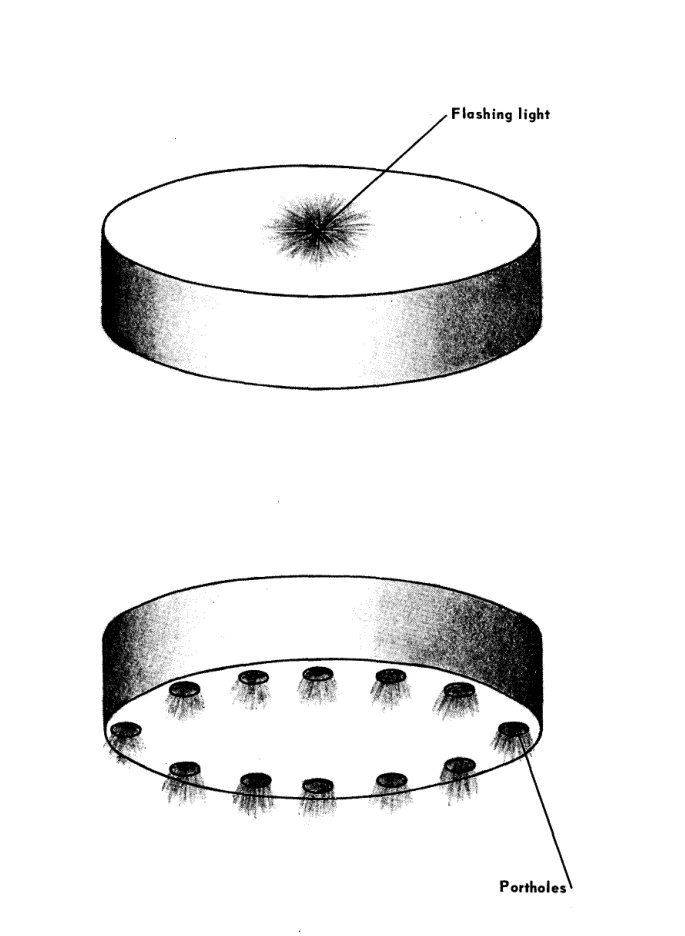
The UFO was described as circular and relatively flat. On the upper part, a very intense light reportedly flashed approximately three times per second. The account distinguishes the viewing angles: this light was seen during the approach and after the pass; when the UFO crossed in front of the observers, its lower part became visible.
On the underside, the crew members described between nine and twelve oval or circular openings distributed symmetrically. A soft violet light reportedly came out of them, compared in the document to the fluorescent lighting of aircraft. The combination of an upper flash and lower light is one of the particularities preserved by the institutional summary.
The observation reportedly lasted between 25 and 35 seconds. The document also records estimates of size, distance and height relative to the airplane. One of the observers calculated a speed above one thousand miles per hour, considering the visibility and the time the UFO remained in view. The value appears as the captain's visual estimate, not as a radar result.
The trajectory was described as straight, without rotation. The documentary interest lies in following how two people on board characterized the same pass and which details changed according to the viewing angle. The page is an official summary of the U.S. investigation; to compare the testimonies individually, it is still necessary to recover the original statements.
The text places the event north of a medium-sized city, without naming it on that page. We keep the location open. The case can be explored alongside other aerial encounters in the archive, but the similarity of a light or shape is not enough to assert that different episodes involved the same type of object.
The full text of Case XI in Report 14 contains figures that the current text summarizes: the observation took place about 15 miles north of a medium-sized city; the UFO was coming from the south, heading north, and passed no more than half a mile from the airplane, about a thousand feet above it. The crew members estimated its diameter at some 100 feet and said the light on top was so bright that it would be impossible to look at it steadily if it did not flash. The portholes were in a circle three quarters of the distance from the center to the edge. The report notes that this was the only one of the 12 cases in which the observer had not made his own drawing.
Case XI has a particularity within Special Report 14: it is the only one of the 12 good unknowns in which the observer had not made his own drawing. The two figures on the following page, a top view with the flashing light in the center and a bottom view with the portholes, were made for the report based on the description. The bottom figure shows 12 portholes, the maximum number in the range of 9 to 12 given in the text. They are, therefore, illustrations of an account, and not a reproduction of a witness sketch.
The account brings together different estimates, all made by eye: a diameter of about 100 feet, a distance of at most half a mile, a height of some 1.000 feet above the airplane, a duration of 25 to 35 seconds and a speed above 1.000 miles per hour. This last one is attributed to the reserve captain, who deduced it from the visibility, the observation time and the distance. The document does not mention radar, contact with air traffic control or another airplane in the area, and does not identify the city, the airline or the flight's route.
In the report's evaluation, Case XI met the first three conditions of the study, but not the fourth: no other good case described portholes on the underside. With this, the authors concluded that it was not possible to derive a verified model of a flying saucer from the data gathered up to then. This is an institutional conclusion about the set, not an explanation of this sighting, which remained classified as unknown. Project Blue Book serial file 1550.00, which would contain the statements of the two crew members, is not in the collection consulted.
DIRECT READING OF THE FILE
The document, in the original
Full translation of the pages added to this dossier. Addresses and personal data of private individuals were omitted and marked.
EXCERPT 1 · PHYSICAL PAGE 97
Case XI (serial 1550.00), physical page 97 (full text)
I
I Case XI (Serial 1550. 00}
I On March 20, 1950, a Reserve Air Force Captain and an airlines
I
Captain were flying a commercial airlines flight. At 21:26, the airline
Captain directed the attention of the Reserve Air Force Captain to an object
which apparently was flying at high speed, approaching the airliner from
the south on a north heading. The Reserve Air Force Captain focused his I attention on the object. Both crew members watched it as it passed in front
I
of them and went out of sight to the right. The observation, which lasted
about 25 to 35 seconds, occurred about 15 miles north of a medium-sized
city. When the object passed in front of the airliner, it was not more than
1/2 mile distant and at an altitude of about 1000 feet higher than the airliner.
I
I The object appeared to be circular, with a diameter of approximately
100 feet and with a vertical height considerably less than the diameter,
giving the object a disc-like shape. In the top center was a light which was
I
blinking at an estimated 3 flashes per second. This light was so brilliant
that it would have been impossible to look at it continuously had it not been
blinking. This light could be seen only when the object was approaching
and after it had passed the airliner. When the object passed in front of the
I observers, the bottom side was visible. The bottom side appeared to have
I
9 to 12 symmetrical oval or circular portholes located in a circle approximately 3/4 of the distance from the center to the outer edge. Through these
portholes came a soft purple light about the shade of aircraft fluorescent
I
lights. The object was traveling in a straight line without spinning. Considering the visibility, the length of time the object was in sight, and the
distance from the object, the Reserve Air Force Captain estimates the
speed to be in excess of 1000 mph. I
I
I
I
I
I
I
I
I 87
ICheck the original PDF
Case XI (Serial 1550.00). On March 20, 1950, a Reserve Air Force Captain and an airlines Captain were flying a commercial airlines flight. At 21:26, the airline Captain directed the attention of the Reserve Air Force Captain to an object which apparently was flying at high speed, approaching the airliner from the south on a north heading. The Reserve Air Force Captain focused his attention on the object. Both crew members watched it as it passed in front of them and went out of sight to the right. The observation, which lasted about 25 to 35 seconds, occurred about 15 miles north of a medium-sized city. When the object passed in front of the airliner, it was not more than 1/2 mile distant and at an altitude of about 1000 feet higher than the airliner. The object appeared to be circular, with a diameter of approximately 100 feet and with a vertical height considerably less than the diameter, giving the object a disc-like shape. In the top center was a light which was blinking at an estimated 3 flashes per second. This light was so brilliant that it would have been impossible to look at it continuously had it not been blinking. This light could be seen only when the object was approaching and after it had passed the airliner. When the object passed in front of the observers, the bottom side was visible. The bottom side appeared to have 9 to 12 symmetrical oval or circular portholes located in a circle approximately 3/4 of the distance from the center to the outer edge. Through these portholes came a soft purple light about the shade of aircraft fluorescent lights. The object was traveling in a straight line without spinning. Considering the visibility, the length of time the object was in sight, and the distance from the object, the Reserve Air Force Captain estimates the speed to be in excess of 1000 mph.View the document record ↗ · Physical page 97, counting the cover.
EXCERPT 2 · PHYSICAL PAGE 98
Captions of the Case XI drawing, physical page 98
Flashing light
I
I
I
I
I
I
I
I
I
I
I
I
I
I
I
I
I
I
I
I
I I 88Editorial note: The drawing is already published in the dossier and is not repeated.
Check the original PDF
Flashing light. Portholes.View the document record ↗ · Physical page 98, counting the cover.
EXCERPT 3 · PHYSICAL PAGE 101
Selection criterion and the four conditions of the model, physical page 101 (passage referring to all cases)
I
I
I
These 12 sightings can be classed into four categories on the basis of
their shapes, as follows:
( l} Propeller shape - Case I
I (2) Aircraft shape - Cases II and III
I (3) Cigar shape - Cases IV and V
I (4) Elliptical or disc shape - Cases VI to XII
The criterion for choosing the above sightings was that their descrip I tions were given in enough detail to permit diagrams of the objects to be
I
drawn. It might be noted here that in all but one of these cases (Case XI)
the observer had already drawn a diagram of what he had seen.
The objective of this section of the study was the conceiving of a
I model, or models. The requirement that the description be detailed is an
I
important one, and was the easiest to determine in the re-evaluation program. However, a good model ought to satisfy the following conditions as
well:
I ( 1) The general shape of the object and the maneuvers it
performed should fit the reports of many of the UNKNOWNS
and thus explain them.
I (2) The observer and the report should be reliable.
I (3} The report should contain elements which should have
been observed with accuracy, and which eliminate the
I possibility that the sighting could be ascribed to a
familiar object or to a known natural phenomenon.
I ( 4} The model should be derived from two or more good
UNKNOWNS between which there is no essential conflict.
I It can be shown that it is not possible to deduce a model from the 12
cases that will satisfy all of these conditions. The following case-by-case
I discussion of the 12 good UNKNOWNS will illustrate this point:
I ( 1) Case I does not satisfy Conditions 1 and 4. The reported
shape of this object is not duplicated in any of the other
UNKNOWNS.
I
I •(2) Case II does not satisfy Conditions 1 and 3. There are
very few UNKNOWNS in the aircraft shape classification.
In addition, the unusual characteristic of this sighting
I
(i.e., the red glow) could have been reflection of the
lights of Flint from the objects if they were either birds
or aircraft.
91
IEditorial note: Passage common to the 12 cases; the sign [...] marks a sentence from the middle omitted because it deals only with the general objective of the study, already translated in the Report 14 dossier.
Check the original PDF
The criterion for choosing the above sightings was that their descriptions were given in enough detail to permit diagrams of the objects to be drawn. It might be noted here that in all but one of these cases (Case XI) the observer had already drawn a diagram of what he had seen. [...] a good model ought to satisfy the following conditions as well: (1) The general shape of the object and the maneuvers it performed should fit the reports of many of the UNKNOWNS and thus explain them. (2) The observer and the report should be reliable. (3) The report should contain elements which should have been observed with accuracy, and which eliminate the possibility that the sighting could be ascribed to a familiar object or to a known natural phenomenon. (4) The model should be derived from two or more good UNKNOWNS between which there is no essential conflict.View the document record ↗ · Physical page 101, counting the cover.
EXCERPT 4 · PHYSICAL PAGE 102
Evaluation of Cases VIII to XII, physical pages 102 and 103
(3) Case III does not satisfy Condition 1. It also does not
satisfy Condition 4 when Case II is eliminated as a
good UNKNOWN.
(4) Case IV does not satisfy Conditions 1 or 2. There are
few cigar-shaped or rocket-shaped objects reported in
the literature. In addition, this observer is not considered to be well-qualified technically.
(5) Case V does not satisfy Condition 1. It also does not
satisfy Condition 4 when Case IV is eliminated as a
good UNKNOWN.
It might be argued here that many of the UNKNOWNS might actually
have shapes similar to these good UNKNOWNS. It will be noted, however,
that each of these five cases does not satisfy one of the other three conditions.
(6) Case VI does not satisfy Condition 2. In the description
of the object, it was stated that at certain times there
was no light seen from the object. Apparently, the
"band of no light", as diagrammed by the observer, was
an attempt to explain this. However, if the object were
constructed as shown in the diagram, light should have
been seen at all times. Because of this conflict the
drawing is not considered reliable, and without the drawing, there is not enough detail in the description to make
it useful for this study.
(7) Case VII violates Conditions 1 and 4. Although the shape
is disc-like, the maneuvers performed by the object are
unique both among the UNKNOWNS and among the good
UNKNOWNS.
Cases VIII to XII satisfy Conditions 1 through 3, but they do not
satisfy Condition 4. The features which make them different from each
other are as follows:
(8) Case VIII. The object is smooth, with no protrusions
or other details.
( 9) Case IX. The object had rocket or jet pods on each
side that were shooting out flames.
(10) Case X. The,object had a fin or rudder.
( 11) Case XI. The object had a series of portholes, or
windows, on its under side.
92
I
I
I
I
I
I
I
I
I
I
I
I
I
I
I
I
I
I
I
I
I
IEditorial note: The passage cites the five cases together because the report's conclusion depends on the comparison between them.
Check the original PDF
Cases VIII to XII satisfy Conditions 1 through 3, but they do not satisfy Condition 4. The features which make them different from each other are as follows: (8) Case VIII. The object is smooth, with no protrusions or other details. (9) Case IX. The object had rocket or jet pods on each side that were shooting out flames. (10) Case X. The object had a fin or rudder. (11) Case XI. The object had a series of portholes, or windows, on its under side. (12) Case XII. The object had windows in its top and front and its top midsection. It also had a set of propellers around its waist. It is not possible, therefore, to derive a verified model of a "flying saucer" from the data that have been gathered to date.View the document record ↗ · Physical page 102, counting the cover.
Dates and documentary context
GEOGRAPHY OF THE CASE
Location to be confirmed
The excerpt consulted does not identify a location sufficient to place the encounter. No coordinates were assigned.
DOCUMENTARY TRAIL
Go back to the sources
References use physical pages of the PDF, counting the cover. Summaries are presented in English; the documents keep their original language.
- CIA-UAP-015-Project_Blue_Book_Special_Report_No_14.pdf
Special Report 14, p. 97 (physical page of the PDF)
CIA · 312 pages
Editorial summary based on the collection's research notes. How we read the documents.