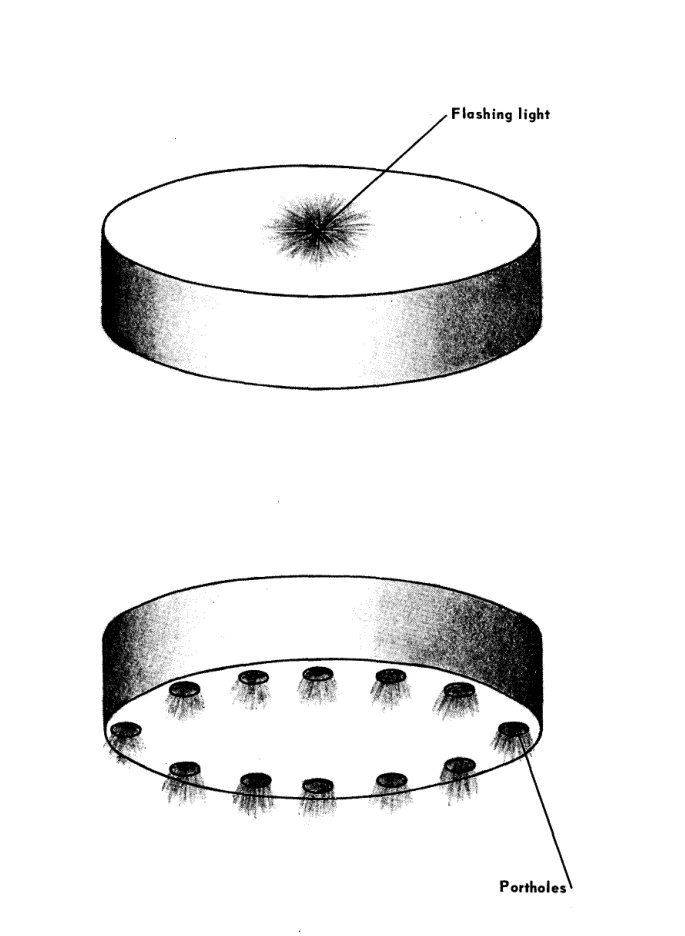
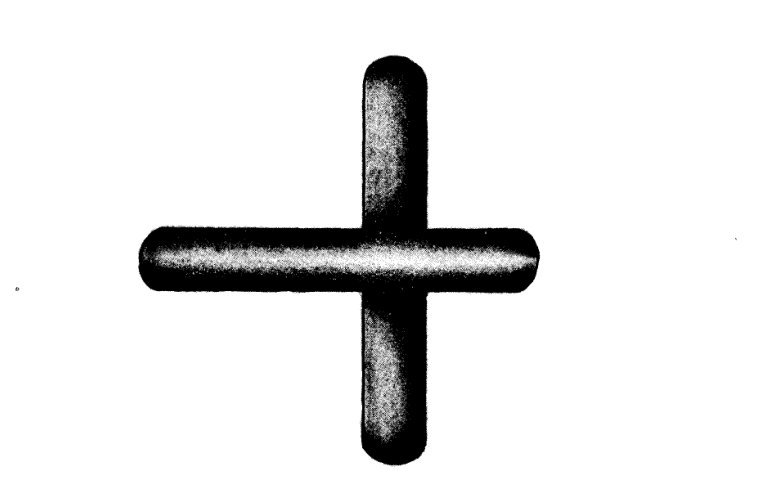
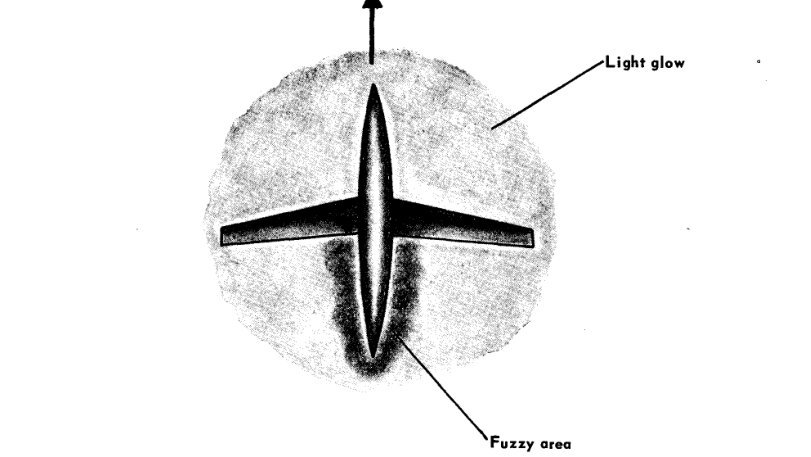
Date: May 24, 1949Location: Location not identified in the excerpt
A UFO with marks on its surface
An aeronautical laboratory employee observes through binoculars a UFO whose surface appeared stained. The drawing went into an official report.
- Event date
- May 24, 1949
- Location
- Location not identified in the excerpt
- Topic
- Lights and encounters
- Source agencies
- CIA
- Documents
- 1 document · 312 pages
- Reading time
- 10 min
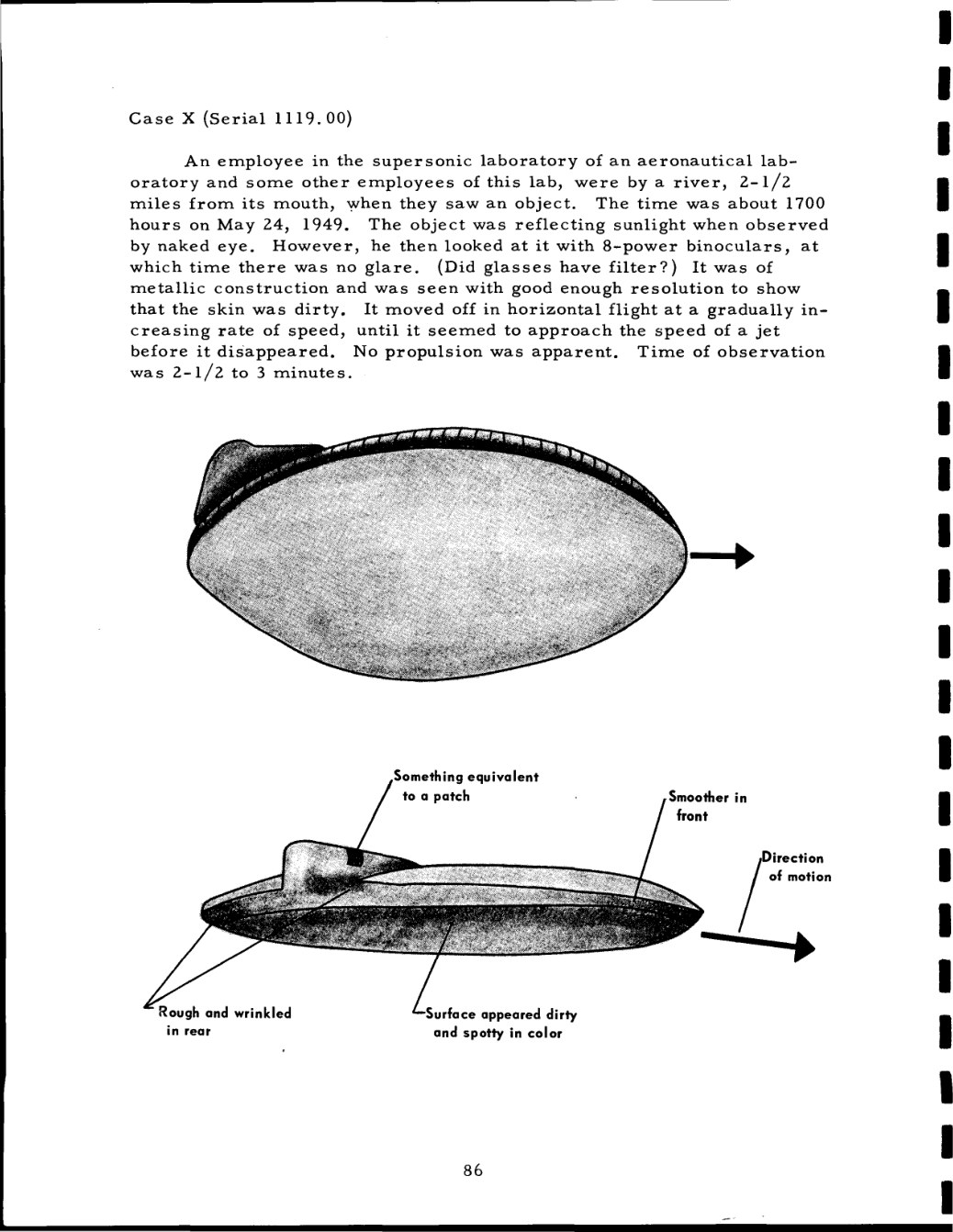 Official report illustrationPhysical page 96
DOCUMENTARY SOURCES · CIA
What the records tell
At five in the afternoon on May 24, 1949, an employee of an aeronautical laboratory and other employees were near a river when they observed an object. The episode appears as Case X, number 1119.00, in Project Blue Book Special Report 14, a document of the U.S. Air Force (USAF) investigation preserved in this official collection.
The summary describes two observing conditions. With the naked eye, the object reflected sunlight. When the observer switched to eight-power binoculars, he reported being able to make out the surface without the same glare. The writer leaves a question about the possible presence of a filter on the instrument, a sign that the optical conditions were also of interest to the analysis.
The most curious detail is in the appearance: the surface was described as dirty or stained, with something compared to a patch. The figure associated with the account includes a fin. These elements make the record different from a simple distant light: the observer attributed to the object a shape and visual features that could be represented in a drawing.
According to the summary, the UFO moved away in horizontal flight, gradually increasing its speed until it seemed to approach the performance of a jet. There was no apparent propulsion. The observation reportedly lasted between two and a half and three minutes. These are estimates from the account, useful for reconstructing the sequence, although they are not equivalent to instrument measurements of speed.
The drawing is part of an official U.S. government report; its nature is a representation of what was reported, not a photograph of the encounter. Nor does the metallic appearance result from an examination of material. Preserving these differences makes it possible to give the document its historical weight without attributing to it an expert analysis it does not contain.
The page places the group about two and a half miles from the mouth of a river, but does not identify the locality in the excerpt consulted. For this reason, the case enters the chronology by its date and remains without a geographic point. The number 1119.00 is the key for searching for the testimonies and records that predate the report's summary.
The text of Report 14 on Case X says that the observer worked in the supersonic laboratory of an aeronautical laboratory, and not just in any laboratory, and that he was with other employees from the same place on the bank of a river, two and a half miles from its mouth. The captions of the drawing detail what he said he saw: the surface looked dirty and mottled, smoother in front and rough and wrinkled at the back, with "something equivalent to a patch" next to the fin. In the final evaluation, the case passed the first three conditions of the study and was distinguished from the other four by the fin or rudder.
Special Report 14 chose its 12 "good unknowns" by a practical criterion: the description had to have enough detail for the UFO to be drawn. The report itself states that, in all cases but one, the observer had already made a drawing of what he saw. Case X is among them. The two figures published on the page, a general view and a captioned profile, are the report's version of that sketch, and not a photograph. The case was grouped with Cases VI to XII in the category of elliptical or disk-shaped objects.
The question the writer left in parentheses, about whether there was a filter on the binoculars, went unanswered in the text. It matters because the absence of glare through the binoculars is what allowed the observer to describe a dirty, mottled covering, smoother in front and wrinkled at the back. The summary also does not state whether the other employees who were on the riverbank looked through the same instrument. What we have is the description of a single observer, with the presence of colleagues recorded, but without separate testimonies from them in the report.
In the report's evaluation, Case X met the first three conditions: a shape compatible with many other unknowns, a reliable observer and account, and elements precise enough to rule out a familiar object. It failed the fourth, because no other good case described a fin or rudder. Hence the authors' general conclusion: among about 4.000 people who said they had seen a flying saucer, only 12 gave detailed descriptions, and not even with them was it possible to build a verified model. Project Blue Book serial file 1119.00, with the original account, is not in the collection consulted.
DIRECT READING OF THE FILE
The document, in the original
Full translation of the pages added to this dossier. Addresses and personal data of private individuals were omitted and marked.
EXCERPT 1 · PHYSICAL PAGE 96
Case X (serial 1119.00), with drawing captions, physical page 96 (full text)
to a patch
Surface appeared dirty
of motion
/
Direction
I
I
Case X (Serial 1119. 00} I An employee in the supersonic laboratory of an aeronautical laboratory and some other employees of this lab, were by a river, 2- 1/2
miles from its mouth, yvhen they saw an object. The time was about 1700 I
hours on May 24, 1949. The object was reflecting sunlight when observed
by naked eye. However, he then looked at it with 8-power binoculars, at
which time there was no glare. (Did glasses have filter?} It was of I
metallic construction and was seen with good enough resolution to show
that the skin was dirty. It moved off in horizontal flight at a gradually in I
creasing rate of speed, until it seemed to approach the speed of a jet
before it disappeared. No propulsion was apparent. Time of observation
was 2- 1/2 to 3 minutes. I
I
I
I
I
I
I
I
in rear
Something equivalent
I
I
I
I
and spotty in color I
I
I
I
86Editorial note: The drawing is already published in the dossier and is not repeated.
Check the original PDF
Case X (Serial 1119.00). An employee in the supersonic laboratory of an aeronautical laboratory and some other employees of this lab, were by a river, 2-1/2 miles from its mouth, when they saw an object. The time was about 1700 hours on May 24, 1949. The object was reflecting sunlight when observed by naked eye. However, he then looked at it with 8-power binoculars, at which time there was no glare. (Did glasses have filter?) It was of metallic construction and was seen with good enough resolution to show that the skin was dirty. It moved off in horizontal flight at a gradually increasing rate of speed, until it seemed to approach the speed of a jet before it disappeared. No propulsion was apparent. Time of observation was 2-1/2 to 3 minutes. [Desenhos:] Something equivalent to a patch. Smoother in front. Direction of motion. Rough and wrinkled in rear. Surface appeared dirty and spotty in color.View the document record ↗ · Physical page 96, counting the cover.
EXCERPT 2 · PHYSICAL PAGE 101
Selection criterion and the four conditions of the model, physical page 101 (passage referring to all cases)
I
I
I
These 12 sightings can be classed into four categories on the basis of
their shapes, as follows:
( l} Propeller shape - Case I
I (2) Aircraft shape - Cases II and III
I (3) Cigar shape - Cases IV and V
I (4) Elliptical or disc shape - Cases VI to XII
The criterion for choosing the above sightings was that their descrip I tions were given in enough detail to permit diagrams of the objects to be
I
drawn. It might be noted here that in all but one of these cases (Case XI)
the observer had already drawn a diagram of what he had seen.
The objective of this section of the study was the conceiving of a
I model, or models. The requirement that the description be detailed is an
I
important one, and was the easiest to determine in the re-evaluation program. However, a good model ought to satisfy the following conditions as
well:
I ( 1) The general shape of the object and the maneuvers it
performed should fit the reports of many of the UNKNOWNS
and thus explain them.
I (2) The observer and the report should be reliable.
I (3} The report should contain elements which should have
been observed with accuracy, and which eliminate the
I possibility that the sighting could be ascribed to a
familiar object or to a known natural phenomenon.
I ( 4} The model should be derived from two or more good
UNKNOWNS between which there is no essential conflict.
I It can be shown that it is not possible to deduce a model from the 12
cases that will satisfy all of these conditions. The following case-by-case
I discussion of the 12 good UNKNOWNS will illustrate this point:
I ( 1) Case I does not satisfy Conditions 1 and 4. The reported
shape of this object is not duplicated in any of the other
UNKNOWNS.
I
I •(2) Case II does not satisfy Conditions 1 and 3. There are
very few UNKNOWNS in the aircraft shape classification.
In addition, the unusual characteristic of this sighting
I
(i.e., the red glow) could have been reflection of the
lights of Flint from the objects if they were either birds
or aircraft.
91
IEditorial note: Passage common to the 12 cases; the sign [...] marks a sentence from the middle omitted because it deals only with the general objective of the study, already translated in the Report 14 dossier.
Check the original PDF
The criterion for choosing the above sightings was that their descriptions were given in enough detail to permit diagrams of the objects to be drawn. It might be noted here that in all but one of these cases (Case XI) the observer had already drawn a diagram of what he had seen. [...] a good model ought to satisfy the following conditions as well: (1) The general shape of the object and the maneuvers it performed should fit the reports of many of the UNKNOWNS and thus explain them. (2) The observer and the report should be reliable. (3) The report should contain elements which should have been observed with accuracy, and which eliminate the possibility that the sighting could be ascribed to a familiar object or to a known natural phenomenon. (4) The model should be derived from two or more good UNKNOWNS between which there is no essential conflict.View the document record ↗ · Physical page 101, counting the cover.
EXCERPT 3 · PHYSICAL PAGE 102
Evaluation of Cases VIII to XII, physical pages 102 and 103
(3) Case III does not satisfy Condition 1. It also does not
satisfy Condition 4 when Case II is eliminated as a
good UNKNOWN.
(4) Case IV does not satisfy Conditions 1 or 2. There are
few cigar-shaped or rocket-shaped objects reported in
the literature. In addition, this observer is not considered to be well-qualified technically.
(5) Case V does not satisfy Condition 1. It also does not
satisfy Condition 4 when Case IV is eliminated as a
good UNKNOWN.
It might be argued here that many of the UNKNOWNS might actually
have shapes similar to these good UNKNOWNS. It will be noted, however,
that each of these five cases does not satisfy one of the other three conditions.
(6) Case VI does not satisfy Condition 2. In the description
of the object, it was stated that at certain times there
was no light seen from the object. Apparently, the
"band of no light", as diagrammed by the observer, was
an attempt to explain this. However, if the object were
constructed as shown in the diagram, light should have
been seen at all times. Because of this conflict the
drawing is not considered reliable, and without the drawing, there is not enough detail in the description to make
it useful for this study.
(7) Case VII violates Conditions 1 and 4. Although the shape
is disc-like, the maneuvers performed by the object are
unique both among the UNKNOWNS and among the good
UNKNOWNS.
Cases VIII to XII satisfy Conditions 1 through 3, but they do not
satisfy Condition 4. The features which make them different from each
other are as follows:
(8) Case VIII. The object is smooth, with no protrusions
or other details.
( 9) Case IX. The object had rocket or jet pods on each
side that were shooting out flames.
(10) Case X. The,object had a fin or rudder.
( 11) Case XI. The object had a series of portholes, or
windows, on its under side.
92
I
I
I
I
I
I
I
I
I
I
I
I
I
I
I
I
I
I
I
I
I
IEditorial note: The passage cites the five cases together because the report's conclusion depends on the comparison between them.
Check the original PDF
Cases VIII to XII satisfy Conditions 1 through 3, but they do not satisfy Condition 4. The features which make them different from each other are as follows: (8) Case VIII. The object is smooth, with no protrusions or other details. (9) Case IX. The object had rocket or jet pods on each side that were shooting out flames. (10) Case X. The object had a fin or rudder. (11) Case XI. The object had a series of portholes, or windows, on its under side. (12) Case XII. The object had windows in its top and front and its top midsection. It also had a set of propellers around its waist. It is not possible, therefore, to derive a verified model of a "flying saucer" from the data that have been gathered to date.View the document record ↗ · Physical page 102, counting the cover.
Dates and documentary context
GEOGRAPHY OF THE CASE
Location to be confirmed
The excerpt consulted does not identify a location sufficient to place the encounter. No coordinates were assigned.
DOCUMENTARY TRAIL
Go back to the sources
References use physical pages of the PDF, counting the cover. Summaries are presented in English; the documents keep their original language.
- CIA-UAP-015-Project_Blue_Book_Special_Report_No_14.pdf
Special Report 14, p. 96 (physical page of the PDF)
CIA · 312 pages
Editorial summary based on the collection's research notes. How we read the documents.