Date: 24/06/2009Location: Washington, DC (U.S. Senate, letter to the Pentagon)
Washington, 2009: Senator Harry Reid asks the Pentagon for a restricted special access program to protect parts of AATIP
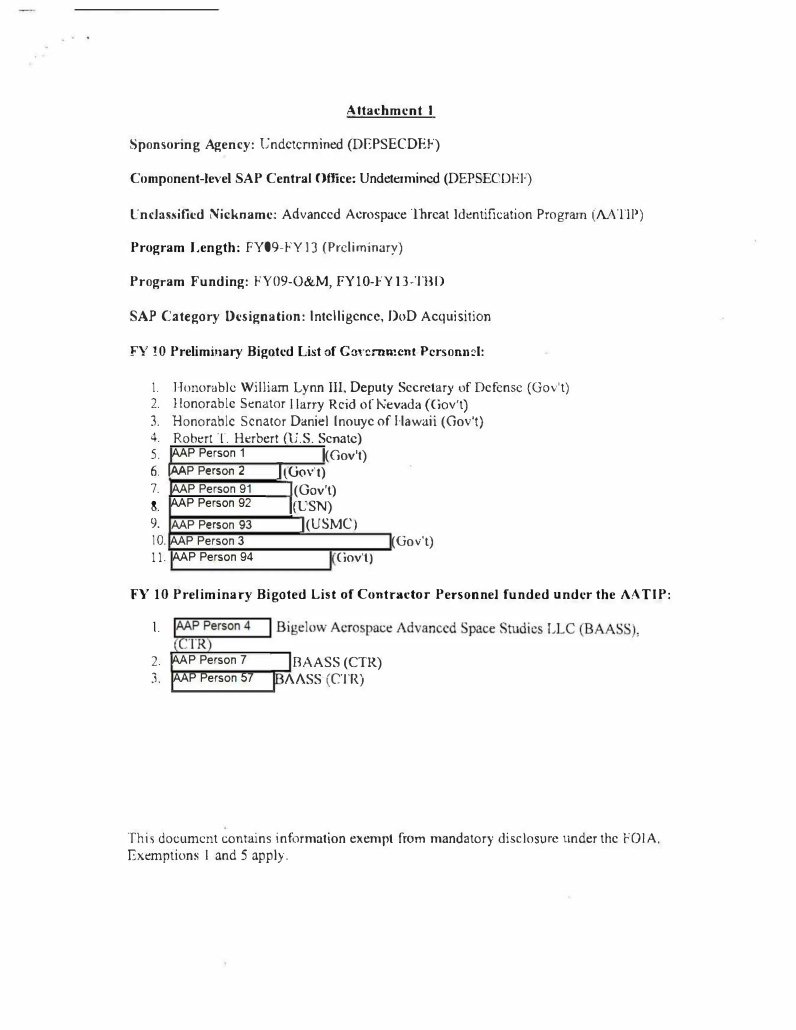
In a letter to Deputy Secretary of Defense William Lynn III, Senator Harry Reid, the majority leader, requests a Restricted Special Access Program, with a named access list, for parts of the program he calls AATIP. The attachment lists government officials, a Senate staffer, and three contractors from Bigelow Aerospace Advanced Space Studies (BAASS), with names redacted.
- Event date
- 24/06/2009
- Location
- Washington, DC (U.S. Senate, letter to the Pentagon)
- Topic
- AAWSAP and advanced technologies
- Source agencies
- DOW
- Documents
- 1 document · 4 pages
- Reading time
- 9 min
 Facsimile of the documentPhysical page 1
DOCUMENTARY SOURCES · DOW
What the records tell
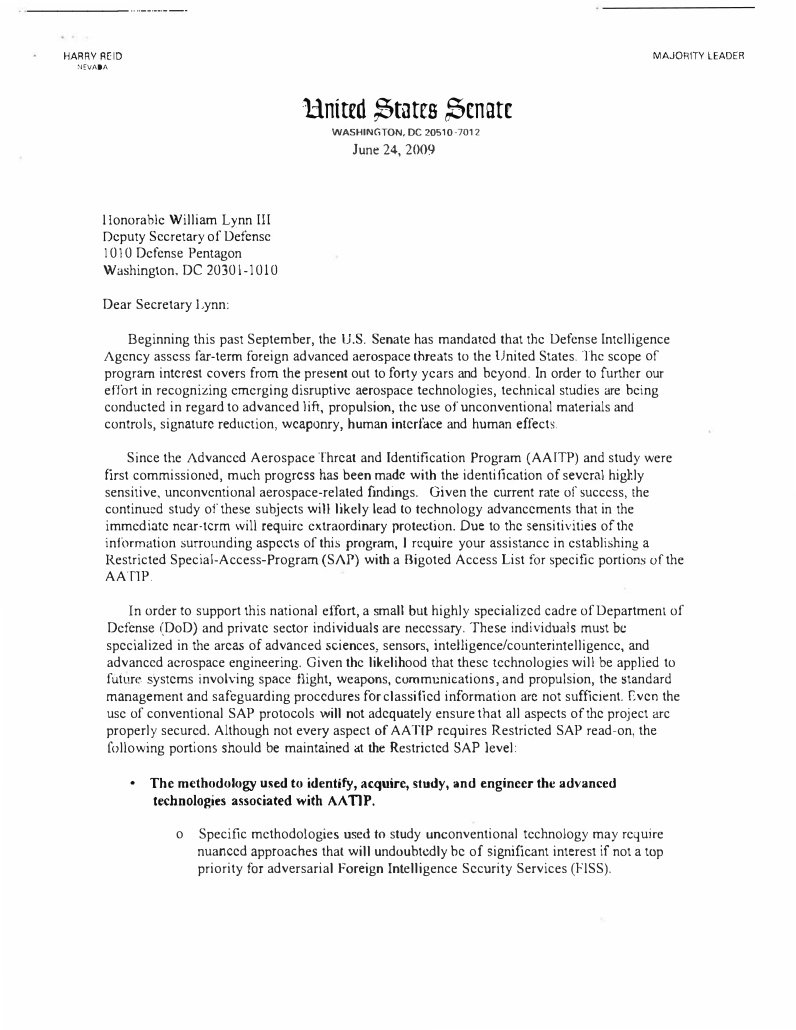
Date: June 24, 2009. Location: Washington. In a three-page letter on Senate letterhead, Senator Harry Reid of Nevada, then majority leader, wrote to Deputy Secretary of Defense William Lynn III. Reid recalls that, since “last September,” that is, September 2008, the Senate had directed the Defense Intelligence Agency (DIA) to assess long-term advanced foreign aerospace threats, over a horizon ranging from the present to forty years or more. According to the letter, technical studies were underway on lift, propulsion, materials, signature reduction, weaponry, human interface, and effects on humans.
The central request comes next. Reid writes that, since the start of the program, there had been “much progress” in identifying “highly sensitive, unconventional findings” in the aerospace sector, and that continuing the studies would lead to advances requiring “extraordinary protection.” He therefore asks for help in creating a Restricted Special Access Program, known by the acronym SAP, with a named access list. Under this secrecy regime, only the people listed by name may know the protected content. The senator states that neither the ordinary rules for classified information nor the usual SAP protocols would suffice.
The letter identifies three parts of the program that should be placed under restricted secrecy. The first is the methodology for identifying, acquiring, studying, and developing the technologies, which, according to Reid, would be of interest to adversary intelligence services. The second is personnel: the letter says that revealing who participates, including scientists, academics, and companies, would create counterintelligence risks and could drive partners away. The third is the application of the technologies, which would require high-level decisions. Reid cites concepts from quantum mechanics, nuclear science, electromagnetic theory, “gravitics,” and thermodynamics.
Attachment 1 summarizes the proposal. The sponsoring agency appears as undetermined, with the office of the Deputy Secretary of Defense indicated. The unclassified nickname is Advanced Aerospace Threat Identification Program (AATIP), with a preliminary duration of fiscal years 2009 to 2013 and operations and maintenance funding in 2009. The government list includes Lynn, Reid, Senator Daniel Inouye of Hawaii, Robert T. Herbert of the Senate, and seven redacted names, one of them from the Navy and another from the Marine Corps. The contractor list includes three redacted names from BAASS.
The document records a political request and the senator's own assessment of the program. The letter does not mention UFOs, UAP, or sighting cases, and does not describe what the “unconventional findings” would be. Nor does it show whether the Pentagon granted the request. The program's acronym varies: in the body of the letter “AAITP” appears once and then “AATIP,” while the DIA contract with BAASS appears in other documents as AAWSAP. The attachment links the two names by listing BAASS personnel as funded under AATIP. The last page carries a note applying Exemptions 1 and 5 of the Freedom of Information Act (FOIA).
More images from the document
DIRECT READING OF THE FILE
The document, in the original
The four physical pages are translated in full: the three-page letter and Attachment 1 with the name lists. Names redacted in the original remain redacted; the senator's staff contact is also redacted in the original.
EXCERPT 1 · PHYSICAL PAGE 1
Physical page 1, full page
-------..··--·--·--·
HARRY REID
MAJORITY LEADER
NEVADA
tinitrd rotes cnatr
WASHINGTON, DC 20510-7012
June 24, 2009
I lonorable William Lynn III
Deputy Secretary of Defense
I 010 Defense Pentagon
Washington, DC 20301-1010
Dear Secretary Lynn:
Beginning this past September, the U.S. Senate has mandated that the Defense Intelligence
Agency assess far-term foreign advanced aerospace threats to the United States. The scope of
program interest covers from the present out to forty years and beyond. In order to f urthcr our
effort in recognizing emerging disruptive aerospace technologies, technical studies are being
conducted in regard to advanced lift, propulsion, the use of unconventional materials and
controls, signature reduction, weaponry, human interface and human effects.
Since the Advanced Aerospace Threat and Identification Program (AATTP) and study were
first commissioned, much progress has been made with the identification of several higl:ly
sensitive, unconventional aerospace-related findings. Given the current rate of success, the
continued study of these subjects will likely lead to technology advancements that in the
immediate near-term will require extraordinary protection. Due to the sensitivities of the
information surrounding aspects of this program, I require your assistance in establishing a
Restricted Special-Access-Program (S/\P) with a Bigoted Access List for specific portions of the
AATIP.
In order to support this national effort, a small but highly specialized cadre of Department of
Defense (DoD) and private sector individuals are necessary. These individuals must be
specialized in the areas of advanced sciences, sensors, intelligence/counterintelligence, and
advanced aerospace engineering. Given the likelihood that these technologies will be applied to
future systems involving space night, weapons, communications,.and propulsion, the standard
management and safeguarding procedures for classified information arc not sufficit:nt. Even the
use of conventional SAP protocols will not adequately ensure that all aspects of the project arc
properly secured. Although not every aspect of AATIP requires Restricted SAP read-on, the
following portions should be maintained at tht: Restricted SAP level:
• The methodology used to identify, acquire, study, and engineer the advanced
technologies associated with AA TIP.
o Specific methodologies used to study unconventional technology may require
nuanced approaches that will undoubtedly be of significant interest if not a top
priority for adversarial Foreign Intelligence Security Services (FISS).Editorial note: Physical page 1 of DOW-UAP-D183-Correspondence_from_Senator_Harry_Reid_June_24-2009.pdf.
Check the original PDF
-------..··--·--·--·
HARRY REID
MAJORITY LEADER
NEVADA
tinitrd rotes cnatr
WASHINGTON, DC 20510-7012
June 24, 2009
I lonorable William Lynn III
Deputy Secretary of Defense
I 010 Defense Pentagon
Washington, DC 20301-1010
Dear Secretary Lynn:
Beginning this past September, the U.S. Senate has mandated that the Defense Intelligence
Agency assess far-term foreign advanced aerospace threats to the United States. The scope of
program interest covers from the present out to forty years and beyond. In order to f urthcr our
effort in recognizing emerging disruptive aerospace technologies, technical studies are being
conducted in regard to advanced lift, propulsion, the use of unconventional materials and
controls, signature reduction, weaponry, human interface and human effects.
Since the Advanced Aerospace Threat and Identification Program (AATTP) and study were
first commissioned, much progress has been made with the identification of several higl:ly
sensitive, unconventional aerospace-related findings. Given the current rate of success, the
continued study of these subjects will likely lead to technology advancements that in the
immediate near-term will require extraordinary protection. Due to the sensitivities of the
information surrounding aspects of this program, I require your assistance in establishing a
Restricted Special-Access-Program (S/\P) with a Bigoted Access List for specific portions of the
AATIP.
In order to support this national effort, a small but highly specialized cadre of Department of
Defense (DoD) and private sector individuals are necessary. These individuals must be
specialized in the areas of advanced sciences, sensors, intelligence/counterintelligence, and
advanced aerospace engineering. Given the likelihood that these technologies will be applied to
future systems involving space night, weapons, communications,.and propulsion, the standard
management and safeguarding procedures for classified information arc not sufficit:nt. Even the
use of conventional SAP protocols will not adequately ensure that all aspects of the project arc
properly secured. Although not every aspect of AATIP requires Restricted SAP read-on, the
following portions should be maintained at tht: Restricted SAP level:
• The methodology used to identify, acquire, study, and engineer the advanced
technologies associated with AA TIP.
o Specific methodologies used to study unconventional technology may require
nuanced approaches that will undoubtedly be of significant interest if not a top
priority for adversarial Foreign Intelligence Security Services (FISS).View the document record ↗ · Physical page 1, counting the cover.
EXCERPT 2 · PHYSICAL PAGE 2
Physical page 2, full page
o Cndue attention by government, or private sector entities, not involved in AATIP
or any international interest will directly or indirectly interfere with the <laily
AATIP mission and perhaps threaten the overall success of the program.
•
Allocation of personnel, support, and oversight.
o Due to the highly specialized nature of the personnel involved with AATIP, the
overt acknowledgement of their participation in the program will lead to an
unnecessary security and counterintelligence risk.
o
Occasional assistance from specialized individuals within DoD, the scientific
community, or academia may be necessary from time to time based on
demonstrated subject matter expertise. Adequate protection of their identities or
affil!ation is critical to avoid unnecessary scrutiny.
o
Without the appropriate Restricted SAP protection, the cost associated with a
compromise would be significantly higher than the cost associated with a
properly administered Restricted SAP.
o
Protection of industry partnerships and participation is critical. Puhlic
awareness of an industry's AATJP affiliation may discourage that industry's
further participation with the U.S. Government in this program.
•
Application and engineering.
o The nuanced manner in which some of these technologies will be collected,
engineered and applied by the U.S. may require senior level government approval.
These decision makers must be afforded the necessary time to make strategic
decisions by restricting access to the "big picture" or overall intent of the program
to those on a strict nigoted List.
o
Associated exotic technologies likely involve extremely sophisticated concepts
within the \vorld of 4uantum mechanics, nuclear science, electromagnetic theory,
gravities, and thermodynamics. Given that all of these have the potential to be
useƶ with catastrophic effects by adversaries, an unusually high degree of
operational security and read-on discretion is required.
Due to the expertise required to carry out the objectives of this program, •,ve will require a
small. specialized group of DoD personnel, who are dedicated to performing the SAP-related
functions and executing programmatic requirements within the program. It is essential that the
Government & military personnel who are already involved with this program arc assigned lo
further support this program in a Restricted SAP capacity (sec Attachment 1). These indivitluals
all currently possess the apprqpriatc security clearances and arc already providing unique support
to AATIP.Editorial note: Physical page 2 of DOW-UAP-D183-Correspondence_from_Senator_Harry_Reid_June_24-2009.pdf.
Check the original PDF
o Cndue attention by government, or private sector entities, not involved in AATIP
or any international interest will directly or indirectly interfere with the <laily
AATIP mission and perhaps threaten the overall success of the program.
•
Allocation of personnel, support, and oversight.
o Due to the highly specialized nature of the personnel involved with AATIP, the
overt acknowledgement of their participation in the program will lead to an
unnecessary security and counterintelligence risk.
o
Occasional assistance from specialized individuals within DoD, the scientific
community, or academia may be necessary from time to time based on
demonstrated subject matter expertise. Adequate protection of their identities or
affil!ation is critical to avoid unnecessary scrutiny.
o
Without the appropriate Restricted SAP protection, the cost associated with a
compromise would be significantly higher than the cost associated with a
properly administered Restricted SAP.
o
Protection of industry partnerships and participation is critical. Puhlic
awareness of an industry's AATJP affiliation may discourage that industry's
further participation with the U.S. Government in this program.
•
Application and engineering.
o The nuanced manner in which some of these technologies will be collected,
engineered and applied by the U.S. may require senior level government approval.
These decision makers must be afforded the necessary time to make strategic
decisions by restricting access to the "big picture" or overall intent of the program
to those on a strict nigoted List.
o
Associated exotic technologies likely involve extremely sophisticated concepts
within the \vorld of 4uantum mechanics, nuclear science, electromagnetic theory,
gravities, and thermodynamics. Given that all of these have the potential to be
useƶ with catastrophic effects by adversaries, an unusually high degree of
operational security and read-on discretion is required.
Due to the expertise required to carry out the objectives of this program, •,ve will require a
small. specialized group of DoD personnel, who are dedicated to performing the SAP-related
functions and executing programmatic requirements within the program. It is essential that the
Government & military personnel who are already involved with this program arc assigned lo
further support this program in a Restricted SAP capacity (sec Attachment 1). These indivitluals
all currently possess the apprqpriatc security clearances and arc already providing unique support
to AATIP.View the document record ↗ · Physical page 2, counting the cover.
EXCERPT 3 · PHYSICAL PAGE 3
Physical page 3, full page
t:Itimatcly, the results of AATIP will not only benefit the C.S. Government but I believe will
directly benefit DoD in ways not yet imagined. The ttxhnological insight and capability gained will
provide the C.S. with a distinct advantage over any foreign threats and allow the U.S. to maintain its
preeminence as a \\'orld leader.
Thank you in a_dvance from your lime and consideration of this request. If..,.,,..,.,,..,....,..,.,,.,.....----,
you or your staff have any questions, please contact!1843(a)(2) lof my staf
f at l1843(a)(2)
Sincerely,
United States Senator
HR:11h
HJ\
yEditorial note: Physical page 3 of DOW-UAP-D183-Correspondence_from_Senator_Harry_Reid_June_24-2009.pdf.
Check the original PDF
t:Itimatcly, the results of AATIP will not only benefit the C.S. Government but I believe will
directly benefit DoD in ways not yet imagined. The ttxhnological insight and capability gained will
provide the C.S. with a distinct advantage over any foreign threats and allow the U.S. to maintain its
preeminence as a \\'orld leader.
Thank you in a_dvance from your lime and consideration of this request. If..,.,,..,.,,..,....,..,.,,.,.....----,
you or your staff have any questions, please contact!1843(a)(2) lof my staf
f at l1843(a)(2)
Sincerely,
United States Senator
HR:11h
HJ\
yView the document record ↗ · Physical page 3, counting the cover.
EXCERPT 4 · PHYSICAL PAGE 4
Physical page 4, full page
Attachment 1
Sponsoring Agency: Cndc-tcnnined (DEPSECDEF)
Component-level SAP Central Office: Undetermined (DEPSECDEF)
A
Lndassificd Nickname: Advanced Aerospace Threat Identification Program (ATII')
Program Length: FY09-FY IJ (Preliminary)
Program Funding: FY09-O&M, FYl0-FY 13-TBD
SAP Category Designation: lntclligcncc, DoD Acquisition
FY !0 Preliminary Bigoted List of Con:mmcnt Pcrsomi::I:
I. Honornblc William Lynn III, Deputy Secretary of Defense (Gov't)
2. l !onorable Senator l larry Reid ofl\'.evada (Gov't)
3. Honorable Senator Daniel fnouyc of J-lawaii (Gov't)
4. Robert T. Herbert (l.i.S. Senate)
5. MP Person 1
l(Gov't)
6. MP Person 2
l(Gov't)
7. MP Person 91
l(Gov't)
MP Person 92
8.
ICCSN)
9. MP Person 93
l(USMC)
10. MP Person 3
(Gov't)
11. MP Person 94
Gov't)
FY 10 Preliminary Bigoted List of Contractor Personnel funded under the AA TIP:
1.
2. MP Person 7
J. MP Person 57
BAASS (CTR)
AASS·(CTR)
This document contains information exempt from mandatory disclosure under the FOIA.
Exemptions l and 5 apply.Editorial note: Physical page 4 of DOW-UAP-D183-Correspondence_from_Senator_Harry_Reid_June_24-2009.pdf.
Check the original PDF
Attachment 1
Sponsoring Agency: Cndc-tcnnined (DEPSECDEF)
Component-level SAP Central Office: Undetermined (DEPSECDEF)
A
Lndassificd Nickname: Advanced Aerospace Threat Identification Program (ATII')
Program Length: FY09-FY IJ (Preliminary)
Program Funding: FY09-O&M, FYl0-FY 13-TBD
SAP Category Designation: lntclligcncc, DoD Acquisition
FY !0 Preliminary Bigoted List of Con:mmcnt Pcrsomi::I:
I. Honornblc William Lynn III, Deputy Secretary of Defense (Gov't)
2. l !onorable Senator l larry Reid ofl\'.evada (Gov't)
3. Honorable Senator Daniel fnouyc of J-lawaii (Gov't)
4. Robert T. Herbert (l.i.S. Senate)
5. MP Person 1
l(Gov't)
6. MP Person 2
l(Gov't)
7. MP Person 91
l(Gov't)
MP Person 92
8.
ICCSN)
9. MP Person 93
l(USMC)
10. MP Person 3
(Gov't)
11. MP Person 94
Gov't)
FY 10 Preliminary Bigoted List of Contractor Personnel funded under the AA TIP:
1.
2. MP Person 7
J. MP Person 57
BAASS (CTR)
AASS·(CTR)
This document contains information exempt from mandatory disclosure under the FOIA.
Exemptions l and 5 apply.View the document record ↗ · Physical page 4, counting the cover.
Dates and documentary context
- Event
- Not established — There is no observation episode. The letter refers to a Senate directive of September 2008, with no day given.
- Document
- 24/06/2009 — Date of Senator Harry Reid's letter.
- Publication
- Not established — Published by the U.S. Department of War on war.gov, release 08 of UAP files (2026).
Origin and release
U.S. Senate; office of Senator Harry Reid (Nevada), Majority Leader · DOW-UAP-D183-Correspondence_from_Senator_Harry_Reid_June_24-2009.pdf
Physical pages 1 to 4: letter (p. 1 to 3) and Attachment 1 (p. 4).
undefined ↗ — undefined
Related accounts and their differences
- Washington, 2008: the DIA hires BAASS
- Las Vegas, 2008: the BAASS plan for AAWSAP
- Las Vegas, 2009: BAASS June report
Questions to continue the investigation
- Did Deputy Secretary William Lynn III respond to the letter? Was the Restricted Special Access Program ever created?
- What would the “unconventional, highly sensitive findings” mentioned by Reid be?
- How were the names AATIP and AAWSAP formally related within the DIA in 2009?
GEOGRAPHY OF THE CASE
Washington, DC
Approximate reference point placed by the editorial team; it does not indicate the exact location.
DOCUMENTARY TRAIL
Go back to the sources
References use physical pages of the PDF, counting the cover. Summaries are presented in English; the documents keep their original language.
- DOW-UAP-D183-Correspondence_from_Senator_Harry_Reid_June_24-2009.pdf
Physical pages 1 to 4
DOW · 4 pages
Editorial summary based on the collection's research notes. How we read the documents.