Date: 06/11/1948, 11:57Location: Wakkanai radar station, northern Hokkaido, Japan
Wakkanai, Japan, 1948: UFO circles radar station for 1 hour and 5 minutes and is assessed as a Soviet spy plane
On November 6, 1948, the radar operator at Wakkanai, in the far north of Japan, followed on the scope for 1 hour and 5 minutes a UFO that circled the station and at times looked like two fighters in combat. No one saw anything with the naked eye, and the report assessed it as a Soviet electronic reconnaissance aircraft.
- Event date
- 06/11/1948, 11:57
- Location
- Wakkanai radar station, northern Hokkaido, Japan
- Topic
- Radar and sensors
- Source agencies
- Arquivo histórico · CIA · DOW
- Documents
- 3 documents · 584 pages
- Reading time
- 6 min
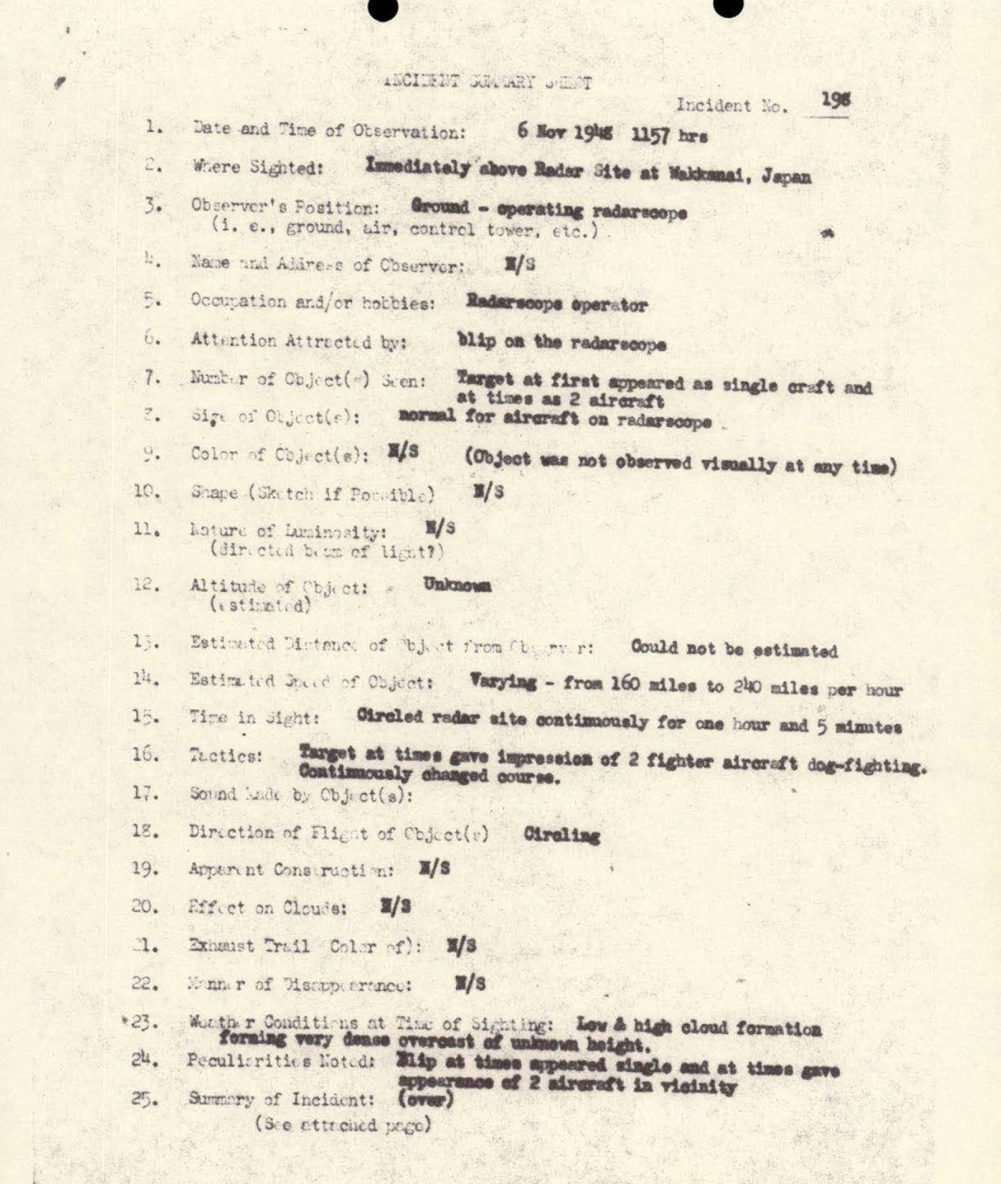 Official formPhysical page 55
DOCUMENTARY SOURCES · Arquivo histórico / CIA / DOW
What the records tell
Project Sign incident 198 comes from the American radar station at Wakkanai, on the northern tip of the island of Hokkaido, in occupied Japan, facing the island of Sakhalin, then Soviet. At 11h57 on November 6, 1948, the radar operator noticed an echo on the screen. The target was, according to the record sheet, "directly over" the station. The operator's name and rank were not recorded.
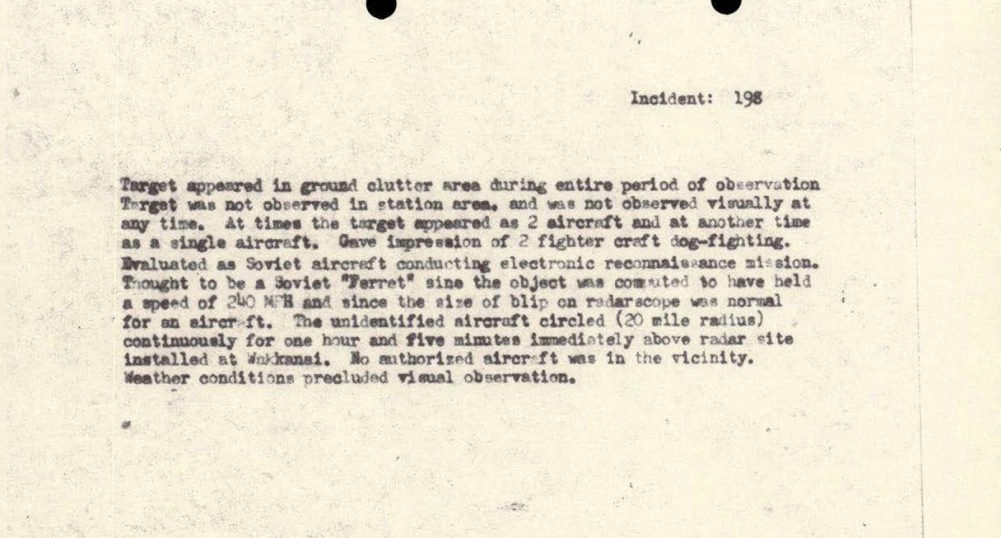
The echo was the normal size of an airplane on the screen. Sometimes it appeared as a single target, sometimes as two airplanes. According to the record sheet, it gave the impression of two fighters in a dogfight and changed course constantly. It circled the station continuously for 1 hour and 5 minutes, within a radius of 20 miles, at speeds ranging from 160 to 240 miles per hour. Altitude and distance could not be estimated.
There was no visual observation. The weather was closed in, with low and high clouds forming a very dense overcast of unknown height, and the summary says this prevented any attempt to see the target. The echo remained the entire time in the ground clutter area, the region of the screen polluted by echoes from the ground, which makes reading it more difficult. The summary adds that no authorized aircraft was in the vicinity.
The assessment recorded on the record sheet is that it was a Soviet aircraft on an electronic reconnaissance mission, probably a "Ferret," the name given to aircraft that flew near radars to pick up their signals. The reasons given were the calculated speed of 240 miles per hour and the size of the echo, normal for an airplane. This is the conclusion of whoever wrote the record sheet; the document provides no confirmation from another source.
The case shows how Project Sign also received records that, in practice, were suspicions of aerial espionage at the beginning of the Cold War. The behavior of two targets that separated and joined together, as reported by the operator, may reflect two real airplanes or the difficulty of reading echoes within the clutter; the record sheet does not allow a decision. There is no record of interception by fighters or of radio contact with the target.
Wakkanai was not the first radar case in northern Japan to reach Air Force intelligence. The study "Analysis of Flying Object Incidents in the United States," dated December 10, 1948, cites among the indications of "unusual aerial activity" a contact on July 1, 1947: a GCA radar on Hokkaido, the same island as Wakkanai, picked up a target at 16 miles, at more than 500 miles per hour, which split in two, each one estimated to be larger than a P-51 fighter. The same study cites the Fukuoka target of September 1947. The Wakkanai case, from November 1948, does not appear in the text.
The similarity with the 1947 case lies in the behavior of the echo, which sometimes appeared as one target, sometimes as two. The blank investigation guide filed at the end of the same folder asks exactly this of investigators of radar cases: to note "especially any separation of a distant target into several targets during the approach," to state whether the echo was sharp and consistent with the size of the object, whether it pulsed, and whether it disappeared suddenly or gradually. The Wakkanai record sheet records the splitting and the size "normal for an airplane," but leaves the manner of disappearance blank and does not give the altitude.
There is a difference between this record sheet and almost all the others in the series. Here, whoever wrote it arrived at an assessment: a Soviet electronic reconnaissance aircraft, supported by the calculated speed of 240 miles per hour, the size of the echo, and the absence of authorized aircraft in the area, an item the guide instructs to be checked against local flight schedules. In the same series, the case of the F-61 night fighter near Fukuoka, in October 1948, was left without an assessment. The Wakkanai conclusion is a hypothesis of whoever wrote the record sheet; the document provides no tracking by another station nor confirmation from another source.
The term "Ferret" used in the record sheet comes from the electronic espionage vocabulary of the time. An official CIA history of aerial reconnaissance, published decades later, recounts that in the late 1940s the U.S. Air Force and Navy flew along the Soviet coasts with aircraft carrying cameras and "ferret" electronic equipment, capable of detecting tracking by Soviet radars. According to the same text, Soviet reconnaissance aircraft only began violating Japanese airspace over Hokkaido in August 1952. The book does not deal with the Wakkanai case, and the 1948 record sheet does not say what it relied on, besides speed and size, to attribute the echo to a Soviet aircraft.
More images from the document
DIRECT READING OF THE FILE
The document, in the original
Both pages of the case translated in full (physical pages 55 and 56): the summary sheet, field by field, and the summary with the evaluation. There is no other copy of this case sheet in the collection.
EXCERPT 1 · PHYSICAL PAGE 55
Summary sheet for incident 198, physical page 55, complete
I :.c ~ .t ::o.
6 In lglli ll57 bra
0 .;,,~
( 1. e .
io.. :
ift
1. ."iu::'-. r o: C j ( ) ..>..en: tarp, firet Cl'l:ilea:li'ed u •iDcl• flrd
., ... 2 a1Nran
-:,i; , 01· .t ---.1 for .sl"GJ'llft oa ~o.~l· _
-. o -~ ~.f C' • , ,. { . : IJ (ObJee, no, baa Nd Yi-.l.li, at a:, U•). .
10. .., :3$..~ ( .J~• C'! if .?Q •. i~l\, I/
... .
,.
t I •
12 . Al ·ti1~1.: " t:
(-. st • •~ ,
Oou.ld not "t>. ••ti•ted
1.... .
lG.
OSn1
; cti s: 'al u.,
f-,ta, - traa lfo ail.ea to 21() l••
,1....1,. ...."'- fttmPt ..
C j, ct{ ) :
lS . ir ctior. n! -11~ .t of r~j t( ·)
20 .
•
r.: -./1
1/1
1/8
•
&l.'"'T.:. ~- f Inci:hnt:
( r~t ci .d ;...c--t":;c)Editorial note: Field 17 (sound) was left blank in the original.
Check the original PDF
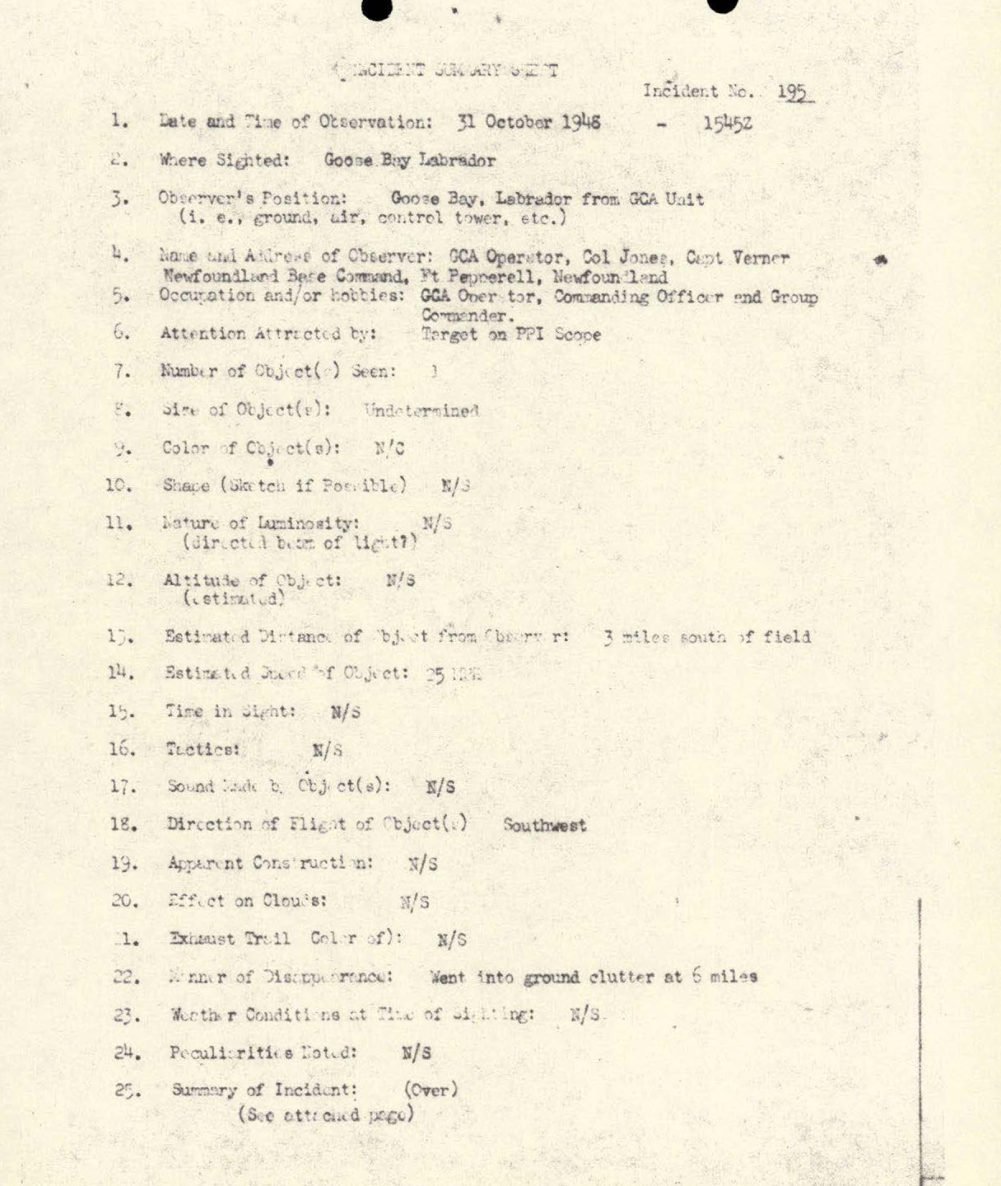
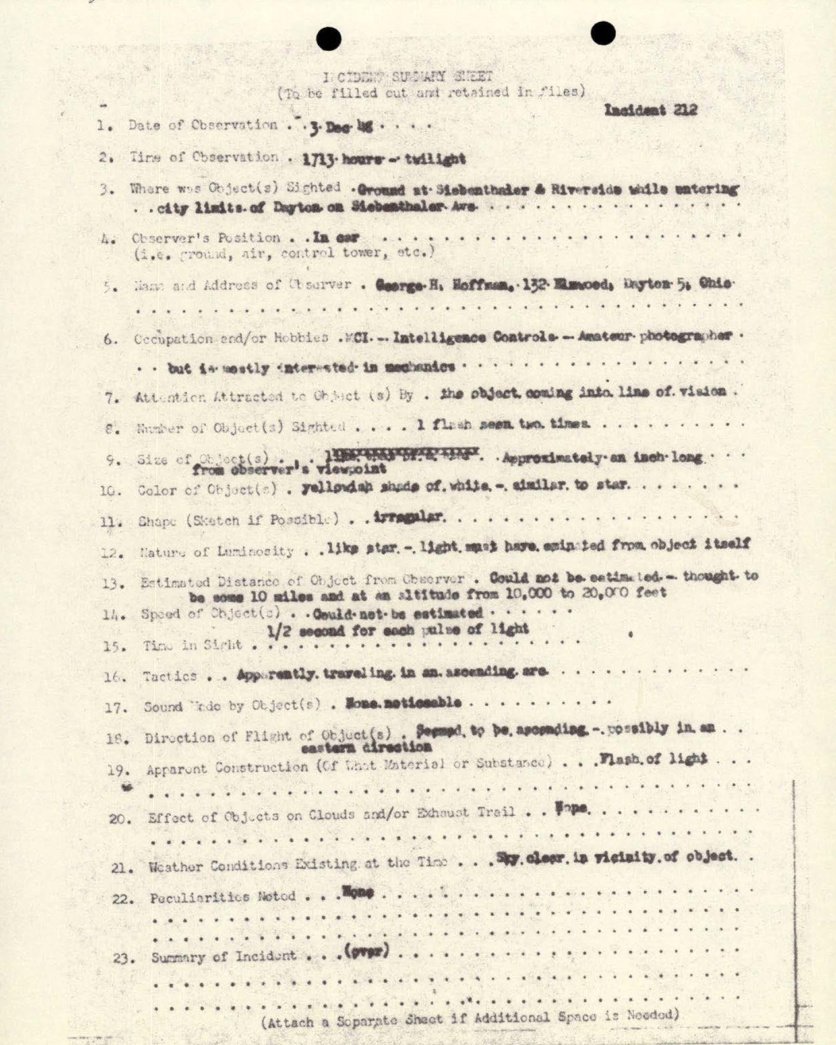
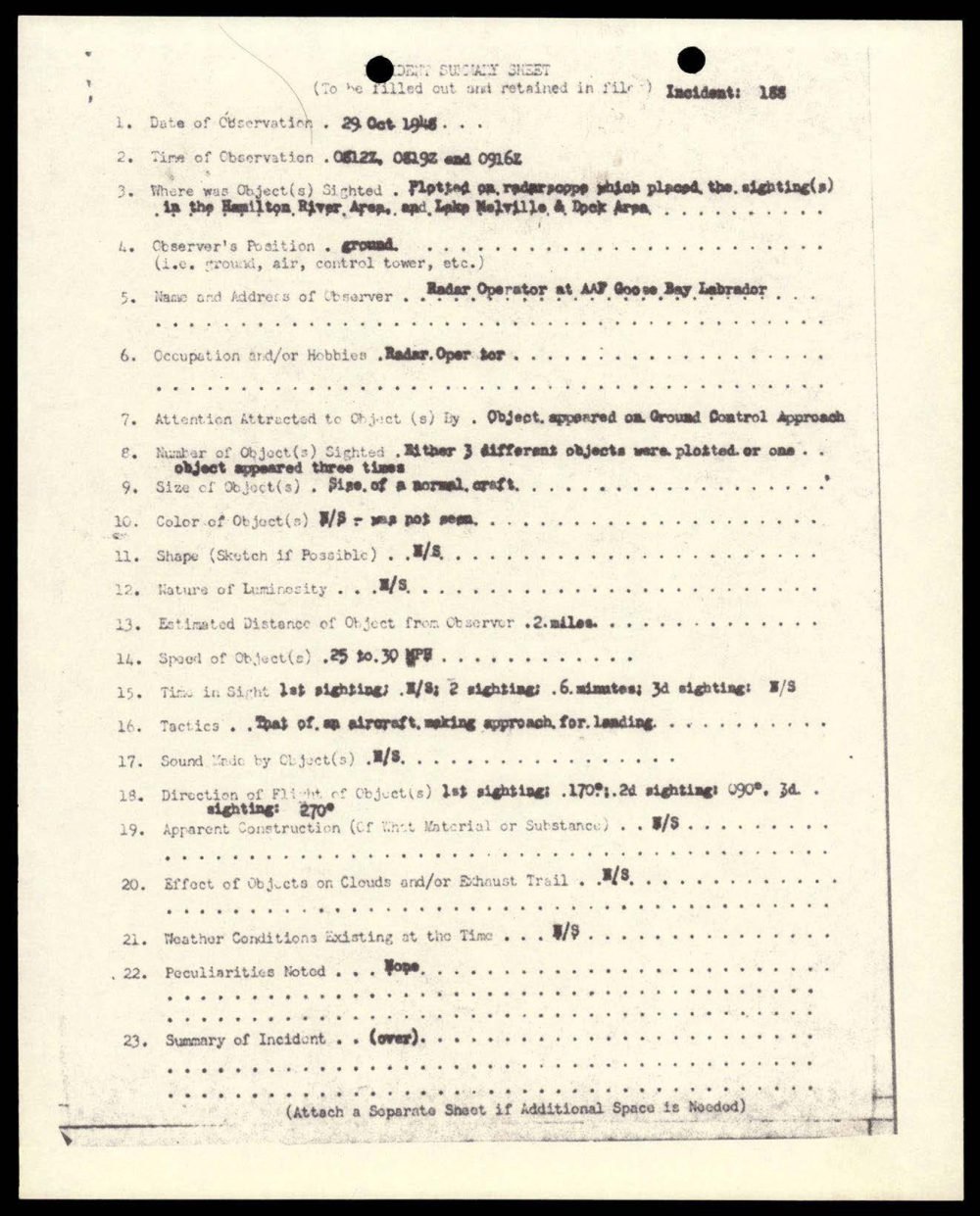
INCIDENT SUMMARY SHEET. Incident No. 198. 1. Date and Time of Observation: 6 Nov 1948 1157 hrs. 2. Where Sighted: Immediately above Radar Site at Wakkanai, Japan. 3. Observer's Position (i.e., ground, air, control tower, etc.): Ground - operating radarscope. 4. Name and Address of Observer: N/S. 5. Occupation and/or hobbies: Radarscope operator. 6. Attention Attracted by: blip on the radarscope. 7. Number of Object(s) Seen: Target at first appeared as single craft and at times as 2 aircraft. 8. Size of Object(s): normal for aircraft on radarscope. 9. Color of Object(s): N/S (Object was not observed visually at any time). 10. Shape (Sketch if Possible): N/S. 11. Nature of Luminosity (directed beam of light?): N/S. 12. Altitude of Object (estimated): Unknown. 13. Estimated Distance of Object from Observer: Could not be estimated. 14. Estimated Speed of Object: Varying - from 160 miles to 240 miles per hour. 15. Time in Sight: Circled radar site continuously for one hour and 5 minutes. 16. Tactics: Target at times gave impression of 2 fighter aircraft dog-fighting. Continuously changed course. 17. Sound Made by Object(s): [em branco]. 18. Direction of Flight of Object(s): Circling. 19. Apparent Construction: N/S. 20. Effect on Clouds: N/S. 21. Exhaust Trail (Color of): N/S. 22. Manner of Disappearance: N/S. 23. Weather Conditions at Time of Sighting: Low & high cloud formation forming very dense overcast of unknown height. 24. Peculiarities Noted: Blip at times appeared single and at times gave appearance of 2 aircraft in vicinity. 25. Summary of Incident: (over) (See attached page)View the document record ↗ · Physical page 55, counting the cover.
EXCERPT 2 · PHYSICAL PAGE 56
Summary of incident 198, physical page 56, complete
•
ire ~od. of O
not ob
At t '-'Ir,.,.~ mt:iea:lrM
61
\ OU'
f, ft a.im • ---"'-~ ' tel
\ "a)rJl::amd a1Nn" 1n
1 t btfflM"a t1cm..
.... --- ---~-·
lnc1d n\: 191
v...UOA
"" rl 17 at.
ud t. ano t
~t doe-fi&htia&.
(
•
,,.Editorial note: "Ferret" is in quotation marks in the original. The phrase "not observed in station area" contrasts with "immediately above radar site"; both have been kept as they are.
Check the original PDF
Incident: 198. Target appeared in ground clutter area during entire period of observation. Target was not observed in station area, and was not observed visually at any time. At times the target appeared as 2 aircraft and at another time as a single aircraft. Gave impression of 2 fighter craft dog-fighting. Evaluated as Soviet aircraft conducting electronic reconnaissance mission. Thought to be a Soviet "Ferret" since the object was computed to have held a speed of 240 MPH and since the size of blip on radarscope was normal for an aircraft. The unidentified aircraft circled (20 mile radius) continuously for one hour and five minutes immediately above radar site installed at Wakkanai. No authorized aircraft was in the vicinity. Weather conditions precluded visual observation.View the document record ↗ · Physical page 56, counting the cover.
Dates and documentary context
- Event
- 06/11/1948 — Date and time (11h57, no time zone indicated) on the summary sheet.
- Document
- Not established — The case sheet has no drafting date.
- Publication
- Not established — Public release date not indicated in the PDF.
Origin and release
U.S. Air Force (USAF), Air Materiel Command, Project Sign; incident summary cards (Incident Summaries 173-233, box 7) · 38_143685_box7_Incident_Summaries_173-233.pdf
55 e 56.
Related accounts and their differences
Questions to continue the investigation
- Are there Soviet or American records of reconnaissance flights near Hokkaido on 6 November 1948?
- Was the original report from the Wakkanai station, with the echo track, preserved?
GEOGRAPHY OF THE CASE
Wakkanai, Hokkaido, Japan
Approximate reference to the city of Wakkanai, placed by the editors. It does not indicate the exact point of the radar station or of the target.
DOCUMENTARY TRAIL
Go back to the sources
References use physical pages of the PDF, counting the cover. Summaries are presented in English; the documents keep their original language.
- 38_143685_box7_Incident_Summaries_173-233.pdf
Physical page 55: summary sheet for incident 198, Wakkanai radar station, Japan, 06/11/1948 · Physical page 56: summary of incident 198, with the assessment of a possible Soviet electronic reconnaissance aircraft
Arquivo histórico · 144 pages - CIA-UAP-003-THE_CENTRAL_INTELLIGENCE_AGENCY_AND_OVERHEAD_RECONNAISSANCE-THE_U-2_AND_OXCART_PROGRAMS_1954-1974.pdf
Physical pages 16 and 17 (pp. 3 and 4 of chapter 1): reconnaissance flights with 'ferret' equipment in the late 1940s and Soviet incursions over Hokkaido starting in August 1952
CIA · 406 pages - DOW-UAP-D094_Analysis-of-Flying-Object-Incidents-in-the-US_1949.pdf
Physical page 20: Appendix C, item 3, radar contacts in Japan in 1947 (Hokkaido and Fukuoka), in the study of 10/12/1948
DOW · 34 pages
Editorial summary based on the collection's research notes. How we read the documents.