Date: 15/10/1948, at nightLocation: Fukuoka area, between the islands of Shikanoshima and Fukue, Japan
Japan, 1948: F-61 night fighter chases UFO that disappears from radar six times
The pilot and radar operator of an F-61 night fighter reported having picked up on the airborne radar, and glimpsed in the moonlight, a UFO that accelerated and dove whenever they approached. Ground radar recorded only the F-61 itself.
- Event date
- 15/10/1948, at night
- Location
- Fukuoka area, between the islands of Shikanoshima and Fukue, Japan
- Topic
- 1948 reports
- Source agencies
- Arquivo histórico · CIA
- Documents
- 2 documents · 330 pages
- Reading time
- 14 min
 Official summaryPhysical page 26
DOCUMENTARY SOURCES · Arquivo histórico / CIA
What the records tell
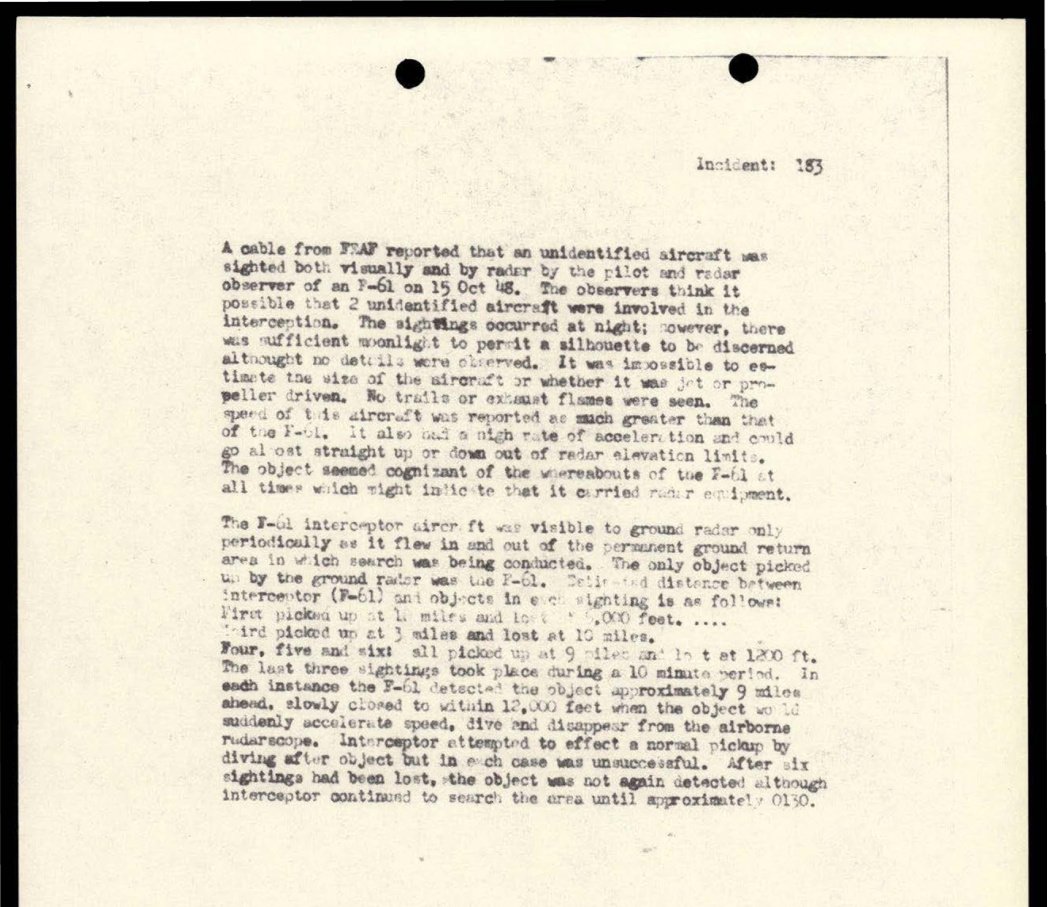
On the night of October 15, 1948, an F-61 night fighter was conducting searches over the Fukuoka area, in southern Japan, between the islands of Shikanoshima and Fukue. According to the sheet for incident 183, based on a telegram from the Far East Air Forces (FEAF), the aircraft's pilot and radar operator picked up on the airborne radar the signal of an unknown aircraft. They considered it possible that two aircraft were involved in the interception.
There was enough moonlight to make out a silhouette, but no detail. The crew could not estimate its size or tell whether it was a jet or propeller aircraft, and saw no trail or exhaust flame. The sheet records a speed far greater than the F-61's, a high rate of acceleration and the ability to climb or descend almost vertically until leaving the radar's elevation limits. The text says the object "seemed aware" of the F-61's position at all times, which "could indicate" that it carried radar. This is the report's interpretation, not a verified fact.
The summary lists the distances for each contact. The first was picked up at about 1? miles and lost at a few thousand feet (the digits are erased in the copy); the second does not appear in the list; the third was picked up at 3 miles and lost at 10 miles. The fourth, fifth and sixth were all picked up at 9 miles and lost at 1.200 feet, within a 10-minute interval. In each case, the F-61 closed the distance to about 12.000 feet, and the target suddenly accelerated, dove and disappeared from the screen.
The pilot tried to regain contact by diving after the target, without success. After the sixth contact, the object was no longer detected, although the search continued until about 1:30. The most important piece of data for evaluating the case is in the document itself: the ground radar saw the F-61 only from time to time, when it left the area of fixed ground echoes, and the only object it picked up was the F-61 itself. There is therefore no independent confirmation of the target by ground radar.
The weather, according to the sheet, had an unlimited ceiling, calm wind, visibility of 5 to 6 miles and scattered clouds between 12.000 and 14.000 feet. The pages contain no conclusion about the nature of the target nor the original radar records. False echoes, another aircraft and operating faults in the airborne radar are possible editorial hypotheses, which the document does not discuss.
The sheet is a secondhand summary. It does not give the name of the pilot or of the radar operator (item 4 says "not reported"), nor the date, number or text of the Far East Air Forces telegram on which it is based. It is part of the bundle of summary sheets for incidents 173 to 233, sent by the Air Materiel Command on March 9, 1949 and stamped March 22. The telegram is not in the collection, and no other page mentions the Fukuoka F-61 or the islands cited.
The summary's numbers do not add up. The sheet says the target was detected at about 9 miles and that the F-61 approached "to about 12.000 feet" before losing it, but the line for the last three contacts says they were "lost at 1.200 feet". The third contact was reportedly picked up at 3 miles and lost at 10, that is, the target moved away. The coordinates printed for the first island also do not match the Fukuoka area. These are the only instrument readings in the case, the distances on the airborne radar, and they come without an original record, only in the summary.
The collection has other radar reports from Japan in those years, each with its own dossier: the fast targets picked up by the Chitose and Fukuoka radars in 1947, cited in the Air Force intelligence analysis of December 1948, and the echo that circled the Wakkanai station in 1948, in the same bundle of sheets. The 1948 analysis mentions the 1947 Fukuoka case, not the F-61 one. There is no institutional evaluation of this episode in the pages; the remark that the target "seemed aware" of the fighter's position is the interpretation of whoever wrote the summary.
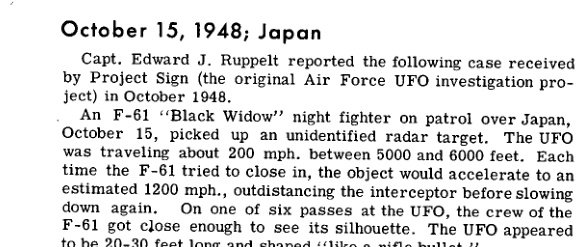
The report "The UFO Evidence", published in 1964 by NICAP, an American civilian UFO research organization, and kept by the CIA in the CREST archive, summarizes the F-61 case on physical page 89, attributing it to Captain Edward J. Ruppelt, who reportedly received it from Project Sign in October 1948. This version contains numbers that the sheet does not have. The target was said to be traveling at about 200 miles per hour, between 5.000 and 6.000 feet, and at each attempt to approach it reportedly accelerated to about 1.200 miles per hour, leaving the fighter behind before slowing down. On one of the six passes, the crew reportedly got close enough to see the silhouette: an object 20 to 30 feet long, shaped like a rifle bullet.
These measurements contrast with the Air Force sheet already published, according to which the crew saw only a silhouette, without detail, and could not estimate size or type of propulsion. The sheet also records that the ground radar picked up only the F-61 itself, a point the NICAP version does not mention. The speed and size figures appear to come from Ruppelt's book, published in 1956, and not from the original telegram, which is not in the archive.
More images from the document
DIRECT READING OF THE FILE
The document, in the original
All pages of the case in this PDF were translated in full, one per block, and checked against the facsimile: the standardized "Incident Summary Sheet" form (items 1 to 25) and the attached summary sheet. Pages 25 and 26 translated in full. Digits erased in the copy were marked as [illegible]. The original FEAF telegram is not on these pages.
EXCERPT 1 · PHYSICAL PAGE 25
Physical page 25: form for incident 183
' • • t " nc1a.e1: ::.o . 11}_.._
1. ::a:t' az. .i 71.~e of Ot ··n•ati r..: 15 Gal 1
er ::ii • :
... _--.--,,,,,... J~ .~• I ..
•~ ..-u;~~ 41-•
- l
~ r..
{L e., u, 1. ~;•~11.~ l t o ·e::-, et,: .)
4.
At ,r.ti . A
, l .
l ':' . iil.d t
l .:
V •
17.
L .
: mile• to 1~. ro, tt
l"-61.
I/
td •
{.-jct(:<) :
1/
l r ~f .: v..il ....
1 te4 eeil lac.
l2 to lll. "", ft
11C&tt "i..
a\ all t -.
?'l-.,.
24.
2r.. .1 •
·-•.. 4'1 5 . .
.chi t:
t'' Ci.1.. C ..C.&,.)Editorial note: "Shigamo Shima" is spelled this way; it is probably the island of Shikanoshima, in Hakata Bay, but the identification is the editors'. The printed longitude 132°00' E does not match the Fukuoka area (about 130° E); kept as in the original.
Check the original PDF
INCIDENT SUMMARY SHEET. Incident No. 183. 1. Date and Time of Observation: 15 Oct 1948 - night. 2. Where Sighted: Fukuoka Area between [S]higamo Shima 33° 40' N by 132° 00' E and Fukae Shima 32° 45' N - 128° 40' East, Japan. 3. Observer's Position: Air. 4. Name and Address of Observer: N/S. 5. Occupation and/or hobbies: Pilot and radar observer. 6. Attention Attracted by: pip of unknown aircraft appearing on airborne radar. 7. Number of Object(s) Seen: 1 possibly 2. 8. Size of Object(s): Could not be estimated. 9. Color of Object(s): N/S. 10. Shape (Sketch if Possible): Could not be determined. 11. Nature of Luminosity: N/S. 12. Altitude of Object (estimated): N/S. 13. Estimated Distance of Object from Observer: 9 miles to 12,000 ft. 14. Estimated Speed of Object: Much greater than F-61. 15. Time in Sight: N/S. 16. Tactics: Evasive. 17. Sound Made by Object(s): N/S. 18. Direction of Flight of Object(s): N/S. 19. Apparent Construction: N/S. 20. Effect on Clouds: N/S. 21. Exhaust Trail (Color of): No exhaust flames or trails seen. 22. Manner of Disappearance: Accelerated speed and was lost to airborne radarscope. 23. Weather Conditions at Time of Sighting: Fukuoka Area: Unlimited ceiling, wind calm, visibility 5 to 6 miles with hazy cloud coverage 12 to 14,000 ft scattered. 24. Peculiarities Noted: High rate of acceleration, vertical ascent, cognizance of F-61's location at all times. 25. Summary of Incident: (over) (See attached page).View the document record ↗ · Physical page 25, counting the cover.
EXCERPT 2 · PHYSICAL PAGE 26
Physical page 26: summary of incident 183
-
A oabl• ftf.-Or t --utt
•i.&bt { ll.7 1l d
obsener on 15 Oct QS. Ml"Yt'!l"I t hink 1 t
po ..-ibl e t,s t 2 unl1 a re ilm>l n tte
OOCW""rffd ; ~r, N
• pe1taa te d1fflled
... ed. • to e... ...
~f \
of t ·. ~
b.l st
') t
all t w.11cb t.
vi,:,ible to «ro 1.
t _,.,.,.,.t'Vt tU'l"Jl
o J.-ct piclro<!
r trr..~
~
• r. ln
9 mile
ct ...:
a1t"'bot"ne
ic ~
Atkr 1:ti&btinga
1ntere.pt.QT • tt untilEditorial note: The digits in the first contact line are faded in the copy and were not inferred. The second contact does not appear in the list; in its place there are ellipses in the original. FEAF: Far East Air Forces.
Check the original PDF
Incident: 183. A cable from FEAF reported that an unidentified aircraft was sighted both visually and by radar by the pilot and radar observer of an F-61 on 15 Oct 48. The observers think it possible that 2 unidentified aircraft were involved in the interception. The sightings occurred at night; however, there was sufficient moonlight to permit a silhouette to be discerned although no details were observed. It was impossible to estimate the size of the aircraft or whether it was jet or propeller driven. No trails or exhaust flames were seen. The speed of this aircraft was reported as much greater than that of the F-61. It also had a high rate of acceleration and could go almost straight up or down out of radar elevation limits. The object seemed cognizant of the whereabouts of the F-61 at all times which might indicate that it carried radar equipment. The F-61 interceptor aircraft was visible to ground radar only periodically as it flew in and out of the permanent ground return area in which search was being conducted. The only object picked up by the ground radar was the F-61. Estimated distance between interceptor (F-61) and objects in each sighting is as follows: First picked up at 1[illegible] miles and lost at [illegible],000 feet. .... Third picked up at 3 miles and lost at 10 miles. Four, five and six: all picked up at 9 miles and lost at 1200 ft. The last three sightings took place during a 10 minute period. In each instance the F-61 detected the object approximately 9 miles ahead, slowly closed to within 12,000 feet when the object would suddenly accelerate speed, dive and disappear from the airborne radarscope. Interceptor attempted to effect a normal pickup by diving after object but in each case was unsuccessful. After six sightings had been lost, the object was not again detected although interceptor continued to search the area until approximately 0130.View the document record ↗ · Physical page 26, counting the cover.
EXCERPT 3 · PHYSICAL PAGE 89
Physical page 89, left column: case of 15/10/1948, Japan
tis “ApRroved For Release 2001/04/02 : CIA-RDP81R00560R000100010001-0
believable target they had just seen. The in-
specting officers were appalled that such a coincidence
should happen. I was part of the meager intelligence report-
ing machinery at the base and I was called in to make an
immediate urgent intelligence report on the incident. The
prevailing theory at the time was that it was a meteor. I
personally discounted this since upon interviewing the radar
observers on both sides of the base they stated that it main-
tained an altitude of 60,000 feet and a speed of approximately
9000 mph.
“To make this story more incredible the very next day
both radars again reported an object hovering over the base
at about 10 mph, at 45,000 feet. The ‘‘official”’ story on this
was that they were probably some type of “high-flying sea-
gulls.” You must remember all these incidents happened
before the days of fast high flying jets and missiles and the
now common altitude record-breaking helicopters.”’
(Maj. Jerome then added: ‘‘On my recent tour in Alaska
[circa 1960], I became very familiar with the early warning
and air defense systems on the DEW Line and Alaska Air
Defense Sectors. Many times high speed unknown objects
were discerned which could not be explained as normal air
breathing vehicles penetrating our sectors. Many of the citi-
zens of Alaska along the Bering Sea Coast have reported
seeing missile-like aircraft flying at very low altitudes at
very high speeds, The AF denied the presence of Russian
aircraft vehemently. When it was suggested that they might
be extra-terrestrial everyone clammed up.’’)
October 15, 1948; Japan
Capt. Edward J. Ruppelt reported the following case received
by Project Sign (the original Air Force UFO investigation pro-
ject) in October 1948.
An F-61 “Black Widow” night fighter on patrol over Japan,
October 15, picked up an unidentified radar target. The UFO
was traveling about 200 mph. between 5000 and 6000 feet. Each
time the F-61 tried to close in, the object would accelerate to an
estimated 1200 mph., outdistancing the interceptor before slowing
down again. On one of six passes at the UFO, the crew of the
F-61 got close enough to see its silhouette. The UFO appeared
to be 20-30 feet long and shaped ‘‘like a rifle bullet.”
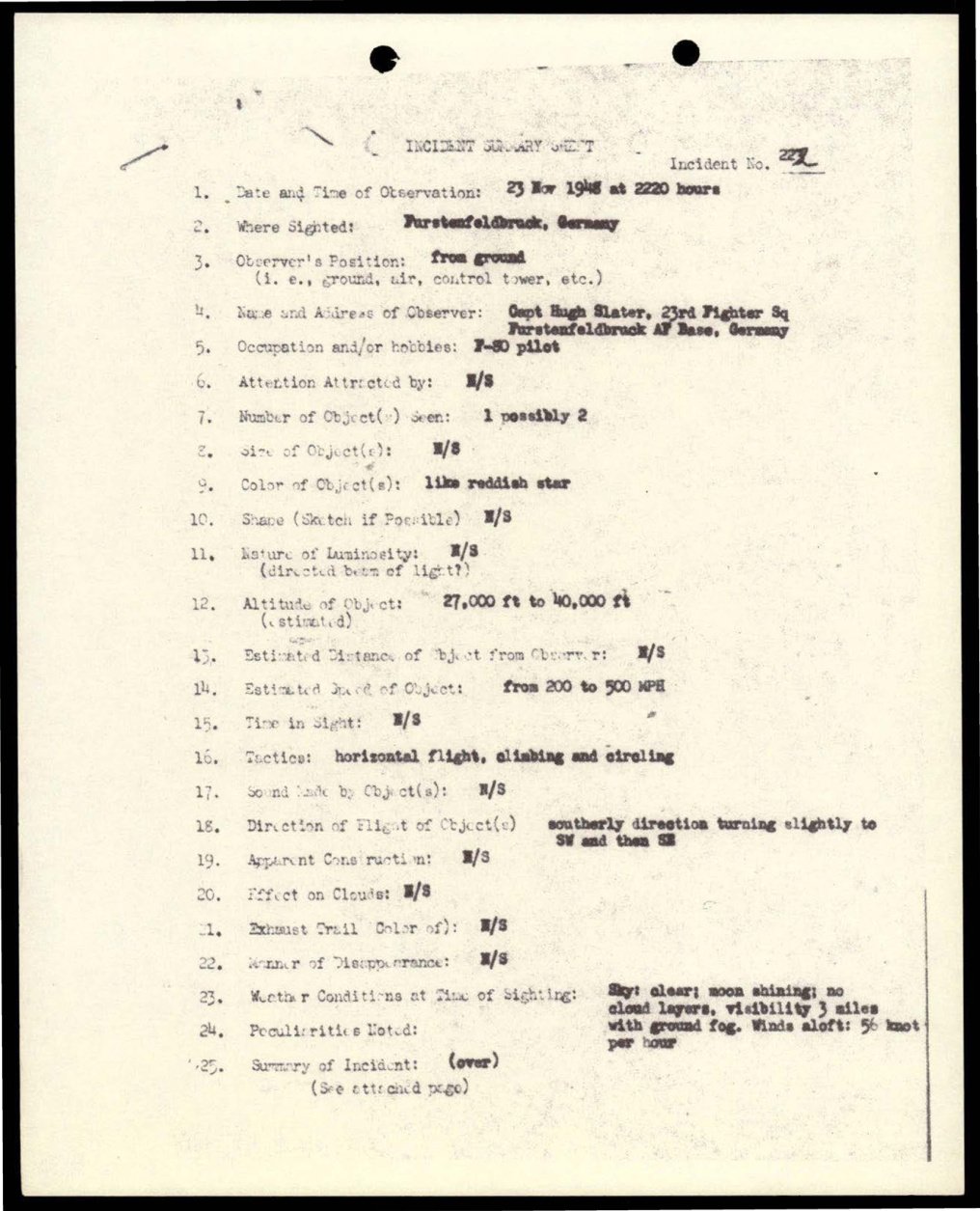
November 23, 1948; Fursten-Feldbruck, Germany
An unidentified object resembling a reddish light was sighted
east of the base at 2200 hours, local time. Capt. [names
deleted from Air Force reports] said the UFO was moving south
across Munich, turned southwest, then southeast. Not knowing
the height, the speed could not be estimated; but it appeared to
be traveling between 200 and 600 mph.
Capt. reported the sighting to base operations, andthe
radar station chécked its scope. An unidentified target, traveling
900 mph., was detected at 27,000 feet about 30 miles south of
Munich. Capt.. verified that the UFO was now visible in
that area, Radar then reported that the target had climbed quick-
ly to 50,000 feet and was circling 40 miles south of Munich.
March 8, 1950; Nr Dayton, Ohio
In mid-morning, the CAA received a report from Capt. W. H.
Kerr, Trans-World Airways pilot, that he and two other TWA
pilots had a UFO in sight. A gleaming object was visible, hover-
ing at high altitude. CAA also had 20 or more reports on the
UFO from the Vandalia area. Wright-Patterson AFB, near Dayton,
was notified, and sent up four interceptors. The UFO was also
visible to control tower operators and personnel of Air Technical
Intelligence Center on the base. Radar had an unidentified tar-
get in the same position.
Two F-51 pilots reported that they could see the UFO, which
presented a distinct round shape and seemed huge and metallic.
But clouds moved in, and the pilots were forced to turn back. The
Master Sergeant who tracked it on radar stated: ‘‘The target
was a good solid return. . . caused by a good solid target.’
Witnesses reported that the UFO finally climbed vertically out of
sight at high speed.
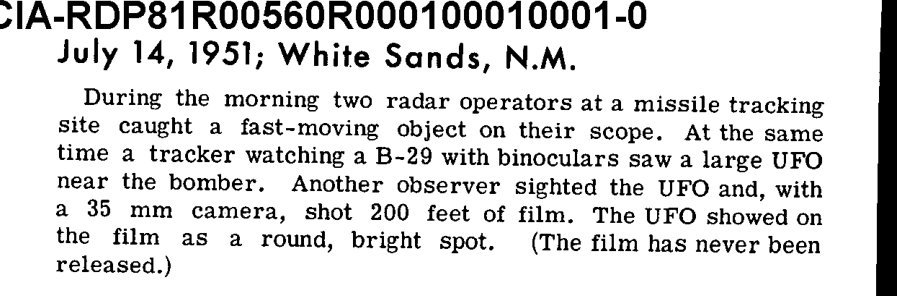
July 14, 1951; White Sands, N.M.
During the morning two radar operators at a missile tracking
site caught a fast-moving object on their scope. At the same
time a tracker watching a B-29 with binoculars saw a large UFO
near the bomber. Another observer sighted the UFO and, with
a 35 mm camera, shot 200 feet of film. The UFO showed on
the film as a round, bright spot. (The film has never been
released.)
Fall 1951; Korean Area
‘Following are extracts from a letter to NICAP dated May 16,
1957, signed by Lt. Cmdr. M. C. Davies, U.S.N., then stationed
at the U. S, Naval Air Station, Jacksonville, Florida.
My background is a Naval Aviator with approximately 4000
hours. At the time of the incident I was deployed with an
Anti-Submarine Squadron aboard a CVE class carrier. I was
assigned Air Crew Training Officer and prior to deployment
had attended CIC Air Controller School at Point Loma, also
Airborne Air Controller School and Airborne Early Warning
School both located at NAS, San Diego. . .
It was at night, I was riding with a radar operator which I
often did to check on their proficiency. We were flying at
5000 feet, solid instruments, with our wingman flying a radar
position about 3 miles astern and slightly to our right or left.
The target, which was slightly larger than our wingman, I
picked up on our scope, had been circling the fleet; it left
the fleet and joined up on us a position behind our wingman,
approximately the same position he held on us.
I reported the target to the ship and was informed that the
target was also held on the ship’s radars, 14 in number; and
for us to get a visual sighting if possible. This was impossible
because of the clouds. The target retained his relative
position for approximately 5 minutes and then departed in
excess of one thousand miles per hour. He departed ona
straight course and was observed to the maximum distance
of my radar which was two hundred miles.
Upon completion of my flight an unidentified flying object
report was completed, at which time I was informed that the
object was held on ship’s radars for approximately seven
hours.
July 1, 1952; Ft. Monmouth, N.J.
A radar tracking of two UFOs at Fort Monmouth, N. J. was
one of a series of sightings which fit a definite pattern. It
occurred at a time when the Air Force was swamped with UFO
reports - good ones. (See Section XII, 1952 Chronology.] Also,
it was the first of ten known incidents of UFOs tracked by radar
during July 1952. (See chart).
The sequence of events, reported by the Air Force UFO pro-
ject chief, was as follows.
7:30 a.m., Boston, Mass. A couple in nearby Lynn and an
Air Force Captain in Bedford saw two F-94’s which had been
scrambled on an intercept mission. The Captain saw one and
the couple saw two silvery cigar-shaped UFOs, which moved
southwest across Boston, outspeeding the jets.
9:30 a.m., Ft. Monmouth, N. J. Radar tracked two UFO tar-
gets, also observed visually as two shiny objects. The UFOs
approached slowly from the northeast, and hovered nearby at
50,000 feet for about 5 minutes.. Suddenly the blips on the
scope accelerated and shot away to the southwest, confirmed
by visual observation.
A_few hours later, Washington, D.C. A physics professor
at George Washington University, and dozens of others, saw
a grayish UFO bobbing back and forth in the sky about 30-40
degrees above the north-northwest horizon.
None of the sightings could be explained.
August 5, 1952; Haneda AFB, Japan
Just before midnight, two Air Force control tower operators
noticed a brilliant light in the sky, and joined others watching
it through binoculars. The UFO approached the base slowly and
hovered, plainly visible from the control tower. Behind the
brilliant light, the observers could see a dark circular shape
Approved For Release 2001/04/02 : CIA-RDP81R00560R000100010001-0Check the original PDF
[p. 89: texto da publicação privada não reproduzido; ver o resumo]View the document record ↗ · Physical page 89, counting the cover.
Dates and documentary context
- Event
- 15/10/1948 — "15 Oct 1948 - night"; search extended until about 01h30, probably already on 16 October (presumed local time).
- Document
- Not established — Date of the FEAF telegram does not appear on these pages.
- Publication
- Not established — Document released in Release 1 of the collection.
Origin and release
U.S. Air Force, Project Sign; incident summary sheets with no identified individual author · 38_143685_box7_Incident_Summaries_173-233.pdf
undefined ↗ — undefined
Questions to continue the investigation
- Is the original FEAF telegram, with the complete figures for each contact, in another file of the collection?
- What type of airborne radar equipped the F-61, and how susceptible was it to sea and ground returns?
GEOGRAPHY OF THE CASE
Fukuoka area, Japan
Approximate reference to the city of Fukuoka, placed by the editors. The search took place over the sea and islands to the west, across a wide area; the point does not indicate where the UFO was.
DOCUMENTARY TRAIL
Go back to the sources
References use physical pages of the PDF, counting the cover. Summaries are presented in English; the documents keep their original language.
- 38_143685_box7_Incident_Summaries_173-233.pdf
Physical pages 25 and 26: incident 183 (sheet and summary of FEAF telegram)
Arquivo histórico · 144 pages - CIA-RDP81R00560R000100010001-0_NICAP-The-UFO-Evidence_1964.pdf
Physical page 89: summary of the 15/10/1948 case in the NICAP report "The UFO Evidence" (1964), CIA CREST copy
CIA · 186 pages
Editorial summary based on the collection's research notes. How we read the documents.