Date: 14/04/1959Location: Mitaka satellite tracking camera station, Tokyo, Japan
Tokyo-Mitaka, 1959: satellite tracking camera records a UFO away from the position of Vanguard 2
According to the NICAP report kept by the CIA, a camera of the Smithsonian satellite tracking program in Mitaka, Tokyo, photographed on April 14, 1959 a bright UFO away from the predicted position of the Vanguard 2 satellite. The photo, reproduced in the report, shows a luminous trail among the stars.
- Event date
- 14/04/1959
- Location
- Mitaka satellite tracking camera station, Tokyo, Japan
- Topic
- CIA file
- Source agencies
- CIA
- Documents
- 1 document · 186 pages
- Reading time
- 10 min
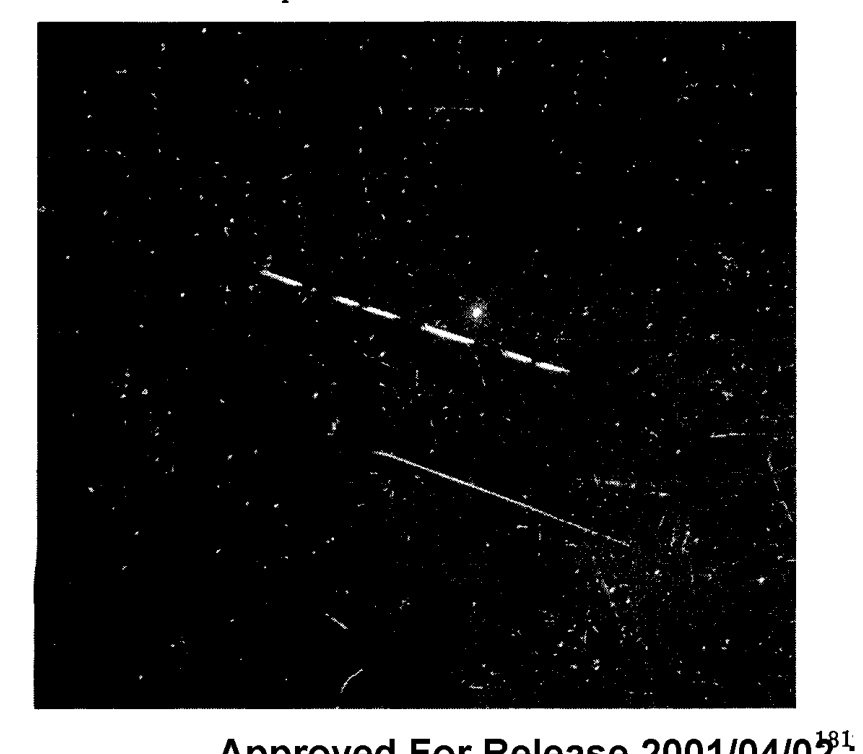 Tracking camera photograph (reproduction in the NICAP report)Physical page 181
DOCUMENTARY SOURCES · CIA
What the records tell
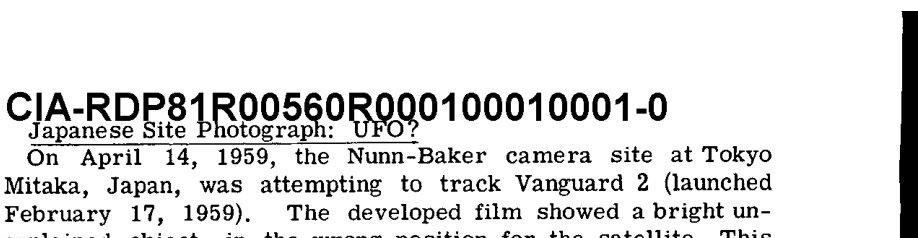
On April 14, 1959, the Mitaka station, in Tokyo, one of the satellite tracking cameras maintained by the Smithsonian Institution, was trying to photograph Vanguard 2, an American satellite launched on February 17 of that year. According to the report The UFO Evidence, published in 1964 by NICAP, a civilian organization, and kept in the CIA archives, the developed film showed an unexplained bright object, in the wrong position for the satellite. The record received Smithsonian observation number SC5-498, whose data, the text says, were in NICAP's files. The photo appears on the same page.
The photo reached NICAP through A. B. Ledwith, an engineer who had worked on the Smithsonian satellite tracking program. In the summer of 1963, he received in Columbus, Ohio, Richard Hall, NICAP's assistant director, and astronomer Walter N. Webb, an adviser to the organization. According to the report, Ledwith made a point of examining the reports of unidentified objects that came in from the camera stations around the world and checked every photo with an unexplained light source. Many, the text says, could not be explained conventionally, and several were given to NICAP.
Ledwith himself, according to NICAP, insisted that the photos proved nothing. It was often impossible to rule out a stray aircraft, which could have entered the camera's field, although no one had reported aircraft in the area. He also said that when something off the satellite's track appeared on the film, the teams usually assumed a film defect, a meteor or an aircraft, with almost no checking. This comment about the teams' work is Ledwith's opinion as reported by NICAP. The report does not include the SC5-498 record or the time, direction or duration of the exposure.
In the photo, against a dark background full of stars, there is a bright line made up of segments, crossing the field diagonally, with a diffuse luminous point right next to it, and, further down, a continuous, thinner streak. The caption speaks only of the trail left by the object and does not say which of the marks it is, although the segmented line is the most prominent. The image is a halftone reproduction in a printed book, later scanned in the CIA copy. Fine details of the original negative were lost, and there is no scale or orientation.
As an editorial hypothesis, not supported by the documents, a trail in regular segments may result from a blinking light, such as an aircraft's, or from interruptions of the camera exposure itself, if the equipment made them to mark time; the continuous streak could be another moving object, such as a meteor or a satellite. The page does not allow a choice between these hypotheses or confirmation of NICAP's reading. The report calls the camera “Nunn-Baker”; the usual name of the model is Baker-Nunn. What the document shows is an instrumental record kept as unexplained by a former member of the program and passed on to a civilian organization.
More images from the document
DIRECT READING OF THE FILE
The document, in the original
Summary of a private publication: the report The UFO Evidence is a work of NICAP, a civilian organization, copyrighted in 1964; the copy is in the CIA's CREST archive, but it is not a government document. For this reason the English text was not transcribed or translated in full: each page used received a block with a faithful summary in English and at most one short quotation. Summarized, from physical page 181: the passage on A. B. Ledwith and the Smithsonian cameras and the caption “Japanese Site Photograph: UFO?”. The rest of the page (problems of scientific investigation and landing reports) is summarized in the dossier on the report.
EXCERPT 1 · PHYSICAL PAGE 181
Physical page 181: passage about Ledwith, caption “Japanese Site Photograph: UFO?” and photo
proved For Release 2001/04/02 :
A
Problems of Re ienti ic Investigation
The atmosphere of ridicule surrounding the subject of UFOs,
largely due to the activities of the cultists, has prevented many of
the best qualified analysts from lending their talents to a meaning-
ful scientific investigation. Also, a myth has developed in some
scientific quarters that there is nothing in UFO evidence that
scientists can come to grips with; no quantitative data or concrete
evidence. This position is based on quicksand, since no real
scientific effort has been made to acquire such data. It is, in
fact, not a reasoned position at all, but a presumption. How can
these skeptics be so sure until someone tries to obtain better
data with instruments? The evidence presented in this report
strongly suggests that an organized and instrumented study of
UFOs would be very fruitful. If not, then these skeptics would
have a solid basis for their currently illogical position.
Some skeptics base their position on the alleged fact that modern
tracking instruments have not detected UFOs. On the contrary,
UFOs have been tracked with theodolites and filmed at White
Sands, N.M. [Section VIII; Photographs], tracked on radar at
Cape Kennedy, and by Air Force and civilian radar all over the
world. [Section VIII; Radar]. There has been a tendency to ra-
tionalize, or suppress, any puzzling data. Interpretation of un-
explained objects detected by instruments has been left to guess-
work.
In the summer of 1963, Richard Hall (NICAP Assistant Director)
and Walter N, Webb (NICAP astronomy Adviser) visited a mutual
friend in Columbus, Ohio. A. B. Ledwith, engineer and former
member of the Smithsonian Institution satellite tracking program,
provided some information which illustrates one of the problems
of UFO investigation.
While on the satellite project, Ledwith had made a particular
point of studying reports of unidentified flying objects which
came from the Nunn-Baker camera sites around the world. In
particular, he carefully checked each photograph showing an
unidentified light source to see if the ‘‘UFOs’’ could be explained
in conventional terms. Many, he found, could not. Several of
the photographs showing unexplained objects tracked by the Smith-
sonian cameras were turned over to NICAP.
Ledwith emphasized that the photographs did not prove anything;
often it was impossible to completely rule out a stray aircraft,
which conceivably could have been captured on film. But the
images, nevertheless, were unexplained and no one had reported
aircraft in the area. Ledwith also ran into the common skeptical
tendency to assume the images must be aircraft, or something
conventional.
The Smithsonian teams were tracking satellites. If something
else which did not fit the satellite track showed up on the film,
it was ordinarily assumed to be a film defect, a meteor, or air-
craft. Very little careful checking was done to determine the
likelihood of these explanations.
CJA-RDP81R00560R090100010001-0
Japanese tog rap!
On April 14, 1959, the Nunn-Baker camera site at Tokyo
Mitaka, Japan, was attempting to track Vanguard 2 (launched
February 17, 1959). The developed film showed a bright un-
explained object, in the wrong position for the satellite. This
was Smithsonian observation number SC5-498 (data on file at
NICAP). Photograph reproduced here shows prominent trail left
by object.
Landings and Near-Landings
The most controversial aspect of the UFO subject is the ques-
tion of the validity of claims that UFOs have actually landed,
in some instances, and that occupants have been seen, On one
extreme are fantastic science-fiction sounding claims of sojourns
through space with noble beings who have come to aid earthmen
through fearsome times. (Such claimants have been labelled
“contactees.’’) Dr..Carl Jung [3] and other psychologists have
pointed out the cultist aspect of these claims, the apparent wish-
ful thinking, and formation of a neo-religion which espouses the
“(New Age’? philosophy. On the other extreme are reports from
seemingly reliable people, with no obvious axe togrind, who claim
to have witnessed the landing or near-landing of strange craft
(usually of general elliptical or circular shape).
Although there is a vast difference between the types of people
who have made the claims on either extreme, and in the types of
experience they depict, the confusion around the UFO subject
in general makes it nearly impossible to distinguish between the
types. If you seem to treat seriously any of these cases, you
seem to be accepting all of them. The most ardent believers
and the most severe skeptics both tend to assume that either all
such stories are true, or all who claim they are true are crack-
pots. Unfortunately, life is not that simple and it is not possible
at this stage of investigation to make any sweeping judgments.
As long as UFO reports are not investigated scientifically,
not quickly and thoroughly checked out, doubt will remain.
The confusion also leaves an open field for opportunists and char-
latans who, it should be noted, are very active in ‘‘contactee’”’
circles.
Since NICAP has concentrated on investigating factual reports
of straightforward UFO observations by reputable people, our
investigation of landing, near-landing, and ‘‘contactee’’ reports
has not been exhaustive. However, it has been more extensive
than many people realize. Our policy has been to quietly investi-
gate the controversial cases to the best of our ability without
engaging in polemics about them. When facts about these cases
have, in our estimation, been fairly conclusively established, we
have reported them. In so doing, we have not passed judgment
on the whole spectrum of landing claims. Some cases have proved
to be fairly obvious hoaxes, others have involved key ‘‘witnesses’’
of dubious background and engaged in dubious activities.
One of the most famous ‘‘contactees’’ made a claim in 1958
which NICAP thoroughly investigated, and disproved. One of
this person’s alleged ‘‘witnesses’’ masquerades as a Ph.D. and
a knowledgeable anthropologist. He is neither. One self-styled
evangelist ‘‘contactee’”’ engaged in blatant misrepresentation of
himself while relating a wild tale of contact with spacemen. Later
he was convicted in Los Angeles of selling Doctor of Divinity
degrees, mainly to other ‘‘contactees.’”” Another was convicted
in California of stock fraud. All four, perhaps significantly,
claimed meetings with the idealized human-type “‘spacemen.’”
Some landings and near-landing cases are more plausible than
others. Some may eventually prove tobe honest mistakes of some
kind. But as long as it is considered a reasonable hypothesis
that some UFOs are space ships, it is logical to suppose that
some form of contact with extraterrestrial beings is possible.
For the moment, we are ignoring other problems which might
prevent or delay contact, such as total dissimilarity between us
and extraterrestrials, different psychological make-up, etc.
If our hypothesis to explain UFOs is correct, then landing
and near-landing reports from seemingly reputable people become
the most important cases of all; and this extraterrestrial hypo-
thesis is based on a considerable accumulation of solid evidence
presented in this report. But lack of recognition even to solidly
established, straightforward UFO sighting reports of a less sen-
sational nature makes objective investigation of these potentially
sensational ones nearly impossible.
Approved For Release 2001/04/02% CIA-RDP81R00560R000100010001-0Editorial note: Dates (14/04/1959.
Check the original PDF
[p. 181: texto da publicação privada não reproduzido; ver o resumo]View the document record ↗ · Physical page 181, counting the cover.
Dates and documentary context
- Event
- 14/04/1959 — Date of the sighting indicated in the caption on p. 181; time not given.
- Document
- 05/1964 — Report published by NICAP in May 1964.
- Publication
- 02/04/2001 — Release stamp on the CIA copy.
Origin and release
NICAP (authored and edited by Richard H. Hall); copy archived by the CIA and released through the CREST system · CIA-RDP81R00560R000100010001-0_NICAP-The-UFO-Evidence_1964.pdf
undefined ↗ — undefined
Questions to continue the investigation
- Does the Smithsonian observation record SC5-498, with time, direction and exposure time, still exist in any archive?
- Which of the marks in the photo did NICAP consider to be the object: the segmented line or the continuous streak?
GEOGRAPHY OF THE CASE
Mitaka, Tokyo, Japan
Approximate reference for the city of the camera station, placed by the editors. It does not indicate the position of the object in the sky.
DOCUMENTARY TRAIL
Go back to the sources
References use physical pages of the PDF, counting the cover. Summaries are presented in English; the documents keep their original language.
- CIA-RDP81R00560R000100010001-0_NICAP-The-UFO-Evidence_1964.pdf
Physical page 181: “Japanese Site Photograph: UFO?” and passage on A. B. Ledwith, NICAP report The UFO Evidence (1964), CIA CREST copy
CIA · 186 pages
Editorial summary based on the collection's research notes. How we read the documents.