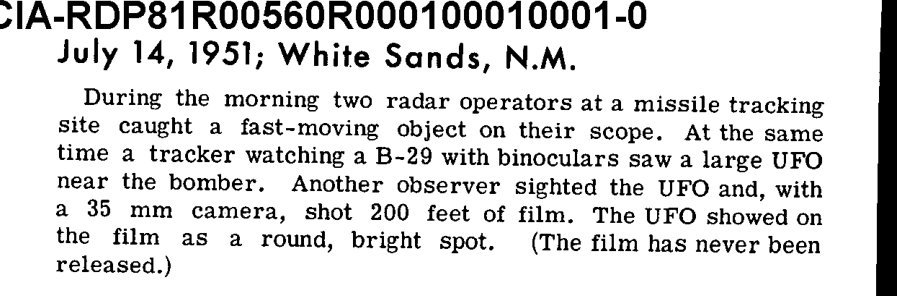
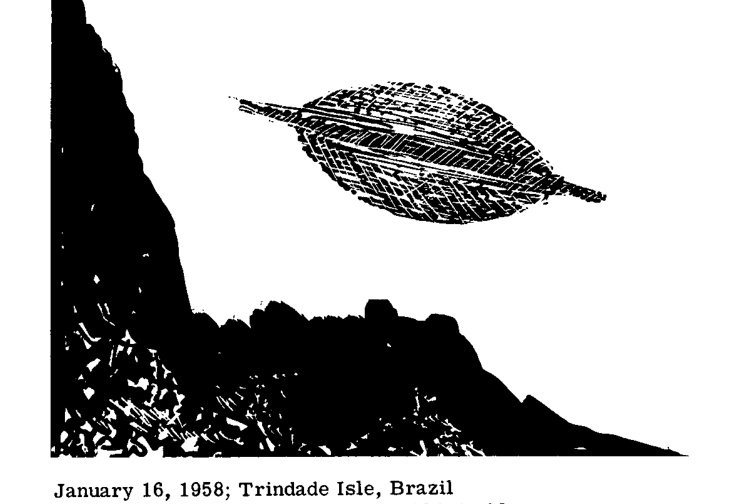
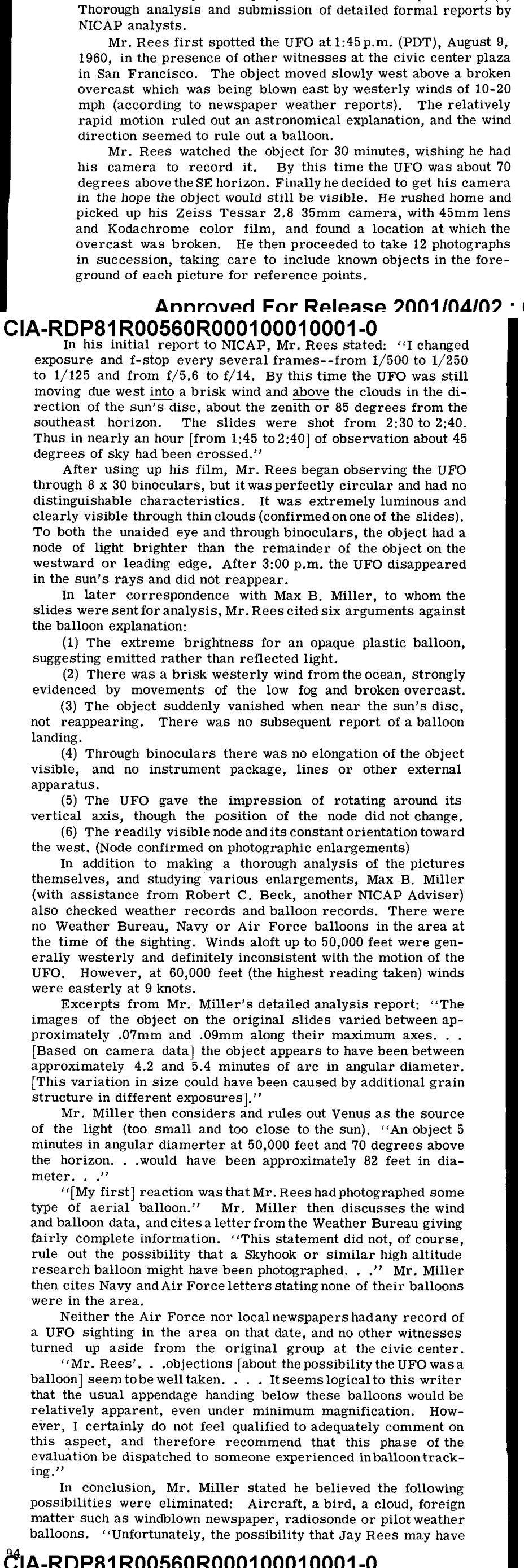
Date: 07/28/1959, between 2:10 and 2:20 p.m.Location: Corpus Christi, Texas, USA
Corpus Christi, 1959: two films by Ray Stanford show a stationary UFO, and NICAP says they do not confirm the account of four UFOs
The 1964 private NICAP report kept by the CIA examines two color films made by Ray Stanford and a friend in Corpus Christi on July 28, 1959. NICAP concluded that the films are authentic records of a UFO in the sky, but that they do not confirm the verbal account of four cigar-shaped UFOs and of a disc-shaped UFO launched by one of them.
- Event date
- 07/28/1959, between 2:10 and 2:20 p.m.
- Location
- Corpus Christi, Texas, USA
- Topic
- CIA file
- Source agencies
- CIA
- Documents
- 1 document · 186 pages
- Reading time
- 26 min
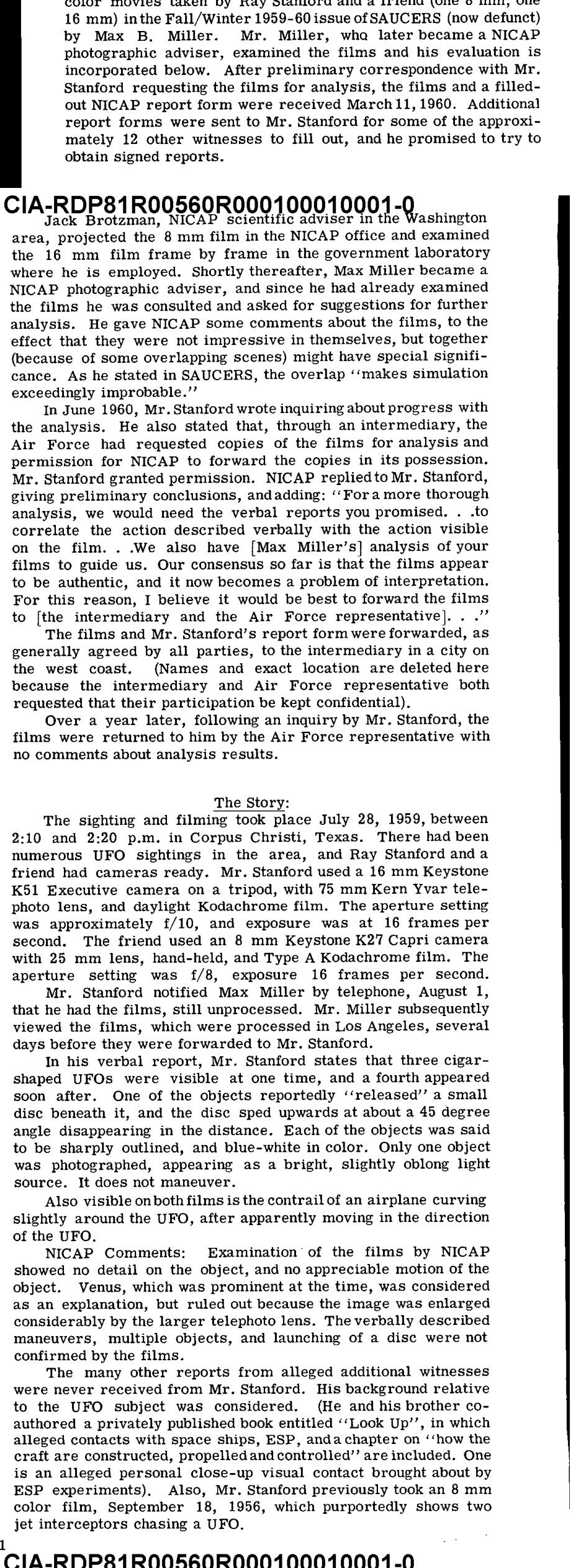 Page of the NICAP reportPhysical page 96
DOCUMENTARY SOURCES · CIA
What the records tell
The source of this dossier is the report "The UFO Evidence", published in 1964 by NICAP (National Investigations Committee on Aerial Phenomena), an American civilian UFO research organization. A copy remained in the CIA's CREST archive and was released in 2001, which proves that the agency kept the book, not that it wrote or validated it. Photographic case 42, on physical pages 96 and 97, concerns two color films, one 16 mm and the other 8 mm, made by Ray Stanford and a friend. In the list on page 92, the case receives the rating (X), doubtful or negative evaluation, with the code for color film analyzed by NICAP. The same list includes an earlier film by Stanford, of September 18, 1956, rated as incomplete.
According to Stanford's account, the filming took place in Corpus Christi, Texas, on July 28, 1959, between 2:10 and 2:20 p.m. There were many sightings in the region and the two had cameras ready. Stanford used a 16 mm Keystone on a tripod, with a 75 mm telephoto lens; his friend, a handheld 8 mm Keystone. Stanford said he saw three cigar-shaped objects at the same time, and a fourth shortly after. One of them reportedly released a small disc, which climbed at 45 degrees and disappeared. The objects were said to be sharp and bluish-white.
The films show something else. Only one object was filmed, as a bright, slightly oblong light that does not maneuver; both films also show the contrail of an aircraft curving near the object. NICAP saw no detail or appreciable motion. Venus, then prominent in the sky, was considered and ruled out because the image grew considerably with the larger telephoto lens. The maneuvers, the multiple objects and the launch of the disc were not confirmed by the films, and the accounts of the roughly twelve other witnesses promised by Stanford never arrived.
The history of the analysis is long. Max B. Miller, later a NICAP consultant, saw the developed films in Los Angeles before Stanford himself. The films reached NICAP in March 1960; Jack Brotzman, a scientific consultant, examined the 16 mm one frame by frame in a government laboratory. At the Air Force's request, through an intermediary, the films were sent to a military representative on the West Coast and returned to Stanford more than a year later, with no analysis results. Miller wrote that the identical scenes in the two films made a hoax "extremely unlikely".
NICAP says it took Stanford's background into account: he and his brother self-published the book "Look Up", with alleged contacts with spaceships, extrasensory perception and a chapter on how the ships would be built. According to the report, this generated a natural suspicion, but NICAP representatives were impressed by his sincerity and found no sign of fraud or tampering. The conclusion is that the films record some object in the sky, but do not support the verbal account and are not significant evidence of UFOs. Miller recalled that the first hypothesis was a polyethylene balloon, although he did not know of one with that shape.
More images from the document
DIRECT READING OF THE FILE
The document, in the original
Private publication (NICAP report The UFO Evidence, 1964): the English text is not reproduced or translated in full. Each translations block provides, in English, a faithful summary of the indicated passage or page (NICAP prose) or a line-by-line translation (tables, lists and reproduced official messages), with at most one short quotation. The images are crops of the report's pages. For this case, case 42 on pages 96 (end of the left-hand column and right-hand column) and 97 (top of the left-hand column) and case 31 on page 94 were summarized, and entries 31 and 42 of the list on page 92 were translated. The films are not reproduced in the report. The opinions about the witness are NICAP's and appear attributed. The full pages 94 and 97 are summarized in the report's documentary dossier.
EXCERPT 1 · PHYSICAL PAGE 92
Physical page 92, entries 31 and 42 of the list of photographic cases (excerpt)
Approved For Release 2001/04/02 : CIA-RDP81R00560R000100010001-0
¢ = color
b = black & white
FILM DATA. M = movie film
S = still photograph
Codes:
RATING. * = considered strongest evidence of UFOS
(*) = potentially strong evidence, worth priority analysis Status of NICAP Analysis
(#) = worth analysis; or possible value in conjunction VN = print viewed, complete analysis not possible because of
with other data Jack of data or lack of reference points and detail in
(X)= dubious, or negative evaluation photograph
(Inc) = incomplete; no rating possible because of lack of AN = analyzed by NICAP
information NN =NICAP unable to obtain for analysis.
bS/VN
bS/VN
M/NN
bM/NN
S/VN
M/NN
S/VN
M/NN
cM/VN
M/NN
bS/VN
bS/VN
cM/VN
bS/VN
bS/VN
M/VN (few frames)
M/VN (few frames)
cS/NN
cM/NN
bS/VN
M/NN
M/NN
bS/VN
bS/VN
/NN
cM/VN (few frames)
bS/VN
bS/VN
bS/VN
bS/VN
cM/NN
bS/VN
bS/VN
bS/VN
bS/VN
bS/VN
cM/NN
cM/NN
bS/VN
cS/VN
bS/NN
cM/AN
bS/VN
cM/NN
bM/AN
bS/VN
cS/AN
bS/VN
cM/AN
bS/AN
cS/AN
bS/VN
bS/AN
M/NN
bS/AN
cM/VN
cS/VN
bS/AN
cM/VN
bS/AN
bS/VN
bS/VN
bS/VN
cM/AN
March 1946. Fred J. Stange, Bernardston, Mass.
July 5, 1947. Frank Ryman, C, G., Seattle, Wash.
February 23, 1949. Cmdr. A. V. Orrego, Chile.
October 23, 1949. Norwood, Ohio, searchlight case.
April 24, 1950. Enrique Hausemann Muller, Balearic Islands.
April 27, 1950. White Sands theodolite photo.
May 11, 1950. Trent photographs, McMinnville, Ore.
May 29, 1950. White Sands theodolite photo.
August 15, 1950. Nick Mariana, Great Falls, Montana.
July 14, 1951. Near White Sands, tracking camera film.
August 30, 1951. Carl Hart, Jr., Lubbock lights, Texas.
May 7, 1952. Barra da Tijuca, Brazil. Ed Keffel.
July 2, 1952. Warrant Officer Newhouse, Tremonton, Utah.
July 16, 1952. Shell Alpert, Coast Guard, Salem, Mass.
July 19, 1952. Peru.
July 29, 1952. Ratph Mayher, Miami, Fla.
August 1, 1952. Wright-Patterson AFB, Ohio. gun-camera
September 19, 1952. Operation Mainbrace color photos.
November 16, 1952. David S. Bunch near Landrum, S. C.
December 13, 1952. Adamski "scout ship.”
August 12, 1953. Ellsworth AFB gun-camera, "best unknown" case.
August 31, 1953. Port Moresby, New Guinea, T. C. Drury
February 15, 1954. Stephen Darbishire, Coniston, England
March 1954, Rouen, France. RAF Flying Review.
May 24, 1954. USAF photo by RB-29 reconaissance plane
June 30, 1954. Scandinavian eclipse photos.
September 9, 1954. K. M. Gibbons, New Zealand
March 5, 1956. William L, Wannall, Hawaii (cS orig.)
July 17, 1956. Elizabeth Klarer, S. Africa.
July 19, 1956. Michael Savage, 15, San Bernardino, Calif.
September 18, 1956. Ray Stanford, Calif.
October 10, 1956. Joe Kerska, Twin Peaks, San Francisco, California
August 20, 1957. Japan. S, Takeda
November 6, 1957. Anaheim, California
November 16, 1957. Near Holloman AFB, New Mexico
December 1957. T. Fogl, radio officer, S.S. Ramse
December 1, 1957. Ralph Benn, Los Angeles, California
January 3, 1958. Cliff DeLacey, Hawaii.
January 16,1958. Trindade Isle, Brazil, sequence.
February 9, 1958. Troy, Michigan, airport
June 23, 1958. Near England AFB, Louisana State police.
July 28, 1959. Ray Stanford. Two movie films.
October 16, 1958. Mike Schultz, Newark, Ohio.
February 9, 1959. Purdon, Imperial Beach, California
September 24, 1959. Redmond, Ore. FAA case.
November 29, 1959. J. J. Rehill, USN, Miami, Florida
February 13, 1960. Joe Perry, Grand Blanc, Michigan
March 2, 1960. Schedelbauer, Vienna.
April 11, 1960. Mary Jo Curwen, Hazel Green, Wisconsin
August 3, 1960. Linz, Austria
August 9, 1960. Jay Rees, San Francisco, California
August 25, 1960. Grumman mystery satellite photo
January 1, 1961. A/3c Bellett, Golden, Colorado
January 22, 1961. Harry Caslar, Eglin AFB, Florida
May 27, 1961. Triangle, Nashville, Tenn.
May 29, 1961. Craig Seese, Newark, Ohio.
July 13, 1961. Bob Feldman, Akron, Ohio
September, 1961. Paccione moon photos
September 29, 1961. Savage, Warrenton, Virginia
March 9, 1962. Jeanne B, Johnson, Hawaii.
May 25, 1962. F, DiMambro, Woburn, Mass.
November 18, 1962. Bruce Fox, Bayonne, New Jersey
December 15 & 16, 1962. Ronald Gounad, New Jersey
December 21, 1962. Ali R. Diaz, Angel Falls, Venezuela.
PHOTOGRAPHIC CASES
1. Fred J. Stange, Bernardston, Mass. Photograph sub-
mitted in 1954 to Rev. Albert Baller (nowNICAP Board member).
Witness states he first saw three discs in a group, then two other
single objects. Photograph shows all five, according to Leonard
H. Stringfield (CRIFO Newsletter; Vol. II No. 3, June 3, 1955).
Lead object of V-formation is largest image. Photo taken with
box camera. Other camera data not available. The slide
viewed by NICAP, a copy of the original, is of very poor quality.
Many splotches are apparent, but no easily discernible UFO
images.
2. Frank Ryman, U.S. Coast Guard, Seattle, Wash. At 5:45
p.m. Mr. Ryman photographed a circular white object moving
across the wind. (See Popular Science, August 1951; ‘Report
on UFO”, Ruppelt, p. 37), Photograph reproduced in ‘‘Coming of
the Saucers’’, by Arnold & Palmer, shows small, white, elliptical
image. Photo carries identification: ‘‘Acme Telephoto, SE86-7/5
Seattle.”
Approved For Release 2001/04/02 ¢°>CIA-RDP81R00560R000100010001-0Check the original PDF
[p. 92: texto da publicação privada não reproduzido; ver o resumo]View the document record ↗ · Physical page 92, counting the cover.
EXCERPT 2 · PHYSICAL PAGE 94
Physical page 94, photographic case 31 (excerpt)
Approved For Release 2001/04/02 : CIA-RDP81R00560R000100010001-0
Photographic Cases (Continued)
spherical object which reportedly moved rapidly across the sky
above the fleet. The pictures showed a round object, according
to press reports, but have not been released to our knowledge.
(‘The Truth About Flying Saucers’’, Michel, p. 130).
19. David §. Bunch film, Landrum, S.C. About 5:00 p.m.
hundreds of people near Florence, S.C. had seen a large disc-
shaped UFO. About six minutes later, a group of round glowing
objects were sighted near Landrum, Among the witnesses were
J.D. McLean and David S. Bunch. Mr. Bunch took 40 feet of color
movie film, using an 8 mm camera with telephoto lens. The film
was submitted to the Air Force, and viewed by Maj. Donald E.
Keyhoe along with Air Force officers, It shows five glowing,
oval-shaped objects.
20. Adamski ‘‘Scout Ship.’’ Because of Mr. George Adamski’s
background as a self-styled ‘‘professor” of oriental mystical
philosophy (later espoused by his ‘‘spacemen’’) and at least one
claim of his which was conclusively proved false by NICAP in-
vestigators, his photographs are considered dubious. NICAP
Board Member, Frank Edwards, (an experienced photographer)
considers the Adamski pictures hoaxes. Mr. Adamski refuses to
submit his negatives for analysis.
21. The Ellsworth AFB case, in which two jet interceptors
chased a UFO which turned and followed the first jet back towards
its base, was termed by Capt. E.J. Ruppelt ‘‘an unknown... the
best.’? Later information obtained by a NICAP member indicates
that the UFO was photographed by gun camera and that the film
verified the presence of a UFO, making it an even stronger case.
Maj. Lawrence J. Tacker, then Air Force Spokesman on UFOs,
wrote to NICAP Member Alexander Overall: 17 September 1958,
“Photos of the radar scope and gun camera photos were made but
were not sufficiently clear for evaluation. The Ellsworth AFB
case is still listed as unknown or unsolved.’’ As in other gun
camera and tracking camera cases, the film has not been re-
leased for outside scientific analysis.
22, New Guinea film. Mr. T.C. Drury, then Deputy Regional
Director of the Civil Aviation Department at Port Moresby,
obtained motion picture film of a UFO at high altitude leaving
a clear vapor trail. (telephoto lens used), The UFO climbed
steeply and disappeared. Reuters, on March 14, 1954, reported
that the film had been sent to the United States for ‘‘special
processing.’’ (Other sources indicate it was sent to ATIC at
Wright-Patterson AFB, Ohio.) On February 19, 1958, Mr. Drury,
replying to a query by Max B. Miller, stated he had turned his
film over to the Commonwealth Security Branch and had not seen
it since.
23. The ‘‘Coniston Saucer”? photograph was taken by Stephen
Darbishire, 13, at Coniston, Lancs., England. His brother Adrian,
8, also reportedly witnessed the UFO. The boys’ father is a doctor
of good reputation. Using an inexpensive Kodak, extending bellows
type, with only two lens settings (‘‘bulb”’ and ‘‘infinity’’), Stephen
photographed a UFO rising low over a hillock.
The picture, although blurred and of poor quality, shows a
bright object (lighter than the sky background) strongly resembling
a side view of the Adamski ‘‘scout ship’’. (See No. 20 above.)
An orthographic projection by Leonard G. Cramp confirmed
that the Coniston and Adamski photographs were of identical
proportions.
David Wightman, NICAP Adviser in England, has met the
Darbishire family and now knows them very well. He found no
reason to consider the incident a hoax. In spite of the above, we
are inclined to be dubious of the photograph (a) because it is an
exact copy of the Adamski-type ‘‘saucer’’, which is in itself
dubious; (b) because it could easily be a cut-out or model of
the Adamski ‘‘saucer’’, and in fact on the photograph a black
marking extends from the object to the hilltop, which could be
a support for a cut-out or model. Admittedly, no motive for a
hoax is apparent, and the validity of the photograph is not dis-
proved.
24, Rouen, France. In conjunction with an article ‘‘Some-
thing in the Sky,’”? RAF Flying Review (July 1957) published a
UFO photograph which was taken over Rouen, France. No
camera or film data were given. The highly-respected aviation
magazine termed it ‘‘one of the few [photographs] which seem
authentic.’? The UFO resembles a disc viewed edge-on, and has
a small projection on top. It closely resembles the May 11, 1950
25. RB-29 Photo. USAF photo taken as UFO was observed
flying beneath an RB-29 near Dayton, Ohio. Picture reportedly
showing unexplained circular light source, never made public.
[See ‘Report on Unidentified Flying Objects,’’ Ruppelt, pp.
310-312]
26. Scandinavian eclipse film. Three aircraft carrying scien-
tists, newsmen and other observers were flying near Lifjell,
Denmark; on an expedition to film and study a total eclipse of
the sun. At 2:17 p.m. two shiny discs were noticed flying past
the planes and witnessed by about 50 people on the three planes.
John Bjornulf, chief cameraman of the expedition, managed to
obtain about 10 seconds (of the approximately 30 second UFO
flight) on 16 mm color film. The film was reportedly shown on
American television December 26, 1954. [See Section 1]
27. Gibbons film, N.Z. Three disc-like UFOs were observed
simultaneously near Nelson, N.Z., at positions 5 miles apart
by Mr. K.M. Gibbons and Mr. Alex Ingram. A third witness
later saw 5 similar discs in the same general area. Mr. Gibbons
took photographs (number unspecified) with a Cannon 35 mm
miniature camera equipped with telephoto lens, as the UFOs
hovered low over 4 mudflat, wobbling like tops and glowing
blue-white. Two of the discs tilted on edge, streaked up verti-
cally and disappeared. Then the third disc brightened, and also
streaked away. (CRIFO Newsletter, L.H. Stringfield, November
5, 1954; CRIFO Case 29). One of the photographs, showing an
apparent oblate spheroid with small dark projection on top, is
reproduced in ‘‘Flying Saucers Uncensored’’, Wilkins, p. 96.
28. Wannall Photo, Hawaii. Mr. and Mrs. William L. Wannall,
Honolulu, Hawaii were driving south on 10th Avenue at 8:45 p.m.,
when they noticed ‘‘three large lights flying in a wide formation
over the Kaimuki area...sky was clear, and visibility unlimited,
prevailing trade winds.’’ (SAUCERS, Vol. IV No. 2). After
watching the lights for about 1 minute, Mr. Wannall took a photo-
graph of them with his Cannon 35 mm camera using Ansco-
chrome color film (32 ASA), exposure 1/8, aperture f/1.8. NICAP
has viewed only a black and white print, which shows three
lights in a triangle pattern, two of which have sharply curving
“trails”. Off to one side is another, slightly larger, apparent
light. There is a dark background with no visible landmarks.
According to Max B. Miller, who examined a color print, the
lights are bright yellow except for one of the “trails”? which
is bluish-green. ‘The fourth ‘‘object’’ was not visible to the
photographer. The light sources are surrounded by an ‘‘aureole-
type effect.’”’
29. Mrs. Elizabeth Klarer, Natal, South Africa, took three
photographs showing a metallic-appearing disc against a cloud
background, She used a Brownie box camera. (See Flying Saucer
Review, November-December, 1956). Clearest photograph strongly
resembles an automobile hubcap. Mrs. Klarer is also a ‘‘con-
tactee’ with claims of meeting spacemen, similar to George
Adamski’s story. Photographs considered dubious.
30. Savage Photo, California. Photograph taken by Michael
Savage, 15, son of Dr. Phillip M. Savage, Jr., San Bernardino,
California. Shows elliptical outline of apparent disc-like object,
large apparent size, above trees and wires. Michael said the
UFO appeared to be about 20 feet indiameter, with some ‘‘appara-
tus or portholes” visible near the trailing edge. He said it moved
at high speed and climbed out of sight at about a 55 degree angle.
The alleged UFO is barely in the frame of the picture, one end
clipped off by the edge of the frame. Could be cardboard or other
model held up in foreground and photographed. Dubious.
31. Ray Stanford, California. Using a Wollensak 8 mm
camera with telephoto lens, Mr. Stanford shot about 6 feet of
film of a ‘‘tiny, flickering object moving in and out of the field
of view;’’ (as described by Max B. Miller), The sequence was
accidentally considerably underexposed. He used Daylight Koda-
chrome. (Pictures and story, SAUCERS, Autumn 1958); originally
described in ‘‘Look Up’’, privately published book by Ray Stanford),
32. Twin Peaks, California. Photograph showing dark disc-
shaped object with lighter dome (about 1/5 diameter of the
object) against light sky with city and mountains visible beneath.
SAUCERS (Vol. V No. 1) reports the picture was taken by Joe
Kerska, about 12:30 p.m., facing east on the south slope of Twin
Peaks, San Francisco. No camera data or character information
available. The alleged UFO strongly resembles a small model
at relatively close range, thrown into the air and photographed.
No meaningful analysis is possible because of lack of data, but
Trent photoeramiy HoWed For Release 2001/04/02 -, CIA-RDP81ROUS60RO00100010001-0Check the original PDF
[p. 94: texto da publicação privada não reproduzido; ver o resumo]View the document record ↗ · Physical page 94, counting the cover.
EXCERPT 3 · PHYSICAL PAGE 96
Physical page 96, photographic case 42 (end of the left column and right column, excerpt)
roved For Release 2001/04/02 : CIA-RDP81R00560R000100010004
Photographi Approvs (Continued
Correspondence between U.S. UFO groups and leading Brazil-
ian investigators drew out many facts about the case, including
background information about other similar sightings at Trindade
Isle over a period of time, all of which tends to substantiate the
January 16 sighting and photographs. No suspicion of hoax was
uncovered by J. Escobar Faria, Sao Paulo attorney (NICAP
Adviser), Dr. Olavo Fontes, M.D., in Rio de Janeiro (APRO Spec-
ial Representative), or other Brazilian correspondents ina position
to ascertain the facts. [See APRO Bulletins, January, March, and
May 1960 for detailed series of articles about the Trindade
photographs by Dr. Fontes].
Weighing all the facts, we conclude that the pictures appear
to be authentic. They definitely are one of the potentially most
significant series of UFO photographs on record, so that clarifi-
cation of the incident and additional analysis is strongly desirable.
In the interests of scientific investigation, we urge that secrecy
about the case be lifted by the United States and Brazil and that a
frank report of the facts be issuedtothe public. In particular, the
full analysis reports by the Brazilian laboratories shouldbe made
available to scientists. Information currently withheldby the U.S.
Air Force about its investigation of the case through the American
Embassy in Rio de Janeiro also should be made available to the
public.
Photographic data: Mr. Barauna useda Rolleiflex 2.8--Model
E camera, speed 1/125, aperture f/8 (causing a slight over-
exposure),
40. Troy, Michigan airport. Photograph taken by H.M. Stump
using an Argus C-3 camera, from a private plane landing at the
airport. Picture shows yellow-white oval with slighttrail. Verbal
report states object hovered, then sped away to the west.
41. England AFB, La.--State Police case. Polaroid pictures
taken by a state policeman at 12:20 p.m. were published by the
Alexandria Daily Town Talk. The officer stated he saw ‘‘two
glowing balls’’ in the sky and that it ‘‘scared hell out of me.”
He was not sure whether it was one double object, or two separate
ones close together. The Air Force later stated the ‘‘UFO’’ was
a reflection off the windshield of the patrol car. NICAP letters
to the state police were not answered.
42, Ray Stanford Movies. NICAP first learned of the two
color movies taken by Ray Stanford and a friend (one 8 mm, one
16 mm) inthe Fall/Winter 1959-60 issue of SAUCERS (now defunct)
by Max B. Miller. Mr. Miller, wha later became a NICAP
photographic adviser, examined the films and his evaluation is
incorporated below. After preliminary correspondence with Mr.
Stanford requesting the films for analysis, the films and a filled-
out NICAP report form were received March11, 1960. Additional
report forms were sent to Mr. Stanford for some of the approxi-
mately 12 other witnesses to fill out, and he promised to try to
obtain signed reports.
July 16, 1952; Massachusetts (Case 14)
Brotzman, NICAP scientific adviser in the 29,.shington
area. a evojected the 8 mm film in the NICAP office and examined
the 16 mm film frame by frame in the government laboratory
where he is employed. Shortly thereafter, Max Miller became a
NICAP photographic adviser, and since he had already examined
the films he was consulted and asked for suggestions for further
analysis. He gave NICAP some comments about the films, to the
effect that they were not impressive in themselves, but together
(because of some overlapping scenes) might have special signifi-
cance. As he stated in SAUCERS, the overlap ‘‘makes simulation
exceedingly improbable.’’
In June 1960, Mr. Stanford wrote inquiring about progress with
the analysis. He also stated that, through an intermediary, the
Air Force had requested copies of the films for analysis and
permission for NICAP to forward the copies in its possession.
Mr. Stanford granted permission. NICAP repliedto Mr. Stanford,
giving preliminary conclusions, andadding: ‘‘Fora more thorough
analysis, we would need the verbal reports you promised. . .to
correlate the action described verbally with the action visible
on the film. . .We also have [Max Miller’s] analysis of your
films to guide us. Our consensus so far is that the films appear
to be authentic, and it now becomes a problem of interpretation.
For this reason, I believe it would be best to forward the films
to [the intermediary and the Air Force representative ]. 2
The films and Mr. Stanford’s report form were forwarded, as
generally agreed by all parties, to the intermediary ina city on
the west coast. (Names and exact location are deleted here
because the intermediary and Air Force representative both
requested that their participation be kept confidential).
Over a year later, following an inquiry by Mr. Stanford, the
films were returned to him by the Air Force representative with
no comments about analysis results.
The Story:
The sighting and filming took place July 28, 1959, between
2:10 and 2:20 p.m. in Corpus Christi, Texas. There had been
numerous UFO sightings in the area, and Ray Stanford anda
friend had cameras ready. Mr. Stanford used a 16 mm Keystone
K51 Executive camera on a tripod, with 75 mm Kern Yvar tele-
photo lens, and daylight Kodachrome film. The aperture setting
was approximately f/10, and exposure was at 16 frames per
second. The friend used an 8 mm Keystone K27 Capri camera
with 25 mm lens, hand-held, and Type A Kodachrome film. The
aperture setting was f/8, exposure 16 frames per second.
Mr. Stanford notified Max Miller by telephone, August 1,
that he had the films, still unprocessed. Mr. Miller subsequently
viewed the films, which were processed in Los Angeles, several
days before they were forwarded to Mr. Stanford.
In his verbal report, Mr. Stanford states that three cigar-
shaped UFOs were visible at one time, and a fourth appeared
soon after. One of the objects reportedly ‘‘released’’ a small
disc beneath it, and the disc sped upwards at about a 45 degree
angle disappearing in the distance. Each of the objects was said
to be sharply outlined, and blue-white in color. Only one object
was photographed, appearing as a bright, slightly oblong light
source. It does not maneuver.
Also visible on both films is the contrail of an airplane curving
slightly around the UFO, after apparently moving in the direction
of the UFO.
NICAP Comments: Examination’ of the films by NICAP
showed no detail on the object, and no appreciable motion of the
object. Venus, which was prominent at the time, was considered
as an explanation, but ruled out because the image was enlarged
considerably by the larger telephoto lens. The verbally described
maneuvers, multiple objects, and launching of a disc were not
confirmed by the films.
The many other reports from alleged additional witnesses
were never received from Mr. Stanford. His background relative
to the UFO subject was considered. (He and his brother co-
authored a privately published book entitled ‘‘Look Up’’, in which
alleged contacts with space ships, ESP, anda chapter on ‘‘how the
craft are constructed, propelledand controlled” are included. One
is an alleged personal close-up visual contact brought about by
ESP experiments), Also, Mr. Stanford previously took an 8 mm
color film, September 18, 1956, which purportedly shows two
jet interceptors chasing a UFO.
91
Approved For Release 2001/04/02 : CIA-RDP81R00560R000100010001-0Check the original PDF
[p. 96: texto da publicação privada não reproduzido; ver o resumo]View the document record ↗ · Physical page 96, counting the cover.
EXCERPT 4 · PHYSICAL PAGE 97
Physical page 97, top of the left column: conclusion of case 42 (excerpt)
Photogra PONE For, Release 2001/04/02 : CIA-RDP81R00560R000100010001-0
ontinue
)
ases ('
September 9, 1954; New Zealand (Case 27)
Drawing from photograph, by Eric Aldwinckle
August 30, 1951; Lubbock, Texas (Case 11)
Drawing from photograph, by Eric Aldwinckle
With this background, there was some natural suspicion about
the authenticity of the 1959film. However, NICAP representatives
who have talked to Mr. Stanford were impressed by his sincerity,
and examination of the films by NICAP and Max B, Miller found
no evidence of fakery or tampering with the films (which, as stated
above, were processed in Los Angeles and examinedby Max Miller
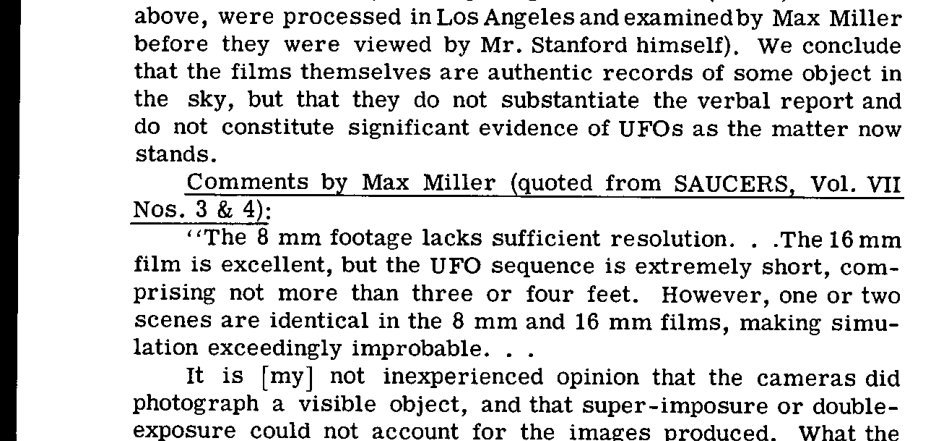
before they were viewed by Mr. Stanford himself), We conclude
that the films themselves are authentic records of some object in
the sky, but that they do not substantiate the verbal report and
do not constitute significant evidence of UFOs as the matter now
stands.
Comments by Max Miller (quoted from SAUCERS, Vol. VII
Nos. 3 & 4):
“The 8 mm footage lacks sufficient resolution. . .The 16mm
film is excellent, but the UFO sequence is extremely short, com-
prising not more than three or four feet. However, one or two
scenes are identical in the 8 mm and 16 mm films, making simu-
lation exceedingly improbable. . .
It is [my] not inexperienced opinion that the cameras did
photograph a visible object, and that super-imposure or double-
exposure could not account for the images produced. What the
object was, of course, remains an enigma. The first possibility
to cross our minds was a polyethelyne type balloon, but we have
never heard of any of the shape recorded. . .”
43. Mike Schultz, Newark, Ohio. The Newark Advocate,
Nov. 15, 1958 published three pictures and the story. Some ex-
cerpts from the article and a black and white print of the news-
paper photographs were forwarded to NICAP in January 1959
by a member. Using an inexpensive camera and telescope, Mr.
Schultz photographed what looked like a bright star in the sky.
Then the object moved and stopped, and he took the second picture.
This was repeated once more. According to the member who
submitted the photographs, each picture is a double-exposure of
one object (the images are double in each case) because of un-
avoidable motion of the camera and telescope. The pictures in
NICAP possession (poor copies with no negatives) strongly re-
semble internal reflections in the telescope as might be obtained
by an inexperienced amateur astronomer using poor equipment.
Without more complete data, no final judgment can be made.
44. James M. Purdon, Jr., Imperial Beach, Calif. Mr.
Purdon, an engineer with a west coast aviation company, obtained
several feet of color movie film of a bright object with a halo
around it, observed by him and his family between 4:20 and 4:50
p.m. The equipment used was a Kodak camera with telephoto
lens on a turret,
According to a report which Mr. Purdon submittedto NICAP,
the UFO was first motionless for a long period of time. While
he was phoning a newspaper, his wife saw the UFO disappear.
Minutes later he obtained footage of a moving bright object (about
20 seconds of which, he states, ‘‘came out rather good’).
According to his report, the UFO ‘‘hove into view from one
direction, slowed up to almost a stop, then proceeded at a 90
degree angle toward the ocean. It accelerated quite rapidly at
first. Then it oscillated up anddown.’’ A TV antenna in the fore-
ground furnishes a reference point on the film, and the object
moves behind a ‘Christmas tree” (presumably planted in his
Ny LAY
NA
QQy
WN
ANY
NYY
\
VS
August 20, 1957; Japan (case 33)
Drawing from photograph, by Eric Aldwinckle
Approved For Release 2001/04/02 : GIA-RDP81 R00560R000100010001-0Check the original PDF
[p. 97: texto da publicação privada não reproduzido; ver o resumo]View the document record ↗ · Physical page 97, counting the cover.
Dates and documentary context
- Event
- 28/07/1959 — Date and time (14h10 to 14h20) of Stanford's account reproduced by NICAP.
- Document
- 02/04/2001 — Date of the CREST release stamp printed on the pages (Approved For Release 2001/04/02).
- Publication
- 1964 — Year of publication of the report "The UFO Evidence" by NICAP (May 1964).
Origin and release
National Investigations Committee on Aerial Phenomena (NICAP), an American civilian organization; private report "The UFO Evidence" (1964), edited by Richard H. Hall. Copy kept in the CIA's CREST archive (CIA-RDP81R00560R000100010001-0, released on 02/04/2001); the CIA kept the text, it did not produce or validate it · CIA-RDP81R00560R000100010001-0_NICAP-The-UFO-Evidence_1964.pdf
CIA CREST, CIA-RDP81R00560R000100010001-0, release of 02/04/2001 ↗ — undefined
Questions to continue the investigation
- Did the Air Force ever analyze the copies of the films sent by the intermediary in 1960?
- Were the accounts of the roughly twelve other Corpus Christi witnesses collected by anyone?
GEOGRAPHY OF THE CASE
Corpus Christi, Texas
Approximate reference to the city, placed by the editorial team. The account does not give the exact location of the filming.
DOCUMENTARY TRAIL
Go back to the sources
References use physical pages of the PDF, counting the cover. Summaries are presented in English; the documents keep their original language.
- CIA-RDP81R00560R000100010001-0_NICAP-The-UFO-Evidence_1964.pdf
Physical page 92: entries 31 and 42 of the photographic case list (Ray Stanford), with rating and code · Physical page 94: photographic case 31, 8 mm film from 1956 · Physical page 96: photographic case 42, analysis history and account of the filming of 28/07/1959 · Physical page 97: NICAP conclusion and comments by Max B. Miller
CIA · 186 pages
Editorial summary based on the collection's research notes. How we read the documents.