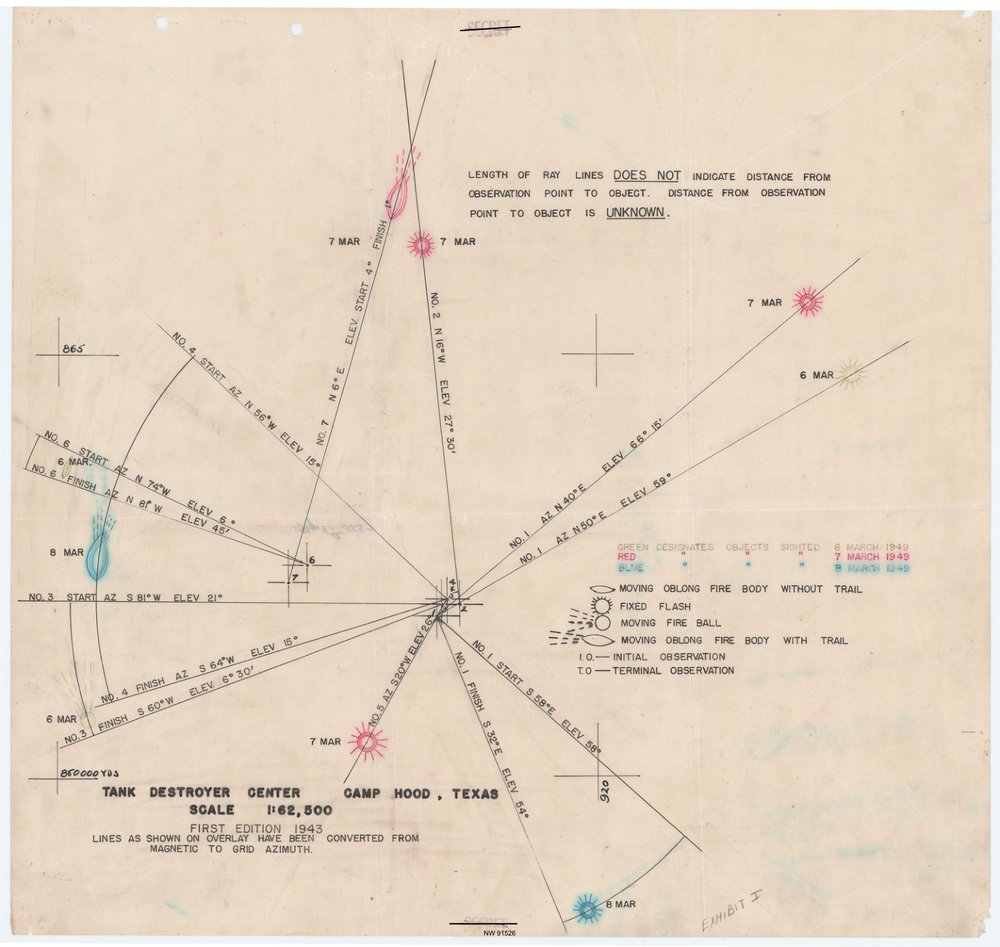
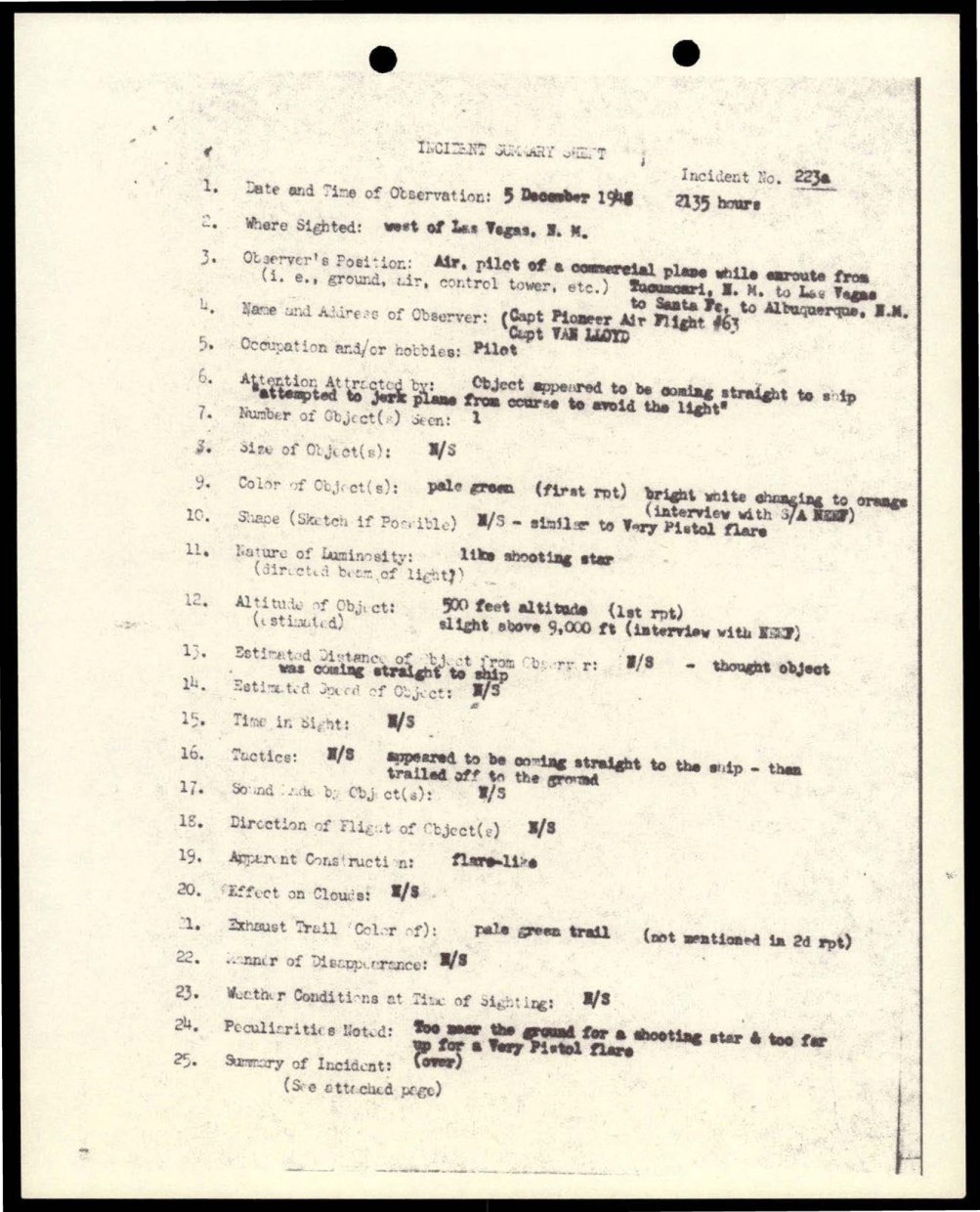
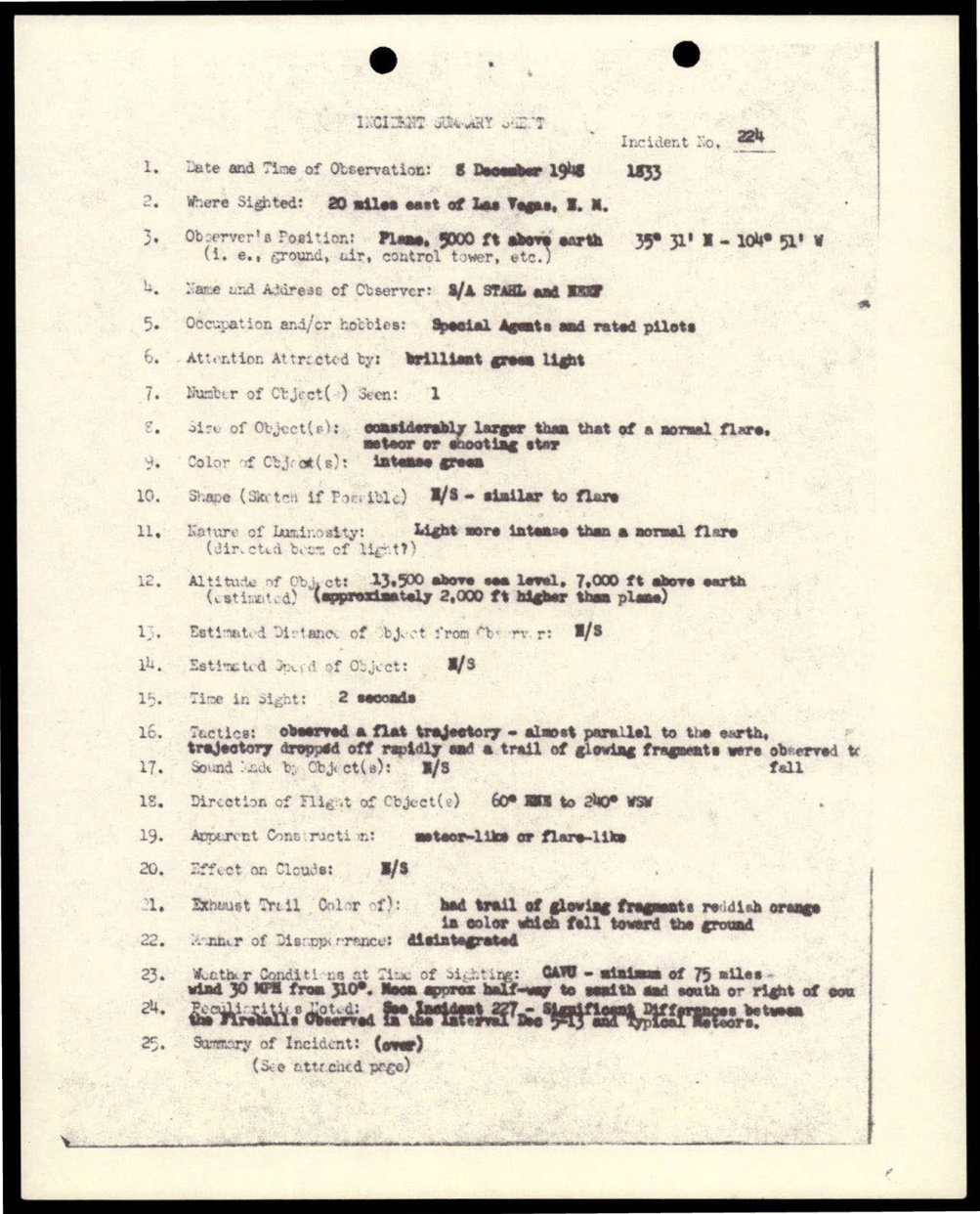
Date: 30/01/1949, 17h54 (Mountain Time)Location: Sky over eastern New Mexico and western Texas; end of the trajectory calculated west of Lamesa, Texas, USA
New Mexico and Texas, 1949: the great fireball of January 30, seen by thousands, crosses 143 miles of sky without a boom
In the late afternoon of Sunday, January 30, 1949, a very bright fireball crossed the sky of New Mexico and Texas and was seen by thousands of people. Lincoln LaPaz calculated an almost horizontal trajectory of 143 miles and recorded that no one heard the detonations typical of large meteorites, but he considered that, among the cases investigated, only this one gave some indication of being a meteorite fall.
- Event date
- 30/01/1949, 17h54 (Mountain Time)
- Location
- Sky over eastern New Mexico and western Texas; end of the trajectory calculated west of Lamesa, Texas, USA
- Topic
- Military reports from 1948–1949
- Source agencies
- DOW · DOE
- Documents
- 2 documents · 141 pages
- Reading time
- 20 min
 Scientific reportPhysical page 81
DOCUMENTARY SOURCES · DOW / DOE
What the records tell
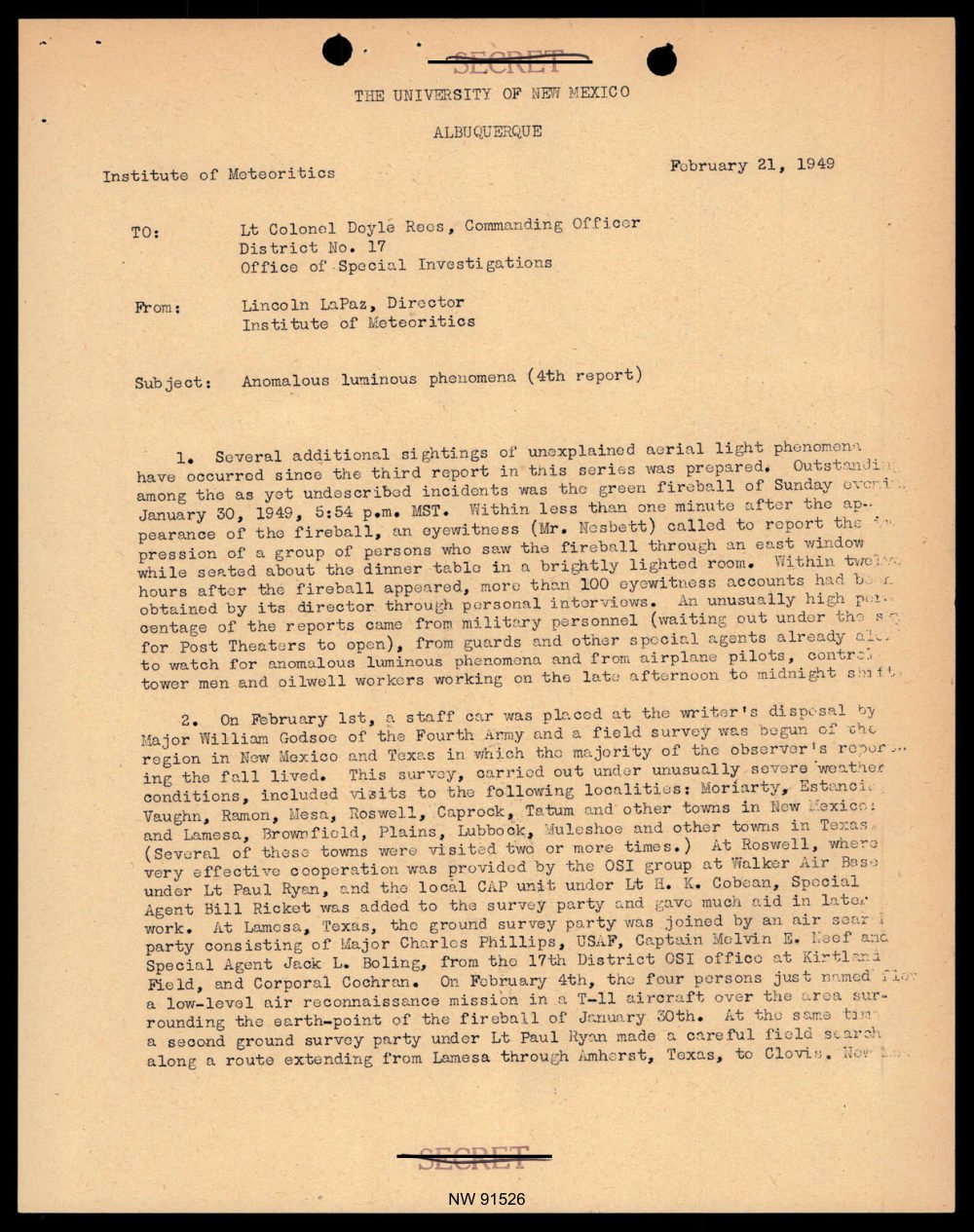
At 17h54 on Sunday, January 30, 1949, a fireball crossed the sky of New Mexico and Texas. According to Lincoln LaPaz's fourth report to the OSI 17th District, dated February 21, less than a minute later a resident telephoned to describe what a group had seen from the dinner table, through a window facing east. Within two hours, LaPaz already had more than a hundred reports. Many came from military personnel waiting outdoors for the base movie theaters to open, from guards already alerted to the green balls, from pilots, tower operators and oil well workers.
Starting February 1, with a car provided by Major William Godsoe, of the Fourth Army, LaPaz traveled to towns in New Mexico, such as Vaughn, Roswell and Tatum, and in Texas, such as Lamesa, Lubbock and Muleshoe. OSI agents and the Civil Air Patrol joined the search, and on February 4 a T-11 with Captain Melvin E. Neef on board flew at low altitude over the area of the probable impact point, while another group drove the route from Lamesa to Clovis.
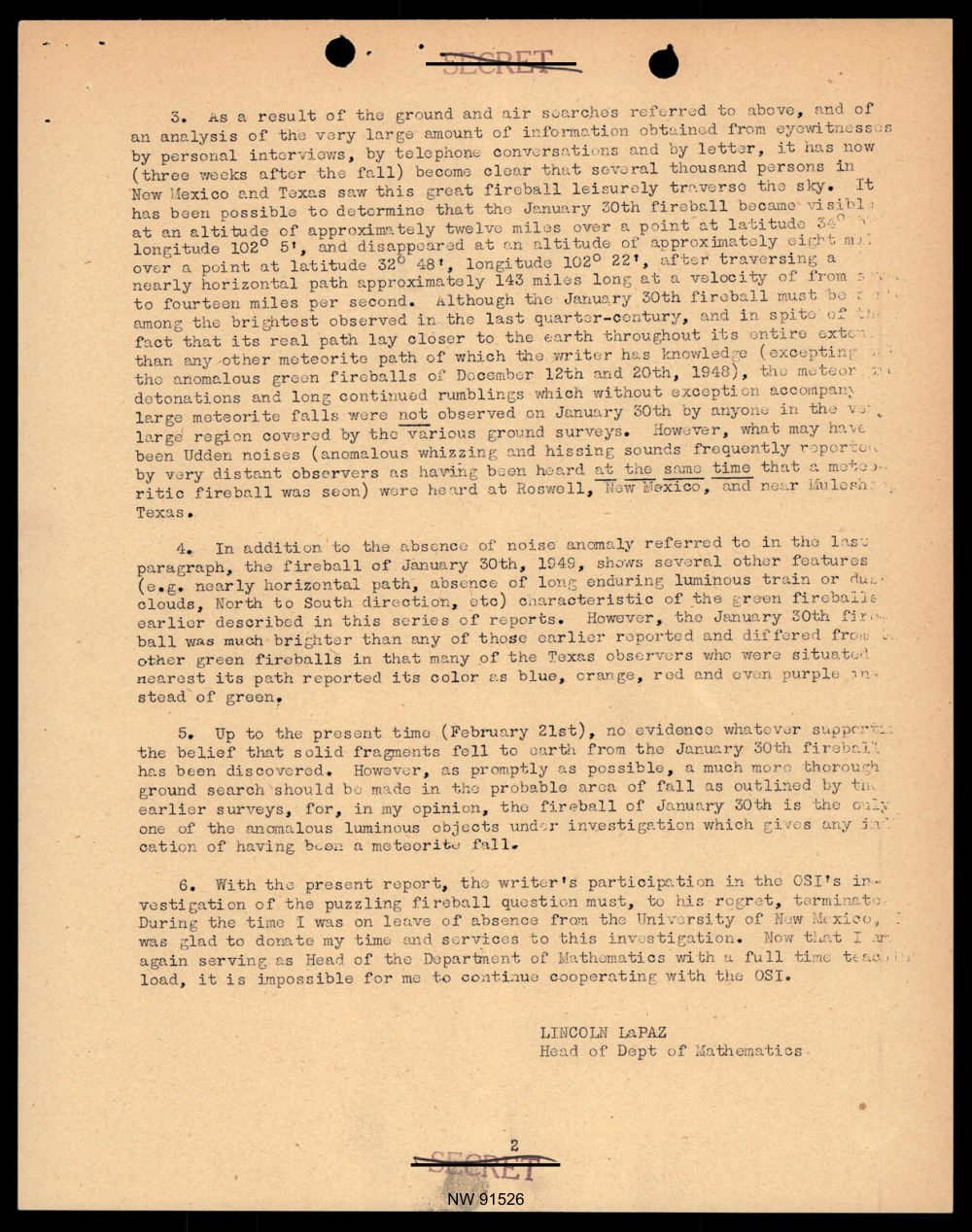
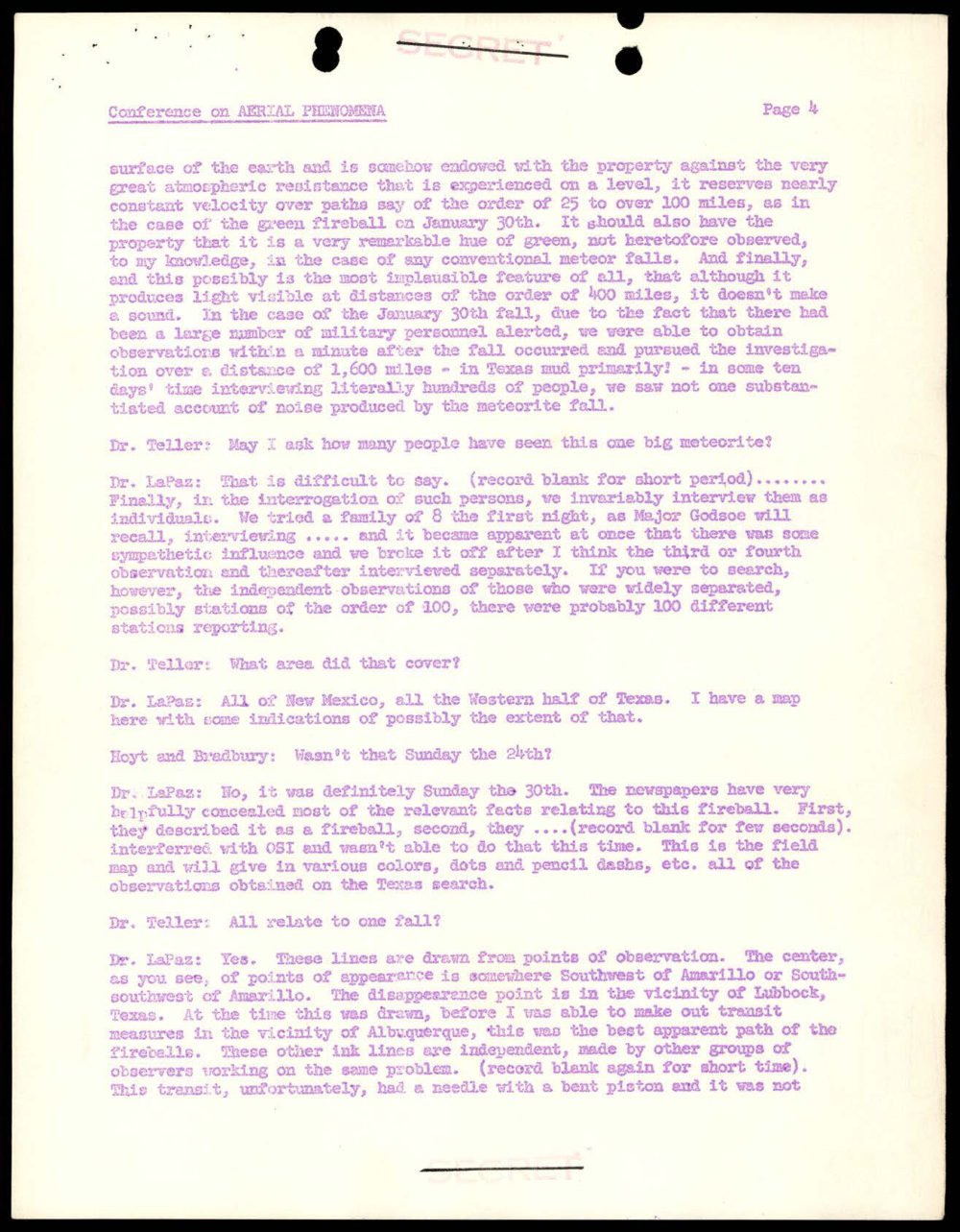
Three weeks later, LaPaz concluded that several thousand people had seen the ball 'slowly cross the sky.' By his calculations, it appeared at about 12 miles altitude over the region of latitude 34° N and longitude 102° 5' W and disappeared at about 8 miles over 32° 48' N, 102° 22' W, after traveling almost horizontally some 143 miles (230 km), at up to 14 miles per second. At the Los Alamos conference, he said the reported durations ranged from 5 to 14 seconds and that the average of 10 gave about 10 miles per second.
No one in the vast area surveyed reported the detonations and prolonged rumbling that accompany large meteorite falls; there were only possible 'Udden noises,' buzzing and hissing sounds reported in Roswell and near Muleshoe. Many observers in Texas, closer to the trajectory, described the light as blue, orange, red or purple, not green. At the conference, LaPaz attributed other reported noises to dynamite blasts at oil wells and related that the theodolite used in the first measurements was defective.
Even while noting features shared with the green balls, LaPaz wrote that the January 30 one was 'the only one' of the objects investigated that gave some indication of being a meteorite fall, and he requested a new search for fragments, which had not turned up so far. In the same report he announced that he was ending his collaboration with the OSI to return to teaching; in 1950 he reappears as a volunteer consultant. The field map shown at the conference is not in the collection.
More images from the document
DIRECT READING OF THE FILE
The document, in the original
Translated in full: the two pages of LaPaz's fourth report (physical pages 81 and 82 of DOW-UAP-D017) and the excerpts from the 1949 transcript dealing with the fall (the full transcript pages are in the green-fireballs enlargement). Numbers cut off at the margin of the copy were marked, without completion.
EXCERPT 1 · PHYSICAL PAGE 81
LaPaz's fourth report, 21/02/1949, page 1 (full text), physical page 81
'
THE UNIVERSI TY OF NEV'f HEXICO •
ALBUQUERQUE
Febr uar y 21 , 1949 Institute of Met e oritics
Lt Col onel Doyle Rec s , Commanding Office r TO :
Distr ict No . 17
Office of . Specia l Investigations
From Lin co l n w.Paz , Dire ctor :
I n stitute of Meteoritic s
Anomalous l umi nous phenomena ( 4t h r e port) Subje ct :
1 . Sev e r a l additi onal si ghtin gs of' une xpla ined a e r i a l light phenomon·,
have occurr ed since the third r ~por t i n t h is s e rie s wa s pr epar ed . Outst'.mdi
among the as yet unde s cribod incidents was the gr een fir0ba ll of Sun day c ,-c1
• i ••
Janua r y 30, 1949 , 5:54 p . m. MST . Within l e ss tha n one mi nute uftc r the ap-•
pear a.n ce of the fir eba l l , a n eyewitness ( Mr . Nc s bett) co.l l ed t o r eport t h :: ' •·
pr essi on of a g roup of pe rsons who s aw the fir e ba l l t hr ou6h a n east wi ndow
while s e P.ted about the d i nne r t able i n o. b ri,;}ltly lighted r oom. \1ithin tvro·; '•·
h ou rs a f t e r t he fire b a l l appe R.r ed , more t han 100 oy owit ness o.ccoun t s had 1:,., f _
obta ined b y i ts dire ctor throu15h p or s onal i n t er views . An unu sua lly h i gh p,.!.
ce ntage of the r e por ts c ame from milito.ry pe r s onne l (waiting out un de r the, :- r:.
for Post Theat e r s to ope n ) , f r om gu a rds and othe r s poc i c.l agents a lre a dy c..:!..~.
to wa t ch f or anomo.l ous l uminous phenomcn n and fr om air pla ne pil ot s , contr .:: :,
towe r men a n d oilw0ll worke r s worki ng on the l a t e) o.ftE;r noon t o mi dni ght s :n f 1
,.
2 . On Febr u ar y 1st, l\ staff C[,r was pkcc d a.t t he writ e r ' s disp(•sal by
Hajor Williom Godsoe of t he Fourth Ar.my tend a f i e l d s u rve y we.s begun of Gli.c.
r egion in New Mexico and Te xa s i n ·whi ch the ma j o r i ty of t he obse rve r I
s r c ;':>u.C , ..
ing the f a l l l i ved. This s urvey , c a rried out umlor unusuo.lly s 0ver e ·wo'lt.'1er
condit ions, i nc l uded vi.sit s to the fo llowi ng l oc a.litios : Mor iar t y ,. Est,~nc L
Vaughn, Ramon, Me s a , Roswe l l, Co.prock , Ta tum ::md other towns in New L::cxicc; ;
o.nd Lame sa, Brownfie ld, Pl a i n s , Lubbo cl<;, ''.'lulc s h oe and othe r tovms i n Te xa.s
( Seve r a l of t hos,:; towns w 0 r tJ v± site d t ·wo or mor e time s . ) At Roswe ll, whe ~o
ve r y e f f e ctivc c oope r a tion wa s provide d b y tho OSI group o.t Wo.lke r ,'l.ir Bas-.:
unde r Lt Paul Ryan , o.nd t ho loca l CAP unit under Lt H. K. Cobcan, Spcc i o.l
Agen t Bill Ricke t wa s a dded to t he surve y pa rty :;,.nd g;a.v o much o.id i n l e.to,:
wor k . At Lame s a , 'fexa s, tho g r ound survey party wo.s joine d by a n o.ir s ea:::- i.
party consisting of Major Cho.r l e s Phil lips, USAF, Ca pta i n Me lvin E. t:aef a:ic.
Spec i a l Agen t J a ck L. Boling, f r om tho 17t h District OSI office ut Ki:-+,l "::::. i
Fie ld , and Cor por a l Cochr an . On Februa ry 4th , t ho f ou r person s j ust n ".med :.-:l.,; •
a low-leve l air r e connaissance mission i n a T- 11 a ircra ft ove r t h e i.r c a sur ••
r oundi ng t h e e a r th- point of the f i r obn\ 1 of J::.nuD.r y 30th. k t tho sc:rr.e b i~
a s e cond gr ound survey pa rty under Lt Paul Ry'.m made o. c o.r e ful f i e l d S(..'.lr c.h
a l ong o. r oute e xtendin g f'r om La.mesa. t h r ough Amhe r st, Te xa.s, t o Clovi. }; . ;Jo~· _
NW 91526Editorial note: Words completed without ambiguity). 'observer's' appears this way in the original.
Check the original PDF
THE UNIVERSITY OF NEW MEXICO, ALBUQUERQUE. Institute of Meteoritics. February 21, 1949. TO: Lt Colonel Doyle Rees, Commanding Officer, District No. 17, Office of Special Investigations. From: Lincoln LaPaz, Director, Institute of Meteoritics. Subject: Anomalous luminous phenomena (4th report). 1. Several additional sightings of unexplained aerial light phenomena have occurred since the third report in this series was prepared. Outstanding among the as yet undescribed incidents was the green fireball of Sunday evening, January 30, 1949, 5:54 p.m. MST. Within less than one minute after the appearance of the fireball, an eyewitness (Mr. Nesbett) called to report the impression of a group of persons who saw the fireball through an east window while seated about the dinner table in a brightly lighted room. Within two hours after the fireball appeared, more than 100 eyewitness accounts had been obtained by its director through personal interviews. An unusually high percentage of the reports came from military personnel (waiting out under the sky for Post Theaters to open), from guards and other special agents already alerted to watch for anomalous luminous phenomena and from airplane pilots, control tower men and oilwell workers working on the late afternoon to midnight shift. 2. On February 1st, a staff car was placed at the writer's disposal by Major William Godsoe of the Fourth Army and a field survey was begun of the region in New Mexico and Texas in which the majority of the observer's reporting the fall lived. This survey, carried out under unusually severe weather conditions, included visits to the following localities: Moriarty, Estancia, Vaughn, Ramon, Mesa, Roswell, Caprock, Tatum and other towns in New Mexico; and Lamesa, Brownfield, Plains, Lubbock, Muleshoe and other towns in Texas. (Several of these towns were visited two or more times.) At Roswell, where very effective cooperation was provided by the OSI group at Walker Air Base under Lt Paul Ryan, and the local CAP unit under Lt H. K. Cobean, Special Agent Bill Ricket was added to the survey party and gave much aid in later work. At Lamesa, Texas, the ground survey party was joined by an air search party consisting of Major Charles Phillips, USAF, Captain Melvin E. Neef and Special Agent Jack L. Boling, from the 17th District OSI office at Kirtland Field, and Corporal Cochran. On February 4th, the four persons just named flew a low-level air reconnaissance mission in a T-11 aircraft over the area surrounding the earth-point of the fireball of January 30th. At the same time a second ground survey party under Lt Paul Ryan made a careful field search along a route extending from Lamesa through Amherst, Texas, to Clovis, New Me[xico].View the document record ↗ · Physical page 81, counting the cover.
EXCERPT 2 · PHYSICAL PAGE 82
LaPaz's fourth report, page 2 (full text), physical page 82
....,......- ..... s
3 . As a r e su l t of tho gr ou nd and a i r s0ur chos r e f 0r r0d to ubovo , and of
a n anal y sis of tho v e ry lurge amount of i n f ormo.t i on ob t :.:.i nc d from oy owi t nc.ss ;s
by pe rsonal i nt or vic,vs , by tel ephone:: c on'TGrs[\t i ons and by l e t t 0r , i t has now
(three weeks a fte r the f u l l ) become cloo.r tha t s oV..) r a l thousand pe rsons i n
New l1exico e.nd T0xo.s s aw this gr eat fir eball l e i sur e ly trf'.ve rsc t h o s ky . I t
ha s been possib l e to d e t e rmine t hat t ho J e.nua r y 30th f ireball be c ame vi.s ibl :
0
at a n altitude of approxima t e l y t welve mil e s ove r a p oint ut l atit ud0 Z.t: '
longitud e 102° 5 ', and disappe ared a t cm a l titude of uppr ox imat ol y o i r_:rt nu:
OV(,r et poi nt nt l a titude 32° 48 1, l ongitude 10 2° 22 ' , ._\f t c r trave rsin g a
nearly horizontal pa t h approximat e l y 143 miles l ong at et ve l ocity o f from .• ,
t o f ourteen mile s pe r s e cond. Althou gh tho J anua r y 30th fir 8ba l l mu st ba ~ ' '•
among t h e brigit c st obs e r ved i n the l ast quartor - c ent ury , and i n s pit o o:: ~',
f a ct t hat its r eal path lay close r t o t he t=J a rth thr oughout i ts ontir o c xt v
t han any ,other met eorit o pa t h of which the wr i t e r h e.s knowl ed r o ( exc eptint
t ho anomalous gr e e n firobo.lls of De c embe r 12th and 20th, 1948) , t he mv t e,)r ~·,
dc t onations and l ong c onti nuod r umblin gs which without e xc epti on a c c ompan:
l a r ge moteorit e f a lls we r e not obse r ved on J u.nu!:',ry 30th by o.nyonv i n thoJ v ~- •
l ~r ge r egi on cove r e d by t h e'""'vnr i ous gr ound s ur veys. Howuva r, what may h~v~
been Udden n ois e s ( anomal ous whizzin g, c.nd hi ssi n g s ounds fre quen tly r ,::por ·c" ,
by ve r y d i st ant obse rve rs as ho.vi n g b een hoe.rd at the S [t."110 t i me t hat ::-. mo-l;J )
ritic fire bo.11 vras s eon) we re he ·ird a t Roswoll, N ,nv 1'.Texico , and no~-r Hulof't1
Te xa s .
1 . In a ddition to t he ctbse nc o of noise anomo.ly r e f e r red t o i n tho l ·\s ·..;
pa r agr aph, the f ire ba ll of J anua ry 30th , 1949 , sh.-:rns seve r a l othe r f ea.tures
( e . g . near ly horizonta l path, abs en c e of l oni; e ndurint; luminous tra i n or <tu ;. •
clouds, Nor t h to South dir e c t i on, e tc) c i1::1.r a cte rist ic of _the g r e en fir e ba:i.J ~
earlie r describe d in t h is ser ie s o f r e ports. Howeve r , tho J anua ry 30th fj_r ,,.
ba ll was much b r i ;ht 0r t h an any of t hos e earlie r r oporte d o.nd diff e r e d f r o,,, , .
othe r gr een f i r e balls in t hat many _of t he Te xa s obs e r vers vrho were sit ua t e.;, '
n 0a.r est its p a th r eported its col or e.s blue, or arige , r od o.nd ovan pur plE; , l'!.
stead of green~
5. Up t o t he pre s Emt t ime (Fe br u a ry 21st) , no evidenc e what c v ..:r st.ppc·.:..:.•
the be lief t hat s olid fragment s f e ll t o oa rth f r om t l-).e J unuc.ry 30th fi r ebr-.1.··
he.s b een dis cove r ed . Howeve r , r,s pr omptly o.s possi b l e , a muc h mor e thor ou "'l-i
gr ound s e arch s houl d b ..,; ma de in the probable a r e a of f nll a.s outli ned by t u.
earlie r survey s , f or , in my opinion , t he fir qba l l of J a nunry 30th i s the en::.:,
one of the anoma l ous luminous objects und--; r i nvestig1>.ti on which g;i vcs uny :l 1 •
ca tion of havi ng b..,;eu a met eoritv £~11 ,
6 . With the pr e s e nt report, t he write r ' s pa r ticipc.tion i n the OSI's i :r
vo sti6a.tion o f the pu zzling fi r eball question mu st, to his r ogr 0t , t -,rminc,t ;
During t he t i me I wa s on l oo.ve o f abs en c e from t he Un i v:::rsity of r[;Jw :Jt xi.:--o ,
wa s ;;l ad t o donate my time e,.n d s c r v:i: c e s to this inv-..·stiEo.t i on. Now t }.:--,t I .'.!'·
agai n serving a s Head of the Dupa.rtmcnt of i,h'..th0mntics ,vith u f u 11 tirric t E: -~-.:.,, ,
l oad , i t i s impossible f or mo t o co,1t i ::1uc cooper a tin g wi th t he OSI.
LINCOU,J La.PAZ
Head of Dept of ,.rathematics
•
NW 91526Editorial note: The right margin of the copy is cut off: the minutes of the initial latitude and the first number of the speed range are not legible ('from s...', perhaps 'seven' or 'six'); they were not completed. 'not' is underlined in 'were not observed', and 'at the same time' in 'heard at the same time'. Udden noises: 'electrophonic' sounds reported along with fireballs, so called in the literature of the time.
Check the original PDF
3. As a result of the ground and air searches referred to above, and of an analysis of the very large amount of information obtained from eyewitnesses by personal interviews, by telephone conversations and by letter, it has now (three weeks after the fall) become clear that several thousand persons in New Mexico and Texas saw this great fireball leisurely traverse the sky. It has been possible to determine that the January 30th fireball became visible at an altitude of approximately twelve miles over a point at latitude 34° [cut], longitude 102° 5', and disappeared at an altitude of approximately eight mi[les] over a point at latitude 32° 48', longitude 102° 22', after traversing a nearly horizontal path approximately 143 miles long at a velocity of from s[...] to fourteen miles per second. Although the January 30th fireball must be [among] the brightest observed in the last quarter-century, and in spite of the fact that its real path lay closer to the earth throughout its entire extent than any other meteorite path of which the writer has knowledge (excepting the anomalous green fireballs of December 12th and 20th, 1948), the meteoritic detonations and long continued rumblings which without exception accompany large meteorite falls were not observed on January 30th by anyone in the very large region covered by the various ground surveys. However, what may have been Udden noises (anomalous whizzing and hissing sounds frequently reported by very distant observers as having been heard at the same time that a meteoritic fireball was seen) were heard at Roswell, New Mexico, and near Muleshoe, Texas. 4. In addition to the absence of noise anomaly referred to in the last paragraph, the fireball of January 30th, 1949, shows several other features (e.g. nearly horizontal path, absence of long enduring luminous train or dust clouds, North to South direction, etc) characteristic of the green fireballs earlier described in this series of reports. However, the January 30th fireball was much brighter than any of those earlier reported and differed from other green fireballs in that many of the Texas observers who were situated nearest its path reported its color as blue, orange, red and even purple instead of green. 5. Up to the present time (February 21st), no evidence whatever supporting the belief that solid fragments fell to earth from the January 30th fireball has been discovered. However, as promptly as possible, a much more thorough ground search should be made in the probable area of fall as outlined by the earlier surveys, for, in my opinion, the fireball of January 30th is the only one of the anomalous luminous objects under investigation which gives any indication of having been a meteorite fall. 6. With the present report, the writer's participation in the OSI's investigation of the puzzling fireball question must, to his regret, terminate. During the time I was on leave of absence from the University of New Mexico, I was glad to donate my time and services to this investigation. Now that I am again serving as Head of the Department of Mathematics with a full time teaching load, it is impossible for me to continue cooperating with the OSI. LINCOLN LaPAZ, Head of Dept of Mathematics. 2View the document record ↗ · Physical page 82, counting the cover.
EXCERPT 3 · PHYSICAL PAGE 5
Transcript of the 16/02/1949 conference: LaPaz on the January 30 fall (excerpt), physical page 5
Conference on AEICAL PHENOMENA
•
Page 4
surface of the e~~h and is aa.:i.ehol{ eadowcd vith tbe property against the very
grea"i:, atmor.pher1c reointance tlmt is experienced. on a level, it reserves neerly
eons-t-..e.n.t ve1lccity over paths say of th.e order of 25 to over 100 miles, as in
the case oi' the greeu fireball en January 30th. It should also bave the
property that it is a very remerkable h·t1e of green, not heretofore observed,
to my knowledge, in "i:.ho case of a:ey- conveutional meteor falls. And finally,
and this pcseibly Ls the moa·I; i.1;1plausible :t"ea.ture of c.ll, that although 1t
produce:, l:i.ght vi:;i".)lc at distances of the o:rder o-f 1!00 miles, it doeSI1't make
e.. sound. J.:n the case of che Jru.?.uary 30th fell, due to the fact that there had
been o. lcre;e mmibcr of milltc1-"7 :persoxmi:?l alerted, ve wre able to obtain
obeervat:i.ona vith".n a minute af'\,je? the fall occurred end pursued the investigation over E'. d.i.atsncc of 1,600 miles - in Texas mud. prim2r1ly! - in some ten
days• ti!lle inte..'1"V'ie'lf'lng literaJ.J.y hundreds oz people, ,,e saw not one substan..
tio.ted accc,unt ot no:l.ee produced by the meteorite fall.
Dr. Teller:· V.ay I a.ok how many people have seen this one big meteorite?
Dr. laPaz: T'ABt .:a difficult to say. (r~cord blank for abort perl,od) ••••••••
FinaUy, ir: the illten-ogation of such persons, w invariably interview them ae
individuaJ.t1. lie •:;rlod a :f'amily o'f 8 the first night, as Majo:z- Godsoe will
recall.• :i.n·· erviev-lng ..•.. and :tt became apparent at once that there vas same
i;ympe:chetiu influence o.nd we broke j_t off after I think the th:trd or fourth
oboervatiOI~ c.:nd thereafter inte:.'.'Vie,red separately. Ii' you were to search,
howe"ter, the inde::9endent observations of those who were v.tdely separated,
!'.)ossibly stations o! the order of 100, ·there lrere probe.bl.y 100 ditterent
staticna Teporting.
D1·. Teller: What area did that cover?
Dr. taPa8: All o::' New.Mexico, ell the Western half of Texas. I have a map
here mth ume indic:itions of possibly the extent of that.
Hoyt and B:•adbury: Wasn°t that Sunday the 2l~th?
Dr. L~az: Ro, 1-t was definitely Sunday tha 30th. The nevspapers have very
hrlrfull.Y conceelccl mst of the r~levan'G facts relating to tb.is f'ireball. First.,
they described it as a firebaJ.l., second, ·they .•••(record blank tor f'ev seconds).
interi'eri·ec. m.th OSI and mum~t a.ble to do that this time. Thie is the f'ield
map and ,rll.l give 111 various eolore, dots and pencil <iashs, etc. all of the
obsei-vationa obta~ned on the T~a.s search.
Dr. Tellel": All ~:elate to one i'a.1.1?
Dr. 1'..a.Paz: Yee. T'aese lines a.re drat.'D. from points o:f observation. The center,
cs you see. of i,o:·nts of e.ppearerce is SO"Jlevhere Southwest of Amarillo or Southoouthveai of Amarillo. The disappe~.re.nce point is in the vicinity of Lubbock,
Texas. At the time this Ul18 dr...wn, before I 1-ra.s able to make out t?'aalSit
meaoures 111 ·i;b.e v:l.cinity of Alb\:.querque, this ,re.o the beet apparent path of tho
?ircioo.llc. These other illk lines are independent, made by other groups ot
obsej,""Vero i:rorking on the Scmle p:. oble:m. (record blenlt again for short time) •
Thi:; transtt, Uilfortunately, had. s. needle with a ben·c p1et-..on and it was MtEditorial note: The full page is translated in the green fireballs dossier enlargement. The field map shown at the meeting is not in the collection.
Check the original PDF
In the case of the January 30th fall, due to the fact that there had been a large number of military personnel alerted, we were able to obtain observations within a minute after the fall occurred and pursued the investigation over a distance of 1,600 miles - in Texas mud primarily! - in some ten days' time interviewing literally hundreds of people, we saw not one substantiated account of noise produced by the meteorite fall. [...] Hoyt and Bradbury: Wasn't that Sunday the 24th? Dr. LaPaz: No, it was definitely Sunday the 30th. [...] The center, as you see, of points of appearance is somewhere Southwest of Amarillo or South-southwest of Amarillo. The disappearance point is in the vicinity of Lubbock, Texas.View the document record ↗ · Physical page 5, counting the cover.
EXCERPT 4 · PHYSICAL PAGE 13
Transcript: visibility at White Sands and duration of the fall (excerpts), physical pages 12 and 13
•
Conference on AERIAL PRENOMENA Page 12
to t:1.e univers1ty of Neu Mexico, whert? h\9 was lecturiDS, we call.ed a conference Yith Major Godsoe and oth<?r interested. parties. Re ~ve a brief resume
of t.~ observations that ha.d b:,en mado to date. Now, Kaplan is one or the
charter members of the Americn:n. Iirtteor Sooiety, and he said certainly theee
could not be conventional meteorite fe.11s. Re, of course, mentioned as other
p<"' :,,h. do ub,o have not gone into it more thoroughly, the poeeibility of
abnormal types o:f meteorite falls, tb.Bt misht come in trom a peculiar direc•
tiOil or m1.ght droop at very l01r1 level, but I don't think he was able to
ex:i>lain the absence ot sound.
Dr. Teller: Did I und rstand you cor,:ectly that the velocity ot the object
appears to be some 50 kilometers per second?
Dr. Lo.Paz: No. In the case of the green i>ireballe sanething between 3 miles
per second ond 12 miles per eecond. l)epeM.ing, you see, it you choose one
ruled map or another. For exnnrple, let me illustrate how that aff"ects the
velocity cleterm:l.nat1on. This is the one I th1nk poesibl7 best repre11ents the
observations of the case ot the fireball of December 12. That is the pat~ I
assu:ne the Los Alamos observers sav the same point of the curves that the
Starvation Peak observers d1d, likevioe to the point ot disappearance. It we
deny that possibility, the pathmipt shorten to this dotted Une. (Dr. LaPaz
worked on maps ...ri~i.h Dr. Teller, explaining paths.) Drappillg from 25 to eome•
thing betveen ll and 12 miles. The January . 30 observation gave us our first
long path.
Dr. Teller: J!ow long was it?
Dr. La.Paz: The firet observatio~ we bad here indicated . . . . • That vss
'because of errors in the deter.llina.t1on ot the azimuth at t.b.e point of begin•
ning, made due to the faulty transit they used. But that's correct that the
path runs aver 100 miles.
Dr. Teller: And how long does it take?
Dr. La.Paz: Duration estimatec range t'rom 5 to around 14 secon.do. I think that
a 10 second av-era&re is about the beat, that vould give about 10 miles per
second.
Dr. Bradbury: Green ie not an unknOffl'l. color in meteors!
Dr. LaPa.z: If I were to rewrite the report that I first presented on that 8\lbject, instead of oa.ying "re.rely observed0 tbis color green, I think I woul4 DOY
ea.y "never observed". You sometimes see green, Dr. ·Bradbury, but it 1a a bluegreen. The blue -g?"een color. ie rare., but it ie observed. Por instance,
Dr. Shem.an Smith9 s observation wae essentially a blue-green, but on the bluo
side.
Dr. Bradbury: What other colon do you see 1n meteors?Editorial note: Full pages translated in the green fireballs enlargement.
Check the original PDF
Captain Neef: This one of the 30th definitely was visible from White Sands because Commander Holloman ? and his wife and one of his assistants and his wife saw it from there. [...] Dr. Teller: How long was it? Dr. LaPaz: The first observations we had here indicated ..... That was because of errors in the determination of the azimuth at the point of beginning, made due to the faulty transit they used. But that's correct that the path runs over 100 miles. Dr. Teller: And how long does it take? Dr. LaPaz: Duration estimates range from 5 to around 14 seconds. I think that a 10 second average is about the best, that would give about 10 miles per second.View the document record ↗ · Physical page 13, counting the cover.
Dates and documentary context
- Event
- 30/01/1949 — 17h54, Mountain Standard Time (MST); it was Sunday.
- Document
- 21/02/1949 — LaPaz's fourth report to the OSI.
- Publication
- Not established — Sandia Base general correspondence (DOW-UAP-D017) and AEC transcript (DOE-UAP-D004), released in declassified batches.
Origin and release
Institute of Meteoritics of the University of New Mexico (Lincoln LaPaz), for the Air Force 17th OSI District; Atomic Energy Commission (transcript) · DOW-UAP-D017_General_Correspondence_Of_Sandia.pdf
Related accounts and their differences
Questions to continue the investigation
- Was the more thorough search for fragments requested by LaPaz ever carried out?
- Why did the closest witnesses see colors other than green?
GEOGRAPHY OF THE CASE
West Texas, between the appearance and disappearance points calculated by LaPaz
Approximate midpoint, placed by the editorial team, between the starting coordinates (about 34° N, 102° 5' W) and ending coordinates (32° 48' N, 102° 22' W) of the calculated path. The ball was seen throughout eastern New Mexico and West Texas.
DOCUMENTARY TRAIL
Go back to the sources
References use physical pages of the PDF, counting the cover. Summaries are presented in English; the documents keep their original language.
- DOW-UAP-D017_General_Correspondence_Of_Sandia.pdf
Physical pages 81 and 82: fourth report by Lincoln LaPaz to the OSI (21/02/1949) on the fireball of 30/01/1949; table line on physical page 73
DOW · 116 pages - DOE-UAP-D004_Los-Alamos-Conference-on-Aerial-Phenomena_1949.pdf
Physical pages 5, 6, 12 and 13: excerpts from the transcript of the 16/02/1949 conference on the fall of 30/01/1949
DOE · 25 pages
Editorial summary based on the collection's research notes. How we read the documents.