Date: 24/07/1949Location: Socorro, New Mexico, USA
Socorro, 1949: scientists filter the air after a green fireball and find copper particles
Two researchers from the New Mexico School of Mines collected dust from the air after a fireball and found particles containing copper. They themselves considered it "very risky" to link the material to the phenomenon, and Lincoln LaPaz recorded why the subject mattered.
- Event date
- 24/07/1949
- Location
- Socorro, New Mexico, USA
- Topic
- Traces and accounts
- Source agencies
- DOW
- Documents
- 1 document · 116 pages
- Reading time
- 28 min
 Scientific reportPhysical page 5
DOCUMENTARY SOURCES · DOW
What the records tell
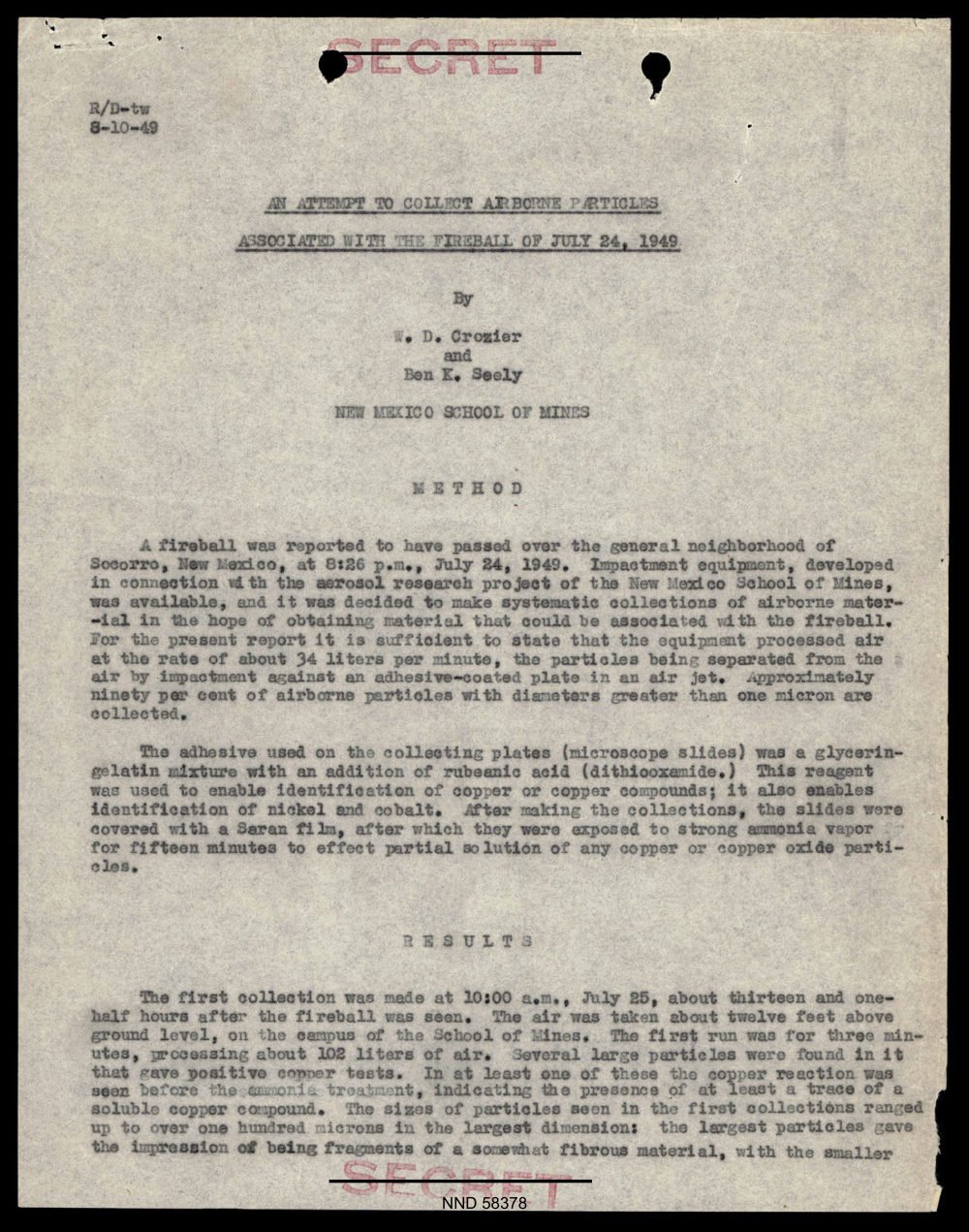
At 20h26 on July 24, 1949, a fireball was reported over the Socorro area in New Mexico. W. D. Crozier and Ben K. Seely, of the New Mexico School of Mines, had on hand a particle collector developed in a research project on aerosols and decided to systematically filter the air, hoping to find material linked to the phenomenon. Their report, dated August 10, 1949, is in the Sandia Base correspondence, together with a letter from Crozier and a memorandum from Lincoln LaPaz, director of the Institute of Meteoritics at the University of New Mexico, who was investigating the green fireballs for the military.
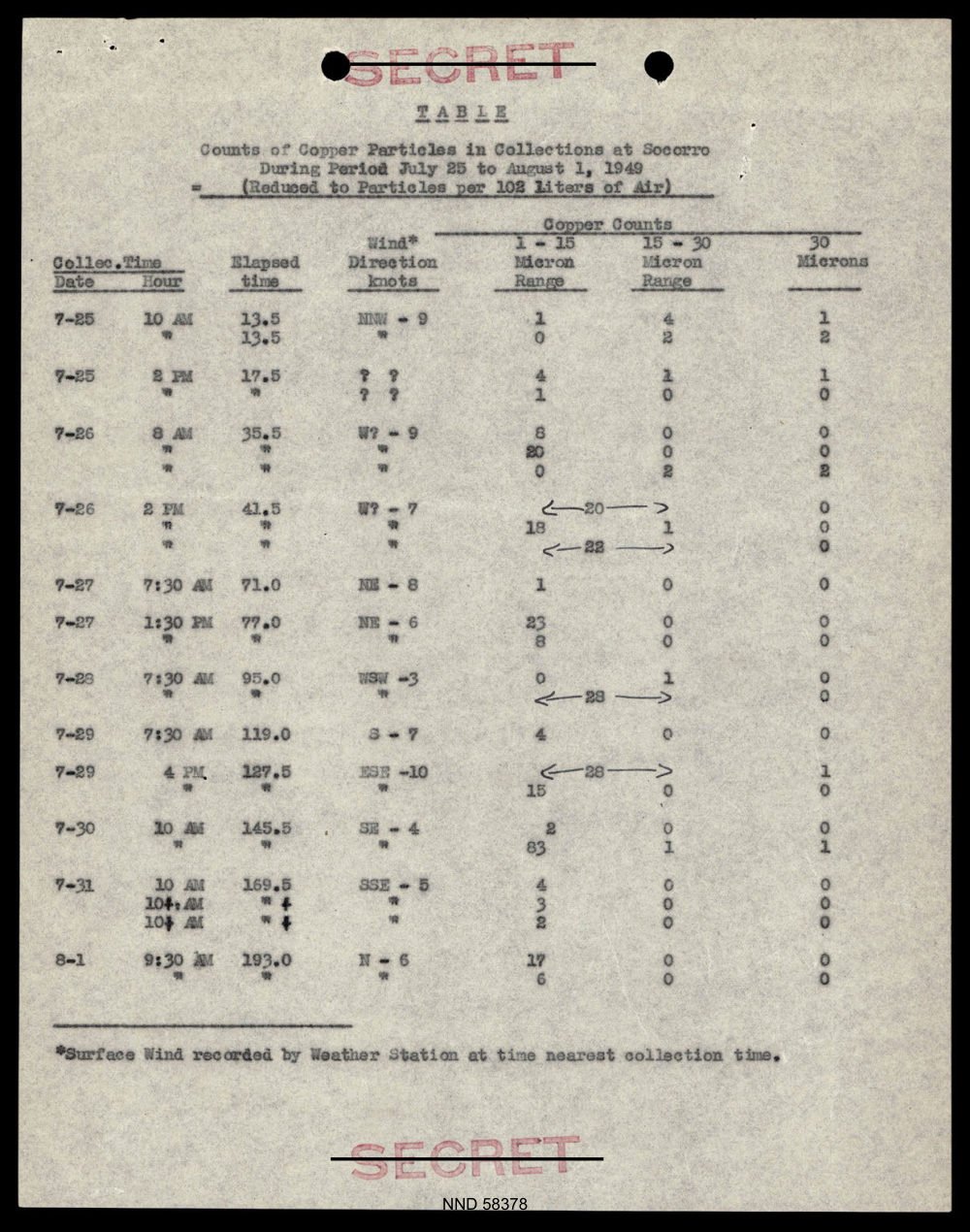
The device processed about 34 liters of air per minute and trapped the particles on a slide with a reagent that reveals copper, nickel and cobalt. The first collection was at 10h on July 25, 13 and a half hours later, on campus, about 12 feet above the ground. Several large particles, up to more than 100 microns, tested positive for copper. Collections continued for eight days. On July 26, three perfect 12-micron spheres appeared with a strong indication of cobalt, "quite unique" in the authors' experience.
The problem lay in the controls. Older samples, from July 14, ten days before the fireball, also showed some particles with copper, and samples taken on July 27 south and east of Socorro had similar particles. The authors concluded that it would be "very risky" to associate the copper with the phenomenon and classified the overall result as "negative or inconclusive." After another fireball, on August 6, a B-25 from Kirtland flew with the collector 41 hours later, at up to 23 thousand feet; the few traces of copper seemed to come from the surface.
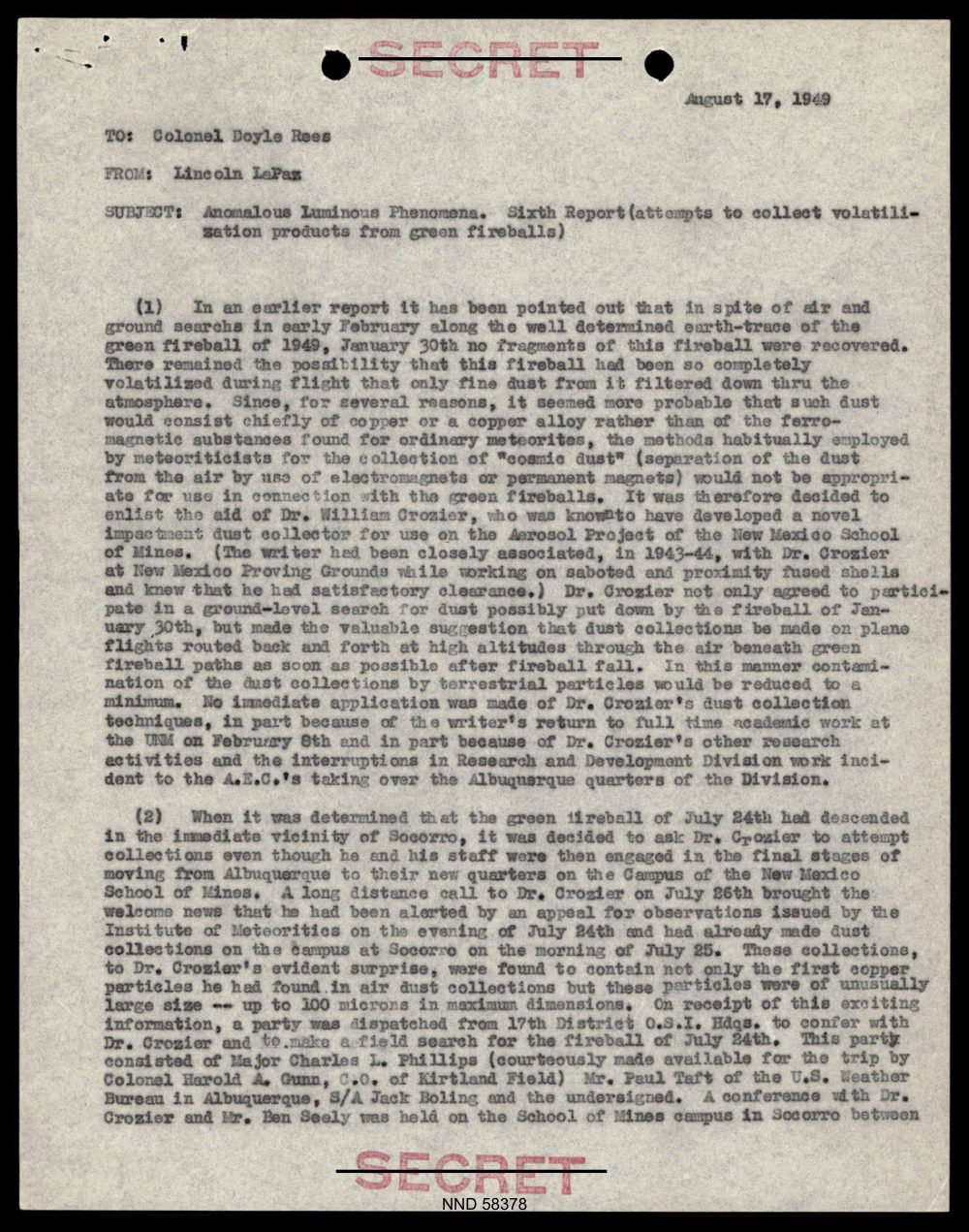
In the August 17 memorandum to Colonel Doyle Rees, of the Air Force Office of Special Investigations, LaPaz explains the idea: after the green fireball of January 30, 1949, ground and air searches found no fragments, and the hypothesis arose that it might have vaporized into fine dust, probably copper. He disputes some of Crozier's reasons for caution, but says he does not disagree with the conclusion. And he adds that, if future work showed that the copper really came from the green fireballs, they "would not be conventional meteorites," because copper is one of the rarest elements in meteorites.
LaPaz recommended aircraft collections above 40 thousand feet right after each event, with a B-36 or B-50, and ground collections along the path of the January 30 fireball. The pages do not show whether this was done. The record stands as a rare attempt to look for physical traces, with the researchers themselves pointing to contamination: Crozier even suspected particles blown from the campus ore-testing building.
More images from the document
DIRECT READING OF THE FILE
The document, in the original
Full translation of the ten pages of the case in D017 (physical pages 4 to 13), checked against the facsimile: Crozier's letter to LaPaz, the Crozier and Seely report with the table of counts, and LaPaz's sixth report to the OSI. Research documents, not sighting reports: the fireball is not described by witnesses on these pages. Bibliographic references remain in the original.
EXCERPT 1 · PHYSICAL PAGE 4
Physical page 4: letter from W. D. Crozier to Lincoln LaPaz, 10/08/1949 (full text)
10 August 1949
Dr. L1nooln ~
InDtituta of 'Meteoritics
University of New Mexico
Albuqu.erquo , N. :t:.
Doar l.1ncoln:
I a::n lnclos1ng two copies or the report you asked tor, fllld hope
that they oerve their purpose.
\'lo Jiave mado a preliminary ez:eminntion ot tm elghtaon collact1ona
token at nine locatione on my, l!onde.:,•'l'uesday trip. !lbere was a large
number of coppor-boar1ng pe.rtiolee on one eolleotion (ll-104L) taken on
Higm1ay 84, seventeen ·mles north ot E1gl:may 661 and aoa.ttered occas•
i onal particles throJJ.ghout the series. The collection teken at tho
Blt"lle location imcodi ately' following R- l04L eho'\YD practically no copper.
A 1orge l)art of the n - 104L is of a granular mnterial untamiliar to us, and
, the copper indioat1ona ori,:.inate principal ly 1n l'lhat are e.pparontl'1
aggregations of finely (ona .. meron) granular material of overall sizes
in tho neighborhood of thirty microns. Some cop_per _part! ,lea, hor.-
ever, appear to be solid nnd o,Paque. The passage of t-, automobiles while
this oollection uas being made is a complicating fe.ctor. It is hard
to aee how they mieht he.Ta been a eourco ot coppor, ho,raver, unlean it
nao a question of stirring up aoI!lo :trom dust on the -pavement.
We intend to do some :1"urther chemi.eal work Tii th theee colloctions, but I doubt if muoh nen relevant information 11111 be obtained.
Hy tentative conclusion is that no ~idcspread significant dispersion
or copper- bea't'ine; particles ,vas present in tbe atmoaphere in the rc"ion
covere.:1 at the timo the eollcct1ons wore made. l,o det1nita statel':lcnt
is possible about the one heavy copper collention: it should be prosumod
to be of local origin until come evidonee to the contrary ic 'found.
~e route at tho collocting trip included Paatura, Santa noaa., junction of Routes 66 and 84, ond Las ·Ve.:;aa on J!ondey af'ternoon. On Tuosdey
morning it included. Las Ve3as, Canonr,1to, Glorieto. end ecos.
Yours vory truly,
mx,~
o.ttaobments (2)
NND 58378Editorial note: The Monday and Tuesday trip is the ground search of August 8 and 9, carried out after the fireball of August 6 (see the LaPaz report, pages 10 to 13). Las Vegas is the city in New Mexico. The stamp NND 58378 is the declassification mark of the file.
Check the original PDF
[Handwritten, top left: 380-01; 353.5 (struck)]. SECRET [struck]. RESEARCH AND DEVELOPMENT DIVISION - NEW MEXICO SCHOOL OF MINES - SOCORRO, NEW MEXICO. 10 August 1949. Dr. Lincoln LaPaz, Institute of Meteoritics, University of New Mexico, Albuquerque, N. M. Dear Lincoln: I am inclosing two copies of the report you asked for, and hope that they serve their purpose. We have made a preliminary examination of the eighteen collections taken at nine locations on my Monday-Tuesday trip. There was a large number of copper-bearing particles on one collection (R-104L) taken on Highway 84, seventeen miles north of Highway 66, and scattered occasional particles throughout the series. The collection taken at the same location immediately following R-104L shows practically no copper. A large part of the R-104L is of a granular material unfamiliar to us, and the copper indications originate principally in what are apparently aggregations of finely (one-micron) granular material of overall sizes in the neighborhood of thirty microns. Some copper particles, however, appear to be solid and opaque. The passage of two automobiles while this collection was being made is a complicating factor. It is hard to see how they might have been a source of copper, however, unless it was a question of stirring up some from dust on the pavement. We intend to do some further chemical work with these collections, but I doubt if much new relevant information will be obtained. My tentative conclusion is that no widespread significant dispersion of copper-bearing particles was present in the atmosphere in the region covered at the time the collections were made. No definite statement is possible about the one heavy copper collection: it should be presumed to be of local origin until some evidence to the contrary is found. The route of the collecting trip included Pastura, Santa Rosa, junction of Routes 66 and 84, and Las Vegas on Monday afternoon. On Tuesday morning it included Las Vegas, Canoncito, Glorieta and Pecos. Yours very truly, W. D. Crozier. WDC*TW. attachments (2). SECRET [struck]. NND 58378.View the document record ↗ · Physical page 4, counting the cover.
EXCERPT 2 · PHYSICAL PAGE 5
Physical page 5: Crozier and Seely report, page 1 (title, method and start of the results) (full text)
M -
' R/D- tw
8-10-49
AN AT'l!EMP? 'ro coU.roT AnBCP.NE PAU'ICLES
A'3SOOIA'l'ED fJI'l'iJ THE FIREBALL OF JULY 241 1949
By
• n . Oroztor
and
Ben x. Seely
HBTHOD
A 'fireball was raportad to have pasaod ovor the general noighborhood of
Socorro, Uew Uexi.00 1 at 8:26 p.m. 1 J'uly 241 1949. Impaotment equipment, develop9d
in conneation 1a th the sarosol research proJect ot the New Mex1 co School of !lines,
was available, and it was decided to make systematic collections ot airborne me.ter
- iel. in the hope ot obta1nill8 material that could be associated .-1th the t1reball.
For the present report it is suftio1ent to state that the equipnant processed air
at the rate ot about J4 11tera per minute , the particles being separated f'rom the
air by -impactment against en adhesi'f9-coate~ plate in an air jet. Appro:d!natel.y
ninety per cent of airborne particlee with dianeters greater than one micron are
collected.
Tho adheeive used. on the collecting plates (mcroscope slides) waa a glyceringelatin tlixture w1th an a.dd1tion or rubeanic aeid (dithiooxamide . ) 'l'lus reagent
was used to enable identifioation of copper or copper compounds; it also enables
identification of nickel and cobalt. After ?C:lking the eollaotions, the slides were
covered with e. Saran til::l, after which thoy were exposed to strong aomonia vapor
for r1:tteon Jninutes to effect partial ao lution or any copp_er or copper oxide partiel.Gs.
R ESULT S
'?he first oolleotion was made at 10:00 a . m., .ruly 25, about thirteen and onehe.lf houra after the fireball was seen. The air wan te.lcen about twelve teet above
ground lovel, on t he Ol!!'.IJ>UO ar the School ot Uines. Tho first run was i'or three min- ,
utes, ll['COosaing cbout 102 liters of air. Sevoro.l large particles wero :round in it
that gave J)ositiva co pe.r teats. In at least ono or these the copper reaction was
aeen petore t he cn::mx>ni c tro~ont, indicating the presence 9f at least a trace of a
aoluble copper co~pound. The sizes of particles aoon in tho first oollections ranged
up to over one hundred microns in the largest dimension: the largest particles gave
tho impression o~ bein.g f'r8gl:lents or a so:i:ievm.at f'ibrous material, llith the smaller
~~
NND 58378Editorial note: Twelve feet is about 3,7 m. Research document, not a sighting report: the fireball is not described by witnesses on these pages.
Check the original PDF
SECRET [struck]. R/D-tw. 8-10-49. AN ATTEMPT TO COLLECT AIRBORNE PARTICLES ASSOCIATED WITH THE FIREBALL OF JULY 24, 1949. By W. D. Crozier and Ben K. Seely. NEW MEXICO SCHOOL OF MINES. METHOD. A fireball was reported to have passed over the general neighborhood of Socorro, New Mexico, at 8:26 p.m., July 24, 1949. Impactment equipment, developed in connection with the aerosol research project of the New Mexico School of Mines, was available, and it was decided to make systematic collections of airborne material in the hope of obtaining material that could be associated with the fireball. For the present report it is sufficient to state that the equipment processed air at the rate of about 34 liters per minute, the particles being separated from the air by impactment against an adhesive-coated plate in an air jet. Approximately ninety per cent of airborne particles with diameters greater than one micron are collected. The adhesive used on the collecting plates (microscope slides) was a glycerin-gelatin mixture with an addition of rubeanic acid (dithiooxamide.) This reagent was used to enable identification of copper or copper compounds; it also enables identification of nickel and cobalt. After making the collections, the slides were covered with a Saran film, after which they were exposed to strong ammonia vapor for fifteen minutes to effect partial solution of any copper or copper oxide particles. RESULTS. The first collection was made at 10:00 a.m., July 25, about thirteen and one-half hours after the fireball was seen. The air was taken about twelve feet above ground level, on the campus of the School of Mines. The first run was for three minutes, processing about 102 liters of air. Several large particles were found in it that gave positive copper tests. In at least one of these the copper reaction was seen before the ammonia treatment, indicating the presence of at least a trace of a soluble copper compound. The sizes of particles seen in the first collections ranged up to over one hundred microns in the largest dimension: the largest particles gave the impression of being fragments of a somewhat fibrous material, with the smaller [continues on page 6]. SECRET [struck]. NND 58378.View the document record ↗ · Physical page 5, counting the cover.
EXCERPT 3 · PHYSICAL PAGE 6
Physical page 6: Crozier and Seely report, page 2 (results, significance and conclusions on the copper) (full text)
Page 2
dbension oi" ,the o-rder o~ twnty or thirty .:nicrono. There were no Br:lall partielee,
that 1e, no particles 11'1th n iruuiml1!11 di?DeXUiion below 15 microns. ,
J'ollmring tho :f'lrat colleotion, ,additional oolleotions 1f8re nade , tindor aimi•
1ar conditions. over a period of elght daya.
The aooco.pann,ng table su:n:iarisea the colld1t1ons and copper counts ror all
tbese collections, including tho first ono described above. nU!!lbor of the ru.ru,
wero tor periods lor.,;or tfum three minutes, but °'he oouhts have, 1n 'tbeee cases, been reduced to the threo-:nnuta equivalent. Olio eolleetion showing oevora.l large
copper indications, tekon J"u~ 25, ia omm:1ttnd fron the to.blo because it was
damaged in courae ot a teai for radioaotivity by exx,osure of a nmlear track plate
(vrith negative reoultn) end a det"inita count oOllld not be made .
The counts are exhibited in tbreo size claeRiflcations, end attention is
directed to tlie :ta.at that particles in the smallest s!ze croup (l to l5 microns)
e::-e practically absent trom the early oollectlona, mil& in the later collectiow,, particles 1n the largest (.30 mioron.o) 8Ii.d middle (15 to 30 microna} groups have
become cp;ite esoarce. At the same tine, the counto have beccte quite large in tile
:.s:ncllest aizo group.
SIONIFICA~CE OF RESULTS
If 1 t were possible to SflY that particles giving a copper test are generally
very rare in eollectione near groimd leTel in this locaJ.lty, the above facts t'.Ould
bo highly s!gni1'1cant. It l1appens, however, that collections have been :-:,ode at
Socorro over only- a short period, and not .muoh e.tten1i1on has been given to !dentifica.tion ot copper coJ:lJ)ounds. ::aowever, after the copper indieetions had been round
in the present sories of: collectio•,s, some collections were round on file that hod
been made on plain glycertn- 3aui.tin on july .1,, 1949. -These r.are oovered ,nth the
Sarun fi-lm and rubeanic eoid C!Jld an::.on1a were appliod by d1 tfusion through tho ·ttlm.
A few copper indications were found, al!nost all the i:e.rtioles being in the 30 micron
size group. Some other co11ection.s were made early 1n ~uly tbo.t will be e::lt8!ninod
tor· 'lopper when they are treed !"roe other tests. lil add1 t1on, oce~ional colloot1ons
will be examined. tor copper in the futll!'e , and 1t may be possible eventually to add
so:neth1ng to tho information now presented.
COllCLUSION6 REGARDING COPPER
In view Qt the above fa.eta , it i,eem:, very hazardous to draw any: definite conclusion associating ~he coppe~- bearioo perticlos collected with the fireball or 1uly
24. Th.are a till is, hwoTer, a residuum or poasitdlity ot such associations men 1 t
is conoidored th c.t partic!.ss ot 1hc smallest s1 ze group did not appear in largo
numbera until some 35 hours at'ter the po.esege of tl;le fireball.
NND 58378Editorial note: 'ommitted' appears as such in the original.
Check the original PDF
SECRET [struck]. Page 2. dimension of the order of twenty or thirty microns. There were no small particles, that is, no particles with a maximum dimension below 15 microns. Following the first collection, additional collections were made, under similar conditions, over a period of eight days. The accompanying table summarizes the conditions and copper counts for all these collections, including the first one described above. A number of the runs were for periods longer than three minutes, but the counts have, in these cases, been reduced to the three-minute equivalent. One collection showing several large copper indications, taken July 25, is ommitted from the table because it was damaged in course of a test for radioactivity by exposure of a nuclear track plate (with negative results) and a definite count could not be made. The counts are exhibited in three size classifications, and attention is directed to the fact that particles in the smallest size group (1 to 15 microns) are practically absent from the early collections, while in the later collections, particles in the largest (30 microns) and middle (15 to 30 microns) groups have become quite scarce. At the same time, the counts have become quite large in the smallest size group. SIGNIFICANCE OF RESULTS. If it were possible to say that particles giving a copper test are generally very rare in collections near ground level in this locality, the above facts would be highly significant. It happens, however, that collections have been made at Socorro over only a short period, and not much attention has been given to identification of copper compounds. However, after the copper indications had been found in the present series of collections, some collections were found on file that had been made on plain glycerin-gelatin on July 14, 1949. These were covered with the Saran film and rubeanic acid and ammonia were applied by diffusion through the film. A few copper indications were found, almost all the particles being in the 30 micron size group. Some other collections were made early in July that will be examined for copper when they are freed from other tests. In addition, occasional collections will be examined for copper in the future, and it may be possible eventually to add something to the information now presented. CONCLUSIONS REGARDING COPPER. In view of the above facts, it seems very hazardous to draw any definite conclusion associating the copper-bearing particles collected with the fireball of July 24. There still is, however, a residuum of possibility of such associations when it is considered that particles of the smallest size group did not appear in large numbers until some 35 hours after the passage of the fireball. SECRET [struck]. NND 58378.View the document record ↗ · Physical page 6, counting the cover.
EXCERPT 4 · PHYSICAL PAGE 7
Physical page 7: table of copper particle counts in Socorro, 25/07 to 01/08/1949 (full text)
~ ,,.~ ;..=- -
• tk-a~~
...,..
'?ABLB __ ---
CountG of Copr,er Partieloa ill Colleetiotu, at Socorro
During Per1o4 lul.:y 25 to August l , 1949 f '
- (Roduced ~o Particlen per 102 J.itera of' Air)
Comr Counts
ind* l • 15 15 • .30 30'
Collec .Timo Elapsed Direction M1c1·on YJ.cron .U.cron.s
Date Hour time knots Range Range
7- 25 10 m.. 13. 5 NN\i • 9 l 4 l .. 13.s 0 2 2
- 7- 25 2 Rf 17. 5 , '1 4 l. l .. .. '1 , l 0 0
' 7-26 8~ 35. 5 tn 8 0 0 - 9
lit ft) 0 0 "' "' lit 'It "' 0 2 2
7- 26 2 I'}.{ 41. 5 ~-20--::> 0 ' •
- 7 lit 18 1 0 "'
"1t 'ft <-22 --> 0 "
7- 27 7:.30 '11. 0 Im • 8 l 0 0
'7- 27 1:3() PU 77. 0 NR • 6 23 0 0 .. <ft "' 8 0 0
7-P,8 7:30 AM 95.0 r,m, -3 0 l 0 .. .,. • <'-28-.> 0
'1-29 7:30 ~ 119. 0 s -7 4 0 0
7- 29 4, .,/1,: 127.t> ESR -10 (f---28--> l
• • 15 0 0 "
7-30 10 14:5. 5 SE - 4 2 0 0
"' .. • 8.3 l l
'l•Jl 10 Rl l.69. 5 SSE • 5 4 0 0
lOf.,JU • + • 3 0 0
10+ A4 2 0 0 - ♦ "'
8-1 9: 30 ! 19,3. 0 N - 6 17 0 0
• • .. 6 0 0
"surt'ace ind recorded by eather Station o.t time nearast collection time.
NND 58378Editorial note: The values between arrows (<-20->, <-22->, <-28->) were typed across two columns, indicating a combined count of the 1 to 15 and 15 to 30 micron ranges. The question marks in the wind column are in the original. The table is the basis for the observation, made in the text, that the smaller particles only appear in high numbers from about 35 hours onward.
Check the original PDF
SECRET [struck]. TABLE. Counts of Copper Particles in Collections at Socorro During Period July 25 to August 1, 1949 (Reduced to Particles per 102 Liters of Air). Columns: Collec. Time (Date, Hour) | Elapsed time | Wind* Direction, knots | Copper Counts: 1-15 Micron Range | 15-30 Micron Range | 30 Microns. Rows: 7-25, 10 AM, 13.5, NNW-9: 1, 4, 1; (same) 13.5: 0, 2, 2. 7-25, 2 PM, 17.5, ? ?: 4, 1, 1; (same): 1, 0, 0. 7-26, 8 AM, 35.5, W?-9: 8, 0, 0; (same): 20, 0, 0; (same): 0, 2, 2. 7-26, 2 PM, 41.5, W?-7: <-20-> (spanning the 1-15 and 15-30 columns), 0; (same): 18, 1, 0; (same): <-22->, 0. 7-27, 7:30 AM, 71.0, NE-8: 1, 0, 0. 7-27, 1:30 PM, 77.0, NE-6: 23, 0, 0; (same): 8, 0, 0. 7-28, 7:30 AM, 95.0, WSW-3: 0, 1, 0; (same): <-28->, 0. 7-29, 7:30 AM, 119.0, S-7: 4, 0, 0. 7-29, 4 PM, 127.5, ESE-10: <-28->, 1; (same): 15, 0, 0. 7-30, 10 AM, 145.5, SE-4: 2, 0, 0; (same): 83, 1, 1. 7-31, 10 AM, 169.5, SSE-5: 4, 0, 0; 10¼ AM: 3, 0, 0; 10½ AM: 2, 0, 0. 8-1, 9:30 AM, 193.0, N-6: 17, 0, 0; (same): 6, 0, 0. *Surface Wind recorded by Weather Station at time nearest collection time. SECRET [struck]. NND 58378.View the document record ↗ · Physical page 7, counting the cover.
EXCERPT 5 · PHYSICAL PAGE 8
Physical page 8: Crozier and Seely report, page 3 (small particles, collections outside Socorro, cobalt and nickel tests, suggestion) (full text)
..
..
Attention is called particularly to the l arao !lumber ot small particles in one
at the 145-l/2-ho-.ir collootione. The actual nl.I!lber in the colle'ltion was 140, tor
the r ive-oinute run. l.!ost of these l'lere in the size range of' tTJO to f1ve microns•
and the principal difficulty in assoctattnc them 111 th the fireball is that a fivemicron par\1cle cannot tall J!lUOh more tho.n l0,000 foot in 145. 5 hom-s. These part1-
olea could have ccr:ie down from a greater height only it' sol:!& downward motion hfld
tc.k:en place in port of the a1r 1nvolvet.
It should be oantioned. that collections were t aken during t be at'ternoon of Ju13'
27, at several pointa eouth end east ot Socorro , tbs fartb.eot being near Binche:a.
These oolleotions ocntainod pcrtiole~ giving copper indications, the :particles being
i n tho •a;?¥!) range ot sizes as those collected in Socorro at about the &a.":le ti'C'.b.
It is perhaps noteworthy that the cop_per- boari ng particles 1n all these collectlona were of opaque material. I.oat ot the co:;,per minerals tbat h uve previouslycome to our attention 1n collection• rrom the air have been oolored material, blue , green, red, or yellow.
C OBALT AND NICKEL TESTS
In the 2 t00 J.l• coll~cti on of J"ul.y 26, three quite re:::iarkable particles were
found that save very strong coba1t indications. The particles were apparently por
:reot spheres (at l east thoy were pori'eetly circul.ar in cross section), twelve micro!ls in diameter. The reaction with rube anie e.eid , after at!nOnia trentmant , pi•odueed a dense yellow-ten halo, eixty microns 1n diameter. The color v.ao not quite
so clear es with pure cobalt: the e.ppearance sU;;gestin.g e. high-cobalt com,vosition
with so~ metal. prosont. Such particles are quite uniqne i n the axporionce or the
present. , It' these particles wore of meteoritic orictn they cwld, in tho absence
of verticul oir IJOV«llSnt, have f'al:len a d1stO!loo of the oi·der ot 20, 000 feet 1n an
i nterval or 41. 5 houra .
Two particlse giT1ns nickel indication.swore round. ~a is quite nomvl, llo ,
ever. It anything, the number is smaller than x::ight have been expected in material
of aurt'aoe ori<;in. The collections ware not given acid treatnent: additional nickel
indieations might h &Te been 'i'ound it t his had been done.
A oUOGEB TION
hile the r&aul.ta o!' the present investiga:Uou ahould be recarded as negatt-vo
or,inoonolusive, it i s desired to call attention to the faet that a coan.s ia at hand
that obould r..al:a .PQAsiblo a definite demonetration of tho presence or absonoe ot cop per :particl es asaod.ated with events or the July 24th type.
rartlol.e collectlon equipment , operating on the s.:mie principle as that used in
the i:resont inTestigat1on, and der;igned tor airple::ie installation, is on hand and
1te suco&esful operation has been dooonstrated in numeroll s sligh:ta. Provision
NND 58378Editorial note: 'Quite unique in the experience of the present' appears this way in the original (probable omission of 'writers'). 10.000 feet is about 3 km; 20.000 feet, about 6 km.
Check the original PDF
SECRET [struck]. Page 3. Attention is called particularly to the large number of small particles in one of the 145-1/2-hour collections. The actual number in the collection was 140, for the five-minute run. Most of these were in the size range of two to five microns, and the principal difficulty in associating them with the fireball is that a five-micron particle cannot fall much more than 10,000 feet in 145.5 hours. These particles could have come down from a greater height only if some downward motion had taken place in part of the air involved. It should be mentioned that collections were taken during the afternoon of July 27, at several points south and east of Socorro, the farthest being near Bingham. These collections contained particles giving copper indications, the particles being in the same range of sizes as those collected in Socorro at about the same time. It is perhaps noteworthy that the copper-bearing particles in all these collections were of opaque material. Most of the copper minerals that have previously come to our attention in collections from the air have been colored material, blue, green, red, or yellow. COBALT AND NICKEL TESTS. In the 2:00 p.m. collection of July 26, three quite remarkable particles were found that gave very strong cobalt indications. The particles were apparently perfect spheres (at least they were perfectly circular in cross section), twelve microns in diameter. The reaction with rubeanic acid, after ammonia treatment, produced a dense yellow-tan halo, sixty microns in diameter. The color was not quite so clear as with pure cobalt: the appearance suggesting a high-cobalt composition with some metal present. Such particles are quite unique in the experience of the present. If these particles were of meteoritic origin they could, in the absence of vertical air movement, have fallen a distance of the order of 20,000 feet in an interval of 41.5 hours. Two particles giving nickel indications were found. This is quite normal, however. If anything, the number is smaller than might have been expected in material of surface origin. The collections were not given acid treatment: additional nickel indications might have been found if this had been done. A SUGGESTION. While the results of the present investigation should be regarded as negative or inconclusive, it is desired to call attention to the fact that a means is at hand that should make possible a definite demonstration of the presence or absence of copper particles associated with events of the July 24th type. Particle collection equipment, operating on the same principle as that used in the present investigation, and designed for airplane installation, is on hand and its successful operation has been demonstrated in numerous flights. Provision [continues on page 9]. SECRET [struck]. NND 58378.View the document record ↗ · Physical page 8, counting the cover.
EXCERPT 6 · PHYSICAL PAGE 9
Physical page 9: Crozier and Seely report, page 4 (end of the suggestion and note of 10/08/1949) (full text)
...... ..,,,,,, t
.. could easily be made ror quickly nountins this equi~ent in an airplane cap&ble ot
o.s~enaing above the 40,000- toot l evsl, wllieh couli teke otr soon otter an event ot
the J'uly 24th kind, and fly a pattern that would ineludo n itl:. reasonable certainty
sO"C!e or the nateriol originating at the neteor u-ajectory. A g_uiek approximate
deteroination of the tTejeetory wo11ld be required, of course, Wld 1f winds aloft
wore or considerable strength 1 t muld b& nocaseary to make due allowance tor ttlc:t:1
1n planning the :flie}lt.
UOT ADDED <l-l AWUS1' 101 1949:
Ao this report ,1aa being 1'1n1shea, an ntte:ipt naa :oade c.t on. airplane oollection
1'ollOm.ng the event o~ uzust 6 . The oolloetins eguiPmQnt ,1as installod in a B- 25
from Kirtland Field nnd on the o.f'to:::-noon or .~ugust 8 , a flight wao ,u1e l!.«lich a was
hoped m18ht intercept somo of the meteoritic material.
An Interval or 41 hours had pussed before the take-oft, and the :ma:dnu.n alt1•
tudo roached waa 2.3,000 i"eet. A rough attenpt was :!lade to include air tho.t wae
under the trajoctory, but distanl'}eo or sevoral hundred miles nore involved. A few
oopI,>o:..~ ind:!cations were obtained, but they seemed definitely to be associated mth
material of surface oricin. l,o nickel or cobalt indications were ~ound. AD. 0lcJ1orate stud.7, which m.tq require more upper air data than ls available, should be oude
before 1 t is decided metber or not the t'lieht di a aotue.1ly include air that 8hould
have borne FOrticles trcm tho etoor trajectory.
NND 58378Editorial note: The 'August 6 event' is another green fireball, in the Vaughn area, cited in LaPaz's report that follows. 40.000 feet is about 12 km; 23.000 feet, about 7 km.
Check the original PDF
SECRET [struck]. page 4. could easily be made for quickly mounting this equipment in an airplane capable of ascending above the 40,000-foot level, which could take off soon after an event of the July 24th kind, and fly a pattern that would include with reasonable certainty some of the material originating at the meteor trajectory. A quick approximate determination of the trajectory would be required, of course, and if winds aloft were of considerable strength it would be necessary to make due allowance for them in planning the flight. NOTE ADDED ON AUGUST 10, 1949: As this report was being finished, an attempt was made at an airplane collection following the event of August 6. The collecting equipment was installed in a B-25 from Kirtland Field and on the afternoon of August 8, a flight was made which it was hoped might intercept some of the meteoritic material. An interval of 41 hours had passed before the take-off, and the maximum altitude reached was 23,000 feet. A rough attempt was made to include air that was under the trajectory, but distances of several hundred miles were involved. A few copper indications were obtained, but they seemed definitely to be associated with material of surface origin. No nickel or cobalt indications were found. An elaborate study, which may require more upper air data than is available, should be made before it is decided whether or not the flight did actually include air that should have borne particles from the meteor trajectory. [rest of page blank] SECRET [struck]. NND 58378.View the document record ↗ · Physical page 9, counting the cover.
EXCERPT 7 · PHYSICAL PAGE 10
Physical page 10: sixth report from Lincoln LaPaz to colonel Doyle Rees, 17/08/1949, page 1 (full text)
• ' e
Au,..i:rust 17, 1949
'1'0: Colonel Doyle Rees
FROU: Lincoln 1ePas
SUDJ"EnTs Momaloua J.uminous Phenomona. Sixth Report{attempts to colleci volatilisation woduots trom ~en fireballs)
(1) In an earlier repori it has boen pointed out ihat in spite ot eir SDd
ground searoha 1n early February elong tlle nll detem.1nad earth-trace ot the
green nreball ot 1949, ianue.ry 30th no :tregmenta of this ti:roball were recovered.
'l'here re::iatnod the _poso1t1lity "that tbia fireball had been so ooopletely
Tolatilizod during tl1sht that oaly tine dnat !'ram it filtered down thru the
atmosph&re. S1noe, fo::- several reasons, 1t eeerced ~ore probable that a uoh dust
would consist chiefly or copper or a copper alloy rattier than ot the ferro- •
magnetic aubstanoes found for ordintn-7 metoorites. the oethodo habitually enployed
by metooritic1ots fo1" the c olleetion at •come duat• (separation ot the dust
trom the air by uBO or eleetroI:Ja.Gllets or permanent magnets) muld not be appropriate tor use in conj]_eet ion with tho s;reon i'ireballo. It was there.tore decided to
cn11nt th~ aid ot Dr. illiwn Orozier, \-d':l.o waa knownto 1'.ave developed a novel
1mpactu~.•.; duat collector f'or UDe o_n the ABrosol Projoct or tho li'ew l!enoo School
of' l!ines. (Tho 'Wr1ter hed bean elo.:sely aasooiated, in 1943-44, with Dr. Orosier
at Km1 JJenco Proving Grounds mile .orking on saboted. and prorlm11;y fuoed shells
and kne\7 ·that ho hrsi aat1sf'e.ctory clearance.) Dr. OrozJ.er not onJ.y agreed to partio1- pnte in a cround- 1.ovel search ~or dust pos~lbly put doun by the f'irebe.ll of' ~anuary ,30th, but mede the valuablll sugeeation that dust oollect1oll.6 be made on plene
flights routod bti.ek and rorth at high altitudes through the air benoath green
t'1reball paths as soon as possible after t"ireball tall. ln this manner eonta:nination ot ttle aust colleetioll8 by tar1·eatr1al particles '10Uld be reduced to a
minimum. No ir:mediate application Wat:J made ot Dr. Orozter• o dust collection
teohniquee • in pa1-t because ot th a m-1ter' a re11urn to fUll ttme ncade.!.11.c work at
the m~ on Febru,47 8~h and in ;part baoause o~ Dr. Crozier's other ;rooec.rch
e.cti'Vities and the interrUJ.)tion11 in Reoearch and Develop:iont D1v1B1on work i.neident to the A.E.O. 'a tek1ns o'Ter the ilbuqunque quarters or the Division.
(2) When it m,.s determ.i?l9d th.at the green 11reball of J\lly 24.tll liod descended
1n. the im»diate vicinity o~ Soco:L"ro, it was decided to ask Dr. Cro--'1er to attempt
colleotio:ns even though he and bis start were then eneaeod in tbe tinal stages ot
mov1na from Albuquerque to their new quarters on the Campus ot the New 1-l&xieo
School of 1!1.nes, A long distance ¢all to Dr, Orozier on J'uly 26th brough.t the
weleorna news that be he.d been alerted by an appeal for observations issued by the
Institu~ of !!otaorittos on tho evening at July 2,th end ha.d al.rood7 made du3t
collections on the campus at Socorro on the morning ot J'tily 25. These collectiono,
to Dr. Crosier's en.dent surprise, nre found to oontcin not only the tlrst coppe~
particles he hod 'found.in air duet col1-eot1ono bu't these I>~ticles were or unusuallt
large ai!Be - up to lOO microns in maximum dimeneiorut. On roceipt or this exciting
tn:to:ro.ation , a party 11u 61apatched t"ram 17th Diotrict o.~.I. Bdq_e. to confer with
Dr. Crozier ond to~makc e field search tor the i'irobcll ot :Tu.ly 24.tb. This part~
conBisted at Uajor Charles L. Phillipa (courteously ma.de avaiJ.able tor 'the trip by
Colon.el Harold ~ Gunn, C.o. ot Kirtland Field) Hr. })aul Tatt of the li.S. ,eather
Bureau in Albuquerque, S/A la.ck .Bolino nnd the underaigued. A conterenoe rtth Dr.
Crozier end er. &,n Seely ma held on the School of w.nee cam;pua in Socorro bet\lOon
NND 58378Editorial note: 'searchs' and 'thru' are as in the original. OSI is the Air Force Office of Special Investigations; AEC, the Atomic Energy Commission; UNM, the University of New Mexico. The mention of Crozier's security clearance is a record made by the document's author.
Check the original PDF
SECRET [struck]. August 17, 1949. TO: Colonel Doyle Rees. FROM: Lincoln LaPaz. SUBJECT: Anomalous Luminous Phenomena. Sixth Report (attempts to collect volatilization products from green fireballs). (1) In an earlier report it has been pointed out that in spite of air and ground searchs in early February along the well determined earth-trace of the green fireball of 1949, January 30th no fragments of this fireball were recovered. There remained the possibility that this fireball had been so completely volatilized during flight that only fine dust from it filtered down thru the atmosphere. Since, for several reasons, it seemed more probable that such dust would consist chiefly of copper or a copper alloy rather than of the ferro-magnetic substances found for ordinary meteorites, the methods habitually employed by meteoriticists for the collection of "cosmic dust" (separation of the dust from the air by use of electromagnets or permanent magnets) would not be appropriate for use in connection with the green fireballs. It was therefore decided to enlist the aid of Dr. William Crozier, who was known to have developed a novel impactment dust collector for use on the Aerosol Project of the New Mexico School of Mines. (The writer had been closely associated, in 1943-44, with Dr. Crozier at New Mexico Proving Grounds while working on saboted and proximity fused shells and knew that he had satisfactory clearance.) Dr. Crozier not only agreed to participate in a ground-level search for dust possibly put down by the fireball of January 30th, but made the valuable suggestion that dust collections be made on plane flights routed back and forth at high altitudes through the air beneath green fireball paths as soon as possible after fireball fall. In this manner contamination of the dust collections by terrestrial particles would be reduced to a minimum. No immediate application was made of Dr. Crozier's dust collection techniques, in part because of the writer's return to full time academic work at the UNM on February 8th and in part because of Dr. Crozier's other research activities and the interruptions in Research and Development Division work incident to the A.E.C.'s taking over the Albuquerque quarters of the Division. (2) When it was determined that the green fireball of July 24th had descended in the immediate vicinity of Socorro, it was decided to ask Dr. Crozier to attempt collections even though he and his staff were then engaged in the final stages of moving from Albuquerque to their new quarters on the Campus of the New Mexico School of Mines. A long distance call to Dr. Crozier on July 26th brought the welcome news that he had been alerted by an appeal for observations issued by the Institute of Meteoritics on the evening of July 24th and had already made dust collections on the campus at Socorro on the morning of July 25. These collections, to Dr. Crozier's evident surprise, were found to contain not only the first copper particles he had found in air dust collections but these particles were of unusually large size -- up to 100 microns in maximum dimensions. On receipt of this exciting information, a party was dispatched from 17th District O.S.I. Hdqs. to confer with Dr. Crozier and to make a field search for the fireball of July 24th. This party consisted of Major Charles L. Phillips (courteously made available for the trip by Colonel Harold A. Gunn, C.O. of Kirtland Field) Mr. Paul Taft of the U.S. Weather Bureau in Albuquerque, S/A Jack Boling and the undersigned. A conference with Dr. Crozier and Mr. Ben Seely was held on the School of Mines campus in Socorro between [continues on page 11]. SECRET [struck]. NND 58378.View the document record ↗ · Physical page 10, counting the cover.
EXCERPT 8 · PHYSICAL PAGE 11
Physical page 11: sixth LaPaz report, page 2 (July 26 meeting, field collections and items 3.1 and 3.2) (full text)
10:00 - 12:00 A.J.1. on .Tul.y 26th. At this eonterenoe it beceme ep:parent that
Dr. Crozier wao 1nollned to attribute the unuauall7 large copper fragcenta
collected on .Tuly 25 at 10,00 A..l!. (-.bich because ot their size could not h&vo
been blown "fer, tar by aurtace 111.nds•) to particles blO\l'D. off the root or out
ot the a uttere ot t he Aseaying Building on the Campus. In answer to e. queation
from the writer, Dr. Crozier replied that he would oone1der this pose1b1llty
ruled out it copper pm-tioles ob.owed up in colloctiono cade in t.he open oouum
at considerable distance• trCX!l the Campus. It wao tharotoro recom?;.ended th~
such oolleotions be made @d Dr. Crosier and t•.r. Seely rigged up a atonge
battery combination and B!llall D.O. J!!.Otor driven 1DlJ)aotmont collector- 11h1ch were
loaded into the o.s.t. etat't car and driven out through San Antonio , Carthage ,
and B1ngbom, No •enco (this route passing, in ~ . Taf't' o opinion, throueh the
region where pnrti~les tran tile tireball ot 1ul7 24th woo ld most probably have
been oarr1ed by the Tery light win.do provatlins in the region ainee the ino1- dent.) Four ot tho collections mode on th io trip W81"$ examined on tho eveniDg
ot 1u.l.)- 26th by • Ben Seely an4 all were found to contain copper particles
1nd1stineu1chable trom :those colleotod. in Socorro at about the omne time.
- (3) Pull detail.a on the mathod.e ot collection enployod by D:t-, Crozier end
Mr. Seel.T and on lata:r examinations of ~e dust l)Eµ'ticles collected af'ter the
graen tueballs or both J'ul.7 24th Cl1.4 August 6th are given 1n Dr, Crozier••
i-aport (R/D - tw, 8-10-49) copie11 of whieh are hereto appended. Dr; Crozier' s
tenta\1ve oonolusion trar:i study' ot the collections mal.e, not only in eonneotion
with the incident o~ .July 24th, but also that o't Aucuat &tb, ts that •the reBUlte
ot the prosont inveot1gaUon should be regarded as negative or inconclusive,•
From anelys1a or hie r~ort (R/D - tw • 8- 10-49) end trom. several phone conYer satlona with Dr. Crozier, it io th e writer• belief' that Dr. Crozier was led to
the abow conolwsion by the tollowing taote listed below 1n docreaelng arder or
iq,ortance, md aooa:;ipanied by er!tioel OODn8ntat
'
(.3.1) 'l'he d1scoverz by tests t:iade on or about kpt l of ., a few
oo r indications~ 1n dust collected at Socorro on J 14 l.949 i .e. ten
dgre betore the men fireball 1nc1den, ot J'uly 24th. Dr. Croz er baa 1n1"omed
the writer that tbs oolleotion ot July 14th wns ·care:t'lllly wrapped up end could
not have becom conte?!linated by copped dWlt '1h1oh blew 1n through the open windows ot the n .D. &J>. Building at Socorro attar the 1no1dent ot July 24th. I!o'7- tner, there remains the poss1b111ty- that an 'Qllol:eerved or unreported green t ire- ball occurring in the Sooorro neighborhood ehortly before 1uly 14th put down
the copper dust round 1n t.be July 14th colleottaa. To one tccn1l1ar with tb.c
al.!nost uninhabited country, around Soeorro md t.he tact that green tireballe aa
bright as the halt mon occurring at timea as favorable tor observation u '1 :))
- 8:30 P.u . have gone alriost unreported , 1t aecms quite likely that a green
:t"ireball that tell arter midnight or during the daytime or while most or the
s1.7 was overcast tlis bt go entirely unroported.)
(:3.?.) The d1aore ane between the co.!!ll>uted an! observed rates of
J.escent ot .er,· tine copper particles. A.9 Dr. Crozier notes, such d!screponc1e• are Wl.deratandable •it eome dor.nward motion had taken place in part of the
air involved.• Preo1sely wch dovm":18.rd tl.Otion oocurred in tha air near tho real
paths ot the f'lreballs of 1uly 24th and 111-rost Gtb tor ttleoa to.Us were nenrly
Tertioal. ll'urtbonloro tho best obaervatiOllB ot tho endpoints of these tireballa
ple.ee 1hat ~ .T'117 :?4th at a bight ot ltl-l2 miles and that ot A!Jeust 6th at 5-6
milsB. 'l'he downward directed bill1st1o head wave therefore coald Yery easily have
carried Dr. Orozier'a 145 hour particloe to mthin 10,000 teat of the earth at
NND 58378Editorial note: 'writers', 'copped', 'hight', and '10:00 - 12:00 A.M.' are as in the original. The heights of 10 to 12 miles and 5 to 6 miles are equivalent to about 16 to 19 km and 8 to 10 km. The critical comments are by LaPaz, the author of the report.
Check the original PDF
- 2 - SECRET [struck]. 10:00 - 12:00 A.M. on July 26th. At this conference it became apparent that Dr. Crozier was inclined to attribute the unusually large copper fragments collected on July 25 at 10:00 A.M. ("which because of their size could not have been blown very far by surface winds") to particles blown off the roof or out of the gutters of the Assaying Building on the Campus. In answer to a question from the writer, Dr. Crozier replied that he would consider this possibility ruled out if copper particles showed up in collections made in the open country at considerable distances from the Campus. It was therefore recommended that such collections be made and Dr. Crozier and Mr. Seely rigged up a storage battery combination and small D.C. motor driven impactment collector which were loaded into the O.S.I. staff car and driven out through San Antonio, Carthage, and Bingham, New Mexico (this route passing, in Mr. Taft's opinion, through the region where particles from the fireball of July 24th would most probably have been carried by the very light winds prevailing in the region since the incident.) Four of the collections made on this trip were examined on the evening of July 26th by Mr. Ben Seely and all were found to contain copper particles indistinguishable from those collected in Socorro at about the same time. (3) Full details on the methods of collection employed by Dr. Crozier and Mr. Seely and on later examinations of the dust particles collected after the green fireballs of both July 24th and August 6th are given in Dr. Crozier's report (R/D - tw, 8-10-49) copies of which are hereto appended. Dr. Crozier's tentative conclusion from study of the collections made, not only in connection with the incident of July 24th, but also that of August 6th, is that "the results of the present investigation should be regarded as negative or inconclusive." From analysis of his report (R/D - tw, 8-10-49) and from several phone conversations with Dr. Crozier, it is the writers belief that Dr. Crozier was led to the above conclusion by the following facts listed below in decreasing order of importance, and accompanied by critical comments: (3.1) The discovery by tests made on or about August 1 of "a few copper indications" in dust collected at Socorro on July 14, 1949, i.e. ten days before the green fireball incident of July 24th. (Dr. Crozier has informed the writer that the collection of July 14th was carefully wrapped up and could not have become contaminated by copped dust which blew in through the open windows of the R.D.&D. Building at Socorro after the incident of July 24th. However, there remains the possibility that an unobserved or unreported green fireball occurring in the Socorro neighborhood shortly before July 14th put down the copper dust found in the July 14th collection. To one familiar with the almost uninhabited country around Socorro and the fact that green fireballs as bright as the half moon occurring at times as favorable for observation as 7:30 -- 8:30 P.M. have gone almost unreported, it seems quite likely that a green fireball that fell after midnight or during the daytime or while most of the sky was overcast might go entirely unreported.) (3.2) The discrepancy between the computed and observed rates of descent of very fine copper particles. (As Dr. Crozier notes, such discrepancies are understandable "if some downward motion had taken place in part of the air involved." Precisely such downward motion occurred in the air near the real paths of the fireballs of July 24th and August 6th for these falls were nearly vertical. Furthermore the best observations of the endpoints of these fireballs place that of July 24th at a hight of 10-12 miles and that of August 6th at 5-6 miles. The downward directed ballistic head wave therefore could very easily have carried Dr. Crozier's 145 hour particles to within 10,000 feet of the earth at [continues on page 12]. SECRET [struck]. NND 58378.View the document record ↗ · Physical page 11, counting the cover.
EXCERPT 9 · PHYSICAL PAGE 12
Physical page 12: sixth LaPaz report, page 3 (items 3.3, 3.4, 4 and start of 5) (full text)
..
b IJ
•
the time of fall. Sinea we cannot assume complete stagnation ot the air rnu,ees
1n the Sooor1"o neiBhborhood tor 145 hours. it must be supposed that such air
motions aa occurred were approximately compeuating and resulted in the return
ot Dr. Crozier' s tiny •r1ve-.:u.cron particles" to the Socorro neighborhood in
a.p_pro:d.mo.tely 145 hrurs. Only a detailed otudy ot air .ll!4SS c.otiol!a ror the
time interval i~lTod can settle this point. )
(.3•.3) The lo continued Q: ea.ranee of co r particles (however • -as
Dr. Crozier emphasizea, S'::l8ller end smaller 1n size . 1n the Sotjorro collection.s.
(Preoisely sueh a decrease 1n particle size hao repeatedly been observed in
connection w1 th duat oolleotions believed to be ot metooritic or.lgi n and is attri b- ~
uted to the slower e.nd slower rate ot descent of the particles as their average Bize
decreases. Thuo , L. Rudaux's ros'Qlta strongly indicate 'that particles :from the •
01aoob1nid shower ot 1933, Oltober 9, filtered down in anallor md Sll18.ller sizes
tar 100 hours or more. Fm-ther.m.ore , tor the green fireballs ot J'Uly 24th and
August 6th, U,.o nearly ver:t1eal real paths extended from alt111udtts of lDO mile&
or more down almost to ground level an4 therofore optimum conditions for long
continued intall of duet particles wre approached in these fallo. ) •
(3. 4) !'allure or the airplane collection ot August 8th to detect ~
bor ne co ner rticles def1n1tel not ot terrestrial or1~1n. (How&Ter, the
airplane eolleotiona vero all made at great distanoee hundreds of ailea) rrom
the Vaughn region in -r.-hir.h tho fireball of Auzust 6th i"ell; and, ea Dr. Crozier
points out, at the mo:.nent 1t can not be determined "whether or not tho :tlight
d1d aotuall,7 include air that should have borne partialee .f'ro:n rmteor tre.jei:,tory. w
In this connection the results a1luded to in para.:,"'!'aph 4 , belcnT• may be or
considerabl e aigniticonce.)
(4) At the ttmo the airplane eolleotion of :uguet &th was plamied the writer
reoamnended not only tha.t the t'l1ght traverse the area fram Vaughn northward to
Raton and · then NW-ward into the Durango, Colorado re~ion (a reconimandation based
on advice received trom l!r. Po.ul Taft of tbO u.u. eathor Buroan) but aleo tb.a~
.s1mu1taneoualy a ground search 1th the portable i npaotmcnt dust collectin,z oq_u1pment rigged up on J"uly 27th be run i'roa Va\l8hll through Future. to Santa Rosa.
Tlle latter po.rt or thin reoomre~mdation was rollowed by Dr. Crozier l'Zho reported
on the results obtained in hia letter to me under date or August 10. copieo ot
which are hereto attached. Dr. Crosier' s letter makes clear that ground collections in the subt1nal regions or tho fireballs of both ~st 6th ond J\lly 24th
resulted in the dotootion or unu.eual. aggregations otcoppor particles, .lppe.rently
the copper IX1rticle aggregate o'btai.ne4 in collectioA R - l04L, m.thin the subtinal
resion ot the August 6th tall was the only such a~egate rou:id in Dr. Crozier' s
lenghty ground search or quet S-9. 111 aeema :particularly oi('Uificant to th&
writer tbat Dr. Crozier auapoets that tho copper dust :round 1n this particular
eolleot1ou R- 1Q4L ntsy have been stirred up troa tbe pavemnt on Illgln'lq 84 --- a likely oatol:dent airfaca for dust put down by tbe green f.'lreball of. August 6th,
in view or the information giYen me by Ur. T8:f't in regard to tba wind direction
pre•aillng dtn"ing the hours !mediately following t llie incident.
(5)8 In apito or the critical ac:mnenta m.ede in porezraphs 3 mid 4 above, the
writer hes no quarrel with Dr. Crozier•• oonclu.aion that the resulta ao far
obtained in the investigation of volatilization product~ possible put down by
the green 1."1.roball.e are negative or at best 1neonolU81ve. ,However, I do wiah to
stress noat emphatically that 1:r :tuture more detailed ,,ork shon that the nuzceroue copper part1oles tound by nr. Crozier and Mr. Seely .!I!!. indud floating don
~
NND 58378Editorial note: 'lenghty' and 'possible put down' are as in the original. 'Subfinal region' is LaPaz's term for the area beneath the final stretch of the trajectory. The hypothesis that the highway dust is a deposit from the fireball is an inference by LaPaz, not by Crozier.
Check the original PDF
- 3 - SECRET [struck]. the time of fall. Since we cannot assume complete stagnation of the air masses in the Socorro neighborhood for 145 hours, it must be supposed that such air motions as occurred were approximately compensating and resulted in the return of Dr. Crozier's tiny "five-micron particles" to the Socorro neighborhood in approximately 145 hours. Only a detailed study of air mass motions for the time interval involved can settle this point.) (3.3) The long continued appearance of copper particles (however, as Dr. Crozier emphasizes, smaller and smaller in size) in the Socorro collections. (Precisely such a decrease in particle size has repeatedly been observed in connection with dust collections believed to be of meteoritic origin and is attributed to the slower and slower rate of descent of the particles as their average size decreases. Thus, L. Rudaux's results strongly indicate that particles from the Giacobinid shower of 1933, October 9, filtered down in smaller and smaller sizes for 100 hours or more. Furthermore, for the green fireballs of July 24th and August 6th, the nearly vertical real paths extended from altitudes of 100 miles or more down almost to ground level and therefore optimum conditions for long continued infall of dust particles were approached in these falls.) (3.4) Failure of the airplane collection of August 8th to detect airborne copper particles definitely not of terrestrial origin. (However, the airplane collections were all made at great distances (hundreds of miles) from the Vaughn region in which the fireball of August 6th fell; and, as Dr. Crozier points out, at the moment it can not be determined "whether or not the flight did actually include air that should have borne particles from meteor trajectory." In this connection the results alluded to in paragraph 4, below, may be of considerable significance.) (4) At the time the airplane collection of August 8th was planned the writer recommended not only that the flight traverse the area from Vaughn northward to Raton and then NW-ward into the Durango, Colorado region (a recommendation based on advice received from Mr. Paul Taft of the U.S. Weather Bureau) but also that simultaneously a ground search with the portable impactment dust collecting equipment rigged up on July 27th be run from Vaughn through Pastura to Santa Rosa. The latter part of this recommendation was followed by Dr. Crozier who reported on the results obtained in his letter to me under date of August 10, copies of which are hereto attached. Dr. Crozier's letter makes clear that ground collections in the subfinal regions of the fireballs of both August 6th and July 24th resulted in the detection of unusual aggregations of copper particles. Apparently the copper particle aggregate obtained in collection R - 104L, within the subfinal region of the August 6th fall was the only such aggregate found in Dr. Crozier's lenghty ground search of August 8-9. It seems particularly significant to the writer that Dr. Crozier suspects that the copper dust found in this particular collection R-104L may have been stirred up from the pavement on Highway 84 ---- a likely catchment surface for dust put down by the green fireball of August 6th, in view of the information given me by Mr. Taft in regard to the wind direction prevailing during the hours immediately following this incident. (5) In spite of the critical comments made in paragraphs 3 and 4 above, the writer has no quarrel with Dr. Crozier's conclusion that the results so far obtained in the investigation of volatilization products possible put down by the green fireballs are negative or at best inconclusive. However, I do wish to stress most emphatically that if future more detailed work shows that the numerous copper particles found by Dr. Crozier and Mr. Seely are indeed floating down [continues on page 13]. SECRET [struck]. NND 58378.View the document record ↗ · Physical page 12, counting the cover.
EXCERPT 10 · PHYSICAL PAGE 13
Physical page 13: sixth LaPaz report, page 4 (end of item 5 and recommendations) (full text)
.
• • ... ... .. ~
..
• ~
t'rom green fl.reballis, then the fireballs are not conventional .tSteorites. Col)l)er
is one or tbs rarosl or the elements tount\ 1n.nie'teor1tea (See G.P . Uerrill•
Memoirs National Aoade:my o~ Science1 vol. 14 (1925)• Table f aci ~ P• 27; and
Harr1aon Brown, Journal ot Geology, vol. 66 (March 1948, ) 'l'able 1 , p . 8'1 . ) In
:taot, I know or no case 1n Which el'en the t1riieet particle o:r co;pper hes been
reported in a dust collection eup:poeedly ot i:,eteoritic or1;;1n. In view ot present
oonoorn in regard to tbe true nature o~ the green :t1reballs, nothing could exceed
in i t1port0Me attailll:llent ot a. definite cor..-iluston in regm-d to the origin o:t tl:le
0OJ'per particl&s detected in the eub:tinal regions of the firobulls or July 24th
and .(i.ugust 6th.
. . (6) The writer therefore wishes to make the :rollow1ng reco11:1?1endationa,
(6. 1) That e.rraneements be made tor dust collections on airplane 'flights
at altitudes or 40, 000 tt. or oore through ~he regton ot the atcloaphera lying
beneath the real puthil ot green fireballs as soon as possible after the occurrence
ot s~h fireball 1nc1denta. Such arrangements preeupposo a wll coordinated
observing network pertlitt1ng t:te epeed1eet possible determination ot the looation
or the real pathl"I in the atnosphere. (Dr. Crozier and Mr. $eely have both agreed
to cooperate in carrying out dust colleotion at the htghest altitudes attainabla.
In Dr. Crozier' s opinion, a B- 36 or 50 should be made available tar such work. )
(6. 2) 5:!lat crOUJ1d- level dust oollect1ons be made along tho well deter mined earth- traee or the green fireball of 1anuary 30th, using the portable impaet
.ment equiptBnt al.reo.dy rigged up by nr. Crozier and ur. Seely and used in the e;round
searches ot J'uly 27th and ~ust 8• 9th. I:r copper particles can be recovered
along this carth..tro.ee but do no, appear in colleotions made 50 miles or eo et1ey
trm the trace , the z,eault -=,ul.d be ot much signiticmoe if not indeed deeisivo.
NND 58378Editorial note: The bibliographic references remain in the original. The statement that the fireballs 'would not be conventional meteorites' is conditional and is LaPaz's opinion recorded in the document; the report itself acknowledges the results as inconclusive.
Check the original PDF
- 4 - SECRET [struck]. from green fireballs, then the fireballs are not conventional meteorites. Copper is one of the rarest of the elements found in meteorites (See G.P. Merrill, Memoirs National Academy of Science, vol. 14 (1925), Table facing p. 27; and Harrison Brown, Journal of Geology, vol. 56 (March 1948,) Table 1, p. 87.) In fact, I know of no case in which even the tiniest particle of copper has been reported in a dust collection supposedly of meteoritic origin. In view of present concern in regard to the true nature of the green fireballs, nothing could exceed in importance attainment of a definite conclusion in regard to the origin of the copper particles detected in the subfinal regions of the fireballs of July 24th and August 6th. (6) The writer therefore wishes to make the following recommendations: (6.1) That arrangements be made for dust collections on airplane flights at altitudes of 40,000 ft. or more through the region of the atmosphere lying beneath the real paths of green fireballs as soon as possible after the occurrence of such fireball incidents. Such arrangements presuppose a well coordinated observing network permitting the speediest possible determination of the location of the real paths in the atmosphere. (Dr. Crozier and Mr. Seely have both agreed to cooperate in carrying out dust collection at the highest altitudes attainable. In Dr. Crozier's opinion, a B-36 or B-50 should be made available for such work.) (6.2) That ground-level dust collections be made along the well determined earth-trace of the green fireball of January 30th, using the portable impactment equipment already rigged up by Dr. Crozier and Mr. Seely and used in the ground searches of July 27th and August 8-9th. If copper particles can be recovered along this earth-trace but do not appear in collections made 50 miles or so away from the trace, the result would be of much significance if not indeed decisive. [rest of page blank] SECRET [struck]. NND 58378.View the document record ↗ · Physical page 13, counting the cover.
Dates and documentary context
- Event
- 24/07/1949 — Fireball reported at 20h26; collections from July 25 to around August 1, 1949.
- Document
- 10/08/1949 — Crozier and Seely report (R/D-tw, 8-10-49); LaPaz memorandum of 17/08/1949.
- Publication
- Not established — Public release not confirmed on these pages.
Origin and release
New Mexico School of Mines (W. D. Crozier and Ben K. Seely) and Institute of Meteoritics of the University of New Mexico (Lincoln LaPaz); copies in the Sandia Base correspondence · DOW-UAP-D017_General_Correspondence_Of_Sandia.pdf
Related accounts and their differences
Questions to continue the investigation
- Were the aircraft collections above 40 thousand feet recommended by LaPaz ever carried out?
- Was there any later analysis of the cobalt-bearing spheres of July 26, 1949?
- Who witnessed the July 24 fireball, and where are those reports?
GEOGRAPHY OF THE CASE
Socorro, New Mexico
Approximate reference for the city where the samples were collected, placed by the editors. It does not indicate the fireball's trajectory.
DOCUMENTARY TRAIL
Go back to the sources
References use physical pages of the PDF, counting the cover. Summaries are presented in English; the documents keep their original language.
- DOW-UAP-D017_General_Correspondence_Of_Sandia.pdf
Physical pages 5 to 9: report by W. D. Crozier and Ben K. Seely, New Mexico School of Mines, 10/08/1949 · Physical page 4: letter of 10/08/1949 to Lincoln LaPaz about the collections of August 8 and 9 · Physical pages 10 to 13: sixth report from Lincoln LaPaz to Colonel Doyle Rees, 17/08/1949
DOW · 116 pages
Editorial summary based on the collection's research notes. How we read the documents.