Date: 1967 (day and month not given in the report)Location: Shag Harbour, Nova Scotia, Canada
Shag Harbour, Nova Scotia, 1967: illuminated UFO enters the sea, in the summary BAASS used to study submerged objects
The 2010 BAASS report summarizes the Shag Harbour case: a UFO with orange lights hovering, which tilts, enters the water, and continues as a yellow light beneath the surface, and a yellow foam found by the Canadian Coast Guard. The company uses the case as the reason to computer-simulate the sound emitted by a submerged sphere.
- Event date
- 1967 (day and month not given in the report)
- Location
- Shag Harbour, Nova Scotia, Canada
- Topic
- AAWSAP and advanced technologies
- Source agencies
- DOW
- Documents
- 1 document · 141 pages
- Reading time
- 6 min
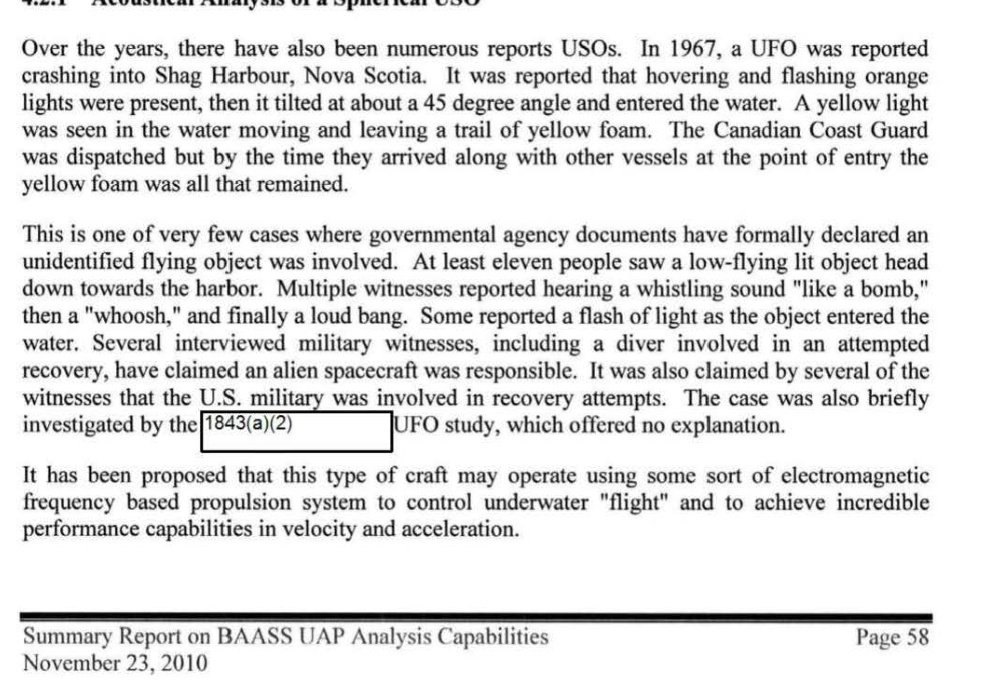 Report page (excerpt)Physical page 59
DOCUMENTARY SOURCES · DOW
What the records tell
Date: 1967; the report does not give the day and month. Location: Shag Harbour, Nova Scotia, Canada. The source is a paragraph from the November 23, 2010 report by Bigelow Aerospace Advanced Space Studies (BAASS), a contractor of the U.S. Defense Intelligence Agency (DIA) in the AAWSAP program. The company did not investigate the case: it summarizes known accounts, without citing documents, witnesses by name or sources, and uses it to open the section on unidentified submerged objects (USO).
According to the summary, orange lights were reported hovering and flashing; then the UFO tilted about 45 degrees and entered the water. A yellow light was seen moving on the water, leaving a trail of yellow foam. The Canadian Coast Guard was dispatched, but when it and other vessels reached the point of entry, only the foam remained. At least eleven people reportedly saw an illuminated, low-flying UFO head toward the harbor. Several reported a whistling "like a bomb," a "whoosh" and a bang, and some, a flash at the moment of entry into the water.
The report also records claims it does not substantiate: according to BAASS, military witnesses who were interviewed, among them a diver who reportedly took part in a recovery attempt, said an alien craft was responsible, and some witnesses said U.S. military personnel took part in the searches. The company states that this is one of the few cases in which documents from government agencies formally declared the involvement of an unidentified flying object, and that the case was briefly examined by a UFO study whose name is suppressed in the release, without explanation.
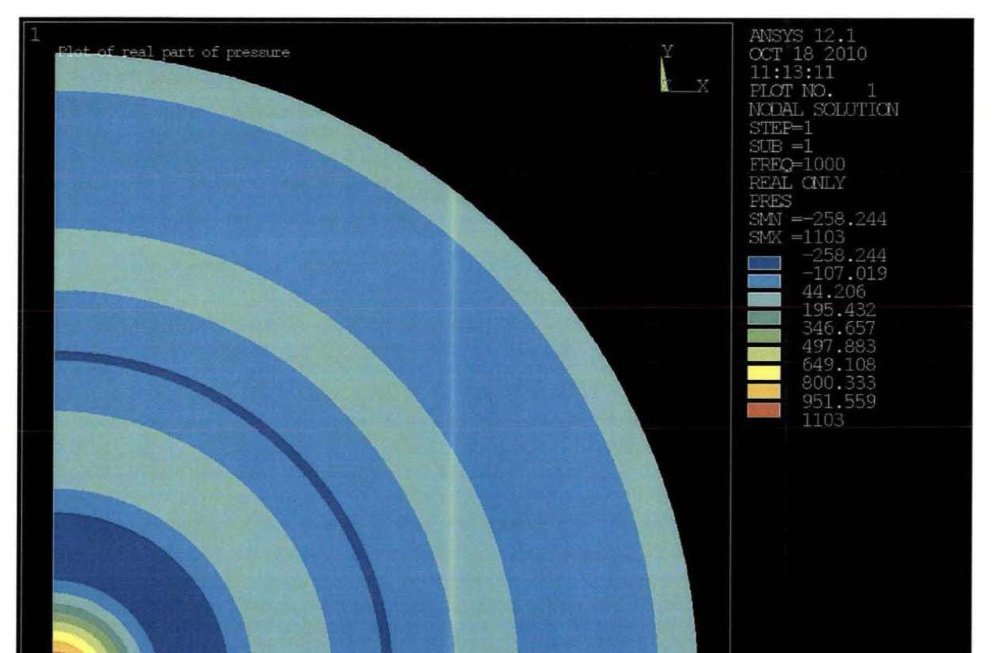
Based on the case, BAASS writes that "it has been proposed" that objects of this type would use some propulsion system based on electromagnetic frequencies to move underwater. Assuming these objects operate with a "frequency-driven" system, the company simulated in the ANSYS software a 10 m sphere emitting sound in water, at 1.000, 5.000 and 10.000 Hz, and compared the results with the theoretical solution. The conclusion is that sound pressure drops rapidly with distance and that ships and submarines could, in the future, detect these disturbances. It is a methodological exercise based on the company's own hypotheses, not an analysis of case data.
The images linked to this dossier are the report excerpt itself and one of the graphs from the acoustic simulation. Neither is a record of the 1967 event: the report contains no photograph, witness drawing or Canadian document on the case. The idea of electromagnetic propulsion and the claims about an alien craft and American participation appear in the text as proposals and third-party allegations, not as demonstrated conclusions.
More images from the document
DIRECT READING OF THE FILE
The document, in the original
Translated in full: physical page 59, which contains the case summary; pages 60 to 70 and following, with the acoustic simulation, are linked to the document's dossier. The report contains no primary documents on the case.
EXCERPT 1 · PHYSICAL PAGE 59
Physical page 59, full page
4.1.7 Summary and Conclusions ofNumerical Analysis of Incompressible Flow ofa UAP
Entering Water Results
The CFX-Post generated graphs and animations are illustrative samples of what ANSYS CFX is
capable ofproducing. The scenario was chosen due to its simple geometry, boundary conditions
and relative ease of computational requirements. A typical problem of this type when solved by
hand, would have taken weeks if not longer. This simulation incorporated a fluid dynamic
analysis and further analysis may incorporate numerous other multiphysics attributes in the study
of UAP. Heat transfer from a craft entering the earth's atmosphere as well as the effects of
varying craft size, shape and speed on wave generation during water impact could be studied just
as easily. In addition to detennining power requirements, achieved surface temperatures etc., re
creations of eyewitness sightings may be.
Furthermore, electromagnetic capabilities allow for modeling of possible magnetohydrodynamic
(MHD) affects. Electrodynamics can show the energy required to create magnetic fields with
different materials as well as the propagation of electromagnetic waves through solid and liquid
mediums. Using careful design and properties of human tissue in the program it would be
possible to show effects on the human body from heat and high electric fields. Effects, such as
increase in body temperature or nervous system interruption may be able to be quantified in
ANSYS. This tool can greatly assist in the goal of studying human effects to reverse engineer
UAP technology.
4.2 ANALYSES OF SPHERICAL UAPS
4.2.1 Acoustical Analysis of a Spherical USO
Over the years, there have also been numerous reports USOs. In 1967, a UFO was reported
crashing into Shag Harbour, Nova Scotia. It was reported that hovering and flashing orange
lights were present, then it tilted at about a 45 degree angle and entered the water. A yellow light
was seen in the water moving and leaving a trail of yellow foam. The Canadian Coast Guard
was dispatched but by the time they arrived along with other vessels at the point of entry the
yellow foam was all that remained.
This is one of very few cases where governmental agency documents have formally declared an
unidentified flying object was involved. At least eleven people saw a low-flying lit object head
down towards the harbor. Multiple witnesses reported hearing a whistling sound "like a bomb,"
then a "whoosh," and finally a loud bang. Some reported a flash oflight as the object entered the
water. Several interviewed military witnesses, including a diver involved in an attempted
recovery, have claimed an alien spacecraft was responsible. It was also claimed by several of the
witnesses that the U.S. mili
was involved in recovery attempts. The case was also briefly
investigated by the 1843(a)(2)
UFO study, which offered no explanation.
It has been proposed that this type of craft may operate using some sort of electromagnetic
frequency based propulsion system to control underwater "flight" and to achieve incredible
performance capabil.ities in velocity and acceleration.
Summary Report on B/\/\SS UAP Analysis Capabilities
Page 58
November 23, 2010Editorial note: Conclusions of the simulation of the disk in water and start of the acoustic analysis of a spherical submerged object, prompted by the Shag Harbour, Nova Scotia, case in 1967, summarized by BAASS.
Check the original PDF
4.1.7 Summary and Conclusions ofNumerical Analysis of Incompressible Flow ofa UAP
Entering Water Results
The CFX-Post generated graphs and animations are illustrative samples of what ANSYS CFX is
capable ofproducing. The scenario was chosen due to its simple geometry, boundary conditions
and relative ease of computational requirements. A typical problem of this type when solved by
hand, would have taken weeks if not longer. This simulation incorporated a fluid dynamic
analysis and further analysis may incorporate numerous other multiphysics attributes in the study
of UAP. Heat transfer from a craft entering the earth's atmosphere as well as the effects of
varying craft size, shape and speed on wave generation during water impact could be studied just
as easily. In addition to detennining power requirements, achieved surface temperatures etc., re
creations of eyewitness sightings may be.
Furthermore, electromagnetic capabilities allow for modeling of possible magnetohydrodynamic
(MHD) affects. Electrodynamics can show the energy required to create magnetic fields with
different materials as well as the propagation of electromagnetic waves through solid and liquid
mediums. Using careful design and properties of human tissue in the program it would be
possible to show effects on the human body from heat and high electric fields. Effects, such as
increase in body temperature or nervous system interruption may be able to be quantified in
ANSYS. This tool can greatly assist in the goal of studying human effects to reverse engineer
UAP technology.
4.2 ANALYSES OF SPHERICAL UAPS
4.2.1 Acoustical Analysis of a Spherical USO
Over the years, there have also been numerous reports USOs. In 1967, a UFO was reported
crashing into Shag Harbour, Nova Scotia. It was reported that hovering and flashing orange
lights were present, then it tilted at about a 45 degree angle and entered the water. A yellow light
was seen in the water moving and leaving a trail of yellow foam. The Canadian Coast Guard
was dispatched but by the time they arrived along with other vessels at the point of entry the
yellow foam was all that remained.
This is one of very few cases where governmental agency documents have formally declared an
unidentified flying object was involved. At least eleven people saw a low-flying lit object head
down towards the harbor. Multiple witnesses reported hearing a whistling sound "like a bomb,"
then a "whoosh," and finally a loud bang. Some reported a flash oflight as the object entered the
water. Several interviewed military witnesses, including a diver involved in an attempted
recovery, have claimed an alien spacecraft was responsible. It was also claimed by several of the
witnesses that the U.S. mili
was involved in recovery attempts. The case was also briefly
investigated by the 1843(a)(2)
UFO study, which offered no explanation.
It has been proposed that this type of craft may operate using some sort of electromagnetic
frequency based propulsion system to control underwater "flight" and to achieve incredible
performance capabil.ities in velocity and acceleration.
Summary Report on B/\/\SS UAP Analysis Capabilities
Page 58
November 23, 2010View the document record ↗ · Physical page 59, counting the cover.
Dates and documentary context
- Event
- 1967 — The report gives only the year.
- Document
- 23/11/2010 — BAASS summary report.
- Publication
- Not established — Released by the U.S. Department of War in the DOW-UAP series (D175).
Origin and release
Bigelow Aerospace Advanced Space Studies (BAASS), contractor of the Defense Intelligence Agency (DIA) · DOW-UAP-D175-BAASS_Self-Assessment_of_UAP_Analysis_Capabilities_November_2010.pdf
Pages 60 to 70 checked as context for the simulation.
Related accounts and their differences
Questions to continue the investigation
- Which government agency documents, according to BAASS, formally declared the involvement of an unidentified object?
- Which UFO study had its name suppressed in the sentence about the brief investigation of the case?
GEOGRAPHY OF THE CASE
Shag Harbour, Nova Scotia, Canada
Approximate reference point for the locality mentioned, placed by the editorial team. It does not indicate the point where the object entered the water.
DOCUMENTARY TRAIL
Go back to the sources
References use physical pages of the PDF, counting the cover. Summaries are presented in English; the documents keep their original language.
- DOW-UAP-D175-BAASS_Self-Assessment_of_UAP_Analysis_Capabilities_November_2010.pdf
Physical page 59: summary of the Shag Harbour case (1967) in the BAASS report of 23/11/2010; pages 60 to 70: acoustic analysis of a spherical submerged object prompted by the case
DOW · 141 pages
Editorial summary based on the collection's research notes. How we read the documents.