Date: 08/09/1960, from 1:45 p.m. to shortly after 3 p.m. (photos between 2:30 and 2:40 p.m., Pacific Daylight Time)Location: Civic center plaza, San Francisco, California, USA
San Francisco, 1960: Jay Rees photographs a luminous UFO for almost an hour, and NICAP concludes it was probably a research balloon
According to the 1964 private NICAP report kept by the CIA, Jay Rees saw and photographed in San Francisco a circular, very luminous UFO that crossed the sky westward against the wind. After analyses by two consultants and by General Mills balloon technicians, NICAP concluded that the UFO was probably a large plastic research balloon at 60.000 feet or higher.
- Event date
- 08/09/1960, from 1:45 p.m. to shortly after 3 p.m. (photos between 2:30 and 2:40 p.m., Pacific Daylight Time)
- Location
- Civic center plaza, San Francisco, California, USA
- Topic
- CIA file
- Source agencies
- CIA
- Documents
- 1 document · 186 pages
- Reading time
- 24 min
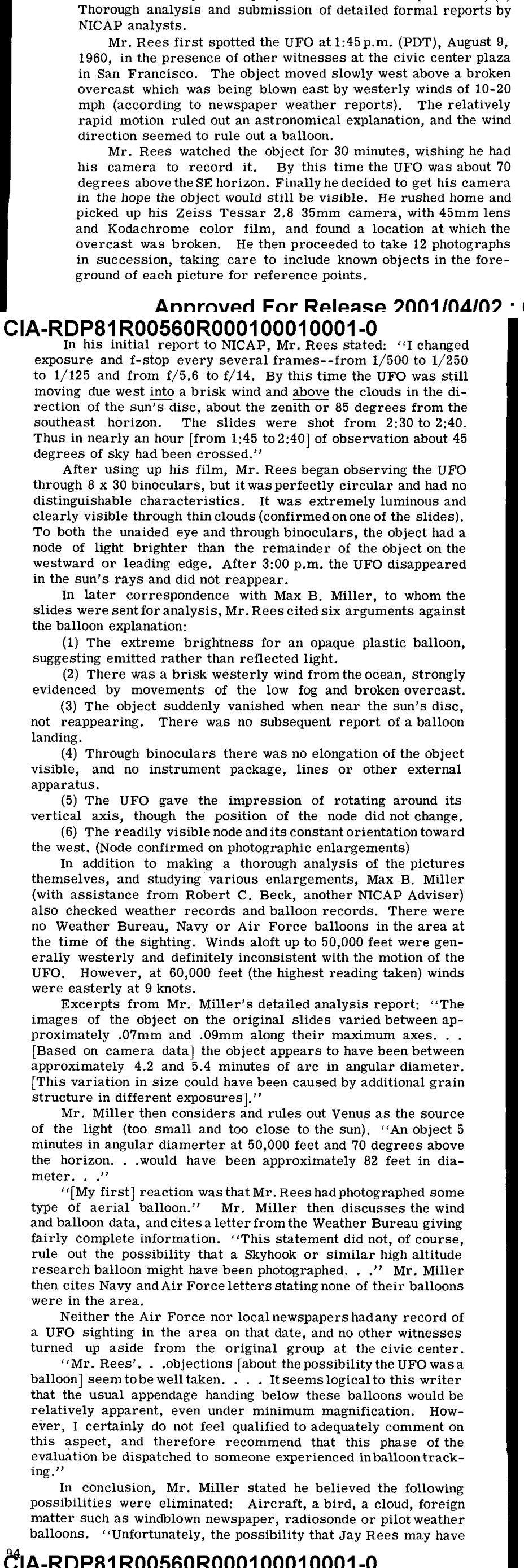 Page of the NICAP reportPhysical page 99
DOCUMENTARY SOURCES · CIA
What the records tell
The source of this dossier is the report "The UFO Evidence", published in 1964 by NICAP (National Investigations Committee on Aerial Phenomena), an American civilian UFO research organization. A copy remained in the CIA's CREST archive and was released in 2001, which proves that the agency kept the book, not that it wrote or validated it. On physical pages 99 and 100, photographic case 51 is presented as one of the few with ideal conditions for analysis: an intelligent witness who saw and photographed an unusual object well, full cooperation with the analysts and detailed formal reports. In the list on page 92, however, the case receives the rating (X), reserved for doubtful or negative evaluations, with the code for color photos analyzed by NICAP.
According to the account, Jay Rees saw the object at 1:45 p.m. on August 9, 1960, with other people, in the San Francisco civic center plaza. It was moving slowly west above scattered clouds that the west wind was pushing east. Rees watched for half an hour, went home to get a 35 mm Zeiss Tessar camera with Kodachrome film and, between 2:30 and 2:40 p.m., took 12 photos, always including objects in the foreground as a reference. With 8x30 binoculars, he saw a perfectly circular and very luminous object, with a brighter spot on its western edge. After 3 p.m., the object disappeared into the glare of the sun.
Rees gave six reasons against the balloon hypothesis: the brightness, which seemed emitted rather than reflected; the strong west wind; the sudden disappearance near the sun, with no report of a downed balloon; the absence of elongation, cables or payload visible through the binoculars; the impression of rotation; and the bright spot always facing west. Consultant Max B. Miller, with Robert C. Beck, measured the images, 0,07 to 0,09 mm on the slides, and estimated about 4 to 5 minutes of arc of apparent diameter. At 50.000 feet and 70 degrees of elevation, this would give about 82 feet in diameter.
Miller ruled out Venus, an aircraft, a bird, a cloud, windblown paper and small weather balloons. The Weather Bureau, the Navy and the Air Force reported that they had no balloons in the area, and the winds up to 50.000 feet were blowing from the west, against the observed movement; at 60.000 feet, the highest reading, the wind was from the east, at 9 knots. Miller acknowledged that the hypothesis of a high-altitude research balloon had not been ruled out. The photos then went to the NICAP subcommittee in Minneapolis, where Wallace Roepke, a former member of General Mills' Skyhook balloon program, and astronomer Hub T. Sherman consulted balloon technicians.
The technicians reported that balloon launch records were destroyed 72 hours later, that some balloons survive for days or weeks after releasing their payload and that, at altitude, they become almost spherical. One consultant felt the object was certainly a balloon at about 100.000 feet; the disappearance could be explained by the sun's glare, by backlighting or by a burst. Of the six General Mills specialists, four leaned toward the balloon and two gave no opinion. NICAP's conclusion is that the object was probably a large plastic research balloon at 60.000 feet or higher, and that the bright spot could be a partial rupture.
More images from the document
DIRECT READING OF THE FILE
The document, in the original
Private publication (NICAP report The UFO Evidence, 1964): the English text is not reproduced or translated in full. Each translations block provides, in English, a faithful summary of the indicated passage or page (NICAP prose) or a line-by-line translation (tables, lists and reproduced official messages), with at most one short quotation. The images are crops of the report's pages. For this case, photographic case 51 on pages 99 (from the start, at the foot of the left-hand column) and 100 (top of the left-hand column) was summarized, and the list entry on page 92 was translated. Rees's 12 photos are not reproduced in the report. The full pages 99 and 100, with the other photographic cases, are summarized in the report's documentary dossier.
EXCERPT 1 · PHYSICAL PAGE 92
Physical page 92, entry 51 of the list of photographic cases (excerpt)
Approved For Release 2001/04/02 : CIA-RDP81R00560R000100010001-0
¢ = color
b = black & white
FILM DATA. M = movie film
S = still photograph
Codes:
RATING. * = considered strongest evidence of UFOS
(*) = potentially strong evidence, worth priority analysis Status of NICAP Analysis
(#) = worth analysis; or possible value in conjunction VN = print viewed, complete analysis not possible because of
with other data Jack of data or lack of reference points and detail in
(X)= dubious, or negative evaluation photograph
(Inc) = incomplete; no rating possible because of lack of AN = analyzed by NICAP
information NN =NICAP unable to obtain for analysis.
bS/VN
bS/VN
M/NN
bM/NN
S/VN
M/NN
S/VN
M/NN
cM/VN
M/NN
bS/VN
bS/VN
cM/VN
bS/VN
bS/VN
M/VN (few frames)
M/VN (few frames)
cS/NN
cM/NN
bS/VN
M/NN
M/NN
bS/VN
bS/VN
/NN
cM/VN (few frames)
bS/VN
bS/VN
bS/VN
bS/VN
cM/NN
bS/VN
bS/VN
bS/VN
bS/VN
bS/VN
cM/NN
cM/NN
bS/VN
cS/VN
bS/NN
cM/AN
bS/VN
cM/NN
bM/AN
bS/VN
cS/AN
bS/VN
cM/AN
bS/AN
cS/AN
bS/VN
bS/AN
M/NN
bS/AN
cM/VN
cS/VN
bS/AN
cM/VN
bS/AN
bS/VN
bS/VN
bS/VN
cM/AN
March 1946. Fred J. Stange, Bernardston, Mass.
July 5, 1947. Frank Ryman, C, G., Seattle, Wash.
February 23, 1949. Cmdr. A. V. Orrego, Chile.
October 23, 1949. Norwood, Ohio, searchlight case.
April 24, 1950. Enrique Hausemann Muller, Balearic Islands.
April 27, 1950. White Sands theodolite photo.
May 11, 1950. Trent photographs, McMinnville, Ore.
May 29, 1950. White Sands theodolite photo.
August 15, 1950. Nick Mariana, Great Falls, Montana.
July 14, 1951. Near White Sands, tracking camera film.
August 30, 1951. Carl Hart, Jr., Lubbock lights, Texas.
May 7, 1952. Barra da Tijuca, Brazil. Ed Keffel.
July 2, 1952. Warrant Officer Newhouse, Tremonton, Utah.
July 16, 1952. Shell Alpert, Coast Guard, Salem, Mass.
July 19, 1952. Peru.
July 29, 1952. Ratph Mayher, Miami, Fla.
August 1, 1952. Wright-Patterson AFB, Ohio. gun-camera
September 19, 1952. Operation Mainbrace color photos.
November 16, 1952. David S. Bunch near Landrum, S. C.
December 13, 1952. Adamski "scout ship.”
August 12, 1953. Ellsworth AFB gun-camera, "best unknown" case.
August 31, 1953. Port Moresby, New Guinea, T. C. Drury
February 15, 1954. Stephen Darbishire, Coniston, England
March 1954, Rouen, France. RAF Flying Review.
May 24, 1954. USAF photo by RB-29 reconaissance plane
June 30, 1954. Scandinavian eclipse photos.
September 9, 1954. K. M. Gibbons, New Zealand
March 5, 1956. William L, Wannall, Hawaii (cS orig.)
July 17, 1956. Elizabeth Klarer, S. Africa.
July 19, 1956. Michael Savage, 15, San Bernardino, Calif.
September 18, 1956. Ray Stanford, Calif.
October 10, 1956. Joe Kerska, Twin Peaks, San Francisco, California
August 20, 1957. Japan. S, Takeda
November 6, 1957. Anaheim, California
November 16, 1957. Near Holloman AFB, New Mexico
December 1957. T. Fogl, radio officer, S.S. Ramse
December 1, 1957. Ralph Benn, Los Angeles, California
January 3, 1958. Cliff DeLacey, Hawaii.
January 16,1958. Trindade Isle, Brazil, sequence.
February 9, 1958. Troy, Michigan, airport
June 23, 1958. Near England AFB, Louisana State police.
July 28, 1959. Ray Stanford. Two movie films.
October 16, 1958. Mike Schultz, Newark, Ohio.
February 9, 1959. Purdon, Imperial Beach, California
September 24, 1959. Redmond, Ore. FAA case.
November 29, 1959. J. J. Rehill, USN, Miami, Florida
February 13, 1960. Joe Perry, Grand Blanc, Michigan
March 2, 1960. Schedelbauer, Vienna.
April 11, 1960. Mary Jo Curwen, Hazel Green, Wisconsin
August 3, 1960. Linz, Austria
August 9, 1960. Jay Rees, San Francisco, California
August 25, 1960. Grumman mystery satellite photo
January 1, 1961. A/3c Bellett, Golden, Colorado
January 22, 1961. Harry Caslar, Eglin AFB, Florida
May 27, 1961. Triangle, Nashville, Tenn.
May 29, 1961. Craig Seese, Newark, Ohio.
July 13, 1961. Bob Feldman, Akron, Ohio
September, 1961. Paccione moon photos
September 29, 1961. Savage, Warrenton, Virginia
March 9, 1962. Jeanne B, Johnson, Hawaii.
May 25, 1962. F, DiMambro, Woburn, Mass.
November 18, 1962. Bruce Fox, Bayonne, New Jersey
December 15 & 16, 1962. Ronald Gounad, New Jersey
December 21, 1962. Ali R. Diaz, Angel Falls, Venezuela.
PHOTOGRAPHIC CASES
1. Fred J. Stange, Bernardston, Mass. Photograph sub-
mitted in 1954 to Rev. Albert Baller (nowNICAP Board member).
Witness states he first saw three discs in a group, then two other
single objects. Photograph shows all five, according to Leonard
H. Stringfield (CRIFO Newsletter; Vol. II No. 3, June 3, 1955).
Lead object of V-formation is largest image. Photo taken with
box camera. Other camera data not available. The slide
viewed by NICAP, a copy of the original, is of very poor quality.
Many splotches are apparent, but no easily discernible UFO
images.
2. Frank Ryman, U.S. Coast Guard, Seattle, Wash. At 5:45
p.m. Mr. Ryman photographed a circular white object moving
across the wind. (See Popular Science, August 1951; ‘Report
on UFO”, Ruppelt, p. 37), Photograph reproduced in ‘‘Coming of
the Saucers’’, by Arnold & Palmer, shows small, white, elliptical
image. Photo carries identification: ‘‘Acme Telephoto, SE86-7/5
Seattle.”
Approved For Release 2001/04/02 ¢°>CIA-RDP81R00560R000100010001-0Check the original PDF
[p. 92: texto da publicação privada não reproduzido; ver o resumo]View the document record ↗ · Physical page 92, counting the cover.
EXCERPT 2 · PHYSICAL PAGE 99
Physical page 99, photographic case 51 (bottom of the left column and right column, excerpt)
Approved For Release 2001/04/02 : CIA-RDP81R00560R000100010001-0
Photographic Cases (Continued)
greenish halation is sympathetic to the defect and is effected by
one of the color developers overcompensating around the un-
developed emulsion (if a cinch mark) or foreign matter.’’
48. Schedelbauer, Vienna. Edgar Schedlebauer, a reporter
for the Vienna newspaper ‘‘Wiener Montag’’, photographed a
round, glowing object which he said hovered low over the ground
for ten seconds emitting heat. The newspaper, alleging that the
photograph had been declared authentic by outside experts, printed
the picture’on the front page and labelled it ‘‘the most sensational
photograph of our century.’’ The picture shows a bright white
object something like a parachute canopy against a black back-
ground. There are no reference points.
NICAP wrote to Mr. Schedelbauer requesting the photograph
and negative for analysis, but received no answer. Therefore
the case must be considered incomplete. Since it is the type of
photograph which could easily be faked, we are presently skeptical
about it.
49. Mary Jo Curwen, Hazel Green, Wisconsin. A signed
report form was received from Miss Curwen in July 1960, with a
letter stating: ‘‘When the Air Force returns our film [A copy of
the original] we will be willing to lend it to you.’’ After further
correspondence, the film was finally submitted to the Minneapolis
NICAP Subcommittee in April 1963. After analysis, it was then
forwarded to NICAP Photographic Adviser Ralph Rankow in New
York City, who also examined it. The film was returned to the
Curwen family in June 1963.
The analyses established that the film was worthless as
evidence of UFOs. The images were tiny, almost merging with
the grain of the film, showed no appreciable motion other than
typical movie film ‘‘jump’”’ and were also visible in other scenes
against the ground. The witnesses did not explain why a mundane
farmyard scene appears between two scenes allegedly showing
UFOs against the blue sky.
In the verbal report the witnesses stated they saw three
saucer-shaped objects flying past in formation, oscillating up and
down in flight, at 5:50 p.m. Miss Curwen attempted to film the
UFOs with an 8 mm camera on a roll of color film which was
being used primarily for family scenes.
It is possible that the attempt was unsuccessful, and that the
family naturally misinterpreted routine film specks as being
images of the UFOs they had seen. At any rate, the film does not
verify the verbal report.
50. Linz, Austria A photograph showing a globular UFO
seemingly lighted more brightly on the underside, near what is
apparently out-of-focus tree branches, was submitted to NICAP
for analysis. Max B, Miller examined the picture, and stated:
“Knowing what camera and lens made the photo, we can determine
that the object was approximately 6 degrees in diameter. . .it
appears to be out of focus rather than blurred due to motion. . .
having no further data additional evaluations cannot be made. My
own opinion, however, is totally negative.’’
51. Jay Rees, San Francisco. This is one of the few photo-
graphic cases involving ideal conditions for analysis; (1) An
intelligent witness who saw and took good photographs of an un-
usual object in the sky; (2) Full cooperation between the witness
and NICAP analysts uniquely fitted for the analysis work; (3)
Thorough analysis and submission of detailed formal reports by
NICAP analysts.
Mr. Rees first spotted the UFO at 1:45p.m. (PDT), August 9,
1960, in the presence of other witnesses at the civic center plaza
in San Francisco. The object moved slowly west above a broken
overcast which was being blown east by westerly winds of 10-20
mph (according to newspaper weather reports). The relatively
rapid motion ruled out an astronomical explanation, and the wind
direction seemed to rule out a balloon.
Mr. Rees watched the object for 30 minutes, wishing he had
his camera to record it. By this time the UFO was about 70
degrees above the SE horizon. Finally he decided to get his camera
in the hope the object would still be visible. He rushed home and
picked up his Zeiss Tessar 2.8 35mm camera, with 45mm lens
and Kodachrome color film, and found a location at which the
overcast was broken. He then proceeded to take 12 photographs
in succession, taking care to include known objects in the fore-
ground of each picture for reference points.
In his initial report to NICAP, Mr. Rees stated: ‘‘I changed
exposure and f-stop every several frames--from 1/500 to 1/250
to 1/125 and from £/5.6 to £/14. By this time the UFO was still
moving due west into a brisk wind and above the clouds in the di-
rection of the sun’s disc, about the zenith or 85 degrees from the
southeast horizon. The slides were shot from 2:30 to 2:40.
Thus in nearly an hour [from 1:45 to 2:40] of observation about 45
degrees of sky had been crossed.’’
After using up his film, Mr. Rees began observing the UFO
through 8 x 30 binoculars, but it was perfectly circular and had no
distinguishable characteristics. It was extremely luminous and
clearly visible through thin clouds (confirmedon one of the slides).
To both the unaided eye and through binoculars, the object had a
node of light brighter than the remainder of the object on the
westward or leading edge. After 3:00 p.m. the UFO disappeared
in the sun’s rays and did not reappear.
In later correspondence with Max B. Miller, to whom the
slides were sent for analysis, Mr. Rees cited six arguments against
the balloon explanation:
(1) The extreme brightness for an opaque plastic balloon,
suggesting emitted rather than reflected light.
(2) There was a brisk westerly wind from the ocean, strongly
evidenced by movements of the low fog and broken overcast.
(3) The object suddenly vanished when near the sun’s disc,
not reappearing. There was no subsequent report of a balloon
landing.
(4) Through binoculars there was no elongation of the object
visible, and no instrument package, lines or other external
apparatus.
(5) The UFO gave the impression of rotating around its
vertical axis, though the position of the node did not change.
(6) The readily visible node and its constant orientation toward
the west. (Node confirmed on photographic enlargements)
In addition to making a thorough analysis of the pictures
themselves, and studying various enlargements, Max B. Miller
(with assistance from Robert C. Beck, another NICAP Adviser)
also checked weather records and balloon records. There were
no Weather Bureau, Navy or Air Force balloons in the area at
the time of the sighting. Winds aloft up to 50,000 feet were gen-
erally westerly and definitely inconsistent with the motion of the
UFO. However, at 60,000 feet (the highest reading taken) winds
were easterly at 9 knots.
Excerpts from Mr. Miller’s detailed analysis report: ‘‘The
images of the object on the original slides varied between ap-
proximately .07mm and .09mm along their maximum axes. . .
[Based on camera data] the object appears to have been between
approximately 4.2 and 5.4 minutes of arc in angular diameter.
[This variation in size could have been caused by additional grain
structure in different exposures].’’
Mr. Miller then considers and rules out Venus as the source
of the light (too small and too close to the sun), ‘‘An object 5
minutes in angular diamerter at 50,000 feet and 70 degrees above
the horizon. . .would have been approximately 82 feet in dia-
meter. . .”
‘(My first] reaction was that Mr. Rees had photographed some
type of aerial balloon.’”’ Mr. Miller then discusses the wind
and balloon data, and citesa letter fromthe Weather Bureau giving
fairly complete information. ‘‘This statement did not, of course,
rule out the possibility that a Skyhook or similar high altitude
research balloon might have been photographed. . .’”’? Mr. Miller
then cites Navy and Air Force letters stating none of their balloons
were in the area.
Neither the Air Force nor local newspapers hadany record of
a UFO sighting in the area on that date, and no other witnesses
turned up aside from the original group at the civic center.
“Mr. Rees’, . .objections [about the possibility the UFO wasa
balloon] seem tobe welltaken. . . . Itseems logical to this writer
that the usual appendage handing below these balloons would be
relatively apparent, even under minimum magnification. How-
ever, I certainly do not feel qualified to adequately comment on
this aspect, and therefore recommend that this phase of the
evaluation be dispatched to someone experienced inballoontrack-
ing.”
In conclusion, Mr. Miller stated he believed the following
possibilities were eliminated: Aircraft, a bird, a cloud, foreign
matter such as windblown newspaper, radiosonde or pilot weather
balloons. ‘‘Unfortunately, the possibility that Jay Rees may have
Approved For Release 2001/04/02 : CIA-RDP81R00560R000100010001-0Check the original PDF
[p. 99: texto da publicação privada não reproduzido; ver o resumo]View the document record ↗ · Physical page 99, counting the cover.
EXCERPT 3 · PHYSICAL PAGE 100
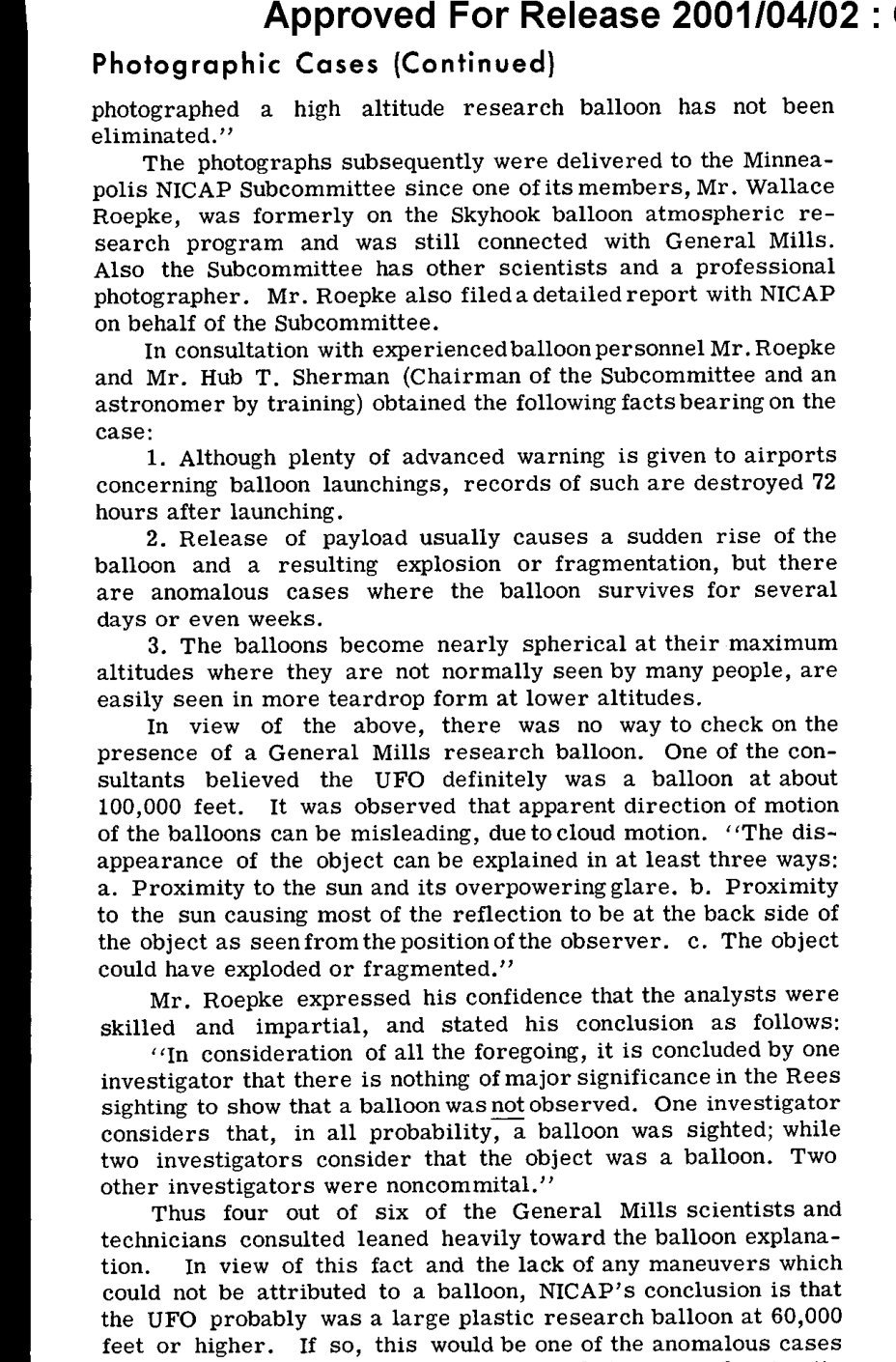
Physical page 100, top of the left column: end of case 51 (excerpt)
Approved For Release 2001/04/02 : CIA-RDP81R00560R000100010001-0
Photographic Cases (Continued)
photographed a high altitude research balloon has not been
eliminated.’’
The photographs subsequently were delivered to the Minnea-
polis NICAP Subcommittee since one ofits members, Mr. Wallace
Roepke, was formerly on the Skyhook balloon atmospheric re-
search program and was still connected with General Mills.
Also the Subcommittee has other scientists and a professional
photographer. Mr. Roepke also fileda detailedreport with NICAP
on behalf of the Subcommittee.
In consultation with experienced balloon personnel Mr. Roepke
and Mr. Hub T, Sherman (Chairman of the Subcommittee and an
astronomer by training) obtained the following facts bearing on the
case:
1. Although plenty of advanced warning is given to airports
concerning balloon launchings, records of such are destroyed 72
hours after launching.
2. Release of payload usually causes a sudden rise of the
balloon and a resulting explosion or fragmentation, but there
are anomalous cases where the balloon survives for several
days or even weeks.
3. The balloons become nearly spherical at their maximum
altitudes where they are not normally seen by many people, are
easily seen in more teardrop form at lower altitudes.
In view of the above, there was no way to check on the
presence of a General Mills research balloon. One of the con-
sultants believed the UFO definitely was a balloon at about
100,000 feet. It was observed that apparent direction of motion
of the balloons can be misleading, due tocloud motion. ‘‘The dis-~
appearance of the object can be explained in at least three ways:
a. Proximity to the sun and its overpowering glare. b. Proximity
to the sun causing most of the reflection to be at the back side of
the object as seenfrom the position ofthe observer. c. The object
could have exploded or fragmented.”’
Mr. Roepke expressed his confidence that the analysts were
skilled and impartial, and stated his conclusion as follows:
“In consideration of all the foregoing, it is concluded by one
investigator that there is nothing of major significance in the Rees
sighting to show that a balloon was not observed. One investigator
considers that, in all probability, a balloon was sighted; while
two investigators consider that the object was a balloon. Two
other investigators were noncommital.’’
Thus four out of six of the General Mills scientists and
technicians consulted leaned heavily toward the balloon explana-
tion. In view of this fact and the lack of any maneuvers which
could not be attributed to a balloon, NICAP’s conclusion is that
the UFO probably was a large plastic research balloon at 60,000
feet or higher. If so, this would be one of the anomalous cases
cited above when the balloon did not explode upon releasing its
instrument package. It is conceivable that the ‘‘node’’ was a
partial rupture--not quite sufficient to cause fragmentation--
resulting from the sudden rise following release of the instru-
ments.
52. August 25, 1960, ‘‘mystery satellite’? photograph. Data
received by NICAP from the Grumman Aircraft Corporation in
Long Island were a contact print and enlargement showing the
motion of the unknown object in relationtothe star field. Grumman
stated the object was moving at a speed comparable to previous
satellites, but from east to west.
53. A/3C Bellett, Golden, Colorado. Photograph submitted
in letter dated January 16, 1961. Negative requested and sub-
sequently furnished. Both were forwarded to Max B. Miller
for analysis. Mr. Miller stated: ‘‘This is a very common
negative defect. . .[which] occurs whenever a piece of foreign
matter happens to collect on the negative at the moment of
exposure.’’ The picture shows a thin dark line (about the pro-
portions of a thin cigar) against the sky high above a plateau.
Nothing was observed visually.
54. Harry Caslar, Eglin AFB, Fla. At 4:45 p.m. while
taking movies of his son on the beach at Eglin AFB reservation,
Mr. Caslar noticed a UFO approaching from over the water.
He managed to obtain footage of it with his 8mm camera. The
film was viewed by the staff of a local newspaper. The film
reportedly showed a cigar shaped or elliptical object making a
U-turn and receding out over the Gulf. Both the Air Force and
a NICAP member approached Mr. Caslar about borrowing the film
for analysis, but he refused to part with it. Based on the news-
paper description, the film sounds like an important one. How-
ever, neither the film nor stills from it have been viewed by
NICAP.
55. Nashville triangle. A shining object at very high alti-
tude, appearing roughly triangular in shape, was viewed over a
wide area near Nashville, Tenn., from about 5:00 p.m. to sunset.
Data on the incident was gathered for NICAP by member Paul
Norman, including photographs of the object. Navy jets tried
to inspect the object, but couldn’t reach its altitude, which appeared
to be at about 60,000 feet. Examination of the photographs and
witness reports to NICAP led tothe conclusion the object probably
was a high altitude research balloon. Nothing contained in
the photographs or reports strongly challenges this conclu-
sion. Huge ‘‘Moby Dick’ plastic balloons (named after Mel-
ville’s legendary whale) used for high altitude research are
pyramidal in form and can appear triangular in outline. Also,
local authorities often know nothing about these balloons, which
travel long distances glowing brightly in sunlight at times. When
local airports are unaware of the nature of the objects, this
sometimes adds to the mystery.
(The NICAP Assistant Director once experienced a sighting
of a ‘Moby Dick’? hovering and glowing brightly over New
Orleans. No one could account for it, and the object still resem-
bled a bright light source through 6 power binoculars. With the
aid of an astronomical telescope, he was finally able to resolve
it. The plastic material and instrument packages were clearly
visible).
56. Craig Seese, Newark, Ohio. NICAP received a telegram
in June 1961 notifying us about the existence of some color movies
of a UFO taken by a 16 year old boy, Craig Seese. Our informant
was Robert William Miller, a young man with serious interest
in UFO investigation who had formed his own group for that
purpose. Mr. Miller had been one of five witnesses to the UFO
sighting and filming.
A meeting was arranged between the youths, and Mr. A. B.
Ledwith, a NICAP member in the area with technical background
(including photographic analysis work with Smithsonian Astrophy-
sical Observatory). Mr. Ledwith was requested to advise NICAP
whether he considered analysis of the film worthwhile. After
talking to the youths and viewing the film, Mr. Ledwith recom-
mended analysis of the film and advised Mr. Seese to have several
copies made, storing the original in a cool safe place.
Mr. Miller was advised to forward one copy of the film to
Max B, Miller in Los Angeles for analysis. (NICAP paid for the
printing of one copy of the film for this purpose), The film was
sent to Max Miller by registered mail August 7, 1961. About
this time photographic analysis work began to pile up on Max
Miller, and other committments began to make demands on his
time. Asa result several analyses inthe past two years are either
incomplete or still pending. Max Miller is no longer a NICAP
Special Adviser, and other arrangements are being made to com-
plete the analyses.
The color film was taken between 10:00 p.m. and midnight
with a Brownie 8mm camera and telephoto lens (2.5 power),
£/1.9. The UFO appeared to the unaided eye as a single white
light, but the film indicates three objects, one slightly off-frame.
Mr. Ledwith has tentatively ruled out reflections and film de-
fects as the source of the images.
57. Bob Feldman, Akron, Ohio. Color photograph of alleged
UFO taken by 12 year old boy forwarded to Max B, Miller for
examination. No report received. Picture shows object resembling
sky rocket, on Echtachrome film E-21.5 at 1/1250 seconds.
58. Paccione Moon Photos. A series of four photographs
showing a dark spot moving across the face of the moon were
submitted to NICAP by Ralph Rankow (now a NICAP photographic
Adviser). A young employee, Michael Paccione, had taken them
sometime around September 20, but could not recall the exact
date. He used a Starmaster refractor telescope and 35mm single
lens reflex camera, with Tri-X pan film exposures of 1, 2, & 3
seconds. The time was just after 8:30 p.m.
Mr. Rankow, a professional photographer, considers the
negatives authentic. The photographs were then examined by Dr.
James C. Bartlett, Jr., NICAP astronomy Adviser in Baltimore,
and Mr. Sidney Parsons, professional astronomer and NICAP
member. Dr. Bartlett determined that, based on the fraction of
the moon’s surface which was illuminated in the photographs, the
Approved For Release 2001/04/02 CIA-RDP81R00560R000100010001-0Check the original PDF
[p. 100: texto da publicação privada não reproduzido; ver o resumo]View the document record ↗ · Physical page 100, counting the cover.
Dates and documentary context
- Event
- 09/08/1960 — Date and times given by Rees's account: first observation at 13h45 (PDT), photos from 14h30 to 14h40, disappearance after 15h.
- Document
- 02/04/2001 — Date of the CREST release stamp printed on the pages (Approved For Release 2001/04/02).
- Publication
- 1964 — Year of publication of the report "The UFO Evidence" by NICAP (May 1964).
Origin and release
National Investigations Committee on Aerial Phenomena (NICAP), an American civilian organization; private report "The UFO Evidence" (1964), edited by Richard H. Hall. Copy kept in the CIA's CREST archive (CIA-RDP81R00560R000100010001-0, released on 02/04/2001); the CIA kept the text, it did not produce or validate it · CIA-RDP81R00560R000100010001-0_NICAP-The-UFO-Evidence_1964.pdf
CIA CREST, CIA-RDP81R00560R000100010001-0, release of 02/04/2001 ↗ — undefined
Questions to continue the investigation
- Were Jay Rees's 12 color photos and the reports by Max B. Miller and Wallace Roepke preserved?
- Was there a Skyhook balloon launch or another research balloon launch in the days before 09/08/1960 that would explain the UFO?
GEOGRAPHY OF THE CASE
Civic Center of San Francisco, California
Approximate reference to the city, placed by the editorial team. It indicates the witness's location, not the position of the UFO, estimated at tens of thousands of feet of altitude.
DOCUMENTARY TRAIL
Go back to the sources
References use physical pages of the PDF, counting the cover. Summaries are presented in English; the documents keep their original language.
- CIA-RDP81R00560R000100010001-0_NICAP-The-UFO-Evidence_1964.pdf
Physical page 92: entry 51 of the photographic case list (Jay Rees), with rating and code · Physical page 99: photographic case 51, Jay Rees's account and Max B. Miller's analysis · Physical page 100: end of case 51, opinion of the NICAP subcommittee in Minneapolis and NICAP's conclusion
CIA · 186 pages
Editorial summary based on the collection's research notes. How we read the documents.