Date: 1957-07-17Location: Mississippi, Louisiana, and Texas, USA, on a training flight
Radar, visual, and microwave encounter involving an RB-47
COMETA places the RB-47 episode on 17 July 1957 and summarizes interviews conducted with six crew members in 1969. The aircraft, on a training flight in the southern U.S., carried equipment for detecting radar emissions. This equipment indicated the characteristics and direction of the signals; the text itself cautions that it did not provide the distance to the source.
- Event date
- 1957-07-17
- Location
- Mississippi, Louisiana, and Texas, USA, on a training flight
- Topic
- COMETA and international accounts
- Source agencies
- Arquivo histórico
- Documents
- 1 document · 94 pages
- Reading time
- 5 min
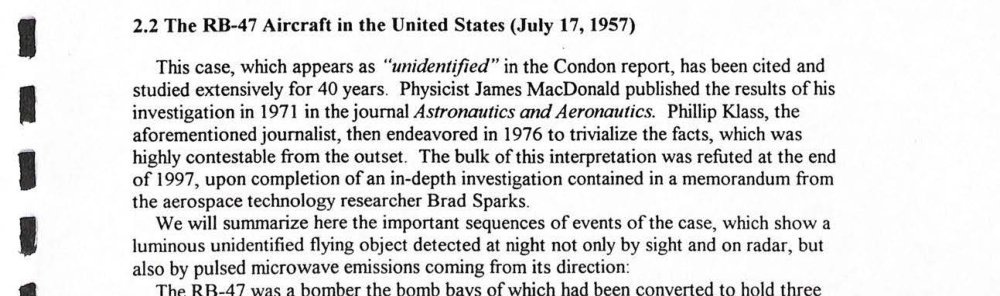 Report excerptPhysical page 17
DOCUMENTARY SOURCES · Arquivo histórico
What the records tell
Source of this entry: COMETA, private association; secondary account. The PDF brings together the private COMETA report and supplementary materials. Inclusion in the public collection does not turn its accounts or conclusions into an official position of the U.S. government.
COMETA places the RB-47 episode on 17 July 1957 and summarizes interviews conducted with six crew members in 1969. The aircraft, on a training flight in the southern U.S., carried equipment for detecting radar emissions. This equipment indicated the characteristics and direction of the signals; the text itself cautions that it did not provide the distance to the source.
The narrative moves through microwave detection off Mississippi, a bluish-white light over Louisiana, and, in Texas, a new source of emissions, a red light, and a contact reported by the Utah radar, near Dallas. The crew reportedly accelerated, reduced speed, and pursued the light; the ground radar reportedly indicated a separation of about 18 km. The text describes losses and reacquisitions of visual, radar, and electronic contacts; the aircraft returned toward Oklahoma City for fuel.
The authors discuss Klass's interpretations and work by McDonald and Brad Sparks. They do not present the complete original instrumental series in the PDF. The hypothesis that all indications correspond to the same object and the speed inferences must remain attributed to the reconstruction, without treating emission-warning equipment as radar that directly measured distance.
DIRECT READING OF THE FILE
The document, in the original
Translation of the selected excerpts checked against the image, with omissions indicated. This is not a full translation of the PDF. Summaries and evaluations are kept separate from the transcription.
EXCERPT 1 · PHYSICAL PAGE 18
Short excerpt supporting the summary, not a full translation.
I
occurred every 600 microseconds. The radar~ scanned the horizon four times per minute.
Three other officers (pilot, copilot, navigator) were in the cockpit and, as a result,
could themselves see out ofthe aircraft. The six officers were questioned by MacDonald I
in 1969. They related that:
- The first incident took place above Mississippi, probably at around 09302 (0330 local 1· time}, when the aircraft, going back to the north from the GulfofMexico, was
approaching the coast a little to the east ofthe Mississippi delta, flying at Mach 0. 75.
Captain MacClure detected on his screen a blip corresponding to a pulsed microwave
source located behind and to the right ofthe RB-47 (at "S o'clock") that rapidly passed I
the aircraft and turned around it, departing again on its left in the other direction (between
"6 o'clock and 9 o'clock"). The source was therefore airborne and supersonic. MacClure 1· noted the characteristics ofthe signal: they were those ofthe aforementioned ground radar
stations, with the exception ofthe length ofthe pulses, which were 2 microseconds. He
did not report this incident immediately, thinking that it was perhaps·a malfunction ofthe
electronics. As Klass writes, at the time there were no supersonic aircraft either in the I
United States or in the USSR large enough to transport a radar, the signal from which
possessed the characteristics that were observed.
- The following incident occurred at 101OZ in Louisiana, when Commander Chase,
pilot, and Captain MacCoyd, copilot, saw an intense bluish-white light aim at the aircraft
from " 11 o'clock," then jump from their left to their right and disappear while it was at "2
o'clock." Klass showed that this object was perhaps a meteorite the trajectory of which
caused an optical illusion, but, at the time, Chase and MacCoyd wondered whether it
wasn't a UFO. Hearing them, MacClure remembered his prior detection and looked for a
signal ofthe same type.
- He found this signal at 10302, which was identical to the previous one and, perhaps
by coincidence, came from "2 o'clock." This signal was confirmed by Captain 1·
Provenzano, whose detector was itself also able to operate at around 3000 MHz. It could
not have been the signal from a fixed radar, because its ''2 o' clock" direction remained
unchanged when the aircraft followed its route to the west for several minutes. The I aircraft entered Texas, then came within range of the "Utah" radar [center] located near
Dallas. The crew reported to Utah, which detected both the aircraft and an object
maintaining a constant distance of 18 km from it. I - At 10392, still in Texas, Commander Chase perceived a large red light, which he
estimated was moving 1500 m below the aircraft at approximately "2 o'clock." The
aircraft was flying at an altitude of 10,500 m, and the weather was perfectly clear. t Although the commander was not able to determine either the shape or the size ofthe
object, he had the distinct impression that the light was emanating from the top of the
object. I
At 10402, he received authorization to pursue this object and notified Utah. He
slowed down, then accelerated; Utah informed him that the object was mirroring his
movements, all the while maintaining a constant distance of 18 km. I - At 10422, Chase accelerated and saw the red object tum to the right in the direction
ofDallas; this was confirmed by MacClure.
- At around 10502, a little to the west ofDallas, the object stopped and simultaneously I
disappeared from the view of the radar(~) (Utah and the onboard radar that had just
detected the object when the RB-47 had approached it) and from MacClure's screen (the
disappearance ofan object from a radar screen is less surprising nowadays; it calls to mind I
the active stealth technologies currently in development ifnot in operation). The aircraft
then banked to the left. MacClure picked up a signal that was perhaps the one from Utah. I
IEditorial note: Continuation of the RB-47 case (1957): microwave signals, lights sighted by the crew and contact with ground radar, according to the COMETA summary.
Check the original PDF
The crew reported to Utah, which detected both the aircraft and an object maintaining a constant distance of 18 km from it.View the document record ↗ · Physical page 18, counting the cover.
Dates and documentary context
- Event
- 17/07/1957 — 1957-07-17. Date indicated by the secondary source, separate from the publication date.
- Document
- Not established — Individual document date not determined; see the source publication below.
- Publication
- 07/1999 — VSD (special edition, July 1999) · Publication of the source examined or cited; do not presume it is the first historical disclosure of the event. · The record reflects the COMETA summary; primary sources are not always reproduced.
Origin and release
COMETA, private association; secondhand account · UFOs and Defense: What Should We Prepare For?
This record reflects the COMETA summary; primary sources are not always reproduced. Hosting or archiving by a public agency does not imply endorsement; COMETA is a private association. The English version has not been fully compared with the French one.
Official collection · release 01 ↗ — Match indicated by the search; bytes of the remote PDF not authenticated.
A propos de la publication du rapport COMETA — GEIPAN ↗ — GEIPAN clarifies that hosting COMETA does not imply approval by CNES. It identifies the committee as private and attributes the conclusions to the authors. The note also records that the version published there was incomplete.
Questions to continue the investigation
- Locate and verify the primary records and technical documents cited.
GEOGRAPHY OF THE CASE
Southern U.S.: Mississippi, Louisiana and Texas
The flight crossed three states; the marker shows the region, not the trajectory. Approximate regional reference, placed by the editors based on the place cited in the document. The marker does not represent the exact location of the account.
DOCUMENTARY TRAIL
Go back to the sources
References use physical pages of the PDF, counting the cover. Summaries are presented in English; the documents keep their original language.
- 255_413270_UFO's_and_Defense_What_Should_we_Prepare_For.pdf
Physical pages 5, 9, 17, 18, 19
Arquivo histórico · 94 pages
Context and references in this document
contexto ou referencia
UFO seen over a rural school after Antananarivo ↗
contexto ou referencia
Reports of “ghost rockets” in Sweden ↗
contexto ou referencia
Reports of “foo fighters” in World War II ↗
contexto ou referencia
Reports of “airships” in the U.S. and the United Kingdom ↗
contexto ou referencia
Luminous phenomenon attributed to Goethe in 1768 ↗
contexto ou referencia
Aerial phenomena reported in Nuremberg ↗
contexto ou referencia
Aerial phenomenon reported in Basel ↗
contexto ou referencia
Medieval narrative attributed to Agobard about occupants of an “aircraft” ↗
contexto ou referencia
Contact with a Venusian attributed to Adamski ↗
contexto ou referencia
Paul Bennewicz's claims about microwaves, abductions and implants ↗
contexto ou referencia
Triangular lights reported in Arizona in 1997 ↗
contexto ou referencia
Interception attempts by military aircraft in Iran, Peru and Belgium ↗
contexto ou referencia
Shoot-down attempt by Peruvian aircraft, cited in a news report ↗
contexto ou referencia
Pursuit of UFOs by Belgian F-16s in 1990 ↗
contexto ou referencia
Mention of a military Vampire in the Orange region in 1951 ↗
contexto ou referencia
Photograph attributed to a mapping flight over Tilarán, Costa Rica ↗
contexto ou referencia
Image attributed to a Zanesville, Ohio, barber in 1966 ↗
contexto ou referencia
Image attributed to a student from Beaver, Pennsylvania ↗
contexto ou referencia
Image attributed to brothers from Detroit in 1967 ↗
Related publications and media
Editorial summary based on the collection's research notes. How we read the documents.