Date: 1956-08-13/1956-08-14Location: Bentwaters and Lakenheath bases, England
Lakenheath–Bentwaters episode
COMETA brings together radar reports and visual observations at the Bentwaters and Lakenheath bases on the night of 13–14 August 1956. It describes an east–west pass at 22h55, with an apparent speed estimated by radar at between 2.000 and 4.000 mph, accompanied by reports of a luminous UFO from the tower and from a transport pilot.
- Event date
- 1956-08-13/1956-08-14
- Location
- Bentwaters and Lakenheath bases, England
- Topic
- COMETA and international accounts
- Source agencies
- Arquivo histórico
- Documents
- 1 document · 94 pages
- Reading time
- 12 min
 Report excerptPhysical page 16
DOCUMENTARY SOURCES · Arquivo histórico
What the records tell
Source of this entry: COMETA, private association; secondary account. The PDF brings together the private COMETA report and supplementary materials. Inclusion in the public collection does not turn its accounts or conclusions into an official position of the U.S. government.
COMETA brings together radar reports and visual observations at the Bentwaters and Lakenheath bases on the night of 13–14 August 1956. It describes an east–west pass at 22h55, with an apparent speed estimated by radar at between 2.000 and 4.000 mph, accompanied by reports of a light from the tower and from a transport pilot.
In the narrated sequence, Lakenheath operators tracked a target that alternated between movements and stops. A Venom fighter reportedly acquired visual/radar contact, lost the target, and then was followed by it during maneuvers for approximately ten minutes. The pilot returned for fuel; a second Venom turned back due to a mechanical problem. The last contact is placed at around 03h30.
The summary cites the 1969 Condon report, a contemporaneous telex, Captain Holt's report, and recollections sent by an operator in 1968. It also cites analyses by Thayer and McDonald and objections by Klass. These documents are not reproduced in full here; the values, simultaneity, and unexplained character are claims of the cited sources, not independent verification by this record.
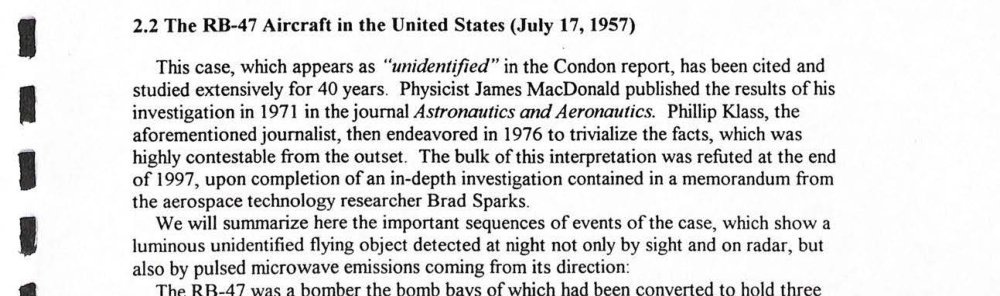
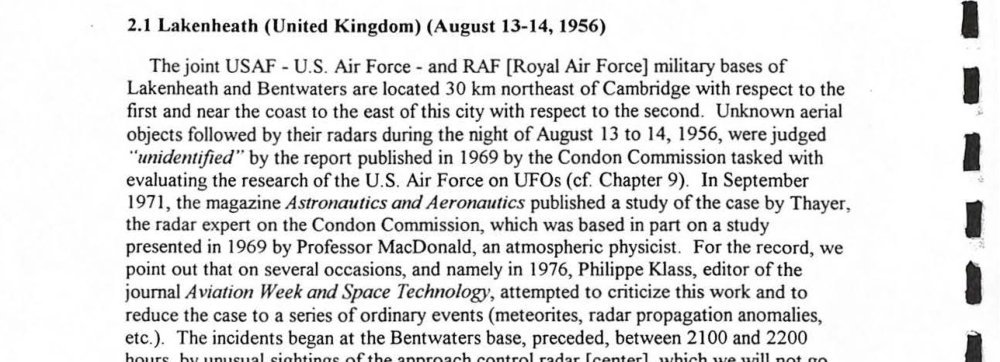
The full text of page 16 shows that COMETA itself classifies the episode as one of the five "significant aeronautical cases" of chapter 2, among four detected by radar and sight simultaneously. It also specifies that the incidents began at the Bentwaters base, preceded by unusual observations on the approach radar between 21h and 22h, before the east-to-west pass at 22h55 already recorded in the dossier. The report also cites the regulation telex sent by Lakenheath to Project Blue Book on the same day, and Captain Holt's report sent two weeks later — documents that COMETA summarizes but does not reproduce in full here.
Page 17, not previously translated, details the pursuit by the RAF Venom fighter: the pilot acquired and lost the target by radar and visually several times, at one point said over the radio that his guns were "locked" on the object, and was informed by the radar operators that the object had begun following him from behind, at a constant distance. He attempted climbs, dives, and turns for about ten minutes without managing to reposition behind the target, and returned to base for lack of fuel; a second Venom, sent afterward, had a mechanical failure before establishing contact.
COMETA locates the two bases, then used jointly by the U.S. Air Force and the RAF: Lakenheath is about 30 km northeast of Cambridge, and Bentwaters, near the coast, east of the same city. The report recalls that the Condon Commission classified that night's radar targets as “unidentified” in 1969 and that the commission's radar specialist, Gordon Thayer, published in 1971 a study of the case based in part on the work of atmospheric physicist James McDonald (spelled “MacDonald” in the text). It also records that Philip Klass tried, especially in 1976, to reduce the episode to ordinary facts, such as meteors and radar propagation anomalies.
Page 17 gives the figures that the Lakenheath operators reportedly observed on the screen. After being stationary about 40 km southwest of the base, the target went from immobility to 600 to 950 km/h, changed direction several times in straight segments of 13 to 30 km, and made abrupt stops of 3 to 6 minutes, always going from zero to about 950 km/h “with no transition.” The telex sent by Lakenheath on the same day concluded that the radar and visual observations, made from the ground, of the rapid acceleration and abrupt stop “certainly lend credence to the report.” These are values transmitted by the telex and by the sergeant's memory, not radar records reproduced in the PDF.
The account of the interception also gains details. The Lakenheath center guided the Venom to the target, first 10 km east of the center and then 16 km east of the base. After the pilot gave up for lack of fuel, the object reportedly followed him briefly, stopped, made several short movements, and departed northward at about 950 km/h, until leaving radar range at 03h30. The second Venom turned back due to a mechanical problem before any contact. This entire sequence comes from the account of the controllers and the pilot, filtered through the sources COMETA summarizes.
In the chapter on official research, COMETA returns to the case to say that, because of Lakenheath, the RAF and the responsible ministry took an early interest in the subject, but that little is known about that work. The chapter 2 bibliography lists the Condon report, a 1970 McDonald article translated in 1974, Thayer's September 1971 study, Klass's chapter “UFOs over England (Bentwaters and Lakenheath),” and a 1979 book by J. Allen Hynek. The Lakenheath telex, Captain Holt's report, and the sergeant's letter are not in the collection; Klass's explanations appear only as a critical summary by the French authors.
DIRECT READING OF THE FILE
The document, in the original
Translation of the selected excerpts checked against the image, with omissions indicated. This is not a full translation of the PDF. Summaries and evaluations are kept separate from the transcription.
EXCERPT 1 · PHYSICAL PAGE 16
Opening of chapter 2 and of the Lakenheath case, p.16
.,
I
It is appropriate to specify that those cases that have been sighted from aircraft are
considered to be aeronautic cases. This chapter describes five significant cases that
occurred in different parts of the world and which were the subject of an investigation by I
the authorities ofthe countries in question. In four cases, the objects were detected both
visually and by radar. In the fifth case, they were observed by a number ofindependent ., witnesses.
2.1 Lakenheath (United Kingdom) (August 13-14, 1956) I
The joint USAF - U.S. Air Force - and RAF [Royal Air Force] military bases of
Lakenheath and Bentwaters are located 30 km northeast ofCambridge with respect to the I first and near the coast to the east ofthis city with respect to the second. Unknown aerial
I
"
objects followed by their radars during the night ofAugust 13 to 14, 1956, were judged
··11nide111ified'' by the report published in 1969 by the Condon Commission tasked with ,:, evaluating the research ofthe U.S. Air Force on UFOs (cf Chapter 9). In September
1971, the magazine Astronautics andAeronautics published a study of the case by Thayer,
the radar expert on the Condon Commission, which was based in part on a study
presented in 1969 by Professor MacDonald, an atmospheric physicist. For the record, we ~ point out that on several occasions, and namely in 1976, Philippe Klass, editor ofthe
journal Aviation Week and Space Technology, attempted to criticize this work and to I
reduce the case to a series of ordinary events (meteorites, radar propagation anomalies,
etc.). The incidents began at the Bentwaters base, preceded, between 2100 and 2200
hours, by unusual sightings ofthe approach control radar [center], which we will not go I
into in further detail. They took place as follows:
- At 2255 hours, the radar detected an unidentified object moving east to west passing
over the base, always almost into the wind at an apparent speed of 2000 to 4000 miles per I
hour (mph), or 3200 to 6400 km/h. No sonic boom was mentioned. The personnel ofthe
Bentwaters control tower said they saw a bright light flying over the ground from east to
west "at an incredible speed" at an altitude of approximately 1200 m. At the same time, I
the pilot of a military transport plane flying over Bentwaters at an altitude of 1200 m
stated that a bright light passed under his plane tearing east to west "at an incredible
speed. " The two visual sightings confirmed the radar detection. I. - The Bentwaters radar operator reported these concurring radar and visual sightings to
the shift supervisor at the Lakenheath [air] traffic radar control center, an American
noncommissioned officer to whom we are indebted for a quite detailed report ofthese I
sightings and those that follow. The report, which was sent to the Condon Commission in
1968 by the then retired NCO, is coherent and does not contradict the documents in the
USAF [Project] Blue Book file except in a few minor points; among these documents, the I
regulation telex sent by Lakenheath to the Blue Book team on the day ofthe incident and
the report forwarded two weeks later to that same team by American Captain Holt, an
intelligence officer at Bentwaters. I - The shift supervisor at the Lakenheath base alerted his radar operators. One ofthem
detected a stationary object approximately 40 km southwest ofthe base, almost in the axis
of the trajectory of the supersonic object seen at 2255 hours. The shift supervisor called I
the Lakenheath approach radar [center], which confirmed the sighting. The radar
technicians at the air traffic control center suddenly saw the object immediately go from
immobility to a speed of600 to 950 km/h. The shift supervisor notified the base I
commander.
·I
IEditorial note: Opening of Chapter 2 of the COMETA report and start of the account of the Lakenheath-Bentwaters case (United Kingdom), of August 1956.
Check the original PDF
It is appropriate to specify that those cases that have been sighted from aircraft are considered to be aeronautic cases. This chapter describes five significant cases that occurred in different parts of the world and which were the subject of an investigation by the authorities of the countries in question. In four cases, the objects were detected both visually and by radar. In the fifth case, they were observed by a number of independent witnesses. 2.1 Lakenheath (United Kingdom) (August 13-14, 1956) [...] The incidents began at the Bentwaters base, preceded, between 2100 and 2200 hours, by unusual sightings of the approach control radar [center] [...] The Bentwaters radar operator reported these concurring radar and visual sightings to the shift supervisor at the Lakenheath [air] traffic radar control center [...] the regulation telex sent by Lakenheath to the Blue Book team on the day of the incident and the report forwarded two weeks later to that same team by American Captain Holt, an intelligence officer at Bentwaters.View the document record ↗ · Physical page 16, counting the cover.
EXCERPT 2 · PHYSICAL PAGE 17
Pursuit by the Venom and Thayer's conclusion, p.17 (full page, not previously translated)
I
The object changed direction several times, describing line segments ranging from 13 to
I 30 km, separated by abrupt stops for 3 to 6 minutes; the speed always went from a value
I
ofzero to a value of some 950 km/h without any transition.
Visual sightings were made from the ground and confirmed the high speed and
astounding accelerations. The regulation telex sent by Lakenheath concluded: ''The.fact
I
that radar and ground visual observations were made on its rapid acceleration and abntpt stop
certainly lend credence to the report."
- After 30 to 45 minutes, the RAF sent a night fighter, a Venom two-seater, in pursuit
I
ofthe object. The Lakenheath air traffic radar control center guided it in the direction of
the object 1 0 km east ofthe center. The pilot acquired the target visually and on radar,
then lost it. The center then directed the plane 16 km to the east ofLakenheath; the pilot
I
again acquired the target and said, "my machine guns are locked onto him. " A short time
afterward, he once again lost his target; but the target was followed by the radar operators
at the center. They informed the pilot that the object had made a rapid movement to
position itself behind him and was following him at a short distance. The pilot confirmed
(this]. Watched by the radar technicians, the pilot tried every maneuver for about I0
I minutes in order to move back behind the object (steep climbs, dives, sustained turns), but
he didn't succeed: the UFO followed him at a constant distance according to the ground
radar stations. Finally, low on fuel, he returned to base, asking that someone tell him I whether the object continued to follow him. The UFO did, in fact, follow him for a short
distance, then came to a standstill. The radar technicians then saw the object make several
short moves, then leave in a northerly direction at about 950 km/h and disappear from
I radar range at 0330 hours.
- A Venom sent to replace the first had to quickly return to base due to mechanical
problems before having been able to establish contact with the object.
I Thayer concluded his article in the journal Astronautics and Aeronautics in this manner:
I
"taking into consideration the high credibility ofinformation and cohesiveness and continuity
ofaccount. combined with a high degree of'strangeness', it is also certainly one ofthe most
disturbing UFO incidents known today."
I 2.2 The RB-47 Aircraft in the United States (July 17, 1957)
I
This case, which appears as "unidentified" in the Condon report, has been cited and
studied extensively for 40 years. Physicist James MacDonald published the results of his
investigation in 1971 in the journal Astronautics and Aeronautics. Phillip Klass, the
I
aforementioned journalist, then endeavored in 1976 to trivialize the facts, which was
highly contestable from the outset. The bulk ofthis interpretation was refuted at the end
of 1997, upon completion ofan in-depth investigation contained in a memorandum from
I
the aerospace technology researcher Brad Sparks.
We will summarize here the important sequences of events ofthe case, which show a
luminous unidentified flying object detected at night not only by sight and on radar, but
I
also by pulsed microwave emissions coming from its direction:
The RB-4 7 was a bomber the bomb bays ofwhich had been converted to hold three
I
officers each equipped with means enabling emissions from ground radar~ to be detected
and their azimuth direction, but not their distance or the nature ofthe signals, to be
specified. In the south central region of the United States, where the aircraft was making
a training flight that day, numerous radar stations were emitting signals the frequencies of
which were close to 3000 MHz and the pulses ofwhich lasted 1 microsecond and
I
ICheck the original PDF
After 30 to 45 minutes, the RAF sent a night fighter, a Venom two-seater, in pursuit of the object. [...] the pilot acquired the target visually and on radar, then lost it. [...] he once again lost his target; but the target was followed by the radar operators at the center. They informed the pilot that the object had made a rapid movement to position itself behind him and was following him at a short distance. [...] the pilot tried every maneuver for about 10 minutes in order to move back behind the object (steep climbs, dives, sustained turns), but he didn't succeed [...] Finally, low on fuel, he returned to base [...] A Venom sent to replace the first had to quickly return to base due to mechanical problems before having been able to establish contact with the object. Thayer concluded his article [...]: "taking into consideration the high credibility of information and cohesiveness and continuity of account, combined with a high degree of 'strangeness', it is also certainly one of the most disturbing UFO incidents known today."View the document record ↗ · Physical page 17, counting the cover.
Dates and documentary context
- Event
- 13/08/1956 to 14/08/1956 — 1956-08-13/1956-08-14. Date indicated by the secondary source, separate from the publication date.
- Document
- Not established — Individual document date not determined; see the source publication below.
- Publication
- 07/1999 — VSD (special edition, July 1999) · Publication of the source examined or cited; do not presume it is the first historical disclosure of the event. · The record reflects the COMETA summary; primary sources are not always reproduced.
Origin and release
COMETA, private association; secondhand account · UFOs and Defense: What Should We Prepare For?
This record reflects the COMETA summary; primary sources are not always reproduced. Hosting or archiving by a public agency does not imply endorsement; COMETA is a private association. The English version has not been fully compared with the French one.
Official collection · release 01 ↗ — Match indicated by the search; bytes of the remote PDF not authenticated.
A propos de la publication du rapport COMETA — GEIPAN ↗ — GEIPAN clarifies that hosting COMETA does not imply approval by CNES. It identifies the committee as private and attributes the conclusions to the authors. The note also records that the version published there was incomplete.
Questions to continue the investigation
- Locate and verify the primary records and technical documents cited.
GEOGRAPHY OF THE CASE
Eastern England, between Bentwaters and Lakenheath
The marker lies between the two bases cited; the radar targets moved across the region. Approximate regional reference, placed by the editors based on the place cited in the document. The marker does not represent the exact location of the account.
DOCUMENTARY TRAIL
Go back to the sources
References use physical pages of the PDF, counting the cover. Summaries are presented in English; the documents keep their original language.
- 255_413270_UFO's_and_Defense_What_Should_we_Prepare_For.pdf
Physical pages 5, 9, 16, 17
Arquivo histórico · 94 pages
Context and references in this document
contexto ou referencia
UFO seen over a rural school after Antananarivo ↗
contexto ou referencia
Reports of “ghost rockets” in Sweden ↗
contexto ou referencia
Reports of “foo fighters” in World War II ↗
contexto ou referencia
Reports of “airships” in the U.S. and the United Kingdom ↗
contexto ou referencia
Luminous phenomenon attributed to Goethe in 1768 ↗
contexto ou referencia
Aerial phenomena reported in Nuremberg ↗
contexto ou referencia
Aerial phenomenon reported in Basel ↗
contexto ou referencia
Medieval narrative attributed to Agobard about occupants of an “aircraft” ↗
contexto ou referencia
Contact with a Venusian attributed to Adamski ↗
contexto ou referencia
Paul Bennewicz's claims about microwaves, abductions and implants ↗
contexto ou referencia
Triangular lights reported in Arizona in 1997 ↗
contexto ou referencia
Interception attempts by military aircraft in Iran, Peru and Belgium ↗
contexto ou referencia
Shoot-down attempt by Peruvian aircraft, cited in a news report ↗
contexto ou referencia
Pursuit of UFOs by Belgian F-16s in 1990 ↗
contexto ou referencia
Mention of a military Vampire in the Orange region in 1951 ↗
contexto ou referencia
Photograph attributed to a mapping flight over Tilarán, Costa Rica ↗
contexto ou referencia
Image attributed to a Zanesville, Ohio, barber in 1966 ↗
contexto ou referencia
Image attributed to a student from Beaver, Pennsylvania ↗
contexto ou referencia
Image attributed to brothers from Detroit in 1967 ↗
Related publications and media
Editorial summary based on the collection's research notes. How we read the documents.