Date: 8/11/1948 (the 8 can also be read as 5), at 16h40 according to the record, with the notation "sunrise"Location: Panama (the record does not indicate the station or the city)
Panama, 1948: weather observer sees a "comet" at dawn, and Project Sign asks for Hynek's opinion
In November 1948, an operator identified as Solera, who was preparing a weather report in Panama, saw in the southeast quadrant of the sky a UFO that looked to him like a comet: a long cone of light ending in a star larger than Venus. The Project Sign summary compares it to a newly discovered comet and sends the question to astronomer Hynek.
- Event date
- 8/11/1948 (the 8 can also be read as 5), at 16h40 according to the record, with the notation "sunrise"
- Location
- Panama (the record does not indicate the station or the city)
- Topic
- 1948 reports
- Source agencies
- Arquivo histórico
- Documents
- 1 document · 144 pages
- Reading time
- 7 min
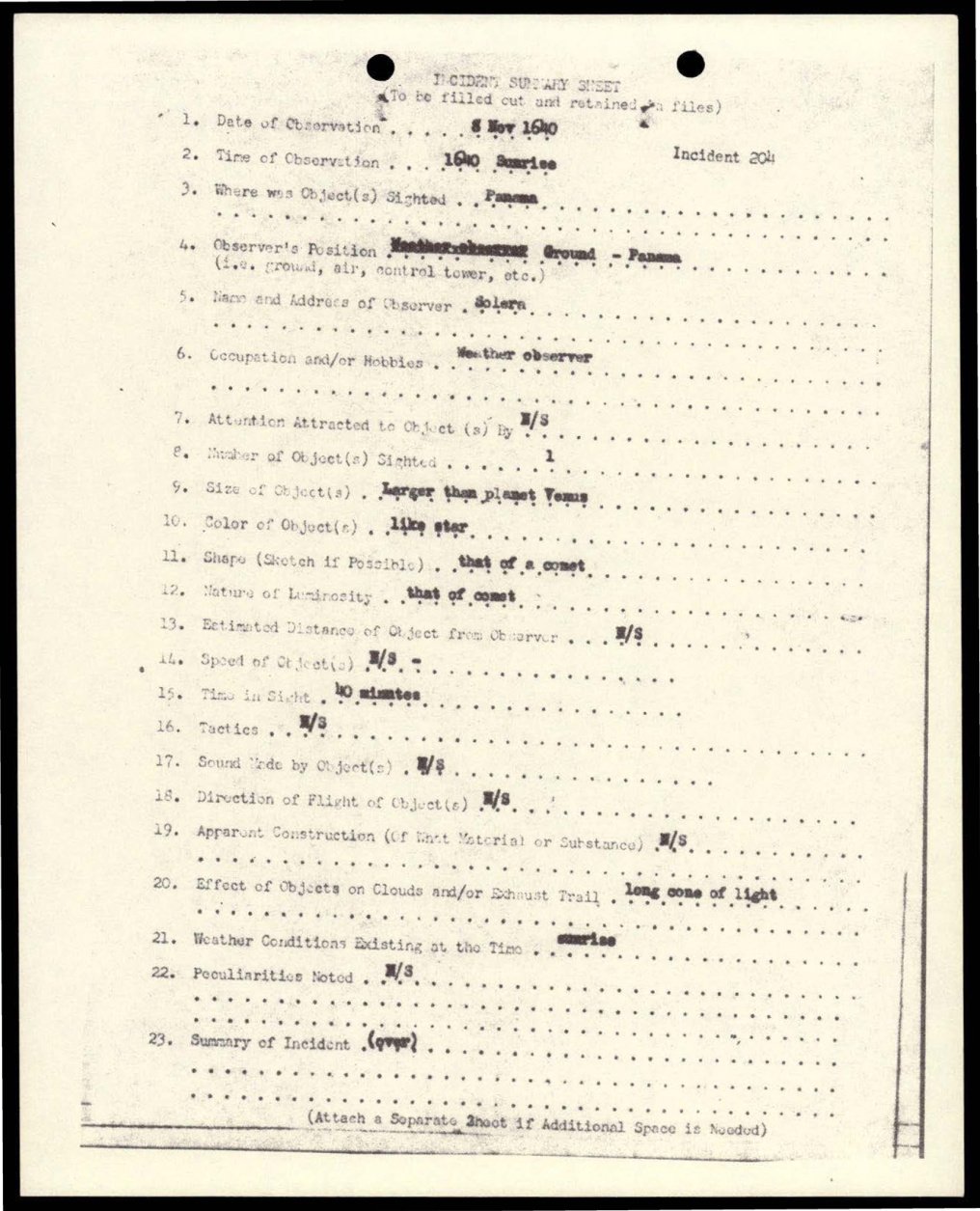 Official formPhysical page 77
DOCUMENTARY SOURCES · Arquivo histórico
What the records tell
Incident 204 has a summary sheet and a typed summary sheet. The observer appears only by his surname, Solera, and by his role: ground weather observer in Panama. The record does not indicate the station or the city. According to the summary, he saw the phenomenon while preparing a weather report with GCT time, Greenwich time. The date is November 8, 1948, although the typed 8 can also be read as 5. In the date field, the record mistakenly repeated the time, 1640, in place of the year.
What Solera saw looked like a comet in the southeast quadrant of the sky: "a long cone of light ending in a star larger than Venus." The color was that of a star, and the shape and brightness, those of a comet. The tail appeared to have "about four degrees of intensity," an expression the summary does not explain. The phenomenon remained visible to the naked eye for about 40 minutes, until the early-morning light dimmed its brightness and sunrise made it disappear. There is no record of sound, speed or movement.
The reported time is a problem. The record and the summary say 16h40 and, at the same time, "sunrise." In Panama, the sun rises around 6h, local time, or close to 11h Greenwich time; neither reading matches 16h40. The summary does not comment on the discrepancy, and it cannot be resolved from the two pages. What the two sheets make clear is that the observation ended with the arrival of daylight.
The summary itself proposes an identification. It cites, from a Life magazine article, that on November 6, 1948 (November 5 in U.S. time) astronomer Harley Wood, in Sydney, Australia, recognized a new and extraordinary comet, with a tail of 15 million miles, and that three days later early risers in the southern and western United States were able to see it with the naked eye for a few minutes before sunlight hid it. The reproduction of the Life article cited as an attachment is not in this copy of the file.
The last line sends the case to astronomer J. Allen Hynek, an Air Force consultant, so that he could say whether the reported object and the comet in the article were the same thing. The answer does not appear on these pages. As an editorial hypothesis, the description is consistent with the so-called eclipse comet of November 1948, visible before dawn in the eastern part of the sky during those weeks; the same possibility appears in the Richmond, Indiana dossier. The explanation is astronomical and does not indicate error or bad faith on the part of the observer.
The summary sheet shows a correction in field 4 itself: before "ground, Panama," someone typed "weather observer" and then struck it out, because that information belonged in the occupation field. Errors of this kind, alongside the "1640" in place of the year, suggest that the sheet was filled out from another text, not during an interview. The record does not identify the station, the agency that received the report or the date it reached Project Sign.
The summary cites Life magazine as the source of the information about the comet and says that a reproduction of the article was attached. The attachment did not remain in the box. The question sent to astronomer J. Allen Hynek also went unanswered on these sheets, and no other document collected on the portal records his opinion on incident 204. The identification with the comet therefore remains a proposal of the summary itself, awaiting confirmation.
The sheet fits the description into the fields of a form designed for aircraft: the "long cone of light" appears in the field for effect on clouds and exhaust trail, and "sunrise" occupies the weather conditions field. The speed, maneuvers, flight direction and sound fields were left as N/S, which is consistent with an object that did not move perceptibly across the sky during the roughly 40 minutes of observation.
DIRECT READING OF THE FILE
The document, in the original
Both pages of the case (physical pages 77 and 78) were translated in full: the summary sheet, field by field, and the typewritten summary with the comparison to the comet. The Life magazine reproduction cited as an attachment is not in the PDF.
EXCERPT 1 · PHYSICAL PAGE 77
Full summary sheet of incident 204, physical page 77
• •
• ♦
---
• •
• ♦
• • •
. . .
. .
Jl.-._cti .. n o F .. 1111
:,e
,"i.lA )1 . Dnt.e vf .- rv tS n .
....
IC
..,
•
1 C.1. :-;:",.
·1:1c cut
Inci en 2()lJ
. . .
(I scrvr>r ' :, .&at.. .z.•r. . •. ......( ! • ~ . ,:. \' ' . . . . ,en 1 ol tc.;\•, r , c , )
Of I S!.!rv r
6. (, cu ic. ..,r11. /or H,-,. . . . . . .. .
.,
I • Att H,t i
".1 -:h ,. e. • Ot Jee~(:·)
- . . . . . ..
1. ~llarv (Sl-:1.:tch i Po.:;.,_: tbatotaon,t
• • • • • • t •
::,., ,u·,_ c,f L:~rn:-i ., tbat ot .... ~~ - ... . . . .
!) . ,... i ':'.:,
~
. .., ... .J_:;~11r.
I ..:..1 -C f ~· • t .l ~l,\.., .I/.• -. • .. . . . .
"";"'.l ~· A......_,~,-.,,1:-. i .zi '"'l ·ltt . . . . • • . . .. .
... '"':ict ics ..I/. . . •
17. ,. II!' ':de. b·•., ' J· rt(:-.' . ."'
.•'s . . . ~
20. feet of j e on Cloud Ard/or Exh· :,i;; 1-.c. ...... .. .. . I
21. ....... . . . .. . . I .. .. .. .
2.2. Poe linritii.:s .ctcd I/• . . • . . . • I. • . . • • .• • . • . • . • • • . . . . . . .• . • . . . . . . •• • . . •2J. s, rr of eid.;nt .( l . • . . . •
. . -, . .
• . . • . . .• • • .. .. .. .. .. . . . . .. . . . . . . . . . . . . ..
(A dditionru. S cc ie • i.: cd)Editorial note: Field 1 gives "1640" in place of the year, a repetition of the time; the day digit looks like 8, but may be 5.
Check the original PDF
INCIDENT SUMMARY SHEET (To be filled out and retained in files) | Incident 204 | 1. Date of Observation: 8 Nov 1640 | 2. Time of Observation: 1640 Sunrise | 3. Where was Object(s) Sighted: Panama | 4. Observer's Position (i.e. ground, air, control tower, etc.): [Weather-observer, riscado] Ground - Panama | 5. Name and Address of Observer: Solera | 6. Occupation and/or Hobbies: Weather observer | 7. Attention Attracted to Object(s) By: N/S | 8. Number of Object(s) Sighted: 1 | 9. Size of Object(s): Larger than planet Venus | 10. Color of Object(s): like star | 11. Shape (Sketch if Possible): that of a comet | 12. Nature of Luminosity: that of comet | 13. Estimated Distance of Object from Observer: N/S | 14. Speed of Object(s): N/S | 15. Time in Sight: 40 minutes | 16. Tactics: N/S | 17. Sound Made by Object(s): N/S | 18. Direction of Flight of Object(s): N/S | 19. Apparent Construction (Of What Material or Substance): N/S | 20. Effect of Objects on Clouds and/or Exhaust Trail: long cone of light | 21. Weather Conditions Existing at the Time: sunrise | 22. Peculiarities Noted: N/S | 23. Summary of Incident: (over) | (Attach a Separate Sheet if Additional Space is Needed)View the document record ↗ · Physical page 77, counting the cover.
EXCERPT 2 · PHYSICAL PAGE 78
Summary of incident 204, physical page 78
At 1640 Nov 8, 19h Operstor Solera when making « OCT weather report
Siw what appecred to be a comet in the southes.t Quadrant of the sky.
It had a long cone of light which ented in « star lurger tian Yems.
It remained visible to the naked eye for mproximately © nimtes
until beginning of sunlight dimmed the brilliance of the phenomena
anf fv") eorrise ob) iter: ted it. Appeared to save about four gr ©
of intensity in the tail
On How 6, 1958 (Hoy 5 = USA time) Dr Harley Wood, astronower in Sidney,
dastralia recognized a new an! extraordinary comet wiich had uo tail
extenJing for 15 million miles.
Three days Later early risers in the southern and western parts of the
U, S. were able to observe the rure celestial body With the naked aye,
Moving close to the eun but away from it at a speed of about 128,000 mph,
the comet wen vicible for a brief simites before obroured th by the
man's light.
a s
See attached reprodnction taken from Life,
(Bais to ve submitted to Dr lynek for nis viewoint as to whether the
object reported and the comet mentiore’ in this article are one and the
same. )Editorial note: "gr[ad]es" has faded letters in the middle. "60 minutes" can also be read as "6 minutes": the first digit is faint. The original spells "Sidney" and "obscured th by" (with stray letters typed by mistake).
Check the original PDF
At 1640 Nov 8, 1948 Operator Solera when making a GCT weather report saw what appeared to be a comet in the southeast quadrant of the sky. It had a long cone of light which ended in a star larger than Venus. It remained visible to the naked eye for approximately 40 minutes until beginning of sunlight dimmed the brilliance of the phenomena and full sunrise obliterated it. Appeared to have about four gr[ad]es of intensity in the tail. | On Nov 6, 1948 (Nov 5 - USA time) Dr Harley Wood, astronomer in Sidney, Australia recognized a new and extraordinary comet which had a tail extending for 15 million miles. | Three days later early risers in the southern and western parts of the U. S. were able to observe the rare celestial body with the naked eye. Moving close to the sun but away from it at a speed of about 128,000 mph, the comet was visible for a brief 60 minutes before obscured by the sun's light. | See attached reproduction taken from "Life." | (This to be submitted to Dr Hynek for his viewpoint as to whether the object reported and the comet mentioned in this article are one and the same.)View the document record ↗ · Physical page 78, counting the cover.
Dates and documentary context
- Event
- 08/11/1948 — Typewritten day that looks like 8 but may be 5; time 16h40 with the note "sunrise", an inconsistent combination that the document does not explain.
- Document
- Not established — Undated summary; later than November 9, 1948, as it cites the comet's visibility in the U.S. three days after November 6.
- Publication
- Not established — Released in the National Archives batch (box 7, incidents 173 to 233).
Origin and release
U.S. Air Force, Air Materiel Command (technical intelligence, Wright-Patterson), under Project Sign; sheets compiled from witness and air base reports · 38_143685_box7_Incident_Summaries_173-233.pdf
Related accounts and their differences
Questions to continue the investigation
- Did Hynek ever answer whether the Panama "comet" was the comet of November 1948?
- Is the time 16h40 Greenwich time, local time, or a typing error?
GEOGRAPHY OF THE CASE
Panama
The record card says only Panama, with no station or city; no point was placed.
DOCUMENTARY TRAIL
Go back to the sources
References use physical pages of the PDF, counting the cover. Summaries are presented in English; the documents keep their original language.
- 38_143685_box7_Incident_Summaries_173-233.pdf
Physical page 77: summary sheet for incident 204, Panama, November 1948 · Physical page 78: summary of incident 204, with the comparison to the November 1948 comet and the request for Hynek's opinion
Arquivo histórico · 144 pages
Editorial summary based on the collection's research notes. How we read the documents.