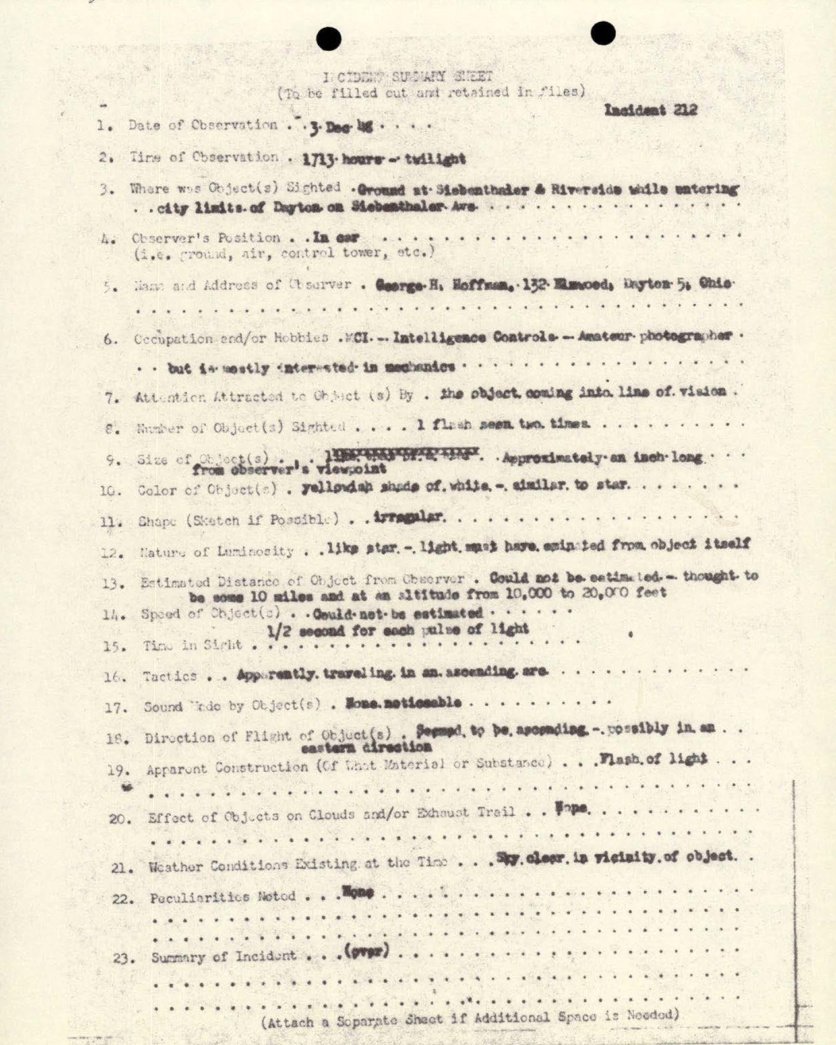
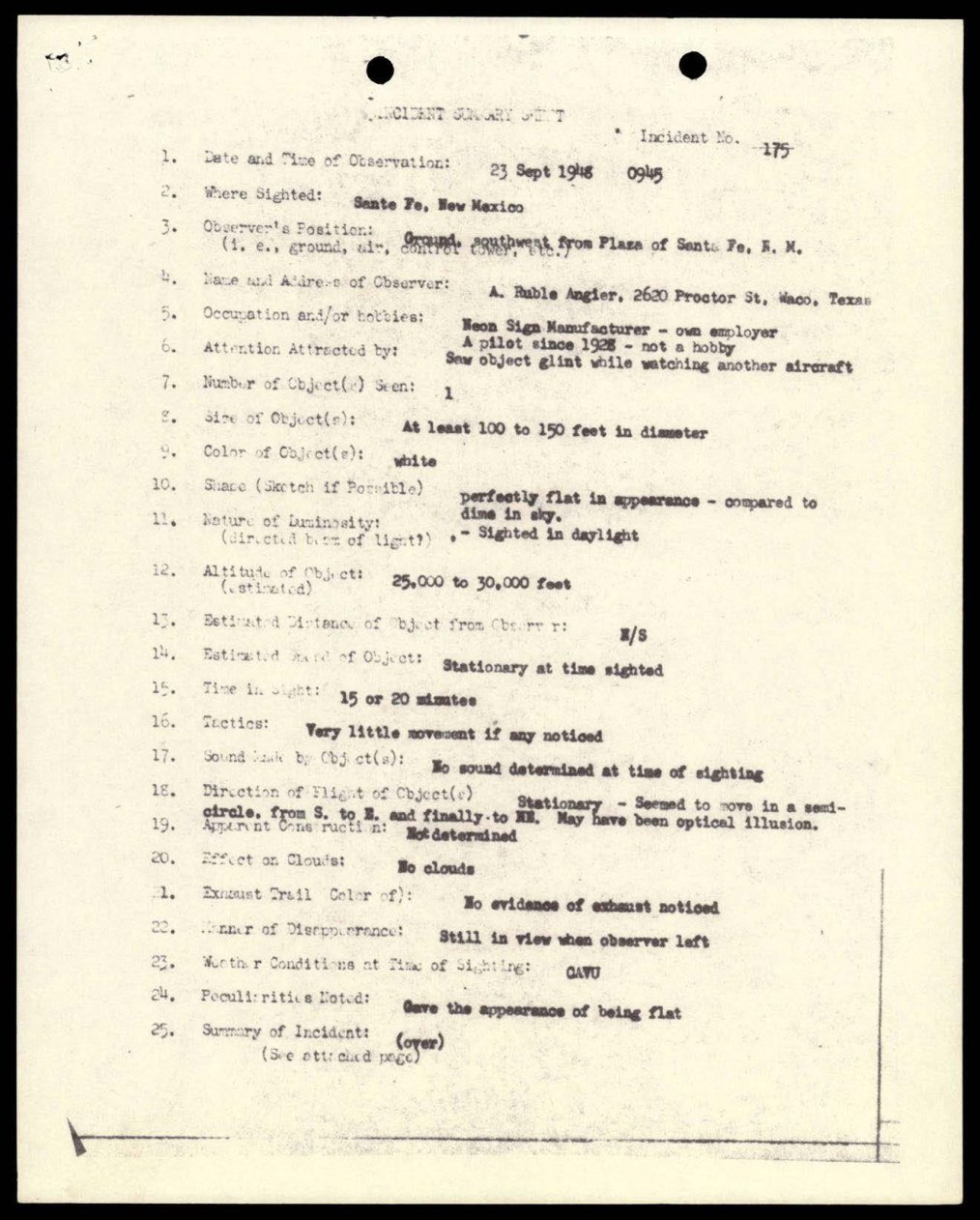
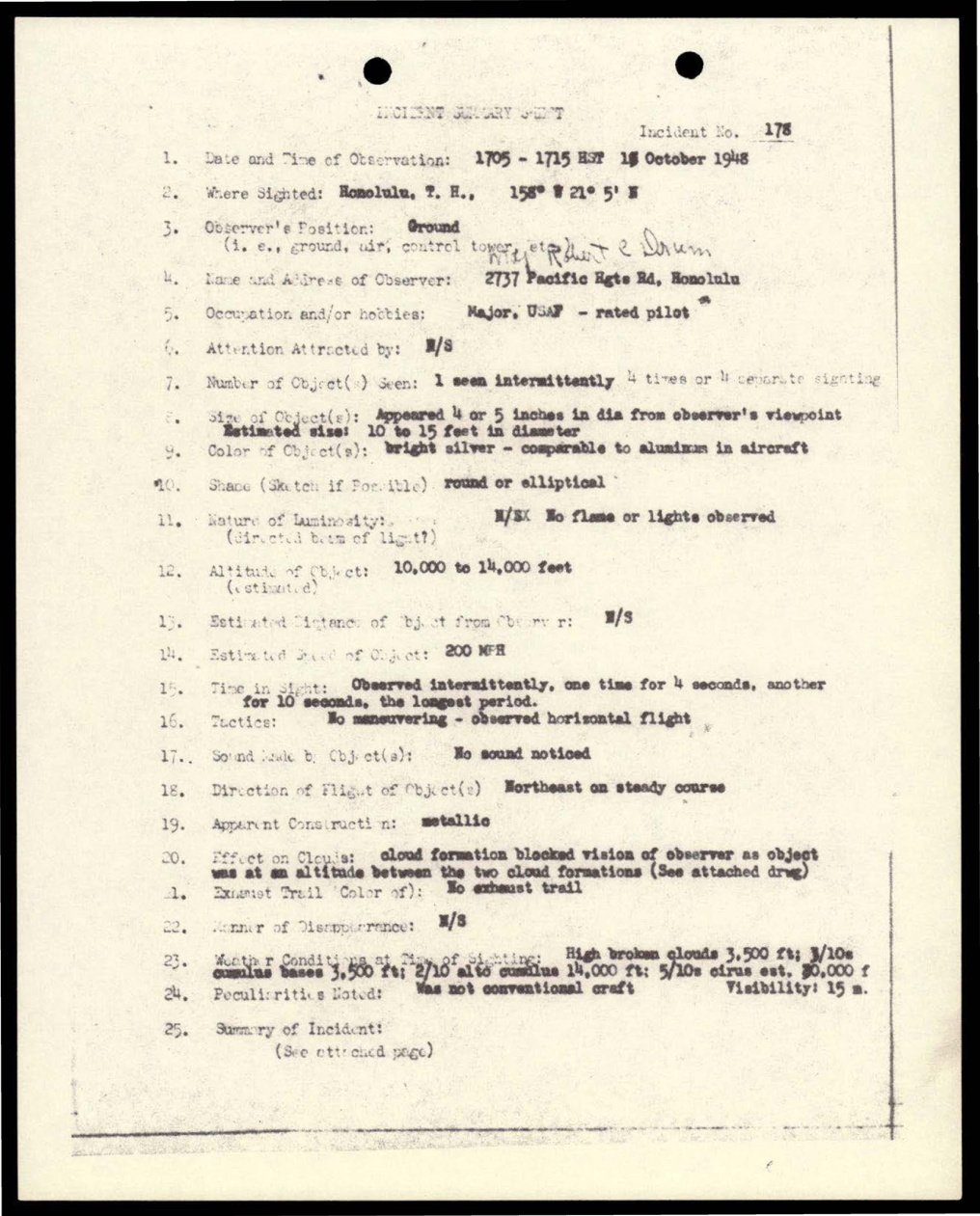
Date: 05/11/1948, from 4:35 to 4:55Location: Palladium-Item newspaper building, Richmond, Indiana
Richmond, Indiana, 1948: a journalist photographs a UFO hanging motionless in the predawn sky
After two phone calls from readers, the sports editor of a Richmond newspaper watched a UFO of white, flickering light to the east for 20 minutes and took two long-exposure photos. The file records the consultation with an astronomer and the comparison with flares, and cites a magazine that spoke of a comet visible in those days.
- Event date
- 05/11/1948, from 4:35 to 4:55
- Location
- Palladium-Item newspaper building, Richmond, Indiana
- Topic
- 1948 reports
- Source agencies
- Arquivo histórico
- Documents
- 1 document · 144 pages
- Reading time
- 8 min
 Official summaryPhysical page 54
DOCUMENTARY SOURCES · Arquivo histórico
What the records tell
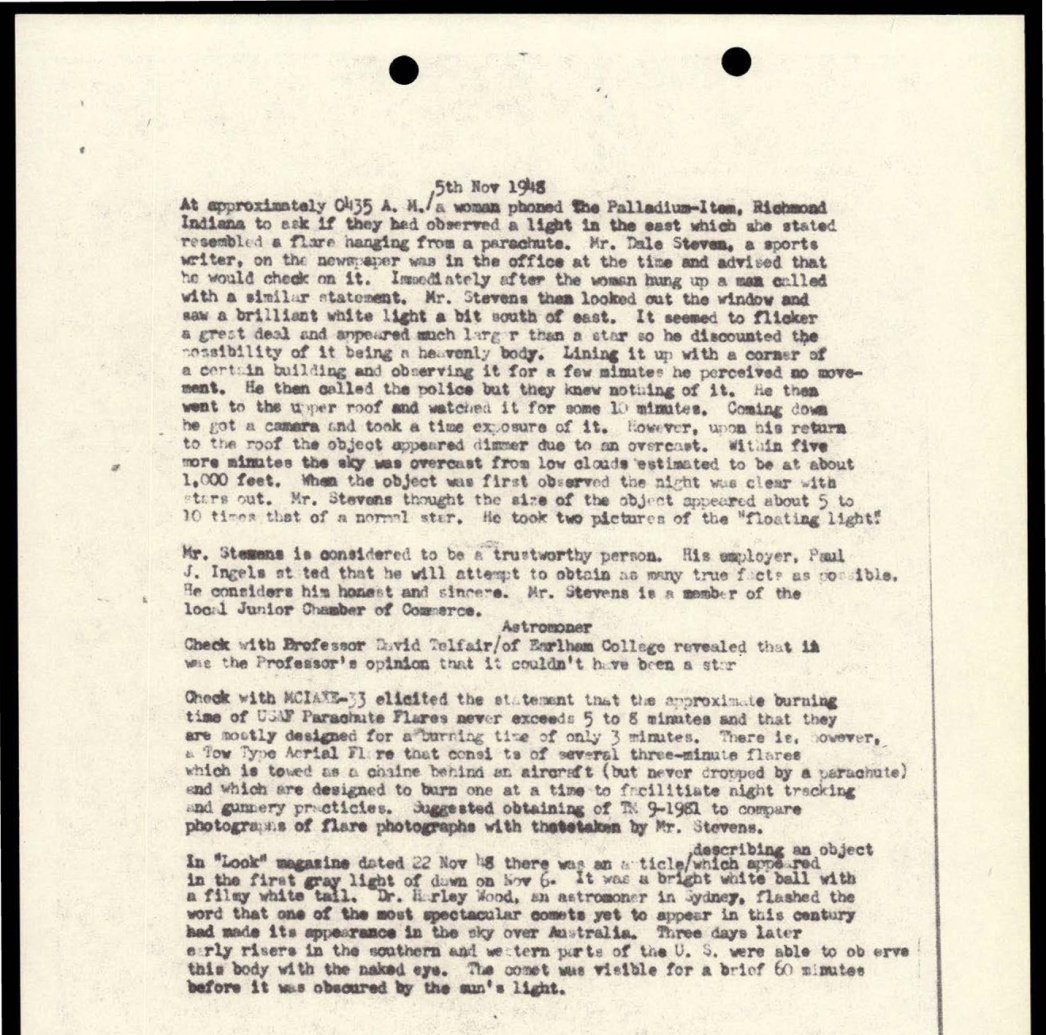
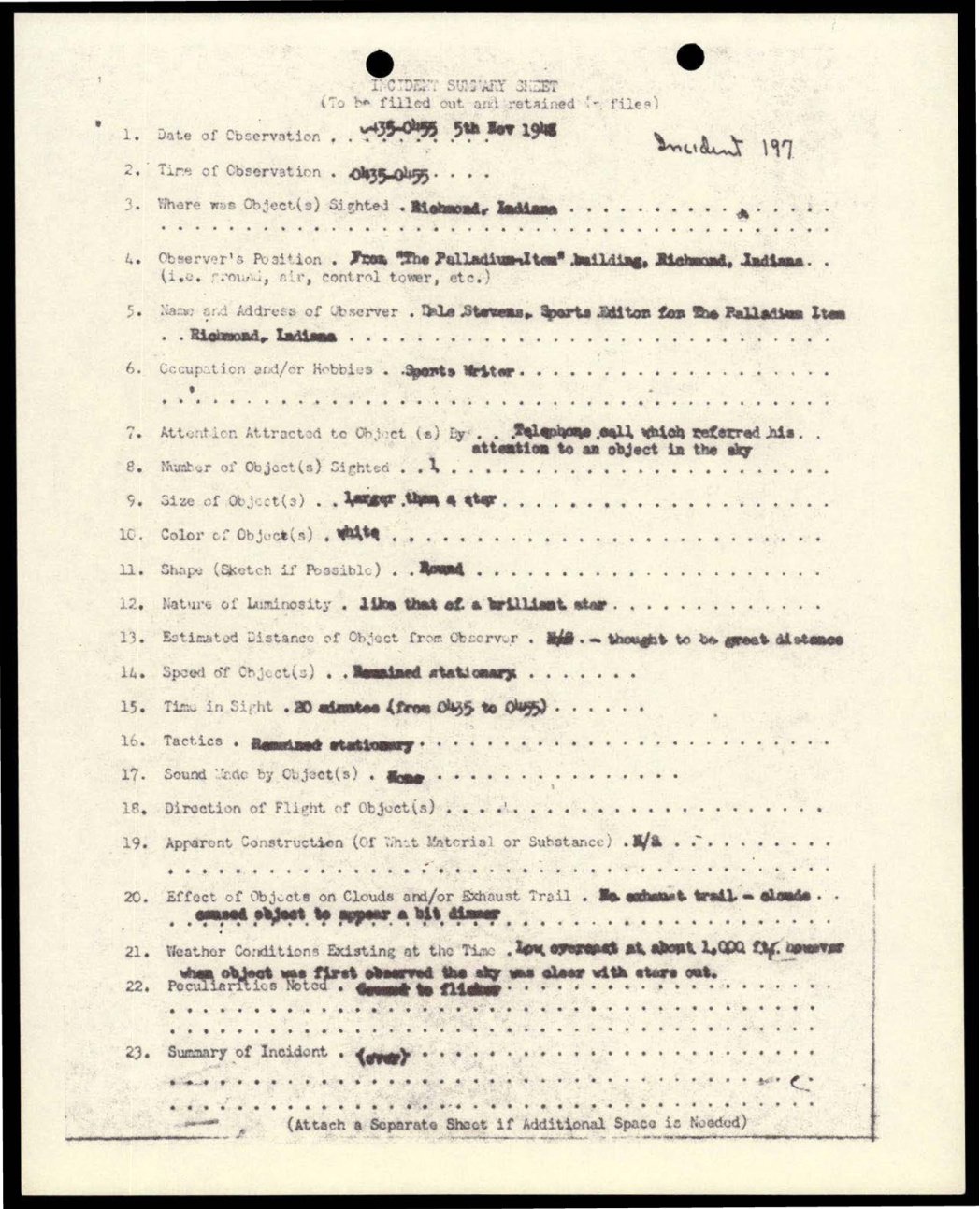
At around 4:35 on November 5, 1948, a woman phoned the newsroom of the Palladium-Item, a newspaper in Richmond, Indiana, asking whether they had seen a light to the east that looked like a flare hanging from a parachute. Dale Stevens, the sports editor, was in the newsroom and said he would check. As soon as she hung up, a man called with a similar report. Stevens looked out the window and saw a bright white light slightly south of east.
According to Project Sign incident 197, the light appeared to flicker a great deal and was much larger than a star, so he ruled out a celestial body. Lining it up with the corner of a building, he noticed no movement over several minutes. He called the police, who knew nothing, and went up to the roof, where he watched it for about 10 minutes. He went down, got a camera and made a long exposure. When he returned, the light was fainter because of clouds, and within five minutes the sky closed in with low clouds, estimated at 1.000 feet. He estimated the apparent size at 5 to 10 times that of an ordinary star and took two photos of the "floating light."
The file records three checks. Stevens's employer, Paul J. Ingels, considered him honest and sincere. Professor David Telfair of Earlham College gave the opinion that it could not have been a star. An Air Force office identified as MCIAXE-33 reported that Air Force parachute flares do not burn more than 5 to 8 minutes, but that there is a towed flare, with several three-minute flares burning in sequence for night training. The report suggested obtaining manual TM 9-1981 to compare photos of flares with Stevens's.
The last paragraph of the summary cites the November 22, 1948, issue of Look magazine, which described an object seen in the first gray light of dawn on November 6: a bright white ball with a faint white tail. According to the magazine, astronomer Harley Wood of Sydney had announced one of the most spectacular comets of the century, visible to the naked eye in the southern and western U.S. three days later, for about 60 minutes before being outshone by the Sun. The report does not say whether the Richmond light was this comet.
Stevens's two photographs are not in this copy of the file. The idea that he saw the eclipse comet of November 1948, low in the east before dawn, is an editorial hypothesis consistent with the time, the direction and the reference in the record itself. The light's stillness and flickering also fit a celestial body low on the horizon, but none of this was confirmed in the document.
The record for incident 197 uses a different form from its neighbors in the same bundle: it has 23 items, bears the instruction "to be filled out and kept in the files," and was given its incident number by hand. The summary was written after November 22, 1948, the date of the magazine cited in the last paragraph, and therefore at least 17 days after the sighting. The bundle of summary sheets for incidents 173 to 233 was sent by the Air Materiel Command on March 9, 1949. The collection does not contain Stevens's two photos, the manual TM 9-1981 suggested for comparison, or any sign that this comparison was made.
The papers make it possible to separate what each party contributed. The main account is Stevens's; the two people who phoned the newspaper are unnamed and were not interviewed. The only check made by the witness himself was lining the light up with the corner of a building to see whether it moved. The size, "5 to 10 times that of an ordinary star," is a visual impression. The assessments come from outside: the employer vouched for Stevens's character, the Earlham College professor said it could not have been a star, and the Air Force technical office reported the burn time of parachute flares. The document draws no conclusion.
The mention of the comet comes from a magazine, Look, and not from an official observation; the investigator summarized it without saying whether he considered it connected to the case. The long-exposure photos would be the only record capable of showing the position and appearance of the light, and that is precisely what is missing. No other page in the collection mentions Richmond, Indiana, the Palladium-Item or Dale Stevens. The November 1948 comet interpretation, already presented as an editorial hypothesis, remains plausible, without documentary confirmation.
More images from the document
DIRECT READING OF THE FILE
The document, in the original
All pages of the case in this PDF were translated in full, one per block, and checked against the facsimile: the standardized "Incident Summary Sheet" form (items 1 to 25) and the attached summary sheet. Pages 53 and 54 translated in full. The reference to Look magazine is the investigator's paraphrase, not a clipping, and was translated as part of the official document. For privacy, home addresses, telephone numbers, military service numbers and health data of private individuals were replaced with bracketed markers; the rest follows the original.
EXCERPT 1 · PHYSICAL PAGE 53
Physical page 53: form for incident 197
I
-r:
out an: _'CJ ;t. ed ' . fil ..)\ 7o . f
ion , - ~~ .5 ,
\,.\
,,_.., . r.'~ cf Cb orv:ltion . . • .~-
J . ·Iha-re ~J Cb~cet(o) J.~hteJ ·11 Je,U . . . . . • . • • . . . . •
l. . -b"erv"'r'
l • • • . . • \ cont r(\l o --.lW laUdS·• ---.
'
b. Cc u ~ ion ~r, /er
..•. . . . . ..
~ I • At t,J~ t •er. :. t . act.: to 01--,i,,ct.
,...'e. '".r..t-~r t)l 0 joct ) h e<i .'"'·
9 , Ghc cf Oi:: 11.:.t(s) . -~- .. .. . . . . ..
lC•. Color c:' Obj l.!Ct . . . . . .. .' ♦ • • •
11 . 5ti;-, .J ( otc if ..
4
..,
f at & lril.Ula\ . . . . ..
. .
14. 1 . !-,.,1..C • ~) • • ri&\.t . . . . .
15 . ~-- ir irht • 5,
lo . Tact.ice . . . . . . . .
1 Sound ·.~.de .,, C jc-ct(s) •
-
. . . . . . . .
1 • Di ction of F i ..ht 0f O j1Jct"s) '. . . . . . . . ..
n (or tcrio 1 or Su ot ,cc) . . . . . .... ,. . ................. .
20 . Eff ct of Obj'-ct M Clouds ord/ or Sxho.u!lt Tr ll • la,
.'· . . . . . . . . . . . . .. . . . . . . . . . . .•!".''·'~- " . ~
19.
21 . athor Co:,ctitio Wstin~ t t
......~ 22 . 0 ••1••
• • . . . • . . • . • • • • • . • • • . . • . . . • . • . . • . • . . . ..... . ' . . . . .. . . . . .. . .
~
J. Swt.1Wlr y_of lnci . . . . . . . .
... .. ....... . ... . . . . . . .... . .. .. . .~ ... .. . . . . ..
i r Ad.dit~oMl S~co i.: N cd)
---- --~-----------------
.... . • . • . . • . . . .Editorial note: The incident number, 197, is handwritten at the top. The address cited is that of the newspaper, the place of work.
Check the original PDF
INCIDENT SUMMARY SHEET (To be filled out and retained in files). Incident 197 [handwritten]. 1. Date of Observation: 0435-0455 5th Nov 1948. 2. Time of Observation: 0435-0455. 3. Where was Object(s) Sighted: Richmond, Indiana. 4. Observer's Position: From "The Palladium-Item" building, Richmond, Indiana. 5. Name and Address of Observer: Dale Stevens, Sports Editor for The Palladium Item, Richmond, Indiana. 6. Occupation and/or Hobbies: Sports Writer. 7. Attention Attracted to Object(s) By: Telephone call which referred his attention to an object in the sky. 8. Number of Object(s) Sighted: 1. 9. Size of Object(s): Larger than a star. 10. Color of Object(s): White. 11. Shape (Sketch if Possible): Round. 12. Nature of Luminosity: like that of a brilliant star. 13. Estimated Distance of Object from Observer: N/S - thought to be great distance. 14. Speed of Object(s): Remained stationary. 15. Time in Sight: 20 minutes (from 0435 to 0455). 16. Tactics: Remained stationary. 17. Sound Made by Object(s): None. 18. Direction of Flight of Object(s): [blank]. 19. Apparent Construction (Of What Material or Substance): N/S. 20. Effect of Objects on Clouds and/or Exhaust Trail: No exhaust trail - clouds caused object to appear a bit dimmer. 21. Weather Conditions Existing at the Time: Low overcast at about 1,000 ft, however when object was first observed the sky was clear with stars out. 22. Peculiarities Noted: Seemed to flicker. 23. Summary of Incident: (over). (Attach a Separate Sheet if Additional Space is Needed).View the document record ↗ · Physical page 53, counting the cover.
EXCERPT 2 · PHYSICAL PAGE 54
Physical page 54: summary of incident 197
f
r>bomd oM..1.-au.,Wll"'l t.a. JU.ota.-1mr.:>roxilmi.ly
U' _,.~ \be Met wbi 11M I ted.
fi.v- a • Stfftat • aporh
wnter • in \he Til)4)d thlt.t
l Atc-1.J ~ 184
with a . 5 t the
ae• ■ d to r t a,wtN,_,;J~ he diaocnmted
up vith a
a percei Y!
·tnc of
• i ~nby per :()
J. I t o o :~u q_. • .r. I 1
loa.J. Jw,i,0r r.'hit.n.
in Brores$01" !},v1d • i-/
op1Jd.cc 1t
i-:· .te bur
and th t
1 I
(,re
b7 • . e)
t ir9ek1ac
~
•
b c\In. I.DI d.ll. ..~ 1JS. UMbl w,
• f'U • 7.k-. t" r !ulhe.d the
WOJ"d ''° 110GMill aede S.h IPIJ,Nl'allCle lat I'
e ,-i, n e t • U. S. a~l• to ob rH . I
thll 1 t !Of' a f fJ1 : tat
WON l\Editorial note: The original spells "Steven" once and "Stevens" elsewhere; "Stemens" appears due to a typing error. "MCIAXE-33" is an office code of the Air Materiel Command, kept as in the original. The original writes "obtain as many true facts", attributed to the employer; translated literally.
Check the original PDF
5th Nov 1948. At approximately 0435 A. M./a woman phoned The Palladium-Item, Richmond Indiana to ask if they had observed a light in the east which she stated resembled a flare hanging from a parachute. Mr. Dale Steven, a sports writer, on the newspaper was in the office at the time and advised that he would check on it. Immediately after the woman hung up a man called with a similar statement. Mr. Stevens then looked out the window and saw a brilliant white light a bit south of east. It seemed to flicker a great deal and appeared much larger than a star so he discounted the possibility of it being a heavenly body. Lining it up with a corner of a certain building and observing it for a few minutes he perceived no movement. He then called the police but they knew nothing of it. He then went to the upper roof and watched it for some 10 minutes. Coming down he got a camera and took a time exposure of it. However, upon his return to the roof the object appeared dimmer due to an overcast. Within five more minutes the sky was overcast from low clouds estimated to be at about 1,000 feet. When the object was first observed the night was clear with stars out. Mr. Stevens thought the size of the object appeared about 5 to 10 times that of a normal star. He took two pictures of the "floating light". Mr. Stevens is considered to be a trustworthy person. His employer, Paul J. Ingels stated that he will attempt to obtain as many true facts as possible. He considers him honest and sincere. Mr. Stevens is a member of the local Junior Chamber of Commerce. Astronomer. Check with Professor David Telfair of Earlham College revealed that it was the Professor's opinion that it couldn't have been a star. Check with MCIAXE-33 elicited the statement that the approximate burning time of USAF Parachute Flares never exceeds 5 to 8 minutes and that they are mostly designed for a burning time of only 3 minutes. There is, however, a Tow Type Aerial Flare which consists of several three-minute flares which is towed as a chain behind an aircraft (but never dropped by a parachute) and which are designed to burn one at a time to facilitate night tracking and gunnery practices. Suggested obtaining of TM 9-1981 to compare photographs of flare photographs with those taken by Mr. Stevens. In "Look" magazine dated 22 Nov 48 there was an article describing an object which appeared in the first gray light of dawn on Nov 6. It was a bright white ball with a filmy white tail. Dr. Harley Wood, an astronomer in Sydney, flashed the word that one of the most spectacular comets yet to appear in this century had made its appearance in the sky over Australia. Three days later early risers in the southern and western parts of the U. S. were able to observe this body with the naked eye. The comet was visible for a brief 60 minutes before it was obscured by the sun's light.View the document record ↗ · Physical page 54, counting the cover.
Dates and documentary context
- Event
- 05/11/1948 — From 04h35 to 04h55, local time.
- Document
- Not established — Summary without a date of writing; it cites a magazine dated 22/11/1948, so it was written after that date.
- Publication
- Not established — Document released in Release 1 of the collection.
Origin and release
U.S. Air Force, Project Sign; incident summary sheets with no identified individual author · 38_143685_box7_Incident_Summaries_173-233.pdf
undefined ↗ — undefined
Questions to continue the investigation
- Were Dale Stevens's two long-exposure photographs sent to Project Sign, and do they exist in any archive?
- Does the position of the 1948 eclipse comet in the Indiana sky in the early morning hours of 5 November match the light described?
GEOGRAPHY OF THE CASE
Richmond, Indiana, USA
Approximate reference to the city cited in the record card, placed by the editors. It does not indicate the position of the UFO in the sky.
DOCUMENTARY TRAIL
Go back to the sources
References use physical pages of the PDF, counting the cover. Summaries are presented in English; the documents keep their original language.
- 38_143685_box7_Incident_Summaries_173-233.pdf
Physical pages 53 and 54: incident 197 (record and summary)
Arquivo histórico · 144 pages
Editorial summary based on the collection's research notes. How we read the documents.