Date: 10/08/1944, shortly after midnightLocation: Sky over Palembang, Sumatra (present-day Indonesia), during a bombing mission launched from Ceylon
Palembang, Sumatra, 1944: B-29 commander says a red spherical UFO with a halo followed the bomber for eight minutes after the raid
Captain Alvah M. Reida, commander of a B-29, reported to NICAP that, after bombing Palembang, a red or orange spherical UFO with a halo paced his airplane at 500 yards for about eight minutes, repeating every evasive maneuver. The account is in the private 1964 report kept by the CIA.
- Event date
- 10/08/1944, shortly after midnight
- Location
- Sky over Palembang, Sumatra (present-day Indonesia), during a bombing mission launched from Ceylon
- Topic
- CIA file
- Source agencies
- CIA
- Documents
- 1 document · 186 pages
- Reading time
- 14 min
 Page of the NICAP reportPhysical page 30
DOCUMENTARY SOURCES · CIA
What the records tell
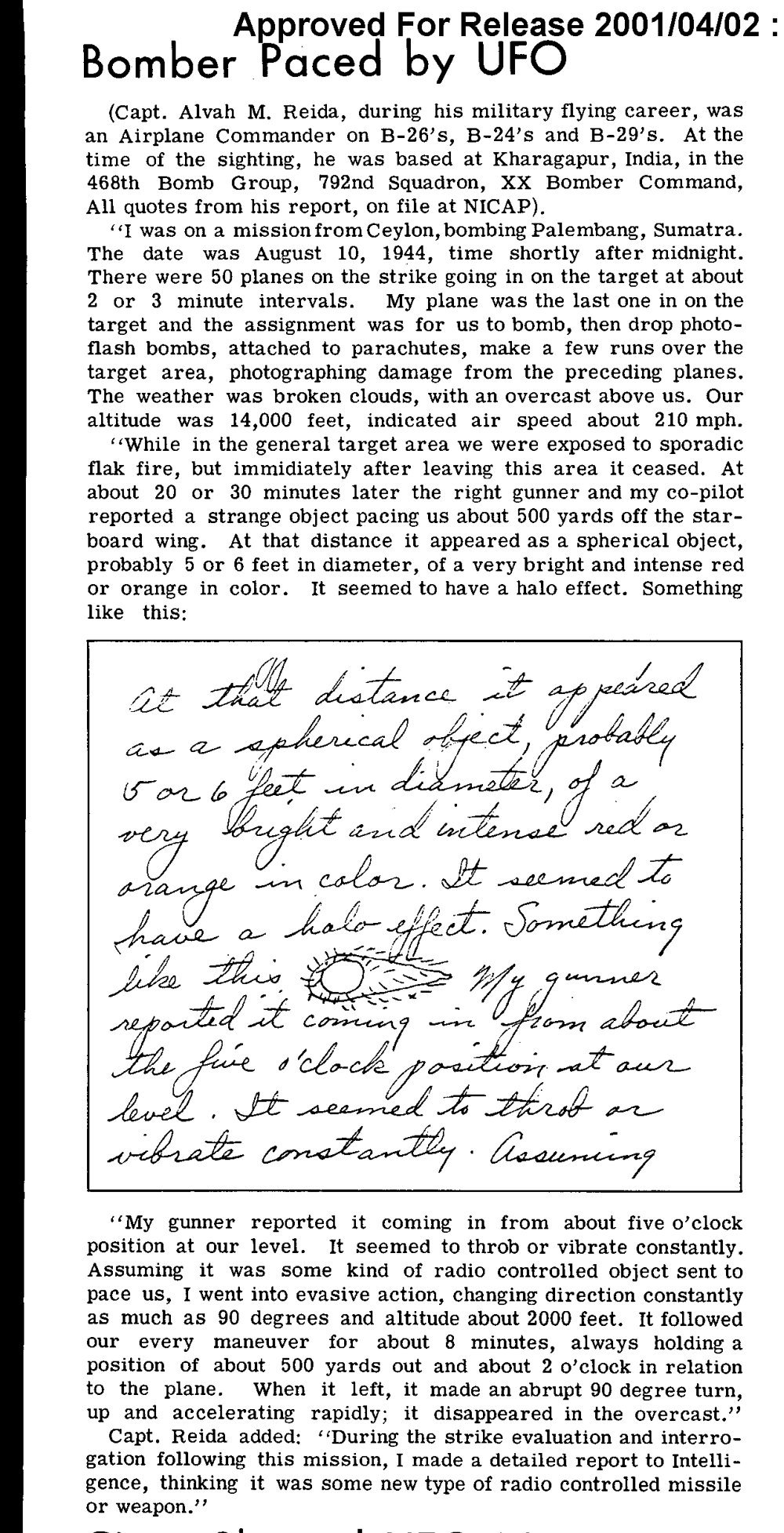
The account is in the section of the report The UFO Evidence on Air Force military personnel. NICAP, a civilian organization that studied flying saucers, published the book in 1964, and the CIA kept a copy. The witness is Captain Alvah M. Reida, who over his career commanded B-26s, B-24s and B-29s and, at the time, was based in Kharagpur, India, in the 468th Bombardment Group, 792nd Squadron, of the XX Bomber Command. NICAP says that all quotations come from his report, filed with the organization, and reproduces a handwritten excerpt with a small sketch.
According to Reida, the mission left Ceylon to bomb Palembang, in Sumatra, on August 10, 1944, shortly after midnight. There were 50 airplanes, entering the target at intervals of two or three minutes. His was the last: it was to bomb, drop parachute flares and make a few passes photographing the damage. There were scattered clouds and a cloud layer above; they were flying at 14.000 feet, at about 210 miles per hour. Over the target there was sporadic antiaircraft fire, which ceased shortly afterward.
Some 20 or 30 minutes later, the right gunner and the copilot reported a strange object pacing the airplane about 500 yards off the right wing. At that distance it appeared spherical, about 5 or 6 feet in diameter, a very bright and intense red or orange, with a halo effect. The gunner said it had come from the five o'clock position, at the same altitude, and seemed to pulsate or vibrate constantly. In the handwritten excerpt, Reida draws a small sphere surrounded by rays.
Thinking it was some radio-controlled object sent to pace them, Reida made evasive maneuvers, changing course by up to 90 degrees and altitude by about 2.000 feet. The object followed each maneuver for about eight minutes, always at some 500 yards and in the two o'clock position. When it left, it made an abrupt 90-degree turn upward, accelerated quickly and disappeared into the cloud layer. Reida added that, at the debriefing and interrogation after the mission, he made a detailed report to intelligence, thinking it was a new missile or radio-controlled weapon.
The episode belongs to the series of so-called "foo fighters," lights seen by Allied crews in World War II. The account reached NICAP many years later, and the report does not reproduce the 1944 intelligence document or say when Reida wrote to the organization. Size, distance and duration are estimates by someone on a night flight, in a sky still lit by flares and by the attack; NICAP does not discuss explanations. The pilots table on page 39 summarizes the case in one line.
DIRECT READING OF THE FILE
The document, in the original
The UFO Evidence report is a private NICAP publication, held by the CIA, and not an official document. For this reason each page appears as a faithful summary in English, one block per page, without transcription or literal translation, with at most one short quotation; table rows are rendered one by one. The part of page 30 about the case and the table row on page 39 were summarized. The rest of page 30 (Puckett, Combs, the Wright-Patterson employee and Kinman) is in other dossiers and in the report's documentary dossier.
EXCERPT 1 · PHYSICAL PAGE 30
Physical page 30, account "Bomber Paced by UFO" (summary of the part about the case)
observed wl ought ooting star 990 southeast over
proved For iize% 2001/04/02 : CIA-RDP81R00560R000100010001-
Bomber ‘Paced d by
(Capt. Alvah M, Reida, during his military flying career, was
an Airplane Commander on B-26’s, B-24’s and B-29’s. At the
time of the sighting, he was based at Kharagapur, India, in the
468th Bomb Group, 792nd Squadron, XX Bomber Command,
All quotes from his report, on file at NICAP).
“‘T was on a mission from Ceylon, bombing Palembang, Sumatra.
The date was August 10, 1944, time shortly after midnight.
There were 50 planes on the strike going in on the target at about
2 or 3 minute intervals. My plane was the last one in on the
target and the assignment was for us to bomb, then drop photo-
flash bombs, attached to parachutes, make a few runs over the
target area, photographing damage from the preceding planes.
The weather was broken clouds, with an overcast above us. Our
altitude was 14,000 feet, indicated air speed about 210 mph.
‘While in the general target area we were exposed to sporadic
flak fire, but immidiately after leaving this area it ceased. At
about 20 or 30 minutes later the right gunner and my co-pilot
reported a strange object pacing us about 500 yards off the star-
board wing. At that distance it appeared as a spherical object,
probably 5 or 6 feet in diameter, of a very bright and intense red
or orange in color. It seemed to have a halo effect. Something
like this:
“ee fo feet oe
le Ese oct ihn
“My gunner reported it coming in from about five o’clock
position at our level. It seemed to throb or vibrate constantly.
Assuming it was some kind of radio controlled object sent to
pace us, I went into evasive action, changing direction constantly
as much as 90 degrees and altitude about 2000 feet. It followed
our every maneuver for about 8 minutes, always holding a
position of about 500 yards out and about 2 o’clock in relation
to the plane. When it left, it made an abrupt 90 degree turn,
up and accelerating rapidly; it disappeared in the overcast.’’
Capt. Reida added: ‘‘During the strike evaluation and interro-
gation following this mission, I made a detailed report to Intelli-
gence, thinking it was some new type of radio controlled missile
or weapon.’’
Cigar-Shaped UFO Near
AF Transport
(Capt. Jack Puckett, at the time ofhis UFO sighting, was Flying
Safety Officer, Hdq., Tactical Air Command, 300th Base Unit,
Langley Field, Va. His duties included supervision of flying op-
erations and training, investigation of all aircraft accidents in his
command. He has served as an instructor pilot, four engine air-
craft, and flew a tour of combat in the European Theater, World
War Il).
“IT was making a scheduled flight from Langley Field, Virginia
[August 1, 1946] to MacDill Field, Tampa, Florida. At approxi-
mately 6 p.m. while flying a C-47 at 4000 feet northeast of Tampa
the Atlantic Ocean. My copilot, Lt. Henry F. Glass and my engi-
neer both observed this object at the same time.
“This object continued toward us ona collision course at our
exact altitude. At about 1000 yards it veered to cross our path.
We observed it to bea long, cylindrical shape approximately twice
the size of a B-29, with luminous portholes.’”’
The UFO seemed to be rocket propelled, Capt. Puckett stated.
The object trailed a stream of ‘‘fire’’ about one-half its own
length, and remained in sight 2 1/2 to 3 minutes.
Pilot Has “Dogfight”
With Oval Object
About 9:45 p.m. November 18, 1948 Lt. Henry G. Combs was
approaching Andrews AFB, Maryland, near the Nation’s Capital,
in a T-6. Suddenly he noticed an odd light over the base, so he
closed in to check on it. Abruptly, the light ‘‘began to take violent
evasive action.’? Repeatedly, Combs tried to close in on the
maneuvering object. But each time it would turn so sharply that
he couldn’t turn with it.
In his official report on the incident, Lt. Combs stated: ‘‘I
chased the light up and down and around for about 10 minutes,
then as a last resort I made a pass and turned on my landing
lights. Just before the object made a final tight turn and headed
for the coast I saw that it was a dark gray oval-shaped object,
smaller than my T-6.”’
The UFO moved at variable speeds, vertically and horizontally.
Lt. Combs estimated it traveled as fast as 600 mph.
TECHNICAL INTELLIGENCE CENTER
OFFICIAL OBSERVES DISC, SHARP TURN
On June 1, 1951, about 10:00 p.m., an official at Wright-
Patterson AFB, Ohio, sighted an apparently disc-shaped UFO.
Because of his sensitive position, he has requested that his name
be kept confidential. The report is certified by the NICAP
Director and Assistant Director. (Note: All confidential reports
in this document, certified by NICAP officials, will be made
available to any authorized Congressional investigators.)
«While driving West near Dayton, Ohio, I suddenly became aware
of a large blue-white light moving parallel to me. It was parallel
and to the left at 30to 45 degrees elevation. I can best describe it
as being similar to the flame trail from a rocket power plant.
It was a clearly defined outline similar to a stubby cigar. It
was much brighter at the leading end, and gradually dimmer to-
ward the trailing end. After 10to 15 seconds it made approximate-
ly a right angle turn, became circular and even-colored, and
rapidly disappeared. I detected no trace of yellow, orange, red
or purple in the color. The speed was faster than an airplane,
slower than a meteor.’’
Disc Buzzes Fighter Plane
The following case was reported by Cleveland Press Aviation
Editor Charles Tracy, a former wing operations officer in the
Air Force. (Originally reported in Cleveland Press, picked up
by United Press International, July 30, 1952).
During the Summer of 1951, Lt. George Kinman was flying over
Augusta, Georgia, on a clear, sunny day. At the time, he was a
seven year flying veteran, since a jet pilot at overseas bases.
“IT was cruising at about 250 mph.,’’ Lt. Kinman told Tracy.
“All of a sudden I noticed something ahead, closing in on me,
head on. Before I could take evasive action ~ before I even
thought of it, in fact - this thing dipped abruptly and passed under-
neath just missing my propeller. The thing was definitely of
disc shape. . . white. .. pretty thick. .. it looked like an
oval. . . it was about twice as big as my plane, It had no visible
protrusions like motors, guns, windows, smoke or fire.’’
Lt. Kinman swung his F-51 around, but the disc was out of
sight. Within about 15 seconds, he said, the disc came at him
again, dipping at the last minute. This performance was repeated
several times for a period of 5 to 10 minutes. Finally, on its
last pass, the UFO zoomed upward instead of down, just missing
his canopy.
Approved For Release 2001/04/02” CIA-RDP81R00560R000100010001-0Editorial note: "United Press International, July 30, 1952" appears this way in the original, although the merger that created UPI dates from 1958; recorded in corrections.
Check the original PDF
[p. 30: texto da publicação privada não reproduzido; ver o resumo]View the document record ↗ · Physical page 30, counting the cover.
EXCERPT 2 · PHYSICAL PAGE 39
Physical page 39, row of the pilots table (summary)
Approved For Release 2001/04/02 : CIA-RDP81R00560R000100010001-0
SECTION V
PILOTS & AVIATION EXPERTS
If UFOs had not been reported by pilots of scheduled air-
liners, and military pilots in operation all over the globe, there
might be some justification in writing off reports of ground ob-
servers as mistaken observations. For, if unknown objects are
maneuvering in our skies, pilots would be among the most likely
to see them. (Others whose professions cause them to spend many
hours watching the skies, such as General Mills Corporation
balloon trackers, also have reported numerous UFOs. [1])
Airline and military pilots are among the most experienced
observers of the sky. Their profession requires them to spend
hundreds of hours per year inthe air. Few, if any, occupations
require more practical knowledge of weather, other aircraft, and
unusual activity such as missile tests. Undoubtedly, few groups
of observers have seen more meteors or watched planets under
a wider variety of sky conditions. In addition, professional pilots
normally are trained in rapid identification of anything which may
endanger a flight. Therefore, it is significant that airline and
military pilots have reported a large number of totally unexplained
UFO sightings.
Recognizing that airline pilots have special training and are
in a unique position for observation, the Defense Department in-
cludes them in the military system of reporting vital intelligence
sightings (CIRVIS), as detailed in the Joint Chiefs regulation
JANAP-146(D). [See Section Ix.] In 1954, the groundwork for
CIRVIS reports was laid by meetings between representatives of
the airlines and Military Air Transport Service (MATS) intelli-
gence branch. The reason? ‘‘The nation’s 8,500 commercial
airline pilots have been seeing a lot of unusual objects while
flying at night, here and overseas,’’ Scripps-Howard reported.
“But,’’? the report continued, ‘‘there hasn’t been much of an or-
ganized system of reporting to military authorities. . . [the air-
lines and MATS] agreed to organize a speedy reporting system
so that a commercial pilot spotting strange objects could send
the word to the Air Force ina hurry. The Air Force could then
send jet fighters to investigate.” [2]
With a few exceptions, most UFO reports on record from
military pilots have come from the World War II and Korean War
eras, or from recently retired officers. Military pilots, naturally,
are restricted from discussing the sightings freely while they are
on active duty. But airline pilots (althoughin recent years some-
times under pressure from their companies not to discuss
sightings) have contributed some of the best reports on record.
There had been scattered reports by airline pilots previously
put ‘In the Spring of 1950,’’ the former Chief of the Air Force
UFO project reported, ‘‘the airline pilots beganto make more and
more reports -- good reports. . . In April, May, and June of
1950 there were over thirty-five good reports fromairline crews.”
[3] That June, Capt. Eddie Rickenbacker said in an interview:
“Flying saucers are real. Too many good men have seen them,
that don’t have hallucinations.’”’ Flying magazine, July 1950,
published a roundup report on pilot sightings, giving them very
serious treatment (as did other aviation journals in later years;
for example, see RAF Flying Review, July 1957).
When NICAP was formed in 1956, four airline pilots (two of
whom had personally sighted UFOs) joined the NICAP Panel of
Special Advisers. Federal Aviation Agency personnel, aviation
industry engineers, and other aviation experts also related their
sightings and offered their services. Why are UFOs taken so
seriously by professional pilots and aviation experts?
WHAT THE PILOTS HAVE SEEN
This chart lists over 100 UFO sightings by pilots (AL=Airline pilot; M=Military; P=Private), the majority of whom reported
typical geometrical objects such as discs and ellipses. The resulting patterns of the observations, and their strong similarity to
reports by other reliable witnesses, are readily apparent.
Code Date Location Witness Description
M 8-10-44 Sumatra Capt. A.M. Reida, Spherical object with halo paced B-29 during mis-
USAF bomber pilot sion; maneuvered sharply, climbed away vertically.
[Section III]
M 12-44 Austria Maj. W.D. Leet, Amber disc followed B-17 across Austria.
USAF bomber pilot [Section III]
M 8-1-46 nr Tampa, Fla. Capt. Jack Puckett, Cigar with "portholes" approached C-47 head-on,
USAF 4-engine pilot veered across path. [Section 11]
P 6-24-47 Mt. Ranier, Wash. Kenneth Arnold, Nine flat shiny objects in line, zig-zagged.
businessman, pilot 4
AL 1-4-47 nr Portland, Capt. E.J. Smith, Two groups of discs.
Oregon United Airlines;
Ralph Stevens,
Co-pilot
M 1-6-47 Fairfield-Suisan Pilot (name deleted UFO sped across sky "oscillating on lateral axis."
AFB, Calif. by Air Force) 5
M 7-8-47 nr Los Angeles, F-51 pilot (name de- Flat, light-reflecting UFO passed above fighter.
Calif. leted by Air Force) [6]
P 7-9-47 nr Boise, Idaho Dave Johnson, pilot Large disc, maneuvered erratically. (Section VII)
& aviation editor;
others on ground
M 8-47 Media, Pa. W. Boyce, USAF Hovering disc. [7]
fighter pilot
Approved For Release 2001/04/02 sCIA-RDP81R00560R000100010001-0Check the original PDF
[p. 39: texto da publicação privada não reproduzido; ver o resumo]View the document record ↗ · Physical page 39, counting the cover.
Dates and documentary context
- Event
- 10/08/1944 — Shortly after midnight, local time not specified, during a bombing mission.
- Document
- Not established — No document date of its own on these pages; the account reached NICAP before 1964.
- Publication
- 1964 — The UFO Evidence, NICAP, 1964; copy released by the CIA on 02/04/2001.
Origin and release
NICAP (National Investigations Committee on Aerial Phenomena), a private civilian organization; compilation The UFO Evidence (1964), edited by Richard H. Hall. Copy kept by the CIA (CREST series, CIA-RDP81R00560R000100010001-0, released on 02/04/2001). · CIA-RDP81R00560R000100010001-0_NICAP-The-UFO-Evidence_1964.pdf
undefined ↗ — undefined
Related accounts and their differences
Questions to continue the investigation
- Was the intelligence report that Reida says he made after the mission preserved in the XX Bomber Command files?
- Did other crews on the same raid report similar lights?
GEOGRAPHY OF THE CASE
Palembang, Sumatra (Indonesia)
Approximate reference for the target city, placed by the editorial team. The sighting occurred in flight, 20 to 30 minutes after the attack; the point does not indicate where the airplane was.
DOCUMENTARY TRAIL
Go back to the sources
References use physical pages of the PDF, counting the cover. Summaries are presented in English; the documents keep their original language.
- CIA-RDP81R00560R000100010001-0_NICAP-The-UFO-Evidence_1964.pdf
Physical pages 30 (Captain Reida's account, with handwritten excerpt) and 39 (pilots table) of the NICAP report The UFO Evidence (1964), CIA copy
CIA · 186 pages
Editorial summary based on the collection's research notes. How we read the documents.