Date: Around the summer of 1957, according to a statement dated 05/11/1963 (day not given)Location: Sea between Soldier Key and Key Biscayne, about 3 miles off the Florida coast, south of Miami
Off the coast of Miami, around 1957: Seaquarium curator sees web-like threads fall from the sky for two hours, and the sample vanishes from the jar
In a 1963 statement published in NICAP's 1964 private report, kept by the CIA, biologist Craig Phillips, former curator of the Miami Seaquarium, says that for more than two hours he saw fine, web-like threads fall from the sky onto the collecting boat, with no spiders. He kept some in a jar, but in the laboratory there was nothing left. No one reported a UFO.
- Event date
- Around the summer of 1957, according to a statement dated 05/11/1963 (day not given)
- Location
- Sea between Soldier Key and Key Biscayne, about 3 miles off the Florida coast, south of Miami
- Topic
- CIA file
- Source agencies
- CIA
- Documents
- 1 document · 186 pages
- Reading time
- 14 min
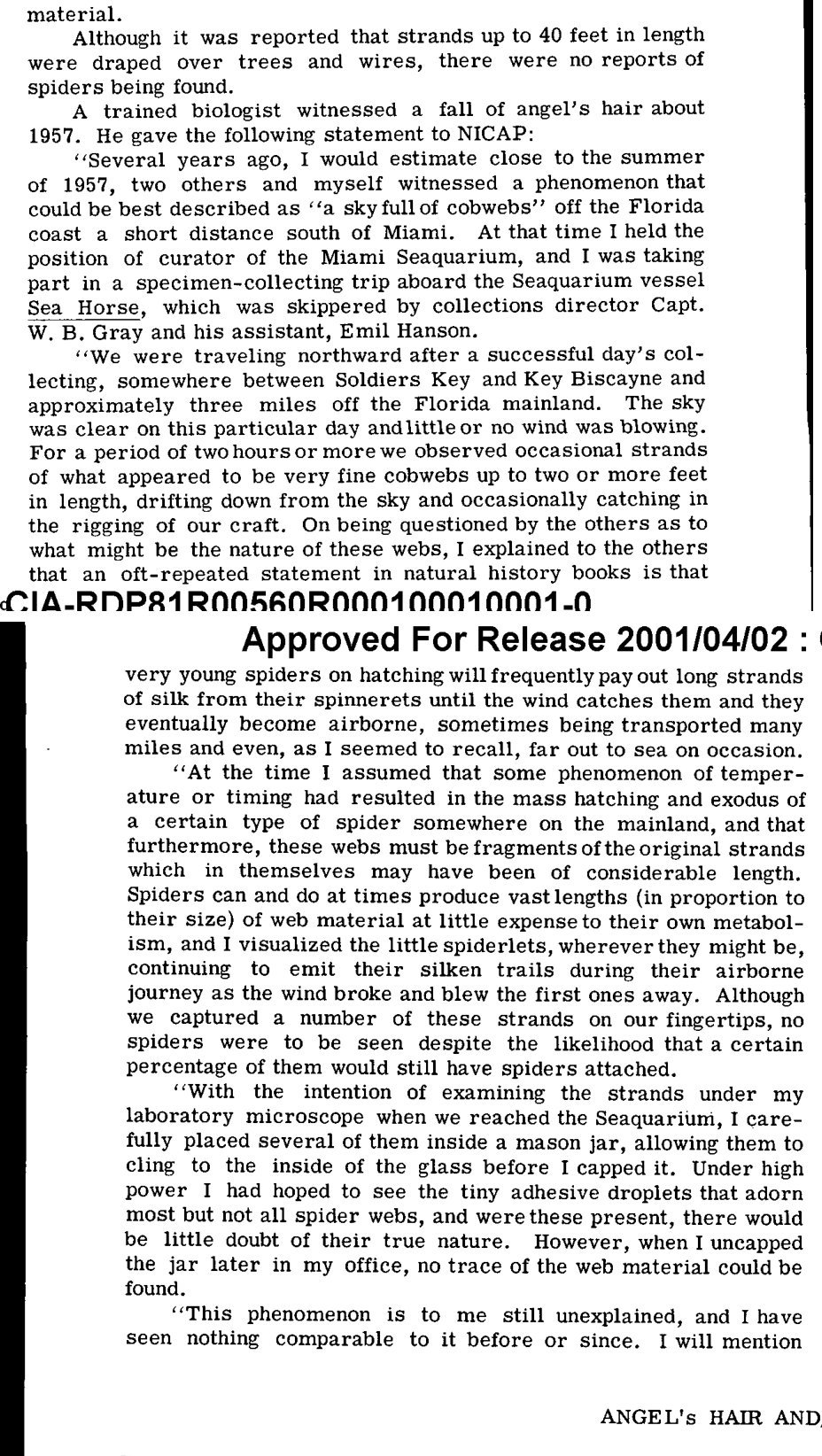 Page of the NICAP reportPhysical page 104
DOCUMENTARY SOURCES · CIA
What the records tell
The source of this dossier is the report "The UFO Evidence," published in 1964 by NICAP (National Investigations Committee on Aerial Phenomena), an American civilian UFO research organization. A copy remained in the CIA's CREST archive and was released in 2001, which proves that the agency kept the book, not that it wrote or validated it. In the subsection "Angel's Hair," on physical pages 104 and 105, NICAP discusses falls of a fine, web-like substance that are sometimes associated with UFOs. As an example of a difficult case, it publishes a biologist's statement, signed by Craig Phillips, of the Fish and Wildlife Service of the Department of the Interior, on November 5, 1963.
Phillips says that, around the summer of 1957, when he was curator of the Miami Seaquarium, he was returning from a specimen-collecting trip aboard the boat Sea Horse, commanded by the collections director, Captain W. B. Gray, with assistant Emil Hanson. The boat was heading north, between Soldier Key and Key Biscayne, about three miles offshore. The sky was clear and almost windless. For two hours or more, the three men saw very fine, web-like threads falling from the sky, up to two feet or more long, which sometimes caught in the rigging.
As a biologist, Phillips explained to his colleagues the hypothesis found in natural history books: newly hatched spiders release silk threads until the wind carries them off, sometimes for many miles and even out to sea. He imagined a mass hatching on the mainland. But although they caught several threads on their fingertips, they saw no spiders. Phillips kept some threads in a glass jar, attached to the inner wall, in order to look under the microscope for the adhesive droplets typical of spider web. When he opened the jar in his office, there was no longer any trace of the material.
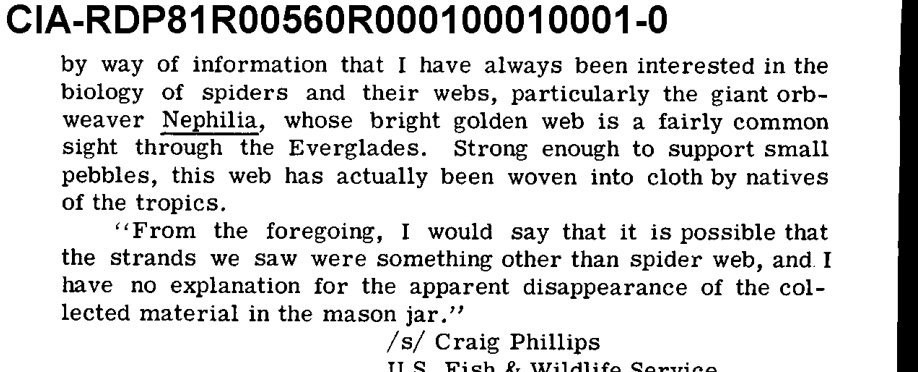
Phillips wrote that the phenomenon remained unexplained to him, that he had never seen anything like it, and that he had always been interested in spiders, such as the large Nephila weaver of the Everglades, whose golden web is even woven into cloth in the tropics. He concluded that it was possible the threads were something other than spider web, and that he had no explanation for their disappearance from the jar. NICAP comments that this disappearance is frequently reported, and that some analysts use it to distinguish "true" angel's hair from spider web.
NICAP itself points out the limit of this idea: if angel's hair vanishes before it can be analyzed, it does not constitute good physical evidence. In the Phillips case there was no UFO seen, no preserved sample, and no exact date, and the statement was written about six years later. The other two crew members are mentioned but did not give statements of their own. The account stands as the observation of a trained biologist who could not fit what he saw into the spider explanation. The table on pages 105 and 106 lists 43 falls of a similar substance, from 1741 to 1962, with a UFO reported in 23.
More images from the document
DIRECT READING OF THE FILE
The document, in the original
Private publication (NICAP report The UFO Evidence, 1964): the English text is not reproduced or translated in full. Each translations block provides, in English, a faithful summary of the indicated passage or page (NICAP prose) or a line-by-line translation (tables, lists and reproduced official messages), with at most one short quotation. The images are crops of the report's pages. For this case, the beginning of the "Angel's Hair" subsection and of Craig Phillips's statement (p. 104, right-hand column) and the end of the statement and NICAP's comment (p. 105, left-hand column and top of the right-hand column) were summarized. The full pages 104, 105 and 106, with the tables of sounds and of angel hair falls, are translated in the report's documentary dossier.
EXCERPT 1 · PHYSICAL PAGE 104
Physical page 104, right column: "Angel's Hair" and beginning of Craig Phillips's statement (excerpt)
Approved For Release 2001/04/02 : CIA-RDP81R00560R000100010001-0
Date & Location Type of UFO
Distance estimate
Sound & Maneuvers
8-11-58; Acright, N. Y. bright white light
moved with skipping motion, droning noise
9-21-58; Sheffield Lake,
Ohio
glowing disc
6 ft. alt., 10 ft. distance
"whirring" or "whining" noise, constant
10-26-58; Baltimore, glowing ellipse
320 ft. distance, hovering
hovered, shot straight up making thun-
Maryland low over bridge derous explosive noise
2-3-59; Oil City, Pa. circular below low cloud ceiling high-speed pass, swishing noise
7-13-59; Blenheim, N.Z. disc below treetops descended, hovered, low humming sound;
rose vertically at high speed with "thin
high-pitched whine" [Section XIV]
8-17-60; Folsom, Calif. dark, body lights
visible
whine "like spinning top"
8-18-60; Dunsmuir, Calif. reddish oblong
sound "like rushing wind"
9-13-62; Nr Overfield,
England
grayish disc
poles
about height of telegraph
hovered, made "'swishing" noise as it sped
away
The eighteen cases above were selected from a larger sample
(approximately 50) of readily available sound cases, in a manner
designed to minimize the accidental inclusion of misidentified
aircraft, etc., which may have been seen under unusual lighting
conditions and reported as UFOs. This was done by taking cases
in which the UFOs exhibited ‘‘typical’’ characteristics such as
sharp turns, erratic maneuvers, and rapid acceleration. Cases
involving simple straight line flight at moderate speeds, regard-
less of the physical appearance of the supposed UFO, were ex-
cluded. The result gives a wide distribution, both by date and
geographical location, of fairly typical UFO sightings, with the
added feature of sound from the objects.
These apparent patterns emerge:
¥ UFOs which make sharp explosive noise during rapidacceler-
ation or high-speed flight.
% UFOs which emit a humming (whining or whirring) noise
while hovering or moving relatively slowly.
% UFOs which make a whistling or ‘‘swishing’’ noise like
rushing air.
Assuming that the sample of cases is representative, we next
have to take into account variations in terminology used by dif-
ferent witnesses in describing what they have heard. We shall
assume that ‘‘whirring,’’ ‘‘whining,’’ or ‘‘humming’’ constitute a
single type of sound. This has sometimes been compared to the
sound made by an electric motor or generator.
The French theorist, Lieutenant Plantier, has developed the
concept of deriving propulsive force from primary cosmic rays by
transforming the energy into ‘‘a local field of force that can be
varied and directed at will.” His theory has the merit of
predicting some of the observed features of UFOs. However,
it rules out sonic booms (postulating that an air cushion carried
along with the UFO would buffer sound), when there is evidence
that UFOs do make sonic booms.
Another similar approach, suggested by Prof. Dr. Hermann
Oberth, is that whoever operates the UFOs has knowledge of the
control of gravity. The UFOs’ apparent circumvention of the
laws of inertia, as we understand them, has been the single
most difficult feature of UFO phenomena to account for. Could
control of gravity explain how this is possible?
The above speculation may or may not be close to the truth.
If we forget for the moment the problem of inertial effects and
assume we are dealing with controlled devices which in some
manner surmount that problem, we can hypothetically explain the
UFO sounds as (a) actual sonic booms; (b) actual ‘‘engine’’
noises very similar to a ‘‘whirring’’ electric motor; and (c)
whistling, rushing air effects of a solid body traveling through
air.
There are indications that only the sonic booms are heard at any
appreciable distance. Atdistances comparable to those attained by
high-altitude aircraft, where we are able to hear jet or piston
engines at least faintly, UFOs apparently are virtually silent.
The July 13, 1959, New Zealand case (and similar data) suggests
a direct relationship between the level of sound and acceleration,
with increased intensity or shrillness when power is applied.
Angel's Hair
An interesting phenomenon which has been linked with UFOs
is so-called ‘‘angel’s hair.’’ This gossamer-like substance has
been observed falling from the sky, sometimes in great quantity.
However, it (if indeed only one type of substance is involved)
has only been observed in association with UFOs in about one-half
of the cases. Also, it is obvious that in many cases the sub-
stance has been nothing but cobwebs spun by ballooning spiders.
(Natural History, January 1951, ‘‘Those Things in the Sky.’’} On
at least one occasion, small spiders have actually been found in
the material leaving little doubt about the identification.
Although we do not presently consider angel’s hair to be
significant evidence of UFOs, (or for that matter to be clearly
differentiated from spider webs in most cases) there are some
surprising reports on record which cause us to suspend final
judgment.
A typical angel’s hair report (though not designated as such)
is reported in the Humboldt (Calif.) Times, November 11 and 12,
1958. Residents of Trinidad, Rio Dell, and other northern Cali-
fornia towns reported showers of cobweb-like material on Novem-
ber 9, some in strands 5 to 6 feet long. Two fishermen at sea,
George Korkan and Jack Curry, said the substance settled on
their boat in such quantity that it made the boat appear to be
“ta million years old.”
A sample of the substance obtained at McKinleyville airport
was examined by Dr. Erwin Bielfuss, assistant professor of
biology at Humboldt State College. The newspaper quotes
him as ruling out the possibility of it being a mold growth or
animal product, and suggesting it is either plant life or a plastic
material.
Although it was reported that strands up to 40 feet in length
were draped over trees and wires, there were no reports of
spiders being found.
A trained biologist witnessed a fall of angel’s hair about
1957. He gave the following statement to NICAP:
“Several years ago, I would estimate close to the summer
of 1957, two others and myself witnessed a phenomenon that
could be best described as ‘‘a sky fullof cobwebs’’ off the Florida
coast a short distance south of Miami. At that time I held the
position of curator of the Miami Seaquarium, and I was taking
part in a specimen-collecting trip aboard the Seaquarium vessel
Sea Horse, which was skippered by collections director Capt.
W. B. Gray and his assistant, Emil Hanson.
“We were traveling northward after a successful day’s col-
lecting, somewhere between Soldiers Key and Key Biscayne and
approximately three miles off the Florida mainland. The sky
was clear on this particular day andlittle or no wind was blowing.
For a period of two hours or more we observed occasional strands
of what appeared to be very fine cobwebs up to two or more feet
in length, drifting down from the sky and occasionally catching in
the rigging of our craft. On being questioned by the others as to
what might be the nature of these webs, I explained to the others
that an oft-repeated statement in natural history books is that
Approved For Release 2001/04/02 »CIA-RDP81R00560R000100010001-0Check the original PDF
[p. 104: texto da publicação privada não reproduzido; ver o resumo]View the document record ↗ · Physical page 104, counting the cover.
EXCERPT 2 · PHYSICAL PAGE 105
Physical page 105, left column and top of the right: end of Craig Phillips's statement and NICAP's comment (excerpt)
Approved For Release 2001/04/02 : CIA-RDP81R00560R000100010001-0
very young spiders on hatching will frequently pay out long strands
of silk from their spinnerets until the wind catches them and they
eventually become airborne, sometimes being transported many
miles and even, as I seemed to recall, far out to sea on occasion.
“At the time I assumed that some phenomenon of temper-
ature or timing had resulted in the mass hatching and exodus of
a certain type of spider somewhere on the mainland, and that
furthermore, these webs must be fragments of the original strands
which in themselves may have been of considerable length.
Spiders can and do at times produce vast lengths (in proportion to
their size) of web material at little expense to their own metabol-
ism, and I visualized the little spiderlets, wherever they might be,
continuing to emit their silken trails during their airborne
journey as the wind broke and blew the first ones away. Although
we captured a number of these strands on our fingertips, no
spiders were to be seen despite the likelihood that a certain
percentage of them would still have spiders attached.
“With the intention of examining the strands under my
laboratory microscope when we reached the Seaquariini, I care-
fully placed several of them inside a mason jar, allowing them to
cling to the inside of the glass before I capped it. Under high
power I had hoped to see the tiny adhesive droplets that adorn
most but not all spider webs, and were these present, there would
be little doubt of their true nature. However, when I uncapped
the jar later in my office, no trace of the web material could be
found.
“This phenomenon is to me still unexplained, and I have
seen nothing comparable to it before or since. I will mention
by way of information that I have always been interested in the
biology of spiders and their webs, particularly the giant orb-
weaver Nephilia, whose bright golden web is a fairly common
sight through the Everglades. Strong enough to support small
pebbles, this web has actually been woven into cloth by natives
of the tropics.
“From the foregoing, I would say that it is possible that
the strands we saw were something other than spider web, and I
have no explanation for the apparent disappearance of the col-
lected material in the mason jar.’’
/s/ Craig Phillips
U.S. Fish & Wildlife Service,
Department of the Interior; 11-5-63
The reported dissipation of the angel’s hair in this case
is commonly reported. Some analysts who do not think all
angel’s hair is cobwebs use this feature to differentiate ‘‘true’”’
angel’s hair from spider webs. If this assumption is correct,
angel’s hair unfortunately becomes a will-of-the-wisp which
disappears before it can be analyzed properly, and therefore it
does not constitute good physical evidence.
Biologists who have examined angel’s hair which has subse-
quently dissipated have been unable to account for it in terms
of spiders. The substances which have not dissipated so far show
no particular pattern, and may be attributed to many different
phenomena, The following chart includes all reported cases of
falls of gossamer-like material which have been compiled by
NICAP for specific dates.
ANGEL's HAIR AND/OR GOSSAMER FALLS
Date & Location U.F.O. Dissi- Spi- Remarks & Notes
reported pation ders
9-21-1741; Bradly, England Strands 5-6 inches long "fell with some velocity" for hours
in great quantity. [From Charles Fort]
9-20-1892; Gainesville, Florida Vast quantity "like great white sheets," some "50 yards or
more in length." [Proceedings, Entomological Society of
Washington, D.C., Vol. II (1892) ppg. 385-388. ]
11-21-1898; Montgomery, Alabama Strands several inches long fell in batches; reportedly
phosphorescent. [From Charles Fort]
11-10-49; Depues Ferry, Pennsylvania x [‘‘Inside Saucer Post ... 3-0 Blue, ”’ Stringfield, p. 49]
10-11-50; Butte County, California x Sample analyzed by Dr. Willis J. Gertsch, Museum of
Natural History; identified as gossamer. (Natural History,
January 1951]
10-11-50; Paradise, California x x Partial dissipation reported, leaving "tough white threads--
resembling a spiderweb, but of much tougher consistency."
[Chico Enterprise-Record, October 12, 1950]
10-17-1952; Oloron, France x x Fibres burned like cellophane when ignited. [‘‘The Truth
about flying Saucers,’’ Michel, ppg. 146-7]
10-27-52; Gaillac, France x x [Ibid., p. 148]
4-15-53; Auckland, N.Z. x [Challenge of UFOs,’’ Maney & Hall, p, 59]
5-30-53; Christchurch, N.Z. x [Tbid., p. 59]
10-9-53; Melbourne, Australia x [Ibid., p. 59]
10-13-53; Pleasant Hill, California x [Ibid., p. 59]
11-16-53; San Fernando Valley, x x [Pageant, November 1954}
California
10-19-54; Fort Wayne, Indiana [Stringfield, op. cit., p. 49]
10-22-54; Marysville, Ohio x x [Maney & Hall, op. cit., ppg. 40-42]
10-28-54; Rome, Italy x [Ibid., p. 59]
11-4-54; Nelson, N.Z. xX [Stringfield, op. cit., p. 49]
11-8-54; Florence, Italy x [Ibid., p. 59]
12-12-54; Christchurch, N.Z. x [Ibid., p. 49]
2-21-55; Horseheads, N.Y. "White, fibrous and heavily impregnated with soot and dirt"
No odor, did not burn rapidly. [AP, 2-22-55 ]
Approved For Release 2001/04/02 :GIA-RDP81R00560R000100010001-0Check the original PDF
[p. 105: texto da publicação privada não reproduzido; ver o resumo]View the document record ↗ · Physical page 105, counting the cover.
Dates and documentary context
- Event
- Not established — Phillips estimates "around summer 1957"; statement dated 05/11/1963.
- Document
- 02/04/2001 — Date of the CREST release stamp printed on the pages (Approved For Release 2001/04/02).
- Publication
- 1964 — Year of publication of the report "The UFO Evidence" by NICAP (May 1964).
Origin and release
National Investigations Committee on Aerial Phenomena (NICAP), an American civilian organization; private report "The UFO Evidence" (1964), edited by Richard H. Hall. Copy kept in the CIA's CREST archive (CIA-RDP81R00560R000100010001-0, released on 02/04/2001); the CIA kept the text, it did not produce or validate it · CIA-RDP81R00560R000100010001-0_NICAP-The-UFO-Evidence_1964.pdf
CIA CREST, CIA-RDP81R00560R000100010001-0, release of 02/04/2001 ↗ — undefined
Related accounts and their differences
Questions to continue the investigation
- Did Captain W. B. Gray or Emil Hanson leave any record of the episode?
- Were there, at the same time, reports of falls of filaments in South Florida that would allow the case to be dated?
GEOGRAPHY OF THE CASE
Sea between Soldier Key and Key Biscayne, south of Miami, Florida
Approximate reference to the area cited in the statement, placed by the editorial team.
DOCUMENTARY TRAIL
Go back to the sources
References use physical pages of the PDF, counting the cover. Summaries are presented in English; the documents keep their original language.
- CIA-RDP81R00560R000100010001-0_NICAP-The-UFO-Evidence_1964.pdf
Physical page 104: beginning of the "Angel's Hair" subsection and of Craig Phillips's statement · Physical page 105: end of Craig Phillips's statement (05/11/1963) and NICAP comment
CIA · 186 pages
Editorial summary based on the collection's research notes. How we read the documents.