Date: 23/03/1957, from 21h55 until the early hours of the following morningLocation: Los Angeles area, California, USA (Downey, Pasadena, Oxnard Air Force Base and Santa Rosa Valley)
Los Angeles, 1957: hundreds of calls, observers in Oxnard and very fast UFOs on a civilian radar
The private NICAP report, kept by the CIA, brings together the accounts of one night in March 1957 in Los Angeles: calls to the police, observers at the Pasadena filter center, the wife of a captain at Oxnard and an F-89 fighter sent up. The centerpiece is a confidential account attributed to a CAA radar operator, who reportedly timed UFOs at 3.600 miles per hour.
- Event date
- 23/03/1957, from 21h55 until the early hours of the following morning
- Location
- Los Angeles area, California, USA (Downey, Pasadena, Oxnard Air Force Base and Santa Rosa Valley)
- Topic
- CIA file
- Source agencies
- CIA
- Documents
- 1 document · 186 pages
- Reading time
- 21 min
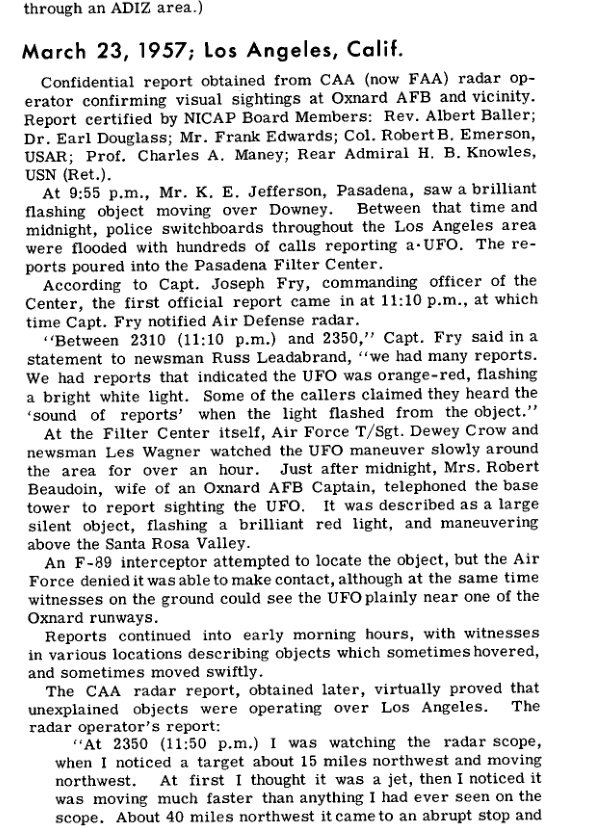 Page of the NICAP reportPhysical page 90
DOCUMENTARY SOURCES · CIA
What the records tell
The source of this dossier is the report "The UFO Evidence," a private compilation published in 1964 by NICAP (National Investigations Committee on Aerial Phenomena), an American civilian UFO research organization. A copy was kept by the CIA and released in 2001 in the CREST archive, which proves that the agency kept it, not that it produced or validated it. On physical pages 90 and 91, NICAP says it obtained a confidential report from a radar operator of the CAA, the civil aviation agency that later became the FAA. The text was certified by six members of NICAP's own board, among them the writer Frank Edwards and retired Rear Admiral H. B. Knowles. Internal certification is not independent verification.
According to the report, at 21h55 K. E. Jefferson, of Pasadena, saw a bright, flashing object over Downey. By midnight, police switchboards in the Los Angeles area had received hundreds of calls, which were forwarded to the Pasadena Filter Center, part of the civilian air defense observer network. The center's commander, Captain Joseph Fry, told journalist Russ Leadabrand that the first official report came in at 23h10, when he alerted air defense radar. The descriptions spoke of a reddish-orange object with a flashing white light, and some people said they heard bangs when the light flashed.
At the center itself, Air Force Technical Sergeant Dewey Crow and journalist Les Wagner watched the object maneuver slowly for more than an hour. Shortly after midnight, the wife of a captain at Oxnard Air Force Base phoned the tower: a large, silent object with a strong red light was maneuvering over the Santa Rosa Valley. An F-89 interceptor tried to locate it. According to NICAP, the Air Force denied having made contact, while witnesses saw the object near one of the Oxnard runways. The reports continued through the early hours of the morning.
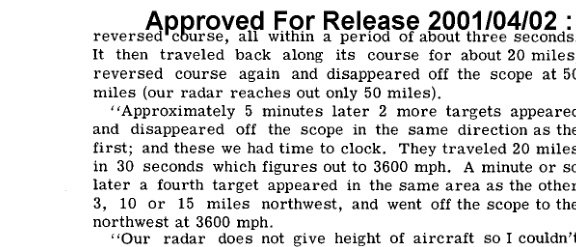
The radar operator's account is the part with numbers. At 23h50, he saw a target about 15 miles to the northwest, heading northwest, faster than anything he had ever seen on the screen. At about 40 miles, the target suddenly stopped and reversed course in about three seconds, came back about 20 miles, reversed again and disappeared at 50 miles, the limit of the set. About five minutes later, two targets followed the same path and were timed: 20 miles in 30 seconds, or 3.600 miles per hour. A fourth target left in the same direction and at the same speed.
The operator added that the radar did not measure height, but that the targets must have been at 10.000 feet or less, the set's vertical range. For NICAP, this account almost proves that unexplained objects were flying over Los Angeles; this is the organization's opinion. The text does not link the fast targets, which were leaving to the northwest, to the slow lights seen from the ground, and it does not give the operator's name, the original document or the F-89 record. In the table on page 85, the same case appears with the location "Long Beach, California".
More images from the document
DIRECT READING OF THE FILE
The document, in the original
Private publication (NICAP report): the English text is not reproduced or translated in full. Each translations block provides a faithful summary, in English, of the portion of the case on the indicated physical page, with at most one short quotation. The images are crops of the report's pages. Summarized here are the case of 23/03/1957 on pages 90 and 91 and the corresponding line of the table on page 85; the other cases on these pages were left out.
EXCERPT 1 · PHYSICAL PAGE 85
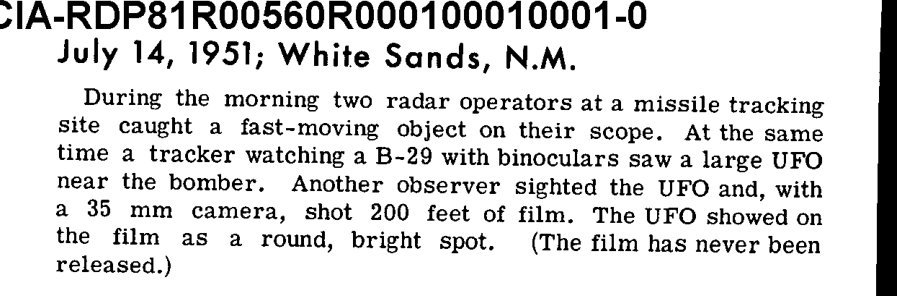
Physical page 85, row for 23/03/1957 in the radar table
Approved For Release 2001/04/02 : CIA-RDP81R00560R000100010001-0
March 23, 1957
Long Beach, Calif.
Four UFOs tracked by CAA radar.
(Confidential report certified by 6
NICAP Board Members) Coincided
with visual reports by GOC, police
and Oxnard AFB,
(Details this
Section]
March 29, 1957
Pan American Airways flight #206A,
saw pulsating UFO, radar target
coincided.
[Section V]
April 4, 1957
Wigtownshire,
Scotland
Three radar posts tracked UFO
which dove and circled. Wing
Cdr. W. P, Whitworth (at
Scottish base): "Quite definitely
this was no freak. It was an object
of some substance and no mistake
could have been made."
60,000 to
143000 ft.
[56]
October 21 or 29, 1957
Nr London, England
UFO sighted visually by pilot near
atomic base, tracked by ground
radar; dimmed lights and sped away.
(57)
November 5, 1957
Gulf of Mexico
Coast Guard Cutter Sebago
tracked UFO, brief visual sighting
from deck.
1020 mph
[Details this
Section]
December 12, 1957
Tokyo, Japan
GCI radar tracked UFO seen by
ground observers as vari-colored
object; jets scrambled.
(58)
March 8, 1958
Korea
USAF radar site tracked slowly de-
scending UFO.
[59]
Summer 1958
Air Force Base,
SW United States.
Two maneuverable UFOs tracked,
evaded jet interceptors,
[60]
November, 1958
Dewline radar
UFO descended from maximum alt. 500 knots
range of radar, moved horizontally (abt. 575
for 100 miles, ascended vertically. | mph.)
[62]
January 23, 1959
Panama Canal
Bright silver object arced across
sky, tracked by U.S. radar.
[63]
September 24, 1959
Redmond, Oregon
Air Force radar site reportedly
tracked UFO, observed visually by
FAA personnel at airport as disc-
shaped object.
[Section v,
IX]
August 13, 1960
Red Bluff,
California
State Police observed egg-shaped UFO
reported USAF radar site confirmed
tracking it.
(Section VII,
Ix]
January 1961
Missile Base during
missile test flight
UFO which alternately hovered and
moved rapidly to new position,
tracked.
[64]
June 19, 1961
Exeter, England;
Edinburgh, Scotland
Large, bright shining UFO observed Hovered
at Exeter airport, tracked on radar.
Cigar-object and speeding light ob-
served over Edinburgh twice during
preceding night.
50,000 ft.
[65]
July 5, 1961
Akron, Ohio
Former AF pilot saw maneuvering
glowing UFO, also tracked by FAA
radar at Cleveland airport.
[Section V}
January 29, 1962
Eastern Holland
Royal Dutch Air Force jet intercep-
tor chased UFO detected by ground and
airborne radar, and visually.
[Section X]
Approved For Release 2001/04/02 : CIA-RDP81R00560R000100010001-0Editorial note: The location in the table, Long Beach, differs from the case title on pages 90 and 91, Los Angeles.
Check the original PDF
[p. 85: texto da publicação privada não reproduzido; ver o resumo]View the document record ↗ · Physical page 85, counting the cover.
EXCERPT 2 · PHYSICAL PAGE 90
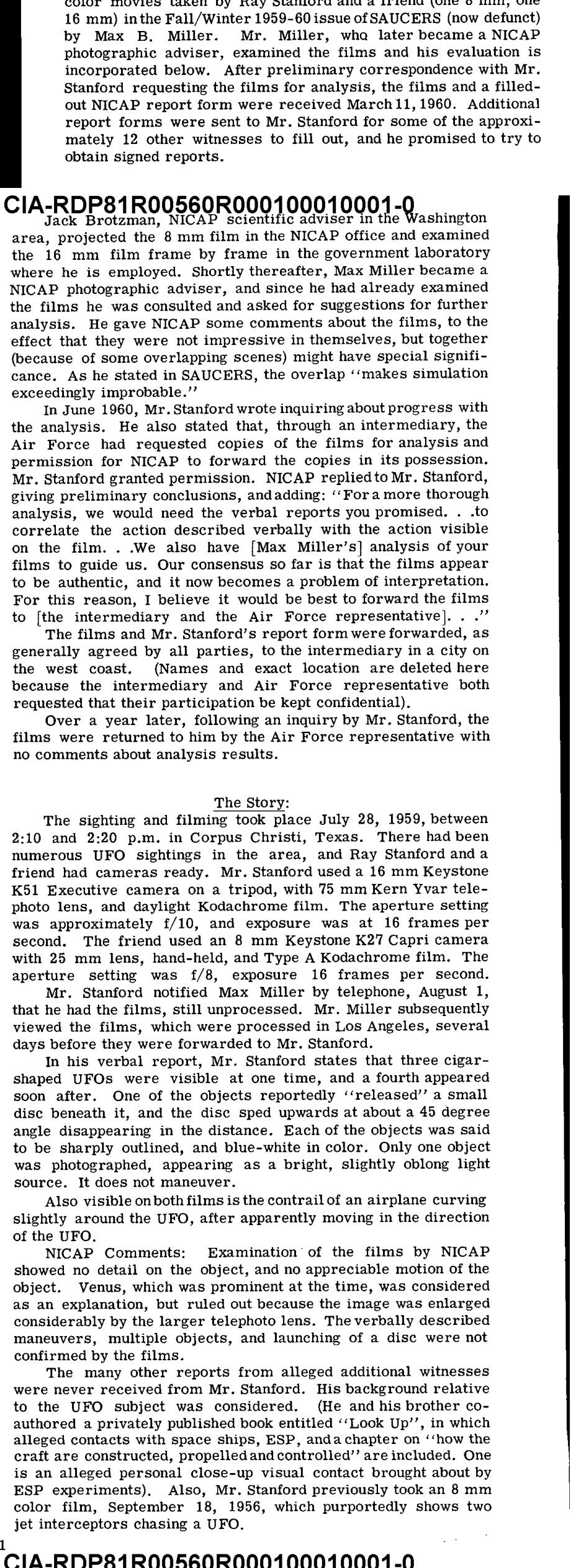
Physical page 90, right column: case of 23/03/1957, beginning
Approved For Release 2001/04/02 :
four times the light’s diameter. A smaller body light was visible
on the underside. The object was tracked by ground radar, and
an F-94 interceptor obtained a radar lock-on while chasing it.
At one point, the UFO suddenly raced away at a clocked speed of
300 knots (about 345 mph.), dividing into three separate radar
targets at spaced intervals. Contact with the UFO either by
radar or visually, was maintained for over 30 minutes. During
this period, scattered witnesses saw the UFO exactly where
radar showed it to be. Conclusion: Officially ‘‘unknown.’’
1951-1952 Period; East Coast Air Force. Base
Period of September 1951 to November 1952; prominent east
coast Air Force Base.
Confidential report, certified by Rev. Albert H. Baller, Ger-
man Congregational Church, Clinton, Mass.
Extracts from letter by Air Force Control Tower Operator
to Rev. Baller, dated March 10, 1954:
“About 3 a.m., on a clear moonlit night, a buddy of mine
who was radar operator on the same night shift called me
rather excitedly on the intercom, and asked me if I could see
any object in the sky about’ 15 miles southwest of the base.
Using a pair of powerful binoculars I carefully scanned the sky
in that direction and assured him that I could see nothing.
It was then that he told me why he was so concerned.
“For several minutes he had tracked an object on his
radar’ scope, then all of a sudden it had stopped at a range of
about 15 miles from the base and remained stationary. Being
an experienced radar operator, he knew that whatever it was,
it was of good size, at least as big as any of our larger
transport planes. But what amazed him was the fact that it
stopped and remained motionless on the scope. A full half
hour passed and still this object remained in the same
location on the radar screen. Remembering that I had an in-
bound C-124 Globemaster coming in from that direction, I
thought that perhaps the pilot would see something out there
that we couldn’t. I gave the pilot a couple of calls and finally
raised him just south of. on his way in. I told him
what we had on radar and asked himif he would mind swinging
off his course slightly so that he could take a look for us.
“| then turned him over to the radar operator who had
picked up the inbound aircraft on radar and he guided the pilot
to a new heading that would bring him directly into this blip
that was still stationary on the screen. The pilot slowed his
aircraft and he and his copilot and engineer started looking
about them. I could hear the radar man giving the pilot di-
rections on a monitoring speaker in the tower.
‘The aircraft got onto a line on the radar screen that would
intersect the blip that was unidentified; then as the minutes
went by the aircraft slowly approached the object on the scope.
Both blips were equally bright and distinct. Then when it
seemed that the two would collide, at about a half mile
separation on the scope, the stationary object simply dis-
appeared, vanished seconds before the big Globemaster reached
its location.
“None of the crew on the plane had seen anything at any
time, although they were all observing closely at the time and
were told how close they were getting allthe way to the object.
“How anything could vanish so suddenly from a radar
screen without even leaving a trace of what direction it went is
really amazing. When you bear in mind that a radar scanner
usually has a sweep of better than 50 miles, that would mean
that whatever the object was it went from a dead standstill
at 15 miles and disappeared from the scope covering over 35
miles in a split second. Remember also that this object was
there for over a half hour and did not disappear until seconds
before the aircraft reached its position: certainly this couldn’t
be any electrical disturbance or other phenomena. Why then
would it disappear precisely when it did?’’
Summer 1953; Yaak, Montana
Unidentified objects were tracked at an Air Force radar site
several times. S/Sgt. William Kelly described the incidents in
a taped interview with Olean, N. Y., newsman Bob Barry.
C A-RDP81 ROOS69ROOO! 000 900 129.4 up six
a one occasion other ada:
unidentified targets. In five sweeps of the antenna (about 1 min-
ute), the UFOs changed direction 5 times, sometimes making 90
degree turns. When radar indicated the UFOs had approached
within 10 miles of the station, the crew went outside to look for
them. They saw six objects in trail formation, switching to in-
line abreast, then stack formation. Other radar stations were
notified and they also tracked the UFOs.
The radar crew calculated thé objects’ speed: 1400-1600
mph. (In 1953 the official world speed record for aircraft was
755.14 mph.; see table).
At other times, the station tracked UFOs making similar man-
euvers. Sgt. Kelly had also tracked UFOs climbing vertically out
of the radar beam, with height finder equipment confirming the
rise, until the objects went off the scope.
July 3, 1954; Albuquerque, N.M.
Nine greenish spherical UFOs which invaded a restricted
flying area were detected by Air Defense Command radar and
sighted visually. The Albuquerque radar station’s message on
the sighting was accidentally intercepted at Chicago Midway
Airport by an airline operations employee:
0105-C. . . NINE UNIDENTIFIED SPHERICAL OBJECTS
GIVING OFF GREEN LIGHT REPORTED 20 MILES NORTH
ABQ [Albuquerque] FIELD AT 24,000 FEET. OBJECTS
HOVERED MOTIONLESS FOR 6 MINUTES THEN PRO-
CEEDED 340 DEGREES AT APPROX 2600 MPH. ALTI-
TUDE AND SPEED BY TRIANGULATION. . . ABQ ADIZ
RADAR.
(NICAP Note: ‘‘ADIZ’’ means Air Defense Identification Zone;
only aircraft which have filed a flight plan are allowed to fly
through an ADIZ area.)
March 23, 1957; Los Angeles, Calif.
Confidential report obtained from CAA (now FAA) radar op-
erator confirming visual sightings at Oxnard AFB and vicinity.
Report certified by NICAP Board Members: Rev. Albert Baller;
Dr. Earl Douglass; Mr. Frank Edwards; Col. RobertB. Emerson,
USAR; Prof. Charles A. Maney; Rear Admiral H. B. Knowles,
USN (Ret.).
At 9:55 p.m., Mr. K. E. Jefferson, Pasadena, saw a brilliant
flashing object moving over Downey. Between that time and
midnight, police switchboards throughout the Los Angeles area
were flooded with hundreds of calls reporting a-UFO. The re-
ports poured into the Pasadena Filter Center.
According to Capt. Joseph Fry, commanding officer of the
Center, the first official report came in at 11:10 p.m., at which
time Capt. Fry notified Air Defense radar.
“Between 2310 (11:10 p.m.) and 2350,’’ Capt. Fry said ina
statement to newsman Russ Leadabrand, ‘‘we had many reports.
We had reports that indicated the UFO was orange-red, flashing
a bright white light. Some of the callers claimed they heard the
‘sound of reports’ when the light flashed from the object.’
At the Filter Center itself, Air Force T/Sgt. Dewey Crow and
newsman Les Wagner watched the UFO maneuver slowly around
the area for over an hour. Just after midnight, Mrs. Robert
Beaudoin, wife of an Oxnard AFB Captain, telephoned the base
tower to report sighting the UFO. It was described as a large
silent object, flashing a brilliant red light, and maneuvering
above the Santa Rosa Valley.
An F-89 interceptor attempted to locate the object, but the Air
Force denied it was able to make contact, although at the same time
witnesses on the ground could see the UFO plainly near one of the
Oxnard runways.
Reports continued into early morning hours, with witnesses
in various locations describing objects which sometimes hovered,
and sometimes moved swiftly.
The CAA radar report, obtained later, virtually proved that
unexplained objects were operating over Los Angeles. The
radar operator’s report:
“At 2350 (11:50 p.m.) I was watching the radar scope,
when I noticed a target about 15 miles northwest and moving
northwest. At first I thought it was a jet, then I noticed it
was moving much faster than anything I had ever seen on the
scope. About 40 miles northwest it came to an abrupt stop and
Approved For Release 2001/04/02 ? CIA-RDP81 R00560R000100010001-0Editorial note: The first line of the right column comes out truncated in the archive text; "On one occasion Sgt. Kelly and other radarmen picked up six unidentified targets".
Check the original PDF
[p. 90: texto da publicação privada não reproduzido; ver o resumo]View the document record ↗ · Physical page 90, counting the cover.
EXCERPT 3 · PHYSICAL PAGE 91
Physical page 91, left column: case of 23/03/1957, end of the operator's account
Se, all within a period of about three seconds.
d For Release 2001/04/02 : CIA-RDP81R00560R000100010001-0
rovratd RPE ER RE RENEE PHOTOGRAPHS
It then traveled back along its course for about 20 miles,
reversed course again and disappeared off the scope at 50
miles (our radar reaches out only 50 miles).
“Approximately 5 minutes later 2 more targets appeared
and disappeared off the scope in the same direction as the
first; and these we had time to clock. They traveled 20 miles
in 30 seconds which figures out to 3600 mph. A minute or so
later a fourth target appeared in the same area as the other
3, 10 or 15 miles northwest, and went off the scope to the
northwest at 3600 mph.
“Our radar does not give height of aircraft so I couldn’t
give you the height, however they had to be about 10,000 feet
or lower because our radar’s maximum height range is about
10,000 feet.”
November 5, 1957; Gulf of Mexico
Just after 5:00 a.m. the U. S. Coast Guard Cutter Sebago was
about 200 miles south of the Mississippi delta. At 5:10 the bridge
radar suddenly showed an unidentified target at 246 degrees true,
moving N to S, range 12,000 yards (almost? miles). On duty were
Ensign Wayne Schotley, deck officer, Lt. (j.g.) Donald Schaefer,
first class quartermaster Kenneth Smith, and radioman Thomas
Kirk.
Interviewed in New Orleans, Ensign Schotley was asked how
good the radar target was.
Schotley: ‘‘The ship’s combat information center confirmed
the sighting. At that point it was reported falling astern rapidly.
It was a good pip [target]. It was a very strong contact, consid-
ered good.’’
Cmdr. James N. Schrader, spokesman in New Orleans, said
that at one point ‘‘in two minutes it went 33 miles straight away
from the ship.’? (About 1020 mph.)
At 5:14 contact was lost.
At 5:16 contact was regained, object about 22 miles north.
At 5:18 object faded off radar screen, range about 55 miles.
At 5:20 contact regained, object appeared stationary, seven
miles due north.
About this time, A/1C William J, Mey, an Electronics tech-
nician at Keesler AFB, Mississippi (about 320 miles to the
north on the Gulf Coast) spotted an elliptical UFO. In his signed
report to NICAP, A/1C Mey gives the time as approximately
5:20 a.m. Looking south, he saw the UFO approach on a norther-
ly course at about the speed of a propeller airliner, then ac-
celerate rapidly and disappear into some clouds.
This suggests that more than one UFO may have been op-
erating in the area, and that the Sebago’s radar may have
tracked more than one of them. A/IC Mey’s report is fairly
consistent with the 5:18 radar report of the UFO headed north
at over 1000 mph. If Mey actually saw the UFO at 5:28, it would
have averaged about 1590 mph., from the time it faded from the
Sebago’s radar screen. If he saw it precisely at 5:20 a.m., it
would have had to accelerate to nearly 8000 mph. to cover the
distance in that time).
At 5:21 the Sebago regained radar contact, and also saw the
UFO visually for 3-5 seconds as a brilliant white object with no
distinguishable shape. It was at a bearing of 270 degrees true
(west), elevation about 31 degrees, moving horizontally from
south to north. (A navigator obtained the elevation by noting a
star at the same angle and taking a sextant reading of it). The
UFO finally entered a cloudbank and disappeared.
At 5:37 the cutter reported its last radar contact with the
Object, about 175 miles to the north, traveling about 660 mph.
[See Section XII, November 1957 chronology, for other reports
during the same period. |
January 1961; Missile Base
Confidential report certified by NICAP Director Donald
E. Keyhoe and Assistant Director Richard Hall. During the
test of a solid fuel missile, radar which was supposed to track
the first stage instead tracked a UFO target. Test evaluation
report in NICAP possession states ‘‘object unidentifiable.’’ The
UFO ‘‘appeared to be alternately hovering, then moving rapidly
to a new location.’’
The photographic material listed below has been
evaluated with this principle in mind: A still photograph
purporting to show a UFO is, at most, approximately as
reliable as the person who took it. If the witness is a
reputable person and all pertinent data is provided, his
bhotograph deserves careful analysis. Where character
information about the witness is lacking, the photograph
is of less value and it is necessary to suspend judgment
about it. Still photographs can be faked very easily. In
general, movie films ave more valuable because they
ave more difficult to fake, and more subject to analysis
independently of the character of the witness.
NICAP Adviser Ralph Rankow, a professional photographer
in New York City, gave the following estimate of photographic
evidence for UFOs:
“Everyone knows that photographs can be faked, but the real
question is, to what extent can they be faked? We have seen
Hollywood movies of realistic dinosaurs fighting one another.
We have seen dams break and towns washed away by the flood
waters. We have seen naval battles and ships blown up right
before our eyes. In one movie I even saw Moses hold back the
waters of the Red Sea. These were all very realistic scenes, and
we had to keep reminding ourselves that what we were seeing was
a Hollywood movie and not a real event.
If these complicated scenes can be photographed so real-
istically why can’t a simple thing like a UFO be faked? The
answer, of course, is that it can, and what’s more it has--time
and time again. A UFO can be any shape, not just saucer or
cigar shaped. This makes it very easy to fake by anyone, and
furthermore any unintentional mark on a film can be, and some-
times is claimed to be a UFO.
If model airplanes can be photographed to look real, then
so can model UFO’s. This does not mean that there are no air-
planes, just because we are easily able to fake a picture to repre-
sent one. In the same way, the ability to fake a UFO photograph
in no way implies that these things do not exist.
This. is just to point up the extreme difficulty of determining
whether or not a photograph is authentic on just the unsupported
word of one or two witnesses who may or may not be reliable.
In truth, no photograph, no matter how clear it may be, can be
considered evidence of UFO reality without a reliable witness.
Now, this brings us to the question of what makes a reliable
witness? One need not be a famous person whose name we all
know, in order to be termed ‘‘reliable’’. A man’s credentials
give him reliability, not his vocation. Is he a mature individual
or one given to playing tricks? What is the opinion of him held
by those who know him best? Questions of this nature will help
to determine how responsible and trustworthy an individual we
are dealing with.
It is only when a photograph is vouched for by such a ver-
acious individual that it becomes important as evidence.’”’
In addition to the question of witness reliability, analysis of
photographic evidence for UFOs is complicated by other factors.
Many of the potentially most significant pictures were taken before
NICAP was formed in 1956. Belated attempts to obtain all the
necessary data for full analysis have proved extremely difficult.
Since then, quite a few of the seemingly better movie films and
photographs were submitted to the Air Force, rather than to
NICAP, by citizens unaware of NICAP’s existence. Secrecy and
red tape thereupon obscured the facts. Insome cases, because of
the confusion surrounding the UFO subject and reports of tamper-
ing with or confiscation of films [Section IX], witnesses have re-
fused to give up their films for analysis.
Because of these problems, we consider it appropriate merely
to list photographic evidence known to exist. This will supply
references to data which would need to be analyzed thoroughly in
any complete scientific investigation of UFOs. We have also at-
tempted to rate each case according to its probable significance
as evidence. The codes below indicate rating, film data, and
status of analysis by NICAP. Other description and comments
follow with cases numbered to match the entries on next page.
Approved For Release 2001/04/02 : ClA-RDP81R00560R000100010001-0Check the original PDF
[p. 91: texto da publicação privada não reproduzido; ver o resumo]View the document record ↗ · Physical page 91, counting the cover.
Dates and documentary context
- Event
- 23/03/1957 — Night of 23/03/1957, with reports continuing into the early hours of 24/03, according to NICAP.
- Document
- 02/04/2001 — Date of the CREST release stamp printed on all pages (Approved For Release 2001/04/02).
- Publication
- 1964 — Year of publication of the report "The UFO Evidence" by NICAP.
Origin and release
National Investigations Committee on Aerial Phenomena (NICAP), American civilian organization; private report "The UFO Evidence" (1964). Copy kept in the CIA's CREST archive (CIA-RDP81R00560R000100010001-0, released on 02/04/2001); the CIA kept the text, it did not produce or validate it · CIA-RDP81R00560R000100010001-0_NICAP-The-UFO-Evidence_1964.pdf
CIA CREST, CIA-RDP81R00560R000100010001-0, release of 02/04/2001 ↗ — undefined
Questions to continue the investigation
- Does the CAA operator's report exist in FAA or Air Force files, with name, station and records?
- Are the fast targets heading out to the northwest related to the slow lights seen in Pasadena and Oxnard?
GEOGRAPHY OF THE CASE
Los Angeles area, California
Approximate reference to the area cited in the report, placed by the editorial team. It does not indicate the position of the targets or of the witnesses.
DOCUMENTARY TRAIL
Go back to the sources
References use physical pages of the PDF, counting the cover. Summaries are presented in English; the documents keep their original language.
- CIA-RDP81R00560R000100010001-0_NICAP-The-UFO-Evidence_1964.pdf
Physical page 85: 23/03/1957 row in NICAP's table of radar cases · Physical pages 90 and 91: case of 23/03/1957, Los Angeles, with the account of the CAA radar operator
CIA · 186 pages
Editorial summary based on the collection's research notes. How we read the documents.