Date: 23/11/1953Location: Lake Superior, off the Keweenaw Point, Michigan, USA; the fighter took off from Kinross Air Force Base
Lake Superior, 1953: an F-89 sent after a UFO on radar disappears from the screen and is never found
According to NICAP's private report kept by the CIA, an F-89C interceptor from Kinross base was guided by radar to a UFO over Lake Superior, and the two echoes merged and disappeared from the screen. The Air Force later said the UFO was a Canadian C-47; the Royal Canadian Air Force replied to two readers that it had no record of such an interception.
- Event date
- 23/11/1953
- Location
- Lake Superior, off the Keweenaw Point, Michigan, USA; the fighter took off from Kinross Air Force Base
- Topic
- CIA file
- Source agencies
- CIA
- Documents
- 1 document · 186 pages
- Reading time
- 17 min
 Page of the NICAP reportPhysical page 119
DOCUMENTARY SOURCES · CIA
What the records tell
The report The UFO Evidence, published in 1964 by NICAP, a civilian association in Washington, and kept by the CIA, recounts the Kinross case in the section on Air Force secrecy. According to NICAP, on the night of November 23, 1953, Air Defense Command radar detected an unidentified object over Lake Superior, and an all-weather F-89C interceptor took off from Kinross base, near the Soo Locks, in northern Michigan. Guided by radar, the jet crossed the lake heading northwest. It is a private compilation, not an official report; the CIA kept the book, but did not produce it.
Also according to NICAP, the controllers saw on the screen the F-89's echo approach the unknown echo; the two merged and disappeared. The last contact showed the fighter at 8.000 feet, 70 miles off the Keweenaw Point and about 160 miles northwest of the Soo Locks. No trace of the aircraft was found. NICAP says that the first release from the public information officer at Truax base, in Wisconsin, stated that contact was lost when the jet appeared to merge with the object, with no mention of later tracking.
The Air Force version cited in the report is different: the F-89 allegedly identified the target as a Royal Canadian Air Force (RCAF) C-47, on a flight plan from Winnipeg, Manitoba, to Sudbury, Ontario, and returned to base; from then on, nothing would be known for certain. An Air Force fact sheet says that those responsible for flight safety at Norton base presumed the pilot had suffered vertigo and crashed into the lake. NICAP responds that, given the weather that night, the pilot would have been flying on instruments, which would make vertigo unlikely, and that the explanation does not say why the radar lost the fighter right after the echoes merged.
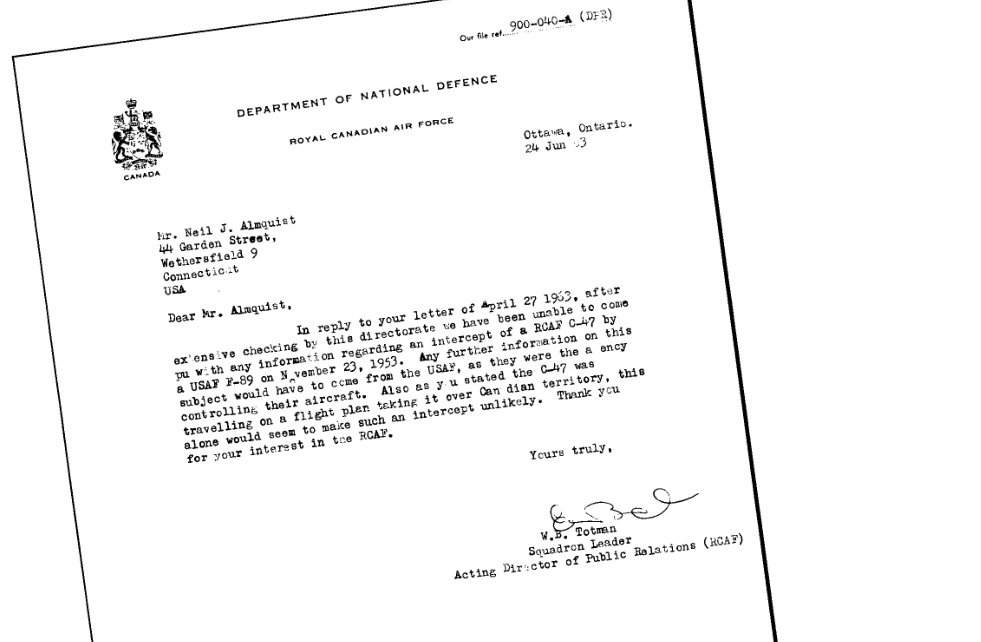
Two readers wrote to the RCAF. In 1961, a flight lieutenant replied, on behalf of the Canadian Chief of the Air Staff, that the records showed no incident involving an RCAF aircraft in the Lake Superior area on that date. On June 24, 1963, Squadron Leader W. B. Totman, acting director of public relations of the RCAF, wrote to Neil J. Almquist, of Connecticut, that he had found no information about an interception of a Canadian C-47 by an American F-89 on that day, that any data would have to come from the U.S. Air Force, and that a flight over Canadian territory would make the interception unlikely. The letter, reproduced in facsimile, is the only official item in these pages.
The report does not name the two F-89 crew members, nor does it include the accident report, the radar records or the C-47 flight plan. It presents two readings: that the fighter collided with something unknown or was destroyed near it, and that it intercepted a Canadian aircraft and later crashed for an unknown reason. NICAP supports the first, but what the pages support is more limited: a military aircraft disappeared over the lake during a radar-guided interception, and the official versions cited about the target do not match.
DIRECT READING OF THE FILE
The document, in the original
The report The UFO Evidence is a private NICAP publication (1964). For this reason the pages were not transcribed or translated in full: each block provides a faithful summary of the page in English, with at most one short quotation. The Royal Canadian Air Force letter of 24/06/1963, reproduced in facsimile on physical page 119, is a government document and was translated in full (original left empty for the integrator). On page 118 only the Kinross case column was summarized; the Olden Moore and Sheneman cases on the same page are outside this dossier.
EXCERPT 1 · PHYSICAL PAGE 118
Physical page 118 (printed 114), end of the right column: beginning of "The Kinross Case"
FEDERAL AVIATION AGENCY
Redmond Oregon,
Jan. 15, 1960
‘TO WHOM IT MAY CONCERH,
The following in the originel records on file at thia facility
and is 411 the information contained in this record concerning
we sighted September 24, 1959, Taken from log of this date.
1259%
Robert Dickeraon Redmond city police reported strange bright
Light ‘ing repidly north of the etation, At several
hundred feet it stopped and hovered for several uinutes, He
drove toward it on the Prineville highway and turned in toward
the airport, At this tine the light turned orange and it moved
to the northeast of the station very rapidly, Relocated
epproxiaately 10 miles northeast of the station estimated 3000
feet.
13103
Reported object to Seattle Air Koute Control Center, Re continued
to observe UFO, Stayed very steady end projected long tongues
of red, yellow and green light, These tongues of light varied
in length and extended and retracted at irregular tines,
Observed high speed airoraft approaching from southeast. As
aircraft approached UFO took shape of mushroom, observed long
yellow and red flame from lower side ae UFC rose rapidly and
@isappeared above clouds estimted 14,000 fect, scattered layer,
UFC reappssred south of Keduond approximately 20 miles estimated
25,000 feet, Seattle Air Koute Control Center advised radar
contacted UFO at 14202 located 25 miles south of Rednond at
52,000 feet, No further sightings made at this station,
15112
Seattie Air Route Control Center advised UFO still 25 miles south
of Redmond, various altitudes from 6,000 to 52,000 feet,
Co cee
edmond Air Traffic
jommunication ‘tation,
OLDEN MOORE
At the height of the November, 1957, ‘‘flap,’’ [See Section XII],
a resident of rural Montville, Ohio, had a close-range sighting of
a UFO. The report quickly spread to newspaper reporters, area
Civil Defense officials and others. The witness, Olden Moore,
stated that not only was he interrogated by representatives of the
Federal Government, but also he was taken to Washington, D.C.,
and questioned repeatedly over a three-day period. At the con-
clusion, he was sworn to secrecy.
After more than three years’ observance of this, he decided
the need for revealing his story superceded the need for secrecy,
so he told his story to newspaper reporter Don Berliner, then
of the Painesville (Ohio) Telegraph, on Jan. 21, 1961.
Moore stated that, within two weeks of the sighting, he was taken
to Youngstown (Ohio) AFB by car, then to Wright-Patterson
AFB by heliconter, and from there to an air base within 20-30
minutes drive of Washington, D.C. (probably Andrews AFB) in
a small Air Force transport plane. At all times he was ac-
companied by two government representatives.
During his stay in Washington, he was quartered ina hotel-
like room with one of the government men, who impressed Moore
as being there for the purpose of keeping an eye on him. Ques-
tioning and interviewing took place in the basement of.the building
in which he stayed. (The U.S, Court House fits the description.
Upstairs are hotel-like jury rooms; in the basement are many
offices, including those of U.S. Marshals.) The only time he was
permitted to leave the building prior to departure was for a
brief guided tour of some historic and scenic areas (which proved
highly impressive to one who had never before seen the Nation’s
Capital.)
The interrogation, according to Moore, was not so mucha
question-and-answer session, as a corroboration by him of details
of his experience, i.e. ‘‘was the thing you saw a such-and-such?’’
His answer, in almost every instance, was affirmative. This led
him to conclude that his questioners were less interested in
learning what he had seen than in finding out how much he had
detected. He said he got the definite impression that those
asking the questions were quite familiar with what he had seen.
At the end of the third day of questions, Moore was required
to sign a statement promising never totellof his trip to Washing-
ton. Upon returning home, all he would tell the b0T/04iC was
Approved For Release 200
7 CIASRDFBd BOQSRQRINGINAN 10081 De others eise-
where, His wife said he was taken to Washington, but Moore did
not confirm this at the time.
Don Berliner, who interviewed Moore in 1961, was highly
impressed by his sincerity, lack of sensationalism, andhis aware-
ness of the seriousness of revealing information he had promised
to keep secret. This material was not published by Mr. Berliner
at the time because of its sensitive nature. However, Mr. Moore
did offer to tell his story to any Committee or Subcommittee
of Congress which might be interested.
Allegedly, the Air Force (government spokesmen on this subject)
has withheld nothing from the public. The implication of Moore’s
story is that considerable information has been withheld. A
Congressional inquiry into this matter would appear to be fully
justified.
The 1956 sighting of a huge disc by the crew of a Navy transport
over the Atlantic [See Section IV] was followed by the personal
visit to the aircraft commander by a government scientist.
The man took a set of photographs out of a briefcase and showed
them to the pilot, asking him to point out the object he saw. The
Commander quickly identified one of the pictures as the machine
he had seen, whereupon the unnamed scientist put the picture back,
refused to comment further, and departed. [Report obtained
by R. Adm. D. S, Fahrney, USN, Ret.].
The obvious implication of this incident is that someone in
the government has considerably more information about UFOs
than has been released by the Air Force. It tends to substantiate
Olden Moore’s report.
The Sheneman Case
On Aug. 1, 1955, W. M, Sheneman, proprietor of a radio and TV
store, arrived at hishome near Willoughby, Ohio, (20 miles east of
Cleveland). As he got out of his car, he saw a large circular
object, with a red light on the front rim, descend rapidly over a
nearby field. It stopped at an estimated 800 feet altitude and shot
two beams of light toward the ground. As the glow illuminated
the ground, Mr. Sheneman saw Several ‘‘windows”’ around the edge
of the hovering disc. He fled into the house, but returned after
a minute with his wife for another look. The craft had become dark
and was hovering about 200 feet above the house; from this vantage
point, he estimated its diameter at 80-100 feet. It then began
to move away, revealing a dome on top lit by a white glow from
within. Mrs. Sheneman reported hearing a soft humming sound.
Following report of the incident to the Air Force in 1956, the
Sheneman’s were visited by a major from ATIC, who told them
they had seen a test of a Canadian Avro vertical-lift device de-
veloped for the U.S. Air Force. To back up his claim, the officer
displayed a glossy print purportedly showing the craft in flight.
This was, in fact, an artist’s conception of what the Avro disc
might look like, as the first example was not completed until
1959. The major tried for three hours to convince Mr. and Mrs.
Sheneman that they had seen the Avro and to sign a statement to
that effect, but they refused.
While definitely resembling the public idea of a ‘‘flying
saucer,’’ the 18-foot Avro VZ-9V failed to achieve its design
performance of vertical take off and high-speed flight. Wind-
tunnel and free-flight tests demonstrated that it would not fly
out of ground effect, and was therefore limited to an altitude of
several inches and top speed of about 35 mph. [5]
The Kinross Case
On the night of November 23, 1953, an unidentified flying object
was detected over Lake Superior by Air Defense Command radar.
An F-89C all-weather interceptor was scrambled from Kinross
AFB, near the Soo Locks in northern Michigan. Guided by radar,
the jet sped northwest across the lake on an intercept course.
On the radar screen, ground controllers saw the F-89 close in
on the UFO blip, and then the two blips merged and faded from
the screen. From all appearances, the aircraft and the UFO had
collided. No trace of the jet has ever been found.
The last radar contact with the F-89 showed it to be at 8000
feet, 70 miles off Keeweenaw Point, and about 160 miles north-
west of Soo Locks. Later, the Air Force reported that the
“UFO” was identified by the F-89 as a Royal Canadian Air
Force C-47. After identifying the friendly plane, the Air Force
states, the F-89 turned back to base. From that time, ‘‘nothing of
402 : GJA-RDP81R00560R000100010001-0.Editorial note: Excerpt examined under magnification. The original spells "Avro VZ-9V" and "Sheneman's" (with apostrophe).
Check the original PDF
[p. 118: texto da publicação privada não reproduzido; ver o resumo]View the document record ↗ · Physical page 118, counting the cover.
EXCERPT 2 · PHYSICAL PAGE 119
Physical page 119 (printed 115), text in two columns
sheet; copy oA PPFONEG Far Release 2004404102 : CLAKRDR8 1ROG560RQ004000 4000 tsQrersing on
from Winnipeg, Manitoba, to Sudbury, Ontario, Canada.’”’ [Air
Force letter to NICAP member, 4-2-63].
The original report released by the Air Force PIO at Truax
AFB, Wisc., stated that contact was lost with the F-89 when it
appeared to merge with the UFO. There is no mention of
tracking the jet after that.
In 1961, a NICAP member wrote to the RCAF concerning the
Kinross incident to verify the C-47 identification. The reply
stated:
“Thank you for your letter of April 4 requesting information
regarding an ‘Unidentified Flying Object’ on November 23, 1953.
“A check of Royal Canadian Air Force records has revealed
no report of an incident involving an RCAF aircraft in the Lake
Superior area on the above date.” (Flight Lt. C. F. Page, for
Chief of the Air Staff, RCAF, to Jon Mikulich, 4-14-61).
Later, another NICAP member wrote to the RCAF and re-
ceived an even more specific denial that any Canadian aircraft
was intercepted by a U.S. jet. The spokesman added: ‘‘. . . as
you stated the C-47 was travelling on a flight plan taking it over
Canadian territory; this alone would seem to make such an inter-
cept unlikely.’’ (See photostat).
There are two interpretations of what happened over Lake
Superior that night: (1) Air Force radar tracked a UFO, the
F-89 closed in to investigate, collided with or was in some manner
N
DEPARTMENT OF
ROYAL CAN
Use
Dear Mrs Ainguist>
ATIONAL DEF
OIA AIR FORC!
Acting Dir7o*°
radar, the fact that radar contact was lostafter the blips merged,
and the fact that no trace of the fully-equipped all-weather
aircraft has been found.); or (2) Air Force radar tracked a tem-
porarily unidentified RCAF plane, the F-89 intercepted it, made
the identification and then crashed for unknown reasons.
The latter explanation does not account for what was observed
on radar; it assumes that expert radar men cannot read radar
scopes. The RCAF has no record of such an incident, although
a flight plan allegedly was filed. If there was such a flight, it
would have been entirely over Canadian territory. Because
of international identification networks between Canada and the
U.S., its flight plan would have been known to the radar stations
and there would have been no need for the intercept mission to
begin with, The F-89 was originally reported to be chasing an
‘unidentified object.’’ .
The Air Force information sheet on this case states: ‘‘It is
presumed by the officials at Norton AFB [Flying Safety Division]
that the pilot probably suffered from vertigo and crashed into
the lake.’’ Judging by weather reports at the time, the pilot
would have been on instruments, so that vertigo (dizziness re-
sulting from visual observation) would be an extremely unlikely
explanation, Even: if the F-89 was not on instruments at the
time, there is no explanation why radar tracked it 160 miles out
over the lake and then lost contact justafter the blips appeared to
merge.
g00-040-8, (DFR)
‘Ove fie ret
ENCE
ottawa, ontaric-
24 Jun ».
on Leade? sions (aca?)
r
Squadr MP poplic Re
ro
or Release 2001/04/02 :C1IA-RDP81R00560R000100010001-0Editorial note: Official Canadian document reproduced in facsimile by NICAP; translated in full from the magnified image. The year of the date appears partially erased ("24 Jun :3"); the reading 1963 is confirmed by the letter of 27/04/1963 cited in the body. The copy is slightly tilted and some letters are missing ("pu with" = "you with", "N vember" = "November", "a ency" = "agency").
Check the original PDF
[p. 119: texto da publicação privada não reproduzido; ver o resumo]View the document record ↗ · Physical page 119, counting the cover.
EXCERPT 3 · PHYSICAL PAGE 119
Physical page 119, facsimile: letter from the Royal Canadian Air Force to Neil J. Almquist, 24/06/1963 (full text)
sheet; copy oA PPFONEG Far Release 2004404102 : CLAKRDR8 1ROG560RQ004000 4000 tsQrersing on
from Winnipeg, Manitoba, to Sudbury, Ontario, Canada.’”’ [Air
Force letter to NICAP member, 4-2-63].
The original report released by the Air Force PIO at Truax
AFB, Wisc., stated that contact was lost with the F-89 when it
appeared to merge with the UFO. There is no mention of
tracking the jet after that.
In 1961, a NICAP member wrote to the RCAF concerning the
Kinross incident to verify the C-47 identification. The reply
stated:
“Thank you for your letter of April 4 requesting information
regarding an ‘Unidentified Flying Object’ on November 23, 1953.
“A check of Royal Canadian Air Force records has revealed
no report of an incident involving an RCAF aircraft in the Lake
Superior area on the above date.” (Flight Lt. C. F. Page, for
Chief of the Air Staff, RCAF, to Jon Mikulich, 4-14-61).
Later, another NICAP member wrote to the RCAF and re-
ceived an even more specific denial that any Canadian aircraft
was intercepted by a U.S. jet. The spokesman added: ‘‘. . . as
you stated the C-47 was travelling on a flight plan taking it over
Canadian territory; this alone would seem to make such an inter-
cept unlikely.’’ (See photostat).
There are two interpretations of what happened over Lake
Superior that night: (1) Air Force radar tracked a UFO, the
F-89 closed in to investigate, collided with or was in some manner
N
DEPARTMENT OF
ROYAL CAN
Use
Dear Mrs Ainguist>
ATIONAL DEF
OIA AIR FORC!
Acting Dir7o*°
radar, the fact that radar contact was lostafter the blips merged,
and the fact that no trace of the fully-equipped all-weather
aircraft has been found.); or (2) Air Force radar tracked a tem-
porarily unidentified RCAF plane, the F-89 intercepted it, made
the identification and then crashed for unknown reasons.
The latter explanation does not account for what was observed
on radar; it assumes that expert radar men cannot read radar
scopes. The RCAF has no record of such an incident, although
a flight plan allegedly was filed. If there was such a flight, it
would have been entirely over Canadian territory. Because
of international identification networks between Canada and the
U.S., its flight plan would have been known to the radar stations
and there would have been no need for the intercept mission to
begin with, The F-89 was originally reported to be chasing an
‘unidentified object.’’ .
The Air Force information sheet on this case states: ‘‘It is
presumed by the officials at Norton AFB [Flying Safety Division]
that the pilot probably suffered from vertigo and crashed into
the lake.’’ Judging by weather reports at the time, the pilot
would have been on instruments, so that vertigo (dizziness re-
sulting from visual observation) would be an extremely unlikely
explanation, Even: if the F-89 was not on instruments at the
time, there is no explanation why radar tracked it 160 miles out
over the lake and then lost contact justafter the blips appeared to
merge.
g00-040-8, (DFR)
‘Ove fie ret
ENCE
ottawa, ontaric-
24 Jun ».
on Leade? sions (aca?)
r
Squadr MP poplic Re
ro
or Release 2001/04/02 :C1IA-RDP81R00560R000100010001-0Editorial note: Official Canadian document reproduced in facsimile by NICAP; translated in full from the magnified image. The year of the date appears partially erased ("24 Jun :3"); the reading 1963 is confirmed by the letter of 27/04/1963 cited in the body. The copy is slightly tilted and some letters are missing ("pu with" = "you with", "N vember" = "November", "a ency" = "agency").
Check the original PDF
[p. 119: texto da publicação privada não reproduzido; ver o resumo]View the document record ↗ · Physical page 119, counting the cover.
Dates and documentary context
- Event
- 23/11/1953 — Night of 23/11/1953, according to NICAP.
- Document
- 24/06/1963 — RCAF letter reproduced; other letters cited: 14/04/1961 (RCAF) and 02/04/1963 (U.S. Air Force).
- Publication
- 1964 — The UFO Evidence, NICAP, 1964; CIA copy released on 02/04/2001.
Origin and release
NICAP (authorship); CIA (custody of the copy, CREST series CIA-RDP81R00560R000100010001-0) · CIA-RDP81R00560R000100010001-0_NICAP-The-UFO-Evidence_1964.pdf
Physical pages 118 and 119 examined in the facsimile, with enlargement of the RCAF letter.
undefined ↗ — undefined
Related accounts and their differences
Questions to continue the investigation
- Were the F-89C accident report and the air defense radar records from that night preserved and released?
- Was there a Canadian C-47 in flight between Winnipeg and Sudbury that night, as the U.S. Air Force claimed?
GEOGRAPHY OF THE CASE
Lake Superior, off the Keweenaw Point, Michigan, USA
Approximate reference for the last radar contact described by NICAP (70 miles off the Keweenaw Point, about 160 miles northwest of the Soo Locks), placed by the editors. It does not indicate a crash site, which was never found.
DOCUMENTARY TRAIL
Go back to the sources
References use physical pages of the PDF, counting the cover. Summaries are presented in English; the documents keep their original language.
- CIA-RDP81R00560R000100010001-0_NICAP-The-UFO-Evidence_1964.pdf
Physical pages 118 and 119 (printed 114 and 115): section IX of the NICAP report, "The Kinross Case", with facsimile of a Royal Canadian Air Force letter (24/06/1963)
CIA · 186 pages
Editorial summary based on the collection's research notes. How we read the documents.