Date: 01/07/1947, 28/08/1947 and 16/09/1947Location: Chitose Air Base, Hokkaido, and Fukuoka, Japan
Japan, 1947: American radars at Chitose and Fukuoka track fast UFOs that split apart and vanish
Two Air Force intelligence studies, from 1947 and 1948, cite three American radar contacts in occupied Japan as an indication of unusual air activity. The most cited is the one at Fukuoka on September 16, 1947: a UFO tracked for 70 miles at 840 to 900 miles per hour.
- Event date
- 01/07/1947, 28/08/1947 and 16/09/1947
- Location
- Chitose Air Base, Hokkaido, and Fukuoka, Japan
- Topic
- Radar and sensors
- Source agencies
- DOW
- Documents
- 2 documents · 279 pages
- Reading time
- 9 min
 Intelligence studyPhysical page 242
DOCUMENTARY SOURCES · DOW
What the records tell
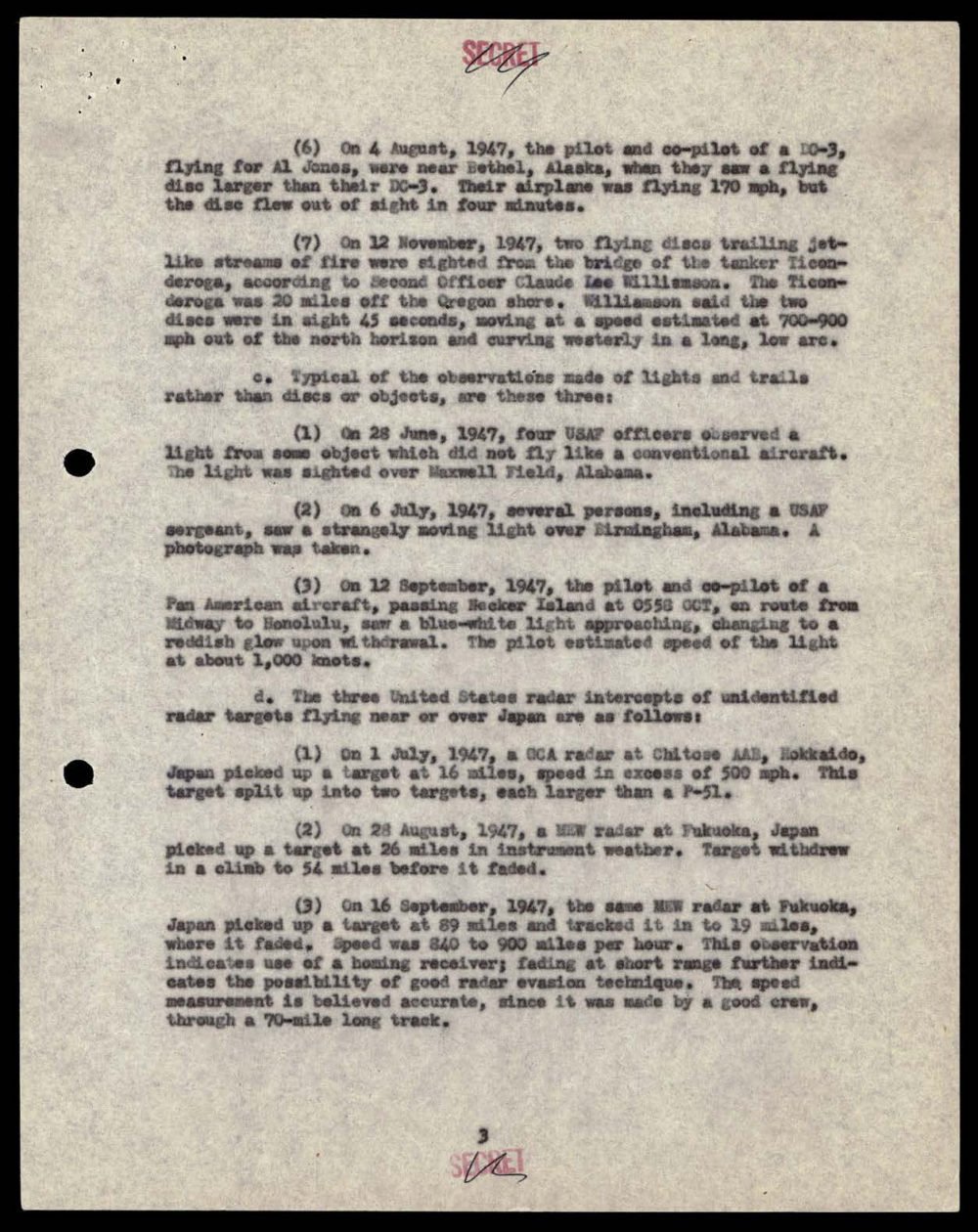
In December 1947, the U.S. Air Force (USAF) Directorate of Intelligence compiled in a study the flying disc reports it considered most significant. Among them, it listed "the three interceptions by United States radars of unidentified targets flying near or over Japan". A year later, the secret study of December 10, 1948 repeated two of these contacts in a separate item, with the statement that the radar reports "indicate unusual air activity that may be related to flying objects". The collection does not contain the original records of the stations.
The first contact was on July 1, 1947. A ground-controlled approach radar, the GCA, at Chitose air base, in Hokkaido, picked up a target at 16 miles, with a speed above 500 miles per hour. According to the text, the target split in two, each one larger than a P-51 fighter. The study does not give the time, heading, or duration of the contact, nor whether there was a visual observation or an interception attempt.
The second was on August 28, 1947, on an MEW early warning radar at Fukuoka, on the island of Kyushu. The target appeared at 26 miles, in closed-in instrument flight weather, and moved away while climbing to 54 miles, where it vanished. There is no speed estimate. This contact appears only in the 1947 study; the 1948 one left it out.
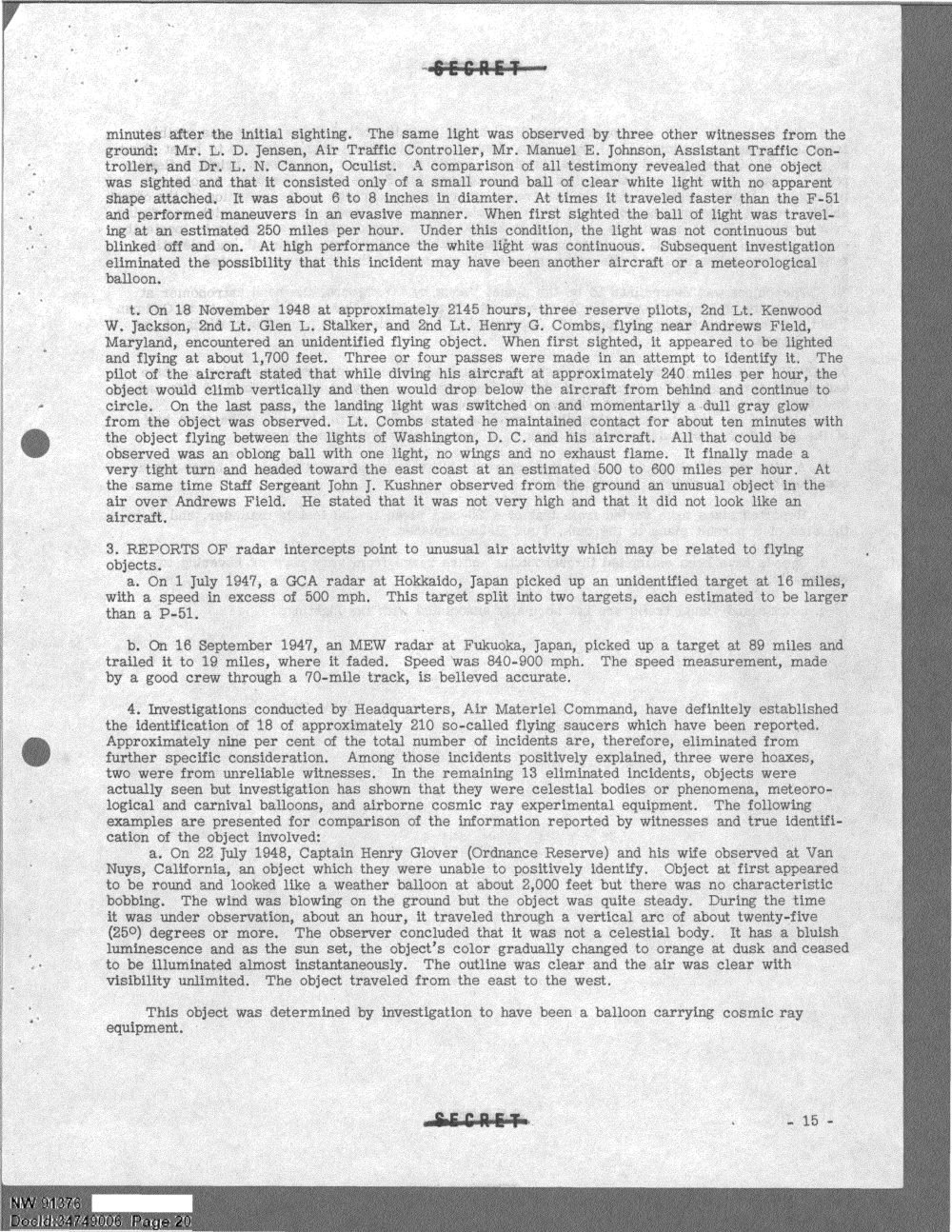
The third, on September 16, 1947, was on the same Fukuoka radar. The target was picked up at 89 miles and tracked to 19 miles, where it disappeared, at 840 to 900 miles per hour. Both studies say the measurement was made by a good crew over a 70-mile track and that it is believed to be accurate. The 1947 study goes further and interprets the case as an indication of the use of a homing receiver and of good radar evasion technique, because the target vanished at short range.
These interpretations are those of the analysts of the time, in a period when the Air Force was considering the hypothesis of foreign aircraft. The studies do not cite photographs of the scope, operators' names, meteorological data, or checks for false echoes, and do not mention any later conclusion. Radar speeds depend on tracking the same target between sweeps, and without the records it is not possible to check how the figures were obtained. The three contacts are different episodes, grouped here because the sources treat them only together.
More images from the document
DIRECT READING OF THE FILE
The document, in the original
U.S. government documents. Item d of the December 1947 study (D100, physical page 242) and item 3 of Appendix C of the 10/12/1948 study (D094, physical page 20) were translated in full. The rest of those pages deals with other cases, translated in their own dossiers and in the dossier on the study.
EXCERPT 1 · PHYSICAL PAGE 242
December 1947 study, item d, physical page 242 (full text of the item)
, t
(6) On 4 Alagtl.at, 1947, thll pilot ad oo,-piln ot a '•
tl.Jilla torn 3=ea, wr. aear •tbe1, Alaeta 1 whiin tbt7 uw a t'lT,laa
diao J.are•r than tbt1r :,. ftliaS.r airplane wu n11n1 l?O llph, bu\ .
the dia tln out ot a1 tin I-our :atauwa.
(7) On 12 owsbir, 1947, ttro n.~ d1acn t.rai11.ng ,.t
lik• aveama ef fire •re etgbtfld t'rc;u t bri• ot the tcikcr ticlll
deroga, accoralng to coM ftic r Cl.aw:le lH 'lUu . • 'lbe Tic~
ditroca n.a :20 idle• orr tbl egon ._.. 1liut801l a&l.d tbi, lwo
41.ace Wf9 in a\ght ,s Memda, so'1 at a ilpNd ••t ai. at. 70C)o,,9()0
• ou.t. r4 tbl north bor1son and ~ ••terl7 1n .a lon&, low arc.
c. 7P1cal ot t~ obearrat.to~s -.:aae ot UQbto md t.ralla
ratbar \ban diec■ or- obj eta, are theae t.hNe1
. (1) ~ 28 lmM, 194?, .tov USO otfic•r• Ow&ervcc! a
light troa •- object lffliob did no\ f'l.7 11.u a ve.nt.1o.nal &1.rcratt .
l.i&bt ~ ■lgbted over ·U&\1tWIU Field, llaba1Aa.
(2) 6 aaly, 1947, eeftl"&l. peracma, liilwll.na • asa
Nr&;eant, ..... •traQpll' .oYl.ng light OYU 111ralaibali, I) ahau • l.
pbotograpt,l ~ taken.
(J) On 12 S.ptabff. 19''7, the 1-t and oo-pllot of•
m Aar1oan aircraft, paaa1AQ abl' tai.na at 0558 00!-, .n l'Ollte trtll
dway to llonolulu, aa-n • blue.-...bttea .linht ~1'.in , cben~ug to a
Nd41ab gloft upon '11!.t: nw&l. ptlot estimate epeed ot tbe Ueht
at abo\\t 11000 'mot••
d. 1'hil tm-.. Ual1-ted 5tate• r~ atercqte or wll.dilnUlled
radar t.u-g•t• t;1y.l. near or flff Japan ~ .. tollft'la
Cl) 01l l July, 194? • OOA r ar at Ch1to • , . aS.do,
~ picked up a get at l.6 {••, ~••d :1tl xoeee of ,oo s,pb. fld.•
tar,et. aplit. up 1.D\e two target•., eacb luga tban • P-:51,.
(2) 2 A st., 1~7, a r ar at ''Fnlrnt1a , Japan
pS.ek•d up a tar •' at 26 ai'lea in irlstr'tzment weatbei-. rerget 1tlt!¥ll'ft
~ a olla'b to 54 ~• before S.t ~aded.
(3) On 16 S.p\eaber, 1947, tm .... rdu a, hlc\iOka,
Japan piobd up a i.arget at 89 miles and tracked l t in rt,o 19 _:i.a.,
'!Wbare tt ta.de • GJ,Md wu SM> to 900 alba s,e baur. fbl.1 •betrva't.1•
in cat.• UN ot a b-.q 11tcei...-er1 radini at ~ ~-- .tvtblr ilad.1•
MtiJ• ta. P,laib.1.Ut.7 of ga.d radar Kuiba 'teclin14w.. ~ apeed
•uaruient 1• belieY•d accurate, id.nee .1.\ wu ma<!•~ a oo4 CJ'n' 1
throu~ a ?0-111.le lGft8 track.Editorial note: The reading follows the image.
Check the original PDF
d. The three United States radar intercepts of unidentified radar targets flying near or over Japan are as follows: (1) On 1 July, 1947, a GCA radar at Chitose AAB, Hokkaido, Japan picked up a target at 16 miles, speed in excess of 500 mph. This target split up into two targets, each larger than a P-51. (2) On 28 August, 1947, a MEW radar at Fukuoka, Japan picked up a target at 26 miles in instrument weather. Target withdrew in a climb to 54 miles before it faded. (3) On 16 September, 1947, the same MEW radar at Fukuoka, Japan picked up a target at 89 miles and tracked it in to 19 miles, where it faded. Speed was 840 to 900 miles per hour. This observation indicates use of a homing receiver; fading at short range further indicates the possibility of good radar evasion technique. The speed measurement is believed accurate, since it was made by a good crew, through a 70-mile long track.View the document record ↗ · Physical page 242, counting the cover.
EXCERPT 2 · PHYSICAL PAGE 20
Study of 10/12/1948, Appendix C, item 3, physical page 20 (full text of the item)
minutes after the initial sighting. The same light was observed by three other witnesses from the
ground! Mr. L. D. Jensen, Air Traffic Controller, Mr. Manuel E. Johnson, Assistant Traffic Controller.> and Dr. L. N. Cannon, Oculist. A comparison of all testimony revealed that one object
was sighted and that it consisted only of a small round ball of clear white light with no apparent
shape attached.· It was about 6 to 8 inches in diamter. At times it traveled faster than the F-51
and performed maneuvers in an evasive manner. When first sighted the ball of light was travel t ing at an estimated 250 miles per hour. Under this condition, the light was not continuous but
blinked off and on. At high performance the white light was continuous, Subsequent investigation
eliminated the possibility that this incident may have been another aircraft or a meteorological
balloon.
t. On 18 November 1948 at approximately 2145 hours, three reserve pilots, 2nd Lt. Kenwood
W. Jackson, 2nd Lt. Glen L. Stalker, and 2nd Lt. Henry G. Combs, flying near Andrews Field,
Maryland, encountered an unidentified flying object. When first sighted, it appeared to be lighted
and flying at about 1,700 feet. Three or four passes were made in an attempt to identify it. The
pilot of the aircraft stated that while diving his aircraft at approximately 240. miles per hour, the
object would climb vertically and then would drop below the aircraft from behind and continue to
circle. On the last pass, the landing light was switched on and momentarily a dull gray glow
from the object was observed. Lt. Combs stated he maintained contact for about ten minutes with
the object flying between the lights of Washington, D. C. and his aircraft. All that could be
observed was an oblong ball with one light, no wings and no exhaust flame. It finally made a
very tight turn and headed toward the east coast at all estimated 500 to 600 miles per hour. At
the same time Staff Sergeant John J. Kushner observed from the ground an unusual object in the
air over Andrews Field. He stated that it was not very high and that it did not look like an
aircraft.
3. REPORTS OF radar intercepts point to unusual air activity which may be related td flying
objects.
a. On 1 July 1947, a GCA radar at Hokkaido, Japan picked up an unidentified target at 16 miles,
with a speed in excess of 500 mph. This target split into two targets, each estimated to be larger
than a P-51.
b. On 16 September 1947, an MEW radar at Fukuoka, Japan, picked up a target at 89 miles and
trailed it to 19 miles, where it faded. Speed was 840-900 mph. The speed measurement, made
by a good crew through a 70-mlle track, is believed accurate.
4. Investigations conducted by Headquarters, Air Materiel Command, have definitely established
the identification of 18 of approximately 210 so-called flying saucers which have been reported.
Approximately nine per cent· of the total number of incidents are, therefore, eliminated from
further specific consideration. Among those incidents positively explained, three were hoaxes,
two were from unreliable witnesses. In the remaining 13 eliminated incidents, objects were
actually seen but investigation has shown that they were celestial bodies or phenomena, meteorological and carnival balloons, and airborne cosmic ray experimental equipment. The following
examples are presented for comparison of the information reported by witnesses and true identification of the object involved:
a. On 22 July 1948, Captain Henry Glover (Ordnance Reserve) and his wife observed at Van
Nuys, Calliornia, an object which they were unable to positively ldenttfy. Object at :first appeared
to be round and looked like a weather balloon at about 2,000 feet but there was no characteristic
bobbing. The wind was blowing on the ground but the object was quite steady. During the time
it was under observation, about an hour, it traveled through a vertical arc of about twenty-:flve
{250) degrees or more. The observer concluded that it was not a celestial body. It has a bluish
luminescence and as the sun set, the object's color gradually changed to orange at dusk and ceased
to be illuminated almost instantaneously. The outline was clear and the air was clear with
visibility unlimited. The object traveled from the east to the west.
This object was determined by investigation to have been a balloon carrying cosmic ray • equipment.
- 15 -Check the original PDF
3. REPORTS OF radar intercepts point to unusual air activity which may be related to flying objects. a. On 1 July 1947, a GCA radar at Hokkaido, Japan picked up an unidentified target at 16 miles, with a speed in excess of 500 mph. This target split into two targets, each estimated to be larger than a P-51. b. On 16 September 1947, an MEW radar at Fukuoka, Japan, picked up a target at 89 miles and trailed it to 19 miles, where it faded. Speed was 840-900 mph. The speed measurement, made by a good crew through a 70-mile track, is believed accurate.View the document record ↗ · Physical page 20, counting the cover.
Dates and documentary context
- Event
- 01/07/1947 — First of three contacts: 01/07/1947 (Chitose), 28/08/1947 and 16/09/1947 (Fukuoka).
- Document
- 18/12/1947 — The D100 study is from December 1947 (written 18/12, stamped 22/12, according to the dossier on that study); the D094 study is from 10/12/1948.
- Publication
- Not established — Files released by the U.S. government, batch date not verified.
Origin and release
U.S. Air Force (USAF) Directorate of Intelligence (December 1947 study); USAF Directorate of Intelligence and Office of Naval Intelligence (1948 study) · DOW-UAP-D100_Air-Materiel-Command-Report-on-UFOs_1947-1948.pdf; DOW-UAP-D094_Analysis-of-Flying-Object-Incidents-in-the-US_1949.pdf
Related accounts and their differences
Questions to continue the investigation
- Were the records of the Chitose and Fukuoka radar stations preserved in any archive?
- Was there a visual observation or an interception attempt in any of the three contacts?
GEOGRAPHY OF THE CASE
Chitose (Hokkaido) and Fukuoka (Kyushu), Japan
Two points far apart from each other; the dossier brings together three contacts at two radar stations and has no single point on the map.
DOCUMENTARY TRAIL
Go back to the sources
References use physical pages of the PDF, counting the cover. Summaries are presented in English; the documents keep their original language.
- DOW-UAP-D100_Air-Materiel-Command-Report-on-UFOs_1947-1948.pdf
Physical page 242: December 1947 study, item d (three radar contacts in Japan)
DOW · 245 pages - DOW-UAP-D094_Analysis-of-Flying-Object-Incidents-in-the-US_1949.pdf
Physical page 20: intelligence study of 10/12/1948, Appendix C, item 3
DOW · 34 pages
Editorial summary based on the collection's research notes. How we read the documents.