Date: Summer 1948, according to a 1961 account (day not given)Location: Goose Bay air base, Labrador (then Newfoundland)
Goose Bay, summer 1948: in front of an inspection party, American and Canadian radars pick up a UFO at 9.000 miles per hour, according to a retired major
In the 1964 private NICAP report kept by the CIA, retired Major Edwin A. Jerome says that, in the summer of 1948, the American and Canadian approach radars at Goose Bay picked up a UFO at about 9.000 miles per hour during the visit of an inspection party, and that the next day they showed a nearly stationary UFO at 45.000 feet. The official explanation, according to him, was a meteor and later "high-altitude seagulls".
- Event date
- Summer 1948, according to a 1961 account (day not given)
- Location
- Goose Bay air base, Labrador (then Newfoundland)
- Topic
- CIA file
- Source agencies
- CIA
- Documents
- 1 document · 186 pages
- Reading time
- 19 min
 Page of the NICAP reportPhysical page 88
DOCUMENTARY SOURCES · CIA
What the records tell
The source of this dossier is the report "The UFO Evidence", published in 1964 by NICAP (National Investigations Committee on Aerial Phenomena), an American civilian UFO research organization. A copy remained in the CIA's CREST archive and was released in 2001, which proves that the agency kept the book, not that it wrote or validated it. On physical pages 88 and 89, NICAP publishes an account sent in 1961 by retired Air Force Major Edwin A. Jerome. According to the book, Jerome was a command pilot, was chief of the air police for about eight years and served as an intelligence officer and criminal investigator. In 1948 he was at Goose Bay, in Labrador, and says he was part of the base's "modest" intelligence reporting structure.
Jerome says that a high-level inspection party, with officers of the Royal Canadian Air Force and the U.S. Air Force, up to the rank of general as far as he remembered, was visiting the base's radar facilities, then a refueling point for military and civilian aircraft on the North Atlantic routes. In the shack of the American ground-controlled approach radar, the operator saw on the scope a fast target heading from northeast to southwest, at about 9.000 miles per hour by calculation. The technician was reprimanded for the supposed error, but the target returned and was shown to the inspectors.
The reaction, according to Jerome, was to conclude that the American equipment was out of calibration. The party went on to the Canadian radar, and the officer in charge said he had just seen the same "unbelievable" target. Jerome says he was called in to prepare an urgent intelligence report. The prevailing theory was a meteor, which he ruled out because the operators on both sides said the target held at 60.000 feet and about 9.000 miles per hour. The next day, both radars showed an object hovering over the base at about 10 miles per hour, at 45.000 feet.
The official version for this second case, he says, was that it was "high-altitude seagulls". Jerome recalls that all this happened before fast jets, missiles and record-altitude helicopters. He adds a memory from another period: on a mission in Alaska, around 1960, the early warning systems often recorded fast unidentified objects, residents of the Bering Sea coast reported missile-like craft flying very low, and the Air Force denied the presence of Russian aircraft.
The account was written about thirteen years later, from memory, with no exact date and without the intelligence report Jerome says he prepared. The speeds and altitudes are those he attributes to the operators; no radar record is reproduced. The site has two Goose Bay dossiers from 1948, of October 29 and 31, based on Project Sign files, with slow targets of 25 to 30 miles per hour. Given the season and the speeds, Jerome's account does not seem to concern those same episodes, but they cannot be ruled out as the same without the date.
DIRECT READING OF THE FILE
The document, in the original
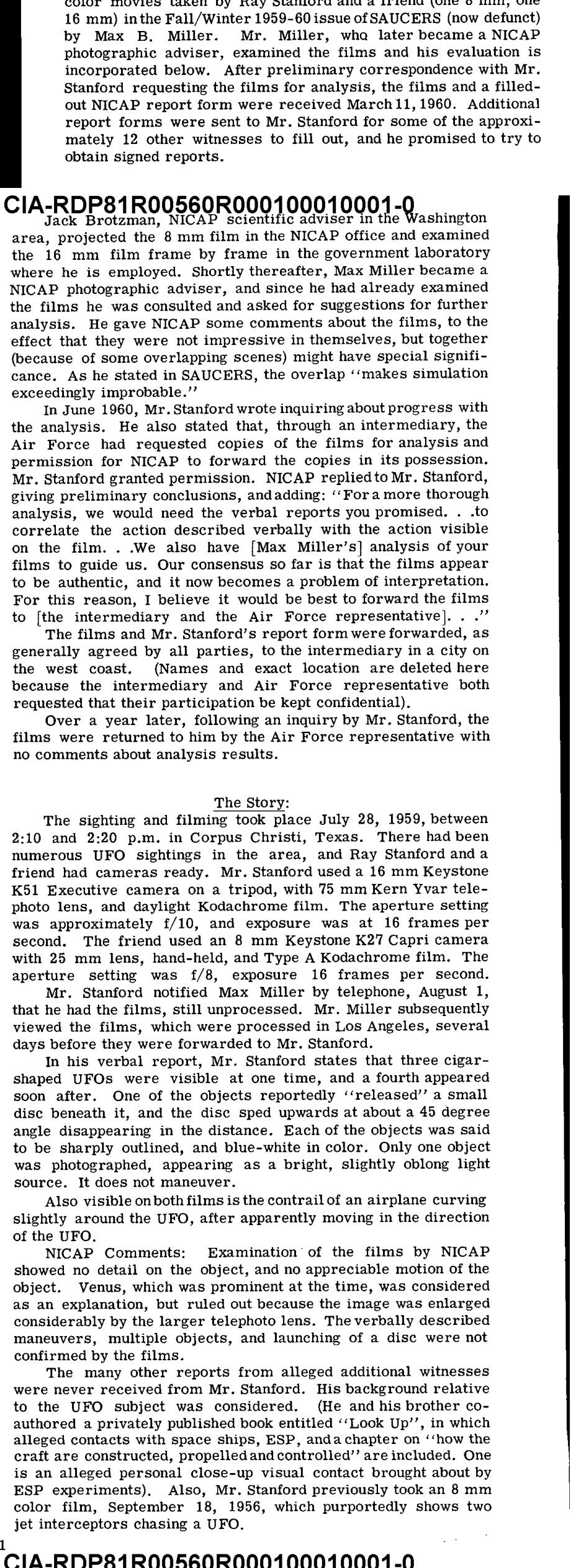
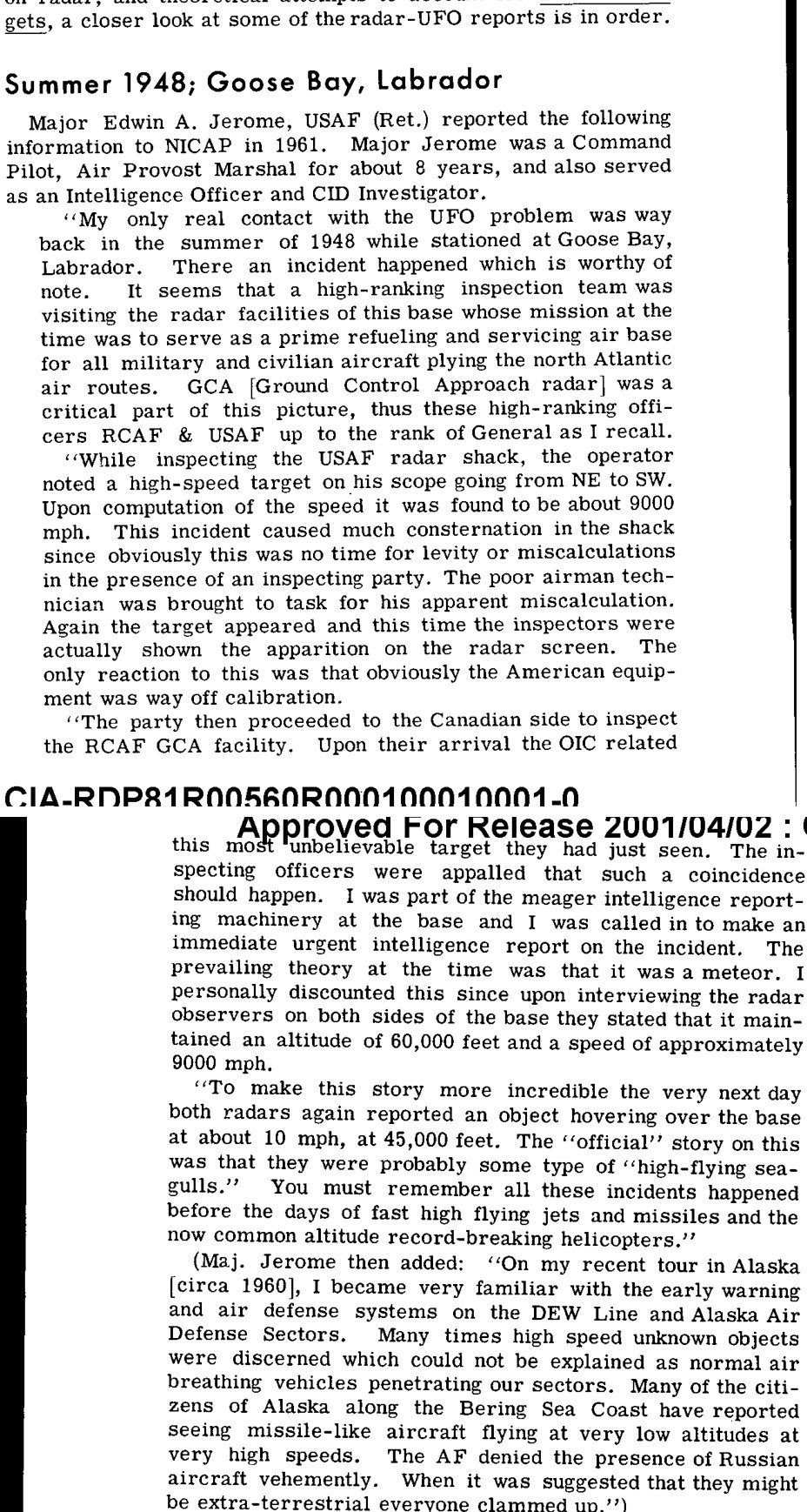
Private publication (NICAP report The UFO Evidence, 1964): the English text is not reproduced or translated in full. Each translations block provides, in English, a faithful summary of the indicated passage or page (NICAP prose) or a line-by-line translation (tables, lists and reproduced official messages), with at most one short quotation. The images are crops of the report's pages. For this case, the end of the right-hand column of page 88 and the top of the left-hand column of page 89 were summarized. The full pages are covered in the report's documentary dossier (p. 88) and in first-round dossiers (p. 89).
EXCERPT 1 · PHYSICAL PAGE 88
Physical page 88, right column: "Summer 1948; Goose Bay, Labrador" (excerpt)
Approved For Release 2001/04/02 : CIA-RDP81R00560R000100010001-
they were able to pick up on radar were at distances ‘‘con-
siderably less than a mile.’’ Yet allauthors agree that angels
are clearly visible at distances of 25 miles or even more. If
the ‘‘bird’’ theory is correct, it must be possible to show that
ordinary aircraft-control radar can ‘‘see’”’ a bird 25 miles
away. No evidence that this is true has ever been presented,
and no practicing radar operator will take such a suggestion
seriously for a moment. . .
Something that appears only sporadically, like angels, can-
not - in the name of simple common sense - be identified
with something that is around all the time, like birds. That
the bird-theorists can ignore difficulties as fundamental as this
one only shows us once again how irrational the human mind
can be when confronted by facts that point to some conclusion
it does not wish to accept. . .
The other leading ‘“‘orthodox’’ idea about angels is that they
are ‘‘refractive-index inhomogeneities of various types,’’ in
the words of a valuable though turgidly-writtenarticle by Ver-
non G, Plank of the Air Force’s Cambridge Research Center
(Bedford, Mass.) in Electronics of March 14, 1958. Plank,
like Harper, nails his thesis to the mast in his title: ‘‘Atmos-
pheric Angels Mimic Radar Echoes.’ As for birds, he informs
us that they have ‘‘radar cross-sections as large as 20
sq. cm at S-Band. . . Radar cross-sections of the non-wind-
carried sources range as large as 700 sq. cm at L-Band. . .
birds cannot explain echoes with such large indicated radar
cross-sections. There must be other sources.”’ (In other
words: the angels give a radar echo far stronger than that
from a bird), This confirms what we have said above about
the applicability of the bird theory.
But when Plank puts forward ‘‘convective bubbles, highly
refractive portions of atmospheric layers and water-vapor or
temperature anomaly regions” as his candidates, he is shutting
his eyes to known impossibilities just as the bird-men have
done. Not only are such atmospheric phenomena obviously
incapable of flying counter to the wind, but they are known to
be just as incapable as birds of producing the sharp, relatively
intense ‘‘angel’? echoes. To quote Herbert Goldstein in the
authoritative Radiation Laboratory treatise Propagation of
Short Radio Waves, ed. D. E. Kerr (McGraw-Hill, 1951):
“nm Section 7.4 it is shown that the refractive index gradients
believed to exist in the atmosphere are much too low to ac-
count for the observed echoes.”’ . . .
“Then there are radar flying saucers.’’ Plank continues.
Here he cites no detail, and has only two remarks to make.
“The classic saucer incidents over Washington in July, 1952,
for example, occurred when the atmosphere was exceedingly
super-refractive and spotty anomalous propagation was de-
finitely in order.’’. . . (In reality, there was onlya moderate
inversion on those nights, and ‘‘spotty anomalous propaga-
tion’? is a purely imaginary phenomenon. It has never been
known to occur, there is no theoretical basis for believing
that it could occur, and it would have had no resemblanace
to the Washington sightings if it did occur.) Plank’s other
“saucer mechanism” (as he calls it) is the suggestion that
real aircraft may generate ghost images by reflection to and
back from some radar mirror on the ground, thus producing
a phantom echo that might seem to accompany the plane. The
accompanying diagram [in the original article] shows that Plank
is unconscious of the optical grotesquerie of what he is
proposing. Quite apart from that, he has not stopped to think
that if this could happen at all, it would happen all the time,
and would be a perfectly familiar nuisance to the radar men.
The idea that reflection from refractive index gradients
could account for radar UFO reports is also challenged by
Merrill J. Skolnik, a scientist associated with the Research
Division of Electronic Communications, Inc. Ina 1962 book
on the subject of radar, Mr. Skolnik states: ‘‘. . . there must
be a large change in the index of refraction over a very short
distance [to account for the observed radar targets]; Un-
fortunately, the refractive-index gradients required by the
theory are much greater than have been measured experi-
mentally, and it has not been possible on this basis to account
for the observed angel radar cross sections theoretically.”
[70]
One of the persons consulted in preparing this rept rt was a
veteran Air Force radar operator, a Sgt. First Class, who has
operated sets all over the world. Hehas also tracked unidentified
targets, at White Sands, N.M.; in Detroit, Michigan; and during
NATO maneuvers overseas. He stated that he had observed some
“golid unidentified targets moving at variable speeds, up to 500
mph.’”? He had observed targets which disappeared and reappeared
on his scope. Sometimes the objects simply moved out of range.
Ionized air ‘‘islands,’’ which are commonly invoked to explain
radar-UFO reports, he said were easily recognizable. Their
blips ‘‘pile up’? and they tend to develop a comet-like tail on the
screen. Birds, he said, cause no problem even to novice opera-
tors fresh out of radar school. The targets which caused prob-
lems were those which exactly resembled a solid object, when
there was no known aerial device in the position indicated.
Special records are kept of all such sightings. Usually, in a case
of this type, jets are Scrambled and other radar stations along
the path of the UFO notified. .
Another consultant, David L. Morgan, Jr. (physicist), Madison,
Connecticut, submitted a paper to NICAP which he preferred to
term ‘‘thoughts on the matter’? rather than a detailed scientific
study. In it, Mr. Morgan approached the question of radar-UFO
targets theoretically, based on a general knowledge of physics.
Citing hypothetical cases of different types of images which appear
on radar screens, he analyzed each in terms of the probability
that they could be explained by weather phenomena.
Mr. Morgan independently concluded that the cases of an un-
explained radar target pacing an aircraft could not be explained
by an echo from the aircraft to another surface, and back to the
radar set. ‘‘If a large, stationary ground object did this,’’ he
states, ‘it would always do it and this would be familiar to the
radar operator. If the [radar-detected] object were a meteoro-
logical condition such as an ionized layer of air, it is highly
doubtful that the reflection would be regular enough to give a
consistent appearance, and sharp enough to prevent the blip from
spreading in a radial direction.”
In summary, Mr. Morgan stated: ‘‘It may be said that highly
specialized UFO patterns on radar scopes can be explained only
by highly unlikely or even impossible meteorological conditions.
In the case of inversions, it is further unlikely that a specialized
condition would exist without the simultaneous presence of less
specialized conditions that would immediately be recognized as
coming from an inversion.”
Having examined various known phenomena which produce blips
on radar, and theoretical attempts to account for unknown tar-
gets, a closer look at some of the radar-UFO reports is in order.
Summer 1948; Goose Bay, Labrador
Major Edwin A. Jerome, USAF (Ret.) reported the following
information to NICAP in 1961. Major Jerome was a Command
Pilot, Air Provost Marshal for about 8 years, and also served
as an Intelligence Officer and CID Investigator.
“My only real contact with the UFO problem was way
back in the summer of 1948 while stationed at Goose Bay,
Labrador. There an incident happened which is worthy of
note. It seems that a high-ranking inspection team was
visiting the radar facilities of this base whose mission at the
time was to serve as a prime refueling and servicing air base
for all military and civilian aircraft plying the north Atlantic
air routes. GCA [Ground Control Approach radar] was a
critical part of this picture, thus these high-ranking offi-
cers RCAF & USAF up to the rank of General as I recall.
“While inspecting the USAF radar shack, the operator
noted a high-speed target on his scope going from NE to Sw.
Upon computation of the speed it was found to be about 9000
mph. This incident caused much consternation in the shack
since obviously this was no time for levity or miscalculations
in the presence of an inspecting party. The poor airman tech-
nician was brought to task for his apparent miscalculation.
Again the target appeared and this time the inspectors were
actually shown the apparition on the radar screen. The
only reaction to this was that obviously the American equip-
ment was way off calibration.
“The party then proceeded to the Canadian side to inspect
the RCAF GCA facility. Upon their arrival the OIC related
Approved For Release 2001/04/02: CIA-RDP81R00560R000100010001-0Check the original PDF
[p. 88: texto da publicação privada não reproduzido; ver o resumo]View the document record ↗ · Physical page 88, counting the cover.
EXCERPT 2 · PHYSICAL PAGE 89
Physical page 89, top of the left column: end of Major Jerome's account (excerpt)
tis “ApRroved For Release 2001/04/02 : CIA-RDP81R00560R000100010001-0
believable target they had just seen. The in-
specting officers were appalled that such a coincidence
should happen. I was part of the meager intelligence report-
ing machinery at the base and I was called in to make an
immediate urgent intelligence report on the incident. The
prevailing theory at the time was that it was a meteor. I
personally discounted this since upon interviewing the radar
observers on both sides of the base they stated that it main-
tained an altitude of 60,000 feet and a speed of approximately
9000 mph.
“To make this story more incredible the very next day
both radars again reported an object hovering over the base
at about 10 mph, at 45,000 feet. The ‘‘official”’ story on this
was that they were probably some type of “high-flying sea-
gulls.” You must remember all these incidents happened
before the days of fast high flying jets and missiles and the
now common altitude record-breaking helicopters.”’
(Maj. Jerome then added: ‘‘On my recent tour in Alaska
[circa 1960], I became very familiar with the early warning
and air defense systems on the DEW Line and Alaska Air
Defense Sectors. Many times high speed unknown objects
were discerned which could not be explained as normal air
breathing vehicles penetrating our sectors. Many of the citi-
zens of Alaska along the Bering Sea Coast have reported
seeing missile-like aircraft flying at very low altitudes at
very high speeds, The AF denied the presence of Russian
aircraft vehemently. When it was suggested that they might
be extra-terrestrial everyone clammed up.’’)
October 15, 1948; Japan
Capt. Edward J. Ruppelt reported the following case received
by Project Sign (the original Air Force UFO investigation pro-
ject) in October 1948.
An F-61 “Black Widow” night fighter on patrol over Japan,
October 15, picked up an unidentified radar target. The UFO
was traveling about 200 mph. between 5000 and 6000 feet. Each
time the F-61 tried to close in, the object would accelerate to an
estimated 1200 mph., outdistancing the interceptor before slowing
down again. On one of six passes at the UFO, the crew of the
F-61 got close enough to see its silhouette. The UFO appeared
to be 20-30 feet long and shaped ‘‘like a rifle bullet.”
November 23, 1948; Fursten-Feldbruck, Germany
An unidentified object resembling a reddish light was sighted
east of the base at 2200 hours, local time. Capt. [names
deleted from Air Force reports] said the UFO was moving south
across Munich, turned southwest, then southeast. Not knowing
the height, the speed could not be estimated; but it appeared to
be traveling between 200 and 600 mph.
Capt. reported the sighting to base operations, andthe
radar station chécked its scope. An unidentified target, traveling
900 mph., was detected at 27,000 feet about 30 miles south of
Munich. Capt.. verified that the UFO was now visible in
that area, Radar then reported that the target had climbed quick-
ly to 50,000 feet and was circling 40 miles south of Munich.
March 8, 1950; Nr Dayton, Ohio
In mid-morning, the CAA received a report from Capt. W. H.
Kerr, Trans-World Airways pilot, that he and two other TWA
pilots had a UFO in sight. A gleaming object was visible, hover-
ing at high altitude. CAA also had 20 or more reports on the
UFO from the Vandalia area. Wright-Patterson AFB, near Dayton,
was notified, and sent up four interceptors. The UFO was also
visible to control tower operators and personnel of Air Technical
Intelligence Center on the base. Radar had an unidentified tar-
get in the same position.
Two F-51 pilots reported that they could see the UFO, which
presented a distinct round shape and seemed huge and metallic.
But clouds moved in, and the pilots were forced to turn back. The
Master Sergeant who tracked it on radar stated: ‘‘The target
was a good solid return. . . caused by a good solid target.’
Witnesses reported that the UFO finally climbed vertically out of
sight at high speed.
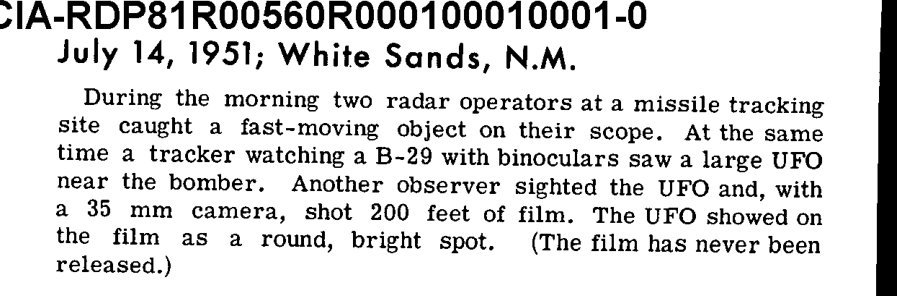
July 14, 1951; White Sands, N.M.
During the morning two radar operators at a missile tracking
site caught a fast-moving object on their scope. At the same
time a tracker watching a B-29 with binoculars saw a large UFO
near the bomber. Another observer sighted the UFO and, with
a 35 mm camera, shot 200 feet of film. The UFO showed on
the film as a round, bright spot. (The film has never been
released.)
Fall 1951; Korean Area
‘Following are extracts from a letter to NICAP dated May 16,
1957, signed by Lt. Cmdr. M. C. Davies, U.S.N., then stationed
at the U. S, Naval Air Station, Jacksonville, Florida.
My background is a Naval Aviator with approximately 4000
hours. At the time of the incident I was deployed with an
Anti-Submarine Squadron aboard a CVE class carrier. I was
assigned Air Crew Training Officer and prior to deployment
had attended CIC Air Controller School at Point Loma, also
Airborne Air Controller School and Airborne Early Warning
School both located at NAS, San Diego. . .
It was at night, I was riding with a radar operator which I
often did to check on their proficiency. We were flying at
5000 feet, solid instruments, with our wingman flying a radar
position about 3 miles astern and slightly to our right or left.
The target, which was slightly larger than our wingman, I
picked up on our scope, had been circling the fleet; it left
the fleet and joined up on us a position behind our wingman,
approximately the same position he held on us.
I reported the target to the ship and was informed that the
target was also held on the ship’s radars, 14 in number; and
for us to get a visual sighting if possible. This was impossible
because of the clouds. The target retained his relative
position for approximately 5 minutes and then departed in
excess of one thousand miles per hour. He departed ona
straight course and was observed to the maximum distance
of my radar which was two hundred miles.
Upon completion of my flight an unidentified flying object
report was completed, at which time I was informed that the
object was held on ship’s radars for approximately seven
hours.
July 1, 1952; Ft. Monmouth, N.J.
A radar tracking of two UFOs at Fort Monmouth, N. J. was
one of a series of sightings which fit a definite pattern. It
occurred at a time when the Air Force was swamped with UFO
reports - good ones. (See Section XII, 1952 Chronology.] Also,
it was the first of ten known incidents of UFOs tracked by radar
during July 1952. (See chart).
The sequence of events, reported by the Air Force UFO pro-
ject chief, was as follows.
7:30 a.m., Boston, Mass. A couple in nearby Lynn and an
Air Force Captain in Bedford saw two F-94’s which had been
scrambled on an intercept mission. The Captain saw one and
the couple saw two silvery cigar-shaped UFOs, which moved
southwest across Boston, outspeeding the jets.
9:30 a.m., Ft. Monmouth, N. J. Radar tracked two UFO tar-
gets, also observed visually as two shiny objects. The UFOs
approached slowly from the northeast, and hovered nearby at
50,000 feet for about 5 minutes.. Suddenly the blips on the
scope accelerated and shot away to the southwest, confirmed
by visual observation.
A_few hours later, Washington, D.C. A physics professor
at George Washington University, and dozens of others, saw
a grayish UFO bobbing back and forth in the sky about 30-40
degrees above the north-northwest horizon.
None of the sightings could be explained.
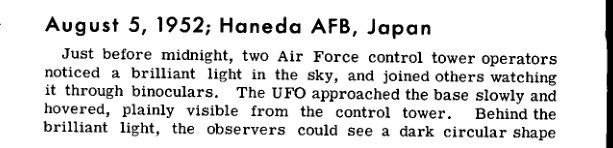
August 5, 1952; Haneda AFB, Japan
Just before midnight, two Air Force control tower operators
noticed a brilliant light in the sky, and joined others watching
it through binoculars. The UFO approached the base slowly and
hovered, plainly visible from the control tower. Behind the
brilliant light, the observers could see a dark circular shape
Approved For Release 2001/04/02 : CIA-RDP81R00560R000100010001-0Editorial note: The part of the left column about Japan (15/10/1948) and Fürstenfeldbruck is already in first-round dossiers.
Check the original PDF
[p. 89: texto da publicação privada não reproduzido; ver o resumo]View the document record ↗ · Physical page 89, counting the cover.
Dates and documentary context
- Event
- Not established — The account gives only "summer 1948"; it was sent to NICAP in 1961.
- Document
- 02/04/2001 — Date of the CREST release stamp printed on the pages (Approved For Release 2001/04/02).
- Publication
- 1964 — Year of publication of the report "The UFO Evidence" by NICAP (May 1964).
Origin and release
National Investigations Committee on Aerial Phenomena (NICAP), an American civilian organization; private report "The UFO Evidence" (1964), edited by Richard H. Hall. Copy kept in the CIA's CREST archive (CIA-RDP81R00560R000100010001-0, released on 02/04/2001); the CIA kept the text, it did not produce or validate it · CIA-RDP81R00560R000100010001-0_NICAP-The-UFO-Evidence_1964.pdf
CIA CREST, CIA-RDP81R00560R000100010001-0, release of 02/04/2001 ↗ — undefined
Related accounts and their differences
Questions to continue the investigation
- Is the urgent intelligence report that Jerome says he made in 1948 in the files of Project Sign?
- Is the summer 1948 episode in any way related to the Goose Bay radar returns of October 29 and 31, 1948?
GEOGRAPHY OF THE CASE
Goose Bay, Labrador
Approximate reference to the Goose Bay base, placed by the editorial team. It does not indicate the target's trajectory.
DOCUMENTARY TRAIL
Go back to the sources
References use physical pages of the PDF, counting the cover. Summaries are presented in English; the documents keep their original language.
- CIA-RDP81R00560R000100010001-0_NICAP-The-UFO-Evidence_1964.pdf
Physical page 88: beginning of "Summer 1948; Goose Bay, Labrador", account by Major Edwin A. Jerome · Physical page 89: end of Major Jerome's account
CIA · 186 pages
Editorial summary based on the collection's research notes. How we read the documents.