Date: 23/11/1948, 22h20 (local time)Location: Sky east of Fürstenfeldbruck, Germany, with a southward path over Munich
Fürstenfeldbruck, 1948: F-80 pilot sees reddish UFO, and a ground station reports a UFO climbing to 40.000 feet
At 22h20 on November 23, 1948, Captain Hugh Slater, an F-80 pilot at Fürstenfeldbruck, in Germany, saw a UFO resembling a reddish star cross over Munich heading south. A ground control station later reported a UFO at 27.000 feet south of Munich, which reportedly climbed to 40.000 feet and began circling.
- Event date
- 23/11/1948, 22h20 (local time)
- Location
- Sky east of Fürstenfeldbruck, Germany, with a southward path over Munich
- Topic
- 1948 reports
- Source agencies
- Arquivo histórico · CIA
- Documents
- 2 documents · 330 pages
- Reading time
- 14 min
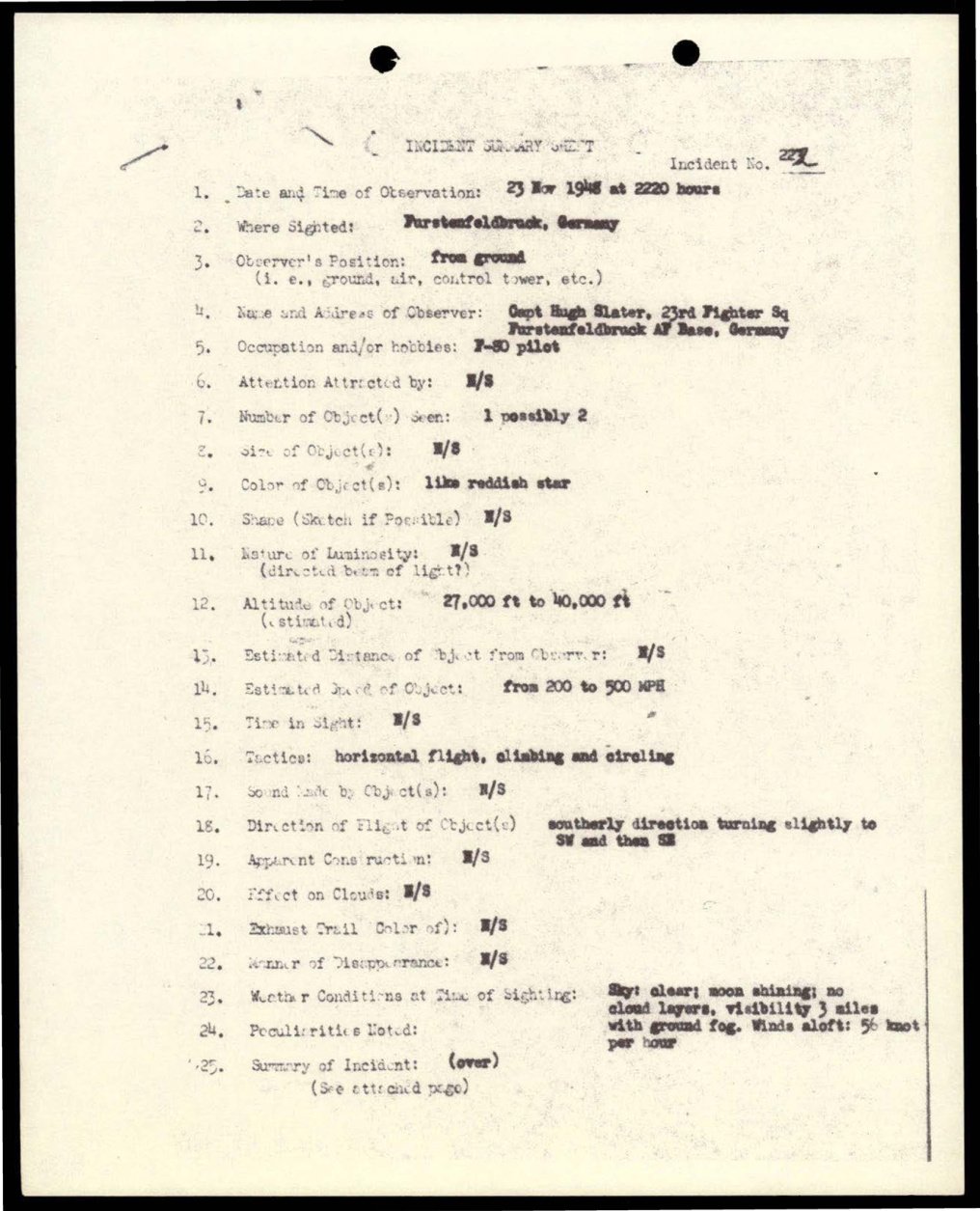 Official formPhysical page 114
DOCUMENTARY SOURCES · Arquivo histórico / CIA
What the records tell
Incident 222 involves two jet pilots of the American Air Force in occupied Germany: Captains Hugh Slater and Darwin R. Addis, of the 23rd Fighter Squadron, at Fürstenfeldbruck Air Base, west of Munich. Both flew the F-80, the first American jet fighter in service. At 22h20, local time, on November 23, 1948, Slater saw from the ground an object in the air, directly east of Fürstenfeldbruck, at unknown altitude. Addis was with him.
The object looked like a reddish star. The file speaks of one object, "possibly two". It was heading south over Munich, veering slightly southwest and then southeast. The speed might have been between 200 and 500 miles per hour, but the summary cautions that the actual speed could not be estimated. The file describes the movement as level flight, climbing and circling. The sky was clear, with a moon, no cloud layers, visibility of 3 miles with ground fog and winds aloft of 56 knots.
From his quarters, Slater telephoned base operations, which notified the station named Racecard, identified as a DF station. Racecard replied that there was nothing on the scope, but that it would look. Later, it telephoned operations to report an unidentified object at 27.000 feet, about 30 miles south of Munich. Later still, it called Slater himself: the object was climbing and, as was then believed, was at 40.000 feet, about 40 miles south of Munich, circling.
The summary adds that no F-80s were flying that night, which rules out the base's own jets. Slater is considered "completely reliable", and Addis, also an F-80 pilot, confirmed the facts. The file combines the visual observation and the information from the ground station, with an altitude of 27.000 to 40.000 feet, without explaining whether Racecard's radar return and the light seen by Slater were in fact the same thing. There is no letter-and-number evaluation and no conclusion.
The acronym DF usually indicates direction finding, which locates the direction of radio signals, but the summary speaks of nothing having appeared "on the scope", without saying what equipment was used. As an editorial hypothesis, a lighted balloon or an aircraft from another unit could explain part of the account, and the slow climb to 40.000 feet is consistent with a balloon. The document, however, does not contain the identification of the return, the station's data or any check of flights from other bases.
The summary sheet puts the altitude "27.000 to 40.000 feet" on a single line. These numbers do not come from Slater's observation, who in the summary sees the object "at unknown altitude", but from the station Racecard's two telephone calls. The file therefore mixes in the same field a visual account and data from equipment of unidentified origin. The incident number appears with the last digit corrected on both sheets, and the box's sequence confirms 222.
The weather field records a clear sky and moon, but also ground fog and visibility of only 3 miles, as well as winds aloft of 56 knots, without direction. The file also does not give the time of Racecard's calls, which makes it impossible to know how much time separated the visual observation from the two reports, nor does it explain whether the station tracked the same return at both positions, 30 and 40 miles south of Munich.
Slater is described as "completely reliable", and Captain Addis, who was with him, confirmed the facts. Even so, the case did not receive a letter-and-number evaluation, as other files in the series did, and no other page gathered on the portal records the station Racecard, the 23rd Fighter Squadron or a light over Munich on November 23, 1948.
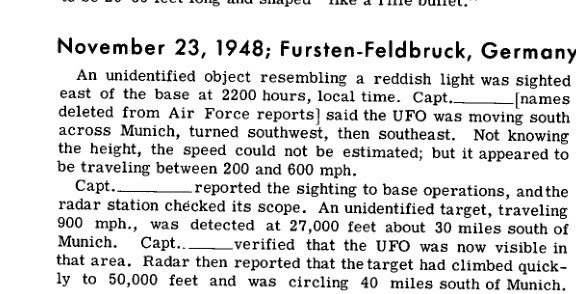
The report "The UFO Evidence", published in 1964 by NICAP, an American civilian UFO research organization, and kept by the CIA in the CREST archive, summarizes the same episode on physical page 89, with names removed and numbers different from those in the file. It says the reddish light was seen east of the base at 22h00, local time, and not at 22h20, and that the speed appeared to be between 200 and 600 miles per hour, and not 500. According to NICAP, a radar station that was consulted detected an unidentified return at 900 miles per hour, at 27.000 feet, about 30 miles south of Munich, and later reported that it had climbed rapidly to 50.000 feet, circling 40 miles south of the city.
The differences matter for reading the case. The Air Force file speaks of a station named Racecard, identified as DF, with no speed, and gives 40.000 feet as the final altitude. NICAP calls the station a radar station, adds the speed of 900 miles per hour, raises the altitude to 50.000 feet and says the captain confirmed that the light was then visible in that area, a link the file does not make. The NICAP passage does not indicate its source; it says only that the names were deleted from the Air Force reports, whereas the portal's file names Slater and Addis.
More images from the document
DIRECT READING OF THE FILE
The document, in the original
Both pages of the case (physical pages 114 and 115) were translated in full: the summary sheet, field by field, and the summary with the calls from Racecard station.
EXCERPT 1 · PHYSICAL PAGE 114
Full summary sheet of incident 222, physical page 114
c. )
kcident !\O. ~
l. 23 b 19'11 at 2220
:1ere .:,ighted:
3. Ob::C'rvt~ I 8 l ~: ,... 8"Clllllllll
(i. e, I t t.i
1 • :.. :.c A
At h ·t. ion A r: t t ~ by : 1/1
7, Nu=i r of t() en: 1 ~•
.,..)i -1. of C• j.._ {r
ol~ ~f ( ). lilraNd41ab aw
11 . 10 1 '-- of W'llin Je i 1/
( t!ir ::.i..e .. f i '. tl ,
2. j, ct : 27,<XX> r, '° 140,000 ri
:
10. .,
200 500 NPI •
..., .•,t : 1/S •
l e, '";,. tic· : horl \al fl \,
1; . ~ n 1 : .:... '1. b C j ct ( · I/
l . Di r c . n of :11~ .to! 'tj ct( ~)
19. ~ n: 1/S
-.
W\.c- h,. r Co1 di i ~ns c.t -~ : • of :... • ~· •1'.€:
P cw.1: 1th s ·o ~
Su ...: y of I .cid ..n
{ - ~~ [Cl d,:-Editorial note: The incident number has its last digit typed over another, but the summary sheet and the sequence confirm 222. The original spells Furstenfeldbruck, without umlaut, and "56 knot per hour".
Check the original PDF
INCIDENT SUMMARY SHEET | Incident No. 222 | 1. Date and Time of Observation: 23 Nov 1948 at 2220 hours | 2. Where Sighted: Furstenfeldbruck, Germany | 3. Observer's Position (i.e., ground, air, control tower, etc.): from ground | 4. Name and Address of Observer: Capt Hugh Slater, 23rd Fighter Sq, Furstenfeldbruck AF Base, Germany | 5. Occupation and/or hobbies: F-80 pilot | 6. Attention Attracted by: N/S | 7. Number of Object(s) Seen: 1 possibly 2 | 8. Size of Object(s): N/S | 9. Color of Object(s): like reddish star | 10. Shape (Sketch if Possible): N/S | 11. Nature of Luminosity (directed beam of light?): N/S | 12. Altitude of Object (estimated): 27,000 ft to 40,000 ft | 13. Estimated Distance of Object from Observer: N/S | 14. Estimated Speed of Object: from 200 to 500 MPH | 15. Time in Sight: N/S | 16. Tactics: horizontal flight, climbing and circling | 17. Sound Made by Object(s): N/S | 18. Direction of Flight of Object(s): southerly direction turning slightly to SW and then SE | 19. Apparent Construction: N/S | 20. Effect on Clouds: N/S | 21. Exhaust Trail (Color of): N/S | 22. Manner of Disappearance: N/S | 23. Weather Conditions at Time of Sighting: Sky: clear; moon shining; no cloud layers, visibility 3 miles with ground fog. Winds aloft: 56 knot per hour | 24. Peculiarities Noted: [em branco] | 25. Summary of Incident: (over) (See attached page)View the document record ↗ · Physical page 114, counting the cover.
EXCERPT 2 · PHYSICAL PAGE 115
Summary of incident 222, physical page 115
At 2220 •• local tlae 2 loT 111.
-11&11\1¥
:Ye been
IOOpe
ledia..
t
bel t lt0.000 ft al.ti de ilea eouth. of
Mu..t lrcltnc.
of
' ftUIUQa
ed could oot be•
n ~11ai obJeot 27,000 n
Muni 8aoeoard
on Jc\ •
t h DJcht.
•Editorial note: "Scope" was translated into Portuguese as "tela" (screen), without presuming whether it was a radar screen or another equipment's screen.
Check the original PDF
Incident: 222 | At 2220 hours, local time, 23 Nov 48, Capt Hugh Slater saw an object in the air directly east of Furstenfeldbruck at an unknown altitude. It looked like a reddish star and was moving in a southerly direction across Munich turning slightly to the South-West and then South-East. Speed could have been between 200 and 500 MPH. Actual speed could not be estimated. Capt Slater called Base Operations from his barracks and they notified Racecard DF Station who reported nothing on the scope but stated they would look. Racecard Station then called Base Operations to report an unidentified object 27,000 ft up some 30 miles south of Munich. Later Racecard Station called Capt Slater to report that the object was climbing and was then believed to be at 40,000 ft altitude about 40 miles south of Munich and was circling. | There were no F-80's (Jets) flying on this night. | Capt Slater (an F-80 pilot) is considered completely reliable and the facts stated above were verified by Capt Darwin R. Addis 23rd Fighter Sq (also an F-80 pilot) who was with Capt Slater at the time of the sighting.View the document record ↗ · Physical page 115, counting the cover.
EXCERPT 3 · PHYSICAL PAGE 89
Physical page 89, left column: case of 23/11/1948, Fürstenfeldbruck
tis “ApRroved For Release 2001/04/02 : CIA-RDP81R00560R000100010001-0
believable target they had just seen. The in-
specting officers were appalled that such a coincidence
should happen. I was part of the meager intelligence report-
ing machinery at the base and I was called in to make an
immediate urgent intelligence report on the incident. The
prevailing theory at the time was that it was a meteor. I
personally discounted this since upon interviewing the radar
observers on both sides of the base they stated that it main-
tained an altitude of 60,000 feet and a speed of approximately
9000 mph.
“To make this story more incredible the very next day
both radars again reported an object hovering over the base
at about 10 mph, at 45,000 feet. The ‘‘official”’ story on this
was that they were probably some type of “high-flying sea-
gulls.” You must remember all these incidents happened
before the days of fast high flying jets and missiles and the
now common altitude record-breaking helicopters.”’
(Maj. Jerome then added: ‘‘On my recent tour in Alaska
[circa 1960], I became very familiar with the early warning
and air defense systems on the DEW Line and Alaska Air
Defense Sectors. Many times high speed unknown objects
were discerned which could not be explained as normal air
breathing vehicles penetrating our sectors. Many of the citi-
zens of Alaska along the Bering Sea Coast have reported
seeing missile-like aircraft flying at very low altitudes at
very high speeds, The AF denied the presence of Russian
aircraft vehemently. When it was suggested that they might
be extra-terrestrial everyone clammed up.’’)
October 15, 1948; Japan
Capt. Edward J. Ruppelt reported the following case received
by Project Sign (the original Air Force UFO investigation pro-
ject) in October 1948.
An F-61 “Black Widow” night fighter on patrol over Japan,
October 15, picked up an unidentified radar target. The UFO
was traveling about 200 mph. between 5000 and 6000 feet. Each
time the F-61 tried to close in, the object would accelerate to an
estimated 1200 mph., outdistancing the interceptor before slowing
down again. On one of six passes at the UFO, the crew of the
F-61 got close enough to see its silhouette. The UFO appeared
to be 20-30 feet long and shaped ‘‘like a rifle bullet.”
November 23, 1948; Fursten-Feldbruck, Germany
An unidentified object resembling a reddish light was sighted
east of the base at 2200 hours, local time. Capt. [names
deleted from Air Force reports] said the UFO was moving south
across Munich, turned southwest, then southeast. Not knowing
the height, the speed could not be estimated; but it appeared to
be traveling between 200 and 600 mph.
Capt. reported the sighting to base operations, andthe
radar station chécked its scope. An unidentified target, traveling
900 mph., was detected at 27,000 feet about 30 miles south of
Munich. Capt.. verified that the UFO was now visible in
that area, Radar then reported that the target had climbed quick-
ly to 50,000 feet and was circling 40 miles south of Munich.
March 8, 1950; Nr Dayton, Ohio
In mid-morning, the CAA received a report from Capt. W. H.
Kerr, Trans-World Airways pilot, that he and two other TWA
pilots had a UFO in sight. A gleaming object was visible, hover-
ing at high altitude. CAA also had 20 or more reports on the
UFO from the Vandalia area. Wright-Patterson AFB, near Dayton,
was notified, and sent up four interceptors. The UFO was also
visible to control tower operators and personnel of Air Technical
Intelligence Center on the base. Radar had an unidentified tar-
get in the same position.
Two F-51 pilots reported that they could see the UFO, which
presented a distinct round shape and seemed huge and metallic.
But clouds moved in, and the pilots were forced to turn back. The
Master Sergeant who tracked it on radar stated: ‘‘The target
was a good solid return. . . caused by a good solid target.’
Witnesses reported that the UFO finally climbed vertically out of
sight at high speed.
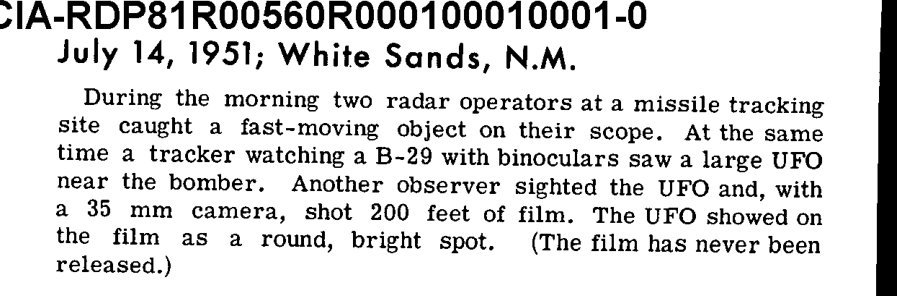
July 14, 1951; White Sands, N.M.
During the morning two radar operators at a missile tracking
site caught a fast-moving object on their scope. At the same
time a tracker watching a B-29 with binoculars saw a large UFO
near the bomber. Another observer sighted the UFO and, with
a 35 mm camera, shot 200 feet of film. The UFO showed on
the film as a round, bright spot. (The film has never been
released.)
Fall 1951; Korean Area
‘Following are extracts from a letter to NICAP dated May 16,
1957, signed by Lt. Cmdr. M. C. Davies, U.S.N., then stationed
at the U. S, Naval Air Station, Jacksonville, Florida.
My background is a Naval Aviator with approximately 4000
hours. At the time of the incident I was deployed with an
Anti-Submarine Squadron aboard a CVE class carrier. I was
assigned Air Crew Training Officer and prior to deployment
had attended CIC Air Controller School at Point Loma, also
Airborne Air Controller School and Airborne Early Warning
School both located at NAS, San Diego. . .
It was at night, I was riding with a radar operator which I
often did to check on their proficiency. We were flying at
5000 feet, solid instruments, with our wingman flying a radar
position about 3 miles astern and slightly to our right or left.
The target, which was slightly larger than our wingman, I
picked up on our scope, had been circling the fleet; it left
the fleet and joined up on us a position behind our wingman,
approximately the same position he held on us.
I reported the target to the ship and was informed that the
target was also held on the ship’s radars, 14 in number; and
for us to get a visual sighting if possible. This was impossible
because of the clouds. The target retained his relative
position for approximately 5 minutes and then departed in
excess of one thousand miles per hour. He departed ona
straight course and was observed to the maximum distance
of my radar which was two hundred miles.
Upon completion of my flight an unidentified flying object
report was completed, at which time I was informed that the
object was held on ship’s radars for approximately seven
hours.
July 1, 1952; Ft. Monmouth, N.J.
A radar tracking of two UFOs at Fort Monmouth, N. J. was
one of a series of sightings which fit a definite pattern. It
occurred at a time when the Air Force was swamped with UFO
reports - good ones. (See Section XII, 1952 Chronology.] Also,
it was the first of ten known incidents of UFOs tracked by radar
during July 1952. (See chart).
The sequence of events, reported by the Air Force UFO pro-
ject chief, was as follows.
7:30 a.m., Boston, Mass. A couple in nearby Lynn and an
Air Force Captain in Bedford saw two F-94’s which had been
scrambled on an intercept mission. The Captain saw one and
the couple saw two silvery cigar-shaped UFOs, which moved
southwest across Boston, outspeeding the jets.
9:30 a.m., Ft. Monmouth, N. J. Radar tracked two UFO tar-
gets, also observed visually as two shiny objects. The UFOs
approached slowly from the northeast, and hovered nearby at
50,000 feet for about 5 minutes.. Suddenly the blips on the
scope accelerated and shot away to the southwest, confirmed
by visual observation.
A_few hours later, Washington, D.C. A physics professor
at George Washington University, and dozens of others, saw
a grayish UFO bobbing back and forth in the sky about 30-40
degrees above the north-northwest horizon.
None of the sightings could be explained.
August 5, 1952; Haneda AFB, Japan
Just before midnight, two Air Force control tower operators
noticed a brilliant light in the sky, and joined others watching
it through binoculars. The UFO approached the base slowly and
hovered, plainly visible from the control tower. Behind the
brilliant light, the observers could see a dark circular shape
Approved For Release 2001/04/02 : CIA-RDP81R00560R000100010001-0Editorial note: The part of the left column about Japan (15/10/1948) and Fürstenfeldbruck is already in first-round dossiers.
Check the original PDF
[p. 89: texto da publicação privada não reproduzido; ver o resumo]View the document record ↗ · Physical page 89, counting the cover.
Dates and documentary context
- Event
- 23/11/1948 — 22h20, local time.
- Document
- Not established — Record with no drafting date.
- Publication
- Not established — Released in the National Archives batch (box 7, incidents 173 to 233).
Origin and release
U.S. Air Force, Air Materiel Command (technical intelligence, Wright-Patterson), under Project Sign; sheets compiled from witness and air base reports · 38_143685_box7_Incident_Summaries_173-233.pdf
Related accounts and their differences
Questions to continue the investigation
- What equipment did Racecard station use to locate the UFO at 27.000 and then at 40.000 feet?
- Was the target reported by Racecard south of Munich the same light seen by Slater east of Fürstenfeldbruck?
GEOGRAPHY OF THE CASE
Fürstenfeldbruck, Bavaria, Germany
Approximate reference to the Fürstenfeldbruck base, placed by the editors. It indicates the observer's location; the light was seen to the east, over Munich, and the target reported by the station was 30 to 40 miles south of Munich.
DOCUMENTARY TRAIL
Go back to the sources
References use physical pages of the PDF, counting the cover. Summaries are presented in English; the documents keep their original language.
- 38_143685_box7_Incident_Summaries_173-233.pdf
Physical page 114: summary sheet for incident 222, Fürstenfeldbruck, Germany, 23/11/1948 · Physical page 115: summary of incident 222, with the information from the station Racecard
Arquivo histórico · 144 pages - CIA-RDP81R00560R000100010001-0_NICAP-The-UFO-Evidence_1964.pdf
Physical page 89: summary of the 23/11/1948 case in the NICAP report "The UFO Evidence" (1964), CIA CREST copy
CIA · 186 pages
Editorial summary based on the collection's research notes. How we read the documents.