Date: September 1951Location: New Jersey, USA
The UFOs on the Fort Monmouth radar
Radar operators describe UFOs that were hard to track and an unusual sequence of movement.
- Event date
- September 1951
- Location
- New Jersey, USA
- Topic
- Radar and sensors
- Source agencies
- FBI · DOW
- Documents
- 2 documents · 290 pages
- Reading time
- 14 min
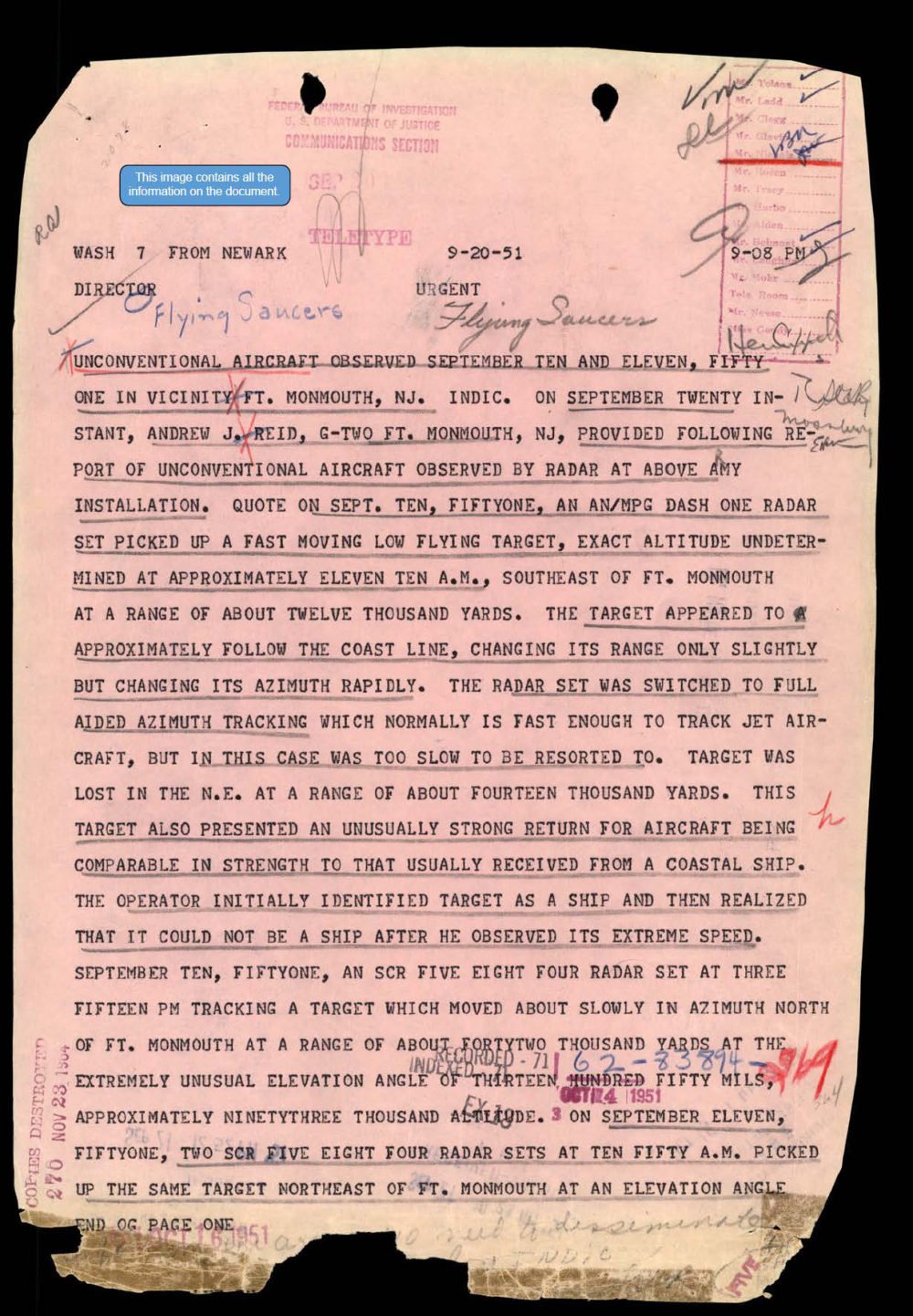 FBI teletype on Fort MonmouthPhysical page 124
DOCUMENTARY SOURCES · FBI / DOW
What the records tell
The records describe returns on SCR584 radars, tracking difficulties in aided mode, and another episode interpreted as a stationary target followed by vertical movement. Cloud cover prevented visual confirmation. The summary mentions identified equipment and observation parameters, which allows for more specific technical questions than an account of a light with no reference.
The indication of speed exceeding tracking capability derives from the behavior observed by the operators. It does not, on its own, amount to a measured three-dimensional trajectory or established acceleration. The later memorandum repeats the telegram; two sheets are not two independent confirmations.
The account reached the FBI through the Army. On September 20, 1951, Andrew J. Reid, of the intelligence section (G-2) at Fort Monmouth, New Jersey, passed to the FBI's Newark office a report on "unconventional aircraft observed by radar" at that installation on September 10 and 11. Newark sent the text to headquarters the same day, at 21h08, by teletype marked urgent. Reid handed it over only after being authorized by the G-2 at Governors Island, New York, asked that the information be coordinated with the Air Force, and said, in confidence, that the report had reached him with a "considerable and unexplained delay."
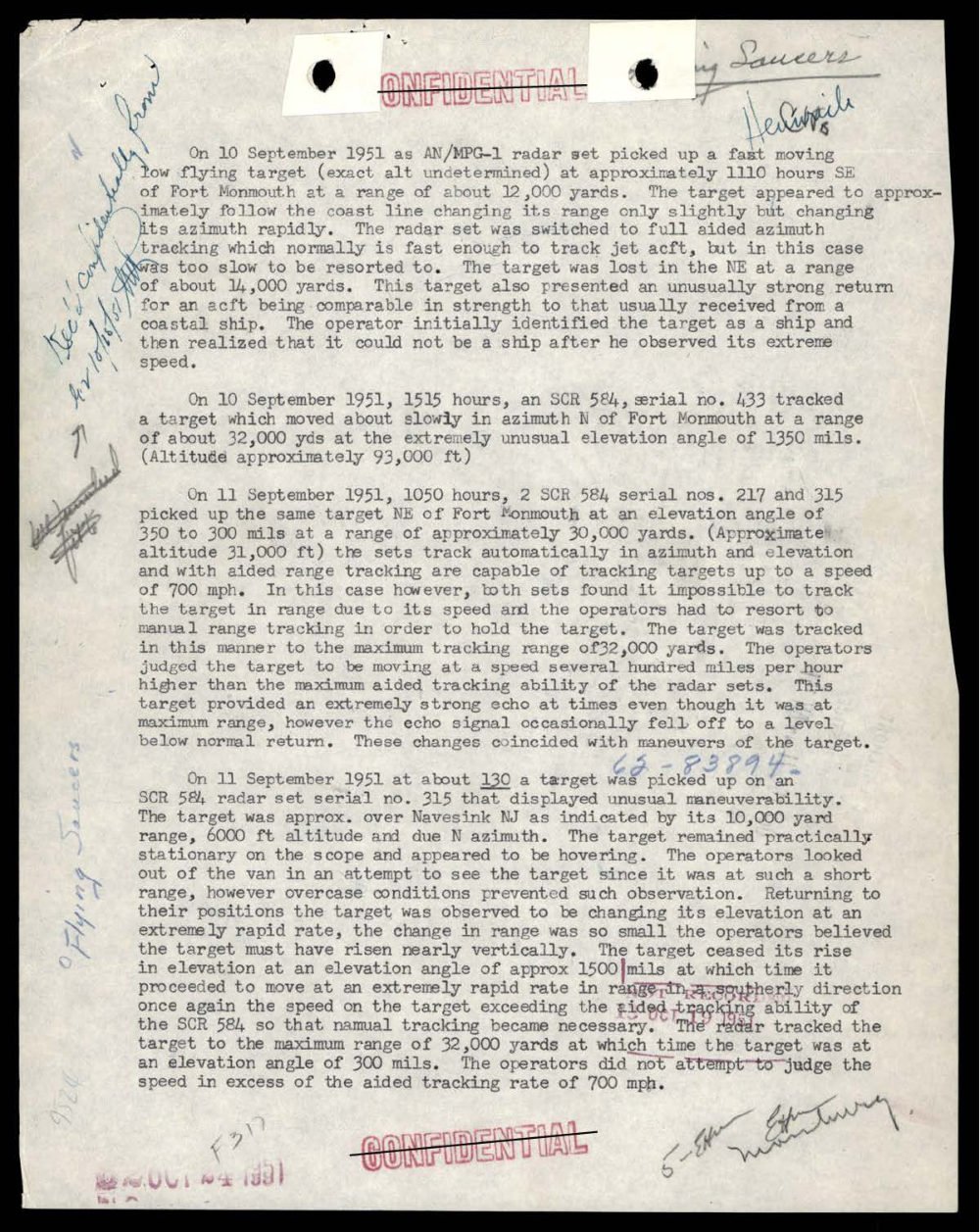
The first record is from the morning of September 10. At 11h10, an AN/MPG-1 radar picked up a fast, low target southeast of the fort, at about 12 mil yards, which seemed to follow the coastline. The range barely changed, but the bearing changed quickly, and not even the aided tracking mode, fast enough for jets, was able to follow it. The echo was as strong as that of a coastal ship, and the operator at first took it for a ship, until he noticed the speed. At 15h15 the same day, an SCR-584 radar tracked, north of the fort, a target moving slowly at a very high elevation angle, at a calculated altitude of about 93 mil feet.
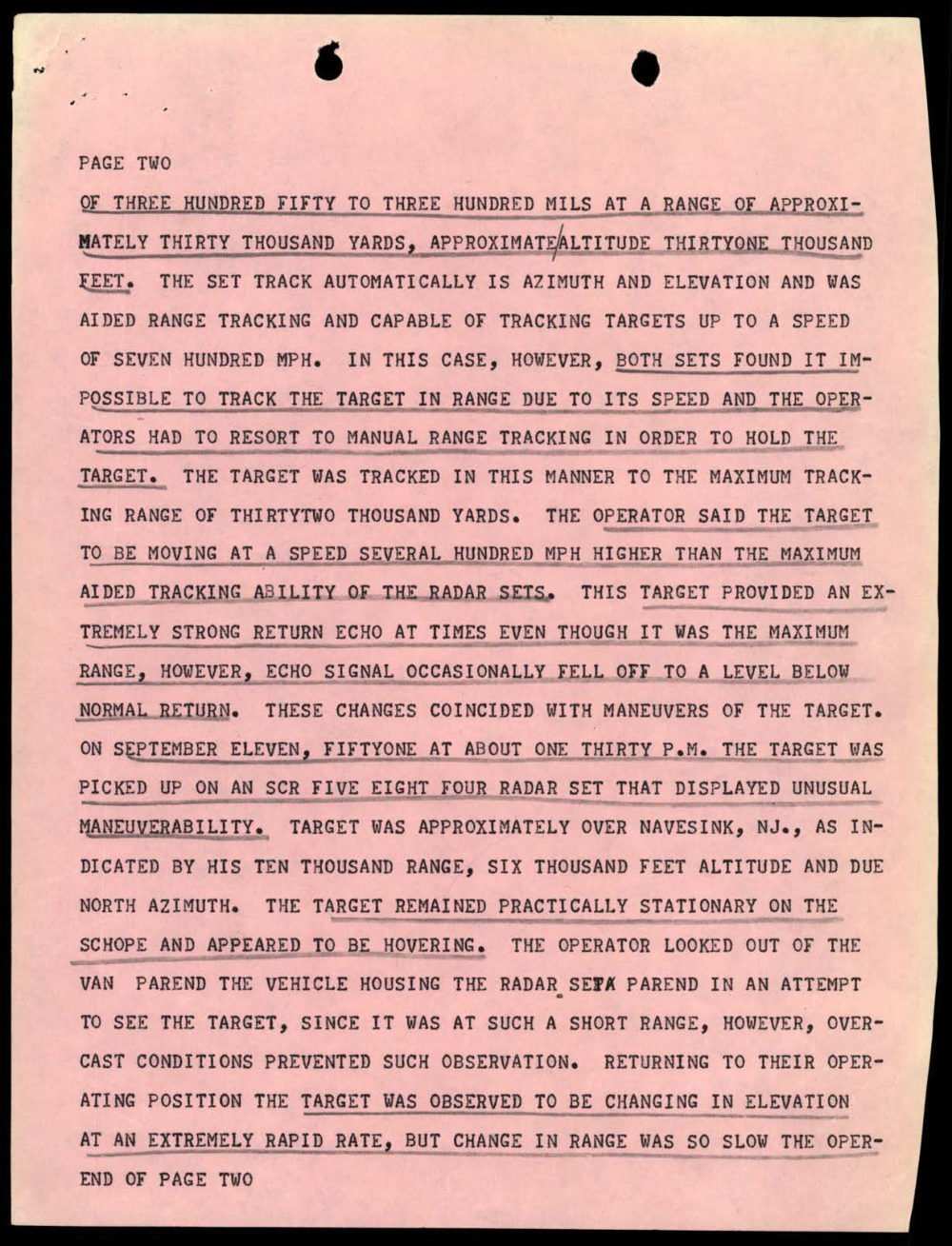
On the morning of September 11, at 10h50, two SCR-584 radars picked up to the northeast what the report calls "the same target," at about 30 mil yards and 31 mil feet. The sets tracked targets of up to 700 miles per hour, but neither of them was able to follow this target's range, and the operators switched to manual tracking up to the maximum range of 32 mil yards. They judged that the speed was several hundred miles per hour above that limit. The echo was sometimes very strong and sometimes dropped below normal, and these variations coincided with the target's maneuvers.
At 13h30 the same day, an SCR-584 recorded a nearly stationary target over Navesink, at about 10 mil yards and 6 mil feet. The operators left the radar vehicle to try to see it, but the sky was overcast. When they returned, the target was climbing so fast, with the range barely changing, that they concluded it was rising vertically. After stopping its climb, it headed south at great speed, again beyond aided tracking. The report says the weather was good on the 10th and cloudy on the 11th, and that each episode had three witnesses, except the first.
At the FBI, the teletype went through the offices of Clyde Tolson, D. M. Ladd, and A. H. Belmont on the morning of September 21 and through the espionage area in October. A typed, confidential summary, with the radars' serial numbers (433, 217, and 315), was "received confidentially" on October 16, according to a margin notation, and entered in the file on October 24, together with the teletype. The two texts tell the same sequence; they are not independent sources. There is one difference: the range of the 15h15 target on September 10 is about 42 mil yards in the teletype and 32 mil in the summary.
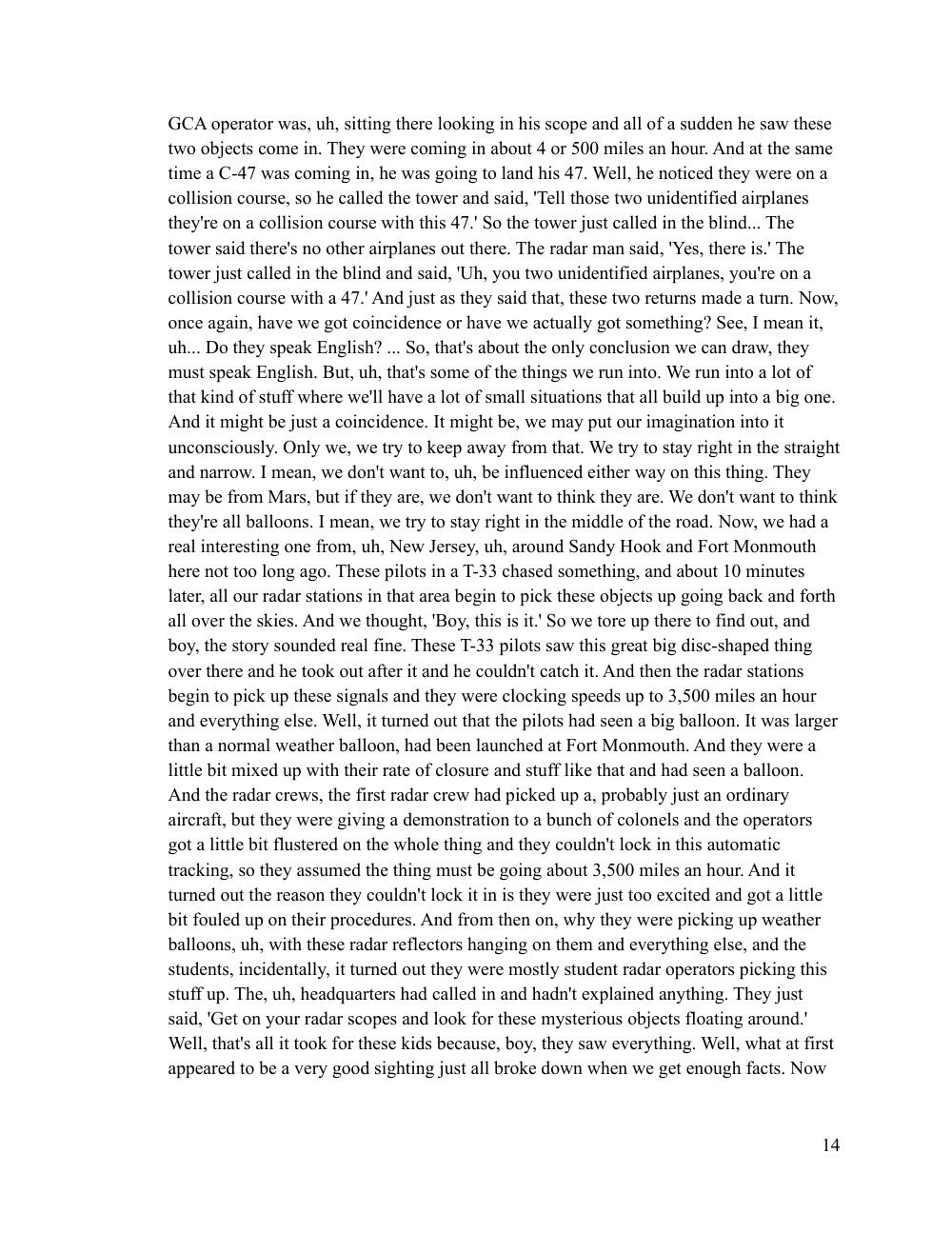
In March 1952, Captain Edward Ruppelt, head of the Air Force project, gave the final version in a lecture. According to him, pilots of a T-33 jet chased a large disk-shaped object near Sandy Hook, and soon the radars in the region recorded targets at up to 3.500 miles per hour. The conclusion was that the pilots saw a large balloon launched from the fort itself, that the first radar crew tracked an ordinary airplane during a demonstration for colonels, without locking on automatic tracking, and that afterward the operators, almost all students, picked up weather balloons with reflectors. The FBI pages do not mention the T-33 or 3.500 miles per hour, and each explanation cannot be tied to each record.
More images from the document
DIRECT READING OF THE FILE
The document, in the original
Full translation of the pages added to this dossier. Addresses and personal data of private individuals were omitted and marked.
EXCERPT 1 · PHYSICAL PAGE 124
Physical page 124: teletype from the Newark office to the FBI Director, 20/09/1951, page 1 (complete)
--
- -
•
' d? -~- WASH 7 FROM NE\IIARK 9-20-51 / 19-08 P
\ . D~cc, I C' URGENT . I r, l'.ll ••••
/ FI I """ "1J a i.\c. e-,'"'~ .74~§S""'""<.L~..-, .. _/' fl \Jn-Q/f ' I
T1
UNCONVENTIONAL A.l.&c.BArT. OBSER-VED SEETEMBER TEN AND ELEVEN, Fl--rH ~
ONE IN VICINIT~/ FT. MONMOUTH, NJ. INDIC. ON SEPTEMBER TWENTY IN- 0 }lh,t? - !{~ • • ~~ STANT, ~NDREW J,..,REID1 G-T'WO FT• MONMOUTH, NJ, J:BOVIDED FOLLOWING RE~~t
PORT OF UNCONVENTIONAL AIRCRAFT OBSERVED BY RADAR AT ABOVE hY 1
INSTALLATION. QUOTE ON SEPT. TEN, FIFTYONE, AN AN/MPG DASH ONE RADAR
SET PICKED UP A FAST MOVING LOW FLYING TARGET, EXACT ALTITUDE UNDETERMINED AT APPROXIMATELY ELEVEN TEN A. M. , SOUTHEAST OF FT. MONMOUTH
AT A RANGE OF ABOUT TWELVE THOUSAND YARDS. THE TARG ET APPEARED TO f(
- APPROXIMATELY FOLLOW THE COAST LINE, CHANGING ITS RANGE ONLY SLIGHTLY
BUT CHANGING ITS AZIMUTH RAPIDLY. THE RAlt,A!i SET WA~ SWITCHED TO FULL
AIDED AZIMUTH TRACKING WHICH NORMALLY IS FAST ENOUGH TO TRACK JET AIRCRAFT, BUT I~ THIS CASE WAS TOO SLOW TO BE RESORTED lO• TARGET VAS
LOST IN THE N.E. AT A RANGE OF ABOUT FOURTEEN THOUSAND YARDS. THIS
TARGET ALSO PRESENTED AN UNUSUALLY STRONG RETURN FOR AIRCRAFT BEING
COMPARABLE IN STRENGTH TO THAT USUALLY RECEIVED FROM A COASTAL SHIP.
THE OPERATOR INITIALLY IDENTIFIED TARGET AS A SHIP AND THEN REALIZED
THAT IT COULD NOT BE A SHIP AFTER HE OBSERVED ITS EXTREME SPEED.
-
SEPTEMBER TEN, FIFTYONE, AN SCR FIVE EIGHT FOUR RADAR SET AT THREE
FIFTEEN PM TRACKING A TARGET WH ICH MOVED ABOUT SLOWLY IN AZIMUTH NORTH
◄ ~ or FT. MONMOUTH AT A RANGE OF Ari~dJ?l,1X:W7~JTbU? AN~ ¼~D~ ,; r THE
f ~ EXTREMELY UNUSUAL ELEVATION ANGLruW°'niltr EE ,_'l.:f.HNDRED FIFTY MILS, ~ ~v uaTfA I ~
f~ ~ APPROXIMATELY NINETYTHREE THOUSAND A·~IJaDE. ON SEPTEM.BER ELEVEN,
O z -
~ -0 FIFTYONE, ~ SCR FIVE EIGHT FOUR RADAR SETS AT TEN FIFTY A.M. PICKED
i :--..
c ~ UP THE SAME TARGET NORTHEAST OF FT. MONMOUTH AT AN ELEVATION ANGIJ;:
QEditorial note: "Mils" are angular mils used in artillery (6.400 per full circle): 1.350 mils equal about 76 degrees of elevation. 12 thousand yards is about 11 km; 42 thousand yards, about 38 km. The teletype says "ninetythree thousand altitude", without a unit; the summary on p. 130 says 93.000 feet. "END OG PAGE ONE" appears this way in the original. The handwritten sentence at the foot of the sheet is partly torn and has only a probable reading. The end of the serial number is overlaid by a red annotation.
Check the original PDF
[Stamps:] FEDERAL BUREAU OF INVESTIGATION, U.S. DEPARTMENT OF JUSTICE, COMMUNICATIONS SECTION. SEP 20 [1951]. TELETYPE. WASH 7 FROM NEWARK 9-20-51 9-08 PM. DIRECTOR. URGENT. [Handwritten:] Flying Saucers. Flying Saucers. UNCONVENTIONAL AIRCRAFT OBSERVED SEPTEMBER TEN AND ELEVEN, FIFTY ONE IN VICINITY FT. MONMOUTH, NJ. INDIC. ON SEPTEMBER TWENTY INSTANT, ANDREW J. REID, G-TWO FT. MONMOUTH, NJ, PROVIDED FOLLOWING REPORT OF UNCONVENTIONAL AIRCRAFT OBSERVED BY RADAR AT ABOVE ARMY INSTALLATION. QUOTE ON SEPT. TEN, FIFTYONE, AN AN/MPG DASH ONE RADAR SET PICKED UP A FAST MOVING LOW FLYING TARGET, EXACT ALTITUDE UNDETERMINED AT APPROXIMATELY ELEVEN TEN A.M., SOUTHEAST OF FT. MONMOUTH AT A RANGE OF ABOUT TWELVE THOUSAND YARDS. THE TARGET APPEARED TO APPROXIMATELY FOLLOW THE COAST LINE, CHANGING ITS RANGE ONLY SLIGHTLY BUT CHANGING ITS AZIMUTH RAPIDLY. THE RADAR SET WAS SWITCHED TO FULL AIDED AZIMUTH TRACKING WHICH NORMALLY IS FAST ENOUGH TO TRACK JET AIRCRAFT, BUT IN THIS CASE WAS TOO SLOW TO BE RESORTED TO. TARGET WAS LOST IN THE N.E. AT A RANGE OF ABOUT FOURTEEN THOUSAND YARDS. THIS TARGET ALSO PRESENTED AN UNUSUALLY STRONG RETURN FOR AIRCRAFT BEING COMPARABLE IN STRENGTH TO THAT USUALLY RECEIVED FROM A COASTAL SHIP. THE OPERATOR INITIALLY IDENTIFIED TARGET AS A SHIP AND THEN REALIZED THAT IT COULD NOT BE A SHIP AFTER HE OBSERVED ITS EXTREME SPEED. SEPTEMBER TEN, FIFTYONE, AN SCR FIVE EIGHT FOUR RADAR SET AT THREE FIFTEEN PM TRACKING A TARGET WHICH MOVED ABOUT SLOWLY IN AZIMUTH NORTH OF FT. MONMOUTH AT A RANGE OF ABOUT FORTYTWO THOUSAND YARDS AT THE EXTREMELY UNUSUAL ELEVATION ANGLE OF THIRTEEN HUNDRED FIFTY MILS, APPROXIMATELY NINETYTHREE THOUSAND ALTITUDE. ON SEPTEMBER ELEVEN, FIFTYONE, TWO SCR FIVE EIGHT FOUR RADAR SETS AT TEN FIFTY A.M. PICKED UP THE SAME TARGET NORTHEAST OF FT. MONMOUTH AT AN ELEVATION ANGLE END OG PAGE ONE. [Stamps and handwriting:] RECORDED-71. INDEXED-71. 62-83894-[number partly legible]. OCT 24 1951. EX-[?]. [Handwritten at the bottom, partly torn:] [...] no need to disseminate [...] INDIC [...]. [Stamp:] [?] OCT 16 1951. FIVE. COPIES DESTROYED 270 NOV 23 1964. [Routing list with checks:] Tolson, Ladd, Clegg, Glavin, Nichols, Rosen, Tracy, Harbo, Alden, Belmont, Mohr, Tele. Room, Nease, Gandy. [Handwritten names:] Hennrich [?]. Mossburg. EHM.View the document record ↗ · Physical page 124, counting the cover.
EXCERPT 2 · PHYSICAL PAGE 125
Physical page 125: back of page 1 of the teletype (complete; stamps only)
_
•
-..,., ..... .. lo- (.j
% -~- 0 • V) ::s
% - -· ff' _J -
- ~ ; ~-\
n:, ~· . u.
• 0
.::.
- ~·- a::> ...: .. .u
n: ~- t;
c::,
•
. .
....
m
~ r.
-u .,, f!.1
,'1 <:
ooo m
w ~, :.:::,
Q .,_ f-C!
::::» c: r
::c:: > .. t..n
,~ ~zs ,, \1 ns
3311.sor :10 · ,.i'3l
.\ •iJ • ~
lM0...139 '3,:"13b __,_,._,_,--Editorial note: Back of physical page 124. The stamps run in various directions, over the front text that shows through.
Check the original PDF
[Stamps:] RECEIVED-TOLSON. F B I. U.S. DEPT. OF JUSTICE. SEP 21 10 21 AM '51. RECEIVED-LADD. F B I. U.S. DEPT. OF JUSTICE. SEP 21 11 36 AM '51. REC'D BELMONT. F.B.I. DEPT. OF JUSTICE. SEP 21 12 52 PM '51. REC'D ESPIONAGE. F B I. U.S. DEPT. OF JUSTICE. OCT 6 2 32 PM '51. REC'D BELMONT. F.B.I. DEPT. OF JUSTICE. OCT 8 11 34 AM '51. REC'D ESPIONAGE. F B I. U.S. DEPT. OF JUSTICE. OCT 8 3 27 [?]. RECEIVED-NICHOLS. F B I. U.S. DEPT. OF JUSTICE. OCT 15 1 44 PM '51. REC'D ESPIONAGE. F B I. U.S. DEPT. OF JUSTICE. [date illegible] 2 51 PM '5[?].View the document record ↗ · Physical page 125, counting the cover.
EXCERPT 3 · PHYSICAL PAGE 126
Physical page 126: teletype of 20/09/1951, page 2 (complete)
- -
PAGE TWO
• '
OF THREE HUNDRED FIFTY TO THREE HUNDRED MILS AT A RANGE OF APPROXIMATELY THIRTY THOUSAND YARDS, APPROXIMAT1LTITUDE THIRTYONE THOUSAND
~EET: THE SET TRACK AUTOMATICALLY IS AZIMUTH AND ELEVATION AND WAS
AIDED RANGE TRACKING AND CAPABLE OF TRACKING TARGETS UP TO A SPEED
OF SEVEN HUNDRED MPH. IN THIS CASE, HOWEVER, BOTH SETS FOUND IT IMPOSSIBLE ..._ ______ TO TRACK_THE TARGET IN RANGE DUE TO ITS SPEED AND THE OPERATORS HAD TO RESORT TO MANUAL RANGE TRACKING IN ORDER TO HOLD THE -
TARGET. THE TARGET WAS TRACKED IN THIS MANNER TO THE MAXIMUM TRACKING RANGE OF THIRTYTWO THOUSAND YARDS. THE OPERATOR SAID THE TARGET
TO BE MOVING AT A SPEED SEVERAL HUNDRED MPH HIGHER THAN THE MAXIMUM
AIDED TRACKING ABILITY OF THE RADAR SETS.. THIS TARGET PROVIDED AN EXTREMELY STRONG RETURN ECHO AT TIMES EVEN THOUGH IT WAS THE MAXIMUM
RANGE, HO~EVER, ECHO SIGNAL OCCASIONALLY FELL OFF TO A LEVEL BELOW
_NORMAL RETURN. THESE CHANGES COINCIDED WITH MANEUVERS OF THE TARGET.
ON StpTEMBER ELEVEN, FIFTYONE AT ABOUT ONE THIRTY P.M. THE TARGET WAS
PICKED UP ON AN SCR FIVE EIGHT FOUR RADAR SET THAT DISPLAYED UNUSUAL
~ANEUVERABILITY. TARGET WAS APPROXIMATELY OVER NAVESINK, NJ., AS INDICATED BY HIS TEN THOUSAND RANGE, SIX THOUSAND FEET ALTITUDE AND DUE
NORTH AZIMUTH. THE TARGET REMAINED PRACTICALLY STATIONARY ON THE
SCHOPE AND APPEARED TO BE HOVERING. THE OPERATOR LOOKED OUT OF THE
VAN PAREND THE VEHICLE HOUSING THE RADAR SEfA PAREND IN AN ATTEMPT . TO SEE THE TARGET, SINCE IT WAS AT SUCH A SHORT RANGE, HOWEVER, OVERCAST CONDITIONS PREVENTED SUCH OBSERVATION. RETURNING TO THEIR OPERATING POSITION THE TARGET WAS OBSERVED TO BE CHANGING IN ELEVATION
AT AN EXTREMELY RAPID RATE, BUT CHANGE IN RANGE WAS SO SLOW THE OPEREND OF PAGE TWOEditorial note: "Schope" appears this way in the original, for "scope" (screen). "Parend" is the teletype word for parenthesis. 30 thousand yards is about 27 km; 32 thousand yards, about 29 km; 31 thousand feet, about 9,4 km; 6 thousand feet, about 1,8 km; 700 miles per hour, about 1.130 km/h.
Check the original PDF
PAGE TWO. OF THREE HUNDRED FIFTY TO THREE HUNDRED MILS AT A RANGE OF APPROXIMATELY THIRTY THOUSAND YARDS, APPROXIMATE ALTITUDE THIRTYONE THOUSAND FEET. THE SET TRACK AUTOMATICALLY IS AZIMUTH AND ELEVATION AND WAS AIDED RANGE TRACKING AND CAPABLE OF TRACKING TARGETS UP TO A SPEED OF SEVEN HUNDRED MPH. IN THIS CASE, HOWEVER, BOTH SETS FOUND IT IMPOSSIBLE TO TRACK THE TARGET IN RANGE DUE TO ITS SPEED AND THE OPERATORS HAD TO RESORT TO MANUAL RANGE TRACKING IN ORDER TO HOLD THE TARGET. THE TARGET WAS TRACKED IN THIS MANNER TO THE MAXIMUM TRACKING RANGE OF THIRTYTWO THOUSAND YARDS. THE OPERATOR SAID THE TARGET TO BE MOVING AT A SPEED SEVERAL HUNDRED MPH HIGHER THAN THE MAXIMUM AIDED TRACKING ABILITY OF THE RADAR SETS. THIS TARGET PROVIDED AN EXTREMELY STRONG RETURN ECHO AT TIMES EVEN THOUGH IT WAS THE MAXIMUM RANGE, HOWEVER, ECHO SIGNAL OCCASIONALLY FELL OFF TO A LEVEL BELOW NORMAL RETURN. THESE CHANGES COINCIDED WITH MANEUVERS OF THE TARGET. ON SEPTEMBER ELEVEN, FIFTYONE AT ABOUT ONE THIRTY P.M. THE TARGET WAS PICKED UP ON AN SCR FIVE EIGHT FOUR RADAR SET THAT DISPLAYED UNUSUAL MANEUVERABILITY. TARGET WAS APPROXIMATELY OVER NAVESINK, NJ., AS INDICATED BY HIS TEN THOUSAND RANGE, SIX THOUSAND FEET ALTITUDE AND DUE NORTH AZIMUTH. THE TARGET REMAINED PRACTICALLY STATIONARY ON THE SCHOPE AND APPEARED TO BE HOVERING. THE OPERATOR LOOKED OUT OF THE VAN PAREND THE VEHICLE HOUSING THE RADAR SET PAREND IN AN ATTEMPT TO SEE THE TARGET, SINCE IT WAS AT SUCH A SHORT RANGE, HOWEVER, OVERCAST CONDITIONS PREVENTED SUCH OBSERVATION. RETURNING TO THEIR OPERATING POSITION THE TARGET WAS OBSERVED TO BE CHANGING IN ELEVATION AT AN EXTREMELY RAPID RATE, BUT CHANGE IN RANGE WAS SO SLOW THE OPER- END OF PAGE TWO.View the document record ↗ · Physical page 126, counting the cover.
EXCERPT 4 · PHYSICAL PAGE 127
Physical page 127: teletype of 20/09/1951, page 3 (complete)
• •
PAGE THREE
AIOR BELIEVED THE TARGET MUST HAVE RISEN NEARLY VERTICALLY. TARGET
FIXED ITS RISE IN EllVAtION AT AN ELEVATION ANGLE OF APPROX. FIFTEEN
HUNDRED MILS, AT WHICH TIME IT PROCEEDED TO MOVE AT AN EXTREMELY RAPID
RATE IN RANGE IN A SOUTHERLY DIRECTION. ONCE AGAIN THE SPEED OF THE
TARGET EXCEEDED THE AIDED TRACKING ABILITY OF THE SCR FIVE EIGHT ,OUR
SET SO THAT MANUAL TRACKING BECAME NECESSARY. RADAR TRACKED THE TARGET MAXIMUM RANGE OF THIRTYTWO THOUSAND YARDS AT WHICH TIME TARGET
WAS AT AN ELEVATION ANGLE THREE HUNDRED MILS. THE OPERATOR DID NOT
ATTEMPT TO JUDGE THE SPEED IN EXCESS OF THE AIDED TRACKING RATE OF SEVEN
HUNDRED MPH. THE WEATHER WAS FAIR WHEN THE OBSERVATION WAS MADE SEPTEMBER TENTH AND CLOUDY FOR THE SEPTEMBER ELEVENTH REPORT. UNQUOTE.
ABO~VE INCIDENT OBSERVED BY THREE WITNESSES WITH EXCEPTION OF FIRST
INCIDENT ON SEPTEMBER TEN. ABOVE INFO FURNISHED BY REID AFTER APPROVAL OF G-TWO, GOVERNORS ISLAND, NY, WITH REQUEST THAT INFO BE COORDINATED WITH AIR FORCE. REID ALSO ADVISED IN CONFIDENCE THAT ABOVE I8EPOR.L.R.ECEIVED BY HIM AFTER CONSIDERABLE UNACCOUNTABLE DELAY,
MC KEE
END AAD PLS
NK R 7 WA AS
DISCEditorial note: McKee signs as head of the Newark office. The final lines are teletype transmission control signals. 1.500 mils equal about 84 degrees; 300 mils, about 17 degrees.
Check the original PDF
PAGE THREE. ATOR BELIEVED THE TARGET MUST HAVE RISEN NEARLY VERTICALLY. TARGET FIXED ITS RISE IN ELEVATION AT AN ELEVATION ANGLE OF APPROX. FIFTEEN HUNDRED MILS, AT WHICH TIME IT PROCEEDED TO MOVE AT AN EXTREMELY RAPID RATE IN RANGE IN A SOUTHERLY DIRECTION. ONCE AGAIN THE SPEED OF THE TARGET EXCEEDED THE AIDED TRACKING ABILITY OF THE SCR FIVE EIGHT FOUR SET SO THAT MANUAL TRACKING BECAME NECESSARY. RADAR TRACKED THE TARGET MAXIMUM RANGE OF THIRTYTWO THOUSAND YARDS AT WHICH TIME TARGET WAS AT AN ELEVATION ANGLE THREE HUNDRED MILS. THE OPERATOR DID NOT ATTEMPT TO JUDGE THE SPEED IN EXCESS OF THE AIDED TRACKING RATE OF SEVEN HUNDRED MPH. THE WEATHER WAS FAIR WHEN THE OBSERVATION WAS MADE SEPTEMBER TENTH AND CLOUDY FOR THE SEPTEMBER ELEVENTH REPORT. UNQUOTE. ABOVE INCIDENT OBSERVED BY THREE WITNESSES WITH EXCEPTION OF FIRST INCIDENT ON SEPTEMBER TEN. ABOVE INFO FURNISHED BY REID AFTER APPROVAL OF G-TWO, GOVERNORS ISLAND, NY, WITH REQUEST THAT INFO BE COORDINATED WITH AIR FORCE. REID ALSO ADVISED IN CONFIDENCE THAT ABOVE REPORT RECEIVED BY HIM AFTER CONSIDERABLE UNACCOUNTABLE DELAY. MC KEE. END AAD PLS. NK R 7 WA AS. DISC. [Handwritten:] cc Mr. Belmont. [illegible].View the document record ↗ · Physical page 127, counting the cover.
EXCERPT 5 · PHYSICAL PAGE 128
Physical page 128: back of page 3 of the teletype (complete; stamp only)
• •
., • T ' H
_.,.
I
T l l -~ , ~ . '
. .... ·- r 1 ... i
;r.
,-
'"'"" m
-0
• c::::b ~
.r--
"':Tl
<.,,, "ti ,=,
..
...
,.
T "" ., ..
' .
:)
\ ....
•
, ,
,.
,,_
C:
<,
:;
·""
(.Q) '"" ,-, u.,
~ _.
.... ""
,
·.31 "' - C:
<.::ltl ~
...
.. ~
.. ') • 1 T ) ,. "'
.. ... .,. ,. T
') .'
• n
. . . . ... .,
'
• n • ' .. ,.
"' )::!1 ' "' , I \
'1 n r.
. r ' t .
rEditorial note: Back of physical page 127; the front text shows through.
Check the original PDF
[Stamp:] RECEIVED TELETYPE UNIT. SEP 20 9 31 PM '51. F.B.I. DEPT. OF JUSTICE.View the document record ↗ · Physical page 128, counting the cover.
EXCERPT 6 · PHYSICAL PAGE 130
Physical page 130: confidential summary of the radar records of 10 and 11/09/1951 (complete)
'~ t ~~~ 4
On 10 September 1951 as AN/MPG-l radar set picked up a fas:t moving
ow flying target (exact alt undetermined) at approximately 1110 hours SE
of Fort Monmouth at a range of about J2 ,000 yards. The target appeared to approximately follow the coast line changing its range only slightly but changing
'ts azimuth rapidly. The radar set was switched to full aided azimuth
tracking which normally is fast enoUe::h to track jet acft, rut in this case
as too slow to be resorted to. The target was lost in the NE at a range
of about 14,000 yards. This target also presented an unusually strong return
for an acft being comparable in strength to that usually received from a
coastal ship. The operator initially identified the target as a ship and
then realized that it could not be a ship after he observed its extrerre
speed.
On 10 September 1951, 1515 hours, an SCR 584, rerial no . 433 tracked
a t arget which moved about slowiy in azimuth N of Fort Monmouth at a range
of about 32, 000 yds at the extremely unusual elevation angle of 1350 mils. (Altituae appro.xin:ately 93, 000 ft)
On 11 September 1951, 1050 hours, 2 SCR 584 serial nos . 217 and 315
picked up the same target NE of Fort l"!onmouth at an elevation angle of
350 to 300 mils at a range of approximately 30,000 yards. (Appro~ima.te
altitude 31 ,000 ft) the sets track automatically in azimuth and elevation
and with aided range tracl<ing are capable of tracking targets up to a speed
of 700 mph. In this case hcwever, 1:oth sets found it impossible to track
the target in range due to its speed am the operators had to resort tbo
mantal range tracking in order to hold the target. The target was tracked
in this manner to the maximum tracking range of32 ,000 yards. The operators
judged the target to be moving at a speed several hundred miles per hour
higtler than the maximum aided tracking ability of the radar sets. This
target provided an extremely strong echo at times even though it was at
maximum range, however the echo signal occasionally fel~ off to a level
below norlll9.l return . These changes coincided with maneuvers of the target. ., ~:; ;
On ll September 1951 at a l:out 130 a target was picked up on an
SCR 584 radar set serial no. .315 that displayed unusual ma.neuverability. The target was approx. over Navesink NJ as indicated by its 10, 000 yard
range, 6000 ft altitude arrl. due N azi.muth . The target remained practically
stationary on the scope and appeared to be hovering . The operators looked
out of the van in an attempt to see the target since it was at such a short
range, however overcase conditions prevented such observation. Returning to
their positions the target was observed to be changing its elevation at an
extrene ly rapid rate , the change in range was so small the operators believed
the target must have risen nearly vertically. The target ceased its rise
in elevation at an elevation angle of approx 1500,mils at which tirre it
proceeded to move at an extrenely rapid rate in r~~~e.rly direction
once again the speed on the target exceeding the fid~r:'.~k;~qg ability of
the SCR 584 so that namual tracking became necessary. Tltef' :ta!<far tracked the
target to the maximum range of 32 ,000 yards at which time the target was at
an elevation angle of 300 mils. The operators did-i;or-a~~udge the
speed in excess of the aided tracking rate of 700 mpp .Editorial note: Summary without header, date or signature; it repeats the text quoted in the teletype, with the radars' serial numbers. "About 130" appears this way in the original; the teletype says 13h30 ("one thirty p.m."). "Overcase" appears this way in the original, for "overcast". The name of the person who delivered the summary is not written in the margin annotation.
Check the original PDF
CONFIDENTIAL [struck through]. [Handwritten:] Flying Saucers. Hennrich [?]. On 10 September 1951 an AN/MPG-1 radar set picked up a fast moving low flying target (exact alt undetermined) at approximately 1110 hours SE of Fort Monmouth at a range of about 12,000 yards. The target appeared to approximately follow the coast line changing its range only slightly but changing its azimuth rapidly. The radar set was switched to full aided azimuth tracking which normally is fast enough to track jet acft, but in this case was too slow to be resorted to. The target was lost in the NE at a range of about 14,000 yards. This target also presented an unusually strong return for an acft being comparable in strength to that usually received from a coastal ship. The operator initially identified the target as a ship and then realized that it could not be a ship after he observed its extreme speed. On 10 September 1951, 1515 hours, an SCR 584, serial no. 433 tracked a target which moved about slowly in azimuth N of Fort Monmouth at a range of about 32,000 yds at the extremely unusual elevation angle of 1350 mils. (Altitude approximately 93,000 ft). On 11 September 1951, 1050 hours, 2 SCR 584 serial nos. 217 and 315 picked up the same target NE of Fort Monmouth at an elevation angle of 350 to 300 mils at a range of approximately 30,000 yards. (Approximate altitude 31,000 ft) the sets track automatically in azimuth and elevation and with aided range tracking are capable of tracking targets up to a speed of 700 mph. In this case however, both sets found it impossible to track the target in range due to its speed and the operators had to resort to manual range tracking in order to hold the target. The target was tracked in this manner to the maximum tracking range of 32,000 yards. The operators judged the target to be moving at a speed several hundred miles per hour higher than the maximum aided tracking ability of the radar sets. This target provided an extremely strong echo at times even though it was at maximum range, however the echo signal occasionally fell off to a level below normal return. These changes coincided with maneuvers of the target. On 11 September 1951 at about 130 a target was picked up on an SCR 584 radar set serial no. 315 that displayed unusual maneuverability. The target was approx. over Navesink NJ as indicated by its 10,000 yard range, 6000 ft altitude and due N azimuth. The target remained practically stationary on the scope and appeared to be hovering. The operators looked out of the van in an attempt to see the target since it was at such a short range, however overcase conditions prevented such observation. Returning to their positions the target was observed to be changing its elevation at an extremely rapid rate, the change in range was so small the operators believed the target must have risen nearly vertically. The target ceased its rise in elevation at an elevation angle of approx 1500 mils at which time it proceeded to move at an extremely rapid rate in range in a southerly direction once again the speed on the target exceeding the aided tracking ability of the SCR 584 so that manual tracking became necessary. The radar tracked the target to the maximum range of 32,000 yards at which time the target was at an elevation angle of 300 mils. The operators did not attempt to judge the speed in excess of the aided tracking rate of 700 mph. CONFIDENTIAL [struck through]. [Handwritten in the left margin:] Rec'd confidentially from [?] [initials] 10/16/51. [Handwritten and stamps:] 62-83894-[?]. RECORDED [?]. OCT 24 1951. F317 [?]. 5-EHM. Mossburg. Flying Saucers.View the document record ↗ · Physical page 130, counting the cover.
Dates and documentary context
GEOGRAPHY OF THE CASE
Fort Monmouth area, New Jersey
Reference for the area of the facility, not of the targets tracked by radar.
DOCUMENTARY TRAIL
Go back to the sources
References use physical pages of the PDF, counting the cover. Summaries are presented in English; the documents keep their original language.
- 65_HS1-834228961_62-HQ-83894_Section_6.pdf
65_HS1-834228961_62-HQ-83894_Section_6.pdf, p. 126 · 65_HS1-834228961_62-HQ-83894_Section_6.pdf, p. 130
FBI · 271 pages - DOW-UAP-D154_Transcript-of-a-Presentation-by-Captain-Edward-J-Ruppelt-1952.pdf
Physical page 14: the Fort Monmouth case as told by Captain Ruppelt in March 1952 (balloon, ordinary airplane, and radar operator error)
DOW · 19 pages
Editorial summary based on the collection's research notes. How we read the documents.