Date: 30/09/1952, around 10h30Location: Dry lake bed at Edwards Air Force Base (formerly Muroc), California, USA
Edwards Air Force Base, 1952: North American photographer and two cameramen see white UFOs maneuver like yo-yos, but do not manage to film them
In a letter reproduced by NICAP, aviation photographer Dick Beemer, of North American Aviation, recounts that he and cameramen Carlos Garcia and Gene Pichler watched for almost ten minutes, over Edwards, whitish UFOs that hovered and circled rapidly around one another. They had a color motion-picture camera, but waited for the UFOs to move out of the direction of the Sun, and they moved away first.
- Event date
- 30/09/1952, around 10h30
- Location
- Dry lake bed at Edwards Air Force Base (formerly Muroc), California, USA
- Topic
- CIA file
- Source agencies
- CIA
- Documents
- 1 document · 186 pages
- Reading time
- 16 min
 Page of the NICAP reportPhysical page 63
DOCUMENTARY SOURCES · CIA
What the records tell
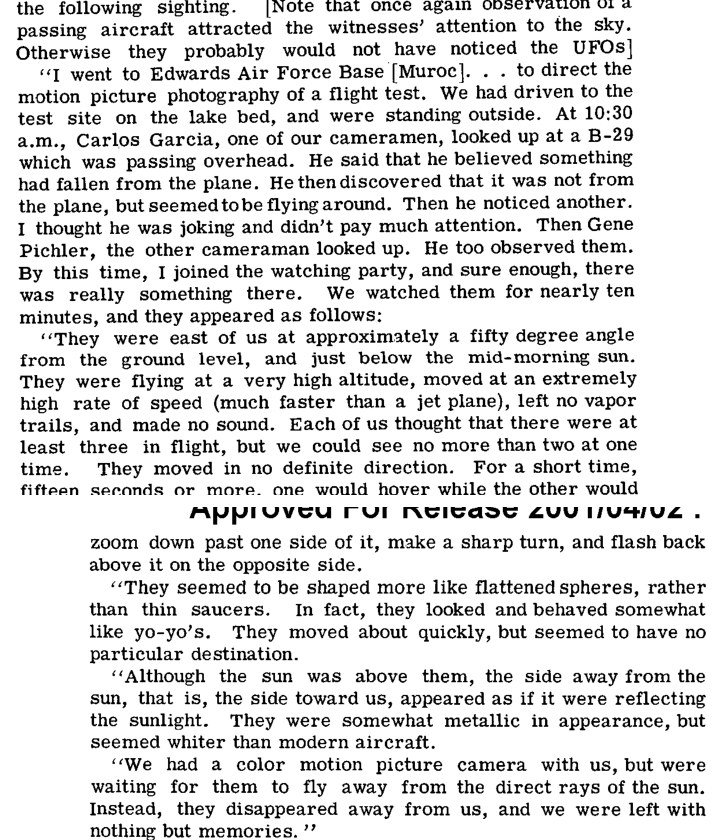
The report The UFO Evidence, published by NICAP in 1964 and kept as a copy by the CIA, reproduces excerpts from a letter by Dick Beemer, an aviation photographer for North American Aviation, to the president of CSI of Los Angeles, a civilian disc study group. Beemer recounts that he went to Edwards Air Force Base, formerly Muroc, on September 30, 1952, to direct the filming of a test flight. NICAP comments that, once again, it was a passing airplane that made the witnesses look up at the sky.
The crew had driven to the test site on the dry lake bed and was outside. At 10h30, cameraman Carlos Garcia looked at a passing B-29 and thought something had fallen from the airplane. Then he realized it was not coming from the airplane and seemed to be flying around, and he noticed another object. Beemer thought it was a joke, until the second cameraman, Gene Pichler, also saw them. Then Beemer joined the two, and they watched the objects for almost ten minutes.
According to the letter, the objects were to the east, about 50 degrees above the ground, just below the morning Sun. They seemed very high, moved much faster than a jet, left no trail and made no noise. Each of the three thought there were at least three, but they never saw more than two at the same time. They followed no definite course: for 15 seconds or more, one hovered while the other descended on one side, made a tight turn and came back over the top on the other side.
Beemer described them more as flattened spheres than as thin plates, and said they looked and behaved like yo-yos. Although the Sun was above them, the side facing the crew seemed to reflect light. They were somewhat metallic, but whiter than the airplanes of the time. The crew had a color motion-picture camera and waited for the objects to move out of the direct line of the Sun to film them. Instead, they moved away, and only the memory remained. There is, therefore, no film of the episode.
The altitude and speed are impressions, with no known distance from which to calculate them. NICAP does not state whether the Air Force received the report. As an editorial hypothesis, small, light-colored objects near the Sun's glare, such as balloons, high-flying birds or wind-borne debris, may appear fast and maneuver strangely, but the page provides no data to test this. The same base, still named Muroc, had reports from military personnel in July 1947, covered in another dossier.
DIRECT READING OF THE FILE
The document, in the original
Summary of a private publication: The UFO Evidence report is a work of NICAP, a civilian organization, and not a government document. For this reason the English text is not transcribed or translated in full; each page of the case has a block with a faithful, detailed summary in English, paragraph by paragraph, with at most one short quotation per page. Passages on the same page dealing with other cases are in the blocks of the corresponding dossiers or in the documentary dossier nicap-the-ufo-evidence-arquivo-cia-1964.
EXCERPT 1 · PHYSICAL PAGE 63
Physical page 63, end of the right column: beginning of the Edwards case (the rest of the page is in the Hampton and Munroe dossiers)
Approved For Release 2001/04/02 : CIA-RDP81R00560R000100010001-0
other seemed to play at flight — a sort of pendulum motion. I
could only estimate their size. I judged about forty-five feet.
Their length about one-half the width. Below is a sketch of how
they appeared to me.””
r
April 23, 1952; Lexington, Mass. Mr. R. C. Munroe (then
Engineering Standards Section Head of Raytheon Manufacturing
Company). While watching an AT-6 trainer aircraft about 9:30
a.m., noticed a second object nearby:
“Because of the speed at which this second aircraft was
moving, I immediately concluded it was of the jet variety. I
would estimate its altitude at approximately 40,000 feet. . . just
below the cloud cover. My curiosity was aroused upon realizing
that I could not distinguish a fuselage wing configuration. My
curiosity was further aroused when this aircraft began to deceler-
ate at an unbelievable rate. I observed the aircraft going into a
flat turn, while continuing to decelerate and believe I saw the
aircraft come toa stop. . .
“The observation that inspires writing this letter to you [i-e.,
to CSI of Los Angeles] was the speed of this aircraft, apparently
accelerating from a stopped condition and flying in a northeast
direction which would carry it over the north end of Boston. I
would relate this speed to the apparent speed of a falling star.
This speed was considerably in excess of that of any jet aircraft
that I have observed.
“The altitude of this aircraft didnot permit color identification.
There was no apparent exhaust or vapor trail. It is inconceivable
to me that any human being could have withstood the deceleration
or acceleration displayed by this aircraft.’”’
_ —
Aviation Expert
UFO RENDEZVOUS OBSERVED
July 16, 1952, Hampton, Virginia, 9:00 p.m. (EST). Mr. Paul
R. Hill, an Aeronautical Research Engineer, holds a B.S. degree
in mechanical and aeronautical engineering from the University of
California. At the time of the report he had 13 years experience
in aeronautical research.
Mr. Hill was aware of previous UFO sightings which had been
headlined in July 1952, particularly the report by Capt. William
B. Nash, Pan-American Airways pilot, who on the night of July
14 had sighted 8 circular UFOs while flying above Newport News,
va, [Section V]. Mr. Hill was situated on Chesapeake Avenue
(near La Salle Avenue) on the north shore of Hampton Roads
watching the sky. With him was his wife, Frances, who also
witnessed what followed.
At 9:00 p.m., he noticed two amber-colored lights. He gave
this description: ‘“Two were seen first coming in over Hampton
Roads at about 500 mph. from the south. These slowed down as
they made a ‘‘U’” turn at the southern edge of the Peninsula.
They moved side by side until they revolved around each other
at a high rate of speed in a tight circle 2 or 3 hundred feet in
diameter. This appeared tobea rendezvous signal as a third UFO
came racing up from the direction of Virginia Beach and ‘‘fell
in’? several hundred feet below the first two, forming a sort of
«y’? formation. A fourth UFO came in from up the James River
and joined the group which headed on south at about 500 mph.”
Mr. Hill added that the UFOs changed altitude ‘‘only when they
revolved around each other, circling or spiraling rapidly (as
fast as once per second).
“They moved jerkily when moving slowly. The speed varied
from about 50 to 500 mph. Their ability to make tight circling
turns was amazing.’’ [See diagram.|
At about 9:03 p.m., the four UFOs had moved into the distance
out of sight to the south. The color and brightness of the objects,
which did not change except apparently due to increase in dis-
tance, was compared to ‘‘an amber traffic light about 3 or 4
blocks away.’’ The elevation angle of the UFOs covered a range of
about 50 degrees, from about 10 to 60 degrees, during the
observation.
Mr. Hill was interrogated by an Air Force intelligence officer
from Langley Air Force Base. [9.]
NICAP note: Four amber-colored UFOs were reported at
Patrick Air Force Base, Florida later the same evening.
1. Two UFOs approached, slowed.
2. Point of fast circling.
3. Third UFO joined circling ones.
4. Fourth joined formation.
5. All four moved south in group.
Paul R. Hill - Hampton, Virginia
July 16, 1952
September 30, 1952; Edwards AFB, California. Ina letter to
the President of CSI of Los Angeles, Dick Beemer, aviation
photographer for North American Aviation Company, described
the following sighting. [Note that once again observation ofa
passing aircraft attracted the witnesses’ attention to the sky.
Otherwise they probably would not have noticed the UFOs]
“] went to Edwards Air Force Base [Muroc]. . . to direct the
motion picture photography of a flight test. We had driven to the
test site on the lake bed, and were standing outside. At 10:30
a.m., Carlos Garcia, one of our cameramen, looked up at a B-29
which was passing overhead. He said that he believed something
had fallen from the plane. He thendiscovered that it was not from
the plane, but seemed tobe flying around. Then he noticed another.
I thought he was joking and didn’t pay much attention. Then Gene
Pichler, the other cameraman looked up. He too observed them.
By this time, I joined the watching party, and sure enough, there
was really something there. We watched them for nearly ten
minutes, and they appeared as follows:
“They were east of us at approximately a fifty degree angle
from the ground level, and just below the mid-morning sun.
They were flying at a very high altitude, moved at an extremely
high rate of speed (much faster than a jet plane), left no vapor
trails, and made no sound. Each of us thought that there were at
least three in flight, but we could see no more than two at one
time. They moved in no definite direction. For a short time,
fifteen seconds or more, one would hover while the other would
Approved For Release 2001/04/02 s;CIA-RDP81R00560R000100010001-0Editorial note: Summary of a private publication; continues on p. 64.
Check the original PDF
[p. 63: texto da publicação privada não reproduzido; ver o resumo]View the document record ↗ · Physical page 63, counting the cover.
EXCERPT 2 · PHYSICAL PAGE 64
Physical page 64, top of the left column: end of the Edwards case (the rest of the page is in the Canoga Park dossier and in the documentary dossier)
Approved For Release 2001/04/02 : CIA-RDP81R00560R000100010001-0
zoom down past one side of it, make a sharp turn, and flash back
above it on the opposite side.
“They seemed to be shaped more like flattened spheres, rather
than thin saucers. In fact, they looked and behaved somewhat
like yo-yo’s. They moved about quickly, but seemed to have no
particular destination.
“Although the sun was above them, the side away from the
sun, that is, the side toward us, appeared as if it were reflecting
the sunlight. They were somewhat metallic in appearance, but
seemed whiter than modern aircraft.
“We had a color motion picture camera with us, but were
waiting for them to fly away from the direct rays of the sun.
Instead, they disappeared away from us, and we were left with
nothing but memories. ”’
Formation of Discs
Mid-August 1956; Boulder City, Nevada. A formation of five
disc-shaped UFOs was seen about 10:15 p.m. (PDT) by Edison
F. Carpenter, a research technician for a division of North
American Aviation. At the time of the sighting, Mr. Carpenter
was employed by the U.S. Bureau of Mines.
“My wife and I were sitting on the back step of our home.
It was a clear night, not a cloud in sight and a slight breeze from
the ‘southwest. We were facing due south. . . Suddenly from
directly overhead, they had come over the house from the north,
we both became aware of a group of slightly glowing objects
as they flew to the south. The group numbered five and was in
roughly this formation:
Their shape was perfectly round as viewed from below and they
had a sort of phosphorescent glow (pinkish incolor), The general
shape must have been round and flat rather than round like a ball
because as they drew away the shape was like this © rather
than this © asa ball would appear from any angle.
“They held the formation illustrated while in view and main-
tained a spacing of approximately one diameter between ships.
This diameter was about the diameter ofa cigarette cross-section
held at arm’s length. They crossed approximately 60 degrees
of sky, from the time they came into view over our roof until I
lost sight of them, in about 6 seconds. I’m quite sure of the time
element because pistol shooting is a hobby of mine and I’ve
become accustomed to counting off 10 and 20 seconds for rapid
and timed fire.”
(In an accompanying letter to NICAP, Mr. Carpenter added an
important point about the duration of some UFO sightings: ‘‘I
am also aware that 10 seconds is a much longer interval than
most people realize since it allows time for 5 aimed shots with
a pistol.’”? Some skeptics deny the validity of observations of
several seconds duration, even when made by trained observers.
Anyone in military service who has taken courses in aircraft
and ship identification is also aware of how much detail can be
observed in 2-3 seconds, and even in a fraction of a second with
appropriate training).
Rocketdyne Engineers
During a large flurry of UFO sightings in November 1957,
four engineers for Rocketdyne, near Canoga Park, California,
observed three UFOs flying in formation in bright daylight. One
of the engineers, Harold R, Lamb, Jr., filled out a NICAP report
form. [10.]
November 11, 1957: at 4:20 p.m. the group was driving in a
generally ESE direction from the Rocketdyne SanSu facility
toward Canoga: Park, with the late afternoon sun to their back.
One of the men happened to look up and saw three shiny objects
crossing their path, from NE to SW. He alerted the others, and
they all clearly saw a large narrow oval object (almost cigar-
shaped) accompanied by two smaller nearly circular objects
(slightly oval, as if discs viewed at an angle), The large UFO
was silvery on top, but bright orange underneath, possibly re-
flecting sunlight. The two smaller UFOs were solid silver color-
ed. Keeping the same positions relative to each other, a V with
one of the smaller objects slightly ahead and one slightly behind
the large object, the three UFOs accelerated and climbed away
into the distance.
The four men compared notes, and arrived at a consensus of
opinion that the UFOs were first seen at about 10,000 feet altitude,
climbing to 30,000 feet, at an estimated 5000 mph.
TELESCOPIC SIGHTINGS
August 11, 1958; Chautauqua Lake, N.Y.
Time: 9:15 to 10:30 p.m.
Observers: Fred C, Fair, Ph.D., and Gary Phillips.
Dr. Fair, a retired professor of Engineering, New York Uni-
versity, submitted the following log of observations of aerial
phenomena. He and Gary Phillips were using a survey transit to
observe the altitude and azimuth of certain stars.
«<(1) A white light was observed moving across the sky to the
right and away from the observers. When the transit telescope
was sighted on the moving light, possibly a minute had elapsed
since it was first observed. Atfirst only one white light was seen,
then a second was noted, then a third and finally a fourth light,
all four being more or less in line, and each separated by an
angular distance of about 2 degrees. It is the opinion of both ob-
servers that when the first of the four lights was seen, that there
were no other moving lights in the vicinity. Which does not mean
that the objects were not inthe sky, but that they were not emitting
visible light at that time.
Shortly after watching all four lights with the naked eye, the
third light became about ten times as bright as the others, be-
coming brighter than Jupiter which was in the same sky area.
The other three lights at this time were about as bright asa
second magnitude star. A few seconds later this third light rather
suddenly dimmed until it was the faintest of the four lights.
Due to the narrow field of view of a surveyor’s transit tele-
scope, it is rather difficult to locate and follow a rapidly moving
object. By the time that Gary made his first observation through
the telescope the moving lights had traveled from Northwest to
Southwest, passing close to Jupiter. Gary made the statement
that the objects were Flying Saucers, and that the telescope showed
that what appeared to be a single light to the naked eye was
several lights, and that there was a red light above the others.
When Dr. Fair took his turn to observe the lights, three of the
objects had already disappeared behind trees to the south.
The very brief glance that Dr. Fair had showed several white
lights, he thought there were five, and he observed a faint red
light to the rear and above the white ones.
(2) Fifteen minutes later, while in a boat on Lake Chautauqua,
while looking for meteors, a single white light was seen in the
southeast sky traveling from south to north. The light slowly
and continuously varied intensity, fluctuating from 5th to 3rd
magnitude, but the time of the cycle was irregular, but of more
than three-second duration per cycle. For several seconds the
light appeared to be stationary and when it resumed its motion it
was traveling in a direction opposite to when first observed.
Total time of observation of this light was about five minutes.
As it receded in the south it became too faint to be further seen.
At about this timea jet trail, making an arc of about 180 degrees
was observed in a tighter radius than that described by the first
four objects, but following essentially the same course. At the
head of the jet trail Gary saw a red glow, possibly the exhaust
from the jet.
(3) Still later a different type of lighting was seen close to
the horizon in the western sky. We were still out on the lake at
the time. A bright, rapidly blinking red and white light moved
rapidly from right to left. Soon a similar blinking red and white
light was seen to the right of this light, moving from right to left.
It was fainter than the other which could have been due to being
farther away. When the two lights passed each other they were
separated by a vertical angle of about 2 or 3 degrees.
Approved For Release 2001/04/02 : @IA-RDP81R00560R000100010001-0Editorial note: Summary of a private publication; no literal quotation. “SanSu” appears this way in the original (abbreviation of Santa Susana).
Check the original PDF
[p. 64: texto da publicação privada não reproduzido; ver o resumo]View the document record ↗ · Physical page 64, counting the cover.
Dates and documentary context
- Event
- 30/09/1952 — Around 10h30 on 30/09/1952.
- Document
- Not established — The UFO Evidence report, published by NICAP in May 1964 (no day on the page).
- Publication
- 02/04/2001 — Release approval date stamped on the pages of the CIA's CREST copy.
Origin and release
NICAP (National Investigations Committee on Aerial Phenomena), private U.S. civilian organization, author of the report The UFO Evidence (1964); copy kept by the CIA in the CREST archive (CIA-RDP81R00560R000100010001-0, release approved on 02/04/2001). The CIA kept the document; it neither produced nor validated it. · CIA-RDP81R00560R000100010001-0_NICAP-The-UFO-Evidence_1964.pdf
Related accounts and their differences
Questions to continue the investigation
- Was Beemer's original letter to CSI of Los Angeles preserved?
- Which test flight was the North American team going to film that day?
GEOGRAPHY OF THE CASE
Edwards Air Force Base, California, USA
Approximate reference for the cited base, placed by the editorial team. It does not indicate the exact point on the lakebed or the position of the objects.
DOCUMENTARY TRAIL
Go back to the sources
References use physical pages of the PDF, counting the cover. Summaries are presented in English; the documents keep their original language.
- CIA-RDP81R00560R000100010001-0_NICAP-The-UFO-Evidence_1964.pdf
Physical pages 63 and 64: account by Dick Beemer on Edwards Air Force Base, Section VI of the NICAP report The UFO Evidence (1964); CIA CREST copy
CIA · 186 pages
Editorial summary based on the collection's research notes. How we read the documents.