Date: 1979-03-10/1979-03-11Location: village in the Dombes region, France
Luminous UFO, blackout and dead fish in the Dombes region
Investigation linked reports of a blue-light UFO and a blackout to an electric arc on a corroded 10 kV line; fish died after drops of aluminum fell into the pond, according to COMETA.
- Event date
- 1979-03-10/1979-03-11
- Location
- village in the Dombes region, France
- Topic
- Cases with an attributed explanation
- Source agencies
- Arquivo histórico
- Documents
- 1 document · 94 pages
- Reading time
- 12 min
 Magazine clippingPhysical page 28
DOCUMENTARY SOURCES · Arquivo histórico
What the records tell
Source of this entry: COMETA, private association; secondary account. The PDF brings together the private COMETA report and supplementary materials. Inclusion in the public collection does not turn its accounts or conclusions into an official position of the U.S. government.
Investigation linked reports of blue light and a blackout to an electric arc on a corroded 10 kV line; fish died after drops of aluminum fell into the pond, according to COMETA.
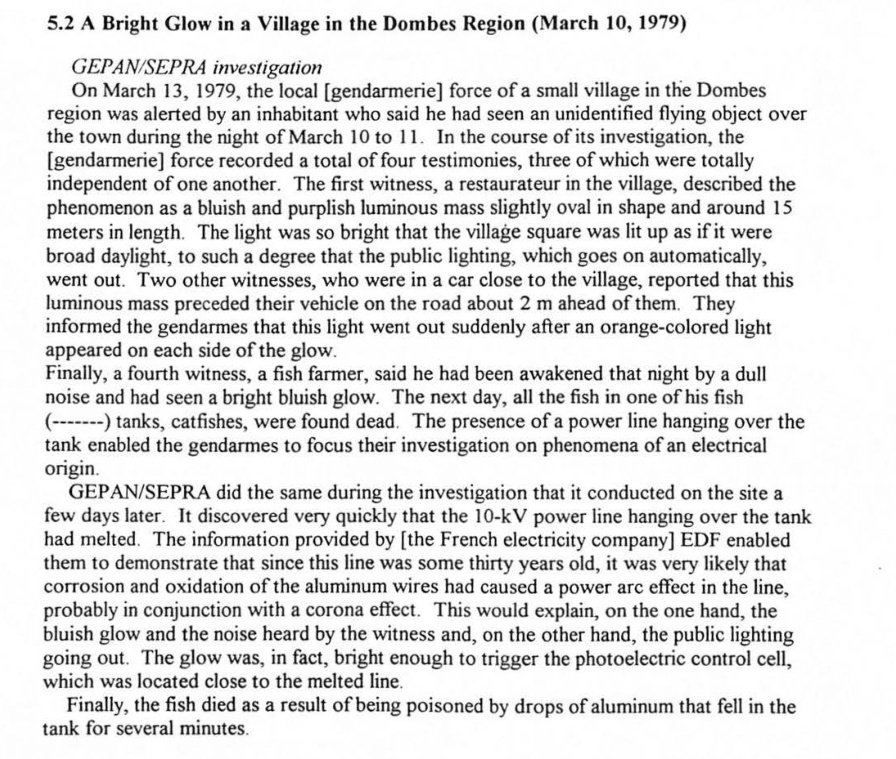
Section 5.2 of the COMETA report (physical page 28) describes the inquiry in detail. On March 13, 1979, the gendarmerie of a village in the Dombes region was told by a resident that an unidentified object had flown over the place on the night of March 10 to 11. The gendarmes took four statements, three of them independent of one another. The owner of a restaurant described a bluish and purplish luminous mass, slightly oval, of about 15 meters, so bright that the square became as bright as day and the automatic street lighting went out. Two people in a car said that the light traveled about 2 meters in front of the vehicle and suddenly went out after an orange light appeared on each side.
The fourth witness, a fish farmer, said he had woken up to a dull noise and seen a bluish flash; the next day, all the catfish in one of his ponds were dead. A power line ran over the pond, and the investigation turned to electrical causes. Days later, GEPAN/SEPRA found that the 10 kV line had melted. Using data from the electric company EDF, it concluded that corrosion and oxidation of the aluminum wires, on a line about thirty years old, probably caused an electric arc, perhaps with a corona effect. This would explain the flash, the noise and the blackout, because the light triggered the nearby photoelectric cell. The fish reportedly died poisoned by drops of aluminum that fell into the pond for several minutes.
The Dombes case is in chapter 5 of COMETA, devoted to counterexamples (physical page 27). The authors say that the unexplained cases of the previous chapters are a minority and that many reports brought to the gendarmerie are resolved after little investigation, with the Moon, planets, airplanes, weather balloons, headlights reflected on clouds and, very rarely, hoaxes. Sometimes, they add, the explanation is more unusual, and Dombes is one of the two examples chosen to show this. The section title attributes the inquiry to GEPAN/SEPRA, although, according to the text itself, the first work was that of the local gendarmerie.
Separating the layers: the four statements are accounts, collected by the gendarmerie starting March 13, two days after the night of the episode. The melted 10 kV line is a material finding made on site by GEPAN/SEPRA a few days later. The link between wire corrosion, electric arc and corona effect is an analysis based on information from the electric company EDF, presented as very probable. The death of the fish from drops of aluminum, by contrast, is asserted without mention of any examination of the animals or of the pond water. The summary also does not say whether a grid failure was recorded that night.
The explanation covers the bluish flash, the dull noise, the street-lighting blackout and the dead fish. The text does not comment on two points in the statements: the luminous mass that, according to the two people in the car, traveled ahead of the vehicle, about 2 meters away, and the orangish lights that appeared on each side before it went out. Nor does it give the distances between the road, the square and the pond. Without these data, the report does not make it possible to know whether all the witnesses described the same electric arc or whether some of the accounts refer to something else.
DIRECT READING OF THE FILE
The document, in the original
Translation of the selected excerpts checked against the image, with omissions indicated. This is not a full translation of the PDF. Summaries and evaluations are kept separate from the transcription.
EXCERPT 1 · PHYSICAL PAGE 28
Short excerpt supporting the summary, not a full translation.
I
small mirrors stuck to its polystyrene casing were for reflecting the show' s lighting
effects ... I
5.2 A Bright Glow in a Village in the Dombes Region (March 10, 1979) I
GEPANISEPRA investigation
On March 13, 1979, the local [gendarrnerie] force ofa small village in the Dombes
region was alerted by an inhabitant who said he had seen an unidentified flying object over I
the town during the night of March IO to 11 . In the course ofits investigation, the
[gendarmerie] force recorded a total offour testimonies, three of which were totally
independent of one another. The first witness, a restaurateur in the village, described the I
phenomenon as a bluish and purplish luminous mass slightly oval in shape and around 15
meters in length. The light was so bright that the village square was lit up as ifit were
broad daylight, to such a degree that the public lighting, which goes on automatically, I
went out. Two other witnesses, who were in a car close to the village, reported that this
luminous mass preceded their vehicle on the road about 2 m ahead ofthem. They
informed the gendarmes that this light went out suddenly after an orange-colored light I
appeared on each side ofthe glow. ~
Finally, a fourth witness, a fish farmer, said he had been awakened that night by a dull
noise and had seen a bright bluish glow. The next day, all the fish in one ofhis fish I
(-------) tanks, catfishes, were found dead. The presence ofa power line hanging over the
tank enabled the gendarmes to focus their investigation on phenomena of an electrical
ongm. I
GEPAN/SEPRA did the same during the investigation that it conducted on the site a
few days later. It discovered very quickJy that the IO-kV power line hanging over the tank
had melted. The information provided by [the French electricity company] EDF enabled I
them to demonstrate that since this line was some thirty years old, it was very likely that
corrosion and oxidation of the aluminum wires had caused a power arc effect in the line,
probably in conjunction with a corona effect. This would explain, on the one hand, the I
bluish glow and the noise heard by the witness and, on the other hand, the public lighting
going out. The glow was, in fact, bright enough to trigger the photoelectric control cell, I I which was located close to the melted line.
Finally, the fish died as a result ofbeing poisoned by drops of aluminum that fell in the
tank for several minutes. I
PART2 I
The Extent of Our Knowledge I
Chapter 6 - Organization of the Research in France
I
In I 977, the Centre National d'Etudes Spatiales was tasked with the mission ofsetting
up a permanent structure for the study of unidentified aerospace phenomena (UAP): the
Groupe d'Etudes de Phenomenes Aerospatiaux Non Identifies (GEPAN). This I
I
IEditorial note: End of the first explained case, a glow in the Dombes region (1979) explained by a power line, and beginning of Part 2 with GEPAN.
Check the original PDF
corrosion and oxidation of the aluminum wires had caused a power arc effect in the line, probably in conjunction with a corona effect.View the document record ↗ · Physical page 28, counting the cover.
EXCERPT 2 · PHYSICAL PAGE 28
Technical conclusion, physical page 28
I
small mirrors stuck to its polystyrene casing were for reflecting the show' s lighting
effects ... I
5.2 A Bright Glow in a Village in the Dombes Region (March 10, 1979) I
GEPANISEPRA investigation
On March 13, 1979, the local [gendarrnerie] force ofa small village in the Dombes
region was alerted by an inhabitant who said he had seen an unidentified flying object over I
the town during the night of March IO to 11 . In the course ofits investigation, the
[gendarmerie] force recorded a total offour testimonies, three of which were totally
independent of one another. The first witness, a restaurateur in the village, described the I
phenomenon as a bluish and purplish luminous mass slightly oval in shape and around 15
meters in length. The light was so bright that the village square was lit up as ifit were
broad daylight, to such a degree that the public lighting, which goes on automatically, I
went out. Two other witnesses, who were in a car close to the village, reported that this
luminous mass preceded their vehicle on the road about 2 m ahead ofthem. They
informed the gendarmes that this light went out suddenly after an orange-colored light I
appeared on each side ofthe glow. ~
Finally, a fourth witness, a fish farmer, said he had been awakened that night by a dull
noise and had seen a bright bluish glow. The next day, all the fish in one ofhis fish I
(-------) tanks, catfishes, were found dead. The presence ofa power line hanging over the
tank enabled the gendarmes to focus their investigation on phenomena of an electrical
ongm. I
GEPAN/SEPRA did the same during the investigation that it conducted on the site a
few days later. It discovered very quickJy that the IO-kV power line hanging over the tank
had melted. The information provided by [the French electricity company] EDF enabled I
them to demonstrate that since this line was some thirty years old, it was very likely that
corrosion and oxidation of the aluminum wires had caused a power arc effect in the line,
probably in conjunction with a corona effect. This would explain, on the one hand, the I
bluish glow and the noise heard by the witness and, on the other hand, the public lighting
going out. The glow was, in fact, bright enough to trigger the photoelectric control cell, I I which was located close to the melted line.
Finally, the fish died as a result ofbeing poisoned by drops of aluminum that fell in the
tank for several minutes. I
PART2 I
The Extent of Our Knowledge I
Chapter 6 - Organization of the Research in France
I
In I 977, the Centre National d'Etudes Spatiales was tasked with the mission ofsetting
up a permanent structure for the study of unidentified aerospace phenomena (UAP): the
Groupe d'Etudes de Phenomenes Aerospatiaux Non Identifies (GEPAN). This I
I
IEditorial note: End of the first explained case, a glow in the Dombes region (1979) explained by a power line, and beginning of Part 2 with GEPAN.
Check the original PDF
it was very likely that corrosion and oxidation of the aluminum wires had caused a power arc effect in the line, probably in conjunction with a corona effect.View the document record ↗ · Physical page 28, counting the cover.
EXCERPT 3 · PHYSICAL PAGE 28
Death of the fish, physical page 28
I
small mirrors stuck to its polystyrene casing were for reflecting the show' s lighting
effects ... I
5.2 A Bright Glow in a Village in the Dombes Region (March 10, 1979) I
GEPANISEPRA investigation
On March 13, 1979, the local [gendarrnerie] force ofa small village in the Dombes
region was alerted by an inhabitant who said he had seen an unidentified flying object over I
the town during the night of March IO to 11 . In the course ofits investigation, the
[gendarmerie] force recorded a total offour testimonies, three of which were totally
independent of one another. The first witness, a restaurateur in the village, described the I
phenomenon as a bluish and purplish luminous mass slightly oval in shape and around 15
meters in length. The light was so bright that the village square was lit up as ifit were
broad daylight, to such a degree that the public lighting, which goes on automatically, I
went out. Two other witnesses, who were in a car close to the village, reported that this
luminous mass preceded their vehicle on the road about 2 m ahead ofthem. They
informed the gendarmes that this light went out suddenly after an orange-colored light I
appeared on each side ofthe glow. ~
Finally, a fourth witness, a fish farmer, said he had been awakened that night by a dull
noise and had seen a bright bluish glow. The next day, all the fish in one ofhis fish I
(-------) tanks, catfishes, were found dead. The presence ofa power line hanging over the
tank enabled the gendarmes to focus their investigation on phenomena of an electrical
ongm. I
GEPAN/SEPRA did the same during the investigation that it conducted on the site a
few days later. It discovered very quickJy that the IO-kV power line hanging over the tank
had melted. The information provided by [the French electricity company] EDF enabled I
them to demonstrate that since this line was some thirty years old, it was very likely that
corrosion and oxidation of the aluminum wires had caused a power arc effect in the line,
probably in conjunction with a corona effect. This would explain, on the one hand, the I
bluish glow and the noise heard by the witness and, on the other hand, the public lighting
going out. The glow was, in fact, bright enough to trigger the photoelectric control cell, I I which was located close to the melted line.
Finally, the fish died as a result ofbeing poisoned by drops of aluminum that fell in the
tank for several minutes. I
PART2 I
The Extent of Our Knowledge I
Chapter 6 - Organization of the Research in France
I
In I 977, the Centre National d'Etudes Spatiales was tasked with the mission ofsetting
up a permanent structure for the study of unidentified aerospace phenomena (UAP): the
Groupe d'Etudes de Phenomenes Aerospatiaux Non Identifies (GEPAN). This I
I
ICheck the original PDF
Finally, the fish died as a result of being poisoned by drops of aluminum that fell in the tank for several minutes.View the document record ↗ · Physical page 28, counting the cover.
Dates and documentary context
- Event
- 10/03/1979 to 11/03/1979 — 1979-03-10/1979-03-11. Date indicated by the secondary source, separate from the publication date.
- Document
- Not established — Individual document date not determined; see the source publication below.
- Publication
- 07/1999 — VSD (special edition, July 1999) · Publication of the source examined or cited; do not presume it is the first historical disclosure of the event. · The record reflects the COMETA summary; primary sources are not always reproduced.
Origin and release
COMETA, private association; secondhand account · UFOs and Defense: What Should We Prepare For?
This record reflects the COMETA summary; primary sources are not always reproduced. Hosting or archiving by a public agency does not imply endorsement; COMETA is a private association. The English version has not been fully compared with the French one.
Official collection · release 01 ↗ — Match indicated by the search; bytes of the remote PDF not authenticated.
A propos de la publication du rapport COMETA — GEIPAN ↗ — GEIPAN clarifies that hosting COMETA does not imply approval by CNES. It identifies the committee as private and attributes the conclusions to the authors. The note also records that the version published there was incomplete.
Questions to continue the investigation
- Locate and verify the primary records and technical documents cited.
GEOGRAPHY OF THE CASE
Dombes region, Ain, France
Approximate regional reference, placed by the editors based on the place cited in the document. The marker does not represent the exact location of the account.
DOCUMENTARY TRAIL
Go back to the sources
References use physical pages of the PDF, counting the cover. Summaries are presented in English; the documents keep their original language.
- 255_413270_UFO's_and_Defense_What_Should_we_Prepare_For.pdf
Physical pages 5, 9, 28
Arquivo histórico · 94 pages
Context and references in this document
contexto ou referencia
UFO seen over a rural school after Antananarivo ↗
contexto ou referencia
Reports of “ghost rockets” in Sweden ↗
contexto ou referencia
Reports of “foo fighters” in World War II ↗
contexto ou referencia
Reports of “airships” in the U.S. and the United Kingdom ↗
contexto ou referencia
Luminous phenomenon attributed to Goethe in 1768 ↗
contexto ou referencia
Aerial phenomena reported in Nuremberg ↗
contexto ou referencia
Aerial phenomenon reported in Basel ↗
contexto ou referencia
Medieval narrative attributed to Agobard about occupants of an “aircraft” ↗
contexto ou referencia
Contact with a Venusian attributed to Adamski ↗
contexto ou referencia
Paul Bennewicz's claims about microwaves, abductions and implants ↗
contexto ou referencia
Triangular lights reported in Arizona in 1997 ↗
contexto ou referencia
Interception attempts by military aircraft in Iran, Peru and Belgium ↗
contexto ou referencia
Shoot-down attempt by Peruvian aircraft, cited in a news report ↗
contexto ou referencia
Pursuit of UFOs by Belgian F-16s in 1990 ↗
contexto ou referencia
Mention of a military Vampire in the Orange region in 1951 ↗
contexto ou referencia
Photograph attributed to a mapping flight over Tilarán, Costa Rica ↗
contexto ou referencia
Image attributed to a Zanesville, Ohio, barber in 1966 ↗
contexto ou referencia
Image attributed to a student from Beaver, Pennsylvania ↗
contexto ou referencia
Image attributed to brothers from Detroit in 1967 ↗
Related publications and media
Editorial summary based on the collection's research notes. How we read the documents.