Date: Fall of 1951, at night (day not given)Location: Korea area, over a fleet with escort carriers (CVE class)
Korea, 1951: naval aviator says UFO picked up on radar positioned itself behind his aircraft and was tracked by 14 fleet radars
In a 1957 letter partly reproduced in NICAP's private report kept by the CIA, Lieutenant Commander M. C. Davies, U.S. Navy, recounts that a UFO picked up on radar, which was circling the fleet, positioned itself behind his antisubmarine aircraft for about five minutes and departed at more than a thousand miles per hour. According to him, the ship reported that 14 radars were tracking it.
- Event date
- Fall of 1951, at night (day not given)
- Location
- Korea area, over a fleet with escort carriers (CVE class)
- Topic
- CIA file
- Source agencies
- CIA
- Documents
- 1 document · 186 pages
- Reading time
- 14 min
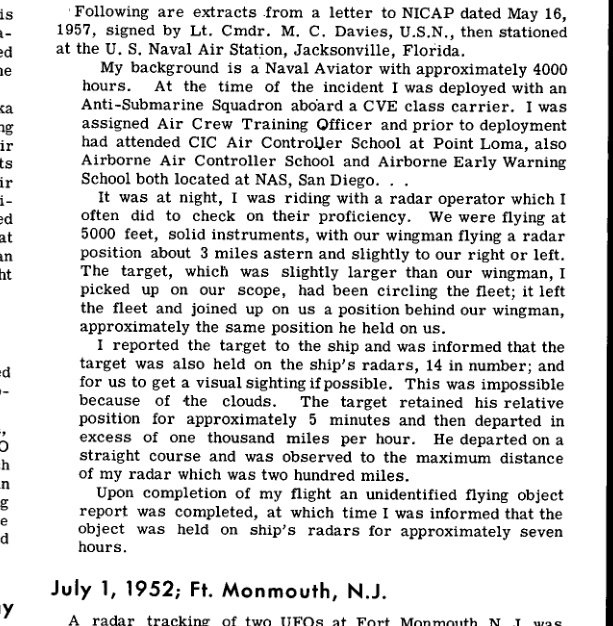 Page of the NICAP reportPhysical page 89
DOCUMENTARY SOURCES · CIA
What the records tell
The source of this dossier is the report "The UFO Evidence", a private compilation published in 1964 by NICAP (National Investigations Committee on Aerial Phenomena), an American civilian UFO research organization. A copy was kept by the CIA and released in 2001 in the CREST archive, which proves that the agency kept it, not that it produced or validated it. On physical page 89, NICAP publishes excerpts from a letter sent to the organization on May 16, 1957, signed by Lieutenant Commander M. C. Davies, U.S. Navy, then stationed at Naval Air Station Jacksonville, Florida. The full letter, which the table on page 82 calls a signed report, is not reproduced.
Davies introduces himself as a naval aviator with about 4.000 flight hours. At the time of the episode, he was serving in an antisubmarine squadron embarked on an escort carrier, CVE class, as crew training officer. Before embarking, he had taken courses as a combat information center air controller at Point Loma and in shipboard air control and airborne early warning at Naval Air Station San Diego. The account therefore comes from someone trained to read radar screens.
It was night, and Davies was flying with a radar operator to check his performance. The aircraft was at 5.000 feet, flying on instruments inside the clouds, and the wingman held a radar position about 3 miles behind, slightly to the side. Davies picked up on the screen a target slightly larger than the wingman, which had been circling the fleet. The target left the fleet and positioned itself behind the wingman, in roughly the same relative position the wingman kept with respect to Davies's aircraft.
He reported the target to the ship and was told that the ship's radars, 14 in all, were also tracking it; he was asked to try to see it, which the clouds prevented. The target held its position for about five minutes and departed in a straight line at more than a thousand miles per hour, tracked to the maximum range of the airborne radar, 200 miles. After the flight, Davies filled out an unidentified flying object report and was told that the object had remained on the ship's radars for about seven hours.
The account is radar-only, with no visual observation, and was written about six years later. The letter does not give the day, the name of the ship or the fleet's position, and the report filled out at the time does not appear in the archive. The information about the 14 radars and the seven hours was passed to Davies by the ship, not seen by him. In the table on page 82, NICAP summarizes the case as a target circling the fleet, with speed from slow to more than a thousand miles per hour, at 5.000 feet.
DIRECT READING OF THE FILE
The document, in the original
Private publication (NICAP report): the English text is not reproduced or translated in full. Each translations block provides a faithful summary, in English, of the portion of the case on the indicated physical page, with at most one short quotation. The images are crops of the report's pages. Summarized here are the excerpts from Davies's letter on page 89 and the table line on page 82; the other cases on these pages were left out.
EXCERPT 1 · PHYSICAL PAGE 82
Physical page 82, row "fall of 1951, Korea area" in the radar table
Approved For Release 2001/04/02 : CIA-RDP81R00560R000100010001-0
. sae i Sources &
Code Date & Location Description Speed Altitude References
A,V July 11, 1950 Disc-shaped UFO sighting visual- 200 mph. Est. 8000 ft. [Section IV]
nr. Osceola , Arkansas ly by Navy pilots, tracked by air-
borne radar
G,V,P July 14, 1951 UFO sped near B-29, tracked on [13]
White Sands, radar; 200 ft. of 35 mm film re-
New Mexico portedly shows bright round spot.
G,V July 23, 1951 UFO tracked on radar, pilots saw 50,000 ft. (14]
March Field, silvery object circling above them
California
G August 26, 1951 Two radar sets tracked UFO 900 mph. [15]
Washington State headed northwest
G,A Fall 1951 Over 14 Navy radar sets tracked Slow to over 5000 ft. {Details this
Korean area UFO circling above fleet. 1000 mph. Section]
(signed report at NICAP)
G,A January 22, 1952 Three F-94s scrambled to inter- 1500 mph. 23,000 ft. {16]
Alaska cept radar target; UFO maneu-
vered, ground radar saw object
streak away to west
G June 1, 1952 Hughes Aircraft radar tracked 180-550 mph. 11,000 ft. {17]
Los Angeles, Cal. UFO which climbed at 35,000 ft.
per min., levelled off, dove, pulled
out, and headed southeast.
G,V June 19, 1952 Red-lighted object approached base, [18]
Goose Bay, Labrador radar blip enlarged as object
seemed to wobble.
G,V July 1, 1952 Two shiny objects tracked; moved Slow - 50,000 ft. [19]
Ft. Monmouth, slowly, hovered, burst of speed “terrific
New Jersey to southwest. Coincided with burst of
other visual observations. speed."
G,V July 10, 1952 Canadian destroyer tracked two 2 miles [20]
Near Korea shiny discs; calculated altitude of
2 miles, 7 miles from ship.
G,V July 19/20, 1952 UFO's tracked by CAA and Air "On the order Section XII;
Washington, D. C. Force radar; some visual of 7500 mph." uly 1952 Chron-
sightings coinciding. (Air Force "fact ology]
sheet")
G July 21, 1952 UFO tracked at 10:30 am. 1200 mph Abt. (21]
Dobbins AFB, Ga. 50,000 ft.
G,A,V July 23, 1952 F-94 pilot obtained radar lock-on (22]
Braintree, Mass. while chasing blue-green light
which circled at high speed.
G,V July 26/27, 1952 Series of radar-visual sightings Some "'slow- Section XII;
Washington, D. C. involving CAA airline and Air moving,'' some fuly 1952 Chron-
Force pilots. “fast.” ology]
G,A,V July 26, 1952 F-94 interceptor obtained radar Slow to [23]
California lock-on, UFO kept pulling away. “terrific speed"
Visually appeared as large
yellow-orange light.
G,V July 28, 1952 USAF jets chased UFO tracked 60 to over [24]
Wisconsin-- by ground radar, UFO's sped up 600 mph
Minnesota and evaded interceptors.
G July 28/29, 1952 Eight to twelve UFO's tracked Section XII;
Washington, D. C. at a time on CAA radar; airline july 1952 Chron-
pilot investigated, saw nothing ology]
put CAA said targets disappeared
from screen when plane was in
their area, then came in behind
plane.
G,A,V July 29, 1952 F-94's attempted to intercept 635 mph 20,000 ft. (25]
Michigan radar traget, observed visually
as flashing red and green light,
then solid white. (From USAF
Intelligence Report)
G,V Summer 1952 UFO target tracked at base. Air 400 knots 40,000 ft. [Section IIT]
MacDill AFB, Force bomber in area investigated (460 mph)
saw maneuverable egg-shaped
UFO.
G,V, P August 1, 1952 UFO tracked, seen visually and 480 mph Above [26]
Wright- Patterson photographed by F-86 pilot. 40,000 ft.
AFB, Ohio
Approved For Release 2001/04/02 : CIA-RDP81R00560R000100010001-0Editorial note: Code legend on physical page 81.
Check the original PDF
[p. 82: texto da publicação privada não reproduzido; ver o resumo]View the document record ↗ · Physical page 82, counting the cover.
EXCERPT 2 · PHYSICAL PAGE 89
Physical page 89, right column: excerpts from the letter by M. C. Davies
tis “ApRroved For Release 2001/04/02 : CIA-RDP81R00560R000100010001-0
believable target they had just seen. The in-
specting officers were appalled that such a coincidence
should happen. I was part of the meager intelligence report-
ing machinery at the base and I was called in to make an
immediate urgent intelligence report on the incident. The
prevailing theory at the time was that it was a meteor. I
personally discounted this since upon interviewing the radar
observers on both sides of the base they stated that it main-
tained an altitude of 60,000 feet and a speed of approximately
9000 mph.
“To make this story more incredible the very next day
both radars again reported an object hovering over the base
at about 10 mph, at 45,000 feet. The ‘‘official”’ story on this
was that they were probably some type of “high-flying sea-
gulls.” You must remember all these incidents happened
before the days of fast high flying jets and missiles and the
now common altitude record-breaking helicopters.”’
(Maj. Jerome then added: ‘‘On my recent tour in Alaska
[circa 1960], I became very familiar with the early warning
and air defense systems on the DEW Line and Alaska Air
Defense Sectors. Many times high speed unknown objects
were discerned which could not be explained as normal air
breathing vehicles penetrating our sectors. Many of the citi-
zens of Alaska along the Bering Sea Coast have reported
seeing missile-like aircraft flying at very low altitudes at
very high speeds, The AF denied the presence of Russian
aircraft vehemently. When it was suggested that they might
be extra-terrestrial everyone clammed up.’’)
October 15, 1948; Japan
Capt. Edward J. Ruppelt reported the following case received
by Project Sign (the original Air Force UFO investigation pro-
ject) in October 1948.
An F-61 “Black Widow” night fighter on patrol over Japan,
October 15, picked up an unidentified radar target. The UFO
was traveling about 200 mph. between 5000 and 6000 feet. Each
time the F-61 tried to close in, the object would accelerate to an
estimated 1200 mph., outdistancing the interceptor before slowing
down again. On one of six passes at the UFO, the crew of the
F-61 got close enough to see its silhouette. The UFO appeared
to be 20-30 feet long and shaped ‘‘like a rifle bullet.”
November 23, 1948; Fursten-Feldbruck, Germany
An unidentified object resembling a reddish light was sighted
east of the base at 2200 hours, local time. Capt. [names
deleted from Air Force reports] said the UFO was moving south
across Munich, turned southwest, then southeast. Not knowing
the height, the speed could not be estimated; but it appeared to
be traveling between 200 and 600 mph.
Capt. reported the sighting to base operations, andthe
radar station chécked its scope. An unidentified target, traveling
900 mph., was detected at 27,000 feet about 30 miles south of
Munich. Capt.. verified that the UFO was now visible in
that area, Radar then reported that the target had climbed quick-
ly to 50,000 feet and was circling 40 miles south of Munich.
March 8, 1950; Nr Dayton, Ohio
In mid-morning, the CAA received a report from Capt. W. H.
Kerr, Trans-World Airways pilot, that he and two other TWA
pilots had a UFO in sight. A gleaming object was visible, hover-
ing at high altitude. CAA also had 20 or more reports on the
UFO from the Vandalia area. Wright-Patterson AFB, near Dayton,
was notified, and sent up four interceptors. The UFO was also
visible to control tower operators and personnel of Air Technical
Intelligence Center on the base. Radar had an unidentified tar-
get in the same position.
Two F-51 pilots reported that they could see the UFO, which
presented a distinct round shape and seemed huge and metallic.
But clouds moved in, and the pilots were forced to turn back. The
Master Sergeant who tracked it on radar stated: ‘‘The target
was a good solid return. . . caused by a good solid target.’
Witnesses reported that the UFO finally climbed vertically out of
sight at high speed.
July 14, 1951; White Sands, N.M.
During the morning two radar operators at a missile tracking
site caught a fast-moving object on their scope. At the same
time a tracker watching a B-29 with binoculars saw a large UFO
near the bomber. Another observer sighted the UFO and, with
a 35 mm camera, shot 200 feet of film. The UFO showed on
the film as a round, bright spot. (The film has never been
released.)
Fall 1951; Korean Area
‘Following are extracts from a letter to NICAP dated May 16,
1957, signed by Lt. Cmdr. M. C. Davies, U.S.N., then stationed
at the U. S, Naval Air Station, Jacksonville, Florida.
My background is a Naval Aviator with approximately 4000
hours. At the time of the incident I was deployed with an
Anti-Submarine Squadron aboard a CVE class carrier. I was
assigned Air Crew Training Officer and prior to deployment
had attended CIC Air Controller School at Point Loma, also
Airborne Air Controller School and Airborne Early Warning
School both located at NAS, San Diego. . .
It was at night, I was riding with a radar operator which I
often did to check on their proficiency. We were flying at
5000 feet, solid instruments, with our wingman flying a radar
position about 3 miles astern and slightly to our right or left.
The target, which was slightly larger than our wingman, I
picked up on our scope, had been circling the fleet; it left
the fleet and joined up on us a position behind our wingman,
approximately the same position he held on us.
I reported the target to the ship and was informed that the
target was also held on the ship’s radars, 14 in number; and
for us to get a visual sighting if possible. This was impossible
because of the clouds. The target retained his relative
position for approximately 5 minutes and then departed in
excess of one thousand miles per hour. He departed ona
straight course and was observed to the maximum distance
of my radar which was two hundred miles.
Upon completion of my flight an unidentified flying object
report was completed, at which time I was informed that the
object was held on ship’s radars for approximately seven
hours.
July 1, 1952; Ft. Monmouth, N.J.
A radar tracking of two UFOs at Fort Monmouth, N. J. was
one of a series of sightings which fit a definite pattern. It
occurred at a time when the Air Force was swamped with UFO
reports - good ones. (See Section XII, 1952 Chronology.] Also,
it was the first of ten known incidents of UFOs tracked by radar
during July 1952. (See chart).
The sequence of events, reported by the Air Force UFO pro-
ject chief, was as follows.
7:30 a.m., Boston, Mass. A couple in nearby Lynn and an
Air Force Captain in Bedford saw two F-94’s which had been
scrambled on an intercept mission. The Captain saw one and
the couple saw two silvery cigar-shaped UFOs, which moved
southwest across Boston, outspeeding the jets.
9:30 a.m., Ft. Monmouth, N. J. Radar tracked two UFO tar-
gets, also observed visually as two shiny objects. The UFOs
approached slowly from the northeast, and hovered nearby at
50,000 feet for about 5 minutes.. Suddenly the blips on the
scope accelerated and shot away to the southwest, confirmed
by visual observation.
A_few hours later, Washington, D.C. A physics professor
at George Washington University, and dozens of others, saw
a grayish UFO bobbing back and forth in the sky about 30-40
degrees above the north-northwest horizon.
None of the sightings could be explained.
August 5, 1952; Haneda AFB, Japan
Just before midnight, two Air Force control tower operators
noticed a brilliant light in the sky, and joined others watching
it through binoculars. The UFO approached the base slowly and
hovered, plainly visible from the control tower. Behind the
brilliant light, the observers could see a dark circular shape
Approved For Release 2001/04/02 : CIA-RDP81R00560R000100010001-0Check the original PDF
[p. 89: texto da publicação privada não reproduzido; ver o resumo]View the document record ↗ · Physical page 89, counting the cover.
Dates and documentary context
- Event
- Not established — The letter and the table say only "fall of 1951"; day and month not given.
- Document
- 02/04/2001 — Date of the CREST release stamp printed on all pages (Approved For Release 2001/04/02).
- Publication
- 1964 — Year of publication of the report "The UFO Evidence" by NICAP.
Origin and release
National Investigations Committee on Aerial Phenomena (NICAP), American civilian organization; private report "The UFO Evidence" (1964). Copy kept in the CIA's CREST archive (CIA-RDP81R00560R000100010001-0, released on 02/04/2001); the CIA kept the text, it did not produce or validate it · CIA-RDP81R00560R000100010001-0_NICAP-The-UFO-Evidence_1964.pdf
CIA CREST, CIA-RDP81R00560R000100010001-0, release of 02/04/2001 ↗ — undefined
Questions to continue the investigation
- Is the UFO report Davies filled out after the flight in the Navy or Project Blue Book files?
- Which was the escort carrier, and on what date was the fleet in the Korea area?
GEOGRAPHY OF THE CASE
Korea area (at sea, fleet position not reported)
The letter does not give the position of the fleet or of the airplane; no point on the map.
DOCUMENTARY TRAIL
Go back to the sources
References use physical pages of the PDF, counting the cover. Summaries are presented in English; the documents keep their original language.
- CIA-RDP81R00560R000100010001-0_NICAP-The-UFO-Evidence_1964.pdf
Physical page 82: row "fall of 1951, Korea area" in the table of radar cases · Physical page 89: excerpts from the 16/05/1957 letter by Lieutenant Commander M. C. Davies, U.S. Navy
CIA · 186 pages
Editorial summary based on the collection's research notes. How we read the documents.