Date: 12/11/1948, between 13h and 14hLocation: Northeast sector of Clark Air Base, Philippines
Clark Base, Philippines, 1948: sergeant sees a white UFO go in and out of the clouds six times
On the afternoon of November 12, 1948, Sergeant Fredrick M. Wright, of Clark Air Base, in the Philippines, saw a white UFO elongate and take the shape of a tailless aircraft, which passed through a large cloud formation six times. The officer who questioned him cast doubt on his character and honesty, and the file's evaluation was D-5.
- Event date
- 12/11/1948, between 13h and 14h
- Location
- Northeast sector of Clark Air Base, Philippines
- Topic
- 1948 reports
- Source agencies
- Arquivo histórico
- Documents
- 1 document · 144 pages
- Reading time
- 6 min
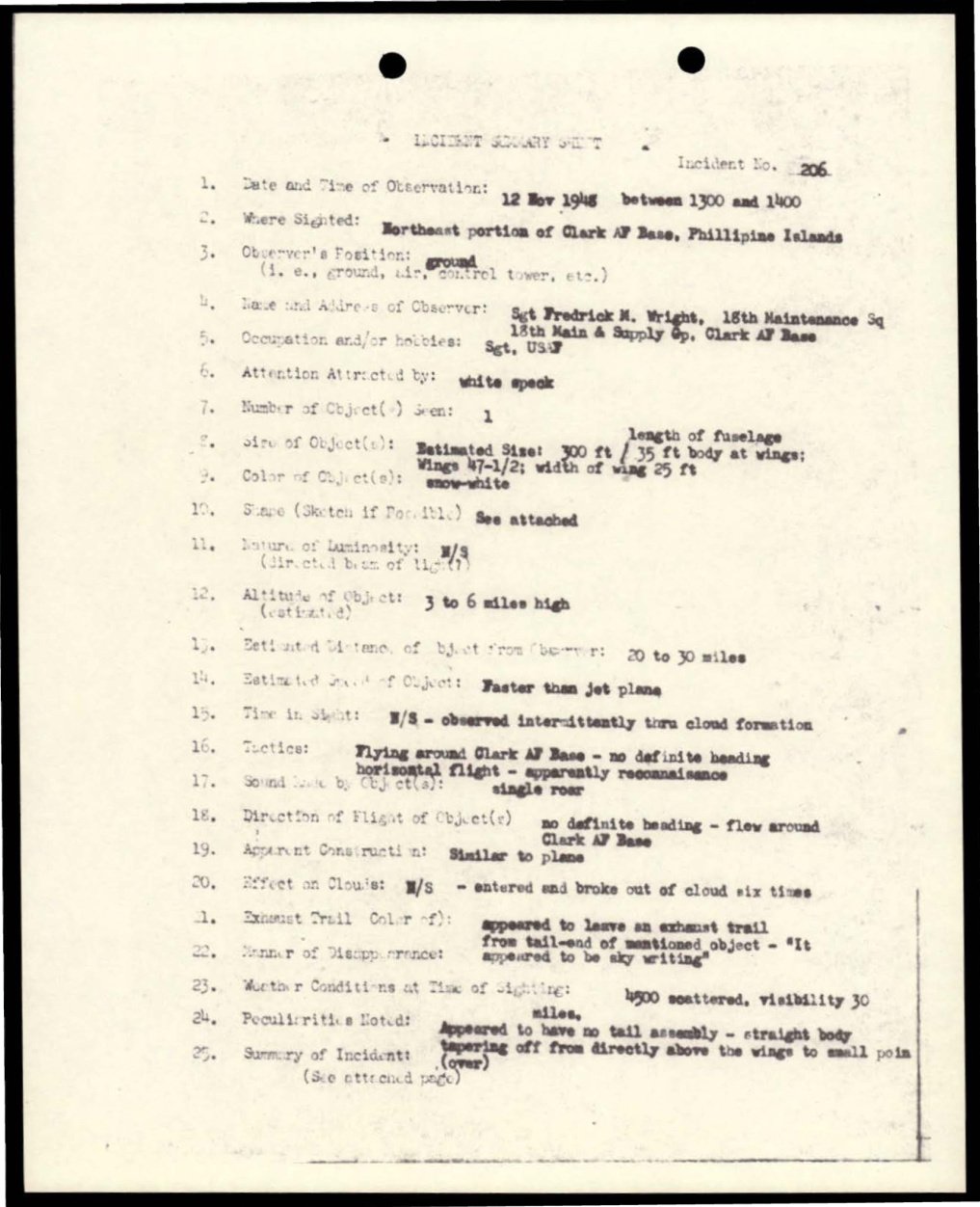 Official formPhysical page 81
DOCUMENTARY SOURCES · Arquivo histórico
What the records tell
Incident 206 was reported by a maintenance serviceman: Sergeant Fredrick M. Wright, of the 18th Maintenance Squadron and the 18th Maintenance and Supply Group at Clark Air Base, in the Philippines, then the main U.S. base in the country. Between 13h and 14h on November 12, 1948, he was on the ground, looking at cloud formations in the northeast sector of the sky, when he saw a white dot "materialize and elongate." That was what caught his attention.
At first, Wright thought it was skywriting done by an airplane. But the object kept moving forward "as one whole unit," headed northwest and entered a very large cloud formation. When it came out on the north-northwest side, it looked larger, and he was able to see it better. It was snow white. On one occasion, he had a side view: it seemed to him that the side was broken by windows, that the nose was short and that there were low wings, very short in relation to the length of the fuselage.
The sergeant saw the object six times through the clouds, in various positions, and made drawings. In them he estimated 300 feet (about 90 meters) of fuselage, 35 feet of body at wing level, a wingspan of 47,5 feet and a wing width of 25 feet. He himself said, however, that it would be impossible to estimate the length if the craft used rear propulsion with a white-exhaust fuel. The record places the object 3 to 6 miles high and 20 to 30 miles away, faster than a jet, with a "single roar."
The object appeared to have no tail: a straight body that tapered, from above the wings, to a very small point. It flew level, with no definite heading, around the base, "apparently on reconnaissance," according to the record. It seemed to leave an exhaust trail at the rear, and "it looked like skywriting." The weather had scattered clouds at 4.500 feet and visibility of 30 miles. The drawings cited as attachments are not in this copy of the file, and the total observation time was not recorded.
The final evaluation is D-5, accompanied by a sentence: "Sergeant Wright's character and honesty are questionable, according to the officer who interrogated him". On the usual scale of the time, D indicates a source that is not usually reliable and 5, improbable information. The file does not explain what this judgment is based on and does not classify the account as a fabrication. Five days later, two fighter pilots from the same base reported another phenomenon, a white mass connected to a corkscrew trail. The archive does not link the two cases.
Sergeant Wright made drawings of the object in several positions, according to the summary, and the sheet refers to them in the shape field: "see attachment". The drawings did not remain in the box. Without them, the measurements attributed to the object, 300 feet of fuselage, 35 feet of body at the height of the wings and 47,5 feet of wingspan, can only be read as the observer's estimates noted down by the investigator, and not as calculated dimensions.
The estimates on the sheet do not fit well with one another. The object would have been 3 to 6 miles high and 20 to 30 miles away, but the sergeant said he saw windows on the side and short, low wings, details that are difficult to distinguish at that distance with the naked eye (editorial note). Wright himself limited the length estimate, saying it would not hold if the craft left a white exhaust trail. The form does not record binoculars or any other instrument.
The D-5 evaluation is lower than the one given, five days later, to the account of Lieutenants Hundley and Feibelman, from the same base (C-3). It rests on a sentence about the sergeant's character and honesty, attributed to the officer who interrogated him, without facts to support it in the document. The two evaluations measure the confidence attributed to the source and to the information; neither of them says what was seen in the sky over Clark.
DIRECT READING OF THE FILE
The document, in the original
Both pages of the case (physical pages 81 and 82) were translated in full: the summary sheet, field by field, and the summary with the D-5 evaluation. The sergeant's drawings cited as attachments are not in the PDF.
EXCERPT 1 · PHYSICAL PAGE 81
Full summary sheet of incident 206, physical page 81
206.
Sgt Fredrick M. Wright, 18th Maintenance Sq
1th Kain & Supply fp. Clark AF Base
Set, US?
white speck
1
length of fuselage
Betimated Sige! ft / 35 ft body at wings;
Wings 47-1/2; width of f2 2 ft
snow-white
121.) fgg attached
3 to 6 miles high
2 to WO miles
Faster than jet plane
B/S = observed intercittently tora cloud formstion
Fiying around Clark AP Base - no definite heading
horisomtal flight - apparently reconnaisance
" Fligat of Chjcet(s) mo definite heading - flew around
Clark AP Base
Similar to plane
~ entered end broke out of cloud six tines
to leave an exhanst trail
from tail-end of mamtioned object - "It
appeared to be sky writing"
oe aoe WHO scattered, visibility 30
miles,
Appeared to have no tail assembly - ctraight body
s teers" off from directly above the wings to eaall poin
|Editorial note: The original spells "Phillipine" and "reconnaisance". The line for fields 22 and 23 is misaligned: the weather text begins at the level of field 22, which was left without its own answer.
Check the original PDF
INCIDENT SUMMARY SHEET | Incident No. 206 | 1. Date and Time of Observation: 12 Nov 1948 between 1300 and 1400 | 2. Where Sighted: Northeast portion of Clark AF Base, Phillipine Islands | 3. Observer's Position (i.e., ground, air, control tower, etc.): ground | 4. Name and Address of Observer: Sgt Fredrick M. Wright, 18th Maintenance Sq, 18th Main & Supply Gp, Clark AF Base | 5. Occupation and/or hobbies: Sgt, USAF | 6. Attention Attracted by: white speck | 7. Number of Object(s) Seen: 1 | 8. Size of Object(s): Estimated Size: 300 ft length of fuselage / 35 ft body at wings; Wings 47-1/2; width of wing 25 ft | 9. Color of Object(s): snow-white | 10. Shape (Sketch if Possible): See attached | 11. Nature of Luminosity (directed beam of light?): N/S | 12. Altitude of Object (estimated): 3 to 6 miles high | 13. Estimated Distance of Object from Observer: 20 to 30 miles | 14. Estimated Speed of Object: Faster than jet plane | 15. Time in Sight: N/S - observed intermittently thru cloud formation | 16. Tactics: Flying around Clark AF Base - no definite heading; horizontal flight - apparently reconnaisance | 17. Sound Made by Object(s): single roar | 18. Direction of Flight of Object(s): no definite heading - flew around Clark AF Base | 19. Apparent Construction: Similar to plane | 20. Effect on Clouds: N/S - entered and broke out of cloud six times | 21. Exhaust Trail (Color of): appeared to leave an exhaust trail from tail-end of mentioned object - "It appeared to be sky writing" | 22. Manner of Disappearance: [em branco] | 23. Weather Conditions at Time of Sighting: 4500 scattered, visibility 30 miles. | 24. Peculiarities Noted: Appeared to have no tail assembly - straight body tapering off from directly above the wings to small point | 25. Summary of Incident: (over) (See attached page)View the document record ↗ · Physical page 81, counting the cover.
EXCERPT 2 · PHYSICAL PAGE 82
Summary of incident 206, physical page 82
_ ,.1-:J""' ~
DON. •
~t •t•te.d he 'fr.' wtobs._ .,.. olOlld forutina11 la the Xorto
.,.,, po..tioa of the .q whe t» ob " d a wn1te tpeck tn1 11•• ad
lUlgUn Ollllt. At fir ~U.. bat • 1t coo-
t to • Ull'J!QCJ:Jt it ~)leSl~ u a le Ullit. Ol>Ject
d a cti n d a ~ lar: P. cl~ torw.U.OD
o'bJ nortn.i.e r.t by ool'"th the
lar~r and a clet. ..~r new. bJoct
- • able to o'b 1
Cl ace b-rolcm lv w1Ddowa. ... I! or t 1 1-Cth. ini tel..J a ~
to t1on snort 1a mia1rm1~ toe l o or the
fu•laip. d t.bP ob U:ru \he claad.
to t1oa. • - att~ ~•• ~ lfrlcbt
Ht1Mte u.. lellC1,h of t. tu.e l be 300 , ..,.
ta ' ed t t U. :1ble \0 e•t te
tbe obJect 1 •• u,1.ae ~ t r,~ of propul 1
aDd u,.,, 1 \QC a rnel \h , 111ft a v:, 11t. h ••lflC• ,-.:,p,.u-r.11t17
~ t bo.'!,y t r 1~ off f ;-
• 7 1 ct.
..aluat 1'lftl !>-5 - t ttht•, Chor~tor and 111 one t1 • ft qu, nu le9000 line to the iut" r:!"Ot U alf1 r.
Md DO t l,v. •Editorial note: "Northwest by north" is a compass-rose bearing, translated as northwest by north.
Check the original PDF
Incident: 206 | Sgt Wright stated he was watching some cloud formations in the Northeast portion of the sky when he observed a white speck materialize and lengthen out. At first he thought it was sky-writing but as it continued to advance he thought it appeared as a whole unit. Object pursued a northwestern direction and entered a very large cloud formation. As the object emerged on the northwest by north side the object appeared larger and he was able to get a clearer view. The object appeared snow-white. At one time Sgt Wright was able to obtain a side-view impression. It seemed as if the side surface was broken by windows. The nose, too, was short in comparison to the length. There was definitely a wing formation - low wing and very short in comparison to the length of the fuselage. Sgt Wright perceived the object six times thru the cloud formation, in various attitudes - see attached drawings. Sgt Wright in his drawing estimates the length of the fuselage to be 300 feet. However, he stated that it would be impossible for him to estimate the length of the object if the craft was using a rear type of propulsion and utilizing a fuel that left a white exhaust. Fuselage apparently had no tail assembly. It appeared as a straight body tapering off from directly above the wings to a very small point. | Evaluation: D-5 - Sgt Wright's character and his honesty are questionable according to the interrogating officer.View the document record ↗ · Physical page 82, counting the cover.
Dates and documentary context
- Event
- 12/11/1948 — Between 13h and 14h, presumed local time.
- Document
- Not established — Record with no drafting date.
- Publication
- Not established — Released in the National Archives batch (box 7, incidents 173 to 233).
Origin and release
U.S. Air Force, Air Materiel Command (technical intelligence, Wright-Patterson), under Project Sign; sheets compiled from witness and air base reports · 38_143685_box7_Incident_Summaries_173-233.pdf
Related accounts and their differences
Questions to continue the investigation
- On what did the officer base his questioning of the sergeant's character and honesty?
- Where are the drawings of the UFO cited as attachments?
GEOGRAPHY OF THE CASE
Clark Air Base, Luzon, Philippines
Approximate reference to the former Clark Air Base, placed by the editors. It indicates the observer's location; the object was estimated to be 20 to 30 miles away.
DOCUMENTARY TRAIL
Go back to the sources
References use physical pages of the PDF, counting the cover. Summaries are presented in English; the documents keep their original language.
- 38_143685_box7_Incident_Summaries_173-233.pdf
Physical page 81: summary sheet for incident 206, Clark Air Base, Philippines, 12/11/1948 · Physical page 82: summary of incident 206, with D-5 evaluation
Arquivo histórico · 144 pages
Editorial summary based on the collection's research notes. How we read the documents.