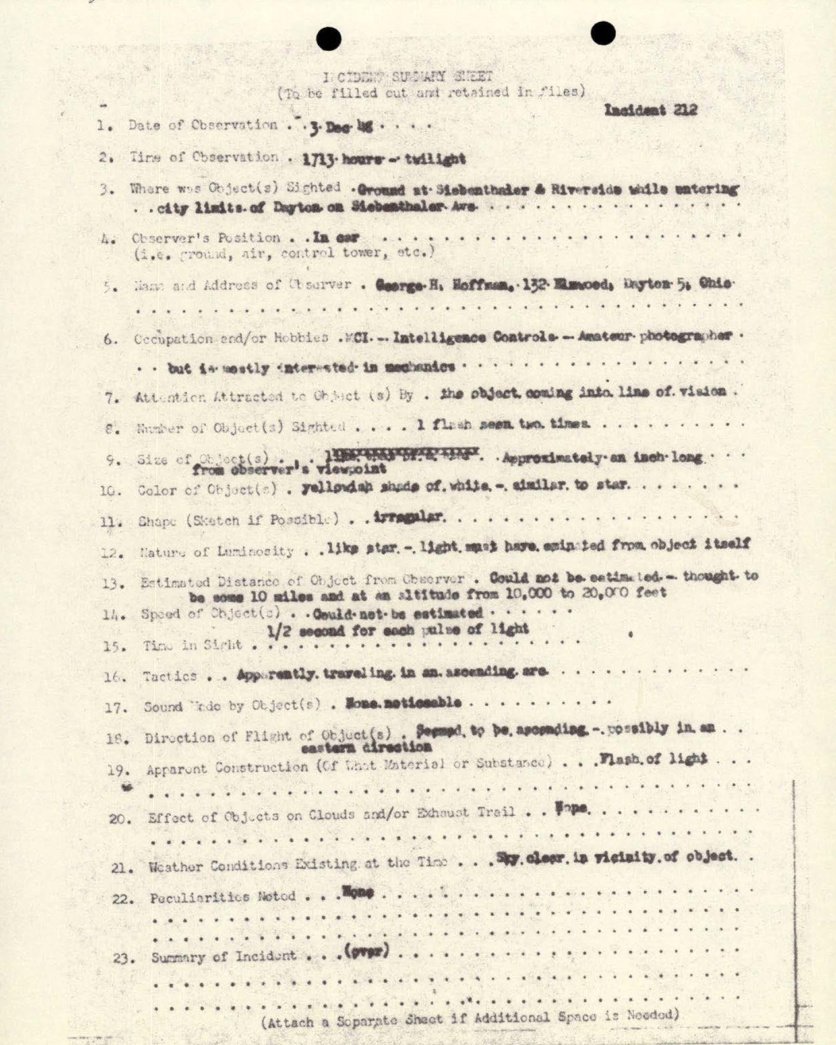
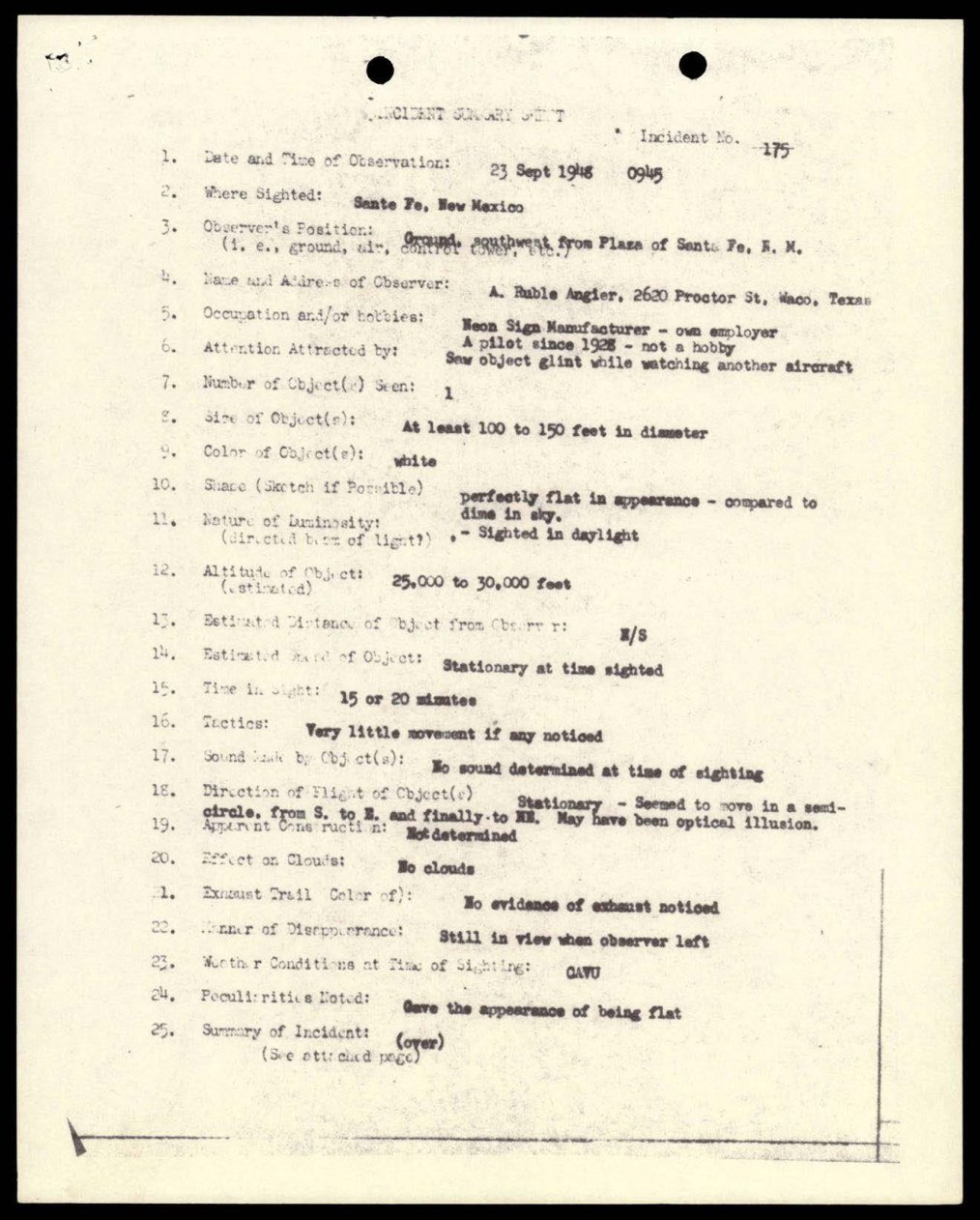
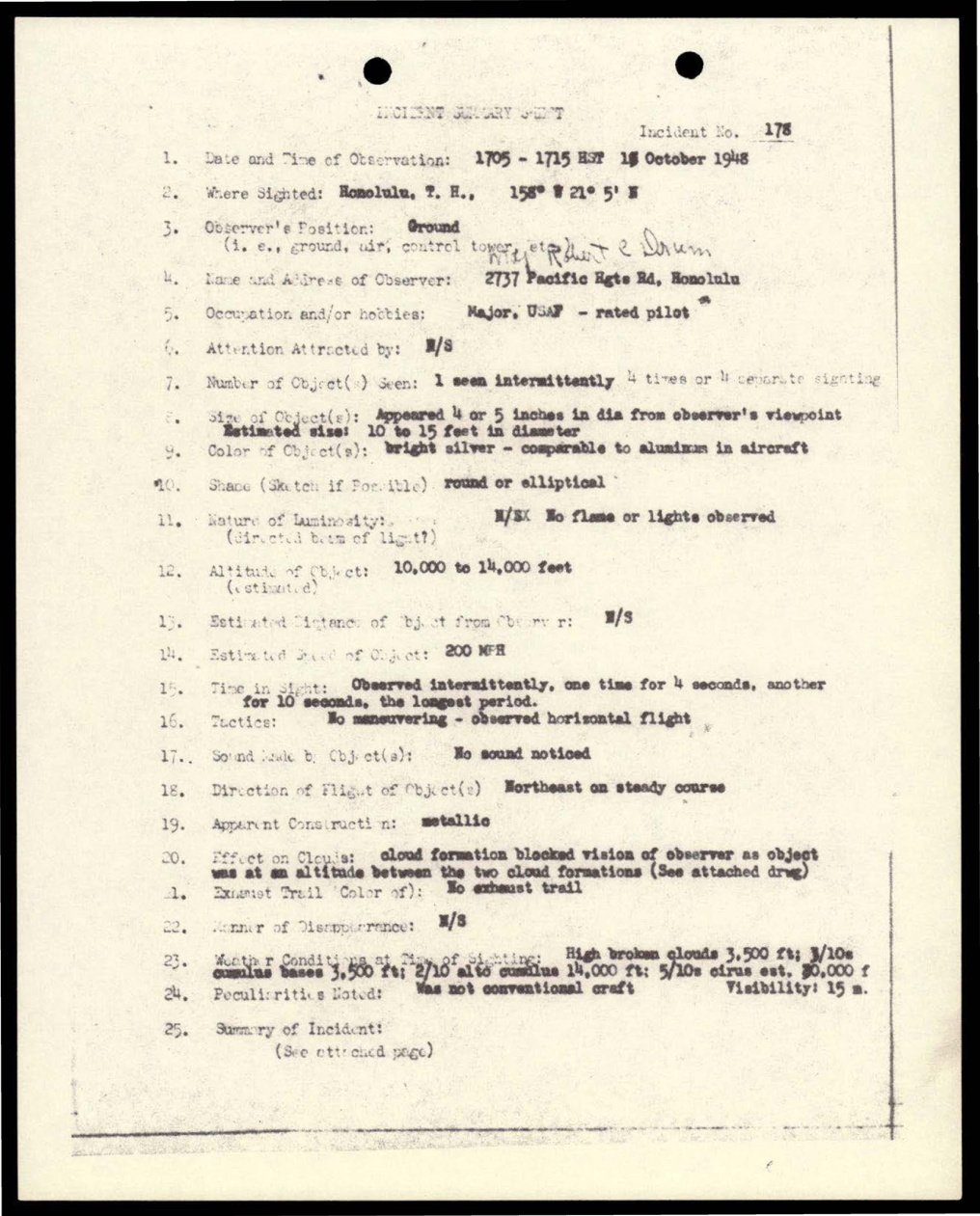
Date: 17/11/1948, 14h30Location: Eastern edge of Clark Air Base, Philippines
Clark Base, Philippines, 1948: two fighter pilots see an "explosion" stationary in the air connected to a corkscrew trail
At 14h30 on November 17, 1948, two lieutenant fighter pilots saw from the ground, at the eastern edge of Clark Air Base, a white mass resembling the burst of an antiaircraft shell, stationary in the air and connected to a curved corkscrew trail. The mass and the trail dissipated like smoke in about 3 minutes.
- Event date
- 17/11/1948, 14h30
- Location
- Eastern edge of Clark Air Base, Philippines
- Topic
- 1948 reports
- Source agencies
- Arquivo histórico
- Documents
- 1 document · 144 pages
- Reading time
- 5 min
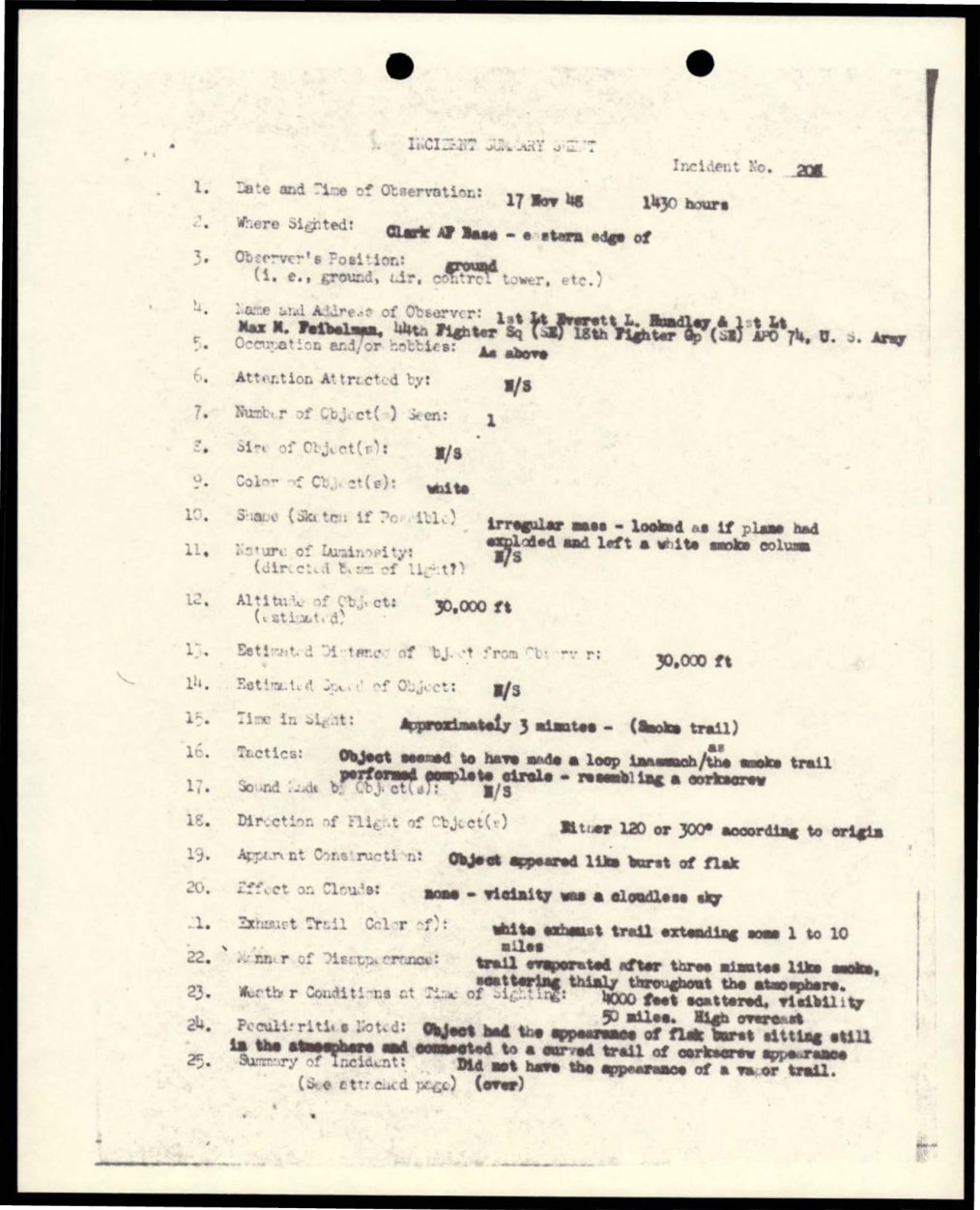 Official formPhysical page 89
DOCUMENTARY SOURCES · Arquivo histórico
What the records tell
Incident 208 has two observers identified by name and rank: First Lieutenants Everett L. Hundley and Max M. Feibelman, of the 44th Fighter Squadron of the 18th Fighter Group, at Clark Air Base, in the Philippines. The incident number is poorly printed on both sheets, but the position of the pages, between incidents 207 and 209, confirms 208. At 14h30 on November 17, 1948, the two were on the ground, at the eastern edge of the base.
They saw a single white object, an "irregular mass" looking like an antiaircraft burst stationary in the air, connected to a curved, corkscrew-shaped trail. The summary refers to an attached drawing, which is not in this copy. The altitude was estimated at 30.000 feet, and the distance, also at 30.000 feet. The trail was 1 to 10 miles long and, according to the pilots, did not look like a condensation trail, but rather the exhaust of a rocket or a jet.
The file says the object "appears to have made a loop", because the smoke trail completed a circle, like a corkscrew. The heading was noted as 120 or 300 degrees, depending on the point of origin. The mass was white, like an exhaust trail that had started with a sudden burst and then thinned out until it vanished. The two remarked that it looked as if an airplane had exploded and left a column of white smoke. In about 3 minutes, everything spread out, thin as smoke.
The pilots were firmly convinced that it was not a cloud, because of its shape and because the sky in the vicinity was cloudless. The file itself, however, records in the weather field scattered clouds at 4.000 feet, visibility of 50 miles and a high overcast layer. The summary does not comment on this discrepancy. The archive's evaluation was C-3: on the usual scale of the time, a fairly reliable source and possibly true information. There is no record of sound, speed or any check of flights and launches in the area.
As an editorial hypothesis, the description resembles the trail of a rocket or of a maneuvering jet aircraft, or the train left by a bright meteor, which winds at altitude can twist over a few minutes. None of this is verified in the document, which contains no response from other agencies. Five days earlier, Sergeant Fredrick Wright reported at the same base a white object moving in and out of the clouds; the archive treats the two as separate incidents.
The sheet estimates both the altitude and the distance at 30.000 feet, a round number repeated in two fields, and gives the trail a length of 1 to 10 miles, a wide range that shows the difficulty of judging the size and distance of a trail in the sky. The heading is also double, 120 or 300 degrees, "depending on the origin", because the pilots did not know at which end the trail had begun.
The drawing the lieutenants made of the corkscrew trail is cited in the summary, but it did not remain in the box. The C-3 evaluation, noted at the end of the summary, is intermediate: a fairly reliable source and possibly true information, on the usual scale of the time. It falls between the B-2 given to the Neubiberg file from October and the D-5 given, five days earlier, to Sergeant Wright's account at the same base.
There is no other Clark file in the box for November 17, nor any record that anyone else on the base saw the initial burst. The document also records no sound, even though the phenomenon was compared to an antiaircraft burst: the sound and speed fields were left as N/S, and the manner-of-disappearance field describes only the trail spreading like smoke.
DIRECT READING OF THE FILE
The document, in the original
Both pages of the case (physical pages 89 and 90) were translated in full: the summary sheet, field by field, and the summary with the C-3 evaluation. The drawing cited as an attachment is not in the PDF.
EXCERPT 1 · PHYSICAL PAGE 89
Full summary sheet of incident 208, physical page 89
• I
1. 171n
ai..tr .... - ot
..
C" .
V •. . 1/1 .c . ' )
.:. ,)1~ f Ol.i { .,
1
Cb- ):
... .
- ( )
12() OJ' ~ aoaor-41-I to orlc1a
, at nu
I •
e.
l .
'· •- ftcda1'1 • el
•
... . '
23.
l'
bt r
Glll..lt ff\ea41ac-lt.ol0
t.11':a .....
a1il1Dl!-N.
11 v
•Editorial note: The incident number is partially covered; the last two digits look like 08. "SE" after the units is in parentheses in the original and is not explained. The original spells "Bither" [Either] in field 18.
Check the original PDF
INCIDENT SUMMARY SHEET | Incident No. 208 [número parcialmente coberto] | 1. Date and Time of Observation: 17 Nov 48, 1430 hours | 2. Where Sighted: Clark AF Base - eastern edge of | 3. Observer's Position (i.e., ground, air, control tower, etc.): ground | 4. Name and Address of Observer: 1st Lt Everett L. Hundley & 1st Lt Max M. Feibelman, 44th Fighter Sq (SE) 18th Fighter Gp (SE) APO 74, U. S. Army | 5. Occupation and/or hobbies: As above | 6. Attention Attracted by: N/S | 7. Number of Object(s) Seen: 1 | 8. Size of Object(s): N/S | 9. Color of Object(s): white | 10. Shape (Sketch if Possible): irregular mass - looked as if plane had exploded and left a white smoke column | 11. Nature of Luminosity (directed beam of light?): N/S | 12. Altitude of Object (estimated): 30,000 ft | 13. Estimated Distance of Object from Observer: 30,000 ft | 14. Estimated Speed of Object: N/S | 15. Time in Sight: Approximately 3 minutes - (Smoke trail) | 16. Tactics: Object seemed to have made a loop inasmuch as the smoke trail performed complete circle - resembling a corkscrew | 17. Sound Made by Object(s): N/S | 18. Direction of Flight of Object(s): Either 120 or 300° according to origin | 19. Apparent Construction: Object appeared like burst of flak | 20. Effect on Clouds: none - vicinity was a cloudless sky | 21. Exhaust Trail (Color of): white exhaust trail extending some 1 to 10 miles | 22. Manner of Disappearance: trail evaporated after three minutes like smoke, scattering thinly throughout the atmosphere. | 23. Weather Conditions at Time of Sighting: 4000 feet scattered, visibility 50 miles. High overcast | 24. Peculiarities Noted: Object had the appearance of flak burst sitting still in the atmosphere and connected to a curved trail of corkscrew appearance | 25. Summary of Incident: Did not have the appearance of a vapor trail. (See attached page) (over)View the document record ↗ · Physical page 89, counting the cover.
EXCERPT 2 · PHYSICAL PAGE 90
Summary of incident 208, physical page 90
Incident: 2.6
The o % sighted Wy the two fighter pilots hod the appearance
of a flek burst sitting still in the atao: Tre and w © connected
to a curved trail of corkscrew appearence (‘ee drawing attacne:)
The trail wis from 1 to 10 miles im length, amd did not have the
“ppearance of a vapor trail but rather that of « rocket or jet
exhaust. Altitude wis judged to be 3,000 ft. The mace and trail
dieappeared within spproximpately three minutes. Phe ma:s avpeured
waite in color like an exhaust trail which bd s sudden burst
origin amd then tape-ed off to nothing. Both parties renarked that
it appesred as if an aircraft had exploded and left a wiite smoke
Colum. The vapor substance dissipated in approximately in 3 mimutes
scattering thinly like enoke through the atwosphere. It is firely
believed by both witnesses that the object was not e cloud because
of its shape and becomrs the oky in the vicinity war cloudless.
Evaluation: C3Editorial note: The incident number is poorly printed. The repetition "in approximately in" is from the original.
Check the original PDF
Incident: 208 | The object sighted by the two fighter pilots had the appearance of a flak burst sitting still in the atmosphere and was connected to a curved trail of corkscrew appearance (See drawing attached). The trail was from 1 to 10 miles in length, and did not have the appearance of a vapor trail but rather that of a rocket or jet exhaust. Altitude was judged to be 30,000 ft. The mass and trail disappeared within approximately three minutes. The mass appeared white in color like an exhaust trail which had a sudden burst origin and then tapered off to nothing. Both parties remarked that it appeared as if an aircraft had exploded and left a white smoke column. The vapor substance dissipated in approximately in 3 minutes scattering thinly like smoke through the atmosphere. It is firmly believed by both witnesses that the object was not a cloud because of its shape and because the sky in the vicinity was cloudless. | Evaluation: C-3View the document record ↗ · Physical page 90, counting the cover.
Dates and documentary context
- Event
- 17/11/1948 — 14h30, presumed local time.
- Document
- Not established — Record with no drafting date.
- Publication
- Not established — Released in the National Archives batch (box 7, incidents 173 to 233).
Origin and release
U.S. Air Force, Air Materiel Command (technical intelligence, Wright-Patterson), under Project Sign; sheets compiled from witness and air base reports · 38_143685_box7_Incident_Summaries_173-233.pdf
Related accounts and their differences
Questions to continue the investigation
- Was there a rocket launch, antiaircraft artillery exercise, or jet flight near Clark that afternoon?
- How can the "cloudless sky" in the summary be reconciled with the scattered clouds and high layer recorded on the sheet?
GEOGRAPHY OF THE CASE
Clark Air Base, Luzon, Philippines
Approximate reference to the former Clark Air Base, placed by the editors. It indicates the observers' location, on the eastern edge of the base; the object was estimated at 30.000 feet.
DOCUMENTARY TRAIL
Go back to the sources
References use physical pages of the PDF, counting the cover. Summaries are presented in English; the documents keep their original language.
- 38_143685_box7_Incident_Summaries_173-233.pdf
Physical page 89: summary sheet for incident 208, Clark Air Base, Philippines, 17/11/1948 · Physical page 90: summary of incident 208, with C-3 evaluation
Arquivo histórico · 144 pages
Editorial summary based on the collection's research notes. How we read the documents.