Date: September 1971 and 1976Location: Yerevan (Soviet Armenia) and USSR
USSR, 1971 and 1976: a ridiculed 'flying saucer committee' and UFOs seen as flashes by Aeroflot pilots
Two CIA reports based on contacts with American scientists show how the subject of UFOs appeared in Soviet science in the 1970s. In 1971, a member of the Soviet committee on unusual phenomena was laughed at during a conference; in 1976, a radiobiologist explained the UFOs seen as flashes by pilots as an effect of cosmic rays.
- Event date
- September 1971 and 1976
- Location
- Yerevan (Soviet Armenia) and USSR
- Topic
- CIA file
- Source agencies
- CIA
- Documents
- 2 documents · 4 pages
- Reading time
- 13 min
 Intelligence reportPhysical page 1
DOCUMENTARY SOURCES · CIA
What the records tell
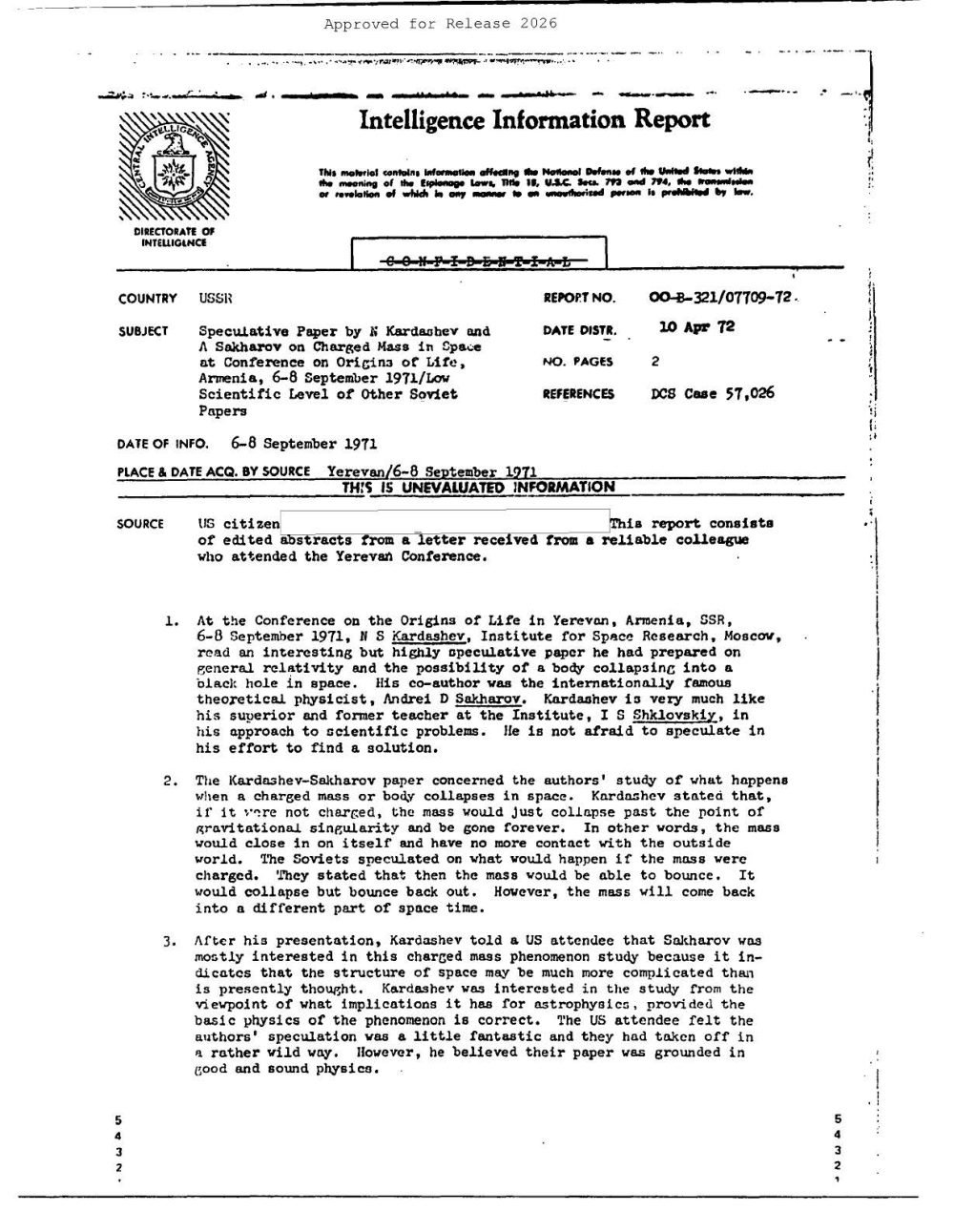
The first report, distributed on 10 April 1972, summarizes the letter of a colleague who attended the Conference on the Origins of Life in Yerevan, from 6 to 8 September 1971. The main topic is a speculative paper by N. S. Kardashev, co-signed by the physicist Andrei Sakharov, on an electrically charged mass that would collapse and 'ricochet' into another region of space-time. The American participant found the idea somewhat fantastic but grounded in solid physics. The paper does not deal with UFOs.
The mention of UFOs comes at the end. According to the report, another Soviet, a member of a committee created in the USSR to investigate 'unusual phenomena, in other words, flying saucers', gave a serious talk that came across as very funny: 'of course, we know there is nothing to this so-called phenomenon, but on the other hand...'. I. S. Shklovskiy and others laughed, and Shklovskiy later told an American that the 'saucer committee' had many politicians, theorists and historians, and little or no scientific talent.
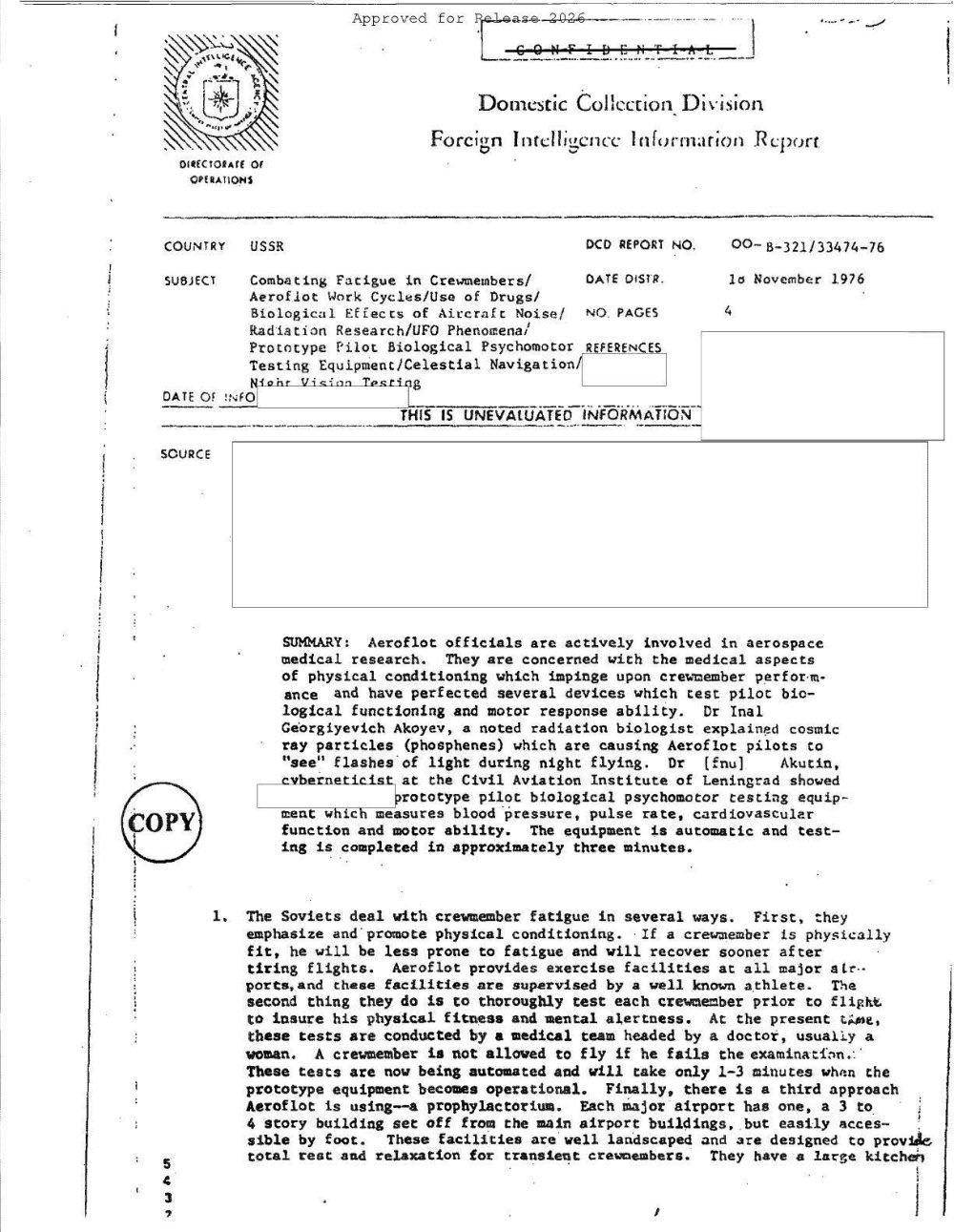
The second report, from November 1976, deals with aviation medicine at Aeroflot: combating fatigue, automated pilot examinations and rest homes at airports. In the summary, the radiobiologist Inal Georgiyevich Akoyev explains that cosmic ray particles caused phosphenes, making pilots 'see' flashes of light on night flights. The document does not link these flashes to any specific case.
In paragraph 6, Akoyev asked the American source, whose name was redacted, for a personal opinion on the UFO phenomenon. The answer was that 99% of occurrences could be attributed to natural or human phenomena, such as celestial movements, airplanes or satellites, and that the remaining 1% had no explanation, perhaps hallucination. Akoyev then asked whether it was possible that something came from space. The estimate is the American source's, not the Soviet scientist's nor the CIA's.
The two documents show the subject of UFOs as a side topic in scientific conversations, recorded by the CIA as part of its collection on Soviet science. Neither contains a dated sighting or an agency assessment. The committee mentioned in Yerevan is not identified by name, and the 1976 report arrived incomplete: the Aeroflot PDF has only pages 1 and 3 of a four-page report.
More images from the document
DIRECT READING OF THE FILE
The document, in the original
U.S. government documents. The paragraph on the 'disc committee' and paragraph 6 of the Aeroflot report are translated; the work of Kardashev and Sakharov and the medical tests are summarized.
EXCERPT 1 · PHYSICAL PAGE 1
1972 report (CIA-UAP-008), physical page 1: full text
------------------
App r oved f o r Re l ease 2026
. .•
DIIECTOIATI Of
INTWIOOICI
··-··-- ---- --- ----------- --~- .···-··- - --· --
-• ----.. ------ ___....,._
Intelligence Information Report
COUNTRY USSH REPOP.TNO. 00-B-'321/0770')-72·
SUBJECT Specw.ative Paper by li KardubeY and DATE OISTlt. 10Apr72
/\ Sakharov on Charged Hus in Cpa.;.,e
nt Cont'erenee on Orici,'13 or Lite, NO. PAGH 2
Armenia, 6-6 September 1971/IAw
Scientific Level ot' Other S~v:let DCS Cue ST,026
Pnpers
DATE Of INFO. 6-8 September 1911
PLACE &DATE ACQ. BY SOURCE Yerevan/6-6 September 1971
THr4i IS UNEVAWATEO INFORMATION
SOURCE US cithen! fni1a report consists
or edited abstracts trom a 1 etter recelved from a reliable colleague
who attended the Yerevan Conference,
..
l,
2.
At the Conference on the Origins of Lite in Yerevo.n, Armenia, $SR,
6-8 Septemher 1971, NS ~.ardashev, Ins titute for Sp~c~ Research, Moscov,
r e ad an interesting but highly Dpeculative paper he had prepared on
r.enera.l relativity and the possibility of a bod;f collap3inc into a
black hole in apace. His co-author vas tbe internationally f81110us
theoretica.l. physicist, Andrei D Su.harov. Y..o.rda.ohev iD very much like
his superior and former teacher at the Institute, IS Shklovskiy, in
his cq>proaeh to acientific problems. Ile is not at'raid to speculate in
his effort to find a solution,
The Kardnshev-Sakharov paper concerned the authors' study of vhat hnppene
when a charged mass or bod,v collapses in space. Knrdn.:.hcv stnteci that,
if it \·~re not cha.ri;ed, the mass would Just collnpse past the point of
~ravitational singularity and be gone forever. In other words, the mass
vould close in on itself and have no more contact with t he outside
' i
I
l
·1
I
I
I
I
I
I
world. 'l'he Soviets speculated on what vould happen 1 f the mass were
charged. '!'hey stated that t hen the mnse vould be o.ble to boW1ce. It
would collapse but boW1ce back out. Hovcver, the mass will come back
into n different part of space time.
3. After his presentation, Kardashev told a US attendee that Sakharov vo.s
mo~tly interested in this charced mass phenomenon study becaus e it ind.i.catcs that the structure of space may be much more complicated than
i s preaently thought. Kardashev vas interested i n the s t udy from t he
vi evpoint or what implications it has for o.strophysi c~ , provided the
basic pnysics of the phenomenon 1s correct, 'l'he US attendee f elt the
authors • speculation vas a little fantastic and they had tllkcn off in
Ii rather vild vo.y. lfovcver, he believed their paper vas grounded in
eood and sound physica, . I
I . '
s 5
4 4
J J
2 2Editorial note: Names underlined in the original (Kardashev, Sakharov, Shklovskiy). The assessments of the people ("not afraid to speculate", "fantastic") are opinions recorded in the report, attributed to the American source. The word "were" (in "if it were not charged") is partially erased in the copy. DCS = the CIA's Domestic Contact Service.
Check the original PDF
Approved for Release 2026. [CIA seal] DIRECTORATE OF INTELLIGENCE. Intelligence Information Report. This material contains information affecting the National Defense of the United States within the meaning of the Espionage Laws, Title 18, U.S.C. Secs. 793 and 794, the transmission or revelation of which in any manner to an unauthorized person is prohibited by law. CONFIDENTIAL [struck through]. COUNTRY: USSR. REPORT NO.: OO-B-321/07709-72. SUBJECT: Speculative Paper by N Kardashev and A Sakharov on Charged Mass in Space at Conference on Origins of Life, Yerevan, Armenia, 6-8 September 1971/Low Scientific Level of Other Soviet Papers. DATE DISTR.: 10 Apr 72. NO. PAGES: 2. REFERENCES: DCS Case 57,026. DATE OF INFO.: 6-8 September 1971. PLACE & DATE ACQ. BY SOURCE: Yerevan/6-8 September 1971. THIS IS UNEVALUATED INFORMATION. SOURCE: US citizen [redacted]. This report consists of edited abstracts from a letter received from a reliable colleague who attended the Yerevan Conference. 1. At the Conference on the Origins of Life in Yerevan, Armenia, SSR, 6-8 September 1971, N S Kardashev, Institute for Space Research, Moscow, read an interesting but highly speculative paper he had prepared on general relativity and the possibility of a body collapsing into a black hole in space. His co-author was the internationally famous theoretical physicist, Andrei D Sakharov. Kardashev is very much like his superior and former teacher at the Institute, I S Shklovskiy, in his approach to scientific problems. He is not afraid to speculate in his effort to find a solution. 2. The Kardashev-Sakharov paper concerned the authors' study of what happens when a charged mass or body collapses in space. Kardashev stated that, if it were not charged, the mass would just collapse past the point of gravitational singularity and be gone forever. In other words, the mass would close in on itself and have no more contact with the outside world. The Soviets speculated on what would happen if the mass were charged. They stated that then the mass would be able to bounce. It would collapse but bounce back out. However, the mass will come back into a different part of space time. 3. After his presentation, Kardashev told a US attendee that Sakharov was mostly interested in this charged mass phenomenon study because it indicates that the structure of space may be much more complicated than is presently thought. Kardashev was interested in the study from the viewpoint of what implications it has for astrophysics, provided the basic physics of the phenomenon is correct. The US attendee felt the authors' speculation was a little fantastic and they had taken off in a rather wild way. However, he believed their paper was grounded in good and sound physics. [Margin numbers: 5 4 3 2.]View the document record ↗ · Physical page 1, counting the cover.
EXCERPT 2 · PHYSICAL PAGE 2
1972 report (CIA-UAP-008), physical page 2: paragraphs 4, 5 (beginning) and 6 (supplement to the paragraph 5 entry)
uu
‘The US attendee considers Kardashev to be very competent technically
and further to be very self-possessed. He recalled on incident in the |
spring of 1971 when Kardashev, L I Matveyenko and he visited Academician :
Lev Artsimovicn, secretary of the Academy's Department of General .
Physics and Astronomy. Matveyenko, Institute for Cosmic Research, is
a Communist Party member and very expert in political matters. He was
almost cringing in Artsimovich's presence whereas Kardashev was cool
and confident in nis businesselike discuss‘ons with the senior Academi-
cian.
In general, the scientific level of most of the Soviet papers nt this
Conference was not very high. One little known Soviet [source could not
recall his name} gave a very naive paper on the detectability of planets.
Another Soviet, who was a member of a committee the USSR has established
to investigate unusual phenomena, in other words, flying saucers, gave
a@ serious talk which was actually very humorous. His approach was,
"Well, of course, we know there isn't anything to this alleged phenome~
non (flying saucers), but on the other hand---." During this talk
Shklovskiy and other Soviets joked and laughed and obviously did net.
take the speaker's remarks seriously. Shklovskiy remarked later te a
US attendee that the "flying saucer committee" consists of many poli-
ticians, theorists, historians ond similar type people. It has little
if any scientific talent.
Shklovskiy gave a general, entertaining talk on wome interesting but
unimportant subject. Vitaliy L Ginzburg, one of the leading astronomers
in the USGR, also gave a talk on the basis of physic:1 theory, that is,
the identification and comparison of fundamental asswnntions in physics.
Ginzburg has a first rate mind and is sounder in his physics knowledce
than Ghklovskiy. Ginzburg thinks realistically, which wa: shown in
answer to a US attendee's question about the Conference. “he Sovi
was asked whether the Conference was worthwhile in that it -as mostly
devoted to theoretical subjects, very remote from tangible goals.
Ginzburg said, ‘Well, if it helps to build up support for the Soviet
reseorchers to get new astronomical equipment, then certainly the Con-
Terence makes sense."
- end -Editorial note: The assessments of people's competence, temperament, and scientific standing are opinions of the American source recorded in the report, not facts. Names underlined in the original.
Check the original PDF
CONFIDENTIAL [struck through]. -2-. 4. The US attendee considers Kardashev to be very competent technically and further to be very self-possessed. He recalled an incident in the spring of 1971 when Kardashev, L I Matveyenko and he visited Academician Lev Artsimovich, secretary of the Academy's Department of General Physics and Astronomy. Matveyenko, Institute for Cosmic Research, is a Communist Party member and very expert in political matters. He was almost cringing in Artsimovich's presence whereas Kardashev was cool and confident in his business-like discussions with the senior Academician. 5. In general, the scientific level of most of the Soviet papers at this Conference was not very high. One little known Soviet [source could not recall his name] gave a very naive paper on the detectability of planets. [Rest of paragraph 5: see the separate entry.] 6. Shklovskiy gave a general, entertaining talk on some interesting but unimportant subject. Vitaliy L Ginzburg, one of the leading astronomers in the USSR, also gave a talk on the basis of physical theory, that is, the identification and comparison of fundamental assumptions in physics. Ginzburg has a first rate mind and is sounder in his physics knowledge than Shklovskiy. Ginzburg thinks realistically, which was shown in his answer to a US attendee's question about the Conference. The Soviet was asked whether the Conference was worthwhile in that it was mostly devoted to theoretical subjects, very remote from tangible goals. Ginzburg said, "Well, if it helps to build up support for the Soviet researchers to get new astronomical equipment, then certainly the Conference makes sense." - end -. [Margin numbers.]View the document record ↗ · Physical page 2, counting the cover.
EXCERPT 3 · PHYSICAL PAGE 1
1976 report (CIA-UAP-012), physical page 1: full text
_
Approved for
Domestic CoJkcrion Division
Foreign I nrdlig.cnn: I nformario,1 Rc.:pon
01•£CTOIAlf Of
OP(u.IIONS
COUNTRY USSR OC0 REPOU NO. 00- B-321 /33474-76
SU6J£CT Combating Fa tigue in Crewmembers/
Aeroflot Work Cyc les/Use of Drugs/
Bi ologica l Eff ects of Ai r c rnfc Noise/
DATE OIS!ll.
NO. PAGES
lo November l.976
4
f
{ DA TE Of !
I
J
l
1
i
I
SOURCE
Radia t 1•on Research/UFO Phenomena, 1
Prototype Pilot Biological Psychomotor REFERENC ES
Nl~~=~:•~i !i~:,~::::t•tial Navigation1 .. ·- · .. .. I___
THIS IS UNEVALUATED INFORMATION -·-------- ·----· -·-··----· ·----·-
8
SUMMARY: Aeroflot of-ficials are actively involved in aerospace
medical research. They are concerned with the medical aspects
of physical conditioning which impinge upon crewcember perfor•m•
ance and have perfected several devices which test pilot biological functioning and motor response ability. Or Inal
Ge"orgiyevich Akoyev, a noted radiation biologist explainr,d cosmic
ray particles (phosphenes) which are causing Aeroflot pilots to
"see" flashes ·of light during night flying. Or [fnu] Akutin,
cvhern:ti:ist at the Civil Aviation Institute of Leningrad showed
~ _ prototype pilot biological psychomotor testing equip .____a:e_ n~t~ w~ i-c~ m- e~asu res blood pressure, pulse rate, cardiovascular
function and 1110tor ability. The equipment is automatic and testing is _completed in approximately three minutes.
l
j
l, The Soviets deal with crelllllember fatigue in several ways. First, :hey
emphasize and ' prOlllote physical conditioning. •If a creWl!lember 1s phy$ i cally
fit, he wil l be less prone to fatigue and will recover sooner after
tiring flights, Aeroflot provides exercise facilities at all major alr••
pores, and these facU.ities are supervised by a well known a.thlete. The
second thing they do is to thoroughly test each cre,,,oeober prior to flir,~~
to insu~e his physi~al fitn~s• and 111ental al,ertness. At the present ti-.ttf.,
these tests are cond~ted by a medical team headed by a doctor, usualiy a
woun. A crewmetnber 1a not alloved to fly if he fails the examina·tfon.:•
These teats are nov being automated aad will take only l-3 minutes whim the
prototype equipment becomes operational. Finally, there is a third Approach
Aeroflot 1s using--a prophylactoriWll. Each 111.ljor airport has one, a 3 to
4 story building set off from the 11141n airport buil~1ngs, .but easily acces- !
sible by foot. These facilities are well landscaped and are designed to provik.
total rest and relaxation for trans1e~t crewaembera." They have a lat'te kitcher, 5
¢
3
., IEditorial note: The released file has only two pages of the four-page report: pages 1 and 3; page 2 is not in the archive. [fnu] = first name unknown, a convention of the original. The explanation of the flashes as cosmic rays is attributed by the report to Dr. Akoyev.
Check the original PDF
Approved for Release 2026. CONFIDENTIAL [struck through]. [CIA seal] DIRECTORATE OF OPERATIONS. Domestic Collection Division. Foreign Intelligence Information Report. COUNTRY: USSR. DCD REPORT NO.: OO-B-321/33474-76. SUBJECT: Combating Fatigue in Crewmembers/Aeroflot Work Cycles/Use of Drugs/Biological Effects of Aircraft Noise/Radiation Research/UFO Phenomena/Prototype Pilot Biological Psychomotor Testing Equipment/Celestial Navigation/Night Vision Testing. DATE DISTR.: 16 November 1976. NO. PAGES: 4. REFERENCES: [redacted]. DATE OF INFO: [redacted]. THIS IS UNEVALUATED INFORMATION. SOURCE: [redacted block]. SUMMARY: Aeroflot officials are actively involved in aerospace medical research. They are concerned with the medical aspects of physical conditioning which impinge upon crewmember performance and have perfected several devices which test pilot biological functioning and motor response ability. Dr Inal Georgiyevich Akoyev, a noted radiation biologist explained cosmic ray particles (phosphenes) which are causing Aeroflot pilots to "see" flashes of light during night flying. Dr [fnu] Akutin, cyberneticist at the Civil Aviation Institute of Leningrad showed [redacted] prototype pilot biological psychomotor testing equipment which measures blood pressure, pulse rate, cardiovascular function and motor ability. The equipment is automatic and testing is completed in approximately three minutes. [Stamp: COPY.] 1. The Soviets deal with crewmember fatigue in several ways. First, they emphasize and promote physical conditioning. If a crewmember is physically fit, he will be less prone to fatigue and will recover sooner after tiring flights. Aeroflot provides exercise facilities at all major airports, and these facilities are supervised by a well known athlete. The second thing they do is to thoroughly test each crewmember prior to flight to insure his physical fitness and mental alertness. At the present time, these tests are conducted by a medical team headed by a doctor, usually a woman. A crewmember is not allowed to fly if he fails the examination. These tests are now being automated and will take only 1-3 minutes when the prototype equipment becomes operational. Finally, there is a third approach Aeroflot is using--a prophylactorium. Each major airport has one, a 3 to 4 story building set off from the main airport buildings, but easily accessible by foot. These facilities are well landscaped and are designed to provide total rest and relaxation for transient crewmembers. They have a large kitchen [continues on the next page, not included in this release]. [Margin numbers: 5 4 3 2.]View the document record ↗ · Physical page 1, counting the cover.
EXCERPT 4 · PHYSICAL PAGE 2
1976 report (CIA-UAP-012), physical page 2 (page 3 of the report): heading and paragraphs 7 to 10 (supplement to the paragraph 6 entry)
10.
( —e-opefaiep ee | 008-921/33474-76
Dr AKeyey asked for| personal opinion of che QFO pheromencs:
He was told thar 99 percent of these occurrencus were tracegh le
to either nacural or man-made phenomena such as celesetal movement, air-
crait or artificial satellices, and thac the other one percent cannot he
explained--possibly an hallucination. Akoyev then asked, “Do you think
it dis possible.,.could there be somezhing coming’ from cuter space?"
n, a cybernecicist at the Civil Aviation Institute of
:. has developed several prototypes of pilot cresting equipmenc.
The equi:nent is planned to replace most of the currenc ducies of mediccl
personnel who examine pilots prior to Flight. The automatic devices will
be installed in ali airport flight operations facilicies. Akucin and his
6s Jenonstracted | ja sec of instruments which automac-
associate
{feally moveurs a pilot's blood pressure and pulse rare, record his cardio-
vaseul tanecioning with melectrc sardiogram, und test his motor reaction
process.
The device is activated by inserting a small metallic plate into the
testing machine. The plate, one of which is carried by each crewmember,
contains a biological baseline on that particular individual. His normal
blood pressure, pulse rate, electrocardiogram, and motor ability are coded
into the metal plate. This plate is updated annually,or more often if
required. After rhe plate is inserted into the machine, the pilot places
the middle finger of each hand into two little holes and rests his wrists
on two small metal plates on a table. Small, automatic pneumatic cups
close around the fingers and inflate. The machine then measures the blood
pressure and pulse rate by comparing the two fingers, computing a mean, and
then comparing the result with the encoded information on the pilot's plate.
The systolic and diastolic blood pressure and pulse race are chen displayen
on the face of che machine in an electronic digital form. At the same tixe
the machine automatically administers an electrocardiogram “across the
heart" and displays this on a cathode-ray tube. If auy of these values «.::
outside the normal standasd for that particular individual, a light illu...
tates and further examination is required by a medical doctor. If no ligt
“dlluminates, the pilot is passed.
The pilot then faces a panel of red and green colored lights. On the panci
are green and red colored bnttons. The lights begin to illuminate in a
random fashion, with the pilot being required to press the corresponding
color button immediately to extinouish the colored light. This test
continues for approximately 20-30 seconds, during which the lights flash
in 6 random sequence. At the end of the testing period, the machine scores
the pilot's performance and digitally displays his score in the number of
correct and wrong responses. If he. scores as high or higher than his
standard, he is passed; if his score is lower, a light illuminates ana
further examination is required by a medical doctor. There are three
separate programs which are randomly selected, making it impossible to
memorize the sequence of the lights.
Finally, the pilot is seated before a miniature cockpit with a control
stick and an attitude indicator. The.control stick must be moved to keep
the attitude indicator (artificial horizon) straight and level. The
indicator pitches up and down and from side to side and very closely dupii-~
cates actual instrument flying conditions. The control stick also
closely approximated necessary pilot skilis.: At the end of this tesr,
the score is again displayed and, depending upon his standard, a pilot passes
or fails. The entire sequence of testing, from taking blood pressure to
the control stick evaluation, takes approximately three minutes. If a
pilot passes all phases, his personal profile plate along with a certili-
cate card is returned to him. He must present the certificate card to
the flight dispatcher before he is allowed to board the aircraft.
‘Rea oEditorial note: Page 3 of the original report; page 4 is not in the released file. "Approximated" (verb tense) and "values are" appear this way in the original. Portions of the copy are faded ("equipment", "associates", "cardiovascular functioning"); the reading was completed from context.
Check the original PDF
CONFIDENTIAL [struck through]. OOB-321/33474-76. 3. [Paragraph 6: see the separate entry; "UFO" is written over by hand and "told" and "traceable" are retouched.] 7. Dr [fnu] Akutin, a cyberneticist at the Civil Aviation Institute of Leningrad, has developed several prototypes of pilot testing equipment. The equipment is planned to replace most of the current duties of medical personnel who examine pilots prior to flight. The automatic devices will be installed in all airport flight operations facilities. Akutin and his associates demonstrated [redacted] a set of instruments which automatically measure a pilot's blood pressure and pulse rate, record his cardiovascular functioning with an electrocardiogram, and test his motor reaction process. 8. The device is activated by inserting a small metallic plate into the testing machine. The plate, one of which is carried by each crewmember, contains a biological baseline on that particular individual. His normal blood pressure, pulse rate, electrocardiogram, and motor ability are coded into the metal plate. This plate is updated annually, or more often if required. After the plate is inserted into the machine, the pilot places the middle finger of each hand into two little holes and rests his wrists on two small metal plates on a table. Small, automatic pneumatic cups close around the fingers and inflate. The machine then measures the blood pressure and pulse rate by comparing the two fingers, computing a mean, and then comparing the result with the encoded information on the pilot's plate. The systolic and diastolic blood pressure and pulse rate are then displayed on the face of the machine in an electronic digital form. At the same time the machine automatically administers an electrocardiogram "across the heart" and displays this on a cathode-ray tube. If any of these values are outside the normal standard for that particular individual, a light illuminates and further examination is required by a medical doctor. If no light illuminates, the pilot is passed. 9. The pilot then faces a panel of red and green colored lights. On the panel are green and red colored buttons. The lights begin to illuminate in a random fashion, with the pilot being required to press the corresponding color button immediately to extinguish the colored light. This test continues for approximately 20-30 seconds, during which the lights flash in a random sequence. At the end of the testing period, the machine scores the pilot's performance and digitally displays his score in the number of correct and wrong responses. If he scores as high or higher than his standard, he is passed; if his score is lower, a light illuminates and further examination is required by a medical doctor. There are three separate programs which are randomly selected, making it impossible to memorize the sequence of the lights. 10. Finally, the pilot is seated before a miniature cockpit with a control stick and an attitude indicator. The control stick must be moved to keep the attitude indicator (artificial horizon) straight and level. The indicator pitches up and down and from side to side and very closely duplicates actual instrument flying conditions. The control stick also closely approximated necessary pilot skills. At the end of this test, the score is again displayed and, depending upon his standard, a pilot passes or fails. The entire sequence of testing, from taking blood pressure to the control stick evaluation, takes approximately three minutes. If a pilot passes all phases, his personal profile plate along with a certificate card is returned to him. He must present the certificate card to the flight dispatcher before he is allowed to board the aircraft. [Stamp: COPY.] [Margin numbers: 5 4 3 2.]View the document record ↗ · Physical page 2, counting the cover.
Dates and documentary context
- Event
- 06/09/1971 — Start of the Yerevan conference (6 to 8/09/1971). The conversation with Akoyev is undated in the released pages.
- Document
- 10/04/1972 — 1972 report; the Aeroflot report was distributed in November 1976 (day '1o' on the copy, ambiguous between 10 and 16).
- Publication
- Not established — 'Approved for Release 2026' stamp at the top of the first page.
Origin and release
CIA, Directorate of Intelligence (1972) and Domestic Collection Division (1976); American sources redacted · CIA-UAP-008_SPECULATIVE_PAPER_BY_N_KARDASHEV_AND_A_SAKHAROV.pdf
Related accounts and their differences
Questions to continue the investigation
- Who was the member of the 'disc committee' who spoke in Yerevan?
- What did the unreleased pages 2 and 4 of the Aeroflot report say on the subject?
GEOGRAPHY OF THE CASE
Yerevan, Armenia
Approximate reference for the city of the 1971 conference, placed by the editorial team. It does not indicate a sighting location.
DOCUMENTARY TRAIL
Go back to the sources
References use physical pages of the PDF, counting the cover. Summaries are presented in English; the documents keep their original language.
- CIA-UAP-008_SPECULATIVE_PAPER_BY_N_KARDASHEV_AND_A_SAKHAROV.pdf
Physical pages 1 and 2: report 00-B-321/07709-72 (10/04/1972) on the Conference on the Origins of Life, Yerevan, 6 to 8/09/1971
CIA · 2 pages - CIA-UAP-012-Combatting_Fatigue_in_Crewmembers.pdf
Physical pages 1 and 2: pages 1 and 3 of report 00-B-321/33474-76 (November 1976) on Aeroflot
CIA · 2 pages
Editorial summary based on the collection's research notes. How we read the documents.