Date: May 1967Location: Moscow, Leningrad, Kiev, Crimea and Alma-Ata, USSR
USSR, 1967: an American astrophysicist asks Soviet astronomers about UFOs
An American astrophysicist who visited Soviet observatories in the spring of 1967 noted what his colleagues thought about UFOs. The answers range from jokes to curiosity, and two astronomers say they saw together a reddish UFO crossing the sky.
- Event date
- May 1967
- Location
- Moscow, Leningrad, Kiev, Crimea and Alma-Ata, USSR
- Topic
- CIA file
- Source agencies
- CIA
- Documents
- 1 document · 2 pages
- Reading time
- 9 min
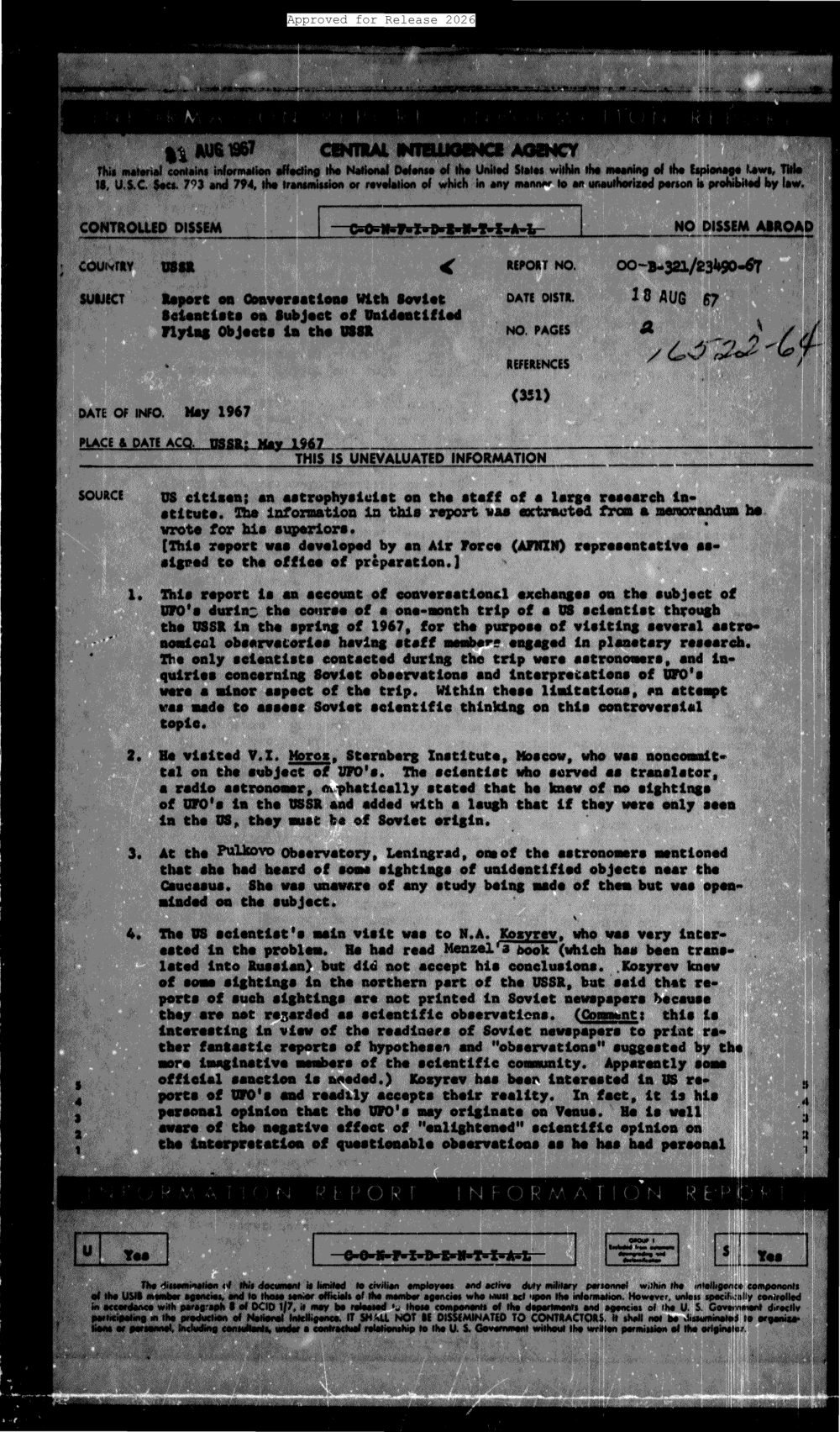 Intelligence reportPhysical page 1
DOCUMENTARY SOURCES · CIA
What the records tell
The report was distributed on August 18, 1967 and is based on a memorandum that an American astrophysicist wrote for his superiors after a one-month trip through the USSR in May of that year. It was prepared by an Air Force intelligence representative (AFNIN). The purpose of the trip was to visit observatories doing planetary research; the questions about UFOs were, as the text itself says, a minor aspect.
In Moscow, V. I. Moroz, of the Sternberg Institute, was evasive; the radio astronomer serving as interpreter said he knew of no sightings in the USSR and joked that, if they appeared only in the US, they must be Soviet. At Pulkovo, a female astronomer had heard of objects near the Caucasus. The most interested interlocutor was N. A. Kozyrev, who did not accept the conclusions of Donald Menzel's book, knew of sightings in the north of the country and thought, as a personal opinion, that UFOs might come from Venus.
In Kiev, I. K. Koval said that he and other astronomers were in the field one night and saw a curious reddish object cross the sky. They were convinced it was neither a satellite nor a meteorite, but the first interpretation was that of a fragment of a satellite or rocket burning up on reentry. In Crimea, L. I. Galkin, who was in the same group, confirmed the observation and seemed impressed by the possibility of its being a 'disc'. There is no date, location or duration.
In Alma-Ata, the director of the Institute of Astrophysics, G. M. Idlis, considered the subject closed by Menzel's book, but, faced with James McDonald's studies, he admitted that it was 'clearly still an open question'. Another astronomer said that repeated sightings of 'ball lightning' in northern Kazakhstan were investigated by the local university: they were reflections of automobile headlights on a thermal inversion layer.
The American's conclusion is that there was no official handling of the subject in the USSR; people cited U.S. work to say there was no scientific problem, but they knew the history of the phenomenon well. He thought Soviet astronomers might become enthusiastic more quickly than American ones, being less exposed to 'official ridicule'. The document records opinions and an undated observation; it is not an investigation.
DIRECT READING OF THE FILE
The document, in the original
U.S. government document. Full translation of the two pages of the report; the comments in parentheses are by the report's writer, not by the witness nor by this editorial team.
EXCERPT 1 · PHYSICAL PAGE 1
Physical page 1: full text (report heading, source, paragraphs 1 to 4 and footer)
Approved for Release 202
‘United States within the meaning of the
sy ey
_NO DISSEM ABROAD
REPORT NO. 00~B.321/23h90-67
. on Conversations With Soviet DATE OISTR. 18 AUG 67 /
‘Schentists on Subject of Unidentified
Flying onsente da the USSR "NO. PAGES a ie pi, y
| Pe anew bree!
REFERENCES
. (351)
DATE OF INFO. May 1967
sm
aanemen anmaet e
US citizen; an ren eg on the staff of a large research in-
etitute. The information in thie report was extracted from a memorandum he.
wrote for his superiors. 2
[This report was developed by an Air Force (AFNIN) representative ss-
sigred to the office of préparation, ]
Thies report is an account of conversations! exchanges on the subject of
bro's durin> the conree of a one-month trip of a US scientist through |
the USSR in the spring of 1967, for the purpose of visiting several astro-
nomical observatories having steff members engaged in planetary research.
The only scientists contacted during the trip were astronowers, and in-
quiries concerning Soviet observations and interpreiations of uro's
were a winor aspect of the trip. Within these limitations, an attempt
was made to assese Soviet scientific thinking on this controversial
topic.
He visited V.1. z, Sternberg Institute, Moscow, who was noncomnit-
tal on the eubject of UFO's. The scientist who sorved as transletor,
a radio aetronomer, m phatically stated that he knew of no sightings
of UFO's in the USSR and added with a leugh that if they were only seen
in the US, they must te of Soviet origin.
At the Pulkovo Observatory, Leningrad, oneof the astronomers mentioned
that she had heard of soma sightings of unidentified objects near the
Caucasus. She was unaware of any study being wade of them but was open-
minded on the subject.
The US scientist's main visit was to N.A. Kozyrev, vhs was very inter-
ested in the problem. He had read Menzel's book (which has been trane-
lated into Russian) but did not accept his conclusions. Kozyrev knew
of some sightings in the northern pert of the USSR, but said that re-
ports of such sightings are not printed in Soviet newspapers because
they are not resarded as scientific observaticns. (Comment: this te
interesting in view of the readinere of Soviet newspapers to print ra-
ther fantastic reports of hypothesen and "observations" suggested by the
more imaginative members of the scientific community. Apparently some
official genction ts needed.) Kozyrev has been interested in US re-
of UFO's and readily accepts their reality. In fact, it is his
personal ‘opinion that the UFO's may originate on Venus. He is well
aware of the negative effect of "enlightened" scientific — on
eens of Se observations as he has had caches:
pol gay and active duly miliary perionnel within the iilali etite: (ike
member agencies who upon the information. However, unless specifically conirolled
3 those ¢ p departments and agencies of the U. S$. Government directly
iD TO CONTRACTORS. lt shall not be vissuminates to
withow! ihe weilEditorial note: The day on the August 1967 receipt stamp is smudged; the handwritten number next to REFERENCES is of uncertain reading. AFNIN is the acronym of the U.S. Air Force (USAF) intelligence office; USIB is the United States Intelligence Board; DCID 1/7 is a directive of the Director of Central Intelligence. The 'U Yes' and 'S Yes' boxes in the footer are form fields. Menzel's book and McDonald's study are cited by the report without a title; Alphonsus is the lunar crater.
Check the original PDF
Approved for Release 2026. INFORMATION REPORT · INFORMATION REPORT. [Stamp:] 2[?] AUG 1967. CENTRAL INTELLIGENCE AGENCY. This material contains information affecting the National Defense of the United States within the meaning of the Espionage Laws, Title 18, U.S.C. Secs. 793 and 794, the transmission or revelation of which in any manner to an unauthorized person is prohibited by law. CONTROLLED DISSEM. C-O-N-F-I-D-E-N-T-I-A-L [struck through]. NO DISSEM ABROAD. COUNTRY: USSR. REPORT NO.: OO-B-321/23490-67. SUBJECT: Report on Conversations With Soviet Scientists on Subject of Unidentified Flying Objects in the USSR. DATE DISTR.: 18 AUG 67. NO. PAGES: 2. REFERENCES: (351). [Handwritten:] 16522-64 [uncertain]. DATE OF INFO.: May 1967. PLACE & DATE ACQ.: USSR; May 1967. THIS IS UNEVALUATED INFORMATION. SOURCE: US citizen; an astrophysicist on the staff of a large research institute. The information in this report was extracted from a memorandum he wrote for his superiors. [This report was developed by an Air Force (AFNIN) representative assigned to the office of preparation.] 1. This report is an account of conversational exchanges on the subject of UFO's during the course of a one-month trip of a US scientist through the USSR in the spring of 1967, for the purpose of visiting several astronomical observatories having staff members engaged in planetary research. The only scientists contacted during the trip were astronomers, and inquiries concerning Soviet observations and interpretations of UFO's were a minor aspect of the trip. Within these limitations, an attempt was made to assess Soviet scientific thinking on this controversial topic. 2. He visited V.I. Moroz, Sternberg Institute, Moscow, who was noncommittal on the subject of UFO's. The scientist who served as translator, a radio astronomer, emphatically stated that he knew of no sightings of UFO's in the USSR and added with a laugh that if they were only seen in the US, they must be of Soviet origin. 3. At the Pulkovo Observatory, Leningrad, one of the astronomers mentioned that she had heard of some sightings of unidentified objects near the Caucasus. She was unaware of any study being made of them but was open-minded on the subject. 4. The US scientist's main visit was to N.A. Kozyrev, who was very interested in the problem. He had read Menzel's book (which has been translated into Russian) but did not accept his conclusions. Kozyrev knew of some sightings in the northern part of the USSR, but said that reports of such sightings are not printed in Soviet newspapers because they are not regarded as scientific observations. (Comment: this is interesting in view of the readiness of Soviet newspapers to print rather fantastic reports of hypotheses and "observations" suggested by the more imaginative members of the scientific community. Apparently some official sanction is needed.) Kozyrev has been interested in US reports of UFO's and readily accepts their reality. In fact, it is his personal opinion that the UFO's may originate on Venus. He is well aware of the negative effect of "enlightened" scientific opinion on the interpretation of questionable observations as he has had personal [continues on page 2] [Footer:] U: Yes. C-O-N-F-I-D-E-N-T-I-A-L [struck through]. GROUP 1. Excluded from automatic downgrading and declassification. S: Yes. The dissemination of this document is limited to civilian employees and active duty military personnel within the intelligence components of the USIB member agencies, and to those senior officials of the member agencies who must act upon the information. However, unless specifically controlled in accordance with paragraph 8 of DCID 1/7, it may be released to those components of the departments and agencies of the U.S. Government directly participating in the production of National Intelligence. IT SHALL NOT BE DISSEMINATED TO CONTRACTORS. It shall not be disseminated to organizations or personnel, including consultants, under a contractual relationship to the U.S. Government without the written permission of the originator.View the document record ↗ · Physical page 1, counting the cover.
EXCERPT 2 · PHYSICAL PAGE 2
Physical page 2: full text (end of paragraph 4 and paragraphs 5 to 11)
CONTROLLED DISSEM Ge Gu Ne Pe be Bacio A NO DISSE)"_ABZOAD &
00-B-321,/23490-67
a ae
experience of this effect. (Comment: Kozyrev is a controversial figure
in the Soviet scientific community as well as internationally, Appar-
ently one of his questionable observations (the activity of the central
peak in the lunar crater Alphonsus) has turned out to be correct, On
the other hand, it is really more accurate to say that this observation
led to an intensive search for activity on the Moon that has produced
some positive results, There may be no connection between the two seta
of data, however.)
At the Main Astronomical Observatory, Kiev, little interest is shown in
the UFO question. I.K, Koval mentioned that he and several other as-
tronomers had been out in the countryside one evening and had seen a
curious, reddish object flashing through the sky that they were convinced
was neither a satellite nor a meteorite, However, their immediate in-
terpretation was that this object might have been a fragment of a satel-
lite or rocket returniag from orbit, buraing up in the atmosphere. Koval
thought that UFO's had been seen in the USSR but he could not be specific
as to locations and characteristics,
At the Crimean Astrophysical Observatory, Crimea, again little interest
was shown. One of the astronomers, L.I. Galkin, was with the group men-
tioned by Koval and confirmed the observation of a peculiar object. He
did not discuss the experience in detail but clearly had been struck by
the possibility that the object might have been a "saucer."
At the Astrophysical Institute, Alwa Ata, there was considerabie interest.
The institute includes an Atmospheric Optics Section presided over by
G.S. Lifschitz. However, the initial discussion of the problem was with
the director of the institue, G.M. Idlis. He too had read Menzel's
book, but considered it an adequate treatment of the subject which he
consequently felt was closed. He indicated that no observations of UFO's
had been made by his staff and that they had received no reports of such
observations. However, when the US scientist proceeded to indicate the
results of McDonald's critical study of the problem, Idlis readily con-
ceded that there might be more to it and concluded by stating that it
was "clearly still an open question."
Another astronomer mentioned that in thse northern part of Kazakhstan
there had been repeated sightings of ball lightning. The University in
Alma At. had sent a team out to investigate and discovered that what war
being seen were reflections of automobile headlights from an inversion
layer,
Later, a discussion was held with Lifschitz. He was not very impressed
with Menzel's book, but was also not impressed with the significance of
the phenomenon. Tt is possible that some interest was kindled that might
lead to additional investigations,
A stellar spectroscopist, Dr. iy «© Kupo, was also interested in this
problem, partly as an adjunct to her attempts to locate fragments from
bolides. Sha was elso dissatisfied with Menzel's book and felt that
there was definitely an opportunity for additional research,
The general feeliug one gets is that no official treatment of the UFO
problem has been given in the USSR, Instead people refer to the US
work, principally Menzei's book, to demonstrate the absence of real
scientific problems. At the same time, there is an almost universal
awareness of the history and characteristics of the phenomenon often as-
sociuted with considerable interest, The reault is that a demonstration
of the inadequacy of US Official explanations coupled with some proof of
the reality of the observations might excite entiusiesm more dly
among Soviet astronomers than among their US counterparts who are more
strongly influenced by the officiul ridicule associated with UFO's in
the US.
« end «Editorial note: The translations of paragraphs 5 and 11, already published, were kept and integrated into the full page. 'institue' is a typo in the original. 'FNU' (first name unknown) indicates that Dr. Kupo's first name was not known to the writer. The judgments about Kozyrev are comments by the report's writer, recorded as the document's opinion.
Check the original PDF
CONTROLLED DISSEM. C-O-N-F-I-D-E-N-T-I-A-L [struck through]. NO DISSEM ABROAD. - 2 -. OO-B-321/23490-67. [continuation of paragraph 4:] experience of this effect. (Comment: Kozyrev is a controversial figure in the Soviet scientific community as well as internationally. Apparently one of his questionable observations (the activity of the central peak in the lunar crater Alphonsus) has turned out to be correct. On the other hand, it is really more accurate to say that this observation led to an intensive search for activity on the Moon that has produced some positive results. There may be no connection between the two sets of data, however.) 5. At the Main Astronomical Observatory, Kiev, little interest is shown in the UFO question. I.K. Koval mentioned that he and several other astronomers had been out in the countryside one evening and had seen a curious, reddish object flashing through the sky that they were convinced was neither a satellite nor a meteorite. However, their immediate interpretation was that this object might have been a fragment of a satellite or rocket returning from orbit, burning up in the atmosphere. Koval thought that UFO's had been seen in the USSR but he could not be specific as to locations and characteristics. 6. At the Crimean Astrophysical Observatory, Crimea, again little interest was shown. One of the astronomers, L.I. Galkin, was with the group mentioned by Koval and confirmed the observation of a peculiar object. He did not discuss the experience in detail but clearly had been struck by the possibility that the object might have been a "saucer." 7. At the Astrophysical Institute, Alma Ata, there was considerable interest. The institute includes an Atmospheric Optics Section presided over by G.S. Lifschitz. However, the initial discussion of the problem was with the director of the institue, G.M. Idlis. He too had read Menzel's book, but considered it an adequate treatment of the subject which he consequently felt was closed. He indicated that no observations of UFO's had been made by his staff and that they had received no reports of such observations. However, when the US scientist proceeded to indicate the results of McDonald's critical study of the problem, Idlis readily conceded that there might be more to it and concluded by stating that it was "clearly still an open question." 8. Another astronomer mentioned that in the northern part of Kazakhstan there had been repeated sightings of ball lightning. The University in Alma Ata had sent a team out to investigate and discovered that what was being seen were reflections of automobile headlights from an inversion layer. 9. Later, a discussion was held with Lifschitz. He was not very impressed with Menzel's book, but was also not impressed with the significance of the phenomenon. It is possible that some interest was kindled that might lead to additional investigations. 10. A stellar spectroscopist, Dr. FNU Kupo, was also interested in this problem, partly as an adjunct to her attempts to locate fragments from bolides. She was also dissatisfied with Menzel's book and felt that there was definitely an opportunity for additional research. 11. The general feeling one gets is that no official treatment of the UFO problem has been given in the USSR. Instead people refer to the US work, principally Menzel's book, to demonstrate the absence of real scientific problems. At the same time, there is an almost universal awareness of the history and characteristics of the phenomenon often associated with considerable interest. The result is that a demonstration of the inadequacy of US Official explanations coupled with some proof of the reality of the observations might excite enthusiasm more rapidly among Soviet astronomers than among their US counterparts who are more strongly influenced by the official ridicule associated with UFO's in the US. - end -. C-O-N-F-I-D-E-N-T-I-A-L [struck through].View the document record ↗ · Physical page 2, counting the cover.
Dates and documentary context
- Event
- Not established — Date of the conversations (DOI: May 1967). The observation by Koval and Galkin is undated.
- Document
- 18/08/1967 — Distribution date checked on physical page 1.
- Publication
- Not established — 'Approved for Release 2026' stamp at the top of the pages.
Origin and release
CIA, prepared with an Air Force intelligence representative (AFNIN) · CIA-UAP-010_REPORT_ON_CONVERSATIONS_WITH_SOVIET_SCIENTISTS_ON_SUBJECT_OF_UNIDENTIFIED_FLYING_OBJECTS_IS_THE_USSR.pdf
Questions to continue the investigation
- When and where did Koval and Galkin see the reddish object?
- Who was the American astrophysicist? The name does not appear in the report.
GEOGRAPHY OF THE CASE
Various observatories in the USSR
The report covers conversations in five cities; no location is given for the observation by Koval and Galkin.
DOCUMENTARY TRAIL
Go back to the sources
References use physical pages of the PDF, counting the cover. Summaries are presented in English; the documents keep their original language.
- CIA-UAP-010_REPORT_ON_CONVERSATIONS_WITH_SOVIET_SCIENTISTS_ON_SUBJECT_OF_UNIDENTIFIED_FLYING_OBJECTS_IS_THE_USSR.pdf
Physical pages 1 and 2: CIA report 00-B-321/23490-67, dated 18/08/1967, on conversations with Soviet scientists
CIA · 2 pages
Editorial summary based on the collection's research notes. How we read the documents.