Date: 1995-07-31Location: approach to San Carlos de Bariloche airport, Argentina
UFO alongside flight AR 674 at Bariloche
In the narrative attributed to SEPRA, the Boeing 727 of Aerolíneas Argentinas flight AR674 was approaching San Carlos de Bariloche on 31 July 1995 when a power outage occurred in the city. On the next approach, the crew reportedly saw on the right a UFO resembling a large aircraft, with three lights, accompanying their flight; another aircraft was holding in the sector.
- Event date
- 1995-07-31
- Location
- approach to San Carlos de Bariloche airport, Argentina
- Topic
- COMETA and international accounts
- Source agencies
- Arquivo histórico
- Documents
- 1 document · 94 pages
- Reading time
- 18 min
 Newspaper clippingPhysical page 90
DOCUMENTARY SOURCES · Arquivo histórico
What the records tell
Source of this entry: COMETA, private association; secondary account. The PDF brings together the private COMETA report and supplementary materials. Inclusion in the public collection does not turn its accounts or conclusions into an official position of the U.S. government.
In the narrative attributed to SEPRA, the Boeing 727 of Aerolíneas Argentinas flight AR674 was approaching San Carlos de Bariloche on 31 July 1995 when a power outage occurred in the city. On the next approach, the crew reportedly saw on the right something resembling a large aircraft, with three lights, accompanying their flight; another aircraft was holding in the sector.
The runway and approach lights reportedly went out again, leading the plane to climb and make another turn. The object reportedly moved behind, stopped, climbed vertically, reappeared ahead, and departed toward the Andes. COMETA also attributes observations to the other aircraft, controllers, passengers, and residents.
The report interprets the association between the object and the blackouts as significant. This copy does not present electrical or flight records demonstrating a causal relationship. The 1995 date is the one in the body of the English version examined; it has not been reconciled with other editions.
The COMETA report returns to the case in the third part, devoted to defense. On physical page 55, the authors use it as an example of two types of effect they attribute to these phenomena: interference with electrical or electronic equipment on the ground and the accompanying of aircraft, alongside the RB-47. On physical page 57, when proposing “reflex responses” for crews and controllers, they cite “the surprise of the runway lights going out in the middle of the incident” at San Carlos de Bariloche as a situation requiring concrete measures. These are the authors' classifications and recommendations; they bring no new data about the episode.
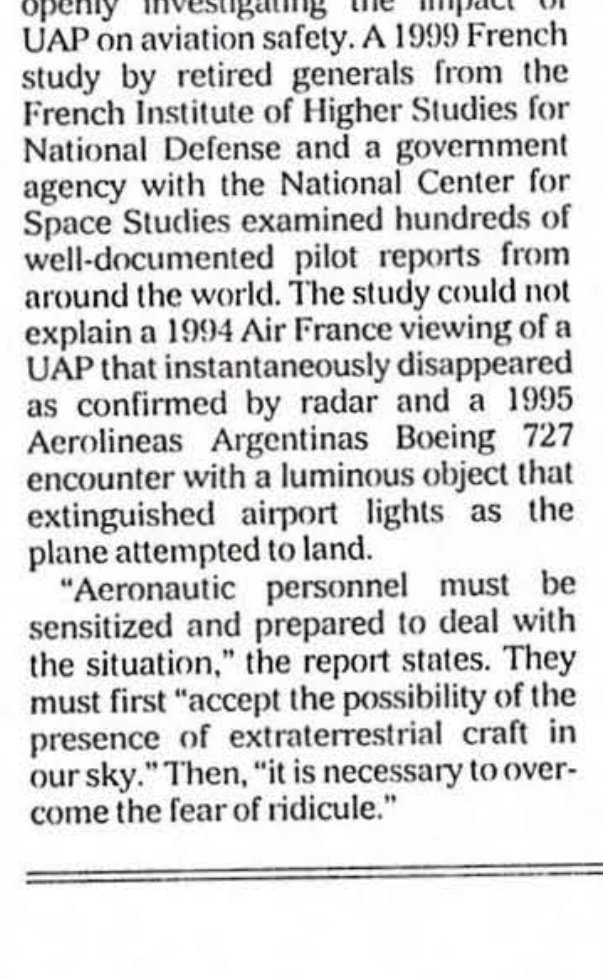
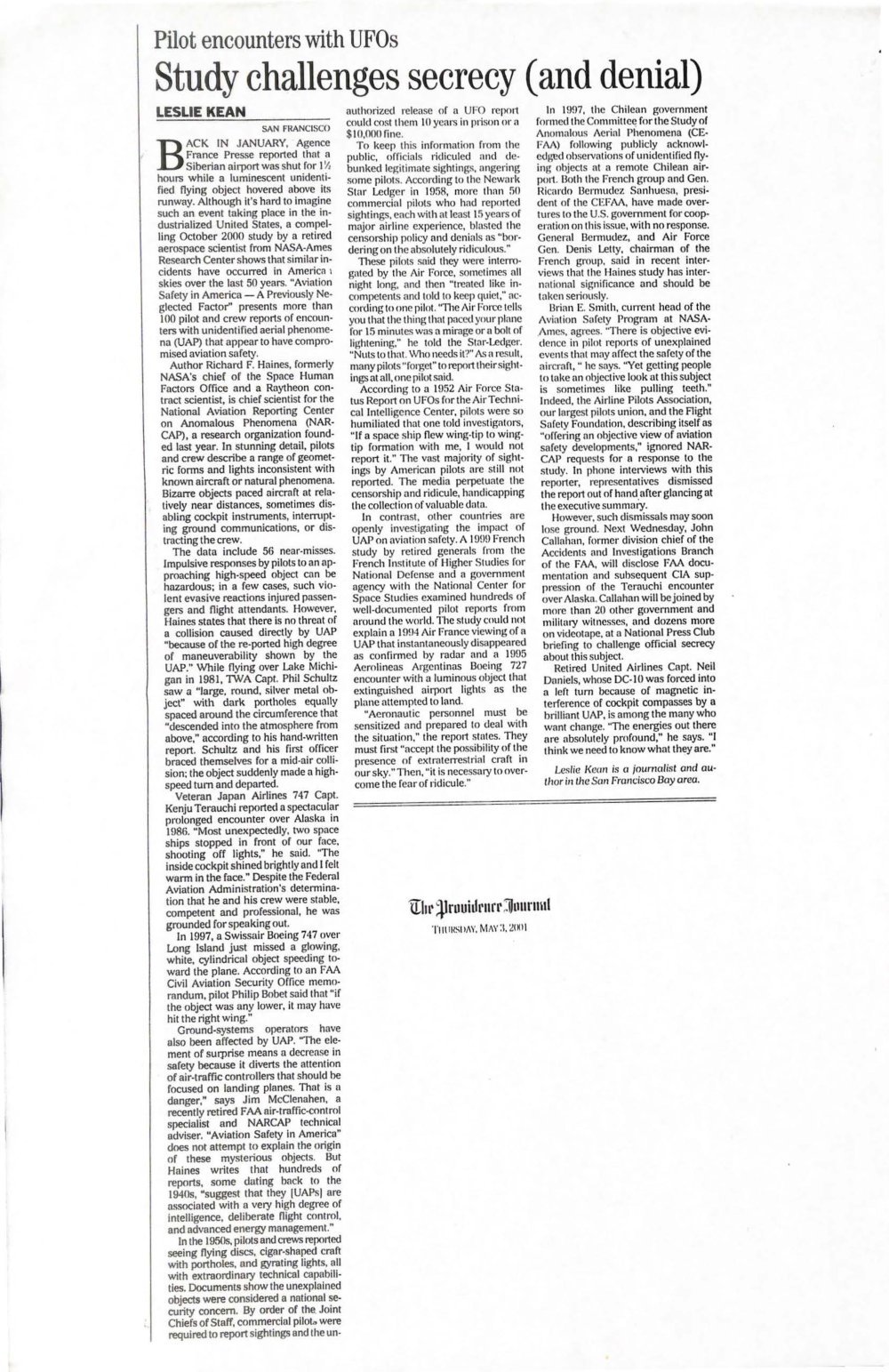
Leslie Kean's article in The Providence Journal of 3 May 2001 (physical page 90) summarizes the case more assertively: it says the French study could not explain the encounter of the Aerolíneas Argentinas Boeing 727 with a luminous object “that turned off the airport lights” as the plane was trying to land. The report describes the blackouts and their coincidence with the presence of the object, but does not demonstrate a causal relationship. The newspaper's sentence therefore goes beyond what COMETA itself documents.
DIRECT READING OF THE FILE
The document, in the original
Translation of the selected excerpts checked against the image, with omissions indicated. This is not a full translation of the PDF. Summaries and evaluations are kept separate from the transcription.
EXCERPT 1 · PHYSICAL PAGE 21
Short excerpt supporting the summary, not a full translation.
machines could hardh· have such capabilities. "
I 2.5 San Carlos de Bariloche (July 31, 1995)
I Source SEPRA
Aerolineas Argentinas flight AR 674, a Boeing 727 en route from Buenos Aires, was
140 km from San Carlos de Bariloche, a tourist resort in the central Andes where it was
I preparing to land.
I
At that precise instant, a power outage plunged the town into darkness, and the pilot
received the order to stay on standby for a few minutes before making his final approach.
When he began his approach, the pilot noticed a strange star. At the same time, the
I
control center put a second airplane that had arrived in the sector on standby. Flight AR
674 continued its approach, but when it had completed its tum and was in the ax.is ofthe
runway, an object resembling a large aircraft appeared on its right side and flew parallel to
I
it! This object had three lights, one ofwhich was red, in the middle ofit. The airport
lights failed again, and the runway and approach ramp lights also went out. The airplane
on standby observed the same phenomenon from its position.
I
Since the pilot could not land, he pulled up and turned again in order to reposition
himself in the ax.is ofthe runway. At that moment, the object, which had become
luminous, moved behind the airplane, stopped, ascended vertically, and once again
stopped. It moved back in front ofthe airplane before finally disappearing in the direction
ofthe Andes Cordillera. The crew and passengers offlight AR 674, those on the other
I airplane, the airport controllers, and some ofthe inhabitants of San Carlos watched this
unusual aerial ballet dumbfounded.
I -
This case is interesting in more than one respect:
·1
the sighting was corroborated by multiple independent observers both in flight and on
the ground,
- the phenomenon lasted several minutes,
I
- there were different trajectories, some ofwhich closely followed those ofthe airplane,
- there was an observation ofan electromagnetic phenomenon (the lights ofth~ town
and the airport went out) directly related to the presence of the object.
I Chapter 3 - Sightings from the Ground
I
This chapter deals with sightings from the ground, two ofwhich were reported to the
committee by direct witnesses ofthe phenomena observed. Here agai~ their testimonies
are all the more interesting since they pertain to the aeronautic world and the phenomena
were observed during the day.
I
I 3.1 Phenomenon Observed by Numerous Witnesses at Antananarivo (August 16,
1954)
Testimony before the commitlee
Edmond Campagnac (C), a fonner artillery officer and former chief of technical I services for Air France in Madagascar who is now retired, came to testify before the
committee. The phenomenon described below occurred on August 16, 1954, in
I
IEditorial note: End of General Maltsev's statement, the Bariloche case (Argentina, 31/07/1995) and opening of Chapter 3, with Campagnac's testimony about Antananarivo (1954).
Check the original PDF
An object resembling a large aircraft appeared on its right side and flew parallel to it.View the document record ↗ · Physical page 21, counting the cover.
EXCERPT 2 · PHYSICAL PAGE 55
List of aeronautical implications, physical page 55
I
aeronautical phenomenon which numerous civilian and military pilots have come face to
face with. Ofthe several hundred confirmed aeronautical cases, there are primarily five
I
types ofimplications:
- simple sighting ofa phenomenon by the crew, passengers, or ground personnel,
- detection ofa track on a radar screen, which occurs in one out offive aeronautical
I
cases, sometimes culminating in the recording ofa track, as was the case on January 28,
I 994, at the Cinq-Mars-la-Pile Control and Detection Center (CDC) ( cf Chapter I),
- interferences with ground (San Carlos de Bariloche) or onboard (Tehran) electrical or
electronic equipment,
- shadowing ofaircraft (San Carlos de Bariloche, RB-47, etc.),
- apparently aggressive conduct ( Colonel Giraud in his Mirage IV, student pilot at
Tours, the Tehran incident, etc.).
The number oftestimonies and the quality ofthe witnesses are such that one cannot dodge
the phenomenon and aeronautic personnel, and more especially defense personnel, must be
sensitized and prepared to deal with the situation. In fact, how can one try to ignore a
phenomenon that is manifested by the regular crossing ofour air space by moving objects
1. the behavior ofwhich suggests that they are piloted by an intelligent [being]? Can one
I
claim, because this appears to exceed our technical knowledge, that it does not fall within
our purview? Ifwe do nothing, the very principle of defense and air intelligence would be
called into question.
I
The first sightings made by aviators date back to the beginning ofthe 40s. Since then,
the number ofunexplained sightings (after an expert's appraisal: UAP Ds) reported by
pilots or [air traffic] controllers has risen to over 500. As a reminder1.. in France, this figure
is three or four since 1951 . It is the responsibility of the Air Force to take into account
these phenomena, which, until proven otherwise, occur primarily in air space.
I 11.2 Who is Involved?
I 11.2.1Flight Crew
I
I
The flight crew is naturally involved, particularly the pilots, because whether they are
civilian or military, they are in a more advantageous position for making sightings and
would be the first affected in the event ofan incident (risk of collision, in particular). This
is especially true for a combat pilot, because he is trained to constantly monitor the sky
and he now has more and more advanced weapons systems capable of detecting faster and
faster and smaller and smaller targets at greater and greater distances. The pilot/weapons
system pair is now more than ever an excellent sighting instrument and would be our first
I means ofintervention if, by chance, this were to prove necessary. The concerns of a
I
commercial airline pilot are different because, in addition to the fact that he does not have
the same equipment, his priority is obviously the safety ofhis passengers. Although he
remains a primary partner in the quest for information, he would be totally powerless in
the face of an aggressive stance by a UFO.
I 11.2.2 (Air Traffic) Controllers
I
The radar [air traffic] controller is, ofcourse, involved, but depending on whether he is
civilian or military, the control equipment at his disposal offer him different options. In
both cases, since he is in radio contact with the pilot, it is he who is the first to receive the
sighting report from the crew.
I
IEditorial note: COMETA Report, p. 55: the authors list five types of aeronautical implications, citing cases already described in the report, and begin to list those involved (crews and controllers).
Check the original PDF
- interferences with ground (San Carlos de Bariloche) or onboard (Tehran) electrical or electronic equipment,
- shadowing of aircraft (San Carlos de Bariloche, RB-47, etc.),View the document record ↗ · Physical page 55, counting the cover.
EXCERPT 3 · PHYSICAL PAGE 57
Reflex responses, physical page 57
I
I
controller training.
This practice just needs to be extended to all flight crew training schools, regardless of
the specialty being taught. For the generations already on the job, these conferences can
I
easily be offered at the Control and Detection Centers and flight units for military
personnel, and, at least for civilian [ air traffic] controllers, at the Regional Air Navigation
Centers (CRNA). As for commercial flight crews, the airline companies - Air France, in
particular - have set up a systematic information sheet for crews that is periodically
I updated.
I
This information must furthermore be updated on a regular basis in the knowledge that
the intended objective is to permit a future witness, whether he plays an active role or is
merely an observer, to be fully aware of what course ofaction to take in the face ofthe
phenomenon sighted. Ifwe want personnel to get involved, it is necessary that they know
how to react in real time and what to communicate and to whom, how to take the
measures corresponding to the present situation, etc. For this reason, it is advisable to
define with them what their reflex responses should be and what course ofaction they
should take.
I 11.3.2 Reflex Responses
I Indeed, it is necessary to instill in_personnel who may face the phenomenon what their
reflex responses should be, in the knowledge that they may merely be simple observers or,
in some cases, have to take concrete measures (for example, at San Carlos de Bariloche,
I the surprise ofthe landing strip lights going out in the middle ofthe UFO incident). It is
I
quite certain that it would be better to be prepared in order to be fully aware ofwhat
course ofaction to take in the face ofsuch an unforeseen and poorly understood event.
These reflex responses differ in type depending on whether it is a matter of sighting,
recording a testimony, transmitting information collected, or reacting in real time in order
to take ad.hoc measures in response to the phenomenon.
I 11.3.3 Course of Action to Take
The course ofaction to take seems to us to be summarized as follows: observe, note I the maximum amount ofdetails, take photographs if possible, _report, allowing the visitors
the initiative of possibly making contact, and avoid premature publicity in the media.
I 11.3.3.1 Objective Observation
In the face of an unknown situation, one must be on guard against any instinctive selfI defense reaction that could be easily interpreted as a provocation. One must just observe
and avoid any initiative aimed at seeking contact.
I 11.3.3.2 Reporting
I
Once a phenomenon has been sighted, it is advisable to report it in order to alert the
other crews, on the one hand, which is what is currently done, and the authorities, on the
other hand, through the air [traffic] control chain of command in civilian cases and the air
defense chain of command in military cases.
I 11.3.3.3 Remaining Discrete Vis-a-Vis the Public
As a witness to a phenomenon ofthis type, one must know how to adopt a certain level
I
ICheck the original PDF
(for example, at San Carlos de Bariloche, the surprise of the landing strip lights going out in the middle of the UFO incident)View the document record ↗ · Physical page 57, counting the cover.
EXCERPT 4 · PHYSICAL PAGE 90
Press summary, The Providence Journal, physical page 90
Pilot encounters with UFOs
Study challenges secrecy (and denial)
LESLIE KEAN
SAN FHANCISCO
BACK IN JANUARY, Agence
France Presse reported thnt a
Siberian airport was shut for I¼
hours while a luminescent unidentified flying object hovered above its
runway. Although it's hard to imagine
such an event taking place in the industrialized United States, a compelling October 2000 study by a retired
aerospace scientist from NASA-Ames
Research Centershows that similar incidents have occurred in America 1
skies over the last 50 years. "Aviation
Safety in America - A Previously Neglected Factor" presents more than
I 00 pilot and crew reports of encounters with unidentified aerial phenomena (UAP) that appear to have compromised aviation safety.
Author Richard F. Haines, formerly
NASA's chief of the Spnce Human
Factors Office and a Raytheon contract scientist, is chief scientist for the
National Aviation Reporting Center
on Anomalous Phenomena (NAR·
CAP), a research organization founded last year. In stunning detail, pilots
and crew describe a range of geometric forms and lights inconsistent with
known aircraft or naturaJ phenomena.
Bizarre objects paced aircraft at relatively near distances, sometimes disabling cockpit instruments, intern1pting ground communications, or distracting the crew.
The data include 56 near-misses.
Impulsive responses by pilots to an approaching high-speed object can be
hazardous; in a few cases, such violent evasive reactions injured passengers and flight attendants. However,
Haines states that there is no threat of
a collision caused directly by UAP
"because of the re-ported high degree
of maneuverability shown by the
UAP." While flying over Lake Michigan in 1981, TWA Capt. Phil Schultz
saw a "large, round, silver metal object" with dark portholes equally
spaced around the circumference that
"descended into the atmosphere from
above," according to his hand-written
report. Schultz and his first officer
braced themselves for a mid-air collision; the object suddenly made a highspeed tum and departed.
Veteran Japan Airlines 747 Capt.
Kenju Terauchi reported a spectacular
prolonged encounter over Alaska in
1986. "Most unexpectedly, two space
ships stopped in front of our face,
shooting off lights," he said. "The
inside cockpit shined brightly and I felt
wann in the face." Despite the Federal
Aviation Administration's determination that he and his crew were stable,
competent and professional, he was
grounded for speaking out.
In 1997, a Swissair Boeing 747 over
Long Island just missed a glowing,
white, cylindrical object speeding toward the plane. According to an f'M
Civil Aviation Security Office memorandum, pilot Philip Bobet said that "if
the object was any lower, it may have
hit the right wing."
Ground-systems operators have
also been affected by UAP. "The element of sulJ}rise means a decrease in
safety because it diverts the attention
ofair-traffic controllers that should be
focused on landing planes. That is o
danger," says Jim McClenahen, a
recently retired FMair-traffic-control
specialist and NARCAP technical
adviser. "Aviation Safety in America"
does not attempt to explain the origin
of these mysterious objects. But
Haines writes that hundreds of
reports, some dating back to the
1940s, "suggest that they IUAPsj are
associated with a very high degree of
intelligence, deliberate flight control,
and advanced energy management."
In the 1950s, pilots and crews reported
seeing flying discs, cigar-shared craft
with portholes, and gyrating lights, all
with extraordinary technical capabilities. Documents show the unexplained
objects were considered a national ~ecurity concern. By order of th~ Joint
Chiefs ofStaff, commercial pilot., were
required to report sightings and the un•
authorized release of a Uf'O report
could cost them 10 years in prison or a
$1 0,000 fine.
To keep this information from the
public, officials ridiculed and de•
bunked legitimate sightings, angering
some pilots. According to the Newark
Stnr Ledger in 1958, more than fl()
commercial pilots who hnd reported
sightings, each with nt least 15 years of
major airline experience, blasted the
censorship policy and deninls as "bordering on the absolutely ridiculous."
1l1ese pilots said they were intenugated by the Air f'orce, sometimes all
night long, and then "treated like in•
competents and told to keep quiet," according to one pilot. "11,e Air force tells
you that the thing that paced your plane
for 15 minutes was a mirage ora bolt of
lightening," he told the Stor-Led~er.
"Nuts to that. Who needsit?" /\s a result,
manypilots "forget" to repor1 their sight•
ings at all, one pilot said.
According to a 1952 Air f'orce Status Report on UFOs for the AirTechnical Intelligence Center, pilots were so
humiliated that one told investigators,
"If a space ship flew wing-tip to wingtip formation with me, I would not
report it." The vast majority of sightings by American pilots are still not
reported. The media perpetuate the
censorship and ridicule, handicapping
the collection of valuable data.
In contrast, other countries arc
openly investigating the impact of
UAP on aviation safety. A Im.m f'rench
study by retired generals from the
r-rench Institute of Higher Studies for
National Defense and a government
agency with the National Center for
Space Studies examined hundreds of
well-documented pilot reports from
nround the world. The study could not
explain a I 9!l4 Air f'rance viewing of a
UAP that instantaneously disappeared
as confirmed by radar and a 1!195
Aerolineas Argentinas Boeing 727
encounter with a luminous object that
extinguished airport lights as the
plane attempted to land.
"Aeronautic personnel must be
sensitized and prepared to deal with
the situation," the repor1 stntes. They
must first "accept the possibility of the
presence of extraterrestrial craft in
our sky." Then, "it is necessary to over•
come the rear of ridicule."
In 19!l7, the Chilean government
formed the Committee for the Study of
Anomalous Aerial Phenomena (CEFM) following publicly acknowledged observations ofunidentified fly.
ing objects at a remote Chilean airport. Both the f'rench group and Gen.
Ricardo Bermudez Sanhuesn, presi•
dent of the CEFM, have made overtures to the U.S. government for coop•
eration on this issue, with no response.
General Bermudez, and Air force
Gen. Denis Letty, chairman of the
French group. said in recent interviews that the Haines study has international significance and should be
taken seriously.
13rian E. Smith. current head of the
Aviation Safety Program ot NASA·
,/\mes, agrees. "There is objective evidence in pilot repor1s of unexplained
events that may affect the safety of the
aircraft, " he says. "Yet getting people
to tal<e an objective look ut this subject
is sometimes lil<e pulling teeth."
Indeed, the Airline Pilots Association,
our largest pilots union, and the Flight
Safety Foundation, describing itselfas
"offering an objective view of aviation
safety developments," ignored NARCAP requests for a response to the
study. In phone interviews with this
reporter, representatives dismissed
the report out ofhand.after glancing at
the executive summary.
However, such dismissals may soon
lose ground. Next Wednesday, John
Callahan, former division chief of the
Accidents and Investigations Branch
of the f'M, will disclose f'M documentation and subsequent CIA sup•
pression of the Terauchi encounter
over Alaska. Callahan will be joined by
more than 20 other government and
military witnesses, and dozens more
on videotape, at a National Press Club
briefing to challenge official secrecy
about this subject.
Retired United Airlines Capt. Neil
Daniels, whose DC-10 was forced into
a left turn because of magnetic interierence of cockpit compasses by a
brilliant UAP, is among the many who
want change. "The energies out there
are absolutely profound," he says. "l
think we need to know what they are."
Leslie Kean is a journalist and author in the San Francisco Bay area.
'[hr:l)ruuidrnrrJ}1111rmtl
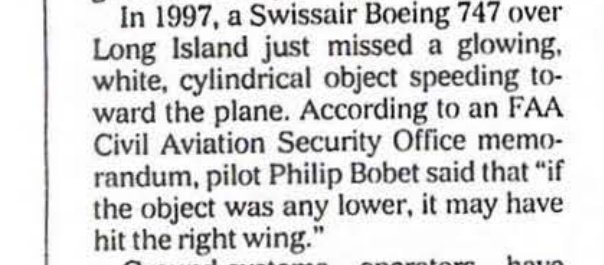
TllllllSl>AY. MAY:I. WllEditorial note: Clipping from The Providence Journal attached to the report: article by Leslie Kean about a study by Richard Haines on pilots' encounters with unidentified aerial phenomena.
Check the original PDF
a 1995 Aerolineas Argentinas Boeing 727 encounter with a luminous object that extinguished airport lights as the plane attempted to land.View the document record ↗ · Physical page 90, counting the cover.
Dates and documentary context
- Event
- 31/07/1995 — 1995-07-31. Date indicated by the secondary source, separate from the publication date.
- Document
- Not established — Individual document date not determined; see the source publication below.
- Publication
- 07/1999 — VSD (special edition, July 1999) · Publication of the source examined or cited; do not presume it is the first historical disclosure of the event. · The record reflects the COMETA summary; primary sources are not always reproduced.
Origin and release
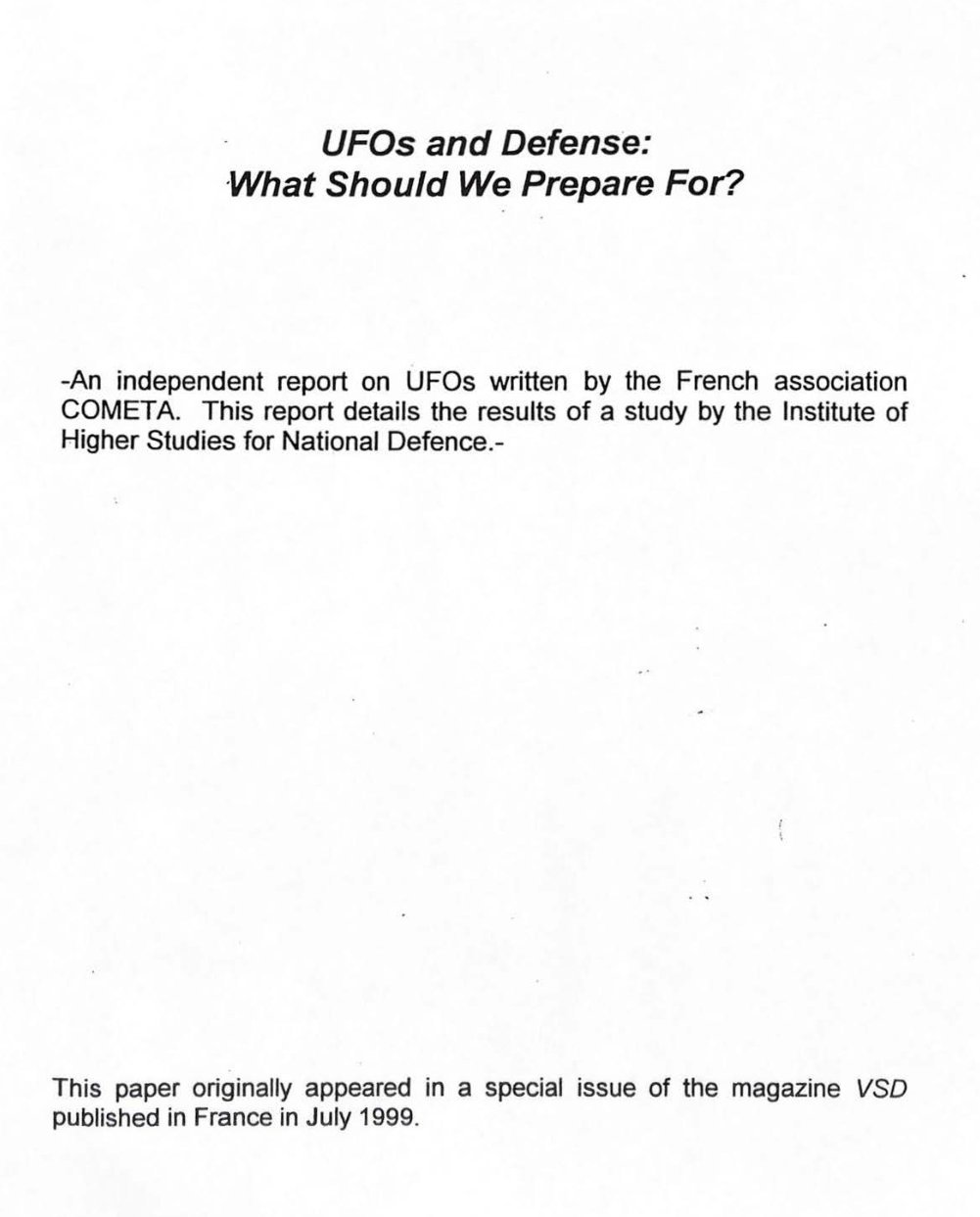
COMETA, private association; secondhand account · UFOs and Defense: What Should We Prepare For?
This record reflects the COMETA summary; primary sources are not always reproduced. Hosting or archiving by a public agency does not imply endorsement; COMETA is a private association. The English version has not been fully compared with the French one.
Official collection · release 01 ↗ — Match indicated by the search; bytes of the remote PDF not authenticated.
A propos de la publication du rapport COMETA — GEIPAN ↗ — GEIPAN clarifies that hosting COMETA does not imply approval by CNES. It identifies the committee as private and attributes the conclusions to the authors. The note also records that the version published there was incomplete.
Questions to continue the investigation
- Locate and verify the primary records and technical documents cited.
GEOGRAPHY OF THE CASE
San Carlos de Bariloche, Argentina
Approximate reference for the location cited in the document, positioned by the editorial team. Does not indicate where the witness or the object was.
DOCUMENTARY TRAIL
Go back to the sources
References use physical pages of the PDF, counting the cover. Summaries are presented in English; the documents keep their original language.
- 255_413270_UFO's_and_Defense_What_Should_we_Prepare_For.pdf
Physical pages 5, 9, 21
Arquivo histórico · 94 pages
Context and references in this document
contexto ou referencia
UFO seen over a rural school after Antananarivo ↗
contexto ou referencia
Reports of “ghost rockets” in Sweden ↗
contexto ou referencia
Reports of “foo fighters” in World War II ↗
contexto ou referencia
Reports of “airships” in the U.S. and the United Kingdom ↗
contexto ou referencia
Luminous phenomenon attributed to Goethe in 1768 ↗
contexto ou referencia
Aerial phenomena reported in Nuremberg ↗
contexto ou referencia
Aerial phenomenon reported in Basel ↗
contexto ou referencia
Medieval narrative attributed to Agobard about occupants of an “aircraft” ↗
contexto ou referencia
Contact with a Venusian attributed to Adamski ↗
contexto ou referencia
Paul Bennewicz's claims about microwaves, abductions and implants ↗
contexto ou referencia
Triangular lights reported in Arizona in 1997 ↗
contexto ou referencia
Interception attempts by military aircraft in Iran, Peru and Belgium ↗
contexto ou referencia
Shoot-down attempt by Peruvian aircraft, cited in a news report ↗
contexto ou referencia
Pursuit of UFOs by Belgian F-16s in 1990 ↗
contexto ou referencia
Mention of a military Vampire in the Orange region in 1951 ↗
contexto ou referencia
Photograph attributed to a mapping flight over Tilarán, Costa Rica ↗
contexto ou referencia
Image attributed to a Zanesville, Ohio, barber in 1966 ↗
contexto ou referencia
Image attributed to a student from Beaver, Pennsylvania ↗
contexto ou referencia
Image attributed to brothers from Detroit in 1967 ↗
Related publications and media
Editorial summary based on the collection's research notes. How we read the documents.