Date: 1994-01-28Location: near Coulommiers, France
Observation by the crew of Air France flight AF 3532
According to COMETA, at 13h14 on 28 January 1994, Jean-Charles Duboc, Valérie Chauffour, and the chief flight attendant observed the phenomenon during a Nice–London flight at 11.900 m. They first compared it to a balloon or an aircraft in a turn. The report presents a visual distance estimated at 50 km and a later inference of size around 250 m, which depends on the proposed correlation with radar.
- Event date
- 1994-01-28
- Location
- near Coulommiers, France
- Topic
- COMETA and international accounts
- Source agencies
- Arquivo histórico
- Documents
- 1 document · 94 pages
- Reading time
- 14 min
 Newspaper clippingPhysical page 90
DOCUMENTARY SOURCES · Arquivo histórico
What the records tell
Source of this entry: COMETA, private association; secondary account. The PDF brings together the private COMETA report and supplementary materials. Inclusion in the public collection does not turn its accounts or conclusions into an official position of the U.S. government.
According to COMETA, at 13h14 on 28 January 1994, Jean-Charles Duboc, Valérie Chauffour, and the chief flight attendant observed the phenomenon during a Nice–London flight at 11.900 m. They first compared it to a balloon or an aircraft in a turn. The report presents a visual distance estimated at 50 km and a later inference of size around 250 m, which depends on the proposed correlation with radar.
On 28/01/1994, the crew of Air France flight AF 3532 described, according to COMETA, a shape that changed from a brown bell to a brownish lens during the flight. The text attributes to CODA a track initiated by the Cinq-Mars-la-Pile center at the same place and time, for about 50 seconds, with no corresponding flight plan. This is a correlation reported by the secondary report; the original radar data and complete onboard records do not accompany this compilation.
The full passage on page 15 of COMETA details the start of the observation: the chief flight attendant, present in the cockpit, pointed out the phenomenon, which looked to him like a weather balloon; the copilot Valérie Chauffour confirmed it immediately, and Captain Duboc, on seeing it, at first thought it was an aircraft in a 45-degree turn. The three soon agreed that it did not resemble anything they knew. Good visibility and the presence of altocumulus clouds allowed the captain to estimate the phenomenon at 10.500 m altitude and about 50 km away; from its apparent diameter, they deduced it was a large object.
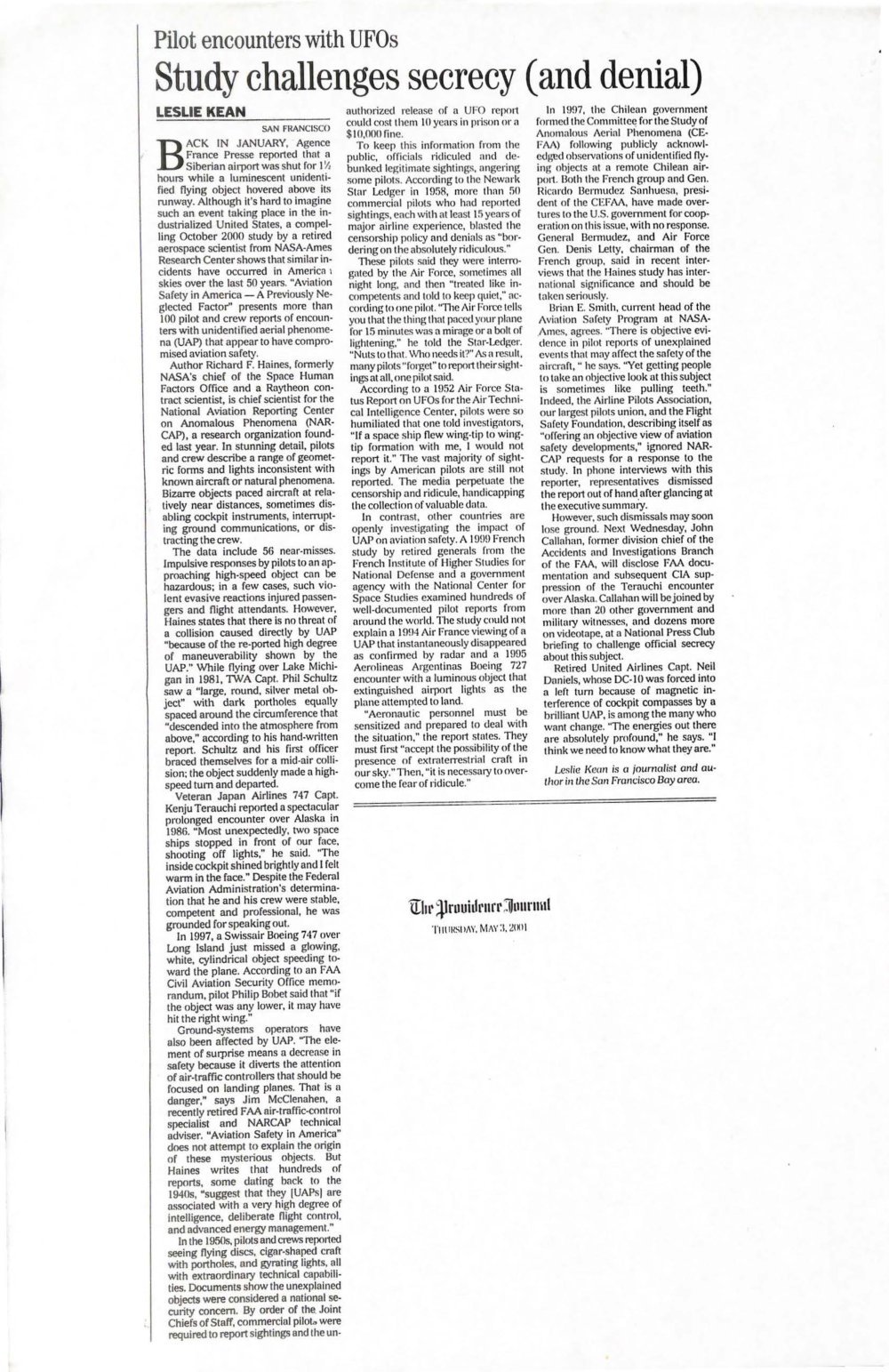
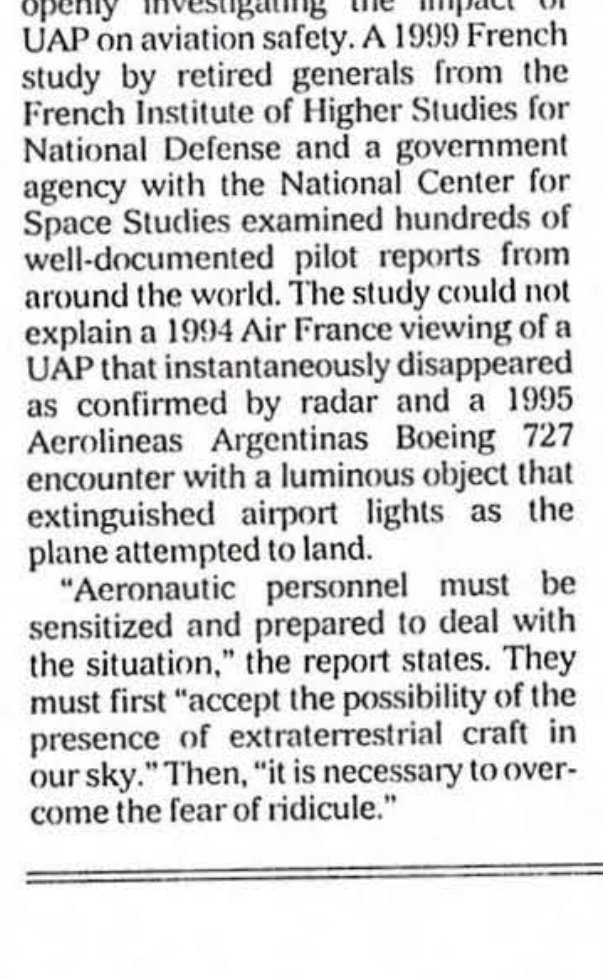
The report records that the captain notified the Reims Air Navigation Control Center, which had no information about traffic in the area; following the established procedure, Reims alerted CODA (the Taverny Air Defense Operations Center) and asked the crew to follow the "Airmiss" procedure on landing. A May 2001 article in the Providence Journal, on the NARCAP study, cites the AF 3532 case as an example of a phenomenon "that could not be explained" and "confirmed by radar," alongside other pilot accounts compiled by Richard Haines; it is a later journalistic reading of the case, not a document of the French investigation itself.
The full text of section 1.3 describes the change of shape that most impressed the crew. The object first appeared as a “brown bell,” turned into a brownish lens, and disappeared almost instantly on the left side of the aircraft, “as if it had suddenly become invisible.” According to COMETA, the phenomenon vanished from the crew's view and from the radar screens at the same instant. The shape, colors, and disappearance are the account of Captain Jean-Charles Duboc, copilot Valérie Chauffour, and the chief flight attendant; the coincidence with radar is the report's assertion, with no record reproduced in the PDF.
The report attributes to the CODA, the air defense operations center, an analysis that goes beyond mere coincidence. The 50-second radar track crossed the route of flight AF 3532 and did not match any flight plan; the investigation reportedly ruled out the weather balloon hypothesis and determined the exact distance at which the two trajectories crossed, which led to estimating the object's length at about 250 m. This is an institutional analysis reported secondhand: the CODA data are not in the collection, and the size depends on the track and the object seen being the same thing.
COMETA returns to the flight at other points. In the preface, General Denis Letty thanks the commander of the French Air Force air operations center for taking part in the investigation and includes Duboc among the civilian and military pilots who gave testimony to the committee. In chapter 7, the case is presented as the first in which the crew of a regular commercial flight obtained a visual observation correlated with radar detection for more than 50 seconds. In chapter 11, it serves as an example of a recorded radar track. These are uses of the same episode by the authors, not independent sources.
DIRECT READING OF THE FILE
The document, in the original
Translation of the selected excerpts checked against the image, with omissions indicated. This is not a full translation of the PDF. Summaries and evaluations are kept separate from the transcription.
EXCERPT 1 · PHYSICAL PAGE 15
Short excerpt supporting the summary, not a full translation.
I
r
I
very last moment and passed over his right wing grazing it, all within a fraction ofa
second. P retained the following memory ofthis incident:
- S was not very large ( l to 2 m in diameter),
I
- S was extended by a tail, which was comparable to that on a comet, that was also a
fluorescent green color,
- the center ofS consisted ofa very bright white light (magnesium-fire type),
- the sighting lasted a total ofless than 5 seconds.
P, who was very shocked by this phenomenon, informed the radar controller (-)
I
!I ensuring the control of the mission on the ground; the controller had not detected anything
on his radar scope. Upon return, two other pilots who had followed the same itinerary as
P stated that they had seen the phenomenon, but from a distance.
I 1.3 Air France Flight AF 3532 (January 28, 1994)
Jean-Charles Duboc (P), captain ofAir France flight AF 3532, was assisted by Copilot
Valerie Chauffour (CP) in making the Nice-London connection on January 28, 1994. At I 1314 hours, while they were cruising at an altitude of 11,900 m in the vicinity of
I
Coulommiers in Seine-et-Mame [Department] under excellent meteorological conditions,
the chief steward, who was present in the cockpit at the time, pointed out a phenomenon
that appeared to him to be a weather balloon. His sighting was immediately confinned by
I
the copilot. P, who in tum saw it, first thought that it was an aircraft banking at a 45°
angle. Very quickly, however, all three agreed that what they were seeing did not
resemble anything that they knew of The excellent visibility and the presence of
altocumulus clouds permitted P to estimate that the phenomenon was at an altitude of
l 0,500 m and at a distance of approximately 50 km. Taking into account its apparent I diameter, they deduced that the craft was large. They were struck by the changes in the
I
shape ofthe craft, which first appeared in the form of a brown bell before transforrning
into a chestnut brown lens shape, then disappearing almost instantaneously on the left side
ofthe aircraft, as ifit had suddenly become invisible. P reported to the Reims Air
I
Navigation Control Center, which had no information on any mobile air presence in the
vicinity. However, following the existing procedure, Reims informed the Tavemy Air
Defense Operations Center (CODA) ofthe sighting made by the crew and asked P to
I
follow the "Airmiss" procedure upon landing.
CODA did in fact record a radar track initiated by the Cinq-Mars-la-Pile control center
at the same time that corresponded in location and time to the phenomenon observed.
I
This radar track, which was recorded for 50 seconds, did cross the trajectory offlight AF
3532 and did not correspond to any flight plan filed. It should be noted that the
phenomenon disappeared from the view ofthe crew and the radar scopes at the same
I
instant. The investigations conducted by CODA enabled both the hypothesis of a weather
balloon to be ruled out and the precise crossing distance ofthe two trajectories to be
determined, consequently bringing the approximate length ofthe craft to 250 min length.
I
It should be noted that the Northern Regional Air Navigation Center (CRNA), which
handles 3000 movements per day, has investigated only three cases over the last seven
years, one ofwhich was that offlight AF 3532.
I Chapter 2 - Aeronautic Cases Throughout the World
I
IEditorial note: End of the T-33 pilot's testimony (1976) and account of Air France flight AF 3532, of 28/01/1994, with a coinciding radar record.
Check the original PDF
CODA did in fact record a radar track initiated by the Cinq-Mars-la-Pile control center at the same time that corresponded in location and time to the phenomenon observed.View the document record ↗ · Physical page 15, counting the cover.
EXCERPT 2 · PHYSICAL PAGE 15
Opening of the account of case AF 3532, p.15
I
r
I
very last moment and passed over his right wing grazing it, all within a fraction ofa
second. P retained the following memory ofthis incident:
- S was not very large ( l to 2 m in diameter),
I
- S was extended by a tail, which was comparable to that on a comet, that was also a
fluorescent green color,
- the center ofS consisted ofa very bright white light (magnesium-fire type),
- the sighting lasted a total ofless than 5 seconds.
P, who was very shocked by this phenomenon, informed the radar controller (-)
I
!I ensuring the control of the mission on the ground; the controller had not detected anything
on his radar scope. Upon return, two other pilots who had followed the same itinerary as
P stated that they had seen the phenomenon, but from a distance.
I 1.3 Air France Flight AF 3532 (January 28, 1994)
Jean-Charles Duboc (P), captain ofAir France flight AF 3532, was assisted by Copilot
Valerie Chauffour (CP) in making the Nice-London connection on January 28, 1994. At I 1314 hours, while they were cruising at an altitude of 11,900 m in the vicinity of
I
Coulommiers in Seine-et-Mame [Department] under excellent meteorological conditions,
the chief steward, who was present in the cockpit at the time, pointed out a phenomenon
that appeared to him to be a weather balloon. His sighting was immediately confinned by
I
the copilot. P, who in tum saw it, first thought that it was an aircraft banking at a 45°
angle. Very quickly, however, all three agreed that what they were seeing did not
resemble anything that they knew of The excellent visibility and the presence of
altocumulus clouds permitted P to estimate that the phenomenon was at an altitude of
l 0,500 m and at a distance of approximately 50 km. Taking into account its apparent I diameter, they deduced that the craft was large. They were struck by the changes in the
I
shape ofthe craft, which first appeared in the form of a brown bell before transforrning
into a chestnut brown lens shape, then disappearing almost instantaneously on the left side
ofthe aircraft, as ifit had suddenly become invisible. P reported to the Reims Air
I
Navigation Control Center, which had no information on any mobile air presence in the
vicinity. However, following the existing procedure, Reims informed the Tavemy Air
Defense Operations Center (CODA) ofthe sighting made by the crew and asked P to
I
follow the "Airmiss" procedure upon landing.
CODA did in fact record a radar track initiated by the Cinq-Mars-la-Pile control center
at the same time that corresponded in location and time to the phenomenon observed.
I
This radar track, which was recorded for 50 seconds, did cross the trajectory offlight AF
3532 and did not correspond to any flight plan filed. It should be noted that the
phenomenon disappeared from the view ofthe crew and the radar scopes at the same
I
instant. The investigations conducted by CODA enabled both the hypothesis of a weather
balloon to be ruled out and the precise crossing distance ofthe two trajectories to be
determined, consequently bringing the approximate length ofthe craft to 250 min length.
I
It should be noted that the Northern Regional Air Navigation Center (CRNA), which
handles 3000 movements per day, has investigated only three cases over the last seven
years, one ofwhich was that offlight AF 3532.
I Chapter 2 - Aeronautic Cases Throughout the World
I
IEditorial note: End of the T-33 pilot's testimony (1976) and account of Air France flight AF 3532, of 28/01/1994, with a coinciding radar record.
Check the original PDF
Jean-Charles Duboc (P), captain of Air France flight AF 3532, was assisted by Copilot Valerie Chauffour (CP) in making the Nice-London connection on January 28, 1994. At 1314 hours, while they were cruising at an altitude of 11,900 m in the vicinity of Coulommiers in Seine-et-Marne [Department] under excellent meteorological conditions, the chief steward, who was present in the cockpit at the time, pointed out a phenomenon that appeared to him to be a weather balloon. His sighting was immediately confirmed by the copilot. P, who in turn saw it, first thought that it was an aircraft banking at a 45° angle. Very quickly, however, all three agreed that what they were seeing did not resemble anything that they knew of. The excellent visibility and the presence of altocumulus clouds permitted P to estimate that the phenomenon was at an altitude of 10,500 m and at a distance of approximately 50 km. Taking into account its apparent diameter, they deduced that the craft was large.View the document record ↗ · Physical page 15, counting the cover.
EXCERPT 3 · PHYSICAL PAGE 15
Communication to Reims/CODA and CRNA statistics, end of p.15
I
r
I
very last moment and passed over his right wing grazing it, all within a fraction ofa
second. P retained the following memory ofthis incident:
- S was not very large ( l to 2 m in diameter),
I
- S was extended by a tail, which was comparable to that on a comet, that was also a
fluorescent green color,
- the center ofS consisted ofa very bright white light (magnesium-fire type),
- the sighting lasted a total ofless than 5 seconds.
P, who was very shocked by this phenomenon, informed the radar controller (-)
I
!I ensuring the control of the mission on the ground; the controller had not detected anything
on his radar scope. Upon return, two other pilots who had followed the same itinerary as
P stated that they had seen the phenomenon, but from a distance.
I 1.3 Air France Flight AF 3532 (January 28, 1994)
Jean-Charles Duboc (P), captain ofAir France flight AF 3532, was assisted by Copilot
Valerie Chauffour (CP) in making the Nice-London connection on January 28, 1994. At I 1314 hours, while they were cruising at an altitude of 11,900 m in the vicinity of
I
Coulommiers in Seine-et-Mame [Department] under excellent meteorological conditions,
the chief steward, who was present in the cockpit at the time, pointed out a phenomenon
that appeared to him to be a weather balloon. His sighting was immediately confinned by
I
the copilot. P, who in tum saw it, first thought that it was an aircraft banking at a 45°
angle. Very quickly, however, all three agreed that what they were seeing did not
resemble anything that they knew of The excellent visibility and the presence of
altocumulus clouds permitted P to estimate that the phenomenon was at an altitude of
l 0,500 m and at a distance of approximately 50 km. Taking into account its apparent I diameter, they deduced that the craft was large. They were struck by the changes in the
I
shape ofthe craft, which first appeared in the form of a brown bell before transforrning
into a chestnut brown lens shape, then disappearing almost instantaneously on the left side
ofthe aircraft, as ifit had suddenly become invisible. P reported to the Reims Air
I
Navigation Control Center, which had no information on any mobile air presence in the
vicinity. However, following the existing procedure, Reims informed the Tavemy Air
Defense Operations Center (CODA) ofthe sighting made by the crew and asked P to
I
follow the "Airmiss" procedure upon landing.
CODA did in fact record a radar track initiated by the Cinq-Mars-la-Pile control center
at the same time that corresponded in location and time to the phenomenon observed.
I
This radar track, which was recorded for 50 seconds, did cross the trajectory offlight AF
3532 and did not correspond to any flight plan filed. It should be noted that the
phenomenon disappeared from the view ofthe crew and the radar scopes at the same
I
instant. The investigations conducted by CODA enabled both the hypothesis of a weather
balloon to be ruled out and the precise crossing distance ofthe two trajectories to be
determined, consequently bringing the approximate length ofthe craft to 250 min length.
I
It should be noted that the Northern Regional Air Navigation Center (CRNA), which
handles 3000 movements per day, has investigated only three cases over the last seven
years, one ofwhich was that offlight AF 3532.
I Chapter 2 - Aeronautic Cases Throughout the World
I
ICheck the original PDF
P reported to the Reims Air Navigation Control Center, which had no information on any mobile air presence in the vicinity. However, following the existing procedure, Reims informed the Tavemy Air Defense Operations Center (CODA) of the sighting made by the crew and asked P to follow the "Airmiss" procedure upon landing. [...] It should be noted that the Northern Regional Air Navigation Center (CRNA), which handles 3000 movements per day, has investigated only three cases over the last seven years, one of which was that of flight AF 3532.View the document record ↗ · Physical page 15, counting the cover.
Dates and documentary context
- Event
- 28/01/1994 — 1994-01-28. Date indicated by the secondary source, separate from the publication date.
- Document
- Not established — Individual document date not determined; see the source publication below.
- Publication
- 07/1999 — VSD (special edition, July 1999) · Publication of the source examined or cited; do not presume it is the first historical disclosure of the event. · The record reflects the COMETA summary; primary sources are not always reproduced.
Origin and release
COMETA, private association; secondhand account · UFOs and Defense: What Should We Prepare For?
This record reflects the COMETA summary; primary sources are not always reproduced. Hosting or archiving by a public agency does not imply endorsement; COMETA is a private association. The English version has not been fully compared with the French one.
Official collection · release 01 ↗ — Match indicated by the search; bytes of the remote PDF not authenticated.
A propos de la publication du rapport COMETA — GEIPAN ↗ — GEIPAN clarifies that hosting COMETA does not imply approval by CNES. It identifies the committee as private and attributes the conclusions to the authors. The note also records that the version published there was incomplete.
Questions to continue the investigation
- Locate and verify the primary records and technical documents cited.
GEOGRAPHY OF THE CASE
Coulommiers, France
Approximate reference for the location cited in the document, positioned by the editorial team. Does not indicate where the witness or the object was.
DOCUMENTARY TRAIL
Go back to the sources
References use physical pages of the PDF, counting the cover. Summaries are presented in English; the documents keep their original language.
- 255_413270_UFO's_and_Defense_What_Should_we_Prepare_For.pdf
Physical pages 5, 9, 15
Arquivo histórico · 94 pages
Context and references in this document
contexto ou referencia
UFO seen over a rural school after Antananarivo ↗
contexto ou referencia
Reports of “ghost rockets” in Sweden ↗
contexto ou referencia
Reports of “foo fighters” in World War II ↗
contexto ou referencia
Reports of “airships” in the U.S. and the United Kingdom ↗
contexto ou referencia
Luminous phenomenon attributed to Goethe in 1768 ↗
contexto ou referencia
Aerial phenomena reported in Nuremberg ↗
contexto ou referencia
Aerial phenomenon reported in Basel ↗
contexto ou referencia
Medieval narrative attributed to Agobard about occupants of an “aircraft” ↗
contexto ou referencia
Contact with a Venusian attributed to Adamski ↗
contexto ou referencia
Paul Bennewicz's claims about microwaves, abductions and implants ↗
contexto ou referencia
Triangular lights reported in Arizona in 1997 ↗
contexto ou referencia
Interception attempts by military aircraft in Iran, Peru and Belgium ↗
contexto ou referencia
Shoot-down attempt by Peruvian aircraft, cited in a news report ↗
contexto ou referencia
Pursuit of UFOs by Belgian F-16s in 1990 ↗
contexto ou referencia
Mention of a military Vampire in the Orange region in 1951 ↗
contexto ou referencia
Photograph attributed to a mapping flight over Tilarán, Costa Rica ↗
contexto ou referencia
Image attributed to a Zanesville, Ohio, barber in 1966 ↗
contexto ou referencia
Image attributed to a student from Beaver, Pennsylvania ↗
contexto ou referencia
Image attributed to brothers from Detroit in 1967 ↗
Related publications and media
Editorial summary based on the collection's research notes. How we read the documents.