Date: 15/11/1969, about 150 thousand miles from EarthLocation: Earth-Moon trajectory
Apollo 12, 1969: “we're being followed,” Pete Conrad's joke about his own rocket's panels
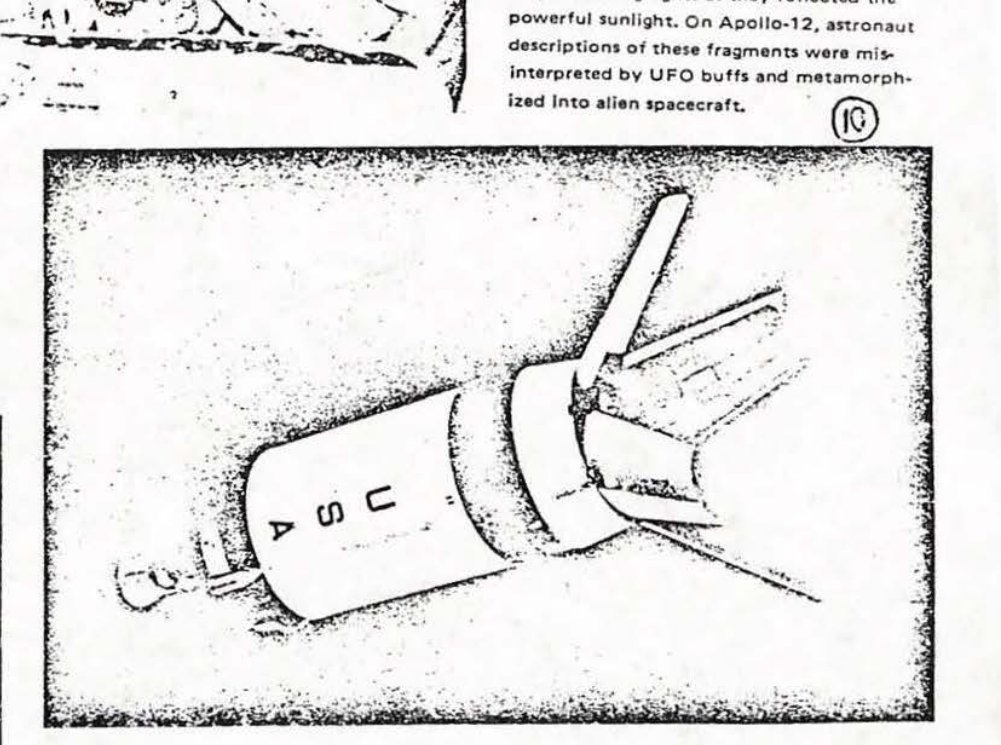
On the way to the Moon, the Apollo 12 crew remarked to Houston about UFOs flashing outside, and Conrad said, jokingly, that they were being followed. Ufological groups turned the exchange into an encounter with spacecraft; NASA and the three astronauts attributed the UFOs to the Saturn rocket's discarded panels.
- Event date
- 15/11/1969, about 150 thousand miles from Earth
- Location
- Earth-Moon trajectory
- Topic
- Astronaut accounts
- Source agencies
- USG
- Documents
- 1 document · 86 pages
- Reading time
- 28 min
 Magazine clippingPhysical page 12
DOCUMENTARY SOURCES · USG
What the records tell
Apollo 12 was launched on 14 November 1969, with Charles “Pete” Conrad, Richard Gordon, and Alan Bean. On the outbound trip, the crew spoke with Houston about bright lights they saw through the window. Conrad said they were “being followed” by something that was flashing. The phrase, heard live by journalists, gave rise to a story in Saga magazine in May 1970 and to claims by researcher James Harder, of APRO, that a UFO accompanied the spacecraft to the Moon.
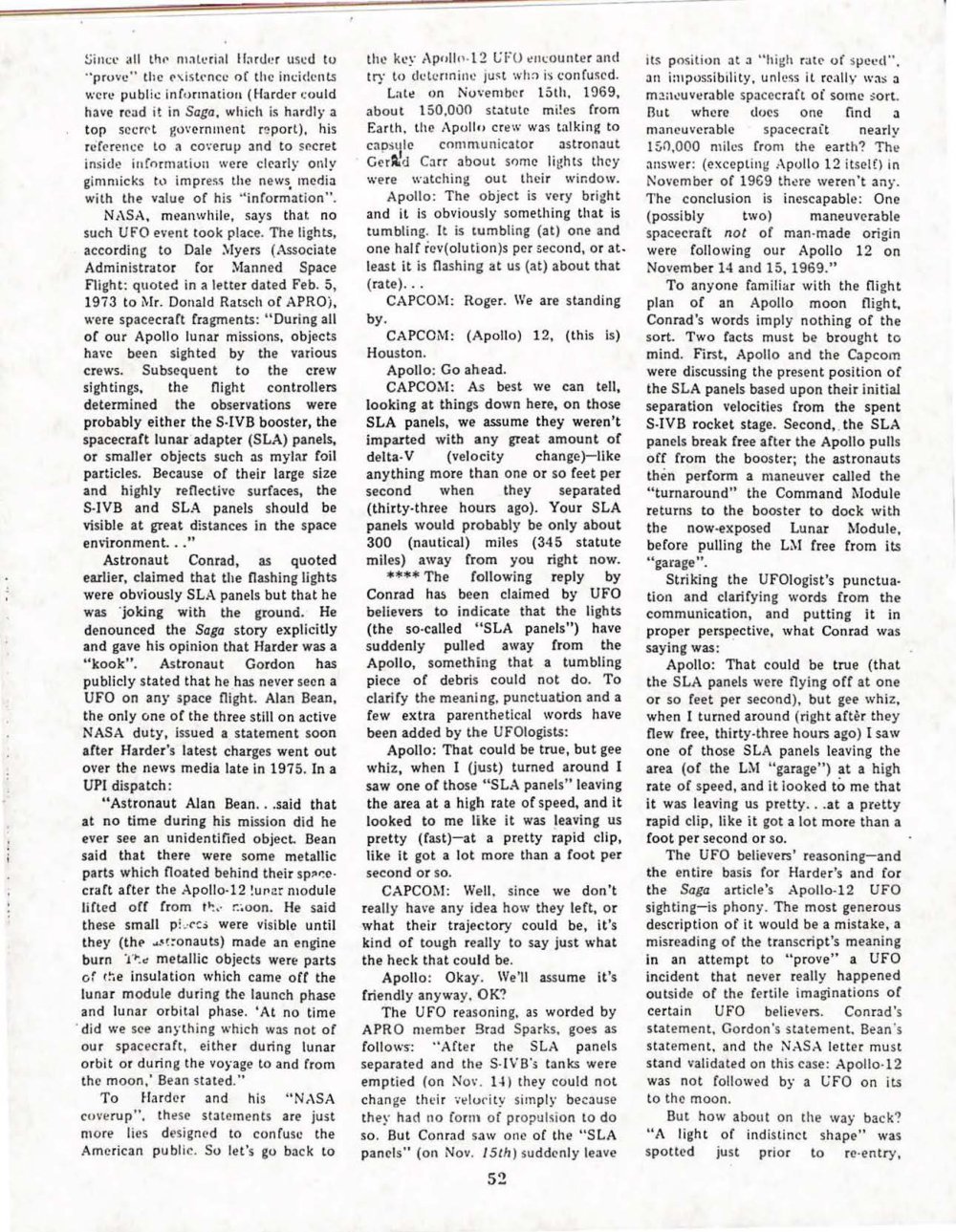
James Oberg's 1976 essay, which NASA attached to a reply to the Senate in 1998, reproduces the excerpt of the 15 November transcript, about 150 thousand miles from Earth. The crew describes a very bright object that “rotates” or flashes about once and a half per second. Houston replies that the SLA panels, which cover the lunar module at launch and are released in space, must be about 300 nautical miles away. Conrad says he saw one of them move away “at high speed” and concludes: “let's assume it's friendly.”
For APRO, panels without propulsion could not accelerate, so they must be spacecraft. Oberg reads the exchange differently: Conrad was talking about the moment of separation, 33 hours earlier, when the panels moved away from the rocket during the docking maneuver with the lunar module. The author cites Conrad's letter, from April 1976, in which he calls the story a lie born of a joke with the ground crew, and statements by Gordon and Bean denying having seen anything foreign to the spacecraft.
The essay also cites a 1973 letter from Dale Myers, NASA associate administrator for manned space flight: on all Apollo missions, the controllers concluded that the objects seen were probably the S-IVB stage, the SLA panels, or smaller fragments, such as mylar particles. A Lockheed report for NASA, from March 1970, studied the “Moon pigeons,” objects filmed on Apollo 12, and attributed them to debris from pyrotechnic events, ice, or reflections, without positive identification.
Oberg also addresses a light without a defined shape seen on the return trip, which seemed to be in the Indian Ocean. According to a letter from Gordon to the author, in September 1976, Rusty Schweickart later suggested it was the Moon's reflection on the water, and the crew agreed. All these explanations are attributed by the essay to those who gave them; the archive does not contain the recording or the full transcript.
Oberg's essay reconstructs how the story grew. The best-known version, published by Saga magazine in May 1970 under the title "Apollo 12's mysterious encounter with flying saucers," spoke of two flashing lights near the command module about 150 thousand miles from Earth; the ground reportedly thought of the third stage, then of the SLA panels, and Conrad reportedly replied that one of them had taken off at high speed. Later versions added that a UFO accompanied the spacecraft to 132 thousand miles from the Moon, that European observatories saw the two objects, and that the astronauts photographed them. Oberg says the origin of these figures is obscure and that none of these sources is identified.
The main proponent of the thesis, according to the essay, was James Harder, APRO's research director. At a symposium at the University of California, Santa Cruz, on 8 November 1975, he stated that a UFO followed Apollo 12 for three orbits around the Moon and that NASA covered up the case "for fear of panic," information reportedly passed to him by a member of the space team whom he refused to identify. Oberg replies that all the material Harder used was public. It is a dispute between a civilian researcher and a skeptical author, both outside NASA; the archive does not contain Harder's version firsthand.
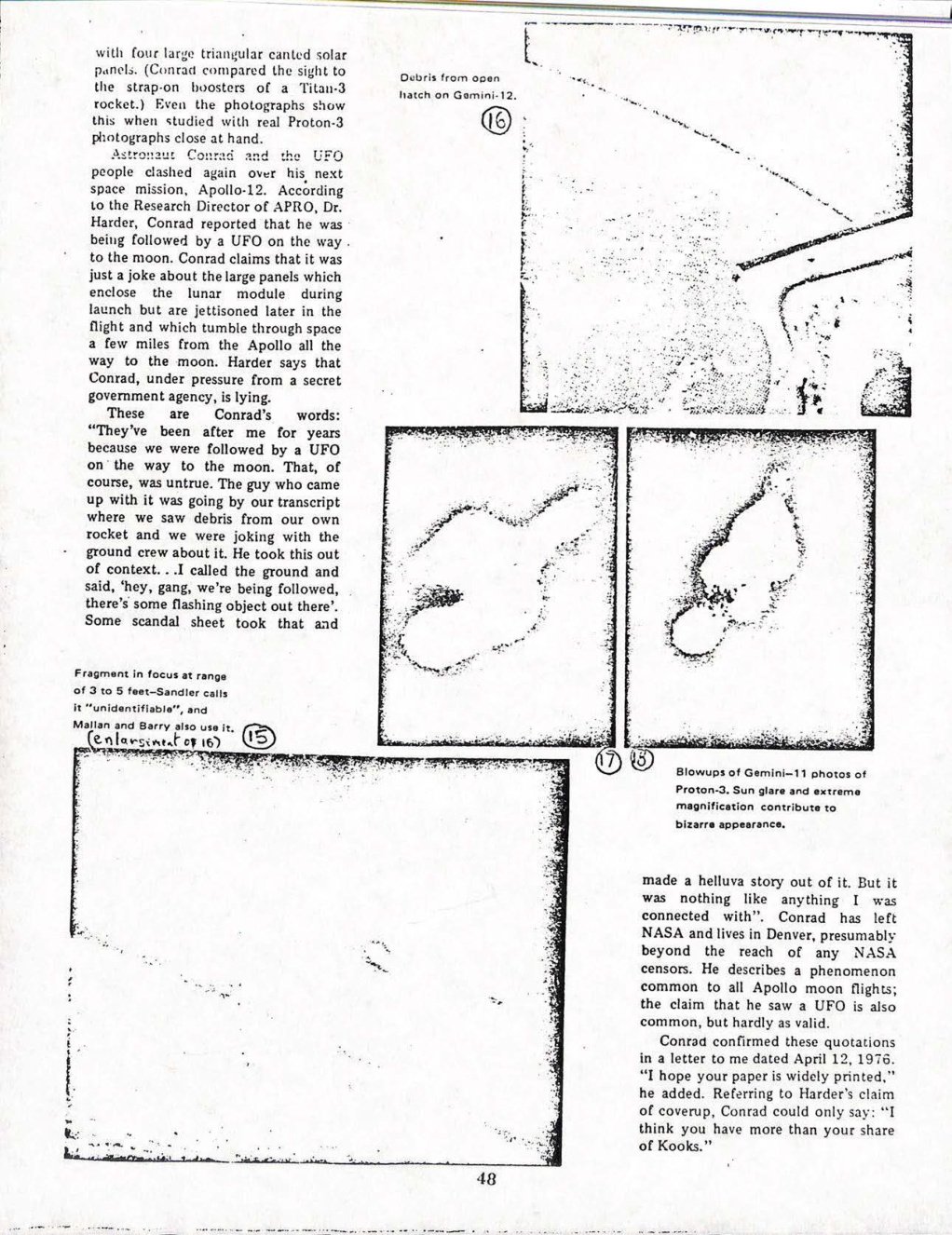
The central point of Oberg's reading is punctuation. He reproduces Conrad's remark twice: in the ufologists' version, with added punctuation and words in parentheses, it suggests that a panel accelerated at the moment of the conversation; in the author's version, "when I turned around" refers to the maneuver 33 hours earlier, in which the command module separates from the rocket, turns around, and docks with the lunar module, the moment when the panels open and move away. Conrad confirmed to the author, in a letter of 12 April 1976, that the phrase was a joke with the ground crew about debris from the rocket itself. The astronauts' letters are cited by the author; the archive does not contain the originals.
Other Apollo 12 "evidence" appears on pages 22 and 23. Saga spoke of a red object flashing against the Earth; according to the essay, APRO itself, through Brad Sparks, corrected that the astronauts described a steady light, not red in color, seen between them and the dark Earth, near the coast of India. The magazine also cited seismic tremors that, according to Oberg, never occurred, and a "blue halo" around an astronaut, which NASA photo analyst Dick Underwood attributed to a developing defect caused by the Sun's glare. A radio commentator claimed the TV camera was deliberately switched off; NASA said Bean accidentally pointed it at the Sun.
The essay details the Lockheed report for NASA that studied the "Moon pigeons." Titled "Unidentified visual phenomena associated with spaceflight," it came out on 18 March 1970, under contract NAS 9-5191, signed by engineers F. D. Beatty and J. G. Baron. The 16-millimeter color film 1165M, from Apollo 12, shows three objects, A, B, and C, during the jettison of the lunar module in lunar orbit; according to the authors, they would be a segment of the docking tunnel, part of the docking ring, and part of the wiring harness. The conclusion cited is that they are normal debris from pyrotechnic events, without positive identification. The report is not in the archive.
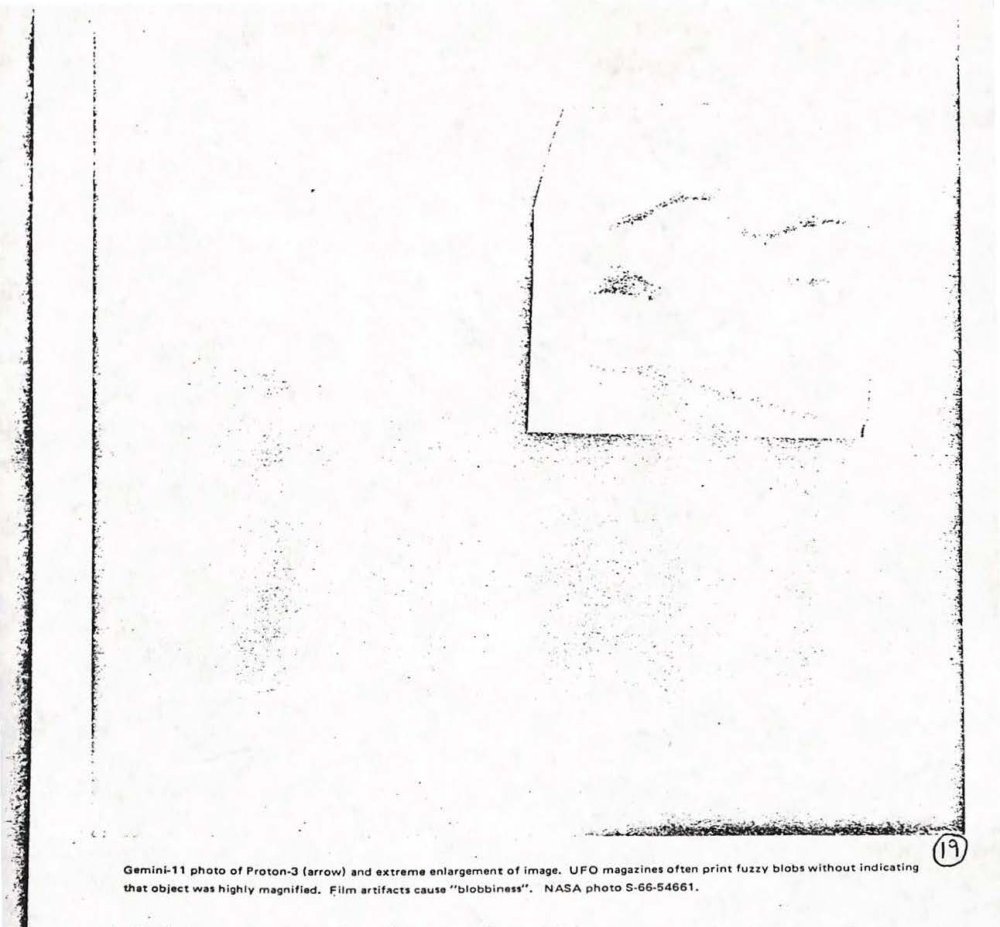
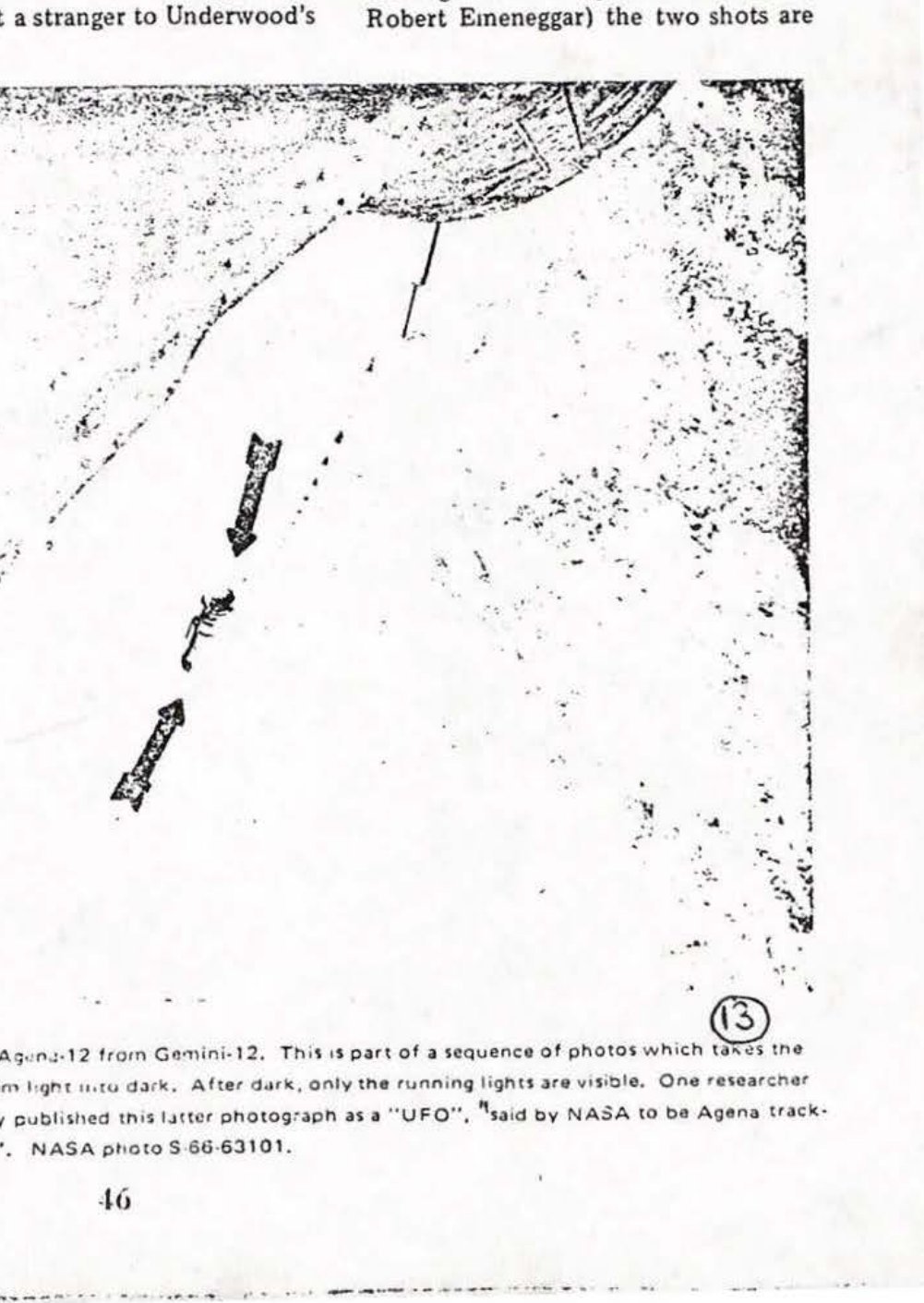
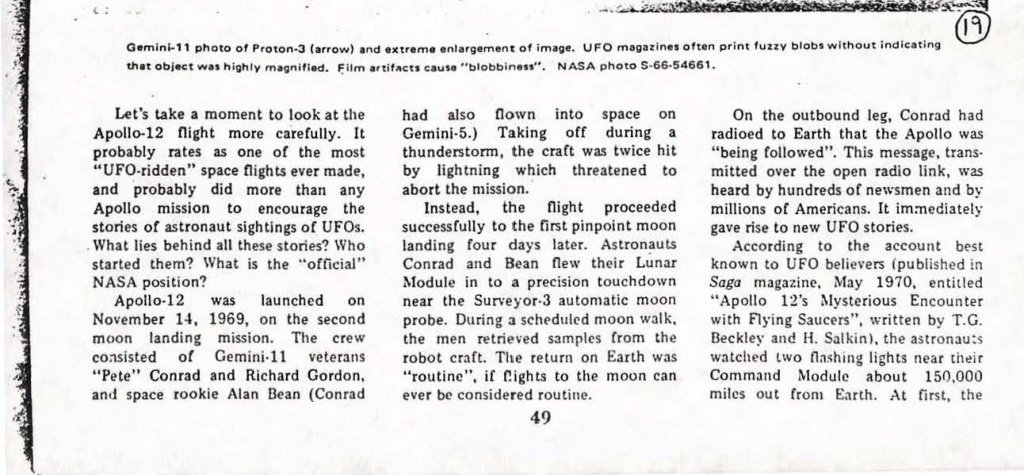
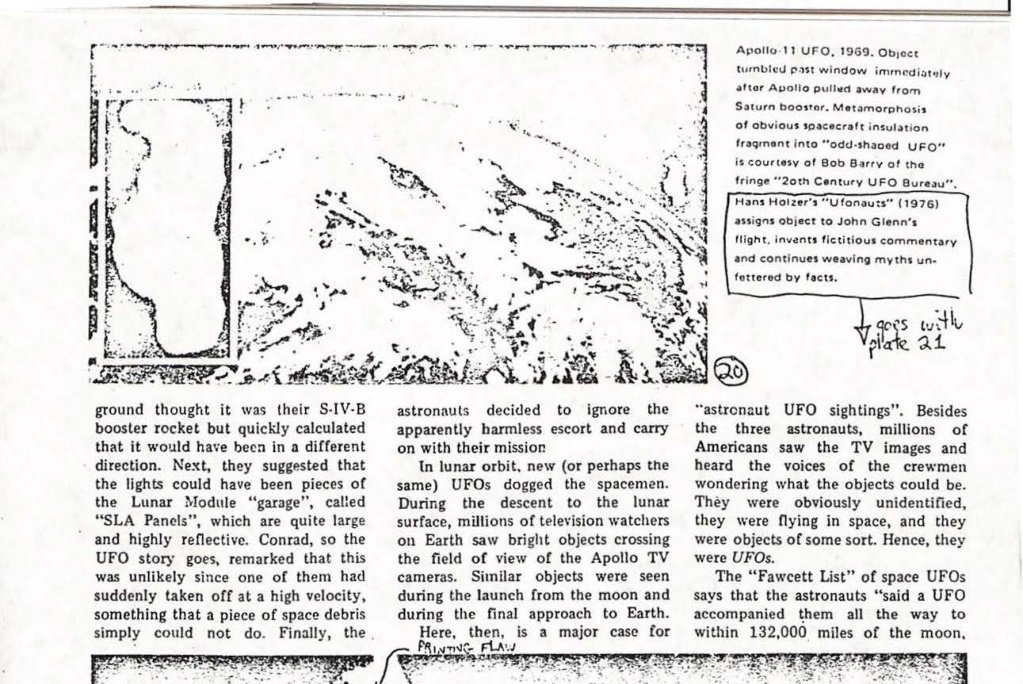
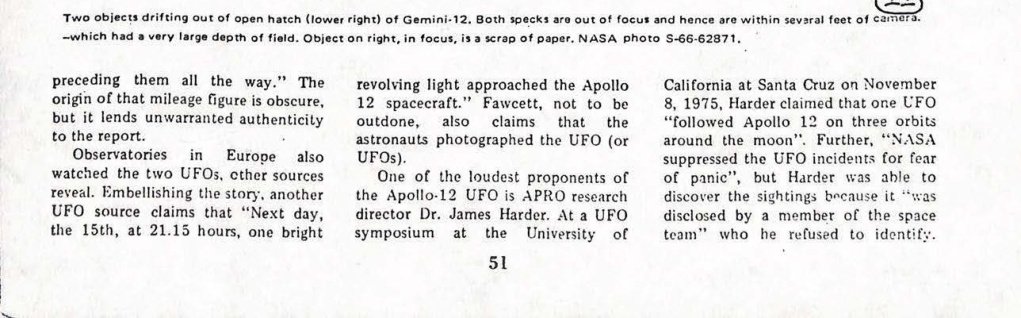
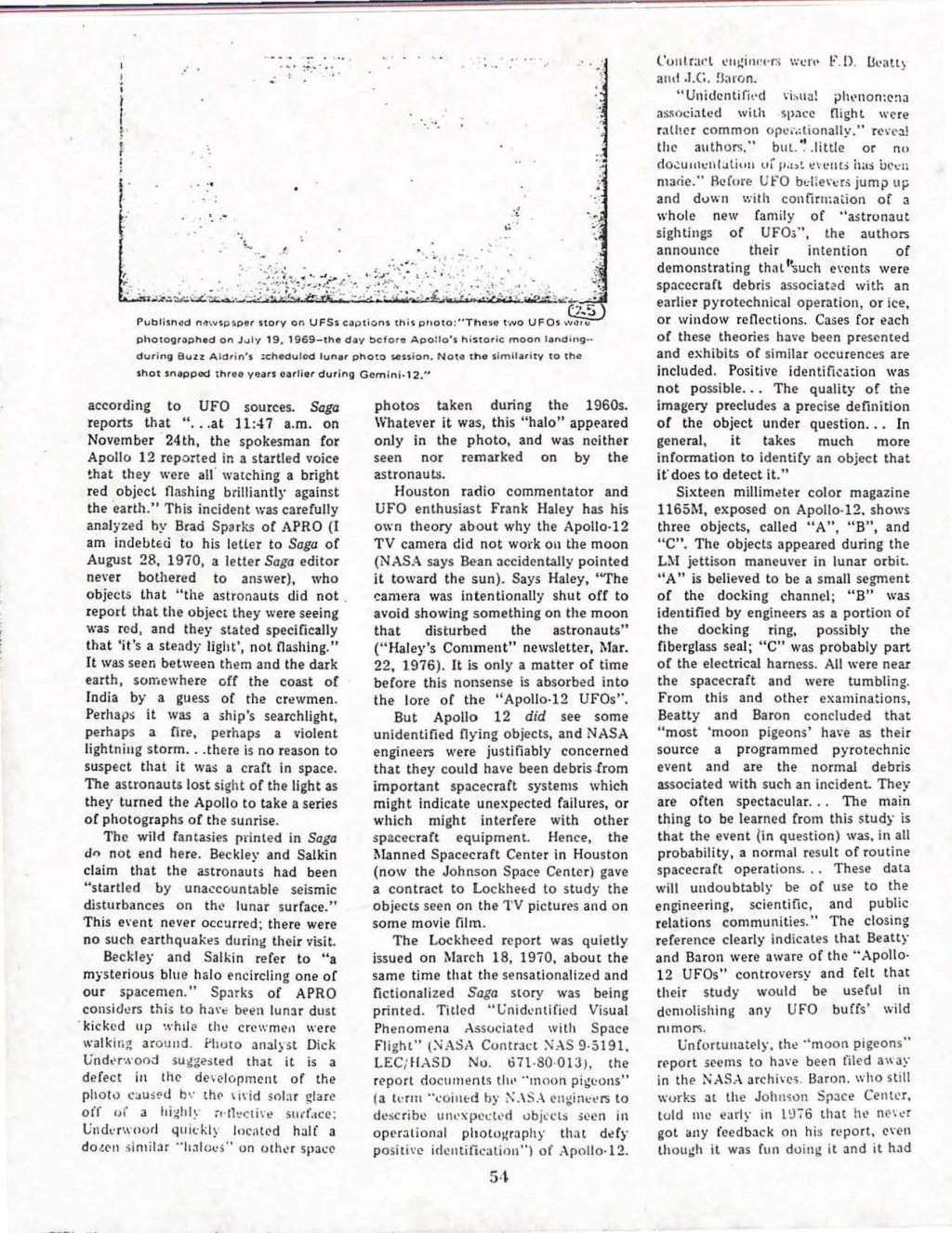
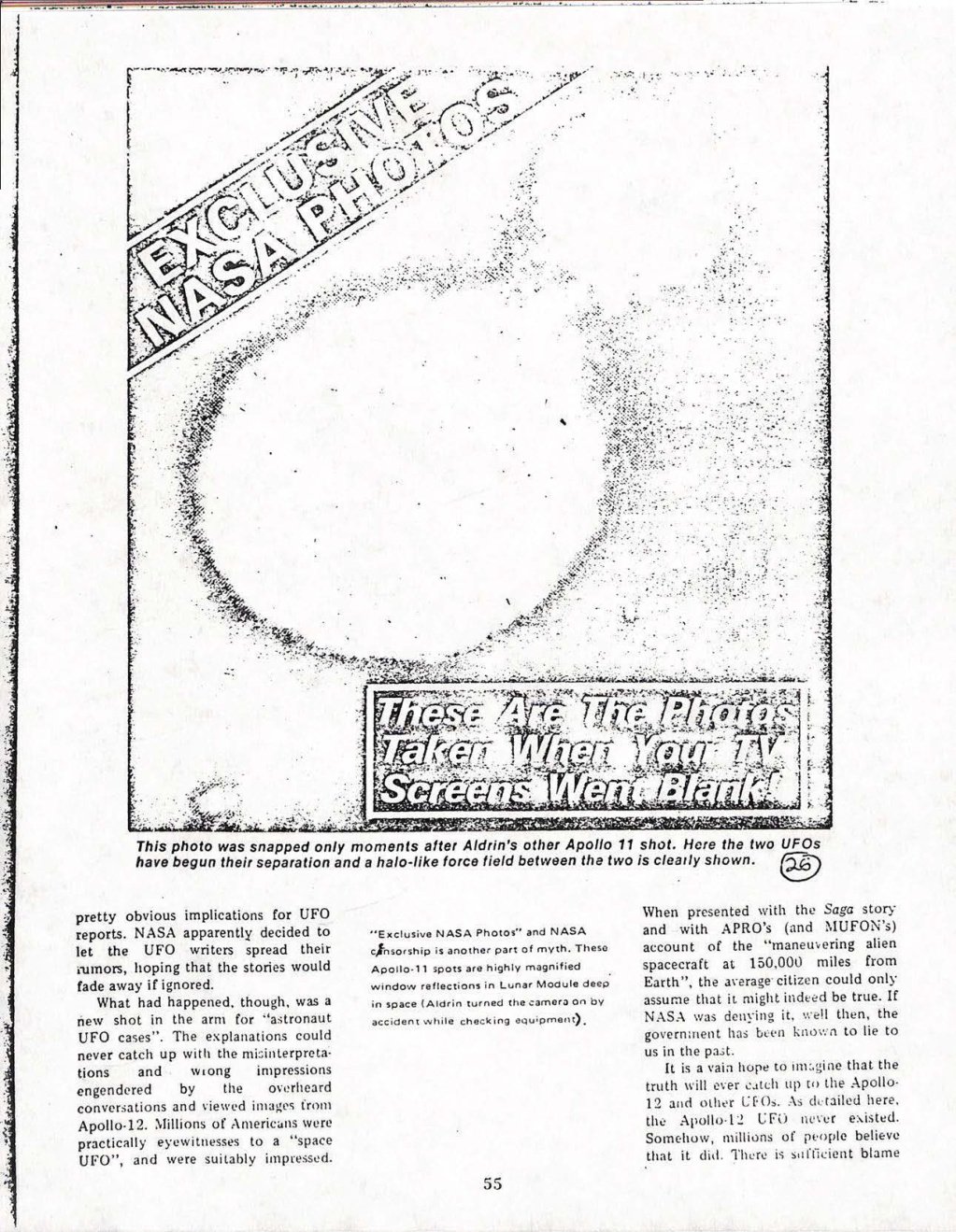
The images in this dossier are magazine pages, in high-contrast photocopy, and serve to show the source, not the phenomenon. None of them is a photo of the lights seen by Apollo 12. The mission photos appearing on the pages are from other flights, Gemini 11, Gemini 12, Mercury 7, and Apollo 11, used by the author to discuss interpretation errors, and they have their own dossiers when they are cases in the collection. NASA's letter to Senator Grassley, of 4 September 1998, which accompanies the essay in the archive, states that no unidentified material was seen on the missions to the Moon; that letter is translated in the dossier on Grassley's request.
More images from the document
DIRECT READING OF THE FILE
The document, in the original
Oberg's essay is a copyrighted magazine article: it gets a summary and at most one or two short quotations, and its pages are included as a magazine clipping. Excerpts from NASA documents quoted by the author (flight transcripts, debriefing reports, official letters) were translated because they are of government origin; the case pages do not contain any government document reproduced in full. The reproduced photos are high-contrast copies of NASA photos, heavily degraded by photocopying. The conclusions are the author's, not NASA's nor this editorial team's.
EXCERPT 1 · PHYSICAL PAGE 20
Excerpt from the Apollo 12 air-to-ground transcript, 15/11/1969, quoted on physical page 20
!.iinc:l' all thf" m:ill.'riill ll;m.lcr used to
..prove" the r xistcncc Qf the inddcnts
werl.' public information ( Harder could
have read it in Saga, which is hardlr a
top scc;rrt )!O\'crnmcnt r:!port), his
rdcrcnce to a co\·eruµ and to sr.cret
inside informatiu,1 were clearly only
gimmicks t\1 impre~r; the news, media
with the value of his •'information".
NASA, meanwhile, says that no
such UFO event took place. The lights,
according to Dale Myers (Associate
Administrator for Manned Space
flight: quoted in a letter dated Feb. 5,
1973 to Mr. Donald Ratsch of APROj,
were spacecraft fragments: "During all
of our Apollo lunar missions. objects
have been sighted by the various
crews. Subsequent to the crew
sightings, the flight controllers
determined the observations were
probably either the S-IVB booster, the
spacecraft lunar adapter (SLA) panels,
or smaller objects such as mylar foil
particles. Because of their large size
and highly reflective surfaces, the
S-IVB and SLA panels should be
visible at great distances in the space
emironment..."
Astronaut Conrad, as quoted
earlier, claimed that the flashing lights
were obviously SLA panels but that he
was 'joking with the ground. He
denounced the Saga story explicitly
and gave his opinion that Harder was a
"kook". Astronaut Gordon has
publicly stated that he has never seen a
UFO on any .;pace flight. Alan Bean,
the only one of the three still on active
NASA duty, issued a statement soon
after Harder's latest charges went out
over the news media late in 1975. In a
UPI dispatch:
"Astronaut Alan Bean...said that
at no time during his mission did he
ever see an unidentified objecL Bean
said that there were some metallic
parts which floated behind their sp:>r.ecraft after the Apollo-12 !Uf'l.?r module
lifled off from t~•• r:~oon. He said
these small p:.-<'::.; were visible until
they (tht> ... •!:onauts) made an engine
burn 'f':c: metallic objects wer~ parts
er <!",e insulation which came off the
lunar module during the launch phase
and lunar orbital phase. 'At no time
•did we see anything which was not of
our spacecraft, either during lunar
orbit or during the voyage to and from
the moon,' Bean stated."
To Harder and his "N,\SA
cuv~rup", these statements are just
more lies designed to confuse the
American public. So let's go back lo
the key r\pnll 11-l 2 LlFU c111:ountcr and
try lo determine just wh:1 is confused.
Lale on No,.·embcr 15th. 1969,
about 150,000 statute mi!es from
Earlh. the Apollo crew was talking to
cilDSllle communicator astronaut
Ger~rJ C:m about SQmc lights they
were watching out their wir.dow.
Apollo: The object is very bright
and it is obviously something that is
tumbling. It is tumbling (at) one and
one half rev(olution)s per second, or at.
least it is flashing at us (at) about that
(rate)...
CAPCOM: Roger. We are standing
by.
CAPCOM: (Apollo) 12, (this is)
Houston.
Apollo: Go ahead.
CAPCOM: As best we can tell,
looking at things down here, on those
SLA panels, we assume they weren't
imparted with any great amount of
delta-V (velocity change)-like
anything more than one or so feet per
second when they separated
(thirty-three hours ago). Your SLA
panels would probably be only about
300 (nautical) miles (345 statute
miles) away fro m you right now.
**** The following reply by
Conrad has been claimed by UFO
believers to indicate that the lights
(the so-called "SLA panels") have
suddenly pulled away from the
Apollo, something that a tumbling
piece of debris could not do. To
clarify the meaning, punctuation and a
few extra parenthetical words have
been added by the UFOiogists:
Apollo: That could be true, but gee
whiz, when I (just) turned around I
saw one of those "SLA panels" leaving
the area at a high rate of speed, and it
loo ked to me like it was leaving us
pretty (fast)-at a pretty rapid clip,
like it got a lot more than a foot per
second or so.
CAPCOM: Well, since we don't
really have any idea how they left, or
what their trajectory could be, it's
kind of tough really to say just what
the heck that could be.
Apollo: Okay. We'll assume it's
friendl y anyway, OK?
The UFO reasoning, as worded by
APRO member Srad Sparks. goes as
follows: ''After the SLA panels
separated and the S-IVB's tanks were
emptied (on No\·. U) they could not
change their ·,t>locity simply because
they had no form of propulsion to do
so. But Conrad saw one of the "SLA
panels" (on Nov. 15th ) suddenly leave
its position at a "high rate of sµccd ...
an i:11;,ossib1lity, unless it really was a
m.lal!uvcrable spacec raft of some ::-ort.
nut where docs one find a
maneuverable spacecrait nearly
150,000 miles from the earth? The
:inswer: (excepting ,\ pollo 12 itself) in
November of 19C9 th~re weren't any.
The conclusion is inescapable: One
(possibly two) maneuverable
spacecraft not of man-made origin
were following our Apollo 12 on
November 14 and 15, 1969."
To anyone familiar with the flight
plan of an Apollo moon flight,
Conrad's words imply nothing of the
sort. Two facts must be brought to
mind. First, Apollo and the Capcom
were discussing the present position of
the SLA panels based upon their initial
separation velocities from the spent
S-IVB rocket stage. Second,. the SLA
panels break free after the Apollo pulls
off from the booster; the astronauts
then perform a maneuver called the
"turnaround" the Command Module
returns to the booster to dock with
the now-exposed Lunar Module,
before pulling the LM free from its
"garage".
Striking the UFOlogist's punctuation and clarifying words from the
communication, and putting it in
proper perspective, what Conrad was
saying was:
Apollo: That could be true (that
the SLA panels were flying off at one
or so feet per second), but gee whiz,
when I turned around (right after they
flew free, thirty-three hours ago) I saw
one of those SLA panels leaving the
area (of the LM "garage") at a high
rate of speed, and it looked to me that
it was leaving us pretty...at a pretty
rapid clip, like it got a lot more than a
foot per second or so.
The UFO believers' reasoning-and
the entire basis for Harder's and for
the Saga article's Apollo-12 UFO
sighting-is phony. The most generous
description of it would be a mistake, a
misreading of the transcript's meaning
in an attempt to "prove" a UFO
incident that never really happened
outside of the fertile imaginations of
certain UFO believers. Conrad's
statement, Gordon's statement. Bean ·s
statement. and the NASA letter must
stand validated on this case: Apollo-12
was not followed by a t;FO on its
to the moon.
But how about on the way back?
"A light of indistinct shape" was
spotted just prior to re-en try,
52Editorial note: NASA transcript reproduced by the magazine, in the author's "clean" version, without the punctuation added by the ufologists he criticizes; the parentheses are his.
Check the original PDF
Apollo: The object is very bright and it is obviously something that is tumbling. It is tumbling (at) one and one half rev(olution)s per second, or at least it is flashing at us (at) about that (rate)... CAPCOM: Roger. We are standing by. CAPCOM: (Apollo) 12, (this is) Houston. Apollo: Go ahead. CAPCOM: As best we can tell, looking at things down here, on those SLA panels, we assume they weren't imparted with any great amount of delta-V (velocity change)-like anything more than one or so feet per second when they separated (thirty-three hours ago). Your SLA panels would probably be only about 300 (nautical) miles (345 statute miles) away from you right now. Apollo: That could be true, but gee whiz, when I turned around I saw one of those SLA panels leaving the area at a high rate of speed, and it looked to me like it was leaving us pretty...at a pretty rapid clip, like it got a lot more than a foot per second or so. CAPCOM: Well, since we don't really have any idea how they left, or what their trajectory could be, it's kind of tough really to say just what the heck that could be. Apollo: Okay. We'll assume it's friendly anyway, OK?View the document record ↗ · Physical page 20, counting the cover.
EXCERPT 2 · PHYSICAL PAGE 30
Statement by Alan Bean to UPI quoted on physical pages 20 and 30 (short quotation)
and inll•llectually dishonest tactic.
Three ti llll' space veteran Wally ::ichirra,
who according to lffOlogisls saw
"glowing masses"( actually lightning-lit
clouds, over the Indian Ocean) hos
written. "I do not know enough about
this subject to render an opinion of
any kind. The o!lly information l ~ave
is that which has been released to the
public through the years by the
various news media". UFO writers
would ha,·e us belieH~ that this is part
or a ,·ast conspiracy of lies which only
they can penetrate. ,Accil~ t:l.,.
The actual answi!r to the "shapeless
light" mystery illustrates the wa~·
NASA races real space mysteries. The
crew was puzzled by the sighting but
reported it to space officials who made
• no effort to conceal the incident. If
NASA were trying to co,·er up actual
UFO sightings by astronauts, this was
a good candidate for one-and it
would never have been publicized.
Astronaut Dick Gordon revealed to
me the unpublicized solution to the
.., publicized mystery. In a letter dated
Septemhcr 15. 1976, Cordon wrote:
" I ,•i\'idly re..:a!I the inciden t which
oc.:11rrcd when a light of indistinct
shape and size was spolled on our
return to earth... (it) did appear lo be
in the Indian Ocean. ln our discussions
and debriefings that occurred l:iter.
Rusty Schwcikart provided the
answer. He simply said, 'how about
the moon's reflection?' and, of course,
that is what it was... How often those
of us in aviation have seen the moon's
reflection on the water in the course
of a nom1al flight. We simply did not
put it together in returning from lunar
distance, where we had the black background of space, the dark night of the
earth. and the moon behind us."
Other spacemen have been asked to
answer these questions). They have
been forthright in their denials: "I
never ha\'e personally seen anything I
could identify as a UFO", says John
Glenn, now a Senator Crom Ohio.
Astronauts Grissom and Young said,
"We have never seen any UFOs".
Richard Gordon, who was with
A common sourco of space and othor UFOs
is shown hore. The aura and the lens-shaped
disc Is actually a sunrise photographed from
Skylab. NASA photo SL3-118,2177.
Conrad on Gcmini-11 and Apollo-1 2.
writes that " I never s:iw a l.Jf'O".
Astronaut "Dcke" Sla}·tor, claims t!1at
"[ don't recollect anyone u,porting
any UFOs on any of our nights''.
"'Buzz" Ald rin went to the moon
on Ai,ollo-11, on which the l.iFO
press lists at least three separate UFO
incldenls. There were no UFOs:
"There are people who say there's a
go\"ernment conspiracy to covu up the
• existence of flying saucers." Aldrin
told a Reuters reporter in 1973,
"That's a lot of hogwlsh."
The L.M pilot on the next fligh~.
Apollo-'12, was Alan Bean. Following a
new press conference in 1975 when
James Harder repeated his stories of
Apollo-11 and Apollo-12 UFOs, Bean
told UPI that at no time during his
mission did he ever see an unidentified
object. "At no time did we see
anything which was not of our
spacecraft, either during lunar orbit or
during the voyage to and from the
moon," Bean stated.
61Check the original PDF
At no time did we see anything which was not of our spacecraft, either during lunar orbit or during the voyage to and from the moon.View the document record ↗ · Physical page 30, counting the cover.
EXCERPT 3 · PHYSICAL PAGE 17
full page
,
<
l
;
f
1
I
. , .
• . ' ..· :;:·..
r ·.•
.....
t,
' ,
~
. ~· ~--.·-,.·. ~ . ~.:.\..®
Geminl-11 photo of Proton-3 (arrow) i nd extreme enlargement of image. UFO magazines often pront funv blobs without indicating
that object w as h ighly magnified. f; llrn ertlf,icts cause "blobblneu". NASA photo S-66-54661.
Let's take a moment to look at the
Apollo--12 flight more ca·re(ully. It
probably rates as one of the most
"UFO-ridden" space flights ever made,
and ·probably did more than any
Apollo mission to encourage the
stories o( astronaut sightings of UFOs.
. What lies behind all these stories? Who
started them? What is the "official"
NASA position?
Apollo-12 was launched on
November 1-l, 1969, on the second
moon landing m1ss1on. The crew
co;'ISisted o( Gcmini-11 veterans
"Pete" Conrad and Richard Gordon,
and space rookie Alan Dean (Conrad
had also nown into space on
Gemini-5.) Taking off during a
thunderstorm, the craft was twice hit
by lightning which threatened to
abort the mission.·
Instead, the night proceeded
successfully to the first pinpoint moon
landing fou r days later. Astronauts
Conrad and Bean flew their Luna.r
Module in to a precision touchdown
near the Surveyor-3 automatic moon
probe. During a scheduled moon walk,
the men retrieved samples from the
robot crnft. The return on Eanh was
"routine", if f?ights to the moon can
ever be considered routine.
49
On the outbound leg, Conrad had
radioed to Earth that the Apollo was
"being followed". This message, transmitted over the open radio link, was
heard by hundreds of newsmen and by
millions of Americans. It im:nediately
gave rise to new UFO stories.
According to the account best
known to UFO believers (published in
Saga magazine, May 1970, entitled
" Apollo l 2's ~Jysterious Encounter
with Flying Sauct'rs", written by T.G.
Beckley and H. Salkinl. the astronau~,;
watched Lwo nashing lights near ch~ir
Command Module about 150,000
miles out from Earth. At first, theEditorial note: Page of Oberg's essay (SEARCH magazine, 1976) that presents Apollo 12 and the story that the astronauts had supposedly been "followed" by lights; summary only, since it is a private publication.
Check the original PDF
[p. 17: texto da revista não reproduzido; ver a síntese]View the document record ↗ · Physical page 17, counting the cover.
EXCERPT 4 · PHYSICAL PAGE 18
full page
-
' A •' '
:-'_.:~--\~ ~
••
A pollo -I 1 U F O, 19G9. Obroct
hunbh.'\J p .1st wind o w im,nr.d i\Jt•jly
altar A1Jollo p ull~<1 aw ay from
Saturn bo osto r. Metamo rpho-sis
of obvi ous sp ac:ec:r aft i nsul atlon
l r~qrnon t i nto "odcl•shao od UFO "
is c ourtesy of Bob Barry o f tho
fri nge " 20th Century UFO Bureau" .
Hon> Hotze,·, " Ulonoua" ( 1976)
assigr,s o bject to Joh n Glen n's
flight. i nvents f ictitious c:om ment ory
and con tin ues weavi ng myth• unlotterod by I ecu.
ground thought it was their S-IV-8 astronauts decided to ignore the ··astrcnuut UFO sightings". Besides
booster rocket but quickly calculated apparently harmless escort and carry the three astronauts, millions of
that it would have been in a different on with their mission Americans saw the TV images and
direction. Next, they suggested that ln lunar orbit. new (or perhaps the heard the voices of the crewmen
the lights could have been pieces of same) UFOs dogged the spacemen. wondering what the objects could be.
the Lunar Module "garage'', called During the descent to the lunar They were obviously unidentified,
"SLA Panels", which are quite large surface, millions of television watchers they were flying in space, and they
and highly reflective. Conrad, so the on Earth saw bright objects crossing were objects of some sort. Hence, they
UFO story goes, remarked that this the field o f view of the Apollo TV were UFOs.
was unlikely since one of them had cameras. Simila.r objects were seen The "Fawcett List" of space UFOs
suddenly taken off at a high velocity, during the launch from the moon and says that the astronauts "said a UFO
something that a piece of space debris during the final approach to Earth. accompanied ~hem all the way to
simply could not do. Finally, the . Here, then, is a major case for within 132,000_miles of the moon.
. nf'~.,,.,.,"~ Ft.>.•:J
~~4":C-,!6S'Jr,~1Jffe»%ffifl ~ ¾4'""~ }4:t¢.:7f~ -, • ., . t:o(';.
\ I(' • • • •• •r. ";'" •••.:-.:•i ••,,; ~•·----~ •C\:--.••::-;•:~•·--•:t~; ~ ',?~•,~•~•'.:'• •·~~ :::\;•••'~
l • ·: ,· •.-·. •. ·- . • • :- ,... -·, •. .• .:· -_.,.
-~- :f ·-~ !
.·,
- ·: ...
- • ··,: ".*# ,- -·-··
I • •
.-·..•.. ~-:.. .~. .. ... :.
M ercury,~. " (.',:,n -e..i ~•FO " on Sco u C·a,o en : ..,,, flight i n 19 6:3. S meors and glaro, c hanQo from @) on-9 1r:ime l O ~he no"t r v1ti1h, a~tronn:ct ""tl~ ~napping p ic tures o f linip bllloon sub•,atellite .
::,tq, plirt,,. ?..)'3./ +, S
50
____.._.,..__ - . -Editorial note: Page of Oberg's essay (SEARCH magazine, 1976) with the popular version of Apollo 12 being "followed" by UFOs and two photo plates; summary only, since it is a private publication.
Check the original PDF
[p. 18: texto da revista não reproduzido; ver a síntese]View the document record ↗ · Physical page 18, counting the cover.
EXCERPT 5 · PHYSICAL PAGE 19
full page
. . . .. . '
:,,.;.
~ I .. -.,., . •·/ 7 • JI ._!' ~. "'1
,..,·.· .., ~
,,;r.1_( J~; .•..,.- . . :.; ._ - .. . . • _•• / • • ~
(?-2)
T wo obiecu drifting out of open hatch (lowe, r ight) of Geminl-12. Both spe_cks are out of focus and hence are within sevoral feet of camera.
-which h ad• very large depth of field. Object on right, in f ocus, i• a scrap of paper. NASA photo S-66-62871.
preceding them all the way." The
origin of that mileage figure is obscure,
but it lends unwarranted authenticity
to the report.
Observatories in Europe also
watc:ied the two UFOs. ether sources
re\'eal. Embellishing the story. another
UFO source claims that "Next day,
the 15th, at 21.15 hours, one bright
revohing light approached the Apollo
12 spacecraft." Fawcett, not to be
outdone, also claims that the
astronauts photographed the UFO (or
UFOs).
One of the loudest proponents of
the Apollo-12 UFO is APRO research
director Or. James Harder. At a UFO
symposium at the University of
California at Santa Cruz on November
8, 1975, Harder claimed that one CFO
"followed Apollo l'.! on three orbits
around the moon". Further, "N,\SA
suppressed the UFO incident~ for fonr
of p,1nic", but Harder was ahle to
discover the si~hting~ b"cau$e it " was
disclosed by a member of the space
team" who he refused to id1:ntif:: .
5 1Editorial note: Page of Oberg's essay (SEARCH magazine, 1976) with a photo of Gemini 12 and the claims of ufologists about Apollo 12, among them those of James Harder (APRO); summary only, since it is a private publication.
Check the original PDF
[p. 19: texto da revista não reproduzido; ver a síntese]View the document record ↗ · Physical page 19, counting the cover.
EXCERPT 6 · PHYSICAL PAGE 22
full page
l
··-.. . :- . ... • ... !"'... • •• ••
.:
. . ·• l·.
' . ...
: >:,;;,_;; ~.~: : ..>ct-'. :'.:,·.'. _: \ . . .w~.:.~~:,. ~ -.....,-;;; ;~·,!<~-~--~ ~- :·,::: :~ J::.s:,:, .£.,.:·,,·~~i«~-;c :+,21~-==.: .. , ;-
"" Publisned n~wsp!per story on UFSs captions this p11oto:"Theso two UFOs wo, u
photographed on July 19, 1969-the day before Apo:lo's historic: moon landingduring Buzz Aldrin'• scheduled lunar photo session. Noto the similarity to the
•hot snapped throo years oarlier during Gcminl-12."
according to UFO sources. Saga photos taken during the? 1960s.
reports that " ...at 11:47 a.m. on Whatever it was, this "halo" appE'ared
November 24th, the spokesman for only in the photo, and was n«?ither
Apollo 12 reported in a startled voice seen nor remarked on by the
that they were all' watching a bright astronauts.
red object flashing brilliantly against Houston radio commentator and
the earth." This incident was carefully UFO enthusiast Frank Haley has his
analyzed by Brad Sparks of APRO (I own theory about why the Apollo-12
am indebt£:ci to his letler to Saga of TV camera did not work on the moon
August 28, 19i0, a letter Saga editor (NASA says Bean accidentally pointed
ne\'er bothered to answer), who it toward the sun). Says Haley, "The
objects that "the astronauts did not i::amera was intentionally shut off to
report that the object. they were seeing avoid showing something on the moon
was red, and they stated specifically that disturbed the astronauts"
that 'it's a steady light', not flashing." ("Haley's Comment" newsletter, Mar.
It was seen between th"'m and the dark 22, 1976). It is only a matter of time
earth, somewhere off the coast of before this nonsense is absorbed into
India by a guess of the cr"'wmen. the lore of the "Apollo-12 UFOs''.
Perhaps it was a ship's searchlight, But Apollo 12 did see some
perhaps a fire, perhaps a violent unidentified flying objects, and NASA
lightning storm...there is no reason to engineers were justifiably concerned
suspect that it was a craft in space. that they could have been debris from
The astronauts lost sight of the light as important spacecraft systems which
they turned the Apollo to take a series might indicate unexpected failures, or
of photographs of the sunrise. which might interfere with other
The wild fantasies printed in Saga spacecraft equipment. Hence, the
dn not end here. Beckley and Salkin Manned Spacecraft Center in Houston
claim that the astronauts had been (now the Johnson Space Center) gave
"startled by unaccountable seismic a contract to Lockhe£:d to study the
disturbances on th.:- lunar surface." objects seen on the TV pictures and on
This event never occurred; there were some movie film.
no such earthquakes during their visit. The Lockhc-ed report was quietly
Beckley and Salkin refer to "a issued on March 18, 19i0, about the
mysterious blue halo encircling one of same time that the sensationalized and
our spacemen." Sparks of APRO fictionalized Saga story was being
consicfors thi:; lo ha,·c bE't?ll lun3r dust printed. Titled "linidcntifhid Visual
•kicked up •.,·h1le thu crcwmt',l were Phenomena Associated with Space
walkii;g around. Photo analyst Dick Flight" (:-.iA$A Contract '.'i .\S 9-5191.
lind,,r·.rood sutgestect that it is a LEC; HASO No. 071-80-013), the
defect in the denilopmeut of the report documents tlw "moon pigc:Qns"
photo cuusE>d h,· thl' , l\'id solar i:larc (a term "coi11E:d by :'\.\S.-\ enl:{inc:t.'r.; lo
oil' oi' a lii~hly ,Hl~cti,·e s11 fi·ace: dcscribu UIH!Xpcctcci 1Jbjccls seen in
Undt•rwood quil'kly located half a operational photo1:r:iphy that ddy
do1.e11 ~imilar "ltalou5" on other space positive identification") of .-\polio• 12.
l'o11f.r:1rl t.'lll!i111•1•r:; wen• F.D. Ul•att~
and ,I.G. !l:nrm .
"Unidenlirkd \'bua! plwnon:C':1.1
as~oci:ilcd with space flight were
rather common opc,,:tionally." rcn,aJ
lhe authors." but. ''. .little or no
clo~u111clllJli1111 ll1 p,1,~ cvc11t.; has i,e..-11
macie." Rcfore UF'O bclle,·crs jump uµ
and d1Jw11 with confim~a,ion of a
whole new family of ''astronaut
sightings of UFO3'', the authors
announce? their intention of
demonstrating that 1
'such evenl~ were
spacecraft debris associated with an
earlier pyrotechnical operation, or ice,
or window reflections. Cases for each
of these theories have been presented
and exhibits of similar occurenccs are
included. Positive identifi~ation was
not possible. . . The quality of tile
imagery precludes a precise definition
of the object under question. . . In
general, it takes much more
information to identify an object that
ifdoes to detect it."
Sixteen millim~ter color magazine
11651\1, exposed on Apollo-12. shows
three objects, called "A", "B", and
"C". The objects appeared during the
Ll\·l jettison man«?uver in lunar orbit.
"A" is believed to be a small segment
of the docking channel; "B" was
identified by engineers as a portion oi
the docking ring, possibly the
fiberglass seal; "C" was probably part
of the electrical harness. All were near
the spacecraft and were tumbling.
From this and other examinations,
Beatty and Baron concluded that
"most 'moon pigeons' have as their
source a programmed pyrotechnic
event and are the normal debris
associated with such an incident. They
are often spectacular. . . The main
thing to be learn«?d from this study is
that the event (in question) was, in all
probability, a normal result of routine
spacecraft operations. . . These data
will undoubtably be of use to the
engineering, scientific, and public
relations communities." The closing
reference clearly indicates that Beatty
and Baron were aware of the "Apollo•
12 UFOs" controversy and felt that
their study would be useful in
demolishini: any UFO buffs' wild
n1mor;.
unfortunately. tht? ·'moon pigeons"
rrport seems to ha\·e been tiled a\\ ay
in the :--i..\S.-\ archi,·C's. Baron. who still
wurks at the Joh11,;011 Space Cerlll'r,
told me early in H)i6 that ht! ne\ l!r
got any feedback on his report, e,·t'n
thoui:h it was fun doini,: it and it had
5.iEditorial note: Page of Oberg's essay (SEARCH magazine, 1976) on the Saga account, Brad Sparks's analysis, and the 1970 Lockheed report on the Apollo 12 "lunar pigeons"; summary only, since it is a private publication.
Check the original PDF
[p. 22: texto da revista não reproduzido; ver a síntese]View the document record ↗ · Physical page 22, counting the cover.
EXCERPT 7 · PHYSICAL PAGE 23
full page
...
·'· ~ - ..
>}{
This photo was snapped only moments after Aldrin's other Apollo 11 shot. Here the two UFOs
have begun their separation and a halo-li ke force field between the two is c/ea,/y shown. ~
p retty o bvious implications for UFO
reports. NASA apparently decided to
le t the UFO writers spread their
;-umors, hoping that the stories would
fade away if ignored.
What had ha ppened. though. was a
riew shot in the arm for ·'astronaut
UFO cases". The explanations could
never catch up with the mi~inlerpreta•
tions and w1ong impressions
engendered by the onirlteard
conversations and l'iewt'd i111a).(r~ (mm
Apollo-12. :\lillions of ,\meric..ins were
practically eyewitnesses to a "space
UFO", and were suitably impressed.
"Ex clusive NASA Photos" and NASA
cJ nsorship is another part of myth . Theso
Apollo-11 spots are highly magnified
window reflection, in Lunar Module dee~
in ,pace (Aldrin turned the .:amer.> on by
ac c ident w hile chec k ing equ ipment) .
When presented with the Saga story
and with APRO's (and MUFON's)
account of the "maneuvering alien
spacecraft at 150,00u miles from
Earth", the a\·erage·citizen could only
assume that iL might indt"'d be true. If
N.-\SA was denying it, '.l'e!l then, the
government has bcl'n kno\'/,1 to lie to
us in the pa~t.
It is a vai:i hop<! to im:.gine that the
truth will ever .:.1tc:h up co the Apollo12 a11<l oth,•r C[· Os..-\s clL-c:iilc<l here,
th.:: Apollo•I:! CFD 1H•rcr e:-..istt!d.
Somc,how, milliuns or pl•oplc beli£:Vc
that il did . There is s,1ffi<:icnt blame
55Editorial note: Page of Oberg's essay (SEARCH magazine, 1976) with the "NASA exclusive" photo attributed to Apollo 11 and the author's conclusion about Apollo 12; summary only, since it is a private publication.
Check the original PDF
[p. 23: texto da revista não reproduzido; ver a síntese]View the document record ↗ · Physical page 23, counting the cover.
Dates and documentary context
- Event
- 15/11/1969 — The essay places the dialogue "late on November 15, 1969", about 150 thousand statute miles from Earth; the launch was on 14/11/1969.
- Document
- Not established — SEARCH magazine, Winter 1976 (issue 129, according to a handwritten note on p. 6); NASA attached the article to its letter of 04/09/1998 to Senator Grassley.
- Publication
- 1976 — Year of the magazine, confirmed by NASA's letter (p. 4).
Origin and release
James E. Oberg, SEARCH magazine (1976); filed and sent by NASA, Office of Legislative Affairs, in 1998 · USG-UAP-D001_Congress-WhiteHouse-UFO-Correspondence_1998.pdf
86-physical-page PDF from release batch 3 (USG-UAP-D001). Essay on physical pages 6 to 31 (magazine pages 38 to 62).
Related accounts and their differences
Questions to continue the investigation
- What the exact mission time of the dialogue about the SLA panels is; the essay does not give it.
- Whether the Lockheed report "Unidentified Visual Phenomena Associated with Space Flight" (contract NAS 9-5191, March 1970) is preserved in a public archive.
GEOGRAPHY OF THE CASE
Earth-Moon trajectory, about 150 thousand miles from Earth
Observation in cislunar space; no geographic position.
DOCUMENTARY TRAIL
Go back to the sources
References use physical pages of the PDF, counting the cover. Summaries are presented in English; the documents keep their original language.
- USG-UAP-D001_Congress-WhiteHouse-UFO-Correspondence_1998.pdf
Physical pages 12, 16 to 20, 22 and 30: essay by James E. Oberg (SEARCH, 1976) on the Apollo 12 lights
USG · 86 pages
Editorial summary based on the collection's research notes. How we read the documents.