Date: 18/11/1948, from 21h45 to 22h03Location: Over Andrews Air Force Base, Camp Springs, Maryland
Andrews base, 1948: two pilots try for 15 minutes to close in on an oval UFO over the base
On a night with a full moon, two Air Force reserve second lieutenants flying over the base reported having chased for more than ten minutes an oval, luminous, wingless UFO that circled over the base, climbed vertically and escaped every approach. A sergeant on the ground heard a loud noise and saw a bright UFO cross the field.
- Event date
- 18/11/1948, from 21h45 to 22h03
- Location
- Over Andrews Air Force Base, Camp Springs, Maryland
- Topic
- 1948 reports
- Source agencies
- Arquivo histórico · DOW · CIA
- Documents
- 4 documents · 431 pages
- Reading time
- 20 min
 Official summaryPhysical page 86
DOCUMENTARY SOURCES · Arquivo histórico / DOW / CIA
What the records tell
On the night of November 18, 1948, at around 21h45, Second Lieutenants Kenwood W. Jackson and Henry G. Combs, of the Air Force reserve, were flying over Andrews Air Force Base, in Camp Springs, Maryland, near Washington. The file does not say whether they were in the same aircraft or what the model was; it records that a third reserve officer, Second Lieutenant Glen L. Stalker, corroborated Jackson's signed statement. Project Sign recorded the case as incidents 207, 207A and 207-B. The night was cloudless, without haze or smoke, with a full moon.
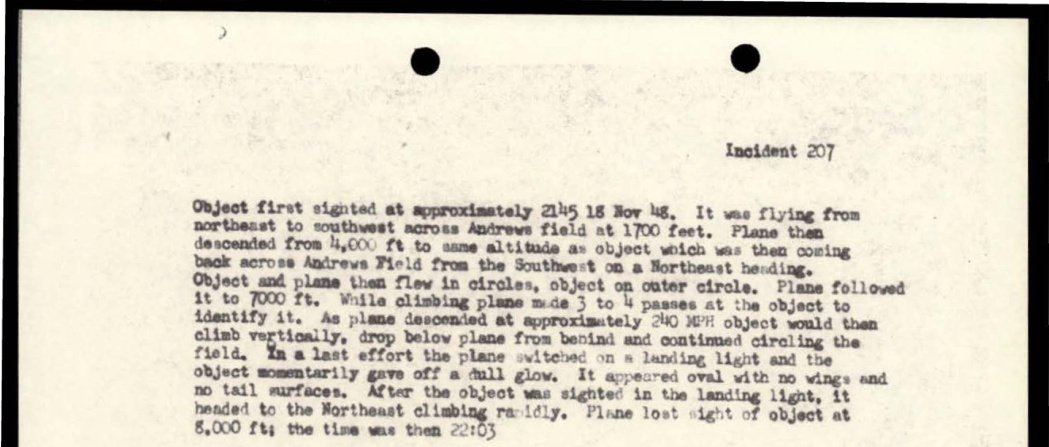
According to Jackson's signed statement, the object was crossing the base from northeast to southwest at 1.700 feet. The aircraft descended from 4.000 feet to the same altitude, and the two began flying in circles, with the object on the outside. The aircraft followed it up to 7.000 feet and made 3 or 4 passes to identify it. When the aircraft was descending at about 240 miles per hour, the object climbed vertically, passed underneath, behind, and resumed circling. Finally, the aircraft turned on a landing light and the object briefly gave off a dull glow: it appeared oval, without wings or tail. It then headed northeast, climbing rapidly, and was lost at 8.000 feet at 22h03.
Combs described the same scene in more detail. He saw a steady white light circling from west to east over the base and thought it was an aircraft with its navigation lights off. When the object began to evade, he turned off his wing and tail lights and maneuvered so that the object would not see the glare of his exhaust. He tried to put the object between the aircraft and the Moon, and between the aircraft and the lights of Washington. He saw only an oblong ball with a light, without wings and without exhaust flame.
According to Combs, the object made 360-degree turns tighter than the aircraft's and changed speed rapidly, from 80 to 500 or 600 miles per hour. On a final approach, Combs passed 300 to 400 feet below it and illuminated it with the landing light: it had a dull gray glow and an oblong shape. Then the object made a very tight turn and headed for the east coast.
On the ground, Sergeant John J. Kushner was on duty when he heard a noise similar to that of a P-47 fighter, only twice as loud. He turned and saw a bright object crossing the sky, coming from the 2238th Engineering hangar toward hangar no. 1, at low altitude. He saw no exhaust, said it could not have been a P-47 and that it did not look like an aircraft. Shortly afterward he heard the same noise, louder, over the field. The file records that he corroborates the two lieutenants.
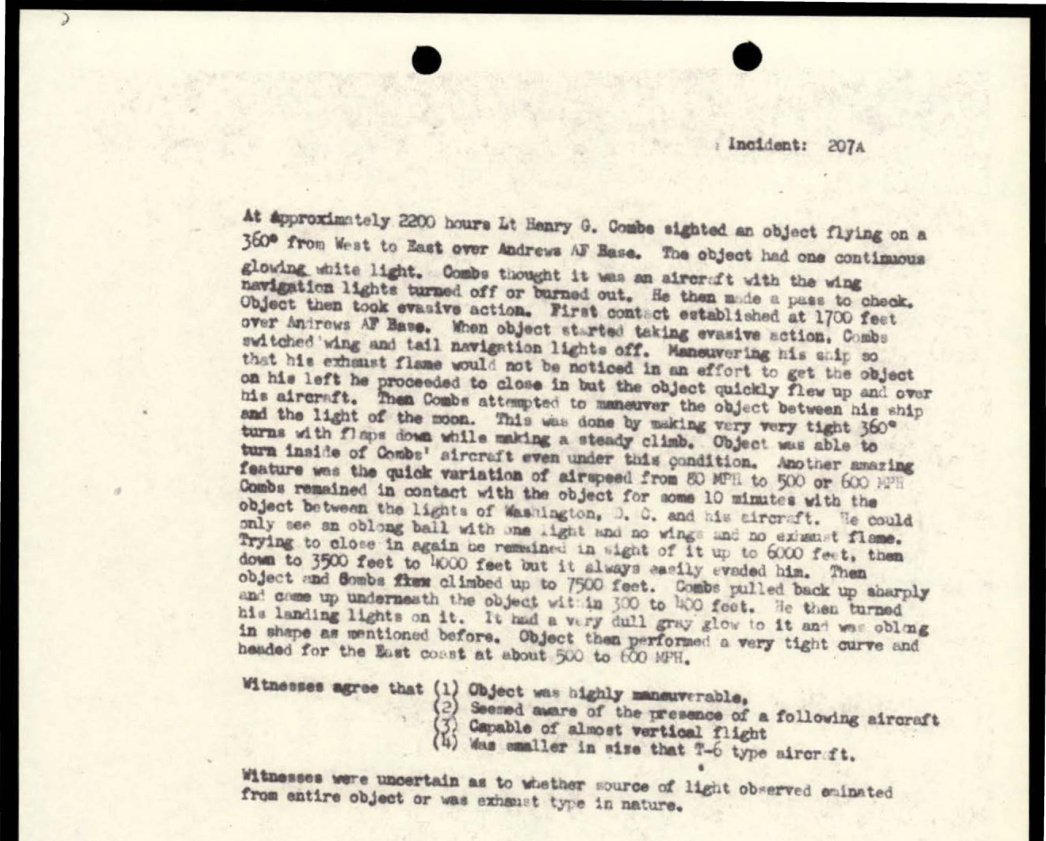
The pilots agreed on four points: the object was highly maneuverable, seemed to realize it was being followed, could fly almost vertically and was smaller than a T-6 aircraft. They could not say whether the light came from the entire object or from an exhaust. The pages contain no conclusion or air traffic check. The type of the lieutenants' aircraft is not given; the T-6 appears only as a size comparison. The illuminated weather balloon is a widely cited editorial hypothesis for chases from this period, but it does not by itself explain the noise described on the ground; the document does not discuss explanations.
The case did not remain only in the sheets. Less than a month later, the secret Air Force intelligence analysis of December 10, 1948, on flying objects in the United States included it in Appendix C, among the selected reports from observers considered qualified. The summary, item "2t," appears in both copies of the study kept in the collection and brings together in a few lines what the sheets recount: the passes at about 240 miles per hour, the vertical climb, the dull gray glow under the landing light, Combs's ten minutes with the object between the aircraft and the lights of Washington, the departure toward the east coast at 500 or 600 miles per hour and Sergeant Kushner's account.
The study's version differs from the sheets on two points. It speaks of "three reserve pilots" flying near Andrews, Jackson, Stalker and Combs, whereas the sheets treat Stalker only as the person who corroborated Jackson's statement. And it refers to "the pilot of the aircraft," in the singular, which suggests a single aircraft, something the sheets do not clarify. The study adds no explanation: the case appears among the incidents not yet explained, and the same document says that only 18 of about 210 reports had been identified up to that point.
Sheets 207, 207A and 207-B are in the bundle of summary sheets for incidents 173 to 233, forwarded by the Air Materiel Command on March 9, 1949. The signed statements by Jackson, Stalker and Kushner, cited in the summaries, are not in the collection. Nothing in the case is a measurement: altitudes of 1.700 to 8.000 feet, a distance of 300 to 400 feet and speeds of 80 to 600 miles per hour are estimates by people flying at night. The institutional assessment is the selection of the case as an example in the December study; the illuminated balloon hypothesis remains editorial and does not appear in the papers.
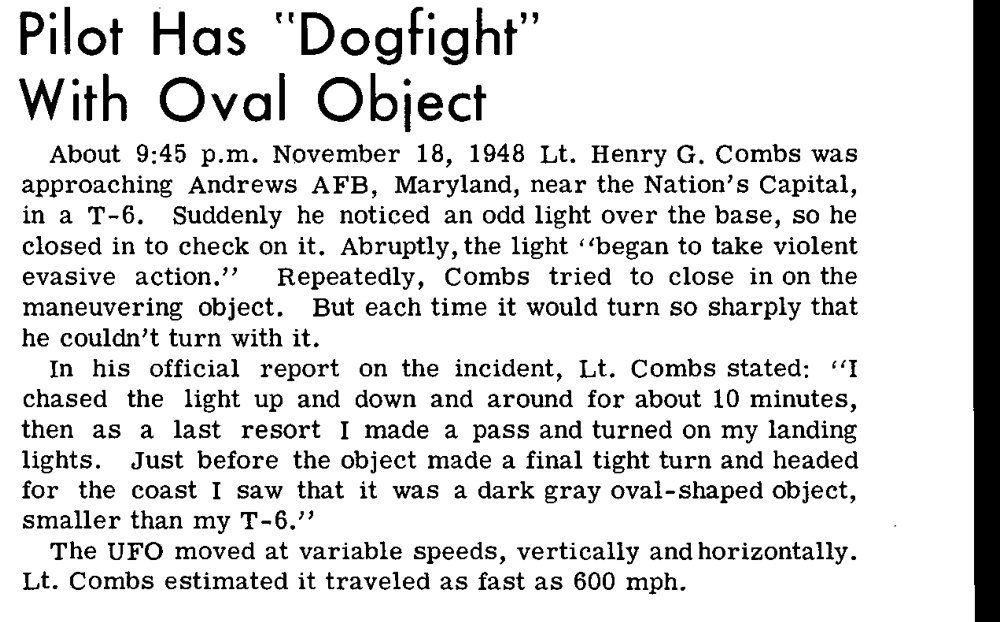
The report The UFO Evidence, published in 1964 by NICAP, a civilian organization in Washington, and kept in copy by the CIA, recounts the case in the section on Air Force military personnel, but only through the version of Lieutenant Henry G. Combs. According to NICAP, at around 21h45 on November 18, 1948, Combs was approaching Andrews Base in a T-6 when he saw a strange light over the base and went to check it out. The light began to "take violent evasive action" and, at each attempted approach, made turns so tight that he could not keep up.
NICAP quotes Combs's "official report": he chased the light up, down and around for about ten minutes and, as a last resort, made a pass with his landing lights on; shortly before the object made its last tight turn and left toward the coast, he saw that it was a dark gray oval object, smaller than his T-6. The object changed speed vertically and horizontally, and Combs estimated up to 600 miles per hour. NICAP's version differs from the sheets on two points: it puts Combs in a T-6, a type the sheets cite only as a size comparison, and it omits Lieutenant Jackson and Sergeant Kushner.
More images from the document
DIRECT READING OF THE FILE
The document, in the original
All pages of the case in this PDF were translated in full, one per block, and checked against the facsimile: the standardized "Incident Summary Sheet" form (items 1 to 25) and the attached summary sheet. Pages 83 to 88 translated in full (three forms and three summaries). For privacy, home addresses, telephone numbers, military service numbers and health data of private individuals were replaced by bracketed markers; the rest follows the original.
EXCERPT 1 · PHYSICAL PAGE 83
Physical page 83: form for incident 207 (Jackson)
•
.J' .. .
::?071 : o .
I...
7
•
-.
- '
.-
(
•• r
.Ji:-
... e,
.
. io. At
0
..•
n:
(r) :
·:
c: l
I
Air
.... .)
e:
l t
1
iM4
1/S
• ., w or
to ciYe ott •,
1100 to 1.oco 1,
al
• . d
• .I.•
ll.
~
, .
1' .
1; .
l •
9.
2~ .
23 .
2
25.
C
I/
15 11mm •
o• - aoa\
beial! ..
( )
a/
I/
r f): I/
•w1..--
( >
)
- : I/
to
'
laaf I - a\rae
•• • or
o!
alrol• f1el4.Editorial note: In item 22 there is a typed line struck out with x's, illegible, before the valid answer.
Check the original PDF
INCIDENT SUMMARY SHEET. Incident No. 207. 1. Date and Time of Observation: 18 Nov 1948 2145 hours. 2. Where Sighted: Circling Andrews AF Base, Camp Springs, Md. 3. Observer's Position: Air. 4. Name and Address of Observer: 2d Lt Kenwood W. Jackson, [home address], Washington, D. C. 5. Occupation and/or hobbies: 2d Lt AFR - telephone cableman. 6. Attention Attracted by: light. 7. Number of Object(s) Seen: 1. 8. Size of Object(s): Undetermined. 9. Color of Object(s): N/S. 10. Shape (Sketch if Possible): Oval, no wings or tail surfaces. 11. Nature of Luminosity: Seemed to give off a dull glow. 12. Altitude of Object (estimated): 1700 to 8,000 ft. 13. Estimated Distance of Object from Observer: N/S. 14. Estimated Speed of Object: N/S. 15. Time in Sight: 15 to 18 minutes. 16. Tactics: Evasive tactics - continued to circle field. Could climb vertically, then would drop behind and continue to circle field. 17. Sound Made by Object(s): N/S. 18. Direction of Flight of Object(s): Northeast - Southwest. 19. Apparent Construction: N/S. 20. Effect on Clouds: N/S. 21. Exhaust Trail (Color of): N/S. 22. Manner of Disappearance: [struck-through text] Climbed out of sight toward northeast. 23. Weather Conditions at Time of Sighting: CAVU - no clouds, haze or smoke. 24. Peculiarities Noted: No wings or tail surfaces - extreme maneuverability. 25. Summary of Incident: (over) (See attached page).View the document record ↗ · Physical page 83, counting the cover.
EXCERPT 2 · PHYSICAL PAGE 84
Physical page 84: summary of incident 207
Incident 207
Object first signted at approximately 2145 18 Bov 4S, It wac flying from
northeast to southwest across Andrews field at 1700 feet. Plane then
descemied from 4,000 ft to same altitude a» object woich was then coming
back across Andrews Field from the Southwest on a Northeast he ding.
Object and plane then flew in circles, object on outer circle. Plane followed
it to 7000 ft, While climbing plane mde 3 to 4 passes at the object to
identify it. As plane descented at approximately 240 M’H object would then
climb vertically, drop below plane from benind and contimed circling the
field, @ last effort the plane switched on = landing Light and the
oBject momentarily gave off a dull glow. It appecred oval with no wings and
no tail surfaces, After the object was sighted in the landing light, it
headed to the Northeast climbing ravidly. Plane lost sight of object at
8,000 ft; the time was then 22:03
Weather at the time: CAVU - no clouds, hase or smoke,
Taken from vigned strtement of Kenwood #. Jackwn, 24 Lt, AFRes, AO- 4113
Statement corroborated by Glen L, Stalker, 2nd Lt, UsiixCheck the original PDF
Incident 207. Object first sighted at approximately 2145 18 Nov 48. It was flying from northeast to southwest across Andrews field at 1700 feet. Plane then descended from 4,000 ft to same altitude as object which was then coming back across Andrews Field from the Southwest on a Northeast heading. Object and plane then flew in circles, object on outer circle. Plane followed it to 7000 ft. While climbing plane made 3 to 4 passes at the object to identify it. As plane descended at approximately 240 MPH object would then climb vertically, drop below plane from behind and continued circling the field. In a last effort the plane switched on a landing light and the object momentarily gave off a dull glow. It appeared oval with no wings and no tail surfaces. After the object was sighted in the landing light, it headed to the Northeast climbing rapidly. Plane lost sight of object at 8,000 ft; the time was then 22:03. Weather at the time: CAVU - no clouds, haze or smoke. Taken from signed statement of Kenwood W. Jackson, 2d Lt, AFRes. [service number]. Statement corroborated by Glen L. Stalker, 2nd Lt, USAFR.View the document record ↗ · Physical page 84, counting the cover.
EXCERPT 3 · PHYSICAL PAGE 85
Physical page 85: form for incident 207A (Combs)
l. Dat en Ti. of Obsel"VO.U.on: 11 loY
lncLei.t :~c . .MA
bow-•
Wh re Sighted: 1u, crNI' AadreVI a .._, 41ncUJ oYff a.., Bp-tDg • N4
3. Ob:.. !"'I C I S • 0 Hi r.: A1,r
(i.e., .:round, r..ir, co it r l ower, tc.)
G. Oollb • 2d L\, 0
5. iot ar.d/or hot 1 91511 S. C-,>lt l ~t. •
7. r b r of O J c ( ) ~,en ; l
~i: ?f Ob t( r) :
0. 0f J, C ( ) : •
10. ~1
dUll
='ball,ld ao
u . ~a d. to
. ~ tt, DO +........-t...
U.H obJ cf\ or
Al
,\
f : 1700 ft to IJ'OU8d. 7'X) t,
'
a:) to 6c,o
10 \o 12 ldlllte1
0111\r to rfona ticht ctrcl•
I•• hsi 'l'Off at•
l S. Dinct on ".'lf F i ·r t o! t'tjcc (!:') • •t to 1\ b circular patten
t Con ru .tl n: • U•
•
22. ::.:..nn.t.r of ::>isr:;:p.r l.: 1/S
a.10•• or foe- Ju.11•--. -a aU'\10\1IN; mrae ~111'1 -
ler.,\1oa.
-
nt:
: lo "1llp
bJabrawof
("91')
( e ttrccl c.d p...~)
• r tail .m-f .. ce• (obl nc
coa\tmous £).orlJlc ii\e licb\
h r aoarce of ll&bt
uture.
Jippt'os JOO to I()() feet Oil OM
w~Editorial note: In the original, the home address was typed in field 5 (occupation); omitted. "Eminated" is a misspelling in the original.
Check the original PDF
INCIDENT SUMMARY SHEET. Incident No. 207A. 1. Date and Time of Observation: 18 Nov 48 2200 hours. 2. Where Sighted: East over Andrews AF Base, directly over Camp Springs, Md. 3. Observer's Position: Air. 4. Name and Address of Observer: Henry G. Combs, 2d Lt, USAFR. 5. Occupation and/or hobbies: [home address], Washington, D. C. 6. Attention Attracted by: movement of lone moving lighted object. 7. Number of Object(s) Seen: 1. 8. Size of Object(s): Smaller than a T-6 type aircraft. 9. Color of Object(s): dull gray (whitish grey). 10. Shape (Sketch if Possible): Oblong ball, no wings or tail surfaces (oblong ovate). 11. Nature of Luminosity: Seemed to have had one continuous glowing white light. Could not determine whether source of light eminated from entire object or was exhaust type in nature. 12. Altitude of Object (estimated): 1700 ft to around 7500 ft. 13. Estimated Distance of Object from Observer: Approx 300 to 400 feet on one instance. 14. Estimated Speed of Object: 80 to 600 MPH. 15. Time in Sight: 10 to 12 minutes. 16. Tactics: Evasive controlled tactics and ability to perform tight circle quick variation of air speed. Vertical ascents. Evasive movements. 17. Sound Made by Object(s): N/S. 18. Direction of Flight of Object(s): East to West in circular pattern. 19. Apparent Construction: metallic. 20. Effect on Clouds: N/S. 21. Exhaust Trail (Color of): no exhaust flame. 22. Manner of Disappearance: N/S. 23. Weather Conditions at Time of Sighting: CAVU, no smoke, haze or fog. Full moon. 24. Peculiarities Noted: No wings or tail structure; extreme maneuverability - highly evasive movements, high rate of acceleration. 25. Summary of Incident: (over) (See attached page).View the document record ↗ · Physical page 85, counting the cover.
EXCERPT 4 · PHYSICAL PAGE 86
Physical page 86: summary of incident 207A
At @pproximtely 2200 hours Lt Henry G. Combe sighted an object flying on a
36 from West to Rast over Andrews AT Base, The object had one continous
glowing white light. Combe thought it was an airer:ft with the wing
navigation lights tarmed off or burned out, He then mie a pass to check,
Object then took evasive action, First contict established at 1700 feet
over Anirews AF Base, When object started teking evasive sction, Combs
switched 'wing and tail havigntion lights off, Maneuvering his cuir so
that his exhaust flame woul’ not be noticed in an effort to get the object
on hie left he to close in but the object quickly flew up an! over
his aireraft, Combs attempted to maneuver the object between hie ship
amd the light of the moon. ‘his was done by waking very very tight 360°
turns with flaps dow while making a steady climb, Object wi able to
turn insite of Combs’ sircreft even under this condition, Another amazing
feature was the quick variation of eirepeed from 8 MPI to 500 or 600
Combs remained in contact with the object for some 10 mimtes with the
object between the lights of Westington, 2, C. and his cirersft. “le could
only see an oblong ball with one aight und no wings uni no exiumet flame.
Trying to close in again ce reminec in whgnt of it up to GOOD fect, then
down to 3500 feet to O00 feet wut it always eseily evaded hin. Then
object amd Gombe fem climbed up to 7500 feet. Combe pulled back up sbarply
ap? come up undermesth the object wit in 300 to loo foot. ‘le then turned
bis landing lights on it. It nad a v: ry dwll gray glow to it ani ws odlmg
in shape as wentioned before, Object then pertorme: & very tight curve and
beaded for the Bast count at about 500 to 600 MPH,
Witnesses agree that (1 Object was highly maneuverable,
2) Seemed aware of the nresence of a following aircraft
t3 Capable of almost vertical flight
) dae omaller in wise that 7-6 type airer ft,
.
Witnesses were uncertain as to Woether source of light ob«erved eninated
from entire object or was exhart type in nature,Editorial note: "Combs flew climbed" has a struck-out word in the original ("flew"). The original writes "Combe" once; corrected to Combs based on the form.
Check the original PDF
Incident: 207A. At approximately 2200 hours Lt Henry G. Combs sighted an object flying on a 360° from West to East over Andrews AF Base. The object had one continuous glowing white light. Combs thought it was an aircraft with the wing navigation lights turned off or burned out. He then made a pass to check. Object then took evasive action. First contact established at 1700 feet over Andrews AF Base. When object started taking evasive action, Combs switched wing and tail navigation lights off. Maneuvering his ship so that his exhaust flame would not be noticed in an effort to get the object on his left he proceeded to close in but the object quickly flew up and over his aircraft. Then Combs attempted to maneuver the object between his ship and the light of the moon. This was done by making very very tight 360° turns with flaps down while making a steady climb. Object was able to turn inside of Combs' aircraft even under this condition. Another amazing feature was the quick variation of airspeed from 80 MPH to 500 or 600 MPH. Combs remained in contact with the object for some 10 minutes with the object between the lights of Washington, D. C. and his aircraft. He could only see an oblong ball with one light and no wings and no exhaust flame. Trying to close in again he remained in sight of it up to 6000 feet, then down to 3500 feet to 4000 feet but it always easily evaded him. Then object and Combs flew climbed up to 7500 feet. Combs pulled back up sharply and came up underneath the object within 300 to 400 feet. He then turned his landing lights on it. It had a very dull gray glow to it and was oblong in shape as mentioned before. Object then performed a very tight curve and headed for the East coast at about 500 to 600 MPH. Witnesses agree that (1) Object was highly maneuverable, (2) Seemed aware of the presence of a following aircraft, (3) Capable of almost vertical flight, (4) Was smaller in size than T-6 type aircraft. Witnesses were uncertain as to whether source of light observed eminated from entire object or was exhaust type in nature.View the document record ↗ · Physical page 86, counting the cover.
EXCERPT 5 · PHYSICAL PAGE 87
Physical page 87: form for incident 207-B (Kushner)
-•r, ,.
.. . 0
.,
a..
•
.. ..
-· .
t
·'· .
•. .
) . I/
I • ct, 11, . • . ..
) w 1 . . . . . .W/1 • . . . • .
l ,
-1/ . •
}
·" . .
.'I/
Rq.
.. ..,,, . . . •
~- •h • . • I
•.. C . .
17. ~ nil j' . . • . M l-'aa
.I. •
.
E!' cct. or.
1/.J • .. -. . . ..
r
•
- .. . .. . • • . . .. . . • . . . . . . .
2) . s 0 nc
• • • . . .. . ... . . . . . ..
• • • • . .
( A n
( _______Editorial note: "Hanger" is the original's spelling (hangar).
Check the original PDF
INCIDENT SUMMARY SHEET (To be filled out and retained in files). Incident 207-B. 1. Date of Observation: 18 Nov 48. 2. Time of Observation: N/S. 3. Where was Object(s) Sighted: Over Andrews AF Base, Camp Springs, Md. 4. Observer's Position: Ground while on duty. 5. Name and Address of Observer: John J. Kushner, S/Sgt USAF, Andrews AF Base. 6. Occupation and/or Hobbies: S/Sgt USAF. 7. Attention Attracted to Object(s) By: Noise. 8. Number of Object(s) Sighted: 1. 9. Size of Object(s): N/S. 10. Color of Object(s): N/S. 11. Shape (Sketch if Possible): N/S. 12. Nature of Luminosity: N/S. 13. Estimated Distance of Object from Observer: Not very high. 14. Speed of Object(s): N/S. 15. Time in Sight: N/S. 16. Tactics: N/S. 17. Sound Made by Object(s): Twice as loud as P-47 but similar in sound. 18. Direction of Flight of Object(s): Cannot be ascertained from statement "came from direction 2238th Eng across field towards Hanger #1". 19. Apparent Construction (Of What Material or Substance): "light". 20. Effect of Objects on Clouds and/or Exhaust Trail: N/S. - no exhaust seen. 21. Weather Conditions Existing at the Time: Night - moonlit - as gleaned from statements of pilots. 22. Peculiarities Noted: did not look like an aircraft. 23. Summary of Incident: (over). (Attach a Separate Sheet if Additional Space is Needed).View the document record ↗ · Physical page 87, counting the cover.
EXCERPT 6 · PHYSICAL PAGE 88
Physical page 88: summary of incident 207-B
Incident 207-3
Statement of S Sgt Jobn J. Kushner corroborates agcount of 2d Lt
od #. J and 2d Lt Henry G. Combs. Sgt Euehner ves on
ground duty when he noise, Turning his head in the direction
of the sound he say @ shin object coming across the sky, It
made a sound similar to a 7 only twice as loud, It seemed to
him to be from the direction of the 2238th
acrose the flats toward Hanger #1, I+ waen't very high, Tenses:
have been « P-i7 and witmers did not see an exhaust, Shortly after.
wards, he heard the same noise only higher Up over the field, He
stated the object dia Rot resemble an aircraft,Editorial note: The surname appears as Kushner on the form and in the summary; the summary's print is faint.
Check the original PDF
Incident 207-B. Statement of S/Sgt John J. Kushner corroborates account of 2d Lt Kenwood W. Jackson and 2d Lt Henry G. Combs. Sgt Kushner was on ground duty when he heard a noise. Turning his head in the direction of the sound he saw a shining object coming across the sky. It made a sound similar to a P-47 only twice as loud. It seemed to him to be coming from the direction of the 2238th Engineering Hangar across the field toward Hangar #1. It wasn't very high. It couldn't have been a P-47 and witness did not see an exhaust. Shortly afterwards, he heard the same noise only higher up over the field. He stated the object did not resemble an aircraft.View the document record ↗ · Physical page 88, counting the cover.
EXCERPT 7 · PHYSICAL PAGE 30
Physical page 30, account "Pilot Has 'Dogfight' With Oval Object" (synopsis of the part about the case)
observed wl ought ooting star 990 southeast over
proved For iize% 2001/04/02 : CIA-RDP81R00560R000100010001-
Bomber ‘Paced d by
(Capt. Alvah M, Reida, during his military flying career, was
an Airplane Commander on B-26’s, B-24’s and B-29’s. At the
time of the sighting, he was based at Kharagapur, India, in the
468th Bomb Group, 792nd Squadron, XX Bomber Command,
All quotes from his report, on file at NICAP).
“‘T was on a mission from Ceylon, bombing Palembang, Sumatra.
The date was August 10, 1944, time shortly after midnight.
There were 50 planes on the strike going in on the target at about
2 or 3 minute intervals. My plane was the last one in on the
target and the assignment was for us to bomb, then drop photo-
flash bombs, attached to parachutes, make a few runs over the
target area, photographing damage from the preceding planes.
The weather was broken clouds, with an overcast above us. Our
altitude was 14,000 feet, indicated air speed about 210 mph.
‘While in the general target area we were exposed to sporadic
flak fire, but immidiately after leaving this area it ceased. At
about 20 or 30 minutes later the right gunner and my co-pilot
reported a strange object pacing us about 500 yards off the star-
board wing. At that distance it appeared as a spherical object,
probably 5 or 6 feet in diameter, of a very bright and intense red
or orange in color. It seemed to have a halo effect. Something
like this:
“ee fo feet oe
le Ese oct ihn
“My gunner reported it coming in from about five o’clock
position at our level. It seemed to throb or vibrate constantly.
Assuming it was some kind of radio controlled object sent to
pace us, I went into evasive action, changing direction constantly
as much as 90 degrees and altitude about 2000 feet. It followed
our every maneuver for about 8 minutes, always holding a
position of about 500 yards out and about 2 o’clock in relation
to the plane. When it left, it made an abrupt 90 degree turn,
up and accelerating rapidly; it disappeared in the overcast.’’
Capt. Reida added: ‘‘During the strike evaluation and interro-
gation following this mission, I made a detailed report to Intelli-
gence, thinking it was some new type of radio controlled missile
or weapon.’’
Cigar-Shaped UFO Near
AF Transport
(Capt. Jack Puckett, at the time ofhis UFO sighting, was Flying
Safety Officer, Hdq., Tactical Air Command, 300th Base Unit,
Langley Field, Va. His duties included supervision of flying op-
erations and training, investigation of all aircraft accidents in his
command. He has served as an instructor pilot, four engine air-
craft, and flew a tour of combat in the European Theater, World
War Il).
“IT was making a scheduled flight from Langley Field, Virginia
[August 1, 1946] to MacDill Field, Tampa, Florida. At approxi-
mately 6 p.m. while flying a C-47 at 4000 feet northeast of Tampa
the Atlantic Ocean. My copilot, Lt. Henry F. Glass and my engi-
neer both observed this object at the same time.
“This object continued toward us ona collision course at our
exact altitude. At about 1000 yards it veered to cross our path.
We observed it to bea long, cylindrical shape approximately twice
the size of a B-29, with luminous portholes.’”’
The UFO seemed to be rocket propelled, Capt. Puckett stated.
The object trailed a stream of ‘‘fire’’ about one-half its own
length, and remained in sight 2 1/2 to 3 minutes.
Pilot Has “Dogfight”
With Oval Object
About 9:45 p.m. November 18, 1948 Lt. Henry G. Combs was
approaching Andrews AFB, Maryland, near the Nation’s Capital,
in a T-6. Suddenly he noticed an odd light over the base, so he
closed in to check on it. Abruptly, the light ‘‘began to take violent
evasive action.’? Repeatedly, Combs tried to close in on the
maneuvering object. But each time it would turn so sharply that
he couldn’t turn with it.
In his official report on the incident, Lt. Combs stated: ‘‘I
chased the light up and down and around for about 10 minutes,
then as a last resort I made a pass and turned on my landing
lights. Just before the object made a final tight turn and headed
for the coast I saw that it was a dark gray oval-shaped object,
smaller than my T-6.”’
The UFO moved at variable speeds, vertically and horizontally.
Lt. Combs estimated it traveled as fast as 600 mph.
TECHNICAL INTELLIGENCE CENTER
OFFICIAL OBSERVES DISC, SHARP TURN
On June 1, 1951, about 10:00 p.m., an official at Wright-
Patterson AFB, Ohio, sighted an apparently disc-shaped UFO.
Because of his sensitive position, he has requested that his name
be kept confidential. The report is certified by the NICAP
Director and Assistant Director. (Note: All confidential reports
in this document, certified by NICAP officials, will be made
available to any authorized Congressional investigators.)
«While driving West near Dayton, Ohio, I suddenly became aware
of a large blue-white light moving parallel to me. It was parallel
and to the left at 30to 45 degrees elevation. I can best describe it
as being similar to the flame trail from a rocket power plant.
It was a clearly defined outline similar to a stubby cigar. It
was much brighter at the leading end, and gradually dimmer to-
ward the trailing end. After 10to 15 seconds it made approximate-
ly a right angle turn, became circular and even-colored, and
rapidly disappeared. I detected no trace of yellow, orange, red
or purple in the color. The speed was faster than an airplane,
slower than a meteor.’’
Disc Buzzes Fighter Plane
The following case was reported by Cleveland Press Aviation
Editor Charles Tracy, a former wing operations officer in the
Air Force. (Originally reported in Cleveland Press, picked up
by United Press International, July 30, 1952).
During the Summer of 1951, Lt. George Kinman was flying over
Augusta, Georgia, on a clear, sunny day. At the time, he was a
seven year flying veteran, since a jet pilot at overseas bases.
“IT was cruising at about 250 mph.,’’ Lt. Kinman told Tracy.
“All of a sudden I noticed something ahead, closing in on me,
head on. Before I could take evasive action ~ before I even
thought of it, in fact - this thing dipped abruptly and passed under-
neath just missing my propeller. The thing was definitely of
disc shape. . . white. .. pretty thick. .. it looked like an
oval. . . it was about twice as big as my plane, It had no visible
protrusions like motors, guns, windows, smoke or fire.’’
Lt. Kinman swung his F-51 around, but the disc was out of
sight. Within about 15 seconds, he said, the disc came at him
again, dipping at the last minute. This performance was repeated
several times for a period of 5 to 10 minutes. Finally, on its
last pass, the UFO zoomed upward instead of down, just missing
his canopy.
Approved For Release 2001/04/02” CIA-RDP81R00560R000100010001-0Editorial note: "United Press International, July 30, 1952" appears this way in the original, although the merger that created UPI dates from 1958; recorded in corrections.
Check the original PDF
[p. 30: texto da publicação privada não reproduzido; ver o resumo]View the document record ↗ · Physical page 30, counting the cover.
Dates and documentary context
- Event
- 18/11/1948 — From 21h45 to 22h03, local time, according to Jackson's statement; Combs records 22h00 for the start of his contact.
- Document
- Not established — The date of the signed statements does not appear on these pages.
- Publication
- Not established — Document released in Release 1 of the collection.
Origin and release
U.S. Air Force, Project Sign; incident summary sheets with no identified individual author · 38_143685_box7_Incident_Summaries_173-233.pdf
undefined ↗ — undefined
Questions to continue the investigation
- Do the signed statements of Jackson, Combs, Stalker and Kushner exist in full in another Project Sign series?
- Was an illuminated sounding balloon launched in the Washington area on the night of November 18, 1948?
- Were Jackson and Combs on the same airplane? The document does not state the type or the crew composition.
GEOGRAPHY OF THE CASE
Andrews Air Force Base, Camp Springs, Maryland, USA
Approximate reference to the base cited in the record cards, placed by the editors. It does not indicate the trajectory of the UFO.
DOCUMENTARY TRAIL
Go back to the sources
References use physical pages of the PDF, counting the cover. Summaries are presented in English; the documents keep their original language.
- 38_143685_box7_Incident_Summaries_173-233.pdf
Physical pages 83 to 88: incidents 207, 207A and 207-B (two pilots and a sergeant on the ground)
Arquivo histórico · 144 pages - DOW-UAP-D094_Analysis-of-Flying-Object-Incidents-in-the-US_1949.pdf
Physical page 20: Air Force intelligence study of 10/12/1948, Appendix C, item 2t (Andrews, 18/11/1948)
DOW · 34 pages - DOW-UAP-D093_Analysis-of-Flying-Object-Incidents-in-the-US_1948.pdf
Physical page 32: another copy of the same study, Appendix C, item t (Andrews, 18/11/1948)
DOW · 67 pages - CIA-RDP81R00560R000100010001-0_NICAP-The-UFO-Evidence_1964.pdf
Physical page 30 of the NICAP report The UFO Evidence (1964), CIA copy: account "Pilot Has 'Dogfight' With Oval Object"
CIA · 186 pages
Editorial summary based on the collection's research notes. How we read the documents.