Date: not stated in the text; December 2010, according to the title of the published fileLocation: Washington, Defense Intelligence Agency (DIA)
Washington, 2010: the DIA director informs the Pentagon that the reports of the advanced aerospace threat program were of “limited value”
In a two-page memorandum, the director of the Defense Intelligence Agency summarizes the origin, the contract with BAASS, the 38 technical reports, and Senator Reid's request to make the program secret. According to the text, the DIA decided there was no reason to classify the program and that the reports were of limited value to the agency, which suggested transferring it to another organization.
- Event date
- not stated in the text; December 2010, according to the title of the published file
- Location
- Washington, Defense Intelligence Agency (DIA)
- Topic
- AAWSAP and advanced technologies
- Source agencies
- DOW
- Documents
- 1 document · 2 pages
- Reading time
- 6 min
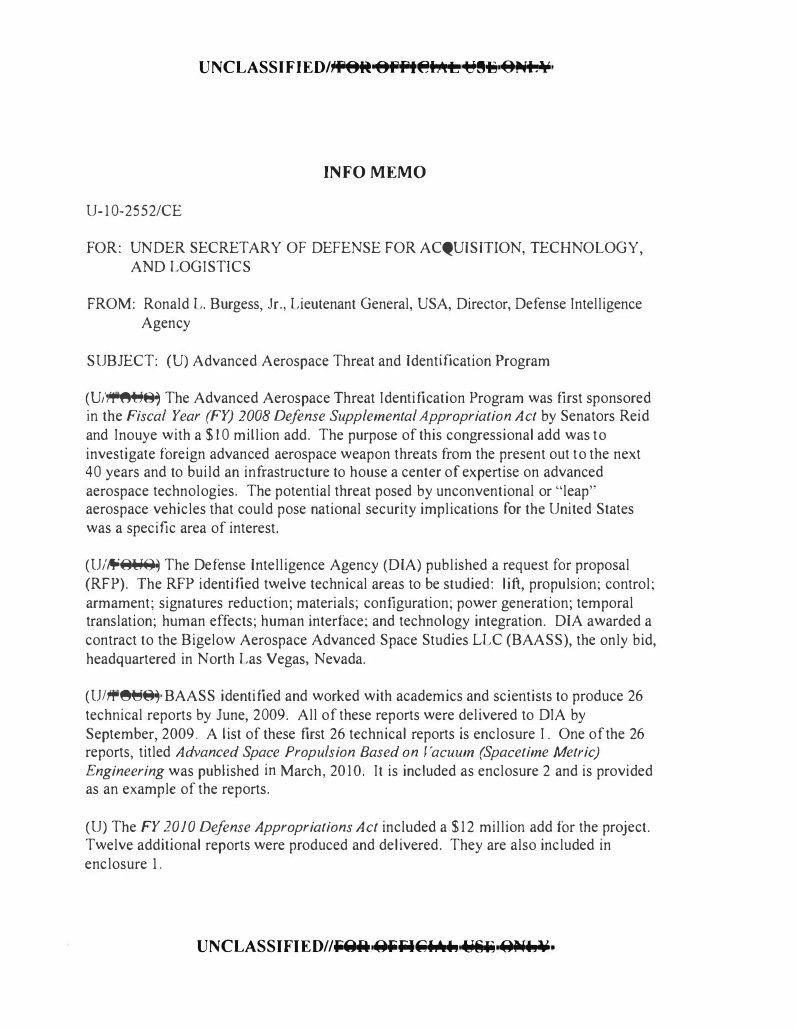 Facsimile of the documentPhysical page 1
DOCUMENTARY SOURCES · DOW
What the records tell
Document: information memorandum U-10-2552/CE, undated in the body of the text. The title of the published file indicates December 2010. It is signed by Lieutenant General Ronald L. Burgess Jr., U.S. Army, director of the Defense Intelligence Agency (DIA). The addressee is the Under Secretary of Defense for Acquisition, Technology and Logistics. The subject is the Advanced Aerospace Threat Identification Program, known by the acronym AATIP. The name appears in two forms in the original, with and without the word “and.” In two pages, the memorandum recounts how the program began, who carried it out, what it produced, and how the DIA assessed it.
According to the memorandum, the program was created by a US$ 10 million add-on in the Fiscal Year 2008 Supplemental Defense Appropriations Act, sponsored by Senators Reid and Inouye. The stated purpose was to investigate foreign advanced aerospace weapons threats, from the present through the following 40 years, and to build the framework for a center of expertise in these technologies. The text cites as a specific interest the potential threat of “unconventional” or “leap” aerospace vehicles. The memorandum does not use the words UAP or UFO and does not mention any sighting.
The DIA issued a solicitation for proposals with twelve technical areas: lift, propulsion, control, weaponry, signature reduction, materials, configuration, power generation, “temporal translation,” effects on humans, human interface, and technology integration. The contract went to Bigelow Aerospace Advanced Space Studies (BAASS), of North Las Vegas, Nevada, described as the sole bidder. According to the director, BAASS worked with academics and scientists and produced 26 technical reports through June 2009, delivered by September. One of them, on propulsion based on “spacetime metric engineering,” was published in March 2010 and attached as an example.
The Fiscal Year 2010 defense appropriations act added another US$ 12 million, and twelve more reports were delivered, for a total of 38. The full list and the sample report were the memorandum's two attachments, but they are not in the two pages of this file. The document also records that, on June 24, 2009, Senator Reid wrote to Deputy Secretary of Defense Lynn asking that the program receive a special form of secrecy: an alternative compensatory control measure or a sensitive access program, with access restricted to a few people.
According to the memorandum, in November 2009 the DIA reviewed the program at the request of the Under Secretary of Defense for Intelligence. The agency concluded that, given the classification level of the products already delivered and planned, there was no basis for making the program secret or for creating the requested restricted access. In the same month, Burgess and Lynn met with Reid. In the director's words, they determined that the reports “were of limited value to DIA.” Burgess writes that he suggested the material might have merit for other organizations and that, once the contract ended, the project could be transferred to another agency.
The memorandum is the DIA director's official account of the program, written for a superior in the Department of Defense and prepared by the agency's public and congressional affairs office, whose head's name is redacted. It confirms amounts, dates, the contractor, and the DIA's assessment. It does not describe the content of the reports beyond one title, contains no sighting cases, and does not say whether the transfer to another organization ever took place. The “limited value” assessment is that of the DIA and its director, not of an independent review.
DIRECT READING OF THE FILE
The document, in the original
The two physical pages of memorandum U-10-2552/CE are translated in full in the page-by-page blocks, including the crossed-out classification markings and the redaction bars in the preparer field. The two attachments cited are not part of this file.
EXCERPT 1 · PHYSICAL PAGE 1
Physical page 1, full page
UNCLASSIFIEDNfJOlt Of3f31CML "t<JSls Q,Jif5:Y
INFO MEMO
U-10-2552/CE
FOR: UNDER SECRETARY OF DEFENSE FOR ACQUISITION, TECHNOLOGY,
AND LOGISTICS
FROM: Ronald L. Burgess, Jr., Lieutenant General, USA, Director, Defense Intelligence
Agency
SUBJECT: (U) Advanced Aerospace Threat and Identification Program
(U,';'FB'ef8) The Advanced Aerospace Threat Identification Program was first sponsored
in the Fiscal Year (FY) 2008 Defense Supplemental Appropriation Act by Senators Reid
and Inouye with a $10 million add. The purpose of this congressional add was to
investigate foreign advanced aerospace weapon threats from the present out to the next
40 years and to build an infrastructure to house a center of expertise on advanced
aerospace technologies. The potential threat posed by unconventional or "leap"
aerospace vehicles that could pose national security implications for the United States
was a specific area of interest.
(U,'WQWe)) The Defense Intelligence Agency (DIA) published a request for proposal
(RFP). The RFP identified twelve technical areas to be studied: lift, propulsion; control;
armament; signatures reduction; materials; configuration; power generation; temporal
translation; human effects; human interface; and technology integration. DIA awarded a
contract to the Bigelow Aerospace Advanced Space Studies LLC (BAASS), the only bid,
headquartered in North Las Vegas, Nevada.
(U,';'PBU8) BAASS identified and worked with academics and scientists to produce 26
technical reports by June, 2009. All of these reports were delivered to DIA by
September, 2009. A list of these first 26 technical reports is enclosure I. One of the 26
reports, titled Advanced Space Propulsion Based on Vacuum (Spacetime Metric)
Engineering was published in March, 2010. It is included as enclosure 2 and is provided
as an example of the reports.
(U) The FY 2010 Defense Appropriations Act included a $12 million add for the project.
Twelve additional reports were produced and delivered. They are also included in
enclosure 1.
UNCLASSIFIED//FOA: OFFICV1eL :WSls ONLYEditorial note: Physical page 1 of DOW-UAP-D186-DIA_Information_Memorandum_on_AATIP_AAWSAP_December-2010.pdf.
Check the original PDF
UNCLASSIFIEDNfJOlt Of3f31CML "t<JSls Q,Jif5:Y
INFO MEMO
U-10-2552/CE
FOR: UNDER SECRETARY OF DEFENSE FOR ACQUISITION, TECHNOLOGY,
AND LOGISTICS
FROM: Ronald L. Burgess, Jr., Lieutenant General, USA, Director, Defense Intelligence
Agency
SUBJECT: (U) Advanced Aerospace Threat and Identification Program
(U,';'FB'ef8) The Advanced Aerospace Threat Identification Program was first sponsored
in the Fiscal Year (FY) 2008 Defense Supplemental Appropriation Act by Senators Reid
and Inouye with a $10 million add. The purpose of this congressional add was to
investigate foreign advanced aerospace weapon threats from the present out to the next
40 years and to build an infrastructure to house a center of expertise on advanced
aerospace technologies. The potential threat posed by unconventional or "leap"
aerospace vehicles that could pose national security implications for the United States
was a specific area of interest.
(U,'WQWe)) The Defense Intelligence Agency (DIA) published a request for proposal
(RFP). The RFP identified twelve technical areas to be studied: lift, propulsion; control;
armament; signatures reduction; materials; configuration; power generation; temporal
translation; human effects; human interface; and technology integration. DIA awarded a
contract to the Bigelow Aerospace Advanced Space Studies LLC (BAASS), the only bid,
headquartered in North Las Vegas, Nevada.
(U,';'PBU8) BAASS identified and worked with academics and scientists to produce 26
technical reports by June, 2009. All of these reports were delivered to DIA by
September, 2009. A list of these first 26 technical reports is enclosure I. One of the 26
reports, titled Advanced Space Propulsion Based on Vacuum (Spacetime Metric)
Engineering was published in March, 2010. It is included as enclosure 2 and is provided
as an example of the reports.
(U) The FY 2010 Defense Appropriations Act included a $12 million add for the project.
Twelve additional reports were produced and delivered. They are also included in
enclosure 1.
UNCLASSIFIED//FOA: OFFICV1eL :WSls ONLYView the document record ↗ · Physical page 1, counting the cover.
EXCERPT 2 · PHYSICAL PAGE 2
Physical page 2, full page
UNCLASSIFIED,'ffi't,ft t,F'F'ICbltts ti9S t,NLY
(U//P@Uo, On June 24, 2009, Senator Reid sent a letter to D.eputy Secretary of Defense
Lynn requesting the Department of Defense establish an alternate compensatory control
measure (ACCM) or sensitive access program (SAP) for this project. In November,
2009, at the request of the Under Secretary of Defense for Intelligence, DIA completed a
review of the program. The Agency determined that, based on classification levels of
current and projected deliverables, insufficient grounds existed to classify the program,
invoke an ACCM, or establish a restricted SAP.
(U/,'F8U®' In November, 2009, Deputy Secretary of Defense Lynn and I met with
Senator Reid to discuss this program. At that time, we determined the reports were of
limited value to DIA. However, I did suggest they could be of merit to other
organizations and, that upon the completion of the DIA contract; the project could be
transitioned to another agency or component better suited to oversee the project.
2 enclosures: a/s
epared by: 11843(a)(3)
I• Office of Congressional and Public AffairsJ1843(a)(3)
1843(a)Q1!5~) P
l
2
UNCLASSIFIED//FOR OFFICIAL USE ONLYEditorial note: Physical page 2 of DOW-UAP-D186-DIA_Information_Memorandum_on_AATIP_AAWSAP_December-2010.pdf.
Check the original PDF
UNCLASSIFIED,'ffi't,ft t,F'F'ICbltts ti9S t,NLY
(U//P@Uo, On June 24, 2009, Senator Reid sent a letter to D.eputy Secretary of Defense
Lynn requesting the Department of Defense establish an alternate compensatory control
measure (ACCM) or sensitive access program (SAP) for this project. In November,
2009, at the request of the Under Secretary of Defense for Intelligence, DIA completed a
review of the program. The Agency determined that, based on classification levels of
current and projected deliverables, insufficient grounds existed to classify the program,
invoke an ACCM, or establish a restricted SAP.
(U/,'F8U®' In November, 2009, Deputy Secretary of Defense Lynn and I met with
Senator Reid to discuss this program. At that time, we determined the reports were of
limited value to DIA. However, I did suggest they could be of merit to other
organizations and, that upon the completion of the DIA contract; the project could be
transitioned to another agency or component better suited to oversee the project.
2 enclosures: a/s
epared by: 11843(a)(3)
I• Office of Congressional and Public AffairsJ1843(a)(3)
1843(a)Q1!5~) P
l
2
UNCLASSIFIED//FOR OFFICIAL USE ONLYView the document record ↗ · Physical page 2, counting the cover.
Dates and documentary context
- Event
- Not established — Administrative document, with no observation episode. Facts cited range from fiscal year 2008 to March 2010, with Reid's letter on 24/06/2009 and the review and meeting in November 2009.
- Document
- 12/2010 — The body of the memorandum is undated; the month of December 2010 comes from the title of the published file.
- Publication
- Not established — Published by the U.S. Department of War on war.gov, release 08 of UAP files (2026).
Origin and release
Defense Intelligence Agency (DIA); signed by Lieutenant General Ronald L. Burgess Jr., director; prepared in the Office of Congressional and Public Affairs (drafter's name [redacted]) · DOW-UAP-D186-DIA_Information_Memorandum_on_AATIP_AAWSAP_December-2010.pdf
Physical pages 1 and 2.
undefined ↗ — undefined
Related accounts and their differences
- Washington, 2008: the DIA hires BAASS
- DIA, 2010: study on spacetime metric engineering
- Las Vegas, 2008: the BAASS management plan for AAWSAP
- Las Vegas, 2010: the BAASS self-assessment
Questions to continue the investigation
- Where are attachments 1 and 2 cited in the memorandum, with the list of the 38 technical reports?
- Was the project ever transferred to another agency or component after the end of the DIA contract?
- What was the exact date this memorandum was sent to the Under Secretary of Defense?
GEOGRAPHY OF THE CASE
Washington, D.C.
Approximate reference point placed by the editorial team; it does not indicate the exact location.
DOCUMENTARY TRAIL
Go back to the sources
References use physical pages of the PDF, counting the cover. Summaries are presented in English; the documents keep their original language.
- DOW-UAP-D186-DIA_Information_Memorandum_on_AATIP_AAWSAP_December-2010.pdf
Physical pages 1 to 2
DOW · 2 pages
Editorial summary based on the collection's research notes. How we read the documents.