Date: April 2010 (April 2 and 6)Location: Reports prepared for the DIA's Acquisition Support Division (DWO-3), Washington, D.C., USA
DIA, 2010: two AAWSAP studies discuss, in theory, the “warp drive” and wormholes for faster-than-light travel
Two DIRDs from April 2010 review solutions of general relativity that would, in principle, allow faster-than-light travel: the Alcubierre warp bubble and traversable wormholes. Both require negative energy or “exotic matter” in quantities no one knows how to produce, and the authors themselves acknowledge that there are no instructions for building any of this.
- Event date
- April 2010 (April 2 and 6)
- Location
- Reports prepared for the DIA's Acquisition Support Division (DWO-3), Washington, D.C., USA
- Topic
- AAWSAP and advanced technologies
- Source agencies
- DOW
- Documents
- 2 documents · 75 pages
- Reading time
- 177 min
 Cover of official reportPhysical page 1
DOCUMENTARY SOURCES · DOW
What the records tell
These are theoretical physics studies, not sighting reports. The first, “Warp Drive, Dark Energy, and the Manipulation of Extra Dimensions,” dated April 2, 2010, has two authors whose names were replaced with “AAP Person 74” and “AAP Person 58.” The second, “Traversable Wormholes, Stargates, and Negative Energy,” dated April 6, 2010, is signed by “AAP Person 58.” Both are part of the AAWSAP program series and start from the same observation: nothing with mass reaches the speed of light, and even a very fast ship would take decades to reach the nearest stars.
The warp drive study explains Miguel Alcubierre's 1994 proposal: a “bubble” of space that contracts in front of the ship and expands behind it, so that the ship remains stationary inside it and it is space itself that moves. Relativity does not limit the speed of space, which would allow the light barrier to be circumvented. A table calculates trips at one hundred times the speed of light: Mars in 193 seconds, Alpha Centauri in 15 days. The authors propose their own approach, linked to dark energy: if it comes from Casimir energy in extra dimensions of space, controlling the size of those dimensions near the ship could control the local expansion of space.
The summary of this first study is cautious. It says the idea of a technology capable of controlling higher dimensions is “tantalizing” and “worthy of deeper investigation,” but that this “may not come to fruition for many years” and “is by no means a certainty.” Before any experiment, it would be necessary to understand dark energy and confirm that extra dimensions exist, something the Large Hadron Collider could test. The estimates of negative energy for a bubble, tabulated in the report, are enormous.
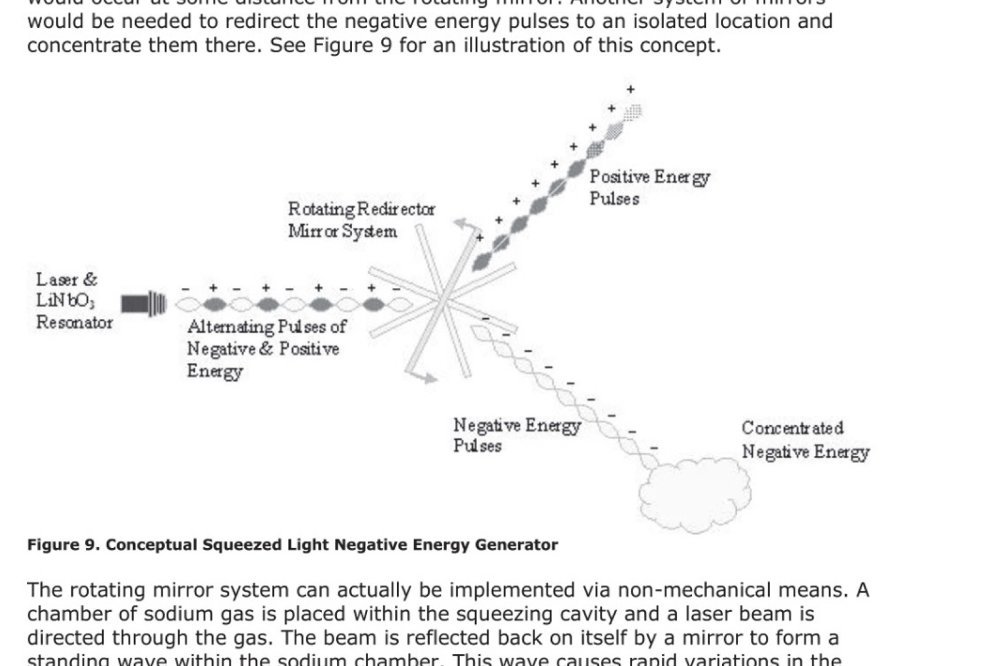
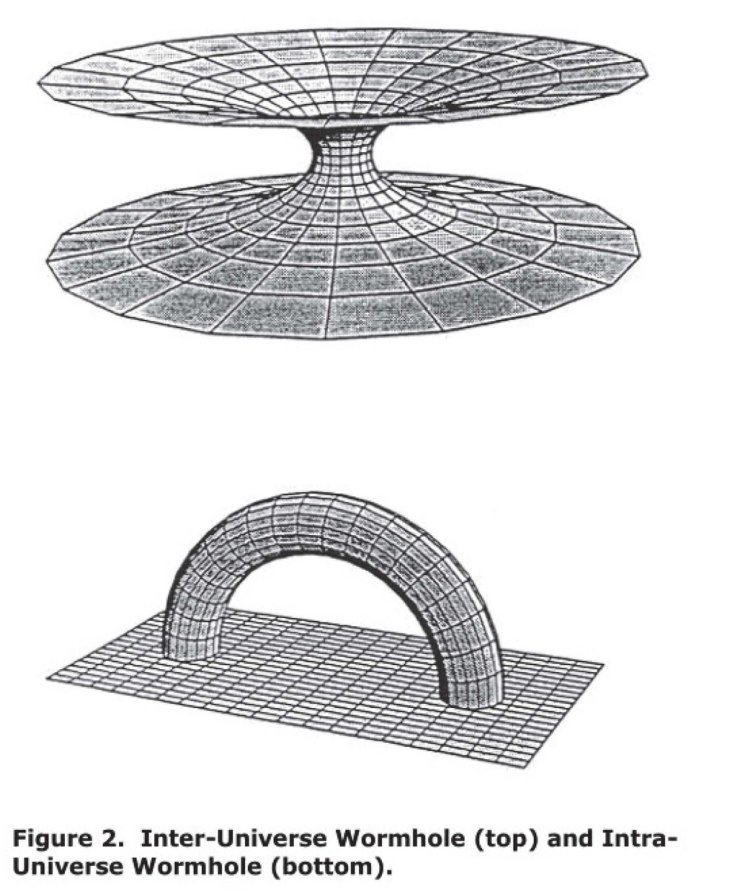
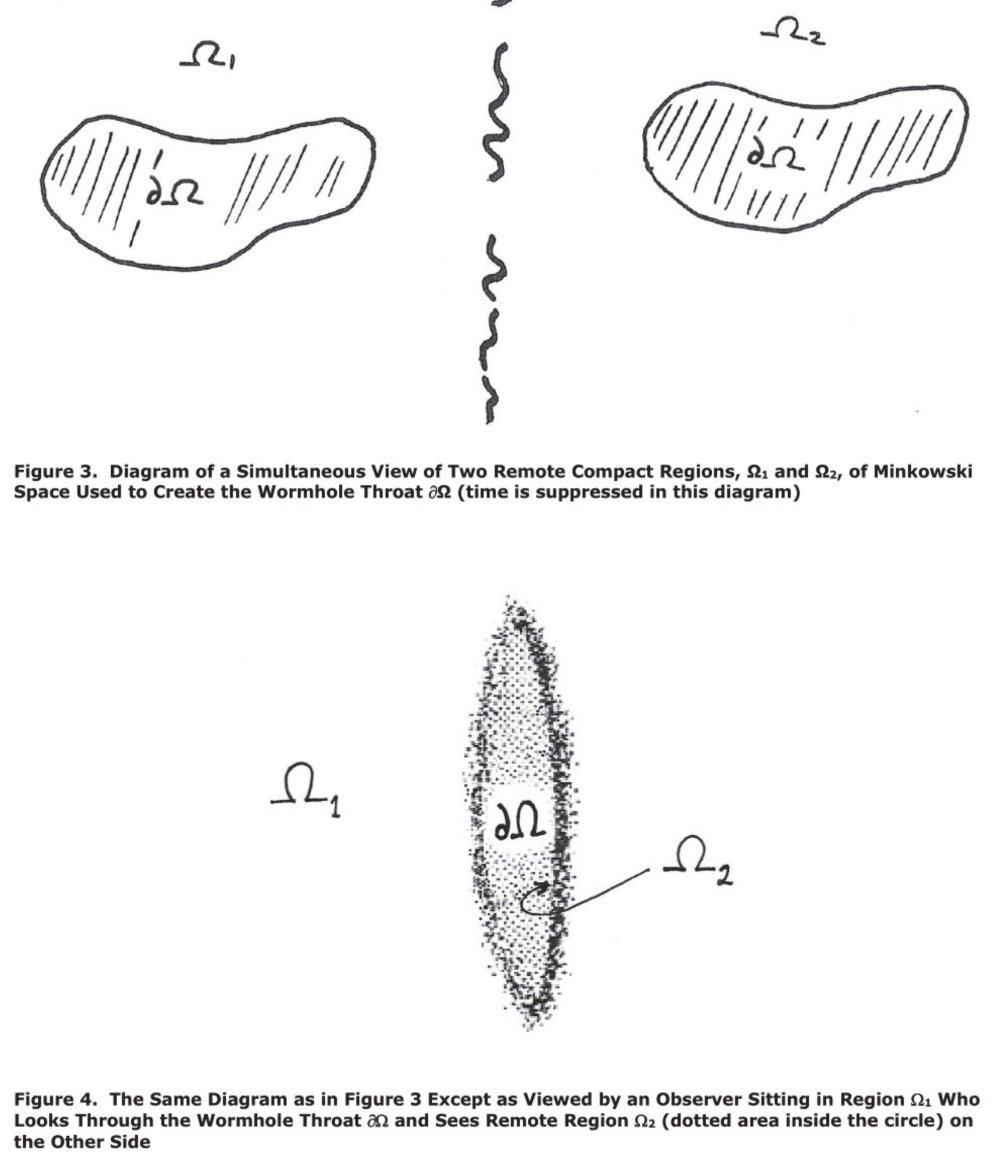
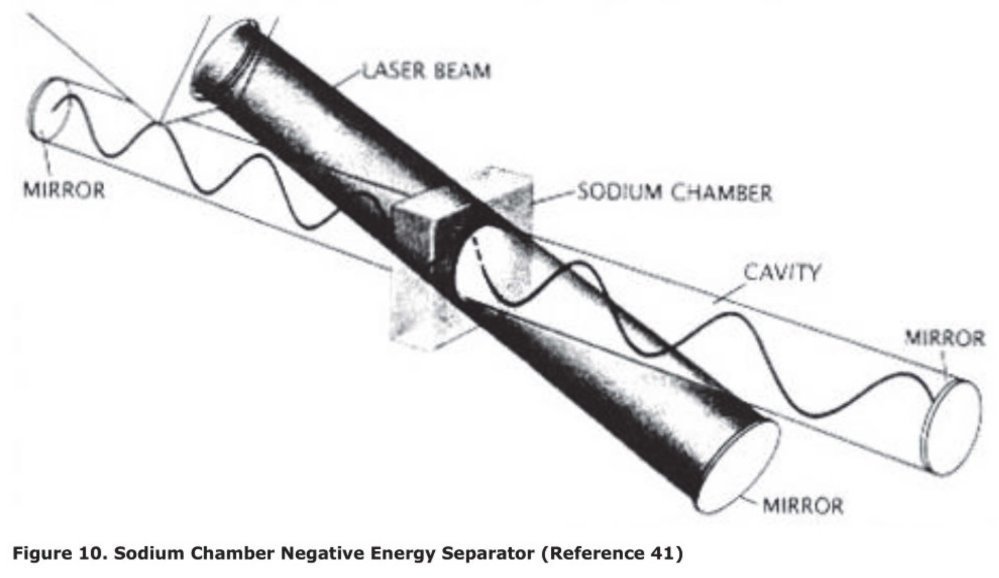
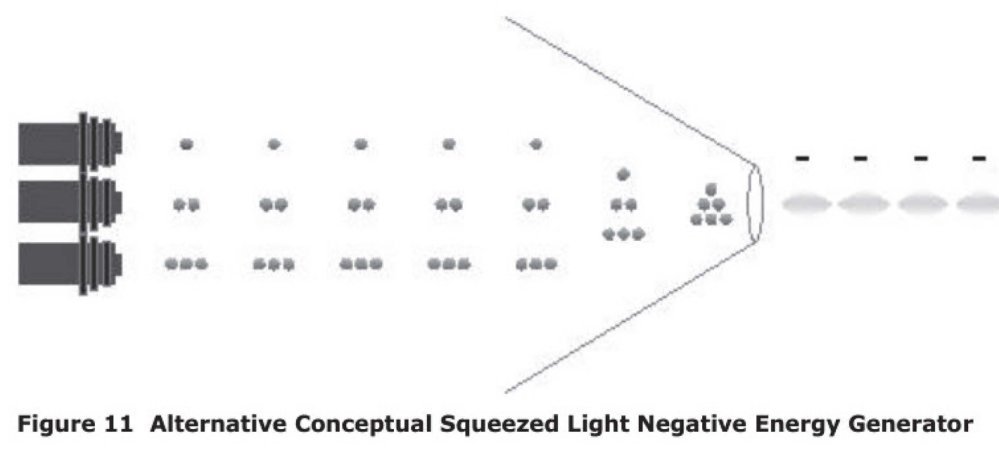
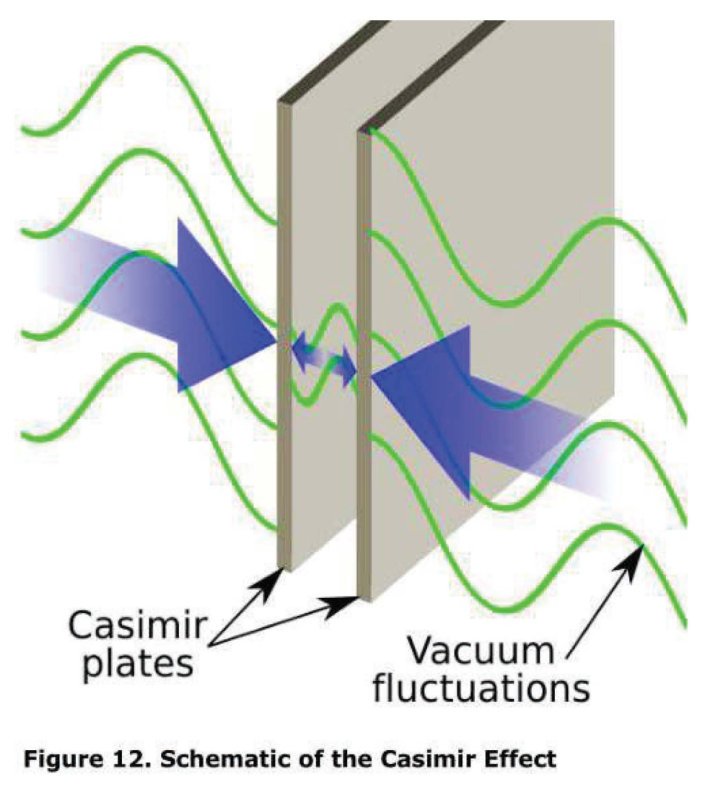
The wormhole study reviews the 1985 Morris and Thorne solution, made at Carl Sagan's request for the novel Contact: tunnels in spacetime that would connect distant regions, with no singularity or event horizon. The author maintains that the objection that “exotic matter” violates the energy conditions is “spurious,” but admits that identifying, measuring, and producing this matter is the central challenge. He reviews ways of generating negative energy in the laboratory, such as squeezed-state light and the Casimir effect, and describes a conceptual generator with rotating mirrors. He acknowledges that “it is not yet known how to build a traversable wormhole”: relativity gives the recipe for the ingredients, “but not the assembly instructions.”
Neither of the two reports mentions UFOs or UAPs. They are relevant to the subject because they show that AAWSAP commissioned assessments of extreme forms of transportation, linked to the “spatial and temporal translation” area of the statement of objectives. The hypotheses are the authors' and depend on unverified physics. The comparison with the history of nuclear energy, from the Curies to the first reactor, is an argument for funding research, not evidence that the technology is feasible.
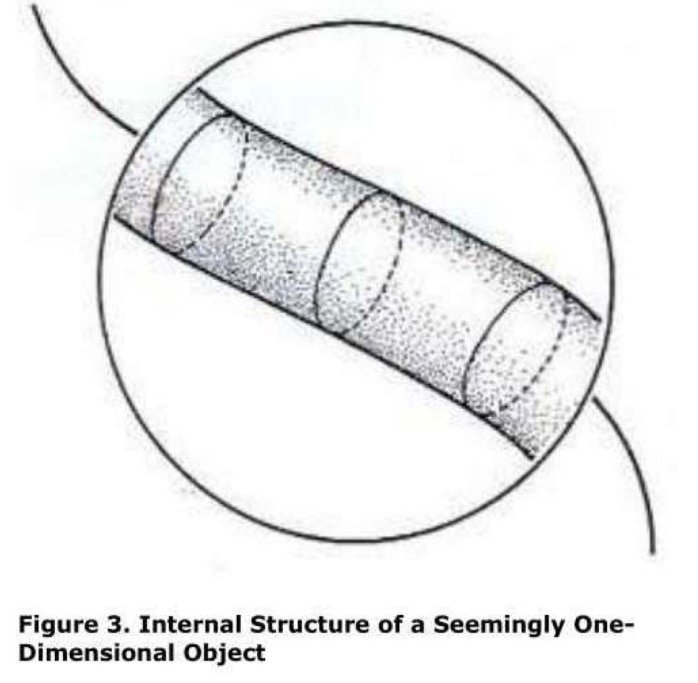
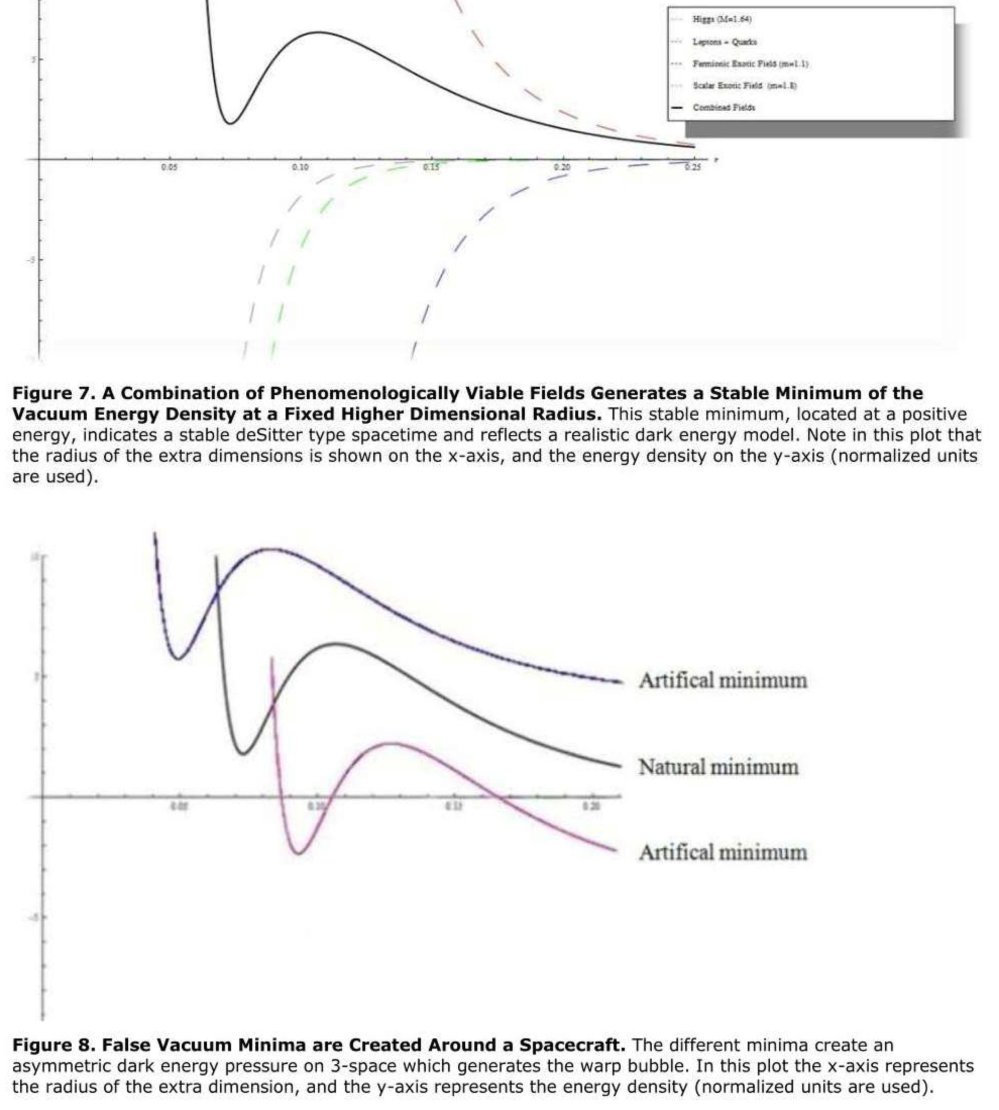
The warp drive study revisits the history of extra dimensions: Kaluza's theory, which Einstein took two years to endorse, and Oskar Klein's idea, in 1926, that the fifth dimension would be curled up in a tiny circle, illustrated in the report by the image of a garden hose seen from far away and up close. The graphs of vacuum energy as a function of the radius of the extra dimension show a stable minimum and “false” minima that would be created around a ship. These are theoretical models; the text itself notes that there is no direct evidence of extra dimensions.
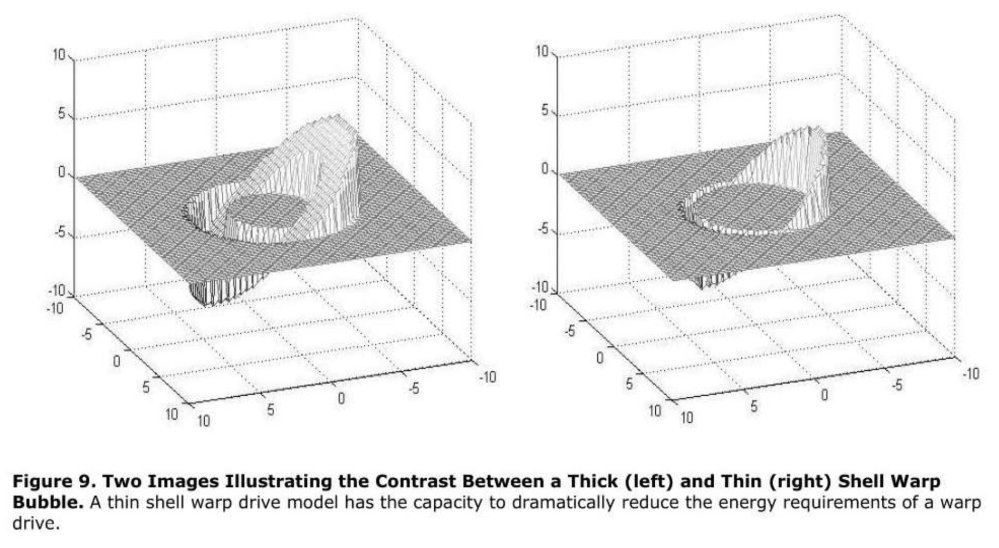
The same study calculates that, to generate the expansion of a warp bubble, the cosmological constant would have to be increased locally by a factor of 10^52, which corresponds, according to the text, to an energy density of 10^42 joules per cubic meter, “an incredible number.” The suggested way out is a thin-shell bubble: if the shell were one Planck length thick, the requirement would drop considerably. The report admits that detailed research would be needed even to estimate the minimum thickness.
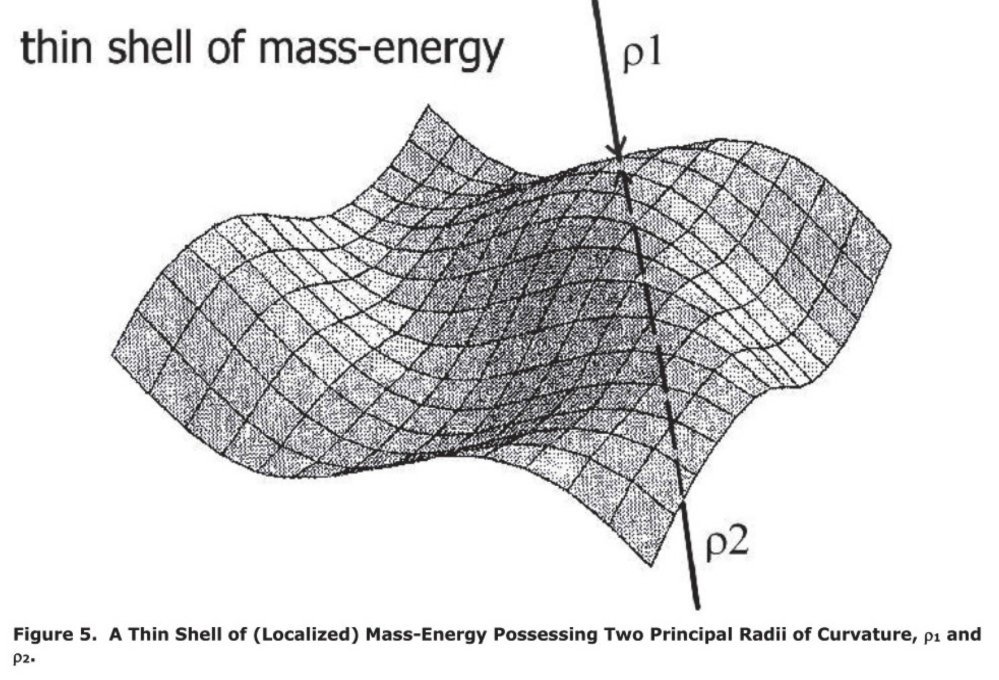
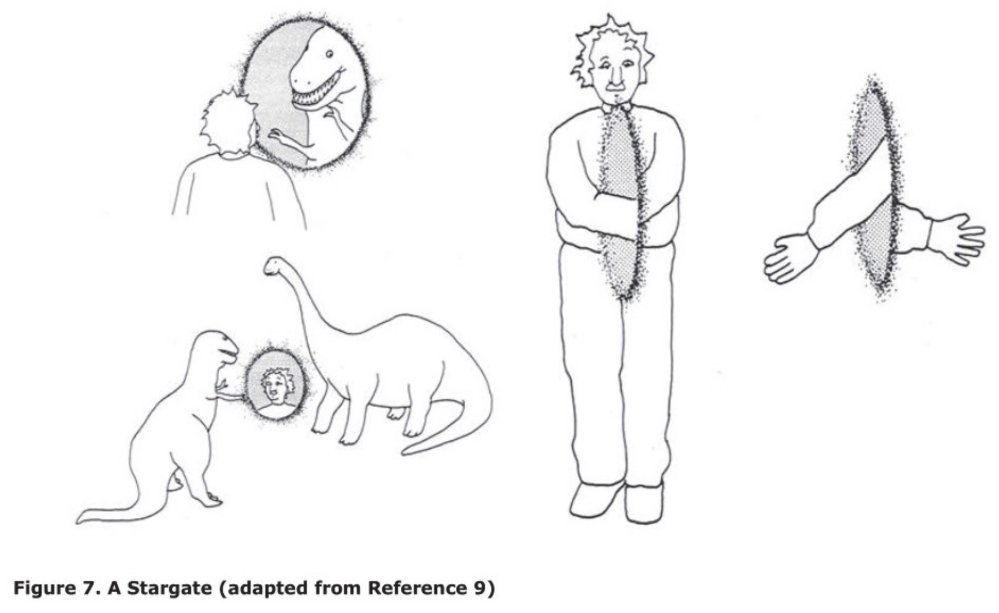
The wormhole study includes a table of the equivalent mass of negative energy needed to hold open throats of various sizes: about −0,71 Jupiter masses for a 1-meter throat and −710 Jupiter masses for a 1-kilometer one. The author cautions that this is not the total mass seen from far away and cites works according to which certain geometries would require arbitrarily small amounts of negative energy. He also describes the “stargate,” a flat-faced wormhole through which a traveler would pass without feeling tidal forces.
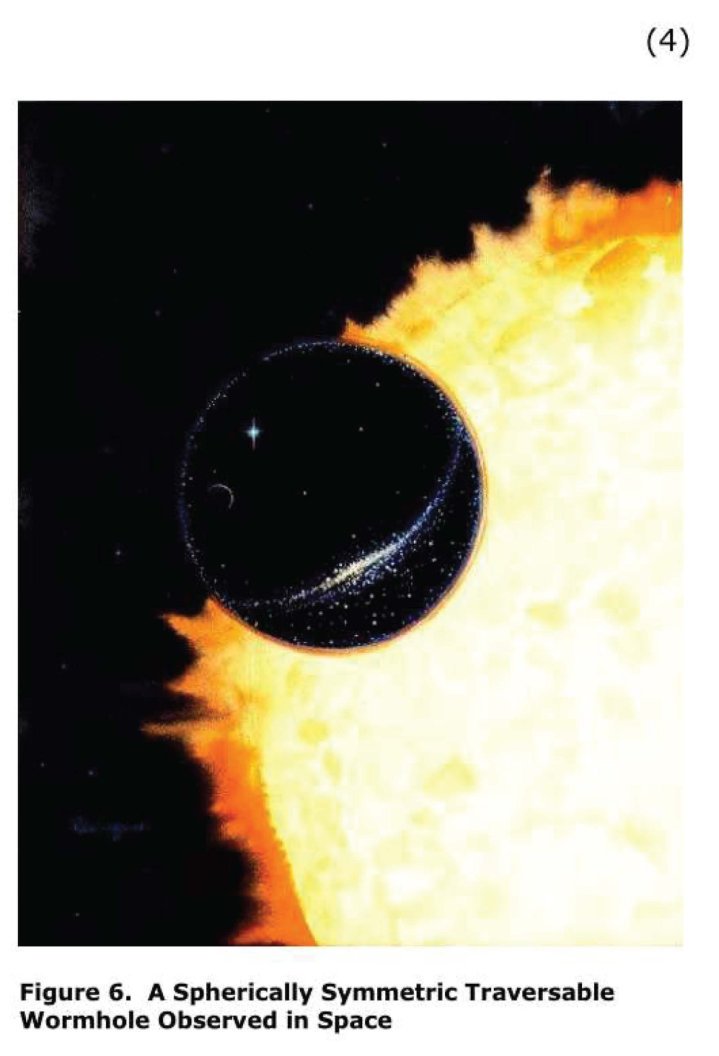
A passage in the wormhole study describes how one would be perceived: if a small wormhole appeared in our space, it would show up as an exceptionally bright point in the sky, blueshifted while it grew and redshifted while it shrank. This is a theoretical prediction by the author, presented without any relation to an observed case. The document does not associate this signature with reports of lights in the sky, and nothing in it indicates that such a phenomenon has been detected.
More images from the document
DIRECT READING OF THE FILE
The document, in the original
D138: translated in full are the masthead (page 2), the introduction (pages 5 to 7), section 7.6 (page 30) and the end of section 7 with the summary (pages 31 and 32). D139: translated in full are the masthead (page 2), the abstract (pages 5 and 6), the caption and text of figure 9 (page 22), the final discussion of section IV (page 32) and the conclusion (pages 34 to 37). Left out are the mathematical sections (D138, pages 8 to 29; D139, pages 7 to 31 and 33), which develop metrics, field equations and numerical estimates, and the references. Equations were indicated, not transcribed.
EXCERPT 1 · PHYSICAL PAGE 2
D138, physical page 2: masthead
UNCLASSIFIED/ /F8R e,,1cMt tl!H! t)f\1L'I'
Warp Drive, Dark Energy, and the Manipulation of Extra
Dimensions
Prepared by:
Acquisition Support Division (DW0-3)
Defense Warning Office
Directorate for Analysis
Defense Intelligence Agency
Authors:
AAP Person 74, AAP Person 58
Administrative Note
COPYRIGHT WARN ING: Further dissemination of the photographs in this publication is not author ized.
This product is one in a series of advanced technology reports produced in FY 2009
under the Defense Intelligence Agency, Defense Warning Office's Advanced Aerospace
Weapon System Applications (AAWSA) Program. Comments or questions pertaining to
this document should be addressed to !AAP Person 1 l AAWSA Program
Manager, Defense Inte lligence Agency, ATTN: CLAR/DWO-3, Bldg 6000, Washington,
DC 20340-5100 .
UNCLASSIFIED//liOA OlililCI0L !!5i ODIL¥ iiCheck the original PDF
Warp Drive, Dark Energy, and the Manipulation of Extra Dimensions. Prepared by: Acquisition Support Division (DWO-3) Defense Warning Office Directorate for Analysis Defense Intelligence Agency. Authors: [AAP Person 74], [AAP Person 58]. Administrative Note. COPYRIGHT WARNING: Further dissemination of the photographs in this publication is not authorized. This product is one in a series of advanced technology reports produced in FY 2009 under the Defense Intelligence Agency, Defense Warning Office's Advanced Aerospace Weapon System Applications (AAWSA) Program. Comments or questions pertaining to this document should be addressed to [AAP Person 1], AAWSA Program Manager, Defense Intelligence Agency, ATTN: CLAR/DWO-3, Bldg 6000, Washington, DC 20340-5100.View the document record ↗ · Physical page 2, counting the cover.
EXCERPT 2 · PHYSICAL PAGE 5
D138, physical pages 5 to 7: introduction
UNCLASSIFIED//FOA OFFIGlal1L W&li O•ILY
Warp Drive , Dark Energy, and the Manipulation of Extra
Dimensions
Introduction
If one is to realistically entertain the notion of interstellar exploration in
timeframes of a human lifespan, a dramatic shift in the traditional approach to
spacecraft propulsion is necessary. It has been known and well tested since
the time of Einstein that all matter is restricted to motion at sublight velocities
(<< 3 x 10⁸ m/s, the speed of light, or c), and that as matter approaches the
speed of light, its mass asymptotically approaches infinity. This mass increase
ensures that an infinite amount of energy would be necessary to travel at the
speed of light, and, thus, this speed is impossible to reach and represents an
absolute speed limit to all matter traveling through spacetime.
Even if an engine were designed that could propel a spacecraft to an
appreciable fraction of light speed, travel to even the closest stars would take
many decades in the frame of reference of an observer on Earth. Although
these lengthy transit times would not make interstellar exploration impossible,
they would certainly dampen the enthusiasm of governments or private
individuals funding these missions. After all, a mission whose success is
perhaps a century away would be difficult to justify. In recent years, however,
physicists have discovered two loopholes to Einstein's ultimate speed limit:
the Einstein-Rosen bridge ( commonly referred to as a "wormhole") and the
warp drive. Fundamentally, both ideas involve manipulation of spacetime itself
in some exotic way that allows for faster-than-light (FTL) travel.
Essentially, the wormhole involves connecting two potentially distant regions
of space by a topological shortcut. Theoretically, one would enter the
wormhole and instantaneously be transported to the exit located in a distant
region of space. Although no observational evidence of wormholes exists,
theoretically they can exist as a valid solution to general relativity.
The warp drive-the main focus this paper-involves local manipulation of the
fabric of space in the immediate vicinity of a spacecraft. The basic idea is to
create an asymmetric bubble of space that is contracting in front of the
spacecraft while expanding behind it. Using this form of locomotion, the
spacecraft remains stationary inside this "warp bubble," and the movement of
space itself facilitates the relative motion of the spacecraft. The most
attractive feature of the warp drive is that the theory of relativity places no
known restrictions on the motion of space itself, thus allowing for a
convenient circumvention of the speed of light barrier.
An advanced aerospace platform incorporating warp drive technology would
profoundly alter the capacity to explore-and potentially to colonize-the
universe. Because a warp drive is not limited by the speed of light, one can
only guess the top speeds such a technology might be capable of achieving.
For the sake of argument, let's consider the duration of trips taken by a
UNCLASSIFIED/ j'FOR. OFFIOIAL WSE OHL\f VEditorial note: The plan announced on page 7 does not match the actual numbering (the “Summary” is section 8 and the calculations are in section 7); it is as in the original.
Check the original PDF
Warp Drive, Dark Energy, and the Manipulation of Extra Dimensions. Introduction. If one is to realistically entertain the notion of interstellar exploration in timeframes of a human lifespan, a dramatic shift in the traditional approach to spacecraft propulsion is necessary. It has been known and well tested since the time of Einstein that all matter is restricted to motion at sublight velocities (<< 3 x 10^8 m/s, the speed of light, or c), and that as matter approaches the speed of light, its mass asymptotically approaches infinity. This mass increase ensures that an infinite amount of energy would be necessary to travel at the speed of light, and, thus, this speed is impossible to reach and represents an absolute speed limit to all matter traveling through spacetime. Even if an engine were designed that could propel a spacecraft to an appreciable fraction of light speed, travel to even the closest stars would take many decades in the frame of reference of an observer on Earth. Although these lengthy transit times would not make interstellar exploration impossible, they would certainly dampen the enthusiasm of governments or private individuals funding these missions. After all, a mission whose success is perhaps a century away would be difficult to justify. In recent years, however, physicists have discovered two loopholes to Einstein's ultimate speed limit: the Einstein-Rosen bridge (commonly referred to as a “wormhole”) and the warp drive. Fundamentally, both ideas involve manipulation of spacetime itself in some exotic way that allows for faster-than-light (FTL) travel. Essentially, the wormhole involves connecting two potentially distant regions of space by a topological shortcut. Theoretically, one would enter the wormhole and instantaneously be transported to the exit located in a distant region of space. Although no observational evidence of wormholes exists, theoretically they can exist as a valid solution to general relativity. The warp drive—the main focus this paper—involves local manipulation of the fabric of space in the immediate vicinity of a spacecraft. The basic idea is to create an asymmetric bubble of space that is contracting in front of the spacecraft while expanding behind it. Using this form of locomotion, the spacecraft remains stationary inside this “warp bubble,” and the movement of space itself facilitates the relative motion of the spacecraft. The most attractive feature of the warp drive is that the theory of relativity places no known restrictions on the motion of space itself, thus allowing for a convenient circumvention of the speed of light barrier. An advanced aerospace platform incorporating warp drive technology would profoundly alter the capacity to explore—and potentially to colonize—the universe. Because a warp drive is not limited by the speed of light, one can only guess the top speeds such a technology might be capable of achieving. For the sake of argument, let's consider the duration of trips taken by a [p. 6] spacecraft capable of 100c(1) for an array of exotic destinations of possible interest. As Table 1 shows, trips to the planets within our own solar system would take hours rather than years, and journeys to local star system would be measured in weeks rather than hundreds of thousands of years. Table 1. Transit Times to Various Exotic Destinations at 100 Times the Speed of Light: Mars 193 seconds; Jupiter 36 minutes; Neptune 4 hours; Alpha Centauri 15 days; Epsilon Eridani 38 days; The Orion Nebula 1.3 years. Until recently, the warp drive was a concept reserved for science fiction. However, a 1994 paper by Miguel Alcubierre placed the idea on a more solid theoretical footing. Alcubierre (Reference 1) demonstrated that a specific Lorentzian manifold could be chosen that exhibited bubble-like features reminiscent of the warp drive from the popular Star Trek television series. The bubble allowed for the surrounding spacetime to move at FTL speeds, and the inhabitants of the bubble would feel no acceleration effects because spacetime itself would be in motion instead of the spacecraft and its inhabitants. A number of papers have emerged in recent years that build on this original idea. However, these papers do not typically address how one might actually create the necessary spacetime bubble. Our own research directly addresses this question from a new and unique perspective and introduces a novel paradigm shift in the field of warp drive study (Reference 2). More formally, our work approaches the physics of warp drive from the perspective of quantum field theory; this diverges from the more traditional approach to warp drives, which utilizes the physics of general relativity. One of the improvements the model introduces is a dramatic reduction in the overall energy required to create such a phenomenon. The roadmap to this new idea was the observation that spacetime is currently known to be in a state of accelerated expansion, as demonstrated by the redshifting of galaxies, and the belief that if the mechanism for this expansion could be understood, then it might ultimately be controlled. A popular term used by cosmologists today is “dark energy,” an exotic and ubiquitous form of energy that is believed to constitute over 70 percent of the matter-energy content of the universe (Reference 3-6). One salient feature of dark energy is its intrinsic ability to generate negative pressure, causing the fabric of space to expand in the way that is currently observed (Reference 7). [footnote 1: This speed, while somewhat arbitrary, highlights the fact that our galaxy would become far more accessible if or when one discovers how to surpass the speed of light barrier.] [p. 7] Although we know what dark energy does, we do not yet fully understand its nature. We do not understand why it exists or how it is created; we simply know it provides an ever-present force on spacetime, causing the universe to expand. Indeed, recent high-precision experimental observations indicate dark energy may be a cosmological vacuum energy (Reference 8-10). These observations are based on the magnitudes of high-redshift supernova and have been a source of high research activity of late owing to the unexpected discovery that the rate of expansion of the universe is increasing (commonly referred to as accelerated expansion). One tantalizing aspect of dark energy is that if it were fully understood, and if a technology were developed that could generate and harness the exotic effects of dark energy on the fabric of space, then a warp drive would be one step closer to technological reality. While a full understanding of the true nature of dark energy may be many years away, it is entirely feasible that experimental breakthroughs at the Large Hadron Collider or developments in the field of M-theory could lead to a quantum leap in our understanding of this unusual form of energy and perhaps help to direct technological innovations. Our own research focuses on gaining an understanding of the physical origin of dark energy. By exploring novel ideas at the forefront of theoretical physics, one is able to propose a physically viable model incorporating some of the cutting-edge ideas emerging from string theory and quantum field theory. This leads to a deeper understanding of the possible origin of dark energy and allows consideration of a mechanism that would allow a sufficiently advanced technology to control the dark energy density in any region of space, and thus the expansion of space. This work has clear implications for the advancement of warp drive research. This paper is structured as follows: Section 2 reviews the more traditional general relativistic warp drives, the energy required to create them, and the physics required to understand them. Section 3 discusses the cosmological constant, a term featured in Einstein's equation that regulates the contraction and expansion of the spacetime. Section 4 introduces the Casimir energy, which, under certain conditions, may be the phenomenon that physically generates the cosmological constant. Section 5 discusses higher dimensions in physics and their importance in the context of Casimir energy calculations. Section 6 introduces the formulas that demonstrate that the Casimir energies in higher dimensions may in fact be the dark energy that is responsible for the accelerated expansion of the universe. Section 7 relates all the previous concepts together and introduces the novel warp drive paradigm. Section 8 performs original calculations of the energy required to create a superluminal warp drive. Finally, the paper speculates about the technological progress that would be necessary to turn this model into a reality.View the document record ↗ · Physical page 5, counting the cover.
EXCERPT 3 · PHYSICAL PAGE 30
D138, physical page 30: section 7.6, technology development
UNCLASSIFIED//FQR QFFIOlsllL WSE QHL\f
understanding and experimentation with warp drive technology. To understand how,
first discuss an analogy with energy w > 1.
In a handful of labs scattered around the country, petawatt lasers are being built and
tested. These are lasers of profound capability, able to generate short laser pulses of
2 3
, ,intensity>> 10
15
W/m with peak focused power densities of>> 10
27
W/m and
energy densities of > > 1016 J/m 3 . If it were possible to construct an exotic device
whose energy output had w < 1, then using calculations identical to those to generate
Table 3, it would seem straightforward to show that the energy density produced by an
analogous dark energy laser would translate into a local expansion of space
corresponding to Vwarp = 10-13 or~ 10-5 m/s for every meter of space that the laser
travels. It may be possible to construct an experiment that could measure the modified
expansion of space along the length of such a laser to test the predictions of this paper.
7.6 THE DEVELOPMENT OF THE TECHNOLOGY
Although a practical warp drive could be many years away from realization, there are a
number of technological developments that may, in fact, be necessary in order to allow
prototype experiments to begin. First, a more complete understanding of dark energy is
of paramount importance. As mentioned earlier, dark energy contributes approximately
70 percent of the overall energy density of the universe, and is responsible for the
expansion of space. As one acquires deeper understanding of this energy, attempts to
generate dark energy in the lab would no doubt be a critical component to a working
warp drive.
Other crucial developments include determining whether extra dimension are, in fact,
real. Once this has been determined with absolute certainty, the role of extra
dimensions and their relationship with the universe that we are more familiar with will
become a more serious focus of scientific research and attention.
As has been discussed, the stabilization of the extra dimensions and the accelerated
expansion of the remaining four dimensions can be realized via the Casimir energy. The
acceleration of the 3-dimensional subspace is a naturally occurring phenomenon which
occurs when the extra dimensions are stabilized.
An important feature of the higher dimensional model is the dependence of the dark
energy density on the size of the extra dimensions. In models with large extra
dimensions, the interaction of the graviton KK tower with the Standard Model fields are
suppressed by the higher dimensional Planck scale and the correspond ing couplings are
inverse TeV in strength. This can be seen more clearly when we consider the expansion
of the metric tensor in models with large extra dimensions computed with in linearized
gravity models:
1 7.7
gMN = TfMN + M D/1- 1 hMN '
D
where the capital letter indices indicate summation over the higher dimensions, M is
the modified Planck mass, TfMN corresponds to flat (Minkowski) spacetime and h MN
corresponds to the bulk graviton fluctuations. The graviton interaction term in the
action is expressed by:
23
UNCLASSIFIED//FOR OFFIOlsllL WSIE 8Ht,•Editorial note: Checked against the text; exponents read for consistency with the notation. “extra dimension are” is as in the original.
Check the original PDF
[...] understanding and experimentation with warp drive technology. To understand how, first discuss an analogy with energy w > 1. In a handful of labs scattered around the country, petawatt lasers are being built and tested. These are lasers of profound capability, able to generate short laser pulses of intensity >> 10^15 W/m^2 with peak focused power densities of >> 10^27 W/m^3 and energy densities of >> 10^16 J/m^3. If it were possible to construct an exotic device whose energy output had w < 1, then using calculations identical to those to generate Table 3, it would seem straightforward to show that the energy density produced by an analogous dark energy laser would translate into a local expansion of space corresponding to V warp = 10^-13 or ~ 10^-5 m/s for every meter of space that the laser travels. It may be possible to construct an experiment that could measure the modified expansion of space along the length of such a laser to test the predictions of this paper. 7.6 THE DEVELOPMENT OF THE TECHNOLOGY. Although a practical warp drive could be many years away from realization, there are a number of technological developments that may, in fact, be necessary in order to allow prototype experiments to begin. First, a more complete understanding of dark energy is of paramount importance. As mentioned earlier, dark energy contributes approximately 70 percent of the overall energy density of the universe, and is responsible for the expansion of space. As one acquires deeper understanding of this energy, attempts to generate dark energy in the lab would no doubt be a critical component to a working warp drive. Other crucial developments include determining whether extra dimension are, in fact, real. Once this has been determined with absolute certainty, the role of extra dimensions and their relationship with the universe that we are more familiar with will become a more serious focus of scientific research and attention. As has been discussed, the stabilization of the extra dimensions and the accelerated expansion of the remaining four dimensions can be realized via the Casimir energy. The acceleration of the 3-dimensional subspace is a naturally occurring phenomenon which occurs when the extra dimensions are stabilized. An important feature of the higher dimensional model is the dependence of the dark energy density on the size of the extra dimensions. In models with large extra dimensions, the interaction of the graviton KK tower with the Standard Model fields are suppressed by the higher dimensional Planck scale and the corresponding couplings are inverse TeV in strength. This can be seen more clearly when we consider the expansion of the metric tensor in models with large extra dimensions computed within linearized gravity models: [equation 7.7] where the capital letter indices indicate summation over the higher dimensions, M is the modified Planck mass, η MN corresponds to flat (Minkowski) spacetime and h MN corresponds to the bulk graviton fluctuations. The graviton interaction term in the action is expressed by:View the document record ↗ · Physical page 30, counting the cover.
EXCERPT 4 · PHYSICAL PAGE 31
D138, physical pages 31 and 32: end of section 7 and summary
7.8
UNCLASSIFIED/ /POI\ OPPIClilrt tt9!! o,~tv
1 MNf D
si nl = M D/ 2-1 d xhMNT •
D
where yMN is the higher dimensional energy-momentum tensor. The interaction of the
graviton with the graviton KK states and with the SM fields are obtained by integrating
the action over the extra coordinates. Because all these states are coupled with the
universal strength I IMPI this leads to the compelling possibility of the control of the size
of the extra dimensions by processes at energies that will be accessible via the particle
accelerators of the near future. Although the coupling is extremely small, the effective
coupling is enhanced by the large number of KK states.
Referring to Figure 7, additional energy in the form of matter or radiation with the TeV
energy scale can alter the shape of the effective potential. In particular, the extrema
determining the size of the extra dimensions are modified with the change of the
Casimir energy density and hence, the dark energy density, in the models under
consideration.
In the ADD model discussed in Section 5.2, the Standard Model fields are confined to a
I
4-dimensional brane and a new gravity scale M O= G2-0 > > TeV is introduced in the D
= 4 + d dimensions, where d is the number of extra dimensions. This is determined
quite easily by forming the higher dimensional action and integrating out the extra
dimension.
The Atlas experiment at CERN's Large Hadron Collider will have the capability to probe
the ADD type extra dimens ions up to MD~ 8 TeV. In the Randall Sundrum scenario, the
hierarchy is explained by the warp factor in the AdSS bulk geometry. A lower bound can
be placed on the lowest KK mass by electroweak precision tests (masses on the order
of 1 TeV are allowed). In the Universal Extra Dimension scenario, Tevatron results
constrain the compactificat ion scale to Mc > 400 GeV. Because the Atlas experiment
will be sensitive to Mc - 3 TeV , the estimates in this section indicate that if nature is in
fact described by one of these higher dimensional scenarios, then the additional
dimens ions can be probed.
Even more excit ing is the possibility that their size may be controlled at the energies
accessible to the Large Hadron Collider. When the Casimir energy to play the role of
dark energy is involved, one can see that the possibility for the direct control of the
local dark energy density by controlling the size of the additional dimensions is possible.
8 . Summary
The idea that a sufficiently advanced technology may interact with, and acquire direct
control over, the higher dimensions is a tantalizing possibility, and one that is most
certainly worthy of deeper investigation. Control of this higher dimensional space may
be a source of technologica l control over the dark energy density and could ultimately
play a role in the development of exotic propulsion technologies; specifically, a warp
drive.
Of course, this may not be actualized until many years in the future, but consider the
many spectacu lar physical phenomena that are believed to be true at this early point in
UNCLASSIFIED//FOA OFFIGl!1L WSE 8HLY
24Editorial note: The original calls the Higgs boson an “energy field”; faithful translation. The boson was only detected in 2012, after the report.
Check the original PDF
[equation 7.8] where T MN is the higher dimensional energy-momentum tensor. The interaction of the graviton with the graviton KK states and with the SM fields are obtained by integrating the action over the extra coordinates. Because all these states are coupled with the universal strength 1/M Pl this leads to the compelling possibility of the control of the size of the extra dimensions by processes at energies that will be accessible via the particle accelerators of the near future. Although the coupling is extremely small, the effective coupling is enhanced by the large number of KK states. Referring to Figure 7, additional energy in the form of matter or radiation with the TeV energy scale can alter the shape of the effective potential. In particular, the extrema determining the size of the extra dimensions are modified with the change of the Casimir energy density and hence, the dark energy density, in the models under consideration. In the ADD model discussed in Section 5.2, the Standard Model fields are confined to a 4-dimensional brane and a new gravity scale M D >> TeV is introduced in the D = 4 + d dimensions, where d is the number of extra dimensions. This is determined quite easily by forming the higher dimensional action and integrating out the extra dimension. The Atlas experiment at CERN's Large Hadron Collider will have the capability to probe the ADD type extra dimensions up to M D ~ 8 TeV. In the Randall Sundrum scenario, the hierarchy is explained by the warp factor in the AdS5 bulk geometry. A lower bound can be placed on the lowest KK mass by electroweak precision tests (masses on the order of 1 TeV are allowed). In the Universal Extra Dimension scenario, Tevatron results constrain the compactification scale to Mc > 400 GeV. Because the Atlas experiment will be sensitive to Mc ~ 3 TeV, the estimates in this section indicate that if nature is in fact described by one of these higher dimensional scenarios, then the additional dimensions can be probed. Even more exciting is the possibility that their size may be controlled at the energies accessible to the Large Hadron Collider. When the Casimir energy to play the role of dark energy is involved, one can see that the possibility for the direct control of the local dark energy density by controlling the size of the additional dimensions is possible. 8. Summary. The idea that a sufficiently advanced technology may interact with, and acquire direct control over, the higher dimensions is a tantalizing possibility, and one that is most certainly worthy of deeper investigation. Control of this higher dimensional space may be a source of technological control over the dark energy density and could ultimately play a role in the development of exotic propulsion technologies; specifically, a warp drive. Of course, this may not be actualized until many years in the future, but consider the many spectacular physical phenomena that are believed to be true at this early point in [p. 32] the 21st century. One believes that an energy field called the Higgs boson permeates spacetime and that the interaction of matter with this field is what is responsible for particles acquiring mass. One believes that an exotic ubiquitous energy source, unimaginatively named dark energy, is responsible for the current accelerated expansion of the universe based on observation of supernova in galaxies billions of light years from Earth. One also believes that the universe may not consist of the three spatial dimension of length, breadth, width, and one of time, but that, in fact, there may be as many as seven additional compactified dimensions assuming the topology of a Calabi-Yau manifold, and that the fundamental building blocks of the universe are, in fact, extended string-like entities. Modern physics is full of many exciting and marvelously imaginative creations. Because one understands these curiosities, one could potentially harness these elements of nature for one's own technological ends. This is by no means a certainty, but if we may make predictions based on the innovative history of scientific pioneers of the past, then it seems entirely possible that the creative minds of the future may indeed find ways to accomplish what, to us, may seem like magic.View the document record ↗ · Physical page 31, counting the cover.
EXCERPT 5 · PHYSICAL PAGE 2
D139, physical page 2: masthead
UNCLASSIFIED//F8A &FFIOltlil YSE 8HL1f
Traversable Wormholes, Stargates, and Negative Energy
Prepared by:
Acquisition support Division (DW0-3)
Defense Warning Office
Directorate for Analysis
Defense Intelligence Agency
MP Person 58
Administrative Note
COPYRIGHT WARNING: Further dissemination of the photographs in this publication is not authorized.
This product is one in a series of advanced technology reports produced in FY 2009
under the Defense Intelligence Agency, Defense Warning Office's Advanced Aerospace
Weapon System Applications (AAWSA) Program. Comments or questions pertaining to
this document should be addressed tolAAP Person 1 IAAWSA Program
Manager, Defense Intelligence Agency, ATTN: CLAR/DWO-3, Bldg 6000 , Washington,
DC 20340-5100 .
UNCLASSIFIFQ { {FOR AfliiliCilil.L WSE 8HLY
iiEditorial note: Checked against the text (the automatic transcription reads “MP Person 58”). The same label “AAP Person 58” is a co-author of D138.
Check the original PDF
Traversable Wormholes, Stargates, and Negative Energy. Prepared by: Acquisition Support Division (DWO-3) Defense Warning Office Directorate for Analysis Defense Intelligence Agency. [AAP Person 58]. Administrative Note. COPYRIGHT WARNING: Further dissemination of the photographs in this publication is not authorized. This product is one in a series of advanced technology reports produced in FY 2009 under the Defense Intelligence Agency, Defense Warning Office's Advanced Aerospace Weapon System Applications (AAWSA) Program. Comments or questions pertaining to this document should be addressed to [AAP Person 1], AAWSA Program Manager, Defense Intelligence Agency, ATTN: CLAR/DWO-3, Bldg 6000, Washington, DC 20340-5100.View the document record ↗ · Physical page 2, counting the cover.
EXCERPT 6 · PHYSICAL PAGE 5
D139, physical pages 5 and 6: summary
UNCLASSIFIED/ fFOA OFFl&I.t.k Y&li &PtLY
Traversable Wormholes, Stargates, and Negative Energy
I. Summary
Implementation of faster-than-light (FTL) interstellar travel via traversable
wormholes generally requires the engineering of spacetime into very
specialized local geometries. The analysis of these via Einstein's General
Theory of Relativity, plus the resultant equations of state, demonstrates that
such geometries require the use of "exotic" matter. It has been claimed that
since such matter violates the energy conditions, FTL spacetimes are not
plausible. However, it has been shown that this is a spurious issue. The
identification, magnitude, and production of exotic matter are seen to be a key
technical challenge, however. These issues are reviewed and summarized, and
an assessment on the present state of their resolution is provided.
In 1985 CalTech physicists M. Morris and K. Thorne discovered the principle of
traversable wormholes based on Einstein's General Theory of Relativity
(published in 1915). Morris and Thorne (Reference 1) and Morris et al.
(Reference 2) did this as an academic exercise at the request of Carl Sagan,
who had completed the draft of his novel Contact. This little exercise led to the
development of two new cottage industries in spacetime physics research: the
study of traversable wormholes and the study of time machines. Wormholes
are hyperspace tunnels through spacetime connecting either remote regions
within our universe or two different universes; they even connect different
dimensions and different times. Space travelers would enter one side of the
tunnel and exit the other, passing through the throat along the way. The
travelers would move at~ c (c is the speed of light, 3 x 10⁸ m/s) through the
wormhole and therefore not violate Special Relativity, but external observers
would view the travelers as traversing multi-light-year distances through
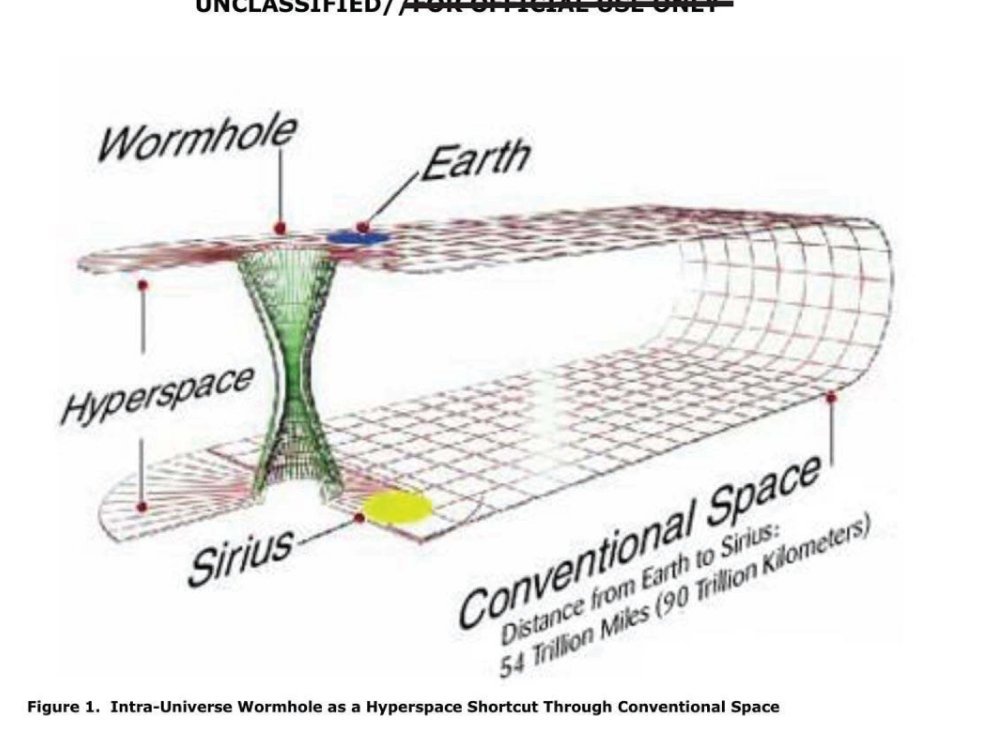
space at FTL speed; Figure 1 illustrates this effect. A "stargate" is a special
class of traversable wormhole solutions to Einstein's general relativistic field
equation that possesses very simple physics and flat entry and exit openings.
Traversable wormholes are unlike the well-known, non-traversable Einstein
Rosen Bridges or Schwarzschild wormholes that are formed from collapsed
stellar matter (that is, black holes) or spherically symmetric vacuum regions.
Black holes are collapsed stars that have all their mass concentrated at an
infinitesimal point where the induced gravitational field crushes all matter and
spacetime. However, even Einstein-Rosen bridges can be made traversable by
an infinitesimal tweaking of their spacetime metric. In the case of black holes,
the singularity of collapsed matter, along with its crushing gravity field, totally
blocks the way through the tunnel. A traversable wormhole does not have a
singularity blocking the tunnel or any crushing gravity field. Explorers would
enter one side of the tunnel, travel through the throat, and exit the other side.
Traversable wormholes also do not possess an event horizon, a region of high
gravitational field strength separating the inside space surrounding the black
hole's singularity from the outside universe. Once you go through a black
hole's event horizon, you can never come back out because you will have to
attain FTL speed to escape it. Not even light can escape from an event horizon.
UNCLASSIFIEQ{ {FOR AFEICIAk Y&li 8HLY
VEditorial note: Figure 1 bears the label “Distance from Earth to Sirius: 54 Trillion Miles (90 Trillion Kilometers)”; 54 trillion miles is about 87 trillion km, and the rounding is from the original.
Check the original PDF
Traversable Wormholes, Stargates, and Negative Energy. I. Summary. Implementation of faster-than-light (FTL) interstellar travel via traversable wormholes generally requires the engineering of spacetime into very specialized local geometries. The analysis of these via Einstein's General Theory of Relativity, plus the resultant equations of state, demonstrates that such geometries require the use of “exotic” matter. It has been claimed that since such matter violates the energy conditions, FTL spacetimes are not plausible. However, it has been shown that this is a spurious issue. The identification, magnitude, and production of exotic matter are seen to be a key technical challenge, however. These issues are reviewed and summarized, and an assessment on the present state of their resolution is provided. In 1985 CalTech physicists M. Morris and K. Thorne discovered the principle of traversable wormholes based on Einstein's General Theory of Relativity (published in 1915). Morris and Thorne (Reference 1) and Morris et al. (Reference 2) did this as an academic exercise at the request of Carl Sagan, who had completed the draft of his novel Contact. This little exercise led to the development of two new cottage industries in spacetime physics research: the study of traversable wormholes and the study of time machines. Wormholes are hyperspace tunnels through spacetime connecting either remote regions within our universe or two different universes; they even connect different dimensions and different times. Space travelers would enter one side of the tunnel and exit the other, passing through the throat along the way. The travelers would move at ≤ c (c is the speed of light, 3 x 10^8 m/s) through the wormhole and therefore not violate Special Relativity, but external observers would view the travelers as traversing multi-light-year distances through space at FTL speed; Figure 1 illustrates this effect. A “stargate” is a special class of traversable wormhole solutions to Einstein's general relativistic field equation that possesses very simple physics and flat entry and exit openings. Traversable wormholes are unlike the well-known, non-traversable Einstein-Rosen Bridges or Schwarzschild wormholes that are formed from collapsed stellar matter (that is, black holes) or spherically symmetric vacuum regions. Black holes are collapsed stars that have all their mass concentrated at an infinitesimal point where the induced gravitational field crushes all matter and spacetime. However, even Einstein-Rosen bridges can be made traversable by an infinitesimal tweaking of their spacetime metric. In the case of black holes, the singularity of collapsed matter, along with its crushing gravity field, totally blocks the way through the tunnel. A traversable wormhole does not have a singularity blocking the tunnel or any crushing gravity field. Explorers would enter one side of the tunnel, travel through the throat, and exit the other side. Traversable wormholes also do not possess an event horizon, a region of high gravitational field strength separating the inside space surrounding the black hole's singularity from the outside universe. Once you go through a black hole's event horizon, you can never come back out because you will have to attain FTL speed to escape it. Not even light can escape from an event horizon. [p. 6] Figure 1. Intra-Universe Wormhole as a Hyperspace Shortcut Through Conventional Space. Traversable wormholes are creatures of classical general relativity theory allowing for very comfortable travel through the Cosmic Neighborhood. But from the viewpoint of modern physics, the Cosmic Neighborhood can encompass other universes, other space dimensions, and other times beyond the four-dimensional spacetime realm. Mankind has certainly not discovered all of the universe's facets and will need to continue to construct new experiments and technology in order to verify (or not) these undiscovered facets. Wormholes can possess normal or backward (in special cases) motion through time and normal or nonexistent gravitational stresses on space travelers, and their entry/exit openings (or throats) are spherically shaped, flat, cubic shaped, polyhedral shaped, generic shaped, and so forth. Why consider wormholes for travel through space, time, and other dimensions? All standard space propulsion engineering is based on Newton's three laws of motion, which is dependent on the expenditure of propellant to induce thrust-generating momentum transfer on a spacecraft. Many investigators have proposed interstellar propulsion schemes based on a variety of nuclear (fission, fusion, and pulsed) rockets, electric (ion or plasma) rockets, matter-antimatter annihilation rockets, solar or laser sails, fusion or laser ramjets, interstellar ion scoops, beamed energy propulsion (sails, rockets, and ramjets), and so forth. Many of these modes either have been experimentally tested at one time or another in our recent history or remain as theoretical proposals,View the document record ↗ · Physical page 5, counting the cover.
EXCERPT 7 · PHYSICAL PAGE 32
D139, physical page 32: law of conservation of mass and what we do not know how to build
UNCLASSIFIED/ fFOA OFFI&il.t..k Y&& 8Ptk\f
where p,- is the outward radial pressure required to hold a wormhole throat open. The
Gauss-Bonnet Theorem (discussed in Section II-A) predicted this result beforehand.
Equation (11) is a result that is also due to the intrinsic nonlinearity of the general
relativistic field equation. This nonlinearity also impacts the coupling of a finite
spaceship mass with each side of a wormhole's throat (or the mouth on each side of the
throat) leading to a specialized mass conservation law for the combined system of
spacecraft and wormhole: when finite mass spaceships traverse a wormhole they alter
the (equivalent) mass of the wormhole mouths they pass through (Reference 3). The
entrance mouth absorbing the spacecraft gains ( equivalent) mass while the exit mouth
emitting it loses (equivalent) mass.11 (This mass coupling and conservation law takes
into account the possibility that spaceships traversing the wormhole may lose or gain
some momentum and kinetic energy in the process, and it is assumed that the two
mouths are sufficiently far apart that their mutual gravitational interaction is
negligible.) This unusual result suggests, but does not prove, the possibility of a
fundamental limit on the total mass that can traverse a wormhole. The coupled mass
conservation law shows that for a sufficiently large net transfer of mass the final
(equivalent) mass of the exit mouth becomes negative. This is actually a beneficial
result because ANEC violations are required just to hold the wormhole throat open in
the first place. If it appears that a runaway reaction might occur, then it would be
prudent for wormhole engineers to simply "turn off" the wormhole for a brief moment
and then "turn it back on" (i.e., "reset" the wormhole) to restart space transportation
operations.
It is on the basis of the foregoing discussion that traversable wormholes appear to be
the most viable form of FTL transport. However, one still does not know how to
construct a traversable wormhole because general relativity theory only provides a
recipe for the essential geometric and material ingredients required to open and
maintain one, but not the required assembly instructions. Will one need to pull a
traversable wormhole out of the quantum spacetime foam and enlarge it to
macroscopic scale or will there be need to use extremely large spacetime curvatures to
"punch a hole" through space? Or are there construction techniques yet to be
identified? The author is convinced that the answer can only be found through empirical
studies designed to decide whether the present general relativistic recipe is enough to
work with or an additiona l construction mechanism will be required.
On physical grounds Equation (10) appears to be the correct negative energy/energy
condition violation quantifier. However, further work is needed to establish whether
Equation (10) is the correct quantifier to use overall and whether all (averaged) energy
condition theorems can be extended to include it.
On another note, Borde et al. (Reference 65) have recast the QI conjecture into a new
program which seeks to study the allowed spatial distributions of negative energy
density in quantum field theory. Their study models free massless scalar fields in flat
two-dimensional Minkowski spacetime. Several explicit examples of spacetime averaged
QI were studied to allow or rule out some particular model (spatial) distributions of
negative energy. Their analysis showed that some geometric configurations of negative
energy can either be ruled out or else constrained by the QI restrictions placed upon
11 Similar coupling and conservation results hold for the case of electrically charged matter that traverse a (charged
or uncharged) wormhole.
24
UNCLASSIFIEQ { {FOR OFFICIAL W&& 8HLYEditorial note: Checked against the text. ANEC is the averaged null energy condition.
Check the original PDF
where p r is the outward radial pressure required to hold a wormhole throat open. The Gauss-Bonnet Theorem (discussed in Section II-A) predicted this result beforehand. Equation (11) is a result that is also due to the intrinsic nonlinearity of the general relativistic field equation. This nonlinearity also impacts the coupling of a finite spaceship mass with each side of a wormhole's throat (or the mouth on each side of the throat) leading to a specialized mass conservation law for the combined system of spacecraft and wormhole: when finite mass spaceships traverse a wormhole they alter the (equivalent) mass of the wormhole mouths they pass through (Reference 3). The entrance mouth absorbing the spacecraft gains (equivalent) mass while the exit mouth emitting it loses (equivalent) mass.(11) (This mass coupling and conservation law takes into account the possibility that spaceships traversing the wormhole may lose or gain some momentum and kinetic energy in the process, and it is assumed that the two mouths are sufficiently far apart that their mutual gravitational interaction is negligible.) This unusual result suggests, but does not prove, the possibility of a fundamental limit on the total mass that can traverse a wormhole. The coupled mass conservation law shows that for a sufficiently large net transfer of mass the final (equivalent) mass of the exit mouth becomes negative. This is actually a beneficial result because ANEC violations are required just to hold the wormhole throat open in the first place. If it appears that a runaway reaction might occur, then it would be prudent for wormhole engineers to simply “turn off” the wormhole for a brief moment and then “turn it back on” (i.e., “reset” the wormhole) to restart space transportation operations. It is on the basis of the foregoing discussion that traversable wormholes appear to be the most viable form of FTL transport. However, one still does not know how to construct a traversable wormhole because general relativity theory only provides a recipe for the essential geometric and material ingredients required to open and maintain one, but not the required assembly instructions. Will one need to pull a traversable wormhole out of the quantum spacetime foam and enlarge it to macroscopic scale or will there be need to use extremely large spacetime curvatures to “punch a hole” through space? Or are there construction techniques yet to be identified? The author is convinced that the answer can only be found through empirical studies designed to decide whether the present general relativistic recipe is enough to work with or an additional construction mechanism will be required. On physical grounds Equation (10) appears to be the correct negative energy/energy condition violation quantifier. However, further work is needed to establish whether Equation (10) is the correct quantifier to use overall and whether all (averaged) energy condition theorems can be extended to include it. On another note, Borde et al. (Reference 65) have recast the QI conjecture into a new program which seeks to study the allowed spatial distributions of negative energy density in quantum field theory. Their study models free massless scalar fields in flat two-dimensional Minkowski spacetime. Several explicit examples of spacetime averaged QI were studied to allow or rule out some particular model (spatial) distributions of negative energy. Their analysis showed that some geometric configurations of negative energy can either be ruled out or else constrained by the QI restrictions placed upon [footnote 11: Similar coupling and conservation results hold for the case of electrically charged matter that traverse a (charged or uncharged) wormhole.]View the document record ↗ · Physical page 32, counting the cover.
EXCERPT 8 · PHYSICAL PAGE 34
D139, physical pages 34 to 37: conclusion
UNCLASSIFIED/ fFOA OFFl&I.t..k YS& 8Ptk\f
explicit switching factor whereby five different switching functions (based on data
windowing theory) are defined and evaluated. In order to isolate the effects of negative
energy a comparison is made for the response of a detector switched on and off during
a period of negative energy density (or negative energy flux) and that switched on and
off in the vacuum. The results shed light on the response of matter (detectors) to
pulses of negative energy of finite duration, and they showed that negative energy
should have the effect of enhancing deexcitation (i.e., induce cooling) of the detector.
This is the opposite of our experience with detectors that undergo excitation when
encountering "normal" matter or energy, and isolated detectors placed in a vacuum
naturally cool due to the usual thermodynamic reasons. But Davies and Ottewill point
out that the enhanced cooling effect they discovered cannot be used to draw a
thermodynamic conclusion because their modeling was restricted to first order in
perturbation theory. It is not possible at first order to determine whether t he enhanced
cooling effects are due to the small violation of energy conservation expected in any
process in which a general quantum state collapses to an energy eigenstate, or whether
they predict a systematic reduction in the energy of the detector which has serious
thermodynamic implications. However, Davies and Ottewill point out that their results
are model dependent and they found for their standard monopole detector model that
there is not always a simple relationship between the strength of the negative energy
density/flux and the behavior of the detector. Further research will be necessary to
resolve these issues.
V. Conclusion: The Way Forward
More than 40 years elapsed between the late 1890s when the Curies first identified
radioactive substances in their laboratory and when a neutron-catalyzed fission chain
reaction - the world's first nuclear reactor - was demonstrated at the University of
Chicago in 1939 by Enrico Fermi and Leo Szilard. Six more years would pass before the
world's first nuclear bomb was successfully tested in New Mexico. The progress of
science and technology is rapid, but highly dependent on adequate and sustained focus,
effort, and support. On this basis, it is possible that a traversable wormhole can be
demonstrated in the laboratory as long as there is a focused, sustained level of long
term research support.
A game changer may appear that could dramatically accelerate or alter the direct ion of
an experimental traversable wormhole program. Such a game changer could entail new
physics that is predicted by a complete, comprehensive quantum gravity theory, or a
quantum gravity theory that is a subset of a larger unified field theory (i.e., a final ized
quantum superstring theory, or some other theory that replaces it), or a completely
new theory for the quantum vacuum and its related spacetime physics (e.g.,
"emergent" spacetime/gravity theories (Reference 73, 74)). The new field of
"emergent" spacetime/gravity suggests that gravitation is not a fundamental force of
nature because, among many other considerations, of its extreme weakness relative to
the other forces of nature. Instead, spacetime and gravitation are seen as emergent
low-energy phenomenon, which arises from the collective action of much higher-energy
phenomenon occurring in the quantum vacuum where Lorentz invariance and energy
conservation may be violated in the trans-Planckian regime. One now knows empirically
that the "emergent" low-energy vacuum within which one exists is in fact a rich
quantum ether comprised of zero-point fluctuation fields that make it behave like a
nonlinear optical medium endowed with paramagnetic, dichroic, birefringent, condensed
UNCLASSIFIEQ { {FOR OFFICIAL WS& 8HLY
26Editorial note: The report dates the first reactor to 1939; Chicago Pile-1 operated in December 1942. Kept in the translation and logged in corrections.
Check the original PDF
V. Conclusion: The Way Forward. More than 40 years elapsed between the late 1890s when the Curies first identified radioactive substances in their laboratory and when a neutron-catalyzed fission chain reaction - the world's first nuclear reactor - was demonstrated at the University of Chicago in 1939 by Enrico Fermi and Leo Szilard. Six more years would pass before the world's first nuclear bomb was successfully tested in New Mexico. The progress of science and technology is rapid, but highly dependent on adequate and sustained focus, effort, and support. On this basis, it is possible that a traversable wormhole can be demonstrated in the laboratory as long as there is a focused, sustained level of long-term research support. A game changer may appear that could dramatically accelerate or alter the direction of an experimental traversable wormhole program. Such a game changer could entail new physics that is predicted by a complete, comprehensive quantum gravity theory, or a quantum gravity theory that is a subset of a larger unified field theory (i.e., a finalized quantum superstring theory, or some other theory that replaces it), or a completely new theory for the quantum vacuum and its related spacetime physics (e.g., “emergent” spacetime/gravity theories (Reference 73, 74)). The new field of “emergent” spacetime/gravity suggests that gravitation is not a fundamental force of nature because, among many other considerations, of its extreme weakness relative to the other forces of nature. Instead, spacetime and gravitation are seen as emergent low-energy phenomenon, which arises from the collective action of much higher-energy phenomenon occurring in the quantum vacuum where Lorentz invariance and energy conservation may be violated in the trans-Planckian regime. One now knows empirically that the “emergent” low-energy vacuum within which one exists is in fact a rich quantum ether comprised of zero-point fluctuation fields that make it behave like a nonlinear optical medium endowed with paramagnetic, dichroic, birefringent, condensed [p. 35] matter, and many other fascinating properties (Reference 22-24, 26, 73-76). Therefore, if the emergent spacetime/gravity approach turns out to be correct, then there will likely be a direct consequence to the physics of traversable wormholes that could dramatically alter the mechanism by which they are created and/or mitigate the requirement for negative energy. Until such new approaches are established and testable predictions published by their proponents, one cannot speculate on how the physics of traversable wormholes will be affected. Therefore, it is beneficial to stick to the outcome of the present study in terms of quantum field theory and general relativity theory, and outline what needs to be accomplished going forward in order to demonstrate a traversable wormhole in the lab. Going forward toward the demonstration of a traversable wormhole will require the following: • Generating Negative Energy in the Lab: Our assessment concludes that we already make small amounts of negative energy in the lab, but we do not yet know if we can access larger amounts for extended periods of time over extended spatial distributions for the purpose of engineering a traversable wormhole. In this regard we propose the following options for further exploration. • Squeezed quantum vacuum generators: A dedicated research program to develop the two negative energy generator concepts described in Section III-B-2 will need to be established in order to evolve state-of-the-art quantum optics technology towards producing higher magnitudes of negative energy as well as special techniques required to separate out any positive energy fluxes that accompany the negative energy fluxes. Specifically, the Rabeau et al. (Reference 48, 49) and Ries et al. (Reference 50) experimental programs should be followed as a template toward this goal. Quantum optics technology via high power fiber lasers, resonators, amplifier stages, beam conditioning stages, etc., are rapidly advancing. So research should be conducted in parallel to invent additional ways to produce negative energy via innovative quantum optics. • Casimir effect: Even though the standard electromagnetic Casimir effect is feeble, and thus not likely to contribute to a traversable wormhole engineering program, there are still a number of other electromagnetic and non-electromagnetic Casimir effects described in Section III-B-4 that require further study. These other Casimir effects have not been explored with an eye toward testing them in the lab, and so there could be important new information yet to be uncovered. • Moving Mirrors (a.k.a. the dynamical Casimir effect): Even though this concept was identified (Section III-B-5) as being too feeble to produce any useful flux of negative energy, the observable effects due to the change in the boundary conditions (e.g., moving mirrors/cavity walls) of quantum fields provide crucial information on the quantum vacuum at the macroscopic level. Theoretical and laboratory efforts are underway to understand the dissipative effects of vacuum fluctuations (Reference 77-78). This dissipation mechanism should induce irradiation of photons, a phenomenon also known as the dynamical Casimir effect. This can be understood both as the creation of particles under non-adiabatic changes in the boundary conditions of quantum fields, or as classical parametric amplification with the zero-point energy of a vacuum field mode as an input state. More recent developments [p. 36] include models for the super-radiant amplification of photons with particular emphasis on its dynamics and the optimization of the involved parameters. Experimental concepts being pursued will try to reveal directly the presence of a non-empty vacuum by using a specifically designed device to amplify the virtual vacuum photons and produce real electromagnetic radiation via the parametric amplification of the vacuum fluctuations in an electromagnetic cavity. The ‘amplifier’ is a boundary undergoing an oscillation, and hence radiates energy due to the dissipative action against the vacuum photons. This line of investigation could serve as a very useful probe to explore the possibility of generating large fluxes of negative energy. It may be expected that a laboratory demonstration of the dynamical Casimir effect will occur before 2012. • Dirac field states: As described in Section III-A, this involves either the superposition of two single particle electron states or the superposition of two multi-electron-positron states (Reference 29, 30). This is still a nascent topic of study in quantum field theory. However, mankind already possesses a great deal of technology that is dedicated to the manipulation and storage of electrons and positrons via solid state/condensed matter devices and particle accelerators. This research topic should be supported in order to establish how it could contribute to an experimental traversable wormhole program. • Quantum coherence effects: Other types of quantum coherence effects not already identified or invented should be theoretically developed and explored for the possibility of finding new free-field or interacting field configurations that produce a significant magnitude of negative energy which could be produced by technological means. • Detecting Negative Energy in the Lab: In Section IV-C this paper identified proposals for observing negative energy in outer space and in the laboratory, but further work is needed to downscale astronomical techniques for use at the lab scale, and we need to firm up our understanding of how lab detectors will respond to negative energy in situ. A first step in the latter direction was recently proposed by Marecki (Reference 79) who generalized the analysis of the output of balanced homodyne detectors (BHDs). The most important feature of these devices is their ability to quantify the quantum vacuum fluctuations of the electric field because the output of BHDs provides information on the one- and two-point functions of arbitrary states of quantum fields. Marecki computed the two-point function and the associated spectral density for the ground state of the quantum electric field in Casimir geometries, and predicts a position- and frequency-dependent pattern of BHD responses if a device of this type is placed inside a Casimir cavity. The proposed device allows for the direct detection of quantum vacuum fluctuations and provides a spatial mapping of the negative energy contained inside the cavity. This offers a potential new characterization of ground states in Casimir geometries, which would provide an understanding of the negative energy densities present in some regions in these geometries. • Trapping and Storing Negative Energy: Ford and Roman (Reference 10) have only superficially addressed this topic, and there is very little technical literature that addresses it fully. A theoretical program to develop the physics and technology of trapping and storing negative energy will need to be supported, and such a program should be guided by the use of laboratory detectors such as the one proposed in the [p. 37] previous section. However, it is the opinion of the author that free-space negative energy sources appear to be a more desirable option for building traversable wormholes than stored negative energy. • Constructing Traversable Wormholes in the Lab: Einstein's General Theory of Relativity does not provide instructions on how to construct a traversable wormhole in space or inside a laboratory vacuum vessel. The Einstein general relativistic field equation only provides a prescription for designing a special, localized spacetime geometry and calculating the physical characteristics of a source of matter that is required to induce it. If one “zaps” a region of empty space with a beam of negative energy, will a traversable wormhole appear? One doesn't know. Maybe one has to poke a hole in space with an intense beam of negative energy, or maybe we have to use the negative energy to inflate a quantum spacetime fluctuation (allegedly in the form of a “geometric foam”). Theoretical studies need to be implemented to address this question and the author believes that empirical studies will be necessary to find the answer once we develop an intense source of negative energy.View the document record ↗ · Physical page 34, counting the cover.
EXCERPT 9 · PHYSICAL PAGE 1
D138, physical page 1: cover
UNCLASSIFIED/ /FOA OFFI&il.t.k WIiii 8Plklf
Defense
Intelligence
Reference
Document
Acquisition Threat Support
2 April 2010
ICOD: 1 December 2009
DIA-08 -1004 -001
Warp Drive, Dark Energy, and
the Manipulation of Extra
Dimensions
UNCLASSIFIED/ /FOA QFFI&iIAk WSE 8,.L\'Editorial note: The marking “FOR OFFICIAL USE ONLY” appears struck through, which indicates that this restriction was removed upon release.
Check the original PDF
UNCLASSIFIED//[FOR OFFICIAL USE ONLY, struck through] Defense Intelligence Reference Document Acquisition Threat Support 2 April 2010 ICOD: 1 December 2009 DIA-08-1004-001 Warp Drive, Dark Energy, and the Manipulation of Extra DimensionsView the document record ↗ · Physical page 1, counting the cover.
EXCERPT 10 · PHYSICAL PAGE 3
D138, physical page 3: table of contents and list of figures (first part)
UNCLASSIFIED//P61t OfflOIAL WSli &••kY
Contents
Introduction ............................................................................................................ v
2. General Relativistic Warp Drives ........................................................................ 1
2.1 Warp Drive Requirements ............................................................................ 2
3. The Cosmological Constant ................................................................................ 4
3.1 Einstein's Equation and the Introduction of/\ .............................................. 4
4. Casimir Energy and the Quantum Vacuum .......................................................... 5
4.1 The Casimir Effect ........................................................................................ 6
5. Extra Space Dimensions ..................................................................................... 8
5.1 Kaluza-Klein Theory ..................................................................................... 8
5.2 Large Extra Dimensions .............................................................................. 10
5.3 Randall Sundrum Brane Models .................................................................. 11
5.4 Extra Dimension Summary ......................................................................... 12
6. Dark Energy as a Higher Dimensional Artifact .................................................. 12
7. Warp Drive and Higher Dimensional Manipulation ........................................... 15
7.1 Adjusting Higher Dimensions for Propulsions ............................................ 16
7.2 The Geometry of Extra Dimensions ............................................................ 17
7.3 Higher Dimensions and Stabilization .......................................................... 17
7.4 Elementary Warp Drive Calculations .......................................................... 20
7.5 Future Experiments .................................................................................... 22
7.6 The Development of the Technology .......................................................... 23
8. Summary .......................................................................................................... 24
Figures
Figure 1. York Extrinsic Time (9-) Plot ..................................................................... 1
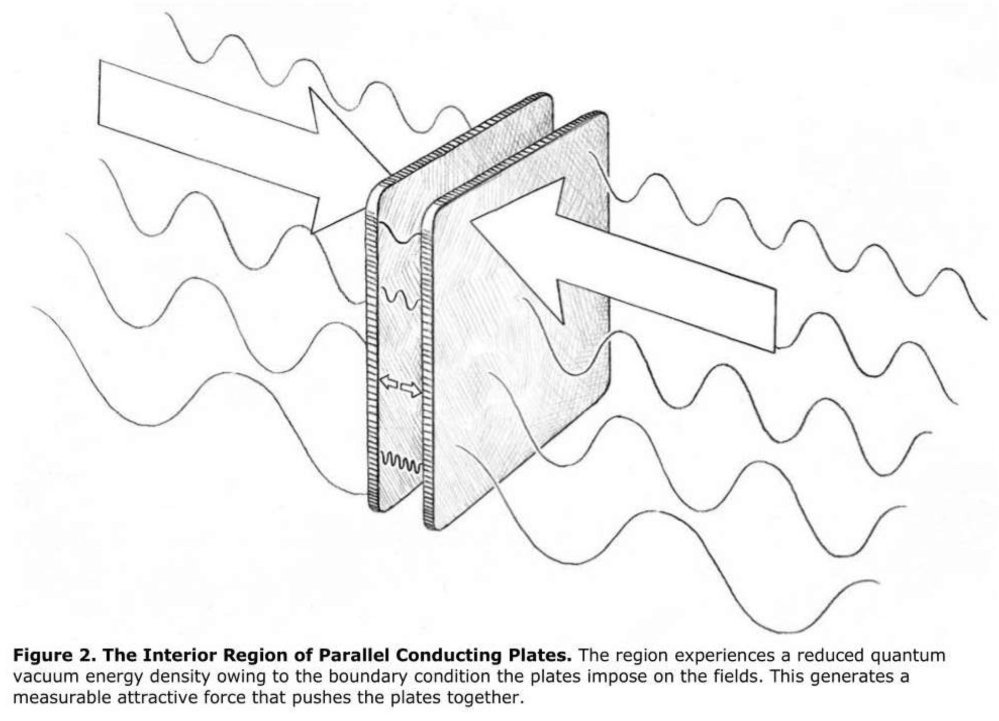
Figure 2. The Interior Region of Parallel Conducting Plates ................................... 7
Figure 3. Internal Structure of a Seemingly One-Dimensional Object .................... 9
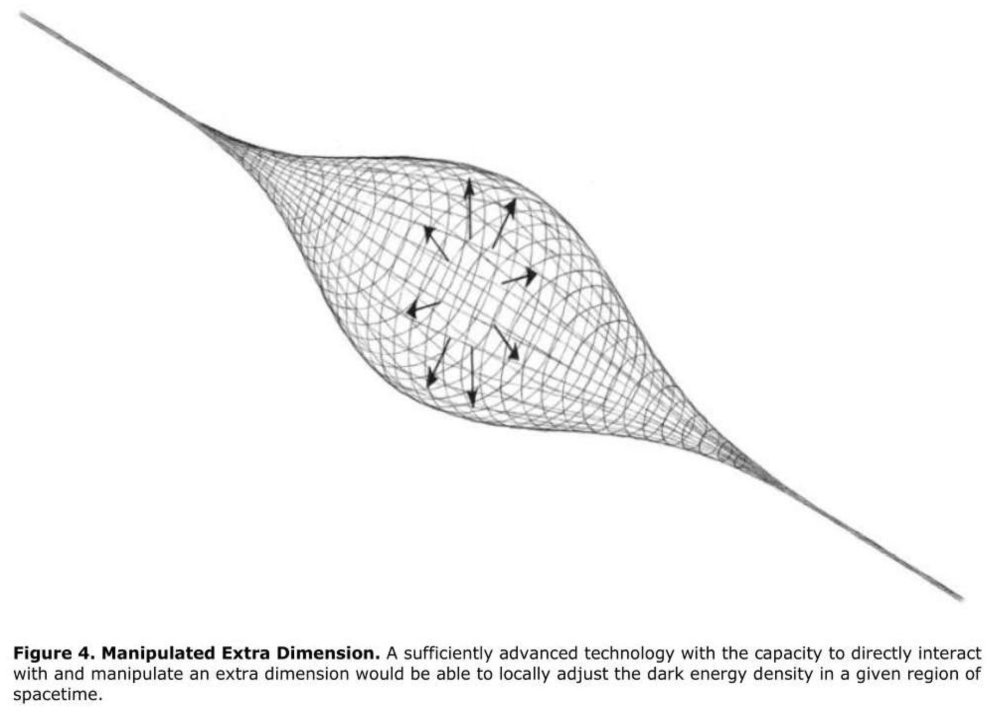
Figure 4. Manipulated Extra Dimension ................................................................ 15
UNCLASSIFIED/ /FQR 8FFl61Ak W&lii &••kY iiiCheck the original PDF
Contents
Introduction ... v
2. General Relativistic Warp Drives ... 1
2.1 Warp Drive Requirements ... 2
3. The Cosmological Constant ... 4
3.1 Einstein's Equation and the Introduction of Λ ... 4
4. Casimir Energy and the Quantum Vacuum ... 5
4.1 The Casimir Effect ... 6
5. Extra Space Dimensions ... 8
5.1 Kaluza-Klein Theory ... 8
5.2 Large Extra Dimensions ... 10
5.3 Randall Sundrum Brane Models ... 11
5.4 Extra Dimension Summary ... 12
6. Dark Energy as a Higher Dimensional Artifact ... 12
7. Warp Drive and Higher Dimensional Manipulation ... 15
7.1 Adjusting Higher Dimensions for Propulsions ... 16
7.2 The Geometry of Extra Dimensions ... 17
7.3 Higher Dimensions and Stabilization ... 17
7.4 Elementary Warp Drive Calculations ... 20
7.5 Future Experiments ... 22
7.6 The Development of the Technology ... 23
8. Summary ... 24
Figures
Figure 1. York Extrinsic Time (ϑ) Plot ... 1
Figure 2. The Interior Region of Parallel Conducting Plates ... 7
Figure 3. Internal Structure of a Seemingly One-Dimensional Object ... 9
Figure 4. Manipulated Extra Dimension ... 15View the document record ↗ · Physical page 3, counting the cover.
EXCERPT 11 · PHYSICAL PAGE 4
D138, physical page 4: list of figures (continued) and of tables
UNCLASSIFIED/ ,'FOR OFFl@IJliL ~!H! 6HLY
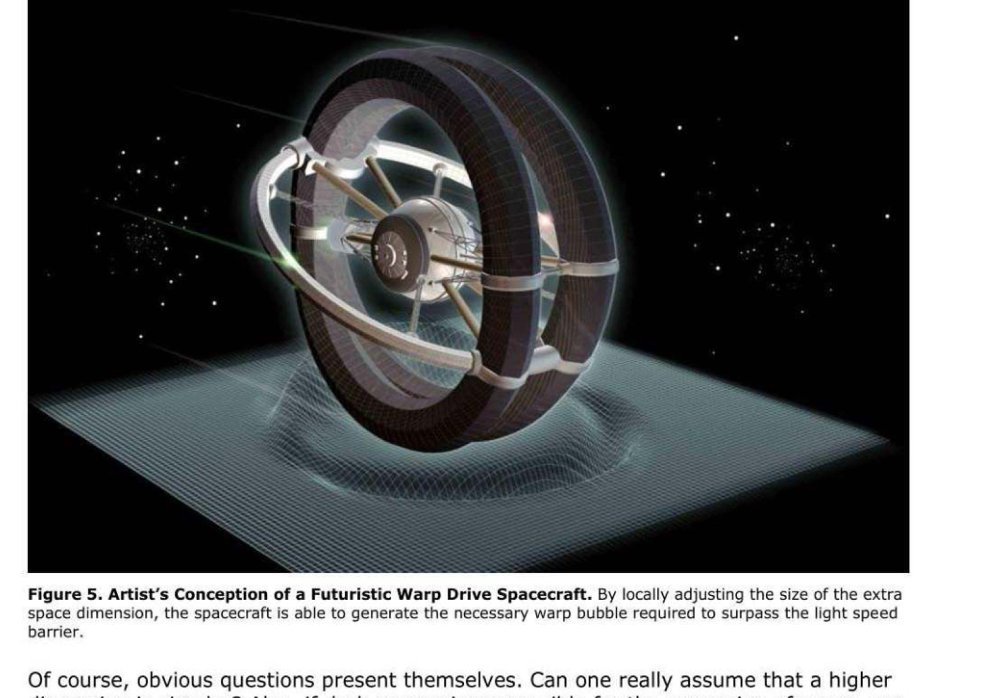
Figure 5. Artist's Conception of a Futuristic Warp Drive Spacecraft ..................... 16
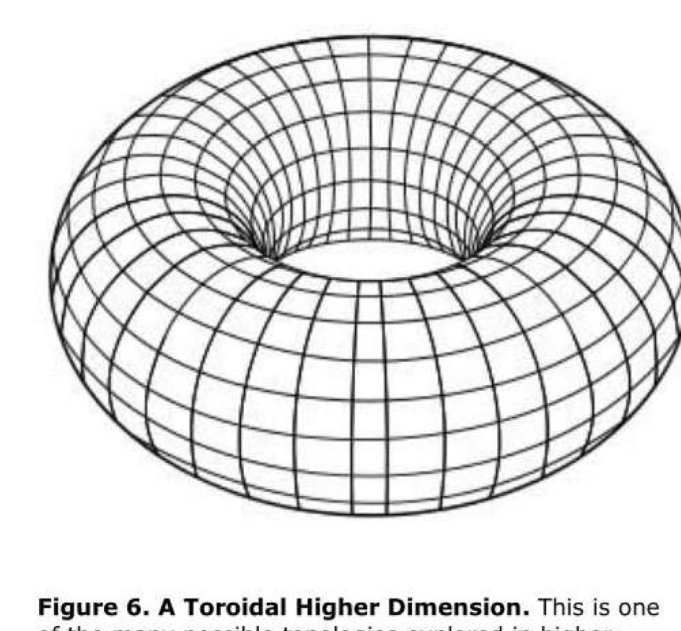
Figure 6. A Toroidal Higher Dimension ................................................................. 17
Figure 7. A Combination of Phenomenologically Viable Fields .............................. 19
Figure 8. False Vacuum Minima ............................................................................ 19
Figure 9. Thick and Thin Shell Warp Bubble .................... ............................... .... .. 21
Tables
Table 1. Transit Times to Various Exotic Destinations at 100 Times the Speed of
Light ......................................................................................................... vi
Table 2. Negative Energy Required for Warp Bubble (Larger Negative Energy) ..... 3
Table 3. Negative Energy Required for Warp Bubble ............................................ 22
UNCLASSIFIED/ /FOfl OFFICIAL ~SI: OHL\S ivCheck the original PDF
Figure 5. Artist's Conception of a Futuristic Warp Drive Spacecraft ... 16
Figure 6. A Toroidal Higher Dimension ... 17
Figure 7. A Combination of Phenomenologically Viable Fields ... 19
Figure 8. False Vacuum Minima ... 19
Figure 9. Thick and Thin Shell Warp Bubble ... 21
Tables
Table 1. Transit Times to Various Exotic Destinations at 100 Times the Speed of Light ... vi
Table 2. Negative Energy Required for Warp Bubble (Larger Negative Energy) ... 3
Table 3. Negative Energy Required for Warp Bubble ... 22View the document record ↗ · Physical page 4, counting the cover.
EXCERPT 12 · PHYSICAL PAGE 8
D138, physical page 8: section 2, space warps in general relativity, and the Alcubierre metric
UNCLASSIFIED/ i'F8R 8FFIOlsllL WSli (U•LY
2. General Relativistic Warp Drives
Alcubierre (Reference 1) derived a spacetime metric motivated by cosmological inflation
that would allow arbitrarily short travel times between two distant points in space. The
"warp drive" metric uses coordinates (t, x, y, z) and curve (or worldline) x = Xsh (t), y =
0, z = 0, lying in the t-x plane passing through the origin. Note that Xsh is the x-axis
coordinate position of the moving spaceship (or warp bubble) frame. The metric 1
specifying this particular spacetime geometry is (Reference 1):
(2.1)
where c is the speed of light, Vsh(t) is the speed associated with the curve (or warp
bubble speed), and Tsh(t) is the Euclidean distance from the curve. The warp bubble
shape function f (rsh) is any smooth positive function that satisfies f (0) = 1 and
decreases away from the origin to vanish when Tsh > R for some distance R. The
geometry of each spatial slice is flat, and spacetime is flat where f (rsh) vanishes but is
curved where it does not vanish.
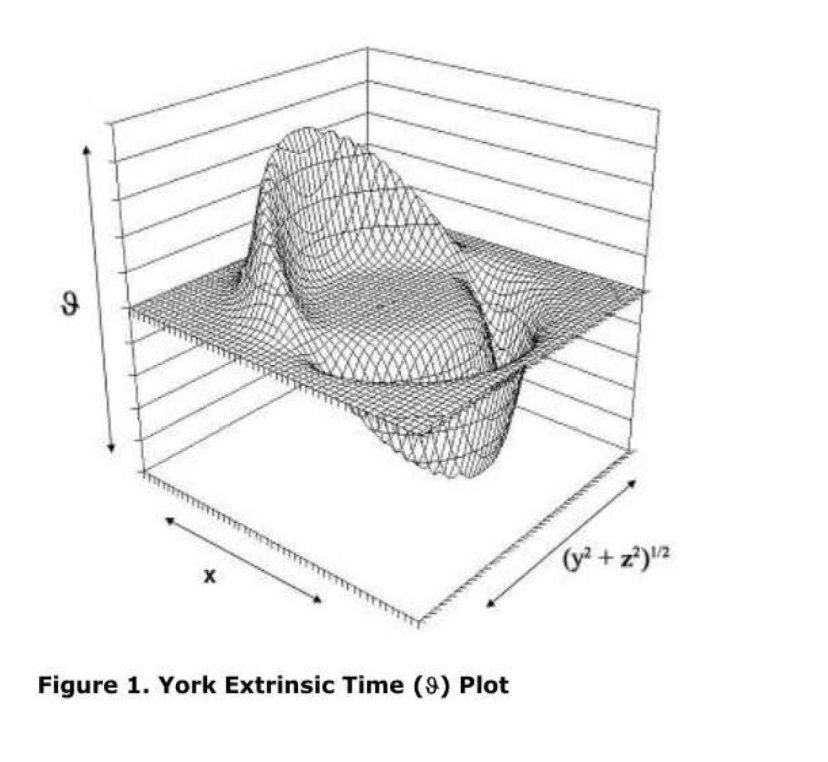
The driving mechanism of Equation (2.1) is the York extrinsic time, 9. This quantity is
defined as ( Reference 1) :
S= v," x ," df . (2.2)
C ~h d,;"
The 9 behavior of the warp drive bubble
provides for the simultaneous expansion
of space behind the spacecraft and a
corresponding contraction of space in
front of the spacecraft. Figure 1 illustrates
the 9 behavior of the warp drive bubble
geometry. Thus the spacecraft is
enveloped within a warp bubble and can
be made to exhibit an arbitrarily large
faster-than-light {FTL) speed (Vsh >> c)
as viewed by external coordinate
observers. Even though the worldlines
inside the warp bubble reg ion are
spacelike for all external observers, the
moving spaceship (warp bubble) frame
itself never travels outside of its local
comoving lig ht cone and thus does not
violate special relativity. Figure 1. York Extrinsic Time (S.} Plot
1 A spacetime metr ic (ds2), or line element, is a Lorentz -invar iant distance function between any two points in
spacetime that is defined by ds2 = 9a,-d><" dx'', where g,"' is the metric tensor which is a 4 x4 matrix that encodes the
geometry of spacetime and dX" is the infinitesimal coordinate separation between two points. The Greek indices (µ,
v = 0... 3) denote spacetime coordinates, x0...x3, such that x1...x3= space coordinates and xD = time coordinate .
UNCLASSIFIED//FOR OFFIGl,1L W&i &~•LY
1Check the original PDF
2. General Relativistic Warp Drives
Alcubierre (Reference 1) derived a spacetime metric motivated by cosmological inflation that would allow arbitrarily short travel times between two distant points in space. The "warp drive" metric uses coordinates (t, x, y, z) and curve (or worldline) x = xsh(t), y = 0, z = 0, lying in the t-x plane passing through the origin. Note that xsh is the x-axis coordinate position of the moving spaceship (or warp bubble) frame. The metric¹ specifying this particular spacetime geometry is (Reference 1):
ds^2 = −c^2dt^2 + [dx − vsh(t) f(rsh(t)) dt]^2 + dy^2 + dz^2, (2.1)
where c is the speed of light, vsh(t) is the speed associated with the curve (or warp bubble speed), and rsh(t) is the Euclidean distance from the curve. The warp bubble shape function f(rsh) is any smooth positive function that satisfies f(0) = 1 and decreases away from the origin to vanish when rsh > R for some distance R. The geometry of each spatial slice is flat, and spacetime is flat where f(rsh) vanishes but is curved where it does not vanish.
The driving mechanism of Equation (2.1) is the York extrinsic time, ϑ. This quantity is defined as (Reference 1):
ϑ = (vsh/c)(xsh/rsh)(df/drsh). (2.2)
The ϑ behavior of the warp drive bubble provides for the simultaneous expansion of space behind the spacecraft and a corresponding contraction of space in front of the spacecraft. Figure 1 illustrates the ϑ behavior of the warp drive bubble geometry. Thus the spacecraft is enveloped within a warp bubble and can be made to exhibit an arbitrarily large faster-than-light (FTL) speed (vsh >> c) as viewed by external coordinate observers. Even though the worldlines inside the warp bubble region are spacelike for all external observers, the moving spaceship (warp bubble) frame itself never travels outside of its local comoving light cone and thus does not violate special relativity.
[Figure 1 labels: ϑ; x; (y^2 + z^2)^1/2] Figure 1. York Extrinsic Time (ϑ) Plot
¹ A spacetime metric (ds^2), or line element, is a Lorentz-invariant distance function between any two points in spacetime that is defined by ds^2 = gµν dx^µ dx^ν, where gµν is the metric tensor which is a 4×4 matrix that encodes the geometry of spacetime and dx^µ is the infinitesimal coordinate separation between two points. The Greek indices (µ, ν = 0...3) denote spacetime coordinates, x^0...x^3, such that x^1...x^3 = space coordinates and x^0 = time coordinate.View the document record ↗ · Physical page 8, counting the cover.
EXCERPT 13 · PHYSICAL PAGE 9
D138, physical page 9: section 2.1, space warp requirements and the necessary negative energy
UNCLASSIFIED//P61t 6Pfl@IIIIL tf!JIE 8HL\S
2.1 WARP DRIVE REQUIREMENTS
Implementation of FTL interstellar travel via warp drives requires engineering of
spacetime into very specialized local geometries as shown by Equation (2.1). The
analysis of these via the general relativistic field equation plus the resultant source
matter equat ions of state demonstrates that such geometries require the use of
"exotic" matter in order to produce the requis ite FTL spacetime modification. Exotic
matter is generally defined by genera l relativity (GR) physics to be matter that
possesses (renormalized) negative energy density and/or negative stress-tension (=
positive outward pressure, aka gravitational repulsion). The term is widely
misunderstood and misapplied by the non-GR community. Also, it has been claimed
that FTL spacetimes are not plausible because exotic matter violates the general
relativistic energy conditions. 2 However, this has been shown to be a spurious issue
(Reference 11).
The energy density for the Alcubierre (Reference 1) warp drive that is derived from the
general relativistic field equation is complex, so we instead use a more simple formu la
to express the net energy required, E.varp , to build a warp bubble around a spaceship
(Reference 12):
v2 c4 R2 cr=_ warp
Ewarp G (2.3)
=-( l.21 x 1044 ) v:,,up R2 cr,
where G is Newton's universal gravitation constant (6.673 x 10⁻¹¹ N·m2/kg 2), Vwarp is the
dimens ionless speed of the warp bubble, R (> 0) is the radius of the warp bubble, and cr
(> 0) is proportional to the inverse of the warp bubble wall th ickness L'. (i.e., cr ~ 1/L'.).
Equation (2.3) characterizes the amount of negative energy that one needs to localize
in the walls of the warp bubble . Table 2 presents a tabulation of the required negat ive
energy as a function of the "warp factor," Vwarp , One can compare the values of E.varp in
the table with the (positive) rest-energy contained in the Sun (1.79 x 1047 J). The
consequence of Equation (2.3) and Table 2 is that if one wants to travel at hyperlight
speeds, then the warp bubble energy requirement will be an enormous negative
number. And this remains true even if one engineers an arbitrarily low sublight speed
warp bubble. Engineering a warp drive bubble is quite daunting given these results.
2 The condition for ordinary, classical (non -exotic) forms of matter that we are fami liar with in nature is that PE > p
and/or PE ;:: 0, where PE is the energy density and p is the pressure/stress-tension of some source of matter. These
condit ions represent two examples of what are variously called the "standa rd" energy conditions : Weak Energy
Condition (WEC: PE.?: 0, PE + p .?: 0), Null Energy Condition (NEC: PE + p ~ 0), Dominant Energy Condition (DEC),
and Strong Energy Condition (SEC). These energy conditions forbid negative energy density between mater ial
objects to occur in nature, but they are mere hypotheses . The energy condit ions were developed to establish a
series of mathematical hypotheses governing the behavior of collapsed-matter singularit ies in the study of
cosmology and black holes.
UNCLASSIFIED/ /FOR OFFICIAL W&i OIUl.:Y
2Check the original PDF
2.1 WARP DRIVE REQUIREMENTS
Implementation of FTL interstellar travel via warp drives requires engineering of spacetime into very specialized local geometries as shown by Equation (2.1). The analysis of these via the general relativistic field equation plus the resultant source matter equations of state demonstrates that such geometries require the use of "exotic" matter in order to produce the requisite FTL spacetime modification. Exotic matter is generally defined by general relativity (GR) physics to be matter that possesses (renormalized) negative energy density and/or negative stress-tension (= positive outward pressure, aka gravitational repulsion). The term is widely misunderstood and misapplied by the non-GR community. Also, it has been claimed that FTL spacetimes are not plausible because exotic matter violates the general relativistic energy conditions.² However, this has been shown to be a spurious issue (Reference 11).
The energy density for the Alcubierre (Reference 1) warp drive that is derived from the general relativistic field equation is complex, so we instead use a more simple formula to express the net energy required, Ewarp, to build a warp bubble around a spaceship (Reference 12):
Ewarp = −vwarp^2 c^4 R^2 σ / G = −(1.21 × 10^44) vwarp^2 R^2 σ, (2.3)
where G is Newton's universal gravitation constant (6.673 × 10^−11 N·m^2/kg^2), vwarp is the dimensionless speed of the warp bubble, R (> 0) is the radius of the warp bubble, and σ (> 0) is proportional to the inverse of the warp bubble wall thickness Δ (i.e., σ ~ 1/Δ). Equation (2.3) characterizes the amount of negative energy that one needs to localize in the walls of the warp bubble. Table 2 presents a tabulation of the required negative energy as a function of the "warp factor," vwarp. One can compare the values of Ewarp in the table with the (positive) rest-energy contained in the Sun (1.79 × 10^47 J). The consequence of Equation (2.3) and Table 2 is that if one wants to travel at hyperlight speeds, then the warp bubble energy requirement will be an enormous negative number. And this remains true even if one engineers an arbitrarily low sublight speed warp bubble. Engineering a warp drive bubble is quite daunting given these results.
² The condition for ordinary, classical (non-exotic) forms of matter that we are familiar with in nature is that ρE > p and/or ρE ≥ 0, where ρE is the energy density and p is the pressure/stress-tension of some source of matter. These conditions represent two examples of what are variously called the "standard" energy conditions: Weak Energy Condition (WEC: ρE ≥ 0, ρE + p ≥ 0), Null Energy Condition (NEC: ρE + p ≥ 0), Dominant Energy Condition (DEC), and Strong Energy Condition (SEC). These energy conditions forbid negative energy density between material objects to occur in nature, but they are mere hypotheses. The energy conditions were developed to establish a series of mathematical hypotheses governing the behavior of collapsed-matter singularities in the study of cosmology and black holes.View the document record ↗ · Physical page 9, counting the cover.
EXCERPT 14 · PHYSICAL PAGE 10
D138, physical page 10: Table 2, negative energy of the warp bubble, and the Lobo and Visser model
UNCLASSIFIED//F8R 8FFIOl:AL WSE 8HL\f
Table 2. Negative Energy Required for Warp Bubble
(Larger Negative Energy)
Warp Factor, Vwarp Ewarp (J)
10-5 (= 3 km/s) - 3.03 X 1040
10-4 (= 30 km/s) - 3.03 X 1042
0.01 (= 3,000 km/s) - 3.03 X 1046
0.5 (= 150,000 km/s) -7 .59 X 1049
1 ( = light speed) - 3.03 X 1050
2 (= 600,000 km/s) - 1.21 X 1051
10 (= 3.0 X 10⁶ km/s) - 3.03 X 1052
100 (= 3.0 x 10⁷ km/s) - 3.03 X 1054
Assume: R = 50 m cr = 103 m-1
Lobo and Visser (Reference 12) constructed an improved model of the warp drive
spacetime by applying linear ized gravity to the weak-field warp drive case and testing
the energy conditions to first and second orders of Vwarp , The fundamental basis of the ir
model is that it specifically includes a finite mass spaceship that interacts with the warp
bubble. Their results verified that all warp drive spacetimes violate the energy
conditions and will continue to do so for arbitrarily low warp bubble speed. They also
found that the energy condition violations in this class of spaceti mes is generic to the
form of the geometry under consideration and is not a side effect of the superlum inal
properties. Based on these facts plus Equation (2.3) and Table 2, it appears that for all
conceivable laboratory experiments in which negative energy can be created in m inute
amounts, the warp bubble speed will be absurdly low.
Coupling of the finite spaceship mass with the warp bubble leads to the (quite
reasonable) condition that the net total energy stored in the warp bubble be less than
the total rest-energy of the spaceship itself, which places a strong constra int upon the
(dimension less) speed of the warp bubble (Reference 3) :
< [2__ ( M .hip R , hip ti J]iv,.,.rp- 2 2
C R.h ip R (2.4)
where M ship and R ship are the mass and size of the spaceship, respectively, and R is the
radius of the warp bubble. Equation (2.4) indicates that for any reasonable values of
the enginee ring parameters inside the brackets, Vwarp will be absurdly low. This result is
due to the int rinsic nonlinear ity of the general relat ivist ic field equat ion. To illust rate
this point, the example starship paramete rs from Table 2 (R = 50 m, ~ 1/cr = 10-3 m)
are inserted into Equation (2.4) and assume M ship = 106 kg to find that Vwarp ~ 1.72 x
10-14 (or 5. 16 x 10-6 m/s). Garden snails can crawl faster than th is. And if Rand M ship
UNCLASSIFIED/ /F8R 8FFl6lal.tL W&i O~ILY
3Check the original PDF
Table 2. Negative Energy Required for Warp Bubble (Larger Negative Energy)
[Warp Factor, vwarp | Ewarp (J)]
10^−5 (= 3 km/s) | −3.03 × 10^40
10^−4 (= 30 km/s) | −3.03 × 10^42
0.01 (= 3,000 km/s) | −3.03 × 10^46
0.5 (= 150,000 km/s) | −7.59 × 10^49
1 (= light speed) | −3.03 × 10^50
2 (= 600,000 km/s) | −1.21 × 10^51
10 (= 3.0 × 10^6 km/s) | −3.03 × 10^52
100 (= 3.0 × 10^7 km/s) | −3.03 × 10^54
Assume: R = 50 m, σ = 10^3 m^−1
Lobo and Visser (Reference 12) constructed an improved model of the warp drive spacetime by applying linearized gravity to the weak-field warp drive case and testing the energy conditions to first and second orders of vwarp. The fundamental basis of their model is that it specifically includes a finite mass spaceship that interacts with the warp bubble. Their results verified that all warp drive spacetimes violate the energy conditions and will continue to do so for arbitrarily low warp bubble speed. They also found that the energy condition violations in this class of spacetimes is generic to the form of the geometry under consideration and is not a side effect of the superluminal properties. Based on these facts plus Equation (2.3) and Table 2, it appears that for all conceivable laboratory experiments in which negative energy can be created in minute amounts, the warp bubble speed will be absurdly low.
Coupling of the finite spaceship mass with the warp bubble leads to the (quite reasonable) condition that the net total energy stored in the warp bubble be less than the total rest-energy of the spaceship itself, which places a strong constraint upon the (dimensionless) speed of the warp bubble (Reference 3):
vwarp ≤ [(G/c^2)(Mship/Rship)(RshipΔ/R^2)]^1/2 ≤ [(7.41 × 10^−28)(MshipΔ/R^2)]^1/2, (2.4)
where Mship and Rship are the mass and size of the spaceship, respectively, and R is the radius of the warp bubble. Equation (2.4) indicates that for any reasonable values of the engineering parameters inside the brackets, vwarp will be absurdly low. This result is due to the intrinsic nonlinearity of the general relativistic field equation. To illustrate this point, the example starship parameters from Table 2 (R = 50 m, Δ ~ 1/σ = 10^−3 m) are inserted into Equation (2.4) and assume Mship = 10^6 kg to find that vwarp ≤ 1.72 × 10^−14 (or 5.16 × 10^−6 m/s). Garden snails can crawl faster than this. And if R and MshipView the document record ↗ · Physical page 10, counting the cover.
EXCERPT 15 · PHYSICAL PAGE 11
D138, physical page 11: section 3, the cosmological constant, and Einstein's equation with Λ
UNCLASSIFIED//P61t OfflOl.tltL WSli &••LY
are kept constant, then t... = 3.37 x 1024 m (or 3.57 x 10⁸ light-years) in order for Vwarp :::;
1, wh ich is an unrealistic requirement on the warp bubble design.
Because this energy requirement is so phenomenally high one finds it of paramount
importance to explore new ideas in the field of warp drive technology . What now follows
is a pedagogically rich review of the novel warp drive concept that we have been
developing since 2005.
3. The Cosmological Constant
Einstein is famous for a multitude of achievements in the field of physics. Arguably his
most notable contribution is the General Theory of Relativity, a geometr ic description of
gravitation whose fundamental idea relates the matter and the energy content of the
universe to the geometry of spacetime. Simply put, the presence of matter and energy
causes spacetime to curve, and this curvature controls how matter and energy move
through spacetime. General relativity has been the prevailing theory of gravitat ion since
1915 and thus far has unambiguously passed observational and experimental tests. It
remains an active area of research and technology is still being developed to test
certain features of the theory . Gravitat ional waves, for example, are one prediction
from GR; however, technology is only now reaching the stage of maturity to allow for
the detection of these waves.
3 .1 EINSTEIN 'S EQUATION AND THE INTRODUCTION OF/\
Upon completion of GR, Einstein applied his theory to the entire universe. He firmly
believed in Mach's principle, and the only way to satisfy this was to assume that space
is globally closed and that the metric tensor should be determined uniquely from the
energy-momentum tensor (Reference 13). He also assumed that the universe was
static, which was a reasonable assumpt ion at the time because observat ional
astronomy had not advanced to a level that contradicted this paradigm. In 1917, when
a static solution to his equations could not be found, he introduced the cosmologica l
constant A (Reference 14): 3
I 8nG
RI"' - 2Rg pv = 7 ~,v+ Agµv · (3.1)
In this equation Rµv is the Ricci curvature tensor, R is the Ricci curvature scalar, Tµv is
the stress-energy-momentum tensor, 4 and gJI" is the spacetime metric. The left-hand
side of Equation (3.1) encodes the curvature in the geometry of spacetime, and the
right-hand side encodes the source of matter-energy that curves spacetime.
The addition of A can be understood as a term in the equation which allows one to
adjust theory to match observation. In Einstein's case, he chose to add A to ensure that
the universe was static and unchanging. In later years, he often referred to this
amendment to his equations as his "biggest blunder." Several years after GR had been
formulated, the astronomer Edwin Hubble discovered the phenomenon of galactic
redshifting, which strongly indicated that the universe was indeed expanding. This
3 Pronounced "lam bda."
4 Tµ,·encodes the density and flux of a matter source's energy and momentum.
4
UNCLASSIFIED/ /FOlil OFFICIO L W&i O•ILYCheck the original PDF
are kept constant, then Δ = 3.37 × 10^24 m (or 3.57 × 10^8 light-years) in order for vwarp ≤ 1, which is an unrealistic requirement on the warp bubble design.
Because this energy requirement is so phenomenally high one finds it of paramount importance to explore new ideas in the field of warp drive technology. What now follows is a pedagogically rich review of the novel warp drive concept that we have been developing since 2005.
3. The Cosmological Constant
Einstein is famous for a multitude of achievements in the field of physics. Arguably his most notable contribution is the General Theory of Relativity, a geometric description of gravitation whose fundamental idea relates the matter and the energy content of the universe to the geometry of spacetime. Simply put, the presence of matter and energy causes spacetime to curve, and this curvature controls how matter and energy move through spacetime. General relativity has been the prevailing theory of gravitation since 1915 and thus far has unambiguously passed observational and experimental tests. It remains an active area of research and technology is still being developed to test certain features of the theory. Gravitational waves, for example, are one prediction from GR; however, technology is only now reaching the stage of maturity to allow for the detection of these waves.
3.1 EINSTEIN'S EQUATION AND THE INTRODUCTION OF Λ
Upon completion of GR, Einstein applied his theory to the entire universe. He firmly believed in Mach's principle, and the only way to satisfy this was to assume that space is globally closed and that the metric tensor should be determined uniquely from the energy-momentum tensor (Reference 13). He also assumed that the universe was static, which was a reasonable assumption at the time because observational astronomy had not advanced to a level that contradicted this paradigm. In 1917, when a static solution to his equations could not be found, he introduced the cosmological constant Λ (Reference 14):³
Rµν − (1/2)Rgµν = (8πG/c^4)Tµν + Λgµν, (3.1)
In this equation Rµν is the Ricci curvature tensor, R is the Ricci curvature scalar, Tµν is the stress-energy-momentum tensor,⁴ and gµν is the spacetime metric. The left-hand side of Equation (3.1) encodes the curvature in the geometry of spacetime, and the right-hand side encodes the source of matter-energy that curves spacetime.
The addition of Λ can be understood as a term in the equation which allows one to adjust theory to match observation. In Einstein's case, he chose to add Λ to ensure that the universe was static and unchanging. In later years, he often referred to this amendment to his equations as his "biggest blunder." Several years after GR had been formulated, the astronomer Edwin Hubble discovered the phenomenon of galactic redshifting, which strongly indicated that the universe was indeed expanding. This
³ Pronounced "lambda."
⁴ Tµν encodes the density and flux of a matter source's energy and momentum.View the document record ↗ · Physical page 11, counting the cover.
EXCERPT 16 · PHYSICAL PAGE 12
D138, physical page 12: Λ as dark energy and section 4, Casimir energy and the quantum vacuum
UNCLASSIFIED//P61t 6ffl@IIIIL HS£ 8HL\S
theoretical prediction from GR was ignored by Einstein because of his belief in a static
universe.
Even though Einstein retracted the addition of A into his equations, it is now known that
it does indeed play a role and is typically included in GR equations. Data from precise
astronomical observations strongly suggest that an extremely small, yet non-zero A is a
necessary feature of GR and is responsible for the expansion of the universe that is
observed.
From a physical perspective, A represents an inherent energy density associated with
empty space. One way to envision this is to take a perfectly insulating box into deep
space, and then to remove all matter and all energy from this box so that it encloses a
perfect void. Even in this emptiness, a residua l energy field would remain. According to
GR, the effect of this energy would be to cause the region of space to expand, albeit at
an extremely small rate. To summarize, A is a ubiqu itous, ever present feature of
space, and its presence causes space to expand.
In the late 1990s it emerged that not only is the universe expanding, but the rate of
expansion is, in fact, increasing. Since then, it has become more popular to refer to A
as dark energy, and the remainder of this paper will follow this convention.
Although the role of dark energy is extremely well understood mathematically, and in
the context of its effects on spacetime, its physical nature is still a mystery. One knows
that it is homogeneous, not part icularly dense, and that it does not interact with any of
the fundamental forces of nature . One also knows that it exerts negative pressure on
spacetime, which expla ins the observed accelerated expansion (Reference 15, 16). As
there is yet to be a reasonable explanation for the fundamental origin of dark energy,
the problem is considered serious and has been tackled by a large number of eminent
and respected physicists, including previous Nobel prize winners (Reference 17).
Because dark energy is intimate ly related to the expansion of space, and because this
expansion is exactly the feature that would allow for a warp drive to function, an
understand ing of this myster ious energy is of paramount importance in the
development of this novel propulsion technology.
4. Casimir Energy and the Quantum Vacuum
A central theme in th is paper is the notion of the quantum vacuum . To a particle
physicist, the term "vacuum" means the ground state of a quantum field in some
quantum theory for matter. In general, this ground state must obey Lorentz invariance,
at least with regards to three spatial dimens ions, meaning that the vacuum must look
identical to all observers.
At all energies probed by experiments to date, the universe is accurately described as a
set of quantum fields. To a non-physicist a quantum field may, at first, be a strange
concept to grasp . This is because one generally likes to visualize the things one thinks
about; for example , an electron and even a photon provides something one can, on
some level, picture in one's minds. Simply put, a quantum field is an intangible
mathematical object whose propert ies are ideal in explain ing nature. Theories have
reached such an advanced level that the familia r physical images that one appreciates
UNCLASSIFIED//P91t 6PPl@IJIIL HS! 9HLY
5Check the original PDF
theoretical prediction from GR was ignored by Einstein because of his belief in a static universe.
Even though Einstein retracted the addition of Λ into his equations, it is now known that it does indeed play a role and is typically included in GR equations. Data from precise astronomical observations strongly suggest that an extremely small, yet non-zero Λ is a necessary feature of GR and is responsible for the expansion of the universe that is observed.
From a physical perspective, Λ represents an inherent energy density associated with empty space. One way to envision this is to take a perfectly insulating box into deep space, and then to remove all matter and all energy from this box so that it encloses a perfect void. Even in this emptiness, a residual energy field would remain. According to GR, the effect of this energy would be to cause the region of space to expand, albeit at an extremely small rate. To summarize, Λ is a ubiquitous, ever present feature of space, and its presence causes space to expand.
In the late 1990s it emerged that not only is the universe expanding, but the rate of expansion is, in fact, increasing. Since then, it has become more popular to refer to Λ as dark energy, and the remainder of this paper will follow this convention.
Although the role of dark energy is extremely well understood mathematically, and in the context of its effects on spacetime, its physical nature is still a mystery. One knows that it is homogeneous, not particularly dense, and that it does not interact with any of the fundamental forces of nature. One also knows that it exerts negative pressure on spacetime, which explains the observed accelerated expansion (Reference 15, 16). As there is yet to be a reasonable explanation for the fundamental origin of dark energy, the problem is considered serious and has been tackled by a large number of eminent and respected physicists, including previous Nobel prize winners (Reference 17).
Because dark energy is intimately related to the expansion of space, and because this expansion is exactly the feature that would allow for a warp drive to function, an understanding of this mysterious energy is of paramount importance in the development of this novel propulsion technology.
4. Casimir Energy and the Quantum Vacuum
A central theme in this paper is the notion of the quantum vacuum. To a particle physicist, the term "vacuum" means the ground state of a quantum field in some quantum theory for matter. In general, this ground state must obey Lorentz invariance, at least with regards to three spatial dimensions, meaning that the vacuum must look identical to all observers.
At all energies probed by experiments to date, the universe is accurately described as a set of quantum fields. To a non-physicist a quantum field may, at first, be a strange concept to grasp. This is because one generally likes to visualize the things one thinks about; for example, an electron and even a photon provides something one can, on some level, picture in one's minds. Simply put, a quantum field is an intangible mathematical object whose properties are ideal in explaining nature. Theories have reached such an advanced level that the familiar physical images that one appreciatesView the document record ↗ · Physical page 12, counting the cover.
EXCERPT 17 · PHYSICAL PAGE 13
D138, physical page 13: the zero-point energy of the quantum oscillator and section 4.1, the Casimir effect
UNCLASSIFIED//P61t 6PPICIIIIL tt!I!! 6HLY
must be abandoned for more erudite mathematical constructions which are better
suited at describing the building blocks of nature (Reference 18-20).
If one takes the Fourier transform of a free quantum field,5 each mode of a fixed
wavelength behaves like a simple harmonic oscillator. A quantum mechanical property
of a simple harmonic oscillator is that the ground state exhibits zero-point fluctuations
as a consequence of the Heisenberg Uncertainty Principle. One way to understand these
zero-point fluctuations is to imagine releasing a pendulum and watching as dissipative
forces slowly try to bring the pendulum to a stop. The uncertainty principle would
ensure that the pendulum was never able to come to a complete rest, but instead
would exhibit microscopic oscillations around the equilibrium position indefinitely. Of
course, for a real macroscopic pendulum, these fluctuations would be miniscule and all
but impossible to detect; however, the analogy with a quantum harmonic oscillator
holds well. The expectation value of the energy associated with the ground state energy
of a quantum oscillator is:
(4.1)
In this formula c and n are the speed of light and Planck's reduced constant (1.055 x
10-34 J.s), respectively, and k is the wave-vector related to the momentum of the
quantum field. One of the features of this ground state energy is that the wave vector
has an infinite degree of freedom. Clearly this sum is divergent; however, this is a
common feature of quantum field theory, and an array of mathematical techniques
known as renormalization exists to deal with the infinities that arise.
4 .1 THE CASIMIR EFFECT
The quantum fluctuations of the vacuum fields give rise to a number of phenomena;
however, one is particularly striking. The Casimir Effect, which will be explored in more
detail in this paper, is arguably the most salient manifestation of the quantum vacuum.
In 1948, H. Casimir published a profound paper where he explained the van der Waals
interaction in terms of the zero-point energy of a quantized field (Reference 19). In its
most basic form, the Casimir Effect it is realized through the interaction of a pair of
neutral parallel conducting plates (with separation distanced). The presence of the
plates modifies the quantum vacuum, and this modification causes the plates to be
pulled toward each other with a force:
2
F = - flCJZ" (4.2)
240d 4
This is a profound result in the sense that the origin of this force cannot be traced back
to one of the four fundamental forces of nature (gravity, electromagnetism, and the two
nuclear forces), but is a force that is entirely due to a modification of the quantum
vacuum.
5 By "free" we mean that the field does not interact with other fields.
UNCLASSIFIED/ f FOR 9FFl611'1L W&lii &••LY
6Check the original PDF
must be abandoned for more erudite mathematical constructions which are better suited at describing the building blocks of nature (Reference 18-20).
If one takes the Fourier transform of a free quantum field,⁵ each mode of a fixed wavelength behaves like a simple harmonic oscillator. A quantum mechanical property of a simple harmonic oscillator is that the ground state exhibits zero-point fluctuations as a consequence of the Heisenberg Uncertainty Principle. One way to understand these zero-point fluctuations is to imagine releasing a pendulum and watching as dissipative forces slowly try to bring the pendulum to a stop. The uncertainty principle would ensure that the pendulum was never able to come to a complete rest, but instead would exhibit microscopic oscillations around the equilibrium position indefinitely. Of course, for a real macroscopic pendulum, these fluctuations would be miniscule and all but impossible to detect; however, the analogy with a quantum harmonic oscillator holds well. The expectation value of the energy associated with the ground state energy of a quantum oscillator is:
⟨E⟩ = (c/2) ∑(n=1 to ∞) ħkn (4.1)
In this formula c and ħ are the speed of light and Planck's reduced constant (1.055 × 10^−34 J·s), respectively, and k is the wave-vector related to the momentum of the quantum field. One of the features of this ground state energy is that the wave vector has an infinite degree of freedom. Clearly this sum is divergent; however, this is a common feature of quantum field theory, and an array of mathematical techniques known as renormalization exists to deal with the infinities that arise.
4.1 THE CASIMIR EFFECT
The quantum fluctuations of the vacuum fields give rise to a number of phenomena; however, one is particularly striking. The Casimir Effect, which will be explored in more detail in this paper, is arguably the most salient manifestation of the quantum vacuum. In 1948, H. Casimir published a profound paper where he explained the van der Waals interaction in terms of the zero-point energy of a quantized field (Reference 19). In its most basic form, the Casimir Effect it is realized through the interaction of a pair of neutral parallel conducting plates (with separation distance d). The presence of the plates modifies the quantum vacuum, and this modification causes the plates to be pulled toward each other with a force:
F = −ħcπ^2/240d^4 (4.2)
This is a profound result in the sense that the origin of this force cannot be traced back to one of the four fundamental forces of nature (gravity, electromagnetism, and the two nuclear forces), but is a force that is entirely due to a modification of the quantum vacuum.
⁵ By "free" we mean that the field does not interact with other fields.View the document record ↗ · Physical page 13, counting the cover.
EXCERPT 18 · PHYSICAL PAGE 14
D138, physical page 14: Figure 2 and the measurement of the Casimir force
UNCLASSIFIED/ /POI\ OPPICIIIIL tt!I! 8HL\S
Figure 2. The Interior Region of Parallel Conducting Plates. The region experiences a reduced quantum
vacuum energy density owing to the boundary condition the plates impose on the fields. This generates a
measurable attractive force that pushes the plates together.
For many years, the paper remained unknown (Reference 22), but from the 1970s
onward the Casimir effect received increasing attention, and over the last decade it has
become very popular (Reference 23). The Casim ir effect is a purely quantum effect. In
classical electrodynamics the force between the plates is zero. The ideal scenario occurs
at zero temperature when there are no real photons (only virtual photons) between the
plates; thus, it is the ground state of the quantum electrodynamic vacuum which
causes the attraction. The most important feature of the Casimir effect is that even
though it is purely quantum in nature, it manifests itself macroscopically. For example,
for two parallel plates of area A = 1 cm2 separated by a distance of d = 1 µm the force
of attraction is F ~ 1.3 x 10⁻⁷ N. This force is certainly with in the range of laboratory
force-measuring techniques.
Typically, the calculations of the expectation value of the vacuum are divergent, 6 so
some form of renormalization must be performed. A full review of the experimental
verifications of the Casimir effect are beyond the scope of this paper, but it is certainly
worth mentioning that exper iments at Washington University using ultra-sensitive
Atomic Force Microscopes have experimentally verified the theoretical predictions of the
Casimir force to within 1 percent accuracy (Reference 24, 25). Needless to say, many
physicists consider this to be a real and well established phenomenon.
6 Divergent meaning the equation predicts an infinite result. Divergences are typ ical in many calculations using
quantum field theory, and an array of ingenious tools is used by physicists to extract fi nite and meaningfu l results.
UNCLASSIFIED//f8R 8fFl611'1L W&i O~lkY
7Check the original PDF
Figure 2. The Interior Region of Parallel Conducting Plates. The region experiences a reduced quantum vacuum energy density owing to the boundary condition the plates impose on the fields. This generates a measurable attractive force that pushes the plates together.
For many years, the paper remained unknown (Reference 22), but from the 1970s onward the Casimir effect received increasing attention, and over the last decade it has become very popular (Reference 23). The Casimir effect is a purely quantum effect. In classical electrodynamics the force between the plates is zero. The ideal scenario occurs at zero temperature when there are no real photons (only virtual photons) between the plates; thus, it is the ground state of the quantum electrodynamic vacuum which causes the attraction. The most important feature of the Casimir effect is that even though it is purely quantum in nature, it manifests itself macroscopically. For example, for two parallel plates of area A = 1 cm^2 separated by a distance of d = 1 µm the force of attraction is F ≈ 1.3 × 10^−7 N. This force is certainly within the range of laboratory force-measuring techniques.
Typically, the calculations of the expectation value of the vacuum are divergent,⁶ so some form of renormalization must be performed. A full review of the experimental verifications of the Casimir effect are beyond the scope of this paper, but it is certainly worth mentioning that experiments at Washington University using ultra-sensitive Atomic Force Microscopes have experimentally verified the theoretical predictions of the Casimir force to within 1 percent accuracy (Reference 24, 25). Needless to say, many physicists consider this to be a real and well established phenomenon.
⁶ Divergent meaning the equation predicts an infinite result. Divergences are typical in many calculations using quantum field theory, and an array of ingenious tools is used by physicists to extract finite and meaningful results.View the document record ↗ · Physical page 14, counting the cover.
EXCERPT 19 · PHYSICAL PAGE 15
D138, physical page 15: section 5, extra spatial dimensions, and beginning of section 5.1, Kaluza-Klein theory
UNCLASSIFIED/ /POiit OPPICIIIIL ~SE e•n:Y
In summary, quantum field theory predicts that the vacuum is an interlaced cobweb of
quantum fields which are never strictly at rest, and which exhibit zero-point
fluctuations. These fluctuations give rise to real and measurable phenomenon, with the
Casimir effect being the most poignant. It seems only natural to attempt to relate the
ideas from the previous section regarding a ubiquitous dark energy field to this
quantum vacuum energy. If a relationship can be established, one would be a step
closer to the technological realization of warp drive.
5. Extra Space Dimensions
In connection with the Casimir effect, extra dimensions provide a rich arena for one to
generate models that explain the origin of dark energy. Technically speaking, the
Casimir effect is a direct consequence of the non-trivial boundary conditions that the
presence of the conducting plates imposes upon the quantum vacuum. The quantum
modes on the interior region of the plates are restr icted, and there is a pressure
difference when compared to the quantum vacuum on the exterior region of the plates.
It is this pressure difference that causes the plates to attract. 7
A very similar phenomenon to the Casimir effect can occur when the quantum vacuum
energy in extra space dimensions are considered. The exploration of this idea has
important ramifications in the context of explaining dark energy. Before one can
address these ideas it is necessary to review the role of higher space dimensions in
physics.
It was Riemann, with his development of differential geometry in the 19th century, who
provided the necessary tools to study higher dimensional descriptions of the world
(Reference 26). Riemann held the belief that 3-dimensional space was not enough to
provide an adequate description of nature. Improvements in physics led to Maxwell's
unified theory of electricity and magnetism, and then GR, which unified space and time
with Special Relativity (SR). Inspired by these unifications, physicists of the early 20th
century wanted to unify gravity and electromagnetism. The first attempt was by
Nordstrom in 1914, who used a scalar potential for the gravitational field. Later Weyl
and Kaluza, using Einstein's tensor potential, followed two separate paths. Weyl's
attempt involved an alteration of the geometry of spacetime in four dimensions. His
early attempts had physical consequences which did not match experimental data.
However, Weyl's work was extended by Einstein and Schrodinger independently in the
Einstein-Schrodinger non-symmetric field theory, which is widely regarded as the most
advanced unified field theory based on classical physics.
5.1 KALUZA - KLEIN THEORY
In 1919 Kaluza (Reference 27) offered a unique approach to unify ing gravity and
electromagnetism which involved adding an additional spatial dimension to GR, and
populat ing this extra dimension with two mathematical objects called a vector potential
A1i and a scalar potential </J. The line element in this theory is given by:
7 This analogy Is not strictly true as different geometries can, in fact, create repulsive Casimir forces and so the
pressure analogy breaks down. It is, however, a useful visualization tool.
UNCLASSIFIED//FOR: OFFIGl,1L W&lii &•ILY
8Check the original PDF
In summary, quantum field theory predicts that the vacuum is an interlaced cobweb of quantum fields which are never strictly at rest, and which exhibit zero-point fluctuations. These fluctuations give rise to real and measurable phenomenon, with the Casimir effect being the most poignant. It seems only natural to attempt to relate the ideas from the previous section regarding a ubiquitous dark energy field to this quantum vacuum energy. If a relationship can be established, one would be a step closer to the technological realization of warp drive.
5. Extra Space Dimensions
In connection with the Casimir effect, extra dimensions provide a rich arena for one to generate models that explain the origin of dark energy. Technically speaking, the Casimir effect is a direct consequence of the non-trivial boundary conditions that the presence of the conducting plates imposes upon the quantum vacuum. The quantum modes on the interior region of the plates are restricted, and there is a pressure difference when compared to the quantum vacuum on the exterior region of the plates. It is this pressure difference that causes the plates to attract.⁷
A very similar phenomenon to the Casimir effect can occur when the quantum vacuum energy in extra space dimensions are considered. The exploration of this idea has important ramifications in the context of explaining dark energy. Before one can address these ideas it is necessary to review the role of higher space dimensions in physics.
It was Riemann, with his development of differential geometry in the 19th century, who provided the necessary tools to study higher dimensional descriptions of the world (Reference 26). Riemann held the belief that 3-dimensional space was not enough to provide an adequate description of nature. Improvements in physics led to Maxwell's unified theory of electricity and magnetism, and then GR, which unified space and time with Special Relativity (SR). Inspired by these unifications, physicists of the early 20th century wanted to unify gravity and electromagnetism. The first attempt was by Nordstrom in 1914, who used a scalar potential for the gravitational field. Later Weyl and Kaluza, using Einstein's tensor potential, followed two separate paths. Weyl's attempt involved an alteration of the geometry of spacetime in four dimensions. His early attempts had physical consequences which did not match experimental data. However, Weyl's work was extended by Einstein and Schrodinger independently in the Einstein-Schrodinger non-symmetric field theory, which is widely regarded as the most advanced unified field theory based on classical physics.
5.1 KALUZA-KLEIN THEORY
In 1919 Kaluza (Reference 27) offered a unique approach to unifying gravity and electromagnetism which involved adding an additional spatial dimension to GR, and populating this extra dimension with two mathematical objects called a vector potential Aµ and a scalar potential φ. The line element in this theory is given by:
⁷ This analogy is not strictly true as different geometries can, in fact, create repulsive Casimir forces and so the pressure analogy breaks down. It is, however, a useful visualization tool.View the document record ↗ · Physical page 15, counting the cover.
EXCERPT 20 · PHYSICAL PAGE 16
D138, physical page 16: the Kaluza metric, Klein compactification, and Figure 3
UNCLASSIFIED//FOR 8FFIOIJIIL l:t!II!! e••t I
(5.1)
where the Greek indices run from O to 3 (0 represents the time coordinate and 1...3 the
space coordinates), and where the higher dimension is expressed using y. The powers
of ¢ are selected for later convenience. Upon solving Einstein's equation in this higher
dimensional space using this metric, Kaluza was able to accurately reproduce both GR
and electromagnetic theory. However, the theory made an additional prediction which
was not consistent with observat ion and was somewhat of an embarrassment for
Kaluza.
The main failure of Kaluza's idea, and an
issue that caused Einstein to delay his
endorsement of the paper by two years,
was the very obvious fact that we clearly
exist in three spatial dimensions and not
four. This issue was tackled in 1926 by
Oskar Klein (Reference 28), who
suggested that the 5th dimension
compactifies, so as to have the geometry
of a circle of extremely small radius. One
way to envisage this additional dimension
is to imagine a garden hose. It is only
when one magnifies the image the
toroidal structure is visible. From a long
distance it looks like a 1-dimensional line,
but a closer inspection reveals that every
point on the line is, in fact, a circle (see
Figure 3. Internal Structure of a Seemingly OneFigure 3 for an illustrat ion). Dimensional Object
While Kaluza-Klein (KK) theory is considered elegant in its simplicity, it is not without
problems. One obvious criticism is that the theory is non-predictive, in that it does not
extend Einstein's or Maxwell's theories, but merely synthesizes the formalism within a
new mathematical framework. A more serious criticism regards the introduction of the
5th dimension, which was, and still is, seen as an artificial construct since our universe
is apparently 4-dimensional. 8
KK theory remained largely ignored and was considered somewhat obscure for the first
half of the twentieth century, as were the speculations regarding additional spatial
dimens ions. However, the birth of string theory generated a renewed interest in the
idea, largely due to string theory's promise of being a quantum theory of gravity. 9
Unification is one of the main themes in the history of science and is a guiding principle
in theoretical physics. Countless examples exist where diverse and seemingly unrelated
phenomena have been understood in terms of a small number of underlying principles.
In the 1940s, it was demonstrated that quantum mechanics and electromagnetism
could be accurately described by quantum field theory, and by the 1970s the weak and
8 Including time , of course.
9 Quantum grav ity is considered somewhat of a " holy grai l" within the theoret ical physics community.
9
UNCLASSIFIED/ /FOR 8FFl611'1L W&lii &••LYCheck the original PDF
ds^2 = φ^(−1/3)(gµν + AµAνφ)dx^µdx^ν + 2φ^(2/3)Aµdx^µdy + φ^(2/3)dy^2 (5.1)
where the Greek indices run from 0 to 3 (0 represents the time coordinate and 1...3 the space coordinates), and where the higher dimension is expressed using y. The powers of φ are selected for later convenience. Upon solving Einstein's equation in this higher dimensional space using this metric, Kaluza was able to accurately reproduce both GR and electromagnetic theory. However, the theory made an additional prediction which was not consistent with observation and was somewhat of an embarrassment for Kaluza.
The main failure of Kaluza's idea, and an issue that caused Einstein to delay his endorsement of the paper by two years, was the very obvious fact that we clearly exist in three spatial dimensions and not four. This issue was tackled in 1926 by Oskar Klein (Reference 28), who suggested that the 5th dimension compactifies, so as to have the geometry of a circle of extremely small radius. One way to envisage this additional dimension is to imagine a garden hose. It is only when one magnifies the image the toroidal structure is visible. From a long distance it looks like a 1-dimensional line, but a closer inspection reveals that every point on the line is, in fact, a circle (see Figure 3 for an illustration).
Figure 3. Internal Structure of a Seemingly One-Dimensional Object
While Kaluza-Klein (KK) theory is considered elegant in its simplicity, it is not without problems. One obvious criticism is that the theory is non-predictive, in that it does not extend Einstein's or Maxwell's theories, but merely synthesizes the formalism within a new mathematical framework. A more serious criticism regards the introduction of the 5th dimension, which was, and still is, seen as an artificial construct since our universe is apparently 4-dimensional.⁸
KK theory remained largely ignored and was considered somewhat obscure for the first half of the twentieth century, as were the speculations regarding additional spatial dimensions. However, the birth of string theory generated a renewed interest in the idea, largely due to string theory's promise of being a quantum theory of gravity.⁹
Unification is one of the main themes in the history of science and is a guiding principle in theoretical physics. Countless examples exist where diverse and seemingly unrelated phenomena have been understood in terms of a small number of underlying principles. In the 1940s, it was demonstrated that quantum mechanics and electromagnetism could be accurately described by quantum field theory, and by the 1970s the weak and
⁸ Including time, of course.
⁹ Quantum gravity is considered somewhat of a "holy grail" within the theoretical physics community.View the document record ↗ · Physical page 16, counting the cover.
EXCERPT 21 · PHYSICAL PAGE 17
D138, physical page 17: string theory and section 5.2, large extra dimensions (ADD model)
UNCLASSIFIED//P61t 6ffl@IIIIL HS£ 8HL\S
strong nuclear forces could also be described using QFT. The full theory, called the
Standard Model of particle physics, is arguably the most successful physical theory to
date.
Despite the successes of the Standard Model, incorporating gravitational interactions
using the methods of QFT has proven to be one of the most challenging problems facing
theoretical physics today. String theory is currently the best candidate for a quantum
theory of gravity (Reference 29). The divergences associated with point particle
gravitational interactions are removed in string theory via the extended nature of the
string. A review of string theory falls far outside the scope of this paper; however, the
theory contains numerous compelling features that deserve mention here. One of the
most discussed aspects of string theory is its prediction that additional dimensions of
space exist, and are indeed required for string theory to work. One of the predictions of
string theory is that these additional dimensions are extremely small, on the order of
10-35 m. However, there are also popular models which attempt to explain certain
aspects of nature that involve large extra dimensions which we will briefly introduce.
5.2 LARGE EXTRA DIMENSIONS
Models with large extra dimensions have enjoyed a revived interest in physics. This
began with the Arkani-Hamed, Dimopoulos, and Dvali (ADD) proposal to lower the
quantum gravity scale to the 10 to 100 TeV scale10 (accessible to the next generation
of particle accelerators) by embedding the Standard Model fields in a 3+ 1 dimensional
brane existing in a higher dimensional bulk spacetime (Reference 30, 31). Gravity is
free to propagate in the bulk, which effectively dilutes its strength. This idea was
inspired by M-theory, where it was recognized that the scale of quantum gravity could
be lowered from the Planck energy scale to the Grand Unification Theory (GUT) energy
scale (Reference 32-35). 11 The assumptions underlying the ADD model are:
• n-extra dimensions compactified on a torus with volume V,, = (2nr)'1 .
• Standard Model fields are localized to the brane.
• Gravity can propagate in the bulk.
• There is no cosmological constant in the bulk or on the boundary.
• The brane is stiff.
The bulk action for this model can be given by:
(5.2)
where g is the matrix determinant of the metric and the two tilde-quantities are the
4+n dimensional Planck mass and Ricci scalar, respectively. By integrating out the
extra dimens ions, it is simple to show that:
10 1 TeV = 1012 eV (1 eV = 1 .602 x 10-19 J) is a mass-energy scale used in elementary part icle physics.
11 Planck energy (flc5/G) 112 " 1028 eV; GUT energy > 1014 GeV (1 GeV = 109 eV).
10
UNCLASSIFIED/ ;roR OPFICIJ!ct tJ9I! e,~tvCheck the original PDF
strong nuclear forces could also be described using QFT. The full theory, called the Standard Model of particle physics, is arguably the most successful physical theory to date.
Despite the successes of the Standard Model, incorporating gravitational interactions using the methods of QFT has proven to be one of the most challenging problems facing theoretical physics today. String theory is currently the best candidate for a quantum theory of gravity (Reference 29). The divergences associated with point particle gravitational interactions are removed in string theory via the extended nature of the string. A review of string theory falls far outside the scope of this paper; however, the theory contains numerous compelling features that deserve mention here. One of the most discussed aspects of string theory is its prediction that additional dimensions of space exist, and are indeed required for string theory to work. One of the predictions of string theory is that these additional dimensions are extremely small, on the order of 10^−35 m. However, there are also popular models which attempt to explain certain aspects of nature that involve large extra dimensions which we will briefly introduce.
5.2 LARGE EXTRA DIMENSIONS
Models with large extra dimensions have enjoyed a revived interest in physics. This began with the Arkani-Hamed, Dimopoulos, and Dvali (ADD) proposal to lower the quantum gravity scale to the 10 to 100 TeV scale¹⁰ (accessible to the next generation of particle accelerators) by embedding the Standard Model fields in a 3+1 dimensional brane existing in a higher dimensional bulk spacetime (Reference 30, 31). Gravity is free to propagate in the bulk, which effectively dilutes its strength. This idea was inspired by M-theory, where it was recognized that the scale of quantum gravity could be lowered from the Planck energy scale to the Grand Unification Theory (GUT) energy scale (Reference 32-35).¹¹ The assumptions underlying the ADD model are:
• n-extra dimensions compactified on a torus with volume Vn = (2πr)^n.
• Standard Model fields are localized to the brane.
• Gravity can propagate in the bulk.
• There is no cosmological constant in the bulk or on the boundary.
• The brane is stiff.
The bulk action for this model can be given by:
Sbulk = −(1/2)∫d^(4+n)x √(−g^(4+n)) M̃^(n+2) R̃, (5.2)
where g is the matrix determinant of the metric and the two tilde-quantities are the 4+n dimensional Planck mass and Ricci scalar, respectively. By integrating out the extra dimensions, it is simple to show that:
¹⁰ 1 TeV = 10^12 eV (1 eV = 1.602 × 10^−19 J) is a mass-energy scale used in elementary particle physics.
¹¹ Planck energy (ħc^5/G)^1/2 ≈ 10^28 eV; GUT energy > 10^14 GeV (1 GeV = 10^9 eV).View the document record ↗ · Physical page 17, counting the cover.
EXCERPT 22 · PHYSICAL PAGE 18
D138, physical page 18: the derived Planck mass and section 5.3, Randall-Sundrum brane models
UNCLASSIFIED/ /F8R 8FFICIJIIL tt!I! 6HLY
(5 .3)
MP, is the Planck mass12 (in our usual 4-dimensional spacetime) and r is the size of the
extra space dimens ions. This remarkable result indicates that the Planck scale is, in
fact, a quantity that is derived from a more fundamental quantum gravity scale and
also the volume of the extra dimensions . Physically, this implies that the graviton is
diluted across the bulk with a dim inished intersection with the familiar 3+1 dimensional
brane.
In this type of model the size of the internal space is of order 1/M and the effect ive
10:
2
cosmological constant is on the order A,11 ~ 8nM;; x (Reference 36, 37). Setting
a
the value of the corresponding energy density equal to the known density of dark
energy, one finds that the extra -dimensional radius is r ~10-3cm. Similar results are
found in models with more complicated internal spaces. This is an important result in
the context of dimensional manipulation.
Note that extra dimensions that are accessible to all the Standard Model fields can also
be realized. These models are known as Universal Extra Dimensions (UED). In the case
of recent experimental constraints, a compactification scale as low as 1 TeV is allowed.
5.3 RANDALL SUNDRUM BRANE MODELS
The idea that the universe can be modeled as a (mem)brane existing in a higher
dimensional bulk spacetime has received a huge amount of attention in recent years
(Reference 38-46). It is possible that the brane energy density affects the spacetime
curvature, and an approximation can be achieved by first considering a model where
branes are located at the two ends of a periodic 5th dimension . To ensure stability of the
model two branes are required to balance the bulk energy. To get a stable metric, the
effects of the brane on the spacetime must be compensated by a negative cosmological
constant in the bulk. Thus, the 5th dimension can be considered a slice of Anti-deSitter
(AdS) 13 space bounded by flat branes, and the price of keeping the branes flat is to
introduce curvature into the 5th dimension. Such models are termed warped extra
dimensions.
The Randall-Sundrum (RSl) model (Reference 47, 48) proposes a novel geometrical
solution to the hierarchy problem. The hierarchy problem questions why gravity is so
much weaker than the weak force (which is 1032 times stronger), and why the Higgs
boson is so much lighter than the Planck mass. In the RSl setup, the Standard Model
fields are now confined to one of two 3-branes which lie at the endpoints (i.e., fixed
points) of an S1 /Z2 orbifold, 14 except for the Higgs field. One of the branes physically
corresponds to "our" universe and is sometimes referred to as the IR or "visible" brane.
The closer a Standard Model field is to the visible brane, the greater its coupling to the
12 2.18 x 10-s kg.
13 Anti-deSitter space is a Lorentzian man ifold with a constant negative scalar curvature . In terms of General
Relativity, this is a solution to Einstein's field equation with an attractive cosmological constant .
14 An 51/22 corresponds to a circular extra dimension with an additional symmetry. This type of projection is
popular in a number of higher dimen sional models due to its ability to mathematically "project " out certain
phenomenologically undesirable fields .
11
UNCLASSIFIED/ /FOR 9FFl611'1L W&lii &••LYCheck the original PDF
MPl^2 = (2πr)^n M̃^(n+2) (5.3)
MPl is the Planck mass¹² (in our usual 4-dimensional spacetime) and r is the size of the extra space dimensions. This remarkable result indicates that the Planck scale is, in fact, a quantity that is derived from a more fundamental quantum gravity scale and also the volume of the extra dimensions. Physically, this implies that the graviton is diluted across the bulk with a diminished intersection with the familiar 3+1 dimensional brane.
In this type of model the size of the internal space is of order 1/M and the effective cosmological constant is on the order Λeff ~ 8πMPl^−2 × 10^−2/a^4 (Reference 36, 37). Setting the value of the corresponding energy density equal to the known density of dark energy, one finds that the extra-dimensional radius is r ~ 10^−3 cm. Similar results are found in models with more complicated internal spaces. This is an important result in the context of dimensional manipulation.
Note that extra dimensions that are accessible to all the Standard Model fields can also be realized. These models are known as Universal Extra Dimensions (UED). In the case of recent experimental constraints, a compactification scale as low as 1 TeV is allowed.
5.3 RANDALL SUNDRUM BRANE MODELS
The idea that the universe can be modeled as a (mem)brane existing in a higher dimensional bulk spacetime has received a huge amount of attention in recent years (Reference 38-46). It is possible that the brane energy density affects the spacetime curvature, and an approximation can be achieved by first considering a model where branes are located at the two ends of a periodic 5th dimension. To ensure stability of the model two branes are required to balance the bulk energy. To get a stable metric, the effects of the brane on the spacetime must be compensated by a negative cosmological constant in the bulk. Thus, the 5th dimension can be considered a slice of Anti-deSitter (AdS)¹³ space bounded by flat branes, and the price of keeping the branes flat is to introduce curvature into the 5th dimension. Such models are termed warped extra dimensions.
The Randall-Sundrum (RS1) model (Reference 47, 48) proposes a novel geometrical solution to the hierarchy problem. The hierarchy problem questions why gravity is so much weaker than the weak force (which is 10^32 times stronger), and why the Higgs boson is so much lighter than the Planck mass. In the RS1 setup, the Standard Model fields are now confined to one of two 3-branes which lie at the endpoints (i.e., fixed points) of an S^1/Z2 orbifold,¹⁴ except for the Higgs field. One of the branes physically corresponds to "our" universe and is sometimes referred to as the IR or "visible" brane. The closer a Standard Model field is to the visible brane, the greater its coupling to the
¹² 2.18 × 10^−8 kg.
¹³ Anti-deSitter space is a Lorentzian manifold with a constant negative scalar curvature. In terms of General Relativity, this is a solution to Einstein's field equation with an attractive cosmological constant.
¹⁴ An S^1/Z2 corresponds to a circular extra dimension with an additional symmetry. This type of projection is popular in a number of higher dimensional models due to its ability to mathematically "project" out certain phenomenologically undesirable fields.View the document record ↗ · Physical page 18, counting the cover.
EXCERPT 23 · PHYSICAL PAGE 19
D138, physical page 19: the RS1 metric, summary on extra dimensions, and section 6, dark energy as an artifact of higher dimensions
UNCLASSIFIED//P6R OFFIOIIIL W&li Q~•kY
Higgs, and therefore the greater the mass. The second brane is the UV or "hidden"
brane. The line element in RSl is described by the metric:
(5.4)
Y/µvis the metric tensor for the D-dimensional Minkowski spacetime, the AdS curvature
radius is given by 1/k and the interbrane separation is given by r. The 5th dimension is
compactified on the orbifold of length a, where a < qi < a. The orbifold fixed points
located at qi= 0 and 4>= a correspond to the location of the visible and the hidden
brane.
The exponential factor is referred to as the warp factor and is an appealing feature in
the RSl model, as it can both generate a TeV mass scale from the Planck scale in the
higher dimensional theory and reduce the effective gravitational strength on the visible
brane through the suppression factor e-2krl.SI while retaining a bulk width that is only a
couple of orders of magnitude above the Planck scale. In addition to the stabilization of
the interbrane separation, the quantum effects from the bulk fields (aka the Casimir
energy) can also provide a mechan ism for the generation of dark energy on the visible
brane.
5.4 EXTRA DIMENSION SUMMARY
Although there is still no direct evidence of extra spatial dimensions, there is the
possibility that the experiments planned at the Large Hadron Collider could detect
particle decay signatures that would indicate the presence of higher dimensions. In fact,
all the theoretical groundwork has been performed by theorists, and as soon as the LHC
is running smoothly it could, in principle, demonstrate the existence of higher
dimensions in a relatively short period of time. Any such discovery would represent a
truly radical alteration of our understanding of nature, and many new questions will
emerge regarding the potential role extra dimensions could play in advanced
technologies (which will be discussed in more detail later in this paper).
6. Dark Energy as a Higher Dimensional Artifact
As discussed earlier, the vacuum of spacetime can be visualized as a sea of quantum
fields never fully at rest due to the Heisenberg Uncertainty Principle. The oscillations of
the vacuum radiate energy over a range of frequencies in much the same way that an
oscillating electron emits electromagnetic energy, and in this way, there exists a ground
state energy associated with space itself. The vacuum potential for a periodic scalar
field in the ADD model described above is given by (Reference 48-50):
+ T}C 00
d
4 2 n,r 2 2
V = - L,,, fo -(k)4 log[ k +( - ) +m ] • (6.1)
2 2,r R11=
where k is the momentum modes of the quantum fields, R is the radius of the 5th
dimension, and mis the mass of the field. The prime on the summation indicates the
n = 0 term is excluded. The integral over the continuous momentum modes of the
UNCLASSIFIED//FQR OFFIOIAL ~81: 6Ht,•
12Check the original PDF
Higgs, and therefore the greater the mass. The second brane is the UV or "hidden" brane. The line element in RS1 is described by the metric:
ds^2 = e^(−2kr|φ|) ηµν dx^µdx^ν − r^2dφ^2. (5.4)
ηµν is the metric tensor for the D-dimensional Minkowski spacetime, the AdS curvature radius is given by 1/k and the interbrane separation is given by r. The 5th dimension is compactified on the orbifold of length a, where a < φ < a. The orbifold fixed points located at φ = 0 and φ = a correspond to the location of the visible and the hidden brane.
The exponential factor is referred to as the warp factor and is an appealing feature in the RS1 model, as it can both generate a TeV mass scale from the Planck scale in the higher dimensional theory and reduce the effective gravitational strength on the visible brane through the suppression factor e^(−2kr|φ|) while retaining a bulk width that is only a couple of orders of magnitude above the Planck scale. In addition to the stabilization of the interbrane separation, the quantum effects from the bulk fields (aka the Casimir energy) can also provide a mechanism for the generation of dark energy on the visible brane.
5.4 EXTRA DIMENSION SUMMARY
Although there is still no direct evidence of extra spatial dimensions, there is the possibility that the experiments planned at the Large Hadron Collider could detect particle decay signatures that would indicate the presence of higher dimensions. In fact, all the theoretical groundwork has been performed by theorists, and as soon as the LHC is running smoothly it could, in principle, demonstrate the existence of higher dimensions in a relatively short period of time. Any such discovery would represent a truly radical alteration of our understanding of nature, and many new questions will emerge regarding the potential role extra dimensions could play in advanced technologies (which will be discussed in more detail later in this paper).
6. Dark Energy as a Higher Dimensional Artifact
As discussed earlier, the vacuum of spacetime can be visualized as a sea of quantum fields never fully at rest due to the Heisenberg Uncertainty Principle. The oscillations of the vacuum radiate energy over a range of frequencies in much the same way that an oscillating electron emits electromagnetic energy, and in this way, there exists a ground state energy associated with space itself. The vacuum potential for a periodic scalar field in the ADD model described above is given by (Reference 48-50):
V^+ = (ħc/2) ∑'(n=−∞ to ∞) ∫(0 to ∞) (d^4k/(2π)^4) log[k^2 + (nπ/R)^2 + m^2], (6.1)
where k is the momentum modes of the quantum fields, R is the radius of the 5th dimension, and m is the mass of the field. The prime on the summation indicates the n = 0 term is excluded. The integral over the continuous momentum modes of theView the document record ↗ · Physical page 19, counting the cover.
EXCERPT 24 · PHYSICAL PAGE 20
D138, physical page 20: regularization of the vacuum energy and the contributions of the Standard Model fields
UNCLASSIFIED/ /F8R 8FFl@IJIIL tt!I! 6HLY
quantum fields is divergent, as is the infin ite summation over the extra-dimensional KK
modes; however , as ment ioned earlier, dimens ional regularization (a form of
renormal ization) can be used to extract a finite result. This equation differs from
Equation (4.1) in that the quantum field that we consider has both mass and a degree
of freedom in the higher dimension. Working with a scalar field, the result can later be
extended simply for the case of more phenomenolog ically viable fields (fermions, for
example).
Our own research focuses upon explor ing a new way to handle the infinities arising
from Equation (6.1), and after performing a novel regularization it was discovered that:
(6.2)
where ( is the Riemann zeta function, and Ks12(2mrn) is the modified Bessel funct ion of
the second kind. Although the summation is infinite, t he function converges rapidly and
so a good approximation is obta ined by performing the sum up to n = 10. Since
discovering this formu la, the result agrees with derivat ions of this energy based on
different regularizat ion methods and so one is confident in the valid ity of Equation
(6 .2).
It is relatively straightforward to calculate the contributions to the vacuum energy
density coming from each field in the Standard Model of particle physics. For example,
the electron is a fundamental quantum field whose ubiquitous ground state energy
contr ibutes to the vacuum energy density. Similarly, the photon is a fundamental
quantum field whose ubiquitous ground state energy also contr ibutes to the vacuum
energy density. In fact, all Standard Model fields contribute a finite and calculable
component to the overa ll energy density of space.
Equation (5.1) expresses the vacuum energy density for a periodic massive scalar field .
Using knowledge of supersymmetry multiplets it is possible to enumerate th is energy
for all fields occurring in the Standard Model (Reference 49) :
vf:rmioil r) = -4V +(r) I
15
v ;,,,mion(r) = -v+(r) ,,, 4
(6 .3)v;,:gg,(r ) = 2v +(r ) .
Also, know ledge of the vacuum energy density for a massless field :
+ 3(( 5)
V,i wssless = - 2 4 t (6.4)641t r
will allow one to fully articulate the energy density of the vacuum in terms of the
build ing blocks of nature. This is expressed algebra ically as:
UNCLASSIFIED/ /FOR 9FFl611.tL W&i O~lkY
13Editorial note: In equation (6.3), the first two lines carry the same “fermion” index in the original; they were transcribed as they appear.
Check the original PDF
quantum fields is divergent, as is the infinite summation over the extra-dimensional KK modes; however, as mentioned earlier, dimensional regularization (a form of renormalization) can be used to extract a finite result. This equation differs from Equation (4.1) in that the quantum field that we consider has both mass and a degree of freedom in the higher dimension. Working with a scalar field, the result can later be extended simply for the case of more phenomenologically viable fields (fermions, for example).
Our own research focuses upon exploring a new way to handle the infinities arising from Equation (6.1), and after performing a novel regularization it was discovered that:
V^+ = −[ζ(5/2) m^(5/2)] / [32π^2 r^(5/2)] ∑(n=1 to ∞) K5/2(2mrn) (6.2)
where ζ is the Riemann zeta function, and K5/2(2mrn) is the modified Bessel function of the second kind. Although the summation is infinite, the function converges rapidly and so a good approximation is obtained by performing the sum up to n = 10. Since discovering this formula, the result agrees with derivations of this energy based on different regularization methods and so one is confident in the validity of Equation (6.2).
It is relatively straightforward to calculate the contributions to the vacuum energy density coming from each field in the Standard Model of particle physics. For example, the electron is a fundamental quantum field whose ubiquitous ground state energy contributes to the vacuum energy density. Similarly, the photon is a fundamental quantum field whose ubiquitous ground state energy also contributes to the vacuum energy density. In fact, all Standard Model fields contribute a finite and calculable component to the overall energy density of space.
Equation (5.1) expresses the vacuum energy density for a periodic massive scalar field. Using knowledge of supersymmetry multiplets it is possible to enumerate this energy for all fields occurring in the Standard Model (Reference 49):
V^+fermion(r) = −4V^+(r),
V^+fermion(r) = (15/4)V^+(r),
V^+higgs(r) = 2V^+(r). (6.3)
Also, knowledge of the vacuum energy density for a massless field:
V^+massless = −3ζ(5)/(64π^2r^4), (6.4)
will allow one to fully articulate the energy density of the vacuum in terms of the building blocks of nature. This is expressed algebraically as:View the document record ↗ · Physical page 20, counting the cover.
EXCERPT 25 · PHYSICAL PAGE 21
D138, physical page 21: vacuum energy adjusted by extradimensional fields as an explanation of dark energy
UNCLASSIFIED//P61t 6ffl01:AL WSE &•n:Y
1 E ) ="v++ v,. +v I ,\ voe L..J , uggs mass e.ss (6.5)
;~ 1
where the index i runs over the spectrum of Standard Model ferm ions. Using Equation
(6.5), and slight var iations, we are able to computationally build a model which
demonstrates how the vacuum energy density varies as a function of higher
dimens ional radius. It cannot be overstated that a full understanding of the vacuum
structure is of critical importance when attempting to understand the nature of dark
energy and to investigate its possible manipulation.
It is important to appreciate that, for example, a physical electron does not actually
have to be present at a specific point in space for it to contribute to the vacuum energy
density. But that the vacuum always has the potential to allow an electron to exist at
any point in space. Thus, at all points in space a virtual electron exists. This virtual
electron is a basic and fundamental feature of the intrinsic makeup of spacetime itself.
In this way, empty space has a ground state energy that is due to the virtual
contributions of all fields that occur in nature: electrons, quarks, photons, and indeed,
the entire particle zoo.
Many attempts have been made to relate this vacuum energy to dark energy; however,
because these quantum fields are free to oscillate over a wide range of possible
frequencies, when one calculates the sum 15 of all the contributions from all possible
frequencies of the vacuum, an energy density far in excess of that seen in nature is
recovered (Reference 50).
Our own work (Reference 51, 53) has demonstrated that when the contribution due to
the extra-dimensional quantum vacuum fields is included, it is possible to "tune" the
theoretica l energy density of the universe to agree with experimental observations
using extens ions of Equation (6.5), provided allowance for certa in exot ic fields to exist
within the higher dimension. Although this may at first appear counterintuitive, one
novel feature of the quantum vacuum energy is that it can contribute both posit ive and
negative energy to the vacuum. The sign of the contribut ion is fundamentally due to
the nature of the under lying virtual quantum field. For example, virtua l ferm ionic fields
(e.g., electrons) contribute an overall positive energy to the vacuum, whereas virtual
bosonic fields contribute an overall negative energy. In this way, certa in field
combinat ions allow for energy cancellations . The additional freedom encountered in
higher dime nsional theories means that it is a fair ly stra ightforward matter to adjust
the overall vacuum energy density to agree with the experimenta lly measured value for
the cosmologica l constant.
Essentially, th is means that one is immediately presented with a natural explanation for
the existence of dark energy. Previous attempts to link dark energy to the vacuum
energy had yielded grossly high theoret ical predictions far in excess of that observed in
natu re; however, by including the cont ribut ions from higher dimens ional fields we have
shown that the taming of this dark energy density is entirely possible. The significance
of this result is that it provides a foundation upon which to explore possibilities relati ng
to warp drive propulsion. More simply, once one knows why space expands, it becomes
possible to explore technologica l possibilities to potent ially make space expand.
15 Technically we i ntegrat e over all the possibl e frequencies.
UNCLASSIFIED/ f FOR OFFIGlaliL WSE 8HL\f
14Check the original PDF
⟨Evac⟩ = ∑(i=1) V^+i + Vhiggs + Vmassless, (6.5)
where the index i runs over the spectrum of Standard Model fermions. Using Equation (6.5), and slight variations, we are able to computationally build a model which demonstrates how the vacuum energy density varies as a function of higher dimensional radius. It cannot be overstated that a full understanding of the vacuum structure is of critical importance when attempting to understand the nature of dark energy and to investigate its possible manipulation.
It is important to appreciate that, for example, a physical electron does not actually have to be present at a specific point in space for it to contribute to the vacuum energy density. But that the vacuum always has the potential to allow an electron to exist at any point in space. Thus, at all points in space a virtual electron exists. This virtual electron is a basic and fundamental feature of the intrinsic makeup of spacetime itself. In this way, empty space has a ground state energy that is due to the virtual contributions of all fields that occur in nature: electrons, quarks, photons, and indeed, the entire particle zoo.
Many attempts have been made to relate this vacuum energy to dark energy; however, because these quantum fields are free to oscillate over a wide range of possible frequencies, when one calculates the sum¹⁵ of all the contributions from all possible frequencies of the vacuum, an energy density far in excess of that seen in nature is recovered (Reference 50).
Our own work (Reference 51, 53) has demonstrated that when the contribution due to the extra-dimensional quantum vacuum fields is included, it is possible to "tune" the theoretical energy density of the universe to agree with experimental observations using extensions of Equation (6.5), provided allowance for certain exotic fields to exist within the higher dimension. Although this may at first appear counterintuitive, one novel feature of the quantum vacuum energy is that it can contribute both positive and negative energy to the vacuum. The sign of the contribution is fundamentally due to the nature of the underlying virtual quantum field. For example, virtual fermionic fields (e.g., electrons) contribute an overall positive energy to the vacuum, whereas virtual bosonic fields contribute an overall negative energy. In this way, certain field combinations allow for energy cancellations. The additional freedom encountered in higher dimensional theories means that it is a fairly straightforward matter to adjust the overall vacuum energy density to agree with the experimentally measured value for the cosmological constant.
Essentially, this means that one is immediately presented with a natural explanation for the existence of dark energy. Previous attempts to link dark energy to the vacuum energy had yielded grossly high theoretical predictions far in excess of that observed in nature; however, by including the contributions from higher dimensional fields we have shown that the taming of this dark energy density is entirely possible. The significance of this result is that it provides a foundation upon which to explore possibilities relating to warp drive propulsion. More simply, once one knows why space expands, it becomes possible to explore technological possibilities to potentially make space expand.
¹⁵ Technically we integrate over all the possible frequencies.View the document record ↗ · Physical page 21, counting the cover.
EXCERPT 26 · PHYSICAL PAGE 22
D138, physical page 22: section 7, space warp and manipulation of higher dimensions, and Figure 4
UNCLASSIFIED//FQR QFFIOlsllL WSE QHL\f
To summarize, the existence of dar k energy may be attributed to the combined effects
of vacuum fluctuations in "normal" 3+1 dimensional spacetime plus higher dimens ional
contributions. If this model proves to be correct, then ideas extending from t his
paradigm could provide one with intriguing opportunit ies for techno logical intervent ion.
7. Warp Drive and Higher Dimensional Manipulation
Both our own researc h and previous work in higher dimensional Casimir energy 16
demonstrate that the magnitude of the vacuum energy is int imate ly related to t he size
of the extra dimension. More precisely, the smaller the extra dimension, the greater the
Casimir energy (and vice versa: the bigger an extra dimension, the smaller the Casimir
energy). In fact, the energy is related to the radius of the higher dimension raised to
the fourth power, which means that very small changes in the radius of the extra
dimens ion generate dramatic changes to the vacuum energy density .
Figure 4. Manipulated Extra Dimension. A sufficiently advanced technology with the capacity to directly interact
with and manipulate an extra dimension would be able to locally adjust the dark energy density in a given region of
spacetime .
What this means is that if an advanced techno logy was able to influence t he radius of
an extra dimension, then it would acquire direct control over dark energy, and hence
the expansion and contraction of space itself. As treme ndous a feat as this may sound,
at this early stage in the research it is one of the only viable mechanisms to generate a
warp drive.
16 Quantum vacuum energy and Casimir energy are often used interchangeably in the literature .
UNCLASSIFIED//FOR OFFIGl,1L W&i O~ILY
15Check the original PDF
To summarize, the existence of dark energy may be attributed to the combined effects of vacuum fluctuations in "normal" 3+1 dimensional spacetime plus higher dimensional contributions. If this model proves to be correct, then ideas extending from this paradigm could provide one with intriguing opportunities for technological intervention.
7. Warp Drive and Higher Dimensional Manipulation
Both our own research and previous work in higher dimensional Casimir energy¹⁶ demonstrate that the magnitude of the vacuum energy is intimately related to the size of the extra dimension. More precisely, the smaller the extra dimension, the greater the Casimir energy (and vice versa: the bigger an extra dimension, the smaller the Casimir energy). In fact, the energy is related to the radius of the higher dimension raised to the fourth power, which means that very small changes in the radius of the extra dimension generate dramatic changes to the vacuum energy density.
Figure 4. Manipulated Extra Dimension. A sufficiently advanced technology with the capacity to directly interact with and manipulate an extra dimension would be able to locally adjust the dark energy density in a given region of spacetime.
What this means is that if an advanced technology was able to influence the radius of an extra dimension, then it would acquire direct control over dark energy, and hence the expansion and contraction of space itself. As tremendous a feat as this may sound, at this early stage in the research it is one of the only viable mechanisms to generate a warp drive.
¹⁶ Quantum vacuum energy and Casimir energy are often used interchangeably in the literature.View the document record ↗ · Physical page 22, counting the cover.
EXCERPT 27 · PHYSICAL PAGE 23
D138, physical page 23: section 7.1, adjusting higher dimensions for propulsion, and Figure 5
UNCLASSIFIED//P61t 6PPl@IIIIL tf!JIE 8HL\S
It is worthwhile to expand more on the concept of what we mean by adjusting the
radius of the extra dimension .
7 .1 ADJUSTING HIGHER DIMENSIONS FOR PROPULSIONS
Figure 4 should assist in the visualization of what a higher dimensional space might
look like. In this 1-dimensional example one can see that all points have an associated
higher dimension . One assumes that generally the radius of the extra dimension is
fixed. It is this fixed radius which generates the observed dark energy density and is
responsible for the homogene ity in the observed expans ion of the universe.
If one were to locally adjust the higher dimensional radius then the dark energy density
would also change locally. More specifically, if one were to adjust the radius of the extra
dimension in the direct vicinity of a spacecraft, then the dark energy density would also
change only in the vicin ity of the spacecraft, as would the expansion of space. It is
important at th is point to appreciate that globally, the universe would continue to
expand at the rate we observe today, but that only in the proximity of the spacecraft
would space be "stimulated" to expand at some modified rate .
Figure 5. Artist's Conception of a Futuristic Warp Drive Spacecraft. By locally adjusting th e size of the extra
space dimension, the spacecraft is able to generate the necessary warp bubble required to surpass the light speed
barr ier.
Of course, obvious questions present themselves. Can one really assume that a higher
dimension is circular? Also, if dark energy is responsible for the expansion of space, can
we assume that it can somehow be used to contract space, and not just expand it?
UNCLASSIFIED//FOR OFFIGl1 11L W&i O~IL\f
16Check the original PDF
It is worthwhile to expand more on the concept of what we mean by adjusting the radius of the extra dimension.
7.1 ADJUSTING HIGHER DIMENSIONS FOR PROPULSIONS
Figure 4 should assist in the visualization of what a higher dimensional space might look like. In this 1-dimensional example one can see that all points have an associated higher dimension. One assumes that generally the radius of the extra dimension is fixed. It is this fixed radius which generates the observed dark energy density and is responsible for the homogeneity in the observed expansion of the universe.
If one were to locally adjust the higher dimensional radius then the dark energy density would also change locally. More specifically, if one were to adjust the radius of the extra dimension in the direct vicinity of a spacecraft, then the dark energy density would also change only in the vicinity of the spacecraft, as would the expansion of space. It is important at this point to appreciate that globally, the universe would continue to expand at the rate we observe today, but that only in the proximity of the spacecraft would space be "stimulated" to expand at some modified rate.
Figure 5. Artist's Conception of a Futuristic Warp Drive Spacecraft. By locally adjusting the size of the extra space dimension, the spacecraft is able to generate the necessary warp bubble required to surpass the light speed barrier.
Of course, obvious questions present themselves. Can one really assume that a higher dimension is circular? Also, if dark energy is responsible for the expansion of space, can we assume that it can somehow be used to contract space, and not just expand it?View the document record ↗ · Physical page 23, counting the cover.
EXCERPT 28 · PHYSICAL PAGE 24
D138, physical page 24: section 7.2, the geometry of the extra dimensions, Figure 6, and section 7.3, stabilization
UNCLASSIFIED/ /POiit OPPICIIIIL ~SE e•n:Y
7 .2 THE GEOMETRY OF EXTRA DIMENSIONS
To answer the first question, our most developed higher dimensional theory (M-theory)
works in seven additional spatial dimensions. The shape is believed to be what
mathematic ians call a Calabi-Yau manifold - a complex object that is notoriously
challenging to work with. Physicists often like to work with simpler models (a single
extra dimension, for example) with an uncomplicated shape like the circle. Although
this may at first appear to be a gross simplification, often these simplistic higher
dimensional models both reflect the flavor of the physics involved, and give accurate
predictions that are believed to deviate from nature only at extremely high energies. 17
For th is reason, many of the research
papers investigating higher dimensions
choose to work in the simpler circular
higher dimensional space. A smaller
fraction of papers explore two additional
higher dimensions, which are commonly
toroidal (see Figure 6), and an even
smaller fraction of papers work in the full
M-theoretic Calabi-Yau manifold. At these
early stages of investig ation, the
addit ional circular dimension represents
an adequate approximation. Should the
research progress to a more highly
developed phase, then it may become
necessary to work within the Calabi-Yau
manifold.
Figure 6. A Toroidal Higher Dimension. This is one
With regards to the question of whether of the many possible topologies explored in higher
space can be made to contract, it seems dimensional theories .
possible if one can make the energy
density of a given region of space negative instead of positive. This type of space has
been well explored by physicists, and is known as anti-deSitter space. One of the
unique features of Casimir energy is that under many conditions it is known to be
negative, and thus with a careful manipulation of the higher dimensional fields it is, in
principle, possible to generate the required contraction of space.
7 .3 HIGHER DIMENSIONS AND STABILIZATION
Our goal in this section is to explore the possibiliti es of manipulating a higher
dimension, which will influence the local dark energy density and thus the expansion
and contraction of spacetime in the vicinity of a spacecraft.
Before the issue of how to manipulate a higher dimens ion can be addressed, first one
must understand why an additi onal spatial dimension holds some fixed radius. This is a
well know problem in higher dimensional physics and is commonly called the problem of
"modulus stabilization." Broadly stated, the question is as follows: if there are
additional spatial dimensions, why do they not perpetually expand, like our familiar
dimensions of space, or alternatively, why do they not perpetually contract? What
17 For example, in the vicinity of a black hole, or in the first moments of the big bang.
UNCLASSIFIED//f8R: 8fFl611'1L W&i O~lkY
17Check the original PDF
7.2 THE GEOMETRY OF EXTRA DIMENSIONS
To answer the first question, our most developed higher dimensional theory (M-theory)
works in seven additional spatial dimensions. The shape is believed to be what mathematicians call a Calabi-Yau manifold - a complex object that is notoriously challenging to work with. Physicists often like to work with simpler models (a single extra dimension, for example) with an uncomplicated shape like the circle. Although this may at first appear to be a gross simplification, often these simplistic higher dimensional models both reflect the flavor of the physics involved, and give accurate predictions that are believed to deviate from nature only at extremely high energies.¹⁷
For this reason, many of the research papers investigating higher dimensions choose to work in the simpler circular higher dimensional space. A smaller fraction of papers explore two additional higher dimensions, which are commonly toroidal (see Figure 6), and an even smaller fraction of papers work in the full M-theoretic Calabi-Yau manifold. At these early stages of investigation, the additional circular dimension represents an adequate approximation. Should the research progress to a more highly developed phase, then it may become necessary to work within the Calabi-Yau manifold.
Figure 6. A Toroidal Higher Dimension. This is one of the many possible topologies explored in higher dimensional theories.
With regards to the question of whether space can be made to contract, it seems possible if one can make the energy density of a given region of space negative instead of positive. This type of space has been well explored by physicists, and is known as anti-deSitter space. One of the unique features of Casimir energy is that under many conditions it is known to be negative, and thus with a careful manipulation of the higher dimensional fields it is, in principle, possible to generate the required contraction of space.
7.3 HIGHER DIMENSIONS AND STABILIZATION
Our goal in this section is to explore the possibilities of manipulating a higher dimension, which will influence the local dark energy density and thus the expansion and contraction of spacetime in the vicinity of a spacecraft.
Before the issue of how to manipulate a higher dimension can be addressed, first one must understand why an additional spatial dimension holds some fixed radius. This is a well know problem in higher dimensional physics and is commonly called the problem of "modulus stabilization." Broadly stated, the question is as follows: if there are additional spatial dimensions, why do they not perpetually expand, like our familiar dimensions of space, or alternatively, why do they not perpetually contract? What
¹⁷ For example, in the vicinity of a black hole, or in the first moments of the big bang.View the document record ↗ · Physical page 24, counting the cover.
EXCERPT 29 · PHYSICAL PAGE 25
D138, physical page 25: Casimir energy as a stabilization mechanism for the extra dimension
UNCLASSIFIED//F8R 8FFl61:wL WSli &••LY
mechanism is it that allows for t his higher space to remain compact and stable? Of the
handful of theories that attempt to answer th is problem, one is part icular ly appealing
due to its naturalness.
A recurring theme throughout this paper is Casimir energy. This energy is compel ling
due to the fact that it is a natura l featu re intrinsic to the fabric of space itself. Casimir
energy in higher dimens ions not only offers the promise of expla ining the nature of dark
energy, as discussed in previous sections, but can also be utilized as a mechanism to
stabilize the compact extra dimension .
We have discovered in our research that with a natural comb inat ion of fields, and a
single exotic component, we are able to generate a stable ext ra dimension (Reference
51, 53) . The way to understand this is as follows : as ment ioned earlier , each field in
nature contributes a component to the ground state of the vacuum (that is, the state of
min imum energy of space) due to the virtual particle contr ibutions. When this energy is
calculated for the case of three large and one compact spatia l dimension, one discovers
that this energy is a strong funct ion of the size of the 5th dimens ion.
I n our research, we summed the contr ibutions from all the known fields in nature using
extensions of Equation (6.5) . We discovered that with the addition of one additional
exotic field confined to exist in only the 5th dimension, a stable higher dimensional
configuration was found. Our motivations for the addition of extra exotic fields have a
strong phenomenolog ica l foundation, and these exotic fields been stud ied successfully
in the context of explaining solar neutrino oscillations (Reference 54-56). A full
discussion, however, is beyond the scope of this paper .
To understand what is meant by a stable higher dimens ional configuration we refer to
Figure 7, which is a plot illustrating the vacuum energy density as a func tion of higher
dimens ional radius.
The x-axis represents the radius of the higher dimension and the y-ax is t he energy
density of spacetime.18 We have shown the contributions to the energy density coming
from the different fields of the Standard Model, and also the addit ional exot ic field. The
overall energy density is illustrated as a thick black line. The most important feature of
th is graph is the mathematical minimum . A good physical analogy here is to imagine
releasing a ball from the far left of the black line: the ball would roll down the line and
become stuck in the min imum. The ball becoming stuck in this minimum is an excellent
analogy to the dynam ics of the higher dimension, which begins at some unstable state,
but evolves into a stable configuration.
18 We work in "normalized" units.
UNCLASSIFIED//FOR OFFIGl,1L W&i &•ILY
18Check the original PDF
mechanism is it that allows for this higher space to remain compact and stable? Of the handful of theories that attempt to answer this problem, one is particularly appealing due to its naturalness.
A recurring theme throughout this paper is Casimir energy. This energy is compelling due to the fact that it is a natural feature intrinsic to the fabric of space itself. Casimir energy in higher dimensions not only offers the promise of explaining the nature of dark energy, as discussed in previous sections, but can also be utilized as a mechanism to stabilize the compact extra dimension.
We have discovered in our research that with a natural combination of fields, and a single exotic component, we are able to generate a stable extra dimension (Reference 51, 53). The way to understand this is as follows: as mentioned earlier, each field in nature contributes a component to the ground state of the vacuum (that is, the state of minimum energy of space) due to the virtual particle contributions. When this energy is calculated for the case of three large and one compact spatial dimension, one discovers that this energy is a strong function of the size of the 5th dimension.
In our research, we summed the contributions from all the known fields in nature using extensions of Equation (6.5). We discovered that with the addition of one additional exotic field confined to exist in only the 5th dimension, a stable higher dimensional configuration was found. Our motivations for the addition of extra exotic fields have a strong phenomenological foundation, and these exotic fields been studied successfully in the context of explaining solar neutrino oscillations (Reference 54-56). A full discussion, however, is beyond the scope of this paper.
To understand what is meant by a stable higher dimensional configuration we refer to
Figure 7, which is a plot illustrating the vacuum energy density as a function of higher dimensional radius.
The x-axis represents the radius of the higher dimension and the y-axis the energy density of spacetime.¹⁸ We have shown the contributions to the energy density coming from the different fields of the Standard Model, and also the additional exotic field. The overall energy density is illustrated as a thick black line. The most important feature of this graph is the mathematical minimum. A good physical analogy here is to imagine releasing a ball from the far left of the black line: the ball would roll down the line and become stuck in the minimum. The ball becoming stuck in this minimum is an excellent analogy to the dynamics of the higher dimension, which begins at some unstable state, but evolves into a stable configuration.
¹⁸ We work in "normalized" units.View the document record ↗ · Physical page 25, counting the cover.
EXCERPT 30 · PHYSICAL PAGE 26
D138, physical page 26: figures 7 and 8, the stable minimum and the false vacuum minima around the craft
UNCLASSIFIED//F8R 8FFIOIAL WSE 8HL\f
IHO OU co
-...
/
/ /
/
I I..
I I
I I
Figure 7. A Combination of Phenomenologically Viable Fields Generates a Stable Minimum of the
Vacuum Energy Density at a Fixed Higher Dimensional Radius. This stable minimum, located at a positive
energy, indicates a stable deSitter type spacetime and reflects a realistic dark energy model. Note in this plot that
the radius of the extra dimensions is shown on the x-axis, and the energy density on the y-ax is (normalized units
are used).
ifical minimum
arural minimum
Anifi al mm1mu
Figure 8. False Vacuum Minima are Created Around a Spacecraft. The different minima create an
asymmetr ic dark energy pressure on 3-space which generates the warp bubble. In this plot the x-axis represents
the radius of the extra dimension, and the y-ax is represents the energy density (normali zed units are used).
The key to creating a warp drive is to create a false vacuum minimum, i.e., to modify
the vacuum spectrum and inject some field which creates a deSitter minimum at the
rear of the craft and an anti-deSitter minimum at the front of the craft. What this
requires is a technology that would allow us to artificially manipulate the field content
illustrated in Figure 7, shifting the location of the minimum. In this basic
representation, the spacecraft would sit in a stable region of space corresponding to the
natural minimum of the extra dimension. At the front and rear of the craft, regions of
UNCLASSIFIED/ /POR OPPICIAL WSE &••LY
19Check the original PDF
[Figure 7 legend: Higgs (M=1.64); Leptons + Quarks; Fermionic Exotic Field (m=1.1); Scalar Exotic Field (m=1.8); Combined Fields] Figure 7. A Combination of Phenomenologically Viable Fields Generates a Stable Minimum of the Vacuum Energy Density at a Fixed Higher Dimensional Radius. This stable minimum, located at a positive energy, indicates a stable deSitter type spacetime and reflects a realistic dark energy model. Note in this plot that the radius of the extra dimensions is shown on the x-axis, and the energy density on the y-axis (normalized units are used).
[Figure 8 labels: Artifical minimum; Natural minimum; Artifical minimum] Figure 8. False Vacuum Minima are Created Around a Spacecraft. The different minima create an asymmetric dark energy pressure on 3-space which generates the warp bubble. In this plot the x-axis represents the radius of the extra dimension, and the y-axis represents the energy density (normalized units are used).
The key to creating a warp drive is to create a false vacuum minimum, i.e., to modify the vacuum spectrum and inject some field which creates a deSitter minimum at the rear of the craft and an anti-deSitter minimum at the front of the craft. What this requires is a technology that would allow us to artificially manipulate the field content illustrated in Figure 7, shifting the location of the minimum. In this basic representation, the spacecraft would sit in a stable region of space corresponding to the natural minimum of the extra dimension. At the front and rear of the craft, regions ofView the document record ↗ · Physical page 26, counting the cover.
EXCERPT 31 · PHYSICAL PAGE 27
D138, physical page 27: section 7.4, elementary space warp calculations (equations 7.1 to 7.4)
UNCLASSIFIED//FQR QFFIGltlJL W&i &~•kV
false minima would be artificially created via the adjustment of the extra dimension
(see Figure 8). These modified regions would correspond to increased and negative
dark energy densities, thus creating the warp bubble previously discussed.
7 .4 ELEMENTARY WARP DRIVE CALCULATIONS
This section will explore the calculations relevant to propulsion. Specifically, it will
determine the energy required to accelerate a spacecraft to the speed of light. By
associating the cosmological constant with the higher dimensional Casimir energy, a
straightforward relation between A and the radius of the extra dimensions can be
determined :
(7.1)
A simpler way of developing the relationship between the energy density of space and
the expansion of space is to express A as a function of Hubble's constant, H:
H oc ✓A , (7.2)
which is a standard result obtained from GR. From these two formula, a relationship
between the expansion of space and the radius of the extra dimension can be shown:
(7.3)
This formula really expresses the foundation of this novel warp drive concept : that a
sufficiently advanced technology with the ability to adjust the radius of the extra
dimension locally would be able to locally adjust the expansion and contraction of
spacetime around a spacecraft. This asymmetric expansion creates the warp bubble
illustrated in Figure 1. The spacecraft would always move within its own light cone and
thus would not contradict any law of special relativity. The possibility that the higher
dimensional radius might vary from place to place has been explored in the context of
string theory (Reference 57), and so is a valid academic pursuit. However, it has never
before been suggested that th is might facilitate a new and exot ic form of propulsion.
Equations (7 .1) and (7.2) used together express a relationship between the expansion
of space and the energy density of space. A sufficient increase in the energy density of
space would generate a proportional increase in the expansion of space. Thus calculate
the energy density of space that would be necessary to generate a local expansion of
space at the speed of light. A local expansion at the speed of light, Hubble's constant
must be increased by a factor of:
Hl' = 1026 H I (7.4)
where Hcrepresents the modified Hubble's constant, and the subscript c indicates that it
is the Hubble's constant for the case of light speed expansion . H must be increased by
a factor of 1026 to achieve a local expansion of space equivalent to the speed of light.
UNCLASSIFIED//FQR QFFIGl,1L W&i &~•LY
20Check the original PDF
false minima would be artificially created via the adjustment of the extra dimension (see Figure 8). These modified regions would correspond to increased and negative dark energy densities, thus creating the warp bubble previously discussed.
7.4 ELEMENTARY WARP DRIVE CALCULATIONS
This section will explore the calculations relevant to propulsion. Specifically, it will determine the energy required to accelerate a spacecraft to the speed of light. By associating the cosmological constant with the higher dimensional Casimir energy, a straightforward relation between Λ and the radius of the extra dimensions can be determined:
ρvac = Λ ~ 1/R^4 (7.1)
A simpler way of developing the relationship between the energy density of space and the expansion of space is to express Λ as a function of Hubble's constant, H:
H ∝ √Λ, (7.2)
which is a standard result obtained from GR. From these two formula, a relationship between the expansion of space and the radius of the extra dimension can be shown:
H ~ 1/R^2. (7.3)
This formula really expresses the foundation of this novel warp drive concept: that a sufficiently advanced technology with the ability to adjust the radius of the extra dimension locally would be able to locally adjust the expansion and contraction of spacetime around a spacecraft. This asymmetric expansion creates the warp bubble illustrated in Figure 1. The spacecraft would always move within its own light cone and thus would not contradict any law of special relativity. The possibility that the higher dimensional radius might vary from place to place has been explored in the context of string theory (Reference 57), and so is a valid academic pursuit. However, it has never before been suggested that this might facilitate a new and exotic form of propulsion.
Equations (7.1) and (7.2) used together express a relationship between the expansion of space and the energy density of space. A sufficient increase in the energy density of space would generate a proportional increase in the expansion of space. Thus calculate the energy density of space that would be necessary to generate a local expansion of space at the speed of light. A local expansion at the speed of light, Hubble's constant must be increased by a factor of:
Hc = 10^26 H, (7.4)
where Hc represents the modified Hubble's constant, and the subscript c indicates that it is the Hubble's constant for the case of light speed expansion. H must be increased by a factor of 10^26 to achieve a local expansion of space equivalent to the speed of light.View the document record ↗ · Physical page 27, counting the cover.
EXCERPT 32 · PHYSICAL PAGE 28
D138, physical page 28: the required energy density, the thin-shell bubble, and Figure 9
UNCLASSIFIED//FQR QFFIOl:wL HSE QHL\f
Another relevant calculation regards the local energy density required to generate this
expans ion. A similar calculation to the one just performed indicates that the
cosmological constant, an expression which characterizes the energy density of space,
must be increased by a factor of 1052• This implies an energy density of:
(7.5)
This is, indeed, an incredible number. However, the total energy requirement would be
reduced if we assumed a "thin shell" of modified spacetime. Figure 9 illustrates the case
where the warp bubble thickness is reduced. More detailed research is necessary before
we cou ld accurately predict the minimum shell thickness that would be necessary to
support a stable warp field. However, if a shell could be produced that was merely a
single Planck length in thickness, then the energy requirements would be reduced
immensely .
10 ·····:·········•"'"' '
'·••' ' --~-"' ,. ' ' . , .... ..
0
-5
Figure 9. Two Images Illustrating the Contrast Between a Thick (left) and Thin (right) Shell Warp
Bubble. A thin shell warp drive model has the capacity to dramat ically reduce the energy requirements of a warp
drive.
Under this new paradigm of warp drive, where the necessary contracting and expansion
of spacetime is generated by a manipulation of the radius of the extra dimension, one
can clearly see that the energy requirements are reduced immensely when compared to
the calculations of Lobo and Visser (Reference 12). Table 3 illustrates the energy
requirements for a range of mult iple of the speed of light. All ca lculations are order-of
magnitude .
UNCLASSIFIED//FOA orr101.•1L WSE 8HLY
21Check the original PDF
Another relevant calculation regards the local energy density required to generate this expansion. A similar calculation to the one just performed indicates that the cosmological constant, an expression which characterizes the energy density of space, must be increased by a factor of 10^52. This implies an energy density of:
ρc = 10^42 J/m^3 (7.5)
This is, indeed, an incredible number. However, the total energy requirement would be reduced if we assumed a "thin shell" of modified spacetime. Figure 9 illustrates the case where the warp bubble thickness is reduced. More detailed research is necessary before we could accurately predict the minimum shell thickness that would be necessary to support a stable warp field. However, if a shell could be produced that was merely a single Planck length in thickness, then the energy requirements would be reduced immensely.
Figure 9. Two Images Illustrating the Contrast Between a Thick (left) and Thin (right) Shell Warp Bubble. A thin shell warp drive model has the capacity to dramatically reduce the energy requirements of a warp drive.
Under this new paradigm of warp drive, where the necessary contracting and expansion of spacetime is generated by a manipulation of the radius of the extra dimension, one can clearly see that the energy requirements are reduced immensely when compared to the calculations of Lobo and Visser (Reference 12). Table 3 illustrates the energy requirements for a range of multiple of the speed of light. All calculations are order-of-magnitude.View the document record ↗ · Physical page 28, counting the cover.
EXCERPT 33 · PHYSICAL PAGE 29
D138, physical page 29: Table 3, the reduction of the required energy, and section 7.5, future experiments
UNCLASSIFIED/ /POI\ OPPICIIIIL tt!II! 8HL\S
Table 3. Negative Energy Required for Warp Bubble
Warp Factor, Vwarp £warp (J)
10-5 (= 3 km/s) - 1.00 X 1032
10-4 (= 30 ktn/s) -1.00 X 1034
0.01 (= 3,000 ktn/s) -l.00 X 1038
0.5 (= 150,000 km/s) - 2.50 X 10⁴ 1
I (= light speed) - 1.00 X 1042
2 (= 600,000 km/s) - 4.00 X 1042
10 (= 3.0 X 10⁶ km/s) - 1.00 X 1044
100 (= 3.Q X 107 km/s) - 3.03 X 1046
Upon comparing Tables 2 and 3, immediately one can see the drastic energy reductions
that are apparent when one uses the dimensional warp drive paradigm. The energy
requirements are reduced by a factor of 108 . This energy is based on a warp bubble
that encompasses 100 m3 of space. As discussed earlier, this is a "worst case" scenario,
and the energy requirements could be further reduced, perhaps by many orders of
magnitude, by utilizing the thin shell model illustrated in Figure 9.
These are, perhaps, the most important numerical results of this paper, as they set an
upper limit on the energy requirements necessary to generate a warp bubble, and also
on the energy requirements necessary to surpass the speed of light. Even though this
energy requirement is a vast improvement on the calculations of Visser and Lobo, the
energies are still far in excess of those available in the foreseeable future.
One interesting prospect to test this theory is to consider the maximum energy density
that is achievable by modern technology, and to calculate the expansion of space that
this energy would generate. One could then conceivably contemplate a table-top
experiment if the numbers allowed. What follows is a description of how this might
work.
7 .5 FUTURE EXPERIMENTS
At this point we take a diversion into pure speculation as to what techno logical
advancements may be necessary to build a device that might test our dark energy
theory. One knows from the Friedmann equations of cosmology that normal matter and
energy generate:
a 4nG -;; =- -3-(p + 3p ), (7.6)
where a is the so-called cosmological scale factor, p is the energy density and p is the
pressure. If one defines the quantity"= plp", one sees immedi ately that an accelerated
expansion of spacetime requires negat ive pressure. Currently, all known matter and
energy generate w > 1; however, dark energy has w = -1. If it were possible to
technologically create dark energy in the lab, then th is would assist with our
UNCLASSIFIED//FOR OFFIOIAL ~SI! 8Ht,•
22Check the original PDF
Table 3. Negative Energy Required for Warp Bubble
[Warp Factor, vwarp | Ewarp (J)]
10^−5 (= 3 km/s) | −1.00 × 10^32
10^−4 (= 30 km/s) | −1.00 × 10^34
0.01 (= 3,000 km/s) | −1.00 × 10^38
0.5 (= 150,000 km/s) | −2.50 × 10^41
1 (= light speed) | −1.00 × 10^42
2 (= 600,000 km/s) | −4.00 × 10^42
10 (= 3.0 × 10^6 km/s) | −1.00 × 10^44
100 (= 3.0 × 10^7 km/s) | −3.03 × 10^46
Upon comparing Tables 2 and 3, immediately one can see the drastic energy reductions that are apparent when one uses the dimensional warp drive paradigm. The energy requirements are reduced by a factor of 10^8. This energy is based on a warp bubble that encompasses 100 m^3 of space. As discussed earlier, this is a "worst case" scenario, and the energy requirements could be further reduced, perhaps by many orders of magnitude, by utilizing the thin shell model illustrated in Figure 9.
These are, perhaps, the most important numerical results of this paper, as they set an upper limit on the energy requirements necessary to generate a warp bubble, and also on the energy requirements necessary to surpass the speed of light. Even though this energy requirement is a vast improvement on the calculations of Visser and Lobo, the energies are still far in excess of those available in the foreseeable future.
One interesting prospect to test this theory is to consider the maximum energy density that is achievable by modern technology, and to calculate the expansion of space that this energy would generate. One could then conceivably contemplate a table-top experiment if the numbers allowed. What follows is a description of how this might work.
7.5 FUTURE EXPERIMENTS
At this point we take a diversion into pure speculation as to what technological advancements may be necessary to build a device that might test our dark energy theory. One knows from the Friedmann equations of cosmology that normal matter and energy generate:
ä/a = −(4πG/3)(ρ + 3p), (7.6)
where a is the so-called cosmological scale factor, ρ is the energy density and p is the pressure. If one defines the quantity "w = ρ/p", one sees immediately that an accelerated expansion of spacetime requires negative pressure. Currently, all known matter and energy generate w > 1; however, dark energy has w = −1. If it were possible to technologically create dark energy in the lab, then this would assist with ourView the document record ↗ · Physical page 29, counting the cover.
EXCERPT 34 · PHYSICAL PAGE 32
D138, physical page 32: reference notes 1 to 24 (remainder of the page, after the summary)
UNCLASSIFIED/ }FOR OFFICIAL W&i oa1~v
the 21st century. One believes that an energy field called the Higgs boson permeates
spacetime and that the interaction of matter with this field is what is responsible for
particles acquiring mass. One believes that an exotic ubiquitous energy source,
unimaginatively named dark energy, is responsible for the current accelerated
expansion of the universe based on observation of supernova in galaxies billions of light
years from Earth. One also believes that the universe may not consist of the three
spatial dimension of length, breadth, width, and one of time, but that, in fact, there
may be as many as seven additional compactified dimensions assuming the topology of
a Calabi-Yau manifold, and that the fundamental building blocks of the universe are, in
fact, extended string-like entities.
Modern physics is full of many exciting and marvelously imaginative creations. Because
one understands these curiosities, one could potentially harness these elements of
nature for one's own technological ends. This is by no means a certainty, but if we may
make predictions based on the innovative history of scientific pioneers of the past, then
it seems entirely possible that the creative minds of the future may indeed find ways to
accomplish what, to us, may seem like magic.
1 Alcubierre, M., " The warp drive : hyper- fast travel with in general relativ ity," Classical and Quantum Gravity, vol.
11, 1994, pp. L73-L77.
2 Obousy, Rand Cleaver, G., "Warp drive : A new approach, " J. Brit. Interplanetary Soc., vol. 61, pp. 149, 2008.
3 Wood-Vasey, W., "Observational constraints on the nature of dark energy: First cosmological results from the
essence supernova survey," Astrophys . J. , vol. 666, pp. 694, 2007 .
4 Davis, T., "Scrutinizing exotic cosmological models using essence supernova data combined with other
cosmological probes, " Astrophys . J., vol. 666, pp. 716, 2007.
5 Carroll, S., and Press, W., " The cosmological constant," Ann. Rev. Astron. Astrophys., vol. 30, pp. 499-542, 1992.
6 Perlmutter, S., " Measurements of the cosmological parameters w and le from 42 high-redshift supernovae,"
Astrophys. J., vol. 517, pp. 565, 1999.
7 Straumann, N., "The mystery of the cosmic vacuum energy density and the accelerated expansion of the
universe, " European J. Phys., vol. 20, pp. 419-427, 1999 .
8 Schwarzschild, B., "High-redshift supernovae indicate that dark energy has been around for 10 billion years, "
Physics Today, Vol. 60, 2007, pp. 21 -25.
9 Riess, A. G., et al., "New Hubble Space Telescope Discoveries of Type Ia Supernovae at z ;:,_ 1: Narrowing
Constraints on the Early Behavior of Dark Energy," Astrophys . J., Vol. 659, 2007, pp. 98- 121.
10 Astier, P ., et al., "The Supernova Legacy Survey: measurement of nM , n A and w from the first year data set,"
Astron. Astrophys., Vol. 447, 2006, pp. 31-48 .
11 Davis, E. W., "Chapter 15: Faster-Than-Light Approaches in General Relativity," Frontiers of Propulsion Science,
eds. M. G. Millis and E. W. Davis, Progress in Astronautics & Aeronautics Series, Vol. 227, American Inst. of
Aeronautics & Astronautics Press, Reston, VA, 2009, pp. 473-509.
12 Lobo, F. S. N., and Visser, M., "Fundamental limitat ions on 'warp drive' spacetimes," Classical and Quantum
Gravity, Vol. 21, 2004, pp. 5871-5892.
13 Einstein, A., The Meaning of Relativity, Princeton Univ Press, Princeton, USA, 1955 .
14 Einstein, A., Kosmologische betrachtungen zur allgemeinen relativittstheorie, Die Naturwissenschaften, vol. 7,
pp. 232, 1919.
15 Sahni, V ., and Starobinsky, A., "The case for a positive cosmological lambda-term , " Int. J. Mod. Phys., vol. D9,
pp. 373, 2000.
16 Guth, A., "Ination, " MIT-CTP-3416, 2004 .
17 Weinberg, S., "The cosmological constant problem, " Rev. Mod. Phys., vol. 61, pp. 1-23, 1989 .
18 F. Mandi and G. Shaw, Quantum Field Theory Revised Edition, Wiley Press, USA, 1984.
19 Peskin. M., and Schroeder, D., An Introduction to Quantum Field Theory, Perseus Books, Cambridge
Massachusetts USA, 1995.
20 Ryder, L., Quantum Field Theory Second Edition, Cambridge Univers ity Press, Cambridge UK, 1995.
21 Casimir , H., "On the attraction between two perfectly conducting plates," Proc. Kon. Ned. Akad. Wetensch .B, vol.
51, pp. 793, 1948.
22 Bordag, M., "New developments in the Casimir effect." Phys. Rept., vol. 353, pp. 222, 2001.
23 Milton, K., "The Casimir effect : Recent controversies and progress," J. Phys. A, vol. 37, pp . R209, 2004.
24 Lamoreaux, S.K., "Demonstration of the Casimir force in the 0.6 to 6 µm range," Phys. Rev. Lett ., vol. 78, pp. 5,
1997.
UNCLASSIFIED/ }FOR OfflClllct tJ9E e,•t I
25Editorial note: Bibliographic references kept in their original form (authors, titles and journals), as is standard practice in citations.
Check the original PDF
1 Alcubierre, M., "The warp drive : hyper-fast travel within general relativity," Classical and Quantum Gravity, vol. 11, 1994, pp. L73-L77.
2 Obousy, R. and Cleaver, G., "Warp drive: A new approach, " J. Brit. Interplanetary Soc., vol. 61, pp. 149, 2008.
3 Wood-Vasey, W., "Observational constraints on the nature of dark energy: First cosmological results from the essence supernova survey," Astrophys. J. , vol. 666, pp. 694, 2007.
4 Davis, T., "Scrutinizing exotic cosmological models using essence supernova data combined with other cosmological probes, " Astrophys. J., vol. 666, pp. 716, 2007.
5 Carroll, S., and Press, W., "The cosmolog ical constant," Ann. Rev. Astron. Astrophys., vol. 30, pp. 499-542, 1992.
6 Perlmutter, S., "Measurements of the cosmological parameters Ω and Λ from 42 high-redshift supernovae," Astrophys. J., vol. 517, pp. 565, 1999.
7 Straumann, N., "The mystery of the cosmic vacuum energy density and the accelerated expansion of the universe," European J. Phys., vol. 20, pp. 419-427, 1999.
8 Schwarzschild, B., "High-redshift supernovae indicate that dark energy has been around for 10 billion years," Physics Today, Vol. 60, 2007, pp. 21 -25.
9 Riess, A. G., et al., "New Hubble Space Telescope Discoveries of Type Ia Supernovae at z ≥ 1: Narrowing Constraints on the Early Behavior of Dark Energy," Astrophys. J., Vol. 659, 2007, pp. 98- 121.
10 Astier, P ., et al., "The Supernova Legacy Survey: measurement of ΩM, ΩΛ and w from the first year data set," Astron. Astrophys., Vol. 447, 2006, pp. 31-48.
11 Davis, E. W., "Chapter 15: Faster-Than-Light Approaches in General Relativity," Frontiers of Propulsion Science, eds. M. G. Millis and E. W. Davis, Progress in Astronautics & Aeronautics Series, Vol. 227, American Inst. of Aeronautics & Astronautics Press, Reston, VA, 2009, pp. 473-509.
12 Lobo, F. S. N., and Visser, M., "Fundamental limitations on 'warp drive' spacetimes," Classical and Quantum Gravity, Vol. 21, 2004, pp. 5871-5892.
13 Einstein, A., The Meaning of Relativity, Princeton Univ Press, Princeton, USA, 1955.
14 Einstein, A., Kosmologische betrachtungen zur allgemeinen relativitätstheorie, Die Naturwissenschaften, vol. 7, pp. 232, 1919.
15 Sahni, V ., and Starobinsky, A., "The case for a positive cosmological lambda-term, " Int. J. Mod. Phys., vol. D9, pp. 373, 2000.
16 Guth, A., "Inflation," MIT-CTP-3416, 2004.
17 Weinberg, S., "The cosmological constant problem," Rev. Mod. Phys., vol. 61, pp. 1-23, 1989. 18 F. Mandi and G. Shaw, Quantum Field Theory Revised Edition, Wiley Press, USA, 1984.
19 Peskin. M., and Schroeder, D., An Introduction to Quantum Field Theory, Perseus Books, Cambridge Massachusetts USA, 1995.
20 Ryder, L., Quantum Field Theory Second Edition, Cambridge University Press, Cambridge UK, 1995.
21 Casimir, H., "On the attraction between two perfectly conducting plates," Proc. Kon. Ned. Akad. Wetensch .B, vol. 51, pp. 793, 1948.
22 Bordag, M., "New developments in the Casimir effect." Phys. Rept., vol. 353, pp. 222, 2001.
23 Milton, K., "The Casimir effect: Recent controversies and progress," J. Phys. A, vol. 37, pp . R209, 2004.
24 Lamoreaux, S.K., "Demonstration of the Casimir force in the 0.6 to 6 µm range," Phys. Rev. Lett., vol. 78, pp. 5, 1997.View the document record ↗ · Physical page 32, counting the cover.
EXCERPT 35 · PHYSICAL PAGE 33
D138, physical page 33: reference notes 25 to 57
UNCLASSIFIED//P61t 6PPICIIIIL tt!I!! 6HLY
25 Roy, A., Lin, C., and Mohideen, U., "Improved precision measurement of the Casimir Force," Phys. Rev. D., vol.
60, pp. 12-16, 1999.
26 Kaku, M., Hyperspace: a scientific odyssey through parallel universes, time warps and the tenth dimension.,
Oxford Univ. Press, Oxford, UK, 1994.
27 Kaluza, T., "Zurn unitatsproblem in der physik (on the problem of unity in physics)," Sitzungsber. Preuss. Akad.
Wiss. Berlin. (Math. Phys.), pp. 966-972, 1921.
28 Klein, 0., "Quantum theory and the five-dimensional theory of relativity, " Z. Phys., vol. 37, pp. 895-906, 1926.
29 Polchinski, J., String Theory, Volume I. An introduction to the bosonic string, Cambridge Univ. Press, Cambridge,
USA, 2001.
30 Antoniadis, I., Arkani-Hamed,N., Dvali, G., and Dimopoulos, 5., "New dimensions at a millimeter to a fermi and
superstrings at a TeV," Phys. Lett. B, vol. 436, pp . 257-263, 1998.
31 Arkani-Hamed, N., Dimopoulos, S., and Dvali, G., "Phenomenology, astrophysics and cosmology of theories with
sub-millimeter dimensions and TeV scale quantum gravity," Phys. Rev. D, vol. 59, pp. 086004, 1999 .
32 Antoniadis, I., Arkani-Hamed, N., Dvali 5., Dimopoulos, 5., " New dimensions at a millimeter to a fermi and
superstrings at a tev," Phys. Lett. B, vol. 436, pp. 257-263, 1998 .
33 Witten, E., "String theory dynamics in various dimensions, " Nucl. Phys. B, vol. 443, pp. 85, 1995.
34 Horava P., and Witten, E., "Heterotic and type I string dynam ics from eleven dimensions," Nucl. Phys. B, vol.
460, pp. 506-524, 1996.
35 Lykken, J., "Weak scale superstr ings," Phys. Rev. D, vol. 54, pp. 3693-3697, 1996 .
36 Saharian, A., "Fermionic Casimir effect in de Sitter spacetime," Talk given at International Workshop on 60 Years
of Casimir Effect, Brasilia, Brazil, 23-27 Jun 2008
37 Saharian, A., "Bulk Casimir densities and vacuum interaction forces in higher dimensional brane models" Phys.
Rev. D, vol. 73, 064019, 2006 .
38 Russell, J., "Classical and quantum brane cosmology ," CERN-TH-2000-372.
39 Maartens, R., Geometry and dynamics of the brane-world, Reference Frames and Gravitomagnetism, vol 1.
World Scientific, city, state, pp. 93-119, 2001.
40 Langlois, D., "Gravitational and cosmological properties of a brane universe, " Int. J. Mod. Phys. A, vol. 17, pp.
2701-2706, 2002 .
41 Deruelle, N., " Cosmological perturbations of an expanding brane in an anti -de sitter bulk : a short review,"
Astrophys . Space Sci., vol. 283, pp. 619-626, 2003 .
42 Binetruy, P., Defayet, C., and Langlois, O., "Non -convent ional cosmology from a brane-universe, " Nucl. Phys. B,
vol. 565, pp. 269-287, 2000 .
43 Khoury, J., Ovrut, B., Steinhardt, P., and Turok, N., "The ekpyrotic universe : Colliding branes and the origin of
the hot big bang," Phys. Rev. D, vol. 64, 123522, 2001.
44 Tziolas, A., and Wang, A., "Colliding branes and formation of spacetime singularities ," JHEP, vol. 0904, p. 038,
2009 .
45 Dvali, G., and Tye, H., "Brane ination, " Phys. Lett. B, vol. 450, pp. 72-82, 1999.
46 Binetruy, P., De_ayet, C. , and Langlois, D., "The radian in brane cosmology," Nucl. Phys. B, vol. 615, pp. 219-
236, 2001.
47 Randall, L., and Sundrum, R., "A large mass hierarchy from a small extra dimension," Phys. Rev. Lett ., vol. 83,
pp. 3370-3373, 1999.
48 Randall, L., and Sundrum, R., "An alternative to compactification ," Phys. Rev. Lett ., vol. 83, pp. 4690-4693,
1999 .
49 Ponton, E., and Poppitz, E., "Casimir energy and radius stabilization in five dimensional orbifolds and six
dimensional orbifolds," JHEP, vol . 0106, p. 019, 2001.
50 Ito, M., "Casimir energies due to matter fields in T2 and T2/Z2 compactificat ions," Nucl. Phys. B, vol. 668, pp.
322-334, 2003 .
51 Obousy, R., and G. Cleaver, "Casimir energy and brane stability, " accepted to Int. J. Mod. Phys. A, March 2009.
arXiv : 0810 .1096.
52 Zel'dovich, B., "The cosmological constant and the theory of elementary particles," Soviet Physics Uspekhi, vol.
11, pp. 381-393, 1968.
53 Obousy, R., "Inves tigation into Compactified Dimensions: Casimir Energies and Phenomenological Aspects,"
Ph.D. Dissertation, Baylor University, Waco, TX, 2008, arXiv: 0901.3640 .
54 Caldwell, D., Mahapatra, R., and Yellin, S., "Large extra dimensions , sterile neutrinos and solar neutrino data,"
Phys. Rev. Lett ., vol. 87, pp . 041601, 2001.
55 Caldwell, D., Mahapatra, R., and Yellin, 5., "A new fit to solar neutr ino data in models with large extra
dimensions," Phys. Rev. D, vol. 64, pp. 073001, 2001.
56 Dienes, K., Dudas, E., and Gherghetta, T., "Neutrino oscillations without neutrino masses or heavy mass scales:
A higher dimensional seesaw mechanism," Nucl. Phys. B, vol. 557, pp. 25, 1999.
57 Giddings, 5., " Gravity and strings, " Lecture given at 32nd SLAC Summer Institute on Particle Physics, vol. 551,
2004.
UNCLASSIFIED/ /POR OPPICIIIIL l:l!IIE 8HL\S
26Editorial note: Bibliographic references kept in their original form (authors, titles and journals), as is standard practice in citations.
Check the original PDF
25 Roy, A., Lin, C., and Mohideen, U., "Improved precision measurement of the Casimir Force," Phys. Rev. D., vol. 60, pp. 12-16, 1999.
26 Kaku, M., Hyperspace: a scientific odyssey through parallel universes, time warps and the tenth dimension., Oxford Univ. Press, Oxford, UK, 1994.
27 Kaluza, T., "Zum Unitätsproblem in der physik (on the problem of unity in physics)," Sitzungsber. Preuss. Akad. Wiss. Berlin. (Math. Phys.), pp. 966-972, 1921.
28 Klein, O., "Quantum theory and the five-dimensional theory of relativity," Z. Phys., vol. 37, pp. 895-906, 1926.
29 Polchinski, J., String Theory, Volume I. An introduction to the bosonic string, Cambridge Univ. Press, Cambridge, USA, 2001.
30 Antoniadis, I., Arkani-Hamed,N., Dvali, G., and Dimopoulos, S., "New dimensions at a millimeter to a fermi and superstrings at a TeV," Phys. Lett. B, vol. 436, pp . 257-263, 1998.
31 Arkani-Hamed, N., Dimopoulos, S., and Dvali, G., "Phenomenology, astrophysics and cosmology of theories with sub-millimeter dimensions and TeV scale quantum gravity," Phys. Rev. D, vol. 59, pp. 086004, 1999.
32 Antoniadis, I., Arkani-Hamed, N., Dvali G., Dimopoulos, S., "New dimensions at a millimeter to a fermi and superstrings at a tev," Phys. Lett. B, vol. 436, pp. 257-263, 1998.
33 Witten, E., "String theory dynamics in various dimensions, " Nucl. Phys. B, vol. 443, pp. 85, 1995.
34 Horava P., and Witten, E., "Heterotic and type I string dynamics from eleven dimensions," Nucl. Phys. B, vol. 460, pp. 506-524, 1996.
35 Lykken, J., "Weak scale superstrings," Phys. Rev. D, vol. 54, pp. 3693-3697, 1996.
36 Saharian, A., "Fermionic Casimir effect in de Sitter spacetime," Talk given at International Workshop on
60 Years of Casimir Effect, Brasilia, Brazil, 23-27 Jun 2008
37 Saharian, A., "Bulk Casimir densities and vacuum interaction forces in higher dimensional brane models" Phys. Rev. D, vol. 73, 064019, 2006.
38 Russell, J., "Classical and quantum brane cosmology," CERN-TH-2000-372.
39 Maartens, R., Geometry and dynamics of the brane-world, Reference Frames and Gravitomagnetism, vol 1. World Scientific, city, state, pp. 93-119, 2001.
40 Langlois, D., "Gravitational and cosmological properties of a brane universe," Int. J. Mod. Phys. A, vol. 17, pp. 2701-2706, 2002.
41 Deruelle, N., "Cosmological perturbations of an expanding brane in an anti-de sitter bulk : a short review," Astrophys. Space Sci., vol. 283, pp. 619-626, 2003 .
42 Binetruy, P., Defayet, C., and Langlois, D., "Non-conventional cosmology from a brane-universe, " Nucl. Phys. B, vol. 565, pp. 269-287, 2000.
43 Khoury, J., Ovrut, B., Steinhardt, P., and Turok, N., "The ekpyrotic universe: Colliding branes and the origin of the hot big bang," Phys. Rev. D, vol. 64, 123522, 2001.
44 Tziolas, A., and Wang, A., "Colliding branes and formation of spacetime singularities," JHEP, vol. 0904, p. 038, 2009.
45 Dvali, G., and Tye, H., "Brane inflation," Phys. Lett. B, vol. 450, pp. 72-82, 1999.
46 Binetruy, P., Deffayet, C. , and Langlois, D., "The radian in brane cosmology," Nucl. Phys. B, vol. 615, pp. 219-236, 2001.
47 Randall, L., and Sundrum, R., "A large mass hierarchy from a small extra dimension," Phys. Rev. Lett., vol. 83, pp. 3370-3373, 1999.
48 Randall, L., and Sundrum, R., "An alternative to compactification," Phys. Rev. Lett., vol. 83, pp. 4690-4693, 1999.
49 Ponton, E., and Poppitz, E., "Casimir energy and radius stabilization in five dimensional orbifolds and six-dimensional orbifolds," JHEP, vol . 0106, p. 019, 2001.
50 Ito, M., "Casimir energies due to matter fields in T2 and T2/Z2 compactifications," Nucl. Phys. B, vol. 668, pp. 322-334, 2003.
51 Obousy, R., and G. Cleaver, "Casimir energy and brane stability," accepted to Int. J. Mod. Phys. A, March 2009. arXiv : 0810.1096.
52 Zel'dovich, B., "The cosmological constant and the theory of elementary particles," Soviet Physics Uspekhi, vol. 11, pp. 381-393, 1968.
53 Obousy, R., "Investigation into Compactified Dimensions: Casimir Energies and Phenomenological Aspects," Ph.D. Dissertation, Baylor University, Waco, TX, 2008, arXiv: 0901.3640.
54 Caldwell, D., Mahapatra, R., and Yellin, S., "Large extra dimensions, sterile neutrinos and solar neutrino data," Phys. Rev. Lett., vol. 87, pp . 041601, 2001.
55 Caldwell, D., Mahapatra, R., and Yellin, S., "A new fit to solar neutrino data in models with large extra dimensions," Phys. Rev. D, vol. 64, pp. 073001, 2001.
56 Dienes, K., Dudas, E., and Gherghetta, T., "Neutrino oscillations without neutrino masses or heavy mass scales: A higher dimensional seesaw mechanism," Nucl. Phys. B, vol. 557, pp. 25, 1999.
57 Giddings, S., "Gravity and strings, " Lecture given at 32nd SLAC Summer Institute on Particle Physics, vol. 551, 2004.View the document record ↗ · Physical page 33, counting the cover.
EXCERPT 36 · PHYSICAL PAGE 1
D139, physical page 1: cover
UNCLASSIFIED/ /1''111l '11'1'1@1JltL t:ISE 8Ptl¥
Defense
Intelligence
Reference
Document
Acquisition Threat Support
6 April 2010
!COD: 1 December 2009
DIA-08 - 1004 -004
Traversable Wormholes,
Stargates, and Negative
Energy
UNCLASSIFIED/,'FQR 8FFlelAL tJ!I! OHLfEditorial note: The marking “FOR OFFICIAL USE ONLY” appears struck through, which indicates that this restriction was removed upon release.
Check the original PDF
UNCLASSIFIED//[FOR OFFICIAL USE ONLY, struck through] Defense Intelligence Reference Document Acquisition Threat Support 6 April 2010 ICOD: 1 December 2009 DIA-08-1004-004 Traversable Wormholes, Stargates, and Negative EnergyView the document record ↗ · Physical page 1, counting the cover.
EXCERPT 37 · PHYSICAL PAGE 3
D139, physical page 3: table of contents and list of figures (first part)
UNCLASSIFIED/ fFOA OFFl&I.t.k Y&li &PtLY
Contents
I. Summary ............................................................................................................. v
II. A Brief Review of Transversable Wormholes and the Stargate Solution ............ 1
A. Traversable Wormholes ................................................................................. 1
B. The "Stargate" Solution ... ................................ .............................................. 4
c. What a Wormhole Looks Like in the Real World ............................................. 7
III. The General Relativistic Definition of Exotic Matter and the Energy Conditions 9
A. Examples of Exotic or "Negative" Energy Found in Nature ........................... 10
B. Generating Negative Energy in the Lab ........................................................ 11
1. Static Radial Electric & Magnetic Fields .................................................... 11
2. Squeezed Quantum Vacuum ..................................................................... 12
3. Gravitationally Squeezed Electromagnetic ZPF ......................................... 16
4. Vacuum Field Stress: Negative Energy from the Casimir Effect ................ 18
5. Dynamical Casimir Effect: Moving Mirrors ................................................ 20
6. Casimir Effect: Negative Energy for Traversable Wormholes .................... 20
IV. Constructing a Traversable Wormhole is not Easy .......................................... 21
A. Negative Energy Requirements and Energy Condition Violations ................. 21
B. Physical Constraints on Negative Energy ..................................................... 22
c. Observing Negative Energy in the Lab .......................................................... 25
V. Conclusion: The Way Forward .......................................................................... 26
VI. References ...................................................................................................... 29
Figures
Figure 1. Intra-Universe Wormhole as a Hyperspace Shortcut Through
Conventional Space ................................................................................. vi
Figure 2. Inter-Universe Wormhole (top} and Intra-Universe Wormhole (bottom}.3
Figure 4. The Same Diagram as in Figure 3 Except as Viewed by an Observer
Figure 5. A Thin Shell of (Localized} Mass-Energy Possessing Two Principal Radii
Figure 3. Diagram of a Simultaneous View of Two Remote Compact Regions, n1
and n2, of Minkowski Space Used to Create the Wormhole Throat on ...... 5
Sitting in Region n1 Who Looks Through the Wormhole Throat and Sees
Remote Region n2 on the Other Side ....................................................... 5
of Curvature, p1 and p2 ............................................................................ 6
UNCLASSIFIEQ{ (FOR AFEICI.IJ.k Y&li 8HLY
iiiCheck the original PDF
Contents
I. Summary ... v
II. A Brief Review of Transversable Wormholes and the Stargate Solution ... 1
A. Traversable Wormholes ... 1
B. The "Stargate" Solution ... 4
C. What a Wormhole Looks Like in the Real World ... 7
III. The General Relativistic Definition of Exotic Matter and the Energy Conditions ... 9
A. Examples of Exotic or "Negative" Energy Found in Nature ... 10
B. Generating Negative Energy in the Lab ... 11
1. Static Radial Electric & Magnetic Fields ... 11
2. Squeezed Quantum Vacuum ... 12
3. Gravitationally Squeezed Electromagnetic ZPF ... 16
4. Vacuum Field Stress: Negative Energy from the Casimir Effect ... 18
5. Dynamical Casimir Effect: Moving Mirrors ... 20
6. Casimir Effect: Negative Energy for Traversable Wormholes ... 20
IV. Constructing a Traversable Wormhole is not Easy ... 21
A. Negative Energy Requirements and Energy Condition Violations ... 21
B. Physical Constraints on Negative Energy ... 22
C. Observing Negative Energy in the Lab ... 25
V. Conclusion: The Way Forward ... 26
VI. References ... 29
Figures
Figure 1. Intra-Universe Wormhole as a Hyperspace Shortcut Through Conventional Space ... vi
Figure 2. Inter-Universe Wormhole (top) and Intra-Universe Wormhole (bottom) ... 3
Figure 3. Diagram of a Simultaneous View of Two Remote Compact Regions, Ω1 and Ω2, of Minkowski Space Used to Create the Wormhole Throat ∂Ω ... 5
Figure 4. The Same Diagram as in Figure 3 Except as Viewed by an Observer Sitting in Region Ω1 Who Looks Through the Wormhole Throat and Sees Remote Region Ω2 on the Other Side ... 5
Figure 5. A Thin Shell of (Localized) Mass-Energy Possessing Two Principal Radii of Curvature, ρ1 and ρ2 ... 6View the document record ↗ · Physical page 3, counting the cover.
EXCERPT 38 · PHYSICAL PAGE 4
D139, physical page 4: list of figures (continued) and of tables
UNCLASSIFIED/ fFOA OFFl&I.t.k Y&li &PtLY
Figure 6. A Spherically Symmetric Traversable Wormhole Observed in Space ........ 7
Figure 7. A Stargate ............................................................................................... 8
Figure 8. A Stargate in Times Square ..................................................................... 9
Figure 9. Conceptual Squeezed Light Negative Energy Generator ........................ 14
Figure 10. Sodium Chamber Negative Energy Separator ...................................... 15
Figure 11. Alternative Conceptual Squeezed Light Negative Energy Generator .... 15
Figure 12. Schematic of the Casimir Effect ........................................................... 18
Tables
Table 1. Substantial Gravitational Squeezing Occurs for Vacuum ZPF ................. 18
Table 2. Negative Equivalent Mass Required for Traversable Wormhole .............. 22
UNCLASSIFIEQ{ {FOR AFEICIAk Y&li 8HLY
ivCheck the original PDF
Figure 6. A Spherically Symmetric Traversable Wormhole Observed in Space ... 7
Figure 7. A Stargate ... 8
Figure 8. A Stargate in Times Square ... 9
Figure 9. Conceptual Squeezed Light Negative Energy Generator ... 14
Figure 10. Sodium Chamber Negative Energy Separator ... 15
Figure 11. Alternative Conceptual Squeezed Light Negative Energy Generator ... 15
Figure 12. Schematic of the Casimir Effect ... 18
Tables
Table 1. Substantial Gravitational Squeezing Occurs for Vacuum ZPF ... 18
Table 2. Negative Equivalent Mass Required for Traversable Wormhole ... 22View the document record ↗ · Physical page 4, counting the cover.
EXCERPT 39 · PHYSICAL PAGE 7
D139, physical page 7: summary (continued): the limits of Newtonian propulsion and the stargate solution
UNCLASSIFIED/ fFOA OFFI&il.t..k Y&& 8Ptk\f
but all are based on Newtonian mechanics. The limiting speed of space flight,
based on any of these modes, is the speed of light. It is important to point out
that for the interstellar travel application, Newtonian rocket propulsion modes
suffer from enormous mass ratios> 105 - 10100 (depending on the specific
impulse) for spacecraft cruise velocities > 0.0Sc, if the travel time is
constrained to within 100 years for a one-way interstellar voyage. If the cruise
velocity is increased to sub-relativistic, near-relativistic, or even ultra
relativistic speeds and thus reduces the one-way travel time, then the mass
ratio increases (exponentially!). The mass ratio is the initial spacecraft mass
(payload +structure+ propellant) at launch divided by the final spacecraft
mass (payload + structure) at "burnout." The large ratios given above show
that Newtonian rockets consist mostly of propellant in order to propel the
propellant, along with a given tiny payload, through interstellar space. The
specific impulse is a measure of rocket propulsion system efficiency: how
much impulse (thrust multiplied by time) is produced per unit of mass of
propellant expenditure. It is desired that rocket propulsion systems possess a
very high specific impulse in order to reduce the mass ratio, and hence
propellant mass requirement, to reasonable levels.
The non-traditional propulsion modes (sails, ramjets, beamed power, etc.)
have different efficiencies and constraints, but they are all still dependent on
Newtonian mechanics, even though their mass ratio and specific impulse
characteristics are slightly improved over that of the traditional modes. But all
traditional and non-traditional propulsion modes come with a great cost in
interstellar voyage travel time. At non-relativistic and sub-relativistic cruise
speeds, it will take explorers several human lifetimes to reach stellar
destinations. At low relativistic to ultra-relativistic cruise speeds, the travel
time will be reduced to hours, days, weeks, months, or years. However, at
these cruise speeds, relativistic time dilation will kick in, and the returning
interstellar voyagers will find that decades to thousands of years have elapsed
on Earth since their launch date and that their families and culture no longer
exist or are unrecognizable. This is an undesirable outcome for any interstellar
voyage. Furthermore, traditional Newtonian propulsion cannot transcend time
or spacetime dimensions or universes.
The solution to this problem is to dispense entirely with long interstellar
voyage times or the undesirable outcome of relativistic time dilation. Explorers
could deploy a wormhole-stargate near the Earth's surface, in Earth's orbit, or
anywhere in the solar system they like and just pass through the "stargate"
and come out the other side in remote spacetime within seconds, moving
through the throat at low cruise speeds (30 mph!) and with no time dilation
effects. Explorers could travel through the wormhole-stargates in small scout
ships or send probes unencumbered by either enormous propellant mass
ratios or extensive life support provisions. Effective travel time through the
Cosmic Neighborhood via stargates would become irrelevant but could be
estimated to be many times or thousands of times the speed of light. Explorers
could spend all day investigating the remote spacetime location and then
return home through the stargate in time to have dinner with their families. If
explorers were to really push the envelope, they would design their stargate
so they could return from their voyage in time to wave goodbye to themselves
UNCLASSIFIEQ{ {FOR AFEICIAk Y&& 8HLY
viiCheck the original PDF
but all are based on Newtonian mechanics. The limiting speed of space flight, based on any of these modes, is the speed of light. It is important to point out that for the interstellar travel application, Newtonian rocket propulsion modes suffer from enormous mass ratios > 10^5 − 10^100 (depending on the specific impulse) for spacecraft cruise velocities > 0.05c, if the travel time is constrained to within 100 years for a one-way interstellar voyage. If the cruise velocity is increased to sub-relativistic, near-relativistic, or even ultra-relativistic speeds and thus reduces the one-way travel time, then the mass ratio increases (exponentially!). The mass ratio is the initial spacecraft mass (payload +structure+ propellant) at launch divided by the final spacecraft mass (payload + structure) at "burnout." The large ratios given above show that Newtonian rockets consist mostly of propellant in order to propel the propellant, along with a given tiny payload, through interstellar space. The specific impulse is a measure of rocket propulsion system efficiency: how much impulse (thrust multiplied by time) is produced per unit of mass of propellant expenditure. It is desired that rocket propulsion systems possess a very high specific impulse in order to reduce the mass ratio, and hence propellant mass requirement, to reasonable levels.
The non-traditional propulsion modes (sails, ramjets, beamed power, etc.)
have different efficiencies and constraints, but they are all still dependent on Newtonian mechanics, even though their mass ratio and specific impulse characteristics are slightly improved over that of the traditional modes. But all traditional and non-traditional propulsion modes come with a great cost in interstellar voyage travel time. At non-relativistic and sub-relativistic cruise speeds, it will take explorers several human lifetimes to reach stellar destinations. At low relativistic to ultra-relativistic cruise speeds, the travel time will be reduced to hours, days, weeks, months, or years. However, at these cruise speeds, relativistic time dilation will kick in, and the returning interstellar voyagers will find that decades to thousands of years have elapsed on Earth since their launch date and that their families and culture no longer exist or are unrecognizable. This is an undesirable outcome for any interstellar voyage. Furthermore, traditional Newtonian propulsion cannot transcend time or spacetime dimensions or universes.
The solution to this problem is to dispense entirely with long interstellar voyage times or the undesirable outcome of relativistic time dilation. Explorers could deploy a wormhole-stargate near the Earth's surface, in Earth's orbit, or anywhere in the solar system they like and just pass through the "stargate" and come out the other side in remote spacetime within seconds, moving through the throat at low cruise speeds (30 mph!) and with no time dilation effects. Explorers could travel through the wormhole-stargates in small scout ships or send probes unencumbered by either enormous propellant mass ratios or extensive life support provisions. Effective travel time through the Cosmic Neighborhood via stargates would become irrelevant but could be estimated to be many times or thousands of times the speed of light. Explorers could spend all day investigating the remote spacetime location and then return home through the stargate in time to have dinner with their families. If explorers were to really push the envelope, they would design their stargate so they could return from their voyage in time to wave goodbye to themselvesView the document record ↗ · Physical page 7, counting the cover.
EXCERPT 40 · PHYSICAL PAGE 8
D139, physical page 8: summary (end): time machines and the exotic matter problem
UNCLASSIFIED/ }FOR OFFICIO Is lallii QI\II.¥
as they see themselves depart on their journey. This is no longer recognized in
classical general relativity physics as a time paradox issue. It is very easy to
build a time machine, given a traversable wormhole. But time travel via
wormhole is beyond the scope of this paper. Suffice it to say that classical
general relativity theory is seriously infested with time machines; the theory
both allows for and demands time travel in order to preserve self-consistency
of dynamic spacetime solutions for just about every problem ever studied.
Implementation of FTL interstellar travel via traversable wormholes generally
requires the engineering of spacetime into very specialized local geometries.
Analysis of these via the general relativistic field equation, plus the resultant
source matter equations of state, demonstrates that such geometries require
the use of "exotic" matter in order to produce the requisite FTL spacetime
modification. Exotic matter is generally defined by general relativity physics to
be matter that possesses (renormalized} negative energy density (sometimes
negative stress-tension = outward pressure, aka gravitational repulsion or
antigravity}. This term is very misunderstood and misapplied by the non
general-relativity community. This misconception can be cleared up by
defining what negative energy is and where it can be found in nature and by
reviewing the proposed experimental concepts for generating negative energy
in the laboratory. In addition, it has been claimed that FTL spacetimes are not
plausible because exotic matter violates the general relativistic energy
conditions. However, this has been shown to be a spurious issue. The
identification, magnitude, and production of exotic matter are seen as key
technical challenges, however. FTL spacetimes also possess features that
challenge the notions of causality, and quantum effects allegedly place
constraints on them. These issues are reviewed and summarized, and an
assessment on the present state of their resolution is provided.
UNCLASSIFIEQ{ {FOR AFFICIAk W&E 8HLY
viiiCheck the original PDF
as they see themselves depart on their journey. This is no longer recognized in classical general relativity physics as a time paradox issue. It is very easy to build a time machine, given a traversable wormhole. But time travel via wormhole is beyond the scope of this paper. Suffice it to say that classical general relativity theory is seriously infested with time machines; the theory both allows for and demands time travel in order to preserve self-consistency of dynamic spacetime solutions for just about every problem ever studied.
Implementation of FTL interstellar travel via traversable wormholes generally requires the engineering of spacetime into very specialized local geometries. Analysis of these via the general relativistic field equation, plus the resultant source matter equations of state, demonstrates that such geometries require the use of "exotic" matter in order to produce the requisite FTL spacetime modification. Exotic matter is generally defined by general relativity physics to be matter that possesses (renormalized) negative energy density (sometimes negative stress-tension = outward pressure, aka gravitational repulsion or antigravity). This term is very misunderstood and misapplied by the non-general-relativity community. This misconception can be cleared up by defining what negative energy is and where it can be found in nature and by reviewing the proposed experimental concepts for generating negative energy in the laboratory. In addition, it has been claimed that FTL spacetimes are not plausible because exotic matter violates the general relativistic energy conditions. However, this has been shown to be a spurious issue. The identification, magnitude, and production of exotic matter are seen as key technical challenges, however. FTL spacetimes also possess features that challenge the notions of causality, and quantum effects allegedly place constraints on them. These issues are reviewed and summarized, and an assessment on the present state of their resolution is provided.View the document record ↗ · Physical page 8, counting the cover.
EXCERPT 41 · PHYSICAL PAGE 9
D139, physical page 9: section II, brief review of traversable wormholes, and the requirements of a wormhole
,
UNCLASSIFIED/ fFOA OFFl&I.t.k Y&& 8PtL\f
II. A Brief Review of Transversable Wormholes and the
Stargate Solution
How does one study the physics of FTL spacetimes with in the framework of general
relativity t heory? When studying spacetime physics, the normal philosophy is to take
the general relativistic field equation, add some form of matter, make simplifying
assumptions, and then solve to deduce what the geometry of spacetime will be. 1 This is
very difficult to do because there are ten nonlinear second-order partial differential
equat ions with four redundancies (arbitrary choice of spacetime coordinates) and four
constraints (stress-energy conservation). There is a tremendous body of research that
takes exactly this approach, either analyt ically or numerically. However, this is not the
best strategy for understanding wormhole spacetimes. The appropriate strategy is to
decide beforehand on a definition of the traversable wormhole that you desire and
decide what the spacetime geometry should look like. Given the desired geometry, use
the general relativistic field equation to calculate the distribution of matter required to
set up this geometry. Then one needs to assess whether the required distribution of
matter is physically reasonable and whether it violates any basic rules of physics, etc.
The following sections briefly outline the key results for traversable wormholes.
A. TRAVERSABLE WORMHOLES
Traversable wormholes represent a class of exact metric solutions of the general
relativistic field equation. The solutions are "exact" in the sense that no approximations
requir ing a plethora of physical assumptions have to be made to derive the appropriate
spacetime geometry. To define a stable traversable wormhole one needs to define t he
desirable physical requirements it is to have in order to achieve the desired FTL travel
benefit. The desired requirements are the following (Reference 1, 3):
• Travel time through the wormhole tunnel or throat should be ::; 1 year as seen by
both the travelers and outside static observers.
• Proper time as measured by travelers should not be dilated by relativistic effects.
• The gravitational acceleration and tidal-gravity accelerations between different parts
of the travelers' body should be ::; 1 go (go is the acceleration of gravity near t he
Earth's surface, 9.81 m/s 2) when going through the wormhole.
• Travel speed through the tunnel/throat should be < c.
• Travelers (made of ordinary matter) must not couple strong ly to the material that
generates the wormhole curvature; the wormhole must be threaded by a vacuum
tube through which the travelers can move.
• There is no event horizon at the wormhole throat.
1 The Einstein field equation is: Gµv"' R,,.,- [(1/2) g,,.,R] = -(S rcG/c4)Tµ, , where G,,, is the Einstein curvature tensor,
R,,., is the Ricci curvature tensor, R "' Rµµ (the trace of Rµ,,) is the Ricci scalar curvature, Tµv is the stress-energy
momentum tensor (a matrix quantity that encodes the density and flux of a matter source's energy and
momentum), G is Newton's universal gravitation constant (6.673 x 10⁻¹¹ Nm2/kg 2), and c is the speed of light. In
simplest terms, this relation states that gravity is a manifestation of the spacetime curvature (Gµv) induced by a
source of matter (T,..). The Greek indices (µ, v = 0...3) denote spacetime coordinates, xo...x, , such that x1 ...x, =
space coordinates and xo"' time coordinate.
UNCLASSIFIEQ { {FOR OFFICIAL Y&& 8HLY
1Check the original PDF
II. A Brief Review of Transversable Wormholes and the Stargate Solution
How does one study the physics of FTL spacetimes within the framework of general relativity theory? When studying spacetime physics, the normal philosophy is to take the general relativistic field equation, add some form of matter, make simplifying assumptions, and then solve to deduce what the geometry of spacetime will be.¹ This is very difficult to do because there are ten nonlinear second-order partial differential equations with four redundancies (arbitrary choice of spacetime coordinates) and four constraints (stress-energy conservation). There is a tremendous body of research that takes exactly this approach, either analytically or numerically. However, this is not the best strategy for understanding wormhole spacetimes. The appropriate strategy is to decide beforehand on a definition of the traversable wormhole that you desire and decide what the spacetime geometry should look like. Given the desired geometry, use the general relativistic field equation to calculate the distribution of matter required to set up this geometry. Then one needs to assess whether the required distribution of matter is physically reasonable and whether it violates any basic rules of physics, etc. The following sections briefly outline the key results for traversable wormholes.
A. TRAVERSABLE WORMHOLES
Traversable wormholes represent a class of exact metric solutions of the general relativistic field equation. The solutions are "exact" in the sense that no approximations requiring a plethora of physical assumptions have to be made to derive the appropriate spacetime geometry. To define a stable traversable wormhole one needs to define the desirable physical requirements it is to have in order to achieve the desired FTL travel benefit. The desired requirements are the following (Reference 1, 3):
• Travel time through the wormhole tunnel or throat should be ≤ 1 year as seen by both the travelers and outside static observers.
• Proper time as measured by travelers should not be dilated by relativistic effects.
• The gravitational acceleration and tidal-gravity accelerations between different parts of the travelers' body should be ≤ 1 g0 (g0 is the acceleration of gravity near the Earth's surface, 9.81 m/s^2) when going through the wormhole.
• Travel speed through the tunnel/throat should be < c.
• Travelers (made of ordinary matter) must not couple strongly to the material that generates the wormhole curvature; the wormhole must be threaded by a vacuum tube through which the travelers can move.
• There is no event horizon at the wormhole throat.
¹ The Einstein field equation is: Gµν ≡ Rµν − [(1/2)gµνR] = −(8πG/c^4)Tµν, where Gµν is the Einstein curvature tensor, Rµν is the Ricci curvature tensor, R ≡ R^µ_µ (the trace of Rµν) is the Ricci scalar curvature, Tµν is the stress-energy-momentum tensor (a matrix quantity that encodes the density and flux of a matter source's energy and momentum), G is Newton's universal gravitation constant (6.673 × 10^−11 Nm^2/kg^2), and c is the speed of light. In simplest terms, this relation states that gravity is a manifestation of the spacetime curvature (Gµν) induced by a source of matter (Tµν). The Greek indices (µ, ν = 0...3) denote spacetime coordinates, x0...x3, such that x1...x3 = space coordinates and x0 = time coordinate.View the document record ↗ · Physical page 9, counting the cover.
EXCERPT 42 · PHYSICAL PAGE 10
D139, physical page 10: the traversable wormhole metric and the travel time through the throat
UNCLASSIFIED/ fFOA OFFI&il.t..k Y&& 8Ptk\f
• There is no singularity of infinitely collapsed matter residing at the wormhole throat.
These requirements then lead us to define a spherically symmetr ic Lorentzian
spacetime metric, ds2,2 that prescribes the required traversable wormhole geometry
(Reference 1, 3):
ds2 = - e2lf!<rlc 2dt2 +[1 -b( r)/ rr'dr2 + r2d02 (1)
where standard spherical-polar coordinates are used (r: 2nr = circumference; 0 s 0 s n;
0 s rps 2n), tis time (-oo < t < oo), d<E>2 = dff- + sin2 Bdq}, r/1,.r) is the freely specifiable
redshift function that defines the proper t ime lapse through the wormhole throat, and
b(r) is the freely specifiable shape function that defines the wormho le throat's spatial
(hypersurface) geometry. The throat is spherically shaped. There are a large number of
variations of Equation ( 1), which define traversable wormholes having different
properties. The reader should consult (Reference 3) for further details . By inserting
Equation (1) into the Einstein field equation and cranking through the math, one can
derive the density and flux of energy and momentum (a.k.a. pressure) encoded by T,,v
for the source of matter that is required to produce the traversable wormhole. The
results show that the source of matter must have zero or negative energy density
and/or an outward radial tension (negative pressure) that is larger than the magnitude
of the energy density (Reference 1-3). Travelers moving through the throat at very
high speed will tend to measure a negative energy density. These exotic properties are
required to create and thread open the wormhole, and stabilize it against collapse (see
Section III for more details).
The technical description of a trip through a spherically symmetric traversable
wormhole is simply given by the proper time and/or the proper distance of travel
through its throat as measured by space travelers, while the (radial) travel velocity
through the throat is v = v(r) < c. The proper time of travel as measured by space
travelers going through the wormhole is given by /J., = f(yv)-1dA, where y = [1 -
(v/c)2J-112 and the integration (over the element of proper distance, d1c) is taken from
the wormhole entrance to its exit. The proper distance of travel as measured by the
space travelers is /J.1c = v!J.,. Remote static observers watching the space travelers go
through the wormhole will measure their travel time to be M = f(ve<P ('"l)-1d). and their
travel distance will be t,,.). = vM, where the integration is taken over the same limits as
before.
2 A spacetime metric, ds2, is a Lorentz-invariant distance funct ion between any two points in spacetime that is
defined by ds2 = gµ,dX1'dx '', where 9w is the metric tensor which is a 4x4 matrix that encodes the geometry of
spacetime and dxµ is the infinitesimal coordinate separation between two points.
UNCLASSIFIEQ { {FOR OFFICIAL W&& 8HLY
2Check the original PDF
• There is no singularity of infinitely collapsed matter residing at the wormhole throat.
These requirements then lead us to define a spherically symmetric Lorentzian spacetime metric, ds^2,² that prescribes the required traversable wormhole geometry (Reference 1, 3):
ds^2 = −e^(2φ(r))c^2dt^2 + [1 − b(r)/r]^−1dr^2 + r^2dΘ^2 (1)
where standard spherical-polar coordinates are used (r: 2πr = circumference; 0 ≤ θ ≤ π; 0 ≤ φ ≤ 2π), t is time (−∞ < t < ∞), dΘ^2 = dθ^2 + sin^2θ dφ^2, φ(r) is the freely specifiable redshift function that defines the proper time lapse through the wormhole throat, and b(r) is the freely specifiable shape function that defines the wormhole throat's spatial (hypersurface) geometry. The throat is spherically shaped. There are a large number of variations of Equation (1), which define traversable wormholes having different properties. The reader should consult (Reference 3) for further details. By inserting Equation (1) into the Einstein field equation and cranking through the math, one can derive the density and flux of energy and momentum (a.k.a. pressure) encoded by Tµν for the source of matter that is required to produce the traversable wormhole. The results show that the source of matter must have zero or negative energy density and/or an outward radial tension (negative pressure) that is larger than the magnitude of the energy density (Reference 1-3). Travelers moving through the throat at very high speed will tend to measure a negative energy density. These exotic properties are required to create and thread open the wormhole, and stabilize it against collapse (see Section III for more details).
The technical description of a trip through a spherically symmetric traversable wormhole is simply given by the proper time and/or the proper distance of travel through its throat as measured by space travelers, while the (radial) travel velocity through the throat is v = v(r) < c. The proper time of travel as measured by space travelers going through the wormhole is given by Δτ = ∫(γv)^−1dλ, where γ ≡ [1 − (v/c)^2]^−1/2 and the integration (over the element of proper distance, dλ) is taken from the wormhole entrance to its exit. The proper distance of travel as measured by the space travelers is Δλ = vΔτ. Remote static observers watching the space travelers go through the wormhole will measure their travel time to be Δt = ∫(ve^φ(r))^−1dλ and their travel distance will be Δλ = vΔt, where the integration is taken over the same limits as before.
² A spacetime metric, ds^2, is a Lorentz-invariant distance function between any two points in spacetime that is defined by ds^2 = gµν dx^µ dx^ν, where gµν is the metric tensor which is a 4×4 matrix that encodes the geometry of spacetime and dx^µ is the infinitesimal coordinate separation between two points.View the document record ↗ · Physical page 10, counting the cover.
EXCERPT 43 · PHYSICAL PAGE 11
D139, physical page 11: Figure 2, Flamm diagrams, and the Gauss-Bonnet theorem applied to wormholes
UNCLASSIFIED/ fFOA OFFI&il.t..k Y&& 8Ptk\f
Figure 2 shows two diagrams
representing the embedded space
(Flamm diagram) representation of
Equation (1), which depicts the
geometry of an equatorial ( 0 = rc/2)
slice through space at a specific
moment of time (t = const). The top of
Figure 2 shows the embedding diagram
for a traversable wormhole that
connects two different universes (i.e.,
an inter-universe wormhole). The
bottom diagram in the figure is an intra-
universe wormhole with a throat that
connects two distant regions of our own
universe. These diagrams serve to aide
in visualizing traversable wormhole
geometry and are merely a geometrical
exaggeration.
There was originally one other criterion
for defining a traversable wormhole,
which was that it must be embedded
Figure 2. Inter-Universe Wormhole (top) and Intrawithin the surround ing (asymptotically)
Universe Wormhole (bottom).flat spacetime. However, Hochberg and
Visser (Reference 4) proved that it is only the behavior near the wormhole throat that is
critical to understanding the physics, and that a generic throat can be defined without
having to make all the symmetry assumpt ions and without assuming the existence of
an asymptotically flat spacetime in which to embed the wormhole. Therefore, one only
needs to know the generic features of the geometry near the throat in order to
guarantee violations of the Null Energy Condition (NEC; see Section III for further
detail) for certain open regions near the throat. So one is free to place our wormhole
anywhere in spacetime because it is only the geometry and physics near the throat that
matters for any analysis . This fact led to the development of a number of different
traversable wormhole throat designs that are cubic shaped, polyhedral shaped, flat-face
shaped, generic shaped, etc. The reader should consult (Reference 3) for a complete
technical review of the various types (and shapes) of traversable wormhole solutions
found in general relativity theory .
One knows that one needs exot ic or negative energy to create and thread open a
traversable wormhole. So in this regard, one asks what kind of wormhole one can make
with less effort. To answer this question one can relate the local wormhole geometry to
the global topo logical invariant of the spacetime via the Gauss-Bonnet Theorem
(Reference 5). In the Gauss-Bonnet Theorem the local wormhole geometry is quantified
by the energy density, U (in geometrodynamic units, TJ = G = c = 1), threading the
wormhole throat plus a spatial curvature constant (for the throat). The global
topological invariant of spacetime is quant ified by the Euler Number, xe, which is itself
defined in terms of the genus, g, representing the number of handles (or throats or
tunnels) a wormhole can be assigned. These two topological quantities are related via
xe = 2(1 - g). Therefore, the (static) wormhole Gauss-Bonnet relation is given by U :;;
xe/4 or U :;; (1 - g)/2 (Reference 5). (The case for dynamic traversable wormholes has
UNCLASSIFIEQ { {FOR OFFICIAL Y&& 8HLY
3Check the original PDF
Figure 2 shows two diagrams representing the embedded space (Flamm diagram) representation of Equation (1), which depicts the geometry of an equatorial (θ = π/2) slice through space at a specific moment of time (t = const). The top of Figure 2 shows the embedding diagram for a traversable wormhole that connects two different universes (i.e., an inter-universe wormhole). The bottom diagram in the figure is an intra-universe wormhole with a throat that connects two distant regions of our own universe. These diagrams serve to aide in visualizing traversable wormhole geometry and are merely a geometrical exaggeration.
Figure 2. Inter-Universe Wormhole (top) and Intra-Universe Wormhole (bottom).
There was originally one other criterion for defining a traversable wormhole, which was that it must be embedded within the surrounding (asymptotically) flat spacetime. However, Hochberg and Visser (Reference 4) proved that it is only the behavior near the wormhole throat that is critical to understanding the physics, and that a generic throat can be defined without having to make all the symmetry assumptions and without assuming the existence of an asymptotically flat spacetime in which to embed the wormhole. Therefore, one only needs to know the generic features of the geometry near the throat in order to guarantee violations of the Null Energy Condition (NEC; see Section III for further detail) for certain open regions near the throat. So one is free to place our wormhole anywhere in spacetime because it is only the geometry and physics near the throat that matters for any analysis. This fact led to the development of a number of different traversable wormhole throat designs that are cubic shaped, polyhedral shaped, flat-face shaped, generic shaped, etc. The reader should consult (Reference 3) for a complete technical review of the various types (and shapes) of traversable wormhole solutions found in general relativity theory.
One knows that one needs exotic or negative energy to create and thread open a traversable wormhole. So in this regard, one asks what kind of wormhole one can make with less effort. To answer this question one can relate the local wormhole geometry to the global topological invariant of the spacetime via the Gauss-Bonnet Theorem (Reference 5). In the Gauss-Bonnet Theorem the local wormhole geometry is quantified by the energy density, U (in geometrodynamic units, η = G = c = 1), threading the wormhole throat plus a spatial curvature constant (for the throat). The global topological invariant of spacetime is quantified by the Euler Number, χe, which is itself defined in terms of the genus, g, representing the number of handles (or throats or tunnels) a wormhole can be assigned. These two topological quantities are related via χe = 2(1 − g). Therefore, the (static) wormhole Gauss-Bonnet relation is given by U ≤ χe/4 or U ≤ (1 − g)/2 (Reference 5). (The case for dynamic traversable wormholes hasView the document record ↗ · Physical page 11, counting the cover.
EXCERPT 44 · PHYSICAL PAGE 12
D139, physical page 12: the number of throats and negative energy, and section B, the “stargate” solution
UNCLASSIFIED/ fFOA OFFl&I.t..k YS& 8Ptk\f
results that are similar to the static case.) This relation will help to decide if a
traversable wormhole having one throat, or two or more throats should be built and at
what energy cost this will incur.
The following is the result of our analysis for traversable wormholes having:
• 1-handle/throat (i.e., flat torus or spherical wormhole topology) giving g = 1, thus
Xe = 0, and so U s 0
• 2-handles/throats giving g = 2, thus xe = -2, and so U s -1/2
• 3-handles/throats giving g = 3, thus xe = -4, and so U s -1; and so on.
It is clear from this that as the number of wormhole handles/throats increases the
amount of negative energy required to create the wormhole will grow larger in
magnitude. This is an undesirable demand on any putative negative energy generator.
It is clear then that item (a) defines the most desirable engineering solution one can
hope for: a 1-handle/throat traversable wormhole that will require zero or (arbitrarily)
little negative energy to create. The magnitude of energy condition violations and the
amount of negative energy required to build a traversable wormhole will be addressed.
B. THE "STARGATE" SOLUTION
It is a straightforward exercise to design a real "stargate" from wormhole physics. A
stargate is essentially a traversable wormhole with a flat-face shape for the throat as
opposed to the spherical-shaped throat of the Morris and Thorne wormhole as discussed
in the previous section. A traveler going through a stargate will simply be shunted into
another remote spacetime region within our universe or into another universe.
The flat-face traversable wormhole solution is derived from the thin shell (a.k.a.
junction condition or surface layer) formalism of the Einstein field equation (Reference
6, 7). The procedure is to take two copies of flat Minkowski space and remove from
each identical regions of the form n x 1.R, where n is a three-dimensional compact
spacelike hypersurface and 9, is a timelike line (time axis). Then identify these two
incomplete spacetimes along the timelike boundaries an x ~H. The resulting spacetime is
geodesically complete and possesses two asymptotically flat regions connected by a
traversable wormhole. The throat of the wormhole is just the junction an, which is a
two-d imensional space-l ike hypersurface, at which the two original Minkowski spaces
are identified (see Figures 3 and 4) .
UNCLASSIFIEQ { {FOR OFFICIAL WS& 8HLY
4Check the original PDF
results that are similar to the static case.) This relation will help to decide if a traversable wormhole having one throat, or two or more throats should be built and at what energy cost this will incur.
The following is the result of our analysis for traversable wormholes having:
• 1-handle/throat (i.e., flat torus or spherical wormhole topology) giving g = 1, thus χe = 0, and so U ≤ 0
• 2-handles/throats giving g = 2, thus χe = −2, and so U ≤ −1/2
• 3-handles/throats giving g = 3, thus χe = −4, and so U ≤ −1; and so on.
It is clear from this that as the number of wormhole handles/throats increases the amount of negative energy required to create the wormhole will grow larger in magnitude. This is an undesirable demand on any putative negative energy generator. It is clear then that item (a) defines the most desirable engineering solution one can hope for: a 1-handle/throat traversable wormhole that will require zero or (arbitrarily) little negative energy to create. The magnitude of energy condition violations and the amount of negative energy required to build a traversable wormhole will be addressed.
B. THE "STARGATE" SOLUTION
It is a straightforward exercise to design a real "stargate" from wormhole physics. A stargate is essentially a traversable wormhole with a flat-face shape for the throat as opposed to the spherical-shaped throat of the Morris and Thorne wormhole as discussed in the previous section. A traveler going through a stargate will simply be shunted into another remote spacetime region within our universe or into another universe.
The flat-face traversable wormhole solution is derived from the thin shell (a.k.a. junction condition or surface layer) formalism of the Einstein field equation (Reference 6, 7). The procedure is to take two copies of flat Minkowski space and remove from each identical regions of the form Ω × ℜ, where Ω is a three-dimensional compact spacelike hypersurface and ℜ is a timelike line (time axis). Then identify these two incomplete spacetimes along the timelike boundaries ∂Ω × ℜ. The resulting spacetime is geodesically complete and possesses two asymptotically flat regions connected by a traversable wormhole. The throat of the wormhole is just the junction ∂Ω, which is a two-dimensional space-like hypersurface, at which the two original Minkowski spaces are identified (see Figures 3 and 4).View the document record ↗ · Physical page 12, counting the cover.
EXCERPT 45 · PHYSICAL PAGE 13
D139, physical page 13: figures 3 and 4 and the surface stress-energy tensor
UNCLASSIFIED/ fFOA OFFI&il.t..k Y&& 8Ptk\f
_a_,
Figure 3. Diagram of a Simultaneous View of Two Remote Compact Regions, Il1 and Il2, of Minkowski
Space Used to Create the Wormhole Throat an (time is suppressed in this diagram)
.n.,_
Figure 4. The Same Diagram as in Figure 3 Except as Viewed by an Observer Sitting in Region n1 Who
Looks Through the Wormhole Throat an and Sees Remote Region n2 (dotted area inside the circle) on
the Other Side
It is a standard result of the thin shell formalism that the Einstein field equat ion may be
cast in terms of the surface stress-energy tensor S ;i of a th in shell of matter (or mass
energy) localized inside the wormhole throat an (Reference 8):
UNCLASSIFIEQ { {FOR OFFICIAL W&& 8HLY
5Check the original PDF
[Figure 3 labels: Ω1; ∂Ω; Ω2; ∂Ω] Figure 3. Diagram of a Simultaneous View of Two Remote Compact Regions, Ω1 and Ω2, of Minkowski Space Used to Create the Wormhole Throat ∂Ω (time is suppressed in this diagram)
[Figure 4 labels: Ω1; ∂Ω; Ω2] Figure 4. The Same Diagram as in Figure 3 Except as Viewed by an Observer Sitting in Region Ω1 Who Looks Through the Wormhole Throat ∂Ω and Sees Remote Region Ω2 (dotted area inside the circle) on the Other Side
It is a standard result of the thin shell formalism that the Einstein field equation may be cast in terms of the surface stress-energy tensor S^i_j of a thin shell of matter (or mass-energy) localized inside the wormhole throat ∂Ω (Reference 8):View the document record ↗ · Physical page 13, counting the cover.
EXCERPT 46 · PHYSICAL PAGE 14
D139, physical page 14: the thin-shell equation and Figure 5
UNCLASSIFIED/ fFOA OFFI&il.t..k Y&& 8Ptk\f
4
S = - - c- (K' -8'K k) (2)
J i J k4rrG
where the second fundamental form K ;i is a matrix that represents the extrinsic
curvature of an (telling how the wormhole throat is curved with respect to the
enveloping four-dimensional spacetime), Sii is the three -dimensional unit matrix, and
K \ is the trace (sum of diagonal matr ix elements) of KV K ;i is a diagonal matrix
having the two principal radii of curvature, p1 and p2, of the thi n shell as its components
(see Figure 5). S ;i may be interpreted in terms of the thin shell's surface energy density
cr and principal surface tensions, S1 and S2, which are also diagonal matr ix components.
thin shell of mass-energy pl
Figure 5. A Thin Shell of (Localized) Mass-Energy Possessing Two Principal Radii of Curvature, p1 and
p2.
Equation (2) is solved and the components of S ;i are found to be (Reference 8):
(3a)
3 The Latin indices (i, j, k = 0...2) denote three-dimensional hypersurface coordinates , ><° ...x2, such that x1, x2"'
space coordinates and><° = time coordinate.
UNCLASSIFIEQ { {FOR OFFICIAL Y&& 8HLY
6Check the original PDF
S^i_j = −(c^4/4πG)(K^i_j − δ^i_j K^k_k) (2)
where the second fundamental form K^i_j is a matrix that represents the extrinsic curvature of ∂Ω (telling how the wormhole throat is curved with respect to the enveloping four-dimensional spacetime), δ^i_j is the three-dimensional unit matrix, and K^k_k is the trace (sum of diagonal matrix elements) of K^i_j.³ K^i_j is a diagonal matrix having the two principal radii of curvature, ρ1 and ρ2, of the thin shell as its components (see Figure 5). S^i_j may be interpreted in terms of the thin shell's surface energy density σ and principal surface tensions, ϑ1 and ϑ2, which are also diagonal matrix components.
[Figure 5 labels: thin shell of mass-energy; ρ1; ρ2] Figure 5. A Thin Shell of (Localized) Mass-Energy Possessing Two Principal Radii of Curvature, ρ1 and ρ2.
Equation (2) is solved and the components of S^i_j are found to be (Reference 8):
σ = −(c^4/4πG)(1/ρ1 + 1/ρ2) (3a)
³ The Latin indices (i, j, k = 0...2) denote three-dimensional hypersurface coordinates, x^0...x^2, such that x^1, x^2 = space coordinates and x^0 = time coordinate.View the document record ↗ · Physical page 14, counting the cover.
EXCERPT 47 · PHYSICAL PAGE 15
D139, physical page 15: the surface stresses, the flat stargate, and Figure 6
UNCLASSIFIED/ fFOA OFFl&I.t..k YS& 8Ptk\f
(3b)
(3c)
These are the Einstein field equations for a traversable wormhole that is produced by a
thin shell of localized matter. Equations (3a-c) imply that (for ~ a convex
hypersurface) one is dealing with negative surface energy density and negative surface
tensions. This is exotic matter! The negative surface tension (= positive outward
pressure, a.k.a. gravitational repulsion) is required to keep the throat open and stable
against collapse. To make this thin shell wormhole entirely flat requires that one
chooses the throat oD. to have at least one flat face (picture the thin shell in Figure 5
becoming flat). On that face the two principal radii of curvature become p1 = p2 = oo as
required by standard three-dimensional geometry; therefore, substituting this
requirement into Equations (3a-c) gives:
(4)
which is a remarkable result. This
means that a traveler encountering and
going through such a wormhole
stargate will feel no tidal gravitational
forces and see no exotic matter
threading the throat. A traveler stepping
through the throat will simply be
shunted into another remote spacetime
region or into another universe (note:
the Einstein field equation does not fix
the spacetime topology, so it is possible
that wormholes are inter-universe as
well as intra-universe tunnels).
Therefore, one can construct a stargate
by generating a thin shell or surface
layer of exotic matter much like a thin
film of soap stretched across a loop of
wire.
C. WHAT A WORMHOLE LOOKS
LIKE IN THE REAL WORLD
The exotic matter threading a
traversable wormhole throat produces
repulsive gravity, which will then deflect
light rays going through and around it.
The entrance to the spherically symmetric Morris & Thorne wormhole looks like a
sphere that contains the mirror image of a whole other universe or remote region
within our own universe, incredibly shrunken and distorted (see Figure 6). This is an
UNCLASSIFIEQ { {FOR AEEiliCili.li.L YS& OHLY
Figure 6. ASpherically Symmetric TraversableWormhole Observed in Space
7Check the original PDF
ϑ1 = −(c^4/4πG)(1/ρ2) (3b)
ϑ2 = −(c^4/4πG)(1/ρ1) (3c)
These are the Einstein field equations for a traversable wormhole that is produced by a thin shell of localized matter. Equations (3a-c) imply that (for ∂Ω a convex hypersurface) one is dealing with negative surface energy density and negative surface tensions. This is exotic matter! The negative surface tension (= positive outward pressure, a.k.a. gravitational repulsion) is required to keep the throat open and stable against collapse. To make this thin shell wormhole entirely flat requires that one chooses the throat ∂Ω to have at least one flat face (picture the thin shell in Figure 5 becoming flat). On that face the two principal radii of curvature become ρ1 = ρ2 = ∞ as required by standard three-dimensional geometry; therefore, substituting this requirement into Equations (3a-c) gives:
σ = ϑ1 = ϑ2 = 0 (4)
which is a remarkable result. This means that a traveler encountering and going through such a wormhole-stargate will feel no tidal gravitational forces and see no exotic matter threading the throat. A traveler stepping through the throat will simply be shunted into another remote spacetime region or into another universe (note: the Einstein field equation does not fix the spacetime topology, so it is possible that wormholes are inter-universe as well as intra-universe tunnels). Therefore, one can construct a stargate by generating a thin shell or surface layer of exotic matter much like a thin film of soap stretched across a loop of wire.
C. WHAT A WORMHOLE LOOKS LIKE IN THE REAL WORLD
The exotic matter threading a traversable wormhole throat produces repulsive gravity, which will then deflect light rays going through and around it. The entrance to the spherically symmetric Morris & Thorne wormhole looks like a sphere that contains the mirror image of a whole other universe or remote region within our own universe, incredibly shrunken and distorted (see Figure 6). This is an
Figure 6. A Spherically Symmetric Traversable Wormhole Observed in SpaceView the document record ↗ · Physical page 15, counting the cover.
EXCERPT 48 · PHYSICAL PAGE 16
D139, physical page 16: the topological inversion, the flat-face stargate, and Figure 7
UNCLASSIFIED/ fFOA OFFI&il.t..k Y&& 8Ptk\f
example of the topological inversion manifested in wormhole geometry. The spherical
wormhole entrance/exit (a.k.a. the throat) is called a hypersphere because it is the
hyperspace surface of our four-dimensional spacetime. If one were to travel through
the wormhole and look back at it from the other side, then one would see a sphere (the
entry way back home) that seemed to contain the whole original universe or home
region of space near Earth (within your universe). This would look just like a glass
Christmas tree ornament, which is just a spherical mirror that reflects, in princ iple, the
entire universe around it.
A flat-faced wormhole, or stargate, which is also a hypersurface, would not distort the
mirror image of the remote space region or other universe seen through it because the
negative surface energy density and negative surface tensions of the exotic matter
threading its throat is zero as seen and felt by light and matter passing through it
(recall Equation (4)). See Figures 7 and 8.
Figure 7. A Stargate (adapted from Reference 9)
UNCLASSIFIEQ { {FOR OFFICIAL W&& 8HLY
8Check the original PDF
example of the topological inversion manifested in wormhole geometry. The spherical wormhole entrance/exit (a.k.a. the throat) is called a hypersphere because it is the hyperspace surface of our four-dimensional spacetime. If one were to travel through the wormhole and look back at it from the other side, then one would see a sphere (the entry way back home) that seemed to contain the whole original universe or home region of space near Earth (within your universe). This would look just like a glass Christmas tree ornament, which is just a spherical mirror that reflects, in principle, the entire universe around it.
A flat-faced wormhole, or stargate, which is also a hypersurface, would not distort the mirror image of the remote space region or other universe seen through it because the negative surface energy density and negative surface tensions of the exotic matter threading its throat is zero as seen and felt by light and matter passing through it (recall Equation (4)). See Figures 7 and 8.
Figure 7. A Stargate (adapted from Reference 9)View the document record ↗ · Physical page 16, counting the cover.
EXCERPT 49 · PHYSICAL PAGE 17
D139, physical page 17: Figure 8, the stargate in Times Square, and section III, the definition of exotic matter
UNCLASSIFIED/ fFOA OFFl&I.t.k Y&& 8PtL\f
Figure 8. A Stargate in Times Square
If a small wormhole (three or more dimensional) were to begin to appear or even bump
into our local space, one would perceive t his process as the occurrence of an unusually
bright spot in the sky. Blue and red Doppler shifting of this bright spot would manifest
when t he intersection of the wormhole with our local space grows or recedes,
respectively.
III. The General Relativistic Definition of Exotic Matter and
the Energy Conditions
This section will consider the physics of the exotic matter that is required to build
traversable wormholes. What exactly is "exotic" matter? In classical physics the energy
density of all observed forms of matter (fields) is non-negative. What is exotic about
the type of matter that must be used to generate traversable wormhole spacetime is
that it must have negative energy density and/or negative flux (Reference 10). The
energy density is "negative" in the sense that the configuration of matter fields one
must deploy to generate and thread a traversable wormhole throat must have an
energy density, pE ( = pc2, where pis the rest-mass density), that is less than or equal
to its pressures/tensions, Pi (Reference 1, 3). 4 In many cases, these equations of state
are also known to possess an energy density that is algebraically negative, i.e., the
energy density and flux are less than zero. It is on the basis of these condit ions that
4 From th is point forward in the text, all Latin indices (e.g., i, j, k =1...3) that are affixed to phys ical quant ities
denote the usual 3-dimensional space coord inates, x1... x3, indicating the spatial components of vector or tensor
quant ities.
UNCLASSIFIEQ { {FOR OFFICIAL Y&& 8HLY
9Check the original PDF
Figure 8. A Stargate in Times Square
If a small wormhole (three or more dimensional) were to begin to appear or even bump into our local space, one would perceive this process as the occurrence of an unusually bright spot in the sky. Blue and red Doppler shifting of this bright spot would manifest when the intersection of the wormhole with our local space grows or recedes, respectively.
III. The General Relativistic Definition of Exotic Matter and the Energy Conditions
This section will consider the physics of the exotic matter that is required to build traversable wormholes. What exactly is "exotic" matter? In classical physics the energy density of all observed forms of matter (fields) is non-negative. What is exotic about the type of matter that must be used to generate traversable wormhole spacetime is that it must have negative energy density and/or negative flux (Reference 10). The energy density is "negative" in the sense that the configuration of matter fields one must deploy to generate and thread a traversable wormhole throat must have an energy density, ρE (= ρc^2, where ρ is the rest-mass density), that is less than or equal to its pressures/tensions, pi (Reference 1, 3).⁴ In many cases, these equations of state are also known to possess an energy density that is algebraically negative, i.e., the energy density and flux are less than zero. It is on the basis of these conditions that
⁴ From this point forward in the text, all Latin indices (e.g., i, j, k =1...3) that are affixed to physical quantities denote the usual 3-dimensional space coordinates, x1...x3, indicating the spatial components of vector or tensor quantities.View the document record ↗ · Physical page 17, counting the cover.
EXCERPT 50 · PHYSICAL PAGE 18
D139, physical page 18: the energy conditions, their violation, and examples of exotic energy in nature
UNCLASSIFIED/ fFOA OFFl&I.t..k YS& 8Ptk\f
one can call this material property "exotic." The condition for ordinary, classical (non
exotic) forms of matter that all are familiar with in nature is that PE > P i and/or PE ~ 0.
These conditions represent two examples of what are variously called the "standard"
energy conditions: Weak Energy Condition (WEC: PE~ 0, PE+ Pi ~ 0), Null Energy
Condition (NEC: PE + Pi~ 0), Dominant Energy Condition (DEC), and Strong Energy
Condition (SEC). These energy conditions forbid negative energy density between
material objects to occur in nature, but they are mere hypotheses. Hawking and Ellis
(Reference 11) formulated the energy conditions in order to establish a series of
mathematical hypotheses governing the behavior of collapsed-matter singularities in
their study of cosmology and black hole physics. More specifically, classical general
relativity allows one to prove lots of general theorems about the behavior of matter in
gravitational fields. The impact or implications of the DEC or SEC will not be considered
because they add no new information beyond the WEC and NEC.
The bad news is that real physical matter is not "reasonable" because the energy
conditions are in general violated by semiclassical quantum effects (occurring at order
ri) (Reference 3). 5 More specifically, quantum effects generically violate the average
NEC (ANEC). Furthermore, it was discovered in 1965 that quantum field theory has the
remarkable property of allowing states of matter contain ing local regions of negat ive
energy density or negative fluxes (Reference 12). This violates the WEC, which
postulates that the local energy density is non-negative for all observers. And there are
also general theorems of differential geometry that guarantee that there must be a
violation of one, some, or all of the energy conditions (meaning exotic matter is
present) for all traversable wormhole spacetimes. With respect to creating traversable
wormhole spacetimes, "negative energy" has the unfortunate reputatio n of alarming
physicists. This is unfounded since all the energy condition hypotheses have been
experimentally tested in the laboratory and experimentally shown to be false - 25 years
before their formulation (Reference 13).
Further investigation into this technical issue showed that violations of the energy
conditions are widespread for all forms of both "reasonable" classical and quantum
matter (Reference 14-18). Furthermore, Visser (Reference 3) showed that all (generic)
spacetime geometries violate all the energy conditions. So the condition that PE > Pi
and/or PE ~ 0 must be obeyed by all forms of matter in nature is spurious. Violating the
energy conditions commits no offense against nature. Negative energy has been
produced in the laboratory and this will be discussed in the following sections.
A. EXAMPLES OF EXOTIC OR "NEGATIVE" ENERGY FOUND IN
NATURE
The exotic (energy condition-violat ing) fields that are known to occur in nature are:
• Static, radially-dependent electric or magnetic fields. These are borderline exotic, if
their tension were infinitesimally larger, for a given energy density (Reference 11,
19).
• Squeezed quantum vacuum states: electromagnetic and other (non-Maxwellian)
quantum fields (Reference 1, 20).
5 Planck's reduced constant, lJ = 1.055 x 10- 34 J-s.
UNCLASSIFIEQ { (FOR OFFICIAL WS& 8HLY
10Check the original PDF
one can call this material property "exotic." The condition for ordinary, classical (non-exotic) forms of matter that all are familiar with in nature is that ρE > pi and/or ρE ≥ 0. These conditions represent two examples of what are variously called the "standard" energy conditions: Weak Energy Condition (WEC: ρE ≥ 0, ρE + pi ≥ 0), Null Energy Condition (NEC: ρE + pi ≥ 0), Dominant Energy Condition (DEC), and Strong Energy Condition (SEC). These energy conditions forbid negative energy density between material objects to occur in nature, but they are mere hypotheses. Hawking and Ellis (Reference 11) formulated the energy conditions in order to establish a series of mathematical hypotheses governing the behavior of collapsed-matter singularities in their study of cosmology and black hole physics. More specifically, classical general relativity allows one to prove lots of general theorems about the behavior of matter in gravitational fields. The impact or implications of the DEC or SEC will not be considered because they add no new information beyond the WEC and NEC.
The bad news is that real physical matter is not "reasonable" because the energy conditions are in general violated by semiclassical quantum effects (occurring at order ħ) (Reference 3).⁵ More specifically, quantum effects generically violate the average NEC (ANEC). Furthermore, it was discovered in 1965 that quantum field theory has the remarkable property of allowing states of matter containing local regions of negative energy density or negative fluxes (Reference 12). This violates the WEC, which postulates that the local energy density is non-negative for all observers. And there are also general theorems of differential geometry that guarantee that there must be a violation of one, some, or all of the energy conditions (meaning exotic matter is present) for all traversable wormhole spacetimes. With respect to creating traversable wormhole spacetimes, "negative energy" has the unfortunate reputation of alarming physicists. This is unfounded since all the energy condition hypotheses have been experimentally tested in the laboratory and experimentally shown to be false – 25 years before their formulation (Reference 13).
Further investigation into this technical issue showed that violations of the energy conditions are widespread for all forms of both "reasonable" classical and quantum matter (Reference 14-18). Furthermore, Visser (Reference 3) showed that all (generic) spacetime geometries violate all the energy conditions. So the condition that ρE > pi and/or ρE ≥ 0 must be obeyed by all forms of matter in nature is spurious. Violating the energy conditions commits no offense against nature. Negative energy has been produced in the laboratory and this will be discussed in the following sections.
A. EXAMPLES OF EXOTIC OR "NEGATIVE" ENERGY FOUND IN NATURE
The exotic (energy condition-violating) fields that are known to occur in nature are:
• Static, radially-dependent electric or magnetic fields. These are borderline exotic, if their tension were infinitesimally larger, for a given energy density (Reference 11, 19).
• Squeezed quantum vacuum states: electromagnetic and other (non-Maxwellian) quantum fields (Reference 1, 20).
⁵ Planck's reduced constant, ħ = 1.055 × 10^−34 J·s.View the document record ↗ · Physical page 18, counting the cover.
EXCERPT 51 · PHYSICAL PAGE 19
D139, physical page 19: other exotic fields and section B.1, static radial fields and ultra-high-intensity lasers
UNCLASSIFIED/ fFOA OFFl&I.t..k YS& 8Ptk\f
• Gravitationally squeezed vacuum electromagnetic zero-point fluctuations (Reference
21).
• Casimir effect, i.e., the Casimir vacuum in flat, curved, and topological spaces
(Reference 22-28).
• Other quantum fields/states/effects. In general, the local energy density in quantum
field theory can be negative due to quantum coherence effects (Reference 12).
Other examp les that have been studied are Dirac field states: the superposition of
two single particle electron states and the superposition of two multi-e lectron
positron states (Reference 29, 30). In the former (latter), the energy densities can
be negative when two single (multi-) particle states have the same number of
electrons (electrons and positrons) or when one state has one more electron
( electron-positron pair) than the other.
Cosmological inflation (Reference 3), cosmological particle production (Reference 3),
classical scalar fields (Reference 3), the conformal anomaly (Reference 3), and
gravitational vacuum polarization (Reference 14-17) are among many other examples
that also violate the energy conditions. Since the laws of quantum field theory place no
strong restrictions on negative energies and fluxes, then it might be possible to produce
exotic phenomena such as faster -than -light travel (Reference 31-33), traversable
wormholes (Reference 1-3), violations of the second law of thermodynamics (Reference
34, 35), and time machines (Reference 2, 3, 36). There are several other exotic
phenomena made possible by the effects of negative energy, but they lie outside the
scope of the present study. This section will review the previously listed items 1 thru 4
and examine their applicab ilit y and technical maturity. Dirac field states are currently
under study by investigators. Also, the issue of capturing and storing negative energy is
not considered in what follows because free-space negative energy sources appear to
be a more desirable option for inducing traversable wormholes than stored negative
energy, and because there is very little technical literature that addresses how to
capture and store negative energy (see, e.g., Reference 10). The issue of capturing and
storing negative energy will be left for future investigations.
B. GENERATING NEGATIVE ENERGY IN THE LAB
1. Static Radial Electric & Magnetic Fields
It is beyond the scope of this study to include all the technical configurations by which
one can generate static, radially-dependent electric or magnetic fields. Suffice it to say
that ultrahigh-intensity tabletop lasers have been used to generate extreme electric and
magnetic field strengths in the lab. Ultrahigh-intensity lasers use the chirped-pu lse
amplification (CPA) technique to boost the total output beam power. All laser systems
simply repackage energy as a coherent package of optical power, but CPA lasers
repackage the laser pulse itself during the amplification process. In typical high-power
short-pulse laser systems, it is the peak intensity, not the energy or the fluence, which
causes pulse distortion or laser damage. However, the CPA laser dissects a laser pulse
according to its frequency components, and reorders it into a time-stretched lower
peak-intensity pulse of the same energy (Reference 37-39). This benign pulse can then
be amplified safely to high energy, and then only afterwards reconstituted as a very
short pulse of enormous peak power - a pulse which could never itself have passed
safely through the laser system. Made more tractable in this way, the pulse can be
UNCLASSIFIEQ { {FOR AEEiliCili.li.L WS& OHLY
11Check the original PDF
• Gravitationally squeezed vacuum electromagnetic zero-point fluctuations (Reference 21).
• Casimir effect, i.e., the Casimir vacuum in flat, curved, and topological spaces (Reference 22-28).
• Other quantum fields/states/effects. In general, the local energy density in quantum field theory can be negative due to quantum coherence effects (Reference 12). Other examples that have been studied are Dirac field states: the superposition of two single particle electron states and the superposition of two multi-electron-positron states (Reference 29, 30). In the former (latter), the energy densities can be negative when two single (multi-) particle states have the same number of electrons (electrons and positrons) or when one state has one more electron (electron-positron pair) than the other.
Cosmological inflation (Reference 3), cosmological particle production (Reference 3), classical scalar fields (Reference 3), the conformal anomaly (Reference 3), and gravitational vacuum polarization (Reference 14-17) are among many other examples that also violate the energy conditions. Since the laws of quantum field theory place no strong restrictions on negative energies and fluxes, then it might be possible to produce exotic phenomena such as faster-than-light travel (Reference 31-33), traversable wormholes (Reference 1-3), violations of the second law of thermodynamics (Reference 34, 35), and time machines (Reference 2, 3, 36). There are several other exotic phenomena made possible by the effects of negative energy, but they lie outside the scope of the present study. This section will review the previously listed items 1 thru 4 and examine their applicability and technical maturity. Dirac field states are currently under study by investigators. Also, the issue of capturing and storing negative energy is not considered in what follows because free-space negative energy sources appear to be a more desirable option for inducing traversable wormholes than stored negative energy, and because there is very little technical literature that addresses how to capture and store negative energy (see, e.g., Reference 10). The issue of capturing and storing negative energy will be left for future investigations.
B. GENERATING NEGATIVE ENERGY IN THE LAB
1. Static Radial Electric & Magnetic Fields
It is beyond the scope of this study to include all the technical configurations by which one can generate static, radially-dependent electric or magnetic fields. Suffice it to say that ultrahigh-intensity tabletop lasers have been used to generate extreme electric and magnetic field strengths in the lab. Ultrahigh-intensity lasers use the chirped-pulse amplification (CPA) technique to boost the total output beam power. All laser systems simply repackage energy as a coherent package of optical power, but CPA lasers repackage the laser pulse itself during the amplification process. In typical high-power short-pulse laser systems, it is the peak intensity, not the energy or the fluence, which causes pulse distortion or laser damage. However, the CPA laser dissects a laser pulse according to its frequency components, and reorders it into a time-stretched lower-peak-intensity pulse of the same energy (Reference 37-39). This benign pulse can then be amplified safely to high energy, and then only afterwards reconstituted as a very short pulse of enormous peak power - a pulse which could never itself have passed safely through the laser system. Made more tractable in this way, the pulse can beView the document record ↗ · Physical page 19, counting the cover.
EXCERPT 52 · PHYSICAL PAGE 20
D139, physical page 20: the extreme conditions obtained with ultra-high-intensity lasers and section B.2, squeezed quantum vacuum
UNCLASSIFIED/ fFOA OFFl&I.t..k YS& 8Ptk\f
amplified to substantial energies (with orders of magnitude greater peak power)
without encountering intensity-related problems.
The extreme output beam power, fields and physical conditions that have been
achieved by ultrahigh-intensity tabletop lasers are (Reference 39):
• Power Intensity "' 1019 to 1030 W/m2 (1034 W/m2 using SLAC as a booster).
• Peak Power Pulse :-::: 103 fs.
• Electric field, E"' 1014 to 1018 V/m [note: compare this with the critical quantum
electrodynamic (QED) vacuum breakdown E-field intensity, Ee = 2me2c3/rie"' 1018
V/m, defined by the total rest-energy of an electron-positron pair created from the
vacuum divided by the electron's Compton wavelength] 6 ,
• Magnetic field, B "' several x 106 Tesla (note: the critical QED vacuum breakdown B
field intensity is Be = Eclc"' 1010 Tesla).
• Ponderomotive Acceleration of Electrons "' 1017 to 1030 go (go is the acceleration of
gravity near the Earth's surface, 9.81 m/s 2).
• Light Pressure"' 109 to 1015 bars.
• Plasma Temperatures > 1010 K.
The vigilant reader might assert that the electric and magnetic fields generated by
ultrahigh-intensity lasers are not static. But in fact, these fields are static over the
duration of the pulse-width while at peak intensity. The data above illustrates that
ultrahigh-intensity lasers can generate an electric field energy density ~1016 to 1028
J/m 3 and a magnetic field energy density ~ 1019 J/m 3 . However, there remains the
problem of engineering this type of experiment because classical electromagnetic
theory states that every observer associated with the experiment will see a non
negati ve energy density that is oc E2 + B2, where E and Bare measured in an observer's
reference frame. It is not known how to increase the tension in these fields using
current physics, but some new physics may provide an answer. This technical problem
must be left for future investigation.
2. Squeezed Quantum Vacuum
Substantial theoretical and experimental work has shown that in many quantum
systems the limits to measurement precision imposed by the quantum vacuum zero
point fluctuations (ZPF) can be breached by decreasing the noise in one observable (or
measurable quantity) at the expense of increasing the noise in the conjugate
observable; at the same time the variations in the first observable, say the energy, are
reduced below the ZPF such that the energy becomes "negative." "Squeezing" is thus
the control of quantum fluctuations and corresponding uncertainties, whereby one can
squeeze/reduce the variance of one (physically important) observable quantity provided
the variance in the (physically unimportant) conjugate variable is stretched/increased.
The squeezed quantity possesses an unusually low variance, meaning less variance
than would be expected on the basis of the equipartition theorem. One can in principle
6 Electron mass, m e = 9.11 x 10⁻³i kg; electron charge, e = 1.602 x 10⁻¹⁹ C.
UNCLASSIFIEQ { (FOR OFFICIAL WS& 8HLY
12Check the original PDF
amplified to substantial energies (with orders of magnitude greater peak power) without encountering intensity-related problems.
The extreme output beam power, fields and physical conditions that have been achieved by ultrahigh-intensity tabletop lasers are (Reference 39):
• Power Intensity ≈ 10^19 to 10^30 W/m^2 (10^34 W/m^2 using SLAC as a booster).
• Peak Power Pulse ≤ 10^3 fs.
• Electric field, E ≈ 10^14 to 10^18 V/m [note: compare this with the critical quantum electrodynamic (QED) vacuum breakdown E-field intensity, Ec = 2me^2c^3/ħe ≈ 10^18 V/m, defined by the total rest-energy of an electron-positron pair created from the vacuum divided by the electron's Compton wavelength]⁶.
• Magnetic field, B ≈ several × 10^6 Tesla (note: the critical QED vacuum breakdown B-field intensity is Bc = Ec/c ≈ 10^10 Tesla).
• Ponderomotive Acceleration of Electrons ≈ 10^17 to 10^30 g0 (g0 is the acceleration of gravity near the Earth's surface, 9.81 m/s^2).
• Light Pressure ≈ 10^9 to 10^15 bars.
• Plasma Temperatures > 10^10 K.
The vigilant reader might assert that the electric and magnetic fields generated by ultrahigh-intensity lasers are not static. But in fact, these fields are static over the duration of the pulse-width while at peak intensity. The data above illustrates that ultrahigh-intensity lasers can generate an electric field energy density ~ 10^16 to 10^28 J/m^3 and a magnetic field energy density ~ 10^19 J/m^3. However, there remains the problem of engineering this type of experiment because classical electromagnetic theory states that every observer associated with the experiment will see a non-negative energy density that is ∝ E^2 + B^2, where E and B are measured in an observer's reference frame. It is not known how to increase the tension in these fields using current physics, but some new physics may provide an answer. This technical problem must be left for future investigation.
2. Squeezed Quantum Vacuum
Substantial theoretical and experimental work has shown that in many quantum systems the limits to measurement precision imposed by the quantum vacuum zero-point fluctuations (ZPF) can be breached by decreasing the noise in one observable (or measurable quantity) at the expense of increasing the noise in the conjugate observable; at the same time the variations in the first observable, say the energy, are reduced below the ZPF such that the energy becomes "negative." "Squeezing" is thus the control of quantum fluctuations and corresponding uncertainties, whereby one can squeeze/reduce the variance of one (physically important) observable quantity provided the variance in the (physically unimportant) conjugate variable is stretched/increased. The squeezed quantity possesses an unusually low variance, meaning less variance than would be expected on the basis of the equipartition theorem. One can in principle
⁶ Electron mass, me = 9.11 × 10^−31 kg; electron charge, e = 1.602 × 10^−19 C.View the document record ↗ · Physical page 20, counting the cover.
EXCERPT 53 · PHYSICAL PAGE 21
D139, physical page 21: the squeezed state of the electromagnetic field and its energy density
UNCLASSIFIED/ fFOA OFFI&il.t..k Y&& 8Ptk\f
exploit quantum squeezing to extract energy from one place in the ordinary vacuum at
the expense of accumulating excess energy elsewhere (Reference 1).
The squeezed state of the electromagnetic field is a primary example of a quantum field
that has negative energy density and negative energy flux. Such a state became a
physical reality in the laboratory as a result of the nonlinear-optics technique of
"squeezing," i.e., of moving some of the quantum-fluctuations of laser light out of the
cos[co(t - z/c)] part of the beam and into the sin[co(t - z/c)] part (Reference 20, 40-
44). 7 The observable that gets squeezed will have its fluctuations reduced below the
vacuum ZPF. The act of squeezing transforms the phase space circular noise profile
characteristic of the vacuum into an ellipse, whose semimajor and semiminor axes are
given by unequal quadrature uncertainties (of the quantized electromagnetic field
harmonic oscillator operators). This applies to coherent states in general, and the usual
vacuum is also a coherent state with eigenvalue zero. As this ellipse rotates about the
origin with angular frequency ro, these unequal quadrature uncertainties manifest
themse lves in the electromagnetic field oscillator energy by periodic occurrences, which
are separated by one quarter cycle, of both smaller and larger fluctuations compared to
the unsqueezed vacuum.
Morris and Thorne (Reference 1) and Caves (Reference 45) point out that if one
squeezes the vacuum, i.e., if one puts vacuum rather than laser light into the input port
of a squeezing device, then one gets at the output an electromagnetic field with weaker
fluctuations and thus less energy density than the vacuum at locations where cos2[co(t -
z/c)] =1 and sin2[co(t - z/c)] < < 1; but with greater fluctuations and thus greater
energy density than the vacuum at locations where cos2[co(t - z/c)J < < 1 and sin2[co(t -
z/c)] =1. Since the vacuum is defined to have vanishing energy density, any region
with less energy density than the vacuum actually has a negative (renormalized)
expectation value for the energy density. Therefore, a squeezed vacuum state consists
of a traveling electromagnetic wave that oscillates back and forth between negative
energy density and positive energy density, but has positive time-averaged energy
density.
For the squeezed electromagnetic vacuum state, the energy density pE-sqvac is given by
(Reference 46):
PE-sqvac = ( 21/"} inh s[sinh s +cosh scos ( 2w(t- z I c) + 8)] (J / m3) (5)
where L3 is the volume of a large box with sides of length L (i.e., the quantum field is
placed in a box with periodic boundary conditions), 1; is the squeezed state amplitude
(giving a measure of the mean photon number in a squeezed state), and 8 is the phase
of squeezing. Equation (5) shows that pE-sqvac falls below zero once every cycle when the
condition cash 1; > sinh I; is met. It turns out that this is always true for every nonzero
value of I;, so pE-sqvac becomes negative at some point in the cycle for a general
squeezed vacuum state. On another note, when a quantum state is close to a squeezed
vacuum state, there will almost always be some negat ive energy densities present.
Negative energy can be generated by an array of ultrahigh-intensity lasers using an
ultra-fast rotating mirror system (Reference 47). In this scheme a laser beam is passed
7 w is the angular frequency of light, I is time, and z denotes the z-axis direction of beam propagation.
UNCLASSIFIEQ { {FOR OFFICIAL W&& 8HLY
13Check the original PDF
exploit quantum squeezing to extract energy from one place in the ordinary vacuum at the expense of accumulating excess energy elsewhere (Reference 1).
The squeezed state of the electromagnetic field is a primary example of a quantum field that has negative energy density and negative energy flux. Such a state became a physical reality in the laboratory as a result of the nonlinear-optics technique of "squeezing," i.e., of moving some of the quantum-fluctuations of laser light out of the cos[ω(t − z/c)] part of the beam and into the sin[ω(t − z/c)] part (Reference 20, 40-44).⁷ The observable that gets squeezed will have its fluctuations reduced below the vacuum ZPF. The act of squeezing transforms the phase space circular noise profile characteristic of the vacuum into an ellipse, whose semimajor and semiminor axes are given by unequal quadrature uncertainties (of the quantized electromagnetic field harmonic oscillator operators). This applies to coherent states in general, and the usual vacuum is also a coherent state with eigenvalue zero. As this ellipse rotates about the origin with angular frequency ω, these unequal quadrature uncertainties manifest themselves in the electromagnetic field oscillator energy by periodic occurrences, which are separated by one quarter cycle, of both smaller and larger fluctuations compared to the unsqueezed vacuum.
Morris and Thorne (Reference 1) and Caves (Reference 45) point out that if one squeezes the vacuum, i.e., if one puts vacuum rather than laser light into the input port of a squeezing device, then one gets at the output an electromagnetic field with weaker fluctuations and thus less energy density than the vacuum at locations where cos^2[ω(t − z/c)] ≅ 1 and sin^2[ω(t − z/c)] << 1; but with greater fluctuations and thus greater energy density than the vacuum at locations where cos^2[ω(t − z/c)] << 1 and sin^2[ω(t − z/c)] ≅ 1. Since the vacuum is defined to have vanishing energy density, any region with less energy density than the vacuum actually has a negative (renormalized) expectation value for the energy density. Therefore, a squeezed vacuum state consists of a traveling electromagnetic wave that oscillates back and forth between negative energy density and positive energy density, but has positive time-averaged energy density.
For the squeezed electromagnetic vacuum state, the energy density ρE-sqvac is given by (Reference 46):
ρE-sqvac = (2ħω/L^3) sinh ξ [sinh ξ + cosh ξ cos(2ω(t − z/c) + δ)] (J/m^3) (5)
where L^3 is the volume of a large box with sides of length L (i.e., the quantum field is placed in a box with periodic boundary conditions), ξ is the squeezed state amplitude (giving a measure of the mean photon number in a squeezed state), and δ is the phase of squeezing. Equation (5) shows that ρE-sqvac falls below zero once every cycle when the condition cosh ξ > sinh ξ is met. It turns out that this is always true for every nonzero value of ξ, so ρE-sqvac becomes negative at some point in the cycle for a general squeezed vacuum state. On another note, when a quantum state is close to a squeezed vacuum state, there will almost always be some negative energy densities present.
Negative energy can be generated by an array of ultrahigh-intensity lasers using an ultra-fast rotating mirror system (Reference 47). In this scheme a laser beam is passed
⁷ ω is the angular frequency of light, t is time, and z denotes the z-axis direction of beam propagation.View the document record ↗ · Physical page 21, counting the cover.
EXCERPT 54 · PHYSICAL PAGE 22
D139, physical page 22: remainder of the page (the lithium niobate resonator and the separation by sodium chamber)
• •
UNCLASSIFIED/ fFOA OFFI&il.t..k Y&& 8Ptk\f
through an opt ical cavity resonator made of a lithium niobate (LiNbQ3) crystal that is
shaped like a cylinder with rounded silvered ends to reflect light. The resonator will act
to produce a secondary lower frequency light beam in which the pattern of photons is
rearranged into pairs. The squeezed light beam emerg ing from the resonator will
contain pulses of negative energy interspersed with pulses of positive energy.
In this concept both the negative and positive energy pulses are ~10-15 second
duration. In princ iple a set of rapidly rotat ing mirrors could be arranged to separate the
positive and negative energy pulses from each other. The light beam would be set to
strike each mirror surface at a very shallow angle while the rotat ion would ensure that
the negative energy pulses would be reflected at a slight ly different angle from the
positive energy pulses. A small spatial separation of the two different energy pulses
would occur at some distance from the rotat ing mirror . Another system of mirrors
would be needed to redirect the negative energy pulses to an isolated location and
concentrate them there. See Figure 9 for an illustration of this concept.
+
+ ).
+
Positive Energy + r,
+ PulsesRotating Redirector +
Mirror Sy&.em
Laser & -+-+-+-
LiNl:DJ •IIIIJ
Resonator Alternating Pulses of
Negative& Positive
Energy
Negative Energy Concentrated
Pulses Negative Energy
Figure 9. Conceptual Squeezed Light Negative Energy Generator
The rotating mirror system can actually be implemented via non-mecha nical means. A
chamber of sodium gas is placed within the squeezing cavity and a laser beam is
directed through the gas. The beam is reflected back on itself by a mirror to form a
standing wave within the sodium chamber. This wave causes rapid variations in the
optical properties of the sodium thus causing rapid variat ions in the squeezed light so
that one can induce rapid reflections of pulses by careful design (Reference 41). An
illustration of this is shown in Figure 10.
UNCLASSIFIEQ { {FOR OFFICIAL Y&& 8HLY
14Check the original PDF
through an optical cavity resonator made of a lithium niobate (LiNbO3) crystal that is shaped like a cylinder with rounded silvered ends to reflect light. The resonator will act to produce a secondary lower frequency light beam in which the pattern of photons is rearranged into pairs. The squeezed light beam emerging from the resonator will contain pulses of negative energy interspersed with pulses of positive energy.
[...]
The rotating mirror system can actually be implemented via non-mechanical means. A chamber of sodium gas is placed within the squeezing cavity and a laser beam is directed through the gas. The beam is reflected back on itself by a mirror to form a standing wave within the sodium chamber. This wave causes rapid variations in the optical properties of the sodium thus causing rapid variations in the squeezed light so that one can induce rapid reflections of pulses by careful design (Reference 41). An illustration of this is shown in Figure 10.View the document record ↗ · Physical page 22, counting the cover.
EXCERPT 55 · PHYSICAL PAGE 23
D139, physical page 23: figures 10 and 11 and the generation of negative energy with counted photon pulses
UNCLASSIFIED/ fFOA OFFI&il.t..k Y&& 8Ptk\f
Figure 10. Sodium Chamber Negative Energy Separator (Reference 41)
Another way to generate negative energy via squeezed light would be to manufacture
extremely reliable light pulses containing precisely one, two, three, etc., photons apiece
and combine them together to create squeezed states to order (Reference 47).
Superimposing many such states could theoretically produce bursts of intense negative
energy. See Figure 11 for a conceptual diagram of this concept. Photonic crystal
research has already demonstrated the feasibility of using photonic crystal waveguides
(mixing together the classical and quantum properties of optical materials) to engineer
light sources that produce beams containing precisely one, two, three, etc., photons.
For example, researchers at Melbourne University used a microwave oven to fuse a tiny
diamond, just 1/l000 th of a millimeter long, onto an optical fiber, which could be used
to create a single photon beam of light (Reference 48, 49). The combining of different
beams containing different (finite integer) numbers of photons is already state-of-the
art practice via numerous optical beam combining methods that can readily be
extended to our application .
• • • •
•• •• •• ••
••• ••• ••• •••
••• •••••
Figure 11 Alternative Conceptual Squeezed Light Negative Energy Generator
UNCLASSIFIEQ { {FOR OFFICIAL W&& 8HLY
15Check the original PDF
[Figure 10 labels: Laser beam; Mirror; Sodium chamber; Cavity; Mirror; Mirror] Figure 10. Sodium Chamber Negative Energy Separator (Reference 41)
Another way to generate negative energy via squeezed light would be to manufacture extremely reliable light pulses containing precisely one, two, three, etc., photons apiece and combine them together to create squeezed states to order (Reference 47). Superimposing many such states could theoretically produce bursts of intense negative energy. See Figure 11 for a conceptual diagram of this concept. Photonic crystal research has already demonstrated the feasibility of using photonic crystal waveguides (mixing together the classical and quantum properties of optical materials) to engineer light sources that produce beams containing precisely one, two, three, etc., photons. For example, researchers at Melbourne University used a microwave oven to fuse a tiny diamond, just 1/1000th of a millimeter long, onto an optical fiber, which could be used to create a single photon beam of light (Reference 48, 49). The combining of different beams containing different (finite integer) numbers of photons is already state-of-the-art practice via numerous optical beam combining methods that can readily be extended to our application.
Figure 11. Alternative Conceptual Squeezed Light Negative Energy GeneratorView the document record ↗ · Physical page 23, counting the cover.
EXCERPT 56 · PHYSICAL PAGE 24
D139, physical page 24: the squeezed vacuum of Ries et al. and section B.3, gravitationally squeezed electromagnetic ZPF
UNCLASSIFIED/ fFOA OFFl&I.t.k Y&li &PtLY
Finally, Ries et al. (Reference SO) exper imenta lly demonstrated the very first simple,
scalable squeezed vacuum source in the laboratory that consisted of a continuous -wave
diode laser and an atom ic rubidium vapor cell. The experimenta l tools one needs to
begin exploring the generation of negative energy for the purpose of creating
traversable worm holes are just now becoming available.
3. Gravitationally Squeezed Electromagnetic ZPF
A natural source of negat ive energy comes from th e effect that grav itational fields (of
astronom ical bodies) in space have upon the surround ing quantum vacuum. For
example, the gravitat ional field of the Earth produces a zone of negative energy around
it by dragging some of the virtua l quanta (a.k.a. vacuum ZPF) downward. This concept
was initially developed in the 1970s as a byproduct of studies on quantum field theory
in curved space (Reference 25). However, Hochberg and Kephart (Reference 21)
derived an important application of th is concept to the problem of creating and
stabilizing traversable wormholes. They showed that one can utilize the negative energy
densities, which arise from distortion of the vacuum ZPF due to the interaction with a
prescribed gravitational background, for providing a violation of the energy conditions.
The squeezed quantum states of quantum optics provide a natural form of matter
having negative energy density.
The analysis, via quantum optics, showed that gravitation itself provides the
mechanism for generating the squeezed vacuum states needed to support stable
traversable wormholes. The production of negative energy densities via a squeezed
vacuum is a necessary and unavoidable consequence of the interaction or coupling
between ordinary matter and gravity, and this defines what is meant by gravitationally
squeezed vacuum states. The magnitude of the gravitational squeezing of the vacuum
can be estimated from the quantum optics squeezing condition for given transverse
momentum and (equivalent) energy eigenvalues, j, of two electromagnetic ZPF field
modes, such that this condition is subject toj ➔ 0, and it is defined as (Reference 21):
(6)
where ,l is the ZPF mode wavelength, r is the radial distance from the center of the
astronomical body in question, Ro is the radius of the Earth (6.378 x 10⁶ m), Mo is the
mass of the Earth (5,972 x 1024 kg), Mis the mass of the astronomical body, and rs is
the Schwarzschild radius of the astronomical body. 8 Note that rs is only a convenient
radial distance parameter for any object under examination and so there is no black
hole collapse involved in this analysis. Any radial distance from the body in question
can be chosen to perform this analysis, but using rs makes the equation simpler in
form. Also note that Equation (6) contains an extra factor of two (compared to the j
derived in Reference 21) in order to account for the photon spin. The squeezing
condition plus Equation (6) simply states that substantial gravitational squeezing of the
vacuum occurs for those ZPF field modes with A~ Bnrs of the mass in question (whose
8 r, = 2GM/c2. According to general relativity theory, this is the critical radius at which a spherically symmetric
massive body becomes a black hole, i.e., at which light is unable to escape from the body's surface.
16
UNCLASSIFIEQ { {FOR OFFICIAL Y&li 8HLYCheck the original PDF
Finally, Ries et al. (Reference 50) experimentally demonstrated the very first simple, scalable squeezed vacuum source in the laboratory that consisted of a continuous-wave diode laser and an atomic rubidium vapor cell. The experimental tools one needs to begin exploring the generation of negative energy for the purpose of creating traversable wormholes are just now becoming available.
3. Gravitationally Squeezed Electromagnetic ZPF
A natural source of negative energy comes from the effect that gravitational fields (of astronomical bodies) in space have upon the surrounding quantum vacuum. For example, the gravitational field of the Earth produces a zone of negative energy around it by dragging some of the virtual quanta (a.k.a. vacuum ZPF) downward. This concept was initially developed in the 1970s as a byproduct of studies on quantum field theory in curved space (Reference 25). However, Hochberg and Kephart (Reference 21) derived an important application of this concept to the problem of creating and stabilizing traversable wormholes. They showed that one can utilize the negative energy densities, which arise from distortion of the vacuum ZPF due to the interaction with a prescribed gravitational background, for providing a violation of the energy conditions. The squeezed quantum states of quantum optics provide a natural form of matter having negative energy density.
The analysis, via quantum optics, showed that gravitation itself provides the mechanism for generating the squeezed vacuum states needed to support stable traversable wormholes. The production of negative energy densities via a squeezed vacuum is a necessary and unavoidable consequence of the interaction or coupling between ordinary matter and gravity, and this defines what is meant by gravitationally squeezed vacuum states. The magnitude of the gravitational squeezing of the vacuum can be estimated from the quantum optics squeezing condition for given transverse momentum and (equivalent) energy eigenvalues, j, of two electromagnetic ZPF field modes, such that this condition is subject to j → 0, and it is defined as (Reference 21):
j ≡ (4πc^2/λg0)(r/R0)^2 (M0/M) = 8πrs/λ (6)
where λ is the ZPF mode wavelength, r is the radial distance from the center of the astronomical body in question, R0 is the radius of the Earth (6.378 × 10^6 m), M0 is the mass of the Earth (5.972 × 10^24 kg), M is the mass of the astronomical body, and rs is the Schwarzschild radius of the astronomical body.⁸ Note that rs is only a convenient radial distance parameter for any object under examination and so there is no black hole collapse involved in this analysis. Any radial distance from the body in question can be chosen to perform this analysis, but using rs makes the equation simpler in form. Also note that Equation (6) contains an extra factor of two (compared to the j derived in Reference 21) in order to account for the photon spin. The squeezing condition plus Equation (6) simply states that substantial gravitational squeezing of the vacuum occurs for those ZPF field modes with λ ≥ 8πrs of the mass in question (whose
⁸ rs = 2GM/c^2. According to general relativity theory, this is the critical radius at which a spherically symmetric massive body becomes a black hole, i.e., at which light is unable to escape from the body's surface.View the document record ↗ · Physical page 24, counting the cover.
EXCERPT 57 · PHYSICAL PAGE 25
D139, physical page 25: the negative energy zone around massive bodies and Ford's objection
UNCLASSIFIED/ fFOA OFFI&il.t..k Y&& 8Ptk\f
gravitational field is squeezing the vacuum). The corresponding local vacuum state
energy density is: pE-gsvac = -211h1c!A4.
The general result of the gravitational squeezing effect is that as the gravitational field
strength increases, the negative energy zone (surrounding the body) also increases in
strength. Table 1 shows when gravitational squeezing becomes important for sample
bodies and their associated pE-gsvac. The table shows that in the case of the Earth,
Jupiter and the Sun, the squeezing effect is extremely feeble because only ZPF mode
wavelengths above 0.2 m to 78 km are affected, each having very minute pE-gsvac. For a
solar mass black hole (radius of 2.95 km), the effect is still feeble because only ZPF
mode wavelengths above 78 km are affected. But note that Planck mass bodies will
have an enormously strong negative energy zone surrounding them because all ZPF
mode wavelengths above 8.50 x 10⁻³⁴ m will be squeezed, in other words, all
wavelengths of interest for vacuum fluctuations. Protons will have the strongest
negative energy zone in comparison because the squeezing effect includes all ZPF mode
wavelengths above 6.50 x 10-53 m. Furthermore, a body smaller than a nuclear
diameter (;::: 10-16 m) and containing the mass of a mountain (;::: 1011 kg) has a fairly
strong negative energy zone because all ZPF mode wavelengths above 10-15 m will be
squeezed. In each of these cases, the magnitude of the corresponding pE-gsvac is very
large.
However, the estimates for the wavelengths in Table 1 might be too small. Ford
(private communication, 2007) argues that Reference 21 is in error because spacetime
is flat on scales smaller than the local radius of curvature, which is defined by the
inverse square root of the typical Riemann curvature tensor component in a local
orthonormal frame, or Ac;::: (?c2/GM) 112 . According to Ford, only ZPF modes with A ;;;;: Ac
will be squeezed by the gravitational field. This leads to a different local vacuum state
energy density (for r >> rs) (Reference 15):
2n2hc
PE-gsvac = - ~
2n2hc
== - -l- 4- (7)
c
2n2hG2M 2
(JI m3)
UNCLASSIFIEQ { {FOR OFFICIAL W&& 8HLY
17Check the original PDF
gravitational field is squeezing the vacuum). The corresponding local vacuum state energy density is: ρE-gsvac = −2π^2ħc/λ^4.
The general result of the gravitational squeezing effect is that as the gravitational field strength increases, the negative energy zone (surrounding the body) also increases in strength. Table 1 shows when gravitational squeezing becomes important for sample bodies and their associated ρE-gsvac. The table shows that in the case of the Earth, Jupiter and the Sun, the squeezing effect is extremely feeble because only ZPF mode wavelengths above 0.2 m to 78 km are affected, each having very minute ρE-gsvac. For a solar mass black hole (radius of 2.95 km), the effect is still feeble because only ZPF mode wavelengths above 78 km are affected. But note that Planck mass bodies will have an enormously strong negative energy zone surrounding them because all ZPF mode wavelengths above 8.50 × 10^−34 m will be squeezed, in other words, all wavelengths of interest for vacuum fluctuations. Protons will have the strongest negative energy zone in comparison because the squeezing effect includes all ZPF mode wavelengths above 6.50 × 10^−53 m. Furthermore, a body smaller than a nuclear diameter (≈ 10^−16 m) and containing the mass of a mountain (≈ 10^11 kg) has a fairly strong negative energy zone because all ZPF mode wavelengths above 10^−15 m will be squeezed. In each of these cases, the magnitude of the corresponding ρE-gsvac is very large.
However, the estimates for the wavelengths in Table 1 might be too small. Ford (private communication, 2007) argues that Reference 21 is in error because spacetime is flat on scales smaller than the local radius of curvature, which is defined by the inverse square root of the typical Riemann curvature tensor component in a local orthonormal frame, or λC ≈ (r^3c^2/GM)^1/2. According to Ford, only ZPF modes with λ ≥ λC will be squeezed by the gravitational field. This leads to a different local vacuum state energy density (for r >> rs) (Reference 15):
ρE-gsvac = −2π^2ħc/λ^4 ≈ −2π^2ħc/λC^4 ≈ −2π^2ħG^2M^2/(c^3r^6) (J/m^3) (7)View the document record ↗ · Physical page 25, counting the cover.
EXCERPT 58 · PHYSICAL PAGE 26
D139, physical page 26: Table 1, section B.4, negative energy from the Casimir effect, and Figure 12
UNCLASSIFIED/ fFOA OFFl&I.t..k YS& 8Ptk\f
Table 1. Substantial Gravitational Squeezing Occurs for Vacuum ZPF When )., ~
8 1trs
Mass of body (kg} rs (m} )., (m} PE-gsvac ( J / m 3 }
Sun = 2.00 x 1030 2.95 X 10³ 2': 78.0 X 10³ - 1.69 X lQ-44
Jupiter = 1. 90 x 1027 2.82 2': 74 - 2. 08 X lQ- 32
Earth = 5.98 x 1024 8.87 X 10⁻³ 2': 0.23 - 2.23 X 10⁻²²
Typical mountain:::::: 1011 :::::: 10-16 2': 10-15 - 6 ,25 X 1035
Pla nck mass= 2.1 8 x 10⁻⁸ 3. 23 X 10-35 2': 8 .50 X 10-34 -1. 20 X l O lOB
Proton = 1.67 x 10⁻²⁷ 2.4 8 X 10-54 2': 6 .50 X 10-5) - 3,5 0 X 10184
For example, near the surface of the Earth (r ~ Ro, M = Mo), 11.c:::::: 2.42 x 10¹¹ m and
hence, Equation (7) gives PE-gsvac:::::: - 1.82 x 10-70 J/m 3. Compare these values with 11. 2':
0.23 m and PE-gsvac:::::: - 2.23 x 10⁻²² J/m 3 in Table 1. The resolution of this disagreement
remains an open question.
One is presently unaware of any way to artificially generate gravitational squeezing of
the vacuum in the laboratory. This will be left for future investigation. However, it is
predicted to occur in the vicinity of astronom ical matter. Naturally occurring traversable
wormholes in the vicin ity of astronomical matter would therefore become possible.
4. Vacuum Field Stress: Negative Energy from the Casimir Effect
The Casimir effect is by far the easiest
and most well known way to generate
negat ive energy in the lab. The Casimir
effect that is fami liar to most people is
the force that is associated with the
electromagnet ic quantum vacuum
(Reference 51). This is an attractive
force that must exist between any two
neutral (uncha rged), parallel, flat,
conducting surfaces (e.g., metallic
plates) in a vacuum. This force has been
well measured and it can be attributed
to a minute imbalance in the vacuum
electromagnet ic zero-point energy
density inside the cavity between the
conducting surfaces versus the vacuum
electromagnet ic zero-point energy
density in t he free-space region outside
of the cavity (Reference 52-54 ). See
Figure 12 for an illustrat ion of this
effect.
UNCLASSIFIEQ { {FOR AEEICili.li.L WS& 8HLY
Figure 12. Schematic of the Casimir Effect
18Check the original PDF
Table 1. Substantial Gravitational Squeezing Occurs for Vacuum ZPF When λ ≥ 8πrs
[Mass of body (kg) | rs (m) | λ (m) | ρE-gsvac (J/m^3)]
Sun = 2.00 × 10^30 | 2.95 × 10^3 | ≥ 78.0 × 10^3 | −1.69 × 10^−44
Jupiter = 1.90 × 10^27 | 2.82 | ≥ 74 | −2.08 × 10^−32
Earth = 5.98 × 10^24 | 8.87 × 10^−3 | ≥ 0.23 | −2.23 × 10^−22
Typical mountain ≈ 10^11 | ≈ 10^−16 | ≥ 10^−15 | −6.25 × 10^35
Planck mass = 2.18 × 10^−8 | 3.23 × 10^−35 | ≥ 8.50 × 10^−34 | −1.20 × 10^108
Proton = 1.67 × 10^−27 | 2.48 × 10^−54 | ≥ 6.50 × 10^−53 | −3.50 × 10^184
For example, near the surface of the Earth (r ≈ R0, M = M0), λC ≈ 2.42 × 10^11 m and hence, Equation (7) gives ρE-gsvac ≈ −1.82 × 10^−70 J/m^3. Compare these values with λ ≥ 0.23 m and ρE-gsvac ≈ −2.23 × 10^−22 J/m^3 in Table 1. The resolution of this disagreement remains an open question.
One is presently unaware of any way to artificially generate gravitational squeezing of the vacuum in the laboratory. This will be left for future investigation. However, it is predicted to occur in the vicinity of astronomical matter. Naturally occurring traversable wormholes in the vicinity of astronomical matter would therefore become possible.
4. Vacuum Field Stress: Negative Energy from the Casimir Effect
The Casimir effect is by far the easiest and most well known way to generate negative energy in the lab. The Casimir effect that is familiar to most people is the force that is associated with the electromagnetic quantum vacuum (Reference 51). This is an attractive force that must exist between any two neutral (uncharged), parallel, flat, conducting surfaces (e.g., metallic plates) in a vacuum. This force has been well measured and it can be attributed to a minute imbalance in the vacuum electromagnetic zero-point energy density inside the cavity between the conducting surfaces versus the vacuum electromagnetic zero-point energy density in the free-space region outside of the cavity (Reference 52-54). See Figure 12 for an illustration of this effect.
[Figure 12 labels: Casimir plates; Vacuum fluctuations] Figure 12. Schematic of the Casimir EffectView the document record ↗ · Physical page 26, counting the cover.
EXCERPT 59 · PHYSICAL PAGE 27
D139, physical page 27: the types of Casimir effect and the topological Casimir effect
UNCLASSIFIED/ fFOA OFFI&il.t..k Y&& 8Ptk\f
It turns out that there are many different types of Casimir effects found in quantum
field theory (Reference 22-24, 28, 55). For example, if one introduces a single infinite
plane conductor into the Minkowski (flat spacetime) vacuum by bringing it adiabatically
from infinity so that whatever quantum fields are present suffer no excitation but
remain in their ground states, then the vacuum (electromagnetic) stresses induced by
the presence of the infinite plane conductor produces a Casimir effect. This result holds
equally well when two parallel plane conductors (with separation distance d) are
present, which gives rise to the familiar Casimir effect inside a cavity. Note that in both
cases, the spacetime manifold is made incomplete by the introduction of the plane
conductor boundary condition(s). The vacuum region put under stress by the presence
of the plane conductor(s) is called the Casimir vacuum. The generic expression for the
energy density of the Casimir effect is pcE = -A(ric)a4, where A= (,(D)/8rr.2 in spacetimes
of arbitrary dimension D (Reference 22-24). The appearance of the zeta-function (,(D)
is characteristic of expressions for vacuum stress-energy tensors, r::,;.In our familiar
four-dimensional spacetime (D = 4), A= rc2/720. To calculate r,:; for a given quantum
field is to calculate its associated Casimir effect.
Analogs of the Casimir effect also exist for fields other than the electromagnetic field.
When considering the vacuum state of other fields, one must consider boundary
conditions that are analogous to the perfect-conductor boundary conditions for the
electromagnetic field at the surfaces of the plates (Reference 22-24, 28). Other fields
are not electromagnetic in nature, that is to say they are non-Maxwellian, and so the
perfect-conductor boundary conditions do not apply to them. It turns out that complete
manifolds exhibit what is called the topological Casimir effect for any non-Maxwellian
fields. In order to define boundary conditions for other fields the conductor boundary
conditions are replaced and Minkowski spacetime by a manifold of the form 9t x r (i.e.,
a product space), where 9t is the real line defining the time dimension for this particular
product space and r is a flat three-dimensional manifold having any one of the
following topologies: 912 x S1, 9~ x T2, T3, 9t x K2, etc., 9t being the real line that defines
any linear space dimension (e.g., 9t = line, 9t2 = two-dimensional plane, etc.), T" being
the n-torus, K2 the two-dimensional Klein bottle, S1 the circle, etc.
The case r = 9\2 x S1 has the closest resemblance to the electromagnetic Casimir effect,
the difference being that instead of imposing conductor boundary conditions, one
imposes periodic boundary conditions on some of the space coordinates in the three
dimensional manifold. When imposing this topological constraint on the field theoretic
calculation of the topological Casimir effect (for linear massless fields), one finds that
the generic expression for the energy density is also pcE = - A(11c)a4, where
A= ±dr (rr.2/90), dr is the number of degrees of freedom (e.g., helicity states) per spatial
point, the plus sign holds for boson fields (giving a negative energy density) and the
negative sign for fermion fields (giving a positive energy density).
If one were to admit spin structure in the manifolds described above and the field is
spinorial, then there is another important subtlety that must be taken into account
when evaluating r::,; . However, this introduces an additional complexity involving the
relationship between the spin structure and the global structure (i.e., the configuration
space or fibre bundle) of the field in question whereby the topology not only of the base
UNCLASSIFIEQ { {FOR OFFICIAL W&& 8HLY
19Check the original PDF
It turns out that there are many different types of Casimir effects found in quantum field theory (Reference 22-24, 28, 55). For example, if one introduces a single infinite plane conductor into the Minkowski (flat spacetime) vacuum by bringing it adiabatically from infinity so that whatever quantum fields are present suffer no excitation but remain in their ground states, then the vacuum (electromagnetic) stresses induced by the presence of the infinite plane conductor produces a Casimir effect. This result holds equally well when two parallel plane conductors (with separation distance d) are present, which gives rise to the familiar Casimir effect inside a cavity. Note that in both cases, the spacetime manifold is made incomplete by the introduction of the plane conductor boundary condition(s). The vacuum region put under stress by the presence of the plane conductor(s) is called the Casimir vacuum. The generic expression for the energy density of the Casimir effect is ρCE = −A(ħc)d^−4, where A = ζ(D)/8π^2 in spacetimes of arbitrary dimension D (Reference 22-24). The appearance of the zeta-function ζ(D) is characteristic of expressions for vacuum stress-energy tensors, T^µν_vac. In our familiar four-dimensional spacetime (D = 4), A = π^2/720. To calculate T^µν_vac for a given quantum field is to calculate its associated Casimir effect.
Analogs of the Casimir effect also exist for fields other than the electromagnetic field. When considering the vacuum state of other fields, one must consider boundary conditions that are analogous to the perfect-conductor boundary conditions for the electromagnetic field at the surfaces of the plates (Reference 22-24, 28). Other fields are not electromagnetic in nature, that is to say they are non-Maxwellian, and so the perfect-conductor boundary conditions do not apply to them. It turns out that complete manifolds exhibit what is called the topological Casimir effect for any non-Maxwellian fields. In order to define boundary conditions for other fields the conductor boundary conditions are replaced and Minkowski spacetime by a manifold of the form ℜ × Σ (i.e., a product space), where ℜ is the real line defining the time dimension for this particular product space and Σ is a flat three-dimensional manifold having any one of the following topologies: ℜ^2 × S^1, ℜ × T^2, T^3, ℜ × K^2, etc., ℜ being the real line that defines any linear space dimension (e.g., ℜ = line, ℜ^2 = two-dimensional plane, etc.), T^n being the n-torus, K^2 the two-dimensional Klein bottle, S^1 the circle, etc.
The case Σ = ℜ^2 × S^1 has the closest resemblance to the electromagnetic Casimir effect, the difference being that instead of imposing conductor boundary conditions, one imposes periodic boundary conditions on some of the space coordinates in the three-dimensional manifold. When imposing this topological constraint on the field theoretic calculation of the topological Casimir effect (for linear massless fields), one finds that the generic expression for the energy density is also ρCE = −A(ħc)d^−4, where A = ±df(π^2/90), df is the number of degrees of freedom (e.g., helicity states) per spatial point, the plus sign holds for boson fields (giving a negative energy density) and the negative sign for fermion fields (giving a positive energy density).
If one were to admit spin structure in the manifolds described above and the field is spinorial, then there is another important subtlety that must be taken into account when evaluating T^µν_vac. However, this introduces an additional complexity involving the relationship between the spin structure and the global structure (i.e., the configuration space or fibre bundle) of the field in question whereby the topology not only of the baseView the document record ↗ · Physical page 27, counting the cover.
EXCERPT 60 · PHYSICAL PAGE 28
D139, physical page 28: section B.5, dynamic Casimir effect, and B.6, Casimir effect and negative energy for wormholes
UNCLASSIFIED/ fFOA OFFl&I.t..k YS& 8Ptk\f
manifold, but of the fibre bundle itself has an effect on r::,; . In addition to this, there
are (compactified) extra-space dimensional quantum field (i.e., D-Brane or "brane
world") analogs of the Casimir effect yet to be explored. But a detailed consideration of
these for producing traversable wormholes is beyond the scope of this report and will
be left for future investigation.
As a final note, the methods used to obtain the electromagnetic T~;; between parallel
plane conductors can also be used when the conductors are not paralle l but are joined
together along a line of intersection. If the conductors have curved surfaces instead,
then one obtains results that are similar to the case of intersecting conductors. These
geometries have also been evaluated for the case of dielectr ic media. These particular
cases will not be considered further since there are technical subtleties involved that
complicate the calculations and application of the different approaches. This topic will
also be left for future investigat ion.
5. Dynamical Casimir Effect: Moving Mirrors
Negative energy can be created by a single moving reflecting (conducting) surface
(a.k.a. a moving mirror). A mirror moving with increasing acceleration generates a flux
of negative energy that emanates from its surface and flows out into the space ahead
of the mirror (Reference 25, 56). This is essentially the simple case of an infinite plane
conductor undergoing acceleration perpendicular to its surface. If the acceleration
varies with time, the conductor will generally emit or absorb photons (i.e., exchange
energy with the vacuum), even though it is neutral. This is an example of the well
known quantum phenomenon of parametric excitation. The parameters of the
electromagnetic field oscillators (e.g., their frequency distribution function) change with
time owing to the acceleration of the mirror (Reference 57). However, this effect is
known to be exceedingly small, and it is not the most effective way to produce negative
energy. This scheme will not be considered any further.
6. Casimir Effect: Negative Energy for Traversable Wormholes
The electromagnetic Casimir effect can be used in principle to create a traversable
wormhole. The energy density pcE = -(n2nc/720)a4 within a Casimir cavity is negative
and manifests itself by producing a force of attraction between the cavity walls. But
cavity dimensions must be made exceedingly small in order to generate a significant
amount of negative energy. In order to use the Casimir effect to generate a spherically
symmetric traversable wormhole throat of radius r11zroar, there is need to design a cavity
made of perfectly conducting spherically concentric thin plates with a plate separation d
of (Reference 2):
(1t3)¼( {he)½d = ~ hroal30 \/7 (8)
= (4.05 X 1o - JS) ✓ r lhroal (m)
To counteract the collapse of the cavity due to the Casimir Force acting between the
plates, the plates will have equal electric charges placed upon them to establish
UNCLASSIFIEQ { {FOR OFFICIAL YS& 8HLY
20Check the original PDF
manifold, but of the fibre bundle itself has an effect on T^µν_vac. In addition to this, there are (compactified) extra-space dimensional quantum field (i.e., D-Brane or "brane world") analogs of the Casimir effect yet to be explored. But a detailed consideration of these for producing traversable wormholes is beyond the scope of this report and will be left for future investigation.
As a final note, the methods used to obtain the electromagnetic T^µν_vac between parallel plane conductors can also be used when the conductors are not parallel but are joined together along a line of intersection. If the conductors have curved surfaces instead, then one obtains results that are similar to the case of intersecting conductors. These geometries have also been evaluated for the case of dielectric media. These particular cases will not be considered further since there are technical subtleties involved that complicate the calculations and application of the different approaches. This topic will also be left for future investigation.
5. Dynamical Casimir Effect: Moving Mirrors
Negative energy can be created by a single moving reflecting (conducting) surface (a.k.a. a moving mirror). A mirror moving with increasing acceleration generates a flux of negative energy that emanates from its surface and flows out into the space ahead of the mirror (Reference 25, 56). This is essentially the simple case of an infinite plane conductor undergoing acceleration perpendicular to its surface. If the acceleration varies with time, the conductor will generally emit or absorb photons (i.e., exchange energy with the vacuum), even though it is neutral. This is an example of the well-known quantum phenomenon of parametric excitation. The parameters of the electromagnetic field oscillators (e.g., their frequency distribution function) change with time owing to the acceleration of the mirror (Reference 57). However, this effect is known to be exceedingly small, and it is not the most effective way to produce negative energy. This scheme will not be considered any further.
6. Casimir Effect: Negative Energy for Traversable Wormholes
The electromagnetic Casimir effect can be used in principle to create a traversable wormhole. The energy density ρCE = −(π^2ħc/720)d^−4 within a Casimir cavity is negative and manifests itself by producing a force of attraction between the cavity walls. But cavity dimensions must be made exceedingly small in order to generate a significant amount of negative energy. In order to use the Casimir effect to generate a spherically symmetric traversable wormhole throat of radius rthroat, there is need to design a cavity made of perfectly conducting spherically concentric thin plates with a plate separation d of (Reference 2):
d = (π^3/30)^1/4 (rthroat √(ħG/c^3))^1/2 = (4.05 × 10^−18)√rthroat (m) (8)
To counteract the collapse of the cavity due to the Casimir Force acting between the plates, the plates will have equal electric charges placed upon them to establishView the document record ↗ · Physical page 28, counting the cover.
EXCERPT 61 · PHYSICAL PAGE 29
D139, physical page 29: the unfeasible plate separations and section IV, building a wormhole is not easy
UNCLASSIFIED/ fFOA OFFl&I.t.k Y&& 8PtL\f
adequate Coulomb repulsion. 9 Equation (8) shows that a 1 km radius throat will require
a cavity plate separation of 1.28 x 10⁻¹⁶ m (smaller than a nuclear diameter), which
gives pEc =- 1.62 x 1036 J/m 3 for this configuration . In contrast, a wormhole with a
throat radius of 1 AU will require a plate separation of 1.57 x 10⁻¹² m (or 35% smaller
than the electron's Compton wavelength), which results in an energy density of -7.14 x
1019 J/m 3. 10 There is no technology known today that can engineer a cavity with such
minuscule plate separations. In addition, such minuscule plate separations are
unrealistic because the Casimir effect switches over to the non-retarded field behavior
( ~ a3) of van der Waals forces when plate separations go below the wavelength (::::: 10
nm) where they are no longer perfectly conducting (Reference 58). This scheme will not
be considered any further. However, future work will be necessary to elucidate whether
the various quantum field analogs of the Casimir effect can provide a more reasonable
technical solution to this problem.
IV. Constructing a Traversable Wormhole is not Easy
A. NEGATIVE ENERGY REQUIREMENTS AND ENERGY CONDITION
VIOLATIONS
One knows how to make small quantities of negative energy in the lab. But one does
not know if it is possible to make large quantities of negative energy. It was pointed out
in Section III that one, some, or all of the classical energy conditions must be violated
in order to build a trave rsable wormhole. And it was also cautioned that this was not a
showstopper because the energy conditions have all been violated by nature or by lab
experiment prior to their formulation. However, the reader should be forewarned that
there are a number of published claims that the energy condition violations can be
avoided. These claims are just semantic games whereby investigators universally
invoke the following scenario: divide the total stress-energy into weird matter plus
normal matter, push all the energy condition violations into the weird matter so that
the normal matter does not violate the energy conditions. Given that the energy
conditions are not absolute, such rearranging approaches are not necessary.
Traversable wormhole throats violate the NEC (or ANEC). So how big a violation is
required? The answer is that there is only need to calculate the amount of negative
energy that will be needed to generate and hold open a wormhole throat. A simple
formula for short-throat wormholes using the thin shell formalism gives this quantity in
terms of the equivalent mass (note: the energy density derived from the general
relativistic field equation is too complex to use for this mass comparison) (Reference
3):
9 I n a detai led analys is the elect rostatic energy required to support the Coulomb repulsion between the plates
would be considered separate ly.
10 Mean Earth-Sun distance, 1 AU =1.50 x 10¹¹ m.
UNCLASSIFIEQ { {FOR OFFICIAL Y&& 8HLY
21Check the original PDF
adequate Coulomb repulsion.⁹ Equation (8) shows that a 1 km radius throat will require a cavity plate separation of 1.28 × 10^−16 m (smaller than a nuclear diameter), which gives ρEC = −1.62 × 10^36 J/m^3 for this configuration. In contrast, a wormhole with a throat radius of 1 AU will require a plate separation of 1.57 × 10^−12 m (or 35% smaller than the electron's Compton wavelength), which results in an energy density of −7.14 × 10^19 J/m^3.¹⁰ There is no technology known today that can engineer a cavity with such minuscule plate separations. In addition, such minuscule plate separations are unrealistic because the Casimir effect switches over to the non-retarded field behavior (~ d^−3) of van der Waals forces when plate separations go below the wavelength (≈ 10 nm) where they are no longer perfectly conducting (Reference 58). This scheme will not be considered any further. However, future work will be necessary to elucidate whether the various quantum field analogs of the Casimir effect can provide a more reasonable technical solution to this problem.
IV. Constructing a Traversable Wormhole is not Easy
A. NEGATIVE ENERGY REQUIREMENTS AND ENERGY CONDITION VIOLATIONS
One knows how to make small quantities of negative energy in the lab. But one does not know if it is possible to make large quantities of negative energy. It was pointed out in Section III that one, some, or all of the classical energy conditions must be violated in order to build a traversable wormhole. And it was also cautioned that this was not a showstopper because the energy conditions have all been violated by nature or by lab experiment prior to their formulation. However, the reader should be forewarned that there are a number of published claims that the energy condition violations can be avoided. These claims are just semantic games whereby investigators universally invoke the following scenario: divide the total stress-energy into weird matter plus normal matter, push all the energy condition violations into the weird matter so that the normal matter does not violate the energy conditions. Given that the energy conditions are not absolute, such rearranging approaches are not necessary.
Traversable wormhole throats violate the NEC (or ANEC). So how big a violation is required? The answer is that there is only need to calculate the amount of negative energy that will be needed to generate and hold open a wormhole throat. A simple formula for short-throat wormholes using the thin shell formalism gives this quantity in terms of the equivalent mass (note: the energy density derived from the general relativistic field equation is too complex to use for this mass comparison) (Reference 3):
⁹ In a detailed analysis the electrostatic energy required to support the Coulomb repulsion between the plates would be considered separately.
¹⁰ Mean Earth-Sun distance, 1 AU = 1.50 × 10^11 m.View the document record ↗ · Physical page 29, counting the cover.
EXCERPT 62 · PHYSICAL PAGE 30
D139, physical page 30: the negative equivalent mass of a wormhole, Table 2, and section IV.B, physical constraints on negative energy
UNCLASSIFIED/ fFOA OFFl&I.t..k YS& 8Ptk\f
2} throat c
M wh =
G
= -(1. 35 X 1027 kg) J throat (9)1 meter
= - (0.71M J) ] throat
1 meter
where Mwh is the (equivalent) mass required to build the wormhole, A.throat is a suitable
measure of the linear dimension (width or diameter) of the throat, and M1 is the mass
of the planet Jupiter. One can also obtain the required energy, E..,1i, by multiplying both
sides of Equation (9) by c2 . Equation (9) shows that a mass of -0. 71 M1 will be required
to build a wormhole 1-m in size. As the wormhole size increases, the mass requirement
grows negative-large. Table 2 presents a tabulation of the required negat ive
( equivalent) mass as a function of sample wormhole throat sizes. After being alarmed
by the magnitude of the results, one should note that M wh is not the total mass of the
wormhole as seen by remote observers. The non-linearity of the general relativistic field
equation dictates that the total mass is zero (actually, the total net mass being positive,
negative or zero in the Newtonian approximation depending on the details of the
negative energy configuration constituting the wormhole system). Finally, Visser et al.
(Reference 59) demonstrated the existence of spacetime geometries containing
traversable wormholes that are supported by arbitrarily small quantities of negative
energy, and this was proved to be a general result. The next section will expand on this
further.
Table 2. Negative Equivalent Mass Required for
Traversable Wormhole
A.throat (m} Mwh
1000 - 709.9 MJ
100 - 71 MJ
10 -7.1 MJ
1 - 0. 71 MJ
0.1 -22.6 M©
0.01 - 2.3 M©
M1 = 1.90 x 1027 kg, Mo= 5.98 x 1024 kg
B. PHYSICAL CONSTRAINTS ON NEGATIVE ENERGY
The Quantum Inequalities (QI) conjecture is an extension of the Heisenberg Uncertainty
Principle to curved spacetimes. Much research has been conducted around this one
topic alone. The literature is too numerous to cite here but the reader should consult
(Reference 10) and (Reference 46) for detailed information. The QI conjecture relates
(via model dependent time integrals of the energy density along geodesics) the energy
density of a free quantum field and the time during which this energy density is
observed. This conjecture was devised as an attempt to quantify the amount of
UNCLASSIFIEQ { {FOR OFFICIAL YS& 8HLY
22Check the original PDF
Mwh = −λthroat c^2/G = −(1.35 × 10^27 kg)(λthroat/1 meter) = −(0.71 MJ)(λthroat/1 meter) (9)
where Mwh is the (equivalent) mass required to build the wormhole, λthroat is a suitable measure of the linear dimension (width or diameter) of the throat, and MJ is the mass of the planet Jupiter. One can also obtain the required energy, Ewh, by multiplying both sides of Equation (9) by c^2. Equation (9) shows that a mass of −0.71 MJ will be required to build a wormhole 1-m in size. As the wormhole size increases, the mass requirement grows negative-large. Table 2 presents a tabulation of the required negative (equivalent) mass as a function of sample wormhole throat sizes. After being alarmed by the magnitude of the results, one should note that Mwh is not the total mass of the wormhole as seen by remote observers. The non-linearity of the general relativistic field equation dictates that the total mass is zero (actually, the total net mass being positive, negative or zero in the Newtonian approximation depending on the details of the negative energy configuration constituting the wormhole system). Finally, Visser et al. (Reference 59) demonstrated the existence of spacetime geometries containing traversable wormholes that are supported by arbitrarily small quantities of negative energy, and this was proved to be a general result. The next section will expand on this further.
Table 2. Negative Equivalent Mass Required for Traversable Wormhole
[λthroat (m) | Mwh]
1000 | −709.9 MJ
100 | −71 MJ
10 | −7.1 MJ
1 | −0.71 MJ
0.1 | −22.6 M⊕
0.01 | −2.3 M⊕
MJ = 1.90 × 10^27 kg, M⊕ = 5.98 × 10^24 kg
B. PHYSICAL CONSTRAINTS ON NEGATIVE ENERGY
The Quantum Inequalities (QI) conjecture is an extension of the Heisenberg Uncertainty Principle to curved spacetimes. Much research has been conducted around this one topic alone. The literature is too numerous to cite here but the reader should consult (Reference 10) and (Reference 46) for detailed information. The QI conjecture relates (via model dependent time integrals of the energy density along geodesics) the energy density of a free quantum field and the time during which this energy density is observed. This conjecture was devised as an attempt to quantify the amount ofView the document record ↗ · Physical page 30, counting the cover.
EXCERPT 63 · PHYSICAL PAGE 31
D139, physical page 31: the quantum inequalities, their counterexamples, and Visser's quantifier
UNCLASSIFIED/ fFOA OFFI&il.t..k Y&& 8Ptk\f
negative energy or energy condition violations required to build a traversable wormhole
spacetime. Investigators have invoked the QI to rule out many of the macroscopic
wormhole spacetimes. When generating negative energy the QI postulate that: a) the
longer the pulse of negative energy lasts, the weaker it must be; b) a pulse of positive
energy must follow and the magnitude of the positive pulse must exceed that of the
initial negative pulse; and c) the longer the time interval between the two pulses, the
larger the positive pulse must be. This actually sounds quite reasonable on energy
conservation grounds until one discovers that the Casimir effect and its non-Maxwellian
quantum field analogs violate all three conditions. There are also a number of squeezed
vacuum sources and Dirac field states that manifestly violate all three conditions.
Cosmological inflation, cosmological particle production, classical scalar fields, the
conformal anomaly, and gravitational vacuum polarization are among the many other
examples that also violate the QI. Visser (Reference 60) also points out that
observational data indicate that large amounts of "exotic matter" are required to exist
in the universe in order to account for the observed cosmological evolution parameters.
The QI have also not been verified by laboratory experiments. The assumptions used to
derive the QI and the efficacy of their derivation for various cases has been called into
question by numerous investigators. Krasnikov (Reference 61) constructed an explicit
counterexample for generalized FTL spacetimes showing that the relevant QI breaks
down even in the simplest FTL cases. And he also addressed Fewster's (Reference 62)
technical arguments on this issue. It is important to point out that the Qis have been
mainly proven for free massless scalar fields in flat two-dimensional Minkowski
spacetime, so there remains the unanswered questions of extending the QI into a four
dimensional curved spacetime model (with or without boundar ies) and how much
negative energy density can arise for interacting fields.
It turns out that Visser and coworkers (Reference 59, 63, 64) developed a superior way
to properly quantify the amount of negative energy or energy condition violations
required to build a traversab le wormhole spacetime. They propose a quantifier in terms
of a spatial volume integral, which amounts to calculating the following definite
integrals (Reference 59, 63, 64):
(10)
with an appropriate choice of the integration measure dV ( = 4n?dr or glf 2drd(:k:J<p, where
g = det(gpv) is the matrix determinant of gw), The amount of energy condition violation
is defined as the extent to which Equation (10) can become negative. The value of
Equation (10) provides information about the total amount of energy condition violating
matter that must exist for any given FTL spacetime under study (e.g., warp drives and
traversable wormholes). It was further shown that Equation (10) can be adjusted to
become vanishingly small by appropriate choice of parameters; therefore, examples
can be constructed whereby the energy condition violation can be made arbitrarily
small. But the violation cannot be made to vanish entirely.
Equation (10) also gives the result that traversable wormholes require arbitrarily small
amounts of negative energy to build (whereby Equation (9) serves only as a gross
upper limit) such that within a wormhole spacetime (Reference 59):
PE= O; fp ,dV ➔ 0 (11)
C
UNCLASSIFIEQ { {FOR OFFICIAL Y&& 8HLY
23Check the original PDF
negative energy or energy condition violations required to build a traversable wormhole spacetime. Investigators have invoked the QI to rule out many of the macroscopic wormhole spacetimes. When generating negative energy the QI postulate that: a) the longer the pulse of negative energy lasts, the weaker it must be; b) a pulse of positive energy must follow and the magnitude of the positive pulse must exceed that of the initial negative pulse; and c) the longer the time interval between the two pulses, the larger the positive pulse must be. This actually sounds quite reasonable on energy conservation grounds until one discovers that the Casimir effect and its non-Maxwellian quantum field analogs violate all three conditions. There are also a number of squeezed vacuum sources and Dirac field states that manifestly violate all three conditions. Cosmological inflation, cosmological particle production, classical scalar fields, the conformal anomaly, and gravitational vacuum polarization are among the many other examples that also violate the QI. Visser (Reference 60) also points out that observational data indicate that large amounts of "exotic matter" are required to exist in the universe in order to account for the observed cosmological evolution parameters. The QI have also not been verified by laboratory experiments. The assumptions used to derive the QI and the efficacy of their derivation for various cases has been called into question by numerous investigators. Krasnikov (Reference 61) constructed an explicit counterexample for generalized FTL spacetimes showing that the relevant QI breaks down even in the simplest FTL cases. And he also addressed Fewster's (Reference 62) technical arguments on this issue. It is important to point out that the QIs have been mainly proven for free massless scalar fields in flat two-dimensional Minkowski spacetime, so there remains the unanswered questions of extending the QI into a four-dimensional curved spacetime model (with or without boundaries) and how much negative energy density can arise for interacting fields.
It turns out that Visser and coworkers (Reference 59, 63, 64) developed a superior way to properly quantify the amount of negative energy or energy condition violations required to build a traversable wormhole spacetime. They propose a quantifier in terms of a spatial volume integral, which amounts to calculating the following definite integrals (Reference 59, 63, 64):
∫ρE dV ≤ 0; ∫(ρE + pi) dV ≤ 0 (10)
with an appropriate choice of the integration measure dV (= 4πr^2dr or g^1/2drdθdφ, where g = det(gµν) is the matrix determinant of gµν). The amount of energy condition violation is defined as the extent to which Equation (10) can become negative. The value of Equation (10) provides information about the total amount of energy condition violating matter that must exist for any given FTL spacetime under study (e.g., warp drives and traversable wormholes). It was further shown that Equation (10) can be adjusted to become vanishingly small by appropriate choice of parameters; therefore, examples can be constructed whereby the energy condition violation can be made arbitrarily small. But the violation cannot be made to vanish entirely.
Equation (10) also gives the result that traversable wormholes require arbitrarily small amounts of negative energy to build (whereby Equation (9) serves only as a gross upper limit) such that within a wormhole spacetime (Reference 59):
ρE = 0; ∫C pr dV → 0 (11)View the document record ↗ · Physical page 31, counting the cover.
EXCERPT 64 · PHYSICAL PAGE 33
D139, physical page 33: the results of Borde et al. and section IV.C, observing negative energy in the laboratory
UNCLASSIFIED/ fFOA OFFl&I.t.k Y&li &PtLY
the allowable spatial distributions of negative energy. And there were found to be
allowable negative energy distr ibutions in which observers would never encounte r the
accompanying posit ive energy distribution so long as the QI restrict ions and
correspond ing energy condit ions are violated . The extent to which the results of Borde
et al.'s analysis can be generalized to a four-d imensional curved spacetime (with or
without boundaries) and interacting fields remain unsolved.
C. OBSERVING NEGATIVE ENERGY IN THE LAB
Negative energy should be observable in lab experiments . The presence of naturally
occurring negative energy regions in space is pred icted to produce a unique signature
correspond ing to lensing, chromaticity and intensity effects in micro- and macro -lensing
events on galact ic and extragalactic/cosmological scales (Reference 66-71) . It has been
shown that these effects provide a specific signature that allows for discrimination
between ordinary (positive energy) and negative energy lenses via the spectra l analysis
of astronomical lensing events. Theoretical modeling of negative energy lensing effects
has led to intense astronomical searches for naturally occurr ing traversable wormholes
in the universe. Computer model simulations and compar ison of their results with
recent satellite observations of gamma ray bursts (GRBs) has shown that putative
negative energy (i.e., traversable wormhole) lensing events very closely resemble the
main features of some GRBs. Other research has found that current observational data
suggests that large amounts of naturally occurring "exotic matter" must have existed
sometime between the epoch of galaxy formation and the present in order to (properly)
quantitatively account for the "age-of-the-oldest-stars-in-the-galactic halo" problem
and the cosmological evolution parameters (Reference 60).
When background light rays strike a negative energy lensing region, they are swept out
of the central region thus creating an umbra region of zero intensity. At the edges of
the umbra the rays accumulate and create a rainbow-like caustic with enhanced light
intensity. The lensing of a negative energy region is not analogous to a diverging lens
because in certa in circumstances it can produce more light enhancement than does the
lensing of an equivalent positive energy region. Real background sources in lensing
events can have non-uniform brightness distributions on their surfaces and a
dependency of their emission with the observing frequency. These complications can
result in chromaticity effects, i.e., in spectral changes induced by differential lensing
during the event. The quantification of such effects is quite lengthy, somewhat model
dependent, and with recent application only to astronomical lensing events. Suffice it to
say that future work is necessary to scale down the predicted lensing parameters and
characterize their effects for lab experiments in which the negative energy will not be of
astronomical magnitude. Present ultrahigh-speed optics and optical cavities, lasers,
photonic crystal (and related switching) technology, sensitive nano-sensor technology,
and other techniques are very likely capable of detecting the very small magnitude
lensing effects expected in lab experiments.
A non-optical scheme for detecting negative energy in exper iments was recently
reported by Davies and Ottewill (Reference 72) who studied the response of switched
particle detectors to static negative energy densities and negative energy fluxes. Their
model is based on a free (massless) scalar field in flat four-dimensional Minkowski
spacetime and utilized a simple generalization of the standard monopole detector,
which is switched on and off to concentrate the measurements on periods of isolated
negative energy density (or negative energy flux). The detector model includes an
UNCLASSIFIEQ { {FOR OFFICIAL Y&li 8HLY
25Check the original PDF
the allowable spatial distributions of negative energy. And there were found to be allowable negative energy distributions in which observers would never encounter the accompanying positive energy distribution so long as the QI restrictions and corresponding energy conditions are violated. The extent to which the results of Borde et al.'s analysis can be generalized to a four-dimensional curved spacetime (with or without boundaries) and interacting fields remain unsolved.
C. OBSERVING NEGATIVE ENERGY IN THE LAB
Negative energy should be observable in lab experiments. The presence of naturally occurring negative energy regions in space is predicted to produce a unique signature corresponding to lensing, chromaticity and intensity effects in micro- and macro-lensing events on galactic and extragalactic/cosmological scales (Reference 66-71) . It has been shown that these effects provide a specific signature that allows for discrimination between ordinary (positive energy) and negative energy lenses via the spectral analysis of astronomical lensing events. Theoretical modeling of negative energy lensing effects has led to intense astronomical searches for naturally occurring traversable wormholes in the universe. Computer model simulations and comparison of their results with recent satellite observations of gamma ray bursts (GRBs) has shown that putative negative energy (i.e., traversable wormhole) lensing events very closely resemble the main features of some GRBs. Other research has found that current observational data suggests that large amounts of naturally occurring "exotic matter" must have existed sometime between the epoch of galaxy formation and the present in order to (properly) quantitatively account for the "age-of-the-oldest-stars-in-the-galactic halo" problem and the cosmological evolution parameters (Reference 60).
When background light rays strike a negative energy lensing region, they are swept out of the central region thus creating an umbra region of zero intensity. At the edges of the umbra the rays accumulate and create a rainbow-like caustic with enhanced light intensity. The lensing of a negative energy region is not analogous to a diverging lens because in certain circumstances it can produce more light enhancement than does the lensing of an equivalent positive energy region. Real background sources in lensing events can have non-uniform brightness distributions on their surfaces and a dependency of their emission with the observing frequency. These complications can result in chromaticity effects, i.e., in spectral changes induced by differential lensing during the event. The quantification of such effects is quite lengthy, somewhat model dependent, and with recent application only to astronomical lensing events. Suffice it to say that future work is necessary to scale down the predicted lensing parameters and characterize their effects for lab experiments in which the negative energy will not be of astronomical magnitude. Present ultrahigh-speed optics and optical cavities, lasers, photonic crystal (and related switching) technology, sensitive nano-sensor technology, and other techniques are very likely capable of detecting the very small magnitude lensing effects expected in lab experiments.
A non-optical scheme for detecting negative energy in experiments was recently reported by Davies and Ottewill (Reference 72) who studied the response of switched particle detectors to static negative energy densities and negative energy fluxes. Their model is based on a free (massless) scalar field in flat four-dimensional Minkowski spacetime and utilized a simple generalization of the standard monopole detector, which is switched on and off to concentrate the measurements on periods of isolated negative energy density (or negative energy flux). The detector model includes anView the document record ↗ · Physical page 33, counting the cover.
EXCERPT 65 · PHYSICAL PAGE 37
D139, physical page 37: section VI, references (remainder of the page, after the end of the conclusion)
UNCLASSIFIED/ fFOA OFFl&I.t..k YS& 8Ptk\f
previous section. However, it is the opinion of the author that free-space negative
energy sources appear to be a more desirable option for building traversable
wormholes than stored negative energy.
• Constructing Traversable Wormholes in the Lab: Einstein's General Theory of
Relativity does not provide instructions on how to construct a traversable wormhole
in space or inside a laboratory vacuum vessel. The Einstein general relativistic field
equation only provides a prescription for designing a special, localized spacetime
geometry and calculat ing the physical characteristics of a source of matter that is
required to induce it. If one "zaps" a region of empty space with a beam of negati ve
energy, will a traversable wormhole appear? One doesn't know. Maybe one has to
poke a hole in space with an intense beam of negative energy, or maybe we have to
use the negative energy to inflate a quantum spacetime fluctuation (allegedly in the
form of a "geometric foam"). Theoret ical studies need to be implemented to address
this question and the author believes that empir ical studies will be necessary to find
the answer once we develop an intense source of negative energy.
VI. References
[1] Morris, M. S., and Thorne, K. S., "Wormholes in spacetime and their use for
interstellar travel : A tool for teaching general relativity," American Journal of Physics,
Vol. 56, 1988, pp. 395-412.
[2] Morris, M. S., Thorne, K. S., and Yurtsever, U., "Wormholes, time machines, and
the weak energy conditions," Physical Review Letters, Vol. 61, 1988, pp. 1446-1449.
[3] Visser, M., Lorentzian Wormholes: From Einstein to Hawking, AIP Press, New York,
1995.
[4) Hochberg, D., and Visser, M., "Geometric Structure of the Generic Static
Traversable Wormhole Throat," Physical Review D, Vol. 56, 1997, pp. 4745-4755.
[5] Ida, D., and Hayward, S. A., "How much negative energy does a wormhole need?,"
Physics Letters A, Vol. 260, 1999, pp. 175-181.
[6] Visser, M., "Traversable wormholes: Some simple examples," Physical Review D,
Vol. 39, 1989, pp . 3182-3184.
[7) Misner, C. W., Thorne, K. S., and Wheeler, J. A., Gravitation, W. H. Freeman & Co.,
New York, 1973, pp. 551-556.
[8] Davis, E. W., "Teleportation Physics Study," Air Force Research Laboratory, Final
Report AFRL-PR-ED-TR-2003-0034, Air Force Materie l Command, Edwards AFB, CA,
2004, pp. 3-11.
[9] Kaku, M., Hyperspace: A Scientific Odyssey Through Parallel Universes, Time
Warps, and the 10th Dimension, Anchor Books Doubleday, New York, 1995.
[10) Ford, L. H., and Roman, T. A., "Negative Energy, Wormholes and Warp Drive,"
Scientific Amer ican, Vol. 13, 2003, pp. 84-91.
UNCLASSIFIEQ { {FOR OFFICIAL YS& 8HLY
29Editorial note: Bibliographic references kept in their original form (authors, titles and journals), as is standard practice in citations.
Check the original PDF
VI. References
[1] Morris, M. S., and Thorne, K. S., "Wormholes in spacetime and their use for interstellar travel : A tool for teaching general relativity," American Journal of Physics, Vol. 56, 1988, pp. 395-412.
[2] Morris, M. S., Thorne, K. S., and Yurtsever, U., "Wormholes, time machines, and the weak energy conditions," Physical Review Letters, Vol. 61, 1988, pp. 1446-1449.
[3] Visser, M., Lorentzian Wormholes: From Einstein to Hawking, AIP Press, New York, 1995.
[4] Hochberg, D., and Visser, M., "Geometric Structure of the Generic Static Traversable Wormhole Throat," Physical Review D, Vol. 56, 1997, pp. 4745-4755.
[5] Ida, D., and Hayward, S. A., "How much negative energy does a wormhole need?," Physics Letters A, Vol. 260, 1999, pp. 175-181.
[6] Visser, M., "Traversable wormholes: Some simple examples," Physical Review D, Vol. 39, 1989, pp . 3182-3184.
[7] Misner, C. W., Thorne, K. S., and Wheeler, J. A., Gravitation, W. H. Freeman & Co., New York, 1973, pp. 551-556.
[8] Davis, E. W., "Teleportation Physics Study," Air Force Research Laboratory, Final Report AFRL-PR-ED-TR-2003-0034, Air Force Materiel Command, Edwards AFB, CA, 2004, pp. 3-11.
[9] Kaku, M., Hyperspace: A Scientific Odyssey Through Parallel Universes, Time-Warps, and the 10th Dimension, Anchor Books Doubleday, New York, 1995.
[10] Ford, L. H., and Roman, T. A., "Negative Energy, Wormholes and Warp Drive," Scientific American, Vol. 13, 2003, pp. 84-91.View the document record ↗ · Physical page 37, counting the cover.
EXCERPT 66 · PHYSICAL PAGE 38
D139, physical page 38: references
UNCLASSIFIED/ fFOA OFFI&il.t..k Y&& 8Ptk\f
[11] Hawking, S. W., and Ellis, G. F. R., The Large-Scale Structure of Space-Time,
Cambridge Univ. Press, Cambridge, 1973, pp. 88-91, 95-96.
[12] Epstein, H., Glaser, V., and Jaffe, A., "Nonpositivity of the Energy Density in
Quantized Field Theories," Nuovo Cimento, Vol. 36, 1965, pp. 1016-1022.
[13] Visser, M., "Wormholes, baby universes, and causality," Physical Review D, Vol.
41, 1990, pp. 1116-1124.
[14] Visser, M., "Gravitational vacuum polarization. I. Energy conditions in the Hartle
Hawking vacuum," Physical Review D, Vol. 54, 1996, pp. 5103-5115.
[15] Visser, M., "Gravitational vacuum polarization. II. Energy conditions in the
Boulware vacuum," Physical Review D, Vol. 54, 1996, pp. 5116-5122.
[16] Visser, M., "Gravitational vacuum polarization. III. Energy conditions in the (1+1)
dimensional Schwarzschild spacetime," Physical Review D, Vol. 54, 1996, pp. 5123-
5128.
[17] Visser, M., "Gravitational vacuum polarization. IV. Energy conditions in the Unruh
vacuum," Physical Review D, Vol. 56, 1997, pp. 936-952.
[18] Barcelo, C., and Visser, M., "Twilight for the energy conditions?," International
Journal of Modern Physics D, Vol. 11, 2002, pp. 1553-1560.
[19] Herrmann, F., "Energy Density and Stress: A New Approach to Teaching
Electromagnetism," American Journal of Physics, Vol. 57, 1989, pp. 707-714.
[20] Drummond, P. D., and Ficek, Z. (eds.), Quantum Squeezing, Springer-Verlag,
Berlin, 2004.
[21] Hochberg, D., and Kephart, T. W., "Lorentzian wormholes from the gravitationally
squeezed vacuum," Physics Letters B, Vol. 268, 1991, pp. 377-383.
[22] DeWitt, B. S., "Quantum Field Theory in Curved Spacetime," Physics Reports, Vol.
19C, 1975, pp. 295-357.
[23] DeWitt, B. S., "Quantum gravity: the new synthesis," General Relativity: An
Einstein Centenary Survey, edited by S. W. Hawking and W. Israel, Cambridge Univ.
Press, Cambridge, 1979, pp. 680-745.
[24] DeWitt, B. S., "The Casimir Effect in Field Theory," Physics in the Making, Essays
on Developments in 20th Century Physics, In Honour of H. B. G. Casimir, edited by A.
Sarlemijn and J. Sparnaay, North-Holland Elsevier Science Publ., New York, 1989, pp.
247-272.
[25] Birrell, N. D., and Davies, P. C. W., Quantum fields in curved space, Cambridge
Univ. Press, Cambridge, 1984.
[26] Saunders, S., and Brown, H. R. (eds.), The Philosophy of Vacuum, Clarendon
Press, Oxford, 1991.
UNCLASSIFIEQ { {FOR OFFICIAL W&& 8HLY
30Editorial note: Bibliographic references kept in their original form (authors, titles and journals), as is standard practice in citations.
Check the original PDF
[11] Hawking, S. W., and Ellis, G. F. R., The Large-Scale Structure of Space-Time, Cambridge Univ. Press, Cambridge, 1973, pp. 88-91, 95-96.
[12] Epstein, H., Glaser, V., and Jaffe, A., "Nonpositivity of the Energy Density in Quantized Field Theories," Nuovo Cimento, Vol. 36, 1965, pp. 1016-1022.
[13] Visser, M., "Wormholes, baby universes, and causality," Physical Review D, Vol. 41, 1990, pp. 1116-1124.
[14] Visser, M., "Gravitational vacuum polarization. I. Energy conditions in the Hartle-Hawking vacuum," Physical Review D, Vol. 54, 1996, pp. 5103-5115.
[15] Visser, M., "Gravitational vacuum polarization. II. Energy conditions in the Boulware vacuum," Physical Review D, Vol. 54, 1996, pp. 5116-5122.
[16] Visser, M., "Gravitational vacuum polarization. III. Energy conditions in the (1+1)-dimensional Schwarzschild spacetime," Physical Review D, Vol. 54, 1996, pp. 5123-5128.
[17] Visser, M., "Gravitational vacuum polarization. IV. Energy conditions in the Unruh vacuum," Physical Review D, Vol. 56, 1997, pp. 936-952.
[18] Barcelo, C., and Visser, M., "Twilight for the energy conditions?," International Journal of Modern Physics D, Vol. 11, 2002, pp. 1553-1560.
[19] Herrmann, F., "Energy Density and Stress: A New Approach to Teaching Electromagnetism," American Journal of Physics, Vol. 57, 1989, pp. 707-714.
[20] Drummond, P. D., and Ficek, Z. (eds.), Quantum Squeezing, Springer-Verlag, Berlin, 2004.
[21] Hochberg, D., and Kephart, T. W., "Lorentzian wormholes from the gravitationally squeezed vacuum," Physics Letters B, Vol. 268, 1991, pp. 377-383.
[22] DeWitt, B. S., "Quantum Field Theory in Curved Spacetime," Physics Reports, Vol. 19C, 1975, pp. 295-357.
[23] DeWitt, B. S., "Quantum gravity: the new synthesis," General Relativity: An Einstein Centenary Survey, edited by S. W. Hawking and W. Israel, Cambridge Univ. Press, Cambridge, 1979, pp. 680-745.
[24] DeWitt, B. S., "The Casimir Effect in Field Theory," Physics in the Making, Essays on Developments in 20th Century Physics, In Honour of H. B. G. Casimir, edited by A. Sarlemijn and J. Sparnaay, North-Holland Elsevier Science Publ., New York, 1989, pp.
[25] Birrell, N. D., and Davies, P. C. W., Quantum fields in curved space, Cambridge Univ. Press, Cambridge, 1984.
[26] Saunders, S., and Brown, H. R. (eds.), The Philosophy of Vacuum, Clarendon Press, Oxford, 1991.View the document record ↗ · Physical page 38, counting the cover.
EXCERPT 67 · PHYSICAL PAGE 39
D139, physical page 39: references
UNCLASSIFIED/ fFOA OFFI&il.t..k Y&& 8Ptk\f
[27] Milonni, P. W., The Quantum Vacuum: An Introduction to Quantum
Electrodynamics, Academic Press, New York, 1994.
[28] Milton, K. A., The Casimir Effect: Physical Manifestations of Zero-Point Energy,
World Scientific, New Jersey, 2001.
[29] Vollick, D. N., "Negative energy density states for the Dirac field in flat spacetime,"
Physical Review D, Vol. 57, 1998, pp. 3484-3488.
[30] Yu, H., and Shu, W., "Quantum states with negative energy density in the Dirac
field and quantum inequalities," Physics Letters B, Vol. 570, 2003, pp. 123-128.
[31] Alcubierre, M., "The warp drive: hyper-fast travel within general relativity,"
Classical and Quantum Gravity, Vol. 11, 1994, pp. L73-L77.
[32] Olum, K. D., "Superluminal Travel Requires Negative Energies," Physical Review
Letters, Vol. 81, 1998, pp. 3567-3570.
[33] Gao, S., and Wald, R. M., "Theorems on gravitational time delay and related
issues," Classical and Quantum Gravity, Vol. 17, 2000, pp. 4999-5008.
[34] Ford, L. H., "Quantum coherence effects and the second law of thermodynamics,"
Proceedings of the Royal Society of London. Series A, Mathematical and Physical
Sciences, Vol. 364, 1978, pp. 227-236.
[35] Davies, P. C. W., "Can moving mirrors violate the second law of
thermodynamics?," Physics Letters B, Vol. 11, 1982, p. 215.
[36] Everett, A. E., "Warp drive and causality," Physical Review D, Vol. 53, 1996, pp.
7365-7368.
[37] Perry, M. D., "Crossing the Petawatt Threshold," Science & Technology Review,
Lawrence-Livermore Nat'I Laboratory, Livermore, CA, December 1996, pp. 4-11.
[38] Perry, M. D., "The Amazing Power of the Petawatt," Science & Technology Review,
Lawrence-Livermore Nat'I Laboratory, Livermore, CA, March 2000, pp. 4-12.
[39] Mourou, G. A., Barty, C. P. J., and Perry, M. D., "Ultrahigh-Intensity Lasers:
Physics Of The Extreme On A Tabletop," Physics Today, Vol. 51, 1998, pp. 22-28.
[40] Slusher, R. E., et al., "Observation of Squeezed States Generated by Four-Wave
Mixing in an Optical Cavity," Physical Review Letters, Vol. 55, 1985, pp. 2409-2412.
[41] Slusher, R. E., and Yurke, B., "Squeezed Light," Scientific American, Vol. 254,
1986, pp. 50-56.
[42] Robinson, A. L., "Bell Labs Generates Squeezed Light," Science, Vol. 230, 1985,
pp. 927-929.
[43] Robinson, A. L., "Now Four Laboratories Have Squeezed Light," Science, Vol. 233,
1986, pp. 280-281.
UNCLASSIFIEQ { {FOR OFFICIAL Y&& 8HLY
31Editorial note: Bibliographic references kept in their original form (authors, titles and journals), as is standard practice in citations.
Check the original PDF
[27] Milonni, P. W., The Quantum Vacuum: An Introduction to Quantum Electrodynamics, Academic Press, New York, 1994.
[28] Milton, K. A., The Casimir Effect: Physical Manifestations of Zero-Point Energy, World Scientific, New Jersey, 2001.
[29] Vollick, D. N., "Negative energy density states for the Dirac field in flat spacetime," Physical Review D, Vol. 57, 1998, pp. 3484-3488.
[30] Yu, H., and Shu, W., "Quantum states with negative energy density in the Dirac field and quantum inequalities," Physics Letters B, Vol. 570, 2003, pp. 123-128.
[31] Alcubierre, M., "The warp drive: hyper-fast travel within general relativity," Classical and Quantum Gravity, Vol. 11, 1994, pp. L73-L77.
[32] Olum, K. D., "Superluminal Travel Requires Negative Energies," Physical Review Letters, Vol. 81, 1998, pp. 3567-3570.
[33] Gao, S., and Wald, R. M., "Theorems on gravitational time delay and related issues," Classical and Quantum Gravity, Vol. 17, 2000, pp. 4999-5008.
[34] Ford, L. H., "Quantum coherence effects and the second law of thermodynamics," Proceedings of the Royal Society of London. Series A, Mathematical and Physical Sciences, Vol. 364, 1978, pp. 227-236.
[35] Davies, P. C. W., "Can moving mirrors violate the second law of thermodynamics?," Physics Letters B, Vol. 11, 1982, p. 215.
[36] Everett, A. E., "Warp drive and causality," Physical Review D, Vol. 53, 1996, pp. 7365-7368.
[37] Perry, M. D., "Crossing the Petawatt Threshold," Science & Technology Review, Lawrence-Livermore Nat'I Laboratory, Livermore, CA, December 1996, pp. 4-11.
[38] Perry, M. D., "The Amazing Power of the Petawatt," Science & Technology Review, Lawrence-Livermore Nat'I Laboratory, Livermore, CA, March 2000, pp. 4-12.
[39] Mourou, G. A., Barty, C. P. J., and Perry, M. D., "Ultrahigh-Intensity Lasers: Physics Of The Extreme On A Tabletop," Physics Today, Vol. 51, 1998, pp. 22-28.
[40] Slusher, R. E., et al., "Observation of Squeezed States Generated by Four-Wave Mixing in an Optical Cavity," Physical Review Letters, Vol. 55, 1985, pp. 2409-2412.
[41] Slusher, R. E., and Yurke, B., "Squeezed Light," Scientific American, Vol. 254, 1986, pp. 50-56.
[42] Robinson, A. L., "Bell Labs Generates Squeezed Light," Science, Vol. 230, 1985, pp. 927-929.
[43] Robinson, A. L., "Now Four Laboratories Have Squeezed Light," Science, Vol. 233, 1986, pp. 280-281.View the document record ↗ · Physical page 39, counting the cover.
EXCERPT 68 · PHYSICAL PAGE 40
D139, physical page 40: references
UNCLASSIFIED/ fFOA OFFl&I.t..k YS& 8Ptk\f
[44] Saleh, B. E. A., and Teich, M. C., Fundamentals of Photonics, Wiley Series in Pure
and Applied Optics, John Wiley & Sons, Inc., New York, 1991, pp. 414-416.
[45] Caves, C. M., "Quantum-mechanical noise in an interferometer," Physical Review
D, Vol. 23, 1981, pp. 1693-1708.
[46] Pfenning, M. J., "Quantum Inequality Restrictions on Negative Energy Densities in
Curved Spacetimes," Ph.D. Dissertation, Dept. of Physics and Astronomy, Tu~s Univ.,
Medford, MA, 1998.
[47] Davies, P. C. W., How to Build a Time Machine, Penguin Books, New York, 2001.
[48] Rabeau, J. R., et al., "Fabrication of single nickel-nitrogen defects in diamond by
chemical vapor deposition," Cornell Univ. Library arXiv.org e-Print Archive, URL:
http://arxiv.org/cond-mat/0411245.pdf (cited 11 April 2004).
[49] Rabeau, J. R., et al., "Diamond chemical vapor deposition on optical fibers for
fluorescence waveguiding," Cornell Univ. Library arXiv.org e-Print Archive, URL:
http://arxiv.org/cond-mat/0411249.pdf (cited 11 April 2004).
[50] Ries, J., Brezger, B., and Lvovsky, A. I., "Experimental vacuum squeezing in
rubidium vapor via self-rotation," Physical Review A, Vol. 68, 2003, 025801.
[51] Casimir, H. B. G., "On the Attraction Between Two Perfectly Conducting Plates,"
Proc. Kon. Ned. Akad. Wetensch., Vol. 51, 1948, pp. 793-796.
[52] Lamoreaux, S. K., "Demonstration of the Casimir Force in the 0.6 to 6 ~tm Range,"
Physical Review Letters, Vol. 78, 1997, pp. 5-8.
[53] Mohideen, U., "Precision Measurement of the Casimir Force from 0.1 to 0.9 µm,"
Physical Review Letters, Vol. 81, 1998, pp. 4549-4552.
[54] Chen, F., et al., "Theory confronts experiment in the Casimir force measurements:
Quantification of errors and precision," Physical Review A, Vol. 69, 2004, 022117.
[55] Brown, L. S., and Maclay, G. J., "Vacuum Stress between Conducting Plates: An
Image Solution," Physical Review, Vol. 184, 1969, pp. 1272-1279.
[56] Walker, W. R., "Negative energy fluxes and moving mirrors in curved space,"
Classical and Quantum Gravity, Vol. 2, 1985, pp. L37-L40.
[57] Moore, G. T., "Quantum Theory of the Electromagnetic Field in a Variable-Length
One-Dimensional Cavity," Journal of Mathematical Physics, Vol. 11, 1970, pp. 2679-
2691.
[58] Forward, R. L., "Alternate Propulsion Energy Sources," Air Force Rocket Propulsion
Laboratory, Final Report AFRPL TR-83-067, Air Force Space Tech. Ctr. Space Div., Air
Force Systems Command, Edwards AFB, CA, 1983, pp. A1-A14.
[59] Visser, M., Kar, S., and Dadhich, N., "Traversable wormholes with arbitrarily small
energy condition violations," Physical Review Letters, Vol. 90, 2003, 201102.
UNCLASSIFIEQ { {FOR OFFICIAL WS& 8HLY
32Editorial note: Bibliographic references kept in their original form (authors, titles and journals), as is standard practice in citations.
Check the original PDF
[44] Saleh, B. E. A., and Teich, M. C., Fundamentals of Photonics, Wiley Series in Pure and Applied Optics, John Wiley & Sons, Inc., New York, 1991, pp. 414-416.
[45] Caves, C. M., "Quantum-mechanical noise in an interferometer," Physical Review D, Vol. 23, 1981, pp. 1693-1708.
[46] Pfenning, M. J., "Quantum Inequality Restrictions on Negative Energy Densities in Curved Spacetimes," Ph.D. Dissertation, Dept. of Physics and Astronomy, Tu~s Univ., Medford, MA, 1998.
[47] Davies, P. C. W., How to Build a Time Machine, Penguin Books, New York, 2001.
[48] Rabeau, J. R., et al., "Fabrication of single nickel-nitrogen defects in diamond by chemical vapor deposition," Cornell Univ. Library arXiv.org e-Print Archive, URL: http://arxiv.org/cond-mat/0411245.pdf (cited 11 April 2004).
[49] Rabeau, J. R., et al., "Diamond chemical vapor deposition on optical fibers for fluorescence waveguiding," Cornell Univ. Library arXiv.org e-Print Archive, URL: http://arxiv.org/cond-mat/0411249.pdf (cited 11 April 2004).
[50] Ries, J., Brezger, B., and Lvovsky, A. I., "Experimental vacuum squeezing in rubidium vapor via self-rotation," Physical Review A, Vol. 68, 2003, 025801.
[51] Casimir, H. B. G., "On the Attraction Between Two Perfectly Conducting Plates," Proc. Kon. Ned. Akad. Wetensch., Vol. 51, 1948, pp. 793-796.
[52] Lamoreaux, S. K., "Demonstration of the Casimir Force in the 0.6 to 6 ~tm Range," Physical Review Letters, Vol. 78, 1997, pp. 5-8.
[53] Mohideen, U., "Precision Measurement of the Casimir Force from 0.1 to 0.9 µm," Physical Review Letters, Vol. 81, 1998, pp. 4549-4552.
[54] Chen, F., et al., "Theory confronts experiment in the Casimir force measurements: Quantification of errors and precision," Physical Review A, Vol. 69, 2004, 022117.
[55] Brown, L. S., and Maclay, G. J., "Vacuum Stress between Conducting Plates: An Image Solution," Physical Review, Vol. 184, 1969, pp. 1272-1279.
[56] Walker, W. R., "Negative energy fluxes and moving mirrors in curved space," Classical and Quantum Gravity, Vol. 2, 1985, pp. L37-L40.
[57] Moore, G. T., "Quantum Theory of the Electromagnetic Field in a Variable-Length One-Dimensional Cavity," Journal of Mathematical Physics, Vol. 11, 1970, pp. 2679-
[58] Forward, R. L., "Alternate Propulsion Energy Sources," Air Force Rocket Propulsion Laboratory, Final Report AFRPL TR-83-067, Air Force Space Tech. Ctr. Space Div., Air Force Systems Command, Edwards AFB, CA, 1983, pp. A1-A14.
[59] Visser, M., Kar, S., and Dadhich, N., "Traversable wormholes with arbitrarily small energy condition violations," Physical Review Letters, Vol. 90, 2003, 201102.View the document record ↗ · Physical page 40, counting the cover.
EXCERPT 69 · PHYSICAL PAGE 41
D139, physical page 41: references
UNCLASSIFIED/ fFOA OFFI&il.t..k Y&& 8Ptk\f
[60] Visser, M., "Energy Conditions in the Epoch of Galaxy Formation," Science, Vol.
276, 1997, pp, 88-90.
[61] Krasnikov, S., "Counter example to a quantum inequality," Cornell Univ. Library
arXiv.org e-Print Archive, URL: http://arxiv.org/gr-qc/0409007.pdf (cited 25 May
2005).
[62] Fewster, C. J., "Comments on 'Counter example to the quantum inequality,"'
Cornell Univ. Library arXiv.org e-Print Archive, URL: http://arxiv.org/gr-qc/0409043.pdf
(cited 10 Sept. 2004).
[63] Lobo, F., and Crawford, P., "Weak Energy Condition Violation and Superluminal
Travel," Lecture Notes in Physics, Vol. 617, Springer, Berlin, 2003, pp. 277-291.
[64] Kar, S., Dadhich, N., and Visser, M., "Quantifying energy condition violations in
traversable wormholes," Pramana, Vol. 63, 2004, pp. 859-864.
[65] Borde, A., Ford, L. H., and Roman, T. A., "Constraints on spatial distributions of
negative energy," Physical Review D, Vol. 65, 2002, pp. 084002.
[66] Cramer, J. G., et al., "Natural wormholes as gravitational lenses," Physical Review
D, Vol. 51, 1995, pp. 3117-3120.
[67] Torres, D. F., Anchordoqui, L. A., and Romero, G. E., "Wormholes, Gamma Ray
Bursts and the Amount of Negative Mass in the Universe," Modern Physics Letters A,
Vol. 13, 1998, pp. 1575-1581.
[68] Torres, D. F., Romero, G. E., and Anchordoqui, L. A., "Might some gamma ray
bursts be an observable signature of natural wormholes?," Physical Review D, Vol. 58,
1998, 123001.
[69] Anchordoqui, L.A., et al., "In Search for Natural Wormholes," Modern Physics
Letters A, Vol. 14, 1999, pp. 791-797.
[70] Safonova, M., Torres, D. F., and Romero, G. E., "Macrolensing Signatures of
Large-Scale Violations of the Weak Energy Condition," Modern Physics Letters A, Vol.
16, 2001, pp. 153-162.
[71] Eiroa, E., Romero, G. E., and Torres, D. F., "Chromaticity Effects in Microlensing by
Wormholes," Modern Physics Letters A, Vol. 16, 2001, pp. 973-983.
[72] Davies, P. C. W., and Ottewill, A. C., "Detection of negative energy: 4-dimensional
examples," Physical Review D, Vol. 65, 2002, 104014.
[73] Novello, M., Visser, M., and Volovik, G. (eds.), Artificial Black Holes, World
Scientific, New Jersey, 2002.
[74] Volovik, G. E., The Universe in a Droplet of Helium, Clarendon Press, Oxford,
2003.
[75] Wilczek, F., The Lightness of Being: Mass, Ether, and the Unification of Forces,
Basic Books, New York, 2008.
UNCLASSIFIEQ { {FOR OFFICIAL W&& 8HLY
33Editorial note: Bibliographic references kept in their original form (authors, titles and journals), as is standard practice in citations.
Check the original PDF
[60] Visser, M., "Energy Conditions in the Epoch of Galaxy Formation," Science, Vol. 276, 1997, pp, 88-90.
[61] Krasnikov, S., "Counter example to a quantum inequality," Cornell Univ. Library arXiv.org e-Print Archive, URL: http://arxiv.org/gr-qc/0409007.pdf (cited 25 May 2005).
[62] Fewster, C. J., "Comments on 'Counter example to the quantum inequality,"' Cornell Univ. Library arXiv.org e-Print Archive, URL: http://arxiv.org/gr-qc/0409043.pdf (cited 10 Sept. 2004).
[63] Lobo, F., and Crawford, P., "Weak Energy Condition Violation and Superluminal Travel," Lecture Notes in Physics, Vol. 617, Springer, Berlin, 2003, pp. 277-291.
[64] Kar, S., Dadhich, N., and Visser, M., "Quantifying energy condition violations in traversable wormholes," Pramana, Vol. 63, 2004, pp. 859-864.
[65] Borde, A., Ford, L. H., and Roman, T. A., "Constraints on spatial distributions of negative energy," Physical Review D, Vol. 65, 2002, pp. 084002.
[66] Cramer, J. G., et al., "Natural wormholes as gravitational lenses," Physical Review D, Vol. 51, 1995, pp. 3117-3120.
[67] Torres, D. F., Anchordoqui, L. A., and Romero, G. E., "Wormholes, Gamma Ray Bursts and the Amount of Negative Mass in the Universe," Modern Physics Letters A, Vol. 13, 1998, pp. 1575-1581.
[68] Torres, D. F., Romero, G. E., and Anchordoqui, L. A., "Might some gamma ray bursts be an observable signature of natural wormholes?," Physical Review D, Vol. 58, 1998, 123001.
[69] Anchordoqui, L.A., et al., "In Search for Natural Wormholes," Modern Physics Letters A, Vol. 14, 1999, pp. 791-797.
[70] Safonova, M., Torres, D. F., and Romero, G. E., "Macrolensing Signatures of Large-Scale Violations of the Weak Energy Condition," Modern Physics Letters A, Vol. 16, 2001, pp. 153-162.
[71] Eiroa, E., Romero, G. E., and Torres, D. F., "Chromaticity Effects in Microlensing by Wormholes," Modern Physics Letters A, Vol. 16, 2001, pp. 973-983.
[72] Davies, P. C. W., and Ottewill, A. C., "Detection of negative energy: 4-dimensional examples," Physical Review D, Vol. 65, 2002, 104014.
[73] Novello, M., Visser, M., and Volovik, G. (eds.), Artificial Black Holes, World Scientific, New Jersey, 2002.
[74] Volovik, G. E., The Universe in a Droplet of Helium, Clarendon Press, Oxford, 2003.
[75] Wilczek, F., The Lightness of Being: Mass, Ether, and the Unification of Forces, Basic Books, New York, 2008.View the document record ↗ · Physical page 41, counting the cover.
EXCERPT 70 · PHYSICAL PAGE 42
D139, physical page 42: references
UNCLASSIFIED/ fFOA OFFI&il.t..k Y&& 8Ptk\f
[76] Zavattini, E., et al., "Experimental Observation of Optical Rotation Generated in
Vacuum by a Magnetic Field," Physical Review Letters, Vol. 96, 2006, 110406.
[77] Agnesi, A., et al., "MIR status report: an experiment for the measurement of the
dynamical Casimir effect," Journal of Physics A: Mathematical and Theoretical, Vol. 41,
2008, 164024.
[78] Brownell, J. H., Kim, W. J., and Onofrio, R., "Modelling superradiant amplification
of Casimir photons in very low dissipation cavities," Journal of Physics A: Mathematical
and Theoretical, Vol. 41, 2008, 164026.
[79] Marecki, P., "Balanced homodyne detectors and Casimir energy densities," Journal
of Physics A: Mathematical and Theoretical, Vol. 41, 2008, 164037.
UNCLASSIFIEQ { {FOR OFFICIAL Y&& 8HLY
34Editorial note: Bibliographic references kept in their original form (authors, titles and journals), as is standard practice in citations.
Check the original PDF
[76] Zavattini, E., et al., "Experimental Observation of Optical Rotation Generated in Vacuum by a Magnetic Field," Physical Review Letters, Vol. 96, 2006, 110406.
[77] Agnesi, A., et al., "MIR status report: an experiment for the measurement of the dynamical Casimir effect," Journal of Physics A: Mathematical and Theoretical, Vol. 41, 2008, 164024.
[78] Brownell, J. H., Kim, W. J., and Onofrio, R., "Modelling superradiant amplification of Casimir photons in very low dissipation cavities," Journal of Physics A: Mathematical and Theoretical, Vol. 41, 2008, 164026.
[79] Marecki, P., "Balanced homodyne detectors and Casimir energy densities," Journal of Physics A: Mathematical and Theoretical, Vol. 41, 2008, 164037.View the document record ↗ · Physical page 42, counting the cover.
EXCERPT 71 · PHYSICAL PAGE 6
full page
UNCLASSIFIED//F0R 0FFIOIAL WSli a••tv
spacecraft capable of 100c 1 for an array of exotic destinations of possible
interest. As Table 1 shows, trips to the planets within our own solar system
would take hours rather than years, and journeys to local star system would
be measured in weeks rather than hundreds of thousands of years.
Table 1. Transit Times to Various Exotic Destinations
at 100 Times the Speed of Light
Destination Transit Time
Mars 193 seconds
Jupiter 36 minutes
Neptune 4 hours
Alpha Centauri 15 days
Epsilon Eridani 38 days
The Orion Nebula 1.3 years
Until recently, the warp drive was a concept reserved for science fiction.
However, a 1994 paper by Miguel Alcubierre placed the idea on a more solid
theoretical footing. Alcubierre (Reference 1) demonstrated that a specific
Lorentzian manifold could be chosen that exhibited bubble-like features
reminiscent of the warp drive from the popular Star Trek television series. The
bubble allowed for the surrounding spacetime to move at FTL speeds, and the
inhabitants of the bubble would feel no acceleration effects because spacetime
itself would be in motion instead of the spacecraft and its inhabitants.
A number of papers have emerged in recent years that build on this original
idea. However, these papers do not typically address how one might actually
create the necessary spacetime bubble. Our own research directly addresses
this question from a new and unique perspective and introduces a novel
paradigm shift in the field of warp drive study (Reference 2). More formally,
our work approaches the physics of warp drive from the perspective of
quantum field theory; this diverges from the more traditional approach to
warp drives, which utilizes the physics of general relativity. One of the
improvements the model introduces is a dramatic reduction in the overall
energy required to create such a phenomenon.
The roadmap to this new idea was the observation that spacetime is currently
known to be in a state of accelerated expansion, as demonstrated by the
redshifting of galaxies, and the belief that if the mechanism for this expansion
could be understood, then it might ultimately be controlled. A popular term
used by cosmologists today is "dark energy," an exotic and ubiquitous form of
energy that is believed to constitute over 70 percent of the matter-energy
content of the universe (Reference 3-6). One salient feature of dark energy is
its intrinsic ability to generate negative pressure, causing the fabric of space
to expand in the way that is currently observed (Reference 7).
1 This speed, while somewhat arbitrary, highlights the fact that our galaxy would become far more accessible if or
when one discovers how to surpass the speed of light barrier.
UNCLASSIFIED/ ,'FQR. QFFIOIAL WSI: OHL\' viEditorial note: Introduction to the study on space warping and dark energy: hypothetical travel times at one hundred times the speed of light and the theoretical starting point of the work.
Check the original PDF
UNCLASSIFIED//F0R 0FFIOIAL WSli a••tv
spacecraft capable of 100c 1 for an array of exotic destinations of possible
interest. As Table 1 shows, trips to the planets within our own solar system
would take hours rather than years, and journeys to local star system would
be measured in weeks rather than hundreds of thousands of years.
Table 1. Transit Times to Various Exotic Destinations
at 100 Times the Speed of Light
Destination Transit Time
Mars 193 seconds
Jupiter 36 minutes
Neptune 4 hours
Alpha Centauri 15 days
Epsilon Eridani 38 days
The Orion Nebula 1.3 years
Until recently, the warp drive was a concept reserved for science fiction.
However, a 1994 paper by Miguel Alcubierre placed the idea on a more solid
theoretical footing. Alcubierre (Reference 1) demonstrated that a specific
Lorentzian manifold could be chosen that exhibited bubble-like features
reminiscent of the warp drive from the popular Star Trek television series. The
bubble allowed for the surrounding spacetime to move at FTL speeds, and the
inhabitants of the bubble would feel no acceleration effects because spacetime
itself would be in motion instead of the spacecraft and its inhabitants.
A number of papers have emerged in recent years that build on this original
idea. However, these papers do not typically address how one might actually
create the necessary spacetime bubble. Our own research directly addresses
this question from a new and unique perspective and introduces a novel
paradigm shift in the field of warp drive study (Reference 2). More formally,
our work approaches the physics of warp drive from the perspective of
quantum field theory; this diverges from the more traditional approach to
warp drives, which utilizes the physics of general relativity. One of the
improvements the model introduces is a dramatic reduction in the overall
energy required to create such a phenomenon.
The roadmap to this new idea was the observation that spacetime is currently
known to be in a state of accelerated expansion, as demonstrated by the
redshifting of galaxies, and the belief that if the mechanism for this expansion
could be understood, then it might ultimately be controlled. A popular term
used by cosmologists today is "dark energy," an exotic and ubiquitous form of
energy that is believed to constitute over 70 percent of the matter-energy
content of the universe (Reference 3-6). One salient feature of dark energy is
its intrinsic ability to generate negative pressure, causing the fabric of space
to expand in the way that is currently observed (Reference 7).
1 This speed, while somewhat arbitrary, highlights the fact that our galaxy would become far more accessible if or
when one discovers how to surpass the speed of light barrier.
UNCLASSIFIED/ ,'FQR. QFFIOIAL WSI: OHL\' viView the document record ↗ · Physical page 6, counting the cover.
EXCERPT 72 · PHYSICAL PAGE 7
full page
UNCLASSIFIED//P01t 0PPl@IIIIL wse 8HL\f
Although we know what dark energy does, we do not yet fully understand its
nature. We do not understand why it exists or how it is created; we simply
know it provides an ever-present force on spacetime, causing the universe to
expand. Indeed, recent high-precision experimental observations indicate dark
energy may be a cosmological vacuum energy (Reference 8-10). These
observations are based on the magnitudes of high-redshift supernova and
have been a source of high research activity of late owing to the unexpected
discovery that the rate of expansion of the universe is increasing (commonly
referred to as accelerated expansion).
One tantalizing aspect of dark energy is that if it were fully understood, and if
a technology were developed that could generate and harness the exotic
effects of dark energy on the fabric of space, then a warp drive would be one
step closer to technological reality. While a full understanding of the true
nature of dark energy may be many years away, it is entirely feasible that
experimental breakthroughs at the Large Hadron Collider or developments in
the field of M-theory could lead to a quantum leap in our understanding of this
unusual form of energy and perhaps help to direct technological innovations.
Our own research focuses on gaining an understanding of the physical origin
of dark energy. By exploring novel ideas at the forefront of theoretical physics,
one is able to propose a physically viable model incorporating some of the
cutting-edge ideas emerging from string theory and quantum field theory. This
leads to a deeper understanding of the possible origin of dark energy and
allows consideration of a mechanism that would allow a sufficiently advanced
technology to control the dark energy density in any region of space, and thus
the expansion of space. This work has clear implications for the advancement
of warp drive research.
This paper is structured as follows: Section 2 reviews the more traditional
general relativistic warp drives, the energy required to create them, and the
physics required to understand them. Section 3 discusses the cosmological
constant, a term featured in Einstein's equation that regulates the contraction
and expansion of the spacetime. Section 4 introduces the Casimir energy,
which, under certain conditions, may be the phenomenon that physically
generates the cosmological constant. Section 5 discusses higher dimensions in
physics and their importance in the context of Casimir energy calculations.
Section 6 introduces the formulas that demonstrate that the Casimir energies
in higher dimensions may in fact be the dark energy that is responsible for the
accelerated expansion of the universe. Section 7 relates all the previous
concepts together and introduces the novel warp drive paradigm. Section 8
performs original calculations of the energy required to create a superluminal
warp drive. Finally, the paper speculates about the technological progress that
would be necessary to turn this model into a reality.
UNCLASSIFIED/ /FOR. OFFIOIAL wse OHL\f viiEditorial note: Continuation of the introduction to the study on space warping and dark energy: the hypothesis of locally controlling dark energy and the outline of the sections of the text.
Check the original PDF
UNCLASSIFIED//P01t 0PPl@IIIIL wse 8HL\f
Although we know what dark energy does, we do not yet fully understand its
nature. We do not understand why it exists or how it is created; we simply
know it provides an ever-present force on spacetime, causing the universe to
expand. Indeed, recent high-precision experimental observations indicate dark
energy may be a cosmological vacuum energy (Reference 8-10). These
observations are based on the magnitudes of high-redshift supernova and
have been a source of high research activity of late owing to the unexpected
discovery that the rate of expansion of the universe is increasing (commonly
referred to as accelerated expansion).
One tantalizing aspect of dark energy is that if it were fully understood, and if
a technology were developed that could generate and harness the exotic
effects of dark energy on the fabric of space, then a warp drive would be one
step closer to technological reality. While a full understanding of the true
nature of dark energy may be many years away, it is entirely feasible that
experimental breakthroughs at the Large Hadron Collider or developments in
the field of M-theory could lead to a quantum leap in our understanding of this
unusual form of energy and perhaps help to direct technological innovations.
Our own research focuses on gaining an understanding of the physical origin
of dark energy. By exploring novel ideas at the forefront of theoretical physics,
one is able to propose a physically viable model incorporating some of the
cutting-edge ideas emerging from string theory and quantum field theory. This
leads to a deeper understanding of the possible origin of dark energy and
allows consideration of a mechanism that would allow a sufficiently advanced
technology to control the dark energy density in any region of space, and thus
the expansion of space. This work has clear implications for the advancement
of warp drive research.
This paper is structured as follows: Section 2 reviews the more traditional
general relativistic warp drives, the energy required to create them, and the
physics required to understand them. Section 3 discusses the cosmological
constant, a term featured in Einstein's equation that regulates the contraction
and expansion of the spacetime. Section 4 introduces the Casimir energy,
which, under certain conditions, may be the phenomenon that physically
generates the cosmological constant. Section 5 discusses higher dimensions in
physics and their importance in the context of Casimir energy calculations.
Section 6 introduces the formulas that demonstrate that the Casimir energies
in higher dimensions may in fact be the dark energy that is responsible for the
accelerated expansion of the universe. Section 7 relates all the previous
concepts together and introduces the novel warp drive paradigm. Section 8
performs original calculations of the energy required to create a superluminal
warp drive. Finally, the paper speculates about the technological progress that
would be necessary to turn this model into a reality.
UNCLASSIFIED/ /FOR. OFFIOIAL wse OHL\f viiView the document record ↗ · Physical page 7, counting the cover.
EXCERPT 73 · PHYSICAL PAGE 35
full page
UNCLASSIFIED/ fFOA OFFI&il.t..k Y&& 8Ptk\f
matter, and many other fascinating properties (Reference 22-24, 26, 73-76).
Therefore, if the emergent spacetime/gravity approach turns out to be correct, then
there will likely be a direct consequence to the physics of traversable wormholes that
could dramatically alter the mechanism by which they are created and/or mitigate the
requirement for negative energy.
Until such new approaches are established and testable predictions published by their
proponents, one cannot speculate on how the physics of traversable wormholes will be
affected. Therefore, it is beneficial to stick to the outcome of the present study in terms
of quantum field theory and general relativity theory, and outline what needs to be
accomplished going forward in order to demonstrate a traversable wormhole in the lab.
Going forward toward the demonstration of a t raversable wormhole will require the
following:
• Generating Negative Energy in the Lab: Our assessment concludes that we already
make small amounts of negat ive energy in the lab, but we do not yet know if we can
access larger amounts for extended periods of time over extended spatial
distributions for the purpose of engineer ing a traversable wormhole . In this regard
we propose the following options for further exploration.
• Squeezed quantum vacuum generators: A dedicated research program to develop
the two negative energy generator concepts described in Section 111-B-2 will need to
be established in order to evolve state-of-the-art quantum optics technology
towards producing higher magnitudes of negative energy as well as special
techn iques required to separate out any positive energy fluxes that accompany the
negative energy fluxes. Specifically, the Rabeau et al. (Reference 48, 49) and Ries
et al. (Reference 50) experimental programs should be followed as a template
toward this goal. Quantum optics technology via high power fiber lasers, resonators,
amplifier stages, beam conditioning stages, etc., are rapidly advanc ing. So research
should be conducted in parallel to invent additional ways to produce negative energy
via innovative quantum optics.
• Casimir effect: Even though the standard electromagnetic Casimir effect is feeble,
and thus not likely to contribute to a traversable wormhole engineering program,
there are still a number of other electromagnetic and non-electromagnetic Casimir
effects described in Section 11I-B-4 that require further study. These other Casimir
effects have not been explored with an eye toward testing them in the lab, and so
there could be important new information yet to be uncovered.
• Moving Mirrors (a.k.a. the dynamical Casimir effect): Even though this concept was
identified (Section I11-B-5) as being too feeble to produce any useful flux of negative
energy, the observable effects due to the change in the boundary conditions (e.g .,
moving mirrors/cavity walls) of quantum fields provide crucial information on the
quantum vacuum at the macroscopic level. Theoretical and laboratory efforts are
underway to understand the dissipative effects of vacuum fluctuations (Reference
77-78). This dissipation mechanism should induce irradiation of photons, a
phenomenon also known as the dynamical Casimir effect. This can be understood
both as the creation of particles under non-adiabatic changes in the boundary
conditions of quantum fields, or as classical parametric amplification with the zero
point energy of a vacuum field mode as an input state. More recent developments
UNCLASSIFIEQ { {FOR OFFICIAL Y&& 8HLY
27Editorial note: Part of the study's recommendations on traversable wormholes: generating negative energy in the laboratory through squeezed quantum vacuum, the Casimir effect and moving mirrors.
Check the original PDF
UNCLASSIFIED/ fFOA OFFI&il.t..k Y&& 8Ptk\f
matter, and many other fascinating properties (Reference 22-24, 26, 73-76).
Therefore, if the emergent spacetime/gravity approach turns out to be correct, then
there will likely be a direct consequence to the physics of traversable wormholes that
could dramatically alter the mechanism by which they are created and/or mitigate the
requirement for negative energy.
Until such new approaches are established and testable predictions published by their
proponents, one cannot speculate on how the physics of traversable wormholes will be
affected. Therefore, it is beneficial to stick to the outcome of the present study in terms
of quantum field theory and general relativity theory, and outline what needs to be
accomplished going forward in order to demonstrate a traversable wormhole in the lab.
Going forward toward the demonstration of a t raversable wormhole will require the
following:
• Generating Negative Energy in the Lab: Our assessment concludes that we already
make small amounts of negat ive energy in the lab, but we do not yet know if we can
access larger amounts for extended periods of time over extended spatial
distributions for the purpose of engineer ing a traversable wormhole . In this regard
we propose the following options for further exploration.
• Squeezed quantum vacuum generators: A dedicated research program to develop
the two negative energy generator concepts described in Section 111-B-2 will need to
be established in order to evolve state-of-the-art quantum optics technology
towards producing higher magnitudes of negative energy as well as special
techn iques required to separate out any positive energy fluxes that accompany the
negative energy fluxes. Specifically, the Rabeau et al. (Reference 48, 49) and Ries
et al. (Reference 50) experimental programs should be followed as a template
toward this goal. Quantum optics technology via high power fiber lasers, resonators,
amplifier stages, beam conditioning stages, etc., are rapidly advanc ing. So research
should be conducted in parallel to invent additional ways to produce negative energy
via innovative quantum optics.
• Casimir effect: Even though the standard electromagnetic Casimir effect is feeble,
and thus not likely to contribute to a traversable wormhole engineering program,
there are still a number of other electromagnetic and non-electromagnetic Casimir
effects described in Section 11I-B-4 that require further study. These other Casimir
effects have not been explored with an eye toward testing them in the lab, and so
there could be important new information yet to be uncovered.
• Moving Mirrors (a.k.a. the dynamical Casimir effect): Even though this concept was
identified (Section I11-B-5) as being too feeble to produce any useful flux of negative
energy, the observable effects due to the change in the boundary conditions (e.g .,
moving mirrors/cavity walls) of quantum fields provide crucial information on the
quantum vacuum at the macroscopic level. Theoretical and laboratory efforts are
underway to understand the dissipative effects of vacuum fluctuations (Reference
77-78). This dissipation mechanism should induce irradiation of photons, a
phenomenon also known as the dynamical Casimir effect. This can be understood
both as the creation of particles under non-adiabatic changes in the boundary
conditions of quantum fields, or as classical parametric amplification with the zero
point energy of a vacuum field mode as an input state. More recent developments
UNCLASSIFIEQ { {FOR OFFICIAL Y&& 8HLY
27View the document record ↗ · Physical page 35, counting the cover.
EXCERPT 74 · PHYSICAL PAGE 36
full page
UNCLASSIFIED/ fFOA OFFI&il.t..k Y&& 8Ptk\f
include models for the super-radiant amplification of photons with particular
emphasis on its dynamics and the optimization of the involved parameters.
Experimental concepts being pursued will try to reveal directly the presence of a
non-empty vacuum by using a specifically designed device to amplify the virtual
vacuum photons and produce real electromagnetic radiation via the parametric
amplification of the vacuum fluctuations in an electromagnetic cavity. The 'amplifier'
is a boundary undergoing an oscillation, and hence radiates energy due to the
dissipative action against the vacuum photons. This line of investigation could serve
as a very useful probe to explore the possibility of generating large fluxes of
negative energy. It may be expected that a laboratory demonstration of the
dynamical Casimir effect will occur before 2012.
• Dirac field states: As described in Section III-A, this involves either the
superposition of two single particle electron states or the superposition of two multi
electron-positron states (Reference 29, 30). This is still a nascent topic of study in
quantum field theory. However, mankind already possesses a great deal of
technology that is dedicated to the manipulation and storage of electrons and
positrons via solid state/condensed matter devices and particle accelerators. This
research topic should be supported in order to establish how it could contribute to
an experimental traversable wormhole program.
• Quantum coherence effects: Other types of quantum coherence effects not already
identified or invented should be theoretically developed and explored for the
possibility of finding new free-field or interacting field configurations that produce a
significant magnitude of negative energy which could be produced by technological
means.
• Detecting Negative Energy in the Lab: In Section IV-C this paper identified
proposals for observing negative energy in outer space and in the laboratory, but
further work is needed to downscale astronomical techniques for use at the lab scale,
and we need to firm up our understanding of how lab detectors will respond to
negative energy in situ. A first step in the latter direction was recently proposed by
Marecki (Reference 79) who generalized the analysis of the output of balanced
homodyne detectors (BHDs). The most important feature of these devices is their
ability to quantify the quantum vacuum fluctuations of the electric field because the
output of BHDs provides information on the one- and two-point functions of
arbitrary states of quantum fields. Marecki computed the two-point function and the
associated spectral density for the ground state of the quantum electric field in
Casimir geometries, and predicts a position- and frequency-dependent pattern of
BHD responses if a device of this type is placed inside a Casimir cavity. The
proposed device allows for the direct detection of quantum vacuum fluctuations and
provides a spatial mapping of the negative energy contained inside the cavity. This
offers a potential new characterization of ground states in Casimir geometries, which
would provide an understanding of the negative energy densities present in some
regions in these geometries.
• Trapping and Storing Negative Energy: Ford and Roman (Reference 10) have only
superficially addressed this topic, and there is very little technical literature that
addresses it fully. A theoretical program to develop the physics and technology of
trapping and storing negative energy will need to be supported, and such a program
should be guided by the use of laboratory detectors such as the one proposed in the
UNCLASSIFIEQ { {FOR OFFICIAL W&& 8HLY
28Editorial note: Continuation of the study's research recommendations: dynamic Casimir effect, Dirac field states, quantum coherence, detection and storage of negative energy.
Check the original PDF
UNCLASSIFIED/ fFOA OFFI&il.t..k Y&& 8Ptk\f
include models for the super-radiant amplification of photons with particular
emphasis on its dynamics and the optimization of the involved parameters.
Experimental concepts being pursued will try to reveal directly the presence of a
non-empty vacuum by using a specifically designed device to amplify the virtual
vacuum photons and produce real electromagnetic radiation via the parametric
amplification of the vacuum fluctuations in an electromagnetic cavity. The 'amplifier'
is a boundary undergoing an oscillation, and hence radiates energy due to the
dissipative action against the vacuum photons. This line of investigation could serve
as a very useful probe to explore the possibility of generating large fluxes of
negative energy. It may be expected that a laboratory demonstration of the
dynamical Casimir effect will occur before 2012.
• Dirac field states: As described in Section III-A, this involves either the
superposition of two single particle electron states or the superposition of two multi
electron-positron states (Reference 29, 30). This is still a nascent topic of study in
quantum field theory. However, mankind already possesses a great deal of
technology that is dedicated to the manipulation and storage of electrons and
positrons via solid state/condensed matter devices and particle accelerators. This
research topic should be supported in order to establish how it could contribute to
an experimental traversable wormhole program.
• Quantum coherence effects: Other types of quantum coherence effects not already
identified or invented should be theoretically developed and explored for the
possibility of finding new free-field or interacting field configurations that produce a
significant magnitude of negative energy which could be produced by technological
means.
• Detecting Negative Energy in the Lab: In Section IV-C this paper identified
proposals for observing negative energy in outer space and in the laboratory, but
further work is needed to downscale astronomical techniques for use at the lab scale,
and we need to firm up our understanding of how lab detectors will respond to
negative energy in situ. A first step in the latter direction was recently proposed by
Marecki (Reference 79) who generalized the analysis of the output of balanced
homodyne detectors (BHDs). The most important feature of these devices is their
ability to quantify the quantum vacuum fluctuations of the electric field because the
output of BHDs provides information on the one- and two-point functions of
arbitrary states of quantum fields. Marecki computed the two-point function and the
associated spectral density for the ground state of the quantum electric field in
Casimir geometries, and predicts a position- and frequency-dependent pattern of
BHD responses if a device of this type is placed inside a Casimir cavity. The
proposed device allows for the direct detection of quantum vacuum fluctuations and
provides a spatial mapping of the negative energy contained inside the cavity. This
offers a potential new characterization of ground states in Casimir geometries, which
would provide an understanding of the negative energy densities present in some
regions in these geometries.
• Trapping and Storing Negative Energy: Ford and Roman (Reference 10) have only
superficially addressed this topic, and there is very little technical literature that
addresses it fully. A theoretical program to develop the physics and technology of
trapping and storing negative energy will need to be supported, and such a program
should be guided by the use of laboratory detectors such as the one proposed in the
UNCLASSIFIEQ { {FOR OFFICIAL W&& 8HLY
28View the document record ↗ · Physical page 36, counting the cover.
EXCERPT 75 · PHYSICAL PAGE 6
full page
UNCLASSIFIED/ fFOA OFFl&I.t.k Y&& 8PtL\f
Worm/Joie
Figure 1. Intra-Universe Wormhole as a Hyperspace Shortcut Through Conventional Space
Traversable wormholes are creatures of classical general relativity theory
allowing for very comfortable travel through the Cosmic Neighborhood. But
from the viewpoint of modern physics, the Cosmic Neighborhood can
encompass other universes, other space dimensions, and other times beyond
the four-dimensional spacetime realm. Mankind has certainly not discovered
all of the universe's facets and will need to continue to construct new
experiments and technology in order to verify (or not) these undiscovered
facets. Wormholes can possess normal or backward (in special cases) motion
through time and normal or nonexistent gravitational stresses on space
travelers, and their entry/exit openings (or throats) are spherically shaped,
flat, cubic shaped, polyhedral shaped, generic shaped, and so forth.
Why consider wormholes for travel through space, time, and other dimensions?
All standard space propulsion engineering is based on Newton's three laws of
motion, which is dependent on the expenditure of propellant to induce thrust
generating momentum transfer on a spacecraft. Many investigators have
proposed interstellar propulsion schemes based on a variety of nuclear (fission,
fusion, and pulsed) rockets, electric (ion or plasma) rockets, matter-
antimatter annihilation rockets, solar or laser sails, fusion or laser ramjets,
interstellar ion scoops, beamed energy propulsion (sails, rockets, and ramjets),
and so forth. Many of these modes either have been experimentally tested at
one time or another in our recent history or remain as theoretical proposals,
UNCLASSIFIEQ{ {FOR AFEICIAk Y&& 8HLY
viEditorial note: Figure 1 (hyperspace shortcut through a wormhole) and the study's rationale: limits of conventional space propulsion.
Check the original PDF
UNCLASSIFIED/ fFOA OFFl&I.t.k Y&& 8PtL\f
Worm/Joie
Figure 1. Intra-Universe Wormhole as a Hyperspace Shortcut Through Conventional Space
Traversable wormholes are creatures of classical general relativity theory
allowing for very comfortable travel through the Cosmic Neighborhood. But
from the viewpoint of modern physics, the Cosmic Neighborhood can
encompass other universes, other space dimensions, and other times beyond
the four-dimensional spacetime realm. Mankind has certainly not discovered
all of the universe's facets and will need to continue to construct new
experiments and technology in order to verify (or not) these undiscovered
facets. Wormholes can possess normal or backward (in special cases) motion
through time and normal or nonexistent gravitational stresses on space
travelers, and their entry/exit openings (or throats) are spherically shaped,
flat, cubic shaped, polyhedral shaped, generic shaped, and so forth.
Why consider wormholes for travel through space, time, and other dimensions?
All standard space propulsion engineering is based on Newton's three laws of
motion, which is dependent on the expenditure of propellant to induce thrust
generating momentum transfer on a spacecraft. Many investigators have
proposed interstellar propulsion schemes based on a variety of nuclear (fission,
fusion, and pulsed) rockets, electric (ion or plasma) rockets, matter-
antimatter annihilation rockets, solar or laser sails, fusion or laser ramjets,
interstellar ion scoops, beamed energy propulsion (sails, rockets, and ramjets),
and so forth. Many of these modes either have been experimentally tested at
one time or another in our recent history or remain as theoretical proposals,
UNCLASSIFIEQ{ {FOR AFEICIAk Y&& 8HLY
viView the document record ↗ · Physical page 6, counting the cover.
Dates and documentary context
- Event
- 02/04/2010 — Cover date of D138; D139 is dated 6 April 2010. ICOD of both: 1º December 2009.
- Document
- 02/04/2010 — Covers, physical page 1 of each report.
- Publication
- Not established — Released in the DOW-UAP series on 18/09/2026.
Origin and release
Defense Intelligence Agency (DIA), Acquisition Support Division (DWO-3), AAWSAP program; authors with names replaced by “AAP Person 74” and “AAP Person 58” · DOW-UAP-D138_AAWSAP-DIRD-Warp-Drive-Dark-Energy-and-the-Manipulation-of-Extra-Dimensions-April-2-2010.pdf; DOW-UAP-D139_AAWSAP-DIRD-Traversable-Wormholes-Stargates-and-Negative-Energy-April-6-2010.pdf
D138 pages 1, 5, 8, 23 and 31; D139 pages 1, 5, 6, 22 and 35.
Related accounts and their differences
Questions to continue the investigation
- Why does “AAP Person 58” sign both studies, and which other DIRDs in the series have the same author?
- Did the program ever fund any experiment on negative energy or the dynamical Casimir effect, as D139 recommends?
GEOGRAPHY OF THE CASE
Technical reports, no event location
Theoretical studies with no episode or observation site.
DOCUMENTARY TRAIL
Go back to the sources
References use physical pages of the PDF, counting the cover. Summaries are presented in English; the documents keep their original language.
- DOW-UAP-D138_AAWSAP-DIRD-Warp-Drive-Dark-Energy-and-the-Manipulation-of-Extra-Dimensions-April-2-2010.pdf
Physical pages 1 and 2 (cover and masthead), 5 to 7 (introduction), 8 and 23 (figures), 30 to 32 (technological development and summary)
DOW · 33 pages - DOW-UAP-D139_AAWSAP-DIRD-Traversable-Wormholes-Stargates-and-Negative-Energy-April-6-2010.pdf
Physical pages 1 and 2 (cover and masthead), 5 and 6 (summary), 22 (figure 9), 32 and 34 to 37 (discussion and conclusion)
DOW · 42 pages
Editorial summary based on the collection's research notes. How we read the documents.