Date: 30/03/2010Location: Report by the DIA's Acquisition Support Division (DWO-3), Washington, D.C., USA
DIA, 2010: AAWSAP study discusses whether quantum entanglement could allow faster-than-light communication in space
The DIRD of March 30, 2010 reviews quantum entanglement and nonlocality and proposes a coincidence-free experiment to test whether they would allow signals between observers. The text itself says there is no convincing answer and that the question is experimental; the example application is real-time control of a rover on Mars.
- Event date
- 30/03/2010
- Location
- Report by the DIA's Acquisition Support Division (DWO-3), Washington, D.C., USA
- Topic
- AAWSAP and advanced technologies
- Source agencies
- DOW
- Documents
- 1 document · 32 pages
- Reading time
- 75 min
 Official report diagramPhysical page 18
DOCUMENTARY SOURCES · DOW
What the records tell
This is a study of theoretical physics and proposed experiments, not a sighting report. The Defense Intelligence Reference Document "The Space-Communication Implications of Quantum Entanglement and Nonlocality" (DIA-08-1003-016) is dated March 30, 2010 and was prepared by the Acquisition Support Division (DWO-3) of the Defense Warning Office, in the Directorate for Analysis of the Defense Intelligence Agency. The author appears as "AAP Person 76." The masthead says the text is part of a series of advanced technology reports from fiscal year 2009, under the Advanced Aerospace Weapon System Applications (AAWSA) program, and that the publication's photographs may not be redistributed.
The article reviews quantum entanglement and nonlocality and asks whether the phenomenon could be used to send signals from one observer to another. The authors acknowledge that the "no-signaling theorems" in the literature say this is not possible, but state that at least some of these proofs are circular, because they already start from local assumptions. They also argue that special relativity would not be violated by a nonlocal signal, since the times of sending and receiving depend on the path and the delay and do not establish an absolute simultaneity. The principle of causality, however, according to the text, would probably be violated.
The experimental part builds on two real works: the 1995 Ghost Interference experiment and Birgit Dopfer's 1998 thesis. Both show that the choice made in one arm of the apparatus changes the pattern observed in the other, but only when the detections are cross-matched by coincidence, which requires a common communication link. The study discusses why coincidence seems necessary and points to a complementarity between source coherence and entanglement: without coherence there is no interference pattern to serve as a "signal," and without entanglement one photon is not linked to the other. Whether a viable middle ground would exist, the text says, is an open question.
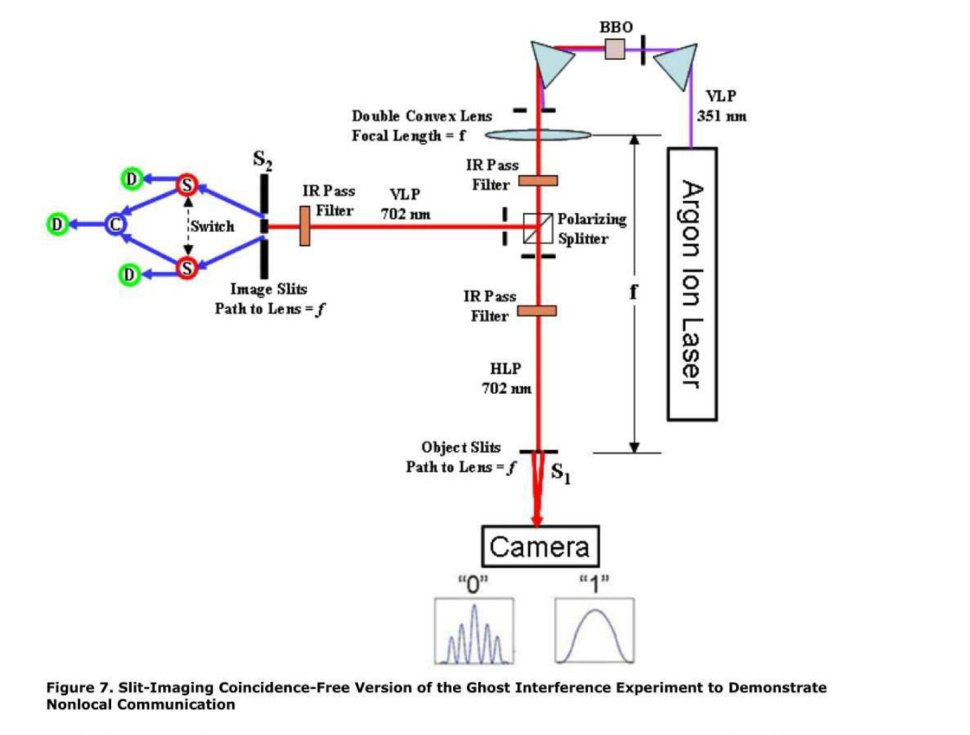
The central proposal is a coincidence-free arrangement (Figure 7): a fiber-optic switch turns the "which-way" information on or off in one arm, and a camera in the other arm should record a single-slit pattern ("1") or a double-slit pattern ("0"). The authors warn that demonstrating the effect is not the same as sending a signal, because a single photon pair transmits nothing. They estimate that about 10 detections would be needed for a 3-sigma statistical decision and, more likely, 100 or more, with a far more efficient source of entangled pairs, such as periodically poled crystals. The analysis via the transactional interpretation finds no impediment, but the interpretation is neutral as to the possibility.
Assuming the arrangement worked, the text describes the consequences: with 10 km fibers in each arm, the message would arrive about 50 microseconds before it was sent, which would be retrocausal signaling. It discusses the bilking and immaculate conception paradoxes, cites the solutions proposed by Wheeler and Feynman, by Thorne, and by Hawking, and shows that a system with a spacelike interval, with fibers of equal length, would avoid time loops. Section XII adds the nonlinear quantum mechanics of Weinberg and Polchinski, whose experimental searches, the text says, have only produced very low upper limits, and speculates that nonlinearity might exist in very strong gravitational fields.
The example application is the control of a rover on Mars. Light takes between 4,4 and 20 minutes to reach Mars and 4 to 4,3 hours to reach Neptune, which, according to the introduction, prevents real-time control of remote devices and forces the use of preprogrammed robots. With a nonlocal link, an operator on Earth would "drive" the rover in virtual reality. The horizon is entirely hypothetical: the text gives no timeframe, does not claim the technology exists, and ends by saying that the question is experimental and that at least one experiment under way is seeking a coincidence-free version of Ghost Interference.
The document does not say why the program commissioned it. The introduction justifies the topic by the limitations of space communication and by the implications of an enabling technology for superluminal and retrocausal signaling. It does not mention UFOs, UAPs, or reverse engineering, and no passage links the subject to observed objects. Its historical value lies in showing the kind of frontier physics the AAWSAP series brought together, alongside studies on propulsion, space warping, and antigravity. The assessments belong to the author, with the knowledge available in 2010; experimental results such as those of Aspect and Zeilinger and the count estimates are citations from the study, not measurements by the portal.
As for the translation, the report's 32 pages are translated in full: cover, masthead, table of contents, text, figure captions, glossary, and reference list. The equations in the text are short and appear inline, such as s² = x² − (ct)². In the figures, the labels have been reproduced in square brackets. In the reference list, only the descriptive elements were translated; the titles of works and articles in English remain in the original.
DIRECT READING OF THE FILE
The document, in the original
All 32 pages of the document were translated in full (cover, front matter, table of contents and list of figures, text of sections I to XIII, glossary and references). Figure labels are in square brackets and equations follow the notation of the original. In the reference list, only the descriptive elements were translated; titles of works and articles in English remain in the original.
EXCERPT 1 · PHYSICAL PAGE 1
full page
UNCLASSIFIED/ /FOR. OFFICIAL 891!! Oflt I
30 March 2010
ICOD: 1 December 2009
DIA-08 -1003 -016
Defense
Intelligence
Reference
Document
Acquisition Threat Support
The Space-Communication
Implications of Quantum
Entanglement and Nonlocality
UNCLASSIFIED/ /FOR 8FPl@IAL 891!! Oflt IEditorial note: Cover of DIRD DIA-08-1003-016, dated March 30, 2010, Acquisition Threat Support series.
Check the original PDF
UNCLASSIFIED/ /FOR. OFFICIAL 891!! Oflt I
30 March 2010
ICOD: 1 December 2009
DIA-08 -1003 -016
Defense
Intelligence
Reference
Document
Acquisition Threat Support
The Space-Communication
Implications of Quantum
Entanglement and Nonlocality
UNCLASSIFIED/ /FOR 8FPl@IAL 891!! Oflt IView the document record ↗ · Physical page 1, counting the cover.
EXCERPT 2 · PHYSICAL PAGE 10
full page
UNCLASSIFIED/ /FOR OFFI@IAk WSE OPtklf
observer signaling (Reference 12), because one would need to deduce from the arriving
photons the polarization basis that was being used in the distant measurements. This is
an aspect of the parameter independence mentioned above. While each observer is free
to choose a parameter that specifies the polarization basis (for example, circular
right/left, linear at any angle) for the measurement, he is not free to force the photon
into a particular state of that basis, as would be required for nonlocal communication.
However, measuring polarization correlations in a system with angular momentum
constraints is not the only way to demonstrate the nonlocal connection between the
entangled separated parts of a quantum system. Below, EPR experiments that use
momentum entanglement are discussed, and the question of whether such quantum
systems might provide a better vehicle for observer-to-observer nonlocal
communication is explored, because by using momentum entanglement, an observer is
able to force the photon into particle-like or wave-like behavior.
II. The Quantum No-Signal Theorems
As Einstein implied with his well-known "spooky actions at a distance" comment,
enforcement of quantum correlations across spacelike and negat ive timelike intervals
by nonlocality is very counterintuitive. It appears to imply the twin possibilities of
superluminal commun ication and of reverse causation through back-in-time
communication between observers. However, a number of authors (Reference 13) have
presented "proofs" that such nonlocal observer-to-observer communication is
impossible within the formalism of standard quantum mechanics. These theorems
assert that in separated measurements involving entangled quantum systems, the
quantum correlations will be preserved, but there will be no effect apparent to an
observer in one sub-system if the character of the measurement is changed in the
other sub-system . Thus, it is asserted, nonlocal signaling is impossible.
As mentioned above, EPR experiments can be viewed (Reference 5, 6) as
demonstrating violations of outcome independence or parameter independence or both.
Outcome independence cannot be used for nonlocal signaling, while parameter
independence can. Thus, any test of nonlocal signaling is, in effect, a test of the
parameter independence of quantum phenomena, and the no-signal theorems are
"proofs" of parameter independence.
Do these no-signal "proofs" really have the status of mathematical theorems? Perhaps
not. Recently it has been pointed out (Reference 14) that at least some of these
"proofs" ruling out nonlocal signaling are tautological, assuming that the measurement
process and its associated Hamiltonian are local, thereby building the final conclusion of
no signaling into their starting assumptions. Standard quantum mechanical Bose
Einstein symmetrization in systems of bosons has been raised as a counter-example,
shown to be inconsistent with the initial assumptions of some of these "proofs."
Therefore, at least from some perspectives, the possibility of nonlocal communication in
the context of standard quantum mechanics remains open and appropriate for
experimental testing.
UNCLASSIFIED/ /FOR OFFI@IAk WSE OHkl/
4Editorial note: End of Section I and Section II: the no-signaling theorems and the objection that some proofs would be circular.
Check the original PDF
UNCLASSIFIED/ /FOR OFFI@IAk WSE OPtklf
observer signaling (Reference 12), because one would need to deduce from the arriving
photons the polarization basis that was being used in the distant measurements. This is
an aspect of the parameter independence mentioned above. While each observer is free
to choose a parameter that specifies the polarization basis (for example, circular
right/left, linear at any angle) for the measurement, he is not free to force the photon
into a particular state of that basis, as would be required for nonlocal communication.
However, measuring polarization correlations in a system with angular momentum
constraints is not the only way to demonstrate the nonlocal connection between the
entangled separated parts of a quantum system. Below, EPR experiments that use
momentum entanglement are discussed, and the question of whether such quantum
systems might provide a better vehicle for observer-to-observer nonlocal
communication is explored, because by using momentum entanglement, an observer is
able to force the photon into particle-like or wave-like behavior.
II. The Quantum No-Signal Theorems
As Einstein implied with his well-known "spooky actions at a distance" comment,
enforcement of quantum correlations across spacelike and negat ive timelike intervals
by nonlocality is very counterintuitive. It appears to imply the twin possibilities of
superluminal commun ication and of reverse causation through back-in-time
communication between observers. However, a number of authors (Reference 13) have
presented "proofs" that such nonlocal observer-to-observer communication is
impossible within the formalism of standard quantum mechanics. These theorems
assert that in separated measurements involving entangled quantum systems, the
quantum correlations will be preserved, but there will be no effect apparent to an
observer in one sub-system if the character of the measurement is changed in the
other sub-system . Thus, it is asserted, nonlocal signaling is impossible.
As mentioned above, EPR experiments can be viewed (Reference 5, 6) as
demonstrating violations of outcome independence or parameter independence or both.
Outcome independence cannot be used for nonlocal signaling, while parameter
independence can. Thus, any test of nonlocal signaling is, in effect, a test of the
parameter independence of quantum phenomena, and the no-signal theorems are
"proofs" of parameter independence.
Do these no-signal "proofs" really have the status of mathematical theorems? Perhaps
not. Recently it has been pointed out (Reference 14) that at least some of these
"proofs" ruling out nonlocal signaling are tautological, assuming that the measurement
process and its associated Hamiltonian are local, thereby building the final conclusion of
no signaling into their starting assumptions. Standard quantum mechanical Bose
Einstein symmetrization in systems of bosons has been raised as a counter-example,
shown to be inconsistent with the initial assumptions of some of these "proofs."
Therefore, at least from some perspectives, the possibility of nonlocal communication in
the context of standard quantum mechanics remains open and appropriate for
experimental testing.
UNCLASSIFIED/ /FOR OFFI@IAk WSE OHkl/
4View the document record ↗ · Physical page 10, counting the cover.
EXCERPT 3 · PHYSICAL PAGE 11
full page
UNCLASSIFIED// POil OFFI@IAk W&i 0NL¥
III. Nonlocality Versus Special Relativity?
If nonlocal communication is possible, would it be in conflict with special relativity, with
its well-known prohibition against faster-than-light signals? The answer is no.
The prohibition of signals with superluminal speeds by Einstein's theory of special
relativity is related to the fact that the definite simultaneity of two separated space
time points is not Lorentz invariant. Since some hypothetical superluminal signal could
be used to establish a fixed simultaneity relation between two such points-for
example, by clock synchronization-this would imply a preferred inertial frame and
would be inconsistent with Lorentz invariance and special relativity. In other words, it
would be inconsistent with the even-handed treatment of all inertial reference frames in
special relativity.
However, if a nonlocal signal could be transmitted through measurements at separated
locations performed on two entangled photons, the signal would be "sent" at the time
of the arrival of the photon in one location and "received" at the time of arrival of the
other photon. By varying path lengths to the two locations, these events could be made
to occur in any order and time separation in any reference frame. Therefore, nonlocal
signals (even superluminal and retrocausal ones) could not be used to establish a fixed
simultaneity relation between two separated space-time points, because the sending
and receiving of such signals do not have fixed time relations. The transmission and
arrival instants of a nonlocal signal cannot be used for synchronization because the
transmission and reception instants are path- and delay-dependent variables.
To put it another way, the nonlocal connections of entangled photons lie along
segmented lightlike world lines that transform properly under Lorentz transformations.
Therefore, there is no conflict between nonlocal signaling and the Lorentz invariance of
special relativ ity. On the other hand, the principle of causality (cause must precede
effect in all refere nce frames) appears very likely to be violated (or at least violate
able) if nonlocal signaling is possible.
Is it possible that the universe does have some preferred reference frame, perhaps that
laid down by the cosmic microwave background or implied by Mach's Principle?
Perhaps, but if such a preferred frame existed, its existence could not be established by
nonlocal communication.
IV. Momentum Domain Entanglement and EPR
Experiments
Einstein's original objection (Reference 4) that quantum mechanics appeared to be
nonlocal was made with arguments based on a gedankenexperiment in the momentum
domain. However, almost all of the modern EPR experiments testing the Bell Inequality
and demonstrating quantum nonlocality have been performed in the polarization (that
is, angular momentum) domain, usually with linearly polarized photons. Interestingly, it
appears that if nonlocal quantum communication is possible at all, it may be more
easily achieved in the momentum domain of Einstein's original focus.
The optical process of spontaneous parametric down-conversion (Reference 15) turns
out to be a very useful way of generating photon pairs entangled in either the
polarization or the momentum domains. In this process, a photon from a "pump laser"
UNCLASSIFIED/ /FOil OFFI&I.t.k W&li ONkY
5Editorial note: Section III (nonlocality and special relativity) and beginning of Section IV (entanglement in the momentum domain).
Check the original PDF
UNCLASSIFIED// POil OFFI@IAk W&i 0NL¥
III. Nonlocality Versus Special Relativity?
If nonlocal communication is possible, would it be in conflict with special relativity, with
its well-known prohibition against faster-than-light signals? The answer is no.
The prohibition of signals with superluminal speeds by Einstein's theory of special
relativity is related to the fact that the definite simultaneity of two separated space
time points is not Lorentz invariant. Since some hypothetical superluminal signal could
be used to establish a fixed simultaneity relation between two such points-for
example, by clock synchronization-this would imply a preferred inertial frame and
would be inconsistent with Lorentz invariance and special relativity. In other words, it
would be inconsistent with the even-handed treatment of all inertial reference frames in
special relativity.
However, if a nonlocal signal could be transmitted through measurements at separated
locations performed on two entangled photons, the signal would be "sent" at the time
of the arrival of the photon in one location and "received" at the time of arrival of the
other photon. By varying path lengths to the two locations, these events could be made
to occur in any order and time separation in any reference frame. Therefore, nonlocal
signals (even superluminal and retrocausal ones) could not be used to establish a fixed
simultaneity relation between two separated space-time points, because the sending
and receiving of such signals do not have fixed time relations. The transmission and
arrival instants of a nonlocal signal cannot be used for synchronization because the
transmission and reception instants are path- and delay-dependent variables.
To put it another way, the nonlocal connections of entangled photons lie along
segmented lightlike world lines that transform properly under Lorentz transformations.
Therefore, there is no conflict between nonlocal signaling and the Lorentz invariance of
special relativ ity. On the other hand, the principle of causality (cause must precede
effect in all refere nce frames) appears very likely to be violated (or at least violate
able) if nonlocal signaling is possible.
Is it possible that the universe does have some preferred reference frame, perhaps that
laid down by the cosmic microwave background or implied by Mach's Principle?
Perhaps, but if such a preferred frame existed, its existence could not be established by
nonlocal communication.
IV. Momentum Domain Entanglement and EPR
Experiments
Einstein's original objection (Reference 4) that quantum mechanics appeared to be
nonlocal was made with arguments based on a gedankenexperiment in the momentum
domain. However, almost all of the modern EPR experiments testing the Bell Inequality
and demonstrating quantum nonlocality have been performed in the polarization (that
is, angular momentum) domain, usually with linearly polarized photons. Interestingly, it
appears that if nonlocal quantum communication is possible at all, it may be more
easily achieved in the momentum domain of Einstein's original focus.
The optical process of spontaneous parametric down-conversion (Reference 15) turns
out to be a very useful way of generating photon pairs entangled in either the
polarization or the momentum domains. In this process, a photon from a "pump laser"
UNCLASSIFIED/ /FOil OFFI&I.t.k W&li ONkY
5View the document record ↗ · Physical page 11, counting the cover.
EXCERPT 4 · PHYSICAL PAGE 12
full page
UNCLASSIFIED/ /FOR. OFFl@IAL l!ISE 8PU::Y
interacts with a nonlinear crystal and is transformed into two photons with energies and
vector momenta that add up to those of the original pump photon. Depending on the
type of down-conversion process, there are well-defined polarization correlations
between the entangled photons. The down-converted photons may also be easily
prepared in momentum -entangled states, because within the nonlinear medium, the
vector momenta of the down-converted pair of photons must add to give that of the
pump photon.
The first measurement using
momentum-entangled down-conversion
photons that might be related to
nonlocal communication is the Ghost
Interference experiment reported in
1995 by the Shih group (Reference 16),
shown schematically in Figure 2. The
experimenters used degenerate
collinear Type-II down-conversion of
351-nm UV pump radiation from an
argon-ion laser passed through a 3-
mm-long BBO (f3-BaB2Q4) crystal that 0had been cut with the optic axis at a
phase-matching angle of 42.2° to the
pump beam to produce a pair of
collinear momentum-entangled 702-nm
photons with opposite polarizations. The
entangled photons emerge from the
crystal very nearly parallel with the
pump beam. The pump beam is then
split off from the pair using refraction in
a quartz prism (UV Prism), and the
entangled photons are separated with a
polarization-selecting beam splitter (BS)
that reflects the "extraordinary"
vertically polarized photon (e) and Figure 2. Schematic of the 1995 Ghost Interference
transmits the "ordinary" horizontally Experiment (Reference 16) of the Shih group
polarized photon (o) . Both photons are
passed through 702 ± 10-nm wavelength-selective filters (f1,2) and then detected
(D1,2).
351 nm
Ar Laser
BS
f
Slits 1
fiber Gating
Gated
UNCLASSIFIED/ /FOR. OFFICIJ!IL U:!~ Gilt I
6Editorial note: Description of the 1995 Ghost Interference experiment and Figure 2, its diagram.
Check the original PDF
UNCLASSIFIED/ /FOR. OFFl@IAL l!ISE 8PU::Y
interacts with a nonlinear crystal and is transformed into two photons with energies and
vector momenta that add up to those of the original pump photon. Depending on the
type of down-conversion process, there are well-defined polarization correlations
between the entangled photons. The down-converted photons may also be easily
prepared in momentum -entangled states, because within the nonlinear medium, the
vector momenta of the down-converted pair of photons must add to give that of the
pump photon.
The first measurement using
momentum-entangled down-conversion
photons that might be related to
nonlocal communication is the Ghost
Interference experiment reported in
1995 by the Shih group (Reference 16),
shown schematically in Figure 2. The
experimenters used degenerate
collinear Type-II down-conversion of
351-nm UV pump radiation from an
argon-ion laser passed through a 3-
mm-long BBO (f3-BaB2Q4) crystal that 0had been cut with the optic axis at a
phase-matching angle of 42.2° to the
pump beam to produce a pair of
collinear momentum-entangled 702-nm
photons with opposite polarizations. The
entangled photons emerge from the
crystal very nearly parallel with the
pump beam. The pump beam is then
split off from the pair using refraction in
a quartz prism (UV Prism), and the
entangled photons are separated with a
polarization-selecting beam splitter (BS)
that reflects the "extraordinary"
vertically polarized photon (e) and Figure 2. Schematic of the 1995 Ghost Interference
transmits the "ordinary" horizontally Experiment (Reference 16) of the Shih group
polarized photon (o) . Both photons are
passed through 702 ± 10-nm wavelength-selective filters (f1,2) and then detected
(D1,2).
351 nm
Ar Laser
BS
f
Slits 1
fiber Gating
Gated
UNCLASSIFIED/ /FOR. OFFICIJ!IL U:!~ Gilt I
6View the document record ↗ · Physical page 12, counting the cover.
EXCERPT 5 · PHYSICAL PAGE 13
full page
UNCLASSIFIED/ /FOR 8FFI@IAL l!IS! 8HLY
The experimenters demonstrated that 300
passing the vertically polar ized photon
(e) through a double- or single-s lit "'
250
system before detection at D1 produced
a "comb" inter ference distribut ion or a
C: ::,
0
0
Ql
200
"bump" diffraction distribution,
respectively, in the position X2 of the
(.)
C:
Ql
'C
·.:;
150
100
horizontally polarized photon (o)
detected at D2 when the pair of photons
C:
·5
0 so
is examined in coincidence. I n other
words, the posit ion distr ibution of the
straight-through photon shows patterns
·8 ·6 ·4 ·2 0 2 4
Detector 2 position (mm)
characterist ic of the single- or doub le
slit system through which its tw in
entangled photon passed. Figure 3
shows the observed position
distributions for the two cases.
From the viewpoint of nonlocal
commun ication, we note that modifying
the slit system before D1 through which
the reflected photon passes, which can
be though t of as the action of a ·8 ·4 ·2 0 2 4
"sending" observer, nonlocally causes Detector 2 position (mm)
an observable change in the Xrpos ition
distribution of the undeflected photon, Figure 3. Ghost Interference Position Distributions
as detected by a " receiv ing" observer at at x,
D2. This is a nonclassical effect t hat demonstrates the nonlocal connection between the
entangled pair and that might form the basis for transmiss ion of a nonlocal signal
between the two observers. However, the Ghost Interference exper iment does not, in
the form reported, demo nstrate nonlocal commun ication, because of its use of a
classical communication link in impos ing the coincidence requirement between the
detected photo ns.
In their paper, the authors comment that with the two-slit system in place, in t he
absence of coincidences there is no observable two-slit interference pattern
dist ribut ions at either D1 or D2. They attribute this lack of an interference "signal" to the
horizontal variation in the creation posit ion of the down-converted photons . The
variation is enough to cause the "e" photons to arrive at the two slits with relative path
lengths that may differ by more than a wavelength, t hereby randomly shift ing and
washing out any interfere nce pattern. Furthermore, their source of entangled photons
was very ineff icient and noisy. Only about 1 in 1010 pump photons produced an
entangled pair, while many unentang led "noise" photons of the same wavelength were
created by fluorescence in the crystal. Therefore, even if the coincidence requirement
had been in princ iple removable (see below), it is not surpris ing that coincidences were
required to observe the reported effects .
0 L__,=..J.----'--~__J_~-----'---~-'--~...,__~ ~ '---'
(a) Two slits
"' C: ::,
0
0
a,
0
C:
Ql
~
C:
·o
0
500 (b) One slit
400
300
200
100
UNCLASSIFIED/ ,'FOR. 8fflE!IJltL U:!E fJHL I
7Editorial note: Results of the 1995 experiment (Figure 3) and why it does not demonstrate nonlocal communication.
Check the original PDF
UNCLASSIFIED/ /FOR 8FFI@IAL l!IS! 8HLY
The experimenters demonstrated that 300
passing the vertically polar ized photon
(e) through a double- or single-s lit "'
250
system before detection at D1 produced
a "comb" inter ference distribut ion or a
C: ::,
0
0
Ql
200
"bump" diffraction distribution,
respectively, in the position X2 of the
(.)
C:
Ql
'C
·.:;
150
100
horizontally polarized photon (o)
detected at D2 when the pair of photons
C:
·5
0 so
is examined in coincidence. I n other
words, the posit ion distr ibution of the
straight-through photon shows patterns
·8 ·6 ·4 ·2 0 2 4
Detector 2 position (mm)
characterist ic of the single- or doub le
slit system through which its tw in
entangled photon passed. Figure 3
shows the observed position
distributions for the two cases.
From the viewpoint of nonlocal
commun ication, we note that modifying
the slit system before D1 through which
the reflected photon passes, which can
be though t of as the action of a ·8 ·4 ·2 0 2 4
"sending" observer, nonlocally causes Detector 2 position (mm)
an observable change in the Xrpos ition
distribution of the undeflected photon, Figure 3. Ghost Interference Position Distributions
as detected by a " receiv ing" observer at at x,
D2. This is a nonclassical effect t hat demonstrates the nonlocal connection between the
entangled pair and that might form the basis for transmiss ion of a nonlocal signal
between the two observers. However, the Ghost Interference exper iment does not, in
the form reported, demo nstrate nonlocal commun ication, because of its use of a
classical communication link in impos ing the coincidence requirement between the
detected photo ns.
In their paper, the authors comment that with the two-slit system in place, in t he
absence of coincidences there is no observable two-slit interference pattern
dist ribut ions at either D1 or D2. They attribute this lack of an interference "signal" to the
horizontal variation in the creation posit ion of the down-converted photons . The
variation is enough to cause the "e" photons to arrive at the two slits with relative path
lengths that may differ by more than a wavelength, t hereby randomly shift ing and
washing out any interfere nce pattern. Furthermore, their source of entangled photons
was very ineff icient and noisy. Only about 1 in 1010 pump photons produced an
entangled pair, while many unentang led "noise" photons of the same wavelength were
created by fluorescence in the crystal. Therefore, even if the coincidence requirement
had been in princ iple removable (see below), it is not surpris ing that coincidences were
required to observe the reported effects .
0 L__,=..J.----'--~__J_~-----'---~-'--~...,__~ ~ '---'
(a) Two slits
"' C: ::,
0
0
a,
0
C:
Ql
~
C:
·o
0
500 (b) One slit
400
300
200
100
UNCLASSIFIED/ ,'FOR. 8fflE!IJltL U:!E fJHL I
7View the document record ↗ · Physical page 13, counting the cover.
EXCERPT 6 · PHYSICAL PAGE 14
full page
UNCLASSIFIED/ /FOR OFFl&IAk W&li 8NL¥
a)
Pump
Figure 4. "Unfolding" the Ghost Interference Experiment
The authors point out that there is a simple way of thinking about momentum
entanglement measurements involving entangled photons. It can be shown from Snell's
Law and conservation of momentum in the crystal that if one photon has a small
momentum that causes it to be slightly deflected to the right of the pump beam by an
angle 0, then the twin entangled photon will be deflected to the left by the same angle
0, a situation reminiscent of reflection from a mirror. This allows the experiment to be
"unfolded" by replacing the effective reflection by a straight-through path, as shown in
Figure 4. The point of the unfolding is that the entangled photons behave exactly as
would be the case if the direction of the deflected photon was reversed, so that it
originated at the detection point D1, passed through one or two slits at C and D, and
produced a one or two slit interference pattern at X2 detected by D2.
Why is the coincidence needed? First, it should be clear from Figure 2 that detector D2
detects not only the entangled twins of the photons that pass through the slit openings,
but also the entangled twins of the much larger number of photons that are stopped by
the opaque parts of the slits . Therefore, without coincidences, no interference pattern
could possibly be observed at X2, Moreover, one can see from Figure 4b that detector D1
behind the slits receives light in a very localized region, and if it were moved vertically
in the diagram, the interference pattern at D2 would be shifted, with maxima becoming
minima and vice versa. Without coincidences requiring a particular location for the
detection at D1, the D2 distribution would have to average over all possible D1 positions,
washing out the two-slit interference pattern. Therefore, because of the geometry used,
the Ghost Interference experiment required a coincidence to observe a two-slit
interference pattern like the one shown in Figure 3a.
UNCLASSIFIED/ /POil orr1e1Jct U91! er~t I
8Editorial note: Figure 4 ("unfolding" of the experiment) and explanation of why coincidence was necessary.
Check the original PDF
UNCLASSIFIED/ /FOR OFFl&IAk W&li 8NL¥
a)
Pump
Figure 4. "Unfolding" the Ghost Interference Experiment
The authors point out that there is a simple way of thinking about momentum
entanglement measurements involving entangled photons. It can be shown from Snell's
Law and conservation of momentum in the crystal that if one photon has a small
momentum that causes it to be slightly deflected to the right of the pump beam by an
angle 0, then the twin entangled photon will be deflected to the left by the same angle
0, a situation reminiscent of reflection from a mirror. This allows the experiment to be
"unfolded" by replacing the effective reflection by a straight-through path, as shown in
Figure 4. The point of the unfolding is that the entangled photons behave exactly as
would be the case if the direction of the deflected photon was reversed, so that it
originated at the detection point D1, passed through one or two slits at C and D, and
produced a one or two slit interference pattern at X2 detected by D2.
Why is the coincidence needed? First, it should be clear from Figure 2 that detector D2
detects not only the entangled twins of the photons that pass through the slit openings,
but also the entangled twins of the much larger number of photons that are stopped by
the opaque parts of the slits . Therefore, without coincidences, no interference pattern
could possibly be observed at X2, Moreover, one can see from Figure 4b that detector D1
behind the slits receives light in a very localized region, and if it were moved vertically
in the diagram, the interference pattern at D2 would be shifted, with maxima becoming
minima and vice versa. Without coincidences requiring a particular location for the
detection at D1, the D2 distribution would have to average over all possible D1 positions,
washing out the two-slit interference pattern. Therefore, because of the geometry used,
the Ghost Interference experiment required a coincidence to observe a two-slit
interference pattern like the one shown in Figure 3a.
UNCLASSIFIED/ /POil orr1e1Jct U91! er~t I
8View the document record ↗ · Physical page 14, counting the cover.
EXCERPT 7 · PHYSICAL PAGE 15
full page
UNCLASSIFIED/ /FOR OFFI@IAI! WSE OHi!:¥
Another momentum-entangled EPR experiment was the 1998 Ph.D. thesis of Birgit
Dopfer (Reference 17) performed at the University of Innsbruck and shown
schematically in Figure 5. In the Dopfer experiment, moving a detector in one arm
non locally changes the observed interference pattern in the other arm. Dopfer used
351-nm UV pump radiation from an argon -ion laser with Type I down-conversion in a
nonlinear Lil03 crystal cut with the optic axis at 90° to the pump beam to produce a
pair of 702-nm momentum-entangled photons that emerged from the crystal at angles
of 28.2° to the right and left of the pump axis, as shown in Figure 5.
Figure 5. Schematic of the 1998 Dopfer Experiment (Reference 17)
The lower entangled photon passed through a pair of slits and into a detector, while the
upper photon passed through a lens that could image the two slits to perform a "which
way" measurement if detector D2 was placed two focal lengths behind the lens (2f).
However, if detector D2 was placed in a position one focal length behind the lens (f), the
slits were not imaged, and light on the reflected line passing through either slit could
reach the detector at the same points, producing a result similar to that of the Ghost
Interference experiment. A structured two-sl it interference pattern could be switched on
and off by moving a detector in the other arm of the experiment between the f and 2f
positions.
Again, from the viewpoint of nonlocal communication, it is noted that moving detector
D2, which can be thought of as the action of a "sending" observer, nonlocally causes an
observable change in the position distribution of the second photon, as detected at
"receiver" position D1. However, the Dopfer experiment does not demonstrate nonlocal
communication because, like the Ghost Interference experiment, it requires a classical
communication link to impose the coincidence requirement between the detected
photons because of the geometry of the experiment.
Examination of these two exper iments raises a very interesting quest ion: Can the
coincidence requirement be removed? The answer is not clear. In principle, the two
entangled photons are connected by nonlocality whether they are detected in
coincidence or not. The coincidence should therefore be removable. However, in both
experiments the authors report that no two -slit interference distr ibution is observed
2f . . . . . . . . . . . . . . . . . . . . . . . . .. . . . . . . . . . . . . . .
702.2 nm
2f
~ ~.... .. . . .. .. ... . . . . . .... .. ........ . .
♦ - .. . ... . ........ .
f
Coincidence
UNCLASSIFIED/ /FOA OFFI&il.t.l:: W&lii OHi!:¥
9Editorial note: Dopfer's 1998 experiment (Figure 5) and the question of removing the coincidence requirement.
Check the original PDF
UNCLASSIFIED/ /FOR OFFI@IAI! WSE OHi!:¥
Another momentum-entangled EPR experiment was the 1998 Ph.D. thesis of Birgit
Dopfer (Reference 17) performed at the University of Innsbruck and shown
schematically in Figure 5. In the Dopfer experiment, moving a detector in one arm
non locally changes the observed interference pattern in the other arm. Dopfer used
351-nm UV pump radiation from an argon -ion laser with Type I down-conversion in a
nonlinear Lil03 crystal cut with the optic axis at 90° to the pump beam to produce a
pair of 702-nm momentum-entangled photons that emerged from the crystal at angles
of 28.2° to the right and left of the pump axis, as shown in Figure 5.
Figure 5. Schematic of the 1998 Dopfer Experiment (Reference 17)
The lower entangled photon passed through a pair of slits and into a detector, while the
upper photon passed through a lens that could image the two slits to perform a "which
way" measurement if detector D2 was placed two focal lengths behind the lens (2f).
However, if detector D2 was placed in a position one focal length behind the lens (f), the
slits were not imaged, and light on the reflected line passing through either slit could
reach the detector at the same points, producing a result similar to that of the Ghost
Interference experiment. A structured two-sl it interference pattern could be switched on
and off by moving a detector in the other arm of the experiment between the f and 2f
positions.
Again, from the viewpoint of nonlocal communication, it is noted that moving detector
D2, which can be thought of as the action of a "sending" observer, nonlocally causes an
observable change in the position distribution of the second photon, as detected at
"receiver" position D1. However, the Dopfer experiment does not demonstrate nonlocal
communication because, like the Ghost Interference experiment, it requires a classical
communication link to impose the coincidence requirement between the detected
photons because of the geometry of the experiment.
Examination of these two exper iments raises a very interesting quest ion: Can the
coincidence requirement be removed? The answer is not clear. In principle, the two
entangled photons are connected by nonlocality whether they are detected in
coincidence or not. The coincidence should therefore be removable. However, in both
experiments the authors report that no two -slit interference distr ibution is observed
2f . . . . . . . . . . . . . . . . . . . . . . . . .. . . . . . . . . . . . . . .
702.2 nm
2f
~ ~.... .. . . .. .. ... . . . . . .... .. ........ . .
♦ - .. . ... . ........ .
f
Coincidence
UNCLASSIFIED/ /FOA OFFI&il.t.l:: W&lii OHi!:¥
9View the document record ↗ · Physical page 15, counting the cover.
EXCERPT 8 · PHYSICAL PAGE 16
full page
B Source Slit Detector
UNCLASSIFIED/ /FOR OFFICIAL tt.!I!! 8HL'f
when the coincidence requirement is relaxed. This may be explained by the action of
coherence-entanglement complementarity, as discussed in the next section.
V. Coherence-Entanglement Complementarity
As discussed above, the finite extent of the source is expected to limit the possibility of
observing a two-slit interference pattern, which would be the "signal" if nonlocal
commun ication were possible. Figure 6 shows schematically (not to scale) this "thick
source" effect. The source volume on the left is the region of the nonlinear crystal that
is illuminated by the UV pump-laser beam directed along the u axis. The source volume
is a cylinder a few mm thick and a mm or so in radius with a center point C. The source
cylinder is assumed to be tilted at an angle 0 with respect to the horizontal z axis on
which the slit system and detector plane are symmetrically centered. We note that 0 =
0° in the Ghost Interference experiment and 0 = 28.2° in the Dopfer experiment. A
horizontal distance Lxs away from the source is a two-slit system, a pair of apertures a
with center-to-center separation d. Light passing through the slit system travels a
horizontal distance Lsd and is detected at detector plane at position x,.
System PlaneVolume
Figure 6. Thick-Source Effect (not to scale): Waves arriv ing at the two slits from points A and B at the
extrema of the source volume may have significant path length and phase differences, while waves from the
central point C are in phase at the slits.
If the point of photon production is off the z axis, there will be a path length difference
between waves relative to C as they arrive at the two slits . In Figure 6, waves from
points A and B could have path length differences greater that half a wavelength and
phase differences greater than 180°. Roughly speaking, this shifts the interference
pattern relative to waves created at central point C so that maxima become minima
and vice versa. The net effect of averaging over all points in the source volume would
therefore be to wash out the two-slit interference pattern. That two-slit interference
pattern must be observed unambiguously, because it is the "signal" that would be used
in any nonlocal communication. This operability is quantified by an observable called
"visibility," which is related to the peak-to-valley ratio of the interference pattern.
The constancy of the relative phase at the two slits for photons arriving from various
parts of the source is called "coherence" and ensures a high visibility. It should be clear
that a point-like source has perfect coherence, while a source with a large solid angle as
UNCLASSIFIED/ ,,roA &FFISIAL 1:181! 8HL'I"
10Editorial note: Section V: complementarity between coherence and entanglement and Figure 6, thick-source effect.
Check the original PDF
B Source Slit Detector
UNCLASSIFIED/ /FOR OFFICIAL tt.!I!! 8HL'f
when the coincidence requirement is relaxed. This may be explained by the action of
coherence-entanglement complementarity, as discussed in the next section.
V. Coherence-Entanglement Complementarity
As discussed above, the finite extent of the source is expected to limit the possibility of
observing a two-slit interference pattern, which would be the "signal" if nonlocal
commun ication were possible. Figure 6 shows schematically (not to scale) this "thick
source" effect. The source volume on the left is the region of the nonlinear crystal that
is illuminated by the UV pump-laser beam directed along the u axis. The source volume
is a cylinder a few mm thick and a mm or so in radius with a center point C. The source
cylinder is assumed to be tilted at an angle 0 with respect to the horizontal z axis on
which the slit system and detector plane are symmetrically centered. We note that 0 =
0° in the Ghost Interference experiment and 0 = 28.2° in the Dopfer experiment. A
horizontal distance Lxs away from the source is a two-slit system, a pair of apertures a
with center-to-center separation d. Light passing through the slit system travels a
horizontal distance Lsd and is detected at detector plane at position x,.
System PlaneVolume
Figure 6. Thick-Source Effect (not to scale): Waves arriv ing at the two slits from points A and B at the
extrema of the source volume may have significant path length and phase differences, while waves from the
central point C are in phase at the slits.
If the point of photon production is off the z axis, there will be a path length difference
between waves relative to C as they arrive at the two slits . In Figure 6, waves from
points A and B could have path length differences greater that half a wavelength and
phase differences greater than 180°. Roughly speaking, this shifts the interference
pattern relative to waves created at central point C so that maxima become minima
and vice versa. The net effect of averaging over all points in the source volume would
therefore be to wash out the two-slit interference pattern. That two-slit interference
pattern must be observed unambiguously, because it is the "signal" that would be used
in any nonlocal communication. This operability is quantified by an observable called
"visibility," which is related to the peak-to-valley ratio of the interference pattern.
The constancy of the relative phase at the two slits for photons arriving from various
parts of the source is called "coherence" and ensures a high visibility. It should be clear
that a point-like source has perfect coherence, while a source with a large solid angle as
UNCLASSIFIED/ ,,roA &FFISIAL 1:181! 8HL'I"
10View the document record ↗ · Physical page 16, counting the cover.
EXCERPT 9 · PHYSICAL PAGE 17
full page
UNCLASSIFIED/ /FOR 8FFI@IsT.tk WSE 8Hk¥
viewed from the slits will have reduced coherence. The path length difference at the
slits is, to a good approximation, inversely proportional to Lxs, Therefore, making Lxs
large-that is, placing the slits some distance from the source volume-can reduce the
path length differences to a value that increases coherence and allows observation of a
sharp two-slit interference pattern signal at detector D1. Alternatively, placing a thin,
double-concave diverging lens at point P of Figure 6 can have the same effect by
causing the shorter path lengths to pass through a greater thickness of lens glass. Such
a lens would also demagnify the source, producing the equivalent of a longer path
length and smaller source solid angle.
However, increasing source coherence has another consequence. The momentum
entanglement of photons from the source arises from momentum conservation.
Restricting the solid angle of the source, as viewed from the slits, means fewer photon
pairs can be entangled and still satisfy the geometrical constraints of the experimental
configuration. The Saleh group at Boston University has shown that there is a
complementary relation between source coherence and two-photon entanglement
(Reference 18). As the source-slit distance Lxs is increased, there are smooth transitions
from one-slit to two-slit interference patterns and from a highly entangled source to a
highly coherent source. We note, as mentioned above, that the parametric down
conversion technology used in the Ghost Interference and Dopfer experiments was
fairly inefficient and noisy, with fairly improbable production of entangled pairs
competing with much more probable production of unentangled "noise" photons of the
same wavelength from pumped fluorescence in the crystal. This would tend to limit the
entanglement of the source.
Nonlocal communication using momentum entanglement requires source coherence.
Source coherence is needed in order to observe the "signal" of a two-slit interference
pattern and two-photon entanglement so that a measurement of one of the photons
"connects" with the interference pattern produced by the other photon. Where there is
coherence without entanglement or entanglement without coherence, nonlocal
communication with momentum-entangled photons is not possible. An unresolved issue
that requires further theoretical consideration and experimental testing is whether there
is a "sweet spot" in the experimental design that embraces both partial coherence and
partial entanglement and that permits the transmission of nonlocal signals.
VI. Nonlocal Communication Versus Signaling
The possibility of nonlocal communication is an unresolved issue. It is perhaps likely
that the coherence-versus-entanglement tradeoff is nature's way of preventing nonlocal
signaling, but that has not been demonstrated. In this section, we assume that nonlocal
signaling is possible and will examine its implications. As will be seen, they are so far
reaching that they could be taken as a strong indication that nature would not allow
such things and therefore nonlocal signaling must be impossible.
Figure 7 shows a variation of the Ghost Interference experiment (Reference 16) in
which the slit-imaging technique of the Dopfer experiment (Reference 17) is used to
ensure that entangled photon pairs passing through slits reach both detectors, and that
those intercepted by the opaque regions of the slits reach neither detector. In
particular, a lens of focal length f is placed in the path alter the BBO crystal and before
the polarization splitter so that both entangled photons pass through this lens. A pair of
slits S1 is placed at a path distance f beyond the lens in the path of the "o" photons,
UNCLASSIFIED/ /f81l Offl@IAL WSIE 8HLY
11Editorial note: Conclusion of Section V and beginning of Section VI: the trade-off between coherence and entanglement and the proposed arrangement without coincidences.
Check the original PDF
UNCLASSIFIED/ /FOR 8FFI@IsT.tk WSE 8Hk¥
viewed from the slits will have reduced coherence. The path length difference at the
slits is, to a good approximation, inversely proportional to Lxs, Therefore, making Lxs
large-that is, placing the slits some distance from the source volume-can reduce the
path length differences to a value that increases coherence and allows observation of a
sharp two-slit interference pattern signal at detector D1. Alternatively, placing a thin,
double-concave diverging lens at point P of Figure 6 can have the same effect by
causing the shorter path lengths to pass through a greater thickness of lens glass. Such
a lens would also demagnify the source, producing the equivalent of a longer path
length and smaller source solid angle.
However, increasing source coherence has another consequence. The momentum
entanglement of photons from the source arises from momentum conservation.
Restricting the solid angle of the source, as viewed from the slits, means fewer photon
pairs can be entangled and still satisfy the geometrical constraints of the experimental
configuration. The Saleh group at Boston University has shown that there is a
complementary relation between source coherence and two-photon entanglement
(Reference 18). As the source-slit distance Lxs is increased, there are smooth transitions
from one-slit to two-slit interference patterns and from a highly entangled source to a
highly coherent source. We note, as mentioned above, that the parametric down
conversion technology used in the Ghost Interference and Dopfer experiments was
fairly inefficient and noisy, with fairly improbable production of entangled pairs
competing with much more probable production of unentangled "noise" photons of the
same wavelength from pumped fluorescence in the crystal. This would tend to limit the
entanglement of the source.
Nonlocal communication using momentum entanglement requires source coherence.
Source coherence is needed in order to observe the "signal" of a two-slit interference
pattern and two-photon entanglement so that a measurement of one of the photons
"connects" with the interference pattern produced by the other photon. Where there is
coherence without entanglement or entanglement without coherence, nonlocal
communication with momentum-entangled photons is not possible. An unresolved issue
that requires further theoretical consideration and experimental testing is whether there
is a "sweet spot" in the experimental design that embraces both partial coherence and
partial entanglement and that permits the transmission of nonlocal signals.
VI. Nonlocal Communication Versus Signaling
The possibility of nonlocal communication is an unresolved issue. It is perhaps likely
that the coherence-versus-entanglement tradeoff is nature's way of preventing nonlocal
signaling, but that has not been demonstrated. In this section, we assume that nonlocal
signaling is possible and will examine its implications. As will be seen, they are so far
reaching that they could be taken as a strong indication that nature would not allow
such things and therefore nonlocal signaling must be impossible.
Figure 7 shows a variation of the Ghost Interference experiment (Reference 16) in
which the slit-imaging technique of the Dopfer experiment (Reference 17) is used to
ensure that entangled photon pairs passing through slits reach both detectors, and that
those intercepted by the opaque regions of the slits reach neither detector. In
particular, a lens of focal length f is placed in the path alter the BBO crystal and before
the polarization splitter so that both entangled photons pass through this lens. A pair of
slits S1 is placed at a path distance f beyond the lens in the path of the "o" photons,
UNCLASSIFIED/ /f81l Offl@IAL WSIE 8HLY
11View the document record ↗ · Physical page 17, counting the cover.
EXCERPT 10 · PHYSICAL PAGE 18
full page
f
-,702nm
)>-,
(0
0
::J
0
::J
r
Q)
Cl)
(1)
UNCLASSIFIED/ /FOR OFFICIAL ".!l! Grit I
which are linearly polarized horizontally (HLP) and are transmitted by the splitter. As
Dopfer has shown, because of momentum entanglement, an image of slit system S1 will
be formed by the "e" photons linearly polarized vertically (VLP) at a path length f
beyond the lens on the deflected path at position S21 where a pair of "cleanup" slits are
located that pass only those photons whose entangled twins passed through S1. We
note that because of the optical geometry, this imaging occurs even for waves that
pass through both of the image points and ultimately interfere.
BBO
VLP
351 nmDouble Convex Lens -
Focal Length = f c::::= :t:::=::::>--.---
Camera
"O" u 1 11
Figure 7. Slit-Imaging Coincidence-Free Version of the Ghost Interference Experiment to Demonstrate
Nonlocal Communication
At the image position of each slit at S2, we place an optical fiber, as shown. The fibers
conduct the light to an optical switch, at which the light either is sent directly to two
avalanche photodiode detectors D (providing which-way information about which of the
S1 slits the photon entered) or alternatively is routed to an optical combiner C, with the
in-phase output of the combiner then detected, so that waves passing through both
slits can contribute constructively to the detection event. We note that this fiber
switching system is the fiber-optic equivalent of a Mach-Zehnder interferometer
(Reference 20), in which one can activate and deactivate the last half-silvered mirror by
switching, so that which-way information can be switched on and off. (We also note
that similar fiber-combiner-detector technology could be employed after the S1 slits to
IR Pass
FilterVLP
702nmD
IR Pass
Filter
HLP
Object Slits
Path to Lens =f
Image Slits
Path to Lens= f
s1
UNCLASSIFIED/ /FOA OFFICIO ls: Pili ODIi.¥
12Editorial note: Figure 7: proposed arrangement, without coincidences, to demonstrate nonlocal communication, and its description.
Check the original PDF
f
-,702nm
)>-,
(0
0
::J
0
::J
r
Q)
Cl)
(1)
UNCLASSIFIED/ /FOR OFFICIAL ".!l! Grit I
which are linearly polarized horizontally (HLP) and are transmitted by the splitter. As
Dopfer has shown, because of momentum entanglement, an image of slit system S1 will
be formed by the "e" photons linearly polarized vertically (VLP) at a path length f
beyond the lens on the deflected path at position S21 where a pair of "cleanup" slits are
located that pass only those photons whose entangled twins passed through S1. We
note that because of the optical geometry, this imaging occurs even for waves that
pass through both of the image points and ultimately interfere.
BBO
VLP
351 nmDouble Convex Lens -
Focal Length = f c::::= :t:::=::::>--.---
Camera
"O" u 1 11
Figure 7. Slit-Imaging Coincidence-Free Version of the Ghost Interference Experiment to Demonstrate
Nonlocal Communication
At the image position of each slit at S2, we place an optical fiber, as shown. The fibers
conduct the light to an optical switch, at which the light either is sent directly to two
avalanche photodiode detectors D (providing which-way information about which of the
S1 slits the photon entered) or alternatively is routed to an optical combiner C, with the
in-phase output of the combiner then detected, so that waves passing through both
slits can contribute constructively to the detection event. We note that this fiber
switching system is the fiber-optic equivalent of a Mach-Zehnder interferometer
(Reference 20), in which one can activate and deactivate the last half-silvered mirror by
switching, so that which-way information can be switched on and off. (We also note
that similar fiber-combiner-detector technology could be employed after the S1 slits to
IR Pass
FilterVLP
702nmD
IR Pass
Filter
HLP
Object Slits
Path to Lens =f
Image Slits
Path to Lens= f
s1
UNCLASSIFIED/ /FOA OFFICIO ls: Pili ODIi.¥
12View the document record ↗ · Physical page 18, counting the cover.
EXCERPT 11 · PHYSICAL PAGE 19
full page
UNCLASSIFIED/ /FOR 8FFI@IsT.tk WSE 8Hk¥
determine the presence or absence of coherent interference, but this will not be
considered further here.)
A quantum sensitive cooled CCD camera is substituted for detector D1 of the Ghost
Interference experiment (Reference 11) and is set to measure distributions like those
shown in Figure 3. In the arrangement in Figure 7, switching the optical fiber routing
can be considered an act of transmitting a binary O or 1 signal. If the switch is in the
position leading to the outer detectors, then which-way information is available, and the
pattern detected by the camera should be a single-slit diffraction pattern labeled "l" in
Figure 7. If the switch is in the position leading to the combiner and middle detector,
waves from both slits contribute to the detection, no which-way information is
available, and the pattern detected by the camera should be the two-slit interference
pattern labeled "0" in Figure 7.
If the pattern observed by the camera can indeed be changed by switching the optical
fiber routing, then this would constitute a direct demonstration on nonlocal
communication. Such an observation would falsify the no-signal theorems mentioned
above, which require that in a noncoincidence scenario, no action on one entangled
photon can produce a "signal-capable" observable result at the detection of the other
entangled photon of the pair.
It should be emphasized that demonstrating nonlocal communication with momentum
entangled photons, as described above, is not the same as actually sending a signal. It
should be clear that no rea l signal can be communicated with a single photon pair. Only
when multiple photons are detected can the underlying distribution function become
apparent. One can estimate that if the distribution functions to be distinguished are a
"pure" two-slit interference pattern modulated by a diffraction envelope and a "pure"
two-slit diffraction pattern, then about 10 photon detections would be required for a 3cr
decision between these two possibilities.
However, as mentioned in the previous section, it is likely that if nonlocal
communication is possible at all, it would have to be accomplished in a situation where
some compromise between entanglement and coherence has been achieved, and such
a compromise would inevitably cause the two patterns to be distinguished to be more
similar and more difficult to separate. Therefore, the 10 photon detections cited above
must be taken as a rather optimistic lower limit, and it is likely that a significantly larger
number of detections (perhaps ~100 or more) would be required. The time required to
send a single bit of information would then be the product of the photon detection rate
in the two arms of the experiment times the number of photons that must be detected
to receive the signal. In principle, such a transmission rate might be improved (and
fluorescence noise suppressed) by pulsing the pump laser, so that "clusters" of
entangled photons would be received with each such pulse.
VII. A Transactional Analysis of the Nonlocal
Communication Test
Now the transactional interpretation of quantum mechanics (Reference 19) to analyze
the system described above is used. The transactional interpretation describes the
formation of a quantum event as a three-stage process: (1) sending retarded "offer"
waves ('!') from emission location(s), (2) back-in-time responses from the reception
location(s) of advanced "confirmation" waves('!'*), and (3) the formation of a space-
UNCLASSIFIED/ /FOR OFFI@IAk WSI!! 8HL'I"
13Editorial note: How the test would work, how many detections would be needed, and beginning of the transactional analysis (Section VII).
Check the original PDF
UNCLASSIFIED/ /FOR 8FFI@IsT.tk WSE 8Hk¥
determine the presence or absence of coherent interference, but this will not be
considered further here.)
A quantum sensitive cooled CCD camera is substituted for detector D1 of the Ghost
Interference experiment (Reference 11) and is set to measure distributions like those
shown in Figure 3. In the arrangement in Figure 7, switching the optical fiber routing
can be considered an act of transmitting a binary O or 1 signal. If the switch is in the
position leading to the outer detectors, then which-way information is available, and the
pattern detected by the camera should be a single-slit diffraction pattern labeled "l" in
Figure 7. If the switch is in the position leading to the combiner and middle detector,
waves from both slits contribute to the detection, no which-way information is
available, and the pattern detected by the camera should be the two-slit interference
pattern labeled "0" in Figure 7.
If the pattern observed by the camera can indeed be changed by switching the optical
fiber routing, then this would constitute a direct demonstration on nonlocal
communication. Such an observation would falsify the no-signal theorems mentioned
above, which require that in a noncoincidence scenario, no action on one entangled
photon can produce a "signal-capable" observable result at the detection of the other
entangled photon of the pair.
It should be emphasized that demonstrating nonlocal communication with momentum
entangled photons, as described above, is not the same as actually sending a signal. It
should be clear that no rea l signal can be communicated with a single photon pair. Only
when multiple photons are detected can the underlying distribution function become
apparent. One can estimate that if the distribution functions to be distinguished are a
"pure" two-slit interference pattern modulated by a diffraction envelope and a "pure"
two-slit diffraction pattern, then about 10 photon detections would be required for a 3cr
decision between these two possibilities.
However, as mentioned in the previous section, it is likely that if nonlocal
communication is possible at all, it would have to be accomplished in a situation where
some compromise between entanglement and coherence has been achieved, and such
a compromise would inevitably cause the two patterns to be distinguished to be more
similar and more difficult to separate. Therefore, the 10 photon detections cited above
must be taken as a rather optimistic lower limit, and it is likely that a significantly larger
number of detections (perhaps ~100 or more) would be required. The time required to
send a single bit of information would then be the product of the photon detection rate
in the two arms of the experiment times the number of photons that must be detected
to receive the signal. In principle, such a transmission rate might be improved (and
fluorescence noise suppressed) by pulsing the pump laser, so that "clusters" of
entangled photons would be received with each such pulse.
VII. A Transactional Analysis of the Nonlocal
Communication Test
Now the transactional interpretation of quantum mechanics (Reference 19) to analyze
the system described above is used. The transactional interpretation describes the
formation of a quantum event as a three-stage process: (1) sending retarded "offer"
waves ('!') from emission location(s), (2) back-in-time responses from the reception
location(s) of advanced "confirmation" waves('!'*), and (3) the formation of a space-
UNCLASSIFIED/ /FOR OFFI@IAk WSI!! 8HL'I"
13View the document record ↗ · Physical page 19, counting the cover.
EXCERPT 12 · PHYSICAL PAGE 2
full page
UNCLASSIFIED/ /P'81t 8P'P'IClilct ~91! 9HLY
The Space-Communication Implications of Quantum
Entanglement and Nonlocality
Prepared by:
Acquisition Support Division (DW0-3)
Defense Warning Office
Directorate for Analysis
Defense Intelligence Agency
Author:
AAP Person 76
Administrative Note
COPYRIGHT WARNING: Further dissemination of the photographs in this publication is not author ized.
This product is one in a series of advanced technology reports produced in FY 2009
under the Defense Intelligence Agency, Defense Warning Office's Advanced Aerospace
Weapon System Applications (AAWSA) Program. Comments or questions pertaining to
this document should be addressed to !AAP Person 1 LAAWSA Program
Manager, Defense Intelligence Agency, ATTN: CLAR/DWO-3, Bldg 6000, Washington,
DC 20340-5100.
UNCLASSIFIED//fQA QffiliCiliCL Pl&li QtlL¥Editorial note: Masthead: the DIA Acquisition Support Division (DWO-3) is the preparer, the author appears as "AAP Person 76", and there is a notice about photographs and about the AAWSA Program.
Check the original PDF
UNCLASSIFIED/ /P'81t 8P'P'IClilct ~91! 9HLY
The Space-Communication Implications of Quantum
Entanglement and Nonlocality
Prepared by:
Acquisition Support Division (DW0-3)
Defense Warning Office
Directorate for Analysis
Defense Intelligence Agency
Author:
AAP Person 76
Administrative Note
COPYRIGHT WARNING: Further dissemination of the photographs in this publication is not author ized.
This product is one in a series of advanced technology reports produced in FY 2009
under the Defense Intelligence Agency, Defense Warning Office's Advanced Aerospace
Weapon System Applications (AAWSA) Program. Comments or questions pertaining to
this document should be addressed to !AAP Person 1 LAAWSA Program
Manager, Defense Intelligence Agency, ATTN: CLAR/DWO-3, Bldg 6000, Washington,
DC 20340-5100.
UNCLASSIFIED//fQA QffiliCiliCL Pl&li QtlL¥View the document record ↗ · Physical page 2, counting the cover.
EXCERPT 13 · PHYSICAL PAGE 20
full page
UNCLASSIFIED/ /FOA OFFI€Ial.k Wiili 8NLY
time standing wave (w•) between the locations (for example, a photon source and a
photon detector). After an initial exchange of offer and confirmation waves, a particular
transaction is selected probabilistically from all that are possible, based on the \Jf\/1*
values of the alternatives. The offer/confirmation exchange continues until all the
conserved quantities (energy, momentum, angular momentum, and so forth) have
been transferred.
For the nonlocal communication test system described above, we will consider two
cases:
• Case 1: The switch is positioned so that each fiber from the slits is routed to one
detector, producing a "which-way" measurement of the slit through which the VLP
photon passed. In this case, the HLP photon as detected by the camera should have
a recorded position that falls on a broad single-slit-diffraction-pattern distribution,
(not a two-slit interference pattern).
• Case 2: The switch is positioned so that light from the two fibers is combined before
detection. Therefore, the detection produces no information on the path of VLP
photon, which could have passed through either slit. In this case, the HLP photon
detected by the camera should be in a position that falls on a two-slit interference
pattern distribution.
Figure 8 shows the transaction that forms for the nonlocal communication test system
in the Case 1 configuration. Here, as in the Ghost Interference experiment, we have
treated the nonlinear crystal source of entangled pairs as an effective "reflector" and
have represented the rays with straight-through paths to "unfold" the system,
duplicating the lens for each photon and representing the system as two-lens optical
imaging, with nearly parallel rays between the two lenses. Slit systems S1 and S2 are
located one focal length f away from the lenses. The left-going photon is assumed to
arrive at the upper slit of S2 and to be detected by the upper detector (circled). The
momentum-entangled right-going photon must then go to S1, which is the optical
image of S2, and be diffracted by the slit and detected by the camera. If Figure 8 were
vertically inverted, it would provide a similar diagram for the equally probable arrival of
the left-going photon at the lower slit of S2 and detect ion by the lower detector. The
three stages of transaction formation are shown.
UNCLASSIFIED/ /rOR. 0rr1e11et U:!I! OHL I
14Editorial note: Transactional interpretation applied to Cases 1 and 2 of the proposed arrangement.
Check the original PDF
UNCLASSIFIED/ /FOA OFFI€Ial.k Wiili 8NLY
time standing wave (w•) between the locations (for example, a photon source and a
photon detector). After an initial exchange of offer and confirmation waves, a particular
transaction is selected probabilistically from all that are possible, based on the \Jf\/1*
values of the alternatives. The offer/confirmation exchange continues until all the
conserved quantities (energy, momentum, angular momentum, and so forth) have
been transferred.
For the nonlocal communication test system described above, we will consider two
cases:
• Case 1: The switch is positioned so that each fiber from the slits is routed to one
detector, producing a "which-way" measurement of the slit through which the VLP
photon passed. In this case, the HLP photon as detected by the camera should have
a recorded position that falls on a broad single-slit-diffraction-pattern distribution,
(not a two-slit interference pattern).
• Case 2: The switch is positioned so that light from the two fibers is combined before
detection. Therefore, the detection produces no information on the path of VLP
photon, which could have passed through either slit. In this case, the HLP photon
detected by the camera should be in a position that falls on a two-slit interference
pattern distribution.
Figure 8 shows the transaction that forms for the nonlocal communication test system
in the Case 1 configuration. Here, as in the Ghost Interference experiment, we have
treated the nonlinear crystal source of entangled pairs as an effective "reflector" and
have represented the rays with straight-through paths to "unfold" the system,
duplicating the lens for each photon and representing the system as two-lens optical
imaging, with nearly parallel rays between the two lenses. Slit systems S1 and S2 are
located one focal length f away from the lenses. The left-going photon is assumed to
arrive at the upper slit of S2 and to be detected by the upper detector (circled). The
momentum-entangled right-going photon must then go to S1, which is the optical
image of S2, and be diffracted by the slit and detected by the camera. If Figure 8 were
vertically inverted, it would provide a similar diagram for the equally probable arrival of
the left-going photon at the lower slit of S2 and detect ion by the lower detector. The
three stages of transaction formation are shown.
UNCLASSIFIED/ /rOR. 0rr1e11et U:!I! OHL I
14View the document record ↗ · Physical page 20, counting the cover.
EXCERPT 14 · PHYSICAL PAGE 21
full page
UNCLASSIFIED/ /FOtt 8ffl@IA:L tt.!l! Dflt I
Offer Waves
RI
G) -E
RI
u
RI
-G)
E
RI
u
G;impleted Transaction
Figure 8. Transactional Interpretation Diagrams for Case 1. The left-go ing offer waves pass through the
upper slit of 52 and reach the upper detector (circled) . The momentum-entangled right -going offer waves pass only
through the lower slit of 51, which is the optical image of upper 52, and are diffracted to the camera. Confirmation
waves ret urn, and the one-slit transaction forms .
Figure 9 shows t he transaction that forms for the nonlocal communication test system
in the Case 2 configuration. The left -going photon passes through bot h the upper and
lower slits of S2. The two paths connect to a combiner and are detected by the central
detector (circled). The momentum-entangled right-go ing photon must then also pass
through both slits of S1, which are the optical images of S2, to form a two-slit
interference pattern detected by the camera . The three stages of transaction formation
are shown.
UNCLASSIFIED/ /FOA OFFl&l.t.k WSE 8,.L'/
15Editorial note: Figure 8: transactional interpretation diagrams for Case 1, and text on Case 2.
Check the original PDF
UNCLASSIFIED/ /FOtt 8ffl@IA:L tt.!l! Dflt I
Offer Waves
RI
G) -E
RI
u
RI
-G)
E
RI
u
G;impleted Transaction
Figure 8. Transactional Interpretation Diagrams for Case 1. The left-go ing offer waves pass through the
upper slit of 52 and reach the upper detector (circled) . The momentum-entangled right -going offer waves pass only
through the lower slit of 51, which is the optical image of upper 52, and are diffracted to the camera. Confirmation
waves ret urn, and the one-slit transaction forms .
Figure 9 shows t he transaction that forms for the nonlocal communication test system
in the Case 2 configuration. The left -going photon passes through bot h the upper and
lower slits of S2. The two paths connect to a combiner and are detected by the central
detector (circled). The momentum-entangled right-go ing photon must then also pass
through both slits of S1, which are the optical images of S2, to form a two-slit
interference pattern detected by the camera . The three stages of transaction formation
are shown.
UNCLASSIFIED/ /FOA OFFl&l.t.k WSE 8,.L'/
15View the document record ↗ · Physical page 21, counting the cover.
EXCERPT 15 · PHYSICAL PAGE 22
full page
UNCLASSIFIED/ /FOR OFFI@IAI! WSE OHi!:¥
Offer Waves
Non&r-r
ei,naI
Confirmah.on Waves
ca...
G)
E ca
u
Comple12d Transaction
Figure 9. Transactional Interpretation Diagrams for Case 2, The left -going offer waves pass through both
slits of S2, where the waves are combined and detected by the center detector (circled) . The momentum-entangled
right -going offer waves pass through the both slits of S1, which are the optical images of S2, and interfere at th e
camera. Confirmat ion waves return, and the two -slit transact ion forms.
Therefore, from the point of view of the transactional interpretation of quantum
mechanics (Reference 19), the nonlocal connection between detection events at the two
ends of the experiment arises because the detection transactions for the two entangled
photons must share a "two -way handshake" at the nonlinear crystal, a condition that
can be realized only when the summed vector momenta of the two photons equals that
of the pump-laser photon that created them. This view explains Dopfer's observations
(Reference 19) and indicates that, in the absence of overwhelming noise or restrictions
imposed by coherence/entanglement complementarity, no coincidence should be
required between the two detectors in the experiment to observe that change in the
pattern observed at D1 when detector D2 is moved. This remains true in the
configurations discussed below, when slit S2 is lengthened with many kilometers of
fiber-optic light transmission cable to enable superluminal and retrocausa l signal
transmission. In other words, analysis of the nonlocal communication test system with
the transactional interpretation reveals no "show-stopper" aspects that would prevent
superluminal and retro-causa l signal transmission. The transactional inte rpretation is
neutral on whether such signals are possible.
UNCLASSIFIED/ /fOR OFFI@I.t.k W&liii 0PIL¥
16Editorial note: Figure 9 (Case 2) and conclusion of the transactional analysis.
Check the original PDF
UNCLASSIFIED/ /FOR OFFI@IAI! WSE OHi!:¥
Offer Waves
Non&r-r
ei,naI
Confirmah.on Waves
ca...
G)
E ca
u
Comple12d Transaction
Figure 9. Transactional Interpretation Diagrams for Case 2, The left -going offer waves pass through both
slits of S2, where the waves are combined and detected by the center detector (circled) . The momentum-entangled
right -going offer waves pass through the both slits of S1, which are the optical images of S2, and interfere at th e
camera. Confirmat ion waves return, and the two -slit transact ion forms.
Therefore, from the point of view of the transactional interpretation of quantum
mechanics (Reference 19), the nonlocal connection between detection events at the two
ends of the experiment arises because the detection transactions for the two entangled
photons must share a "two -way handshake" at the nonlinear crystal, a condition that
can be realized only when the summed vector momenta of the two photons equals that
of the pump-laser photon that created them. This view explains Dopfer's observations
(Reference 19) and indicates that, in the absence of overwhelming noise or restrictions
imposed by coherence/entanglement complementarity, no coincidence should be
required between the two detectors in the experiment to observe that change in the
pattern observed at D1 when detector D2 is moved. This remains true in the
configurations discussed below, when slit S2 is lengthened with many kilometers of
fiber-optic light transmission cable to enable superluminal and retrocausa l signal
transmission. In other words, analysis of the nonlocal communication test system with
the transactional interpretation reveals no "show-stopper" aspects that would prevent
superluminal and retro-causa l signal transmission. The transactional inte rpretation is
neutral on whether such signals are possible.
UNCLASSIFIED/ /fOR OFFI@I.t.k W&liii 0PIL¥
16View the document record ↗ · Physical page 22, counting the cover.
EXCERPT 16 · PHYSICAL PAGE 23
full page
UNCLASSIFIED/ /P81t errl@IAL ~SI! 8HL'I
VIII. Superluminal and Retrocausal Nonlocal
Communication
As mentioned in the previous section, we will assume for the sake of discussion that
nonlocal signaling is possible and will consider its implications for the speed of
transmission of signals. For definiteness, schemes for doing this are based on the slit
imaging coincidence-free version of the Ghost Interference experiment described above
and shown in Figure 7. In that system, the instant at which a nonlocal signal is sent is
the arrival of the VLP photon at the fiber-optic system on the left, and the instant at
which the signal is received is the arrival of the HLP photon at the camera at the
bottom of the diagram. Assuming the workability of this scheme, both the instants of
sending and of receiving can be delayed, in principle, by the introduction of delay
paths-for example, runs of fiber-optic cables-in the system.
In particular, the "send" instant could be made to occur well after the "receive" instant
in the system, constituting a direct demonstration of retrocausal signaling. This is
shown in Figure 10. Here the cleanup two-slit system S2 becomes the entrance for two
10-km-long runs of fiber-optics that are carefully matched to have identical exit phases
at SJ, the end of the fiber runs where the light enters the optical switching arrangement
described above. If the index of refraction of the fiber is 1.5, light transiting the 10-km
path requires about 50 µs. In the presence of detection noise or the degradation of
pattern visibility because of compromises between entanglement and coherence,
considerably more photon detection events-say 100-might be required.
10km
Apertures 10km
Image Slits
Path lo Lens =f
IR Pass
Filler
HIJ>
702 nm
0!¥ctSlits
BBO
VLP
JSI nm
Path to Lens= f S1
Camera
u 1 n
[/SJ
Figure 10. Slit-Imaging Coincidence-Free Version of the Ghost Interference Experiment Demonstrating
Superluminal and Retrocausal Signaling
UNCLASSIFIED/ /FOlil OFFI&il.t.k W&lii 8Nk¥
17Editorial note: Section VIII and Figure 10: 10 km optical fiber delays and the concept of retrocausal signaling.
Check the original PDF
UNCLASSIFIED/ /P81t errl@IAL ~SI! 8HL'I
VIII. Superluminal and Retrocausal Nonlocal
Communication
As mentioned in the previous section, we will assume for the sake of discussion that
nonlocal signaling is possible and will consider its implications for the speed of
transmission of signals. For definiteness, schemes for doing this are based on the slit
imaging coincidence-free version of the Ghost Interference experiment described above
and shown in Figure 7. In that system, the instant at which a nonlocal signal is sent is
the arrival of the VLP photon at the fiber-optic system on the left, and the instant at
which the signal is received is the arrival of the HLP photon at the camera at the
bottom of the diagram. Assuming the workability of this scheme, both the instants of
sending and of receiving can be delayed, in principle, by the introduction of delay
paths-for example, runs of fiber-optic cables-in the system.
In particular, the "send" instant could be made to occur well after the "receive" instant
in the system, constituting a direct demonstration of retrocausal signaling. This is
shown in Figure 10. Here the cleanup two-slit system S2 becomes the entrance for two
10-km-long runs of fiber-optics that are carefully matched to have identical exit phases
at SJ, the end of the fiber runs where the light enters the optical switching arrangement
described above. If the index of refraction of the fiber is 1.5, light transiting the 10-km
path requires about 50 µs. In the presence of detection noise or the degradation of
pattern visibility because of compromises between entanglement and coherence,
considerably more photon detection events-say 100-might be required.
10km
Apertures 10km
Image Slits
Path lo Lens =f
IR Pass
Filler
HIJ>
702 nm
0!¥ctSlits
BBO
VLP
JSI nm
Path to Lens= f S1
Camera
u 1 n
[/SJ
Figure 10. Slit-Imaging Coincidence-Free Version of the Ghost Interference Experiment Demonstrating
Superluminal and Retrocausal Signaling
UNCLASSIFIED/ /FOlil OFFI&il.t.k W&lii 8Nk¥
17View the document record ↗ · Physical page 23, counting the cover.
EXCERPT 17 · PHYSICAL PAGE 24
full page
UNCLASSIFIED/ /FOR OFFI@IsT.tk WS& OPtklf
Assume then that the fiber coils of Figure 10 remain rolled up and stored in a corner of
the laboratory and that the source can be made strong enough so that the average rate
at which the entangled photon pairs are detected is 10 MHz (which would correspond to
the efficient detection of about 3 nW of 702-nm photons) . This would require a source
of entangled photons considerably stronger than is achievab le with the "bulk" BBO or
Lil0 3 crystals used in the Ghost Interference and Dopfer exper iments, which produce a
usable entangled photon pair from only about 1 in 1010 pump photons.
Fortunately, a recently emerging technology makes the production of entangled photon
pairs much more efficient through the use of "periodically poled" nonlinear crystals. In
"bulk" nonlinear crystal there is a "walk-out" phenomenon that limits the distance
within the crystal over which phase matching holds, permitting entangled pairs to be
produced efficiently by down-conversion. However, nonlinear crystals like potassium
titanyl phosphate (KTiOPQ4 or KTP) have very large nonlinear coefficients and are also
ferroelectric, with a large electr ic dipole moment. By using a large pulsed electric field
during crystal production, one can "write" on KTP crystals to change the orientation of
their local dipole moment over small distances (a few tens of wavelengths) periodically
along the pump direction through the crystal, so that the phase drift regularly reverses
and cancels out as the pump radiation progresses through the crystal. This is called
"periodic poling." With this kind of crystal, the walk-out is suppressed, and one can use
very long crystals that efficiently produce entangled pairs of photons over their ent ire
length. The IQOQI group of Anton Zeilinger in Vienna, using a periodically polled KTP
crystal 25-mm long, has measured the entangled pair production rate at 2. 73 x 105
pairs per second per mW of pump radiation per nm of wavelength 20. Such a source
should be easily able to produce the 10-MHz detection rate assumed above.
Now consider that the "sending" detector system and the "rece iving" camera are in the
same room and separated by a distance of 1 meter or less. If the switch is set on the 0
or 1 position, the " message" that it is in that position begins to arrive at the camera 50
µs before the switch position is moved. If 100 photon counts constitute a signal, then,
even allowing for the latency in signal recept ion, the message could be received 40 µs
before it was sent . This would be a direct demonstration of retrocausal signaling using
nonlocal communication and would constitute a direct violation of the principle of
causality.
IX. Paradoxes and Nonlocal Communication
The setup described above, with its retrocausal communication link, raises some time
communication paradoxes. First, let us consider the issue of "bilking." Suppose we
construct a million linked systems of the type shown in Figure 10 (or use 107 km of
nonattenuating fiber). Then the transmitted message would be received 40 seconds
before it was sent. Now suppose a tricky observer receives a message from himself 40
seconds in the future and then decides not to send it. This produces an inconsistent
timelike loop, which has come to be known as a "bilking paradox." Could this happen?
If not, what would prevent it?
There are discussions of such bilking paradoxes in the physics literature by Wheeler and
Feynman (Reference 22), who were considering the retrocausal aspects of the advanced
waves of absorber theory, and by Kip Thorne and colleagues (Reference 23), who were
considering the paradoxes that might arise from timelike wormholes. The general
consensus of both groups is that nature will forbid it and will require a consistent set of
UNCLASSIFIED/ /P91l err1e1At U.!I!! er•t I
18Editorial note: More intense pair source, periodically poled crystals, and beginning of the discussion of time paradoxes.
Check the original PDF
UNCLASSIFIED/ /FOR OFFI@IsT.tk WS& OPtklf
Assume then that the fiber coils of Figure 10 remain rolled up and stored in a corner of
the laboratory and that the source can be made strong enough so that the average rate
at which the entangled photon pairs are detected is 10 MHz (which would correspond to
the efficient detection of about 3 nW of 702-nm photons) . This would require a source
of entangled photons considerably stronger than is achievab le with the "bulk" BBO or
Lil0 3 crystals used in the Ghost Interference and Dopfer exper iments, which produce a
usable entangled photon pair from only about 1 in 1010 pump photons.
Fortunately, a recently emerging technology makes the production of entangled photon
pairs much more efficient through the use of "periodically poled" nonlinear crystals. In
"bulk" nonlinear crystal there is a "walk-out" phenomenon that limits the distance
within the crystal over which phase matching holds, permitting entangled pairs to be
produced efficiently by down-conversion. However, nonlinear crystals like potassium
titanyl phosphate (KTiOPQ4 or KTP) have very large nonlinear coefficients and are also
ferroelectric, with a large electr ic dipole moment. By using a large pulsed electric field
during crystal production, one can "write" on KTP crystals to change the orientation of
their local dipole moment over small distances (a few tens of wavelengths) periodically
along the pump direction through the crystal, so that the phase drift regularly reverses
and cancels out as the pump radiation progresses through the crystal. This is called
"periodic poling." With this kind of crystal, the walk-out is suppressed, and one can use
very long crystals that efficiently produce entangled pairs of photons over their ent ire
length. The IQOQI group of Anton Zeilinger in Vienna, using a periodically polled KTP
crystal 25-mm long, has measured the entangled pair production rate at 2. 73 x 105
pairs per second per mW of pump radiation per nm of wavelength 20. Such a source
should be easily able to produce the 10-MHz detection rate assumed above.
Now consider that the "sending" detector system and the "rece iving" camera are in the
same room and separated by a distance of 1 meter or less. If the switch is set on the 0
or 1 position, the " message" that it is in that position begins to arrive at the camera 50
µs before the switch position is moved. If 100 photon counts constitute a signal, then,
even allowing for the latency in signal recept ion, the message could be received 40 µs
before it was sent . This would be a direct demonstration of retrocausal signaling using
nonlocal communication and would constitute a direct violation of the principle of
causality.
IX. Paradoxes and Nonlocal Communication
The setup described above, with its retrocausal communication link, raises some time
communication paradoxes. First, let us consider the issue of "bilking." Suppose we
construct a million linked systems of the type shown in Figure 10 (or use 107 km of
nonattenuating fiber). Then the transmitted message would be received 40 seconds
before it was sent. Now suppose a tricky observer receives a message from himself 40
seconds in the future and then decides not to send it. This produces an inconsistent
timelike loop, which has come to be known as a "bilking paradox." Could this happen?
If not, what would prevent it?
There are discussions of such bilking paradoxes in the physics literature by Wheeler and
Feynman (Reference 22), who were considering the retrocausal aspects of the advanced
waves of absorber theory, and by Kip Thorne and colleagues (Reference 23), who were
considering the paradoxes that might arise from timelike wormholes. The general
consensus of both groups is that nature will forbid it and will require a consistent set of
UNCLASSIFIED/ /P91l err1e1At U.!I!! er•t I
18View the document record ↗ · Physical page 24, counting the cover.
EXCERPT 18 · PHYSICAL PAGE 25
full page
UNCLASSIFIED/ /FOR OFFI@IAL li!I! er~t I
conditions. Thorne and coworkers showed that "nearby" to any inconsistent paradoxical
situation involving timelike wormholes there is always a self-consistent situation that
does not involve a paradox. As Sherlock Holmes said, "When the impossible is
elim inat ed, whatever remains, however improbable, must be the truth." These
speculations assert that equipment failure producing a consistent sequence of events is
more likely than producing an inconsistency between the send and receive events. The
implications of this are that bilking itself is impossible, but very improbable events
could perhaps be produced in avoiding it.
The other issue raised by retrocausal signaling might be called the "immaculate
conception" paradox. Suppose you are using the setup described above, and you
receive from yourself in the future the manuscript of a best-selling novel with your
name listed as the author. You sell it to a publisher and become rich and famous. And
when the time subsequently comes for transmission, you duly send the manuscript
back to yourse lf, thereby closing the timelike loop and producing a completely
consistent set of events. But the question is, Just who wrote the novel? Clearly, you did
not; you merely passed it along to yourself. Yet highly structured information (the
novel) has been created out of nothing. And in this case, nature should not object,
because there was no bilkin g, and you produced no inconsistent timelik e loops.
It is not known how to resolve either of these paradoxes. Here are a few possibilities:
• If nonlocal signaling is impossible, then the paradoxes need no resolution, but better,
more "air-tight" proofs of the impossibility of nonlocal signaling would be needed.
• If nonlocal signaling is possible and can be used to form timelike loops, then
paradoxes become important subjects for further experimental testing, study, and
theoretical treatment.
• As suggested by Stephen Hawking (Reference 24 ), perhaps nature "abhors" timelike
loops, so that if one is about to be created, quantum vacuum fluctuations will grow
without limit and destroy the apparatus that is attempting to produce the loop. Even
in this case, use of nonlocal signaling might still be possible, provided timelike loops
were carefully avoided in such systems. (See below.)
X. Superluminal Communication Without Paradoxes
One path to avoid the retrocausal paradoxes outlined above would be to make sure
there were no timelike loops in the communication system. This can be achieved by
careful arrangement of the propagation delays in the sending and receiving ends of the
hypothetica l nonlocal commun ication.
Consider the space-time interval 5, as defined by the equation: 5 2 = x2 - (ct)2, where
x is the spatial distance separat ing two events (for example, send and receive), t is
their separation in time, and c is the speed of light. A positive value of 5 2 means the
interval is spacelike and s=O is a lightlike interval, and a negative value of s2 means
the interval is timelike. The interval s is a Lorentz-invariant quantity that, in particular,
retains its sign independent of the choice of inert ial reference frame from which the two
events are viewed.
As long as the nonlocal communication system is arranged so that the space-time
interval between the sender and the receiver is always separated by a spacelike or
UNCLASSIFIED/;'FOR OFFI@IAI: WSE OHl:l/
19Editorial note: The bilking and immaculate conception paradoxes and Section X, on superluminal communication without time loops.
Check the original PDF
UNCLASSIFIED/ /FOR OFFI@IAL li!I! er~t I
conditions. Thorne and coworkers showed that "nearby" to any inconsistent paradoxical
situation involving timelike wormholes there is always a self-consistent situation that
does not involve a paradox. As Sherlock Holmes said, "When the impossible is
elim inat ed, whatever remains, however improbable, must be the truth." These
speculations assert that equipment failure producing a consistent sequence of events is
more likely than producing an inconsistency between the send and receive events. The
implications of this are that bilking itself is impossible, but very improbable events
could perhaps be produced in avoiding it.
The other issue raised by retrocausal signaling might be called the "immaculate
conception" paradox. Suppose you are using the setup described above, and you
receive from yourself in the future the manuscript of a best-selling novel with your
name listed as the author. You sell it to a publisher and become rich and famous. And
when the time subsequently comes for transmission, you duly send the manuscript
back to yourse lf, thereby closing the timelike loop and producing a completely
consistent set of events. But the question is, Just who wrote the novel? Clearly, you did
not; you merely passed it along to yourself. Yet highly structured information (the
novel) has been created out of nothing. And in this case, nature should not object,
because there was no bilkin g, and you produced no inconsistent timelik e loops.
It is not known how to resolve either of these paradoxes. Here are a few possibilities:
• If nonlocal signaling is impossible, then the paradoxes need no resolution, but better,
more "air-tight" proofs of the impossibility of nonlocal signaling would be needed.
• If nonlocal signaling is possible and can be used to form timelike loops, then
paradoxes become important subjects for further experimental testing, study, and
theoretical treatment.
• As suggested by Stephen Hawking (Reference 24 ), perhaps nature "abhors" timelike
loops, so that if one is about to be created, quantum vacuum fluctuations will grow
without limit and destroy the apparatus that is attempting to produce the loop. Even
in this case, use of nonlocal signaling might still be possible, provided timelike loops
were carefully avoided in such systems. (See below.)
X. Superluminal Communication Without Paradoxes
One path to avoid the retrocausal paradoxes outlined above would be to make sure
there were no timelike loops in the communication system. This can be achieved by
careful arrangement of the propagation delays in the sending and receiving ends of the
hypothetica l nonlocal commun ication.
Consider the space-time interval 5, as defined by the equation: 5 2 = x2 - (ct)2, where
x is the spatial distance separat ing two events (for example, send and receive), t is
their separation in time, and c is the speed of light. A positive value of 5 2 means the
interval is spacelike and s=O is a lightlike interval, and a negative value of s2 means
the interval is timelike. The interval s is a Lorentz-invariant quantity that, in particular,
retains its sign independent of the choice of inert ial reference frame from which the two
events are viewed.
As long as the nonlocal communication system is arranged so that the space-time
interval between the sender and the receiver is always separated by a spacelike or
UNCLASSIFIED/;'FOR OFFI@IAI: WSE OHl:l/
19View the document record ↗ · Physical page 25, counting the cover.
EXCERPT 19 · PHYSICAL PAGE 26
full page
UNCLASSIFIED/ /FOR OFFI@IAI! WSE OHi!:¥
lightlike interval, and in particu lar is never separated by a timelike interval that can go
backwards down the t ime stream, then t imelike loops are avoided, along with the
paradoxes they imply.
Figure 11 shows such a system. Entangled photons in the two arms of the system are
propagated through fiber-optic cables of equal length. Therefore, in the reference frame
of the system, the send and receive events are simultaneous, and, aside from the
latency associated with the reception of enough photons to estab lish the reception of a
signal bit, the communication is instantaneous but does not create a timelike loop.
BBO
litt.age Slits
Path to Le..,. - f 1km
1km
IR Pas s
Filur
I
I
IR Pass
Filter
Object Slits
Pa:th to Le:ns - f
VLP
351
Camera
n>tt
Figure 11. A Superluminal Nonlocal Communication System in Which the Communication Spans a
Spacelike Interval
XI. Example: Real-Time Earth Control of Mars Rover
Now consider the application of a " rover " operated at interplanetary distances, with
nonlocal communications used to provide rea l-t ime "virtual reality" control of the mobile
device . Figure 12 shows a schematic of the Earth-based operation of a Mars rover. A
base station on Mars would contain a high-intensity source of entang led photon pairs.
One stream of photons from the entangled pairs, after passing through image slits,
would be transmitted from the probe to an Earth control station, allowing a nonlocal
signal to be "sent" from the control station by a time sequence of choices of whether to
detect the stream of arriving photons as waves or particles . The other stream of
photons from the entangled pairs, after passing through object slits, would be detected
locally at the Mars base stat ion near the source and analyzed for the presence or
absence of an interference pattern, thereby "receiving" the nonlocal signal as a logical
"0" or "1," respectively.
UNCLASSIFIED/ /fOll Offl@IAI! WSIE OHi!:¥
20Editorial note: Figure 11 (system with spacelike interval) and beginning of the Mars rover example.
Check the original PDF
UNCLASSIFIED/ /FOR OFFI@IAI! WSE OHi!:¥
lightlike interval, and in particu lar is never separated by a timelike interval that can go
backwards down the t ime stream, then t imelike loops are avoided, along with the
paradoxes they imply.
Figure 11 shows such a system. Entangled photons in the two arms of the system are
propagated through fiber-optic cables of equal length. Therefore, in the reference frame
of the system, the send and receive events are simultaneous, and, aside from the
latency associated with the reception of enough photons to estab lish the reception of a
signal bit, the communication is instantaneous but does not create a timelike loop.
BBO
litt.age Slits
Path to Le..,. - f 1km
1km
IR Pas s
Filur
I
I
IR Pass
Filter
Object Slits
Pa:th to Le:ns - f
VLP
351
Camera
n>tt
Figure 11. A Superluminal Nonlocal Communication System in Which the Communication Spans a
Spacelike Interval
XI. Example: Real-Time Earth Control of Mars Rover
Now consider the application of a " rover " operated at interplanetary distances, with
nonlocal communications used to provide rea l-t ime "virtual reality" control of the mobile
device . Figure 12 shows a schematic of the Earth-based operation of a Mars rover. A
base station on Mars would contain a high-intensity source of entang led photon pairs.
One stream of photons from the entangled pairs, after passing through image slits,
would be transmitted from the probe to an Earth control station, allowing a nonlocal
signal to be "sent" from the control station by a time sequence of choices of whether to
detect the stream of arriving photons as waves or particles . The other stream of
photons from the entangled pairs, after passing through object slits, would be detected
locally at the Mars base stat ion near the source and analyzed for the presence or
absence of an interference pattern, thereby "receiving" the nonlocal signal as a logical
"0" or "1," respectively.
UNCLASSIFIED/ /fOll Offl@IAI! WSIE OHi!:¥
20View the document record ↗ · Physical page 26, counting the cover.
EXCERPT 20 · PHYSICAL PAGE 27
full page
UNCLASSIFIED/ /FOR 8FFI@IAk WSE 8Hk¥
Figure 12. Schematic of Earth-to-Mars Real-Time Control of a Rover
In order to avoid having to transmit two streams of entangled photons, the equivalent
of the two fiber-optic links in Figure 10, at the base station the photons from one image
slit would be polarized horizontally and those the other slit would be polarized vertically
before transmission. Then, at the Earth control station, detection of the polarization of
photons in the stream would constitute "particle" measurements, while separating,
rotating to the same polarization state, and recombining the waves so that they could
interfere before detection would constitute a "wave" measurement.
In parallel with this nonlocal link, a conventional microwave or optical link would be
used to communicate video images and other data to the Earth station. The video
images and data would experience a propagation delay equal to the transmission
distance divided by the speed of light, and would arrive at the Earth station seconds,
minutes, or hours aher they were transmitted. The entangled photons would experience
the same delay, but the nonlocal control signal would be sent backwards up the time
stream, arriving at the probe at the instant the video signals and data were being
transmitted, so that the nonlocal signal could steer and control the probe in real time,
and an Earth-based operator could "drive" the rover on Mars using virtual-reality
techniques. One can imagine driving the Mars Rover around the planet, actively
steering around obstacles, activating analysis instruments in real time as interesting
objects were found, and actively controlling repair equipment to deal with problems
that arise.
Such a communication loop (conventional + nonlocal) would be a light-like loop, with
the two-way send and receive points located on the light cone. As such, it would not
UNCLASSIFIED/ /F8R. 8FFIE!IJltt U:!I! eHt I
21Editorial note: Figure 12 and hypothetical description of real-time control of a rover on Mars from Earth.
Check the original PDF
UNCLASSIFIED/ /FOR 8FFI@IAk WSE 8Hk¥
Figure 12. Schematic of Earth-to-Mars Real-Time Control of a Rover
In order to avoid having to transmit two streams of entangled photons, the equivalent
of the two fiber-optic links in Figure 10, at the base station the photons from one image
slit would be polarized horizontally and those the other slit would be polarized vertically
before transmission. Then, at the Earth control station, detection of the polarization of
photons in the stream would constitute "particle" measurements, while separating,
rotating to the same polarization state, and recombining the waves so that they could
interfere before detection would constitute a "wave" measurement.
In parallel with this nonlocal link, a conventional microwave or optical link would be
used to communicate video images and other data to the Earth station. The video
images and data would experience a propagation delay equal to the transmission
distance divided by the speed of light, and would arrive at the Earth station seconds,
minutes, or hours aher they were transmitted. The entangled photons would experience
the same delay, but the nonlocal control signal would be sent backwards up the time
stream, arriving at the probe at the instant the video signals and data were being
transmitted, so that the nonlocal signal could steer and control the probe in real time,
and an Earth-based operator could "drive" the rover on Mars using virtual-reality
techniques. One can imagine driving the Mars Rover around the planet, actively
steering around obstacles, activating analysis instruments in real time as interesting
objects were found, and actively controlling repair equipment to deal with problems
that arise.
Such a communication loop (conventional + nonlocal) would be a light-like loop, with
the two-way send and receive points located on the light cone. As such, it would not
UNCLASSIFIED/ /F8R. 8FFIE!IJltt U:!I! eHt I
21View the document record ↗ · Physical page 27, counting the cover.
EXCERPT 21 · PHYSICAL PAGE 28
full page
UNCLASSIFIED/ /FOil 8fPl@IA:L tt.!l! 6NL I
lead to any causality problems or paradoxes but would bring the remote parts of the
solar system and perhaps the universe to the here and now.
XII . Another Superluminal Possibility : Nonlinear Quantum
Mechanics
Thus far, the focus has been on the possibility of nonlocal communication within the
framework of standard quantum mechanics. However, even if nonlocal communication
proves impossible in standard quantum mechanics, there could be another path to
nonlocal communication.
The no-signal theorems described in Part III above are based on the formalism of
standard quantum mechanics. Such "proofs" become invalid if quantum mechanics is
allowed to be slightly "nonlinear," a technical term meaning that when quantum waves
are superimposed, they may generate a small cross-term not present in the standard
formalism. Steven Weinberg, Nobel laureate for his theoretical work in unifying the
electromagnetic and weak interactions, investigated a theory that introduces small,
nonlinear terms to standard quantum mechanics (Reference 25). The onset of nonlinear
behavior is seen in other areas of physics-for example, laser light in certain media
and, he suggested, might also be present but unnoticed in quantum mechanics itself.
Weinberg's nonlinear quantum mechanics subtly alters certain properties of the
standard theory, producing new physical effects that can be detected through precise
measurements.
Two years after Weinberg's nonlinear quantum mechanics theory was published, Joseph
Polchinski published a paper demonstrating that Weinberg's nonlinear corrections upset
the balance in quantum mechanics that prevents superluminal communication using
EPR experiments (Reference 26). Through the new nonlinear effects, separated
measurements on the same quantum system begin to "talk" to each other, and faster
than-light and/or backward-in-time signaling becomes possible. Polchinski describes
such an arrangement as an "EPR telephone."
The Weinberg/Polchinski work had implications that are devastating for the Copenhagen
Interpretation's representation of the wave function as "observer knowledge."
Polchinski has shown that a tiny nonlinear modification transforms the "hidden"
nonlocality of the standard QM formalism into a manifest property that can be used for
nonlocal observer-to-observer communication. This is completely inconsistent with the
Copenhagen Interpretation's "knowledge" interpretation.
Weinberg's experimental predictions have led to a large number of experimental tests
that have searched for the predicted effects. Regrettably, all such experimental
attempts to observe the nonlinear effects have failed, producing only very low upper
limits. Apparently, if there are nonlinear effects that modify the quantum formalism,
they are extremely small in Earth-based laboratories. These negative results are not
surprising, however, because the atomic transitions used involve only a few electron
volts of energy. If quantum mechanics does have nonlinear properties, they would be
expected to depend on mass-energy and to appear only at a very high energy scale,
particularly at the highest energy densities or in very high gravitational fields. In the
everyday world of weak gravity and fairly flat space, this path to nonlocal
communication appears to be blocked, because the "vehicle" for sending the signal is
not observable.
UNCLASSIFIED/ f FOR: OFFI&il.t.k W&liii OP•k¥
22Editorial note: Section XII: nonlinear quantum mechanics (Weinberg and Polchinski) and negative experimental results.
Check the original PDF
UNCLASSIFIED/ /FOil 8fPl@IA:L tt.!l! 6NL I
lead to any causality problems or paradoxes but would bring the remote parts of the
solar system and perhaps the universe to the here and now.
XII . Another Superluminal Possibility : Nonlinear Quantum
Mechanics
Thus far, the focus has been on the possibility of nonlocal communication within the
framework of standard quantum mechanics. However, even if nonlocal communication
proves impossible in standard quantum mechanics, there could be another path to
nonlocal communication.
The no-signal theorems described in Part III above are based on the formalism of
standard quantum mechanics. Such "proofs" become invalid if quantum mechanics is
allowed to be slightly "nonlinear," a technical term meaning that when quantum waves
are superimposed, they may generate a small cross-term not present in the standard
formalism. Steven Weinberg, Nobel laureate for his theoretical work in unifying the
electromagnetic and weak interactions, investigated a theory that introduces small,
nonlinear terms to standard quantum mechanics (Reference 25). The onset of nonlinear
behavior is seen in other areas of physics-for example, laser light in certain media
and, he suggested, might also be present but unnoticed in quantum mechanics itself.
Weinberg's nonlinear quantum mechanics subtly alters certain properties of the
standard theory, producing new physical effects that can be detected through precise
measurements.
Two years after Weinberg's nonlinear quantum mechanics theory was published, Joseph
Polchinski published a paper demonstrating that Weinberg's nonlinear corrections upset
the balance in quantum mechanics that prevents superluminal communication using
EPR experiments (Reference 26). Through the new nonlinear effects, separated
measurements on the same quantum system begin to "talk" to each other, and faster
than-light and/or backward-in-time signaling becomes possible. Polchinski describes
such an arrangement as an "EPR telephone."
The Weinberg/Polchinski work had implications that are devastating for the Copenhagen
Interpretation's representation of the wave function as "observer knowledge."
Polchinski has shown that a tiny nonlinear modification transforms the "hidden"
nonlocality of the standard QM formalism into a manifest property that can be used for
nonlocal observer-to-observer communication. This is completely inconsistent with the
Copenhagen Interpretation's "knowledge" interpretation.
Weinberg's experimental predictions have led to a large number of experimental tests
that have searched for the predicted effects. Regrettably, all such experimental
attempts to observe the nonlinear effects have failed, producing only very low upper
limits. Apparently, if there are nonlinear effects that modify the quantum formalism,
they are extremely small in Earth-based laboratories. These negative results are not
surprising, however, because the atomic transitions used involve only a few electron
volts of energy. If quantum mechanics does have nonlinear properties, they would be
expected to depend on mass-energy and to appear only at a very high energy scale,
particularly at the highest energy densities or in very high gravitational fields. In the
everyday world of weak gravity and fairly flat space, this path to nonlocal
communication appears to be blocked, because the "vehicle" for sending the signal is
not observable.
UNCLASSIFIED/ f FOR: OFFI&il.t.k W&liii OP•k¥
22View the document record ↗ · Physical page 28, counting the cover.
EXCERPT 22 · PHYSICAL PAGE 29
full page
UNCLASSIFIED/ ,<FOA OFFl&IAk WSE 8HLY
However, emerging from work on quantum gravity offers the possibility of an explicitly
nonlinear form of quantum mechanics that reduces to linear quantum mechanics in the
limiting case of weak or no gravity. Using the wave picture, it is possible to formulate a
Laplace-Beltrami wave equation for gravitationally curved space. The Laplace-Beltrami
operator on the left-hand side contains information about the space-time geometry (the
metric te nsor) and operates on the wave function. On the right-hand side is the same
term found in the flat space Klein-Gordon wave equation. In flat space (no gravity), this
"curved-space" wave equation reduces to the Klein-Gordon wave equation, but in
curved space it is nonlinear in a way that could facilitate nonlocal communication. Thus,
in an environment where strong space curvature is expected-for example, the vicinity
of a neutron star or black hole-sufficient quantum nonlinearit y may exist to facilitate
nonlocal communication .
XIII. Conclusion
Ultimately, the question of whether nonlocal communication is possible is an
experimental one. The issue should be resolvable by testing for nonlocal communication
and observing what experimental lim its appear. In particular, are the limits of
coherence/entanglement complementarity so severe as to preclude signaling? Currently
at least one experiment in progress aims to produce a coincidence-free version of the
Ghost Interference experiment. We await the outcome of such tests.
UNCLASSIFIED/ /POI\ OPPIEIICL U:!I!! 9HLY
23Editorial note: Nonlinearity in curved space and Section XIII, conclusion: the question is experimental.
Check the original PDF
UNCLASSIFIED/ ,<FOA OFFl&IAk WSE 8HLY
However, emerging from work on quantum gravity offers the possibility of an explicitly
nonlinear form of quantum mechanics that reduces to linear quantum mechanics in the
limiting case of weak or no gravity. Using the wave picture, it is possible to formulate a
Laplace-Beltrami wave equation for gravitationally curved space. The Laplace-Beltrami
operator on the left-hand side contains information about the space-time geometry (the
metric te nsor) and operates on the wave function. On the right-hand side is the same
term found in the flat space Klein-Gordon wave equation. In flat space (no gravity), this
"curved-space" wave equation reduces to the Klein-Gordon wave equation, but in
curved space it is nonlinear in a way that could facilitate nonlocal communication. Thus,
in an environment where strong space curvature is expected-for example, the vicinity
of a neutron star or black hole-sufficient quantum nonlinearit y may exist to facilitate
nonlocal communication .
XIII. Conclusion
Ultimately, the question of whether nonlocal communication is possible is an
experimental one. The issue should be resolvable by testing for nonlocal communication
and observing what experimental lim its appear. In particular, are the limits of
coherence/entanglement complementarity so severe as to preclude signaling? Currently
at least one experiment in progress aims to produce a coincidence-free version of the
Ghost Interference experiment. We await the outcome of such tests.
UNCLASSIFIED/ /POI\ OPPIEIICL U:!I!! 9HLY
23View the document record ↗ · Physical page 29, counting the cover.
EXCERPT 23 · PHYSICAL PAGE 3
full page
UNCLASSIFIED/ /FOR OFFI@IAk WSli OPtklf
Contents
Foreword and Introduction .................................................................................... iv
I. Quantum Entanglement, Nonlocality, and EPR Experiments ............................... 1
II. The Quantum No-Signal Theorems .................................................................... 4
III. Nonlocality Versus Special Relativity? ............................................................. 5
IV. Momentum Domain Entanglement and EPR Experiments .................................. 5
V. Coherence-Entanglement Complementarity ..................................................... 10
VI. Nonlocal Communication Versus Signaling ..................................................... 11
VII. A Transactional Analysis of the Nonlocal Communication Test ...................... 13
VIII. Superluminal and Retrocausal Nonlocal Communication ............................. 17
IX. Paradoxes and Nonlocal Communication ........................................................ 18
X. Superluminal Communication without Paradoxes ............................................ 19
XI. Example: Real-Time Earth Control of Mars Rover ............................................ 20
XII. Another Superluminal Possibility: Nonlinear Quantum Mechanics ................. 22
XIII. Conclusion ................................................................................................... 23
Appendix: Glossary .............................................................................................. 24
Figures
Figure 1. Schematic of the 1972 Freedman-Clauser Experiment ............................ 2
Figure 2. Schematic of the 1995 Ghost Interference Experiment of the Shih
Figure 7. Slit-Imaging Coincidence-Free Version of the Ghost Interference
Group ...................................................................................................... 6
Figure 3. Ghost Interference Position Distributions at X2 ....................................... 7
Figure 4. "Unfolding" the Ghost Interference Experiment ...................................... 8
Figure 5. Schematic of the 1998 Dopfer Experiment .............................................. 9
Figure 6. Thick-Source Effect ............................................................................... 10
Experiment to Demonstrate Nonlocal Communication ........................... 12
Figure 8. Transactional Interpretation Diagrams for Case 1 ................................. 15
Figure 9. Transactional Interpretation Diagrams for Case 2................................. 16
UNCLASSIFIED/ /FOR OFFI@I.t.k WSli 8Ptklf
iiEditorial note: Table of contents and beginning of the list of figures of the study.
Check the original PDF
UNCLASSIFIED/ /FOR OFFI@IAk WSli OPtklf
Contents
Foreword and Introduction .................................................................................... iv
I. Quantum Entanglement, Nonlocality, and EPR Experiments ............................... 1
II. The Quantum No-Signal Theorems .................................................................... 4
III. Nonlocality Versus Special Relativity? ............................................................. 5
IV. Momentum Domain Entanglement and EPR Experiments .................................. 5
V. Coherence-Entanglement Complementarity ..................................................... 10
VI. Nonlocal Communication Versus Signaling ..................................................... 11
VII. A Transactional Analysis of the Nonlocal Communication Test ...................... 13
VIII. Superluminal and Retrocausal Nonlocal Communication ............................. 17
IX. Paradoxes and Nonlocal Communication ........................................................ 18
X. Superluminal Communication without Paradoxes ............................................ 19
XI. Example: Real-Time Earth Control of Mars Rover ............................................ 20
XII. Another Superluminal Possibility: Nonlinear Quantum Mechanics ................. 22
XIII. Conclusion ................................................................................................... 23
Appendix: Glossary .............................................................................................. 24
Figures
Figure 1. Schematic of the 1972 Freedman-Clauser Experiment ............................ 2
Figure 2. Schematic of the 1995 Ghost Interference Experiment of the Shih
Figure 7. Slit-Imaging Coincidence-Free Version of the Ghost Interference
Group ...................................................................................................... 6
Figure 3. Ghost Interference Position Distributions at X2 ....................................... 7
Figure 4. "Unfolding" the Ghost Interference Experiment ...................................... 8
Figure 5. Schematic of the 1998 Dopfer Experiment .............................................. 9
Figure 6. Thick-Source Effect ............................................................................... 10
Experiment to Demonstrate Nonlocal Communication ........................... 12
Figure 8. Transactional Interpretation Diagrams for Case 1 ................................. 15
Figure 9. Transactional Interpretation Diagrams for Case 2................................. 16
UNCLASSIFIED/ /FOR OFFI@I.t.k WSli 8Ptklf
iiView the document record ↗ · Physical page 3, counting the cover.
EXCERPT 24 · PHYSICAL PAGE 30
full page
UNCLASSIFIED/ /FOR OFFl&IAk W&li 0NL¥
Appendix: Glossary
Basis: In quantum mechanics, a choice of an observable quantity that may be
complementary to another variable, so that both cannot be measured at the same time.
An example is the choice of measuring position, which prevents the simultaneous
measurement of momentum. In EPR experiments, one must choose a polarization basis
(for example, linear polarization that may be either vertical or horizontal). Since both
circular polarization and 45° left/right polarization are linear superpositions of
vertical/horizontal polarization, they may not be measured simultaneously. In quantum
mechanics, the measurement causes the wave function to collapse to a particular basis
value, excluding other possible values .
Bell's Theorem: A mathematical proof by John S. Bell (Reference 8) demonstrating
that in a polarization-based EPR experiment, the fal loff of correlations as the basis
angle of a polarization measurement is changed is qualitatively different, as predicted
by local hidden-variable theories and by standard quantum mechanics. In particular,
local hidden-variable theories predict a linear falloff, while quantum mechanics predicts
a quadratic falloff. This difference in predictions is represented as an inequality in
measurement intensity ratios that all local hidden variable theories must satisfy, while
quantum mechanics does not. Tests of these predictions have been found to agree with
quantum mechanics and to falsify local hidden-variable theories.
Bilking Paradox: A type of back-in-time communication paradox in which an
inconsistent causal loop is created. A well-known example is the Grandmother Paradox,
a time-travel scenario from science fiction in which a time traveler travels to the past
and kills his grandmother before she had children. The question then arises, How could
he have been born if his grandmother had no children? Several works in the physics
literature (Reference 17, 18) have concluded that such trans -tempo ral bilking is
impossible, that nature will not permit inconsistent timelike loops, and that it is more
likely that some apparatus will fail than that a "bilk" of nature could be achieved .
Causality: The observation, which is regarded as a law of physics, that a cause must
precede its effects as viewed in any and all reference frames. Sometimes referred to as
"Cause and Effect" or "the Law of Cause and Effect."
Correlations: The mathematical connection between two variables or two measured
quantities. As an example, in an EPR measurement, the basis polarization of one
photon is selected, the basis polarization of the twin entangled photon is varied, and
the coincidence counting rate versus varied angle is measured to establish the
correlation between the two polarizations.
Coherence: Describes whether two waves (for example, those arriving at a pair of slits
or at a detector) have a definite phase relation (in which case they are completely
coherent), have a random phase relation (in which case they are completely
incoherent), or have someth ing in between.
Coherence-Entanglement Complementarity: The theoretical expectation and
experimental observation (Reference 15) that perfect coherence and perfect
entanglement cannot be achieved for an entangled pair of photons at the same time.
UNCLASSIFIED/ ,,roA 0FFI&IAI: WSE o .. L'/
24Editorial note: Appendix, glossary (part 1): basis, Bell's theorem, bilking paradox, causality, correlations and coherence.
Check the original PDF
UNCLASSIFIED/ /FOR OFFl&IAk W&li 0NL¥
Appendix: Glossary
Basis: In quantum mechanics, a choice of an observable quantity that may be
complementary to another variable, so that both cannot be measured at the same time.
An example is the choice of measuring position, which prevents the simultaneous
measurement of momentum. In EPR experiments, one must choose a polarization basis
(for example, linear polarization that may be either vertical or horizontal). Since both
circular polarization and 45° left/right polarization are linear superpositions of
vertical/horizontal polarization, they may not be measured simultaneously. In quantum
mechanics, the measurement causes the wave function to collapse to a particular basis
value, excluding other possible values .
Bell's Theorem: A mathematical proof by John S. Bell (Reference 8) demonstrating
that in a polarization-based EPR experiment, the fal loff of correlations as the basis
angle of a polarization measurement is changed is qualitatively different, as predicted
by local hidden-variable theories and by standard quantum mechanics. In particular,
local hidden-variable theories predict a linear falloff, while quantum mechanics predicts
a quadratic falloff. This difference in predictions is represented as an inequality in
measurement intensity ratios that all local hidden variable theories must satisfy, while
quantum mechanics does not. Tests of these predictions have been found to agree with
quantum mechanics and to falsify local hidden-variable theories.
Bilking Paradox: A type of back-in-time communication paradox in which an
inconsistent causal loop is created. A well-known example is the Grandmother Paradox,
a time-travel scenario from science fiction in which a time traveler travels to the past
and kills his grandmother before she had children. The question then arises, How could
he have been born if his grandmother had no children? Several works in the physics
literature (Reference 17, 18) have concluded that such trans -tempo ral bilking is
impossible, that nature will not permit inconsistent timelike loops, and that it is more
likely that some apparatus will fail than that a "bilk" of nature could be achieved .
Causality: The observation, which is regarded as a law of physics, that a cause must
precede its effects as viewed in any and all reference frames. Sometimes referred to as
"Cause and Effect" or "the Law of Cause and Effect."
Correlations: The mathematical connection between two variables or two measured
quantities. As an example, in an EPR measurement, the basis polarization of one
photon is selected, the basis polarization of the twin entangled photon is varied, and
the coincidence counting rate versus varied angle is measured to establish the
correlation between the two polarizations.
Coherence: Describes whether two waves (for example, those arriving at a pair of slits
or at a detector) have a definite phase relation (in which case they are completely
coherent), have a random phase relation (in which case they are completely
incoherent), or have someth ing in between.
Coherence-Entanglement Complementarity: The theoretical expectation and
experimental observation (Reference 15) that perfect coherence and perfect
entanglement cannot be achieved for an entangled pair of photons at the same time.
UNCLASSIFIED/ ,,roA 0FFI&IAI: WSE o .. L'/
24View the document record ↗ · Physical page 30, counting the cover.
EXCERPT 25 · PHYSICAL PAGE 31
full page
UNCLASSIFIED/ ,'FOR OFFI@IsT.tk WS& OPtklf
Coherent Superposition: The formation of a quantum mechanical state (for example,
right circular polarization) by adding components of other states (for example, le~ and
right polarization) with a definite complex phase between the added states.
Collapse: A quantum mechanical wave function is said to collapse to a particular basis
value when a measurement is made in that basis. For example, if a photon is emitted
isotropically (with equal probability in all direct ions), its wave funct ion is distr ibuted
uniformly over a sphere with a radius that grows at the speed of light until it is
detected . Upon detection, the photon's wave function is localized at the detection point
and disappears everywhere else.
Entangled: The separated parts of the same quantum system are said to be entangled
when each of the parts can be described only by referencing the state of other parts .
This is one of the most counterintuitive aspects of quantum mechanics, because,
classically, system parts out of "local" contact should be completely independent. Thus,
entanglement represents a kind of quantum "connectedness" in which measurements
on one isolated part of an entang led quantum system have nonclassical consequences
for the outcome of measurements performed on other (possibly very distant) parts of
the same system.
EPR Experiment: A class of exper iments with entang led part icles, usually photons,
that demonstrate quantum nonlocality. A gedankenexperiment of this kind was first
suggested in the famous 1936 paper by Einstein, Podolsky, and Rosen (Reference 4) in
which a set of crit icisms of quantum mechanics were presented.
Hidden Variable Theories: A set of alternatives to quantum mechanics intended to
satisfy the objections of the EPR paper in which the uncertainty principle does not apply
and a quantum system can simultaneously have defin ite values of complementary
variables like positi on and momentum, provided one of these values is somehow
"hidden." Hidden variable theories are usually also "local" (see below) to deal with
Einstein's objection to the nonlocality of quantum mechanics.
Immaculate Conception Paradox: A type of back-in-time commun ication paradox in
which a completely consistent causal loop produces information with no known origin.
An example is the Book Paradox, in which an author receives a book in a message from
the future. He publishes it, and when the time comes, he transmits the manuscript to
himself in the past. The question then arises, Who wrote the book? In this case, no
inconsistent timelike loops are involved, and the arguments against bilking (see above)
do not apply in this case .
Locality: The assumpt ion that the correlat ions between parts of a system can be
established only while the subsystems are in contact (or speed-of-light communication),
and that once out of such contact, no changes in such correlations are possible.
Nonlocality: The situation, apparently present in quantum mechanics, in which
correlations between parts of a system can be established independent of the
separation of the parts in time and space.
Retro-Causal: Situations in theory or in the real world where the effect precedes the
cause, in violation of the principle of causality .
UNCLASSIFIED/ /fOR. 0rr1e11et U:!I! OHL I
25Editorial note: Glossary (part 2): coherent superposition, collapse, entanglement, EPR experiment, locality, nonlocality and retrocausal.
Check the original PDF
UNCLASSIFIED/ ,'FOR OFFI@IsT.tk WS& OPtklf
Coherent Superposition: The formation of a quantum mechanical state (for example,
right circular polarization) by adding components of other states (for example, le~ and
right polarization) with a definite complex phase between the added states.
Collapse: A quantum mechanical wave function is said to collapse to a particular basis
value when a measurement is made in that basis. For example, if a photon is emitted
isotropically (with equal probability in all direct ions), its wave funct ion is distr ibuted
uniformly over a sphere with a radius that grows at the speed of light until it is
detected . Upon detection, the photon's wave function is localized at the detection point
and disappears everywhere else.
Entangled: The separated parts of the same quantum system are said to be entangled
when each of the parts can be described only by referencing the state of other parts .
This is one of the most counterintuitive aspects of quantum mechanics, because,
classically, system parts out of "local" contact should be completely independent. Thus,
entanglement represents a kind of quantum "connectedness" in which measurements
on one isolated part of an entang led quantum system have nonclassical consequences
for the outcome of measurements performed on other (possibly very distant) parts of
the same system.
EPR Experiment: A class of exper iments with entang led part icles, usually photons,
that demonstrate quantum nonlocality. A gedankenexperiment of this kind was first
suggested in the famous 1936 paper by Einstein, Podolsky, and Rosen (Reference 4) in
which a set of crit icisms of quantum mechanics were presented.
Hidden Variable Theories: A set of alternatives to quantum mechanics intended to
satisfy the objections of the EPR paper in which the uncertainty principle does not apply
and a quantum system can simultaneously have defin ite values of complementary
variables like positi on and momentum, provided one of these values is somehow
"hidden." Hidden variable theories are usually also "local" (see below) to deal with
Einstein's objection to the nonlocality of quantum mechanics.
Immaculate Conception Paradox: A type of back-in-time commun ication paradox in
which a completely consistent causal loop produces information with no known origin.
An example is the Book Paradox, in which an author receives a book in a message from
the future. He publishes it, and when the time comes, he transmits the manuscript to
himself in the past. The question then arises, Who wrote the book? In this case, no
inconsistent timelike loops are involved, and the arguments against bilking (see above)
do not apply in this case .
Locality: The assumpt ion that the correlat ions between parts of a system can be
established only while the subsystems are in contact (or speed-of-light communication),
and that once out of such contact, no changes in such correlations are possible.
Nonlocality: The situation, apparently present in quantum mechanics, in which
correlations between parts of a system can be established independent of the
separation of the parts in time and space.
Retro-Causal: Situations in theory or in the real world where the effect precedes the
cause, in violation of the principle of causality .
UNCLASSIFIED/ /fOR. 0rr1e11et U:!I! OHL I
25View the document record ↗ · Physical page 31, counting the cover.
EXCERPT 26 · PHYSICAL PAGE 32
full page
UNCLASSIFIED/ ,<fOlil OFFl&IAk W&lii OPUslf
1 S. J. Freedman and J. F. Clauser, Phys. Rev. Letters, 28, 938 -942 (1972) .
2 A. Aspect, J. Dalibard, and G. Roger, Phys. Rev. Letters, 49, 91-95 (1982); A. Aspect, J. Dalibard, and G. Roger,
Phys. Rev. Letters, 49, 1804 (1982).
3 Erwin Schrodinger, Proc. of Cambridge Philosophical Society, 31, 555-563 (1935); 32, 446-451 (1936).
4 A. Einstei n, B. Podolsky, and N. Rosen, Physical Review. 47, 777-785 (1935) .
5 Jon P. Jarrett, Nous, 18, 569 (1984) .
6 Abner Shimony, Quantum Concepts in Space and Time, R. Penrose and C. J. Isham, eds., Chapter 12, pp.
182-203, Clarendon Press, Oxford (1986).
7 C. S. Wu and I. Shanknov, Phys. Rev., 77, 136 (1950).
8 J. S. Bell, Physics, Vol. 1, 195 (1964); Rev. of Modern Physics, 38,447 (1966) .
9 W. Tittel, J. Brendel, H. Zbinden, and N. Gisin, Phys. Rev. Letters, 81, 3563-3566 (1998).
10 Anthony J. Leggett, Foundations of Physics 33, 1469 (2003)
11 S. Groblacher, T. Paterek, R. Kaltenbaek, C. Brukner, M. Zukowski, M. Aspelmeyer, and A. Zeilinger, "An
experime nta l test of non-loca l realism," Nature 446 , 871-875 (2007) .
12 Heinz Pagels, The Cosmic Code, Simon & Schuster, NY (1982) .
13 P. H. Eberhard, Nuovo Cimento B 38, 75 (1977) , ibid . B 46, 392 (1978); G. C. Ghirardi, A. Rimini, and T. Weber,
Lett. Nuovo Cimento 2 7, 293-298 (1980); U. Yurtsever and G. Hockney, Classical and Quantum Gravity 22, 295-
312 (2005), gr-qc/0409112 .
14 K. A. Peacock and B. Hepburn, Proceedings of the Meeting of the Society of Exact Philosophy (1999), quant
ph/99 06036.
' 5 L. Mandel and E. Wolf, Optical Coherence and Quantum Optics , Chapter 22.4, Cambridge University Press
(1995) .
16 D. V. Streka lov, A. V. Sergienko, D. N. Klyshko, and Y. H. Shih, Phys. Rev. Letters, 74, 3600-3603 (199 5).
17 B. Dopfer, Ph.D. Thesis, Univ. Innsbr uck (1998); A. Zeilinger, Rev. Modern Physics 71, 5288 -5297 (1999).
18 A. F. Abouraddy, M. B. Nasr, B. E. A. Saleh, A. V. Sergienko, and M. C. Teich . Phys. Rev. A, 63, 063803 (2001) .
19 John G. Cramer, Reviews of Modern Physics 58, 647 (1986) ; John G. Cramer, International Journa l of
Theoretica l Physics 27, 227 (1988); John G. Cramer, Foundations of Physics Letters 19 , 63-73, (2006) .
20 A. Fedrizzi, T. Herbstl, A. Poppe, T. Jenneweinl and A. Zeilinger, Optics Express 15, 15377 (2007).
21 Ludwig Zehnder, Z. Instrumentenkunde 11, 275 (1891); Ludwig Mach, Z. Jnstrumentenkunde 12, 89 (1892) .
22 J. A. Wheeler and R. P. Feynman, Rev. Mod. Physics, 21, 425-433 (1949).
23 F. Eschenerria, G. Klinkhammer, and K. S. Thorne, Phys. Rev. D, 44, 1077-1099 (1991).
24 S. W. Hawking, Phys. Rev. D 46, 603- 611 (1992) .
25 Steven Weinberg, Physical Review Letters, 62 , 485 -490 (1989).
26 Joseph Polchinski, Physical Review Letters, 66 , 397-401 (1991).
UNCLASSIFIED/ ,'FOR. OFFI&I.t.k W&liii QPlkV
26Editorial note: List of 26 bibliographic references of the study.
Check the original PDF
UNCLASSIFIED/ ,<fOlil OFFl&IAk W&lii OPUslf
1 S. J. Freedman and J. F. Clauser, Phys. Rev. Letters, 28, 938 -942 (1972) .
2 A. Aspect, J. Dalibard, and G. Roger, Phys. Rev. Letters, 49, 91-95 (1982); A. Aspect, J. Dalibard, and G. Roger,
Phys. Rev. Letters, 49, 1804 (1982).
3 Erwin Schrodinger, Proc. of Cambridge Philosophical Society, 31, 555-563 (1935); 32, 446-451 (1936).
4 A. Einstei n, B. Podolsky, and N. Rosen, Physical Review. 47, 777-785 (1935) .
5 Jon P. Jarrett, Nous, 18, 569 (1984) .
6 Abner Shimony, Quantum Concepts in Space and Time, R. Penrose and C. J. Isham, eds., Chapter 12, pp.
182-203, Clarendon Press, Oxford (1986).
7 C. S. Wu and I. Shanknov, Phys. Rev., 77, 136 (1950).
8 J. S. Bell, Physics, Vol. 1, 195 (1964); Rev. of Modern Physics, 38,447 (1966) .
9 W. Tittel, J. Brendel, H. Zbinden, and N. Gisin, Phys. Rev. Letters, 81, 3563-3566 (1998).
10 Anthony J. Leggett, Foundations of Physics 33, 1469 (2003)
11 S. Groblacher, T. Paterek, R. Kaltenbaek, C. Brukner, M. Zukowski, M. Aspelmeyer, and A. Zeilinger, "An
experime nta l test of non-loca l realism," Nature 446 , 871-875 (2007) .
12 Heinz Pagels, The Cosmic Code, Simon & Schuster, NY (1982) .
13 P. H. Eberhard, Nuovo Cimento B 38, 75 (1977) , ibid . B 46, 392 (1978); G. C. Ghirardi, A. Rimini, and T. Weber,
Lett. Nuovo Cimento 2 7, 293-298 (1980); U. Yurtsever and G. Hockney, Classical and Quantum Gravity 22, 295-
312 (2005), gr-qc/0409112 .
14 K. A. Peacock and B. Hepburn, Proceedings of the Meeting of the Society of Exact Philosophy (1999), quant
ph/99 06036.
' 5 L. Mandel and E. Wolf, Optical Coherence and Quantum Optics , Chapter 22.4, Cambridge University Press
(1995) .
16 D. V. Streka lov, A. V. Sergienko, D. N. Klyshko, and Y. H. Shih, Phys. Rev. Letters, 74, 3600-3603 (199 5).
17 B. Dopfer, Ph.D. Thesis, Univ. Innsbr uck (1998); A. Zeilinger, Rev. Modern Physics 71, 5288 -5297 (1999).
18 A. F. Abouraddy, M. B. Nasr, B. E. A. Saleh, A. V. Sergienko, and M. C. Teich . Phys. Rev. A, 63, 063803 (2001) .
19 John G. Cramer, Reviews of Modern Physics 58, 647 (1986) ; John G. Cramer, International Journa l of
Theoretica l Physics 27, 227 (1988); John G. Cramer, Foundations of Physics Letters 19 , 63-73, (2006) .
20 A. Fedrizzi, T. Herbstl, A. Poppe, T. Jenneweinl and A. Zeilinger, Optics Express 15, 15377 (2007).
21 Ludwig Zehnder, Z. Instrumentenkunde 11, 275 (1891); Ludwig Mach, Z. Jnstrumentenkunde 12, 89 (1892) .
22 J. A. Wheeler and R. P. Feynman, Rev. Mod. Physics, 21, 425-433 (1949).
23 F. Eschenerria, G. Klinkhammer, and K. S. Thorne, Phys. Rev. D, 44, 1077-1099 (1991).
24 S. W. Hawking, Phys. Rev. D 46, 603- 611 (1992) .
25 Steven Weinberg, Physical Review Letters, 62 , 485 -490 (1989).
26 Joseph Polchinski, Physical Review Letters, 66 , 397-401 (1991).
UNCLASSIFIED/ ,'FOR. OFFI&I.t.k W&liii QPlkV
26View the document record ↗ · Physical page 32, counting the cover.
EXCERPT 27 · PHYSICAL PAGE 4
full page
UNCLASSIFIED/ /FOR OFFI@IAL WSE OHL¥
Figure 10. Slit-Imaging Coincidence-Free Version of the Ghost Interference
Experiment Demonstrating Superluminal and Retrocausal Signaling .. 17
Figure 11. A Superluminal Nonlocal Communication System in Which the
Communication Spans a Spacelike Interval ........................................ 20
Figure 12. Schematic of Earth-to-Mars Real-Time Control of a Rover ................... 21
UNCLASSIFIED/ /FOA 0FFl&l.t.L WSE OHL'/
iiiEditorial note: Continuation of the list of figures (Figures 10 to 12).
Check the original PDF
UNCLASSIFIED/ /FOR OFFI@IAL WSE OHL¥
Figure 10. Slit-Imaging Coincidence-Free Version of the Ghost Interference
Experiment Demonstrating Superluminal and Retrocausal Signaling .. 17
Figure 11. A Superluminal Nonlocal Communication System in Which the
Communication Spans a Spacelike Interval ........................................ 20
Figure 12. Schematic of Earth-to-Mars Real-Time Control of a Rover ................... 21
UNCLASSIFIED/ /FOA 0FFl&l.t.L WSE OHL'/
iiiView the document record ↗ · Physical page 4, counting the cover.
EXCERPT 28 · PHYSICAL PAGE 5
full page
UNCLASSIFIED/ /P81t errl@IAL ~SI! 8HL'I
The Space-Communication Implications of Quantum
Entanglement and Nonlocality
Foreword and Introduction
This paper reviews quantum entanglement and nonlocality and considers the
possibility that this phenomenon could be used for sending observer-to
observer signals. Such a demonstration would break several quantum "no
signal theorems" in the physics literature. Nonlocal quantum signaling would
have far-reaching implications as an enabling technology for superluminal and
retrocausal signaling. Scenarios that might lead to nonlocal quantum
communication are described, and applications to retrocausal signaling and
real-time space communication are considered. Also considered briefly is the
nonlocal communication implications of nonlinear quantum mechanics.
Communication in space at the scale of the solar system is severely limited by
the space-time scale set by the speed of light. Light signals, whether in the
form of radio waves, microwaves, visible light, X-rays, or gamma rays, require
about 3.3 microseconds to travel a distance of 1 kilometer. A light signal sent
from Earth requires about 1.3 seconds to reach the Moon, between 4.4 and 20
minutes to reach Mars, and between 4 and 4.3 hours to reach Neptune,
depending on their orbital positions. This time delay makes real-time control
of remote space-based devices impossible and leads to the need for pre
programmed robotic devices with enough "intelligence" to perform limited
operations with a minimum of remote control.
The burden of these limitations raises the question of whether there is some
way to speed up the space communications link. The conventional answer is
"No!," because the well-established special theory of relativity is viewed as
limiting signal transmission speed to the speed of light, with superluminal
communications strictly forbidden. However, as will be discussed in Section
III, relativity prohibits only certain forms of superluminal communication,
while other forms are not in conflict with relativity. One phenomenon that
appears, at least superficially, to exhibit superluminal aspects while
preserving compatibility with special relativity is quantum nonlocality, the
ability of quantum phenomena to enforce correlations between quantum
states over large separations in space-time.
When two photons emerge from a single quantum event, the state of one
photon may be subtly connected to that of the other. The classical view is that,
once separated, such photon states must be fixed according to mechanics and
conservation relations that act at the point of their origin, so that modifying
one later will not affect the other. In quantum physics, however, as borne out
by experiment (Reference 1, 2), the outcome of a measurement of the state of
one of the photons, even well after their point of joint creation, can affect the
state of the other photon. This connection is referred to as quantum
entanglement, a phrase first coined by Erwin Schrodinger (Reference 3).
Questions raised by the phenomenon of quantum entanglement are: (1) what
is the causal connection between entangled states, and (2) can the
phenomenon possibly be used for sending observer-to-observer signals? This
UNCLASSIFIED/ /FOR OFFI&I.t.k Wliliii QfslL¥
ivEditorial note: Preface and introduction: the study asks whether quantum entanglement could be used for signals between observers and why this would matter for communications in the solar system.
Check the original PDF
UNCLASSIFIED/ /P81t errl@IAL ~SI! 8HL'I
The Space-Communication Implications of Quantum
Entanglement and Nonlocality
Foreword and Introduction
This paper reviews quantum entanglement and nonlocality and considers the
possibility that this phenomenon could be used for sending observer-to
observer signals. Such a demonstration would break several quantum "no
signal theorems" in the physics literature. Nonlocal quantum signaling would
have far-reaching implications as an enabling technology for superluminal and
retrocausal signaling. Scenarios that might lead to nonlocal quantum
communication are described, and applications to retrocausal signaling and
real-time space communication are considered. Also considered briefly is the
nonlocal communication implications of nonlinear quantum mechanics.
Communication in space at the scale of the solar system is severely limited by
the space-time scale set by the speed of light. Light signals, whether in the
form of radio waves, microwaves, visible light, X-rays, or gamma rays, require
about 3.3 microseconds to travel a distance of 1 kilometer. A light signal sent
from Earth requires about 1.3 seconds to reach the Moon, between 4.4 and 20
minutes to reach Mars, and between 4 and 4.3 hours to reach Neptune,
depending on their orbital positions. This time delay makes real-time control
of remote space-based devices impossible and leads to the need for pre
programmed robotic devices with enough "intelligence" to perform limited
operations with a minimum of remote control.
The burden of these limitations raises the question of whether there is some
way to speed up the space communications link. The conventional answer is
"No!," because the well-established special theory of relativity is viewed as
limiting signal transmission speed to the speed of light, with superluminal
communications strictly forbidden. However, as will be discussed in Section
III, relativity prohibits only certain forms of superluminal communication,
while other forms are not in conflict with relativity. One phenomenon that
appears, at least superficially, to exhibit superluminal aspects while
preserving compatibility with special relativity is quantum nonlocality, the
ability of quantum phenomena to enforce correlations between quantum
states over large separations in space-time.
When two photons emerge from a single quantum event, the state of one
photon may be subtly connected to that of the other. The classical view is that,
once separated, such photon states must be fixed according to mechanics and
conservation relations that act at the point of their origin, so that modifying
one later will not affect the other. In quantum physics, however, as borne out
by experiment (Reference 1, 2), the outcome of a measurement of the state of
one of the photons, even well after their point of joint creation, can affect the
state of the other photon. This connection is referred to as quantum
entanglement, a phrase first coined by Erwin Schrodinger (Reference 3).
Questions raised by the phenomenon of quantum entanglement are: (1) what
is the causal connection between entangled states, and (2) can the
phenomenon possibly be used for sending observer-to-observer signals? This
UNCLASSIFIED/ /FOR OFFI&I.t.k Wliliii QfslL¥
ivView the document record ↗ · Physical page 5, counting the cover.
EXCERPT 29 · PHYSICAL PAGE 6
full page
UNCLASSIFIED/ /FOR OFFI@IsT.tk WS& OPtklf
paper attempts to address these questions by taking a close look at quantum
entanglement, quantum nonlocality, the experiments that have explored them,
and proposed experiments to test the causal and faster-than-light
communication issues evoked by such physics.
Quantum entanglement describes the condition of separated parts of the same
quantum system in which each of the parts can be described only by
referencing the state of other parts. This is one of the most counterintuitive
aspects of quantum mechanics, because classically one would expect system
parts out of "local" contact to be completely independent. Thus, entanglement
represents a kind of quantum "connectedness" in which measurements on one
isolated part of an entangled quantum system have nonclassical consequences
for the outcome of measurements performed on the other (possibly very
distant) part of the same system. This quantum connectedness acting in
entangled quantum systems is called quantum nonlocality.
Nonlocality was first highlighted by Albert ~instein and his coworkers Boris
_fodolsky and Nathan ,Rosen in their famous EPR paper (Reference 4). They
argued that the nonlocal connectedness of quantum systems was unphysical
in that it implied a faster-than-light connection in apparent conflict with
special relativity. Despite their objection, quantum nonlocality has now been
demonstrated (see Section I) in many quantum systems (Reference 1, 2). In
the physics community, it is now generally acknowledged to be implicit in the
quantum formalism as applied to entangled systems, although there remain a
few Copenhagen "holdouts" who would require an explicit demonstration of
nonlocal signaling before admitting that nonlocality can be considered a real
quantum phenomenon.
The question investigated in this paper is whether quantum nonlocality is the
private domain of nature or whether it can be used in experimental situations
to send signals from one observer to another. As we will see, there is at
present no compelling answer to this question. However, it is clear that if such
nonlocal observer-to-observer communication were possible, it would have
far-reaching implications. In particular, it would represent an enabling
technology for superluminal (and retrocausal) signaling and communications,
and perhaps make possible the real-time exploration of the universe.
UNCLASSIFIED/ /rOR. 0rr1e11et U:!I! OHL I
VEditorial note: End of the preface: defines entanglement and nonlocality, recalls the EPR paper, and states that there is no convincing answer on signaling.
Check the original PDF
UNCLASSIFIED/ /FOR OFFI@IsT.tk WS& OPtklf
paper attempts to address these questions by taking a close look at quantum
entanglement, quantum nonlocality, the experiments that have explored them,
and proposed experiments to test the causal and faster-than-light
communication issues evoked by such physics.
Quantum entanglement describes the condition of separated parts of the same
quantum system in which each of the parts can be described only by
referencing the state of other parts. This is one of the most counterintuitive
aspects of quantum mechanics, because classically one would expect system
parts out of "local" contact to be completely independent. Thus, entanglement
represents a kind of quantum "connectedness" in which measurements on one
isolated part of an entangled quantum system have nonclassical consequences
for the outcome of measurements performed on the other (possibly very
distant) part of the same system. This quantum connectedness acting in
entangled quantum systems is called quantum nonlocality.
Nonlocality was first highlighted by Albert ~instein and his coworkers Boris
_fodolsky and Nathan ,Rosen in their famous EPR paper (Reference 4). They
argued that the nonlocal connectedness of quantum systems was unphysical
in that it implied a faster-than-light connection in apparent conflict with
special relativity. Despite their objection, quantum nonlocality has now been
demonstrated (see Section I) in many quantum systems (Reference 1, 2). In
the physics community, it is now generally acknowledged to be implicit in the
quantum formalism as applied to entangled systems, although there remain a
few Copenhagen "holdouts" who would require an explicit demonstration of
nonlocal signaling before admitting that nonlocality can be considered a real
quantum phenomenon.
The question investigated in this paper is whether quantum nonlocality is the
private domain of nature or whether it can be used in experimental situations
to send signals from one observer to another. As we will see, there is at
present no compelling answer to this question. However, it is clear that if such
nonlocal observer-to-observer communication were possible, it would have
far-reaching implications. In particular, it would represent an enabling
technology for superluminal (and retrocausal) signaling and communications,
and perhaps make possible the real-time exploration of the universe.
UNCLASSIFIED/ /rOR. 0rr1e11et U:!I! OHL I
VView the document record ↗ · Physical page 6, counting the cover.
EXCERPT 30 · PHYSICAL PAGE 7
full page
UNCLASSIFIED/ /FOR OFFI&iIAk W&li OPlklf
I. Quantum Entanglement , Nonlocality , and EPR
Experiments
In the quantum mechanical description of elementary entities like photons, there is a
duality between the description as a particle and as a wave. Photons can be thought of
as traveling through space as waves but delivering energy (and other conserved
quantities) at detection as particles. By choosing the kinds of measurements made on
such objects, one can force wave-like or particle-like behavior to be exhibited in the
measurements results. Between the entangled parts of a quantum system (for
example, the emission of a pair of entangled photons), this wave-like or particle-like
behavior in a measurement on one part of the system may force similar behavior in the
other part. This is considered further in Section IV below.
The quantum entanglement condition is usually a consequence of some conservation
law acting within the system, so that the subsystems are connected by the conserved
quantities. For example, if two photons are emitted back to back in a joint state that
has zero angular momentum and positive parity, then whatever linear or circular
polarization state one photon is measured to have, the other photon must have an
identical polarization if measured in the same basis (linear or circular). This condition
must exist to ensure that the net angular momentum of the two photon states is zero.
In this situation, if the photons are measured for circular polarization, they must both
be in states of right circular polarization or in states of left circular polarization. Because
linear polarization is a coherent superposition of circular polarization states, if measured
in the vertical/horizontal linear polarization basis, they must be in the same vertical or
horizontal polarization state, and in the 45° left or right linear polarization basis, they
must be in the same 45° left/r ight polarization state.
Classically, such a polarization correlation condition could in principle exist in some
particular polarization basis but not in all of the many possible polarization bases
simultaneously. This is the underlying physics of the Bell Inequalities (Reference 8),
which deal with the falloff rate of the correlations as the polarization basis of one of the
measurements is rotated in angle. The Bell Inequalities demonstrate mathematically
that the predictions of semi-classical local hidden-variable theories are inconsistent with
those of standard quantum mechanics. Tests of such polarization correlations have
been the basis for a number of Bell-Inequality tests (or so-called EPR experiments), in
which the validity of the predictions of quantum mechanics and the inadequacies of
semi-classical local hidden-variable theories have been demonstrated to high statistical
precision (Reference 1, 2) .
It was later demonstrated (Reference 5, 6) that the issues surrounding a violation of
the Bell Inequalities could be separated into violations of either parameter
independence (the outcome probability of a measurement on one of a pair of entangled
particles is independent of the choice of parameters of a measurement performed on
the other member of the entangled pair) and violations of outcome independence (the
outcome probability of a measurement on one of a pair of entangled particles is
independent of the outcome of a measurement performed on the other member of the
entangled pair). The observation of a violation of the Bell Inequalities indicates a
violation of either parameter independence or outcome independence (or both).
Outcome independence is fairly evident in the quantum formalism, while parameter
independence is more elusive and depends on specific assumptions. Below, the
UNCLASSIFIED/ /rOR. 0rr1e11et U:!I! OHL I
1Editorial note: Section I: photon pairs, polarization, Bell inequalities, and the distinction between parameter independence and outcome independence.
Check the original PDF
UNCLASSIFIED/ /FOR OFFI&iIAk W&li OPlklf
I. Quantum Entanglement , Nonlocality , and EPR
Experiments
In the quantum mechanical description of elementary entities like photons, there is a
duality between the description as a particle and as a wave. Photons can be thought of
as traveling through space as waves but delivering energy (and other conserved
quantities) at detection as particles. By choosing the kinds of measurements made on
such objects, one can force wave-like or particle-like behavior to be exhibited in the
measurements results. Between the entangled parts of a quantum system (for
example, the emission of a pair of entangled photons), this wave-like or particle-like
behavior in a measurement on one part of the system may force similar behavior in the
other part. This is considered further in Section IV below.
The quantum entanglement condition is usually a consequence of some conservation
law acting within the system, so that the subsystems are connected by the conserved
quantities. For example, if two photons are emitted back to back in a joint state that
has zero angular momentum and positive parity, then whatever linear or circular
polarization state one photon is measured to have, the other photon must have an
identical polarization if measured in the same basis (linear or circular). This condition
must exist to ensure that the net angular momentum of the two photon states is zero.
In this situation, if the photons are measured for circular polarization, they must both
be in states of right circular polarization or in states of left circular polarization. Because
linear polarization is a coherent superposition of circular polarization states, if measured
in the vertical/horizontal linear polarization basis, they must be in the same vertical or
horizontal polarization state, and in the 45° left or right linear polarization basis, they
must be in the same 45° left/r ight polarization state.
Classically, such a polarization correlation condition could in principle exist in some
particular polarization basis but not in all of the many possible polarization bases
simultaneously. This is the underlying physics of the Bell Inequalities (Reference 8),
which deal with the falloff rate of the correlations as the polarization basis of one of the
measurements is rotated in angle. The Bell Inequalities demonstrate mathematically
that the predictions of semi-classical local hidden-variable theories are inconsistent with
those of standard quantum mechanics. Tests of such polarization correlations have
been the basis for a number of Bell-Inequality tests (or so-called EPR experiments), in
which the validity of the predictions of quantum mechanics and the inadequacies of
semi-classical local hidden-variable theories have been demonstrated to high statistical
precision (Reference 1, 2) .
It was later demonstrated (Reference 5, 6) that the issues surrounding a violation of
the Bell Inequalities could be separated into violations of either parameter
independence (the outcome probability of a measurement on one of a pair of entangled
particles is independent of the choice of parameters of a measurement performed on
the other member of the entangled pair) and violations of outcome independence (the
outcome probability of a measurement on one of a pair of entangled particles is
independent of the outcome of a measurement performed on the other member of the
entangled pair). The observation of a violation of the Bell Inequalities indicates a
violation of either parameter independence or outcome independence (or both).
Outcome independence is fairly evident in the quantum formalism, while parameter
independence is more elusive and depends on specific assumptions. Below, the
UNCLASSIFIED/ /rOR. 0rr1e11et U:!I! OHL I
1View the document record ↗ · Physical page 7, counting the cover.
EXCERPT 31 · PHYSICAL PAGE 8
full page
UNCLASSIFIED/ /P91t 9ffl@IAL WSE &P•Llf
implicat ions of this dichotomy are considered in the context of the "no-signal"
theorems .
It is noted that there is some misinformation in the literature concerning the chronology
of successful EPR polarization correlation experiments, and here we wish to set the
record at least somewhat straighter. The experimental measurement that first
demonstrated a polarization correlation related to EPR nonlocality was performed by C.
S. Wu and I. Shanknov in 1949 (Reference 7), well before Bell's work and the
subsequent interest in testing Bell's Inequality. Wu and Shanknov showed that the
linear polarizations of back-to-back entangled gamma rays from electron-positron
annihilation (an L=O negative parity state) were anticorrelated, for example, if one
photon was polarized vertically, then the other was polarized horizontally. They did not,
however, investigate the falloff of the correlation with polarimeter angle, which is the
basis of Bell Inequality tests, nor did they depict their results as a consequence of
quantum nonlocality.
Almost two decades passed before the publication of John Bell's pivotal work (Reference
8) in 1964 and 1966. In 1972, Freedman and Clauser (Reference 1) performed the first
definitive Bell inequality test by measuring the polarization correlation of entangled
photons from a positive parity L=O atomic cascade in calcium. Their results were in
agreement with the predictions of quantum mechanics and were inconsistent with local
hidden-variable theories by 6. 7 standard deviations. A decade later, in 1982, EPR
measurements of the Aspect group (Reference 2) eliminated several "loophole"
scenarios that might constitute unlikely ways of preserving classical locality and again
demonstrated agreement with quantum mechanics and inconsistency with local hidden
variable theories, this time by 46 standard deviations. In a more recent example of an
EPR experiment, the Gisin group (Reference 9) used the fiber-optic cables owned by the
Swiss Telephone System to demonstrate the nonlocal connection between EPR
measurements made at locations in Geneva and Bern, Swiss cities with a line -of-sight
separation of 156 km-a direct demonstration, if one was required, that quantum
nonlocality can operate over quite large distances.
LENS
~
FILTER
POLARIZER 2
~LE ,
....._ _ _ __-..i DISC.
f8
P.H.A.
ELAY
COINC .
COINC.
TA.C.
Ca-OVEN
LENS
RI ~ '~ POLARIZER I
=--------i
Figure 1. Schematic of the 1972 Freedman-Clauser Experiment (Reference 1)
UNCLASSIFIED/ /FOil OFFl@IAL W!H! 9HL1/
2Editorial note: Chronology of the polarization correlation experiments (Wu and Shanknov, Freedman and Clauser, Aspect, Gisin) and Figure 1, diagram of the 1972 experiment.
Check the original PDF
UNCLASSIFIED/ /P91t 9ffl@IAL WSE &P•Llf
implicat ions of this dichotomy are considered in the context of the "no-signal"
theorems .
It is noted that there is some misinformation in the literature concerning the chronology
of successful EPR polarization correlation experiments, and here we wish to set the
record at least somewhat straighter. The experimental measurement that first
demonstrated a polarization correlation related to EPR nonlocality was performed by C.
S. Wu and I. Shanknov in 1949 (Reference 7), well before Bell's work and the
subsequent interest in testing Bell's Inequality. Wu and Shanknov showed that the
linear polarizations of back-to-back entangled gamma rays from electron-positron
annihilation (an L=O negative parity state) were anticorrelated, for example, if one
photon was polarized vertically, then the other was polarized horizontally. They did not,
however, investigate the falloff of the correlation with polarimeter angle, which is the
basis of Bell Inequality tests, nor did they depict their results as a consequence of
quantum nonlocality.
Almost two decades passed before the publication of John Bell's pivotal work (Reference
8) in 1964 and 1966. In 1972, Freedman and Clauser (Reference 1) performed the first
definitive Bell inequality test by measuring the polarization correlation of entangled
photons from a positive parity L=O atomic cascade in calcium. Their results were in
agreement with the predictions of quantum mechanics and were inconsistent with local
hidden-variable theories by 6. 7 standard deviations. A decade later, in 1982, EPR
measurements of the Aspect group (Reference 2) eliminated several "loophole"
scenarios that might constitute unlikely ways of preserving classical locality and again
demonstrated agreement with quantum mechanics and inconsistency with local hidden
variable theories, this time by 46 standard deviations. In a more recent example of an
EPR experiment, the Gisin group (Reference 9) used the fiber-optic cables owned by the
Swiss Telephone System to demonstrate the nonlocal connection between EPR
measurements made at locations in Geneva and Bern, Swiss cities with a line -of-sight
separation of 156 km-a direct demonstration, if one was required, that quantum
nonlocality can operate over quite large distances.
LENS
~
FILTER
POLARIZER 2
~LE ,
....._ _ _ __-..i DISC.
f8
P.H.A.
ELAY
COINC .
COINC.
TA.C.
Ca-OVEN
LENS
RI ~ '~ POLARIZER I
=--------i
Figure 1. Schematic of the 1972 Freedman-Clauser Experiment (Reference 1)
UNCLASSIFIED/ /FOil OFFl@IAL W!H! 9HL1/
2View the document record ↗ · Physical page 8, counting the cover.
EXCERPT 32 · PHYSICAL PAGE 9
full page
UNCLASSIFIED/ /POK OFFICIAL tt.!I!! 8HL'f
Do these EPR experiments constitute a demonstration of the existence of quantum
nonlocality? There is more than one way of interpreting the implications of the
experimental results (Reference 1, 2), and one can find much discussion in the
literature as to whether it is locality or "realism" (the objective observer- independent
reality of external events) that has been refuted by these EPR measurements.
Noble Laureate Anthony Leggett of the University of Illinois recently pushed this issue
somewhat further (Reference 10). He demonstrated that by focusing on the falloff of
correlations with elliptical polarization rather than the linear polarization used in the Bell
Inequality EPR experiments, one can compare the predictions of quantum mechanics
with a class of nonlocal realistic theories that he constructed. The resulting Leggett
Inequalit ies can be used in the same way as the Bell Inequalities, but to test theories
incorporating nonlocal realism instead of local realism. Anton Zeilinger's group at the
Institute for Quantum Optics and Quantum Information (IQOQI) in Vienna performed a
definitive test of the Leggett Inequalities (Reference 11). The results show that using
elliptically polar ized entangled photons, the Leggett Inequalities in two observables are
violated by 3.6 and by 9 standard deviations. This is interpreted as a statistically
significant falsification of the whole class of nonlocal realistic theories constructed by
Leggett. The IQOQI group summarizes its results with the statement "We believe that
our results lend strong support to the view that any future extension of quantum theory
that is in agreement with experiments must abandon certain features of realistic
descriptions ."
It is our view, however, that this is mainly an exercise in demolishing a "strawman."
Leggett's nonlocal realistic theories assume that when entangled photons emerge from
their emission source, they are in a definite state of polarization. It is well known that
when that assumption (and no others) is made, one does not observe the quantum
mechanical prediction of Malus's Law for the correlations of the photon pair .
However, Leggett solves that problem by assuming an unspecified nonlocal connection
mechanism between the detection systems that fixes the discrepancy. In effect, the two
measurements talk to each other nonlocally in such a way that the detected linearly
polarized photons obey Malus's Law and produce the same linear polarization
correlations predicted by quantum mechanics calculations. Leggett then shows that this
nonlocal "fix" cannot be extended into the realm of elliptical polarization, and that
quantum mechanics and this type of nonlocal realistic theories give differing predictions
for the elliptic polarization correlations. In other words, the "reality" that is being tested
is whether the photon source is initially emitting the entangled photons in a definite
state of polarization. It is this version of "reality" that has been falsified by the IQOQI
measurements.
It is our view that this assumption, clearly inconsistent with the formalism of quantum
mechanics, is invalid, and that nature is both nonlocal and unrealistic, if by realism one
means that when entangled photons emerge from their emission source, they are in a
definite state of polarization. This very restricted definition of realism is not required,
and it is assumed that the intrinsic nonlocality of standard quantum mechanics is a
physical fact.
It is noted that the several polarization bases used in t hese ki nds of polarization EPR
experiments make demonstrating the quantum nonlocal connections straightforward
but also make it effectively impossible to use those connections for observer-to-
UNCLASSIFIED/ /FOR: OFFI&il.t.k W&liii OP•k¥
3Editorial note: Discussion of the Leggett inequalities and the authors' critique of the restricted realism they test.
Check the original PDF
UNCLASSIFIED/ /POK OFFICIAL tt.!I!! 8HL'f
Do these EPR experiments constitute a demonstration of the existence of quantum
nonlocality? There is more than one way of interpreting the implications of the
experimental results (Reference 1, 2), and one can find much discussion in the
literature as to whether it is locality or "realism" (the objective observer- independent
reality of external events) that has been refuted by these EPR measurements.
Noble Laureate Anthony Leggett of the University of Illinois recently pushed this issue
somewhat further (Reference 10). He demonstrated that by focusing on the falloff of
correlations with elliptical polarization rather than the linear polarization used in the Bell
Inequality EPR experiments, one can compare the predictions of quantum mechanics
with a class of nonlocal realistic theories that he constructed. The resulting Leggett
Inequalit ies can be used in the same way as the Bell Inequalities, but to test theories
incorporating nonlocal realism instead of local realism. Anton Zeilinger's group at the
Institute for Quantum Optics and Quantum Information (IQOQI) in Vienna performed a
definitive test of the Leggett Inequalities (Reference 11). The results show that using
elliptically polar ized entangled photons, the Leggett Inequalities in two observables are
violated by 3.6 and by 9 standard deviations. This is interpreted as a statistically
significant falsification of the whole class of nonlocal realistic theories constructed by
Leggett. The IQOQI group summarizes its results with the statement "We believe that
our results lend strong support to the view that any future extension of quantum theory
that is in agreement with experiments must abandon certain features of realistic
descriptions ."
It is our view, however, that this is mainly an exercise in demolishing a "strawman."
Leggett's nonlocal realistic theories assume that when entangled photons emerge from
their emission source, they are in a definite state of polarization. It is well known that
when that assumption (and no others) is made, one does not observe the quantum
mechanical prediction of Malus's Law for the correlations of the photon pair .
However, Leggett solves that problem by assuming an unspecified nonlocal connection
mechanism between the detection systems that fixes the discrepancy. In effect, the two
measurements talk to each other nonlocally in such a way that the detected linearly
polarized photons obey Malus's Law and produce the same linear polarization
correlations predicted by quantum mechanics calculations. Leggett then shows that this
nonlocal "fix" cannot be extended into the realm of elliptical polarization, and that
quantum mechanics and this type of nonlocal realistic theories give differing predictions
for the elliptic polarization correlations. In other words, the "reality" that is being tested
is whether the photon source is initially emitting the entangled photons in a definite
state of polarization. It is this version of "reality" that has been falsified by the IQOQI
measurements.
It is our view that this assumption, clearly inconsistent with the formalism of quantum
mechanics, is invalid, and that nature is both nonlocal and unrealistic, if by realism one
means that when entangled photons emerge from their emission source, they are in a
definite state of polarization. This very restricted definition of realism is not required,
and it is assumed that the intrinsic nonlocality of standard quantum mechanics is a
physical fact.
It is noted that the several polarization bases used in t hese ki nds of polarization EPR
experiments make demonstrating the quantum nonlocal connections straightforward
but also make it effectively impossible to use those connections for observer-to-
UNCLASSIFIED/ /FOR: OFFI&il.t.k W&liii OP•k¥
3View the document record ↗ · Physical page 9, counting the cover.
Dates and documentary context
- Event
- Not established — Theoretical study, with no dated event.
- Document
- 30/03/2010 — Date printed on the cover; the information cutoff date (ICOD) given is 1º December 2009.
- Publication
- Not established — Released by the Department of War, in a batch of AAWSAP documents.
Origin and release
Defense Intelligence Agency, Defense Warning Office (DWO-3); masked author "AAP Person 76" · DOW-UAP-D133_AAWSAP-DIRD-The-Space-Communication-Implications-of-Quantum-Entanglement-and-Nonlocality-March-30-2010.pdf
Physical pages 1 to 32 checked.
Related accounts and their differences
- DIRDs on space warp and wormholes
- DIRD on space-time metric engineering
- DIRDs on quantum vacuum energy
Questions to continue the investigation
- Was the coincidence-free experiment described as ongoing carried out, and with what result?
- Is there a viable middle ground between coherence and entanglement? The study leaves the question open.
- The text does not explain the reason for the commission within the AAWSAP program, beyond the topic of space communication.
GEOGRAPHY OF THE CASE
Washington, D.C., U.S.
Approximate reference to the DIA address given in the administrative details, placed by the editors. It does not indicate the location of any experiment or observation.
DOCUMENTARY TRAIL
Go back to the sources
References use physical pages of the PDF, counting the cover. Summaries are presented in English; the documents keep their original language.
- DOW-UAP-D133_AAWSAP-DIRD-The-Space-Communication-Implications-of-Quantum-Entanglement-and-Nonlocality-March-30-2010.pdf
Physical pages 1 to 32: complete report, dated 30/03/2010; pages 1 and 2 (cover and masthead), 18 (Figure 7), 27 (Figure 12), and 30 and 31 (glossary)
DOW · 32 pages
Editorial summary based on the collection's research notes. How we read the documents.