Datum: 10/12/2010Locatie: Rapport opgesteld voor de afdeling Technologische Waarschuwing (DWO-4) van de DIA, Washington, D.C., VS
DIA, 2010: AAWSAP-studie beoordeelt kwantum- en DNA-computers voor ruimtemissies over een horizon van 10 tot 40 jaar
Het DIRD van 10 december 2010 bespreekt kwantumcomputing en moleculaire DNA-computing als alternatieven voor siliciumchips bij toekomstige ruimtereizen. De auteur voorspelt ionen-kwantumcomputers binnen 10 jaar, optische computing over ongeveer 20 jaar en DNA-apparaten en hybriden met kwantumdots op een schaal van 40 jaar.
- Datum van de gebeurtenis
- 10/12/2010
- Locatie
- Rapport opgesteld voor de afdeling Technologische Waarschuwing (DWO-4) van de DIA, Washington, D.C., VS
- Thema
- AAWSAP en geavanceerde technologieën
- Instanties van de bronnen
- DOW
- Documenten
- 1 document · 54 pagina's
- Leestijd
- 122 min
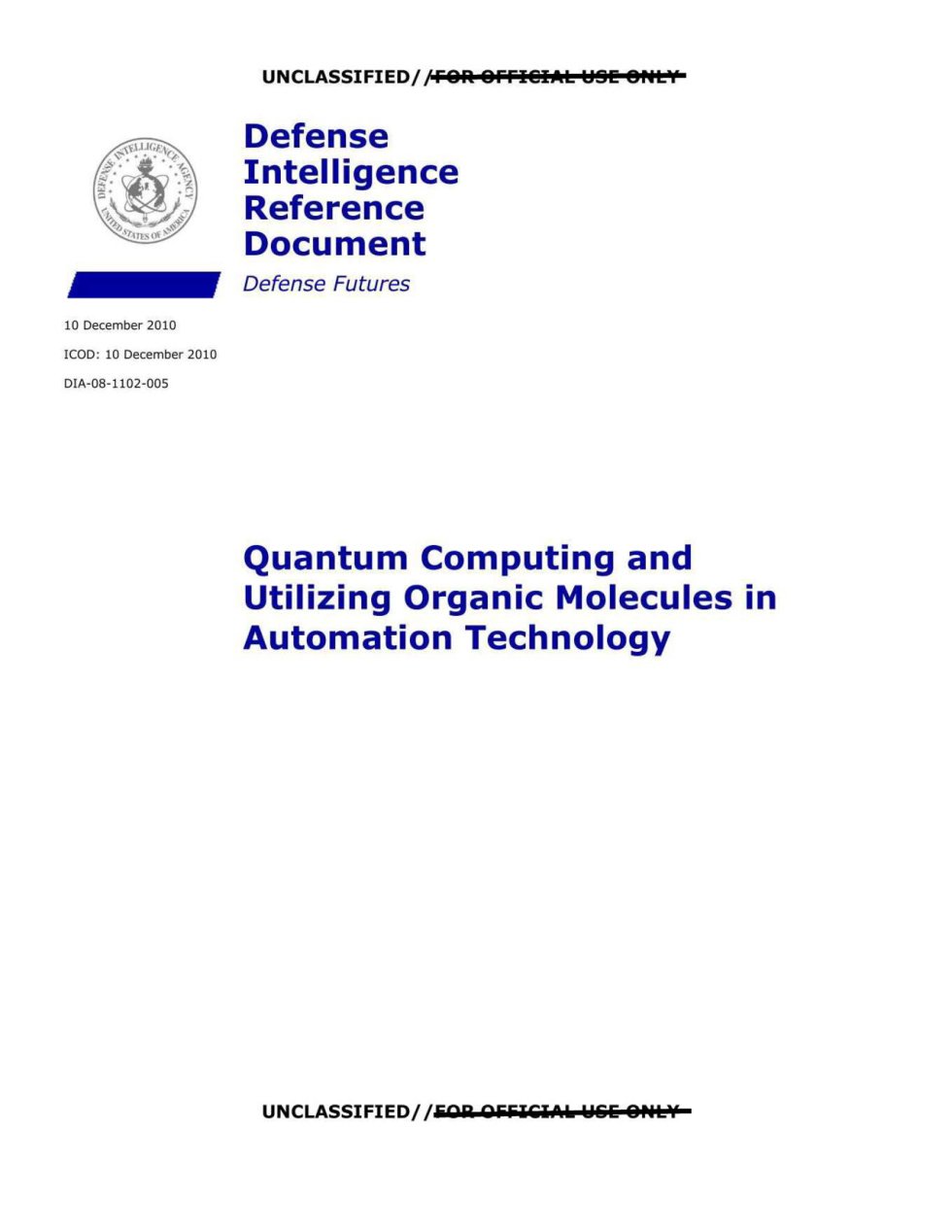 Omslag van officieel rapportFysieke pagina 1
DOCUMENTAIRE BRONNEN · DOW
Wat de archiefstukken vertellen
Dit is een technische referentiestudie, geen waarnemingsrapport. Het Defense Intelligence Reference Document (DIRD) "Quantum Computing and Utilizing Organic Molecules in Automation Technology" (Kwantumcomputing en het gebruik van organische moleculen in automatiseringstechnologie) is gedateerd 10 december 2010, draagt het nummer DIA-08-1102-005 en maakt deel uit van de reeks Defense Futures. Het werd opgesteld door de Technology Warning Division (DWO-4) van het Defense Warning Office, binnen het Directorate for Analysis van de Amerikaanse Defense Intelligence Agency. De naam van de auteur is vervangen door "AAP Person 73".
Het titelblad vermeldt dat het product deel uitmaakt van een reeks rapporten over geavanceerde technologie uit het fiscale jaar 2010, opgesteld binnen het AAWSA-programma (Advanced Aerospace Weapon System Applications), en omschrijft het DIRD als "niet-inhoudelijke, maar gezaghebbende" referentie-informatie. De rechtvaardiging die de tekst zelf voor het onderwerp geeft, is gerelateerd aan lucht- en ruimtevaart: toekomstige ruimtereizen zouden krachtige computers aan boord vereisen, omdat het naar de aarde sturen van gegevens van astronomische sensoren, het ruimtevaartuig en de bemanning vertragingen van minuten tot uren zou veroorzaken, en commerciële siliciumchips nauwelijks stralingsbestendig zouden zijn zonder kostbare aanpassingen.
De studie presenteert twee alternatieven. Het eerste is kwantumcomputing, uitgelegd vanaf de grondbeginselen (qubits, superpositie, verstrengeling, decoherentie, fouttolerantie) tot en met grafeen-kwantumdots als kandidaten voor spinqubits, met een overzicht van concurrerende anorganische technologieën: fotonen, ionen- en atoomvallen, kernmagnetische resonantie en supergeleiders. Het tweede is moleculaire DNA-computing: basenparing, assemblage van DNA-stukken, origami, logische poorten, schakelingen die boter-kaas-en-eieren spelen, nanomotoren en kleine moleculaire "lopers", die de auteur voorstelt als machines die hun eigen schakelingen kunnen repareren.
De technologische horizon wordt in de samenvatting expliciet vermeld. Binnen 10 jaar zouden de eerste bruikbare kwantumcomputers op ionenvallen gebaseerd zijn, wat de auteur onpraktisch acht voor de ruimte omdat ze zware cryogene apparatuur en afscherming vereisen. Optische computers zouden er over ongeveer 20 jaar komen en op een schaal van 40 jaar zouden hybride ontwerpen van kwantumdots en fotonkanalen en DNA-apparaten instrumenten voor ruimteverkenning zijn, zoals draadloze sensoren die vanuit een baan worden neergelaten om op planeten of planetoïden naar water te zoeken. De tekst tekent aan dat DNA niet de snelste systemen zou opleveren, maar misschien wel de robuustste, dankzij zelfherstel.
Al deze data zijn projecties van de auteur, gebaseerd op de hoeveelheid onderzoek die in 2010 gaande was, en geen behaalde resultaten. Het rapport beweert niet dat een van de beschreven apparaten voor gebruik in de ruimte is gebouwd en vermeldt bijvoorbeeld dat NASA in 2009 de ruimtetest van een supercomputer uit commerciële componenten heeft geannuleerd. Het behandelt DNA-computing ook als door de biologie geïnspireerde techniek, zonder een onbekende oorsprong of oude technologie te suggereren.
Het document vermeldt geen ufo's of UAP's, noch reverse engineering. De aanwezigheid ervan in de AAWSAP-reeks laat zien dat het programma, naast studies over voortstuwing en speculatieve natuurkunde, opdracht gaf tot algemene overzichten van technologieën die toekomstige lucht- en ruimtevaartplatforms zouden kunnen uitrusten of door andere landen zouden kunnen worden ontwikkeld. De studie noemt meer dan honderd bibliografische verwijzingen en bevat figuren van grafeenstructuren, DNA-assemblages en experimenten, die reproducties zijn van gepubliceerd werk en geen afbeeldingen die door dit programma zijn gemaakt.
DIRECTE LEZING VAN HET BESTAND
Het document, in het Nederlands
De fysieke pagina's 1 tot en met 27 zijn volledig vertaald: omslag, colofon, inhoudsopgave en lijst van figuren, samenvatting, inleiding, de tekst over quantumcomputing (grafeen-quantumdots, aanvullende anorganische technologieën) en het begin van de sectie over DNA-computers, tot en met de assemblage van onderdelen. De pagina's 28 tot en met 54 (fouten bij zelfassemblage, microfluïdica, origami, logische poorten, nanomotoren, discussie, conclusie en referenties) worden in een afzonderlijk blok vertaald. Formules en vergelijkingen zijn weergegeven in de notatie van het origineel; grafieken en schema's worden tussen vierkante haken beschreven.
FRAGMENT 1 · FYSIEKE PAGINA 1
volledige pagina
[Voorblad]
ONGECLASSIFICEERD//~~UITSLUITEND VOOR OFFICIEEL GEBRUIK~~
[Afbeelding: zegel met de tekst ‘Defense Intelligence Agency — Verenigde Staten van Amerika’]
**Defense Intelligence Reference Document**
*Defense Futures*
10 December 2010
ICOD: 10 December 2010
DIA-08-1102-005
**Quantum Computing and Utilizing Organic Molecules in Automation Technology**
ONGECLASSIFICEERD//~~UITSLUITEND VOOR OFFICIEEL GEBRUIK~~Redactionele noot: Omslag van het Defense Intelligence Reference Document van 10 december 2010, nummer DIA-08-1102-005.
Origineel in het Engels controleren
UNCLASSIFIED/ ,<FOR. OFFI@IAL l!ISI!! 8HLY
Defense
Intelligence
Reference
Document
Defense Futures
10 December 2010
!COD: 10 December 2010
DIA-08 -1102 -005
Quantum Computing and
Utilizing Organic Molecules in
Automation Technology
UNCLASSIFIED/ /FOR 066iliCili.t.k WS& 8,.LlfDe documentfiche raadplegen ↗ · Fysieke pagina 1, de omslag meegeteld.
FRAGMENT 2 · FYSIEKE PAGINA 10
volledige pagina
ONGECLASSIFICEERD//~~UITSLUITEND VOOR OFFICIEEL GEBRUIK~~
.ᵈ Ter vergelijking: atoomdiameters lopen uiteen van ongeveer 0.1 nm tot 0.5 nm, waarbij die van silicium ~0.2 nm bedraagt, dus slechts een factor 100 kleiner.
Naarmate circuitelementen kleiner worden, neemt het aantal atomen waaruit het materiaal bestaat af en wordt het problematisch om afzonderlijke kwantumeffecten te negeren. Dit is de mesoscopische schaal. Op deze schaal kunnen kwantumeffecten door de onvoorspelbareᵉ aard van de onderliggende golffuncties ruis in de schakeling veroorzaken. Zodra de schakeling nog maar enkele atomen groot is, zullen de kwantumeffecten niet langer alleen als ruis merkbaar zijn, maar het elektrische gedrag gaan beheersen. Men verwacht dat het benutten van kwantumverschijnselen, in plaats van ze te vermijden, in dit regime nuttig kan blijken voor anorganische technologieën.
Volgens de wet van Moore zullen anorganische circuitelementen over minder dan 10 jaar in twee dimensies kleiner zijn dan 5x5 moleculen. (Moleculaire machines die uit organische componenten zijn opgebouwd, hoofdzakelijk DNA, worden in een later hoofdstuk besproken.) Het verkleinen van traditionele siliciumtechnologie voor algemene gegevensverwerking tot deze microscopische schaal is een van de redenen om nieuwe typen machines te ontwikkelen die op kwantumverschijnselen berusten, maar niet de enige. Kleinere circuitelementen verkortten de insteltijd van transistoren en daarmee die van logische poorten in CPU’s, waardoor de kloksnelheid kon worden verhoogd (de CPU kan na de vorige instructie met minder vertraging de volgende uitvoeren). De huidige CPU’s halen het grootste deel van hun prestaties uit een parallelle architectuur, waarbij ze meerdere instructies tegelijk uitvoeren in verschillende pijplijnen. Kleinere schakelingen verbruiken doorgaans minder vermogen, waardoor er meer parallelle elementen in één behuizing passen zonder dat het totale vermogen te hoog wordt. De ontwikkeling naar steeds kleinere schakelingen gaat onverminderd door, dus het is essentieel om rekening te houden met de eigenschappen die zullen optreden wanneer kwantumeffecten de overhand krijgen.
Vaak wordt de analogie met de laser gebruikt om te verduidelijken welke toepassingen met kwantumcomputers kunnen worden ontwikkeld. In zekere zin is de laser gewoon een andere hardwaretechnologie om licht te produceren. Eerdere verlichtingstechnologieën zijn onder meer vuur op organische brandstof (~50,000 v.Chr.), gloeilampen (begin 19e eeuw) en fluorescentiekamers (midden 19e eeuw). De keuze van een lichtbron wordt niet bepaald door hoe geavanceerd de technologie is, maar door de eisen van de toepassing. Men kan bij laserlicht lezen, maar het oudere en goedkopere gloeilamplicht zal een bladzijde voor het oog beter verlichten. Traditionele computertechnologie op basis van halfgeleiders is goedkoop en ruim krachtig genoeg om de navigatie aan te sturen of de status van het ruimtevaartuig op schermen weer te geven.
De analogie met de laser is ook verhelderend omdat kwantumeffecten een bijzonder soort licht voortbrengen dat coherent is. Coherent licht heeft één golflengte en alle fotonen bewegen zich in dezelfde richting.ᶠ Deze coherentie is een natuurlijk gevolg van het behoud van impuls bij het absorptie-/emissieproces. (4) Coherent licht is zeer nuttig voor sommige toepassingen die weinig spreiding vereisen, bijvoorbeeld om een bundel te laten weerkaatsen op een spiegel op de maan of, alledaagser, om een specifieke plek op een geprojecteerde PowerPoint-presentatie aan te wijzen.
De praktische toepassingen van de laser zijn niet per definitie groter of kleiner, sneller of langzamer, of meer of minder energie-efficiënt dan die van andere hardwaretechnologieën die licht produceren; ze zijn gewoon anders. Evenzo geldt voor de hardware en toepassingen die uit kwantumcomputing zullen voortkomen dat ze niet noodzakelijk groter, kleiner of sneller zijn dan traditionele methoden; ze zijn gewoon anders, en veel ervan zouden met traditionele technologieën niet kunnen worden gerealiseerd. (5)
ᵈ De steek is de afstand tussen zich herhalende circuitelementen. Het opmerkelijkste aan de 22 nm-technologie is dat ze met 192 nm-lithografie werd gerealiseerd.
ᵉ Op mesoscopische schaal worden afzonderlijke golffuncties niet vooraf geprepareerd en wordt hun voortplanting niet gestuurd. Sommige ruiscomponenten zijn gecorreleerd.
ᶠ Laserlicht heeft in feite een zeer smalle bandbreedte in plaats van één enkele golflengte.
9
ONGECLASSIFICEERD//~~UITSLUITEND VOOR OFFICIEEL GEBRUIK~~Redactionele noot: Legt schalen van schakelingen, grenzen aan miniaturisering en de laseranalogie uit om te illustreren dat quantumcomputing anders zou zijn dan traditionele computing, en niet alleen sneller.
Origineel in het Engels controleren
UNCLASSIFIED/ /FOR: 8FFl@IJIIL tt9I!!! er•t I
pitch.d By comparison, atomic diameters range from around 0.1 nm to 0.5 nm, with silicon
~0.2 nm, or only a factor of 100 smaller.
As circuit elements decrease in size, the number of atoms making up the bulk materials
decreases and ignoring individual quantum effects becomes problematic. This is the
mesoscopic scale. At this size, quantum effects can introduce noise into the circuit as the
unpred ictable e nature of the underlying wave functions. Once the circuit size shrinks to only a
few atoms, quantum effects will emerge from the noise domain to dominate the electrical
behavior. It is thought that exploiting rather than avoiding quantum phenomena may prove
useful in this regime for inorganic technologies.
Following Moore's law, in less than 10 years inorganic circuit elements will be less than 5x5
molecules in 2-D extent. (Molecular machines built of organic components, primarily DNA,
are discussed in a later section.) Shrinking traditional silicon-based general-processing
technology to this microscopic scale is one motivation for developing new types of machines
based on quantum phenomena, but it is not the only one. Smaller circuit elements decreased
the settling time of transistors and thus gates on CPUs, allow ing increasing clock speed (the
CPU can execute the next instruction with shorter delay from the last instruction). CPUs
today get most of their performance with parallel architecture, executing several instructions
at once in different pipelines. Using smaller circuitry in general consumes less power, and
this allows more parallel elements to be packed into a reasonable wattage package. The
march toward smaller circuitry is continuing unabated so plann ing for the eventual quantum
dominant characteristics is essential.
It is common to use the analogy of the laser to elucidate the application developments
possible with quantum computing. In one sense, the laser is just another hardware
technology that makes light. Earlier light technologies include organic-fueled fire (~50,000
BC), incandescent bulbs (early 19th c.), and fluorescent chambers (mid-19 th c.). The light
source to utilize is not governed by the highness of the technology, but by requirements of
the application. One can read by laser light, but older and cheaper incandescent light will
provide superior perceptible illumination to a page. Traditional semiconductor-based
computing is cheap and plenty powerful for controlling navigation or driving ship status
displays.
The laser analogy is further revealing in that it is quantum effects producing a special kind of
light that is coherent. Coherent light is single wavelength with all photons travelling in the
same direction .f This coherence is a natural consequence of conservation of momentum in
the absorption/emission process. (4) Coherent light is very useful for some applications that
require low dispersion; for example, bouncing a beam off of a mirror on the moon, or the
more pedestrian pinpoint highlight of a projected PowerPoint presentation.
The practical uses of the laser are not universally bigger or smaller, faster or slower, or more
or less energy efficient than the other hardware technologies that produce light, they are just
different. Similarly, when we think of what hardware and applications will arise for quantum
computing, they too are not necessarily bigger, smaller, or faster than traditional methods;
they are just different, and many could not be accomplished with traditional technologies. (5)
d Pitch is the distance between repeat circuit elements. What is most interesting about the 22 nm technology is that it was
produced with 192 nm lithography.
• At the mesoscopic scale, indiv idual wave functions are not prepared a priori or controlled in their propagati on. Some of
the noise components are correlated .
'Laser light is actually very narrow bandwidth rather than single-valued.
UNCLASSIFIED/ /FOR OFFI&Iit.k W&E OHkY
9De documentfiche raadplegen ↗ · Fysieke pagina 10, de omslag meegeteld.
FRAGMENT 3 · FYSIEKE PAGINA 11
volledige pagina
ONGECLASSIFICEERD//~~UITSLUITEND VOOR OFFICIEEL GEBRUIK~~
**TOEPASSINGEN VAN KWANTUMCOMPUTERS**
Hoewel kleinere schakelingen en supercomputing een drijfveer vormen, is cryptografie de belangrijkste toepassing die de ontwikkeling van kwantumcomputing aanstuurt. Ten eerste is er het kraken van versleutelde codes. Verreweg de meeste beveiligde communicatie maakt gebruik van een methode die bekendstaat als cryptografie met openbare sleutels. Bij deze methode berust de code op de priemfactoren van een zeer groot geheel getal dat openbaar beschikbaar is. De privésleutel is een van de gehele factoren, waarmee de ontvanger van de informatie de code eenvoudig kan ontcijferen. De kracht van deze techniek is dat traditionele computeralgoritmen veel tijd nodig hebben om de juiste factoren van de openbare sleutel te raden, in de orde van maanden.ᵍ Bij traditionele bruteforcemethoden neemt het aantal benodigde stappen exponentieel toe met de grootte van de openbare sleutel. In 1994 presenteerde Shor echter een kwantumalgoritme dat slechts een polynomiaal aantal stappen nodig zou hebben, waardoor de benodigde tijd voor de ontbinding in factoren drastisch zou afnemen, aangenomen dat een kwantumcomputer ooit fysiek gerealiseerd zou worden. (6) Deze versnelling is vooral te danken aan de aard van kwantumgolven: ze kunnen meerdere parallelle paden volgen in plaats van instructies zoals gebruikelijk stapsgewijs uit te voeren. Dit principe van versnelling door superpositie is gemakkelijker te begrijpen aan de hand van een willekeurige zoekactie in gegevens. Neem een algoritme dat bij willekeurig zoeken 50% kans heeft om een specifiek telefoonnummer te vinden in een databank met N telefoonnummers. Het stapsgewijze algoritme heeft gemiddeld 0.5N zoekopdrachten nodig om het juiste nummer te vinden. Daarentegen kan een kwantumalgoritme worden ontworpen dat informatie opbouwt door bij elke stap meerdere nummers te onderzoeken. Aangetoond is dat zo’n methode het benodigde aantal controles terugbrengt tot √N. (7, 8) Door de superpositie van toestanden kunnen in een op Turing geïnspireerde machine meerdere bandcellen gelijktijdig worden onderzocht en verwerkt.
Ten tweede is er kwantumcommunicatie. Zodra de kwantumcomputer versleuteling met openbare sleutels gemakkelijk kan kraken, moet een nieuwe versleutelingsmethode ervoor in de plaats komen. In het standaardexperiment voor kwantumcommunicatie worden Bob als zender en Alice als ontvanger aangewezen. In de meeste scenario’s communiceren Alice en Bob op afstand via verstrengelde deeltjes en een traditionele open lijn. De open lijn geeft informatie over de meetinstellingen door, maar is nutteloos voor een waarnemer zonder toegang tot de verstrengelde golffunctie (verstrengeling wordt hieronder besproken, en de informatie op de open lijn is te vergelijken met de openbare sleutel bij de huidige versleutelingsmethoden). Het andere voordeel van deze opzet is dat vrijwel elke verstoring van de communicatielijn tussen Alice en Bob de verstrengeling zou verbreken, zodat de informatie verloren zou gaan in plaats van te worden onderschept. Andere standaarddeelnemers aan een communicatie-experiment of -scenario volgen de volgorde van het Engelse alfabet: Charlie (of Chuck als hij kwaad in de zin heeft), Dave, Eve, enz. Kwantumcommunicatie is dus een toepassing die een taak overneemt die door een computer voor algemeen gebruik wordt uitgevoerd; de klassieke en kwantumsystemen werken niet op dezelfde manier en hebben alleen de functie van veilige informatieoverdracht gemeen. Daarnaast is kwantumcommunicatie voorgesteld als methode om geïsoleerde kwantumsystemen met elkaar te verbinden zonder de vereiste afzondering van de ‘gesloten doos’ aan te tasten, zoals bij klassieke ingrepen zou gebeuren. (9, 10)
Buiten de cryptografie is er een derde toepassing, kwantummetrologie, waarbij tijd en/of afstand met een extreem hoge nauwkeurigheid worden gemeten. Een vierde voor de hand liggende toepassing is het simuleren van kwantumsystemen. (11, 12)
ᵍ Of uren als men over supercomputerparken beschikt. Waar het om gaat, is dat de waarde van de meeste communicatie veel lager is dan de kosten om die met brute kracht te ontcijferen. De 128-bitstandaard voor het web is een compromis tussen veiligheid en snelheid.
10
ONGECLASSIFICEERD//~~UITSLUITEND VOOR OFFICIEEL GEBRUIK~~Redactionele noot: Vat toepassingen van quantumcomputing samen: cryptografie (algoritme van Shor en zoekalgoritmen), quantumcommunicatie, metrologie en simulatie. De beschreven winst hangt af van quantumcomputers die nog niet zijn gerealiseerd.
Origineel in het Engels controleren
UNCLASSIFIED/ /POK: OPPIClltL U.!r:: Oflt I
APPLICATIONS OF QUANTUM COMPUTERS
Although smaller circuitry and supercomputing is a motivator, the driving application behind
quantum computing is cryptography. First, there is cracking cipher codes. The vast majority
of secured communications utilize a method known as public-key cryptography . In this
method, the code is based on the prime number factors of a very large integer which is
publically available. The private key is one of the integer factors and this allows the receiver
of information to decipher the code easily. The strength of this technique is that traditional
computer algorithms will take a long time to guess the correct factors of the public key, on
the order of months. 9 Traditional brute force methods require a number of steps that
increase as an exponential function of the size of the public key. However, in 1994 Shor
presented a quantum algor ithm that would only require a polynomial number of steps, thus
dramatically decreasing the required time to factor, assuming a quantum computer would
ever be physically realized. (6) This speedup is primarily due to the nature of quantum
waves; specifically, they can follow several parallel paths instead of the usual stepwise
procedural execution of instructions. This accelerat ion by superposition concept is more
easily understood in a random search of data. Consider an algorithm that has a 50%
probability to locate a specific phone number in a database of N phone numbers by a random
search. The procedural algorithm on average will require O.SN inquiries to locate the correct
number. A quantum algorithm on the other hand can be devised that accumulates
information by examining multiple numbers with each step. Such a scheme has been shown
to reduce the number of examinations required to .JN. (7, 8) The superposition of states
allows examination and processing of several tape cells simultaneously in a Turing-inspired
machine.
Second, there is quantum communication. Once public key encryption is easily broken by the
quantum computer, a new cipher needs to replace it. The canonical quantum commun ication
experiment defines a sender, Bob, and a receiver, Alice. In most scenarios, Alice and Bob
communicate over a distance using entangled particles and a trad iti onal open line. The open
line relays information about measurement sett ings, but is useless to an observer without
access to the entangled wave function (entanglement is discussed below, and the open line
information is an analogue to the public key of current ciphers). The other advantage of this
setup is that almost any disturbance in the commun ication line between Alice and Bob would
destroy entanglement and thus the information would be lost instead of intercepted.
Additional archetypical participants in a communications experiment/scenario follow the
English alphabet: Charlie (or Chuck if his intent is malicious), Dave, Eve, etc. Quantum
communication is thus an application replacing one performed by a general purpose
computing machine ; the classical and quantum systems do not operate in similar fashion
other than the function of securely transmitting information. Additionally, quantum
communication has been suggested as a method to connect isolated quantum systems
without disturbing closed box requirements like classical interventions would. (9, 10)
Beyond cryptography is a third application, quantum metrology, where time and/or distance
are measured to an extremely high accuracy . A fourth obvious application is simulation of
quantum systems. (11, 12)
9 Or hours if one has farms of supercomputers. The point is that the value of most communication is much smaller than
the cost to decipher by brute force. The 128-bit web standard is a compromise between security and speed.
UNCLASSIFIED/ /POK: 9ffl@IAl W&li 8P◄ IL¥
10De documentfiche raadplegen ↗ · Fysieke pagina 11, de omslag meegeteld.
FRAGMENT 4 · FYSIEKE PAGINA 12
volledige pagina
ONGECLASSIFICEERD//~~UITSLUITEND VOOR OFFICIEEL GEBRUIK~~
**DE GESLOTEN DOOS EN FOUTTOLERANTIE**
Wanneer in traditionele schakelingen met siliciumtransistoren een bit eenmaal op 1 of 0 is gezet door een logische poort of een andere component die de uitgangsspanning vastzet, blijft die waarde naar verwachting tijdens volgende klokcycli behouden totdat ze deterministisch wordt gewijzigd.ʰ Bovendien gedragen traditionele schakelingen zich in iedere klokcyclus volgens dezelfde regels; dat wil zeggen dat bij het verwerken van meer informatie het herhaaldelijk schakelen van de poorten het mechanisme voor het vasthouden van de bitwaarde niet aantast. Dit gedrag wordt bereikt door de schakelingen voortdurend van energie te voorzien. Bij elke onderbreking van deze voortdurende externe stroomtoevoer gaat de integriteit van de informatie in de rekenschakeling verloren.ⁱ
Een fundamenteel beginsel van de kwantummechanica is dat elke externe invloed op een systeem noodzakelijkerwijs de toestand van dat systeem verstoort. Deze invloed kan een verstoring van buitenaf zijn of lekkage van binnenuit – beide vormen van interactie veranderen de interne kwantumtoestand. Dit destructieve proces staat bekend als decoherentie. Externe invloeden verstoren het systeem, zodat de schakelingen van de rest van het universum geïsoleerd moeten worden, ook wel de eis van de ‘gesloten doos’ genoemd.
Variaties tussen opeenvolgende proeven met een kwantumschakeling veroorzaken een steeds grotere afwijking van de beginfase naarmate de golffunctie evolueert. Deze afwijking van proef tot proef veroorzaakt decoherentie op een tijdschaal die T2* wordt genoemd. Hoewel bij een afzonderlijke proef met een kwantumschakeling de coherentie langer dan T2* behouden kan blijven, moeten de geïsoleerde interne schakelingscomponenten bij afwezigheid van externe invloeden uiteindelijk door toevalsprocessen een thermisch evenwicht bereiken: dit gebeurt op tijdschaal T1. Bovendien kan de gesloten doos niet perfect zijn, omdat een bruikbaar apparaat enige vorm van invoer en uitvoer nodig heeft en dus in beperkte mate met de buitenwereld moet kunnen interageren. Willekeurige interacties met de omgeving als gevolg van dit ‘lek’ in de isolatie zorgen ervoor dat interne signalen op tijdschaal T2 uit fase raken. Deze drie tijdconstanten, die het verval van de interne signalen beschrijven, komen sterk overeen met de gelijknamige grootheden bij kernspinresonantie (NMR). NMR is inderdaad een technologische benadering die voor kwantumschakelingen wordt ontwikkeld. Bij elke technologie en elk hardwareontwerp wordt de mate van isolatie tegen externe en interne invloeden gekarakteriseerd door T2* (stabiele herhaalbaarheid), T1 (weerstand tegen entropie) en T2 (isolatie van de rest van het universum).
Geen enkel ontwerp kan geheel vrij zijn van decoherentie, en de volgende vraag is hoeveel decoherentie aanvaardbaar is, of preciezer: waar ligt de fouttolerantiegrens voor een goede werking? Fouttolerantie speelt geen grote rol in traditionele verwerkingsarchitecturen,ʲ maar is wel van groot belang bij de opslag en overdracht van informatie. Neem ter illustratie van fouttolerantie een opslagconfiguratie met harde schijven waarin elke 8-bitbyte gespreid over 9 schijven wordt weggeschreven in een stripe-setconfiguratie (één bit per schijf, parallel uitgelezen). De extra schijf bevat de pariteitsinformatie over de byte. Bij opeenvolgende bytes schuift de locatie van alle bits telkens één schijf op, zodat de pariteitsinformatie niet allemaal op dezelfde schijf wordt opgeslagen.ᵏ Als één schijf uitvalt, kan elke byte uit de andere 8 schijven worden gereconstrueerd met een softwarealgoritme dat automatisch start zodra de schijfstoring wordt gedetecteerd. De defecte hardware kan worden vervangen en de gegevens kunnen worden gereconstrueerd terwijl het systeem in deze tragere ‘noodmodus’ blijft werken. Dit opslagsysteem wordt fouttolerant genoemd. De
ʰ Voor wie niet vertrouwd is met kwantumverschijnselen, lijkt de formulering ‘deterministisch gewijzigd’ misschien overbodig. De formulering benadrukt dat klassieke schakelingen, zolang er geen fouten optreden, altijd doelbewust worden gewijzigd, terwijl bij kwantumschakelingen ook toeval een rol speelt.
ⁱ Hier bedoelen we de verwerkingsschakelingen zelf. Sommige soorten geheugen en langetermijnopslag kunnen informatie uiteraard voor onbepaalde tijd geïsoleerd bewaren.
ʲ Een niet-deterministisch resultaat in de verwerkingshardware veroorzaakt in huidige ontwerpen een fatale fout.
ᵏ De stripe-set op bitniveau verduidelijkt het besproken principe, maar om technische redenen worden in de praktijk complexere configuraties gebruikt. Zie ‘RAID’ op Wikipedia voor gegevensverdelingsschema’s die in de praktijk worden gebruikt.
11
ONGECLASSIFICEERD//~~UITSLUITEND VOOR OFFICIEEL GEBRUIK~~Redactionele noot: Legt decoherentie uit, de eis van isolatie (de gesloten doos) en de tijden T2*, T1 en T2, en introduceert fouttolerantie naar analogie van opslag op schijven.
Origineel in het Engels controleren
UNCLASSIFIED/ /EAR OEFIClt.k WSIE ertt I
THE CLOSED BOX AND FAULT TOLERANCE
In traditional silicon transistor circuits, once a bit is set to 1 or O by a gate or other device
locking the output voltage, that value is expected to remain through subsequent clock cycles
until deterministically changed.h Additionally, traditional circuits behave by the same rules for
each clock cycle; that is, as more information is processed, repeated gate operation does not
deteriorate the bit latching mechanism. This behavior is achieved by constantly providing
energy to the circuits. Any interruption in this constant need for power from the outside and
the integrity of the information in the computing circuit is lost. 1
A fundamental principle of quantum mechanics is that any external influence on a system
necessarily disturbs the state of that system. This influence could be external disruption or
internal leakage - either interaction will change the internal quantum state. This destructive
process is known as decoherence. External influences will disturb the system and thus the
circuits need to be isolated from the rest of the universe, also known as the 'closed box'
requirement.
Trial to trial variations in a quantum circuit produce an increasing deviation from an initial
phase as the wave function evolves. This trial-to-trial deviation causes decoherence on a
timescale termed T2*. Although a single trial in a quantum circuit could retain coherence
longer than T2*, absent external influence the isolated internal circuit components must
eventually come to thermal equilibrium through random processes: this occurs on timescale
TL Moreover, the closed box cannot be perfect since a useful device requires some kind of
input and output, thus some small interaction with the external environment is necessary.
Random interactions with the environment from this isolation 'leakage' will dephase internal
signals on timescale T2. These three time constants that describe the internal signal decays
are very similar to the same named quantities in nuclear magnetic resonance (NMR). NMR is
indeed a technology path under development for quantum circuits. Each technology and
hardware design will be characterized in its isolation from external and internal influences by
T2* (stable repeatability), Tl (resistance to entropy), and T2 (isolation from the rest of the
universe).
No design can be completely free of decoherence and the next consideration is how much
decoherence is acceptable, or more precisely, what is the fault tolerance threshold for
successful operation? Fault tolerance isn't much of a consideration in traditional processing
architecture,i although it is a major consideration in storage and communication of
information. To illustrate fault tolerance, consider a scheme of hard disk storage
configuration where each 8-bit byte is written across 9 disks in a stripe-set configuration
(one bit per disk, read in parallel). The extra disk holds parity information about the byte.
Consecutive bytes shift the location of all bits one disk so the parity information isn't all
stored on the same disk.k In the event one disk fails, each byte can be reconstructed from
the other 8 disks using a software algorithm that automatically starts when the disk failure is
detected. The broken hardware ca n be replaced and the data reconstructed while the system
is operating in this slower 'limp' mode. This storage system is said to be fault tolerant. The
h For those new to quantum phenomena, it may seem redundant to use the phrase "deterministically changed ." The
phrase emphasizes the point that absent any error, classical circuits are always changed by intent, while quantum circuits
include the element of random occurrence .
; Here we refer to the processing circuits themselves. Some types of memory and long term storage can of course hold
information in isolation indefinitely .
J A non-determ inistic result in processing hardware causes a fatal error in current des igns.
k The bitwise stripe-set is instructive on the principle at hand, but for engineering considerations , more complex
configurations are used in practice. See Wikipedia "RAID" for actual data distribution schemes .
UNCLASSIFIED// FOR OFFICIAL YSE 8P.k¥
11De documentfiche raadplegen ↗ · Fysieke pagina 12, de omslag meegeteld.
FRAGMENT 5 · FYSIEKE PAGINA 13
volledige pagina
ONGECLASSIFICEERD//~~UITSLUITEND VOOR OFFICIEEL GEBRUIK~~
detectie van schijfuitval en overname door het algoritme tijdens de uitleesfase vormen het foutcorrectieschema.
In een kwantumsysteem wordt foutcorrectie op vergelijkbare wijze uitgevoerd; dat wil zeggen dat de toestand van een qubit over meerdere deelruimten van de logische ruimte wordt gedefinieerd en dat vervolgens meerdere metingen in de deelruimte worden uitgevoerd die de toestand zelf niet verstoren. De oorspronkelijke toestand kan uit de gedeeltelijke meting worden gereconstrueerd. Neem ter illustratie de ruimte van één qubit, die wordt bepaald door een elektron met spin omhoog of spin omlaag. Definieer deze 1-d-toestand eerst opnieuw in een scheef driedimensionaal stelsel, zodat spin omhoog zich in het octant (+x,+y,+z) bevindt en spin omlaag dus in het octant (-x,-y,-z). Als voor x een positieve waarde wordt gemeten, was de oorspronkelijke spin omhoog; als zowel voor x als voor y een positieve waarde wordt gemeten, geeft dat extra zekerheid dat de spin daadwerkelijk omhoog was. Als de metingen van x en y verschillende tekens opleveren, kan z de doorslag geven. In dit voorbeeldsysteem zijn foutpercentages van 33% toegestaan. In de praktijk realiseerbare systemen zijn uiteraard complexer en verdragen slechts foutpercentages in de orde van 3%. Dit verschil komt voornamelijk voort uit de noodzaak het systeem zo min mogelijk te verstoren bij wat een kwantumniet-demolitiemeting wordt genoemd (een QND-meting). (13, 14) Samengevat is fouttolerantie mogelijk als een QND-mechanisme voor het meten van qubits kan worden aangetoond.
**SCHAALBAARHEID**
Zodra een gesloten doos is gebouwd, is de volgende vraag voor een succesvolle technologie voor kwantuminformatieverwerking (QIP) of de circuitelementen schaalbaar zijn. Dat wil zeggen: of elementen waarvan is aangetoond dat ze als kwantumbits functioneren, tegen redelijke kosten in termen van middelen (rekentijd, decoherentietijd, fysieke ruimte of benodigd vermogen) tot grotere circuits kunnen worden gecombineerd. Welke technische opschaling precies nodig is, verschilt per technologie.
De eenheid van QIP (kwantuminformatieverwerking) is de qubit.ᴵ Anders dan bij digitale logica neemt door superpositie in de kwantummechanica de informatie-inhoud van N qubits toe. Dat wil zeggen dat kwantumgolven verschillende paden kunnen volgen en een superpositie van toestanden kunnen bevatten, waardoor de hoeveelheid informatie in elk kanaal toeneemt. Bovendien kan elk systeem van N qubits verschillende graden van verstrengeling vertonen. Door deze verstrengeling verschilt de eenvoudige voorbeeldtoestand (1,0,0) van (1,0,0) verstrengeld met (x,0,0), die weer verschilt van (1,0,0) verstrengeld met (1,0,x), enz. Bij 4 qubits kunnen 2, 3 of alle 4 bits verstrengeld zijn, maar ook 2 met 2. De logische ruimte neemt al snel reusachtige proporties aan en kan met N of zelfs N² klassieke bits al gauw niet meer worden gesimuleerd of zelfs maar weergegeven. Als men bedenkt dat men met qupits of qudits zou kunnen beginnen (zie voetnoot I), wordt al snel duidelijk dat kwantumcomputers, mits schaalbaar, een enorm rekenpotentieel hebben.
**UNIVERSELE LOGICA**
Het zeer grote aantal mogelijke toestanden van een kwantumcomputer spant op wat in de wiskunde een Hilbertruimte wordt genoemd: een veralgemening van de euclidische ruimte met een willekeurige (eindige of oneindige) dimensie (de euclidische ruimte heeft 3 dimensies). Het concept van universele logica vereist dat deze grote Hilbertruimte toegankelijk is met een eindige verzameling besturingsoperaties. Bij de meeste ontwerpen zijn deze besturingsoperaties gering in aantal en vormen ze de kwantumanalogen van digitale poorten die bewerkingen op qubits uitvoeren.
ᴵ Om didactische redenen blijft de bespreking beperkt tot qbits; p- en d-toestanden zouden echter ook als basiseenheid kunnen worden gebruikt (qpits of qdits), waardoor de mogelijke informatie-inhoud van één kanaal sterk toeneemt.
12
ONGECLASSIFICEERD//~~UITSLUITEND VOOR OFFICIEEL GEBRUIK~~Redactionele noot: Beschrijft quantumfoutcorrectie door niet-destructieve metingen, de schaalbaarheid van qubits en de groei van de ruimte van verstrengelde toestanden; de percentages zijn didactische voorbeelden, geen testresultaten.
Origineel in het Engels controleren
UNCLASSIFIED/ /fQR OFFICI0k WSE 8HLI
drive failure detection and algorithm takeover in the readout phase is the error correction
scheme.
In a quantum system the error correction is accomplished in a similar manner; that is, the
state of a qubit is defined across multiple subspaces of the logic space and then several
measurements are performed on the subspace that do not disturb the state itself. The
original state can be reconstructed by the partial measurement. As an illustrative example
consider the one-qubit space defined by an electron spin-up or spin-down. First, re-define
this 1-d state in an oblique three-dimensional system such that spin-up is in the (+x,+y,+z)
octant, and spin down is thus in the (-x,-y,-z) octant. If one measures x as positive the
original state was up; measuring x and y both positive provides additional assurance the
state was actually up. Measuring x and y different allows z as a tie-breaker. In this example
system, 33% error rates are allowed. Of course realizable systems are more complex and
only tolerate error rates in the 3% range. This difference is mainly due to the need to disturb
the system as little as possible in what is known as a quantum non-demolition measurement
(a QND measurement). (13, 14) In summary, fault tolerance is possible if a QND mechanism
to measure qubits can be demonstrated.
SCALABILITY
Once a closed box has been constructed, the next consideration in successful quantum
information processing (QIP) technology is whether circuit elements are scalable. That is,
whether elements shown to perform as quantum bits can be combined into larger circuits at
a reasonable cost of resources (computation time, decoherence time, physical space, or
required power). The exact nature of the required engineering scale-up is specific to each
technology.
The unit of QIP (quantum information processing) is the qubit. 1 Different from digital logic,
quantum mechanics increases the information content in N qubits through superposition.
That is, quantum waves can travel through several paths and contain a superposition of
states, increasing the amount of information in each channel. Furthermore, any system of N
qubits can have degrees of entanglement. This entanglement makes the simple example
state (1,0,0) different from (1,0,0) with (x,0,0) entangled, different from (1,0,0) with (1,0,x)
entangled, etc. When there are 4 qubits, entanglement can occur with 2, 3 or all 4 bits, as
well as 2 with 2. The logic space quickly grows to Bunyanesque proportions and is easily
outside of the rea lm of simulation or even representation by Nor even N2 classical bits.
Considering that one could start with qupits or qudits (see footnote I) it is quickly obvious
that quantum computers have enormous computational potential when scalable.
UNIVERSAL LOGIC
The very large numbe r of possible states of a quantum computer spans what is known in
mathematics as a Hilbert space, a generalized version of Euclidean space with arbitrary
(finite or infinite) dimension (Euclidean space having 3 dimensions). The concept of a
universal logic requires that this large Hilbert space be accessible with a finite set of control
operations. For most designs these control operations are small in number and are the
quantum analogues of digital gates performing operations on qubits.
1 For pedagogy, the discussion is limited to qbits ; however, p and d states could also be used as a basic unit (qpits or
qdits ) thus greatly expanding the possible Information content In a single channel.
UNCLASSIFIED/ /FOR &FFl&I.Tik WSE &Hk\f
12De documentfiche raadplegen ↗ · Fysieke pagina 13, de omslag meegeteld.
FRAGMENT 6 · FYSIEKE PAGINA 14
volledige pagina
ONGECLASSIFICEERD//~~UITSLUITEND VOOR OFFICIEEL GEBRUIK~~
Twee bijzondere schema’s die anders werken dan de digitale analogen van technologie op basis van poorten zijn adiabatische kwantumberekening en kwantumberekening met clustertoestanden. In een adiabatisch ontwerp is het antwoord de grondtoestand van een complex netwerk van interacties, en worden de interacties geleidelijk ingeschakeld om de qubits van de begintoestand naar de uiteindelijke grondtoestand te laten evolueren. In het schema met clustertoestanden wordt het systeem met een kleine verzameling besturingspoorten in een bepaalde toestand gebracht en wordt de uitvoer herhaaldelijk gemeten in een willekeurige basis (het fouttolerantiemechanisme). In het adiabatische geval wordt de berekening ‘geprogrammeerd’ door de interacties in te stellen. In het geval van clustertoestanden levert de berekening een superpositie van toestanden op die meerdere metingen vereist om een juiste interpretatie te waarborgen. Van beide schema’s is aangetoond dat ze equivalent zijn aan circuittechnologieën op basis van poorten. (15-17)
**INITIALISATIE EN METING**
In de voorgaande bespreking wordt ervan uitgegaan dat men de kwantumcomputer in een bekende begintoestand kan brengen, zo nodig tijdens de berekening verschillende toestanden kan meten en de eindtoestand kan uitlezen. Deze processen kunnen lastig zijn als tegelijkertijd de isolatie en een lage entropie gehandhaafd moeten blijven. De initialisatie- en meettechnieken worden bij elke technologie besproken.
**De aanpak met kwantumstippen**
Een belangrijk obstakel bij het ontwerpen en bouwen van een radicaal nieuw type anorganische kwantumcomputer is het vinden van een manier om de afzonderlijke elektronen te manipuleren die waarschijnlijk de qubits van de nieuwe machines zullen vormen. Het vermogen om één elektron te manipuleren en te veranderen zonder de biljoenen elektronen in de directe omgeving te verstoren is een belangrijk onderwerp van veel studies geworden. (18) (19)(20) Een mogelijke aanpak is gebruik te maken van de eigenschappen van de intrinsieke spin van het elektron. In 1925 stelde de Oostenrijkse natuurkundige Wolfgang Pauli voor dat een elektron in een kwantumtoestand slechts één van twee toestanden kan aannemen: ‘spin omhoog’ of ‘spin omlaag’. (21) De kwantumstip biedt een manier om de spintoestand en de elektrische lading onafhankelijk van elkaar te manipuleren voor gebruik in kwantumcomputers.
Kwantumstippen (QD’s) zijn minuscule eilandjes in het rooster van een vaste stof, waar elektronen zowel opladingseffecten als kwantumopsluiting ondervinden, zoals een elektron op een energieniveau rond een kern. (22) Deze kunstmatige atomen verschaffen niet alleen fundamentele inzichten in materie, maar kunnen ook dienen als bouwstenen voor de aansturing van elektronica op het niveau van één elektron. De zogeheten één-elektrontransistoren kunnen met elektrische stuurelektroden het elektronentransport door een stip in- en uitschakelen door gebruik te maken van de coulombblokkade.
Omgekeerd kan men in elektronica op mesoscopische schaal spin in plaats van lading gebruiken om de elektrische geleiding te regelen; zulke ‘spingestuurde elektronische componenten’ en de ontwikkeling en bestudering ervan worden spintronica genoemd. (23) Door gebruik te maken van de spinvrijheidsgraad kan een kwantumstip als spinfilter (24)(25)(26) of als spinblokkadecomponent (27) fungeren. Kwantumstippen zijn voorgesteld als drager van een elektronspinqubit. Arrays van zulke kwantumstippen met instelbare onderlinge tunnelkoppelingen zouden als universele kwantumcomputer kunnen functioneren. (28) De recente vooruitgang op dit gebied met tweedimensionale elektronengassen op basis van GaAs is indrukwekkend (29), al kan decoherentie ontstaan door spin-baaninteractie en hyperfijninteractie met de kernspin(s) van het dragermateriaal (30) (31) (32). Deze decoherentie-effecten kunnen worden verminderd door een roosterstructuur met een laag magnetisch moment te gebruiken. Koolstof heeft een magnetisch moment van vrijwel nul doordat de zes protonen en de zes neutronen in de koolstofisotoop 12C elk gepaard zijn; een klein netto magnetisch moment is afkomstig van de natuurlijke bijmenging van 1% 13C.
13
ONGECLASSIFICEERD//~~UITSLUITEND VOOR OFFICIEEL GEBRUIK~~Redactionele noot: Presenteert adiabatische computing en computing met clustertoestanden en introduceert quantumdots en spintronica als kandidaat-qubits; het gaat om voorstellen en onderzoek in ontwikkeling.
Origineel in het Engels controleren
UNCLASSIFIED//FOR. 8FFI@IAL l!ISI!!! er~t I
Two special schemes that operate differently than digital analogues of gate-based technology
are adiabatic and cluster-state quantum computation . In an adiabatic design, the answer is
the ground state of a complex network of interactions and the interactions are slowly turned
on to evolve qubits from the initi al state to the final ground state . In the cluster-state
scheme, the system is placed in a particular state through use of a small set of control gates
and the output is repeatedly measured using arb itrary basis (the fault-tolerance mechanism).
In the adiabatic case, the computation is 'programmed' in the setup of interactions. In the
cluster-state case, the calculation produces a superposition of states that need several
measurements to ensure correct interpretation. Both schemes have been shown to be
equivalent to gate-based circuit technologies. (15-17)
INITIALIZATION AND MEASUREMENT
Implied in the discussions above is the ability to set the quantum computer into a known
initial state, measure various states during computation if needed, and output the final state.
These processes can be tricky while maintaining isolation and low entropy. The initialization
and measurement techniques are discussed with each technology.
The Quantum Dot Approach
A major obstacle in the quest to design and construct a radically new kind of inorganic
quantum computer has been finding a way to manipulate the single electrons that are likely
to constitute the new machines' qubits . The ability to manipulate and alter a single electron
without disturbing the trillions of electrons in the immed iate surround ings has become a
research focus for many studies. (18) (19)(20) A cand idate is to utilize properties of the
intrinsic spin of the electron. In 1925, Austrian physicist Wolfgang Pauli proposed that an
electron in a quantum state can assume only one of two states-"spin-up" or "spin down."
(21) One approach to manipulate spin state and electrical charge independently for use in
quantum computing has arisen in the quantum dot.
Quantum dots (QDs) are tiny islands within a solid state lattice where electrons experience
charg ing effects as well as quantum confinement, like an electron in an energy level around a
nucleus. (22) Besides fundamental insights into matter, these artificial atoms can also work
as building blocks for the control of electronics at the single electron level. The so called
single-electron transistors are able to switch on and off electron transport through a dot by
means of electrical gates using the effect of Coulomb blockade.
Conversely, one can use spin rather than charge to control electrical conduction in
mesoscopic-scale electronics; such "spin-controlled electronic devices," and the ir
development and study, are termed spintronics. (23) Exploiting the spin degree of freedom,
a quantum dot can act as a spin filter (24)(25)(26) or as a spin-blockade device. (27)
Quantum dots have been proposed as host for an electron -spin qubit . Arrays of such
quantum dots with tunable tunnel-couplings between them would work as a universal
quantum computer. (28) Recent progress in this field using GaAs-based two-dimensional
electron gases is impressive (29), though decoherence can arise from spin-orbit and
hyperfine interaction with the nuclear-spin(s) of the host material (30) (31) (32). These
decoherence effects can be reduced by using a lattice structure with low magnetic moment.
Carbon has near zero magnetic moment due to the six each paired protons and neutrons in
carbon isotope 12C; a small net magnetic moment comes from the natural 1% contamination
of 13C.
UNCLASSIFIED//fdk OFFICIAL U:!I!!! 9HL'I
13De documentfiche raadplegen ↗ · Fysieke pagina 14, de omslag meegeteld.
FRAGMENT 7 · FYSIEKE PAGINA 15
volledige pagina
[Tekstpagina met figuur]
ONGECLASSIFICEERD//~~UITSLUITEND VOOR OFFICIEEL GEBRUIK~~
**Elektrostatische kwantumstippen in grafeen**
Grafeen, een vorm van koolstof die bestaat uit een hexagonaal rooster van één atoom dik, is een mogelijk substraat voor kwantumstippen. Er moeten echter twee fundamentele problemen worden opgelost voordat grafeen kan worden gebruikt om spinqubits te vormen en aan te sturen. Ten eerste is het moeilijk om in grafeen een instelbare kwantumstip te maken, omdat er in het bandenspectrum geen energiekloof is. Elektronen in zulke materialen met een kleine energiekloof vertonen Klein-tunneling, wat het opsluiten van deeltjes bemoeilijkt (33) (34) (35). Ten tweede is het vanwege de valleidegeneratie in grafeen (36)(37)(38) niet eenvoudig om tweequbitpoorten te maken met behulp van Heisenberg-uitwisselingskoppeling tussen spins in tunnelgekoppelde stippen. Er zijn pogingen gedaan om het eerste probleem op te lossen, bijvoorbeeld door geschikte transversale toestanden in grafeenlinten te gebruiken om elektronen op te sluiten (39), door enkellaagse en dubbellaagse grafeengebieden te combineren (40), of door opsluiting te bereiken met inhomogene magnetische velden. (41) Het tweede probleem is pas onlangs onderkend, en wetenschappers hebben een methode ontwikkeld om de elektronen via geschikte transversale toestanden in een grafeenlint in één enkele vallei op te sluiten, die deze beperkingen lijkt te omzeilen. (42) De bij GaAs-kwantumstippen toegepaste aanpak (43) is door Klein-tunneling niet mogelijk.
[Tekening: perspectiefweergave van het hexagonale rooster van grafeen]
**Figuur 1. Hexagonale structuur van grafeen.**
Er zijn verschillende manieren om een bandkloof in bulkgrafeen teweeg te brengen. In het algemeen kan kwantumopsluiting leiden tot het ontstaan van een bandkloof in linten (44) (45) (46). Binnen de tight-bindingbenadering voor grafeen kunnen armchair-randvoorwaarden leiden tot een isolator en tot kwantumstippen die met een stuurelektrode afstembaar zijn (figuur 2).
Een andere veelbelovende richting is om uit te gaan van bulkgrafeen en via interactie met een substraat een bandkloof teweeg te brengen. (47)(48)(49) Drie kwantumstiparchitecturen met gebonden toestanden die met elektrostatische velden kunnen worden afgestemd, zijn: (i) grafeennanolinten met armchair-randen, (ii) schijven in enkellaags grafeen en (iii) schijven in dubbellaags grafeen. Bijzondere nadruk ligt op de mogelijkheid de valleidegeneratie op gecontroleerde wijze op te heffen, een voorwaarde voor spintronische tweequbitpoorten (50) (51) in grafeen.
14
ONGECLASSIFICEERD//~~UITSLUITEND VOOR OFFICIEEL GEBRUIK~~Redactionele noot: Figuur 1 toont het hexagonale rooster van grafeen; de tekst bespreekt de opsluiting van elektronen, kleintunneling en voorgestelde architecturen van quantumdots.
Origineel in het Engels controleren
UNCLASSIFIED/ /EOA QFFl&Il.l Y81: 8HtY
Electrostatic Quantum Dots in Graphene
The graphene form of carbon, a hexagonal sheet array single atom thick, is a candidate
substrate for quantum dots. However, two fundamental challenges need to be overcome
before graphene can be used to form and operate spin qubits. First, it is difficult to create a
tunable quantum dot in graphene because of the absence of an energy gap in the band
spectrum. Electrons in such low energy gap materials exhibit Klein tunneling, and
complicating efforts to confine particles (33) (34) (35). Second, due to the valley degeneracy
that exists in graphene, (36)(37)(38) it is non-trivial to form two-qubit gates using
Heisenberg exchange coupling for spins in tunnel-coupled dots. Attempts have been made to
solve the first problem, such as to use suitable transverse states in graphene ribbons to
confine electrons (39), to combine single and bilayer regions of graphene (40), or to achieve
confinement by using inhomogeneous magnetic fields. ( 41) The second problem has only
been realized recently, and scientists have created a method to confine the electrons in a
unique valley through suitable transverse states in a ribbon of graphene which appears to
overcome these limitations. (42) The approach as used in GaAs quantum dots ( 43) is not
possible due to Klein tunneling.
Figure 1. Hexagonal structure of graphene.
Several ways are possible to induce a gap in bulk graphene. In general, quantum
confinement can lead to the opening of a gap in ribbons (44) (45) (46). Within the tight
binding approximation of graphene, armchair boundary conditions can lead to an insulator
and gate-tunable quantum dots (Figure 2).
Another promising direction is to start with bulk grapheme and induce a gap via the
interaction with a substrate. (47)(48)(49) Three quantum dot architectures that allow for
bound states tunable by electrostatic fields are: (i) graphene nanoribbons with armchair
terminated boundaries, (ii) discs in single-layer graphene, and (iii) discs in bilayer graphene.
Special emphasis is given on the ability to controllably break the valley degeneracy, a
prerequisite for two-qubit spintronic gates (50) (51) in graphene.
UNCLASSIFIED/ /FOR AEEICIAk W&i &Ptllf
14De documentfiche raadplegen ↗ · Fysieke pagina 15, de omslag meegeteld.
FRAGMENT 8 · FYSIEKE PAGINA 16
volledige pagina
[Tekstpagina met diagram]
ONGECLASSIFICEERD//~~UITSLUITEND VOOR OFFICIEEL GEBRUIK~~
**Kwantumstippen in grafeennanolinten**
Grafeenlinten zijn eendimensionale stroken grafeen. Ze kunnen worden beschouwd als opengevouwen koolstofnanobuisjes. Grafeenlinten werden in 1996 voorgesteld door Nakada et al. (52). Nakada gebruikte hetzelfde tight-bindingmodel met één orbitaal dat tweedimensionaal grafeen goed beschrijft als een halfmetaal; grafeenlinten zijn metallisch of halfgeleidend, afhankelijk van hun kristallografische oriëntatie en breedte. Meer realistische berekeningen met het Hubbard-model in een gemiddeldeveldbenadering en berekeningen met dichtheidsfunctionalen laten zien dat zigzaglinten isolerend zijn door de magnetisatie van hun randen, waarbij de spinoriëntaties aan de twee randen tegengesteld zijn. Gebleken is dat deze antiferromagnetische isolatorfase een verborgen onderliggende ferro-elektrische ordening heeft die kan worden beschreven als een excitonische isolator waarvan de ordeparameter de spinopgeloste dipooloperator is, de analogon van de spinstroomoperator (53). Lange (g1 µm) grafeen-nanovernauwingen vertonen gedrag dat kenmerkend is voor een bandkloof: de geleiding wordt met meerdere grootteordes onderdrukt over een breed bereik van stuurspanningen rond het Dirac-punt en bij bron-drainspanningen van tientallen millivolts (54) (55).
[Diagram: kwantumstip in een grafeennanolint, met twee barrière-elektroden, een achterste stuurelektrode, x- en y-assen en de afmetingen W en L]
Barrière1 · Stuurelektrode · Barrière2 · W · x · y · L
**Figuur 2. Kwantumstip in een grafeennanolint.** Een grafeenlint met halfgeleidende armchair-randen is schematisch weergegeven. Twee barrière-elektroden (blauw) bepalen de afmetingen van de rechthoekige kwantumstip (met breedte W en lengte L). Met een achterste stuurelektrode (rood) kunnen de energieniveaus in de stip worden verschoven. Twee of meer kwantumstippen van dit type kunnen eenvoudig in serie worden geplaatst in één nanolint.
15
ONGECLASSIFICEERD//~~UITSLUITEND VOOR OFFICIEEL GEBRUIK~~Redactionele noot: Figuur 2: schema van een quantumdot in een grafeennanolint, met twee barrièregates en een backgate; de tekst vat de theorie van grafeenlinten samen.
Origineel in het Engels controleren
UNCLASSIFIED/ /FOA 8FFl&I.t.k WSli 8,.k\f
Quantum Dots in Graphene Nanoribbons
Graphene ribbons are one dimensional stripes of graphene. They can be considered as
unfolded carbon nanotubes. Graphene ribbons were proposed by Nakada et al in 1996 (52).
Nakada used the same single orbital tight-binding model that successfully portrays two
dimensional graphene as a semimetal; graphene ribbons are either metallic or
semiconducting depending on their crystallographic orientation and width. More realistic
calculations using the Hubbard model in a mean field approximation and density functional
calculations show that zigzag ribbons are insulating due to the magnetization of their edges
with opposite spin orientation in each edge. It has been found that this anti-ferromagnetic
insulator phase has a hidden underlying ferroelectric order that can be described as excitonic
insulator whose order parameter is the spin-resolved dipole operator, the analog of the spin
current operator (53). Long (gl µm) graphene nanoconstrictions display gapped behavior:
conduction is suppressed by several orders of magnitude for a wide range of gate voltages
around the Dirac point, and for tens of millivolts of source-drain bias (54) (55).
Figure 2. Quantum dot in graphene nanoribbon. A ribbon of graphene with semi-conducting
armchair boundaries is schematically shown. Two barrier gates (blue) define the rectangular
size of the quantum dot (with width W and length L). A back gate (red) allows one to shift the
energy levels in the dot. Two or more quantum dots of this type can be easily put in series in a
single nanoribbon.
UNCLASSIFIED// FOR OPPICIJ!tt U:!I!! 8HL\S
15De documentfiche raadplegen ↗ · Fysieke pagina 16, de omslag meegeteld.
FRAGMENT 9 · FYSIEKE PAGINA 17
volledige pagina
[Pagina met tekst en diagrammen over kwantumstippen in enkellaags grafeen]
ONGECLASSIFICEERD//~~UITSLUITEND VOOR OFFICIEEL GEBRUIK~~
[Diagram: links een energiediagram met de aanduidingen E, c, v, 2Δ, U₀ en r, en de posities −R, 0 en R; rechts een grafiek met doorgetrokken en gestreepte krommen, met E/Δ op de verticale as (1.0, 1.1, 1.2, 1.3, 1.4) en R[ℏv/Δ] op de horizontale as (0, 2, 4, 6, 8, 10, 12, 14).]
**Figuur 3. Links: energiediagram voor een kwantumstip in enkellaags grafeen. Rechts: energieniveaus van gebonden toestanden als functie van de straal van de stip.**
### Grafeenschijf in enkellaags grafeen
Enkellaags grafeen trekt de aandacht omdat de ladingsdragers massaloze, relativistische deeltjes zijn (56). De relativistische effecten komen voort uit een unieke bandstructuur zonder bandkloof, die leidt tot kwantumtoestanden die worden beschreven door de tweecomponentenvergelijking van Dirac–Weyl. Hierdoor kan relativistische fysica worden onderzocht in een vastestofsysteem en zijn er tal van mogelijke toepassingen, van hoogfrequente elektronica (57) tot kwantumcomputing (58).
Kwantumstippen in grafeen kunnen worden gevormd met externe potentialen of nanokristallen, maar dit werk gaat alleen over externe potentialen. De fysica van nanokristallen is onlangs besproken (59) (60) en verschilt van de situatie die hier wordt behandeld. De kwantumtoestanden in externe potentialen zijn quasi-gebonden: ze hebben een oscillerende staart met een geringe amplitude en lijken op de verstrooiingsresonanties die in de bacheloropleiding natuurkunde worden bestudeerd. Een loodrecht magnetisch veld versterkt de lokalisatie van deze toestanden (61), en werkelijk gebonden toestanden kunnen voorkomen in grafeenstippen die door een ruimtelijk niet-uniform veld worden gedefinieerd (62). Een magnetische vectorpotentiaal heeft dus een lokaliserend effect dat het delokaliserende effect van een scalaire potentiaal doorgaans tegengaat.
[Diagram: twee kleurplots. (a) Vₛᵈ = 50 μV; kleurenschaal dI/dVg₁ (nS): 0, 0.4, 0.8; verticale as Vg₂ [mV]: 400, 450, 500, 550, 600; horizontale as Vg₁ [mV]: 300, 400, 500, 600. Gebieden: (n, m+1), (n+1, m+1), (n−1, m), (n, m), (n+1, m), (n−1, m−1), (n, m−1). Inzet: schema van de honingraatstructuur met de assen Vg₁ en Vg₂ en de aanduidingen ΔVg₁[?] en ΔVg₂[?]. (b) Vₛᵈ = 800 μV; kleurenschaal I [pA]: 0, 20, 40, 60; verticale as Vg₂ [mV]: 1820, 1840, 1860, 1880, 1900; horizontale as Vg₁ [mV]: 1380, 1400, 1420, 1440, 1460, 1480.]
**Figuur 4. (a) Kleurplot van de transconductantie. (b) Een van de hoekpunten van de honingraatstructuur bij Vsd = 800 μV: ladingsstabiliteitsdiagrammen voor in serie gekoppelde kwantumstippen.**
16
ONGECLASSIFICEERD//~~UITSLUITEND VOOR OFFICIEEL GEBRUIK~~Redactionele noot: Figuur 3 combineert het energieprofiel en de gebonden niveaus als functie van de straal van de dot; figuur 4 toont kleurenkaarten van transconductantie en ladingsstabiliteit van gekoppelde dots. De vierkante haken beschrijven de grafieken.
Origineel in het Engels controleren
UNCLASSIFIED/ /FOR. 8FFI@IAL l::181: 8HL'I
E
C
11
IUo2Ll
u
<l-........,
V
I I
II
I 10 11 loll
- R 0 R r
Figure 3. Left; Energy diagram for quantum dot in single-layer graphene. Right; Bound state
levels as function of dot radius .
Graphene Disc in Single-Layer Graphene
Single layer graphene is attracting attention because its charge carriers are massless,
relativistic particles (56). The relativistic effects result from a unique, zero-gap band
structure that leads to quantum states described by the two-component Dirac-Weyl equation.
This allows relativistic physics to be explored in a solid state system and has many potential
applications ranging from high frequency electronics (57) to quantum computing (58).
Graphene dots can be formed from external potentials or nanocrystals but this work is only
concerned with external potentials. The physics of nanocrystals has been discussed recently
(59) (60) and is different from the situation treated here. The quantum states, in external
potentials are quasi-bound: they have a low amplitude oscillatory tail and are similar to the
scattering resonances stud ied in undergraduate physics. A perpendicular magnetic field
enhances the localization of these states (61) and true bound states can occur in graphene
dots defined by a spatially non-un iform field (62). So a magnetic vector potential has a
localizing effect that tends to cancel the delocalizing effect of a scalar potential.
(a)
800
5'
E
-
-::.";l,
550
500
450
400
dl/dVg1(nS) /[pA](b)
0 0 , ◄ 0.8
1900
1880
>E
- 1860
>~
1&40
1820
300 400 500 600 1380 1400 1420 1440 1460 1480
V91 [mV] V91 [mV]
Figure 4. (a) Color scale plot of the transconductance. (b) One of the vertices of the honeycomb
structure at Vsd = 800 1,1V: Charge stability diagrams for series-coupled quantum dots.
UNCLASSIFIED/ /POft. orr1e1s11t l::181: 8,.LY
16De documentfiche raadplegen ↗ · Fysieke pagina 17, de omslag meegeteld.
FRAGMENT 10 · FYSIEKE PAGINA 18
volledige pagina
[Pagina met tekst en een doorsnedediagram van een kwantumstip in dubbellaags grafeen]
ONGECLASSIFICEERD//~~UITSLUITEND VOOR OFFICIEEL GEBRUIK~~
### Grafeenschijf in dubbellaags grafeen
Dubbellaags grafeen is de tweelaagse tegenhanger van enkellaags grafeen. De twee subroosters zijn gekoppeld door de zogeheten Bernalstapeling. Een spanning V tussen de twee lagen verbreekt de inversiesymmetrie (net als de massaterm Δ in de enkele laag) en opent een bandkloof die evenredig is met de spanning. Bovendien maakt de combinatie van een bovenste en een achterste poortelektrode het mogelijk de bandkloof en de gemiddelde potentiaal U(r) onafhankelijk van elkaar af te stemmen.
Vanuit het perspectief van computationele elektronica is een centrale vraag hoe de gecondenseerde toestand kwantitatief kan worden bestudeerd. In componentmodellen die op materiaaleigenschappen zijn gebaseerd, ligt een hamiltoniaan ten grondslag aan het model, bijvoorbeeld een *ab initio*-hamiltoniaan.ᵐ
In principe ontstaat het excitoncondensaat uit de onderling wisselwerkende deeltjes die door de hamiltoniaan worden beschreven. Aangetoond wordt dat zowel werkelijk gebonden als quasi-gebonden toestanden voorkomen, afhankelijk van de vorm van de potentialen. Daarnaast is er een derde en meest interessante mogelijkheid, waarbij de aard van de toestanden afhangt van de parameters van de potentialen en naar believen kan worden gestuurd. Er treedt dan een overgang tussen opsluiting en de afwezigheid daarvan op, waarbij de aard van de toestanden verandert van oscillerend in exponentieel, zoals bij de Kleinparadox voor deeltjes met massa. Dit biedt een manier om de Kleinparadox experimenteel te onderzoeken in een vastestofsysteem, en numeriek onderzoek naar de kwantumtoestanden in een realistisch model van een kwantumstip toont aan dat dit haalbaar is. Bovendien zou hetzelfde effect kunnen worden gebruikt om een grafeenstip met werkelijk gebonden toestanden te vervaardigen. Hiervoor zijn alleen een uniform magnetisch veld en een lithografisch te vervaardigen poortelektrode nodig, een geometrie die veel eenvoudiger te vervaardigen is dan de geometrie met een niet-uniform magnetisch veld.
De relativistische transmissie bedraagt precies 100%, is onafhankelijk van E en U₀ en is een gevolg van de afwezigheid van massa. Als de deeltjes een massa m₀ hadden, zou de energie-impulsrelatie (E − V)² − p²c² = m₀²c⁴ zijn en zouden de amplitudes van de golffunctiecomponenten in de bewegingsvergelijkingen afhangen van k of k′ en m₀. Dan zou de amplitude aan de rechterkant van de vergelijkingen verschillen van de amplitude aan de linkerkant, zodat een gereflecteerde golf zou moeten worden geïntroduceerd om aan de randvoorwaarde bij x = 0 te voldoen, en zou de transmissiecoëfficiënt niet 100% zijn.
[Diagram: doorsnede met de aanduidingen dubbellaags grafeen, bovenste poortelektrode, ε, QD, doteringsatomen, SiO₂ en achterste poortelektrode.]
**Figuur 5. Kwantumstip in dubbellaags grafeen.**
ᵐ Een *ab initio*-hamiltoniaan is een hamiltoniaan die uit eerste beginselen is afgeleid.
17
ONGECLASSIFICEERD//~~UITSLUITEND VOOR OFFICIEEL GEBRUIK~~Redactionele noot: Figuur 5 is een schematische doorsnede van een kwantumdot in dubbellaags grafeen; de tekst bespreekt het afstemmen van de energiekloof en Klein-tunneling. De vierkante haken beschrijven de figuur.
Origineel in het Engels controleren
UNCLASSIFIED/ /FOR. OFFI@IAI: l48E OHi:¥
Graphene Disc in Bilayer Graphene
Bilayer graphene is the two-layer analog of the single layer. The two sublattices are coupled
by the so-called Bernal stacking. A voltage V between the two layers breaks inversion
symmetry (like the mass term ti in the single layer) and opens a gap proportional to the
voltage. In addition, the combination of a top gate and a back gate allows tuning the gap and
the average potential U(r) independently.
A central issue, from a computational electronics perspective, is to quantitatively study the
condensed state. In materials-based device models, one has an underlying Hamiltonian, such
as an ab initio Hamilton ian .m
In principle, the excitonic condensate emerges from the interacting particles described by the
Hamiltonian. It is shown that both true bound states and quasi-bound states occur,
depending on the form of the potentials. In addition, there is a third and most interesting
possibility where the character of the states depends on the parameters of the potentials and
can be controlled at will. A confinement-de-confinement transition then occurs in which the
character of the states changes from oscillatory to exponential as in the Klein paradox for
particles with mass. This gives a way of probing the Klein paradox experimentally in a solid
state system and numerical studies of the quantum states in a realistic dot model show it is
feasible. Further, the same effect could be used to fabricate a graphene dot which has true
bound states. This only requires a uniform magnetic field and a gate which can be made
lithographically, a geometry that is much easier to fabr icate than the non-uniform magnetic
field geometry.
The relativ istic nature of the transmission, exactly 100%, does not depend on E and Vo is a
consequence of the zero mass. If the particles had mass mo, the energy-momentum relation
would be (E - V)2 - p2c2 = mo2c4 and the amplitudes of the wave function components in
equat ions of mot ion would depend on k or k' and mo. Then the right side amplitude in
equations would be different from the left side amplitude, so a reflected wave would have to
be introduced to satisfy the boundary condit ion at x = 0 and the transmission coefficient
would not be 100%.
bilayer aph · ne op gat
f
+ + + + + + + +
Figure 5. Quantum dot in bilayer graphene .
m Ab initi o Hamiltonian is one derived from first principles.
UNCLASSIFIED/ ;'FOR. 8FFl@IAL U9I!! eHt I
17De documentfiche raadplegen ↗ · Fysieke pagina 18, de omslag meegeteld.
FRAGMENT 11 · FYSIEKE PAGINA 19
volledige pagina
[Pagina met tekst en een schematische tekening van een tunnelcomponent met dubbellaags grafeen]
ONGECLASSIFICEERD//UITSLUITEND VOOR OFFICIEEL GEBRUIK
[Tekening: gelaagde tunnelcomponent met de aanduidingen bovenste poortelektrode: V_TG; 10 nm SiO₂; V_TL; 600 nm; V_TR; 1 nm SiO₂; V_BL; V_BR; 10 nm SiO₂; onderste poortelektrode: V_BG.]
**Figuur 6. Structuur van een tunnelcomponent met dubbellaags grafeen. Twee grafeenvellen zijn gescheiden door een één nanometer dikke isolatielaag van grafeen.**
[Noot: het bijschrift noemt grafeen als isolatiemateriaal, maar in de tekening staat bij de isolatielaag van 1 nm SiO₂.]
### Manipulatie van spinqubits in grafeenkwantumstippen vergeleken met GaAs
Voor universele kwantumcomputing zijn manipulaties van één en van twee qubits nodig. Rotaties van afzonderlijke spinqubits kunnen van nature worden uitgevoerd met elektronspinresonantie (ESR) (63) en met elektrisch-dipoolgeïnduceerde spinresonantie (EDSR) (64). De Rabifrequentie f_Rabi waarmee de qubit roteert, bijvoorbeeld in het ESR-experiment (65), is evenredig met de g-factor van de elektronspin, f_Rabi = gμ_BB_ac/2h, waarbij μ_B het bohrmagneton is en B_ac het externe oscillerende magnetische veld waarmee de spin wordt geroteerd. Opmerkelijk is dat de g-factor van de elektronspin per materiaal verschilt. In GaAs-kwantumstippen is gemeten dat |g| < 0.43 (66), terwijl voor grafeenkwantumstippen is vastgesteld dat de waarde dicht bij |g| = 2 ligt. (67) Met ESR kan de elektronspin in grafeenkwantumstippen dus ongeveer vijf keer zo snel worden geroteerd als in GaAs-kwantumstippen, bij dezelfde sterkte van het externe oscillerende magnetische veld. Dit is een belangrijke winst, omdat alle qubitmanipulaties snel moeten worden uitgevoerd om decoherentie te voorkomen en fouttolerante kwantumcomputing te realiseren (68).
Een ander belangrijk voordeel van grafeenspinqubits houdt verband met de kleine bandkloof in grafeennanolinten. (Bij een lintbreedte van ongeveer 30nm wordt de bandkloof geschat op ongeveer 60 meV.) Dit biedt extra flexibiliteit bij bewerkingen op twee qubits. Bewerkingen op twee qubits worden meestal uitgevoerd via de Heisenberg-uitwisselingsinteractie (69). Het matrixelement voor tunneling kan echter eenvoudig worden afgestemd door de overlap van de golffuncties van de elektronen in de twee kwantumstippen te vergroten of te verkleinen. In grafeen of een andere halfgeleider met een kleine bandkloof kan dit op twee verschillende manieren: door tunneling via toestanden in de geleidingsband (d.w.z. gewone tunneling) of door tunneling via toestanden in de valentieband (d.w.z. Kleintunneling). Dit is voorspeld voor grafeennanolinten en experimenteel gerealiseerd in kwantumstippen in koolstofnanobuizen in (70)(71).
Het belangrijkste fysische gevolg van deze extra flexibiliteit is het ontstaan van een nieuw type koppeling op grote afstand tussen grafeenspinqubits, zoals geïllustreerd in figuur 8.
18
ONGECLASSIFICEERD//~~UITSLUITEND VOOR OFFICIEEL GEBRUIK~~Redactionele noot: Figuur 6 toont de structuur van een tunnelcomponent in twee grafeenlagen; de tekst vergelijkt spincontrole in grafeen en in GaAs. De formule voor de Rabi-frequentie is weergegeven zoals in het origineel.
Origineel in het Engels controleren
UNCLASSIFIED//FOR OFFICIAL USE ONLY
Figure 6. Bilayer graphene tunneling device structure. Two sheets of graphene
are separated by a one-nanometer thick insulating of graphene.
Manipulation of Spin Qubits in Graphene Quantum Dots Relative to GaAs
For universal quantum computing, single-qubit and two-qubit manipulations are necessary.
Single-qubit rotations of spin qubits are naturally done by electron spin resonance (ESR) (63)
and by electric- dipole- induced spin resonance (EDSR) (64). The Rabi frequency faabl at which
the qubit rotates, for instance, in the ESR experiment (65) is proportional to the electron spin
g-factor, faabi = gµsBac/2h where µs is the Bohr magneton and Bae the external oscillating
magnetic field used to rotate the spin. Notably, the electron spin g-factor differs for different
materials . In GaAs quantum dots, it has been measured to be lg I < 0.43 (66) whereas, in
graphene quantum dots, it has been determined to be close to lg I = 2. (67) Thus, it is
possible to rotate the electron spin in graphene quantum dots using ESR about five times
faster than in GaAs quantum dots using the same field strength of the external oscillating
magnetic field. This is an important gain because all qubit manipulations need to be done
fast to avoid decoherence and implement fault-tolerant quantum computing (68).
Another important advantage of graphene spin qubits is related to the small band gap in
graphene nanor ibbons . (For a ribbon width of about 30nm, the band gap can be estimated to
be of the order of 60 meV.) This fact yields additional flexibility for two-qubit operations.
Two-qubit operations are usually done via the Heisenberg exchange interaction (69). The
tunneling matrix element can, however, be easily tuned by increasing or decreasing the
overlap of the wave functions of the electrons in the two quantum dots. In graphene or any
small band gap semiconductor, this manipulation can be done in two distinct ways: either
through tunneling via conduction band states (i.e., normal tunneling) or through tu nneling
via valence band states (i.e., Klein tunne ling) . This has been predicted for graphene
nanoribbons and experimentally realized in carbon nanotube quantum dots in (70)(71).
The most important physical consequence of this additional flexibility is the appearance of a
new type of long-d istance coupling between graphene spin qubits as illustrated in Figure 8.
UNCLASSIFIED/ ,'FOA OFFI&il.t.L W&li 8,.LY
18De documentfiche raadplegen ↗ · Fysieke pagina 19, de omslag meegeteld.
FRAGMENT 12 · FYSIEKE PAGINA 2
volledige pagina
ONGECLASSIFICEERD//UITSLUITEND VOOR OFFICIEEL GEBRUIK
**Quantum Computing and Utilizing Organic Molecules in Automation Technology**
> Het **Defense Intelligence Reference Document** biedt niet-inhoudelijke maar gezaghebbende naslaginformatie over onderwerpen of methoden op het gebied van inlichtingen.
**Opgesteld door:**
Technology Warning Division (DWO-4)
Defense Warning Office
Directorate for Analysis
Defense Intelligence Agency
Auteur: AAP Person 73
AUTEURSRECHTELIJKE WAARSCHUWING: Verdere verspreiding van de foto’s in deze publicatie is niet toegestaan.
Dit document maakt deel uit van een reeks rapporten over geavanceerde technologie die in begrotingsjaar 2010 zijn opgesteld in het kader van het Advanced Aerospace Weapon System Applications (AAWSA) Program van het Defense Warning Office van de Defense Intelligence Agency. Opmerkingen of vragen over dit document dienen te worden gericht aan AAP Person 1, programmamanager AAWSA, Defense Intelligence Agency, t.a.v.: JUIAF - DI/DWO-3, Bldg 6000, Washington, DC 20340-5100.
1
ONGECLASSIFICEERD//~~UITSLUITEND VOOR OFFICIEEL GEBRUIK~~Redactionele noot: Titelpagina: opstellende instantie (Technology Warning Division, Defense Warning Office, DIA), aard van het document en auteursrechtvermelding.
Origineel in het Engels controleren
UNCLASSIFIED/ /FOR OFFICIAL USE ONLY
Quantum Computing and Utilizing Organic Molecules in
Automation Technology
The Defense Intelligence Reference Document provides non-substantive but
authori tative reference information related to intelliqence topics or methodoloqies .
Prepared by:
Technology Warning Division (DW0-4 )
Defense Warning Office
Directorate for Analysis
Defense Intelligence Agency
Author:
AAP Person 73
COPYRIGHT WARNING : Further dissemination of the photographs in this publication is not authorized.
This product is one in a series of advanced technology reports produced in FY 2010 under the
Defense Intelligence Agency, Defense Warning Office's Advanced Aerospace Weapon System
Applications \AAWSA) Program. Comments or questions pertaining to this document should be
addressed to AAP Person 1 lAAWSA Program Manager, Defense Intelligence Agency,
ATTN: JUIAF - DI/DWO-3, Bldg 6000, Washington, DC 20340-5100.
UNCLASSIFIED/ /FOR AlililGII.L W&lii &PtLY
1De documentfiche raadplegen ↗ · Fysieke pagina 2, de omslag meegeteld.
FRAGMENT 13 · FYSIEKE PAGINA 20
volledige pagina
[Pagina met tekst, een tekening van een qubitpiano en een diagram van koppeling op grote afstand]
ONGECLASSIFICEERD//~~UITSLUITEND VOOR OFFICIEEL GEBRUIK~~
Door middel van Kleintunneling kunnen twee qubits op grote afstand sterk worden gekoppeld zonder de toestanden van eventuele tussenliggende qubits te beïnvloeden. Een grafeenlint met veel spinqubits op een rij kan dus worden gezien als een qubitpiano waarin twee willekeurige qubits met elkaar kunnen worden verstrengeld terwijl de toestanden van de andere qubits onveranderd blijven; zie figuur 7. Opmerkelijk is dat deze eigenschap, d.w.z. de beschikbaarheid van niet-lokale interacties, belangrijk is voor kwantumfoutcorrectie, omdat zij de drempel voor fouttolerante kwantumcomputing verhoogt (72).
[Tekening: een grafeennanolint in perspectief met rode en blauwe balken en gekleurde spinqubits op een rij.]
**Figuur 7. Qubitpiano. Afbeelding van veel spinqubits op een rij in een grafeennanolint. Rode balken geven kwantumstippen aan en blauwe balken geven barrièregebieden aan. Verschillende spinqubits die via Kleintunneling sterk aan elkaar zijn gekoppeld, zijn met dezelfde kleur aangegeven.**
[Diagram: blauwe en rode banden met de aanduidingen Δε₁ en Δε₂; van links naar rechts: barrière 1, stip 1, barrière 2, stip 2, barrière 3, stip 3, barrière 4.]
**Figuur 8. Koppeling op grote afstand tussen drie grafeenqubits.**
### Spinrelaxatie en defasering in grafeenkwantumstippen
Waarom kunnen we stabiele spinqubits verwachten in grafeenkwantumstippen? De hoop is dat spinrelaxatie en defasering in grafeen zeer zwak zullen zijn, om de volgende redenen: (i) Koolstof
19
ONGECLASSIFICEERD//~~UITSLUITEND VOOR OFFICIEEL GEBRUIK~~Redactionele noot: Figuur 7 toont de qubitpiano in een nanolint en figuur 8 schetst de koppeling op afstand tussen drie dots; de tekst begint de bespreking van de spinstabiliteit in grafeen.
Origineel in het Engels controleren
UNCLASSIFIED/ /FOA QFFIEJIAL YSI!!! 9Ht'I"
By means of Klein tunneling, two distant qubits can be strongly coupled without touching the
states of intermediate qubits that might be located between the two. Thus, a ribbon of
graphene hosting many spin qubits in a line can be viewed as a qubit piano where any two of
them can be entangled with leaving the states of the others unchanged; see Figure 7.
Interestingly, this feature, i.e., the availability of non-local interactions, is important for
quantum error correction since it raises the threshold for fault-tolerant quantum comput ing
(72).
Figure 7. Qubit piano . Illustration of many spin qubits in a line hosted within a
graphene nanoribbon. Quantum dots are red bars and barrier regions are blue
bars. Different spin qubits that are strongly coupled to each other via Klein
tunneling are marked with the same color.
Figure 8. Long distance coupling of three graphene qubits.
Spin Relaxation and De-phasing in Graphene Quantum Dots
Why can we expect stable spin qubits in graphene quantum dots? There is hope that spin
relaxation and dephasing will be very weak in graphene for the following reasons: (i) Carbon
UNCLASSIFIED//EAR OFFICIO I. flii 0Plk¥
19De documentfiche raadplegen ↗ · Fysieke pagina 20, de omslag meegeteld.
FRAGMENT 14 · FYSIEKE PAGINA 21
volledige pagina
ONGECLASSIFICEERD // ~~UITSLUITEND VOOR OFFICIEEL GEBRUIK~~
is een licht element met atoomnummer 6. De atomaire spin-baaninteractie ervan is dan ook zwak vergeleken met die van zwaardere elementen. Die uitspraak moet echter met enige voorzichtigheid worden geïnterpreteerd, omdat spin-baankoppeling in de vaste toestand vaak wordt gedomineerd door inversieasymmetrie in het bulkmateriaal of in de structuur. Kristalstructuren van lichte elementen kunnen daarom (onder bepaalde omstandigheden) een vrij sterke spin-baankoppeling vertonen.
Een goed voorbeeld zijn koolstofnanobuizen, waarvoor de theorie een aanzienlijke spin-baankoppeling (enkele honderden µeV) voorspelde als gevolg van de kromming van de buis (73) (74)(75), wat onlangs duidelijk is bevestigd door transportexperimenten met kwantumstippen in koolstofnanobuizen (76). Omdat het oppervlak van grafeen minder gekromd is dan dat van koolstofnanobuizen, zou de spin-baankoppeling in grafeen – als gevolg van golvingen – nog steeds vrij zwak moeten zijn (ongeveer tien keer zo zwak als de spin-baankoppeling door kromming in koolstofnanobuizen (77)). (ii) Koolstof heeft twee stabiele isotopen: 12C en 13C. De natuurlijke abundantie bedraagt 99% 12C en 1% 13C. Omdat 12C een kernspin van 0 heeft en 13C een kernspin van 1/2, kan de elektronspin van de qubit slechts met 1% van de kernen interageren via hyperfijninteractie. Dit aandeel kan nog verder worden verlaagd, omdat het mogelijk is om kunstmatig met 12C verrijkt grafeen te maken.
**Spinrelaxatie door spin-baaninteractie**
De spin-baankoppeling komt voort uit de bandstructuur en wordt versterkt door golvingen in de grafeenlaag. De baanbeweging wordt beïnvloed door verstrooiingscentra en door ijkvelden die door golvingen worden opgewekt. Besproken wordt de spinrelaxatie als gevolg van de Elliott-Yafet- en Dyakonov-Perel-mechanismen en van ijkvelden in combinatie met spin-baankoppeling. In intrinsiek grafeen overheersen het Dyakonov-Perel-mechanisme en spinomklapping door ijkvelden, en is de relaxatietijd voor spinomklapping omgekeerd evenredig met de elastische verstrooiingstijd. De anisotropie van de spinrelaxatie hangt af van een ingewikkelde wisselwerking tussen deze concurrerende mechanismen.
Zoals Pauli opmerkte, kan een elektron in een kwantumtoestand zich tegelijkertijd gedeeltelijk in de toestand met spin omhoog en gedeeltelijk in de toestand met spin omlaag bevinden. Bij dit verschijnsel, dat bekendstaat als ‘superpositietoestanden’, kan een elektron zich in een vrije spincyclus bevinden waarin het tussen de omhoog- en omlaagtoestand oscilleert. Een qubit die op de spin van een elektron is gebaseerd, zou vrijwel onbeperkte mogelijkheden kunnen bieden, omdat die niet strikt aan of uit is. Onlangs ontdekten onderzoekers aan Princeton University hoe zij één elektron konden manipuleren zonder omliggende elektronen te verstoren (78). Met behulp van een interferometertechniek waarbij één of twee elektronen worden opgesloten in microscopische begrenzingen die ontstaan door spanning aan te leggen op uiterst kleine elektroden, werden ‘spinqubits’ gevormd. Dit werk is baanbrekend omdat bij eerder onderzoek technieken werden gebruikt waarbij de elektronen werden blootgesteld aan microgolfstraling.
Met de eerdere methode konden afzonderlijke spinqubits niet doeltreffend worden gemanipuleerd, omdat de microgolfstraling niet tot één enkel elektron kon worden beperkt. Terwijl gangbare mechanismen voor het roteren van één spin gebruikmaken van magnetische velden met frequenties in het gigahertzbereik, vinden de hier gedemonstreerde coherente rotaties tussen S en T+ plaats op een tijdschaal van nanoseconden die door de Zeeman-energie wordt bepaald en worden ze uitsluitend aangedreven door lokale poortspanningspulsen. Daardoor zal het mogelijk zijn deze methode voor kwantumcontrole op te schalen naar een groot aantal spinqubits die dicht bij elkaar werken. Bovendien zou het hier gebruikte mechanisme voor spinomklapping, dat berust op koppeling aan het kernspinbad, onder geschikte omstandigheden kunnen worden benut om een kernspingeheugen te maken (79).
20
ONGECLASSIFICEERD // ~~UITSLUITEND VOOR OFFICIEEL GEBRUIK~~Redactionele noot: Bespreekt mechanismen van spinrelaxatie en defasering in grafeen en noemt een experiment van Princeton met lokale spanningspulsen en coherente spinrotaties op een schaal van nanoseconden.
Origineel in het Engels controleren
UNCLASSIFIED/ /FOR: OPPIClltt U.!I! Oflt I
is a light element with atomic number 6. Hence, its atomic spin-orbit interaction is weak as
compared to heavier elements. However, such a statement should be taken with care
because, in the solid state, spin-orbit coupling is oftentimes dominated by bulk inversion or
structure inversion asymmetry. Therefore, crystal structures of light elements can (under
certain circumstances) exhibit rather strong spin-orbit coupling.
Prime examples are carbon nanotubes where theory predicted a substantial spin-orbit
coupling (a few hundred µeV) due to the curvature of the tube (73) (74 )(75) which has been
nicely confirmed in recent transport experiments on carbon nanotube quantum dots (76).
Since the surface of graphene is less curved than that of carbon nanotubes, the spin-orbit
coupling in graphene - due to ripples - should still be rather weak (roughly ten times less
than the spin-orbit coupling due to curvature in carbon nanotubes (77)). (ii) Carbon has two
stable isotopes: 12C and 13C. The natural abundance is 99% 12C and 1 % 13C. Since 12C
has nuclear-spin O and 13C has nuclear-spin 1/2, the electron spin of the qubit can only
interact with 1 % of the nuclei via hyperfine interaction. This ratio can even be further
decreased because it is possible to artificially make 12C-enriched graphene.
Spin Relaxation Due to Spin-orbit Interaction
The spin-orbit coupling arises from the band structure and is enhanced by ripples in the
graphene sheet. The orbital motion is influenced by scattering centers and ripple-induced
gauge fields. Spin relaxation due to Elliot-Yafet and Dyakonov-Perel mechanisms and gauge
fields in combination with spin-orbit coupling are discussed. In intrinsic graphene, the
Dyakonov-Perel mechanism and spin flip due to gauge fields dominate and the spin-fl ip
relaxation time is inversely proportional to the elastic scattering time. The spin-relaxation
anisotropy depends on an intricate competition between these mechanisms.
As Pauli noted, when an electron is in a quantum state it can simultaneously be partially in
the spin up state and partially in the spin down state. During this phenomenon known as
"superposition states" an electron can exist in a free spin cycle oscillating between the up
and down states. A qubit based on the spin of an electron could have nearly limitless
potential because it is neither strictly on or off. Recently, researchers at Princeton University
discovered how to manipulate a single electron without disrupting any surrounding electrons
(78) . By utilizing an interferometer technique where one or two electrons are trapped in
microscopic corrals that are created by applying voltage to miniscule electrodes, "spin qubits"
were formed. This effort is ground-breaking in that previous research utilized techniques
where the electrons were exposed to microwave radiation.
The previous method was ineffective to manipulate individual spin qubits because the
microwave was incapable of isolating to only a single electron. Whereas commonly used
single-spin rotation mechanisms rely on gigahertz frequency magnetic fields, the coherent
rotations between S and T+ demonstrated here occur on a nanosecond time scale set by the
Zeeman energy and are solely driven with local gate-voltage pulses. As a result, it will be
feasible to scale this quantum control method to a large number of spin qubits operating in
close proximity. In addition, it is possible that the spin-flip mechanism employed here, which
relies on coupling to the nuclear-spin bath, could be harnessed under the appropriate
conditions to create a nuclear-spin memory (79).
UNCLASSIFIED/ /fdk OFFICIAL U.!I! OHL¥
20De documentfiche raadplegen ↗ · Fysieke pagina 21, de omslag meegeteld.
FRAGMENT 15 · FYSIEKE PAGINA 22
volledige pagina
ONGECLASSIFICEERD // ~~UITSLUITEND VOOR OFFICIEEL GEBRUIK~~
**Onderzoek met grafeenkwantumstippen**
Grafeen is een ideale kandidaat voor spinqubits vanwege de zwakke intrinsieke spin-baankoppeling en het geringe aantal kernspins. We hebben gebonden toestanden besproken in grafeenkwantumstippen die met een poortspanning kunnen worden afgestemd en die zijn gerealiseerd in zowel grafeennanolinten als in enkellaags en dubbellaags grafeen met een bandkloof. In tegenstelling tot kwantumstippen in grafeenvlokken met randen worden met een poortspanning afstembare kwantumstippen elektrostatisch begrensd, en niet door de fysieke rand van een grafeenmonster. Daardoor kan de valleidegeneratie op een gecontroleerde manier worden opgeheven, bijvoorbeeld met een magnetisch veld, wat een voorwaarde is voor kwantumberekeningen op basis van spin. We hebben ook de kwantummanipulatie van spinqubits in dergelijke stippen besproken, evenals recente theoretische studies naar de gevolgen van spin-baaninteractie en hyperfijninteractie met kernen voor spinrelaxatie en spindecoherentie. Zowel theoretisch als experimenteel onderzoek heeft zich gericht op kwantumstippen in enkellaags grafeen. Het volgende belangrijke onderzoeksgebied zal waarschijnlijk dubbellaags grafeen zijn. Dubbellaags grafeen is mogelijk geschikter dan enkellaags grafeen, omdat elektrische velden er een afstembare bandkloof in kunnen creëren, waardoor grafeenkwantumstippen volledig elektrisch kunnen worden aangestuurd.
Deze nieuwe mogelijkheden kunnen een grote aanwinst zijn voor spintronische kwantuminformatieverwerking. Met enkelqubitpoorten op basis van elektronspinresonantie van één spin zijn belangrijke doorbraken bereikt. Een snelle (~200 ps) tweequbitbewerking is gedemonstreerd, maar enkelqubitbewerkingen op een vergelijkbare tijdschaal blijven een uitdaging. Een voorgestelde nieuwe configuratie voor de codering van een qubit in twee spins, waarbij een singlet- en een triplettoestand respectievelijk de rol van 0 en 1 vervullen, is veelbelovend. Met dit type qubit zou de door de onderzoekers van Princeton gedemonstreerde interferometer kunnen worden gebruikt voor enkelqubitpoorten op een tijdschaal van nanoseconden. Als alternatief kunnen snelle qubitrotaties in een iets andere singlet-tripletqubit worden verkregen door kernspins uit te lijnen om in de twee stippen verschillende kernpolarisaties te creëren. Als snelle enkel- en tweequbitpoorten in hetzelfde systeem beschikbaar zijn, maakt dit efficiënte kwantumfoutcorrectie mogelijk en kan dat een belangrijke voorsprong opleveren in de strijd tegen decoherentie. Voor dit type qubit zijn echter nog geen tweequbitpoorten gedemonstreerd, waarvoor vier spins nodig zouden zijn. Het gebruik van grafeen als structurele basis voor kwantumberekeningen, in combinatie met andere materialen op koolstofbasis zoals zelfassemblerende DNA-motieven, kan het voortouw nemen bij revolutionaire ontwikkelingen in kwantumcomputing.
**OVERZICHT VAN AANVULLENDE ANORGANISCHE TECHNOLOGIEËN**
In de afgelopen twee decennia is aanzienlijk geïnvesteerd in en gewerkt aan de ontwikkeling van methoden voor kwantumberekeningen. Onlangs heeft Ladd anorganische technologieën besproken. (5) Ladd stelt dat ionenvallen vanwege hun lange T2 de meest waarschijnlijke technologie zijn, maar concludeert vervolgens dat een vergelijking tussen de technologieën onvolledig is zonder verdere ontwikkeling op alle fronten. Deze verhandeling richt zich op organische technologie, maar vat hier volledigheidshalve het werk van Ladd en anderen samen.
**Fotonentechnologieën**
Het gebruik van de polarisatietoestand van een foton is een aantrekkelijke manier om qubits op te slaan, over te dragen en te manipuleren. Fotonen hebben geen vacuüm of zeer lage temperatuur nodig om redelijk goed van thermodynamische interacties geïsoleerd te zijn. Voor robuuste en betrouwbaar voorspelbare manipulatie zijn wel speciale, niet-lineaire media nodig. Een belangrijke vooruitgang in 2001, bekend als het KLM-schema, toonde aan dat schaalbare kwantumberekeningen mogelijk waren met lineaire optica en detectoren en bronnen voor afzonderlijke fotonen. (80) Het grootste obstakel is volgens Ladd foton-
21
ONGECLASSIFICEERD // ~~UITSLUITEND VOOR OFFICIEEL GEBRUIK~~Redactionele noot: Vat de mogelijke voordelen van dubbellaags grafeen voor qubits samen, met het voorbehoud dat twee-qubitpoorten voor de besproken codering nog niet zijn aangetoond, en opent de vergelijking met andere anorganische kwantumtechnologieën.
Origineel in het Engels controleren
UNCLASSIFIED/ /FOR: 8Pfl@IAL YSli &Pn,¥
Research with Graphene Quantum Dots
Graphene is an ideal candidate for spin qubits due to its low intrinsic spin-orbit coupling and
the sparse amount of nuclear spins. We discussed bound states in gate-tunable graphene
quantum dots realized in both graphene nanoribbons and gapped single -layer and bilayer
graphene. In contrast to quantum dots realized in edged graphene flakes, gate-tunable
quantum dots are defined electrostatically rather than by the physical edge of a graphene
sample . This allows one to controllably break the valley degeneracy, a prerequisite for spin
based quantum computing, e.g., by using a magnetic field. We have also discussed quantum
manipulation of spin qubits in such dots, as well as recent theoretical studies on the
consequences of spin-orbit interaction and hyperfine interaction with nuclei for spin
relaxation and spin-decoherence . Both theoret ical and exper imental efforts have focused on
single-layer graphene quantum dots. The next major area is likely to be bilayer graphene.
Bilayer graphene is potentially superior to single-layer graphene due to the creation of a
tunable bandgap by electric fields which allows for an all electrical control of graphene
quantum dots .
These new capabilities may be a boon for spintron ic quantum information processing.
Single-qubit gates, based on single-spin electron spin resonance, have achieved significant
breakthroughs. Fast ( ~200 ps) two-qubit operation has been demonstrated, but single-qubit
operations on a similar time scale still remain a challenge. A proposed new configuration of
two-spin encoding of the qubit, where a sing le and a triplet state play the role of the 0 and 1,
shows promise. With this type of qubit, the interferometer, demonstrated by the Princeton
researchers, could be used for single-qubit gates on a nanosecond time scale. Alternat ively,
fast qubit rotations in a slightly different singlet-triplet qubit can be obta ined by align ing
nuclear spins to create different nuclear polarizations in the two dots. Fast single -qubit and
two-qubit gates available in the same system allow for efficient quant um error correction and
could provide an important head start in the battle against decoherence. However, no two
qubit gates for this type of qubit, which would involve four spins, have yet been
demonstrated. Utilizing graphene as a structural basis for quantum computing, coupled with
other carbon based materials such as self-assembling DNA, motifs, may lead the
revolut ionary development in quantum computing.
SUMMARY OF ADDITIONAL INORGANIC TECHNOLOGIES
The advancement of quantum computing schemes is the subject of significant investment
and development over the past two decades. Recently, Ladd reviewed inorganic techno logies.
(5) Ladd proposes that ion traps are the most probable technology based on their long T2,
but then concludes that a comparison between the technologies is incomplete without further
development on all fron ts. The current treatise concentrates on organic technology but
summar izes here the work of Ladd and others for completeness.
Photon Technologies
Using the polarization state of a photon is an appealing approach to store, communicate, and
manipulate qubits. Photons do not require a vacuum or very low tempe rature for fairly good
isolation from thermodynamic interactions. They do require special, non-linear media for
robust, reliably predictable manipu lation. A major advance in 2001, known as the KLM
scheme, showed that a scalable quantum comput ing was possible using linear optics and
single-photon detectors and sources. (80) The major hurd le, according to Ladd, is photon
UNCLASSIFIED/ /EAR OEEICIOI IPiii QNLlf
21De documentfiche raadplegen ↗ · Fysieke pagina 22, de omslag meegeteld.
FRAGMENT 16 · FYSIEKE PAGINA 23
volledige pagina
ONGECLASSIFICEERD // ~~UITSLUITEND VOOR OFFICIEEL GEBRUIK~~
verlies in golfgeleiders, wat overeenkomt met de decoherentietijd in andere kwantumhardware.ⁿ De afmetingen van kwantumpoorten liggen momenteel in de orde van cm; dit obstakel wordt minder groot naarmate de poorten kleiner worden. Ten slotte wordt geconcludeerd dat fotonen waarschijnlijk zullen worden gebruikt in een hybride technologie, waarin een ander kwantumelement als basis dient voor poorten en andere interacties. Deze opzet staat bekend als gedistribueerde kwantumcomputing, waarbij de elementen zich op aanzienlijke afstand van elkaar kunnen bevinden. Die afstand is groot ten opzichte van de afmetingen van een poort of een poortenmatrix, of is in een communicatienetwerk ook in absolute zin groot (km).
Fotonische technologieën vormen een zeer actief ontwikkelingsgebied: het ongecorrigeerde aantal publicaties dat wordt gevonden met de zoektermen ‘photon computers’ of ‘photon computing’ levert meer vermeldingen op voor 2009 dan voor 2008 en 2007 samen.ᵒ Bovendien werken veel apparaten bij of rond kamertemperatuur en hebben de meeste geen dure cryogene systemen nodig (temperatuur onder het kookpunt van He), waardoor onderzoek ernaar goedkoper is dan onderzoek naar andere technologieën. Deze objectieve maatstaven wijzen op een grotere kans op doorbraken, en over 10 jaar zou volledig optische computertechnologie problemen moeten aanpakken die met klassieke systemen niet kunnen worden opgelost. Over 40 jaar zal productietechniek de kosten van deze apparaten verlagen en zullen ze een optie zijn voor veel rekentaken in de ruimte.
**Technologieën voor ionen- en atoomvallen**
Afzonderlijke atomaire ionen kunnen met elektroden op nanoschaal in de vrije ruimte worden ingevangen, terwijl atomen kunnen worden ingevangen in een optisch rooster dat met lasers wordt gecreëerd. In ionensystemen worden de spanningen op de elektroden aangepast om ionen door het rooster te verplaatsen en met elkaar te laten interageren. In atoomsystemen worden de atomen gemanipuleerd door modulatie van het optische rooster en/of door externe optische interferentie. Ladd concludeert dat opschaling het voornaamste obstakel is bij technologieën die op vallen zijn gebaseerd.
Een (veel langer) overzicht van Haffner van een jaar eerder gaat nader in op dergelijke obstakels bij technologieën op basis van vallen. (81) Voor poortbewerkingen op basis van ionenvallen blijkt de getrouwheid willekeurig hoog te kunnen zijn, of hoger dan voor fouttolerante berekeningen vereist is. Het huidige knelpunt van valtechnologie ten opzichte van klassieke systemen is de invangfrequentie van enkele honderden microseconden, hoewel grootschalige parallelle bewerkingen mogelijk zijn. Haffner concludeert dat er geen fundamentele belemmeringen zijn voor de opschaling van computertechnologie op basis van vallen, maar dat de technologie veeleisend is en zich eerder geleidelijk dan revolutionair zal ontwikkelen. Dat is bemoedigend, aangezien transistors van 20-nm 40 jaar geleden ook een uitdaging leken, maar er geen fundamentele belemmeringen voor hun werking waren.
**Technologieën op basis van kernspinresonantie (NMR)**
Opslag en manipulatie met NMR zijn in vloeibare media aangetoond voor maximaal een dozijn qubits. Vloeistoffen genieten de voorkeur vanwege hun langere T2. Thermische beweging in de vloeibare toestand bemoeilijkte echter de opschaling. De overstap naar NMR in de vaste toestand om thermodynamische problemen aan te pakken, verkort T2 aanzienlijk. Ladd concludeert dat NMR-technologieën een goede proeftuin zijn voor de ontwikkeling van fouttolerante algoritmen, maar van weinig praktisch nut zijn voor kwantumberekeningen.
**Supergeleidende technologieën**
Supergeleiding is het stromen van elektriciteit zonder weerstandsverliezen. Net als bij de laser heeft dit macroscopische verschijnsel een kwantummechanische oorsprong. Bij afkoeling tot onder een kritische
ⁿ Een golfgeleider is het equivalent van een ‘draad’ die de overdracht van fotonen tussen apparaten voor interactie en opslag isoleert.
ᵒ Web of Science-databank, geraadpleegd op 30 June 2010.
22
ONGECLASSIFICEERD // ~~UITSLUITEND VOOR OFFICIEEL GEBRUIK~~Redactionele noot: Vergelijkt fotonische technologieën, ionen- en atoomvallen en NMR, met nadruk op verliezen, schaalbaarheid en betrouwbaarheid. De voorspellingen voor 10 en 40 jaar zijn inschattingen van de auteur op basis van de onderzoeksactiviteit.
Origineel in het Engels controleren
UNCLASSIFIED/ /FOA OFFIEIAk W&lii 0NLY
loss within waveguides, and is equivalent to decoherence time in other quantum hardware. n
The size of quantum gates is currently on the order of cm; this hurdle becomes less as gate
size decreases. It is finally concluded that photons will likely be used in a hybrid technology
with another quantum element serving as the basis for gates and other interact ions. This
scheme is known as distributed quantum computing, where elements can be separated by
significant distance. This distance is either large by comparison with gate or gate array size,
or actually large (km) in a communications network.
Photonic technologies are a very active development area: the raw number of publications
found for "photon computers" or "photon comput ing" shows more entries for 2009 than for
2008 and 2007 combined.° Furthermore, many devices operate at or near room temperature
and most do not require expensive cryogenic systems (temperature below He boiling point),
making them inexpensive to research versus other technologies. These objective measures
make breakthroughs more likely, and in 10 years all-optical computing should be addressing
problems that cannot be accomplished via classical systems. In 40 years, manufacturing
engineering will decrease the cost of these devices and they will be an option for many
computing tasks in the space environment.
Ion and Atomic Trap Technologies
Individual atomic ions can be trapped in free space by nanoscale electrodes, while atoms can
be trapped in an optical lattice created by lasers. In the ion systems, manipulation of
electrode voltages move ions around the lattice and interact them with each other. In atomic
systems, modulation of the optical lattice and/or external optical interference is used to
manipulate the atoms. Ladd concludes that scaling is the primary hurdle in trap-based
technologies.
More detail of such hurdles in trap technologies is revealed in a year earlier (much longer)
review by Haffner. (81) Ion-trap-based gate operations are shown to have arbitrar ily high
fidelity, or higher fidelity than required for fault-tolerant computation. The current bottleneck
in trap technology versus classical systems is the trapping frequency of a few hundred
microseconds, even though massive parallel operations are possible. Haffner concludes that
there are no fundamental barriers to scaling trap-based computing, but the technology is
challeng ing and will progress as evolution rather than revolution. This is encouraging given
that 40 years ago 20-nm transistors seemed challenging, but without fundamental
operational barriers.
Nuclear Magnetic Resonance (NMR) Technologies
NMR storage and manipulation has been shown in liquid media up to a dozen qubits. Liquids
are preferred because of their longer T2. However, thermal motion in the liquid state made
scalability an issue. Moving to solid state NMR to address thermodynamic issues dramat ically
decreases T2. Ladd concludes that NMR technologies are a good testing ground for fault
tolerant algorithm development, but of little practical use for quantum computing.
Superconducting Technologies
Superconductivity is the flow of electric ity without resistive losses. Similar to the laser, this
macroscopic phenomenon has quantum mechanical origins. When cooled below a critical
n A waveguide is the equivalent "wire" that isolates the transmission of photons between interaction and storage devices.
0 Web of Science database, Inquired 30 June 2010 .
22
UNCLASSIFIED//FOR OFFIClftt tJ.!I!!! 8HLYDe documentfiche raadplegen ↗ · Fysieke pagina 23, de omslag meegeteld.
FRAGMENT 17 · FYSIEKE PAGINA 24
volledige pagina
[Tekstpagina met diagram]
ONGECLASSIFICEERD // ~~UITSLUITEND VOOR OFFICIEEL GEBRUIK~~
temperatuur vormen sommige materialen, zoals koper, een rooster waarin elektronen paren kunnen vormen en als een bosonisch deeltje met lading (2e) kunnen stromen. De onderdelen van supergeleidende schakelingen kunnen met de huidige technologie worden vervaardigd; de decoherentietijden zijn echter beperkt tot maximaal enkele microseconden vanwege de grote afmetingen (100 micrometer) van de schakelelementen en het daaruit voortvloeiende grote aantal ladingsdragers in een qubitapparaat (~10¹⁰). Bovendien werken de huidige ontwerpen voor qubitapparaten alleen bij temperaturen in de orde van tientallen mK. Supergeleidende elementen, in het bijzonder Josephson-juncties, kunnen een rol spelen in hybride ontwerpen zoals de gedistribueerde ionenvallen van Haffner (81), maar worden momenteel niet beschouwd als een op zichzelf staande technologie voor kwantumberekeningen.
**DNA-GEBASEERDE ONTWERPEN VOOR MOLECULAIRE COMPUTERS**
Nu traditionele schakelingen op basis van silicium hun fundamentele grens op atomaire schaal bereiken, zoeken onderzoekers naar alternatieve media voor berekeningen. De meest logische oplossing om deze beperking van architecturen voor geïntegreerde schakelingen op basis van silicium te overwinnen, bevindt zich in ons eigen lichaam: desoxyribonucleïnezuur (DNA). Ook levende organismen voeren complexe fysische processen uit onder aansturing van digitale informatie. Biochemische reacties en uiteindelijk de werking van een heel organisme worden gestuurd door instructies die in het genoom zijn opgeslagen en in sequenties van nucleïnezuren zijn gecodeerd. Wanneer de werking van bimoleculaire machines die binnen cellen DNA en RNA verwerken, wordt vergeleken met die van de machine van Turing, komen opvallende overeenkomsten naar voren: beide systemen verwerken informatie die is opgeslagen in een reeks symbolen uit een vast alfabet, en beide doorlopen die reeksen stap voor stap, waarbij ze volgens een gegeven verzameling regels symbolen wijzigen of toevoegen.
[Diagram: cyclus waarin een DNA-nanomachine wisselt tussen de open en gesloten toestand door toevoeging van DNA-strengen, waarbij een afvalproduct ontstaat.]
‘Open’
Sluitstreng
Afval
‘Gesloten’
Openingsstreng
**Figuur 9. Een DNA-nanomachine die wordt aangedreven door herhaalde, opeenvolgende toevoeging van DNA-stuurstrengen (82).**
**Achtergrond van DNA**
Watson en Crick hebben mogelijk nooit het volledige potentieel beseft van de dubbele helixstructuur die zij bijna 60 jaar geleden identificeerden (83), want er was weinig bekend over dit opmerkelijke molecuul dat het leven aanstuurt. Biochemici hadden aan het eind van de negentiende eeuw ontdekt dat deze nucleïnezuren, langeketenpolymeren van nucleotiden, waren opgebouwd uit suiker, fosforzuur en
23
ONGECLASSIFICEERD // ~~UITSLUITEND VOOR OFFICIEEL GEBRUIK~~Redactionele noot: Laatste anorganische technologie (supergeleiders) en begin van het hoofdstuk over DNA-computers; figuur 9 toont de cyclus van een DNA-nanomachine die wordt aangedreven door controlestrengen. De vierkante haken beschrijven de figuur.
Origineel in het Engels controleren
UNCLASSIFIED/ /EOA QFFl&Il.l l::181: 8HtY
temperature, some materials such as copper form a lattice that allows electrons to pair and
flow as a bosonic charged (2e) particle. The components of superconducting circuits can be
fabricated with current technology; however, decoherence times are limited to several
microseconds maximum due to the large size (100 micrometers) of the circuit elements and
thus large number of charge carriers in a qubit device (~10 10 ). Additionally, the current qubit
device designs only operate at the scale of l0's of mK. Superconducting elements,
specifically Josephson junctions, may play a role in hybrid designs such as the distributed ion
traps of Haffner (81), but are currently not seen as a stand-alone technology for quantum
computation.
DNA-BASED DESIGNS FOR MOLECULAR COMPUTERS
While traditional silicon-based circuits reach their fundamental atomic limitation, researchers
search for alternative mediums for computation. The most logical solution to overcome this
restriction in silicon-based integrated circuit architectures resides within our own bodies,
deoxyribonucleic acid (DNA). Living organisms also carry out complex physical processes
under the direction of digital information. Biochemical reactions and ultimately an entire
organism's operation are ruled by instruc tions stored in its genome, encoded in sequences of
nucleic acids. When the workings of bimolecular machines inside cells that process DNA and
RNA are compared to Turing's machine, striking similarities emerge: both systems process
information stored in a string of symbols taken from a fixed alphabet, and both operate by
moving step by step along those strings, modifying or adding symbols according to a given
set of rules.
Set strand
'Open'
'Closed'
r
Unset strand
Figure 9. A DNA nanomachine driven by repeated sequential addition of DNA control strands (82).
DNA Background
Watson and Crick may have never realized the full potential of the double helical structure
they identified nearly 60 years ago, (83) for little was known about this amazing molecule
that harnesses life. Biochemists in the late nineteenth century had found that these nucleic
acids, long-chain polymers of nucleotides, were made up of sugar, phosphoric acid, and
UNCLASSIFIED/ /FQA QFFIEIAk Wlii QNk¥
23De documentfiche raadplegen ↗ · Fysieke pagina 24, de omslag meegeteld.
FRAGMENT 18 · FYSIEKE PAGINA 25
volledige pagina
ONGECLASSIFICEERD//~~UITSLUITEND VOOR OFFICIEEL GEBRUIK~~
verschillende stikstofhoudende basen die uit desoxyribonucleïnezuur (DNA) bestaan. Tegen het einde van de jaren 1940 aanvaardde de wetenschappelijke gemeenschap DNA algemeen als drager van genetische informatie. Maar pas in 1977 ontwikkelde Fred Sanger de eerste methode voor de bottom-upassemblage van DNA door ketenbeëindiging met dideoxynucleotiden. (84) Deze techniek zou later een nieuw tijdperk van nucleïnezuuronderzoek inluiden en de weg vrijmaken voor het moderne tijdperk van de biotechnologie. Met de komst van de polymerasekettingreactie (PCR) (85) kregen genetisch en biochemisch ingenieurs een schat aan mogelijkheden om DNA-strengen op maat te maken. Dit revolutionaire proces heeft binnen de nanotechnologie een multidisciplinair werkterrein doen ontstaan op het snijvlak van informatica, biochemie, materiaalkunde en techniek. In dit gedeelte over op DNA gebaseerde nanosystemen en gebitsberekeningen worden verschillende geavanceerde onderzoekstoepassingen en concepten geïntroduceerd die momenteel worden gebruikt om op DNA gebaseerde apparaten te maken.
Om het potentieel van DNA als bouwmateriaal voor op DNA gebaseerde nanosystemen volledig te begrijpen, is basiskennis van de structuur en de chemische principes van het DNA-molecuul van cruciaal belang. Voor de niet-ingewijde lezer hebben we een vereenvoudigd overzicht opgesteld van de algemene principes van het DNA-molecuul en de biochemische eigenschappen waarop die berusten, voor zover ze van toepassing zijn op de bottom-upassemblage van nanostructuren.
1. DNA bestaat uit twee lange polymeren die zijn opgebouwd uit eenvoudige eenheden, nucleotiden genaamd, met ruggengraten van suikers en fosfaatgroepen die door esterbindingen met elkaar zijn verbonden. Deze twee strengen lopen in tegengestelde richtingen en zijn dus antiparallel. De twee DNA-strengen vormen een dubbele helix.
2. De informatie in DNA is opgeslagen als een code die bestaat uit vier chemische basen: adenine (A), guanine (G), cytosine (C) en thymine (T). De volgorde, of sequentie, van deze basen bepaalt welke informatie beschikbaar is voor de opbouw en instandhouding van een organisme. Deze nucleotiden binden zich via een chemisch bindingsproces dat bekendstaat als Watson-Crick-basenparing. A bindt aan T en G bindt aan C – een gegeven sequentie van zulke nucleotiden bindt zich altijd aan de complementaire sequentie.ᵖ
3. In zijn configuratie als dubbele helix is DNA een betrekkelijk stijf molecuul. Die stijfheid kan verder worden vergroot door meerdere dubbele helices te bundelen tot DNA-roosters en -tegels, waarmee synthetische nanoarchitecturen kunnen worden gevormd (87)(88)(89).
4. De principes van Watson-Crick-basenparing maken de bindingsaffiniteiten bij laboratoriumtoepassingen voorspelbaar. Met deze kennis van de intra- en intermoleculaire fysische eigenschappen van het DNA-molecuul kunnen de gewenste interacties binnen de sequenties worden geprogrammeerd om een DNA-sequentie op maat te produceren.
5. Doordat DNA gemakkelijk kan worden gesequencet met de Sanger-techniek, die inmiddels is uitgegroeid tot geavanceerde geautomatiseerde processen, zijn ontworpen DNA-strengen gemakkelijk verkrijgbaar. Strengen met een lengte op maat of oligonucleotiden (strengen die doorgaans 100-200 basenparen lang zijn) kunnen eenvoudig bij verschillende sequencingdiensten worden besteld of tegen relatief lage kosten, met een hoge doorvoer en kwaliteit, in het laboratorium worden geproduceerd.
6. Biotechnologen beschikken tegenwoordig over een verzameling verschillende restrictie-enzymen die de DNA-streng tussen specifieke nucleotiden kunnen knippen en daarbij ‘kleverige uiteinden’ achterlaten, oftewel enkelstrengs
ᵖ Soms leiden transcriptiefouten tot een onjuiste binding, bijvoorbeeld tussen A en G. Dit zijn enkel-nucleotidepolymorfismen, of SNP’s (uitgesproken als ‘snips’). SNP’s zijn niet ongewoon in het menselijk genoom en spelen een belangrijke rol bij ziekten; in deze verhandeling beschouwen we dergelijke ‘verkeerde’ paringen echter als fouten die moeten worden gecorrigeerd.
24
ONGECLASSIFICEERD//~~UITSLUITEND VOOR OFFICIEEL GEBRUIK~~Redactionele noot: Presenteert de structuur van DNA en de technische hulpmiddelen (basenparing, oligonucleotiden, restrictie-enzymen, geautomatiseerde sequencing). Het is een inleidende uiteenzetting.
Origineel in het Engels controleren
UNCLASSIFIED/ /FAQ OFFI&ilAl YSIE 8HtY
several nitrogen-containing bases consisting of deoxyribonucleic acid (DNA). By the late
1940s the scientific community widely accepted DNA as the carrier of genetic information.
But, it wasn't until 1977 that Fred Sanger developed the first dideoxynucleotide chain
termination bottom up assembly method for DNA. (84) This technique would later usher in a
new age of nucleic acid research and open the door for the modern era of biotechnology.
With the advent of the Polymerase Chain Reaction (PCR) (85) technology a virtual treasure
trove of capabilities now exist for genetic and biochemical engineers to create customized
DNA strands. This revolutionary process has created a multidisciplinary field of work within
nanotechnology that intersects at the crossroads of computer science, biochemistry, material
science, and engineering. This section on DNA-based nanosystems and computing will
introduce several state of the art research applications and concepts currently being
employed to produce DNA-based devices.
It is crucial to formulate a basic understanding of the structure and chemical principles of the
DNA molecule to fully grasp its potential as a building material for DNA-based nanosytems.
For the lay reader we have constructed a simplistic outline to illustrate the general principles
of the DNA molecule that hold true to their biochemical properties as they apply to bottom
up nanostructure assemblies.
1. DNA consists of two long polymers made of simple units called nucleotides, with
backbones made of sugars and phosphate groups joined by ester bonds. These two
strands run in opposite directions to each other and are therefore anti-parallel. The
double strands of DNA form a double helical structure.
2. The information in DNA is stored as a code made up of four chemical bases: adenine (A),
guanine (G), cytosine (C), and thymine (T). The order, or sequence, of these bases
determines the information available for building and maintaining an organism. These
nucleotides bind through a chemical bonding process known as Watson and Crick base
pairing . A bonds with T, and G bonds with C - a given sequence of such nucleotides will
always bond with the complementary sequence.P
3. In its double helical configuration, DNA is a relatively rigid molecule. This rigidity can be
further enhanced by bundling several double helixes to form DNA lattices and tiles to
form synthesized nanoarchitechtures (87)(88)(89).
4. The Watson and Crick base-pairing principles have created predictable binding affinities in
bench top applications. This knowledge of the intra- and inter-molecular physical
properties of the DNA molecule enable the programming of desired interactions within the
sequences to produce a customized sequence of DNA.
5. The ease in sequencing DNA based on the Sanger technique, which today has evolved
into advanced automated processes, have made designer DNA strands readily available.
Customized strand lengths or oligonucleotides (strands typically 100-200 base pairs long)
can be easily ordered from various sequencing services or produced within the lab at
relatively low costs with high throughput and quality.
6. Today biotechnologists can employ a library of unique restriction enzymes that can cut
the DNA strand between specific nucleotides leaving "sticky ends", or single stranded
P Sometimes transcription errors will result in an incorrect bond, such as A with G. These are single nucleotide
polymorph isms, or SNPs (pronounced "snips"). SNPs are not uncommon in the human genome and have important
implications in disease; however, in the current treatise we consider such "wrong" pairings to be errors that need
correction .
UNCLASSIFIED/ /FOR: orr1e11tt U:!E OHt I
24De documentfiche raadplegen ↗ · Fysieke pagina 25, de omslag meegeteld.
FRAGMENT 19 · FYSIEKE PAGINA 26
volledige pagina
[Pagina met tekst en een diagram van de vorming van recombinant DNA]
ONGECLASSIFICEERD//~~UITSLUITEND VOOR OFFICIEEL GEBRUIK~~
overhangende stukken aan het uiteinde van de dubbele helix (figuur 10). Deze fragmenten kunnen worden benut om een recombinant DNA-molecuul te maken door:
a. Een specifieke DNA-sequentie in te voegen of te verwijderen.
b. Een fluorescerend moleculair baken te bevestigen.
c. De sequentie te amplificeren met behulp van PCR.
[Diagram: twee oorspronkelijke DNA-moleculen worden geknipt; fragmenten uit de twee moleculen worden vervolgens samengevoegd tot één recombinant DNA-molecuul.]
Oorspronkelijke DNA-moleculen (beide):
```text
5′ GAATTC 3′
3′ CTTAAG 5′
```
1. Knip DNA uit twee bronnen met hetzelfde restrictie-enzym.
Fragmenten (uit beide bronnen):
```text
5′ G AATTC 3′
3′ CTTAA G 5′
```
2. Meng de fragmenten en laat de kleverige uiteinden zich door basenparing met elkaar verbinden.
```text
5′ G|AATTC 3′
3′ CTTAA|G 5′
```
3. Incubeer met DNA-ligase om elke streng covalent te verbinden.
```text
5′ GAATTC 3′
3′ CTTAAG 5′
```
Recombinant DNA-molecuul
**Figuur 10. Recombinant DNA-molecuul na knippen met een restrictie-enzym en ligatie van kleverige uiteinden.**
7. Door zorgvuldig gebruik te maken van de hulpmiddelen en technieken voor recombinant DNA waarover genetisch ingenieurs beschikken, kan men een DNA-motief op maat programmeren dat zich in oplossing door Watson-Crick-basenparing zelf assembleert. Deze methode van zelfassemblage heeft de voorkeur bij kleinschalige toepassingen, vanwege de problemen die zich voordoen bij het assembleren van objecten op nanoschaal met de traditionele top-downmethode. De assemblage van DNA-motieven met behulp van verschillende vertakte DNA-strengen met kleverige uiteinden kan worden gestuurd door de geometrie van de verschillende motieven en de manier waarop ze met elkaar verbonden zijn. Zodra de structuur is geassembleerd, kunnen uiteenlopende DNA-roosters worden geproduceerd (figuur 11).
25
ONGECLASSIFICEERD//~~UITSLUITEND VOOR OFFICIEEL GEBRUIK~~Redactionele noot: Figuur 10 toont het knippen van twee DNA-moleculen door hetzelfde enzym, de paring van de kleverige uiteinden en de verbinding door ligase, waarbij recombinant DNA ontstaat. De vierkante haken beschrijven de figuur.
Origineel in het Engels controleren
UNCLASSIFIED//FOR OFFICIAL 09~ l>flti
overhangs at the end of the double helix (Figure 10). These fragments can be exploited to
create a recombinant molecule of DNA by;
a. Inserting or removing a specific sequence of DNA.
b. Attaching a fluorescent molecular beacon.
c. Amplifying the sequence through the PCR process.
5,• ~----G A_A_T_T_C___--<1 3s•'3Original DNA _ CT TA A G _
molecules
5' GAATTC
3' CTTAAG 5'3• l
ve DNAI from IWO, urc
s3: ~---=GI_~
. C TTAAI
O o
vVtth s.arru'!' ·~trh t1on enzyme
~ £ ,fragmemsand~llow
¥7ic~y-end, to Join by base patnng
I E) Incubate w,th DNA log.1se
+10 t,nk each wand covo! ntly
Recombinant DNA molecule
Figure 10. Recombinant DNA molecule with restriction enzyme cleavage and sticky end ligation.
7. By carefully using the recombinant tools and technologies available to genetic engineers,
one can properly program a customized Watson-Crick base-paired DNA motif that will
self-assemble in solution. This method of self assembly is preferred on small scale
applications due to the difficulties experienced when assembling nanoscale objects
through the traditional top down method. Assembly of DNA motifs with t he aid of various
branched DNA strands with sticky ends can be directed by the geometry and connectivity
of the varying motifs. Once the structure is assembled a range of DNA latt ices can be
produced (Figure 11) .
UNCLASSIFIED/ /FOR OFFI&I.t.k W&E 8Nk\f
25De documentfiche raadplegen ↗ · Fysieke pagina 26, de omslag meegeteld.
FRAGMENT 20 · FYSIEKE PAGINA 27
volledige pagina
[Pagina met tekst, tekeningen en microscopiebeelden van DNA-nanomotieven en kristallen]
ONGECLASSIFICEERD//~~UITSLUITEND VOOR OFFICIEEL GEBRUIK~~
[Tekening: (a) symmetrisch kruisvormig DNA-motief; (d) driepuntig stervormig DNA-motief.]
[Foto: (b) en (e) atoomkrachtmicroscopiebeelden van kristalroosters; schaalverdeling in beide beelden: 0, 100, 200, 300 (nm).]
[Foto: (c) en (f) fluorescentiemicroscopiebeelden van DNA-kristallen; schaalbalk in beide beelden: 200 µm.]
**Figuur 11. Twee symmetrische DNA-nanomotieven en de kristallen die ermee zijn gegroeid. (a) en (d) tonen respectievelijk een symmetrisch kruismotief en een driepuntig stermotief. Beelden (b) en (e) zijn atoomkrachtmicroscopiebeelden die de kristalstructuur tonen, en (c) en (f) zijn fluorescentiemicroscopiebeelden van 2D-DNA-kristallen die uit de DNA-motieven zijn geassembleerd (86).**
8. Een andere algemeen aanvaarde bottom-upmethode voor de constructie van DNA-nanosystemen berust op een proces dat bekendstaat als strengverplaatsing of vertakkingsmigratie. Bij deze assemblagemethode wordt één DNA-streng verdrongen en selectief vervangen door een complementaire streng die sterker bindt en gewoonlijk meer Watson-Crick-basenparen vormt. Deze methode kan worden gebruikt om sequentiefouten te corrigeren die ontstaan bij de synthese van strengen, bij de assemblage van DNA-tegels en in complexe logische poorten, en om DNA-motoren aan te sturen.
In 1996 werkte Winfree een theoretisch voorstel uit over de vraag hoe de vorm en patroonvorming van kristallen door het ontwerp van tegels kunnen worden geprogrammeerd in een inherent asynchroon assemblageproces, waarvoor hij het abstracte tegelassemblagemodel (aTAM) gebruikte. (90) Winfree onderzocht hoe fysische parameters, zoals tegelconcentratie en temperatuur, de kristalgroei en foutpercentages beïnvloeden, uitgaande van de snelheden waarmee tegels zich omkeerbaar aan elkaar hechten en weer loslaten (91). Dit werk bouwde voort op eerder werk van Wang (92)(93), waarin berekeningen in geometrische tegels werden ingebed, en toonde aan dat tweedimensionale (2D) zelfassemblage van DNA Turing-universele berekeningen kan uitvoeren. Dit houdt in dat in beginsel elk algoritme kan worden ingebed in een mogelijk aperiodiek kristallisatieproces en dat proces kan sturen. In dit paradigma van ‘algoritmische zelfassemblage’ wordt een verzameling moleculaire ‘Wang-tegels’ beschouwd als het programma voor een specifieke berekening of moleculaire fabricagetaak.
Latere samenwerking tussen Winfree en Seeman leidde tot de eerste succesvolle vervaardiging van een tweedimensionale DNA-roosterstructuur die gebruikmaakte van het wiskundige principe van betegeling (94). Het door hen DX (dubbele crossover) genoemde molecuul heeft twee dubbele-helixmotieven die stevig aan elkaar zijn gebonden door meerdere enkelvoudige strengen die in een dubbel crossoverpatroon zijn gerangschikt en zo een stijve DNA-structuur vormen. Deze DNA-strengen lopen parallel. Met deze methode kunnen op DNA gebaseerde roosters worden geproduceerd door gebruik te maken van kleverige uiteinden op vier plaatsen. Deze uiteinden kunnen vervolgens verder worden uitgebouwd tot een DNA-steiger op basis van
26
ONGECLASSIFICEERD//~~UITSLUITEND VOOR OFFICIEEL GEBRUIK~~Redactionele noot: Figuur 11 vergelijkt kruis- en stervormige DNA-motieven, met micrografieën van kristalroosters, als voorbeeld van 2D-zelfassemblage; de tekst introduceert algoritmische zelfassemblage.
Origineel in het Engels controleren
UNCLASSIFIED/ /FOR: orr1e1At l:ISI!! e .. tv
Figure 11. Two symmetric DNA nanomotifs and the crystals grown using them. {a)
and {d) show a symmetric cross motif and a three-point-star motif, respectively.
Images {b) and {e) are atomic force micrographs showing the crystal structure,
and (c) and (f) are fluorescence microscopy images of DNA 2D crystals assembled
from the DNA motifs {86).
8. Another widely accepted bottom up method to construct DNA nanosystems is through a
process known as strand displacement or branched migration . This assembly method
displaces one DNA strand and selectively replaces it with a strong complementary strand
which usually consists of more Watson Crick base pairs. This method can be utilized to
correct sequence errors made during strand synthesis and DNA tile assembly and in
complex logic gates, and for controll ing DNA motors.
In 1996, Winfree devised a theoretical proposal that addressed how crystal morphology and
patterning can be programmed by tile design in an inherently asynchronous assembly
process, in which it was addressed by the abstract Tile Assembly Model (aTAM) . (90) Winfree
explored how physical parameters, such as tile concentration and temperature, affect crystal
growth and influence error rates, based on reversible tile associat ion and dissociation rates
(91). This work was built on previous efforts by Wang 's (92)(93) embedding of computation
in geometrical tiles showing that two-dimens ional (20) self-assembly of DNA can perform
Turing-universal computation. This implies that any algorithm can in princip le be embedded
in, and guide, a potentially aperiodic crystallization process. In this "algorithmic self
assembly" paradigm, a set of molecu lar "Wang tiles" is viewed as the program for a
particular computation or molecular fabrication task.
Later collaboration between Winfree and Seeman resulted in the first successful fabrication of
a two-dimensional DNA lattice structure that util ized the mathemat ical principle of tiling (94) .
The self named DX (double crossover) molecule has two double helical motifs that are rigidly
bound together by several single strands that are organized in a double crossover pattern
forming a rigid structure of DNA. These DNA strands are oriented in a parallel direction. This
method allows for the production of DNA based lattices by exploiting the use of sticky ends at
four ends. These ends can then be further constructed to build up a scaffold of DNA based on
UNCLASSIFIED/ ,{FOR OFFICIO .. Uii 8PtLY
26De documentfiche raadplegen ↗ · Fysieke pagina 27, de omslag meegeteld.
FRAGMENT 21 · FYSIEKE PAGINA 3
volledige pagina
ONGECLASSIFICEERD//~~UITSLUITEND VOOR OFFICIEEL GEBRUIK~~
**Inhoudsopgave**
- Samenvatting — 5
- Inleiding — 7
- Ultrasnelle rekenkracht voor lucht- en ruimtevaarttoepassingen — 7
- Digitale schakelingen versnellen — 8
- Toepassingen van kwantumcomputers — 10
- De gesloten doos en fouttolerantie — 11
- Schaalbaarheid — 12
- Universele logica — 12
- Initialisatie en meting — 13
- De aanpak met kwantumdots — 13
- Elektrostatische kwantumdots in grafeen — 14
- Kwantumdots in grafeennanolinten — 15
- Grafeenschijf in enkellaags grafeen — 16
- Grafeenschijf in dubbellaags grafeen — 17
- Manipulatie van spinqubits in grafeenkwantumdots vergeleken met GaAs — 18
- Spinrelaxatie en defasering in grafeenkwantumdots — 19
- Spinrelaxatie door spin-baaninteractie — 20
- Onderzoek met grafeenkwantumdots — 21
- Overzicht van overige anorganische technologieën — 21
- Fotonentechnologieën — 21
- Technologieën voor ionen- en atoomvallen — 22
- Technologieën voor nucleaire magnetische resonantie (NMR) — 22
- Supergeleidende technologieën — 22
- Ontwerpen voor moleculaire computers op basis van DNA — 23
- Achtergrondinformatie over DNA — 23
- Mechanismen voor foutonderdrukking bij DNA-zelfassemblage — 28
- Zelfassemblage met microfluïdische apparaten op basis van DNA — 31
- DNA-origami — 32
- Ontwerp van logische poorten op basis van DNA — 35
- Logische bewerkingen met deoxyribozymen — 35
2
ONGECLASSIFICEERD//~~UITSLUITEND VOOR OFFICIEEL GEBRUIK~~Redactionele noot: Inhoudsopgave van het rapport, eerste pagina.
Origineel in het Engels controleren
UNCLASSIFIED/ }Fdk OFFICIAL U.!r:: BHL\I
Contents
Summary ........................................................................................................................ 5
Introduction ................................................................................................................... 7
Ultrafast Computing Power in Aerospace Applications ................................................... 7
Making Digital Circuits Faster ..................................................................................... 8
Applications of Quantum Computers ........................................................................ 10
The Closed Box and Fault Tolerance ......................................................................... 11
Scalability ................................................................................................................ 12
Universal Logic ......................................................................................................... 12
Initialization and Measurement ................................................................................ 13
The Quantum Dot Approach ................................................................................. 13
Electrostatic Quantum Dots in Graphene .............................................................. 14
Quantum Dots in Graphene Nanoribbons ............................................................. 15
Graphene Disc in Single-Layer Graphene ............................................................. 16
Graphene Disc in Bilayer Graphene ...................................................................... 17
Manipulation of Spin Qubits in Graphene Quantum Dots Relative to GaAs ........... 18
Spin Relaxation and De-phasing in Graphene Quantum Dots ............................... 19
Spin Relaxation Due to Spin-orbit Interaction ...................................................... 20
Research with Graphene Quantum Dots ............................................................... 21
Summary of Additional Inorganic Technologies ....................................................... 21
Photon Technologies ............................................................................................ 21
Ion and Atomic Trap Technologies ....................................................................... 22
Nuclear Magnetic Resonance (NMR) Technologies ............................................... 22
Superconducting Technologies ............................................................................. 22
DNA-based Designs for Molecular Computers ........................................................... 23
DNA Background .................................................................................................. 23
Error Suppression Mechanisms in DNA Self-Assembly .......................................... 28
Self-assembly with DNA-based Microfluidic Devices ............................................ 31
DNA Origami ........................................................................................................ 32
Engineering DNA-Based Logic Gates .................................................................... 35
Logic Operation by Deoxyribozymes .................................................................... 35
UNCLASSIFIED/ /FAR 055iliCl.\k W&E 8HLY
2De documentfiche raadplegen ↗ · Fysieke pagina 3, de omslag meegeteld.
FRAGMENT 22 · FYSIEKE PAGINA 4
volledige pagina
ONGECLASSIFICEERD//~~UITSLUITEND VOOR OFFICIEEL GEBRUIK~~
- Booleaanse automaten op basis van deoxyribozymen — 39
- Grondslagen van robotica (de DNA-robot) — 40
- DNA-nanomotoren — 41
- De nanoloper; een spinachtige aanpak — 43
- Discussie — 45
- Conclusie — 46
- Referenties — 48
**Figuren**
Figuur 1. Hexagonale structuur van grafeen — 14
Figuur 2. Kwantumdot in een grafeennanolint — 15
Figuur 3. Links: energiediagram voor een kwantumdot in enkellaags grafeen. Rechts: energieniveaus van gebonden toestanden als functie van de straal van de dot — 16
Figuur 4. (a) Grafiek van de transconductantie met een kleurenschaal. (b) Een van de hoekpunten van de honingraatstructuur bij Vsd = 800 µV: ladingsstabiliteitsdiagrammen voor in serie gekoppelde kwantumdots — 16
Figuur 5. Kwantumdot in dubbellaags grafeen — 17
Figuur 6. Structuur van een tunnelcomponent van dubbellaags grafeen. — 18
Figuur 7. Qubitpiano. — 19
Figuur 8. Koppeling op grote afstand van drie grafeenqubits. — 19
Figuur 9. Een DNA-nanomachine die wordt aangedreven door herhaalde opeenvolgende toevoeging van DNA-stuurstrengen. — 23
Figuur 10. Recombinant DNA-molecuul met knipreacties door restrictie-enzymen en ligatie van kleverige uiteinden. — 25
Figuur 11. Twee symmetrische DNA-nanomotieven en de daarmee gegroeide kristallen. — 26
Figuur 12. (boven, a-e) De XOR-cellulaire automaat en de implementatie ervan door zelfassemblage met tegels. — 27
Figuur 12 (vervolg). (onder, a-e) AFM-beelden van de algoritmische zelfassemblage van kristallen in de vorm van Sierpiński-driehoeken. — 28
Figuur 13. Foutonderdrukking met de PTM-methode. — 30
Figuur 14. Simulatieresultaten van groei in (A) het OTM, (B) het PTM en (C) het LTM. — 30
Figuur 15. Drie soorten fouten bij de zelfassemblage van DNA-tegels: (a) groeifout, (b) facetfout, (c) kiemvormingsfout. Rode lijnen geven de zijden aan die niet op elkaar aansluiten. — 31
Figuur 16. Microfluïdisch apparaat voor de zelfassemblage van DNA-tegels. — 32
Figuur 17. (A) Schematische weergave van een microfluïdische DNA-synthesizer met 16 kolommen. (B) Schematische detailweergave van de kolommenreeks. — 33
Figuur 18. Ontwerp van DNA-origami. — 34
Figuur 19. Verschillende vouwroutes voor DNA-origami. — 34
Figuur 20. Functioneel ontwerp van een logische poort op basis van DNA. — 37
Figuur 21. Vereenvoudigde weergave van een logische DNA-poort. — 38
Figuur 22. Basisstructuren van logische poorten, afgeleid van het allosterisch gereguleerde deoxyribozym E6, om boter-kaas-en-eieren te spelen tegen een menselijke tegenstander. — 39
Figuur 23. Logische schakeling van de eerste generatie (MAYA I) op basis van DNA die boter-kaas-en-eieren speelt. — 40
Figuur 24. Een nanomotor op basis van DNA die uit één molecuul bestaat en door fotonen wordt aangedreven. — 42
Figuur 25. AFM-scan van nanolopers die een op het oppervlak aangebracht baanpatroon volgen. — 43
3
ONGECLASSIFICEERD//~~UITSLUITEND VOOR OFFICIEEL GEBRUIK~~Redactionele noot: Inhoudsopgave, tweede pagina, met het begin van de lijst met figuren. De nummering van de figuren 13 tot 15 staat in het origineel in de verkeerde volgorde.
Origineel in het Engels controleren
UNCLASSIFIED/ /P91t 9PPl@IAL l:ISIE 8HLY
Deoxyribozyme-based Boolean Automata ............................................................ 39
Robotic Bases (The DNA Robot) ........................................................................... 40
DNA Nanomotors .................................................................................................. 41
The Nano Walker; a Spider-like Approach ............................................................ 43
Discussion ................................................................................................................ 45
Conclusion ................................................................................................................ 46
References ................................................................................................................ 48
Figures
Figure 1. Hexagonal structure of graphene ..................................................................... 14
Figure 2. Quantum dot in graphene nanoribbon .............................................................. 15
Figure 3. Left; Energy diagram for quantum dot in single-layer graphene. Right; Bound
state levels as function of dot radius ............................................................. 16
Figure 4. (a) Color scale plot of the transconductance. (b) One of the vertices of the
honeycomb structure at Vsd = 800 µV: Charge stability diagrams for series-
coupled quantum dots ...................................................................................... 16
Figure 5. Quantum dot in bilayer graphene ..................................................................... 17
Figure 6. Bilayer graphene tunneling device structure ................................................. 18
Figure 7. Qubit piano ........................................................................................................ 19
Figure 8. Long distance coupling of three graphene qubits ............................................ 19
Figure 9. A DNA nanomachine driven by repeated sequential addition of DNA control
strands .............................................................................................................. 23
Figure 10. Recombinant DNA molecule with restriction enzyme cleavage and sticky end
ligation ....................................................................................................... 25
Figure 11. Two symmetric DNA nanomotifs and the crystals grown using them .......... 26
Figure 12. (top a-e) The XOR Cellular Automaton and Its Implementation by Tile-Based
Self-Assembly ............................................................................................. 27
Figure 12 (continued). (bottom a-e) AFM Images of Algorithmic Self-assembly of
Sierpinski Triangle Crystals ........................................................................... 28
Figure 14. Simulation results of growth in (A} the OTM, (B) the PTM, and (C} the LTM.30
Figure 15. Three Types of Error in DNA Tile Self-assembly (a) Growth error (b) Facet
Figure 13. Error Suppression with the PTM Method ........................................................ 30
error (c) Nucleation error. Red lines indicate the mismatched sides .......... 31
Figure 16. Micro-fluidic device for DNA tile self-assembly ............................................ 32
Figure 17. (A) Schematic diagram of a 16-column microfluidic DNA synthesizer
(B) Close up schematic of the column array ............................................... 33
Figure 18. Design of DNA origami ................................................................................ 34
Figure 19. Several DNA origami folding paths .............................................................. 34
Figure 20. Functional design of a DNA based logic gate ............................................... 37
Figure 21. Simplistic rendering of a DNA logic gate ...................................................... 38
Figure 22. Basic gate structures, derived from allosterically regulated deoxyribozyme
E6, for playing tic-tac-toe against a human opponent ................................ 39
Figure 23. First Generation (MAYA I) DNA-based Logic Circuit that plays tic-tac-toe ... 40
Figure 24. A single molecule DNA-based nanomotor driven by photons ....................... 42
Figure 25. AFM Scan of walkers as they follow a track pattern places on the surface .. 43
UNCLASSIFIED/ /EAR OEEICI Pk Wlili BHLY
3De documentfiche raadplegen ↗ · Fysieke pagina 4, de omslag meegeteld.
FRAGMENT 23 · FYSIEKE PAGINA 5
volledige pagina
ONGECLASSIFICEERD//~~UITSLUITEND VOOR OFFICIEEL GEBRUIK~~
**Figuur 26.** De nanowandelaar die aan Columbia University is gemaakt, is een eiwitmolecuul met drie poten: enkelstrengs DNAzymen, synthetische DNA-moleculen die als enzymen werken en een reactie katalyseren. ........ 44
**Figuur 27.** Moleculaire wandelaar op basis van deoxyribozymen en een origamilandschap dat de route bepaalt. ........ 45
4
ONGECLASSIFICEERD//~~UITSLUITEND VOOR OFFICIEEL GEBRUIK~~Redactionele noot: Einde van de lijst met figuren (figuren 26 en 27).
Origineel in het Engels controleren
UNCLASSIFIED/ /FOR: 8ffl@IAL U.!I! 014Li
Figure 26. The Nano walker made at Columbia University is a protein molecule
decorated with three legs--single-stranded DNAzymes, synthetic DNA
molecules that act as enzymes and catalyze a reaction ............................. 44
Figure 27. Deoxyribozyme-based molecular walker and origami prescriptive landscape .
..................................................................................................................................... 45
UNCLASSIFIED/ /FOR AliliiliCIAk W&i 9PU::J.f
4De documentfiche raadplegen ↗ · Fysieke pagina 5, de omslag meegeteld.
FRAGMENT 24 · FYSIEKE PAGINA 6
volledige pagina
ONGECLASSIFICEERD//~~UITSLUITEND VOOR OFFICIEEL GEBRUIK~~
# Quantum Computing and Utilizing Organic Molecules in Automation Technology
## Samenvatting
Krachtige computerhardware aan boord is een wenselijke optie voor toekomstige ruimtereizen. Zonder voldoende verwerkingscapaciteit zullen de grote hoeveelheden gegevens die tijdens de vlucht worden verzameld door astronomische sensoren en door sensoren van de bemanning en het ruimtevaartuig, voor verwerking naar computers op aarde moeten worden teruggestuurd, wat bij routineberekeningen vertragingen van enkele uren oplevert. De huidige ontwikkeling van commerciële computerhardware op basis van halfgeleiders met een siliciumsubstraat zal zonder ingrijpende missiespecifieke aanpassingen waarschijnlijk geen stralingsbestendige of kleine en draagbare supercomputer opleveren. Alternatieven voor traditionele computertechnologie zijn onder meer computers op basis van verstrengelde kwantumtoestanden en moleculaire computerhardware op basis van DNA-moleculen.
Dit overzicht bevat een uitvoerige inleiding tot de noodzakelijke elementen van kwantumcomputing en een samenvatting van de stand van de techniek. Daarna volgt achtergrondinformatie over DNA en over de productie van ontworpen DNA-ketens. Tot slot worden DNA-logische poorten gepresenteerd en worden nanomachines behandeld die DNA-circuits zullen repareren. Door het hele overzicht heen worden prognoses gegeven voor de technologische ontwikkeling op termijnen van 10-20 en 40 jaar, en het bevat ook een samenvattende bespreking en een conclusie.
De eerste werkende kwantumcomputers die praktische problemen kunnen oplossen, zullen binnen 10 jaar in gebruik worden genomen en zullen gebaseerd zijn op ionenvaltechnologie. Deze verwachting berust volledig op de hoeveelheid onderzoeksmiddelen die voor dit probleem wordt ingezet en op het feit dat er kennelijk alleen nog technische uitdagingen resteren. Atoom- en ionenvallen vereisen zeer omvangrijke cryogene systemen en systemen voor EM-afscherming en zijn niet praktisch voor ruimtereizen.
De zuiver fotonische technologieën die momenteel beschikbaar zijn, kampen met problemen op het gebied van zowel miniaturisering als schaalbaarheid. De hoeveelheid onderzoek die momenteel op dit gebied wordt verricht, maakt een ingrijpende doorbraak binnen 10 jaar echter waarschijnlijk. Optische computers zullen waarschijnlijk binnen 20 jaar worden gerealiseerd; de veelbelovende kwantumcomputing zal echter in elk vastestofapparaat nog steeds te kampen hebben met fotonverlies. Op een termijn van 40 jaar zullen fotonische technologieën een essentiële maar ondersteunende rol spelen bij gedistribueerde kwantumcomputing. Volledig optische systemen die geen gebruikmaken van kwantumeffecten zullen, zodra ze zijn gerealiseerd, beter bestand zijn tegen straling dan de huidige halfgeleidertechnologie en zullen voor ruimtereizen waarschijnlijk computers voor algemeen gebruik aanvullen of zelfs vervangen.
Hybride ontwerpen die gebruikmaken van arrays van kwantumdots en fotonische communicatiekanalen zullen op een termijn van 40 jaar een optie zijn voor supercomputing tijdens ruimtereizen. Deze systemen werken bij temperaturen die zonder cryogene koeling haalbaar zijn en vereisen niet meer afscherming dan mensen. Waarschijnlijk zal spintronica een essentieel onderdeel zijn.
Eenvoudige organische computers op basis van DNA-tegels zullen in de komende 20 jaar worden gerealiseerd. Op een termijn van 40 jaar zullen bruikbare apparaten op basis van DNA onmisbare hulpmiddelen zijn voor ruimteverkenning. Een mogelijke toepassing is die van draadloze sensoren die vanuit een baan worden uitgezet om op planeten of asteroïden te zoeken naar bepaalde kenmerken of naar essentiële stoffen, zoals water in hoge concentraties. Ook DNA-computers zullen op een termijn van 40 jaar worden gerealiseerd. Hun voordeel ten opzichte van vastestofapparaten is dat ze onderdelen op nanoschaal kunnen repareren die door normaal gebruik of kosmische straling beschadigd zijn geraakt.
5
ONGECLASSIFICEERD//~~UITSLUITEND VOOR OFFICIEEL GEBRUIK~~Redactionele noot: Samenvatting van de studie: stelt kwantum- en DNA-computers voor toekomstige ruimtemissies voor en presenteert voorspellingen voor 10, 20 en 40 jaar die projecties van de auteur zijn, geen reeds behaalde resultaten.
Origineel in het Engels controleren
UNCLASSIFIED/ /FOR. 8FFI@IAL l!ISI!!! er~t I
Quantum Computing and Utilizing Organic Molecules in
Automation Technology
Summary
Powerful onboard computing hardware is a desired option for future space travel. Without
large data processing capability, the copious amounts of data acquired during flight from
astronomical sensors as well as crew and vehicle sensors will need to be sent back to
earthbound machines for processing, introducing delays measured in hours for routine
calculations. Current commercial computer hardware trajectories in silicon substrate
semiconductors are not likely to produce a radiation-hard or small and portable
supercomputer without significant mission-specific alteration. Alternatives to traditional
computing technology include computers based on entangled quantum states and molecular
computing hardware based on DNA molecules.
Included in th is review is significant introduction to the necessary elements of quantum
computing and a summary of the state-of-the-art technologies. Following is background on
DNA and production of engineered DNA chains. Finally, DNA logic gates are presented along
with a treatment of nanomachines that will repair DNA circuitry. Forecasts of technology
development in the 10-20 and 40-year horizons are included along the way, as well as
summary discussion and a conclusion.
The first operating quantum computers capable of solving real-world problems will
commence within 10 years and be based on ion trap technology. This is entirely based on the
amount of research resources dedicated to the problem and the fact that there appear to
only be engineering challenges remaining. Atomic and ion traps require very substantial
cryogenic and EM shielding systems and are not practical for space travel.
Pure photonic technologies available today have difficulty with both miniaturization and
scalability. However, the amount of active work in the field makes a disruptive advance likely
in the 10-year timeframe . Optical computers will likely be realized in the 20-year horizon;
however, the very powerful promise of quantum computing will still have issues with photon
loss in any solid state device. The 40-year horizon will see photon technologies play an
essential but supporting role in distributed quantum computing. Realized all-optical non
quantum systems will have radiation tolerance advantages over current semiconductor
technology and are likely to augment or even replace general -purpose computing devices for
space trave l.
Hybrid designs uti lizing arrays of quantum dots and photon communication channels will be
an option for space travel supercomputing on the 40-year timescale. These systems operate
at attainable temperatures without cryonics, and require no more shielding than humans. It
is likely that spintronics will be an essential ingre dient.
Simple organic computing based on DNA tiles will be realized in the next 20 years. On the
40-year time horizon, useful DNA-based devices will be essential space exploration tools.
These could take the form of orbital-del ivered wireless sensors searching planetary/asteroid
features or for essential compounds such as high concentrations of water. DNA computers
will also be realized on the 40-year timeline . Their advantage over solid state devices will be
the ability to repair nanoscale elements damaged in normal use or by cosmic radiation.
UNCLASSIFIED/ j FOR OFFICIAL 031!!! l>flt I
5De documentfiche raadplegen ↗ · Fysieke pagina 6, de omslag meegeteld.
FRAGMENT 25 · FYSIEKE PAGINA 7
volledige pagina
ONGECLASSIFICEERD//~~UITSLUITEND VOOR OFFICIEEL GEBRUIK~~
Dit zullen niet de snelste systemen in het ruimtevaartarsenaal zijn, maar door hun vermogen zichzelf te repareren zijn ze mogelijk wel de robuustste.
6
ONGECLASSIFICEERD//~~UITSLUITEND VOOR OFFICIEEL GEBRUIK~~Redactionele noot: Laatste zin van de samenvatting, los op deze pagina.
Origineel in het Engels controleren
UNCLASSIFIED/ /FAQ OFFI€i1Al 1481: 8Ht'I"
These will not be the fastest systems in the astro-arsenal, but self-repair may make them
the most robust.
UNCLASSIFIED//FOR OPPICil<t U:!I!! 8HLY
6De documentfiche raadplegen ↗ · Fysieke pagina 7, de omslag meegeteld.
FRAGMENT 26 · FYSIEKE PAGINA 8
volledige pagina
ONGECLASSIFICEERD//~~UITSLUITEND VOOR OFFICIEEL GEBRUIK~~
## INLEIDING
Computers zijn tegenwoordig niet meer wat ze ooit waren. In de 17e eeuw was een computer eenvoudigweg iemand die berekeningen uitvoerde. In die zin waren de eerste computers universeel programmeerbaar en maakten ze uiteindelijk gebruik van een organische hardwarearchitectuur (DNA). De moderne betekenis van een computer als een machine die invoer verwerkt om deterministische uitvoer te produceren, komt voort uit het werk van Turing in de jaren 1930. Een Turingmachine bestaat uit vier onderdelen: een band met vakjes die symbolen bevatten, een leeskop, een actietabel en een toestandsregister. Tijdens de werking wordt het toestandsregister geïnitialiseerd, leest de kop het eerste vakje van de band, vertaalt de tabel het symbool in een actie in het toestandsregister en schuift de band door om het volgende symbool te lezen. De cyclus van lezen, een actie uitvoeren en de band doorschuiven wordt herhaald tot het programma eindigt.(1) Elke berekening die een moderne digitale computer kan uitvoeren, kan met een Turingmachine worden uitgevoerd.ᵃ
Moderne hardware voor digitale verwerking, die in de jaren 1950 voor het eerst in de ENIAC werd gebruikt, is gebaseerd op logische poorten. Alle functies van een computer zijn opgebouwd uit elementaire logische functies zoals AND, OR, NOT enzovoort. Deze functies worden elektronisch uitgevoerd door middel van logische poorten: combinaties van transistors die de logische functie op de invoergegevens toepassen. Een veelgebruikte oefening in het onderwijs in digitale logica is alle elementaire logische poorten te ontwerpen met uitsluitend NAND- of NOR-poorten; met elk hardware-element dat de NAND-functie kan uitvoeren, kan dus een volledige computer worden gebouwd.ᵇ Optimale ontwerpen zijn vaak eleganter dan ontwerpen die uitsluitend één type poort met twee ingangen combineren, maar om het principe van een architectuur aan te tonen, volstaat het dat die een inverter en een eenvoudige logische poort (AND/OR) kan realiseren.
Sneller rekenen is mogelijk door de bestaande hardwarearchitectuur sneller te maken of door nieuwe hardware te ontwerpen op basis van een andere architectuur die de berekening in minder stappen uitvoert. Deze verhandeling richt zich op de tweede aanpak, waarbij de architectuur van moderne computers ingrijpend wordt veranderd om berekeningen op een andere manier uit te voeren. Twee methoden worden onderzocht: het maken van logische poorten en het maken van een algemene Turingmachine. De tweede methode wordt onderzocht in de context van kwantumcomputing, met de nadruk op organische moleculen als kerntechnologie. Ontwerpen van logische poorten die DNA gebruiken, komen aan bod. Eerst wordt achtergrondinformatie over al deze onderzoeksgebieden gegeven. Tot slot wordt een overzicht gegeven van DNA-machines die systemen op basis van DNA kunnen assembleren en repareren.
## ULTRASNELLE REKENKRACHT IN LUCHT- EN RUIMTEVAARTTOEPASSINGEN
In de geschiedenis van de bemande ruimtevaart zijn krachtige computers nooit als integraal onderdeel meegevlogen; supercomputers in de ruimte zijn tot dusver voorbehouden gebleven aan de wereld van de sciencefiction. Bij ruimtestations was stralingsbestendigheid het belangrijkste probleem, terwijl bij voertuigen zoals de Space Shuttle veiligheid vooropstond. Door de hoeveelheid tests die nodig is om een microprocessor voor gebruik in de ruimte te certificeren, komt de nieuwste technologie niet in aanmerking voor ruimtevluchten. De krachtigste computers voor algemeen gebruik die in de shuttle meevliegen, zijn dan ook de laptops die de astronauten zelf meenemen.
ᵃ De volledige geschiedenis van computers tot aan de jaren 1950 is een fascinerend verhaal. Een goede samenvatting van deze geschiedenis is onder meer te vinden in de Wikipedia-artikelen over de ‘computer’ en de ‘Turingmachine’. Het hier gepresenteerde model van een Turingmachine is vereenvoudigd.
ᵇ Op de theoretische oefening volgt gewoonlijk een practicum met breadboards, waarbij de waarheidstabel door metingen wordt bepaald. NAND-poorten zijn populair omdat ze met de huidige technologie bijzonder eenvoudig te vervaardigen zijn.
7
ONGECLASSIFICEERD//~~UITSLUITEND VOOR OFFICIEEL GEBRUIK~~Redactionele noot: Inleiding: legt de turingmachine en logische poorten uit en presenteert de motivatie vanuit de lucht- en ruimtevaart; de auteur behandelt DNA-computing als technisch onderzoek geïnspireerd op biologische processen.
Origineel in het Engels controleren
UNCLASSIFIED//P91t 9PPl@IAL l!ISI!!! 9HL'I
INTRODUCTION
Computers today are not what they used to be. In the 17th century, a computer was merely a
person who performs computations. In this sense, the first computers were universally
programmable and were ultimately utilizing organic (DNA) hardware architecture. The
modern sense of a computer as a machine that manipulates input to produce deterministic
output emerged from the work of Turing in the 1930s. A Turing machine consists of four
parts: tape containing cells of symbols, read head, action table, and state register. In
operation, the state register is initialized, the first cell of the tape is read by the head, the
table translates the symbol into an action in the state register, and the tape is advanced to
read the next symbol. The read, action, advance tape loop is repeated until the program
ends.(1) Any calculation a modern digital computer can perform can be accomplished using a
Turing machine .a
Modern digital processing hardware, first used in the ENIAC in the 1950s, is based on logic
gates. All functions of a computer consist of the basic logic elements AND, OR, NOT, etc.
These are accomplished electronically by producing logic gates, combinations of transistors
that perform the logic function on input data. A common exercise in didactic digital logic
pedagogy is to design all of the basic logic gates using only NANO or NOR gates; thus, any
hardware element that can execute the NAND function can build a complete computer.b
Optimum designs are regularly more elegant than combining a single two-input gate, but it is
sufficient as proof of principle for any architecture to be able to produce an inverter and a
simple logic gate (AND/OR).
The quest for faster computing can be accomplished by making current hardware
architecture faster, or by designing new hardware based on different architecture that solves
the calculation in fewer steps. The current treatise concentrates on the latter, dramatically
changing the architecture of modern computers to perform calculations in a different manner.
Two methods are explored: that of creating logic gates, and that of creating a general Turing
machine. The second of these is explored in the context of quantum computing with an
emphasis on organ ic molecules as a core technology. Designs of logic gates utilizing DNA are
covered. Background on all these areas of research is included first. Finally, DNA machines
that can assemble and repair DNA technology are outlined.
ULTRAFAST COMPUTING POWER IN AEROSPACE
APPLICATIONS
The history of manned spaceflight does not include powerful computers as integrated
companions; space-borne supercomputers have so far been reserved to the world of science
fiction. The main issue on space stations has been radiation hardness, while the main issue
on vehicles such as the space shuttle has been safety. The amount of testing required for a
microprocessor to be certified for space precludes the most current technology from
becoming astro-worthy. Indeed, the most powerful general purpose computers riding in the
shuttle are the laptops the astronauts bring with them.
• The complete history of computers up unt il the 1950s is a fascinating story. A good summary of this history is available
in the Wikipedia entries for "computer " and "Turing machine " among other places. The mode l of a Turing machine
presented is simplified .
b The didactic exercise is usually followed by a laboratory exercise on breadboards and measurement of the truth table .
NAND gates are popular because they are particularly simple to manufactu re with current technology .
UNCLASSIFIED/ lfQB OFFICIO! I !Si OPIL¥
7De documentfiche raadplegen ↗ · Fysieke pagina 8, de omslag meegeteld.
FRAGMENT 27 · FYSIEKE PAGINA 9
volledige pagina
ONGECLASSIFICEERD//~~UITSLUITEND VOOR OFFICIEEL GEBRUIK~~
De eerste uitdaging bij supercomputing in de ruimte is straling die tijdelijke en permanente rekenfouten veroorzaakt. De huidige aanpak is om de componenten op basis van vastestoftechnologie stralingsbestendig te maken, een tijdrovend en kostbaar proces. Een alternatieve aanpak is om meerdere commercieel verkrijgbare standaardcomponenten (COTS) in een parallelle architectuur te gebruiken. De groep van George aan de University of Florida heeft deze aanpak gevolgd, met succes op aarde. (2, 3) Dan rijst de vraag: als er in 50 jaar ruimtevaart nog geen enkele supercomputer aan boord nodig is geweest, waarom zou men er dan nu mee beginnen? Kennelijk stelde NASA zich die vraag ook en annuleerde het na jaren van voorbereiding eind 2009 de test van de technologie in de ruimte.
Los van de vraag of er bij de huidige missies behoefte aan is, zijn er veel toekomstige toepassingen denkbaar waarbij het handiger zou zijn om tijdens lange ruimtemissies de gegevens aan boord te verwerken, zonder ze naar een systeem op aarde te sturen en de resultaten weer naar het ruimtevaartuig te uploaden. Dit geldt vooral voor langdurige ruimtevluchten, waarbij communicatievertragingen minuten tot uren kunnen bedragen (Mars ~13 minuten, Jupiter ~45 minuten en Neptunus ~4 uur). Ruimtevaartuigen die binnen een termijn van 40 jaar operationeel zijn, zullen supercomputertechnologie aan boord nodig hebben om alle tijdens de vlucht verzamelde gegevens te verwerken. Dit omvat zowel astronomische gegevens als gegevens over het ruimtevaartuig en de bemanning.ᶜ Voorbeelden zijn missies naar Mars die tot doel hebben de planeet te analyseren met duizenden semi-autonome sensoren of miljoenen onafhankelijke, draadloos communicerende nanomachines (‘toverstof’). In zulke scenario’s gaat het niet noodzakelijkerwijs om grote hoeveelheden cijfers die moeten worden verwerkt, maar om algoritmen die moeten draaien op krachtige systemen met mogelijk een onconventioneel ontwerp, bijvoorbeeld een massaal parallelle architectuur.
**DIGITALE SCHAKELINGEN SNELLER MAKEN**
Bij de beschouwing van de onderliggende fysica van de elektrodynamica van transistoren bepaalt vooral de schaal van de samenstellende elementen welke analyses nodig zijn. In het macroscopische regime worden de bestanddelen gemeten in micrometers of grotere eenheden, worden de eigenschappen overwegend bepaald door welomschreven statistische gemiddelden in het materiaal als geheel, en kunnen niet-klassieke effecten veilig worden verwaarloosd, ook al zijn alle deeltjes die bij de interacties betrokken zijn in feite fluctuaties in een relativistisch kwantumveld. Gedurende 40 jaar werden snelle transistoren vooral gerealiseerd door bij het schakelen tussen toestanden verzadiging te vermijden in een configuratie die bekendstaat als emittergekoppelde logica (ECL, uitgesproken als ‘ek-el’). De ECL-familie van logische schakelingen kon schakeltijden van minder dan een nanoseconde bereiken en domineerde tot het begin van de jaren 1990 de voorhoede van het rekenen op hoge snelheid. Het nadeel van ECL was dat er zonder verzadiging geen depletiezone in de afzonderlijke transistoren ontstond, waardoor er stroom door een groot deel van de hardware liep in plaats van de gebruikelijke kleine lekstroom bij logische poorten in een vastgelegde toestand. De hoge stroomsterkte van ECL maakt het lastig om aan de koel- en vermogenseisen te voldoen, vooral bij platforms in de ruimte waar warmteafvoer een probleem is.
Verzadigingstechnologieën, voornamelijk gebaseerd op MOSFET’s, werden sneller dan componenten met hoge stroomsterkte toen het oppervlak van de afzonderlijke elementen klein genoeg werd om na een overgang tussen depletietoestanden snel te stabiliseren, ondanks de relatief lage driftsnelheden van de primaire ladingsdragers. Deze componenten uit de CMOS-familie vormen de huidige stand van de techniek bij geïntegreerde schakelingen, en snelheidswinsten werden tot voor kort vooral bereikt door de circuitelementen kleiner te maken (zie hieronder). Intel produceert in grote aantallen IC’s met circuitelementen van 32 nm en heeft geheugenelementen gedemonstreerd met een steek van 22 nm
ᶜ Het scenario met meerdere kanalen voor grootschalige gegevensverzameling werd gepresenteerd tijdens de Workshop for Technology Breakthroughs for Human Space Exploration, June 17th 2010, NASA Headquarters, Washington DC. Navigatie wordt en blijft verzorgd door traditionele computers – voor navigatiedoeleinden hoeven alleen vraagstukken uit de raketwetenschap te worden opgelost.
8
ONGECLASSIFICEERD//~~UITSLUITEND VOOR OFFICIEEL GEBRUIK~~Redactionele noot: Bespreekt straling, parallel rekenen met commerciële componenten en communicatievertragingen bij toekomstige missies; de scenario's zijn toekomstgericht. Noemt de annulering, in 2009, van een ruimtetest van NASA.
Origineel in het Engels controleren
UNCLASSIFIED//POR: OPPICIAL USE OIILI
The first challenge to overcome in supercomputing in space is radiation causing temporary
and permanent errors in calculation. The current approach is to make the solid state
components radiation-hard, a time-consuming and costly process. An alternate approach is
to use multiple commercial-off-the-shelf (COTS) components in parallel architecture.
George's group at the University of Florida pursued this approach with earthbound success. (2,
3) A good question arises that if 50 years of space travel hasn't required one onboard
supercomputer, why start now? It seems NASA asked this question as well and, after years
of preparation, cancelled the space test of the technology in late 2009.
Regardless of the need for current missions, one can imagine many future applications where
it would be more convenient to data process on long space missions without downloading
data to Earth-based system and uploading the results. This is especially true for long
duration spaceflight where communication delays could be minutes to hours (Mars ~13
minutes, Jupiter ~45 minutes, and Neptune ~4 hours). Spacecraft active in the 40-year
horizon will require supercomput ing technology on-board to process all of the data to be
acquired during flight. This includes astronomical data as well as ship and crew data. c
Example missions include Mars with a goal to analyze the planet using thousands of semi
autonomous sensors or millions of independent, wirelessly communicating nanomachines
("magic dust"). In such scenarios, it is not necessarily numbers that need lots of crunching,
but algorithms that need to be run on powerful systems that could be non-traditional in their
design; for example, massively parallel.
MAKING DIGITAL CIRCUITS FASTER
In consideration of the underlying physics in the electrodynamics of transistor operation, the
scale of the constituent elements dominates the type of analyses required. In the
macroscopic regime, constituents are measured in microns or larger, properties are
dominated by well-defined statistical averages in bulk matter, and non-classical effects due
to the underlying fact that all particles involved in the interact ions are really fluctuations
within a relativistic quantum field can safely be ignored. For 40 years making a fast transistor
was primarily accomplished by avoiding saturation between states in an arrangement known
as emitter coupled logic (ECL, pronounced "ek-el"). The ECL family of logic circuits could
achieve sub-nanosecond switching times and dominated the leading-edge of high-speed
computing up until the early 1990s. The drawback of ECL was that without reaching
saturation, no depletion zone existed within the individual transistors and thus current flowed
through much of the device hardware instead of the usual small leakage current associated
with gates in a defined state. ECL's large current flow makes cooling and power requirements
challenging, especially for space-based platforms where heat dissipation is an issue.
Saturation technologies, primarily MOSFET-based, surpassed the speed of high-current
devices when the footprint of individual elements became small enough that a change
between depletion states could be quickly stabilized, given the comparably slow drift
velocities of primary charge carriers. These CMOS-family technology devices are the current
state-of-the-art in integrated circuits, and device speed increases, until recently, were
dominated by making the circuit elements smaller (see below). Intel produces high volume
!Cs with circuit elements size at 32 nm, and has demonstrated memory elements in 22 nm
c The scenario of several massive data acquisition channels was presented at the Workshop for Technology Breakthroughs
for Human Space Exploration , June 17th 2010, NASA Headquarters , Washington DC. Navigation is and will continue to be
handled by traditional computing machines - it is only rocket science that needs to be solved for navigation purposes.
UNCLASSIFIED/ /FOA OFFICil.t.k W&E 8HL1/
8De documentfiche raadplegen ↗ · Fysieke pagina 9, de omslag meegeteld.
FRAGMENT 28 · FYSIEKE PAGINA 28
volledige pagina
[Pagina met tekst en een diagram van algoritmische zelfassemblage met tegels]
ONGECLASSIFICEERD//~~UITSLUITEND VOOR OFFICIEEL GEBRUIK~~
de complementaire binding van de Watson-Crick-basenparen die bij elk kleverig uiteinde horen. Zo kan op de basisstructuur een rooster worden opgebouwd door extra DX-motieven te synthetiseren en daarmee een zogeheten ‘DNA-tegel’ te construeren. Deze tegels kunnen vervolgens dienen als steiger voor andere moleculaire structuren.
Om zich het betegelingsproces van het aTAM voor te stellen, kan men denken aan verschillende tegels met getallen op de zijkanten, die de regels aangeven volgens welke twee tegels alleen aan elkaar hechten als hun contactvlakken overeenkomen. De aanvullende interacties tussen overeenkomende contactvlakken kunnen zo worden ingericht dat aangrenzende tegels samen de volgende tegel stevig op zijn plaats houden, terwijl één enkele interactie een zwakke binding oplevert. Figuur 12 toont een concrete uitvoering van het algoritmische zelfassemblageproces, waarbij een verzameling van vier typen tegels de XOR-functie (exclusieve OF) weergeeft en zo een patroon van een Sierpinski-driehoek vormt. De zogeheten kiemstructuur wordt gebruikt om de beginwaarden in te voeren die het algoritmische zelfassemblageproces op gang brengen. Er moet echter worden opgemerkt dat spontane kiemvorming kan optreden. Toch biedt algoritmische zelfassemblage een manier om cellulaire automaten na te bootsen.
[Diagram: (A) opeenvolgende toestanden van de XOR-automaat en het driehoekspatroon; (B) de invoer en uitvoer van een tegel en de koppeling ervan aan naburige tegels; (C) vier tegeltypen en groei vanaf een blauwe kiemstructuur; (D) en (E) resulterende tegelpatronen met rode markeringen.]
A
`t = 2: 0 1 0 1 0`
`t = 1: … 0 1 1 0 …`
`t = 0: 0 0 1 0 0`
B
`z = x ⊕ y`
Uitvoer → z, z
Invoer → x, y
T-xy; T-xy
C
| Tegel | Linksboven | Rechtsboven | Linksonder | Rechtsonder |
|---|---:|---:|---:|---:|
| T-00 | 0 | 0 | 0 | 0 |
| T-11 | 0 | 0 | 1 | 1 |
| T-01 | 1 | 1 | 0 | 1 |
| T-10 | 1 | 1 | 1 | 0 |
Groei ↑
D
E
**Figuur 12. (boven a-e) De cellulaire XOR-automaat en de implementatie ervan door zelfassemblage met tegels. (onder a-e) AFM-beelden van de algoritmische zelfassemblage van kristallen met een Sierpinski-driehoekspatroon.**
27
ONGECLASSIFICEERD//~~UITSLUITEND VOOR OFFICIEEL GEBRUIK~~Redactionele noot: Pagina uit de DIA-studie (december 2010) over algoritmische zelfassemblage van DNA-tegels, met figuur 12 (XOR-automaat en Sierpinski-driehoek).
Origineel in het Engels controleren
UNCLASSIFIED/ /FOR OFFICIAL 031! BHLY
the complementary binding of the Watson-Crick base pairs that correspond to each sticky
end. In this way, a lattice structure can be built upon the base structure by synthesizing
additional DX motifs to construct what is known as a "DNA tile." These tiles can be further
utilized as a scaffold for additional molecular structures.
In order to envision the aTAM tiling process, it is easy to picture various tiles with different
numbers written on the sides, indicat ing matching rules where two tiles would stick only if
their contacts matched. Additional matching interactions can be arranged in a manner that
adjacent tiles can strongly hold the next one in place, but a single interaction creates a weak
bond. Figure 12 illust rates an instant iation of the algorithmic self assembly process, in which
sets of four species tiles that represents XOR ( exclusive OR) function to create a Sierpinski
triangle pattern. The so called seed structure is used to input the initial values that
commence the algorithmic self assembly process. However, it must be noted that random
nucleat ion events may occur. Nevertheless, algorithmic self-assembly has created a means
to emulate cellular automata.
A
l = 2 :
I = 0 :
z = xEBy
output - z z ~
~ ~ inputs - x y
D *
E - - -
y
.... .....
........ ~-~ ---
--·-- -
Figure 12. (top a-e) The XOR Cellular Automaton and Its Implementation by Tile -Ba sed Self-Assembly .
(bottom a-e) AFM Images of Algorithmic Self-assembly of Sierpinski Triangle Crystals.
UNCLASSIFIED/ /FOA QFFl&IAL Y!H! 8Ht,
27De documentfiche raadplegen ↗ · Fysieke pagina 28, de omslag meegeteld.
FRAGMENT 29 · FYSIEKE PAGINA 29
volledige pagina
[Pagina met een samengestelde microscopieafbeelding en begeleidende tekst]
ONGECLASSIFICEERD//~~UITSLUITEND VOOR OFFICIEEL GEBRUIK~~
[Afbeelding: AFM-opnamen van kristallen met driehoekspatronen, in panelen A, B, C, D en E, met rode lijnen, pijlen en kruisen.]
**Figuur 12 (vervolg). (boven a-e) De XOR-cellulaire automaat en de implementatie ervan door zelfassemblage met tegels. (onder a-e) AFM-opnamen van de algoritmische zelfassemblage van kristallen met Sierpinski-driehoeken.**
In theorie stelt dit proces wetenschappers in staat om met DNA-tegels een computer te bouwen uit materiaal op nanoschaal (95). Het experimentele succes van deze proef toonde aan dat 2D-algoritmische zelfassemblage nieuwe mogelijkheden biedt voor berekening en constructie, en daarnaast een nieuw scala aan fysische verschijnselen en experimentele uitdagingen met zich meebrengt.
### Mechanismen voor foutonderdrukking bij DNA-zelfassemblage
Moleculaire zelfassemblage is een opkomende technologie die het uiteindelijk mogelijk zal maken om tegen zeer lage kosten grote hoeveelheden complexe voorwerpen op nanoschaal, zoals computercircuits, te vervaardigen. Omdat de bottom-upassemblagetechniek met DNA-tegels berust op de logica van het programmeren van zelfassemblage, gaat zij ervan uit dat de binding van cohesieve uiteinden feilloos specifiek is. In de praktijk kan een correcte koppeling tussen tegels echter niet worden gegarandeerd vanwege de thermodynamica en kinetiek van de zelfassemblage van DNA-tegels. Dit proces leidt op zichzelf al af en toe tot foutieve assemblagestappen. Het aantal assemblagefouten neemt toe met het aantal typen tegels, en door de ophoping van fouten worden complexe berekeningen op grote schaal praktisch onuitvoerbaar.
Assemblagefouten kunnen in drie typen worden ingedeeld: 1.) Groeifouten. 2.) Facetfouten. 3.) Nucleatiefouten. Groei- en facetfouten treden op aan het groeifront van een bestaande assemblage, terwijl nucleatiefouten betrekking hebben op het onbedoeld ontstaan van assemblages. Een groeifout treedt op wanneer een DNA-tegel met een of meer niet-passende cohesieve uiteinden in de assemblage wordt opgenomen. Een facetfout treedt op aan het vlakke oppervlak (facet) van het aggregaat wanneer twee DNA-tegels zich naast elkaar aan een groeifront (facet) hechten en zo elkaars binding stabiliseren. Dit wordt als een fout beschouwd omdat deze tegels mogelijk niet de juiste zijn voor de berekening die wordt uitgevoerd. Nucleatiefouten lijken op facetfouten doordat een aantal tegels spontaan een cluster vormt door elkaar te stabiliseren via
28
ONGECLASSIFICEERD//~~UITSLUITEND VOOR OFFICIEEL GEBRUIK~~Redactionele noot: Pagina uit de DIA-studie (2010) die de mechanismen voor foutonderdrukking bij DNA-zelfassemblage beschrijft en de assemblagefouten in drie typen indeelt.
Origineel in het Engels controleren
UNCLASSIFIED/ /FOR. OFFI@IAL l!ISI!!! er~t I
Figure 12 (continued). (top a-e) The XOR Cellular Automaton and Its
Implementation by Tile-Based Self-Assembly. (bottom a-e) AFM Images of
Algorithmic Self-assembly of Sierpinski Triangle Crystals.
In theory, this process allows scientists the ability to build a computer from nanoscale
material with DNA tiles (95). The experimental success of this trial demonstrated that 2D
algorithm ic self-assembly offers new capabilities for computation and construction, as well as
a new range of physical phenomena and exper imental challenges as well.
Error Suppression Mechanisms in DNA Self -Assembly
Molecular self-assembly is an emerging technology that will ultimately enable the fabricat ion
of great quant ities of complex nanoscale objects such as compute r circuits at very low costs.
Because the DNA-tile-based bottom-up assembly technique relies on the logic of
programming self-assembly, it requires a situation where sticky-end binding specificity is
infallible. Realistically, however, correctness of matching between tiles cannot be guaranteed
due to the thermodynamics and kinetics of DNA tile self-assembly. This process alone results
in occasional erroneous assembly steps. The number of assembly errors increases with the
number of tile types, and accruing errors render large scale complex computation practically
infeasible.
Assembly errors can be classified into three types: 1.) Growth errors. 2.) Facet errors. 3.)
Nucleation errors. Growth and facet errors are the errors that occur on the growth front of an
existing assembly, while nucleation errors deal with the spurious initiation of assembl ies. A
growth error occurs when a DNA tile with one or more mismatched sticky ends is embedded
in the assembly. A facet error occurs on the flat surface (facet) of the aggregate when two
DNA tiles attach on a growth front (facet) side by side, and thus stabilize each other's
binding . This is considered an error because the identity of these tiles may not be correct
with respect to the computation being performed. Nucleation errors are similar to facet errors
in that a number of tiles spontaneously assemble a cluster by stabilizing each other through
UNCLASSIFIED/ /POI'.. orr1e1At l!ISE Qptkl{
28De documentfiche raadplegen ↗ · Fysieke pagina 29, de omslag meegeteld.
FRAGMENT 30 · FYSIEKE PAGINA 30
volledige pagina
ONGECLASSIFICEERD//~~UITSLUITEND VOOR OFFICIEEL GEBRUIK~~
binding. Dit vormt vervolgens de kiem voor een normale, maar betekenisloze berekening. Groeifouten, facetfouten en nucleatiefouten ontstaan allemaal doordat tegels slechts zwakke contacten met de assemblage vormen (figuur 15). Deze foutief geplaatste tegels moeten loslaten voordat de juiste groei kan doorgaan. Eén aanpak is het rooster zo te ontwerpen dat elke tegel eerst door de komst van een andere tegel wordt gestabiliseerd voordat hij definitief op zijn plaats komt te zitten.
Eerdere analyses voorspelden dat de foutpercentages bij tegelassemblage kunnen worden verlaagd door fysische parameters zoals tegelconcentraties en temperatuur te optimaliseren. Om verschillende typen fouten te onderdrukken, zijn verscheidene methoden voorgesteld die berusten op het idee dat het langer moet duren voordat foutief geassembleerde tegels definitief vastzitten. Om de fouten tot een minimum te beperken, zijn verscheidene methoden voorgesteld. Helaas kunnen sommige van deze methoden niet alle typen fouten doeltreffend onderdrukken. Zo kan het model voor tegelcontrole dat voor het eerst door Winfree en Bekbolatov (96) is voorgesteld, groeifouten corrigeren als zich op de volgende positie een onjuiste tegel hecht. Deze foutcorrectietechniek maakt gebruik van redundantie om fouten te corrigeren. Bij deze methode wordt elke tegel in het systeem vervangen door vier tegels, gerangschikt in een blok van 2 X 2. Met het door Reif (97) voorgestelde compacte, fouttolerante tegelmodel wordt geprobeerd de schaalvergroting van het uiteindelijke, door zelfassemblage gevormde patroon te beperken. Hoewel beide methoden fouten doeltreffend verminderen, werken ze alleen bij fouten die tijdens de groei ontstaan. De door Fujibayashi en Murata voorgestelde foutonderdrukkingsmodellen *mechanisme met beschermde tegels* (PTM) en *mechanisme met gelaagde tegels* (LTM) kunnen daarentegen alle drie de in figuur 15 getoonde fouttypen onderdrukken. (98)(99). Deze modellen onderdrukken fouten door de hybridisatie van cohesieve uiteinden te sturen. Bij deze mechanismen wordt de uitvoering van de DNA-tegels aangepast door de invoering van een structureel motief met een *beschermingsstreng en beschermingstegels* (zie figuur 13 en figuur 14). Bij deze techniek bestaat de beschermingsstreng uit één oligomeer dat de ingangszijde van de tegel bedekt. Elk cohesief uiteinde blijft onbedekt en dient als aangrijpingspunt om vertakkingsmigratie in gang te zetten, waardoor de beschermingsstreng wordt verwijderd. De combinatie van een tegel en een beschermingsstreng wordt een ‘beschermde tegel’ genoemd, of gewoon ‘tegel’ als uit de context duidelijk is wat wordt bedoeld, en ‘basistegel’ verwijst naar de onbeschermde basistegel. De uitgangszijden van alle tegels zijn onbeschermd, zodat het groeifront altijd onbeschermde cohesieve uiteinden heeft. Zoals te zien in figuur 13 hechten de beschermde tegels zich eerst via de blootliggende cohesieve uiteinden van 3 nt aan het groeifront, waarna vertakkingsmigratie op elke passende ingangsarm tot strengverdringing leidt; als beide armen passen, wordt de beschermingsstreng volledig verdrongen en laat hij los. In figuur 14 wordt deze methode met een Monte Carlo-simulatie onderzocht om te beoordelen hoe goed zij fouten onderdrukt. Verrassend genoeg bleek dat de onderdrukkingsmethoden PTM en LTM zowel nucleatiefouten als groei- en facetfouten kunnen voorkomen.
29
ONGECLASSIFICEERD//~~UITSLUITEND VOOR OFFICIEEL GEBRUIK~~Redactionele noot: Pagina uit de DIA-studie (2010) over foutcorrectiemodellen (proofreading, compacte tegel, PTM en LTM) bij zelfassemblage van DNA-tegels; de genoemde effectiviteit komt uit Monte Carlo-simulaties.
Origineel in het Engels controleren
UNCLASSIFIED/ /FOA 8FFI€iIAL ttSI!! Brit I
binding. This then seeds ordinary, but meaningless computation. Growth errors, facet errors,
and nucleation errors all occur because of tiles that make only weak contacts with the
assembly (Figure 15). These erroneous tiles must fall off in order for correct growth to
proceed. One approach is to design the lattice such that each tile is first stabil ized by the
arrival of another tile before it secures itself in place.
Prior analys is predicted that the error rates of tile assembly can be reduced by optim izing
physical parameters such as tile concentrations and temperature. In order to suppress
different types of errors, several methods have been proposed based on the idea of
increasing the amount of time required to lock in erroneously assembled tiles. In order to
min imize the errors, several methods have been proposed. Unfortunately, some of these
methods cannot effectively suppress all types of errors. For example, the tile proof reading
model first proposed by Winfree and Bekbolatov (96) can correct errors in growth if an
incorrect tile attaches in the next position. This error correction technique uses redundancy
to correct errors . In this method, each tile is replaced in the system with four tiles, arranged
in a 2 X 2 block. The compact resilient tile model as proposed by Reif (97) attempts to
reduce the increase in scale of the final pattern produced by self-assembly. While both of
these methods are effective in reducing errors, they are only lim ited to those errors produced
by growth. However, the error suppression models Protected Tile Mechanism (PTM) and
Layered Tile Mechanism (LTM) proposed by Fujibayashi and Murata can suppress all three
error types illustrated in Figure 15. (98)(99). The functional method of suppression in these
models is the control of sticky end hybridization. In these mechanisms the implementation of
the DNA tiles is altered by the introduction of a structural motif protection strand and
protection tiles (see Figure 13 and Figure 14 ). In this technique, the protect ion strand is a
single oligomer that covers the input side of the tile. Each sticky end remains uncovered and
it works as the toehold for initiating a branch migration process that removes the protection
strand . The combination of a tile and a protection strand is called a "protected tile," or just
"tile" when it is clear from context, and "foundation tile" refers to the unprotected
foundation tile. The output sides of all t iles are unprotected, thus the growth front always
displays unprotected sticky ends. As seen in Figure 13 the protected tiles associate to the
growth front by the exposed 3-nt sticky ends first, then branch migration results in strand
displacement on each of the matching input arms; if both arms are matched, the protection
strand is completely displaced, and it dissociates. In Figure 14, this method undergoes Monte
Carlo simulation to evaluate its suppressive properties. Surprisingly, it was discovered that
the PTM and LTM suppression methods can prevent nucleation errors as well as growth and
facet errors .
UNCLASSIFIED// FOR OFFICIAL ttSf 8Ptk¥
29De documentfiche raadplegen ↗ · Fysieke pagina 30, de omslag meegeteld.
FRAGMENT 31 · FYSIEKE PAGINA 31
volledige pagina
[Pagina met twee diagrammen en bijschriften]
ONGECLASSIFICEERD//~~UITSLUITEND VOOR OFFICIEEL GEBRUIK~~
[Diagram: schema van een beschermde DNA-tegel en van de stappen bij binding met twee passende armen of met één niet-passende arm.]
(a) Uitgangen — 14 nt. Uitgangen — 14/14, 14/14. Ingangen — 14/14, 11/14, 11/14, 14/14. 11 nt; 14 nt. Beschermingsstreng. Ingangen.
(b) Passend — Passend.
(c) Niet passend — Passend.
**Figuur 13. Foutonderdrukking met de PTM-methode.**
[Diagram: drie simulatiebeelden van tegelgroei, met driehoekige patronen langs een diagonale grens.]
(a) τ = Gₘ꜀/Gₛₑ = 18.4/12.1 [?] ≈ 1.52
(b) τ = Gₘ꜀/Gₛₑ = 18.4/33.8 [?] ≈ 0.54
(c) τ = Gₘ꜀/Gₛₑ = 18.4/33.8 [?] ≈ 0.54
**Figuur 14. Simulatieresultaten van groei in (A) het OTM, (B) het PTM en (C) het LTM.**
30
ONGECLASSIFICEERD//~~UITSLUITEND VOOR OFFICIEEL GEBRUIK~~Redactionele noot: Figurenpagina uit de DIA-studie (2010): schema van foutonderdrukking met een beschermde tegel (PTM) en simulaties die OTM, PTM en LTM vergelijken.
Origineel in het Engels controleren
UNCLASSIFIED/ /EOA QFFl&Il.l l::181!! 8HtY
Outpu
~
t
~~~
u
11
if ~
lnpuis u u
Xf'loolctlon slrand
Figure 13. Error Suppression with the PTM Method .
f' a
Figure 14. Simulation results of growth in (A) the OTM, (B) the PTM, and (C) the LTM.
UNCLASSIFIED// FOR OPFICIAL l::181!! 8Ptllf
30De documentfiche raadplegen ↗ · Fysieke pagina 31, de omslag meegeteld.
FRAGMENT 32 · FYSIEKE PAGINA 32
volledige pagina
[Pagina met een diagram en begeleidende tekst]
ONGECLASSIFICEERD//~~UITSLUITEND VOOR OFFICIEEL GEBRUIK~~
[Diagram: drie typen fouten bij de zelfassemblage van DNA-tegels, met rode lijnen bij niet-passende zijden.]
(a) Niet passend
(b) Facet
(c) Willekeurige assemblage
**Figuur 15. Drie typen fouten bij de zelfassemblage van DNA-tegels: (a) groeifout, (b) facetfout, (c) nucleatiefout. Rode lijnen geven de niet-passende zijden aan.**
### Zelfassemblage met microfluïdische apparaten op basis van DNA
Tot dusver hebben we DNA-computing onderzocht aan de hand van methoden die berusten op de hybridisatie van lineaire DNA-moleculen (100) en op ‘DNA-tegels’ met vier ‘cohesieve uiteinden’ (101). Hoewel experimenteel is aangetoond dat DNA-tegels veel krachtiger zijn voor berekeningen dan lineaire DNA-strengen (102)(103), blijft het onderdrukken van assemblagefouten het centrale probleem van nanotechnologie op basis van DNA-tegels. Hoewel er tot dusver verscheidene methoden zijn voorgesteld om fouten te verminderen, richten veel daarvan zich uitsluitend op het ontwerp van sets DNA-tegels. (104) Doorgaans levert dit een ingewikkelde tegelset op en worden deze benaderingen zelden toegepast. Om deze beperkingen te overwinnen, ontwikkelden onderzoekers in Tokio een microfluïdisch apparaat dat speciaal is ontworpen voor de assemblage van DNA-tegels (105).
Bij traditionele methoden voor de assemblage van DNA-tegels worden alle DNA-tegels in één reageerbuis gemengd en door middel van annealing tot zelfassemblage gebracht, waarna het mengsel op een micaoppervlak wordt gedruppeld voor waarneming met AFM. Omdat alle soorten tegels in één vat worden geassembleerd, moeten sets DNA-tegels zeer zorgvuldig worden ontworpen, zodat elk cohesief uiteinde de juiste bindingsspecificiteit en bindingssterkte heeft om de gewenste structuur te verkrijgen. In de praktijk is het zeer moeilijk om bij zelfassemblage in één vat de concentratie van elk type monomere tegel op peil te houden. Bovendien wordt het assemblageproces sterk beïnvloed door de concentratie van de DNA-tegels en de temperatuur van de waterige oplossing.
Met het microfluïdische apparaat voor zelfassemblage van DNA-tegels wordt het tegelrooster in een reeks opeenvolgende assemblagestappen opgebouwd. In het microfluïdische apparaat worden vooraf geassembleerde DNA-roosters in het microfluïdische kanaal verankerd om de tegelgroei via de volgende stappen op gang te brengen: 1) Enkelstrengs DNA-moleculen worden op het oppervlak van een reactiekamer geïmmobiliseerd. Dit levert draagstructuren op die het zelfassemblageproces op gang brengen en tegelijkertijd de geassembleerde structuur tegen de stroming in op haar plaats houden. 2) Monomere DNA-tegels worden door de stroming in het microkanaal aangevoerd. Een
31
ONGECLASSIFICEERD//~~UITSLUITEND VOOR OFFICIEEL GEBRUIK~~Redactionele noot: Pagina uit de DIA-studie (2010) met figuur 15 (drie typen assemblagefouten) en het begin van het hoofdstuk over microfluïdische apparaten voor het assembleren van DNA-tegels.
Origineel in het Engels controleren
UNCLASSIFIED/ /P91t 9PPl@IAL l:ISIE 8HLY
(a)
Mismatched
~
Facet
c )
~OOm
~'::eRW 1y
Figure 15. Three Types of Error in DNA Tile Self-assembly (a)
Growth error (b) Facet error (c) Nucleation error. Red lines
indicate the mismatched sides.
Self-assembly with DNA-based Microfluidic Devices
Thus far we have explored DNA computing through methods based on linear DNA molecule
hybrid izations (100) and "DNA tiles" with four "sticky ends"(101) . While it has been proven
experimentally that DNA tiles have much stronger computational power compared to linear
DNA strands (102)(103), the suppression of assembly errors is the central problem of the
DNA-tile-based nanotechnology. Even though several error reduction methods have been
proposed thus far, many of them only consider the design of DNA tile sets. (104)
Traditionally, the result is a complicated tile set and these approaches are rarely
implemented. To overcome these restraints, researchers in Tokyo devised a microfluidic
device specially designed for DNA tile assembly ( 105).
Traditional DNA Tile assembly methods require that all the DNA tiles are mixed in a single
test tube, annealed for self-assembly, and then the mixture is dropped on a mica surface for
AFM observation. Since all kinds of tiles are assembled in one pot, DNA tile sets must be very
carefully designed such that each sticky end has an appropriate bonding specificity and
strength to obta in desired structure. In practice, it is very diff icult to keep concentrations of
each monomer tile in one-pot self-assembly. Additionally, the assembly process is strong ly
affected by the concentration of the DNA tile and the temperature of the water solution.
With the microfluid ic DNA tile self-assembler, a series of stepwise assembly processes are
incorporated into construct ion of the tile lattice . In the microfluid ic device, pre-assembled
DNA lattices are anchored on the microfluidic channel to initiate tile growth through the
following steps: 1) Single-strand DNAs are immobilized on the surface of a reaction chamber.
This provides scaffolds to initiate the self-assembly process, while anchoring the assembled
structure against the flow. 2) Monomer DNA tiles are supplied by flow in the microchannel. A
UNCLASSIFIED/ lfQR OEEICIAk WSIE 9Htt
31De documentfiche raadplegen ↗ · Fysieke pagina 32, de omslag meegeteld.
FRAGMENT 33 · FYSIEKE PAGINA 33
volledige pagina
[Getypte tekst met een diagram van een microfluïdisch apparaat]
ONGECLASSIFICEERD//~~UITSLUITEND VOOR OFFICIEEL GEBRUIK~~
… een constante concentratie rond het kristal kan eenvoudig worden gehandhaafd met een constante stroming. Dit baanbrekende werk op het gebied van DNA-synthesetechnologie heeft de weg geopend voor diverse toepassingen in genetische modificatie en lab-on-a-chiptechnologie (107)(108)(109).
Deze vorm van gecontroleerde zelfassemblage zal de omvang en opbrengst van foutloze nanostructuren aanzienlijk vergroten. Het is ook mogelijk om voor uiteenlopende toepassingen de gewenste nanostructuren te produceren op een sjabloon met een patroon in de reactiekamer.
[Diagram: microfluïdisch apparaat voor de zelfassemblage van DNA-tegels]
Glasplaat
Temperatuursensor
Verwarmingselement
Oliekader
Microfluïdische apparaten (3 sets)
Olie
**Figuur 16. Microfluïdisch apparaat voor de zelfassemblage van DNA-tegels.**
### DNA-origami
Het idee om helixdomeinen parallel te houden door antiparallelle kruisingen naast elkaar te plaatsen, is een algemeen principe in de DNA-nanotechnologie geworden, dat in ten minste twaalf constructies is toegepast. Het is bijvoorbeeld uitgebreid naar moleculen met drie parallelle helices (110) en gebruikt om driehoeken star aan een nanomechanisch apparaat te bevestigen. (111) Met deze technieken kan echter geen algemeen toepasbaar molecuul met meerdere kruisingen en parallelle helices worden gemaakt, omdat de korte strengen waaruit het bestaat niet in exact gelijke verhoudingen kunnen worden samengebracht.
Bij enkelstrengs origami, zoals de octaëder van William Shih (113), kan dit probleem zich per definitie niet voordoen. Origami met een steigerstreng omzeilt het probleem van gelijke strengverhoudingen doordat hulpstrengen in overmaat kunnen worden gebruikt. Zolang elke steigerstreng van elk type één hulpstreng krijgt, kunnen alle steigerstrengen zich correct vouwen (sommige kunnen in een verkeerd gevouwen toestand blijven steken). Omdat origamistructuren gemakkelijk van de hulpstrengen te onderscheiden zijn, is het niet moeilijk om ze te scheiden (grote origamistructuren hechten bijvoorbeeld veel sterker aan mica-oppervlakken dan de kleine hulpstrengen, zodat overtollige hulpstrengen kunnen worden weggespoeld). Enkelstrengs origami en origami met een steigerstreng lijken dan ook de beste kandidaten voor het maken van grote, complexe structuren. Zoals Shih heeft opgemerkt, zou de voor de octaëder gebruikte geometrie te veralgemenen moeten zijn, zodat willekeurige veelhoekige netwerken kunnen worden gemaakt. De parallelle helixgeometrie die met moleculen met dubbele kruising is geïntroduceerd, is eenvoudig te veralgemenen met DNA-origami met een steigerstreng; Ruthemond heeft onlangs gedemonstreerd hoe met deze techniek zes willekeurige vormen en zes willekeurige patronen kunnen worden gemaakt (waaronder het hier getoonde patroon); de ontwerpmethode en de experimenten die de algemene toepasbaarheid ervan aantonen, worden beschreven in (114). Zie figuur 18 voor een indruk van de methode. Vormen worden benaderd door binnen de omtrek een reeks parallelle helixdomeinen te leggen (figuur 18a). De helices worden van boven naar beneden in opeenvolgende paren op maat gemaakt, zodat
32
ONGECLASSIFICEERD//~~UITSLUITEND VOOR OFFICIEEL GEBRUIK~~Redactionele noot: Pagina uit de DIA-studie (2010) met figuur 16 (microfluïdisch apparaat) en het begin van het hoofdstuk over DNA-origami.
Origineel in het Engels controleren
UNCLASSIFIED/ /FOR OSSICIAl WSE 8Ht'I"
constant concentration around the crystal can easily be realized by a constant flow. This
ground-breaking work in DNA synthesis technology has opened the door for several
applications in genetic engineering and lab on a chip technology (107)(108)(109).
This kind of controlled self-assembly will drastically improve the size and yield of errorless
nano structure. It is also possible to produce desired nano structures on a patterned
template in the react ion chamber for various applicat ions.
Glass plate
011
Figure 16. Micro-fluidic device for DNA tile self-assembly .
DNA Origami
The idea of holding helical domains in a parallel arrangement via the juxtaposition of
antiparallel crossovers has become a general principle in DNA nanotechnology, used in at
least a dozen constructions . For example, it has been extended to molecules with three
parallel helixes (110) and it has been used to attach triangles rigidly to a nanomechanical
device. (111) However, these techniques do not create a generalized multi-crossover
molecule with parallel helices due to the inability to have the ratio of the component short
strands exactly equal.
Single -stranded origam i such as William Shih's octahedron (113) cannot, by definition, suffer
from this problem. Scaffolded origami sidesteps the problem of equalizing strand ratios by
allowing an excess of helpers to be used. As long as each scaffold strand gets one of each
helper, all scaffolds may fold correctly (some might get trapped in misfolding). Because
origami are easily differentiable from the helpers, separating them is not difficult (e.g. large
origami stick much more strongly to mica surfaces than do tiny helpers and so excess
helpers can be washed away). Single-stranded origami and scaffolded origami thus seem
the best candidates for the creation of large complex structures. As Shih has observed, the
geometry used for the octahedron should generalize and allow the creation of arbitrary
polygonal networks. Generalization of the parallel helical geometry int roduced by double
crossover molecules is simple using scaffolded DNA origami; Ruthemond has recently
demonstrated the technique for the creation of six arbitrary shapes and six arbitrary patterns
(inc luding the one shown here); the design method and experiments showing its generality
are described in (114). To get a feeling for the method, look at Figure 18. Shapes are
approximated by laying down a series of parallel helical domains inside of the shape (Figure
18a). Helices are cut to fit the shape, in a series of sequential pairs from top to bottom, so
UNCLASSIFIED// FOR OPPICIJ!tt tJ!JE 8Hllf
32De documentfiche raadplegen ↗ · Fysieke pagina 33, de omslag meegeteld.
FRAGMENT 34 · FYSIEKE PAGINA 34
volledige pagina
[Getypte tekst met een schema van een microfluïdische DNA-synthesizer]
ONGECLASSIFICEERD//~~UITSLUITEND VOOR OFFICIEEL GEBRUIK~~
de resulterende geometrie de vorm benadert tot op één DNA-winding (~ 3.6 nm) in de x-richting en twee helixbreedtes (~ 6 nm, inclusief de ruimte tussen de helices) in de y-richting. Om een moleculair ontwerp te maken, wordt een steigerstreng precies één keer door elke helix geleid; door de helices rij voor rij te vullen ontstaat zo een ‘vouwpad’ (figuur 18b). Om de steigerstreng in deze vorm te houden, worden hulpstrengen toegevoegd die een regelmatig patroon van antiparallelle kruisingen vormen (figuur 18c).
Figuur 19 laat zien hoe veelzijdig DNA-origami met geprogrammeerde vormen is, met een hoge opbrengst van meer dan 70%. Voor elke vorm in figuur 19 worden steigerstrengen van 7000 basen lang gebruikt en zijn meer dan 200 DNA-strengen nodig, voor een uiteindelijk molecuulgewicht van 15,000 nucleotiden. De DNA-origamistructuur heeft dus een molecuulgewicht van 100X dat van het oorspronkelijke DX-model en is geometrisch bijna 6X zo groot, waarbij in één keer 50 miljard kopieën van het patroon worden gemaakt. Met deze techniek is een apparaat gemaakt met hetzelfde molecuulgewicht als het celonderdeel dat eiwitten en aminozuren kan synthetiseren: het ribosoom. Voor het eerst kunnen we nu door zelfassemblage structuren maken waarvan de omvang en complexiteit kunnen wedijveren met die van de meest complexe machines die zich in de natuur zelf assembleren.
[Diagram: schema van een microfluïdische DNA-synthesizer en detailweergave van de reactiekolommen]
**A**
Reagensregeling — Binair vertakkingsnetwerk met visgraatmengers — Kolommenreeks
**B**
Spoeling — Reactiekolom 1
Spoeling — Reactiekolom 2
Spoeling — Reactiekolom 3
Spoeling — Reactiekolom 16
Rood: normale klep
Blauw: zeefklep
Geel: afzonderlijk aanstuurbare inlaatklep
Groen: compressieklep
**Figuur 17. (A) Schematische weergave van een microfluïdische DNA-synthesizer met 16 kolommen. De stuurleidingen zijn rood weergegeven, de vloeistofleidingen blauw, de visgraatmengers geel en het binaire vertakkingsnetwerk met vierkant profiel en de reactiekolommen groen. (B) Schematische detailweergave van de kolommenreeks (106).**
33
ONGECLASSIFICEERD//~~UITSLUITEND VOOR OFFICIEEL GEBRUIK~~Redactionele noot: Pagina uit de DIA-studie (2010) over het ontwerp van DNA-origami en figuur 17 (microfluïdische DNA-synthesizer met 16 kolommen).
Origineel in het Engels controleren
UNCLASSIFIED/ /FOR OFFICIAL U.!I! 8Ht¥
that the resulting geometry approximates the shape within one DNA turn ( ~ 3.6 nm) in the
x-direction and two helical widths(~ 6 nm, including an inter-helix gap) in they-d irection.
To make a molecular design, a scaffold is run exactly once through each helix; performed in
a raster-fill manner, this creates a 'fold ing path' (Figure 18b). To hold the scaffold in this
shape, helper strands are added to create a regular pattern of antiparallel crossovers (Figure
18c).
Figure 19 illustrates the versatility of shapes-programmed DNA origami with a high yield in
excess of 70%. Each shape seen in Figure 19 uses 7000-base long scaffolds requiring more
than 200 DNA strands for a final molecular weight of 15,000 nucleotides. Thus, the DNA
origami structure has a molecular weight that is l00X that of the original DX model and
nearly 6X larger in geometric construction where 50 billion copies of the pattern are created
at once. With this technique, a device has been created that has a molecular weight of the
component of cells that can synthes ize proteins and amino acids- the ribosome. For the first
time, we are now capable of self-assembling structures whose size and complexity rival that
of Nature's most complex self assembled machines.
A B
1 1
11
1 1
~
- ~'t'fl\tt - JfflV,Jw
Reagen! Controller Herringbone Binary Tree Column Array "'d!Yld..ily
□ lnldvAM•""'"'"""' - -
Figure 17. (A) Schematic diagram of a 16-column microfluidic DNA synthesizer.
The control lines are shown in red, the fluidic lines in blue, the herringbone
mixers in yellow, and the square profiled binary tree and reactor columns in
green. (8) Close up schematic of the column array (106).
UNCLASSIFIED/ /FOA OFFICil.t.k W&E 8HL1/
33De documentfiche raadplegen ↗ · Fysieke pagina 34, de omslag meegeteld.
FRAGMENT 35 · FYSIEKE PAGINA 35
volledige pagina
[Pagina met diagrammen van DNA-origami en voorbeelden van vouwpaden]
ONGECLASSIFICEERD//~~UITSLUITEND VOOR OFFICIEEL GEBRUIK~~
[Diagram: vier deelafbeeldingen die laten zien hoe een DNA-origamistructuur wordt ontworpen]
**a**
Vul de vorm met helices en een periodiek patroon van kruisingen.
1 helixwinding:
10.6̅ basen, 3.63 nm
32 basen ≈ 3 windingen
y, x
De helices benaderen de vorm tot op één winding.
1 nm tussenruimte tussen helices
**b**
Vul de helices rij voor rij met één lange steigerstreng.
Naad
**c**
Voeg hulpstrengen toe om de steigerstreng bijeen te houden.
0, 0
-1, +1
+1, -1
0, 0
**d**
Een helixweergave van de structuur.
2 — Zonder spanning; met spanning
1
1, 2
Haarspeldlabel
**Figuur 18. Ontwerp van DNA-origami. (112)**
[Diagram: vouwpaden en kleurenweergaven van DNA-origami in de vorm van een ster (a), een lachend gezicht (b) en een driehoek (c)]
**Figuur 19. Verschillende vouwpaden voor DNA-origami. (112)**
34
ONGECLASSIFICEERD//~~UITSLUITEND VOOR OFFICIEEL GEBRUIK~~Redactionele noot: Figurenpagina uit de DIA-studie (2010): ontwerp van DNA-origami (figuur 18) en vouwpaden van verschillende vormen (figuur 19).
Origineel in het Engels controleren
a
Fi ll th hape with
helices and periodic
I \ hefloes approXll!lale
shape to with n a
'( a single tum
b Raster fill helices
with a
ffold strand.
arra of cro sovers.
1 helical tum:
~
.
1'id - 1nm lnlar-hellx gap
y
10.6 bases, 3.63 run
32 bases : 3 turns X
A
ingle long
Q
Q
0
ffi -
-
UNCLASSIFIED/ /EOA QFFI@IAL U.!E Gilli
seam
C dAdd helper strands to bind the scaffold together. A helical representation of the structure.
2 2
I hairpin label
unstrained:
slrailed: +1
.
p
1i'l
-1
~ ~
0
5 E 5 E ,._ 0
11111111 1u1•1t HIIIIII HIPIII 11111111
n11u11 ltnDII UII II
::J C: ::i .:J C
,un111 11111 11 1 IIIUU ~ ll fllllN """..
JHIIUI
c 5 c ::j E ::J
IMIUI 11111111 IUIIUl 111111111 11111 111 tlltll ll
1111111 , fflrtll l
C :Sc ~ 11111111 11NIUI 1111•11
1111 1111 UIII IIUIIU 11111 111 11111111
::J C ::J C :::J
1111111 MUii llltll " 01111 111 l lli! III
1111\lfl f\lllU 11111 11
::J C: ::i C .:::J C
lll11111 l .. jllll flll l~I lllltli l 11 0111 10( ...
!!il!!}J. ~ llU!!!J,
Figure 18. Des ign of DNA origami. (112)
-1
'" ....'"
5 E 1111 ,111 11111111
b
■
..
.
Figure 19. Several DNA origam i fold ing paths. (112)
UNCLASSIFIED//FOA 0FFI€IAk Wlii &Nk¥
34De documentfiche raadplegen ↗ · Fysieke pagina 35, de omslag meegeteld.
FRAGMENT 36 · FYSIEKE PAGINA 36
volledige pagina
ONGECLASSIFICEERD//~~UITSLUITEND VOOR OFFICIEEL GEBRUIK~~
### Ontwerp van logische poorten op basis van DNA
Deze tak van de nanotechnologie maakt gebruik van DNA-enzymologie om in oplossing moleculair gedrag op te wekken dat reageert op een geschikt nucleïnezuur als ingangssignaal. Het doel is betrouwbare logische poorten op basis van DNA te maken waarmee ingewikkelde logische schakelingen kunnen worden samengesteld, die op hun beurt kunnen worden gebruikt om complexe moleculaire apparaten aan te sturen (115). Strikt genomen staan de benaderingen die in oplossing de werking van siliciumschakelingen nabootsen los van de traditionele DNA-nanotechnologie en van Adlemans model voor DNA-computing (116). Toch overlappen sommige concepten elkaar en kunnen al deze benaderingen worden geïntegreerd om complex functioneel gedrag te bereiken. Een logisch apparaat op basis van DNA moet aan twee hoofdvereisten voldoen: ten eerste moet het de aan- of afwezigheid van verschillende ingangssignalen kunnen verwerken tot één uitgangssignaal. Ten tweede moet het apparaat zo worden ontworpen dat een beperkt aantal eenvoudige apparaten tot uiteenlopende complexe schakelingen kan worden gecombineerd. Dit betekent doorgaans dat een apparaat met andere componenten kan communiceren via een vorm van informatieoverdracht. Verder gaat onze belangstelling uit naar apparaten die met sensoren kunnen communiceren en uitgangssignalen voor autonome therapeutische en diagnostische apparaten kunnen produceren, omdat ze ooit als expertsystemen zonder silicium zouden kunnen functioneren. Logische poorten op basis van DNA moeten werken zoals traditionele binaire logische poorten, die enen en nullen aan de ingang omzetten in enen en nullen aan de uitgang en samen de centrale verwerkingseenheden van digitale computers vormen. Onlangs hebben Seeman en zijn collega’s aan New York University een inventieve nieuwe manier gevonden om DNA-strengen de werking van exclusieve OF-poorten (XOR) te laten nabootsen (117). Bij een XOR-poort is de regel eenvoudig: als twee gelijke cijfers de poort binnenkomen, komt er een 0 uit; twee verschillende cijfers leveren een 1 op. In dit nieuwste voorbeeld van DNA-computing worden de ingangssignalen vervangen door enkelstrengsmoleculen, en de manier waarop die aan elkaar binden — basenpaar voor basenpaar — bepaalt welke bewerkingen plaatsvinden. In wezen bepaalt de verzameling gebruikte ingangsmoleculen het probleem; daarna assembleert het antwoord zichzelf in één stap. Het doel op korte termijn is rekenmodules op basis van DNA te bouwen en machines op nanoschaal te ontwikkelen die in levende organismen kunnen functioneren, omstandigheden kunnen waarnemen, op basis daarvan beslissingen kunnen nemen en vervolgens kunnen reageren door bijvoorbeeld geneesmiddelen vrij te geven of specifieke cellen te doden.
### Logische bewerkingen met deoxyribozymen
Deze benadering van biocomputing is gebaseerd op twee bibliotheken van nucleïnezuren, waarvan de ene bestaat uit een allosterisch gemodificeerd deoxyribozym (een nucleïnezuurkatalysator die uit DNA bestaat) en de andere uit de bijbehorende substraten. Een DNAzym wordt alleen met genreplicatie in verband gebracht, en DNAzymen bestaan uitsluitend in het laboratorium. Toch zijn het zeer krachtige hulpmiddelen voor de bouw van nanosystemen op basis van DNA. De functies van deze moleculaire eenheden zijn essentieel voor moleculaire logische poorten en voor hun naadloze integratie in rekenapparaten op basis van DNA. Deze constructies kunnen eenvoudige rekenkundige bewerkingen uitvoeren (118) en maken het mogelijk meerdere poorten rond een gemeenschappelijk substraat te rangschikken. (119)
Deze apparaten gebruiken oligonucleotiden (kort ssDNA) als zowel ingangs- als uitgangssignalen. Deoxyribozymen met fosfodiësteraseactiviteit splitsen andere oligonucleotiden, waardoor kortere strengen als uitgangssignalen ontstaan. De werking van de eenvoudigste sensoren wordt bijvoorbeeld weergegeven in figuur 20. De stamlus van het YESx-molecuul remt de katalytische module doordat de stam overlapt met het gebied dat het substraat herkent. Hybridisatie van ix met de complementaire lus opent de stam, zodat het substraat kan binden. De YESx-poort gedraagt zich als een schakelaar met twee toestanden, die actief is wanneer het ingangssignaal aanwezig is. Figuur 21 laat zien hoe deze sensoren worden gecombineerd om ingangssignalen aan logische poorten te leveren. Algemenere benaderingen gebruiken poorten met drie ingangen (waaronder NOT-, AND-, ANDNOT- en ANDANDNOT-poorten) die zijn gebaseerd op de logica van deoxyribozymen. (121) Deze poorten zijn generiek en modulair, in die zin dat andere deoxyribozymen zouden kunnen worden
35
ONGECLASSIFICEERD//~~UITSLUITEND VOOR OFFICIEEL GEBRUIK~~Redactionele noot: Pagina uit de DIA-studie (2010) over op DNA gebaseerde logische poorten en logische bewerking door deoxyribozymen; de genoemde therapeutische toepassingen zijn doelen, geen verwezenlijkingen.
Origineel in het Engels controleren
UNCLASSIFIED/ /POK: OPPICllcL l:191!!! OHL'/
Engineering DNA-Based Logic Gates
This branch of nanotechnology employs DNA enzymology to induce molecular behavior in
solution that responds to an appropriate nucleic acid input. The goal is to make reliable DNA
based logic gates that can be used to assemble complicated logic circuits, which, in turn, can
be used to control complex molecular devices (115). Strictly speaking the silicomimetic
solution-phase approaches are not connected to traditional DNA nanotechnology, or
Adleman's model of DNA computing (116). However, there is some overlap of concepts, and
all these approaches can be integrated in order to achieve complex functional behaviors.
There are two primary requirements that a DNA-based logical device has to fulfill: first, the
device should have the ability to integrate the presence or absence of several inputs into a
single output. Second, a device has to be designed in such a way that a limited number of
simple devices can be combined into a variety of complex circuitries. This usually means that
one device can communicate with other components through some kind of information
transfer. Furthermore, devices that could communicate with sensors, and produce outputs
for autonomous therapeutic and diagnostic devices are of our interest, because they may one
day function as silicon-free expert systems. DNA-based logic gates are intended to perform
as traditional binary logic gates, which turn 1 's and O's of input into 1's and O's of output,
which form the central processing units in digital computers. Recently, Seeman and
colleagues at New York University have found a clever new way to tease DNA strands into
mimicking exclusive OR (XOR) logic gates ( 117). In the case of an XOR gate, the rule is
simple: when the same two digits enter the gate, a 0 comes out; two different entering digits
return a 1. In this latest case of DNA computing, inputs are replaced by single-stranded
molecules, and how they bind with each other--base pair to base pair--dictates the
operations. In essence, the collection of input molecules that are used set up the problem;
once that's done, the answer self-assembles in a single step. The near term goal is to build
DNA-based computing modules and to develop nanoscopic machines that could exist in living
organisms, sensing conditions and making decisions based on what they sense, then
responding with actions such as releasing medicine or killing specific cells.
Logic Operation by Deoxyribozymes
This biocomputing approach is based on two libraries of nucleic acids, one consisting of an
allosterically modified deoxyribozyme (nucleic acid catalysts made of DNA) and the second,
its substrates. A DNAzyme is associated with gene replication only, and they exist only in the
laboratory. Nevertheless, they are very powerful tools for building DNA-based nanosystems.
The functions of these molecular units are essential for molecular logic gates and the
seamless integration into DNA-based computing devices. These constructs are capable of
carrying out simple arithmetic operations ( 118) and have the capability to arrange several
gates around a common substrate. (119)
These devices have oligonucleotides (short ssDNA) as both inputs and outputs.
Phosphodieseterase deoxyribozymes cleave other oligonucleotides, producing shorter strands
as outputs. For example, operation of the simplest sensors is illustrated in Figure 20. The
stem-loop of YESx molecule inhibits the catalytic module through the overlap of the stem
with the substrate recognition region. Hybridization of ix to the complementary loop opens
the stem to allow substrate binding to proceed. The YESx gate behaves as a two-state switch,
with the active state in the presence of input. The combination of these sensors for input to
gate logic is illustrated in Figure 21. Generalized approaches have three-input gates
(including NOT, AND, ANDNOT, ANDANDNOT gates) based on the deoxyribozyme logic. (121)
These gates are generic and modular, in the sense that other deoxyribozymes could be
UNCLASSIFIED// FOR OPPICilcL tl:!I!! 8HLY
35De documentfiche raadplegen ↗ · Fysieke pagina 36, de omslag meegeteld.
FRAGMENT 37 · FYSIEKE PAGINA 37
volledige pagina
ONGERUBRICEERD//~~UITSLUITEND VOOR OFFICIEEL GEBRUIK~~
parallel gecombineerd tot soortgelijke constructies, waarbij vergelijkbaar gedrag wordt verwacht. Dat betekent dat we in principe enzymatische netwerken kunnen bouwen die booleaanse berekeningen van elke complexiteit uitvoeren. Op dit moment zijn seriële verbindingen te traag om in praktische apparaten te worden gebruikt, waardoor de beschreven schakelingen beperkt blijven tot impliciete OF-verbindingen tussen afzonderlijke elementen.
36
ONGERUBRICEERD//~~UITSLUITEND VOOR OFFICIEEL GEBRUIK~~Redactionele noot: Pagina uit de DIA-studie (2010) die de beschrijving van de deoxyribozympoorten afrondt en vermeldt dat serieschakelingen te traag zijn voor praktisch gebruik.
Origineel in het Engels controleren
UNCLASSIFIED//fQq OFFI&il.t.k WSE 8Ht'I"
combined in parallel into similar constructs, with the expectation of similar behavior. That
means, in principle, we can construct enzymat ic networks that perform Boolean calculat ions
of any complexity. At this moment, serial connections are prohibitively slow to be used in
practical devices, thus reported circuits are lim ited to implic it OR connectivity between
individual elements.
UNCLASSIFIED// FOR OFFICIAL U:!E eutv
36De documentfiche raadplegen ↗ · Fysieke pagina 37, de omslag meegeteld.
FRAGMENT 38 · FYSIEKE PAGINA 38
volledige pagina
[Diagram: werking van een op DNA gebaseerde logische poort, met een uitvoerenzym, een invoersensor en drie stappen waarin de sensorpoort wordt geactiveerd]
ONGERUBRICEERD//~~UITSLUITEND VOOR OFFICIEEL GEBRUIK~~
Om te kunnen functioneren als logische poorten die vergelijkbaar zijn met siliciumpoorten, moet een technologie specifieke uitgangen produceren in reactie op uiteenlopende ingangen. DNA-enzymen en herkenningsmodules vervullen deze uitgangs- en ingangsfuncties in een systeem op basis van DNA in oplossing.
**UITVOERENZYM**
Een DNA-enzym, deoxyribozym genaamd (boven), bestaat uit enkelstrengs DNA dat tot een ‘kernstructuur’ is gevouwen met aan elk uiteinde een arm die kan binden aan een DNA-substraatstreng met complementaire basensequenties die van elkaar worden gescheiden door een specifieke sequentie van drie andere basen (donkergrijs). Het enzym knipt de streng in twee stukken (onder). Dit proces kan worden gevolgd door aan het ene uiteinde van de substraatstrengen een fluorescerend molecuul te bevestigen en aan het andere uiteinde een quenchermolecuul. Het quenchermolecuul onderdrukt de fluorescentie totdat het door het knippen van de streng buiten bereik komt.
**DEOXYRIBOZYM**
Substraatbindingsgebied
Enzymkern
Fluorescerende groep
Substraat
Quenchergroep
Geknipt substraat
Substraatbindingsarmen: AGTGAT; CTTCTC
Substraat: TCACTATrAGGAAGAG
Geknipt substraat: TCACTATrA; GGAAGAG
**INVOERSENSOR**
In een DNA-structuur die een stam-lus wordt genoemd, vouwt het DNA terug op zichzelf en ritst het dicht tot een dubbelstrengs stam met een enkelstrengs lus (links). Wanneer een passende invoerstreng aan de lus bindt, duwt deze de stam uiteen (rechts).
**GESLOTEN STAM-LUS**
Bindingsgebied voor de invoerstreng
Invoer
Basen in de stam: GAGAAGT; CTCTTCA
**OPEN STAM-LUS**
Basen in de vrijgekomen uiteinden: GAGAAGT; CTCTTCA
[Noot: de overige basenlabels in het diagram zijn niet allemaal betrouwbaar leesbaar.]
**SENSORPOORT**
Een stam-lus die aan de arm van een enzym vastzit, blokkeert de werking van het enzym (1) totdat een DNA-invoerstreng het regelelement opent en de arm vrijmaakt (2), zodat het enzym substraten kan binden en knippen (3). Deze structuur wordt ook wel een JA-poort genoemd, omdat ze het signaal geeft: ‘Ja, de invoer is aanwezig.’
1 · 2 · 3
**Figuur 20. Functioneel ontwerp van een op DNA gebaseerde logische poort.**
37
ONGERUBRICEERD//~~UITSLUITEND VOOR OFFICIEEL GEBRUIK~~Redactionele noot: Figuurpagina uit de DIA-studie (2010): functioneel ontwerp van een op DNA gebaseerde logische poort.
Origineel in het Engels controleren
UNCLASSIFIED/ {FOR CFEICl.t.k l481!! er•tt
Figure 20. Functional design of a DNA based logic gate .
UNCLASSIFIED/ /POft. OPPl@IAL l48i &PU,¥
37De documentfiche raadplegen ↗ · Fysieke pagina 38, de omslag meegeteld.
FRAGMENT 39 · FYSIEKE PAGINA 39
volledige pagina
[Diagram: op DNA gebaseerde EN-poort en EN-EN-NIET-poort, met schema’s van de actieve en inactieve toestand en bijbehorende waarheidstabellen]
ONGERUBRICEERD//~~UITSLUITEND VOOR OFFICIEEL GEBRUIK~~
Door DNA-enzymen te combineren met stam-lussen als regelelementen ontstaan verschillende elementaire logische poorten die korte DNA-strengen als invoer én uitvoer gebruiken. Door te knippen produceert het enzym de strengen die als uitgangswaarde 1 van de poort dienen. Als er niet wordt geknipt, is de uitgangswaarde 0.
**EN-POORT**
Een logische EN-poort heeft twee ingangen en geeft alleen een 1 als beide ingangen 1 zijn. Een deoxyribozym met op elk van zijn armen een stam-lus werkt als een EN-poort. De gesloten stammen schakelen het enzym uit (links), en het enzym kan pas substraten knippen wanneer de bij beide lussen passende invoerstrengen zijn toegevoegd (midden). De waarheidstabel (rechts) vat de werking van de poort samen.
| Linkeringang | Rechteringang | Uitgang |
|---|---|---|
| 0 | 0 | 0 |
| 1 | 0 | 0 |
| 0 | 1 | 0 |
| 1 | 1 | 1 |
**EN-EN-NIET-POORT**
Een stam-lus op de ‘achterkant’ van een deoxyribozym dient als regelelement en werkt als een NIET-ingang die het enzym remt wanneer de passende invoerstreng aanwezig is. Als de invoerstreng voor de stam-lus afwezig is (0), blijft de stam gesloten en knipt het enzym substraten om uitvoerstrengen te produceren, mits de armen van het enzym vrij zijn (links). Wanneer de invoerstreng aan het regelelement bindt, gaat de stam open, waardoor de enzymkern vervormt en inactief wordt (midden). Een deoxyribozym met regelelementen op beide armen en op de achterkant gedraagt zich dus als een EN-EN-NIET-poort. Het enzym is alleen actief en knipt dus alleen substraten om uitgangswaarde 1 te produceren wanneer ingang X (blauw) EN Y (paars) EN NIET Z (geel) aanwezig zijn.
| X | Y | Z | Uitgang |
|---|---|---|---|
| 0 | 0 | 0 | 0 |
| 1 | 0 | 0 | 0 |
| 0 | 1 | 0 | 0 |
| 1 | 1 | 0 | 1 |
| 0 | 0 | 1 | 0 |
| 1 | 0 | 1 | 0 |
| 0 | 1 | 1 | 0 |
| 1 | 1 | 1 | 0 |
**Figuur 21. Vereenvoudigde weergave van een DNA-logische poort.**
38
ONGERUBRICEERD//~~UITSLUITEND VOOR OFFICIEEL GEBRUIK~~Redactionele noot: Figuurpagina uit de DIA-studie (2010): vereenvoudigde weergave van logische DNA-poorten.
Origineel in het Engels controleren
UNCLASSIFIED/) FOR OFFICIAL l:ISE 8PUs:¥
Figure 21. Simplistic rendering of a DNA logic gate .
UNCLASSIFIED// FOR OFFICIAL l:ISE 8PU,¥
38De documentfiche raadplegen ↗ · Fysieke pagina 39, de omslag meegeteld.
FRAGMENT 40 · FYSIEKE PAGINA 40
volledige pagina
[Pagina met tekst en een diagram van het deoxyribozym E6 en vier daarop gebaseerde logische poorten, met waarheidstabellen]
ONGERUBRICEERD//~~UITSLUITEND VOOR OFFICIEEL GEBRUIK~~
**Booleaanse automaten op basis van deoxyribozymen**
De logische poorten op basis van deoxyribozymen werden gebruikt om de eerste op DNA gebaseerde booleaanse automaten te bouwen die zelfstandig op menselijke invoer kunnen reageren: ‘MAYA’s’ zijn automaten die boter-kaas-en-eieren spelen tegen een menselijke speler. Bij boter-kaas-en-eieren kan de menselijke speler maximaal 4 zetten doen als MAYA de eerste zet doet. De eerste MAYA-automaat speelde een vereenvoudigd spel waarin hij altijd eerst het middelste vakje bezette en de eerste zet van de menselijke speler vanwege symmetrie beperkt bleef tot één hoek- of één zijvakje. Door deze vereenvoudigingen kon het spel worden weergegeven als een reeks booleaanse formules die de uitvoer van de automaat in elk putje berekenen op basis van de menselijke invoer in alle putjes. Deze formules werden omgezet in 23 logische poorten op basis van deoxyribozymen door de poorten in de afzonderlijke putjes rond een gemeenschappelijk substraat te rangschikken. Deze ‘hard bedrade’ automaten geven de menselijke speler geen kans om te winnen (Figuur 22, Figuur 23). (120, 122) Logische poorten op basis van deoxyribozymen met één, twee en drie ingangen worden allosterisch gemoduleerd door 32 oligonucleotiden die door de menselijke speler als invoer worden gebruikt: 97 logische poorten, verdeeld over 9 putjes, berekenen de zetten van de automaat, en 32 poorten (omkaderd) geven de zetten van de menselijke speler weer met een fluorogeen uitvoersysteem dat twee kleuren gebruikt. Hoewel dit mechanisme eenvoudig van aard is, heeft het foutloze booleaanse berekeningen uitgevoerd.
[Diagram: moleculaire structuren van E6 en van de JA-, NIET-, EN- en EN-EN-NIET-poorten, met schematische weergaven van hun uitgangswaarden]
**a** — R, E6, F
[Noot: de afzonderlijke basenlabels in de moleculaire structuren zijn niet allemaal betrouwbaar leesbaar.]
**b — JA i₁**
Schematische labels: 1, i₁, F
Uitgangswaarden in het kader: 0, 1
| i₁ | o |
|---|---|
| 0 | 0 |
| 1 | 1 |
**c — NIET i₆**
Schematische labels: 6, i₆, F
Uitgangswaarden in het kader: 1, 0
| i₆ | o |
|---|---|
| 0 | 1 |
| 1 | 0 |
**d — i₁ EN i₆**
Schematische labels: 6, 1, i₆, i₁, F
Uitgangswaarden in het kader: 0, 0, 0, 1
| i₁ | i₆ | o |
|---|---|---|
| 0 | 0 | 0 |
| 1 | 0 | 0 |
| 0 | 1 | 0 |
| 1 | 1 | 1 |
**e — i₁ EN i₃ EN NIET i₆**
Schematische labels: 3, 6, 1, i₃, i₆, i₁, F
Uitgangswaarden in het kader: 0, 0, 0, 1, 0, 0, 0, 0
| i₁ | i₃ | i₆ | o |
|---|---|---|---|
| 0 | 0 | 0 | 0 |
| 1 | 0 | 0 | 0 |
| 0 | 1 | 0 | 0 |
| 1 | 1 | 0 | 1 |
| 0 | 0 | 1 | 0 |
| 1 | 0 | 1 | 0 |
| 0 | 1 | 1 | 0 |
| 1 | 1 | 1 | 0 |
**Figuur 22. Basisstructuren van logische poorten, afgeleid van het allosterisch gereguleerde deoxyribozym E6, om boter-kaas-en-eieren te spelen tegen een menselijke tegenstander. De opgestelde waarheidstabellen volstaan om ervoor te zorgen dat de menselijke speler het spel niet kan winnen. (120)**
39
ONGERUBRICEERD//~~UITSLUITEND VOOR OFFICIEEL GEBRUIK~~Redactionele noot: Pagina uit de DIA-studie (2010) over de MAYA-automaten, gebaseerd op deoxyribozymen, die boter-kaas-en-eieren spelen tegen een mens.
Origineel in het Engels controleren
UNCLASSIFIED/ /FAA: QFFI&il.t.k YSIE 8HtY
Deoxyribozyme-based Boolean Automata
The deoxyribozyme logic gates were applied to the construction of the first DNA-based
Boolean automata capable of autonomously responding to human inputs: "MAYAs" are
automata playing a game of tic-tac-toe against a human player. In tic-tac-toe there are a
maximum of 4 moves by the human player when MAYA has the first move. The initial MAYA
automaton played a simplified game, always claiming the center first, and the first human
move is symmetry-restricted to one corner or one side move. These simplifications led to a
representation of the game as a series of Boolean formulae that compute the automaton's
output in each well, based on the human inputs present in all wells. These formulae were
mapped to 23 deoxyribozyme-based logic gates by arranging gates in the individual wells
around a common substrate. These "hard-wired" automata give the human no chance to win
(Figure 22, Figure 23). (120, 122) One, two and three input deoxyribozyme-based logic
gates are allosterically modulated by 32 human-operated input oligonucleotides: 97 logic
gates distributed across 9 wells which calculate automaton moves, and 32 gates (boxed)
display human moves by implementation of a two-color fluorogenic output system. Even
though this mechanism is simplistic in nature, it has performed flawless Boolean calculations.
rA-T--A-"f-C.--A-C-t:--F
d
It i:, ;, 0
0 0 0 0
1 0 0 0
0 , 0 0
, , 0 I
0 0 1 0
1 0 1 0
0 I 1 0
1 1 1 0
Figure 22. Basic gate structures, derived from allosterically regulated deoxyribozyme E6, for playing tic-tac
toe against a human opponent. The truth tables constructed are sufficient to ensure the human player cannot
win the game. (120)
UNCLASSIFIED//EAA: QFFiliCiliOI. l'ii QPII.¥
39De documentfiche raadplegen ↗ · Fysieke pagina 40, de omslag meegeteld.
FRAGMENT 41 · FYSIEKE PAGINA 41
volledige pagina
[Diagram: de negen putjes van de DNA-computer MAYA-I en het verloop van een voorbeeldpartij boter-kaas-en-eieren]
ONGECLASSIFICEERD // ~~UITSLUITEND VOOR OFFICIEEL GEBRUIK~~
De automaat van de eerste generatie, MAYA-I, toont het potentieel van DNA-logische poorten aan door een foutloze partij boter-kaas-en-eieren te spelen, zij het met enkele beperkingen om de programmering te vereenvoudigen. MAYA speelt als eerste en kiest het middelste vakje (5), en de eerste zet van de menselijke speler moet linksboven (vakje 1) of links in het midden (vakje 4) worden gedaan.
**OPBOUW VAN MAYA-I**
Het raster van 3 × 3 putjes van de computer bevat uiteenlopende moleculaire poorten in oplossing, samen met substraatstrengen (niet afgebeeld). In putjes waarin enzymen actief worden, fluoresceren de gesplitste substraten rood. De ‘poort’ in het middelste putje is een DNA-enzym zonder sturende stamlussen.
| | | |
|---|---|---|
| **1:** 4 | **2:** 6–²–7; 7–¹–9; 8–¹–9 | **3:** 1–6; 4–9 |
| **4:** 1 | **5** | **6:** 1–⁶–2; 1–⁶–3; 1–⁶–7; 1–⁶–8; 1–⁶–9 |
| **7:** 2–⁷–6; 2–¹–9; 6–⁷–8; 6–⁷–9 | **8:** 7–⁴–9 | **9:** 4–⁹–2; 4–⁹–3; 4–⁹–6; 4–⁹–7; 4–⁹–8; 7–⁴–8 |
**VOORBEELDPARTIJ**
De menselijke speler, ‘Harry’, voegt magnesiumionen toe aan alle negen putjes om MAYA in te schakelen. De enzymen in putje 5 splitsen substraatstrengen en het putje licht op om de openingszet van MAYA (X) aan te geven.
Mg⁺ · 5 · X · 0[?] · 1[?]
Bij zijn eerste zet kiest Harry vakje 4. Hij geeft dit aan MAYA door door invoerstreng 4 aan alle putjes toe te voegen.
4 · 1 · 4 · 0[?] · 1[?]
Invoerstreng 4 activeert de JA-4-poorten in putje 1, dat oplicht; MAYA heeft voor zijn tweede zet vakje 1 gekozen.
Om te voorkomen dat MAYA de diagonaal krijgt, kiest Harry vakje 9 door streng 9 aan alle putjes toe te voegen.
9 · 3 · 4 · 9 · 0[?] · 1[?]
Zijn twee invoerstrengen activeren de 4-EN-9-poorten in putje 3; MAYA kiest dat vakje.
Harry probeert MAYA wanhopig te blokkeren door vakje 7 te kiezen.
7 · 2 · 7 · 1 · 9 · 0[?] · 1[?]
Helaas voor Harry activeren zijn invoerstrengen nu de 7-EN-9-EN-NIET-1-poort in putje 2 (hij heeft streng 1 niet toegevoegd), en MAYA kiest dat vakje en wint.
**Figuur 23. Op DNA gebaseerd logisch circuit van de eerste generatie (MAYA I) dat boter-kaas-en-eieren speelt.**
### Bouwstenen voor robotica (de DNA-robot)
Tot dusver zijn verschillende structuren getoond die met op DNA gebaseerde methoden kunnen worden gebouwd, en zulke componenten kunnen worden gecombineerd tot nog complexere systemen op nanoschaal. Als voorbeeld van de integratie van verschillende DNA-componenten presenteren we hier een benadering die uiteindelijk zal leiden tot het ontwerp van DNA-‘robots’. Om zulke robots te maken, moeten we drie tot nu toe afzonderlijke moleculaire functies integreren, hetzij in het molecuul zelf, hetzij in de interacties tussen het molecuul en de omgeving waar het doorheen beweegt. Deze drie functies zijn waarneming, informatieverwerking en beweging. In principe biedt DNA ons al deze functies en zouden we uitsluitend uit nucleïnezuren functionele eenheden moeten kunnen bouwen die met recht moleculaire robots kunnen worden genoemd. We hopen dat DNA-robots ons in staat zullen stellen om belangrijke vraagstukken uit de ‘gewone’ robotica op moleculaire schaal te benaderen, zoals evolutie, leren, interactie tussen meerdere robots, zelfreplicatie en zelfherstel. Sensoren zijn nodig om informatie uit de omgeving te halen, zoals de aanwezigheid van een specifieke molecuulsoort in de oplossing en de vorm en eigenschappen van de
40
ONGECLASSIFICEERD // ~~UITSLUITEND VOOR OFFICIEEL GEBRUIK~~Redactionele noot: Pagina uit de DIA-studie (2010) met figuur 23 (MAYA I-circuit) en de inleiding op het concept van een DNA-robot.
Origineel in het Engels controleren
UNCLASSIFIED/ j FOR OFFICiltL tJ!lf! 8HL¥
Figure 23. First Generation (MAYA I} DNA-based Logic Circuit that plays tic-tac-toe .
Robotic Bases (The DNA Robot)
Illustrated thus far are various structures that can be built by DNA-based approaches, and
such components can be combined into even more complex systems at a nanoscale. As an
example of the integration of different DNA components, we present here an approach that
that will eventually lead to the design of DNA "robots." In order to make such robots, we
must integrate three, up to now separate, molecular functions into either the molecule itself,
or into the interactions between the molecule and the environment it traverses. These three
functions are sensing, informati on processing, and movement. In principle, DNA provides us
with all these functions, and we should be able to build functional units that could be
jus t ifiab ly called molecular robots solely out of nucleic acids. We hope that DNA robots will
enable us to approach on a molecular scale, the important issues in the field of 'ordinary'
robotics such as; evolution, learning, multi-robot inte raction, self-replications, and self-repair.
Sensing devices are necessary to extract information from the environment such as
existence of a specific molecular species in the solution and shape and properties of the
UNCLASSIFIED//EAR OfiFI&ilAL Y!II!!! 8fltt
40De documentfiche raadplegen ↗ · Fysieke pagina 41, de omslag meegeteld.
FRAGMENT 42 · FYSIEKE PAGINA 42
volledige pagina
ONGECLASSIFICEERD // ~~UITSLUITEND VOOR OFFICIEEL GEBRUIK~~
landschappen waar moleculen doorheen bewegen. Er is ook rekenvermogen nodig om deze gegevens te analyseren, en voor veel toepassingen zouden enkele eenvoudige verwerkingseenheden, zoals de netwerken van logische poorten uit het vorige gedeelte, volstaan om nuttige functies te realiseren.
Om deze mogelijkheden te demonstreren heeft een team wetenschappers van Columbia University, Arizona State University, de University of Michigan en het California Institute of Technology (Caltech) (123) een autonome moleculaire ‘robot’ van DNA geprogrammeerd om op een DNA-baan te starten, te bewegen, af te slaan en te stoppen. Deze ontwikkeling zou uiteindelijk kunnen leiden tot moleculaire systemen die ooit kunnen worden gebruikt voor medische behandelapparatuur en herconfigureerbare robots op moleculaire schaal — robots die bestaan uit veel eenvoudige eenheden die zich kunnen verplaatsen of zelfs opnieuw kunnen samenstellen om verschillende taken uit te voeren. De onderzoekers legden op de DNA-origamibaan een spoor van moleculaire ‘broodkruimels’ aan door extra enkelstrengs DNA-moleculen, of oligonucleotiden, aan de uiteinden van de nietjes te bevestigen. Deze dienen als signalen die de moleculaire robots vertellen wat ze moeten doen — bijvoorbeeld starten, lopen, linksaf slaan, rechtsaf slaan of stoppen — vergelijkbaar met de opdrachten die traditionele robots krijgen. We bespreken de ‘nanoloper’ uitvoeriger in een later gedeelte van deze verhandeling. Het is deze derde functie, de gecontroleerde beweging van moleculen met behulp van nanomotoren, die hierna wordt besproken.
### DNA-nanomotoren
Motoren ter grootte van moleculen zijn in de natuur geëvolueerd en worden daar in vrijwel elk belangrijk biologisch proces gebruikt. De ontwikkeling van synthetische nanomotoren die de werking van deze opmerkelijke natuurlijke systemen nabootsen en in door mensen gemaakte nanoapparaten zouden kunnen worden gebruikt, staat daarentegen nog in de kinderschoenen. Het bouwen van motoren op nanoschaal is niet simpelweg een kwestie van het verkleinen van het ontwerp van een motor uit de macroscopische wereld tot afmetingen op nanoschaal. Veel factoren, zoals wrijving, warmteafvoer en allerlei andere mechanische verschijnselen, zijn op deze schaal heel anders — alles is voortdurend in beweging (door kinetische energie die wordt geleverd door de warmte van de omgeving) en wordt voortdurend door andere atomen en moleculen aangestoten (brownse beweging). Het concept van een nanomotor die uit één DNA-molecuul bestaat, werd al begin 2002 geïntroduceerd. (124) DNA-nanomotoren zijn synthetische biochemische apparaten waarvan de beweging op moleculaire schaal kan worden gestuurd.
Moleculaire DNA-motoren zullen onmisbare onderdelen zijn bij de bouw van moleculaire robots. De beweging van een robot moet nauwkeurig worden gestuurd door een moleculair ingangssignaal, of moet autonoom worden aangedreven door signalen uit de omgeving. De eerste methoden om moleculaire beweging in DNA-structuren te coderen waren gebaseerd op omkeerbare, van het ingangssignaal afhankelijke conformatieveranderingen. Zo betrof de eerste gerapporteerde toepassing van een DNA-motor een nanomechanisch apparaat dat een draaibeweging om de helixas voortbracht op basis van een B-Z-overgang, gestuurd door de ionsterkte van een oplossing. (125) De eerste moleculaire pincetten werden vervolgens aangedreven door opeenvolgende omkeerbare takmigraties van DNA-strengen, en deze strengen werden ‘brandstof’ en ‘antibrandstof’ genoemd. (126) Een volgende stap in complexiteit waren de door Seeman en Pierce geïntroduceerde ‘op afstand bestuurde’ lopers, omdat deze waren gebaseerd op een reeks opeenvolgende, eenrichtingsgebonden conformatieveranderingen die door strengverdringing werden aangedreven. Deze opeenvolgende conformatieveranderingen waren microscopische equivalenten van macroscopische opdrachten als: ‘til de eerste poot op’, ‘zet de eerste poot neer op de volgende beschikbare positie’; ‘til de tweede poot op’, ‘zet de tweede poot neer op de volgende beschikbare positie’, met als gezamenlijk resultaat een translatiebeweging van een molecuul langs een baan. Een nadeel van deze systemen was dat ze niet autonoom waren en dat elke conformatieverandering afzonderlijk moest worden geactiveerd, terwijl een voordeel was dat ze gemakkelijk in bulk konden worden gevolgd met fluorescentiemetingen. De eerste autonome systemen waren gebaseerd op nucleïnezuur-
41
ONGECLASSIFICEERD // ~~UITSLUITEND VOOR OFFICIEEL GEBRUIK~~Redactionele noot: Pagina uit de DIA-studie (2010) over moleculaire DNA-robots en DNA-nanomotoren, met verwijzingen naar academisch werk.
Origineel in het Engels controleren
UNCLASSIFIED/; FOR OFFICIAL U.!I! er•tY
landscapes traversed by molecules. The capability for computation is also needed to analyze
these data and, in many applications, some rudimentary processing units such as the logic
gate networks shown in the previous section would be enough to achieve useful
functionalit ies.
To exhibit these capabilit ies, a team of scientists from Columbia University, Arizona State
University, the University of Michigan, and the California Institute of Technology (Caltech)
(123) have programmed an autonomous molecular "robot" made out of DNA to start, move,
turn, and stop while following a DNA track. This development could ultimately lead to
molecular systems that might one day be used for medical therapeutic devices and
molecular -scale reconfigurable robots-robots made of many simple units that can reposit ion
or even rebuild themselves to accomplish different tasks. The researchers constructed a trail
of molecular "bread crumbs" on the DNA origami track by stringing additional single-stranded
DNA molecules, or oligonucleot ides, off the ends of the staples. These represent the cues
that tell the molecular robots what to do-start, walk, turn left, turn right, or stop, for
example-akin to the commands given to traditional robots. We will discuss the "nano
walker" in greater detail in a later section in this treatise. It is this third function, the
controlled movement of molecules through the aid of nanometers that will be discussed next.
DNA Nanomotors
Molecular-size motors have evolved in nature, where they are used in virtually every
important biological process. In contrast, the development of synthetic nanometers that
mimic the function of these amazing natural systems and that could be used in man-made
nanodevices is in its infancy. Building nanoscale motors is not just an exercise in scaling
down the design of a macroworld engine to nanoscale dimensions . Many factors such as
friction, heat dissipation and many other mechanical behaviors are just very different at this
scale - everything is constantly moving (under kinet ic energy supplied by the heat of the
surroundings) and being buffeted by other atoms and molecules (Brownian motion). The
concept of a single DNA molecule nanometer was already introduced in early 2002. (124)
DNA nanometers are synthetic biochemical devices whose motion can be controlled at the
molecular scale.
DNA molecular motors will be indispensable parts for the construction of molecular robots.
The motion of a robot should be well-controlled by means of some molecular input, or it
should be driven autonomously by cues from the environment. First approaches to encode
molecular motion in DNA structures were based on the reversible and input-sensitive
conformational changes. For example, the first reported use of a DNA motor was a
nanomechanical device which generated twisting motion along the helix axis based on 8-Z
transition controlled by ionic strength of a solution. (125) Then, the first molecular tweezers
were driven by successive reversible branch migrations of DNA strands, and these strands
were called "fuel" and "anti-fuel." (126) The next level in complexity were "remotely
controlled" walkers introduced by Seeman and Pierce, as they were based on a series of
successive unidirectional conformational changes driven by strand displacement . These
sequential conformationa l changes were microscopic analogs of macroscopic commands such
as: "lift the first leg", "drop the first leg to the next available position"; "lift the second leg",
"drop the second leg to the next available position", with a cumulative result of a
translational movement of a molecule along a track. One drawback of these systems was
that they were not autonomous, and that each conformational change had to be triggered
separate ly, while one advantage was that they could have been monitored easily in bulk with
fluorescence measurements. The first autonomous systems were based on nucleic acid
UNCLASSIFIED//EOA: OFFICil.t.k YSf 8HtY
41De documentfiche raadplegen ↗ · Fysieke pagina 42, de omslag meegeteld.
FRAGMENT 43 · FYSIEKE PAGINA 43
volledige pagina
[Diagram: de DNA-sequentie en onderdelen van een door fotonen aangedreven nanomotor]
ONGECLASSIFICEERD // ~~UITSLUITEND VOOR OFFICIEEL GEBRUIK~~
enzymen, bijvoorbeeld deoxyribozymen, en ondergingen conformatieveranderingen in oplossing of werden voorgesteld als systemen die zich in maximaal vier stappen autonoom langs een rechte baan konden verplaatsen. (127)
Een nieuw artikel in het tijdschrift *Nano Letters* beschrijft in detail hoe de onderzoekers de eerste door licht aangedreven nanomotor (figuur 24) maakten uit een fotoreactieve chemische stof en een kort stukje DNA van slechts 31 basenparen. (128) De motor lijkt een beetje op een pincet. Wanneer er UV-licht op valt, zorgt de fotoreactieve stof ervoor dat het DNA buigt; dit vormt de arbeidsslag van de motor, waardoor het pincet opengaat. Licht in het zichtbare spectrum brengt de stof vervolgens terug in haar oorspronkelijke toestand, waardoor het pincet sluit. Het team van de University of Florida bouwde een nieuw type ‘moleculaire nanomotor’ dat uitsluitend wordt aangedreven door fotonen, oftewel lichtdeeltjes. Hoewel dit niet de eerste door fotonen aangedreven nanomotor is, is het haast oneindig kleine apparaat wel het eerste dat volledig met één enkel DNA-molecuul is gebouwd, en die eenvoud vergroot het potentieel voor ontwikkeling, productie en praktische toepassingen op gebieden die uiteenlopen van geneeskunde tot industriële productie. In de komende jaren zouden nanomotoren deel kunnen gaan uitmaken van microscopische apparaten die individuele cellen repareren of virussen of bacteriën bestrijden. Hoewel deze apparaten zich nog in de conceptfase bevinden, zullen ze, net als veel grotere apparaten, een energiebron nodig hebben om te functioneren. Omdat de nanomotor van DNA is gemaakt, is hij biocompatibel. Anders dan traditionele energiesystemen produceert de nanomotor bovendien geen afval wanneer hij lichtenergie omzet in beweging.
Azobenzeen
5′FAM-CCT AGC TCT AAA TCA CTA TGG TCG CGC TAG G-Dabcyl3′
5′-stam · Lus · 3′-stam
**Figuur 24. Een op DNA gebaseerde nanomotor die uit één molecuul bestaat en door fotonen wordt aangedreven. (128)**
Nanomotoren kunnen in een keten aan elkaar worden gekoppeld, zodat kleine bewegingen op microscopische schaal samen grote bewegingen op macroscopische schaal opleveren. In de biologie zijn zowel het samentrekken van spieren als de beweging van planten het resultaat van kleine motoren die samenwerken om grote veranderingen teweeg te brengen. Wetenschappers proberen de vele moleculaire motoren na te bootsen die hun werking in de natuur hebben bewezen. Tegenwoordig dient de biologie als blauwdruk voor de ontwikkeling van veel op DNA gebaseerde apparaten. Een voorbeeld van zo’n op de biologie gebaseerd mechanisme is de op een spin geïnspireerde nanoloper.
42
ONGECLASSIFICEERD // ~~UITSLUITEND VOOR OFFICIEEL GEBRUIK~~Redactionele noot: Pagina uit de DIA-studie (2010) over een door licht aangedreven DNA-nanomotor (figuur 24), met het onderzoek van de University of Florida.
Origineel in het Engels controleren
----
UNCLASSIFIED//EOR OFFl&IJ..L ttSI!! BHLI
enzymes, e.g., deoxyribozymes, and performed either solution phase conformational
changes, or were proposed to move autonomously along a linear track over up to four steps.
(127)
A new paper published in the journal Nano Letters details how the researchers created the
first light-powered nanometer (Figure 24) out of a photoreactive chemical and a short length
-- only 31 base pairs -- of DNA. (128) The motor looks a bit like a pair of tweezers. When UV
light hits it, the photoreactive chemical causes the DNA to bend, which acts as the power
stroke of the motor, opening the tweezers. Light in the visible spectrum, in turn, resets the
chemical, closing the tweezers. The team from the University of Florida built a new type of
"molecular nanometer" driven only by photons, or particles of light . While it is not the first
photon-driven nanomotor, the almost infinitesimal device is the first built entirely with a
single molecule of DNA, offering a simplic ity that increases its potent ial for development,
manufacture and real-world applicat ions in areas ranging from medicine to manufactur ing.
In the coming years, nanometers could become a component of microscopic devices that
repair individual cells or fight viruses or bacteria. Although in the conceptual stage, those
devices, like much larger ones, will require a power source to function . Because it is made of
DNA, the nanomotor is biocompatible. Unlike traditional energy systems, the nanomotor also
produces no waste when it converts light energy into motion.
zob oz n< > . '. . . 'I '•
I
. •.
T TOOT G
____, \._.... ).
V I
tern' tem Loop
Figure 24. A single molecule DNA-based nanomotor driven by photons . (128)
Nanometers can be daisy -chained together, so that small movements on the microscopic
scale add up to large movements at the macroscopic scale. In biology, muscle contraction
and plant movement both result from small motors working together to create big changes.
Scientists are attempting to mimic the many molecu lar motors that have been proven in
nature. Today, biology is acting as a blueprint for the development of many DNA-based
devices . One such biologically based mechanism is the spider-like-inspired nanowalker.
UNCLASSIFIED//POR: Offl@IAL Y&li 8Ptllf
42De documentfiche raadplegen ↗ · Fysieke pagina 43, de omslag meegeteld.
FRAGMENT 44 · FYSIEKE PAGINA 44
volledige pagina
[Foto: drie AFM-opnamen van nanolopers op een baan, elk met een schaalbalk]
ONGECLASSIFICEERD // ~~UITSLUITEND VOOR OFFICIEEL GEBRUIK~~
**Figuur 25. AFM-scan van lopers die een op het oppervlak aangebracht baanpatroon volgen. Elke loper kan maximaal 50 stappen zetten. Het lichaam van elke loper is zichtbaar terwijl de lopers vracht (goudatomen) langs de ontworpen route vervoeren. De schaalbalk geeft 50 nm aan. (129)**
### De nanoloper: een spinachtige benadering
Gu demonstreerde een eenvoudige robot die vracht kan vervoeren. (129) De spinnen volgen een vastgelegde route op een oppervlak en pikken goudatomen op wanneer ze eroverheen bewegen. Zo’n apparaat zou kunnen worden gebruikt om monsters te verzamelen van het oppervlak van asteroïden of planeten. Op zeer grote schaal zouden ze op een verkenningslocatie materialen kunnen verzamelen die van cruciaal belang zijn voor de missie.
Bij een andere benadering introduceerde Stojanovic een moleculaire protorobot op nanoschaal die zou kunnen worden gecombineerd met reken- en waarnemingsfuncties (en daarmee een echte moleculaire robot zou worden) (130): dit ontwerp vertrekt vanuit de volgende situatie; een oppervlak dat is bedekt met substraten die in een steigerstructuur gerangschikt zijn, wordt blootgesteld aan één deoxyribozym, dat zich aan zijn substraat bindt, het splitst, beide producten vrijgeeft en zich vervolgens weer aan een ander substraat bindt, waarbij de cyclus zich herhaalt zolang er substraten op de steigerstructuur beschikbaar zijn. (Figuur 26) Dit deoxyribozym zou zich over het oppervlak verplaatsen via een proces dat een zelfafstotende toevalsbeweging wordt genoemd, doordat het sterker wordt aangetrokken door substraten dan door het reactieproduct dat op het oppervlak achterblijft. Telkens wanneer het contact met het oppervlak verloren ging, kon het deoxyribozym echter in de bulkoplossing terechtkomen, waarbij de experimenteel bepaalde processiviteit (het aantal substraten dat wordt gesplitst zonder in de bulkoplossing terecht te komen) onder de tien bleef. De combinatie van de zelfafstotende beweging van deoxyribozymen en multivalentie leidde echter tot proeven met constructies met 2-6 deoxyribozympoten op inerte lichamen (oftewel spinnen), en de processiviteit steeg tot enkele duizenden. In wezen zou de gezamenlijke binding van meerdere katalysatoren aan substraten de spin stevig aan de matrix hechten, terwijl afzonderlijke katalysatoren nog steeds snel substraten zouden kunnen splitsen, producten zouden kunnen vrijgeven en nieuwe substraten zouden kunnen binden door los te laten en zich opnieuw te binden. Als de dichtheid van
43
ONGECLASSIFICEERD // ~~UITSLUITEND VOOR OFFICIEEL GEBRUIK~~Redactionele noot: Pagina uit de DIA-studie (2010) met figuur 25 (AFM-scan van moleculaire lopers) en de beschrijving van de spinvormige nanoloper.
Origineel in het Engels controleren
UNCLASSIFIED/ /Fdk OFFICIAL USE l>flti"
Figure 25. AFM Scan of walkers as they follow a track pattern places on
the surface. Each can take up to 50 steps. Visible is the body of each
walker as they carry cargo (gold atoms} along the designed path.
Scale bar is 50 nm. (129}
The Nano Walker; a Spider-like Approach
A simple cargo carry ing robot was demonst rated by Gu. (129) Spiders follow a designated
path placed on a surface, picking up gold atoms as they pass over them. Such a device could
be used to collect samples from asteroid or planetary surfaces . On a massive scale, they
could collect mission critica l mater ials from an explorat ion site.
In a different approach, a nano-scale molecular proto-robot with a potential for integration
with computing and sensing (i.e ., into a real molecular robot), (130) was introduced by
Stojanovic: This design starts with a consideration of the following situation; a surface
covered with substrates in a scaffold configuration is exposed to a single deoxyr ibozyme that
will bind to its substrate, cleave it, release both products, and then bind again to another
substrate, repeating the cycle, for as long as there are substrates available on the scaffold.
(Figure 26) This deoxyribozyme would move over the surface with the process called self
repelling random walk, being attracted more by substrates, than by the residual product on
the surface. But every loss of the contact with surface could lead to the removal of the
deoxyribozyme in the bulk solution, with experimentally determined processivity (cleaving
substrates without leaving into bulk solution) into single digits. However, combin ing the
concepts of self-repelling walk of deoxyribozymes and multivalency, led to testing
assemblies with 2-6 deoxyribozyme legs displayed on inert bodies (i.e., spiders), and the
processivity was increased to up to several thousands. Essentially, the cumu lative binding of
multiple catalysts to substrates would attach the spider tightly to the matrix, whereas
individual catalysts would still be able to rapidly cleave substrates, release products, and
bind new substrates through the process of dissociation and rebinding. If density of
UNCLASSIFIED/ /FAR OSSICl.\k W&E 8HLY
43De documentfiche raadplegen ↗ · Fysieke pagina 44, de omslag meegeteld.
FRAGMENT 45 · FYSIEKE PAGINA 45
volledige pagina
[Illustratie: een moleculaire nanoloper met drie poten op een baan van DNA-origami.]
ONGECLASSIFICEERD//~~UITSLUITEND VOOR OFFICIEEL GEBRUIK~~
substraten en de grootte van de poten goed op elkaar zijn afgestemd, verplaatst het samenstel zich voortdurend naar nieuwe, met substraat bedekte gebieden. Doordat deoxyribozymen zich nog enigszins aan de reactieproducten binden, zouden de spinnen, zelfs als ze door met reactieproducten bedekte gebieden waren omringd, zich daarover kunnen verplaatsen via een gewone toevalsbeweging, totdat ze weer substraten zouden vinden. Belangrijk is dat de spinnen gericht kunnen bewegen door de substraten langs vooraf bepaalde banen te rangschikken, bijvoorbeeld door ze aan te brengen op zelfgeassembleerde structuren, waaronder origami (figuur 27). Verder kunnen eenvoudige berekeningen worden uitgevoerd door logische poorten als poten te gebruiken. De nanoloper zou door hybridisatie kunnen worden ingezet om op DNA gebaseerde machines, waaronder DNA-computers, te repareren terwijl ze worden geassembleerd of wanneer ze bijvoorbeeld door kosmische straling zijn beschadigd.
**Figuur 26.** De aan Columbia University gemaakte nanoloper is een eiwitmolecuul waaraan drie poten zijn bevestigd: enkelstrengs DNA-zymen, synthetische DNA-moleculen die als enzymen werken en een reactie katalyseren.
44
ONGECLASSIFICEERD//~~UITSLUITEND VOOR OFFICIEEL GEBRUIK~~Redactionele noot: Pagina uit de DIA-studie (2010) die verdergaat met de spinvormige nanoloper en figuur 26 bevat (weergave van de moleculaire loper).
Origineel in het Engels controleren
UNCLASSIFIED/ /FOR OFFICIJcL l:ISI: 8HL¥
substrates and size of legs are adjusted well, the assembly is continuously moving to new
substrate-covered areas. Due to residual binding of deoxyribozymes to products, even if the
spiders were surrounded by the product-covered areas, they would be able to move over
t hem by ordinary random walk, until they would find substrates again. Importantly,
directional movement of spiders can be accomplished by aligning substrates in directional
paths, for example, by displaying them on self-assembled structures, including origami
(Figure 27). Further, simple computing can be introd uced by logic gates as legs. The nano
walker could be hybridized to repair DNA based machinery, including DNA computers, when
they are being assembled, or when they are damaged from cosmic rays, for example.
Figure 26. The Nano walker made at Columbia University is a
protein molecule decorated with three legs--single-stranded
DNAzymes, synthetic DNA molecules that act as enzymes and
catalyze a reaction.
UNCLASSIFIED//EOAt QFFICilit.L YSI!! 9HL I
44De documentfiche raadplegen ↗ · Fysieke pagina 45, de omslag meegeteld.
FRAGMENT 46 · FYSIEKE PAGINA 46
volledige pagina
[Diagram: vijf deelafbeeldingen van een moleculaire spin, de splitsing van een substraat, de bewegingen van de spin en een baan op DNA-origami.]
ONGECLASSIFICEERD//~~UITSLUITEND VOOR OFFICIEEL GEBRUIK~~
**a:** Vangpoot; poot van 8–17-DNA-enzym; 5′; 3′; 3′; 3′.
**b:** Spinnenlichaam; 8–17-DNA-enzym; substraat; origami. Spinnenlichaam; reactieproduct; origami. De basen zijn aangeduid met A, C, G en T, de splitsingsplaats met rA en de strenguiteinden met 3′.
**c:** Start; triggerstreng; volgen; afslaan; stoppen. De strenguiteinden zijn aangeduid met 5′ en 3′.
**d:** C, I, B, A, D, E.
**e:** rA; dA; 25 nm.
**Figuur 27. Moleculaire loper op basis van deoxyribozymen en een origamilandschap dat de route bepaalt.** **a,** De NICK3.4A311-spin bestaat uit een kern van streptavidine, met enkelstrengs DNA van 20 basen (groen) dat de spin op de startpositie plaatst, en drie poten van deoxyribozymen. **b,** Het 8–17-deoxyribozym splitst zijn substraat bij een RNA-base, waardoor twee kortere reactieproducten ontstaan (respectievelijk 7 en 11 basen lang). Nadat de poten van deze reactieproducten zijn losgekomen, kunnen ze zich aan het volgende substraat binden. **c,** Bewegingen van de spin: nadat een enkelstrengs DNA-trigger van 27 basen de spin heeft losgemaakt, volgt de spin het substraat tot aan een STOP-positie. **d,** Schematische weergave van het DNA-origamilandschap met de posities A–E; het traject EABD is weergegeven en I duidt een marker voor topografische beeldvorming aan. **e,** Een representatief origamilandschap met de START-positie (groen), het substraattraject (bruin), de STOP- en CONTROLE-locaties (rood) en een marker voor topografische beeldvorming (blauw). rA: de ribonucleotidepositie waar de splitsing plaatsvindt; dA: het deoxyribonucleotide in een niet-chimeer en niet-splitsbaar analogon van het substraat op een STOP-positie. (123)
**BESPREKING**
De eerste werkende kwantumcomputers die praktische problemen kunnen oplossen, zullen binnen 10 jaar in gebruik worden genomen en zullen gebaseerd zijn op ionenvangtechnologie. Deze verwachting is geheel gebaseerd op de hoeveelheid onderzoeksmiddelen die voor dit vraagstuk wordt ingezet en op het feit dat er kennelijk alleen nog technische uitdagingen overblijven. Atoom- en ionenvallen vereisen zeer omvangrijke cryogene systemen en systemen voor elektromagnetische afscherming en zijn niet praktisch voor ruimtereizen.
Bij de zuiver fotonische technologieën die momenteel beschikbaar zijn, vormen zowel miniaturisering als schaalbaarheid een probleem. Door de hoeveelheid onderzoek die op dit terrein gaande is, is een ingrijpende doorbraak binnen 10 jaar echter waarschijnlijk. Optische computers zullen waarschijnlijk binnen 20 jaar worden gerealiseerd; niettemin zal kwantumcomputing, hoe veelbelovend ook, in elk vastestofapparaat te maken blijven hebben met fotonverlies. Op een termijn van 40 jaar zullen fotonische technologieën een essentiële maar ondersteunende rol spelen bij gedistribueerde kwantumcomputing. De gerealiseerde systemen zullen beter bestand zijn tegen straling dan de huidige halfgeleidertechnologie en zullen waarschijnlijk computers voor algemeen gebruik bij ruimtereizen aanvullen of zelfs vervangen.
Hybride ontwerpen die gebruikmaken van arrays van kwantumdots en fotonische communicatiekanalen zullen op een termijn van 40 jaar een optie zijn voor supercomputing bij ruimtereizen. Deze systemen werken bij temperaturen die zonder cryogene koeling haalbaar zijn en vereisen niet meer afscherming dan mensen. Waarschijnlijk zal spintronica een essentieel onderdeel zijn.
45
ONGECLASSIFICEERD//~~UITSLUITEND VOOR OFFICIEEL GEBRUIK~~Redactionele noot: Pagina uit de DIA-studie (2010) met figuur 27 (moleculaire loper op DNA-origami) en het begin van de discussie, met scenario's voor 10, 20 en 40 jaar voor kwantum- en fotonische computers in de ruimtevaart.
Origineel in het Engels controleren
--
UNCLASSIFIED/ /FOR 8FFl@IAL U5E Oiltf
a 5' , Captun, leg d . Ill51
n
c r- StartAr1-~"=..,..... • VV\.
..."W'J'>... TRIGGER
strand
b 3'
Spider~Y G -- Follow~ -~~-i' •c ~
T - A T A -- -
C-G C A
T - A
a-kJl. T -A ~ AC. ; :
°'c?;;:~ o-c."l;p c 3• - - Turnl .,. A T -A ___{ .,,:A-;,]' --~-~~----+'G-A~;:1
8-17 A- T A- T ---Substrate o-c Product === DNA r~ T ·A em:yme G- C
A - T
A •T A •T
A •T
,_,A· T n~ =~ ~ - -- Stop --3 / 3'' < - -4:.--4:.
Origami Origam i
---
~~--
~
-► 4:.-.4:._
Figure 27. Deoxyribozyme-based molecular walker and origami prescriptive landscape. a, The
NICK3.4A311 spider consists of a streptavidin core, with a 20-base single-stranded DNA (green)
that positions the spider at the start, and three deoxyribozyme legs. b, The 8-17 deoxyribozyme
cleaves its substrate at an RNA base, creating two shorter products (respectively 7 and 11 bases in
length). Dissociation from these products allows legs to associate with the next substrate. c, Spider
actions: after release by a 27-base single-stranded DNA trigger, the spider follows the substrate at
a STOP position. d, Schematic of the DNA origami landscape with positions A-E labelled; track
EABD is shown with I indicating a topographical imaging marker. e, A representative origami
landscape showing the START position (green), the substrate track (brown), STOP and CONTROL
sites (red), and a topographical imaging marker (blue). rA, ribonucleotide position at which
cleavage occurs; dA, deoxyribonucleotide within non-chimeric and non-cleavable analogue of
substrate at a STOP position. (123)
DISCUSSION
The first operating quantum computers capable of solving real-world problems will
commence within 10 years and be based on ion-trap technology. This is entirely based on the
amount of research resources dedicated to the problem and the fact that there appear to
only be engineering challenges remaining. Atomic and ion traps require very substantial
cryogenic and EM shielding systems and are not practical for space travel.
Pure photonic technologies available today have difficulty with both miniaturization and
scalability. However, the amount of active work in the field makes a disruptive advance likely
in the 10-year timeframe. Optical computers will likely be realized in the 20-year horizon;
however, the very powerful promise of quantum computing will still have issues with photon
loss in any solid state device. The 40-year horizon will see photon technologies play an
essential but supporting role in distributed quantum computing. The realized systems will
have radiation tolerance advantages over current semiconductor technology and are likely to
augment or even replace general purpose computing devices for space travel.
Hybrid designs utilizing arrays of quantum dots and photon communication channels will be
an option for space travel supercomputing on the 40-year timescale. These systems operate
at attainable tempe ratures without cryonics, and require no more shielding than humans. It
is likely that spintronics will be an essential ingredient .
UNCLASSIFIED/ ,{FOR OEEICIAk WSf 9HL I
45De documentfiche raadplegen ↗ · Fysieke pagina 46, de omslag meegeteld.
FRAGMENT 47 · FYSIEKE PAGINA 47
volledige pagina
ONGECLASSIFICEERD//~~UITSLUITEND VOOR OFFICIEEL GEBRUIK~~
Eenvoudige organische computers op basis van DNA-tegels zullen in de komende 20 jaar worden gerealiseerd. Op een termijn van 40 jaar zullen bruikbare apparaten op basis van DNA essentiële hulpmiddelen zijn voor ruimteverkenning. Het zouden bijvoorbeeld draadloze sensoren kunnen zijn die vanuit een omloopbaan worden uitgezet om op planeten of asteroïden te zoeken naar bepaalde kenmerken of naar essentiële verbindingen, zoals water in hoge concentraties. DNA-computers zullen op een termijn van 40 jaar worden gerealiseerd. Hun voordeel ten opzichte van vastestofapparaten zal zijn dat ze componenten op nanoschaal kunnen repareren die door normaal gebruik of door kosmische straling beschadigd zijn geraakt. Het zullen niet de snelste systemen in het arsenaal voor ruimtevaart zijn, maar mogelijk wel de robuustste.
**CONCLUSIE**
We hebben een inleiding gegeven tot kwantumcomputing en de technologieën die samen de huidige stand van de techniek bepalen. Op een termijn van 10-20 jaar zullen optische computers en computers op basis van DNA op kleine schaal worden geproduceerd, maar ze zullen nog niet voldoende ontwikkeld zijn voor ruimtereizen. Op een termijn van 40 jaar zullen zich vier belangrijke ontwikkelingen voordoen op het gebied van voor ruimtevaart geschikte technologie: componenten die voor optisch rekenen zijn ontwikkeld, zullen het mogelijk maken om computers voor algemeen gebruik aan te vullen of te vervangen door een volledig optische computer; optische communicatie zal, samen met kwantumdots, een essentiële rol spelen in hybride ontwerpen voor kwantumcomputers in de ruimte; DNA-apparaten zullen eenvoudige, gedistribueerde analyses van sensorgegevens uitvoeren; en fouttolerante DNA-computers zullen beschikbaar zijn voor analysetaken die cruciaal zijn voor de missie.
46
ONGECLASSIFICEERD//~~UITSLUITEND VOOR OFFICIEEL GEBRUIK~~Redactionele noot: Pagina uit de DIA-studie (2010) met de conclusie: toekomstgerichte voorspellingen voor optische en DNA-computers over een termijn van 10 tot 40 jaar, toegepast op ruimtemissies.
Origineel in het Engels controleren
UNCLASSIFIED//FOR OFFICIAL USE 014Li
Simple organic computing based on DNA tiles will be real ized in the next 20 years. On the
40-year time horizon, useful DNA-based devices will be essential space exploration tools.
These could take the form of orbital-delivered wireless sensors searching planeta ry/ astero id
features or for essential compounds such as high concentrations of water. DNA computers
will be realized on the 40-year timeline. Their advantage over solid state devices will be the
ability to repair nanoscale elements damaged in normal use or by cosmic radiation. These
will not be the fastest systems in the astro-arsenal, but they may be the most robust.
CONCLUSION
We have presented an introduction to quantum computing and the technologies that
comprise the current state-of-the-art. In the 10-20 year horizon, we will see optical and
DNA-based computers realized on small production scales, but their readiness level for space
travel will be lacking. On the 40-year horizon four major advances in space-ready technology
will be seen: devices developed for optical computing will allow an all-optical computer to
augment or replace general purpose computers; optical communication will play an essential
role in hybrid designs of space-based quantum computers along with quantum dots; DNA
devices will perform simple distributed sensor data analyses; and fault tolerant DNA
computers will be available for mission-critical analysis tasks.
UNCLASSIFIED/ ,{EQR OEEICI\L W&E 8HtY
46De documentfiche raadplegen ↗ · Fysieke pagina 47, de omslag meegeteld.
FRAGMENT 48 · FYSIEKE PAGINA 48
volledige pagina
ONGECLASSIFICEERD//~~UITSLUITEND VOOR OFFICIEEL GEBRUIK~~
47
ONGECLASSIFICEERD//~~UITSLUITEND VOOR OFFICIEEL GEBRUIK~~Redactionele noot: Lege pagina, alleen met de rubriceringsmarkeringen, tussen de conclusie en de literatuurlijst.
Origineel in het Engels controleren
UNCLASSIFIED/ /FOA 0FFI€iIJ..l YSIE 8HLY
UNCLASSIFIED/ /FOR: orr1e1J1ct U:!I!! OHL¥
47De documentfiche raadplegen ↗ · Fysieke pagina 48, de omslag meegeteld.
FRAGMENT 49 · FYSIEKE PAGINA 49
volledige pagina
**ONGECLASSIFICEERD//~~UITSLUITEND VOOR OFFICIEEL GEBRUIK~~**
## REFERENTIES
1. Turing A. Over berekenbare getallen, met een toepassing op het beslissingsprobleem. Proceedings of the London Mathematical Society. 1937;42:230-65.
2. Cho K, George AD, Subramaniyan R. Fouttolerante parallelle algoritmen voor adaptieve matched-fieldverwerking op gedistribueerde arraysystemen. Journal of Computational Acoustics. 2005;13(4):667-87.
3. Cho K, George AD, Subramaniyan R, Kim K. Fouttolerante matched-fieldverwerking bij uitval van arrayelementen. Journal of Computational Acoustics. 2006;14(3):299-319.
4. Einstein A. Zur Quantentheorie der Strahlung (Over de kwantumtheorie van straling). Physikalische Zeitschrift. 1917;18:121-8.
5. Ladd TD, Jelezko F, Laflamme R, Nakamura Y, Monroe C, O'Brien JL. Kwantumcomputers. Nature. 4 maart 2010;464(7285):45-53.
6. Shor PW, redacteur. Algoritmen voor kwantumberekeningen: discrete logaritmen en factorisatie. 35e Annual Symposium on the Foundations of Computer Science; 1994: IEEE Computer Society Press, Los Alamitos, CA.
7. Grover LK. Kwantummechanica helpt bij het zoeken naar een speld in een hooiberg. Physical Review Letters. juli 1997;79(2):325-8.
8. Grover LK. Kwantumzoeken met een vast punt. Physical Review Letters. okt. 2005;95(15).
9. Bennett CH, Brassard G, Popescu S, Schumacher B, Smolin JA, Wootters WK. Zuivering van verstrengeling met ruis en getrouwe teleportatie via kanalen met ruis. Physical Review Letters. jan. 1996;76(5):722-5.
10. Gottesman D, Chuang IL. Aantonen dat universele kwantumberekeningen mogelijk zijn met teleportatie en bewerkingen op afzonderlijke qubits. Nature. nov. 1999;402(6760):390-3.
11. Feynman RP. Natuurkunde simuleren met computers. International Journal of Theoretical Physics. 1982;21(6-7):467-88.
12. Ortiz G, Gubernatis JE, Knill E, Laflamme R. Fermionen simuleren op een kwantumcomputer. Computer Physics Communications. 2002;146(3):302-16.
13. Knill E, Laflamme R. Theorie van kwantumcodes voor foutcorrectie. Phys Rev A. [Artikel]. feb. 1997;55(2):900-11.
14. Li YF, Dumer I, Pryadko LP. Geclusterde foutcorrectie van door codewoorden gestabiliseerde kwantumcodes. Physical Review Letters. [Artikel]. mei 2010;104(19):4.
15. Mizel A, Lidar DA, Mitchell M. Eenvoudig bewijs van de equivalentie tussen adiabatische kwantumberekening en het circuitmodel. Physical Review Letters. aug. 2007;99(7).
16. Raussendorf R, Briegel HJ. Een eenrichtingskwantumcomputer. Physical Review Letters. mei 2001;86(22):5188-91.
17. Raussendorf R, Harrington J, Goyal K. Een fouttolerante eenrichtingskwantumcomputer. Annals of Physics. sept. 2006;321(9):2242-70.
18. B. Trauzettel, D.V. Bulaev, D. Loss, G. Burkard. Spinqubits in kwantumstippen van grafeen, Nat Phys 3, 192–196 (2007).
19. Weinstein Y S, Hellberg C S en Levy J 2005 Rekenen met clustertoestanden in kwantumstippen en gecodeerde qubits Phys. Rev. A 72 020304.
20. A.N. Jordan, B. Trauzettel, G. Burkard. Theorie van zwakke metingen aan spinqubits in kwantumstippen, Phys. Rev. B 76, 155324 (2007).
48 **ONGECLASSIFICEERD//~~UITSLUITEND VOOR OFFICIEEL GEBRUIK~~**Redactionele noot: Pagina met literatuurverwijzingen 1 tot 20 van de DIA-studie (2010), over de turingmachine, kwantumalgoritmen, foutcorrectie en qubits.
Origineel in het Engels controleren
UNCLASSIFIED/ /FOR OFFI&IAl l::181: 8HLY
REFERENCES
1. Turing A. On Computable Numbers, with an Application to the
Entscheidungsproblem. Proceedings of the London Mathematical Society
1937 ;42: 230-65.
2. Cho K, George AD, Subramaniyan R. Fault-tolerant parallel algorithms for adaptive
matched-field processing on distributed array systems. Journal of Computational
Acoustics. 2005;13(4):667-87.
3. Cho K, George AD, Subramaniyan R, Kim K. Fault-tolerant matched-field processing
in the presence of element failures. Journal of Computational Acoustics.
2006; 14(3): 299-319.
4. Einstein A. Zur Quantentheorie der Strahlung (On the Quantum Theory of Radiation).
Physikalische Zeitschrilt. 1917;18:121-8.
5. Ladd TD, Jelezko F, Laflamme R, Nakamura Y, Monroe C, O'Brien JL. Quantum
computers. Nature. 2010 Mar 4;464(7285) :45-53.
6. Shor PW, editor. Algorithms for Quantum Computation: Discrete Logarithms and
Factor ing. 35th Annual Symposium on the Foundations of Computer Science; 1994:
IEEE Computer Society Press, Los Alamitos, CA.
7. Grover LK. Quantum mechanics helps in searching for a needle in a haystack.
Physical Review Letters. 1997 Jul;79(2):325-8.
8. Grover LK. Fixed-point quantum search. Physical Review Letters. 2005 Oct;95(15).
9. Bennett CH, Brassard G, Popescu S, Schumacher B, Smolin JA, Wootters WK.
Purification of noisy entanglement and faithful teleportation via noisy channels.
Physical Review Letters. 1996 Jan;76(5):722-5.
10. Gottesman D, Chuang IL. Demonstrating the viability of universal quantum
computation using teleportation and single-qubit operations. Nature. 1999
Nov;402(6760): 390-3.
11. Feynman RP. Simulating Physics with Computers. International Journal of
Theoretical Physics. 1982;21(6-7):467-88.
12. Ortiz G, Gubernatis JE, Knill E, Laflamme R. Simulating fermions on a quantum
computer. Computer Physics Communicat ions. 2002;146(3):302 -16.
13.Knill E, Laflamme R. Theory of quantum error-correcting codes. Phys Rev A. [Article].
1997 Feb;55(2) :900 -11.
14. Li YF, Dumer I, Pryadko LP. Clustered Error Correction of Codeword-Stabilized
Quantum Codes. Physical Review Letters. [Article]. 2010 May;104(19):4.
15. Mizel A, Lidar DA, Mitchell M. Simple proof of equivalence between adiabatic
quantum computation and the circu it model. Physical Review Letters. 2007
Aug;99(7).
16. Raussendorf R, Briegel HJ. A one-way quantum computer. Physical Review Letters .
2001 May;86(22):5188-91.
17.Raussendorf R, Harrington J, Goyal K. A fault-to lerant one-way quantum computer.
Annals of Physics. 2006 Sep;321(9):2242 -70.
18. B. Trauzettel, D.V. Bulaev, D. Loss, G. Burkard. Spin qubits in graphene quantum
dots, Nat Phys 3, 192-196 (2007).
19. WeinsteinY S, Hellberg C S and Levy J 2005 Quantum-dot cluster-state comput ing
with encoded qubits Phys. Rev. A 72 020304.
20.A.N. Jordan, B. Trauzettel, G. Burkard. Weak-measurement theory of quantum-dot
spin qub its, Phys. Rev. B 76, 155324 (2007).
UNCLASSIFIED/ /FOA QFFl&IAL Y!H!! f>flt I 48De documentfiche raadplegen ↗ · Fysieke pagina 49, de omslag meegeteld.
FRAGMENT 50 · FYSIEKE PAGINA 50
volledige pagina
**ONGECLASSIFICEERD//~~UITSLUITEND VOOR OFFICIEEL GEBRUIK~~**
21. W. Pauli, Z. Physik, 31 (1925) 373.
22. Kouwenhoven LP\`, Sch¨on G\`, en Sohn LL\`, in Mesoscopic Electron Transport\`, NATO ASI Series E\`, deel 345 (Kluwer Academic Publishers\`, Dordrecht\`, 1997).
23. Wolf SA, Awschalom DD, Buhrman RA, Daughton JM, vonMoln´ar S, Roukes ML, Chtchelkanova AY, en Treger DM, Science 294, 1488 (2001).
24. Recher P, Sukhorukov EV, en Loss D, Phys. Rev. Lett. 85, 1962 (2000).
25. Folk JA, Potok RM, Marcus CM, en Umansky V, Science 299, 679 (2003).
26. Hanson R, Vandersypen LMK, Willems van Beveren LH, Elzerman JM, Vink IT, en Kouwenhoven LP, Phys. Rev. B 70, 241304 (2004).
27. Ono K, Austing DG, Tokura Y, en Tarucha S, Science 297, 1313 (2002).
28. Zie voor een recent, uitgebreid overzicht van dit onderwerp Cerletti V, Coish WA, Gywat O, en Loss D, Nanotechnology 16, R27 (2005).
29. Hanson R, Kouwenhoven LP, Petta JR, Tarucha S, en Vandersypen LMK, Rev. Mod. Phys. 79, 1217 (2007).
30. Novoselov, K.S. et al. Elektrisch veldeffect in atomair dunne koolstoffilms. Science 306, 666-669 (2004).
31. Novoselov, K.S. et al. Tweedimensionaal gas van massaloze Dirac-fermionen in grafeen. Nature 438, 197-200 (2005).
32. Zhang, Y., Tan, Y.-W., Stormer, H.L. & Kim, P. Experimentele waarneming van het kwantum-halleffect en de Berryfase in grafeen. Nature 438, 201-204 (2005).
33. Cheianov, V.V. & Fal’ko, V.I. Selectieve transmissie van Dirac-elektronen en ballistische magnetoweerstand van n–p-overgangen in grafeen. Phys. Rev. B 74, 041403(R) (2006).
34. Dombay, N. & Calogeracos, A. Zeventig jaar Kleinparadox. Phys. Rep. 315, 41–58 (1999).
35. Katsnelson, M.I., Novoselov, K.S. & Geim, A.K. Kleinparadox in grafeen. Nature Phys. 2, 620–625 (2006).
36. McClure, J.W. Diamagnetisme van grafiet. Phys. Rev. 104, 666-671 (1956).
37. Semenoff, G.W. Simulatie van een driedimensionale anomalie in gecondenseerde materie. Phys. Rev. Lett. 53, 2449-2452 (1984).
38. DiVincenzo, D.P. & Mele, E.J. Zelfconsistente effectievemassatheorie voor afscherming binnen lagen in grafietintercalatieverbindingen. Phys. Rev. B 29, 1685–1694 (1984).
39. Silvestrov, P.G. & Efetov, K.B. Kwantumstippen in grafeen. Phys. Rev. Lett. 98, 016802 (2007).
40. Nilsson, J., Castro Neto, A.H., Guinea, F. & Peres, N.M.R. Transmissie door een dubbellaagse grafeenbarrière onder spanning. Voorpublicatie op www.arXiv.org/cond-mat/0607343 (2010).
41. De Martino, A., Dell’Anna, L. & Egger, R. Magnetische opsluiting van massaloze Dirac-fermionen in grafeen. Voorpublicatie op www.arXiv.org/cond-mat/0610290 (2010).
42. Silvestrov, P.G. & Efetov, K.B. Kwantumstippen in grafeen. Phys. Rev. Lett. 98, 016802 (2007).
43. Hanson R, Kouwenhoven LP, Petta JR, Tarucha S, en Vandersypen LMK, Rev. Mod. Phys. 79,1217 (2007).
44. Nakada K, Fujita M, Dresselhaus G, en Dresselhaus MS, Phys. Rev. B 54, 17954 (1996).
45. Brey L en Fertig HA, Phys. Rev. B 73, 235411 (2006).
46. Son Y-W, Cohen ML, en Louie SG, Phys. Rev. Lett. 97, 216803 (2006).
47. Giovannetti G, Khomyakov PA, Brocks G, Kelly PJ, en van den Brink J, Phys. Rev. B 76, 073103 (2007).
49 **ONGECLASSIFICEERD//~~UITSLUITEND VOOR OFFICIEEL GEBRUIK~~**Redactionele noot: Pagina met literatuurverwijzingen 21 tot 47 van de DIA-studie (2010), over grafeen, kwantumdots en spincontrole.
Origineel in het Engels controleren
UNCLASSIFIED/ /EOR OFFIEIAk W&li 8PtLY
21.W. Pauli, Z. Physik, 31 (1925) 373.
22.Kouwenhoven LP ' , Sch .. on G' , and Sohn LL' , in Mesoscopic Electron Transport ' ,
NATO ASI Series E', Vol. 345 (Kluwer Academic Publishers', Dordrecht', 1997).
23. Wolf SA, Awschalom DD, Buhrman RA, Daughton JM, vonMoln 'ar S, Roukes ML,
Chtchelkanova AY, and Treger DM, Science 294, 1488 (2001).
24. Recher P, Sukhorukov EV, and Loss D, Phys. Rev. Lett. 85, 1962 (2000).
25. Folk JA, Potok RM, Marcus CM, and Umansky V, Science 299, 679 (2003).
26. Hanson R, Vandersypen LMK, Willems van Beveren LH, Elzerman JM, Vink IT, and
Kouwenhoven LP, Phys. Rev. B 70, 241304 (2004).
27.Ono K, Austing DG, Tokura Y, and Tarucha S, Science 297, 1313 (2002).
28. For a comprehens ive recent review on the topic, see Cerletti V, Coish WA, Gywat 0,
and Loss D, Nanotechnology 16, R27 (2005).
29. Hanson R, Kouwenhoven LP, Petta JR, Tarucha S, and Vandersypen LMK, Rev. Mod.
Phys. 79, 1217 (2007).
30.Novoselov, K.S. et al. Electric field effect in atomically thin carbon films. Science 306,
666-669 (2004).
31. Novoselov, K.S. et al. Two -dimensional gas of massless Dirac fermions in graphene.
Nature 438, 197-200 (2005).
32 . Zhang, Y., Tan, Y.- W., Stormer, H.L. & Kim, P. Experimental observation of the
quantum Hall effect and Berry's phase in graphene. Nature 438, 201-204 (2005).
33. Cheianov, V.V. & Fal'ko, V.I. Selective transmission of Dirac electrons and ballistic
magnetoresistance of n - p junctions in graphene. Phys. Rev. B 74, 041403(R)
(2006).
34. Dombay, N.& Calogeracos, A. Seventy years of the Klein paradox . Phys. Rep. 315,
41-58 (1999).
35. Katsnelson, M.I., Novoselov, K.S.& Geim, A.K. Klein paradox in graphene. Nature
Phys. 2, 620 - 625 (2006).
36. McClure, J. W. Diamagnetism of graphite. Phys. Rev. 104, 666-671 (1956).
37.Semenoff, G.W. Condensed-matter simulation of a threedimens ional anomaly. Phys.
Rev. Lett. 53, 2449-2452 (1984).
38. DiVincenzo, D.P. & Mele, E.J. Self-consistent effective-mass theory for intralayer
screening in graphite intercalation compounds. Phys. Rev. B 29, 1685-1694 (1984) .
39. Silvestrov, P.G. & Efetov, K.B. Quantum dots in graphene. Phys. Rev. Lett. 98,
016802 (2007).
40.Nilsson, J., Castro Neto, A.H., Guinea, F. & Peres, N.M.R. Transmission through a
biased graphene bilayer barrier. Preprint at www .arXiv .org/cond -mat/0607343
(2010).
41. De Martino, A., Dell'Anna, L. & Egger, R. Magnet ic confinement of massless Dirac
fermions in graphene. Preprint at www .arXiv.org/cond -mat/0610290 (2010) .
42. Silvestrov, P.G. & Efetov, K.B. Quantum dots in graphene. Phys. Rev. Lett. 98,
016802 (2007).
43. Hanson R, Kouwenhoven LP, Petta JR, Tarucha S, and Vandersypen LMK, Rev. Mod.
Phys. 79,1217 (2007).
44. Nakada K, Fujita M, Dresselhaus G, and Dresselhaus MS, Phys. Rev. B 54, 17954
{1996).
45. Brey Land Fertig HA, Phys. Rev . B 73, 235411 (2006) .
46.Son Y-W, Cohen ML, and Louie SG, Phys. Rev. Lett. 97, 216803 (2006).
47.Giovannetti G, Khomyakov PA, Brocks G, Kelly PJ, and van den Brink J, Phys. Rev. B
76, 073103 (2007).
UNCLASSIFIED/ /EOR OFFIGIAL W&li 8PtLY 49De documentfiche raadplegen ↗ · Fysieke pagina 50, de omslag meegeteld.
FRAGMENT 51 · FYSIEKE PAGINA 51
volledige pagina
**ONGECLASSIFICEERD//~~UITSLUITEND VOOR OFFICIEEL GEBRUIK~~**
48. Zhou SY, Gweon GH, Fedorov AV, First PN, de Heer WA, Lee DH, Guinea F, Castro Neto AH, Lanzara A, Nature Mater. 6, 770 (2007).
49. Enderlein C, Kim YS, Bostwick A, Rotenberg E, en Horn K, New Journal of Phys. 12, 033014 (2010).
50. Trauzettel B, Bulaev DV, Loss D, en Burkard G, Nature Phys. 3 192 (2007).
51. Recher P, Nilsson J, Burkard G, en Trauzettel B, Phys. Rev. B 79, 085407 (2009).
52. F. Muñoz-Rojas, D. Jacob, J. Fernández-Rossier, en J. J. Palacios, Coherent transport in nanovernauwingen van grafeen. PRB 74, 195417 (2006).
53. Reddy, C.D., Ramasubramaniam, A., Shenoy, V.B. & Zhang, Y.-W. Elastische eigenschappen van de randen van defectvrije enkellaagse grafeenvellen. Applied Physics Letters 94, 101904 (2009).
54. Han, M. Y.; O¨ zyilmaz, B.; Zhang, Y.; Kim, P. Phys. Rev. Lett. 2007, 98, 206805.
55. Chen, Z. H.; Lin, Y. M.; Rooks, M. J.; Avouris, P. Physica E 2007, 40, 228–232.
56. Geim AK, Novoselov KS. De opkomst van grafeen. Nat Mater. maart 2007;6(3):183-91.
57. Geim AK, Novoselov KS. De opkomst van grafeen. Nat Mater. maart 2007;6(3):183-91.
58. Trauzettel B, Bulaev D V, Loss D en Burkard G 2007 Nat. Phys. 3 192.
59. Schnez A, Ensslin K, Sigrist M en Ihn T 2008 arXiv:0810.3216v1.
60. Peres N M R, Rodriquez J N B, Stauber T en Lopes dos Santos J M B 2008 arXiv:0810.4768v
61. Chen H-Y, Apalkov V en Chakraborty T 2007 Phys. Rev. Lett. 98 186803.
62. De Martino A, Dell'Anna L en Egger R 2007 Phys. Rev. Lett. 98.
63. Engel H-A en Loss D, Phys. Rev. Lett. 86, 4648 (2001).
64. Borhani M, Golovach VN, en Loss D, Phys. Rev. B 73, 155311 (2006).
65. Koppens FHL, Buizert C, Tielrooij KJ, Vink IT, Nowack KC, Meunier T, Kouwenhoven LP, en Vandersypen LMK, Nature 442, 766 (2006).
66. Hanson R, Witkamp B, Vandersypen LMK, Willems van Beveren LH, Elzerman JM, en Kouwenhoven LP, Phys. Rev. Lett. 91, 192802 (2003).
67. Engel HA, Loss D. Detectie van de decoherentie van een afzonderlijke spin in een kwantumstip via ladingsstromen. Physical Review Letters. mei 2001;86(20):4648-51.
68. Nielsen MA en Chuang IL, Quantum Computation and Quantum Information, Cambridge University Press (2000).
69. Burkard G, Loss D, en DiVincenzo DP, Phys. Rev. B 59, 2070 (1999).
70. Burkard G, Loss D, en DiVincenzo DP, Phys. Rev. B 59, 2070 (1999).
71. Recher P, Nilsson J, Burkard G, Trauzettel B. Gebonden toestanden en door een magnetisch veld geïnduceerde valleisplitsing in kwantumstippen van grafeen die met een poortspanning afstembaar zijn. Physical Review B. feb. 2009;79(8).
72. Svore KM, Terhal BM, en DiVincenzo DP, Phys. Rev. A 72, 022317 (2005).
73. Ando T, J. Phys. Soc. Jpn. 69, 1757 (2000).
74. Huertas-Hernando D, Guinea F, en Brataas A, Phys. Rev. B 74, 155426 (2006).
75. Bulaev DV, Trauzettel B, en Loss D, Phys. Rev. B 77, 235301 (2008).
76. Kuemmeth F, Ilani S, Ralph D, en McEuen PL, Nature 452, 448 (2008).
77. Huertas-Hernando D, Guinea F, en Brataas A, Phys. Rev. B 74, 155426 (2006).
78. Petta J. R., et al. Een coherente bundelsplitser voor elektronspintoestanden, Science 327, 669 (2010)
79. Taylor, J. M. et al., Phys. Rev. Lett. 94, 236803 (2005).
80. Knill E, Laflamme R, Milburn GJ. Een schema voor efficiënte kwantumberekeningen met lineaire optica. Nature. jan. 2001;409(6816):46-52.
81. Haffner H, Roos CF, Blatt R. Kwantumcomputing met ingevangen ionen. Physics Reports-Review Section of Physics Letters. dec. 2008;469(4):155-203.
50 **ONGECLASSIFICEERD//~~UITSLUITEND VOOR OFFICIEEL GEBRUIK~~**Redactionele noot: Pagina met literatuurverwijzingen 48 tot 81 van de DIA-studie (2010), over grafeen, kwantumdots en kwantumcomputers.
Origineel in het Engels controleren
UNCLASSIFIED/ /FOR 8FFI@IAL 1::181!! 8HLY
48. Zhou SY, Gweon GH, Fedorov AV, First PN, de Heer WA, Lee DH, Guinea F, Castro
Neto AH, Lanzara A, Nature Mater. 6, 770 (2007).
49. Enderlein C, Kim YS, Bostwick A, Rotenberg E, and Horn K, New Journal of Phys. 12,
033014 (2010).
50.Trauzettel B, Bulaev DV, Loss D, and Burkard G, Nature Phys. 3 192 (2007).
51. Recher P, Nilsson J, Burkard G, and Trauzettel B, Phys. Rev. B 79, 085407 (2009).
52. F. Munoz-Rojas, D. Jacob, J. Fernandez-Rossier, and J. J. Palacios, Coherent
transport in graphene nanoconstrictions. PRB 74, 195417 (2006 ).
53. Reddy, C.D., Ramasubramaniam, A., Shenoy, V.B. & Zhang, Y.-W. Edge elastic
properties of defect-free single-layer graphene sheets. Applied Physics Letters 94,
101904 (2009).
54.Han, M. Y.;o·· zyilmaz, B.; Zhang, Y.; Kim, P. Phys. ReV. Lett. 2007, 98, 206805.
55.Chen, Z. H.; Lin, Y. M.; Rooks, M. J.; Avouris, P. Physica E 2007, 40, 228-232.
56. Geim AK, Novoselov KS. The rise of graphene. Nat Mater. 2007 Mar;6(3): 183-91.
57.Geim AK, Novoselov KS. The rise of graphene. Nat Mater. 2007 Mar;6(3):183-91.
58.Trauzettel B, Bulaev D V, Loss D and Burkard G 2007 Nat. Phys. 3 192.
59. Schnez A, Ensslin K, Sigrist Mand Ihn T 2008 arXiv:0810.3216v1.
60. Peres N M R, Rodriquez J N B, Stauber T and Lopes dos Santos J M B 2008
arXiv: 0810.4768v
61. Chen H-Y, Apalkov V and Chakraborty T 2007 Phys. Rev. Lett. 98 186803.
62. De Martino A, Dell'Anna Land Egger R 2007 Phys. Rev. Lett. 98.
63. Engel H-A and Loss D, Phys. Rev. Lett. 86, 4648 (2001).
64. Borhani M, Golovach VN, and Loss D, Phys. Rev. B 73, 155311 (2006).
65. Koppens FHL, Buizert C, Tielrooij KJ, Vink IT, Nowack KC, Meunier T, Kouwenhoven
LP, and Vandersypen LMK, Nature 442, 766 (2006).
66. Hanson R, Witkamp B, Vandersypen LMK, Willems van Beveren LH, Elzerman JM,
and
Kouwenhoven LP, Phys. Rev. Lett. 91, 192802 (2003).
67. Engel HA, Loss D. Detection of single spin decoherence in a quantum dot via charge
currents. Physical Review Letters. 2001 May;86(20):4648-51.
68. Nielsen MA and Chuang IL, Quantum Computation and Quantum Information,
Cambridge University Press (2000).
69. Burkard G, Loss D, and DiVincenzo DP, Phys. Rev. B 59, 2070 (1999).
70.Burkard G, Loss D, and DiVincenzo DP, Phys. Rev. B 59, 2070 (1999).
71. Recher P, Nilsson J, Burkard G, Trauzettel B. Bound states and magnetic field
induced valley splitting in gate-tunable graphene quantum dots. Physical Review B.
2009 Feb;79(8).
72.Svore KM, Terhal BM, and DiVincenzo DP, Phys. Rev. A 72, 022317 (2005).
73.Ando T, J. Phys. Soc. Jpn. 69, 1757 (2000).
74. Huertas-Hernando D, Guinea F, and Brataas A, Phys. Rev. B 74, 155426 (2006).
75. Bulaev DV, Trauzettel B, and Loss D, Phys. Rev. B 77, 235301 (2008).
76. Kuemmeth F, I lani S, Ralph D, and McEuen PL, Nature 452, 448 (2008).
77.Huertas-Hernando D, Guinea F, and Brataas A, Phys. Rev. B 74, 155426 (2006).
78. Petta J. R., et al. A Coherent Beam Splitter for Electronic Spin States, Science 327,
669 (2010)
79 .Taylor, J. M. et al., Phys. Rev. Lett. 94, 236803 (2005).
80. Knill E, Laflamme R, Milburn GJ. A scheme for efficient quantum computation with
linear optics. Nature. 2001 Jan;409(6816) :46-52.
81. Haffner H, Roos CF, Blatt R. Quantum computing with trapped ions. Physics Reports
Review Section of Physics Letters. 2008 Dec;469( 4): 155-203.
so UNCLASSIFIED/ /FOR errl@IAI::: Yliliii Qt11 XDe documentfiche raadplegen ↗ · Fysieke pagina 51, de omslag meegeteld.
FRAGMENT 52 · FYSIEKE PAGINA 52
volledige pagina
**ONGECLASSIFICEERD//~~UITSLUITEND VOOR OFFICIEEL GEBRUIK~~**
82. Bath J. en Turberfield A.J. DNA-nanomachines. Nature Nanotechnology, deel 2: mei 2007.
83. Watson JD, Crick FH. Moleculaire structuur van nucleïnezuren; een structuur voor desoxyribonucleïnezuur. Nature. 25 april 1953;171(4356):737-8.
84. Sanger F, Nicklen S, Coulson AR. DNA-sequencing met ketenterminerende remmers. Proc Natl Acad Sci U S A. dec. 1977;74(12):5463-7.
85. Saiki RK, Scharf S, Faloona F, Mullis KB, Horn GT, Erlich HA, et al. Enzymatische amplificatie van genomische bètaglobinesequenties en analyse van restrictieplaatsen voor de diagnose van sikkelcelanemie. Science. 20 dec. 1985;230(4732):1350-4.
86. Mao, C en Yu, H. Het kweken van DNA-kristallen van millimeterformaat. SPIE Newsroom, april 2006.
87. Seeman N C. Knooppunten en roosters van nucleïnezuren J. Theor. Biol. 99 237–47, 1982.
88. Seeman, N. C. De-novo-ontwerp van sequenties voor de constructie van nucleïnezuurstructuren. J. Biomol. Struct. Dyns 8, 573–581, 1990.
89. Carbone A., Seeman NC. Moleculaire betegeling en zelfassemblage van DNA. Aspects of Molecular Computing. 61-83,
90. Winfree E, Yang X, Seeman NC (1998b) Universele berekeningen via zelfassemblage van DNA: enige theorie en enkele experimenten. In: Landweber LF, Baum EB, redacteuren. DNA-based computers II. Providence, Rhode Island: American Mathematical Society. blz. 191–213.
91. Winfree E Simulaties van berekeningen door zelfassemblage. Technisch rapport CS-TR:1998.22. Pasadena, Californië: California Institute of Technology. 1998.
92. Wang H. Stellingen bewijzen door patroonherkenning II. Bell System Tech J 40: 1–42, 1961.
93. Wang H Een onoplosbaar probleem met dominostenen. Technisch rapport BL-30 (II-15). Cambridge, Massachusetts: Harvard Computation Laboratory. 1962.
94. Winfree E., Liu F., Wenzler L A, Seeman N C. Ontwerp en zelfassemblage van tweedimensionale DNA-kristallen, Nature, deel 394, 6 augustus 1998.
95. Winfree, E. Algoritmische zelfassemblage van DNA: theoretische beweegredenen en experimenten met 2D-assemblage. Journal of Biomolecular Structure and Dynamics 11: 263–270, 2000.
96. Winfree E. en Bekbolatov R. Zelfcorrigerende tegelsets: foutcorrectie voor algoritmische zelfassemblage. In Proceedings of the Ninth International Meeting on DNA Based Computers. Madison, Wisconsin, juni 2003.
97. Reif, J.H., Sahu, S. en Yin, P. ‘Compacte, foutbestendige DNA-betegelingen voor berekeningen’, Nanotechnology Science and Computation (Chen, J. et al., red.), Springer-Verlag, Berlijn Heidelberg, blz. 79-103, 2006.
98. Fujibayashi, K., Murata, S. ‘Een methode om fouten bij de zelfassemblage van DNA-tegels te onderdrukken’, DNA Computing 10 (Ferretti et al., red.), LNCS 3384, Springer-Verlag Berlijn Heidelberg, blz. 113-127, 2005.
99. Fujibayashi, Yu Zhang D., Winfree E., Murata S. Mechanismen voor foutonderdrukking bij de zelfassemblage van DNA-tegels en simulaties daarvan. Nat Comput. Springer, 2008.
100. Adleman, L.: Moleculaire berekening van oplossingen voor combinatorische problemen, Science, deel 266, blz. 1021-1024, 1994.
101. Winfree, E.: Algoritmische zelfassemblage van DNA, proefschrift, California Institute of Technology, 1998.
102. Winfree, E., Yang, X. en Seeman, N. C.: Universele berekeningen via zelfassemblage van DNA: enige theorie en enkele experimenten, DNA based Computers 2, DIMACS Series in Discrete Mathematics and Theoretical Computer Science, deel 44, blz. 191-213, 1999.
51 **ONGECLASSIFICEERD//~~UITSLUITEND VOOR OFFICIEEL GEBRUIK~~**Redactionele noot: Pagina met literatuurverwijzingen 82 tot 102 van de DIA-studie (2010), over DNA-machines, origami, algoritmische zelfassemblage en moleculaire computers.
Origineel in het Engels controleren
UNCLASSIFIED/ /FOR OFFl@IAL YSE OHL¥
82. Bath J. and Turberfield A.J. DNA nanomachines. Nature Nanotechnology, VOL 2 :
MAY 2007.
83. Watson JD, Crick FH. Molecular structure of nucleic acids; a structure for
deoxyribose nucleic acid. Nature . 1953 Apr 25;171(4356):737-8.
84. Sanger F, Nicklen S, Coulson AR. DNA sequencing with chain-terminating inhibitors.
Proc Natl Acad Sci US A. 1977 Dec;74(12):5463-7.
85. Saiki RK, Scharf S, Faloona F, Mullis KB, Horn GT, Erlich HA, et al. Enzymatic
amplification of beta-globin genomic sequences and restriction site analysis for
diagnosis of sickle cell anemia. Science. 1985 Dec 20;230(4732) :1350-4.
86. Mao, C and Yu, H. Growing millimeter-sized DNA crystals. SPIE Newsroom, April
2006.
87 .Seeman NC . Nucleic acid junctions and lattices J. Theor . Biol. 99 237-47, 1982.
88. Seeman, N. C. De nova design of sequences for nucleic acid structural engineer ing.
J. Biomol. Struct. Dyns 8, 573-581, 1990.
89.Carbone A., Seeman NC. Molecular Tiling and DNA Self-assembly. Aspects of
Molecular Computing. 61-83,
90. Winfree E, Yang X, Seeman NC (1998b) Universal computation via self-assembly of
DNA: Some theory and experiments. In: Landweber LF, Baum EB, editors. DNA
based computers II. Providence, Rhode Island: American Mathematical Society. pp.
191-213.
91. Winfree E Simulat ions of computing by self-assembly. Technical report CS
TR: 1998.22. Pasadena, California: California Inst itute of Technology. 1998.
92. Wang H. Proving theorems by pattern recognition II. Bell System Tech J 40: 1-42,
1961.
93. Wang H An unsolvable problem on dom inoes. Technica l report BL-30 (II-15).
Cambridge, Massachusetts: Harvard Computation Laboratory.1962.
94. Winfree E., Liu F., Wenzler LA, Seeman N C. Design and Self-Assembly of Two
Dimens ional DNA Crystals, Nature, VOL 394 6 AUGUST, 1998.
95. Winfree, E. Algorithmic Self-Assembly of DNA: Theoretica l Motivations and 2D
Assembly Experiments. Journa l of Biomolecu lar Structure and Dynamics 11: 263 -
270, 2000.
96. Winfree E. and Bekbolatov R. Proofreading tile sets: Error correction for algorithmic
self-assembly. In Proceedings of the Ninth International Meeting on DNA Based
Computers. Madison, Wisconsin, June 2003.
97. Reif, J.H., Sahu, S. and Yin, P. "Compact Error-Resilient Computational DNA Tilin gs,"
Nanotechnology Science and Computation (Chen, J. et al. Eds.), Springer-Verlag,
Berlin Heidelberg, pp. 79-103, 2006.
98. Fujibayashi, K., Murata, S. "A method of error suppression for self-assembling DNA
tiles," DNA Computing 10 (Ferrett i et al. Eds.), LNCS 3384, Springer- Verlag Berlin
Heidelberg, pp. 113-127, 2005.
99. Fujibayashi, Yu Zhang D., Winfree E., Murata S. Error Suppression Mechanisms for
DNA Tile Self-Assembly and their Simulations. Nat Comput. Springer, 2008 .
100. Adleman, L.: Molecular Computation of Solutions to Combinatorial Problems,
Science, Vol.266, pp.1021 -1024, 1994.
101. Winfree, E.: Algorithmic Self-Assembly of DNA, Ph.D Thesis, California Institute of
Technology, 1998.
102. Winfree, E., Yang, X. and Seeman, N. C.: Universal Computation via Self -assembly
of DNA : Some Theory and Experiments, DNA based Computers 2, DIMACS Series
in Discrete Mathematics and Theoretical Computer Science, Vol.44, pp.191-
213,1999.
UNCLASSIFIED//FOR: en ILIA[ USE ONLY 51De documentfiche raadplegen ↗ · Fysieke pagina 52, de omslag meegeteld.
FRAGMENT 53 · FYSIEKE PAGINA 53
volledige pagina
**ONGECLASSIFICEERD//~~UITSLUITEND VOOR OFFICIEEL GEBRUIK~~**
103. Winfree, E., Liu, F., Wenzler, L., Seeman, N.C.: Ontwerp en zelfassemblage van tweedimensionale DNA-kristallen, Nature, deel 394, pp. 539-544, 1998.
104. Verscheidene artikelen over foutonderdrukking bij DNA-tegels zijn opgenomen in: Voorlopige congresbundel van de tiende internationale bijeenkomst over rekenen met DNA (red. C. Ferretti et al.), Milaan, 2004.
105. Somei, K., Kaneda, S., Fujii, T., en S. Murata, ‘Een microfluïdisch apparaat voor de zelfassemblage van DNA-tegels’, DNA Computing 11 (A. Carbone en N.A. Pierce, red.), LNCS 3892, Springer-Verlag Berlin Heidelberg, pp. 325-335, 2006.
106. Somei, K., Kaneda, S., Fujii, T., en S. Murata, ‘Een microfluïdisch apparaat voor de zelfassemblage van DNA-tegels’, DNA Computing 11 (A. Carbone en N.A. Pierce, red.), LNCS 3892, Springer-Verlag Berlin Heidelberg, pp. 325-335, 2006.
107. Huang, M.C., Ye, H., Kuan, Y.K., Li, M.H. en Ying, J.Y. (2009) Geïntegreerde gensynthese in twee stappen in een microfluïdisch apparaat. Lab. Chip, 9, 276–285.
108. Mueller, S., Coleman, J.R. en Wimmer, E. (2009) Synthese introduceren in de biologie: een virologische kijk op genetische modificatie door de-novosynthese van genen en genomen. Chem. Biol., 16, 337–347.
109. Lee CC, Snyder TM, Quake SR. Een microfluïdische oligonucleotidesynthesizer. Nucleic Acids Res. mei 2010;38(8):2514-21. Elektronisch gepubliceerd op 21 februari 2010.
110. LaBean T.H., Yan H., Kopatsch J., Liu F., Winfree E, Reif J.H. en Seeman N.C. Constructie, analyse, ligatie en zelfassemblage van DNA-complexen met drie kruisverbindingen. Journal of the American Chemical Society, 122:1848–1860, 2000.
111. Yan H, Zhang X, Shen Z, Seeman NC. Een robuust mechanisch DNA-apparaat dat wordt aangestuurd door de hybridisatietopologie. Nature. 3 januari 2002;415(6867):62-5.
112. Rothemund PW. DNA vouwen om vormen en patronen op nanoschaal te maken. Nature. 16 maart 2006;440(7082):297-302.
113. Shih W.M., Quispe J.D., en . Joyce G.F. Een enkelstrengs DNA-molecuul van 1.7 kilobasen dat zich opvouwt tot een octaëder op nanoschaal. Nature, 427(6453):618–621, 2004.
114. Rothemund P.W.K., DNA-origami met een steigerstreng: van gegeneraliseerde meervoudige kruisverbindingen tot polygonale netwerken. Nanotechnology: Science and Computation, pp. 3-21 (2006).
115. Seelig, G., Soloveichi, D., Zhang, D.Y. en Winfree, E., ‘Enzymvrije logische schakelingen op basis van nucleïnezuren’, Science, 314, pp. 1585-1588, 2006.
116. Adleman, L.: Moleculaire berekening van oplossingen voor combinatorische problemen, Science, deel 266, pp. 1021-1024, 1994.
117. N. C. Seeman, C. D. Mao, T. LaBean en J. H. Reif, ‘XOR-bewerkingen door algoritmische assemblage van DNA-tegels’, Biophys. J., deel 2, vol. 80, nr. 1, p. 45, jan. 2001.
118. Stojanovic MN, Stefanovic D. Halve opteller op basis van deoxyribozymen. Journal of the American Chemical Society. juni 2003;125(22):6673-6.
119. Stojanovic, M.N., Nikic, D.B. en Stefanivic, D. Impliciete OR-tegelstructuren van deoxyribozymen: constructie van OR-poorten, NAND-poorten en logische poorten met vier ingangen op moleculaire schaal. J. Serb. Chem Soc. 68, 321-326 (2003).
120. Stojanovic MN, Stefanovic D. Een moleculaire automaat op basis van deoxyribozymen. Nat Biotechnol. sept. 2003;21(9):1069-74.
121. Stojanovic MN, Mitchell TE, Stefanovic D. Logische poorten op basis van deoxyribozymen. Journal of the American Chemical Society. apr. 2002;124(14):3555-61.
122. Macdonald J, Li Y, Sutovic M, Lederman H, Pendri K, Lu WH, et al. Integratie op middelgrote schaal van moleculaire logische poorten in een automaat. Nano Letters. nov. 2006;6(11):2598-603.
52 **ONGECLASSIFICEERD//~~UITSLUITEND VOOR OFFICIEEL GEBRUIK~~**Redactionele noot: Pagina met literatuurverwijzingen 103 tot 122 van de DIA-studie (2010), over microfluïdica, DNA-origami, enzymatische circuits en moleculaire automaten.
Origineel in het Engels controleren
UNCLASSIFIED/ /FOA OFFI€1Ak Wlili QPILY
103. Winfree, E., Liu, F., Wenzler, L., Seeman, N.C.: Design and self-assembly of two
dimensional DNA crystals, Nature, Vol. 394, pp.539-544, 1998.
104. Several papers related to error suppression of DNA tiles are presented in:
Preliminary Proceedings of Tenth International Meeting on DNA Computing (Edtors.
C. Ferretti, et. al), Milan, 2004.
105. Somei, K., Kaneda, S., Fujii, T., and S. Murata, "A microfluidic device for DNA tile
self-assembly," DNA Computing 11 (A. Carbone and N.A. Pierce Eds.), LNCS 3892,
Springer-Verlag Berlin Heidelberg, pp. 325-335, 2006.
106. Somei, K., Kaneda, S., Fujii, T., and S. Murata, "A microfluidic device for DNA tile
self-assembly," DNA Computing 11 {A. Carbone and N.A. Pierce Eds.), LNCS 3892,
Springer-Verlag Berlin Heidelberg, pp. 325-335, 2006.
107. Huang,M.C., Ye,H., Kuan,Y.K., Li,M.H. and Ying,J .Y. (2009) Integrated two-step
gene synthesis in a microfluidic device. Lab. Chip, 9, 276-285.
108. Mueller,S., Coleman,J.R. and Wimmer,E. (2009) Putting synthesis into biology: a
viral view of genetic engineering through de novo gene and genome synthesis.
Chem. Biol., 16, 337-347.
109. Lee CC, Snyder TM, Quake SR. A microfluidic oligonucleotide synthesizer. Nucleic
Acids Res. 2010 May;38(8):2514-21. Epub 2010 Feb 21.
110. LaBean T.H., Yan H., Kopatsch J., Liu F., Winfree E, Reif J.H., and Seeman N.C.
Construction, analysis, ligation, and self-assembly of DNA triple crossover
complexes. Journal of the American Chemical Society, 122: 1848-1860, 2000.
111. Yan H, Zhang X, Shen Z, Seeman NC. A robust DNA mechanical device controlled
by hybridization topology. Nature. 2002 Jan 3;415(6867) :62-5.
112. Rothemund PW. Folding DNA to create nanoscale shapes and patterns. Nature.
2006 Mar 16;440(7082):297-302.
113. Shih W.M., Quispe J.D., and . Joyce G.F. A 1.7-kil obase single-stranded DNA that
folds into a nanoscale octahedron . Nature, 427(6453) :618-621, 2004.
114. Rothemund P.W.K., Scaffolded DNA origami: From generalized multicrossovers to
polygonal networks Nanotechnology: Science and Computation, pp 3-21 (2006).
115. Seelig, G., Soloveichi, D., Zhang, D.Y. and Winfree, E., "Enzyme-Free Nucleic Acid
Logic Circuits," Science, 314, pp. 1585-1588, 2006.
116. Adleman, L.: Molecular Computation of Solutions to Combinatorial Problems,
Science, Vol.266, pp.1021-1024, 1994.
117. N. C. Seeman, C. D. Mao, T. LaBean, and J. H. Reif, "XOR operations by
algorithmic assembly of DNA tiles," Biophys . J., pt. 2, vol. 80, no. 1, p. 45, Jan.
2001.
118. Stojanovic MN, Stefanovic D. Deoxyribozyme-based half-adder. Journal of the
American Chemical Society. 2003 Jun;125(22):6673-6.
119. Stojanovic, M.N., Nikic, D.B. and Stefanivic, D. Impl icit OR tiling of
deoxyribozymes: construction of molecular scale OR, NAND and four input logic
gates. J. Serb. Chem Soc. 68, 321-326 (2003).
120. Stojanovic MN, Stefanovic D. A deoxyribozyme-based molecu lar automaton. Nat
Biotechnol. 2003 Sep;21(9):1069-74.
121. Stojanovic MN, Mitchell TE, Stefanovic D. Deoxyribozyme -based logic gates.
Journal of the American Chemical Society. 2002 Apr;124(14):3555-61.
122. Macdonald J, Li Y, Sutovic M, Lederman H, Pendri K, Lu WH, et al. Medium scale
integration of molecular logic gates in an automaton. Nano Letters. 2006
Nov;6(11) :2598-603.
UNCLASSIFIED/ j P"OR. eP"P"ltlAL l:ISE 8Ptllf 52De documentfiche raadplegen ↗ · Fysieke pagina 53, de omslag meegeteld.
FRAGMENT 54 · FYSIEKE PAGINA 54
volledige pagina
**ONGECLASSIFICEERD//~~UITSLUITEND VOOR OFFICIEEL GEBRUIK~~**
123. Lund K, Manzo AJ, Dabby N, Michelotti N, Johnson-Buck A, Nangreave J, et al. Moleculaire robots geleid door landschappen die hun route voorschrijven. Nature. 13 mei 2010;465(7295):206-10.
124. Li JWJ, Tan WH. Een nanomotor bestaande uit één DNA-molecuul. Nano Letters. apr. 2002;2(4):315-8.
125. Mao CD, Sun WQ, Shen ZY, Seeman NC. Een nanomechanisch apparaat op basis van de B-Z-overgang van DNA. Nature. jan. 1999;397(6715):144-6.
126. Yurke B, Turberfield AJ, Mills AP, Jr., Simmel FC, Neumann JL. Een moleculaire machine die uit DNA bestaat en DNA als brandstof gebruikt. Nature. 10 aug. 2000;406(6796):605-8.
127. Tian Y, He Y, Chen Y, Yin P, Mao CD. Moleculaire apparaten – een DNAzym dat zich processief en autonoom langs een eendimensionale baan voortbeweegt. Angewandte Chemie-International Edition. 2005;44(28):4355-8.
128. Kang HZ, Liu HP, Phillips JA, Cao ZH, Kim Y, Chen Y, et al. Een door fotonen gereguleerde nanomotor bestaande uit één DNA-molecuul. Nano Letters. juli 2009;9(7):2690-6.
129. Gu HZ, Chao J, Xiao SJ, Seeman NC. Een programmeerbare DNA-assemblagelijn op nanoschaal die op basis van ruimtelijke nabijheid werkt. Nature. mei 2010;465(7295):202-U86.
130. Pei R, Taylor SK, Stefanovic D, Rudchenko S, Mitchell TE, Stojanovic MN. Gedrag van polykatalytische assemblages in een matrix die substraten presenteert. Journal of the American Chemical Society. okt. 2006;128(39):12693-9.
53 **ONGECLASSIFICEERD//~~UITSLUITEND VOOR OFFICIEEL GEBRUIK~~**Redactionele noot: Laatste pagina met literatuurverwijzingen (123 tot 130) van de DIA-studie (2010), over moleculaire DNA-robots, nanomotoren en polykatalytische assemblages.
Origineel in het Engels controleren
UNCLASSIFIED/ /FAR AEEICIAl 1::181!! ertt I
123. Lund K, Manzo AJ, Dabby N, Michelotti N, Johnson-Buck A, Nangreave J, et al.
Molecular robots guided by prescriptive landscapes . Nature . 2010 May
13;465(7295):206-10.
124. Li JWJ, Tan WH. A single DNA molecule nanomotor. Nano Letters . 2002
Apr;2(4): 315-8.
125. Mao CD, Sun WQ, Shen ZY, Seeman NC. A nanomechanical device based on the B
Z trans iti on of DNA. Nature. 1999 Jan;397(6715):144 -6.
126. Yurke B, Turberfield AJ, Mills AP, Jr., Simme l FC, Neumann JL. A DNA-fuelled
molecular machine made of DNA. Nature. 2000 Aug 10;406(6796) :605-8.
127. Tian Y, He Y, Chen Y, Yin P, Mao CD. Molecular devices - A DNAzyme that walks
processively and autonomously along a one-d imensional track. Angewandte
Chemie-International Edition. 2005;44(28) :4355-8 .
128. Kang HZ, Liu HP, Phillips JA, Cao ZH, Kim Y, Chen Y, et al. Single-DNA Molecule
Nanomotor Regulated by Photons. Nano Letters. 2009 Ju1;9(7):2690 -6.
129. Gu HZ, Chao J, Xiao SJ, Seeman NC. A proximity -based programmable DNA
nanoscale assembly line. Nature. 2010 May;465(7295):202-U86.
130. Pei R, Taylor SK, Stefanovic D, Rudchenko S, Mitchell TE, Stojanov ic MN. Behavior
of polycatalytic assemblies in a substrate-displaying matrix. Journa l of the
America n Chemical Society. 2006 Oct; 128(39) : 12693 -9.
UNCLASSIFIED// FOR OFFICIJ!IL U:!I!! f>HL\S 53De documentfiche raadplegen ↗ · Fysieke pagina 54, de omslag meegeteld.
Data en documentaire context
- Gebeurtenis
- 10/12/2010 — Omslagdatum. ICOD: 10 december 2010. Documentnummer: DIA-08-1102-005.
- Document
- 10/12/2010 — Omslag, fysieke pagina 1.
- Publicatie
- Niet vastgesteld — Document uit de DOW-UAP-reeks (code D150); vrijgavedatum niet vermeld in deze fiche.
Herkomst en openbaarmaking
Defense Intelligence Agency (DIA), Technology Warning Division (DWO-4), Defense Warning Office, AAWSAP-programma; naam van de auteur vervangen door “AAP Person 73” · DOW-UAP-D150_AAWSAP-DIRD-Quantum-Computing-and-Utilizing-Organic-Molecules-in-Automation-Technology-December-10-2010.pdf
Fysieke pagina's 1 tot en met 54; omslag gecontroleerd.
Gerelateerde verslagen en hun verschillen
Vragen om het onderzoek voort te zetten
- Welk gebruik maakte de DIA van de prognoses voor 10, 20 en 40 jaar in dit DIRD, en zijn die later vergeleken met de werkelijke ontwikkeling van quantumcomputing?
- Waarom maakte een rapport over moleculaire computing met DNA deel uit van een reeks studies van het AAWSAP-programma die gericht was op geavanceerde lucht- en ruimtevaartsystemen?
GEOGRAFIE VAN DE ZAAK
Washington, D.C., VS (hoofdkwartier van de DIA)
Technische studie zonder plaats van voorval; het rapport werd opgesteld voor de DIA in Washington.
DOCUMENTAIR SPOOR
Ga terug naar de bronnen
De verwijzingen gebruiken fysieke pagina's van de pdf, de omslag meegeteld. De samenvattingen worden in het Nederlands weergegeven; de documenten behouden hun oorspronkelijke taal.
- DOW-UAP-D150_AAWSAP-DIRD-Quantum-Computing-and-Utilizing-Organic-Molecules-in-Automation-Technology-December-10-2010.pdf
Fysieke pagina's 1 tot 54: omslag, colofonpagina, inhoudsopgave, samenvatting, inleiding, kwantumcomputing (grafeen-kwantumdots en anorganische technologieën), DNA-computers, discussie, conclusie en referenties (pagina's 1 tot 27 zijn in dit dossier vertaald)
DOW · 54 pagina's
Redactionele samenvatting op basis van de onderzoeksnotities bij de collectie. Hoe wij de documenten lezen.