Date: 07/07/1947, around 15hLocation: West Rindge, New Hampshire, USA
West Rindge, 1947: small fires on a lawn, hot metal and a secret examination at MIT
People on a porch saw smoke rising from burned spots on a lawn and small fires in a circle of about 200 feet. MIT scientists treated the metal fragments as a classified matter and concluded they were ordinary cast iron exposed to very high heat.
- Event date
- 07/07/1947, around 15h
- Location
- West Rindge, New Hampshire, USA
- Topic
- FBI file
- Source agencies
- FBI
- Documents
- 1 document · 185 pages
- Reading time
- 12 min
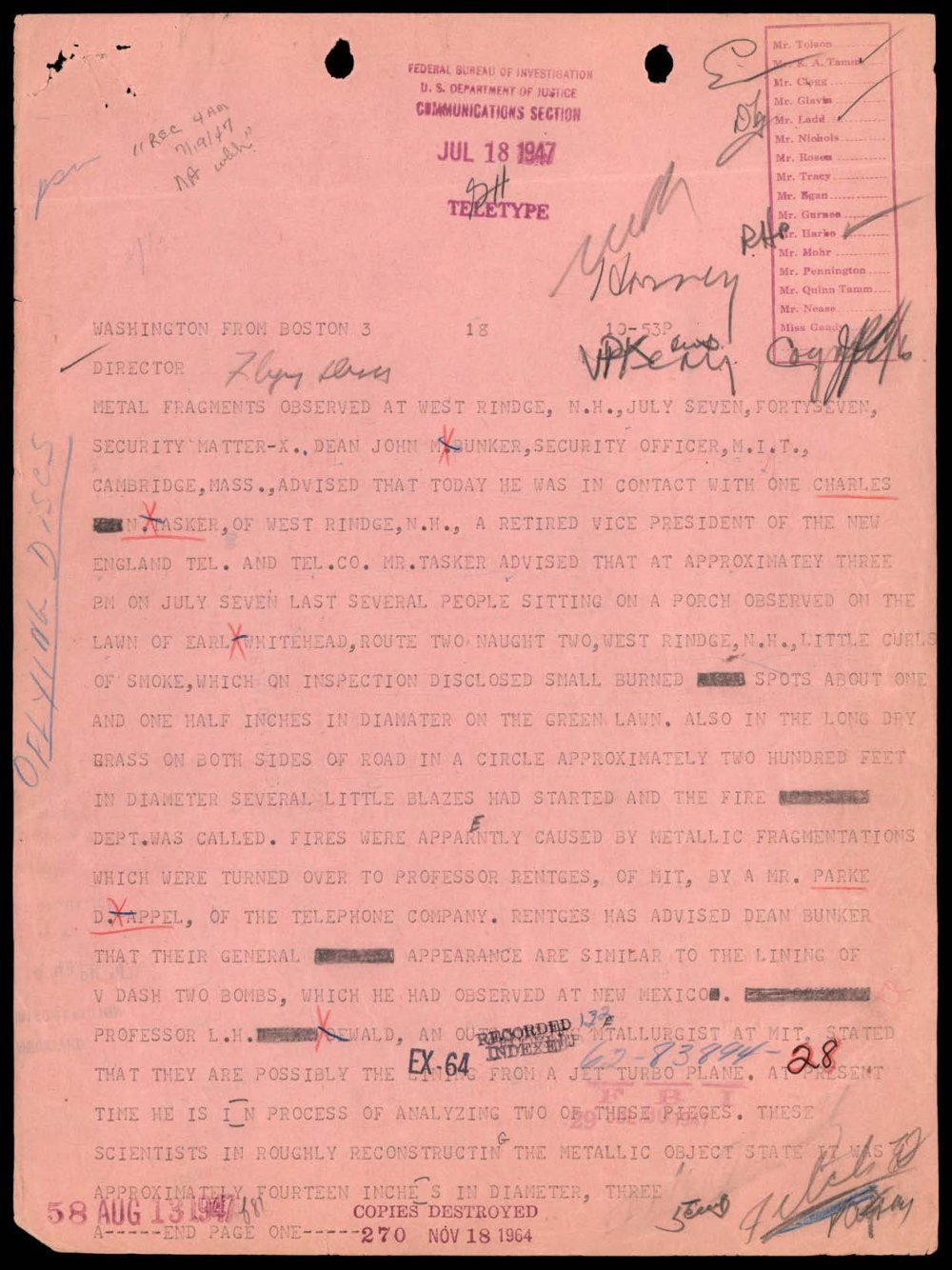 Official teletypePhysical page 106
DOCUMENTARY SOURCES · FBI
What the records tell
On July 18, 1947, the FBI Boston office sent the Director a teletype titled “Metal fragments observed at West Rindge, N.H., July 7, 1947”. The source was Dean John M. Bunker, security officer of the Massachusetts Institute of Technology (MIT). He said that Charles N. Tasker, retired vice president of the New England telephone company, had reported that, around 15h on July 7, several people sitting on a porch saw small wisps of smoke on a neighbor's lawn.
When the site was examined, there were small burned spots about one and a half inches in diameter in the green grass. In the dry grass on both sides of the road, in a circle about 200 feet in diameter, several small fires had started, and the fire department was called. The fires appeared to have been caused by metal fragments, which were handed to Professor Rentges, of MIT, by a telephone company employee. The local fire chief also kept some pieces.
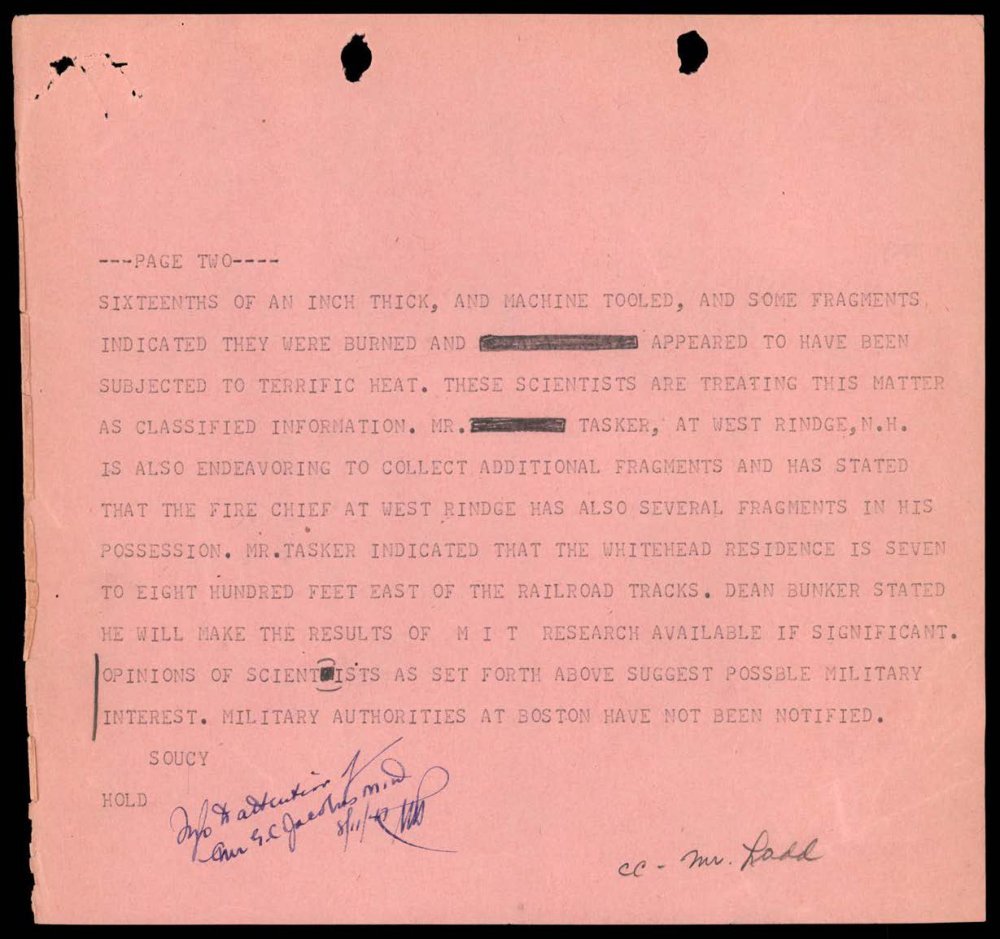
The first opinions were the strangest. Rentges said the appearance of the fragments resembled the casing of V-2 bombs he had seen in New Mexico. An MIT metallurgist thought they could be the casing of a jet airplane. Roughly reconstructing the object, the scientists estimated it at 14 inches in diameter and 3/16 of an inch thick, machined, and some pieces seemed to have undergone "terrific" heat. The teletype says the scientists were treating the matter as confidential information and that the opinions suggested "possible military interest."
Eleven days later, on July 29, a memorandum from the Boston office brought the result of the spectrographic examination: the fragments were ordinary cast iron subjected to very high heat, which formed scales previously taken for some metal alloy. The scientist calculated that pieces so small, falling from a great height, would have lost almost all their heat before reaching the ground and would not have caused fires. The pieces fell about 700 feet from a railroad line, but MIT determined that they did not come from a train or a locomotive. The measurements of four pieces indicated a single hollow cylinder 8 inches in diameter and 3/16 of an inch thick.
An unidentified scientist recalled that cast-iron cylinders of similar dimensions had been used in New Mexico in a guided missile project, without ruling out other possibilities. The memorandum records that there was no speculation about a foreign missile, that the case received no publicity, and that the FBI's interest was not known at MIT. Boston closed the case and offered to destroy the samples on August 15, unless ordered otherwise. The documentation itself shows the estimate changing: the diameter dropped from 14 to 8 inches between the first teletype and the examination. The origin of the cylinder was never established in the pages consulted.
The markings on the paper show the pace of the case within the FBI. The Boston teletype went out at 22h53 on July 18, 1947, and, according to a pencil notation, was received at 4h on the 19th. It bears the word "HOLD," a copy to D. M. Ladd, and the filing stamp for the general flying disc dossier. On the second page, a handwritten notation dated August 11, of uncertain legibility, appears to record that the information was brought to the attention of a military intelligence officer. The teletype itself said that the military authorities in Boston had not yet been notified.
The July 29 memorandum reveals who actually performed the examination. The name is covered by exemption (b)(7)(D), used to protect confidential sources, and next to the redaction bar is the notation "CONF. INFT.," an abbreviation for confidential informant. The text says this person gave the Boston office an informal report similar in every respect to Dean Bunker's, and that the FBI's interest was not known to the MIT scientists. In other words, the FBI followed the examination through two channels, one of them confidential.
The numbers change between the two documents, and this is recorded in the file itself. The teletype spoke of an object about 14 inches in diameter, machined, with marks of "terrific" heat and possible military interest. The spectrographic examination reduced everything to four pieces of ordinary cast iron, from a hollow 8-inch cylinder, with heat scales that had previously looked like a special alloy. The conclusion that pieces so small, coming from a great height, would reach the ground cold is an assessment by the MIT scientist, not a measurement taken on the lawn.
Left unanswered in the pages of the file are the origin of the cylinder and the fate of the samples. There is no record of an interview with Earl Whitehead, owner of the lawn, with the people on the porch, or with the fire chief, who also kept pieces. There is no photograph of the fragments or of the site, and no later document confirms whether the samples were destroyed on August 15 or sent to Washington. As an editorial hypothesis, a heated industrial part ejected from some nearby equipment would explain the heat and the fall; the documents do not make it possible to confirm this or any other origin.
More images from the document
DIRECT READING OF THE FILE
The document, in the original
Translated in full: the two pages of the Boston teletype (106 and 108, section 1) and the two pages of the 29/07/1947 memorandum (26 and 28, section 3). Pages 107 (section 1) and 27 (section 3) are reverse sides with no legible text. Passages redacted in the original are marked [redacted]. The road address of the residence was omitted.
EXCERPT 1 · PHYSICAL PAGE 106
Teletype from Boston to the FBI director, 18/07/1947, physical page 106 (in full)
T -
•
F£0El1At 6-. t"M 1., t 1 , 10
u. s. OErARll!lfNf )F Ju., er
CllM,UJHICATIOHS SECrJOff
JIii 1819!1
JeibE
:J:\..:r:H1GTO'. F.. C1. ~OSTO'' 3 13
/ n...:cro 1/Y'"t ~
•
8 /
/I
•.tr. Ros~•
Mr. Tracy
l\lr. llgan
Mr Gnnaea
r. Uarl,o
Mr. Pennlni:ton
!llr. Quh•" Tamm
.,...T'\
1 FT A rr fl! 0 ~ -r:, -c, I\ T p-s ~1 T I !f'\r•- r· • JULY ,. - ";''II ~,-, ,~1' • -" .,L. , , I, u , - oJ ,_,.._,J.!. ,:J,....J ,, • ,;. • ,.Ju- J • • J . ..,_:/,_ S • v,. I.::> • , J
,:;::cu .. r:-Y .i11.rr:: .. - ,~ • . J...:.ei
I
JCI-I" 1 '1''1~.:::r.,::;::cu .ITY, O}FIC•., . r . T . .,
C .. .i..i .. IDGi:..,Ll\SS . ,AJ\iI~ED T}'liT TO:.L'.Y '1: '".::; r 1 COHTACT '.'.ITl'
V - ·· • .,,S,G.r , o~; :,JT Pll':H,:,1 . H • ., ,'\ ::1::TII:ED :re: ?..:::::sr::>E"T OFT" . • , ....
TI1:,_ 1 [ rs J f' ,)ROCESS OF A"A!.Y!.I ·u r;o er TP .. SC p .,.c :s I T",.. J
.i
sc1.::Tr,.)·1~ If' r.OUG!l!..Y lICC"'..,T,.CC'!'I'fT,.~ ::T'\LLIC 0,.J':C .. ; .", ...i: J~
---~) 8 }{oGOXI, ~. -r;~~\\:;oun·:~~.c~~~k~ ~EJ~'n6ii1/T~., -i·· ': I~ 6
1\----- E~'D ,,:.GE 0"..:--- --27 0 NOV 181964 ......:::>
c·1 T'
1 .,'\T o:· _.'\. 1.- :· I'f .' :.rm, RO~T: r:o '11\u'.::i'":' T, O, 'TS~ . I''JG , ".1..• ., • t.,..,.., ~ ~
,,,
f f'\ • T
I., '
_.,.,.. .rrr
Y 1 1.F .Editorial note: Words covered by a redaction bar in the original are marked [redacted]; their content is not inferred. The spellings “APPROXIMATEY” and “DIAMATER” are from the original. The metallurgist's surname is partially redacted.
Check the original PDF
WASHINGTON FROM BOSTON 3 18 10-53P. DIRECTOR. METAL FRAGMENTS OBSERVED AT WEST RINDGE, N.H., JULY SEVEN, FORTYSEVEN, SECURITY MATTER-X. DEAN JOHN M. BUNKER, SECURITY OFFICER, M.I.T., CAMBRIDGE, MASS., ADVISED THAT TODAY HE WAS IN CONTACT WITH ONE CHARLES [suppressed] N. TASKER, OF WEST RINDGE, N.H., A RETIRED VICE PRESIDENT OF THE NEW ENGLAND TEL. AND TEL. CO. MR. TASKER ADVISED THAT AT APPROXIMATEY THREE PM ON JULY SEVEN LAST SEVERAL PEOPLE SITTING ON A PORCH OBSERVED ON THE LAWN OF EARL WHITEHEAD, [road omitted], WEST RINDGE, N.H., LITTLE CURLS OF SMOKE, WHICH ON INSPECTION DISCLOSED SMALL BURNED [suppressed] SPOTS ABOUT ONE AND ONE HALF INCHES IN DIAMATER ON THE GREEN LAWN. ALSO IN THE LONG DRY GRASS ON BOTH SIDES OF ROAD IN A CIRCLE APPROXIMATELY TWO HUNDRED FEET IN DIAMETER SEVERAL LITTLE BLAZES HAD STARTED AND THE FIRE [suppressed] DEPT. WAS CALLED. FIRES WERE APPARENTLY CAUSED BY METALLIC FRAGMENTATIONS WHICH WERE TURNED OVER TO PROFESSOR RENTGES, OF MIT, BY A MR. PARKE D. APPEL, OF THE TELEPHONE COMPANY. RENTGES HAS ADVISED DEAN BUNKER THAT THEIR GENERAL [suppressed] APPEARANCE ARE SIMILAR TO THE LINING OF V DASH TWO BOMBS, WHICH HE HAD OBSERVED AT NEW MEXICO. [suppressed] PROFESSOR L.H. [suppressed]EWALD, AN OUTSTANDING METALLURGIST AT MIT, STATED THAT THEY ARE POSSIBLY THE LINING FROM A JET TURBO PLANE. AT PRESENT TIME HE IS IN PROCESS OF ANALYZING TWO OF THESE PIECES. THESE SCIENTISTS IN ROUGHLY RECONSTRUCTING THE METALLIC OBJECT STATE IT WAS APPROXIMATELY FOURTEEN INCHES IN DIAMETER, THREE -----END PAGE ONE-----View the document record ↗ · Physical page 106, counting the cover.
EXCERPT 2 · PHYSICAL PAGE 108
Boston teletype, page two, physical page 108 (in full)
• •
--
I , ..
--- PAC:.:::: T,;O-- - -
•t..rct1-r1-tt·,•SIXTEE!'THS OF A:1 J\.CH Tl-'IC1<, :\I':) l \J •· ..,_ 1,o.L"',h
AS CL~SSIFIED Il'F0f; ,:\TIOr . r:r: .
rs ALSO r:11:::i::AV0f.I~1G TO ~01.L:CT l'.DDI'.:'IOt'AL FrU\Gt:Et'TS APD J-!AS S7AT•:"\
•
TO E:u}i7 t.UJ''.)RIJ :-£ET ':II.ST OF THE RAILROAD n~AC!{S . DE!\l' Ut"KFR :iT'\T:'."J
r..: d ILL :.Al~E TFE ~ESU1 .,.S OF i1 I T
,--. .
0,-'I!'. I OrS OF SCIEt:T . I ->". ...> ,'\S SET
I
It'TEREST . ~.IL I TARY i\UTHORITIES
SOUCY - g_.
HOLD ¥::::P1-,0f_Editorial note: “POSSBLE” is the original spelling. The final handwritten annotation was not read in full.
Check the original PDF
---PAGE TWO---- SIXTEENTHS OF AN INCH THICK, AND MACHINE TOOLED, AND SOME FRAGMENTS INDICATED THEY WERE BURNED AND [suppressed] APPEARED TO HAVE BEEN SUBJECTED TO TERRIFIC HEAT. THESE SCIENTISTS ARE TREATING THIS MATTER AS CLASSIFIED INFORMATION. MR. [suppressed] TASKER, AT WEST RINDGE, N.H. IS ALSO ENDEAVORING TO COLLECT ADDITIONAL FRAGMENTS AND HAS STATED THAT THE FIRE CHIEF AT WEST RINDGE HAS ALSO SEVERAL FRAGMENTS IN HIS POSSESSION. MR. TASKER INDICATED THAT THE WHITEHEAD RESIDENCE IS SEVEN TO EIGHT HUNDRED FEET EAST OF THE RAILROAD TRACKS. DEAN BUNKER STATED HE WILL MAKE THE RESULTS OF M I T RESEARCH AVAILABLE IF SIGNIFICANT. OPINIONS OF SCIENTISTS AS SET FORTH ABOVE SUGGEST POSSBLE MILITARY INTEREST. MILITARY AUTHORITIES AT BOSTON HAVE NOT BEEN NOTIFIED. SOUCY. HOLD. [handwritten] Info to attention [illegible] 8/11/47. cc - Mr. Ladd.View the document record ↗ · Physical page 108, counting the cover.
EXCERPT 3 · PHYSICAL PAGE 107
full page
1
lite.
l./41 ~l'v~IJ
i ,c I soNc>1:.
I ''(} r_ I III .) 011
; . J> 7,4/,f,
~£CEIVF.O '·l:p,.. 8 ~ lfl' 0 /. ., '
IAISOI',SE1,110N vlJs,,cF.'
4 43 PM'~7
r..· A T
i ~ - .
In. 01- .;US;'ICF.
.z:
C)
V)
>--o
ll>-0::
~ o;...
< er
0
(X)
<_,
RFC EIV1:'f
Rte·•,:- • ~ rO ,-'1d . I/~"'.f;/._
'1; , ~ 1,.., ~ :
- tc.,.,o"
Jul Jirf.R?.f-!lf#~?f
• •• 1"\
u ~ o F.s.,.
" · tPr. OF JlJsr,cF
... C
r ;•• ,:::,,...
'Ir..
"'-
•"',; :.:,
'-".. - 0:
•
-~£Df l\lf ft
UL 21 4 48 P/,f 't/7
,..HH/C~~ 4BORA,[0Rt- ,., ... t jj -'-
S. DF.PT. o i: ,JUST/C F.
I
,,
• •
.,. ~_ L -Editorial note: Back of the Boston teletype of July 18, 1947, with the receipt stamps of the FBI sections.
Check the original PDF
1
lite.
l./41 ~l'v~IJ
i ,c I soNc>1:.
I ''(} r_ I III .) 011
; . J> 7,4/,f,
~£CEIVF.O '·l:p,.. 8 ~ lfl' 0 /. ., '
IAISOI',SE1,110N vlJs,,cF.'
4 43 PM'~7
r..· A T
i ~ - .
In. 01- .;US;'ICF.
.z:
C)
V)
>--o
ll>-0::
~ o;...
< er
0
(X)
<_,
RFC EIV1:'f
Rte·•,:- • ~ rO ,-'1d . I/~"'.f;/._
'1; , ~ 1,.., ~ :
- tc.,.,o"
Jul Jirf.R?.f-!lf#~?f
• •• 1"\
u ~ o F.s.,.
" · tPr. OF JlJsr,cF
... C
r ;•• ,:::,,...
'Ir..
"'-
•"',; :.:,
'-".. - 0:
•
-~£Df l\lf ft
UL 21 4 48 P/,f 't/7
,..HH/C~~ 4BORA,[0Rt- ,., ... t jj -'-
S. DF.PT. o i: ,JUST/C F.
I
,,
• •
.,. ~_ L -View the document record ↗ · Physical page 107, counting the cover.
EXCERPT 4 · PHYSICAL PAGE 109
full page
.
• • -
JUL I8 II 06 Pi~ '~7
.e.1. p·. . .._ ICI.:
.. :-:- v•
..-::r
•· ~
::,
..,...::: ~ _,,: ...-f •.: (J1---~ ta
;:;:; ro c: \1l
> , ';;"
- u £, .,!JJ - ,_
er., -w ' -.. ,__ (...
s =r - U: .,., ·-_,
:
C
~ rn
"'tl
-· U1 0 ;:
Vl "Ti
-t:" c... ,...:.:a . c::.
CJ).:::::
.. -i
0 · <"".....,- ......
"-C
en -I
:-Editorial note: Back of the Boston teletype of July 18, 1947: the stamps show the path of the notice within FBI headquarters, from the Director to the Internal Security section.
Check the original PDF
.
• • -
JUL I8 II 06 Pi~ '~7
.e.1. p·. . .._ ICI.:
.. :-:- v•
..-::r
•· ~
::,
..,...::: ~ _,,: ...-f •.: (J1---~ ta
;:;:; ro c: \1l
> , ';;"
- u £, .,!JJ - ,_
er., -w ' -.. ,__ (...
s =r - U: .,., ·-_,
:
C
~ rn
"'tl
-· U1 0 ;:
Vl "Ti
-t:" c... ,...:.:a . c::.
CJ).:::::
.. -i
0 · <"".....,- ......
"-C
en -I
:-View the document record ↗ · Physical page 109, counting the cover.
EXCERPT 5 · PHYSICAL PAGE 99
full page
-
r.. :
..
,J- -""= •
l
I .I!.
~
., ..
~
• I
.... I er. e I . . .
1c
:J1' ot '"''rte .
r.:
... .
':
l
l .
.... :J•
1
• coo 1nu1Editorial note: Summary form for incident 214, from West Rindge (New Hampshire): it records only the date, the place, the observer, who was a retired telephone executive, and that what caught his attention were puffs of smoke; the rest is blank and the investigation was ongoing.
Check the original PDF
-
r.. :
..
,J- -""= •
l
I .I!.
~
., ..
~
• I
.... I er. e I . . .
1c
:J1' ot '"''rte .
r.:
... .
':
l
l .
.... :J•
1
• coo 1nu1View the document record ↗ · Physical page 99, counting the cover.
EXCERPT 6 · PHYSICAL PAGE 26
Physical page 26 (Section 3), in full, reviewed: memorandum from the Boston SAC to the director, 29/07/1947, with header and annotations
was
- f Office _Memo \ .,,.,um • UNITED S1n. ... ..__ ;.ovERNMENT
TO
FROM
SUBJECT:
.
METAL FRAGMENTS O SERVED AT WEST RUDGE, NE11 HAMPSHIRE, JULY 7, 1947
SECURITY MA.Tr.ER (X
7-29-47
Referenoe is made to Bost on teletype to tho Bureau datod July 18, 1947.
Dean John M. Bunker, the original inf'or111ant, baa advi:sed that a speotographio
examination has boen oomplotod of tho metal partioles referred to. Thay were
determined to be of ordinary oast iron whioh bad boen aubjeoted to a very
high degree of heat. The heat caused aoales to be formed on the oaet iron
whioh were originally thought to bo of some metallic alloy.
The soientist examining the partioloa oonoluded that if they had oome through
the air from any great altitude in as small pieoea aa they were found th.en
most of the heat would have been taken from them by the time they reao~ed
the ground and fires 'WOUld not havo resulted. It ia noted they landed
approximately 700 feet from a railroad traok e.nd inquiriea were oonduoted by
MI'!' to determine whether or not the partioles oould havo been originally a
pa.rt of a liuer in a smoke staok or some other part of the steam engine. Theee
inquiries resulted in positive information -that the particles did not oome from
a train or looomoti ve. Measurements of the four pieoes examined revealed
that they had most likely been originally all part of one hollow oylinder,
eight inohes in diameter and three sixteenth• of a.n inoh in thioknesa. It
felt that ono piooo falling from a great height would haw still retained
a good part of its heat and probably 11ould have mashed when 1t hit the ground.
A aoiontiat, whom Doan Bunker did not identify by name, recalled that oast
iron oylindors of similar measurements had been used in New Mexioo on
roaearoh work on a guided missile projeot. However, this unidentified scientist
not so oonoludo to the exoluaion or all other possibilities.
OONP I Ni'T, '"
is intere l ting to note that the examination at MIT was a.otually oonduoted
b) (7)(0) who furnished the Boston Office with an informal report similar~
in all major details to that supp lied by Dean Bunker above. The man at MIT ,.
are gathering through friends all additional pieoes of the origin&l oylin ~
available. These will be turned over to the Boston Office . No further
examination is being oonduotad by MIT and no effort is ·being ma.de t
reoonatruot tho original cylinder.
- \t 1)
Unlesa advised to the contrary by August 15• 1947 the
destroy these specimon,. In tho interim they will be transmitted to the
Bureau on speoifio Bureau instruotiona.
~~~ COPIE S DQq~'ll OYE D --<1<.c:P , F
27 0 NOV ld Wb4 EX·64 ~ ~i ~ <t1P 3l
55C j 'Ml-1
•
~
oston Offioe will
IEditorial note: The subject line of the memorandum says West Rindge, like the teletype. "(b)(7)(D)" is the exemption under the U.S. Freedom of Information Act that protects the identity of confidential sources; the annotation "CONF. INFT." is written next to the redaction bar. "spectographic" is the original's spelling. This page of the file 65_hs1-834228961_62-hq-83894_section_3.pdf is another scan of p. 26 of 65_HS1-834228961_62-HQ-83894_Section_3.pdf, with the same translation.
Check the original PDF
Office Memorandum. UNITED STATES GOVERNMENT. TO: Director, FBI. FROM: SAC, Boston. DATE: 7-29-47. SUBJECT: METAL FRAGMENTS OBSERVED AT WEST RINDGE, NEW HAMPSHIRE, JULY 7, 1947. SECURITY MATTER (X). Reference is made to Boston teletype to the Bureau dated July 18, 1947. Dean John M. Bunker, the original informant, has advised that a spectographic examination has been completed of the metal particles referred to. They were determined to be of ordinary cast iron which had been subjected to a very high degree of heat. The heat caused scales to be formed on the cast iron which were originally thought to be of some metallic alloy. The scientist examining the particles concluded that if they had come through the air from any great altitude in as small pieces as they were found then most of the heat would have been taken from them by the time they reached the ground and fires would not have resulted. It is noted they landed approximately 700 feet from a railroad track and inquiries were conducted by MIT to determine whether or not the particles could have been originally a part of a liner in a smoke stack or some other part of the steam engine. These inquiries resulted in positive information that the particles did not come from a train or locomotive. Measurements of the four pieces examined revealed that they had most likely been originally all part of one hollow cylinder, eight inches in diameter and three sixteenths of an inch in thickness. It was felt that one piece falling from a great height would have still retained a good part of its heat and probably would have smashed when it hit the ground. A scientist, whom Dean Bunker did not identify by name, recalled that cast iron cylinders of similar measurements had been used in New Mexico on research work on a guided missile project. However, this unidentified scientist did not so conclude to the exclusion of all other possibilities. [handwritten:] CONF. INFT. It is interesting to note that the examination at MIT was actually conducted by [(b)(7)(D)] who furnished the Boston Office with an informal report similar in all major details to that supplied by Dean Bunker above. The men at MIT are gathering through friends all additional pieces of the original cylinder available. These will be turned over to the Boston Office. No further examination is being conducted by MIT and no effort is being made to reconstruct the original cylinder. Unless advised to the contrary by August 15, 1947 the Boston Office will destroy these specimens. In the interim they will be transmitted to the Bureau on specific Bureau instructions. [handwritten:] Egan [reading uncertain]. Fletcher. Flying Discs. [stamps:] HANDLED BY [partly illegible]. RECORDED & INDEXED. 62-83894-103. FBI SEP 2? 1947. EX-64. COPIES DESTROYED 270 NOV 18 1964. 55 OCT 1 1947.View the document record ↗ · Physical page 26, counting the cover.
EXCERPT 7 · PHYSICAL PAGE 27
full page
(b) (7)(0 )Editorial note: Back of the sheet of the Boston office memorandum about the West Rindge metal fragments; it shows the receipt stamps of the FBI Internal Security Section. This page of the file 65_hs1-834228961_62-hq-83894_section_3.pdf is another scan of p. 27 of 65_HS1-834228961_62-HQ-83894_Section_3.pdf, with the same translation.
Check the original PDF
(b) (7)(0 )
[p. 27: sem texto extraído (página sem texto datilografado)]View the document record ↗ · Physical page 27, counting the cover.
EXCERPT 8 · PHYSICAL PAGE 28
Memorandum from the FBI Boston office, continuation, physical page 28 (in full)
• t
It is noted that the original Boston teletype refleoted that this inquiry
was being treated aa •19cret" matter at MIT. (b) (7)(D) has advised that
the comparatively Blll&ll number of research sci entists at LJ:T during the summer
are a l l oognizant of the incident and the results of the researoh. However,
no publicity has been given and it ia not anticipated that any will res\llt.
'!he Bureau's interest is not .known to the scientists at MIT. There ha1 been
no speculation that a guided missilo originating in a foreign land landed
in New Hampshire.
As indicated above, unloas tho Bureau requests spoo i fioally further investigative
aotion. this oase is being olosed in the Boston O£tioe.
BSG:md
100-20698Editorial note: This page of the file 65_hs1-834228961_62-hq-83894_section_3.pdf is another scan of p. 28 of 65_HS1-834228961_62-HQ-83894_Section_3.pdf, with the same translation.
Check the original PDF
It is noted that the original Boston teletype reflected that this inquiry was being treated as "secret" matter at MIT. [(b)(7)(D)] has advised that the comparatively small number of research scientists at MIT during the summer are all cognizant of the incident and the results of the research. However, no publicity has been given and it is not anticipated that any will result. The Bureau's interest is not known to the scientists at MIT. There has been no speculation that a guided missile originating in a foreign land landed in New Hampshire. As indicated above, unless the Bureau requests specifically further investigative action, this case is being closed in the Boston Office. BSG:md. 100-20698.View the document record ↗ · Physical page 28, counting the cover.
Dates and documentary context
- Event
- 07/07/1947 — Date and time (about 15h) given in the teletype of 18/07/1947.
- Document
- 18/07/1947 — Teletype from Boston; the memorandum with the result of the examination is dated 29/07/1947.
- Publication
- Not established — Internal FBI documents; the memorandum says the case received no publicity.
Origin and release
FBI, Boston office; informant: MIT security officer · 65_HS1-834228961_62-HQ-83894_Section_1.pdf; 65_HS1-834228961_62-HQ-83894_Section_3.pdf
The memorandum also appears in another scan of section 3 (65_hs1-834228961_62-hq-83894_section_3.pdf, page 26); it is a copy, not a separate case.
Related accounts and their differences
Questions to continue the investigation
- Where did the cast-iron cylinder come from, if not from a train or a locomotive?
- Were the samples destroyed in August 1947 or sent to FBI headquarters?
- Why did the diameter estimate drop from 14 to 8 inches between the teletype and the examination?
GEOGRAPHY OF THE CASE
West Rindge, New Hampshire
Approximate reference to the cited locality, placed by the editorial team. It does not indicate the lawn or the residence.
DOCUMENTARY TRAIL
Go back to the sources
References use physical pages of the PDF, counting the cover. Summaries are presented in English; the documents keep their original language.
- 65_HS1-834228961_62-HQ-83894_Section_1.pdf
Physical pages 106 and 108: FBI teletype from Boston to the director, 18/07/1947
FBI · 185 pages
Editorial summary based on the collection's research notes. How we read the documents.