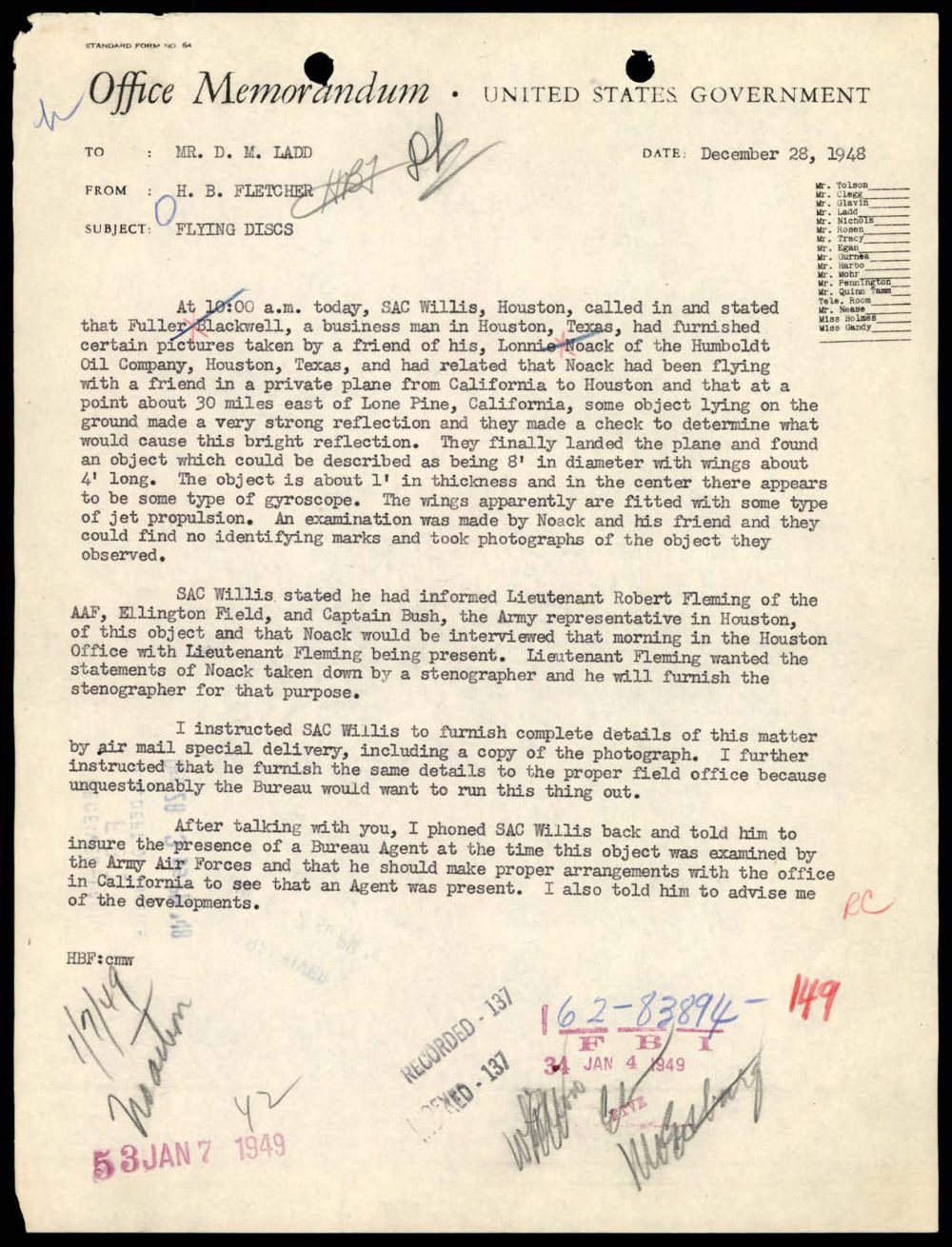
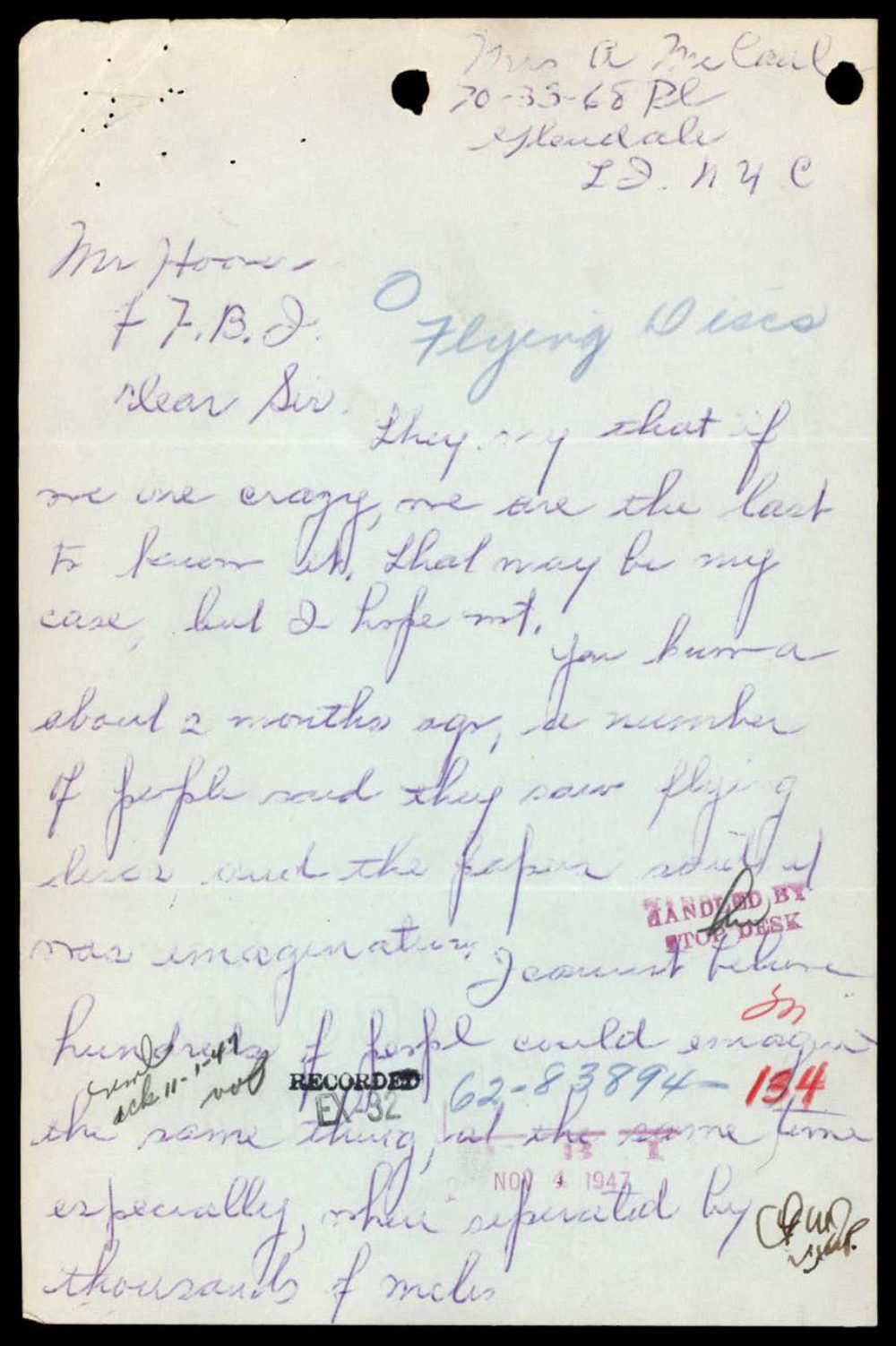
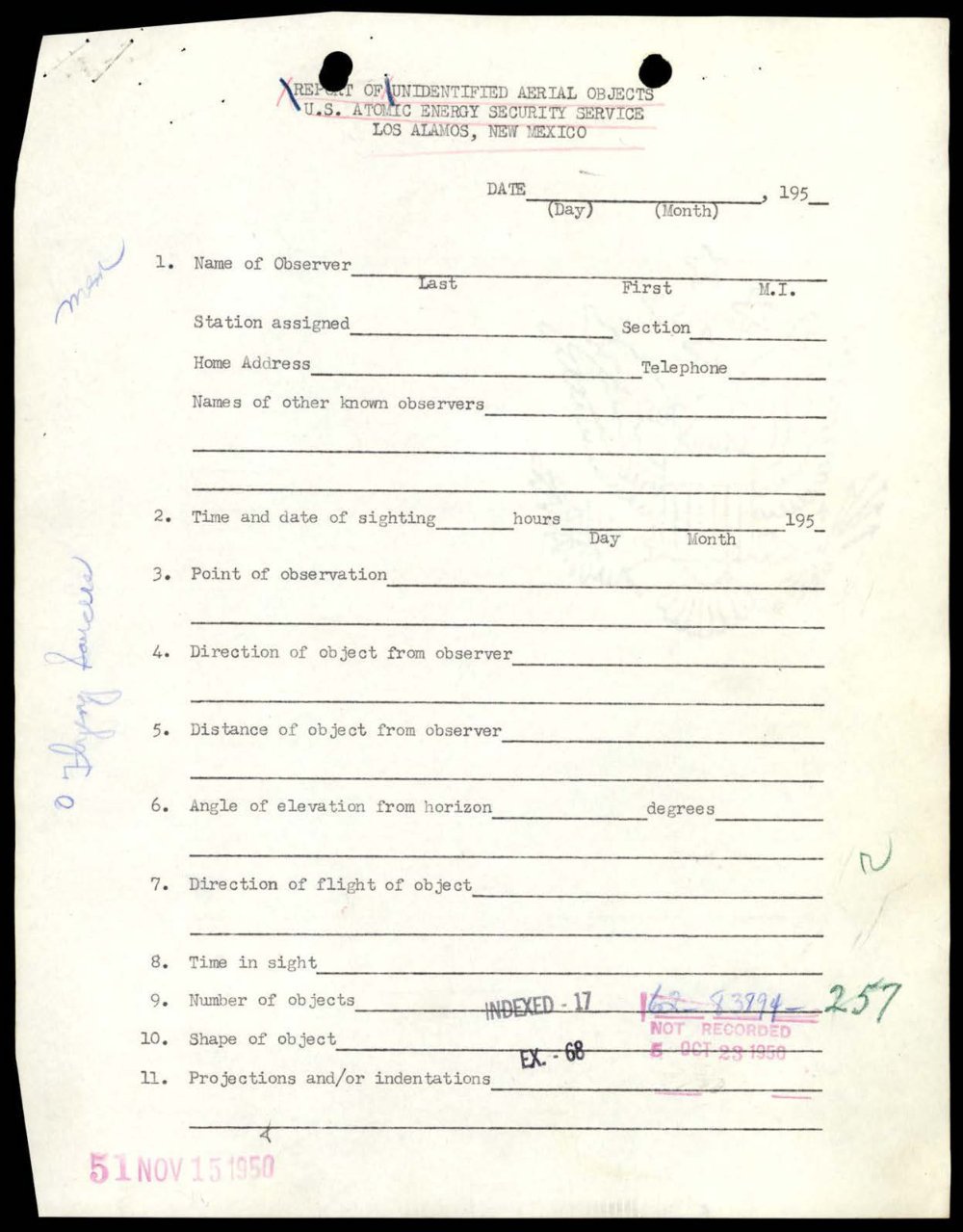
Date: 15/02/1949Location: Washington, D.C., USA (Air Force Directorate of Intelligence)
Washington, 1949: the Air Force questionnaire for reporting “unconventional aircraft,” with a copy to the FBI
In February 1949, U.S. Air Force (USAF) intelligence set out in a memorandum what should be asked about each sighting of an “unconventional aircraft,” including flying saucers, and where to send the answers. The FBI received seventeen copies of the text and kept them in an envelope attached to its flying saucer file.
- Event date
- 15/02/1949
- Location
- Washington, D.C., USA (Air Force Directorate of Intelligence)
- Topic
- FBI file
- Source agencies
- FBI
- Documents
- 3 documents · 622 pages
- Reading time
- 150 min
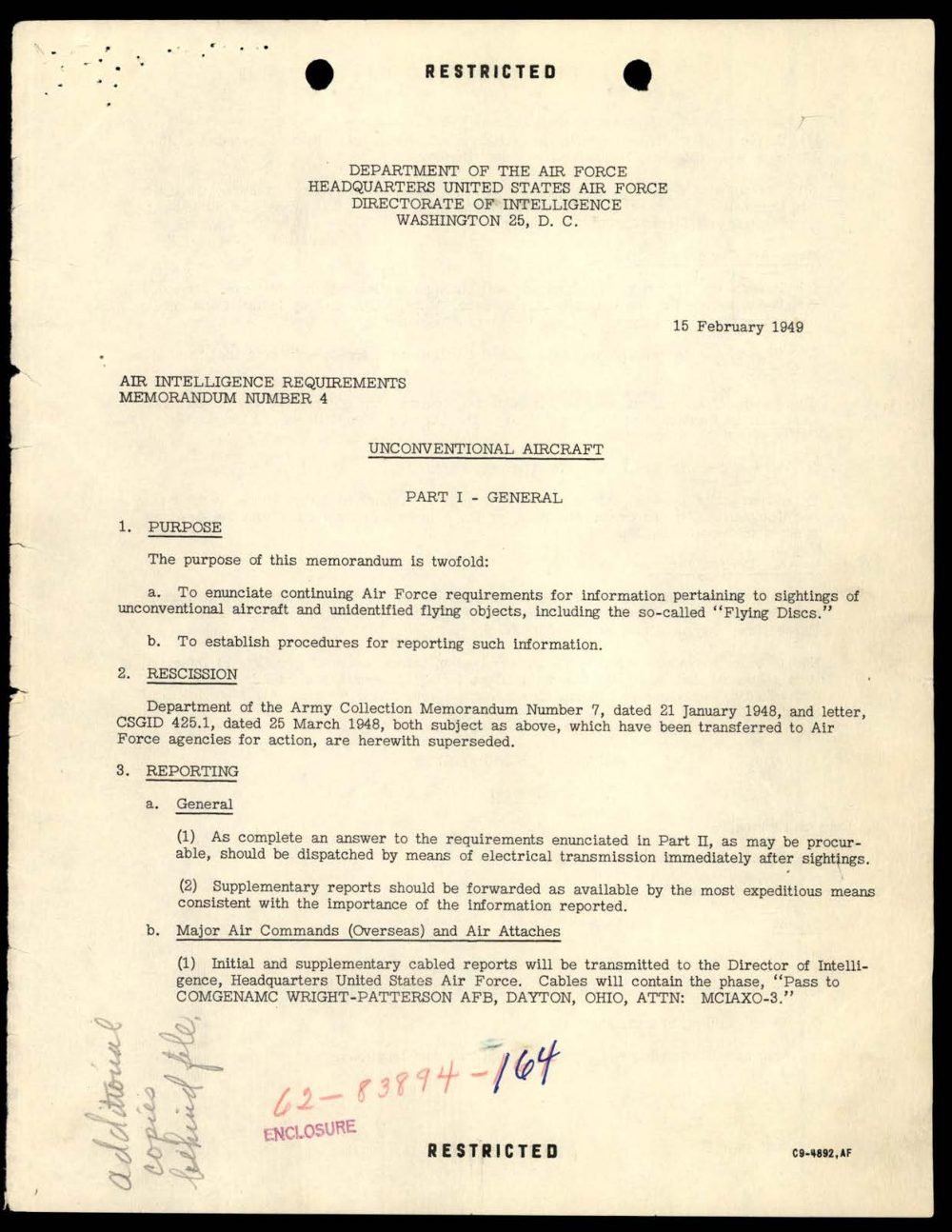 Air Force memorandumPhysical page 2
DOCUMENTARY SOURCES · FBI
What the records tell
Air Intelligence Requirements Memorandum No. 4, of February 15, 1949, signed by Major General C. P. Cabell, Air Force director of intelligence, had two stated objectives: to set out the standing information requirements on “unconventional aircraft and unidentified flying objects, including so-called flying saucers,” and to establish how these reports should be sent. It superseded an Army memorandum of January 1948 and a letter of March of the same year, whose subject had passed to the Air Force.
The route defined was fast and centralized. The first response was to go by electrical transmission, telegram or cable, right after the sighting. Overseas commands and air attachés sent reports to the director of intelligence, with instructions to pass them on to the air materiel command at Wright-Patterson, in Dayton, Ohio. Commands within the U.S. sent them directly to Wright-Patterson, with a copy to Washington, and written reports used form AF 112. Agencies outside the Air Force were also to send everything directly to Wright-Patterson.
The second part is a script of questions. It asks for date, time on the 24-hour clock, observer's position on the ground, in the air or at sea, number of objects and formation, distance, elevation angle, time in view, color, shape, size, maneuvers, smoke, effect on clouds, lights, means of support and propulsion, sound, speed and manner of disappearance. It also orders checking for planets and celestial phenomena that might explain the case, by consulting local institutions that track them.
Regarding the people, the form asks for name, address, occupation, useful hobbies, such as amateur astronomy or piloting, and the ability to judge color, speed and size at a distance. To gauge reliability, it suggests talking to neighbors, police, employer and checking FBI records, as well as noting pilot fatigue and the interviewer's opinion of the witness's intelligence and character. There are items for radar, such as turns and targets that split as they approach, and for noise on onboard radios.
The closing section lists practical checks: weather reports, winds aloft, civil and military flight schedules, possible launches of balloons and test devices, soil samples inside and outside the landing spot, use of a Geiger counter on nearby surfaces, original photographs or negatives, sketches, a signed statement and fragments. The distribution list includes the CIA, the State Department, Army and Navy intelligence, the Coast Guard and the FBI director.
The FBI file does not contain the transmittal letter or any comment on the memorandum. The seventeen printed copies, all dated February 15, 1949, are in an envelope marked “Serials EBF 164” and “do not destroy,” with the notation “additional copies behind file.” The document does not report any sighting. It shows the method the Air Force wanted to apply in 1949: first seek ordinary explanations, such as planets, airplanes and balloons, and gather comparable data from each case.
The FBI file partly answers the question left open about how the Bureau received the memorandum. On March 14, 1949, Inspector H. B. Fletcher asked D. M. Ladd to approve a letter to the heads of offices that would send to the field "the type of information desired" by Air Force Intelligence. He recalled Bulletin No. 57, of October 1, 1947, which had ordered a halt to investigating flying saucers, and said the Air Force had supplied the Bureau with enough copies of the memorandum. SAC Letter No. 38, of March 25, 1949, carried the text to the offices, with the caveat that it served only to collect data from those who came forward voluntarily.
The internal distribution also appears. The legal attaché in Mexico City, John N. Speakes, wrote on April 5, 1949 that the enclosure announced in Letter No. 38 had not arrived. Hoover replied on May 4, in a letter sent by air pouch and special messenger, sending him the "booklet" Unconventional Aircraft, of February 15, 1949. The stamps show that the reply was recorded in file 62-83894 under number 165, right after the envelope holding the seventeen copies (number 164). The two documents form a single set in the file, and the Air Force document remained in the FBI envelope marked "enclosure behind file."
Two points in the memorandum itself deserve to be read together with other documents. Item 5 of the closing section orders soil samples to be collected "inside and outside" the depression where the object allegedly landed, to compare the soils. This was the flaw acknowledged by the Air Materiel Command's letter to the FBI in September 1948: no one had thought to send soil from the surrounding area. The papers do not say whether one fact led to the other. And the memorandum supersedes the Army's "Collection Memorandum No. 7," of January 21, 1948, and a letter of March 25, 1948: the "ICM 7," enclosed with the Army's reply of March 25, is very probably this same memorandum.
The physical side of the set also says something. There are seventeen copies of the same text, seven sheets each, every sheet accompanied by a blank reverse marked "RESTRICTED." The first copy has an "ENCLOSURE" stamp, the number 62-83894-164 and the notation "additional copies behind file." In all copies, the date is February 15, 1949 and C. P. Cabell's signature is at the end of the seventh sheet. Each page bears the file number handwritten at the bottom. It is a distribution stock, not seventeen different documents.
The sending of the memorandum to the FBI is documented on an Air Force routing slip of March 4, 1949, kept in Section 4 of the file. The collection branch of the Directorate of Intelligence (AFOIR-CO) wrote by hand: "Per your recent request, attached are 50 copies of Air Intelligence Requirements Memorandum No. 4, for transmittal to the F.B.I." The slip was addressed to another Air Force branch, attention Colonel Martin. The FBI recorded it on April 7, 1949 under number 62-83894-164, the same as the envelope with the seventeen copies, and noted "enclosure behind file" and "additional copies behind file."
The dates fit together. The Air Force slip is dated March 4; ten days later, on March 14, Inspector Fletcher wrote to Ladd that the Air Force had supplied "sufficient copies" of the memorandum for the field offices. The stamps on the reverse of that memorandum show that it passed through Fletcher on March 15, through Ladd on March 16 and 23, through the director's office on March 23 and through Nichols on March 24, the day before SAC Letter No. 38. The papers do not say how many of the 50 copies were sent to the offices; seventeen remained in the file.
The 1949 questionnaire was brought up again at the FBI a year and a half later. In September 1950, General Cabell sent Hoover a new directive, "Reporting of information on unconventional aircraft," dated September 8, which replaced the long script with a shorter list of data to be sent by telegram and, within ten days, on Form 112. When filing the transmittal letter under number 62-83894-249, a Bureau employee noted in the margin the cross-reference to SAC Letter No. 38, of March 25, 1949, the same one that had distributed the 1949 memorandum to the FBI offices.
DIRECT READING OF THE FILE
The document, in the original
Full translation of copy A of the memorandum (Serial 164, physical pages 2 to 8) and of the envelope cover (physical page 1). The other sixteen copies (pages 10 to 136) are identical printings, with the same date of 15/02/1949 checked against the facsimile, and were not translated again; the blank backs marked “RESTRICTED” (pages 9, 17, 25 and following) contain no text.
EXCERPT 1 · PHYSICAL PAGE 1
FBI envelope “Serials EBF 164”, physical page 1 (full text)
1
11 I I I
. '
'
62- IHC-83894 I
Serials EBF 154
~ ~ 1111 I11111 IH~ llm EBF t
62-HCl-83894-ESF" 164
DO NOT·
DES.fRO)'
•• ~ U l t7{iJ;; +•
_ FBI - CENTRAL RECORDS CENTER _ _ .
HQ - HEADQUARTERS
. Class / Case # Sub Vol. Serial #
0062 83694 1 164 ONLY
8/11/1274166
I
11 1/IIIHIIMIIIIIIIIIIIIlllllllllll~IIIIII
RRPO031XG8Editorial note: EBF indicates an enclosure kept behind the file (“enclosure behind file”).
Check the original PDF
62- HQ-83894. Serials EBF 164. [Código de barras] 62-HQ-83894-EBF 164. EBF. [Anotação:] 62-83894-164. DO NOT DESTROY. [Carimbo:] ENCL. BEHIND FILE. FBI - CENTRAL RECORDS CENTER. HQ - HEADQUARTERS. Class / Case #: 0062 83894. Sub: -. Vol.: 1. Serial #: 164. ONLY. 8/11/1274166. DO NOT DESTROY. FOIPA # 1142292. [Selo:] Declassification authority derived from FBI Automatic Declassification Guide, issued May 24, 2007.View the document record ↗ · Physical page 1, counting the cover.
EXCERPT 2 · PHYSICAL PAGE 2
Memorandum No. 4, copy A, page 1, physical page 2 (full text)
RESTRICTED
r
DEPARTMENT OF THE AIR FORCE
HEADQUARTERS UN1TED STATES AIR FORCE
DIRECTORATE OF INTELLIGENCE
WASHINGTON 25, D. C.
15 February 1949
AIR INTELLIGENCE REQUIREMENTS
MEMORANDUM NUMBER 4
UNCONVENTIONAL AIRCRAFT
PART I - GENERAL
1. PURPOSE
The purpose of this memorandum is twofold:
a. To enunciate continuing Air Force requirements for information pertaining to sightings of
unconventional ai rcraft and unidentified flying objects, including the so- called "Flying Discs ."
b. To establish procedures for reporting such information.
2. RESCISSION
Department of the Army Collection Memorandum Number 7, dated 21 January 1948, and letter,
CSGID 425.1, dated 25 March 1948, both subject as above, which have been transferred to Air
Force agencies for action, are herewith superseded .
3. REPORTING
a. General
(1) As complete an answer to the requirements enunciated in Part II, as may be procur
able , should be dispatched by means of electrical transmission immedia tely afte:' sighttngs.
(2) Supplementary reports should be forwarded as availab l e by the most expeditious means
consistent with the importance of the information reported .
b. Major Air Commands (Overseas) and Air Attaches
(1) Initial and supplementary cabled reports will be transmitted to the Dir ector of Intelli
gence, Headquarters United States Air Force . Cables will contain the phase, " Pass to
COMGENAMC WRIGHT -PATTERSON AFB, DAYTON, OHIO, ATTN: MCIAXO - 3."
RESTRICTED C9-~89 2, AFEditorial note: “Phase” is an error in the original for “phrase”. COMGENAMC designates the commanding general of the Air Materiel Command.
Check the original PDF
RESTRICTED. DEPARTMENT OF THE AIR FORCE, HEADQUARTERS UNITED STATES AIR FORCE, DIRECTORATE OF INTELLIGENCE, WASHINGTON 25, D. C. 15 February 1949. AIR INTELLIGENCE REQUIREMENTS MEMORANDUM NUMBER 4. UNCONVENTIONAL AIRCRAFT. PART I - GENERAL. 1. PURPOSE. The purpose of this memorandum is twofold: a. To enunciate continuing Air Force requirements for information pertaining to sightings of unconventional aircraft and unidentified flying objects, including the so-called "Flying Discs." b. To establish procedures for reporting such information. 2. RESCISSION. Department of the Army Collection Memorandum Number 7, dated 21 January 1948, and letter, CSGID 425.1, dated 25 March 1948, both subject as above, which have been transferred to Air Force agencies for action, are herewith superseded. 3. REPORTING. a. General. (1) As complete an answer to the requirements enunciated in Part II, as may be procurable, should be dispatched by means of electrical transmission immediately after sightings. (2) Supplementary reports should be forwarded as available by the most expeditious means consistent with the importance of the information reported. b. Major Air Commands (Overseas) and Air Attaches. (1) Initial and supplementary cabled reports will be transmitted to the Director of Intelligence, Headquarters United States Air Force. Cables will contain the phase, "Pass to COMGENAMC WRIGHT-PATTERSON AFB, DAYTON, OHIO, ATTN: MCIAXO-3." [Anotações:] 62-83894-164; Enclosure; additional copies behind file. RESTRICTED. C9-4892, AF.View the document record ↗ · Physical page 2, counting the cover.
EXCERPT 3 · PHYSICAL PAGE 3
Memorandum No. 4, copy A, page 2, physical page 3 (full text)
..
RESTRICTED
(2) Supplementary written reports, prepared on AF Form 112, will be forwarded to the
Director of Intelligence, Headquarters United States Air Force.
(3) Commanding General, Air Materiel Command is authorized direct contact with major
Air Commands (overseas) and organizations under their control in connection with the
development of information on this subject.
c. Major Air Commands (ZI)
(1) Reports will be forwarded direct to the Commanding General, Air Materiel Command,
Wright-Patterson Air Force Base, Dayton, Ohio, Attn: MCIAXO-3 by installations receiv
ing information pertaining to the requirements enunciated in Part II.
(2) Copies of such reports may be supplied the Command Headquarters of the installation
concerned.
(3) A copy of all reports sent to Air Materiel Command in accordance with these instruc
tions will be forwarded at the same time to the Director of Intelligence, Headquarters
United States Air Force.
(4) Written reports will be submitted on AF Form 112.
(5) Commanding General, Air Materiel Command is authorized direct contact with major
Air Commands (ZI) and organizations under their control in connection with the d~velop
ment of information on this subject.
d. Non-Air Force Agencies
(1) Addressees otqer than those of the United States Air Force are requested to forward
reports direct to the Commanding General, Air Materiel Command, Wright-Patterson Air
Force Base, Dayton , Ohio, Attn: MCIAXO-3.
(2) In order to reduce the time factor involved in transmission of this type of information
it is requested that, wherever communications facilities permit, subordinate elements be
authorized to communicate reports direct to the Commanding General, Air Materiel Com
mand.
PART II - REQUIREMENTS
General
1. Date of sighting.
2. Time of sighting (zonal by 24 hr. clock) .
3. Where sighted (observer 's position):
a. Ground
(1) City, town.
(2) Distance and direction from city or town, road, intersection , etc.
(3) From building (story), yard, etc .
(4) Map coordinates (if feasible) showing latitude and longitude.
- 2 - RESTRICTEDCheck the original PDF
RESTRICTED. (2) Supplementary written reports, prepared on AF Form 112, will be forwarded to the Director of Intelligence, Headquarters United States Air Force. (3) Commanding General, Air Materiel Command is authorized direct contact with major Air Commands (overseas) and organizations under their control in connection with the development of information on this subject. c. Major Air Commands (ZI). (1) Reports will be forwarded direct to the Commanding General, Air Materiel Command, Wright-Patterson Air Force Base, Dayton, Ohio, Attn: MCIAXO-3 by installations receiving information pertaining to the requirements enunciated in Part II. (2) Copies of such reports may be supplied the Command Headquarters of the installation concerned. (3) A copy of all reports sent to Air Materiel Command in accordance with these instructions will be forwarded at the same time to the Director of Intelligence, Headquarters United States Air Force. (4) Written reports will be submitted on AF Form 112. (5) Commanding General, Air Materiel Command is authorized direct contact with major Air Commands (ZI) and organizations under their control in connection with the development of information on this subject. d. Non-Air Force Agencies. (1) Addressees other than those of the United States Air Force are requested to forward reports direct to the Commanding General, Air Materiel Command, Wright-Patterson Air Force Base, Dayton, Ohio, Attn: MCIAXO-3. (2) In order to reduce the time factor involved in transmission of this type of information it is requested that, wherever communications facilities permit, subordinate elements be authorized to communicate reports direct to the Commanding General, Air Materiel Command. PART II - REQUIREMENTS. General. 1. Date of sighting. 2. Time of sighting (zonal by 24 hr. clock). 3. Where sighted (observer's position): a. Ground. (1) City, town. (2) Distance and direction from city or town, road, intersection, etc. (3) From building (story), yard, etc. (4) Map coordinates (if feasible) showing latitude and longitude. - 2 - RESTRICTED.View the document record ↗ · Physical page 3, counting the cover.
EXCERPT 4 · PHYSICAL PAGE 4
Memorandum No. 4, copy A, page 3, physical page 4 (full text)
RESTRICTED
b. Air
(1) Type aircraft, speed, altitude, direction of flight.
(2) Distance and direction from city, town or known landmark.
(3) Clock position of object from observer 's aircraft.
(4) Latitude and longitude.'
c. Sea
(1) Latitude and longitude.
(2) Proximity to land. (Name city , country, etc.)
4. Number of objects.
Formation type (if any), sketch if possible.
5. Observable celestial phenomena or planets that may account for the sighting. (Local facilities
or organizations which follow such celestial phenomena should be consulted for such information.)
6. Distance of object from observer.
a. Laterally or horizontally.
b. Angle of elevation from horizon.
C. Altitude.
7. Time in sight.
8. Appearance of object.
a. Color.
b. Shape . (Sketch if possible)
c. Apparent construction. (Of what material or substance)
d. Size.
(1) Estimated size.
(2) Size as it appeared from observer's view. (Compared to known object)
9. Direction of flight.
10. Tactics or maneuvers.
Vertical ascent or descent, horizontal, oscillating , fluttering, evasive, aggressive, erratic, etc .
11. Evidence of exhaust.
a. Color of smoke.
, b . Length and width.
RESTRICTED - 3 -Check the original PDF
RESTRICTED. b. Air. (1) Type aircraft, speed, altitude, direction of flight. (2) Distance and direction from city, town or known landmark. (3) Clock position of object from observer's aircraft. (4) Latitude and longitude. c. Sea. (1) Latitude and longitude. (2) Proximity to land. (Name city, country, etc.) 4. Number of objects. Formation type (if any), sketch if possible. 5. Observable celestial phenomena or planets that may account for the sighting. (Local facilities or organizations which follow such celestial phenomena should be consulted for such information.) 6. Distance of object from observer. a. Laterally or horizontally. b. Angle of elevation from horizon. c. Altitude. 7. Time in sight. 8. Appearance of object. a. Color. b. Shape. (Sketch if possible) c. Apparent construction. (Of what material or substance) d. Size. (1) Estimated size. (2) Size as it appeared from observer's view. (Compared to known object) 9. Direction of flight. 10. Tactics or maneuvers. Vertical ascent or descent, horizontal, oscillating, fluttering, evasive, aggressive, erratic, etc. 11. Evidence of exhaust. a. Color of smoke. b. Length and width. RESTRICTED - 3 -View the document record ↗ · Physical page 4, counting the cover.
EXCERPT 5 · PHYSICAL PAGE 5
Memorandum No. 4, copy A, page 4, physical page 5 (full text)
• RESTRICTED
c. Odor (if any).
d. Rate of evaporation.
e. Does trail vary with sound? (spurts)
12. Effect on clouds.
a. Opened path thru clouds .
b. Forced cloud or mists.
c. Reflected on cloud.
d. Showed thru cloud.
13. Lights.
a. Reflected or attached.
b. Luminous
c . Blinked on and off in r elation to speed .
14. Support
a. Wings.
b. Aerodynamic list of fuselage.
c. Vertical jet.
d. Rotating cylinder or cone.
e. Aerostatic lift (ball oon or dirigible).
15. Propulsion .
a. Propeller or jet.
b. Rotor.
c. Aerodynamic vanes (flapping or oscillating ) (Katz Mayer effect).
d. Visible exhaust or jet openings.
16. Control and stability .
a . Fins
b. Stabilizers (hor izontal or vertical).
(1) Size.
(2) Shape .
(3) Location.
- 4 - RESTRICTEDEditorial note: “Aerodynamic list” appears as such in the original, probably for “lift”; translated according to the meaning. “Katz Mayer effect” was kept as is, without identification.
Check the original PDF
RESTRICTED. c. Odor (if any). d. Rate of evaporation. e. Does trail vary with sound? (spurts) 12. Effect on clouds. a. Opened path thru clouds. b. Forced cloud or mists. c. Reflected on cloud. d. Showed thru cloud. 13. Lights. a. Reflected or attached. b. Luminous. c. Blinked on and off in relation to speed. 14. Support. a. Wings. b. Aerodynamic list of fuselage. c. Vertical jet. d. Rotating cylinder or cone. e. Aerostatic lift (balloon or dirigible). 15. Propulsion. a. Propeller or jet. b. Rotor. c. Aerodynamic vanes (flapping or oscillating) (Katz Mayer effect). d. Visible exhaust or jet openings. 16. Control and stability. a. Fins. b. Stabilizers (horizontal or vertical). (1) Size. (2) Shape. (3) Location. - 4 - RESTRICTED.View the document record ↗ · Physical page 5, counting the cover.
EXCERPT 6 · PHYSICAL PAGE 6
Memorandum No. 4, copy A, page 5, physical page 6 (full text)
, .. ,,. ... .. RESTRICTED
17. Air ducts.
a. Slots.
b. Duct openings.
18. Speed - M.P .H.
19. Sound.
a. Continuous whine or buzz.
b. Roar, whistle, whoosh.
c. Intermittent .
20. Manner of disappearance.
a. Explode.
(1) Possibility of fragments.
(2) Other physical evidence.
b. Faded from view .
c. Disappeared behind obstacle.
Relative to the Observer
1. Name of observer.
2. Address.
3. Occupation.
4. Place of business.
a. Employer or employee.
5. Pertinent hobbies.
a. Is observer amateur astronomer, pilot, engineer , etc.
b. Length of time engaged in hobby (experience).
6. AbUity to determine:
a. Color .
b. Speed of moving objects.
c . Size at distance.
7. Reliability of observer.
a. Sources.
RESTRICTED - 5 -Check the original PDF
RESTRICTED. 17. Air ducts. a. Slots. b. Duct openings. 18. Speed - M.P.H. 19. Sound. a. Continuous whine or buzz. b. Roar, whistle, whoosh. c. Intermittent. 20. Manner of disappearance. a. Explode. (1) Possibility of fragments. (2) Other physical evidence. b. Faded from view. c. Disappeared behind obstacle. Relative to the Observer. 1. Name of observer. 2. Address. 3. Occupation. 4. Place of business. a. Employer or employee. 5. Pertinent hobbies. a. Is observer amateur astronomer, pilot, engineer, etc. b. Length of time engaged in hobby (experience). 6. Ability to determine: a. Color. b. Speed of moving objects. c. Size at distance. 7. Reliability of observer. a. Sources. RESTRICTED - 5 -View the document record ↗ · Physical page 6, counting the cover.
EXCERPT 7 · PHYSICAL PAGE 7
Memorandum No. 4, copy A, page 6, physical page 7 (full text)
.•
''
RESTRICTED
(1) Neighbors.
(2) Police Dept.
(3) FBI records .
(4) Employer.
8. Notes relative to observer on:
a. Sightings in general.
b. How attention was drawn to object(s).
(1) Sound.
(2) Motion.
(3) Glint of light.
c. Degree of fatigue and duration of flight at time of sighting in cases where observer is
airborne.
9. Witnesses.
a. Addressees .
b. Occupation.
C. Reliability.
10. Comments of interrogator regarding the intell1gence and character of person interrogated.
Relative to Radar Sightings
1. Re radars operating on ground.
a. Observations of range, speed, altitude and size of target.
b. Did target executive any turns? If so, what angle (180°), etc . and what radius of turn.
If radius of turn is not observable, how long did the target stay in the turn and what was its speed?
c. Note particularly any separation of distant target into several targets upon approach. Track
all if possible.
2. If airborne when object sighted.
a. Were there any radar inductions or extra noise on radio circuits?
b. Give estimates of size, speed, maneuvers, etc.
GENERAL
1. Teletype sequences of local weather conditions.
2. Winds aloft report.
- 6 - RESTRICTEDEditorial note: “Executive” and “Addressees” appear as such in the original, for “execute” and “Addresses”; translated according to the meaning.
Check the original PDF
RESTRICTED. (1) Neighbors. (2) Police Dept. (3) FBI records. (4) Employer. 8. Notes relative to observer on: a. Sightings in general. b. How attention was drawn to object(s). (1) Sound. (2) Motion. (3) Glint of light. c. Degree of fatigue and duration of flight at time of sighting in cases where observer is airborne. 9. Witnesses. a. Addressees. b. Occupation. c. Reliability. 10. Comments of interrogator regarding the intelligence and character of person interrogated. Relative to Radar Sightings. 1. Re radars operating on ground. a. Observations of range, speed, altitude and size of target. b. Did target executive any turns? If so, what angle (180°), etc. and what radius of turn. If radius of turn is not observable, how long did the target stay in the turn and what was its speed? c. Note particularly any separation of distant target into several targets upon approach. Track all if possible. 2. If airborne when object sighted. a. Were there any radar inductions or extra noise on radio circuits? b. Give estimates of size, speed, maneuvers, etc. GENERAL. 1. Teletype sequences of local weather conditions. 2. Winds aloft report. - 6 - RESTRICTED.View the document record ↗ · Physical page 7, counting the cover.
EXCERPT 8 · PHYSICAL PAGE 8
Memorandum No. 4, copy A, page 7, physical page 8 (full text)
,. ' RESTRICTED
•
3. Local flight schedules of commercial, private and military aircraft flying in vic!nity at the
time. (Check Canadian activity if close to that border.)
4. Possible releases of testing devices in vicinity sent aloft by Ordnance, Navy, Air Force,
Army, Weather Units, Research Organizations or any other.
5. Jf object contacted earth, obtain soil samples within and without depression or spot where
object landed (and then presumably departed) for purpose of making comparison of soils.
6. Jf object came sufficiently near other aircraft or known objects check surfaces with Geiger
counters for possible radi oactivity. Make comparisons with other unaffected aircraft objects, etc.
7. Obtain photographs (or original negatives) where available; if not, secure sketches of:
a. Object.
b. Surrounding terrain where observed.
c. Place where it contacted earth (ii this happened).
d. Maneuvers.
e. Formation ii objects were more than two.
8. Secure signed statement .
9. Obtain fragments or physical evidence where possible.
10. Was any radio antenna to be observed, i.e., (any projections or extentlons that might presum
ably be construed as such).
c>:1-?~
C. P . CABELL
Major General, USAF
Director of Intelligence, Office of
Deputy Chief of Staff, Operations
DISTRIBUTION:
Commanding Generals, Major Air Commands,
ZI and Overseas
All United States Air Attaches
Director of Central Intelligence
Special Assistant for Research and Intelligence,
Department of State
Director of Intelligence, GSUSA
Chief of Naval Intelligence
Commandant (INT), United States Coast Guard
Direct or, Federal Bureau of Investigation
RESTRICTED - 7 -Editorial note: Handwritten signature of C. P. Cabell over the printed name.
Check the original PDF
RESTRICTED. 3. Local flight schedules of commercial, private and military aircraft flying in vicinity at the time. (Check Canadian activity if close to that border.) 4. Possible releases of testing devices in vicinity sent aloft by Ordnance, Navy, Air Force, Army, Weather Units, Research Organizations or any other. 5. If object contacted earth, obtain soil samples within and without depression or spot where object landed (and then presumably departed) for purpose of making comparison of soils. 6. If object came sufficiently near other aircraft or known objects check surfaces with Geiger counters for possible radioactivity. Make comparisons with other unaffected aircraft objects, etc. 7. Obtain photographs (or original negatives) where available; if not, secure sketches of: a. Object. b. Surrounding terrain where observed. c. Place where it contacted earth (if this happened). d. Maneuvers. e. Formation if objects were more than two. 8. Secure signed statement. 9. Obtain fragments or physical evidence where possible. 10. Was any radio antenna to be observed, i.e., (any projections or extentions that might presumably be construed as such). C. P. CABELL, Major General, USAF, Director of Intelligence, Office of Deputy Chief of Staff, Operations. DISTRIBUTION: Commanding Generals, Major Air Commands, ZI and Overseas; All United States Air Attaches; Director of Central Intelligence; Special Assistant for Research and Intelligence, Department of State; Director of Intelligence, GSUSA; Chief of Naval Intelligence; Commandant (INT), United States Coast Guard; Director, Federal Bureau of Investigation. RESTRICTED - 7 -View the document record ↗ · Physical page 8, counting the cover.
EXCERPT 9 · PHYSICAL PAGE 130
Hoover's reply to the legal attaché in Mexico City, 04/05/1949 (FBI, Section 4, physical page 130, full text)
•
Mr. Pennl,=-
~i.~uil.:,.----=
llr, Nease
lllU Gandy
May 4, 1949RECORDED - 34
TO: Legal Attache
Mexico City, D. F.
FROlJ: Director, FBI
SUBJECT: FLYING DISCS
Reference is made to your letter dated April 5, 1949 captioned as above
in wh;i.ch you request a copy of the Air Force memorandum mentioned in SAC Letter
#38, Series 1949 dated March 25, 1949.
In response thereto there is enclosed herewith the pamphlet captioned,
UUnconventional Aircraft•• issued by the Department of the Air Force under date of
11r. ~1aofebruary- l~) 1949 to which refer~nce was made in the above-mentioned SAC Letter.
:::fil:T~ 8:: ~~ sure li1:1t, -· __llr. Rosen
llr. '!'racy
::: =... CC - Fo;reign Service ~s~ (detached)
llr. Harbo--
llr. llobr,--=-= -_Editorial note: Reply to the legal attaché's request of April 5, 1949 (physical page 131, translated in the dossier on the conflicting FBI and Air Force instructions). The Bureau calls the memorandum a "pamphlet" and sends it as an enclosure, by air pouch. SAC Letter No. 38 is translated in the Oak Ridge dossier (physical page 125). In the upper right corner there is a handwritten declassification annotation, partially legible.
Check the original PDF
[handwritten, red:] 62-83894-165. RECORDED - 34. May 4, 1949. [CONFIDENTIAL, struck through] - AIR POUCH. [handwritten, top right: declassification note dated 1977, partly legible] TO: Legal Attache, Mexico City, D.F. FROM: Director, FBI. SUBJECT: FLYING DISCS. Reference is made to your letter dated April 5, 1949 captioned as above in which you request a copy of the Air Force memorandum mentioned in SAC Letter #38, Series 1949 dated March 25, 1949. In response thereto there is enclosed herewith the pamphlet captioned, "Unconventional Aircraft" issued by the Department of the Air Force under date of February 15, 1949 to which reference was made in the above-mentioned SAC Letter. Enclosure. CC - Foreign Service Desk (detached). NLF:mk. [Stamps: COMMUNICATIONS SECTION, BY SPECIAL MESSENGER, with date; FEDERAL BUREAU OF INVESTIGATION, U.S. DEPARTMENT OF JUSTICE; 63 MAY 11 1949] [routing list: Mr. Tolson, Mr. Clegg, Mr. Glavin, Mr. Ladd, Mr. Nichols, Mr. Rosen, Mr. Tracy, Mr. Egan, Mr. Gurnea, Mr. Harbo, Mr. Mohr, Mr. Pennington, Mr. Quinn Tamm, Tele. Room, Mr. Nease, Miss Gandy] [handwritten initials and signatures at the foot]View the document record ↗ · Physical page 130, counting the cover.
EXCERPT 10 · PHYSICAL PAGE 128
Air Force routing slip, 04/03/1949, forwarding 50 copies of memorandum No. 4 to the FBI, physical page 128 (FBI, Section 4, full text)
A
-
I .., • •
-- '
0-J,f ~ ~
!~J
OSI
RE"'-~ r-,..
HEADQUARTERS UNITED STATES AIR FORCE
TO: ROUTING SLIP
u. s. GOVUNfll!NT PRIHTINC. o,Ftcl
I. OFFICE
A F C SL
DATE
~d_
ATTENTeN
d /YlLJA.it.~ -Rm IE 107s ~'l
2. OFFICE DATE
ATTENTION
3. OFFICE DATE
ATTENTION I
FOR: FOLLOWING ACTION($) AS CHECKED
COORDINATION NOTE ANO RETURN INFORMATION
NECESSARY ACTION RECOMMENDATION FILE
SEE OR PHONE ME APPROVAL SIGNATURE
COMM ENT ~ f-'
~ ~ /1...Lc.,.t...-....,z
- I :>-a~ i,~
t: ';&_~ Iv d,._
F 13. £.
FROM: ra Inff
OFFICE
1-trOIK-C O
ROOM NO.
~-E,2o3
INDIVIDUAL k PHONE
/\fU/77) e - - ~ / ~
71 0 C, 7- '><::: r
All' H Q l •'orm 12 l&-W400r/
10 Nov 47
-Editorial note: This is the transmittal that was missing from the file: the collection branch of the Directorate of Intelligence (AFOIR-CO) sent 50 copies of memorandum No. 4 to another Air Force branch, attention Colonel Martin, so that they would be passed on to the FBI. The FBI recorded the transmittal in file 62-83894 under number 164, the same as the envelope holding the seventeen copies. The acronym AFCSI and the annotation 'OSI' are not explained on the sheet. The signer's name and the annotations '1 enc 60' and '5-EHM' are of uncertain reading.
Check the original PDF
[handwritten, top left:] na [?]. [handwritten, blue:] o Flying Discs. [slip, upper right corner:] OSI. RESTRICTED [struck through]. HEADQUARTERS UNITED STATES AIR FORCE. ROUTING SLIP. TO: 1. OFFICE: AFCSI. ATTENTION: Col Martin - Rm 4E1075. DATE: 4 march 49. 2. OFFICE: [blank]. ATTENTION: [blank]. 3. OFFICE: [blank]. ATTENTION: [blank]. FOR: FOLLOWING ACTION(S) AS CHECKED: Coordination; Note and Return; Information; Necessary Action; Recommendation; File; See or Phone Me; Approval; Signature [no box checked]. COMMENT: As per your recent request, 50 copies of Air Intelligence Requirements No 4 are forwarded herewith for transmittal to the F.B.I. FROM: RESTRICTED. OFFICE: AFOIR-CO. ROOM NO.: 5E203. INDIVIDUAL: D W McKinney [?]. PHONE: 71067. AF HQ Form 12, 10 Nov 47. [FBI marks on the sheet:] ENCLOSURE BEHIND FILE. [handwritten:] addl. copies behind file. EX-109. [stamp, partly covered:] [?]. [handwritten:] 1 enc 60 [?]. [handwritten:] File in file on "Flying Discs". [handwritten and stamped:] 62-83894-164. [stamp:] FBI, 3 APR 7 1949. RECORDED - 60. EX-109. [handwritten:] file 5-EHM [?]. [stamp, red:] 58 APR 22 1949. [red initials, twice.]View the document record ↗ · Physical page 128, counting the cover.
EXCERPT 11 · PHYSICAL PAGE 129
Back of the routing slip of 04/03/1949, with FBI receipt stamps, physical page 129 (FBI, Section 4, full text)
•
...
,..._,_
3;;u snr .:10 ·.t_ 3a ·s ·r,
I 8 1
3!J~N0/d ~J U,:.,J/J
6/1, Hd fJT I IZYd~
G3Af3;i3~Editorial note: The stamps show that the slip passed through the FBI Espionage Section on April 4, 1949, before the April 7 registration on the front of the sheet, and again on April 21.
Check the original PDF
[two stamps, upside down:] RECEIVED APR 4 5 05 PM '49 REC'D ESPIONAGE FBI U.S. DEPT. OF JUSTICE. RECEIVED APR 21 1 14 PM '49 REC'D ESPIONAGE FBI U.S. DEPT. OF JUSTICE. [The rest of the page is the back of the pasted routing slip, without text.]View the document record ↗ · Physical page 129, counting the cover.
EXCERPT 12 · PHYSICAL PAGE 119
Back of the memorandum from Fletcher to Ladd (14/03/1949), with receipt stamps, physical page 119 (FBI, Section 4, full text)
::,g
,......,
<-.o
( 0
....
0::,
.. .
:IJ/J.~/ i, :J I J.CJ:/t} ' II
I 8 J
f,, Hd cs v r YcJV
U:J/\13J3tJ
~ !:l:, •.:-
"-...., ,,
ll1
~
--l:;. t.:;: c-:,ll~
~· !:!! 3: ~
~ ~....,_
C. ')!:: V, I :n '70\ ....·- ,....,~
;g
•...:.
~ t.c,Editorial note: The stamps show the route of the memorandum of March 14, 1949, that requested approval of SAC Letter No. 38: Fletcher (15/3), Ladd (16/3 and 23/3), the director's office (23/3) and Nichols (24/3), before the Internal Security and Espionage sections, on April 4 and 5. The name on the March 24 stamp and that of the April 4 section are partly faded.
Check the original PDF
[The typed text of the front shows through the paper and is not a separate text.] [stamps:] RECEIVED - FLETCHER, MAR 15 9 59 AM '49. RECEIVED - LADD, FBI, U.S. DEPT. OF JUSTICE, MAR 16 9 19 AM '49. RECEIVED - DIRECTOR, FBI, U.S. DEPT. OF JUSTICE, MAR 23 3 18 PM '49. RECEIVED - LADD, FBI, U.S. DEPT. OF JUSTICE, MAR 23 9 18 AM '49. RECEIVED - NICHOLS [?], FBI, U.S. DEPT. OF JUSTICE, MAR 24 12 56 PM '49. RECEIVED APR 4 4 52 PM '49, INTERNAL SECURITY SECTION [?], FBI, U.S. DEPT OF JUSTICE. RECEIVED APR 5 9 38 AM '49, REC'D ESPIONAGE, FBI, U.S. DEPT. OF JUSTICE.View the document record ↗ · Physical page 119, counting the cover.
EXCERPT 13 · PHYSICAL PAGE 10
full page
RESTRICTED
DEPARTMENT OF THE AIR FORCE
HEADQUARTERS UNITED STATES AIR FORCE
DIRECTORATE OF INTELLIGENCE
WASHINGTON 25, D. C.
15 February 1949
AIR INTELLIGENCE REQUIREMENTS
MEMORANDUM NUMBER 4
UNCONVENTIONAL AIRCRAFT
PART I - GENERAL
1. PURPOSE
The purp ose of this memorandum is twofold:
a. To enunciate continuing Air Force requirements for information pertaining to sightings of
unconventional aircraft and unidentified flying objects, including the so-called "Flying Discs ."
b. To establlsh procedures for reporting such information.
2. RESCISSION
Department of the Army Collection Memorandum Number 7, dated 21 January 1948, and lett er,
CSGID 425.1, dated 25 March 1948, both subject as above, which have been transferred to Air
Force agencies for action, ar e herewith superseded .
3. REPORTING
a. General
(1) As complete an answer to the requirements enunciated in Part II, as may be procur
able, should be dispatched by means of electrical transmission immediately after sightings .
(2) Supplementary reports should be forwarded as available by the most expeditious means
consistent with the importance of the information reported.
b. Major Air Commands (Overseas) and Air Attaches
(1) Initial and supplementary cabled reports wlll be transmitted to the Director of Intelll
gence, Headquarters United State:s Air Force . Cables will contain the phase, "Pass to
COMGENAMC WRIGHT-PATTERSON AFB, DAYTON, OHIO, ATTN: MCIAX0-3."
RESTRICTED
~a- 8 ~t-9 ~-/t'1/Editorial note: Copy B of Air Intelligence Requirements Memorandum 4 on unconventional aircraft (February 15, 1949), page 1 of 7: U.S. Air Force (USAF) instructions on what to report regarding unidentified flying objects.
Check the original PDF
RESTRICTED
DEPARTMENT OF THE AIR FORCE
HEADQUARTERS UNITED STATES AIR FORCE
DIRECTORATE OF INTELLIGENCE
WASHINGTON 25, D. C.
15 February 1949
AIR INTELLIGENCE REQUIREMENTS
MEMORANDUM NUMBER 4
UNCONVENTIONAL AIRCRAFT
PART I - GENERAL
1. PURPOSE
The purp ose of this memorandum is twofold:
a. To enunciate continuing Air Force requirements for information pertaining to sightings of
unconventional aircraft and unidentified flying objects, including the so-called "Flying Discs ."
b. To establlsh procedures for reporting such information.
2. RESCISSION
Department of the Army Collection Memorandum Number 7, dated 21 January 1948, and lett er,
CSGID 425.1, dated 25 March 1948, both subject as above, which have been transferred to Air
Force agencies for action, ar e herewith superseded .
3. REPORTING
a. General
(1) As complete an answer to the requirements enunciated in Part II, as may be procur
able, should be dispatched by means of electrical transmission immediately after sightings .
(2) Supplementary reports should be forwarded as available by the most expeditious means
consistent with the importance of the information reported.
b. Major Air Commands (Overseas) and Air Attaches
(1) Initial and supplementary cabled reports wlll be transmitted to the Director of Intelll
gence, Headquarters United State:s Air Force . Cables will contain the phase, "Pass to
COMGENAMC WRIGHT-PATTERSON AFB, DAYTON, OHIO, ATTN: MCIAX0-3."
RESTRICTED
~a- 8 ~t-9 ~-/t'1/View the document record ↗ · Physical page 10, counting the cover.
EXCERPT 14 · PHYSICAL PAGE 11
full page
RESTRICTED
(2) Supplementary written reports , prepared on AF Form 112, will be forwarded to the
Director of Intelligence , Headquarters United States Air Force.
(3) Commanding General , Air Materiel Command is authorized direct contact with major
Air Commands (overseas) and organizations under their control in connection with the
development of information on thl.s subject.
c. Major Air Commands (ZI)
(1) Reports wlll be forwarded direct to the Commandi ng General, Al.r Materiel Command,
Wright-Patterson Al.r Force Base, Dayton, Ohio, Attn: MCIAXO-3 by installations rece iv
ing lnformation pertaining to the requ iremen ts enunciated in Part II.
(2) Copies of such r eports may be supplied the Comma nd Headquarters of the installati on
concerned.
(3) A copy of all r eports sent to Air Materiel Command in acco rdance with these instruc
tions wlll be forwarded at the same ti.me to the Direc tor of Intelligence, Headquarters
United States Air Force.
(4) Writt en r eports will be submitted on AF Form 112.
(5) Commanding General, Air Mate riel Command is authorized direct contact with major
Air Commands (ZI) and organizations under thel.r control in connection wl.th the develop
ment of informatio n on this subject.
d. Non-Air Force Agencies
(1) Addressees otQer than those of the United States Air Force are r equested to forward
r eports direct to the Commanding General, Al.r Materiel Command, Wright- Patterson Air
Force Base, Dayton, Ohio, Attn: MCIAXO-3.
(2) In order to r educe the ti.me factor involved in transmissi on of this type of information
it is r equested that , wher ever communica tions facilities permit, subordinate elements be
authorized to communicate reports dir ect to the Commanding General, Air Materiel Com
mand.
PART Il - REQUIREMENTS
General
1. Date of sighting .
2. Time o f sighting (zonal by 24 hr . clock).
3. Where sighted (observ er's position):
a. Ground
(1) City, town.
(2) Distance and direction from city or town, road, intersection, etc.
(3) Fr om building (story), yard, etc.
(4) Map coordinates (lf feasible) showing latitude and longitude.
- 2 - RESTRICTEDEditorial note: Copy B of Air Intelligence Requirements Memorandum 4 on unconventional aircraft (February 15, 1949), page 2 of 7: U.S. Air Force (USAF) instructions on what to report regarding unidentified flying objects.
Check the original PDF
RESTRICTED
(2) Supplementary written reports , prepared on AF Form 112, will be forwarded to the
Director of Intelligence , Headquarters United States Air Force.
(3) Commanding General , Air Materiel Command is authorized direct contact with major
Air Commands (overseas) and organizations under their control in connection with the
development of information on thl.s subject.
c. Major Air Commands (ZI)
(1) Reports wlll be forwarded direct to the Commandi ng General, Al.r Materiel Command,
Wright-Patterson Al.r Force Base, Dayton, Ohio, Attn: MCIAXO-3 by installations rece iv
ing lnformation pertaining to the requ iremen ts enunciated in Part II.
(2) Copies of such r eports may be supplied the Comma nd Headquarters of the installati on
concerned.
(3) A copy of all r eports sent to Air Materiel Command in acco rdance with these instruc
tions wlll be forwarded at the same ti.me to the Direc tor of Intelligence, Headquarters
United States Air Force.
(4) Writt en r eports will be submitted on AF Form 112.
(5) Commanding General, Air Mate riel Command is authorized direct contact with major
Air Commands (ZI) and organizations under thel.r control in connection wl.th the develop
ment of informatio n on this subject.
d. Non-Air Force Agencies
(1) Addressees otQer than those of the United States Air Force are r equested to forward
r eports direct to the Commanding General, Al.r Materiel Command, Wright- Patterson Air
Force Base, Dayton, Ohio, Attn: MCIAXO-3.
(2) In order to r educe the ti.me factor involved in transmissi on of this type of information
it is r equested that , wher ever communica tions facilities permit, subordinate elements be
authorized to communicate reports dir ect to the Commanding General, Air Materiel Com
mand.
PART Il - REQUIREMENTS
General
1. Date of sighting .
2. Time o f sighting (zonal by 24 hr . clock).
3. Where sighted (observ er's position):
a. Ground
(1) City, town.
(2) Distance and direction from city or town, road, intersection, etc.
(3) Fr om building (story), yard, etc.
(4) Map coordinates (lf feasible) showing latitude and longitude.
- 2 - RESTRICTEDView the document record ↗ · Physical page 11, counting the cover.
EXCERPT 15 · PHYSICAL PAGE 12
full page
RESTRIC:t'ED
b. Air
(1) Type aircraft, speed, altltude, direction of flight.
(2) Distance and direction from city , town or known landmark.
(3) Clock position of object from observe r's aircraft.
(4) Latitude and longitude .
c. Sea
(1) Latitude and longitude.
(2) Proximity to land. (Name city , country, etc .)
4. Number of objects .
Formation type (l.f any), sketch l.f possible.
5. Observable celestial phenomena or planets that may account for the slghtlng. (Local fac111t!.es
or organiz ations which follow such celestial phenomena should be consulted for such information .)
6. Distance of object from observe r.
a. Laterally or horizontally.
b. Angle of elevation from horizon.
c. Altitude.
7. Time in sight.
8. Appearance of object.
a . Color.
b. Shape. (Sketch ti possible)
c. Apparent construction. (Of what material or substance)
d. Size.
(1) Estimated size .
(2) Size as Lt appeared from observer's view. (Compared to known object)
Q. Direction of flight.
10. Tactics or maneuvers.
Vertical ascent or descent, horizontal, osctllatlng, fluttering, evasive , aggressive, erratic, etc.
11. Evidence of exhaust .
a. Color of smoke.
, b. Length and width.
RESTRICTED - 3 -Editorial note: Copy B of Air Intelligence Requirements Memorandum 4 on unconventional aircraft (February 15, 1949), page 3 of 7: U.S. Air Force (USAF) instructions on what to report regarding unidentified flying objects.
Check the original PDF
RESTRIC:t'ED
b. Air
(1) Type aircraft, speed, altltude, direction of flight.
(2) Distance and direction from city , town or known landmark.
(3) Clock position of object from observe r's aircraft.
(4) Latitude and longitude .
c. Sea
(1) Latitude and longitude.
(2) Proximity to land. (Name city , country, etc .)
4. Number of objects .
Formation type (l.f any), sketch l.f possible.
5. Observable celestial phenomena or planets that may account for the slghtlng. (Local fac111t!.es
or organiz ations which follow such celestial phenomena should be consulted for such information .)
6. Distance of object from observe r.
a. Laterally or horizontally.
b. Angle of elevation from horizon.
c. Altitude.
7. Time in sight.
8. Appearance of object.
a . Color.
b. Shape. (Sketch ti possible)
c. Apparent construction. (Of what material or substance)
d. Size.
(1) Estimated size .
(2) Size as Lt appeared from observer's view. (Compared to known object)
Q. Direction of flight.
10. Tactics or maneuvers.
Vertical ascent or descent, horizontal, osctllatlng, fluttering, evasive , aggressive, erratic, etc.
11. Evidence of exhaust .
a. Color of smoke.
, b. Length and width.
RESTRICTED - 3 -View the document record ↗ · Physical page 12, counting the cover.
EXCERPT 16 · PHYSICAL PAGE 13
full page
RESTRICTED
c. Odor (if any).
d. Rate of evaporatlon.
e. Does trail vary with sound? (spur ts)
12. Effect on clouds.
a. Opened path thru clouds.
b. Forced cloud or mists.
c. Reflected on cloud .
d. Showed thru cloud.
13. Lights.
a. Reflected or attached.
b. Luminous
c. Blinked on and off in r elati on to speed.
14. Support
a. Wings.
b. Aerodynamic list of fuselage.
c . Vertical jet.
d. Rotating cylinde r or cone.
e . Aerostatic lift (balloon or dirig ible).
15. Propulsion .
a. Propeller or j et .
b. Rotor .
c . Aerodynamlc vanes (flapping or osclllating) (Katz Mayer effect).
d. Visible exhaust or jet openings.
16. Control artd stability.
a . Fins
b. Stablll.zers (hor izontal or vertical).
(1) Size.
(2) Shape.
(3) Location.
- 4 - RESTRIC T EDEditorial note: Copy B of Air Intelligence Requirements Memorandum 4 on unconventional aircraft (February 15, 1949), page 4 of 7: U.S. Air Force (USAF) instructions on what to report regarding unidentified flying objects.
Check the original PDF
RESTRICTED
c. Odor (if any).
d. Rate of evaporatlon.
e. Does trail vary with sound? (spur ts)
12. Effect on clouds.
a. Opened path thru clouds.
b. Forced cloud or mists.
c. Reflected on cloud .
d. Showed thru cloud.
13. Lights.
a. Reflected or attached.
b. Luminous
c. Blinked on and off in r elati on to speed.
14. Support
a. Wings.
b. Aerodynamic list of fuselage.
c . Vertical jet.
d. Rotating cylinde r or cone.
e . Aerostatic lift (balloon or dirig ible).
15. Propulsion .
a. Propeller or j et .
b. Rotor .
c . Aerodynamlc vanes (flapping or osclllating) (Katz Mayer effect).
d. Visible exhaust or jet openings.
16. Control artd stability.
a . Fins
b. Stablll.zers (hor izontal or vertical).
(1) Size.
(2) Shape.
(3) Location.
- 4 - RESTRIC T EDView the document record ↗ · Physical page 13, counting the cover.
EXCERPT 17 · PHYSICAL PAGE 14
full page
RESTRICTED
17. Al.r ducts.
a. Slots.
b. Duct openings .
18. Speed - M .P.H.
19. Sound.
a. Continuous wblne or buzz .
b. Roar, whistl e, whoosh.
c . Interml.ttent.
20. Manner of disappearance.
a. Explode.
(1) Possl.bill.ty of fragments.
(2) Other physl.cal evldence.
b. Faded from vlew.
c. Disap pear ed b ehlnd o bstacle.
Relative to the Observe r
1. Name o f observer.
2. Addr ess .
3. Occupation.
4. Place of busine ss.
a. Employer or employee.
5. Pertinent hobbles.
a. Is observer amateur astronomer, pllot, engineer, etc.
b. Length of time e ngaged in hobby (experience).
6. Abllity to determine:
a. Color .
b. Speed of movl.ng objects .
c. Size at distance.
? . ReUabll1ty of observ er.
a. Sources.
REST RICTED - 5 -Editorial note: Copy B of Air Intelligence Requirements Memorandum 4 on unconventional aircraft (February 15, 1949), page 5 of 7: U.S. Air Force (USAF) instructions on what to report regarding unidentified flying objects.
Check the original PDF
RESTRICTED
17. Al.r ducts.
a. Slots.
b. Duct openings .
18. Speed - M .P.H.
19. Sound.
a. Continuous wblne or buzz .
b. Roar, whistl e, whoosh.
c . Interml.ttent.
20. Manner of disappearance.
a. Explode.
(1) Possl.bill.ty of fragments.
(2) Other physl.cal evldence.
b. Faded from vlew.
c. Disap pear ed b ehlnd o bstacle.
Relative to the Observe r
1. Name o f observer.
2. Addr ess .
3. Occupation.
4. Place of busine ss.
a. Employer or employee.
5. Pertinent hobbles.
a. Is observer amateur astronomer, pllot, engineer, etc.
b. Length of time e ngaged in hobby (experience).
6. Abllity to determine:
a. Color .
b. Speed of movl.ng objects .
c. Size at distance.
? . ReUabll1ty of observ er.
a. Sources.
REST RICTED - 5 -View the document record ↗ · Physical page 14, counting the cover.
EXCERPT 18 · PHYSICAL PAGE 15
full page
RESTRICTED
(1) Neighbors .
(2) Police Dept.
(3) FBI records .
(4) Employer.
8. Notes relative to observer on:
a. Sightings in general.
b. How attention was drawn to object(s).
(1) Sound.
(2) Motion.
(3) Glint of llght.
c. Degree of fatigue and duratlon of flight at time of sighting in cases where observer ls
airborne.
9. Witness es.
a . Addressees.
b. Occupation.
c. Reliabllity.
10. Comments of interr ogator regarding the intelligence and character of person interrogated.
Relative to Radar Sightings
1. Re radars operating on gr ound.
a . Observations of range, speed, altitude and size of target.
b. Did targ et executive any turns? If so, what angle (180°), etc. and what radius of t urn.
If radius of turn 1s not observable, how long did the target stay in the turn and what was its speed?
c. Note particularly any separation of distant target into several targets upon approach. Track
all if possible.
2. If airborne when object sighted.
a. Wer e there any radar inductions or extra noise on radi o circuits?
b. Give estima tes of size, speed, maneuv ers, etc .
GENERAL
1. Teletype sequences of local weather condltl.ons.
2. Winds aloft r eport.
- 6 - RESTRICTEDEditorial note: Copy B of Air Intelligence Requirements Memorandum 4 on unconventional aircraft (February 15, 1949), page 6 of 7: U.S. Air Force (USAF) instructions on what to report regarding unidentified flying objects.
Check the original PDF
RESTRICTED
(1) Neighbors .
(2) Police Dept.
(3) FBI records .
(4) Employer.
8. Notes relative to observer on:
a. Sightings in general.
b. How attention was drawn to object(s).
(1) Sound.
(2) Motion.
(3) Glint of llght.
c. Degree of fatigue and duratlon of flight at time of sighting in cases where observer ls
airborne.
9. Witness es.
a . Addressees.
b. Occupation.
c. Reliabllity.
10. Comments of interr ogator regarding the intelligence and character of person interrogated.
Relative to Radar Sightings
1. Re radars operating on gr ound.
a . Observations of range, speed, altitude and size of target.
b. Did targ et executive any turns? If so, what angle (180°), etc. and what radius of t urn.
If radius of turn 1s not observable, how long did the target stay in the turn and what was its speed?
c. Note particularly any separation of distant target into several targets upon approach. Track
all if possible.
2. If airborne when object sighted.
a. Wer e there any radar inductions or extra noise on radi o circuits?
b. Give estima tes of size, speed, maneuv ers, etc .
GENERAL
1. Teletype sequences of local weather condltl.ons.
2. Winds aloft r eport.
- 6 - RESTRICTEDView the document record ↗ · Physical page 15, counting the cover.
EXCERPT 19 · PHYSICAL PAGE 16
full page
RESTRICTED
3. Local fUght schedules of commercial, private and m1litary aircraft flying in vicinity at the
time. (Check Canadian activ1ty 1f close to that border.)
4. Possible releases of testing devices ln vicinity sent aloft by Ordnance, Navy, Air Force,
Army, Weather Units, Research Organizations or any other.
6. If object contacted earth, obtain soil samples within and without depression or spot where
object landed (and then presumably departed) for purpose of making comparison of sons.
6. If object came sufficiently near other aircraft or known objects check surfaces with Geiger
counters for possible radioactivity. Make comparisons with other unaffected aircraft objects, etc.
7. Obtain photographs (or original negatives) where available; if not, secure sketches of:
a. Object.
b . Surrounding terrain where observed.
c. Place where it contacted earth (if this happened).
d. Maneuvers.
e. Formation if objects were more than two.
8. Secure signed statement.
9. Obtain fragments or physical evidence where possible.
10. Was any radi o antenna to be observed, 1.e., (any projections or extentions that might presum
ably be construed as such).
c>: t-!~
C. P. CABELL
Major General, USAF
Director of Intelligence, Offlce of
Deputy Chtef of Staff, Operations
DISTRlBUTION:
Commanding Generals, Major Air Commands,
ZI and Overseas
All United States Air Attaches
Director of Central Intelligence
Spec ial Assistant for Research and Intelllgence,
Department of State
Director of Intelligence, GSUSA
Chief of Naval Intelligence
Commandant (INT), United States Coast Guard
Director I Federal Bur eau of Investigation
RESTRICTED - 7 -Editorial note: Copy B of Air Intelligence Requirements Memorandum 4 on unconventional aircraft (February 15, 1949), page 7 of 7: U.S. Air Force (USAF) instructions on what to report regarding unidentified flying objects.
Check the original PDF
RESTRICTED
3. Local fUght schedules of commercial, private and m1litary aircraft flying in vicinity at the
time. (Check Canadian activ1ty 1f close to that border.)
4. Possible releases of testing devices ln vicinity sent aloft by Ordnance, Navy, Air Force,
Army, Weather Units, Research Organizations or any other.
6. If object contacted earth, obtain soil samples within and without depression or spot where
object landed (and then presumably departed) for purpose of making comparison of sons.
6. If object came sufficiently near other aircraft or known objects check surfaces with Geiger
counters for possible radioactivity. Make comparisons with other unaffected aircraft objects, etc.
7. Obtain photographs (or original negatives) where available; if not, secure sketches of:
a. Object.
b . Surrounding terrain where observed.
c. Place where it contacted earth (if this happened).
d. Maneuvers.
e. Formation if objects were more than two.
8. Secure signed statement.
9. Obtain fragments or physical evidence where possible.
10. Was any radi o antenna to be observed, 1.e., (any projections or extentions that might presum
ably be construed as such).
c>: t-!~
C. P. CABELL
Major General, USAF
Director of Intelligence, Offlce of
Deputy Chtef of Staff, Operations
DISTRlBUTION:
Commanding Generals, Major Air Commands,
ZI and Overseas
All United States Air Attaches
Director of Central Intelligence
Spec ial Assistant for Research and Intelllgence,
Department of State
Director of Intelligence, GSUSA
Chief of Naval Intelligence
Commandant (INT), United States Coast Guard
Director I Federal Bur eau of Investigation
RESTRICTED - 7 -View the document record ↗ · Physical page 16, counting the cover.
EXCERPT 20 · PHYSICAL PAGE 17
full page
RESTRICTED
RESTRICTEDEditorial note: Nearly blank reverse side, marked RESTRICTED, between the copies of Memorandum 4.
Check the original PDF
RESTRICTED
RESTRICTEDView the document record ↗ · Physical page 17, counting the cover.
EXCERPT 21 · PHYSICAL PAGE 18
full page
RESTRICTED
DEPARTMENI' OF THE Affi. FORCE
HEADQUARTERS UNITED STATES Am FORCE
DmECTORATE OF INI'ELLIGENCE
WASHINGTON 25, D. C.
15 February 1949
Am INTELLIGENCE REQUIBEMENI'S
MEMORANDUM NUMBER 4
UNCONVENTIONAL Arn.CRAFT
PART I - GENERAL
1. PURPOSE
The purpose of this memorandum ls twofold;
a. To enunciate continuing Air Force requirements for information pertaining to sightings of
unconventional aircraf t and un1dent1f1ed flying objects, including the so-called "Flying Discs. "
b. To establish procedures for reporting such information.
2. RESCISSION
Department of the Army Collection Memorandum Number 7, dated 21 January 1948, and letter,
CSGID 425.1 , dated 25 March 1948, both subject as above, which have been transferred to Air
Force agencies for action, are herewith superseded.
3. REPORTING
a. General
(1) As complete an answer to the requirements enunciated in Part II, as may be proc ur
able, should be dispatched by means of electrical transmission immediately after sightings.
(2) Supplementary reports should be forwarded as available by the most expeditlous means
consistent with the importance of the information reported.
b. Major Air Commands (Overseas) and Air Attaches
(1) Initial and supplementary cabled reports will be transmitted to the Director of Intem
gence, Headquarters United State:s Air Force. Cables will contain the phase, "Pass to
COMGENAMC WRIGHT-PATTERSON AFB, DAYTON, OHIO, ATTN : MCIAX0-3."
RESTRICTEDEditorial note: Copy C of Air Intelligence Requirements Memorandum 4 on unconventional aircraft (February 15, 1949), page 1 of 7: U.S. Air Force (USAF) instructions on what to report regarding unidentified flying objects.
Check the original PDF
RESTRICTED
DEPARTMENI' OF THE Affi. FORCE
HEADQUARTERS UNITED STATES Am FORCE
DmECTORATE OF INI'ELLIGENCE
WASHINGTON 25, D. C.
15 February 1949
Am INTELLIGENCE REQUIBEMENI'S
MEMORANDUM NUMBER 4
UNCONVENTIONAL Arn.CRAFT
PART I - GENERAL
1. PURPOSE
The purpose of this memorandum ls twofold;
a. To enunciate continuing Air Force requirements for information pertaining to sightings of
unconventional aircraf t and un1dent1f1ed flying objects, including the so-called "Flying Discs. "
b. To establish procedures for reporting such information.
2. RESCISSION
Department of the Army Collection Memorandum Number 7, dated 21 January 1948, and letter,
CSGID 425.1 , dated 25 March 1948, both subject as above, which have been transferred to Air
Force agencies for action, are herewith superseded.
3. REPORTING
a. General
(1) As complete an answer to the requirements enunciated in Part II, as may be proc ur
able, should be dispatched by means of electrical transmission immediately after sightings.
(2) Supplementary reports should be forwarded as available by the most expeditlous means
consistent with the importance of the information reported.
b. Major Air Commands (Overseas) and Air Attaches
(1) Initial and supplementary cabled reports will be transmitted to the Director of Intem
gence, Headquarters United State:s Air Force. Cables will contain the phase, "Pass to
COMGENAMC WRIGHT-PATTERSON AFB, DAYTON, OHIO, ATTN : MCIAX0-3."
RESTRICTEDView the document record ↗ · Physical page 18, counting the cover.
EXCERPT 22 · PHYSICAL PAGE 19
full page
RESTRICTED
(2) Supplementary written reports, prepared on AF Form 112, wlll be forwarded to the
Director of Intelllgence, Headquarters United States Air Force.
(3) Commanding General, Air Materiel Command is authorized direct contact with major
Al.r Commands (overseas) and organizations under their control in connection with the
development of information on this subjec t.
c. Major Air Commands (Zl)
(1) Reports will be forwarded direct to the Commanding General , Air Materiel Command,
Wright-Patterson Air Force Base, Dayton, Ohio, Attn: MCIAXO-3 by l.nstallations receiv
ing information pertaining to the requirements enunciated in Part TI.
(2) Copies of such reports may be supplied the Command Headquarters of the installati on
conce rned.
(3) A copy of all reports sent t o Air Materiel Command in accordan ce with these instruc
tions will be forwarded at the same time to the D lrector of Intelligence, Headquarters
United States Air Force .
(4) Written r eports wlll be subm itted on AF Form 112.
(5) Commanding General, Al.r Materiel Command is authorized direct contact with major
Air Commands (ZI) and organizations under their control in connection with the develop
ment of information on this subjec t.
d. Non-Air Force Agencies
(1) Addressees otQer than those of the United states Air Force are r equest ed to forward
reports direct to the Commanding General, Air Materiel Command, Wright - Patter son Air
Force Base , Dayton, Ohio, Attn: MCIAXO-3.
(2) In order to reduce the time factor involved in tran smissi on of this type o f information
it ts r equested that, wher ever communications facillties permit, subordinate eleme nts be
authorized t o communicate r eports direct to the Commanding General, Air Materiel Com
mand.
PART II - REQUIREMENTS
Genera l
1. Date of sighting.
2. Time of sighting (zonal by 24 hr. clock).
3. Wher e sighted (observer' s position) :
a. Ground
(1) City, town.
(2) Distance and direction from city or town, road, intersection, etc .
(3) From building (story), yard, etc .
(4) Map coordinates (if feasible) showing latitude and l~ngitude.
- 2 - RESTRICTEDEditorial note: Copy C of Air Intelligence Requirements Memorandum 4 on unconventional aircraft (February 15, 1949), page 2 of 7: U.S. Air Force (USAF) instructions on what to report regarding unidentified flying objects.
Check the original PDF
RESTRICTED
(2) Supplementary written reports, prepared on AF Form 112, wlll be forwarded to the
Director of Intelllgence, Headquarters United States Air Force.
(3) Commanding General, Air Materiel Command is authorized direct contact with major
Al.r Commands (overseas) and organizations under their control in connection with the
development of information on this subjec t.
c. Major Air Commands (Zl)
(1) Reports will be forwarded direct to the Commanding General , Air Materiel Command,
Wright-Patterson Air Force Base, Dayton, Ohio, Attn: MCIAXO-3 by l.nstallations receiv
ing information pertaining to the requirements enunciated in Part TI.
(2) Copies of such reports may be supplied the Command Headquarters of the installati on
conce rned.
(3) A copy of all reports sent t o Air Materiel Command in accordan ce with these instruc
tions will be forwarded at the same time to the D lrector of Intelligence, Headquarters
United States Air Force .
(4) Written r eports wlll be subm itted on AF Form 112.
(5) Commanding General, Al.r Materiel Command is authorized direct contact with major
Air Commands (ZI) and organizations under their control in connection with the develop
ment of information on this subjec t.
d. Non-Air Force Agencies
(1) Addressees otQer than those of the United states Air Force are r equest ed to forward
reports direct to the Commanding General, Air Materiel Command, Wright - Patter son Air
Force Base , Dayton, Ohio, Attn: MCIAXO-3.
(2) In order to reduce the time factor involved in tran smissi on of this type o f information
it ts r equested that, wher ever communications facillties permit, subordinate eleme nts be
authorized t o communicate r eports direct to the Commanding General, Air Materiel Com
mand.
PART II - REQUIREMENTS
Genera l
1. Date of sighting.
2. Time of sighting (zonal by 24 hr. clock).
3. Wher e sighted (observer' s position) :
a. Ground
(1) City, town.
(2) Distance and direction from city or town, road, intersection, etc .
(3) From building (story), yard, etc .
(4) Map coordinates (if feasible) showing latitude and l~ngitude.
- 2 - RESTRICTEDView the document record ↗ · Physical page 19, counting the cover.
EXCERPT 23 · PHYSICAL PAGE 20
full page
RESTRICTED
b. Air
(1) Type aircraft, speed, altitude, direction of flight.
(2) Distance and direction from city, town or known landmark.
(3) Clock position of object from observe r's aircraft.
(4) Latitude and longitude.
c. Sea
(1) Latitude and longitude.
(2) Proximity to land. (Name city, country, etc.)
4. Number of objects.
Formation type (if any), sketch if possible.
5. Observable celestial phenomena or planets that may account for the sighting. (Local facilities
or orga nizations which follow such celestial phenomena should be consulted for such inform ation.)
6. Distance of object from observer.
a. Laterally or horizontally.
b. Angle of eleva tion from horizon.
c. Altitude .
7. Time in sight.
8. Appearance of object.
a. Color.
b. Shape. (Sketch if possible)
c. Apparent construction. (Of what material or substance)
d. Size.
(1) Estimated size.
(2) Size as it appeared from observer 's view. (Compared to known object)
9. Direction of flight.
10. Tactics or maneuvers.
Vertical ascent or descent, horizontal, osclllating, fluttering, evasive, aggressive, erratic, etc.
11. Evidence of exhaust.
a. Color of smoke .
, b. Length and width.
RESTRICTED - 3 -•Editorial note: Copy C of Air Intelligence Requirements Memorandum 4 on unconventional aircraft (February 15, 1949), page 3 of 7: U.S. Air Force (USAF) instructions on what to report regarding unidentified flying objects.
Check the original PDF
RESTRICTED
b. Air
(1) Type aircraft, speed, altitude, direction of flight.
(2) Distance and direction from city, town or known landmark.
(3) Clock position of object from observe r's aircraft.
(4) Latitude and longitude.
c. Sea
(1) Latitude and longitude.
(2) Proximity to land. (Name city, country, etc.)
4. Number of objects.
Formation type (if any), sketch if possible.
5. Observable celestial phenomena or planets that may account for the sighting. (Local facilities
or orga nizations which follow such celestial phenomena should be consulted for such inform ation.)
6. Distance of object from observer.
a. Laterally or horizontally.
b. Angle of eleva tion from horizon.
c. Altitude .
7. Time in sight.
8. Appearance of object.
a. Color.
b. Shape. (Sketch if possible)
c. Apparent construction. (Of what material or substance)
d. Size.
(1) Estimated size.
(2) Size as it appeared from observer 's view. (Compared to known object)
9. Direction of flight.
10. Tactics or maneuvers.
Vertical ascent or descent, horizontal, osclllating, fluttering, evasive, aggressive, erratic, etc.
11. Evidence of exhaust.
a. Color of smoke .
, b. Length and width.
RESTRICTED - 3 -•View the document record ↗ · Physical page 20, counting the cover.
EXCERPT 24 · PHYSICAL PAGE 21
full page
RESTRICTED
c. Odor (if any).
d. Rate of evaporation.
e. Does trail vary with sound? (spurts)
12. Effect on clouds.
a. Opened path thru clouds.
b. Forced cloud or mists .
c. Reflected on cloud.
d. Showed thru cloud.
13, Lights.
a. Reflected or attached.
b. Luminous
c. Blinked on and off Ln r elation to speed.
14. Support
a. Wings.
b. Aerodynamic list of fuselage .
c. Vertical jet.
d. Rotating cylinder or cone.
e. Aer ostatic lift (balloon or dir igible) .
15. Propulsion.
a . Pr opeller or jet.
b. Rotor.
c . Aerodynamic vanes (flapping or oscillating) (Katz Mayer effect) .
d. Visible exhaust or jet openings.
16. Control and stability.
a. Fins
b. StabiUzers (hor izontal or vertical).
(1) Size.
(2) Shape .
(3) Location .
- 4 - RESTRICTEDEditorial note: Copy C of Air Intelligence Requirements Memorandum 4 on unconventional aircraft (February 15, 1949), page 4 of 7: U.S. Air Force (USAF) instructions on what to report regarding unidentified flying objects.
Check the original PDF
RESTRICTED
c. Odor (if any).
d. Rate of evaporation.
e. Does trail vary with sound? (spurts)
12. Effect on clouds.
a. Opened path thru clouds.
b. Forced cloud or mists .
c. Reflected on cloud.
d. Showed thru cloud.
13, Lights.
a. Reflected or attached.
b. Luminous
c. Blinked on and off Ln r elation to speed.
14. Support
a. Wings.
b. Aerodynamic list of fuselage .
c. Vertical jet.
d. Rotating cylinder or cone.
e. Aer ostatic lift (balloon or dir igible) .
15. Propulsion.
a . Pr opeller or jet.
b. Rotor.
c . Aerodynamic vanes (flapping or oscillating) (Katz Mayer effect) .
d. Visible exhaust or jet openings.
16. Control and stability.
a. Fins
b. StabiUzers (hor izontal or vertical).
(1) Size.
(2) Shape .
(3) Location .
- 4 - RESTRICTEDView the document record ↗ · Physical page 21, counting the cover.
EXCERPT 25 · PHYSICAL PAGE 22
full page
RESTRICTED
17. Alr ducts.
a. Slots.
b. Duct openlngs.
18. Speed - M.P.H.
19. Sound.
a. Continuous whlne or buzz.
b. Roar, whlstle, wl;loosh.
c. Intermittent .
20. Manner of disappearance.
a. Explode.
(1) PosslbHlty of fragments.
(2) Other physical evidence.
b. Faded from view.
c. Disappeared behind obstacle.
Relative to the Observer
1. Name of observer .
2. Address.
3. Occupation .
4. Place of business .
a. Employer or employee.
5. Pertinent hobbies.
a. Is observer amateur astronomer, pilot , engineer, etc.
b. Length of time engaged ln hobby (experience).
6. Ablllty to determine:
a . Color .
b. Speed of moving objects .
c. Size at distance.
7. Rell.abllity of observer.
a. Sources.
RESTRICTED - 5 -Editorial note: Copy C of Air Intelligence Requirements Memorandum 4 on unconventional aircraft (February 15, 1949), page 5 of 7: U.S. Air Force (USAF) instructions on what to report regarding unidentified flying objects.
Check the original PDF
RESTRICTED
17. Alr ducts.
a. Slots.
b. Duct openlngs.
18. Speed - M.P.H.
19. Sound.
a. Continuous whlne or buzz.
b. Roar, whlstle, wl;loosh.
c. Intermittent .
20. Manner of disappearance.
a. Explode.
(1) PosslbHlty of fragments.
(2) Other physical evidence.
b. Faded from view.
c. Disappeared behind obstacle.
Relative to the Observer
1. Name of observer .
2. Address.
3. Occupation .
4. Place of business .
a. Employer or employee.
5. Pertinent hobbies.
a. Is observer amateur astronomer, pilot , engineer, etc.
b. Length of time engaged ln hobby (experience).
6. Ablllty to determine:
a . Color .
b. Speed of moving objects .
c. Size at distance.
7. Rell.abllity of observer.
a. Sources.
RESTRICTED - 5 -View the document record ↗ · Physical page 22, counting the cover.
EXCERPT 26 · PHYSICAL PAGE 23
full page
RESTRICTED
(1) Neighbors.
(2) Police Dept.
(3) FBI records .
(4) Employer.
8. Notes relative to observer on:
a. Sightings in general.
b. How attention was drawn to ob1ect(s).
(1) Sound.
(2) Motion.
(3) Glint of light,
c. Degree of fatigue and duration of :flight at time of sighting in cases where observer is
airborne .
9. Witnesses.
a. Addressees.
b. Occupation .
c. Reliability.
10. Comments of interrogator regarding the intelHgence and character of person interrogated.
Relative to Radar Sightings
1. Re radars operating on ground.
a. Observatlons of range, speed, altitude and size of target.
b. Did target executive any turns? If so, what arlgle (180°), etc. and what radius of turn.
If radius of turn is not observable, how long did the target stay 1n the turn and what was its speed?
c. Note particularly any separation of distant target into several targets upon approach. Track
all if possible.
2. If airborne when object sighted.
a. Were there any radar inductions or extra noise on radio circuits?
b. Give estimates of size, speed, maneuvers, etc.
GENERAL
1. Teletype sequences of local weather conditions.
2. Winds aloft report.
- 6 - RESTRICTEDEditorial note: Copy C of Air Intelligence Requirements Memorandum 4 on unconventional aircraft (February 15, 1949), page 6 of 7: U.S. Air Force (USAF) instructions on what to report regarding unidentified flying objects.
Check the original PDF
RESTRICTED
(1) Neighbors.
(2) Police Dept.
(3) FBI records .
(4) Employer.
8. Notes relative to observer on:
a. Sightings in general.
b. How attention was drawn to ob1ect(s).
(1) Sound.
(2) Motion.
(3) Glint of light,
c. Degree of fatigue and duration of :flight at time of sighting in cases where observer is
airborne .
9. Witnesses.
a. Addressees.
b. Occupation .
c. Reliability.
10. Comments of interrogator regarding the intelHgence and character of person interrogated.
Relative to Radar Sightings
1. Re radars operating on ground.
a. Observatlons of range, speed, altitude and size of target.
b. Did target executive any turns? If so, what arlgle (180°), etc. and what radius of turn.
If radius of turn is not observable, how long did the target stay 1n the turn and what was its speed?
c. Note particularly any separation of distant target into several targets upon approach. Track
all if possible.
2. If airborne when object sighted.
a. Were there any radar inductions or extra noise on radio circuits?
b. Give estimates of size, speed, maneuvers, etc.
GENERAL
1. Teletype sequences of local weather conditions.
2. Winds aloft report.
- 6 - RESTRICTEDView the document record ↗ · Physical page 23, counting the cover.
EXCERPT 27 · PHYSICAL PAGE 24
full page
..
RESTR I CTED
3, Local flight schedules of commercial, private and m111tary aircraft flying in vicinity at the
time. {Check Canadian activity if close to that border.)
4. Possible releases of testing devices in vicinity sent aloft by Ordnance, Navy, Alr Force,
Army, Weather Units, Research Organizations or any other.
6. If object contacted earth, obtain sou samples within and without depression or spot where
object landed {and then presumably departed) for purpose of making comparison of sol.ls.
6. If object came sufficiently near other aircraft or known objects check surfaces with Geiger
counters for possible radioactivity. Make comparisons with other unaffected aircraft objects, etc .
7. Obtain photographs {or original negatives) where available; if not, secure sketches of:
a. Object.
b. Surrounding terrain where observed.
c. Place where it contacted earth (if this happened).
d. Maneuvers.
e. Formation if objects were more than two.
8. Secure signed statement.
9. Obtain fragments or physical evidence where possible.
10. Was any radio antenna to be observed, l..e., {any projections or extentlons that mlght presum
ably be construed as such).
cl?~
C. P. CABELL
Major General, USAF
Director of Intelligence, Office of
Deputy Chief of Staff, Operations
DISTRIBUTION:
Commanding Generals, Major Air Commands,
ZI and Overseas
All United States Air Attaches
Dir ecto r of Central Intelligence
Spec ial Assistant for Research and IntelUgence,
Department of State
Director of Intelligence, GSUSA
Chief of Naval Intelligence
Commandant (INT), United States Coast Guard
Director, Federal Bureau of Investlgatlon
RESTRIC TED - 7 -Editorial note: Copy C of Air Intelligence Requirements Memorandum 4 on unconventional aircraft (February 15, 1949), page 7 of 7: U.S. Air Force (USAF) instructions on what to report regarding unidentified flying objects.
Check the original PDF
..
RESTR I CTED
3, Local flight schedules of commercial, private and m111tary aircraft flying in vicinity at the
time. {Check Canadian activity if close to that border.)
4. Possible releases of testing devices in vicinity sent aloft by Ordnance, Navy, Alr Force,
Army, Weather Units, Research Organizations or any other.
6. If object contacted earth, obtain sou samples within and without depression or spot where
object landed {and then presumably departed) for purpose of making comparison of sol.ls.
6. If object came sufficiently near other aircraft or known objects check surfaces with Geiger
counters for possible radioactivity. Make comparisons with other unaffected aircraft objects, etc .
7. Obtain photographs {or original negatives) where available; if not, secure sketches of:
a. Object.
b. Surrounding terrain where observed.
c. Place where it contacted earth (if this happened).
d. Maneuvers.
e. Formation if objects were more than two.
8. Secure signed statement.
9. Obtain fragments or physical evidence where possible.
10. Was any radio antenna to be observed, l..e., {any projections or extentlons that mlght presum
ably be construed as such).
cl?~
C. P. CABELL
Major General, USAF
Director of Intelligence, Office of
Deputy Chief of Staff, Operations
DISTRIBUTION:
Commanding Generals, Major Air Commands,
ZI and Overseas
All United States Air Attaches
Dir ecto r of Central Intelligence
Spec ial Assistant for Research and IntelUgence,
Department of State
Director of Intelligence, GSUSA
Chief of Naval Intelligence
Commandant (INT), United States Coast Guard
Director, Federal Bureau of Investlgatlon
RESTRIC TED - 7 -View the document record ↗ · Physical page 24, counting the cover.
EXCERPT 28 · PHYSICAL PAGE 26
full page
RESTRICTED
DEPARTMENT OF THE Affi FORCE
HEADQUARTERS UNITED STATES AIR FORCE
DlRECTORATE OF INTELLIGENCE
WASHINGTON 25, D. C.
16 Febr uary 1949
AIR INTELLIGENCE REQUIREMENTS
MEMORANDUM NUMBER 4
UNCONVENTIONAL AJRCRAFT
PART I - GENERAL
1. PURPOSE
The purpose of this memorandum is twofold:
a. To enunciate continuing Air Force requirements for information pertaining to sightings of
unconventional aircraft and unidentified flying objects , including the so-called "Flying Discs. "
b. To establish procedures for reporting such information.
2. RESCISSION
Department of the Army Collection Memorandum Number 7, dated 21 January 1948, and letter,
CSGID 425.1, dated 25 March 1948, both subject as above, which have been transfe r red to Air
Force agencies for action, ar e herewith superseded .
3. REPORTING
a. General
(1) As complete an answer to the requirements enunciated in Part II, as may be procur
able, should be dispatched by means of electrical transmission immediately after sightings .
(2) Supplementary r eports should be forwarded as available by the most expeditious means
consistent with the importance of the information reported .
b. Major Air Commands (Overseas) and Air Attaches
(1) Initial and supplementary cabled reports wlll be transmitted to the Dir ector of Intelli
gence, Headquarters United State:s Air Force. Cables will contain the phase, " Pass to
COMGENAMC WRIGHT-PATTERSON AFB, DAYTON, OHIO, ATTN: MCIAX0-3."
RESTRICTED C9-H92 , AFEditorial note: Copy D of Air Intelligence Requirements Memorandum 4 on unconventional aircraft (February 16, 1949), page 1 of 7: U.S. Air Force (USAF) instructions on what to report regarding unidentified flying objects.
Check the original PDF
RESTRICTED
DEPARTMENT OF THE Affi FORCE
HEADQUARTERS UNITED STATES AIR FORCE
DlRECTORATE OF INTELLIGENCE
WASHINGTON 25, D. C.
16 Febr uary 1949
AIR INTELLIGENCE REQUIREMENTS
MEMORANDUM NUMBER 4
UNCONVENTIONAL AJRCRAFT
PART I - GENERAL
1. PURPOSE
The purpose of this memorandum is twofold:
a. To enunciate continuing Air Force requirements for information pertaining to sightings of
unconventional aircraft and unidentified flying objects , including the so-called "Flying Discs. "
b. To establish procedures for reporting such information.
2. RESCISSION
Department of the Army Collection Memorandum Number 7, dated 21 January 1948, and letter,
CSGID 425.1, dated 25 March 1948, both subject as above, which have been transfe r red to Air
Force agencies for action, ar e herewith superseded .
3. REPORTING
a. General
(1) As complete an answer to the requirements enunciated in Part II, as may be procur
able, should be dispatched by means of electrical transmission immediately after sightings .
(2) Supplementary r eports should be forwarded as available by the most expeditious means
consistent with the importance of the information reported .
b. Major Air Commands (Overseas) and Air Attaches
(1) Initial and supplementary cabled reports wlll be transmitted to the Dir ector of Intelli
gence, Headquarters United State:s Air Force. Cables will contain the phase, " Pass to
COMGENAMC WRIGHT-PATTERSON AFB, DAYTON, OHIO, ATTN: MCIAX0-3."
RESTRICTED C9-H92 , AFView the document record ↗ · Physical page 26, counting the cover.
EXCERPT 29 · PHYSICAL PAGE 27
full page
RESTRICTED
(2) Supplementary written reports, prepared on AF Form 112, will be forwarded to the
Director of Intelll.gence, Headquarter s Unlted States Alr Force .
(3) Commandlng General, Air Materiel Command is authorized direct contact with major
Alr Commands (overseas) and or ganizations under thelr contr ol in connection with the
development of information on this subject.
c. Major Air Commands (ZI)
(1) Reports will be forward ed dlrect to the Commanding Genera l, Air Mate riel Command,
Wright-Patter son Air Force Base, Dayton, Ohio, Attn: MCIAXO-3 by installatlons r ece iv
ing information pertaining to the requir ements enunciated ln P art II.
(2) Coples of such r eports may be supplied the Command Headquarters of the installation
concerned.
(3) A copy of all rep orts sent to Air Materiel Command in accordance with these instruc
tions will be forwarded at the same time to the D irect or of Intelllgence, Headquarter s
United States Air Force .
(4) Written r eports will be submitted on AF Form 112.
(5) Commandlng Gener al, Air Materiel Command is authorized direct contact with major
Air Commands (ZI) and or ganizations under their control in connection with the devel op
ment of information on this subject.
d. Non-Air Force Agencies
(1) Addressees otQer than those of the United States Air Force are r equested to forward
r eports direct to the Commanding General, Air Materiel Command, Wright-Patterson Air
Force Base, Dayton, Ohio, Attn: MCIAXO-3.
(2) In order to reduc e the time fact or involved ln transmissi on of this type of informati on
it is r equested that, wher ever c ommunications facilltles permit, subordinate elements be
authorized to communicate r eports direct to the Commanding General, Air Materiel Com
mand.
PART II - REQUIREMENTS
General
1. Date of sighting .
2. Time of sighting (zonal by 24 hr. clock).
3. Where sighted (observer' s posltion) :
a. Ground
(1) City, town.
(2) Distance and direction from city or t own, road, lnter sect1on, etc .
(3) From building (story), yard, etc.
(4) Map coordinates (if feasib le) showing latitude and longitude .
- 2 - RESTRICTEDEditorial note: Copy D of Air Intelligence Requirements Memorandum 4 on unconventional aircraft (February 16, 1949), page 2 of 7: U.S. Air Force (USAF) instructions on what to report regarding unidentified flying objects.
Check the original PDF
RESTRICTED
(2) Supplementary written reports, prepared on AF Form 112, will be forwarded to the
Director of Intelll.gence, Headquarter s Unlted States Alr Force .
(3) Commandlng General, Air Materiel Command is authorized direct contact with major
Alr Commands (overseas) and or ganizations under thelr contr ol in connection with the
development of information on this subject.
c. Major Air Commands (ZI)
(1) Reports will be forward ed dlrect to the Commanding Genera l, Air Mate riel Command,
Wright-Patter son Air Force Base, Dayton, Ohio, Attn: MCIAXO-3 by installatlons r ece iv
ing information pertaining to the requir ements enunciated ln P art II.
(2) Coples of such r eports may be supplied the Command Headquarters of the installation
concerned.
(3) A copy of all rep orts sent to Air Materiel Command in accordance with these instruc
tions will be forwarded at the same time to the D irect or of Intelllgence, Headquarter s
United States Air Force .
(4) Written r eports will be submitted on AF Form 112.
(5) Commandlng Gener al, Air Materiel Command is authorized direct contact with major
Air Commands (ZI) and or ganizations under their control in connection with the devel op
ment of information on this subject.
d. Non-Air Force Agencies
(1) Addressees otQer than those of the United States Air Force are r equested to forward
r eports direct to the Commanding General, Air Materiel Command, Wright-Patterson Air
Force Base, Dayton, Ohio, Attn: MCIAXO-3.
(2) In order to reduc e the time fact or involved ln transmissi on of this type of informati on
it is r equested that, wher ever c ommunications facilltles permit, subordinate elements be
authorized to communicate r eports direct to the Commanding General, Air Materiel Com
mand.
PART II - REQUIREMENTS
General
1. Date of sighting .
2. Time of sighting (zonal by 24 hr. clock).
3. Where sighted (observer' s posltion) :
a. Ground
(1) City, town.
(2) Distance and direction from city or t own, road, lnter sect1on, etc .
(3) From building (story), yard, etc.
(4) Map coordinates (if feasib le) showing latitude and longitude .
- 2 - RESTRICTEDView the document record ↗ · Physical page 27, counting the cover.
EXCERPT 30 · PHYSICAL PAGE 28
full page
RESTRICTED
b. Air
(1) Type aircraft, speed, altitude, direction of flight.
(2) Distance and direction from city , town or known landmark .
(3) Clock position of object from observer 's aircraft.
(4) Latitude and longitude.
c. Sea
(1) Latitude and longitude.
(2) Proxlmity to land. (Name city, country, etc.)
4, Number of objects.
Formation type (if any), sketch 1f possible .
6. Observable celestial phenomena or planets that may account for the slghtlng. (Local facillties
or organ izati ons which follow such celestial phenomena should be consulted for such information.)
6. Distance of object fr om observer.
a. Laterally or horizontally.
b. Angle of elevation from horizon.
c. Altitude.
7. Time in sight .
8. Appearance of object .
a. Color.
b. Shape. (Sketch if possible)
c. Apparent construction. (Of what material or substance)
d. Size.
(l} Estimated size.
(2) Size as Lt appeared from observer's view. (Compared to known object)
9. Direction of flight,
10. Tactics or maneuvers.
Vertical ascent or descent, horizontal, osclllatlng, flutterlng, evasive , aggressive, erratic, etc.
11. Evidence of exhaust .
a. Color of smoke .
, b. Length and width.
RESTRICTED - 3 -Editorial note: Copy D of Air Intelligence Requirements Memorandum 4 on unconventional aircraft (February 16, 1949), page 3 of 7: U.S. Air Force (USAF) instructions on what to report regarding unidentified flying objects.
Check the original PDF
RESTRICTED
b. Air
(1) Type aircraft, speed, altitude, direction of flight.
(2) Distance and direction from city , town or known landmark .
(3) Clock position of object from observer 's aircraft.
(4) Latitude and longitude.
c. Sea
(1) Latitude and longitude.
(2) Proxlmity to land. (Name city, country, etc.)
4, Number of objects.
Formation type (if any), sketch 1f possible .
6. Observable celestial phenomena or planets that may account for the slghtlng. (Local facillties
or organ izati ons which follow such celestial phenomena should be consulted for such information.)
6. Distance of object fr om observer.
a. Laterally or horizontally.
b. Angle of elevation from horizon.
c. Altitude.
7. Time in sight .
8. Appearance of object .
a. Color.
b. Shape. (Sketch if possible)
c. Apparent construction. (Of what material or substance)
d. Size.
(l} Estimated size.
(2) Size as Lt appeared from observer's view. (Compared to known object)
9. Direction of flight,
10. Tactics or maneuvers.
Vertical ascent or descent, horizontal, osclllatlng, flutterlng, evasive , aggressive, erratic, etc.
11. Evidence of exhaust .
a. Color of smoke .
, b. Length and width.
RESTRICTED - 3 -View the document record ↗ · Physical page 28, counting the cover.
EXCERPT 31 · PHYSICAL PAGE 29
full page
RESTRICTED
C. Odor (if any).
d. Rate of evaporation.
e. Does trail vary wlth sound? (spurts)
12, Effect on clouds .
a . Opened path thru clouds .
b. Forced cloud or mists.
c . Reflected on cloud.
d. Showed thru cloud .
13. Lights.
a. Reflected or attached .
b. Luminous
c . Blinked on and off in relation to speed.
14. Support
a . Wings.
b. Aer odynamic 11st of fuse lage .
C . Vertical jet.
d. Rotating cylinder or cone.
e . Aer ostatic lift (balloon or dir igible) .
15. Pr opulslon .
a . Pr opelle r or j et.
b. Rotor.
c . Aerodynamlc vanes (flapping or osclilating) (Katz Mayer effect).
d. Visible eXhaust or j et openings.
16. Control and stability.
a. Fins
b. Stabilizers (horizontal or vertical) .
(1) Size.
(2) Shape.
(3) Location.
- 4 - RESTRICTEDEditorial note: Copy D of Air Intelligence Requirements Memorandum 4 on unconventional aircraft (February 16, 1949), page 4 of 7: U.S. Air Force (USAF) instructions on what to report regarding unidentified flying objects.
Check the original PDF
RESTRICTED
C. Odor (if any).
d. Rate of evaporation.
e. Does trail vary wlth sound? (spurts)
12, Effect on clouds .
a . Opened path thru clouds .
b. Forced cloud or mists.
c . Reflected on cloud.
d. Showed thru cloud .
13. Lights.
a. Reflected or attached .
b. Luminous
c . Blinked on and off in relation to speed.
14. Support
a . Wings.
b. Aer odynamic 11st of fuse lage .
C . Vertical jet.
d. Rotating cylinder or cone.
e . Aer ostatic lift (balloon or dir igible) .
15. Pr opulslon .
a . Pr opelle r or j et.
b. Rotor.
c . Aerodynamlc vanes (flapping or osclilating) (Katz Mayer effect).
d. Visible eXhaust or j et openings.
16. Control and stability.
a. Fins
b. Stabilizers (horizontal or vertical) .
(1) Size.
(2) Shape.
(3) Location.
- 4 - RESTRICTEDView the document record ↗ · Physical page 29, counting the cover.
EXCERPT 32 · PHYSICAL PAGE 30
full page
RESTRICTED
17. Air ducts .
a. Slots.
b. Duct openings.
18. Speed - M.P.H.
19. Sound.
a. Continuous whine or buzz.
b, Roar, whistle , whoosh.
c. Intermitt ent.
20. Manner of disappearance.
a. Explode.
(1) Poss ibility of fragments.
(2) Other physical evidence .
b. Faded from view.
c. Disappeared behind obstacle.
Relative to the Observer
1. Name o f observer .
2. Addr ess .
3. Occupation.
4. P lace of business.
a. Employer or employee.
5. Pertinent hobbies.
a. Is observer amateur astronome r, pilot, engineer, etc.
b. Length of time engaged in hobby (experience).
6. Ability to determine:
a . Color,
b. Speed of moving objects .
c . Size at distance.
7. Reliability of observe r.
a . Sources.
RESTRICTED - 5 -Editorial note: Copy D of Air Intelligence Requirements Memorandum 4 on unconventional aircraft (February 16, 1949), page 5 of 7: U.S. Air Force (USAF) instructions on what to report regarding unidentified flying objects.
Check the original PDF
RESTRICTED
17. Air ducts .
a. Slots.
b. Duct openings.
18. Speed - M.P.H.
19. Sound.
a. Continuous whine or buzz.
b, Roar, whistle , whoosh.
c. Intermitt ent.
20. Manner of disappearance.
a. Explode.
(1) Poss ibility of fragments.
(2) Other physical evidence .
b. Faded from view.
c. Disappeared behind obstacle.
Relative to the Observer
1. Name o f observer .
2. Addr ess .
3. Occupation.
4. P lace of business.
a. Employer or employee.
5. Pertinent hobbies.
a. Is observer amateur astronome r, pilot, engineer, etc.
b. Length of time engaged in hobby (experience).
6. Ability to determine:
a . Color,
b. Speed of moving objects .
c . Size at distance.
7. Reliability of observe r.
a . Sources.
RESTRICTED - 5 -View the document record ↗ · Physical page 30, counting the cover.
EXCERPT 33 · PHYSICAL PAGE 9
full page
•
RESTRICTED
RESTRICTEDEditorial note: Nearly blank reverse side, marked RESTRICTED, between the copies of Memorandum 4.
Check the original PDF
•
RESTRICTED
RESTRICTEDView the document record ↗ · Physical page 9, counting the cover.
EXCERPT 34 · PHYSICAL PAGE 31
Memorandum No. 4, copy D, page 6, physical page 31 (full text)
RESTRICTED
(1) Neighbors .
(2) Police Dept.
(3) FBI records.
(4) Employer.
8. Notes relative to obser ver on:
a. Sightings in general.
b. How attention was drawn to object{s).
(1) Sound.
(2) Motion.
(3) Glint of light.
c . Degree of fatigue and duration of flight at time of sighting ln cases where observe r ls
airborne.
9. Witnesses.
a . Addressees.
b. Occupation.
c. Reliability .
10. Comments of interrogator regarding the intelligence and character of person interrogated.
Relative to Radar Sightings
1. Re radars operating on ground.
a. Observations of range, speed , altitude and size of target.
b. Did target executive any turns? If so, what angle (180°), etc. and what radius of turn.
If radius of turn ls not observable, how long did the target stay in the turn and what was its speed?
c . Note particula rly any separation of distant target into several targets upon approach. Track
all 1f possible.
2. If airborne when object sighted.
a. Were there any r adar inductions or extra noise on radio circuits?
b. Give estimates of size, speed, maneuvers, etc .
GENERAL
1. Teletype sequences of local weather conditions.
2. Winds aloft r eport.
- 6 - RESTRICTEDEditorial note: Questions about witnesses, interviewer's assessment, radar and weather data.
Check the original PDF
RESTRICTED
(1) Neighbors .
(2) Police Dept.
(3) FBI records.
(4) Employer.
8. Notes relative to obser ver on:
a. Sightings in general.
b. How attention was drawn to object{s).
(1) Sound.
(2) Motion.
(3) Glint of light.
c . Degree of fatigue and duration of flight at time of sighting ln cases where observe r ls
airborne.
9. Witnesses.
a . Addressees.
b. Occupation.
c. Reliability .
10. Comments of interrogator regarding the intelligence and character of person interrogated.
Relative to Radar Sightings
1. Re radars operating on ground.
a. Observations of range, speed , altitude and size of target.
b. Did target executive any turns? If so, what angle (180°), etc. and what radius of turn.
If radius of turn ls not observable, how long did the target stay in the turn and what was its speed?
c . Note particula rly any separation of distant target into several targets upon approach. Track
all 1f possible.
2. If airborne when object sighted.
a. Were there any r adar inductions or extra noise on radio circuits?
b. Give estimates of size, speed, maneuvers, etc .
GENERAL
1. Teletype sequences of local weather conditions.
2. Winds aloft r eport.
- 6 - RESTRICTEDView the document record ↗ · Physical page 31, counting the cover.
EXCERPT 35 · PHYSICAL PAGE 32
Memorandum No. 4, copy D, page 7, physical page 32 (full text)
RESTRICTED
3. Local flight schedules of commerc1al, private and m1Utary aircraft flying ln viclnity at the
time. (Check Canadian activity if close to that border.)
4. Possible releases of testlng devices in vicinity sent aloft by Ordnance , Navy, Air Force,
Army, Weather Units, Research Organizations or any other .
5. If object contacted earth, obtain son samples within and without depression or spot where
object landed (and then presumably departed) for purpose of making comparison of soils.
6. If object came sufficiently near other aircraft or known objects check surfaces with Geiger
counters for possible radioactivity. Make comparisons with other unaffected aircraft objects, etc.
7. Obtain photographs (or original negatives) where available; if not, secure sketches of:
a. Object.
b. Surrounding terraln where observed.
c. Place where 1t contacted earth (if this happened).
d. Maneuvers.
e. Formation if objects were more than two.
8. Secure signed statement .
9. Obtain fragments or physical evidence where poss ible.
10. Was any radi o antenna to be observed , i.e., (any projections or extentlons that might presum
ably be construed as such).
cl-!~
C. P. CABELL
Major General, USAF
Director of Intellige nce, Office of
Deputy Chief of Staff, Operati ons
DISTRJBUTION:
Commanding Generals, Major Air Commands,
ZI and Overseas
All United States Air Attaches
Director of Central Intelligence
Spec ial Assistant for Research and Intelllgence,
Department of State
Dir ecto r of Intelllgence, GSUSA
Chief of Naval Intelligence
Comman dant (INT), United States Coast Guard
Director, Federal Bureau of Investigation
RESTRICTED - 7 -Editorial note: Last page of the memorandum: checks, samples, photographs, statement, fragments, Cabell's signature and distribution.
Check the original PDF
RESTRICTED
3. Local flight schedules of commerc1al, private and m1Utary aircraft flying ln viclnity at the
time. (Check Canadian activity if close to that border.)
4. Possible releases of testlng devices in vicinity sent aloft by Ordnance , Navy, Air Force,
Army, Weather Units, Research Organizations or any other .
5. If object contacted earth, obtain son samples within and without depression or spot where
object landed (and then presumably departed) for purpose of making comparison of soils.
6. If object came sufficiently near other aircraft or known objects check surfaces with Geiger
counters for possible radioactivity. Make comparisons with other unaffected aircraft objects, etc.
7. Obtain photographs (or original negatives) where available; if not, secure sketches of:
a. Object.
b. Surrounding terraln where observed.
c. Place where 1t contacted earth (if this happened).
d. Maneuvers.
e. Formation if objects were more than two.
8. Secure signed statement .
9. Obtain fragments or physical evidence where poss ible.
10. Was any radi o antenna to be observed , i.e., (any projections or extentlons that might presum
ably be construed as such).
cl-!~
C. P. CABELL
Major General, USAF
Director of Intellige nce, Office of
Deputy Chief of Staff, Operati ons
DISTRJBUTION:
Commanding Generals, Major Air Commands,
ZI and Overseas
All United States Air Attaches
Director of Central Intelligence
Spec ial Assistant for Research and Intelllgence,
Department of State
Dir ecto r of Intelllgence, GSUSA
Chief of Naval Intelligence
Comman dant (INT), United States Coast Guard
Director, Federal Bureau of Investigation
RESTRICTED - 7 -View the document record ↗ · Physical page 32, counting the cover.
EXCERPT 36 · PHYSICAL PAGE 34
Memorandum No. 4, copy E, page 1, physical page 34 (full text)
RESTRICTED
DEPARTMENT OF THE AIR FORCE
HEADQUARTERS UNITED STATES AIR FORCE
DIRECTORATE OF INTELLIGENCE
WASHINGTON 25, D. C.
15 February 1949
Am INTELLIGENCE REQUIB.EMENTS
MEMORANDUM NUMBER 4
UNCONVENTIONAL AIRCRAFT
PART I - GENERAL
1. PURPOSE
The purpose of this memorandum is twofold:
a. To enunciate continuing Air Force requirements for information pertaining to s ightings of
unconventional aircraft and unidentified flying objects , including the so-called "Flying Discs ."
b. To establi sh procedures for reporting such information.
2. RESCISSION
Department of the Army Collection Memorandum Number 7, dated 21 January 1948 , and letter,
CSGID 425.1, dated 25 March 1948, both subject as above, which have been transferred to Air
Force agencies for action, are herewith superseded .
3. REPORTING
a. General
(1) As complete an answer to the requirements enWlCiated in Part II, as may be procur
able, should be dispatched by means of electrical transmission immediately after sightings .
(2) Supplementary reports should be forwarded as available by the most expeditious means
consistent with the importance of the information reported.
b. Major Air Commands (Overseas) and Air Attaches
(1) Initial and supplementary cabled reports will be transmitted to the Director of IntelU
gence, Headquarters United States Air Force . Cables wm contain the phase, "Pass to
COMGENAMC WRIGHT-PATTERSON AFB, DAYTON, OHIO, ATTN: MCIAX0 -3."
RESTRICTED C9-'892,AFEditorial note: Beginning of Air Force Directorate of Intelligence Memorandum No. 4 (15/02/1949): purpose and channels for reporting unconventional aircraft and "flying discs".
Check the original PDF
RESTRICTED
DEPARTMENT OF THE AIR FORCE
HEADQUARTERS UNITED STATES AIR FORCE
DIRECTORATE OF INTELLIGENCE
WASHINGTON 25, D. C.
15 February 1949
Am INTELLIGENCE REQUIB.EMENTS
MEMORANDUM NUMBER 4
UNCONVENTIONAL AIRCRAFT
PART I - GENERAL
1. PURPOSE
The purpose of this memorandum is twofold:
a. To enunciate continuing Air Force requirements for information pertaining to s ightings of
unconventional aircraft and unidentified flying objects , including the so-called "Flying Discs ."
b. To establi sh procedures for reporting such information.
2. RESCISSION
Department of the Army Collection Memorandum Number 7, dated 21 January 1948 , and letter,
CSGID 425.1, dated 25 March 1948, both subject as above, which have been transferred to Air
Force agencies for action, are herewith superseded .
3. REPORTING
a. General
(1) As complete an answer to the requirements enWlCiated in Part II, as may be procur
able, should be dispatched by means of electrical transmission immediately after sightings .
(2) Supplementary reports should be forwarded as available by the most expeditious means
consistent with the importance of the information reported.
b. Major Air Commands (Overseas) and Air Attaches
(1) Initial and supplementary cabled reports will be transmitted to the Director of IntelU
gence, Headquarters United States Air Force . Cables wm contain the phase, "Pass to
COMGENAMC WRIGHT-PATTERSON AFB, DAYTON, OHIO, ATTN: MCIAX0 -3."
RESTRICTED C9-'892,AFView the document record ↗ · Physical page 34, counting the cover.
EXCERPT 37 · PHYSICAL PAGE 35
Memorandum No. 4, copy E, page 2, physical page 35 (full text)
RESTRICTED
(2) Supplementary writt en reports, pr epared on AF Form 112, will be forwarded to the
Director of Intelligence, Headquarters United States Alr For ce.
(3) Commandlng General , Alr Materiel Command ls authorized direct contact with major
Air Commands (over seas) and organ izations under their control in connection with the
development of information on this subject.
c. Major Air Commands (ZI)
(1) Reports wlll be forwarded dir ect to the Commanding General, Air Materiel Command,
Wright-Patterson Air Force Base, Dayton, Ohio, Attn: MCIAX0-3 by Installations r eceiv
ing information pertaining to the r equir ements enunciated in Part II.
(2) Copies of such r eports may be supplied the Command Headquarters of the installati on
concerned.
(3) A copy of all r eports sent to Air Materiel Command in accordance with these instruc
tions wtll be forwarded at the same time to the Director of Intelligenc e, Headquarters
United stat es Air Force .
(4) Written r eports wm be submitted on AF Form 112.
(5) Commanding General, Air Materiel Command ls authorized direct contact with major
Air Commands (ZI) and or ganizations under their control in connection with the develop
ment of informati on on this subject.
d. Non-Air Force Agencies
(1) Addr essees ot.cyer than those of the United states Air For ce are r equeste d t o forward
repo rts direct to the Commanding General, Air Materiel Command, Wright -Patterson Air
Force Base , Dayton, Ohio, Attn: MCIAX0-3 .
(2) In order to reduc e the time factor involved in transmission of this type of information
it is r equested that, wher ever communications faciUties permit, subordinate elements be
authorized to communicate r eports direct to the Commanding General , Air Materiel Com
mand.
PART IT - REQUIREMENTS
General
1. Date of sighting .
2. Time of sighting (zonal by 24 hr. clock) .
3. Where sighted (observer 's position):
a. Ground
(1) City, town.
(2) Distance and direction fr om city or town, r oad, inter section , etc.
(3) From building (story), yard, etc .
(4) Map coordinates (if feasible) showing latitude and longitude.
- 2 - RESTRICTEDEditorial note: Continuation of the procedures for submitting reports and beginning of the list of data required for each sighting.
Check the original PDF
RESTRICTED
(2) Supplementary writt en reports, pr epared on AF Form 112, will be forwarded to the
Director of Intelligence, Headquarters United States Alr For ce.
(3) Commandlng General , Alr Materiel Command ls authorized direct contact with major
Air Commands (over seas) and organ izations under their control in connection with the
development of information on this subject.
c. Major Air Commands (ZI)
(1) Reports wlll be forwarded dir ect to the Commanding General, Air Materiel Command,
Wright-Patterson Air Force Base, Dayton, Ohio, Attn: MCIAX0-3 by Installations r eceiv
ing information pertaining to the r equir ements enunciated in Part II.
(2) Copies of such r eports may be supplied the Command Headquarters of the installati on
concerned.
(3) A copy of all r eports sent to Air Materiel Command in accordance with these instruc
tions wtll be forwarded at the same time to the Director of Intelligenc e, Headquarters
United stat es Air Force .
(4) Written r eports wm be submitted on AF Form 112.
(5) Commanding General, Air Materiel Command ls authorized direct contact with major
Air Commands (ZI) and or ganizations under their control in connection with the develop
ment of informati on on this subject.
d. Non-Air Force Agencies
(1) Addr essees ot.cyer than those of the United states Air For ce are r equeste d t o forward
repo rts direct to the Commanding General, Air Materiel Command, Wright -Patterson Air
Force Base , Dayton, Ohio, Attn: MCIAX0-3 .
(2) In order to reduc e the time factor involved in transmission of this type of information
it is r equested that, wher ever communications faciUties permit, subordinate elements be
authorized to communicate r eports direct to the Commanding General , Air Materiel Com
mand.
PART IT - REQUIREMENTS
General
1. Date of sighting .
2. Time of sighting (zonal by 24 hr. clock) .
3. Where sighted (observer 's position):
a. Ground
(1) City, town.
(2) Distance and direction fr om city or town, r oad, inter section , etc.
(3) From building (story), yard, etc .
(4) Map coordinates (if feasible) showing latitude and longitude.
- 2 - RESTRICTEDView the document record ↗ · Physical page 35, counting the cover.
EXCERPT 38 · PHYSICAL PAGE 36
Memorandum No. 4, copy E, page 3, physical page 36 (full text)
RESTRICTED
b. Air
(1) Type aircraft, speed, altitude, direction of flight.
(2) Distance and direction from city, town or known landmark.
(3) Clock position of object from observe r's aircraft.
(4) Latitude and longitude.
c. Sea
(1) Latitude and longitude .
(2) Proxlmity to land. (Name city, country, etc.)
4. Number of objects .
Formation type (If any), sketch if possible.
5. Observable celestial phenomena or planets that may account for the sighting. (Local facilities
or organiz ations which follow such celestial phenomena should be consulted for such information.)
6. Distance of object from observer.
a. Laterally or horizontally.
b. Angle of elevation from horizon .
c. Altitude.
7. Time in sight .
8. Appearance of object.
a. Color.
b. Shape. (Sketch if possible)
c. Apparent construction. (Of what material or substance)
d. Size.
(1) Estimated size.
(2) Size as it appeared from observer's view. (Compared to known object)
9. Direction of fllght.
10. Tactics or maneuvers.
Vertical ascent or descent, horizontal, oscillating , fluttering, evasive, aggressive, erratic , etc.
11. Evidence of exhaust.
a. Color of smoke .
, b. Length and width.
RESTRICTED - 3 -
•Editorial note: List of data on the observer's position, objects, distance, appearance, flight path, maneuvers and exhaust.
Check the original PDF
RESTRICTED
b. Air
(1) Type aircraft, speed, altitude, direction of flight.
(2) Distance and direction from city, town or known landmark.
(3) Clock position of object from observe r's aircraft.
(4) Latitude and longitude.
c. Sea
(1) Latitude and longitude .
(2) Proxlmity to land. (Name city, country, etc.)
4. Number of objects .
Formation type (If any), sketch if possible.
5. Observable celestial phenomena or planets that may account for the sighting. (Local facilities
or organiz ations which follow such celestial phenomena should be consulted for such information.)
6. Distance of object from observer.
a. Laterally or horizontally.
b. Angle of elevation from horizon .
c. Altitude.
7. Time in sight .
8. Appearance of object.
a. Color.
b. Shape. (Sketch if possible)
c. Apparent construction. (Of what material or substance)
d. Size.
(1) Estimated size.
(2) Size as it appeared from observer's view. (Compared to known object)
9. Direction of fllght.
10. Tactics or maneuvers.
Vertical ascent or descent, horizontal, oscillating , fluttering, evasive, aggressive, erratic , etc.
11. Evidence of exhaust.
a. Color of smoke .
, b. Length and width.
RESTRICTED - 3 -
•View the document record ↗ · Physical page 36, counting the cover.
EXCERPT 39 · PHYSICAL PAGE 37
Memorandum No. 4, copy E, page 4, physical page 37 (full text)
RESTRICTED
C. Odor (if any).
d. Rate of evaporation .
e. Does trall vary with sound? (spurts)
12. Effect on clouds.
a . Opened path thru clouds .
b. Forced cloud or mists.
c. Reflected on cloud .
d. Showed thru cloud .
13. Lights .
a. Reflected or attached .
b. Luminous
c. Blinked on and off ln r elation to speed.
14. Support
a. Wings.
b. Aerodynamic Hst of fuselage.
c. Vertical jet.
d. Rotating cylinder or cone.
e . Aerostatic 11.ft (balloon or dirigible) .
15. Propulsion .
a. Pr opeller or j et.
b. Rotor .
c. Aerodynamic vanes (flapping or osc1llat1ng) (Katz Mayer effect).
d. Visible exhaust or jet openings .
16. Control and stabHity.
a. Fins
b. Stabil!.zers (horizontal or vertical).
(1) Size.
(2) Shape.
(3) Location.
- 4 - RESTRICTEDEditorial note: Questions about the trail, clouds, lights, lift, propulsion and control of the object.
Check the original PDF
RESTRICTED
C. Odor (if any).
d. Rate of evaporation .
e. Does trall vary with sound? (spurts)
12. Effect on clouds.
a . Opened path thru clouds .
b. Forced cloud or mists.
c. Reflected on cloud .
d. Showed thru cloud .
13. Lights .
a. Reflected or attached .
b. Luminous
c. Blinked on and off ln r elation to speed.
14. Support
a. Wings.
b. Aerodynamic Hst of fuselage.
c. Vertical jet.
d. Rotating cylinder or cone.
e . Aerostatic 11.ft (balloon or dirigible) .
15. Propulsion .
a. Pr opeller or j et.
b. Rotor .
c. Aerodynamic vanes (flapping or osc1llat1ng) (Katz Mayer effect).
d. Visible exhaust or jet openings .
16. Control and stabHity.
a. Fins
b. Stabil!.zers (horizontal or vertical).
(1) Size.
(2) Shape.
(3) Location.
- 4 - RESTRICTEDView the document record ↗ · Physical page 37, counting the cover.
EXCERPT 40 · PHYSICAL PAGE 38
Memorandum No. 4, copy E, page 5, physical page 38 (full text)
RESTR I CTED
17. Air ducts.
a. Slots.
b. Duct openings .
18. Speed - M.P.H.
19. Sound.
a. Continuous whine or buzz.
b. Roar, whistle, w};loosh.
c. Intermittent.
20. Manner of disappearance.
a. Explode.
(1) Poss1b1Uty of fragments.
(2) Other physical evidence.
b. Faded from view.
c. Disappeared behind obstacle .
Relattve to the Observer
1. Name of observer.
2. Address.
3. Occupation.
4. Place of business.
a. Employer or employee.
6. Pertinent hobbies.
a. Is observer amateur astronomer, pilot, engineer, etc.
b. Length of time engaged in hobby (experience) .
6. Ability to determine:
a. Color.
b. Speed of moving objects .
c. Size at distance.
7. Reliablllty of observer.
a. Sources.
RESTRICTEDEditorial note: Questions about ducts, speed, sound, disappearance and identification of the observer.
Check the original PDF
RESTR I CTED
17. Air ducts.
a. Slots.
b. Duct openings .
18. Speed - M.P.H.
19. Sound.
a. Continuous whine or buzz.
b. Roar, whistle, w};loosh.
c. Intermittent.
20. Manner of disappearance.
a. Explode.
(1) Poss1b1Uty of fragments.
(2) Other physical evidence.
b. Faded from view.
c. Disappeared behind obstacle .
Relattve to the Observer
1. Name of observer.
2. Address.
3. Occupation.
4. Place of business.
a. Employer or employee.
6. Pertinent hobbies.
a. Is observer amateur astronomer, pilot, engineer, etc.
b. Length of time engaged in hobby (experience) .
6. Ability to determine:
a. Color.
b. Speed of moving objects .
c. Size at distance.
7. Reliablllty of observer.
a. Sources.
RESTRICTEDView the document record ↗ · Physical page 38, counting the cover.
EXCERPT 41 · PHYSICAL PAGE 39
Memorandum No. 4, copy E, page 6, physical page 39 (full text)
RESTRICTED
(1) Neighbors .
(2) Pollce Dept.
(3) FBI records.
(4) Employer .
8. Notes relative to observer on:
a. Sightings in gener al.
b. How attention was drawn to object(s).
(1) Sound.
(2) Motion.
(3) Glint of light.
c. Degree of fatigue and duration of flight at time of sighting in cases where observer is
airborne.
9. Witnesses.
a. Addressees.
b. Occupation.
c. Rellablllty .
10. Comments of interrogator regarding the lntelllgence and character of person interrogated.
Relative to Radar Sightings
1. Re radars operating on ground.
a. Observations of rang e, speed, altitude and size of target.
b. Did target executive any turns? If so, what angle (180°), etc. and what radius of turn.
If radius of turn is not observable, how long did the target stay ln the turn and what was its speed?
c. Note particularly any separation of distant target into several targets upon approach. Tr ack
all l.f possible.
2. If airb orne when object sighted.
a. Were there any radar inductions or extra noise on radi o circuits?
b. Give estimates of size , speed, maneuvers, etc.
GENERAL
1. Teletype sequences of local weather conditions.
2. Winds aloft report .
- 6 - RESTRICTEDEditorial note: Questions about witnesses, interviewer's assessment, radar and weather data.
Check the original PDF
RESTRICTED
(1) Neighbors .
(2) Pollce Dept.
(3) FBI records.
(4) Employer .
8. Notes relative to observer on:
a. Sightings in gener al.
b. How attention was drawn to object(s).
(1) Sound.
(2) Motion.
(3) Glint of light.
c. Degree of fatigue and duration of flight at time of sighting in cases where observer is
airborne.
9. Witnesses.
a. Addressees.
b. Occupation.
c. Rellablllty .
10. Comments of interrogator regarding the lntelllgence and character of person interrogated.
Relative to Radar Sightings
1. Re radars operating on ground.
a. Observations of rang e, speed, altitude and size of target.
b. Did target executive any turns? If so, what angle (180°), etc. and what radius of turn.
If radius of turn is not observable, how long did the target stay ln the turn and what was its speed?
c. Note particularly any separation of distant target into several targets upon approach. Tr ack
all l.f possible.
2. If airb orne when object sighted.
a. Were there any radar inductions or extra noise on radi o circuits?
b. Give estimates of size , speed, maneuvers, etc.
GENERAL
1. Teletype sequences of local weather conditions.
2. Winds aloft report .
- 6 - RESTRICTEDView the document record ↗ · Physical page 39, counting the cover.
EXCERPT 42 · PHYSICAL PAGE 40
Memorandum No. 4, copy E, page 7, physical page 40 (full text)
RESTRICTED
3. Local fllght schedules of commercial, private and mll1tary aircraft flying in vidnlty at the
time. (Check Canadian activity l.f close to that border.)
4. Possible releases of testing devices in vlcinlty sent aloft by Ordnance, Navy, Air Force,
Army, Weather Units, Research Organizations or any other.
5. If object contacted earth, obtain soil samples within and without depression or spot where
object landed (and then presumably departed) for purpose of making comparison of soils .
6. If object came sufficiently near other aircraft or known objects check surfaces with Gelger
counters for possible radioactivity. Make comparisons with other unaffected aircraft objects, etc.
7. Obtain photographs (or original negatives) where available; if not, secure sketches of:
a. Object.
b. Surrounding terrain where observed.
c. Place wher e 1t contacted earth (if this happened).
d. Maneuvers.
e. Formation if objects were more than two.
8. Secure signed statement .
9. Obtain fragments or physical evidence where possible.
10. Was any radio antenna to be observed, Le., (any projections or extentlons that might pr esum
ably be construed as such).
e>:P~
C. P. CABELL
Major General, USAF
Dlrector of Intelligence , Office of
Deputy Chief of Staff , Operations
DISTRlBUTION:
Commanding Generals, Major Air Commands ,
ZI and Overseas
All United States Air Attaches
Directo r of Central lntelllgence
Special Assistant for Research and Intelligence,
Departmen t of State
Directo r of Intelligence, GSUSA
Chief of Naval Intelligence
Commandant (INT), United States Coast Guard
Directo r , Federal Bureau of Invest1gatlon
RESTRICTED - 7 -Editorial note: Last page of the memorandum: checks, samples, photographs, statement, fragments, Cabell's signature and distribution.
Check the original PDF
RESTRICTED
3. Local fllght schedules of commercial, private and mll1tary aircraft flying in vidnlty at the
time. (Check Canadian activity l.f close to that border.)
4. Possible releases of testing devices in vlcinlty sent aloft by Ordnance, Navy, Air Force,
Army, Weather Units, Research Organizations or any other.
5. If object contacted earth, obtain soil samples within and without depression or spot where
object landed (and then presumably departed) for purpose of making comparison of soils .
6. If object came sufficiently near other aircraft or known objects check surfaces with Gelger
counters for possible radioactivity. Make comparisons with other unaffected aircraft objects, etc.
7. Obtain photographs (or original negatives) where available; if not, secure sketches of:
a. Object.
b. Surrounding terrain where observed.
c. Place wher e 1t contacted earth (if this happened).
d. Maneuvers.
e. Formation if objects were more than two.
8. Secure signed statement .
9. Obtain fragments or physical evidence where possible.
10. Was any radio antenna to be observed, Le., (any projections or extentlons that might pr esum
ably be construed as such).
e>:P~
C. P. CABELL
Major General, USAF
Dlrector of Intelligence , Office of
Deputy Chief of Staff , Operations
DISTRlBUTION:
Commanding Generals, Major Air Commands ,
ZI and Overseas
All United States Air Attaches
Directo r of Central lntelllgence
Special Assistant for Research and Intelligence,
Departmen t of State
Directo r of Intelligence, GSUSA
Chief of Naval Intelligence
Commandant (INT), United States Coast Guard
Directo r , Federal Bureau of Invest1gatlon
RESTRICTED - 7 -View the document record ↗ · Physical page 40, counting the cover.
EXCERPT 43 · PHYSICAL PAGE 42
Memorandum No. 4, copy F, page 1, physical page 42 (full text)
RESTRICTED
DEPARTMENT OF THE AIR FORCE
HEADQUARTERS UNITED STATES AIR FORCE
DIRECTORATE OF INTELLIGENCE
WASHINGTON 25, D. C.
15 February 1949
AIR INTELLIGENCE REQUIREMENTS
MEMORANDUM NUMBER 4
UNCONVENTIONAL AIRCRAFT
PART I - GENERAL
1. PURPOSE
The purpos e of this memorandum is twofold:
a. To enunciate continuing Air Force requirements for information pertalning to sightings of
unconventional aircraft and unidentified flying objects, including the so-called "Flying Discs. "
b. To establish procedures for reporting such information.
2. RESCISSION
Department of the Army Collection Memorandum Number 7, dated 21 January 1948, and letter,
CSGID 425.1, dated 25 March 1948, both subject as above, which have been transferred to Air
Force agencies for action, are herewith superseded.
3. REPORTING
a. General
(1) As complete an answer to th e requirements enunciated 1n Part II, as may be procu r
able, should be dispatched by means of electrical transmission immediately after sightings .
(2) Supplementary reports should be forwarded as available by the most expeditious means
consistent with the importance of the information reported.
b. Major Air Commands (Overseas) and Air Attaches
(1) Initial and supplementary cabled reports will be transmitted to the Director of Intelll
gence, Headquarters United Stat (:s Air Force . Cables wl.11 contain the phase, "Pass to
COMGENAMC WRIGHT-PATTERSON AFB, DAYTON, OHIO, ATTN: MCIAX0-3."
RESTRICTEDEditorial note: Beginning of Air Force Directorate of Intelligence Memorandum No. 4 (15/02/1949): purpose and channels for reporting unconventional aircraft and "flying discs".
Check the original PDF
RESTRICTED
DEPARTMENT OF THE AIR FORCE
HEADQUARTERS UNITED STATES AIR FORCE
DIRECTORATE OF INTELLIGENCE
WASHINGTON 25, D. C.
15 February 1949
AIR INTELLIGENCE REQUIREMENTS
MEMORANDUM NUMBER 4
UNCONVENTIONAL AIRCRAFT
PART I - GENERAL
1. PURPOSE
The purpos e of this memorandum is twofold:
a. To enunciate continuing Air Force requirements for information pertalning to sightings of
unconventional aircraft and unidentified flying objects, including the so-called "Flying Discs. "
b. To establish procedures for reporting such information.
2. RESCISSION
Department of the Army Collection Memorandum Number 7, dated 21 January 1948, and letter,
CSGID 425.1, dated 25 March 1948, both subject as above, which have been transferred to Air
Force agencies for action, are herewith superseded.
3. REPORTING
a. General
(1) As complete an answer to th e requirements enunciated 1n Part II, as may be procu r
able, should be dispatched by means of electrical transmission immediately after sightings .
(2) Supplementary reports should be forwarded as available by the most expeditious means
consistent with the importance of the information reported.
b. Major Air Commands (Overseas) and Air Attaches
(1) Initial and supplementary cabled reports will be transmitted to the Director of Intelll
gence, Headquarters United Stat (:s Air Force . Cables wl.11 contain the phase, "Pass to
COMGENAMC WRIGHT-PATTERSON AFB, DAYTON, OHIO, ATTN: MCIAX0-3."
RESTRICTEDView the document record ↗ · Physical page 42, counting the cover.
EXCERPT 44 · PHYSICAL PAGE 43
Memorandum No. 4, copy F, page 2, physical page 43 (full text)
RESTRICTED
(2) Supplementary wrltt en reports, prepared on AF For m 112, will be forwarded to the
Director of Intelligence , Headquarters United States Air Force .
(3) Commanding General , Air Materiel Command ls authorized direct contact with major
Air Commands (over seas) and organi zations under their control in connection with the
development of information on this subject ,
c . Major Air Commands (ZI)
(1) Reports wm be forwarded direct to the Commanding General, Air Materiel Command,
Wright-Patte rson Air Force Base, Dayton, Ohio, Attn: MCIAXO-3 by installations r eceiv
ing information pertaining to the requirements enunciated in Part II.
(2) Copies of such reports may be supplied the Command Headquart ers of the installation
concerned.
(3) A copy of all r eports sent to Air Materiel Command in accordance with these instruc
tions wm be forward ed at the same time to the Direct or of Intelligenc e, Headquarters
United States Air Force.
(4) Written r eports will be submitted on AF Form 112.
(6) Commanding Gener al, Air Materiel Command is authorized direct contact with major
Air Commands (ZI) and or ganizati ons under their control in connection with the develop
ment of informati on on this s ubject.
d. Non-Air Force Agencies
(1) Addressees ot~er than those of the United States Air Force are requested to forward
reports direct to the Commanding General, Air Materiel Command, Wright- Patter son Air
F orce Base, Dayton, Ohio, Attn: MCIAXO-3.
(2) In order to reduce the time factor involved in transmission of this type o f information
it Ls r equested that, whereve r communications faciliti es permit , subordinate elements be
authorized to communicate rep orts direct to the Commanding General, Air Materiel Com
mand.
PART II - REQUIB.EMENTS
General
1. Date of s ighting.
2. Time of sightl.ng (zonal by 24 hr. clock).
3, Where sighted (observ er 's position):
a. Ground
(1) City, town.
(2) Distance and direction from city or town, road, intersection, etc.
(3) Fr om building (story), yard, etc.
(4) Map coordinates (if feasible) showing lat itude and longitude.
- 2 - RESTRICTEDEditorial note: Continuation of the procedures for submitting reports and beginning of the list of data required for each sighting.
Check the original PDF
RESTRICTED
(2) Supplementary wrltt en reports, prepared on AF For m 112, will be forwarded to the
Director of Intelligence , Headquarters United States Air Force .
(3) Commanding General , Air Materiel Command ls authorized direct contact with major
Air Commands (over seas) and organi zations under their control in connection with the
development of information on this subject ,
c . Major Air Commands (ZI)
(1) Reports wm be forwarded direct to the Commanding General, Air Materiel Command,
Wright-Patte rson Air Force Base, Dayton, Ohio, Attn: MCIAXO-3 by installations r eceiv
ing information pertaining to the requirements enunciated in Part II.
(2) Copies of such reports may be supplied the Command Headquart ers of the installation
concerned.
(3) A copy of all r eports sent to Air Materiel Command in accordance with these instruc
tions wm be forward ed at the same time to the Direct or of Intelligenc e, Headquarters
United States Air Force.
(4) Written r eports will be submitted on AF Form 112.
(6) Commanding Gener al, Air Materiel Command is authorized direct contact with major
Air Commands (ZI) and or ganizati ons under their control in connection with the develop
ment of informati on on this s ubject.
d. Non-Air Force Agencies
(1) Addressees ot~er than those of the United States Air Force are requested to forward
reports direct to the Commanding General, Air Materiel Command, Wright- Patter son Air
F orce Base, Dayton, Ohio, Attn: MCIAXO-3.
(2) In order to reduce the time factor involved in transmission of this type o f information
it Ls r equested that, whereve r communications faciliti es permit , subordinate elements be
authorized to communicate rep orts direct to the Commanding General, Air Materiel Com
mand.
PART II - REQUIB.EMENTS
General
1. Date of s ighting.
2. Time of sightl.ng (zonal by 24 hr. clock).
3, Where sighted (observ er 's position):
a. Ground
(1) City, town.
(2) Distance and direction from city or town, road, intersection, etc.
(3) Fr om building (story), yard, etc.
(4) Map coordinates (if feasible) showing lat itude and longitude.
- 2 - RESTRICTEDView the document record ↗ · Physical page 43, counting the cover.
EXCERPT 45 · PHYSICAL PAGE 44
Memorandum No. 4, copy F, page 3, physical page 44 (full text)
RESTRICTED
b . Air
(1) Type aircraft, speed, altitude, direction of fllght.
(2) Distance and direction fr om city, town or known landmark .
(3) Clock position of object from observer's aircraft.
(4) Latitude and longitude.
c . Sea
(1) Latitude and longitude.
(2) Proximity to land. (Name city, country , etc.)
4. Number of objects.
Formation type (if any), sketch if possible.
6. Observable celestial phenomena or planets that may account for the slghtlng. (Local fac1lities
or organizations which follow such celestial phenomena should be consulted for such information.)
6. Distance of object from observer .
a. Laterally or horizontally.
b. Angle of elevation from horizon.
c. Altitude .
7. Time in sight.
8, Appearance of object .
a. Color.
b. Shape. (Sketch 1f possible)
c. Apparent construction. (Of what material or substance)
d. Size.
(1) Estimated size.
(2) Slze as it appeared from observer's vlew. (Compared to known object)
9. Direction of fUght.
10. Tactics or maneuvers.
Vertical ascent or descent, horiz ontal, oscillatlng, fluttering, . evasive , aggressive , er ratic, etc.
11. Evidence of exhaust.
a. Color of smoke .
, b. Length and width.
RESTRICTED - 3 -Editorial note: List of data on the observer's position, objects, distance, appearance, flight path, maneuvers and exhaust.
Check the original PDF
RESTRICTED
b . Air
(1) Type aircraft, speed, altitude, direction of fllght.
(2) Distance and direction fr om city, town or known landmark .
(3) Clock position of object from observer's aircraft.
(4) Latitude and longitude.
c . Sea
(1) Latitude and longitude.
(2) Proximity to land. (Name city, country , etc.)
4. Number of objects.
Formation type (if any), sketch if possible.
6. Observable celestial phenomena or planets that may account for the slghtlng. (Local fac1lities
or organizations which follow such celestial phenomena should be consulted for such information.)
6. Distance of object from observer .
a. Laterally or horizontally.
b. Angle of elevation from horizon.
c. Altitude .
7. Time in sight.
8, Appearance of object .
a. Color.
b. Shape. (Sketch 1f possible)
c. Apparent construction. (Of what material or substance)
d. Size.
(1) Estimated size.
(2) Slze as it appeared from observer's vlew. (Compared to known object)
9. Direction of fUght.
10. Tactics or maneuvers.
Vertical ascent or descent, horiz ontal, oscillatlng, fluttering, . evasive , aggressive , er ratic, etc.
11. Evidence of exhaust.
a. Color of smoke .
, b. Length and width.
RESTRICTED - 3 -View the document record ↗ · Physical page 44, counting the cover.
EXCERPT 46 · PHYSICAL PAGE 45
Memorandum No. 4, copy F, page 4, physical page 45 (full text)
RESTRICTED
c. Odor (if any).
d. Rate of evaporation.
e. Does trail vary with som1d? (spurts)
12. Effect on clouds.
a. Opened path thru clouds .
b . Forced cloud or mists.
c . Reflected on cloud.
d. Showed thru cloud.
13. Llghts.
a. Reflected or attached.
b. Luminous
c. Blinked on and off in relation to speed .
14. Support
a. Wlngs.
b. Aer odynamic Ust of fuselage .
c. Vertical Jet.
d. Rotating cyllnder or cone .
e . Aeros tatic lift (balloon or dir igible).
15. Propulsion.
a . P ropelle r or jet.
b. Rotor.
c. Aer odynamic vanes (flapping or oscillating) (Katz Mayer effect).
d. Visible exhaust or jet openings.
18. Control and stability.
a. Flns
b. Stabilizers (hor izontal or v ertical) .
(1) Size.
(2) Shape.
(3) Locat ion.
- 4 - RESTRICTEDEditorial note: Questions about the trail, clouds, lights, lift, propulsion and control of the object.
Check the original PDF
RESTRICTED
c. Odor (if any).
d. Rate of evaporation.
e. Does trail vary with som1d? (spurts)
12. Effect on clouds.
a. Opened path thru clouds .
b . Forced cloud or mists.
c . Reflected on cloud.
d. Showed thru cloud.
13. Llghts.
a. Reflected or attached.
b. Luminous
c. Blinked on and off in relation to speed .
14. Support
a. Wlngs.
b. Aer odynamic Ust of fuselage .
c. Vertical Jet.
d. Rotating cyllnder or cone .
e . Aeros tatic lift (balloon or dir igible).
15. Propulsion.
a . P ropelle r or jet.
b. Rotor.
c. Aer odynamic vanes (flapping or oscillating) (Katz Mayer effect).
d. Visible exhaust or jet openings.
18. Control and stability.
a. Flns
b. Stabilizers (hor izontal or v ertical) .
(1) Size.
(2) Shape.
(3) Locat ion.
- 4 - RESTRICTEDView the document record ↗ · Physical page 45, counting the cover.
EXCERPT 47 · PHYSICAL PAGE 46
Memorandum No. 4, copy F, page 5, physical page 46 (full text)
RESTRICTED
17. Air ducts.
a. Slots.
b. Duct openings .
18. Speed - M.P.H.
19. Sound.
a. Continuous whine or buzz.
b. Roar, whistle, whoosh.
c. Intermittent.
20. Manner of disappearance.
a. Explode.
(1) Possibility of fragments.
(2) Other physical evidence.
b. Faded from view.
c. Disappeared behind obstacle.
Relative to the Observer
1. Name of observer.
2. Address .
3. Occupation.
4. Place of busine ss .
a. Employer or employee.
5. Per tinent hobbies.
a. Is observe r amateur astronomer, pl.lot, engineer, etc .
b. Length of time engaged in hobby (experience).
6. Abllity to determine :
a. Color.
b. Speed of moving objects .
c . Size at distanc e.
7. Reliability of observer .
a . Sources .
RESTRICTE D - 5 -Editorial note: Questions about ducts, speed, sound, disappearance and identification of the observer.
Check the original PDF
RESTRICTED
17. Air ducts.
a. Slots.
b. Duct openings .
18. Speed - M.P.H.
19. Sound.
a. Continuous whine or buzz.
b. Roar, whistle, whoosh.
c. Intermittent.
20. Manner of disappearance.
a. Explode.
(1) Possibility of fragments.
(2) Other physical evidence.
b. Faded from view.
c. Disappeared behind obstacle.
Relative to the Observer
1. Name of observer.
2. Address .
3. Occupation.
4. Place of busine ss .
a. Employer or employee.
5. Per tinent hobbies.
a. Is observe r amateur astronomer, pl.lot, engineer, etc .
b. Length of time engaged in hobby (experience).
6. Abllity to determine :
a. Color.
b. Speed of moving objects .
c . Size at distanc e.
7. Reliability of observer .
a . Sources .
RESTRICTE D - 5 -View the document record ↗ · Physical page 46, counting the cover.
EXCERPT 48 · PHYSICAL PAGE 47
Memorandum No. 4, copy F, page 6, physical page 47 (full text)
RESTRICTED
(1) Neighbors .
(2) Police Dept.
(3) FBI records.
(4) Employer.
8. Notes relative to observe r on:
a. Sightings 1n general.
b. How attention was drawn to object(s).
(1) Sound.
(2) Motion.
(3) Glint of light .
c. Degree of fatigue and duration of flight at tlme of sightlng in cases where observe r is
airborne .
9. Witnesses.
a. Addressees.
b. Occupation.
c. Reliability .
10. Comments of interrogator regarding the intelUgence and character of person inter r ogated.
Relative to Radar Sightings
1. Re radars operating on ground.
a. Observations of range , speed, altitude and size of target.
b. Did target executive any turns? If so, what angle (180°), etc. and what r adius of turn.
If radius of turn is not observable, how long did the target stay in the turn and what was its speed?
c. Note particularly any separation of distant target into several targets upon appr oach, Track
all if possible .
2. If airborne when object sighted.
a. Were there any radar inductions or extra noise on radio circuits?
b, Give estimates of slze , speed, maneuvers, etc.
GENERAL
1. Teletype sequences of local weather conditions.
2. Winds aloft report.
- 6 - RESTRICTEDEditorial note: Questions about witnesses, interviewer's assessment, radar and weather data.
Check the original PDF
RESTRICTED
(1) Neighbors .
(2) Police Dept.
(3) FBI records.
(4) Employer.
8. Notes relative to observe r on:
a. Sightings 1n general.
b. How attention was drawn to object(s).
(1) Sound.
(2) Motion.
(3) Glint of light .
c. Degree of fatigue and duration of flight at tlme of sightlng in cases where observe r is
airborne .
9. Witnesses.
a. Addressees.
b. Occupation.
c. Reliability .
10. Comments of interrogator regarding the intelUgence and character of person inter r ogated.
Relative to Radar Sightings
1. Re radars operating on ground.
a. Observations of range , speed, altitude and size of target.
b. Did target executive any turns? If so, what angle (180°), etc. and what r adius of turn.
If radius of turn is not observable, how long did the target stay in the turn and what was its speed?
c. Note particularly any separation of distant target into several targets upon appr oach, Track
all if possible .
2. If airborne when object sighted.
a. Were there any radar inductions or extra noise on radio circuits?
b, Give estimates of slze , speed, maneuvers, etc.
GENERAL
1. Teletype sequences of local weather conditions.
2. Winds aloft report.
- 6 - RESTRICTEDView the document record ↗ · Physical page 47, counting the cover.
EXCERPT 49 · PHYSICAL PAGE 48
Memorandum No. 4, copy F, page 7, physical page 48 (full text)
RESTRICTED
3. Local night schedules of commercial, private and m111tary aircraft flying 1n vicinity at the
time. (Check Canadian activity 1f close to that border.)
4. Possible releases of testing devic es 1n vicinity sent aloft by Ordnance, Navy, Alr Force,
Army, Weather Units, Research Organizations or any other.
6. If object contacted earth, obtain soil samples within and without depression or spot where
object landed (and then presumably departed) for purpose of making comparison of soils.
6. If object came sufficiently near other aircraft or known objects check surfaces with Geiger
counters for possible radioactivity. Make comparis ons with other unaffected aircraft objects, etc.
7. Obtain photographs (or original negatives) where available; if not, secure sketches of:
a. Object.
b. Surroundlng terrain where observed.
c . Place where it contacted earth (if this happened).
d. Maneuvers.
e. FormaUon if objects were more than two.
8. Secure signed statement.
9. Obtain fragments or physical evidence where possible .
10. Was any radi o antenna to be observed, i.e., (any pr ojections or extentions that might presum
ably be construed as such) .
c:1-?~
C. P. CABELL
Major General, USAF
Director of lntell1gence, Office of
Deputy Chief of Staff, Operations
DISTRIBUTION:
Commanding Generals, Major Air Commands,
ZI and Overseas
All United States Air Attaches
Director of Central Intellig ence
Special Assistant for Research and Intelligence,
Department of State
Director of Intelligence, GSUSA
Chief of Naval Intelligenc e
Commandant (INT), United States Coast Guard
Director, Federal Bureau of Investigati on
RESTRICTED - 7 -Editorial note: Last page of the memorandum: checks, samples, photographs, statement, fragments, Cabell's signature and distribution.
Check the original PDF
RESTRICTED
3. Local night schedules of commercial, private and m111tary aircraft flying 1n vicinity at the
time. (Check Canadian activity 1f close to that border.)
4. Possible releases of testing devic es 1n vicinity sent aloft by Ordnance, Navy, Alr Force,
Army, Weather Units, Research Organizations or any other.
6. If object contacted earth, obtain soil samples within and without depression or spot where
object landed (and then presumably departed) for purpose of making comparison of soils.
6. If object came sufficiently near other aircraft or known objects check surfaces with Geiger
counters for possible radioactivity. Make comparis ons with other unaffected aircraft objects, etc.
7. Obtain photographs (or original negatives) where available; if not, secure sketches of:
a. Object.
b. Surroundlng terrain where observed.
c . Place where it contacted earth (if this happened).
d. Maneuvers.
e. FormaUon if objects were more than two.
8. Secure signed statement.
9. Obtain fragments or physical evidence where possible .
10. Was any radi o antenna to be observed, i.e., (any pr ojections or extentions that might presum
ably be construed as such) .
c:1-?~
C. P. CABELL
Major General, USAF
Director of lntell1gence, Office of
Deputy Chief of Staff, Operations
DISTRIBUTION:
Commanding Generals, Major Air Commands,
ZI and Overseas
All United States Air Attaches
Director of Central Intellig ence
Special Assistant for Research and Intelligence,
Department of State
Director of Intelligence, GSUSA
Chief of Naval Intelligenc e
Commandant (INT), United States Coast Guard
Director, Federal Bureau of Investigati on
RESTRICTED - 7 -View the document record ↗ · Physical page 48, counting the cover.
EXCERPT 50 · PHYSICAL PAGE 50
Memorandum No. 4, duplicate copy 1, page 1, physical page 50 (full text)
RESTRICTED
DEPARTMENT OF THE AIR FORCE
HEADQUARTERS UNITED STATES AIR FORCE
DIRECTORATE OF INTELLIGENCE
WASHINGTON 25, D. C.
15 February 1949
AIR INTELLIGENCE REQUIREMENTS
MEMORANDUM NUMBER 4
UNCONVENTIONAL AIRCRAFT
PART I - GENERAL
1. PURPOSE
The purpose of thls memorandum Is twofold:
a. To enunciate continuing Air Force requirements for information pertaining to sightings of
unconventional aircraft and unidentified flying objects , lncludlng the so-called "Flying Discs. 11
b. To establish procedures for reporting such information.
2. RESCISSION
Department of the Army Collection Memorandum Number 7, dated 21 January Hl48, and letter ,
CSGID 425 .1, dated 25 March 1948, both subject as above, which have been transferred to Air
Force agencies for action, are herewith superseded.
3. REPORTING
a. General
(1) As complete an answer to the requirements enunciated in Part II, as may be procur
able, should be dispatched by means of electrical transmission immediately after sightings .
(2) Supplementary r·eports should be forwarded as available by the most expeditious means
consistent with the importance of the Information reported.
b. Major Air Commands (Overseas) and Air Attaches
(1) Initial and supplementary cabled reports will be transmitted to the Director of Intelll
gence, Headquarters United Statc,s Air Force. Cables will contaln the phase, "Pass to
COMGENAMC WRIGHT- PATTERSON AFB, DAYTON, OHIO, ATTN : MClAX0-3."
RESTRICTEDEditorial note: Beginning of Air Force Directorate of Intelligence Memorandum No. 4 (15/02/1949): purpose and channels for reporting unconventional aircraft and "flying discs". Repeated copy of the same memorandum.
Check the original PDF
RESTRICTED
DEPARTMENT OF THE AIR FORCE
HEADQUARTERS UNITED STATES AIR FORCE
DIRECTORATE OF INTELLIGENCE
WASHINGTON 25, D. C.
15 February 1949
AIR INTELLIGENCE REQUIREMENTS
MEMORANDUM NUMBER 4
UNCONVENTIONAL AIRCRAFT
PART I - GENERAL
1. PURPOSE
The purpose of thls memorandum Is twofold:
a. To enunciate continuing Air Force requirements for information pertaining to sightings of
unconventional aircraft and unidentified flying objects , lncludlng the so-called "Flying Discs. 11
b. To establish procedures for reporting such information.
2. RESCISSION
Department of the Army Collection Memorandum Number 7, dated 21 January Hl48, and letter ,
CSGID 425 .1, dated 25 March 1948, both subject as above, which have been transferred to Air
Force agencies for action, are herewith superseded.
3. REPORTING
a. General
(1) As complete an answer to the requirements enunciated in Part II, as may be procur
able, should be dispatched by means of electrical transmission immediately after sightings .
(2) Supplementary r·eports should be forwarded as available by the most expeditious means
consistent with the importance of the Information reported.
b. Major Air Commands (Overseas) and Air Attaches
(1) Initial and supplementary cabled reports will be transmitted to the Director of Intelll
gence, Headquarters United Statc,s Air Force. Cables will contaln the phase, "Pass to
COMGENAMC WRIGHT- PATTERSON AFB, DAYTON, OHIO, ATTN : MClAX0-3."
RESTRICTEDView the document record ↗ · Physical page 50, counting the cover.
EXCERPT 51 · PHYSICAL PAGE 51
Memorandum No. 4, duplicate copy 1, page 2, physical page 51 (full text)
RESTRICTED
(2) Supplementary writt en r eports , prepared on AF Form 112, will be forward ed to the
Direc tor of Intelligence, Headquarters United States Air Force .
(3) Commanding General, Air Materiel Command is a uthorized direct contact wlth majo r
Air Commands (overseas) and or ganizations under their cont r ol in connectio n wlth the
development of information on this subject .
c. Major Air Commands (ZI)
(1) Reports wm be forward ed direct to the Commanding Gener al, Air Materiel Command,
Wright-Patt erson Air Force Base , Dayton, Ohio, Attn: MCIAXO-3 by installations receiv
ing information pertaining to the r equir ements enunciated in Part Il.
(2) Copies of such r eports may b e supplied the Command Headquarters of the inst allation
concerned .
(3) A copy of all reports sent to Air Materiel Command In accor dance with these instruc
tions will be forward ed at the same time to the Director of Intelligence, Headquarters
United States Air Force.
(4) Written rep orts will be submitted on AF Form 112.
(5) Commanding Gener al, Air Materiel Command is authorized direct contact with major
Air Commands (ZI) and or ganizati ons under their control in connection with the develop
ment of informati on on thls subject.
d. Non-Air Force Agencies
(1) Addressees ot~er than those of the United States Air Force are request ed to forward
r eports direct to the Commanding General, Air Materiel Command, Wright-Patter son Air
Force Base , Dayton, Ohio, Attn: MCIAXO-3.
(2) In order to reduc e the time fact or involved in transmissi on of this type o f information
it is r equested that, wherever communications facUlties permit, subordinate elements be
author ized to communicate rep orts direct to the Commanding General, Air Materiel Com
mand .
PART ll - REQUffiEMENTS
General
1. Date of sighting.
2, Time of sighting (zonal by 24 hr. clock).
3. Where sighted (observer's position):
a. Ground
(1) City, town.
(2) Distance and direction from city or town, road, intersection, etc.
(3) From bullding (story), yard, etc.
(4) Map coor dinates (if feasible) showing latitude and longitude.
- 2 - RESTRICTEDEditorial note: Continuation of the procedures for submitting reports and beginning of the list of data required for each sighting. Repeated copy of the same memorandum.
Check the original PDF
RESTRICTED
(2) Supplementary writt en r eports , prepared on AF Form 112, will be forward ed to the
Direc tor of Intelligence, Headquarters United States Air Force .
(3) Commanding General, Air Materiel Command is a uthorized direct contact wlth majo r
Air Commands (overseas) and or ganizations under their cont r ol in connectio n wlth the
development of information on this subject .
c. Major Air Commands (ZI)
(1) Reports wm be forward ed direct to the Commanding Gener al, Air Materiel Command,
Wright-Patt erson Air Force Base , Dayton, Ohio, Attn: MCIAXO-3 by installations receiv
ing information pertaining to the r equir ements enunciated in Part Il.
(2) Copies of such r eports may b e supplied the Command Headquarters of the inst allation
concerned .
(3) A copy of all reports sent to Air Materiel Command In accor dance with these instruc
tions will be forward ed at the same time to the Director of Intelligence, Headquarters
United States Air Force.
(4) Written rep orts will be submitted on AF Form 112.
(5) Commanding Gener al, Air Materiel Command is authorized direct contact with major
Air Commands (ZI) and or ganizati ons under their control in connection with the develop
ment of informati on on thls subject.
d. Non-Air Force Agencies
(1) Addressees ot~er than those of the United States Air Force are request ed to forward
r eports direct to the Commanding General, Air Materiel Command, Wright-Patter son Air
Force Base , Dayton, Ohio, Attn: MCIAXO-3.
(2) In order to reduc e the time fact or involved in transmissi on of this type o f information
it is r equested that, wherever communications facUlties permit, subordinate elements be
author ized to communicate rep orts direct to the Commanding General, Air Materiel Com
mand .
PART ll - REQUffiEMENTS
General
1. Date of sighting.
2, Time of sighting (zonal by 24 hr. clock).
3. Where sighted (observer's position):
a. Ground
(1) City, town.
(2) Distance and direction from city or town, road, intersection, etc.
(3) From bullding (story), yard, etc.
(4) Map coor dinates (if feasible) showing latitude and longitude.
- 2 - RESTRICTEDView the document record ↗ · Physical page 51, counting the cover.
EXCERPT 52 · PHYSICAL PAGE 52
Memorandum No. 4, duplicate copy 1, page 3, physical page 52 (full text)
RESTRICTED
b. Al.r
(1) Type aircraft , speed, altitude, direction of flight.
(2) Distance and direction from city, town or known landmark.
(3) Clock position of object from observer ' s aircraft.
(4) Latitude and longitude.
c. Sea
(1) Latitude and longitude.
(2) Proximity to land. (Name clty, country, etc.)
4. Number of objects.
Formation type (if any), sketch If poss ible.
5. Observable celestial phenomena or planets that may account for the sighting . (Local facilities
or organizations which follow such celestial phenomena should be consulted for such information.)
6. Distance of object from observer.
'
a. Laterally or horizontally.
b. Angle of elevation from horizon.
C. Altitude.
7. Time in sight.
8. Appearance of object .
a. Color.
b. Shape. (Sketch if possible)
c . Apparent construction. (Of what material or substance)
d. Size.
(1) Estimated size .
(2) Size as l.t appeared from observer's view. (Compared to known object)
9. Direction of flight.
10. Tactics or maneuvers.
Vertical ascent or descent, horizontal, oscillating, fluttering, evasive , aggressive, erratic, etc .
11. Evidence of exhaust.
a. Color of smoke.
, b. Length and width.
RESTRICTED - 3 -Editorial note: List of data on the observer's position, objects, distance, appearance, flight path, maneuvers and exhaust. Repeated copy of the same memorandum.
Check the original PDF
RESTRICTED
b. Al.r
(1) Type aircraft , speed, altitude, direction of flight.
(2) Distance and direction from city, town or known landmark.
(3) Clock position of object from observer ' s aircraft.
(4) Latitude and longitude.
c. Sea
(1) Latitude and longitude.
(2) Proximity to land. (Name clty, country, etc.)
4. Number of objects.
Formation type (if any), sketch If poss ible.
5. Observable celestial phenomena or planets that may account for the sighting . (Local facilities
or organizations which follow such celestial phenomena should be consulted for such information.)
6. Distance of object from observer.
'
a. Laterally or horizontally.
b. Angle of elevation from horizon.
C. Altitude.
7. Time in sight.
8. Appearance of object .
a. Color.
b. Shape. (Sketch if possible)
c . Apparent construction. (Of what material or substance)
d. Size.
(1) Estimated size .
(2) Size as l.t appeared from observer's view. (Compared to known object)
9. Direction of flight.
10. Tactics or maneuvers.
Vertical ascent or descent, horizontal, oscillating, fluttering, evasive , aggressive, erratic, etc .
11. Evidence of exhaust.
a. Color of smoke.
, b. Length and width.
RESTRICTED - 3 -View the document record ↗ · Physical page 52, counting the cover.
EXCERPT 53 · PHYSICAL PAGE 53
Memorandum No. 4, duplicate copy 1, page 4, physical page 53 (full text)
RESTRICTED
c. Odor (if any).
d. Rate of evaporation.
e. Does trail vary with sound? (spurts)
12. Effect on clouds .
a. Opened path thru clouds .
b. Forced cloud or mists.
c. Reflected on cloud.
d. Showed thru cloud.
13. Lights .
a. Reflected or attached.
b. Luminous
c. Blinked on and off in r elation to speed.
14. Support
a. Wings .
b. Aerodynamic list of fusel age .
c. Vertical jet.
d. Rotating cylinder or cone.
e. Aerostatic 11ft (balloon or dirigibl e) .
15. Propulsion .
a. Propeller or j et.
b. Rotor.
c. Aerodynamic vanes (flapping or oscillating) (Katz Mayer effect).
d. Visible exhaust or jet openings .
16. Control and stablll.ty.
a. Fins
b. Stabillzers (horizontal or vertical) .
(1) Size.
(2) Shape.
(3) Locatlon .
- 4 - RESTRICTEDEditorial note: Questions about the trail, clouds, lights, lift, propulsion and control of the object. Repeated copy of the same memorandum.
Check the original PDF
RESTRICTED
c. Odor (if any).
d. Rate of evaporation.
e. Does trail vary with sound? (spurts)
12. Effect on clouds .
a. Opened path thru clouds .
b. Forced cloud or mists.
c. Reflected on cloud.
d. Showed thru cloud.
13. Lights .
a. Reflected or attached.
b. Luminous
c. Blinked on and off in r elation to speed.
14. Support
a. Wings .
b. Aerodynamic list of fusel age .
c. Vertical jet.
d. Rotating cylinder or cone.
e. Aerostatic 11ft (balloon or dirigibl e) .
15. Propulsion .
a. Propeller or j et.
b. Rotor.
c. Aerodynamic vanes (flapping or oscillating) (Katz Mayer effect).
d. Visible exhaust or jet openings .
16. Control and stablll.ty.
a. Fins
b. Stabillzers (horizontal or vertical) .
(1) Size.
(2) Shape.
(3) Locatlon .
- 4 - RESTRICTEDView the document record ↗ · Physical page 53, counting the cover.
EXCERPT 54 · PHYSICAL PAGE 54
Memorandum No. 4, duplicate copy 1, page 5, physical page 54 (full text)
RESTRICTED
17. Air ducts.
a. Slots.
b. Duct openings.
18. Speed - M.P .H.
19. Sound.
a. Continuous whine or buzz.
b. Roar, whistle, w}:loosh.
C. Intermittent.
20. Manner of disappearance.
a. Explode.
(1) Possibility of fragments .
(2) Other physical evidence.
b. Faded from view .
C. Disappeared behlnd obstacle.
Relative to the Observer
1. Name of observer.
2. Address.
3. Occupation.
4. Place of business.
a. Employer or employee.
5. Pertinent hobbles.
a. Is observer amateur astronomer, pilot, engineer, etc.
b. Length of time engaged in bobby (experience).
6, Ablllty to determine:
a. Color.
b. Speed of moving objects .
c. Size at distance.
7. Reliability of observ er.
a. Sources.
RESTRICTED - 5 -Editorial note: Questions about ducts, speed, sound, disappearance and identification of the observer. Repeated copy of the same memorandum.
Check the original PDF
RESTRICTED
17. Air ducts.
a. Slots.
b. Duct openings.
18. Speed - M.P .H.
19. Sound.
a. Continuous whine or buzz.
b. Roar, whistle, w}:loosh.
C. Intermittent.
20. Manner of disappearance.
a. Explode.
(1) Possibility of fragments .
(2) Other physical evidence.
b. Faded from view .
C. Disappeared behlnd obstacle.
Relative to the Observer
1. Name of observer.
2. Address.
3. Occupation.
4. Place of business.
a. Employer or employee.
5. Pertinent hobbles.
a. Is observer amateur astronomer, pilot, engineer, etc.
b. Length of time engaged in bobby (experience).
6, Ablllty to determine:
a. Color.
b. Speed of moving objects .
c. Size at distance.
7. Reliability of observ er.
a. Sources.
RESTRICTED - 5 -View the document record ↗ · Physical page 54, counting the cover.
EXCERPT 55 · PHYSICAL PAGE 55
Memorandum No. 4, duplicate copy 1, page 6, physical page 55 (full text)
RESTRICTED
(1) Neighbors.
(2) Police Dept.
(3) FBI records.
(4) Employer.
8. Notes relative to observer on:
a, Sightings in general.
b. How attention was drawn to object(s).
(1) Sound.
(2) Motion.
(3) Glint of Ught.
c. Degree of fatigue and duration of flight at time of sighting in cases wher e observer is
airborne.
9. Witnesses.
a. Addressees.
b. Occupation.
C. ReliabiUty .
10. Comments of interrogator regarding the intelUgence and character of person interrogated.
Relative to Radar Sightings
1. Re radars operating on ground.
a. Observations of range, speed, altitude and size of target .
b. D1d target executive any turns? If so, what angle (180°), etc . and what radius of turn.
If radius of turn 1s not observable, how long did the target stay in the turn and what was its speed?
c. Note particularly any separation of distant target into several targets upon approach. Track
all if possible.
2. I.f airborne when object sighted.
a. Were there any radar inductions or extra noise on radio circu its?
b. Give estimates of size, speed , maneuvers, etc .
GENERAL
1. Teletype sequences of local weather conditions.
2. Winds aloft report.
- 6 - RESTRICTEDEditorial note: Questions about witnesses, interviewer's assessment, radar and weather data. Repeated copy of the same memorandum.
Check the original PDF
RESTRICTED
(1) Neighbors.
(2) Police Dept.
(3) FBI records.
(4) Employer.
8. Notes relative to observer on:
a, Sightings in general.
b. How attention was drawn to object(s).
(1) Sound.
(2) Motion.
(3) Glint of Ught.
c. Degree of fatigue and duration of flight at time of sighting in cases wher e observer is
airborne.
9. Witnesses.
a. Addressees.
b. Occupation.
C. ReliabiUty .
10. Comments of interrogator regarding the intelUgence and character of person interrogated.
Relative to Radar Sightings
1. Re radars operating on ground.
a. Observations of range, speed, altitude and size of target .
b. D1d target executive any turns? If so, what angle (180°), etc . and what radius of turn.
If radius of turn 1s not observable, how long did the target stay in the turn and what was its speed?
c. Note particularly any separation of distant target into several targets upon approach. Track
all if possible.
2. I.f airborne when object sighted.
a. Were there any radar inductions or extra noise on radio circu its?
b. Give estimates of size, speed , maneuvers, etc .
GENERAL
1. Teletype sequences of local weather conditions.
2. Winds aloft report.
- 6 - RESTRICTEDView the document record ↗ · Physical page 55, counting the cover.
EXCERPT 56 · PHYSICAL PAGE 56
Memorandum No. 4, duplicate copy 1, page 7, physical page 56 (full text)
RESTRICTED
3. Local flight schedules of commercial, private and military aircraft flying 1n viclnlty at the
time. (Check Canadian actlvlty 1f close to that border.)
4. Possible releases of testing devices in vicinlty sent aloft by Ordnanc e, Navy, Air For ce,
Army, Weathe r Units, Research Organ izations or any other .
5. If object contacted earth , obtain soil samples within and without depression or spot where
object landed (and then presumably departed) for purpose of making comparison of solls .
6. If object came sufflclently near other aircraft or known objects check surfaces with Gelger
counters for possible radi oactiv ity. Make comparisons wlth othe r unaffected aircraft objects , etc.
7. Obtain photographs (or origin al negatives) wher e available; Ii not, secure sketches of:
a. Object.
b. Surrounding terrain where observed.
c. Place wher e it contacted earth (lf this happened).
d. Maneuver s.
e. Formation lf objects wer e more than two.
8. Secure signed statement.
9. Obtain fragments or physical evidence where possible.
10. Was any radi o antenna to be observed, Le., (any projections or exte ntlons that might presum
ably be construed as such).
c>: P.~
C. P . CABELL
Major General, USAF
Director of Intelllgence, Office of
Deputy Chief of Staff, Operations
DISTRIBUTION:
Commanding Generals, Major Air Commands,
ZI and Overseas
All United States Air Attaches
Director of Central Intelligence
Special Assistant for Research and Intelligence,
Department of State
Dir ector of Intelligenc e, GSUSA
Chief of Naval Intelligence
Commandant (INT), Unit ed States Coast Guard
Director, Federal Bureau of Investigation
RESTRICTED - 7 -Editorial note: Last page of the memorandum: checks, samples, photographs, statement, fragments, Cabell's signature and distribution. Repeated copy of the same memorandum.
Check the original PDF
RESTRICTED
3. Local flight schedules of commercial, private and military aircraft flying 1n viclnlty at the
time. (Check Canadian actlvlty 1f close to that border.)
4. Possible releases of testing devices in vicinlty sent aloft by Ordnanc e, Navy, Air For ce,
Army, Weathe r Units, Research Organ izations or any other .
5. If object contacted earth , obtain soil samples within and without depression or spot where
object landed (and then presumably departed) for purpose of making comparison of solls .
6. If object came sufflclently near other aircraft or known objects check surfaces with Gelger
counters for possible radi oactiv ity. Make comparisons wlth othe r unaffected aircraft objects , etc.
7. Obtain photographs (or origin al negatives) wher e available; Ii not, secure sketches of:
a. Object.
b. Surrounding terrain where observed.
c. Place wher e it contacted earth (lf this happened).
d. Maneuver s.
e. Formation lf objects wer e more than two.
8. Secure signed statement.
9. Obtain fragments or physical evidence where possible.
10. Was any radi o antenna to be observed, Le., (any projections or exte ntlons that might presum
ably be construed as such).
c>: P.~
C. P . CABELL
Major General, USAF
Director of Intelllgence, Office of
Deputy Chief of Staff, Operations
DISTRIBUTION:
Commanding Generals, Major Air Commands,
ZI and Overseas
All United States Air Attaches
Director of Central Intelligence
Special Assistant for Research and Intelligence,
Department of State
Dir ector of Intelligenc e, GSUSA
Chief of Naval Intelligence
Commandant (INT), Unit ed States Coast Guard
Director, Federal Bureau of Investigation
RESTRICTED - 7 -View the document record ↗ · Physical page 56, counting the cover.
EXCERPT 57 · PHYSICAL PAGE 58
Memorandum No. 4, duplicate copy 2, page 1, physical page 58 (full text)
RESTRICTED
DEPARTMENT OF THE Affi F ORCE
HEADQUARTERS UNITED STATES AIR FORCE
DffiECTORATE OF INTELLIGE NCE
WASHINGTON 25, D. C.
15 Febr uary 1949
Affi INTELLIGENCE REQUIB.EMENTS
MEMORANDUM NUMBER 4
UNCONVENTIONAL AffiCRAFT
PART I - GENERAL
1. PURPOSE
The purpose of this memorandum is twofold:
a. To enunciate contlnulng Air Force r equirements for information pertaining to sightings of
unconventional aircraft and unidentified flying objects, including the so -called "Flying Dlscs. "
b. To establish procedures for reporting such information.
2. RESCISSION
Department of the Army Collection Memorandum Number 7, dated 21 January 1948, and letter,
CSGID 425.1 , dated 25 March 1948, both subject as above, which have been transferred t o Air
Force agencies for action , ar e herewith super seded .
3. REPORTING
a. General
(1) As complete an answer to the requirements enunciated in Part II, as may be procur
able, should be dispatched by means of electr ical transmissi on immediately after sightings .
(2) Supplementary reports should be for warded as available by the
consistent with the importance of the lnformation r eported.
most expediti ous means
b. Major Air Commands (Over seas) and Air Attaches
(1) Initial and supplementary cabled repor ts will be transmitted to the Director of Intem
gence, Headquarters United Stat<::s Air Force. Cables will conta in the phase, " Pass to
COMGENAMC WRIGHT-PATTERSON AFB, DAYTON, OHIO, ATTN: MCIAXO-3."
RESTRICTED C9- IIH2,AFEditorial note: Beginning of Air Force Directorate of Intelligence Memorandum No. 4 (15/02/1949): purpose and channels for reporting unconventional aircraft and "flying discs". Repeated copy of the same memorandum.
Check the original PDF
RESTRICTED
DEPARTMENT OF THE Affi F ORCE
HEADQUARTERS UNITED STATES AIR FORCE
DffiECTORATE OF INTELLIGE NCE
WASHINGTON 25, D. C.
15 Febr uary 1949
Affi INTELLIGENCE REQUIB.EMENTS
MEMORANDUM NUMBER 4
UNCONVENTIONAL AffiCRAFT
PART I - GENERAL
1. PURPOSE
The purpose of this memorandum is twofold:
a. To enunciate contlnulng Air Force r equirements for information pertaining to sightings of
unconventional aircraft and unidentified flying objects, including the so -called "Flying Dlscs. "
b. To establish procedures for reporting such information.
2. RESCISSION
Department of the Army Collection Memorandum Number 7, dated 21 January 1948, and letter,
CSGID 425.1 , dated 25 March 1948, both subject as above, which have been transferred t o Air
Force agencies for action , ar e herewith super seded .
3. REPORTING
a. General
(1) As complete an answer to the requirements enunciated in Part II, as may be procur
able, should be dispatched by means of electr ical transmissi on immediately after sightings .
(2) Supplementary reports should be for warded as available by the
consistent with the importance of the lnformation r eported.
most expediti ous means
b. Major Air Commands (Over seas) and Air Attaches
(1) Initial and supplementary cabled repor ts will be transmitted to the Director of Intem
gence, Headquarters United Stat<::s Air Force. Cables will conta in the phase, " Pass to
COMGENAMC WRIGHT-PATTERSON AFB, DAYTON, OHIO, ATTN: MCIAXO-3."
RESTRICTED C9- IIH2,AFView the document record ↗ · Physical page 58, counting the cover.
EXCERPT 58 · PHYSICAL PAGE 59
Memorandum No. 4, duplicate copy 2, page 2, physical page 59 (full text)
RESTRICTED
(2) Supplementary writt en reports, prepared on AF Form 112, will be forwarded to the
Director of Intelligence, Headquarters United States Air Force.
(3) Commanding General, Air Materiel Command is authorized direct contact with major
Air Commands (overseas) and organizations under their control in connection with the
development of information on this subject.
c. Major Air Commands (ZI)
(1) Reports w111 be forwarded direct to the Commanding General, Air Materiel Command,
Wright-Patters on Air Force Base, Dayton, Ohio, Attn: MCIAX0-3 by installations receiv
ing Information pertaining to the requirements enunciated in Part II.
(2) Coples of such reports may be supplled the Command Headquarters of the Installation
concerned .
(S) A copy of all reports sent to Air Materiel Command in accordance with these Instruc
tions wlll be forwarded at the same time to the Directo r of Intelligence, Headquarters
United States Air Force .
(4) Writt en r eports will be submitted on AF Form 112.
(5) Commanding General, Air Materiel Command ls authorized direct contact with major
Air Commands (ZI) and or ganizations under their control in connection with the develop
ment of information on this subject.
d. Non-Air Force Agencies
(1) Addressees o~er than those of the United States Air Force are requested to forward
reports direct to the Commanding General, Air Materiel Command, Wright-Patterson Air
Force Base, Dayton, Ohio, Attn: MCIAX0-3.
(2) In order to reduce the time factor involved in transmission of this type of information
1t is requested that , wherever communications fac1litles permit, subordinate elements be
authorized to communicate reports direct to the Commanding General, Air Materiel Com
mand.
PART Il - REQUIREMENTS
General
1. Date of sighting.
2. Time of sighting (zonal by 24 hr. clock) .
3. Where sighted (observer's position) :
a. Ground
(1) City, town.
(2) Distance and direction from city or town, road, intersection, etc.
(3) From building (story), yard, etc.
(4) Map coordinates (If feasible) showing latitude and longitude.
- 2 - RESTRICTEDEditorial note: Continuation of the procedures for submitting reports and beginning of the list of data required for each sighting. Repeated copy of the same memorandum.
Check the original PDF
RESTRICTED
(2) Supplementary writt en reports, prepared on AF Form 112, will be forwarded to the
Director of Intelligence, Headquarters United States Air Force.
(3) Commanding General, Air Materiel Command is authorized direct contact with major
Air Commands (overseas) and organizations under their control in connection with the
development of information on this subject.
c. Major Air Commands (ZI)
(1) Reports w111 be forwarded direct to the Commanding General, Air Materiel Command,
Wright-Patters on Air Force Base, Dayton, Ohio, Attn: MCIAX0-3 by installations receiv
ing Information pertaining to the requirements enunciated in Part II.
(2) Coples of such reports may be supplled the Command Headquarters of the Installation
concerned .
(S) A copy of all reports sent to Air Materiel Command in accordance with these Instruc
tions wlll be forwarded at the same time to the Directo r of Intelligence, Headquarters
United States Air Force .
(4) Writt en r eports will be submitted on AF Form 112.
(5) Commanding General, Air Materiel Command ls authorized direct contact with major
Air Commands (ZI) and or ganizations under their control in connection with the develop
ment of information on this subject.
d. Non-Air Force Agencies
(1) Addressees o~er than those of the United States Air Force are requested to forward
reports direct to the Commanding General, Air Materiel Command, Wright-Patterson Air
Force Base, Dayton, Ohio, Attn: MCIAX0-3.
(2) In order to reduce the time factor involved in transmission of this type of information
1t is requested that , wherever communications fac1litles permit, subordinate elements be
authorized to communicate reports direct to the Commanding General, Air Materiel Com
mand.
PART Il - REQUIREMENTS
General
1. Date of sighting.
2. Time of sighting (zonal by 24 hr. clock) .
3. Where sighted (observer's position) :
a. Ground
(1) City, town.
(2) Distance and direction from city or town, road, intersection, etc.
(3) From building (story), yard, etc.
(4) Map coordinates (If feasible) showing latitude and longitude.
- 2 - RESTRICTEDView the document record ↗ · Physical page 59, counting the cover.
EXCERPT 59 · PHYSICAL PAGE 60
Memorandum No. 4, duplicate copy 2, page 3, physical page 60 (full text)
RESTRICfED
b. Air
(1) Type aircraft, speed, altitude, direction of flight.
(2) Distance and direction from city, town or known landmark.
(3) Clock position of object from observer's aircraft.
(4) Latitude and longitude.
c. Sea
(1) Latitude and longitude.
(2) Proxlml.ty to land. (Name city, country, etc.)
4. Number of objects.
Formati on type (!.f any), sketch l.f possible.
5. Observable celestial phenomena or planets that may account for the sighting . (Local fac111ties
or organizations which follow such celestial phenomena should be consulted for such information.)
6. Distance of object from observer.
a. Laterally or h orizontally.
b. Angle of elevation from horizon .
c. Altitude.
7. Time 1n sight.
8. Appearance of object.
a. Color.
b. Shape. (Sketch l.f possible)
c. Apparent construction. (Of what material or substance)
d. Sii.e .
(1) Estimated size .
(2) Sl.ze as lt appeared from observer 's view. (Compared to known object)
9. Direction of flight.
10. Tactics or maneuvers.
Vertical ascent or descent, horizontal, oscilla ting, fluttering, evasive, aggressive , erratic, etc.
11. Evidence of exhaust.
a. Color of smoke.
1 b. Length and width.
RESTRICTED - 3 -Editorial note: List of data on the observer's position, objects, distance, appearance, flight path, maneuvers and exhaust. Repeated copy of the same memorandum.
Check the original PDF
RESTRICfED
b. Air
(1) Type aircraft, speed, altitude, direction of flight.
(2) Distance and direction from city, town or known landmark.
(3) Clock position of object from observer's aircraft.
(4) Latitude and longitude.
c. Sea
(1) Latitude and longitude.
(2) Proxlml.ty to land. (Name city, country, etc.)
4. Number of objects.
Formati on type (!.f any), sketch l.f possible.
5. Observable celestial phenomena or planets that may account for the sighting . (Local fac111ties
or organizations which follow such celestial phenomena should be consulted for such information.)
6. Distance of object from observer.
a. Laterally or h orizontally.
b. Angle of elevation from horizon .
c. Altitude.
7. Time 1n sight.
8. Appearance of object.
a. Color.
b. Shape. (Sketch l.f possible)
c. Apparent construction. (Of what material or substance)
d. Sii.e .
(1) Estimated size .
(2) Sl.ze as lt appeared from observer 's view. (Compared to known object)
9. Direction of flight.
10. Tactics or maneuvers.
Vertical ascent or descent, horizontal, oscilla ting, fluttering, evasive, aggressive , erratic, etc.
11. Evidence of exhaust.
a. Color of smoke.
1 b. Length and width.
RESTRICTED - 3 -View the document record ↗ · Physical page 60, counting the cover.
EXCERPT 60 · PHYSICAL PAGE 61
full page
RESTRICTED
c. Odor (if any).
d. Rate of evaporation .
e . Does trail vary with sound? (spurts)
12. Effect on clouds.
a. Opened path thru clouds .
b. Forced cloud or mists.
c. Reflected on cloud.
d. Showed thru cloud .
13. Lights.
a. Reflected or attached.
b. Luminous
c . Blinked on and off in relation to speed.
14. Support
a. Wings.
b. Aerodynamic 11st of fuselage.
c. Vertic al jet.
d. Rotating cylinder or c one .
e . Aerostatic lift (balloon or dirigible) .
15. P r opulsion .
a . P r opeller or j et.
b. Rotor.
c . Aerodynamic vanes (flapping or oscillating) (Katz Mayer effect) .
d. Visible exhaust or jet openings.
16. Control artd stability .
a . F!.ns
b. Stabili zers (hor izontal or vertical).
(1) Size.
(2) Shape.
(3) Location.
- 4 - RESTRICTEDEditorial note: Repeated copy 2 of the February 15, 1949 memorandum (page 4 of 7): trail, effect on clouds, lights, lift, propulsion and control of the object.
Check the original PDF
RESTRICTED
c. Odor (if any).
d. Rate of evaporation .
e . Does trail vary with sound? (spurts)
12. Effect on clouds.
a. Opened path thru clouds .
b. Forced cloud or mists.
c. Reflected on cloud.
d. Showed thru cloud .
13. Lights.
a. Reflected or attached.
b. Luminous
c . Blinked on and off in relation to speed.
14. Support
a. Wings.
b. Aerodynamic 11st of fuselage.
c. Vertic al jet.
d. Rotating cylinder or c one .
e . Aerostatic lift (balloon or dirigible) .
15. P r opulsion .
a . P r opeller or j et.
b. Rotor.
c . Aerodynamic vanes (flapping or oscillating) (Katz Mayer effect) .
d. Visible exhaust or jet openings.
16. Control artd stability .
a . F!.ns
b. Stabili zers (hor izontal or vertical).
(1) Size.
(2) Shape.
(3) Location.
- 4 - RESTRICTEDView the document record ↗ · Physical page 61, counting the cover.
EXCERPT 61 · PHYSICAL PAGE 62
full page
RESTRICTED
17. Air ducts.
a. Slots.
b. Duct openings.
18. Speed - M.P.H.
19. Sound.
a. Continuous whine or buzz.
b. Roar, whistle, whoosh.
c. Intermittent.
20. Manner of disappearance.
a. Explode.
(1) Possibility of fragments.
(2) Other physical evidence.
b. Faded from view.
c. Disappeared behind obstacle.
Relative to the Observer
1. Name of obse rver.
2. Address .
3. Occupation .
4. Place of business.
a. Employer or employee.
5. Pertinent hobbies.
a. Is observer amateur astronomer, pilot, engineer , etc .
b. Length of time engaged in hobby (experience).
6. AbHity to determine:
a. Color.
b. Speed of moving objects.
c. Size at distance.
7. Reliab111ty of observ er .
a. Sources.
RESTRICTED - 5 -Editorial note: Repeated copy 2 of the February 15, 1949 memorandum (page 5 of 7): ducts, speed, sound and disappearance; beginning of the items about the observer.
Check the original PDF
RESTRICTED
17. Air ducts.
a. Slots.
b. Duct openings.
18. Speed - M.P.H.
19. Sound.
a. Continuous whine or buzz.
b. Roar, whistle, whoosh.
c. Intermittent.
20. Manner of disappearance.
a. Explode.
(1) Possibility of fragments.
(2) Other physical evidence.
b. Faded from view.
c. Disappeared behind obstacle.
Relative to the Observer
1. Name of obse rver.
2. Address .
3. Occupation .
4. Place of business.
a. Employer or employee.
5. Pertinent hobbies.
a. Is observer amateur astronomer, pilot, engineer , etc .
b. Length of time engaged in hobby (experience).
6. AbHity to determine:
a. Color.
b. Speed of moving objects.
c. Size at distance.
7. Reliab111ty of observ er .
a. Sources.
RESTRICTED - 5 -View the document record ↗ · Physical page 62, counting the cover.
EXCERPT 62 · PHYSICAL PAGE 63
full page
RESTRICTED
(1) Neighbors .
(2) Police Dept.
(3) FBI records .
(4) Employer.
8. Notes relative to observer on:
a . Sightings in general.
b. How attention was drawn to object(s).
(1) Sound.
(2) Motion.
(3) Glint of light.
c. Degree of fatigue and duration of flight at time of slghtlng in cases where observer ls
airborne.
9. Witnesses.
a. Addressees.
b. Occupation.
c. Rellablllty.
10. Comments of interrogator regarding the intelllgence and character of person interrogated.
Relative to Radar Sightings
1. Re radars operating on ground.
a. Observations of range, speed, altitude and size of target.
b. Did target executive any tw-ns? If so, what angle (180°), etc . and what radius of turn.
If radius of turn ls not observable , how long did the target stay in the turn and what was its speed?
c . Note particularly any separation of distant target into several targets upon approach . Track
all if possible.
2. If airborne when object sighted.
a. Were there any radar inductions or extra noise on radio circuits?
b. Give estimates of size, speed, maneuvers, etc.
GENERAL
1. Teletype sequences of local weather conditions.
2. Winds aloft report.
- 6 - RESTRICTEDEditorial note: Repeated copy 2 of the February 15, 1949 memorandum (page 6 of 7): reliability and witnesses, radar sightings and beginning of general conditions (weather and winds).
Check the original PDF
RESTRICTED
(1) Neighbors .
(2) Police Dept.
(3) FBI records .
(4) Employer.
8. Notes relative to observer on:
a . Sightings in general.
b. How attention was drawn to object(s).
(1) Sound.
(2) Motion.
(3) Glint of light.
c. Degree of fatigue and duration of flight at time of slghtlng in cases where observer ls
airborne.
9. Witnesses.
a. Addressees.
b. Occupation.
c. Rellablllty.
10. Comments of interrogator regarding the intelllgence and character of person interrogated.
Relative to Radar Sightings
1. Re radars operating on ground.
a. Observations of range, speed, altitude and size of target.
b. Did target executive any tw-ns? If so, what angle (180°), etc . and what radius of turn.
If radius of turn ls not observable , how long did the target stay in the turn and what was its speed?
c . Note particularly any separation of distant target into several targets upon approach . Track
all if possible.
2. If airborne when object sighted.
a. Were there any radar inductions or extra noise on radio circuits?
b. Give estimates of size, speed, maneuvers, etc.
GENERAL
1. Teletype sequences of local weather conditions.
2. Winds aloft report.
- 6 - RESTRICTEDView the document record ↗ · Physical page 63, counting the cover.
EXCERPT 63 · PHYSICAL PAGE 64
full page
RESTRICTED
3. Local filght schedules of commercial, private and mmtary aircraft flylng In vicinity at the
time. (Check Canadian activity If close to that border.)
4. Possible releases of testing devices In vicinity sent aloft by Ordnanc e, Navy, Air Force,
Army, Weather Units, Research Organizations or any other.
5. If object contacted earth, obtain soil samples within and without depression or spot where
object landed (and then presumably departed) for purpose of making comparison of soils .
6. 11 object ca.me sufficiently near other aircraft or known objects check surfaces with Gelger
cowiters for possible radi oact ivity. Make comparisons with other unaffected aircraft objects, etc.
7. Obtain photographs (or original negatives) where available; 1f not, secure sketches of:
a. Object .
b. Surrounding terrain where observed.
c. Place where lt contacted earth (lf this happened).
d. Maneuvers.
e. Formation Ii objects were more than two.
8. Secure signed statement.
9. Obtain fragments or physical evidence where possibl e .
10. Was any r adio antenna to be o bserved , L e. , (any projections or extentlons that might presum
ably be construed as such).
C. P. CABELL
Major General, USAF
Director of Intelllgence, Office of
Deputy Chief of Staff, Operations
DISTRIBUTION:
Commanding Gener als, Major Air Commands,
ZI and Overseas
All United States Air Attaches
Dir ecto r of Central Intelligence
Spec ial Ass istant for Research and IntelUgence,
Department of State
Director of Intell1gence, GSUSA
Chief of Naval Intelllg ence
Commandant (INT), United States Coast Guard
DI.rector, Federal Bureau of Investigation
RESTRIC TED - 7 -Editorial note: Repeated copy 2 of the February 15, 1949 memorandum (page 7 of 7): local flights, launches of test devices, soil samples, Geiger counters, photographs, signed statement and fragments; signed by Maj.-Gen. C. P. Cabell, with a distribution list that includes the FBI.
Check the original PDF
RESTRICTED
3. Local filght schedules of commercial, private and mmtary aircraft flylng In vicinity at the
time. (Check Canadian activity If close to that border.)
4. Possible releases of testing devices In vicinity sent aloft by Ordnanc e, Navy, Air Force,
Army, Weather Units, Research Organizations or any other.
5. If object contacted earth, obtain soil samples within and without depression or spot where
object landed (and then presumably departed) for purpose of making comparison of soils .
6. 11 object ca.me sufficiently near other aircraft or known objects check surfaces with Gelger
cowiters for possible radi oact ivity. Make comparisons with other unaffected aircraft objects, etc.
7. Obtain photographs (or original negatives) where available; 1f not, secure sketches of:
a. Object .
b. Surrounding terrain where observed.
c. Place where lt contacted earth (lf this happened).
d. Maneuvers.
e. Formation Ii objects were more than two.
8. Secure signed statement.
9. Obtain fragments or physical evidence where possibl e .
10. Was any r adio antenna to be o bserved , L e. , (any projections or extentlons that might presum
ably be construed as such).
C. P. CABELL
Major General, USAF
Director of Intelllgence, Office of
Deputy Chief of Staff, Operations
DISTRIBUTION:
Commanding Gener als, Major Air Commands,
ZI and Overseas
All United States Air Attaches
Dir ecto r of Central Intelligence
Spec ial Ass istant for Research and IntelUgence,
Department of State
Director of Intell1gence, GSUSA
Chief of Naval Intelllg ence
Commandant (INT), United States Coast Guard
DI.rector, Federal Bureau of Investigation
RESTRIC TED - 7 -View the document record ↗ · Physical page 64, counting the cover.
EXCERPT 64 · PHYSICAL PAGE 66
full page
RESTRICTED
DEPARTMENT OF THE AIR FORCE
HEADQUARTERS UNITED STATES AIR FORCE
DIRECTORATE OF INI'ELLIGENCE
WASHINGTON 25, D. C.
15 February 1949
AIR INTELLIGENCE REQUIREMENTS
MEMORANDUM NUMBER 4
UNCONVENTIONAL AIRCRAFT
PART I - GENERAL
1. PURPOSE
The purpose of this memorandum Is twofold:
a. To enunciate continuing Air Force requirements for information pertaining to sightings of
unconventional aircraft and unidentlfied flying objects, including the so-called "Flying Discs. "
b. To establish procedures for reporting such information .
2. RESCISSION
Department of the Army Collection Memorandum Nwnber 7, dated 21 January 1948, and letter,
CSGID 425.1, dated 25 March HM8, both subject as above, which have been transferred to Air
Force agencies for action, are herewith superseded .
3. REPORT ING
a. General
(1) As complete an answer to the requirements enunciated in Part II, as may be procur
able, should be dispatched by means of electrical transmission immediately after sighti ngs.
(2) Supplementary reports should be forwarded as available by the most expeditious means
consistent with the importance of the information reported.
b. Major Air Commands (Overseas) and Air Attaches
(1) Initial and supplementary cabled reports will be transmitted to the Director of Intelll
gence , Headquarters United States Air Force. Cables wm contain the phase, " Pass to
COMGENAMC WRIGHT-PATTERSON AFB, DAYTON, OHIO, ATTN: MCIAX0-3. "
RESTRICTED Cll-11892, AFEditorial note: Repeated copy 3 of the February 15, 1949 memorandum (page 1 of 7): purpose, rescission of previous instructions and channels for reporting sightings of unconventional aircraft and flying discs.
Check the original PDF
RESTRICTED
DEPARTMENT OF THE AIR FORCE
HEADQUARTERS UNITED STATES AIR FORCE
DIRECTORATE OF INI'ELLIGENCE
WASHINGTON 25, D. C.
15 February 1949
AIR INTELLIGENCE REQUIREMENTS
MEMORANDUM NUMBER 4
UNCONVENTIONAL AIRCRAFT
PART I - GENERAL
1. PURPOSE
The purpose of this memorandum Is twofold:
a. To enunciate continuing Air Force requirements for information pertaining to sightings of
unconventional aircraft and unidentlfied flying objects, including the so-called "Flying Discs. "
b. To establish procedures for reporting such information .
2. RESCISSION
Department of the Army Collection Memorandum Nwnber 7, dated 21 January 1948, and letter,
CSGID 425.1, dated 25 March HM8, both subject as above, which have been transferred to Air
Force agencies for action, are herewith superseded .
3. REPORT ING
a. General
(1) As complete an answer to the requirements enunciated in Part II, as may be procur
able, should be dispatched by means of electrical transmission immediately after sighti ngs.
(2) Supplementary reports should be forwarded as available by the most expeditious means
consistent with the importance of the information reported.
b. Major Air Commands (Overseas) and Air Attaches
(1) Initial and supplementary cabled reports will be transmitted to the Director of Intelll
gence , Headquarters United States Air Force. Cables wm contain the phase, " Pass to
COMGENAMC WRIGHT-PATTERSON AFB, DAYTON, OHIO, ATTN: MCIAX0-3. "
RESTRICTED Cll-11892, AFView the document record ↗ · Physical page 66, counting the cover.
EXCERPT 65 · PHYSICAL PAGE 67
full page
RESTRICTED
(2) Supplementary wr1tten reports, prepared on AF Form 112, will be forwarded to the
Director of Intelligence, Headquarters United States Air Force .
(3) Commanding General, Air Materiel Command is authorized direct contact with major
Air Commands (overseas) and or ganizations under their control in connection with the
development of information on thi s s ubject.
c. Major Air Commands (ZI)
(1) Reports wlll be forwarded direct to the Commanding General, Air Materiel Command,
Wright-Patterson Air Force Base, Dayton, Ohio, Attn: MCIAXO-3 by insta llati ons r ece iv
ing inform ation pertaining to the requirements enunciated in Part II.
(2) Copies of such reports may be supplied the Command Headquarters of the installation
concerned .
(3) A copy of all reports sent to Air Materiel Command in accordanc e with these instruc
tions wlll be forward ed at the same time to the Director of Intellig ence , Headquarters
United States Air Force.
(4) Writt en reports will be submitted on AF Form 112.
(5) Commanding General, Air Materiel Command 1s authorized direct contact with major
Air Commands (ZI) and organizati ons under their control in connection with the develop
ment of informati on on this s ubject.
d. Non-Air Force Agencies
(1) Addressees ot~er than those of the United States Air Force are r equested to forward
reports direct to the Commanding General, Air Materiel Command, Wright-Patterson Air
Force Base, Dayton, Ohio, Attn: MCIAXO-3.
(2) In order to reduce the time factor involved in transmissi on of this type o f information
it is requested that, wher ever communications fac111ties permit, subordinate elements be
authorized to communicate reports direct to the Commanding General, Air Materiel Com
mand.
PART II - REQUIREMENTS
General
1. Date o f sighting.
2. Time of sighting (zonal by 24 hr. clock).
3. Where sighted (observer's position):
a. Ground
(1) City, town.
(2) Distance and direction from city or t own, r oad, intersec tion, etc .
(3) From building (story) , yard, etc.
(4) Map coordina tes (if feasib le) showing latitude and longitude.
- 2 - RESTRICTEDEditorial note: Repeated copy 3 of the February 15, 1949 memorandum (page 2 of 7): reporting channels for commands in the U.S. and for other agencies; beginning of the list of requirements (date, time and observer's position).
Check the original PDF
RESTRICTED
(2) Supplementary wr1tten reports, prepared on AF Form 112, will be forwarded to the
Director of Intelligence, Headquarters United States Air Force .
(3) Commanding General, Air Materiel Command is authorized direct contact with major
Air Commands (overseas) and or ganizations under their control in connection with the
development of information on thi s s ubject.
c. Major Air Commands (ZI)
(1) Reports wlll be forwarded direct to the Commanding General, Air Materiel Command,
Wright-Patterson Air Force Base, Dayton, Ohio, Attn: MCIAXO-3 by insta llati ons r ece iv
ing inform ation pertaining to the requirements enunciated in Part II.
(2) Copies of such reports may be supplied the Command Headquarters of the installation
concerned .
(3) A copy of all reports sent to Air Materiel Command in accordanc e with these instruc
tions wlll be forward ed at the same time to the Director of Intellig ence , Headquarters
United States Air Force.
(4) Writt en reports will be submitted on AF Form 112.
(5) Commanding General, Air Materiel Command 1s authorized direct contact with major
Air Commands (ZI) and organizati ons under their control in connection with the develop
ment of informati on on this s ubject.
d. Non-Air Force Agencies
(1) Addressees ot~er than those of the United States Air Force are r equested to forward
reports direct to the Commanding General, Air Materiel Command, Wright-Patterson Air
Force Base, Dayton, Ohio, Attn: MCIAXO-3.
(2) In order to reduce the time factor involved in transmissi on of this type o f information
it is requested that, wher ever communications fac111ties permit, subordinate elements be
authorized to communicate reports direct to the Commanding General, Air Materiel Com
mand.
PART II - REQUIREMENTS
General
1. Date o f sighting.
2. Time of sighting (zonal by 24 hr. clock).
3. Where sighted (observer's position):
a. Ground
(1) City, town.
(2) Distance and direction from city or t own, r oad, intersec tion, etc .
(3) From building (story) , yard, etc.
(4) Map coordina tes (if feasib le) showing latitude and longitude.
- 2 - RESTRICTEDView the document record ↗ · Physical page 67, counting the cover.
EXCERPT 66 · PHYSICAL PAGE 68
full page
RESTRICTED
b. Air
(1) Type aircraft, speed, altltude , direction of flight.
(2) Distance and direction from city, town or known landmark.
(3) Clock position of object from observer's aircraft.
(4) Latitude and longitude.
c. Sea
(1) Latitude and longitude .
(2) Proximity to land. (Name city, country, etc.)
4. Number of objects .
Formation type (if any), sketch if possible.
6. Observable celestial phenomena or planets that may account for the sighting. (Local facillties
or organizati ons which follow such celestial phenomena should be consulted for such information .)
6. Distance of object from observer.
a. Laterally or horizontally.
b. Angle of elevation from horizon .
C. Altitude.
7. Time in sight .
8. Appearance of object.
a. Color.
b. Shape. (Sketch if possible)
c. Apparent construction. (Of what material or substance)
d. Size.
(1) Estimated size.
(2) Size as it appeared from observer's view. (Compared to known object)
9. Direction of flight.
10. Tactics or maneuvers.
Vertical ascent or descent, horizontal, osc illating, fluttering, evasive, aggress ive, erratic , etc.
11. Evidence of exhaust .
a. Color of smoke.
, b. Length and width.
RESTRICTED - 3 -•Editorial note: Repeated copy 3 of the February 15, 1949 memorandum (page 3 of 7): observer's location, number of objects, celestial phenomena, distance, appearance, flight path, maneuvers and exhaust.
Check the original PDF
RESTRICTED
b. Air
(1) Type aircraft, speed, altltude , direction of flight.
(2) Distance and direction from city, town or known landmark.
(3) Clock position of object from observer's aircraft.
(4) Latitude and longitude.
c. Sea
(1) Latitude and longitude .
(2) Proximity to land. (Name city, country, etc.)
4. Number of objects .
Formation type (if any), sketch if possible.
6. Observable celestial phenomena or planets that may account for the sighting. (Local facillties
or organizati ons which follow such celestial phenomena should be consulted for such information .)
6. Distance of object from observer.
a. Laterally or horizontally.
b. Angle of elevation from horizon .
C. Altitude.
7. Time in sight .
8. Appearance of object.
a. Color.
b. Shape. (Sketch if possible)
c. Apparent construction. (Of what material or substance)
d. Size.
(1) Estimated size.
(2) Size as it appeared from observer's view. (Compared to known object)
9. Direction of flight.
10. Tactics or maneuvers.
Vertical ascent or descent, horizontal, osc illating, fluttering, evasive, aggress ive, erratic , etc.
11. Evidence of exhaust .
a. Color of smoke.
, b. Length and width.
RESTRICTED - 3 -•View the document record ↗ · Physical page 68, counting the cover.
EXCERPT 67 · PHYSICAL PAGE 69
full page
RESTRICTED
C. Odor (if any).
d. Rate of evaporation.
e. Does trail va:ry with sound? (spurts)
12. Effect on clouds .
a. Opened path thru clouds.
b. For ced cloud or mists .
c. Reflected on cloud.
d. Showed thru cloud.
13. Lights .
a. Reflected or attached.
b. Luminous
c. Blinked on and off ln r elation to speed.
14. Support
a . Wings.
b . Aerodynam ic list of fuselage.
c. Verti cal jet,
d. Rotating cylinder or cone.
e. Aer ostatic lift (balloon or dirigible) .
15. Pr opulsion.
a. Propeller or jet.
b. Rotor.
c . Aerodynamic vanes (flapping or osc illating) (Katz Mayer effec t).
d. Visible exh aust or Jet openings .
16. Control and stabili ty.
a . Fins
b. Stabillzers (horizontal or vertical).
(1) Size.
(2) Shape .
(3) Location.
- 4 - RESTRICTEDEditorial note: Repeated copy 3 of the February 15, 1949 memorandum (page 4 of 7): trail, effect on clouds, lights, lift, propulsion and control of the object.
Check the original PDF
RESTRICTED
C. Odor (if any).
d. Rate of evaporation.
e. Does trail va:ry with sound? (spurts)
12. Effect on clouds .
a. Opened path thru clouds.
b. For ced cloud or mists .
c. Reflected on cloud.
d. Showed thru cloud.
13. Lights .
a. Reflected or attached.
b. Luminous
c. Blinked on and off ln r elation to speed.
14. Support
a . Wings.
b . Aerodynam ic list of fuselage.
c. Verti cal jet,
d. Rotating cylinder or cone.
e. Aer ostatic lift (balloon or dirigible) .
15. Pr opulsion.
a. Propeller or jet.
b. Rotor.
c . Aerodynamic vanes (flapping or osc illating) (Katz Mayer effec t).
d. Visible exh aust or Jet openings .
16. Control and stabili ty.
a . Fins
b. Stabillzers (horizontal or vertical).
(1) Size.
(2) Shape .
(3) Location.
- 4 - RESTRICTEDView the document record ↗ · Physical page 69, counting the cover.
EXCERPT 68 · PHYSICAL PAGE 70
full page
RESTRICTED
17. Air ducts .
a. Slots.
b . Duct openings.
18. Speed - M.P.H .
19. Sound.
a. Continuous whine or buzz.
b. Roar, whistle, wl;loosh.
c. Intermittent.
20. Manner of disappearance .
a. Explode.
(1) Possibility of fragments.
(2) Other physical evidence.
b. Faded from view.
c. Disappeared behind obstacle.
Relative to the Observer
1. Name of observer .
2. Address.
3, Occupatlon.
4. P lace of business.
a . Employer or employee.
5. Pertinent hobbies.
a. Is observer amateur astronomer, pl.lot, engineer , etc.
b. Length of time engaged in hobby (experience) .
6. Ability to determine:
a. Color.
b. Speed of moving objects.
c. Size at distance .
7. Reliabi11ty of observer .
a. Sources.
RESTRIC TED - 5 -Editorial note: Repeated copy 3 of the February 15, 1949 memorandum (page 5 of 7): ducts, speed, sound and disappearance; beginning of the items about the observer.
Check the original PDF
RESTRICTED
17. Air ducts .
a. Slots.
b . Duct openings.
18. Speed - M.P.H .
19. Sound.
a. Continuous whine or buzz.
b. Roar, whistle, wl;loosh.
c. Intermittent.
20. Manner of disappearance .
a. Explode.
(1) Possibility of fragments.
(2) Other physical evidence.
b. Faded from view.
c. Disappeared behind obstacle.
Relative to the Observer
1. Name of observer .
2. Address.
3, Occupatlon.
4. P lace of business.
a . Employer or employee.
5. Pertinent hobbies.
a. Is observer amateur astronomer, pl.lot, engineer , etc.
b. Length of time engaged in hobby (experience) .
6. Ability to determine:
a. Color.
b. Speed of moving objects.
c. Size at distance .
7. Reliabi11ty of observer .
a. Sources.
RESTRIC TED - 5 -View the document record ↗ · Physical page 70, counting the cover.
EXCERPT 69 · PHYSICAL PAGE 71
full page
RESTRICTED
(1) Neighbors.
(2) Police Dept.
(3) FBI records .
(4) Employer.
8. Notes relative to observer on:
a. Sightings in general .
b. How attention was drawn to object(s).
(1) Sound.
(2) Motion.
(3) Glint of light.
c. Degree of fatigue and duration of flight at time of sighting in cases where observer ls
airborne .
9. Witnesses.
a. Addressees.
b. Occupation.
C. Reliablllty.
10. Comments of interrogator regarding the lntelllgence and character of person interrogated.
Relative to Radar Sightings
1. Re radars operating on ground .
a. Observations of range, speed, altitude and size of target.
b. Did target executive any turns? If so, what angle (180°), etc . and what radiu s o f turn.
If radius of turn is not observable, how long did the target stay in the turn and what was its speed?
c. Note particularly any separation of distant target into several targets upon approach . Tr ack
all if possible.
2. I! airborne when object sighted.
a. Were there any radar inductions or extra noise on rad lo circuits?
b. Give estimates of size, speed , maneuvers, etc.
GENERAL
1. Teletype sequences of local weather conditions.
2. Winds aloft report.
- 6 - RESTRICTEDEditorial note: Repeated copy 3 of the February 15, 1949 memorandum (page 6 of 7): reliability and witnesses, radar sightings and beginning of general conditions (weather and winds).
Check the original PDF
RESTRICTED
(1) Neighbors.
(2) Police Dept.
(3) FBI records .
(4) Employer.
8. Notes relative to observer on:
a. Sightings in general .
b. How attention was drawn to object(s).
(1) Sound.
(2) Motion.
(3) Glint of light.
c. Degree of fatigue and duration of flight at time of sighting in cases where observer ls
airborne .
9. Witnesses.
a. Addressees.
b. Occupation.
C. Reliablllty.
10. Comments of interrogator regarding the lntelllgence and character of person interrogated.
Relative to Radar Sightings
1. Re radars operating on ground .
a. Observations of range, speed, altitude and size of target.
b. Did target executive any turns? If so, what angle (180°), etc . and what radiu s o f turn.
If radius of turn is not observable, how long did the target stay in the turn and what was its speed?
c. Note particularly any separation of distant target into several targets upon approach . Tr ack
all if possible.
2. I! airborne when object sighted.
a. Were there any radar inductions or extra noise on rad lo circuits?
b. Give estimates of size, speed , maneuvers, etc.
GENERAL
1. Teletype sequences of local weather conditions.
2. Winds aloft report.
- 6 - RESTRICTEDView the document record ↗ · Physical page 71, counting the cover.
EXCERPT 70 · PHYSICAL PAGE 72
full page
RESTRICTED
3. Local fl1ght schedules of commercial , private and military aircraft flying ln vicfnity at the
time. (Check Canadian activity 1f close to that border.)
4. Possible r eleases of testing devices 1n vicinity sent aloft by Ordnance , Navy, Air Force,
Army, Weather Units, Research Organiza tions or any other.
5. Ii object contacted earth, obtain soil samp les within and without depr ession or spot where
object landed (and then presumably departed) for purpose of making comparison of soils.
6. If object came sufficiently near other aircraft or known objects check surfaces with Geiger
counters for possible radi oacti vity. Make comparisons with other unaffected aircraft objects, etc.
? . Obtain photographs (or original negatives) wher e availabl e; 1f not, secure sketches of:
a. Object.
b. Surrounding terrain where observed.
c. Place where it contacted earth (if this happened) .
d. Maneuvers .
e. Formati on 1f objects wer e more than two.
8. Secure signed statement .
9. Obtain fragments or physical evidence wher e possi ble.
10. Was any r adio antenna to be observed, i.e ., (any projections or extentions that might presum
ably be construed as such).
C. P . CABELL
Major General, USAF
Director of Intel11gence, Office of
Deputy Chief of Staff, Operations
DISTRlBUTION:
Command ing Generals , Major Air Commands,
ZI and Overseas
All United States Air Attaches
Director of Central Intelligence
Special Assistant for Research and Intelllgence,
Department of State
Director of Intelligence, GSUSA
Chief of Naval Intelligence
Commandant (INT), United States Coast Guard
Dire ctor, Federal Bureau of Investigation
RESTRICTED - ? -Editorial note: Repeated copy 3 of the memorandum of 15 February 1949 (page 7 of 7): local flights, launches of test devices, soil samples, Geiger counters, photographs, signed statement and fragments; signed by Maj.-Gen. C. P. Cabell, with a distribution list that includes the FBI.
Check the original PDF
RESTRICTED
3. Local fl1ght schedules of commercial , private and military aircraft flying ln vicfnity at the
time. (Check Canadian activity 1f close to that border.)
4. Possible r eleases of testing devices 1n vicinity sent aloft by Ordnance , Navy, Air Force,
Army, Weather Units, Research Organiza tions or any other.
5. Ii object contacted earth, obtain soil samp les within and without depr ession or spot where
object landed (and then presumably departed) for purpose of making comparison of soils.
6. If object came sufficiently near other aircraft or known objects check surfaces with Geiger
counters for possible radi oacti vity. Make comparisons with other unaffected aircraft objects, etc.
? . Obtain photographs (or original negatives) wher e availabl e; 1f not, secure sketches of:
a. Object.
b. Surrounding terrain where observed.
c. Place where it contacted earth (if this happened) .
d. Maneuvers .
e. Formati on 1f objects wer e more than two.
8. Secure signed statement .
9. Obtain fragments or physical evidence wher e possi ble.
10. Was any r adio antenna to be observed, i.e ., (any projections or extentions that might presum
ably be construed as such).
C. P . CABELL
Major General, USAF
Director of Intel11gence, Office of
Deputy Chief of Staff, Operations
DISTRlBUTION:
Command ing Generals , Major Air Commands,
ZI and Overseas
All United States Air Attaches
Director of Central Intelligence
Special Assistant for Research and Intelllgence,
Department of State
Director of Intelligence, GSUSA
Chief of Naval Intelligence
Commandant (INT), United States Coast Guard
Dire ctor, Federal Bureau of Investigation
RESTRICTED - ? -View the document record ↗ · Physical page 72, counting the cover.
EXCERPT 71 · PHYSICAL PAGE 74
full page
RESTRICTED
DEPARTMENT OF THE AIR FORCE
HEADQUARTERS UNITED STATES AIR FORCE
DmECTORATE OF INTELLIGENCE
WASHINGTON 25, D. C.
15 February 1949
AIR INTELLIGENCE REQUIREMENTS
MEMORANDUM NUMBER 4
UNCONVENTIONAL AIRCRAFT
PART I - GENERAL
1. PURPOSE
The purpose of this memorandum is twofold:
a. To enunciat e continuing Air Force requirements for informatl on pertaining to sightings of
unconventional aircraft and unldentifi. ed flying objects, including the so- called "Flying Discs .,,
b. To establish procedures for reporting such information.
2. RESCISSION
Department of the Army Collection Memorandum Number 7, dated 21 January 1948, and letter,
CSGID 425.1, dated 25 March 1948, both subject as above, which have been transferred to Air
Force agencies for action, are herewith super seded.
3. REPORTING
a. General
(1) As compl ete an answer to the requirements enunciated in Part Il, as may be procur
able, should be dispatched by means of elec trical transmiss ion immediately aft er sightings,
(2) Supplementary r eports should be forwarded as available by the most expeditlous means
consistent with the importance of the informati on r eported.
b. Major Air Commands (Over seas) and Air Attaches
(1) Initial and supplementary cabled r eports will be transmitted to the Director of Intelli
gence, Headquarters United States Air Force. Cabl es wlll contain the phase, " Pass to
COMGENAMC WRIGHT -PATTERSON AFB, DAYTON, OHIO, ATTN: MCIAX0 -3.' '
RESTRICTED ce-,as2,AF
ha ff 1K 9~-/t' '/rEditorial note: Repeated copy 4 of the memorandum of 15 February 1949 (page 1 of 7): purpose, rescission of previous instructions and reporting channels for sightings of unconventional aircraft and flying discs.
Check the original PDF
RESTRICTED
DEPARTMENT OF THE AIR FORCE
HEADQUARTERS UNITED STATES AIR FORCE
DmECTORATE OF INTELLIGENCE
WASHINGTON 25, D. C.
15 February 1949
AIR INTELLIGENCE REQUIREMENTS
MEMORANDUM NUMBER 4
UNCONVENTIONAL AIRCRAFT
PART I - GENERAL
1. PURPOSE
The purpose of this memorandum is twofold:
a. To enunciat e continuing Air Force requirements for informatl on pertaining to sightings of
unconventional aircraft and unldentifi. ed flying objects, including the so- called "Flying Discs .,,
b. To establish procedures for reporting such information.
2. RESCISSION
Department of the Army Collection Memorandum Number 7, dated 21 January 1948, and letter,
CSGID 425.1, dated 25 March 1948, both subject as above, which have been transferred to Air
Force agencies for action, are herewith super seded.
3. REPORTING
a. General
(1) As compl ete an answer to the requirements enunciated in Part Il, as may be procur
able, should be dispatched by means of elec trical transmiss ion immediately aft er sightings,
(2) Supplementary r eports should be forwarded as available by the most expeditlous means
consistent with the importance of the informati on r eported.
b. Major Air Commands (Over seas) and Air Attaches
(1) Initial and supplementary cabled r eports will be transmitted to the Director of Intelli
gence, Headquarters United States Air Force. Cabl es wlll contain the phase, " Pass to
COMGENAMC WRIGHT -PATTERSON AFB, DAYTON, OHIO, ATTN: MCIAX0 -3.' '
RESTRICTED ce-,as2,AF
ha ff 1K 9~-/t' '/rView the document record ↗ · Physical page 74, counting the cover.
EXCERPT 72 · PHYSICAL PAGE 75
full page
RESTRICTED
(2) Supplementary written r eports, prepared on AF Form 112, wm be forwarded to the
Director of IntelHgence, Headquarters United States Air Force.
(3) Commanding General, Alr Materiel Command ls authorized direct contact with major
Air Commands (overseas) and organizations under their control in connection with the
development of information on this subject .
c. Major Air Commands (ZI)
(1) Reports will be forwarded direct to the Commanding General, Air Materiel Command,
Wright-Patterson Alr Force Base, Dayton, Ohio, Attn: MCIAXO-3 by installations receiv
ing information pertaining to the requirements enunciated in Part II.
(2) Copies of such r eports may be supplied the Command Headquarters of the installation
concerned.
(3) A copy of all reports sent to Air Materiel Command in accordance with these instruc
tions will be forwarded at the same time to the Director of Intelligence, Headquarters
United States Air Force.
(4) Written reports will be submitted on AF Form 112.
(5) Commanding General, Air Materiel Command is authorized direct contact with major
Air Commands (ZI) and organizations under their control in connection with the develop
ment of information on this subject.
d. Non-Air Force Agencies
(1) Addressees otter than those of the United States Air Force are r equested to forward
reports direct to the Commanding General, Air Materiel Command, Wright-Patterson Air
Force Base, Dayton, Ohio, Attn: MCIAXO-3.
(2) In order to reduc e the time factor involved in transmission of this type of information
it is requested that , wherever communications facilltles permit, subordinate elements be
authorized to communicate reports direct to the Commanding General, Alr Materiel Com
mand.
PART II - REQUIREMENTS
General
1. Date of sighting.
2. Time of slghtl.ng (zonal by 24 hr. clock).
3. Where sighted (observer's position) :
a. Ground
(1) City, town.
(2) Distance and direction from city or town, road, intersection, etc.
(3) From building (story), yard, etc .
(4) Map coordinates (if feasible) showing latitude and longitude.
- 2 - RESTRICTE DEditorial note: Repeated copy 4 of the memorandum of 15 February 1949 (page 2 of 7): reporting channels for commands in the U.S. and for other agencies; start of the list of requirements (date, time and observer's position).
Check the original PDF
RESTRICTED
(2) Supplementary written r eports, prepared on AF Form 112, wm be forwarded to the
Director of IntelHgence, Headquarters United States Air Force.
(3) Commanding General, Alr Materiel Command ls authorized direct contact with major
Air Commands (overseas) and organizations under their control in connection with the
development of information on this subject .
c. Major Air Commands (ZI)
(1) Reports will be forwarded direct to the Commanding General, Air Materiel Command,
Wright-Patterson Alr Force Base, Dayton, Ohio, Attn: MCIAXO-3 by installations receiv
ing information pertaining to the requirements enunciated in Part II.
(2) Copies of such r eports may be supplied the Command Headquarters of the installation
concerned.
(3) A copy of all reports sent to Air Materiel Command in accordance with these instruc
tions will be forwarded at the same time to the Director of Intelligence, Headquarters
United States Air Force.
(4) Written reports will be submitted on AF Form 112.
(5) Commanding General, Air Materiel Command is authorized direct contact with major
Air Commands (ZI) and organizations under their control in connection with the develop
ment of information on this subject.
d. Non-Air Force Agencies
(1) Addressees otter than those of the United States Air Force are r equested to forward
reports direct to the Commanding General, Air Materiel Command, Wright-Patterson Air
Force Base, Dayton, Ohio, Attn: MCIAXO-3.
(2) In order to reduc e the time factor involved in transmission of this type of information
it is requested that , wherever communications facilltles permit, subordinate elements be
authorized to communicate reports direct to the Commanding General, Alr Materiel Com
mand.
PART II - REQUIREMENTS
General
1. Date of sighting.
2. Time of slghtl.ng (zonal by 24 hr. clock).
3. Where sighted (observer's position) :
a. Ground
(1) City, town.
(2) Distance and direction from city or town, road, intersection, etc.
(3) From building (story), yard, etc .
(4) Map coordinates (if feasible) showing latitude and longitude.
- 2 - RESTRICTE DView the document record ↗ · Physical page 75, counting the cover.
EXCERPT 73 · PHYSICAL PAGE 76
full page
RESTRICTED
b. Air
(1) Type aircraft, speed, altitude, direction of fUght.
(2) Distance and direction from city, town or known landmark.
(3) Clock position of object from observer's aircraft.
(4) Latitude and longitude .
c. Sea
(1) Latitude and longitude.
(2) Proximity to land. (Name city, country, etc .)
4. Number of objects.
Formation type (If any), sketch if possible.
5. Observable celestial phenomena or planets that may account for the sighting. (Local facilltles
or organizations which follow such celestial phenomena should be consulted for such information.)
6. Distance of object from observer.
a. Laterally or horizontally.
b . Angle of elevation from horizon.
c. Altitude.
7. Time in sight.
8. Appearance of object.
a. Color.
b . Shape. (Sketch if possible)
c . Apparent constructlon. (Of what material or substance)
d. Size.
(1) Estimated s ize.
(2) Size as it appeared from observer's view. (Compared to known object)
9. Direction of flight.
10. Tactics or maneuvers.
Vertical ascent or descent, horizontal, oscillating, fluttering, evasive, aggressive, erratlc, etc.
11. Evidence of exhaust.
a. Color of smoke.
, b. Length and width.
RESTRICTED - 3 -Editorial note: Repeated copy 4 of the memorandum of 15 February 1949 (page 3 of 7): observer's location, number of objects, celestial phenomena, distance, appearance, flight path, maneuvers and exhaust.
Check the original PDF
RESTRICTED
b. Air
(1) Type aircraft, speed, altitude, direction of fUght.
(2) Distance and direction from city, town or known landmark.
(3) Clock position of object from observer's aircraft.
(4) Latitude and longitude .
c. Sea
(1) Latitude and longitude.
(2) Proximity to land. (Name city, country, etc .)
4. Number of objects.
Formation type (If any), sketch if possible.
5. Observable celestial phenomena or planets that may account for the sighting. (Local facilltles
or organizations which follow such celestial phenomena should be consulted for such information.)
6. Distance of object from observer.
a. Laterally or horizontally.
b . Angle of elevation from horizon.
c. Altitude.
7. Time in sight.
8. Appearance of object.
a. Color.
b . Shape. (Sketch if possible)
c . Apparent constructlon. (Of what material or substance)
d. Size.
(1) Estimated s ize.
(2) Size as it appeared from observer's view. (Compared to known object)
9. Direction of flight.
10. Tactics or maneuvers.
Vertical ascent or descent, horizontal, oscillating, fluttering, evasive, aggressive, erratlc, etc.
11. Evidence of exhaust.
a. Color of smoke.
, b. Length and width.
RESTRICTED - 3 -View the document record ↗ · Physical page 76, counting the cover.
EXCERPT 74 · PHYSICAL PAGE 77
full page
RESTRICTED
c. Odor (if any).
d. Rate of evaporatlon.
e. Does trail vary with sound? (spurts)
12. Effect on clouds.
a. Opened path thru clouds.
b. For ced cloud or mists.
c . Reflected on cloud.
d. Showed thru cloud.
13. Lights.
a. Reflected or attached .
b. Luminous
c. Blinked on and off in relation to speed .
14. Support
a. Wings .
b. Aerodynami c list of fuselage.
c . Vertical jet.
d. Rotating cylind er or cone.
e. Aerostatic lift (balloon or dirigible) .
15. Propulsion .
a. Propeller or j et .
b. Rotor .
c. Aerodynamic vanes (-flapping or oscl.llating} (Katz Mayer effect).
d. Visible exhaust or j et openings .
16. Contr ol and stability .
a. Fins
b. Stabilizers (hor izontal or vertical).
(1) Size.
(2) Shape.
(3) Location.
- 4 - RESTRICTEDEditorial note: Repeated copy 4 of the memorandum of 15 February 1949 (page 4 of 7): trail, effect on clouds, lights, support, propulsion and control of the object.
Check the original PDF
RESTRICTED
c. Odor (if any).
d. Rate of evaporatlon.
e. Does trail vary with sound? (spurts)
12. Effect on clouds.
a. Opened path thru clouds.
b. For ced cloud or mists.
c . Reflected on cloud.
d. Showed thru cloud.
13. Lights.
a. Reflected or attached .
b. Luminous
c. Blinked on and off in relation to speed .
14. Support
a. Wings .
b. Aerodynami c list of fuselage.
c . Vertical jet.
d. Rotating cylind er or cone.
e. Aerostatic lift (balloon or dirigible) .
15. Propulsion .
a. Propeller or j et .
b. Rotor .
c. Aerodynamic vanes (-flapping or oscl.llating} (Katz Mayer effect).
d. Visible exhaust or j et openings .
16. Contr ol and stability .
a. Fins
b. Stabilizers (hor izontal or vertical).
(1) Size.
(2) Shape.
(3) Location.
- 4 - RESTRICTEDView the document record ↗ · Physical page 77, counting the cover.
EXCERPT 75 · PHYSICAL PAGE 78
full page
RESTRICTED
17. Air ducts.
a. Slots.
b. Duct openings .
18. Speed - M.P .H.
19. Sound.
a. Continuous whine or buzz.
b. Roar, whistle, whoosh .
C. Intermittent.
20. Manner of disappearance.
a. Explode.
(1) Possibility of fragments.
(2) Other physical evidence.
b. Faded from view.
c. Disappeared behind obstacle.
Relative to the Observer
1. Name of observer .
2. Address.
3, Occupation .
4. Place of busin ess.
a. Employer or employee.
5. Pertinent hobbies.
a. Is observer amateur astronomer, pilot, engineer, etc .
b. Length of time engaged in hobby (experience).
6. Ab111ty to determine:
a. Color .
b. Speed of moving objects.
c. Size at distance.
7. Reliabillty of observer .
a. Sources.
RESTRICTED - 5 -Editorial note: Repeated copy 4 of the memorandum of 15 February 1949 (page 5 of 7): ducts, speed, sound and disappearance; start of the items about the observer.
Check the original PDF
RESTRICTED
17. Air ducts.
a. Slots.
b. Duct openings .
18. Speed - M.P .H.
19. Sound.
a. Continuous whine or buzz.
b. Roar, whistle, whoosh .
C. Intermittent.
20. Manner of disappearance.
a. Explode.
(1) Possibility of fragments.
(2) Other physical evidence.
b. Faded from view.
c. Disappeared behind obstacle.
Relative to the Observer
1. Name of observer .
2. Address.
3, Occupation .
4. Place of busin ess.
a. Employer or employee.
5. Pertinent hobbies.
a. Is observer amateur astronomer, pilot, engineer, etc .
b. Length of time engaged in hobby (experience).
6. Ab111ty to determine:
a. Color .
b. Speed of moving objects.
c. Size at distance.
7. Reliabillty of observer .
a. Sources.
RESTRICTED - 5 -View the document record ↗ · Physical page 78, counting the cover.
EXCERPT 76 · PHYSICAL PAGE 79
full page
RESTRICTED
(1) Neighbors.
(2) Pollce Dept.
(3) FBI records.
(4) Employer .
8. Notes relative to observer on;
a. Sightings In general.
b. How attention was drawn to object(s) .
(1) Sound,
(2) Motion.
(3) Glint of Ught.
c. Degree of fatigue and duration of flight at time of sighting in cases where observe r ls
airborne .
9. Witnesses .
a. Addressees.
b. Occupation.
c. Reliablllty.
10. Comments of Interrogator regarding the l.ntell1gence and character of person Interrogated.
Relative to Radar Sightings
1. Re radars operating on ground.
a. Observations of range, speed, altitude and size of target .
b. Did target executive any turns? If so, what angle (180°), etc. and what radius of turn.
If radius of turn is not observable, how long did the target stay in the turn and what was I.ts speed?
c, Note particularly any separation of distant target into several targets upon approach. Tr ack
all l.f possible .
2. If airborne when object sighted.
a. Were there any radar inductions or extra noise on radio circuits?
b. Give estimates of slze, speed, maneuvers, etc.
GENERAL
1. Teletype sequences of local weather condtuons.
2. Winds aloft report.
- 6 - RESTRICTEDEditorial note: Repeated copy 4 of the memorandum of 15 February 1949 (page 6 of 7): reliability and witnesses, radar sightings and start of general conditions (weather and winds).
Check the original PDF
RESTRICTED
(1) Neighbors.
(2) Pollce Dept.
(3) FBI records.
(4) Employer .
8. Notes relative to observer on;
a. Sightings In general.
b. How attention was drawn to object(s) .
(1) Sound,
(2) Motion.
(3) Glint of Ught.
c. Degree of fatigue and duration of flight at time of sighting in cases where observe r ls
airborne .
9. Witnesses .
a. Addressees.
b. Occupation.
c. Reliablllty.
10. Comments of Interrogator regarding the l.ntell1gence and character of person Interrogated.
Relative to Radar Sightings
1. Re radars operating on ground.
a. Observations of range, speed, altitude and size of target .
b. Did target executive any turns? If so, what angle (180°), etc. and what radius of turn.
If radius of turn is not observable, how long did the target stay in the turn and what was I.ts speed?
c, Note particularly any separation of distant target into several targets upon approach. Tr ack
all l.f possible .
2. If airborne when object sighted.
a. Were there any radar inductions or extra noise on radio circuits?
b. Give estimates of slze, speed, maneuvers, etc.
GENERAL
1. Teletype sequences of local weather condtuons.
2. Winds aloft report.
- 6 - RESTRICTEDView the document record ↗ · Physical page 79, counting the cover.
EXCERPT 77 · PHYSICAL PAGE 80
full page
RESTRICTED
3. Local flight schedules of commercial , private and military aircra!t flying 1n vicinity at the
time . (Check Canadian activity 1f close to that border.)
4. Possible releases of t esting devices 1n vicinity sent aloft by Ordnanc e, Navy, Air Force,
Army, Weather Units, Research Organizati ons or any other.
5. If object contacted earth, obtain soil samples within and without depr ession or s pot wher e
object landed (and then presumably departed) for purpose of making comparison of soils.
6. 11 object came sufficiently near other alrcra!t or known objects check surfa ces with Geiger
counters for possible radi oactivity. Make comparisons with other unaffected a1rcra!t objects, etc .
7. Obtain photographs (or original negatives) wher e available ; if not, secure sket ches of:
a. Object.
b. Surrounding terrain wher e observed .
c. Place wher e it contacted earth (If this happened).
d. Maneuvers.
e. Formati on 1f objects were mor e than two.
8. Secure signed statement.
9. Obtain fragments or physical evidence wher e possible.
10. Was any radi o antenna to be observed, Le ., (any projections or extentl.ons that might presum
ably be construed as such).
C. P. CABELL
Major General, USAF
Director of Intellig ence, Office of
Deputy Chief of Sta!f, Operations
DISTRIBUTION:
Commanding Generals, Major Air Commands,
ZI and Overseas
All United States Air Attaches
Director of Central Intelligence
Special Assistant for Research and Intelligence,
Department of State
Director of Intelllgence, GSUSA
Chief of Naval Intelligenc e
Commandant {INT), United States Coast Guard
Dire ctor, Federal Bureau of Investigation
RESTRICTED - 7 -Editorial note: Repeated copy 4 of the memorandum of 15 February 1949 (page 7 of 7): local flights, launches of test devices, soil samples, Geiger counters, photographs, signed statement and fragments; signed by Maj.-Gen. C. P. Cabell, with a distribution list that includes the FBI.
Check the original PDF
RESTRICTED
3. Local flight schedules of commercial , private and military aircra!t flying 1n vicinity at the
time . (Check Canadian activity 1f close to that border.)
4. Possible releases of t esting devices 1n vicinity sent aloft by Ordnanc e, Navy, Air Force,
Army, Weather Units, Research Organizati ons or any other.
5. If object contacted earth, obtain soil samples within and without depr ession or s pot wher e
object landed (and then presumably departed) for purpose of making comparison of soils.
6. 11 object came sufficiently near other alrcra!t or known objects check surfa ces with Geiger
counters for possible radi oactivity. Make comparisons with other unaffected a1rcra!t objects, etc .
7. Obtain photographs (or original negatives) wher e available ; if not, secure sket ches of:
a. Object.
b. Surrounding terrain wher e observed .
c. Place wher e it contacted earth (If this happened).
d. Maneuvers.
e. Formati on 1f objects were mor e than two.
8. Secure signed statement.
9. Obtain fragments or physical evidence wher e possible.
10. Was any radi o antenna to be observed, Le ., (any projections or extentl.ons that might presum
ably be construed as such).
C. P. CABELL
Major General, USAF
Director of Intellig ence, Office of
Deputy Chief of Sta!f, Operations
DISTRIBUTION:
Commanding Generals, Major Air Commands,
ZI and Overseas
All United States Air Attaches
Director of Central Intelligence
Special Assistant for Research and Intelligence,
Department of State
Director of Intelllgence, GSUSA
Chief of Naval Intelligenc e
Commandant {INT), United States Coast Guard
Dire ctor, Federal Bureau of Investigation
RESTRICTED - 7 -View the document record ↗ · Physical page 80, counting the cover.
EXCERPT 78 · PHYSICAL PAGE 82
full page
RESTRICTED
DEPARTMENT OF THE AIR FORCE
HEADQUARTERS UNITED STATES AIR FORCE
DIRECTORATE OF INTELLIGENCE
WASHINGTON 25, D. C.
15 Februa r y 1949
AIR INTELL IGENCE REQUIREMENTS
MEMORANDUM NUMBER 4
UNCONVENTIONAL AIRCRAFT
PART I - GENERAL
1. PURPOSE
The purpose of this memorandum is twofold:
a. To enunciate continuing Air Force requirements for information pertaining to sightings of
unconventional aircraf t and unidentified flying objects , including the so-called "Flying Discs .''
b. To establish procedures for reporting such information .
2. RESCISSION
Department of the Army Collection Memorandum Number 7, dated 21 January 1948, and letter,
CSGID 425.1, dated 25 March 1948, both subject as above, which have been transferred to Air
Force agencles for action , are herewith superseded .
3. REPORTING
a. General
(1) As complete an answer to the requirements enunciated in Part n, as may be proc ur
able , should be dispatched by means of electrical transm ission immediately after sightings .
(2) Supplementary reports should be for warded as available by the most expeditious means
consistent with the importance of the information reported.
b. Major Air Commands (overseas) and Air Attaches
(1) Initial and supplementary cabled repor ts wm be transm itted to the Director of IntelU
gence , Headquarte r s United State:s Air Force . Cables wlll contain the phase, "Pass to
COMGENAMC WRIGHT-PATTERSON AFB, DAYTON, OHIO, ATTN : MCIAX0-3."
RESTRICTED ce- 11892, AFEditorial note: Repeated copy 5 of the memorandum of 15 February 1949 (page 1 of 7): purpose, rescission of previous instructions and reporting channels for sightings of unconventional aircraft and flying discs.
Check the original PDF
RESTRICTED
DEPARTMENT OF THE AIR FORCE
HEADQUARTERS UNITED STATES AIR FORCE
DIRECTORATE OF INTELLIGENCE
WASHINGTON 25, D. C.
15 Februa r y 1949
AIR INTELL IGENCE REQUIREMENTS
MEMORANDUM NUMBER 4
UNCONVENTIONAL AIRCRAFT
PART I - GENERAL
1. PURPOSE
The purpose of this memorandum is twofold:
a. To enunciate continuing Air Force requirements for information pertaining to sightings of
unconventional aircraf t and unidentified flying objects , including the so-called "Flying Discs .''
b. To establish procedures for reporting such information .
2. RESCISSION
Department of the Army Collection Memorandum Number 7, dated 21 January 1948, and letter,
CSGID 425.1, dated 25 March 1948, both subject as above, which have been transferred to Air
Force agencles for action , are herewith superseded .
3. REPORTING
a. General
(1) As complete an answer to the requirements enunciated in Part n, as may be proc ur
able , should be dispatched by means of electrical transm ission immediately after sightings .
(2) Supplementary reports should be for warded as available by the most expeditious means
consistent with the importance of the information reported.
b. Major Air Commands (overseas) and Air Attaches
(1) Initial and supplementary cabled repor ts wm be transm itted to the Director of IntelU
gence , Headquarte r s United State:s Air Force . Cables wlll contain the phase, "Pass to
COMGENAMC WRIGHT-PATTERSON AFB, DAYTON, OHIO, ATTN : MCIAX0-3."
RESTRICTED ce- 11892, AFView the document record ↗ · Physical page 82, counting the cover.
EXCERPT 79 · PHYSICAL PAGE 83
full page
RES TRICTED
(2) Supplementary written r eports , prepared on AF Form 112, will be forwarded to the
Directo r of Intelllgence, Headquarters United States Air Force .
(3) Commanding General , Air Materiel Command ls authorized direct contact with major
Air Commands (overseas) and organizations Wlder their control in connection with the
development of information on this subject .
c. Major Air Commands (ZI)
(1) Reports will be forward ed direct to the Commanding General, Air Materiel Command,
Wright-Patterson Air Force Base, Dayton, Ohio, Attn: MCIAX0-3 by installations r ece iv
ing informati on pertaining to the r equiremen ts enW1ciated in Part II.
(2) Copies of such r eports may be supplled the Command Headquarters of the installati on
concerned .
(3) A copy of all reports sent to Air Materiel Command in accordance with these instruc
tions wlll be forwarded at the same time to the Director of Intellig ence , Headquarters
United States Air Force.
(4) Writt en r eports will be submitted on AF Form 112.
(5) Commanding General, Air Materiel Command ls authorized direct contact with major
Air Commands (ZI) and or ganizations W1der their control in connection with the develop
ment of informati on on this subject.
d. Non-Air Force Agencies
(1) Addressees o~er than those of the United States Air Force are r equested to forward
r eports direct to the Command ing General, Air Materiel Command, Wright-Patterson Air
Force Base, Dayton, Ohio, Attn: MCIAX0-3.
(2) In order to reduc e the time factor lnvolved ln transmission of this type of lnformatlon
it ls r equested that, wher ever communications faciUtl es permit, s ubordinat e elements be
authorized to communicat e r eports direct to the Commanding General, Air Materiel Com
mand.
PART II - REQUffiEMENTS
General
1. Date of sighting.
2. Time o f sighting (zonal by 24 hr. clock).
3. Wher e sighted (observer 's position) :
a. Ground
(1) City, town.
(2) Distance and direction from city or town, road, intersec tion, etc.
(3) F r om building (story), yard , etc.
(4) Map coordinates (I! feasible) showing latit ude and longitude.
- 2 - RESTRICTEDEditorial note: Repeated copy 5 of the memorandum of 15 February 1949 (page 2 of 7): reporting channels for commands in the U.S. and for other agencies; start of the list of requirements (date, time and observer's position).
Check the original PDF
RES TRICTED
(2) Supplementary written r eports , prepared on AF Form 112, will be forwarded to the
Directo r of Intelllgence, Headquarters United States Air Force .
(3) Commanding General , Air Materiel Command ls authorized direct contact with major
Air Commands (overseas) and organizations Wlder their control in connection with the
development of information on this subject .
c. Major Air Commands (ZI)
(1) Reports will be forward ed direct to the Commanding General, Air Materiel Command,
Wright-Patterson Air Force Base, Dayton, Ohio, Attn: MCIAX0-3 by installations r ece iv
ing informati on pertaining to the r equiremen ts enW1ciated in Part II.
(2) Copies of such r eports may be supplled the Command Headquarters of the installati on
concerned .
(3) A copy of all reports sent to Air Materiel Command in accordance with these instruc
tions wlll be forwarded at the same time to the Director of Intellig ence , Headquarters
United States Air Force.
(4) Writt en r eports will be submitted on AF Form 112.
(5) Commanding General, Air Materiel Command ls authorized direct contact with major
Air Commands (ZI) and or ganizations W1der their control in connection with the develop
ment of informati on on this subject.
d. Non-Air Force Agencies
(1) Addressees o~er than those of the United States Air Force are r equested to forward
r eports direct to the Command ing General, Air Materiel Command, Wright-Patterson Air
Force Base, Dayton, Ohio, Attn: MCIAX0-3.
(2) In order to reduc e the time factor lnvolved ln transmission of this type of lnformatlon
it ls r equested that, wher ever communications faciUtl es permit, s ubordinat e elements be
authorized to communicat e r eports direct to the Commanding General, Air Materiel Com
mand.
PART II - REQUffiEMENTS
General
1. Date of sighting.
2. Time o f sighting (zonal by 24 hr. clock).
3. Wher e sighted (observer 's position) :
a. Ground
(1) City, town.
(2) Distance and direction from city or town, road, intersec tion, etc.
(3) F r om building (story), yard , etc.
(4) Map coordinates (I! feasible) showing latit ude and longitude.
- 2 - RESTRICTEDView the document record ↗ · Physical page 83, counting the cover.
EXCERPT 80 · PHYSICAL PAGE 84
full page
RESTRICTED
b. Air
(1) Type aircraft, speed, altitude, direction of flight .
(2) Distanc e and direction from city, town or known landmark.
(3) Clock position of object from observe r 's a ircraft .
(4) Latitud e and longitude.
c. Sea
(1) Latitude and longitude.
(2) Proximity to land. (Name city, country, etc .)
4. Number of objects.
Formation type (if any), sketch if possible.
5. Observable celestial phenomena or planets that may account for the sighting. (Local facl.llties
or organizations which follow such celestial phenomena should be consulted for such information.)
6. Distance of object from observer.
a. Laterally or horizontally.
b. Angle of elevation from horizon.
c. Altitude.
7. Time in sight.
8. Appearance of object .
a. Color.
b. Shape. (Sketch if possible)
c. Apparent construction. (Of what material or substance)
d. Size.
(1) Estimated size .
(2) Size as it appeared from observer's view. (Compared to known object)
9. Direction of flight.
10. Tactics or maneuvers.
Vertical ascent or descent, horiz ontal, osc lllatl.ng, fluttering, evasive , aggressive, erratic , etc .
11. Evidence of exhaust.
a. Color of smoke.
•b. Length and width.
RESTRICTED - 3 -•Editorial note: Repeated copy 5 of the memorandum of 15 February 1949 (page 3 of 7): observer's location, number of objects, celestial phenomena, distance, appearance, flight path, maneuvers and exhaust.
Check the original PDF
RESTRICTED
b. Air
(1) Type aircraft, speed, altitude, direction of flight .
(2) Distanc e and direction from city, town or known landmark.
(3) Clock position of object from observe r 's a ircraft .
(4) Latitud e and longitude.
c. Sea
(1) Latitude and longitude.
(2) Proximity to land. (Name city, country, etc .)
4. Number of objects.
Formation type (if any), sketch if possible.
5. Observable celestial phenomena or planets that may account for the sighting. (Local facl.llties
or organizations which follow such celestial phenomena should be consulted for such information.)
6. Distance of object from observer.
a. Laterally or horizontally.
b. Angle of elevation from horizon.
c. Altitude.
7. Time in sight.
8. Appearance of object .
a. Color.
b. Shape. (Sketch if possible)
c. Apparent construction. (Of what material or substance)
d. Size.
(1) Estimated size .
(2) Size as it appeared from observer's view. (Compared to known object)
9. Direction of flight.
10. Tactics or maneuvers.
Vertical ascent or descent, horiz ontal, osc lllatl.ng, fluttering, evasive , aggressive, erratic , etc .
11. Evidence of exhaust.
a. Color of smoke.
•b. Length and width.
RESTRICTED - 3 -•View the document record ↗ · Physical page 84, counting the cover.
EXCERPT 81 · PHYSICAL PAGE 85
full page
RESTRICTED
c. Odor (if any).
d. Rate of evaporation .
e. Does trail va:ry with sound? (spurts)
12. Effect on clouds.
a. Opened path thru clouds.
b. Forced cloud or mist s .
c. Reflected on cloud.
d. Showed thru cloud .
13. Llghts .
a. Reflected or attached .
b. Luminous i
c. Blinked on and off in r elation to speed .
14, Support
a. Wings.
b. Aerodynamic 11st of fuselage.
c. Vertical jet.
d. Rotating cylinder or cone.
e. Aerostatic lift (balloon or dirigible) .
15. Propuls ion.
a. Pr opeller or j et.
b. Rotor.
c. Aerodynamic vanes (flapping or osclllating) (Katz Mayer effect) .
d. Visibl e exhaust or jet openings.
16. Control and stability .
a. Fins
b. StabiUzer s (horizontal or vertical).
(1) Size.
(2) Shape.
(3) Location.
- 4 - RESTRICTEDEditorial note: Repeated copy 5 of the memorandum of 15 February 1949 (page 4 of 7): trail, effect on clouds, lights, support, propulsion and control of the object.
Check the original PDF
RESTRICTED
c. Odor (if any).
d. Rate of evaporation .
e. Does trail va:ry with sound? (spurts)
12. Effect on clouds.
a. Opened path thru clouds.
b. Forced cloud or mist s .
c. Reflected on cloud.
d. Showed thru cloud .
13. Llghts .
a. Reflected or attached .
b. Luminous i
c. Blinked on and off in r elation to speed .
14, Support
a. Wings.
b. Aerodynamic 11st of fuselage.
c. Vertical jet.
d. Rotating cylinder or cone.
e. Aerostatic lift (balloon or dirigible) .
15. Propuls ion.
a. Pr opeller or j et.
b. Rotor.
c. Aerodynamic vanes (flapping or osclllating) (Katz Mayer effect) .
d. Visibl e exhaust or jet openings.
16. Control and stability .
a. Fins
b. StabiUzer s (horizontal or vertical).
(1) Size.
(2) Shape.
(3) Location.
- 4 - RESTRICTEDView the document record ↗ · Physical page 85, counting the cover.
EXCERPT 82 · PHYSICAL PAGE 86
full page
RESTRICTED
17. Air ducts.
a. Slots.
b. Duct openings.
18. Speed - M.P.H .
HJ. Sound.
a, Continuous whine or buzz.
b. Roar, whistle , wt)oosh.
c. Intermittent.
20. Manner of disappearance.
a. Explode.
(1) PossibHity of fragments.
(2) Other physical evidence .
b, Faded from view.
c. Disappeared behind obstacle.
Relative to the Observer
1. Name of observer .
2. Address.
3. Occupation.
4. Place of business.
a. Employer or employee .
5. Pertinen t hobbies.
a. Is observer amateur astronomer, pilot, engineer, etc.
b. Length of time engaged in hobby (experience) .
6. Ab111ty to determine:
a. Color.
b. Speed of moving objects .
c. Size at distance.
7. Reliablll.ty of observer.
a. Sources.
RESTRICTED - 5 -Editorial note: Repeated copy 5 of the memorandum of 15 February 1949 (page 5 of 7): ducts, speed, sound and disappearance; start of the items about the observer.
Check the original PDF
RESTRICTED
17. Air ducts.
a. Slots.
b. Duct openings.
18. Speed - M.P.H .
HJ. Sound.
a, Continuous whine or buzz.
b. Roar, whistle , wt)oosh.
c. Intermittent.
20. Manner of disappearance.
a. Explode.
(1) PossibHity of fragments.
(2) Other physical evidence .
b, Faded from view.
c. Disappeared behind obstacle.
Relative to the Observer
1. Name of observer .
2. Address.
3. Occupation.
4. Place of business.
a. Employer or employee .
5. Pertinen t hobbies.
a. Is observer amateur astronomer, pilot, engineer, etc.
b. Length of time engaged in hobby (experience) .
6. Ab111ty to determine:
a. Color.
b. Speed of moving objects .
c. Size at distance.
7. Reliablll.ty of observer.
a. Sources.
RESTRICTED - 5 -View the document record ↗ · Physical page 86, counting the cover.
EXCERPT 83 · PHYSICAL PAGE 87
full page
RESTRICTED
(1) Neighbors.
(2) PoUce Dept.
(3) FBI records .
(4) Employer .
8. Notes relative to observer on:
a. Sightings 1n general.
b. How attention was drawn to object(s).
(1) Sound.
(2) Motion.
(3) Glint of light.
c. Degree of fatigue and duration of flight at time of sighting In cases where observe r ls
airborne.
9. Witnesses.
a. Addressees .
b. occupation.
c . Reliab111ty.
10. Comments of interrogator regarding the 1nte1Ugence and character of person interrogated.
Relative to Radar Sightings
1. Re radars operating on ground.
a. Observations of range, speed, altitude and size of target.
b. Did target executive any turns? If so, what angle (180°), etc. and what radius of turn.
If radius of turn ls not observable, how long did the target stay 1n the turn and what was Its speed?
c. Note particularly any separation of distant target Into several targets upon approach. Track
all Ii possible.
2. If airborne when object sighted.
a. Were there any radar inductions or extra noise on radio circuits?
b. Give estimates of size, speed, maneuvers, etc.
GENERAL
1. Teletype sequences of local weather conditions.
2. Winds aloft report.
- 6 - RESTRICTEDEditorial note: Repeated copy 5 of the memorandum of 15 February 1949 (page 6 of 7): reliability and witnesses, radar sightings and start of general conditions (weather and winds).
Check the original PDF
RESTRICTED
(1) Neighbors.
(2) PoUce Dept.
(3) FBI records .
(4) Employer .
8. Notes relative to observer on:
a. Sightings 1n general.
b. How attention was drawn to object(s).
(1) Sound.
(2) Motion.
(3) Glint of light.
c. Degree of fatigue and duration of flight at time of sighting In cases where observe r ls
airborne.
9. Witnesses.
a. Addressees .
b. occupation.
c . Reliab111ty.
10. Comments of interrogator regarding the 1nte1Ugence and character of person interrogated.
Relative to Radar Sightings
1. Re radars operating on ground.
a. Observations of range, speed, altitude and size of target.
b. Did target executive any turns? If so, what angle (180°), etc. and what radius of turn.
If radius of turn ls not observable, how long did the target stay 1n the turn and what was Its speed?
c. Note particularly any separation of distant target Into several targets upon approach. Track
all Ii possible.
2. If airborne when object sighted.
a. Were there any radar inductions or extra noise on radio circuits?
b. Give estimates of size, speed, maneuvers, etc.
GENERAL
1. Teletype sequences of local weather conditions.
2. Winds aloft report.
- 6 - RESTRICTEDView the document record ↗ · Physical page 87, counting the cover.
EXCERPT 84 · PHYSICAL PAGE 88
full page
RESTRICTED
S. Local flight schedules of commercial, private and military aircraft :flying in vic!nlty at the
time. (Check Canadian activity 1f close to that border.)
4. Possible releases of testing devlces in vicinity sent aloft by Ordnance, Navy, Air Force,
Ar my, Weather Units , Research Organlzatlons or any other .
5. If object contacted earth, obtain soll samples within and without depression or spot where
object landed (and then presumably departed) for purpose of making comparison of soils .
6. If object came sufficiently near other aircraft or lmown objects check surfaces with Gelger
counters for possible rad1oact1v1ty. Make comparisons with other unaffected aircraft objects, etc.
7. Obtain photographs (or original negatives) where available; if not, secure sketches of:
a. Object .
b. Surrounding terrain where observed .
c. Place where it contacted earth (lf this happened).
d. Maneuvers.
e. Formation lf objects were more than two.
8. Secure signed statement.
9. Obtain fragments or physical evidence where possible.
10. Was any radio antenna to be observed, Le., (any projections or extentlons that might presum
ably be const rued as such) .
c:P.~
C. P. CABELL
Major General, USAF
Directo r of Intelllgence, Office of
Deputy Chief of Staff , Operations
DISTRIBUTION:
Commanding Generals , Major Alr Commands,
ZI and Overseas
All United States Alr Attaches
Director of Central Intelligence
Special A ssistant for Resea r ch and Intelligence ,
Depar tment of State
Directo r of Intelligence, GSUSA
Chief of Naval Intelllgence
Commandant (I.NT), United States Coast Guard
Directo r , Federal Bureau of Investigation
RESTRICTED - 7 -Editorial note: Repeated copy 5 of the memorandum of 15 February 1949 (page 7 of 7): local flights, launches of test devices, soil samples, Geiger counters, photographs, signed statement and fragments; signed by Maj.-Gen. C. P. Cabell, with a distribution list that includes the FBI.
Check the original PDF
RESTRICTED
S. Local flight schedules of commercial, private and military aircraft :flying in vic!nlty at the
time. (Check Canadian activity 1f close to that border.)
4. Possible releases of testing devlces in vicinity sent aloft by Ordnance, Navy, Air Force,
Ar my, Weather Units , Research Organlzatlons or any other .
5. If object contacted earth, obtain soll samples within and without depression or spot where
object landed (and then presumably departed) for purpose of making comparison of soils .
6. If object came sufficiently near other aircraft or lmown objects check surfaces with Gelger
counters for possible rad1oact1v1ty. Make comparisons with other unaffected aircraft objects, etc.
7. Obtain photographs (or original negatives) where available; if not, secure sketches of:
a. Object .
b. Surrounding terrain where observed .
c. Place where it contacted earth (lf this happened).
d. Maneuvers.
e. Formation lf objects were more than two.
8. Secure signed statement.
9. Obtain fragments or physical evidence where possible.
10. Was any radio antenna to be observed, Le., (any projections or extentlons that might presum
ably be const rued as such) .
c:P.~
C. P. CABELL
Major General, USAF
Directo r of Intelllgence, Office of
Deputy Chief of Staff , Operations
DISTRIBUTION:
Commanding Generals , Major Alr Commands,
ZI and Overseas
All United States Alr Attaches
Director of Central Intelligence
Special A ssistant for Resea r ch and Intelligence ,
Depar tment of State
Directo r of Intelligence, GSUSA
Chief of Naval Intelllgence
Commandant (I.NT), United States Coast Guard
Directo r , Federal Bureau of Investigation
RESTRICTED - 7 -View the document record ↗ · Physical page 88, counting the cover.
EXCERPT 85 · PHYSICAL PAGE 90
full page
RESTRICTED
DEPARTMENT OF THE AIR FORCE
HEADQUARTERS UNITED STATES AIR FORCE
DIRECTORATE OF INTELLIGENCE
WASHINGTON 25, D. C.
15 February 1949
AIR INTELLIGENCE REQUIREMENTS
MEMORANDUM NUMBER 4
UNCONVENTIONAL AIRCRAFT
PART I - GENERAL
1. PURPOSE
The purpose of this memorandum ls twofold:
a. To enunciate continuing Air Force requirements for information pertaining to sightings of
unconventional aircraft and unldentlfled flying objec ts, including the so-called "Flying Discs."
b. To establish procedures for reporting such information.
2. RESCISSION
Department of the Army Collection Memorandum Number 7, dated 21 January 1948, and lett er,
CSGID 425.1, dated 25 March 1948, both subject as above, which have been transfer red to Air
Force agencies for action, are herewith superseded.
3. REPORTING
a. General
(1) As complete an answer to the requirements enunciated in Part II, as may be procur
able, should be dispatched by means of electrical transmission immediately after sightings,
(2) Supplementary reports should be forwarded as ava1lable by the most expeditious means
consistent with the importance of the information reported.
b, Major Air Commands (Overseas) and Air Attaches
(1) Initial and supplementary cabled reports wlll be transmitted to the Director of Intem
gence, Headquarters United States Al.r Force . Cables wl.11 contain the phase, " Pass to
COMGENAMC WRIGHT-PATTERSON AFB, DAYTON, OHIO, ATTN: MCIAXO-3."
RESTRICTED
ta- 8~k94'-/~ 1/Editorial note: Repeated copy 6 of the memorandum of 15 February 1949 (page 1 of 7): purpose, rescission of previous instructions and reporting channels for sightings of unconventional aircraft and flying discs.
Check the original PDF
RESTRICTED
DEPARTMENT OF THE AIR FORCE
HEADQUARTERS UNITED STATES AIR FORCE
DIRECTORATE OF INTELLIGENCE
WASHINGTON 25, D. C.
15 February 1949
AIR INTELLIGENCE REQUIREMENTS
MEMORANDUM NUMBER 4
UNCONVENTIONAL AIRCRAFT
PART I - GENERAL
1. PURPOSE
The purpose of this memorandum ls twofold:
a. To enunciate continuing Air Force requirements for information pertaining to sightings of
unconventional aircraft and unldentlfled flying objec ts, including the so-called "Flying Discs."
b. To establish procedures for reporting such information.
2. RESCISSION
Department of the Army Collection Memorandum Number 7, dated 21 January 1948, and lett er,
CSGID 425.1, dated 25 March 1948, both subject as above, which have been transfer red to Air
Force agencies for action, are herewith superseded.
3. REPORTING
a. General
(1) As complete an answer to the requirements enunciated in Part II, as may be procur
able, should be dispatched by means of electrical transmission immediately after sightings,
(2) Supplementary reports should be forwarded as ava1lable by the most expeditious means
consistent with the importance of the information reported.
b, Major Air Commands (Overseas) and Air Attaches
(1) Initial and supplementary cabled reports wlll be transmitted to the Director of Intem
gence, Headquarters United States Al.r Force . Cables wl.11 contain the phase, " Pass to
COMGENAMC WRIGHT-PATTERSON AFB, DAYTON, OHIO, ATTN: MCIAXO-3."
RESTRICTED
ta- 8~k94'-/~ 1/View the document record ↗ · Physical page 90, counting the cover.
EXCERPT 86 · PHYSICAL PAGE 100
full page
RESTRICTED
b. Air
(1) Type aircraft, speed, altitude , direction of flight.
(2) Distance and direction from city, town or known landmark .
(3) Clock position of object from observer's aircraft.
(4) Latitud e and longitude.
c. Sea
(1) Latit ude and longitude.
(2) Pr oximity to land. (Name city, country, etc.)
4. Number of objects.
Formati on type (If any), sketch if possible.
5. Observable celestial phenomena or planets that may account for the sighting . (Local faciUtles
or organizati ons which follow such celestial phenomena should be consulted for such information.)
6. Distance of object fr om observer .
a. Laterally or horizontally.
b. Angle of elevati on from horizon .
c. Altitude.
7. Time in sight.
8. Appearance of object.
a. Color.
b. Shape. (Sketch If possible)
c. Apparent construction. (Of what material or substanc e)
d. Size.
(1) Estimated size.
(2) Size as lt appeared from observer's view. (Compared to known object)
9. Dir ection of flight.
10. Tactics or maneuvers.
Vertical ascent or descent, horiz ontal, oscillating , fluttering, evas ive, aggressive, erratic, etc .
11. Evidence of exhaust.
a. Color of smoke.
, b. Length and width.
RESTRICTED - 3 -Editorial note: Third page of the memorandum: list of data on position, number of objects, appearance, direction, maneuvers and exhaust.
Check the original PDF
RESTRICTED
b. Air
(1) Type aircraft, speed, altitude , direction of flight.
(2) Distance and direction from city, town or known landmark .
(3) Clock position of object from observer's aircraft.
(4) Latitud e and longitude.
c. Sea
(1) Latit ude and longitude.
(2) Pr oximity to land. (Name city, country, etc.)
4. Number of objects.
Formati on type (If any), sketch if possible.
5. Observable celestial phenomena or planets that may account for the sighting . (Local faciUtles
or organizati ons which follow such celestial phenomena should be consulted for such information.)
6. Distance of object fr om observer .
a. Laterally or horizontally.
b. Angle of elevati on from horizon .
c. Altitude.
7. Time in sight.
8. Appearance of object.
a. Color.
b. Shape. (Sketch If possible)
c. Apparent construction. (Of what material or substanc e)
d. Size.
(1) Estimated size.
(2) Size as lt appeared from observer's view. (Compared to known object)
9. Dir ection of flight.
10. Tactics or maneuvers.
Vertical ascent or descent, horiz ontal, oscillating , fluttering, evas ive, aggressive, erratic, etc .
11. Evidence of exhaust.
a. Color of smoke.
, b. Length and width.
RESTRICTED - 3 -View the document record ↗ · Physical page 100, counting the cover.
EXCERPT 87 · PHYSICAL PAGE 101
full page
RESTRICTED
c. Odor (!.f any).
d. Rate of evaporation.
e. Does trail va:ry with sound? (spurts)
12. Effect on clouds.
a. Opened path thru clouds.
b. Forced cloud or mists .
c. Reflected on cloud.
d. Showed thru cloud.
13. Lights.
a. Reflected or attached.
b. Luminous
c. Blmked on and off in relation to speed.
14. Support
a. Wings.
b. Aerodynamic 11st of fuselage.
c . Vertical jet.
d. Rotating cylinder or cone.
e. Aerostatic liit (balloon or dirigible).
15. Propuls ion.
a. Propeller or jet.
b. Rotor.
c. Aerodynamic vanes (flapping or osclllating) (Katz Mayer effect).
d. Visible exhaust or jet openings.
16. Control and stability.
a. Fins
b. Stabilizers (horizontal or vertical) .
(1) Size.
(2) Shape.
(3) Location.
- 4 - RESTRICTEDEditorial note: Fourth page of the memorandum: odor of the trail, effect on clouds, lights, lift, propulsion and control of the object.
Check the original PDF
RESTRICTED
c. Odor (!.f any).
d. Rate of evaporation.
e. Does trail va:ry with sound? (spurts)
12. Effect on clouds.
a. Opened path thru clouds.
b. Forced cloud or mists .
c. Reflected on cloud.
d. Showed thru cloud.
13. Lights.
a. Reflected or attached.
b. Luminous
c. Blmked on and off in relation to speed.
14. Support
a. Wings.
b. Aerodynamic 11st of fuselage.
c . Vertical jet.
d. Rotating cylinder or cone.
e. Aerostatic liit (balloon or dirigible).
15. Propuls ion.
a. Propeller or jet.
b. Rotor.
c. Aerodynamic vanes (flapping or osclllating) (Katz Mayer effect).
d. Visible exhaust or jet openings.
16. Control and stability.
a. Fins
b. Stabilizers (horizontal or vertical) .
(1) Size.
(2) Shape.
(3) Location.
- 4 - RESTRICTEDView the document record ↗ · Physical page 101, counting the cover.
EXCERPT 88 · PHYSICAL PAGE 102
full page
RESTRICTED
17. Air ducts .
a. Slots .
b. Duct openings .
18. Speed - M.P .H.
19. Sound.
a. Contin uous w hine or buzz.
b. Roar, whistle , w };l.oosh.
c. Inter mittent .
20. Manner of disappearance .
a. Explode.
(1) Poss lblUty of fragments.
(2) Other physical evidence.
b. Faded from view.
c. Disappeare d b ehind obstacl e.
Relati ve to the Observer
1. Name o f observer .
2. Addr ess .
3. Occupation.
4. Place o f busin ess .
a. Employer or employee.
5. Pertin ent hobbles .
a. Is observer amat eur astronomer, pilot, engineer, etc .
b . Length of time engaged l.n hobby (experience).
6. Ablllty to determine:
a. Color .
b. Speed of m oving objects .
c. Size at distance.
7. Reliabil ity of observer.
a. Sources.
RESTRICTED - 5 -Editorial note: Fifth page of the memorandum: ducts, speed, sound, manner of disappearance and data on the observer.
Check the original PDF
RESTRICTED
17. Air ducts .
a. Slots .
b. Duct openings .
18. Speed - M.P .H.
19. Sound.
a. Contin uous w hine or buzz.
b. Roar, whistle , w };l.oosh.
c. Inter mittent .
20. Manner of disappearance .
a. Explode.
(1) Poss lblUty of fragments.
(2) Other physical evidence.
b. Faded from view.
c. Disappeare d b ehind obstacl e.
Relati ve to the Observer
1. Name o f observer .
2. Addr ess .
3. Occupation.
4. Place o f busin ess .
a. Employer or employee.
5. Pertin ent hobbles .
a. Is observer amat eur astronomer, pilot, engineer, etc .
b . Length of time engaged l.n hobby (experience).
6. Ablllty to determine:
a. Color .
b. Speed of m oving objects .
c. Size at distance.
7. Reliabil ity of observer.
a. Sources.
RESTRICTED - 5 -View the document record ↗ · Physical page 102, counting the cover.
EXCERPT 89 · PHYSICAL PAGE 103
full page
RESTRICTED
(1) Neighbors .
(2) Police Dept.
(3) FBI records ,
(4) Employer.
8. Notes relative to obser ver on:
a. Sightings in general.
b. How attention was drawn to object(s}.
(1) Sound.
(2) Motion.
(3) Glint of light.
c . Degree of fatigue and duration of flight at time of sighting in cases where observer is
airborne.
9. Witnesses .
a. Addressees.
b. Occupation.
c. Rellab1Uty.
10. Comments of interrogator regarding the intelllgence and character of person interrogate d.
Relative to Radar Sightings
1. Re radars operating on ground.
a. Observations of range, speed, altitude and size of target.
b. Did target executive any turns? If so, what angle (180°), etc. and what radius of turn.
If radius of turn is not observable, how long did the target stay in the turn and what was its speed?
c. Note particularly any separation of distant target into several targets upon appr oach. Track
all Ii possible.
2. If airborne when object sighted.
a. Were there any radar inductions or extra noise on radio circuits?
b. Give estimates of size, speed, maneuvers , etc.
GENERAL
1. Teletype sequences of local weather conditions .
2. Winds aloft report.
- 6 - RESTRICTEDEditorial note: Sixth page of the memorandum: reliability and circumstances of the observer, witnesses, radar data and meteorological data.
Check the original PDF
RESTRICTED
(1) Neighbors .
(2) Police Dept.
(3) FBI records ,
(4) Employer.
8. Notes relative to obser ver on:
a. Sightings in general.
b. How attention was drawn to object(s}.
(1) Sound.
(2) Motion.
(3) Glint of light.
c . Degree of fatigue and duration of flight at time of sighting in cases where observer is
airborne.
9. Witnesses .
a. Addressees.
b. Occupation.
c. Rellab1Uty.
10. Comments of interrogator regarding the intelllgence and character of person interrogate d.
Relative to Radar Sightings
1. Re radars operating on ground.
a. Observations of range, speed, altitude and size of target.
b. Did target executive any turns? If so, what angle (180°), etc. and what radius of turn.
If radius of turn is not observable, how long did the target stay in the turn and what was its speed?
c. Note particularly any separation of distant target into several targets upon appr oach. Track
all Ii possible.
2. If airborne when object sighted.
a. Were there any radar inductions or extra noise on radio circuits?
b. Give estimates of size, speed, maneuvers , etc.
GENERAL
1. Teletype sequences of local weather conditions .
2. Winds aloft report.
- 6 - RESTRICTEDView the document record ↗ · Physical page 103, counting the cover.
EXCERPT 90 · PHYSICAL PAGE 104
full page
RESTRICTED
3. Local flight schedules of commercial, privat e and military aircraft flying 1n vicinity at the
time. (Check Canadian activity If close to that border.)
4. Pos sible releases of testing devices in vicinity sent aloft by Ordnanc e, Navy, Air For ce,
Army, Weather Units, Research Organizati ons or any other .
6. If object contact ed earth , obtain sol.l samples within and without depr ession or spot wher e
object landed (and then presumably depar ted) for purp ose of making comparis on of soils .
6. If object came sufficiently near other aircraft or known objects check surfaces with Gelger
counters for possible radi oactivity. Make comparisons with other unaffected aircraft objects , etc.
7. Obtain photographs (or original negatives) wher e available; 1f not, secure sketches of:
a. Object.
b. Surr ounding terrain wher e observed .
c. Place where it contacted earth (lf this happened) .
d. Maneuvers.
e. Formati on if objects wer e more than two.
8. Secure signed state ment.
9. Obtain fragm ents or physi cal evidence where possible.
10. Was any radi o antenna to be observed, i.e., (any projections or extentions that might presum
ably be construed as such).
C. P . CABELL
Major General, USAF
Director of Intelllgenc e, Office of
Deputy Chief of Sta.ff, Operati ons
DISTRIBUTION:
Commanding Generals, Major Air Commands,
ZI and Overseas
All United States Air Attaches
Dire ctor of Central Intelllgenc e
Special Assistant for Research and Intelligence ,
Department of State
Direct or of Intelligenc e , GSUSA
Chief of Naval Intelllgence
Commandant (INT), United States Coast Guard
Director, Federal Bureau of Investlgatlon
RESTRICTED - 7 -Editorial note: Last page of the memorandum: flight schedules, device launches, soil samples, Geiger counters, photographs, fragments, signature of Maj. Gen. Cabell and distribution list, which includes the FBI.
Check the original PDF
RESTRICTED
3. Local flight schedules of commercial, privat e and military aircraft flying 1n vicinity at the
time. (Check Canadian activity If close to that border.)
4. Pos sible releases of testing devices in vicinity sent aloft by Ordnanc e, Navy, Air For ce,
Army, Weather Units, Research Organizati ons or any other .
6. If object contact ed earth , obtain sol.l samples within and without depr ession or spot wher e
object landed (and then presumably depar ted) for purp ose of making comparis on of soils .
6. If object came sufficiently near other aircraft or known objects check surfaces with Gelger
counters for possible radi oactivity. Make comparisons with other unaffected aircraft objects , etc.
7. Obtain photographs (or original negatives) wher e available; 1f not, secure sketches of:
a. Object.
b. Surr ounding terrain wher e observed .
c. Place where it contacted earth (lf this happened) .
d. Maneuvers.
e. Formati on if objects wer e more than two.
8. Secure signed state ment.
9. Obtain fragm ents or physi cal evidence where possible.
10. Was any radi o antenna to be observed, i.e., (any projections or extentions that might presum
ably be construed as such).
C. P . CABELL
Major General, USAF
Director of Intelllgenc e, Office of
Deputy Chief of Sta.ff, Operati ons
DISTRIBUTION:
Commanding Generals, Major Air Commands,
ZI and Overseas
All United States Air Attaches
Dire ctor of Central Intelllgenc e
Special Assistant for Research and Intelligence ,
Department of State
Direct or of Intelligenc e , GSUSA
Chief of Naval Intelllgence
Commandant (INT), United States Coast Guard
Director, Federal Bureau of Investlgatlon
RESTRICTED - 7 -View the document record ↗ · Physical page 104, counting the cover.
EXCERPT 91 · PHYSICAL PAGE 106
full page
RESTRICTED
DEPARTMENT OF THE AIR FORCE
HEADQUARTERS UNITED STATES AIR FORCE
DIRECTORATE OF INTELLIGENCE
WASHINGTON 25, D. C.
15 February 1949
AIR INTELLIGENCE REQUIREMENTS
MEMORANDUM NUMBER 4
UNCONVENTIONAL AIRCRAFT
PART I - GENERAL
1. PURPOSE
The purpose of this memorandum ls twofold:
a. To enunciate continuing Air Force requirements for information pertaining to sightings of
unconventional air craft and unidentified flying objects , including the so~called "Flying Discs. "
b. To establish procedures for reporting such information .
2. RESCISSION
Department of the Army Collectlon Memorandum Number 7, dated 21 January 1948, and letter,
CSGID 425.1, dated 25 March 1948, both subject as above, which have been transferred to Air
Force agencies for actlon , are herewith superseded.
3. REPORTING
a. General
(1) As complete an answer to the requirements enunciated in Part II, as may be procur
able, should be dispatched by means of elec trical transmission immediately after sightings.
(2) Supplementary reports should be forwarded as available by the most expedit ious means
consistent with the importance of the information reported.
b. Major Air Commands (Overseas) and Air Attaches
(1) Initial and supplementary cabled reports will be transmitted to the Director of Intelll
gence, Headquarters United State:s Air Force . Cables will contain the phase, " Pass to
COMGENAMC WRIGHT-PATTERSON AFB, DAYTON, OHIO, ATTN: MCIAXO-3."
RESTRICTEDEditorial note: First page of a copy of Air Intelligence Requirements Memorandum No. 4 (February 15, 1949) on unconventional aircraft: purpose, rescission of previous regulations and reporting rules.
Check the original PDF
RESTRICTED
DEPARTMENT OF THE AIR FORCE
HEADQUARTERS UNITED STATES AIR FORCE
DIRECTORATE OF INTELLIGENCE
WASHINGTON 25, D. C.
15 February 1949
AIR INTELLIGENCE REQUIREMENTS
MEMORANDUM NUMBER 4
UNCONVENTIONAL AIRCRAFT
PART I - GENERAL
1. PURPOSE
The purpose of this memorandum ls twofold:
a. To enunciate continuing Air Force requirements for information pertaining to sightings of
unconventional air craft and unidentified flying objects , including the so~called "Flying Discs. "
b. To establish procedures for reporting such information .
2. RESCISSION
Department of the Army Collectlon Memorandum Number 7, dated 21 January 1948, and letter,
CSGID 425.1, dated 25 March 1948, both subject as above, which have been transferred to Air
Force agencies for actlon , are herewith superseded.
3. REPORTING
a. General
(1) As complete an answer to the requirements enunciated in Part II, as may be procur
able, should be dispatched by means of elec trical transmission immediately after sightings.
(2) Supplementary reports should be forwarded as available by the most expedit ious means
consistent with the importance of the information reported.
b. Major Air Commands (Overseas) and Air Attaches
(1) Initial and supplementary cabled reports will be transmitted to the Director of Intelll
gence, Headquarters United State:s Air Force . Cables will contain the phase, " Pass to
COMGENAMC WRIGHT-PATTERSON AFB, DAYTON, OHIO, ATTN: MCIAXO-3."
RESTRICTEDView the document record ↗ · Physical page 106, counting the cover.
EXCERPT 92 · PHYSICAL PAGE 107
full page
RESTRICTED
(2) Supplementary written reports, pr epared on AF For m 112, will be forwarded to the
Director of Intelligence, Headquart er s United States Air Force.
(3) Commanding General, Air Materiel Command is authorized direct contact with major
Air Commands (overseas) and organization s under their contr ol in connec tion with the
development of informati on on this s ubject.
c. Major Alr Commands (ZI)
(1) Reports will be forward ed direct to the Commanding General, Air Mater iel Command,
Wright- Patterson Air Force Base, Dayton, Ohio, Attn: MCIAX0-3 by Installations r eceiv
ing information pertaining to the requir ements enunciated in Part II.
(2) Coples of such r eports may be supplied the Command Headquarters of the inst allati on
conce rned.
(3) A copy of all r eports sent to Air Materiel C ommand in accordance with thes e instruc
tions will be forward ed at the same time to the Directo r of Intelllgenc e , Headquarters
United States Air Force .
(4) Written reports will be submitted on AF Form 112.
(5) Commanding General, Air Materiel Command ls authorized direct contact with major
Air Commands (ZI) and organ izations under their control in connection with the develop
ment of information on this s ubjec t .
d. Non-Air Force Agencies
(1) Addressees otqer than those of the United States Air Force are requested to forward
r eports direct to the Commanding Gener al, Air Materiel Command, Wright-Patterson Air
Force Base, Dayton, Ohio, Attn: MCIAX0-3.
(2) In order to reduce the tlme fact or involved 1n transmission of this type of informa tion
it ls requested that , wherever communications faciliti es permit , subordinate elements be
authorized to communicate reports direct to the Commanding General, Air Materiel Com
mand.
PART Il - REQUIREMENTS
General
1. Date o f sighting.
2. Time of sighting (zonal by 24 hr. clock).
3. Wher e sighted (observer's position):
a. Ground
(1) City, town.
(2) Distance and direction from city or t own, road , Intersecti on, etc.
(3) From building (story), yard, etc .
(4) Map coor dinates (if feasible) showing latitude and longitude.
- 2 - RESTRICTEDEditorial note: Second page of the memorandum: forwarding of reports to the Air Materiel Command and beginning of the list of data the observer must report.
Check the original PDF
RESTRICTED
(2) Supplementary written reports, pr epared on AF For m 112, will be forwarded to the
Director of Intelligence, Headquart er s United States Air Force.
(3) Commanding General, Air Materiel Command is authorized direct contact with major
Air Commands (overseas) and organization s under their contr ol in connec tion with the
development of informati on on this s ubject.
c. Major Alr Commands (ZI)
(1) Reports will be forward ed direct to the Commanding General, Air Mater iel Command,
Wright- Patterson Air Force Base, Dayton, Ohio, Attn: MCIAX0-3 by Installations r eceiv
ing information pertaining to the requir ements enunciated in Part II.
(2) Coples of such r eports may be supplied the Command Headquarters of the inst allati on
conce rned.
(3) A copy of all r eports sent to Air Materiel C ommand in accordance with thes e instruc
tions will be forward ed at the same time to the Directo r of Intelllgenc e , Headquarters
United States Air Force .
(4) Written reports will be submitted on AF Form 112.
(5) Commanding General, Air Materiel Command ls authorized direct contact with major
Air Commands (ZI) and organ izations under their control in connection with the develop
ment of information on this s ubjec t .
d. Non-Air Force Agencies
(1) Addressees otqer than those of the United States Air Force are requested to forward
r eports direct to the Commanding Gener al, Air Materiel Command, Wright-Patterson Air
Force Base, Dayton, Ohio, Attn: MCIAX0-3.
(2) In order to reduce the tlme fact or involved 1n transmission of this type of informa tion
it ls requested that , wherever communications faciliti es permit , subordinate elements be
authorized to communicate reports direct to the Commanding General, Air Materiel Com
mand.
PART Il - REQUIREMENTS
General
1. Date o f sighting.
2. Time of sighting (zonal by 24 hr. clock).
3. Wher e sighted (observer's position):
a. Ground
(1) City, town.
(2) Distance and direction from city or t own, road , Intersecti on, etc.
(3) From building (story), yard, etc .
(4) Map coor dinates (if feasible) showing latitude and longitude.
- 2 - RESTRICTEDView the document record ↗ · Physical page 107, counting the cover.
EXCERPT 93 · PHYSICAL PAGE 108
full page
RESTRICTED
b, Air
(1) Type aircraft , speed, altitude, direction of flight .
(2) Distance and direction fr om city , town or known landmark.
(3) Clock position of object from observer's aircraft.
(4) Latltude and longitude .
c. Sea
(1) Latitude and longitude.
(2) Proximity to land. (Name city , countr y, etc .)
4. Number of objects .
Formation type (!f any), sketch if possible .
5. Observable celestial phenomena or planets that may account for the sighting . (Local faclli tles
or organizations which follow such celestial phenomena should be consulted for such information.)
6. Distance of object from observer .
a. Laterally or horizontally .
b. Angle of elevation from hor izon.
c. Altitude.
7. Tl.me 1n sight.
8. Appearance of object.
a. Color.
b. Shape. (Sketch if possible)
c. Apparent construction . (Of what material or substance)
d. size.
(1) Estimated size.
(2) Size as it appeared from observer's view. (Compared to known object)
9. Dir ection of flight.
10. Tactics or maneuvers .
Vert ical ascent or descent, horizontal , osclllating, fluttering, evasive, aggressive, er ratic, etc .
11. Evidence of exhaust.
a. Color of smoke.
, b. Length and width.
RESTRICTED - 3 -Editorial note: Third page of the memorandum: list of data on position, number of objects, appearance, direction, maneuvers and exhaust.
Check the original PDF
RESTRICTED
b, Air
(1) Type aircraft , speed, altitude, direction of flight .
(2) Distance and direction fr om city , town or known landmark.
(3) Clock position of object from observer's aircraft.
(4) Latltude and longitude .
c. Sea
(1) Latitude and longitude.
(2) Proximity to land. (Name city , countr y, etc .)
4. Number of objects .
Formation type (!f any), sketch if possible .
5. Observable celestial phenomena or planets that may account for the sighting . (Local faclli tles
or organizations which follow such celestial phenomena should be consulted for such information.)
6. Distance of object from observer .
a. Laterally or horizontally .
b. Angle of elevation from hor izon.
c. Altitude.
7. Tl.me 1n sight.
8. Appearance of object.
a. Color.
b. Shape. (Sketch if possible)
c. Apparent construction . (Of what material or substance)
d. size.
(1) Estimated size.
(2) Size as it appeared from observer's view. (Compared to known object)
9. Dir ection of flight.
10. Tactics or maneuvers .
Vert ical ascent or descent, horizontal , osclllating, fluttering, evasive, aggressive, er ratic, etc .
11. Evidence of exhaust.
a. Color of smoke.
, b. Length and width.
RESTRICTED - 3 -View the document record ↗ · Physical page 108, counting the cover.
EXCERPT 94 · PHYSICAL PAGE 109
full page
RESTRICTED
c . Odor (if any).
d. Rate of evaporation.
e. Does trall vary with sound? (spurts)
12. Effect on clouds.
a. Opened path thru clouds .
b. Forced cloud or mists.
c. Reflected on cloud.
d. Showed thru cloud .
13. Lights .
a. Reflected or attached .
b. Luminous
c. Bllnked on and off l.n relation to speed.
14. Support
a. Wings.
b. Aerodynamic list of fusel~e.
c. Vertical jet.
d. Rotating cylinder or cone.
e. Aerostatic lift (balloon or dirigible) .
15. Propulsion.
a. Pr opeller or j et.
b. Rotor.
c. Aerodynamlc vanes (flapping or oscUlating) (Katz Mayer effect).
d. Visible exhaust or jet openings.
16. Control and stability.
a. Fins
b. StabiHzers (horizontal or vertical).
(1) Size.
(2) Shape.
(3) Location.
- 4 - RESTRICTEDEditorial note: Fourth page of the memorandum: odor of the trail, effect on clouds, lights, lift, propulsion and control of the object.
Check the original PDF
RESTRICTED
c . Odor (if any).
d. Rate of evaporation.
e. Does trall vary with sound? (spurts)
12. Effect on clouds.
a. Opened path thru clouds .
b. Forced cloud or mists.
c. Reflected on cloud.
d. Showed thru cloud .
13. Lights .
a. Reflected or attached .
b. Luminous
c. Bllnked on and off l.n relation to speed.
14. Support
a. Wings.
b. Aerodynamic list of fusel~e.
c. Vertical jet.
d. Rotating cylinder or cone.
e. Aerostatic lift (balloon or dirigible) .
15. Propulsion.
a. Pr opeller or j et.
b. Rotor.
c. Aerodynamlc vanes (flapping or oscUlating) (Katz Mayer effect).
d. Visible exhaust or jet openings.
16. Control and stability.
a. Fins
b. StabiHzers (horizontal or vertical).
(1) Size.
(2) Shape.
(3) Location.
- 4 - RESTRICTEDView the document record ↗ · Physical page 109, counting the cover.
EXCERPT 95 · PHYSICAL PAGE 110
full page
RESTRIC TED
17. Air ducts .
a. Slots.
b. Duct openlngs .
18. Speed - M.P .H.
19. Sound.
a. Contlnuous whine or buzz.
b. Roar, whistle, whoosh.
c. Intermittent.
20. Manner of disappearance.
a. Explode .
(1) Poss ibility of fragm ents .
(2) Other physical evidence.
b. Faded from view,
c. Disappeared behind obstacle.
Relative to the Observer
1. Name o f observe r.
2. Address .
3. Occupation .
4. Place of busin ess.
a. Employer or employee.
5. Pertinent hobbies.
a . Is observer amateur astronomer, pilot, engineer, etc.
b. Length of time e ngaged in hobby (exper ience).
6. Ability to determin e:
a. Color.
b. Speed of moving objects .
c. Size at distance.
7. Re11ab111ty of observer.
a. Sourc es.
REST RICTED - 5 -Editorial note: Fifth page of the memorandum: ducts, speed, sound, manner of disappearance and data on the observer.
Check the original PDF
RESTRIC TED
17. Air ducts .
a. Slots.
b. Duct openlngs .
18. Speed - M.P .H.
19. Sound.
a. Contlnuous whine or buzz.
b. Roar, whistle, whoosh.
c. Intermittent.
20. Manner of disappearance.
a. Explode .
(1) Poss ibility of fragm ents .
(2) Other physical evidence.
b. Faded from view,
c. Disappeared behind obstacle.
Relative to the Observer
1. Name o f observe r.
2. Address .
3. Occupation .
4. Place of busin ess.
a. Employer or employee.
5. Pertinent hobbies.
a . Is observer amateur astronomer, pilot, engineer, etc.
b. Length of time e ngaged in hobby (exper ience).
6. Ability to determin e:
a. Color.
b. Speed of moving objects .
c. Size at distance.
7. Re11ab111ty of observer.
a. Sourc es.
REST RICTED - 5 -View the document record ↗ · Physical page 110, counting the cover.
EXCERPT 96 · PHYSICAL PAGE 111
full page
RESTRICTED
(1) Neighbors .
(2) Police Dept.
(3) FBI records.
(4) Employer.
8. Notes relative to observer on:
a. Sightings in general.
b. How attention was drawn to oblect(s).
(1) Sound.
(2) Motion.
(3) Glint of light .
c. Degree of fatigue and duration of flight at time of sighting ln cases where observer is
airborne .
9. Witnesses.
a. Addressees .
b. Occupation .
c. Rell.ability .
10. Comments of interrogator regarding the lntelHgence and character of person interrogated.
Relative to Radar Sightings
1. Re radars operating on ground.
a . Observations of range, speed , altitude and size of target.
b. Did target executive any turns? If so, what angle (180°), etc . and what radius of turn .
If radius of turn ls not observable , how long did the target stay in the turn and what was I.ts speed?
c. Note particularly any separation of distant target into several targets upon approach . Track
all 1f possible.
2. If airborne when object sighted .
a. Were there any radar inductions or extra noise on radio circuits?
b. Give estimates of size, speed, maneuvers, etc.
GENERAL
1. Teletype sequences of local weather conditions.
2. Winds aloft report.
- 6 - RESTRICTEDEditorial note: Sixth page of the memorandum: reliability and circumstances of the observer, witnesses, radar data and meteorological data.
Check the original PDF
RESTRICTED
(1) Neighbors .
(2) Police Dept.
(3) FBI records.
(4) Employer.
8. Notes relative to observer on:
a. Sightings in general.
b. How attention was drawn to oblect(s).
(1) Sound.
(2) Motion.
(3) Glint of light .
c. Degree of fatigue and duration of flight at time of sighting ln cases where observer is
airborne .
9. Witnesses.
a. Addressees .
b. Occupation .
c. Rell.ability .
10. Comments of interrogator regarding the lntelHgence and character of person interrogated.
Relative to Radar Sightings
1. Re radars operating on ground.
a . Observations of range, speed , altitude and size of target.
b. Did target executive any turns? If so, what angle (180°), etc . and what radius of turn .
If radius of turn ls not observable , how long did the target stay in the turn and what was I.ts speed?
c. Note particularly any separation of distant target into several targets upon approach . Track
all 1f possible.
2. If airborne when object sighted .
a. Were there any radar inductions or extra noise on radio circuits?
b. Give estimates of size, speed, maneuvers, etc.
GENERAL
1. Teletype sequences of local weather conditions.
2. Winds aloft report.
- 6 - RESTRICTEDView the document record ↗ · Physical page 111, counting the cover.
EXCERPT 97 · PHYSICAL PAGE 112
full page
RESTRICTED
3. Local flight schedules of commercial, private and m111tary aircraft flylng ln vicinlty at the
tlme. (Check Canadian activity 1f close to that border.)
4. Possible releases of testing devices 1n vicinity sent aloft by Ordnance, Navy, Air Force ,
Army, Weather Units, Research Organizations or any other.
5. If object contacted earth, obtain soil samples within and without depression or spot where
object landed (and then presumably departed) for purpose of making comparison of sons.
6. If object came sufficiently near other aircraft or known objects check surfaces with Gelger
counters for possible radioactivity. Make comparisons with other unaffected aircraft objects, etc.
7. Obtain photographs (or original negatives) where available; if not, secure sketches of:
a . Object.
b. Surrounding terrain where observed .
c. Place where it contacted earth (if this happened).
d. Maneuvers.
e. Formation 1f objects were more than two.
8. Secure signed statement ,
9. Obtain fragments or physical evidence where possible.
10. Was any r adlo antenna to be observed, Le., (any projections or extentions that might presum
ably be construed as such).
c.P~
C. P. CABELL
Major General, USAF
Director of IntelUgence, Office of
Deputy Chief of Staff, Operations
DISTRIBUTION:
Commanding Generals , Major Air Commands ,
ZI and Overseas
All United States Air Attaches
Director of Central Intelligence
Special Assistant for Research and Intelligence,
Department of State
Director of Intelligence, GSUSA
Chief of Naval Intelligence
Commandant (INT), United States Coast Guard
Director, Federal Bureau of Investigation
AESTRICTED - 7 -Editorial note: Last page of the memorandum: flight schedules, device launches, soil samples, Geiger counters, photographs, fragments, signature of Maj. Gen. Cabell and distribution list, which includes the FBI.
Check the original PDF
RESTRICTED
3. Local flight schedules of commercial, private and m111tary aircraft flylng ln vicinlty at the
tlme. (Check Canadian activity 1f close to that border.)
4. Possible releases of testing devices 1n vicinity sent aloft by Ordnance, Navy, Air Force ,
Army, Weather Units, Research Organizations or any other.
5. If object contacted earth, obtain soil samples within and without depression or spot where
object landed (and then presumably departed) for purpose of making comparison of sons.
6. If object came sufficiently near other aircraft or known objects check surfaces with Gelger
counters for possible radioactivity. Make comparisons with other unaffected aircraft objects, etc.
7. Obtain photographs (or original negatives) where available; if not, secure sketches of:
a . Object.
b. Surrounding terrain where observed .
c. Place where it contacted earth (if this happened).
d. Maneuvers.
e. Formation 1f objects were more than two.
8. Secure signed statement ,
9. Obtain fragments or physical evidence where possible.
10. Was any r adlo antenna to be observed, Le., (any projections or extentions that might presum
ably be construed as such).
c.P~
C. P. CABELL
Major General, USAF
Director of IntelUgence, Office of
Deputy Chief of Staff, Operations
DISTRIBUTION:
Commanding Generals , Major Air Commands ,
ZI and Overseas
All United States Air Attaches
Director of Central Intelligence
Special Assistant for Research and Intelligence,
Department of State
Director of Intelligence, GSUSA
Chief of Naval Intelligence
Commandant (INT), United States Coast Guard
Director, Federal Bureau of Investigation
AESTRICTED - 7 -View the document record ↗ · Physical page 112, counting the cover.
EXCERPT 98 · PHYSICAL PAGE 114
full page
RESTRICTED
DEPARTMENT OF THE AIR FORCE
HEADQUARTERS UNITED STATES AIR FORCE
DIRECTORATE OF INTELLIGENCE
WASHINGTON 25, D. C.
15 February 1949
AIR INTELLIGENCE REQUIREMENTS
MEMORANDUM NUMBER 4
UNCONVENTIONAL AIRCRAFT
PART I - GENERAL
1. PURPOSE
The purpose of this memorandum ls twofold:
a. To enW1ciate continuing Alr Force requirements for information pertaining to sightings of
Wlconventlonal aircraft and Wlidentified flying objects, including the so -called "Flying Discs ."
b. To establish procedures for reporting such informatlon.
2. RESCISSION
Department of the Army Collection Memorandum Number 7, dated 21 January 1948, and letter,
CSGID 425.1, dated 25 March 1948, both subject as above, which have been transferred to Air
Force agencies for action, are herewith superseded.
3. REPORTING
a. General
(1) As complete an answer to the requirements enW1ciated in Part II, as may be procur
able, should be dispatched by means of electrical transmission immediately after sightings.
(2) Supplementary reports should be forwarded as available by the most expeditious means
consistent with the importance of the information reported.
b. Major Air . Commands (Overseas) and Air Attaches
(1) Initial and supplementary cabled reports will be transmitted to the Director of Intelli
gence, Headquarters United State:s Air Force . Cables wUl contain the phase, "Pass to
COMGENAMC WRIGHT-PATTERSON AFB, DAYTON, OHIO, ATTN: MClAX0-3."
RESTRICTEDEditorial note: First page of a copy of Air Intelligence Requirements Memorandum No. 4 (February 15, 1949) on unconventional aircraft: purpose, rescission of previous regulations and reporting rules.
Check the original PDF
RESTRICTED
DEPARTMENT OF THE AIR FORCE
HEADQUARTERS UNITED STATES AIR FORCE
DIRECTORATE OF INTELLIGENCE
WASHINGTON 25, D. C.
15 February 1949
AIR INTELLIGENCE REQUIREMENTS
MEMORANDUM NUMBER 4
UNCONVENTIONAL AIRCRAFT
PART I - GENERAL
1. PURPOSE
The purpose of this memorandum ls twofold:
a. To enW1ciate continuing Alr Force requirements for information pertaining to sightings of
Wlconventlonal aircraft and Wlidentified flying objects, including the so -called "Flying Discs ."
b. To establish procedures for reporting such informatlon.
2. RESCISSION
Department of the Army Collection Memorandum Number 7, dated 21 January 1948, and letter,
CSGID 425.1, dated 25 March 1948, both subject as above, which have been transferred to Air
Force agencies for action, are herewith superseded.
3. REPORTING
a. General
(1) As complete an answer to the requirements enW1ciated in Part II, as may be procur
able, should be dispatched by means of electrical transmission immediately after sightings.
(2) Supplementary reports should be forwarded as available by the most expeditious means
consistent with the importance of the information reported.
b. Major Air . Commands (Overseas) and Air Attaches
(1) Initial and supplementary cabled reports will be transmitted to the Director of Intelli
gence, Headquarters United State:s Air Force . Cables wUl contain the phase, "Pass to
COMGENAMC WRIGHT-PATTERSON AFB, DAYTON, OHIO, ATTN: MClAX0-3."
RESTRICTEDView the document record ↗ · Physical page 114, counting the cover.
EXCERPT 99 · PHYSICAL PAGE 115
full page
RESTRICTED
(2) Supplementary written reports, prepared on AF Form 112, will be forwarded to the
Director of Intelligence, Headquarters United States Air Force.
(3) Commanding General, Air Materiel Command is auth orized dir ect contact wlth major
Air Commands (overseas) and organizations under their control in connection with the
development of in.formation on this subject.
c. Major Air Commands (ZI)
(1) Reports wm be forward ed direct to the Commanding General, Air Materiel Command,
Wright-Patterson Air Force Base, Dayton, Ohio, Attn: MCIAX0-3 by installations receiv
ing information pertaining to the requirements enunciated in Part II.
(2) Coples of such reports may be supplled the Command Headquarters of the installation
concerned .
(3) A copy of all reports sent to Air Materiel Command in acco r dance with these instruc
tions will be forwarded at the same time to the Director of Intelligence, Headquarters
United States Air Force.
(4) Written reports will be submitted on AF Form 112.
(5) Commanding General, Air Materiel Command is authorized direct contact with major
Air Commands (ZI) and organizations under thei r control in connectlon with the develop
ment of information on this subject.
d. Non-Air Force Agencies
(1) Addressees otQer than those of the United States Air Force are requested to forward
reports direct to the Commanding General, Air Materiel Command, Wright-Patterson Air
Force Base, Dayton, Ohio, Attn: MCIAX0-3.
(2) In order to reduce the time factor involved in transmission of this type of information
it is r equested that, wherever communications facilities permit, subordinate elements be
authorized to communicate reports direct to the Commanding General, Air Materiel Com
mand.
PART ll - REQUIREMENTS
General
1. Date of sighting.
2. Time of sighting (zonal by 24 hr . clock) .
3. Where sighted (observer's position) :
a. Ground
(1) City, town.
(2) Distance and dir ection from city or town, road, intersection, etc.
(3) From building (story), yard, etc.
(4) Map coordinat es (if feasible) showing latitud e and longitude.
- 2 - RESTRICTEDEditorial note: Second page of the memorandum: forwarding of reports to the Air Materiel Command and beginning of the list of data the observer must report.
Check the original PDF
RESTRICTED
(2) Supplementary written reports, prepared on AF Form 112, will be forwarded to the
Director of Intelligence, Headquarters United States Air Force.
(3) Commanding General, Air Materiel Command is auth orized dir ect contact wlth major
Air Commands (overseas) and organizations under their control in connection with the
development of in.formation on this subject.
c. Major Air Commands (ZI)
(1) Reports wm be forward ed direct to the Commanding General, Air Materiel Command,
Wright-Patterson Air Force Base, Dayton, Ohio, Attn: MCIAX0-3 by installations receiv
ing information pertaining to the requirements enunciated in Part II.
(2) Coples of such reports may be supplled the Command Headquarters of the installation
concerned .
(3) A copy of all reports sent to Air Materiel Command in acco r dance with these instruc
tions will be forwarded at the same time to the Director of Intelligence, Headquarters
United States Air Force.
(4) Written reports will be submitted on AF Form 112.
(5) Commanding General, Air Materiel Command is authorized direct contact with major
Air Commands (ZI) and organizations under thei r control in connectlon with the develop
ment of information on this subject.
d. Non-Air Force Agencies
(1) Addressees otQer than those of the United States Air Force are requested to forward
reports direct to the Commanding General, Air Materiel Command, Wright-Patterson Air
Force Base, Dayton, Ohio, Attn: MCIAX0-3.
(2) In order to reduce the time factor involved in transmission of this type of information
it is r equested that, wherever communications facilities permit, subordinate elements be
authorized to communicate reports direct to the Commanding General, Air Materiel Com
mand.
PART ll - REQUIREMENTS
General
1. Date of sighting.
2. Time of sighting (zonal by 24 hr . clock) .
3. Where sighted (observer's position) :
a. Ground
(1) City, town.
(2) Distance and dir ection from city or town, road, intersection, etc.
(3) From building (story), yard, etc.
(4) Map coordinat es (if feasible) showing latitud e and longitude.
- 2 - RESTRICTEDView the document record ↗ · Physical page 115, counting the cover.
EXCERPT 100 · PHYSICAL PAGE 116
full page
RESTRICTED
b , Air
(1) Type aLrcraft, speed, altltude, direction of fllght.
(2) Distance and direction from city, town or known landmark.
(3) Clock positlon of object from observe r's aircraft.
(4) Latitude and longitude.
c. Sea
(1) Latitude and longitude.
(2) Proximity to land. (Name city, country, etc.)
4. Number of objects.
Formation type (1! any), sketch if possible.
5. Observable celestial phenomena or planets that may account for the sighting . (Local faciliti es
or organizations which follow such celestial phenomena should be cons ulted for such information .)
6. Distance of object from observer.
a. Laterally or horizontally.
b. Angle of eleva tion from horizon .
c. Altitud e.
7. Time in sight.
8, Appearance of object .
a. Color.
b. Shape. (Sketch if posslble)
c. Apparent constructlon. (Of what material or substance)
d. Size.
(1) Estimated slze .
(2) Size as it appeared from observer's view. (Compared to known object)
9. Direction of fllght .
10. Tactics or maneuvers.
Vertical ascent or descent, horizontal, osclllat1ng, fluttering, evasive, aggressive, erratic, etc .
11. Evidence of exhaust.
a. Color of smoke.
1 b. Length and width.
RESTRICTED - 3 -•Editorial note: Third page of the memorandum: list of data on position, number of objects, appearance, direction, maneuvers and exhaust.
Check the original PDF
RESTRICTED
b , Air
(1) Type aLrcraft, speed, altltude, direction of fllght.
(2) Distance and direction from city, town or known landmark.
(3) Clock positlon of object from observe r's aircraft.
(4) Latitude and longitude.
c. Sea
(1) Latitude and longitude.
(2) Proximity to land. (Name city, country, etc.)
4. Number of objects.
Formation type (1! any), sketch if possible.
5. Observable celestial phenomena or planets that may account for the sighting . (Local faciliti es
or organizations which follow such celestial phenomena should be cons ulted for such information .)
6. Distance of object from observer.
a. Laterally or horizontally.
b. Angle of eleva tion from horizon .
c. Altitud e.
7. Time in sight.
8, Appearance of object .
a. Color.
b. Shape. (Sketch if posslble)
c. Apparent constructlon. (Of what material or substance)
d. Size.
(1) Estimated slze .
(2) Size as it appeared from observer's view. (Compared to known object)
9. Direction of fllght .
10. Tactics or maneuvers.
Vertical ascent or descent, horizontal, osclllat1ng, fluttering, evasive, aggressive, erratic, etc .
11. Evidence of exhaust.
a. Color of smoke.
1 b. Length and width.
RESTRICTED - 3 -•View the document record ↗ · Physical page 116, counting the cover.
EXCERPT 101 · PHYSICAL PAGE 117
full page
RESTRICTED
C. Odor (1.f any).
d. Rate of evaporation .
e. Does trail vary wlth sound? (spurts)
12. Effect on clouds.
a. Opened path thru clouds.
b. Forced cloud or mists .
c. Reflected on cloud.
d. Showed thru cloud.
13. Lights.
a. Reflected or attached.
b . Lumlnous
c. Blinked on and off ln r elation to speed.
14. Support
a. Wings.
b. Aer odynamic list of fuselage.
c. Vertical jet.
d. Rotating cylinde r or cone.
e . Aerostatlc llit (balloon or d lr1glble).
16. Propulsion.
a. Propeller or j et .
b. Rotor.
c. Aerodynamic vanes (flapping or oscillating) (Katz Mayer effect).
d. Visible exhaust or jet openings.
16. Control and stability .
a. Fins
b. Stab111zers (horizontal or vertical).
(1) Size.
(2) Shape.
(3) Location.
- 4 - RESTRICTE DEditorial note: Fourth page of the memorandum: odor of the trail, effect on clouds, lights, lift, propulsion and control of the object.
Check the original PDF
RESTRICTED
C. Odor (1.f any).
d. Rate of evaporation .
e. Does trail vary wlth sound? (spurts)
12. Effect on clouds.
a. Opened path thru clouds.
b. Forced cloud or mists .
c. Reflected on cloud.
d. Showed thru cloud.
13. Lights.
a. Reflected or attached.
b . Lumlnous
c. Blinked on and off ln r elation to speed.
14. Support
a. Wings.
b. Aer odynamic list of fuselage.
c. Vertical jet.
d. Rotating cylinde r or cone.
e . Aerostatlc llit (balloon or d lr1glble).
16. Propulsion.
a. Propeller or j et .
b. Rotor.
c. Aerodynamic vanes (flapping or oscillating) (Katz Mayer effect).
d. Visible exhaust or jet openings.
16. Control and stability .
a. Fins
b. Stab111zers (horizontal or vertical).
(1) Size.
(2) Shape.
(3) Location.
- 4 - RESTRICTE DView the document record ↗ · Physical page 117, counting the cover.
EXCERPT 102 · PHYSICAL PAGE 118
full page
RESTRICTED
17. Air ducts.
a. Slots.
b. Duct openings .
18. Speed - M.P.H.
19. Sound.
a. Continuous whlne or buzz.
b. Roar I whistle , wooosh.
c. Intermittent.
20. Manner of disappearance.
a. Explode.
(1) Possibility of fragments.
(2) Other physical evidence.
b. Faded from view.
c. Disappeared behind obstacle .
Relatlve to the Observer
1. Name of observer .
2. Address.
3. Occupation .
4. Place of buslness.
a. Employer or employee.
5. Pertinent hobbies.
a. Is observer amateur astronomer, pilot, engineer, etc.
b. Length of time engaged in hobby (experience).
e. Ability to determine:
a. Color.
b. Speed of moving objects.
c. Size at distance.
7. Reliability of observer .
a. Sources.
RESTRICTED - 5 -Editorial note: Fifth page of the memorandum: ducts, speed, sound, manner of disappearance and data on the observer.
Check the original PDF
RESTRICTED
17. Air ducts.
a. Slots.
b. Duct openings .
18. Speed - M.P.H.
19. Sound.
a. Continuous whlne or buzz.
b. Roar I whistle , wooosh.
c. Intermittent.
20. Manner of disappearance.
a. Explode.
(1) Possibility of fragments.
(2) Other physical evidence.
b. Faded from view.
c. Disappeared behind obstacle .
Relatlve to the Observer
1. Name of observer .
2. Address.
3. Occupation .
4. Place of buslness.
a. Employer or employee.
5. Pertinent hobbies.
a. Is observer amateur astronomer, pilot, engineer, etc.
b. Length of time engaged in hobby (experience).
e. Ability to determine:
a. Color.
b. Speed of moving objects.
c. Size at distance.
7. Reliability of observer .
a. Sources.
RESTRICTED - 5 -View the document record ↗ · Physical page 118, counting the cover.
EXCERPT 103 · PHYSICAL PAGE 119
full page
RESTRICTED
(1) Neighbors.
(2) Police Dept.
(3) FBI r ecords.
(4) Employer.
8. Notes relative to observer on:
a. Sightings in general .
b. How attention was drawn to object(s).
(1) Sound.
(2) Motion.
(3) Glint of light.
c. Degree of fatigue and duration of flight at time of sighting in cases where observe r is
airborne.
9. Witnesses.
a. Addressees.
b. Occupation.
c. Reliability.
10. Comments of interrogator regard ing the intelligence and characte r of person interrogated.
Relative to Rada r Sightings
1. Re radars operating on ground.
a. Observations of range, speed , altitude and size of targe t.
b. Did targ et executive any turns? If so, what angle (180°), etc . and what radiu s o f turn.
If radiu s of turn is not observable , how long did the target stay in the turn and what was its speed?
c . Note particular ly any sepa rati on of distant target into several targets upon approach. Track
all Ii possible.
2. If airborne when object sighted.
a. Were there any radar inductions or extra noise on radio circuits?
b. Give estimates of size , speed , maneuvers, etc .
GENERAL
1. Teletype sequences of local weathe r conditions.
2. Winds aloft report.
- 6 - RESTRICTEDEditorial note: Sixth page of the memorandum: reliability and circumstances of the observer, witnesses, radar data and meteorological data.
Check the original PDF
RESTRICTED
(1) Neighbors.
(2) Police Dept.
(3) FBI r ecords.
(4) Employer.
8. Notes relative to observer on:
a. Sightings in general .
b. How attention was drawn to object(s).
(1) Sound.
(2) Motion.
(3) Glint of light.
c. Degree of fatigue and duration of flight at time of sighting in cases where observe r is
airborne.
9. Witnesses.
a. Addressees.
b. Occupation.
c. Reliability.
10. Comments of interrogator regard ing the intelligence and characte r of person interrogated.
Relative to Rada r Sightings
1. Re radars operating on ground.
a. Observations of range, speed , altitude and size of targe t.
b. Did targ et executive any turns? If so, what angle (180°), etc . and what radiu s o f turn.
If radiu s of turn is not observable , how long did the target stay in the turn and what was its speed?
c . Note particular ly any sepa rati on of distant target into several targets upon approach. Track
all Ii possible.
2. If airborne when object sighted.
a. Were there any radar inductions or extra noise on radio circuits?
b. Give estimates of size , speed , maneuvers, etc .
GENERAL
1. Teletype sequences of local weathe r conditions.
2. Winds aloft report.
- 6 - RESTRICTEDView the document record ↗ · Physical page 119, counting the cover.
EXCERPT 104 · PHYSICAL PAGE 120
full page
RESTRICTED
3. Local flight schedules of commercial, private and m.111tary aircraft flying In vicinity at the
time. (Check Canadian activity 1f close to that border.)
4. Poss ible r eleases of testing devices 1n vicinity sent aloft by Ordnance, Navy, Air For ce,
Army, Weather Units, Research Organiza tions or any other .
6. If object contacted earth, obtain son samples within and without depr ession or spot where
obj ect landed (and then presumably departed) for purpose of ma.king compar ison of soils.
6. 11 object came suffic ientl y near other aircraft or known objects check s urfaces with Geiger
counters for possible radioactivity . Make comparisons with other unaffected aircraft objects , etc .
7. Obtain photographs (or original negatives) where available; if not, secure sketches of:
a. Object.
b. Surrounding terrain wher e observed .
c. Place wher e it contacted earth (1.f this happened).
d. Maneuvers.
e. Formati on if objects were more than two.
8. Secure signed statement .
9. Obtain fragm ents or physical evidence wher e possible.
10. Was any radi o antenna to be observed, Le., (any pr ojections or extentlons that might presum
ably be construed as such) .
C. P . CABELL
Major General, USAF
Director of Intelligence , Office of
Deputy Chief of Staff, Operati ons
DISTRlBUTION:
Commanding Generals, Major Alr Commands ,
ZI and overseas
All United States Air Attaches
Dire ctor of Central Intelligence
Special Assistant for Research and Intelllgence,
Department of State
Dir ector of Intelligence , GSUSA
Chief of Naval Intelllgence
Commandant (INT), United States Coast Guard
Dir ecto r, Federal Bureau of Investigation
RES TRI CT ED - 7 -Editorial note: Last page of the memorandum: flight schedules, device launches, soil samples, Geiger counters, photographs, fragments, signature of Maj. Gen. Cabell and distribution list, which includes the FBI.
Check the original PDF
RESTRICTED
3. Local flight schedules of commercial, private and m.111tary aircraft flying In vicinity at the
time. (Check Canadian activity 1f close to that border.)
4. Poss ible r eleases of testing devices 1n vicinity sent aloft by Ordnance, Navy, Air For ce,
Army, Weather Units, Research Organiza tions or any other .
6. If object contacted earth, obtain son samples within and without depr ession or spot where
obj ect landed (and then presumably departed) for purpose of ma.king compar ison of soils.
6. 11 object came suffic ientl y near other aircraft or known objects check s urfaces with Geiger
counters for possible radioactivity . Make comparisons with other unaffected aircraft objects , etc .
7. Obtain photographs (or original negatives) where available; if not, secure sketches of:
a. Object.
b. Surrounding terrain wher e observed .
c. Place wher e it contacted earth (1.f this happened).
d. Maneuvers.
e. Formati on if objects were more than two.
8. Secure signed statement .
9. Obtain fragm ents or physical evidence wher e possible.
10. Was any radi o antenna to be observed, Le., (any pr ojections or extentlons that might presum
ably be construed as such) .
C. P . CABELL
Major General, USAF
Director of Intelligence , Office of
Deputy Chief of Staff, Operati ons
DISTRlBUTION:
Commanding Generals, Major Alr Commands ,
ZI and overseas
All United States Air Attaches
Dire ctor of Central Intelligence
Special Assistant for Research and Intelllgence,
Department of State
Dir ector of Intelligence , GSUSA
Chief of Naval Intelllgence
Commandant (INT), United States Coast Guard
Dir ecto r, Federal Bureau of Investigation
RES TRI CT ED - 7 -View the document record ↗ · Physical page 120, counting the cover.
EXCERPT 105 · PHYSICAL PAGE 91
full page
RESTRICTED
(2) Supplementary written reports, prepared on AF Form 112, wlll be forwarded to the
Director of Intelligence, Headquarters United States Alr Force.
(3) Commanding General, Air Materiel Command ls authorized direct contact with major
Alr Commands (overseas) and organizations under their control in connection with the
development of information on this subject.
c. Major Air Commands (ZI)
(1) Reports wm be forwarded direct to the Commanding General, Air Materiel Command,
Wright-Patterson Air Force Base, Dayton, Ohio, Attn: MClAX0-3 by inst allati ons receiv
ing information pertaining to the requirements enunciated in Part Il.
(2) Coples of such r eports may be supplied the Command Headquarters of the Installation
concerned.
(3) A copy of all reports sent to Air Materiel Command In accordance with these inst r uc
tions will be forwarded at the same time to the Director of Intelllgence, Headquarters
United States Air Force .
(4) Written reports will be submitted on AF Form 112.
(5) Commanding General, Air Materiel Command Ls authorized direct contact with major
Air Commands (ZI) and or ganizati ons under their control In connection with the develop
ment of information on this subject.
d. Non-Air Force Agencies
(1) Address ees ot~er than those of the United States Air Force are requested to forward
reports direct to the Commanding General, Air Materiel Command, Wright-Patterson Air
Force Base, Dayton, Ohio, Attn: MCIAX0-3.
(2) In order to reduce the time factor involved in transmission of this type of information
Lt ls requested that, wherever communications facilities permit , subordinate elements be
authorized to communicate reports direct to the Commanding General, Air Materiel Com
mand.
PART II - REQUIREMENTS
General
1. Date of sighting .
2. Time of sighting (zonal by 24 hr . clock).
3. Where sighted (observer's position):
a. Ground
(1) City, town.
(2) Distance and direction from city or town, r oad, intersection, etc.
(3) From building (story), yard, etc .
(4) Map coordinates (11 feasible) showing latitude and longitude.
- 2 - RESTRICTEDEditorial note: Page 2 of another copy of the same memorandum: forwarding of reports to the Air Materiel Command and start of the list of data the observer must report.
Check the original PDF
RESTRICTED
(2) Supplementary written reports, prepared on AF Form 112, wlll be forwarded to the
Director of Intelligence, Headquarters United States Alr Force.
(3) Commanding General, Air Materiel Command ls authorized direct contact with major
Alr Commands (overseas) and organizations under their control in connection with the
development of information on this subject.
c. Major Air Commands (ZI)
(1) Reports wm be forwarded direct to the Commanding General, Air Materiel Command,
Wright-Patterson Air Force Base, Dayton, Ohio, Attn: MClAX0-3 by inst allati ons receiv
ing information pertaining to the requirements enunciated in Part Il.
(2) Coples of such r eports may be supplied the Command Headquarters of the Installation
concerned.
(3) A copy of all reports sent to Air Materiel Command In accordance with these inst r uc
tions will be forwarded at the same time to the Director of Intelllgence, Headquarters
United States Air Force .
(4) Written reports will be submitted on AF Form 112.
(5) Commanding General, Air Materiel Command Ls authorized direct contact with major
Air Commands (ZI) and or ganizati ons under their control In connection with the develop
ment of information on this subject.
d. Non-Air Force Agencies
(1) Address ees ot~er than those of the United States Air Force are requested to forward
reports direct to the Commanding General, Air Materiel Command, Wright-Patterson Air
Force Base, Dayton, Ohio, Attn: MCIAX0-3.
(2) In order to reduce the time factor involved in transmission of this type of information
Lt ls requested that, wherever communications facilities permit , subordinate elements be
authorized to communicate reports direct to the Commanding General, Air Materiel Com
mand.
PART II - REQUIREMENTS
General
1. Date of sighting .
2. Time of sighting (zonal by 24 hr . clock).
3. Where sighted (observer's position):
a. Ground
(1) City, town.
(2) Distance and direction from city or town, r oad, intersection, etc.
(3) From building (story), yard, etc .
(4) Map coordinates (11 feasible) showing latitude and longitude.
- 2 - RESTRICTEDView the document record ↗ · Physical page 91, counting the cover.
EXCERPT 106 · PHYSICAL PAGE 92
full page
RESTRICTED
b, Air
(1) Type a1rcraft, speed, alutude, d1rection of fUght.
(2) Distance and d1rection from city , town or known landmark.
(3) Clock posltlon of object from observer's aircraft.
(4) Latitude and longitude.
c. Sea
(1) Latitude and longitude .
(2) Pr oximity to land. (Name city, country, etc .)
4. Number of objects .
Formation type (lf any), sketch 1f possible.
5. Observable celestlal phenomena or planets that may account for the sight1ng. (Local £ac1Uties
or organizations which follow such celestial phenomena should be consulted for such Lnformatlon.)
6. Distance of object from observer.
a. Laterally or hor1zontally .
b. Angle of elevation from horiz on.
c . Altitude.
7. Time in sight.
8. Appearance of object .
a . Color.
b. Shape. (Sketch if possible)
c . Apparent construction . (Of what material or subs tance)
d, Size,
(1) Estimated size .
(2) Size as it appeared from observer's view. (Compared to known object)
9. Direction of flight.
10. Tactics or maneuvers .
Vertical ascent or descent, horizontal, oscllla tlng, fluttering, evasive , aggressive , erratic, etc .
11. Evidence of exhaust.
a. Color of smoke .
, b. Length and width.
RESTRICTED - 3 -Editorial note: Third page of the memorandum: list of data on position, number of objects, appearance, direction, maneuvers and exhaust.
Check the original PDF
RESTRICTED
b, Air
(1) Type a1rcraft, speed, alutude, d1rection of fUght.
(2) Distance and d1rection from city , town or known landmark.
(3) Clock posltlon of object from observer's aircraft.
(4) Latitude and longitude.
c. Sea
(1) Latitude and longitude .
(2) Pr oximity to land. (Name city, country, etc .)
4. Number of objects .
Formation type (lf any), sketch 1f possible.
5. Observable celestlal phenomena or planets that may account for the sight1ng. (Local £ac1Uties
or organizations which follow such celestial phenomena should be consulted for such Lnformatlon.)
6. Distance of object from observer.
a. Laterally or hor1zontally .
b. Angle of elevation from horiz on.
c . Altitude.
7. Time in sight.
8. Appearance of object .
a . Color.
b. Shape. (Sketch if possible)
c . Apparent construction . (Of what material or subs tance)
d, Size,
(1) Estimated size .
(2) Size as it appeared from observer's view. (Compared to known object)
9. Direction of flight.
10. Tactics or maneuvers .
Vertical ascent or descent, horizontal, oscllla tlng, fluttering, evasive , aggressive , erratic, etc .
11. Evidence of exhaust.
a. Color of smoke .
, b. Length and width.
RESTRICTED - 3 -View the document record ↗ · Physical page 92, counting the cover.
EXCERPT 107 · PHYSICAL PAGE 93
full page
RESTRICTED
c. Odor (if any).
d. Rate of evaporation.
e . Does trail vary wl.th sound? (spurt s)
12. Effect on clouds.
a . Opened path thru clouds.
b. Forced cloud or ml.sts.
c. Re.fleeted on cloud.
d. Showed thru cloud.
13. Llghts.
a. Reflected or attached.
b. Lumin ous
c . Blinked on and off in r elation to speed .
14, Support
a. Wings.
b. Aerodynamic list of fuselage.
c. Vertical jet.
d. Rotating cylinder or cone.
e. Aerostatl.c lift (balloon or dirigible).
15. Propulsion.
a. Propeller or jet.
b. Rotor.
c. Aerodynamic vanes (flapping or oscillatlng) (Katz Mayer effect).
d. Visible exhaust or jet openings.
16. Control and stabllit y.
a. Fins
b. Stabilizers (horizontal or v ertical) .
(1) Sl.ze.
(2) Shape.
(3) Location.
- 4 - RESTRICTEDEditorial note: Fourth page of the memorandum: odor of the trail, effect on clouds, lights, lift, propulsion and control of the object.
Check the original PDF
RESTRICTED
c. Odor (if any).
d. Rate of evaporation.
e . Does trail vary wl.th sound? (spurt s)
12. Effect on clouds.
a . Opened path thru clouds.
b. Forced cloud or ml.sts.
c. Re.fleeted on cloud.
d. Showed thru cloud.
13. Llghts.
a. Reflected or attached.
b. Lumin ous
c . Blinked on and off in r elation to speed .
14, Support
a. Wings.
b. Aerodynamic list of fuselage.
c. Vertical jet.
d. Rotating cylinder or cone.
e. Aerostatl.c lift (balloon or dirigible).
15. Propulsion.
a. Propeller or jet.
b. Rotor.
c. Aerodynamic vanes (flapping or oscillatlng) (Katz Mayer effect).
d. Visible exhaust or jet openings.
16. Control and stabllit y.
a. Fins
b. Stabilizers (horizontal or v ertical) .
(1) Sl.ze.
(2) Shape.
(3) Location.
- 4 - RESTRICTEDView the document record ↗ · Physical page 93, counting the cover.
EXCERPT 108 · PHYSICAL PAGE 94
full page
RESTRICTED
17. Air ducts .
a. Slots.
b. Duct openings.
18. Speed - M.P .H.
19. Sound.
a. Continuous whine or buzz.
b. Roar , whistle, whoosh.
c. Intermittent.
20. Manner of disappearance.
a . Explode.
(1) Possibil!.ty of fragments.
(2) Other physical evidence.
b. Faded from view.
c. Disappeared behind obstac le.
Relat!.ve to the Observer
1. Name of observer .
2. Address .
3. Occupation .
4. Place of business.
a. Employer or employee.
5. Pertinent hobbies.
a. Is o bserver amateur astronomer, pilot , engineer, etc .
b. Length of time engaged in hobby (experie nce).
6. Ability to deter mine :
a. Color .
b. Speed of moving objects.
c. Size at distance.
7. Rellabillty of obse rver .
a. Sources.
RESTRICTED - 5 -Editorial note: Fifth page of the memorandum: ducts, speed, sound, manner of disappearance and data on the observer.
Check the original PDF
RESTRICTED
17. Air ducts .
a. Slots.
b. Duct openings.
18. Speed - M.P .H.
19. Sound.
a. Continuous whine or buzz.
b. Roar , whistle, whoosh.
c. Intermittent.
20. Manner of disappearance.
a . Explode.
(1) Possibil!.ty of fragments.
(2) Other physical evidence.
b. Faded from view.
c. Disappeared behind obstac le.
Relat!.ve to the Observer
1. Name of observer .
2. Address .
3. Occupation .
4. Place of business.
a. Employer or employee.
5. Pertinent hobbies.
a. Is o bserver amateur astronomer, pilot , engineer, etc .
b. Length of time engaged in hobby (experie nce).
6. Ability to deter mine :
a. Color .
b. Speed of moving objects.
c. Size at distance.
7. Rellabillty of obse rver .
a. Sources.
RESTRICTED - 5 -View the document record ↗ · Physical page 94, counting the cover.
EXCERPT 109 · PHYSICAL PAGE 95
full page
RESTRICTED
(1) Neighbors.
(2) Police Dept.
(3) FBI records .
(4) Employer .
8. Notes relative to observer on:
a. Sightings in general.
b. How attention was drawn to object(s) .
(1) Sound.
(2) Motion.
(3) Glint of light .
c. Degree of fatigue and duration of flight at time of slghtlng in cases where observer is
air borne.
9. Witnesses .
a. Addressees.
b. Occupation.
C . ReUabiUty.
10. Comments of interrogator regarding the intelUgence and character of person inte r rogated.
Relative to Radar Sightings
1. Re radars operating on ground.
a. Observations of range , speed, altitude and size of target.
b. Did target executive any turns? If so, what angle (180°), etc. and what radius of turn .
If radius of turn ls not observable, how long did the target stay in the turn and what was its speed?
c. Note particularly any separation of distant target Into several targets upon approach. Tr ack
all if possible .
2. If airborne when object sighted.
a. Were there any radar inductions or extra noise on radio circuits?
b. Give estimates of size, speed, maneuvers, etc .
GENERAL
1. Teletype sequences of local weather condlt1ons .
2. Winds aloft report .
- 6 - RES TRICTEDEditorial note: Sixth page of the memorandum: reliability and circumstances of the observer, witnesses, radar data and meteorological data.
Check the original PDF
RESTRICTED
(1) Neighbors.
(2) Police Dept.
(3) FBI records .
(4) Employer .
8. Notes relative to observer on:
a. Sightings in general.
b. How attention was drawn to object(s) .
(1) Sound.
(2) Motion.
(3) Glint of light .
c. Degree of fatigue and duration of flight at time of slghtlng in cases where observer is
air borne.
9. Witnesses .
a. Addressees.
b. Occupation.
C . ReUabiUty.
10. Comments of interrogator regarding the intelUgence and character of person inte r rogated.
Relative to Radar Sightings
1. Re radars operating on ground.
a. Observations of range , speed, altitude and size of target.
b. Did target executive any turns? If so, what angle (180°), etc. and what radius of turn .
If radius of turn ls not observable, how long did the target stay in the turn and what was its speed?
c. Note particularly any separation of distant target Into several targets upon approach. Tr ack
all if possible .
2. If airborne when object sighted.
a. Were there any radar inductions or extra noise on radio circuits?
b. Give estimates of size, speed, maneuvers, etc .
GENERAL
1. Teletype sequences of local weather condlt1ons .
2. Winds aloft report .
- 6 - RES TRICTEDView the document record ↗ · Physical page 95, counting the cover.
EXCERPT 110 · PHYSICAL PAGE 96
full page
RESTRICTED
S. Local flight schedules of commercial, private and military airc raft flying In vicinity at the
time. (Check Canadian activity if close to that border .)
4. Poss ible releases of testing devices in vicinity sent aloft by Ordnance, Navy, Air Force ,
Army, Weather Units, Research Organizations or any other .
6. If object contacted earth, obtain soil samples within and without depression or spot where
object landed (and then presumably departed) for purpose of making comparison of soils.
6. If object came sufficiently near other aircraft or known objects check surfaces with Geiger
counters for possible radi oactiv ity . Make comparisons with other unaffected aircrait objects, etc.
7. Obtain photographs (or original negatives) where available; if not, secure sketches of:
a. Object.
b. Surrounding terrain wher e obse rved.
c. Place where it contacted earth (if this happened).
d. Maneuvers.
e. Formation 1f objec ts were more than two.
8. Secure signed statement.
9. Obtain fragm ents or physical evidence wher e possible.
10. Was any radi o antenna to be observed , i.e., (any projections or extentlons that might presum
ably be construed as such).
cf-?~
C. P. CABELL
Major General, USAF
Director of Intelllgence, Office of
Deputy Chief of Staff , Operati ons
DISTRIBUTION:
Commanding Generals, Major Air Commands,
ZI and overseas
All United States Air Attaches
Dir ector of Central IntelUgence
Special Ass istant for Research and Intelligence,
Department of State
Director o:f Intelllgenc e , GSUSA
Chief of Naval Intelligence
Commandant (!NT), United States Coast Guard
Director, Federal Bureau of Investigation
RESTRICTED - 7 -Editorial note: Last page of the memorandum: flight schedules, device launches, soil samples, Geiger counters, photographs, fragments, signature of Maj. Gen. Cabell and distribution list, which includes the FBI.
Check the original PDF
RESTRICTED
S. Local flight schedules of commercial, private and military airc raft flying In vicinity at the
time. (Check Canadian activity if close to that border .)
4. Poss ible releases of testing devices in vicinity sent aloft by Ordnance, Navy, Air Force ,
Army, Weather Units, Research Organizations or any other .
6. If object contacted earth, obtain soil samples within and without depression or spot where
object landed (and then presumably departed) for purpose of making comparison of soils.
6. If object came sufficiently near other aircraft or known objects check surfaces with Geiger
counters for possible radi oactiv ity . Make comparisons with other unaffected aircrait objects, etc.
7. Obtain photographs (or original negatives) where available; if not, secure sketches of:
a. Object.
b. Surrounding terrain wher e obse rved.
c. Place where it contacted earth (if this happened).
d. Maneuvers.
e. Formation 1f objec ts were more than two.
8. Secure signed statement.
9. Obtain fragm ents or physical evidence wher e possible.
10. Was any radi o antenna to be observed , i.e., (any projections or extentlons that might presum
ably be construed as such).
cf-?~
C. P. CABELL
Major General, USAF
Director of Intelllgence, Office of
Deputy Chief of Staff , Operati ons
DISTRIBUTION:
Commanding Generals, Major Air Commands,
ZI and overseas
All United States Air Attaches
Dir ector of Central IntelUgence
Special Ass istant for Research and Intelligence,
Department of State
Director o:f Intelllgenc e , GSUSA
Chief of Naval Intelligence
Commandant (!NT), United States Coast Guard
Director, Federal Bureau of Investigation
RESTRICTED - 7 -View the document record ↗ · Physical page 96, counting the cover.
EXCERPT 111 · PHYSICAL PAGE 97
full page
RESTRICTED
RESTRICTED
I
IEditorial note: Blank reverse of the previous sheet, with the marking RESTRICTED at the top and bottom.
Check the original PDF
RESTRICTED
RESTRICTED
I
IView the document record ↗ · Physical page 97, counting the cover.
EXCERPT 112 · PHYSICAL PAGE 98
full page
RESTRICTED
DEPARTMENT OF THE AIR FORCE
HEADQUARTERS UNITED STATES AIR FORCE
DIRECTORATE OF INTELLIGENCE
WASHINGTON 25, D. C.
16 February 1949
AIR INTELLIGENCE REQUIREMENTS
MEMORANDUM NUMBER 4
UNCONVENTIONAL AIRCRAFT
PART I - GENERAL
1. PURPOSE
The purpose of this memorandum is twofold:
a. To enunciate continuing Air Force requirements for information pertaining to sightings of
unconventional aircraft and unidentified flying objec ts , including the so-called "Flying Discs. "
b. To establish procedures for reporting such information.
2. RESCISSION
Department of the Army CollecUon Memorandum Number 7, dated 21 January 1948, and letter,
CSGID 425.1, dated 25 March 1948, both subject as above, which have been transferred to Air
Force agencies for action , are herewith superseded.
3. REPORTING
a. General
(1) As complete an answer to the requirements enunciated in Part II, as may be procur
able, should be dispatched by means of electrical transmission immediately after sightings.
(2) Supplementary reports should be forwarded as available by the most expeditious means
consistent with the importance of the information reported.
b. Major Air Commands (Overseas) and Air Attaches
(1) Initial and supplementary cabled reports will be transmitted to the Director of Intelli
gence, Headquarters United States Air Force. Cables wm contain the phase, " Pass to
COMGENAMC WRIGHT-PATTERSON AFB, DAYTON, OHIO, ATTN: MCIAXO-3.''
RESTRICTED C9•11892,.4FEditorial note: First page of a copy of Air Intelligence Requirements Memorandum No. 4 (15 February 1949) on unconventional aircraft: purpose, rescission of previous rules and reporting rules. There is a handwritten annotation with the FBI file number.
Check the original PDF
RESTRICTED
DEPARTMENT OF THE AIR FORCE
HEADQUARTERS UNITED STATES AIR FORCE
DIRECTORATE OF INTELLIGENCE
WASHINGTON 25, D. C.
16 February 1949
AIR INTELLIGENCE REQUIREMENTS
MEMORANDUM NUMBER 4
UNCONVENTIONAL AIRCRAFT
PART I - GENERAL
1. PURPOSE
The purpose of this memorandum is twofold:
a. To enunciate continuing Air Force requirements for information pertaining to sightings of
unconventional aircraft and unidentified flying objec ts , including the so-called "Flying Discs. "
b. To establish procedures for reporting such information.
2. RESCISSION
Department of the Army CollecUon Memorandum Number 7, dated 21 January 1948, and letter,
CSGID 425.1, dated 25 March 1948, both subject as above, which have been transferred to Air
Force agencies for action , are herewith superseded.
3. REPORTING
a. General
(1) As complete an answer to the requirements enunciated in Part II, as may be procur
able, should be dispatched by means of electrical transmission immediately after sightings.
(2) Supplementary reports should be forwarded as available by the most expeditious means
consistent with the importance of the information reported.
b. Major Air Commands (Overseas) and Air Attaches
(1) Initial and supplementary cabled reports will be transmitted to the Director of Intelli
gence, Headquarters United States Air Force. Cables wm contain the phase, " Pass to
COMGENAMC WRIGHT-PATTERSON AFB, DAYTON, OHIO, ATTN: MCIAXO-3.''
RESTRICTED C9•11892,.4FView the document record ↗ · Physical page 98, counting the cover.
EXCERPT 113 · PHYSICAL PAGE 99
full page
RES TRIC T ED
(2) Supplementary written reports, prepared on AF Form 112, will be forwarded to the
Director of Intelligence, Headquarters United States Air Force.
(3) Commanding General, Air Materiel Command is authorized direct contact wlth major
Air Commands (overseas) and organizations under their control in connection with the
development of information on this subjec t.
c. Major Air Commands (ZI)
(1) Reports wlll be forwarded direct to the Commanding General, Air Materiel Command ,
Wright-Patterson Air Force Base , Dayton, Ohio, Attn: MCIAX0-3 by installations r ece iv
ing information pertaining to the requirements enunciated in Part II.
(2) Copies of such r eports may be supplied the Command Headquarters of the installation
conce rned.
(3) A copy of all reports sent to Air Materiel Command in acco r dance with these instruc
tions will be forwarded at the same time to the Director of Intellig ence, Headquarter s
United States Air Force.
(4) Written r eports will be submitted on AF Form 112.
(5) Commanding General, Air Materiel Command ls authorized direct contact with major
Air Commands (ZI) and organi zations under their contr ol in connection wlth the develop
ment of information on this subjec t.
d. Non-Air Force Agencies
(1) Addressees ot~er than those of the United States Air Force are r eques ted to forward
r eports direct to the Commanding General, Alr Materiel Command, Wright-Patterson Air
Force Base , Dayton, Ohio, Attn: MCIAX0-3.
(2) In order to r educe the time factor involved in transmission of this type of information
it is r equested that, wherever communications facilities permit , subordinate eleme nts be
authorized to communicate reports direct to the Commanding General, Alr Materiel Com
mand.
PART II - REQUIREMENTS
General
1. Date of sighting.
2. Time of sighting (zonal by 24 hr. clock).
3. Wher e sighted {observe r's position):
a. Ground
(1) City, town.
(2) Distance and direction from city or town, road , intersection, etc .
(3) Fr om building (story), yard, etc .
(4) Map coord inates (if feasible) showing latitude and longitude.
- 2 - RESTRICT EDEditorial note: Second page of the memorandum: forwarding of reports to the Air Materiel Command and beginning of the list of data the observer must report.
Check the original PDF
RES TRIC T ED
(2) Supplementary written reports, prepared on AF Form 112, will be forwarded to the
Director of Intelligence, Headquarters United States Air Force.
(3) Commanding General, Air Materiel Command is authorized direct contact wlth major
Air Commands (overseas) and organizations under their control in connection with the
development of information on this subjec t.
c. Major Air Commands (ZI)
(1) Reports wlll be forwarded direct to the Commanding General, Air Materiel Command ,
Wright-Patterson Air Force Base , Dayton, Ohio, Attn: MCIAX0-3 by installations r ece iv
ing information pertaining to the requirements enunciated in Part II.
(2) Copies of such r eports may be supplied the Command Headquarters of the installation
conce rned.
(3) A copy of all reports sent to Air Materiel Command in acco r dance with these instruc
tions will be forwarded at the same time to the Director of Intellig ence, Headquarter s
United States Air Force.
(4) Written r eports will be submitted on AF Form 112.
(5) Commanding General, Air Materiel Command ls authorized direct contact with major
Air Commands (ZI) and organi zations under their contr ol in connection wlth the develop
ment of information on this subjec t.
d. Non-Air Force Agencies
(1) Addressees ot~er than those of the United States Air Force are r eques ted to forward
r eports direct to the Commanding General, Alr Materiel Command, Wright-Patterson Air
Force Base , Dayton, Ohio, Attn: MCIAX0-3.
(2) In order to r educe the time factor involved in transmission of this type of information
it is r equested that, wherever communications facilities permit , subordinate eleme nts be
authorized to communicate reports direct to the Commanding General, Alr Materiel Com
mand.
PART II - REQUIREMENTS
General
1. Date of sighting.
2. Time of sighting (zonal by 24 hr. clock).
3. Wher e sighted {observe r's position):
a. Ground
(1) City, town.
(2) Distance and direction from city or town, road , intersection, etc .
(3) Fr om building (story), yard, etc .
(4) Map coord inates (if feasible) showing latitude and longitude.
- 2 - RESTRICT EDView the document record ↗ · Physical page 99, counting the cover.
EXCERPT 114 · PHYSICAL PAGE 122
full page
RESTRICTED
DEPARTMENT OF THE Affi FORCE
HEADQUARTERS UNITED STATES AIR FORCE
DmECTORATE OF INTELLIGENCE
WASHINGTON 26, D. C.
15 Febr uary Hl49
AIR INTELLIGENCE REQUIREMENTS
MEMORANDUM NUMBER 4
UNCONVENTIONAL Am.CRAFT
PART I - GENERAL
1. PURPOSE
The purpose of this memorandum is twofold :
a. To enunciate continuing Air Force requirements for information pertaining to sightings of
unconventional aircraft and unidentified flying objects, including the so-called "Flying Discs .''
b. To establlsh procedures for reporting such information .
2. RESCISSION
Department of the Army Collection Memorandum Number 7, dated 21 January 1948, and letter ,
CSGID 425.1, dated 25 March 1948, both subject as above, which have been transferred to Air
Force agencies for action, are herewith superseded.
3. REPORTING
a. General
(1) As complete an answer to the requirements enunciated in Part II, as may be proc ur
able, should be dispatched by means of electrical transmission immediately after sightings .
(2) Supplementary reports should be forwarded as available by the most expeditio us means
consistent with the importance of the information reported.
b. Major Air Commands (Overseas) and Air Attaches
(1) Initial and supplementary cabled reports will be transmitted to the Dir ector of Intelli
gence, Headquarters United Statc,s Air Force. Cables wm contain the phase, "Pass to
COMGENAMC WRIGHT-PATTERSON AFB , DAYTON, OHIO, ATTN: MCIAX0-3."
RESTRICTED C9•11892,AF
b ~ - ff 1t- 9~-/t' '/Editorial note: First page of the February 15, 1949 memorandum in which the Air Force defines how to report sightings of unconventional aircraft and flying discs. Repeated copy 3 of the same memorandum in the FBI file.
Check the original PDF
RESTRICTED
DEPARTMENT OF THE Affi FORCE
HEADQUARTERS UNITED STATES AIR FORCE
DmECTORATE OF INTELLIGENCE
WASHINGTON 26, D. C.
15 Febr uary Hl49
AIR INTELLIGENCE REQUIREMENTS
MEMORANDUM NUMBER 4
UNCONVENTIONAL Am.CRAFT
PART I - GENERAL
1. PURPOSE
The purpose of this memorandum is twofold :
a. To enunciate continuing Air Force requirements for information pertaining to sightings of
unconventional aircraft and unidentified flying objects, including the so-called "Flying Discs .''
b. To establlsh procedures for reporting such information .
2. RESCISSION
Department of the Army Collection Memorandum Number 7, dated 21 January 1948, and letter ,
CSGID 425.1, dated 25 March 1948, both subject as above, which have been transferred to Air
Force agencies for action, are herewith superseded.
3. REPORTING
a. General
(1) As complete an answer to the requirements enunciated in Part II, as may be proc ur
able, should be dispatched by means of electrical transmission immediately after sightings .
(2) Supplementary reports should be forwarded as available by the most expeditio us means
consistent with the importance of the information reported.
b. Major Air Commands (Overseas) and Air Attaches
(1) Initial and supplementary cabled reports will be transmitted to the Dir ector of Intelli
gence, Headquarters United Statc,s Air Force. Cables wm contain the phase, "Pass to
COMGENAMC WRIGHT-PATTERSON AFB , DAYTON, OHIO, ATTN: MCIAX0-3."
RESTRICTED C9•11892,AF
b ~ - ff 1t- 9~-/t' '/View the document record ↗ · Physical page 122, counting the cover.
EXCERPT 115 · PHYSICAL PAGE 123
full page
RESTRICTED
(2) Supplementary writt en repor ts, prepared on AF Form 112, wlll be forwarded to the
Director of Intelll.gence, Headquar ters United States Air Force.
(3) Commanding General , Air Materiel Command ls authorized direct contact WI.th major
Air Commands (overseas) and or ganlzatl.ons under their control ln connection with the
development of information on this s ubject.
c. Major Air Commands (ZI)
(1) Reports will be forward ed direct to the Commanding General, Air Mater iel Comman d,
Wright-Patterson Air Force Base, Dayton, Ohio, Attn: MCIAX0-3 by installations r eceiv
ing information pertaining to the r equir ements enunciated in Part II.
(2) Copies of such r epor ts may be supplied the Command Headquart er s o f the installati on
conce rned .
(3) A copy of all r eports sent to A ir Materiel Command in accordance with these instruc
tions wlll be forwarded at the same ti.me to the Director of Intelligenc e, Headquarters
United State s Air Force.
(4) Written r eports wlll be submitted on AF Form 112.
(6) Commanding General, Air Materiel Command is a uthorized direct contact with major
Air Commands (Zl) and or ganizations under their control ln connection with the develop
ment of informati on on this subject.
d. Non-Air Force Agencies
(1) Addressees ot~er than those of the United States Air Force are r equested to forward
reports direct to the Commanding General, Air Materiel Command, Wright-Patterson Air
Force Base, Dayton, Ohio, Attn: MCIAX0-3.
(2) In order to r educe the ti.me factor involved in transmis sion of this type of informati on
it is r equested that, wher ever communications faciliti es permit, subordinat e e lements be
authorized to communicate reports direct to the Commanding General, Air Materiel Com
mand.
PART II - REQUIB.EMENTS
General
1. Date of sighting .
2. Tl.me of sighting (zonal by 24 hr. clock) .
3. Wher e s ighted (observer 's position):
a. Ground
(1) City, town.
(2) Distance and direction from city or town, r oad, intersection, etc.
(3) Fr om building (story ), yard, etc.
(4) Map coordi nates (if feasible) showing latitude and longitude.
- 2 - RESTRICTE DEditorial note: Continuation of the memorandum: where to send the reports and the beginning of the sighting questionnaire. Repeated copy 3 of the same memorandum in the FBI file.
Check the original PDF
RESTRICTED
(2) Supplementary writt en repor ts, prepared on AF Form 112, wlll be forwarded to the
Director of Intelll.gence, Headquar ters United States Air Force.
(3) Commanding General , Air Materiel Command ls authorized direct contact WI.th major
Air Commands (overseas) and or ganlzatl.ons under their control ln connection with the
development of information on this s ubject.
c. Major Air Commands (ZI)
(1) Reports will be forward ed direct to the Commanding General, Air Mater iel Comman d,
Wright-Patterson Air Force Base, Dayton, Ohio, Attn: MCIAX0-3 by installations r eceiv
ing information pertaining to the r equir ements enunciated in Part II.
(2) Copies of such r epor ts may be supplied the Command Headquart er s o f the installati on
conce rned .
(3) A copy of all r eports sent to A ir Materiel Command in accordance with these instruc
tions wlll be forwarded at the same ti.me to the Director of Intelligenc e, Headquarters
United State s Air Force.
(4) Written r eports wlll be submitted on AF Form 112.
(6) Commanding General, Air Materiel Command is a uthorized direct contact with major
Air Commands (Zl) and or ganizations under their control ln connection with the develop
ment of informati on on this subject.
d. Non-Air Force Agencies
(1) Addressees ot~er than those of the United States Air Force are r equested to forward
reports direct to the Commanding General, Air Materiel Command, Wright-Patterson Air
Force Base, Dayton, Ohio, Attn: MCIAX0-3.
(2) In order to r educe the ti.me factor involved in transmis sion of this type of informati on
it is r equested that, wher ever communications faciliti es permit, subordinat e e lements be
authorized to communicate reports direct to the Commanding General, Air Materiel Com
mand.
PART II - REQUIB.EMENTS
General
1. Date of sighting .
2. Tl.me of sighting (zonal by 24 hr. clock) .
3. Wher e s ighted (observer 's position):
a. Ground
(1) City, town.
(2) Distance and direction from city or town, r oad, intersection, etc.
(3) Fr om building (story ), yard, etc.
(4) Map coordi nates (if feasible) showing latitude and longitude.
- 2 - RESTRICTE DView the document record ↗ · Physical page 123, counting the cover.
EXCERPT 116 · PHYSICAL PAGE 124
full page
RESTRICTED
b. Air
(1) Type aircraft, speed, altitude, direction of flight.
(2) Distance and dlrectlon from city, town or known landmark.
(3) Clock position of object from observer's aircraft.
(4) Latitude and longitude .
c. Sea
(1) Latitude and longitude.
(2) Proximity to land. (Name city, country, etc.)
4. Number of objects.
Formation type (Lf any), sketch if possible.
5. Observable celestial phenomena or planets that may account for the sighting. (Local facilities
or organizations which follow such celestial phenomena should be consulted for such information.)
6. Distance of object from observer.
a. Laterally or horizontally.
b. Angle of elevation from horizon.
c . Altitude.
7. Time 1n sight .
8. Appearance of object.
a. Color .
b. Shape. (Sketch if possible)
c. Apparent construction. (Of what material or substance)
d. Size.
(1) Estimated size.
(2) Size as it appeared from observer's view. (Compared to known object)
9. Direction of flight.
10. Tactics or maneuvers.
Vertical ascent or descent, horizontal, oscillating , fluttering, evasive, aggressive , erratic, etc.
11. Evidence of exhaust.
a . Color of smoke.
, b. Length and width.
RESTRICTED - 3 -Editorial note: Sighting questionnaire: observer's position, number of objects, distance, appearance, maneuvers and exhaust. Repeated copy 3 of the same memorandum in the FBI file.
Check the original PDF
RESTRICTED
b. Air
(1) Type aircraft, speed, altitude, direction of flight.
(2) Distance and dlrectlon from city, town or known landmark.
(3) Clock position of object from observer's aircraft.
(4) Latitude and longitude .
c. Sea
(1) Latitude and longitude.
(2) Proximity to land. (Name city, country, etc.)
4. Number of objects.
Formation type (Lf any), sketch if possible.
5. Observable celestial phenomena or planets that may account for the sighting. (Local facilities
or organizations which follow such celestial phenomena should be consulted for such information.)
6. Distance of object from observer.
a. Laterally or horizontally.
b. Angle of elevation from horizon.
c . Altitude.
7. Time 1n sight .
8. Appearance of object.
a. Color .
b. Shape. (Sketch if possible)
c. Apparent construction. (Of what material or substance)
d. Size.
(1) Estimated size.
(2) Size as it appeared from observer's view. (Compared to known object)
9. Direction of flight.
10. Tactics or maneuvers.
Vertical ascent or descent, horizontal, oscillating , fluttering, evasive, aggressive , erratic, etc.
11. Evidence of exhaust.
a . Color of smoke.
, b. Length and width.
RESTRICTED - 3 -View the document record ↗ · Physical page 124, counting the cover.
EXCERPT 117 · PHYSICAL PAGE 125
full page
RESTRIC TE D
C. Odor (if any).
d. Rate of evaporation.
e. Does trall vary with sound? (spurts)
12. Effect on clouds .
a. Opened path thru clouds .
b. For ced cloud or mists .
c . Reflected on cloud.
d. Showed thru cloud.
13. Lights .
a. Reflected or attached .
b. Luminous
c. Bllnked on and off i n relation to speed.
14. Support
a. Wings.
b. Aer odynamic list of fuselage .
c. Vertical jet.
d. Rotating cylinde r or cone.
e. Aer ostatic lift (balloon or dirigible).
15. Pr opuls ion.
a. Pr opeller or j et .
b. Rotor .
c . Aerodynamic vanes (flapping or oscill ating) (Katz Mayer effect) .
d. Vlslble exhaust or jet openings.
16. Cont rol and stabilit y.
a . Fins
b. Stabili zer s (hor izontal or vert ical).
(1) Size.
(2) Shape .
(3) Location.
- 4 - RESTRICTEDEditorial note: Sighting questionnaire: odor, effect on clouds, lights, lift, propulsion and control. Repeated copy 3 of the same memorandum in the FBI file.
Check the original PDF
RESTRIC TE D
C. Odor (if any).
d. Rate of evaporation.
e. Does trall vary with sound? (spurts)
12. Effect on clouds .
a. Opened path thru clouds .
b. For ced cloud or mists .
c . Reflected on cloud.
d. Showed thru cloud.
13. Lights .
a. Reflected or attached .
b. Luminous
c. Bllnked on and off i n relation to speed.
14. Support
a. Wings.
b. Aer odynamic list of fuselage .
c. Vertical jet.
d. Rotating cylinde r or cone.
e. Aer ostatic lift (balloon or dirigible).
15. Pr opuls ion.
a. Pr opeller or j et .
b. Rotor .
c . Aerodynamic vanes (flapping or oscill ating) (Katz Mayer effect) .
d. Vlslble exhaust or jet openings.
16. Cont rol and stabilit y.
a . Fins
b. Stabili zer s (hor izontal or vert ical).
(1) Size.
(2) Shape .
(3) Location.
- 4 - RESTRICTEDView the document record ↗ · Physical page 125, counting the cover.
EXCERPT 118 · PHYSICAL PAGE 126
full page
RESTRICTED
17. Air ducts.
a. Slots.
b. Duct openings.
18. Speed - M.P.H.
19. Sound.
a . Continuous whine or buzz.
b. Roar, whistle, whoosh.
C. Intermittent.
20. Manner of disappearance.
a. Explode.
(1) Possib111ty of fragments.
(2) Other physical evidence.
b. Faded from view.
c. Disappeared behind obstacle.
Relative to the Observer
1. Name of obse rver.
2. Address.
3. Occupation .
4. Place of business.
a. Employer or employee.
5. Pertinent hobbies.
a. Is observer amateur astronomer, pUot, engineer , etc .
b. Length of time engaged in hobby (experience).
6. Abllity to determine:
a. Color .
b. Speed of moving objects.
c . Size at distance.
7. Rellabllity of observer.
a. Sources.
RESTRICTED - 5 -Editorial note: Sighting questionnaire: ducts, speed, sound, disappearance and observer data. Repeated copy 3 of the same memorandum in the FBI file.
Check the original PDF
RESTRICTED
17. Air ducts.
a. Slots.
b. Duct openings.
18. Speed - M.P.H.
19. Sound.
a . Continuous whine or buzz.
b. Roar, whistle, whoosh.
C. Intermittent.
20. Manner of disappearance.
a. Explode.
(1) Possib111ty of fragments.
(2) Other physical evidence.
b. Faded from view.
c. Disappeared behind obstacle.
Relative to the Observer
1. Name of obse rver.
2. Address.
3. Occupation .
4. Place of business.
a. Employer or employee.
5. Pertinent hobbies.
a. Is observer amateur astronomer, pUot, engineer , etc .
b. Length of time engaged in hobby (experience).
6. Abllity to determine:
a. Color .
b. Speed of moving objects.
c . Size at distance.
7. Rellabllity of observer.
a. Sources.
RESTRICTED - 5 -View the document record ↗ · Physical page 126, counting the cover.
EXCERPT 119 · PHYSICAL PAGE 127
full page
RESTRICTED
(1) Neighbors.
(2) Police Dept.
(3) FBI records .
(4) Employer .
8. Notes relative to observer on:
a. Sightings in genera l.
b. How attention was drawn to object(s).
(1) Sound.
(2) Motion.
(3) Glint of light.
c. Degree of fatigue and duration of flight at time of sighting in cases where observer is
airborne .
9. Witnesses.
a. Addressees .
b. Occupation.
c. Reliability .
10. Comments of interrogator regarding the Lnte111gence and character of person inter r ogated .
Relative to Radar Sightings
1. Re radars operating on ground.
a. Observations of range, speed, altitude and size of target.
b. Did target executive any turns? If so, what angle (180°), etc. and what radius of turn.
If radius of turn is not observable, how long did the target stay 1n the turn and what was its speed?
c. Note particularly any separation of distant target into several targets upon approach . Track
all 1f possible.
2. If airborne when object sighted.
a. Were there any radar inductions or extra noise on radio circuits?
b. Give estimates of size , speed, maneuvers, etc .
GENERAL
1. Teletype sequences of local weather conditions.
2. Winds aloft report.
- 6 - RESTRICTEDEditorial note: Questionnaire on the reliability of witnesses and on radar sightings. Repeated copy 3 of the same memorandum in the FBI file.
Check the original PDF
RESTRICTED
(1) Neighbors.
(2) Police Dept.
(3) FBI records .
(4) Employer .
8. Notes relative to observer on:
a. Sightings in genera l.
b. How attention was drawn to object(s).
(1) Sound.
(2) Motion.
(3) Glint of light.
c. Degree of fatigue and duration of flight at time of sighting in cases where observer is
airborne .
9. Witnesses.
a. Addressees .
b. Occupation.
c. Reliability .
10. Comments of interrogator regarding the Lnte111gence and character of person inter r ogated .
Relative to Radar Sightings
1. Re radars operating on ground.
a. Observations of range, speed, altitude and size of target.
b. Did target executive any turns? If so, what angle (180°), etc. and what radius of turn.
If radius of turn is not observable, how long did the target stay 1n the turn and what was its speed?
c. Note particularly any separation of distant target into several targets upon approach . Track
all 1f possible.
2. If airborne when object sighted.
a. Were there any radar inductions or extra noise on radio circuits?
b. Give estimates of size , speed, maneuvers, etc .
GENERAL
1. Teletype sequences of local weather conditions.
2. Winds aloft report.
- 6 - RESTRICTEDView the document record ↗ · Physical page 127, counting the cover.
EXCERPT 120 · PHYSICAL PAGE 128
full page
RESTRICTED
3. Local flight schedules of commercial, private and military aircraft flying in vic1n1ty at the
tlme. (Check Canadian activity 1f close to that border.)
4. Possible releases o:f testing devices in vicinity sent aloft by Ordnance, Navy, Air Force,
Army, Weather Units, Research Organizations or any other .
6. If object contacted earth , obtain son samples within and without depression or spot where
object landed (and then presumably departed) for purpose of making comparison of soils.
6. If object came sufficiently near other aircraft or known objects check surfaces with Geiger
counters :for possible radi oactivity. Make comparisons with other unaffected aircraft objects, etc.
7. Obtain photographs (or original negatives) wher e available ; if not, secure sketches of:
a. Object.
b. Surrounding terrain where observed .
c. Place where it contacted earth (1:f this happened).
d. Maneuvers.
e. Formati on 1:f objects were more than two.
8. Secure signed statement.
9. Obtain fragm ents or physical evidence where possible.
10. Was any radi o antenna to be observed, Le., (any pr ojections or extentions that might presum
ably be construed as such).
e>:P~
C. P. CABELL
Major General, USAF
Director of IntelUgence, Office of
Deputy Chief of Staff, Operations
DISTRIBUTION:
Commanding Generals, Major Air Commands ,
ZI and Overseas
All United States Air Attaches
Director of Central Intelligence
Special Assistant for Resea r ch and Intelllgence,
Department of State
Director of Intellig ence , GSUSA
Chief of Naval Intelligence
Commandant (I.NT), United States Coast Guard
Director, Federal Bureau of Investigation
RESTRICTED - 7 -Editorial note: Last page of the memorandum: requests for weather, air traffic, soil samples, Geiger counter, photos and fragments; signature of General Cabell and distribution list, which includes the FBI. Repeated copy 3 of the same memorandum in the FBI file.
Check the original PDF
RESTRICTED
3. Local flight schedules of commercial, private and military aircraft flying in vic1n1ty at the
tlme. (Check Canadian activity 1f close to that border.)
4. Possible releases o:f testing devices in vicinity sent aloft by Ordnance, Navy, Air Force,
Army, Weather Units, Research Organizations or any other .
6. If object contacted earth , obtain son samples within and without depression or spot where
object landed (and then presumably departed) for purpose of making comparison of soils.
6. If object came sufficiently near other aircraft or known objects check surfaces with Geiger
counters :for possible radi oactivity. Make comparisons with other unaffected aircraft objects, etc.
7. Obtain photographs (or original negatives) wher e available ; if not, secure sketches of:
a. Object.
b. Surrounding terrain where observed .
c. Place where it contacted earth (1:f this happened).
d. Maneuvers.
e. Formati on 1:f objects were more than two.
8. Secure signed statement.
9. Obtain fragm ents or physical evidence where possible.
10. Was any radi o antenna to be observed, Le., (any pr ojections or extentions that might presum
ably be construed as such).
e>:P~
C. P. CABELL
Major General, USAF
Director of IntelUgence, Office of
Deputy Chief of Staff, Operations
DISTRIBUTION:
Commanding Generals, Major Air Commands ,
ZI and Overseas
All United States Air Attaches
Director of Central Intelligence
Special Assistant for Resea r ch and Intelllgence,
Department of State
Director of Intellig ence , GSUSA
Chief of Naval Intelligence
Commandant (I.NT), United States Coast Guard
Director, Federal Bureau of Investigation
RESTRICTED - 7 -View the document record ↗ · Physical page 128, counting the cover.
EXCERPT 121 · PHYSICAL PAGE 130
full page
RESTRICTED
DEPARTMENT OF THE Am FORCE
HEADQUARTERS UNITED STATES Am FORCE
DmECTORATE OF INTELLIGENCE
WASHINGTON 25, D. C.
15 February 1949
AIR INTELLIGENCE REQUIREMENTS
MEMORANDUM NUMBER 4
UNCONVENTIONAL AIRCRAFT
PART I - GENERAL
1. PURPOSE
The purpose of this memorandum is twofold:
a. To enunciate continuing Air Force requirements for information pertaining to sightings of
unconventional aircraft and unidentifled flying objects , including the so-called "Flying Discs ."
b. To establish procedures for reporting such information.
2. RESCISSION
Department of the Army Collection Memorandum Number 7, dated 21 January 1948, and letter,
CSGID 425.1, dated 25 March 1948, both subject as above, which have been transferred to Air
Force agencies for action, are herewith superseded.
3. REPORTING
a. General
(1) As complete an answer to the requirements enunciated in Part II, as may be procur
able, should be dispatched by means of electrical transmission immediately after sightings.
(2) Supplementary reports should be forwarded as available by the most expeditious means
consistent with the importance of the informaUon reported .
b. Major Air Commands (Overseas) and Air Attaches
(1) Initial and supplementary cabled reports will be transm itted to the Director of Intelli
gence, Headquarters United States Air Force. Cables will contain the phase, "Pass to
COMGENAMC WRIGHT-PATTERSON AFB, DAYTON, OHIO, ATTN: MCIAX0-3 ."
RESTRICTED C9·'892,AFEditorial note: First page of the February 15, 1949 memorandum in which the Air Force defines how to report sightings of unconventional aircraft and flying discs. Repeated copy 4 of the same memorandum in the FBI file.
Check the original PDF
RESTRICTED
DEPARTMENT OF THE Am FORCE
HEADQUARTERS UNITED STATES Am FORCE
DmECTORATE OF INTELLIGENCE
WASHINGTON 25, D. C.
15 February 1949
AIR INTELLIGENCE REQUIREMENTS
MEMORANDUM NUMBER 4
UNCONVENTIONAL AIRCRAFT
PART I - GENERAL
1. PURPOSE
The purpose of this memorandum is twofold:
a. To enunciate continuing Air Force requirements for information pertaining to sightings of
unconventional aircraft and unidentifled flying objects , including the so-called "Flying Discs ."
b. To establish procedures for reporting such information.
2. RESCISSION
Department of the Army Collection Memorandum Number 7, dated 21 January 1948, and letter,
CSGID 425.1, dated 25 March 1948, both subject as above, which have been transferred to Air
Force agencies for action, are herewith superseded.
3. REPORTING
a. General
(1) As complete an answer to the requirements enunciated in Part II, as may be procur
able, should be dispatched by means of electrical transmission immediately after sightings.
(2) Supplementary reports should be forwarded as available by the most expeditious means
consistent with the importance of the informaUon reported .
b. Major Air Commands (Overseas) and Air Attaches
(1) Initial and supplementary cabled reports will be transm itted to the Director of Intelli
gence, Headquarters United States Air Force. Cables will contain the phase, "Pass to
COMGENAMC WRIGHT-PATTERSON AFB, DAYTON, OHIO, ATTN: MCIAX0-3 ."
RESTRICTED C9·'892,AFView the document record ↗ · Physical page 130, counting the cover.
EXCERPT 122 · PHYSICAL PAGE 131
full page
RESTRICTED
(2) Supplementary writt en reports, prepared on AF Form 112, wlll be forwarded to the
Director of Intellig ence , Headquarters United States Alr Force .
(3) Commanding General, Air Materiel Command ls authorized direct contact with major
Alr Commands (oversea s) and organi zations under their control ln connection wlth the
development of informati on on this subjec t.
c. Major Air Commands (ZI)
(1) Reports will be forward ed direct to the Commanding General, Alr Materiel Command ,
Wright-Patters on Air Force Base, Dayton, Ohio, Attn: MCIAXO-3 by installations receiv
ing informati on pertaining to the r equirements enunciat ed in Part II.
(2) Copies of such r eports may be supplied the Command Headquarters of the installation
concerned.
(3) A copy of all reports sent to Air Materiel Command ln accordanc e with these instruc
tions will be forwarded at the same tlme to the Director of Intelllgence, Headquart ers
United States Air Forc e.
(4) Written r eports wlll be submitted on AF Form 112.
(5) Commanding General, Air Mate riel Command is authorized direct contact with major
Air Commands (ZI) and organizations under their control in connection with the develop
ment of informati on on this subject.
d. Non-Alr Force Agencies
(1) Address ees ot~er than those of the United States Air Force are requested to forward
reports direct to the Commanding General, Air Materiel Command , Wright-Patters on Air
Force Base, Dayton, Ohio, Attn: MCIAXO-3 .
(2) In order to reduce the time factor involved in transmissi on of this type of information
it is requested that, wher ever c ommunications facilities permit, subordinate elements be
authorized to communicate reports direct to the Commanding General, Air Materiel Com
mand.
PART II - REQUIREMENTS
General
1. Date of sighting.
2. Time of sighting (zonal by 24 hr. clock).
3. Where sighted (observer's position) :
a. Ground
(1) City, town.
(2) DI.stance and direction from city or t own, road, intersection, etc.
(3) From building (story), yard, etc .
(4) Map coordinates (l.f feasib le) s howing latitude and longitude.
- 2 - RESTRICTEDEditorial note: Continuation of the memorandum: where to send the reports and the beginning of the sighting questionnaire. Repeated copy 4 of the same memorandum in the FBI file.
Check the original PDF
RESTRICTED
(2) Supplementary writt en reports, prepared on AF Form 112, wlll be forwarded to the
Director of Intellig ence , Headquarters United States Alr Force .
(3) Commanding General, Air Materiel Command ls authorized direct contact with major
Alr Commands (oversea s) and organi zations under their control ln connection wlth the
development of informati on on this subjec t.
c. Major Air Commands (ZI)
(1) Reports will be forward ed direct to the Commanding General, Alr Materiel Command ,
Wright-Patters on Air Force Base, Dayton, Ohio, Attn: MCIAXO-3 by installations receiv
ing informati on pertaining to the r equirements enunciat ed in Part II.
(2) Copies of such r eports may be supplied the Command Headquarters of the installation
concerned.
(3) A copy of all reports sent to Air Materiel Command ln accordanc e with these instruc
tions will be forwarded at the same tlme to the Director of Intelllgence, Headquart ers
United States Air Forc e.
(4) Written r eports wlll be submitted on AF Form 112.
(5) Commanding General, Air Mate riel Command is authorized direct contact with major
Air Commands (ZI) and organizations under their control in connection with the develop
ment of informati on on this subject.
d. Non-Alr Force Agencies
(1) Address ees ot~er than those of the United States Air Force are requested to forward
reports direct to the Commanding General, Air Materiel Command , Wright-Patters on Air
Force Base, Dayton, Ohio, Attn: MCIAXO-3 .
(2) In order to reduce the time factor involved in transmissi on of this type of information
it is requested that, wher ever c ommunications facilities permit, subordinate elements be
authorized to communicate reports direct to the Commanding General, Air Materiel Com
mand.
PART II - REQUIREMENTS
General
1. Date of sighting.
2. Time of sighting (zonal by 24 hr. clock).
3. Where sighted (observer's position) :
a. Ground
(1) City, town.
(2) DI.stance and direction from city or t own, road, intersection, etc.
(3) From building (story), yard, etc .
(4) Map coordinates (l.f feasib le) s howing latitude and longitude.
- 2 - RESTRICTEDView the document record ↗ · Physical page 131, counting the cover.
EXCERPT 123 · PHYSICAL PAGE 132
full page
RESTRICTED
b. Air
(1) Type aircraft, speed, altitude, direction of flight.
(2) Distance and direction from city, town or known landmark.
(3) Clock posltlon of object from observe r's aircraft.
(4) Latitude and longitude.
c. Sea
(1) Latitude and longitude.
(2) Proximity to land. (Name city, country , etc.)
4. Number of objects.
Formation type (if any), sketch if possible.
5. Observable celestial phenomena or planets that may account for the sighting. (Local facilities
or organizations which follow such celestial phenomena should be consulted for such information.)
6. Distance of object from observer .
a. Laterally or horizontally.
b. Angle of elevation from horizon.
c. Altitude.
7. Time in sight.
8. Appearance of object.
a. Color .
b. Shape. (Sketch 1f possible)
c. Apparent construction. (Of what material or substance)
d. Size.
(1) Estimated size.
(2) Size as it appeared from observer's view. (Compared to known object)
9, Direction of flight.
10. Tactics or maneuvers.
Vertical ascent or descent, horizontal, oscl.llating, fluttering, evasive , aggress ive, erratic, etc .
11. Evidence of exhaust.
a. Color of smoke.
, b. Length and width,
RESTRICTED - 3 -•Editorial note: Sighting questionnaire: observer's position, number of objects, distance, appearance, maneuvers and exhaust. Repeated copy 4 of the same memorandum in the FBI file.
Check the original PDF
RESTRICTED
b. Air
(1) Type aircraft, speed, altitude, direction of flight.
(2) Distance and direction from city, town or known landmark.
(3) Clock posltlon of object from observe r's aircraft.
(4) Latitude and longitude.
c. Sea
(1) Latitude and longitude.
(2) Proximity to land. (Name city, country , etc.)
4. Number of objects.
Formation type (if any), sketch if possible.
5. Observable celestial phenomena or planets that may account for the sighting. (Local facilities
or organizations which follow such celestial phenomena should be consulted for such information.)
6. Distance of object from observer .
a. Laterally or horizontally.
b. Angle of elevation from horizon.
c. Altitude.
7. Time in sight.
8. Appearance of object.
a. Color .
b. Shape. (Sketch 1f possible)
c. Apparent construction. (Of what material or substance)
d. Size.
(1) Estimated size.
(2) Size as it appeared from observer's view. (Compared to known object)
9, Direction of flight.
10. Tactics or maneuvers.
Vertical ascent or descent, horizontal, oscl.llating, fluttering, evasive , aggress ive, erratic, etc .
11. Evidence of exhaust.
a. Color of smoke.
, b. Length and width,
RESTRICTED - 3 -•View the document record ↗ · Physical page 132, counting the cover.
EXCERPT 124 · PHYSICAL PAGE 133
full page
RESTRICTED
c. Odor (1f any).
d. Rate of evaporation .
e. Does trail vary with sound? (spurts)
12. Effect on clouds.
a. Opened path thru clouds.
b. Forced cloud or mists.
C. Reflected on cloud.
d. Showed thru cloud.
13. Lights.
a . Reflected or attached.
b. Luminous
c. Blinked on and off in r elatio n t o speed .
14. Support
a. Wings.
b. Aerodynamic list of fuselage .
I
c. Vertical jet.
d. Rotating cylinder or cone.
e. Aerostatic lift (balloon or dirigible).
15. Propuls ion.
a. Propeller or jet.
b. Rotor.
c . Aerodynamic vanes (flapping or oscillating) (Katz Mayer effect).
d. Visible exhaust or jet openings.
16. Contr ol and stability.
a. Fins
b. Stabilizers (horizontal or vertical).
(1) Size.
(2) Shape.
(3) Location .
- 4 - RESTRICTEDEditorial note: Sighting questionnaire: odor, effect on clouds, lights, lift, propulsion and control. Repeated copy 4 of the same memorandum in the FBI file.
Check the original PDF
RESTRICTED
c. Odor (1f any).
d. Rate of evaporation .
e. Does trail vary with sound? (spurts)
12. Effect on clouds.
a. Opened path thru clouds.
b. Forced cloud or mists.
C. Reflected on cloud.
d. Showed thru cloud.
13. Lights.
a . Reflected or attached.
b. Luminous
c. Blinked on and off in r elatio n t o speed .
14. Support
a. Wings.
b. Aerodynamic list of fuselage .
I
c. Vertical jet.
d. Rotating cylinder or cone.
e. Aerostatic lift (balloon or dirigible).
15. Propuls ion.
a. Propeller or jet.
b. Rotor.
c . Aerodynamic vanes (flapping or oscillating) (Katz Mayer effect).
d. Visible exhaust or jet openings.
16. Contr ol and stability.
a. Fins
b. Stabilizers (horizontal or vertical).
(1) Size.
(2) Shape.
(3) Location .
- 4 - RESTRICTEDView the document record ↗ · Physical page 133, counting the cover.
EXCERPT 125 · PHYSICAL PAGE 134
full page
RESTRICTED
17. Alr ducts.
a. Slots.
b. Duct openings.
18. Speed - M.P.H.
19. Sound.
a. Continuous whine or buzz.
b. Roar, whistle , wl;loosh.
C. Intermittent.
20. Manner of disappearance.
a. Explode .
(1) Posslblllty of fragments.
(2) Other physical evidence .
b. Faded from view.
c. Disappeared behind obstacle .
Relative to the Observer
1. Name of observer .
2. Address .
3. Occupation.
4. Place of business.
a. Employer or employee.
5. Pertinen t hobbles.
a. Is observer amateur astronome r , pilot , engineer, etc.
b. Length of time engaged in hobby (experience).
6. Abllity to determine:
a. Color.
b. Speed of moving objects.
c. Size at distance .
7. ReliabiUty of observer.
a. Sources.
RESTRICTED - 5 -Editorial note: Sighting questionnaire: ducts, speed, sound, disappearance and observer data. Repeated copy 4 of the same memorandum in the FBI file.
Check the original PDF
RESTRICTED
17. Alr ducts.
a. Slots.
b. Duct openings.
18. Speed - M.P.H.
19. Sound.
a. Continuous whine or buzz.
b. Roar, whistle , wl;loosh.
C. Intermittent.
20. Manner of disappearance.
a. Explode .
(1) Posslblllty of fragments.
(2) Other physical evidence .
b. Faded from view.
c. Disappeared behind obstacle .
Relative to the Observer
1. Name of observer .
2. Address .
3. Occupation.
4. Place of business.
a. Employer or employee.
5. Pertinen t hobbles.
a. Is observer amateur astronome r , pilot , engineer, etc.
b. Length of time engaged in hobby (experience).
6. Abllity to determine:
a. Color.
b. Speed of moving objects.
c. Size at distance .
7. ReliabiUty of observer.
a. Sources.
RESTRICTED - 5 -View the document record ↗ · Physical page 134, counting the cover.
EXCERPT 126 · PHYSICAL PAGE 135
full page
RESTRICTED
(1) Neighbors .
(2) PoUce Dept.
(3) FBI r ecords.
(4) Employer.
8. Notes relative to observer on:
a. Sightings 1n general.
b. How attention was drawn to object(s).
(1) Sound.
(2) Motion.
(3) Glint of light.
c. Degree of fatigue and duration of flight at time of sighting in cases where observer is
airborne.
9. Witnesses .
a. Addressees.
b. Occupation.
c. Reliab1Uty.
10. Comments of interr ogator regarding the intelllgence and character of person interrogated.
Relati ve to Radar Sightings
1. Re radars operating on ground.
a. Observa tions of rang e, speed, altitude and size of target.
b. Did targ et executive any turns? If so , what angle (180°), etc . and what radius of t urn.
If radiu s o f turn is not observabl e, how long did the targ et stay in the turn and what was 1ts speed?
c. Note particularly any separation of distant target into several targets upon approach. Tr ack
all 1f possible.
2. If airborne when object sighted.
a. Were there any radar inductions or extra noise on radi o circuits?
b. Glve estimates of size , speed , maneuvers, etc.
GENERAL
1. Teletype sequences of l ocal weather conditi ons.
2. Winds a.loft report.
- 6 - RESTRICTEDEditorial note: Questionnaire on the reliability of witnesses and on radar sightings. Repeated copy 4 of the same memorandum in the FBI file.
Check the original PDF
RESTRICTED
(1) Neighbors .
(2) PoUce Dept.
(3) FBI r ecords.
(4) Employer.
8. Notes relative to observer on:
a. Sightings 1n general.
b. How attention was drawn to object(s).
(1) Sound.
(2) Motion.
(3) Glint of light.
c. Degree of fatigue and duration of flight at time of sighting in cases where observer is
airborne.
9. Witnesses .
a. Addressees.
b. Occupation.
c. Reliab1Uty.
10. Comments of interr ogator regarding the intelllgence and character of person interrogated.
Relati ve to Radar Sightings
1. Re radars operating on ground.
a. Observa tions of rang e, speed, altitude and size of target.
b. Did targ et executive any turns? If so , what angle (180°), etc . and what radius of t urn.
If radiu s o f turn is not observabl e, how long did the targ et stay in the turn and what was 1ts speed?
c. Note particularly any separation of distant target into several targets upon approach. Tr ack
all 1f possible.
2. If airborne when object sighted.
a. Were there any radar inductions or extra noise on radi o circuits?
b. Glve estimates of size , speed , maneuvers, etc.
GENERAL
1. Teletype sequences of l ocal weather conditi ons.
2. Winds a.loft report.
- 6 - RESTRICTEDView the document record ↗ · Physical page 135, counting the cover.
EXCERPT 127 · PHYSICAL PAGE 136
full page
RESTRICTED
3. Local flight schedules of commercial , private and m111tary a1rcra!t flying in vicinity at the
time. (Check Canadian activity 1f close to that border.)
4. Poss ible releases of testing devices 1n vicinity sent aloft by Ordnance , Navy, Air Force,
Army, Weather Units, Research Organizatlons or any other.
5. If object contacted earth , obtain soil samples within and without depression or spot where
object landed (and then presumably departed) for purpose of making comparison of solls.
6. I! object came suffic iently near other aircraft or known objec ts check surfaces with Gelger
counters for possible radioactivity. Make compa risons with other unaffected alrc r att objects , etc.
7. Obtain photographs (or original negatives) where availab le; if not, secure sketches of:
a. Object.
b. Surrounding terrain where observed.
c. Place wher e it contacted earth (if this happened).
d. Maneuvers.
e. Formation 1f objects were more than two.
8. Secure s igned statement.
9. Obtain fragmen ts o r physical evidence where possible .
10. Was any radi o antenna to be observed, Le ., (any pr ojections or extentions that might presum
ably be construed as such),
c l?~
C. P. CABELL
Major General , USAF
Director of IntelHgence , Office of
Deputy Chief of Sta!f, Operati ons
DISTRIBUTION:
Commanding Generals, Major Air Commands ,
ZI and Overseas
All United States Air Attaches
Direct or of Central Intell1gence
Special Assistant for Research and Intelllgence ,
Department of State
Director of IntelHgence, GSUSA
Chief of Naval Intelligence
Commandant (INT), United States Coast Guard
Director, Federal Bureau of Investigation
RESTRI CT ED - 7 -Editorial note: Last page of the memorandum: requests for weather, air traffic, soil samples, Geiger counter, photos and fragments; signature of General Cabell and distribution list, which includes the FBI. Repeated copy 4 of the same memorandum in the FBI file.
Check the original PDF
RESTRICTED
3. Local flight schedules of commercial , private and m111tary a1rcra!t flying in vicinity at the
time. (Check Canadian activity 1f close to that border.)
4. Poss ible releases of testing devices 1n vicinity sent aloft by Ordnance , Navy, Air Force,
Army, Weather Units, Research Organizatlons or any other.
5. If object contacted earth , obtain soil samples within and without depression or spot where
object landed (and then presumably departed) for purpose of making comparison of solls.
6. I! object came suffic iently near other aircraft or known objec ts check surfaces with Gelger
counters for possible radioactivity. Make compa risons with other unaffected alrc r att objects , etc.
7. Obtain photographs (or original negatives) where availab le; if not, secure sketches of:
a. Object.
b. Surrounding terrain where observed.
c. Place wher e it contacted earth (if this happened).
d. Maneuvers.
e. Formation 1f objects were more than two.
8. Secure s igned statement.
9. Obtain fragmen ts o r physical evidence where possible .
10. Was any radi o antenna to be observed, Le ., (any pr ojections or extentions that might presum
ably be construed as such),
c l?~
C. P. CABELL
Major General , USAF
Director of IntelHgence , Office of
Deputy Chief of Sta!f, Operati ons
DISTRIBUTION:
Commanding Generals, Major Air Commands ,
ZI and Overseas
All United States Air Attaches
Direct or of Central Intell1gence
Special Assistant for Research and Intelllgence ,
Department of State
Director of IntelHgence, GSUSA
Chief of Naval Intelligence
Commandant (INT), United States Coast Guard
Director, Federal Bureau of Investigation
RESTRI CT ED - 7 -View the document record ↗ · Physical page 136, counting the cover.
EXCERPT 128 · PHYSICAL PAGE 25
full page
RESTRICTED
RESTRICTEDEditorial note: Nearly blank reverse side, marked RESTRICTED, between the copies of Memorandum 4.
Check the original PDF
RESTRICTED
RESTRICTEDView the document record ↗ · Physical page 25, counting the cover.
EXCERPT 129 · PHYSICAL PAGE 33
Blank reverse side, physical page 33 (full text)
RESTRICTED
RESTRICTEDEditorial note: Blank reverse side of the previous sheet, marked RESTRICTED at the top and bottom.
Check the original PDF
RESTRICTED
RESTRICTEDView the document record ↗ · Physical page 33, counting the cover.
EXCERPT 130 · PHYSICAL PAGE 41
Blank reverse side, physical page 41 (full text)
RESTRICTED
RESTRICTEDEditorial note: Blank reverse side of the previous sheet, marked RESTRICTED at the top and bottom.
Check the original PDF
RESTRICTED
RESTRICTEDView the document record ↗ · Physical page 41, counting the cover.
EXCERPT 131 · PHYSICAL PAGE 49
Blank reverse side, physical page 49 (full text)
RESTRICTED
RESTRICTEDEditorial note: Blank reverse side of the previous sheet, marked RESTRICTED at the top and bottom.
Check the original PDF
RESTRICTED
RESTRICTEDView the document record ↗ · Physical page 49, counting the cover.
EXCERPT 132 · PHYSICAL PAGE 57
Blank reverse side, physical page 57 (full text)
RESTRICTED
RESTRICTEDEditorial note: Blank reverse side of the previous sheet, marked RESTRICTED at the top and bottom.
Check the original PDF
RESTRICTED
RESTRICTEDView the document record ↗ · Physical page 57, counting the cover.
EXCERPT 133 · PHYSICAL PAGE 65
full page
RESTRICTED
RESTRICTEDEditorial note: Blank reverse side of a sheet of the memorandum; only the RESTRICTED markings appear at the top and bottom.
Check the original PDF
RESTRICTED
RESTRICTEDView the document record ↗ · Physical page 65, counting the cover.
EXCERPT 134 · PHYSICAL PAGE 73
full page
RESTRICTED
RESTRICTEDEditorial note: Blank reverse side of a sheet of the memorandum; only the RESTRICTED markings appear at the top and bottom.
Check the original PDF
RESTRICTED
RESTRICTEDView the document record ↗ · Physical page 73, counting the cover.
EXCERPT 135 · PHYSICAL PAGE 81
full page
RESTRICTED
RESTRICTEDEditorial note: Blank reverse side of a sheet of the memorandum; only the RESTRICTED markings appear at the top and bottom.
Check the original PDF
RESTRICTED
RESTRICTEDView the document record ↗ · Physical page 81, counting the cover.
EXCERPT 136 · PHYSICAL PAGE 89
full page
RESTRICTED
RESTRICTEDEditorial note: Blank reverse side of a sheet of the memorandum; only the RESTRICTED markings appear at the top and bottom.
Check the original PDF
RESTRICTED
RESTRICTEDView the document record ↗ · Physical page 89, counting the cover.
EXCERPT 137 · PHYSICAL PAGE 105
full page
RESTRICTED
RESTRICTEDEditorial note: Blank reverse of the previous sheet, with the marking RESTRICTED at the top and bottom.
Check the original PDF
RESTRICTED
RESTRICTEDView the document record ↗ · Physical page 105, counting the cover.
EXCERPT 138 · PHYSICAL PAGE 113
full page
RESTRICTED
RESTRICTEDEditorial note: Blank reverse of the previous sheet, with the marking RESTRICTED at the top and bottom.
Check the original PDF
RESTRICTED
RESTRICTEDView the document record ↗ · Physical page 113, counting the cover.
EXCERPT 139 · PHYSICAL PAGE 121
full page
RESTRICTED
RESTRICTEDEditorial note: Blank reverse of a sheet marked RESTRICTED at the top and bottom.
Check the original PDF
RESTRICTED
RESTRICTEDView the document record ↗ · Physical page 121, counting the cover.
EXCERPT 140 · PHYSICAL PAGE 129
full page
RESTRICTED
RESTRICTEDEditorial note: Blank reverse of a sheet marked RESTRICTED at the top and bottom.
Check the original PDF
RESTRICTED
RESTRICTEDView the document record ↗ · Physical page 129, counting the cover.
EXCERPT 141 · PHYSICAL PAGE 137
full page
RESTRICTED
RESTRICTEDEditorial note: Blank reverse of a sheet marked RESTRICTED at the top and bottom.
Check the original PDF
RESTRICTED
RESTRICTEDView the document record ↗ · Physical page 137, counting the cover.
Dates and documentary context
- Event
- 15/02/1949
- Document
- 15/02/1949 — Air Intelligence Requirements Memorandum No. 4.
- Publication
- Not established — FBI file 62-HQ-83894, Serial 164 (EBF enclosure).
Origin and release
Directorate of Intelligence, Headquarters, U.S. Air Force (USAF) (Major General C. P. Cabell); copies filed by the FBI · 65_HS1-834228961_62-HQ-83894_Serial_164.pdf
Translated: pages 1 to 8 in full and the dated header of pages 2, 10, 18, 26, 34, 42, 50, 58, 66, 74, 82, 90, 98, 106, 114, 122 and 130.
Related accounts and their differences
Questions to continue the investigation
- When, and with what letter, did the FBI receive the seventeen copies of the memorandum?
- What did the Army's Collection Memorandum No. 7, of January 1948, and the March 1948 letter it replaced provide for?
GEOGRAPHY OF THE CASE
Washington, D.C.
Approximate reference to Air Force headquarters, placed by the editorial team. The document is regulatory and has no observation location.
DOCUMENTARY TRAIL
Go back to the sources
References use physical pages of the PDF, counting the cover. Summaries are presented in English; the documents keep their original language.
- 65_HS1-834228961_62-HQ-83894_Serial_164.pdf
Physical page 1: FBI envelope “Serials EBF 164” (enclosure kept behind file 62-83894) · Physical pages 2 to 8: copy A of Air Intelligence Requirements Memorandum No. 4, “Unconventional Aircraft,” 15/02/1949 · Physical pages 10 to 136: sixteen more identical printed copies of the same memorandum, interspersed with blank reverse sides
FBI · 137 pages - 65_HS1-834228961_62-HQ-83894_Section_4.pdf
Physical pages 118 and 125: memorandum from Fletcher to Ladd (14/03/1949) and SAC Letter No. 38 (25/03/1949); 130 and 131: request from the legal attaché in Mexico (05/04/1949) and Hoover's reply (04/05/1949)
FBI · 214 pages - 65_HS1-834228961_62-HQ-83894_Section_6.pdf
Physical page 10: letter from Major General C. P. Cabell to J. Edgar Hoover, with FBI notation of 25/09/1950 and the handwritten cross-reference to SAC Letter No. 38 of 1949
FBI · 271 pages
Editorial summary based on the collection's research notes. How we read the documents.