Date: 22/07/1948Location: Van Nuys, California
Colored sphere over Van Nuys
A sharply defined sphere changed from bluish to orange, moved in an arc and vanished abruptly.
- Event date
- 22/07/1948
- Location
- Van Nuys, California
- Topic
- 1948 reports
- Source agencies
- Arquivo histórico · DOW
- Documents
- 3 documents · 422 pages
- Reading time
- 14 min
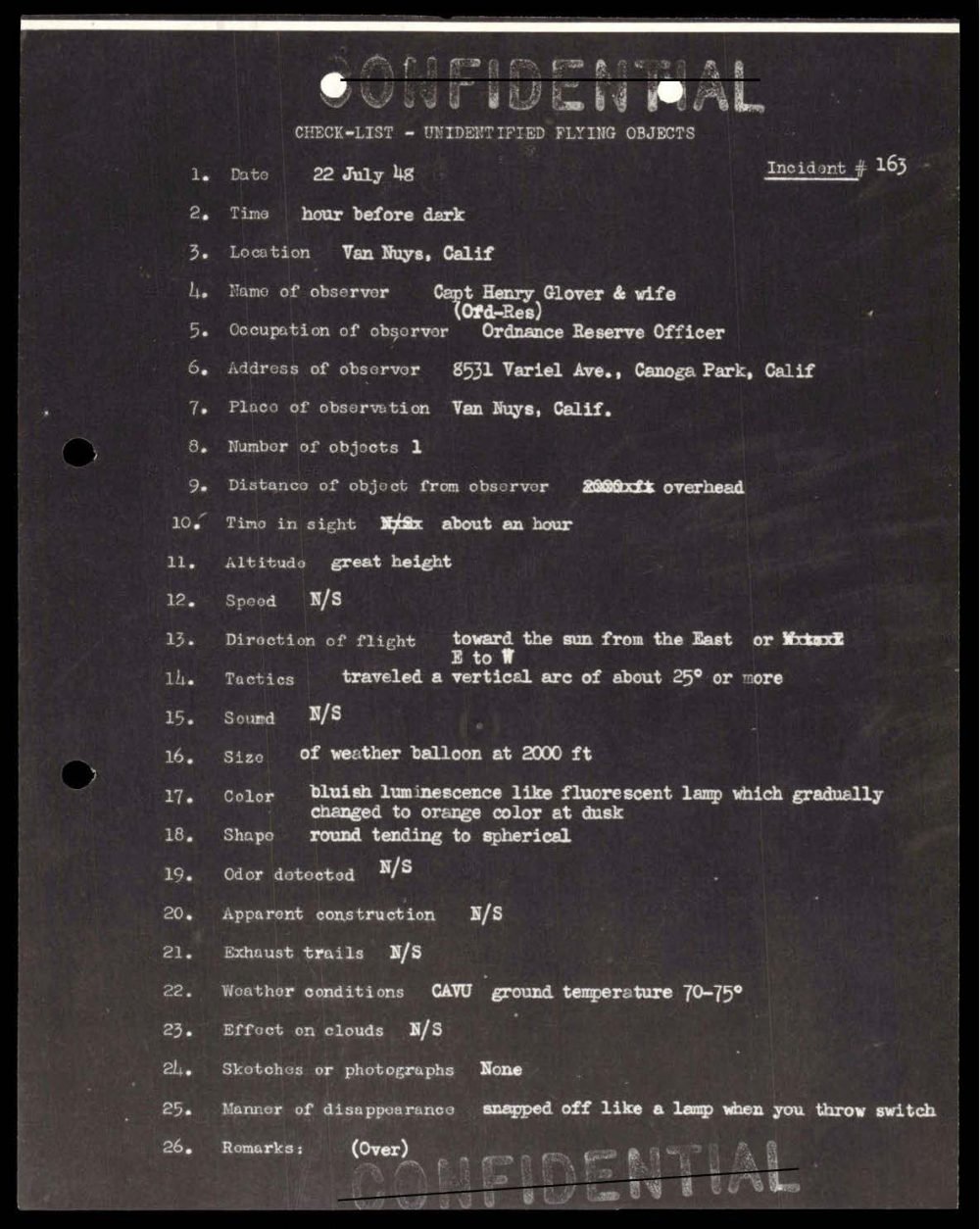 Incident form (checklist of unidentified flying objects)Physical page 160
DOCUMENTARY SOURCES · Arquivo histórico / DOW
What the records tell
A sharply defined sphere changed from bluish to orange, moved in an arc and vanished abruptly.
The incident 163 form lists as observers Captain Henry Glover, an ordnance reserve officer, and his wife, in Van Nuys, California, on July 22, 1948, about an hour before dark. Copy DOW-UAP-D088 holds the full statement that gave rise to the form, taken at 12h30 on September 17, 1948 by Special Agent William G. Sproull. Glover, then a power consultant for the Los Angeles Department of Water and Power, was having dinner with his wife on the patio of an open-air market when other customers pointed to something almost directly overhead.
Glover described a round object, probably spherical, which at first looked like a weather balloon at 2.000 feet, but without the typical swaying, even though the wind on the ground was strong and gusty. It had a bluish luminescence, "like a fluorescent lamp", which turned orange at dusk. In about an hour, it traveled a vertical arc of about 25 degrees, from the east toward the sun, with no sound or trail, and went out suddenly, "like a light bulb when the switch is turned off", while he was looking directly at it.
Under questioning, Glover said he was "POSITIVE" it was not a weather balloon, considered a reflection of the sun but could not explain the blue tint, and ruled out a meteor, comet and gaseous formation because the outline was too sharp. He admitted he had thought of flying discs when he saw it and said he did not know any of the other people who observed it. Editorial hypothesis: a high-altitude balloon lit by the setting sun, which darkens suddenly when it enters the Earth's shadow, would explain the color change and the "going out"; the statement, however, provides no data to test this reading.
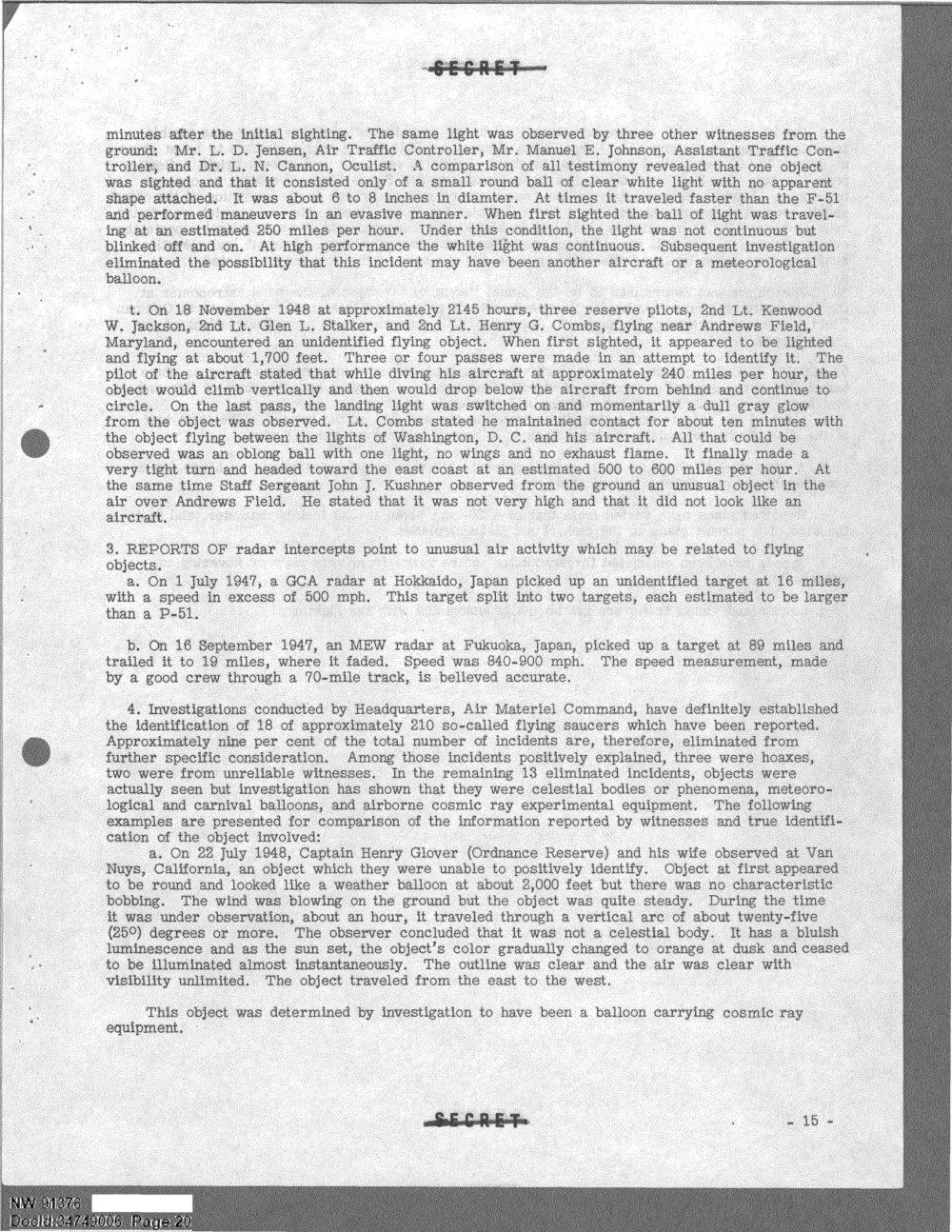
The case did not go without an official answer. In the December 1948 air intelligence study, the Air Force used Glover's account as the first example of an explained incident. The text summarizes the observation: a round object, resembling a weather balloon at 2.000 feet, steady despite the wind, which in about an hour traveled an arc of 25 degrees or more, had a bluish glow, turned orange at dusk and stopped glowing almost all at once. The conclusion comes in one line: according to the investigation, the object was a balloon carrying cosmic ray equipment.
The study includes the case among 18 incidents, out of about 210, that the Air Materiel Command said it had identified with certainty. Of these, three were said to be hoaxes, two came from unreliable witnesses and thirteen were real objects misidentified: celestial bodies, weather and amusement park balloons, and cosmic ray experiment equipment. The document does not say which balloon this was, who launched it or how the link to Van Nuys was made. The identification is the Air Force's; the collection's pages do not contain the launch data that would support it.
The official conclusion contradicts the witness's conviction. In the September statement, Glover said he was "positive" it was not a weather balloon. But a cosmic ray research balloon is not an ordinary weather balloon: they were larger envelopes that rose much higher. Seen from the ground, such an object remains lit by the sun after sunset at the surface and darkens when it enters the Earth's shadow. This physical explanation for the "going out" is an editorial reading; the Air Force study does not go into that detail.
More images from the document
DIRECT READING OF THE FILE
The document, in the original
Selected narrative translations, extensive when the source allows. Summary and analysis remain distinct from the translation.
EXCERPT 1 · PHYSICAL PAGE 161
full descriptive account from the continuation page
Object appeared round and probably rs At first looked.
similar to weather balloon at about 2000 f naligrasy saa was no
characteristic bobbing, The eon wee Basia on the ground with
fair strength and gusty yet ear oot aces In the
time it was under observation (about an hour) it pha agh
vertical are of about 25° or mre. After wat object f
while tha Gasepree ands gine Wonk ‘Weeeeent tae Tin ththa woos
at great height but not a star. It hada Mais yf atm, like
a fluorescent lamp and as the sun set the color gradually d to en
orange color at dusk and finally off like a lamp when the
switch is thrown. The outline was and sharp end symetrical (no
fuzziness or blurring), the air clear with visibility mites imited.
Direction of travel from East directly toward the sun,Editorial note: Measurements, descriptions and conclusions remain attributed to the witnesses and the agents.
Check the original PDF
The object appeared round and probably spherical. At first it looked similar to a weather balloon at about 2,000 ft, but there was no characteristic bobbing. The wind was blowing on the ground with fair strength and gusty, yet the object was quite steady. In the time it was under observation (about an hour) it traveled through a vertical arc of about 25° or more. After watching the object for a while, the observer concluded that whatever it was, the thing was at great height but not a star. It had a bluish luminescence like a fluorescent lamp and as the sun set the color gradually changed to an orange color at dusk and finally snapped off like a lamp when the switch is thrown. The outline was clear and sharp and symmetrical (no fuzziness or blurring); the air was clear with visibility unlimited. Direction of travel: from East directly toward the sun.View the document record ↗ · Physical page 161, counting the cover.
EXCERPT 2 · PHYSICAL PAGE 180
Statement of Henry Glover, sheet 1, D088 physical page 180, full text
co Taw en antes to an orange color at dusk and finally ‘snmopet ont
ab ithe Te cunt 202 throw the suitch (at which moment I mas Lome ee
at it). thranout an hour that I had been observing it, the object tar
traveled * vertical arc of about 25 degrees or more, The outline
the air wee very aia am she and aynetrioa! yg a
the air was Clear with cyrece an mb Sroud tenperature
08 to about 60 degrees an hour after
ADOTTIOWAL INTERROGATION BY SPECIAL AGENT @. SPROULL
aE PICIAL AGENT WILLIAM G, SPROULL
MR, SPROULL: orn 28 approximate the geographical location when you first
sighted the object?
MR, GLOVER: Birestly over Yan Nuys shout-25-er-30-degrecs-it-travertei~ A?
MR, SPROULLs Aprroximately what ws the tine when you first sighted this
ject?
MR. GLOVER: X didn't know the exact hour, but it was about an hour be-
fore suxiowm,
MR. SPROULLS Who called your attention to the object?
MR, GLOVER: Unidentified meber of a group at the patio,
MR, SPROULLs What was the weather condition at the tine?
MR, GLOVER: Very clear sky, Visibility unlimited,
MR. SPROULL® ejects 7%" tmpression of the actual shape or dimension of the
MR, GLOVER: T* appeared to be round with no certain construction,
ihe, £Editorial note: Temperatures are in degrees Fahrenheit. Sheet missing from box 7.
Check the original PDF
STATEMENT. Statement made by Mr. Henry Glover, Power Consultant, Department of Water and Power, Van Nuys, California; home address, 8531 Variel Avenue, Conoga Park, California. 1230 hours, 17 September 1948, concerning object sighted in the sky, 22 July 1948, in the vicinity of San Fernando Valley, California: "On the evening of 22 July 1948, between the hours of 1930 and 2030, my wife and I were having dinner in the patio of an open air market in Van Nuys, California. We arrived there about an hour before dark. Our attention was attracted by other patrons to a strange object in the sky almost directly overhead. DESCRIPTION: It appeared to be round and probably spherical. At first, it appeared to be a weather balloon at about 2000 feet but there was none of the characteristic bobbing. The wind was blowing on the ground in fair strength and gusty yet the object was quite steady. After watching it a while, I concluded that whatever it was, was at great height but not a star. It had a bluish luminescence like a fluorescent lamp and as the sun set the color gradually changed to an orange color at dusk and finally snapped off like a lamp when you throw the switch (at which moment I was looking right at it). In about an hour that I had been observing it, the object had traveled through a vertical arc of about 25 degrees or more. The outline of the object was clear and sharp and symetrical (no fuzziness or bluring); the air was very clear with visibility unlimited; ground temperature about 70-75 degrees dropping to about 60 degrees an hour after dark (two hour time lapse); direction of travel was from East directly toward the sun. ADDITIONAL INTERROGATION BY SPECIAL AGENT WILLIAM G. SPROULL. MR. SPROULL: Can you approximate the geographical location when you first sighted the object? MR. GLOVER: Directly over Van Nuys [about 25 or 30 degrees it travelled, struck out]. MR. SPROULL: Approximately what was the time when you first sighted this object? MR. GLOVER: I didn't know the exact hour, but it was about an hour before sundown. MR. SPROULL: Who called your attention to the object? MR. GLOVER: Unidentified member of a group at the patio. MR. SPROULL: What was the weather condition at the time? MR. GLOVER: Very clear sky. Visibility unlimited. MR. SPROULL: What was your impression of the actual shape or dimension of the object? MR. GLOVER: It appeared to be round with no certain construction. - 1 -View the document record ↗ · Physical page 180, counting the cover.
EXCERPT 3 · PHYSICAL PAGE 181
Statement of Henry Glover, sheet 2, D088 physical page 181, full text
SPROULL:
GLOVERS
SPROUL
GLOVERs
SPROULLS
GLOVERS
SPROULLs
GLOVERs
GlOVERS
SPROULL®
‘GLOVER
SPROULLS
QLovis
SPROULLS
GLOVERs
SPROULLs
GLOVER
SPROULLS
GLOVERs
SPROULLs
GLOVER
What was the approximate size of the object?
The size, as near as I could judge, would be a weather balloon
at 2,000 feet. I am POSITIVE {t wis not a weather balloon,
What would you approximate as the speed?
That I wouldn't know except that it travelled. about 25 or 30
degrees Fp tely forty-five mimutes to an hour,
In what direction did it move?
Overhead directly into the sun, :
Did you think it might be a reflection from anything?
5 neh 23 shee be 4 Cee ee
t then I couldn't account for the blue tinge,
Did it glint or sparkle?
Wo, it didn’t sparkle at all. ths Light f from the object ane
was
constant vith a constant intensity but changed as the sun
lower until it turned toward an orange se Pher ag
setting, it becam yellow and after the sun is aces
it became orange color, I was just
change of coloring, when it disappeared aye :
What was the manner of disappearance?
It disappeared like Se eins St ot 6 ee I was looking
directly at it, when it scomed to ee
light when one turns off the switch, no expansion
and no change in dimension whatsoever, Tat is the last I saw
of the object. :
Any tactics employed during flight of object?
No change in altitude or direction.
Was there any sound to this object?
There was no soum whatsoever,
Was there an exhaust trail?
No exhaust trail at all.
Did you notice the object as carrying any lights? -_
There ware no dietingsishing chemmptertotin® 66 ait SNnyy Tem
the bluish light.
Did this cecur te you to be something resenbling a flying saucer?
Cae £ Sheek saaeel tee’ ealetty, Se, SE ree
came to my mind,Editorial note: “in” was added by hand over “at” in the answer about speed. Sheet missing from box 7.
Check the original PDF
MR. SPROULL: What was the approximate size of the object? MR. GLOVER: The size, as near as I could judge, would be a weather balloon at 2,000 feet. I am POSITIVE it was not a weather balloon. MR. SPROULL: What would you approximate as the speed? MR. GLOVER: That I wouldn't know except that it travelled about 25 or 30 degrees in approximately forty-five minutes to an hour. MR. SPROULL: In what direction did it move? MR. GLOVER: Overhead directly into the sun. MR. SPROULL: Did you think it might be a reflection from anything? MR. GLOVER: I thought it might be a reflection from the sunlight at first but then I couldn't account for the blue tinge. MR. SPROULL: Did it glint or sparkle? MR. GLOVER: No, it didn't sparkle at all. The light from the object was constant with a constant intensity but changed as the sun set lower until it turned toward an orange color. As the sun was setting, it became yellow and after the sun completely dropped, it became orange color. I was just observing this particular change of coloring, when it disappeared completely. MR. SPROULL: What was the manner of disappearance? MR. GLOVER: It disappeared like the turning off of a light. I was looking directly at it, when it seemed to disappear as an incandescent light when one turns off the switch. There was no expansion and no change in dimension whatsoever. That is the last I saw of the object. MR. SPROULL: Any tactics employed during flight of object? MR. GLOVER: No change in altitude or direction. MR. SPROULL: Was there any sound to this object? MR. GLOVER: There was no sound whatsoever. MR. SPROULL: Was there an exhaust trail? MR. GLOVER: No exhaust trail at all. MR. SPROULL: Did you notice the object as carrying any lights? MR. GLOVER: There were no distinguishing characteristics at all except for the bluish light. MR. SPROULL: Did this occur to you to be something resembling a flying saucer? MR. GLOVER: When I first viewed the object, the flying saucers immediately came to my mind. - 2 -View the document record ↗ · Physical page 181, counting the cover.
EXCERPT 4 · PHYSICAL PAGE 182
Statement of Henry Glover, sheet 3, D088 physical page 182, full text
*
4
4
;
A ¢
im, GlovesEditorial note: Sheet missing from box 7.
Check the original PDF
MR. SPROULL: Do you feel that you were observing a definite object? MR. GLOVER: Yes, it had a definite sharp outline - something I had never seen before. At first I thought it might be a gaseous formation but it didn't have the characteristics of a meteor or comet and the outline was too definite and sharp to be gaseous. It instead appeared to be a definite material object. I had even considered that it might be an astronomical object caught in our Earth's rotation like the moon, but it travelled faster than the sun so it couldn't have been. It was travelling three times as fast as the sun and was going in the same direction as the sun. MR. SPROULL: Do you know any of the persons who observed this object personally? MR. GLOVER: No. END OF STATEMENT. [signature] Henry Glover. HENRY GLOVER, 8531 Variel Avenue, Conoga, California. - 3 -View the document record ↗ · Physical page 182, counting the cover.
EXCERPT 5 · PHYSICAL PAGE 160
Form for incident 163, box 7 physical page 160, fields that were missing
sun -frolll the Ee.st
•
Odor dotoctod
•
Exho.ust trnils
conditions
photogruphs
of disuppciaranco " :; . ' . •Editorial note: Completes the excerpt of fields already published. Same sheet in DOW-UAP-D088, physical page 178.
Check the original PDF
Incident # 163. 1. Date 22 July 48. 2. Time hour before dark. 3. Location Van Nuys, Calif. 4. Name of observer Capt Henry Glover & wife (Ord-Res). 5. Occupation of observer Ordnance Reserve Officer. 6. Address of observer 8531 Variel Ave., Canoga Park, Calif. 7. Place of observation Van Nuys, Calif. 8. Number of objects 1. 9. Distance of object from observer [struck out] overhead. 10. Time in sight [struck out] about an hour. 11. Altitude great height. 12. Speed N/S. 13. Direction of flight toward the sun from the East [struck out] E to W. 14. Tactics traveled a vertical arc of about 25° or more. 15. Sound N/S. 16. Size of weather balloon at 2000 ft. 17. Color bluish luminescence like flurescent lamp which gradually changed to orange color at dusk. 18. Shape round tending to spherical. 19. Odor detected N/S. 20. Apparent construction N/S. 21. Exhaust trails N/S. 22. Weather conditions CAVU ground temperature 70-75°. 23. Effect on clouds N/S. 24. Sketches or photographs None. 25. Manner of disappearance snapped off like a lamp when you throw switch. 26. Remarks: (Over)View the document record ↗ · Physical page 160, counting the cover.
EXCERPT 6 · PHYSICAL PAGE 20
D094, physical page 20 (p. 15 of the study): item 4 and subparagraph a, on the Van Nuys case (full text of the passage)
minutes after the initial sighting. The same light was observed by three other witnesses from the
ground! Mr. L. D. Jensen, Air Traffic Controller, Mr. Manuel E. Johnson, Assistant Traffic Controller.> and Dr. L. N. Cannon, Oculist. A comparison of all testimony revealed that one object
was sighted and that it consisted only of a small round ball of clear white light with no apparent
shape attached.· It was about 6 to 8 inches in diamter. At times it traveled faster than the F-51
and performed maneuvers in an evasive manner. When first sighted the ball of light was travel t ing at an estimated 250 miles per hour. Under this condition, the light was not continuous but
blinked off and on. At high performance the white light was continuous, Subsequent investigation
eliminated the possibility that this incident may have been another aircraft or a meteorological
balloon.
t. On 18 November 1948 at approximately 2145 hours, three reserve pilots, 2nd Lt. Kenwood
W. Jackson, 2nd Lt. Glen L. Stalker, and 2nd Lt. Henry G. Combs, flying near Andrews Field,
Maryland, encountered an unidentified flying object. When first sighted, it appeared to be lighted
and flying at about 1,700 feet. Three or four passes were made in an attempt to identify it. The
pilot of the aircraft stated that while diving his aircraft at approximately 240. miles per hour, the
object would climb vertically and then would drop below the aircraft from behind and continue to
circle. On the last pass, the landing light was switched on and momentarily a dull gray glow
from the object was observed. Lt. Combs stated he maintained contact for about ten minutes with
the object flying between the lights of Washington, D. C. and his aircraft. All that could be
observed was an oblong ball with one light, no wings and no exhaust flame. It finally made a
very tight turn and headed toward the east coast at all estimated 500 to 600 miles per hour. At
the same time Staff Sergeant John J. Kushner observed from the ground an unusual object in the
air over Andrews Field. He stated that it was not very high and that it did not look like an
aircraft.
3. REPORTS OF radar intercepts point to unusual air activity which may be related td flying
objects.
a. On 1 July 1947, a GCA radar at Hokkaido, Japan picked up an unidentified target at 16 miles,
with a speed in excess of 500 mph. This target split into two targets, each estimated to be larger
than a P-51.
b. On 16 September 1947, an MEW radar at Fukuoka, Japan, picked up a target at 89 miles and
trailed it to 19 miles, where it faded. Speed was 840-900 mph. The speed measurement, made
by a good crew through a 70-mlle track, is believed accurate.
4. Investigations conducted by Headquarters, Air Materiel Command, have definitely established
the identification of 18 of approximately 210 so-called flying saucers which have been reported.
Approximately nine per cent· of the total number of incidents are, therefore, eliminated from
further specific consideration. Among those incidents positively explained, three were hoaxes,
two were from unreliable witnesses. In the remaining 13 eliminated incidents, objects were
actually seen but investigation has shown that they were celestial bodies or phenomena, meteorological and carnival balloons, and airborne cosmic ray experimental equipment. The following
examples are presented for comparison of the information reported by witnesses and true identification of the object involved:
a. On 22 July 1948, Captain Henry Glover (Ordnance Reserve) and his wife observed at Van
Nuys, Calliornia, an object which they were unable to positively ldenttfy. Object at :first appeared
to be round and looked like a weather balloon at about 2,000 feet but there was no characteristic
bobbing. The wind was blowing on the ground but the object was quite steady. During the time
it was under observation, about an hour, it traveled through a vertical arc of about twenty-:flve
{250) degrees or more. The observer concluded that it was not a celestial body. It has a bluish
luminescence and as the sun set, the object's color gradually changed to orange at dusk and ceased
to be illuminated almost instantaneously. The outline was clear and the air was clear with
visibility unlimited. The object traveled from the east to the west.
This object was determined by investigation to have been a balloon carrying cosmic ray • equipment.
- 15 -Editorial note: "diamter" is a typo in the original. The summary of the Andrews incident mixes up the two aircraft and different times that appear in the original forms (see its own dossier).
Check the original PDF
4. Investigations conducted by Headquarters, Air Materiel Command, have definitely established the identification of 18 of approximately 210 so-called flying saucers which have been reported. Approximately nine per cent of the total number of incidents are, therefore, eliminated from further specific consideration. Among those incidents positively explained, three were hoaxes, two were from unreliable witnesses. In the remaining 13 eliminated incidents, objects were actually seen but investigation has shown that they were celestial bodies or phenomena, meteorological and carnival balloons, and airborne cosmic ray experimental equipment. The following examples are presented for comparison of the information reported by witnesses and true identification of the object involved: a. On 22 July 1948, Captain Henry Glover (Ordnance Reserve) and his wife observed at Van Nuys, California, an object which they were unable to positively identify. Object at first appeared to be round and looked like a weather balloon at about 2,000 feet but there was no characteristic bobbing. The wind was blowing on the ground but the object was quite steady. During the time it was under observation, about an hour, it traveled through a vertical arc of about twenty-five (25°) degrees or more. The observer concluded that it was not a celestial body. It has a bluish luminescence and as the sun set, the object's color gradually changed to orange at dusk and ceased to be illuminated almost instantaneously. The outline was clear and the air was clear with visibility unlimited. The object traveled from the east to the west. This object was determined by investigation to have been a balloon carrying cosmic ray equipment. SECRET [struck through]. - 15 -View the document record ↗ · Physical page 20, counting the cover.
EXCERPT 7 · PHYSICAL PAGE 178
full page
----
' ,I_
Ir 1 1 163
hnnr before ~.rk
V2.n :1uys. Calif
r •• r C .t Henry Glovr-r & •Alif a
(Otd-Res)
• 1r• ; i. .. r h rv r Ordnance Reserve Officer
11· l rv r 8531 Variel Ave., Cano~.: Park, Cru if
• l r·· • i r Van Nuys, Calif.
r •! 1, • C' • l
t·ro:-i c,t1., r v r . ~ overnead
I • r . 1 1 t 'l:fis:,. about an hour
11. n J ' I ,. ll l grt"cit he i:e,ht
I •
• n i l,t toward the sun from t he Ea.et or Wxim:d!
E to . ,.. , r tr a,11=led a ve-rtictl arc of about 25° or or e
I . , ,- d N/S
1,,. . ; j :: of we·.ther balloon i:.t 2CXX) f t
r 1~r blu i sh lum nescence like fluor escent l amp whi ch gradUE.lly
cn~.nged to or,nge color at dusk
~h P" r ound tend~ to spheri cal
I , . r i ,i;, l't. •d N/S
l • ,-r,r,r.ror.t cons• ructinn N/S
;->1 . c.r.h•.•J., t t r u1 l s N/S
,, 1 1 r c onditi r· CA.VU ground terq:,er · tu.re 70-75°
2:, . :·vnr r of diznpp· :--t r nc" snapped off like a lamp 'ftlen you throw switch
LU o R 1,hr lts: (Over)Editorial note: Record card for incident 163: an ordnance reserve captain reports the bluish sphere that, over about an hour on July 22, 1948, turned orange at dusk and suddenly went out.
Check the original PDF
----
' ,I_
Ir 1 1 163
hnnr before ~.rk
V2.n :1uys. Calif
r •• r C .t Henry Glovr-r & •Alif a
(Otd-Res)
• 1r• ; i. .. r h rv r Ordnance Reserve Officer
11· l rv r 8531 Variel Ave., Cano~.: Park, Cru if
• l r·· • i r Van Nuys, Calif.
r •! 1, • C' • l
t·ro:-i c,t1., r v r . ~ overnead
I • r . 1 1 t 'l:fis:,. about an hour
11. n J ' I ,. ll l grt"cit he i:e,ht
I •
• n i l,t toward the sun from t he Ea.et or Wxim:d!
E to . ,.. , r tr a,11=led a ve-rtictl arc of about 25° or or e
I . , ,- d N/S
1,,. . ; j :: of we·.ther balloon i:.t 2CXX) f t
r 1~r blu i sh lum nescence like fluor escent l amp whi ch gradUE.lly
cn~.nged to or,nge color at dusk
~h P" r ound tend~ to spheri cal
I , . r i ,i;, l't. •d N/S
l • ,-r,r,r.ror.t cons• ructinn N/S
;->1 . c.r.h•.•J., t t r u1 l s N/S
,, 1 1 r c onditi r· CA.VU ground terq:,er · tu.re 70-75°
2:, . :·vnr r of diznpp· :--t r nc" snapped off like a lamp 'ftlen you throw switch
LU o R 1,hr lts: (Over)View the document record ↗ · Physical page 178, counting the cover.
EXCERPT 8 · PHYSICAL PAGE 179
full page
Object api:eared round and probo.blJ c,;phH.!"ic:.tl.. At first l0ok{•d
si'llilt:.r to weather balloon at t~bout 2000 ft but t.'1-iere was no
characterletic bobbing. The wind vc:1.s blo~,i~ on the ground wit;,
fatr strength and gusty yet t:.~e object was <r?,ite steady. Io t~e
time 1t was under observation (about an nour) it traveled thru a
v.ertical arc of about 25° or 1rore. After watcning tne object for
a 'While the observer concluded that whatever it was the t r.. ng ~c s
at great height but not a star. It had a. bluish :!.U.'llin.escenoe like
.a fluorescent lamp and as the sun set tbe color gr~dually c..~w:iged to an
or ange color at dusk and finslly snru,ped off like a L.mp when the
switch is throw. The outl i.ne was clear and sharp and symetricc:l (no
fuzziness or blurring) , t ne air cler:;r with visibility unlimited.
Di recti0n of travel from Ea.st directly to•~d the sun.Editorial note: Continuation of the narrative of the Van Nuys report: spherical light observed for about an hour, which changed from bluish to orange at sunset and went out suddenly.
Check the original PDF
Object api:eared round and probo.blJ c,;phH.!"ic:.tl.. At first l0ok{•d
si'llilt:.r to weather balloon at t~bout 2000 ft but t.'1-iere was no
characterletic bobbing. The wind vc:1.s blo~,i~ on the ground wit;,
fatr strength and gusty yet t:.~e object was <r?,ite steady. Io t~e
time 1t was under observation (about an nour) it traveled thru a
v.ertical arc of about 25° or 1rore. After watcning tne object for
a 'While the observer concluded that whatever it was the t r.. ng ~c s
at great height but not a star. It had a. bluish :!.U.'llin.escenoe like
.a fluorescent lamp and as the sun set tbe color gr~dually c..~w:iged to an
or ange color at dusk and finslly snru,ped off like a L.mp when the
switch is throw. The outl i.ne was clear and sharp and symetricc:l (no
fuzziness or blurring) , t ne air cler:;r with visibility unlimited.
Di recti0n of travel from Ea.st directly to•~d the sun.View the document record ↗ · Physical page 179, counting the cover.
Dates and documentary context
- Event
- 22/07/1948 — Date visually verified on the form/account on the indicated physical page.
- Document
- Not established — Internal date not established in the selected pages.
- Publication
- Not established — An internal report does not prove public release or the authenticity of the interpretation.
Origin and release
Historical archive · 38_143685_box7_Incident_Summaries_101-172.pdf
Partial document selection: 16 dossiers from physical pages 140–171. Review of the remaining pages of this 178-page PDF is ongoing. Surface wind does not prove a trajectory at altitude.
GEOGRAPHY OF THE CASE
Van Nuys, California
Approximate reference for the location cited in the document, positioned by the editorial team. Does not indicate where the witness or the object was.
DOCUMENTARY TRAIL
Go back to the sources
References use physical pages of the PDF, counting the cover. Summaries are presented in English; the documents keep their original language.
- 38_143685_box7_Incident_Summaries_101-172.pdf
Physical pages 160, 161
Arquivo histórico · 178 pages - DOW-UAP-D088_US-AirForce_Analysis-of-Flying-Objects-in-the-US_101-172.pdf
Physical pages 178 and 179: second copy of form 163; physical pages 180 to 182: signed statement by Henry Glover to Special Agent William G. Sproull, 17/09/1948, absent from box 7
DOW · 210 pages - DOW-UAP-D094_Analysis-of-Flying-Object-Incidents-in-the-US_1949.pdf
Physical page 20 (p. 15 of the 10/12/1948 study): Appendix C, item 4a, with the official identification of the Van Nuys object as a balloon with cosmic ray equipment
DOW · 34 pages
Editorial summary based on the collection's research notes. How we read the documents.