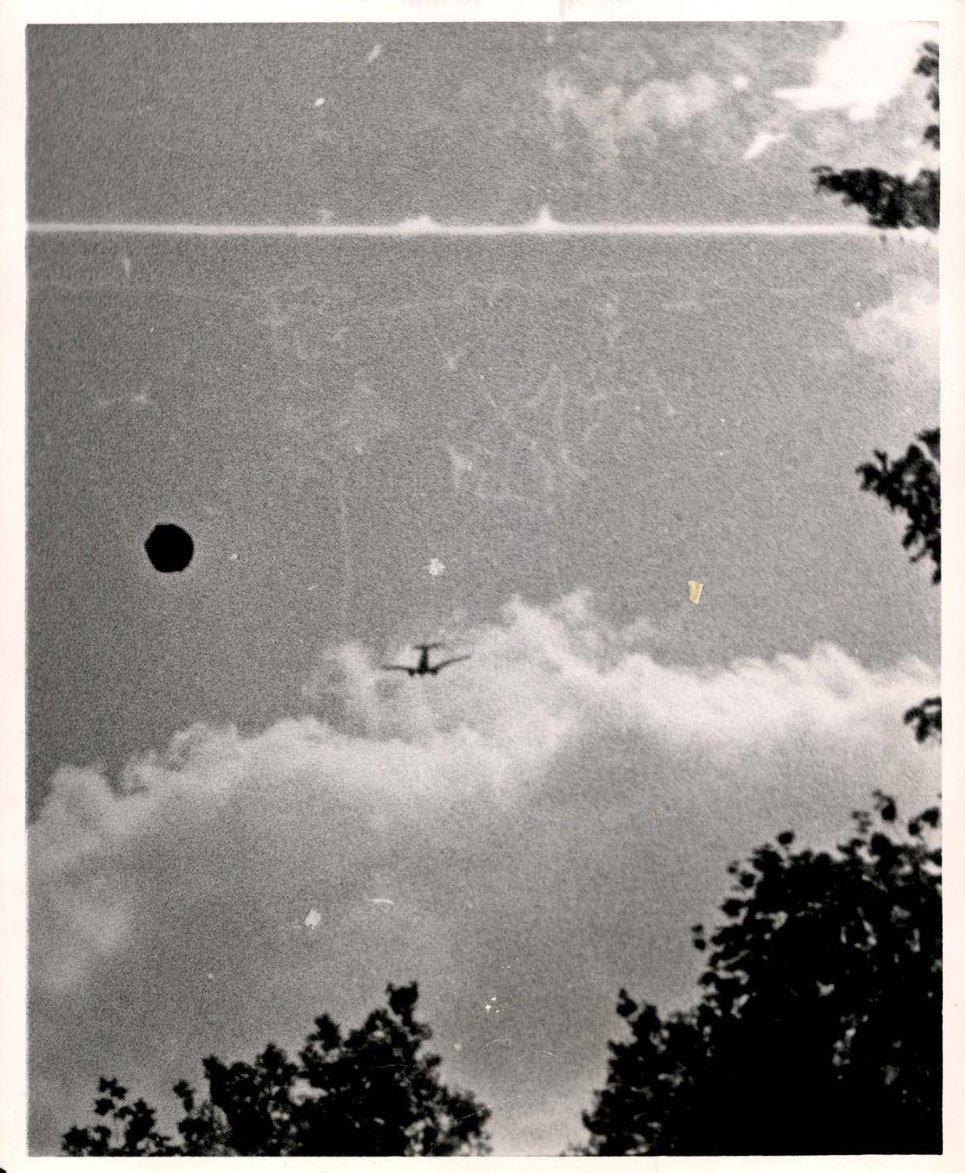
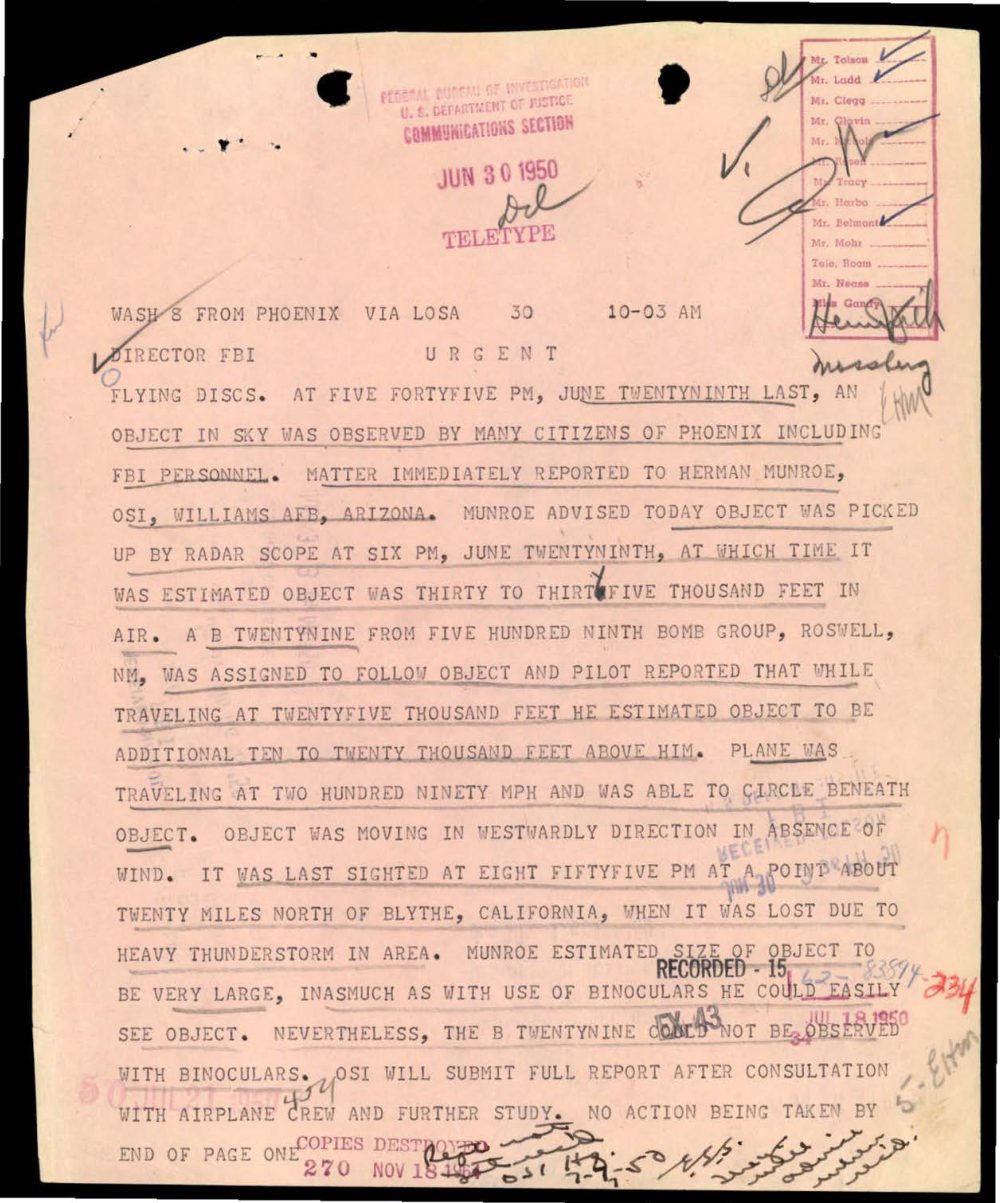
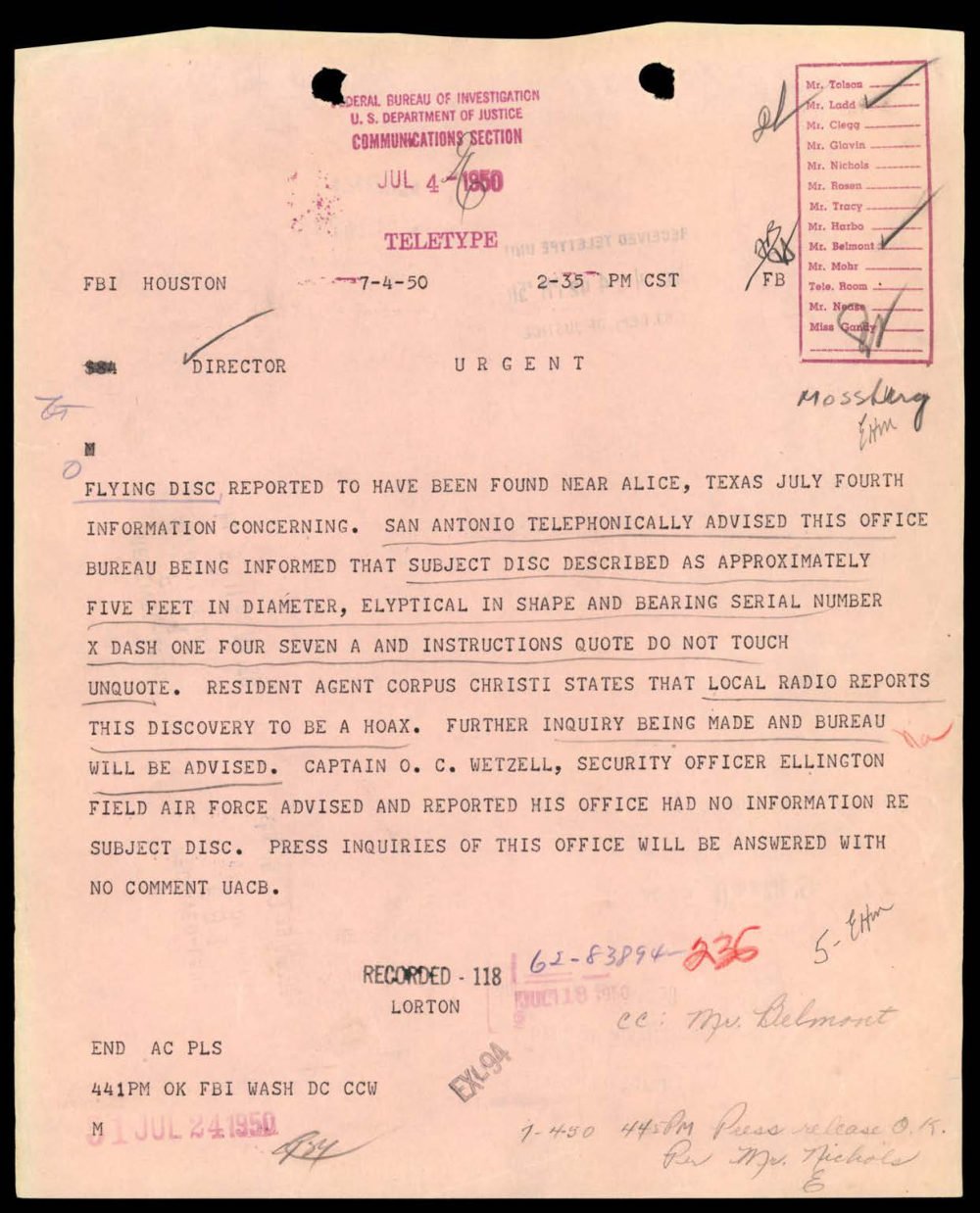
Date: 07/04/1950 (magazine issue)Location: Washington, D.C. (magazine)
Washington, 1950: U.S. News & World Report says flying saucers are U.S. Navy aircraft, and the FBI keeps the issue
The April 7, 1950 issue of U.S. News & World Report magazine, kept in the FBI file, carries the article “Flying Saucers: The Real Story,” which argues that the saucers are real aircraft, born of a 1942 project, and that the evidence points to the Navy. It is magazine text, without documentary proof.
- Event date
- 07/04/1950 (magazine issue)
- Location
- Washington, D.C. (magazine)
- Topic
- FBI file
- Source agencies
- FBI
- Documents
- 1 document · 209 pages
- Reading time
- 14 min
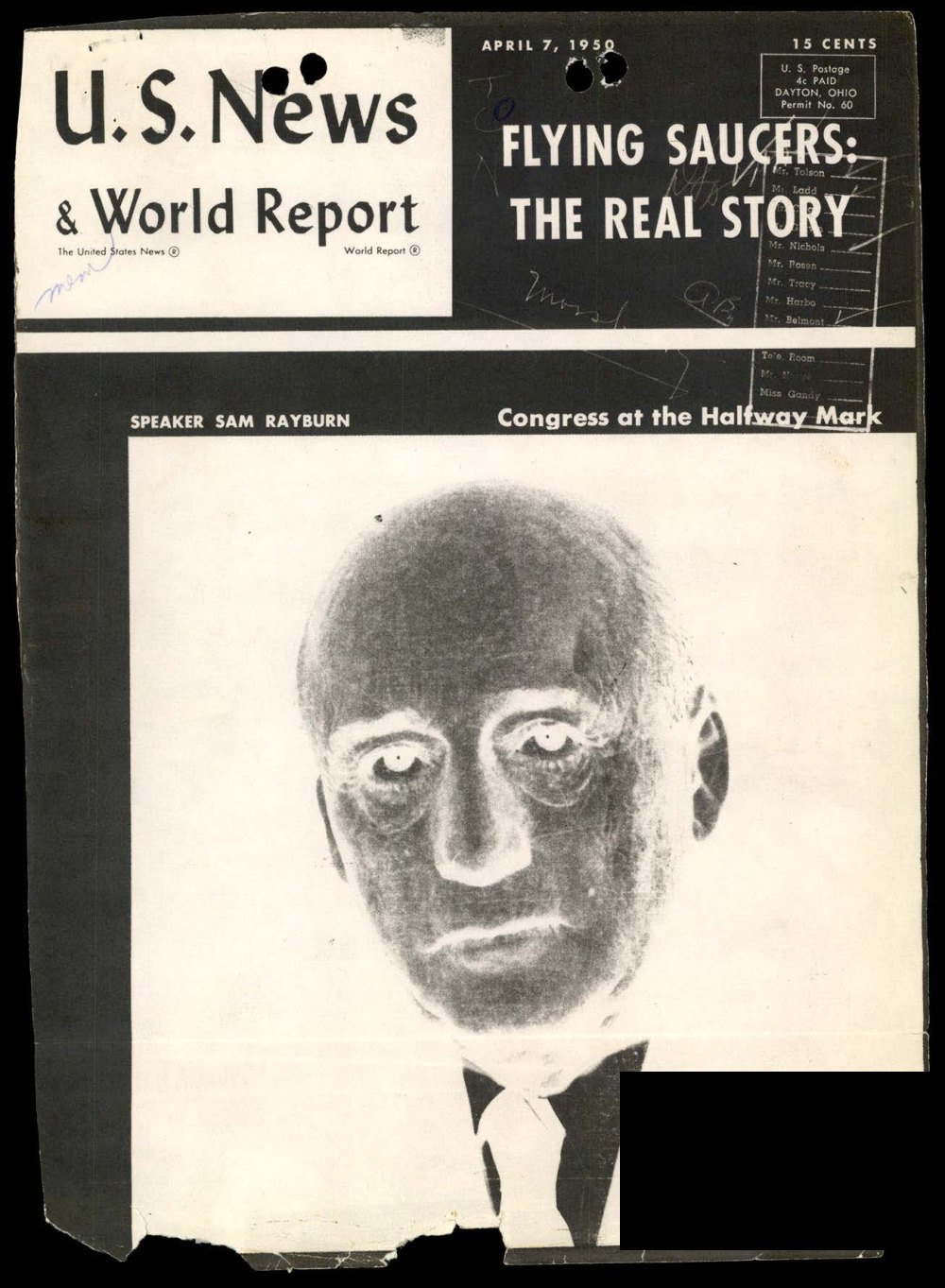 Magazine coverPhysical page 97
DOCUMENTARY SOURCES · FBI
What the records tell
Section 5 of the FBI file keeps the April 7, 1950 issue of U.S. News & World Report magazine. The cover, in a negative copy, headlines the main article “Flying Saucers: The Real Story,” alongside two other headlines. It bears the list of names of Bureau officials for routing and the subscription label in Hoover's name, which was covered by a redaction bar. A file sheet bears the notation “File in Flying Disc file.” The article runs on pages 13 to 15. This dossier provides a summary and the cover, without translation, because it is magazine text.
The article's thesis is that the saucers are real aircraft, of a revolutionary type, a combination of helicopter and jet airplane, flown by ordinary pilots. It says no official announcement has been made, but that the only big secret remaining is who builds them, and that the evidence points to Navy experiments. The subtitle states that the United States built the first one in 1942. The magazine says it relies on non-secret testimony from scientists, private observers and military personnel.
According to the article, the first model would have been designed by Charles H. Zimmerman, of NACA, in an elliptical shape, with two piston engines and two propellers, a top speed of 400 to 500 miles per hour and landing at about 35 miles per hour. The page carries two photographs attributed to NACA, of the 1942 model and of a scale model tested in a wind tunnel, and the magazine relates that the Navy bought it after the 1942 test, that Chance-Vought built a full-size example and that it was later announced that the project had been abandoned. The project described appears to correspond to the Vought V-173, the “Flying Pancake”; the identification is the editors', not the magazine's.
For the current saucers, the text gathers descriptions from observers: 105 feet in diameter, circular shape, jet nozzles around the rim, whitish metal alloy, three layers, no rudders. As a basis it cites a measurement made in April near the White Sands base, the observation by airline pilots over Arkansas and Georgia, and the chase by F-51 fighters at Fort Knox. It attributes to an unnamed government engineer the explanation that steerable jets would provide control. These are the author's inferences from published accounts, not verified measurements.
The last page argues that the Air Force closed its inquiry in December 1949 because it knew where the saucers come from, and that the Navy spends more money than the Air Force on secret missile research, which would point to its research centers. The article admits that this cannot be proven until there is a public announcement, and that officials emphatically denied that a secret Air Force project was the cause. At the bottom appear fiction illustrations with spaceships, monsters and Martians and a homemade saucer, for contrast.
The FBI file does not comment on the article. A few weeks later, the Army G-2 summary, a separate dossier, stated that the United States was not conducting experiments with weapons that could be mistaken for saucers. The April 1950 article is an example of the “secret American weapons” hypothesis that circulated in the press, presented as reporting, not as an official document.
DIRECT READING OF THE FILE
The document, in the original
Press clipping reproduced in full, with the original in English and a complete translation. Names of minors, home addresses, and health data of private individuals were omitted in the original and in the translation.
EXCERPT 1 · PHYSICAL PAGE 98
Section 5, physical page 98: file sheet that accompanied the magazine, April 1950
)
-,}
APR201sso
••Editorial note: File sheet, nearly blank, with the instruction to file the magazine of 7 April 1950 in the flying disc file.
Check the original PDF
[folha de arquivo; carimbos e anotações manuscritas]View the document record ↗ · Physical page 98, counting the cover.
EXCERPT 2 · PHYSICAL PAGE 100
full page
U.S. News & World Rep; ~’ ont
Bee OO lf re at Ee et ee
ing in still others. The saucers appear to
FACT: THESE DESIGNS, AND LATER ONES ARE REAL have the power to “coast” long toe.
thus saving on fuel consumption.
Direction of the aircraft and its veloc-
sity, in turn, evidently are controlled by
the angle at which the jet nozzles are
tilted, the number operating, the power
applied. By choosing which nozzles to
turn on or off and the angle of tilt, the
pilot could make the saucer rise or de-
scend vertically, hover, fly straight ahead,
or make sharp turns. A right-angle turn,
for example, could be made by turning
off the rear jets, turning on the side and
front nozzles. Great speed can be ob
tained by focusing to the rear all nozzles
in the after half of the aircraft. With all
nozzles pointed downward, the saucer
could rise straight off the ground, and,
with less power, could descend the same
way.
That is the explanation, based on ac-
cepted principles of aerodynamics, given
by an authoritative engineer as the likely
answer to how these saucer aircraft oper-
ate. As evidence that this explanation is
correct, there are these actual cases of
publicly observed saucer behavior:
Rows of window-like openings around
the rims of saucers traveling at more
than 500 miles an hour are mentioned in
several documented reports. In all cases,
g ; these “windows” glowed as if they were
viii - 4 Mas jet-nozzle openings. The most recent of
DISK-LIKE NAVY FLOUNDER PROJECT WAS ‘DROPPED’ these reports was made last month by
two experienced pilots of the Chicago
and Southern Air Lines, who passed
within 1,000 feet of a saucer traveling
over Arkansas. Another similar report
was made by two Eastem Air Lines
pilots who narrowly missed colliding with
a saucer in July, 1948, while flying a
DC-3 over Georgia.
Saucers’ ability to hover in mid-air,
accelerate at tremendous speed, and
then rise almost vertically is described in
several reports, one documented by Air
Force officers at Fort Knox, Ky. That
saucer, seen by dozens of officers at the
post, was chased by three military pilots
flying fast F-51s. The saucer quickly out-
maneuvered the planes.
Speed of one saucer was measured by
ground instruments in the White Sands
case at well over the speed of sound,
indicating the use of a number of jet
engines. Cruising speed has been esti-
mated in other cases at 200 to 600 miles
an hour.
What it all adds up to is this: Flying
saucers being observed in many parts
of the U.S. are not mysterious visitors
from Mars. They are actual planes, sound-
ly engineered on principles developed by
U.S. in wartime. By using this new design,
they can do things that no conventional
, NACA. photo aircraft can be expected to approach.
MOCK-UP OF EARLY MODEL IS TESTED IN WIND TUNNEL Who’s building the saucers now
. .. latest models are circular, faster, more maneuverable being observed in test flights over U.S.
14 © U.S. NEWS & WORLD REPORTEditorial note: Second page of the U.S. News & World Report article of April 1950. The magazine claims that the discs are jet aircraft with steerable nozzles and cites reports from pilots of Chicago and Southern and Eastern Air Lines, from Fort Knox and from White Sands; the technical explanation is attributed to an unnamed government engineer.
Check the original PDF
U.S. News & World Rep; ~’ ont
Bee OO lf re at Ee et ee
ing in still others. The saucers appear to
FACT: THESE DESIGNS, AND LATER ONES ARE REAL have the power to “coast” long toe.
thus saving on fuel consumption.
Direction of the aircraft and its veloc-
sity, in turn, evidently are controlled by
the angle at which the jet nozzles are
tilted, the number operating, the power
applied. By choosing which nozzles to
turn on or off and the angle of tilt, the
pilot could make the saucer rise or de-
scend vertically, hover, fly straight ahead,
or make sharp turns. A right-angle turn,
for example, could be made by turning
off the rear jets, turning on the side and
front nozzles. Great speed can be ob
tained by focusing to the rear all nozzles
in the after half of the aircraft. With all
nozzles pointed downward, the saucer
could rise straight off the ground, and,
with less power, could descend the same
way.
That is the explanation, based on ac-
cepted principles of aerodynamics, given
by an authoritative engineer as the likely
answer to how these saucer aircraft oper-
ate. As evidence that this explanation is
correct, there are these actual cases of
publicly observed saucer behavior:
Rows of window-like openings around
the rims of saucers traveling at more
than 500 miles an hour are mentioned in
several documented reports. In all cases,
g ; these “windows” glowed as if they were
viii - 4 Mas jet-nozzle openings. The most recent of
DISK-LIKE NAVY FLOUNDER PROJECT WAS ‘DROPPED’ these reports was made last month by
two experienced pilots of the Chicago
and Southern Air Lines, who passed
within 1,000 feet of a saucer traveling
over Arkansas. Another similar report
was made by two Eastem Air Lines
pilots who narrowly missed colliding with
a saucer in July, 1948, while flying a
DC-3 over Georgia.
Saucers’ ability to hover in mid-air,
accelerate at tremendous speed, and
then rise almost vertically is described in
several reports, one documented by Air
Force officers at Fort Knox, Ky. That
saucer, seen by dozens of officers at the
post, was chased by three military pilots
flying fast F-51s. The saucer quickly out-
maneuvered the planes.
Speed of one saucer was measured by
ground instruments in the White Sands
case at well over the speed of sound,
indicating the use of a number of jet
engines. Cruising speed has been esti-
mated in other cases at 200 to 600 miles
an hour.
What it all adds up to is this: Flying
saucers being observed in many parts
of the U.S. are not mysterious visitors
from Mars. They are actual planes, sound-
ly engineered on principles developed by
U.S. in wartime. By using this new design,
they can do things that no conventional
, NACA. photo aircraft can be expected to approach.
MOCK-UP OF EARLY MODEL IS TESTED IN WIND TUNNEL Who’s building the saucers now
. .. latest models are circular, faster, more maneuverable being observed in test flights over U.S.
14 © U.S. NEWS & WORLD REPORTView the document record ↗ · Physical page 100, counting the cover.
EXCERPT 3 · PHYSICAL PAGE 101
Clipping from U.S. News & World Report, 07/04/1950, physical page 101 (full text)
U.S. News & World Report
is not yet publicly disclosed. It cannot be
proved until a public announcement is
made or until a saucer crashes away from
its home base—which is highly unlikely
because of its jet helicopter action that
makes take-offs and landings almost com-
pletely safe. But there are these factors
that point to an answer:
Official inquiry by the Air Force, in the
face of overwhelming evidence that the
saucers are real, was called off last De-
cember. This indicates clearly that top
Air Force officials know where the saucers
originate and are not concerned about
them, as they would be if these aircraft
were from Russia or Mars. These officials,
at the same time, denied emphatically
that a secret Air Force project is re-
sponsible.
Best use of fully developed saucer air-
craft, however, could be made in war-
time not by the Air Force, but by the
Navy. All fleet operations now require
an air cover, even in antisubmarine war-
fare, and a plane that can rise like a heli-
copter could be used from any N:
combat ship, not only from big, expen-
sive aircraft carriers. It was for that
reason that the first U.S. flying sau-
cer was purchased by the Navy after
the original model was tested in 1942.
That first full-size aircraft, built by
Chance-Vought, was thoroughly tested
by Navy engineers. Then a statement
was released that this project had been
dropped. Early experimenting with sau-
cers, thus, centered in the Navy.
Big atime on missile aircraft cen-
ters in the Navy now, too. More than
twice as many dollars were spent by the
Navy last year as by the Air Force on
secret guided-missile research. There is
no public accounting for these millions,
the only Government funds aside from
atomic-energy dollars that still are being
spent with great secrecy.
Surface indications, then, point to re-
search centers of the U.S. Navy’s vast
guided-missile project as the scene of
present flying-saucer development. That
project has the scientists, the engineers,
the dollars, .the mols, and the back-
ground of early development of
saucer-type ee This likelihood will
remain, despite any future denials by the
Navy front office, until secrecy is lifted
on the big missile program.
But, regardless of just where these
saucers are being built now, the evidence
points to a U.S, development that will
mean a radical change-in aircraft design
in coming decades. In war, this combina-
tion of helicopter and fast jet plane will
easily outfly any present types of mili-
tary aircraft. In peacetime, the safety of
a nearly crash-proof aircraft may be ex-
pected to revolutionize civil air transport.
It all points to a big advance in the sci-
ence of flying.
APRIL 7, 1950 o
FANCY: SPACE SHIPS, MONSTERS, MARTIANS, MAYHEM
NOCTURNAL ‘INVASION’ SURPRISE PACKAGE FROM MARS
A PLANE DESIGNER’S DAYDREAM
photos fom Bettman, Acme, Wide World
HOME-MADE SAUCER 259 Fie\?
The real thing is strictly a one-planet proposition
15Editorial note: Third page of the U.S. News & World Report article of April 1950. The magazine speculates that the Navy, and not the Air Force, is developing the discs, and interprets the closing of the Air Force inquiry in December 1949 as an indication of this; these are the magazine's conjectures.
Check the original PDF
U.S. News & World Report
is not yet publicly disclosed. It cannot be
proved until a public announcement is
made or until a saucer crashes away from
its home base—which is highly unlikely
because of its jet helicopter action that
makes take-offs and landings almost com-
pletely safe. But there are these factors
that point to an answer:
Official inquiry by the Air Force, in the
face of overwhelming evidence that the
saucers are real, was called off last De-
cember. This indicates clearly that top
Air Force officials know where the saucers
originate and are not concerned about
them, as they would be if these aircraft
were from Russia or Mars. These officials,
at the same time, denied emphatically
that a secret Air Force project is re-
sponsible.
Best use of fully developed saucer air-
craft, however, could be made in war-
time not by the Air Force, but by the
Navy. All fleet operations now require
an air cover, even in antisubmarine war-
fare, and a plane that can rise like a heli-
copter could be used from any N:
combat ship, not only from big, expen-
sive aircraft carriers. It was for that
reason that the first U.S. flying sau-
cer was purchased by the Navy after
the original model was tested in 1942.
That first full-size aircraft, built by
Chance-Vought, was thoroughly tested
by Navy engineers. Then a statement
was released that this project had been
dropped. Early experimenting with sau-
cers, thus, centered in the Navy.
Big atime on missile aircraft cen-
ters in the Navy now, too. More than
twice as many dollars were spent by the
Navy last year as by the Air Force on
secret guided-missile research. There is
no public accounting for these millions,
the only Government funds aside from
atomic-energy dollars that still are being
spent with great secrecy.
Surface indications, then, point to re-
search centers of the U.S. Navy’s vast
guided-missile project as the scene of
present flying-saucer development. That
project has the scientists, the engineers,
the dollars, .the mols, and the back-
ground of early development of
saucer-type ee This likelihood will
remain, despite any future denials by the
Navy front office, until secrecy is lifted
on the big missile program.
But, regardless of just where these
saucers are being built now, the evidence
points to a U.S, development that will
mean a radical change-in aircraft design
in coming decades. In war, this combina-
tion of helicopter and fast jet plane will
easily outfly any present types of mili-
tary aircraft. In peacetime, the safety of
a nearly crash-proof aircraft may be ex-
pected to revolutionize civil air transport.
It all points to a big advance in the sci-
ence of flying.
APRIL 7, 1950 o
FANCY: SPACE SHIPS, MONSTERS, MARTIANS, MAYHEM
NOCTURNAL ‘INVASION’ SURPRISE PACKAGE FROM MARS
A PLANE DESIGNER’S DAYDREAM
photos fom Bettman, Acme, Wide World
HOME-MADE SAUCER 259 Fie\?
The real thing is strictly a one-planet proposition
15View the document record ↗ · Physical page 101, counting the cover.
EXCERPT 4 · PHYSICAL PAGE 97
Clipping from U.S. News & World Report, 07/04/1950, physical page 97 (full text)
U.S.News
& World Report
The United Stotes News ® World Report @
SPEAKER SAM RAYBURN
APRIL 7, 1959
Pr o>
ro
U. S, Postage
4c PAID
DAYTON, OHIO
Permit No. 60
__15 CENTSEditorial note: Cover of U.S. News & World Report magazine of 7 April 1950, with the headline "Flying Saucers: The Real Story", a copy attached to the FBI file.
Check the original PDF
U.S.News
& World Report
The United Stotes News ® World Report @
SPEAKER SAM RAYBURN
APRIL 7, 1959
Pr o>
ro
U. S, Postage
4c PAID
DAYTON, OHIO
Permit No. 60
__15 CENTSView the document record ↗ · Physical page 97, counting the cover.
EXCERPT 5 · PHYSICAL PAGE 99
Clipping from U.S. News & World Report, 07/04/1950, physical page 99 (full text)
ao
\ r
Ls y
—
U.S. News & World Report
i
VOLUME XXVIII—No. 14 WASHINGTON, D. C.
FLYING SAUCERS—THE REAL STORY:
U.S. BUILT FIRST ONE IN 1942
Jet-Propelled Disks Can Outfly Other Planes
Observers of ‘flying saucers”
aren't just seeing things. They're
real—aircraft that conform to ac-
cepted laws.
Sky disks, manned by regular
pilots, can hover aloft, spurt
ahead at tremendous speed, out-
maneuver conventional craft.
No official announcements are
being made yet. But about the
only big secret left is who makes
them. Evidence points to Navy
experiments.
The real story on “flying saucers” is
finally coming to light. What the
saucers are, how they operate, and
how they have been tested in U.S.,
all can be told in detail at this time.
That story, without violating present
security regulations, points to these basic
conclusions by engineers competent to
appraise reports of reliable observers:
Flying saucers, seen by hundreds of
competent observers over most
parts of U.S., are accepted as real.
Evidence is that they are aircraft of
a revolutionary type, a combination
of helicopter and fast jet plane.
They conform to well-known prin-
ciples of aerodynamics. An early
model of these saucers was built by
U.S. engineers in 1942, achieved
more than 100 successful test flights.
That project then was taken over by
the Navy in wartime. Much more
advanced models now are being
built. Just where present saucers
are being built also is indicated by
evidence now available.
In more detail, the story pieced
together from nonsecret testimony
of responsible U.S. scientists, pri-
vate observers and military offi-
cials, is this:
Early models of the flying
saucer, pictured on this page and
the next, were built by U.S. Gov-
ernment engineers of the National
Advisory Committee for Aeronau-
APRIL 7, 1950 ©
~q :
tics. Similar flying-saucer projects were
begun in Germany and Italy at the same
time, in 1942.
The first U.S. model, designed by
Charles H. Zimmerman, of NACA, was
elliptical in shape, powered by two piston
engines and driven by twin propellers.
It had a maximum speed between 400
and 500 miles an hour. More important,
it could rise almost vertically and its
minimum speed for landing s only
about 35 miles an hour, a great advan-
tage in military and naval aircraft. And it
was far more maneuverable than con-
ventional military planes.
Idea behind those original flying-sau-
cer projects, both in U.S. and abroad in
Germany and Italy, was to overcome
basic drawbacks of conventional aircraft
by new techniques. A plane that could
rise almost straight would not need long
airfields, could be used from any cleared
area just behind front-line troops or from
the deck of any Navy combat ship. If
that plane, in addition, had great speed
and more maneuverability, it could prob-
ably outfly any conventional aircraf? In
United States, the first model seemed to
fulfill these requirements, but the less-
U. S. ‘SAUCER'—1942 MODEL
. . a combination of helicopter and fast jet plane
“NACA photo
ened stability of the wingless craft re-
quired more research,
Present flying saucers apparently
have overcome this problem of stability
by use of very advanced design. An
analysis of reports submitted by compe-
tent observers show this:
What they look like, first, is de-
scribed in well-documented accounts.
Those accounts show saucers to be exact-
ly 105 feet in diameter, circular in shape.
They have what appear to be jet nozzles
arranged all around the outer rim, just
below the center of gravity. They are
made of a metal alloy, with a dull whitish
color. There are no rudders, ailerons, or
other protruding surfaces. From the side,
the saucers appear about 10 feet thick
there are no exact measurements from
this angle in publicly available accounts.
They are built in three layers, with the
center layer slightly larger in diameter
than the other two.
That is the picture agreed on by quali
fied observers of saucers in flight—com-
mercial aircraft pilots, fighter pilots who
have chased these aircraft, trained air-
plane spotters, high-ranking Army and
Air Force officers. It is backed by exact
measurement made by a group of
E ast. April. near White
Sands Proving Ground base, with
instruments set up to observe high-
altitude balloons, who suddenly ob.
served a saucer and tracked it for
several minutes, thereby getting
reliable data on its size, speed, alti-
tude and maneuverability.
How they operate now can be
told in some detail, too. Based on
this description, the probable tech
nique used by current saucers is
explained by a top-level Govern-
ment aeronautical engineer in this
manner:
Power for these aircraft, at their
present stage of development, ob-
viously is supplied by jet engines.
Each saucer appears to have a
of variable-direction jet noz-
zles around its rim, with a compli-
cated central control system. Fuel
jused is unknown—the exhaust flame
has been observed to be red-orange
in some cases, blue in others, miss-
13Editorial note: First page of the U.S. News & World Report article of 7 April 1950 claiming that flying saucers are American aircraft, derived from a 1942 project, and that the Navy was the likely manufacturer. The claims are the magazine's and those of sources it does not identify; the article relies on pilot accounts and an episode at White Sands.
Check the original PDF
ao
\ r
Ls y
—
U.S. News & World Report
i
VOLUME XXVIII—No. 14 WASHINGTON, D. C.
FLYING SAUCERS—THE REAL STORY:
U.S. BUILT FIRST ONE IN 1942
Jet-Propelled Disks Can Outfly Other Planes
Observers of ‘flying saucers”
aren't just seeing things. They're
real—aircraft that conform to ac-
cepted laws.
Sky disks, manned by regular
pilots, can hover aloft, spurt
ahead at tremendous speed, out-
maneuver conventional craft.
No official announcements are
being made yet. But about the
only big secret left is who makes
them. Evidence points to Navy
experiments.
The real story on “flying saucers” is
finally coming to light. What the
saucers are, how they operate, and
how they have been tested in U.S.,
all can be told in detail at this time.
That story, without violating present
security regulations, points to these basic
conclusions by engineers competent to
appraise reports of reliable observers:
Flying saucers, seen by hundreds of
competent observers over most
parts of U.S., are accepted as real.
Evidence is that they are aircraft of
a revolutionary type, a combination
of helicopter and fast jet plane.
They conform to well-known prin-
ciples of aerodynamics. An early
model of these saucers was built by
U.S. engineers in 1942, achieved
more than 100 successful test flights.
That project then was taken over by
the Navy in wartime. Much more
advanced models now are being
built. Just where present saucers
are being built also is indicated by
evidence now available.
In more detail, the story pieced
together from nonsecret testimony
of responsible U.S. scientists, pri-
vate observers and military offi-
cials, is this:
Early models of the flying
saucer, pictured on this page and
the next, were built by U.S. Gov-
ernment engineers of the National
Advisory Committee for Aeronau-
APRIL 7, 1950 ©
~q :
tics. Similar flying-saucer projects were
begun in Germany and Italy at the same
time, in 1942.
The first U.S. model, designed by
Charles H. Zimmerman, of NACA, was
elliptical in shape, powered by two piston
engines and driven by twin propellers.
It had a maximum speed between 400
and 500 miles an hour. More important,
it could rise almost vertically and its
minimum speed for landing s only
about 35 miles an hour, a great advan-
tage in military and naval aircraft. And it
was far more maneuverable than con-
ventional military planes.
Idea behind those original flying-sau-
cer projects, both in U.S. and abroad in
Germany and Italy, was to overcome
basic drawbacks of conventional aircraft
by new techniques. A plane that could
rise almost straight would not need long
airfields, could be used from any cleared
area just behind front-line troops or from
the deck of any Navy combat ship. If
that plane, in addition, had great speed
and more maneuverability, it could prob-
ably outfly any conventional aircraf? In
United States, the first model seemed to
fulfill these requirements, but the less-
U. S. ‘SAUCER'—1942 MODEL
. . a combination of helicopter and fast jet plane
“NACA photo
ened stability of the wingless craft re-
quired more research,
Present flying saucers apparently
have overcome this problem of stability
by use of very advanced design. An
analysis of reports submitted by compe-
tent observers show this:
What they look like, first, is de-
scribed in well-documented accounts.
Those accounts show saucers to be exact-
ly 105 feet in diameter, circular in shape.
They have what appear to be jet nozzles
arranged all around the outer rim, just
below the center of gravity. They are
made of a metal alloy, with a dull whitish
color. There are no rudders, ailerons, or
other protruding surfaces. From the side,
the saucers appear about 10 feet thick
there are no exact measurements from
this angle in publicly available accounts.
They are built in three layers, with the
center layer slightly larger in diameter
than the other two.
That is the picture agreed on by quali
fied observers of saucers in flight—com-
mercial aircraft pilots, fighter pilots who
have chased these aircraft, trained air-
plane spotters, high-ranking Army and
Air Force officers. It is backed by exact
measurement made by a group of
E ast. April. near White
Sands Proving Ground base, with
instruments set up to observe high-
altitude balloons, who suddenly ob.
served a saucer and tracked it for
several minutes, thereby getting
reliable data on its size, speed, alti-
tude and maneuverability.
How they operate now can be
told in some detail, too. Based on
this description, the probable tech
nique used by current saucers is
explained by a top-level Govern-
ment aeronautical engineer in this
manner:
Power for these aircraft, at their
present stage of development, ob-
viously is supplied by jet engines.
Each saucer appears to have a
of variable-direction jet noz-
zles around its rim, with a compli-
cated central control system. Fuel
jused is unknown—the exhaust flame
has been observed to be red-orange
in some cases, blue in others, miss-
13View the document record ↗ · Physical page 99, counting the cover.
Dates and documentary context
- Event
- Not established — Not applicable: the article deals with accounts from 1947 to 1950 and with a 1942 project.
- Document
- 14/04/1950 — FBI filing stamp dated 14/04/1950 on the file sheet.
- Publication
- 07/04/1950 — Issue of April 7, 1950, pages 13 to 15.
Origin and release
Federal Bureau of Investigation (file 62-HQ-83894) · 65_HS1-834228961_62-HQ-83894_Section_5.pdf
Physical pages 97 to 101 of Section 5 of file 62-HQ-83894.
Related accounts and their differences
Questions to continue the investigation
- Where did the magazine get the description of the discs 105 feet in diameter?
GEOGRAPHY OF THE CASE
Washington, D.C. (magazine)
The article brings together accounts from several locations, with no single location.
DOCUMENTARY TRAIL
Go back to the sources
References use physical pages of the PDF, counting the cover. Summaries are presented in English; the documents keep their original language.
- 65_HS1-834228961_62-HQ-83894_Section_5.pdf
Physical pages 97 to 101: cover of the 07/04/1950 issue (p. 97), file sheet (p. 98) and pages 13 to 15 of the article “Flying Saucers: The Real Story” (pp. 99 to 101)
FBI · 209 pages
Editorial summary based on the collection's research notes. How we read the documents.