Date: 1981-01-08Location: Trans-en-Provence, Var, France
UFO and traces investigated in Trans-en-Provence
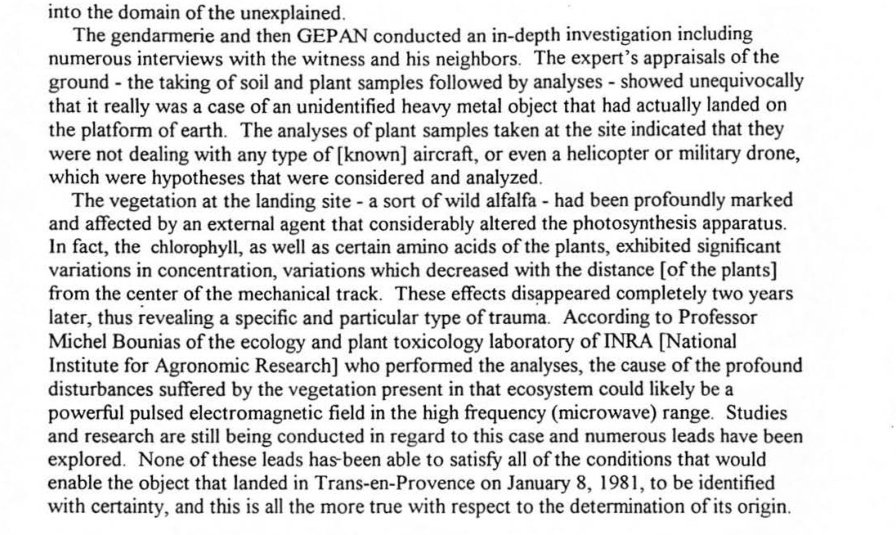
In Trans-en-Provence, on 08/01/1981, a man said he saw a silent metallic UFO land for a few seconds and depart. The gendarmerie and GEPAN examined marks on the ground and plant samples; COMETA reports plant alterations that decreased with distance and cites Michel Bounias for the hypothesis of a pulsed electromagnetic field. The text itself says that no lead met all the conditions and that origin and identification remained uncertain. The analyses are summarized, not reproduced in full, in this compilation.
- Event date
- 1981-01-08
- Location
- Trans-en-Provence, Var, France
- Topic
- COMETA and international accounts
- Source agencies
- Arquivo histórico
- Documents
- 1 document · 94 pages
- Reading time
- 31 min
 Magazine clippingPhysical page 25
DOCUMENTARY SOURCES · Arquivo histórico
What the records tell
Source of this entry: COMETA, private association; secondary account. The PDF brings together the private COMETA report and supplementary materials. Inclusion in the public collection does not turn its accounts or conclusions into an official position of the U.S. government.
In Trans-en-Provence, on 08/01/1981, a man said he saw a silent metallic UFO land for a few seconds and depart. The gendarmerie and GEPAN examined marks on the ground and plant samples; COMETA reports plant alterations that decreased with distance and cites Michel Bounias for the hypothesis of a pulsed electromagnetic field. The text itself says that no lead met all the conditions and that origin and identification remained uncertain. The analyses are summarized, not reproduced in full, in this compilation.
Outside chapter 4, the COMETA report returns to Trans-en-Provence in three passages with a more assertive tone. The introduction (physical page 12) says that in-depth studies allegedly proved that “something did in fact land on the ground and stayed there.” Physical page 34 highlights the case, along with Amaranth, among about a hundred GEPAN/SEPRA investigations, and refers to GEPAN technical notes 16 and 17, which are not in the PDF. Physical page 36 states that the expert analyses show a UFO of metallic appearance and circular shape that landed and took off silently near a 2,5 m wall, and that no modern aircraft would be capable of these maneuvers.
In chapter 4 (physical pages 25 and 26), the authors admit that no lead met all the conditions and that the origin remained uncertain, but in the same passage they state that the expert analyses proved the landing of a metallic UFO. The reader should treat the passages on pages 12, 34 and 36 as conclusions of the COMETA authors, supported by studies that the PDF summarizes but does not reproduce. GEPAN technical notes 16 and 17 would be the way to check what was measured.
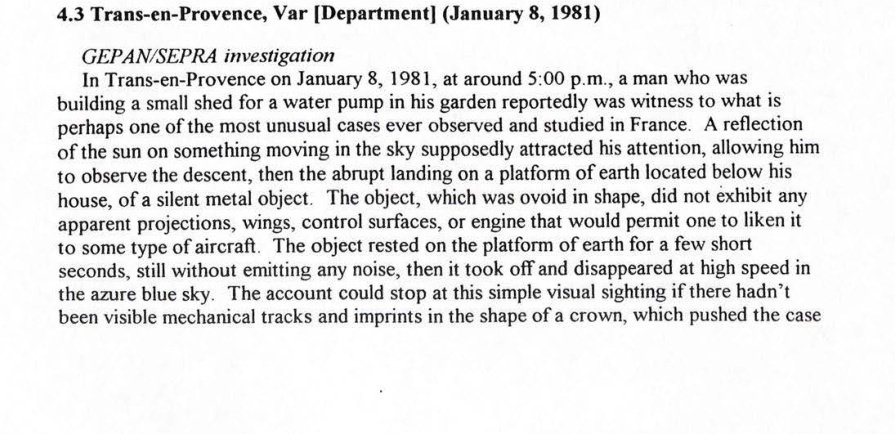
Chapter 4 of COMETA sets the scene: at around 17h on January 8, 1981, a man was building a small shelter for a water pump in his garden when a reflection of sunlight caught his attention. He allegedly saw the descent and abrupt landing, on an earthen terrace below the house, of a silent, metallic, ovoid UFO, without protrusions, wings, rudders or visible engine. The UFO stayed there a few seconds and departed at high speed. What took the case beyond a simple visual account, the text says, were visible mechanical marks and crown-shaped imprints on the ground, examined by the gendarmerie and later by GEPAN, with interviews of the witness and neighbors and collection of soil and plant samples.
A remark about what the dossier already says: chapter 4 itself is not merely cautious. In the same paragraph in which it admits that no lead made it possible to identify the UFO with certainty, the text states that the expert analyses showed "unequivocally" that a heavy, unidentified metallic UFO landed on the terrace. The two positions coexist on physical page 26. The vegetation at the site, a kind of wild alfalfa, allegedly showed variations in chlorophyll and some amino acids that decreased with distance from the center of the mark and disappeared two years later. The hypothesis of a high-frequency pulsed electromagnetic field is attributed to Professor Michel Bounias, of INRA, who carried out the analyses.
COMETA uses Trans-en-Provence as a showcase for the French system of collecting reports. According to chapter 6 (physical page 30), since 1974 the gendarmerie had sent GEPAN/SEPRA more than 3.000 reports, with an average of three testimonies each, in addition to about a hundred field investigations carried out jointly. It was this collaboration, the text says, that made it possible to study cases such as Trans-en-Provence and Amaranth under excellent conditions. In chapter 7 (physical page 33), the case returns as an example of when the analysis of traces in the environment requires specialized laboratories, in a study that can take up to two years. These are descriptions of the method by the COMETA authors, not GEPAN reports.
The descriptions of the UFO change throughout the report. In chapter 4 (physical page 25), the witness sees an ovoid, metallic and silent UFO that stays on the terrace for a few seconds. On physical page 34, the authors say the investigations lead one to believe in UFOs shaped like a "double saucer" that remained near the ground for some time. On physical page 36, the UFO has a circular shape. The text does not explain these differences in shape and duration. They may come from summaries written by different hands, from the English translation or from the experts' reading of the marks, but the PDF does not allow a decision.
The French bibliography (physical page 83) gives the title of GEPAN technical note no. 16: "Analysis of a trace (Trans-en-Provence case)". Note no. 17 deals with the Amaranth case. These are the primary sources COMETA refers to, and none of them is part of the PDF kept in the American archive. Therefore, the chlorophyll and amino acid measurements, the description of the crown-shaped marks and the interviews with the witness and neighbors reach the reader only through the authors' summary. No photo of the site, sketch of the marks or laboratory table accompanies the text.
In closing chapter 7 (physical pages 36 and 37), COMETA likens Trans-en-Provence to the Socorro case, in New Mexico, which it considers similar, but says examining it would lengthen the report unnecessarily. It then draws the strongest conclusion in the text: some category D phenomena would appear to be unknown flying machines, of exceptional performance, guided by natural or artificial intelligence. This is the authors' interpretation, based on summaries. The report does not technically compare the Socorro marks with those of Trans-en-Provence, and COMETA itself admits, in chapter 8 (physical page 40), that formulating a credible hypothesis does not prove the existence of the UFOs.
Separating the layers of the case as COMETA presents it: there is the account of one witness, and the text does not state whether anyone else saw the UFO; there are physical traces (mechanical marks, crown-shaped imprints and alterations in the vegetation) examined by the gendarmerie and later by GEPAN; there are laboratory analyses attributed to Professor Michel Bounias, of INRA; and there are two different hypotheses. That of a pulsed electromagnetic field is attributed to Bounias. That of a piloted or remotely guided machine belongs to the COMETA authors. The text also says that known aircraft, a helicopter and a military drone were considered and ruled out, without showing how.
More images from the document
DIRECT READING OF THE FILE
The document, in the original
Translation of the selected excerpts checked against the image, with omissions indicated. This is not a full translation of the PDF. Summaries and evaluations are kept separate from the transcription.
EXCERPT 1 · PHYSICAL PAGE 25
Short excerpt supporting the summary, not a full translation.
I
I
over the low wall ofthe enclosure. The boy, who was 13 years old at the time, got up to
make the cow come back, when he spotted four children whom he did not recognize on
I
the other side ofthe road.
Surprised by what he saw, he called his sister, when he noticed an extremely bright sphere
back behind the unknown children. They then realized that these were not children but
I
small black beings whose height did not exceed 1.20 m. Two ofthem were standing next
to the sphere, another was kneeling before it, and the fourth, who was standing, held in its
hand a sort ofmirror that blinded the children. The boy tried to call out to them, but the
small beings then hurriedly returned to the sphere. The children saw them rise from the
ground and penetrate the ball from the top, diving in head first. The sphere took off with
I a hissing sound, then rose into the sky describing a continuous spiral movement at high
speed. The dog barked, the cows started to moo, and a very strong odor ofsulfur filled
the air. The second inquiry began in 1978 with a team ofinvestigators from GEP AN and
I qualified outside advisors, one ofwhom was a former examining magistrate.
The highlights ofthis second inquiry did not have to do with the facts or the account, but
with new elements such as secondary witnesses found at the site who provided
I supplemental information and strengthened the credibility ofthe case. In particular, a
gendarme who arrived on the scene immediately following the incident found tracks on the
ground at the place indicated by the children and noted the very strong odor ofsulfur.
I Likewise, another witness also came forward who admitted being in a granary close to the
site and clearly remembered a hissing sound very different from that of a helicopter ofthe
time. I The reconstruction at the site in the presence ofthe two main witnesses confirmed both
the descriptive accounts and the circumstances that followed the sighting. At the time the
children gave offa strong odor ofsulfur, but, above all, they suffered from physiological
I disorders, and their eyes ran for several days. These facts were certified by the family
doctor and confirmed by their father, who was mayor ofthe village at the time. In the
conclusion ofthis_, second inquirythe judge gave his opinion on the witnesses and their I testimony: "There is noflaw or inconsistency in these various elements that permit us to
doubt the sincerity ofthe witnesses or to reasonably suspect an invention, hoax, or
hallucination. Under these circumstances, despite the young age ofthe principal I witnesses, andas extraordinary as the facts that they have related seem to be, I think
that they actually observed them. "
I 4.3 Trans-en-Provence, Var [Department] (January 8, 1981)
I GEPANISEPRA investigation
I
In Trans-en-Provence on January 8, 198 1, at around 5: 00 p. m., a man who was
building a small shed for a water pump in his garden reportedly was witness to what is
perhaps one ofthe most unusual cases ever observed and studied in France. A reflection
ofthe sun on something moving in the sky supposedly attracted his attention, allowing him
to observe the descent, then the abrupt landing on a platform ofearth located below his
I house, ofa silent metal object. The object, which was ovoid in shape, did not exhibit any
apparent projections, wings, control surfaces, or engine that would permit one to liken it
to some type ofaircraft. The object rested on the platform ofearth for a few short
I seconds, still without emitting any noise, then it took offand disappeared at high speed in
the azure blue sky. The account could stop at this simple visual sighting if there hadn't
been visible mechanical tracks and imprints in the shape ofa crown, which pushed the case
I
IEditorial note: Continuation of the Cussac case (1967), with the second investigation of 1978, and beginning of the Trans-en-Provence case (Var, 08/01/1981).
Check the original PDF
The object rested on the platform of earth for a few short seconds, still without emitting any noise.View the document record ↗ · Physical page 25, counting the cover.
EXCERPT 2 · PHYSICAL PAGE 12
Introduction, physical page 12
,~
(/): AA or AR xx: auditor of national or regional promotion no. xx.
INTRODUCTION I
In 1976, a committee ofthe Institut des Hautes Etudes de Defense Nationale (IHEDN) I
chaired by General Blanchard1 ofthe Gendarmerie Nationale1 opened the unidentified
flying objects file. The objective: to make proposals for organizing research and the
collection ofdata on these phenomena. The-goal was achieved, because the I
recommendations ofthis cornm.ittee were followed b,1 the creation of the Groupe d'Etude
des Phenomenes Aerospatiaux Non Identifies (GEPAN) [Unidentified Aerospace
Phenomena Study Group], the precursor to the current Service d'Expertise des I
Phenomenes de Rentree Atmospherique (SEPRA) [Atmospheric Reentry Phenomena
Consulting Department], a division of the Centre National d'Etudes Spatiales (CNES),
which is in charge ofthis file. Twenty years later, it seemed useful to us to take stock 1.
once again ofthe knowledge regarding these sightings, which are becoming ofgreater and
greater interest to a large public that is often convinced ofthe extraterrestrial origin of
UFOs. Just look at the number offilms or television broadcasts on this subject. I
For the sake ofconvenience with respect to language, we will use the term UFO
(Unidentified Flying Object) generally1 instead ofthe more scientific term UAP
(Unidentified Aerospace Phenomenon). I
Without a doubt, the phenomenon remains and the number ofsightings, which are
completely unexplained despite the abundance and quality ofdata, is growing throughout
the world. On the ground, some sightings, like the Trans-en-Provence sighting in 1981, I
have been the subject ofin-depth studies proving that something did in fact land on the
ground and parked there. Civilian and military pilots have provided gripping visual
testimonies, often corroborated by radar recordings, as was the case recently in France. In I
view ofthe lack ofirrefutable proofregarding the origin of these phenomena, the need for
understanding
We will devote
persists
the
.
first part ofthis report to several particularly remarkable French and e
foreign cases.
In the second part, after having recalled the current organization of the research on I these phenomena in France and abroad, we will evaluate the work being done by scientists
worldwide who are interested in UFOs and are proposing, as we will see, partial
explanations that are based on known laws ofphysics. I Some ofthese (propulsion systems, non lethal weapons, etc.) could become realities in
the short, medium and long term.
We will review the principal global explanations proposed, focusing on those that are in
extraterrestrial
keeping with th
manife
e current
statio
scientific
ns.
data, which range from secret weapons to
-
The UFO phenomenon involves defense in the broad sense and calls for a certain
number of measures, which we will examine in the last part:
- [providing] civilian and military pilots with sufficient information to teach them an
adapted conduct when faced with these phenomena and, more generally, [providing] the
public and decision-makers with information,
- developing the actions ofSEPRA and promoting supplemental scientific monitoring,
or even research, actions,
- considering the strategic, political, and religious consequences of a possible
confirmation ofthe extraterrestrial hypothesis, the bizarre connotation of which it isEditorial note: Introduction to the COMETA report: origin of GEPAN/SEPRA, objectives of the report and the three parts of the study.
Check the original PDF
On the ground, some sightings, like the Trans-en-Provence sighting in 1981, have been the subject of in-depth studies proving that something did in fact land on the ground and parked there.View the document record ↗ · Physical page 12, counting the cover.
EXCERPT 3 · PHYSICAL PAGE 34
Notable cases, physical page 34
I
labeled CE3s (close encounters ofthe third kind) according to the classification proposed
by Professor A. Hynek, an astronomer and consultant to the USAF, within the context of
the Blue Book Project (cf. Chapter 9.1 ). I
7.3 Typology of UAP Ds I
The detailed statistical analysis ofUAP Ds enables a precise determination ofthe
distribution oftheir physical characteristics: speed, acceleration, silence, shape, effects on
the environment. It is interesting to note that statistical studies in the USSR yielded I
distributions comparable to those determined by Claude Poher, the first head ofGEPAN,
from some 200 French cases, or 1,000 cases worldwide. It would be desirable to be able
to develop UAP D statistical studies in France. I
7.4 Investigations ofRemarkable Cases I
Around one hundred investigations have been conducted by GEP AN/SEPRA. Some of
them have highlighted rare physical atmospheric phenomena associated, for example, with I
lightning~ others have revealed unusual psychological behavior ofwitnesses caused, for
example, by taking hallucinogenic drugs. Several very in-depth investigations based on
analyses of evidence have demonstrated, in the end, the physical presence ofa I
phenomenon the nature and origin ofwhich remain unknown. Two cases related in
Chapter 4 stand out in our minds, the Trans-en-Provence case ofJanuary 8, 1981, and the
"Amaranth" case ofOctober 2 1, I 982. The investigations lead us to believe that double I
saucer-shaped objects were close to the ground for some time, then departed toward the
sky leaving traces on the vegetation and, in the Trans-en-Provence case, on the ground
itself. They are detailed in GEP AN technical memoranda no. 16 and no. 17 (see the I
reference list in Chapter 6).
I
7.5 Aeronautical Cases
7.5.l Data on French Aeronautical Cases I - Twelve French aeronautical cases have been brought to the attention of
GEPAN/SEPRA~ only three or four ofthese can be considered to fall into category D.
- The first UAP D case identified dates back to 1951. It involved Vampire military I
I
. aircraft in the Orange area. In two other very extraordinary sightings, which are presented
in Chapter 1, military pilots reported the presence ofobjects with aeronautical
performances inconsistent with the maneuvers ofclassic aircraft over the region ofTours
in 1976 and ofLuxeuil in 1977. However, not until January 28, 1994, was the crew ofa
regularly scheduled Air France commercial airplane able to collect the first case of a visual
sighting correlated with a radar detection over 50 seconds long (see Chapter 1.3). I
7.5.2 Aeronautical UAP D Cases Worldwide I
The aeronautical UAP D cases known since 1942 were initially enumerated in a
document entitled Rencontres dans le cie/ {Encounters in the Sky], by Dominique
Weinstein, the French portion ofwhich SEPRA contributed to. The list ofsightings I
I
ICheck the original PDF
They are detailed in GEPAN technical memoranda no. 16 and no. 17 (see the reference list in Chapter 6).View the document record ↗ · Physical page 34, counting the cover.
EXCERPT 4 · PHYSICAL PAGE 36
Close-range sightings in France, physical page 36
I
maneuvers when the disks are detected lead one to assume that they are piloted or
operated by remote control. , , 5. Most witnesses describe objects with a metalsurface that are circular or elliptical
in shape, the upper portion ofwhich is dome shaped, flying without making any
noise in a fonnation ofthree to nine objects ... I
7.6.2 GEPAN/SEPRA's Work I
We do not have irrefutable tangible proof in the forrn of material, either whole or in
fragments, that confirm the physical nature ofUAP Ds and their artifact character. I
Nevertheless, the collection and expert appraisal work carried out at GEP AN/SEP RA for
over 20 years confinns the statements Genera] Twining made in 1947. I
7.6.3 French Aeronautical Cases I The study ofFrench military aeronautical UAP D [sightings] (Orange in 1951, Tours in
1976, Luxeuil in 1977) supports General Twining's conclusions, namely the fourth one.
The testimonies ofthe pilots do in fact lead one to assume that the objects were "either I piloted or operated by remote control": all ofthe pilots reported that it was "the object"
that appeared to be moving toward them and not the other way around. Moreover, all of
them considered the maneuvering abilities of the object to be far superior to those that I they were familiar with.
7.6.4 Cases ofClose-Up UAP D Sightings in France I
For their part, the cases ofclose-up UAP D sightings in France are very much in
keeping with Twining's conclusions 4 and 5. In Trans-en-Provence (Chapter 4), the I
expert appraisals made at the site support the local testimony and show that the object
with a metallic appearance and circular shape landed, then took offsilently within a very
short space of time not very far from a wall 2.5 min height. No modem aircraft is capable I
ofthese silent maneuvers, nor ofthis degree of precision when landing. It is hard not to
imagine a piloted or remote-controlled flying machine, or else one having highly advanced
cybernetics. I
The other French cases ofclose encounters described in Chapter 4 also strongly
suggest the existence ofan intelligent [civilization] behind the UAP Os. In the Valensole,
"Amaranth" and Cussac cases, once the witness or witnesses are brought face to face with I
the UAP D, everything generally happens very quickly, and the object escapes without
having shown the slightest aggressiveness toward the witnesses. I
7.6.5 Foreign Cases - Conclusion I
The study of certain foreign cases leads to conclusions similar to those drawn from the
French cases. One may reread in this spirit the description ofthe aeronautical cases
presented in Chapter 2. We could also relate foreign cases ofclose encounters, such as I
I
ICheck the original PDF
the expert appraisals made at the site support the local testimony and show that the object with a metallic appearance and circular shape landed, then took off silently within a very short space of time not very far from a wall 2.5 m in height.View the document record ↗ · Physical page 36, counting the cover.
EXCERPT 5 · PHYSICAL PAGE 25
Physical page 25, chapter 4.3: the ground marks (short excerpt)
I
I
over the low wall ofthe enclosure. The boy, who was 13 years old at the time, got up to
make the cow come back, when he spotted four children whom he did not recognize on
I
the other side ofthe road.
Surprised by what he saw, he called his sister, when he noticed an extremely bright sphere
back behind the unknown children. They then realized that these were not children but
I
small black beings whose height did not exceed 1.20 m. Two ofthem were standing next
to the sphere, another was kneeling before it, and the fourth, who was standing, held in its
hand a sort ofmirror that blinded the children. The boy tried to call out to them, but the
small beings then hurriedly returned to the sphere. The children saw them rise from the
ground and penetrate the ball from the top, diving in head first. The sphere took off with
I a hissing sound, then rose into the sky describing a continuous spiral movement at high
speed. The dog barked, the cows started to moo, and a very strong odor ofsulfur filled
the air. The second inquiry began in 1978 with a team ofinvestigators from GEP AN and
I qualified outside advisors, one ofwhom was a former examining magistrate.
The highlights ofthis second inquiry did not have to do with the facts or the account, but
with new elements such as secondary witnesses found at the site who provided
I supplemental information and strengthened the credibility ofthe case. In particular, a
gendarme who arrived on the scene immediately following the incident found tracks on the
ground at the place indicated by the children and noted the very strong odor ofsulfur.
I Likewise, another witness also came forward who admitted being in a granary close to the
site and clearly remembered a hissing sound very different from that of a helicopter ofthe
time. I The reconstruction at the site in the presence ofthe two main witnesses confirmed both
the descriptive accounts and the circumstances that followed the sighting. At the time the
children gave offa strong odor ofsulfur, but, above all, they suffered from physiological
I disorders, and their eyes ran for several days. These facts were certified by the family
doctor and confirmed by their father, who was mayor ofthe village at the time. In the
conclusion ofthis_, second inquirythe judge gave his opinion on the witnesses and their I testimony: "There is noflaw or inconsistency in these various elements that permit us to
doubt the sincerity ofthe witnesses or to reasonably suspect an invention, hoax, or
hallucination. Under these circumstances, despite the young age ofthe principal I witnesses, andas extraordinary as the facts that they have related seem to be, I think
that they actually observed them. "
I 4.3 Trans-en-Provence, Var [Department] (January 8, 1981)
I GEPANISEPRA investigation
I
In Trans-en-Provence on January 8, 198 1, at around 5: 00 p. m., a man who was
building a small shed for a water pump in his garden reportedly was witness to what is
perhaps one ofthe most unusual cases ever observed and studied in France. A reflection
ofthe sun on something moving in the sky supposedly attracted his attention, allowing him
to observe the descent, then the abrupt landing on a platform ofearth located below his
I house, ofa silent metal object. The object, which was ovoid in shape, did not exhibit any
apparent projections, wings, control surfaces, or engine that would permit one to liken it
to some type ofaircraft. The object rested on the platform ofearth for a few short
I seconds, still without emitting any noise, then it took offand disappeared at high speed in
the azure blue sky. The account could stop at this simple visual sighting if there hadn't
been visible mechanical tracks and imprints in the shape ofa crown, which pushed the case
I
IEditorial note: Continuation of the Cussac case (1967), with the second investigation of 1978, and beginning of the Trans-en-Provence case (Var, 08/01/1981).
Check the original PDF
The account could stop at this simple visual sighting if there hadn't been visible mechanical tracks and imprints in the shape of a crown, which pushed the case into the domain of the unexplained.View the document record ↗ · Physical page 25, counting the cover.
EXCERPT 6 · PHYSICAL PAGE 26
Physical page 26, chapter 4.3: the authors' conclusion on the expert analyses (short excerpt)
I
into the domain ofthe unexplained.
The gendarmerie and then GEPAN conducted an in-depth investigation including
numerous interviews with the witness and his neighbors. The expert's appraisals ofthe I
ground - the talcing ofsoil and plant samples followed by analyses - showed unequivocally
that it really was a case ofan unidentified heavy metal object that had actually landed on
the platform ofearth. The analyses of plant samples taken at the site indicated that they I
were not dealing with any type of [known] aircraft, or even a helicopter or military drone,
which were hypotheses that were considered and analyzed.
The vegetation at the landing site - a sort ofwild alfalfa - had been profoundly marked I
and affected by an external agent that considerably altered the photosynthesis apparatus.
In fact, the chlorophyll, as well as certain amino acids ofthe plants, exhibited significant
variations in concentration, variations which decreased with the distance [ ofthe plants] I
from the center ofthe mechanical track. These effects disappeared completely two years
later, thus revealing a specific and particular type oftraum·a. According to Professor
Michel Bounias ofthe ecology and plant toxicology laboratory oflNRA [National I
Institute for Agronomic Research] who performed the analyses, the cause ofthe profound
disturbances suffered by the vegetation present in that ecosystem could likely be a I powerful pulsed electromagnetic field in the high frequency (microwave) range. Studies
and research are still being conducted in regard to this case and numerous leads have been
explored. None ofthese leads has-been able to satisfy all ofthe conditions that would I enable the object that landed in Trans-en-Provence on January 8, 1981, to be identified
with certainty, and this is all the more true with respect to the detennination ofits origin. I 4.4 Nancy, Meurthe-et-Moselle [Department], the so-called "Amaranth" Case
(October 21, 1982) I
GEPANISEPRA investigation
The "Amaranth" Case concerns the sighting during the day by a witness, a cellular
biology researcher, of an object that hovered above his garden for 20 minutes. The I
testimony recorded by the gendarmerie less than 5 hours after the sighting is summarized
as follows:
- The witness was in his garden in front of his house at around 12:35 a.m. after work I
on October 21, 1982; he saw a flying craft, which he first took for an airplane, come from
the southeast. He saw a shiny craft. He indicated that there were no clouds, that the sun
was not in his eyes, and that visibility was excellent. The craft's speed ofdescent was not I
very great, and he thought that it was going to pass over his house. Once he realized that
the trajectory ofthe craft was bringing it toward him, he backed up 3 to 4 meters. This
craft, which was oval in shape, stopped approximately one meter from the ground and I
remained hovering at this height for about 20 minutes.
- The witness stated that since he had looked at his watch, he was absolutely certain
about the length oftime the craft hovered. He described the craft as follows: ovoid in I
shape, approximately I min diameter, 80 cm thick, the bottom halfmetallic in appearance
like polished beryllium and the upper half the blue-green color of the inner depths of a
lagoon. The craft did not emit any noise, nor did it seem to emit any heat, cold, radiation, I
magnetism, or electromagnetism. After 20 minutes, the craft suddenly rose straight up, a
trajectory which it maintained until it was out ofsight. The craft' s departure was very
fast, as if it were under the effect ofstrong suction. The witness indicated, finally, that I
there were no tracks or marks on the ground and the grass was not charred or flattened, I
IEditorial note: End of the Trans-en-Provence case (1981), with the vegetation analyses, and beginning of the Amaranth case (Nancy, 21/10/1982).
Check the original PDF
The expert's appraisals of the ground - the taking of soil and plant samples followed by analyses - showed unequivocally that it really was a case of an unidentified heavy metal object that had actually landed on the platform of earth.View the document record ↗ · Physical page 26, counting the cover.
EXCERPT 7 · PHYSICAL PAGE 26
Physical page 26, chapter 4.3: effects on vegetation (short excerpt)
I
into the domain ofthe unexplained.
The gendarmerie and then GEPAN conducted an in-depth investigation including
numerous interviews with the witness and his neighbors. The expert's appraisals ofthe I
ground - the talcing ofsoil and plant samples followed by analyses - showed unequivocally
that it really was a case ofan unidentified heavy metal object that had actually landed on
the platform ofearth. The analyses of plant samples taken at the site indicated that they I
were not dealing with any type of [known] aircraft, or even a helicopter or military drone,
which were hypotheses that were considered and analyzed.
The vegetation at the landing site - a sort ofwild alfalfa - had been profoundly marked I
and affected by an external agent that considerably altered the photosynthesis apparatus.
In fact, the chlorophyll, as well as certain amino acids ofthe plants, exhibited significant
variations in concentration, variations which decreased with the distance [ ofthe plants] I
from the center ofthe mechanical track. These effects disappeared completely two years
later, thus revealing a specific and particular type oftraum·a. According to Professor
Michel Bounias ofthe ecology and plant toxicology laboratory oflNRA [National I
Institute for Agronomic Research] who performed the analyses, the cause ofthe profound
disturbances suffered by the vegetation present in that ecosystem could likely be a I powerful pulsed electromagnetic field in the high frequency (microwave) range. Studies
and research are still being conducted in regard to this case and numerous leads have been
explored. None ofthese leads has-been able to satisfy all ofthe conditions that would I enable the object that landed in Trans-en-Provence on January 8, 1981, to be identified
with certainty, and this is all the more true with respect to the detennination ofits origin. I 4.4 Nancy, Meurthe-et-Moselle [Department], the so-called "Amaranth" Case
(October 21, 1982) I
GEPANISEPRA investigation
The "Amaranth" Case concerns the sighting during the day by a witness, a cellular
biology researcher, of an object that hovered above his garden for 20 minutes. The I
testimony recorded by the gendarmerie less than 5 hours after the sighting is summarized
as follows:
- The witness was in his garden in front of his house at around 12:35 a.m. after work I
on October 21, 1982; he saw a flying craft, which he first took for an airplane, come from
the southeast. He saw a shiny craft. He indicated that there were no clouds, that the sun
was not in his eyes, and that visibility was excellent. The craft's speed ofdescent was not I
very great, and he thought that it was going to pass over his house. Once he realized that
the trajectory ofthe craft was bringing it toward him, he backed up 3 to 4 meters. This
craft, which was oval in shape, stopped approximately one meter from the ground and I
remained hovering at this height for about 20 minutes.
- The witness stated that since he had looked at his watch, he was absolutely certain
about the length oftime the craft hovered. He described the craft as follows: ovoid in I
shape, approximately I min diameter, 80 cm thick, the bottom halfmetallic in appearance
like polished beryllium and the upper half the blue-green color of the inner depths of a
lagoon. The craft did not emit any noise, nor did it seem to emit any heat, cold, radiation, I
magnetism, or electromagnetism. After 20 minutes, the craft suddenly rose straight up, a
trajectory which it maintained until it was out ofsight. The craft' s departure was very
fast, as if it were under the effect ofstrong suction. The witness indicated, finally, that I
there were no tracks or marks on the ground and the grass was not charred or flattened, I
IEditorial note: End of the Trans-en-Provence case (1981), with the vegetation analyses, and beginning of the Amaranth case (Nancy, 21/10/1982).
Check the original PDF
In fact, the chlorophyll, as well as certain amino acids of the plants, exhibited significant variations in concentration, variations which decreased with the distance [of the plants] from the center of the mechanical track. These effects disappeared completely two years later, thus revealing a specific and particular type of trauma.View the document record ↗ · Physical page 26, counting the cover.
EXCERPT 8 · PHYSICAL PAGE 34
Physical page 34, chapter 7.4: shape and persistence of the objects, according to the authors (short quotation)
I
labeled CE3s (close encounters ofthe third kind) according to the classification proposed
by Professor A. Hynek, an astronomer and consultant to the USAF, within the context of
the Blue Book Project (cf. Chapter 9.1 ). I
7.3 Typology of UAP Ds I
The detailed statistical analysis ofUAP Ds enables a precise determination ofthe
distribution oftheir physical characteristics: speed, acceleration, silence, shape, effects on
the environment. It is interesting to note that statistical studies in the USSR yielded I
distributions comparable to those determined by Claude Poher, the first head ofGEPAN,
from some 200 French cases, or 1,000 cases worldwide. It would be desirable to be able
to develop UAP D statistical studies in France. I
7.4 Investigations ofRemarkable Cases I
Around one hundred investigations have been conducted by GEP AN/SEPRA. Some of
them have highlighted rare physical atmospheric phenomena associated, for example, with I
lightning~ others have revealed unusual psychological behavior ofwitnesses caused, for
example, by taking hallucinogenic drugs. Several very in-depth investigations based on
analyses of evidence have demonstrated, in the end, the physical presence ofa I
phenomenon the nature and origin ofwhich remain unknown. Two cases related in
Chapter 4 stand out in our minds, the Trans-en-Provence case ofJanuary 8, 1981, and the
"Amaranth" case ofOctober 2 1, I 982. The investigations lead us to believe that double I
saucer-shaped objects were close to the ground for some time, then departed toward the
sky leaving traces on the vegetation and, in the Trans-en-Provence case, on the ground
itself. They are detailed in GEP AN technical memoranda no. 16 and no. 17 (see the I
reference list in Chapter 6).
I
7.5 Aeronautical Cases
7.5.l Data on French Aeronautical Cases I - Twelve French aeronautical cases have been brought to the attention of
GEPAN/SEPRA~ only three or four ofthese can be considered to fall into category D.
- The first UAP D case identified dates back to 1951. It involved Vampire military I
I
. aircraft in the Orange area. In two other very extraordinary sightings, which are presented
in Chapter 1, military pilots reported the presence ofobjects with aeronautical
performances inconsistent with the maneuvers ofclassic aircraft over the region ofTours
in 1976 and ofLuxeuil in 1977. However, not until January 28, 1994, was the crew ofa
regularly scheduled Air France commercial airplane able to collect the first case of a visual
sighting correlated with a radar detection over 50 seconds long (see Chapter 1.3). I
7.5.2 Aeronautical UAP D Cases Worldwide I
The aeronautical UAP D cases known since 1942 were initially enumerated in a
document entitled Rencontres dans le cie/ {Encounters in the Sky], by Dominique
Weinstein, the French portion ofwhich SEPRA contributed to. The list ofsightings I
I
IEditorial note: Chapter 7 of the COMETA report: typology of D-type UAP (FANI D), investigations of notable cases and French aeronautical cases, according to the authors.
Check the original PDF
double-saucer-shaped objects were close to the ground for some timeView the document record ↗ · Physical page 34, counting the cover.
Dates and documentary context
- Event
- 08/01/1981 — 1981-01-08. Date indicated by the secondary source, separate from the publication date.
- Document
- Not established — Individual document date not determined; see the source publication below.
- Publication
- 07/1999 — VSD (special edition, July 1999) · Publication of the source examined or cited; do not presume it is the first historical disclosure of the event. · The record reflects the COMETA summary; primary sources are not always reproduced.
Origin and release
COMETA, private association; secondhand account · UFOs and Defense: What Should We Prepare For?
This record reflects the COMETA summary; primary sources are not always reproduced. Hosting or archiving by a public agency does not imply endorsement; COMETA is a private association. The English version has not been fully compared with the French one.
Official collection · release 01 ↗ — Match indicated by the search; bytes of the remote PDF not authenticated.
A propos de la publication du rapport COMETA — GEIPAN ↗ — GEIPAN clarifies that hosting COMETA does not imply approval by CNES. It identifies the committee as private and attributes the conclusions to the authors. The note also records that the version published there was incomplete.
Questions to continue the investigation
- Locate and verify the primary records and technical documents cited.
GEOGRAPHY OF THE CASE
Trans-en-Provence, Var, France
Approximate reference for the location cited in the document, positioned by the editorial team. Does not indicate where the witness or the object was.
DOCUMENTARY TRAIL
Go back to the sources
References use physical pages of the PDF, counting the cover. Summaries are presented in English; the documents keep their original language.
- 255_413270_UFO's_and_Defense_What_Should_we_Prepare_For.pdf
Physical pages 5, 9, 25, 26
Arquivo histórico · 94 pages
Context and references in this document
contexto ou referencia
UFO seen over a rural school after Antananarivo ↗
contexto ou referencia
Reports of “ghost rockets” in Sweden ↗
contexto ou referencia
Reports of “foo fighters” in World War II ↗
contexto ou referencia
Reports of “airships” in the U.S. and the United Kingdom ↗
contexto ou referencia
Luminous phenomenon attributed to Goethe in 1768 ↗
contexto ou referencia
Aerial phenomena reported in Nuremberg ↗
contexto ou referencia
Aerial phenomenon reported in Basel ↗
contexto ou referencia
Medieval narrative attributed to Agobard about occupants of an “aircraft” ↗
contexto ou referencia
Contact with a Venusian attributed to Adamski ↗
contexto ou referencia
Paul Bennewicz's claims about microwaves, abductions and implants ↗
contexto ou referencia
Triangular lights reported in Arizona in 1997 ↗
contexto ou referencia
Interception attempts by military aircraft in Iran, Peru and Belgium ↗
contexto ou referencia
Shoot-down attempt by Peruvian aircraft, cited in a news report ↗
contexto ou referencia
Pursuit of UFOs by Belgian F-16s in 1990 ↗
contexto ou referencia
Mention of a military Vampire in the Orange region in 1951 ↗
contexto ou referencia
Photograph attributed to a mapping flight over Tilarán, Costa Rica ↗
contexto ou referencia
Image attributed to a Zanesville, Ohio, barber in 1966 ↗
contexto ou referencia
Image attributed to a student from Beaver, Pennsylvania ↗
contexto ou referencia
Image attributed to brothers from Detroit in 1967 ↗
Related publications and media
Editorial summary based on the collection's research notes. How we read the documents.