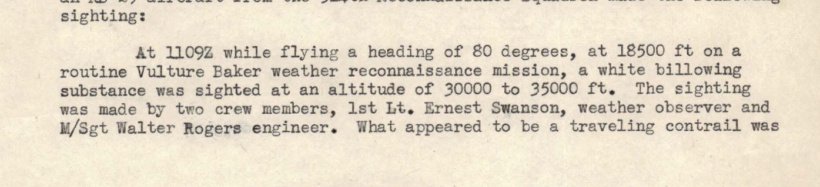
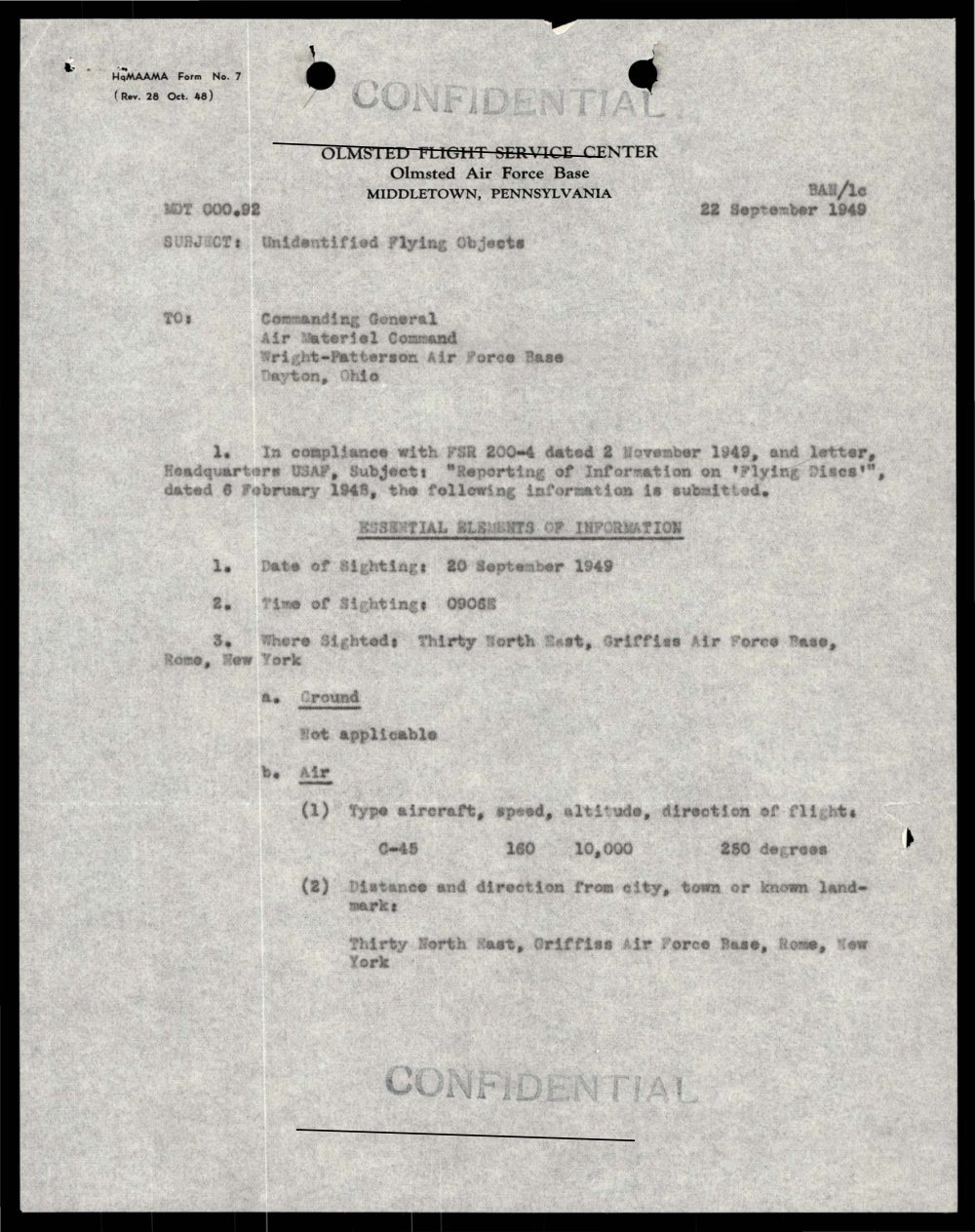
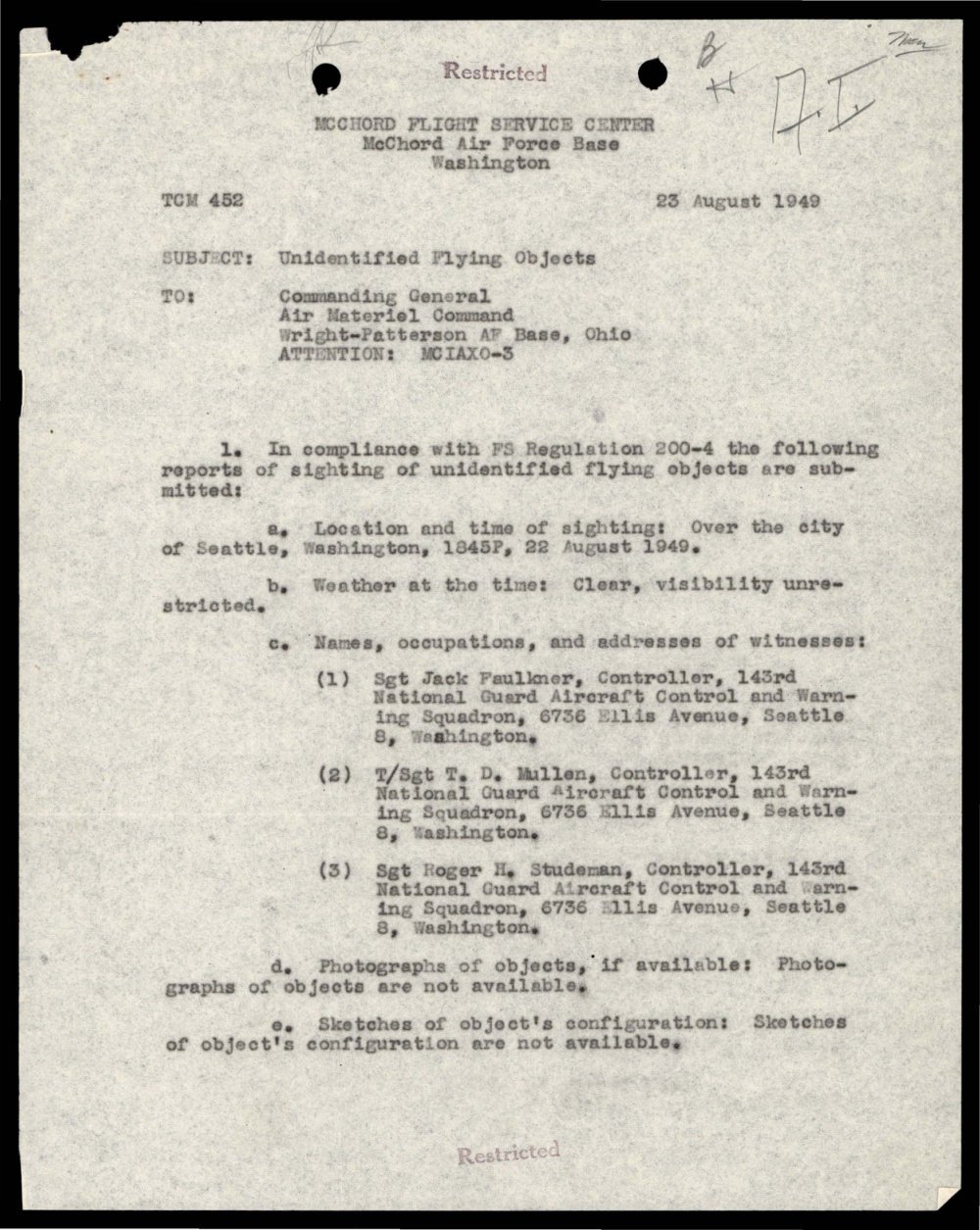
Date: 1949-02-06Location: Near the San Andrés islands
Three UFOs observed from the ship SS Antigua
The account describes one UFO at 16:30 and two more at 17h. The report considers possibilities such as a balloon, without being able to identify the UFOs; the mention of Russian ships is speculative.
- Event date
- 1949-02-06
- Location
- Near the San Andrés islands
- Topic
- Military reports from 1948–1949
- Source agencies
- Arquivo histórico
- Documents
- 1 document · 143 pages
- Reading time
- 8 min
 Document facsimilePhysical page 75
DOCUMENTARY SOURCES · Arquivo histórico
What the records tell
Account describes one object at 16:30 and two more at 5 p.m. The report considers possibilities such as a balloon, without being able to identify the objects; mention of Russian ships is speculative.
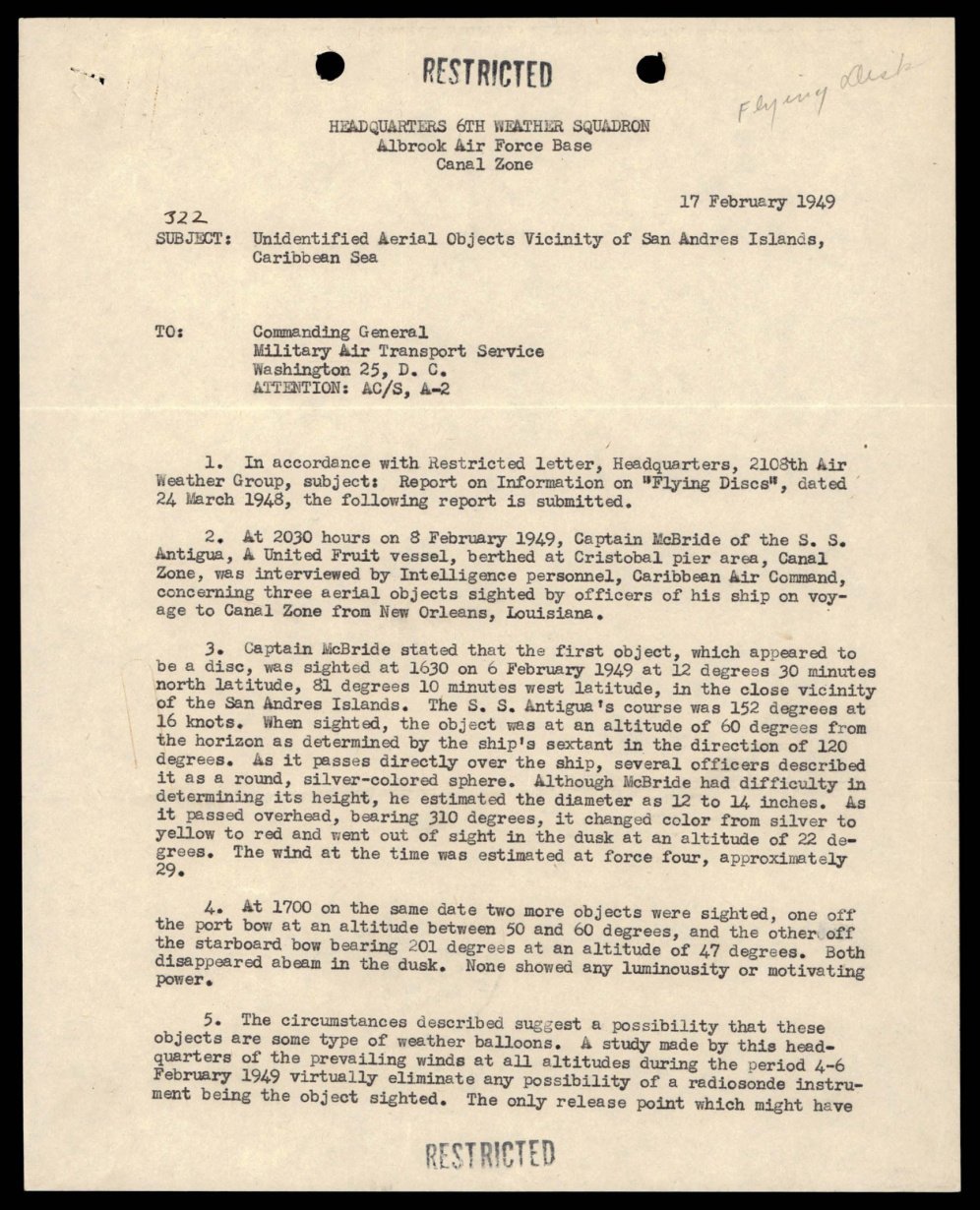
The report of the 6th Weather Squadron, in the Panama Canal Zone, is dated February 17, 1949. It is based on an interview conducted on February 8, at 8:30 p.m., with Captain McBride of the S.S. Antigua, a United Fruit ship docked at Cristóbal. The ship was coming from New Orleans. The first object, disc-like in appearance, was seen at 4:30 p.m. on February 6 at 12°30' N and 81°10' W, near the San Andrés islands. The ship's sextant measured its elevation: 60 degrees above the horizon, in the direction of 120 degrees. As it passed over the ship, several officers described it as a round, silver sphere.
The captain admitted that he could not judge the height, but estimated the diameter at 12 to 14 inches, somewhere between 30 and 35 centimeters. As it passed, the object changed color, from silver to yellow and then red, and disappeared in the twilight at 22 degrees of elevation. At 5 p.m., two more objects appeared, one to port, between 50 and 60 degrees, and another to starboard, at a bearing of 201 degrees and 47 degrees of elevation. None of them showed any light of its own or any visible means of propulsion. A small object that changes color at sunset is consistent with a balloon lit by the low sun. This is an editorial hypothesis, not a conclusion of the report.
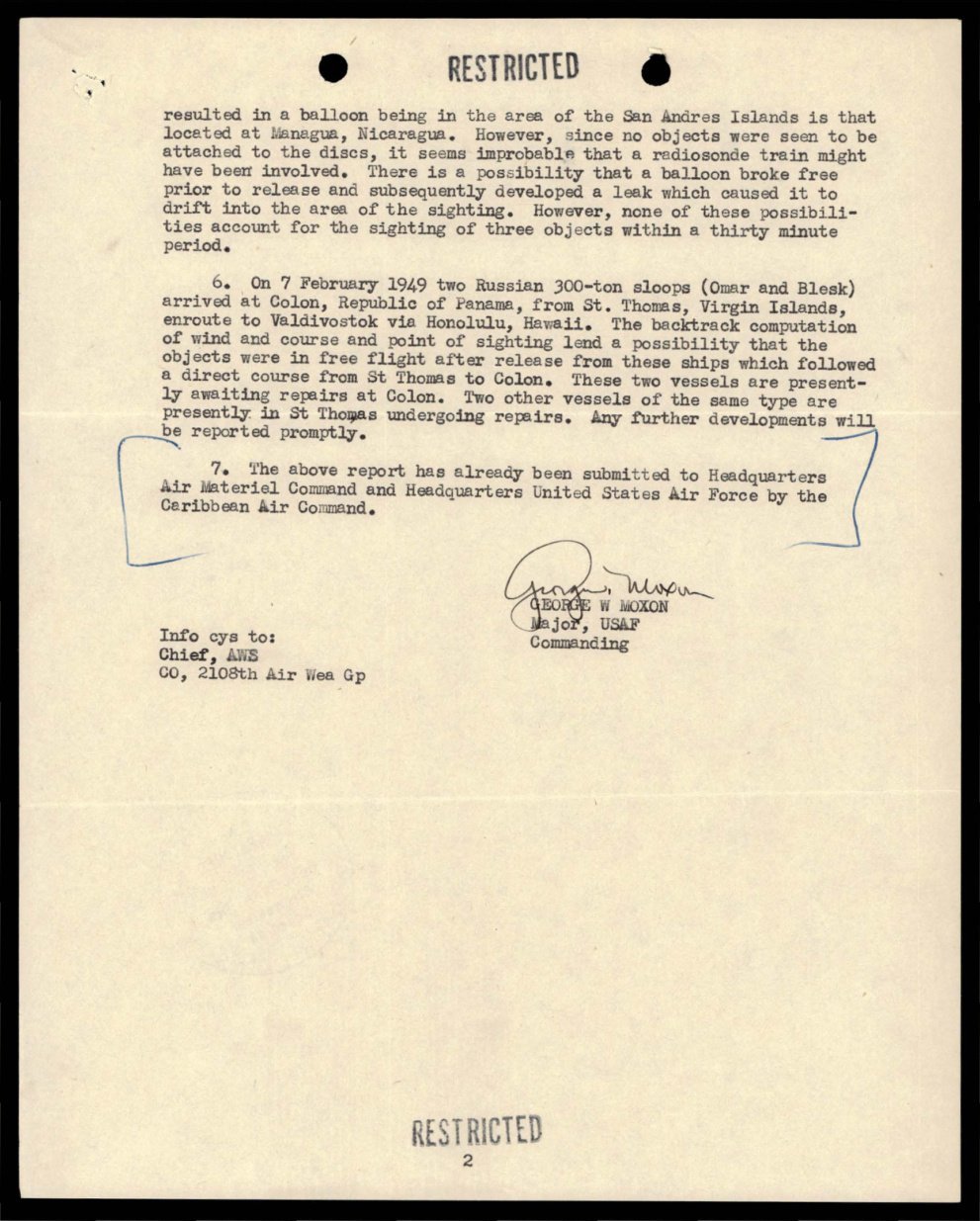
The squadron itself examined the balloon hypothesis and recorded the difficulties. Based on the winds of February 4 to 6, a radiosonde was practically ruled out. The only launch point capable of carrying a balloon to San Andrés was Managua, in Nicaragua, but no object was seen hanging from the discs. There remained the possibility of a balloon that broke loose before launch and leaked. None of these hypotheses explained three objects within half an hour. The report also cited two 300-ton Soviet sailing ships that arrived at Colón on February 7. According to the wind calculation, the objects could have been released from them. The document reaches no conclusion.
Both sheets of the report bear on the back the same circular dispatch stamp of the headquarters of the 6th Weather Squadron, dated February 18, 1949. The text was dated February 17 and left the Canal Zone the next day, bound for the headquarters of the Military Air Transport Service, in Washington, with copies to the chief of the Air Weather Service and the 2108th Weather Group. The report itself notes, in a paragraph marked in pen, that the Caribbean Air Command had already sent the same information to the Air Materiel Command and to Air Force headquarters.
The starting point was an interview. Intelligence personnel of the Caribbean Air Command questioned Captain McBride on February 8, at 8:30 p.m., with the ship already docked at Cristóbal, two days after the sighting. The position and course are those of the ship, and the first angular height was taken with the ship's sextant; the size of 12 to 14 inches is the captain's estimate, and he admitted he did not know the height of the objects. The officers who saw them pass are not named.
The analysis section is by the weather squadron and mixes two lines of reasoning. The first, technical, examines balloons and nearly rules out radiosondes based on the winds of February 4 to 6. The second, from the Cold War context, points to two 300-ton Soviet sailing ships, the Omar and the Blesk, which arrived at Colón on February 7, and says that the wind and course calculation "gives a possibility" that the objects had been released from them. The report promises to report any new developments, but the archive holds no follow-up.
More images from the document
DIRECT READING OF THE FILE
The document, in the original
Translation of the selected excerpts checked against the image, with omissions indicated. This is not a full translation of the PDF. Summaries and evaluations are kept separate from the transcription.
EXCERPT 1 · PHYSICAL PAGE 75
Physical page 75, full text: report of the 6th Weather Squadron of 17/02/1949, p. 1
RfSTRJCTEO
HFAD UARTERS 6TH mrATHER SQUADRON
Albrook Air Force Base
Canal Zone
17 February 1949
'322..
SUBJET: Unidentified erial Objects Vicinity of San Andres Islan ds,
Caribbean Sea
TO: Commanding General
Military Air Transport Service
Washington 25, D. c.
ATTENTION: AC/S, A- 2
1. In accordance with Res t ricted l etter, Headquarters, 2108th Air
eather Group, subject: Report on Information on "Flying Discs", dated
24 March 1948, the following report is submitted.
2 . t 2030 hours on 8 February 1949, Captain McBride of the S. s.
Antigua, A United Fruit vessel, berthed at Cristobal pier area, Canal
Zone, was interviewed by Intelligence personnel, Caribbean Air Command,
concerning three aerial objects sighted by officers of his ship on voy-
age to Canal Zone from New Orleans, Louisiana. •
3. Captain :cBride stated that the first object, which appeared to
be a disc, was sight ed at 1630 on 6 February 1949 at 12 degre es 30 minutes
north latitude, 81 degrees 10 minutes west latitude, in the close vicinity
of the San Andres Islands . The S. s. Antigua's course was 152 degrees at
16 knots. Vihen sighted, the obj ect was at an altitude of 60 degr ees f r om
the horizon as determined by the ship's sextant in. the direction of 120
degre es. As it µ:i.ss es directly over the ship, several officers described
it as a round, silver-colored sphere. Although McBride had di£f'iculty in
determining its height, he estimated the diameter as 12 to 14 inches. As
it pass ed overhead, bearing 310 degrees, it chang ed color from silver to
yellow to red and went out of sight in the dusk at an altitude of 22 de
grees . The wind at the time was estimated at force four, approximat ely
29 .
4. t 1700 on the same date two more objects were sighted, one off'
the pert bow at an altitude between 50 and 60 degrees, and the other , off
the starboard bow bearing 201 degre es at an altitude of 47 degr ees . Both
disappeared abeam in the dusk . None showed any luminousity or motivating power.
5. The circumstances described sug gest a pos sibility that these
objects are some type of weather balloons . A study made by this head
quarters of the prevailing winds at all altitudes during the period 4-6
February 1949 virtually eliminate any possibility 0£ a radiosonde instru
ment being the object sighted . The only release point which might have
R(ST lCTtDEditorial note: Expands to the full text the excerpt already published from this page. The original writes 'west latitude' where it should be longitude; the translation marks the error in quotation marks. 'Force four, about 29' is like this in the original, with no unit (probably 29 km/h or 29 feet per second; unresolved).
Check the original PDF
RESTRICTED. HEADQUARTERS 6TH WEATHER SQUADRON, Albrook Air Force Base, Canal Zone. 17 February 1949. [handwritten:] Flying discs. 322. SUBJECT: Unidentified Aerial Objects Vicinity of San Andres Islands, Caribbean Sea. TO: Commanding General, Military Air Transport Service, Washington 25, D. C. ATTENTION: AC/S, A-2. 1. In accordance with Restricted letter, Headquarters, 2108th Air Weather Group, subject: Report on Information on "Flying Discs", dated 24 March 1948, the following report is submitted. 2. At 2030 hours on 8 February 1949, Captain McBride of the S. S. Antigua, A United Fruit vessel, berthed at Cristobal pier area, Canal Zone, was interviewed by Intelligence personnel, Caribbean Air Command, concerning three aerial objects sighted by officers of his ship on voyage to Canal Zone from New Orleans, Louisiana. 3. Captain McBride stated that the first object, which appeared to be a disc, was sighted at 1630 on 6 February 1949 at 12 degrees 30 minutes north latitude, 81 degrees 10 minutes west latitude, in the close vicinity of the San Andres Islands. The S. S. Antigua's course was 152 degrees at 16 knots. When sighted, the object was at an altitude of 60 degrees from the horizon as determined by the ship's sextant in the direction of 120 degrees. As it passes directly over the ship, several officers described it as a round, silver-colored sphere. Although McBride had difficulty in determining its height, he estimated the diameter as 12 to 14 inches. As it passed overhead, bearing 310 degrees, it changed color from silver to yellow to red and went out of sight in the dusk at an altitude of 22 degrees. The wind at the time was estimated at force four, approximately 29. 4. At 1700 on the same date two more objects were sighted, one off the port bow at an altitude between 50 and 60 degrees, and the other off the starboard bow bearing 201 degrees at an altitude of 47 degrees. Both disappeared abeam in the dusk. None showed any luminousity or motivating power. 5. The circumstances described suggest a possibility that these objects are some type of weather balloons. A study made by this headquarters of the prevailing winds at all altitudes during the period 4-6 February 1949 virtually eliminate any possibility of a radiosonde instrument being the object sighted. The only release point which might have [continues]. RESTRICTEDView the document record ↗ · Physical page 75, counting the cover.
EXCERPT 2 · PHYSICAL PAGE 77
Physical page 77, full text: report of the 6th Weather Squadron, p. 2
I
RESTRICTED
•resulted in a balloon bein g in t he area of the San Andres Islands is that
located at Managua, Nicaragua. However, since no objects were seen to be
attached to the discs, it seems improbabla that a r adiosonde train might
have beert involved. There is a pos sibility that a balloon broke free
prior to release and subsequently developed a leak which caused it to
drift into the area of the sighting. However, none o:f these possibili
ties account for the sighting of three obj ects within a thirty minute
period.
6. On 7 February 1949 two Russian JOO-ton sloops (Omar and Blesk)
arrived at Colon, Republic o:f Panama, :from St. Thomas, Virgin Islands,
enroute to Valdivostok via Honolulu, Hawaii. The backtrack computation
of wind and course and point o:f sighting lend a possibility that the
objects were in free flight after release from these ships which :followed
a direct course from St Thomas to Colon. These two vessels are present
ly awaiting rep:iirs at Colon. Two other vessels of the same type are
presently in st Thoipas undergoing rep:iirs. Any further developments will
,,---b- e reparted promptly.
7. 'l'he above report has already been submit t ed to Headquarters
ir Materiel Command and Headquarters Unit ed States Air Force by the
Caribbean Air Command.
j ,
~\I\.-.__
W MOXON
USAFInfo cys to: CommandingChief, liS
co, 2108th Air ea GpEditorial note: 'Valdivostok' is like this in the original (Vladivostok). Paragraph 7 is marked in blue pen in the original. 'Sloops' was translated as sailboats; the document does not describe the vessels.
Check the original PDF
RESTRICTED. resulted in a balloon being in the area of the San Andres Islands is that located at Managua, Nicaragua. However, since no objects were seen to be attached to the discs, it seems improbable that a radiosonde train might have been involved. There is a possibility that a balloon broke free prior to release and subsequently developed a leak which caused it to drift into the area of the sighting. However, none of these possibilities account for the sighting of three objects within a thirty minute period. 6. On 7 February 1949 two Russian 300-ton sloops (Omar and Blesk) arrived at Colon, Republic of Panama, from St. Thomas, Virgin Islands, enroute to Valdivostok via Honolulu, Hawaii. The backtrack computation of wind and course and point of sighting lend a possibility that the objects were in free flight after release from these ships which followed a direct course from St Thomas to Colon. These two vessels are presently awaiting repairs at Colon. Two other vessels of the same type are presently in St Thomas undergoing repairs. Any further developments will be reported promptly. 7. The above report has already been submitted to Headquarters Air Materiel Command and Headquarters United States Air Force by the Caribbean Air Command. GEORGE W MOXON, Major, USAF, Commanding. Info cys to: Chief, AWS; CO, 2108th Air Wea Gp. RESTRICTED. 2View the document record ↗ · Physical page 77, counting the cover.
EXCERPT 3 · PHYSICAL PAGE 76
Physical page 76, full text: reverse of the first sheet of the report of 17/02/1949 (dispatch stamp)
•Editorial note: Back of physical page 75.
Check the original PDF
[Circular stamp:] DISPATCHED. 18 FEB 1949. HEADQUARTERS 6th Weather Squadron. [Outer ring with numbers; no hour marked legibly.] [The rest of the page shows, faintly and in reverse, the typed text from the front of the sheet.]View the document record ↗ · Physical page 76, counting the cover.
EXCERPT 4 · PHYSICAL PAGE 78
full page
•Editorial note: Back of page 77 (6th Weather Squadron report on the SS Antigua): there is only a dispatch stamp, dated February 18, 1949.
Check the original PDF
•View the document record ↗ · Physical page 78, counting the cover.
Dates and documentary context
- Event
- 06/02/1949 — 1949-02-06. Date stated in the document and/or corrected through visual verification; when uncertain, it remains null.
- Document
- 17/02/1949 — February 17, 1949 — 6º Weather Squadron report
- Publication
- Not established — No original public publication was identified for these internal forms, messages and reports.
Origin and release
U.S. Air Force (USAF) and military flight information services, according to the report · Military administrative reports and messages
No original public publication was identified for these internal forms, messages and reports. The report's hypotheses are not confirmation of a balloon or of foreign activity.
Official collection · release 01 ↗ — Correspondence indicated by the local collection; bytes of the remote PDF not authenticated.
GEOGRAPHY OF THE CASE
San Andrés Islands, Caribbean
The ship was near the islands; the marker does not represent its position. Approximate regional reference, placed by the editorial team based on the place cited in the document. The marker does not represent the exact location of the account.
DOCUMENTARY TRAIL
Go back to the sources
References use physical pages of the PDF, counting the cover. Summaries are presented in English; the documents keep their original language.
- 342_HS1-416511228_box186_319.1-Flying-Discs-1949.pdf
Physical pages 75, 77
Arquivo histórico · 143 pages
Context and references in this document
contexto institucional
Administrative hypothesis about activity in Greenland ↗
Editorial summary based on the collection's research notes. How we read the documents.