Date: 16/09/1948, 17h (central time)Location: About 3 miles from Shreveport, Louisiana, USA (the direction is blurred on the record)
Shreveport, 1948: resident sees an aluminum-colored UFO through binoculars, and the record points to a radiosonde
In the late afternoon of September 16, 1948, a resident of Shreveport, Louisiana, was scanning the sky with binoculars when he saw a round, aluminum-colored UFO glide south with no sound and no trail. An agent's note on the record itself points out that a radiosonde had been launched from Barksdale Field two hours earlier and says that it may have been what he saw.
- Event date
- 16/09/1948, 17h (central time)
- Location
- About 3 miles from Shreveport, Louisiana, USA (the direction is blurred on the record)
- Topic
- 1948 reports
- Source agencies
- Arquivo histórico
- Documents
- 1 document · 144 pages
- Reading time
- 5 min
 Official formPhysical page 2
DOCUMENTARY SOURCES · Arquivo histórico
What the records tell
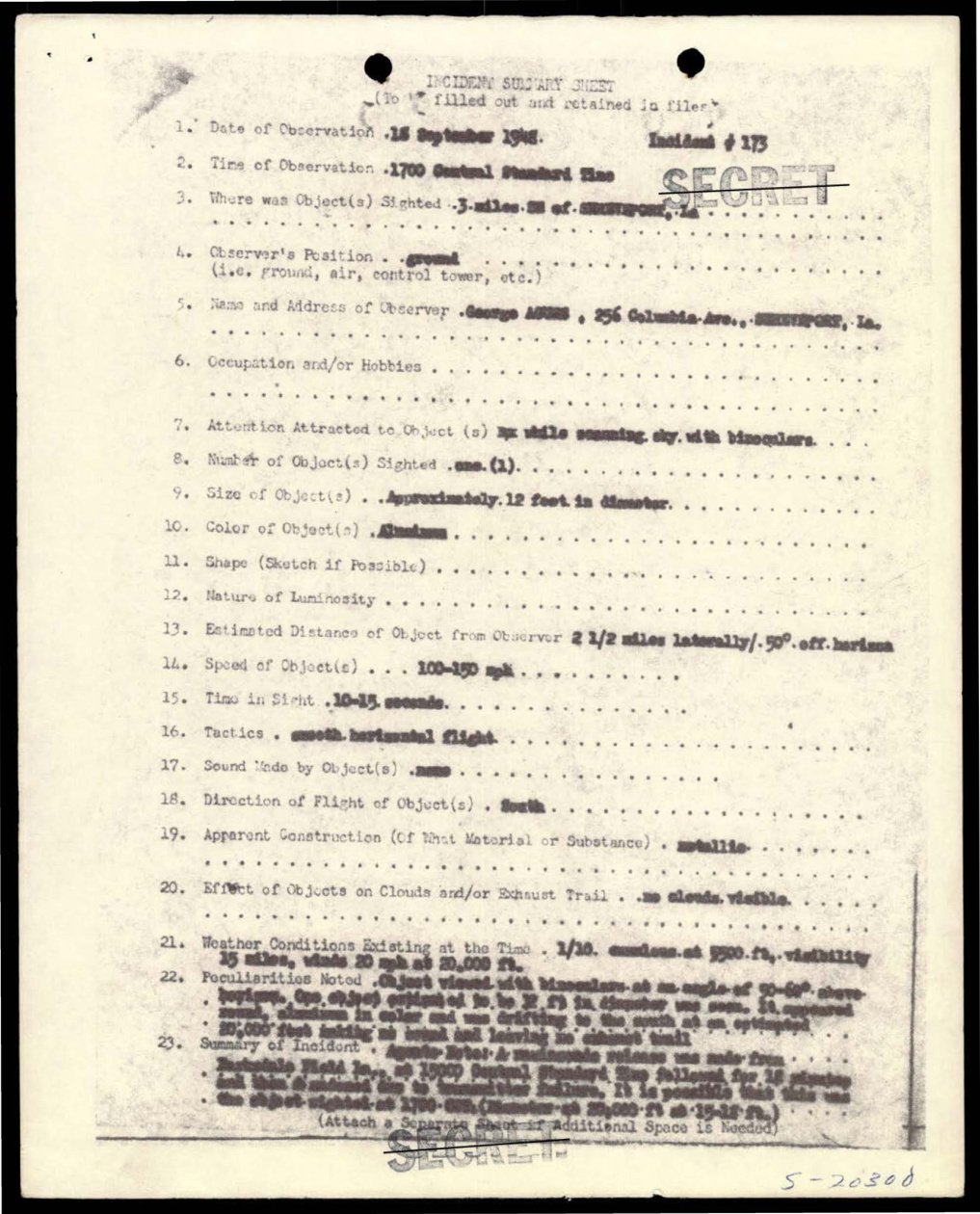
Incident 173, the first in box 7 of the Project Sign records, takes up a single summary sheet, stamped secret and later struck through. The lower half is badly faded but can be read with magnification. The observer, George A. (the surname is blurred), lived in Shreveport, Louisiana. At 17h, central time, on September 16, 1948, he was on the ground, about 3 miles from the city, scanning the sky with binoculars when he noticed the object.
The record describes a single object, about 12 feet (3,7 meters) in diameter, aluminum-colored and metallic in appearance. It was reportedly 2,5 miles away horizontally, 50 to 60 degrees above the horizon, and was heading south in smooth, level flight at 100 to 150 miles per hour. It remained in view for 10 to 15 seconds, with no sound and no trail. The peculiarities field adds that the object appeared round and was drifting south at an estimated altitude of 20.000 feet.
The weather was good: one-tenth of the sky with cumulus clouds at 5.500 feet, visibility of 15 miles and wind of 20 miles per hour at 20.000 feet. In the summary field, an agent's note records that a radiosonde, a weather balloon with a radio transmitter, was launched from Barksdale Field, an air base near Shreveport, at 15h, central time. The balloon was tracked for 18 minutes and then lost due to a transmitter failure. The note says it is possible that it was the object seen at 17h.
The explanation comes from the record itself and is phrased as a possibility, not a conclusion. It fits the color, apparent size, silence and slow movement, and the note calculates, in parentheses, that at 20.000 feet the balloon would be 15 to 18 feet in diameter. The sheet does not, however, include the wind direction, the expected trajectory of the radiosonde or a reliability evaluation. There is also no sketch, even though the form has a field for one. The case stands as an individual account with an explanation suggested by the investigator and not confirmed in the document.
In the lower right corner of the sheet there is a handwritten number, "5-20308," with no explanation. It may be an internal control number, but the sheet does not say what it indicates. The record has two struck-through SECRET stamps, one at the top and one at the bottom, and does not state who filled it out, on what date, or when the classification was removed. The number does not reappear on any other page collected on the portal.
As the first record in the 173 to 233 series, the Shreveport sheet also shows how the box was assembled. The preceding page of the PDF is only a cover sheet, with release authorization NND 917033 from the U.S. National Archives. Immediately after comes incident 174, near New Orleans, another Louisiana account, unrelated to this one. Unlike most of the records that follow, the Shreveport one has a single sheet, with no separate typed summary: the agent's note occupies field 23 itself.
The agent's note is the only verification element in the case. It links the object to a radiosonde launched from Barksdale Field at 15h, two hours earlier, but does not explain how the balloon, tracked for only 18 minutes, would have been near Shreveport at 17h, nor does it record the wind direction at 20.000 feet, only the speed of 20 miles per hour. The possibility is plausible but not demonstrated, as the note itself indicates by saying it "is possible."
DIRECT READING OF THE FILE
The document, in the original
The single page of the case (physical page 2) was translated in full, field by field, including the agent's note about the radiosonde. Erased or blurred words are marked as [illegible] or with [?]; nothing was completed by inference.
EXCERPT 1 · PHYSICAL PAGE 2
Full summary sheet of incident 173, physical page 2
• •
•
0 0:: rvat.i
I
ic:-,
s) Si
·•. . ..
. l':l
3. ·..:.e
.. . • . . .0 1 r , t c.
,. • ......r
" rv • MIii •
• . •• ••. .
6 . r !l . . . .
. . • . . . .
s)
•
I I ......... •e. ). • . . . . .
5iz f . . • • .
( .. ) • . . . .
( utc if :l' ) • • • • . . .• .
l?. . L ~ r.o i . . . . . .
] f IJ au. i· 1.. . } . . . • . . •
15. 111 II . . . .
16. • • .
17 . Sound ••~ 0 by 0 J..ct(:s) . . ..·- . .. .
l . Di ctic t F j\; \.1) I• . • . . . . • . . .
9. t on r lC i n i.:o tar,c
• . . . . . • . ..
20. of j.:.cts on Clo
. . . . . . .I
• • . . • • . • .I
•
l,. lo
. . . •
21 ,
22.Editorial note: The witness's surname, the first word of field 7 and the second letter of the direction in field 3 could not be read with certainty. In fields 22 and 23, the readings "drifting", "Barksdale Field", "18 minutes" and "15-18 ft" are the most likely in the faded copy.
Check the original PDF
INCIDENT SUMMARY SHEET (To be filled out and retained in files) | Incident # 173 | SECRET [carimbo riscado] | 1. Date of Observation: 16 September 1948 | 2. Time of Observation: 1700 Central Standard Time | 3. Where was Object(s) Sighted: 3 miles S[E?] of Shreveport, La. | 4. Observer's Position (i.e. ground, air, control tower, etc.): ground | 5. Name and Address of Observer: George A[illegible], 256 Columbia Ave., Shreveport, La. | 6. Occupation and/or Hobbies: [blank] | 7. Attention Attracted to Object(s) By: [illegible] while scanning sky with binoculars | 8. Number of Object(s) Sighted: one (1) | 9. Size of Object(s): Approximately 12 feet in diameter | 10. Color of Object(s): Aluminum | 11. Shape (Sketch if Possible): [blank] | 12. Nature of Luminosity: [blank] | 13. Estimated Distance of Object from Observer: 2 1/2 miles laterally / 50° off horizon | 14. Speed of Object(s): 100-150 mph | 15. Time in Sight: 10-15 seconds | 16. Tactics: smooth horizontal flight | 17. Sound Made by Object(s): none | 18. Direction of Flight of Object(s): South | 19. Apparent Construction (Of What Material or Substance): metallic | 20. Effect of Objects on Clouds and/or Exhaust Trail: no clouds visible | 21. Weather Conditions Existing at the Time: 1/10 cumulus at 5500 ft, visibility 15 miles, winds 20 mph at 20,000 ft. | 22. Peculiarities Noted: Object viewed with binoculars at an angle of 50-60° above horizon. One object estimated to be 12 ft in diameter was seen. It appeared round, aluminum in color and was drifting to the south at an estimated 20,000 feet making no sound and leaving no exhaust trail. | 23. Summary of Incident: Agent's Notes: A radiosonde release was made from Barksdale Field La., at 1500 Central Standard Time followed for 18 minutes and then discontinued due to transmitter failure. It is possible that this was the object sighted at 1700 CST (Diameter at 20,000 ft at 15-18 ft.) | (Attach a Separate Sheet if Additional Space is Needed) | SECRET [carimbo riscado] | [anotação à mão no rodapé, parcialmente legível]View the document record ↗ · Physical page 2, counting the cover.
Dates and documentary context
- Event
- 16/09/1948 — 17h, Central Standard Time (CST), according to fields 1 and 2.
- Document
- Not established — Record with no drafting date.
- Publication
- Not established — Released in the National Archives batch (box 7, incidents 173 to 233).
Origin and release
U.S. Air Force, Air Materiel Command (technical intelligence, Wright-Patterson), under Project Sign; sheets compiled from witness and air base reports · 38_143685_box7_Incident_Summaries_173-233.pdf
Related accounts and their differences
Questions to continue the investigation
- Could the radiosonde launched from Barksdale Field at 15h have been near Shreveport, at 20.000 feet, two hours later?
- What is the witness's surname, blurred in this copy?
GEOGRAPHY OF THE CASE
Shreveport, Louisiana
Approximate reference to Shreveport, placed by the editors. The record card places the observer about 3 miles from the city and the object 2,5 miles from him; it does not indicate an exact point.
DOCUMENTARY TRAIL
Go back to the sources
References use physical pages of the PDF, counting the cover. Summaries are presented in English; the documents keep their original language.
- 38_143685_box7_Incident_Summaries_173-233.pdf
Physical page 2: summary sheet for incident 173, near Shreveport, 16/09/1948, with the agent's note about the Barksdale Field radiosonde
Arquivo histórico · 144 pages
Editorial summary based on the collection's research notes. How we read the documents.