Date: 23/09/1948, around noonLocation: Castro Ranch, 4 miles east of San Pablo and 4,1 miles south of Pinole, California
San Pablo, California, 1948: two witnesses side by side describe a UFO in opposite ways
A retired Army colonel saw, above a bomber, a translucent, undulating UFO like an amoeba; the man next to him described a rectangular box with ribs, like a vegetable crate. The investigator himself recorded that the two descriptions were in direct contradiction.
- Event date
- 23/09/1948, around noon
- Location
- Castro Ranch, 4 miles east of San Pablo and 4,1 miles south of Pinole, California
- Topic
- 1948 reports
- Source agencies
- Arquivo histórico
- Documents
- 1 document · 144 pages
- Reading time
- 9 min
 Official formPhysical page 12
DOCUMENTARY SOURCES · Arquivo histórico
What the records tell
Around noon on September 23, 1948, at Castro Ranch, east of San Pablo, California, retired Colonel Horace S. Eakins was watching an Army bomber flying very low when he noticed an unknown object above it, heading almost exactly east. He asked his companion, Sylvester Bentham, a 70-year-old retired butcher, whether he was seeing things. Bentham confirmed that there was something above the bomber. The two versions were recorded by Project Sign as incidents 176 and 176a.
In Eakins's version, the object was the size of a large four-engine bomber and had an undulating shape, similar to an amoeba. It had three appendages in front and two behind, which seemed to flap or oscillate while the center remained stable. The body looked translucent, a dirty gray, with a canvas-like appearance, and in the center there was a dark circle that he interpreted as a sphere, denser near the middle. It was more than a mile above the bomber and going much faster than it. It made no noise, left no trail, neither reflected nor emitted light, and vanished in a short time.
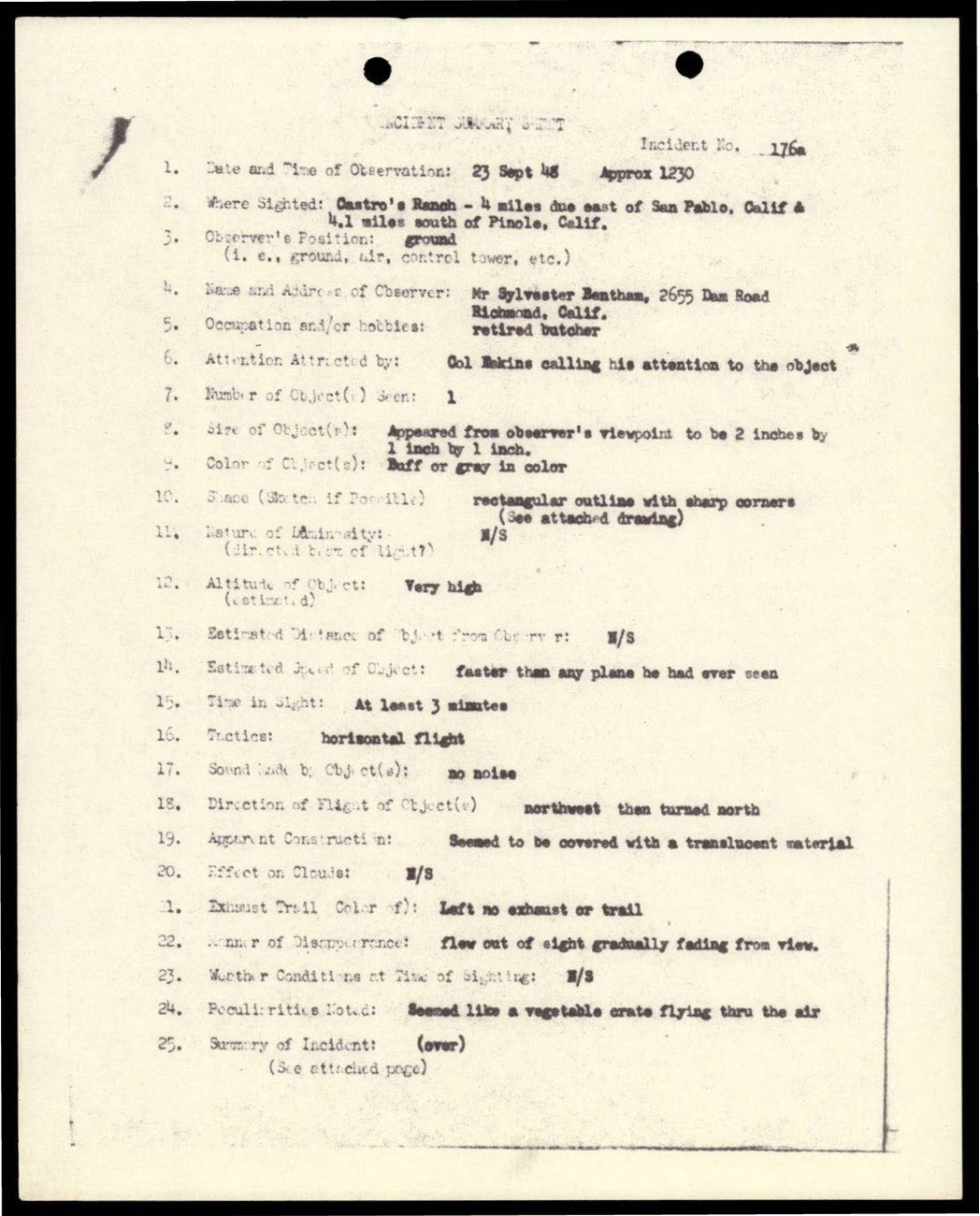
Bentham described something else. According to sheet 176a, the object appeared in the northeast, very high and faster than any airplane he had ever seen. It had a regular rectangular outline, with sharp corners, light tan or gray in color, with several darker vertical lines like ribs, and it looked like "a vegetable crate" flying, covered with translucent material. Apparent size: about 2 by 1 by 1 inch. The two followed it for at least three minutes, in a straight line to the northwest, until it turned north and gradually disappeared.
The investigator noted that Bentham's description as to shape, direction and general appearance was "in direct contradiction" with the colonel's. There is also a discrepancy in time: Eakins could not estimate the duration and said the object vanished quickly; Bentham spoke of at least three minutes. The sheets record 12:00 for one and 12:30 for the other. Both mention attached drawings, which are not in this copy of the file.
The summary says neighbors and business associates considered Eakins highly reliable and that the investigator found him stable and intelligent. None of this resolves the disagreement. The pages contain no conclusion about the object nor any check of flights in the area beyond the bomber mentioned. The case is valuable as a documented example of how two people in the same place can describe incompatible shapes.
The two sheets are part of the bundle of summary sheets for incidents 173 to 233, which the Air Materiel Command, in Dayton, sent with a routing slip dated March 9, 1949 and which was stamped March 22. The sheets have no completion date of their own, but they were made, at most, about five and a half months after the sighting. The drawings cited in both forms were not filed in this bundle: immediately after Bentham's summary comes the sheet for incident 177, about another case. No other page in the collection mentions Eakins, Bentham, Castro Ranch or Pinole.
Compared item by item, the sheets agree only on the place, the number of objects, the absence of sound and trail, and the impression of high speed. They differ on the recorded time, direction, shape, color, duration and manner of disappearing. Eakins described the weather as "quite overcast and hazy," with few clouds; for Bentham the field was left without information. The size Bentham gave, 2 by 1 by 1 inch, is apparent size, and Eakins's, "that of a four-engine bomber," is a comparison. There is no measurement of height or distance: the "more than a mile" is Eakins's estimate.
What the file holds is a double, discordant account, without technical evaluation. The only institutional assessment is the investigator's, who recorded the "direct contradiction" and Eakins's good reputation, without trying to reconcile the versions or identify the bomber. Editorial hypothesis: a light, translucent object carried by the wind, such as a balloon or a piece of plastic material, could seem to change shape depending on the angle, which would help explain such different descriptions; the high speed reported by both does not fit well with this reading, and the document does not discuss it.
DIRECT READING OF THE FILE
The document, in the original
All pages of the case in this PDF were translated in full, one per block, and checked against the facsimile: the standardized "Incident Summary Sheet" form (items 1 to 25) and the attached summary sheet. Pages 10 to 13 translated in full (incidents 176 and 176a). For privacy, home addresses, telephone numbers, military service numbers and health data of private individuals were replaced with bracketed markers; the rest follows the original.
EXCERPT 1 · PHYSICAL PAGE 10
Physical page 10: form for incident 176 (witness Eakins)
bci .1er. t : · ]..Th_
t. ~ Approx 1200
vo•• laaall - .U.• • ,, ot Pablo, Oal.1.f
~ .UH South of Pinol•• CalU
"t Ql-' . :-,1 ?' I F o it i :-r.:,, .
( i. e.' i;TO ~. I • ,,.i :r I ~ • )
r
t .
f C-..,, Mau "'bod.1 \Nul. dlrt;r gr oolor
3· ..::u,(, ( 3;,., ,. . l.f - y·.-r•..L, ..,,et.in& w1 t. r por\1 IIP.P81Lri.DC
apherl. 'f1ltc \he 1hape 4 4-pth flJdl.ar to a &lobe - lib ba
~-- :,_..rl, c:, I.: "..i,."'d :~•: Did mt n \ or pn ott 11cht of t~
C-~ir.-::• .•. ,:.". :: ,it:
Onr. llil.•
1' . ':°Lc'ti" .: .trpeMip•... \o nap or oacUlaw while eu\er
pc,rti •talal•__1,:&,111,U
17. n~: ::. •i • C ·, c lo not.
l • • 17
r. ! fbou&bl a1a pen of obJeot appeen4 lta Ullll••-19
20. 1/S
T'.r.c~ : Ja.et. 41111· lm'l:l~l"eG fl'Cla ai&b\ 1ft a TfJr7 1 1 ffl t.11111
• C' ..o , • :t:.: of -i, r dwl23 . -tbenwenwrtfi
Pccul.1: riti, ::o d : 8-
·7r:. ry of I . id . n : (OYW)
( . e t : ci.l d . ~ )Editorial note: The drawing mentioned in item 24 is not in this copy.
Check the original PDF
INCIDENT SUMMARY SHEET. Incident No. 176. 1. Date and Time of Observation: 23 Sept 48 Approx 1200. 2. Where Sighted: Castro's Ranch - 4 miles due east of San Pablo, Calif and 4.1 miles South of Pinole, Calif. 3. Observer's Position: ground. 4. Name and Address of Observer: Horace S. Eakins, Col., U. S. Army (RET), [home address], Walnut Creek, Calif. 5. Occupation and/or hobbies: Retired army colonel formerly a veterinarian presently employed as a Meat Inspector by Calif State Dept of Agr. 6. Attention Attracted by: Was observing an Army bomber when he observed an unknown object flying above the bomber. 7. Number of Object(s) Seen: 1. 8. Size of Object(s): About the size of a 4-engine bomber - longer than wide. 9. Color of Object(s): Main part of body translucent and of a dirty gray color. 10. Shape (Sketch if Possible): undulating with center portion appearing spherical having the shape and depth similar to a globe - like amoeba. 11. Nature of Luminosity: Did not reflect or give off light of any type. 12. Altitude of Object (estimated): Over a mile. 13. Estimated Distance of Object from Observer: Over a mile directly above. 14. Estimated Speed of Object: very fast speed. 15. Time in Sight: Could not estimate. 16. Tactics: Appendages seemed to flap or oscillate while center portion remained stable. 17. Sound Made by Object(s): No noise. 18. Direction of Flight of Object(s): Nearly due east. 19. Apparent Construction: Thought main part of object appeared like canvas. 20. Effect on Clouds: N/S. 21. Exhaust Trail (Color of): No evidence of exhaust. 22. Manner of Disappearance: just disappeared from sight in a very short time. 23. Weather Conditions at Time of Sighting: N/S. Day was rather dull and hazy - there were very few clouds in the sky at the time. 24. Peculiarities Noted: See drawing attached. 25. Summary of Incident: (over) (See attached page).View the document record ↗ · Physical page 10, counting the cover.
EXCERPT 2 · PHYSICAL PAGE 11
Physical page 11: summary of incident 176
observed above ami going nearly de
his companion, Mr Benthan, were seeing things.
the fact that there was an object abowe the bowber. Col Bakine iescribed
the object es being epproximately the aire of a large four-engine’ bomber.
It appeared undulating in shape resembling an ameeba (See sketch incloved).
The object avpe«red to have 3 appendages forward and 2 aft wnich seemed to
be flap ing or ovcillating wnile the center portion re eined etable, Col
Makins toought it woe a mile or more above toe bomber, In the center of
the object there appeered a round, dark circle which, in Col Bukins' opinion,
seemed to be above the main body of the object. Further it appeared that
the main p«rt of the object was translucent end of a dirty gray color and
that the dark, circular portion ayprered to grow tore jense in color as
it approached the center. From this obserwation Ool Bakins conclu ed that
the dark portion was spherical howing the shave and depth of a glove.
Be further stated that the main prt of the object appesred like canvas,
Re could not estimate the meed of the object tut sai’ it wis triveling
at = far greater speed than the bomber or anything else he had ever seen.
There was no noice of any typ® and no eviience of exhaust or trail.
The object di’ not reflect or give off light of any type.
Col Eakins pricr to his retiresent in 198 w on luty in Panam a
veterinarian with the Army mission, ie retired becaise of p reonal
ani not tec use of piysicul defects. ‘lowrver, Col Sekine is
mi nes to wear glaeres. Neighbors an’ burineve a socistes
te fect that he i» uighly thought of and is reliable in all
aui associations with tuem, He impressed tne investigator
eing stable, intelligent and above average in comon sense.Editorial note: The sketch cited is not in this copy. Information about the colonel's eyesight omitted as health data.
Check the original PDF
Incident: 176. While watching an Army bomber which was flying rather low, Col Eakins observed above and going nearly due east an unknown object. He asked his companion, Mr Bentham, if he were seeing things. Bentham substantiated the fact that there was an object above the bomber. Col Eakins described the object as being approximately the size of a large four-engined bomber. It appeared undulating in shape resembling an amoeba (See sketch inclosed). The object appeared to have 3 appendages forward and 2 aft which seemed to be flapping or oscillating while the center portion remained stable. Col Eakins thought it was a mile or more above the bomber. In the center of the object there appeared a round, dark circle which, in Col Eakins' opinion, seemed to be above the main body of the object. Further it appeared that the main part of the object was translucent and of a dirty gray color and that the dark, circular portion appeared to grow more dense in color as it approached the center. From this observation Col Eakins concluded that the dark portion was spherical having the shape and depth of a globe. He further stated that the main part of the object appeared like canvas. He could not estimate the speed of the object but said it was traveling at a far greater speed than the bomber or anything else he had ever seen. There was no noise of any type and no evidence of exhaust or trail. The object did not reflect or give off light of any type. Col Eakins prior to his retirement in 1948 was on duty in Panama as a veterinarian with the Army mission. He retired because of personal reasons and not because of physical defects. [health detail]. Neighbors and business associates established the fact that he is highly thought of and is reliable in all his dealings and associations with them. He impressed the investigator as being stable, intelligent and above average in common sense.View the document record ↗ · Physical page 11, counting the cover.
EXCERPT 3 · PHYSICAL PAGE 12
Physical page 12: form for incident 176a (witness Bentham)
7, };'tbr fOtJct( .S. r.: 1
.,.. ~~n,o. fr.oa o'bNINi" 1 a fl wpoi.nt to be 2 i nch • by
1 baob l 1mll.
ldt or crs:, 1n color
: .
J.... l ,.
~-s , ... c:· " ':'",i1~, ~ .. it~·:
( 2 .... i: ~, .t t, ~ '": cf ..i. ~ 7
tu• t u, plane be bad ffff een
l"'I• - · ~·"" .. . - ,..... \;; _:,; .~... .J .. ..
I . iJer. t • :o. _.lJ,.6a
ts. 1230
·1: e e ·1 ·.ted : Outro'• - 4 1111H du N.St of Pablo, Oal.it •4.1 11•• aout.h of Pinole, Cal.it.
0:., ":"'Vt''' 1 s - .)i • e . : O'O\ilDll
(L .• t,ro ,J., 1.1. . ~r.!rc-l t ,)WOl' , t .)
I
·- Mr fb-ln•ter -a.w..-. 2655 Dia Road.
atcbwad., Cellt. Oc ..o io r:. :/er !~ tl.::1 ntf.Nd billtobff
l C.. ':'• cti. :
(' j t( ·): IIO be
IMIPUlla ..\ the tQned nJl
19. aee..a t.o '- OOftN4 wltb a tnllal.uomt tfl1,a1
l r f.:
22. . . ru:, r of ; l ·:t::," r·.n 1..: tlw 1 al Scb\ ,ndaal.17 tadilac f rom "1w.
23 . tel\ r C·m, 1t1 r.s c. .ci:...: 1/1
2..t• Su•- · 1.cid nt: ( )
( • e c. t ! c:, d . ~c)Editorial note: The size of 2 by 1 by 1 inch is apparent (measured at arm's length, presumably), not actual. The cited drawing is not in this copy.
Check the original PDF
INCIDENT SUMMARY SHEET. Incident No. 176a. 1. Date and Time of Observation: 23 Sept 48 Approx 1230. 2. Where Sighted: Castro's Ranch - 4 miles due east of San Pablo, Calif & 4.1 miles south of Pinole, Calif. 3. Observer's Position: ground. 4. Name and Address of Observer: Mr Sylvester Bentham, [home address], Richmond, Calif. 5. Occupation and/or hobbies: retired butcher. 6. Attention Attracted by: Col Eakins calling his attention to the object. 7. Number of Object(s) Seen: 1. 8. Size of Object(s): Appeared from observer's viewpoint to be 2 inches by 1 inch by 1 inch. 9. Color of Object(s): Buff or gray in color. 10. Shape (Sketch if Possible): rectangular outline with sharp corners (See attached drawing). 11. Nature of Luminosity: N/S. 12. Altitude of Object (estimated): Very high. 13. Estimated Distance of Object from Observer: N/S. 14. Estimated Speed of Object: faster than any plane he had ever seen. 15. Time in Sight: At least 3 minutes. 16. Tactics: horizontal flight. 17. Sound Made by Object(s): no noise. 18. Direction of Flight of Object(s): northwest then turned north. 19. Apparent Construction: Seemed to be covered with a translucent material. 20. Effect on Clouds: N/S. 21. Exhaust Trail (Color of): Left no exhaust or trail. 22. Manner of Disappearance: flew out of sight gradually fading from view. 23. Weather Conditions at Time of Sighting: N/S. 24. Peculiarities Noted: Seemed like a vegetable crate flying thru the air. 25. Summary of Incident: (over) (See attached page).View the document record ↗ · Physical page 12, counting the cover.
EXCERPT 4 · PHYSICAL PAGE 13
Physical page 13: summary of incident 176a
- -
to Col
in~
that
Bo\h
I
eon t t
new.
l~ Mr
t Col »M•thl• 1 • at tct1on to a
h~
!or at 1.. 1t 3 aimlt•••
t 11.Qe at
f fro
the obJ a recular Ne lar
out wUh aharp OOl'neTa. lt w. lxd'f' or u,q in color
r1b • ( • ru-a.vuac
•) etabb cr4te" n_: ~
al ta a\ alucent
• uhau ·tor trail.
d b7 l 'b l '
i pt1o er , Jirecti on 0ver-
t .h diNCt t r,,. 1cti on <iltb
Col a.
t iiei u, r col ro
and that , gln o !or
ye s of • He 1" tiN'!d.
IEditorial note: Passage about the use of reading glasses omitted as health data.
Check the original PDF
Incident 176a. On 23 Sept 1948 Mr Sylvester Bentham was talking to Col Eakins when the Colonel called Bentham's attention to a single object in the sky. Object first appeared in the northeast and was moving faster than any airplane that Bentham had ever seen. Object appeared very high. Both Eakins and Bentham watched it for at least 3 minutes. It moved toward the northwest in a straight line at a constant speed finally turning to the North and faded from view. To Bentham the object appeared to have a regular rectangular outline with sharp corners. It was buff or gray in color with several darker vertical lines like ribs. (See drawing attached.) Object appeared like a "vegetable crate" flying thru the air and seemed to be covered with a translucent material. It made no noise and left no exhaust or trail. Apparent size was approximately 2 inches by 1 inch by 1 inch. Mr Bentham's description as to the shape, direction and over-all appearance of this object is in direct contradiction with statements made by Col Horace Eakins. Mr Bentham further stated that neither he nor Col Eakins were wearing glasses at the time [health detail]. Mr. Bentham is 70 years of age. He is a retired butcher.View the document record ↗ · Physical page 13, counting the cover.
Dates and documentary context
- Event
- 23/09/1948 — The sheets record about 12h00 (Eakins) and about 12h30 (Bentham) for the same joint observation.
- Document
- Not established — The sheets do not show a completion date.
- Publication
- Not established — Document released in Release 1 of the collection.
Origin and release
U.S. Air Force, Project Sign; incident summary sheets with no identified individual author · 38_143685_box7_Incident_Summaries_173-233.pdf
undefined ↗ — undefined
Questions to continue the investigation
- Do the drawings by the two witnesses, cited on the sheets, exist in another Project Sign series?
- Which Army bomber was flying over the San Pablo area around noon on 23 September 1948?
GEOGRAPHY OF THE CASE
San Pablo and Pinole, California, USA
Approximate reference to the area between San Pablo and Pinole cited in the record cards, placed by the editors. It does not indicate the exact location of the ranch or the position of the UFO.
DOCUMENTARY TRAIL
Go back to the sources
References use physical pages of the PDF, counting the cover. Summaries are presented in English; the documents keep their original language.
- 38_143685_box7_Incident_Summaries_173-233.pdf
Physical pages 10 to 13: incidents 176 and 176a (sheets and summaries of the two witnesses)
Arquivo histórico · 144 pages
Editorial summary based on the collection's research notes. How we read the documents.